

Sugar Reduction in Yogurt Products Sold in the UK between 2016 and 2019


Abstract
1. Introduction
2. Materials and Methods
2.1. Data Collection
2.2. Data Analysis
3. Results
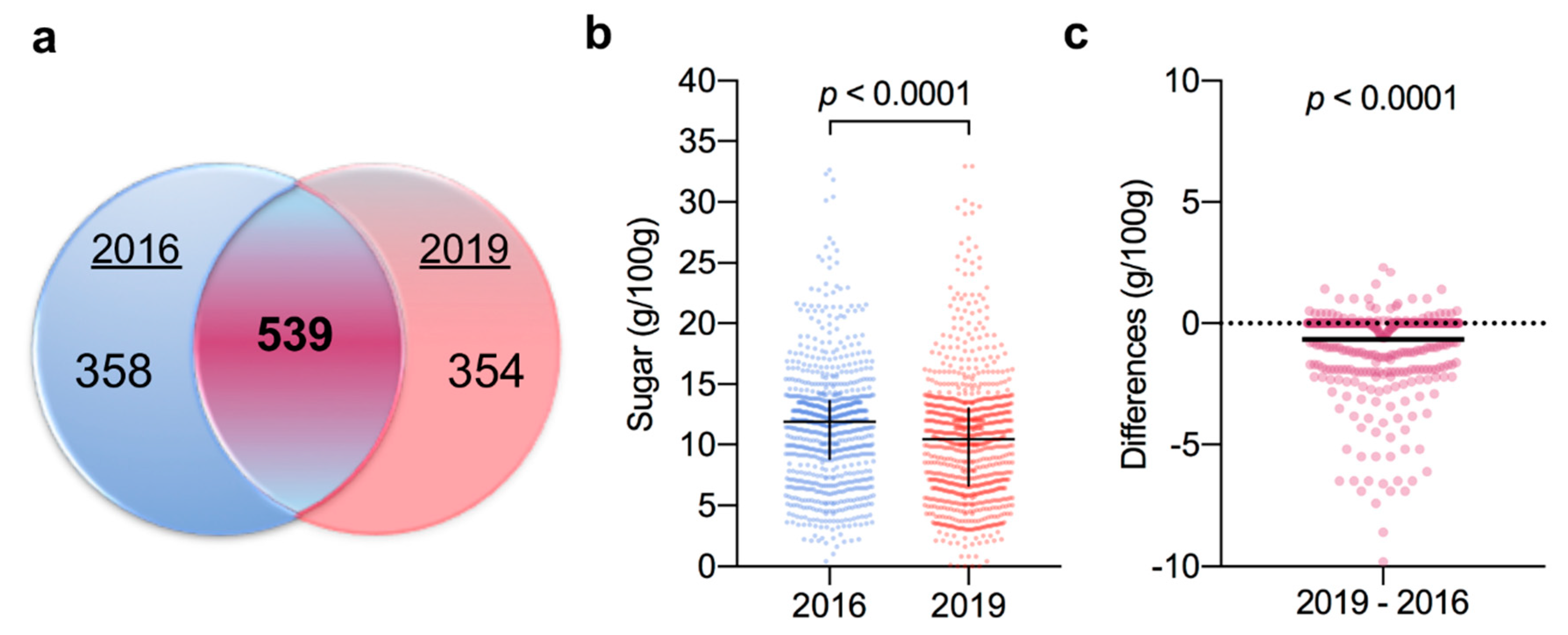
3.1. Comparison of Yogurt Products Sold in 2016 and 2019
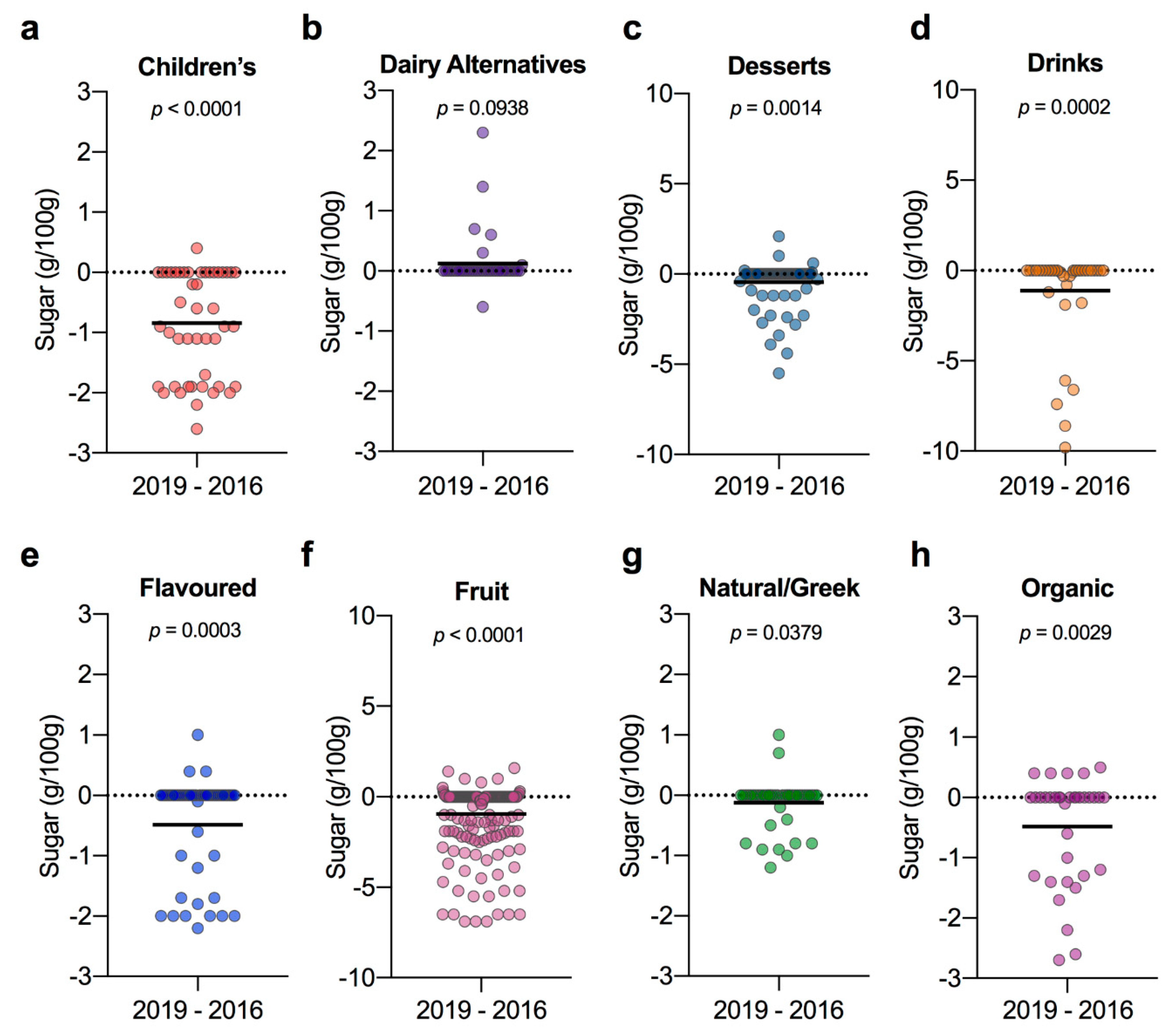
3.2. Changes in Sugar Contents of Yogurts within Different Product Categories
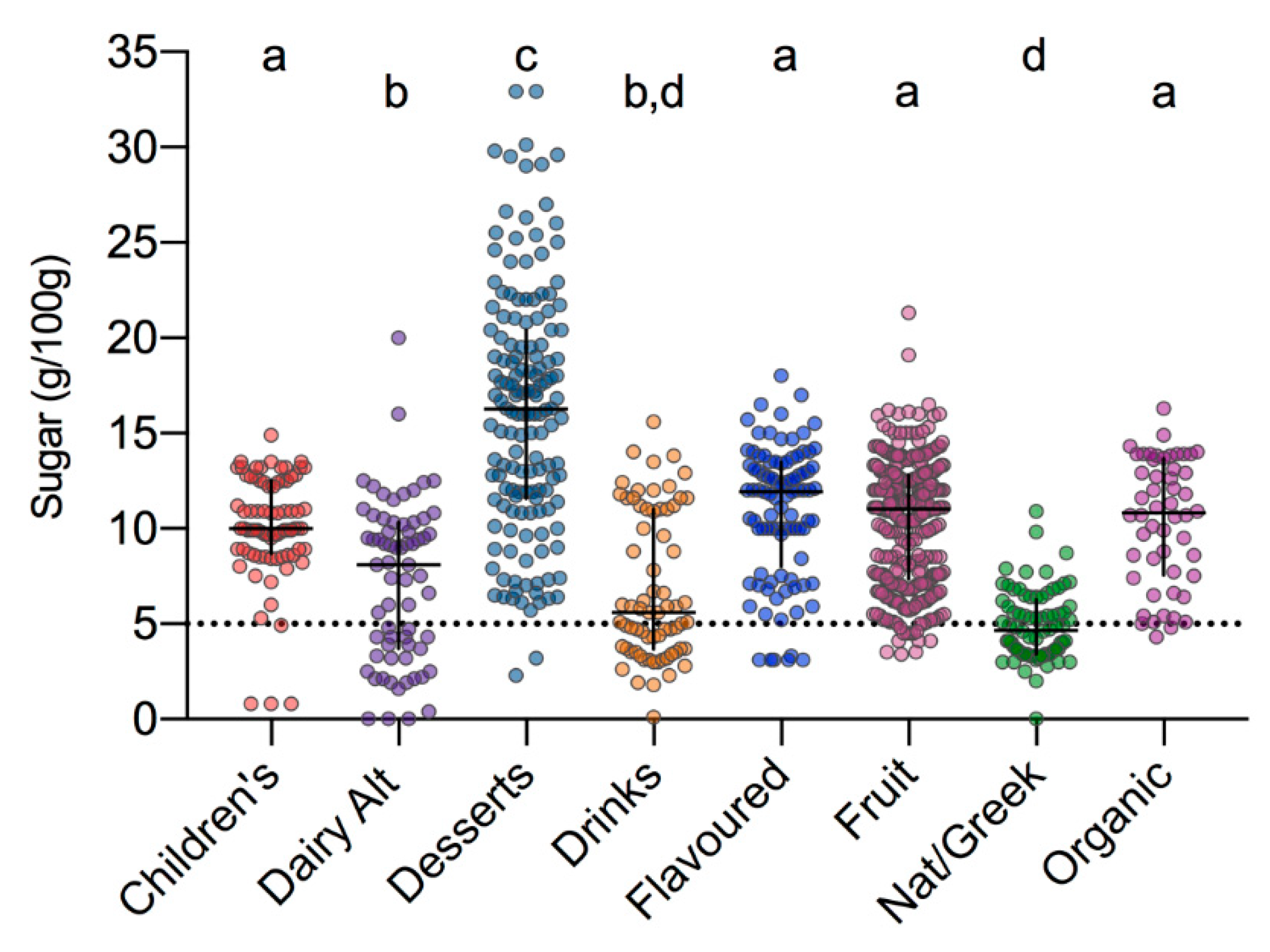
3.3. Total Sugar Contents of 2019 Yogurt Products across Categories
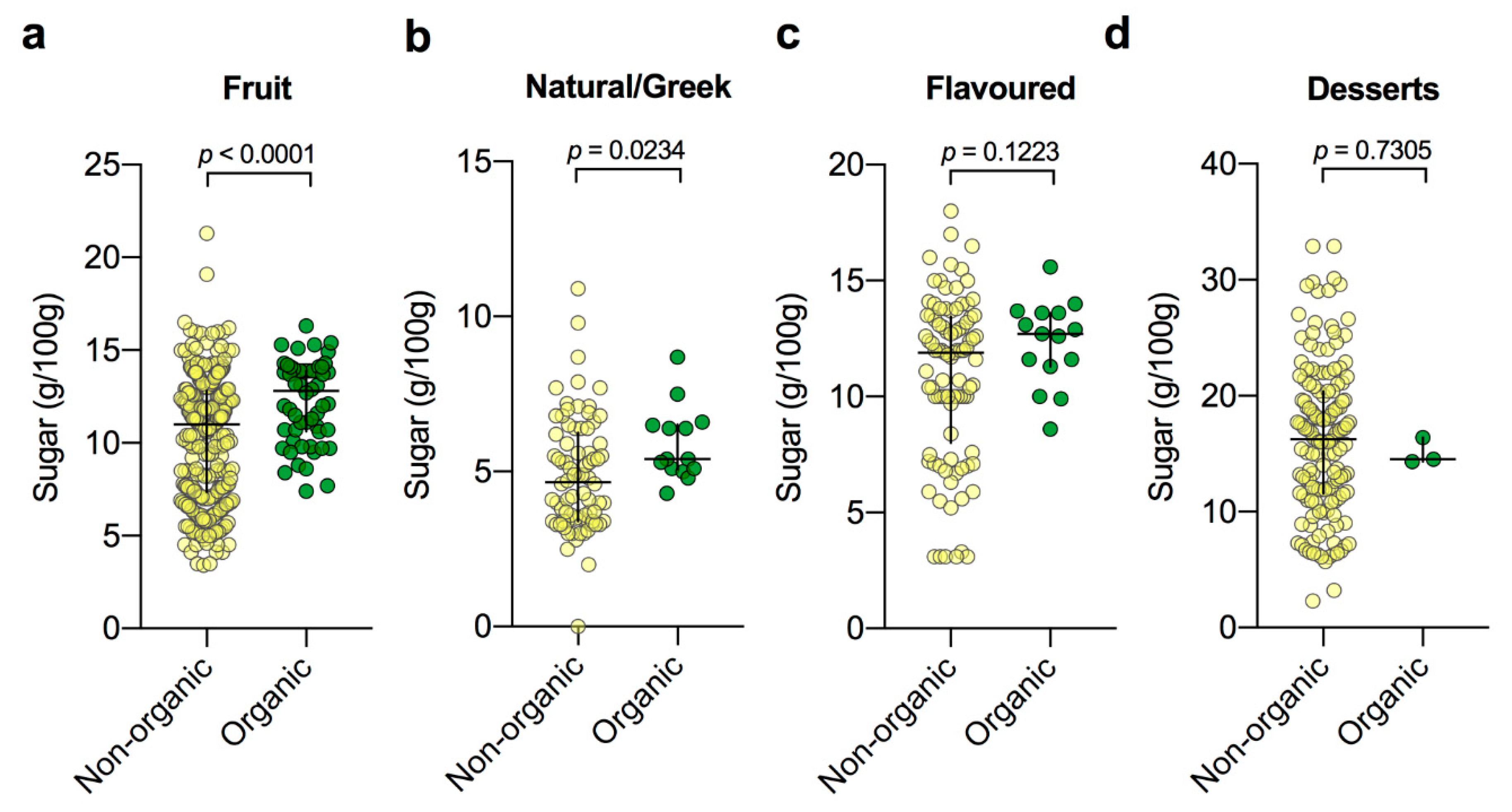
3.4. Examination of Organic Yogurts Subdivided by Category
4. Discussion
5. Conclusions
Author Contributions
Funding
Acknowledgments
Conflicts of Interest
References
- Marette, A.; Picard-Deland, E. Yogurt consumption and impact on health: Focus on children and cardiometabolic risk. Am. J. Clin. Nutr. 2014, 99, 1243S–1247S. [Google Scholar] [CrossRef]
- Kok, C.R.; Hutkins, R. Yogurt and other fermented foods as sources of health-promoting bacteria. Nutr. Rev. 2018, 76, 4–15. [Google Scholar] [CrossRef] [PubMed]
- Aryana, K.J.; Olson, D.W. A 100-Year Review: Yogurt and other cultured dairy products. J. Dairy Sci. 2017, 100, 9987–10013. [Google Scholar] [CrossRef] [PubMed]
- Williams, E.B.; Hooper, B.; Spiro, A.; Stanner, S. The contribution of yogurt to nutrient intakes across the life course. Nutr. Bull. 2015, 40, 9–32. [Google Scholar] [CrossRef]
- Devenish, G.; Golley, R.; Mukhtar, A.; Begley, A.; Ha, D.; Do, L.; Scott, J.A. Free Sugars Intake, Sources and Determinants of High Consumption among Australian 2-Year-Olds in the SMILE Cohort. Nutrients 2019, 11, 161. [Google Scholar] [CrossRef] [PubMed]
- Moore, J.B.; Fielding, B.A. Sugar and metabolic health: Is there still a debate? Curr. Opin. Clin. Nutr. Metab. Care 2016, 19, 303–309. [Google Scholar] [CrossRef]
- Scientific Advisory Committee on Nutrition. Carbohydrates and Health. 2015. Available online: https://assets.publishing.service.gov.uk/government/uploads/system/uploads/attachment_data/file/445503/SACN_Carbohydrates_and_Health.pdf (accessed on 23 November 2019).
- Vos, M.B.; Kaar, J.L.; Welsh, J.A.; Van Horn, L.V.; Feig, D.I.; Anderson, C.A.M.; Patel, M.J.; Cruz Munos, J.; Krebs, N.F.; Xanthakos, S.A.; et al. Added Sugars and Cardiovascular Disease Risk in Children: A Scientific Statement From the American Heart Association. Circulation 2017, 135, e1017–e1034. [Google Scholar] [CrossRef]
- Conolly, A.; Davies, B. Health Survey for England 2017: Adult and Child Overweight and Obesity; NHS Digital: Leeds, UK, 2018; Available online: https://digital.nhs.uk/data-and-information/publications/statistical/health-survey-for-england/2017 (accessed on 27 June 2019).
- Kelsey, M.M.; Zaepfel, A.; Bjornstad, P.; Nadeau, K.J. Age-related consequences of childhood obesity. Gerontology 2014, 60, 222–228. [Google Scholar] [CrossRef]
- World Health Organization. Diet, Nutrition and the Prevention of Chronic Diseases: Report of a Joint WHO/FAO Expert Consultation. Available online: http://www.who.int/nutrition/publications/obesity/WHO_TRS_916/en/ (accessed on 23 November 2019).
- U.S. Department of Health and Human Services; U.S. Department of Agriculture. 2015–2020 Dietary Guidelines for Americans. Available online: http://health.gov/dietaryguidelines/2015/guidelines/. (accessed on 23 November 2019).
- Food and Drug Administration HHS. Food Labeling: Revision of the Nutrition and Supplement Facts Labels. Final rule. Fed. Regist. 2016, 81, 33741–33999. [Google Scholar]
- Public Health England. McCance and Widdowson′s the Composition of Foods Integrated Dataset. Available online: https://www.gov.uk/government/publications/composition-of-foods-integrated-dataset-cofid (accessed on 23 November 2019).
- Moore, J.B.; Horti, A.; Fielding, B.A. Evaluation of the nutrient content of yogurts: A comprehensive survey of yogurt products in the major UK supermarkets. BMJ Open 2018, 8, e021387. [Google Scholar] [CrossRef]
- HM Government. Childhood Obesity: A Plan for Action. 2016. Available online: https://www.gov.uk/government/publications/sugar-reduction-from-evidence-into-action (accessed on 20 June 2019).
- European Parliament Council of the European Union. Regulation (EC) No 1924/2006 of the European Parliament and of the Council of 20 December 2006 on nutrition and health claims made on foods. Off. J. Eur. Union 2006, L404, 9–25. Available online: https://eur-lex.europa.eu/LexUriServ/LexUriServ.do?uri=OJ:L:2006:404:0009:0025:EN:PDF (accessed on 20 June 2019).
- Department of Health UK. Guide to Creating a Front of Pack (FoP) Nutrition Label for Pre-Packed Products Sold Through Retail Outlets. 2016. Available online: https://www.gov.uk/government/publications/front-of-pack-nutrition-labelling-guidance (accessed on 20 June 2019).
- Azais-Braesco, V.; Sluik, D.; Maillot, M.; Kok, F.; Moreno, L.A. A review of total & added sugar intakes and dietary sources in Europe. Nutr. J. 2017, 16, 6. [Google Scholar] [CrossRef]
- Public Health England. Sugar Reduction: The Evidence for Action; Annexe 5: Food Supply. 2015. Available online: https://www.gov.uk/government/publications/sugar-reduction-from-evidence-into-action (accessed on 20 June 2019).
- Amies-Cull, B.; Briggs, A.D.M.; Scarborough, P. Estimating the potential impact of the UK government′s sugar reduction programme on child and adult health: Modelling study. BMJ 2019, 365, l1417. [Google Scholar] [CrossRef] [PubMed]
- Public Health England. Sugar Reduction: Report on Progress between 2015 and 2018. 2019. Available online: https://www.gov.uk/government/publications/sugar-reduction-progress-between-2015-and-2018 (accessed on 21 September 2019).
- Kantar Worldpanel. Grocery Market Share for Great Britain. Available online: https://www.kantarworldpanel.com/en/grocery-market-share/great-britain (accessed on 12 July 2019).
- Roberts, C.; Steer, T.; Maplethorpe, N.; Cox, L.; Meadows, S.; Nicholson, S.; Page, P.; Swan, G. National Diet and Nutrition Survey: Results from Years 7 and 8 (combined) of the Rolling Programme (2014/2015 to 2015/2016). 2018. Available online: https://www.gov.uk/government/statistics/ndns-results-from-years-7-and-8-combined (accessed on 19 July 2019).
- Moore, J.B.; Sutton, E.; Hancock, N. A comprehensive survey of the nutrient content of yogurt products in the UK′s five major online supermarkets in January 2019. 2019. [Google Scholar] [CrossRef]
- Moore, J.B.; Horti, A.; Fielding, B. A comprehensive survey of the nutrient content of yogurt products in the UK′s five major online supermarkets in November 2016. 2019. [Google Scholar] [CrossRef]
- Public Health England. Sugar Reduction: Achieving the 20%. 2017. Available online: https://www.gov.uk/government/publications/sugar-reduction-achieving-the-20 (accessed on 19 July 2019).
- Dallacker, M.; Hertwig, R.; Mata, J. Parents′ considerable underestimation of sugar and their child′s risk of overweight. Int. J. Obes. 2018, 42, 1097–1100. [Google Scholar] [CrossRef] [PubMed]
- Public Health England. Sugar Swaps for Kids. Available online: https://www.nhs.uk/change4life/food-facts/sugar/sugar-swaps-for-kids (accessed on 8 July 2019).
- Schuldt, J.P.; Schwarz, N. The “organic” path to obesity? Organic claims influence calorie judgments and exercise recommendations. Judgm. Decis. Mak. 2010, 5, 144–150. [Google Scholar]
- Besson, T.; Lalot, F.; Bochard, N.; Flaudias, V.; Zerhouni, O. The calories underestimation of “organic” food: Exploring the impact of implicit evaluations. Appetite 2019, 137, 134–144. [Google Scholar] [CrossRef] [PubMed]
- Sethi, S.; Tyagi, S.K.; Anurag, R.K. Plant-based milk alternatives an emerging segment of functional beverages: A review. J. Food Sci. Technol. 2016, 53, 3408–3423. [Google Scholar] [CrossRef] [PubMed]
- Singhal, S.; Baker, R.D.; Baker, S.S. A Comparison of the Nutritional Value of Cow′s Milk and Nondairy Beverages. J. Pediatr. Gastroenterol. Nutr. 2017, 64, 799–805. [Google Scholar] [CrossRef]
- Vanga, S.K.; Raghavan, V. How well do plant based alternatives fare nutritionally compared to cow′s milk? J. Food Sci. Technol. 2018, 55, 10–20. [Google Scholar] [CrossRef]
- Thorning, T.K.; Raben, A.; Tholstrup, T.; Soedamah-Muthu, S.S.; Givens, I.; Astrup, A. Milk and dairy products: Good or bad for human health? An assessment of the totality of scientific evidence. Food Nutr. Res. 2016, 60, 32527. [Google Scholar] [CrossRef]
- Bengoa, A.A.; Iraporda, C.; Garrote, G.L.; Abraham, A.G. Kefir micro-organisms: Their role in grain assembly and health properties of fermented milk. J. Appl. Microbiol. 2019, 126, 686–700. [Google Scholar] [CrossRef] [PubMed]
- Pimenta, F.S.; Luaces-Regueira, M.; Ton, A.M.; Campagnaro, B.P.; Campos-Toimil, M.; Pereira, T.M.; Vasquez, E.C. Mechanisms of Action of Kefir in Chronic Cardiovascular and Metabolic Diseases. Cell Physiol. Biochem. 2018, 48, 1901–1914. [Google Scholar] [CrossRef] [PubMed]
- Public Health England. Fermented (Yogurt) Drinks: A Supplementary Report to the Sugar Reduction Guidelines, Outlining the Drinks Included and Separate Guidelines Set. Available online: https://assets.publishing.service.gov.uk/government/uploads/system/uploads/attachment_data/file/773818/Fermented_yogurt_drinks_supplementary_report_to_sugar_reduction_guidelines.pdf (accessed on 20 June 2019).
- Moore, J.B.; Fielding, B.A. Taxing confectionery, biscuits, and cakes to control obesity. BMJ 2019, 366, l5298. [Google Scholar] [CrossRef] [PubMed]
- Mela, D.J.; Woolner, E.M. Perspective: Total, Added, or Free? What Kind of Sugars Should We Be Talking About? Adv. Nutr. 2018, 9, 63–69. [Google Scholar] [CrossRef]
- CNS Media BV. Fruit Purees May Offer a Viable Strategy for Clearing US FDA’s New “Added Sugar” Label “Hurdle”. Available online: https://www.foodingredientsfirst.com/news/fruit-purees-may-offer-a-viable-strategy-for-clearing-us-fdas-new-added-sugar-label-hurdle.html (accessed on 3 August 2019).

| Term | Definition |
|---|---|
| Sugars | Conventionally describes chemically the monosaccharides (glucose, fructose, galactose) and disaccharides (sucrose, lactose, maltose). Sugars includes those occurring naturally in foods and drinks or added during processing and preparation. |
| Free Sugars | ‘All monosaccharides and disaccharides added to foods by the manufacturer, cook, or consumer, plus sugars naturally present in honey, fruit juices, and syrups’ [11]. Under this definition, sugars present in intact fruits and vegetables and lactose naturally present in milk and milk products are excluded. |
| Total Sugars | Currently required for UK nutrition labels. Includes sugars occurring naturally in foods and beverages and those added during processing and preparation. |
| Added Sugars | A term used in the United States that excludes sugars in juiced or pureed fruits and vegetables that are included in WHO and UK adopted definition of free sugars. ‘Syrups and other caloric sweeteners used as a sweetener in other food products. Naturally occurring sugars such as those in fruit or milk are not added sugars’ [12]. Will be a required subline under ‘total sugars’ for US food labels from 2020 [13]. |
| Lactose | A disaccharide of glucose and galactose. It is often called ‘milk sugar’ because 100% of ‘total sugars’ in milk are lactose. In natural/Greek yogurt ~80% of the sugar is lactose, with the remainder being galactose generated from lactose fermentation [14]. |
© 2020 by the authors. Licensee MDPI, Basel, Switzerland. This article is an open access article distributed under the terms and conditions of the Creative Commons Attribution (CC BY) license (http://creativecommons.org/licenses/by/4.0/).
Share and Cite
Moore, J.B.; Sutton, E.H.; Hancock, N. Sugar Reduction in Yogurt Products Sold in the UK between 2016 and 2019. Nutrients 2020, 12, 171. https://doi.org/10.3390/nu12010171
Moore JB, Sutton EH, Hancock N. Sugar Reduction in Yogurt Products Sold in the UK between 2016 and 2019. Nutrients. 2020; 12(1):171. https://doi.org/10.3390/nu12010171
Chicago/Turabian StyleMoore, J. Bernadette, Eiméar H. Sutton, and Neil Hancock. 2020. "Sugar Reduction in Yogurt Products Sold in the UK between 2016 and 2019" Nutrients 12, no. 1: 171. https://doi.org/10.3390/nu12010171
APA StyleMoore, J. B., Sutton, E. H., & Hancock, N. (2020). Sugar Reduction in Yogurt Products Sold in the UK between 2016 and 2019. Nutrients, 12(1), 171. https://doi.org/10.3390/nu12010171


