Article

Plasma Oxidative Status in Preterm Infants Receiving LCPUFA Supplementation: A Pilot Study


by
David Ramiro-Cortijo
1,2,
Ángel Luis López de Pablo
1,
Mᵃ Rosario López-Giménez
3,
Camilia R. Martin
4,
Joanne Brown
2,
Miguel Saenz de Pipaón
5,6,* and
Silvia M. Arribas
1,*
1
Department of Physiology, Faculty of Medicine, Universidad Autónoma de Madrid, C/ Arzobispo Morcillo, 2, 28029 Madrid, Spain
2
Department of Medicine, Beth Israel Deaconess Medical Center, Harvard Medical School, 330 Brookline Avenue, Boston, MA 02215, USA
3
Department of Epidemiology, Public Health and Microbiology, Faculty of Medicine, Universidad Autónoma de Madrid, C/ Arzobispo Morcillo, 2, 28029 Madrid, Spain
4
Department of Neonatology, Beth Israel Deaconess Medical Center, Harvard Medical School, 330 Brookline Avenue, Boston, MA 02215, USA
5
Carlos III Health Institute, Maternal and Child Health and Development Research Network, 28046 Madrid, Spain
6
Department of Neonatology, Hospital La Paz, Paseo de la Castellana, 261, 28046 Madrid, Spain
*
Authors to whom correspondence should be addressed.
Nutrients 2020, 12(1), 122; https://doi.org/10.3390/nu12010122
Submission received: 9 December 2019 / Revised: 29 December 2019 / Accepted: 30 December 2019 / Published: 1 January 2020
(This article belongs to the Special Issue New Insights in Preterm Nutrition)

Abstract

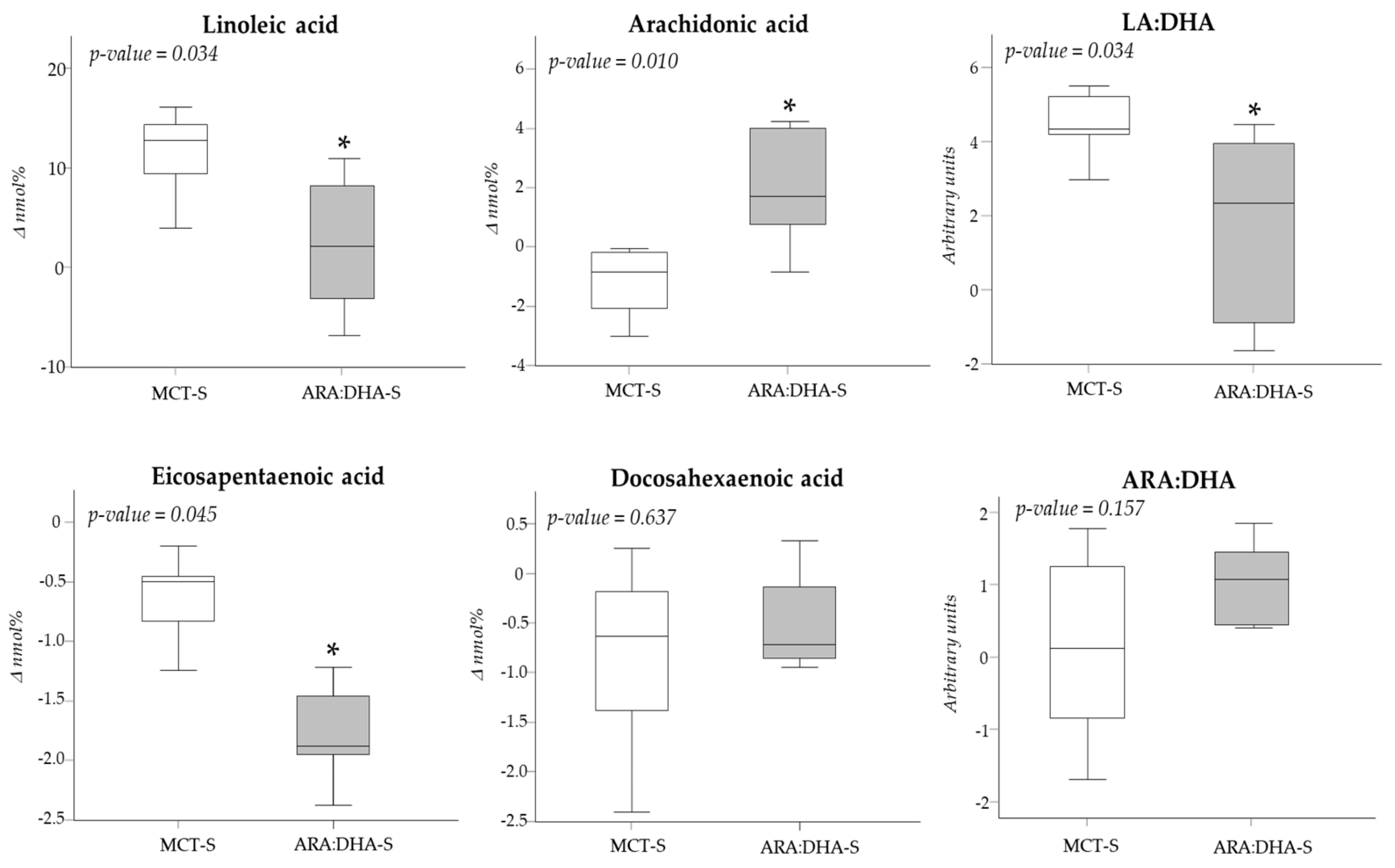
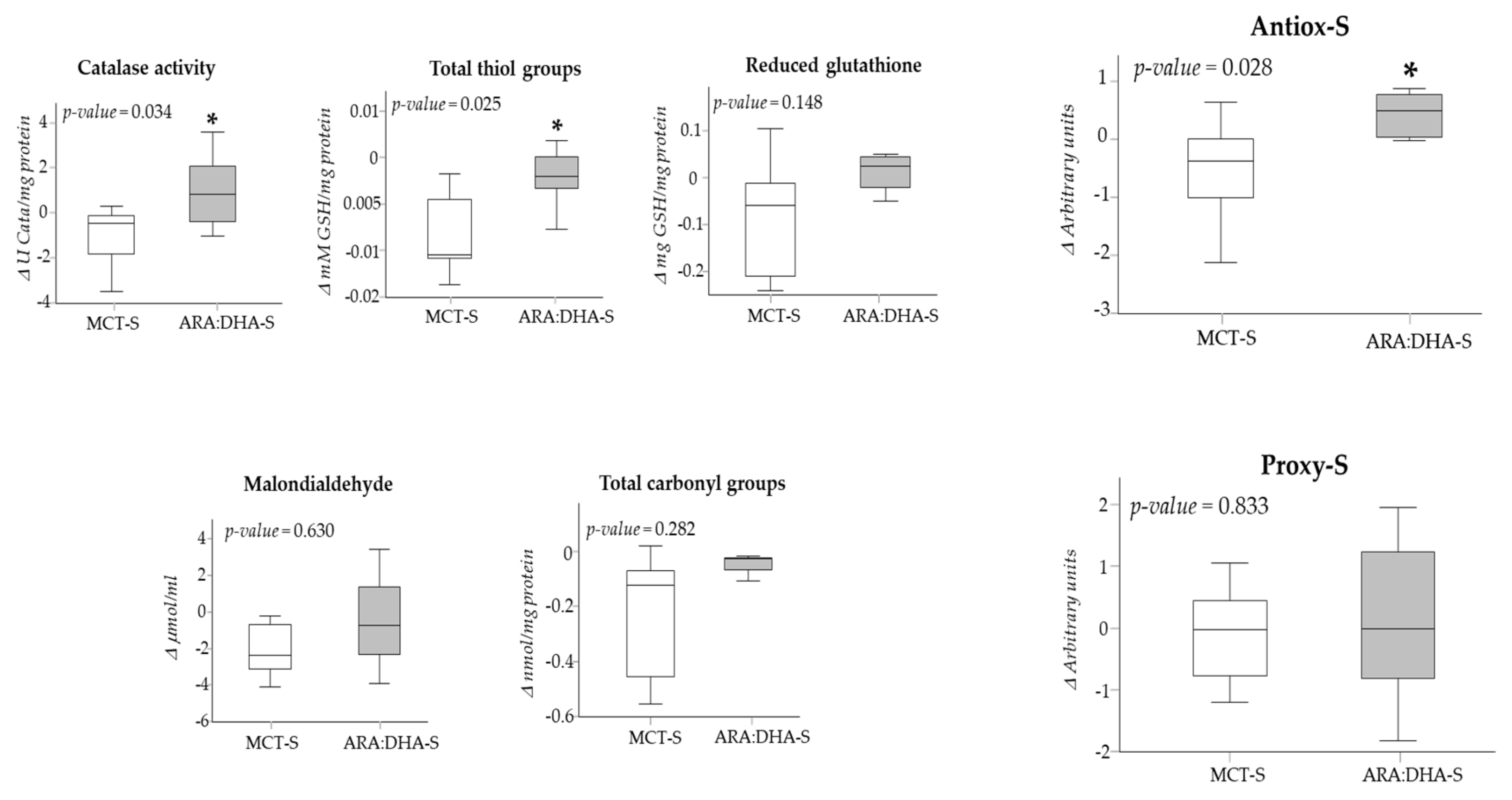
After birth, preterm infants are deficient in arachidonic acid (ARA), docosahexaenoic acid (DHA), and antioxidants, increasing their risk of oxidative stress-related pathologies. The principal aim was to evaluate if supplementation with long-chain polyunsaturated fatty acids (LCPUFAs) improves antioxidant defenses. In total, 21 preterm infants were supplemented with ARA and DHA in a 2:1 ratio (ARA:DHA-S) or with medium-chain triglycerides (MCT-S). Plasma n-3 and n-6 LCPUFAs were measured at birth, postnatal day 28, and 36 weeks of postmenstrual age (36 WPA) by gas chromatography–mass spectroscopy. Plasma antioxidants (glutathione (GSH), catalase, and thiols) and oxidative damage biomarkers (malondialdehyde (MDA), carbonyls) were analyzed at the same time points by spectrophotometry, and scores of antioxidant status (Antiox-S) and oxidative damage (Proxy-S) were calculated. At 36 WPA, linoleic acid (LA) and dihomo-γ-linolenic acid (DGLA) were decreased in ARA:DHA-S compared to the MCT-S group (LA: ARA:DHA-S = 18.54 ± 1.68, MCT-S = 22.80 ± 1.41; p = 0.018; DGLA: ARA:DHA-S = 1.68 ± 0.38, MCT-S = 2.32 ± 0.58; p = 0.018). Furthermore, α-linolenic acid (ALA) was increased in ARA:DHA-S (ARA:DHA-S = 0.52 ± 0.33, MCT-S = 0.22 ± 0.10; p = 0.018). Additionally, LA:DHA ratio was decreased in the ARA:DHA-S compared to control group (ARA:DHA-S = 6.26 ± 2.35, MCT-S = 8.21 ± 2.65; p = 0.045). By the end of supplementation (36 WPA), catalase, thiol groups, and Antiox-S were significantly higher in neonates receiving ARA:DHA-S compared to those receiving MCT-S, with no differences in oxidative stress biomarkers. In conclusion, ARA:DHA supplementation in preterm neonates resulted in an overall improvement in antioxidant to oxidant balance and a decrease in early fatty acid precursors of the n-6 relative to the n-3 pathway. These effects may reduce oxidative stress and inflammation.
Keywords: preterm; supplementation; arachidonic acid; docosahexaenoic acid; antioxidants; oxidative stress preterm; supplementation; arachidonic acid; docosahexaenoic acid; antioxidants; oxidative stress