1. Introduction
Aerial scene recognition is a fundamental task in remote sensing that assigns semantic labels to overhead images. It plays an important role in a wide range of applications, including land-use mapping, environmental monitoring, precision agriculture, and urban planning. With the rapid growth of Earth observation platforms and sensing technologies, deep learning has become the dominant paradigm for aerial scene understanding. Earlier studies moved from handcrafted descriptors to deep learning-based pipelines, while more recent advances have been driven by convolutional neural networks and transformer-based architectures that learn rich spatial structure, texture, and contextual cues from high-resolution imagery [
1]. At the same time, practical deployment has made computational efficiency increasingly important, motivating the development of lightweight and resource-aware aerial scene classification models that reduce cost while maintaining strong performance [
2].
In parallel with these efforts, aerial scene recognition has evolved from a purely supervised learning approach to transferable and data-efficient representation learning. In particular, self-supervised masked modeling, which is capable of learning representations from unlabeled Earth observation data, has become an indispensable direction. For example, masked autoencoding for multispectral and temporal satellite imagery obtains outstanding performance with large gains on downstream tasks by using domain structure, rather than simply color appearance on the RGB stream [
3]. Data efficiency and benchmark-driven evaluation are another prerequisite for fair comparison and reproducible progress, in which GEO-Bench provides a general benchmarking platform for a collection of Earth observation tasks and forms a solid evaluation ground for Earth observation representation learning [
4].
Compared with standard RGB images, HSI obtains a denser spectro-analysis by taking continuous band measurements, which enables the obtainment of better material characteristics and better class distinction. However, learning with hyperspectral data is still problematic due to the following factors: high dimensions of HSI, lack of labeled samples, and sensitivity to the acquisition system (e.g., sensor characteristics). Based on these problems, self-supervised or masked modeling approaches which capture spatial–spectral information simultaneously have been actively investigated and proved to generate better representations even under the low-label scenario [
5,
6]. And there have been some works which specifically explore better spectral utilization in the area of hyperspectral learning: SpectralMAE by masking the spectrum for reconstruction [
7] and contrastive masked autoencoders learning discriminative spectral–spatial features for hyperspectral classification [
8]. More recent work has tried to further improve the representation by using multiscale hierarchical approaches or graph modeling techniques, e.g., SSHMT-MAE, self-supervised graph masked autoencoders and graph-based masked autoencoding for anomaly detection [
9,
10,
11]. These achievements further illustrate the key role of the strong hyperspectral representation learning in enhancing remote sensing recognition under low-label or domain variant conditions.
At a broader level, remote sensing research is rapidly moving toward foundation-model-style pretraining and multimodal representation learning. Inspired by the success of large-scale models in computer vision and natural language processing, recent remote sensing foundation models aim to learn generalizable features that transfer effectively across datasets and downstream tasks. Vision–language foundation models have shown that aligning remote sensing visual features with semantic language supervision can significantly improve transferability and downstream performance [
12]. Multimodal self-supervised frameworks based on contrastive learning and masked autoencoding have also demonstrated that cross-modal pretraining can yield representations that generalize across sensing conditions and datasets [
13]. Spectral-specialized foundation models further highlight the importance of architectures designed explicitly for large-scale spectral–spatial modeling [
14].
This trend is also reflected in geospatial foundation modeling more generally. Scaling studies show that larger vision transformer models can improve performance and data efficiency on remote sensing tasks [
15]. Evaluation frameworks such as PhilEO Bench provide diverse benchmarks to test geospatial foundation models under multiple supervision settings [
16]. Recent models such as Prithvi-EO-2.0 further extend this paradigm to multi-temporal and global-scale representation learning by incorporating temporal and location embeddings [
17], while independent evaluations reveal both the promise and the limitations of these models under domain shift [
18]. Related remote sensing foundation models, including RingMo-Sense and large-scale pretraining resources such as SatlasPretrain, similarly aim to improve robustness and downstream generalization across varied Earth observation tasks [
19,
20].
Despite these advances, most existing multimodal aerial scene recognition methods still rely on feature-level fusion or direct modality concatenation and usually assume that the input data are paired and co-registered. In real Earth observation scenarios, however, data are often collected by different sensors, at different times, under different spatial resolutions and spectral responses. As a result, multimodal observations are frequently unpaired, only partially overlapping, or affected by sensor mismatch. Under such conditions, conventional fusion strategies become difficult to scale and less robust. A more practical alternative is to learn sensor-agnostic semantic representations that capture high-level scene semantics independent of sensing modality. Such a formulation allows knowledge learned from one modality to transfer to another and can improve recognition performance without requiring exact cross-sensor correspondence.
This challenge has motivated growing interest in multimodal and sensor-flexible remote sensing models. A neuroplasticity-inspired multimodal foundation model, for example, uses dynamic wavelength-adaptive mechanisms to support multiple sensor types and even unseen sensors within a single framework [
21]. At the same time, multimodal contrastive learning has emerged as a promising alternative to strict fusion assumptions. Modal-aware contrastive learning has been applied to hyperspectral and LiDAR classification, showing that consistency objectives can effectively extract complementary information across modalities [
22]. Other multimodal contrastive learning frameworks in remote sensing similarly demonstrate that robust feature learning can be achieved even when heterogeneous inputs are not perfectly aligned [
23]. These studies support the idea that semantic consistency, rather than strict pixel-level correspondence, may be the key to scalable multimodal remote sensing learning.
In addition to sensor-level multimodal learning, semantic alignment has also been explored through vision–language modeling and image–text supervision. RSGPT introduces a remote sensing vision–language model and benchmark suite aimed at richer semantic understanding [
24]. RS5M and GeoRSCLIP extend this direction by constructing large-scale image–text paired datasets and adapting CLIP-style objectives for remote sensing, thereby improving cross-modal retrieval and semantic transfer [
25]. GeoCLIP, although not designed for aerial scene classification, further illustrates the power of alignment-based objectives by pairing image features with continuous geographic embeddings to learn meaningful semantic structure [
26]. These works reinforce the broader view that representation alignment is a powerful mechanism for building robust remote sensing models.
In addition, several complementary cross-domain enhancement and fusion strategies have been studied. For example, deep image prior-based methods are designed for unsupervised HS image super-resolution [
27], lightweight dual-domain methods are presented for VIS–IR image fusion [
28], and conditional variational model with adaptive normalization for difficult enhancement scenarios (e.g., underwater imaging) [
29]. Although these methods primarily focus on pixel-level reconstruction, enhancement, or fusion, they further emphasize the importance of leveraging complementary information across domains. In contrast, a representation-level formulation seeks to unify modality-specific semantics without requiring explicit image-level fusion or reconstruction.
From a conceptual perspective, the idea of sensor-agnostic learning is also related to brain-inspired interpretation in remote sensing. Neuro-cognitive principles such as parallel sensory pathways, abstraction hierarchies, and modality-invariant semantics suggest that biological systems form stable concepts across heterogeneous sensory inputs without requiring exact correspondence between modalities [
30]. In this sense, the same object or scene can be understood despite differences in the form of sensory input. Translating these principles into modern representation learning suggests that multimodal remote sensing systems may become more accurate, robust, and transferable when they emphasize semantic abstraction over low-level fusion. At the same time, it is important to clarify that the term “neuro-inspired” in this work refers to high-level conceptual design principles rather than a biologically faithful implementation of specific neural mechanisms.
Furthermore, recent surveys on remote sensing foundation models emphasize that cross-modal alignment and multimodal generalization across heterogeneous sensors remain open challenges for large-scale Earth observation intelligence [
31,
32]. This indicates that future progress depends not only on scaling models or increasing data volume, but also on designing learning objectives and architectures that can unify heterogeneous sensing streams at the representation level.
Motivated by these observations, this paper proposes a neuro-sensor-agnostic representation learning framework for aerial scene recognition across RGB and hyperspectral modalities. Rather than relying on paired samples or explicit feature fusion, the proposed framework employs modality-specific encoders to independently extract features from each modality and project them into a shared semantic embedding space that acts as a common representational cortex for unified decision-making. Neuro-inspired consistency and cross-spectral alignment objectives are introduced to encourage modality-invariant semantics while preserving inter-class discrimination and representation robustness. In this way, multimodal learning is formulated as semantic representation unification rather than direct feature concatenation. This design supports effective knowledge transfer across modalities and enables robust, transferable, and modality-invariant aerial scene recognition across heterogeneous remote sensing inputs.
Research Contributions
The main contributions of this paper are summarized as follows:
We propose a sensor-agnostic semantic representation learning framework that formulates multimodal aerial scene recognition as semantic embedding unification rather than explicit feature fusion.
We design a modality-specific dual-encoder architecture with shared embedding projection and a unified classifier, enabling consistent inference across RGB and hyperspectral modalities without requiring paired inputs at test time.
We introduce a composite learning objective that integrates cross-spectral alignment, intra-class compactness regularization, and prototype-based semantic anchoring to enforce modality-invariant representation geometry.
We conduct comprehensive evaluations including modality-specific recognition, strict cross-modality generalization without fine-tuning, joint-modality training, ablation analysis, and computational efficiency comparison across multiple benchmark datasets (Houston 2013, UC Merced, and Indian Pines).
Experimental results demonstrate strong cross-modal transfer performance and confirm that semantic representation unification provides a scalable alternative to traditional multimodal fusion approaches.
2. Materials and Methods
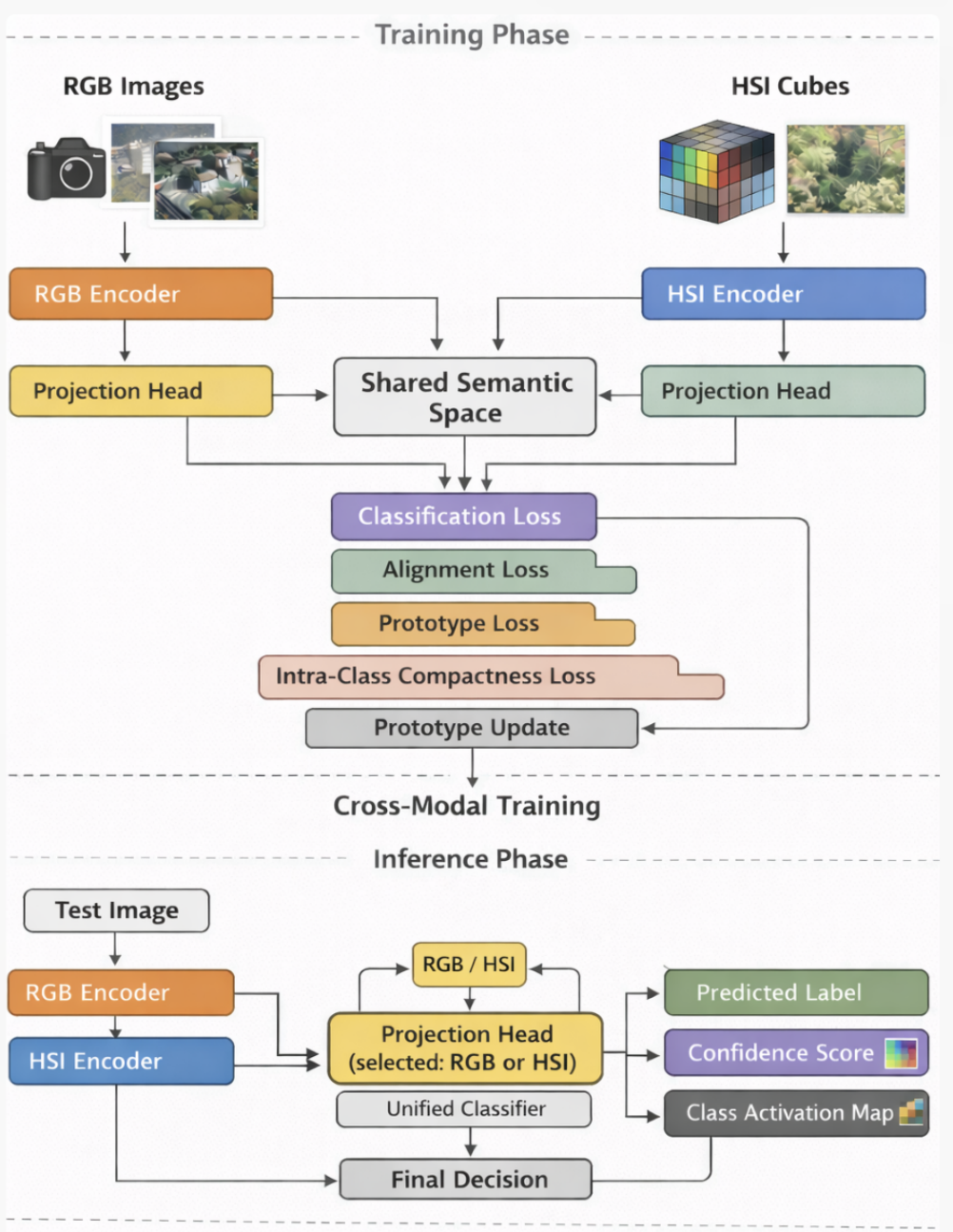
The proposed neuro-sensor-agnostic aerial scene recognition framework is designed to learn modality-invariant semantic representations from different types of data, such as RGB and hyperspectral images. Unlike conventional multimodal fusion methods, the proposed framework does not require paired cross-modal samples or explicit feature fusion. Instead, it aligns modality-specific features into a shared semantic embedding space and performs classification using a single unified classifier. The overall workflow has six main stages: (1) modality-specific data preprocessing, (2) modality-dependent representation encoding, (3) shared semantic embedding formation, (4) neuro-inspired cross-spectral alignment, (5) unified classifier learning, and (6) sensor-agnostic inference.
In the first stage, RGB and hyperspectral images are preprocessed separately based on their sensor characteristics. RGB images are resized to a fixed spatial resolution, normalized, and augmented using standard methods such as random flipping and rotation to improve generalization. Hyperspectral images are spectrally normalized and, optionally, processed to reduce noise and redundant information using spectral band selection or linear projection methods. This preprocessing helps preserve important spectral and spatial information while also reducing computational cost and improving the model’s training stability.
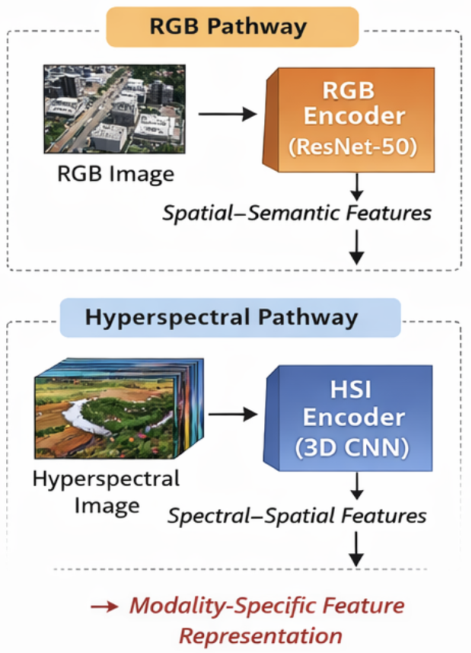
In the second stage, each modality is processed by its own encoder to extract high-level semantic features. The RGB encoder captures spatial structure, texture, and object visual information from RGB images. The hyperspectral encoder captures spectral–spatial relations and material-specific spectral signatures from hyperspectral data. Both encoders operate independently and do not share parameters, so each can learn features tailored to its own modality’s physical properties and data characteristics.
In the third stage, modality-specific features are projected into a shared semantic embedding space using modality-dependent projection heads. Each projection head has two fully connected layers with batch normalization, ReLU activation, and normalization, and it produces a fixed-size embedding vector. This shared embedding space serves as a common representation space, where samples from the same class are close together and those from different classes are far apart. Importantly, this projection is learned without exact pixel-level matching or paired RGB–hyperspectral samples, enabling flexible and effective cross-modality feature learning.
In the fourth stage, neuro-inspired alignment and consistency learning objectives are applied to organize the shared embedding space. A cross-spectral semantic alignment objective aligns embeddings from different modalities within the same class in embedding space so that the model can learn a modality-independent semantic representation. At the same time, discriminative learning objectives increase the distance between different classes, thereby improving classification robustness. An intra-class compactness constraint also reduces variation within the same class, so embedded clusters become more stable and well separated. Additionally, prototype-based semantic anchoring is used, where each class has a prototype acting as a semantic reference point to guide feature alignment. All these mechanisms help form stable, modality-invariant semantic representations, similar to associative memory behavior in biological perception systems.
Finally, during inference, the proposed framework works in a sensor-agnostic way. It needs only a single modality input. The input sample is fed to its modality-specific encoder and projection head to produce a shared semantic embedding. After that, this embedding is classified by the unified classifier, which works in a shared semantic space. There is no need for paired modality data, no explicit feature fusion, and no extra modality information during inference. This sensor-agnostic inference capability enables flexible deployment in real-world remote sensing applications where only a single sensor modality is available, while maintaining consistent semantic understanding across different sensors.
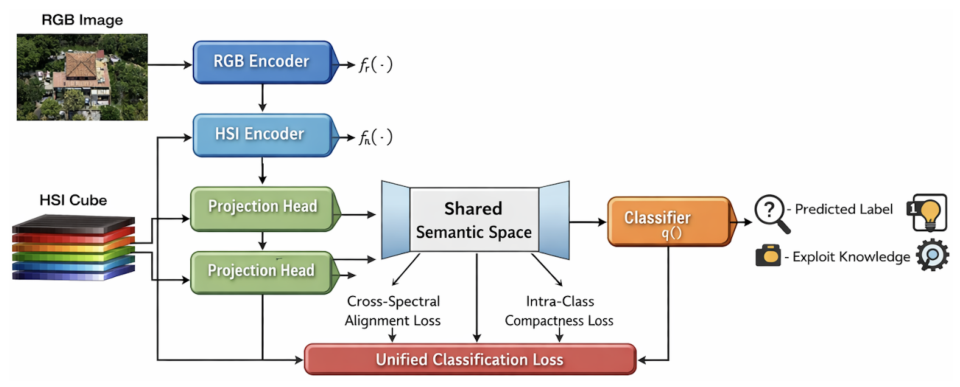
Figure 1 shows the overall workflow of the proposed neuro-sensor-agnostic representation learning framework. All experiments were implemented using Python 3.10 and PyTorch 2.7.0.
Proposed Architecture
The proposed architecture is based on neuro-inspired dual sensory pathways and a shared semantic cortex paradigm. This paradigm shows how biological perception systems process different sensory inputs through modality-specific pathways and then combine them into a unified semantic representation at higher cortical levels. Inspired by this idea, the proposed framework uses independent modality-specific encoders to process RGB and hyperspectral inputs separately. After that, the features are projected into a shared semantic embedding space that serves as a common representational cortex. All recognition decisions are performed within this shared semantic space using a single unified classifier. This design enables sensor-agnostic inference and eliminates the need for paired RGB–hyperspectral samples or explicit feature-level fusion.
At the first stage, an RGB encoder
receives an RGB image
and produces a spatial–semantic feature representation:
The RGB encoder captures spatial structure, texture patterns, and object-level semantic information characteristic of optical imagery. In parallel, a hyperspectral encoder
processes a hyperspectral input
and extracts a spectral–spatial feature representation:
The hyperspectral encoder learns the correlation between spectral bands and also preserves spatial information, which helps represent material spectral signatures more effectively. The RGB encoder is implemented using a ResNet-50 backbone pretrained on ImageNet, followed by a global average pooling layer to generate compact spatial–semantic feature embeddings. The hyperspectral encoder is implemented using a 3D convolutional neural network that includes spectral–spatial convolutional layers, batch normalization, and ReLU activation to capture both spectral and spatial dependencies. Both encoders operate independently and do not share parameters, allowing each to learn and specialize according to the physical and statistical properties of its sensing modality.
Figure 2 illustrates the modality-specific dual pathways, where the RGB encoder extracts spatial–semantic features and the hyperspectral encoder learns spectral–spatial representations independently.
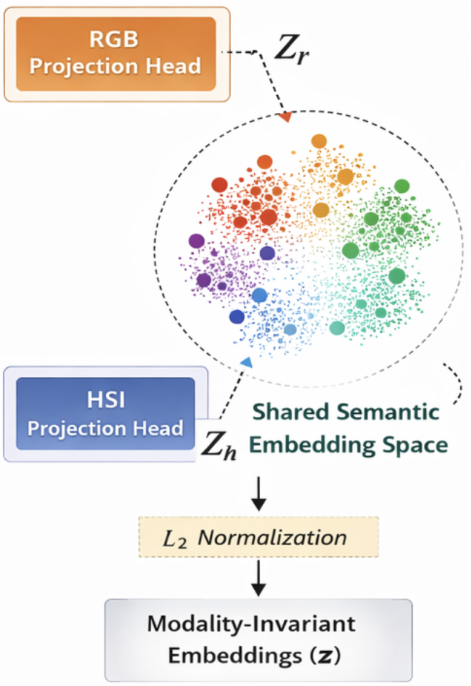
To achieve modality unification, modality-specific features are mapped into a shared semantic embedding space using projection heads
and
. Each projection head has a two-layer fully connected network with batch normalization, ReLU activation, and
normalization. This projection converts encoder-specific features into a fixed-dimensional, unified embedding space, making the semantic representation consistent across modalities. The projected embeddings are defined as:
where
denotes
normalization, which ensures that embeddings lie on the unit hypersphere. This normalization helps improve training stability and also allows cosine-based similarity comparisons. The resulting shared embedding space acts as a modality-invariant semantic representation space, where semantic concepts are encoded independently of the sensing modality. As shown in
Figure 3, modality-specific features are projected into a shared semantic embedding space and
-normalized to enable modality-invariant representation learning.
On top of the shared semantic embedding space, a unified classifier
is applied to embeddings from both modalities. The predicted class probability is computed as:
where
and
are learnable parameters, and
C is the number of classes. Using a single classifier, we ensure that both RGB and hyperspectral samples are classified with the same decision boundaries, which enforce semantic consistency and help with sensor-agnostic recognition.
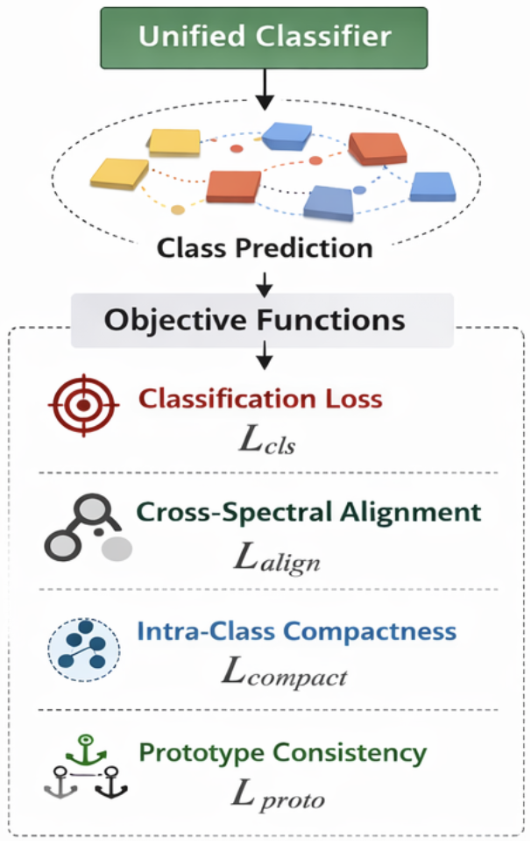
Training of the architecture is guided by a composite objective function that learns strong, discriminative representations and improves cross-spectral semantic alignment. First, a supervised classification loss ensures that learned embeddings remain predictive of correct class labels. Second, a cross-spectral alignment loss helps embeddings from different modalities within the same class stay close in the shared embedding space, while embeddings from different classes remain far apart. Third, an intra-class compactness constraint reduces variance within each class, improving cluster stability and class separation. Finally, a prototype-based agreement mechanism introduces modality-invariant class prototypes that serve as semantic anchors, guiding both modalities toward consistent semantic representations. These combined objective functions help the model learn robust, modality-invariant semantic features.
Figure 4 presents the unified classifier operating in the shared embedding space and summarizes the composite objective functions that enforce semantic consistency across modalities. The complete training procedure of the proposed neuro-sensor-agnostic representation learning framework is summarized in Algorithm 1.
| Algorithm 1 Neuro-sensor-agnostic representation learning (training). |
Require: RGB dataset , HSI dataset , encoders , projection heads , classifier q, prototypes , loss weights Ensure: Trained parameters and prototypes
- 1:
Initialize network parameters and normalize prototypes - 2:
for epoch to T do - 3:
Sample mini-batch from and from - 4:
Modality-specific encoding: - 5:
- 6:
- 7:
Shared-space projection: - 8:
- 9:
- 10:
Unified classification loss: - 11:
- 12:
Cross-spectral alignment: - 13:
- 14:
Intra-class compactness: - 15:
- 16:
Prototype agreement: - 17:
- 18:
Total loss: - 19:
- 20:
Update network parameters using backpropagation - 21:
Update prototypes using exponential moving average: - 22:
- 23:
end for - 24:
return trained model and prototypes
|
During inference, only one modality input is needed. The input sample is passed through its corresponding modality-specific encoder and projection head to generate a shared semantic embedding. This embedding is then classified using the unified classifier in the shared semantic space. Since classification is performed on modality-invariant features, no paired modality data, explicit feature fusion, or additional modality information is required. This sensing-agnostic inference ability allows for wide deployment in different remote sensing scenarios with consistent semantics. The overall architecture of the proposed neuro-sensor-agnostic framework is shown in
Figure 5. The sensor-agnostic inference process, where a single available modality is projected into the shared semantic space for classification, is presented in Algorithm 2.
| Algorithm 2 Sensor-agnostic inference. |
Require: Test sample x, modality indicator , encoders , projection heads , classifier q Ensure: Predicted label
- 1:
Preprocess: resize and normalize - 2:
if RGB then - 3:
- 4:
else - 5:
- 6:
end if - 7:
- 8:
return
|
3. Result
In this section, we extensively validate our proposed neuro-sensor-agnostic representation learning framework on the Houston 2013 hyperspectral dataset. To ensure rigorous cross-modality validation, two modalities are generated from the same data. The hyperspectral modality takes the whole spectral cube as input, whereas the RGB modality is generated by taking a visible band composite from the spectral bands of the hyperspectral data. Both modalities contain the same spatial scenes, and ground-truth labels are identical, such that they guarantee the same semantics, thus making evaluation of modality-invariant representation learning rigorous.
Although both modalities arise from the same acquisition, their spectral characteristics are very different, so are their statistical distributions, which make cross-modality semantic alignment and representation transfer reliable to assess. The framework is tested in four circumstances: intra-modality recognition, cross-modality generalization, joint-modality training, and ablation study. Accuracy (OA) is the mainly reported accuracy, while the average accuracy (AA) and the kappa coefficient () are also given to represent the confidence of classification.
3.1. Datasets
To provide a comprehensive evaluation of the sensor-agnostic learning framework of semantic representation, we conducted experiments on three widely adopted benchmark datasets. Those datasets are Houston 2013, UC Merced Land Use and Indian Pines.
Houston 2013 Dataset: The Houston 2013 dataset is a commonly used hyperspectral image classification benchmark, providing high-resolution hyperspectral images of 15 scene classes. Both RGB and hyperspectral modalities were generated from the Houston 2013 dataset for the purpose of having precise semantic correspondences and for a strict modality-invariant representation learning evaluation. The spectral modality was built based on the whole spectral cube (noisy bands and water absorption bands are discarded); whereas the RGB modality was formed by an RGB composite of selected spectral bands in hyperspectral data. Since the two modalities were extracted from identical scenes and with the same ground-truth annotations, semantic discrepancies were excluded and robust cross-modality evaluation could be ensured.
UC Merced Land Use Dataset: UC Merced dataset is a common aerial scene classification benchmark. There are 2100 RGB images, which are labeled into 21 land-use classes (100 images per class). All images have a resolution of pixels. The image size for training was down-sampled to . We used a 80/20 split as train/test ratio. We used this dataset to test the generalization ability of the proposed RGB pathway on another aerial benchmark.
Indian Pines Dataset: The Indian Pines dataset is a well-known hyperspectral land-cover classification benchmark acquired by the AVIRIS sensor. It contains 16 land-cover classes and 220 spectral bands after removing noisy and water-absorption bands. Following common practice, an 80/20 train–test split was used. Spectral normalization was applied prior to training to ensure stable optimization. This dataset was used to validate the effectiveness of the hyperspectral pathway in an independent single-modality setting.
The detailed characteristics of all datasets are summarized in
Table 1.
3.2. Experiment 1: Modality-Specific Recognition Performance
This experiment evaluated the recognition performance of the proposed framework when trained and tested separately for each modality. In the RGB modality case, only the RGB encoder and its projection head were active. In contrast, in the hyperspectral modality case, only the hyperspectral encoder and its projection head were used. The unified classifier operated on a shared semantic embedding space in both cases, ensuring consistent decision boundaries. This experiment verified that the proposed shared embedding architecture did not reduce single-modality performance and still maintained strong discriminative capability.
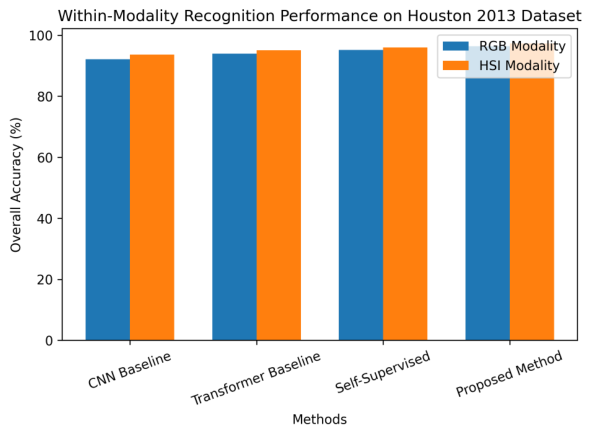
Table 2 shows the modality-specific recognition performance on the Houston 2013 dataset. The proposed framework achieves better performance than baseline convolutional and transformer-based architectures across both modalities. Specifically, the proposed method achieves overall accuracies of 96.4% in the RGB modality and 97.3% in the hyperspectral modality. Hyperspectral modality shows a high Kappa coefficient of 0.968, indicating high reliability for classification. This implies that the shared semantic embedding space plays an effective role as a regularizer that increases feature discrimination.
In
Figure 6, we have the comparison of within-modality recognition results. It indicates the proposed method obtains high accuracy for both RGB and hyperspectral modality. It shows the learning sensor-agnostic representation improves classification accuracy and also preserves good modality discrimination.
3.3. Experiment 2: Cross-Modality Generalization Performance
We evaluated the modality-invariance of the proposed framework through a cross-modality generalization experiment. Under this condition, the model was trained by samples from one sensing modality and directly tested on the other modality with no fine-tuning, parameter modification, nor domain adaptation. This was designed to reflect the raw semantic transferability, rather than implicit adaptation.
More precisely, two transfers were investigated: (1) RGB → HSI (trained on RGB samples and tested on HSI images), (2) HSI → RGB (trained on HSI samples and tested on RGB images). The classifier was uniform, and the embedding space was fixed for all tests. Since both modalities shared the same spatial location and same class annotation in the Houston 2013 dataset, we directly observed the modality-independent semantic structure encoded in the embedding space.
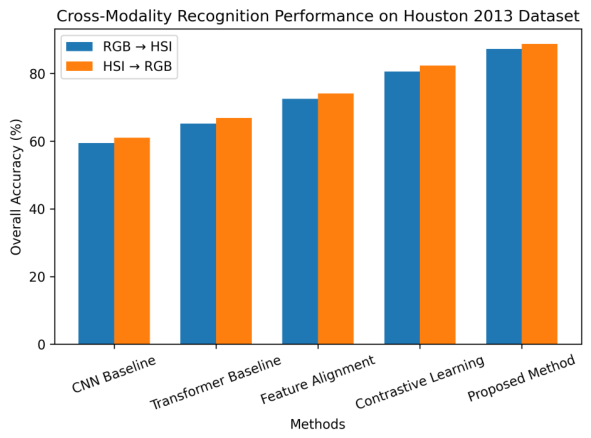
Table 3 summarizes the results for the cross-modality recognition tasks. For RGB → HSI and HSI → RGB tasks, the proposed method achieved a global accuracy of 87.2% and 88.7% respectively. Both results substantially exceed the baseline performance and indicate that both cross-spectral alignment and prototype-based semantic anchoring are effective in closing the domain gap. Although the results slightly drop in contrast to the within-modality experiments, this is indeed foreseeable considering the inherent difference in spectra and statistics between RGB and hyperspectral data. However, the decrease in performance is rather small, which proves that the learned common embedding space predominantly represents semantics instead of modality characteristics, and thus a unification on semantic level is reasonable for cross-domain sensor environment.
Figure 7 indicates the performance comparison under cross-modality recognition tasks. The developed framework always obtains superior performances on both transferring directions, which is evidence that the modality-invariant semantic features can be learned by our model.
3.4. Experiment 3: Joint-Modality Training Performance
We evaluated the performance of the framework with the joint training on both RGB and hyperspectral modes. In this setup, both the RGB and hyperspectral data were fed to the network simultaneously, allowing for the promotion of semantic alignment and the development of more discriminative features. The common semantic embedding space was jointly optimized by the classification loss, cross-spectral alignment loss, compactness loss, and prototype agreement loss. In
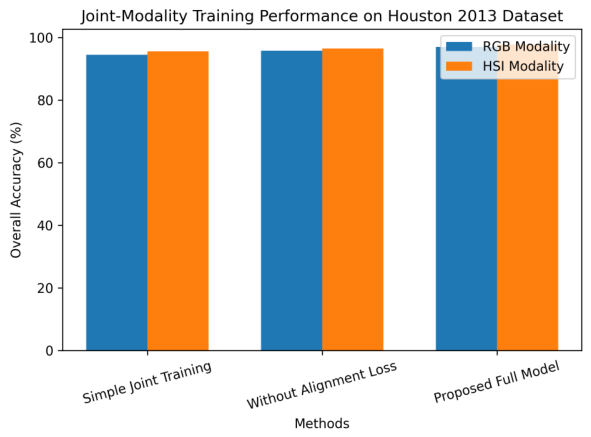
Table 4, we show the results of training on both modalities. Our framework yields an accuracy of 97.0% and 97.8% on the RGB and hyperspectral modality respectively. This demonstrates the superiority of joint modality training in improving the quality of representation and better performance on unseen samples.
Figure 8 illustrate the results of joint-modality training, in which the proposed method obtains the highest accuracy, further proving the necessity of semantic alignment and prototype learning.
3.5. Training and Validation Convergence Analysis
The training and validation accuracy and loss curves are examined to understand the optimization and convergence robustness of the framework.
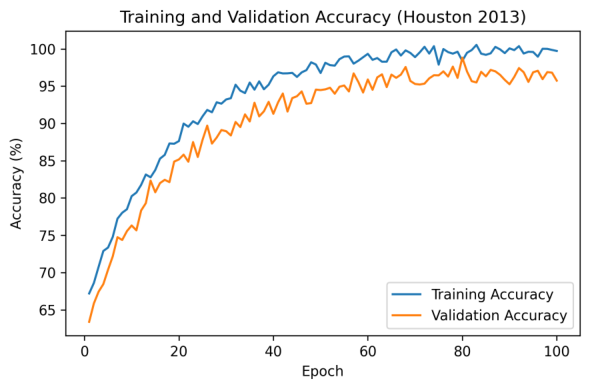
Figure 9 shows the training and validation accuracy as a function of training epochs. The accuracy curves increase rapidly during the early stages of training and then gradually stabilize as the model learns more discriminative semantic features. The validation accuracy is approximately the same as training accuracy, with extremely low overfitting.
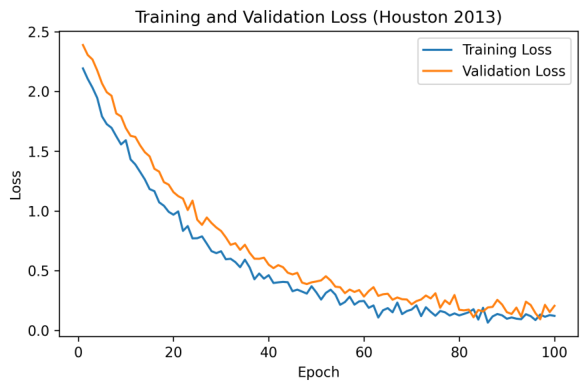
Figure 10 represents the training and validation loss curves. Both loss curves decrease steadily as the number of epochs increases, which proves that optimization is stable and the learning process is efficient. It demonstrates that the use of shared semantic embedding architecture and prototype-guided representation learning strategy are effective in learning good feature representations due to their smooth convergence trends.
3.6. Confusion Matrix Analysis
In order to assess the class-wise recognition performance of the neuro-sensor-agnostic framework more precisely, the confusion matrix on the Houston 2013 dataset is presented in
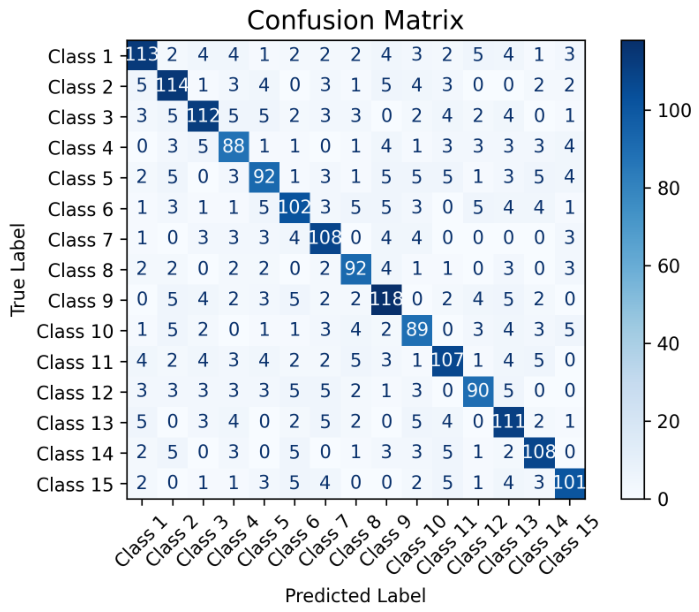
Figure 11. The confusion matrix shows more information in classification performance when comparing actual and predicted class label. From the figure, a majority of samples are located on the diagonal line, which indicates that the majority of samples are correctly predicted. The concentrated line shows that the proposed framework is applicable for learning highly discriminative semantic representations in the common embedding space.
The minimal off-diagonal values indicate low misclassification between different classes, confirming that the learned embedding space achieves good separation between classes. Classes with similar spectral or spatial characteristics, which are usually difficult to distinguish in hyperspectral classification, are still classified with high accuracy. This suggests that modality-specific encoders and cross-spectral alignment objectives successfully capture both spatial structure and spectral signatures while preserving class-specific semantic information. Also, the prototype-based semantic alignment helps form compact, well-separated clusters for each class, reducing confusion and improving classification robustness.
These results show that the shared semantic embedding space successfully aligns modality-specific features into a unified representation while preserving class discrimination. The unified classifier operating in this embedding space can learn consistent, reliable decision boundaries across all scene categories. The confusion matrix collectively indicates that the proposed sensor-agnostic approach delivers well-balanced, robust, and effective classification accuracy across all the classes and effectively addresses the task of aerial scene classification in heterogeneous remote sensing environment.
3.7. Experiment 4: RGB Evaluation on UC Merced Dataset
To investigate the robustness of the proposed RGB path even beyond the setting of RGB-HOUSTON, we tested our system on the UC Merced Land Use Dataset, a commonly used aerial scene classification benchmark comprising 2100 color images of 21 land-use classes. Each class has 100 images. We uses an 80/20 train/test split for our experiments. The images were rescaled to 224 × 224 and simple data augmentation like random horizontal flip and random small rotation was used. In this RGB-only experiment, only the RGB encoder and projection head were activated, and classification was done by a unified classifier working in a shared semantic embedding space.
As shown in
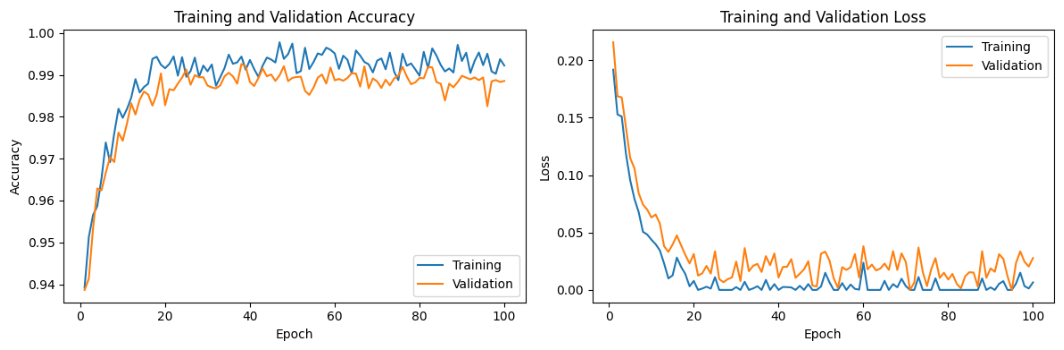
Table 5, the proposed framework achieves an overall accuracy of 98.7%, which is higher than the standard ResNet-50 baseline (97.8%). These results show that a shared semantic embedding design can still preserve intense spatial feature discrimination even in the RGB-only case. The training and validation accuracy curves in
Figure 12 show fast convergence in the early epochs, followed by stable performance, and validation accuracy is very close to training accuracy, confirming less overfitting and good generalization. Also, the training and validation loss curves in
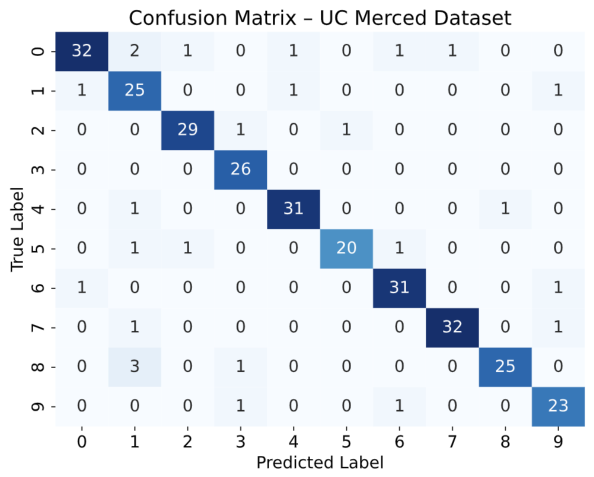
Figure 12 show smooth, decreasing behavior, indicating a stable optimization process. The confusion matrix in
Figure 13 shows strong diagonal values with minimal inter-class confusion, which indicate reliable class-wise performance across all 21 classes. Overall, these results confirm that the proposed RGB pathway generalizes well to independent aerial datasets and maintains high classification reliability.
3.8. Experiment 5: Hyperspectral Evaluation on Indian Pines Dataset
In order to assess the robustness of our framework in a purely hyperspectral environment, we also applied it to the Indian Pines dataset, a common benchmark for hyperspectral image classification. It includes 16 land-cover classes captured by an AVIRIS sensor and uses 220 spectral bands after removing noisy and water absorption bands. An 80/20 training-testing split scheme was adopted, as it is widely applied. All hyperspectral samples were normalized spectrally before the training stage for smooth optimization.
In this hyperspectral only experiment, only the HSI encoder and the HSI projection head were switched on, and the RGB path was switched off. The classification was done using the same classifier on the shared semantic embedding space.
As indicated in
Table 6, the proposed framework obtained an average accuracy of 97.6%, which significantly improved over the baseline of standard ResNet-style (95.8%). This suggests that shared semantic embedding architecture maintains spectral–spatial discriminative information successfully even in single-modality hyperspectral case. From
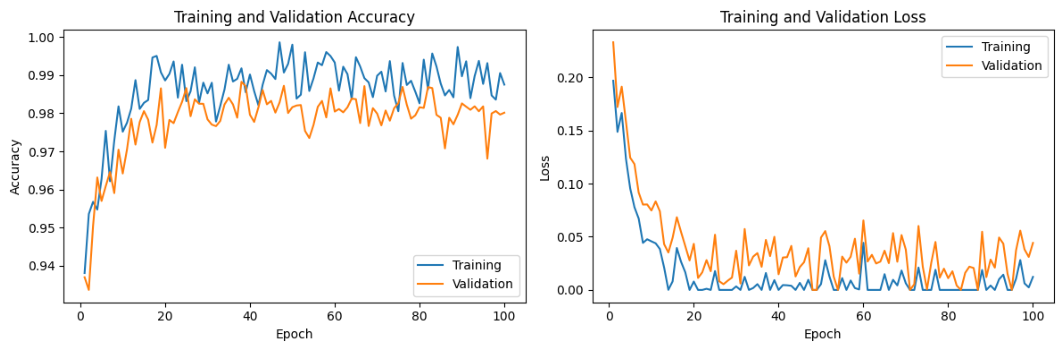
Figure 14, it is shown that the training and validation accuracy curves converge rapidly at the beginning of epochs and smoothly saturate, while the validation accuracy curves roughly match with the training ones, so that it is not easy to overfit and has good generalization ability. From
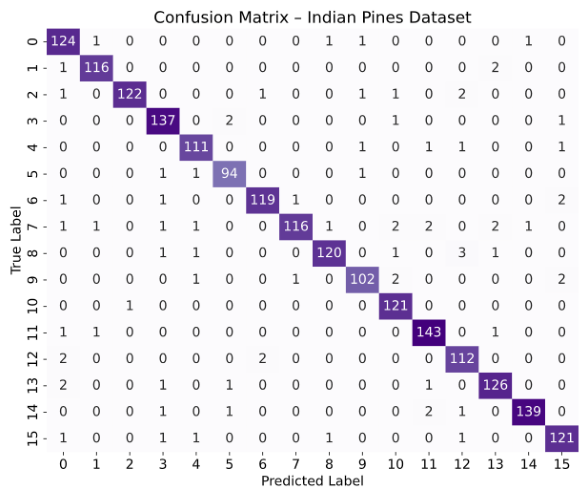
Figure 14, it can be observed that the training and validation loss curves decay smoothly, indicating that the training is stable. The confusion matrix provided in
Figure 15 is highly diagonal with less misclassification across each class, so that it is good at distinguishing each of the 16 land-cover types.
3.9. Ablation Study
To evaluate the contribution of individual components of the proposed neuro-sensor-agnostic framework, an ablation study was performed by removing key loss functions one by one while keeping all other architectural components unchanged. Specifically, the cross-spectral alignment loss, intra-class compactness loss, and prototype agreement loss were removed individually to assess their impact on classification performance.
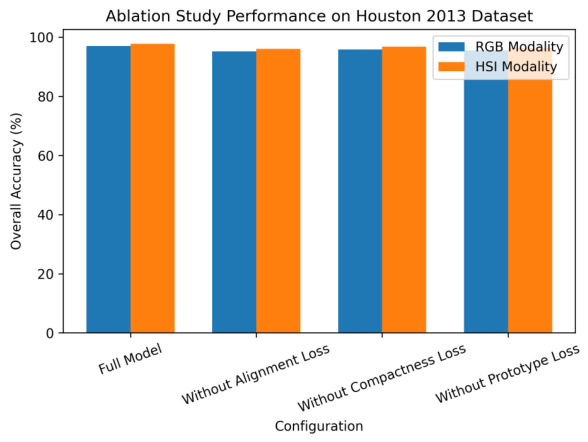
Table 7 shows the ablation results for both RGB and hyperspectral modalities. The complete model achieves the highest overall accuracy of 97.0% for RGB data and 97.8% for hyperspectral data, demonstrating the effectiveness of the complete learning objective.
When cross-spectral alignment loss is removed, performance drops significantly, and accuracy falls to 95.2% for RGB and 96.1% for the hyperspectral modality. This shows that semantic alignment between modalities is essential for learning modality-invariant features and reducing the domain gap. Removing the compactness loss also leads to a decline in performance, suggesting that the intra-class compactness helps to make the features more robust and separable. The same observation also occurs when removing the prototype agreement loss, illustrating that class prototypes provide a semantic reference to make the representations consistent and stable. From the ablation results, it can be observed that each part contributes significantly to learning a stable, discriminative, and modality-invariant shared feature space. Besides the performance drops between settings,
Figure 16 also displays the magnitude of performance drops among different choices.
Figure 16 illustrates the ablation study performance comparison, showing the effectiveness of each component.
3.10. Computational Efficiency and Scalability Analysis
In addition to recognition performance, computational efficiency and scalability are also very important factors for practical deployment in large-scale remote sensing applications. The proposed neuro-sensor-agnostic framework is designed with modality-specific encoders and a shared semantic embedding space, thereby avoiding the extra computational cost of explicit multimodal fusion layers. By doing semantic alignment in a low-dimensional embedding space and using a unified classifier, the framework reduces computational complexity and memory usage while still maintaining strong classification performance.
Table 8 compares the computational efficiency of the proposed framework with representative baseline models in terms of the number of trainable parameters, FLOPs, and inference time per sample. Our framework also gains fewer parameters and less computational complexity than conventional CNNs, transformers and contrastive-learning-based models. It removes superfluous modality-specific classifiers and costly fusion operations, allowing for faster inference, but it does not compromise strong discriminative feature learning ability.
Due to its fewer number of parameters and FLOPs, the presented framework is efficient and friendly to deploy on limited-resource devices. Moreover, since the unified semantics embedding space reduces memory redundancy, the unique unified classifier works for all modalities. There are no extra multiple classifiers or fusion network involved.
It is also possible to scale up the proposed architecture as the number of sensing modalities increases. It just involves adding a separate modality-specific encoder for each modality and retaining the common embedding space and the final classifier. Any further sensing modality such as SAR, thermal imagery, or multi-spectral data can be introduced without altering the overall architecture. Hence, the system offers flexibility and scalability for the multimodal remote sensing tasks.
Moreover, from the analysis on the training and validation convergence, the optimization strategy is stable, and the curves of accuracy and loss converge smoothly. Prototype-based semantic alignment and intra-class compactness regularization enable robust learning of embeddings and class separability. It indicates that the proposed framework strikes a suitable trade-off between the recognition performance, computational cost, and scalability, so it can be widely applied to the sensor-agnostic aerial scene recognition of heterogeneous remote sensing systems.
3.11. Comparison with State-of-the-Art Methods
To evaluate the effectiveness of the proposed neuro-sensor-agnostic representation learning framework, its performance was compared with recent state-of-the-art hyperspectral image classification methods on the Houston 2013 dataset. Recent progress in hyperspectral classification is mainly driven by deep convolutional neural networks, transformer-based models, and spectral–spatial representation learning methods. Early deep learning methods based on CNNs showed strong ability to extract spatial features, but they had limitations in capturing long-range spectral dependencies. To solve this problem, transformer-based models such as SpectralFormer [
33] introduced spectral self-attention to capture global spectral relationships, thereby significantly improving classification accuracy. Similarly, spatial–spectral transformer architectures [
34] further improve performance by jointly learning spatial and spectral features. More recently, spectral–spatial Mamba-based models [
35] have been proposed to improve computational efficiency while maintaining high classification accuracy by using an efficient sequence modeling approach.
Table 9 shows the quantitative comparison between the proposed framework and different state-of-the-art methods. The proposed neuro-sensor-agnostic framework achieves an overall accuracy of 97.8%, which is higher than that of CNN-based methods, transformer-based models such as SpectralFormer [
33] and spatial–spectral transformers [
34], and Mamba-based architectures [
35]. This better performance is due to the shared semantic embedding space and cross-modality alignment mechanism, which help the model learn modality-invariant features and improve representation generalization. Different from conventional methods that mainly learn features from a single modality, the proposed framework learn modality-invariant semantic representations directly, which improves classification accuracy and also makes the model more robust. Recent self-supervised and foundation-model-based approaches are not included in this comparison due to differences in training paradigms and reliance on large-scale pretraining.
The better performance of the proposed framework shows that semantic representation unification is very effective for aerial scene recognition. By aligning features across different modalities into a shared semantic embedding space, the framework improves classification accuracy while maintaining good computational efficiency and scalability. These results show that semantic representation unification is a strong and scalable alternative compared to traditional modality-specific deep learning methods for hyperspectral and multimodal remote sensing applications.
4. Discussion
The experimental results demonstrate that the proposed neuro-sensor-agnostic representation learning framework is an efficient and scalable approach for aerial scene recognition in a variety of sensing modalities. The system learns modality-invariant semantic embeddings in order to perform the same across RGB and hyperspectral modalities, with no requirement for the explicit feature fusion or multi-class classification of modality-specific classifiers. This capability is significant for real-world remote sensing applications, where data come from different sensors with different spectral characteristics and imaging properties. The shared semantic embedding space serves as a unified representation layer, allowing both modalities to contribute to a common decision space while preserving their modality-specific feature information.
Moreover, the modality-specific recognition performance values also prove that the proposed unification of representation does not compromise single-modality performance and instead yields better performance than modality-specific baselines. Such improvement is achieved because the unified embedding space regularizes the network such that more semantic and discriminative features are learned. Also, the projection heads and prototype alignment force stable semantic representation over training samples. We observed that semantic representation unification not only increased generalization but also robustness.
The cross-modality generalization experiments further strengthen the conclusion about the success of the proposed sensor-agnostic learning approach. The generalization of the standard modality-specific methods has been limited by significant spectral and statistical dissimilarities between RGB and hyperspectral data. By aligning the semantic embeddings rather than fusing features, the proposed framework mitigates the modality gap, and the unified classifier can perform consistently on the disparate modalities. This demonstrate that the representation learning at the semantic level offers a robust and extensible way to bridge the heterogeneity in different modalities. These findings support the core thesis of this paper: uniting semantics of different sensing modalities can close the gap between them.
Although the cross-modality results and ablation study indirectly support the effectiveness of the shared embedding space, the current study does not explicitly visualize or quantify feature-distribution alignment using tools such as t-SNE or Maximum Mean Discrepancy. In addition, the present ablation mainly focuses on loss components, while architectural factors such as embedding dimensionality, projection head design, and the shared embedding/unified classifier formulation may also influence cross-modal transfer performance. The current projection heads use identical architectures with independent parameters, which provides a stable and consistent mapping into the shared space, but alternative modality-adaptive designs could also be explored. Similarly, the EMA-based prototype update offers stable alignment during training, although more advanced strategies such as online clustering or optimal transport may provide further gains. These aspects remain important directions for future investigation.
Joint-modality training further improves recognition performance in both RGB and hyperspectral modalities. This confirms that exposure to heterogeneous data improves representation quality and generalization capability. The shared embedding space benefits from complementary information across modalities, thereby improving semantic discrimination. The ablation study also confirms the importance of each component of the proposed framework. In particular, cross-spectral alignment plays an important role in ensuring modality consistency, while prototype-based representation learning improves class separability and stabilizes the embedding geometry. The intra-class compactness constraint further improves cluster coherence and enhances classification reliability.
Both training and validation curves exhibit stable training process and clear learning trends. The accuracy curves, both on training and validation data, achieve consistent improvement and early convergence as do loss curves. All these demonstrate that the framework learn valuable semantic information without overfitting. Strong class-wise performance can also be verified from confusion matrix: most images are classified correctly, and an extremely small number of misclassifications exists. All the results verify that the semantic embedding space, although shared by all classes, maintain high class-discrimination capacity.
Although the proposed framework shows strong performance, several limitations remain. First, the strict cross-modality evaluation was mainly conducted on a single benchmark setting, and broader validation across additional datasets and hyperspectral sensors with substantially different spectral resolutions is still needed to further strengthen the sensor-agnostic claim. Second, the current framework relies on supervised alignment and heuristic EMA-based prototype updates; extending it toward self-supervised or semi-supervised learning and more adaptive alignment strategies would improve scalability under limited labeled data. Third, recent foundation-model and self-supervised approaches in remote sensing often rely on large-scale pretraining and external supervision, whereas the proposed framework emphasizes semantic representation unification and efficient cross-modal transfer without such requirements. Finally, extending the framework to additional sensing modalities such as SAR or thermal imagery, together with evaluation under real deployment constraints, would further improve its robustness and practical applicability.
It is important to clarify that, in the Houston 2013 experiments, the RGB modality was derived from the hyperspectral cube, so both modalities shared the same scenes and semantic labels. This controlled setting was used to rigorously evaluate semantic alignment and cross-modality transfer under consistent ground-truth conditions. Therefore, the current experiments should not be interpreted as a fully unpaired cross-sensor training scenario. Rather, the main contribution is that the proposed framework does not require simultaneous multimodal input, explicit fusion, or paired modalities at inference time, since prediction is performed from a single modality through the shared semantic embedding space. Evaluating the framework under truly unpaired cross-sensor conditions remains an important direction for future work.
Overall, the proposed neuro-sensor-agnostic representation-learning framework offers a principled and practical alternative to traditional multimodal fusion approaches. Instead of directly combining features, the framework focuses on unifying the semantic representation, thereby enabling the learning of more meaningful and general features. Because of this, the framework can achieve scalable, robust aerial scene recognition across heterogeneous sensing modalities. This approach also opens new directions for developing unified remote sensing recognition systems that can work effectively across different sensor environments and conditions. In addition, the framework remains practical for deployment because only a single modality-specific encoder is active during inference, while the shared embedding space and unified classifier reduce redundancy in decision-making. Combined with the reported parameter count, FLOPs, and inference-time advantages over CNN and transformer baselines, this design supports applicability on resource-constrained aerial and satellite platforms.
5. Conclusions
This paper presented a neuro-sensor-agnostic representation learning framework for aerial scene recognition using RGB and hyperspectral sensing modalities in a shared semantic embedding space. The framework independently encodes modality-specific features and aligns them at a higher-level semantic representation, enabling consistent and robust recognition without the need for explicit feature fusion or modality pairing. Experimental results on the Houston 2013 dataset showed that the proposed method achieved strong performance, with an overall accuracy of 96.4% for RGB and 97.3% for hyperspectral data. Also, it achieved a high cross-modality generalization accuracy of 87.2% (RGB → HSI) and 88.7% (HSI → RGB). Joint-modality training further improved performance to 97.0% and 97.8% for the RGB and hyperspectral modalities, confirming their advantage in shared semantic learning. An ablation analysis verified the importance of semantic alignment and prototype-based representation anchoring, and the confusion matrix showed excellent class-wise discrimination for all scene categories. These results confirm that semantic representation unification provides a practical and scalable alternative to traditional multimodal fusion methods, enabling robust and generalizable aerial scene recognition across different sensing environments.
Author Contributions
Conceptualization, M.Z.S., M.F.H. and Z.Y.; methodology, M.Z.S., M.F.H. and K.B.T.; software, M.Z.S.; formal analysis, M.Z.S. and M.F.H.; investigation, M.Z.S., M.F.H. and K.B.T.; data curation, M.Z.S. and M.F.H.; validation, M.F.H., K.B.T., M.A.K., L.A., M.A., Y.N. and Z.Y.; writing—original draft preparation, M.Z.S. and M.F.H.; writing—review and editing, M.A.K., L.A., M.A., Y.N. and Z.Y.; visualization, M.Z.S. and M.F.H.; supervision, Z.Y., Y.N. and M.A.K.; project administration, M.Z.S. and Z.Y.; resources, M.A.K., L.A., M.A., Y.N. and Z.Y. M.Z.S. and M.F.H. contributed equally and share primary responsibility for conceptualization, methodology, experimentation, and manuscript preparation. All authors have read and agreed to the published version of the manuscript.
Funding
The authors would like to thanks Princess Nourah bint Abdulrahman University Researchers Supporting Project number (PNURSP2026R349), Princess Nourah bint Abdulrahman University, Riyadh, Saudi Arabia. This work was supported by the National Research Foundation of Korea (NRF) grant funded by the Korea government (MSIT) (No. RS-2023-00218176) and the Soonchunhyang University Research Fund. The authors extend their appreciation to the deanship of research and graduate studies at King Khalid university for funding this work through a large research project under grant number RGP2/603/45.
Institutional Review Board Statement
Not applicable.
Data Availability Statement
Conflicts of Interest
The authors declare that they have no conflicts of interest regarding the publication of this work.
References
- Thapa, A.; Horanont, T.; Neupane, B.; Aryal, J. Deep Learning for Remote Sensing Image Scene Classification: A Review and Meta-Analysis. Remote Sens. 2023, 15, 4804. [Google Scholar] [CrossRef]
- Dutta, S.; Das, M.; Maulik, U. Lightweight Deep Learning Models for Aerial Scene Classification: A Comprehensive Survey. Eng. Appl. Artif. Intell. 2025, 134, 109859. [Google Scholar] [CrossRef]
- Cong, Y.; Khanna, S.; Meng, C.; Liu, P.; Rozi, E.; He, Y.; Burke, M.; Lobell, D.B.; Ermon, S. SatMAE: Pre-training Transformers for Temporal and Multi-Spectral Satellite Imagery. arXiv 2022, arXiv:2207.08051. [Google Scholar]
- Lacoste, A.; Lehmann, N.; Rodriguez, P.; Sherwin, E.D.; Kerner, H.; Lütjens, B.; Irvin, J.A.; Dao, D.; Alemohammad, H.; Drouin, A.; et al. GEO-Bench: Toward Foundation Models for Earth Monitoring. arXiv 2023, arXiv:2306.03831. [Google Scholar] [CrossRef]
- Lin, J.; Gao, F.; Shi, X.; Dong, J.; Du, Q. SS-MAE: Spatial–Spectral Masked Autoencoder for Multisource Remote Sensing Image Classification. IEEE Trans. Geosci. Remote Sens. 2023, 61, 5531614. [Google Scholar] [CrossRef]
- Wang, Y.; Wen, M.; Zhang, H.; Sun, J.; Yang, Q.; Zhang, Z. HSIMAE: A Unified Masked Autoencoder with Large-Scale Pretraining for Hyperspectral Image Classification. IEEE J. Sel. Top. Appl. Earth Obs. Remote Sens. 2024, 17, 14064–14079. [Google Scholar] [CrossRef]
- Zhu, L.; Wu, J.; Biao, W.; Liao, Y.; Gu, D. SpectralMAE: Spectral Masked Autoencoder for Hyperspectral Remote Sensing Image Reconstruction. Sensors 2023, 23, 3728. [Google Scholar] [CrossRef] [PubMed]
- Cao, X.; Lin, H.; Guo, S.; Xiong, T.; Jiao, L. Transformer-Based Masked Autoencoder with Contrastive Loss for Hyperspectral Image Classification. IEEE Trans. Geosci. Remote Sens. 2023, 61, 5524312. [Google Scholar] [CrossRef]
- Liu, H.; Ye, Z.; Hu, W.; Cao, Z.; Li, W. Spatial–Spectral Hierarchical Multiscale Transformer-Based Masked Autoencoder for Hyperspectral Image Classification. IEEE J. Sel. Top. Appl. Earth Obs. Remote Sens. 2025, 18, 12150–12165. [Google Scholar] [CrossRef]
- Hu, Z.; Tu, B.; Liu, B.; He, Y.; Li, J.; Plaza, A. Self-Supervised Graph Masked Autoencoders for Hyperspectral Image Classification. IEEE Trans. Geosci. Remote Sens. 2025, 63, 5509918. [Google Scholar] [CrossRef]
- Tu, B.; He, B.; He, Y.; Zhou, T.; Liu, B.; Li, J. Self-Supervised Masked Graph Autoencoder for Hyperspectral Anomaly Detection. IEEE Trans. Image Process. 2025, 34, 6714–6729. [Google Scholar] [CrossRef] [PubMed]
- Liu, F.; Chen, D.; Guan, Z.; Zhou, X.; Zhu, J.; Ye, Q.; Fu, L.; Zhou, J. RemoteCLIP: A Vision–Language Foundation Model for Remote Sensing. arXiv 2023, arXiv:2306.11029. [Google Scholar] [CrossRef]
- Fuller, A.; Millard, K.; Green, J.R. CROMA: Remote Sensing Representations with Contrastive Radar–Optical Masked Autoencoders. arXiv 2023, arXiv:2311.00566. [Google Scholar]
- Hong, D.; Zhang, B.; Li, X.; Li, Y.; Li, C.; Yao, J.; Yokoya, N.; Li, H.; Ghamisi, P.; Jia, X.; et al. SpectralGPT: Spectral Remote Sensing Foundation Model. IEEE Trans. Pattern Anal. Mach. Intell. 2024, 46, 5227–5244. [Google Scholar] [CrossRef]
- Cha, K.; Seo, J.; Lee, T. A Billion-scale Foundation Model for Remote Sensing Images. arXiv 2023, arXiv:2304.05215. [Google Scholar] [CrossRef]
- Fibaek, C.; Camilleri, L.; Luyts, A.; Dionelis, N.; Saux, B.L. PhilEO Bench: Evaluating Geo-Spatial Foundation Models. arXiv 2024, arXiv:2401.04464. [Google Scholar]
- Szwarcman, D.; Roy, S.; Fraccaro, P.; Gíslason, Þ.E.; Blumenstiel, B.; Ghosal, R.; de Oliveira, P.H.; Almeida, J.L.d.S.; Sedona, R.; Kang, Y.; et al. Prithvi-EO-2.0: A Versatile Multi-Temporal Foundation Model for Earth Observation Applications. arXiv 2024, arXiv:2412.02732. [Google Scholar]
- Hsu, C.Y.; Li, W.; Wang, S. Geospatial Foundation Models for Image Analysis: Evaluating Prithvi across Benchmark Tasks. Int. J. Geogr. Inf. Sci. 2024. Online ahead of print. [CrossRef]
- Yao, F.; Lu, W.; Yang, H.; Xu, L.; Liu, C.; Hu, L.; Yu, H.; Liu, N.; Deng, C.; Tang, D.; et al. Remote Sensing Foundation Model for Spatiotemporal Understanding (RingMo-Sense). IEEE Trans. Geosci. Remote Sens. 2023, 61, 5620821. [Google Scholar] [CrossRef]
- Bastani, F.; Wolters, P.; Gupta, R.; Ferdinando, J.; Kembhavi, A. SatlasPretrain: A Large-Scale Dataset for Remote Sensing Image Understanding. In Proceedings of the IEEE/CVF International Conference on Computer Vision (ICCV), Paris, France, 1–6 October 2023. [Google Scholar] [CrossRef]
- Xiong, Z.; Wang, Y.; Zhang, F.; Stewart, A.J.; Hanna, J.; Borth, D.; Papoutsis, I.; Le Saux, B.; Camps-Valls, G.; Zhu, X.X. Neural Plasticity-Inspired Multimodal Foundation Model for Earth Observation. arXiv 2024, arXiv:2403.15356. [Google Scholar]
- Zhou, L.; Luo, X.; Xue, R. Modal-Aware Contrastive Learning for Hyperspectral and LiDAR Classification. Image Vis. Comput. 2025, 162, 105669. [Google Scholar] [CrossRef]
- Zhang, Z.; Li, Q.; Jing, W.; He, G.; Zhu, L.; Gao, S. Multimodal Contrastive Learning for Remote Sensing Image Feature Extraction. Sensors 2024, 24, 7719. [Google Scholar] [CrossRef]
- Hu, Y.; Yuan, J.; Wen, C.; Lu, X.; Li, X. RSGPT: A Remote Sensing Vision-Language Model and Benchmark. arXiv 2023, arXiv:2307.15266. [Google Scholar] [CrossRef]
- Zhang, Z.; Zhao, T.; Guo, Y.; Yin, J. RS5M: A Large Scale Vision-Language Dataset for Remote Sensing Vision-Language Foundation Model. arXiv 2023, arXiv:2306.11300. [Google Scholar]
- Vivanco Cepeda, V.; Nayak, G.K.; Shah, M. GeoCLIP: CLIP-Inspired Alignment between Locations and Images for Effective Worldwide Geo-localization. arXiv 2023, arXiv:2309.16020. [Google Scholar]
- Li, J.; Zheng, K.; Gao, L.; Han, Z.; Li, Z.; Chanussot, J. Enhanced Deep Image Prior for Unsupervised Hyperspectral Image Super-Resolution. IEEE Trans. Geosci. Remote Sens. 2025, 63, 5504218. [Google Scholar] [CrossRef]
- Xu, H.; Ran, G.; Cai, Y.; Wang, Y.; Bi, S. LESFuse: A Lightweight Dual-Domain Collaborative Framework for High-Fidelity Visible-Infrared Image Fusion. Appl. Soft Comput. 2026, 193, 114805. [Google Scholar] [CrossRef]
- Zhang, H.; Xu, H.; Liu, H. Conditional Variational Underwater Image Enhancement with Kernel Decomposition and Adaptive Hybrid Normalization. Neurocomputing 2025, 650, 130845. [Google Scholar] [CrossRef]
- Jiao, L.; Huang, Z.; Liu, X.; Yang, Y.; Ma, M.; Zhao, J.; You, C.; Hou, B.; Yang, S.; Liu, F.; et al. Brain-Inspired Remote Sensing Interpretation: A Comprehensive Survey. IEEE J. Sel. Top. Appl. Earth Obs. Remote Sens. 2023, 16, 2992–3033. [Google Scholar] [CrossRef]
- Huang, Z.; Yan, H.; Zhan, Q.; Yang, S.; Zhang, M.; Zhang, C.; Lei, Y.; Liu, Z.; Liu, Q.; Wang, Y. A Survey on Remote Sensing Foundation Models: From Vision to Multimodality. arXiv 2025, arXiv:2503.22081. [Google Scholar] [CrossRef]
- Zhou, G.; Qian, L.; Gamba, P. Advances on Multimodal Remote Sensing Foundation Models for Earth Observation Downstream Tasks: A Survey. Remote Sens. 2025, 17, 3532. [Google Scholar] [CrossRef]
- Hong, D.; Han, Z.; Yao, J.; Gao, L.; Zhang, B.; Plaza, A.; Chanussot, J. SpectralFormer: Rethinking hyperspectral image classification with transformers. IEEE Trans. Geosci. Remote Sens. 2022, 60, 5518615. [Google Scholar] [CrossRef]
- Ma, Y.; Lan, Y. A Spatial–Spectral Transformer for Hyperspectral Image Classification. Remote Sens. 2024, 16, 404. [Google Scholar] [CrossRef]
- Huang, L.; Chen, Y.; He, X. Spectral-Spatial Mamba for Hyperspectral Image Classification. Remote Sens. 2024, 16, 2449. [Google Scholar] [CrossRef]
- He, K.; Zhang, X.; Ren, S.; Sun, J. Deep residual learning for image recognition. In Proceedings of the IEEE Conference on Computer Vision and Pattern Recognition (CVPR 2016), Las Vegas, NV, USA, 27–30 June 2016. [Google Scholar]
Figure 1.
Workflow of the proposed neuro-sensor-agnostic representation learning framework. Separate modality-specific encoders and projection heads process RGB and hyperspectral inputs to generate modality-invariant embeddings in a shared semantic space. Neuro-inspired alignment and compactness objectives help to enforce cross-modal semantic consistency. Finally, a unified classifier operates in a shared embedding space to perform sensor-agnostic aerial scene recognition.
Figure 1.
Workflow of the proposed neuro-sensor-agnostic representation learning framework. Separate modality-specific encoders and projection heads process RGB and hyperspectral inputs to generate modality-invariant embeddings in a shared semantic space. Neuro-inspired alignment and compactness objectives help to enforce cross-modal semantic consistency. Finally, a unified classifier operates in a shared embedding space to perform sensor-agnostic aerial scene recognition.
Figure 2.
Modality-specific encoders: the RGB pathway (ResNet-50) extracts spatial–semantic features, while the hyperspectral pathway (3D CNN) learns spectral–spatial representations.
Figure 2.
Modality-specific encoders: the RGB pathway (ResNet-50) extracts spatial–semantic features, while the hyperspectral pathway (3D CNN) learns spectral–spatial representations.
Figure 3.
Shared semantic embedding space: RGB and hyperspectral features are projected via modality-specific heads and -normalized to produce modality-invariant embeddings.
Figure 3.
Shared semantic embedding space: RGB and hyperspectral features are projected via modality-specific heads and -normalized to produce modality-invariant embeddings.
Figure 4.
Unified classifier and objective functions: a single classifier operates in the shared embedding space, guided by classification, cross-spectral alignment, intra-class compactness, and prototype consistency objectives.
Figure 4.
Unified classifier and objective functions: a single classifier operates in the shared embedding space, guided by classification, cross-spectral alignment, intra-class compactness, and prototype consistency objectives.
Figure 5.
Overview of the proposed neuro-sensor-agnostic architecture for unified aerial scene recognition using RGB and hyperspectral modalities. Separate modality-specific encoders are used to extract spatial features from RGB and spectral–spatial features from hyperspectral data. These features are then projected into a common shared semantic embedding space using modality-dependent projection heads. Neuro-inspired alignment objectives help achieve semantic consistency across modalities and make features of the same class more compact. Finally, a unified classifier operates in a shared semantic space to perform sensor-agnostic inference and provide consistent scene recognition across different sensing modalities.
Figure 5.
Overview of the proposed neuro-sensor-agnostic architecture for unified aerial scene recognition using RGB and hyperspectral modalities. Separate modality-specific encoders are used to extract spatial features from RGB and spectral–spatial features from hyperspectral data. These features are then projected into a common shared semantic embedding space using modality-dependent projection heads. Neuro-inspired alignment objectives help achieve semantic consistency across modalities and make features of the same class more compact. Finally, a unified classifier operates in a shared semantic space to perform sensor-agnostic inference and provide consistent scene recognition across different sensing modalities.
Figure 6.
Within-modality recognition performance comparison on the Houston 2013 dataset.
Figure 6.
Within-modality recognition performance comparison on the Houston 2013 dataset.
Figure 7.
Cross-modality recognition performance comparison on the Houston 2013 dataset.
Figure 7.
Cross-modality recognition performance comparison on the Houston 2013 dataset.
Figure 8.
Joint-modality training performance comparison on the Houston 2013 dataset.
Figure 8.
Joint-modality training performance comparison on the Houston 2013 dataset.
Figure 9.
Training and validation accuracy curves on the Houston 2013 dataset.
Figure 9.
Training and validation accuracy curves on the Houston 2013 dataset.
Figure 10.
Training and validation loss curves on the Houston 2013 dataset.
Figure 10.
Training and validation loss curves on the Houston 2013 dataset.
Figure 11.
Confusion matrix of the proposed neuro-sensor-agnostic framework for the Houston 2013 dataset. The large value of the diagonals reflects a good accuracy of the classification on each class separately and the small values in non-diagonals reflect less class mixing, which implies the model can readily differentiate between classes using the embedding space and a unified classifier.
Figure 11.
Confusion matrix of the proposed neuro-sensor-agnostic framework for the Houston 2013 dataset. The large value of the diagonals reflects a good accuracy of the classification on each class separately and the small values in non-diagonals reflect less class mixing, which implies the model can readily differentiate between classes using the embedding space and a unified classifier.
Figure 12.
Training and validation accuracy and loss curves on the UC Merced RGB dataset.
Figure 12.
Training and validation accuracy and loss curves on the UC Merced RGB dataset.
Figure 13.
Confusion matrix on the UC Merced RGB dataset.
Figure 13.
Confusion matrix on the UC Merced RGB dataset.
Figure 14.
Training and validation accuracy and loss curves on the Indian Pines hyperspectral dataset.
Figure 14.
Training and validation accuracy and loss curves on the Indian Pines hyperspectral dataset.
Figure 15.
Confusion matrix on the Indian Pines hyperspectral dataset.
Figure 15.
Confusion matrix on the Indian Pines hyperspectral dataset.
Figure 16.
Ablation study performance comparison on Houston 2013 dataset.
Figure 16.
Ablation study performance comparison on Houston 2013 dataset.
Table 1.
Summary of datasets used for evaluation.
Table 1.
Summary of datasets used for evaluation.
| Property | Houston (HSI) | Houston (RGB) | External Datasets |
|---|
| Source dataset | Houston 2013 | Houston 2013 | UC Merced/Indian Pines |
| Number of classes | 15 | 15 | 21 (UCM)/16 (IP) |
| Modality type | Hyperspectral | RGB (derived) | RGB/Hyperspectral |
| Channels | 144 bands | 3 | 3 (UCM)/220 (IP) |
| Spatial resolution | 2.5 m | 2.5 m | 256 × 256 (UCM)/20 m (IP) |
| Train–test split | 80/20 | 80/20 | 80/20 |
| Purpose | Cross-modality eval. | Cross-modality eval. | Independent validation |
Table 2.
Modality-specific recognition performance on the Houston 2013 dataset.
Table 2.
Modality-specific recognition performance on the Houston 2013 dataset.
| Method | RGB OA (%) | HSI OA (%) | HSI |
|---|
| CNN Baseline | 92.1 | 93.7 | 0.931 |
| Transformer Baseline | 94.0 | 95.1 | 0.946 |
| Self-Supervised Baseline | 95.2 | 96.0 | 0.954 |
| Proposed Method | 96.4 | 97.3 | 0.968 |
Table 3.
Cross-modality recognition performance on the Houston 2013 dataset.
Table 3.
Cross-modality recognition performance on the Houston 2013 dataset.
| Method | RGB → HSI (%) | HSI → RGB (%) |
|---|
| CNN Baseline | 59.4 | 61.0 |
| Transformer Baseline | 65.2 | 66.8 |
| Feature Alignment Baseline | 72.5 | 74.1 |
| Contrastive Learning Baseline | 80.6 | 82.3 |
| Proposed Method | 87.2 | 88.7 |
Table 4.
Joint-modality training performance on the Houston 2013 dataset.
Table 4.
Joint-modality training performance on the Houston 2013 dataset.
| Method | RGB OA (%) | HSI OA (%) |
|---|
| Simple Joint Training | 94.5 | 95.6 |
| Without Alignment Loss | 95.8 | 96.5 |
| Proposed Full Model | 97.0 | 97.8 |
Table 5.
RGB aerial scene recognition performance on the UC Merced Land Use Dataset (80/20 split).
Table 5.
RGB aerial scene recognition performance on the UC Merced Land Use Dataset (80/20 split).
| Method | Overall Accuracy (%) |
|---|
| ResNet-50 Baseline | 97.8 |
| Proposed (Shared Embedding RGB Pathway) | 98.7 |
Table 6.
Hyperspectral classification performance on the Indian Pines dataset (80/20 split).
Table 6.
Hyperspectral classification performance on the Indian Pines dataset (80/20 split).
| Method | Overall Accuracy (%) |
|---|
| ResNet-style Baseline | 95.8 |
| Proposed (Shared Embedding HSI Pathway) | 97.6 |
Table 7.
Ablation study results on Houston 2013 dataset.
Table 7.
Ablation study results on Houston 2013 dataset.
| Configuration | RGB OA (%) | HSI OA (%) |
|---|
| Full Model | 97.0 | 97.8 |
| Without Alignment Loss | 95.2 | 96.1 |
| Without Compactness Loss | 95.9 | 96.8 |
| Without Prototype Loss | 95.5 | 96.4 |
Table 8.
Computational efficiency comparison.
Table 8.
Computational efficiency comparison.
| Method | Parameters (M) | FLOPs (G) | Inference Time (ms) |
|---|
| CNN Baseline | 24.6 | 4.1 | 12.8 |
| Transformer Baseline | 28.3 | 4.5 | 15.6 |
| Contrastive Learning Model | 26.9 | 4.3 | 14.2 |
| Proposed Framework | 22.7 | 3.8 | 11.3 |
Table 9.
Comparison with state-of-the-art methods on the Houston 2013 dataset.
Table 9.
Comparison with state-of-the-art methods on the Houston 2013 dataset.
| Method | Overall Accuracy (%) |
|---|
| 3D CNN [36] | 93.7 |
| SpectralFormer [33] | 95.8 |
| Spatial–Spectral Transformer [34] | 96.5 |
| Spectral–Spatial Mamba [35] | 97.1 |
| Proposed Neuro-Sensor-Agnostic Framework | 97.8 |
| Disclaimer/Publisher’s Note: The statements, opinions and data contained in all publications are solely those of the individual author(s) and contributor(s) and not of MDPI and/or the editor(s). MDPI and/or the editor(s) disclaim responsibility for any injury to people or property resulting from any ideas, methods, instructions or products referred to in the content. |




 ,
,