Author Contributions
Conceptualization, A.N. and A.B.; data curation, A.N. and J.L.; formal analysis, A.N.; funding acquisition, A.N. and B.D.; investigation, A.N. and A.B.; methodology, A.N.; project administration, A.N.; resources, B.D. and J.L.; software, A.N.; validation, A.B., B.D. and T.D.; visualization, A.N. and J.L.; writing—original draft, A.N.; writing—review and editing, A.B. and T.D. All authors have read and agreed to the published version of the manuscript.
Figure 1.
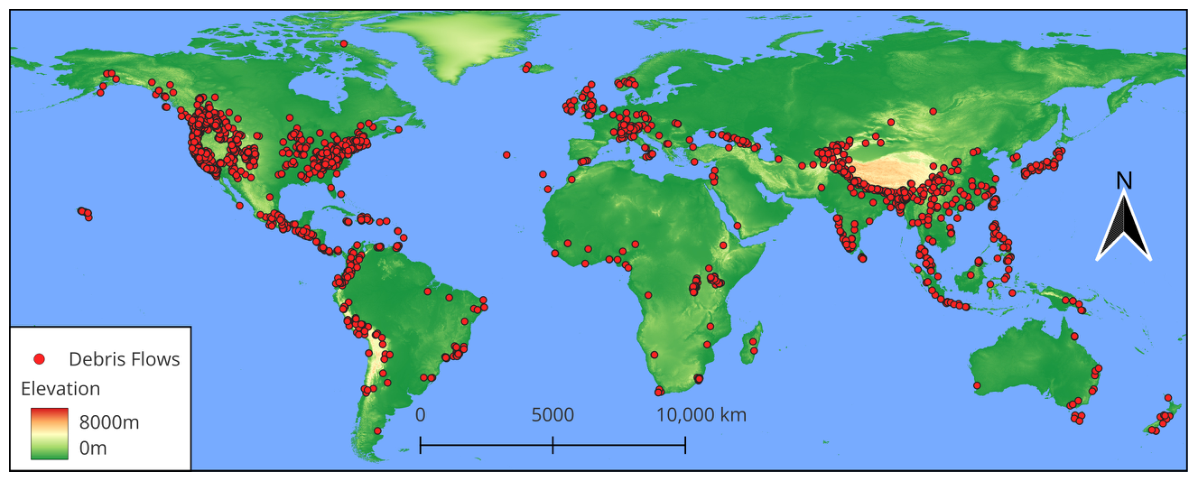
Distribution of debris flows contained in the NASA global landslide catalog. Shown is only the debris-flow-related subset of the full dataset.
Figure 1.
Distribution of debris flows contained in the NASA global landslide catalog. Shown is only the debris-flow-related subset of the full dataset.
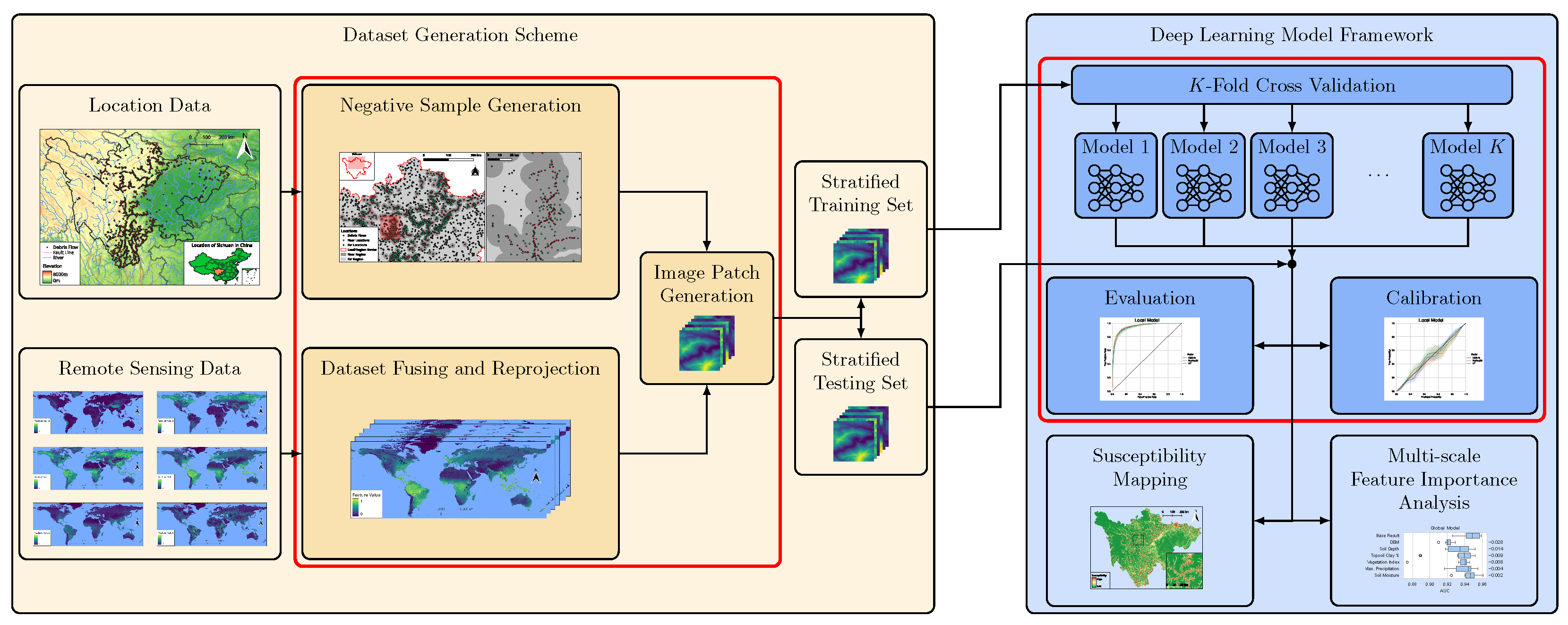
Figure 2.
Overview of the research framework for debris-flow susceptibility. The main contributions—the unified data generation scheme and end-to-end machine learning framework—are highlighted in red.
Figure 2.
Overview of the research framework for debris-flow susceptibility. The main contributions—the unified data generation scheme and end-to-end machine learning framework—are highlighted in red.
Figure 3.
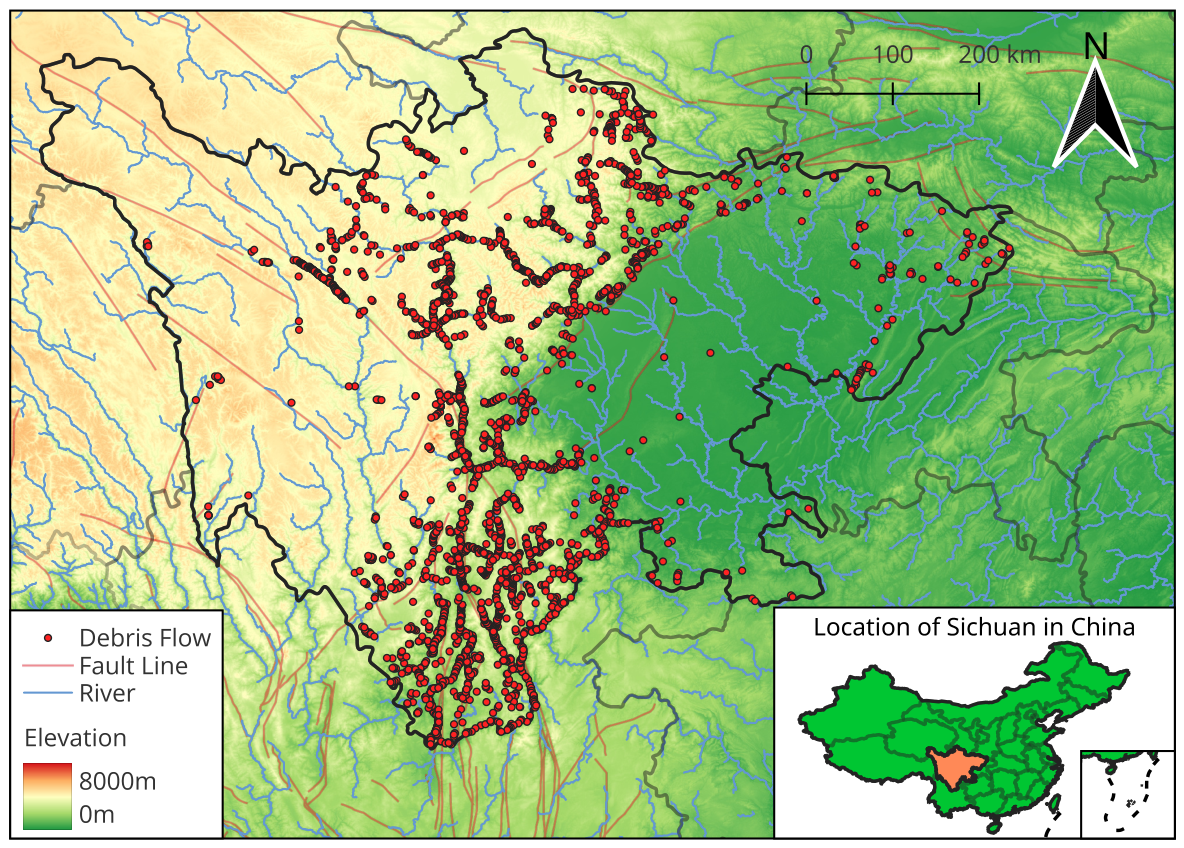
Distribution of debris flows in the Sichuan province, China.
Figure 3.
Distribution of debris flows in the Sichuan province, China.
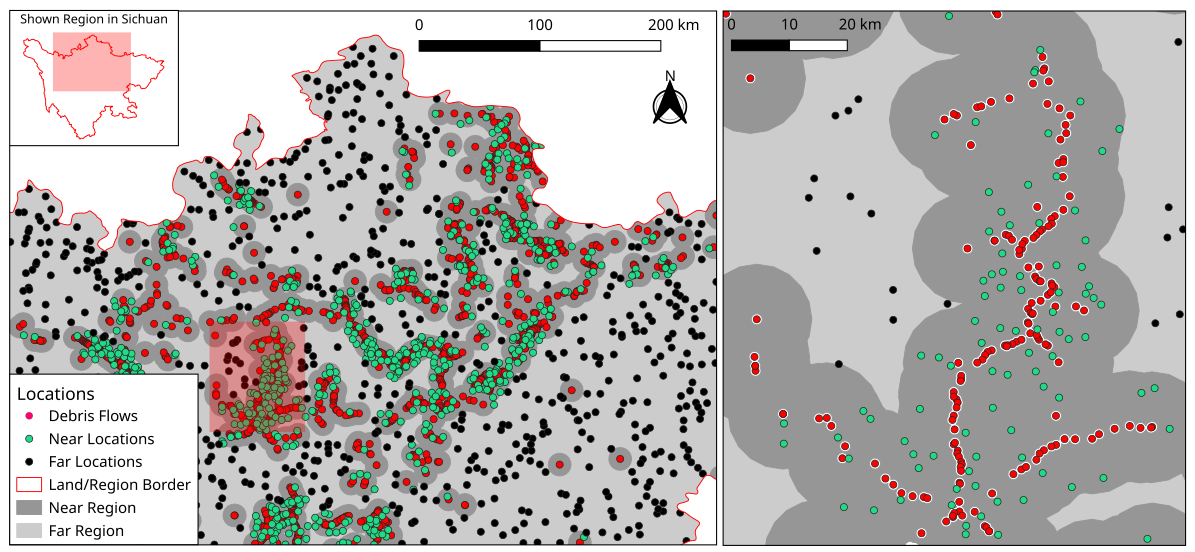
Figure 4.
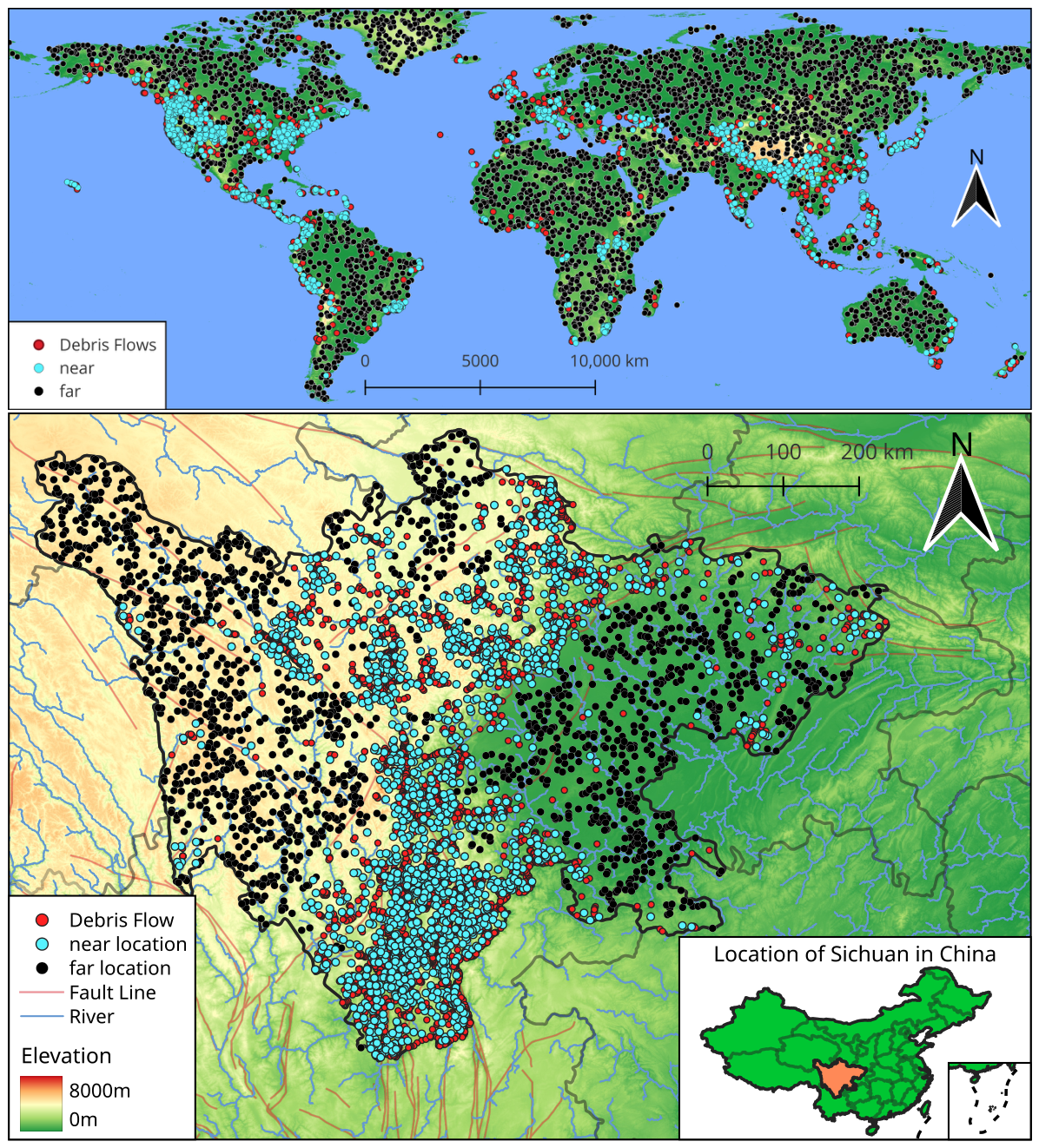
Illustration of the two-step negative sample generation for the local dataset. ‘Near’ locations (green) are randomly generated in the ‘Near region’ close to debris-flow locations. ‘Far’ negative locations (black) are randomly generated in the ‘Far Region’ with a minimum distance to debris-flow locations. The red shaded areas show the location of the close up views.
Figure 4.
Illustration of the two-step negative sample generation for the local dataset. ‘Near’ locations (green) are randomly generated in the ‘Near region’ close to debris-flow locations. ‘Far’ negative locations (black) are randomly generated in the ‘Far Region’ with a minimum distance to debris-flow locations. The red shaded areas show the location of the close up views.
Figure 5.
Distribution of the real debris-flow locations (red), as well as the generated ‘near’ (blue) and ‘far’ (black) locations used for training the global (top) and local (bottom) models. The ‘near’ locations provide negative samples close to the debris-flow locations to focus the susceptibility prediction into a smaller area, while the ‘far’ samples provide coverage of regions with no recorded debris flows.
Figure 5.
Distribution of the real debris-flow locations (red), as well as the generated ‘near’ (blue) and ‘far’ (black) locations used for training the global (top) and local (bottom) models. The ‘near’ locations provide negative samples close to the debris-flow locations to focus the susceptibility prediction into a smaller area, while the ‘far’ samples provide coverage of regions with no recorded debris flows.
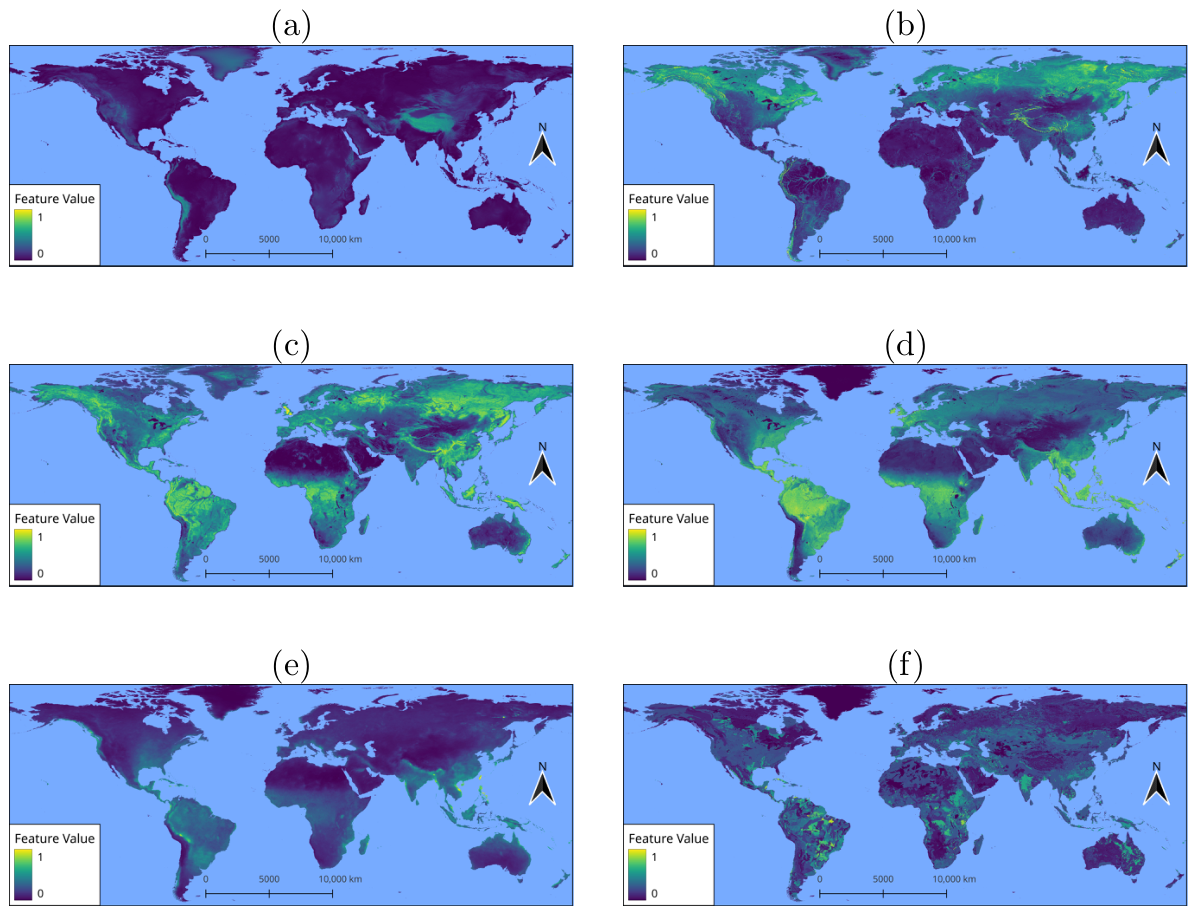
Figure 6.
Examples of the used remote sensing features. Shown is the average of all available years. (a) DEM, (b) Soil Moisture, (c) Soil Depth, (d) Vegetation Index, (e) Max. Precipitation, (f) Topsoil Clay %.
Figure 6.
Examples of the used remote sensing features. Shown is the average of all available years. (a) DEM, (b) Soil Moisture, (c) Soil Depth, (d) Vegetation Index, (e) Max. Precipitation, (f) Topsoil Clay %.
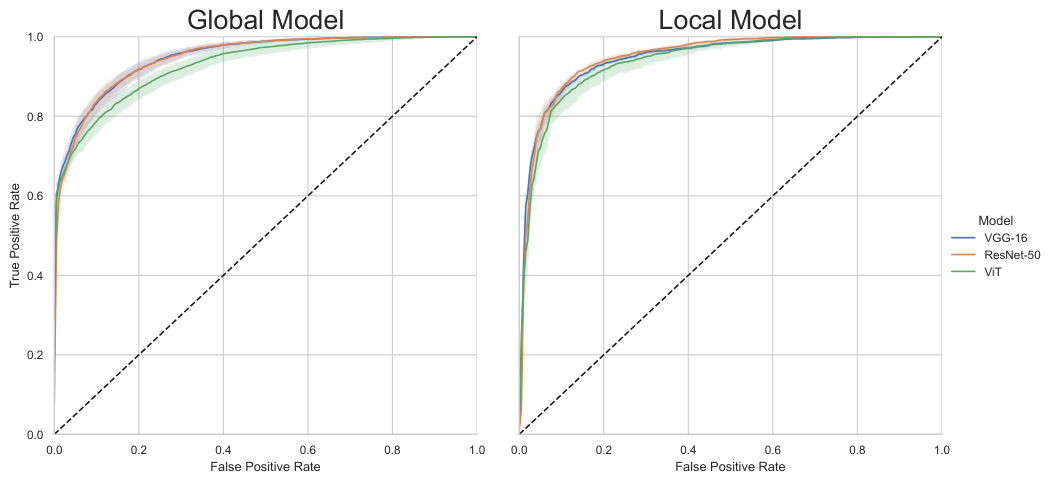
Figure 7.
ROC curves of the global and local models.
Figure 7.
ROC curves of the global and local models.
Figure 8.
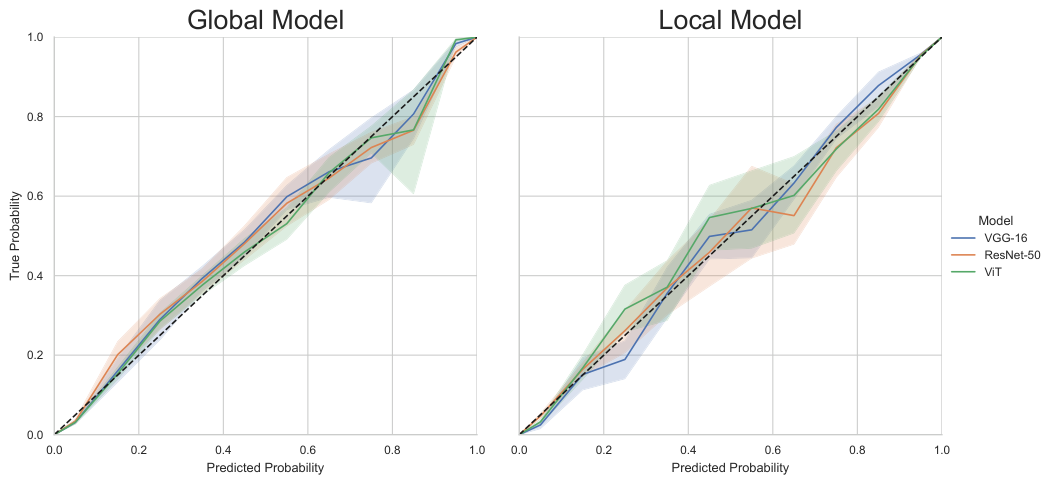
Calibration curves of the global and local models. Each curve shows the mean and 95% confidence interval of the 10 folds of the respective model.
Figure 8.
Calibration curves of the global and local models. Each curve shows the mean and 95% confidence interval of the 10 folds of the respective model.
Figure 9.
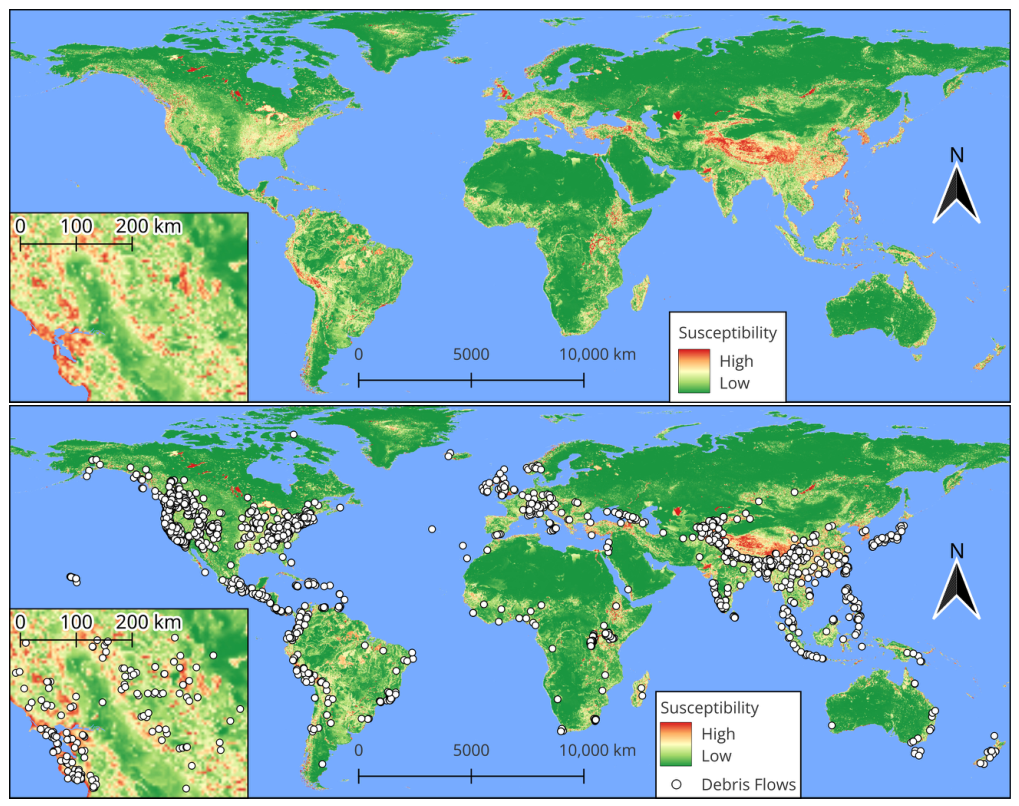
Susceptibility map of the global ResNet-50 model. Display without (top) and with (bottom) known debris-flow locations.
Figure 9.
Susceptibility map of the global ResNet-50 model. Display without (top) and with (bottom) known debris-flow locations.
Figure 10.
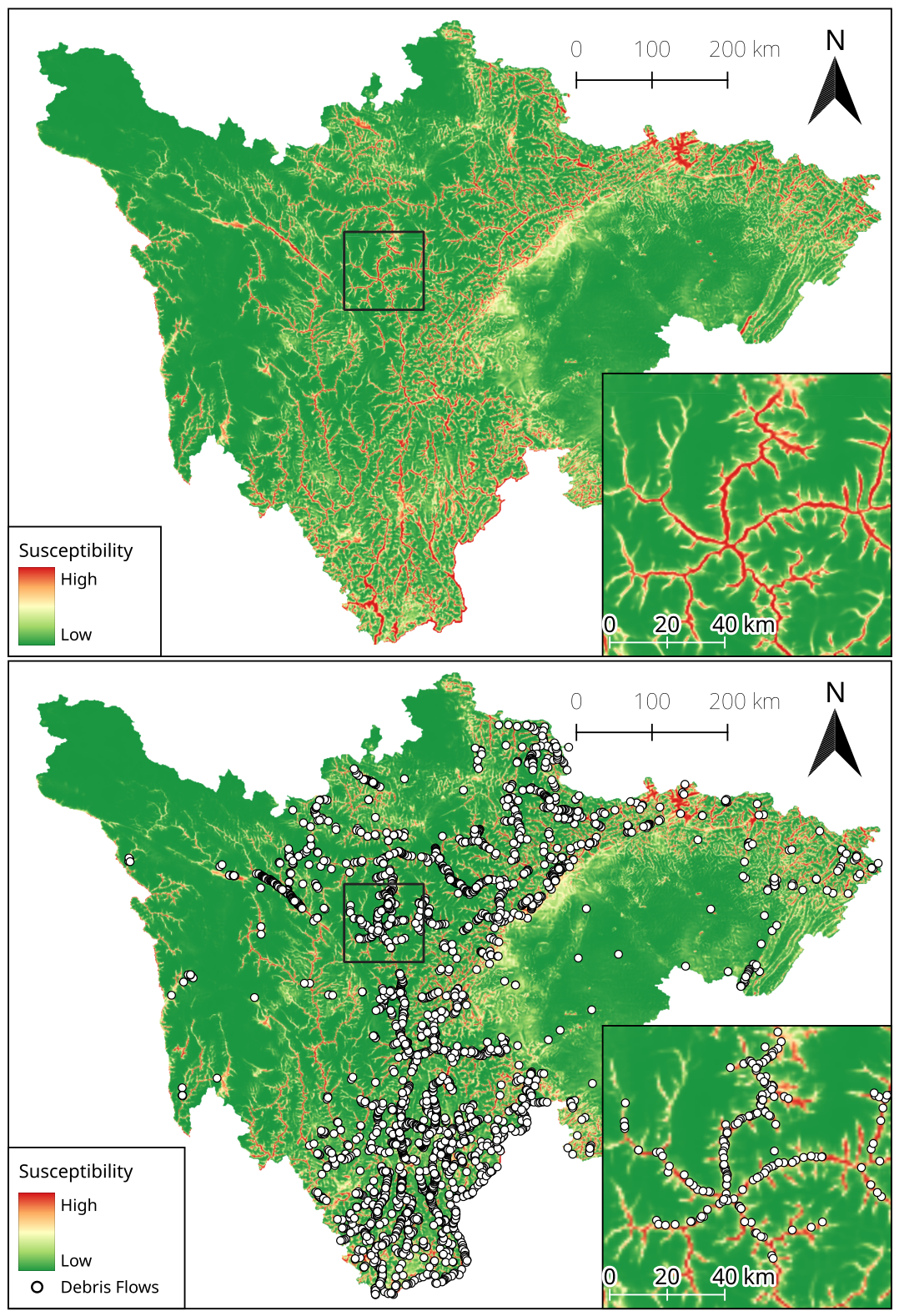
Susceptibility map of the local ResNet-50 model for the Sichuan province. Display without (top) and with known debris-flow locations (bottom). The black box shows the location of the detailed view in Sichuan.
Figure 10.
Susceptibility map of the local ResNet-50 model for the Sichuan province. Display without (top) and with known debris-flow locations (bottom). The black box shows the location of the detailed view in Sichuan.
Figure 11.
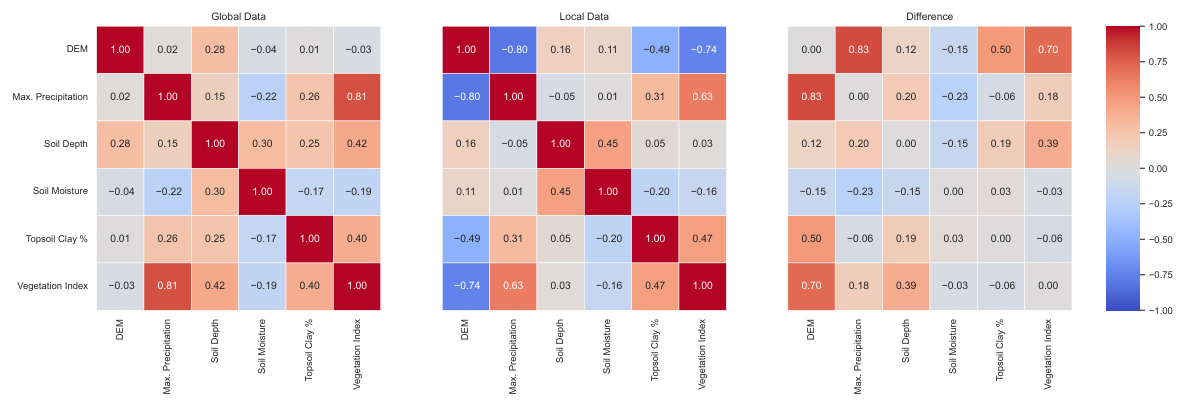
Correlation between features in the global (left) and local (center) datasets, with the difference (global–local, right) between them.
Figure 11.
Correlation between features in the global (left) and local (center) datasets, with the difference (global–local, right) between them.
Figure 12.
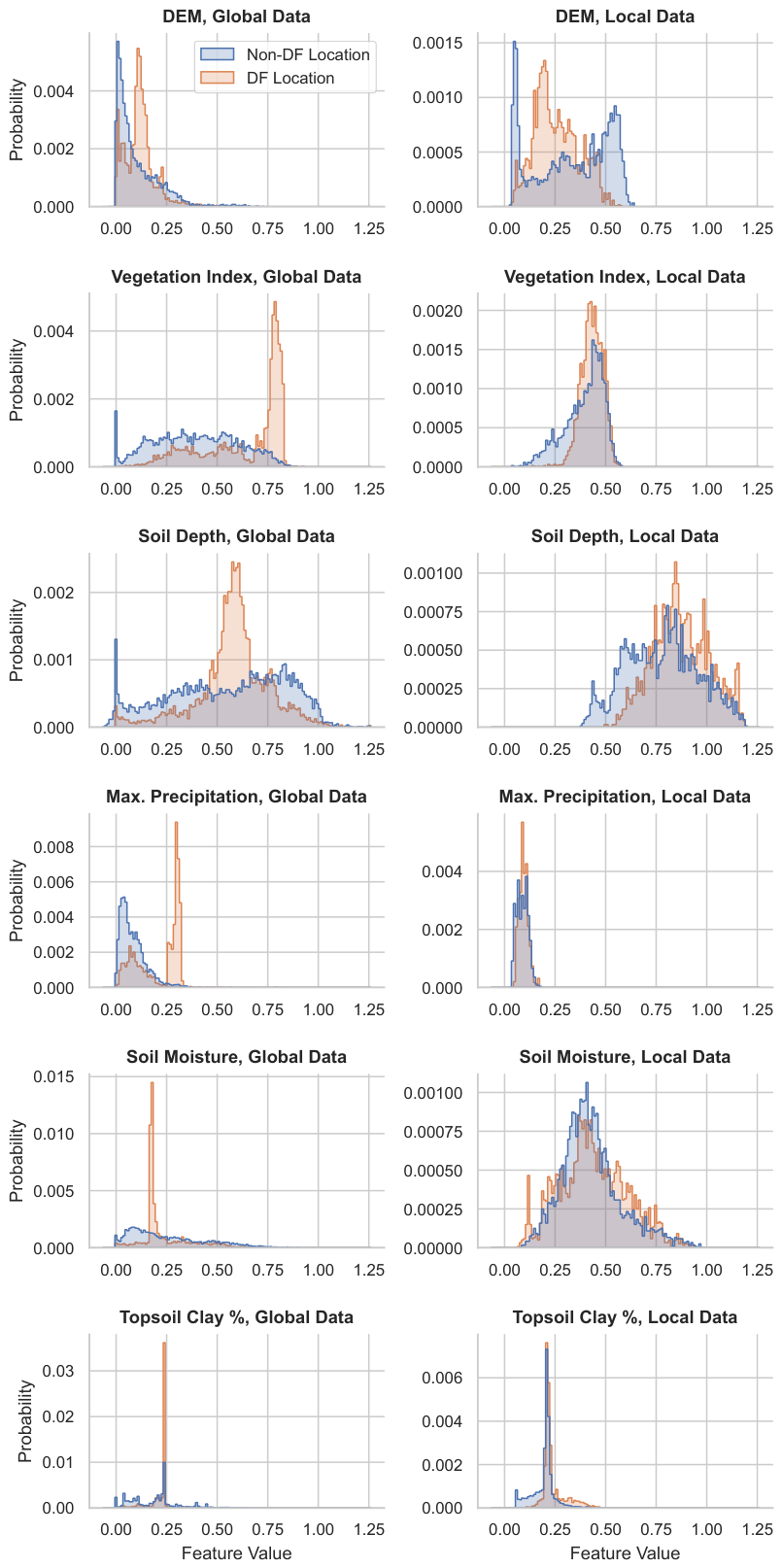
Distributions of mean values of the remote sensing feature patches for the global and local datasets, sorted by non-debris-flow locations (blue) and debris-flow locations (orange).
Figure 12.
Distributions of mean values of the remote sensing feature patches for the global and local datasets, sorted by non-debris-flow locations (blue) and debris-flow locations (orange).
Figure 13.
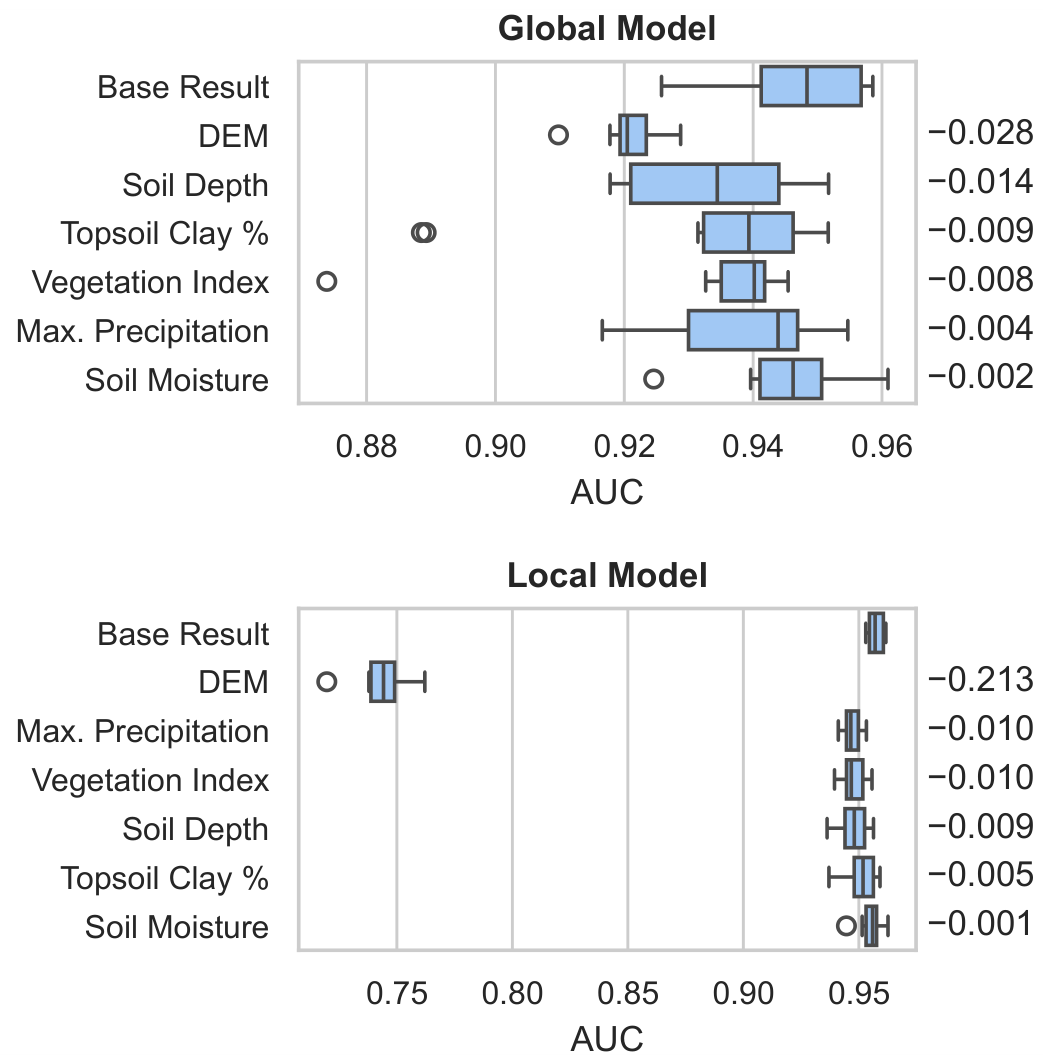
Impact of missing features on debris-flow susceptibility performance in the global and local ResNet-50 model. Shown are the distributions of the 10 models generated with k-fold cross-validation and the difference in median AUC from the base result.
Figure 13.
Impact of missing features on debris-flow susceptibility performance in the global and local ResNet-50 model. Shown are the distributions of the 10 models generated with k-fold cross-validation and the difference in median AUC from the base result.
Figure 14.
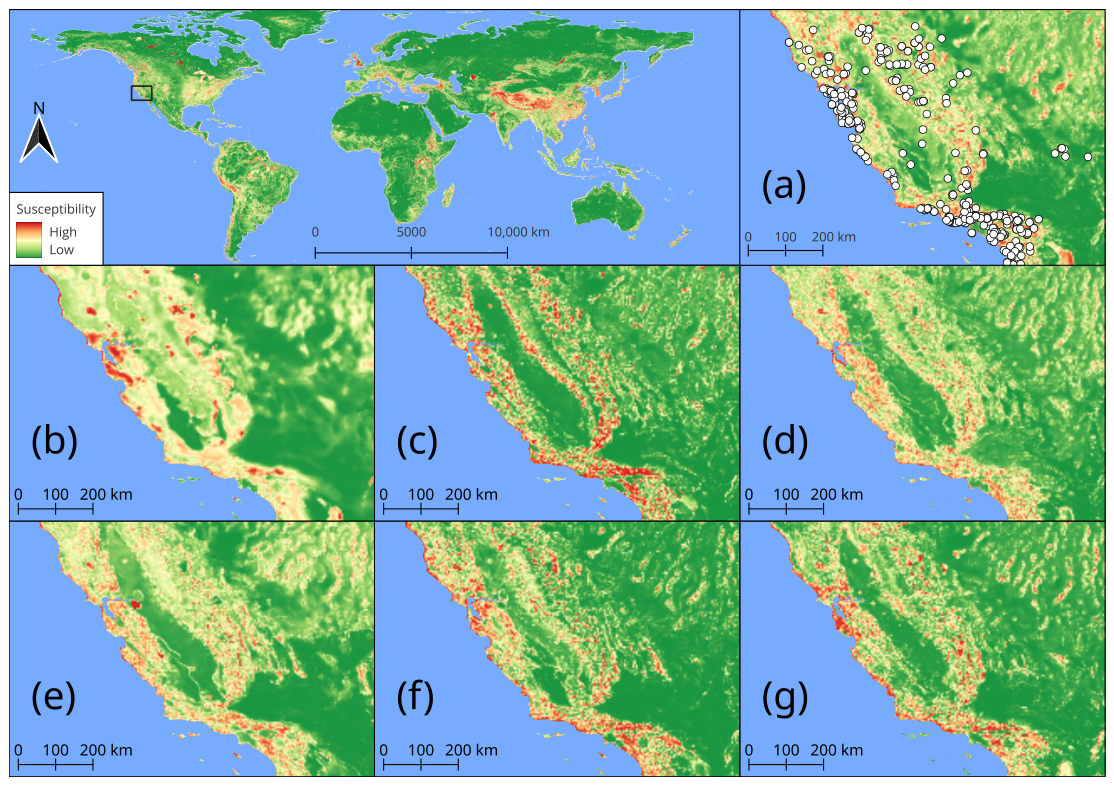
Debris flow susceptibility map of the global model with detailed views of missing features. (a) All features with debris-flow locations, (b) missing DEM, (c) missing soil moisture, (d) missing soil depth, (e) missing vegetation index, (f) missing max. precipitation, and (g) missing topsoil clay %.
Figure 14.
Debris flow susceptibility map of the global model with detailed views of missing features. (a) All features with debris-flow locations, (b) missing DEM, (c) missing soil moisture, (d) missing soil depth, (e) missing vegetation index, (f) missing max. precipitation, and (g) missing topsoil clay %.
Figure 15.
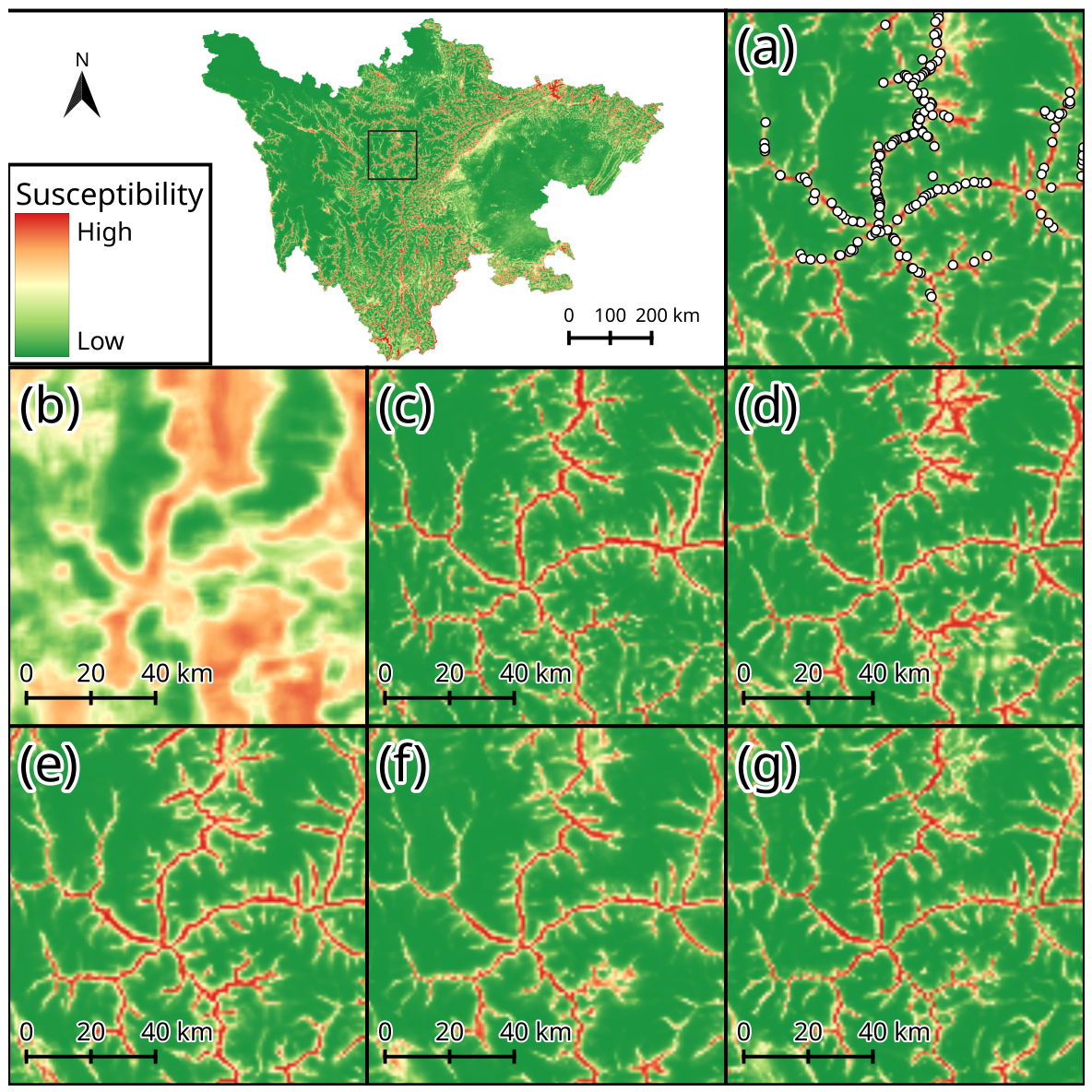
Debris flow susceptibility maps of the local model with detailed views of missing features. (a) All features with debris-flow locations, (b) missing DEM, (c) missing soil moisture, (d) missing soil depth, (e) missing vegetation index, (f) missing max. precipitation, and (g) missing topsoil clay %.
Figure 15.
Debris flow susceptibility maps of the local model with detailed views of missing features. (a) All features with debris-flow locations, (b) missing DEM, (c) missing soil moisture, (d) missing soil depth, (e) missing vegetation index, (f) missing max. precipitation, and (g) missing topsoil clay %.
Table 1.
Overview of the Related Work.
Table 1.
Overview of the Related Work.
| Statistical Modeling |
| Reference | Scale | Study Area | # Samples | # Features | Method |
| de Carvalho Faria Lima Lopes et al. [2] | Local | Southeast Brazil | 87 | 8 | Power Model |
| Liu & Lei [6] | Local | Yunnan, China | 10 | 11 | Power Model |
| Calvo & Savi [13] | Local | Alps, Italy | 13 | 1 | Monte-Carlo model |
| Kurilla & Fubelli [16] | Global | Global | 7989 | 12 | Maximum Entropy |
| Machine Learning |
| Reference | Scale | Study Area | # Samples | # Features | Method |
| Zhao et al. [7] | Local | Loess Plateau, China | ∼380 | 1 | Extra Trees |
| Di et al. [8] | Local | Sichuan, China | ∼3800 | 72 | Gradient Boosting |
| Liang et al. [9] | Local | China | 716 | 7 | Bayesian Network |
| Xiong et al. [10] | Local | Sichuan, China | ∼2500 | 18 | Various |
| Kern et al. [11] | Local | western USA | 388 | 26 | Various |
| Pal et al. [14] | Local | Markazi Province, Iran | ∼700 | 15 | Random Forest |
| Lay et al. [15] | Local | Cameron Highlands, Malaysia | ∼700 | 12 | Support Vector Machine |
| Yuan et al. [17] | Local | Yunnan, China, | 259 | 9 | Support Vector Machine |
| Ferentinou & Chalkias [18] | Local | Greece | 1200 | 16 | Artificial Neural Network |
| Deep Learning |
| Reference | Scale | Study Area | # Samples | # Features | Method |
| Ullah et al. [19] | Local | Hindu Kusch, Pakistan | n/a | 15 | Convolutional Neural Network |
| Zhao et al. [20] | Local | Three Gorges Res., China | ∼4200 | 9 | Transformer |
Table 2.
The used remote sensing data sources.
Table 2.
The used remote sensing data sources.
| Feature | Description | Resolution (m) | Resolution (Deg) | Time Range | Reference |
|---|
| DEM | Digital elevation model | ∼30 m | 0.00028° | - | [24] |
| Soil Moisture | Soil water content | ∼10 km | 0.1° | 2013–2025 | [25] |
| Soil Depth | Depth of the surface soil | ∼10 km | 0.1° | 2013–2025 | [25] |
| Vegetation Index | Average yearly vegetation index | ∼5 km | 0.05° | 1981–2014 | [26] |
| Max. Precipitation | Maximum daily rainfall in a year | ∼10 km | 0.1° | 1998–2025 | [27] |
| Topsoil Clay % | Clay content percentage of the topsoil | ∼1 km | 0.0083° | - | [28] |
Table 3.
Results of the proposed methods on global and local datasets.
Table 3.
Results of the proposed methods on global and local datasets.
| Global Model |
| Method | AUC ↑ | CI ↓ | # Features |
| VGG-16 | | | 6 |
| ResNet-50 | 0.947 | | 6 |
| Vision Transformer | | | 6 |
| Random Forest | | | 6 |
| Histogram Gradient Boost | | | 6 |
| Maximum Entropy (Kurilla & Fubelli [16]) | | | 12 |
| Local Model |
| Method | AUC ↑ | CI ↓ | # Features |
| VGG-16 | | | 6 |
| ResNet-50 | 0.957 | | 6 |
| Vision Transformer | | | 6 |
| Random Forest | | | 6 |
| Histogram Gradient Boost | | | 6 |
| Gradient Boosting Trees (Di et al. [8]) | | | 72 |
Table 4.
Calibration slope and intercept of the global and local models.
Table 4.
Calibration slope and intercept of the global and local models.
| Global Model |
| Method | Calibration Slope | Calibration Intercept |
| VGG-16 | | |
| ResNet-50 | | |
| Vision Transformer | | |
| Local Model |
| Method | Calibration Slope | Calibration Intercept |
| VGG-16 | | |
| ResNet-50 | | |
| Vision Transformer | | |
Table 5.
Effect of different radii on model performance, measured as average AUC and 95% confidence interval of k-fold cross-validation.
Table 5.
Effect of different radii on model performance, measured as average AUC and 95% confidence interval of k-fold cross-validation.
| Global Model |
| | | |
| VGG-16 | | | |
| ResNet-50 | | | |
| Vision Transformer | | | |
| Local Model |
| | | |
| VGG-16 | | | |
| ResNet-50 | | | |
| Vision Transformer | | | |
Table 6.
Statistical significance of feature importance difference between the global and local models. Values are the p-values of a two-sided Wilcoxon rank-sum test. Values marked with a * are statistically significantly different.
Table 6.
Statistical significance of feature importance difference between the global and local models. Values are the p-values of a two-sided Wilcoxon rank-sum test. Values marked with a * are statistically significantly different.
| Feature | Mean Difference | p |
|---|
| DEM | 0.185 | 0.0002 * |
| Soil Depth | 0.005 | 0.47 |
| Topsoil Clay % | 0.004 | 0.68 |
| Vegetation Index | 0.002 | 0.68 |
| Max. Precipitation | 0.006 | 0.21 |
| Soil Moisture | 0.001 | 0.73 |
Table 7.
Change in prediction rates depending on sample type. Columns show the base result and the results of models without the listed feature. Note that, when debris flows are all classified as positive, only is defined, while for the negative generated near and far samples, only is defined.
Table 7.
Change in prediction rates depending on sample type. Columns show the base result and the results of models without the listed feature. Note that, when debris flows are all classified as positive, only is defined, while for the negative generated near and far samples, only is defined.
| Global Model |
| Sample | Score | Base Res. | DEM | S. Depth | Tops. Clay % | Veg. Index | Max. Prec. | S. Moisture |
| debris flow | ↑ | 0.866 | 0.868 | 0.872 | 0.820 | 0.877 | 0.884 | 0.871 |
| near sample | ↓ | 0.144 | 0.208 | 0.150 | 0.073 | 0.199 | 0.165 | 0.098 |
| far sample | ↓ | 0.058 | 0.147 | 0.061 | 0.046 | 0.081 | 0.081 | 0.046 |
| Local Model |
| Sample | Score | Base Res. | DEM | S. Depth | Tops. Clay % | Veg. Index | Max. Prec. | S. Moisture |
| debris flow | ↑ | 0.858 | 0.674 | 0.870 | 0.891 | 0.897 | 0.931 | 0.949 |
| near sample | ↓ | 0.122 | 0.410 | 0.106 | 0.128 | 0.170 | 0.202 | 0202 |
| far sample | ↓ | 0.048 | 0.102 | 0.027 | 0.048 | 0.048 | 0.048 | 0.061 |