Article

Long-Term Wildfire Emissions and Smoke-Plume Dynamics in Greece

by
Thanos Kourantos
1,2,*,
Anna Kampouri
1,
Marios Mermigkas
1,
Konstantinos Michailidis
3,
Apostolos Voulgarakis
4,5,
Mark Parrington
6,
Dimitris Vallianatos
1,
Dimitris Melas
3,
Ioannis Kioutsioukis
2 and
Vassilis Amiridis
1
1
Institute for Astronomy, Astrophysics, Space Applications and Remote Sensing (IAASARS), National Observatory of Athens, 10560 Athens, Greece
2
Laboratory of Atmospheric Physics, Department of Physics, University of Patras, 26504 Rio, Greece
3
Laboratory of Atmospheric Physics, Physics Department, Aristotle University of Thessaloniki, 54124 Thessaloniki, Greece
4
School of Chemical and Environmental Engineering, Technical University of Crete, 731 00 Chania, Greece
5
Leverhulme Centre for Wildfires, Environment and Society, Imperial College London, London SW7 2AZ, UK
6
European Centre for Medium-Range Weather Forecasts, RG2 9AX Bonn, Germany
*
Author to whom correspondence should be addressed.
Remote Sens. 2026, 18(9), 1438; https://doi.org/10.3390/rs18091438
Submission received: 16 March 2026 / Revised: 29 April 2026 / Accepted: 1 May 2026 / Published: 5 May 2026

Highlights

What are the main findings?
  • Wildfire emissions in Greece have shown a modest but statistically significant upward trend since 2003.
  • Peak fire years released up to 15–17% of national anthropogenic CO2.
What are the implications of the main findings?
  • Plume-injection heights remain predominantly below 1.5 km, indicating strong impacts on surface-air quality.
  • Extreme wildfire emissions are linked to strong wind forcing and cumulative drought conditions.

Abstract

This study investigates long-term wildfire emissions and smoke-plume geospatial characteristics in Greece by analyzing a multi-pollutant dataset spanning January 2003 to August 2025. Details of emissions of carbon monoxide (CO), carbon dioxide (CO2), methane (CH4), particulate matter (PM2.5), organic carbon (OC), and black carbon (BC) were derived from the Global Fire Assimilation System (GFAS), which converts MODIS fire radiative power into trace gas and aerosol fluxes at 0.1° resolution, and also accounts for the land type. Burned-area statistics from the European Forest Fire Information System (EFFIS) were used for cross-validation. Data were processed into daily, monthly, annual, and cumulative time series, with spatial mapping at the municipality scale and information regarding long-term trends. The analysis shows that while there are several sizeable wildfire events in the country every year, the bulk of the total of Greek wildfire emissions for the last 23 years is attributable to a few extreme fire seasons (2007, 2021, and 2023) that produced abrupt emission surges and accounted for a disproportionate share of national totals. Analysis of spatial data identifies the areas of Evia, East Attica, Messinia, and Evros as persistent emission hotspots. Although wildfire CO2 emissions are generally a minor fraction of Greece’s anthropogenic totals (<5%), they reached 15–17% during peak fire years. Plume-injection height analysis reveals that most smoke remains below ~1 km but can reach 3–6 km during extreme events, facilitating long-range transport. Overall, the dataset demonstrates a shift toward more intense and concentrated wildfire events in recent years, highlighting both their growing climatic relevance and their acute impacts on regional air quality.

1. Introduction

Greece’s Mediterranean climate, characterized by mild, wet winters and hot, dry summers, creates ideal conditions for wildfire ignition and spread. Forested areas cover 50–60% of the country, providing abundant fuel for fires [1]. In eastern Greece, summers are marked by high temperatures, low relative humidity, and strong winds, increasing the fire risk during May to October [1].
Regional research indicates that under heatwave or hot drought conditions, where extreme heat coincides with prolonged dryness, wildfires escalate to intense, widespread events, often referred to as megafires, causing severe ecological and socio-economic impacts [2,3]. Beyond the direct damage they cause, wildfires exert substantial influence on both weather and atmospheric composition [4]. Smoke plumes from intense fire events alter local radiation balances by scattering and absorbing solar energy, which can suppress or enhance convection, depending on the aerosol loading [5]. Furthermore, interactions between wildfire aerosols and cloud microphysics [6] may impact precipitation patterns, leading to feedback in regional weather systems [7].
From an air-quality perspective, wildfire emissions contribute large quantities of trace gases and aerosols, causing significantly deteriorating atmospheric conditions. Fine particulate matter (PM2.5) from wildfires is especially hazardous as it penetrates deep into the lungs and bloodstream, leading to respiratory and cardiovascular illnesses, exacerbating asthma, and increasing premature-mortality rates [8]. Episodes of intense fire activity in southern Europe, including Greece, have been associated with hospital admissions for respiratory diseases and measurable increases in mortality [9]. A well-documented case occurred during the 2009 Attica wildfires, when smoke transported into Athens led to severe deterioration of urban air quality. Observations showed substantial increases in aerosol optical depth and surface-particle concentrations, underscoring the ability of wildfire plumes to overwhelm air quality in densely populated regions [10]. Similar findings have been documented in the United States, where wildfire smoke plumes frequently cause widespread exceedances of air-quality standards, with elevated PM2.5 and ozone levels extending across hundreds of kilometers. These episodes have been linked to surges in respiratory and cardiovascular hospital admissions and premature mortality, underscoring the severe public health risks associated with wildfire emissions [11]. Beyond acute outcomes, evidence is emerging regarding the long-term health risks of repeated wildfire-smoke exposure. A population-based cohort study in Canada found that individuals living in areas with chronic wildfire activity faced an elevated risk of cancer incidence, including lung and brain cancers, likely due to prolonged exposure to carcinogenic compounds such as polycyclic aromatic hydrocarbons (PAHs) bound to particulate matter [12]. This suggests that wildfire smoke is not only a short-term respiratory hazard but also a contributor to chronic-disease burden in exposed populations.
The injection height of wildfire plumes adds another crucial dimension to both atmospheric and health impacts. It determines whether smoke remains trapped within the planetary boundary layer, thereby directly degrading surface-air quality and elevating human exposure to fine particles and trace gases, or whether it is lofted into the free troposphere, where it can persist for extended periods and undergo long-range transport, influencing regional atmospheric composition, cloud microphysics, and radiative balance [13,14,15]. High-altitude injections prolong aerosol lifetimes and increase the geographical reach of pollution episodes, while low-altitude plumes pose the greatest risk to densely populated urban areas by sustaining elevated concentrations of PM2.5 and ozone precursors near the surface [8,9]. Thus, injection height acts as a critical control on whether wildfire impacts are primarily local, affecting public health, or regional to global, affecting atmospheric composition and climate.
Carbon dioxide (CO2), the dominant long-lived greenhouse gas, accounts for about 65% of radiative forcing and is rising by roughly 2 ppm annually due to human activities, driving global warming. Methane (CH4), with approximately 27–30 times the warming potential of CO2 over a 100-year horizon, has increased by ~259% since pre-industrial times and now contributes ~16% of radiative forcing, with recent growth rates at record highs [4,16]. Carbon monoxide (CO), although short-lived, influences air quality and climate by reacting with hydroxyl radicals (OH), thereby affecting the lifetime of other GHGs and contributing to tropospheric-ozone formation [4]; it originates mainly from fossil fuel combustion, biomass burning, and industry, and is used as a tracer for pollution transport, including wildfire plumes. Wildfires emit a complex mixture of trace gases such as CO2, CO, CH4, and nitrogen oxides (NOx) and aerosols such as organic carbon (OC), black carbon (BC), and PM2.5, with BC being particularly significant due to its dual role as a climate forcer and toxic pollutant. BC deposition on snow and glaciers can lower surface albedo by up to 50%, accelerating melt rates by ~10% per season, meaning wildfire emissions affect not only air quality and climate but also hydrological systems and water resources [4,13,17].
Despite growing attention being paid to Mediterranean wildfire trends, there is a notable research gap. Few studies offer long-term, multi-pollutant wildfire-emission analysis in Greece, and few integrate plume dynamics. By examining wildfire emissions from 2003 to August 2025, this study fills that gap by assessing temporal trends, spatial hotspots, anomalous years, and the interplay between fire intensity and plume-injection-height behavior.

2. Materials and Methods

2.1. Study Area

The study focuses on Greece, located in the eastern Mediterranean basin, encompassing mainland territory and numerous islands, including Crete and the Aegean archipelago. The region’s complex topography, diverse vegetation types, and pronounced seasonal climate patterns strongly influence wildfire occurrence and behavior. Forested areas, shrublands, and agricultural lands provide significant fuel loads, while summer meteorological conditions, characterized by high temperatures, low humidity, and often strong winds, create an elevated risk of large wildfire events [1].

2.2. Data Source

Wildfire emissions were derived from the Global Fire Assimilation System (GFAS), developed by the Copernicus Atmosphere Monitoring Service (CAMS) and operated by the European Centre for Medium-Range Weather Forecasts (ECMWF). GFAS assimilates satellite observations of fire radiative power (FRP) from the Moderate Resolution Imaging Spectroradiometer (MODIS) instruments aboard NASA’s Terra and Aqua satellites to produce daily global fields of wildfire emissions. Using biome-specific emission factors, FRP is converted into emission fluxes of trace gases and aerosols at a spatial resolution of 0.1° × 0.1° (~10 km), reported in kg m−2 s−1 [18].
MODIS FRP observations are subject to limitations due to cloud cover and satellite-overpass constraints. To quantify the impact of these limitations, we estimated the effective observational sampling over Greece by analyzing MODIS overpasses during days with active fire activity. For each day, the fraction of cloud-free versus cloud-contaminated pixels was calculated over the study domain. The results indicate that during the peak fire season (June–September), the mean cloud fraction is approximately 25%, while higher values of around 32% are observed when extending the analysis to the broader April–September period.
GFAS is an assimilation product that integrates satellite observations of FRP to provide continuous emission estimates [18]. Since GFAS is primarily driven by MODIS FRP observations, its performance depends on the availability of satellite detections. During periods of increased cloud cover, active fires may not be detected, potentially leading to partial underrepresentation of fire activity.
The pollutants analyzed in this study include CO, CO2, BC, OC, PM2.5, and CH4. Each pollutant plays a distinct role in atmospheric chemistry and environmental impacts. CO is a toxic gas and precursor to tropospheric ozone, particularly in remote and forested environments where wildfire emissions contribute significantly, although nitrogen oxides (NOx) and volatile organic compounds (VOCs) are the primary drivers of ozone formation in urban atmospheres [19,20,21]; CO2 is the principal greenhouse gas driving long-term climate change; CH4 is a potent short-lived climate forcer; and PM2.5, OC, and BC are critical for both air quality degradation and radiative forcing. In particular, BC is a short-lived climate forcer with strong light-absorbing properties that reduce surface albedo when deposited on snow and ice, while in the atmosphere it enhances positive radiative forcing. From a health perspective, BC is a toxic component of PM2.5 associated with cardiovascular and respiratory diseases and often carries hazardous organic compounds into the lungs [13,17,22].
A key feature of GFAS is the provision of plume-injection height, representing the altitude at which smoke plumes are released into the atmosphere. Injection height is calculated using a plume-injection-height model coupled with meteorological data and is critical for atmospheric-transport modeling since vertical distribution strongly determines pollutant dispersion, chemical transformation, and removal processes [23]. Plumes injected above the planetary boundary layer can reach the free troposphere, enabling long-range transport across the Eastern Mediterranean and beyond, while lower injections primarily impact local and regional surface-air quality.
The dataset used in this study spans from January 2003 to August 2025 and is based on the GFAS product, which includes a consistent multi-pollutant record suitable for long-term analysis of wildfire emissions and injection heights over Greece.
To place wildfire emissions in a broader national context, anthropogenic CO2 emission data were obtained from the Greek National Inventory Report (NIR) and submitted to the United Nations Framework Convention on Climate Change (UNFCCC) [24]. These data represent total national emissions excluding the Land Use, Land Use Change, and Forestry (LULUCF) sector, following established inventory methodologies [25,26], ensuring consistency when comparing wildfire emissions with anthropogenic sources. The national inventory data was used solely for comparative purposes in Section 3.3.

2.3. Data Preprocessing

GFAS data were numerically processed to determine emission patterns. Flux values F (kg m−2 s−1) were converted into total daily emissions per day (kg/day) for each grid cell by multiplying the cell area A(φ) and the number of seconds in a day (86,400):
Eday = F × A(φ) × 86.400,
where
A(φ) ≈ (R×Δϕ) × (R × Δλ × cosφ),
where φ is latitude and λ is longitude (in radians), with R = 6.371.000 m and Δϕ = Δλ = π/1800 (0.1° in radians). For grid cells partially over water, the full cell area was retained for domain-wide emission totals; land–sea masking was only applied for spatial-mapping products.
For the creation of municipality-level maps, GFAS grid cells were spatially intersected with administrative boundaries from the Global Administrative Areas (GADM) database. This operation was used solely for the mapping output (monthly or annual choropleths) and did not affect domain-wide temporal analyses, which were calculated from all GFAS grid cells whose centers fall within the national boundary of Greece. For municipality maps, emissions were apportioned to polygons based on the fractional cell overlap and then aggregated to monthly and annual totals.
Numerical processing of GFAS data was performed using open-source code, whereas land-cover (CORINE) and vegetation (NDVI) datasets were processed using Google Earth Engine (Google LLC, Mountain View, CA, USA).

2.4. Analytical Methods

Wildfire emissions in Greece were analyzed using temporal, spatial, and vertical approaches. Temporal variability was assessed with daily, monthly, and annual GFAS time series (2003–2025), including cumulative plots by day of year and deseasonalized trends derived from Sen’s slope [27]. Spatial analysis was performed at the municipality level, aggregating annual and cumulative black carbon and pollutant totals to identify regional emission hotspots. To complement GFAS, annual wildfire CO2 emissions were compared against burned-area data from the European Forest Fire Information System (EFFIS) [28,29]. Vertical plume characteristics were examined using GFAS injection-height outputs (2018–2025), with annual statistics and frequency distributions calculated. The interpretation of these results was placed in a broader context through comparisons with findings from previous studies based on satellite aerosol-layer-height retrievals (e.g., Sentinel-5P TROPOMI, and MISR) and ground-based-lidar observations, which have repeatedly confirmed that extreme wildfires in Greece are capable of lofting smoke into the free troposphere, often reaching 3–6 km [30,31,32].

3. Results

The results present wildfire emissions in Greece for 2003–2025, with BC and CO2 as the primary tracers of combustion and climate impact. Analyses include temporal variability (daily, monthly, and annual means, and cumulative trajectories), spatial distribution at the municipality level, and plume-injection-height characteristics. Together, these provide an integrated view of the magnitude, location, timing, and vertical transport of wildfire emissions.

3.1. Cumulative Emissions of Multiple Pollutants

In this section, we calculate and present the cumulative wildfire emissions for Greece over the period 2003–2025, using the GFAS dataset. The analysis includes major trace gases and aerosols, specifically CO2, CO, PM2.5, NOx, OC, BC, and CH4. For each species, annual cumulative totals were derived to illustrate the temporal progression of emissions throughout the fire season, providing a consistent basis for comparing interannual variability across the 23-year record.
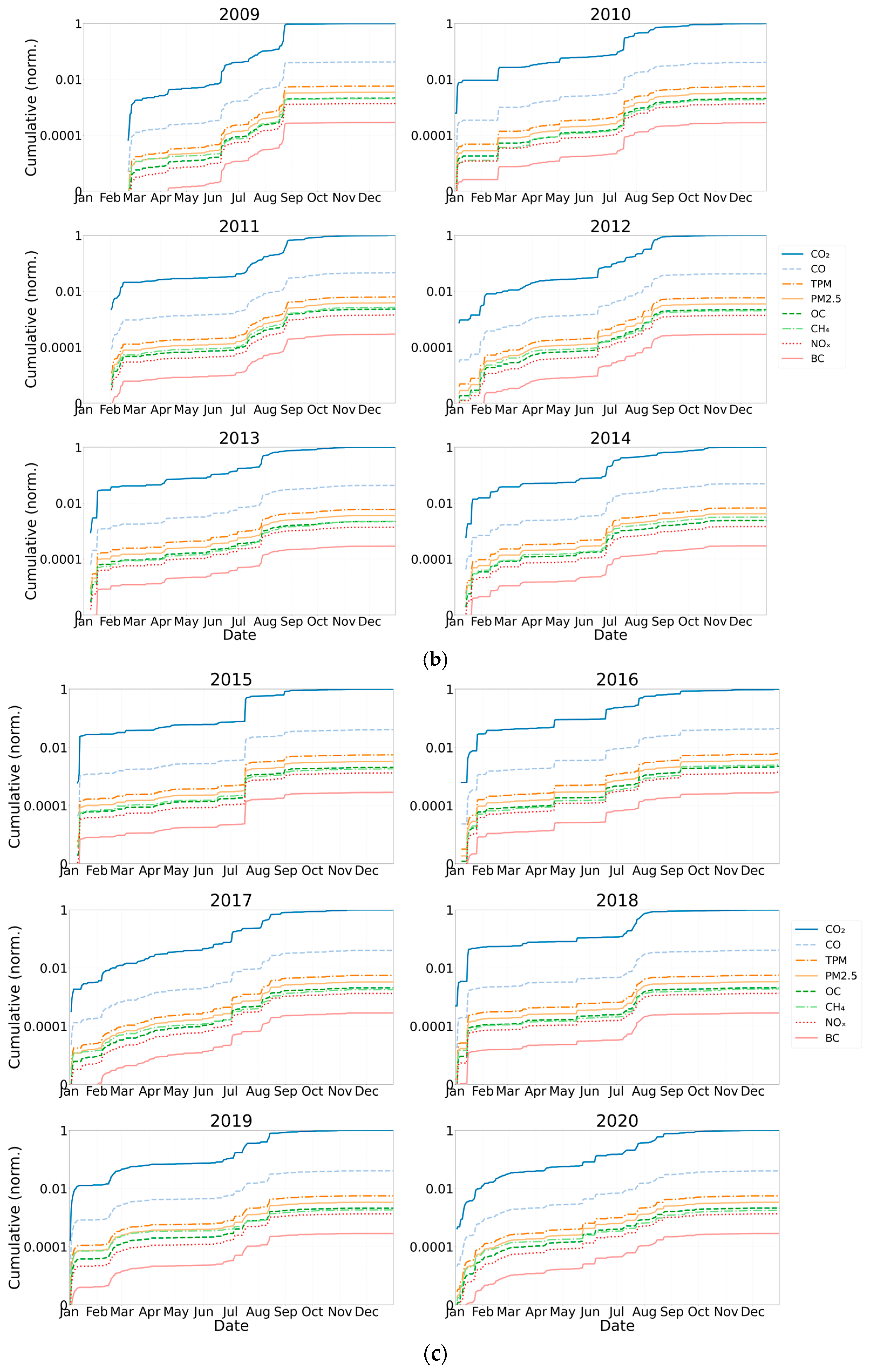
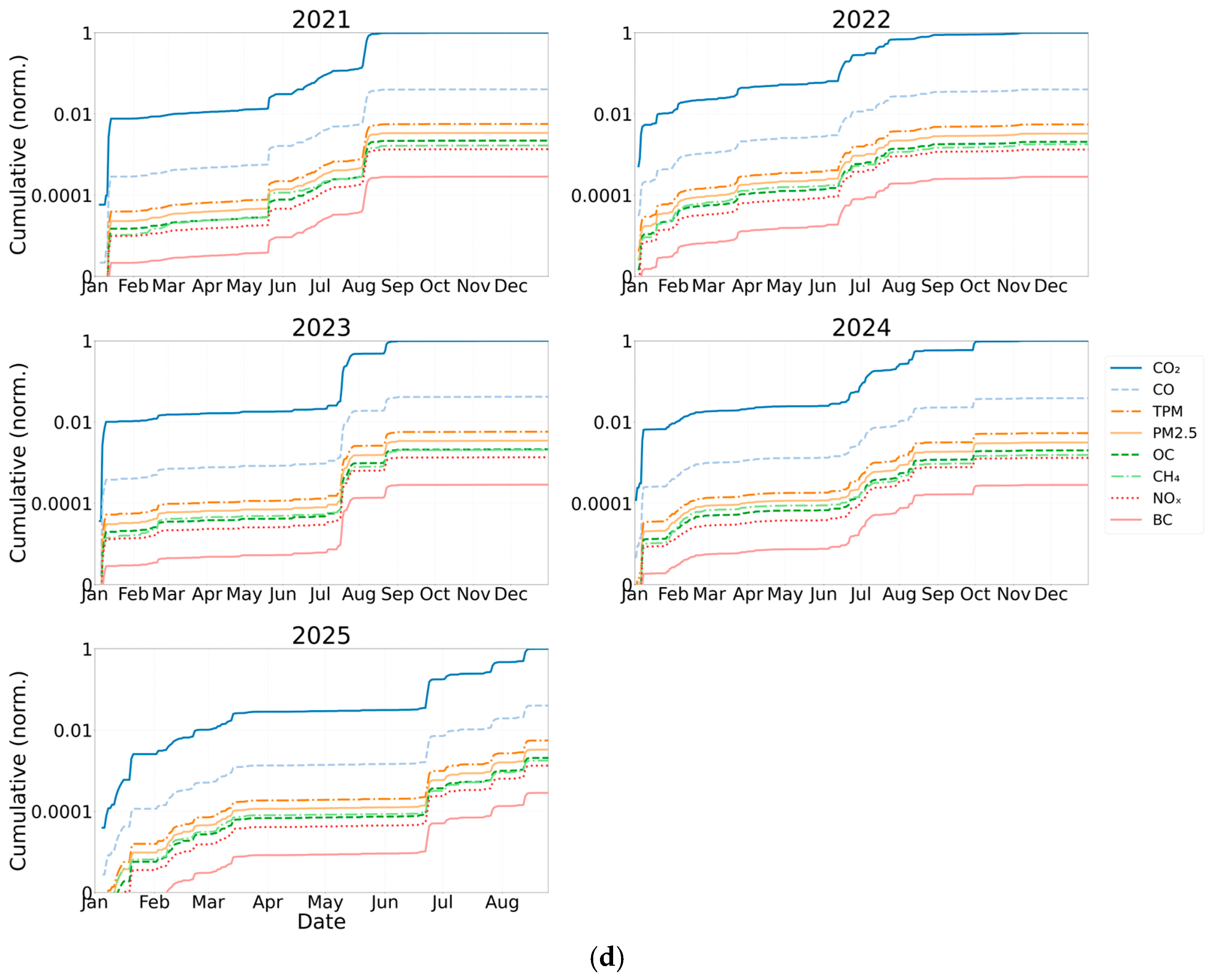
The cumulative wildfire emissions (2003–2025), normalized by the annual CO2 total, illustrate the contrasting roles of moderate- and extreme fire seasons in shaping Greece’s atmospheric-pollution burden (Figure 1a–d). Across all years, CO2 accounted for the largest fraction of total emissions, followed by CO, TPM, PM2.5, and OC, while CH4, NOX, and BC contributed smaller but significant amounts.
A key feature of the cumulative curves is the contrast between earlier and more recent years of the record. During the first half of the study period (2003–2010), emissions generally increased in smoother increments through the summer months, with moderate seasonal steps reflecting more dispersed fire activity. In contrast, several later years, including 2007 and the extreme fire seasons of 2021 and 2023, exhibit sharp, step-like increases concentrated in late July and August. These abrupt jumps correspond to major fire outbreaks that released large pollutant loads within relatively short periods. Similar step-like increases can also be identified in other years, although they tend to be less intense and may occur at different points within the fire season. However, the number of recent extreme years remains limited, and additional years of observations will be required to assess whether this behavior represents a persistent shift in seasonal emission patterns.
The year 2007 stands out as the most extreme case, with cumulative curves showing near-vertical rises in late August, reflecting the Peloponnese mega fires. Similarly, in 2021, emissions surged during the Northern Evia and Attica wildfires, driving some of the steepest cumulative increases in CO2, CO, PM2.5, and BC observed across the entire dataset. In 2023, the Evros fires produced another step-change signature, with large emission increases over a short period despite a smaller total burned area compared to 2007 [33].
Overall, the cumulative trajectories confirm that Greek wildfire emissions are not the product of steady seasonal burning but are dominated by short-lived, high-intensity fire episodes. These findings also highlight a shift in recent decades toward more abrupt and concentrated emission events, reflecting changes in fire frequency, intensity, and fuel consumption under increasingly extreme weather conditions.

3.2. Spatial Distribution of Wildfire Emissions

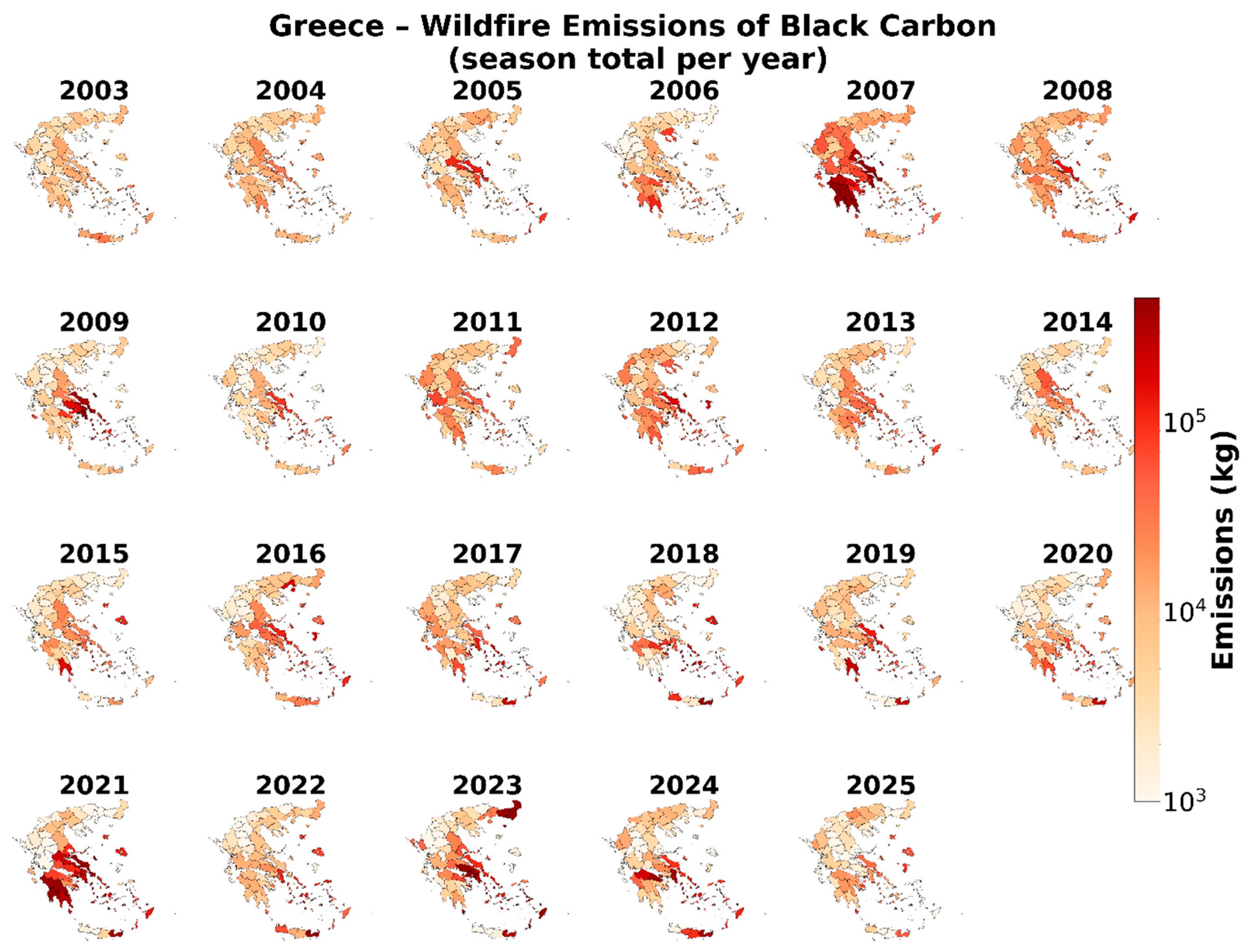
The spatial analysis of emissions (we show BC as a representative species) at the municipality level (2003–2025) reveals both the localized nature of wildfire impacts and the dominance of a few regions (Figure 2). Annual-emission maps highlight strong spatial heterogeneity: certain municipalities repeatedly appear as emission hotspots, while others remain relatively unaffected throughout the study period. Severe fire years such as 2007, 2021, and 2023 are clearly distinguished by extensive high-emission clusters, particularly in the Peloponnese (Messinia, Arcadia, and Ilia), Attica and Evia, and northeastern Greece (Evros). By contrast, years such as 2010 and 2014 show limited fire activity, while 2025 represents a moderate to above-average year. These results emphasize that Greece’s wildfire emissions are episodic and highly localized, reflecting the occurrence of a few catastrophic events rather than widespread moderate burning.
To quantify the spatial contribution of different municipalities, Table 1 lists the top emitters in their peak fire years. The most extreme case was Evia in 2021, with 1.4 kt BC, followed by Messinia and Arcadia during the 2007 megafires, both exceeding 1.0 kt BC. In 2023, Evros in northeastern Greece contributed nearly 0.8 kt BC, highlighting the regional diversity of regions experiencing extreme wildfire events, from the southwest to the northeast of Greece.
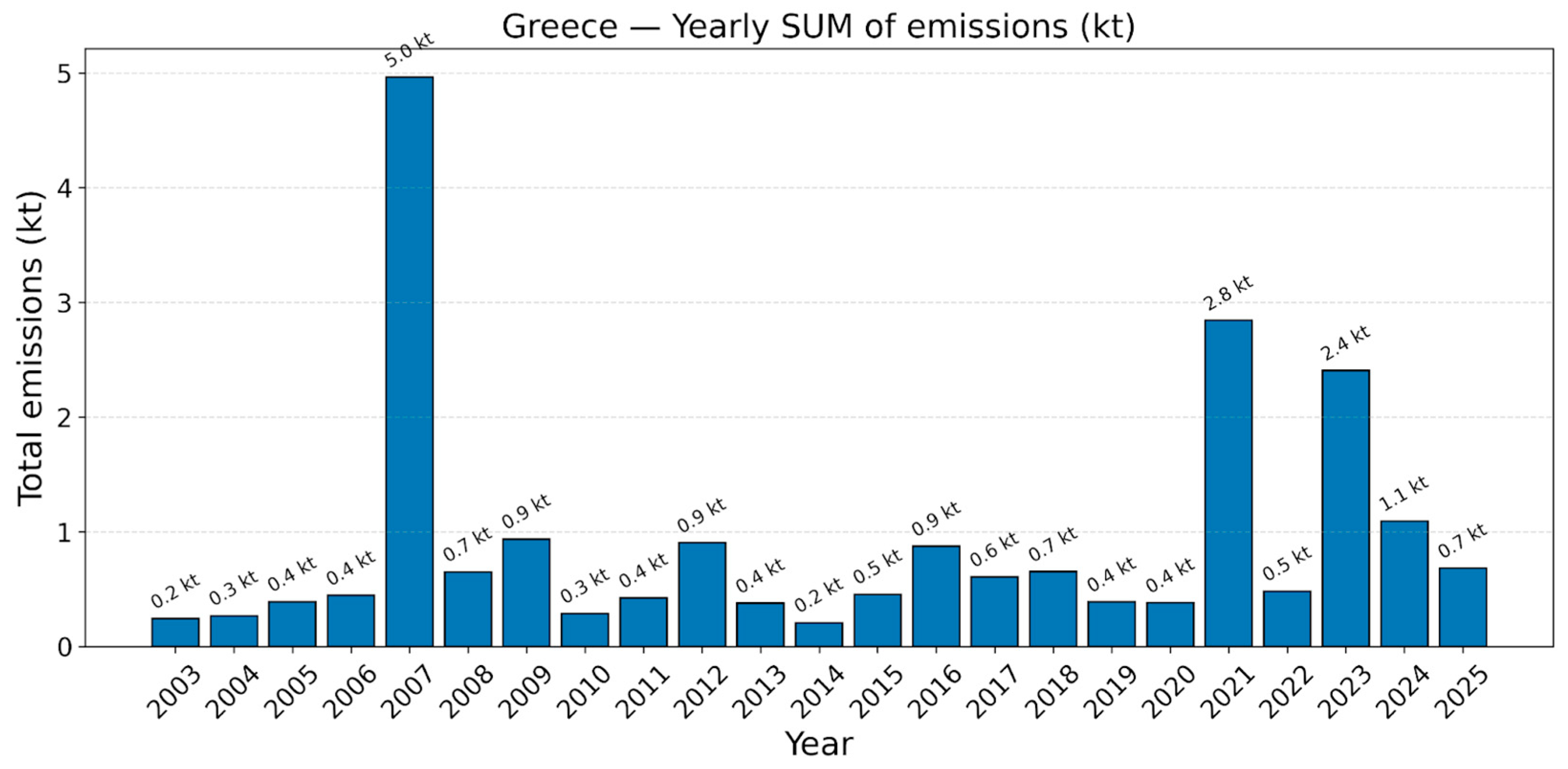
The annual national totals of BC emissions (Figure 3) also demonstrate pronounced interannual variability, with relatively low background levels in most years punctuated by a small number of exceptional seasons that dominate the long-term budget. The largest peak occurs in 2007, followed by secondary maxima in 2021 and 2023, confirming that Greek wildfire emissions are strongly event-driven at the national scale. This behavior is consistent with previous global-scale studies showing that biomass burning is a major driver of interannual variability in atmospheric trace gases and aerosols, and can produce substantial year-to-year fluctuations in atmospheric composition during extreme fire years [34].
A cumulative analysis of BC emissions (2003–2025) further confirms the skewed contribution of a few municipalities (Table 2). Northern Evia dominates the long-term record with more than 3.2 kt BC, nearly double the total of the second ranked East Attica (1.5 kt). Other persistently high contributors include Messinia, the Dodecanese, and Ilia, each exceeding 1.2 kt over the 23-year period.

3.3. Annual Totals and Contribution of Extreme Years

In this section, annual totals of wildfire CO2 emissions are evaluated to assess the relative contribution of individual years to the long-term record. The analysis draws exclusively on GFAS data and focuses on interannual variability, the role of extreme fire seasons, and their comparison to national-scale-emission and burned-area datasets.
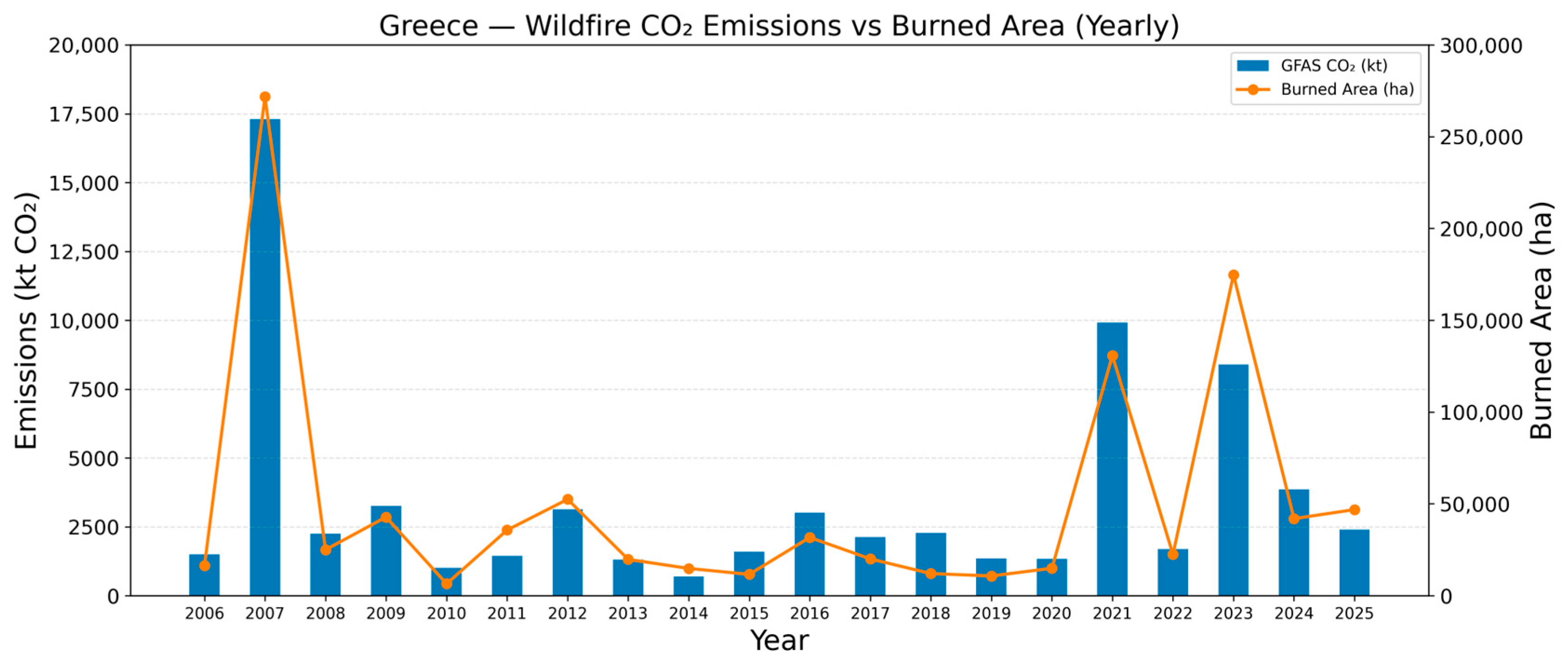
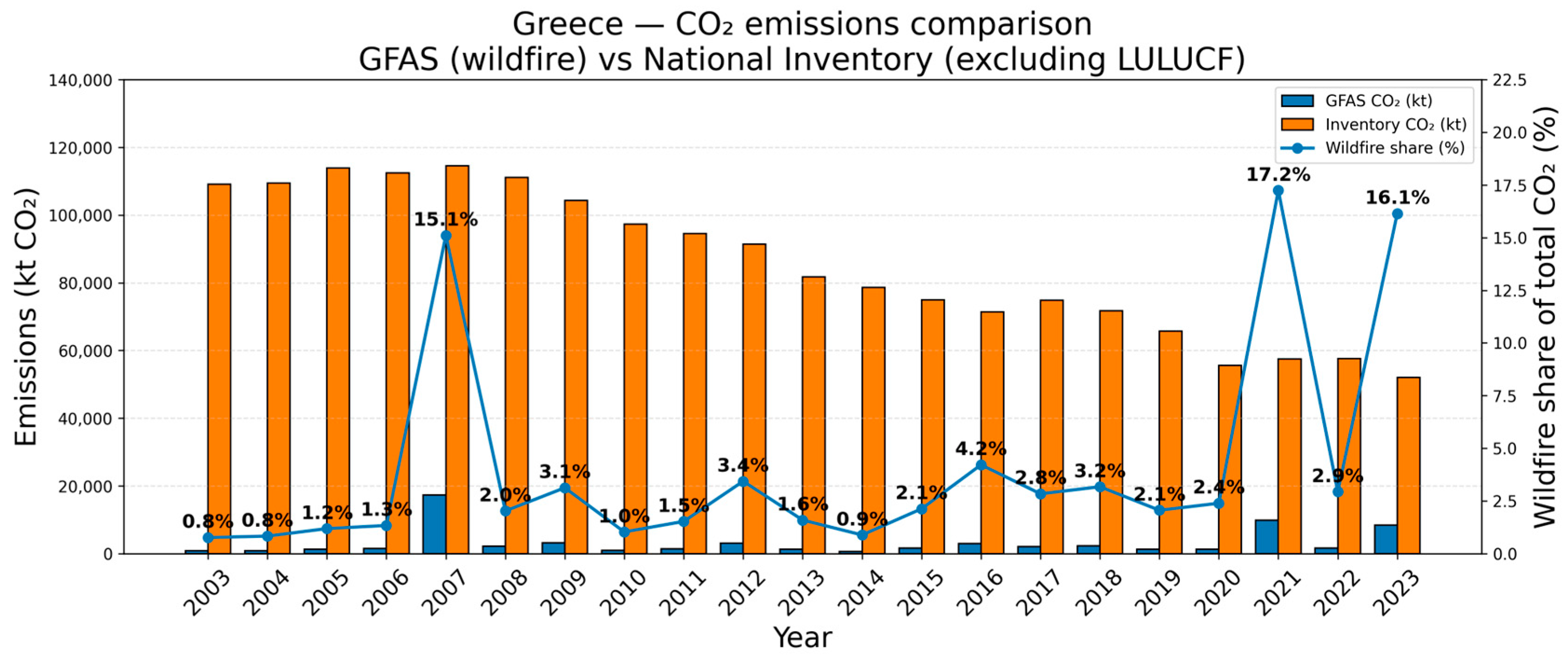
Figure 4 extends this analysis by placing wildfire CO2 emissions (GFAS estimates) in the context of Greece’s national anthropogenic CO2 inventory, excluding emissions and removals from the Land Use, Land Use Change, and Forestry (LULUCF) sector (which, when included, represent the total net-national-carbon balance). The comparison highlights that, while wildfire emissions are generally a minor component in most years (<5% of national totals), they spike dramatically during extreme fire seasons and constitute a much larger fraction of the total. In 2007, wildfire CO2 reached ~17,300 kt, equivalent to over 15% of national emissions. Similarly, in 2021 (~9900 kt, ~17%) and 2023 (~8400 kt, ~16%), wildfires temporarily became a major component of Greece’s total CO2 footprint. By contrast, in years such as 2013 or 2014, the wildfire share was negligible (<1% compared to anthropogenic).
The wildfire seasons of 2021 and 2023 in Greece were dominated, in terms of CO2 emissions, by two exceptional events: the Evia fire of 2021, which accounted for approximately 50% of all national wildfire CO2 emissions that year and the Evros fire of 2023, which contributed around 40% of total wildfire CO2 emissions in 2023. Although the Rhodes (Dodecanese) and Boeotia fires were extreme relative to their regional scales, their estimated CO2 emissions (~1800 kt and ~1700 kt, respectively) were substantially lower than those from Evros (~2600 kt), confirming Evros as the dominant contributor at the national scale. Figure 5 shows a general correspondence between burned area (EFFIS) and wildfire CO2 emissions (GFAS), but the relationship is not linear. This becomes evident when comparing these two extreme events. The Evros wildfire in 2023, burning approximately 96,609 ha according to the EFFIS, was responsible for one of the largest recorded burned areas in the EU [31], yet its total CO2 emissions were lower than those of the smaller 2021 Evia fire, which affected around 51,881 ha, based on EFFIS records.
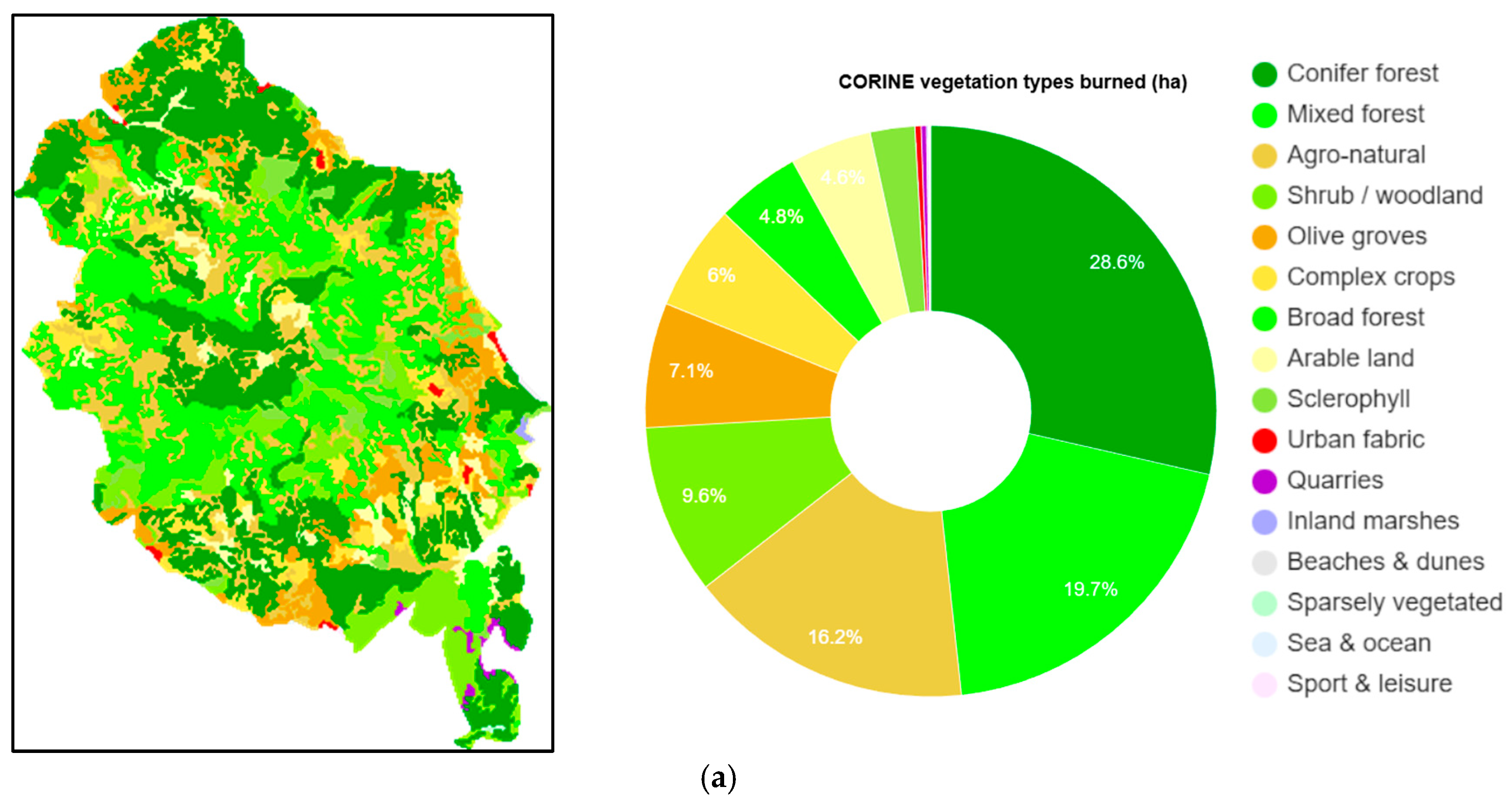
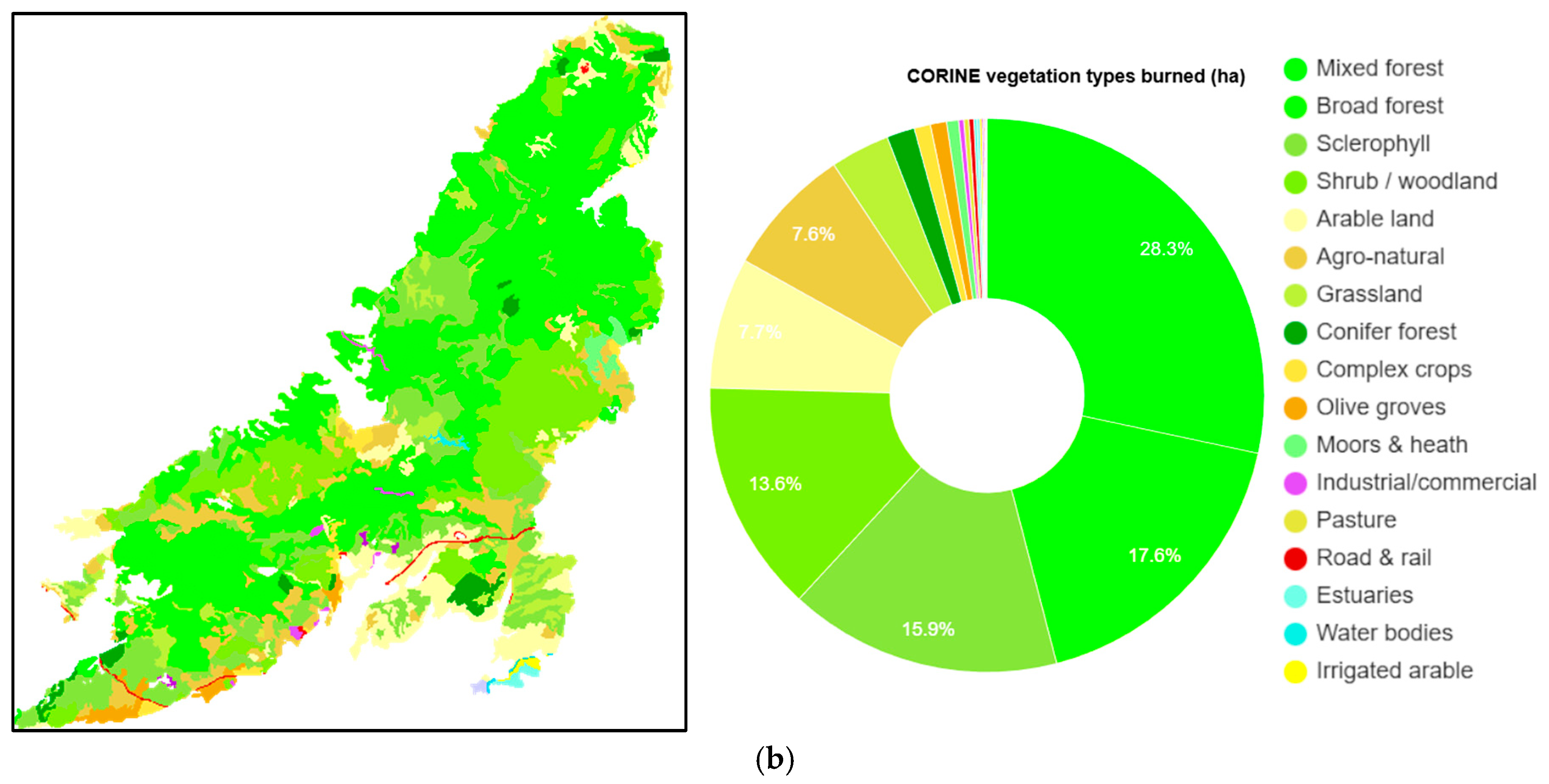
To further characterize the type of burned vegetation, land-cover information was derived from the CORINE (Coordination of Information on the Environment) land-cover dataset, a standardized European classification system that provides detailed information on land use and vegetation types across Europe. This dataset allows the identification of dominant vegetation categories (e.g., forests, shrublands, and agricultural areas) within the burned regions [35].
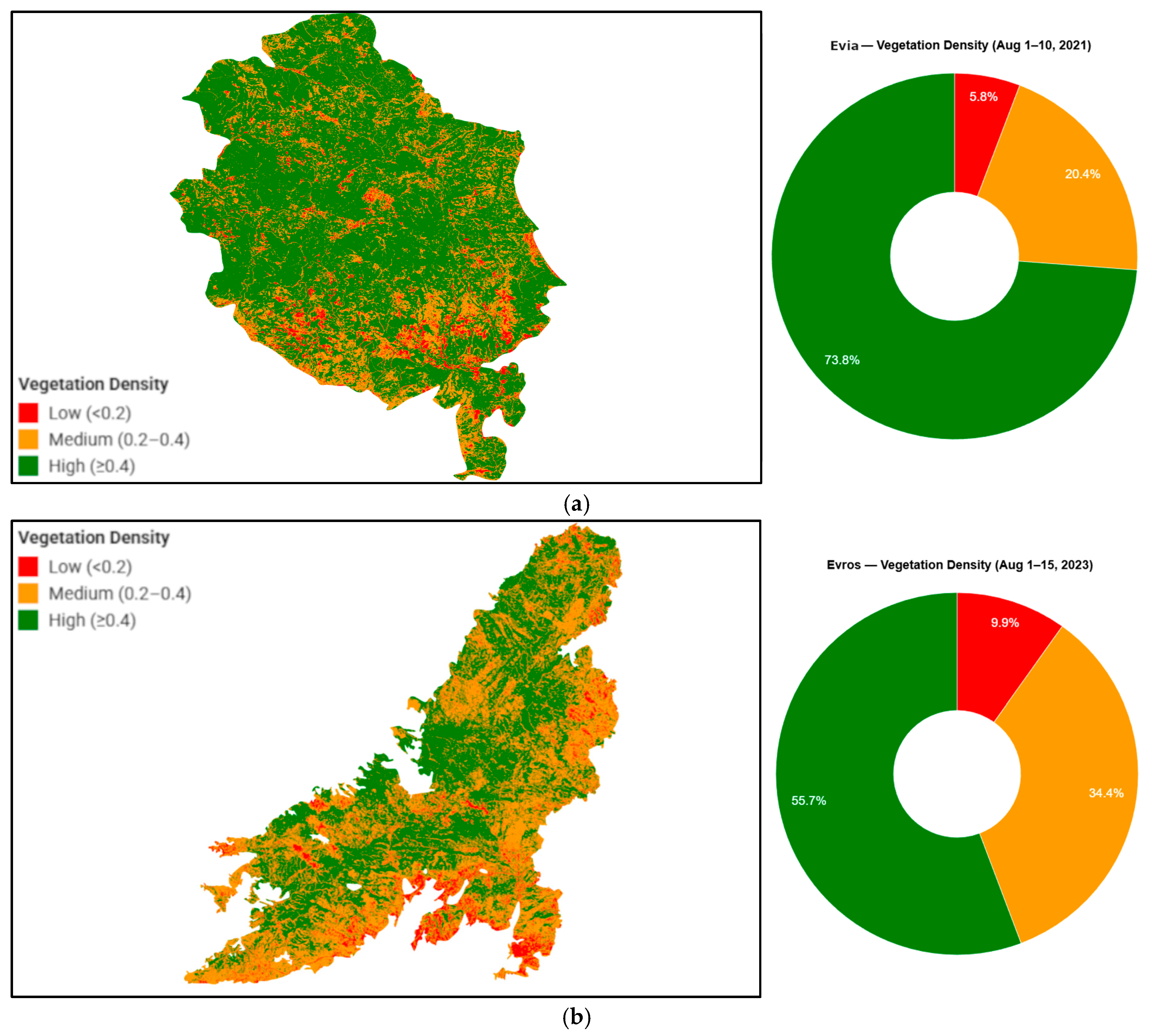
The vegetation-density and land-cover analyses clarify this discrepancy. In Evia (2021), more than 70% of the affected area contained high-density vegetation (NDVI ≥ 0.4), with an overall mean NDVI of ~0.50 and an NDVI per-hectare value of ~4.995 NDVI m2/ha, indicating higher vegetation density and biomass availability, and reflecting dense forest fuels dominated by coniferous and mixed forest types with high biomass loads, as also supported by the CORINE land-cover data (Figure 6). In contrast, the Evros 2023 burned area exhibited a substantially lower mean NDVI of ~0.40 and a reduced NDVI per-hectare value of ~3.981 NDVI·m2/ha, with only ~56% of the area classified as high-density vegetation and a larger fraction composed of medium-density cover (~34%) and low-density vegetation (~10%). The CORINE land-cover data (Figure 6) indicate broadly similar vegetation types between the two regions, suggesting that differences in emission factors related to fuel type are likely limited, while the NDVI analysis (Figure 7) highlights differences in vegetation density and biomass availability, implying higher fuel loads in Evia compared to Evros. In addition, analysis of GFAS-derived FRP (W m−2) indicates comparable fire intensity between the two events, with a slightly higher mean FRP in Evia (~2.75 W m−2) compared to Evros (~1.88 W m−2), while maximum values are nearly identical (~50 W m−2), suggesting similar peak-fire behavior. These combined results indicate that differences in total emissions are influenced by both fire intensity (as represented by FRP) and fuel availability, with the higher fuel loads in Evia likely contributing to increased emissions despite comparable fire intensity, while combustion efficiency remains controlled by additional factors such as fuel type, moisture conditions, and fire behavior.
These structural differences in fuel availability and type resulted in higher combustion completeness and fuel consumption during the Evia 2021 event, producing significantly greater CO2 emissions despite a smaller total burned area. Conversely, the Evros fire spread across a much larger landscape but burned substantial fractions of lower biomass vegetation, resulting in lower emissions per unit burned area.
Taken together, the results confirm that wildfire emissions in Greece are strongly event-driven. While burned area remains a first-order control, fire intensity, vegetation structure, and fuel composition ultimately determine emission magnitude. Across the 23-year record, just three extreme years (2007, 2021, and 2023) contribute disproportionately to total wildfire CO2, highlighting the increasing dominance of high-impact fire seasons. Moreover, when comparing recent years with the earlier portion of the record, there is a clear shift toward more emission-intensive fire events.

3.4. Cumulative Annual Emissions

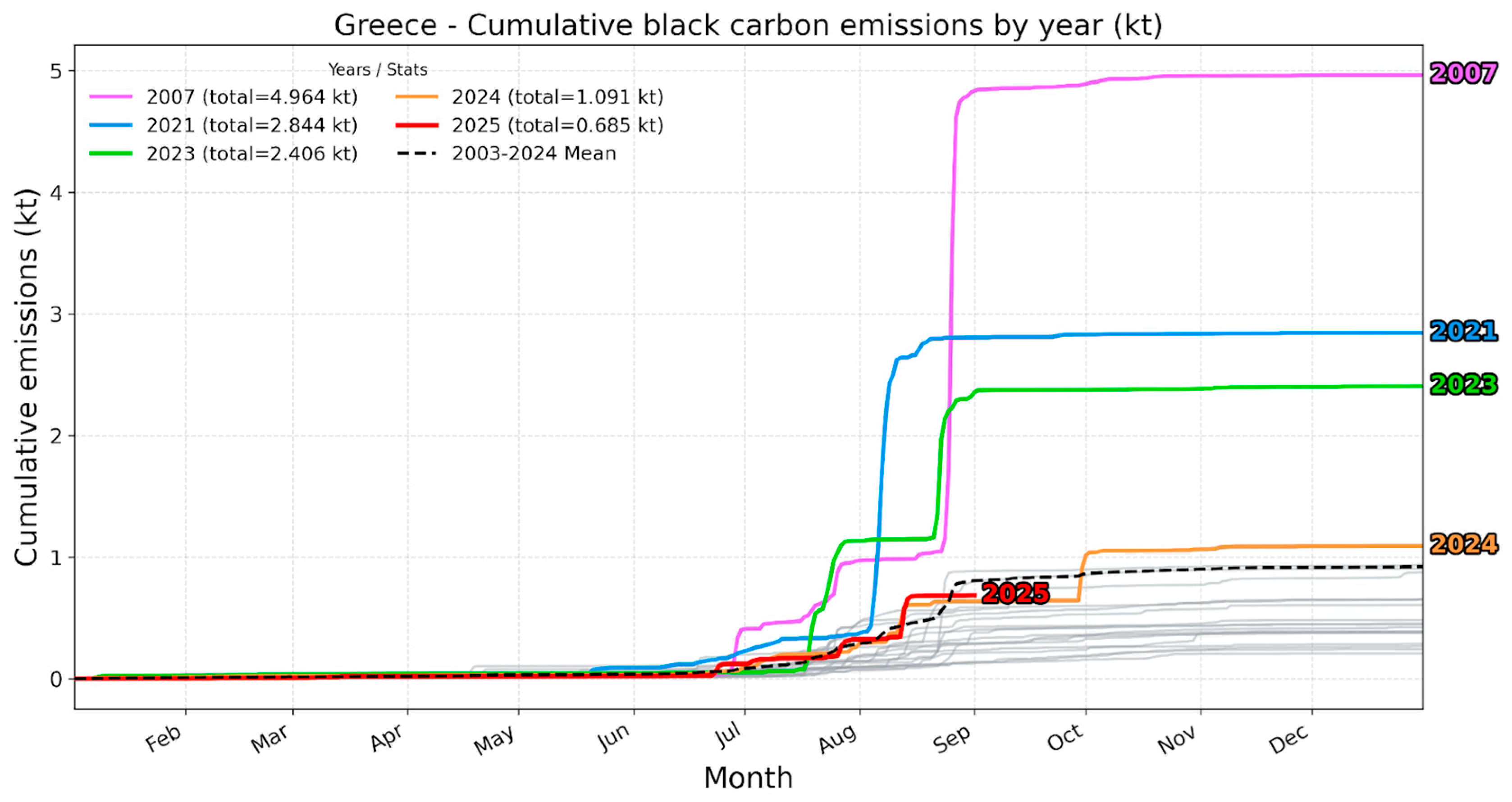
Building on the annual totals presented in Section 3.3, the cumulative-emission curves provide insight into how these extreme years unfolded over time. Unlike Figure 1, which presents normalized cumulative emissions to highlight the seasonal timing of wildfire activity, Figure 8 shows absolute cumulative BC emissions, allowing direct comparison of the magnitude of emissions between years. The cumulative plots (Figure 8) demonstrate the rapid seasonal build-up of pollutants during major fire years. In 2007, emissions rose sharply during late August, reaching nearly 5 kt, far surpassing all other years. Similarly, 2021 and 2023 exhibited pronounced mid-summer emission increases, though with lower totals (~2.8 kt and 2.4 kt, respectively). In contrast, 2024 was comparatively moderate, with cumulative emissions of around 1.1 kt. These trajectories confirm the dominance of a few severe fire seasons in shaping the long-term emission burden.
Beyond interannual variability, the plots also reveal a consistent month-to-month pattern across all years. Emissions remain minimal from January to April, begin to rise gradually in May and June, and then increase sharply during the July–September peak fire season, when the majority of annual emissions occur. In many cases, a single extreme episode in August produces the steepest cumulative jumps, highlighting the critical role of late-summer heatwaves and droughts. After October, emissions plateau, marking the end of the fire season.
This seasonal perspective reinforces the findings shown in Section 3.3, illustrating the fact that the high annual totals of years such as 2007, 2021, and 2023 result not from steady burning but from short, concentrated bursts of extreme fire activity. Section 3.5 will extend this analysis by evaluating the meteorological and climatic drivers that underlie these seasonal peaks.

3.5. Temporal Variability of Emissions

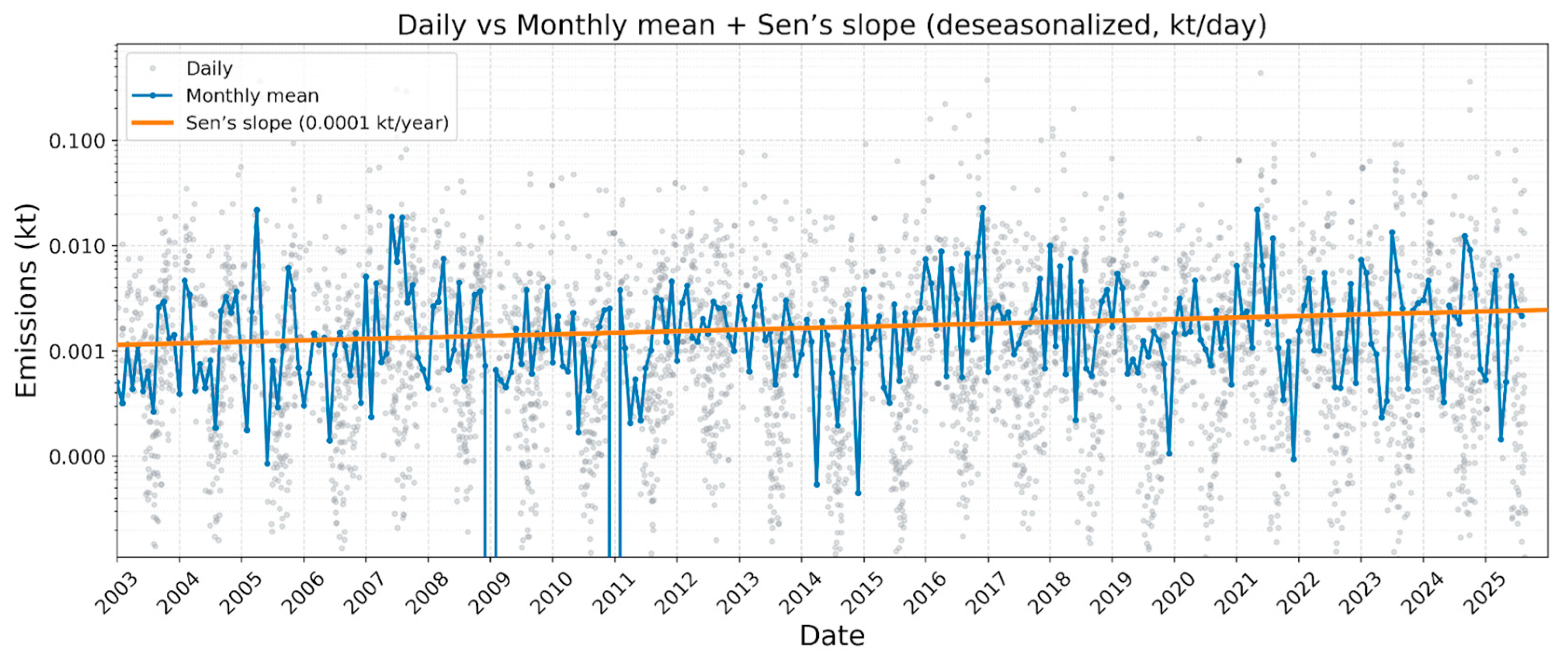
This section investigates the variability of wildfire emissions across different temporal scales. Daily and monthly averages are used to capture short-term fire events, seasonal cycles, and interannual differences. To isolate long-term changes beyond the recurring summer fire season, the daily emissions series is deseasonalized, and Sen’s slope trend (Sen, 1968 [14]) analysis is applied to quantify any underlying trend. Figure 9 and Figure 10 illustrate these complementary approaches, combining high-frequency variability with long-term temporal evolution.
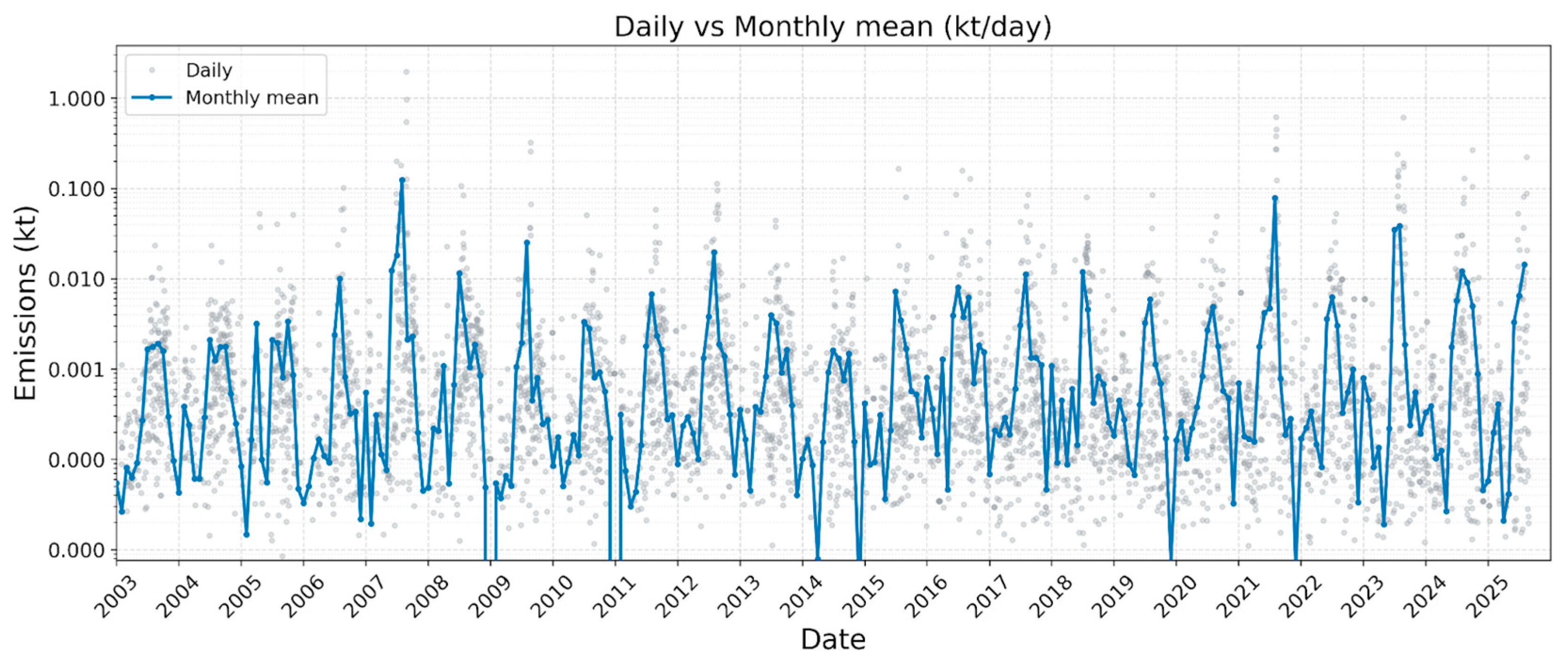
The combined time series of daily, monthly, and yearly mean wildfire emissions for Greece (2003–2025) highlights strong variability across multiple temporal scales (Figure 9). Daily values show sharp spikes, corresponding to individual extreme fire events, while monthly averages smooth these fluctuations and clearly capture the recurrent summertime peak in emissions. This strong seasonal cycle underscores the dominant role of July–September fire activity, where most emissions are concentrated.
However, the deseasonalized series (Figure 10) provides a clearer view of the long-term trajectory. By removing the regular seasonal cycle, the residual trend becomes more apparent. Sen’s slope analysis confirms a modest but statistically significant upward trend in wildfire emissions over the study period, indicating that Greece has gradually experienced higher average daily fire-related emissions since 2003. While this increase is partly influenced by a small number of extreme fire years (notably 2007, 2021, and 2023), the distribution of emissions also appears to shift upward over time, with relatively low fire years in the later period generally exhibiting higher baseline emissions than comparably low fire years in the early part of the record (e.g., 2010 and 2014). Similar behavior has been reported in previous studies. Climate change has been shown to strengthen the relationship between fire weather and realized CO2 emissions in Europe, leading to more intense emission responses during extreme fire conditions [36]. In addition, global analyses indicate an overall upward trend in forest-fire carbon emissions [37], while regional studies confirm the increasing impact of wildfire emissions in Southern Europe [38]. These findings support the interpretation that the observed increase is primarily driven by the growing intensity and frequency of extreme wildfire events.
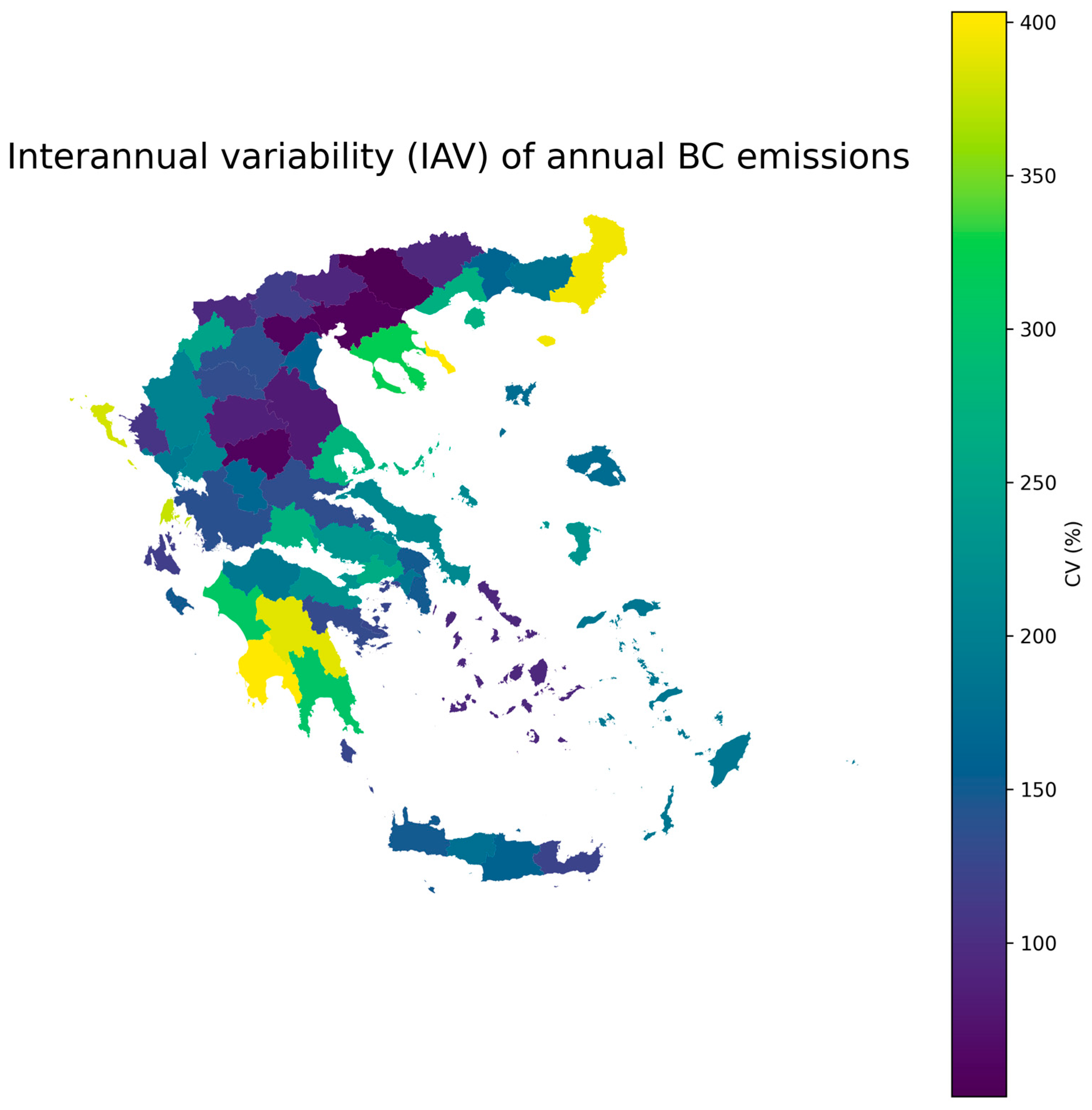
In addition to national-scale trends, interannual variability (IAV) was quantified at the prefecture level using the coefficient of variation (CV), defined as the ratio of the multi-year standard deviation to the multi-year mean of annual emissions and expressed here as a percentage (CV% = σ/μ × 100). This metric, commonly used in interannual variability studies [34], expresses the relative IAV of emissions with respect to their typical magnitude and allows direct comparison across regions. Figure 11 shows the spatial distribution of CV% for annual wildfire BC emissions across Greece. Very high CV% values (>300%) occur in prefectures such as Messinia, Evros, Arcadia, Kerkira, and Lefkada, indicating regions where emissions are highly episodic and dominated by infrequent but severe fire events. In contrast, metropolitan areas such as Athens exhibit comparatively lower CV% values (~150–190%), suggesting that wildfire activity occurs in a more systematic and recurrent manner. Evia displays intermediate CV% values (~210%), reflecting a mixed regime in which recurrent fire activity is punctuated by a small number of extreme seasons, most notably 2021. The fifteen prefectures with the highest CV% values are listed in Table 3 and represent regional hotspots of wildfire-emission unpredictability.
Together, these figures reveal a dual picture: on the one hand, wildfire emissions remain dominated by seasonal concentration and short-lived extreme events; on the other hand, there is evidence of a slow but persistent upward trend, suggesting that the baseline risk of severe wildfire emissions has increased over the past two decades.

3.6. Injection Height of Wildfire Plumes

The injection height of wildfire plumes is a critical parameter for understanding both the air-quality and climate impacts of biomass burning. It determines whether smoke remains trapped within the planetary boundary layer, thereby directly degrading surface-air quality and elevating human exposure to fine particles and trace gases, or whether it is lofted into the free troposphere, where it can persist for extended periods and undergo long-range transport, influencing atmospheric composition, cloud microphysics, and radiative balance [13,14]. This work is based exclusively on the GFAS plume-injection-height product, which estimates injection heights by coupling satellite-derived fire radiative power with ECMWF meteorological inputs to produce daily global fields of smoke-release altitudes for use in air-quality and climate studies [18,39]. Although GFAS presents a continuous long-term record and is broadly consistent with independent observations, some studies suggest potential underestimation of peak plume heights in certain conditions: for instance, satellite-based smoke-plume-height products evaluated against lidar in biomass-burn cases show differences in “plume-top” versus “mean” definitions [16] and radar-derived plume heights have been found to exceed GFAS estimates by up to ~12–32% in some fire episodes [40]. Despite these caveats, GFAS remains one of the few spatially extensive and temporally consistent datasets available for quantifying plume-injection height. In the Greek and broader Eastern Mediterranean context, it provides a valuable framework for characterizing wildfire-plume dynamics, assessing interannual variability in emission intensity, and evaluating the influence of major fire episodes on both national air quality and transboundary pollution transport. Such applications are particularly relevant in a region frequently affected by large-scale biomass burning and long-range aerosol advection [31].
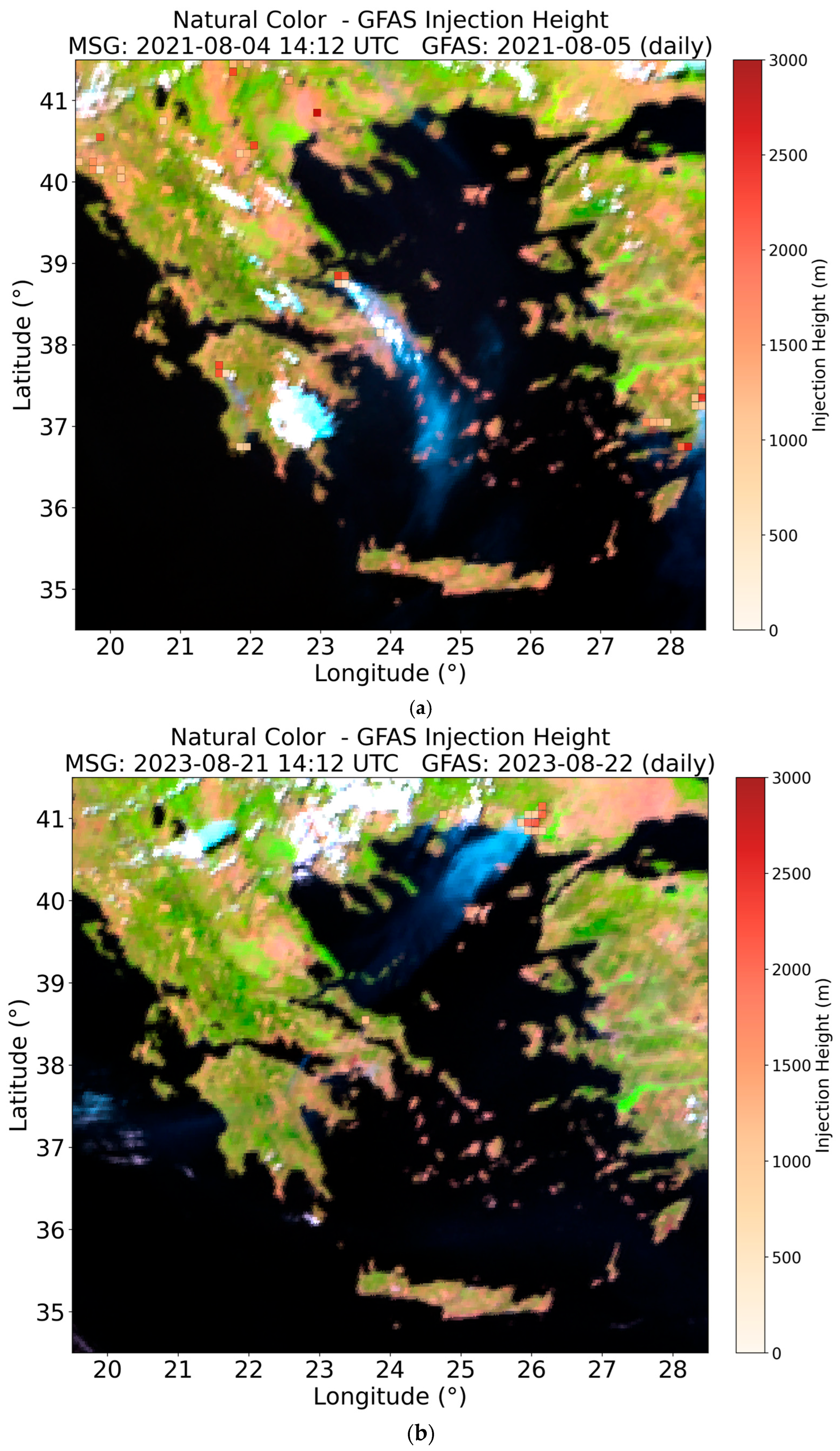
To illustrate the structure and magnitude of extreme fire plumes, in Figure 12a,b we present Meteosat Second Generation (MSG) Spinning Enhanced Visible and InfraRed Imager (SEVIRI) natural color composites, overlaid with GFAS black carbon (BC) emission fluxes, for two of Greece’s largest wildfire episodes: the August 2021 Evia fires and the August 2023 Evros fires. While SEVIRI imagery (~3 km spatial resolution at nadir) is not used directly in the production of the GFAS injection-height product, it is employed here to provide an independent, high-temporal-resolution visual context and to collocate the spatial patterns of active fires, smoke plumes, and GFAS-derived emissions during these events. The natural color composites combine visible and near-infrared channels to provide an intuitive visualization of smoke plumes, surface features, and clouds, enabling identification of plume extent and optical thickness. In the 2021 Evia case, a dense smoke plume extended eastward across the Aegean Sea, which was consistent with strong northerly winds and GFAS-derived injection heights ranging from ~224 m to ~2769 m, with a mean value of ~1200 m calculated over the duration of the fire episode (typically several days). The 2023 Evros event involved a large plume expanding from northeastern Greece into the Black Sea region, with GFAS injection heights between ~727 m and ~1936 m (mean ~1200 m, also calculated over the duration of the fire episode), highlighting the potential for transboundary transport. Together, these examples demonstrate that major Greek wildfire events can generate plumes that are frequently lofted into the lower free troposphere and contribute to long-range aerosol dispersion.
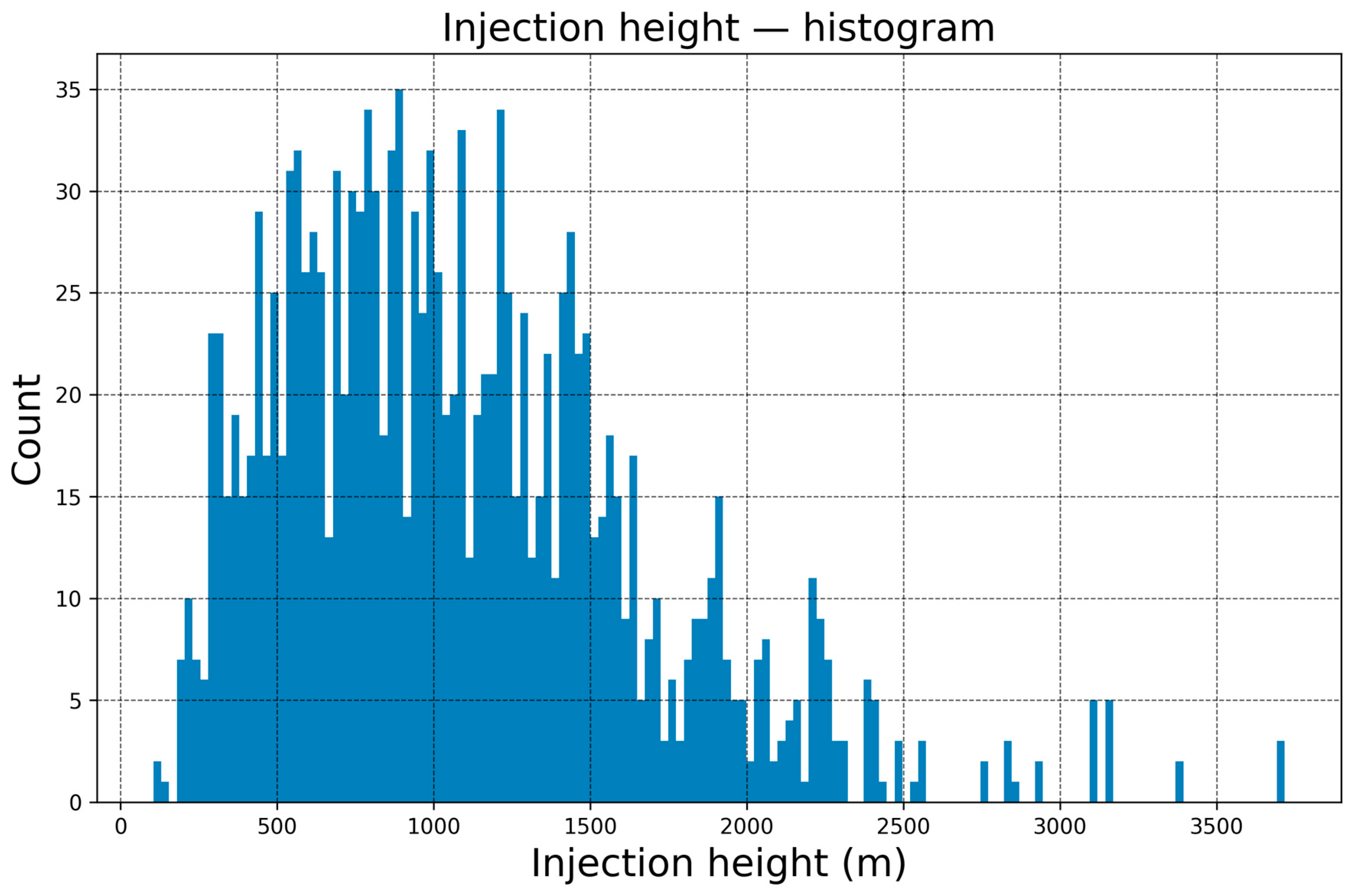
The statistical distribution of all GFAS plume-injection heights across Greece (Figure 13) shows most plumes were confined between 400 m and 1500 m. This indicates that the majority of wildfire smoke remains within the lower troposphere, directly affecting surface-air quality and local exposure. Nevertheless, the histogram also exhibits a pronounced upper tail, with plumes occasionally exceeding 2 and even 3 km. These high-altitude injections play a critical role in transporting aerosols and trace gases over long distances and influencing regional radiative forcing.
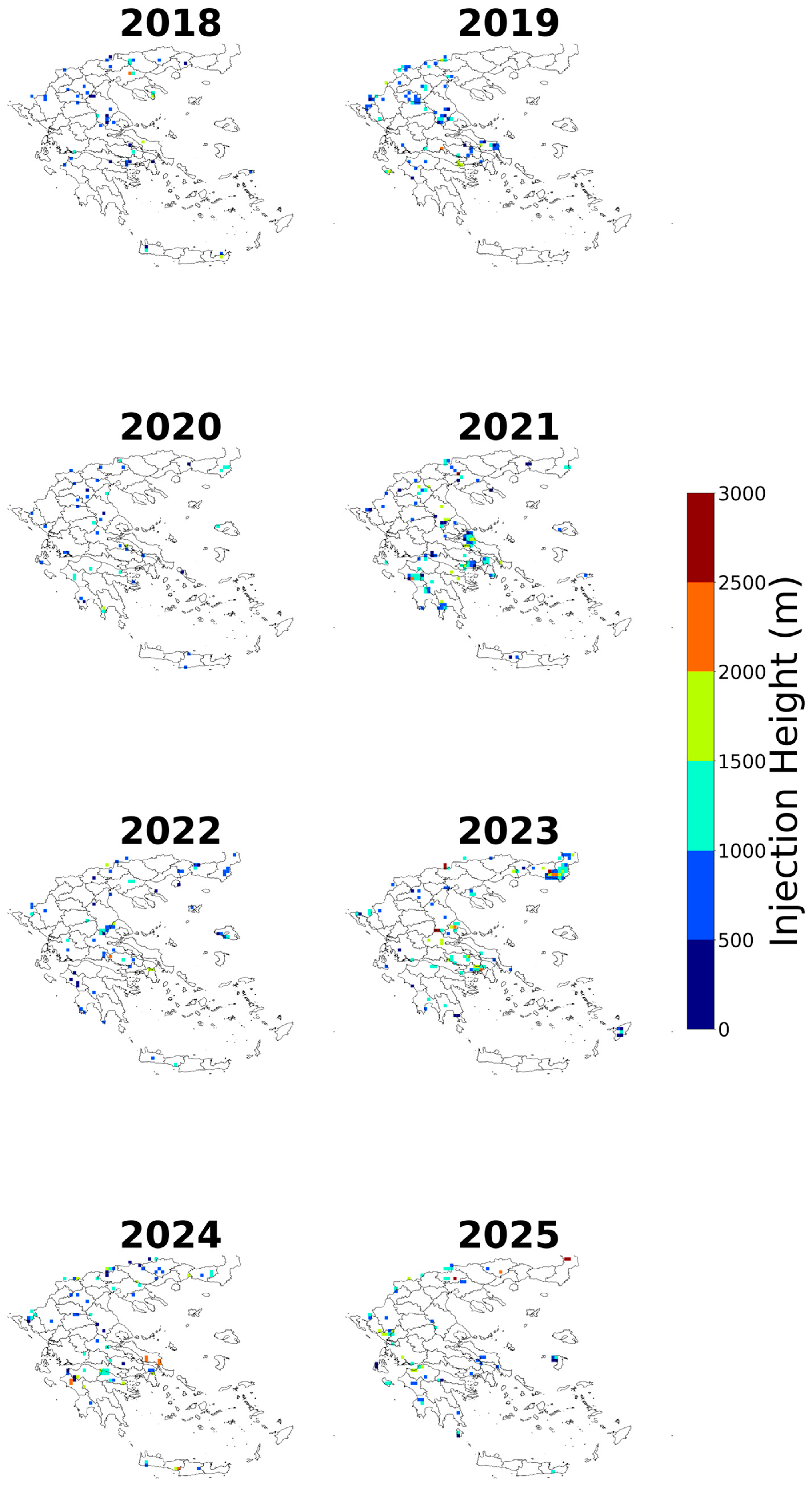
To visualize spatial and interannual variability, Figure 14 maps the GFAS-derived mean injection heights over Greece from 2018 to 2025. Elevated plume altitudes are concentrated in regions historically prone to intense wildfires such as central and southern mainland Greece, Evia, Crete, and northeastern Greece (Evros). The highest values, occasionally exceeding 3 km, occurred during the severe fire years of 2021 and 2023, consistent with the real-event imagery shown in Figure 12. These spatial patterns align with the major emission hotspots identified in earlier sections, confirming a tight link between fire intensity, fuel conditions, emissions, and plume-injection-height behavior.
Yearly statistics (Table 4) further illustrate this variability. The year 2021 recorded a relatively high mean injection height (1050 m) with maximum values reaching 2769 m, consistent with the intensity of the Evia fires. However, higher mean values are observed in later years, particularly 2023–2025 (2023 (1271 m), 2024 (1185 m), and 2025 (1241 m)), indicating stronger plume development in recent extreme fire events. In contrast, 2022 shows a lower mean value (820 m), reflecting reduced fire activity compared to major fire years.
The number of available injection-height samples (n) represents only a subset of fire-affected grid cells. A comparison between the number of GFAS grid cells with active FRP and those with available injection-height estimates indicates that approximately 15–35% of fire-grid cells are associated with valid injection-height values, depending on the year (Table 4).
This behavior is consistent with the methodology of the GFAS plume-injection-height product. As described by Rémy et al. 2017 [10], FRP is first aggregated at the GFAS spatial resolution (0.1° × 0.1°) and used as the driving input for a physically based parameterization of plume-injection height. The model computes injection height only when fire intensity is sufficient and meteorological conditions (e.g., atmospheric stability and boundary-layer structure) allow vertical-plume development.
To ensure the reliability of the GFAS-derived injection-height estimates, we compared our results with previous observational and modeling studies. Independent observational datasets provide valuable context for interpreting the GFAS results and extending the record beyond the model’s temporal coverage. During the Attica wildfires of August 2009, ground-based lidar measurements over Athens detected smoke layers reaching the free troposphere at altitudes of approximately 2–4 km [10], demonstrating that intense Greek wildfires were capable of producing elevated plumes even before the availability of GFAS plume-injection-height data. A decade later, the extreme wildfires of August 2021 in Evia and Attica exhibited similar characteristics, with ground-based and satellite observations confirming smoke layers extending into the free troposphere and strong aerosol loads that significantly reduced surface solar irradiance [31]. The subsequent Evros wildfires in August 2023 provided further examples, as lidar measurements over Thessaloniki documented plume altitudes between 4 and 6 km above ground level [31,41], underscoring the potential for long-range pollutant transportation and pronounced radiative effects. Additional insight is offered by Sentinel-5P TROPOMI aerosol-layer-height (ALH) retrievals, which, when validated against EARLINET lidar observations across the Mediterranean, were shown to have good agreement over oceanic regions (bias ≈ –0.5 km) but a tendency to underestimate plume heights over land by about 1–2 km [42]. Despite limitations, TROPOMI has provided continuous satellite-based monitoring of smoke-plume altitudes since 2018, serving as a valuable bridge between GFAS-model estimates and direct lidar observations.
Taken together, the consistency between GFAS injection heights and independent lidar and satellite observations indicates that GFAS captures the first-order magnitude and variability of wildfire plume heights over Greece, making it a robust and suitable dataset for assessing plume dynamics and their air-quality and climate implications in this study.

3.7. Fire-Emission Sources’ Link to Wind Gust and Cumulative Drought (SPI6)

To investigate the meteorological and hydroclimatic conditions associated with enhanced wildfire activity, GFAS fire-emission sources were coupled with two key fire weather drivers: (i) wind-gust intensity and (ii) cumulative drought conditions represented by the 6-month Standardized Precipitation Index (SPI6). The analysis was conducted on a common temporal framework for the period 2003–2024, using collocated data for Greece subsequently aggregated on an annual basis.
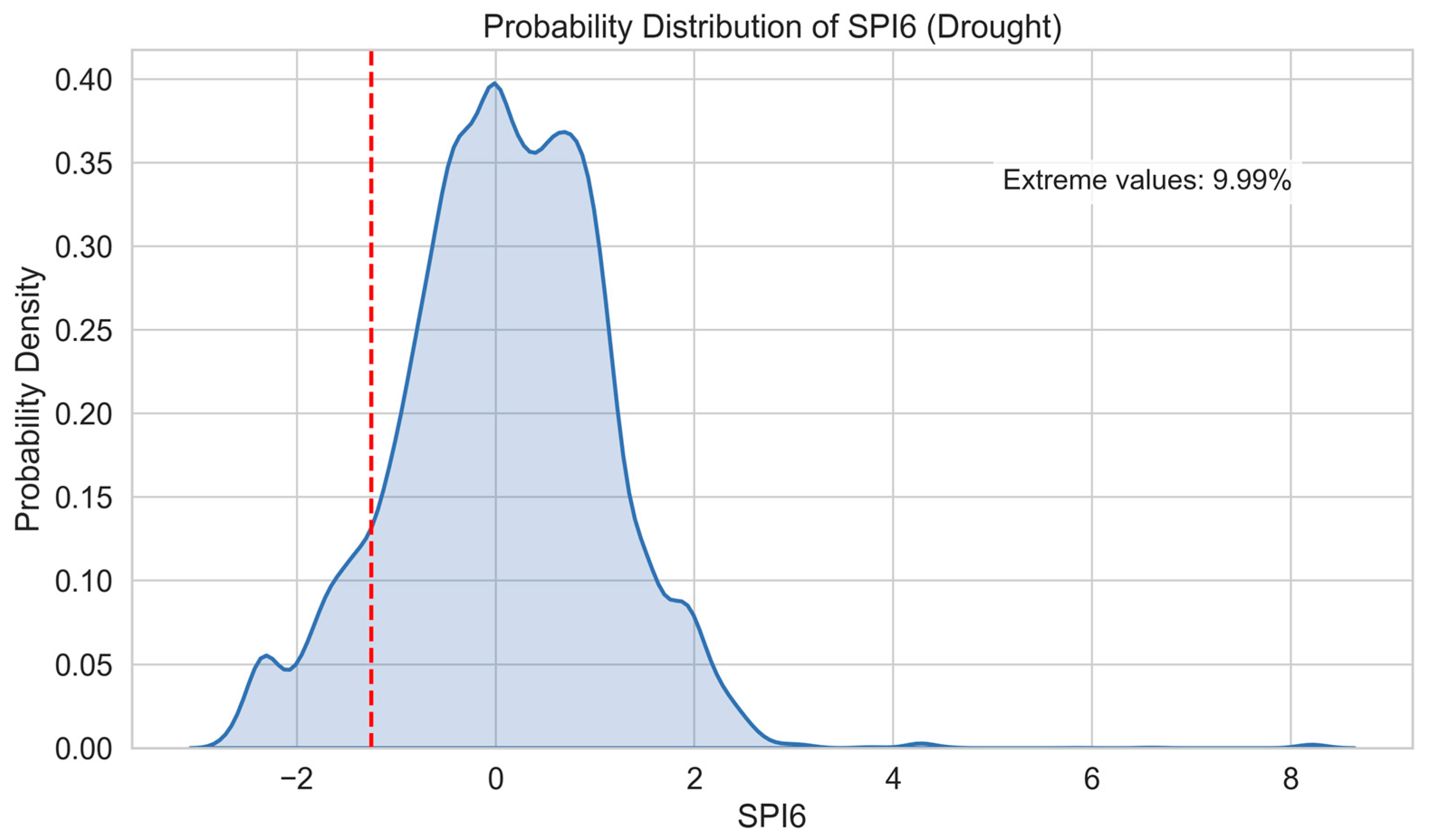
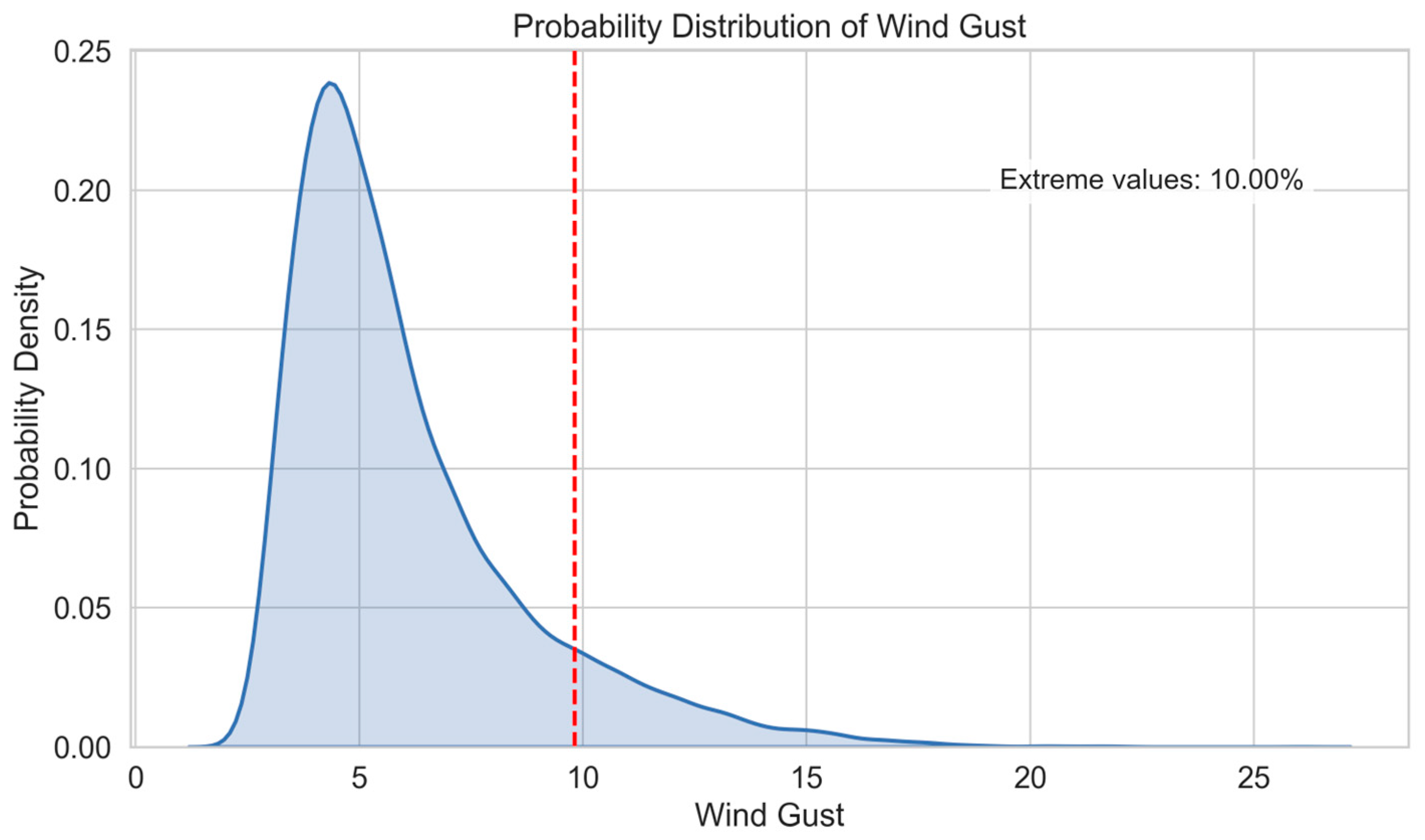
Extreme conditions were identified using a statistically consistent and transparent thresholding approach based on monthly climatological percentiles, allowing a distribution-robust definition of extremes that is comparable across variables. Wind-gust extremes were defined as values exceeding the 90th percentile (p90), capturing unusually strong wind conditions that enhance fire spread and intensity. In contrast, drought extremes were defined as SPI6 values below the 10th percentile (p10), corresponding to pronounced cumulative moisture deficits that promote fuel dryness and flammability. Each data sample was classified as “Extreme” if at least one of these conditions was met, while all remaining samples were classified as “No Extreme”. This binary classification was applied uniformly across all GFAS fire-emission sources.
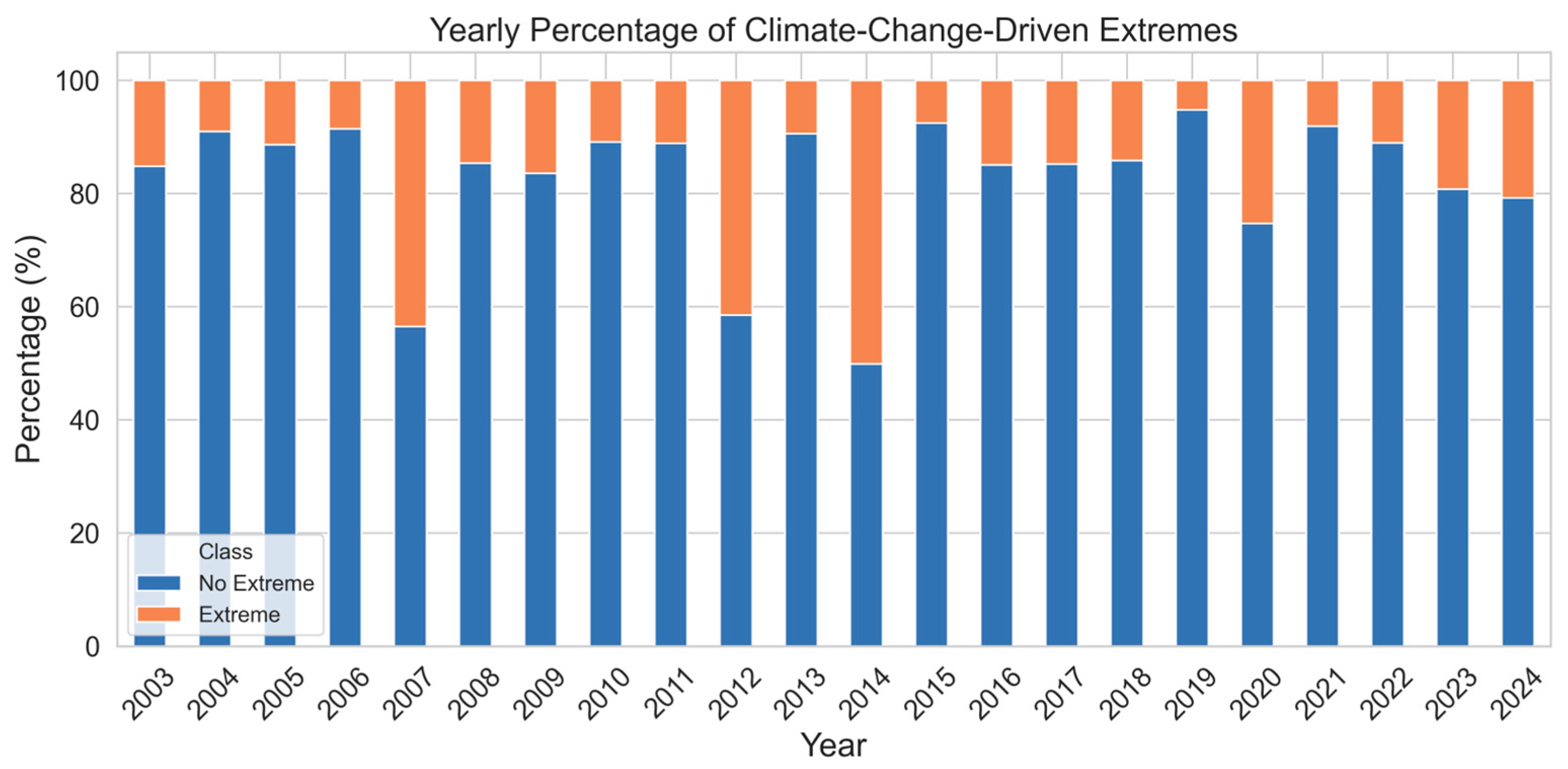
Using the p90/p10 percentile-based criterion, 19% of the samples were classified as “Extreme”, whereas the remaining 81% were categorized as “No Extreme” (Figure 15). When examined separately, wind-gust extremes and SPI6 drought extremes each account for approximately 10% of the total samples, consistent with the percentile-based definition. Their combined contribution is higher because wind-driven and drought-driven extremes do not always occur simultaneously, highlighting the complementary roles of short-term atmospheric forcing and longer-term hydroclimatic stress in shaping extreme fire-emission conditions.
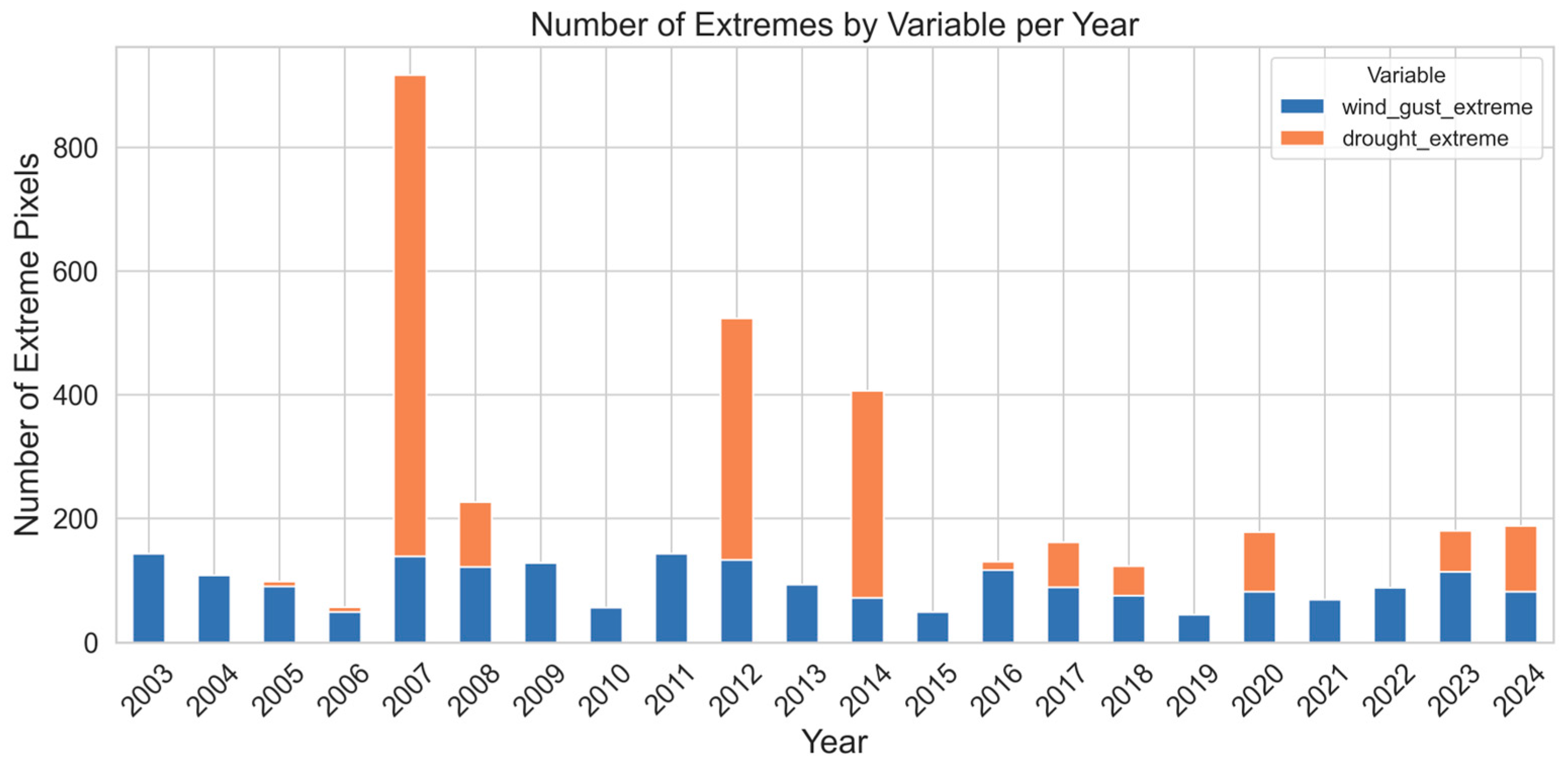
The interannual evolution of the extreme and non-extreme classes exhibits pronounced variability, with certain years characterized by a substantially higher proportion of extreme conditions. The probability density functions of SPI6 (Figure 16) and wind gust (Figure 17) confirm that the selected p90/p10 thresholds effectively isolate the tails of the distributions, representing physically meaningful extremes rather than marginal deviations. Furthermore, the annual decomposition of extreme events by variables indicates that some years are predominantly influenced by drought-driven extremes, others by wind-driven extremes, and several by a combination of both drivers (Figure 18).
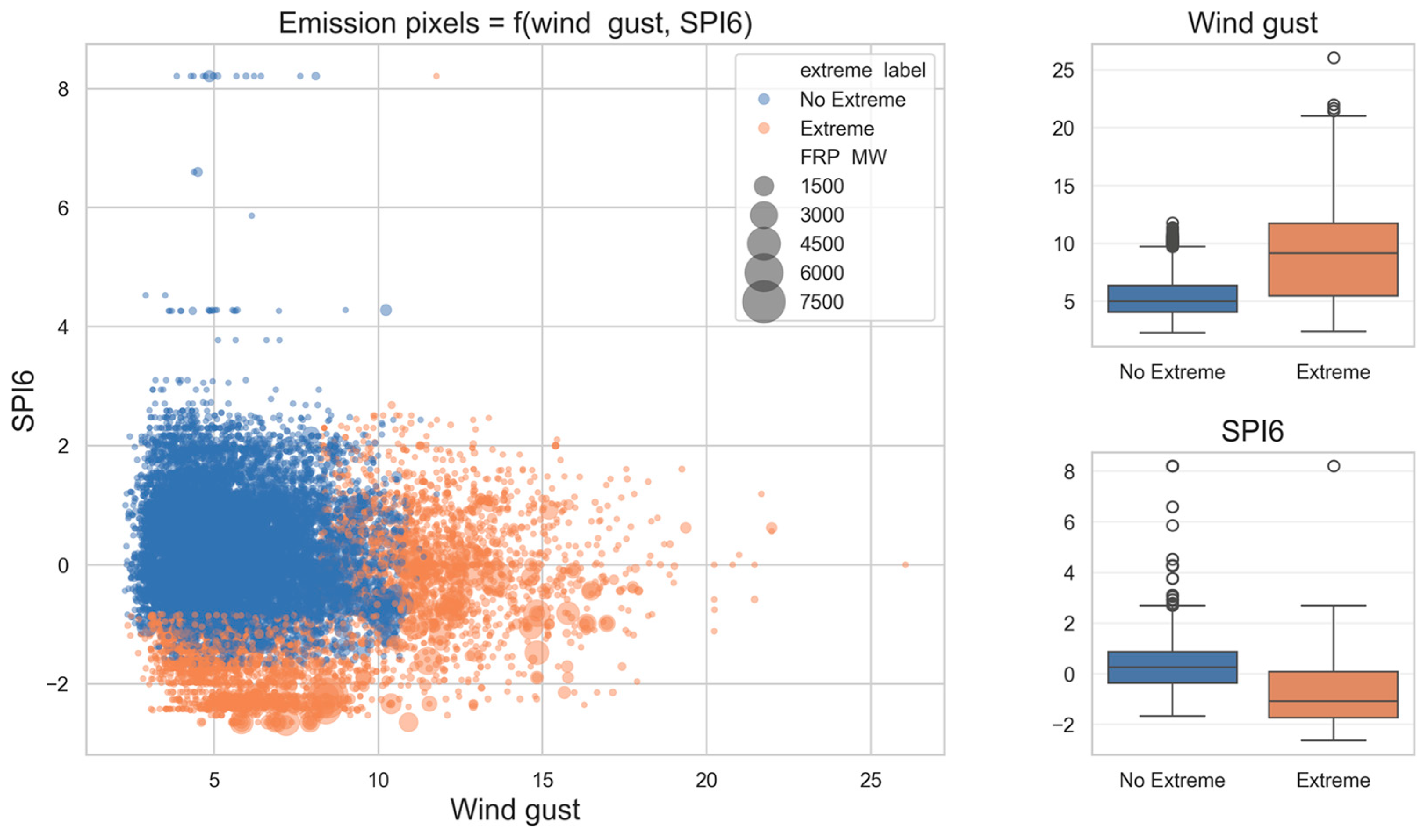
To provide a joint visualization of the wind–drought control space, a pixel-level bubble plot was produced linking fire-emission-source detections to concurrent wind-gust and SPI6 conditions (Figure 19). In this representation, each GFAS fire-emission-source pixel is mapped in the wind–drought phase space, while the bubble size is proportional to the associated Fire Radiative Power (FRP). The bubble plot highlights that extreme fire-emission conditions preferentially occur under either strong wind forcing (high wind gust) and/or enhanced drought stress (low SPI6), demonstrating the combined and complementary influence of short-term atmospheric variability and longer-term hydroclimatic stress on wildfire emissions.

4. Discussion

This study analyzed wildfire emissions and smoke-plume geometrical characteristics in Greece (2003–2025) with the emphasis on black carbon (BC) and carbon dioxide (CO2). The results demonstrate that wildfire emissions are highly episodic and dominated by a few catastrophic years. In particular, 2007, 2021, and 2023 accounted for a disproportionate share of the long-term totals, with wildfire CO2 during these seasons reaching up to 15–17% of national anthropogenic emissions. Cumulative time series revealed sharp August peaks in these years, contrasting with smoother seasonal increases during moderate years. Recent seasons, including 2023 and 2024, also point to a broader trend toward more frequent and destructive wildfires, with burned areas above the long-term average and growing impacts on protected ecosystems.
Statistical analysis of deseasonalized emissions showed a modest but significant upward trend since 2003, suggesting that the baseline risk of extreme wildfire emissions has increased over time, even though many years remained relatively quiet. Spatially, emissions were concentrated in a limited set of municipalities, most notably Evia, East Attica, and Messinia, confirming the localized but severe nature of the national wildfire burden.
Global Fire Assimilation System (GFAS) data generally indicate that a large fraction of smoke is injected within the lower troposphere, typically below ~1 km, but also show elevated injection heights of ~2–3 km during major fire episodes. Independent lidar and satellite observations further document that, during extreme events, portions of the plume can be lofted into the free troposphere reaching ~2–4 km in 2009 (Attica), ~3–4 km in 2021 (Evia), and ~4–6 km in 2023 (Evros). Such injections enhance long-range transport and amplify radiative impacts. Modeling studies confirm the climate significance of plume-injection height, with injection heights altering aerosol vertical profiles and producing a global mean forcing of about –0.11 W m−2 at the top of the atmosphere and –0.38 W m−2 at the surface [27]. These results highlight that the altitude of smoke layers is a decisive factor for radiative forcing, since higher injection heights prolong aerosol lifetime, increase their interaction with solar radiation, and enhance their ability to affect cloud properties and precipitation patterns [13,14]. TROPOMI aerosol-layer-height retrievals, despite underestimating plume heights over land, have provided valuable continuous monitoring since 2018 and complement GFAS and lidar datasets. Looking forward, the Copernicus Sentinel-3 mission, which delivers near real-time fire-radiative-power (FRP) observations together with aerosol optical depth (AOD) and aerosol-layer-height products, will offer an integrated dataset that can significantly improve plume-injection-height characterization. These measurements will be especially valuable for validating GFAS outputs and for advancing future studies on wildfire injection height, radiative forcing, and their broader implications for air quality and climate.
Beyond emissions and transport, the health and climate implications of wildfire smoke are profound. A recent multicountry epidemiological study estimated that short-term exposure to wildfire smoke causes thousands of premature deaths each year across Europe, with southern regions such as Greece among the most affected [43]. These impacts are driven primarily by exposure to fine particulate matter (PM2.5) and black carbon (BC), which penetrate deep into the respiratory system, exacerbate cardiovascular and respiratory diseases, and trigger acute mortality events during extreme smoke episodes. The results of Alari et al. also highlight that health risks are not confined to fire-prone rural areas but extend to major urban centers, as smoke plumes travel hundreds of kilometers, degrading air quality across entire regions. The Greek case studies of 2021 and 2023, therefore, represent not only environmental disasters but also significant public health crises, linking local fire activity to continent-wide health burdens.
Nevertheless, important limitations remain. The GFAS, while widely used, is constrained by the limited spatial and temporal resolution of MODIS FRP observations, which often miss short-lived or small fires and underestimate activity in cloudy or smoky conditions. Emission estimates are highly sensitive to FRP errors and to biome specific emission factors, which propagate uncertainty into total pollutant loads. The injection height parameterization, although valuable, tends to underestimate the variability and extremes of pyroconvective events compared to lidar and Multi-Angle Imaging SpectroRadiometer (MISR) observations, a NASA instrument that uses multi-angle imagery to retrieve plume heights with high accuracy and has been widely applied in wildfire plume studies.
Studies indicate that climate change is expected to increase fire danger and wildfire occurrence in Greece and the broader Mediterranean region in the coming decades [44,45,46]; therefore, continued advances in wildfire monitoring and modeling will be critical for understanding and managing future impacts. The new Meteosat Third Generation (MTG) mission, with its Flexible Combined Imager, will provide higher spatial (0.5–1 km) and temporal (~10 min) FRP retrievals over Europe. These improvements will allow better detection of small and short-lived fires, more accurate temporal integration of FRP, and stronger constraints on plume-injection-height models. At the same time, there is a pressing need for the development of a real-time injection-height product that integrates high-frequency FRP observations with satellite-based aerosol-layer-height retrievals and ground-based networks. In this context, lidar observations are indispensable, both as an independent validation tool and as a means to constrain and improve model parameterizations of plume-injection height and smoke dispersion. The synergy between MTG’s enhanced FRP monitoring, satellite products such as TROPOMI ALH, and lidar profiling from EARLINET and other networks would provide a robust framework for next-generation fire-emission datasets. In addition, the Sentinel-4 instrument, with spectral coverage in the 750–775 nm range similar to TROPOMI, is expected to support future ALH retrievals with high temporal resolution over Europe [47,48]. Such a capability would enable smoke-dispersion, air-quality, and, potentially, weather models to initialize with realistic vertical placement, substantially improving forecasts of surface particulate matter and long-range transport during extreme fire events.

5. Conclusions

Wildfire emissions in Greece reflect strong wildfire activity, resulting in substantial emission production across the study period. A modest but statistically significant upward trend in emissions suggests an increasing baseline risk of wildfire impacts. Spatial analysis highlights persistent emission hotspots, particularly in Evia, East Attica, and Messinia. Plume-injection heights remain predominantly within the lower troposphere, indicating strong impacts on surface-air quality, with only occasional higher-altitude injections enabling long-range transport. In addition, extreme fire-emission conditions are linked to strong wind forcing and cumulative drought, highlighting the combined role of atmospheric and hydroclimatic drivers. These findings emphasize the importance of wildfire emissions for both regional air quality and atmospheric processes. Improved monitoring of fire activity and plume dynamics will be essential for better understanding and managing future wildfire impacts.

Author Contributions

Conceptualization and definition of research aims, T.K., A.V., I.K.,D.M. and V.A.; methodology, T.K.; software, T.K.; validation, T.K., A.K. and M.M.; formal analysis, T.K.; investigation, T.K.; resources, V.A. and D.M.; data curation, T.K.; writing original draft preparation, T.K.; writing review and editing, A.K., M.M., K.M., M.P., D.V., D.M., I.K. and V.A.; visualization, T.K., M.M. and K.M.; supervision, I.K.; advisory committee, D.M., I.K. and V.A.; project administration, V.A.; and funding acquisition, V.A. All authors have read and agreed to the published version of the manuscript.

Funding

This research was funded by PANORAMA project (Grant Agreement No. 101182795).

Institutional Review Board Statement

Not applicable.

Informed Consent Statement

Not applicable.

Data Availability Statement

The Global Fire Assimilation System (GFAS) emissions data used in this study are available from the ECMWF data repository. True-color imagery from the Meteosat Second Generation (MSG) satellites was obtained via EUMETSAT. Burned-area data were sourced from the European Forest Fire Information System (EFFIS). National fire-emission estimates were taken from the Greek National Inventory Report. Normalized Difference Vegetation Index (NDVI) data were derived from MODIS and Sentinel-2 observations. All datasets used in this study are publicly available from their respective data providers.

Acknowledgments

T.K. and the authors affiliated with the National Observatory of Athens acknowledge the support of the following research projects the PANGEA4CalVal project funded by the European Union (Grant Agreement No. 101079201). A.V. was financially supported by the AXA Research Fund (project: AXA Chair in Wildfires and Climate, CPO00163217), the Leverhulme Centre for Wildfires, Environment, and Society through the Leverhulme Trust (Grant No. RC-2018-023), and the CLIMPACT project (Grant No. 82798), which is supported by the Greek National Component of the Public Investment Program, National Development Program 2021–2025, Ministry of Development—General Secretariat for Research and Innovation.

Conflicts of Interest

The authors declare no conflicts of interest.

References

  1. Organisation for Economic Co-Operation and Development. Taming Wildfires in the Context of Climate Change: The Case of Greece; OECD Environment Policy Papers; OECD Publishing: Paris, France, 2024; Volume 43. [Google Scholar]
  2. Pausas, J.G.; Keeley, J.E. Wildfires as an Ecosystem Service. Front. Ecol. Environ. 2019, 17, 289–295. [Google Scholar] [CrossRef]
  3. Ruffault, J.; Curt, T.; Moron, V.; Trigo, R.M.; Mouillot, F.; Koutsias, N.; Pimont, F.; Martin-StPaul, N.; Barbero, R.; Dupuy, J.-L.; et al. Increased Likelihood of Heat-Induced Large Wildfires in the Mediterranean Basin. Sci. Rep. 2020, 10, 13790. [Google Scholar] [CrossRef]
  4. Voulgarakis, A.; Field, R.D. Fire Influences on Atmospheric Composition, Air Quality and Climate. Curr. Pollut. Rep. 2015, 1, 70–81. [Google Scholar] [CrossRef]
  5. Jacobson, M.Z. Effects of Biomass Burning on Climate, Accounting for Heat and Moisture Fluxes, Black and Brown Carbon, and Cloud Absorption Effects. J. Geophys. Res. Atmos. 2014, 119, 8980–9002. [Google Scholar] [CrossRef]
  6. Gidarakou, M.; Papayannis, A.; Mylonaki, M.; Kralli, E.; Eleftheratos, K.; Fountoulakis, I.; Zografou, O.; Diapouli, E.; Gini, M.I.; Vratolis, S.; et al. Exceptional Wildfire Smoke over Greece in Summer 2023: A Synergistic Study of Aerosol Optical-Microphysical and UVB Radiative Impacts. EGUsphere 2025, 2025, 1–41. [Google Scholar] [CrossRef]
  7. Vaezi, R.B.; Martin, M.R.; Hosseinpour, F. Impacts of Wildfire Smoke Aerosols on Radiation, Clouds, Precipitation, Climate, and Air Quality. Atmos. Environ. X 2025, 26, 100322. [Google Scholar] [CrossRef]
  8. Johnston, F.H.; Henderson, S.B.; Chen, Y.; Randerson, J.T.; Marlier, M.; Defries, R.S.; Kinney, P.; Bowman, D.M.J.S.; Brauer, M. Estimated Global Mortality Attributable to Smoke from Landscape Fires. Environ. Health Perspect. 2012, 120, 695–701. [Google Scholar] [CrossRef]
  9. Analitis, A.; Georgiadis, I.; Katsouyanni, K. Forest Fires Are Associated with Elevated Mortality in a Dense Urban Setting. Occup. Environ. Med. 2012, 69, 158–162. [Google Scholar] [CrossRef] [PubMed]
  10. Rémy, S.; Veira, A.; Paugam, R.; Sofiev, M.; Kaiser, J.W.; Marenco, F.; Burton, S.P.; Benedetti, A.; Engelen, R.J.; Ferrare, R.; et al. Two Global Data Sets of Daily Fire Emission Injection Heights since 2003. Atmos. Chem. Phys. 2017, 17, 2921–2942. [Google Scholar] [CrossRef]
  11. Altshuler, S.L.; Zhang, Q.; Kleinman, M.T.; Garcia-Menendez, F.; Moore, C.T.T.; Hough, M.L.; Stevenson, E.D.; Chow, J.C.; Jaffe, D.A.; Watson, J.G. Wildfire and Prescribed Burning Impacts on Air Quality in the United States. J. Air Waste Manag. Assoc. 2020, 70, 961–970. [Google Scholar] [CrossRef]
  12. Korsiak, J.; Pinault, L.; Christidis, T.; Burnett, R.T.; Abrahamowicz, M.; Weichenthal, S. Long-Term Exposure to Wildfires and Cancer Incidence in Canada: A Population-Based Observational Cohort Study. Lancet Planet. Health 2022, 6, e400–e409. [Google Scholar] [CrossRef]
  13. Andreae, M.O. Emission of Trace Gases and Aerosols from Biomass Burning—An Updated Assessment. Atmos. Chem. Phys. 2019, 19, 8523–8546. [Google Scholar] [CrossRef]
  14. Sen, P.K. Estimates of the Regression Coefficient Based on Kendall’s Tau. J. Am. Stat. Assoc. 1968, 63, 1379–1389. [Google Scholar] [CrossRef]
  15. Evgenieva, T.; Dosev, S.; Gurdev, L.; Vulkova, L.; Peshev, Z.; Toncheva, E.; Popov, L.; Vankov, O.; Dreischuh, T. Canadian Wildfire Smoke Episode over Europe in October 2023: Lidar, Sun-Photometer, and Model Characterization of Smoke Layers Observed Above Sofia, Bulgaria. Remote Sens. 2025, 17, 2899. [Google Scholar] [CrossRef]
  16. Saunois, M.; Martinez, A.; Poulter, B.; Zhang, Z.; Raymond, P.A.; Regnier, P.; Canadell, J.G.; Jackson, R.B.; Patra, P.K.; Bousquet, P.; et al. Global Methane Budget 2000–2020. Earth Syst. Sci. Data 2025, 17, 1873–1958. [Google Scholar] [CrossRef]
  17. Koutsias, N.; Xanthopoulos, G.; Founda, D.; Xystrakis, F.; Nioti, F.; Pleniou, M.; Mallinis, G.; Arianoutsou, M. On the Relationships between Forest Fires and Weather Conditions in Greece from Long-Term National Observations (1894–2010). Int. J. Wildland Fire 2012, 22, 493–507. [Google Scholar] [CrossRef]
  18. Kaiser, J.W.; Heil, A.; Andreae, M.O.; Benedetti, A.; Chubarova, N.; Jones, L.; Morcrette, J.-J.; Razinger, M.; Schultz, M.G.; Suttie, M.; et al. Biomass Burning Emissions Estimated with a Global Fire Assimilation System Based on Observed Fire Radiative Power. Biogeosciences 2012, 9, 527–554. [Google Scholar] [CrossRef]
  19. Pan, K.; Faloona, I.C. The Impacts of Wildfires on Ozone Production and Boundary Layer Dynamics in California’s Central Valley. Atmos. Chem. Phys. 2022, 22, 9681–9702. [Google Scholar] [CrossRef]
  20. Rubio, M.A.; Lissi, E.; Gramsch, E.; Garreaud, R.D. Effect of Nearby Forest Fires on Ground Level Ozone Concentrations in Santiago, Chile. Atmosphere 2015, 6, 1926–1938. [Google Scholar] [CrossRef]
  21. Ninneman, M.; Jaffe, D.A. The Impact of Wildfire Smoke on Ozone Production in an Urban Area: Insights from Field Observations and Photochemical Box Modeling. Atmos. Environ. 2021, 267, 118764. [Google Scholar] [CrossRef]
  22. Aubry-Wake, C.; Bertoncini, A.; Pomeroy, J.W. Fire and Ice: The Impact of Wildfire-Affected Albedo and Irradiance on Glacier Melt. Earth’s Future 2022, 10, e2022EF002685. [Google Scholar] [CrossRef]
  23. Bond, T.C.; Doherty, S.J.; Fahey, D.W.; Forster, P.M.; Berntsen, T.; DeAngelo, B.J.; Flanner, M.G.; Ghan, S.; Kärcher, B.; Koch, D.; et al. Bounding the Role of Black Carbon in the Climate System: A Scientific Assessment. J. Geophys. Res. Atmos. 2013, 118, 5380–5552. [Google Scholar] [CrossRef]
  24. Hellenic Republic. National Inventory Report for Greece for Greenhouse and Air Pollutants 1990–2021; Submitted to the United Nations Framework Convention on Climate Change (UNFCCC): Bonn, Germany, 2023. [Google Scholar]
  25. Intergovernmental Panel on Climate Change. 2019 Refinement to the 2006 IPCC Guidelines for National Greenhouse Gas Inventories; IPCC: Geneva, Switzerland, 2019. [Google Scholar]
  26. Intergovernmental Panel on Climate Change. 2006 IPCC Guidelines for National Greenhouse Gas Inventories; IGES: Hayama, Japan, 2006. [Google Scholar]
  27. Pouyaei, A.; Ginoux, P.; Ward, D.S.; Yu, Y.; Horowitz, L.W. Implementation of Dynamic Fire Injection Height in GFDL’s Atmospheric Model (AM4.0): Impacts on Aerosol Profiles and Radiation. J. Adv. Model. Earth Syst. 2025, 17, e2024MS004407. [Google Scholar] [CrossRef]
  28. Sedano, F.; San-Miguel-Ayanz, J.; Broglia, M.; Durrant, T.; Boca, R.; Maianti, P.; Oom, D.; Branco, A.; de Rigo, D.; Suarez-Moreno, M.; et al. Forest Fires in Europe, Middle East and North Africa 2024; Publications Office of the European Union: Luxembourg, 2025. [Google Scholar]
  29. San-Miguel-Ayanz, J.; Schulte, E.; Schmuck, G.; Camia, A.; Strobl, P.; Liberta, G.; Giovando, C.; Boca, R.; Sedano, F.; Kempeneers, P.; et al. Comprehensive Monitoring of Wildfires in Europe: The European Forest Fire Information System (EFFIS). In Approaches to Managing Disaster—Assessing Hazards, Emergencies and Disaster Impacts; Tiefenbacher, J., Ed.; IntechOpen: London, UK, 2012. [Google Scholar]
  30. Amiridis, V.; Giannakaki, E.; Balis, D.S.; Gerasopoulos, E.; Pytharoulis, I.; Zanis, P.; Kazadzis, S.; Melas, D.; Zerefos, C. Smoke Injection Heights from Agricultural Burning in Eastern Europe as Seen by CALIPSO. Atmos. Chem. Phys. 2010, 10, 11567–11576. [Google Scholar] [CrossRef]
  31. Masoom, A.; Fountoulakis, I.; Kazadzis, S.; Raptis, I.-P.; Kampouri, A.; Psiloglou, B.E.; Kouklaki, D.; Papachristopoulou, K.; Marinou, E.; Solomos, S.; et al. Investigation of the Effects of the Greek Extreme Wildfires of August 2021 on Air Quality and Spectral Solar Irradiance. Atmos. Chem. Phys. 2023, 23, 8487–8514. [Google Scholar] [CrossRef]
  32. Balis, D.S.; Amiridis, V.; Nickovic, S.; Papayannis, A.; Zerefos, C. Optical Properties of Saharan Dust Layers as Detected by a Raman Lidar at Thessaloniki, Greece. Geophys. Res. Lett. 2004, 31, L13104. [Google Scholar] [CrossRef]
  33. Jones, M.W.; Kelley, D.I.; Burton, C.A.; Di Giuseppe, F.; Barbosa, M.L.F.; Brambleby, E.; Hartley, A.J.; Lombardi, A.; Mataveli, G.; McNorton, J.R.; et al. State of Wildfires 2023–2024. Earth Syst. Sci. Data 2024, 16, 3601–3685. [Google Scholar] [CrossRef]
  34. Voulgarakis, A.; Marlier, M.E.; Faluvegi, G.; Shindell, D.T.; Tsigaridis, K.; Mangeon, S. Interannual Variability of Tropospheric Trace Gases and Aerosols: The Role of Biomass Burning Emissions. J. Geophys. Res. Atmos. 2015, 120, 7157–7173. [Google Scholar] [CrossRef]
  35. Bossard, M.; Feranec, J.; Oťaheľ, J. CORINE Land Cover Technical Guide—Addendum 2000; European Enviroment Agency: Copenhagen, Denmark, 2000. [Google Scholar]
  36. Carnicer, J.; Alegria, A.; Giannakopoulos, C.; Di Giuseppe, F.; Karali, A.; Koutsias, N.; Lionello, P.; Parrington, M.; Vitolo, C. Global Warming Is Shifting the Relationships between Fire Weather and Realized Fire-Induced CO2 Emissions in Europe. Sci. Rep. 2022, 12, 10365. [Google Scholar] [CrossRef]
  37. Liu, Y.; Shi, Y. Estimates of Global Forest Fire Carbon Emissions Using FY-3 Active Fires Product. Atmosphere 2023, 14, 1575. [Google Scholar] [CrossRef]
  38. Malytska, L.; Chiriacò, M.V. Where Do Wildfire-Related Emissions Travel? Transport Trajectories of Black Carbon, Organic Carbon, and PM2.5 from Italian Forest Fires (2008–2024). Atmos. Environ. 2026, 373, 121922. [Google Scholar] [CrossRef]
  39. Sofiev, M.; Ermakova, T.; Vankevich, R. Evaluation of the Smoke-Injection Height from Wild-Land Fires Using Remote-Sensing Data. Atmos. Chem. Phys. 2012, 12, 1995–2006. [Google Scholar] [CrossRef]
  40. Huang, J.; Loría-Salazar, S.M.; Deng, M.; Lee, J.; Holmes, H.A. Assessment of Smoke Plume Height Products Derived from Multisource Satellite Observations Using Lidar-Derived Height Metrics for Wildfires in the Western US. Atmos. Chem. Phys. 2024, 24, 3673–3698. [Google Scholar] [CrossRef]
  41. Michailidis, K.; Garane, K.; Karagkiozidis, D.; Peletidou, G.; Voudouri, K.-A.; Balis, D.; Bais, A. Extreme Wildfires over Northern Greece during Summer 2023—Part A: Effects on Aerosol Optical Properties and Solar UV Radiation. Atmos. Res. 2024, 311, 107700. [Google Scholar] [CrossRef]
  42. Michailidis, K.; Koukouli, M.-E.; Balis, D.; Veefkind, J.P.; de Graaf, M.; Mona, L.; Papagianopoulos, N.; Pappalardo, G.; Tsikoudi, I.; Amiridis, V.; et al. Validation of the TROPOMI/S5P Aerosol Layer Height Using EARLINET Lidars. Atmos. Chem. Phys. 2023, 23, 1919–1940. [Google Scholar] [CrossRef]
  43. Alari, A.; Ballester, J.; Milà, C.; Benmarhnia, T.; Sofiev, M.; Uppstu, A.; Hänninen, R.; Tonne, C. Quantifying the Short-Term Mortality Effects of Wildfire Smoke in Europe: A Multicountry Epidemiological Study in 654 Contiguous Regions. Lancet Planet. Health 2025, 9, 101296. [Google Scholar] [CrossRef]
  44. Karali, A.; Hatzaki, M.; Giannakopoulos, C.; Roussos, A.; Xanthopoulos, G.; Tenentes, V. Sensitivity and Evaluation of Current Fire Risk and Future Projections Due to Climate Change: The Case Study of Greece. Nat. Hazards Earth Syst. Sci. 2014, 14, 143–153. [Google Scholar] [CrossRef]
  45. Rovithakis, A.; Burke, E.; Burton, C.; Kasoar, M.; Grillakis, M.G.; Seiradakis, K.D.; Voulgarakis, A. Estimating Future Wildfire Burnt Area over Greece Using the JULES-INFERNO Model. Nat. Hazards Earth Syst. Sci. 2025, 25, 3185–3200. [Google Scholar] [CrossRef]
  46. Rovithakis, A.; Grillakis, M.G.; Seiradakis, K.D.; Giannakopoulos, C.; Karali, A.; Field, R.; Lazaridis, M.; Voulgarakis, A. Future Climate Change Impact on Wildfire Danger over the Mediterranean: The Case of Greece. Environ. Res. Lett. 2022, 17, 045022. [Google Scholar] [CrossRef]
  47. Quesada-Ruiz, S.; Attié, J.-L.; Lahoz, W.A.; Abida, R.; Ricaud, P.; El Amraoui, L.; Zbinden, R.; Piacentini, A.; Joly, M.; Eskes, H.; et al. Benefit of Ozone Observations from Sentinel-5P and Future Sentinel-4 Missions on Tropospheric Composition. Atmos. Meas. Tech. 2020, 13, 131–152. [Google Scholar] [CrossRef]
  48. Gulde, S.T.; Kolm, M.G.; Smith, D.J.; Maurer, R.; Courrèges-Lacoste, G.B.; Sallusti, M.; Bagnasco, G. Sentinel 4: A Geostationary Imaging UVN Spectrometer for Air Quality Monitoring: Status of Design, Performance and Development. In Proceedings of the International Conference on Space Optics—ICSO 2014; Sodnik, Z., Cugny, B., Karafolas, N., Eds.; SPIE: Bellingham, WA, USA, 2017; Volume 10563, p. 1056341. [Google Scholar]
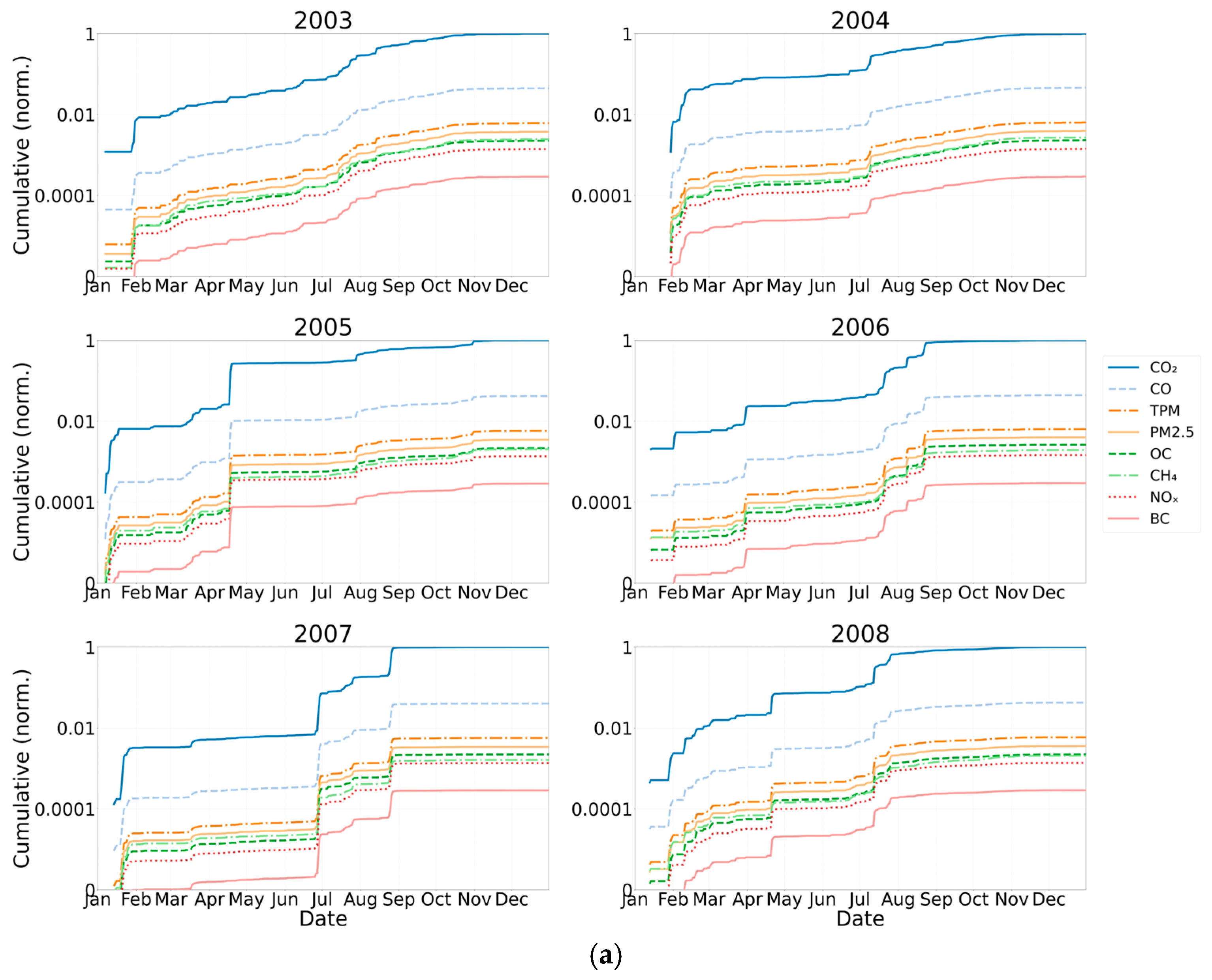
Figure 1. (ad): Cumulative wildfire emissions (2003–2025), normalized by the corresponding annual CO2 total for each year, shown for CO2, CO, TPM, PM2.5, NOx, OC, BC, and CH4.
Remotesensing 18 01438 g001aRemotesensing 18 01438 g001bRemotesensing 18 01438 g001c
Figure 2. Maps—wildfire emissions of black carbon 2003–2025.
Remotesensing 18 01438 g002
Figure 3. Annual totals of wildfire BC emissions in Greece, 2003–2025.
Remotesensing 18 01438 g003
Figure 4. Comparison of wildfire CO2 emissions (GFAS) with national inventory CO2 totals, 2003–2023.
Remotesensing 18 01438 g004
Figure 5. Annual wildfire CO2 emissions (GFAS) vs. burned area (EFFIS), 2006–2025.
Remotesensing 18 01438 g005
Figure 6. (a) CORINE layer of Evia’s burned area for 2018 and (b) CORINE layer of Evros’ burned area for 2018.
Remotesensing 18 01438 g006aRemotesensing 18 01438 g006b
Figure 7. (a) NDVI of Evia’s burned area from 1 August 2021 to 10 August 2021, (b) NDVI of Evros’ burned area from 1 August 2023 to 15 August 2023.
Remotesensing 18 01438 g007
Figure 8. Cumulative wildfire BC emissions, 2003–2025.
Remotesensing 18 01438 g008
Figure 9. Daily vs. monthly mean BC emissions in Greece, 2003–2025.
Remotesensing 18 01438 g009
Figure 10. Deseasonalized daily BC emissions with Sen’s slope trend, 2003–2025.
Remotesensing 18 01438 g010
Figure 11. Spatial distribution of the coefficient of variation expressed as a percentage (CV% = σ/μ × 100) of annual wildfire black carbon (BC) emissions across Greek prefectures for 2003–2025, representing relative IAV.
Remotesensing 18 01438 g011
Figure 12. (a,b). MSG SEVIRI natural-color composites over Greece with overlaid GFAS black carbon (BC) flux points for two major wildfire events: 2021 Evia fires (above) and 2023 Evros fires (below).
Remotesensing 18 01438 g012
Figure 13. Histogram of injection heights (m) from the GFAS dataset (2018–2025) across Greece, calculated using a 25-m bin width.
Remotesensing 18 01438 g013
Figure 14. Spatial distribution of GFAS-derived plume-injection heights over Greece for 2018–2025.
Remotesensing 18 01438 g014
Figure 15. Yearly percentage of samples classified as “Extreme” versus “No Extreme” based on the combined wind-gust (μ + std) and SPI6 drought (μ − std) thresholds during 2003–2024.
Remotesensing 18 01438 g015
Figure 16. Probability density in y-axis (dimensionless) of SPI6 in x-axis (dimensionless) (6-month cumulative drought index) with the extreme drought threshold (p90/p10) indicated by the dashed line.
Remotesensing 18 01438 g016
Figure 17. Probability density in y-axis (dimensionless) of wind gust in x-axis (m/s) with the extreme drought threshold (p90/p10) indicated by the dashed line.
Remotesensing 18 01438 g017
Figure 18. Annual number of extreme classifications by driver, distinguishing between wind-gust extremes and SPI6 drought extremes.
Remotesensing 18 01438 g018
Figure 19. Bubble plot linking GFAS fire-emission-source pixels to wind-gust (m/s) and SPI6 (dimensionless) conditions during 2003–2024. Each point corresponds to a fire-emission-source pixel; color indicates “Extreme” versus “No Extreme” classification based on the combined wind-gust (monthly p90) and SPI6 drought (monthly p10) thresholds, while bubble size is proportional to FRP (MW).
Remotesensing 18 01438 g019
Table 1. Top five municipalities by annual BC emissions (peak year shown).
MunicipalityYearBC Emissions (kt)
Evia20211.4
Messinia20071.1
Arcadia20071.0
Evros20230.8
Ilia20070.6
Table 2. Long-term cumulative BC emissions by municipality (2003–2025, top five).
RankMunicipalityTotal Emissions 2003–2025 (kt)
1Evia3.2
2East Attica1.5
3Messinia1.3
4Dodecanese1.3
5Ilia1.2
Table 3. Top 15 Greek prefectures with the highest coefficient of variation expressed as a percentage (CV% = σ/μ × 100) of annual wildfire black carbon (BC) emissions during 2003–2025.
MunicipalityCV (%)
Agio Oros403
Messinia401
Evoros393
Arkadia387
Kerkyra381
Lefkada376
Chalkidikis321
Ilia308
Lakonia303
Magnisia277
Fokida273
Kavala271
Dytiki Attiki262
Kastoria253
Table 4. Yearly statistics of injection height (m) for Greece, 2018–2025.
YearMin (m)Max (m)Mean (m)Median (m)n Samplesn Samples/Active FRP
20183222133869738940.15
201914520599388561480.15
20203221755957904770.16
20211942769105010283200.30
202219320838207451300.15
20232453717127111123500.25
20242692419118511531840.20
20252663157124110961040.35
Disclaimer/Publisher’s Note: The statements, opinions and data contained in all publications are solely those of the individual author(s) and contributor(s) and not of MDPI and/or the editor(s). MDPI and/or the editor(s) disclaim responsibility for any injury to people or property resulting from any ideas, methods, instructions or products referred to in the content.