Article

Changes in Glaciers of the Vakhsh River Basin, Tajikistan Under Global Climate Change

1
Xinjiang Institute of Ecology and Geography, Chinese Academy of Sciences, Urumqi 830011, China
2
Institute of Water Problems, Hydropower and Ecology of the National Academy of Sciences of Tajikistan, Dushanbe 734042, Tajikistan
3
Center for Glacier Research of the National Academy of Sciences of Tajikistan, Dushanbe 734042, Tajikistan
4
Institute of Geographic Sciences and Natural Resources Research, Chinese Academy of Sciences, Beijing 100101, China
*
Author to whom correspondence should be addressed.
Remote Sens. 2026, 18(9), 1436; https://doi.org/10.3390/rs18091436
Submission received: 18 March 2026 / Revised: 16 April 2026 / Accepted: 27 April 2026 / Published: 5 May 2026

Highlights

What are the main findings?
  • The glacier area in the Vakhsh River Basin (VRB) decreased from 4440.9 km2 in 2000 to 3955.2 km2 in 2025, representing a 10.94% reduction.
  • About 60% of the surge-type glaciers of the Pamir region are located in the basin, with glacier advances ranging from 0.4 to 3.6 km, significantly affecting glacier morphology and basin dynamics.
What are the implications of the main findings?
  • Climatic warming, decreasing surface albedo, and increasing dust and black carbon deposition contribute to accelerated glacier melting in the VRB.
  • Continued glacier retreat may alter river runoff regimes and affect water resources, hydropower production, and water security of the VRB.

Abstract

The VRB represents one of the most important glacierized regions in the upper Amu Darya Basin (UADB), where glacier and snow dynamics play a key role in regional water resources. This study investigates glacier changes in the VRB during 2000–2025 based on multi-source remote sensing and GIS analysis, while long-term climatic variability since 1970 is used to provide background context for regional climate conditions. The results show a significant reduction in glacier area from 4440.9 km2 in 2000 to 3955.2 km2 in 2025, corresponding to a loss of 485.7 km2 (10.94%). The glaciers are mainly distributed on northern and northeastern slopes at elevations between 4000 and 5000 m a.s.l., where climatic conditions favor their preservation. The basin also contains numerous surge-type glaciers, accounting for approximately 60% of all surge-type glaciers in the Pamir region, with advances ranging from 0.4 to 3.6 km. Climatic analysis indicates a warming trend of 0.15–0.31 °C per decade during 1970–2025, accompanied by pronounced seasonal variability in snow cover and gradual decreases in surface albedo associated with increased dust and black carbon concentrations. Glacier thinning is particularly evident in the lower glacier zones, while hydrological analysis shows that glacier and snow meltwater strongly influence river runoff. These results highlight the sensitivity of glaciers in the VRB to climatic and environmental changes and emphasize the importance of continued monitoring and adaptive water resource management in the VRB.

1. Introduction

Climate change significantly influences glacier dynamics in High Mountain Asia (HMA), including the Pamirs and Tianshan Mts. Studying the spatiotemporal variability of glaciers in HMA is crucial for understanding their impact on water resources [1,2]. Under the 1.5 °C Paris Agreement scenario, temperatures in HMA are projected to rise by 2.1 ± 0.1 °C by 2100, potentially exceeding 3 °C under high-emission scenarios [3,4]. HMA glaciers are projected to lose 36 ± 7% of their mass by 2100 under moderate scenarios [5,6]. These changes lead to increased debris cover, GLOF risks, and slope destabilization, threatening infrastructure, hydropower, and irrigation [7,8,9], thus underscoring the need for integrated modeling of glacier dynamics [10,11] using glaciology, hydrology, and remote sensing [12].
Central Asia, including Tajikistan, is a climate change hotspot [13,14,15]. Tajikistan’s glaciers cover 6% of its territory and form more than 60% of the total water resources of Central Asia [16,17,18,19]. The Amu Darya River basin is significantly influenced by meltwater from glaciers in Tajikistan, Kyrgyzstan, and Afghanistan. GCMs and RCMs project that over a third of major glaciated basins, including the Amu Darya, could experience runoff declines exceeding 10% by 2100 [11]. Remote sensing enables tracking of glacier changes [20,21], but in Tajikistan, projections are constrained by a lack of historical data [22,23]. Hydrological models (SPHY, SWAT) enhanced by neural networks (e.g., LSTM) integrate melt and runoff data [24,25], and projected runoff increases until 2060 followed by decline after 2080 necessitate continuous monitoring [26,27]. Surge-type glaciers and moraine-dammed lakes pose significant hazards, although some lie outside the study basin [28,29,30].
Glaciological research in the region intensified during the International Geophysical Year (1957–1958) [31], but since the 1990s, in situ monitoring has declined [32,33]. Detailed information on glaciers in the Surkhob and Khingov basins highlights their role as key freshwater sources [34,35,36]. Research in the 1970s–1980s revealed glacier degradation trends, including the disappearance of small glaciers (<0.1 km2) and fragmentation of glacial systems [37,38], confirming the sensitivity of tributaries in the VRB to climate change [18,19]. Contemporary global models indicate that even if temperatures stabilize, glaciers will lose about 39% of their mass compared to 2020; in Central Asia, this “committed” loss is estimated at 12% [39].
This study presents an integrated analysis of glacier dynamics in the VRB based on multi-temporal remote sensing (2000–2025), GIS analysis, and hydroclimatic datasets (1970s–2025). Unlike previous studies, this work specifically examines the role of surge-type glaciers and their implications for regional hydrological processes.
The aim of this study is to assess glacier dynamics in the VRB under global climate change. Specifically, we: (1) assess glacier area changes during 2000–2025; (2) identify spatial patterns of glacier degradation; (3) evaluate the role of surge-type glaciers; (4) analyze the relationship between glacier changes and climatic factors, including albedo decline; and (5) evaluate the contribution of glacier meltwater to runoff formation in the VRB.

2. Materials and Methods

2.1. Study Area

This study focuses on the high-mountain regions of the VRB, located within the territories of Tajikistan and Kyrgyzstan. The Amu Darya Basin represents one of the most important water systems in Central Asia. This region is characterized by a high degree of glaciation and plays a crucial role in maintaining the regional water balance and regulating hydrological processes.
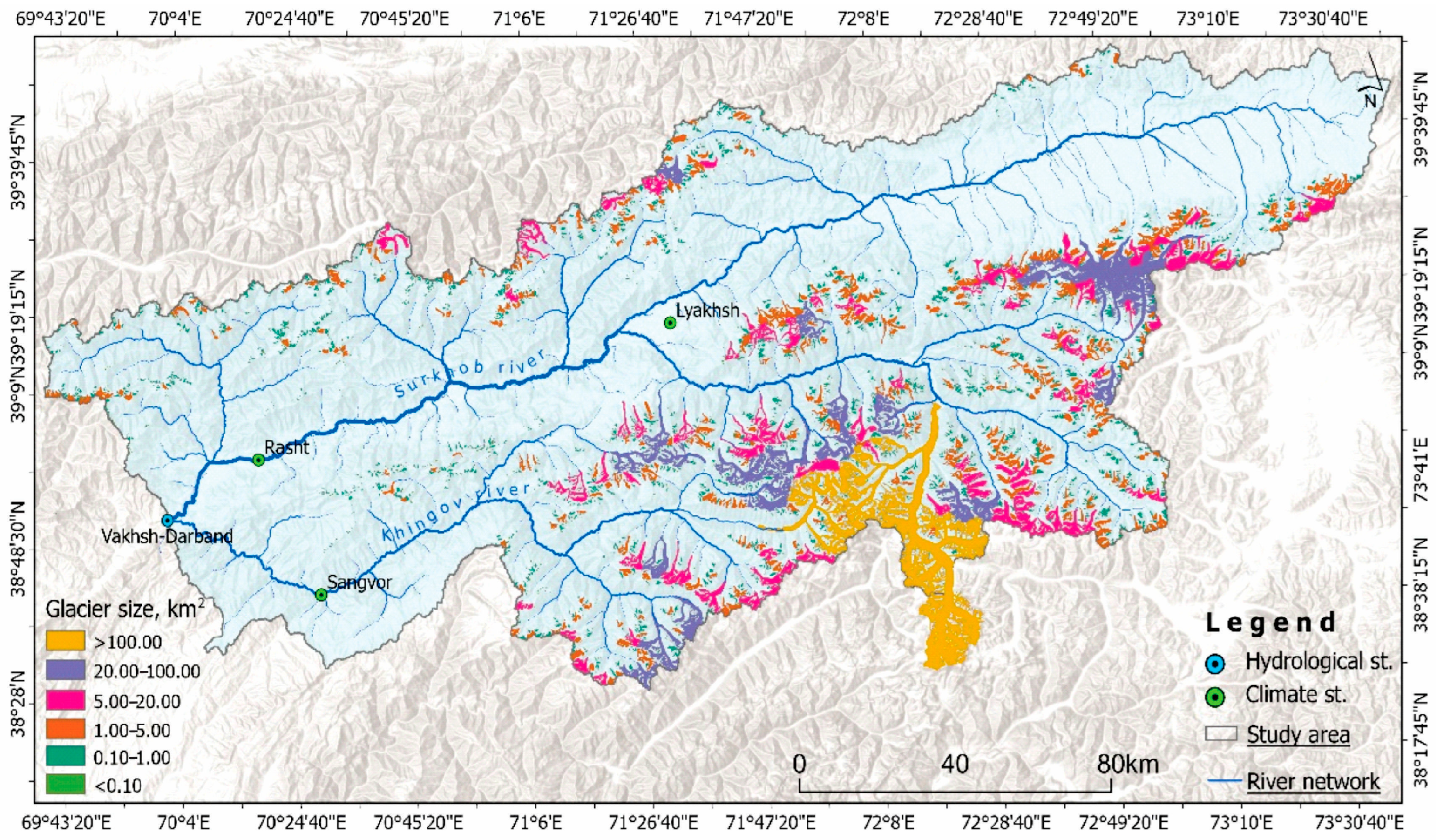
The Vakhsh River is one of the main tributaries of the transboundary Amu Darya River, together with the Panj River, and contributes a significant portion of its total discharge, accounting for approximately 25–30% of the Amu Darya flow [40]. The total area of the VRB exceeds 39,100 km2 [41]. The major tributaries of the Vakhsh River include the Surkhob, Khingov (Obikhingou), and Mughob (Muksu) rivers, whose basins contain some of the largest glaciers in Tajikistan and the entire Central Asian region, including the Vanjyakh (Fedchenko) and Garmo glaciers (Figure 1).
The river basin covers a wide range of natural and geographical conditions, extending from the northern margin of the Pamir Mts. within the Pamir and Alay ranges to the semi-arid zone of the South Tajik Depression. The elevation range of the basin varies from approximately 1100 m to 7450 m above sea level, with an average elevation of about 3500 m. The names of rivers and glaciers used in this study correspond to the new official toponyms approved by the Government of the Republic of Tajikistan [42].

2.2. Data Sources

The datasets used in this study are summarized in Table 1. These include satellite imagery, glacier inventories, hydrological and climatic observations, as well as reanalysis and remote sensing products used for the assessment of glacier dynamics and environmental drivers.
For the 2025 glacier inventory, a total of 24 Landsat 8 and 9 OLI/TIRS scenes were used. The acquisition details for each scene, including the satellite/sensor, date of acquisition, Path/Row, and spatial resolution, are provided in Table 2. All images are Tier 1 (L1TP) products with cloud cover below 10%, acquired during the late ablation season (July–September 2025) from the USGS EarthExplorer platform [43].
Spatial resolution consistency: The datasets used in this study have different spatial resolutions, ranging from high-resolution satellite imagery (e.g., Landsat, 30 m) to coarse-resolution reanalysis products, such as MERRA-2 (0.5° × 0.625°, ~50–70 km) and ERA5-Land (0.1°, ~10 km) (Table 1). To ensure consistency in comparative analysis, all datasets were reprojected into a common coordinate system and processed within the Google Earth Engine (GEE) environment. Gridded datasets (MODIS, MERRA-2, and ERA5-Land) were analyzed at their native spatial resolution and aggregated to represent mean conditions over the study area.
For basin-scale analysis, all variables were spatially averaged over the VRB. For glacier-scale analysis, mean values were extracted only from higher-resolution datasets (e.g., MODIS products with 500 m−1 km resolution), whereas MERRA-2 and ERA5-Land were not applied at the glacier scale due to their coarse spatial resolution relative to typical glacier sizes in the study area (most <10 km2).
This approach minimizes the impact of spatial resolution differences and ensures consistency in the comparison of multi-source datasets. Nevertheless, residual uncertainties related to scale differences are acknowledged.

2.3. Methods

2.3.1. Glacier Delineation and Digitization

Initial image preprocessing, including geometric correction, georeferencing, and composite generation, was performed using ArcGIS Pro software (version 3.4.0). For topographic analysis, the SRTM DEM with a spatial resolution of 30 m was used to derive morphometric characteristics such as mean elevation, slope, and aspects of the glacierized areas.
Glacier outlines were manually delineated through visual interpretation of false-color composites (Landsat 8/9 channels 5-4-3), supported by the GLIMS database RGI 7.0 [45]. This approach ensures consistency with widely used glacier inventory standards.
However, it is important to note that glacier inventories derived from different sources are not fully homogeneous. Differences in image acquisition season, cloud cover, and delineation protocols can introduce inconsistencies in glacier mapping. These issues are well documented in previous studies. For example, ref. [47] demonstrated that glacier delineation is highly sensitive to the selection of Landsat imagery, particularly with respect to seasonal snow, cloud cover, and shadow effects. Similarly, ref. [46] highlighted that debris cover, seasonal snow, cast shadow, and analyst interpretation represent major sources of uncertainty in glacier mapping.
To minimize these inconsistencies, all datasets were harmonized into a common coordinate system and visually inspected using multi-source satellite imagery. Manual corrections were applied, particularly in debris-covered glacier areas and shadowed regions, where automatic classification is less reliable. Additional validation was performed using high-resolution imagery available in Google Earth [45,56].
Special attention was given to debris-covered glaciers, which require manual interpretation due to spectral similarity with surrounding terrain. This limitation has been widely recognized in glacier inventory studies [46,47].
Uncertainty Assessment: Remote sensing data accuracy assessment involves calculating the uncertainty of the obtained data. Errors in satellite imagery may arise from various factors, including equipment quality, acquisition conditions, atmospheric effects, and data processing errors. Acquisition timing can also affect accuracy (e.g., an inappropriate time of day may cause shadows, color distortions, and other errors). Atmospheric conditions such as cloud cover and atmospheric effects can also influence image accuracy. Data processing errors can occur at any stage, from signal readout to final image formation, due to incorrect instrument settings, software errors, or human factors. Although the uncertainty of satellite imagery can be significant, modern data processing methods can substantially reduce this uncertainty and improve image accuracy [57,58,59].
The shape complexity (or sinuosity) of glacier boundaries was evaluated using the formula:
f = P 2 4 π S
where f is the shape complexity (sinuosity) coefficient, P is the perimeter of the polygon, and S is the area of the polygon.
This coefficient indicates the degree of boundary irregularity, which correlates with the potential error. For simple geometric shapes, the coefficient f takes the following values: circle f = 1.00; hexagon f = 1.10; square f = 1.27; semicircle f = 1.34; and equilateral triangle f = 1.65 [59]. The more complex the glacier shape and type, the greater the sinuosity of the polygon and, accordingly, the greater the value of f and the greater the uncertainty of the results [59]. The number of pixels (Np) within the reference area was calculated as:
N p = S L 2
where L is the spatial resolution. The raster-based measured area was determined by:
S m = N m × L 2
and the relative error of area estimation was calculated using the empirical formula:
δ = a × ( S m L 2 ) b
where Sm is the measured area of the object, and a and b are empirical coefficients that depend on the shape complexity of the object and the number of pixels representing it. This relationship is based on the modeling study of Kupriyanov et al. [57], where the coefficients vary depending on object geometry and spatial resolution. Therefore, in this study, the equation is applied in a generalized form, and uncertainty is interpreted within literature-supported ranges rather than fixed coefficient values. Atmospheric conditions such as cloud cover, sensor noise, and processing errors were also considered as potential sources of uncertainty.
Use of existing glacier inventories: The existing inventories (Pamir and Karakoram Inventory [46], GAMDAM [47], USSR Glacier Inventory [34,35], and Catalogue of Surge-Type Glaciers of the Pamirs [48,49]) were used as reference sources for comparison and validation, not directly for change calculation. For the quantitative analysis of glacier area changes, we generated consistent glacier boundaries from Landsat imagery (2025) using a uniform manual delineation protocol. The existing inventories were primarily used to identify surge-type glaciers and to provide historical context. Systematic differences between inventories (due to different acquisition dates, spatial resolutions, and delineation protocols) are acknowledged. To minimize their impact, we prioritized our own consistent mapping results for all quantitative change analyses and used existing inventories only as qualitative references. Where discrepancies were found, we verified against high-resolution Google Earth imagery. The uncertainty related to inventory comparisons is reflected in the uncertainty bounds (±2–5% for clean-ice glaciers, ±5–10% for debris-covered or small glaciers) discussed above.
In addition, a buffer-based uncertainty approach was considered following previous studies. For Landsat imagery (30 m resolution), positional uncertainty is typically assumed to be ±0.5 pixel for clean ice and ±1 pixel for debris-covered glacier areas. Based on these methods and the literature values, the uncertainty of glacier area estimation is generally within ±2–5% for clean-ice glaciers and may exceed ±5–10% for debris-covered or small glaciers [46].
Furthermore, temporal inconsistencies in satellite imagery (e.g., differences in acquisition dates) may introduce additional uncertainty, particularly in regions affected by seasonal snow and cloud cover [47]. These uncertainties were minimized by selecting images from the late ablation season where possible.
Despite these efforts, complete elimination of inter-dataset differences is not possible. Therefore, all glacier change results are interpreted within the defined uncertainty bounds.

2.3.2. Glacier Inventory and Calculation Glacier Area Changes

The percentage change in glacier area (PCA; %) is calculated using the following formula:
P S A = A 2 A 1 A 1
where A1 and A2 represent the glacier areas (km2) at different time points, with A1 corresponding to the earlier year.
The annual percentage change in glacier area (APCA; %) is determined as:
A P S A = P C A Δ t × 100 %
where Δt is the time interval between the two glacier inventories (in years) [60].
A detailed glacier inventory in the upper reaches of the VRB (including the basins of the Mughob, Surkhob, and Khingov rivers) was compiled based on processed Landsat imagery for 2025. This inventory includes updated glacier outlines, area measurements, and classification by size categories and exposition, including surge-type glaciers. Glacier boundaries were manually digitized in ArcGIS Pro, resulting in polygon layers saved in Shape file format. Each polygon includes spatial and attribute information: a unique glacier identifier, names corresponding to entries in [34,35,46,47], and updated area values derived from 2025 remote sensing data.
This research provides a critical foundation for detecting and quantifying glacier changes over recent decades, as well as for evaluating their impact on river runoff and water resources management.

2.3.3. Trend Analysis

To assess long-term changes in the factors influencing glaciers in the VRB, a linear trend analysis was conducted. The analysis covered the following parameters: Satellite and reanalysis data (2000–2025): snow albedo (MODIS Snow Albedo), dust concentration (MERRA-2 Dust), cloud cover (MODIS Cloud Cover), black carbon concentration (MERRA-2 Black Carbon), glacier surface temperature (LST, MODIS), snowfall (ERA5-Land), and solar radiation (ERA5-Land). Hydrological and climate data from ground stations:
-
Mean monthly discharge at the Darband hydrological station for the period 2000–2025;
-
Mean annual temperature for the period 1970–2025;
-
Annual precipitation for the period 1970–2025.
The linear trend model was expressed as:
y = a x + b
where y is the variable of interest, x is the observation year, a is the slope (trend per year), and b is the intercept. The coefficient of determination (R2) was calculated to quantify the proportion of variance explained by the linear trend.
This analysis allowed the identification of long-term trends in both climatic and hydrological factors and their influence on glacier dynamics in the upper reaches of the VRB.

2.3.4. Ancillary Data and Field Surveys

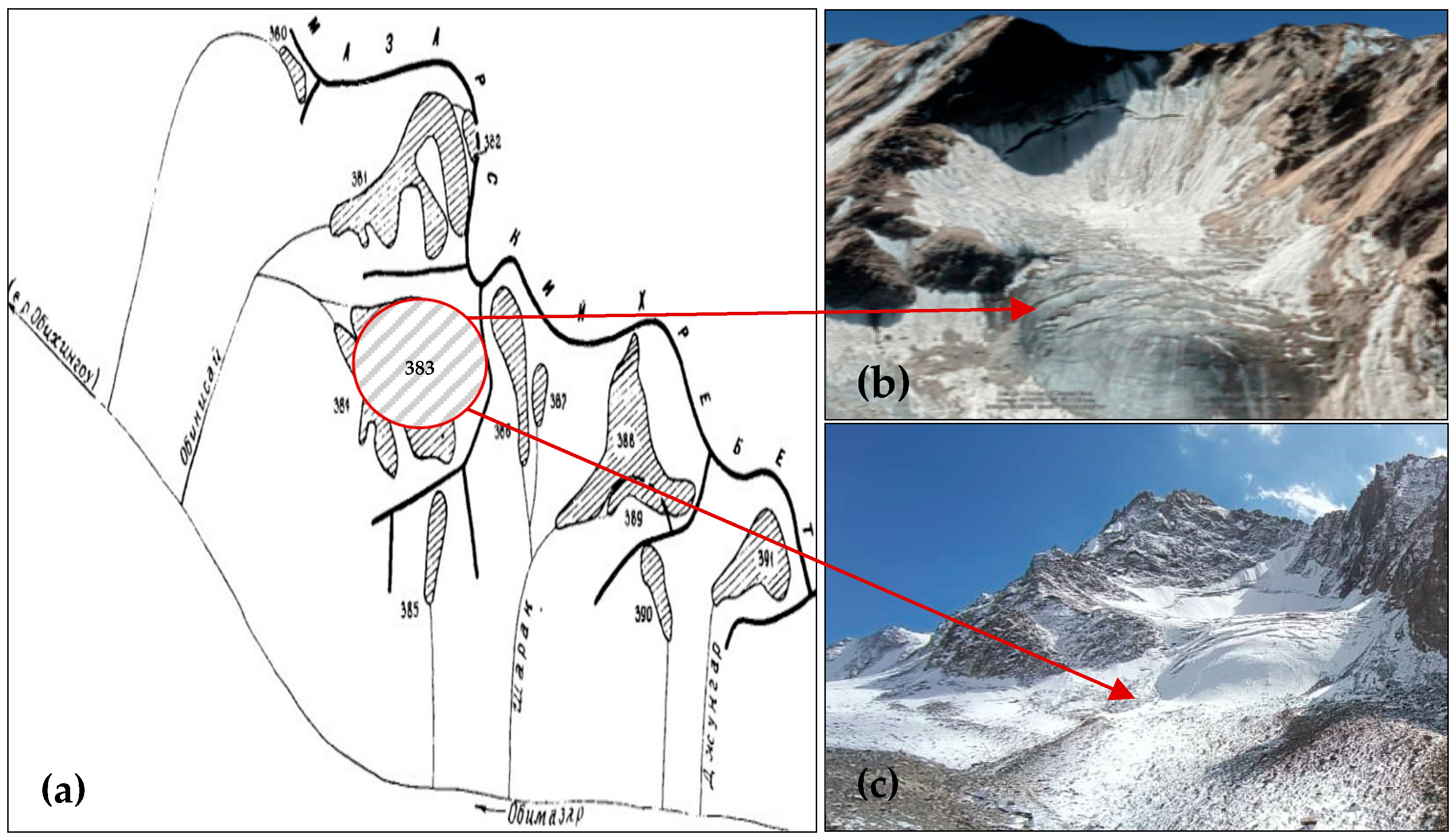
Field observations were particularly crucial for refining knowledge of dynamic processes, including recurrent glacier surges and the formation of proglacial lakes behind glacier termini. The verification of the results involved cross-referencing modern remote sensing data with archival records, field photographs, and high-resolution satellite imagery. This integrative approach enabled the production of a series of thematic maps (Figure 2) illustrating the spatial distribution of glaciers across different sectors of the Khingov River basin. During the delineation of glacier boundaries, spectral characteristics of their components were considered: the dark-blue tones of exposed ice, the white areas of firn and snow, and regions covered by moraine deposits. This approach facilitated precise mapping of glacier outlines, updated their spatial distribution, and revealed temporal changes in glacier areas over the study period.

3. Results

3.1. Glacier Changes

3.1.1. Area Changes and Slope Aspect

The VRB is one of the largest glacierized areas in Central Asia. The basin includes the sub-basins of the Mughob, Surkhob, Khingov, and Kizilsu rivers, as well as the Vanjyakh (Fedchenko) glacier system and a part of the Markansu sub-basin. The results of this study indicate that the glacier area in the VRB in 2000 was 4440.9 km2 [46]. By 2018, this area had decreased to 4087.1 km2 [47]. According to the current study, the projected glacier area decreased to 3955.2 km2 by 2025. Between 2000 and 2025, the glacier area decreased by −485.7 km2, which corresponds to a 10.94% reduction in the initial area. From 2018 to 2025, the glacier area decreased by −131.9 km2, which corresponds to 3.23%. The average annual area loss from 2000 to 2025 was 19.43 km2 (Figure 3).
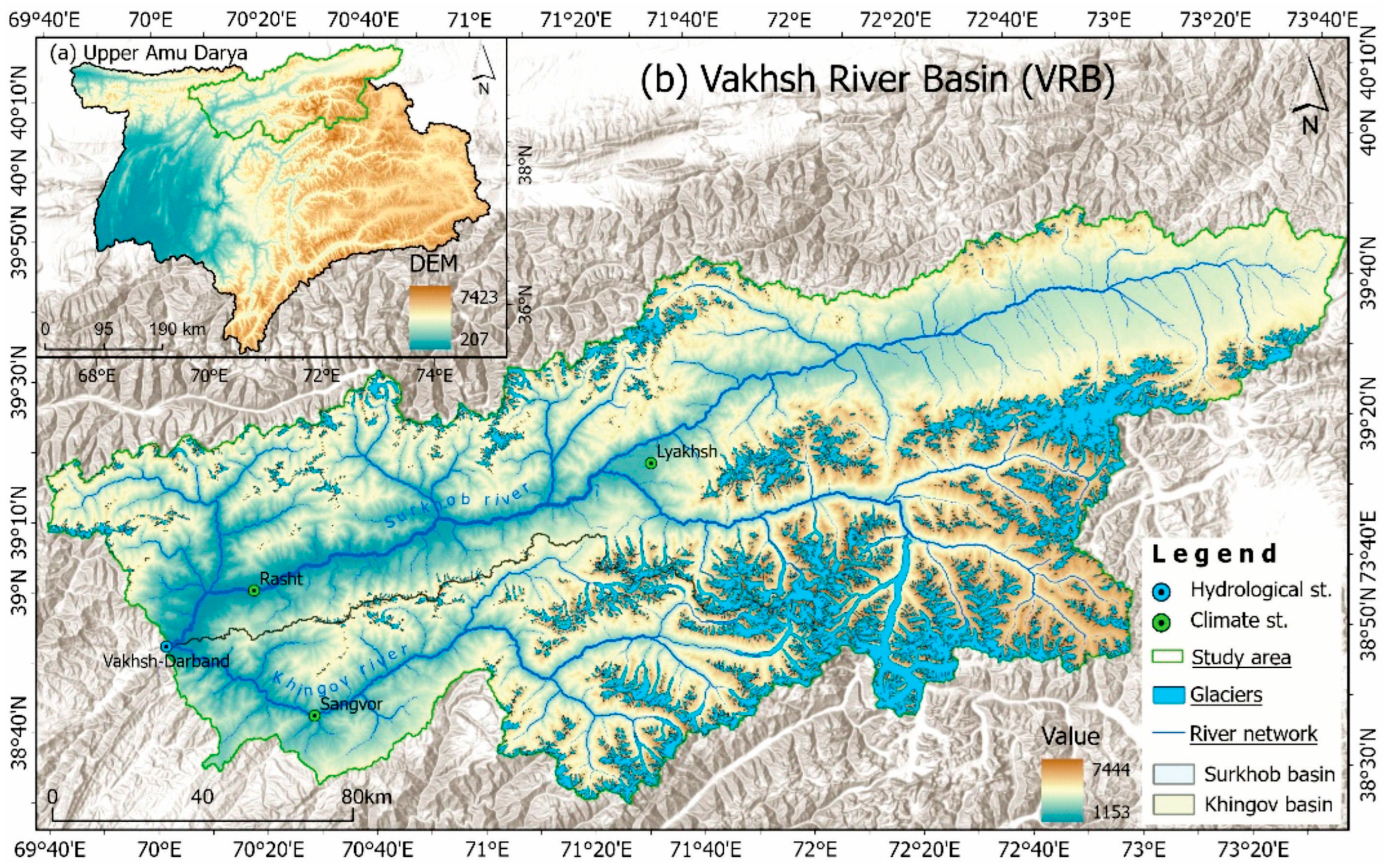
Figure 3 illustrates the schematic map of glacierized regions in the VRB, showing the geographical distribution of glaciers, their sizes, and major rivers. This map highlights important aspects of the glacier cover, including glacier sizes, hydrological and climate stations, as well as the study area and river network.
Table 3 demonstrates the glacier area changes in the (2000–2025) period. The table presents the absolute values of area changes, percentage changes, and the annual glacier area loss during the study period.
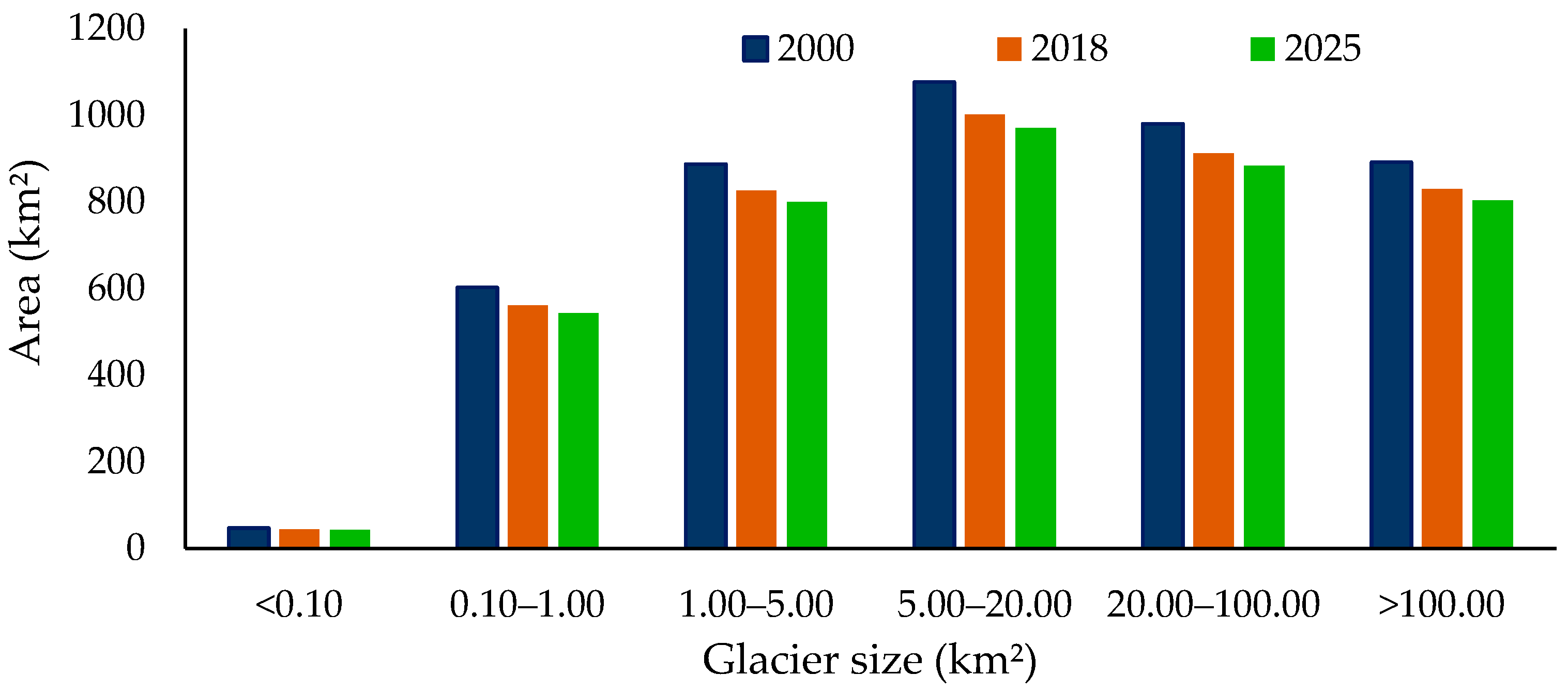
The distribution of glacier area by size classes in the VRB shows that the largest share of glacier area is concentrated in medium and large glaciers. The 5.00–20.00 km2 size class represents the largest glacier area in all analyzed years, amounting to 1076.63 km2 in 2000, 1001.71 km2 in 2018, and 970.38 km2 in 2025. Glaciers belonging to the 20.00–100.00 km2 class also occupy a significant area, decreasing from 980.53 km2 in 2000 to 912.38 km2 in 2018 and 883.84 km2 in 2025. Similarly, glaciers in the >100.00 km2 class show a gradual reduction in area from 891.67 km2 in 2000 to 829.75 km2 in 2018 and 803.80 km2 in 2025. Smaller glaciers (<5 km2) contribute relatively less to the total glacier area. The area of glaciers smaller than 0.10 km2 remains very limited, decreasing slightly from 47.20 km2 in 2000 to 42.55 km2 in 2025. Overall, the results indicate a consistent decrease in glacier area across all size classes between 2000 and 2025, reflecting the ongoing reduction of glacierized area in the VRB (Figure 4).

3.1.2. Spatial Distribution and Characteristics

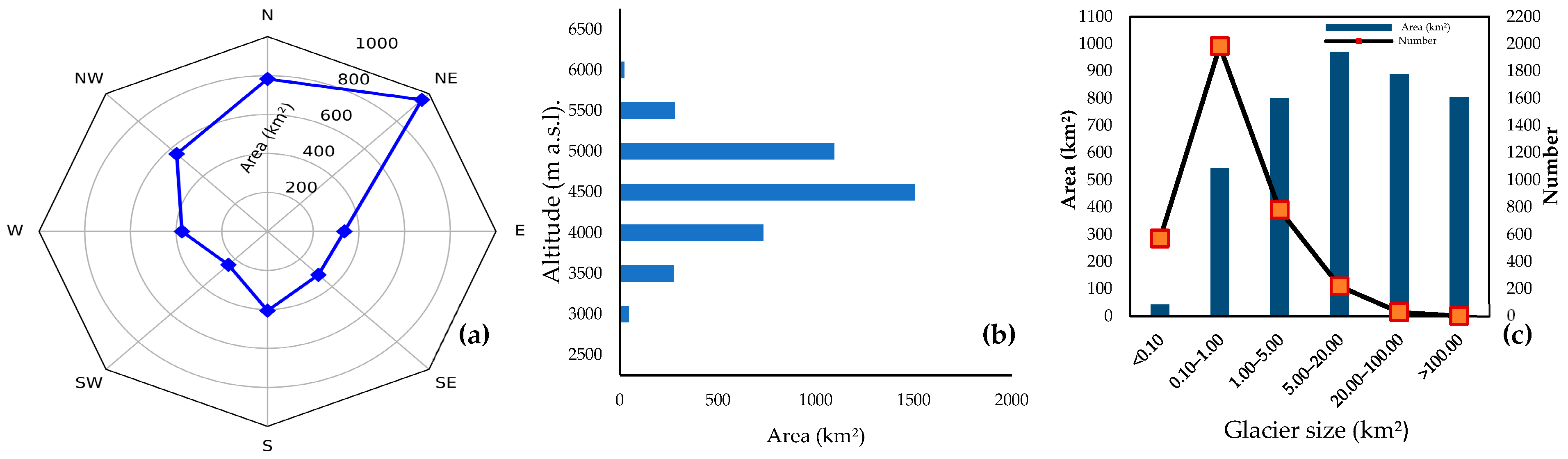
The distribution of glaciers by slope aspect in the VRB shows that the largest glacier areas are concentrated on the northern and northeastern slopes. According to the results, the largest glacier area is observed on the northeastern aspect (955.6 km2), followed by the northern aspect (782.8 km2) and the northwestern aspect (562.4 km2).
Significantly smaller glacier areas are characteristic of southern-facing slopes. The glacier area on the southern aspect is 406.4 km2, on the southeastern aspect it is 315.1 km2, and on the southwestern aspect it is 242 km2, which represents the smallest value among all the aspects. The glacier areas on the eastern and western aspects are 336.4 km2 and 374.4 km2, respectively (see Figure 5a). The results obtained reflect the spatial distribution of glaciers in the VRB by slope aspect and indicate that a significant portion of glaciers is located on northern-facing slopes.
The distribution of glacier area by elevation in the VRB shows that glaciers are mainly concentrated at elevations between 4000 m and 5000 m above sea level. The largest glacier area is found at 4500 m, totaling 1505.25 km2, followed by 5000 m with 1094.22 km2 of glaciers. A significant glacier area is also observed at 4000 m, amounting to 730.91 km2. At lower elevations, the glacier area significantly decreases. At 3500 m, the glacier area is 273.95 km2, while at 3000 m, it decreases to 44.84 km2, and at 2500 m, glaciers cover only 2.34 km2. At higher elevations above 5500 m, the glacier area also sharply decreases: 280.20 km2 at 5500 m, 23.27 km2 at 6000 m, and only 0.09 km2 at 6500 m (Figure 5b).
Overall, the results show that most glaciers in the VRB are concentrated in the mid-altitude range between 4000 m and 5000 m, which represents the most favorable elevation zone for glacier formation and preservation in this region.
The distribution of glacier area and the number of glaciers by size classes in the VRB indicates a clear difference between the contributions of size classes to the total glacier area and the number of glaciers. The total glacierized area of the basin in 2025 is expected to be 3955 km2. The largest contribution to the total glacier area is observed in the 5.00–20.00 km2 size class, which accounts for approximately 970.38 km2 of the glacier area. Significant glacier areas are also associated with the 20.00–100.00 km2 size class (883.84 km2) and the >100 km2 class (803.80 km2). Glaciers in the 1.00–5.00 km2 class contribute 799.94 km2 to the total glacier area. In contrast, small glaciers dominate by number. The 0.10–1.00 km2 class contains the highest number of glaciers, while very large glaciers (>100 km2) are few but contribute significantly to the total glacier area. Similarly, glaciers smaller than 0.10 km2 are relatively frequent but occupy only a small portion of the total glacier area (Figure 5c).
Overall, the results show that while there are more small glaciers, the majority of the glacierized area in the VRB is concentrated in medium and large glaciers. Understanding the vertical dimensions of these changes is critical; therefore, the next section presents an analysis of glacier surface elevation changes, which provides a direct measure of ice volume loss.

3.1.3. Surface Elevation Changes of Glaciers

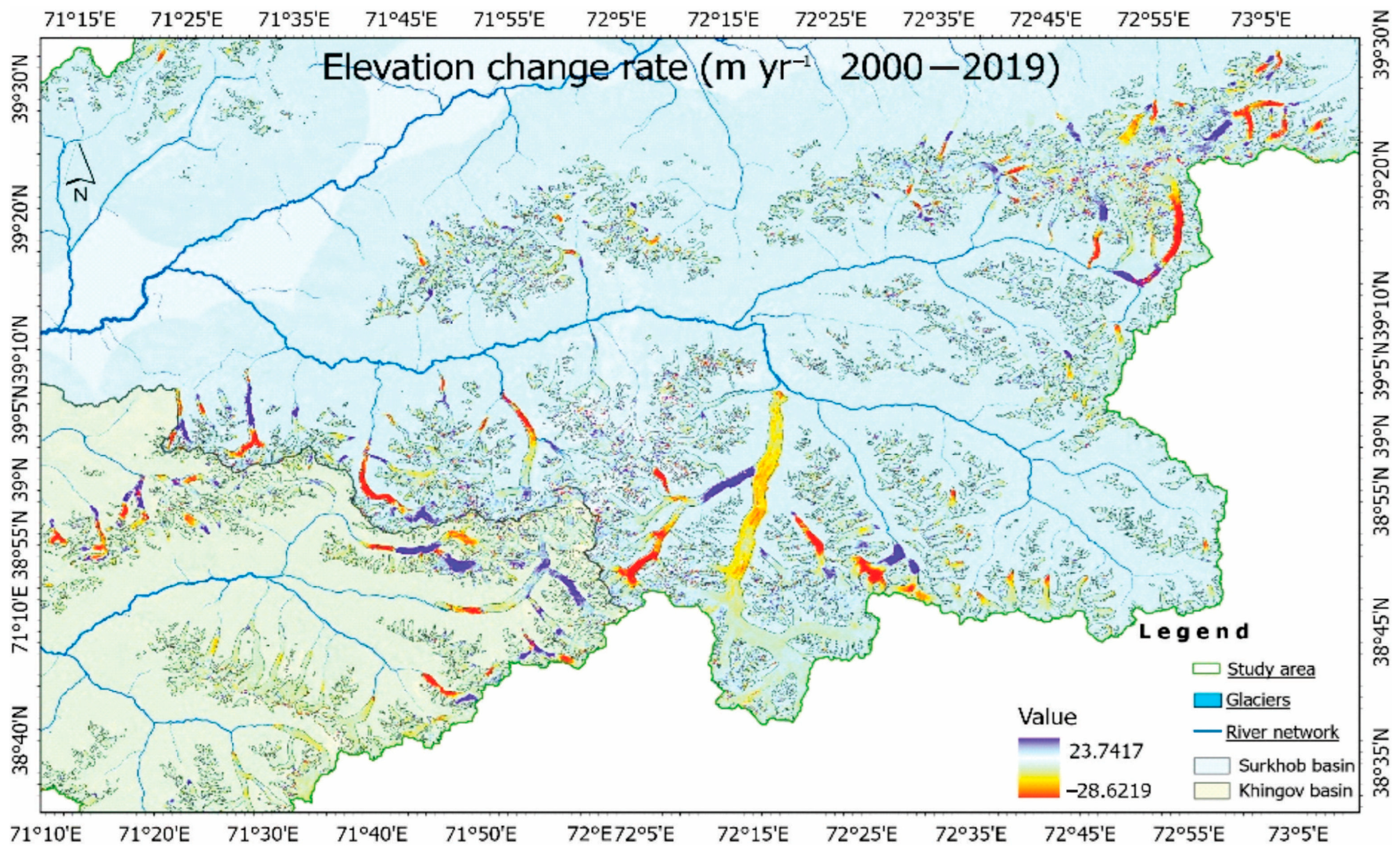
According to the data presented in [5], changes in the surface elevation of glaciers and the surrounding areas within a 10 km buffer zone were analyzed for the period 2000–2019. According to datasets provided by [54], the analysis used a spatial resolution of 100 × 100 m across the entire study area. To assess elevation changes, a Gaussian process regression method was applied to a time series of elevation values derived from various digital elevation models (DEMs). Based on data from the Land Processes Distributed Active Archive Center (LP DAAC), the DEMs were derived from ASTER Level 1A stereo images [55].
The analysis was conducted over complete calendar years—from January 1 of a given year to January 1 of the following year. Thus, the period 2000–2019 covers the interval from 1 January 2000 to 1 January 2019 [5]. The results of glacier surface elevation changes in the VRB over this 19-year period are presented in Figure 6. The analysis of glacier surface elevation changes over the period 2000–2019 reveals significant spatial heterogeneity across the VRB (Figure 6). The overall trend indicates pronounced surface lowering in the tongue regions of many glaciers, where maximum thinning rates reached −28.6 m yr−1. These zones of intense ice loss are concentrated at lower elevations and are likely driven by enhanced surface melting and dynamic thinning. Conversely, localized areas of surface elevation gain (up to +23.7 m yr−1) were identified in the middle parts of several glaciers, which may be attributed to snow accumulation, dynamic thickening, or surge-type activity.
The observed spatial patterns indicate substantial mass loss of glaciers in these basins, particularly in their terminal zones, which directly affects the regional hydrological regime. The distribution of elevation changes also highlights the influence of topographic and climatic factors, as well as the possible role of debris cover, on glacier responses to climatic forcing.
To validate the obtained results, publicly available geospatial datasets [5] and a widely recognized geodetic approach [61] were used, allowing for a more reliable assessment of glacier surface dynamics over the 2000–2019 period. The geodetic analysis revealed a decrease in elevation in the central parts of the glaciers and a simultaneous increase in elevation near the termini. These findings indicate that the glaciers in the VRB are undergoing active melting, characterized by mass redistribution from the upper to the lower zones. The observed trends reflect ongoing mass loss in the ablation areas and point to the potential risk of complete glacier degradation under continued climate change. The following section analyzes the surge-type glaciers in the VRB, which exhibit distinct dynamic behavior compared to the gradual mass loss described above.

3.1.4. Surge-Type Glaciers

According to [48], a total of 845 surge-type glaciers have been identified in the Pamir region, of which 473 glaciers are located in the VRB, accounting for approximately 60% of the total number of surge-type glaciers. Depending on the degree of surge activity, they are classified into three groups:
Group 1 (68 glaciers)—glaciers showing clear evidence of an active surge phase;
Group 2 (266 glaciers)—glaciers characterized by episodic or historically recorded surge events;
Group 3 (139 glaciers)—glaciers with possible or insufficiently confirmed surge activity.
Overall, more than 20% of the glaciers (Groups 1 and 2) exhibit active or recently observed surges, making them priority targets for monitoring glacier dynamics and assessing the associated hydrological hazards. Spatial analysis indicates that most surge-type glaciers are concentrated in the sub-basins of Mughob, Surkhob, Khingov, and Kyzylsu.
Within the framework of this study, glaciers exhibiting almost annual surge activity were analyzed. The main results for the period 1977–2025 include the identification of glaciers at different stages of the surge cycle and a quantitative assessment of their advance. The magnitude of glacier frontal advance was found to vary from +0.4 to +3.6 km over several decades (Table 4).
The majority of surge-type glaciers are concentrated in the Khingov River basin, particularly within the catchments of the Kargasrud, Garmo, and Gando rivers. The Gando glacier system includes 12 surge-type tributaries, whose dynamics significantly influence the behavior of the main glacier.
For example, Gando Glacier (No. 188, Group 1) advanced by approximately 2.0 km during the period 2011–2017. The intensification of surge activity during this period was associated with interactions with tributaries No. 189, No. 190, and No. 191. Significant events include the detachment of the lower glacier tongue (about 3 km) in 1972, as well as the surge event during 1985–1993, which resulted in a 1.5 km advance and was linked to the dynamics of Dorofeev Glacier (No. 191). In addition, during 2011–2017, a gradual decrease in the glacier front elevation from 4389 m to 3840 m a.s.l. was observed.
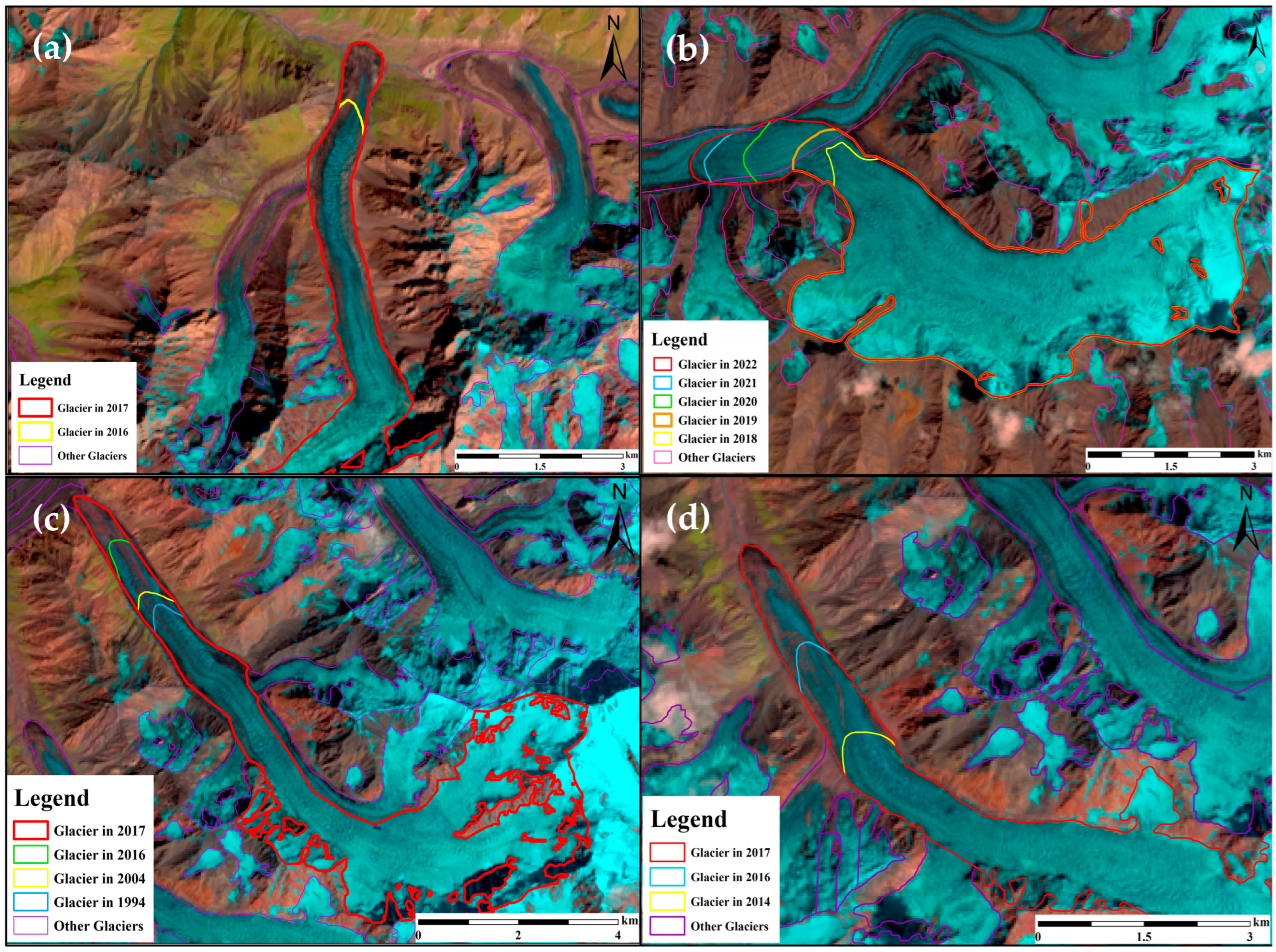
The Dorofeev Glacier (No. 191, Group 1) experienced a maximum advance of up to +4.5 km during 1987–1992. A subsequent surge phase during 2018–2022 resulted in an additional advance of 2.53 km and led to a change in the flow direction of the Gando Glacier (Figure 7b). Historical records also indicate repeated confluences between these glaciers in 1948 and 1987.
The Shohqala Glacier (No. 240, Group 1) advanced by approximately 1.8 km during 2014–2018, while long-term monitoring between 1994 and 2017 indicates a cyclical intensification of its activity (Figure 7c). Similarly, the Vanjdara Glacier (No. 264, Group 1) exhibited a record advance of up to 3.6 km during 2014–2017 (Figure 7d). The Vayzirak Glacier (No. 85, Group 2) advanced by approximately 1.8 km during 1991–2017, with short-term changes detected on high-resolution satellite imagery in 2016–2017 (Figure 7a).
The surge activity of these glaciers is accompanied by significant geomorphological transformations, including thickening of glacier termini, overriding of ice masses, the formation of transverse faults and longitudinal crevasses, and the development of ice-dammed proglacial lakes, which increase the risk of glacial lake outburst floods (GLOFs). For instance, Glaciers No. 62 and No. 63, which merged by 2016, exhibited a series of surge events with frontal advances of up to 1.4 km and the formation of proglacial water bodies during 2011–2017.
Surge-type glaciers can significantly influence hydrological processes through rapid redistribution of ice mass, temporary advance of glacier termini, and changes in meltwater pathways. Such dynamics may affect local runoff patterns, promote the formation of proglacial lakes, and increase the potential risk of glacial lake outburst floods (GLOFs). However, due to the lack of direct hydrological measurements at the glacier scale, these impacts are discussed qualitatively in this study.
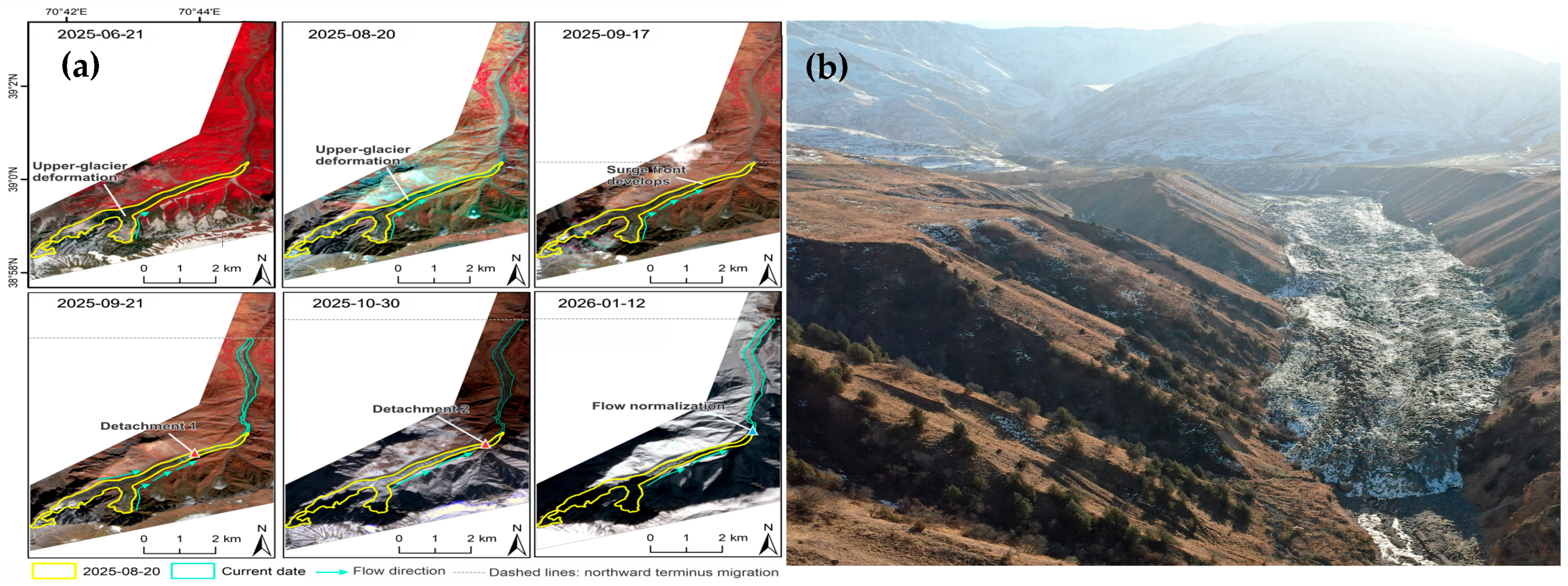
Special attention in this study was given to the Dehdal (Didal) Glacier, located on the northern slope of the Peter the First Range and belonging to the group of glaciers situated along the left side of the Surkhob River valley. This complex valley glacier with a northeastern exposure is registered in the glacier catalogue [34] under No. 513, and the Dara River originates from its tongue. The earliest information about the glacier’s dynamics dates back to the expedition of V.I. Lipsky [62], who reported signs of relatively recent glacier activation manifested by surface fragmentation and the occurrence of large snow avalanches.
Subsequent studies documented surge events in 1939, 1974, and 2015–2016, allowing this glacier to be classified as a surge-type glacier with an activation interval of approximately 35–45 years [62]. One of the most thoroughly documented events is the 1974 surge, which was accompanied by the detachment of part of the glacier tongue and its rapid advance down the valley. Following this event, the glacier tongue significantly shortened, and by 2014 its length was approximately 3350 m, while the glacier front elevation was about 3060 m above sea level. The next major surge phase was recorded in 2015–2016, when the glacier advanced by approximately 1950 m down the valley, with an average velocity of about 7.2 m day−1, and the glacier front reached an elevation of approximately 2550 m.
Analysis of high-resolution satellite imagery, including Sentinel-2 data, and Planet Labs [63] indicates that the glacier re-entered an active surge phase in 2025 (Figure 8a). In August 2025, the glacier front advance reached approximately 4040 m, increasing to 5100–5133 m by October, indicating the development of a new surge phase. Further analysis of satellite data showed that the glacier’s dynamic state remained unstable. Between 1 and 3 November 2025, the glacier advanced by about 72 m, between 6 and 18 November it advanced by approximately 240 m, and between 18 and 23 November it advanced by an additional 130 m. Thus, the total glacier advance in November 2025 amounted to approximately 442 m.
Field observations conducted in December 2025 revealed that following glacier activation on 25 October 2025, a new ice mass advanced down the valley by approximately 520 m during November, with an average velocity of about 20 m day−1 (Figure 8b). The height of the moving ice mass was estimated at 25–30 m, while the width of the flow ranged from 80 to 120 m.
These results confirm the continued active surge phase of the Dehdal Glacier and emphasize the need for regular monitoring using both remote sensing and field-based observation methods. Despite more than two decades of satellite observations, significant challenges remain for the long-term monitoring of surge-type glaciers in the region. A more detailed analysis of the dynamics of these glaciers will be presented in subsequent scientific publications.
To achieve a more comprehensive understanding of the factors controlling the observed glacier dynamics, a climatic analysis was conducted. The following section, Section 3.2, examines recent trends in air temperature, precipitation, and surface albedo, as well as the factors contributing to their reduction in the study area, and evaluates their potential role in the observed glacier changes.

3.2. Causes of Glacial Change

3.2.1. Climatic Variability

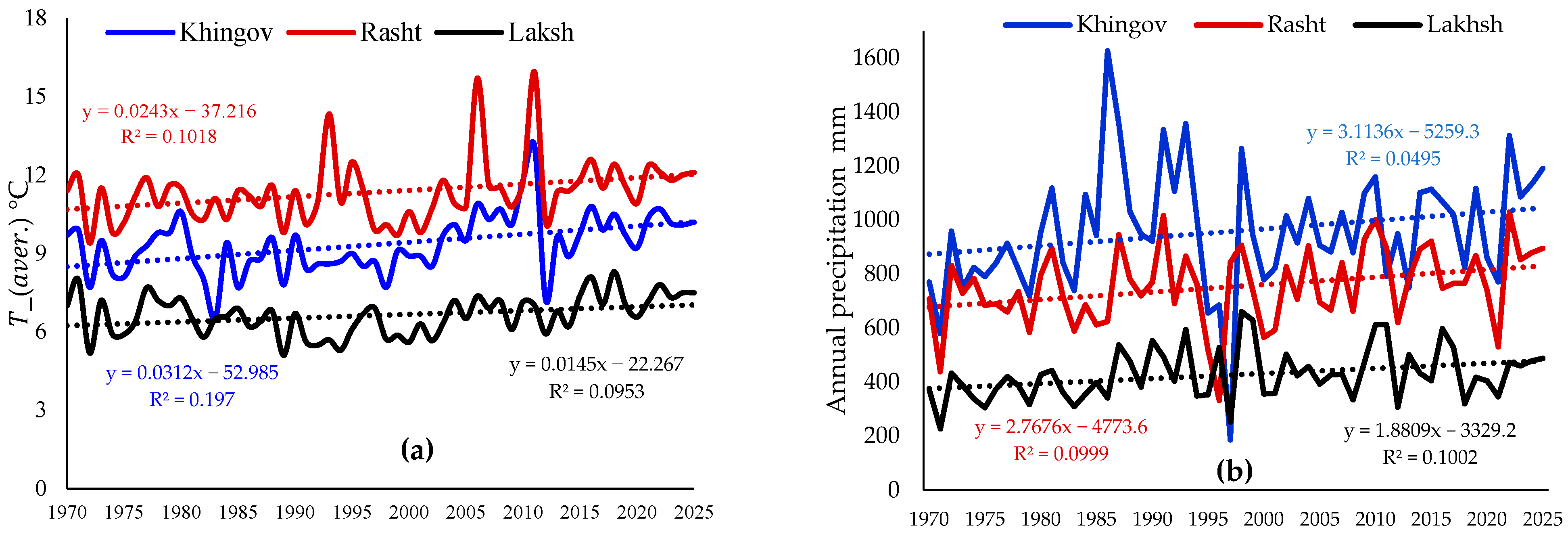
The analysis of climatic variability in the VRB was carried out using long-term observations of air temperature and precipitation at three meteorological stations: Rasht (Surkhob River basin, 39°00′ N, 70°18′ E), Lakhsh (Surkhob River basin, 39°16′ N, 71°31′ E), and Sangvor (Khingov River basin, 38°42′ N, 70°28′ E) for the period 1970–2025 (Figure 3). The long-term variability of mean annual air temperature at the selected meteorological stations is presented in Figure 9a. The analysis reveals the considerable interannual variability of temperature across the basin, reflecting the influence of regional atmospheric circulation and local orographic conditions typical of the mountainous regions of Central Asia. Among the three stations, the Rasht station records the highest mean annual air temperatures throughout the observation period. The average temperature values generally range between 10 and 13 °C, while in some warmer years the temperature exceeds 14–15 °C, particularly during the early 1990s and the mid-2000s. In contrast, the Lakhsh station exhibits the lowest temperature values, mostly varying between 5 and 7 °C, which can be explained by its higher elevation and more continental climatic conditions. The Sangvor station shows intermediate temperature values, typically ranging between 8 and 11 °C.
Despite significant interannual temperature fluctuations, a general warming tendency is observed at all three stations. Linear trend analysis indicates a positive temperature trend over the study period. The estimated warming rates are approximately 0.31 °C per decade for the Sangvor station, 0.24 °C per decade for the Rasht station, and 0.15 °C per decade for the Lakhsh station. These results suggest that the most pronounced warming signal occurs at the Sangvor station, while the weakest warming trend is observed at the Lakhsh station.
However, the coefficients of determination (R2 = 0.197 for Sangvor, 0.1018 for Rasht, and 0.0953 for Lakhsh) indicate that the long-term linear trends explain only a small portion of the total variability in the temperature series. This suggests that short-term climatic variability and local meteorological conditions play a significant role in controlling annual temperature fluctuations in the VRB.
Overall, the results indicate that the temperature regime of the basin has experienced gradual warming during the last five decades, although the magnitude of this trend remains relatively moderate compared to the strong interannual variability. Such warming tendencies are consistent with broader regional climate change patterns observed across Central Asia and the Pamir-Alai Mountain system (Figure 9a).
The analysis of the interannual variability of annual precipitation at the same meteorological stations reveals considerable year-to-year fluctuations in precipitation throughout the basin. Such variability is typical for the mountainous regions of Central Asia and is influenced by regional atmospheric circulation patterns, the orographic characteristics of the terrain, and the variability of moist air masses arriving from the western and southwestern directions.
A comparative analysis of the data from the three stations indicates that the highest precipitation amounts are observed at the Sangvor station. In some years, the annual precipitation totals exceed 1200–1600 mm, indicating a strong orographic effect and favorable conditions for precipitation formation in this part of the basin. The Rasht station is characterized by somewhat lower precipitation amounts, which in most years range between 600 and 900 mm. The lowest precipitation values are recorded at the Lakhsh station, where annual precipitation generally varies between 300 and 500 mm, which is associated with more continental climatic conditions and specific circulation patterns of air masses. Despite pronounced interannual variability, linear trend analysis indicates a slight increasing tendency in annual precipitation at all the studied stations. However, the coefficients of determination (R2 ≈ 0.05–0.10) remain relatively low, indicating the weak statistical significance of the identified trend. This suggests that long-term changes in precipitation are considerably weaker than their natural interannual variability (Figure 9b).
The obtained results indicate that the precipitation regime in the VRB is characterized by high interannual variability and only a weak long-term trend. Such hydroclimatic characteristics are typical for the mountainous regions of the Pamir-Alai Mountain system, where precipitation distribution is largely controlled by complex terrain and variability in atmospheric circulation processes. Changes in precipitation patterns may significantly affect the hydrological regime of rivers, snow cover dynamics, and glacier conditions, making precipitation an important factor in the assessment of water resources in the VRB.
Despite the slight increasing tendency in annual precipitation, this growth is insufficient to compensate for the impact of rising air temperatures across the basin. Higher temperatures accelerate snowmelt processes and reduce the duration of seasonal snow cover. In addition, climatic warming leads to changes in the phase of precipitation, with a larger proportion falling as rainfall instead of snowfall, particularly during spring and autumn. These changes limit snow accumulation and shorten the period of snow storage, which ultimately affects glacier mass balance and the hydrological regime of the basin. Therefore, understanding the dynamics of snow cover is essential for evaluating the response of the cryosphere to ongoing climatic changes in the VRB.

3.2.2. Snow Cover Dynamics

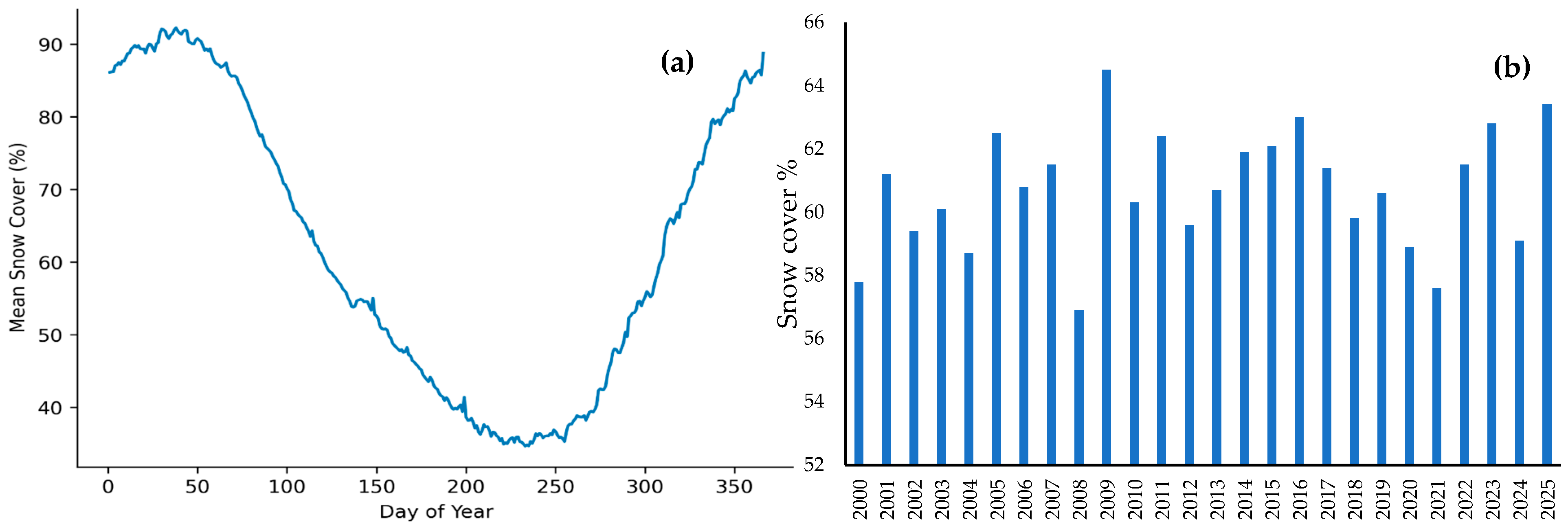
Snow cover represents one of the most important components of the cryosphere in mountainous river basins and plays a key role in regulating seasonal water availability, glacier mass balance, and river runoff. In the VRB, snow accumulation and melting processes are strongly influenced by climatic factors such as air temperature and precipitation variability, which were discussed in the previous section. Therefore, the analysis of snow cover dynamics provides important insights into the response of the basin’s cryosphere to ongoing climatic changes. To assess snow cover conditions in the study area, the MODSNOW dataset was used for the period 2000–2025. Figure 10 illustrates the seasonal and interannual variability of snow cover in the VRB.
Figure 10a shows the seasonal dynamics of mean snow cover throughout the year. Snow accumulation begins in autumn (September–October) and gradually increases toward winter. The maximum snow cover occurs during January–February, when approximately 90–92% of the basin is covered by snow. During spring (March–May), snow cover rapidly decreases due to increasing air temperature and active snowmelt processes. The minimum snow cover occurs in summer (June–August), when snow remains mainly at high elevations and the mean snow-covered area decreases to about 35–40%.
Figure 10b presents the interannual variability of mean annual snow cover during the period 2000–2025. The results show moderate fluctuations between years, with mean annual snow cover values generally ranging from approximately 57% to 65%. The lowest snow cover conditions were observed during the 2007–2008 season, whereas the highest snow cover occurred during the 2008–2009 season. These variations reflect the influence of climatic factors such as winter precipitation, temperature variability, and atmospheric circulation patterns affecting snow accumulation and melt processes. Since snow cover strongly controls surface albedo, changes in its extent and duration can significantly alter the radiation balance of a basin. In addition, the persistence of snow mainly at higher elevations during the summer period indicates a strong altitudinal control on snow distribution, which is important for glacier accumulation and melt processes. Therefore, the following section examines the dynamics of albedo and the factors contributing to its decline.

3.2.3. Albedo and Factors of Its Decline

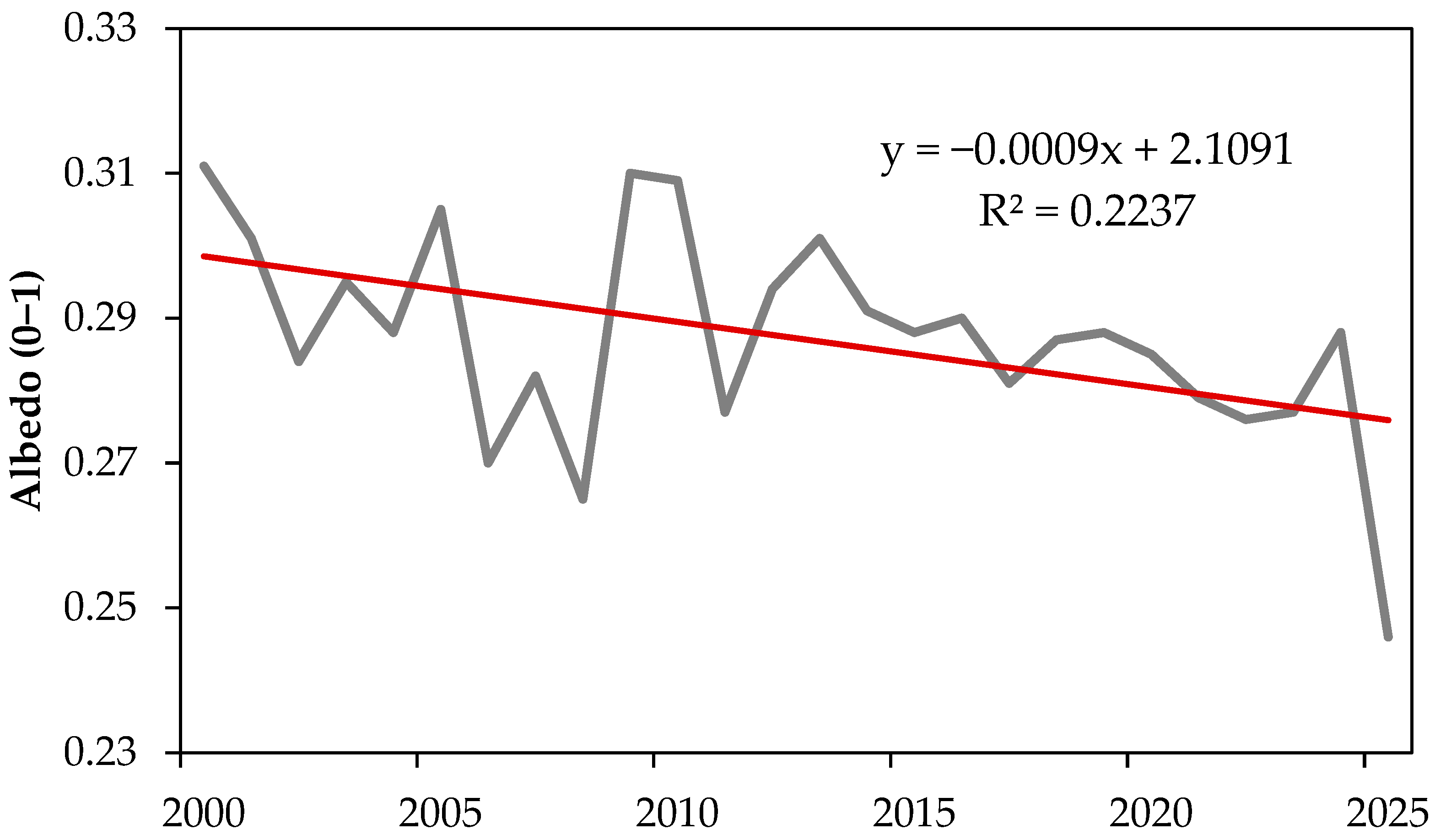
To further investigate the factors influencing albedo changes and glacier melting processes in the VRB, several climatic and environmental parameters were analyzed using satellite observations and reanalysis datasets. These include glacier surface temperature, snow albedo (Figure 11), atmospheric dust, black carbon concentration, cloud cover, snowfall, and incoming solar radiation (Figure 12 and Figure 13). These variables are closely related to the surface energy balance of glaciers and can significantly influence albedo variability, glacier mass balance, and the intensity of melting processes.
The analysis of the surface albedo time series obtained from MODIS satellite data for the period 2000–2025 reveals noticeable interannual variability. During the study period, albedo values ranged approximately from 0.25 to 0.31, reflecting variations in the state of the snow and ice cover as well as the influence of climatic conditions.
The linear trend of the time series shows a negative tendency, which is described by the regression equation y = −0.0009x + 2.1091. The slope coefficient (−0.0009) indicates a gradual decrease in albedo at a rate of approximately 0.0009 per year, suggesting a reduction in surface reflectivity during the study period. The coefficient of determination is R2 = 0.2237, meaning that the linear trend explains about 22.4% of the variability in the observed albedo values. This indicates that a significant portion of the variability is likely associated with other factors, such as interannual fluctuations in temperature and precipitation, changes in snow cover conditions, deposition of dust and impurities on the surface, and glacier melt dynamics.
Overall, the observed declining trend in albedo may indicate enhanced melting processes and changes in the physical properties of glacier surfaces under current climate change conditions.
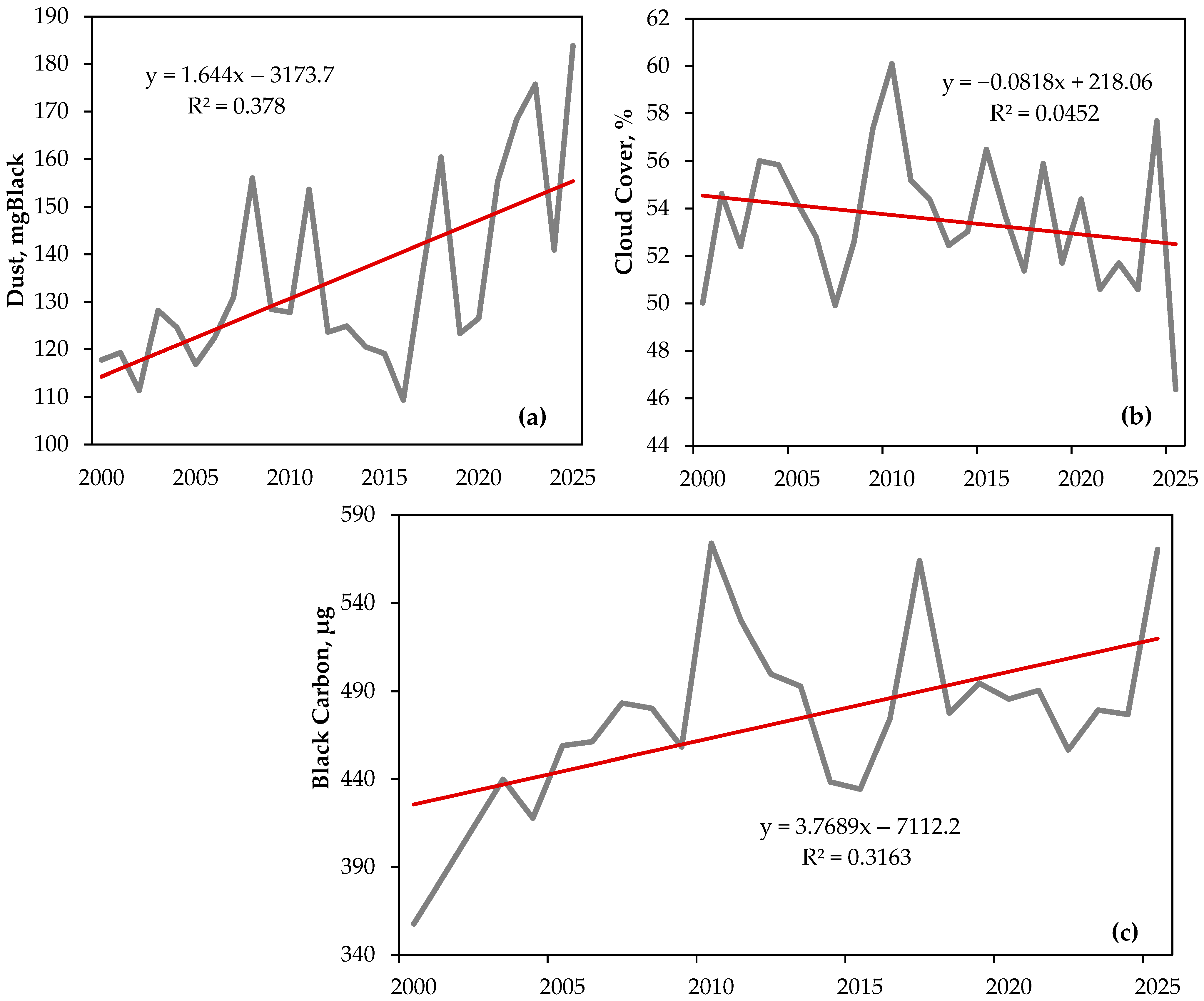
The analysis of dust concentration derived from the MERRA-2 reanalysis dataset for the period 2000–2025 shows a noticeable increasing trend with significant interannual variability. Dust concentrations ranged from approximately 110 to 185 mgBlack, and the linear regression (y = 1.644x − 3173.71; R2 = 0.378) indicates an average increase of about 1.64 mgBlack per year (Figure 12a). The increasing atmospheric dust loading may contribute to the deposition of light-absorbing particles on glacier surfaces, which reduces surface albedo and enhances solar radiation absorption. As a result, this process can accelerate glacier melting and influence the energy balance of glacierized regions under ongoing climate change [52].
The analysis of cloud cover derived from MODIS satellite data for the period 2000–2025 shows noticeable interannual variability with a slight decreasing trend. During the study period, cloud cover values fluctuated between approximately 46% and 60%, reflecting variability in regional atmospheric and climatic conditions (Figure 12b). The linear trend is described by the regression equation y = −0.0818x + 218.06, indicating a gradual decrease in cloud cover at an average rate of approximately 0.08% per year. The coefficient of determination (R2 = 0.0452) suggests that the linear model explains about 4.5% of the observed variability, indicating that cloud cover changes are largely influenced by short-term atmospheric processes and climate variability. A reduction in cloud cover may lead to increased incoming solar radiation reaching glacier surfaces, potentially enhancing surface warming and accelerating glacier melt in glacierized regions [64,65,66].
The analysis of black carbon concentration derived from the MERRA-2 reanalysis dataset for the period 2000–2025 shows noticeable interannual variability with an overall increasing trend. During the study period, black carbon concentrations ranged from approximately 360 to 580 μg, reflecting variations in atmospheric aerosol loading and regional emission processes (Figure 12c). The linear trend is described by the regression equation y = 3.7689x − 7112.2, indicating an average increase of approximately 3.77 μg per year. The coefficient of determination (R2 = 0.3163) suggests that the linear model explains about 31.6% of the variability in the observed black carbon concentrations. The increasing concentration of black carbon may contribute to the deposition of light-absorbing particles on glacier surfaces, reducing surface albedo and enhancing solar radiation absorption. Consequently, this process can accelerate glacier melting and influence the energy balance of glacierized regions under ongoing climate change.
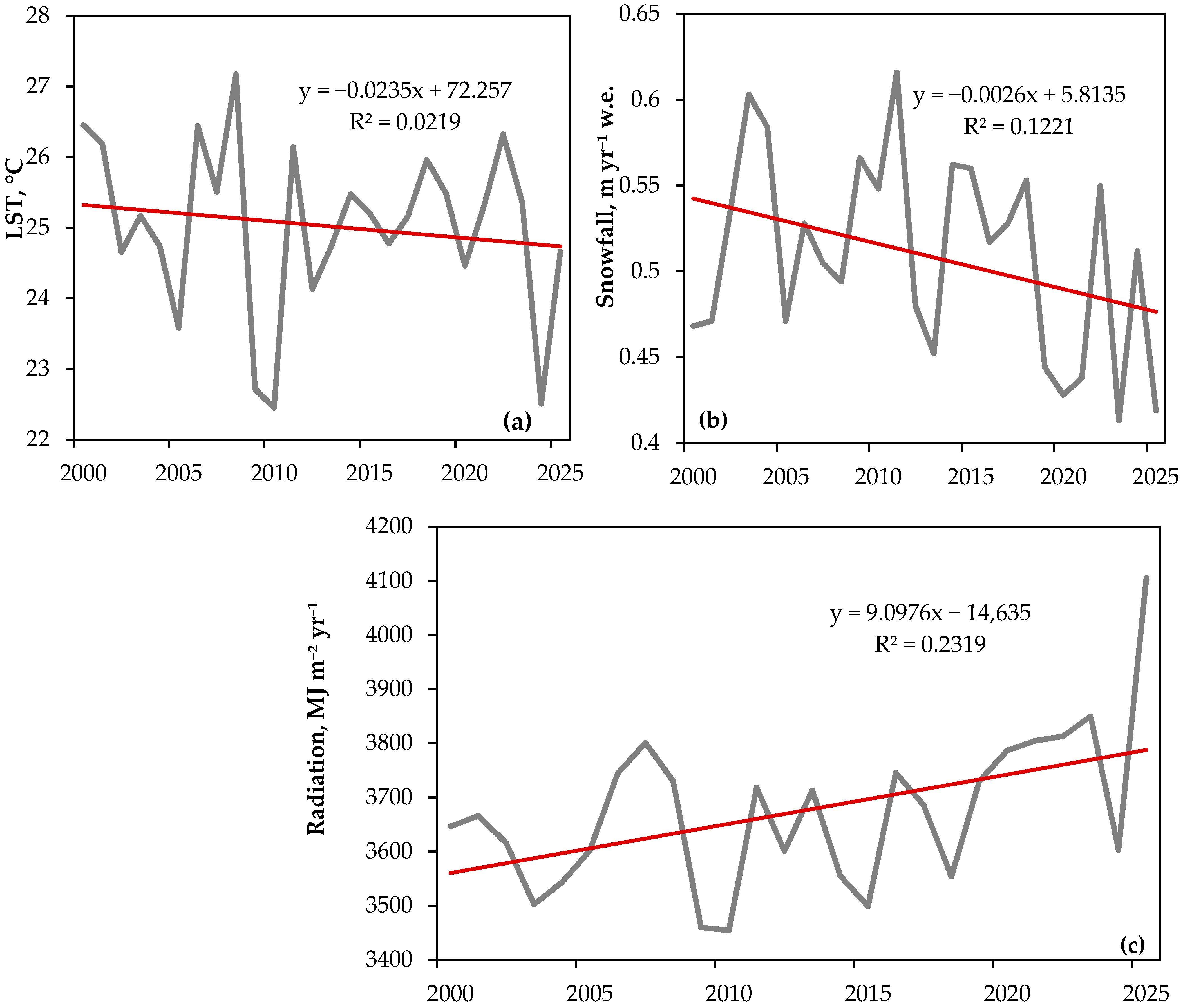
The analysis of glacier surface temperature (LST) derived from MODIS satellite data for the period 2000–2025 shows noticeable interannual variability with a slight decreasing trend. During the study period, glacier surface temperature values fluctuated between approximately 22.5 °C and 27 °C, reflecting variations in atmospheric conditions, radiation balance, and seasonal climate variability (Figure 13a). The linear trend is described by the regression equation y = −0.0235x + 72.257, indicating a gradual decrease in surface temperature at an average rate of approximately 0.02 °C yr−1. The coefficient of determination (R2 = 0.0219) suggests that the linear model explains only about 2.2% of the observed variability, indicating the decreasing trend is not statistically significant and that short-term climatic fluctuations and local environmental factors play a dominant role in controlling glacier surface temperature. It is important to note that the slight decreasing LST trend does not contradict the increasing trends in solar radiation, decreasing albedo, and rising air temperature. During the melt season, glacier surface temperature is constrained by the melting point (0 °C); any additional energy absorbed is consumed as latent heat of fusion (i.e., melt) rather than increasing surface temperature. Therefore, increasing energy absorption leads to accelerated glacier melt, not necessarily higher surface temperatures. The LST trend reflects natural interannual variability (R2 = 0.0219) and is not a robust indicator of melt energy. Variations in surface temperature are closely related to glacier energy balance and may influence melting processes in glacierized regions.
The analysis of snowfall derived from the ERA5-Land dataset for the period 2000–2025 shows noticeable interannual variability with an overall decreasing trend. During the study period, snowfall values fluctuated between approximately 0.41 and 0.62 m yr−1 w.e., reflecting variability in regional climatic conditions and precipitation patterns. The linear trend is described by the regression equation y = −0.0026x + 5.8135, indicating a gradual decrease in snowfall at an average rate of approximately 0.0026 m yr−1 w.e. per year. The coefficient of determination (R2 = 0.1221) suggests that the linear model explains about 12.2% of the variability in the observed snowfall values (Figure 13b). The decreasing snowfall trend may contribute to reduced snow accumulation on glacier surfaces, which can influence glacier mass balance and potentially enhance glacier retreat under ongoing climate change.
The analysis of solar radiation derived from the ERA5-Land dataset for the period 2000–2025 shows noticeable interannual variability with an overall increasing trend. During the study period, solar radiation values ranged between approximately 3450 and 4100 MJ m−2 yr−1, reflecting variations in atmospheric conditions and regional climate dynamics. The linear trend is described by the regression equation y = 9.0976x − 14635, indicating an average increase in solar radiation of approximately 9.1 MJ m−2 yr−1 per year. The coefficient of determination (R2 = 0.2319) suggests that the linear model explains about 23.2% of the variability in the observed radiation values (Figure 13c). The increasing solar radiation may enhance the surface energy balance of glaciers, contributing to higher absorption of incoming energy and potentially accelerating glacier melting in glacierized regions.
The combined analysis of environmental factors for the period 2000–2025 indicates several important trends influencing glacier dynamics in the VRB: increasing dust and black carbon concentrations, increasing solar radiation, decreasing snow albedo, a slight decrease in snowfall, a minor reduction in cloud cover, and a relatively stable glacier surface temperature with strong variability. Together, these factors contribute to enhanced absorption of solar radiation and reduced snow accumulation, which likely accelerates glacier melting and contributes to the ongoing retreat of glaciers in the VRB. Glacier surface temperature (LST) shows a slight decreasing trend, but this trend is not statistically significant (R2 = 0.0219) and does not contradict the other findings. As noted above, during the melt season, additional energy is consumed as latent heat of fusion rather than increasing surface temperature. Therefore, the observed LST trend is consistent with accelerated melt rather than surface warming. As a consequence of these processes, measurable changes in glacier geometry can be observed. These cryospheric changes, in turn, have direct implications for river runoff and water availability in the basin. The following section examines the impact of glacier changes on water resources in the VRB.

3.3. Impact of Glacial Change on Water Resources

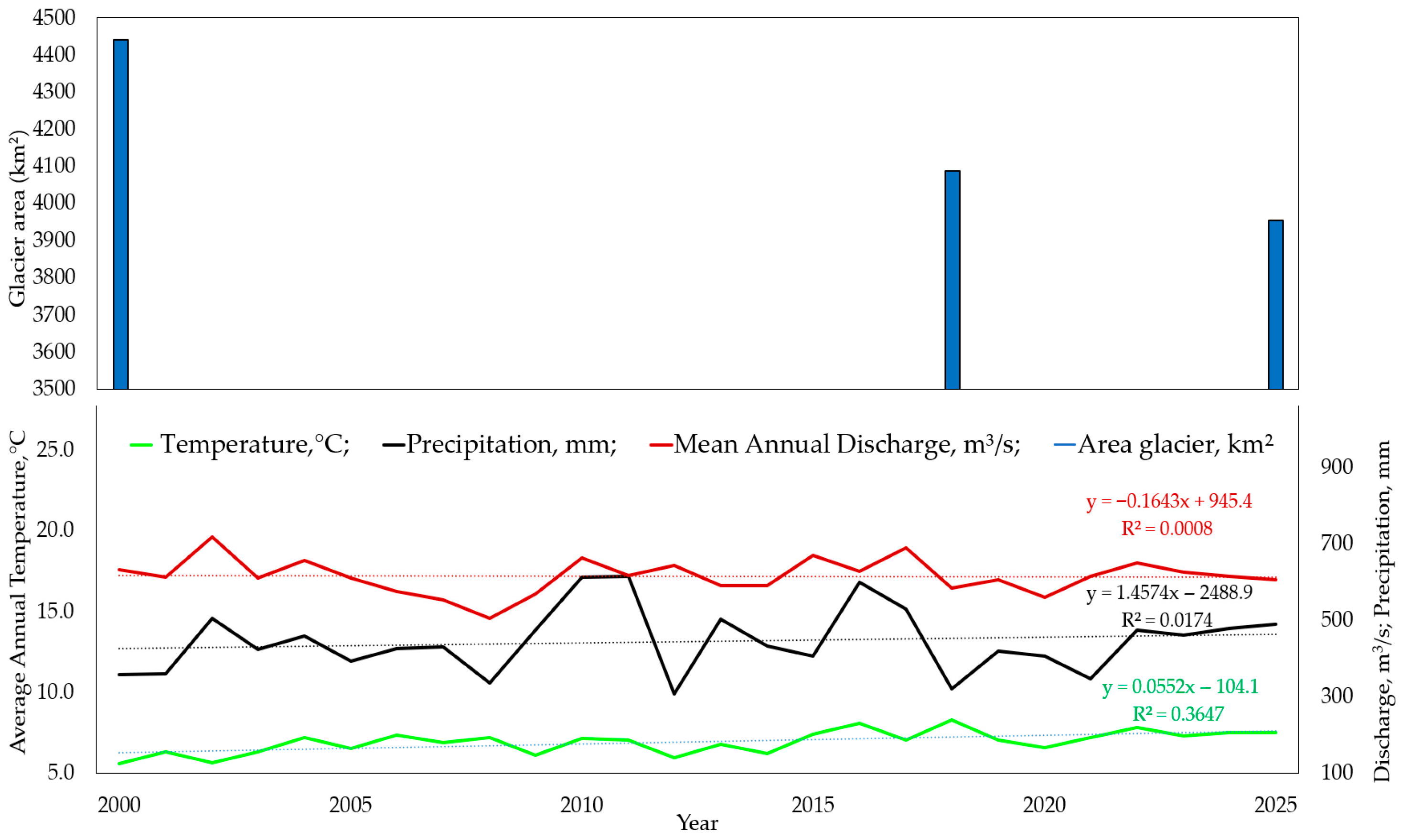
To assess the impact of cryospheric changes on water resources in the VRB, the dynamics of air temperature, atmospheric precipitation (from the meteorological stations described in Section 3.2.1), and mean annual river discharge were analyzed for the period 2000–2025 (Figure 14). River discharge data were obtained from the Darband hydrological station (38°41′ N, 69°59′ E), located at the confluence of the Khingob and Surkhob rivers within the study area. The comparison of these variables allows an evaluation of the potential influence of glacier degradation and climatic variability on runoff formation. The results show that interannual fluctuations in river discharge reflect the combined influence of atmospheric conditions, seasonal snow accumulation, and cryospheric processes. The mean annual discharge varies between approximately 506 and 717 m3/s, indicating substantial variability controlled by precipitation, snow storage, and glacier melt. Glacier meltwater represents an important component of runoff formation in the VRB. During the study period, the glacier area in the basin decreased from approximately 4440 km2 to about 3955 km2, reflecting ongoing glacier degradation.
The reduction in glacier area may have a dual impact on the hydrological regime. In the early stages, intensified melting can temporarily increase glacier runoff, whereas in the long term, continued glacier shrinkage is expected to reduce meltwater contributions and alter the structure of water resources in the basin.
To further evaluate the relationship between hydrological and climatic variables, a linear regression analysis was performed for the same period (2000–2025). The results indicate that river discharge exhibits no clear linear trend (R2 = 0.0008; y = −0.1643x + 945.4), suggesting high interannual variability and the absence of a simple linear relationship. Precipitation shows only a weak increasing trend (R2 = 0.0174; y = 1.4574x − 2488.9), while air temperature demonstrates a more pronounced increasing trend (R2 = 0.3647; y = 0.0552x − 104.1), reflecting a consistent warming signal in the region.
These findings indicate that river discharge in the VRB is controlled by a complex combination of factors, including precipitation variability, snow accumulation, glacier melt, and internal glacier dynamics, rather than a simple linear dependence on individual climatic variables. Therefore, the identified relationships should be interpreted as indicative rather than strictly quantitative.

4. Discussion

4.1. Regional Differences in Glacier Area Change and Their Driving Factors

The transformation of glaciers in the UADB directly affects regional water resources, agriculture, and hydropower production. Our analysis revealed an 11% reduction in the glacier area in the VRB (2000–2025), which is consistent with the 8.3% decrease reported for 1980–2000 and the 13% projection by 2020 [67]. Mean annual air temperature increased by 0.023 °C yr−1 (1970–2025), coinciding with glacier retreat. The slight discrepancy with [67] (0.017 °C yr−1) reflects differences in datasets and seasonal focus, but both confirm the high sensitivity of glaciers to even small temperature increases.
Our results on LST, albedo, aerosols, and radiation are consistent with previous studies in the Pamir and Hissar-Alay regions [64,68,69,70], confirming that reduced albedo and increased aerosols accelerate glacier melt in High Mountain Asia [71].
Methodological differences (data resolution, debris cover treatment) introduce uncertainties, particularly in complex glacier systems. The VRB, spanning 1100–7450 m elevation with a continental climate [72], receives peak precipitation in winter and spring. RCP4.5/8.5 projections indicate summer warming of 1.96–10.34 °C by 2100 [73] and a potential 8.1% precipitation decrease [74], which will accelerate retreat in high-altitude sub-basins such as Mughob, where glacier melt already contributes >54% of annual runoff [75]. Between 1935 and 1985, ice volume losses in the Surkhob and Khingov basins reached 79.9 × 10⁶ m3 and 27.2 × 10⁶ m3, respectively [76], reflecting warming and reduced snow accumulation. Progressive glacier loss reduces hydrological buffering capacity, threatening water security during drought years.
A potential contradiction may arise between the observed slight decreasing trend in glacier surface temperature (LST) and the increasing trends in solar radiation, decreasing albedo, rising air temperature, and increasing atmospheric absorbers (black carbon and dust). However, this apparent paradox can be resolved as follows. First, the decreasing LST trend is not statistically significant (R2 = 0.0219). The large interannual variability and low R2 indicate that no robust trend can be inferred, and the apparent decrease may be an artefact of natural variability. Second, during the melt season, glacier surface temperature is constrained by the melting point (0 °C). Any additional energy absorbed due to lower albedo, higher solar radiation, or increased black carbon deposition is consumed as latent heat of fusion (i.e., melt) rather than increasing surface temperature. This is a fundamental characteristic of melting ice surfaces. Third, satellite-derived LST over mountain glaciers is subject to methodological uncertainties. Previous studies have shown that MODIS LST products can exhibit cold biases over ice surfaces due to cloud masking errors and atmospheric effects [77,78,79,80]. Enhanced melt also leads to a wetter surface, which can reduce daytime LST due to evaporative cooling [81].
Therefore, the observed LST trend does not contradict the other lines of evidence for enhanced glacier melt. Instead, it reflects the consumption of energy for melting rather than heating, the weak physical link between temperature and melt energy in high-altitude environments, and inherent uncertainties in satellite-derived LST over mountain glaciers.

4.2. Specific Impact of Surge-Type Glaciers

Surge-type glaciers in the VRB, particularly in the Mughob, Khingov, and Surkhob sub-basins, significantly influence the hydrological regime. Episodic advances and retreats cause abrupt changes in meltwater contributions, increasing hydrological variability and GLOF risks [82,83,84]. Garmo Glacier, the largest in the Pamirs (Khingov basin), contributes >65% of the annual discharge of the Kargasrud and Bohud rivers [83,85]. Historical records indicate that during low-snow years (1938–1978), surge-related meltwater accounted for 40–74% of summer runoff. However, continued glacier shrinkage reduces this buffering capacity [86].
In the Surkhob basin, Glacier No. 62 (formed from the merger of Glaciers No. 62 and No. 63) advanced 4 km by 1999, forming a glacier-dammed lake that later burst. Recent observations (2021–2022) revealed 5–6 supraglacial lakes on its surface [62]. Similarly, Glacier No. 85 temporarily dammed the Vayzirak River during surges in 1993 (1500 m) and 2016–2017 (1800 m) [62]. In the upper Khingov basin (>55 surge-type glaciers), the Gando Glacier system illustrates cumulative surge effects. Glacier No. 190 advanced 300 m in just 10 days (1969). The recurrence interval of surges is estimated at 10–16 years [62,85,86], and ongoing warming may increase their frequency and intensity.
Overall, the observed glacier pulsations confirm the so-called “soft” nature of ice-flow instabilities in the region [87,88,89,90], characterized by slow terminus advances of tens of to several hundred meters over several years without forming stagnant, downwasting “dead” ice. Pulsations are more common on smaller glaciers (<0.5 km2) and typically last around a decade, while larger surge-type glaciers (>10 km2) exhibit more intense events [30]. Peaks in pulsating glacier activity around 1970 and 2004 may indicate a possible climatic influence, likely related to enhanced melting triggering basal instabilities [91,92,93], although more detailed climatic analyses are required to confirm this [30].
Overall, surge-type glaciers significantly modify the timing and volume of river runoff, creating challenges for downstream hydropower and water management [18].

4.3. Hydrological Implications and Regional Water Resource Management

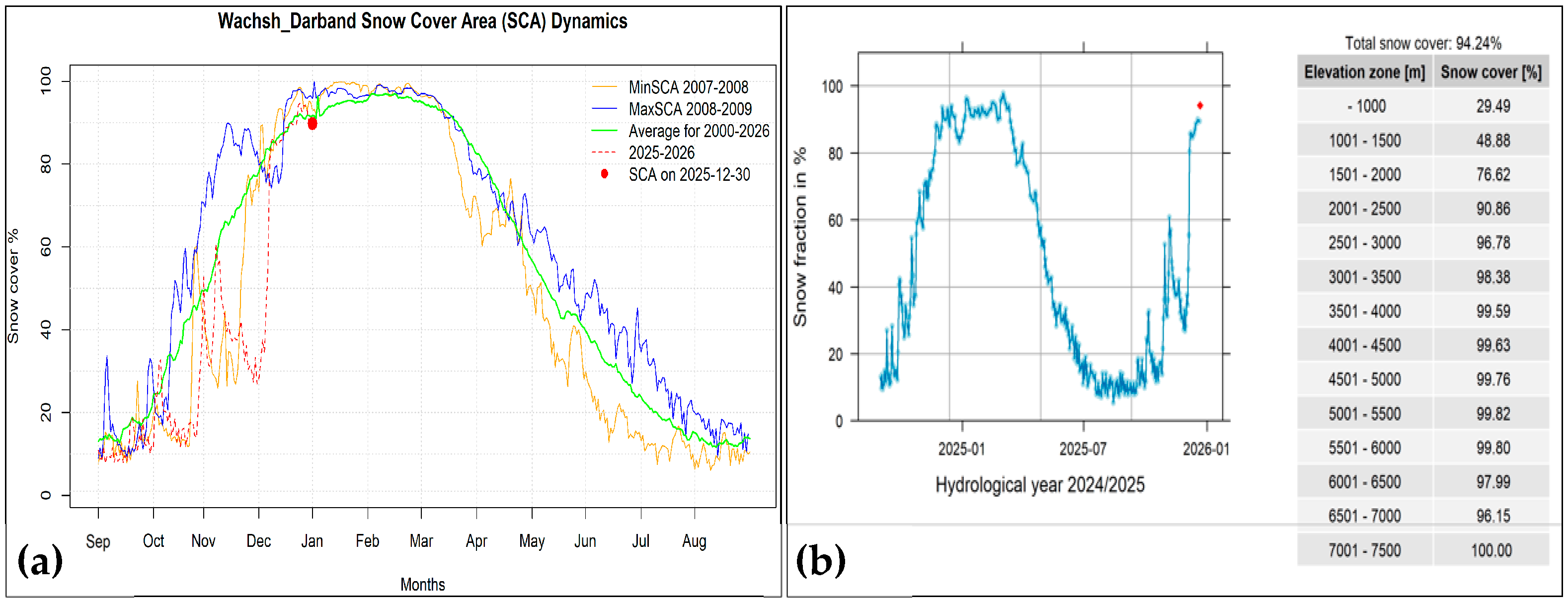
Snowmelt and glacier melt together provide ~63% of the annual runoff in the VRB (37% snowmelt, 26% glacier melt) [94,95,96]. Projections indicate accelerated glacier retreat and changes in seasonal runoff distribution, with “peak water” expected around 2060 followed by decline after 2080 due to glacier depletion [97]. Runoff formation varies with elevation: at 2900–3300 m, snowmelt contributes 60–64%; above 3500 m, glacier melt increases to 23%; and rainfall contributes <1% [34,35]. Considering the key role of snow cover in runoff formation in the VRB, this study analyzes its spatiotemporal dynamics based on snow cover area (SCA) estimates obtained using the MODSNOW tool.
The analysis of snow cover dynamics in the VRB reveals pronounced interannual and seasonal variability in snow cover area (SCA). The results obtained in this study (Figure 10b) indicate significant fluctuations in the mean annual snow cover during 2000–2025, reflecting variability in winter precipitation and temperature conditions and influencing the cryospheric and hydrological processes of the basin. Comparison with previously published studies (Figure 15a,b) shows that snow accumulation typically begins in autumn, increases rapidly during October–December, and reaches its maximum in January–February [53,98], after which it gradually declines from March due to rising air temperatures and snowmelt processes. A similar seasonal pattern is also confirmed by the results obtained using the MODSNOW tool [53].
Hydrological year analysis indicates that snow cover reaches 90–95% during winter, while in summer it decreases to less than 20%, which is consistent with observations reported for the VRB. The altitudinal distribution also demonstrates a strong elevation dependence: above 3000–3500 m, snow cover persists in 95–99% of cases, whereas at lower elevations significantly higher variability is observed [53,98].
However, the absence of a clear long-term decreasing trend in total snow cover area (SCA) does not imply stable glacier conditions. Snow cover area alone is not sufficient to explain glacier response, as it does not capture key processes such as snowmelt timing, snow persistence, and the vertical distribution of snow cover.
The results show that snow rapidly disappears at lower and mid-elevations during the warm season, while it persists mainly at high altitudes. This pattern indicates a strong altitudinal control and suggests an upward shift of the seasonal snowline during the melt period. Such a shift reduces the effective glacier accumulation area and increases the extent of exposed ice surfaces.
Earlier snow depletion leads to reduced surface albedo and enhanced absorption of solar radiation, which significantly intensifies glacier ablation. Similar findings have been reported by [99], who demonstrated that even under relatively stable snowfall conditions, snow cover during the warm season decreases due to rising air temperatures, with a strong negative correlation (r = −0.8) between snow cover and temperature.
Therefore, even without a significant decline in total SCA, changes in snowmelt timing, snow persistence, and snowline altitude can contribute to negative glacier mass balance and explain the observed glacier retreat in the VRB.

4.4. Limitations and Future Research

Current research on glacier dynamics and hydrological responses in the UADB, including the VRB, faces several limitations. The scarcity of high-resolution and long-term hydrometeorological data, particularly in high-altitude regions, constrains the accuracy of existing models and limits our ability to fully understand glacier–runoff interactions [27]. The rugged topography of the Pamir-Alay Mountain system further complicates field measurements, resulting in significant spatial and temporal gaps in monitoring glacier mass balance and ice thickness. In addition, uncertainties in precipitation projections derived from GCMs [73] complicate the development of reliable hydrological forecasts. The weak observed correlation (0.1–0.3) between precipitation and river discharge suggests that glacier melt and groundwater contributions may play a more significant role than previously assumed [100].
Furthermore, assessments of glacier area change are often based on heterogeneous data sources and are therefore susceptible to methodological inconsistencies. For example, in studies [34,35], glacierized areas were partially overestimated, likely due to the misinterpretation of seasonal snow cover in aerial imagery. Consequently, studies that have used this inventory as a baseline frequently overestimate the magnitude of glacier retreat, particularly in the outer mountain ranges [34,35,84]. Similar discrepancies have also been reported for the Vakhsh River sub-basins in the inner mountain ranges [96], where misidentification of fresh snow and failure to account for debris-covered glaciers may have led to biased results.
Future research should focus on expanding and maintaining glacier monitoring programs, including mass balance and ice thickness measurements on key reference glaciers such as Vanjyakh (Fedchenko) and surge-type glaciers such as Garmo [84]. Strengthening observational networks in high-altitude regions and integrating satellite remote sensing with in situ measurements will improve the spatial and temporal resolution of available datasets. In addition, the development of basin-specific hydrological models that incorporate the region’s complex orography and climatic variability is necessary to reduce uncertainties. Particular attention should be given to the role of surge-type glaciers in the hydrological cycle, as their episodic behavior may significantly influence river discharge and hydrological extremes.
Finally, future investigations should consider the socio-economic implications of changing runoff patterns, particularly with respect to hydropower production and irrigation demands. Including small glaciers (<1 km2), which represent a substantial proportion of the glacierized area in the VRB, will provide a more comprehensive understanding of the regional hydrological system [101]. Equally important is the consideration of anthropogenic factors, such as the influence of hydropower infrastructure, as well as the combined effects of climatic and hydrological changes on regional water security.

5. Conclusions

This study examined glacier dynamics, climatic variability, and their hydrological implications in the VRB, one of the most important glacierized regions of the UADB. The findings lead to several important conclusions.
A significant reduction in glacier area was observed during the study period. The total glacierized area of the basin decreased from 4440.9 km2 in 2000 to 3955.2 km2 in 2025, corresponding to a loss of 485.7 km2 (10.94%), with an average annual decrease of about 19.4 km2 per year. Glacier retreat occurred across all size classes, although most glacierized areas remain concentrated in medium and large glaciers (5–100 km2). Spatial analysis shows that the glaciers are predominantly located on northern and northeastern slopes and mainly occur within elevations of 4000–5000 m a.s.l., which provide the most favorable conditions for glacier preservation in the region.
The VRB contains numerous surge-type glaciers, a distinctive feature of glacier dynamics in the Pamir region. These glaciers account for approximately 60% of surge-type glaciers in the Pamirs and are characterized by periodic rapid advances of 0.4–3.6 km. The recent surge activity of the Dehdal Glacier in 2025 confirms that such dynamic processes remain active and can significantly modify glacier morphology and downstream hydrological conditions.
Climatic analysis for 1970–2025 indicates a general warming trend across the basin, with the mean annual air temperature increasing by 0.15–0.31 °C per decade. Although precipitation shows a slight increasing tendency, its long-term trend remains weak compared to the strong interannual variability typical for the mountainous regions of Central Asia. Rising temperatures accelerate snowmelt, shorten snow accumulation periods, and increase the proportion of rainfall relative to snowfall.
Snow cover dynamics during 2000–2025 show pronounced seasonal and interannual variability. Maximum snow cover occurs during January–February, when about 90–92% of the basin is snow-covered, while summer snow cover decreases to 35–40%, remaining mainly at higher elevations. Variations in snow cover strongly influence surface albedo and the energy balance of glacierized areas.
The analysis of albedo and environmental factors indicates a gradual decline in surface albedo during the study period. Increasing dust and black carbon concentrations, together with rising solar radiation and decreasing snowfall and cloud cover, reduce surface reflectivity and enhance solar energy absorption, thereby accelerating glacier melting.
Glacier surface elevation changes for 2000–2019 reveal pronounced thinning in the lower parts of many glaciers, with maximum lowering rates reaching −28.6 m yr−1, while localized thickening occurs in some middle glacier zones due to snow accumulation or surge activity. These patterns confirm ongoing glacier mass loss and spatial variability in glacier response to climatic forcing.
Hydrological analysis shows that glacier meltwater plays a key role in the formation of runoff in the Vakhsh River. Mean annual river discharge during 2000–2025 ranged from 506 to 717 m3 s−1, reflecting the combined influence of climate variability, snow accumulation, and glacier melt. In the short term, enhanced glacier melting may temporarily increase river runoff, whereas continued glacier retreat is expected to reduce the long-term glacier contribution to river discharge and potentially affect water availability in the VRB.
Overall, the results demonstrate that glaciers in the VRB are undergoing significant changes driven by climatic warming and environmental factors, with important implications for regional water resources, hydropower production, and ecosystem stability in Central Asia.

Author Contributions

Conceptualization, Methodology, Investigation, Formal analysis, Writing—original draft, F.N.; Conceptualization, Supervision, Funding acquisition, Project administration, Writing—review and editing, Y.C.; Data curation, Formal analysis, Validation, A.G.; Investigation, Data curation, Visualization, A.M.; Software, Formal analysis, Writing—review and editing, X.Z. All authors have read and agreed to the published version of the manuscript.

Funding

This research is supported by the National Natural Science Foundation of China (2412135).

Data Availability Statement

Raw declassified satellite scenes are accessible via the EarthExplorer portal (https://earthexplorer.usgs.gov/, accessed on 20 March 2026). Additional glacier boundaries were obtained from global glacier inventories, including the Randolph Glacier Inventory (RGI v7.0) (https://doi.org/10.5067/f6jmovy5navz, accessed on 16 January 2026) and the GAMDAM Glacier Inventory (https://doi.org/10.5194/tc-13-2043-2019; https://doi.org/10.5194/essd-10-1807-2018, accessed on 26 February 2026). Snow cover data for the period 2000–2025 were obtained using the MODSNOW tool (https://modsnow.online, accessed on 28 February 2026). Historical glacier information was derived from the USSR Glacier Inventory (1971, 1978) [34,35] and the Catalogue of Surge-Type Glaciers (1998) [48]. Digital elevation models (DEMs) were generated from ASTER Level 1A imagery obtained from the LP DAAC data archive (NASA/METI/AIST/ASTER Science Team, 2001, accessed on 25 June 2025). Cartographic base layers with a spatial resolution of 100 × 100 m were accessed via the Theia Land Data portal (http://maps.theia-land.fr/theia-cartographic-layers.html, accessed on 25 June 2025).

Acknowledgments

The authors gratefully acknowledge the scientific support provided by the State Scientific Institution, the “Center for Glacier Research of the National Academy of Sciences of Tajikistan”. Hydrometeorological observation data were kindly provided by the Agency for Hydrometeorology of the Environmental Protection Committee under the Government of the Republic of Tajikistan.

Conflicts of Interest

The authors declare that they have no known competing financial interests or personal relationships that could have appeared to influence the work reported in this paper.

Abbreviations

The following abbreviations are used in this manuscript:
VRBVakhsh River Basin
UADBUpper Amu Darya Basin
HMAHigh Mountain Asia
GLOFsGlacial Lake Outburst Floods
RCPRepresentative Concentration Pathway
DEMDigital Elevation Model
GCMsGlobal Climate Models
RCMsRegional Climate Models
GISGeographic Information System
RGI7.0 RGI7.0 Randolph Glacier Inventory version 7.0
GAMDAMGlacier Area Mapping for Discharge from the Asian Mountains
USSRUnion of Soviet Socialist Republics
GEEGoogle Earth Engine
GSTGlacier surface temperature
MERRA-2Modern-Era Retrospective Analysis for Research and Applications, Version 2
MISRMulti-angle Imaging SpectroRadiometer
SRTMShuttle Radar Topography Mission
LP DAACLand Processes Distributed Active Archive Center
GLIMSGlobal Land Ice Measurements from Space

References

  1. Wang, L.; Jie, F.; He, B. Analysis of snow cover variability and spatial difference in the High Mountain Asia. Res. Cold Arid. Reg. 2025, 17, 184–194. [Google Scholar] [CrossRef]
  2. IPCC. Climate Change 2022: Impacts, Adaptation, and Vulnerability; Cambridge University Press: Cambridge, UK, 2022. [Google Scholar] [CrossRef]
  3. Kraaijenbrink, P.D.A.; Bierkens, M.F.P.; Lutz, A.F.; Immerzeel, W.W. Impact of a global temperature rise of 1.5 degrees Celsius on Asia’s glaciers. Nature 2017, 549, 257–260. [Google Scholar] [CrossRef]
  4. Stocker, T.F.; Qin, D.; Plattner, G.-K.; Tignor, M.M.B.; Allen, S.K.; Boschung, J.; Nauels, A.; Xia, Y.; Bex, V.; Midgley, P.M. (Eds.) Climate Change 2013: The Physical Science Basis; Cambridge University Press: Cambridge, UK, 2013. [Google Scholar] [CrossRef]
  5. Hugonnet, R.; McNabb, R.; Berthier, E.; Menounos, B.; Nuth, C.; Girod, L.; Farinotti, D.; Huss, M.; Dussaillant, I.; Brun, F.; et al. Accelerated global glacier mass loss in the early twenty-first century. Nature 2021, 592, 726–731. [Google Scholar] [CrossRef]
  6. Davaze, L.; Rabatel, A.; Dufour, A.; Hugonnet, R.; Arnaud, Y. Region-wide annual glacier surface mass balance for the European Alps from 2000 to 2016. Front. Earth Sci. 2020, 8, 149. [Google Scholar] [CrossRef]
  7. Compagno, L.; Huss, M.; Miles, E.S.; McCarthy, M.J.; Zekollari, H.; Dehecq, A.; Pellicciotti, F.; Farinotti, D. Modelling supraglacial debris-cover evolution from the single-glacier to the regional scale: An application to High Mountain Asia. Cryosphere 2022, 16, 1697–1718. [Google Scholar] [CrossRef]
  8. Zemp, M.; Huss, M.; Thibert, E.; Eckert, N.; McNabb, R.; Huber, J.; Barandun, M.; Machguth, H.; Nussbaumer, S.U.; Gärtner-Roer, I.; et al. Global glacier mass changes and their contributions to sea-level rise from 1961 to 2016. Nature 2019, 568, 382–386. [Google Scholar] [CrossRef]
  9. McColl, S.T. Paraglacial rock-slope stability. Geomorphology 2012, 153–154, 1–16. [Google Scholar] [CrossRef]
  10. Rounce, D.R.; Hock, R.; Shean, D.E. Glacier mass change in High Mountain Asia through 2100 using the open-source Python Glacier Evolution Model (PyGEM). Front. Earth Sci. 2020, 7, 331. [Google Scholar] [CrossRef]
  11. Huss, M.; Hock, R. Global-scale hydrological response to future glacier mass loss. Nat. Clim. Change 2018, 8, 135–140. [Google Scholar] [CrossRef]
  12. Marzeion, B.; Jarosch, A.H.; Hofer, M. Past and future sea-level change from the surface mass balance of glaciers. Cryosphere 2012, 6, 1295–1322. [Google Scholar] [CrossRef]
  13. Chen, Y.; Fang, G.; Li, Z.; Zhang, X.; Gao, L.; Elbeltagi, A.; Shaer, H.E.; Duan, W.; Wassif, O.M.A.; Li, Y.; et al. The Crisis in Oases: Research on Ecological Security and Sustainable Development in Arid Regions. Annu. Rev. Environ. Resour. 2024, 49, 3.1–3.20. [Google Scholar] [CrossRef]
  14. Wang, X.; Cui, B.; Chen, Y.; Feng, T.; Li, Z.; Fang, G. Dynamic changes in water resources and comprehensive assessment of water resource utilization efffciency in the Aral Sea basin, Central Asia. J. Environ. Manag. 2024, 353, 120198. [Google Scholar] [CrossRef]
  15. Mukhabbatov, K. Water resources of Tajikistan: Current state and perspectives. J. Water Resour. Cent. Asia 2006, 12, 45–52. [Google Scholar]
  16. Immerzeel, W.W.; van Beek, L.P.H.; Bierkens, M.F.P. Climate change will affect the Asian water towers. Science 2010, 328, 1382–1385. [Google Scholar] [CrossRef]
  17. Amirzoda, O.K.; Kurbanov, N. Leader of the Nation: Issues of Water and Ecology; National Academy of Sciences of Tajikistan: Dushanbe, Tajikistan, 2022. (In Tajik) [Google Scholar]
  18. Nasrulloev, F.; Chen, Y.; Sheralizoda, N.; Gulahmadov, N.; Seyed Omid Reza, S.; Murodov, M. Hydrological change trends of the Surkhob and Khingov river basins in the Vakhsh River of Tajikistan under climate change. Reg. Sustain. 2026, 7, 100300. [Google Scholar] [CrossRef]
  19. Chen, Y.; Fang, G.; Li, Z.; Zhang, X.; Li, W.; Gulahmadov, N.; Nasrulloev, F.; Gulakhmadov, A. Water resources and sustainable management in Tajikistan under global change. Reg. Sustain. 2026, 7, 100291. [Google Scholar] [CrossRef]
  20. Paul, F.; Rastner, P.; Azzoni, R.S.; Diolaiuti, G.; Fugazza, D.; Le Bris, R.; Nemec, J.; Rabatel, A.; Ramusovic, M.; Schwaizer, G.; et al. Glacier shrinkage in the Alps continues unabated as revealed by a new glacier inventory from Sentinel-2. Earth Syst. Sci. Data 2020, 12, 1805–1821. [Google Scholar] [CrossRef]
  21. Brun, F.; Berthier, E.; Wagnon, P.; Kääb, A.; Treichler, D. A spatially resolved estimate of High Mountain Asia glacier mass balances, 2000–2016. Nat. Geosci. 2017, 10, 668–673. [Google Scholar] [CrossRef]
  22. Scherler, D.; Wulf, H.; Gorelick, N. Global assessment of supraglacial debris-cover extents. Geophys. Res. Lett. 2018, 45, 11798–11805. [Google Scholar] [CrossRef]
  23. Pohl, E.; Gloaguen, R.; Andermann, C.; Knoche, M. Glacier melt buffers river runoff in the Pamir Mountains. Water Resour. Res. 2017, 53, 2467–2489. [Google Scholar] [CrossRef]
  24. Liang, W.; Chen, Y.; Fang, G.; Kaldybayev, A. Machine learning method as an alternative for hydrological modeling in alpine catchments of the Tianshan region, Central Asia. J. Hydrol. Reg. Stud. 2023, 49, 101492. [Google Scholar] [CrossRef]
  25. Chen, Y.; Li, W.; Fang, G.; Li, Z. Hydrological modeling in glacierized catchments of central Asia-status and challenges. Hydrol. Earth Syst. Sci. 2017, 21, 669–684. [Google Scholar] [CrossRef]
  26. Saks, T.; Pohl, E.; Machguth, H.; Dehecq, A.; Barandun, M.; Kenzhebaev, R.; Kalashnikova, O.; Hoelzle, M. Glacier runoff variation since 1981 in the upper Naryn River catchments, Central Tien Shan. Front. Environ. Sci. 2022, 9, 780466. [Google Scholar] [CrossRef]
  27. Kure, S.; Jang, S.; Ohara, N. Hydrologic impact of regional climate change for the snowfed and glacierfed river basins in the Republic of Tajikistan: Hydrological response of flow to climate change. Hydrol. Process. 2013, 27, 4057–4070. [Google Scholar] [CrossRef]
  28. Murodov, M.; Li, L.; Safarov, M.; Murodov, A.; Gulakhmadov, A.; Khusrav, K.; Qiu, Y. A comprehensive examination of the Medvezhiy Glacier’s surges in West Pamir (1968–2023). Remote Sens. 2024, 16, 1730. [Google Scholar] [CrossRef]
  29. Safarov, M.; Kang, S.; Murodov, M.; Banerjee, A.; Navruzshoev, H.; Gulayozov, M.; Fazylov, A.; Vosidov, F. Quantifying glacier surging and associated lake dynamics in Amu Darya river basin using UAV and remote sensing data. J. Mt. Sci. 2024, 21, 2967–2985. [Google Scholar] [CrossRef]
  30. Goerlich, F.; Bolch, T.; Paul, F. More dynamic than expected: An updated survey of surging glaciers in the Pamir. Earth Syst. Sci. Data 2020, 12, 3161–3176. [Google Scholar] [CrossRef]
  31. Nasrulloev, F.K. About the history of the organization of the science of glaciology. In Proceedings of the of the IX Int. Scientific-Practical Conf. “Science-the Basis of Innovative Development”, Dushanbe, Tajikistan, 18–19 April 2024; EDN BROCCW. pp. 295–298. (In Russian) [Google Scholar]
  32. Kotlyakov, V.M.; Desinov, L.V.; Desinov, S.L.; Rudakov, V.A. Glacier movements in the Pamirs in the first 20 years of the 21st century. Reports of the Russian Academy of Sciences. Earth Sci. 2020, 495, 64–68. (In Russian) [Google Scholar]
  33. Finaev, A.F. Analysis of hydrometeorological observations in Tajikistan (1990–2005). In Snow-Ice and Water Resources of the High Mountains of Asia, Almaty; UNESCO-IHP: Paris, France; IHP/HWRP: Koblenz, Germany, 2007; pp. 135–150. (In Russian) [Google Scholar]
  34. Union of Soviet Socialist Republics. Glacier Inventory, Catalog of Glaciers of the USSR; Gidrometeoizdat: Leningrad, Russia, 1971. (In Russian) [Google Scholar]
  35. Union of Soviet Socialist Republics. Glacier Inventory, Catalog of Glaciers of the USSR; Gidrometeoizdat: Leningrad, Russia, 1978. (In Russian) [Google Scholar]
  36. Sheralizoda, N.S.; Nasrulloev, F.K. Climatic conditions and features of the Obi-Khingob River basin. EDN GLETZO. Bull. Technol. Univ. Tajikistan 2025, 1, 106–112. (In Russian) [Google Scholar]
  37. Karandaev, S.V.; Karandaeva, L.M. Assessment of current glaciation of the Zeravshansky glacier basin. Cent. Asian J. Geogr. Res. 2021, 3–4, 75–86. (In Russian) [Google Scholar]
  38. Nasrulloev, F.K. Assessment of the Skogach Glacier in the Context of Climate Change. EDN JAQZPH. Sci. Innov. 2024, 3, 68–73. (In Russian) [Google Scholar]
  39. Zekollari, H.; Schuster, L.; Maussion, F.; Hock, R.; Marzeion, B.; Rounce, D.R.; Compagno, L.; Fujita, K.; Huss, M.; James, M.; et al. Glacier preservation doubled by limiting warming to 1.5 °C versus 2.7 °C. Science 2025, 380, eadu4675. [Google Scholar] [CrossRef]
  40. Wegerich, K.; Olsson, O.; Froebrich, J. Reliving the Past in a Changed Environment: Hydropower Ambitions, Opportunities and Constraints in Tajikistan. Energy Policy 2007, 35, 3815–3825. [Google Scholar] [CrossRef]
  41. World Bank. Valuing Green Infrastructure: A Case Study of the Vakhsh River Basin, Tajikistan; World Bank: Washington, DC, USA, 2023; p. 20. [Google Scholar]
  42. Government of the Republic of Tajikistan. Decision “On Renaming Certain Geographical Objects in the Territory of the Republic of Tajikistan.”; No. 348; Government of the Republic of Tajikistan: Dushanbe, Tajikistan, 2023. (In Tajik)
  43. U.S. Geological Survey (USGS). EarthExplorer. Available online: https://earthexplorer.usgs.gov/ (accessed on 20 March 2026).
  44. European Space Agency (ESA). Copernicus Data Space Ecosystem. Available online: https://dataspace.copernicus.eu/ (accessed on 20 March 2026).
  45. RGI Consortium. Randolph Glacier Inventory—A Dataset of Global Glacier Outlines; Version 7.0; National Snow and Ice Data Center: Boulder, CO, USA, 2023. [Google Scholar] [CrossRef]
  46. Mölg, N.; Bolch, T.; Rastner, P.; Strozzi, T.; Paul, F. A Consistent Glacier Inventory for Karakoram and Pamir Derived from Landsat Data: Distribution of Debris Cover and Mapping Challenges. Earth Syst. Sci. Data 2018, 10, 1807–1827. [Google Scholar] [CrossRef]
  47. Sakai, A. Brief Communication: Updated GAMDAM Glacier Inventory over the High Mountain Asia. Cryosphere 2019, 13, 2043–2049. [Google Scholar] [CrossRef]
  48. Osipova, G.B.; Tsvetkov, D.G.; Shchetinnikov, A.S.; Rudak, M.S. Catalogue of Surge-Type Glaciers of the Pamirs; Kotlyakov, V.M., Ed.; Glaciological Association: Moscow, Russia, 1998. (In Russian) [Google Scholar]
  49. State Scientific Institution “Center for Glacier Research of the National Academy of Sciences of Tajikistan”. Tajikistan Glaciers Database. Available online: https://cryosphere.tj/en/the-surging-glaciers-of-tajikistan (accessed on 1 June 2025).
  50. Wan, Z.; Hook, S.; Hulley, G. MODIS/Aqua Land Surface Temperature/Emissivity Daily L3 Global 6 km SIN Grid V061; NASA EOSDIS Land Processes Distributed Active Archive Center (DAAC): Sioux Falls, SD, USA, 2021. [Google Scholar] [CrossRef]
  51. Randles, C.A.; da Silva, A.M.; Buchard, V.; Colarco, P.R.; Darmenov, A.; Govindaraju, R.; Smirnov, A.; Holben, B.; Ferrare, R.; Hair, J.; et al. The MERRA-2 Aerosol Reanalysis, 1980 Onward. Part I: System Description and Data Assimilation Evaluation. J. Clim. 2017, 30, 6823–6850. [Google Scholar] [CrossRef] [PubMed]
  52. Xu, X.; Yang, X.; Zhu, B.; Tang, Z.; Wu, H.; Xie, L. Characteristics of MERRA-2 black carbon variation in east China during 2000–2016. Atmos. Environ. 2020, 222, 117140. [Google Scholar] [CrossRef]
  53. MODSNOW Tool. Snow Cover Estimation and Monitoring Platform (2000–2022). Available online: https://modsnow.online (accessed on 28 February 2026).
  54. Theia Land Data Portal. Cartographic Base Layers with 100 × 100 m Resolution. Available online: http://maps.theia-land.fr/theia-cartographic-layers.html (accessed on 25 June 2025).
  55. NASA; METI; AIST; Japan Spacesystems and U.S.; Japan ASTER Science Team. ASTER Level 1A Data Set—Reconstructed, Unprocessed Instrument Data [Data Set]; NASA Land Processes Distributed Active Archive Center: Sioux Falls, SD, USA, 2001. [CrossRef]
  56. Paul, F.; Huggel, C.; Kääb, A. Combining satellite multispectral image data and a digital elevation model for mapping debris-covered glaciers. Remote Sens. Environ. 2004, 89, 510–518. [Google Scholar] [CrossRef]
  57. Kupriyanov, M.A.; Kochergin, G.A.; Polishchuk, Y.M. The Modelling Study of Area Measurement Accuracy Using Remote Sensing Techniques. Yugra State Univ. Bull. 2018, 3, 25–34. (In Russian) [Google Scholar] [CrossRef]
  58. Han, X.A.; Ma, Y.C.; Huang, X.L. The cubic trigonometric Bézier curve with two shape parameters. Appl. Math. Lett. 2009, 22, 226–231. [Google Scholar] [CrossRef]
  59. Berlyant, A.M. Cartographic Research Method; Moscow University Press: Moscow, Russia, 1978; p. 68. (In Russian) [Google Scholar]
  60. Xu, C.; Li, Z.; He, Z.; Wang, F.; Mu, J.; Chen, Y.; Nazrialo, S.; Nasrulloev, F.; Gulahmadzoda, A. Current Status and Recent Changes of Glaciers in Tajikistan. Reg. Sustain. 2026, 7, 100296. [Google Scholar] [CrossRef]
  61. Ananicheva, M.D. Estimation of the areas, volumes and heights of the boundary of the feeding of glacier systems of the Northeast of Russia from the space images of the beginning of the 21st century. Ice Snow 2014, 1, 35–48. (In Russian) [Google Scholar]
  62. Desinov, S.L. Recent Glacier Surges in the Western Parts of Peter the First Ridge (Pamir). Earth’s Cryosphere 2021, 25, 47–56. (In Russian) [Google Scholar] [CrossRef]
  63. Planet Labs PBC. Didal Glacier Collapses 2025, Tajikistan. Available online: https://www.planet.com/stories/didal-glacier-collapses-2025-tajikistan-navN7YgDR (accessed on 20 March 2026).
  64. Xiao, Y.; Ke, C.-Q.; Shen, X.; Cai, Y.; Li, H. What drives the decrease of glacier surface albedo in High Mountain Asia in the past two decades? Sci. Total Environ. 2023, 863, 160945. [Google Scholar] [CrossRef]
  65. Chen, J.; Qin, X.; Kang, S.; Du, W.; Sun, W.; Liu, Y. Effects of clouds on surface melting of Laohugou glacier No. 12, western Qilian Mountains, China. J. Glaciol. 2018, 64, 89–99. [Google Scholar] [CrossRef]
  66. Conway, J.P.; Abermann, J.; Andreassen, L.M.; Azam, M.F.; Cullen, N.J.; Fitzpatrick, N.; Giesen, R.H.; Langley, K.; MacDonell, S.; Mölg, T.; et al. Cloud forcing of surface energy balance from in situ measurements in diverse mountain glacier environments. Cryosphere 2022, 16, 3331–3356. [Google Scholar] [CrossRef]
  67. Konovalov, V.G. Dynamics of glaciation in Central Asia based on remote sensing data. Mod. Probl. Remote Sens. Earth Space 2012, 9, 281–288. (In Russian) [Google Scholar]
  68. Zhang, Y.; Gao, T.; Kang, S.; Shangguan, D.; Luo, X. Albedo reduction as an important driver for glacier melting in Tibetan Plateau and its surrounding areas. Earth Sci. Rev. 2021, 220, 103735. [Google Scholar] [CrossRef]
  69. Davaze, L.; Rabatel, A.; Arnaud, Y.; Sirguey, P.; Six, D.; Letreguilly, A.; Dumont, M. Monitoring glacier albedo as a proxy to derive summer and annual surface mass balances from optical remote-sensing data. Cryosphere 2018, 12, 271–286. [Google Scholar] [CrossRef]
  70. Liu, P.; Wu, G.; Cao, B.; Zhao, X.; Chen, Y. Variation in Glacier Albedo on the Tibetan Plateau between 2001 and 2022 Based on MODIS Data. Remote Sens. 2024, 16, 3472. [Google Scholar] [CrossRef]
  71. Duan, S.B.; Li, Z.L.; Li, H.; Göttsche, F.M.; Wu, H.; Zhao, W.; Leng, P.; Zhang, X.; Coll, C. Validation of collection 6 MODIS land surface temperature product using in situ measurements. Remote Sens. Environ. 2019, 225, 16–29. [Google Scholar] [CrossRef]
  72. Siegfried, T.; Bernauer, T.; Guiennet, R.; Sellars, S.; Robertson, A.W.; Mankin, J. Will climate change exacerbate water stress in Central Asia? Clim. Change 2012, 112, 881–899. [Google Scholar] [CrossRef]
  73. Petrov, G.N.; Normatov, I.S. Conflict of interests between water users in the Central Asian Region and possible ways to its elimination. Wat. Res. 2010, 37, 113–120. (In Russian) [Google Scholar] [CrossRef]
  74. Pohl, E.; Gloaguen, R.; Seiler, R. Remote sensing-based assessment of the variability of winter and summer precipitation in the Pamirs and their effects on hydrology and hazards using harmonic time series analysis. Remote Sens. 2015, 7, 9727–9752. [Google Scholar] [CrossRef]
  75. Wagner, S.; Hoelzle, M. Glacier Volume Changes in the Pyanj and Vakhsh Basins. Application of Simple Parameterizations to Estimate Past and Future Glacier Changes in the Pyanj and Vakhsh River Subbasins; FAO: Rome, Italy, 2010; pp. 112–134. [Google Scholar]
  76. Kotlyakov, V.M.; Osipova, G.B.; Tsvetkov, D.G. Monitoring surging glaciers of the Pamirs, Central Asia, from space. Ann. Glaciol. 2008, 48, 125–134. [Google Scholar] [CrossRef]
  77. Gök, D.T.; Scherler, D.; Wulf, H. Land surface temperature trends derived from Landsat imagery in the Swiss Alps. Cryosphere 2024, 18, 5259–5276. [Google Scholar] [CrossRef]
  78. Wu, Y.; Wang, N.; Li, Z.; Chen, A.; Guo, Z.; Qie, Y. The effect of thermal radiation from surrounding terrain on glacier surface temperatures retrieved from remote sensing data: A case study from Qiyi Glacier, China. Remote Sens. Environ. 2019, 231, 111267. [Google Scholar] [CrossRef]
  79. Sicart, J.-E.; Hock, R.; Six, D. Glacier melt, air temperature, and energy balance in different climates: The Bolivian Tropics, the French Alps, and northern Sweden. J. Geophys. Res. Atmos. 2008, 113, D24113. [Google Scholar] [CrossRef]
  80. Ebrahimi, S.; Marshall, S.J. Parameterization of incoming longwave radiation at glacier sites in the Canadian Rocky Mountains. J. Geophys. Res. Atmos. 2015, 120, 12536–12556. [Google Scholar] [CrossRef]
  81. Muster, S.; Langer, M.; Abnizova, A.; Young, K.L.; Boike, J. Spatio-temporal sensitivity of MODIS land surface temperature anomalies indicates high potential for large-scale land cover change detection in Arctic permafrost landscapes. Remote Sens. Environ. 2015, 168, 1–12. [Google Scholar] [CrossRef]
  82. Konovalov, V.G.; Rudakov, V.A. Opportunities for using Earth remote sensing data for glacier monitoring and glaciological calculations. Ice Snow 2015, 1, 15–27. (In Russian) [Google Scholar] [CrossRef][Green Version]
  83. Kotlyakov, V.; Severskiy, I. Glaciers of Central Asia: Current Situation, Changes and Possible Impact on Water Resources. In Assessment of Snow, Glacier and Water Resources in Asia; Braun, L., Hagg, W., Severskiy, I., Young, G., Eds.; UNESCO-IHP/German IHP/HWRP National Committee: Koblenz, Germany, 2009; Volume 8, pp. 160–177. [Google Scholar]
  84. Sorg, A.; Bolch, T.; Stoffel, M.; Solomina, O.; Beniston, M. Climate change impacts on glaciers and runoff in Tien Shan (Central Asia). Nat. Clim. Change 2012, 2, 725–731. [Google Scholar] [CrossRef]
  85. Severskiy, I.; Vilesov, E.; Armstrong, R.; Kokarev, A.; Kogutenko, L.; Usmanova, Z.; Morozova, V.; Raup, B. Changes in glaciation of the Balkhash–Alakol basin, Central Asia, over recent decades. Ann. Glaciol. 2016, 57, 382–394. [Google Scholar] [CrossRef]
  86. Wu, K.; Feng, J.; Cheng, P.; Bolch, T.; Jiang, Z.; Liu, S.; Tahir, A.A. Surge Mechanisms of Garmo Glacier: Integrating Multi-Source Data for Insights into Acceleration and Hydrological Control. Remote Sens. 2024, 16, 4619. [Google Scholar] [CrossRef]
  87. Glazirin, G. Identification of surging glaciers by morphometric characteristics. Mater. Gliatsiologicheskikh Issled. 1978, 33, 136–138. [Google Scholar]
  88. Mayo, L. Identification of unstable glaciers intermediate between normal and surging glaciers. Mater. Gliatsiologicheskikh Issled. 1978, 33, 133–135. [Google Scholar]
  89. Mattea, E.; Berthier, E.; Dehecq, A.; Bolch, T.; Bhattacharya, A.; Ghuffar, S.; Barandun, M.; Hoelzle, M. Five decades of Abramov glacier dynamics reconstructed with multi-sensor optical remote sensing. Cryosphere 2025, 19, 219–247. [Google Scholar] [CrossRef]
  90. Glazirin, G.; Shchetinnikov, A. Pulsating glaciers of the Gissar-Alay Mountains. Tr. Sredneaziat. Reg. Nauchno-Issledovatel’skiy Inst. 1980, 71, 81–100. [Google Scholar]
  91. Thøgersen, K.; Gilbert, A.; Bouchayer, C.; Schuler, T.V. Glacier Surges Controlled by the Close Interplay Between Subglacia Friction and Drainage. J. Geophys. Res. Earth Surf. 2024, 129, e2023JF007441. [Google Scholar] [CrossRef]
  92. Hewitt, K. Tributary glacier surges: An exceptional concentration at Panmah Glacier, Karakoram Himalaya. J. Glaciol. 2007, 53, 181–188. [Google Scholar] [CrossRef]
  93. Kääb, A.; Bazilova, V.; Leclercq, P.W.; Mannerfelt, E.S.; Strozzi, T. Global clustering of recent glacier surges from radar backscatter data, 2017–2022. J. Glaciol. 2023, 69, 1515–1523. [Google Scholar] [CrossRef]
  94. Normatov, I.S.; Sheralizoda, N.S.; Khomidov, A.S.; Sharofzoda, F.A.; Muminov, A.O. Chemical composition of snow cover and meltwater of the Garmo Glacier forming the hydrochemistry of the Obikhingou River in the Vakhsh River Basin. Earth Sci. Ser. 2022, 42, 58–67. [Google Scholar] [CrossRef]
  95. Huang, J.; Su, F.; Yao, T.; Sun, H. Runoff regime, change, and attribution in the Upper Syr Darya and Amu Darya, Central Asia. J. Hydrometeorol. 2022, 23, 1563–1585. [Google Scholar] [CrossRef]
  96. Aizen, V.B.; Kuzmichenok, V.A.; Surazakov, A.B.; Aizen, E.M. Glacier changes in the central and northern Tien Shan during the last 140 years based on surface and remote sensing data. Ann. Glaciol. 2006, 43, 202–213. [Google Scholar] [CrossRef]
  97. Hock, R.; Rasul, G.; Adler, C.; Cáceres, B.; Gruber, S.; Hirabayashi, Y.; Jackson, M.; Kääb, A.; Kang, S.; Kutuzov, S.; et al. High Mountain areas. In IPCC Special Report on the Ocean and Cryosphere in a Changing Climate; Cambridge University Press: Cambridge, UK, 2019; pp. 131–202. [Google Scholar] [CrossRef]
  98. Gafurov, A.; Lüdtke, S.; Unger-Shayesteh, K.; Vorogushyn, S.; Schöne, T.; Schmidt, S.; Kalashnikova, O.; Merz, B. MODSNOW-Tool: An operational tool for daily snow cover monitoring using MODIS data. Environ. Earth Sci. 2016, 75, 1078. [Google Scholar] [CrossRef]
  99. Motiee, S.; Motiee, H.; Ahmadi, A. Analysis of Rapid Snow and Ice Cover Loss in Mountain Glaciers of Arid and Semi-Arid Regions Using Remote Sensing Data. J. Arid Environ. 2024, 222, 105153. [Google Scholar] [CrossRef]
  100. Mernild, S.H.; Lipscomb, W.H.; Bahr, D.B.; Radić, V.; Zemp, M. Global glacier changes: A revised assessment of committed mass losses and sampling uncertainties. Cryosphere 2013, 7, 1565–1577. [Google Scholar] [CrossRef]
  101. Barnett, T.P.; Adam, J.C.; Lettenmaier, D.P. Potential impacts of a warming climate on water availability in snow-dominated regions. Nature 2005, 438, 303–309. [Google Scholar] [CrossRef]
Figure 1. Study area. (a) Map of upper Amu Darya; (b) Map of VRB.
Remotesensing 18 01436 g001
Figure 2. Visual comparison of Glacier No. 385 on the upper VRB: (a) schematic map from the USSR Glacier Inventory; (b) Google Earth satellite image (2024); and (c) the authors’ photograph (September 2025).
Remotesensing 18 01436 g002
Figure 3. Schematic map of glacierized regions in the VRB.
Remotesensing 18 01436 g003
Figure 4. Distribution of glacier area by size classes in the VRB for the years 2000, 2018, and 2025.
Remotesensing 18 01436 g004
Figure 5. (a) Distribution of glacier area by slope exposition in the VRB. The radar diagram shows the total glacier area (km2) for eight slope orientations (N, NE, E, SE, S, SW, W, NW). (b) Distribution of glacier area by elevation zones in the VRB. (c) Distribution of glacier area and number of glaciers by size classes in the VRB. The bars represent the total glacier area (km2), while the line indicates the number of glaciers within each size class.
Remotesensing 18 01436 g005
Figure 6. Surface elevation change of glaciers in the VRB from 2000 to 2019 m yr−1.
Remotesensing 18 01436 g006
Figure 7. Dynamics of surge-type glaciers in the Khingov River basin over different years. (a) Surge of the Vayzirak Glacier (No. 85) in 2016–2017. (b) Advances of the Dorofeev Glacier (No. 191) in 2018–2022. (c) Multi-year changes of the Shohqala Glacier (No. 240) (1994–2017). (d) Rapid advance of the Vanjdara Glacier (No. 264) (2014–2017).
Remotesensing 18 01436 g007
Figure 8. Surge dynamics of the Dehdal (Didal) Glacier in 2025–2026. (a) Stages of the glacier surge derived from Sentinel-2 satellite imagery showing deformation of the upper glacier, development of the surge front, detachment processes, and subsequent flow normalization. (b) Photo of the Dehdal (Didal) Glacier taken by the authors during a scientific field expedition in December 2025, showing the advance of the glacier tongue and the morphological features of the moving ice mass.
Remotesensing 18 01436 g008
Figure 9. Dynamics of air temperature and precipitation in the VRB. (a) Trends of mean annual air temperature at the Sangvor (blue), Rasht (red), and Lakhsh (black) meteorological stations for the period 1970–2025. (b) Trends of annual precipitation for the period 1970–2025.
Remotesensing 18 01436 g009
Figure 10. Seasonal and interannual variability of snow cover in the VRB (2000–2025). (a) Seasonal dynamics of mean snow cover during the annual cycle. (b) Interannual variability of mean annual snow cover.
Remotesensing 18 01436 g010
Figure 11. Temporal trends in albedo in the VRB (2000–2025).
Remotesensing 18 01436 g011
Figure 12. Trends of atmospheric and surface factors influencing glacier dynamics in the VRB (2000–2025). (a) Dust concentration. (b) MODIS cloud cover. (c) Black carbon concentration.
Remotesensing 18 01436 g012
Figure 13. Trends of energy balance and cryospheric variables influencing glacier dynamics in the VRB (2000–2025). (a) Glacier surface temperature (LST); (b) snowfall; (c) solar radiation.
Remotesensing 18 01436 g013
Figure 14. Trends and regression analysis of glacier area, air temperature, precipitation, and river discharge in the VRB for the period 2000–2025.
Remotesensing 18 01436 g014
Figure 15. Snow cover area (SCA) dynamics in the VRB derived from the MODSNOW tool. (a) Seasonal SCA variability; (b) hydrological year snow cover fraction and elevation-dependent distribution. The red dot indicates the SCA value on 30 December 2025.
Remotesensing 18 01436 g015
Table 1. Summary of datasets used in this study, including data type, dataset name, source, spatial/temporal resolution, and purpose.
Data TypeDataset NameSourceSpatial/Temporal ResolutionPurpose
Satellite imageryLandsat 5, 7, 8–9 OLI/TIRS; Sentinel-2USGS EarthExplorer [43],
Copernicus Open Access Hub [44]
30 m (15 m pan, Landsat), 10 m (Sentinel-2), multi-temporalGlacier mapping, delineation, and analysis of surge-type glaciers
Glacier inventoryRGI 7.0NSIDC/GLIMS [45]VectorReference glacier outlines
Glacier inventoryPamir–Karakoram InventoryMölg et al. (2018) [46]~2000 epochBaseline glacier extent
Glacier inventoryGAMDAM InventorySakai (2019) [47]~2018 epochGlacier change analysis
Historical dataUSSR Glacier Inventory[34,35]HistoricalLong-term glacier reference
Surge-type glaciersCatalogue of Surge-Type Glaciers[48,49]VectorSurge glacier identification
Field & auxiliary dataField surveys, Google EarthField campaigns, Google Earth [45]High resolutionValidation and interpretation
Hydrological dataRiver discharge
(Darband station)
Agency for Hydrometeorology
(Tajikistan)
Annual
(2000–2025)
Runoff analysis
Climate dataTemperature & precipitationAgency for Hydrometeorology
(Tajikistan)
Annual
(1970–2025)
Climate analysis
Snow & albedoMOD10A1, MYD10A1NASA MODIS (GEE)500 m, dailySnow cover and albedo
Surface temperatureMOD11A2 (MODIS LST)NASA MODIS (GEE) [50]1 km, 8-dayGlacier surface temperature
AerosolsMERRA-2 (bc, dust)NASA GES DISC [51,52]0.5° × 0.625°, monthlyAerosol analysis
Climate reanalysisERA5-LandECMWF (GEE)0.1°, monthlySnowfall & solar radiation
Cloud coverMOD09GAMODIS (GEE)1 km, dailyCloud cover analysis
Snow coverMODSNOWMODSNOW platform [53]MODIS-basedSnow cover dynamics
DEMSRTM DEMNASA30 mTerrain analysis
DEMCopernicus DEM (COP-DEM)ESA30–90 mGlacier delineation
Elevation changeASTER DEM (Hugonnet et al.)LP DAAC/Theia [5,54,55]100 mElevation change analysis
Table 2. Details of Landsat satellite imagery used for the 2025 glacier inventory in the VRB.
Satellite/SensorDate of
Acquisition
Path/RowResolution (m)
Landsat 8 OLI/TIRS27 July 2025153/03230
Landsat 8 OLI/TIRS21 August 2025151/033, 151/03230
Landsat 8 OLI/TIRS28 August 2025152/033, 152/03230
Landsat 8 OLI/TIRS4 September 2025153/033, 153/03230
Landsat 8 OLI/TIRS6 September 2025151/03330
Landsat 8 OLI/TIRS13 September 2025152/033, 152/03230
Landsat 8 OLI/TIRS20 September 2025153/033, 153/03230
Landsat 9 OLI/TIRS20 August 2025152/033, 152/03230
Landsat 9 OLI/TIRS27 August 2025153/033, 153/03230
Landsat 9 OLI/TIRS29 August 2025151/033, 151/03230
Landsat 9 OLI/TIRS5 September 2025152/033, 152/03230
Landsat 9 OLI/TIRS12 September 2025153/033, 153/03230
Landsat 9 OLI/TIRS14 September 2025151/033, 151/03230
Table 3. Glacier area changes in the VRB (2000–2025).
Basin2000 (km2)2018 (km2)2025 (km2)Δ km2
(2025–2000)
Δ km2
(2025–2018)
Δ %
(2025–2000)
Δ %
(2025–2018)
Annual Loss (km2/yr)
Vakhsh4440.94087.13955.2−485.7−131.9−10.94−3.2319.43
Table 4. Characteristics of surge-type glaciers in the Khingov River basin.
GlacierGroupLength (km)Advance (km)Observation Period
Siyahshurob, (No. 63)38.4+1.42011–2016
Peter the Great, (No. 69)212.1+0.41993–2006
Vayzirak, (No. 73)25.1+1.11993–2006
Vayzirak, (No. 85)27.4+1.81991–2017
Vayzirak, (No. 88)17.6+1.61977–2016
Zarzamin112.7+2.71990–2016
Pulisangin, (No. 104)35.7+0.852002–2011
Pulisangin, (No. 109)33+1.62005–2007
Gando (No. 188)122.7+22011–2017
Dorofeev (No. 191)115.1+2.532018–2022
Shohqala (No. 240)125.5+1.82014–2018
Vanjdara (No. 264)18.9+3.62014–2017
Disclaimer/Publisher’s Note: The statements, opinions and data contained in all publications are solely those of the individual author(s) and contributor(s) and not of MDPI and/or the editor(s). MDPI and/or the editor(s) disclaim responsibility for any injury to people or property resulting from any ideas, methods, instructions or products referred to in the content.