Article

A Hierarchical Multi-Scale Denoising Framework for UAV-Derived Digital Subsidence Models in Coal Mining Areas

1
School of Environment Science & Spatial Informatics, China University of Mining & Technology, Xuzhou 221116, China
2
School of Energy Science & Engineering, Henan Polytechnic University, Jiaozuo 454000, China
3
Institute of Land Reclamation & Ecological Restoration, China University of Mining & Technology (Beijing), Beijing 100083, China
*
Author to whom correspondence should be addressed.
Remote Sens. 2026, 18(9), 1423; https://doi.org/10.3390/rs18091423
Submission received: 24 February 2026 / Revised: 21 April 2026 / Accepted: 27 April 2026 / Published: 3 May 2026

Highlights

What are the main findings?
  • Identify subsidence-interval-dependent noise patterns in UAV-derived DSuMs, including large-scale anomalous clusters and small-scale high-frequency perturbations.
  • Propose a two-stage hierarchical denoising framework that combines density-adaptive DBSCAN with curvature-adaptive multi-stage refinement for multi-scale noise suppression.
What are the implications of the main findings?
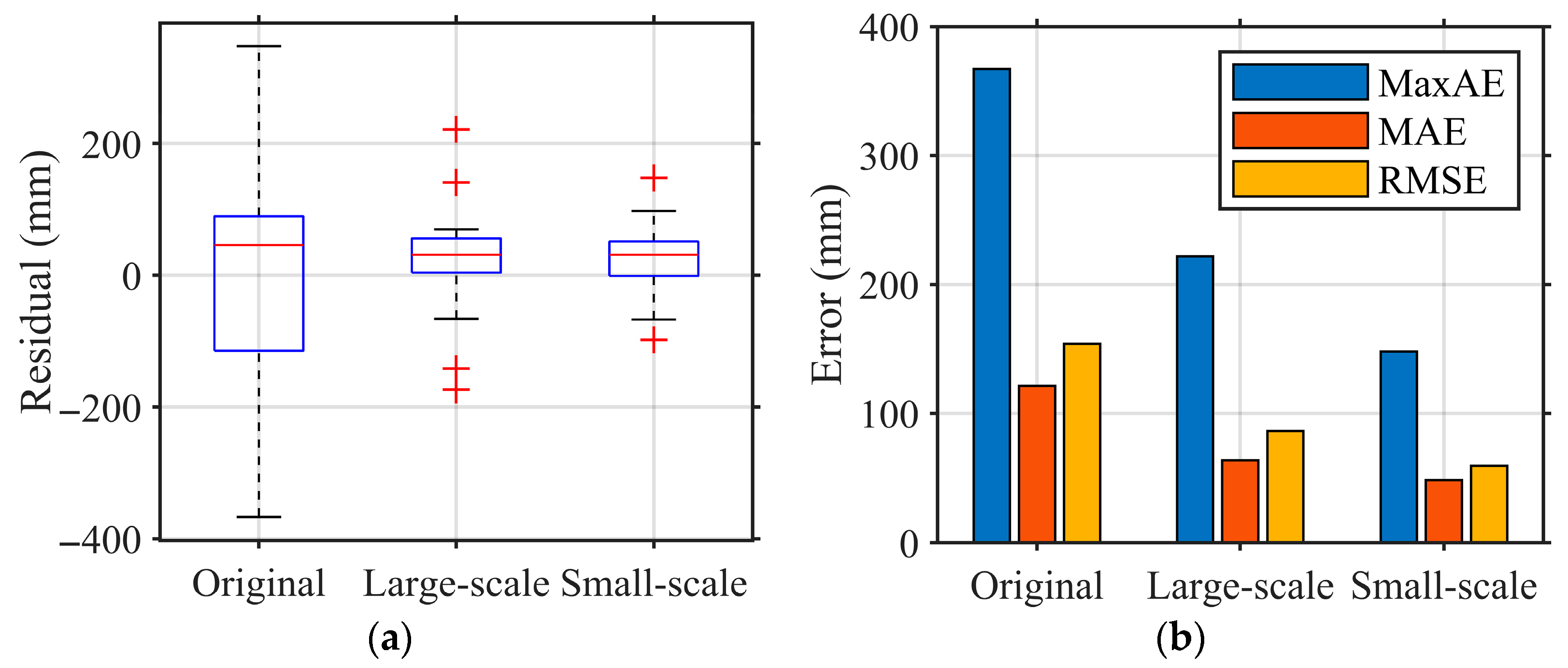
  • Reduce the DSuM RMSE from 154 mm to 59 mm, achieving a 61.5% overall accuracy improvement and outperforming median, bilateral, and wavelet-threshold denoising methods.
  • Provide a reliable DSuM preprocessing strategy for high-precision UAV-based mining subsidence monitoring and deformation interpretation in complex surface environments.

Abstract

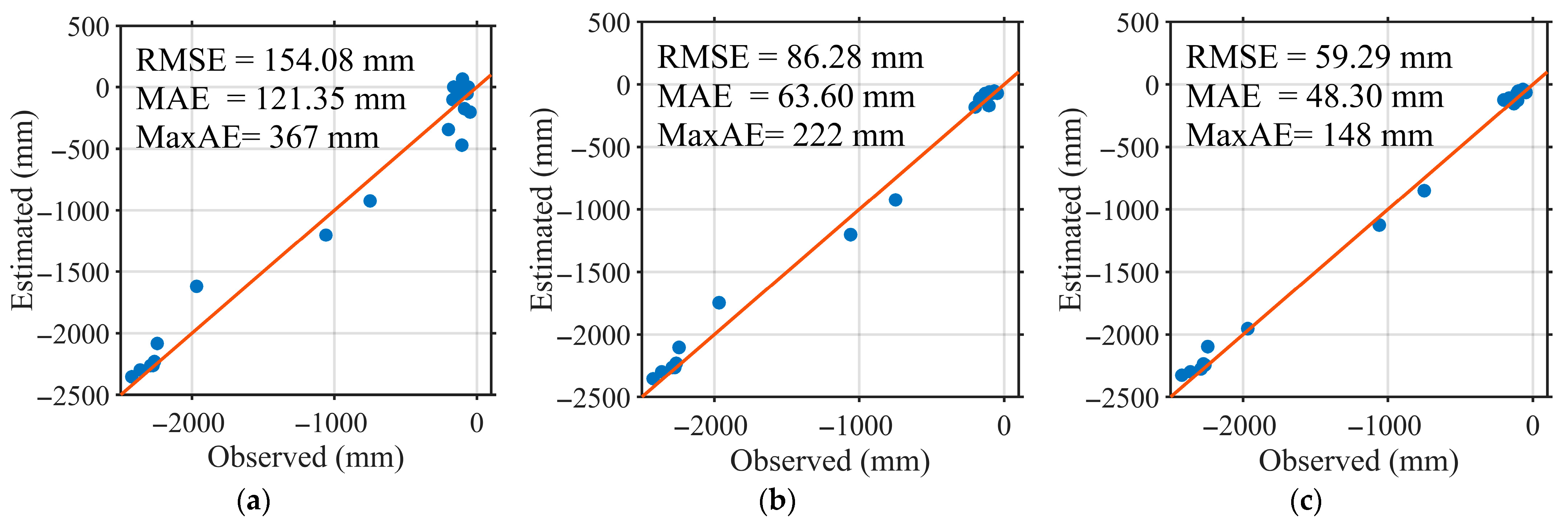
Mining-induced subsidence monitoring is essential for safe coal production and ecological protection in mining areas. UAV photogrammetry has become a widely adopted technique for constructing Digital Subsidence Models (DSuM); however, multi-scale composite noise significantly limits model accuracy and parameter extraction reliability. Taking the 2S201 working face of Wangjiata Coal Mine in a western arid–semi-arid region as the study area, this study systematically investigates DSuM noise characteristics and proposes a hierarchical multi-scale denoising framework. First, subsidence value interval stratification is employed to analyze the spatial distribution of noise. Based on this analysis, a two-stage strategy is developed. In the first stage, large-scale outliers are identified and removed using an improved DBSCAN algorithm with empirically calibrated and density-adaptive parameter computation. In the second stage, small-scale mixed noise is suppressed through a curvature-adaptive multi-stage denoising method. Validation using 20 ground monitoring points demonstrates that the RMSE decreases from 154 mm to 86 mm after large-scale denoising and further to 59 mm, achieving a 61.5% overall accuracy improvement. The denoised model exhibits enhanced surface continuity, smoother deformation profiles, and clearer subsidence boundaries while preserving overall deformation trends. The proposed framework effectively improves DSuM geometric accuracy and spatial consistency, providing reliable technical support for subsidence monitoring with improved accuracy in complex mining environments.

1. Introduction

China is the world’s largest producer and consumer of coal, with coal accounting for nearly 60% of its primary energy consumption [1]. The western region, a strategic area in China’s westward development framework, contributes approximately 70% of the national coal output. However, most western mining areas are located in ecologically fragile arid and semi-arid environments, where coal seams are typically shallow, thick, and characterized by relatively simple geological structures [2,3]. Large-scale and high-intensity mechanized extraction in such settings [4,5,6] can rapidly induce significant surface subsidence, leading to ecological degradation and triggering secondary geological hazards such as landslides and debris flows [7]. These impacts pose serious threats to mine safety and local communities. Therefore, reliable and accurate monitoring of mining-induced surface subsidence is essential for sustainable coal resource development and environmental protection.
Mining subsidence in western China is generally characterized by rapid settlement rates, large subsidence magnitudes and gradients, and relatively limited spatial extent [8,9,10]. Conventional monitoring approaches, including GNSS and leveling, terrestrial laser scanning, InSAR-based remote sensing, UAV LiDAR, and UAV photogrammetry, each exhibit distinct advantages and limitations. Traditional ground-based methods provide high measurement accuracy but require dense observation networks, are labor-intensive to maintain, and are often incapable of capturing the complete morphology of the surface subsidence basin [11,12,13,14]. Terrestrial laser scanning can acquire high-resolution and spatially continuous surface data without the need for observation lines [15,16,17]; however, in mountainous terrain, control network deployment is challenging and operational efficiency is low, limiting its applicability for large-area, long-term monitoring [18]. InSAR technology offers clear advantages in rapidly retrieving terrain models over inaccessible areas and detecting small-gradient deformation [19,20,21,22,23]. Nevertheless, in regions experiencing high-gradient or large-magnitude subsidence, interferometric decorrelation frequently occurs, thereby restricting its effectiveness in strongly deforming mining areas [24,25].
Among low-altitude remote sensing approaches, UAV LiDAR and UAV photogrammetry have emerged as two complementary technologies for mining subsidence monitoring. UAV LiDAR actively acquires three-dimensional surface information via laser pulse ranging [26,27], providing relatively high vertical accuracy under suitable survey and processing conditions, good penetration through partially vegetated areas, and low dependence on illumination conditions. Its main limitations include relatively high equipment cost and lower point density in certain scenarios compared to photogrammetry [28,29]. UAV photogrammetry, by contrast, reconstructs surface topography through multi-view image matching, featuring low cost, high spatial resolution, and dense point clouds; however, its vertical accuracy (typically centimeter to decimeter level) is more sensitive to lighting conditions, ground texture, and flight parameters [30,31]. Both techniques share the characteristics of high operational flexibility, efficient area coverage, and suitability for multi-temporal repeated observations, and have been gradually applied to subsidence monitoring in mining areas.
Both UAV LiDAR and UAV photogrammetry can generate dense surface point clouds through multi-temporal surveys, from which subsidence deformation is extracted via filtering, interpolation, and differencing. However, these processes inevitably introduce classification errors, interpolation bias, and modeling uncertainties, resulting in significant noise in the digital subsidence model (DSuM). Such noise not only degrades the visualization of surface deformation patterns but also reduces the reliability of subsequent quantitative analysis [32,33]. Existing studies have employed wavelet transform, median filtering, and bilateral filtering [34] to suppress noise. Wavelet-based methods [35] effectively attenuate high-frequency noise but may remove fine-scale subsidence details. Median filtering performs well for impulsive noise but is less effective for Gaussian noise. Bilateral filtering preserves edges while smoothing, yet struggles to simultaneously maintain global trends and local details. Most of these approaches primarily address single-scale noise and have limited capability in handling clustered anomalies or large-scale outliers. Furthermore, few studies have systematically analyzed the spatial distribution characteristics of DSuM noise and incorporated such insights into algorithm design [36].
In this study, UAV photogrammetry was adopted, and the working face of the Wangjiata coal mine in western China was selected as the experimental site. Using two-epoch UAV point cloud data, an initial subsidence model was constructed, and the morphology and error distribution characteristics of the subsidence basin were analyzed. The results show that noise points in the DSuM exhibit an overall random and irregular spatial distribution. Through data stratification of subsidence values, this study found that considerable noise is intermingled with genuine subsidence signals across different subsidence ranges. According to their spatial characteristics, these noise points can be categorized into two types: large-scale noise, characterized by outliers and abnormal clusters with density-dependent distribution, and small-scale noise, embedded within the main data body as high-frequency, low-amplitude fluctuations. Confronted with such complex noise patterns, conventional single-method denoising approaches show clear limitations and cannot achieve unified noise suppression.
To address these challenges, this study proposes a two-stage hierarchical denoising framework tailored to UAV-derived DSuMs by integrating spatial density attributes with terrain geometric constraints. Specifically, an improved DBSCAN algorithm is first used to identify and remove large-scale outliers and anomalous clusters, after which a curvature-adaptive multi-stage denoising method is applied to suppress small-scale mixed noise while preserving subsidence boundaries and critical micro-topographic features. Experimental results show that the proposed framework effectively reduces multi-scale noise and significantly enhances the geometric accuracy and spatial consistency of the DSuM, thereby providing methodological support for improving the reliability of UAV-based subsidence monitoring in western mining regions. The novelty of this study lies not in the introduction of entirely new standalone denoising operators, but in the development of a problem-oriented hierarchical framework that unifies interval-based noise characterization, adaptive large-scale outlier removal, curvature-guided small-scale refinement, and physically consistent surface optimization for UAV-derived DSuMs.

2. Materials and Methods

2.1. Overview of the Study Area

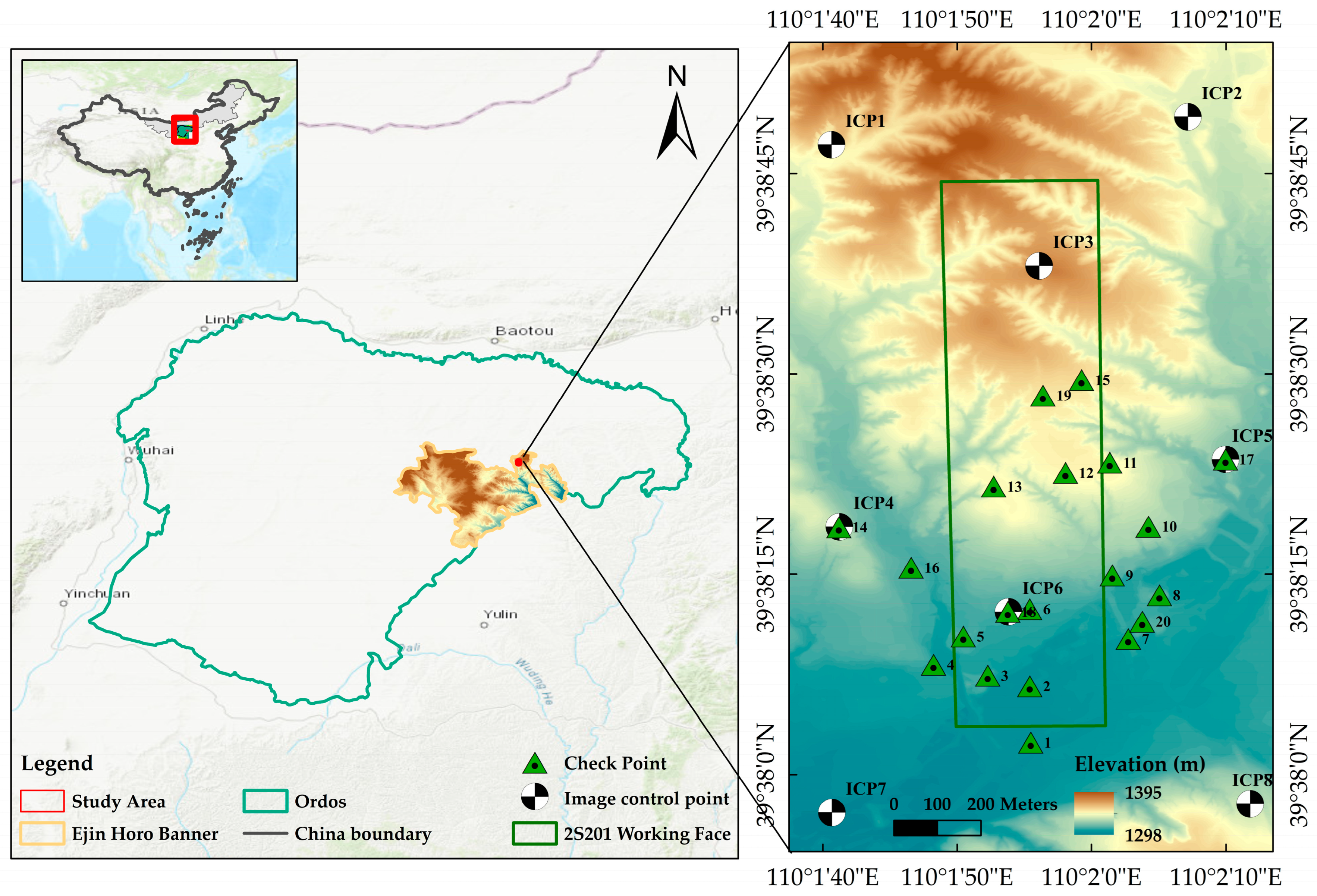
This study focuses on Panel 2S201 of the Wangjiata Coal Mine, located in the southern Dongsheng Coalfield, Ordos City, Inner Mongolia Autonomous Region, China (110°1′E, 39°38′N). The longwall panel, with dimensions of 1252 m (strike) by 260 m (dip), was advanced from south to north at a rate of 12 m per day. The near-horizontal extraction of a 3.26 m thick coal seam at an average depth of 200 m is predicted to induce a surface subsidence basin of approximately 1.66 km2. The site presents a highly dissected, erosional hilly terrain with significant surface roughness, characterized by intricate gully networks and low vegetation coverage. This geomorphology, coupled with the open landscape and sparse distribution of surface obstructions (e.g., high-voltage towers and isolated buildings), provides optimal conditions for Unmanned Aerial Vehicle (UAV) surveys. The specific flight parameters and data acquisition strategy were designed to leverage these terrain characteristics for high-resolution topographic mapping. The geographical location and detailed surface context are provided in Figure 1.

2.2. Data Acquisition

2.2.1. UAV Photogrammetry Data

This study utilized a Trimble UX5 Unmanned Aerial Vehicle (UAV) (Trimble Inc., Sunnyvale, CA, USA) equipped with a GPS/IMU-assisted aerotriangulation system to monitor the mining area. This system enables direct acquisition of the position and three attitude parameters of each image at the moment of exposure. Consequently, when employing the UX5 UAV for mining area monitoring, only a minimal number of photo control points is required to correct various image distortions and establish a connection with ground coordinates. In accordance with the survey area extent and field layout specifications for photo control points, a regional network layout scheme was adopted in this study, involving a total of eight control points. To ensure clear visibility of the control points in the acquired imagery, black-and-white cardboard targets, exhibiting high color contrast with the natural terrain, were deployed in relatively flat and unobstructed areas. The layout scheme of the photo control points is detailed in Figure 1. Following the placement of the control points, the UAV was launched for data acquisition.
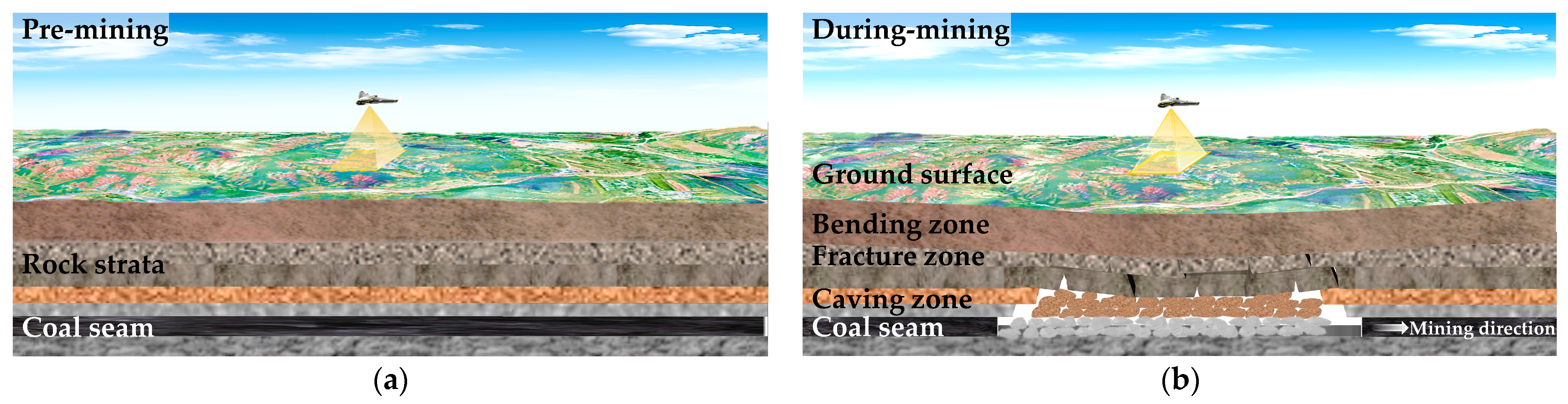
The UAV imagery used as initial input data was primarily acquired through aerial photography conducted by a Trimble UX5 UAV equipped with a Sony A5100 camera (Sony Corporation, Tokyo, Japan). The camera had a focal length of approximately 15 mm, capturing images with dimensions of 6000 × 4000 pixels. With a maximum flight endurance of 40 min and an effective operational window of approximately 30 min, the flight altitude was set at 230 m, considering the topographic conditions of the study area and the UAV’s endurance. This altitude resulted in a ground sampling distance (GSD) of 5.98 cm. Both the forward and side overlap rates were set at 80%, and a total of 28 flight lines were executed. A schematic diagram of the UAV-acquired imagery data is presented in Figure 2.
Prior to coal seam extraction, the first epoch of UAV data acquisition was conducted to obtain baseline imagery of the surface. As mining progressed and surface deformation occurred in the study area, a second epoch of UAV image acquisition was performed. Identical flight parameters were maintained for both aerial surveys to ensure that the datasets shared consistent systematic errors. Each survey collected a total of 560 images.

2.2.2. Validation Data

To comprehensively validate the accuracy of UAV-based monitoring of mining-induced subsidence, a total of 20 checkpoints (Figure 1) were established within the survey area. These checkpoints were uniformly distributed across the subsidence basin, along the main profile sections, at the predicted maximum subsidence location, and in areas outside the anticipated mining influence zone.
Ground observation markers were installed at the locations of both the checkpoints and photo control points to ensure absolute positional consistency across multiple survey campaigns. To guarantee data accuracy, a total station was employed to periodically measure the elevation and planimetric coordinates of these monitoring points. This geodetic monitoring enabled the calculation of both the subsidence values and horizontal displacement vectors for each point.
The checkpoint measurements were obtained through repeated total-station surveys conducted under the same control framework, so as to maintain positional consistency between campaigns. These measurements were used as independent reference data for evaluating the vertical accuracy of the DSuM before and after denoising.

2.3. UAV Data Pre-Processing Methods

The preprocessing of UAV data primarily comprised the processing of scanned imagery and point cloud data. The UAV image data processing was performed to generate the point cloud data. Subsequent point cloud processing involved registration, denoising, and filtering to extract the ground points.

2.3.1. UAV Photogrammetry Data Processing

The UAV-acquired imagery was processed primarily through analytical aerotriangulation. This algorithm resolves the ground coordinates of unknown points within the survey area via a rigorous mathematical model and the principle of least squares adjustment, utilizing image point coordinates measured from the photographs and a limited number of ground control points. The fundamental concept of this method is based on the collinearity condition, which states that the perspective center, an image point, and its corresponding ground point are collinear in space. Using each individual photograph as a computational unit, collinearity equations are established.
Subsequently, building upon these collinearity equations and integrating the three-dimensional coordinates of the exposure stations at the moment of image capture, a block adjustment is performed. This process constructs a unified system of error equations for the entire survey area, ultimately solving simultaneously for the six exterior orientation parameters of every image and the ground coordinates of all tie points.
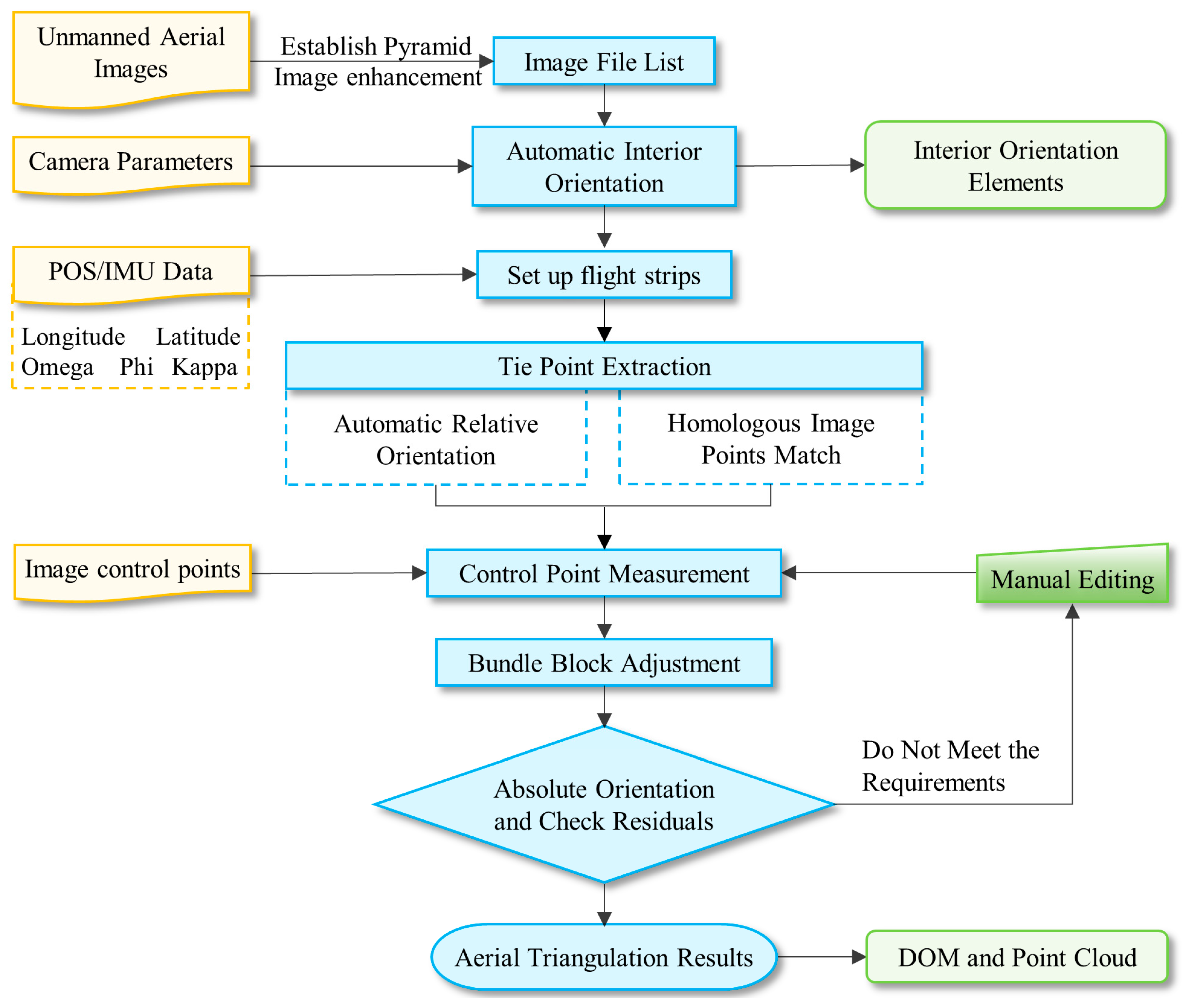
In this study, the Inpho-UASMaster software (Trimble Inc., Sunnyvale, CA, USA) was employed to process the UAV-acquired imagery, performing automatic aero-triangulation to generate a densely matched point cloud of the study area. The workflow for aero-triangulation and point encryption is illustrated in Figure 3. The software utilizes pattern recognition techniques and multi-image matching algorithms to automate the selection and transfer of tie points across images, thereby acquiring image point coordinates without manual measurement. Using the derived image point coordinates as original observations, a block adjustment was performed in conjunction with a limited number of ground control points. This process determined the spatial coordinates of all tie points within the selected coordinate system and resolved the orientation parameters for each image.
Key processing steps for the study area’s image data included: lens distortion correction, image pyramid generation, automatic interior orientation to determine the interior orientation elements, automatic relative orientation to restore the relative positions between images, matching of homologous points, measurement of control point coordinates, bundle block adjustment, and finally, absolute orientation with residual error checking.

2.3.2. Point Cloud Registration

To mitigate errors in the subsidence DEM arising from planimetric misalignment between multi-temporal point clouds, co-registration of each epoch’s data is essential. This process began by selecting multiple distinct geomorphic features (e.g., buildings, scarps, terraces, hillocks) within stable areas outside the subsidence zone from the second epoch’s point cloud. Using TerraSolid software (Terrasolid Ltd., Helsinki, Finland; version 2017), profiles were extracted along the X and Y coordinate axes. Given the localized extent and high point density, the profiles of a specific feature exhibited identical geometric shapes between the two epochs but were offset along the X, Y, and Z axes. The second epoch point cloud was then registered to the first epoch’s reference frame by calculating and applying the mean offset values (dX, dY, dZ).

2.3.3. Extraction of the Ground Points

For point cloud filtering to extract ground points, this paper adopts the progressive triangulated irregular network densification (PTD) algorithm [37], taking into account both the topographic characteristics of the study area and the applicability of various filtering algorithms. The PTD algorithm is based on independent units, dividing the point cloud data in the survey area into different regular grids, and then finding the lowest point of the point cloud in each grid as the initial seed point. Then, an initial terrain model is established based on the seed point, and threshold values for distance and angle are determined for the target point. The ground point and non-ground point datasets are iteratively separated step by step. The lowest point within each grid is selected as an initial seed point, based on which an initial terrain model is constructed. Through iterative threshold judgments of distance and angle, points to be classified are progressively separated into ground and non-ground datasets. This method demonstrates strong adaptability to complex mountainous, gully, and forested terrains; however, it exhibits a high dependency on seed points. This dependency becomes particularly critical in areas characterized by stepped surface cracks resulting from coal mining. If seed points are inadvertently located at the bottom of cracks or collapse pits, localized filtering errors may occur. Moreover, when the grid parameters are set smaller than the largest building in the survey area, ground points in topographically complex regions may not be accurately identified, leading to their misclassification. Consequently, in applying the PTD algorithm to filter the experimental point cloud data in this study, the selection of seed points, grid size, and the configuration of angle and distance thresholds are pivotal factors influencing the filtering outcome.
To address the aforementioned issues, a systematic point cloud filtering procedure was implemented. Initially, the low point filtering function in TerraScan software (Terrasolid Ltd., Helsinki, Finland; version 2017) was employed to remove erroneous elevation points (gross errors) lying significantly below the terrain surface, thereby establishing a reliable set of seed points for subsequent processing. Subsequently, the Progressive TIN Densification (PTD) algorithm was iteratively applied to construct Triangular Irregular Network (TIN) models for the classification of ground points. To optimize the accuracy of ground point extraction within the experimental area, the key parameters of the algorithm were meticulously calibrated through repeated tests, taking into account the specific topographic conditions. The final optimized parameters were determined as follows: a grid size corresponding to the largest building dimension (60 m), an iteration angle of 10°, and an iteration distance of 1.4 m. Finally, manual refinement of the classification results was performed within TerraScan, involving careful editing to remove residual non-ground points and incorporate any omitted ground points.

2.4. Error Characteristics of Subsidence Model Constructed by Conventional Methods

2.4.1. Initial DSuM Construction

Following this processing, irregularly distributed ground point datasets from two survey epochs were obtained. Unlike conventional mining subsidence monitoring methods, it is challenging to directly calculate the differences between two identical ground points from the point clouds. Consequently, UAV-based monitoring of mining-induced subsidence requires interpolating the ground point cloud data to construct multi-temporal Digital Elevation Models (DEMs). A model of the subsidence basin is then derived through the differencing of these DEMs.
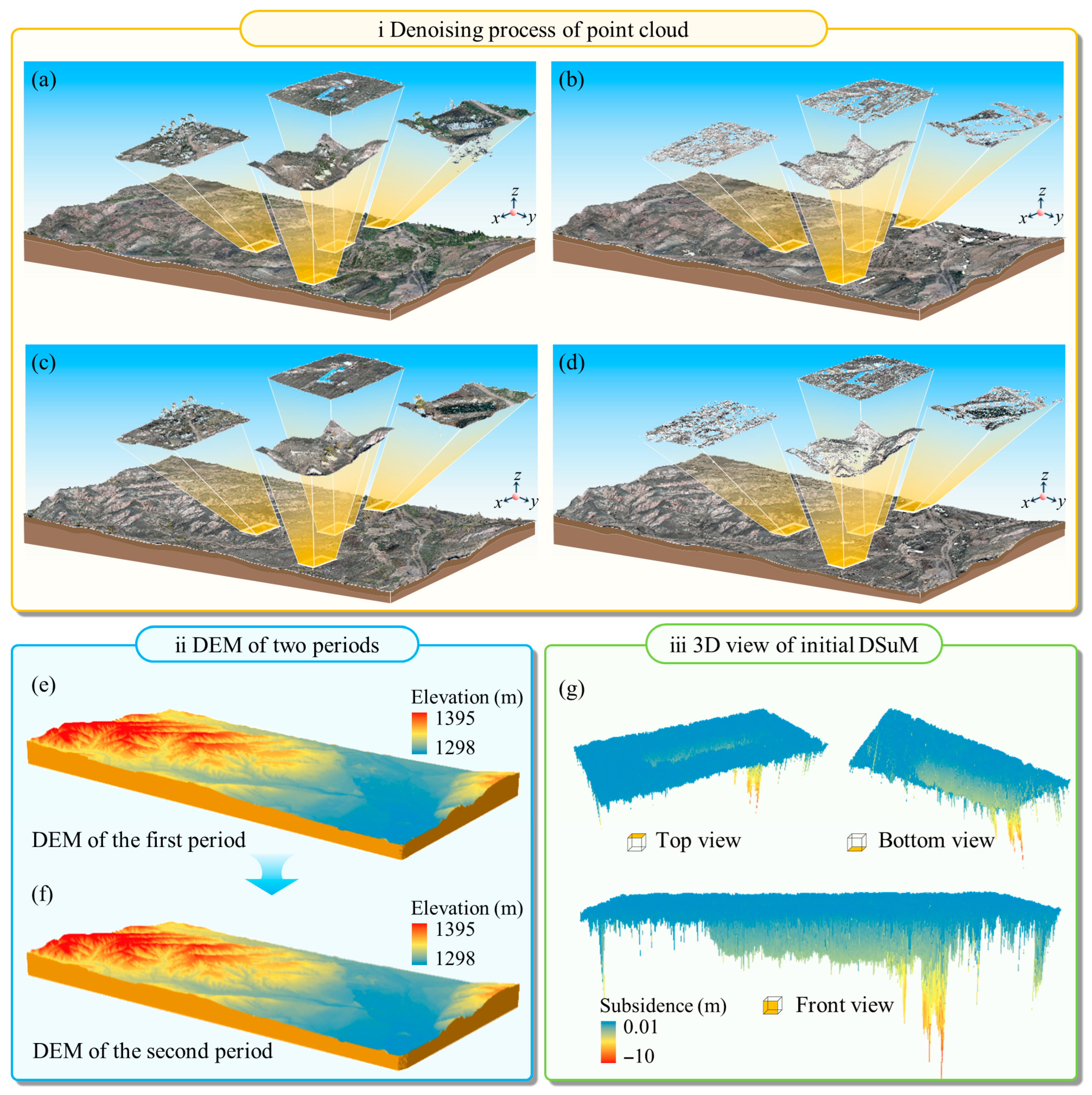
Following the preprocessing of UAV-acquired imagery, ground point clouds were successfully generated. The original point cloud density for both survey epochs was approximately 25 points/m2. After filtering, the average spacing between ground points was reduced to less than 0.5 m. Figure 4a–d shows the results of point-cloud denoising. Specifically, Figure 4a,c present the original point clouds from the two survey epochs, whereas Figure 4b,d show the corresponding filtered ground point clouds.
Based on the terrestrial point datasets from the study area, a Triangular Irregular Network (TIN)-based linear interpolation method was employed to digitally reconstruct the surface topography, resulting in the generation of two Digital Elevation Models (DEMs) with a cell size of 0.5 m. The interpolated DEMs for the two survey epochs are presented in Figure 4e,f. This algorithm effectively reduces data redundancy while preserving geomorphological features, thereby enabling a more accurate and realistic representation of the terrain.
Finally, a preliminary subsidence DEM, designated as the Digital Subsidence Model (DSuM), was generated by subtracting the June DEM from the October DEM. The DSuM constitutes a digital entity model of surface subsidence, represented as an ordered numerical array (X, Y, Z), where each value quantifies the vertical displacement induced by coal mining at the corresponding cell location. A three-dimensional view of the initial DSuM is shown in Figure 4g, in which the subsidence values were vertically exaggerated by a factor of 100 to highlight the error characteristics of the model.

2.4.2. DSuM Error Characterization Method

As illustrated in Figure 4g, the initial Digital Subsidence Model (DSuM) constructed using existing filtering and interpolation algorithms inevitably contains significant erroneous points. Through in-depth analysis of the raw point cloud data and the spatial distribution of these artifacts, we identified that the noise in the initial subsidence DEM primarily originates from the following three categories of error sources:
First, model errors are introduced by residual non-ground points that were not removed by the filtering algorithm. Due to inherent limitations in point cloud filtering algorithms, certain non-ground objects such as vegetation and low-height features cannot be completely eliminated. Furthermore, the spatiotemporal dynamics of vegetation significantly interfere with the extraction of true surface deformation information, resulting in pronounced noise in the differenced subsidence DEM.
Second, spatial displacement errors contribute significantly. During the process of DEM generation through the interpolation of ground points and subsequent DEM differencing, even minor planimetric errors can lead to substantial propagation of error in areas with pronounced topographic relief or along steep slopes and escarpment edges.
The third source comprises model errors arising from the interpolation algorithm itself during gridded DEM generation. Owing to the inherent density constraints of the ground point cloud, the use of interpolation algorithms to generate gridded DEMs often introduces considerable accuracy loss. Discrepancies in the positional information of retained ground points and their elevation data across different temporal epochs lead to distinct noise patterns in the final subsidence DEM. Such errors are distributed across the entire area but are particularly pronounced in regions with lower point cloud densities, such as extensive vegetated areas and water bodies.
Collectively, these error factors often cause the noise points within the Digital Subsidence Model (DSuM) to exhibit random and irregular distribution characteristics, which present considerable challenges for the selection of an appropriate DSuM denoising methodology.
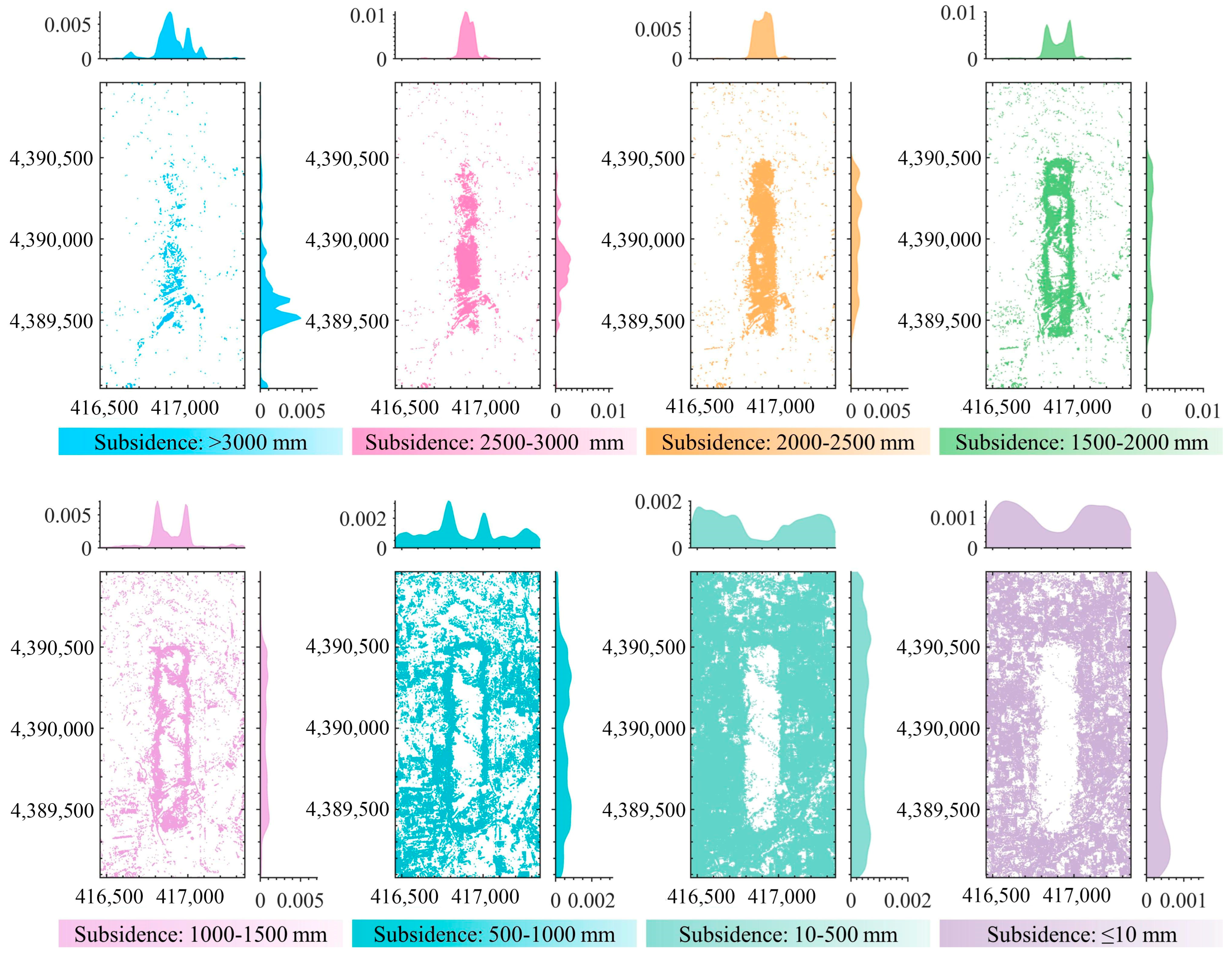
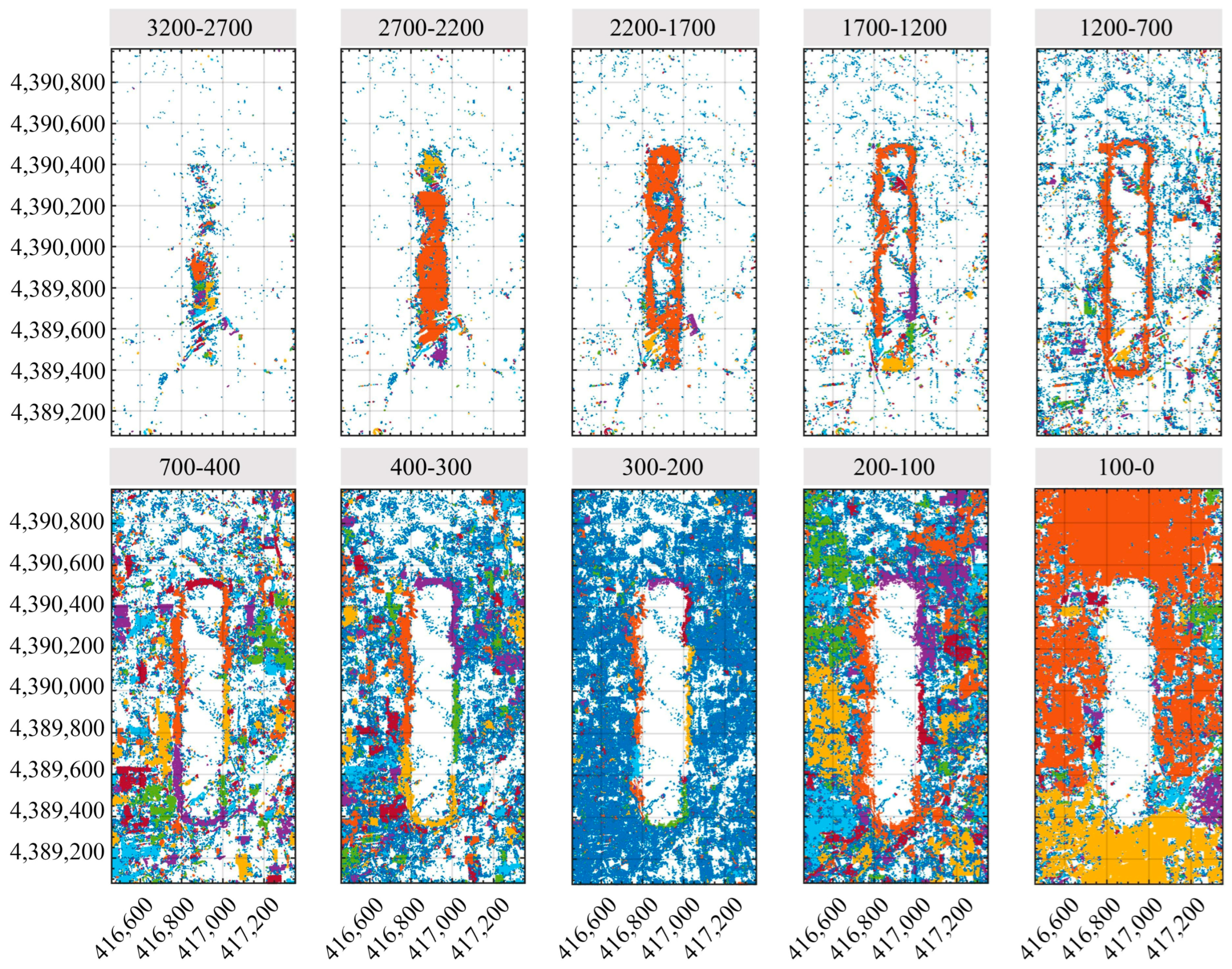
To further investigate the distribution patterns of noise points, this study employed a data stratification method to partition the initial subsidence values into intervals, based on the principles of ground movement in subsidence areas and the spatial distribution characteristics of settlement values. Using the mining thickness and mapped subsidence boundaries as references, the subsidence magnitude was classified into eight intervals: >3000, 2500–3000, 2000–2500, 1500–2000, 1000–1500, 500–1000, 10–500, and ≤10 mm. Each subsidence value was assigned exclusively to a single interval, thereby avoiding overlap and omission.
Subsequently, the settlement value of each pixel in the initial DSuM was allocated to its corresponding interval and sequentially visualized to gain deeper insight into the distribution across different magnitudes of subsidence. Furthermore, the probability density of the sample vectors in both the x and y directions for each interval was estimated using MatlabR2024a ’s built-in ‘ksdensity’ function, and probability density curves for both directions were plotted. The subsidence values for each interval and the overall density distribution are presented in Figure 5.
Figure 5 shows that noise is not confined to a particular subsidence interval, but is mixed with deformation signals across different subsidence levels. Therefore, noise identification in this study was not determined directly from subsidence magnitude itself. Instead, subsidence interval stratification was used as an observational and analytical framework to examine how point distributions, directional probability-density patterns, and their correspondence with the expected morphology of the mining-induced subsidence basin vary with subsidence magnitude. In other words, the interval classes were used to describe distributional differences under different deformation levels, rather than serving as the sole criterion for distinguishing noise from actual subsidence signals.
This issue is especially important for the shallow-subsidence intervals, particularly the 10–500 mm and ≤10 mm classes, within which actual subtle subsidence and noise coexist. Actual subtle subsidence should mainly occur along the attenuating transition zone near the basin margin, where deformation gradually weakens from the basin center toward the periphery and remains morphologically continuous with the basin boundary. By contrast, when low-subsidence points fall within the 10–500 mm or ≤10 mm classes but appear inside the main subsidence body or within the central high-subsidence background, and are expressed as isolated, weakly connected, or fragmented patches rather than as a continuous marginal transition, such features should not be interpreted as actual subtle subsidence. Instead, they should be classified as noise. Their occurrence is usually associated with residual non-ground points, registration offsets, or interpolation artifacts, and they essentially represent anomalous low-value information embedded within the main subsidence body.
As indicated by Figure 5, the deep-subsidence intervals are still dominated by the main basin structure, with only a limited number of anomalous scattered points. In the intermediate intervals, peripheral scattered points become more frequent, suggesting the coexistence of actual transition-zone deformation and local disturbances. In the 10–500 mm and ≤10 mm intervals, however, the point distribution expands markedly and becomes much more diffuse. Within these low-amplitude classes, low-value points occurring around the basin periphery and maintaining continuity with the basin-margin transition zone may be regarded as actual subtle subsidence, whereas scattered low-value points appearing in the basin center or inside the main subsidence body should be regarded as internal noise rather than real weak deformation. Therefore, in low-amplitude intervals, the distinction between actual subtle subsidence and noise must be made jointly from spatial position, continuity with the basin-margin transition zone, neighborhood point-density consistency, and local elevation behavior, rather than from small subsidence magnitude alone.
On this basis, the noise in the initial DSuM was further divided into two categories. The first category comprises outlier noise points, namely isolated points or point clusters that deviate from the main data body. These points may occur both within and outside the main subsidence body and are typically characterized by low planar density, uneven spatial distribution, and pronounced local elevation discontinuities. The second category consists of internal noise points, namely anomalous points embedded within the main data body or distributed near its boundaries. Unlike outlier noise points, these features do not completely detach from the subsidence body in space, but usually appear as short-wavelength, low-amplitude undulations or local pseudo-structures that disturb surface continuity without conforming to the natural subsidence trend.
To address the challenge of coexisting multi-type and multi-scale noise in subsidence models derived from UAV photogrammetry, traditional single-method denoising algorithms often struggle to effectively remove noise at different scales while preserving topographic structures. This paper proposes a hierarchical, multi-stage denoising framework for subsidence models, integrating spatial density and terrain geometric constraints. The proposed method employs a “two-level noise control + multi-step collaborative optimization” strategy to achieve progressive noise suppression, ranging from the removal of global outliers to the smoothing of local details.
First, targeting large-scale noise characterized by sparse spatial distribution and deviation from the main data body, a local density estimation method based on the average k-nearest neighbor distance is used to adaptively determine the parameters and thresholds for the DBSCAN algorithm. This enables the automatic identification and removal of large-scale outliers. Subsequently, multi-scale Hampel filtering and Curvature-Adaptive Polynomial Fitting (CAPF) smoothing are applied to the initially denoised model. This step incorporates curvature-driven dynamic scale adjustment and adaptive updating of smoothing intensity to achieve refined processing of local elevation artifacts and high-frequency noise.
This hierarchical denoising strategy effectively integrates spatial density features, terrain curvature information, and the physical principles of subsidence. It achieves graded noise suppression and structure-adaptive optimization, significantly enhancing the continuity and accuracy of the final subsidence model.

2.5. DSuM Denoising Method Based on Parameter Adaptive DBSCAN

2.5.1. DBSCAN Denoising Principle

The DBSCAN (Density-Based Spatial Clustering of Applications with Noise) algorithm is a density-based spatial clustering method that demonstrates strong robustness when applied to datasets containing noise (i.e., outliers or anomalies). Unlike partitioning and hierarchical clustering approaches, the fundamental premise of DBSCAN lies in identifying clusters by analyzing the local density of data points. The algorithm defines a cluster as the largest set of density-connected points, where regions with sufficiently high density are classified as clusters, while areas of low density are regarded as noise. To facilitate a systematic description of the DBSCAN algorithm, the specific definitions of relevant concepts are provided below.
Definition 1. 
ε-neighborhood of a data point: For an arbitrary data point p in a dataset D, its ε-neighborhood, denoted as Nε(p), is defined as a spherical region centered at p with a radius of ε. This is formally expressed as (1):
N ε ( p ) = { q D dist ( p , q )     ε }
where dist(p,q) denotes the distance between data points p and q, calculated here using the Euclidean distance metric.
Definition 2. 
Point Density: For any data point p in a dataset D, the density of p is defined as the number of data points contained within its ε-neighborhood.
Definition 3. 
Core Point: For a data point p where p∈D, if the number of data points within the ε-neighborhood Nε(p) exceeds a specified threshold MinPts, then p is defined as a core point. Here, MinPts denotes the density threshold.
Definition 4. 
Border Point: For a data point p where p∈D, if p is not a core point but lies within the ε-neighborhood Nε(q) of some core point q, then p is defined as a border point.
Definition 5. 
Noise Point: For a data point p∈D, if p is neither a core point nor a border point, then p is defined as a noise point or outlier. This implies that noise does not belong to any cluster.
Definition 6. 
Directly Density-Reachable: Given a dataset D, if a data point p lies within the neighborhood of a data point q, and q is a core point, then p is said to be directly density-reachable from q.
Definition 7. 
Density-Reachable: Given parameters ε and MinPts, a point q is said to be density-reachable from a point p if there exists a sequence of points p1, p2, …, pj in dataset D, where p1 = p and pj = q, such that every point pi + 1 is directly density-reachable from pi.
Definition 8. 
Density-Connected: If there exists a point o∈D such that both data point p and data point q are density-reachable from o under the parameters (ε, MinPts), then p and q are said to be density-connected. Density-connectedness is a symmetric relation.
The core procedure of the DBSCAN algorithm can be summarized as follows: first, for each point in the dataset D, the ε-neighborhood is computed to determine whether the point is a core point. Specifically, the number of data points within the neighborhood of each point is counted; if this number is greater than or equal to MinPts, the sample point is identified as a core point. Then, starting from each core point, all points that are density-reachable via the directly density-reachable relationship are identified to form a cluster. Finally, points that are neither core points nor directly density-reachable are labeled as noise points.

2.5.2. Parameter Adaptive Determination Based on LDP-KNA

A notable advantage of DBSCAN lies in its ability to autonomously cluster datasets of arbitrary shapes and identify anomalies without requiring pre-specification of the number of clusters. Its core mechanism depends on two critical input parameters: the neighborhood radius (ε) and the minimum number of points (MinPts) within that radius. The selection of these parameters significantly influences clustering accuracy. For instance, an excessively large ε value may lead to an overly expansive neighborhood, causing points from distinct clusters to be erroneously merged. Conversely, an overly small ε value may prevent naturally connected points within the same cluster from being grouped together, resulting in an increased number of fragmented clusters. Furthermore, the setting of the MinPts parameter is equally critical: an insufficient value may allow noise points to be incorrectly incorporated into valid clusters, while an excessively high value may lead to valid small clusters being misclassified as noise.
Based on the preceding discussion, the performance of the DBSCAN algorithm is highly dependent on the appropriate selection of the parameters ε and MinPts, which require careful tuning according to the characteristics of the dataset. The local density peak method serves as an adaptive approach for determining DBSCAN parameters. This method analyzes the local density of data points to automatically identify optimal values for ε and MinPts, thereby reducing the complexity and uncertainty associated with manual parameter adjustment. The local density peak strategy employs statistical analysis of density estimates to reveal the overall density distribution of the data, followed by the identification of local density maxima and their corresponding points as cluster centers. Building upon this foundation, this paper proposes a novel method integrated into the DBSCAN framework that adaptively determines ε and MinPts based on the average k-nearest neighbor distance.
The use of the average k-nearest neighbor distance to estimate local density employs a commonly used non-parametric density estimation approach. It evaluates the local density of each sample point by calculating the average distance to its surrounding neighboring points. The k-means distance method is less affected by individual outliers since it utilizes the mean distance rather than a single nearest-neighbor distance. This approach demonstrates stronger robustness when data are contaminated by noise, enabling more stable performance in noise-polluted environments. Furthermore, in cases of non-uniform data density, this method better reflects the overall trend of local density without being overly sensitive to extreme distance values. This helps reveal the overall density structure of the data rather than being confined to local extremes. The specific computational steps for adaptively determining parameters based on LDP-KNA are as follows:
Step 1: For the i-th sample point pi in the given dataset D, compute its distance to all other points. This calculation follows the traditional Euclidean distance Formula (2):
dist   ( i , j ) = x i   x j 2 + y i   y j 2
where (xi, yi) and (xj, yj) represent the spatial coordinates of the sample points.
Step 2: Compute the distance matrix DISTn×n of the dataset D.
DISTn×n = {dist(i, j)∣1 ≤ i, j ≤ n}
where n is the total number of points in the dataset D, DISTn×n is a real symmetric matrix of size n × n, and dist(i, j) denotes the Euclidean distance between the i-th and j-th data points.
Step 3: Identify k-nearest neighbors. For each row of the distance matrix DISTn×n, sort the elements in ascending order. After sorting, the first column of the matrix consists entirely of zeros (as each point has a zero distance to itself). Columns 2 to k + 1 of the sorted matrix form the K-nearest neighbor (KNN) distance matrix KDist for all points in dataset D.
KDistn×k = (sort (DISTn×n))(1:n, 2:k + 1)
In the equation, k (k = 1, 2, …, n − 1) represents the number of nearest neighbors considered for each point, and its value is typically adjusted according to the specific problem context.
Step 4: Compute the average k-nearest neighbor distance.
The average of the elements in each row of the KDist matrix is calculated, yielding the K-average nearest neighbor distance matrix EKDist for dataset D. Each row in EKDist represents the k-average nearest neighbor distance of the corresponding sample point in dataset D.
Step 5: Calculate the local density of sample points.
This study defines the local density of a sample point pi, denoted as density(pi), using the volume formula of a hypersphere as follows:
density p i = k π E KDist   ( i ) 2
where EKDist (i) represents the average k-nearest neighbor distance of the i-th sample point pi. density(pi) represents the local point density estimated from the average distance to the k-nearest neighbors. This formulation indicates that points located in regions of higher density are generally closer to each other; therefore, the average k-nearest neighbor distance of these points can be effectively used to estimate the clustering boundaries of other points.
Step 6: Adaptive Determination of Parameters ε and MinPts.
In this study, the parameters ε and MinPts are determined through the following procedure: first, all local density values density (pi) are sorted in descending order to form the local density matrix Density. Then, the top h points with the highest local densities are selected as density peak points. Typically, selecting the top h local density peaks corresponds to identifying the most representative dense regions, which characterize the main clusters and structural features of the dataset. Finally, the mean of the k-average distances associated with these h density peaks is defined as the neighborhood radius ε, while the mean of these h density peak values, rounded up to the nearest integer, is set as the minimum number of core points MinPts. The calculation is expressed as follows:
ε = j = 1 h E KDist ( p ( j ) ) h
where p(j) denotes the index i corresponding to the top h local density peaks.
Minpts = j = 1 h density ( j )   h
It is further noted that the local density of the density peaks can effectively represent the minimum number of points required to form a cluster. By calculating the average local density of these peak points, a reasonable threshold can be established to ensure that points located in lower-density regions are not mistakenly identified as part of a cluster.

2.6. A Curvature-Adaptive Multi-Stage Denoising Method for Small-Scale Noise Removal in DSuM

To address the small-scale noise present in the Digital Subsidence Model (DSuM), this paper proposes a curvature-adaptive multi-stage denoising method. The entire algorithm is implemented on the MATLAB platform and consists of three progressive modules: (1) Multi-scale Hampel pre-filtering, which utilizes robust statistical characteristics to rapidly identify and remove local anomalies; (2) Curvature-Adaptive Polynomial Fitting (CAPF) smoothing, which achieves continuous suppression of small-scale noise through curvature-driven multi-scale Gaussian fusion and Sigmoid dynamic weight iteration. (3) Residual-domain micro-island suppression and internal hole filling, which eliminates low-amplitude pseudo-structures without altering the overall subsidence trend, and imposes a non-positive constraint Z ≤ 0 to ensure the physical consistency of the subsidence morphology.

2.6.1. Multi-Scale Hampel Prefiltering

Hampel filtering is an anomaly detection and suppression method grounded in robust statistical principles. Its core concept is to evaluate the deviation of each pixel from the local central tendency using the local median and Median Absolute Deviation (MAD). When a pixel value deviates from the local median by more than a specified multiple of the MAD, it is identified as an outlier and replaced with the neighborhood median. Unlike conventional mean or variance-based filters, the Hampel filter is insensitive to extreme values and effectively removes impulsive, small-scale amplitude anomalies (salt-and-pepper noise) without distorting the main trend or underlying surface structure.
To accommodate noise features across different spatial scales, this study extends the conventional Hampel filter into a multi-scale detection mechanism. A small-scale window (e.g., wsmall = 3, threshold coefficient ksmall = 2) is employed to identify isolated high-frequency anomalies or individual noise pulses, while a large-scale window (e.g., wlarge = 9, threshold coefficient klarge = 3) targets clustered anomalies and localized persistent noise.
At the implementation level, a multi-scale Hampel denoising algorithm module (MultiScaleHampelDenoise.m) was autonomously developed on the MATLAB platform. This module employs a combined strategy of bidirectional scanning and hierarchical detection. First, Hampel filtering is executed separately along the row and column directions of the input data, ensuring the identification and correction of anomalies along both primary axes. Secondly, the algorithm adheres to a “fine-to-coarse” processing logic: initially, a small-scale window is applied to remove high-frequency isolated noise, preventing it from distorting local statistical characteristics; subsequently, a large window enhancement process is employed to further smooth residual clustered anomaly patches. This “bidirectional + multi-scale” strategy effectively suppresses both isolated anomalous points and localized continuous noise, thereby providing a stable and continuous initial topographic foundation for subsequent Curvature-Adaptive Polynomial Fitting Smoothing.

2.6.2. Curvature-Adaptive Polynomial Fitting Smoothing

Addressing the limitations of conventional linear or isotropic filters (e.g., Gaussian and mean filters)—which often lead to excessive smoothing in central subsidence areas, edge blurring, and loss of micro-topographic details in subsidence model processing—this study proposes a Curvature-Adaptive Polynomial Fitting (CAPF) smoothing method to overcome the trade-off between noise removal and structural preservation inherent in traditional approaches. Building upon the multi-scale Hampel pre-filtering that eliminates isolated impulses and local anomalies, the proposed method introduces a curvature-driven multi-scale fusion mechanism. This mechanism utilizes terrain curvature as a core regulating factor to adaptively adjust smoothing intensity and spatial scale according to surface complexity. Thereby, it achieves enhanced denoising in flat areas while preserving structural features along subsidence edges, effectively balancing noise suppression with topographic fidelity.
Step 1: Local Curvature Modeling
To quantitatively characterize surface morphological complexity, this study conducts second-order polynomial fitting on the Digital Elevation Model (DEM) within a 9 × 9 pixel window:
z   =   a x 2 + b y 2 + cxy + dx + ey + f
A design matrix A   =   [ x 2 , y 2 , xy , x , y , 1 ] is constructed using the pixels within the window. The ridge regression problem is then solved as:
( A A + λ I ) θ = A z
where θ   =   [ a ,   b ,   c ,   d ,   e ,   f ]  represents the vector of local quadratic surface coefficients obtained via least-squares fitting with ridge regularization. These coefficients describe the second-order curvature (x2, y2, xy), first-order inclination (x, y), and the constant term, respectively. The variable z denotes the subsidence value of the Digital Subsidence Model (DSuM) at the spatial coordinate point (x, y).
Ridge regularization (λ = 0.25) was applied to suppress unstable solutions and enhance robustness in areas with sparse or anomalous data. The resulting fitting coefficients were directly utilized to compute the mean curvature:
H fit = z xx + z yy 2   =   a   +   b
where zxx = 2a and zyy = 2b represent the second partial derivatives of the fitted function z, and the curvature H is defined as their mean value.
The mean curvature Hfit quantitatively describes the rate of topographic change and spatial complexity: low-curvature areas correspond to the gently subsiding zones in the subsidence center, whereas high-curvature regions reflect intense deformation and fissure micro-landforms along the subsidence edges. The resulting curvature field provides a spatial-adaptive basis for subsequent smoothing, enabling the algorithm to automatically distinguish between “high-smoothing zones” and “protection zones”, thereby achieving structure-aware denoising control.
Step 2: Multi-scale Gaussian Fusion
The subsidence terrain exhibits significant spatial heterogeneity across different scales: the central region, despite its substantial subsidence magnitude, demonstrates relatively gradual elevation changes, while the marginal areas are characterized by high gradient variations and frequent local noise. To address this characteristic, the CAPF method introduces a dual-scale Gaussian convolution kernel fusion mechanism, achieving adaptive smoothing scale adjustment through curvature-based weighting. The specific procedure is as follows:
First, during each iteration, the current subsidence model Z(t) is convolved with Gaussian kernels at two distinct scales, yielding small-scale and large-scale smoothing results. The Gaussian kernel is defined as:
G σ ( u , v ) = 1 2 π σ 2 exp u 2 + v 2 2 σ 2
The small-scale kernel G σ s primarily employed to preserve topographic details and subsidence boundary features. In this study, the parameter is set to σs = 2, with a kernel window size of 11 × 11. The large-scale Gaussian kernel G σ L mainly used to suppress random noise and local errors within gently varying regions, thereby extracting the overall deformation trend. Its standard deviation is defined as σL = 3σs, and the corresponding window size is determined by L   =   max 11 ,   2 6 σ s + 1 . When σs = 2, L = 25, meaning the large kernel size is 25 × 25. The parameter σs controls the trade-off between detail preservation and small-scale noise removal, while the relatively larger σL is used for trend extraction and aggressive denoising. Maintaining an approximate threefold ratio between the two scales enables coupled adjustment of kernel sizes, facilitating control over the overall smoothing effect and reducing the parameter search space.
To achieve terrain-adaptive smoothing, a curvature-dependent small-scale contribution ratio β is introduced:
β   =   0.2 + 0.8 1 + H fit
Here, Hfit denotes the mean curvature derived from local quadratic surface fitting, which quantifies the complexity of surface undulation. When |Hfit| is small (indicating flat areas), the terrain is significantly affected by noise, requiring stronger denoising. In this case, β is small, and the algorithm relies more on the large-scale result. Conversely, when |Hfit| is large (indicating edges or fissure zones), detailed features dominate, and shape preservation is prioritized. Here, β is large, and the algorithm favors the small-scale result. The constants 0.2 and 0.8 constrain β within the range [0.2, 1], avoiding extreme values that could cause numerical instability and ensuring a continuous transition in smoothing intensity between flat and edge regions. Through this curvature-based regulation mechanism, the algorithm achieves spatially adaptive scale control consistent with the terrain morphology.
Finally, based on the weighting coefficient β, the dual-scale convolution results are linearly fused to obtain the local reference surface μ for the current pixel:
μ   =   β G σ s × Z ( t ) + ( 1 β ) G σ L × Z ( t )
The variable μ represents the curvature-adaptive expected terrain surface: in flat areas, it aligns more closely with the large-scale trend, whereas in high-curvature regions, it adheres more faithfully to small-scale details. where ∗ denotes the convolution operator between the Gaussian kernel and the subsidence model. This linear fusion approach offers excellent numerical stability and avoids artifacts or edge oscillation issues that may arise from nonlinear combination methods.
Step 3: Sigmoid-Based Dynamic Weight Update
During the iterative smoothing process, to achieve a progressive transition from the subsidence center toward the basin edges, the CAPF framework introduces a curvature-based Sigmoid dynamic weighting function:
w   =   1 1 + exp k H fit τ ,   k   =   3 ,   τ   =   0.2
In the equation, the parameters k and τ govern the slope and threshold position of the weighting transition, respectively, serving as critical factors determining the spatial distribution characteristics of smoothing intensity. Here, τ (set to 0.2 in this study) represents the curvature threshold used to distinguish between “flat areas” and “complex zones” in the terrain, determining the onset of smoothing attenuation. Specifically, when |Hfit| < τ, the weight w ≈ 1, enforcing strong smoothing in flat regions such as the subsidence center; when |Hfit| > τ, w decreases rapidly, reducing smoothing in complex terrain like subsidence edges to preserve structural features. The parameter k acts as the sensitivity coefficient (set to 3 in this study), controlling the steepness of the smoothing intensity transition near the threshold. A larger k value results in a sharper weight transition, making the system more sensitive to curvature changes and suitable for terrain with abrupt boundary transitions, whereas a smaller k value yields a more gradual smoothing transition, appropriate for areas with continuously distributed noise and gradual variations.
Z t + 1 = Z t + α w ( μ Z t )
where the smoothing intensity coefficient α = 3 and the number of iterations T = 50. Here, μ denotes the dual-scale fused reference surface. To maintain physical plausibility of the subsidence model, a non-positivity constraint (i.e., Z ≤ 0) is enforced after each update, preventing artificial uplift or false convexity in the subsidence values and ensuring compliance with the characteristic negative deformation pattern of mining-induced subsidence.

2.6.3. Residual-Domain Micro-Island Suppression and Zero-Bias Correction

Although CAPF smoothing effectively suppresses high-frequency noise, small-amplitude, weakly connected pseudo-structures may still persist along subsidence margins and gradient transition zones. These artifacts typically appear as isolated closed contour loops and local spikes (i.e., “micro-island” bulges and “micro-pit” depressions), which compromise the geometric continuity of the DSuM and the reliability of accuracy assessment. To address this issue, a lightweight residual-domain post-processing strategy was developed based on the CAPF output to further enhance geometric fidelity and RMSE stability.
Step 1: Local baseline construction and residual decomposition
A large-window median filter (20 × 20) was applied to the CAPF output ZCAPF to extract the local baseline (medLoc), representing the macroscopic subsidence trend. The model was decomposed into trend and residual components:
r0 = ZCAPF − medLoc
The residual field r0 carries micro-islands, micro-pits and local sharp points in a concentrated manner, enabling accurate identification and elimination of pseudo-structural noise without interfering with the main subsidence morphology.
Step 2: Edge-protection zone construction based on the Sobel gradient.
Because subsidence boundaries and slope-break zones correspond to genuine high-gradient terrain features, applying uniform denoising across the entire DSuM may undesirably smooth real structural variations. To preserve such features, the Sobel operator was used to compute the gradient magnitude G, and the 95th percentile of valid gradient values was adopted as the threshold gth. An edge-protection mask was then generated by applying morphological dilation to the high-gradient pixels:
edgeMask = dilate(G > gth), gth = prctile(G|valid,95)
Here, the dilation radius was defined in raster pixel units rather than metric units. A radius of two pixels was selected to introduce a limited buffer around detected high-gradient features, thereby preserving authentic subsidence boundaries and slope-break structures during subsequent denoising while minimizing unnecessary expansion of the protected region into relatively smooth interior areas. Based on this mask, the study area was partitioned into edge-sensitive zones and interior smoother zones, which provided the spatial basis for the subsequent differentiated threshold design.
Step 3: Zonal micro-island/micro-pit detection and median replacement
Connected-component analysis was performed separately for positive (r>0) and negative (r < 0) residuals. Components satisfying both an amplitude constraint (|r| ≤ τ) and an area constraint (area ≤ A) were classified as micro-structure noise and replaced with the neighborhood median. To balance edge preservation and interior smoothness, asymmetric zonal thresholds were adopted: in interior regions, τpos = 40 mm and τneg = 35 mm; within edge-protection zones, thresholds were relaxed to 1.2τ to reduce the risk of removing genuine micro-topography. Area thresholds were set to Aedge = 500 pixels and Ainner = 280 pixels. Because operations were confined to the residual domain, replacements removed only local pseudo-structures without altering the macroscopic basin geometry or key boundary positions.
Step 4: Zero-bias correction
Because median replacement may introduce a small global mean drift, the reconstructed residuals may become slightly biased relative to the ground control points. To reduce this effect, the residual difference was first calculated as Δ = r − r0, where r denotes the reconstructed residual and r0 denotes the reference residual. A global zero-bias correction was then applied as:
b = mean (Δ), rc = r − b
where b is the mean residual bias and rc is the bias-corrected residual. This correction helps suppress systematic offset and improves the robustness and reliability of the RMSE-based accuracy evaluation.
Step 5: Model reconstruction and non-positivity constraint
After zero-bias correction, the final subsidence surface was reconstructed by superimposing the bias-corrected residual onto the local baseline:
Z = medLoc + rc
where medLoc represents the local baseline surface. To avoid physically unrealistic uplift in the reconstructed result, a non-positivity constraint (Z ≤ 0) was further imposed. This treatment ensures that the final surface remains consistent with the physical characteristics and deformation mechanism of mining-induced subsidence.
Step 6: Constrained infilling of internal missing areas
To ensure DSuM continuity while avoiding boundary distortion caused by extrapolation, a morphology-guided constrained natural neighbor interpolation was applied. After erosion of the valid-data mask, only missing pixels within the internal valid domain (Ωh) were interpolated, whereas external no-data regions were preserved as NaN. This strategy repairs small internal voids without altering authentic external boundaries.
In summary, the proposed residual-domain micro-island suppression and zero-bias correction strategy establishes a complete post-processing chain of edge protection–residual purification–bias correction–physical constraint–constrained infilling. Without compromising the overall basin geometry or boundary integrity, the method significantly improves geometric continuity, contour regularity, and accuracy-evaluation stability of the DSuM. It constitutes an important component of the proposed hierarchical denoising framework.

2.7. Comparative Methods and Evaluation Protocol

To further examine the practical performance of the proposed hierarchical denoising framework relative to representative existing approaches, three commonly used baseline denoising methods were additionally introduced for comparative evaluation, namely median filtering, bilateral filtering, and wavelet-threshold denoising. These methods were selected because they are widely used as conventional denoising strategies and have also been discussed in the Introduction as representative approaches for suppressing DSuM noise. In the present study, they were not intended to serve as exhaustive benchmarks against all available denoising algorithms, but rather as representative single-method baselines for evaluating whether the proposed hierarchical framework provides additional advantages for the current UAV-derived DSuM scenario.
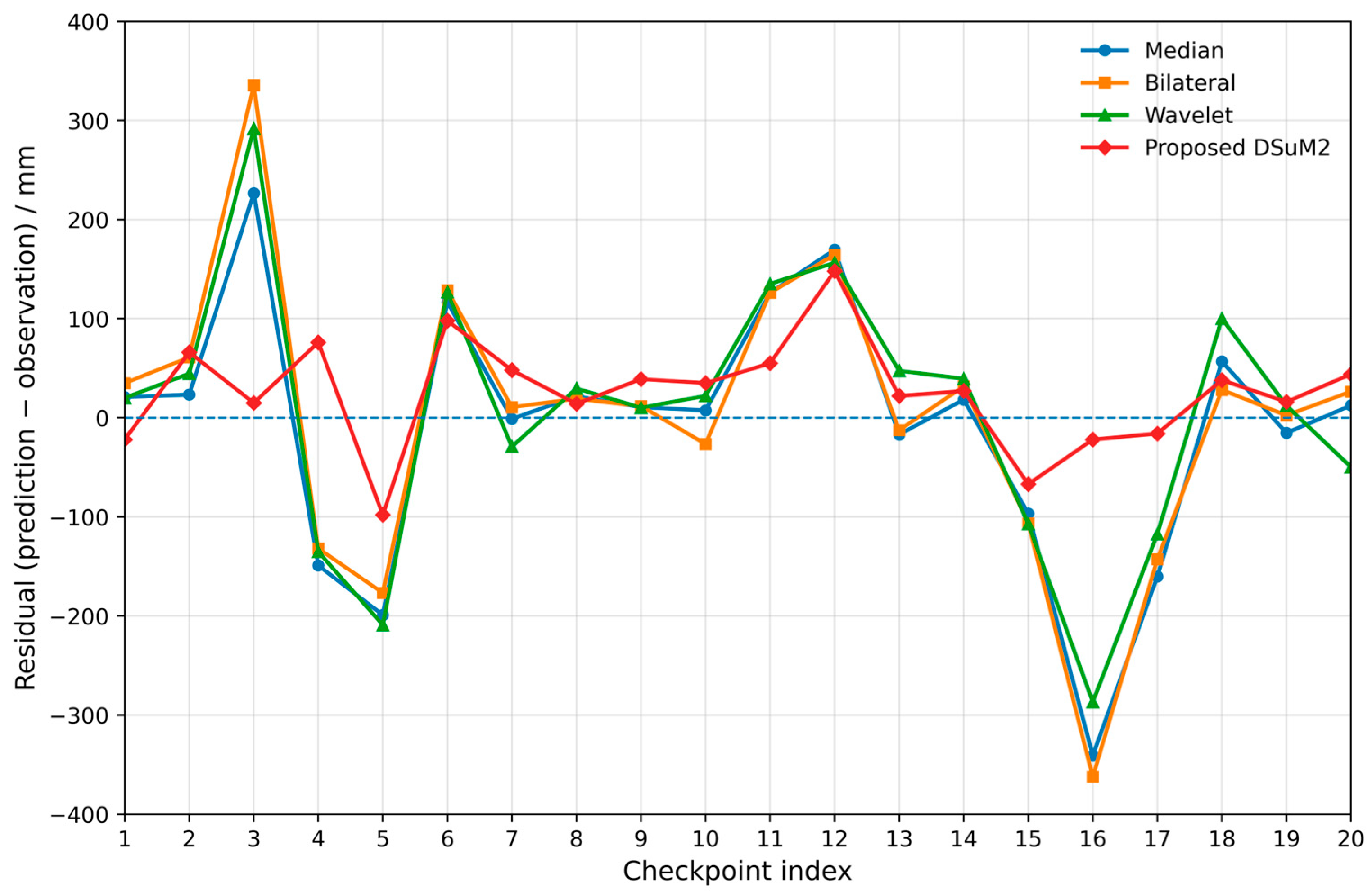
For fairness, all baseline methods were applied to the same raw DSuM used in this study, and all denoised products were evaluated under the same dataset, coordinate system, checkpoint set, and value-extraction protocol. The comparative assessment was conducted using the same 20 ground-based monitoring points and the same quantitative metrics adopted for the hierarchical framework, including MaxAE, MAE, 95% confidence interval of MAE, and RMSE. In this way, the comparison focused on whether different denoising strategies could improve the accuracy and stability of the DSuM under a consistent evaluation framework, rather than on differences caused by inconsistent data sources or validation procedures.

3. Results

3.1. Subsidence Basin Noise Filtering Results

3.1.1. Large-Scale Noise Identification and Processing Results

To enhance the effectiveness of noise identification and filtering in subsidence data, this study employs a zonal partitioning of subsidence values based on the settlement range corresponding to the 3.26 m coal seam thickness prior to applying the improved DBSCAN clustering algorithm. The partitioning follows the principle of “wide intervals for major subsidence zones and narrow intervals for slight subsidence zones,” with specific rationale as follows:
In the major to moderate subsidence zones (3200–700 mm), where subsidence values generally change gradually with sparse data point distribution and limited noise impact, intervals of 500 mm width (e.g., 3200–2700 mm, 2700–2200 mm, etc.) are adopted to preserve the integrity of the overall trend.
Within the transition zone (700–200 mm), characterized by increased subsidence gradients, enhanced local irregularity, and more noise points, a layered, progressive segmentation strategy is implemented: First, clustering-based denoising is applied to the 700–400 mm interval to filter normal clusters while removing anomalous clusters and noise points. Next, the denoised results from the 700–400 mm interval are combined with the raw data from the 400–300 mm interval for re-clustering, but only the clustering results for the 400–300 mm interval are retained to generate purified data for this sub-zone. Subsequently, the purified data from the 700–300 mm range is merged with the raw data from the 300–200 mm interval for another clustering step, ultimately extracting only the purified data for the 300–200 mm interval. This progressive strategy ensures stepwise optimization from the central zone (700 mm) toward the periphery (200 mm), preserving the core subsidence structure of each interval while effectively suppressing noise interference, thereby achieving refined noise identification from the subsidence center to the edges.
In the slight subsidence fringe zone (<200 mm), where boundary effects are prominent, local fluctuations are complex, and sensitivity to noise is high, the interval width is further refined to 100 mm (e.g., 200–100 mm, 100–0 mm) to enhance the resolution of genuine boundary structures. This partitioning approach aligns with the evolutionary pattern of subsidence basins—characterized by “gentle central zones and steep edges”—ensuring continuity of the overall deep trend while improving discernibility in complex shallow intervals.
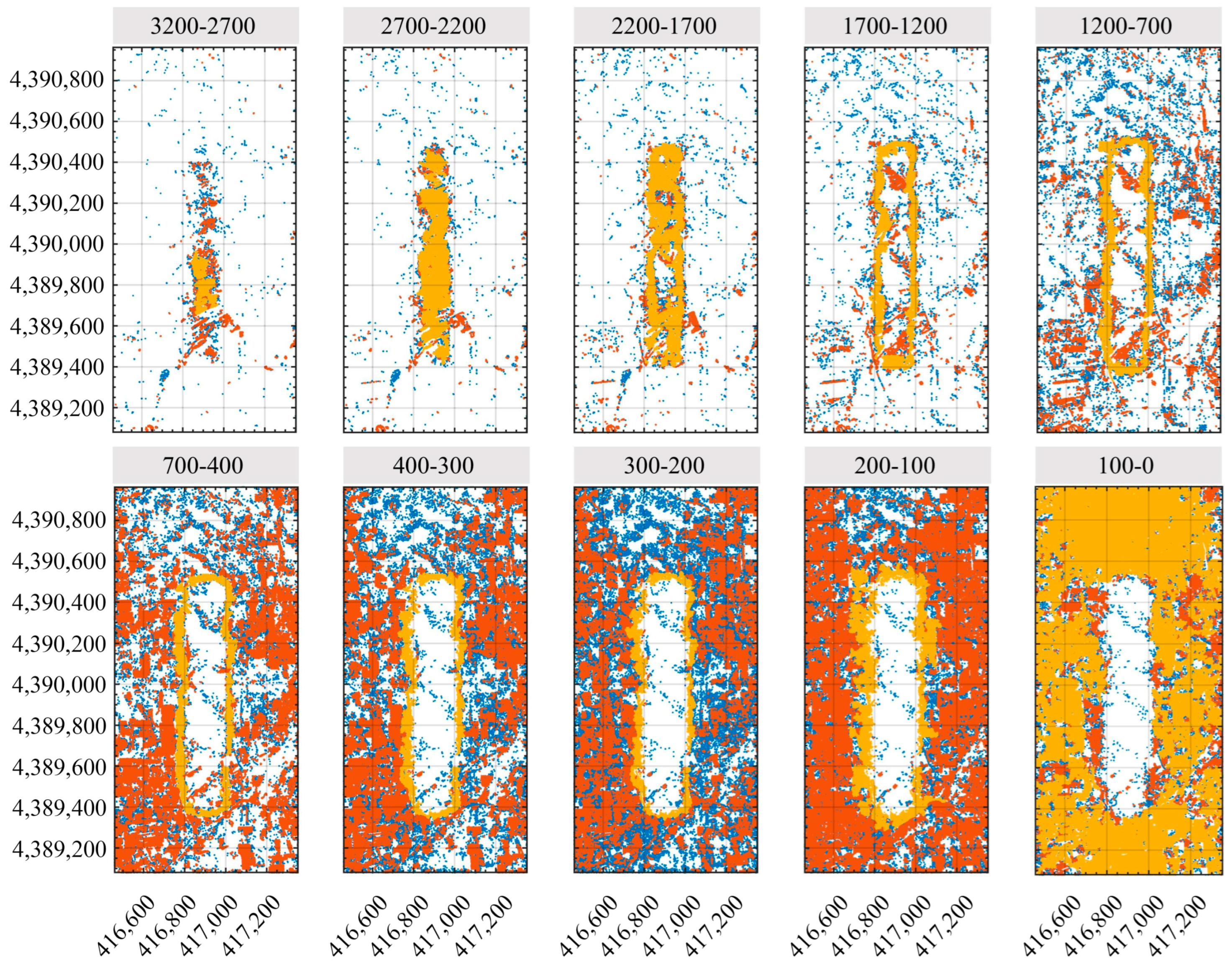
Following the zonal partitioning, the enhanced DBSCAN algorithm was applied individually within each subsidence interval for clustering and noise filtering. Parameter configurations were determined through repeated comparative trials to accommodate the gradually varying data characteristics from the basin center to the edges, after which ε and MinPts were adaptively computed within each interval using the proposed LDP-KNA procedure. In the central subsidence zone (3200–700 mm), a parameter set of K = 120 and h = 20 was adopted, yielding an adaptively determined ε of 2.09 and MinPts of 9. Results indicate a progressive increase in the number of clusters from 406 in the 3200–2700 mm interval to 1999 in the 1200–700 mm interval, reflecting enhanced point cloud complexity as the subsidence area expands, while maintaining high structural consistency overall. Within the transition zone (700–200 mm), a segmented parameter strategy was implemented to address variations in point cloud density and noise levels. For the 700–400 mm interval, parameters were set to K = 180, yielding an adaptive ε of 2.54 and generating 2511 clusters. When extended to the 700–300 mm interval, K was adjusted to 120, resulting in ε = 2.09 and increasing the cluster count to 3266. Further narrowing to the 700–200 mm interval with K reduced to 60 (ε = 1.17) caused a sharp rise in clusters to 9730, indicating significantly enhanced data irregularity and fragmentation. In the marginal shallow subsidence zone (200–0 mm), the neighborhood search scope was progressively expanded to avoid erroneous removal of small-scale genuine subsidence features. For the 200–100 mm interval, K was increased to 130 (ε = 2.17), producing 3303 clusters. The 100–0 mm interval further raised K to 210 (ε = 2.75), yielding 1276 clusters.
For the present dataset, the selected parameter settings provided stable and physically reasonable clustering results across different subsidence intervals, while preserving the primary structure of the subsidence basin (Table 1). Visualizations of the clustering results are presented in Figure 6.
Following the implementation of the improved DBSCAN clustering, this study further refined the clustering results within each subsidence interval to obtain high-quality subsidence point clouds. The specific procedure is outlined as follows: First, the number of points in each cluster was tallied and ranked by size. The top K clusters in terms of point count were preliminarily selected as candidate “normal clusters.” Subsequently, through integration of subsidence morphological characteristics and domain knowledge, clusters not ranked within the top K but exhibiting typical features were manually screened and incorporated into the normal cluster set. Finally, all points within the identified normal clusters were assigned a label of 1, while those in clusters not selected were labeled as 0 and categorized as “abnormal clusters.” The original DBSCAN noise label of −1 was retained for noise points. Based on these three classifications, a mask was generated to filter out abnormal clusters and noise points, retaining only the normal cluster point cloud as purified data for subsequent modeling and analysis.
Based on the above refinement procedure, this study obtained the distribution of normal clusters, abnormal clusters, and noise points within each subsidence interval (Table 2). The results show that from deeper to shallower zones, the total number of data points increases substantially, while the proportion of abnormal points and noise points rises in stages and reaches its peak in the middle-to-shallow subsidence zones. In contrast, the proportion of normal clusters exhibits a clear stagewise variation across the depth profile.
In the deep subsidence intervals (3200–1700 mm), the overall subsidence data remained stable. In the 3200–2700 mm interval, a total of 51,431 points were obtained, of which 26,879 (52.3%) were normal points, 20,392 (39.6%) were abnormal points, and only 4160 (8.1%) were noise points. Although the sample size in this interval was limited, normal points still dominated, indicating high continuity in the subsidence process within the deep central zone. As the intervals narrowed to 2700–2200 mm and 2200–1700 mm, the number of sample points increased significantly to 247,677 and 260,845, respectively. The proportion of normal points remained around 88%, while the combined proportion of abnormal points and noise points was below 12%. These results suggest that the deep subsidence maintained a “stable–continuous” state with relatively uniform spatial distribution, and the surface response remained largely undisturbed. Such deep intervals typically correspond to the core of the mining-induced basin, where subsidence magnitude is high but the morphology is smooth. The presence of outliers and noise is mainly attributable to local sampling deviations or isolated fracture structures rather than systematic deformation.
In the 1700–1200 mm interval, the total number of points was 200,697, with the proportion of normal points decreasing to 75.6%, while abnormal points and noise accounted for 19.4% and 5.0%, respectively. Compared to the deeper intervals, the number of abnormal points increased notably, indicating that this zone represents a transition layer within the subsidence basin. Influenced by both stratified fracturing of the overlying strata and differential surface settlement, the data began to exhibit irregularities.
This trend became more pronounced in the 1200–700 mm interval. The sample size increased to 303,458 points, with normal points accounting for only 54.7%, abnormal points rising sharply to 113,392 (37.4%), and noise points totaling 24,121 (7.9%). These results indicate a shift in the subsidence pattern from “continuous–stable” to “complex–diverse” in this high-subsidence range. Local surface collapse, linear fissures, and differential settlement collectively contributed to the significant increase in abnormal points and accumulation of noise. This stage marks a key transition from homogeneous to heterogeneous deformation within the subsidence basin.
The shallow transition intervals exhibited the most complex data characteristics. In the 700–400 mm range, a total of 580,003 points were recorded, with abnormal points reaching 443,358 (76.4%), normal points plummeting to 18.4%, and noise points accounting for 5.1%. Here, abnormal points clearly dominate, reflecting intensified shallow overburden failure and highly localized subsidence. In the 400–300 mm range, the total point count is 452,513, with the abnormal proportion remaining high at 77.4%, noise rising to 12.6%, and normal points dropping to only 10.2%. This indicates extreme fragmentation of surface morphology, where concentrated abnormal clustering reflects segmented collapse within the basin interior. The 300–200 mm interval displayed the most extreme data dispersion. With a total of 620,117 points, abnormal points accounted for 381,382 (61.5%) and noise points surged to 197,352 (31.8%), together exceeding 93% of the data. Such a high proportion of noise indicates that surface subsidence in this interval has become extremely complex and irregular, often corresponding to large-scale caving of shallow overburden, superimposed differential settlement, and external disturbances during monitoring. The overall characteristics at this stage are segmentation and fragmentation, with severe local collapse, pronounced boundary effects, and dominance of abnormal and noise points, leaving normal points nearly unrepresentative.
In the near-surface marginal intervals, data volume increased significantly. The 200–100 mm interval contained 739,736 points, with abnormal points accounting for 588,074 (79.5%), normal points only 13.6%, and noise points 6.9%. In the shallowest 100–0 mm range, the total number of points surges to 1,678,586, of which normal points reach 1,579,890 (94.1%). Although the absolute counts of abnormal and noise points remained substantial in this interval, their proportions converged to relatively low levels, indicating a trend toward stabilization in surface subsidence morphology.
In summary, the evolutionary pattern of the subsidence basin from the deep zone to the marginal area can be categorized into four distinct phases:
Deep-Seated Stability (3200–1700 mm): Normal points overwhelmingly dominate, indicating a continuous, homogeneous subsidence process with stable spatial distribution.
Intermediate Complexity (1700–700 mm): The proportion of abnormal points increases notably, revealing transitional and heterogeneous subsidence characteristics.
Shallow Fragmentation (700–200 mm): Abnormal points and noise collectively prevail, accompanied by pronounced local fragmentation and differential settlement, reflecting the most severe structural disruption in the shallow zone.
Marginal Convergence (200–0 mm): While the proportion of abnormal points remains high, noise decreases, and the subsidence morphology tends to converge, indicating gradual closure of the basin edge.
The results clearly reveal a hierarchical mechanism in coal mining-induced subsidence: the deep zone is dominated by stable subsidence, the intermediate zone begins to exhibit heterogeneous deformation, the shallow zone demonstrates segmented fragmentation and a highly noisy response, while the basin edge ultimately shows convergence. This stratified evolutionary process not only validates the subsidence propagation and convergence mechanisms elucidated by the probability integral method, but also demonstrates that the cluster-based denoising approach can effectively capture deformation characteristics across different zones, thereby providing reliable data support for the detailed characterization of mining-induced subsidence.
The classification results are further visualized in a scatter plot (Figure 7), where yellow points represent the retained normal clusters, red points denote abnormal clusters, and blue points indicate noise points. The spatial distribution reveals that normal clusters are predominantly concentrated within the main subsidence basin, maintaining strong spatial continuity. Abnormal clusters are primarily distributed along the basin periphery and transitional zones, exhibiting discernible discrete distribution characteristics. Noise points appear sporadically in outer regions or areas with low point density.
Following this improved DBSCAN-based processing step, a total of 2,678,187 normal subsidence points were retained, while 2,053,701 abnormal cluster points were eliminated and 403,175 noise points were removed. These results indicate that approximately 56.6% of the original point cloud was identified as genuine subsidence information, with the remaining 43.4% classified as either anomalies or noise. This procedure effectively reduced interference from marginal discrete points and small-scale spurious clusters on the overall morphological representation, significantly enhancing the purity and reliability of the dataset, thereby providing higher-quality input data for subsequent subsidence modeling.

3.1.2. Small-Scale Noise Suppression Results of the DSuM

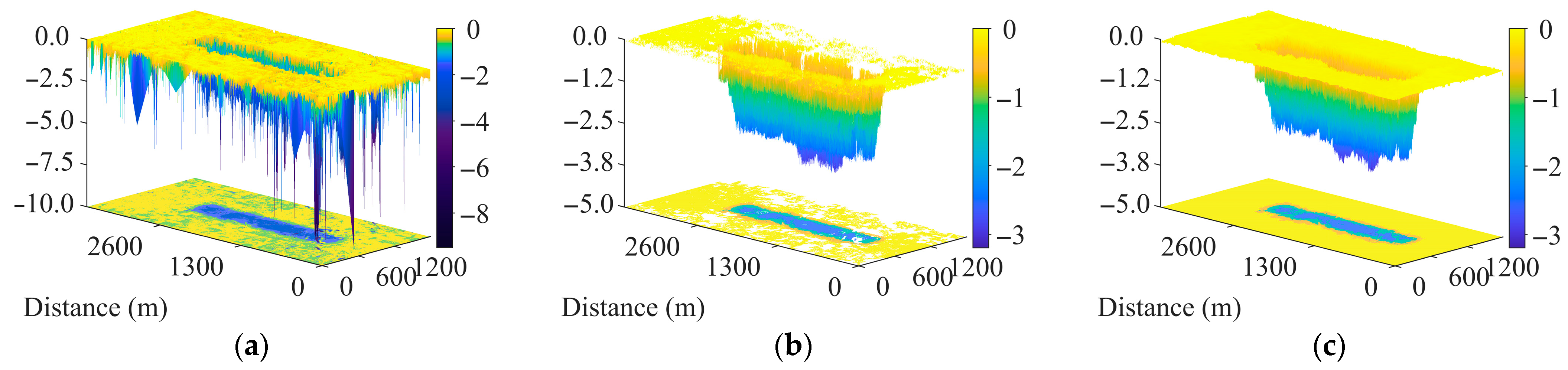
Following the large-scale noise identification and removal procedure, the DSuM largely recovers the primary subsidence morphology. However, as illustrated in Figure 8b, certain voids and residual high-frequency local perturbations persist, which compromise the continuous representation of the subsidence features. To further enhance the smoothness and structural integrity of the DEM surface, a curvature-adaptive multi-stage denoising method is introduced for small-scale noise suppression, applied to the coarsely denoised DSuM obtained from the previous stage. This method incorporates curvature priors and spatial weights during local fitting and updating processes. By achieving a balance between smoothing terms and curvature constraints, it effectively removes fine-scale noise while preserving boundary sharpness, thereby reconciling edge preservation with interior smoothing.
Figure 8 presents a three-dimensional comparison of the DSuM at different processing stages. Figure 8a shows the original DSuM, in which numerous spike-like negative outliers and randomly distributed discrete noise are evident. These artifacts manifest as localized “needle-like” downward penetrations and background rough undulations, resulting in blurred basin boundaries and spatially heterogeneous internal deformation patterns. As indicated by the color bars, Figure 8a spans a broad value range of approximately 0 to −9 m, with the color transition progressing from light blue to deep blue as subsidence values become more negative. In contrast, Figure 8b,c are mainly confined to a narrower range of 0 to −3.2 m, and the corresponding color variation is concentrated within lighter blue to medium blue tones. This difference in both value range and color distribution indicates that the extreme negative anomalies represented by the darkest blue in the raw DSuM were effectively suppressed after denoising, while the main subsidence morphology was retained more clearly in the processed results.
As shown in Figure 8a, the displayed value range spans approximately 0 to −9 m, indicating the presence of extreme negative anomalies in the raw DSuM. According to the color scale, values near 0 m are rendered in light blue, while more negative subsidence values are represented by progressively darker blue tones. In particular, the abnormal spike-like noise points and localized distorted depressions are mainly mapped in deep blue, indicating that they belong to the lowest end of the value range. These extreme values are generally attributable to measurement noise, image-matching errors, or local distortions introduced during DSuM generation. By markedly expanding the dynamic range, they mask subtle but geomorphologically meaningful subsidence signals and reduce the reliability of morphological interpretation.
After large-scale noise removal, the extreme negative anomalies are effectively suppressed, and the principal subsidence structure is restored. The spatial differentiation between subsidence and non-subsidence areas becomes clearer. Compared with the original stage, the overall dynamic range converges substantially, with the color scale in Figure 8b primarily confined to 0 to −3.2 m. This indicates that isolated outliers and background noise inconsistent with geomorphic continuity have been largely eliminated, rendering the macroscopic outline of the subsidence basin more discernible. Nevertheless, residual small-amplitude fluctuations remain near subsidence margins and slope-transition zones, appearing as high-frequency roughness and localized speckled disturbances—typical manifestations of small-scale noise.
Following the implementation of the curvature-adaptive multi-stage denoising method (Figure 8c), surface quality is further improved, and both morphological continuity and interpretability are significantly enhanced. Relative to Figure 8b, residual high-frequency roughness in non-subsidence areas is markedly reduced. Local undulations and scattered micro-perturbations along boundary transition zones are effectively suppressed and naturally integrated into the surrounding terrain, resulting in smoother and more continuous boundary gradients. Interpolation-based reconstruction strengthens areal completeness, and the projected subsidence imprint becomes more coherent and regular, reducing fragmentation caused by discrete anomalies. Importantly, despite substantial noise reduction, the internal low-value zones remain stable and spatially coherent, the geometric framework of the subsidence trough is preserved, and critical details within the central depression are retained without evidence of over-smoothing, boundary diffusion, or contour drift. These results demonstrate that the curvature-adaptive multi-stage denoising method achieves an effective balance among noise suppression, surface completion, and morphological preservation.
Overall, the two-stage processing framework progresses from macroscopic purification to refined optimization. Large-scale denoising primarily targets global background noise and extreme isolated outliers, restoring the overall basin morphology. Small-scale refinement further suppresses high-frequency roughness and localized disturbances while enhancing surface continuity through constrained interpolation. As indicated by the numerical ranges in Figure 8b,c, the processed subsidence depths stabilize within 0 to −3 m, whereas the extreme negative values approaching −10 m in the raw dataset (Figure 8a) exhibit clear characteristics of abnormal noise and have been effectively mitigated. Consequently, the small-scale noise suppression stage not only substantially improves DSuM data quality but also provides a more stable and reliable foundation for subsequent subsidence morphology modeling, parameter extraction, and evolutionary mechanism analysis.

3.2. Analysis of the Subsidence Characteristics of the Main Section

To highlight the influence of different denoising stages on the principal cross-sectional subsidence morphology, the original data (gray scatter), large-scale denoising results (magenta), and small-scale denoising results (green) were compared along the same profile. Key segments were magnified along the sequence “boundary slope-break—basin bottom—rebound transition—stable reference zone” (Figure 9a,b). In Figure 9a, enlarged windows correspond to 500–700 m (left subsidence transition), 1300–1700 m (basin bottom), and 2850–3050 m (right rebound transition). In Figure 9b, the selected intervals include 650–850 m (left transition), 1000–1200 m (right transition), and 1300–1500 m (non-subsiding stable reference zone).
Overall, the original DSuM profile is strongly affected by vegetation, buildings, water bodies, and measurement errors. In non-subsiding or low-curvature regions (Figure 9a: 0–500 m and 3000–3700 m; Figure 9b: 0–650 m and 1200–1800 m), numerous discrete outliers and random fluctuations obscure the true deformation pattern, resulting in unstable boundary identification and masked central subsidence trends. After large-scale denoising, global background noise and isolated extreme anomalies are effectively removed, and the macroscopic basin geometry becomes clearly defined; however, residual high-frequency disturbances remain near slope transitions and local boundary zones. With further application of the curvature-adaptive multi-stage denoising method, high-frequency noise is substantially suppressed and local voids are reconstructed, while preserving the overall deformation trend and key geometric features (e.g., maximum subsidence location and approximate boundary position). Consequently, the continuity, stability, and reproducibility of the subsidence profile are markedly improved.
In terms of deformation characteristics, Figure 9a represents a fully extracted strike-oriented profile, exhibiting a broad and gentle subsidence trough. In the left transition zone (500–700 m), where small-scale noise is concentrated, denoising results in smoother gradient variation and improved continuity. At the basin bottom (1300–1700 m), residual fluctuations observed after large-scale processing are further consolidated into a stable low-value band, better reflecting the realistic morphology of a near-flat basin floor with minor undulations. In the right rebound segment (2850–3050 m), boundary transitions become more natural after small-scale refinement, facilitating stable extraction of inflection points and boundary positions.
By contrast, Figure 9b displays a typical under-extracted subsidence morphology characterized by a pronounced U-shaped depression. Local enlargements demonstrate that curvature-adaptive multi-stage denoising method effectively suppresses slope-side oscillations, allowing a clearer depiction of the gradual recovery from the subsidence trough toward the stable reference surface. In the stable zone (1300–1500 m), the green curve remains closer to the zero-subsidence baseline with reduced fluctuation, indicating effective suppression of the background noise floor in non-subsiding areas.

3.3. Accuracy Assessment

To quantitatively evaluate the accuracy of the DSuM before and after denoising, the measured subsidence values Si (unit: mm) obtained from 20 ground-based monitoring points within the study area were adopted as reference truth values. Accuracy assessments were performed on the raw DSuM, the DSuM after large-scale denoising (DSuM1), and the final DSuM after small-scale denoising (DSuM2). Three quantitative metrics were employed for evaluation: Maximum Absolute Error (MaxAE), Mean Absolute Error (MAE), and Root Mean Square Error (RMSE). The corresponding formulas are provided in Equations (20)–(22).
MaxAE = max i = 1 n   s ^ i s i
MAE = 1 n i = 1 n   s ^ i s i
RMSE = 1 n i = 1 n   s ^ i s i 2
In the equations, Si represents the measured subsidence value at the i-th monitoring point, while s ^ i denotes the corresponding value extracted from the DEM at the same location. The number of valid monitoring points is n = 20. To ensure comparability, all datasets were unified to the same coordinate system and units, with a consistent value extraction strategy applied at each monitoring point location. For points falling within NoData areas, interpolation was first performed according to the hole-filling rules established in this study before including them in the statistical analysis.
To further evaluate whether the observed accuracy improvements were statistically reliable, paired significance analysis was conducted using the point-wise absolute errors at the same 20 ground checkpoints. Because all three products (raw DSuM, DSuM1, and DSuM2) were evaluated at identical checkpoint locations, paired comparisons were adopted. Considering the limited sample size and the fact that the paired differences in absolute errors did not strictly satisfy normality, the Wilcoxon signed-rank test was used as the primary inferential method. In addition, 95% confidence intervals (CIs) of MAE were estimated from the checkpoint absolute errors to further characterize the statistical stability of the results.
Based on the statistical results from the 20 monitoring points (Table 3 and Figure 10 and Figure 11), the raw DSuM exhibited relatively high error levels, with MaxAE, MAE, and RMSE values of 367, 121.3, and 154.1 mm, respectively, indicating substantial contamination by discrete anomalies and local distortions. After large-scale denoising, isolated outliers and global background noise were effectively suppressed, and the corresponding MaxAE, MAE, and RMSE decreased to 222, 63.6, and 86.3 mm, representing reductions of 39.5%, 47.6%, and 44.0%, respectively, relative to the raw DSuM. After subsequent small-scale denoising, the final DSuM2 further improved to 148, 48.3, and 59.3 mm, respectively. Compared with the raw DSuM, this corresponds to overall reductions of 59.7% in MaxAE, 60.2% in MAE, and 61.5% in RMSE. Relative to DSuM1, the second-stage denoising further reduced MAE and RMSE by 24.1% and 31.3%, respectively, indicating that the proposed hierarchical framework effectively enhanced both the numerical accuracy and stability of the subsidence model.
Paired statistical analysis further substantiated the reliability of these improvements. The Wilcoxon signed-rank test showed that both DSuM1 and DSuM2 had significantly lower point-wise absolute errors than the raw DSuM (Raw vs DSuM1: p = 0.0030; Raw vs DSuM2: p = 0.0016). By contrast, although DSuM2 numerically outperformed DSuM1, the incremental improvement between the two denoised products was not statistically significant at the 20 checkpoints (DSuM1 vs. DSuM2: p = 0.5191). Furthermore, the residual distribution shown in Figure 10a demonstrates a progressive narrowing of dispersion after denoising, with fewer extreme residuals and a more concentrated interquartile range. Figure 10b similarly reveals a stepwise decline in MaxAE, MAE, and RMSE. These results indicate that the first-stage denoising contributed the dominant statistically supported accuracy gain, whereas the second-stage denoising mainly provided additional numerical refinement and morphological regularization.
The residual distribution (Figure 10a) reveals that the raw DSuM exhibits a wide range and high dispersion of residuals. Following large-scale denoising, the residual distribution narrows considerably, and after small-scale processing, the residuals become further concentrated near zero, with the boxplot median approaching zero—indicating a more symmetric and stable error distribution. The comparison of accuracy metrics (Figure 10b) intuitively demonstrates the stepwise improvement achieved by the two-stage denoising approach: large-scale denoising delivers a substantial leap in accuracy, while small-scale denoising provides further numerical refinement and improves residual concentration and surface regularity. The scatter plots (Figure 11) further validate that after small-scale processing, the estimated subsidence values exhibit stronger linear correlation with the measured values, with data points clustering more tightly around the 1:1 line. This confirms that the fidelity and reliability of the subsidence DEM have been comprehensively enhanced.
To further examine whether the proposed framework also provides practical advantages over representative conventional denoising strategies, three baseline methods, namely median filtering, bilateral filtering, and wavelet-threshold denoising, were additionally evaluated under the same study dataset and checkpoint-based assessment framework. The comparative results are summarized in Table 4. Among the tested baseline methods, median filtering achieved the best overall performance, with the optimal parameter setting of window = 5, indicating a moderate local smoothing scale, and with MaxAE, MAE, and RMSE values of 342.01, 90.21, and 128.78 mm, respectively. Wavelet-threshold denoising ranked second and yielded the lowest MaxAE among the three baseline methods (296.90 mm); its best-performing configuration was sym4, level = 5, UniversalThreshold, where sym4 denotes the selected wavelet basis, level = 5 represents the decomposition depth, and UniversalThreshold indicates the thresholding rule used for coefficient shrinkage. However, its MAE and RMSE remained higher than those of median filtering, indicating that its improvement was locally evident but less stable overall. Bilateral filtering showed the weakest improvement, with the best-performing parameter combination of sigmaS = 3, sigmaR = 120, window = 30, where sigmaS controls the spatial weighting decay, sigmaR controls the sensitivity to local subsidence-value differences, and window defines the neighborhood size. Under this configuration, its MaxAE, MAE, and RMSE values were 363.43, 97.73, and 140.75 mm, respectively. By comparison, the final result of the proposed hierarchical framework (DSuM2) still achieved substantially better performance, with MaxAE, MAE, and RMSE values of 148, 48.3, and 59.3 mm, respectively. These results indicate that although conventional single-method denoising approaches can partially suppress DSuM noise, they remain insufficient for jointly handling the coexistence of large-scale outliers, anomalous clusters, and small-scale mixed perturbations in the present UAV-derived DSuM. By contrast, the proposed two-stage framework is better suited to the multi-scale and spatially heterogeneous noise characteristics of UAV-derived subsidence models.
Figure 12 further compares the checkpoint residual patterns of the three representative baseline denoising methods and the proposed DSuM2. Among the baseline methods, median filtering shows the most stable overall residual distribution, whereas bilateral filtering and wavelet-threshold denoising still retain relatively large local deviations at several checkpoints. By contrast, the residuals of DSuM2 are generally more concentrated around zero, and the magnitude of extreme positive and negative deviations is markedly reduced. In particular, several residual spikes that remain evident in the baseline methods are substantially suppressed in DSuM2, indicating that the proposed hierarchical framework achieves not only lower overall error metrics but also more stable checkpoint-level performance. A comparative evaluation against representative conventional denoising methods further confirmed that the proposed hierarchical framework outperformed median filtering, bilateral filtering, and wavelet-threshold denoising under the present dataset and checkpoint-based validation framework.

4. Discussion

This study, conducted at Panel 2S201 of the Wangjiata Coal Mine in the arid/semi-arid western mining region of China, developed a hierarchical denoising framework that integrates adaptive DBSCAN for large-scale noise removal with a curvature-adaptive multi-stage denoising method for small-scale suppression, addressing the challenge of multi-scale compound noise in UAV-derived Digital Subsidence Models (DSuMs). This framework achieves comprehensive optimization from noise identification and hierarchical suppression to accuracy enhancement, offering a novel technical pathway for high-precision modeling of mining-induced subsidence in coal mining areas. This section provides an in-depth discussion of the core advantages of the proposed method, its comparison with traditional approaches, research limitations, and applicable scenarios.

4.1. Core Advantages and Innovations of the Hierarchical Denoising Method

Compared with traditional single-scale and fixed-parameter filtering methods, the proposed hierarchical denoising framework enables more accurate and adaptive suppression of DSuM noise according to its spatial distribution characteristics in mining areas. Its major advantages can be summarized in three aspects.
First, the framework achieves hierarchical noise identification and targeted treatment. By stratifying the DSuM according to subsidence intervals, it distinguishes large-scale noise, such as isolated outliers and anomalous clusters, from small-scale noise, such as high-frequency perturbations and local pseudo-structures. Different denoising strategies are then applied to these two noise categories, which helps overcome the common trade-off between noise reduction and structural preservation in single-algorithm approaches.
Second, the framework improves the adaptability of large-scale noise detection. Instead of relying on manually selected clustering parameters, it uses an adaptive parameter determination strategy based on local point-density characteristics in different subsidence intervals. This reduces parameter sensitivity and enhances the robustness and transferability of large-scale noise identification.
Third, the framework introduces a curvature-guided adaptive mechanism for small-scale noise suppression. By adjusting the denoising strength according to local terrain morphology, the method is able to achieve stronger smoothing in relatively stable areas while preserving critical structural features in boundary and slope-transition zones. As a result, the processed DSuM shows improved geometric continuity, clearer basin morphology, and better physical plausibility.

4.2. Methodological Positioning and Stage-Wise Effectiveness of the Proposed Hierarchical Denoising Framework

Existing denoising methods, such as wavelet transform, median filtering, and bilateral filtering, each have recognized strengths for particular types of noise. However, the noise pattern in UAV-derived Digital Subsidence Models (DSuMs) is typically more complex, because large-scale outliers, anomalous clusters, and small-scale mixed perturbations often coexist within the same model and exhibit clear spatial heterogeneity across different subsidence intervals. Under such conditions, applying a single denoising strategy uniformly to the entire DSuM is often insufficient.
From this perspective, the contribution of the proposed method lies in its problem-oriented hierarchical design rather than in establishing universal superiority over all existing denoising algorithms. The first stage uses adaptive DBSCAN to identify and remove large-scale outliers and abnormal clusters according to local density characteristics under different subsidence intervals. The second stage introduces curvature-adaptive multi-stage denoising to further suppress small-scale mixed noise while preserving boundary morphology, slope-transition features, and the overall geometry of the subsidence basin.
The results obtained in the present study demonstrate that this hierarchical strategy is effective for the target dataset and application scenario. The RMSE decreases from 154 mm in the raw DSuM to 86 mm after large-scale denoising and further to 59 mm after small-scale denoising, while the continuity of the basin surface and the clarity of boundary transitions are simultaneously improved.
In addition, the comparative evaluation against three representative baseline denoising methods further supports the practical advantage of the proposed framework. Among the tested baseline methods, median filtering achieved the best overall performance, whereas wavelet-threshold denoising ranked second and bilateral filtering showed the weakest improvement. Nevertheless, all three baseline methods remained clearly inferior to the final hierarchical result (DSuM2) in terms of overall checkpoint accuracy. Figure 12 further shows that, although the baseline methods reduce noise to different extents, noticeable positive and negative residual spikes still remain at several checkpoints, whereas the residuals of DSuM2 are generally more concentrated around zero. These results indicate that conventional single-method denoising approaches can partially improve DSuM quality, but they remain insufficient for jointly handling the coexistence of large-scale outliers, anomalous clusters, and small-scale mixed perturbations in the present UAV-derived DSuM. Therefore, the advantage of the proposed method lies not merely in stronger smoothing, but in its hierarchical and stage-wise adaptation to the actual noise structure of the subsidence model.

4.3. Geological and Engineering Significance of the Findings

Through statistical clustering of subsidence intervals, this study elucidates a hierarchical evolutionary pattern of mining-induced subsidence in western mining areas with shallow, thick coal seams. This pattern progresses from “stable and continuous” subsidence in the deep zone (3200–1700 mm), to “complex and heterogeneous” subsidence in the intermediate zone (1700–700 mm), then to “segmented and fragmented” subsidence in the shallow zone (700–200 mm), and finally to “convergent and stable” subsidence at the margin (200–0 mm). This finding not only validates the subsidence propagation and convergence mechanisms described by the probability integral method but also provides practical engineering insights for subsidence monitoring and hazard prevention. Notably, the shallow 700–200 mm interval, identified as a high-incidence zone for anomalies and noise, corresponds to the critical stage of large-scale overburden caving and differential settlement, marking it as a high-risk area for geological hazards (e.g., cracks, collapses) and thus a priority for monitoring and control. Furthermore, the denoised DSuM, with its significantly enhanced accuracy, provides reliable data for the quantitative extraction of key subsidence parameters (maximum subsidence, basin width, slope/curvature characteristics, inflection point location), offering technical support for rational coal resource development, surface ecological protection, and geological disaster early warning.

4.4. Limitations of the Study

Despite the improvements achieved in UAV-based DSuM denoising and reconstruction, several limitations of the present study should be acknowledged.
First, the proposed framework is mainly designed for the vertical deformation component represented by the DSuM. Although vertical settlement provides the most direct description of subsidence magnitude and basin morphology, mining-induced ground deformation is inherently three-dimensional. Horizontal displacement is closely related to boundary migration, tensile-compressive behavior, and the evolution of surface damage, but it is not considered in the current framework. As a result, the method cannot yet provide a complete characterization of the full deformation process. Future work should integrate the denoised DSuM with horizontal displacement information derived from multi-temporal UAV image matching, dense feature tracking, or point-cloud co-registration.
Second, the framework is less reliable in areas of minor subsidence. When settlement magnitudes approach the level of systematic uncertainty and residual noise in UAV photogrammetry, the distinction between weak deformation and background fluctuation becomes less clear. Under such conditions, the sensitivity of the method decreases, and subtle deformation signals may not be captured with sufficient reliability. Therefore, the current framework is more suitable for areas with moderate to strong deformation than for weak-deformation settings.
Third, the current validation is still limited in representativeness. The study was conducted in a single mining area, and the selected parameter settings, although shown by repeated comparative trials to yield stable and physically reasonable results for the present dataset, have not yet been evaluated through a formal sensitivity analysis. In addition, the experimental site is characterized by erosional hilly terrain and relatively sparse vegetation cover, which are generally favorable for UAV photogrammetric reconstruction. In areas with denser vegetation, more rugged topography, or more heterogeneous surface conditions, residual non-ground points, occlusions, and interpolation artifacts may become more prominent, thereby affecting both DSuM generation and subsequent denoising performance. Further validation is therefore needed in mining areas with different topographic, vegetation, and deformation conditions.
Finally, although a comparative evaluation against three representative baseline denoising methods has now been included, the current benchmark remains limited in scope. The comparison was conducted in a single mining area and focused on a small group of conventional single-method denoising approaches, rather than covering a broader spectrum of more recent algorithms or multiple geological and geomorphological settings. Therefore, the present results should still be regarded primarily as evidence of the effectiveness and practical advantage of the proposed hierarchical framework for the target UAV-derived DSuM scenario, rather than as a universal claim of superiority over all existing denoising methods. More systematic benchmarking across different mining environments, data conditions, and representative external algorithms is still needed in future work.

4.5. Applicability and Extensibility of the Method

The hierarchical denoising framework proposed in this study is particularly well suited to mining-induced subsidence monitoring in western coal mining regions characterized by shallow burial depth, thick coal seams, pronounced topographic relief, and relatively sparse vegetation cover. Its practical value resides not only in improving the reconstruction quality of Digital Subsidence Models, but also in offering a transferable denoising paradigm centered on hierarchical noise recognition and adaptive suppression.
A notable strength of the framework is that its principal processing steps are not entirely dependent on fixed empirical parameter settings. In the large-scale denoising stage, clustering parameters are determined adaptively according to local point-density characteristics across different subsidence intervals. In the small-scale denoising stage, smoothing intensity is regulated in response to local curvature and morphological variability. This design provides the method with a meaningful degree of adaptability when applied to datasets acquired under different spatial resolutions, deformation amplitudes, or geomorphic settings. Even so, such adaptability should be interpreted with caution. The framework is more accurately described as a semi-adaptive methodology whose transferability relies on structured adjustment rather than unrestricted universality.
Its extensibility can be envisioned along several directions. One concerns the transition from vertical subsidence analysis to integrated three-dimensional deformation monitoring. By incorporating horizontal displacement information derived from multi-temporal image matching, point-cloud registration, or auxiliary geodetic observations, the framework could evolve toward a coupled representation of settlement, lateral movement, and deformation gradients, thereby deepening the interpretation of mining-induced ground response.
Another avenue lies in strengthening performance in weak-deformation environments. Greater sensitivity to minor subsidence may be achieved through stable-background correction, uncertainty-constrained thresholding, and signal enhancement based on multi-temporal accumulation. Such refinements would enable the framework to better distinguish subtle deformation from photogrammetric noise and extend its utility to low-amplitude deformation scenarios.
A further direction involves improving robustness under complex land-surface conditions. In regions affected by dense vegetation, strong topographic variability, or heterogeneous surface cover, the framework could be enhanced through scenario-oriented parameter tuning, terrain-informed filtering, vegetation masking, and multi-source data fusion. These developments would promote a shift from empirical portability toward genuinely data-driven self-optimization.
Because the conceptual foundations of the proposed method—hierarchical noise identification, curvature-adaptive denoising, and physically consistent surface optimization—are not confined to mining subsidence alone, the framework may also offer methodological value for other deformation-related applications, including landslide evolution analysis, debris-flow terrain reconstruction, and urban land-subsidence assessment. Its broader significance therefore lies not only in its engineering utility for coal mining regions, but also in its potential contribution to high-precision digital surface deformation modeling across complex geospatial environments.

5. Conclusions

This study addressed the multi-scale noise problem in UAV photogrammetry-derived Digital Subsidence Models (DSuMs) at Panel 2S201 of the Wangjiata Coal Mine and developed a hierarchical denoising framework for high-precision mining subsidence modeling. The main conclusions are as follows.
(1)
The raw DSuM contains significant compound noise caused mainly by residual non-ground points, spatial registration offsets, and interpolation errors. Its noise distribution is scale-dependent: isolated outliers dominate the deep subsidence zone, whereas high-frequency perturbations, anomalous clusters, and local pseudo-structures are concentrated in shallow transition and marginal zones. Consequently, the raw DSuM shows an RMSE of 154 mm, which is insufficient for high-precision subsidence monitoring.
(2)
A hierarchical denoising framework was established by combining LDP-KNA-based adaptive DBSCAN for large-scale noise removal with curvature-adaptive multi-stage denoising for small-scale noise suppression. This framework enables targeted treatment of different noise types, improves the physical plausibility of the processed DSuM, and effectively alleviates the trade-off between noise suppression and structural preservation.
(3)
The proposed framework significantly improves both model accuracy and morphological fidelity. The RMSE decreases from 154 mm in the raw DSuM to 86 mm after large-scale denoising and further to 59 mm after small-scale denoising, corresponding to an overall improvement of 61.5%. The denoised DSuM exhibits clearer basin boundaries, more continuous subsidence profiles, and more natural topographic transitions. In addition, the 700–200 mm interval is identified as the zone with the strongest structural disturbance and highest noise concentration, and therefore represents a key target for refined monitoring and hazard prevention.
Overall, the proposed framework provides an effective solution for multi-scale noise suppression in UAV-derived DSuMs and offers a useful methodological reference for high-precision mining subsidence monitoring in western mining areas. Future work will focus on integrating horizontal deformation information, improving applicability in low-subsidence and high-vegetation areas, and incorporating multi-temporal UAV data for dynamic monitoring and evolutionary prediction.

Author Contributions

Conceptualization, X.Z.; methodology, X.Z.; software, X.Z.; validation, X.Z. and Z.F.; formal analysis, X.Z. and J.H.; investigation, X.Z.; resources, X.Z., R.C. and L.M.; data curation, X.Z. and J.H.; writing—original draft preparation, X.Z.; writing—review and editing, X.Z.; visualization, X.Z.; supervision, Z.H.; project administration, Z.H.; funding acquisition, X.Z. and Z.H. All authors have read and agreed to the published version of the manuscript.

Funding

This research was funded by the Postgraduate Research & Practice Innovation Program of Jiangsu Province, grant number KYCX21_2298, and the National Key Research and Development Program, grant number 2023YFE0122300.

Data Availability Statement

The data are available from the corresponding author upon reasonable request.

Acknowledgments

We thank the anonymous reviewers for their constructive comments on the earlier version of the manuscript. All individuals have consented to the acknowledgment.

Conflicts of Interest

The authors declare no conflicts of interest.

References

  1. Xie, P.; Liao, J.; Pan, X.; Sun, F. Will China’s Carbon Intensity Achieve Its Policy Goals by 2030? Dynamic Scenario Analysis Based on STIRPAT- PLS Framework. Sci. Total Environ. 2022, 832, 155060. [Google Scholar] [CrossRef]
  2. He, X.; Zhang, C.; Han, P. Overburden Damage Degree-Based Optimization of High-Intensity Mining Parameters and Engineering Practices in China’s Western Mining Area. Geofluids 2020, 2020, 8889663. [Google Scholar] [CrossRef]
  3. Yang, Z.; Li, W.; Pei, Y.; Qiao, W.; Wu, Y. Classification of the Type of Eco-Geological Environment of a Coal Mine District: A Case Study of an Ecologically Fragile Region in Western China. J. Clean. Prod. 2018, 174, 1513–1526. [Google Scholar] [CrossRef]
  4. Behera, A.; Singh Rawat, K. A Brief Review Paper on Mining Subsidence and Its Geo-Environmental Impact. Mater. Today Proc. 2023. [Google Scholar] [CrossRef]
  5. Hu, Z.; Chen, C.; Xiao, W.; Wang, X.; Gao, M. Surface Movement and Deformation Characteristics Due to High-Intensive Coal Mining in the Windy and Sandy Region. Int. J. Coal Sci. Technol. 2016, 3, 339–348. [Google Scholar] [CrossRef]
  6. Cai, Y.; Jin, Y.; Wang, Z.; Chen, T.; Wang, Y.; Kong, W.; Xiao, W.; Li, X.; Lian, X.; Hu, H. A Review of Monitoring, Calculation, and Simulation Methods for Ground Subsidence Induced by Coal Mining. Int. J. Coal Sci. Technol. 2023, 10, 32. [Google Scholar] [CrossRef]
  7. An, S.; Yuan, L.; Xu, Y.; Wang, X.; Zhou, D. Ground Subsidence Monitoring in Based on UAV-LiDAR Technology: A Case Study of a Mine in the Ordos, China. Geomech. Geophys. Geo-Energy Geo-Resour. 2024, 10, 57. [Google Scholar] [CrossRef]
  8. Ge, D.Q.; Dai, K.R.; Guo, Z.C.; Li, Z.H. Early identification of serious geological hazards with integrated remote sensing technologies: Thoughts and recommendations. Geomat. Inf. Sci. Wuhan Univ. 2019, 44, 949–956. [Google Scholar] [CrossRef]
  9. Fan, L.M.; Ma, X.D.; Li, Y.H.; Li, C.; Peng, J. Geological Disasters and Control Technology in High Intensity Mining Area of Western China. J. China Coal Soc. 2017, 42, 276–285. [Google Scholar]
  10. Ju, J.; Xu, J.; Zhao, F.; Wang, Y. Surface Subsidence Observations and Strata Breaking Activity Inversion from Underground Coal Mining: A Case Study in Western China. Rock. Mech. Rock. Eng. 2024, 57, 10935–10952. [Google Scholar] [CrossRef]
  11. Hu, L.; Navarro-Hernández, M.I.; Liu, X.; Tomás, R.; Tang, X.; Bru, G.; Ezquerro, P.; Zhang, Q. Analysis of Regional Large-Gradient Land Subsidence in the Alto Guadalentín Basin (Spain) Using Open-Access Aerial LiDAR Datasets. Remote Sens. Environ. 2022, 280, 113218. [Google Scholar] [CrossRef]
  12. Zhou, Q.-Y.; Neumann, U. Complete Residential Urban Area Reconstruction from Dense Aerial LiDAR Point Clouds. Graph. Models 2013, 75, 118–125. [Google Scholar] [CrossRef]
  13. Zhang, W.; Qi, J.; Wan, P.; Wang, H.; Xie, D.; Wang, X.; Yan, G. An Easy-to-Use Airborne LiDAR Data Filtering Method Based on Cloth Simulation. Remote Sens. 2016, 8, 501. [Google Scholar] [CrossRef]
  14. Aumann, G.; Ebner, H.; Tang, L. Automatic Derivation of Skeleton Lines from Digitized Contours. ISPRS J. Photogramm. Remote Sens. 1991, 46, 259–268. [Google Scholar] [CrossRef]
  15. Bonneau, D.A.; DiFrancesco, P.-M.; Hutchinson, D.J. A Method for Vegetation Extraction in Mountainous Terrain for Rockfall Simulation. Remote Sens. Environ. 2020, 251, 112098. [Google Scholar] [CrossRef]
  16. Li, J.; Wang, L. Mining Subsidence Monitoring Model Based on BPM-EKTF and TLS and Its Application in Building Mining Damage Assessment. Environ. Earth Sci. 2021, 80, 396. [Google Scholar] [CrossRef]
  17. Wojtkowska, M.; Kedzierski, M.; Delis, P. Validation of Terrestrial Laser Scanning and Artificial Intelligence for Measuring Deformations of Cultural Heritage Structures. Measurement 2021, 167, 108291. [Google Scholar] [CrossRef]
  18. Wang, R.; Wu, K.; He, Q.; He, Y.; Gu, Y.; Wu, S. A Novel Method of Monitoring Surface Subsidence Law Based on Probability Integral Model Combined with Active and Passive Remote Sensing Data. Remote Sens. 2022, 14, 299. [Google Scholar] [CrossRef]
  19. Chen, B.; Deng, K.; Fan, H.; Hao, M. Large-Scale Deformation Monitoring in Mining Area by D-InSAR and 3D Laser Scanning Technology Integration. Int. J. Min. Sci. Technol. 2013, 23, 555–561. [Google Scholar] [CrossRef]
  20. Chen, B.Q.; Deng, K.Z. Integration of D-InSAR Technology and PSO-SVR Algorithm for Time Series Monitoring and Dynamic Prediction of Coal Mining Subsidence. Surv. Rev. 2014, 46, 392–400. [Google Scholar] [CrossRef]
  21. Dong, L.; Wang, C.; Tang, Y.; Tang, F.; Zhang, H.; Wang, J.; Duan, W. Time Series InSAR Three-Dimensional Displacement Inversion Model of Coal Mining Areas Based on Symmetrical Features of Mining Subsidence. Remote Sens. 2021, 13, 2143. [Google Scholar] [CrossRef]
  22. Fan, H.D.; Cheng, D.; Deng, K.Z.; Chen, B.Q.; Zhu, C.G. Subsidence Monitoring Using D-InSAR and Probability Integral Prediction Modelling in Deep Mining Areas. Surv. Rev. 2015, 47, 438–445. [Google Scholar] [CrossRef]
  23. Diao, X.; Wu, K.; Hu, D.; Li, L.; Zhou, D. Combining Differential SAR Interferometry and the Probability Integral Method for Three-Dimensional Deformation Monitoring of Mining Areas. Int. J. Remote Sens. 2016, 37, 5196–5212. [Google Scholar] [CrossRef]
  24. Baek, W.-K.; Jung, H.-S. Precise Three-Dimensional Deformation Retrieval in Large and Complex Deformation Areas via Integration of Offset-Based Unwrapping and Improved Multiple-Aperture SAR Interferometry: Application to the 2016 Kumamoto Earthquake. Engineering 2020, 6, 927–935. [Google Scholar] [CrossRef]
  25. Morishita, Y.; Kobayashi, T. Three-Dimensional Deformation and Its Uncertainty Derived by Integrating Multiple SAR Data Analysis Methods. Earth Planets Space 2022, 74, 16. [Google Scholar] [CrossRef]
  26. Bauwens, S.; Bartholomeus, H.; Calders, K.; Lejeune, P. Forest Inventory with Terrestrial LiDAR: A Comparison of Static and Hand-Held Mobile Laser Scanning. Forests 2016, 7, 127. [Google Scholar] [CrossRef]
  27. Yu, Y.; Li, J.; Guan, H.; Wang, C.; Yu, J. Semiautomated Extraction of Street Light Poles from Mobile LiDAR Point-Clouds. IEEE Trans. Geosci. Remote Sens. 2015, 53, 1374–1386. [Google Scholar] [CrossRef]
  28. Junliang, Z.; Wanqiang, Y.; Xiaohu, L.; Fuquan, T.; Xiongwei, M.; Yong, Z.; Bolin, M.; Zongliang, W.; Jiyao, G. Improving the Accuracy and Reliability of UAV LiDAR-Derived Digital Subsidence Model Using the Probability Integral Method in Mining Areas. Measurement 2026, 262, 120043. [Google Scholar] [CrossRef]
  29. Wang, X.; Zhan, X.; Zhou, D. A New Approach for Monitoring Mining Surface 3D Deformation Using UAV-LiDAR Point Cloud Data. Measurement 2025, 253, 117745. [Google Scholar] [CrossRef]
  30. Liu, X.; Zhu, W.; Lian, X.; Xu, X. Monitoring Mining Surface Subsidence with Multi-Temporal Three-Dimensional Unmanned Aerial Vehicle Point Cloud. Remote Sens. 2023, 15, 374. [Google Scholar] [CrossRef]
  31. Gao, S.; Liu, Y.; Men, X.; Zhao, H.; Wang, L.; Fu, Z.; Zhang, Z.; Yang, Y.; Jiang, G.; Wu, Q. Centimeter-Resolution 4D Dynamics of Retrogressive Thaw Slumps from Repeat UAV Photogrammetry on the Tibetan Plateau. Remote Sens. Environ. 2026, 335, 115262. [Google Scholar] [CrossRef]
  32. Polat, N.; Uysal, M. Investigating Performance of Airborne LiDAR Data Filtering Algorithms for DTM Generation. Measurement 2015, 63, 61–68. [Google Scholar] [CrossRef]
  33. Zeybek, M.; Şanlıoğlu, İ. Point Cloud Filtering on UAV Based Point Cloud. Measurement 2019, 133, 99–111. [Google Scholar] [CrossRef]
  34. Zhou, D.; Qi, L.; Zhang, D.; Zhou, B.; Guo, L. Unmanned Aerial Vehicle (UAV) Photogrammetry Technology for Dynamic Mining Subsidence Monitoring and Parameter Inversion: A Case Study in China. IEEE Access 2020, 8, 16372–16386. [Google Scholar] [CrossRef]
  35. Tang, F.; Lu, J.; Wei, S.; Li, X.; He, K.; Yang, Q. Improvement of Mining Subsidence Modeling Method Based on UAV LiDAR in Yushen Mining Area. Meitan Xuebao/J. China Coal Soc. 2020, 45, 2655–2666. [Google Scholar] [CrossRef]
  36. Zheng, J.; Yao, W.; Lin, X.; Ma, B.; Bai, L. An Accurate Digital Subsidence Model for Deformation Detection of Coal Mining Areas Using a UAV-Based LiDAR. Remote Sens. 2022, 14, 421. [Google Scholar] [CrossRef]
  37. Nie, S.; Wang, C.; Dong, P.; Xi, X.; Luo, S.; Qin, H. A Revised Progressive TIN Densification for Filtering Airborne LiDAR Data. Measurement 2017, 104, 70–77. [Google Scholar] [CrossRef]
Figure 1. Overview Map of the Study Area.
Remotesensing 18 01423 g001
Figure 2. Schematic diagram of UAV data acquisition: (a) before mining and (b) during mining.
Remotesensing 18 01423 g002
Figure 3. Aerotriangulation and Point Encryption Workflow in Inpho-UASMaster.
Remotesensing 18 01423 g003
Figure 4. Process of initial DSuM construction. (a,c) Original point clouds; (b,d) Point clouds after noise removal; (e,f) DEMs of the two survey epochs; (g) 3D view of the initial DSuM.
Remotesensing 18 01423 g004
Figure 5. DSuM error characteristics by traditional methods.
Remotesensing 18 01423 g005
Figure 6. Cluster visualization results for different subsidence intervals. Different colors represent different cluster memberships within each interval.
Remotesensing 18 01423 g006
Figure 7. Scatter plot of classification results for different subsidence intervals. Yellow points represent retained normal clusters, red points denote abnormal clusters, and blue points indicate noise points.
Remotesensing 18 01423 g007
Figure 8. Three-dimensional map of subsidence at different stages. (a) Original DSuM; (b) DSuM after removing large-scale noise; (c) DSuM after removing small-scale noise.
Remotesensing 18 01423 g008
Figure 9. Subsidence profiles of the main strike and dip sections: (a) strike main section and (b) dip main section. Gray points denote the original DSuM values, magenta points denote the large-scale denoising results, and the green curve denotes the small-scale denoising results.
Remotesensing 18 01423 g009
Figure 10. Error analysis of raw and denoised DSuMs. (a) Boxplots of residual distributions; (b) Comparison of MaxAE, MAE, and RMSE before and after denoising. The black dashed lines indicate the whiskers of the boxplot, representing the data range excluding outliers, while the red “+” symbols denote outliers.
Remotesensing 18 01423 g010
Figure 11. Scatter plots of observed versus estimated subsidence values for: (a) raw DSuM; (b) DSuM after large-scale denoising (DSuM1); (c) DSuM after small-scale denoising (DSuM2). The closer the data points cluster around the 1:1 line, the higher the accuracy and fidelity of the DSuM.
Remotesensing 18 01423 g011
Figure 12. Residual comparison of representative baseline denoising methods and the proposed DSuM2 at the 20 checkpoints.
Remotesensing 18 01423 g012
Table 1. Hierarchical Parameter Settings and Clustering Results of the Improved DBSCAN Algorithm across Different Subsidence Intervals.
LevelSubsidence Intervals (mm)KhεMinPtsCluster Count
13200–2700120202.099406
12700–2200120202.099375
12200–1700120202.099515
11700–1200120202.099787
11200–700120202.0991999
1700–400180202.5492511
2700 (400)–300120202.0993266
2700 (300)–20060201.1799730
3200–100130202.1793303
3100–0210202.7591276
Table 2. Statistical results of clustering and denoising for each subsidence interval.
Subsidence Interval (mm)Total PointsNormal Cluster Abnormal ClusterNormal Cluster Points (Proportion)Abnormal Cluster Points (Proportion)Noise Points
(Proportion)
3200–270051,431540026,879 (52.3)20,392 (39.6)4160 (8.1)
2700–2200247,6774370227,479 (91.9)15,632 (6.3)4566 (1.8)
2200–1700260,8452512230,838 (88.5)23,295 (8.9)6712 (2.6)
1700–1200200,6975781151,806 (75.6)38,867 (19.4)10,024 (5.0)
1200–700303,45811997165,945 (54.7)113,392 (37.4)24,121 (7.9)
700–400580,00362504106,973 (18.5)443,358 (76.4)29,672 (5.1)
400–300452,5134326146,160 (10.2)349,511 (77.2)56,842 (12.6)
300–200620,11710971941,383 (6.7)381,382 (61.5)197,352 (31.8)
200–100739,73663296100,834 (13.6)588,074 (79.5)50,828 (6.9)
100–01,678,586512701,579,890 (94.1)79,798 (4.8)18,898 (1.1)
Table 3. Accuracy assessment and statistical summary of DSuM before and after hierarchical denoising.
ProductMaxAE (mm)MAE (mm)95% CI of MAE (mm)RMSE (mm)
Raw DSuM36712175.8–166.9154
DSuM12226435.6–91.686
DSuM21484831.8–64.859
Table 4. Comparative performance of representative baseline denoising methods and the proposed hierarchical framework.
MethodBest Parameter SettingMaxAE (mm)MAE (mm)95% CI of MAE (mm)RMSE (mm)
Median filteringwindow = 5342.0190.2146.08–134.34128.78
Bilateral filteringsigmaS = 3, sigmaR = 120, window = 30363.4397.7349.09–146.36140.75
Wavelet-threshold denoisingsym4, level = 5,
UniversalThreshold
296.9099.3458.48–140.19130.80
Proposed method (DSuM2)14848.331.8–64.859.3
Disclaimer/Publisher’s Note: The statements, opinions and data contained in all publications are solely those of the individual author(s) and contributor(s) and not of MDPI and/or the editor(s). MDPI and/or the editor(s) disclaim responsibility for any injury to people or property resulting from any ideas, methods, instructions or products referred to in the content.