Article

Spatiotemporal Coupling and Driving Mechanisms Between Ecological Quality and Vegetation Carbon Sink–Source Dynamics on the Loess Plateau, China

1
School of Public Administration, Shanxi University of Finance and Economics, Taiyuan 030006, China
2
School of Geographical Sciences, Shanxi Normal University, Taiyuan 030031, China
*
Author to whom correspondence should be addressed.
Remote Sens. 2026, 18(9), 1412; https://doi.org/10.3390/rs18091412
Submission received: 26 February 2026 / Revised: 16 April 2026 / Accepted: 29 April 2026 / Published: 2 May 2026
(This article belongs to the Special Issue Remote Sensing in Applied Ecology (Second Edition))

Abstract

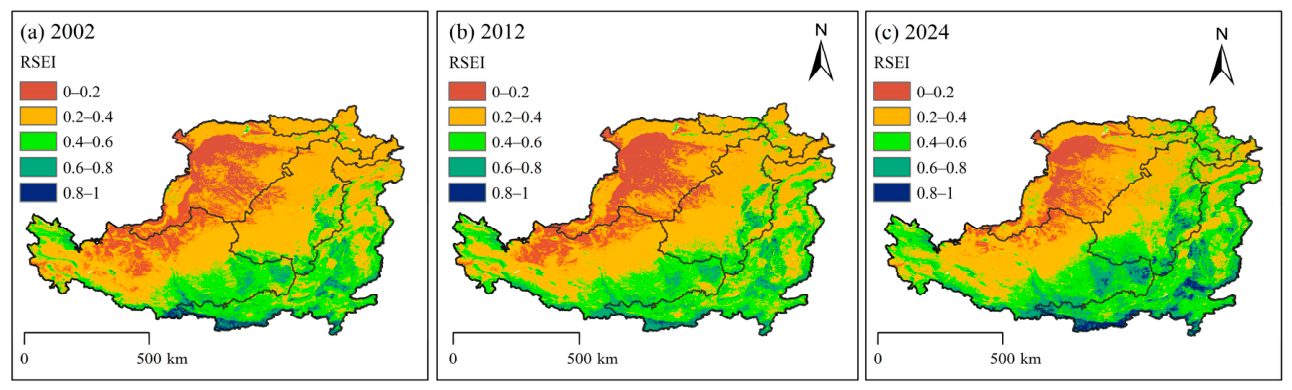
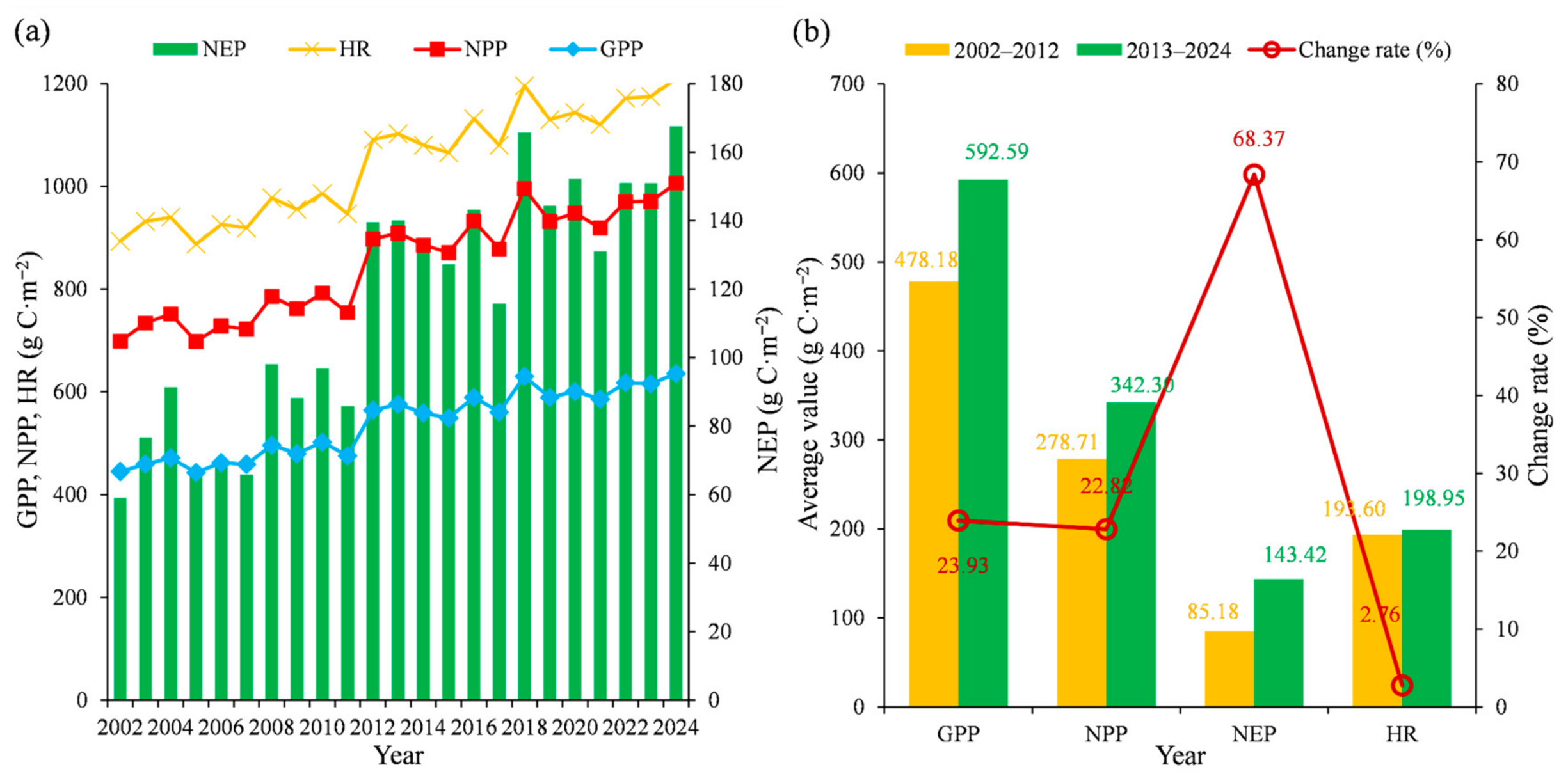
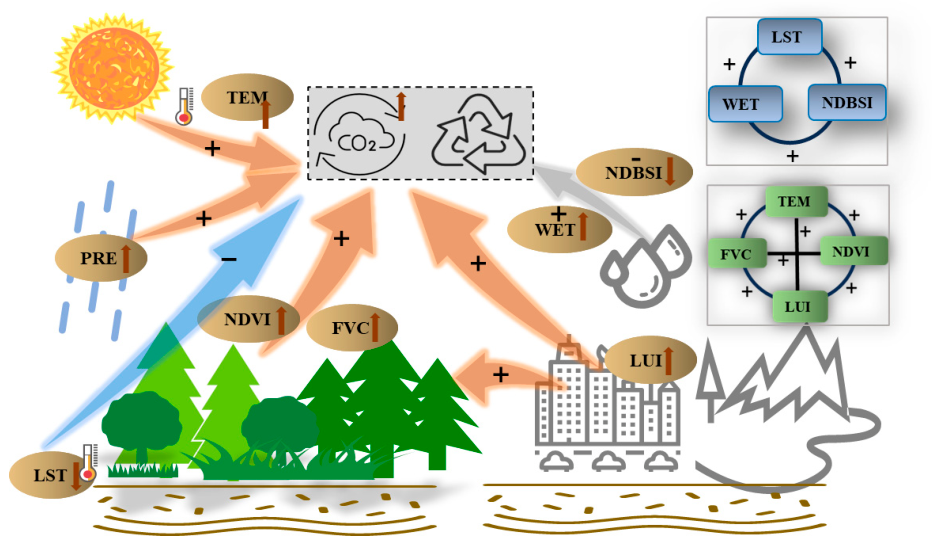
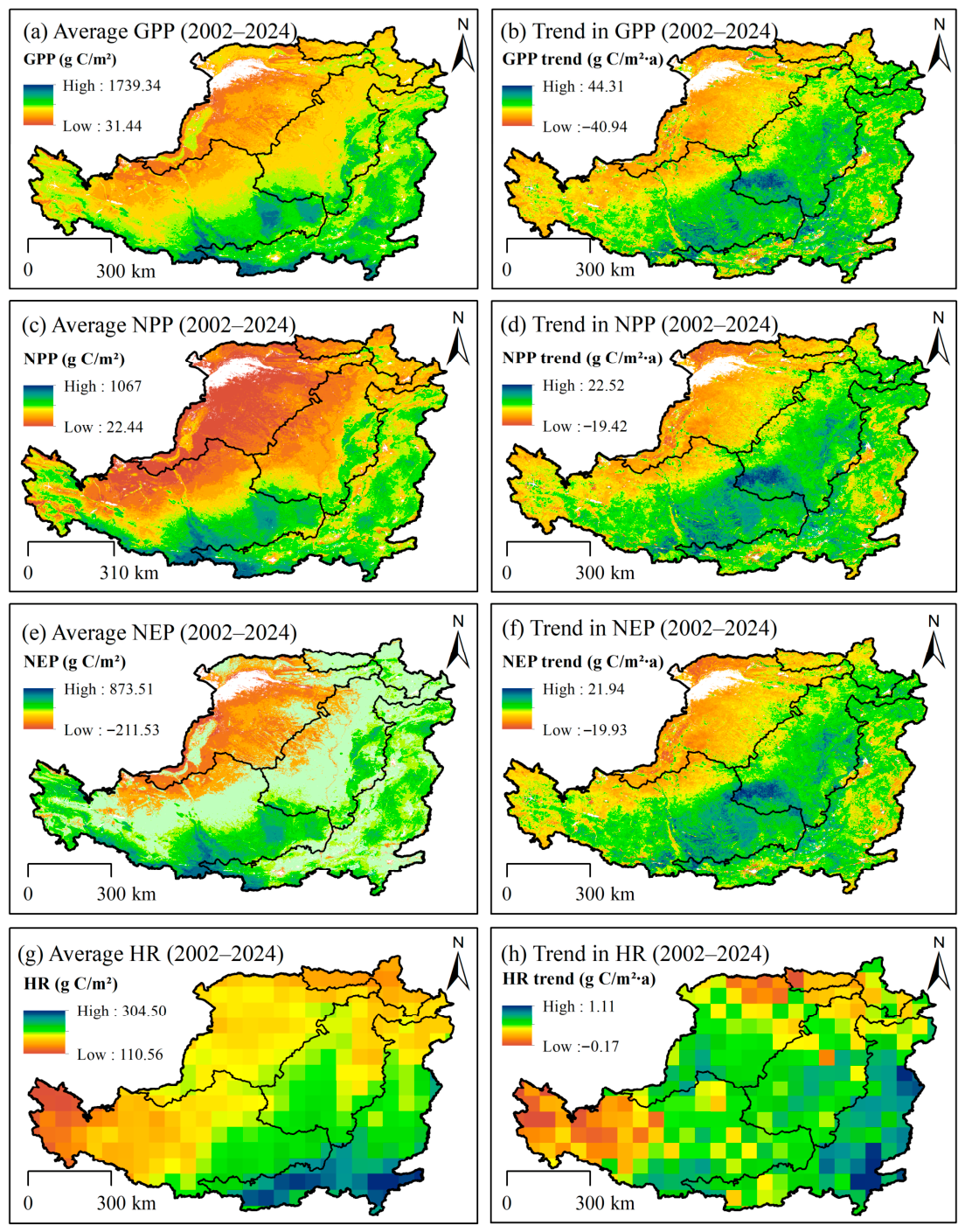
Against the backdrop of global climate change and the “carbon neutrality” target, the ecological quality improvement of the Loess Plateau—a key region for ecological restoration in China—and its impact on vegetation carbon sources hold significant importance for regional carbon balance and ecological security. Based on MODIS and meteorological reanalysis data from 2002 to 2024, this study constructed the Remote Sensing Ecological Index (RSEI). Combined with a carbon source/sink model, it systematically assessed the spatiotemporal coupling evolution characteristics of ecological environment quality and vegetation carbon storage capacity in the Loess Plateau, and explored the synergistic driving mechanisms of major hydrothermal and surface factors. The results indicate the following: (1) From 2002 to 2024, the ecological environment of the Loess Plateau improved significantly, with the RSEI rising from moderate to good. This improvement was accompanied by a marked decrease in surface dryness, an increase in surface wetness, and notable growth in vegetation cover, revealing a positive coupling relationship characterized by “reduced surface dryness—increased surface wetness—enhanced vegetation restoration.” (2) Regional vegetation carbon storage capacity strengthened markedly. Gross Primary Productivity (GPP), Net Primary Productivity (NPP), and Net Ecosystem Productivity (NEP) all showed significant increasing trends, and the proportion of area classified as carbon sink increased substantially. (3) Spatially, carbon sink distribution exhibited a pattern of “higher in the southeast, lower in the northwest.” Sub-regions A and D were identified as core areas with higher ecological quality and carbon sink capacity, whereas sub-regions B and C were more ecologically fragile and served as primary carbon source areas. (4) The implementation of soil and water conservation measures on the Loess Plateau has effectively enhanced regional carbon storage capacity. Vegetation restoration, improved water conditions, and reduced surface dryness have jointly driven the transition of the Loess Plateau ecosystem from a “vulnerable type” to a “recovering type”, while ecological restoration projects have played a certain role in enhancing the carbon sink. This study provides a theoretical basis and scientific–technological support for ecological protection and high-quality development in the Yellow River Basin.
Keywords: carbon sources and sinks; NEP; RSEI; spatiotemporal variation; Loess Plateau carbon sources and sinks; NEP; RSEI; spatiotemporal variation; Loess Plateau