Asymmetric Responses of Spring and Autumn Phenology to Permafrost Degradation in the Source Region of the Yangtze River


Highlights
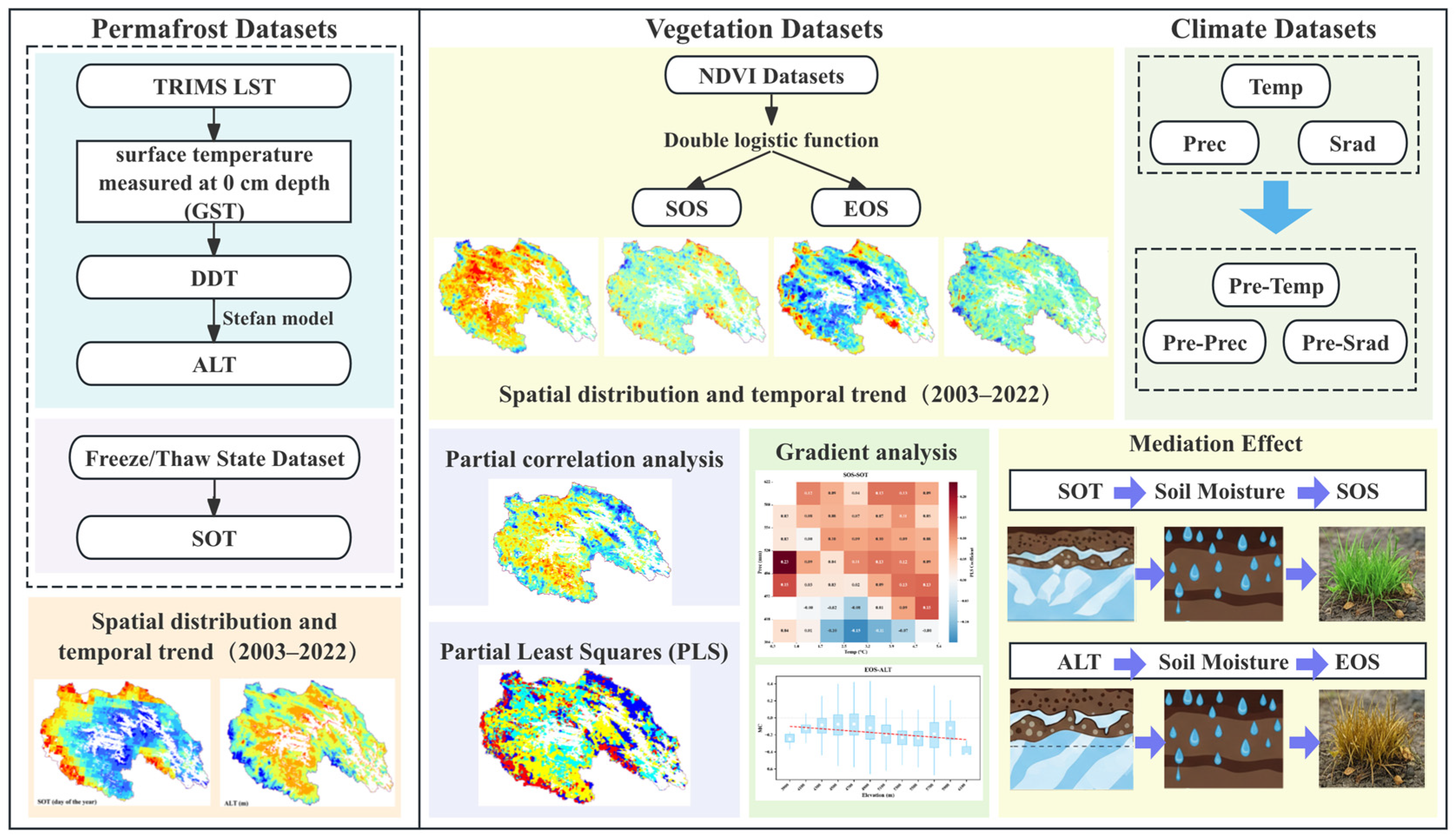
- Earlier soil thawing advances the start of the growing season in wet areas but delays it in dry regions, with alpine meadows showing higher sensitivity than grasslands.
- Active layer thickening advances the end of the growing season by draining water and nutrients away from shallow roots, affecting alpine meadows more significantly than grasslands.
- Downward movement of water and nutrients from shallow soil may offset the potential lengthening of growing seasons under climate warming, because deeper drainage limits resources for shallow-rooted plants.
- Soil moisture is the key factor linking permafrost degradation to vegetation phenology, meaning future models should consider these subsurface processes when predicting ecosystem responses.
Abstract
1. Introduction
2. Materials and Methods
2.1. Study Area
2.2. Data
2.2.1. Vegetation Dataset
2.2.2. Meteorological Dataset
2.2.3. Soil Freeze–Thaw Datasets
2.2.4. Topographic Dataset
2.3. Methods
2.3.1. Estimation of the ALT
- (1)
- ALT Estimation Based on the Stefan Model
- (2)
- Degree–Days of Thaw (DDT) Calculation
2.3.2. Determination of the SOT
2.3.3. Determination of Vegetation Phenology
2.3.4. Analysis of Long-Term Trends
2.3.5. Determination of the Optimal Pre-Season Window for Meteorological Factors
2.3.6. Partial Least Squares Regression
2.3.7. Path Analysis and Contribution Partitioning
3. Results
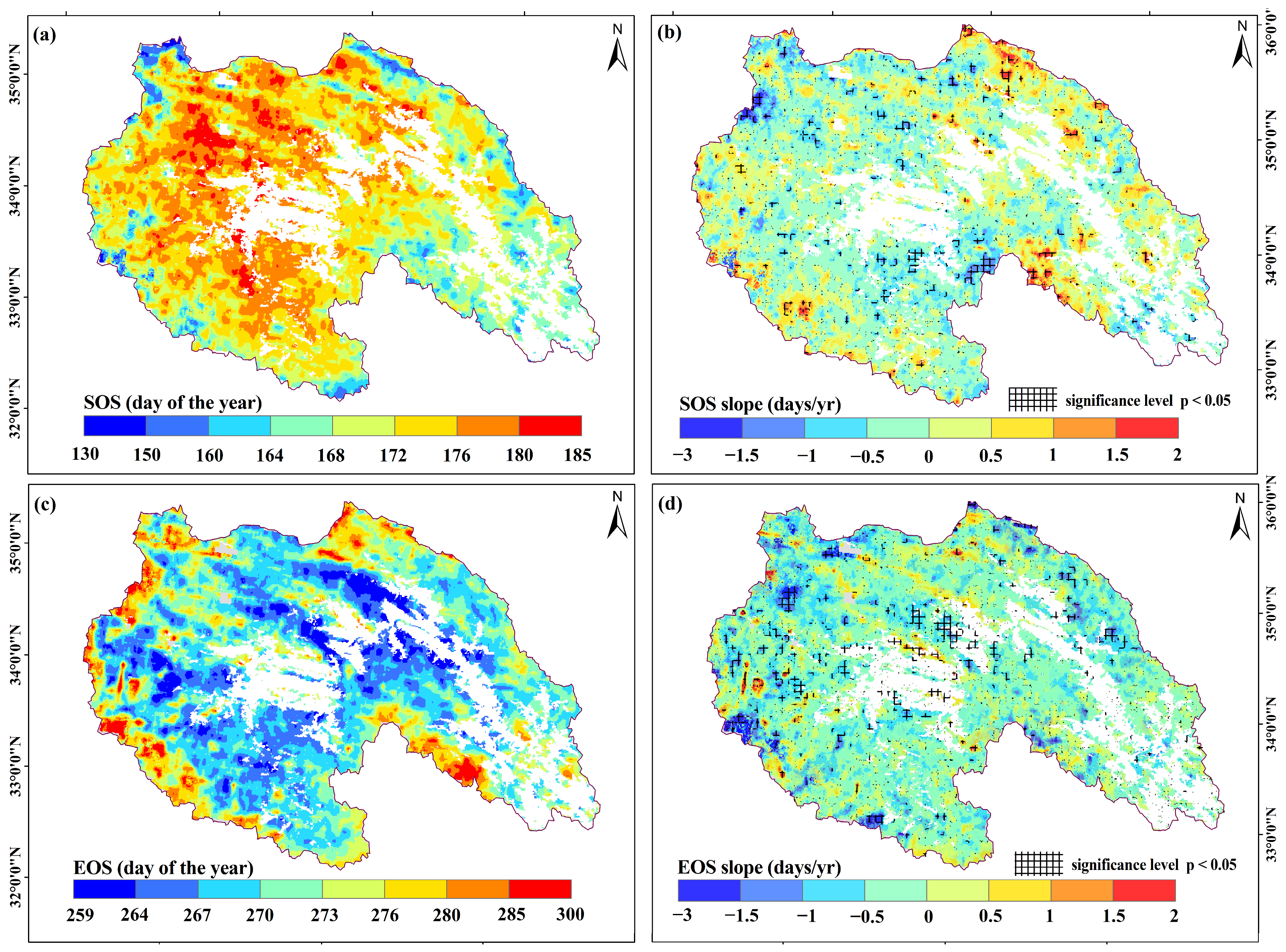
3.1. Spatiotemporal Trends of Vegetation Phenology
3.2. Permafrost Degradation Trends
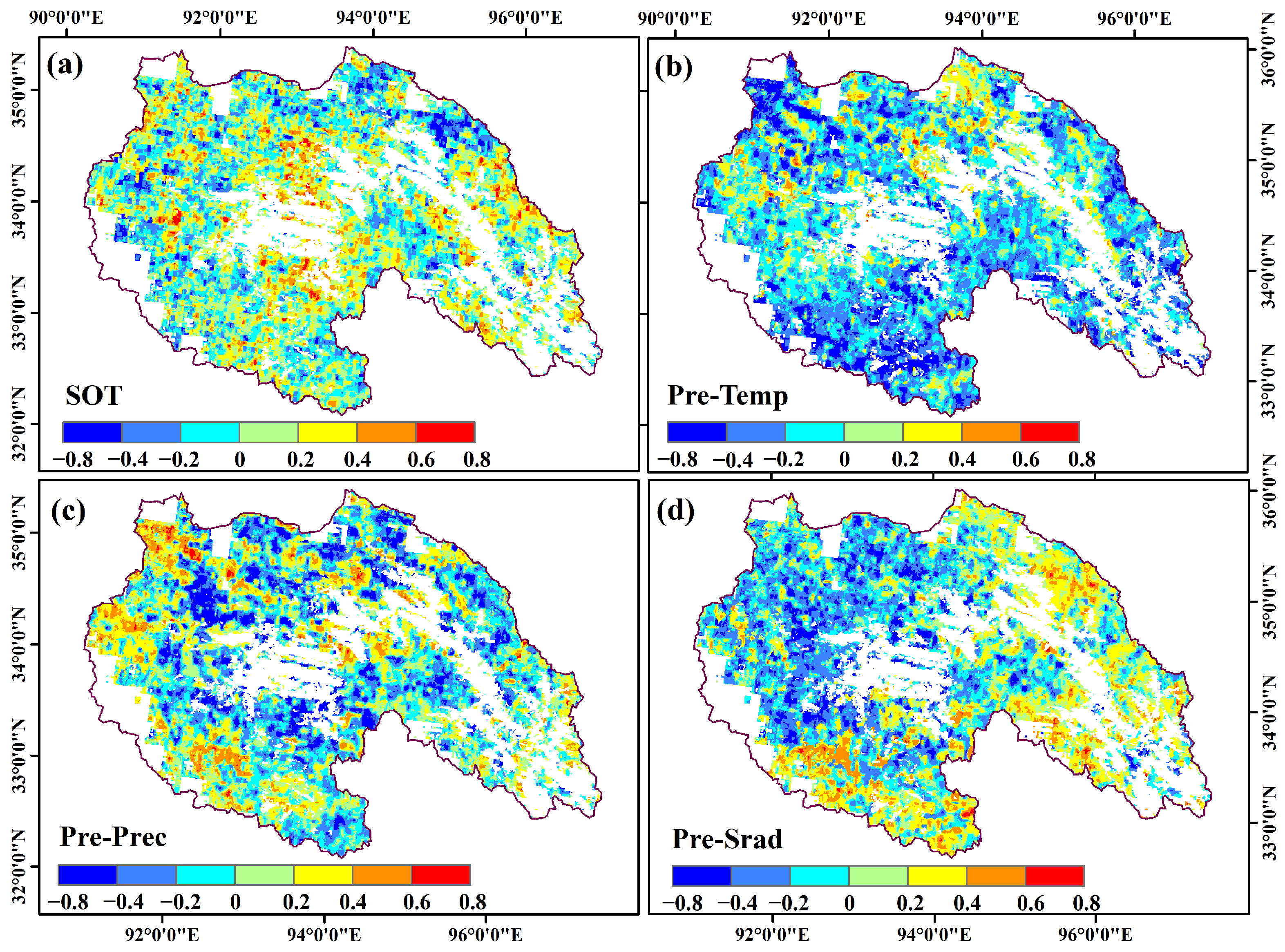
3.3. Correlation Between Grassland Phenology and Permafrost Degradation
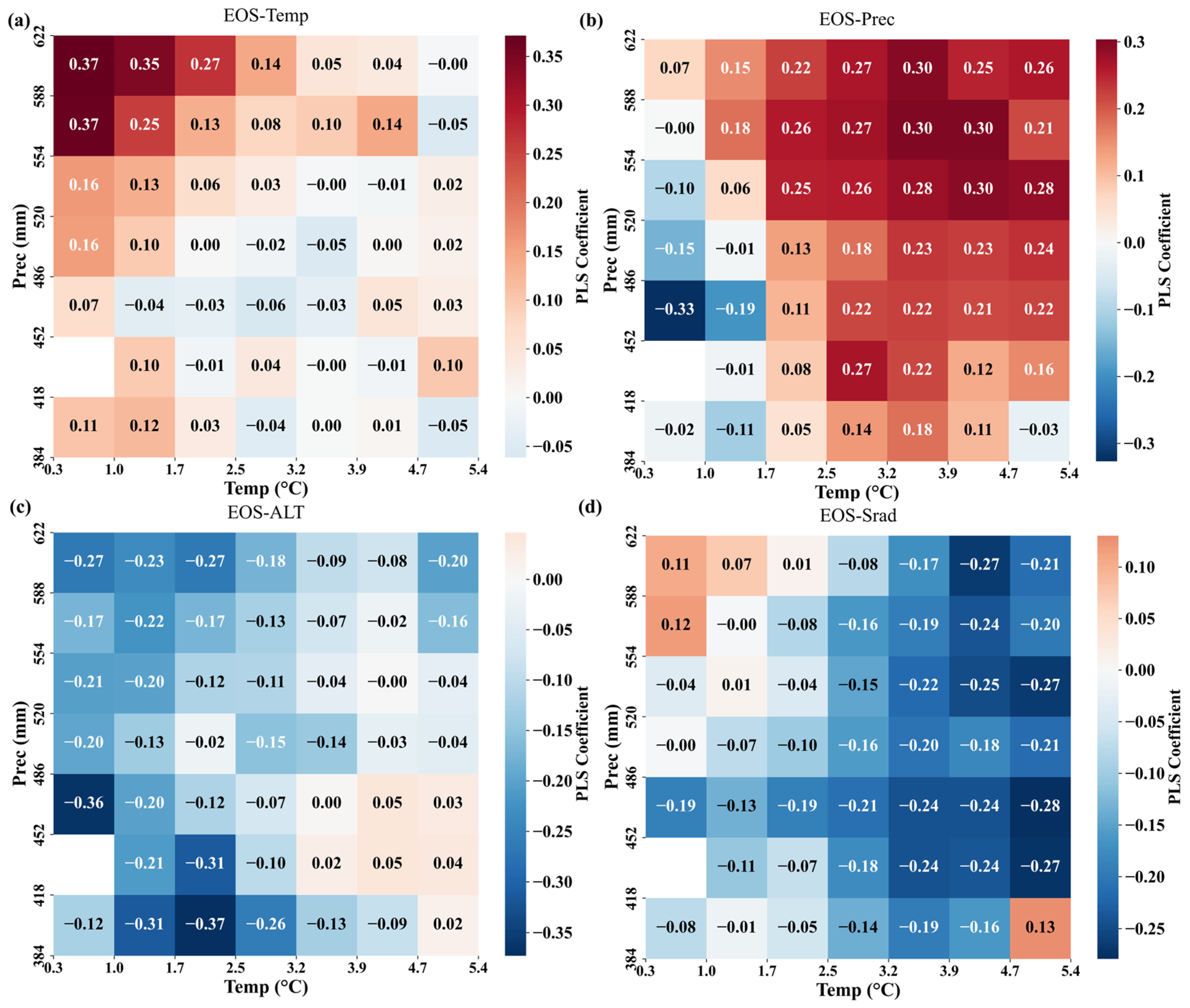
3.4. Interannual Sensitivity of Phenology to Permafrost and Climate Factors
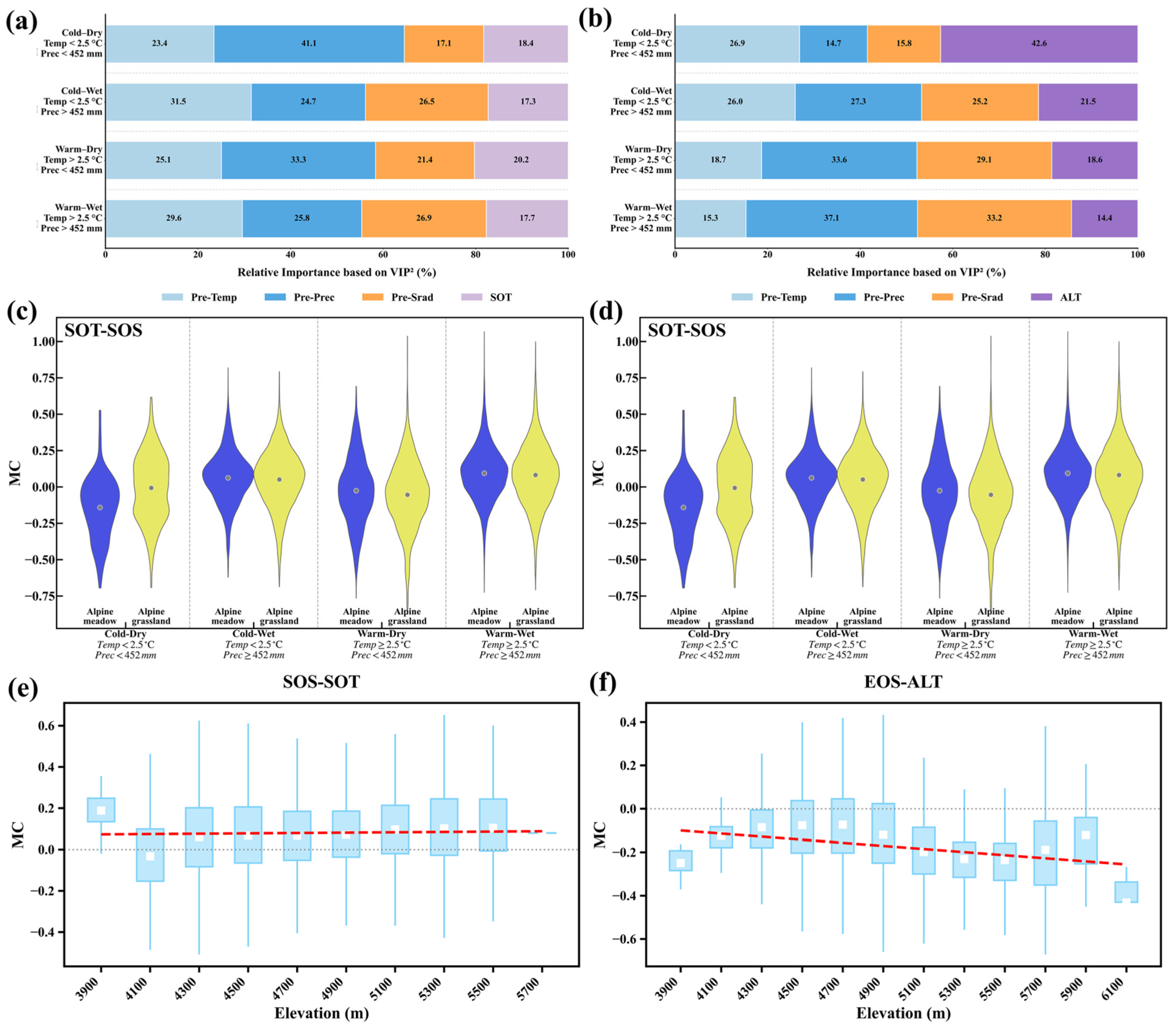
3.5. Phenological Responses Along Environmental Gradients
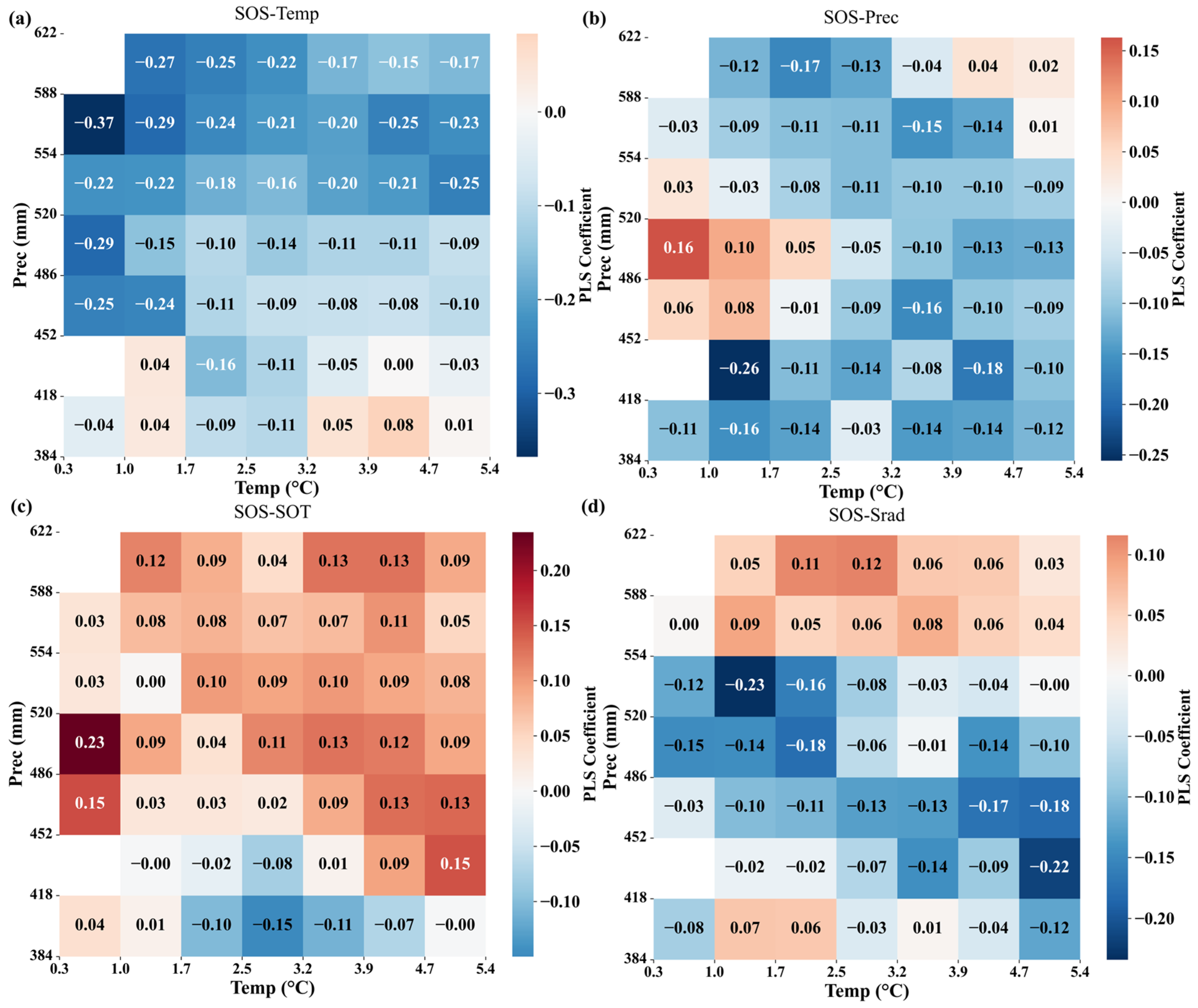
3.5.1. Response of Phenology to Climate and Permafrost Across Hydrothermal Gradients
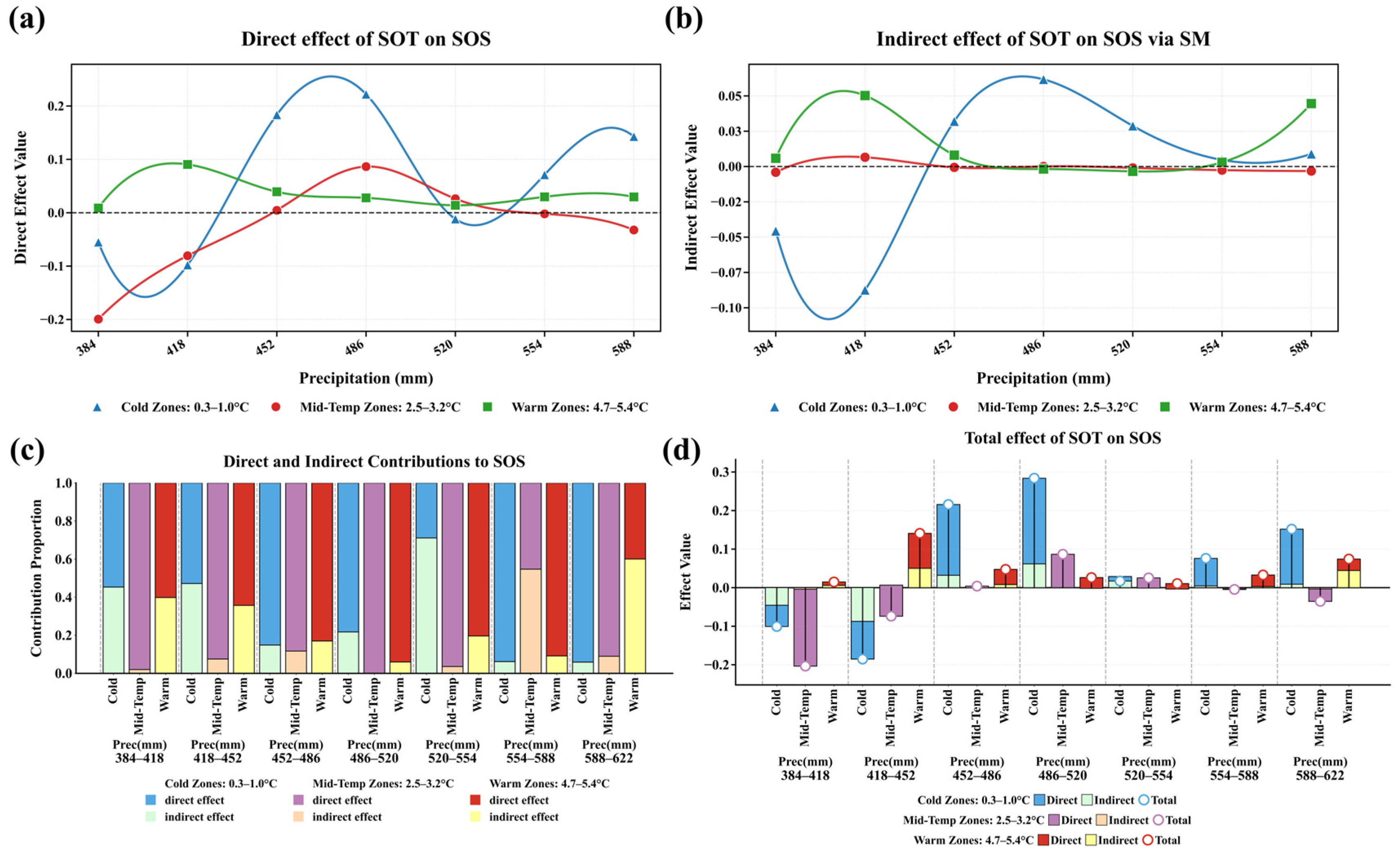
3.5.2. Direct and Indirect Effects of Permafrost Degradation on SOS and EOS
4. Discussion
4.1. Evolutionary Characteristics of Vegetation Phenology in the SRYR
4.2. Response of Grassland Phenology to Permafrost Degradation
4.3. Differential Responses of Vegetation Types to Permafrost Changes
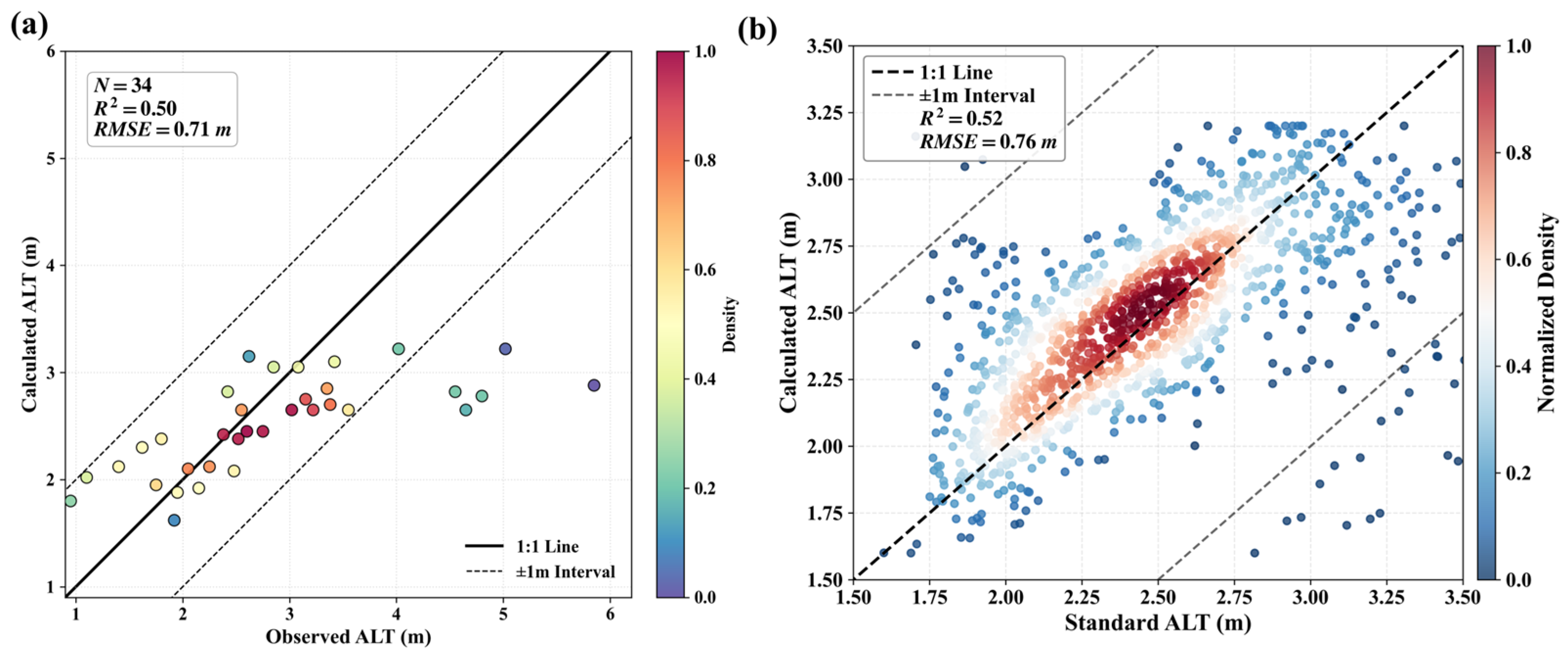
4.4. Reliability and Uncertainty
5. Conclusions
Author Contributions
Funding
Data Availability Statement
Acknowledgments
Conflicts of Interest
References
- Smith, S.L.; O’Neill, H.B.; Isaksen, K.; Noetzli, J.; Romanovsky, V.E. The Changing Thermal State of Permafrost. Nat. Rev. Earth Environ. 2022, 3, 10–23. [Google Scholar] [CrossRef] [Scilit]
- Wang, X.; Ran, Y.; Pang, G.; Chen, D.; Su, B.; Chen, R.; Li, X.; Chen, H.W.; Yang, M.; Gou, X.; et al. Contrasting Characteristics, Changes, and Linkages of Permafrost between the Arctic and the Third Pole. Earth-Sci. Rev. 2022, 230, 104042. [Google Scholar] [CrossRef] [Scilit]
- Hu, G.; Zhao, L.; Zou, D.; Wu, X.; Li, R.; Zhu, X.; Su, Y.; Wu, T.; Wu, Y.; Ni, J. Large Variability in Permafrost Degradation over the Northern Hemisphere. Catena 2024, 246, 108440. [Google Scholar] [CrossRef] [Scilit]
- Wang, G.; Bai, W.; Li, N.; Hu, H. Climate Changes and Its Impact on Tundra Ecosystem in Qinghai-Tibet Plateau, China. Clim. Change 2011, 106, 463–482. [Google Scholar] [CrossRef] [Scilit]
- Yi, S.; Wang, X.; Qin, Y.; Xiang, B.; Ding, Y. Responses of Alpine Grassland on Qinghai–Tibetan Plateau to Climate Warming and Permafrost Degradation: A Modeling Perspective. Environ. Res. Lett. 2014, 9, 074014. [Google Scholar] [CrossRef] [Scilit]
- Jin, X.-Y.; Jin, H.-J.; Iwahana, G.; Marchenko, S.S.; Luo, D.-L.; Li, X.-Y.; Liang, S.-H. Impacts of Climate-Induced Permafrost Degradation on Vegetation: A Review. Adv. Clim. Change Res. 2021, 12, 29–47. [Google Scholar] [CrossRef] [Scilit]
- Chen, S.-Y.; Wei, P.-J.; Wu, T.-H.; Wu, Q.-B.; Luo, F.-D. Effect of Permafrost Degradation on Carbon Sequestration of Alpine Ecosystems. Sci. Total Environ. 2023, 899, 165642. [Google Scholar] [CrossRef] [Scilit]
- Zhao, Y.; Yao, Y.; Jin, H.; Cao, B.; Hu, Y.; Ran, Y.; Zhang, Y. Characterizing the Changes in Permafrost Thickness across Tibetan Plateau. Remote Sens. 2022, 15, 206. [Google Scholar] [CrossRef] [Scilit]
- Shen, T.; Jiang, P.; Ju, Q.; Yu, Z.; Chen, X.; Lin, H.; Zhang, Y. Changes in Permafrost Spatial Distribution and Active Layer Thickness from 1980 to 2020 on the Tibet Plateau. Sci. Total Environ. 2023, 859, 160381. [Google Scholar] [CrossRef] [Scilit] [PubMed]
- Richardson, A.D.; Keenan, T.F.; Migliavacca, M.; Ryu, Y.; Sonnentag, O.; Toomey, M. Climate Change, Phenology, and Phenological Control of Vegetation Feedbacks to the Climate System. Agric. For. Meteorol. 2013, 169, 156–173. [Google Scholar] [CrossRef] [Scilit]
- Buitenwerf, R.; Rose, L.; Higgins, S.I. Three Decades of Multi-Dimensional Change in Global Leaf Phenology. Nat. Clim. Change 2015, 5, 364–368. [Google Scholar] [CrossRef] [Scilit]
- Kuang, X.; Jiao, J.J. Review on Climate Change on the Tibetan Plateau during the Last Half Century. J. Geophys. Res. Atmos. 2016, 121, 3979–4007. [Google Scholar] [CrossRef] [Scilit]
- Yuan, H.; Wang, X.; Wu, C.; Wang, H. Satellite Observed Strong Relationship Between Nighttime Surface Temperature and Leaf Coloring Dates of Terrestrial Ecosystems in East China. IEEE J. Sel. Top. Appl. Earth Obs. Remote Sens. 2020, 13, 717–725. [Google Scholar] [CrossRef] [Scilit]
- Ontel, I.; Avram, S.; Gheorghe, C.A.; Niculae, M.I.; Pascu, I.S.; Rodino, S. Shifting Vegetation Phenology in Protected Areas: A Response to Climate Change. Ecol. Inform. 2025, 85, 102962. [Google Scholar] [CrossRef] [Scilit]
- Shen, M.; Piao, S.; Cong, N.; Zhang, G.; Jassens, I.A. Precipitation Impacts on Vegetation Spring Phenology on the T Ibetan P Lateau. Glob. Change Biol. 2015, 21, 3647–3656. [Google Scholar] [CrossRef] [Scilit]
- Li, P.; Zhu, Q.; Peng, C.; Zhang, J.; Wang, M.; Zhang, J.; Ding, J.; Zhou, X. Change in Autumn Vegetation Phenology and the Climate Controls From 1982 to 2012 on the Qinghai–Tibet Plateau. Front. Plant Sci. 2020, 10, 1677. [Google Scholar] [CrossRef] [Scilit]
- Wang, C.-P.; Huang, M.-T.; Zhai, P.-M. Co-Influence of the Start of Thermal Growing Season and Precipitation on Vegetation Spring Green-up on the Tibetan Plateau. Adv. Clim. Change Res. 2024, 15, 327–337. [Google Scholar] [CrossRef] [Scilit]
- Fu, W.; Zhang, X.; Zhao, J.; Du, S.; Horton, R.; Hou, M. Artificial Warming-Mediated Soil Freezing and Thawing Processes Can Regulate Soybean Production in Northeast China. Agric. For. Meteorol. 2018, 262, 249–257. [Google Scholar] [CrossRef] [Scilit]
- Li, T.; Fu, B.; Lü, Y.; Du, C.; Zhao, Z.; Wang, F.; Gao, G.; Wu, X. Soil Freeze–Thaw Cycles Affect Spring Phenology by Changing Phenological Sensitivity in the Northern Hemisphere. Sci. Total Environ. 2024, 914, 169963. [Google Scholar] [CrossRef] [Scilit]
- Gao, B.; Li, J.; Wang, X. Impact of Frozen Soil Changes on Vegetation Phenology in the Source Region of the Yellow River from 2003 to 2015. Theor. Appl. Climatol. 2020, 141, 1219–1234. [Google Scholar] [CrossRef] [Scilit]
- Van Der Heijden, M.G.A.; Bardgett, R.D.; Van Straalen, N.M. The Unseen Majority: Soil Microbes as Drivers of Plant Diversity and Productivity in Terrestrial Ecosystems. Ecol. Lett. 2008, 11, 296–310. [Google Scholar] [CrossRef] [Scilit]
- Keuper, F.; Van Bodegom, P.M.; Dorrepaal, E.; Weedon, J.T.; Van Hal, J.; Van Logtestijn, R.S.P.; Aerts, R. A Frozen Feast: Thawing Permafrost Increases Plant-available Nitrogen in Subarctic Peatlands. Glob. Change Biol. 2012, 18, 1998–2007. [Google Scholar] [CrossRef] [Scilit]
- Zhang, F.; Li, H.; Wang, W.; Li, Y.; Lin, L.; Guo, X.; Du, Y.; Li, Q.; Yang, Y.; Cao, G.; et al. Net Radiation Rather than Surface Moisture Limits Evapotranspiration over a Humid Alpine Meadow on the Northeastern Qinghai-Tibetan Plateau. Ecohydrology 2018, 11, e1925. [Google Scholar] [CrossRef] [Scilit]
- Zhao, H.; Yi, P.; Pan, X.; Wan, C. The Role of Root Zone Soil Moisture Return on Vegetation Green-up: A Comparison of Two Degrading Permafrost Sites. Sci. Total Environ. 2023, 905, 167049. [Google Scholar] [CrossRef] [Scilit] [PubMed]
- Bense, V.F.; Ferguson, G.; Kooi, H. Evolution of Shallow Groundwater Flow Systems in Areas of Degrading Permafrost. Geophys. Res. Lett. 2009, 36, 2009GL039225. [Google Scholar] [CrossRef] [Scilit]
- Lv, M.; Wang, Y.; Gao, Z. The Change Process of Soil Hydrological Properties in the Permafrost Active Layer of the Qinghai–Tibet Plateau. Catena 2022, 210, 105938. [Google Scholar] [CrossRef] [Scilit]
- Zastruzny, S.F.; Ingeman-Nielsen, T.; Zhang, W.; Elberling, B. Accelerated Permafrost Thaw and Increased Drainage in the Active Layer: Responses from Experimental Surface Alteration. Cold Reg. Sci. Technol. 2023, 212, 103899. [Google Scholar] [CrossRef] [Scilit]
- Liang, S.; Ge, S.; Wan, L.; Zhang, J. Can Climate Change Cause the Yellow River to Dry Up? Water Resour. Res. 2010, 46, 2009WR007971. [Google Scholar] [CrossRef] [Scilit]
- Finger, R.A.; Turetsky, M.R.; Kielland, K.; Ruess, R.W.; Mack, M.C.; Euskirchen, E.S. Effects of Permafrost Thaw on Nitrogen Availability and Plant–Soil Interactions in a Boreal Alaskan Lowland. J. Ecol. 2016, 104, 1542–1554. [Google Scholar] [CrossRef] [Scilit]
- Clayton, L.K.; Schaefer, K.; Battaglia, M.J.; Bourgeau-Chavez, L.; Chen, J.; Chen, R.H.; Chen, A.; Bakian-Dogaheh, K.; Grelik, S.; Jafarov, E.; et al. Active Layer Thickness as a Function of Soil Water Content. Environ. Res. Lett. 2021, 16, 055028. [Google Scholar] [CrossRef] [Scilit]
- Ogden, E.L.; Cumming, S.G.; Smith, S.L.; Turetsky, M.R.; Baltzer, J.L. Permafrost Thaw Induces Short-term Increase in Vegetation Productivity in Northwestern Canada. Glob. Change Biol. 2023, 29, 5352–5366. [Google Scholar] [CrossRef] [Scilit]
- Ding, Y.; Yang, J.; Liu, S.; Chen, R.; Wang, G.; Shen, Y.; Wang, J.; Xie, C.; Zhang, S. Eco-Environment Range in the Source Regions of the Yangtze and Yellow Rivers. J. Geogr. Sci. 2003, 13, 172–180. [Google Scholar] [CrossRef] [Scilit]
- Li, H.; Cao, Y.; Xiao, J.; Yuan, Z.; Hao, Z.; Bai, X.; Wu, Y.; Liu, Y. A Daily Gap-Free Normalized Difference Vegetation Index Dataset from 1981 to 2023 in China. Sci. Data 2024, 11, 527. [Google Scholar] [CrossRef] [Scilit] [PubMed]
- Zhou, G.; Ren, H.; Zhang, L.; Lv, X.; Zhou, M. Annual Vegetation Maps in the Qinghai–Tibet Plateau (QTP) from 2000 to 2022 Based on MODIS Series Satellite Imagery. Earth Syst. Sci. Data 2025, 17, 773–797. [Google Scholar] [CrossRef] [Scilit]
- Hu, Y.; Zhang, L. Added Value of Merging Techniques in Precipitation Estimates Relative to Gauge-Interpolation Algorithms of Varying Complexity. J. Hydrol. 2024, 645, 132214. [Google Scholar] [CrossRef] [Scilit]
- Jiang, Y.; Tang, W.; Yang, K.; He, J.; Shao, C.; Zhou, X.; Lu, H.; Chen, Y.; Li, X.; Shi, J. Development of a High-Resolution near-Surface Meteorological Forcing Dataset for the Third Pole Region. Sci. China Earth Sci. 2025, 68, 1274–1290. [Google Scholar] [CrossRef] [Scilit]
- National Tibet Plateau Data Center. MAO Kebiao Soil Moisture Dataset of the Tibetan Plateau Region, China (2003–2022); National Tibet Plateau Data Center: Beijing, China, 2025. [Google Scholar]
- Tang, W.; Zhou, J.; Ma, J.; Wang, Z.; Ding, L.; Zhang, X.; Zhang, X. TRIMS LST: A Daily 1 Km All-Weather Land Surface Temperature Dataset for China’s Landmass and Surrounding Areas (2000–2022). Earth Syst. Sci. Data 2024, 16, 387–419. [Google Scholar] [CrossRef] [Scilit]
- Ran, Y.; Li, X.; Cheng, G.; Nan, Z.; Che, J.; Sheng, Y.; Wu, Q.; Jin, H.; Luo, D.; Tang, Z.; et al. Mapping the Permafrost Stability on the Tibetan Plateau for 2005–2015. Sci. China Earth Sci. 2021, 64, 62–79. [Google Scholar] [CrossRef] [Scilit]
- Food and Agriculture Organization of the United Nations (FAO). International Institute for Applied Systems Analysis China Soil Map Based Harmonized World Soil Database (HWSD) (v1.1) (2009); Food and Agriculture Organization of the United Nations (FAO): Rome, Italy, 2021. [Google Scholar]
- Zhao, T.; Pei, Y.; Feng, D.; Zhang, Z. Global 0.05° Near-Surface Freeze/Thaw State Dataset V2.0 (2002–2023); National Tibet Plateau Data Center: Beijing, China, 2025. [Google Scholar]
- Nelson, F.E.; Outcalt, S.I. A Computational Method for Prediction and Regionalization of Permafrost. Arct. Alp. Res. 1987, 19, 279–288. [Google Scholar] [CrossRef] [Scilit]
- Zhang, T.; Frauenfeld, O.W.; Serreze, M.C.; Etringer, A.; Oelke, C.; McCreight, J.; Barry, R.G.; Gilichinsky, D.; Yang, D.; Ye, H.; et al. Spatial and Temporal Variability in Active Layer Thickness over the Russian Arctic Drainage Basin. J. Geophys. Res. Atmos. 2005, 110, 2004JD005642. [Google Scholar] [CrossRef] [Scilit]
- Zou, D.; Zhao, L.; Sheng, Y.; Chen, J.; Hu, G.; Wu, T.; Wu, J.; Xie, C.; Wu, X.; Pang, Q.; et al. A New Map of Permafrost Distribution on the Tibetan Plateau. Cryosphere 2017, 11, 2527–2542. [Google Scholar] [CrossRef] [Scilit]
- Zou, D.; Zhao, L.; Wu, T.; Wu, X.; Pang, Q.; Wang, Z. Modeling Ground Surface Temperature by Means of Remote Sensing Data in High-Altitude Areas: Test in the Central Tibetan Plateau with Application of Moderate-Resolution Imaging Spectroradiometer Terra/Aqua Land Surface Temperature and Ground-Based Infrared Radiometer. J. Appl. Remote Sens. 2014, 8, 083516. [Google Scholar] [CrossRef] [Scilit]
- Wang, J.; Liu, D. Vegetation Green-up Date Is More Sensitive to Permafrost Degradation than Climate Change in Spring across the Northern Permafrost Region. Glob. Change Biol. 2022, 28, 1569–1582. [Google Scholar] [CrossRef] [Scilit]
- Beck, P.S.A.; Atzberger, C.; Høgda, K.A.; Johansen, B.; Skidmore, A.K. Improved Monitoring of Vegetation Dynamics at Very High Latitudes: A New Method Using MODIS NDVI. Remote Sens. Environ. 2006, 100, 321–334. [Google Scholar] [CrossRef] [Scilit]
- Elmore, A.J.; Guinn, S.M.; Minsley, B.J.; Richardson, A.D. Landscape Controls on the Timing of Spring, Autumn, and Growing Season Length in Mid—A Tlantic Forests. Glob. Change Biol. 2012, 18, 656–674. [Google Scholar] [CrossRef] [Scilit]
- Gonsamo, A.; Chen, J.M.; D’Odorico, P. Deriving Land Surface Phenology Indicators from CO2 Eddy Covariance Measurements. Ecol. Indic. 2013, 29, 203–207. [Google Scholar] [CrossRef] [Scilit]
- Li, J.; Wu, C.; Wu, M.; Zhang, Y.; Ran, Y. Modeling the Start of Frozen Dates with Leaf Senescence over Tibetan Plateau. Remote Sens. Environ. 2022, 281, 113258. [Google Scholar] [CrossRef] [Scilit]
- Shen, M.; Piao, S.; Dorji, T.; Liu, Q.; Cong, N.; Chen, X.; An, S.; Wang, S.; Wang, T.; Zhang, G. Plant Phenological Responses to Climate Change on the Tibetan Plateau: Research Status and Challenges. Natl. Sci. Rev. 2015, 2, 454–467. [Google Scholar] [CrossRef] [Scilit]
- Li, X.; Yu, K.; Xu, G.; Li, P.; Li, Z.; Jia, L. Spatiotemporal Evolution of Vegetation Phenology and Its Response to Environmental Factors in the Upper and Middle Reaches of the Yellow River Basin. J. Environ. Manag. 2025, 380, 124970. [Google Scholar] [CrossRef] [Scilit]
- Liu, Q.; Fu, Y.H.; Zhu, Z.; Liu, Y.; Liu, Z.; Huang, M.; Janssens, I.A.; Piao, S. Delayed Autumn Phenology in the Northern Hemisphere Is Related to Change in Both Climate and Spring Phenology. Glob. Change Biol. 2016, 22, 3702–3711. [Google Scholar] [CrossRef] [Scilit]
- Huang, Y.; Jiang, N.; Shen, M.; Guo, L. Effect of Preseason Diurnal Temperature Range on the Start of Vegetation Growing Season in the Northern Hemisphere. Ecol. Indic. 2020, 112, 106161. [Google Scholar] [CrossRef] [Scilit]
- Yin, P.; Li, X.; Pellikka, P. Asymmetrical Impact of Daytime and Nighttime Warming on the Interannual Variation of Urban Spring Vegetation Phenology. Earths Future 2024, 12, e2023EF004127. [Google Scholar] [CrossRef] [Scilit]
- Zhang, Q.; Kong, D.; Shi, P.; Singh, V.P.; Sun, P. Vegetation Phenology on the Qinghai-Tibetan Plateau and Its Response to Climate Change (1982–2013). Agric. For. Meteorol. 2018, 248, 408–417. [Google Scholar] [CrossRef] [Scilit]
- Pan, Y.; Liu, L. Impact of Permafrost Degradation on Alpine Grasslands in the Three-Rivers Headwater Region. Catena 2026, 262, 109631. [Google Scholar] [CrossRef] [Scilit]
- Luo, W.; Yang, J.; Wang, Y.; Cui, X.; Zhang, L.; Zhao, T.; Xue, K.; Du, J.; Song, X.; Hao, Y. Causal Analysis Reveals That Ecosystem Structure and Function Are Temperature-Dominated but Relatively Independent. Ecol. Indic. 2024, 165, 112188. [Google Scholar] [CrossRef] [Scilit]
- Liu, H.; Tian, F.; Hu, H.C.; Hu, H.P.; Sivapalan, M. Soil Moisture Controls on Patterns of Grass Green-up in Inner Mongolia: An Index Based Approach. Hydrol. Earth Syst. Sci. 2013, 17, 805–815. [Google Scholar] [CrossRef] [Scilit]
- Cui, X.; Xu, G.; He, X.; Luo, D. Influences of Seasonal Soil Moisture and Temperature on Vegetation Phenology in the Qilian Mountains. Remote Sens. 2022, 14, 3645. [Google Scholar] [CrossRef] [Scilit]
- Yang, B.; He, M.; Shishov, V.; Tychkov, I.; Vaganov, E.; Rossi, S.; Ljungqvist, F.C.; Bräuning, A.; Grießinger, J. New Perspective on Spring Vegetation Phenology and Global Climate Change Based on Tibetan Plateau Tree-Ring Data. Proc. Natl. Acad. Sci. USA 2017, 114, 6966–6971. [Google Scholar] [CrossRef] [Scilit]
- Wang, T.; Yang, D.; Zheng, G.; Shi, R. Possible Negative Effects of Earlier Thaw Onset and Longer Thaw Duration on Vegetation Greenness over the Tibetan Plateau. Agric. For. Meteorol. 2022, 326, 109192. [Google Scholar] [CrossRef] [Scilit]
- Fan, T.; Zhong, X.; Wang, C.; Zhou, L.; Zhou, Z. Phenological Shifts of Vegetation in Seasonally Frozen Ground and Permafrost Zones of the Qinghai–Tibet Plateau. Remote Sens. 2025, 17, 3391. [Google Scholar] [CrossRef] [Scilit]
- Wang, Y.; Zhu, Z.; Ma, Y.; Yuan, L. Carbon and Water Fluxes in an Alpine Steppe Ecosystem in the Nam Co Area of the Tibetan Plateau during Two Years with Contrasting Amounts of Precipitation. Int. J. Biometeorol. 2020, 64, 1183–1196. [Google Scholar] [CrossRef] [Scilit]
- Lian, X.; Piao, S.; Li, L.Z.X.; Li, Y.; Huntingford, C.; Ciais, P.; Cescatti, A.; Janssens, I.A.; Peñuelas, J.; Buermann, W.; et al. Summer Soil Drying Exacerbated by Earlier Spring Greening of Northern Vegetation. Sci. Adv. 2020, 6, eaax0255. [Google Scholar] [CrossRef] [Scilit]
- Guo, D.; Yang, M.; Wang, H. Sensible and Latent Heat Flux Response to Diurnal Variation in Soil Surface Temperature and Moisture under Different Freeze/Thaw Soil Conditions in the Seasonal Frozen Soil Region of the Central Tibetan Plateau. Environ. Earth Sci. 2011, 63, 97–107. [Google Scholar] [CrossRef] [Scilit]
- Piao, S.; Tan, J.; Chen, A.; Fu, Y.H.; Ciais, P.; Liu, Q.; Janssens, I.A.; Vicca, S.; Zeng, Z.; Jeong, S.-J.; et al. Leaf Onset in the Northern Hemisphere Triggered by Daytime Temperature. Nat. Commun. 2015, 6, 6911. [Google Scholar] [CrossRef] [Scilit]
- Ma, Q.; Liu, J.; Li, X.; Li, Y.; Zeng, F.; Guo, X.; Keyimu, M. Snow Depth and Spring Temperature Dominate the Spring Phenological Shifts and Control Growing Season Dynamics on the Tibetan Plateau. Agric. For. Meteorol. 2025, 363, 110435. [Google Scholar] [CrossRef] [Scilit]
- Jiang, H.; Zhang, W.; Yi, Y.; Yang, K.; Li, G.; Wang, G. The Impacts of Soil Freeze/Thaw Dynamics on Soil Water Transfer and Spring Phenology in the Tibetan Plateau. Arct. Antarct. Alp. Res. 2018, 50, e1439155. [Google Scholar] [CrossRef] [Scilit]
- Lipson, D.A.; Raab, T.K.; Parker, M.; Kelley, S.T.; Brislawn, C.J.; Jansson, J. Changes in Microbial Communities along Redox Gradients in Polygonized A Rctic Wet Tundra Soils. Environ. Microbiol. Rep. 2015, 7, 649–657. [Google Scholar] [CrossRef] [Scilit]
- Feng, J.; Wang, C.; Lei, J.; Yang, Y.; Yan, Q.; Zhou, X.; Tao, X.; Ning, D.; Yuan, M.M.; Qin, Y.; et al. Warming-Induced Permafrost Thaw Exacerbates Tundra Soil Carbon Decomposition Mediated by Microbial Community. Microbiome 2020, 8, 3. [Google Scholar] [CrossRef] [Scilit] [PubMed]
- Chen, S.; Gu, Y.; Liu, E.; Wu, M.; Cheng, X.; Yang, P.; Bahadur, A.; Bai, R.; Chen, J.; Zhang, M.; et al. Freeze-Thaw Strength Increases Microbial Stability to Enhance Diversity-Soil Multifunctionality Relationship. Commun. Earth Environ. 2024, 5, 578. [Google Scholar] [CrossRef] [Scilit]
- Natali, S.M.; Schuur, E.A.G.; Rubin, R.L. Increased Plant Productivity in Alaskan Tundra as a Result of Experimental Warming of Soil and Permafrost. J. Ecol. 2012, 100, 488–498. [Google Scholar] [CrossRef] [Scilit]
- Descals, A.; Verger, A.; Yin, G.; Filella, I.; Fu, Y.H.; Piao, S.; Janssens, I.A.; Peñuelas, J. Radiation-constrained Boundaries Cause Nonuniform Responses of the Carbon Uptake Phenology to Climatic Warming in the Northern Hemisphere. Glob. Change Biol. 2023, 29, 719–730. [Google Scholar] [CrossRef] [Scilit] [PubMed]
- Yang, H.; Xing, Y.; Chang, X.; Wang, J.; Li, Y.; Tang, J.; Wang, D. Internal Response of Vegetation Growth to Degrees of Permafrost Degradation in Northeast China from 2001 to 2020. Geo-Spat. Inf. Sci. 2025, 28, 265–283. [Google Scholar] [CrossRef] [Scilit]
- Park, H.; Kim, Y.; Kimball, J.S. Widespread Permafrost Vulnerability and Soil Active Layer Increases over the High Northern Latitudes Inferred from Satellite Remote Sensing and Process Model Assessments. Remote Sens. Environ. 2016, 175, 349–358. [Google Scholar] [CrossRef] [Scilit]
- Wrona, F.J.; Johansson, M.; Culp, J.M.; Jenkins, A.; Mård, J.; Myers-Smith, I.H.; Prowse, T.D.; Vincent, W.F.; Wookey, P.A. Transitions in Arctic Ecosystems: Ecological Implications of a Changing Hydrological Regime. J. Geophys. Res. Biogeosciences 2016, 121, 650–674. [Google Scholar] [CrossRef] [Scilit]
- Chang, J.; Ye, R.; Wang, G. Review: Progress in Permafrost Hydrogeology in China. Hydrogeol. J. 2018, 26, 1387–1399. [Google Scholar] [CrossRef] [Scilit]
- Jorgenson, M.T.; Racine, C.H.; Walters, J.C.; Osterkamp, T.E. Permafrost Degradation and Ecological Changes Associated with a Warming Climate in Central Alaska. Clim. Change 2001, 48, 551–579. [Google Scholar] [CrossRef] [Scilit]
- Keuper, F.; Dorrepaal, E.; Van Bodegom, P.M.; Van Logtestijn, R.; Venhuizen, G.; Van Hal, J.; Aerts, R. Experimentally Increased Nutrient Availability at the Permafrost Thaw Front Selectively Enhances Biomass Production of Deep-rooting Subarctic Peatland Species. Glob. Change Biol. 2017, 23, 4257–4266. [Google Scholar] [CrossRef] [Scilit]
- Wang, R.; Dong, Z.; Zhou, Z. Effect of Decreasing Soil Frozen Depth on Vegetation Growth in the Source Region of the Yellow River for 1982–2015. Theor. Appl. Climatol. 2020, 140, 1185–1197. [Google Scholar] [CrossRef] [Scilit]
- Lin, S.; Wang, G.; Hu, Z.; Sun, X.; Song, C.; Huang, K.; Sun, J.; Yang, Y. Contrasting Response of Growing Season Water Use Efficiency to Precipitation Changes between Alpine Meadows and Alpine Steppes over the Tibetan Plateau. Agric. Water Manag. 2023, 289, 108571. [Google Scholar] [CrossRef] [Scilit]
- Wang, T.; Yang, D.; Yang, Y.; Zheng, G.; Jin, H.; Li, X.; Yao, T.; Cheng, G. Unsustainable Water Supply from Thawing Permafrost on the Tibetan Plateau in a Changing Climate. Sci. Bull. 2023, 68, 1105–1108. [Google Scholar] [CrossRef] [Scilit]
- Wu, X.; Zhao, L.; Hu, G.; Liu, G.; Li, W.; Ding, Y. Permafrost and Land Cover as Controlling Factors for Light Fraction Organic Matter on the Southern Qinghai-Tibetan Plateau. Sci. Total Environ. 2018, 613–614, 1165–1174. [Google Scholar] [CrossRef] [Scilit]
- Yang, Z.; Gao, J.; Zhao, L.; Xu, X.; Ouyang, H. Linking Thaw Depth with Soil Moisture and Plant Community Composition: Effects of Permafrost Degradation on Alpine Ecosystems on the Qinghai-Tibet Plateau. Plant Soil 2013, 367, 687–700. [Google Scholar] [CrossRef] [Scilit]
- Li, T.; Fu, B.; Lü, Y.; Ran, Y.; Du, C.; Zhao, Z.; Sun, C.; Wang, H.; Huang, B.; Wu, X. The Thickening of the Active Layer Will Negate the Promoting Effect on Vegetation Productivity in Permafrost Regions. Environ. Res. Lett. 2025, 20, 054042. [Google Scholar] [CrossRef] [Scilit]
- Piao, S.; Liu, Q.; Chen, A.; Janssens, I.A.; Fu, Y.; Dai, J.; Liu, L.; Lian, X.; Shen, M.; Zhu, X. Plant Phenology and Global Climate Change: Current Progresses and Challenges. Glob. Change Biol. 2019, 25, 1922–1940. [Google Scholar] [CrossRef] [Scilit] [PubMed]
- Ma, N.; Zhang, Y. Contrasting Trends in Water Use Efficiency of the Alpine Grassland in Tibetan Plateau. J. Geophys. Res. Atmos. 2022, 127, e2022JD036919. [Google Scholar] [CrossRef] [Scilit]
- Liu, W.; Mo, X.; Liu, S.; Lin, Z.; Lv, C. Attributing the Changes of Grass Growth, Water Consumed and Water Use Efficiency over the Tibetan Plateau. J. Hydrol. 2021, 598, 126464. [Google Scholar] [CrossRef] [Scilit]
- Ran, Y.; Li, X.; Che, T.; Wang, B.; Cheng, G. Current State and Past Changes in Frozen Ground at the Third Pole; National Tibet Plateau Data Center: Beijing, China, 2022. [Google Scholar]
- Ni, J.; Wu, T.; Zhu, X.; Hu, G.; Zou, D.; Wu, X.; Li, R.; Xie, C.; Qiao, Y.; Pang, Q.; et al. Simulation of the Present and Future Projection of Permafrost on the Qinghai-Tibet Plateau with Statistical and Machine Learning Models. J. Geophys. Res. Atmos. 2021, 126, e2020JD033402. [Google Scholar] [CrossRef] [Scilit]
- Yan, D.; Zheng, X.; Feng, M.; Liang, S.; Hu, Z.; Kuang, X.; Feng, Y. Frozen Ground Change Data Set in the Tibetan Plateau (1961–2020); National Tibet Plateau Data Center: Beijing, China, 2024. [Google Scholar]
- Xu, X.; Wu, Q. Active Layer Thickness Variation on the Qinghai-Tibetan Plateau: Historical and Projected Trends. J. Geophys. Res. Atmos. 2021, 126, e2021JD034841. [Google Scholar] [CrossRef] [Scilit]
- Huang, J.; Li, C.; Jia, B.; Gao, C.; Li, R. Variation in the Permafrost Active Layer over the Tibetan Plateau during 1980–2020. Atmos. Ocean. Sci. Lett. 2024, 17, 100536. [Google Scholar] [CrossRef] [Scilit]
- Chen, F.; Luo, D.; Dai, L.; Gao, Y.; Lei, W.; Huang, Y. Spatial and Temporal Characteristics of the Site-Specific N-Factor over the Qinghai-Tibet Plateau. Cold Reg. Sci. Technol. 2023, 205, 103684. [Google Scholar] [CrossRef] [Scilit]
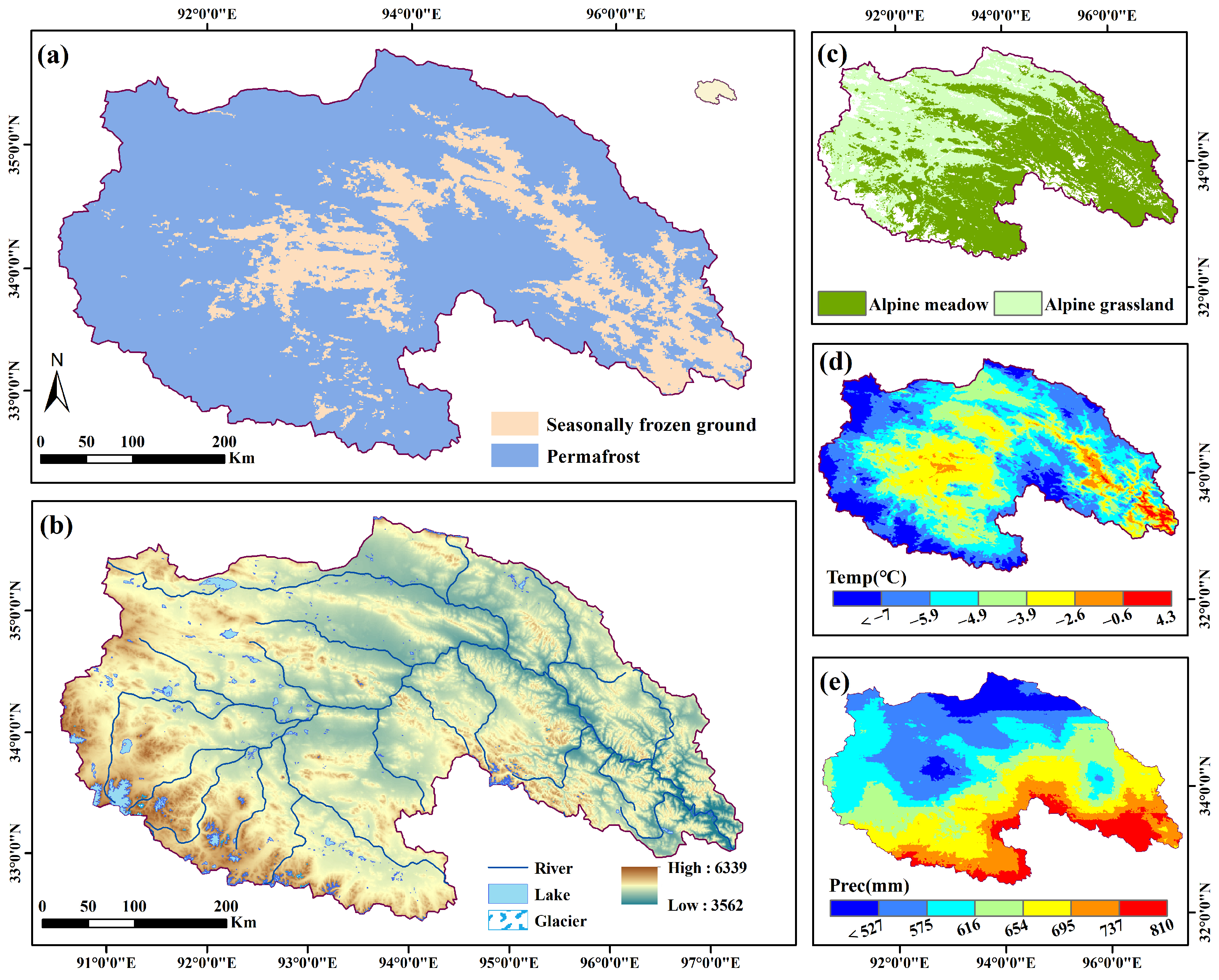


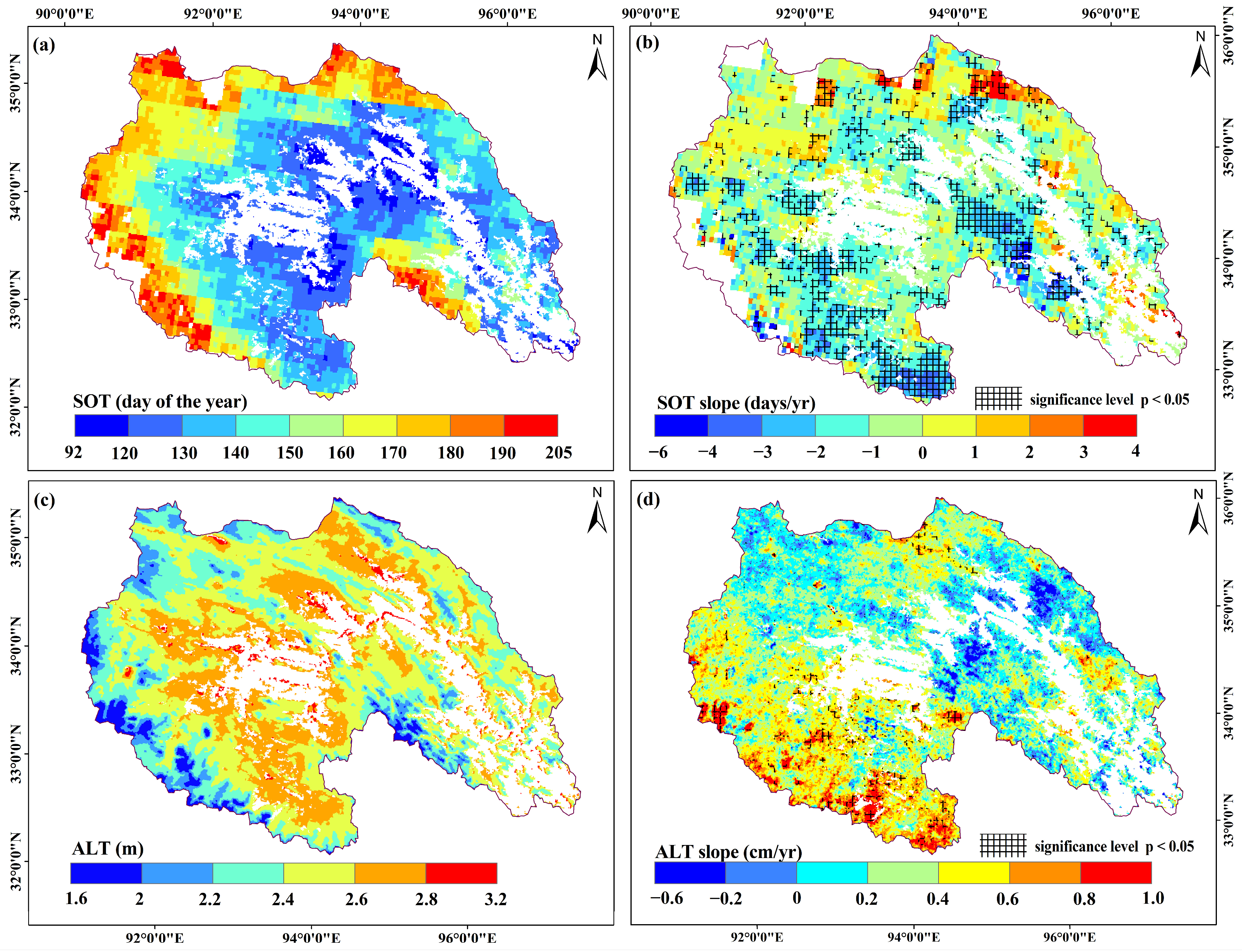

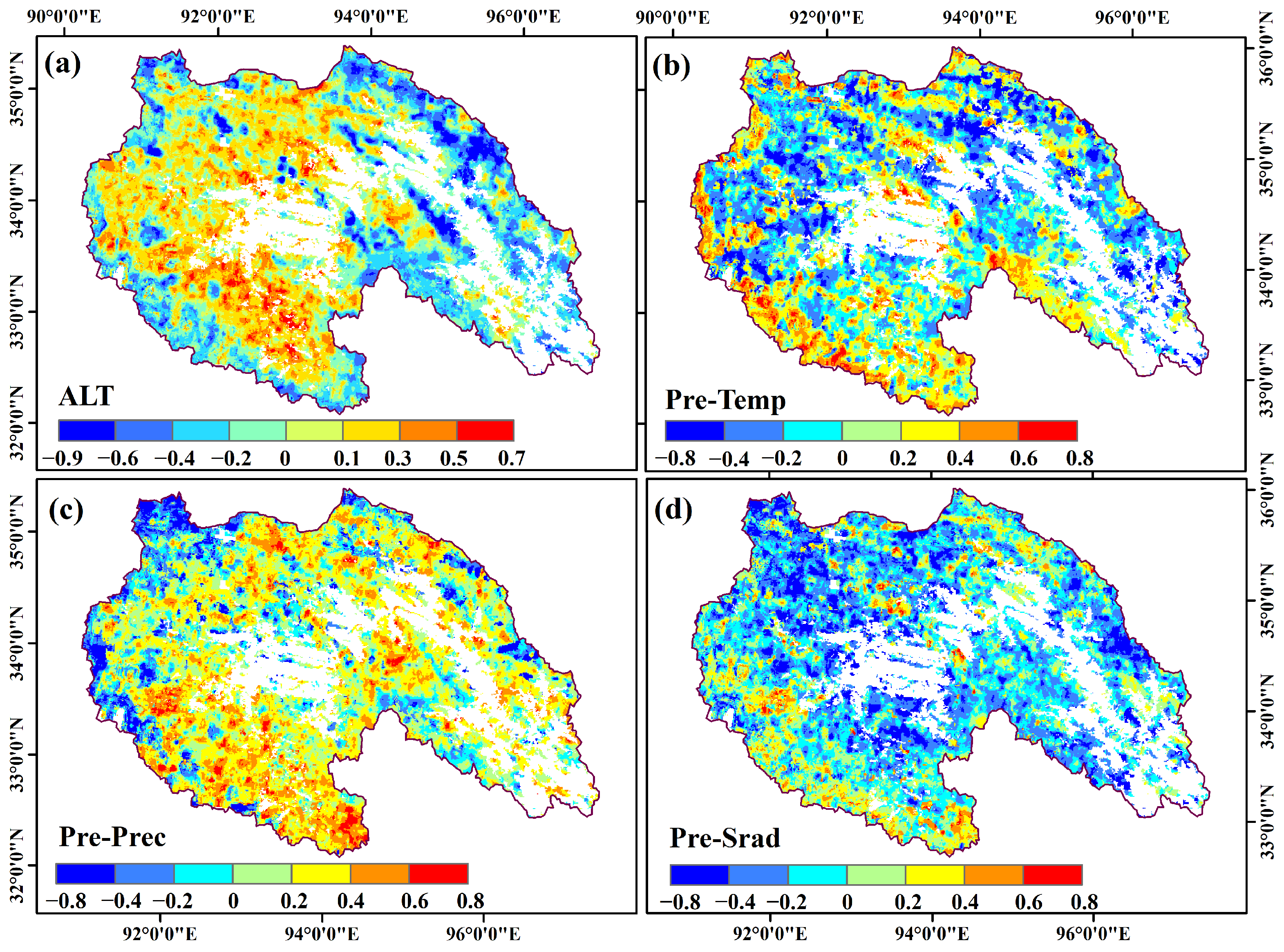
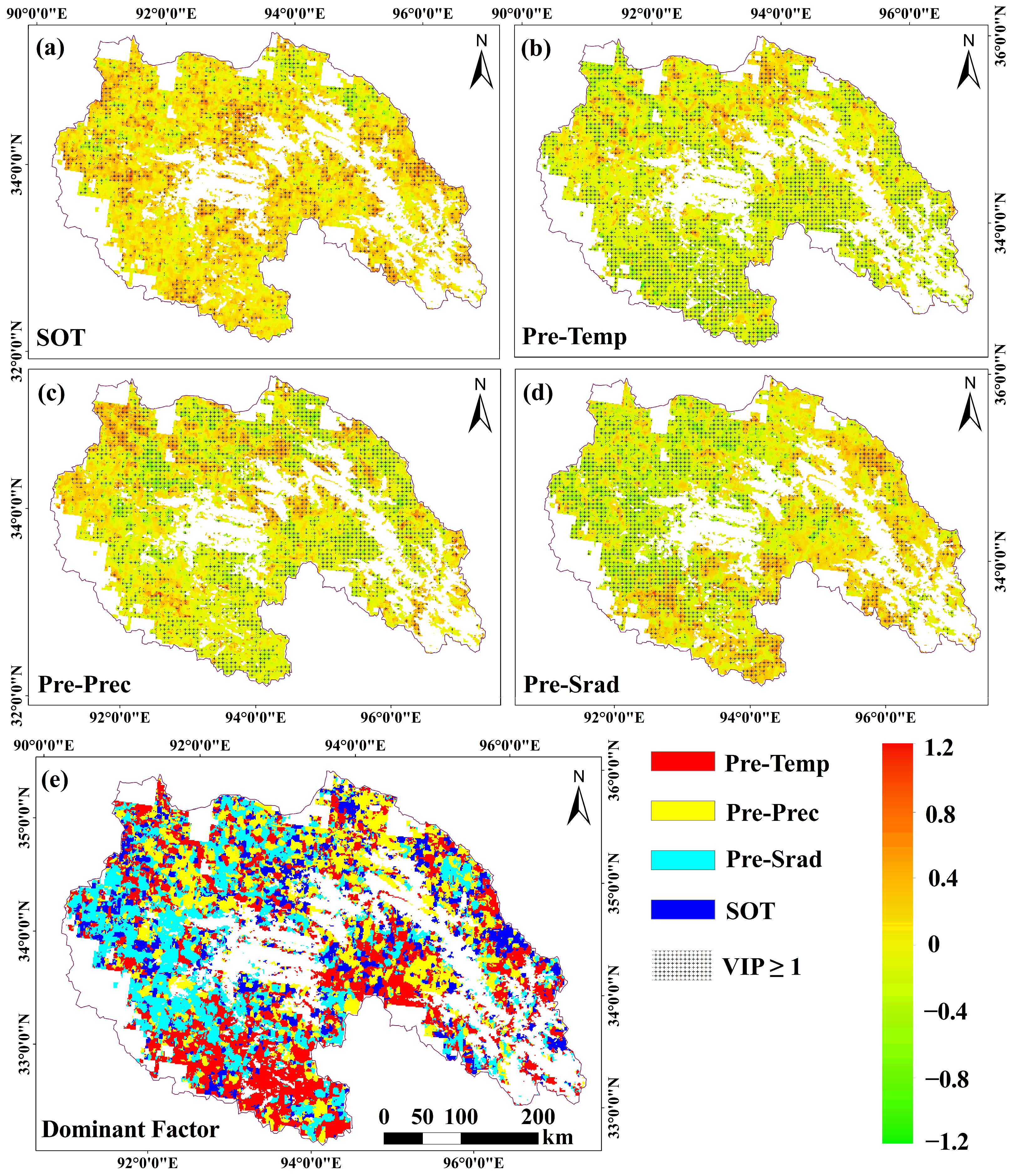




| Variable | Spatial Resolution | Data Source | |
|---|---|---|---|
| Vegetation | NDVI | 0.05° | https://doi.org/10.1038/s41597-024-03364-3 |
| Vegetation type | 500 m | https://doi.org/10.5194/essd-17-773-2025 | |
| Soil freeze–thaw | Permafrost Distribution map | 1 km | https://doi.org/10.1007/s11430-020-9685-3 |
| Land surface temperature (LST) | 1 km | https://cstr.cn/18406.11.Meteoro.tpdc.270953 | |
| Soil type | 1 km | National Tibetan Plateau/Third Pole Environment Data Center (http://data.tpdc.ac.cn) | |
| Soil thawing date (SOT) | 0.05° | https://doi.org/10.11888/Cryos.tpdc.301551 | |
| Meteorological | Near-surface air temperature | 0.01° | https://cstr.cn/CSTR:11738.11.NCDC.NIEER.DB6722.2025 |
| Daily precipitation | 0.01° | ||
| Surface net solar radiation | 1/30° | https://cstr.cn/18406.11.Atmos.tpdc.300398 (http://data.tpdc.ac.cn). | |
| Soil moisture | 1 km | https://cstr.cn/18406.11.Terre.tpdc.301721 | |
| Topographic | Elevation (DEM) | 30 m | https://earthdata.nasa.gov/ |
| Variable | Meaning | Variable | Value |
|---|---|---|---|
| ALTi | Active layer thickness in the i-th year | m | Number |
| DDTi | Degree–days of thaw in the i-th year | °C | |
| λ | Thawed soil thermal conductivity | W/mk−1 | See Table 3 |
| ut | Ratio of degree–day sums of the ground surface to air temperatures when both are above 0 °C | 1 | |
| 1 | Time conversion factor | s/d | 8.64 × 10⁴ |
| L | Latent heat of ice melting | J/Kg | 3.34 × 10⁵ |
| ρ | Bulk density | Kg/m3 | See Table 3 |
| w | Moisture content | % | See Table 3 |
| wu | Unfrozen water content in frozen soil | % | 5 |
| Soil Order | Bulk Density (kg/m3) | Moisture Content (%) | Thawed Soil Thermal Conductivity (W/mk−1) |
|---|---|---|---|
| Aridisols | 1601.9 | 7.76 | 1.47 |
| Entisols | 1447.7 | 8.79 | 1.23 |
| Gelisols | 1277.6 | 22.24 | 1.2 |
| Inceptisol | 1313.4 | 16.22 | 1.18 |
| Mollisols | 1186.9 | 20 | 1.05 |
| Driving Factors | Significantly Correlated Area (%) | Significantly Positive (%) | Significantly Negative (%) | |
|---|---|---|---|---|
| SOS | SOT | 10.03 | 7.07 | 2.96 |
| Pre-Temp | 12.73 | 1.63 | 11.1 | |
| Pre-Prec | 11.83 | 5.52 | 6.31 | |
| Pre-Srad | 15.67 | 5.99 | 9.68 | |
| EOS | ALT | 17.16 | 3.87 | 13.29 |
| Pre-Temp | 17.82 | 9.71 | 8.1 | |
| Pre-Prec | 14.94 | 3.59 | 11.35 | |
| Pre-Srad | 20.22 | 15.12 | 5.1 |
| Pre-Temp | SOT | Pre-Prec | Pre-Srad | |
|---|---|---|---|---|
| Regression coefficient (R) | −0.15 | 0.07 | −0.08 | −0.05 |
| Significant area (VIP ≥ 1, %) | 54.14% | 27.66 | 47.33 | 44.64 |
| Significantly positive (R > 0, VIP ≥ 1, %) | 6.31% | 20.95 | 12.42 | 14.56 |
| Significantly negative (R < 0, VIP ≥ 1, %) | 47.83% | 6.7 | 34.91 | 30.08 |
| Pre-Temp | ALT | Pre-Prec | Pre-Srad | |
|---|---|---|---|---|
| Regression coefficient (R) | 0.04 | −0.10 | 0.19 | −0.16 |
| Significant area (VIP ≥ 1, %) | 28.9 | 28.42 | 67.19 | 59.76 |
| Significantly positive (R > 0, VIP ≥ 1, %) | 20.32 | 1.11 | 62.05 | 6.15 |
| Significantly negative (R < 0, VIP ≥ 1, %) | 8.58 | 27.32 | 5.14 | 53.61 |
Disclaimer/Publisher’s Note: The statements, opinions and data contained in all publications are solely those of the individual author(s) and contributor(s) and not of MDPI and/or the editor(s). MDPI and/or the editor(s) disclaim responsibility for any injury to people or property resulting from any ideas, methods, instructions or products referred to in the content. |
© 2026 by the authors. Licensee MDPI, Basel, Switzerland. This article is an open access article distributed under the terms and conditions of the Creative Commons Attribution (CC BY) license.
Share and Cite
Xu, M.; Tian, S.; Li, Q.; Li, T.; Zhao, X.; Fan, R. Asymmetric Responses of Spring and Autumn Phenology to Permafrost Degradation in the Source Region of the Yangtze River. Remote Sens. 2026, 18, 1375. https://doi.org/10.3390/rs18091375
Xu M, Tian S, Li Q, Li T, Zhao X, Fan R. Asymmetric Responses of Spring and Autumn Phenology to Permafrost Degradation in the Source Region of the Yangtze River. Remote Sensing. 2026; 18(9):1375. https://doi.org/10.3390/rs18091375
Chicago/Turabian StyleXu, Minghan, Shufang Tian, Qian Li, Tianqi Li, Xiaoqing Zhao, and Ruiyao Fan. 2026. "Asymmetric Responses of Spring and Autumn Phenology to Permafrost Degradation in the Source Region of the Yangtze River" Remote Sensing 18, no. 9: 1375. https://doi.org/10.3390/rs18091375
APA StyleXu, M., Tian, S., Li, Q., Li, T., Zhao, X., & Fan, R. (2026). Asymmetric Responses of Spring and Autumn Phenology to Permafrost Degradation in the Source Region of the Yangtze River. Remote Sensing, 18(9), 1375. https://doi.org/10.3390/rs18091375