The Role of Solar-Induced Chlorophyll Fluorescence (SIF) in the Mechanistic Simulation of Eco-Hydrological Processes
 ,
,  ,
,  ,
,  and
and 
Highlights
- Meteorology-driven and remote sensing-driven mechanistic models show markedly different performance in simulating GPP and LE.
- Incorporating SIF substantially improves mechanistic model accuracy by reducing bias associated with uncertainties in parameters and forcing data.
- SIF provides critical physiological constraints for mechanistic eco-hydrological modeling, supporting more accurate assessment and management of terrestrial carbon-water processes.
- Quantifying the contributions of key drivers (e.g., SIF) enhances the interpretability of mechanistic eco-hydrological models and facilitates understanding of model mechanisms, supporting improved model development and application.
Abstract
1. Introduction
2. Materials and Methods
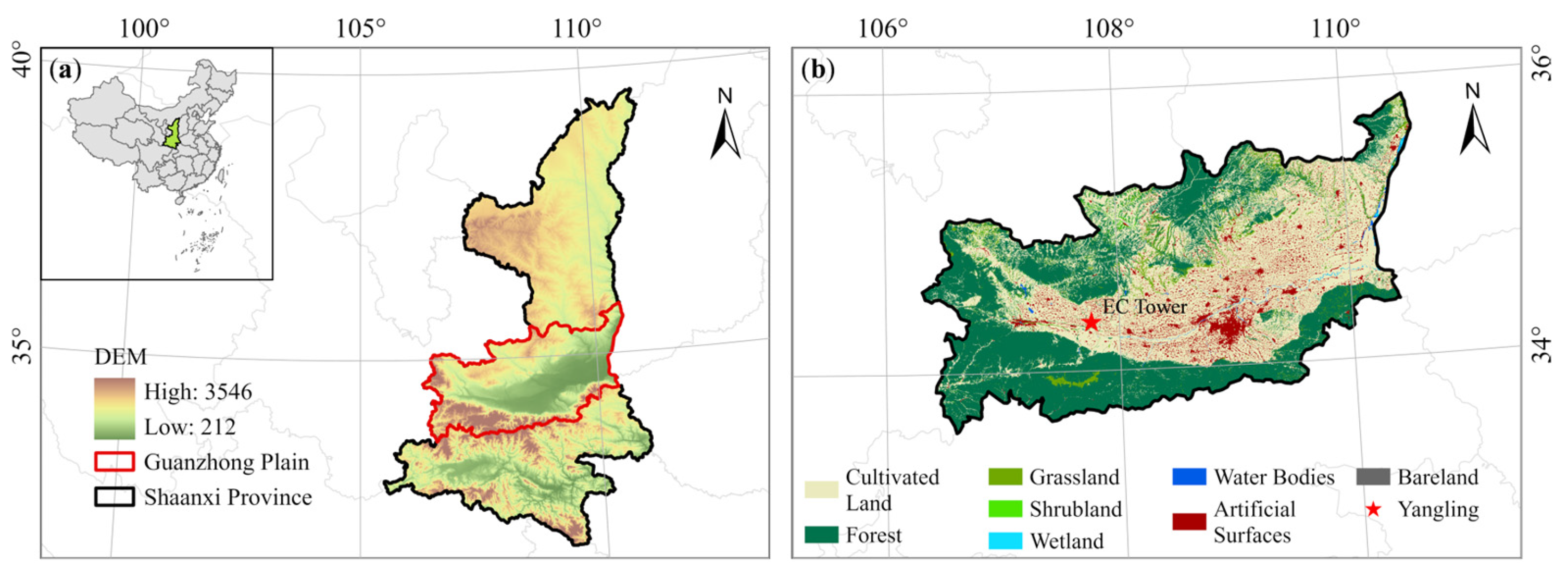
2.1. Site Description
2.2. In-Situ Data Collection and Processing
2.3. STEMMUS-SCOPE Model
2.4. STEMMUS-MLR Model
2.5. Random Forest Model and SHAP Method
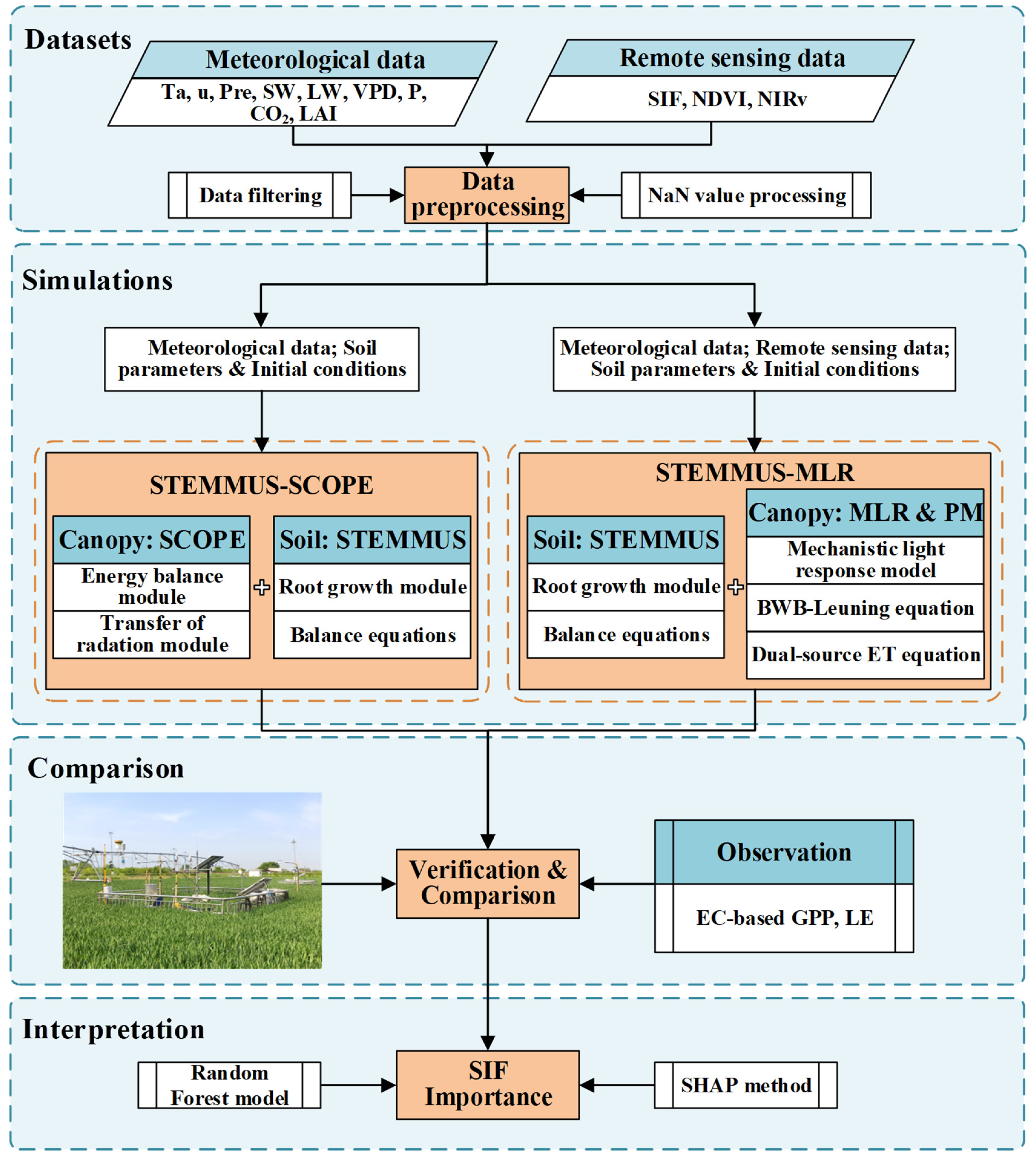
2.6. Experiment Design
2.7. Statistical Analysis Methods
3. Results
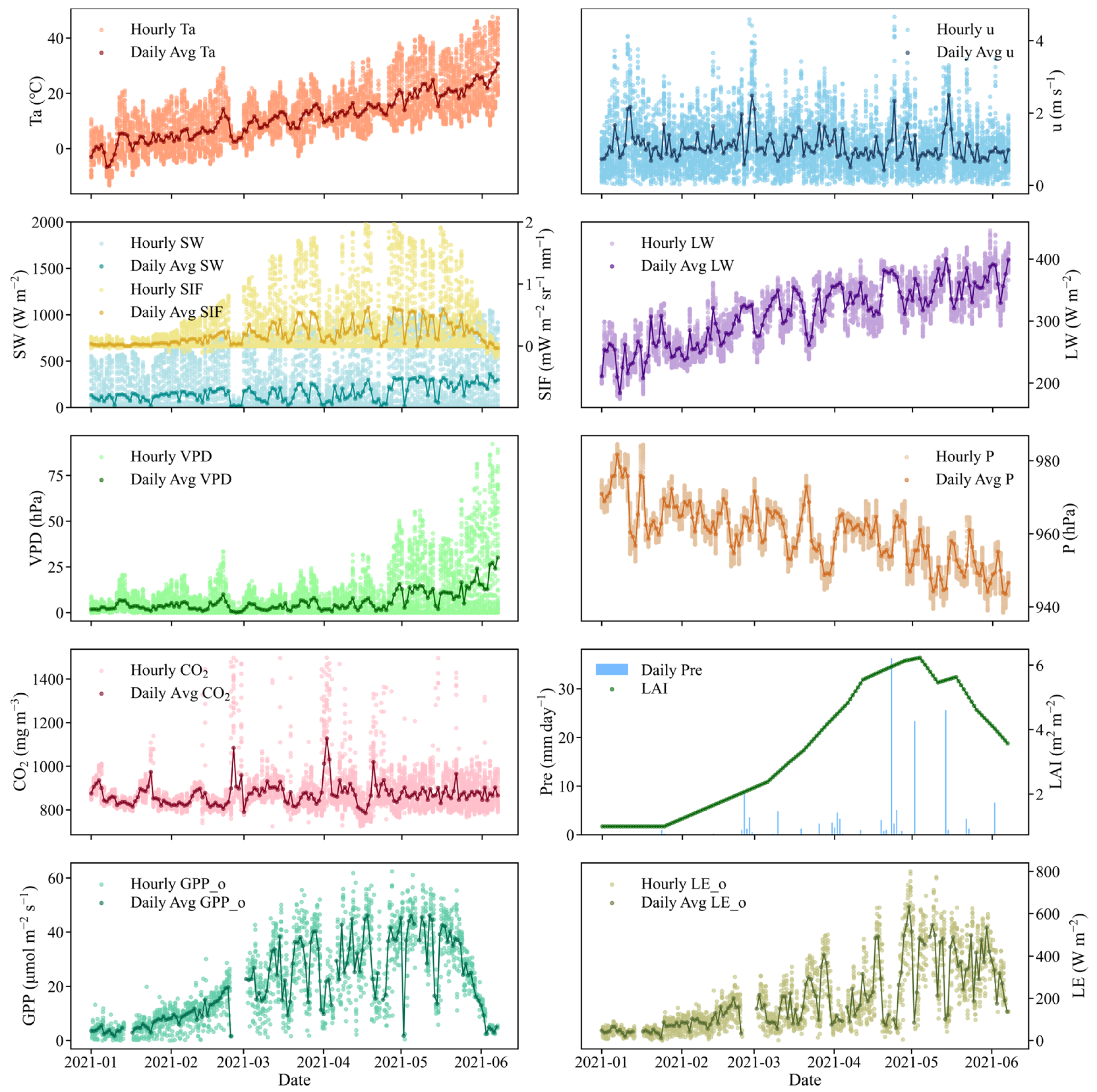
3.1. In-Situ Meteorology, Fluxes, and SIF Observations
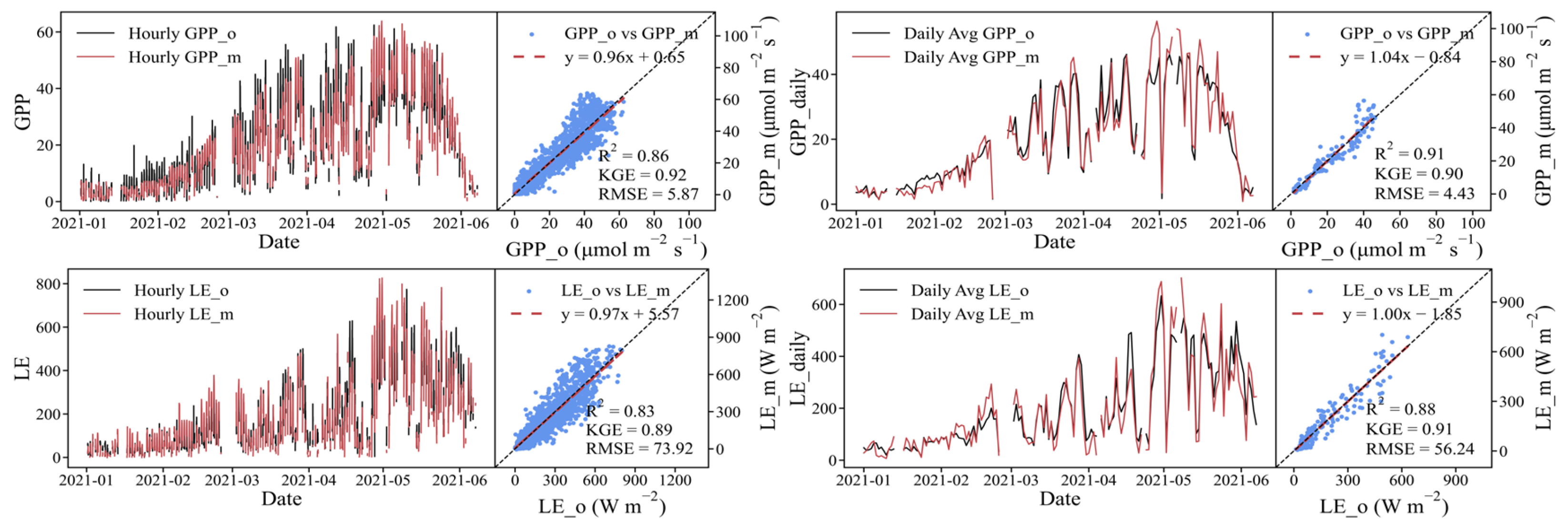
3.2. STEMMUS-SCOPE and STEMMUS-MLR Model Simulations
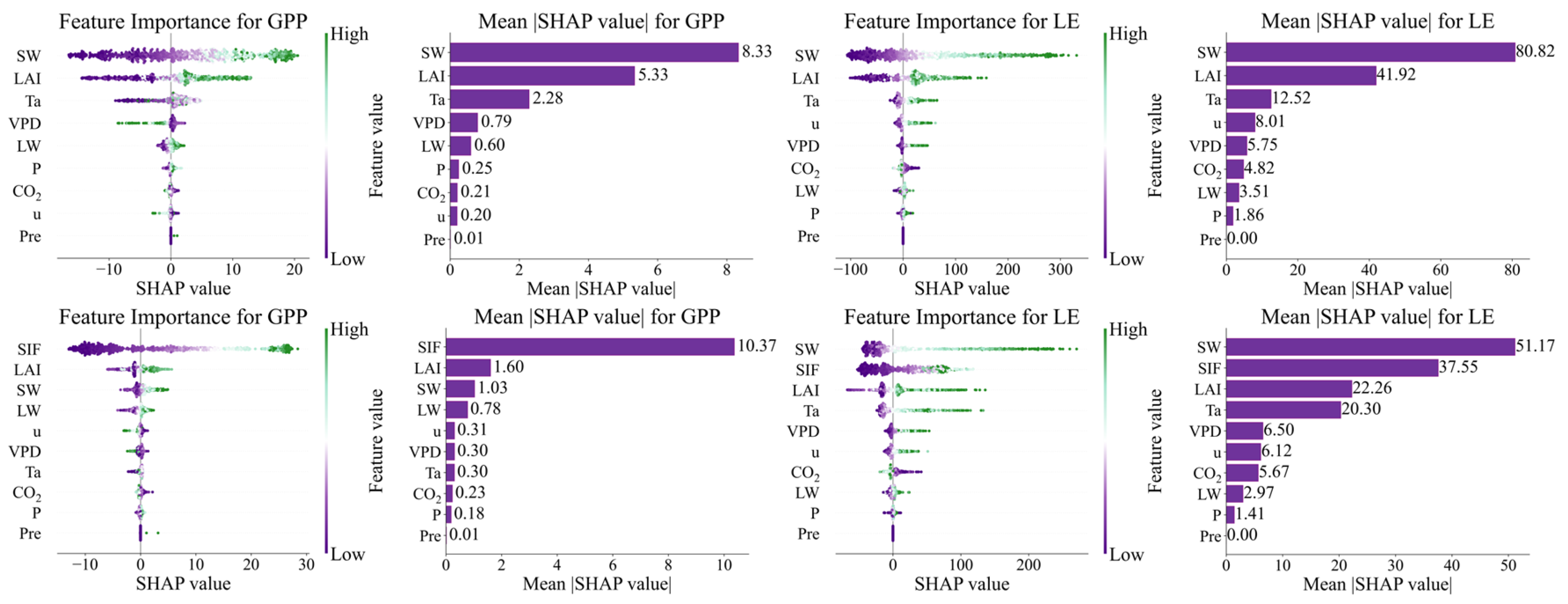
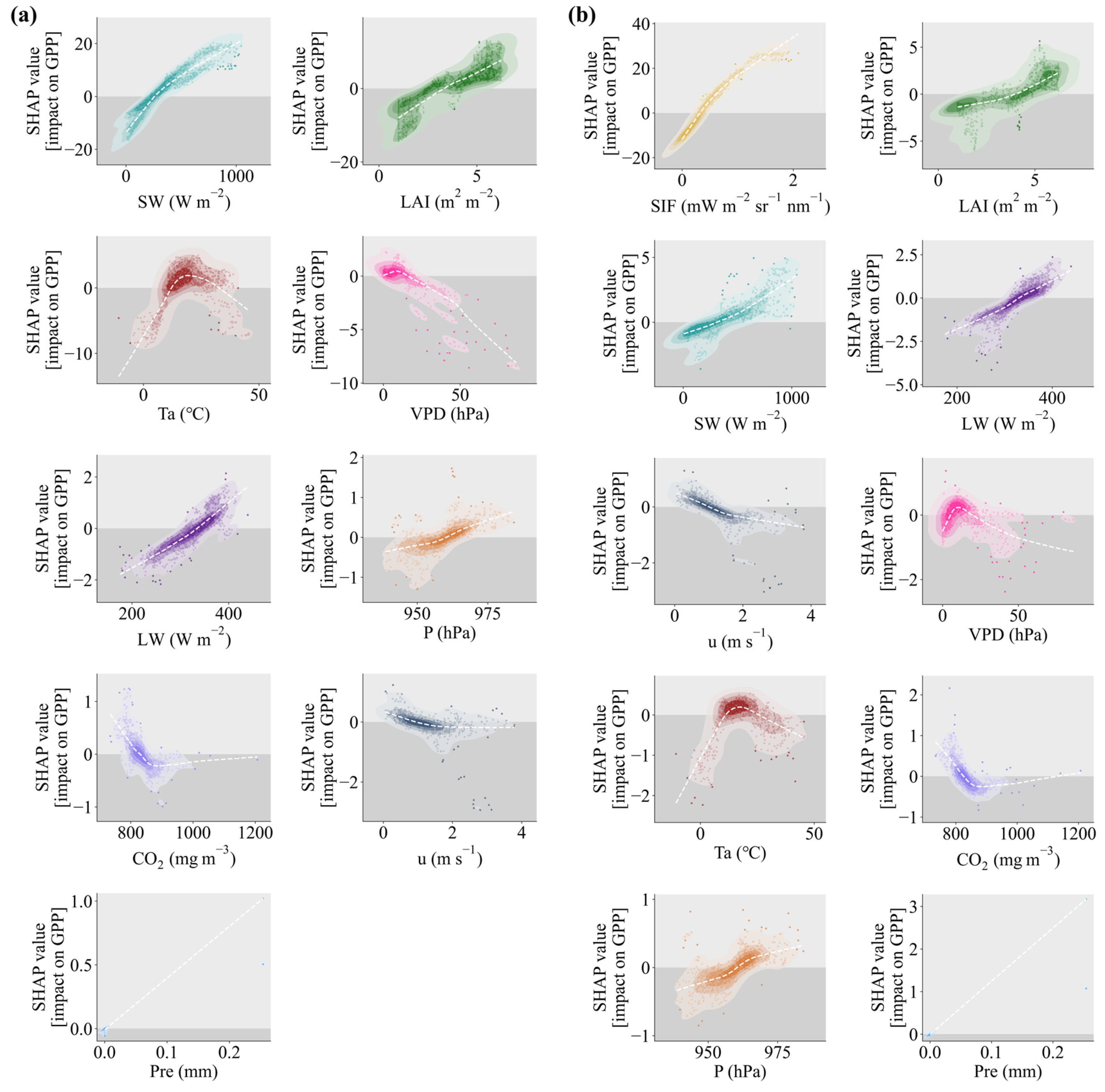
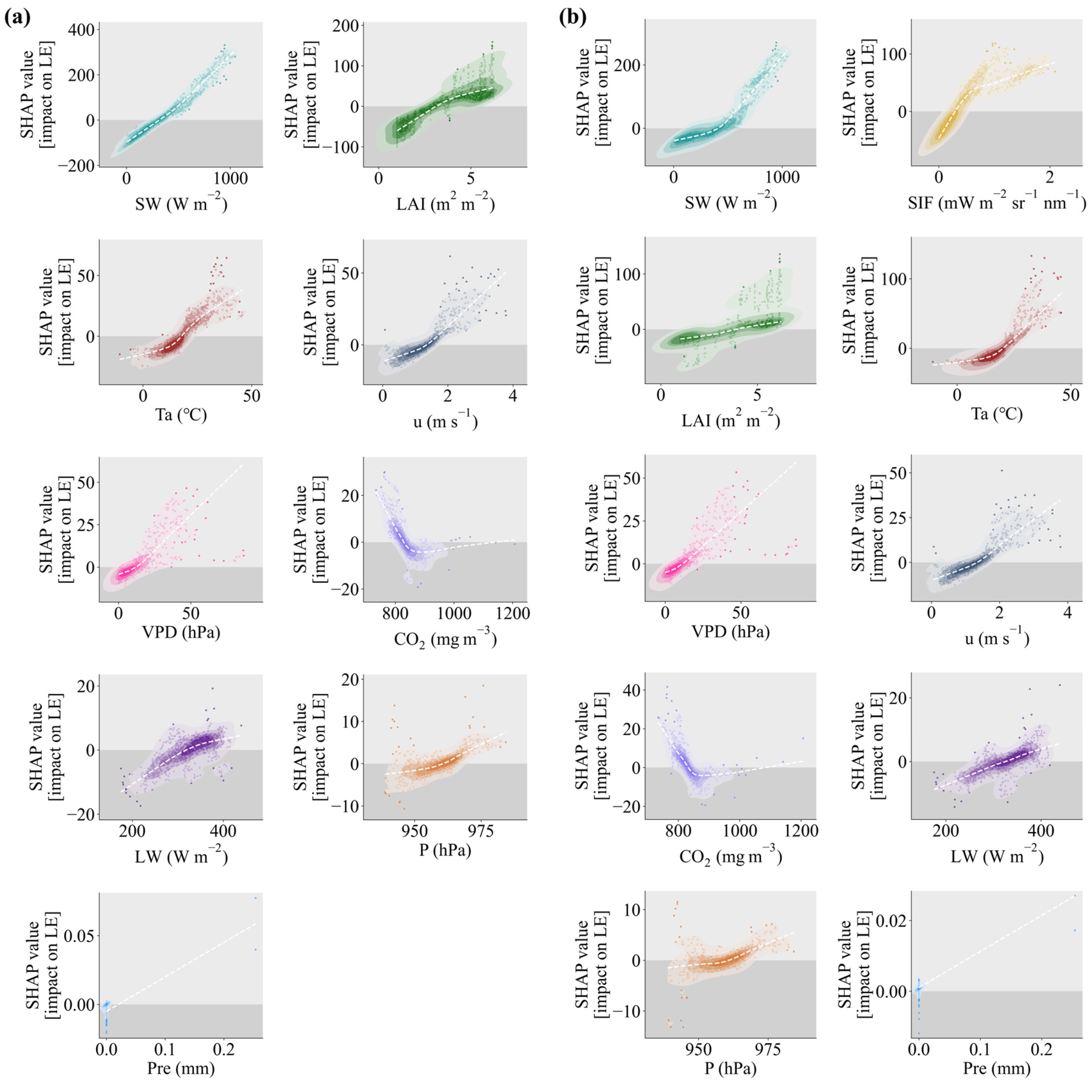
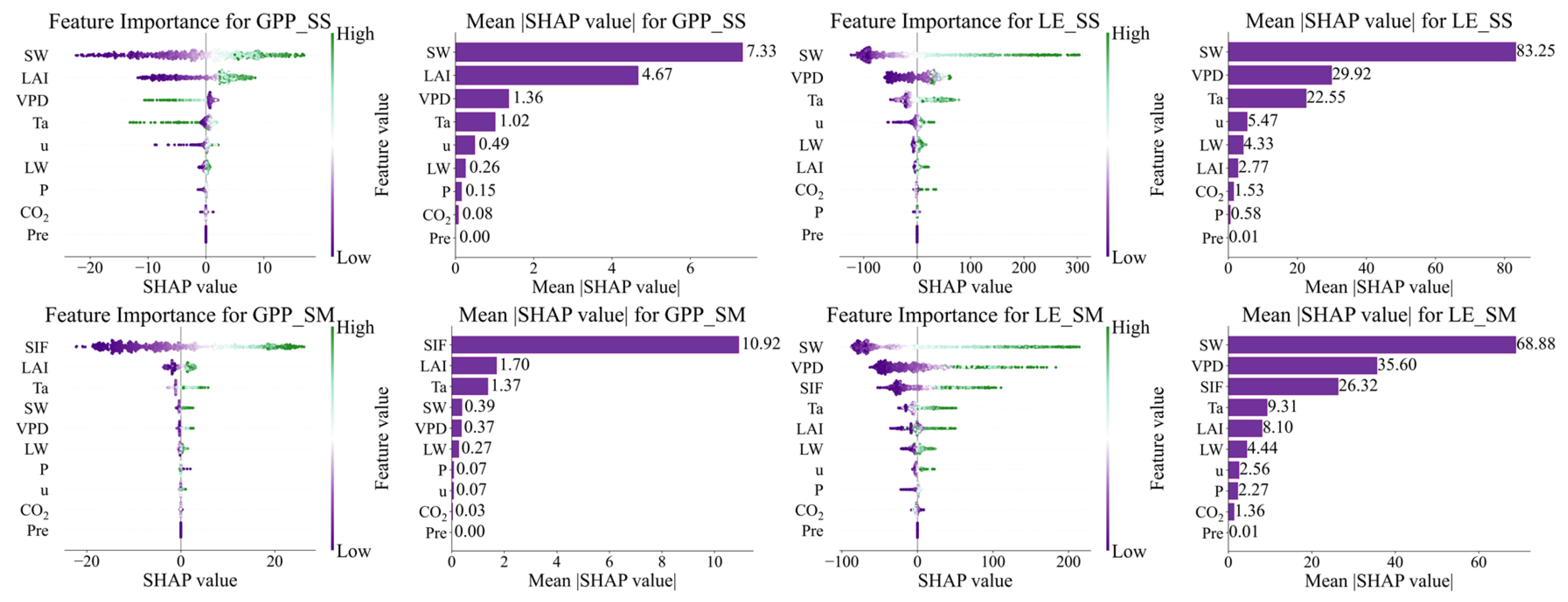
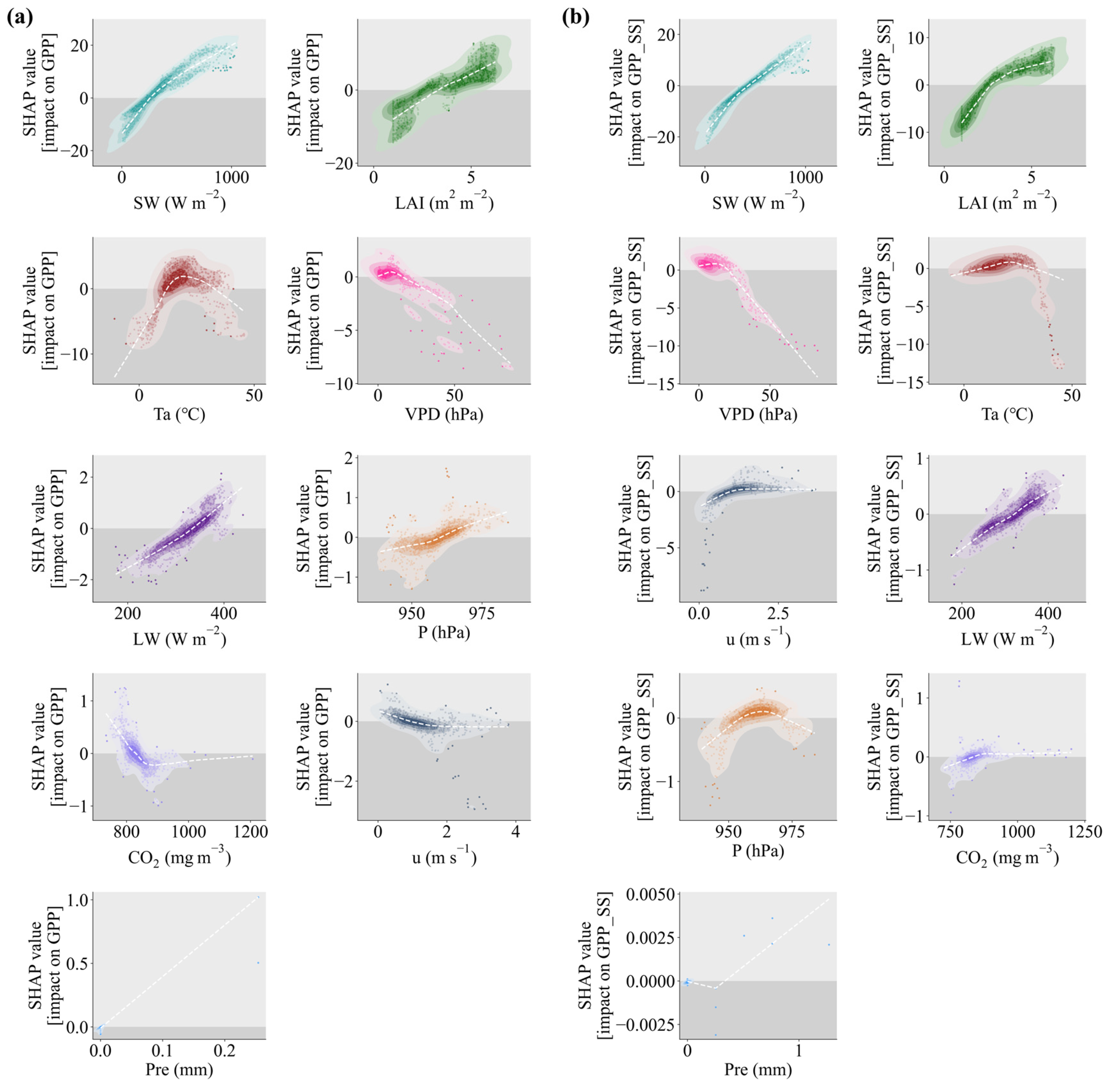
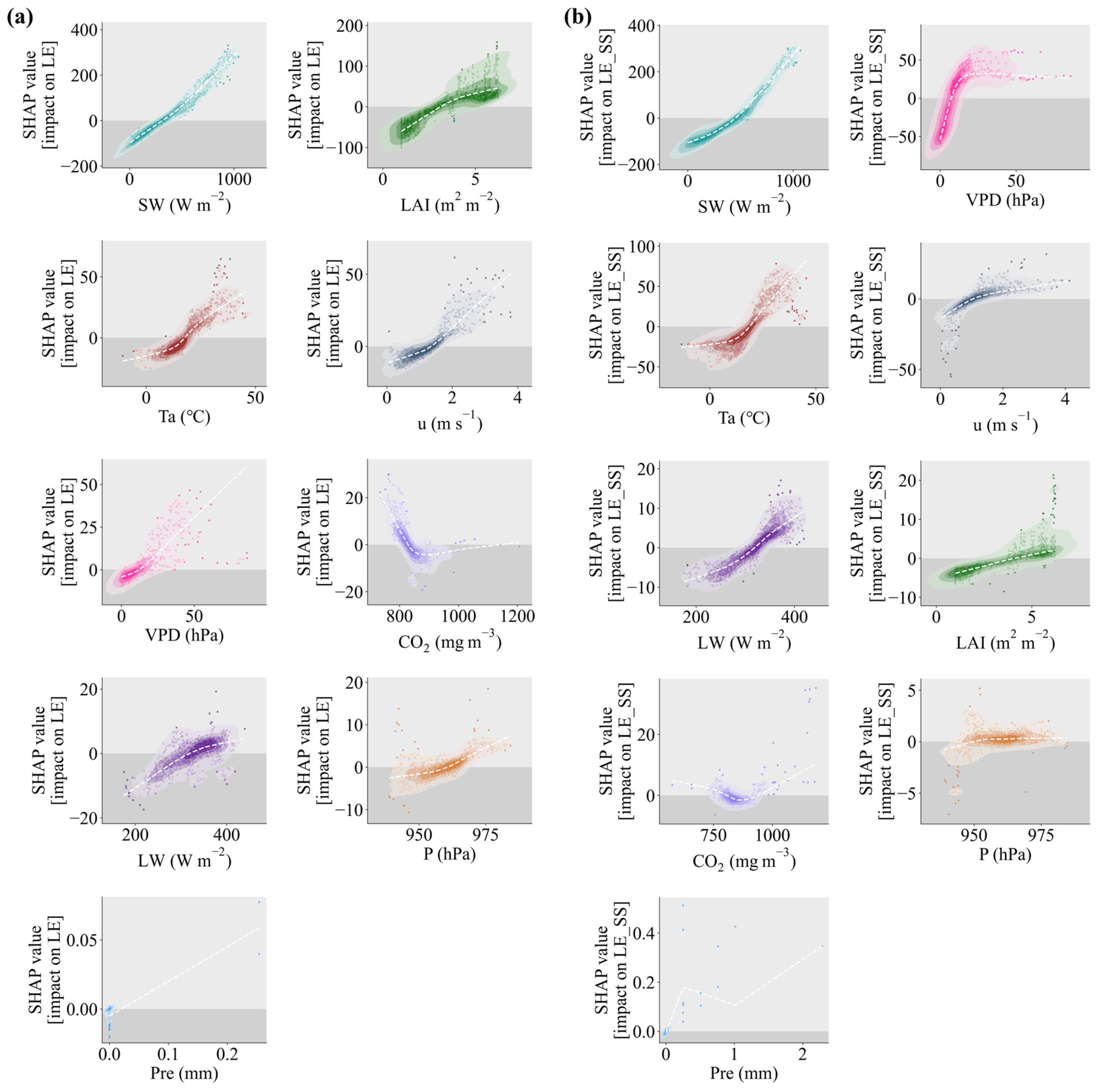
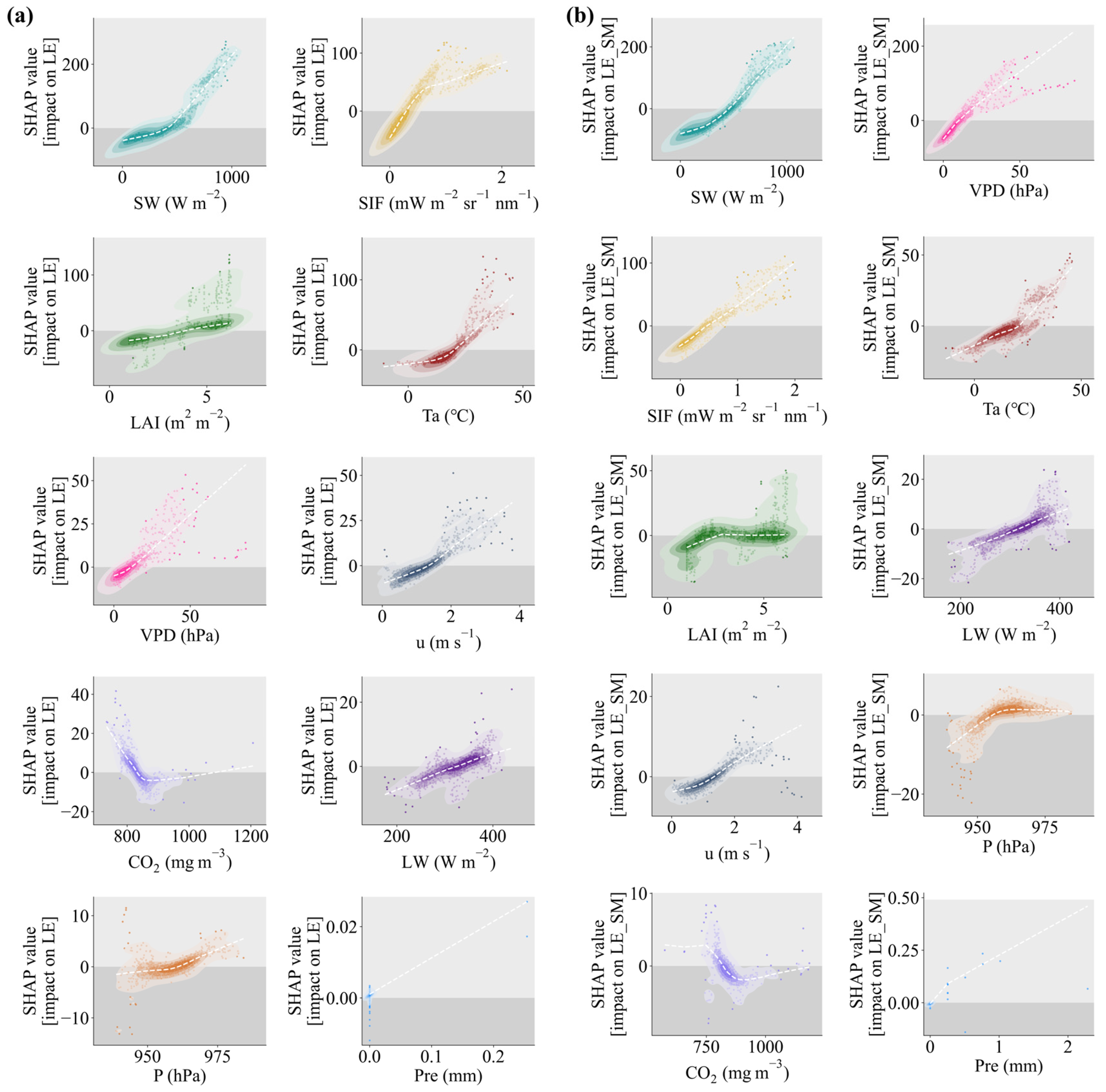
3.3. SHAP-Based Feature Importance and Contributions of SIF and Other Factors
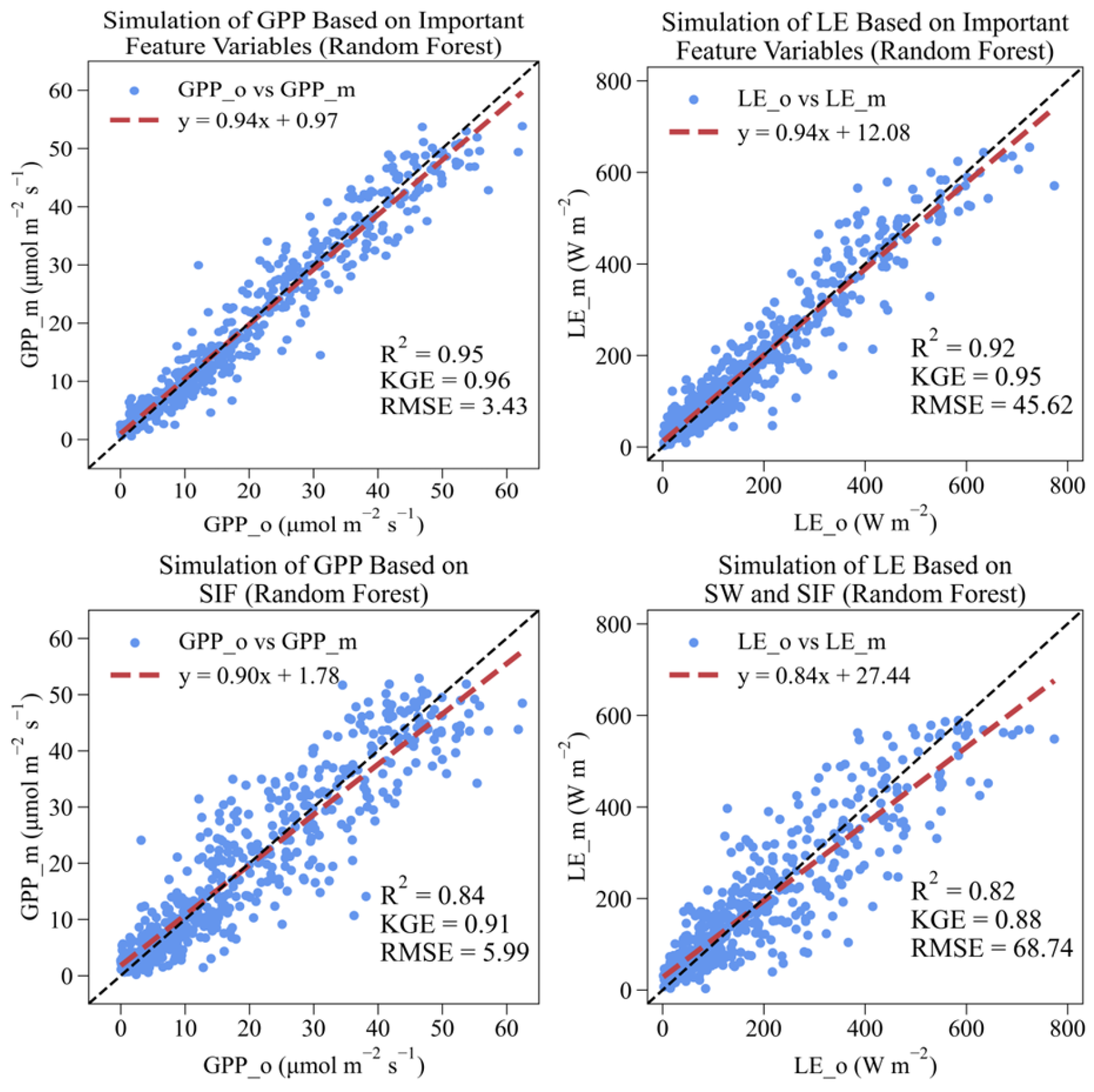
3.4. The “Equivalent Modeling” Approach for Interpreting Mechanistic Models
4. Discussion
4.1. SIF Better Represents GPP than LE
4.2. The Role of SIF in Mechanistic Models
4.3. Limitations and Future Perspectives
5. Conclusions
Author Contributions
Funding
Data Availability Statement
Acknowledgments
Conflicts of Interest
Abbreviations
| An | Net Photosynthesis |
| APAR | Absorbed Photosynthetically Active Radiation |
| BWB | Ball–Woodrow–Berry Canopy Conductance Model |
| EC | Eddy Covariance |
| Es | Soil Evaporation |
| ET | Evapotranspiration |
| EVI | Enhanced Vegetation Index |
| FvCB | Farquhar–von Caemmerer–Berry |
| G | Soil Heat Flux |
| Gc | Canopy Conductivity |
| GPP | Gross Primary Productivity |
| H | Sensible Heat Flux |
| IWSA | The Institute of Water Saving Agriculture in Arid Areas |
| J | Electron Transport Rate |
| KGE | Kling–Gupta Efficiency |
| LE | Latent Heat Flux |
| LW | Longwave Radiation |
| LAI | Leaf Area Index |
| LWP | Leaf Water Potential |
| MLR | Mechanistic Light Response Model |
| MSE | Mean Squared Error |
| NEE | Net Ecosystem Exchange |
| NPQ | Non-Photochemical Quenching |
| NDVI | Normalized Difference Vegetation Index |
| NWAFU | Northwest Agriculture and Forestry University |
| P | Air Pressure |
| PM | Dual-source Penman-Monteith Equations |
| PAR | Photosynthetically Active Radiation |
| Pre | Precipitation |
| qL | Photosystem II Operating Efficiency |
| R2 | Coefficient of Determination |
| RF | Random Forest |
| RH | Relative Humidity |
| Rn | Net Radiation |
| RWU | Root Water Uptake |
| RMSE | Root Mean Square Error |
| SM | Soil Moisture |
| SR | Solar Radiation |
| SW | Shortwave Radiation |
| SIF | Solar-induced Chlorophyll Fluorescence |
| SVD | Singular Value Decomposition |
| SHAP | Shapley Additive Explanations |
| SPAC | Soil-plant-atmosphere Continuum |
| SCOPE | Soil Canopy Observation, Photochemistry, and Energy Fluxes Model |
| STEMMUS | Simultaneous Transfer of Energy, Mass, and Momentum in Unsaturated Soil |
| T | Transpiration |
| Ta | Air Temperature |
| Ts | Soil Temperature |
| TER | Total Ecosystem Respiration |
| TOC | Top-of-canopy |
| u | Wind Speed |
| VPD | Vapor Pressure Deficit |
| Vcmax | Maximum Carboxylation Rate |
| WSF | Water Stress Factor |
Appendix A
Appendix A.1. STEMMUS-SCOPE
Photosynthesis and Evapotranspiration Under Water Stress in SCOPE
Appendix A.2. Governing Equations in STEMMUS
Appendix A.2.1. Soil Water Conservation Equation
Appendix A.2.2. Dry Air Conservation Equation
Appendix A.2.3. Energy Balance Equation
Appendix A.3. Dynamic Root Growth Modeling
Appendix A.3.1. Root Front Growth
Appendix A.3.2. Root Length Growth
Appendix A.4. Root Water Uptake
Appendix A.5. STEMMUS-MLR
Appendix A.5.1. MLR Model
Appendix A.5.2. Calculation of qL Proposed by Liu, et al. [69]
Appendix A.5.3. Calculation of Total Leaf Emitted SIF
Appendix A.5.4. Determination of Γ* and CC
Appendix A.5.5. Estimation of Transpiration (T) and Evaporation (E) with the Dual-Source PM Model
Appendix A.5.6. Estimation of Canopy Conductance (Gc)

| Model | Parameter | Description | Unit |
|---|---|---|---|
| STEMMUS-SCOPE | LIDFa | Parameter a of the leaf inclination distribution function | |
| LIDFb | Parameter b of the leaf inclination distribution function | ||
| Leafwidth | Leaf width | m | |
| Cab | Leaf chlorophyll content | μg cm−2 | |
| Cw | Leaf water content | g cm−2 | |
| Cdm | Leaf dry matter content | g cm−2 | |
| Cs | Senescent material content | ||
| Cca | Leaf Carotenoid content | μg cm−2 | |
| w | Leaf albedo | ||
| Vcmax | maximum carboxylation rate | μmol m−2 s−1 | |
| Rdparam | Leaf respiration parameter | ||
| kp | pseudo-first-order rate constant for PEP carboxylase with respect to Ci | ||
| Slti | Slope of cold temperature decline (C4 only) | ||
| Shti | Slope of high-temperature decline in photosynthesis | ||
| Thl | Temperature below which C4 photosynthesis is lower than half that predicted by Q10 | K | |
| Thh | Temperature above which photosynthesis is lower than half that predicted by Q10 | K | |
| Trdm | Temperature at which respiration is lower than half that predicted by Q10 | K | |
| m | Ball-Berry parameter | ||
| BallBerry0 | Intercept of Ball-Berry equation | ||
| STEMMUS-MLR | SIF | Solar-induced fluorescence | uw m−2 sr−1 nm−1 |
| SIFTOC(λ) | Top of canopy solar-induced fluorescence at λ nm | uw m−2 sr−1 nm−1 | |
| SIFTOT_FULL_PSII | Broadband total SIF emitted by PSII | uw m−2 sr−1 | |
| NIRv | Near-Infrared Reflectance of Vegetation | ||
| qL | fraction of open PSII reaction centers | ||
| ΦPSIImax | maximum photochemical quantum yield of PSII | ||
| KDF | Ratio of the KD to the KF | ||
| fesc | escape probability of SIF | ||
| fesc_P_C | Escape probability of SIF from leaf to top of canopy | ||
| STEMMUS-MLR | fλ | the integrated SIF signal at 743 nm across the entire fluorescence spectrum | |
| fPSII | Proportion of PSII SIF contributing to total leaf emission | ||
| m | dimensionless parameter | ||
| Hd | decrease rate of m above Topt | ||
| Ha | increase rate of m below Topt | ||
| Topt | Optimal TLeaf | K | |
| mopt | value of m at Topt | ||
| τ | Light extinction coefficient |
Appendix B




References
- Kropp, H.; Ogle, K.; Vivoni, E.R.; Hultine, K.R. The sensitivity of evapotranspiration to inter-specific plant neighbor interactions: Implications for models. Ecosystems 2017, 20, 1311–1323. [Google Scholar] [CrossRef]
- Popović, N.; Petrone, R.M.; Green, A.; Khomik, M.; Price, J.S. Evolution of ecosystem-scale surface energy fluxes of a newly constructed boreal upland-fen watershed. Ecol. Eng. 2023, 194, 107059. [Google Scholar] [CrossRef]
- Zheng, C.; Jia, L.; Hu, G. Global land surface evapotranspiration monitoring by etmonitor model driven by multi-source satellite earth observations. J. Hydrol. 2022, 613, 128444. [Google Scholar] [CrossRef]
- Haghighi, E.; Kirchner, J.W. Near-surface turbulence as a missing link in modeling evapotranspiration-soil moisture relationships. Water Resour. Res. 2017, 53, 5320–5344. [Google Scholar] [CrossRef]
- Tarin, T.; Nolan, R.H.; Eamus, D.; Cleverly, J. Carbon and water fluxes in two adjacent australian semi-arid ecosystems. Agric. For. Meteorol. 2020, 281, 107853. [Google Scholar] [CrossRef]
- Xu, J.; Mu, Q.; Ding, Y.; Sun, S.; Zou, Y.; Yu, L.; Zhang, P.; Yang, N.; Guo, W.; Cai, H. Considering spatio-temporal dynamics of soil water with evapotranspiration partitioning helps to clarify water utilization characteristics of summer maize under deficit irrigation. J. Hydrol. 2023, 617, 129102. [Google Scholar] [CrossRef]
- Ruairuen, W.; Fochesatto, G.J.; Sparrow, E.B.; Schnabel, W.; Zhang, M.; Kim, Y. Evapotranspiration cycles in a high latitude agroecosystem: Potential warming role. PLoS ONE 2015, 10, e0137209. [Google Scholar] [CrossRef]
- Wang, W.; Xu, F.; Wang, J. Energy exchange and evapotranspiration over the ejina oasis riparian forest ecosystem with different land-cover types. Water 2021, 13, 3424. [Google Scholar] [CrossRef]
- Cavaleri, M.A.; Coble, A.P.; Ryan, M.G.; Bauerle, W.L.; Loescher, H.W.; Oberbauer, S.F. Tropical rainforest carbon sink declines during EI Nino as a result of reduced photosynthesis and increased respiration rates. New Phytol. 2017, 216, 136–149. [Google Scholar] [CrossRef] [PubMed]
- Kohonen, K.M.; Dewar, R.; Tramontana, G.; Mauranen, A.; Kolari, P.; Kooijmans, L.M.J.; Papale, D.; Vesala, T.; Mammarella, I. Intercomparison of methods to estimate gross primary production based on CO(2) and cos flux measurements. Biogeosciences 2022, 19, 4067–4088. [Google Scholar] [CrossRef] [PubMed]
- Boss, S.K.; Montana, Q.; Barnett, B. Global agriculture as an energy transfer system and the energy yield of world agriculture 1961–2013. Environ. Prog. Sustain. Energy 2017, 37, 108–121. [Google Scholar] [CrossRef]
- Amthor, J.S. After photosynthesis, what then: Importance of respiration to crop growth and yield. Field Crops Res. 2025, 321, 109638. [Google Scholar] [CrossRef]
- Nottingham, A.T.; Meir, P.; Velasquez, E.; Turner, B.L. Soil carbon loss by experimental warming in a tropical forest. Nature 2020, 584, 234. [Google Scholar] [CrossRef] [PubMed]
- Sun, P.; Wu, Y.; Xiao, J.; Hui, J.; Hu, J.; Zhao, F.; Qiu, L.; Liu, S. Remote sensing and modeling fusion for investigating the ecosystem water-carbon coupling processes. Sci. Total Environ. 2019, 697, 134064. [Google Scholar] [CrossRef] [PubMed]
- Gao, L.; Kang, S.; Bai, X.; Li, S.; Niu, J.; Ding, R. Water-carbon relationships and variations from the canopy to ecosystem scale in a sparse vineyard in the northwest china. J. Hydrol. 2021, 600, 126469. [Google Scholar] [CrossRef]
- Lawson, T.; Vialet-Chabrand, S. Speedy stomata, photosynthesis and plant water use efficiency. New Phytol. 2019, 221, 93–98. [Google Scholar] [CrossRef]
- Running, S.W.; Nemani, R.R.; Heinsch, F.A.; Zhao, M.S.; Reeves, M.; Hashimoto, H. A continuous satellite-derived measure of global terrestrial primary production. Bioscience 2004, 54, 547–560. [Google Scholar] [CrossRef]
- Yuan, W.; Liu, S.; Yu, G.; Bonnefond, J.-M.; Chen, J.; Davis, K.; Desai, A.R.; Goldstein, A.H.; Gianelle, D.; Rossi, F.; et al. Global estimates of evapotranspiration and gross primary production based on modis and global meteorology data. Remote Sens. Environ. 2010, 114, 1416–1431. [Google Scholar] [CrossRef]
- Bejagam, V.; Sharma, A. Remote sensing-based multi-scale characterization of ecohydrological indicators (ehis) in india. Ecol. Eng. 2023, 187, 106841. [Google Scholar] [CrossRef]
- Wang, Y. Exploring Terrestrial Eco-Hydrological Processes from Bottom-Up and Top-Down Perspectives. Ph.D. Thesis, Faculty of Geo-Information Science and Earth Observation (ITC), University of Twente, Enschede, The Netherlands, 2025. [Google Scholar]
- Raab, N.; Meza, F.J.; Franck, N.; Bambach, N. Empirical stomatal conductance models reveal that the isohydric behavior of an acacia caven mediterranean savannah scales from leaf to ecosystem. Agric. For. Meteorol. 2015, 213, 203–216. [Google Scholar] [CrossRef]
- Zeng, S.D.; Xia, J.; Chen, X.D.; Zou, L.; Du, H.; She, D.X. Integrated land-surface hydrological and biogeochemical processes in simulating water, energy and carbon fluxes over two different ecosystems. J. Hydrol. 2020, 582, 124390. [Google Scholar] [CrossRef]
- Li, Y.; Zhou, J.; Kinzelbach, W.; Cheng, G.; Li, X.; Zhao, W. Coupling a svat heat and water flow model, a stomatal-photosynthesis model and a crop growth model to simulate energy, water and carbon fluxes in an irrigated maize ecosystem. Agric. For. Meteorol. 2013, 176, 10–24. [Google Scholar] [CrossRef]
- Vote, C.; Hall, A.; Charlton, P. Carbon dioxide, water and energy fluxes of irrigated broad-acre crops in an australian semi-arid climate zone. Environ. Earth Sci. 2014, 73, 449–465. [Google Scholar] [CrossRef]
- Gu, X.Q.; Yao, L.; Wu, L.F. Prediction of water carbon fluxes and emission causes in rice paddies using two tree-based ensemble algorithms. Sustainability 2023, 15, 12333. [Google Scholar] [CrossRef]
- Scholze, M.; Buchwitz, M.; Dorigo, W.; Guanter, L.; Shaun, Q.G. Reviews and syntheses: Systematic earth observations for use in terrestrial carbon cycle data assimilation systems. Biogeosciences 2017, 14, 3401–3429. [Google Scholar] [CrossRef]
- Wang, Y.P.; Zhang, L.; Liang, X.; Yuan, W.P. Coupled models of water and carbon cycles from leaf to global: A retrospective and a prospective. Agric. For. Meteorol. 2024, 358, 110229. [Google Scholar] [CrossRef]
- Liu, X.; Peng, X.; Li, Y.; Gu, X.; Yu, L.; Wang, Y.; Cai, H. Environmental influences on evapotranspiration in wheat-maize rotation systems under diverse hydrological regimes in the Guanzhong Plain, China. Agric. Water Manag. 2024, 306, 109204. [Google Scholar] [CrossRef]
- Joetzjer, E.; Maignan, F.; Chave, J.; Goll, D.; Poulter, B.; Barichivich, J.; Maréchaux, I.; Luyssaert, S.; Guimberteau, M.; Naudts, K.; et al. Effect of tree demography and flexible root water uptake for modeling the carbon and water cycles of amazonia. Ecol. Model. 2022, 469, 109969. [Google Scholar] [CrossRef]
- He, X.; Liu, S.; Xu, T.; Yu, K.; Gentine, P.; Zhang, Z.; Xu, Z.; Jiao, D.; Wu, D. Improving predictions of evapotranspiration by integrating multi-source observations and land surface model. Agric. Water Manag. 2022, 272, 107827. [Google Scholar] [CrossRef]
- Ma, N.; Zhang, Y.; Xu, C.Y.; Szilagyi, J. Modeling actual evapotranspiration with routine meteorological variables in the data--scarce region of the tibetan plateau: Comparisons and implications. J. Geophys. Res. Biogeosci. 2015, 120, 1638–1657. [Google Scholar] [CrossRef]
- Li, W.; Duveiller, G.; Wieneke, S.; Forkel, M.; Gentine, P.; Reichstein, M.; Niu, S.; Migliavacca, M.; Orth, R. Regulation of the global carbon and water cycles through vegetation structural and physiological dynamics. Environ. Res. Lett. 2024, 19, 073008. [Google Scholar] [CrossRef]
- Ma, Y.M.; Guan, X.B.; Wang, Y.C.; Li, Y.Y.; Lin, D.K.; Shen, H.F. GPP estimation by transfer learning with combined solar-induced chlorophyll fluorescence and eddy covariance data. Int. J. Appl. Earth Obs. Geoinf. 2025, 139, 104503. [Google Scholar] [CrossRef]
- Raza, A.; Hu, Y.G.; Lu, Y.Z. Improving carbon flux estimation in tea plantation ecosystems: A machine learning ensemble approach. Eur. J. Agron. 2024, 160, 127297. [Google Scholar] [CrossRef]
- Xu, W.; Ma, L.; Ma, M.; Zhang, H.; Yuan, W. Spatial–temporal variability of snow cover and depth in the qinghai–tibetan plateau. J. Clim. 2017, 30, 1521–1533. [Google Scholar] [CrossRef]
- Zhang, T.L.; Sun, R.; Peng, C.H.; Zhou, G.Y.; Wang, C.L.; Zhu, Q.A.; Yang, Y.Z. Integrating a model with remote sensing observations by a data assimilation approach to improve the model simulation accuracy of carbon flux and evapotranspiration at two flux sites. Sci. China Earth Sci. 2016, 59, 337–348. [Google Scholar] [CrossRef]
- Zhao, G.; Bryan, B.A.; King, D.; Song, X.D.; Yu, Q. Parallelization and optimization of spatial analysis for large scale environmental model data assembly. Comput. Electron. Agric. 2012, 89, 94–99. [Google Scholar] [CrossRef]
- Sravani, C.; Kishore, P.; Jiang, J.H.; Rao, S.V.B. Climatological changes in soil moisture during the 21st century over the indian region using cmip5 and satellite observations. Remote Sens. 2022, 14, 2108. [Google Scholar] [CrossRef]
- Zeng, Y.; Verhoef, A.; Vereecken, H.; Ben-Dor, E.; Veldkamp, T.; Shaw, L.; Van Der Ploeg, M.; Wang, Y.; Su, Z. Monitoring and Modeling the Soil-Plant System Toward Understanding Soil Health. Rev. Geophys. 2025, 63, e2024RG000836. [Google Scholar] [CrossRef]
- Cai, W.Y.; Ullah, S.; Yan, L.; Lin, Y. Remote sensing of ecosystem water use efficiency: A review of direct and indirect estimation methods. Remote Sens. 2021, 13, 2393. [Google Scholar] [CrossRef]
- Gu, L.H.; Han, J.M.; Wood, J.D.; Chang, C.Y.Y.; Sun, Y. Sun-induced chl fluorescence and its importance for biophysical modeling of photosynthesis based on light reactions. New Phytol. 2019, 223, 1179–1191. [Google Scholar] [CrossRef]
- Mohammed, G.H.; Colombo, R.; Middleton, E.M.; Rascher, U.; van der Tol, C.; Nedbal, L.; Goulas, Y.; Pérez-Priego, O.; Damm, A.; Meroni, M.; et al. Remote sensing of solar-induced chlorophyll fluorescence (SIF) in vegetation: 50 years of progress. Remote Sens. Environ. 2019, 231, 111177. [Google Scholar] [CrossRef]
- Yang, J.; Lu, X.; Liu, Z.; Tang, X.; Yu, Q.; Wang, Y. Atmospheric drought dominates changes in global water use efficiency. Sci. Total Environ. 2024, 934, 173084. [Google Scholar] [CrossRef]
- Porcar-Castell, A.; Tyystjärvi, E.; Atherton, J.; van der Tol, C.; Flexas, J.; Pfündel, E.E.; Moreno, J.; Frankenberg, C.; Berry, J.A. Linking chlorophyll a fluorescence to photosynthesis for remote sensing applications: Mechanisms and challenges. J. Exp. Bot. 2014, 65, 4065–4095. [Google Scholar] [CrossRef]
- Meroni, M.; Rossini, M.; Guanter, L.; Alonso, L.; Rascher, U.; Colombo, R.; Moreno, J. Remote sensing of solar-induced chlorophyll fluorescence: Review of methods and applications. Remote Sens. Environ. 2009, 113, 2037–2051. [Google Scholar] [CrossRef]
- Yang, J.; Liu, Z.; Yu, Q.; Lu, X. Estimation of global transpiration from remotely sensed solar-induced chlorophyll fluorescence. Remote Sens. Environ. 2024, 303, 113998. [Google Scholar] [CrossRef]
- Frankenberg, C.; Fisher, J.B.; Worden, J.; Badgley, G.; Saatchi, S.S.; Lee, J.-E.; Toon, G.C.; Butz, A.; Jung, M.; Kuze, A.; et al. New global observations of the terrestrial carbon cycle from GOSAT: Patterns of plant fluorescence with gross primary productivity. Geophys. Res. Lett. 2011, 38, L17706. [Google Scholar] [CrossRef]
- Cai, G.; Lu, X.; Zhang, X.; Li, G.; Yu, H.; Lou, Z.; Fan, J.; Zhou, Y. Application of the Reconstructed Solar-Induced Chlorophyll Fluorescence by Machine Learning in Agricultural Drought Monitoring of Henan Province, China from 2010 to 2022. Agronomy 2024, 14, 1941. [Google Scholar] [CrossRef]
- Wang, Y.-Q.; Leng, P.; Shang, G.-F.; Zhang, X.; Li, Z.-L. Sun-induced chlorophyll fluorescence is superior to satellite vegetation indices for predicting summer maize yield under drought conditions. Comput. Electron. Agric. 2023, 205, 107615. [Google Scholar] [CrossRef]
- Yang, X.; Tang, J.; Mustard, J.F.; Lee, J.-E.; Rossini, M.; Joiner, J.; Munger, J.W.; Kornfeld, A.; Richardson, A.D. Solar-induced chlorophyll fluorescence that correlates with canopy photosynthesis on diurnal and seasonal scales in a temperate deciduous forest. Geophys. Res. Lett. 2015, 42, 2977–2987. [Google Scholar] [CrossRef]
- Sun, Y.; Frankenberg, C.; Wood, J.D.; Schimel, D.S.; Jung, M.; Guanter, L.; Drewry, D.T.; Verma, M.; Porcar-Castell, A.; Griffis, T.J.; et al. OCO-2 advances photosynthesis observation from space via solar-induced chlorophyll fluorescence. Science 2017, 358, eaam5747. [Google Scholar] [CrossRef]
- Chen, J.; Liu, X.; Ma, Y.; Liu, L. Effects of low temperature on the relationship between solar-induced chlorophyll fluorescence and gross primary productivity across different plant function types. Remote Sens. 2022, 14, 3716. [Google Scholar] [CrossRef]
- Bai, J.; Zhang, H.; Sun, R.; Li, X.; Xiao, J.; Wang, Y. Estimation of global GPP from GOME-2 and OCO-2 SIF by considering the dynamic variations of GPP-SIF relationship. Agric. For. Meteorol. 2022, 326, 109180. [Google Scholar] [CrossRef]
- Shan, N.; Ju, W.; Migliavacca, M.; Martini, D.; Guanter, L.; Chen, J.; Goulas, Y.; Zhang, Y. Modeling canopy conductance and transpiration from solar-induced chlorophyll fluorescence. Agric. For. Meteorol. 2019, 268, 189–201. [Google Scholar] [CrossRef]
- Damm, A.; Haghighi, E.; Paul-Limoges, E.; van der Tol, C. On the seasonal relation of sun-induced chlorophyll fluorescence and transpiration in a temperate mixed forest. Agric. For. Meteorol. 2021, 304–305, 108386. [Google Scholar] [CrossRef]
- Wang, Y.; Zeng, Y.; Yu, L.; Yang, P.; Van der Tol, C.; Yu, Q.; Lü, X.; Cai, H.; Su, Z. Integrated modeling of canopy photosynthesis, fluorescence, and the transfer of energy, mass, and momentum in the soil–plant–atmosphere continuum (stemmus–scope v1.0.0). Geosci. Model Dev. 2021, 14, 1379–1407. [Google Scholar] [CrossRef]
- Tang, E.; Zeng, Y.; Wang, Y.; Song, Z.; Yu, D.; Wu, H.; Qiao, C.; van der Tol, C.; Du, L.; Su, Z. Understanding the effects of revegetated shrubs on fluxes of energy, water, and gross primary productivity in a desert steppe ecosystem using the stemmus–scope model. Biogeosciences 2024, 21, 893–909. [Google Scholar] [CrossRef]
- Abramowitz, G.; Ukkola, A.; Hobeichi, S.; Cranko Page, J.; Lipson, M.; De Kauwe, M.G.; Green, S.; Brenner, C.; Frame, J.; Nearing, G.; et al. On the predictability of turbulent fluxes from land: Plumber2 mip experimental description and preliminary results. Biogeosciences 2024, 21, 5517–5538. [Google Scholar] [CrossRef]
- Wang, Y.F.; Zeng, Y.J.; Alidoost, F.; Schilperoort, B.; Song, Z.J.; Yu, D.Y.; Tang, E.T.; Han, Q.Q.; Liu, Z.Q.; Peng, X.B.; et al. A physically consistent dataset of water-energy-carbon fluxes across the soil-plant-atmosphere continuum. Sci. Data 2025, 12, 1146. [Google Scholar] [CrossRef]
- Wang, Y.; Zeng, Y.; Su, Z. Data Underlying the Research on Advancing the Understanding of Eco-Hydrological Processes with the Stemmus-MLR Model. 4TU.ResearchData. 2025. Available online: https://doi.org/10.4121/0feee349-83e7-4872-8fd4-bc07aa4dd265.v1 (accessed on 9 July 2025).
- Liu, Z.; Zhao, F.; Liu, X.; Yu, Q.; Wang, Y.; Peng, X.; Cai, H.; Lu, X. Direct estimation of photosynthetic CO2 assimilation from solar-induced chlorophyll fluorescence (SIF). Remote Sens. Environ. 2022, 271, 112893. [Google Scholar] [CrossRef]
- Peng, X.; Liu, X.; Wang, Y.; Cai, H. Evapotranspiration partitioning and estimation based on crop coefficients of winter wheat cropland in the guanzhong plain, china. Agronomy 2023, 13, 2982. [Google Scholar] [CrossRef]
- Zheng, J.; Wang, H.; Fan, J.; Zhang, F.; Guo, J.; Liao, Z.; Zhuang, Q. Wheat straw mulching with nitrification inhibitor application improves grain yield and economic benefit while mitigating gaseous emissions from a dryland maize field in northwest china. Field Crops Res. 2021, 265, 108125. [Google Scholar] [CrossRef]
- Chen, H.; Hou, H.-J.; Wang, X.-Y.; Zhu, Y.; Saddique, Q.; Wang, Y.-F.; Cai, H. The effects of aeration and irrigation regimes on soil CO2 and N2O emissions in a greenhouse tomato production system. J. Integr. Agric. 2018, 17, 449–460. [Google Scholar] [CrossRef]
- Wang, Y.; Cai, H.; Yu, L.; Peng, X.; Xu, J.; Wang, X. Evapotranspiration partitioning and crop coefficient of maize in dry semi-humid climate regime. Agric. Water Manag. 2020, 236, 106164. [Google Scholar] [CrossRef]
- Wang, Y.; Zou, Y.; Cai, H.; Zeng, Y.; He, J.; Yu, L.; Zhang, C.; Saddique, Q.; Peng, X.; Siddique, K.H.M.; et al. Seasonal variation and controlling factors of evapotranspiration over dry semi-humid cropland in guanzhong plain, china. Agric. Water Manag. 2022, 259, 107242. [Google Scholar] [CrossRef]
- Yu, L.; Zeng, Y.; Su, Z.; Cai, H.; Zheng, Z. The effect of different evapotranspiration methods on portraying soil water dynamics and et partitioning in a semi-arid environment in northwest china. Hydrol. Earth Syst. Sci. 2016, 20, 975–990. [Google Scholar] [CrossRef]
- Zhou, X.; Liu, Z.; Xu, S.; Zhang, W.; Wu, J. An Automated Comparative Observation System for Sun-Induced Chlorophyll Fluorescence of Vegetation Canopies. Sensors 2016, 16, 775. [Google Scholar] [CrossRef]
- Liu, Z.; Guo, C.; Yu, Q.; Zhu, P.; Peng, X.; Dong, M.; Cai, H.; Lu, X. A SIF-based approach for quantifying canopy photosynthesis by simulating the fraction of open PSII reaction centers (qL). Remote Sens. Environ. 2024, 305, 114111. [Google Scholar] [CrossRef]
- Meroni, M.; Picchi, V.; Rossini, M.; Cogliati, S.; Panigada, C.; Nali, C.; Lorenzini, G.; Colombo, R. Leaf level early assessment of ozone injuries by passive fluorescence and photochemical reflectance index. Int. J. Remote Sens. 2008, 29, 5409–5422. [Google Scholar] [CrossRef]
- Liu, X.J.; Liu, Z.Q.; Liu, L.Y.; Lu, X.L.; Chen, J.D.; Du, S.S.; Zou, C. Modelling the influence of incident radiation on the SIF-based GPP estimation for maize. Agric. For. Meteorol. 2021, 307, 108522. [Google Scholar] [CrossRef]
- Yang, K.; Ryu, Y.; Dechant, B.; Berry, J.A.; Hwang, Y.; Jiang, C.; Kang, M.; Kim, J.; Kimm, H.; Kornfeld, A.; et al. Sun-induced chlorophyll fluorescence is more strongly related to absorbed light than to photosynthesis at half-hourly resolution in a rice paddy. Remote Sens. Environ. 2018, 216, 658–673. [Google Scholar] [CrossRef]
- Chang, C.Y.; Guanter, L.; Frankenberg, C.; Köhler, P.; Gu, L.H.; Magney, T.S.; Grossmann, K.; Sun, Y. Systematic assessment of retrieval methods for canopy far-red solar-induced chlorophyll fluorescence using high-frequency automated field spectroscopy. J. Geophys. Res. Biogeosci. 2020, 125, e2019JG005533. [Google Scholar] [CrossRef]
- Guanter, L.; Frankenberg, C.; Dudhia, A.; Lewis, P.E.; Gómez-Dans, J.; Kuze, A.; Suto, H.; Grainger, R.G. Retrieval and global assessment of terrestrial chlorophyll fluorescence from GOSAT space measurements. Remote Sens. Environ. 2012, 121, 236–251. [Google Scholar] [CrossRef]
- Guanter, L.; Rossini, M.; Colombo, R.; Meroni, M.; Frankenberg, C.; Lee, J.E.; Joiner, J. Using field spectroscopy to assess the potential of statistical approaches for the retrieval of sun-induced chlorophyll fluorescence from ground and space. Remote Sens. Environ. 2013, 133, 52–61. [Google Scholar] [CrossRef]
- Zhang, Z.; Zhang, X.; Porcar-Castell, A.; Chen, J.M.; Ju, W.; Wu, L.; Wu, Y.; Zhang, Y. Sun-induced chlorophyll fluorescence is more strongly related to photosynthesis with hemispherical than nadir measurements: Evidence from field observations and model simulations. Remote Sens. Environ. 2022, 279, 113118. [Google Scholar] [CrossRef]
- Wutzler, T.; Lucas-Moffat, A.; Migliavacca, M.; Knauer, J.; Sickel, K.; Sigut, L.; Menzer, O.; Reichstein, M. Basic and extensible post-processing of eddy covariance flux data with REddyProc. Biogeosciences 2018, 15, 5015–5030. [Google Scholar] [CrossRef]
- Campbell, G.S.; Norman, J.M. An Introduction to Environmental Biophysics; Springer Science & Business Media: Berlin/Heidelberg, Germany, 1977. [Google Scholar]
- Zeng, Y.J.; Su, Z.B.; Wan, L.; Wen, J. A simulation analysis of the advective effect on evaporation using a two-phase heat and mass flow model. Water Resour. Res. 2011, 47, W10529. [Google Scholar] [CrossRef]
- Zeng, Y.J.; Su, Z.B.; Wan, L.; Wen, J. Numerical analysis of air-water-heat flow in unsaturated soil: Is it necessary to consider airflow in land surface models? J. Geophys. Res. Atmos. 2011, 116, D20107. [Google Scholar] [CrossRef]
- Yu, L.Y.; Zeng, Y.J.; Wen, J.; Su, Z.B. Liquid-vapor-air flow in the frozen soil. J. Geophys. Res. Atmos. 2018, 123, 7393–7415. [Google Scholar] [CrossRef]
- Zeng, Y.; Su, Z. Stemmus: Simultaneous Transfer of Energy, Mass and Momentum in Unsaturated Soil; University of Twente, Faculty of Geo-Information Science and Earth Observation (ITC): Enschede, The Netherlands, 2013. [Google Scholar]
- Meyer, H.; Reudenbach, C.; Wöllauer, S.; Nauss, T. Importance of spatial predictor variable selection in machine learning applications—Moving from data reproduction to spatial prediction. Ecol. Model. 2019, 411, 108815. [Google Scholar] [CrossRef]
- Reitz, O.; Graf, A.; Schmidt, M.; Ketzler, G.; Leuchner, M. Upscaling net ecosystem exchange over heterogeneous landscapes with machine learning. J. Geophys. Res. Biogeosci. 2021, 126, e2020JG005814. [Google Scholar] [CrossRef]
- Zhang, C.; Luo, G.; Hellwich, O.; Chen, C.; Zhang, W.; Xie, M.; He, H.; Shi, H.; Wang, Y. A framework for estimating actual evapotranspiration at weather stations without flux observations by combining data from modis and flux towers through a machine learning approach. J. Hydrol. 2021, 603, 127047. [Google Scholar] [CrossRef]
- Zahura, F.T.; Goodall, J.L. Predicting combined tidal and pluvial flood inundation using a machine learning surrogate model. J. Hydrol. Reg. Stud. 2022, 41, 101087. [Google Scholar] [CrossRef]
- Zahura, F.T.; Goodall, J.L.; Sadler, J.M.; Shen, Y.W.; Morsy, M.M.; Behl, M. Training machine learning surrogate models from a high-fidelity physics-based model: Application for real-time street-scale flood prediction in an urban coastal community. Water Resour. Res. 2020, 56, e2019WR027038. [Google Scholar] [CrossRef]
- Lundberg, S.M.; Erion, G.; Chen, H.; DeGrave, A.; Prutkin, J.M.; Nair, B.; Katz, R.; Himmelfarb, J.; Bansal, N.; Lee, S.I. From local explanations to global understanding with explainable AI for trees. Nat. Mach. Intell. 2020, 2, 56–67. [Google Scholar] [CrossRef]
- Yan, Y.L.; Li, B.L.; Dechant, B.; Xu, M.Z.; Luo, X.Z.; Qu, S.; Miao, G.F.; Leng, J.Y.; Shang, R.; Shu, L.; et al. Plant traits shape global spatiotemporal variations in photosynthetic efficiency. Nat. Plants 2025, 11, 924–934. [Google Scholar] [CrossRef] [PubMed]
- Huan, S. Shapelet-based decomposition stack machine learning model explains more middle river reaches water level hydrological process with high accuracy early warning. J. Hydrol. 2025, 662, 133927. [Google Scholar] [CrossRef]
- Samantaray, S.; Sahoo, A.; Yaseen, Z.M.; Al-Suwaiyan, M.S. River discharge prediction based multivariate climatological variables using hybridized long short-term memory with nature inspired algorithm. J. Hydrol. 2025, 649, 132453. [Google Scholar] [CrossRef]
- Qiu, R.; Han, G.; Li, X.; Xiao, J.; Liu, J.; Wang, S.; Li, S.; Gong, W. Contrasting responses of relationship between solar-induced fluorescence and gross primary production to drought across aridity gradients. Remote Sens. Environ. 2024, 302, 113984. [Google Scholar] [CrossRef]
- van der Tol, C.; Berry, J.A.; Campbell, P.K.E.; Rascher, U. Models of fluorescence and photosynthesis for interpreting measurements of solar-induced chlorophyll fluorescence. J. Geophys. Res. Biogeosci. 2014, 119, 2312–2327. [Google Scholar] [CrossRef]
- Fisher, J.B.; Tu, K.P.; Baldocchi, D.D. Global estimates of the land-atmosphere water flux based on monthly avhrr and islscp-ii data, validated at 16 fluxnet sites. Remote Sens. Environ. 2008, 112, 901–919. [Google Scholar] [CrossRef]
- Huang, J.Y.; Sehgal, V.; Alvarez, L.V.; Brocca, L.; Cai, S.H.; Cheng, R.; Cheng, X.H.; Du, J.Y.; El Masri, B.; Endsley, K.A.; et al. Remotely sensed high-resolution soil moisture and evapotranspiration: Bridging the gap between science and society. Water Resour. Res. 2025, 61, e2024WR037929. [Google Scholar] [CrossRef]
- Pan, S.F.; Pan, N.Q.; Tian, H.Q.; Friedlingstein, P.; Sitch, S.; Shi, H.; Arora, V.K.; Haverd, V.; Jain, A.K.; Kato, E.; et al. Evaluation of global terrestrial evapotranspiration using state-of-the-art approaches in remote sensing, machine learning and land surface modeling. Hydrol. Earth Syst. Sci. 2020, 24, 1485–1509. [Google Scholar] [CrossRef]
- Shan, N.; Zhang, Y.; Chen, J.M.; Ju, W.; Migliavacca, M.; Peñuelas, J.; Yang, X.; Zhang, Z.; Nelson, J.A.; Goulas, Y. A model for estimating transpiration from remotely sensed solar-induced chlorophyll fluorescence. Remote Sens. Environ. 2021, 252, 112134. [Google Scholar] [CrossRef]
- Zhang, Q.; Liu, X.; Zhou, K.; Zhou, Y.; Gentine, P.; Pan, M.; Katul, G.G. Solar-induced chlorophyll fluorescence sheds light on global evapotranspiration. Remote Sens. Environ. 2024, 305, 114061. [Google Scholar] [CrossRef]
- Bu, J.; Gan, G.; Chen, J.; Su, Y.; Yuan, M.; Gao, Y.; Domingo, F.; López-Ballesteros, A.; Migliavacca, M.; El-Madany, T.S.; et al. Dryland evapotranspiration from remote sensing solar-induced chlorophyll fluorescence: Constraining an optimal stomatal model within a two-source energy balance model. Remote Sens. Environ. 2024, 303, 113999. [Google Scholar] [CrossRef]
- Xue, K.J.; Song, L.S.; Xu, Y.H.; Liu, S.M.; Zhao, G.L.; Tao, S.N.; Magliulo, E.; Manco, A.; Liddell, M.; Wohlfahrt, G.; et al. Estimating ecosystem evaporation and transpiration using a soil moisture coupled two-source energy balance model across fluxnet sites. Agric. For. Meteorol. 2023, 337, 109513. [Google Scholar] [CrossRef]
- Caine, R.S.; Khan, M.S.; Brench, R.A.; Walker, H.J.; Croft, H.L. Inside-out: Synergising leaf biochemical traits with stomatal-regulated water fluxes to enhance transpiration modelling during abiotic stress. Plant Cell Environ. 2024, 47, 3494–3513. [Google Scholar] [CrossRef]
- Jonard, F.; De Cannière, S.; Brüggemann, N.; Gentine, P.; Short Gianotti, D.J.; Lobet, G.; Miralles, D.G.; Montzka, C.; Pagán, B.R.; Rascher, U.; et al. Value of sun-induced chlorophyll fluorescence for quantifying hydrological states and fluxes: Current status and challenges. Agric. For. Meteorol. 2020, 291, 108088. [Google Scholar] [CrossRef]
- Wang, R.; Qin, X.; Du, Z.; Liu, Y.; Zhao, Q.; Jin, Z.; Qiang, D. Improving terrestrial evapotranspiration estimation using physics-guided machine learning model driven by solar-induced chlorophyll fluorescence. J. Hydrol. 2025, 661, 133468. [Google Scholar] [CrossRef]
- Zhang, K.; Kimball, J.S.; Running, S.W. A review of remote sensing based actual evapotranspiration estimation. Wiley Interdiscip. Rev. Water 2016, 3, 834–853. [Google Scholar] [CrossRef]
- Chen, H.; Huang, J.J.; Dash, S.S.; Wei, Y.; Li, H. A hybrid deep learning framework with physical process description for simulation of evapotranspiration. J. Hydrol. 2022, 606, 127422. [Google Scholar] [CrossRef]
- Zhang, T.; Liang, Z.; Zhou, J.; Shao, Q.; Sarukkalige, R.; Lü, H.; Zhang, J.; Bi, C.; Wang, J.; Hu, Y.; et al. Multi-layer grid-scale soil moisture estimation using spatiotemporal deep learning methods with physical constraints. J. Hydrol. 2025, 657, 133086. [Google Scholar] [CrossRef]
- Abbes, A.B.; Jarray, N.; Farah, I.R. Advances in remote sensing based soil moisture retrieval: Applications, techniques, scales and challenges for combining machine learning and physical models. Artif. Intell. Rev. 2024, 57, 224. [Google Scholar] [CrossRef]
- Chen, H.; Ghani Razaqpur, A.; Wei, Y.; Huang, J.J.; Li, H.; McBean, E. Estimation of global land surface evapotranspiration and its trend using a surface energy balance constrained deep learning model. J. Hydrol. 2023, 627, 130224. [Google Scholar] [CrossRef]
- He, X.L.; Liu, S.M.; Bateni, S.M.; Xu, T.R.; Jun, C.; Kim, D.; Li, X.; Song, L.S.; Zhao, L.; Xu, Z.W.; et al. Innovative approach for estimating evapotranspiration and gross primary productivity by integrating land data assimilation, machine learning, and multi-source observations. Agric. For. Meteorol. 2024, 355, 110136. [Google Scholar] [CrossRef]
- Collatz, G.J.; Ball, J.T.; Grivet, C.; Berry, J.A. Physiological and environmental regulation of stomatal conductance, photosynthesis and transpiration. Agric. For. Meteorol. 1991, 54, 107–136. [Google Scholar] [CrossRef]
- Collatz, G.J.; Ribas-Carbo, M.; Berry, J.A. Coupled photosynthesis-stomatal conductance model for leaves of C4 plants. Aust. J. Plant Physiol. 1992, 19, 519–538. [Google Scholar] [CrossRef]
- Farquhar, G.D.; von Caemmerer, S.; Berry, J.A. A biochemical model of photosynthetic CO2 assimilation in leaves of C3 species. Planta 1980, 149, 78–90. [Google Scholar] [CrossRef]
- Bayat, B.; van der Tol, C.; Yang, P.; Verhoef, W. Extending the scope model to combine optical reflectance and soil moisture observations for remote sensing of ecosystem functioning under water stress conditions. Remote Sens. Environ. 2019, 221, 286–301. [Google Scholar] [CrossRef]
- van Genuchten, M.T. A closed-form equation for predicting the hydraulic conductivity of unsaturated soils. Soil. Sci. Soc. Am. J. 1980, 44, 892–898. [Google Scholar] [CrossRef]
- Reid, J.B.; Huck, M.G. Diurnal variation of crop hydraulic resistance: A new analysis. Agron. J. 1990, 82, 827–834. [Google Scholar] [CrossRef]
- Klepper, B.; Rickman, R.W.; Taylor, H.M. Farm management and the function of field crop root systems. Agric. Water Manag. 1983, 7, 115–141. [Google Scholar] [CrossRef]
- Pfündel, E. Estimating the contribution of photosystem I to total leaf chlorophyll fluorescence. Photosynth. Res. 1998, 56, 185–195. [Google Scholar] [CrossRef]
- Zhang, Z.; Chen, J.M.; Guanter, L.; He, L.; Zhang, Y. From canopy-leaving to total canopy far-red fluorescence emission for remote sensing of photosynthesis: First results from tropomi. Geophys. Res. Lett. 2019, 46, 12030–12040. [Google Scholar] [CrossRef]
- Badgley, G.; Field, C.B.; Berry, J.A. Canopy near-infrared reflectance and terrestrial photosynthesis. Sci. Adv. 2017, 3, e1602244. [Google Scholar] [CrossRef]
- Katul, G.; Manzoni, S.; Palmroth, S.; Oren, R. A stomatal optimization theory to describe the effects of atmospheric CO2 on leaf photosynthesis and transpiration. Ann. Bot. 2010, 105, 431–442. [Google Scholar] [CrossRef]
- Medlyn, B.E.; Duursma, R.A.; Eamus, D.; Ellsworth, D.S.; Prentice, I.C.; Barton, C.V.M.; Crous, K.Y.; De Angelis, P.; Freeman, M.; Wingate, L. Reconciling the optimal and empirical approaches to modelling stomatal conductance. Glob. Change Biol. 2011, 17, 2134–2144. [Google Scholar] [CrossRef]
- Wang, Y.P.; Leuning, R. A two-leaf model for canopy conductance, photosynthesis and partitioning of available energy I:: Model description and comparison with a multi-layered model. Agric. For. Meteorol. 1998, 91, 89–111. [Google Scholar] [CrossRef]




Disclaimer/Publisher’s Note: The statements, opinions and data contained in all publications are solely those of the individual author(s) and contributor(s) and not of MDPI and/or the editor(s). MDPI and/or the editor(s) disclaim responsibility for any injury to people or property resulting from any ideas, methods, instructions or products referred to in the content. |
© 2026 by the authors. Licensee MDPI, Basel, Switzerland. This article is an open access article distributed under the terms and conditions of the Creative Commons Attribution (CC BY) license.
Share and Cite
Cui, A.; Wang, Y.; Zuo, Q.; Mao, X.; Li, L.; Yang, J.; Peng, X.; Liu, Z.; Lu, X.; Yu, Q.; et al. The Role of Solar-Induced Chlorophyll Fluorescence (SIF) in the Mechanistic Simulation of Eco-Hydrological Processes. Remote Sens. 2026, 18, 1364. https://doi.org/10.3390/rs18091364
Cui A, Wang Y, Zuo Q, Mao X, Li L, Yang J, Peng X, Liu Z, Lu X, Yu Q, et al. The Role of Solar-Induced Chlorophyll Fluorescence (SIF) in the Mechanistic Simulation of Eco-Hydrological Processes. Remote Sensing. 2026; 18(9):1364. https://doi.org/10.3390/rs18091364
Chicago/Turabian StyleCui, Aofan, Yunfei Wang, Qiting Zuo, Xinyu Mao, Linlin Li, Jingjing Yang, Xiongbiao Peng, Zhunqiao Liu, Xiaoliang Lu, Qiang Yu, and et al. 2026. "The Role of Solar-Induced Chlorophyll Fluorescence (SIF) in the Mechanistic Simulation of Eco-Hydrological Processes" Remote Sensing 18, no. 9: 1364. https://doi.org/10.3390/rs18091364
APA StyleCui, A., Wang, Y., Zuo, Q., Mao, X., Li, L., Yang, J., Peng, X., Liu, Z., Lu, X., Yu, Q., Cai, H., Zeng, Y., & Su, Z. (2026). The Role of Solar-Induced Chlorophyll Fluorescence (SIF) in the Mechanistic Simulation of Eco-Hydrological Processes. Remote Sensing, 18(9), 1364. https://doi.org/10.3390/rs18091364