Article

Aerosol Optical Properties and Long-Term Variations over the Northeastern Tibetan Plateau: Insights from Ground and Space Observations and MERRA-2 Data

1
Key Laboratory of Atmospheric Optics, Anhui Institute of Optics and Fine Mechanics, Hefei Institute of Physical Science, Chinese Academy of Sciences, Hefei 230031, China
2
Science Island Branch of Graduate School, University of Science and Technology of China, Hefei 230026, China
3
Nanhu Laser Laboratory, National University of Defense Technology, Changsha 410073, China
*
Author to whom correspondence should be addressed.
Remote Sens. 2026, 18(9), 1283; https://doi.org/10.3390/rs18091283
Submission received: 31 March 2026 / Revised: 17 April 2026 / Accepted: 21 April 2026 / Published: 23 April 2026

Highlights

What are the main findings?
  • MERRA-2 reanalysis demonstrates superior reliability in surface AOD retrievals compared to MODIS products over this high-altitude terrain.
  • A 20-year decadal analysis identifies 2011 as a pivotal turning point, with AOD shifting to a significant downward trend.
What are the implications of the main findings?
  • The findings of aerosol extinction profiles effectively reveal the potential mechanisms underlying transboundary aerosol transport and uplift processes.
  • The findings derived from long-term aerosol optical characteristics can reveal the evolving feedback between human activities and the global climate system.

Abstract

To comprehensively investigate the aerosol optical properties and vertical structures over the northeastern Tibetan Plateau (TP), a field campaign was conducted from January to August 2023 in the Hainan Tibetan Autonomous Prefecture. Ground-based sunphotometer measurements yielded a mean aerosol optical depth (AOD) of 0.18 and an Ångström exponent (AE) of 1.20 over the study period. The lowest AE, observed in April alongside the highest aerosol loading, suggests a predominance of dust aerosols during this period. This finding is further supported by the elevated vertical extinction profiles derived from LiDAR measurements, indicating long-range transboundary transport of dust aerosols from northern desert regions. Ground-based AOD measurements were used to validate satellite-derived MODIS retrievals and the assimilated MERRA-2 reanalysis product. Among the aerosol types examined, dust aerosols exhibited the highest accuracy in both AOD and AE validation. MERRA-2 was found to systematically underestimate AOD by 22% and AE by 35%. Nevertheless, due to its tighter expected error envelope, lower overall errors, and superior temporal continuity and spatial coverage, MERRA-2 remains a reliable data source for subsequent analyses. A long-term analysis spanning 2006 to 2025 identifies 2011 as a turning point, after which AOD declined at a rate of 0.0022 per year. This sustained reduction highlights the effectiveness of China’s air pollution prevention and control policies. Collectively, these findings provide essential insights for refining satellite retrieval algorithms and aerosol–climate models over the TP.

1. Introduction

The Tibetan Plateau (TP), located in Western China, is characterized by its vast high-altitude landscape, with mean elevations exceeding 4.5 km and an area spanning over 2.5 million km2 [1]. Owing to its massive scale and profound topographic effects, the TP plays a critical role in shaping both regional Asian and global climatic systems [2]. Substantial thermal forcing over the TP during summer triggers a “heat pump effect”, thereby facilitating the efficient vertical transport of surface air pollutants to stratospheric levels [3]. Uplifted aerosols over the TP simultaneously influence the radiative budget by directly absorbing solar radiation and by decreasing surface albedo via deposition on glaciers [4,5]. Thus, strengthening aerosol research over the TP is essential for a more accurate assessment of regional climate change.
Aerosol optical depth (AOD) and the Ångström exponent (AE) are two fundamental parameters representing aerosol optical properties. AOD is defined as the integrated extinction coefficient within an atmospheric column and is widely employed as a proxy for aerosol loading [6,7]. Observations over the eastern TP indicated that winter is characterized by the lowest aerosol loading among all seasons [8]. The combination of AOD and AE from sunphotometer measurements provides a foundation for aerosol identification, which is essential for effectively tracing potential pollution sources [9]. Analysis of the relationship between AOD and AE revealed that anthropogenic aerosols prevail over the foothills of the eastern Himalayan region [10]. Vertical extinction profiles enable the distinction between locally emitted and transboundary-transported aerosols. Field observations at Mt. Qomolangma revealed that the high-concentration layer of transported aerosols is positioned at an elevation of approximately 4.58 km above sea level during the monsoon [11]. Furthermore, accurate knowledge of the vertical distribution of aerosols is essential for deriving ground-level aerosol concentrations from columnar AOD measurements in satellite retrieval processes [12]. However, previous studies over the TP have often treated AOD and its vertical distribution in isolation. The integrated approach combining AOD with vertical structure information offers irreplaceable advantages in both satellite retrieval and understanding aerosol transport mechanisms.
The methods for obtaining AOD are primarily categorized into three groups: ground-based direct observations, satellite remote sensing retrievals, and reanalysis data from numerical assimilation. Taking advantage of the continuous temporal coverage of reanalysis products, previous studies have revealed that South Asian pollutants are transported over the Himalayas and onto the TP, driven by atmospheric processes such as cyclonic uplift [13,14]. Remote sensing research employing satellite constellations such as FengYun, MODIS, and CALIPSO has been extensively conducted over the TP, focusing on decoupling surface reflectance to accurately retrieve aerosol signals [15,16,17]. Ground-based observations primarily rely on tracking measurements from a sunphotometer, which provide high-precision data, but are limited by the sparse distribution of monitoring stations. Two established aerosol monitoring stations are operational on the TP: the Nam Co station and the QOMS CAS station, both operating under the AERONET (Aerosol Robotic Network) [18,19]. These stations are located in the central and southern parts of the TP. To fill the geographical gaps in field observations, enhance spatial representativeness, and validate the accuracy of retrieval and reanalysis data, it is necessary to conduct in situ AOD measurements across the northern TP.
Extensive research has been conducted to investigate the long-term spatiotemporal variations in aerosol properties, utilizing both satellite remote sensing and ground-based observations. Analysis of AOD data from AERONET in Hong Kong over the past 20 years indicated a non-linear trajectory, with annual mean AOD first increasing and then decreasing [20]. Long-term MODIS observations revealed that 2013 served as a major turning point for AOD levels over China [21,22]. In addition to overcoming the temporal limitations of ground-based observations, long-term aerosol trend analysis over the TP is pivotal for tracking climate change processes and evaluating the effectiveness of environmental protection policies.
Therefore, to address the knowledge gap regarding AOD and its long-term trends over the TP, a comprehensive field observation campaign was conducted in Hainan Tibetan Autonomous Prefecture from January to August 2023. This study was conducted from the following aspects: (1) characterizing aerosol optical properties includes AOD, AE, and extinction profile based on ground-based measurements; (2) identifying aerosol types and inferring their potential sources; (3) validating satellite retrieval and reanalysis data against ground-based observations; (4) analyzing the long-term spatiotemporal patterns of aerosols across the TP.

2. Materials and Methods

2.1. Study Aera

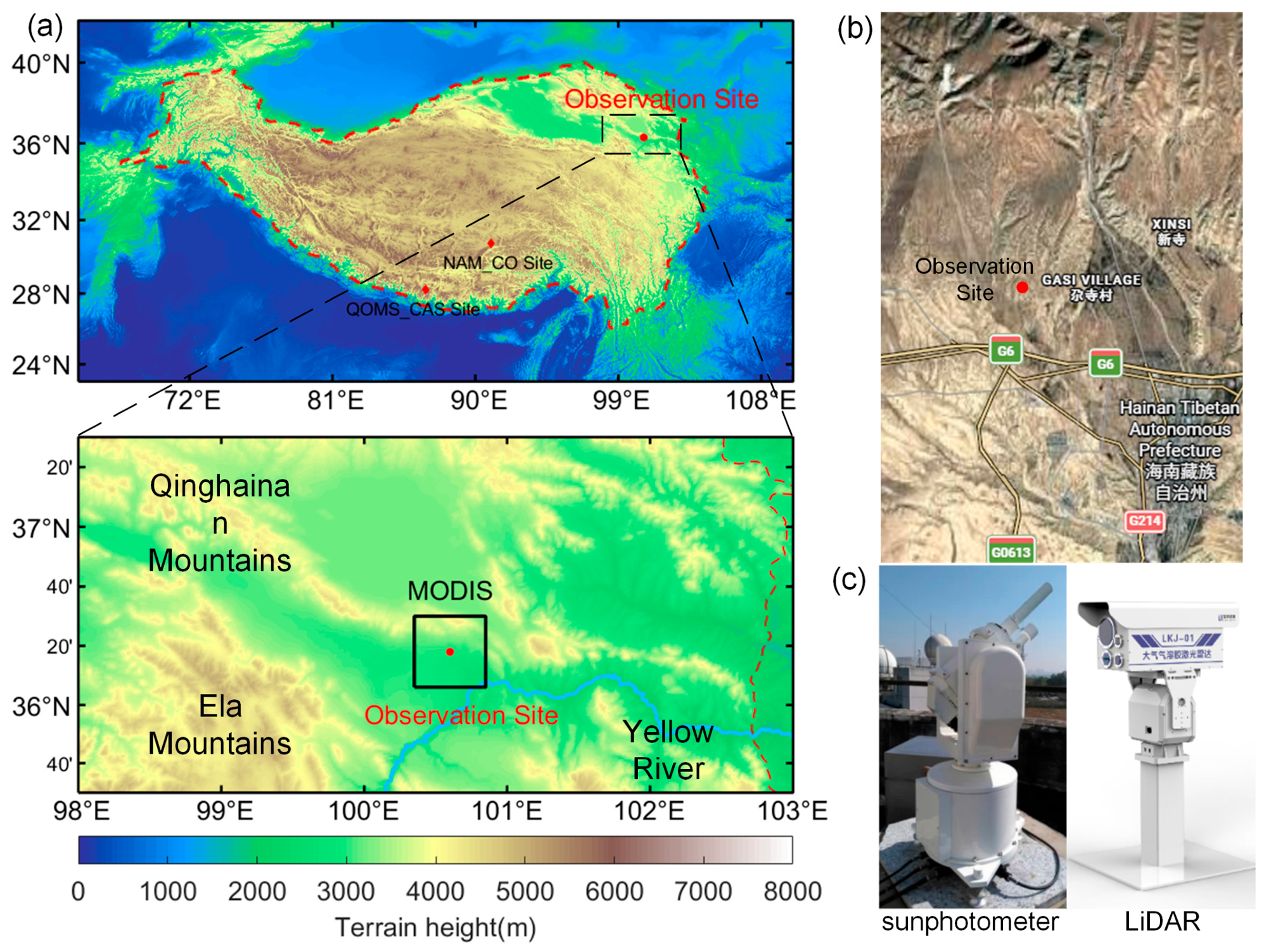
The observation site was located in the Hainan Tibetan Autonomous Prefecture, Qinghai Province, China (100.6°E, 36.3°N, 3200 m a.s.l.; hereafter referred to as “HN Prefecture”) (Figure 1). HN Prefecture is situated in the northeastern TP, approximately 250 km from its nearest edge. The site lies within an open alpine desert grassland, bordered by the Qinghainan Mountains to the north, the Yellow River to the southeast, and the Ela Mountains to the southwest [23]. The G6 Expressway, located 2.2 km south of the observation site, serves as a major transportation route crossing the TP. The nearest county town is 15 km away, ensuring that industrial emissions do not affect the site. Consequently, this location is particularly well-suited for characterizing background atmospheric aerosol characteristics. The red dashed line in Figure 1 delineates the boundary of the TP [24], while the black rectangle marks the selected 0.5° × 0.5° (55.6 km × 55.6 km) area for satellite retrieval analysis.

2.2. Ground-Based Observations

2.2.1. Sunphotometer Data

The field measurement campaign was conducted from January to August 2023. Due to interruptions caused by adverse weather conditions and instrument malfunctions, 65 days of high-quality data were obtained over the study period. The distribution of valid observational data is summarized in Table S1. The sunphotometer employed in this study was the ISP02 model, independently developed by the Anhui Institute of Optics and Fine Mechanics. The instrument was set to automatically power on and initiate measurements after sunrise, and to shut down after sunset, with a measurement interval of 1 min. It measures direct solar radiation at eight specific wavelengths spanning the visible to near-infrared spectrum: 400 nm, 500 nm, 610 nm, 670 nm, 780 nm, 870 nm, 940 nm, and 1050 nm [25]. These measurements are then used to retrieve key atmospheric parameters, including atmospheric transmittance and AOD. However, anomalous variations in atmospheric transmittance at 940 nm were observed, as shown in Figure S1. As a strong absorption band for water vapor, the 940 nm near-infrared channel is utilized for the retrieval of precipitable water vapor (PWV) [26].
The fundamental principle of the sunphotometer is based on the Beer–Lambert–Bouguer law [27,28]:
E ( λ ) = E 0 ( λ ) R 2 exp ( m τ ( λ ) )
where E(λ) is the measured irradiance at the Earth’s surface for wavelength λ, E0(λ) is the direct solar irradiance at the top of the Earth’s atmosphere for wavelength λ, R−2 is the sun–earth distance correction factor, which is the square of the ratio of the actual sun–earth distance to the average sun–earth distance, m is the optical air masses, given by secant of the zenith angle, τ(λ) is the total optical depth. The total optical depth is influenced by multiple factors, including Mie scattering by aerosols, Rayleigh scattering by air molecules, and absorption by water vapor and other gases [29]. The sunphotometer was calibrated using the improved Langley calibration method, from which AOD was retrieved, as detailed in Text S1 [30,31].
The relationship between the retrieved AOD and wavelength is presented below [32,33]:
τ a ( λ ) = β × λ α
ln τ a ( λ ) = α ln ( λ ) + ln ( β )
where τa(λ) is the AOD at the wavelength λ, α is the AE, and β is the turbidity coefficient. The parameter α serves as an indicator of aerosol particle size, with higher values indicating a greater proportion of fine particles, such as those from combustion or urban emissions. In contrast, β represents the aerosol loading, where larger values correspond to higher mass concentrations of particulate matter [34]. The α and β values are calculated by applying the least squares method to Equation (3) across the wavelength range of the sunphotometer. Given known values of α and β, Equation (2) is used to interpolate the AOD at 550 nm. The sunphotometer AOD hereafter refers to the 550 nm wavelength.

2.2.2. LiDAR Data

During sunphotometer measurements, ground-based LiDAR observations were conducted simultaneously as a component of the comprehensive AOD measurement campaign. The LiDAR (LKJ-01, Anhui Lanke, Hefei, China) operated at a wavelength of 1024 nm with a pulse repetition rate of 3000 Hz. The LiDAR provided vertical profiles of the aerosol extinction coefficient from 0.0075 km to 10 km altitude, with a vertical resolution of 7.5 m and a temporal resolution of 5 min. At near ranges, the transmitted laser beam and the field of view of the receiving telescope in a LiDAR system may not fully overlap, leading to anomalous signal strength in the received data [35,36]. To avoid the influence of this near-range “blind zone,” the actual extinction profiles employed in this study begin at a height of 0.3 km.

2.2.3. Quality Control

The sunphotometer used in this study, the ISP02, is equipped with an optical solar tracking system that automatically initiates and terminates measurements based on sunrise and sunset times, ensuring data collection only when the solar zenith angle is below 70°. This operational constraint minimizes calibration uncertainties. A rain sensor is integrated into the ISP02 to guarantee that data collection occurs only under clear-sky conditions. Additionally, the optical windows of both the sunphotometer and the LiDAR are cleaned regularly to minimize measurement biases caused by dust accumulation.
Sunphotometer data were processed through time-series analysis to identify and remove extremely high values and outliers caused by cloud contamination. Specifically, a sliding window of 10 samples with a step size of 10 samples was applied to calculate the coefficient of variation (CV) of AOD within each window, defined as the ratio of the standard deviation to the mean. Any window with a CV exceeding the threshold of 0.1 was flagged as cloud-affected, and the corresponding data were excluded from subsequent analysis. Vertical extinction profiles from LiDAR during cloud-affected periods were also excluded.

2.3. Satellite Products and MERRA-2 Dataset

2.3.1. MODIS Products

The Moderate Resolution Imaging Spectroradiometer (MODIS) is a key remote sensing instrument aboard the Terra and Aqua Earth-observing satellites [37]. MODIS measures across 36 spectral bands, covering wavelengths from the visible to the thermal infrared. MODIS products enable global coverage once daily, providing key parameters such as AOD and the normalized difference vegetation index (NDVI) [38]. Two predominant methods are widely used for retrieving AOD from MODIS remote sensing data: the Deep Blue (DB) algorithm and the Dark Target (DT) algorithm [39]. The DB algorithm operates in the blue spectral band and focuses on bright surfaces such as deserts. Although these surfaces are highly reflective overall, they exhibit relatively low reflectivity at blue wavelengths [40]. The DT algorithm retrieves AOD by estimating surface reflectance in shortwave infrared bands, which is then extrapolated to the visible spectrum using an empirical relationship [41]. The satellite AOD data used in this study were obtained from the MOD04 (Terra) and MYD04 (Aqua) products, which employ the DB and DT algorithms. Detailed information on the satellite data used in this study is provided in Table S2.

2.3.2. MERRA-2 Dataset

NASA’s Modern Era Retrospective Analysis for Research and Applications, Version 2 (MERRA-2), represents the latest generation of reanalysis products, integrating satellite observations with advanced modeling and data assimilation techniques [42]. This comprehensive dataset enables a consistent, long-term perspective on atmospheric composition and processes, supporting a wide range of climate and environmental studies [43]. This study utilized the MERRA-2 reanalysis dataset, which provided AOD and AE at a 1 h temporal resolution during the ground-based observation periods. The dataset also included monthly records spanning from 2006 to 2025 at a spatial resolution of 0.5° × 0.625°, as detailed in Table S2.

2.3.3. Match Methods

Due to temporal and spatial discrepancies between satellite-derived data and ground-based measurements, spatiotemporal matching is required before validation. For MODIS products, the following procedure was applied to match with ground observations. For spatial matching, all satellite retrieval pixels within a 0.5° × 0.5° box centered on the ground observation site were averaged. Subsequently, temporal matching was performed by averaging ground-based measurements within a ±30 min window centered on the satellite overpass time [44,45]. For MERRA-2, which has a 1 h temporal resolution, temporal matching was performed using hourly averaged ground-based AOD measurements. Its spatial resolution (0.5° × 0.625°) was considered sufficient to meet the requirements for spatial matching.
To evaluate the accuracy of the satellite and reanalysis products, several statistical metrics were employed, including the correlation coefficient (R), root mean square error (RMSE), normalized root mean square error (NRMSE), mean absolute error (MAE), and relative mean bias (RMB), as detailed in Equations (4)–(8). The RMSE and MAE quantify the aggregate magnitude of error between the retrieved and observed values. The NRMSE is a normalized version of the RMSE, facilitating the comparison of errors across different variables or datasets. The RMB indicates whether the retrievals are systematically overestimated or underestimated [19,46]. The expected error (EE) for AOD (AODEE) and for AE (AEEE) is defined in Equations (8) and (9), respectively [17]. The validation criterion is generally considered satisfied if the percentage of data points falling within the EE envelope exceeds the threshold of 66.7% [22].
R = i = 1 n ( X i X ¯ ) ( Y i Y ¯ ) i = 1 n ( X i X ¯ ) 2 i = 1 n ( Y i Y ¯ ) 2
R M S E = 1 n i = 1 n ( Y i X i ) 2
N R M S E = R M S E X ¯
M A E = 1 n i = 1 n | Y i X i |
R M B = 1 n i = 1 n Y i X i
A O D E E = ± ( 0.05 + 20 % × A O D g r o u n d )
A E E E = ± ( 0.05 + 44 % × A E g r o u n d )
where n is the number of matched data pairs; Xi and Yi are the ground-based sunphotometer observation and the satellite/reanalysis products, respectively; X ¯ and Y ¯ are the mean values of the ground-based sunphotometer and the satellite/analysis observations.

3. Results and Discussion

3.1. Characteristics of Sunphotometer Observations

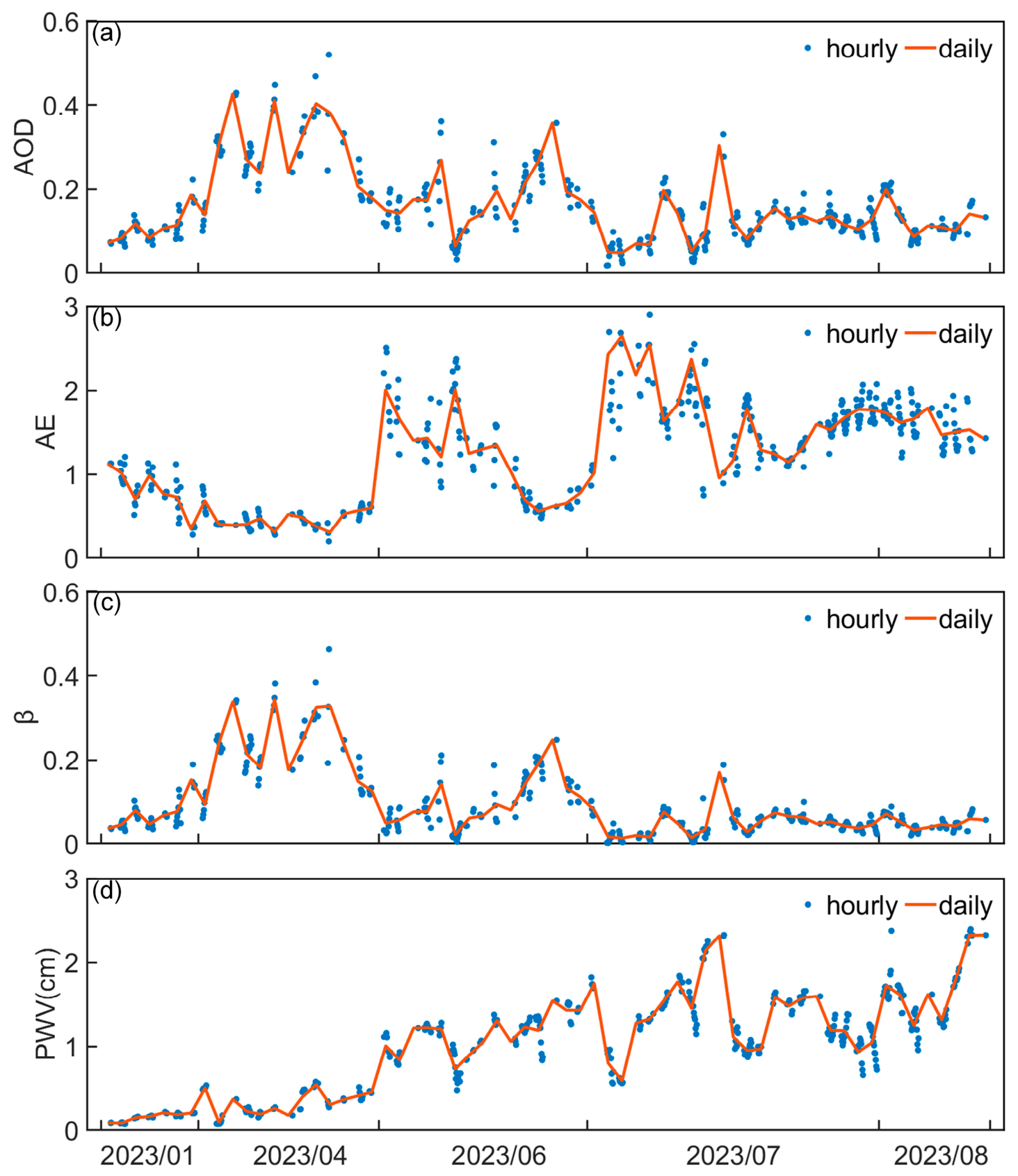
During the entire observation period, a total of 446 h of clear-sky sunphotometer data spanning 65 days were obtained, distributed across January, April, June, July, and August of 2023. Figure 2 presents the time series of hourly and daily averaged sunphotometer data. The hourly average AOD fluctuated between 0.02 and 0.52, with an average value of 0.15 ± 0.08 (Figure S2). The daily mean values of AE and β ranged from 0.19 to 2.90 and 0.01 to 0.46, respectively, while their overall mean values were 1.20 ± 0.61 and 0.09 ± 0.07 (Table S3). A significant negative correlation was observed between AOD and AE (R = −0.72, p < 0.01), whereas a strong positive correlation was found between AOD and β (R = 0.97, p < 0.01), as shown in Figure S3. AOD and β exhibited consistent temporal trends, jointly reflecting variations in atmospheric pollution levels. Increasing AOD alongside decreasing AE suggests that a rise in coarse-mode aerosols contributes to elevated pollution loading.
The AOD and AE observations from HN Prefecture were compared with data from other sites across Asia, as summarized in Table 1. Although these observations were collected under varying environmental conditions and using different instruments, they contribute to a more comprehensive understanding of aerosol optical properties over the TP. In densely populated urban and rural areas—such as Hong Kong [20] and Shouxian in China [47]—the average AOD was more than three times higher than that observed in HN Prefecture. Aerosol loading at Issyk-Kul Lake in the Central Asian mountains [48] and at the Mt. Waliguan baseline station [49] is comparable to the levels observed in HN Prefecture. However, significantly lower AOD values, typically below 0.1, were observed in the higher-altitude Nagqu region of the central TP [50,51]. Regarding AE, HN Prefecture exhibited lower values compared to Hong Kong and Shouxian. This is attributable to the higher proportion of fine-mode particles generated by anthropogenic activities in those urban areas [52]. Meanwhile, the AE value at HN Prefecture was substantially higher than that at the Mt. Waliguan baseline station, reflecting the presence of fine particles and indicating a greater diversity of aerosol sources. Overall, AOD in HN Prefecture is relatively low, reflecting a comparatively clean atmospheric background condition.
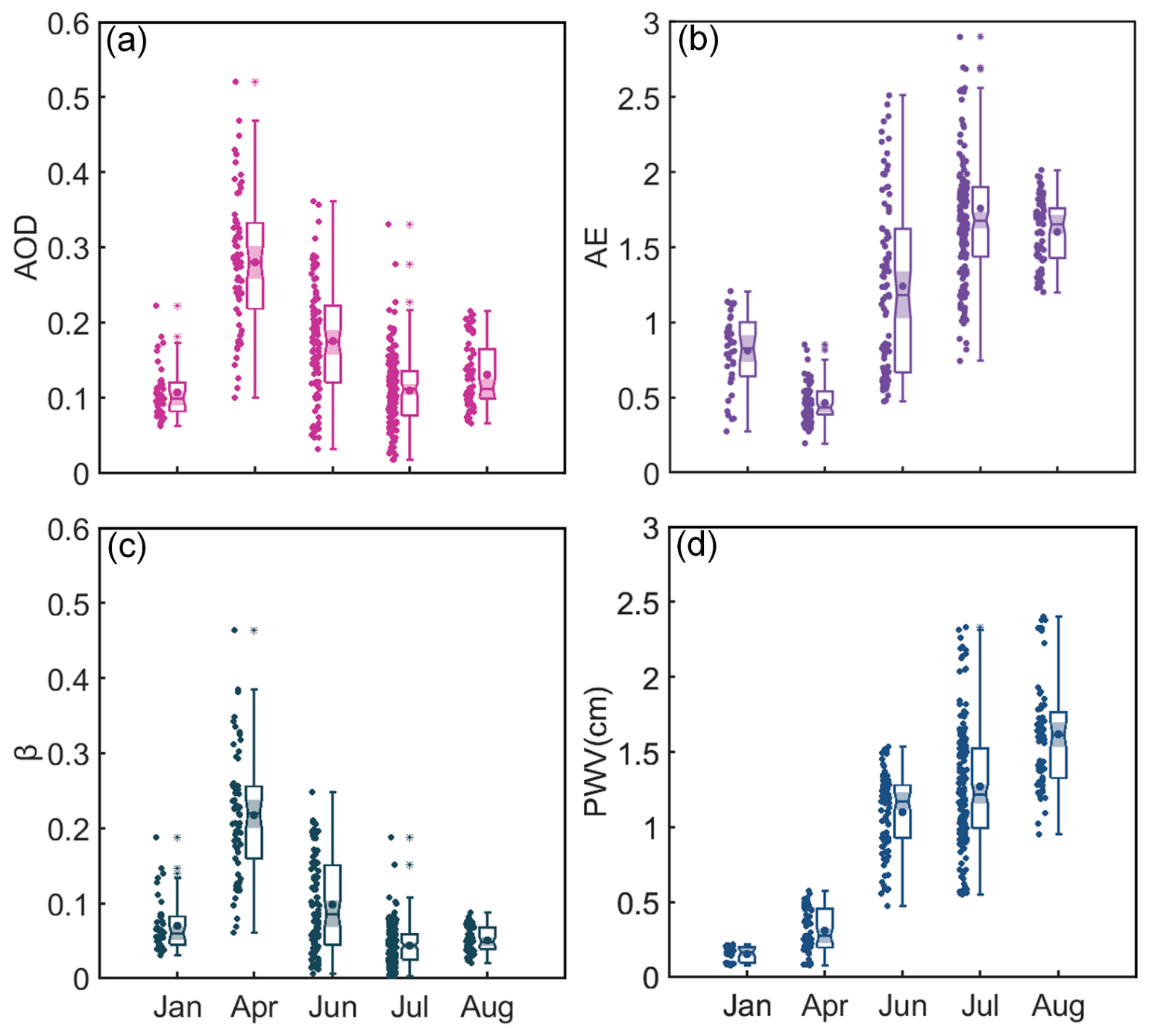
The monthly variation in sunphotometer data is shown in Figure 3. During the observation period, the monthly mean AOD reached a peak of 0.28 in April, with the highest standard deviation (0.09) among all months (see Table S3 for details). This not only indicates an increase in aerosol loading but also suggests that the fluctuations were most pronounced in April. This is consistent with other observational studies conducted over the TP [53]. Concurrently, AE dropped to its lowest value (0.46 ± 0.13) with the smallest variability, indicating that HN Prefecture in April was predominantly influenced by coarse-mode aerosols, such as mineral dust [54]. In July, the mean AOD and AE were 0.11 ± 0.05 and 1.76 ± 0.58, respectively, making July the month with the lowest AOD and the highest AE during the observation period. This indicates that fine-mode particles constitute the largest proportion in July, likely influenced by anthropogenic aerosols. Studies on secondary inorganic aerosols in the northeastern TP during summer have shown that they originate primarily from the transboundary transport of urban aerosols emitted from low-altitude cities [55].
As shown in Figure 2d, the hourly mean PWV during the observation period ranged from 0.08 to 2.39 cm, with a mean value of 1.04 ± 0.57 cm. From January to August, PWV exhibited a distinct increasing trend, with the highest values observed during the monsoon period (Figure 3d). The average monthly PWV in August reached 1.62 ± 0.35 cm, approximately ten times the value observed in January (Table S3). This indicates that August is the most humid month of the year, which facilitates the deposition and removal of particulate matter from the atmosphere. At Delingha in the northern TP, the highest PWV values are typically observed in summer, consistent with the seasonal variation pattern observed in HN Prefecture [56].
Table 1. Comparison of aerosol optical properties over different sites (values in parentheses in the AOD column correspond to wavelengths).
LocationInstrumentEnvironmentAODAEPWVPeriodReference
Hong Kong, ChinaCE318 sunphotometerDowntown area0.46
(500)
1.34
(440–675)
\2006–2013[20]
Shouxian, ChinaCE318 sunphotometerRural town0.50
(550)
1.22
(440–675)
\January 2016–December 2017[47]
Issyk-Kul Lake,
Kyrgyzstan
CE318 sunphotometerMountainous region0.14
(500)
1.19
(440–870)
\August 2007–November 2021[48]
Mt. Waliguan,
China
CE318 sunphotometerNortheastern TP0.14
(500)
0.59
(440–870)
\September 2009–August 2010[49]
Naqu, Chinahand-held Microtops II sunphotometerCentral TP<0.1
(500)
\\August 2011[50]
Nam Co, ChinaCE318 sunphotometerCentral TP0.05
(500)
\\2009–2017[51]
Delingha, Chinasky radiometerNorthern TP\\1.31 cmJun–Aug 2012[56]
HN Prefecture, ChinaISP02 sunphotometerNortheastern TP0.15
(550)
1.201.62 cmApril–August, 2023This study

3.2. Vertical Distribution of Aerosol Extinction

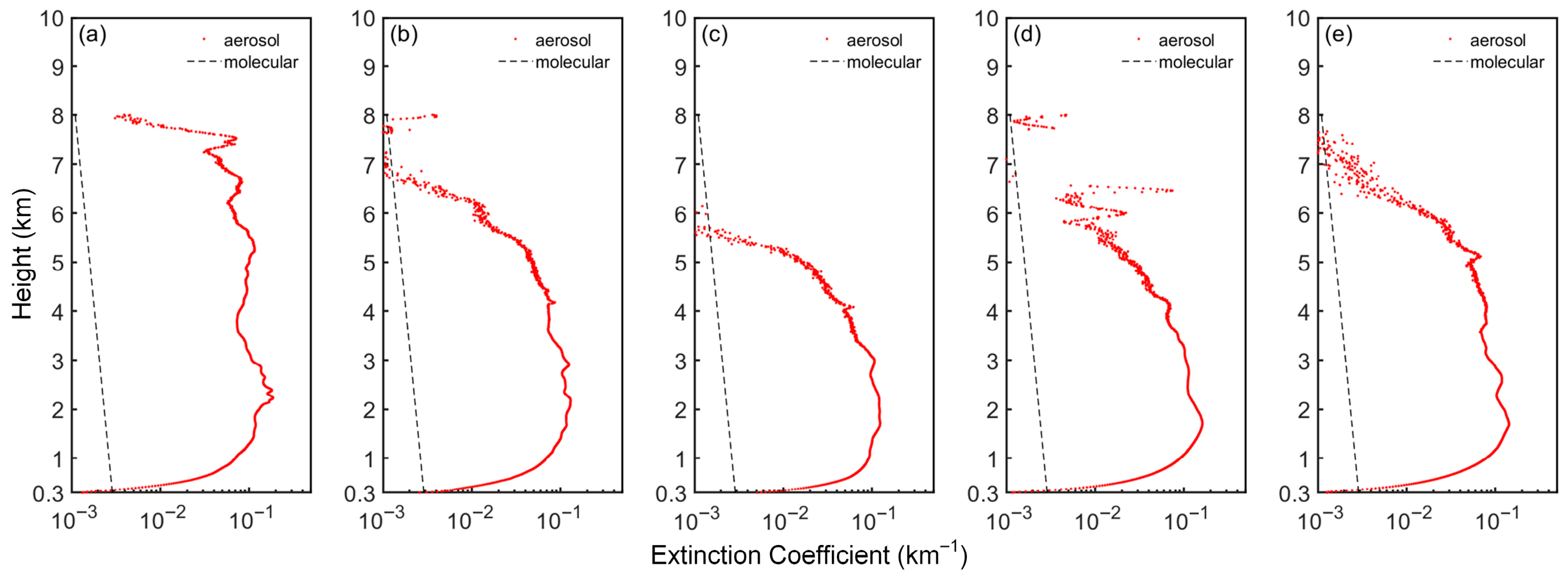
AOD is defined as the integral of the aerosol extinction coefficient over the entire vertical atmospheric column [7]. The fine vertical structure of the atmosphere can be obtained from high-vertical-resolution extinction profiles retrieved from LiDAR measurements. Moreover, these profile data can detect unique aerosol layers and analyze their temporal evolution, including cloud cover, residual tropospheric pollutants [12], and stratospheric volcanic ash [57]. Figure S4 displays the full diurnal variation in the vertical distribution of the extinction coefficient in HN Prefecture, clearly revealing the masking effect of cloud cover. Figure 4, however, compares the vertical distributions of hourly averaged aerosol extinction coefficients under cloud-free conditions during five time intervals: 07:00–08:00, 10:00–11:00, 12:00–13:00, 15:00–16:00 and 18:00–19:00 local time.
The most fundamental distribution pattern of aerosol extinction profiles is an exponential decrease. It is characterized by the extinction coefficient reaching its maximum value near the Earth’s surface, followed by a steep decline with increasing height in an exponential or approximately exponential manner [58]. In a logarithmic coordinate plot, this pattern appears as an approximately straight line, similar to the vertical profile of the molecular extinction coefficient represented by the black dashed line in Figure 4. Clearly, the extinction profiles over the TP depart from this simple exponential decay pattern, rather exhibiting a more complex vertical structure. Another common extinction profile pattern is the well-mixed type. In this pattern, the extinction coefficient varies gradually within the boundary layer with no distinct peak, followed by a sharp decrease above the boundary layer [59,60]. However, observations at HN Prefecture show that the extinction coefficient is relatively low near the surface, gradually increases with altitude, and peaks at approximately 2 km. For instance, during the noon period, the peak extinction coefficient occurs at 1.7 km with a value of 0.12 km−1. Above this height, the extinction coefficient gradually decreases with increasing altitude. This profile type, in which the peak extinction coefficient occurs at higher altitudes due to the combined effects of topographic and thermal lifting over the TP, is referred to as the elevated type. An elevated profile structure suggests that aerosols originate from long-range transboundary transport [61]. This study further reveals distinct diurnal variations in aerosol extinction profiles. Compared with the extinction profiles at 07:00 and 18:00, the noon profile exhibits a steeper vertical gradient, with the extinction coefficient decreasing more rapidly with height above the peak height. The extinction coefficient becomes negligible above 6 km during the noon period. This can be attributed to the strongest solar heating at noon, which drives the most intense aerosol diffusion.

3.3. Validation of Retrieved Data Against Observation

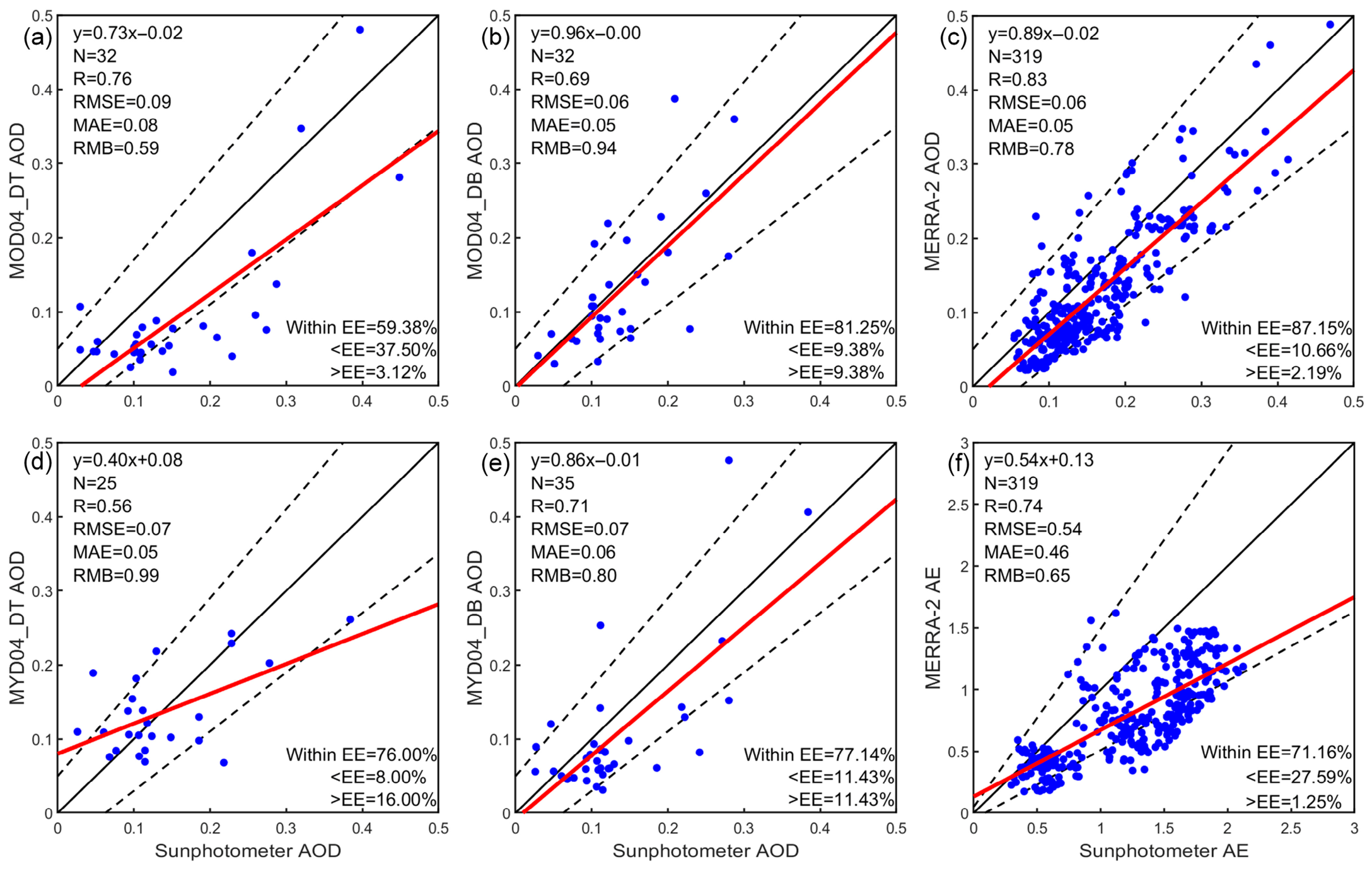
Figure 5 and Table 2 present a comparison of AOD and AE derived from multiple retrieval methods against ground-based observations in HN Prefecture. As outlined in Section 2, the Terra and Aqua satellites have a single daily overpass. Of the 65 valid daily observations collected by the sunphotometer, only approximately half could be successfully matched with MODIS 550 nm AOD retrievals. For instance, the number of matched data pairs for the MYD04 DB and DT products from Aqua was 25 and 35, respectively. By contrast, the hourly MERRA-2 dataset yielded a substantially higher number of matches, with 319 matched data pairs obtained for AOD and AE. Due to limitations in orbital coverage and the challenges of remote sensing over plateau regions, satellite retrievals typically yield a lower match rate with ground-based observations compared to MERRA-2.
Except for the MOD04_DT product (RMB = 0.59), all other products exhibited RMB values around or above 0.80. This indicates a substantial underestimation of AOD by MOD04_DT relative to ground-based observations, with the bias magnitude exceeding acceptable margins. Although the MYD04_DT product exhibited the highest RMB of 0.99, its linear regression yielded an intercept of 0.08 and a modest correlation coefficient of 0.56. The overall validation results suggest that the performance of MYD04_DT is limited. Therefore, a comprehensive performance evaluation across multiple metrics demonstrates that the DB algorithm achieves superior accuracy compared to the DT algorithm. It is recommended that the DB algorithm be prioritized in the TP arid regions to enhance the accuracy and reliability of AOD products.
A comparative analysis was conducted on MODIS-derived AOD products from the Terra (MOD04) and Aqua (MYD04) satellites. The Terra and Aqua satellite products exhibit highly similar performance, with R values of 0.69 and 0.71 and RMSE values of 0.06 and 0.07, respectively. Compared to Aqua, Terra (MOD04) showed better agreement with ground-based observations, exhibiting a higher RMB (0.94) and a larger proportion of matched pairs falling within the EE envelope (81.25%). MODIS aerosol products achieve better overall performance in other parts of Asia than over the TP [62]. This may be primarily attributed to the limited availability of valid matchable data and constrained temporal windows. Additionally, the generally low AOD over the TP increases the sensitivity of the retrieval algorithm to surface reflectance, consequently affecting the accuracy of the MODIS products [63].
Compared to the MODIS product, the MERRA-2 reanalysis yields better consistency with ground-based observations, attributable to its integration of modeling and data assimilation. For the MERRA-2 AOD product, R, RMSE, and RMB were 0.83, 0.06, and 0.78, respectively (Table 2). A total of 87.15% of AOD values fell within the EE envelope. The AE values from MERRA-2 typically ranged between 0 and 1.5, exhibiting a lower correlation (0.74) with ground-based observations compared to AOD. Additionally, the RMSE and RMB were 0.54 and 0.65, respectively, with 71.16% of data falling within the EE envelope. The proportion of MERRA-2 data within the EE envelope meets the predefined threshold criteria [22]. Although MERRA-2 exhibited systematic underestimations of approximately 22% for AOD and 35% for AE, it remains more accurate and reliable than other satellite data products. Consequently, the MERRA-2 reanalysis dataset was selected as the basis for all further analyses.

3.4. Identification and Classification of Aerosol Types

3.4.1. Aerosol Type Identification Based on AOD and AE

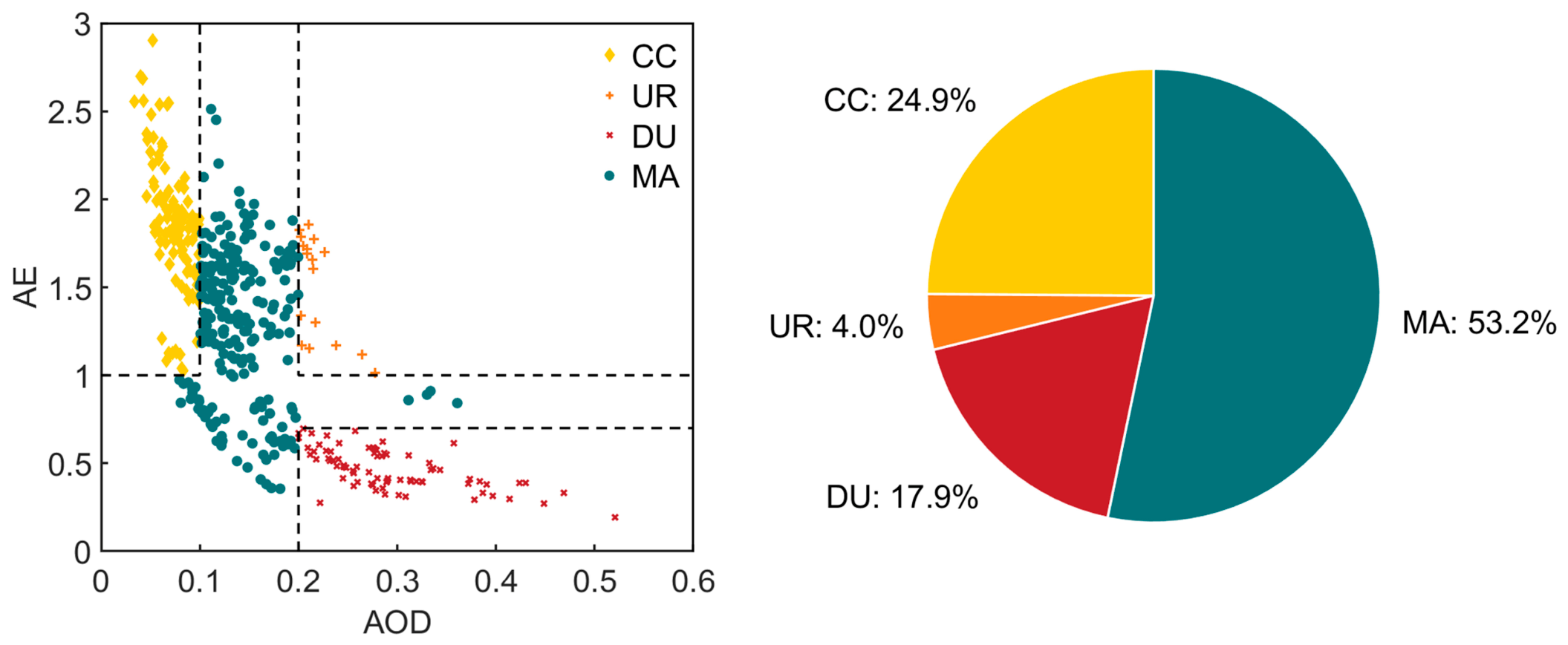
Based on previous studies, this study established aerosol classification criteria using the relationship between hourly averaged AOD and AE, with thresholds adjusted according to local conditions [48,51]. Aerosol cases were classified as follows: dust aerosols (DU) for AOD > 0.2 and AE < 0.7; urban aerosols (UR) for AOD > 0.2 and AE > 1; and clean continental aerosols (CC) for AOD < 0.1 and AE > 1. All remaining cases were classified as mixed aerosols (MA). As illustrated in Figure 6, the aerosol classification for HN Prefecture reveals that MA is the predominant type, comprising 53.2% of the total observations. This is followed by DU (24.9%), CC (17.9%), and UR (4.0%) in descending order of contribution. Human activity is sparse over the TP, resulting in the lowest proportion of UR, such as those from biomass burning. In contrast, anthropogenic aerosols dominated in the low-altitude city of Lanzhou, located only about 270 km away [64]. This highlights the role of plateaus in isolating regional pollution.
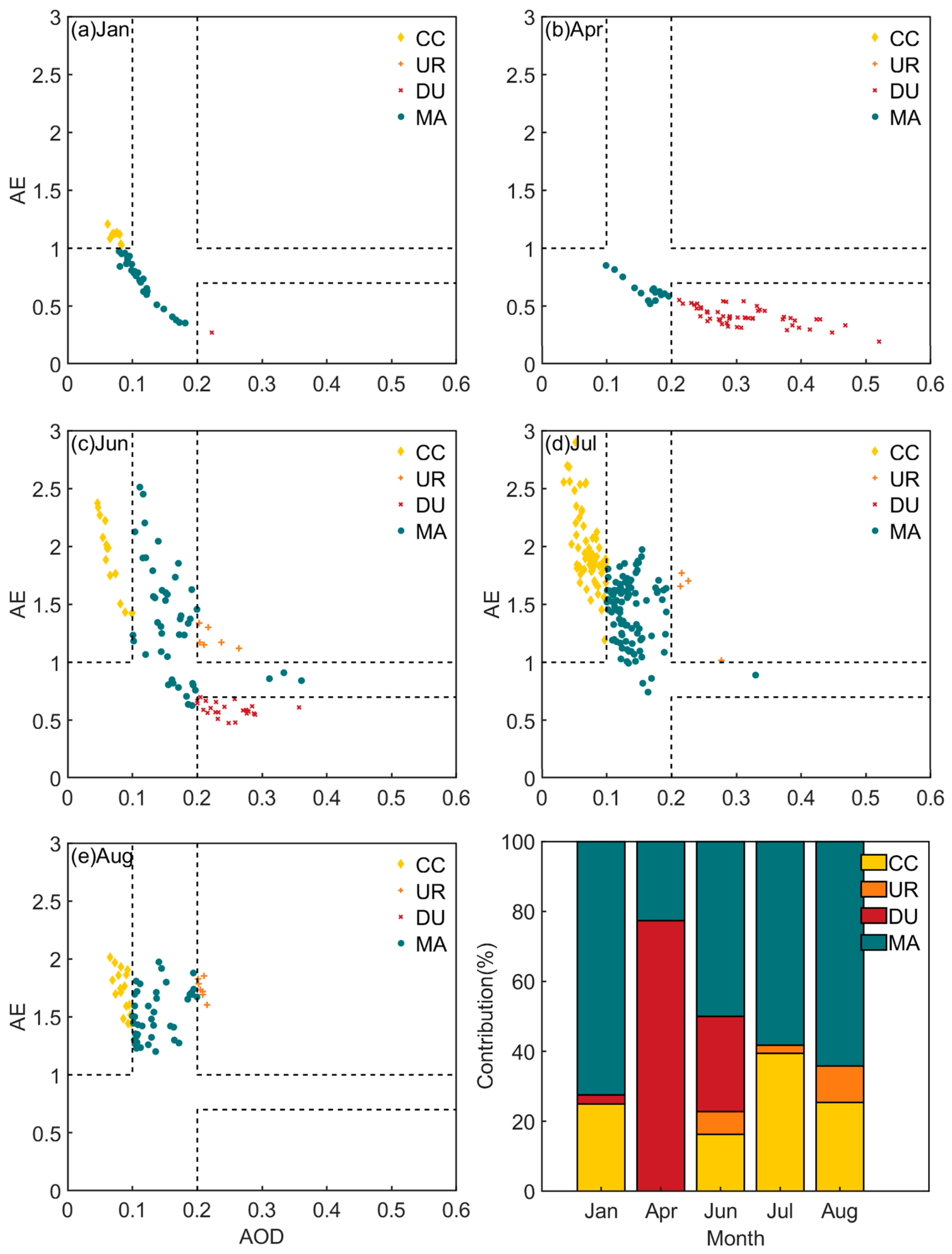
Aerosol type identification and their monthly contributions were also analyzed, as shown in Figure 7 and Figure S5. Except in April, MA consistently constituted more than half of the total, resulting from the combination of anthropogenic and natural aerosols. Its proportion peaked at 72.5% in January and dropped to a minimum of 22.7% in April. CC represented the background aerosol levels over the TP and accounted for more than a quarter of the total aerosol composition each month except April. In July, CC accounted for 39.4% of the total, whereas this aerosol type was absent in April. April was the most distinctive month, as DU dominated the atmosphere during this period, accounting for 77.3% of the total. Dust particles may originate from wind-blown soil in local arid regions or be transported from more distant desert sources, such as the Taklamakan Desert [65,66]. In July and August, DU was nearly absent from the atmosphere. This is most likely attributable to the seasonal peak in PWV during this period, when the moist atmosphere significantly suppresses both the generation and uplift of dust particles. Overall, April is characterized by the dominance of long-range transported mineral dust. In contrast, other seasons are primarily dominated by a combination of CC and MA, reflecting the pristine atmospheric conditions of HN Prefecture with minimal anthropogenic interference.

3.4.2. AOD and AE Comparison for Different Aerosol Types

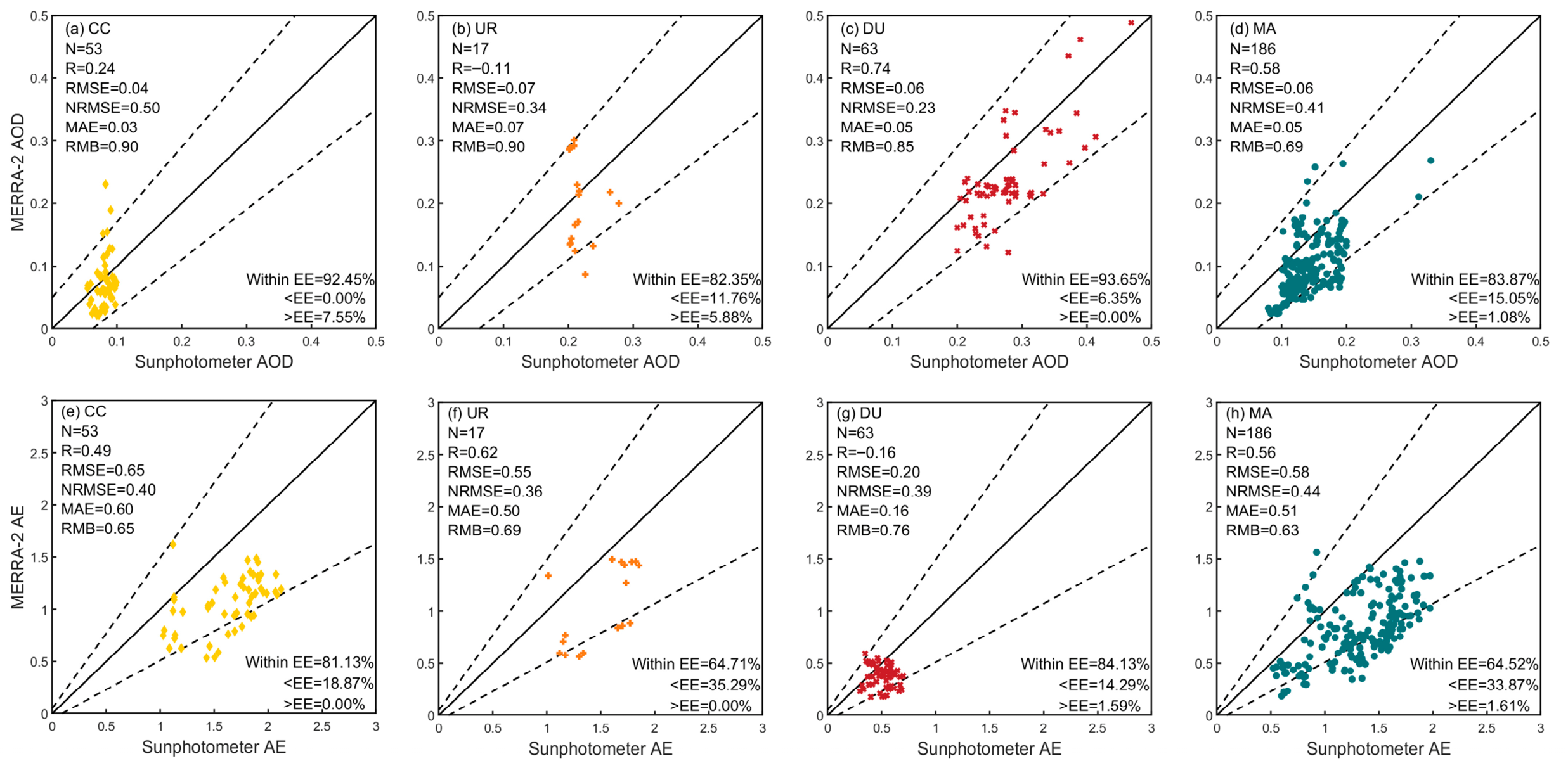
This study compares ground-based observations with reanalysis datasets for AOD and AE corresponding to the four aerosol types, as shown in Figure 8. For AOD, the best validation performance and highest agreement between ground-based measurements and the reanalysis dataset were achieved for DU, as indicated by the strongest correlation, with an R value of 0.74. Normalized error analysis revealed that DU exhibited the lowest NRMSE among all aerosol types, with a value of 0.23. As summarized in Table S4, CC and MAs exhibited the poorest AOD consistency among all types, with corresponding NRMSE values of 0.50 and 0.41, respectively. For both reanalysis and satellite-retrieved AOD, lower AOD levels are generally associated with higher retrieval errors. The high AOD characteristic of DU contributes to more accurate retrievals.
In contrast to AOD, the consistency between the reanalysis dataset and ground-based sunphotometer AE is significantly lower. This performance decline is evidenced by consistently higher NRMSE values, all exceeding 0.3. The AE retrievals showed limited variation across aerosol types, with UR achieving the lowest NRMSE (0.36) and MA the highest (0.44). Overall, the DU demonstrated the highest reliability in both AOD and AE estimations, while the UR yielded the most accurate AE results. Notably, the reanalysis dataset exhibited a systematic bias, consistently underestimating the observed values across all aerosol categories.

3.5. Long-Term Variations in Aerosol Optical Properties

3.5.1. Long-Term Interannual and Monthly Variations

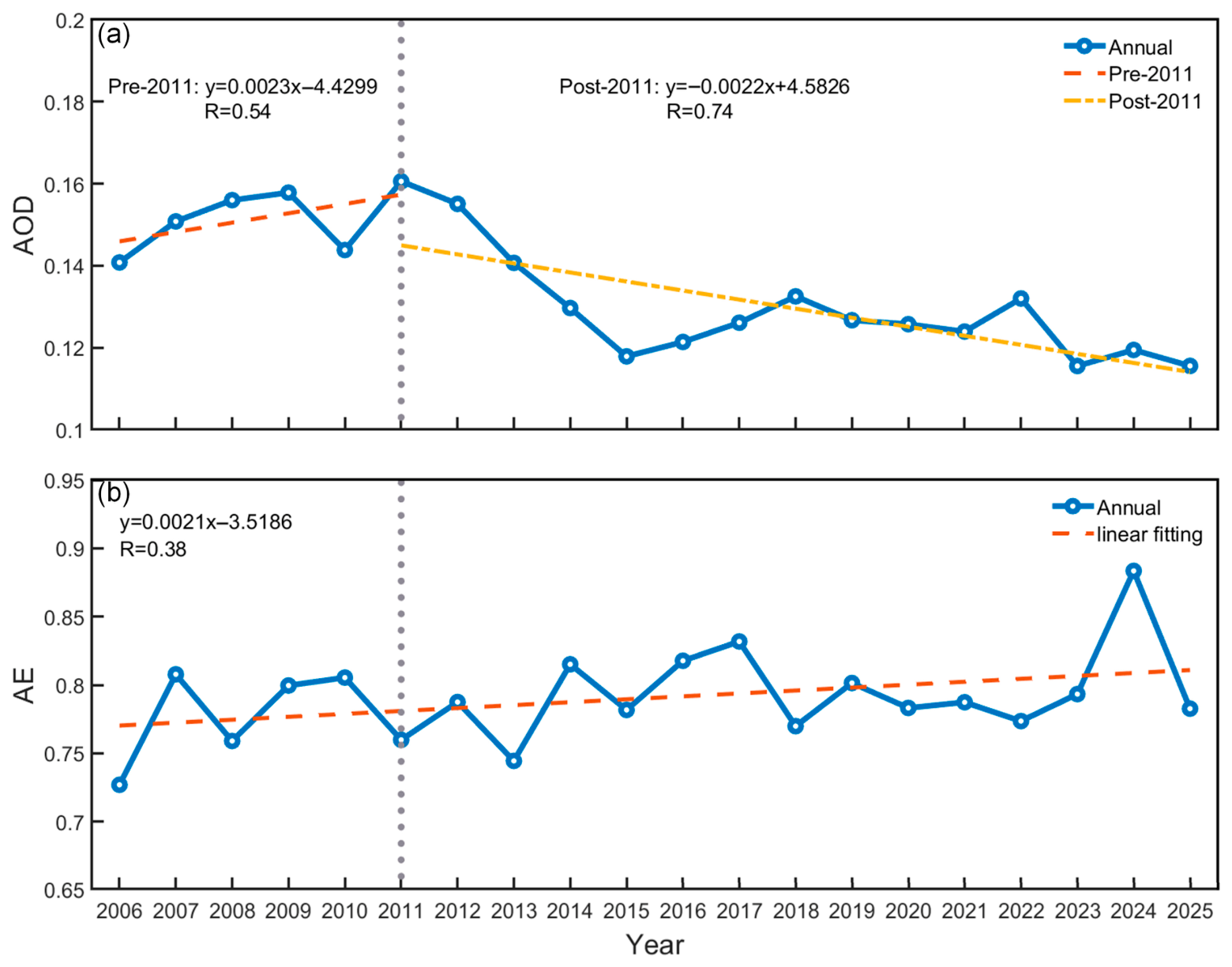
As the previous section has already evaluated the accuracy and reliability of the reanalysis dataset in HN Prefecture, a further analysis of the long-term trends in aerosol optical parameters over 20 years from 2006 to 2025 was conducted using the MERRA-2. As shown in Figure 9, the trend in AOD can be divided into two distinct phases, with 2011 as the turning point. From 2006 to 2011, AOD exhibited a gradual increase at a rate of 0.0023 per year (R = 0.54, p < 0.05), reaching a peak annual mean of 0.1606 in 2011. After 2011, AOD showed a steady downward trend, decreasing at a rate of 0.0022 per year (R = −0.74, p < 0.01) to an annual mean of 0.1156 by 2025. Overall, the annual average AOD in HN Prefecture from 2006 to 2025 was 0.1346 ± 0.0146, exhibiting a gradual declining trend. The turning point in the AOD trend coincides closely with the implementation of China’s 12th Five-Year Plan (2011–2015). During this period, the Chinese government implemented stricter policies on energy conservation and air pollution control, which explains the observed AOD reduction over the TP. In contrast to the long-term trend observed for AOD, AE exhibited an overall upward trend, with an annual mean AE of 0.7906 ± 0.0327. Linear regression analysis indicated a weak increasing trend of 0.0021 per year (R = 0.38, p < 0.05), with values rising from 0.7269 in 2006 to 0.7826 in 2025. During 2023–2025, AE exhibited significant interannual fluctuation, likely reflecting the significant impact of extreme weather events on aerosol sources and transport processes. Therefore, continued monitoring and analysis are warranted in future studies.
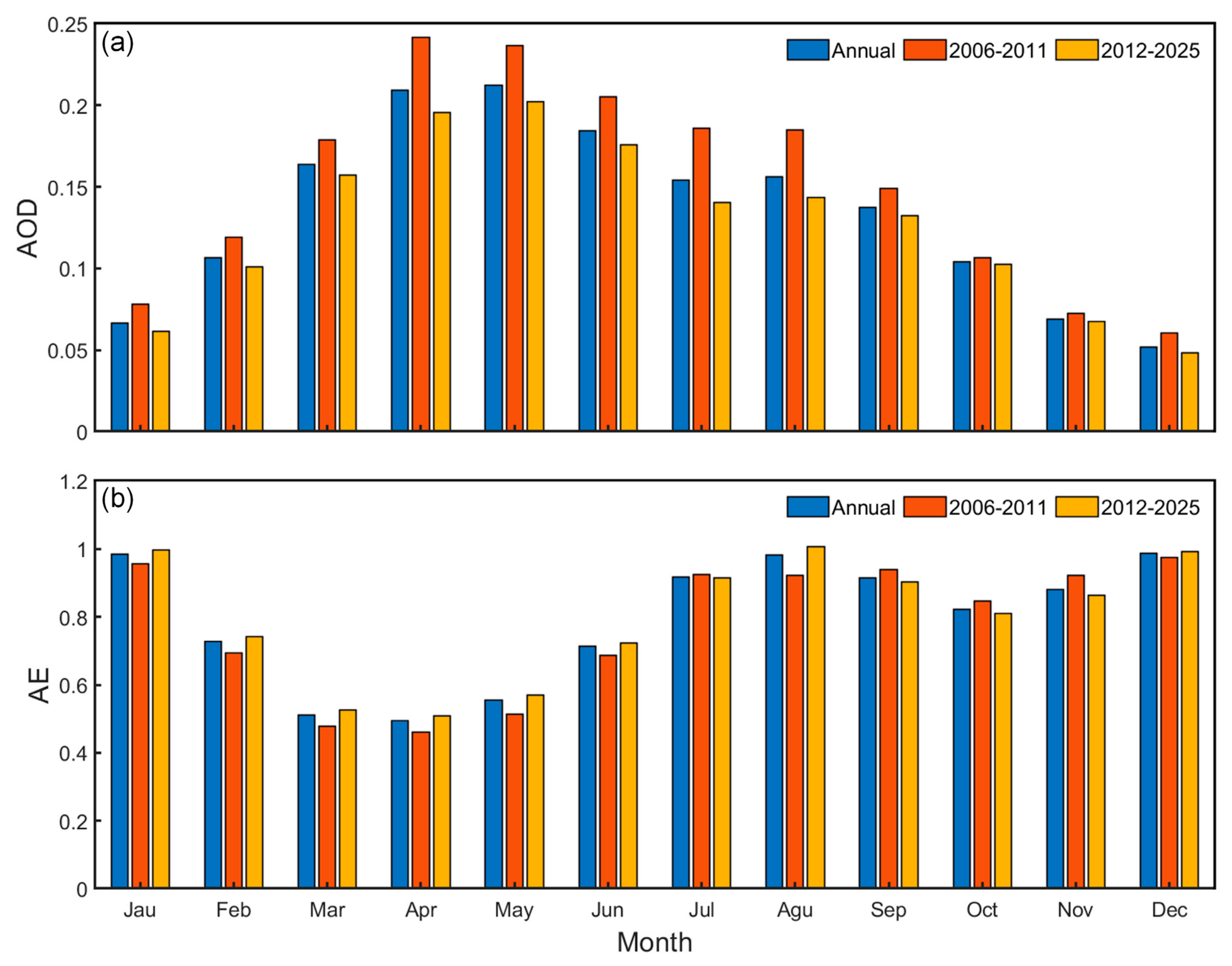
As shown in Figure 10, the monthly variation in AOD exhibits a unimodal distribution, with a peak of approximately 0.21 occurring in April and May, while the lowest value of about 0.05 is observed in December. The minimum and maximum AE occur in April and December, with values of approximately 0.49 and 0.98, respectively. As noted earlier, under the combined effect of favorable transport conditions and enhanced spring dust activity in April and May [67], AOD over the TP reaches its annual maximum during these months, while AE drops to its minimum. Due to the shallower boundary layer over the TP in winter, large-scale material exchange with the surrounding atmosphere is significantly limited [68], leading to AOD reaching its lowest level in winter. Additionally, the monthly average AE values from 2006 to 2011 and from 2012 to 2025 show a small difference, with a slight increase. The monthly mean AOD values during the 2012–2025 period are consistently lower than those before 2011, particularly in spring and summer. This suggests that dust control efforts implemented in China’s arid regions are beginning to yield positive results.

3.5.2. Long-Term Spatial Distribution

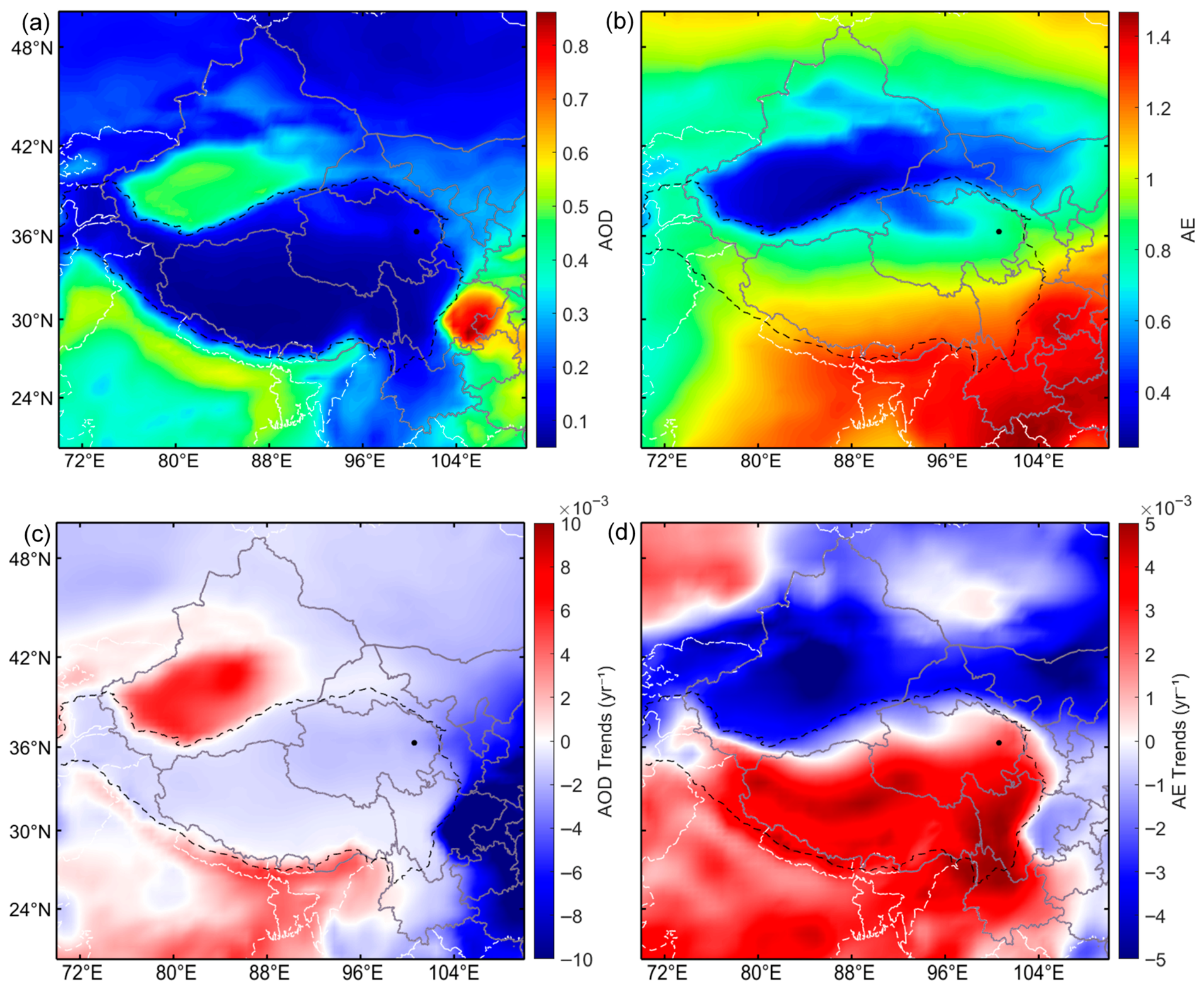
Based on the temporal analysis of aerosol optical parameters in HN Prefecture from 2006 to 2025, the spatial distributions of AOD and AE over the TP and its surrounding regions were also analyzed. Based on the spatial distributions of AOD and AE (Figure 11a,b), three major high-AOD regions can be identified surrounding the TP. To the north, the Taklimakan Desert corresponds to a source region for DU [69]. The Sichuan Basin (SCB) to the east and the Indo-Gangetic Plain (IGP) to the south are densely populated areas corresponding to UR source regions [70,71]. Due to the plateau’s dramatic elevation, the region of low AOD closely aligns with the geographical boundaries of the TP. This topography inhibits the transport of aerosol particles into the plateau interior, thereby creating a relatively independent atmospheric system. Within the plateau interior, AOD remains generally low and exhibits a relatively homogeneous spatial distribution, with no significant difference between values in the central and marginal regions. The spatial distribution of AE shows lower values in the north than in the south, due to the influence of distinct aerosol types in the two regions.
Figure 11c,d present the spatial distributions of the annual mean linear trends in AOD and AE, respectively. AOD over the TP exhibits a slight decreasing trend, while the SCB shows a significant decline at a rate exceeding 0.01 per year. AE over the TP exhibits a rising trend, with rates exceeding 0.004 per year in the southern TP. This increase is in close agreement with the trend observed over the IGP. This suggests that the decline in AOD over the TP is primarily attributed to the reduction in aerosol loading in inland China, while the increasing trend in AE over the TP reflects the influence of rising AE values in South Asia. The implementation of China’s environmental protection policies stands as one of the key drivers of atmospheric improvement over the TP.

4. Summary and Conclusions

This study investigated the AOD and vertical structure over the northeastern TP using the ground-based sunphotometer and LiDAR from January to August 2023. Long-term trends in optical properties over the TP were analyzed based on the validation and comparison of multiple retrieval datasets. The key findings are summarized as follows:
  • The observed average AOD of 0.15, coupled with over half of the contribution from mixed aerosol, confirms a clean atmospheric background in the northeastern TP. The highest aerosol loading and the lowest AE value occurred in April due to intensified dust activity originating from desert sources in the northern TP. August was marked by the highest PWV and an increased contribution from urban aerosol.
  • Unlike the typical exponential decay observed in low-altitude regions, the TP exhibits an elevated-type extinction profile. The maximum extinction coefficient was approximately 0.12 km−1, occurring at an altitude of 1.7–2.0 km above ground level. This highlights the significant role of topographic and thermal lifting in transporting pollutants to higher altitudes.
  • Among various AOD retrieval schemes, MODIS DB products showed superior performance over DT algorithms in this arid terrain. Despite exhibiting systematic underestimations of approximately 22% for AOD and 35% for AE, the MERRA-2 reanalysis was found to be the most reliable product for this region, with 87.15% of AOD data falling within the EE envelope.
  • Long-term analysis from 2006 to 2025 reveals a distinct two-phase evolution in AOD over the TP, with 2011 identified as a critical turning point. The steady increase in AE and decrease in AOD over the TP reflect both the worsening pollution in South Asia and the effectiveness of China’s emission control measures.
Ground-based aerosol observations are often incomplete or discontinuous due to limited monitoring duration. Multi-site continuous monitoring is necessary to investigate regional aerosol characteristics. Furthermore, given the low vertical resolution of the MERRA-2, future studies should incorporate high-resolution satellite LiDAR data. Such data integration is essential for clarifying the transboundary transport and climate impacts of aerosols over the TP.

Supplementary Materials

The following supporting information can be downloaded at: https://www.mdpi.com/article/10.3390/rs18091283/s1, Text S1: Improved Langley calibration method; Figure S1: Spectral variation of atmospheric transmittance; Figure S2: Frequency distribution of AOD, AE, β and PWV; Figure S3: Scatterplots of (a) AOD versus AE, and (b) AOD versus β; Figure S4: Vertical distribution of aerosol extinction coefficient based on ground-based LiDAR; Figure S5: Monthly pie charts of aerosol types during the observation period; Table S1: Valid measurement date; Table S2: Satellite and reanalysis products used in this study; Table S3: Monthly average of AOD, AE, β, and PWV; Table S4: Average values of AOD and AE for four different aerosol types for MERRA-2 products against ground-based observations.

Author Contributions

Conceptualization, P.T. and S.S.; methodology, P.T.; software, P.T.; validation, P.T., S.S. and J.Z.; formal analysis, P.T., S.S. and J.Z.; investigation, P.T. and Z.H.; resources, L.Z.; data curation, L.Z. and Y.M.; writing—original draft preparation, P.T.; writing—review and editing, P.T.; visualization, P.T.; supervision, S.S.; project administration, S.S.; funding acquisition, S.S. All authors have read and agreed to the published version of the manuscript.

Funding

This research was supported by the National Science and Technology Support Program (2018YFC0213102) and the National Natural Science Foundation of China (Grant No. 42027804).

Data Availability Statement

Aerosol optical depth (AOD) from MODIS was obtained from https://ladsweb.modaps.eosdis.nasa.gov/search/ (accessed on 20 April 2026). The MERRA-2 reanalysis data are available at https://disc.gsfc.nasa.gov/ (accessed on 20 April 2026). The ground-based AOD and meteorological data are available from the corresponding author.

Acknowledgments

We would like to express our gratitude to Jianyu Li for her contributions to the measurement and data processing of the sunphotometer.

Conflicts of Interest

The authors declare no conflicts of interest.

Abbreviations

The following abbreviations are used in this manuscript:
TPTibetan Plateau
AODAerosol Optical Depth
AEÅngström Exponent
MODISModerate Resolution Imaging Spectroradiometer
MERRA-2NASA’s Modern Era Retrospective Analysis for Research and Applications, Version 2
RMSERoot Mean Square Error
NRMSENormalized Root Mean Square Error
MAEMean Absolute Error
RMBRelative Mean Bias
EEExpected Error

References

  1. Spicer, R.A.; Su, T.; Valdes, P.J.; Farnsworth, A.; Wu, F.-X.; Shi, G.; Spicer, T.E.V.; Zhou, Z. Why ‘the uplift of the Tibetan Plateau’ is a myth. Natl. Sci. Rev. 2021, 8, nwaa091. [Google Scholar] [CrossRef]
  2. Kang, S.; Cong, Z.; Wang, X.; Zhang, Q.; Ji, Z.; Zhang, Y.; Xu, B. The transboundary transport of air pollutants and their environmental impacts on Tibetan Plateau. Chin. Sci. Bull. 2019, 64, 2876–2884. [Google Scholar] [CrossRef]
  3. Bian, J.C.; Li, D.; Bai, Z.X.; Li, Q.; Lyu, D.R.; Zhou, X.J. Transport of Asian surface pollutants to the global stratosphere from the Tibetan Plateau region during the Asian summer monsoon. Natl. Sci. Rev. 2020, 7, 516–533. [Google Scholar] [CrossRef]
  4. Hu, Y.; Yu, H.; Kang, S.; Xu, M.; Chen, S.; Yang, J.; Chen, X.; Li, J. Reduced aerosol transport from South Asia to the Tibetan Plateau following the January 2021 sudden stratospheric warming event. Commun. Earth Environ. 2024, 5, 706. [Google Scholar] [CrossRef]
  5. Zhang, Z.D.; Liang, J.N.; Ji, H.Y.; Li, M.Q.; Ding, J.; Tang, C.G.; Zhang, M.; Yu, Z.R.; Cao, X.J.; Tian, P.F.; et al. Quantifying Mineral Dust Emissions on the Tibetan Plateau With a Modified Dust Source Map. Geophys. Res. Lett. 2024, 51, e2023GL107042. [Google Scholar] [CrossRef]
  6. Han, X.; Chen, Q.; Song, Z.; Fu, D.; Shi, H. Impacts of Aerosol Optical Depth on Different Types of Cloud Macrophysical and Microphysical Properties over East Asia. Remote Sens. 2025, 17, 3535. [Google Scholar] [CrossRef]
  7. Zhang, L.; Wang, X.; Huang, G.; Zhang, S. Comprehensive Assessment and Analysis of the Current Global Aerosol Optical Depth Products. Remote Sens. 2024, 16, 1425. [Google Scholar] [CrossRef]
  8. Xia, J.J.; Zhu, F.R.; Zhao, X.B.; Liu, J.; Liu, H.; Yuan, G.T.; Sun, Q.N.; Xie, L.; Jin, M.; Chen, L.; et al. Optical Properties and Possible Origins of Atmospheric Aerosols over LHAASO in the Eastern Margin of the Tibetan Plateau. Remote Sens. 2024, 16, 1695. [Google Scholar] [CrossRef]
  9. Ningombam, S.S.; Mukhopadhyay, S.; Madhavan, B.L.; Srivastava, A.K.; Sharma, S.K.; Singh, A.; Jorphel, S.; Angchuk, D.; Mahay, T.T. Characterization of aerosol optical and radiative properties at Leh, located over the climate sensitive Hindu Kush Himalayan region using sky radiometer observation. Atmos. Environ. 2025, 353, 121234. [Google Scholar] [CrossRef]
  10. Dahal, S.; Rupakheti, D.; Sharma, R.K.; Bhattarai, B.K.; Adhikary, B. Aerosols over the Foothills of the Eastern Himalayan Region during Post-monsoon and Winter Seasons. Aerosol Air Qual. Res. 2022, 22, 210152. [Google Scholar] [CrossRef]
  11. Xiang, Y.; Zhang, T.; Liu, J.; Wan, X.; Loewen, M.; Chen, X.; Kang, S.; Fu, Y.; Lv, L.; Liu, W.; et al. Vertical profile of aerosols in the Himalayas revealed by lidar: New insights into their seasonal/diurnal patterns, sources, and transport. Environ. Pollut. 2021, 285, 117686. [Google Scholar] [CrossRef]
  12. Yang, H.; Zhu, X.; Fang, Z.; Qiu, D.; Hu, Y.; Tian, C.; Ming, F. Study on the Vertical Distribution and Transport of Aerosols in the Joint Observation of Satellite and Ground-Based LiDAR. Atmosphere 2024, 15, 240. [Google Scholar] [CrossRef]
  13. Xu, H.Y.; He, J.J.; Li, J.X.; Ren, H.L.; Zhang, L.; Gong, S.L.; Wang, H.; Che, H.Z.; Zhang, X.Y. Identifying spatio-temporal climatic characteristics and events of the South-Asian aerosol pollution transport to the Tibetan Plateau. Atmos. Res. 2023, 286, 106683. [Google Scholar] [CrossRef]
  14. Xu, X.F.; Wu, H.; Yang, X.Y.; Xie, L.F. Distribution and transport characteristics of dust aerosol over Tibetan Plateau and Taklimakan Desert in China using MERRA-2 and CALIPSO data. Atmos. Environ. 2020, 237, 117670. [Google Scholar] [CrossRef]
  15. Gong, S.Q.; Hagan, D.F.T.; Zhang, C.J. Analysis on Precipitable Water Vapor over the Tibetan Plateau Using FengYun-3A Medium Resolution Spectral Imager Products. J. Sens. 2019, 2019, 6078591. [Google Scholar] [CrossRef]
  16. Pan, B.W.; Yao, Z.D.; Wang, M.Z.; Pan, H.L.; Bu, L.B.; Kumar, K.R.; Gao, H.Y.; Huang, X.Y. Evaluation and utilization of CloudSat and CALIPSO data to analyze the impact of dust aerosol on the microphysical properties of cirrus over the Tibetan Plateau. Adv. Space Res. 2019, 63, 2–15. [Google Scholar] [CrossRef]
  17. Su, X.; Cao, M.; Wang, L.; Gui, X.; Zhang, M.; Huang, Y.; Zhao, Y. Validation, inter-comparison, and usage recommendation of six latest VIIRS and MODIS aerosol products over the ocean and land on the global and regional scales. Sci. Total Environ. 2023, 884, 163794. [Google Scholar] [CrossRef] [PubMed]
  18. Zhao, Z.J.; Tonooka, H. Analysis of Atmospheric Aerosol Changes in the Qinghai-Tibetan Plateau Region during 2009-2019 Using a New Fusion Algorithm. Atmosphere 2024, 15, 712. [Google Scholar] [CrossRef]
  19. Wang, Y.; Yuan, Q.; Li, T.; Shen, H.; Zheng, L.; Zhang, L. Evaluation and comparison of MODIS Collection 6.1 aerosol optical depth against AERONET over regions in China with multifarious underlying surfaces. Atmos. Environ. 2019, 200, 280–301. [Google Scholar] [CrossRef]
  20. Yu, X.; Nichol, J.; Lee, K.H.; Li, J.; Wong, M.S. Analysis of Long-Term Aerosol Optical Properties Combining AERONET Sunphotometer and Satellite-Based Observations in Hong Kong. Remote Sens. 2022, 14, 5220. [Google Scholar] [CrossRef]
  21. Huang, G.; Su, X.; Wang, L.; Wang, Y.; Cao, M.; Wang, L.; Ma, X.; Zhao, Y.; Yang, L. Evaluation and analysis of long-term MODIS MAIAC aerosol products in China. Sci. Total Environ. 2024, 948, 174983. [Google Scholar] [CrossRef] [PubMed]
  22. Ji, W.Q.; Yang, L.K.; Tian, X.Y.; Bilal, M.; Pei, X.; Zheng, Y.; Lu, X.F.; Cheng, X.Q. Long-term validation and error analysis of DB and MAIAC aerosol products over bright surface of China. Atmos. Res. 2024, 297, 107106. [Google Scholar] [CrossRef]
  23. Tian, S.; Xiao, G.; Dai, G.; Lai, Z. Recovery of Early Holocene paleowind direction from the Gonghe Basin in northeastern Tibetan Plateau and its implications for provenance of Chinese loess. Quat. Sci. 2020, 40, 95–104. [Google Scholar] [CrossRef]
  24. Zhang, Y.; Liu, L.; Li, B.; Zheng, D. Comparison of Boundary Datasets Covering Tibetan Plateau between 2021 and 2014 Versions. J. Glob. Change Data Discov. 2021, 5, 322–332. [Google Scholar]
  25. Li, J.; Huang, Y.; Huang, H.; Zhu, W. Laser atmospheric transmittance extraction using broadband direct solar radiation mesurement. Acta Opt. Sin. 2020, 40, 7–16. [Google Scholar] [CrossRef]
  26. Li, J.; Liu, Q.; Xu, W.; Huang, H. Solar radiometer for measurement of multi-waveband laser atmospheric transmittance. Opt. Precis. Eng. 2020, 28, 261–270. Available online: https://ope.lightpublishing.cn/zh/article/doi/10.3788/OPE.20202802.0261/ (accessed on 20 April 2026).
  27. Wang, X.; Qiao, Y.; Philippe, G.; Li, Z. Radiometric Calibration of Sunphotometer System Applied to Aerosol Robotic Network. Acta Opt. Sin. 2008, 28, 87–91. [Google Scholar] [CrossRef]
  28. Che, H.Z.; Wang, Y.Q.; Sun, J.Y.; Zhang, X.C. Assessment of In-situ Langley Calibration of CE-318 Sunphotometer at Mt. Waliguan Observatory, China. Sola 2011, 7, 89–92. [Google Scholar] [CrossRef][Green Version]
  29. Logothetis, S.-A.; Salamalikis, V.; Kazantzidis, A. A Machine Learning Approach to Retrieving Aerosol Optical Depth Using Solar Radiation Measurements. Remote Sens. 2024, 16, 1132. [Google Scholar] [CrossRef]
  30. Tang, X.X.; Li, J.Y.; Xu, G.; Sun, F.Y.; Dai, C.M.; Wei, H.L. Mixing Calibration Method for Spectral Sun-Photometer. Spectrosc. Spectr. Anal. 2023, 43, 2536–2542. [Google Scholar] [CrossRef]
  31. Xun, L.A.; Liu, X.; Lu, H.; Zhang, J.J.; Yan, Q.; Kavouras, I.; Kajii, Y. Screening Approach of the Langley Calibration Station for Sun Photometers in China. Atmosphere 2023, 14, 1641. [Google Scholar] [CrossRef]
  32. Chen, S.Y.; Li, Y.; Cao, F.M.; Zhang, Y.X. Calibration of Automatic Sun Photometer with Temperature Correction in Field Environment. Remote Sens. 2022, 14, 66. [Google Scholar] [CrossRef]
  33. Angstrom, A. The parameters of atmospheric turbidity. Tellus 1964, 16, 64–75. [Google Scholar] [CrossRef]
  34. Voinea, S.; Stefan, S. Study of the Angstrom turbidity over Romanian Black Sea coast. J. Atmos. Sol.-Terr. Phys. 2019, 182, 67–78. [Google Scholar] [CrossRef]
  35. Ma, X.; Liu, C.; Wu, Y.; Yang, K.; Liu, N. Method for correcting extinction profile of Mie scattering lidar based on UAV-borne aerosol radiosonde. Proc. SPIE 2022, 12169, 2625955. [Google Scholar] [CrossRef]
  36. Zhao, Y.; Gao, Y.; Zhang, X.; Ding, J.; Su, R.; Wang, K.; Wang, Y.; Fang, J. Method to evaluate errors of Mie-Lidar in the transition zone with a dual CCD laser system. Results Phys. 2022, 41, 105933. [Google Scholar] [CrossRef]
  37. Platnick, S.; Meyer, K.G.; King, M.D.; Wind, G.; Amarasinghe, N.; Marchant, B.; Arnold, G.T.; Zhang, Z.; Hubanks, P.A.; Holz, R.E.; et al. The MODIS Cloud Optical and Microphysical Products: Collection 6 Updates and Examples From Terra and Aqua. IEEE Trans. Geosci. Remote Sens. 2017, 55, 502–525. [Google Scholar] [CrossRef]
  38. Levy, R.C.; Mattoo, S.; Munchak, L.A.; Remer, L.A.; Sayer, A.M.; Patadia, F.; Hsu, N.C. The Collection 6 MODIS aerosol products over land and ocean. Atmos. Meas. Tech. 2013, 6, 2989–3034. [Google Scholar] [CrossRef]
  39. Hsu, N.C.; Jeong, M.J.; Bettenhausen, C.; Sayer, A.M.; Hansell, R.; Seftor, C.S.; Huang, J.; Tsay, S.C. Enhanced Deep Blue aerosol retrieval algorithm: The second generation. J. Geophys. Res. Atmos. 2013, 118, 9296–9315. [Google Scholar] [CrossRef]
  40. Sayer, A.M.; Hsu, N.C.; Lee, J.; Kim, W.V.; Dutcher, S.T. Validation, Stability, and Consistency of MODIS Collection 6.1 and VIIRS Version 1 Deep Blue Aerosol Data Over Land. J. Geophys. Res. Atmos. 2019, 124, 4658–4688. [Google Scholar] [CrossRef]
  41. Levy, R.C.; Remer, L.A.; Kleidman, R.G.; Mattoo, S.; Ichoku, C.; Kahn, R.; Eck, T.F. Global evaluation of the Collection 5 MODIS dark-target aerosol products over land. Atmos. Chem. Phys. 2010, 10, 10399–10420. [Google Scholar] [CrossRef]
  42. Gelaro, R.; McCarty, W.; Suarez, M.J.; Todling, R.; Molod, A.; Takacs, L.; Randles, C.A.; Darmenov, A.; Bosilovich, M.G.; Reichle, R.; et al. The Modern-Era Retrospective Analysis for Research and Applications, Version 2 (MERRA-2). J. Clim. 2017, 30, 5419–5454. [Google Scholar] [CrossRef] [PubMed]
  43. Su, Y.; Han, Y.; Luo, H.; Zhang, Y.; Shao, S.; Xie, X. Physical-Optical Properties of Marine Aerosols over the South China Sea: Shipboard Measurements and MERRA-2 Reanalysis. Remote Sens. 2022, 14, 2453. [Google Scholar] [CrossRef]
  44. Gupta, P.; Remer, L.A.; Levy, R.C.; Mattoo, S. Validation of MODIS 3 km land aerosol optical depth from NASA’s EOS Terra and Aqua missions. Atmos. Meas. Tech. 2018, 11, 3145–3159. [Google Scholar] [CrossRef]
  45. Pei, X.; Yang, L.; Ji, W.; Cheng, X.; Lu, X. Global validation and comparison of MODIS DT and POLDER-3 GRASP aerosol products over ocean. Atmos. Res. 2023, 281, 106480. [Google Scholar] [CrossRef]
  46. Jiao, S.X.; Li, M.Y.; Fan, M.; Li, Z.B.; Xu, B.B.; Tao, J.H.; Chen, L.F. Validation and Analysis of MISR and POLDER Aerosol Products over China. Remote Sens. 2022, 14, 3697. [Google Scholar] [CrossRef]
  47. Deng, X.; Xie, C.; Liu, D.; Wang, Y. Comparisons of aerosol types and optical characters over Shouxian Area China observed from ground- and space-based systems. Opt. Express 2024, 32, 27081–27098. [Google Scholar] [CrossRef]
  48. Rupakheti, D.; Rupakheti, M.; Rai, M.; Yu, X.N.; Yin, X.F.; Kang, S.C.; Orozaliev, M.D.; Sinyakov, V.P.; Abdullaev, S.F.; Sulaymon, I.D.; et al. Characterization of columnar aerosol over a background site in Central Asia. Environ. Pollut. 2023, 316, 120501. [Google Scholar] [CrossRef]
  49. Che, H.; Wang, Y.; Sun, J. Aerosol optical properties at Mt. Waliguan Observatory, China. Atmos. Environ. 2011, 45, 6004–6009. [Google Scholar] [CrossRef]
  50. He, Q.S.; Li, C.C.; Ma, J.Z.; Wang, H.Q.; Yan, X.L.; Lu, J.; Liang, Z.R.; Qi, G.M. Lidar-observed enhancement of aerosols in the upper troposphere and lower stratosphere over the Tibetan Plateau induced by the Nabro volcano eruption. Atmos. Chem. Phys. 2014, 14, 11687–11696. [Google Scholar] [CrossRef]
  51. Pokharel, M.; Guang, J.; Liu, B.; Kang, S.; Ma, Y.; Holben, B.N.; Xia, X.a.; Xin, J.; Ram, K.; Rupakheti, D.; et al. Aerosol Properties Over Tibetan Plateau From a Decade of AERONET Measurements: Baseline, Types, and Influencing Factors. J. Geophys. Res. Atmos. 2019, 124, 13357–13374. [Google Scholar] [CrossRef]
  52. Lee, J.; Kim, J.; Song, C.H.; Kim, S.B.; Chun, Y.; Sohn, B.J.; Holben, B.N. Characteristics of aerosol types from AERONET sunphotometer measurements. Atmos. Environ. 2010, 44, 3110–3117. [Google Scholar] [CrossRef]
  53. You, Y.C.; Zhao, T.L.; Xie, Y.; Zheng, Y.; Zhu, J.; Xia, J.R.; Cao, L.; Wang, C.G.; Che, H.Z.; Liao, Y.; et al. Variation of the aerosol optical properties and validation of MODIS AOD products over the eastern edge of the Tibetan Plateau based on ground-based remote sensing in 2017. Atmos. Environ. 2020, 223, 117257. [Google Scholar] [CrossRef]
  54. Xia, X.G.; Wang, P.C.; Wang, Y.S.; Li, Z.Q.; Xin, J.Y.; Liu, J.; Chen, H.B. Aerosol optical depth over the Tibetan Plateau and its relation to aerosols over the Taklimakan Desert. Geophys. Res. Lett. 2008, 35, L16804. [Google Scholar] [CrossRef]
  55. Pei, T.; Shiyong, S.; Jie, Z.; Yingjian, W.; Liangping, Z.; Zhiyuan, H.; Yuan, M. Mixed sources of water-soluble inorganic ions over the northeastern Tibetan Plateau: Anthropogenic aerosol transport versus salt lake emissions. Atmos. Res. 2026, 330, 108604. [Google Scholar] [CrossRef]
  56. Lu, X.Y.; Zhu, L.M.; Zhang, H.J.; Li, X.B.; Sun, G.; Weng, N.Q. Long-term Trends of Precipitable Water Vapor and Temperature at the Delingha Observatory. Publ. Astron. Soc. Pac. 2025, 137, 104502. [Google Scholar] [CrossRef]
  57. Mereu, L.; Scollo, S.; Boselli, A.; Leto, G.; Zanmar Sanchez, R.; Bonadonna, C.; Marzano, F.S. Dual-Wavelength Polarimetric Lidar Observations of the Volcanic Ash Cloud Produced during the 2016 Etna Eruption. Remote Sens. 2021, 13, 1728. [Google Scholar] [CrossRef]
  58. Zhang, T.; Zhang, R.; Zhong, J.; Che, H.; Wang, J.; Guo, L. The vertical pollution structure reflected by aerosol optical properties in Beijing and its relation with meteorological conditions in the autumn and winter of 2017–2020. Atmos. Environ. 2023, 308, 119870. [Google Scholar] [CrossRef]
  59. Hicks, M.; Sakai, R.; Joseph, E. The Evaluation of a New Method to Detect Mixing Layer Heights Using Lidar Observations. J. Atmos. Ocean. Technol. 2015, 32, 2041–2051. [Google Scholar] [CrossRef]
  60. Liu, Q.J.; Cheng, A.Y.; Zhu, J.H.; Chang, S.W.; Tam, K. Ultra-Violet Mie Lidar Observations of Particulates Vertical Profiles in Macao during a Record High Pollution Episode. Remote Sens. 2022, 14, 118. [Google Scholar] [CrossRef]
  61. Dahutia, P.; Pathak, B.; Bhuyan, P.K. Vertical distribution of aerosols and clouds over north-eastern South Asia: Aerosol-cloud interactions. Atmos. Environ. 2019, 215, 116882. [Google Scholar] [CrossRef]
  62. Li, Y.; Shi, G.; Sun, Z. Evaluation and improvement of MODIS aerosol optical depth products over China. Atmos. Environ. 2020, 223, 117251. [Google Scholar] [CrossRef]
  63. Sogacheva, L.; Popp, T.; Sayer, A.M.; Dubovik, O.; Garay, M.J.; Heckel, A.; Hsu, N.C.; Jethva, H.; Kahn, R.A.; Kolmonen, P.; et al. Merging regional and global aerosol optical depth records from major available satellite products. Atmos. Chem. Phys. 2020, 20, 2031–2056. [Google Scholar] [CrossRef]
  64. Jiang, H.M.; Li, Z.Q.; Wang, F.T.; Zhou, X.; Wang, F.L.; Ma, S.; Zhang, X. Water-Soluble Ions in Atmospheric Aerosol Measured in a Semi-Arid and Chemical-Industrialized City, Northwest China. Atmosphere 2021, 12, 456. [Google Scholar] [CrossRef]
  65. Li, B.; Zhang, L.; Zhang, Y. Temporal and Spatial Changes of Dust Aerosol over Qinghai-Xizang (Tibet) Plateau and Analysis on Its Source Regions. Plateau Meteorol. 2023, 42, 564–574. [Google Scholar] [CrossRef]
  66. Xiao, H.; He, Q.; Yuan, S. Spatial and Temporal Distribution Characteristics of AOD and Influence of Meteorological Factors in Qaidam Basin. Plateau Meteorol. 2024, 43, 762–774. [Google Scholar] [CrossRef]
  67. Ran, L.; Deng, Z.Z.; Wu, Y.F.; Bai, Z.X.; Xu, W.Y.; Xu, X.L.; Wang, S.C.; Tian, P.; Huang, M.Y.; Xia, X.G.; et al. Persistent influence of dust on aerosol properties in summer over the northeast Tibetan Plateau explored by surface and tethered balloon-borne observations. Atmos. Environ. 2025, 351, 121194. [Google Scholar] [CrossRef]
  68. Wang, C.; Ma, Y.; Han, C.; Zhang, Y. The impact of the summer monsoon on the convective boundary layer height in different regions of the Tibetan Plateau. Atmos. Res. 2024, 300, 107252. [Google Scholar] [CrossRef]
  69. Shao, S.; Han, Y.; Qin, F.; Xu, M.; Zhao, Y. Spatial and temporal properties of a winter dust event in North China. City Environ. Interact. 2019, 4, 100025. [Google Scholar] [CrossRef]
  70. Malik, A.; Aggarwal, S.G.; Kondo, Y.; Kumar, B.; Patel, P.; Sinha, P.R.; Oshima, N.; Ohata, S.; Mori, T.; Koike, M.; et al. Source contribution of black carbon aerosol during 2020-2022 at an urban site in Indo-Gangetic Plain. Sci. Total Environ. 2024, 934, 173039. [Google Scholar] [CrossRef]
  71. Tang, P.; Shao, S.; Zhan, J.; Zhou, L.; Hu, Z.; Mu, Y.; Ye, L. Contrasting pathways of spring black carbon pollution in Northeastern Sichuan basin: Biomass burning transport versus local fossil fuel accumulation. Atmos. Environ. 2026, 368, 121765. [Google Scholar] [CrossRef]
Figure 1. (a) Topographic map of the Tibetan Plateau and distribution of observation sites marked in red points. (b) Satellite view of HN Prefecture. (c) Photograph of the ground-based observation instruments.
Remotesensing 18 01283 g001
Figure 2. Time series of (a) AOD, (b) AE, (c) β, and (d) PWV. The dots and the line represent the hourly and daily average values, respectively. The plotted data represent only the days with valid measurements during the observation period and do not encompass all calendar days.
Remotesensing 18 01283 g002
Figure 3. Monthly variation of (a) AOD, (b) AE, (c) β, and (d) PWV based on hourly averages. The box indicates the median, upper quartile, and lower quartile, and the whiskers represent the maximum and minimum. These scattered points indicate the hourly mean, while the asterisks (*) indicate outliers. The filled circles in the box represent the monthly averages.
Remotesensing 18 01283 g003
Figure 4. Comparison of the vertical distribution of hourly average aerosol extinction coefficients: (a) 7:00–8:00; (b) 10:00–11:00; (c) 12:00–13:00; (d) 15:00–16:00; (e) 18:00–19:00.
Remotesensing 18 01283 g004
Figure 5. Validation of satellite/reanalysis products against ground-based sunphotometer observation: (a) MOD04_DT; (b) MOD04_DB; (c) MERRA-2 AOD; (d) MYD04_DT; (e) MYD04_DB; (f) MERRA-2 AE. The solid black line denotes the 1:1 line, while the dashed lines represent the EE envelope; the solid red line indicates the linear regression fit.
Remotesensing 18 01283 g005
Figure 6. Relationship between hourly mean AOD and AE and the corresponding proportions of aerosol types during the observation period (CC: clean continental aerosol; UR: urban aerosol; DU: dust aerosol; MA: mixed aerosol).
Remotesensing 18 01283 g006
Figure 7. Aerosol type classification and contributions of different types on monthly scale.
Remotesensing 18 01283 g007
Figure 8. Comparison of AOD (ad) and AE (eh) between ground-based observations and MERRA-2 reanalysis data across four aerosol types.
Remotesensing 18 01283 g008
Figure 9. Interannual variations of (a) AOD and (b) AE in HN Prefecture from 2006 to 2025. The blue solid lines represent the annual time series, while the colored dashed lines indicate the linear trends.
Remotesensing 18 01283 g009
Figure 10. Monthly variations of (a) AOD and (b) AE in HN Prefecture for the periods 2006–2011, 2012–2025, and 2006–2025.
Remotesensing 18 01283 g010
Figure 11. Spatial distributions of the long-term mean (2006–2025) (a) AOD and (b) AE over the TP; linear trend of (c) AOD and (d) AE over the TP from 2006 to 2025. The black dashed line delineates the boundary of the TP, and the black dot indicates the location of the observation site.
Remotesensing 18 01283 g011
Table 2. Statistics of validation metrics for satellite/reanalysis products against ground-based sunphotometer observations (* the significance level at 99% (p < 0.01)).
ProductNRRMSEMAERMB=EE (%)<EE (%)>EE (%)
MOD04_DT320.76 *0.090.080.5959.3837.53.12
MOD04_DB320.69 *0.060.050.9481.259.389.38
MYD04_DT250.56 *0.070.050.9976.008.0016.00
MYD04_DB350.71 *0.070.060.8077.1411.4311.43
MERRA-2 AOD3190.83 *0.060.050.7887.1510.662.19
MERRA-2 AE3190.74 *0.540.460.6571.1627.591.25
Disclaimer/Publisher’s Note: The statements, opinions and data contained in all publications are solely those of the individual author(s) and contributor(s) and not of MDPI and/or the editor(s). MDPI and/or the editor(s) disclaim responsibility for any injury to people or property resulting from any ideas, methods, instructions or products referred to in the content.