Article

Vegetation Carbon Use Efficiency Across Management Zones in the Three-River Headwaters Region: Boundary-Based Comparison and Climate–Land-Use Attribution


1
School of Architecture and Urban Planning, Lanzhou Jiaotong University, Lanzhou 730070, China
2
State Key Laboratory of Geographic Information Science and Technology, Institute of Geographic Sciences and Natural Resources Research, Chinese Academy of Sciences, Beijing 100101, China
3
School of Geographic Sciences, East China Normal University, Shanghai 201100, China
4
School of Marine Technology and Surveying, Jiangsu Ocean University, Lianyungang 222001, China
*
Author to whom correspondence should be addressed.
Remote Sens. 2026, 18(9), 1282; https://doi.org/10.3390/rs18091282
Submission received: 6 March 2026 / Revised: 7 April 2026 / Accepted: 21 April 2026 / Published: 23 April 2026
(This article belongs to the Section Ecological Remote Sensing)

Highlights

What are the main findings?
  • Vegetation net primary productivity increased across 2001–2024, whereas vegetation carbon use efficiency was stable to slightly declining.
  • Core and Buffer zones maintained higher long-term carbon use efficiency than Outside, but near-boundary contrasts were heterogeneous, and the Experimental–Outside contrast was small in magnitude.
What are the implications of the main findings?
  • Climate and land surface structure dominated interannual carbon use-efficiency variability in the zone–year attribution model, whereas human pressure showed a smaller negative association.
  • Persistent post-2020 negative efficiency anomalies in Buffer and Experimental zones may inform differentiated, efficiency-oriented monitoring and adaptive management review.

Abstract

Evaluating whether zoning-based management is associated with measurable ecosystem function benefits is crucial for China’s national park system reform, yet most existing assessments emphasize greening or productivity alone. Here, we evaluate zoning-associated patterns in the Three-River Headwaters Region by combining MODIS-derived carbon use efficiency (CUE = NPP/GPP; 2001–2024), a boundary–buffer comparison with environmental matching, and an explainable machine learning attribution framework. NPP increased across all zones, whereas CUE remained stable to slightly declining, indicating a productivity–efficiency decoupling in the remote sensing record. Core and Buffer zones maintained higher long-term median CUE than the Outside zone, but matched boundary contrasts were heterogeneous, and the Experimental–Outside CUE contrast, although robust in sign, was small in magnitude. Zone–year attribution (2002–2020) suggests that interannual CUE variability is dominated by climate and land surface structure/change, while human pressure shows a smaller negative association; these grouped SHAP contributions should be interpreted as indicative rather than precise estimates. Post-2020 climate baseline residuals show persistent negative CUE anomalies in Buffer and Experimental zones, suggesting additional non-climatic influences but not demonstrating causality. Given the temperature-sensitive structure of MOD17 and the representativeness limits of QC-filtered 500 m observations, we interpret these results as management-consistent patterns rather than stand-alone causal proof. The findings support incorporating carbon use efficiency into zonal monitoring and may inform differentiated, efficiency-oriented management review.

1. Introduction

The Three-River Headwaters Region (TRHR) is a flagship pilot area for China’s protected area and national park system reform, where zoning-based rules are implemented to regulate human activities while sustaining key ecosystem services [1]. Zonal management combines multiple interventions (e.g., grazing restrictions, fencing, and compensation schemes) with varying intensities across Core, Buffer, and Experimental zones. With the formal establishment of the national park and the ongoing refinement of management rules, a central scientific question is whether zoning yields detectable improvements in ecosystem functioning beyond background environmental controls, and how remotely sensed evidence can support rule refinement and resource allocation [2,3].
A key challenge in protected area evaluation is that zoning often coincides with strong environmental gradients and site-selection bias; naïve zonal comparisons can therefore confound management effects with baseline differences. Robust evaluation therefore requires (i) indicators that reflect ecosystem functioning rather than greenness alone and (ii) a quasi-experimental identification strategy that reduces confounding from natural gradients and mitigates spatial dependence [4,5,6,7].
In terms of indicators, net primary productivity (NPP) is often used to measure vegetation biomass accumulation, but higher NPP does not necessarily indicate healthier ecosystem functioning. Carbon use efficiency (CUE = NPP/GPP), i.e., the efficiency with which vegetation converts gross primary productivity (GPP) into biomass, more directly reflects restoration quality, respiratory costs, and carbon sink stability. Under rapid warming on the Qinghai–Tibet Plateau, increasing respiratory costs can reduce CUE even when productivity increases, yielding “productivity gains without efficiency gains”. Introducing CUE into zoning effectiveness evaluation enables a quantitative test of policy objectives (enhancing function and resilience) [8,9,10,11].
Zoning is widely used to balance conservation and sustainable use through spatially differentiated rules [4,5,6]. Remote sensing enables consistent, cross-scale monitoring of ecosystem responses to such management [12]. However, existing assessments in Sanjiangyuan still rely heavily on greenness/productivity proxies and rarely provide counterfactual, mechanism-aware evidence that can inform zoning revision [1,2,3,13,14]. Existing evaluations of ecological governance in Sanjiangyuan, while often reporting “greening” signals (e.g., increases in the Normalized Difference Vegetation Index [NDVI] or NPP) [15,16,17], face three key limitations that hinder their direct application to policy revision:
First, there is an indicator gap. Most studies rely on vegetation cover or total net primary productivity (NPP) as primary performance metrics [15,16,17]. These indicators capture biomass accumulation but do not directly capture carbon-cycle efficiency or stability. Carbon use efficiency (CUE = NPP/GPP), which measures the fraction of GPP allocated to NPP (biomass accumulation), directly indicates restoration quality, respiratory costs, and carbon sink stability [8,9,10,11]. A policy aimed at functional restoration should address not only how much carbon is captured but also how efficiently it is used, yet this efficiency perspective is largely missing from zone-level assessments [9,18].
Second, there is an identification gap. Zoning boundaries often align with strong natural gradients such as elevation and climate [6,19]. Core zones are typically located in higher, harsher environments, while Experimental and Outside areas occupy more productive lowlands. Simple comparisons of zonal averages conflate policy effects with pre-existing environmental baselines [4,5]. Isolating the net effect of management therefore requires a counterfactual approach that estimates what would have happened without protection, for example, boundary-based discontinuity (Buffer) designs, which have rarely been applied in this region [7,19,20].
Third, there is an attribution gap. Driver attribution in current studies typically relies on linear regressions or residual analyses [21], yet ecosystem responses to climatic drivers such as temperature and vapor pressure deficit (VPD) are frequently nonlinear, exhibiting threshold behaviors and complex interactions [10,22]. Traditional methods struggle to capture these dynamics, limiting our understanding of why efficiency changes occur and hindering the prediction of future responses under climate change.
Addressing these three gaps—indicator, identification, and attribution—is essential for transforming remote sensing observations into actionable evidence for national park management.
To bridge these gaps, this study evaluates zoning-associated ecosystem function patterns in the Three-River Headwaters Region using a long-term remote sensing record (2001–2024) and an integrated analytical framework. Specifically, we aim to (1) characterize the spatiotemporal relationship between vegetation productivity and carbon use efficiency, (2) compare zoning-associated contrasts in CUE and NPP while reducing environmental gradient confounding, and (3) diagnose the dominant climatic, land surface, and human pressure factors associated with interannual CUE variability.
Our contribution is threefold. First, we use CUE as a primary performance-oriented indicator for zoning evaluation, moving beyond greenness or productivity alone. Second, we combine zonal comparison with a boundary–buffer matching framework to reduce natural gradient confounding when interpreting zoning-associated contrasts. Third, we use an explainable machine learning framework to summarize the relative importance and nonlinear behavior of key drivers and identify post-2020 anomalies that warrant further validation.

2. Materials and Methods

2.1. Study Area

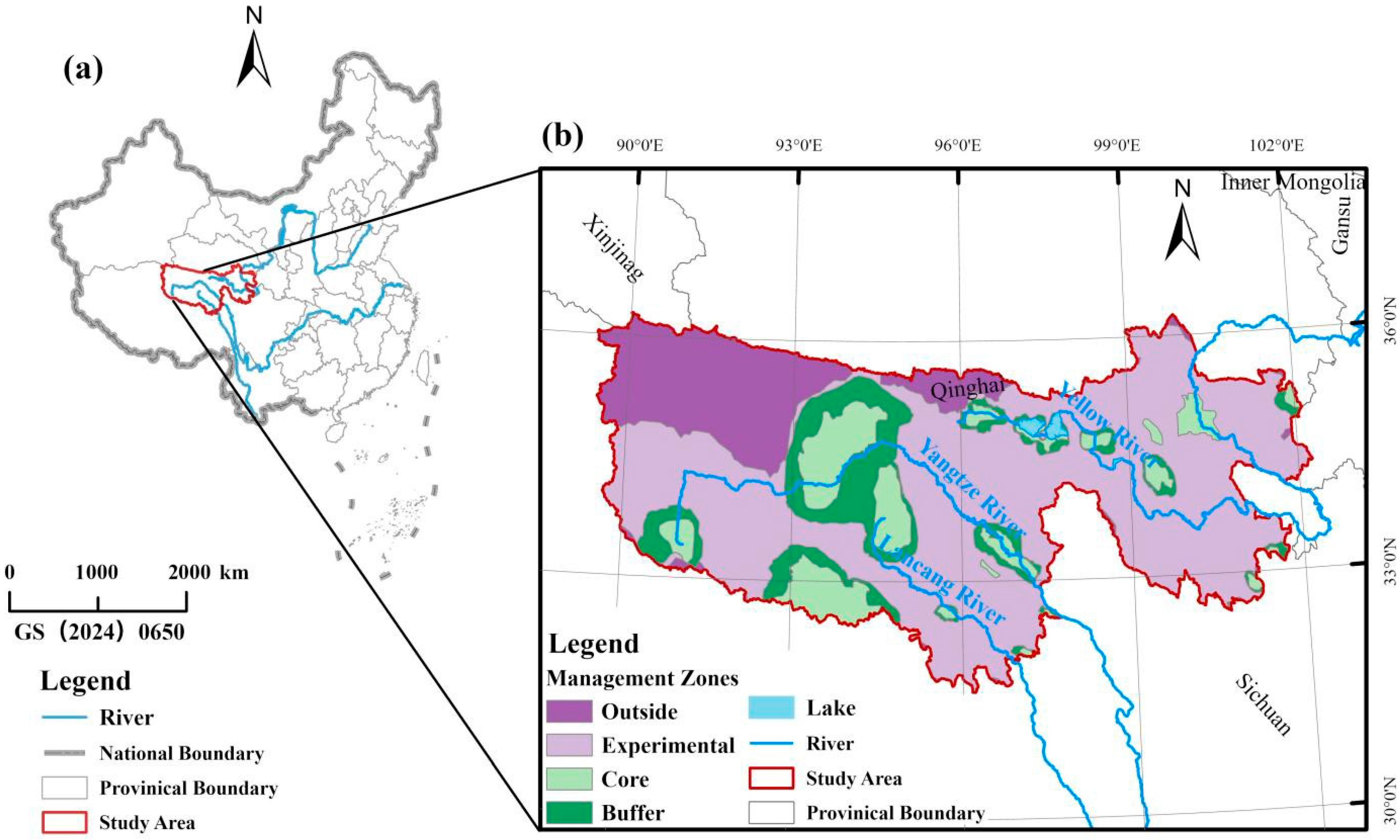
Management zone boundaries (Core/Buffer/Experimental/Outside) were obtained from an official vector boundary dataset (polygon shapefile) released by the Sanjiangyuan National Park Administration and the Qinghai Provincial Forestry and Grassland Administration (accessed on 1 May 2025). The boundaries were originally provided in EPSG:4326 (WGS 84) [23]. For distance- and area-related vector operations (e.g., buffering and area calculation), they were reprojected to EPSG:32647, and the resulting zone masks were subsequently rasterized onto the native MODIS 500 m sinusoidal grid (SR-ORG:6974) for pixel-wise analyses. The TRHR, situated in the northeastern Qinghai–Tibet Plateau, encompasses the headwaters of the Yangtze, Yellow, and Lancang (Mekong) rivers (Figure 1) [24].
Sanjiangyuan has a typical plateau continental monsoon climate characterized by distinct cold and warm seasons, clear wet and dry seasons, and coincident rainy and warm seasons. Mean annual temperature ranges from −5.6 °C to 3.8 °C, and annual precipitation increases from 262 mm in the northwest to 772 mm in the southeast. Driven by hydrothermal gradients, vegetation types exhibit pronounced latitudinal and elevational zonation: alpine meadows dominate the humid southeastern area, with Kobresia and Carex as typical genera; the arid and cold northwest transitions to alpine steppe and alpine desert steppe, dominated by drought-tolerant species such as Stipa purpurea.
The Core zone (Core; ~3.1 × 10⁴ km2, 20.5% of the reserve) lies at higher elevations in the transition between alpine desert and meadow; it is ecologically fragile yet biodiversity-rich and is subject to the strictest protection, with grazing and other human activities prohibited [13,25]. Its primary goal is to conserve habitats of rare wildlife (e.g., Tibetan antelope and snow leopard) and maintain intact ecological processes.
The Buffer zone (Buffer; ~3.9 × 10⁴ km2) surrounds the Core zone; only non-destructive scientific research and monitoring are permitted, and it functions as an ecological barrier and transitional buffer [13,25].
The Experimental zone (Experimental; ~2.0 × 10⁴ km2) is mainly distributed in valley grasslands and areas with convenient access; moderate grazing and community development are allowed to balance protection and use [13,25].
The Outside zone (Outside) refers to regions within the administrative boundary of Sanjiangyuan but outside the protected area zoning, and serves as the reference area for comparison; it primarily supports urban development and intensive pastoral production. Activities such as ecotourism, environmental education and outreach, and controlled traditional pastoralism are permitted. Under the “one household, one post” ecological ranger program, local herders participate in co-management, exploring a balance between conservation and community development (Figure 1).

2.2. Data Sources and Preprocessing

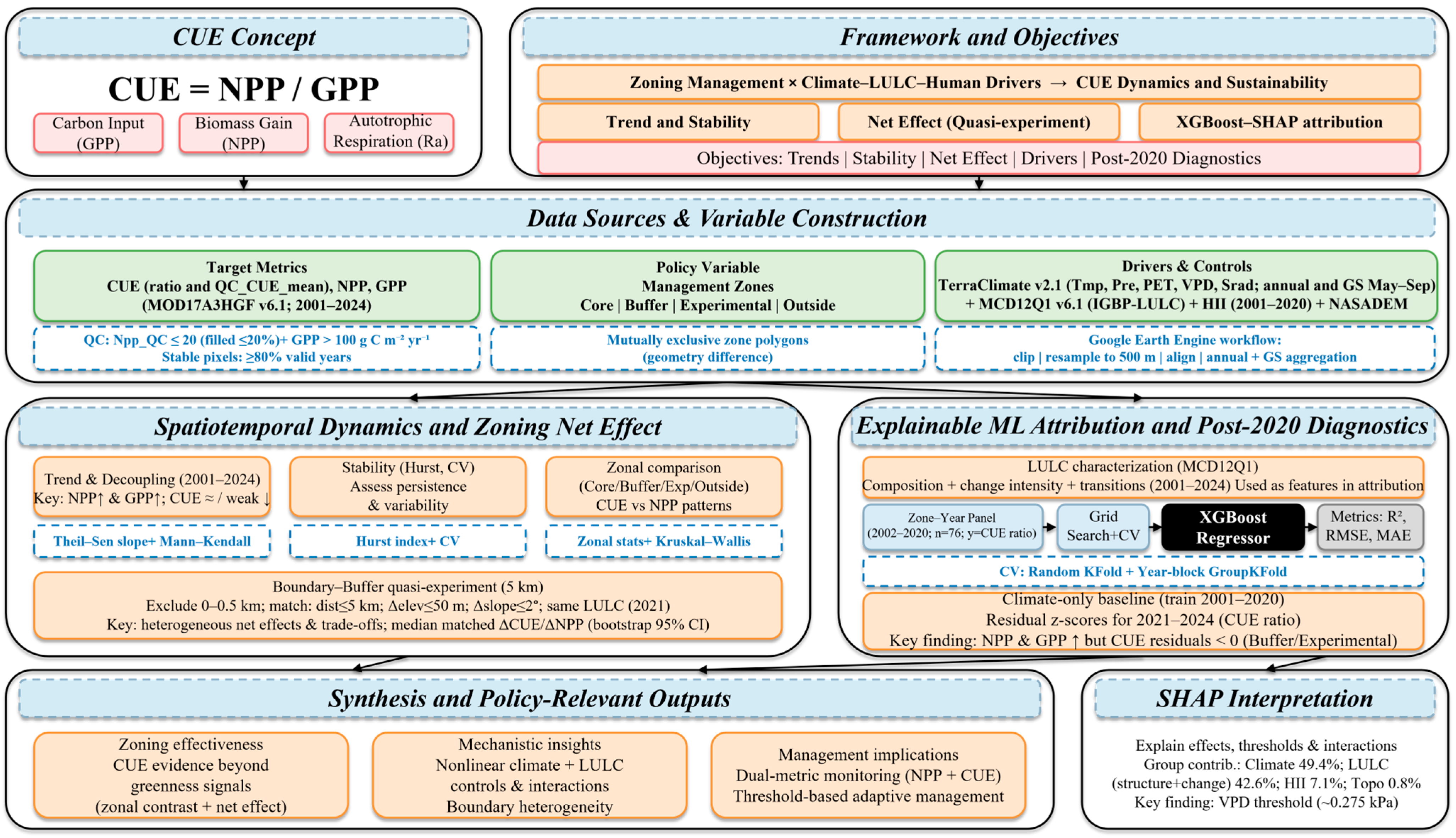
All preprocessing was conducted on the Google Earth Engine (GEE) platform, including data clipping, quality control, resampling to 500 m, and time series construction. GEE enables cloud-based parallel processing of large-scale remote sensing data and provides stable image computation and visualization capabilities [25]. A list of datasets used in this study is provided in Table 1, and the overall technical workflow and analysis pipeline are shown in Figure 2. Unless otherwise stated, all pixel-wise analyses were conducted on the native MODIS 500 m sinusoidal grid (SR-ORG:6974). All ancillary datasets (climate, land cover, topography, and HII) were reprojected/resampled to this grid to ensure pixel-level alignment.

2.2.1. Vegetation Productivity Data (MOD17) and Quality Control

This study used the annual GPP and NPP products from the Moderate Resolution Imaging Spectroradiometer (MODIS) MOD17A3HGF v6.1 (500 m), distributed by the NASA Land Processes Distributed Active Archive Center (LP DAAC, Sioux Falls, SD, USA), as the basis for estimating carbon fluxes. MOD17A3HGF is a gap-filled product that uses multiple imputation strategies to fill missing values caused by cloud contamination and orbital gaps, thereby improving time series continuity [26,32]. MOD17A3HGF data are provided on the native MODIS sinusoidal projection; all derived NPP, GPP, and CUE layers retained this grid for subsequent analyses.
  • Unit conversion: The raw digital numbers (DN) of MOD17A3HGF should be multiplied by the scale factor 0.0001 to obtain kg C m−2 yr−1, and then multiplied by 1000 to convert to g C m−2 yr−1 (i.e., DN × 0.1).
  • Quality control: MOD17A3HGF provides the NPPQC layer, which indicates the percentage of growing season days for which filled FPAR/LAI was used; lower values imply less reliance on gap-filling and higher data confidence. At the pixel–year scale, we retained observations with NPPQC ≤ 20 and additionally applied a threshold of annual GPP > 100 g C m−2 yr−1 to avoid ratio instability. We also required that each pixel meet these criteria in at least 80% of years during the study period (stability screening) to ensure the comparability and robustness of multi-year means and trend estimates [33,34,35].
To assess the representativeness of the screened sample, we also summarized the QC-filtered area fraction by management zone using the zone–year panel. This diagnostic indicates that QC screening improves the stability of ratio-based CUE estimates, but it also introduces a representativeness trade-off that should be interpreted as QC-filtered area coverage rather than a complete census of all pixels.

2.2.2. Climate and Environmental Factors

Climate data were obtained from TerraClimate v2.1 (monthly, ~4 km). We extracted annual air temperature (Tmp), precipitation (Pre), potential evapotranspiration (PET), vapor pressure deficit (VPD), and shortwave radiation (Srad), aggregated them to annual metrics in GEE, and then resampled all climate layers to the native MODIS 500 m sinusoidal grid to ensure pixel-level alignment with vegetation productivity data. Topographic background (elevation, slope, and aspect derived from NASADEM/SRTM) was treated as a static environmental context for environmental matching and attribution modeling [29].
Furthermore, to directly link climatic conditions with interannual CUE variability, we conducted a climate–CUE linkage analysis. For annual time series in the four zones (Core/Buffer/Experimental/Outside), we matched CUE/NPP/GPP with five TerraClimate variables (Tmp, Pre, PET, VPD, and Srad) and computed within-zone standardized anomalies (z-scores) using 2001–2020 as the reference period. Based on this workflow, we (i) calculated correlations between climate variables and CUE/NPP/GPP at lag 0 and lag 1; (ii) fitted multivariate regressions in the standardized anomaly space to quantify climatic sensitivities; and (iii) built a climate-only baseline (trained using climate variables over 2001–2020) and computed residual anomalies of CUE for 2021–2024. This workflow provides a transparent and reproducible evidence chain for discussing “non-climatic signals” when human pressure data are unavailable for 2021–2024. Details of the climate–CUE linkage workflow and corresponding supplementary descriptors are provided in the Supplementary Materials.

2.2.3. Vector Boundary Cleaning

To ensure mutually exclusive management zones and avoid double counting, we performed topology checking and sequential geometric cleaning of the zoning polygons in GEE. We first dissolved multipart features within each zone and removed potential slivers/overlaps by applying ordered difference operations: (i) Core was retained as provided; (ii) Buffer was updated as Buffer\Core; (iii) Experimental was updated as Experimental\(Core ∪ Buffer); and (iv) Outside was defined as StudyArea\(Core ∪ Buffer ∪ Experimental), representing the non-protected reference area within the administrative extent. After cleaning, all zones were converted to non-overlapping raster masks aligned to the native MODIS 500 m sinusoidal grid (SR-ORG:6974), ensuring consistent pixel-level assignment across all datasets.

2.2.4. Land Use/Land Cover (LULC) Data and Construction of Change Intensity Indicators

LULC data were obtained from the annual MODIS MCD12Q1 V6.1 product (500 m). We used the International Geosphere–Biosphere Programme (IGBP) classification scheme (classes 1–17) to characterize land surface structure and potential disturbances across the study area during 2001–2024 (Figure S2). In Google Earth Engine (GEE), we retained only valid classes (1–17) and removed the fill value (255). All LULC layers were kept on the native MODIS sinusoidal grid (SR-ORG:6974) at 500 m and strictly aligned with the MOD17A3HGF productivity grids. Using the cleaned zone polygons (Core/Buffer/Experimental/Outside), we computed zonal statistics for annual LULC and derived three groups of indicators—composition, change intensity, and transition pathways—to support the interpretation of CUE/NPP patterns and provide land surface structure features for subsequent attribution analyses. Algorithm updates and classification characteristics of MCD12Q1 are detailed in [36].
To quantify structural change within each zone, we constructed three types of LULC indicators:
(1) Zonal–annual class composition: For each year t and zone z , we calculated the area k m 2 and proportion of each class c as:
A z , t , c = p z 1 L p , t = c a p
P z , t , c = A z , t , c A z
where L p , t is the IGBP class code of pixel p in year t , 1 ( ) is an indicator function, a p is the pixel area k m 2 , and A z = p z a p is the total area of zone z . To reduce dimensionality and emphasize ecologically relevant classes, the main text focuses on the proportions of grassland (GRA, IGBP = 10), barren land (BAR, 16), water bodies (WAT, 17), and permanent snow/ice (ICE, 15). Other classes occupy small proportions and are not elaborated individually in the main text.
(2) Annual change intensity: This metric characterizes the fraction of a zone undergoing LULC class transitions between adjacent years. For each zone z , the change intensity in year t (2002–2024) was defined as:
C I z , t = 1 A z p z 1 L p , t L p , t 1 a p
We further summarized structural stability over the study period using the multi-year mean change intensity:
C I z = 1 T t = 2002 2024 C I z , t
where T is the number of year-to-year transitions (here T = 23 ). Higher C I z , t (or C I z ) indicates more frequent land cover transitions and lower structural stability (Figure S2b).
(3) Transition matrix and dominant transition pathways: For each adjacent year pair (t − 1,t), we calculated the transition area from class i to class j i j within each zone, and accumulated it over 2002–2024 to identify dominant conversion pathways (Figure S2c). We ranked off-diagonal transitions by accumulated area and reported the dominant transition types for each zone. These LULC indicators provide structural change context in Section 3 (e.g., composition shifts, disturbance intensity, and dominant transitions) and, in the subsequent XGBoost–SHAP framework, serve as land surface structure feature variables to strengthen interpretability of the management–eco-efficiency relationship.

2.2.5. Human Activity Indicator (Human Impact Index, HII)

Human disturbance intensity was represented by the annual World Conservation Society (WCS) Human Impact Index (HII) time series (2001–2020). The HII integrates multiple pressure dimensions, including population density, night-time lights, roads/infrastructure, and land-use intensity [37]. We reprojected HII to the MODIS sinusoidal projection (SR-ORG:6974) and resampled it to 500 m so that it was strictly aligned with the MOD17A3HGF and MCD12Q1 grids. For each management zone, we extracted annual mean HII values and also derived pixel-level HII trend metrics (Theil–Sen slope and Mann–Kendall significance) to support subsequent zonal comparison and attribution analyses. These HII-derived summaries were later used to contextualize zonal differences and the attribution analysis rather than to serve as stand-alone evidence in Section 2. Because the publicly available HII product ends in 2020, we did not extrapolate human pressure numerically for 2021–2024; instead, post-2020 interpretation relied on residual diagnostics, LULC context, and independent proxy pathways discussed later in the manuscript.

2.3. Trend Analysis and Significance Testing

Trends were estimated using the Theil–Sen median slope, and their significance was assessed using the Mann–Kendall test [38,39,40,41]. For pixel-level mapping, we used conventional two-sided |Z| thresholds of 1.65, 1.96, and 2.58 to classify weak, standard, and strong significance levels. For the key regional and zonal annual mean summaries, we additionally report 95% confidence intervals to make uncertainty in slope estimates explicit.

Persistence (Hurst) and Interannual Variability (CV) Analysis and Zonal Summaries

To supplement evidence on zonal performance for trend sustainability and interannual variability, we further computed the Hurst exponent and coefficient of variation (CV) of CUE, GPP, and NPP at the pixel level using the QC-filtered time series (Section 2.2.1).
The Hurst exponent H (0–1) characterizes long-term memory and persistence: H > 0.5 indicates persistence (past increases/decreases are more likely to continue), H < 0.5 indicates anti-persistence/mean reversion (trends are more likely to reverse), and H 0.5 indicates a random walk. The Hurst exponent was computed at the pixel level using rescaled range (R/S) analysis applied to the annual QC-filtered CUE time series (2001–2024; n = 24 years). Pixel-level H values were then summarized to zonal means and the proportion of pixels with H > 0.5 (persistence) within each management zone.
The coefficient of variation was computed as CV = σ/μ (interannual standard deviation divided by multi-year mean), measuring relative fluctuation magnitude; a larger CV indicates stronger interannual variability and lower stability. For the ratio metric CUE, we calculated CV only after QC filtering and applying the lower bound on GPP (annual GPP > 100 g C m 2 y r 1 ) to reduce amplification effects from low values.
Sen–MK (slope and significance), Hurst, and CV outputs were generated as 500 m rasters. We then conducted zonal statistics using the four zone polygons (Core/Buffer/Experimental/Outside) and reported (i) area proportions of significantly increasing/decreasing/non-significant pixels and (ii) zonal means/medians of Hurst and CV, supporting the integrated evidence on trends, persistence, and interannual variability presented in Section 3.1.2.

2.4. Boundary–Buffer Quasi-Experimental Design

This design moves beyond simple zonal comparisons and approximates a counterfactual comparison by leveraging spatial discontinuity. To evaluate zoning-associated contrasts in CUE while reducing natural gradient confounding, we adopted a boundary–buffer comparison quasi-experiment. Centered on the shared boundary between adjacent zones, we constructed buffers of width w = 5 km on each side as the default bandwidth and treated the inside buffer as the treatment group and the outside buffer as the control group. This design leverages the assumption that environmental conditions are approximately continuous over short distances, thereby partially reducing confounding from elevation, climate, and topographic gradients. By comparing CUE differences between the inside and outside buffers, we approximate zoning-associated contrasts under stricter versus less strict management while reducing confounding from natural gradients [4,5,6,7]. We further assessed robustness to bandwidth choice by repeating the procedure with w = 1–5 km (see Section 3.2.2).
The analytical procedure consisted of five steps: (1) We extracted the shared boundaries between the Core–Buffer zones, Buffer–Experimental zones, and Experimental–Outside areas. (2) We created 5 km-wide buffer strips on both sides of each boundary. Within the buffers, we computed pixel-level annual CUE as NPP/GPP and summarized multi-year mean metrics (e.g., mean CUE and mean NPP) using the full 2001–2024 time series. (3) To avoid ambiguity caused by boundary delineation errors or mixed pixels, we excluded pixels within 500 m on both sides of the boundary line to reduce boundary misregistration and mixed-pixel effects at the 500 m MODIS resolution. (4) Candidate pixels were preferentially sampled from the stable pixel set that met QC and GPP constraints in ≥80% of years during the study period. If stable samples were insufficient, we fell back to all valid pixels observed in any year (“anyYears”). Within each buffer strip, we performed nearest-neighbor matching at the MODIS 500 m pixel level (with replacement). Matching constraints included geographic distance ≤ 5 km, |Δelev| ≤ 50 m, |Δslope| ≤ 2°, and the same IGBP land cover class from MCD12Q1 (using 2021 as the matching year). (5) For each matched pixel pair, we computed ΔCUE = CUE_in − CUE_out and ΔNPP = NPP_in − NPP_out. Here, “Inside” denotes the more strictly managed side. We summarized effects using the median and bootstrap 95% confidence intervals (see Section 3.2.1).
According to Tobler’s first law of geography, climate and topographic backgrounds are expected to be approximately continuous within such short distances (≤5 km). Post-matching diagnostics confirm covariate balance for elevation and slope (Table S4, Supplementary Materials; |SMD| < 0.03 for all boundaries), though pre-treatment baseline similarity prior to policy implementation cannot be directly verified from available data. This quasi-experimental design therefore reduces, but does not eliminate, potential confounding from pre-existing unobserved differences between zones. If significant ΔCUE or ΔNPP persists after controlling for elevation, slope, and land cover class, it is more consistent with zoning-associated differences in management intensity (e.g., fencing, grazing bans, or grazing restrictions), although unobserved baseline differences cannot be fully excluded.
In addition, to visually examine whether boundary contrasts decay with distance, we binned distances within the 5 km buffers into strips (0.5–1, 1–2, 2–3, 3–4, and 4–5 km) and computed, on both sides, the area proportions of trend classes and the mean Sen slope, Hurst exponent, and CV (see Section 3.2.2) as a robustness complement to the matched quasi-experiment. To address common concerns regarding bandwidth choice, covariate balance, and spatial autocorrelation, we conducted three robustness checks: buffer-width sensitivity (w = 1–5 km and different exclusion distances), post-matching covariate balance assessments (e.g., standardized differences for elevation and slope), and block bootstrap inference accounting for spatial autocorrelation.

2.5. Attribution Framework: Identifying Drivers of CUE Using Explainable Machine Learning

To quantitatively identify the main drivers of CUE and their nonlinear responses, we constructed an explainable machine learning attribution framework based on annual zonal statistics (a zone–year panel). This framework does not rely on linear assumptions and can capture nonlinear contributions of multiple factors to carbon use efficiency. SHAP dependence plots can further hint at potential interactions through conditional patterns and the dispersion of SHAP values. Given the limited sample size (n = 76) and manuscript length, we did not systematically quantify interaction strengths; instead, we provide testable directions for future extensions in Section 4.
The sampling unit is the annual zonal statistic for each management zone (Core/Buffer/Experimental/Outside). Because HII data are available through 2020 and annual LULC change intensity is available from 2002, we used 2002–2020 as the SHAP modeling window (n = 4 zones × 19 years = 76).
(1) Response variable (y): The response variable was carbon use efficiency (CUE), defined as NPP/GPP. We computed zonal annual mean NPP and GPP from QC-filtered MOD17A3HGF pixels and used their ratio as the zonal annual CUE ratio (hereafter “CUE ratio”) to reduce the influence of a small number of high-uncertainty pixels. In this study, the CUE ratio (zonal NPP/GPP; ratio of zonal means) was used as the primary metric for quasi-experimental effect estimation, XGBoost–SHAP attribution, and climate baseline residual diagnostics. As a robustness metric, we additionally calculated zonal mean CUE based on pixel-wise ratios (mean of pixel ratios after QC and threshold masking; hereafter “CUE mean”), to test sensitivity to low-GPP pixels and ratio error propagation (its post-2020 changes are shown in Figure S7 and corroborate the residual diagnostics of the CUE ratio in Figure S8c).
(2) Explanatory variables (X): The explanatory variables comprised four categories: (i) climate: annual mean temperature (Tmp), annual precipitation (Pre), potential evapotranspiration (PET), vapor pressure deficit (VPD), and shortwave radiation (Srad); (ii) surface structure and change: the area proportions of major classes (grassland, barren, water bodies, and permanent snow/ice) and annual LULC change intensity; (iii) human pressure: the annual mean Human Impact Index (HII); and (iv) topographic background: elevation, slope, and aspect (aspect represented by sin/cos to avoid angular discontinuities).
(a) We used an XGBoost regression model to characterize nonlinear relationships between CUE and multi-source drivers. The model was trained on zone–year samples for 2002–2020 (n = 76), with features including climate, surface structure/change, human pressure, and topography. To reduce overfitting under the small sample size, hyperparameters were tuned via five-fold cross-validation within the training period [42]. The final hyperparameters were: n_estimators = 400, max_depth = 4, learning_rate = 0.05, subsample = 0.85, and colsample_bytree = 0.85. Model evaluation was conducted separately using the two cross-validation schemes described below.
(b) Model evaluation employed two cross-validation schemes: (1) random K-fold (Random KFold) as a conventional baseline; and (2) year-block GroupKFold, where all zone samples from the same year were assigned to the same fold to reduce performance inflation due to interannual autocorrelation. Performance metrics (R2, RMSE, and MAE) are reported in Section 3.3.1.
(c) To improve interpretability, we applied SHAP (Shapley Additive Explanations) to explain XGBoost outputs using TreeExplainer. SHAP quantifies the marginal contribution of each feature to the prediction and reveals contribution directions and threshold effects. Using SHAP summary plots and dependence plots, we analyzed dominant climatic and human controls on CUE variation and their nonlinear response ranges [43].
For mechanistic synthesis, we grouped features into four sources—climate, surface structure and change, human pressure, and topographic background—and computed each group’s contribution as the proportion of mean (|SHAP|) summed within the group across all samples. Grouped contribution results are reported in Section 3.3.1.

3. Results

3.1. Decoupling of Productivity and Efficiency: Regional and Zonal Trends

Analysis of MOD17 data for 2001–2024 reveals a pronounced decoupling between vegetation productivity (NPP) and carbon use efficiency (CUE) in the Three-River Headwaters Region at the regional scale.
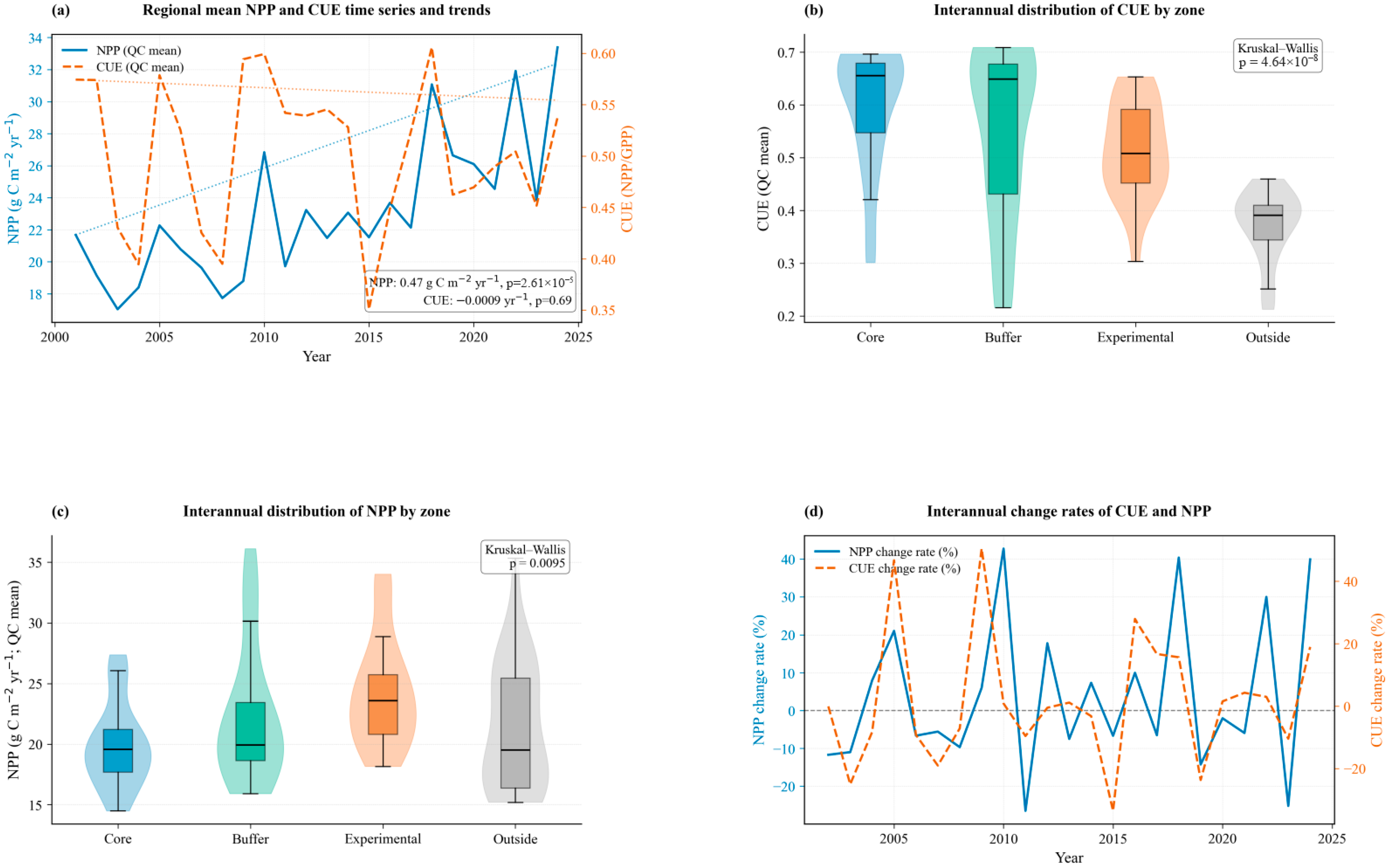
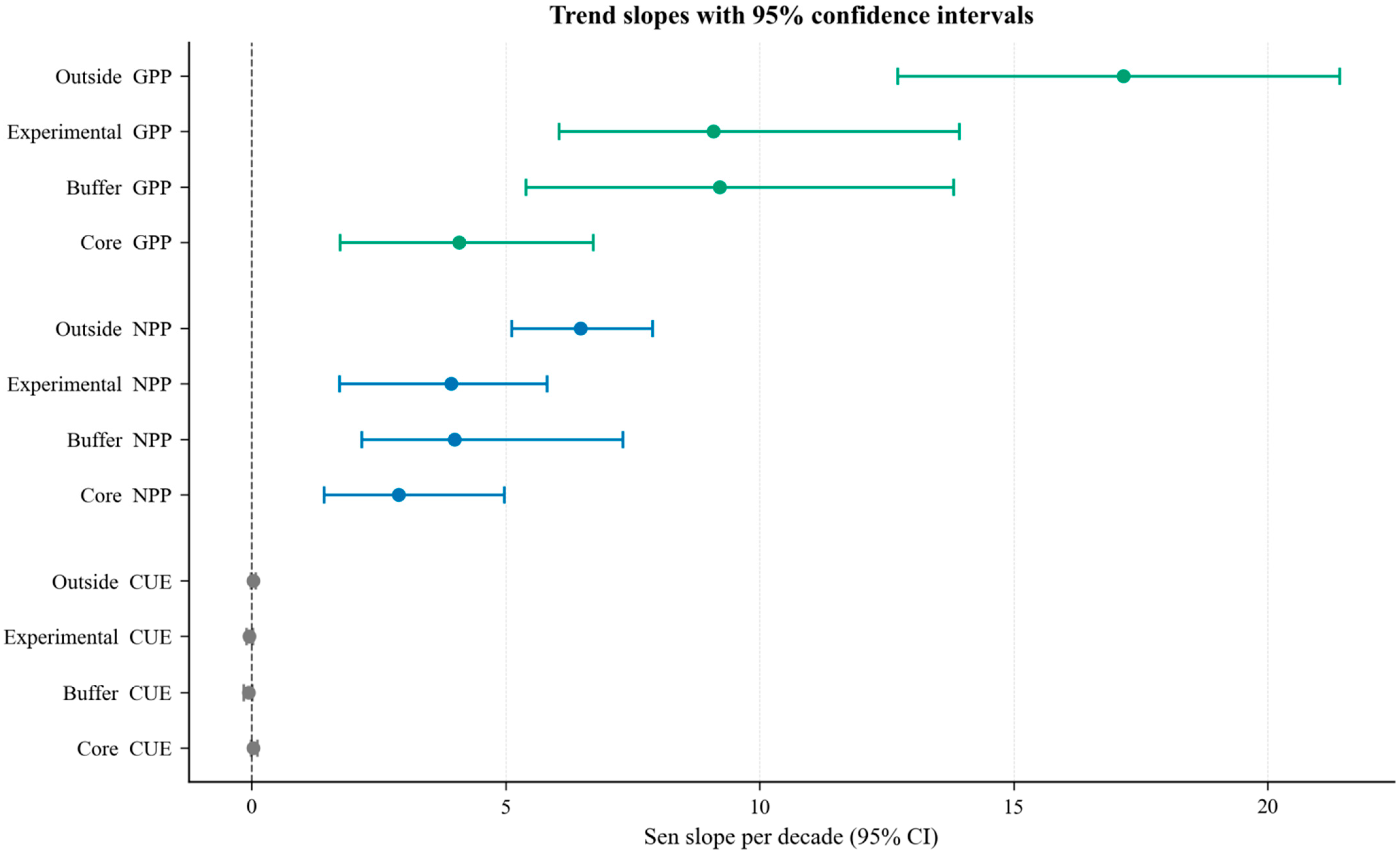
As shown in Figure 3a, the QC-filtered regional mean NPP exhibited a robust increasing trend during 2001–2024. When 95% confidence intervals are considered, the NPP and GPP increases remain clearly positive, whereas the regional CUE slope is much smaller and substantially more uncertain.
In terms of interannual variability (Figure 3d), CUE exhibited larger year-to-year fluctuations than NPP: for example, the largest year-to-year increase in CUE occurred in 2008 (+58.6%), whereas the largest decrease occurred in 2007 (−35.5%). In comparison, the largest increase in NPP occurred in 2024 (+39.1%), and the largest decrease occurred in 2003 (−24.5%). This suggests higher sensitivity of CUE to short-term climate variability than NPP [44,45].
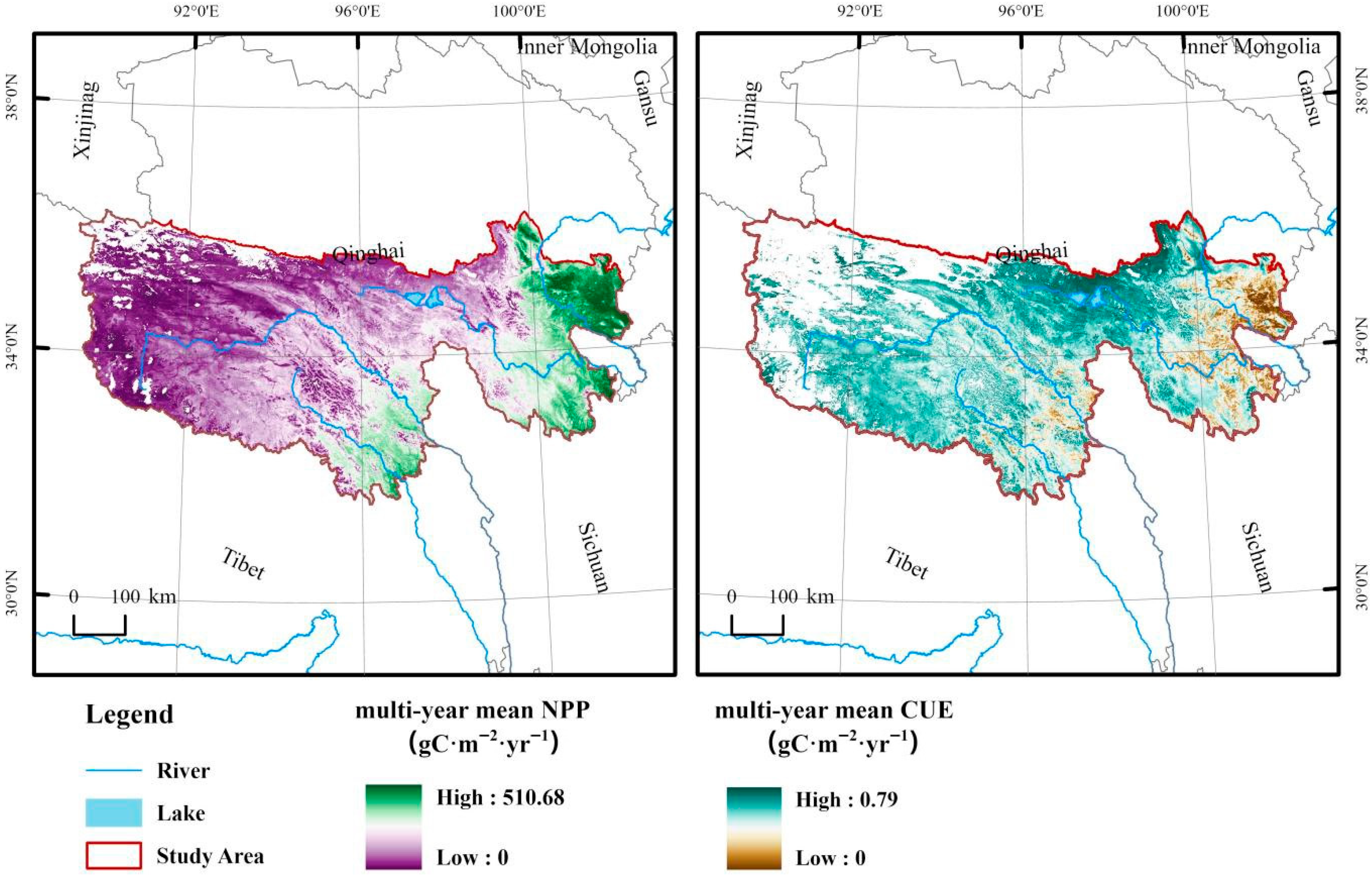
The multi-year mean spatial distributions of NPP and CUE (Figure 4) show a consistent southeast–northwest decreasing gradient.
High-value areas are concentrated in eastern Yushu Prefecture and southern Golog Prefecture (Lancang headwaters) in the southeast, where hydrothermal conditions are favorable and alpine meadows dominate, with CUE often exceeding 0.6.
Conversely, low-value areas occur in the northwest, including Hoh Xil and the Yangtze headwaters, where high elevation and low precipitation support alpine steppe and desert steppe, with CUE frequently below 0.4. This spatial gradient confirms that hydrothermal conditions remain the primary determinant of baseline carbon-cycle efficiency at the regional scale.
This southeast–northwest gradient is consistent with the later attribution results, which identify hydrothermal conditions and land surface structure as the dominant controls on spatial differences in CUE.

3.1.1. Interannual Variations in Raw GPP/NPP and Zonal Differences

We analyzed the interannual time series of raw GPP and NPP under QC filtering (Figures S4 and S5) and characterized long-term trends using the Theil–Sen slope and Mann–Kendall (MK) test on zonal annual means, providing a baseline comparison for the CUE decoupling pattern of “productivity gains without efficiency gains” discussed below.
The results show that annual mean GPP and NPP increased in all four zones during 2001–2024. The newly added 95% confidence intervals indicate that these productivity increases are comparatively robust across zones, whereas the estimated CUE slopes are much smaller and, in several zones, overlap zero. This uncertainty-aware summary strengthens the interpretation that productivity gains are clearer and more stable than long-term efficiency gains. The uncertainty structure is summarized in Figure 5, which shows that NPP and GPP slopes remain consistently positive across zones, whereas several CUE intervals overlap zero.
GPP more directly reflects changes in ecosystem carbon uptake potential, whereas NPP represents the net carbon increment retained by ecosystems. Taken together with the confidence interval results, these metrics support a productivity increase signal that is stronger than the long-term trend signal in CUE.

3.1.2. Pixel-Level Trends, Persistence, and Interannual Variability: Zonal Statistics and Stability Evidence

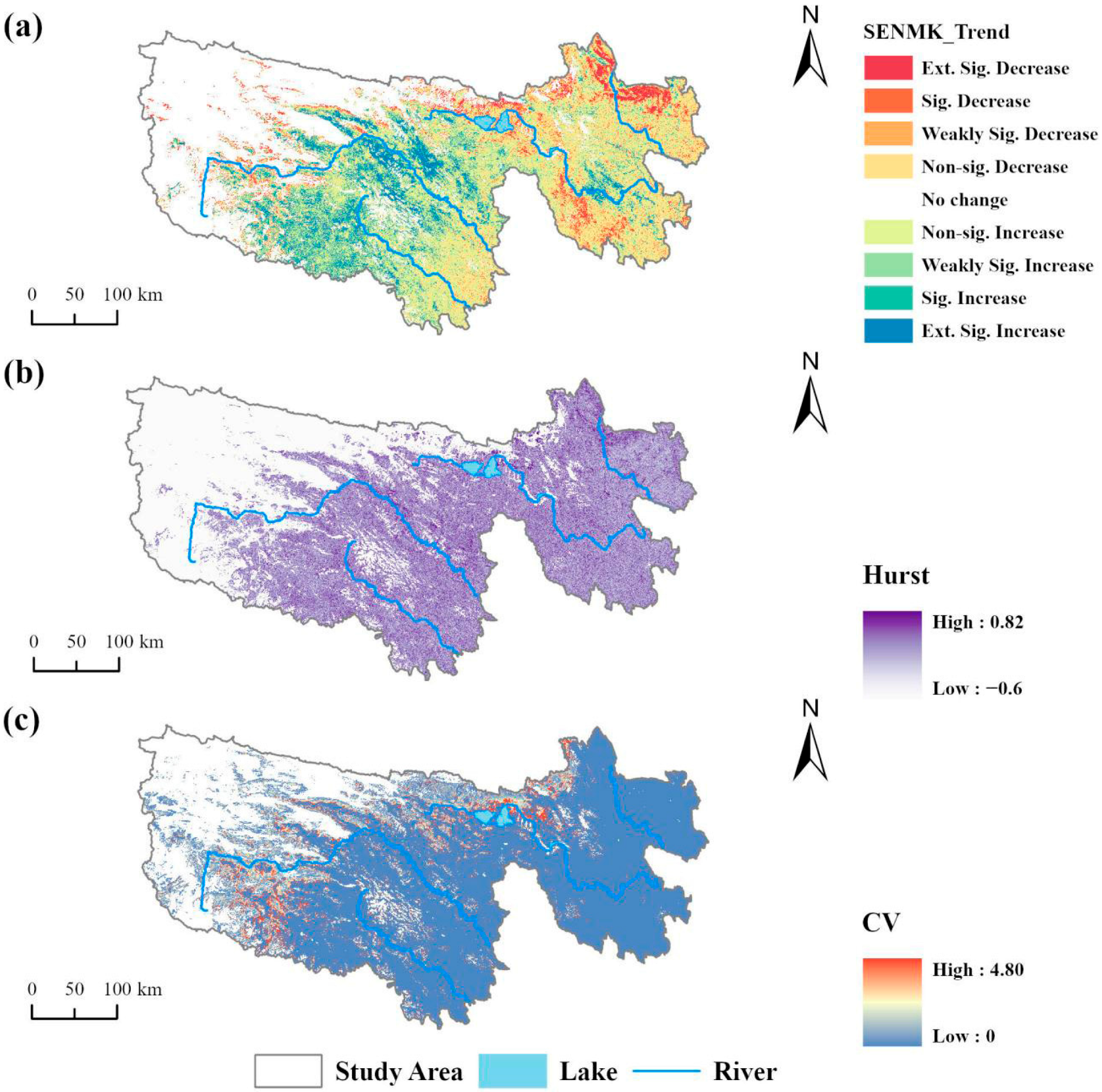
Beyond regional mean time series, pixel-level analyses reveal within-zone heterogeneity and differences in stability. We conducted zonal summaries of pixel-wise Theil–Sen slopes and MK significance, Hurst exponent, and CV for CUE over 2001–2024; the results are summarized in Table 2. Spatial distributions are shown in Figure 6.
The Sen–MK results show that the proportions of significantly increasing CUE pixels were 21.98% and 19.45% in the Core and Buffer zones, respectively, whereas significantly decreasing pixels accounted for 7.02% and 8.41%. In the Experimental zone, the proportions of significantly increasing and decreasing pixels were 14.45% and 11.38%, respectively. In contrast, the Outside zone had only 0.96% significantly increasing pixels, whereas significantly decreasing pixels reached 12.08%, showing a “decline-dominated” spatial pattern. Together with the boundary quasi-experiment results in Section 3.2.1, this pattern is unlikely to be explained solely by natural gradients, motivating boundary-based tests with environmental matching to examine the direction and heterogeneity of zoning-associated contrasts.
Regarding the Hurst exponent, mean H for CUE across zones ranged from 0.399 to 0.408, and only ~12–13% of pixels satisfied H > 0.5 (persistence); the remainder of the pixels were dominated by anti-persistence (H < 0.5; mean reversion). This suggests that monotonic CUE trends do not generally exhibit self-reinforcing persistence, indicating limited trend sustainability at the pixel level.
The CV results show that the interannual relative variability of CUE was generally small (mean ~0.010), but the Experimental zone had the highest mean CV (0.0120) and the Core zone the lowest (0.0097), indicating stronger CUE fluctuations and weaker stability in the Experimental zone.

3.2. Zoning Effects: Zonal Contrasts from Comparisons and Quasi-Experimental Evidence

Comparisons of zonal means reflect overall differences but are not, by themselves, evidence of causal management effects. Section 3.2.1 therefore applies a boundary–buffer quasi-experiment with environmental matching to reduce confounding from elevation and climatic gradients and to estimate the direction and magnitude of zoning-associated effects.
The zonal statistics (Figure 3b,c) reveal significant differences in ecosystem performance under different management intensities. The Kruskal–Wallis test indicates highly significant differences in CUE among zones (p < 0.001) and significant differences in NPP as well (p = 0.009). Notably, the ranking of zones differs between NPP and CUE.
For NPP, the Experimental zone exhibited the highest values, followed by the Buffer and then Core zone; under QC filtering, NPP in the Experimental zone remained generally higher, whereas the Core zone was relatively lower. This may appear counterintuitive to the notion that “stricter protection leads to better growth”, but it largely reflects reserve delineation: the Experimental zone often includes lower-elevation pastures with higher inherent productivity potential and concentrated pastoral activity. By contrast, the Core zone is mostly located in high-elevation, ecologically fragile areas with widespread glaciers and permafrost, where the natural productivity baseline is low.
For CUE, the Core and Buffer zones exhibited higher values than the Outside zone; when the focus shifts to carbon use efficiency, the ranking reverses. The Core zone shows the highest median CUE (0.656), followed closely by the Buffer zone (0.649), and the two do not differ significantly. Outside has a significantly lower median CUE (0.391) with a very wide distribution.
Although NPP in the Core zone is constrained by harsh natural conditions, its relatively high CUE indicates more efficient biomass allocation under a low-productivity baseline. In contrast, the wide and low CUE distribution in the Outside zone suggests lower carbon use efficiency despite higher productivity potential, which is consistent with stronger human pressure and differences in land surface structure.
Quality control and threshold masking change the subset of pixels included in zonal statistics. We therefore interpret QC-filtered results as robust estimates for a high-confidence subset rather than as a full-area carbon budget. The added area-based representativeness diagnostic further indicates that QC screening improves ratio stability but may reduce representativeness in fragile high-elevation areas. The zonal QC-filtered area fractions are summarized in Figure S9, which should be interpreted as an area-based representativeness diagnostic rather than a complete pixel census.

3.2.1. Boundary–Buffer Quasi-Experiment: Matched Zoning-Associated Contrasts Across Adjacent Zones

The boundary analysis further mitigated elevation-related confounding and provides additional evidence on zoning-associated contrasts, although unobserved baseline differences cannot be fully ruled out.
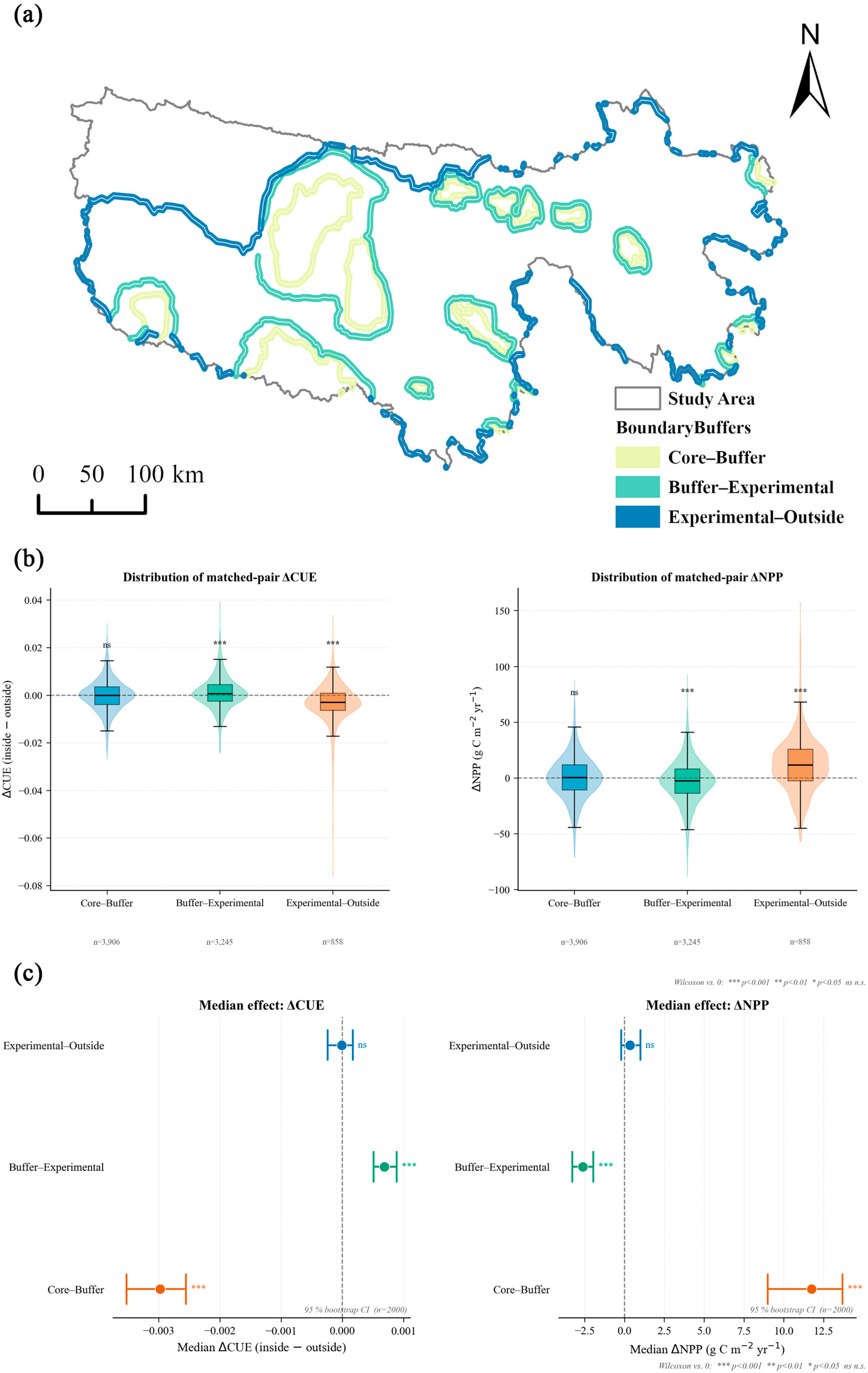
As shown in Figure 7a, we constructed the shared boundaries between three pairs of adjacent zones and generated 0.5–5 km buffer belts on both sides (excluding the 0–0.5 km mixed-pixel belt). The pixel-level matching results for the three key boundaries (Figure 7b,c and Table 3; matching diagnostics are provided in Table S4 of the Supplementary Materials) show pronounced boundary heterogeneity in zoning-associated effects.
Experimental–Outside: After matching land cover class and elevation/slope within the 0.5–5 km buffers, the Experimental zone exhibited significantly higher NPP than the Outside zone (ΔNPP = +11.75 g C m−2 yr−1, 95% CI: +9.01 to +13.82; n = 858) but significantly lower CUE (ΔCUE = −0.00298, 95% CI: −0.00356 to −0.00256). Although the sign of this CUE contrast is statistically robust, its absolute magnitude is small. Given the 500 m MODIS resolution and the inherent uncertainty of ratio metrics, it should be interpreted as a modest management-associated difference rather than a large ecological effect.
Buffer–Experimental: The Buffer zone showed a slightly higher CUE than the Experimental zone (ΔCUE = +0.00068, 95% CI: +0.00049 to +0.00088; n = 3245) but slightly lower NPP (ΔNPP = −2.61 g C m−2 yr−1, 95% CI: −3.23 to −1.96). This suggests that, under comparable topography and land cover conditions, the internal management gradient may be expressed as higher CUE but slightly lower NPP, rather than a uniform increase in both metrics.
Core–Buffer: Differences between the Core and Buffer zones were not significant (median ΔCUE was close to 0 and the 95% CI crossed 0; ΔNPP also crossed 0; n = 3906), suggesting a limited matched contrast across this boundary at the 500 m scale.
Robustness diagnostics included buffer-width sensitivity (w = 1–5 km; exclusion distance e = 0.5/1.0 km), post-matching covariate balance (|SMD| < 0.03 for elevation and slope), and block bootstrap inference accounting for spatial autocorrelation (10 km blocks); all of the robustness diagnostics results indicated directionally consistent conclusions.

3.2.2. Strip Statistics: Distance Responses of Boundary Effects and Robustness Checks

The boundary–buffer quasi-experiment (Section 3.2.1) provides stronger quasi-experimental interpretability through environmental matching, but it also discards many pixels due to strict screening. To complement the main framework with a more intuitive and verifiable spatial evidence chain, we constructed distance-binned strips (0.5–5 km; excluding the 0–500 m mixed-pixel belt) on both sides of the three key boundaries (Core–Buffer, Buffer–Experimental, Experimental–Outside) and computed, for each side, the area proportions of CUE trend classes and the mean Hurst/CV, to examine whether boundary contrasts persist or attenuate with distance.
The results show that contrasts across the Experimental–Outside boundary are the most stable. Across distance bins from 0.5 to 5 km, the Experimental zone consistently had a higher proportion of significantly increasing CUE trend pixels than the Outside zone ( Δ p c t i n c = +0.31% to +2.95%, mean +2.10%) and a lower proportion of significantly decreasing pixels ( Δ p c t d e c = −1.51% to −7.01%, mean −4.82%). This pattern suggests lower trend-decline risk in the Experimental zone within the boundary belt, even though the matched-pair level contrast shows a small negative ΔCUE in multi-year means (Figure 7).
By contrast, differences across the Core–Buffer and Buffer–Experimental boundaries are smaller and fluctuate with distance ( Δ p c t i n c typically < 2%), suggesting weaker internal boundary effects within the protected area, potentially due to homogeneous management implementation, time lags, and mixed pixels at 500 m resolution.
Strip statistics serve as a descriptive robustness check; differences across distance bins are not strictly monotonic and may still be influenced by boundary orientation, land cover mosaics, and micro-topographic variation. We therefore treat them as complementary evidence supporting the quasi-experimental conclusions in Section 3.2.1 and provide the distance-binned difference plots in Figure S6.

3.3. Attribution Analysis (Including Human Disturbance): Structural Change, Driver Contributions, and Residual Diagnostics

Zonal differences in CUE can arise from multiple sources, including climatic/topographic baselines, land surface structure (e.g., grassland, barren land, water bodies, and snow/ice), and human pressure and management implementation. Accordingly, we organized the attribution analysis as a sequential evidence chain: (i) we summarize LULC composition and change intensity to provide structural context; (ii) we apply an XGBoost–SHAP framework (2002–2020), including human pressure to quantify multi-source driver contributions; and (iii) for 2021–2024, when HII is unavailable, we conduct climate baseline residual diagnostics to identify potential non-climatic signals and constrain policy interpretation in Section 4.
In terms of structural background, LULC in Sanjiangyuan is dominated by grassland (GRA) and barren land (BAR) (Figure S2a); annual change intensity during 2002–2024 is significantly higher outside the protected area than inside (Outside: 3.09% yr−1; Buffer: 1.26% yr−1; Core: 0.93% yr−1; and Experimental: 0.80% yr−1), and most zones show a declining trend (Figure S2b). Across all four zones, the dominant transition pathways are bidirectional conversions between BAR and GRA (Figure S2c); the accumulated transition area is much larger in the Outside and Experimental zones than in the Core and Buffer zones, indicating more active surface structure disturbance at protected area edges and in high-use intensity regions. In terms of human pressure, HII during 2001–2020 is highest in the Experimental zone and lowest in the Outside zone (Figure S3a,b), and shows a significant monotonic increasing trend in all four zones (Sen slope per decade; see Table S3 (Supplementary Materials) and Figure S3c). These results provide contextual background for interpreting the SHAP contributions of LULC composition, LULC change intensity, and human pressure (HII) in the subsequent attribution analysis.
We first summarize LULC composition, annual change intensity, and dominant transition pathways to provide structural context for CUE patterns. We then quantify driver contributions and nonlinear thresholds by modeling the CUE ratio using XGBoost with climate, topography, LULC, and human pressure predictors, and then interpret the fitted relationships using SHAP.

3.3.1. Explainable Machine Learning Attribution: Contributions of Climate, Surface Structure, and Human Pressure

On the 2002–2020 zone–year samples, the XGBoost model shows moderate explanatory power for the CUE ratio: the mean R2 is 0.60 under random K-fold cross-validation, and 0.57 under the more conservative year-block GroupKFold (Table S5 (Supplementary Materials)). The small difference suggests that model performance is broadly consistent across the two validation schemes and reflects stable hydrothermal and land surface structure signals.
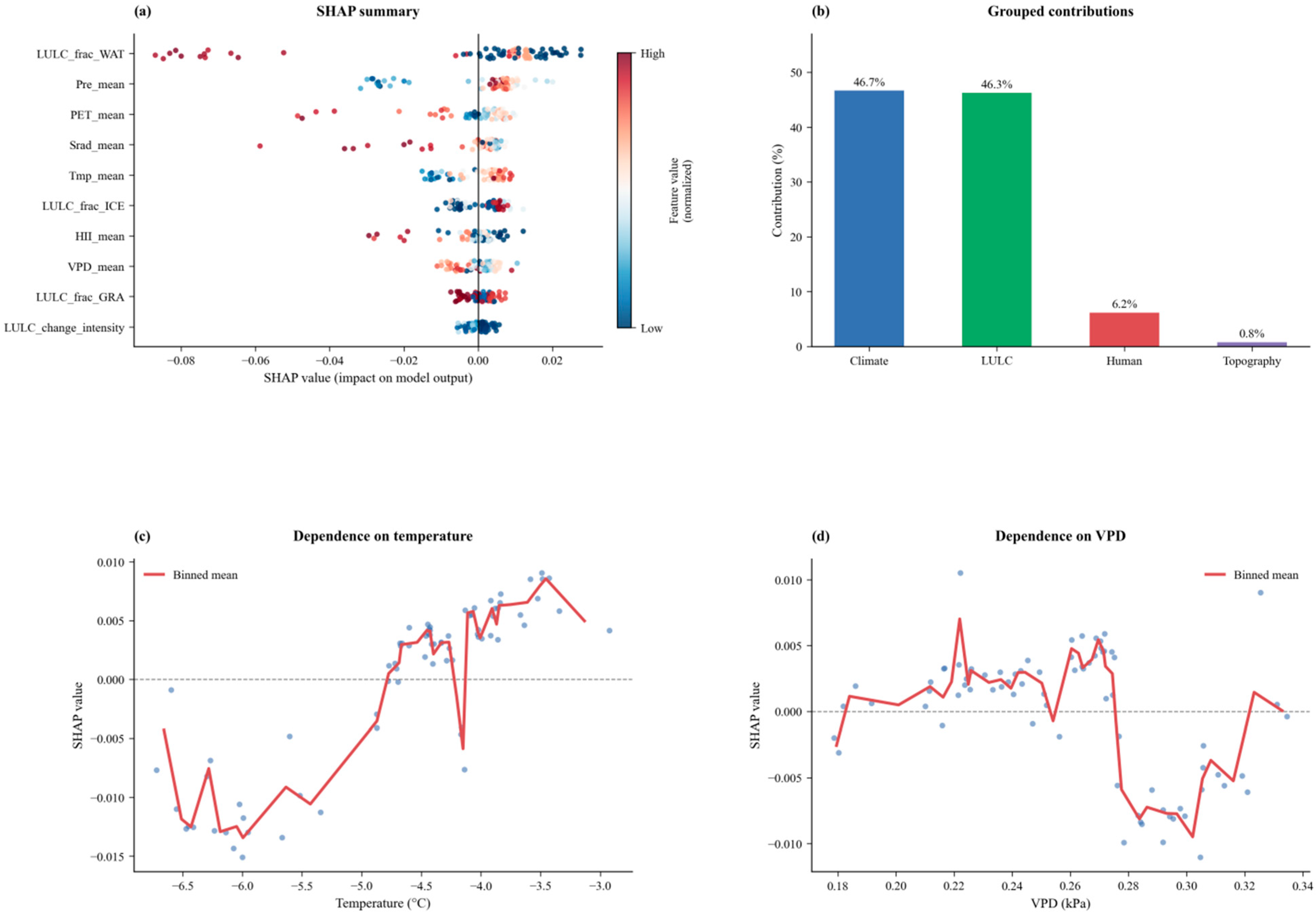
Global feature importance (Figure 8a) indicates that key controls on CUE include both climate and land surface structure: water body fraction (26.7%) and precipitation (Pre, 15.3%) are most prominent, followed by PET (10.8%), temperature (Tmp, 10.2%), shortwave radiation (Srad, 8.4%), and permanent snow/ice fraction (7.7%). Human pressure (HII) contributes 7.1%, VPD contributes 5.5%, and LULC change intensity contributes 3.5%.
When aggregated by factor groups (Figure 8b; Table 4), climate factors contribute approximately 49%, surface structure and change approximately 43%, human pressure approximately 7%, and topographic background less than 1%. A lightweight stability summary based on the existing model performance and group/feature contribution outputs indicates that this ordering is directionally consistent, but the grouped SHAP contributions should still be interpreted as indicative rather than precise estimates given the small zone–year panel (n = 76) and modest temporal GroupKFold performance. A supplementary stability summary (Figure S10) further shows that this ordering remains directionally consistent across the current lightweight uncertainty checks.
SHAP dependence plots reveal pronounced nonlinearity in climatic effects. Temperature exhibits a three-phase response: when the annual mean temperature is below approximately −4.9 °C, SHAP values are generally negative, indicating that extreme cold constrains carbon use efficiency; as temperature increases toward approximately −3.4 °C, contributions become positive and tend to saturate (Figure 8c).
Atmospheric moisture demand (VPD) shows a threshold-like inhibition on CUE: when VPD is below approximately 0.275 kPa, SHAP values are near zero or slightly positive, but once VPD rises above this threshold, its contribution rapidly becomes negative and remains so at higher values, indicating that enhanced evaporative demand reduces carbon use efficiency (Figure 8d). This threshold offers a quantitative reference point for interpreting CUE sensitivity to atmospheric moisture demand under ongoing warming.
Precipitation and potential evapotranspiration show overall positive contributions, suggesting that in alpine environments, moderate water supply and energy input favor a higher NPP-to-GPP ratio. However, under high VPD, this benefit may be offset by water stress, resulting in a co-modulation whereby water stress and energy limitation interact (Figure 8a,c,d).
In addition, the vertical dispersion of SHAP values at the same predictor level in Figure 8c,d implies that the effects of temperature and VPD may be modulated by precipitation, PET, and surface structure (i.e., potential interactions). Given the sample size (n = 76) and figure space constraints, we did not further compute and present a systematic ranking of SHAP interaction values, but this direction can be pursued in future work using higher-resolution samples or a pixel-level panel.
Although HII’s global contribution is lower than that of climate and surface structure, high HII values generally correspond to negative SHAP contributions (Figure 8a), which is consistent with the relatively lower CUE observed in the Experimental and Outside zones under disturbances from grazing, roads, and settlements. Together with the 2021–2024 residual diagnostics in Section 3.3.2, these results support a testable hypothesis that non-climatic pressures may have contributed to post-2020 negative CUE anomalies (see Section 4.4).
This attribution analysis is based on zonal annual statistics, which capture macro-scale drivers but cannot resolve fine-scale heterogeneity within zones. Accordingly, the SHAP results are best treated as directional evidence about dominant drivers rather than as a precise variance decomposition.

3.3.2. Post-2020 Residual Diagnostics: Productivity Anomalies and CUE Efficiency Divergence by Zone (2021–2024)

Because the human pressure (HII) product is only available through 2020, the SHAP attribution analysis in Section 3.3.1 covers 2002–2020 (n = 76). To ensure the argumentative completeness of the 2001–2024 remote sensing series without introducing assumptions about HII extrapolation, we conducted consistent comparisons and residual diagnostics of changes in NPP, GPP, and CUE for 2021–2024. The CUE ratio (zonal NPP/GPP) was used as the primary indicator, and the QC-filtered CUE mean (zonal mean of pixel-level CUE; “CUE mean”) was used as a robustness indicator. This provides a consistent comparison framework combining level changes, robustness checks, and climate-adjusted residual diagnostics (Table 5; Figures S7 and S8).
Productivity increased overall during 2021–2024, but efficiency diverged among zones. Compared with 2001–2020, NPP and GPP increased significantly in all four zones during 2021–2024: NPP increased by 25.4% (Core) to 43.8% (Outside), and GPP increased by 24.6% (Core) to 55.8% (Outside) (Table 5; Figure S7). Using the primary indicator, the CUE ratio (zonal NPP/GPP; Table 5; Figure S8c), the Core zone increased slightly (+0.7%), whereas the Buffer, Experimental, and Outside zones decreased (−9.5%, −11.2%, and −10.5%, respectively) (Table 5). As a robustness check, Figure S7 also shows changes in the QC-filtered CUE mean (zonal mean of pixel-level CUE); its zonal direction is consistent with the CUE ratio, indicating that the post-2020 efficiency-decline signal in the Buffer and Experimental zones persists under different calculation conventions; however, differences in magnitude suggest that this signal is somewhat sensitive to the fraction of low-GPP pixels and error propagation.
Over the same period, the climate continued to warm and evaporative demand strengthened, but interannual LULC disturbance intensity did not increase in parallel. During 2021–2024, mean temperature in each zone increased by ~1.0–1.3 °C relative to the reference period, PET increased by 8.8–15.6%, and VPD increased by 1.7–8.5%, while shortwave radiation slightly decreased and precipitation slightly increased (Table 5). Although climate change may intensify the respiratory cost and alter water stress status, annual land cover change intensity during 2021–2024 did not increase relative to 2002–2020, but instead decreased by 6.1–18.7% (Table 5; Figure S7), and the main land cover composition (grassland/barren/water/ice–snow) changed only slightly within the protected area (Table 5). Therefore, the CUE decline in the Buffer and Experimental zones is difficult to explain solely by “short-term intense LULC transitions”.
Climate baseline residuals reveal that NPP and GPP during 2021–2024 were generally higher than climate expectations, whereas CUE in the Buffer and Experimental zones exhibited persistent negative deviations. We built zone-specific climate baseline models using multivariate ordinary least squares regression with annual zonal means of Tmp, Pre, PET, VPD, and Srad (TerraClimate) as predictors. Separate models were fitted for each management zone and for each response variable (NPP, GPP, and CUE ratio) using 2001–2020 as the training period, and then applied to 2001–2024 to estimate the climate-explainable component of interannual variability. Climate-adjusted anomalies were quantified using standardized residuals (z-scores), normalized to the 2001–2020 residual distribution for each zone and variable (Table 5; Figure S8). Given the short post-2020 window (four years), we used OLS as a parsimonious baseline to isolate climate-adjusted deviations rather than to infer detailed nonlinear mechanisms.
The results show positive productivity residuals but negative efficiency residuals after 2020 in key zones. Residuals of NPP and GPP during 2021–2024 are positive in all four zones (mean 0.55–1.12 standard deviations; Figure S8a,b), indicating that part of the productivity increase exceeds what can be explained by the climate baseline. In contrast, residuals of the CUE ratio are persistently negative in the Buffer and Experimental zones (−1.15 ± 0.97 and −1.37 ± 0.78, respectively; Table 5; Figure S8c). This combination of positive productivity residuals and negative efficiency residuals suggests additional non-climatic signals beyond the climate baseline, although the residual diagnostics alone do not identify specific mechanisms. Residual diagnostics therefore do not constitute causal attribution; rather, they are used to formulate testable hypotheses that can be evaluated with external data.
Decomposition of CUE changes indicates that the efficiency decline in the Buffer and Experimental zones mainly arises from GPP increasing more than NPP. A log decomposition of the CUE ratio shows that Δln(CUEratio) for 2021–2024 relative to the reference period is negative in the Buffer and Experimental zones (−0.089 and −0.116), indicating that although photosynthetic carbon input increased, net carbon accumulation did not rise proportionally, leading to efficiency loss. This provides quantitative constraints for the testable hypotheses discussed in Section 4.4.

4. Discussion

Overall, productivity (GPP/NPP) increased across 2001–2024, whereas CUE stagnated or declined; boundary-based tests and attribution analyses further suggest that post-2020 efficiency anomalies are concentrated in the Buffer and Experimental zones.

4.1. Physiological and Ecological Mechanisms Behind the Decoupling Between Productivity and Efficiency

Across Sanjiangyuan during 2001–2024, NPP increased significantly, whereas CUE remained stable to slightly declining, with a more pronounced post-2020 efficiency penalty in the Buffer and Experimental zones. A key caveat is that MOD17 derives respiration through a temperature-sensitive light use efficiency framework, so part of the observed CUE decline may reflect the algorithmic structure of the product rather than a purely eco-physiological response. We therefore interpret the productivity–efficiency decoupling as a management-consistent remote sensing pattern that warrants caution rather than as stand-alone causal proof.
Consistent with the attribution results, the marginal effects of warming and increasing atmospheric evaporative demand on CUE are nonlinear and generally inhibitory. VPD shows a threshold-like negative contribution around ~0.275 kPa, and this inhibition pattern is consistent with drought-related reductions in ecosystem productivity and efficiency reported for grassland systems at broader scales [44,45]. The positive contributions of precipitation and PET suggest that, within a certain range, water supply and energy input can buffer efficiency declines; however, under high VPD conditions, these gains may be offset.
In Sanjiangyuan National Park, long-term warming can increase respiratory costs and alter carbon allocation, thereby plausibly contributing to productivity gains without proportional efficiency gains. This interpretation is also consistent with broader evidence that belowground carbon fluxes [46], Tibetan Plateau climate variability [47], warming-related respiration responses [48], permafrost-related carbon feedbacks [49], and microbial carbon use dynamics [50] can influence ecosystem-level carbon use efficiency. At the same time, because the MOD17 framework itself is temperature-sensitive, this interpretation should be treated as ecologically plausible but not independently proven by the MOD17-derived series alone.
Similar climate-driven patterns of CUE variability have been reported in other Chinese basins under different hydrothermal contexts and land-use settings, such as the Yangtze River Basin and the Huai River Basin [51,52].

4.2. Ecological Interpretation of Zoning-Based Management

Ecological interpretation of zonal differences should be framed around “disturbance constraints plus resource–environment background”. The Core zone maintains higher CUE over the long term, plausibly reflecting stricter disturbance exclusion and a relatively stable community structure. The boundary quasi-experiment shows no significant matched contrast across the Core–Buffer boundary at the near-boundary scale, suggesting that differences in management intensity between these two zones do not necessarily translate into a detectable efficiency gradient at 500 m resolution.
In the Buffer and Experimental zones, efficiency declines may reflect the combined effects of use intensity and management implementation. Moderate use can sustain productivity, whereas repeated disturbance, fencing-related shifts in community composition, altered root-to-shoot allocation, and higher regrowth or maintenance costs may depress CUE, even under rising GPP [53,54,55,56,57]. This interpretation is also consistent with evidence that climatic controls on CUE can differ across land-use types and disturbance regimes [58].
The long-term effects of fencing enclosure and grazing bans in grassland systems remain debated, and outcomes depend on factors such as duration, soil hydrothermal responses, and community structural shifts [59,60,61,62,63]. Therefore, a feasible pathway is to treat CUE anomalies (e.g., persistent negative residuals, rising fractions of significantly decreasing pixels, or elevated CV) as management review triggers and to dynamically adjust fence layouts, stocking rates, and the spatiotemporal configuration of rotational grazing.

4.3. Uncertainty Analysis

Uncertainty in this study mainly arises from four sources. (i) MOD17A3HGF product uncertainty: MOD17 productivity estimates can be affected by generalized biome parameters, light use efficiency assumptions, and meteorological driver errors over the plateau. (ii) Ratio-metric uncertainty: CUE is a ratio metric and is sensitive to error propagation, especially where GPP is low. (iii) Screening-induced representativeness: QC and threshold masking reduce noise but can also reduce representativeness in cloudy, high-elevation, or otherwise fragile areas; our added area-based diagnostic should therefore be interpreted as a QC-retained coverage summary rather than a pixel-count audit. (iv) Attribution model uncertainty: the SHAP analysis is based on a small zone–year panel and should be interpreted as indicative rather than precise. In addition, spatial dependence and residual confounding may remain in the boundary analysis despite matching, covariate-balance checks, and block bootstrap inference.
To mitigate these effects, we report GPP and NPP time series and trends under QC filtering, compare the CUE ratio with the QC-filtered CUE mean as a robustness check, add 95% confidence intervals for key trend estimates, and summarize the directional stability of the SHAP grouping results. Even with these additions, the main conclusions should be interpreted cautiously as management-consistent and zoning-associated rather than strictly causal.
Future work should cross-validate our findings using eddy-covariance flux observations, process-based models, and multi-source data assimilation products, and further reduce uncertainty by integrating sustainably updated human activity proxies and higher-resolution disturbance datasets.

4.4. Testable Conjectures About Post-2020 Changes in Human Activities and Validation Pathways

Because the human pressure (HII) dataset is available only through 2020, we did not explicitly model human pressure attribution for 2021–2024. To maintain interpretability of the full 2001–2024 record without extrapolating HII, we used climate baseline residual diagnostics (Section 3.3.2) to formulate falsifiable hypotheses and outline a minimal validation strategy.

4.4.1. Key Observational Fact: The 2021–2024 “Efficiency Penalty” Shows Clear Zonal Specificity

Residual diagnostics show that, relative to 2001–2020, NPP and GPP increased in all four zones during 2021–2024 and were generally above climate expectations, whereas the CUE ratio exhibited persistent negative residuals in the Buffer and Experimental zones, while the Core zone was positive or near zero (Table 5; Figures S7 and S8). This “efficiency penalty” is therefore zonally specific and should be interpreted as a suggestive non-climatic signal superimposed after 2020 rather than as a demonstrated mechanism.
SHAP results for 2002–2020 further indicate that, although HII contributes modestly, its marginal contribution is consistently negative. Because HII is a composite index, it cannot disentangle “use intensity” from “governance/enforcement”; independent proxies are therefore needed to validate post-2020 hypotheses.

4.4.2. Testable Hypotheses

Based on the observations above, we propose two falsifiable hypotheses:
H1 (intensified use/pressure): 
During 2021–2024, grazing intensity, tourism/road activity, or localized construction increased in the Buffer and Experimental zones, increasing disturbance frequency and respiratory/allocation costs and leading to persistent negative CUE deviations under rising GPP.
H2 (non-climatic ecological processes): 
During 2021–2024, ecological processes not represented by the climate baseline (e.g., lagged extreme-event impacts, permafrost/soil hydrothermal changes, or pest outbreaks) intensified more strongly in the Buffer/Experimental zones, producing systematic negative CUE residuals. The key distinction is that H1 predicts residuals covary with human activity proxies, whereas H2 predicts weaker alignment with human proxies but stronger alignment with event/process proxies.

4.4.3. Validation Pathways: Testing Hypotheses with Available Independent Evidence

Validation can prioritize human activity proxies with sustained updates, such as VIIRS night-time lights, road density/accessibility, construction intensity, and livestock numbers/stocking rates. These proxies can first be benchmarked during the overlap period (e.g., 2012–2020) against HII to assess consistency. For 2021–2024, hypothesis tests can then evaluate whether residual proxy co-strengthening occurs in Buffer/Experimental zones and whether boundary-based contrasts persist when comparing equal-width buffers on both sides of management boundaries (a DID-like design). This pathway provides an empirical route to distinguish H1 from H2 without assuming post-2020 HII extrapolation.

4.5. Management and Policy Implications: From Evidence to Actionable Rules

To translate the revised results into operational guidance, we summarize zone-specific management triggers in Table 6. These suggestions should be interpreted as monitoring-oriented decision support rather than as direct causal prescriptions, and they are intended to guide adaptive review under changing climatic and disturbance conditions.
We further suggest institutionalizing an adaptive management loop.
Beyond zone-specific actions, we recommend establishing an annual performance evaluation system based on a “baseline–threshold–triggered response” framework:
First, zonal baselines should be established using the 2001–2020 period to calculate the historical mean, standard deviation, and key percentiles (e.g., 10th and 20th) for CUE and NPP in each zone, serving as the reference against which current performance is judged.
Second, early-warning thresholds should be defined. As detailed in Table 6, these thresholds are derived from our findings (e.g., the VPD threshold identified by SHAP and residual persistence from climate diagnostics) and should trigger a management review rather than automatic action, allowing for ground-truthing and contextual analysis.
Third, the dual indicators of productivity (NPP) stability and efficiency (CUE) performance should be incorporated into the annual national park assessment and ecological compensation frameworks. For instance, ecological compensation mechanisms could explore incorporating efficiency-oriented indicators (such as CUE) alongside productivity metrics, subject to ground validation and policy feasibility.
By operationalizing these indicators in this way, remote sensing evidence can more directly support adaptive review of zoning rules and management priorities in Sanjiangyuan.

4.6. Limitations and Outlook: Multi-Source Human Activity Proxies and a Segmented Attribution Framework for 2002–2024

A key limitation of this study is that the Human Impact Index (HII) is available only through 2020. As a result, post-2020 changes (2021–2024) can currently be evaluated mainly through climate baseline residual diagnostics rather than direct human pressure attribution. Moreover, the zonal panel used for XGBoost–SHAP attribution (n = 76) captures macro-scale drivers but cannot resolve fine-scale heterogeneity within zones, and the post-2020 residuals should be treated as suggestive non-climatic signals rather than causal proof.
Future work can address these limitations by integrating sustainably updated human activity proxies (e.g., VIIRS night-time lights, road/construction intensity, and livestock/stocking-rate statistics) and establishing a segmented (or bridged) attribution framework spanning 2002–2024. Land-use change can also introduce trade-offs between water and carbon services and affect soil carbon stocks, which should be considered when extending post-2020 attribution and management evaluation [64,65]. Specifically, such a framework can be used to examine whether the relative contributions of climate, land surface structure/change, and human factors shift systematically in 2021–2024, and it can be combined with boundary-based designs and spatial-block cross-validation to strengthen inference. This extension would enable falsification tests of the hypotheses proposed in Section 4.4 and improve the interpretation of zoning-associated contrasts.

5. Conclusions

(1) From 2001 to 2024, NPP increased significantly across Sanjiangyuan, whereas CUE remained stable to slightly declining overall. This indicates a productivity–efficiency decoupling in the remote sensing record and shows that productivity gains do not necessarily translate into higher carbon use efficiency.
(2) Zonal differences are clear: The Core and Buffer zones maintain higher long-term CUE than the Outside zone, but the boundary–buffer quasi-experiment indicates heterogeneous near-boundary contrasts. In particular, the Experimental–Outside CUE contrast is statistically robust in sign but small in magnitude and should not be overstated ecologically.
(3) The zone–year attribution analysis (2002–2020; n = 76) suggests that CUE variability is shaped mainly by climate and land surface structure/change, whereas human pressure shows a smaller negative association. These grouped SHAP contributions should be interpreted as indicative rather than precise estimates.
(4) Post-2020 climate baseline residual diagnostics show persistent negative CUE anomalies in the Buffer and Experimental zones, suggesting additional non-climatic influences beyond the climate baseline. We therefore recommend incorporating CUE into zonal monitoring and using it to inform differentiated, efficiency-oriented management review, while treating the residual evidence as suggestive rather than causal.

Supplementary Materials

The following supporting information can be downloaded at: https://www.mdpi.com/article/10.3390/rs18091282/s1, Table S1: Summary of topographic conditions by management zone (NASADEM; 500 m). Table S2: Monotonic trends of TerraClimate annual zonal means (2001–2024) by management zone. Cells report Sen’s slope per decade with Mann-Kendall p-values. Table S3: Monotonic trends of zonal mean HII during 2001–2020. Slope is reported as Sen’s slope per decade with Mann-Kendall p-values. Table S4: Matching quality-control summary for the pixel-level boundary-buffer quasi-experiment. Table S5: Performance of the XGBoost model for predicting CUE ratio under different cross-validation schemes (2002–2020; n = 76). Table S6: Sen’s slope estimates and 95% confidence intervals for regional and zonal CUE, NPP, and GPP trends. Figure S1: Interannual variability of zonal mean TerraClimate variables during 2001–2024: (a) air temperature (Tmp); (b) precipitation (Pre); (c) potential evapotranspiration (PET); (d) vapor pressure deficit (VPD); (e) shortwave radiation (Srad). Legends report Sen’s slope (per decade) and Mann-Kendall p-values. Figure S2: LULC patterns and change indicators based on MCD12Q1 (IGBP; 500 m): (a) representative land-cover snapshots for 2001, 2012, and 2024, shown as baseline, midpoint, and endpoint views of the study period; (b) annual LULC change intensity (t vs. t − 1) during 2002–2024; (c) dominant off-diagonal transition pathways (top 6) aggregated over 2002–2024 by management zone. In panel (a), the legend visually emphasizes the dominant classes discussed in the main text, while the full analysis remains based on the original IGBP classification. Figure S3: Human Impact Index (HII) across the study area (2001–2020): (a) interannual zonal means; (b) multi-year mean HII (2001–2020); (c) pixel-wise monotonic trends in HII (Sen’s slope per decade) with Mann-Kendall significance. Figure S4: QC-filtered annual mean GPP (MOD17, g C m−2 yr−1) by management zone for 2001–2024. Shaded envelopes indicate ±1 standard deviation of pixel-level GPP within each zone for each year. Figure S5: QC-filtered annual mean NPP (MOD17, g C m−2 yr−1) by management zone for 2001–2024. Shaded envelopes indicate ±1 standard deviation of pixel-level NPP within each zone for each year. Figure S6: Distance-binned strip statistics across management boundaries (5-km buffers excluding the 0–0.5 km mixed-pixel band): differences in (left) the fraction of significant CUE increases, (middle) the fraction of significant CUE decreases, and (right) mean Sen’s slope between adjacent zone pairs. Figure S7: Post-2020 changes in QC-filtered zonal mean NPP, QC-filtered zonal mean GPP, and QC-filtered mean CUE. Figure S8: Climate-only baseline residuals (z-scores; trained on 2001–2020) for 2001–2024 by management zone: (a) NPP; (b) GPP; (c) CUE ratio (NPP/GPP). The shaded period indicates 2021–2024. Figure S9: QC-filtered area fraction by management zone, derived from the zone–year panel. The figure summarizes the representativeness trade-off introduced by QC screening and shows the fraction of area retained after filtering in each zone. Figure S10: Grouped SHAP contributions and top-ranked features from the zone–year attribution model. The stability summary indicates a climate-dominant attribution pattern followed by land-surface structure/change, while the grouped SHAP results should be interpreted as directional and indicative rather than precise.

Author Contributions

Conceptualization, B.C. and Q.X.; methodology, Q.X. and B.C.; software, Q.X.; validation, Q.X. and B.C.; formal analysis, Q.X.; investigation, Q.X., Y.W. and L.C.; resources, B.C.; data curation, Q.X., Y.W. and L.C.; writing—original draft preparation, Q.X.; writing—review and editing, B.C., Y.W. and L.C.; visualization, Q.X. and Y.W.; supervision, B.C.; project administration, B.C.; funding acquisition, B.C. All authors have read and agreed to the published version of the manuscript.

Funding

This research is funded by the National Natural Science Foundation of China (No. 4245000217) Jiangsu Province’s Special Fund for Carbon Peak and Carbon Neutrality Technological Innovation for the year 2023 (#BE2023855), and the Science and Technology Project of Jiangsu Provincial Department of Natural Resources (No. JSZRKJ202421).

Institutional Review Board Statement

Not applicable.

Informed Consent Statement

Not applicable.

Data Availability Statement

The datasets used in this study are available from the corresponding author upon reasonable request and/or from the official data repositories cited in the main text.

Conflicts of Interest

The authors declare no conflicts of interest.

References

  1. Cao, W.; Wu, D.; Huang, L.; Liu, L. Spatial and temporal variations and significance identification of ecosystem services in the Sanjiangyuan National Park, China. Sci. Rep. 2020, 10, 63137. [Google Scholar] [CrossRef]
  2. Wang, Y.; Hu, Y.; Liu, J. Overview of China’s national park system reform process. Chin. J. Popul. Resour. Environ. 2024, 22, 481–492. [Google Scholar] [CrossRef]
  3. Zhao, W. Beginning: China’s national park system. Natl. Sci. Rev. 2022, 9, nwac150. [Google Scholar] [CrossRef]
  4. Rodrigues, A.S.L.; Cazalis, V. The multifaceted challenge of evaluating protected area effectiveness. Nat. Commun. 2020, 11, 5147. [Google Scholar] [CrossRef]
  5. Andam, K.S.; Ferraro, P.J.; Pfaff, A.; Sanchez-Azofeifa, G.A.; Robalino, J.A. Measuring the effectiveness of protected area networks in reducing deforestation. Proc. Natl. Acad. Sci. USA 2008, 105, 16089–16094. [Google Scholar] [CrossRef]
  6. Ferraro, P.J.; Hanauer, M.M. Quantifying causal mechanisms to determine how protected areas affect poverty through changes in ecosystem services and infrastructure. Proc. Natl. Acad. Sci. USA 2014, 111, 4332–4337. [Google Scholar] [CrossRef] [PubMed]
  7. Roberts, D.R.; Bahn, V.; Ciuti, S.; Boyce, M.S.; Elith, J.; Guillera-Arroita, G.; Hauenstein, S.; Lahoz-Monfort, J.J.; Schröder, B.; Thuiller, W.; et al. Cross-validation strategies for data with temporal, spatial, hierarchical, or phylogenetic structure. Ecography 2017, 40, 913–929. [Google Scholar] [CrossRef]
  8. Gifford, R.M. Plant respiration in productivity models: Conceptualisation, representation and issues for global terrestrial carbon-cycle research. Funct. Plant Biol. 2003, 30, 171–186. [Google Scholar] [CrossRef]
  9. Manzoni, S.; Capek, P.; Porada, P.; Thurner, M.; Winterdahl, M.; Beer, C.; Bruchert, V.; Frouz, J.; Herrmann, A.M.; Lindahl, B.D.; et al. Reviews and syntheses: Carbon use efficiency from organisms to ecosystems—Definitions, theories, and empirical evidence. Biogeosciences 2018, 15, 5929–5949. [Google Scholar] [CrossRef]
  10. Chen, N.; Zhang, Y.J.; Zhu, J.T.; Cong, N.; Zhao, G.; Zu, J.X.; Wang, Z.P.; Huang, K.; Wang, L.; Liu, Y.J.; et al. Multiple-scale negative impacts of warming on ecosystem carbon use efficiency across the Tibetan Plateau grasslands. Glob. Ecol. Biogeogr. 2021, 30, 398–413. [Google Scholar] [CrossRef]
  11. Zhang, Y.; Yu, G.; Yang, J.; Wimberly, M.C.; Zhang, X.; Tao, J.; Jiang, Y.; Zhu, J. Climate-driven global changes in carbon use efficiency. Glob. Ecol. Biogeogr. 2014, 23, 144–155. [Google Scholar] [CrossRef]
  12. Schimel, D.; Pavlick, R.; Fisher, J.B.; Asner, G.P.; Saatchi, S.; Townsend, P.; Miller, C.; Frankenberg, C.; Hibbard, K.; Cox, P. Observing terrestrial ecosystems and the carbon cycle from space. Glob. Change Biol. 2015, 21, 1762–1776. [Google Scholar] [CrossRef] [PubMed]
  13. Zhu, Z.; Piao, S.; Myneni, R.B.; Huang, M.; Zeng, Z.; Canadell, J.G.; Ciais, P.; Sitch, S.; Friedlingstein, P.; Arneth, A.; et al. Greening of the Earth and its drivers. Nat. Clim. Change 2016, 6, 791–795. [Google Scholar] [CrossRef]
  14. Guo, B.; Wang, J.; Mantravadi, V.S.; Zhang, L.; Liu, G. Effect of climate and ecological restoration on vegetation changes in the “Three-River Headwaters” region based on remote sensing technology. Environ. Sci. Pollut. Res. 2022, 29, 16436–16448. [Google Scholar] [CrossRef]
  15. He, C.; Yan, F.; Wang, Y.; Lu, Q. Spatiotemporal Variation in Vegetation Growth Status and Its Response to Climate in the Three-River Headwaters Region, China. Remote Sens. 2022, 14, 5041. [Google Scholar] [CrossRef]
  16. He, Y.; Piao, S.L.; Li, X.Y.; Chen, A.P.; Qin, D.H. Global patterns of vegetation carbon use efficiency and their climate drivers deduced from MODIS satellite data and process-based models. Agric. For. Meteorol. 2018, 256–257, 150–158. [Google Scholar] [CrossRef]
  17. Joppa, L.N.; Pfaff, A. High and far: Biases in the location of protected areas. PLoS ONE 2009, 4, e8273. [Google Scholar] [CrossRef]
  18. Evans, J.; Geerken, R. Discrimination between climate and human-induced dryland degradation. J. Arid Environ. 2004, 57, 535–554. [Google Scholar] [CrossRef]
  19. Liu, J.; Milne, R.I.; Cadotte, M.W.; Wu, Z.Y.; Provan, J.; Zhu, G.F.; Gao, L.M.; Li, D.Z. Protect Third Pole’s fragile ecosystem. Science 2018, 362, 1368–1369. [Google Scholar] [CrossRef]
  20. State Council of the People’s Republic of China. China to Establish Sanjiangyuan National Park. 2021. Available online: https://english.www.gov.cn/policies/latestreleases/202110/14/content_WS6167f3b8c6d0df57f98e1a6d.html (accessed on 8 March 2025).
  21. Ploton, P.; Mortier, F.; Réjou-Méchain, M.; Barbier, N.; Picard, N.; Rossi, V.; Dormann, C.F.; Cornu, G.; Viennois, G.; Bayol, N.; et al. Spatial validation reveals poor predictive performance of large-scale ecological mapping models. Nat. Commun. 2020, 11, 4540. [Google Scholar] [CrossRef] [PubMed]
  22. El Masri, B.; Schwalm, C.; Huntzinger, D.N.; Mao, J.; Shi, X.; Peng, C.; Fisher, J.B.; Jain, A.K.; Tian, H.; Poulter, B.; et al. Carbon and Water Use Efficiencies: A Comparative Analysis of Ten Terrestrial Ecosystem Models under Changing Climate. Sci. Rep. 2019, 9, 14680. [Google Scholar] [CrossRef]
  23. National Geospatial-Intelligence Agency. NGA.STND.0036_1.0.0_WGS84; Department of Defense World Geodetic System 1984: Its Definition and Relationships with Local Geodetic Systems; National Geospatial-Intelligence Agency: Springfield, VA, USA, 2014.
  24. Yao, T.; Thompson, L.G.; Mosbrugger, V.; Zhang, F.; Ma, Y.; Luo, T.; Xu, B.; Yang, X.; Joswiak, D.R.; Wang, W.; et al. Third Pole Environment (TPE). Environ. Dev. 2012, 3, 52–64. [Google Scholar] [CrossRef]
  25. Gorelick, N.; Hancher, M.; Dixon, M.; Ilyushchenko, S.; Thau, D.; Moore, R. Google Earth Engine: Planetary-scale geospatial analysis for everyone. Remote Sens. Environ. 2017, 202, 18–27. [Google Scholar] [CrossRef]
  26. Running, S.; Zhao, M. MODIS/Terra Net Primary Production Gap-Filled Yearly L4 Global 500m SIN Grid V061 [Data set]. NASA Land Processes Distributed Active Archive Center, 2021. Available online: https://www.earthdata.nasa.gov/data/catalog/lpcloud-mod17a3hgf-061 (accessed on 7 April 2026).
  27. Abatzoglou, J.T.; Dobrowski, S.Z.; Parks, S.A.; Hegewisch, K.C. TerraClimate, a high-resolution global dataset of monthly climate and climatic water balance from 1958–2015. Sci. Data 2018, 5, 170191. [Google Scholar] [CrossRef] [PubMed]
  28. Friedl, M.; Sulla-Menashe, D. MODIS/Terra+Aqua Land Cover Type Yearly L3 Global 500m SIN Grid V061 [Data set]. NASA Land Processes Distributed Active Archive Center, 2022. Available online: https://www.earthdata.nasa.gov/data/catalog/lpcloud-mcd12q1-061 (accessed on 7 April 2026).
  29. NASA JPL. NASADEM Merged DEM Global 1 arc Second V001 [Data set]. NASA Land Processes Distributed Active Archive Center, 2020. Available online: https://www.earthdata.nasa.gov/data/catalog/lpcloud-nasadem-hgt-001 (accessed on 7 April 2026).
  30. Venter, O.; Sanderson, E.W.; Magrach, A.; Allan, J.R.; Beher, J.; Jones, K.R.; Possingham, H.P.; Laurance, W.F.; Wood, P.; Fekete, B.M.; et al. Sixteen years of change in the global terrestrial human footprint and implications for biodiversity conservation. Nat. Commun. 2016, 7, 12558. [Google Scholar] [CrossRef]
  31. Sanderson, E.W.; Jaiteh, M.; Levy, M.A.; Redford, K.H.; Wannebo, A.V.; Woolmer, G. The human footprint and the last of the wild. BioScience 2002, 52, 891–904. [Google Scholar] [CrossRef]
  32. Running, S.W.; Nemani, R.R.; Heinsch, F.A.; Zhao, M.; Reeves, M.; Jolly, W.M. A continuous satellite-derived measure of global terrestrial primary production. BioScience 2004, 54, 547–560. [Google Scholar] [CrossRef]
  33. Niu, B.; He, Y.; Zhang, X.; Fu, G.; Shi, P.; Du, M.; Zhang, Y.; Zong, N. Tower-based validation and improvement of MODIS gross primary production in an alpine swamp meadow on the Tibetan Plateau. Remote Sens. 2016, 8, 592. [Google Scholar] [CrossRef]
  34. Endsley, K.A.; Zhao, M.; Kimball, J.S.; Devadiga, S. Continuity of global MODIS terrestrial primary productivity estimates in the VIIRS era using model-data fusion. J. Geophys. Res. Biogeosciences 2023, 128, e2023JG007457. [Google Scholar] [CrossRef]
  35. Turner, D.P.; Ritts, W.D.; Cohen, W.B.; Gower, S.T.; Running, S.W.; Zhao, M.; Costa, M.H.; Kirschbaum, A.A.; Ham, J.M.; Saleska, S.R.; et al. Evaluation of MODIS NPP and GPP products across multiple biomes. Remote Sens. Environ. 2006, 102, 282–292. [Google Scholar] [CrossRef]
  36. Friedl, M.A.; Sulla-Menashe, D.; Tan, B.; Schneider, A.; Ramankutty, N.; Sibley, A.; Huang, X. MODIS Collection 5 global land cover: Algorithm refinements and characterization of new datasets. Remote Sens. Environ. 2010, 114, 168–182. [Google Scholar] [CrossRef]
  37. Li, S.; Wu, J.; Gong, J.; Li, S. Human footprint in Tibet: Assessing the spatial layout and effectiveness of nature reserves. Sci. Total Environ. 2018, 621, 18–29. [Google Scholar] [CrossRef]
  38. Sen, P.K. Estimates of the regression coefficient based on Kendall’s tau. J. Am. Stat. Assoc. 1968, 63, 1379–1389. [Google Scholar] [CrossRef]
  39. Theil, H. A rank-invariant method of linear and polynomial regression analysis. Proc. K. Ned. Akad. Van Wet. 1950, 53, 386–392. [Google Scholar]
  40. Mann, H.B. Nonparametric tests against trend. Econometrica 1945, 13, 245–259. [Google Scholar] [CrossRef]
  41. Kendall, M.G. Rank Correlation Methods, 4th ed.; Charles Griffin: London, UK, 1975. [Google Scholar]
  42. Chen, T.; Guestrin, C. XGBoost: A scalable tree boosting system. In Proceedings of the 22nd ACM SIGKDD International Conference on Knowledge Discovery and Data Mining, San Francisco, CA, USA, 13–17 August 2016; pp. 785–794. [Google Scholar] [CrossRef]
  43. Lundberg, S.M.; Lee, S.I. A unified approach to interpreting model predictions. Adv. Neural Inf. Process. Syst. 2017, 30, 4765–4774. [Google Scholar]
  44. Gang, C.C.; Wang, Z.Q.; Chen, Y.Z.; Yang, Y.; Li, J.L.; Cheng, J.M.; Qi, J.G.; Odeh, I. Drought-induced dynamics of carbon and water use efficiency of global grasslands from 2000 to 2011. Ecol. Indic. 2016, 67, 788–797. [Google Scholar] [CrossRef]
  45. Zhao, M.; Running, S.W. Drought-induced reduction in global terrestrial net primary production from 2000 through 2009. Science 2010, 329, 940–943. [Google Scholar] [CrossRef]
  46. Gill, A.L.; Finzi, A.C. Belowground carbon flux links biogeochemical cycles and resource-use efficiency at the global scale. Ecol. Lett. 2016, 19, 1419–1428. [Google Scholar] [CrossRef]
  47. Duan, A.; Xiao, Z. Does the climate warming hiatus exist over the Tibetan Plateau? Sci. Rep. 2015, 5, 13711. [Google Scholar] [CrossRef] [PubMed]
  48. Lin, X.; Zhang, Z.; Wang, S.; Hu, Y.; Xu, G.; Luo, C.; Chang, X.; Duan, J.; Lin, Q.; Xu, B.; et al. Response of ecosystem respiration to warming and grazing during the growing seasons in the alpine meadow on the Tibetan Plateau. Agric. For. Meteorol. 2011, 151, 792–802. [Google Scholar] [CrossRef]
  49. Schuur, E.A.G.; McGuire, A.D.; Schadel, C.; Grosse, G.; Harden, J.W.; Hayes, D.J.; Hugelius, G.; Koven, C.D.; Kuhry, P.; Lawrence, D.M.; et al. Climate change and the permafrost carbon feedback. Nature 2015, 520, 171–179. [Google Scholar] [CrossRef]
  50. Blagodatskaya, E.; Blagodatsky, S.; Anderson, T.-H.; Kuzyakov, Y. Microbial Growth and Carbon Use Efficiency in the Rhizosphere and Root-Free Soil. PLoS ONE 2014, 9, e93282. [Google Scholar] [CrossRef] [PubMed]
  51. Ye, X.C.; Liu, F.H.; Zhang, Z.X.; Xu, C.Y.; Liu, J. Spatio-temporal variations of vegetation carbon use efficiency and potential driving meteorological factors in the Yangtze River Basin. J. Mt. Sci. 2020, 17, 1959–1973. [Google Scholar] [CrossRef]
  52. Hua, L.; Zhang, F.; Sun, R.; Yu, X.; Ma, H. Synergy of carbon and water use efficiencies in the Huai River Basin. Ecol. Indic. 2024, 160, 111874. [Google Scholar] [CrossRef]
  53. Strickland, M.S.; Hawlena, D.; Reese, A.; Bradford, M.A.; Schmitz, O.J. Trophic cascade alters ecosystem carbon exchange. Proc. Natl. Acad. Sci. USA 2013, 110, 11035–11038. [Google Scholar] [CrossRef] [PubMed]
  54. Sjögersten, S.; van der Wal, R.; Woodin, S.J. Impacts of grazing and climate warming on C pools and decomposition rates in arctic environments. Ecosystems 2012, 15, 349–362. [Google Scholar] [CrossRef]
  55. Sorensen, M.V.; Graae, B.J.; Hagen, D.; Enquist, B.J.; Nystuen, K.O.; Strimbeck, R. Experimental herbivore exclusion, shrub introduction, and carbon sequestration in alpine plant communities. BMC Ecol. 2018, 18, 29. [Google Scholar] [CrossRef]
  56. Heggenes, J.; Odland, A.; Chevalier, T.; Ahlberg, J.; Berg, A.; Larsson, H.; Bjerketvedt, D.K. Herbivore grazing—Or trampling? Trampling effects by a large ungulate in cold high-latitude ecosystems. Ecol. Evol. 2017, 7, 6423–6431. [Google Scholar] [CrossRef]
  57. Tang, X.; Cai, L.; Du, P. Differentiated Climate Drivers of Carbon and Water Use Efficiencies Across Land Use Types in the Yellow River Basin, China. Land 2025, 14, 1614. [Google Scholar] [CrossRef]
  58. Wang, S.P.; Wilkes, A.; Zhang, Z.C.; Chang, X.F.; Lang, R.; Wang, Y.F.; Niu, H.S. Management and land use change effects on soil carbon in northern China’s grasslands: A synthesis. Agric. Ecosyst. Environ. 2011, 142, 329–340. [Google Scholar] [CrossRef]
  59. Sun, J.; Liu, M.; Fu, B.; Kemp, D.; Zhao, W.; Liu, G.; Han, G.; Wilkes, A.; Lu, X.; Chen, Y.; et al. Reconsidering the efficiency of grazing exclusion using fences on the Tibetan Plateau. Sci. Bull. 2020, 65, 1405–1414. [Google Scholar] [CrossRef] [PubMed]
  60. Yao, X.X.; Wu, J.P.; Gong, X.Y.; Lang, X.; Wang, C.L.; Song, S.Z.; Ahmad, A.A. Effects of long term fencing on biomass, coverage, density, biodiversity and nutritional values of vegetation community in an alpine meadow of the Qinghai-Tibet Plateau. Ecol. Eng. 2019, 130, 80–93. [Google Scholar] [CrossRef]
  61. Wu, J.; Li, M.; Fiedler, S.; Ma, W.; Wang, X.; Zhang, X.; Tietjen, B. Impacts of grazing exclusion on productivity partitioning along regional plant diversity and climatic gradients in Tibetan alpine grasslands. J. Environ. Manag. 2019, 231, 635–645. [Google Scholar] [CrossRef] [PubMed]
  62. Lu, X.; Yan, Y.; Sun, J.; Zhang, X.; Chen, Y.; Wang, X.; Cheng, G. Short-term grazing exclusion has no impact on soil properties and nutrients of degraded alpine grassland in Tibet, China. Solid Earth 2015, 6, 1195–1205. [Google Scholar] [CrossRef]
  63. Feng, Y.; Wu, J.; Li, M.; Chen, B.; Tilahun, M.; Zhang, X. Carbon use efficiency of alpine grasslands affected by grazing exclusion and local environmental context in Tibet, China. Glob. Ecol. Conserv. 2024, 56, e03275. [Google Scholar] [CrossRef]
  64. Kim, J.H.; Jobbágy, E.G.; Jackson, R.B. Trade-offs in water and carbon ecosystem services with land-use changes in grasslands. Ecol. Appl. 2016, 26, 1633–1644. [Google Scholar] [CrossRef]
  65. Qiu, L.P.; Wei, X.R.; Zhang, X.C.; Cheng, J.M.; Gale, W.; Guo, C.; Long, T. Soil organic carbon losses due to land use change in a semiarid grassland. Plant Soil 2012, 355, 299–309. [Google Scholar] [CrossRef]
Figure 1. Location of the Three-River Headwaters Region (TRHR) and the study area. (a) Location of the Three-River Headwaters Region within China. (b) Internal management zoning of the Three-River Headwaters Region, including the Core, Buffer, Experimental, and Outside zones. For visualization, the maps are displayed in Asia North Albers Equal-Area Conic; all pixel-wise analyses were conducted on the native MODIS sinusoidal 500 m grid (SR-ORG:6974).
Remotesensing 18 01282 g001
Figure 2. Overall workflow of data processing, boundary–buffer quasi-experimental design, and attribution analyses (trend analysis, LULC characterization, XGBoost–SHAP attribution, and post-2020 climate baseline diagnostics).
Remotesensing 18 01282 g002
Figure 3. Integrated statistics of vegetation carbon use efficiency (CUE) and net primary productivity (NPP) across management zones in the Three-River Headwaters Region under QC filtering (2001–2024). (a) Regional mean NPP and CUE time series and trends; (b) interannual distribution of CUE by zone (violin + box; Kruskal–Wallis test, p < 0.001); (c) interannual distribution of NPP by zone; and (d) interannual change rates of CUE and NPP at the regional scale.
Remotesensing 18 01282 g003
Figure 4. Spatial patterns of multi-year mean NPP and CUE (2001–2024) across the study area.
Remotesensing 18 01282 g004
Figure 5. Sen slope estimates with 95% confidence intervals for regional and zonal CUE, NPP, and GPP trends derived from the zone–year panel. Points indicate Sen slope estimates, horizontal line segments indicate 95% confidence intervals, and the vertical dashed line indicates zero slope. Gray, blue, and green denote CUE, NPP, and GPP, respectively. NPP and GPP increases are consistently positive, whereas CUE slopes are smaller and, in several zones, overlap zero.
Remotesensing 18 01282 g005
Figure 6. Spatial patterns of Sen–MK trends (a), Hurst exponents (b), and coefficient of variation (CV) (c) for carbon use efficiency (CUE).
Remotesensing 18 01282 g006
Figure 7. Pixel-level boundary–buffer quasi-experiment across management boundaries: (a) shared boundary segments and 0.5–5 km ring buffers (excluding the 0–0.5 km mixed-pixel zone) for three adjacent zone pairs (Core–Buffer, Buffer–Experimental, and Experimental–Outside); (b) matched-pair contrast distributions (Inside [stricter management]−Outside [less strict]) for ΔCUE and ΔNPP, stratified by boundary type; (c) median effect sizes (Δ) with 95% bootstrap confidence intervals (n = 3906, 3245, and 858 for the Core–Buffer, Buffer–Experimental, and Experimental–Outside zones, respectively). Colors denote boundary types consistently across panels; points indicate median effect sizes, horizontal line segments indicate 95% bootstrap confidence intervals, and dashed lines indicate zero effect.
Remotesensing 18 01282 g007
Figure 8. XGBoost–SHAP attribution results for the interannual CUE ratio (2002–2020): (a) SHAP summary; (b) grouped contributions; (c) dependence on temperature; and (d) dependence on VPD. In panel (a), each point represents one sample, and point color indicates the normalized feature value from low (blue) to high (red). In panel (b), bar colors distinguish the driver groups. In panels (c,d), blue points represent individual samples, red lines represent binned means, and dashed horizontal lines indicate zero SHAP value.
Remotesensing 18 01282 g008
Table 1. Datasets used in this study.
Data CategoryDatasetVariables/IndicatorsNative ResolutionTemporal ResolutionData Source
Vegetation parametersMOD17A3HGF V6.1GPP, NPP, NPPQC500 mAnnualNASA LP DAAC [26]
Climate variablesTerraClimateAir temperature (Tmp), precipitation (Pre), potential evapotranspiration (PET), vapor pressure deficit (VPD), and shortwave radiation (Srad)~4 km (1/24°)MonthlyTerraClimate (Univ. of Idaho) [27]
Land coverMCD12Q1 V6.1 L C T y p e 1   (IGBP); derived indicators: transition matrix, annual change intensity, and change frequency500 mAnnualNASA LP DAAC [28]
TopographySRTM/NASADEMElevation, slope, and aspect30 mStaticNASA JPL/LP DAAC [29]
Human activitiesWCS Human Impact Index (HII)Human Impact Index (HII)~1 km (resampled to 500 m)Annual (2001–2020)WCS/Google Earth Engine [30,31]
Management zonesSNNR VectorCore, Buffer, ExperimentalVectorStaticSanjiangyuan NP/Qinghai Forestry and Grassland Admin. (vector)
Table 2. Zonal statistics of pixel-wise CUE trend categories (Sen–MK), Hurst exponent, and coefficient of variation (CV) during 2001–2024.
ZoneSig. Inc. (%)Sig. Dec. (%)Non-Sig. (%)Hurst MeanH > 0.5 (%)CV Mean
Core21.987.0271.010.407412.890.0097
Buffer19.458.4172.140.407612.810.0102
Exp.14.4511.3874.170.408313.160.0120
Outside0.9612.0886.970.398912.350.0107
Table 3. Effect sizes of matched-pair contrasts across management boundaries (Inside–Outside) with 95% bootstrap confidence intervals.
BoundaryMatched Pairs (n)ΔCUE Median [95% CI]ΔNPP Median [95% CI] (g C m−2 yr−1)
Core–Buffer3906−0.000009 [−0.000241, 0.000185]0.337 [−0.244, 0.995]
Buffer–Experimental32450.000682 [0.000494, 0.000882]−2.607 [−3.228, −1.960]
Experimental–Outside858−0.002975 [−0.003557, −0.002558]11.754 [9.006, 13.819]
Table 4. Group-level contributions to the CUE ratio variability based on mean (|SHAP|) (2002–2020; n = 76).
Driver GroupContribution (% of Mean|SHAP|)
Climate49.40
LULC42.60
Human7.10
Topography0.80
Table 5. Summary of post-2020 changes (2021–2024 vs. 2001–2020) and climate baseline residuals (z-scores) by management zone.
ZoneNPP (%)GPP (%)CUE Ratio
(%)
ΔTmp
(°C)
ΔPre
(mm)
ΔPET
(mm)
ΔVPD
(kPa)
ΔLULC Intensity
(pp)
CUE Residual Mean (z)SD
Core25.4024.600.700.9717.4032.100.006−0.000.71 1.28
Buffer37.5050.30−9.501.137.8040.200.019−0.00−1.15 0.97
Experimental24.6039.90−11.201.2830.7038.000.005−0.00−1.37 0.78
Outside43.8055.80−10.501.192.7050.600.024−0.01−0.49 0.71
Table 6. Evidence-based policy recommendations and actionable triggers for each management zone.
ZoneScientific Finding
(From This Study)
Primary Management GoalActionable Indicator and TriggerRecommended Intervention
CoreHigh long-term CUE (≈0.656) but high sensitivity to warming.Maintain baseline integrity and climate risk interception.CUE anomaly from historical baseline (2001–2020). Trigger: CUE falls below the 10th percentile of its baseline distribution for two consecutive years.Initiate a “climate risk review”: deploy field sensors to validate if warming or permafrost thaw is accelerating; do not introduce engineering disturbances.
BufferCUE remains relatively stable, and the Buffer zone functions as an ecological transition barrier. Relative to the Experimental zone, the matched boundary contrast is small but directionally positive.Strengthen “outer-edge” risk interception.CUE residual from climate-only model (as shown in Figure S8c). Trigger: Persistent negative residuals (z-score < −1 for ≥2 years).Investigate spillover effects (e.g., tourism, grazing encroachment). Enforce temporal access restrictions or adjust Buffer zone boundaries if needed.
ExperimentalHigh NPP but post-2020 negative CUE residuals. Human pressure has a stable negative SHAP contribution.Balance use with efficiency; shift from “yield control” to “efficiency-based precision grazing.”Gridded CUE anomaly and VPD threshold. Trigger 1: Identify hotspots where pixel-level CUE falls below the zonal mean by >1 standard deviation. Trigger 2: In years where the mean annual VPD exceeds the identified threshold (~0.275 kPa).Trigger 1 (hotspots): Prioritize these areas for rotational grazing, temporary enclosures, or stocking rate reduction. Trigger 2 (high VPD): Enforce mandatory destocking during peak stress periods to prevent efficiency collapse.
OutsideLowest median CUE (≈0.391) with high dispersion. Boundary analysis shows higher NPP but lower CUE than the Experimental zone.Address low-efficiency bottlenecks through “water–carbon synergy” restoration.Combined low CUE × high VPD sensitivity pixels. Trigger: Identify degraded patches where CUE is consistently low (e.g., <0.3) and VPD sensitivity is high.Prioritize these patches for integrated restoration: water-harvesting micro-topography, control of rodent damage, and reseeding with native, drought-tolerant species, rather than one-size-fits-all fencing.
Disclaimer/Publisher’s Note: The statements, opinions and data contained in all publications are solely those of the individual author(s) and contributor(s) and not of MDPI and/or the editor(s). MDPI and/or the editor(s) disclaim responsibility for any injury to people or property resulting from any ideas, methods, instructions or products referred to in the content.