Article

Identifying the Impact of Leaf-Miner Complex Insects on Nothofagus obliqua Forests by Assessing Changes in Land Surface Phenology


by
Benjamín Vergara
1,
Regis Le-Feuvre
1,
Paula Tiara Torres
1,
Rosa M. Alzamora
2,3 and
Priscila Moraga-Suazo
1,2,*
1
Departamento de Ecosistemas y Medio Ambiente, Facultad de Agronomía y Sistemas Naturales, Pontificia Universidad Católica de Chile, Av. Vicuña Mackenna 4860, Santiago 7810000, Chile
2
Centro Nacional de Excelencia para la Industria de la Madera (CENAMAD), Edificio Centro de Innovación UC, Pontificia Universidad Católica de Chile, Av. Vicuña Mackenna 4860, Santiago 7820436, Chile
3
Departamento de Manejo de Bosques y Medio Ambiente, Facultad de Ciencias Forestales, Universidad de Concepción, Victoria 631, Concepción 4030000, Chile
*
Author to whom correspondence should be addressed.
Remote Sens. 2026, 18(8), 1260; https://doi.org/10.3390/rs18081260
Submission received: 5 February 2026 / Revised: 2 April 2026 / Accepted: 18 April 2026 / Published: 21 April 2026
(This article belongs to the Section Forest Remote Sensing)

Highlights

What are the main findings?
  • A 2022 leaf-miner outbreak produced the strongest EVI decline in Nothofagus obliqua forests over 20 years.
  • Phenological anomalies coincided with larval development and persisted across two growing seasons.
What are the implications of the main findings?
  • Linking satellite phenology with insect life cycles improves attribution of biotic forest disturbances.
  • The approach enables scalable early detection of native insect outbreaks using time-series remote sensing.

Abstract

Nothofagus obliqua forests in south-central Chile are increasingly threatened by outbreaks of a native leaf-miner complex, dominated by the moth Heterobathmia pseuderiocrania. Despite the high ecological and economic value of these forests, landscape-scale monitoring of forest–insect interactions remains limited, particularly regarding the attribution of phenological anomalies to biotic disturbances. This study aimed to detect and quantify the late-2022 outbreak and evaluate its effects on Land Surface Phenology (LSP), addressing signal attribution challenges associated with remote-sensing-based monitoring of insect defoliation. Using MODIS Enhanced Vegetation Index (EVI) time series (2003–2024), Seasonal-Trend decomposition (STL) was applied to isolate long-term trend anomalies. An EVI condition index was developed to compare 2022–2023 observations against a historical baseline, and synchrony between vegetation condition loss and larval developmental phases was assessed. Additionally, Highest Density Regions (HDR) were used to quantify the statistical probability of spectral anomalies. Results revealed a sharp decline in EVI trend during late 2022, reaching the lowest recorded value in the 20-year time series. Phenological decoupling began in November, coinciding with larval development and peak defoliation, with impacts extending across two growing seasons. Ecosystem condition declined to a minimum of 42%, falling with the 4% historical probability region. Notably, exceptional pre-outbreak vigor (160% condition) preceded the disturbance. By integrating spectral anomaly detection with insect life-cycle dynamics, this multi-layered approach strengthens biotic disturbance attribution and provides a scalable framework for remote forest health monitoring. The findings also address key knowledge gaps in Southern Hemisphere Forest entomology and improve early detection strategies for native insect outbreaks.

1. Introduction

Nothofagus obliqua (Mirb.) Oerst., commonly known as Roble or Pellín, is a deciduous tree species of paramount ecological, economic, and social importance in the temperate forests of Chile and Argentina. In Chile, its distribution spans from the Valparaíso Region to the Los Lagos Region, primarily along the Andes and Coastal mountain ranges [1]. These forests represent nearly 8.4 million hectares—equivalent to 57.6% of Chile’s native forest land use—and are highly valued not only for their high-quality timber production [2] but also for their provision of critical ecosystem services [3,4,5].
Despite their resilience, N. obliqua forests are increasingly exposed to stressors associated with the global climate change. Central Chile is currently experiencing a persistent megadrought characterized by significant precipitation deficits and elevated temperatures [6,7]. These conditions caused a browning trend and reduced net primary productivity in Chilean Mediterranean forests [8,9]. Crucially, warmer and drier climates can also modulate the population dynamics of phytophagous insects by accelerating their development and reducing host resistance, thereby increasing the likelihood of massive outbreaks [10].
While large-scale defoliation by lepidopterans such as Ormiscodes sp. has been well-documented in southern Nothofagus forests [11,12], a more subtle but increasingly frequent disturbance has emerged in South-Central Chile, the outbreaks of a native leaf-mining insect complex dominated by the moth Heterobathmia pseuderiocrania Kristensen & Nielsen (Lepidoptera: Heterobathmiidae). Leaf miners are specialized herbivores whose larvae feed on the leaf mesophyll while leaving the epidermis intact, creating characteristic mines [13]. This feeding habit reduces the photosynthetically active surface area, disrupts transpiration, and can lead to significant losses in height and diameter growth of the affected individuals [14,15]. Despite their ecological impact, the biology and landscape-scale dynamics of H. pseuderiocrania remain poorly understood [16].
Monitoring these outbreaks through traditional field surveys is logistically challenging and expensive, particularly for identifying spatial progression and long-term effects. In this context, Satellite Remote Sensing (SRS) has emerged as an objective and cost-effective tool for forest health assessment. Specifically, Land Surface Phenology (LSP), the study of seasonal vegetation patterns (e.g., green-up, peak vigor, and senescence) detected through spectral indices like the Enhanced Vegetation Index (EVI), allows for the quantification of ecosystem responses to disturbances [17]. While LSP has been used to detect forest damage caused by insects, as in the cases of bark beetle damage in North America [18] and massive defoliation in Patagonia [19], it has not yet been applied to monitor leaf miner complexes in N. obliqua forests.
There is a growing need to understand the mechanisms of landscape-scale forest damage, as insect attacks can become less predictable or more frequent due to climate change and globalization [20,21]. However, most of this knowledge is concentrated in the Northern Hemisphere, leaving a significant gap in our understanding of Southern Hemisphere forest–insect interactions [22].
Accordingly, this study aimed to detect and quantify a leaf miner outbreak in South-Central Chile during the late 2022 season using MODIS EVI time series and to characterize the associated changes in Land Surface Phenology. We hypothesized that the leaf miner complex would induce a significant negative EVI anomaly near the end of the growing season, linked to premature foliage senescence. By integrating trend decomposition (STL), evaluating the synchrony between condition loss and larval development phases, and utilizing anomaly probability analysis (HDR), this work seeks to establish a methodological framework for the remote monitoring of the H. pseuderiocrania leaf miner complex in N. obliqua stands. This framework specifically addresses the signal attribution challenges associated with remote-sensing-based monitoring of insect defoliation, while providing a baseline for assessing the health of these vital temperate ecosystems in a changing climate.

2. Materials and Methods

2.1. Study Area

This study focused on N. obliqua forests in south-central Chile, specifically in the Ñuble and Los Ríos regions, in the context of a leaf miner complex outbreak dominated by H. pseuderiocrania in late 2022. The Ñuble region, located between 36°00′ S and 37°12′ S, covers an area of 13,178.5 square kilometers, equivalent to 1.7% of the national territory [23]. Native forest accounts for 1.7% of the country, with the ‘Roble–Raulí–Coihue’ forest type being the most abundant [1]. The Los Ríos region (XIV) is located south of Ñuble region, between 39°15′ S and 40°33′ S, and covers 18,429.5 square kilometers, equivalent to 2.4% of the national territory [24]. Native forest covers 6.3% of this area, with 30.4% belonging to the Roble–Raulí–Coihue forest type [1].
Both regions have a temperate climate; however, the Los Ríos region is characterized by lower average annual temperatures and higher precipitation regimes compared to the Ñuble region. In 2021, the annual precipitation levels recorded in the regional capitals were 949 mm and 552.4 mm, with mean annual temperatures of 11.9 °C and 14.25 °C, respectively [25]. Since no meteorological stations were located directly at the study sites, precipitation data were obtained from the nearest available stations. Annual precipitation was then averaged for the period 2022–2024, and the resulting values are presented in Table 1 [26,27].
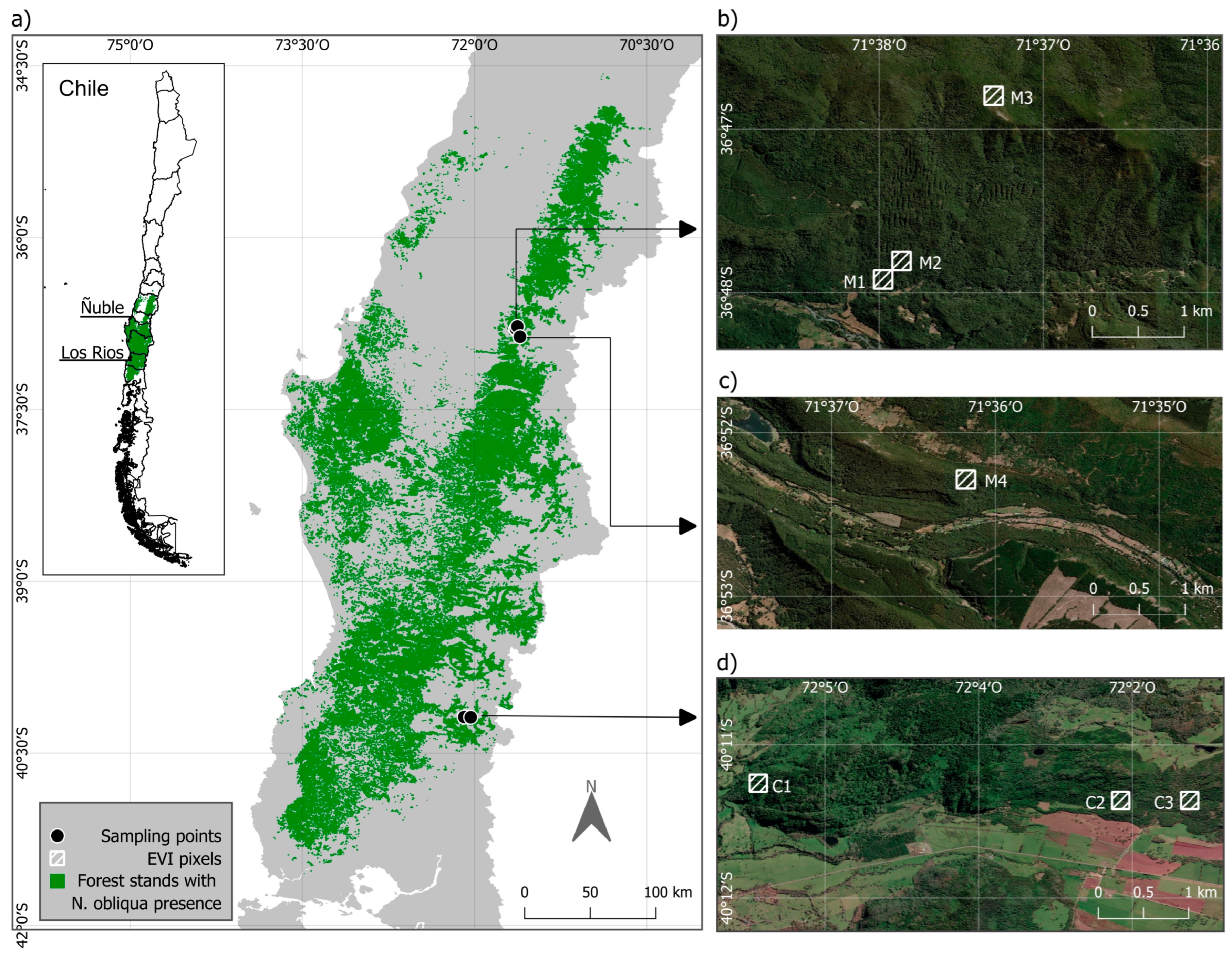
For the analysis, two categories of study sites were selected: control pixels (C), corresponding to N. obliqua stands located in Los Rios region with no visual evidence of infestation or damage during field monitoring; and miner-affected pixels (M), corresponding to N. obliqua stands located in the Ñuble region which had been severely defoliated by the leaf miner complex in late 2022 (Figure 1, Table 1). Site classification was supported by field data collected in [28], which documented the presence of leaf-miner damage across the study areas.

2.2. EVI Data Acquisition and Processing

Based on the pixels, time series of the Enhanced Vegetation Index (EVI) were generated. The EVI was selected for its ability to reduce soil background noise in the canopy, which is critical in deciduous N. obliqua forests where canopy cover decreases during the cold season.
The time series were derived from the MOD13Q1 V6.1 [29] and MYD13Q1 V6.1 [30] surface reflectance products, obtained from the MODIS spectroradiometer aboard the Terra and Aqua satellites, respectively. Processing was performed using the Google Earth Engine platform. Combining these surface reflectance products allowed for the generation of composite images with a spatial resolution of 250 m and a high temporal resolution of 8 days, which minimized data gaps caused by frequent cloud cover in the area.
To ensure data quality, pixels affected by clouds, shadows, or snow were masked and excluded. This filter was applied using the DetailedQA quality band of each product, retaining only pixels labeled as “acceptable image quality” (bits 0–1) and without the presence of adjacent clouds (bit 8), mixed clouds (bit 10), snow/ice (bit 14), or cloud shadow (bit 15).

2.3. Time Series Range and Definition of Growing Seasons

The time series covers the period between 1 January 2003, and 5 September 2024. This temporal range allowed for a comparison between the phenological behavior observed during the growing season of the leaf miner outbreak and the historical EVI behavior using previous growing seasons as a reference.
We defined each growing season as the phenological cycle, the starting and ending of a period of minimal vegetational activity, between 1 July and 30 June of the next year, following the Southern Hemisphere’s seasonality. Thus, the leaf miner outbreak occurred during the 2022 season, which spans the period from 1 July 2022, to 30 June 2023. The complete time series covers 20 growing seasons, each containing 46 EVI observations.

2.4. Time Series Decomposition and EVI Trend Analysis

The first analysis focused on isolating the EVI trend over time to identify whether the index showed a general downward direction during the outbreak season as a primary indicator of the defoliation effect. To extract the trend, the components of seasonality, trend, and random error were separated using the STL method [31]. The procedure was conducted using the forecast package [32,33] in the R statistical programming environment (R Core Team, 2024) [34].
For the decomposition, the seasonal component was set as periodic, assuming an identical annual pattern for each year. This choice was made since N. obliqua phenology is characterized by an intrinsically stable annual cycle. Therefore, any deviation from this baseline cycle (caused by climate or disturbance agents like defoliators) is reflected in the trend and residual components rather than seasonal variation.
To generate the trend component, a moving window of 49 observations was used—slightly more than one growing season (46 observations). This size allows for a flexible trend that is sensitive to inter-seasonal changes, facilitating the detection of sharp drops in productivity associated with the outbreak.

2.5. Phenological Cycle Analysis

Complementarily, analysis of the EVI dynamics during the outbreak season was performed. This involved comparing the EVI phenological cycle during the 2022 and 2023 seasons with a reference season. The reference season represents the expected EVI cycle under normal conditions and was obtained by calculating the average phenological cycle across all previous seasons. Only for M pixels the years 2008, 2009, 2014, and 2015 were excluded from the average because the trend analysis revealed abnormally low greenness, potentially due to previously documented defoliator outbreaks [16,35].
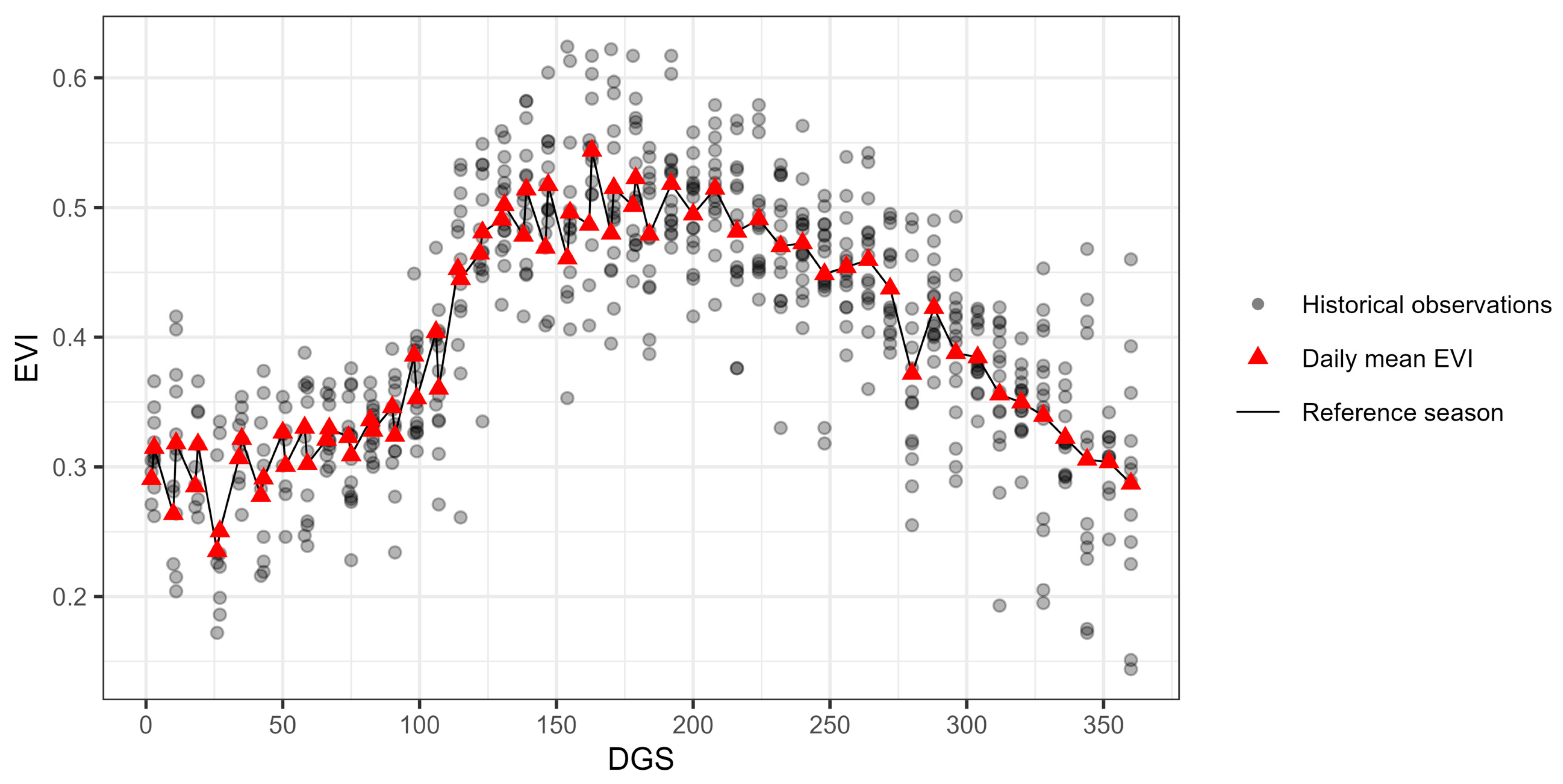
The reference seasons were constructed for each pixel independently by compiling the average EVI measurements per Day of the Growing Season (DGS) (Figure 2). This is possible because, every year, the Terra and Aqua satellites detect EVI on the same calendar days for a given location (e.g., every 3 April). The comparison was visual, overlaying the 2022 and 2023 seasons with the reference to observe decoupling.

2.6. EVI Condition Calculation

The condition index allows for the evaluation of the health or integrity of an ecosystem indicator by comparing an observed value (Vobs) against a reference value (Vref). In this study, the observed value corresponded to the EVI recorded at each DGS for the 2022 and 2023 seasons, while the reference value corresponded to the estimated EVI for the same DGS in the reference season.
The condition is calculated using the following equation:
E V I   c o n d i t i o n =   V o b s V m i n V r e f V m i n
where Vmin represents the absolute theoretical limit of indicator collapse, corresponding to the point where ecosystem function is entirely lost. In this study, it was defined as 0, representing completely bare soil, consistent with the interpretation of low Enhanced Vegetation Index (EVI) values as indicative of negligible canopy structure and photosynthetic activity [36,37]. Thus, the equation simplifies to:
E V I   c o n d i t i o n =   V o b s V r e f

2.7. Sensitivity Analysis Using Different Reference Values

To evaluate the EVI condition during 2022 and 2023, three reference values were considered to account for the impact of the megadrought affecting south-central Chile in 2010. A “pre-drought” reference (2003–2009), a “post-drought” reference (2010–2023), and a “global” reference (2003–2023) were generated. The condition was calculated for each scenario, and differences between groups were evaluated using a Tukey’s HSD test of mean differences.

2.8. Anomaly Probability Analysis Using Highest Density Regions (HDR)

To quantify the magnitude of the phenological decoupling, the Highest Density Regions (HDR) method [38] was used to estimate how unusual the EVI values were during the outbreak. This method estimates the probability of observing a specific EVI value given a specific DGS, based on the ecosystem’s historical behavior.
HDR identifies areas where 50%, 80%, 95%, and 99% of historical data (excluding anomalous years) are concentrated. By overlaying the 2022 and 2023 curves onto these regions, it was possible to visualize the decline and estimate the statistical probability of occurrence for the observed decay values. We used the markers alpha (α) for the onset of the trend decline in miner-affected pixels (1 July 2022), and beta (β) for the recovery (30 June 2023), respectively. The analysis was performed using the ggdensity package in R [39].

3. Results and Discussion

3.1. Long-Term EVI Trend Analysis

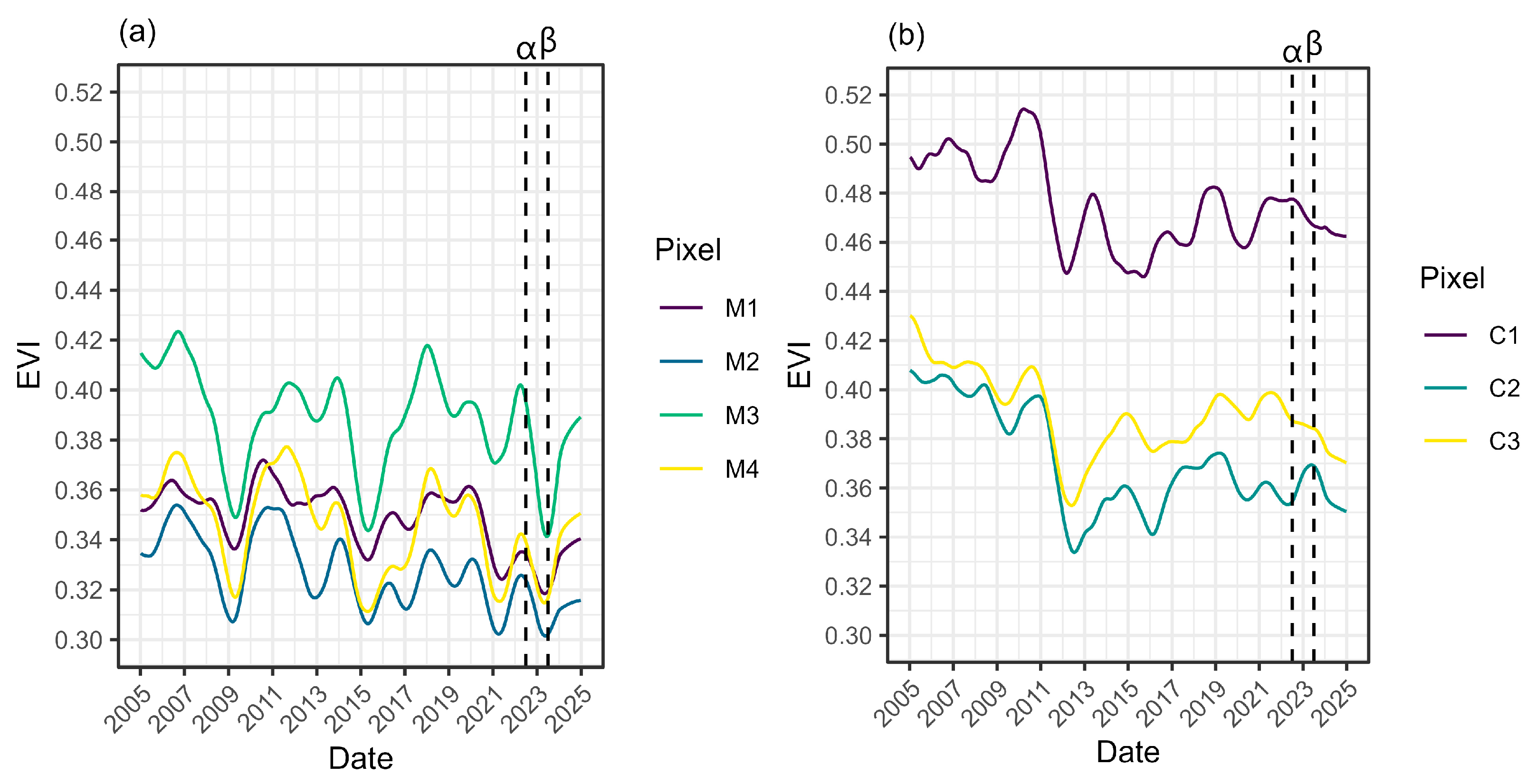
The EVI series shows strong interannual variability, with consistently lower values in affected pixels than in control pixels, reflecting the combined effects of climatic, disturbance, and phenological influences (Figure 3). Despite this variability, a slightly but persistent negative long-term trend suggests gradual declines in photosynthetic vigor. During the alpha–beta period (Figure 3a), the STL revealed a pronounced decline in the EVI for all four leaf-miner-affected pixels (M) during the 2022 growing season. This negative slope persisted into the beginning of the 2023 season, aligning chronologically with field reports documenting the leaf miner complex outbreak [1]. Notably, for all M-pixels, the decline recorded during the 2022 season resulted in the lowest EVI trend values observed across the entire 20-year time series. This suggests that the impact of the leaf miner complex represents an extreme disturbance event within the historical context of these forests.
In contrast, control pixels (C), located in areas with no reported outbreaks, did not exhibit a uniform downward pattern during the same period (Figure 3b). While pixel C1 showed a slight negative trend, it was marginal compared to previous fluctuations. Pixel C2 remained relatively stable, and C3 experienced an increase in its EVI trend during the 2022 season. The contrasting responses between M and C pixels suggest that the sharp decline observed in M-pixels is likely driven by a localized biotic stressor, consistent with a leaf miner complex outbreak, rather than widespread event across distribution range of N. obliqua. At least for the 2022 season, the data support this interpretation, with mean leaf miner incidence reaching 92.5% in M pixels, while C pixels showed no detectable incidence (0%) as shown in Table 1.
Historical declines in the EVI trend were also identified in M-pixels during the 2008 and 2014 seasons (Figure 3a), which coincided with reported leaf miner complex outbreaks [16,32]. However, these discrete events are embedded within an overall declining trend across the full time series (2003–2023), suggesting that additional large-scale drivers may be operating. A general negative trend was observed, with both maximum and minimum EVI values gradually decreasing over time. This long-term degradation may be associated with climate-driven stress, particularly the megadrought affecting south-central Chile, as reported in previous studies. For instance, deteriorated growth rates have been documented in ‘Roble–Raulí–Coihue’ forests between 2007 and 2012 [40]. Furthermore, winter precipitation anomalies during the megadrought were shown to explain more than 50% of the variance in EVI during the subsequent spring and summer seasons in central Chile [41].
The high interannual variability of EVI poses significant challenges for signal attribution. As observed in C-pixels, several trend declines occurred in the absence of insect outbreaks, indicating that other factors may be involved. Previous studies have linked EVI negative trends to vegetation browning caused by prolonged drought and heat synergies [9], showing that factors such as extreme heatwaves or water stress can induce similar spectral responses. Additionally, the spectral signature of insect-driven defoliation can be confused with other disturbances, such as canopy burn severity [42].
Furthermore, disturbances often interact synergistically [43]; for example, thermal and hydric stress can weaken host trees, increasing their susceptibility to phytophagous insects [44], while simultaneously modulating insect population dynamics [20]. Therefore, while the 2022 decline is highly synchronized with the outbreak, a trend analysis alone is insufficient to unequivocally isolate the primary cause from other environmental stressors.
STL was key to detecting an anomaly associated with a potential outbreak. Previous studies on Nothofagus defoliators, such as Ormiscodes amphimone in Patagonia, have shown that massive defoliation events can be visible in raw and unprocessed EVI data [19]. However, in our study, the damage caused by the leaf miner complex in 2022 was more subtle, requiring the isolation of the trend component to reveal the underlying signal. These results indicate that trend analysis is not only effective for capturing gradual changes, such as variations in Leaf Area Index (LAI) variations [45], but also for identifying abrupt and transient disturbances. Our findings align with Zhang et al. [46], who demonstrated that STL decomposition can effectively detect discrete events such as wind throw or insect infestations. Nevertheless, isolating the trend component alone does not fully resolve the attribution of the detected signal. To further elucidate its biotic origin and overcome these limitations, the following section evaluates the intra-annual phenological cycle and its decoupling from historical norms.

3.2. EVI Dynamics During the Growing Season

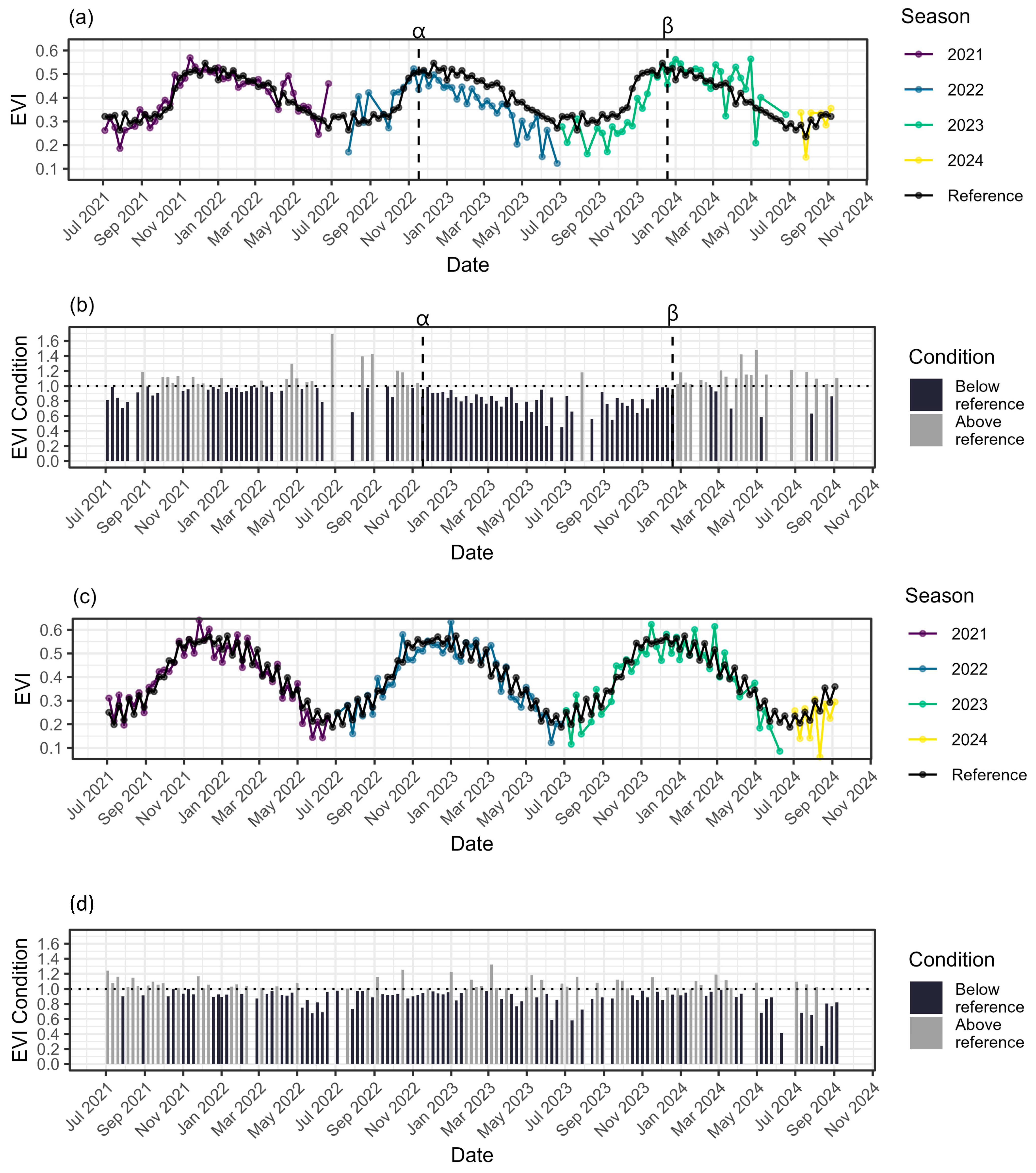
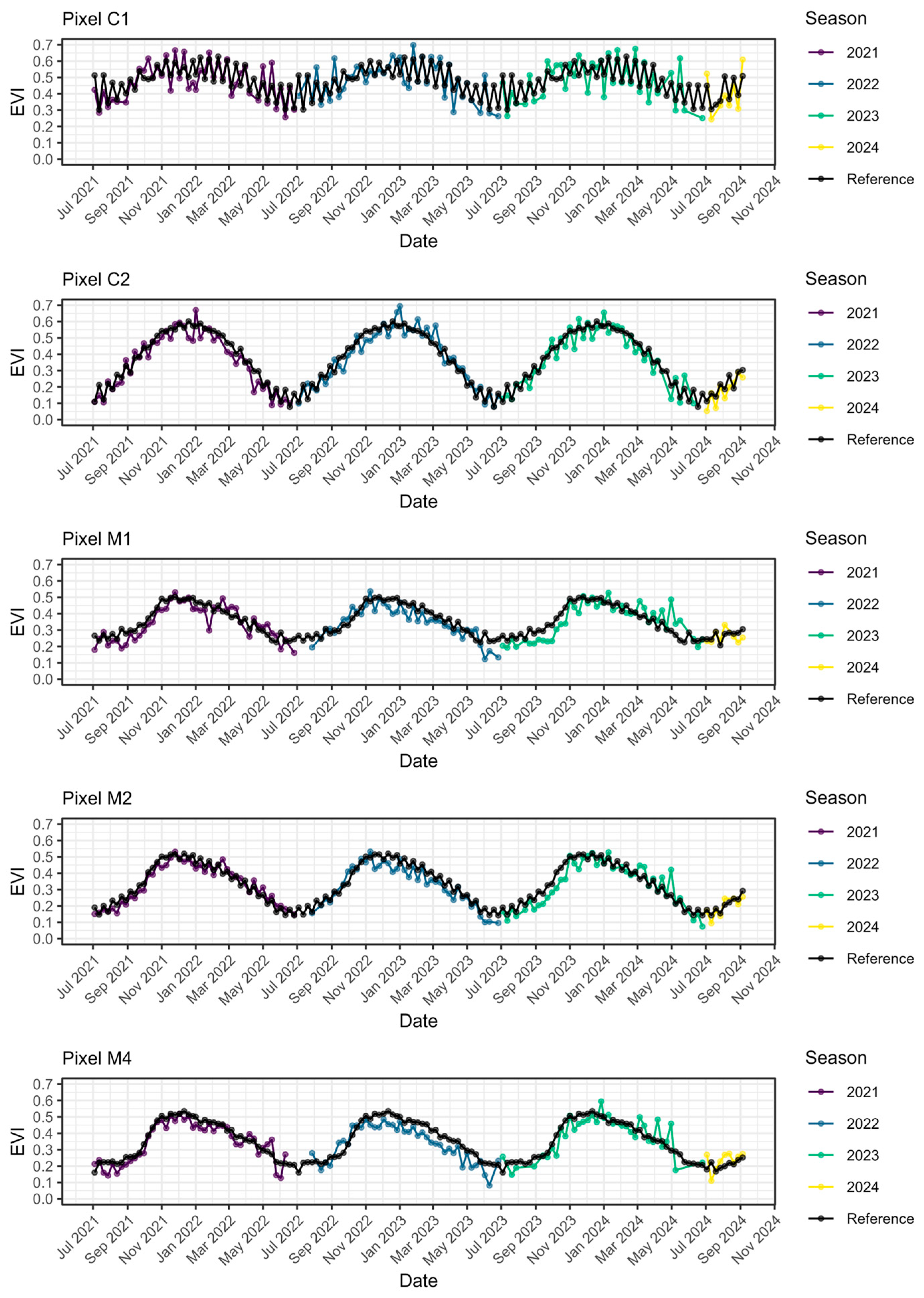
When plotting the 2022 growing season against its historical reference, a clear divergence was observed in all M-pixels (Figure A1 and Figure 4a,b). Specifically, EVI measurements remained consistently below the historical mean for several months. In terms of phenological metrics, this EVI decay began near the 2022 Peak of Season (POS), approximately in November, and persisted until the End of Season (EOS) in July. Figure 4c,d illustrates this decoupling, showing how the 2022 curve breaks away from the reference precisely when the forest should be at its maximum vigor.
The observed pattern of progressive greenness reduction in N. obliqua stands closely synchronizes with the larval phase of H. pseuderiocrania and other species within the leaf miner complex. The life cycle of these insects follows a highly specialized and predictable phenological timing: females deposit eggs during the spring budding (September to November). The emerging larvae begin mining the leaf parenchyma by late November, coinciding with the phase of maximum foliage expansion (POS) [35,47].
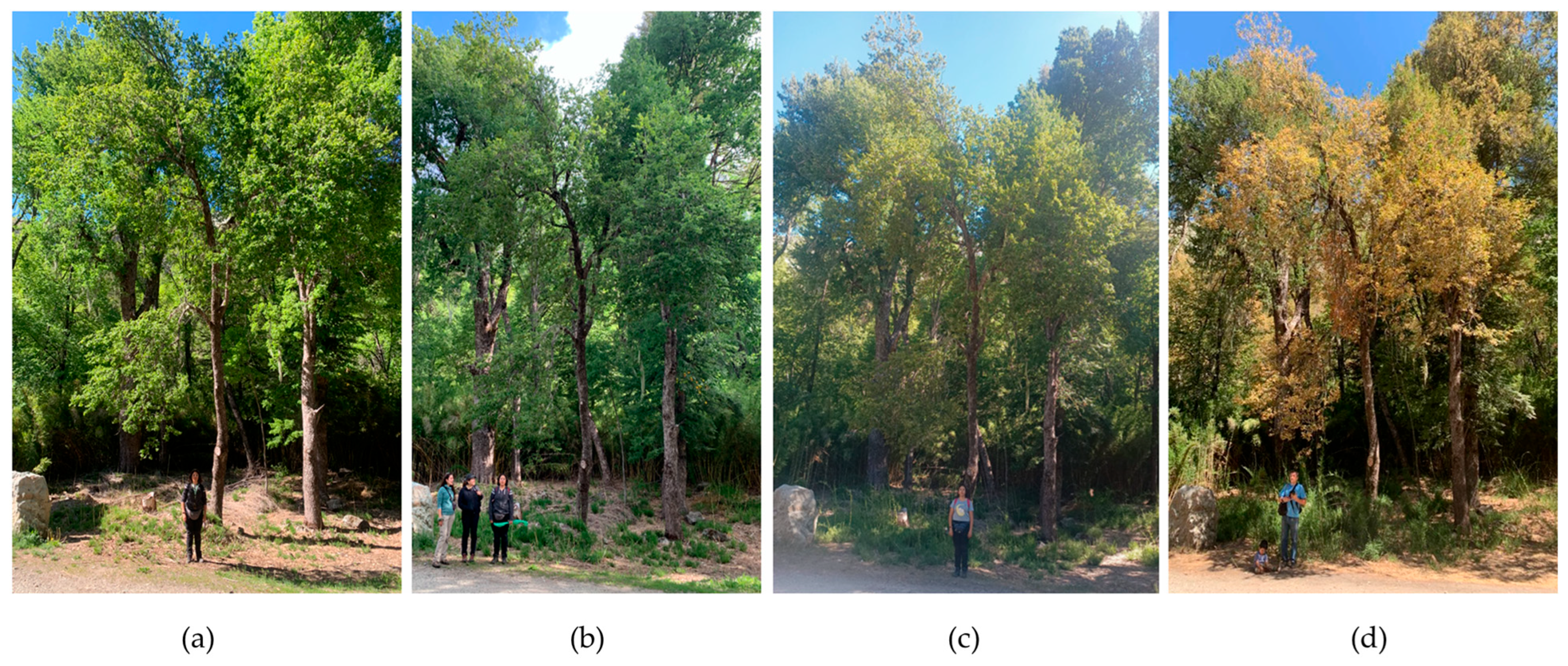
This feeding activity continues throughout the summer (December to February), causing a sustained loss of photosynthetically active tissue (Figure 5) and progressive canopy browning by the continuous decline in EVI values. By March to April, larvae complete their development and exit the mines to pupate in the soil for winter diapause [35,47].
A critical finding in the M-pixels was that the EVI suppression extended beyond the initial outbreak season, affecting the subsequent 2023 growing season. In all affected cases, the 2023 season began its greening phase at values significantly lower than the reference curve, only recovering toward normal levels as it approached the 2023 peak. This indicates that the impact of the leaf miner complex outbreak spanned two consecutive growing seasons, revealing a clear carry-over effect.
This carry-over effect can be explained by the carbon balance and energetic constraints of deciduous trees. N. obliqua must produce and store sufficient carbohydrates through photosynthesis to support winter dormancy and, critically, to meet the high energetic cost of producing new foliage the following spring. The defoliation caused by the 2022 outbreak may have severely reduced these carbon reserves. Consequently, the trees likely entered dormancy with depleted energy stores, leading to a weaker budburst and reduced canopy development, characterized by smaller and/or fewer leaves, in the spring of 2023 [48].
The stability of the control pixels (C) further reinforces the causal link between the leaf miner complex and the observed alteration of the phenological cycle. As shown in Figure 4c,d, the 2021, 2022, and 2023 seasons in the control sites overlapped almost perfectly with the reference curve. This lack of divergence in non-infested stands (Figure A1) confirms that the 2022 season was phenologically normal. Furthermore, the 2021 season in the affected stands also showed a close fit with the reference, highlighting that the decoupling was an abrupt event exclusive to the infestation period (alpha–beta period, Figure 4a,b).

3.3. EVI-Based Ecosystem Assessment

While phenological curves visually demonstrate the decoupling during the outbreak, the EVI condition metric provides a standardized assessment of this impact. By estimating the proportion of optimal greenness maintained throughout the cycle, the condition index translates spectral decoupling into a functional measure of ecosystem health loss. This approach allows for a precise and objective identification of the moment when the forest departs from its historical phenological stability.
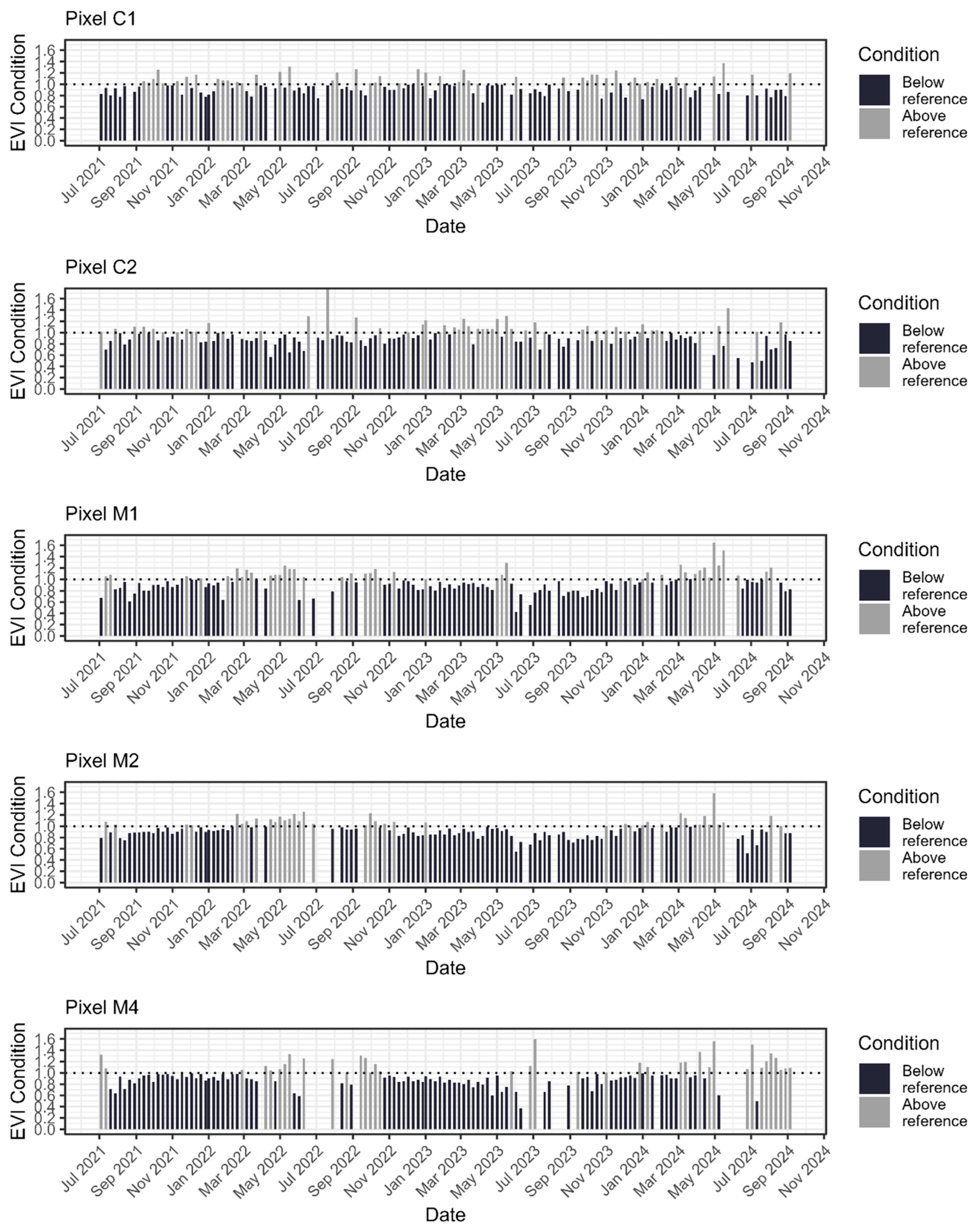
In M-pixels, the condition showed a linear and progressive decline starting in November 2022, coinciding with the onset of larval activity. In pixel M3 (Figure 4a,b), the condition dropped from its baseline to a minimum of 42%, representing a 58% reduction in photosynthetic integrity by the end of the season. This trajectory was consistent across all affected pixels (M1, M2, and M4) (Figure A2). The recovery phase began after the larvae entered pupation; however, the condition remained suppressed below the 100% threshold throughout most of the 2023 season, confirming the multi-seasonal legacy effect discussed previously. A notable observation in the M-pixels was the occurrence of positive anomalies surrounding the disturbance. Prior to the outbreak, near July 2022, EVI was 60% higher relative to the reference EVI, indicating exceptionally high vegetative vigor (Figure 4b). This suggests that the outbreak may be facilitated by a bottom-up mechanism, as in the plant vigor hypothesis, whereby high-quality, nutrient-rich foliage in highly vigorous plants can trigger insect population irruptions [49]. Following the collapse and subsequent recovery, the condition again exceeded the 100% reference, reaching nearly 130% by May 2024. This rebound effect is likely a manifestation of defoliation-induced compensatory growth. Deciduous trees often exhibit a physiological overcompensation response after defoliation, whereby increased light availability and nutrient reallocation stimulate a flush of high-density foliage once the biotic stressor is removed [50].
In contrast, control pixels (C) exhibited random fluctuations around the 100% baseline throughout the 2022 and 2023 seasons (Figure 4c,d and Figure A2). The statistical summary (Table 2) highlights the severity and persistence of the outbreak in M-pixels. The mean condition during the affected period ranged between 81% and 87%, while the minimum values reached critical thresholds between 36% and 54%. Furthermore, the duration of the disturbance, the period during which the forest remained below its healthy reference, lasted between 288 and 421 days, highlighting the protracted nature of recovery in N. obliqua forests.
To evaluate the potential confounding effect of the Chilean megadrought, the condition was recalculated using two other historical baselines: pre-drought (2003–2009) and post-drought (2010–2023) (Table 2). Interestingly, ANOVA and Tukey’s HSD tests revealed no significant differences in any condition across the three reference scenarios. This suggests that, for these specific stands, the baseline phenological dynamics have remained remarkably stable despite the regional drought. A degree of localized drought resilience in N. obliqua is therefore plausible, as previously documented [51]. This strengthens the interpretation that the drastic decline in condition observed in 2022 was primarily attributable to the leaf miner complex outbreak, particularly since no other disturbance agents or factors were reported nor observed, and the reference baseline did not exhibit a structural shift following the onset of the megadrought in 2010.

3.4. Anomaly Detection and Probability-Based Analysis Using HDR

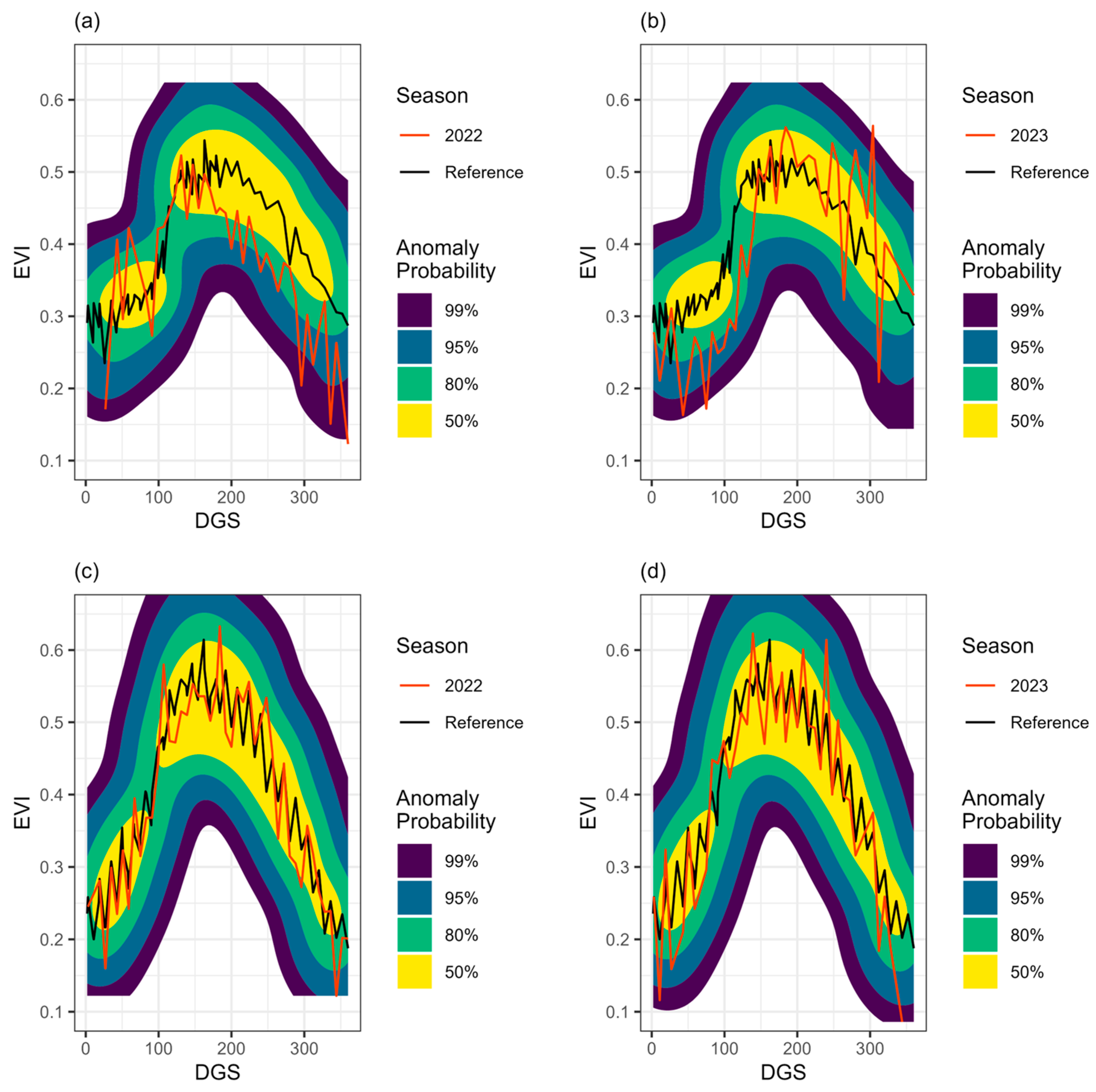
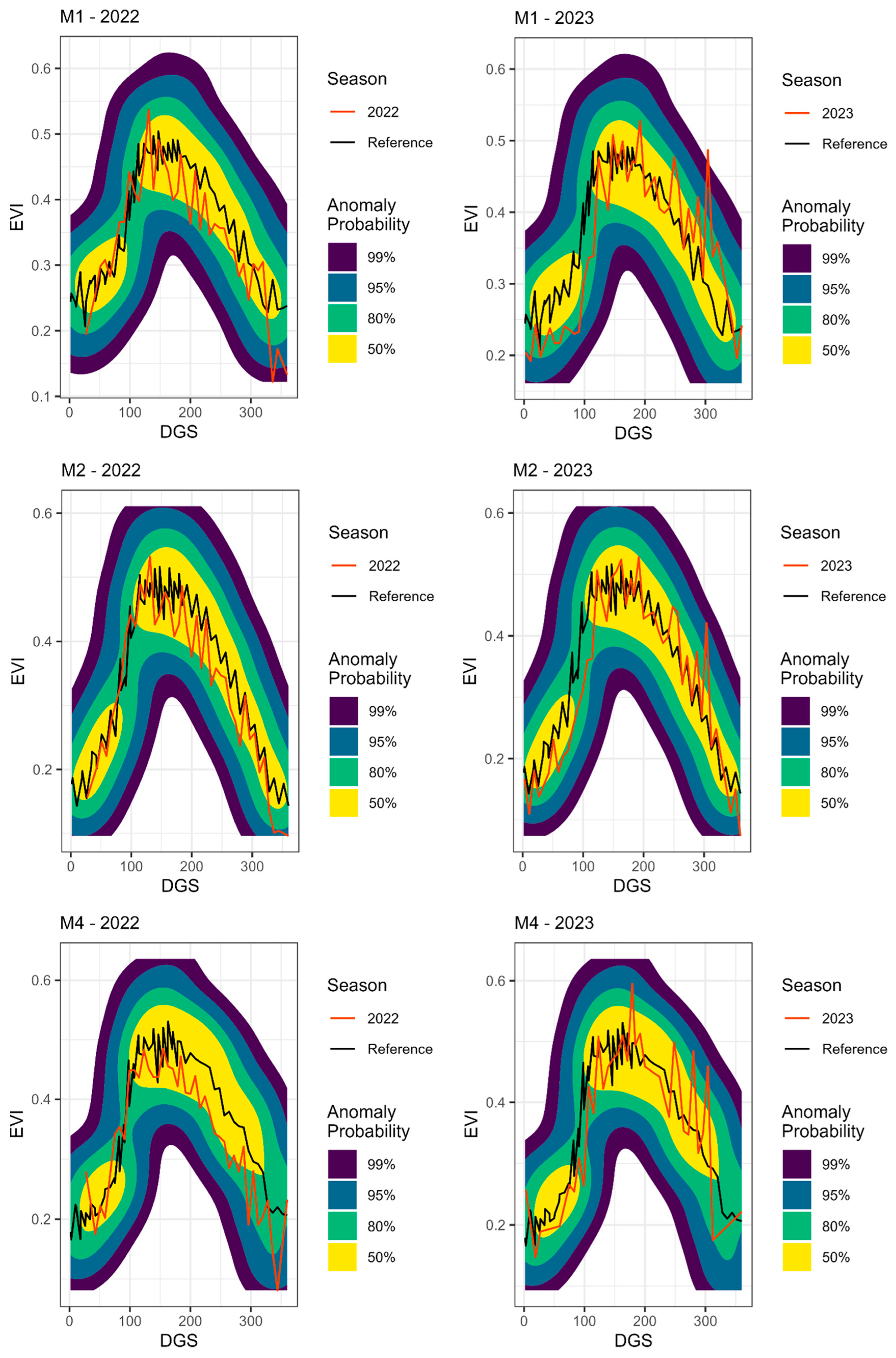
To estimate the statistical significance of the observed EVI decline, the HDR method was employed. This approach allowed for the quantitative assessment of how unusual the 2022 and 2023 growing seasons were relative to the historical probability distribution of forest greenness. While the reference phenological cycle consistently falls within the 50% highest density region (representing the most frequent historical states), the observations from M-pixels during the outbreak season shifted into statistically rare ranges (Figure A3). For example, in pixel M3, during the period of maximum condition loss, EVI values shifted to the 80% and even the 95% density regions (Figure 6a,b), which contain only 20% to 5% of historical data. This indicates a very low probability of occurrence under normal conditions, thereby confirming the presence of a significant negative anomaly.
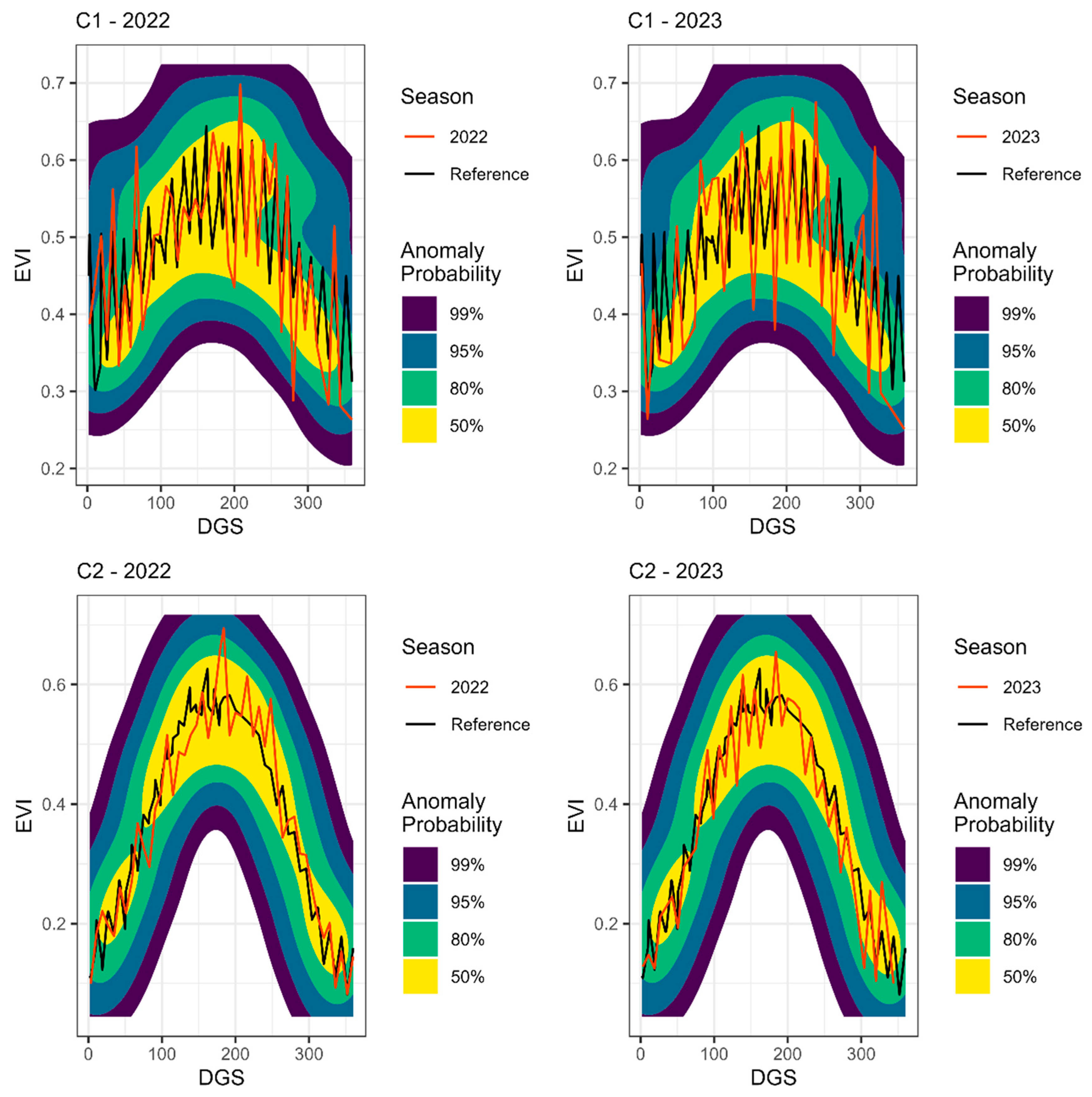
The HDR analysis also provided evidence for the pre-outbreak and post-outbreak anomalies previously identified. As represented in pixel M3, around DGS 50 of the 2022 season, EVI values reached the 95% probability region for positive anomalies, meaning that these values were higher than 95% of historical records for that specific date. This statistic confirms the exceptional canopy vigor that may have acted as a precursor to the leaf-miner complex outbreak irruption. Similarly, the compensatory greening observed in late 2023 and 2024 reached the 99% probability region, characterizing the recovery as a statistically extreme positive event, consistent with a rebound effect. In contrast, EVI values for control pixels (C) remained consistently within the 50% core density region throughout both seasons (Figure 6c,d and Figure A4), showing no statistically significant departure from historical norms.
The use of the HDR method is particularly critical for this study, as it provides a non-parametric and probabilistic validation of disturbance signals in the absence of quantitative field-based severity data. The patterns observed here—where a sudden shift toward low-probability HDRs occurs during periods of known insect activity—align with previous research in Chilean Nothofagus forests. For instance, similar self-calibrated time series approaches have successfully quantified massive outbreaks of the defoliator Ormiscodes amphimone in Patagonia [19,52], showing that these spectral anomalies are reliable proxies for ground-level defoliation. Furthermore, the effectiveness of the HDR framework for near-real-time anomaly detection has recently been validated across different ecosystems and disturbance types [51]. This probabilistic framework opens new opportunities for operational forest health monitoring, enabling early warning systems based solely on remotely sensed data.

4. Conclusions

4.1. Synthesis of Evidence for Biotic Attribution

By integrating the trend analysis, phenological synchronization, and HDR probability mapping, this study strengthens the hypothesis that the observed EVI collapse in N. obliqua forests is associated with a leaf miner outbreak. While the long-term EVI trend analysis suggested that EVI drops could be confused with drought or fire, EVI dynamics during the growing season, especially the precise temporal alignment with the larval feeding stage, combined with the lack of such signals in control stands, provides a robust multi-layered argument that suggests that the primary driver of the observed forest decay was the biotic pressure from the H. pseuderiocrania complex.

4.2. A Methodological Framework for Automated Monitoring

This research proposes a methodological framework to track defoliator damage by contrasting intra-annual phenological decoupling against healthy forest baselines. By establishing clear historical norms and quantifying deviations through statistical density regions, this work lays the foundation for a remote and automated forest health monitoring system. Once validated through further ground-truthing, this model has the potential to become a scalable tool for real-time control and damage assessment in deciduous forests, moving beyond reactive management towards a more proactive remote surveillance.

4.3. Addressing Global Change and Landscape-Scale Dynamics

The use of Seasonal Trend Decomposition, Highest Density Regions and field observation is of strategic importance. The frequency and intensity of forest diseases and insect attacks have increased over the past two decades in the region. This reality poses a growing need to understand the mechanisms—specifically the spatial and temporal patterns—of landscape-scale damage carried out by insect progression. In this context, remote sensing offers an indispensable, cost-effective solution for monitoring population dynamics and assessing damage in the Chilean forests, providing a viable alternative to logistically challenging and expensive field surveys.

4.4. Bridging the Hemispheric Knowledge Gap

Finally, this study addresses a critical knowledge gap in global forest ecology. Historically, forest–insect interactions and their ecosystem impacts have been extensively documented in the Northern Hemisphere, leaving a significant void in our understanding of Southern Hemisphere dynamics. Chilean forests represent a vital natural capital, hosting a high diversity of native defoliators whose ecological behaviors remain largely under-researched. By providing evidence of these patterns in the Southern Hemisphere, this study not only contributes with essential data to regional forest entomology but also highlights the urgent need to protect these unique ecosystems from emerging biotic threats in a climate change scenario.

Author Contributions

Conceptualization, B.V., P.M.-S., P.T.T.; Data curation, B.V., P.M.-S., P.T.T.; Formal analysis, B.V., P.M.-S., P.T.T., R.L.-F.; Funding acquisition, P.M.-S.; Investigation, B.V., P.M.-S.; Methodology, B.V., P.M.-S.; Project administration, P.M.-S.; Resources, P.M.-S., R.M.A.; Software, B.V., P.M.-S., P.T.T.; Supervision, P.M.-S.; Validation, B.V., P.M.-S., P.T.T., R.L.-F.; Visualization, B.V.; Writing—original draft, B.V., P.M.-S.; writing—review and editing, B.V., P.M.-S., P.T.T., R.L.-F. All authors have read and agreed to the published version of the manuscript.

Funding

This research was partially funded by the Chilean National Commission for Scientific and Technological Research with Project Grant ANID BASAL FB210015. Monitoring activities in the Los Ríos Region were additionally funded by ANID FONDEF IDeA Project ID23I10410.

Data Availability Statement

The original data, as well as the processing code used to generate the results presented in this study, are openly available on Github at URL (accessed on 20 March 2026) https://github.com/benjavergara/H.pseuderiocrania.git.

Acknowledgments

The authors acknowledge Bosque Nativo Elnahue for providing access to monitoring plots in the Ñuble region. The authors also thank forestry engineering student Bárbara Soto, together with Valentina Ahumada and María Paz Martínez, for their valuable support during field data collection. Bárbara Soto’s participation was carried out as part of her undergraduate thesis. The authors have reviewed and edited the output and take full responsibility for the content of this publication.

Conflicts of Interest

The authors declare no conflicts of interest. The funders had no role in the design of the study; in the collection, analyses, or interpretation of data; in the writing of the manuscript; or in the decision to publish the results.

Abbreviations

The following abbreviations are used in this manuscript:
CONAFCorporación Nacional Forestal
DGSDay of the Growing Season
EOSEnd of Season
EVIEnhanced Vegetation Index
HDRHighest Density Regions
HSDHonestly Significant Difference (referring to Tukey’s HSD test)
LAILeaf Area Index
LSPLand Surface Phenology
MODISModerate Resolution Imaging Spectroradiometer
NPPNet Primary Productivity
POSPeak of Season
SRSSatellite Remote Sensing
STLSeasonal-Trend decomposition using Loess

Appendix A

Appendix A.1

Figure A1. EVI phenological dynamics across the 2021–2023 growing seasons for the remaining control (C) and miner-affected (M) pixels. The panels show observed versus reference EVI values for pixels C1, C2, M1, M2, and M4.
Remotesensing 18 01260 g0a1

Appendix A.2

Figure A2. EVI condition across the 2021–2023 growing seasons for the remaining control (C) and miner-affected (M) pixels. The panels show EVI condition relative to Day of the Growing Season (DGS) for pixels C1, C2, M1, M2, and M4.
Remotesensing 18 01260 g0a2

Appendix A.3

Figure A3. Highest Density Regions (HDR) analysis for the 2022 and 2023 growing seasons for the remaining miner-affected (M) pixels. Shaded areas represent historical probability densities at the 50%, 80%, 95%, and 99% levels.
Remotesensing 18 01260 g0a3

Appendix A.4

Figure A4. Highest Density Regions (HDR) analysis for the 2022 and 2023 growing seasons for the remaining control (C) pixels. Shaded areas represent historical probability densities at the 50%, 80%, 95%, and 99% levels.
Remotesensing 18 01260 g0a4

References

  1. Corporación Nacional Forestal (CONAF). Catastro de Los Recursos Vegetacionales de Chile Al Año 2024; CONAF: Santiago, Chile, 2024. [Google Scholar]
  2. Poblete, P.; Kahler, C.; Bañados, J.C.; Gysling, J.; Pardo, E.; Soto, D.; Baeza, D.; Catelicán, L.; Hernández, J.; Troncoso, H. Anuario Forestal 2024; INFOR: Valdivia, Chile, 2024. [Google Scholar]
  3. Almonacid-Muñoz, L.; Herrera, H.; Fuentes-Ramírez, A.; Vargas-Gaete, R.; Larama, G.; Jara, R.; Fernández-Urrutia, C.; da Silva Valadares, R.B. Tree Cover Species Modify the Diversity of Rhizosphere-Associated Microorganisms in Nothofagus Obliqua (Mirb.) Oerst Temperate Forests in South-Central Chile. Forests 2022, 13, 756. [Google Scholar] [CrossRef]
  4. Ramos, C.; Zagal, E.; Timmusk, S.; Dube, F.; Paulino, L.; Ortiz, J.; Intriago-Ávila, J.; Fuentes, J.P. Soil Carbon Sequestration in Nothofagus Obliqua Forests with Different Canopy Cover Levels Under Silvopastoral Management. Agronomy 2025, 15, 855. [Google Scholar] [CrossRef]
  5. Ortiz, J.; Dube, F.; Neira, P.; Panichini, M.; Stolpe, N.B.; Zagal, E.; Martínez-Hernández, P.A. Soil Quality Changes within a (Nothofagus Obliqua) Forest under Silvopastoral Management in the Andes Mountain Range, South Central Chile. Sustainability 2020, 12, 6815. [Google Scholar] [CrossRef]
  6. Garreaud, R.D.; Boisier, J.P.; Rondanelli, R.; Montecinos, A.; Sepúlveda, H.H.; Veloso-Aguila, D. The Central Chile Mega Drought (2010–2018): A Climate Dynamics Perspective. Int. J. Climatol. 2020, 40, 421–439. [Google Scholar] [CrossRef]
  7. Garreaud, R.; Boisier, J.P.; Alvarez-Garreton, C.; Christie, D.A.; Carrasco-Escaff, T.; Vergara, I.; Chávez, R.O.; Aldunce, P.; Camus, P.; Suazo-Álvarez, M.; et al. Hyperdroughts in Central Chile: Drivers, Impacts, and Projections. Hydrol. Earth Syst. Sci. 2025, 29, 5347–5369. [Google Scholar] [CrossRef]
  8. Miranda, A.; Lara, A.; Altamirano, A.; Di Bella, C.; González, M.E.; Camarero, J.J. Forest Browning Trends in Response to Drought in a Highly Threatened Mediterranean Landscape of South America. Ecol. Indic. 2020, 115, 106401. [Google Scholar] [CrossRef]
  9. Miranda, A.; Syphard, A.D.; Berdugo, M.; Carrasco, J.; Gómez-González, S.; Ovalle, J.F.; Delpiano, C.A.; Vargas, S.; Squeo, F.A.; Miranda, M.D.; et al. Widespread Synchronous Decline of Mediterranean-Type Forest Driven by Accelerated Aridity. Nat. Plants 2023, 9, 1810–1817. [Google Scholar] [CrossRef]
  10. Ward, S.F.; Aukema, B.H.; Fei, S.; Liebhold, A.M. Warm Temperatures Increase Population Growth of a Nonnative Defoliator and Inhibit Demographic Responses by Parasitoids. Ecology 2020, 101, e03156. [Google Scholar] [CrossRef]
  11. Vergara, O.; Jerez, V. Insects and Infestations Associated to Foliage of Nothofagus Antarctica (Forst) Oerst. (Nothofagaceae) in the Baker River Basin, Region de Aysén, Chile. Gayana 2010, 74, 83–93. [Google Scholar] [CrossRef]
  12. Estay, S.A.; Chávez, R.O.; Rocco, R.; Gutiérrez, A.G. Quantifying Massive Outbreaks of the Defoliator Moth Ormiscodes Amphimone in Deciduous Nothofagus-Dominated Southern Forests Using Remote Sensing Time Series Analysis. J. Appl. Entomol. 2019, 143, 787–796. [Google Scholar] [CrossRef]
  13. Sinclair, R.J.; Hughes, L. Leaf Miners: The Hidden Herbivores. Austral Ecol. 2010, 35, 300–313. [Google Scholar] [CrossRef]
  14. Nabity, P.D.; Zavala, J.A.; DeLucia, E.H. Indirect Suppression of Photosynthesis on Individual Leaves by Arthropod Herbivory. Ann. Bot. 2009, 103, 655–663. [Google Scholar] [CrossRef] [PubMed]
  15. Raimondo, F.; Ghirardelli, L.A.; Nardini, A.; Salleo, S. Impact of the Leaf Miner Cameraria Ohridella on Photosynthesis, Water Relations and Hydraulics of Aesculus Hippocastanum Leaves. Trees 2003, 17, 376–382. [Google Scholar] [CrossRef]
  16. Ramos, R.A.; Parra, L.E. Heterobathmia Pseuderiocrania Kristensen & Nielsen (Lepidoptera, Heterobathmiidae): Identificación Basada En DNA-Barcoding y Notas Morfológicas e Historia de Vida de Los Estados Inmaduros. Rev. Bras. Entomol. 2013, 57, 24–30. [Google Scholar] [CrossRef][Green Version]
  17. Caparros-Santiago, J.A.; Rodriguez-Galiano, V.; Dash, J. Land Surface Phenology as Indicator of Global Terrestrial Ecosystem Dynamics: A Systematic Review. ISPRS J. Photogramm. Remote Sens. 2021, 171, 330–347. [Google Scholar] [CrossRef]
  18. Senf, C.; Pflugmacher, D.; Wulder, M.A.; Hostert, P. Characterizing Spectral–Temporal Patterns of Defoliator and Bark Beetle Disturbances Using Landsat Time Series. Remote Sens. Environ. 2015, 170, 166–177. [Google Scholar] [CrossRef]
  19. Chávez, R.O.; Rocco, R.; Gutiérrez, Á.G.; Dörner, M.; Estay, S.A. A Self-Calibrated Non-Parametric Time Series Analysis Approach for Assessing Insect Defoliation of Broad-Leaved Deciduous Nothofagus Pumilio Forests. Remote Sens. 2019, 11, 204. [Google Scholar] [CrossRef]
  20. Battisti, A.; Larsson, S. Climate Change and Forest Insect Pests. In Forest Entomology and Pathology: Volume 1: Entomology; Allison, J.D., Paine, T.D., Slippers, B., Wingfield, M.J., Eds.; Springer International Publishing: Berlin/Heidelberg, Germany, 2023; Volume 1, pp. 773–787. ISBN 9783031115530. [Google Scholar]
  21. Boyd, I.L.; Freer-Smith, P.H.; Gilligan, C.A.; Godfray, H.C.J. The Consequence of Tree Pests and Diseases for Ecosystem Services. Science 2013, 342, 1235773. [Google Scholar] [CrossRef]
  22. Chen, G.; Meentemeyer, R.K. Remote Sensing of Forest Damage by Diseases and Insects. In Remote Sensing for Sustainability; Weng, Q., Ed.; CRC Press: Boca Raton, FL, USA, 2016; pp. 145–162. ISBN 9781498700726. [Google Scholar]
  23. Yáñez, B.L. Región Del Ñuble: Ficha Regional Actualizada; Oficina de Estudios y Políticas Agrarias (ODEPA); Ministerio de Agricultura: Santiago, Chile, 2025; Available online: https://bibliotecadigital.odepa.gob.cl/bitstream/handle/20.500.12650/8962/Nuble.pdf (accessed on 20 December 2025).
  24. Yáñez; B. Barrios, L. Región de Los Ríos: Ficha Regional Actualizada; Oficina de Estudios y Políticas Agrarias (ODEPA); Ministerio de Agricultura: Santiago, Chile, 2025; Available online: https://bibliotecadigital.odepa.gob.cl/bitstream/handle/20.500.12650/8965/LosRios.pdf (accessed on 20 December 2025).
  25. Moya, A.; Reyes, A. Reporte Climático Anual Año 2021; Estacion Central: Santiago, Chile, 2021. [Google Scholar]
  26. Centro de Ciencia del Clima y la Resiliencia (CR2) Climate Explorer: Data from the Río Diguillín Station in San Lorenzo (Atacalco) [DGA]. Available online: https://explorador.cr2.cl/ (accessed on 27 March 2026).
  27. Centro de Ciencia del Clima y la Resiliencia (CR2) Climate Explorer: Data from the Río Calle Calle Station in Pupunahue [DGA]. Available online: https://explorador.cr2.cl/ (accessed on 27 March 2026).
  28. Soto, B. Evaluación de La Defoliación Causada Por Un Complejo de Minadores En Nothofagus Obliqua En Las Regiones de Ñuble y Los Ríos; Pontificia Universidad Católica de Chile: Santiago, Chile, 2025. [Google Scholar]
  29. Didan, K. MODIS/Terra Vegetation Indices 16-Day L3 Global 250m SIN Grid V061. NASA, 2021. Available online: https://www.earthdata.nasa.gov/data/catalog/lpcloud-mod13q1-061 (accessed on 13 April 2026).
  30. Didan, K. MODIS/Aqua Vegetation Indices 16-Day L3 Global 250m SIN Grid V061. NASA, 2021. Available online: https://www.earthdata.nasa.gov/data/catalog/lpcloud-myd13q1-061 (accessed on 13 April 2026).
  31. Cleveland, R.B.; Cleveland, W.S.; Terpenning, I. STL: A Seasonal-Trend Decomposition Procedure Based on Loess. J. Off. Stat. 1990, 6, 3–73. [Google Scholar]
  32. Hyndman, R.J.; Khandakar, Y. Automatic Time Series Forecasting: The Forecast Package for R. J. Stat. Softw. 2008, 27, 1–22. [Google Scholar] [CrossRef]
  33. Hyndman, R.J.; Athanasopoulos, G.; Bergmeir, C.; Caceres, G.; Chhay, L.; O’Hara-Wild, M.; Petropoulos, F.; Razbash, S.; Wang, E.; Yasmeen, F. Forecast: Forecasting Functions for Time Series and Linear Models. 2025. Available online: https://researchportal.bath.ac.uk/en/publications/forecast-forecasting-functions-for-time-series-and-linear-models/ (accessed on 13 April 2026).
  34. R Core Team. R: A Language and Environment for Statistical Computing. 2025. Available online: https://www.r-project.org/ (accessed on 26 January 2026).
  35. Ramos, R. Caracterización Morfológica y Ciclo Biológico de Dos Minadores de Hoja de Nothofagus Obliqua (Mirb.) Oerst; Universidad de Concepción: Concepción, Chile, 2012. [Google Scholar]
  36. Huete, A.; Didan, K.; Miura, T.; Rodriguez, E.P.; Gao, X.; Ferreira, L.G. Overview of the Radiometric and Biophysical Performance of the MODIS Vegetation Indices. Remote Sens. Environ. 2002, 83, 195–213. [Google Scholar] [CrossRef]
  37. Xiao, X.; Zhang, Q.; Saleska, S.; Hutyra, L.; De Camargo, P.; Wofsy, S.; Frolking, S.; Boles, S.; Keller, M.; Moore, B. Satellite-Based Modeling of Gross Primary Production in a Seasonally Moist Tropical Evergreen Forest. Remote Sens. Environ. 2005, 94, 105–122. [Google Scholar] [CrossRef]
  38. Hyndman, R.J. Computing and Graphing Highest Density Regions. Am. Stat. 1996, 50, 120–126. [Google Scholar] [CrossRef]
  39. Otto, J.; Kahle, D. Ggdensity: Interpretable Bivariate Density Visualization with “Ggplot2”. R Package 2026. Available online: https://cran.r-project.org/web/packages/ggdensity/index.html (accessed on 21 January 2026).
  40. Corvalán, P.; Hernández, J. Impacto de La Megasequía En El Crecimiento Radial de Nothofagus Obliqua (Mirb.) Oerst. (Roble), Chile. Rev. Cuba. Ciencias For. 2019, 7, 184–196. [Google Scholar]
  41. Garreaud, R.D.; Alvarez-Garreton, C.; Barichivich, J.; Boisier, J.P.; Christie, D.; Galleguillos, M.; LeQuesne, C.; McPhee, J.; Zambrano-Bigiarini, M. The 2010-2015 Megadrought in Central Chile: Impacts on Regional Hydroclimate and Vegetation. Hydrol. Earth Syst. Sci. 2017, 21, 6307–6327. [Google Scholar] [CrossRef]
  42. Chen, G.; Metz, M.R.; Rizzo, D.M.; Meentemeyer, R.K. Mapping Burn Severity in a Disease-Impacted Forest Landscape Using Landsat and MASTER Imagery. Int. J. Appl. Earth Obs. Geoinf. 2015, 40, 91–99. [Google Scholar] [CrossRef]
  43. Turner, M.G. Disturbance and Landscape Dynamics in a Changing World. Ecology 2010, 91, 2833–2849. [Google Scholar] [CrossRef] [PubMed]
  44. Allen, C.D.; Macalady, A.K.; Chenchouni, H.; Bachelet, D.; McDowell, N.; Vennetier, M.; Kitzberger, T.; Rigling, A.; Breshears, D.D.; Hogg, E.H.; et al. A Global Overview of Drought and Heat-Induced Tree Mortality Reveals Emerging Climate Change Risks for Forests. For. Ecol. Manag. 2010, 259, 660–684. [Google Scholar] [CrossRef]
  45. Reygadas, Y.; Jensen, J.L.R.; Moisen, G.G. Forest Degradation Assessment Based on Trend Analysis of MODIS-Leaf Area Index: A Case Study in Mexico. Remote Sens. 2019, 11, 2503. [Google Scholar] [CrossRef]
  46. Zhang, Y.; Wang, A.; Liu, Y.; Shen, L.; Cai, R.; Wu, J. Disturbance of Wind Damage and Insect Outbreaks in the Old-Growth Forest of Changbai Mountain, Northeast China. Forests 2023, 14, 368. [Google Scholar] [CrossRef]
  47. Gallardo, H. Identificación de Un Insecto Minador Que Afecta a Bosques de Nothofagus Obliqua y Su Relación Con La Pérdida de Productividad Primaria Neta En La Zona Centro Sur de Chile; Pontificia Universidad Católica de Chile: Santiago, Chile, 2022. [Google Scholar]
  48. Kulman, H.M. Effects of Insect Defoliation on Growth and Mortality of Trees. Annu. Rev. Entomol. 1971, 16, 289–324. [Google Scholar] [CrossRef]
  49. Price, P.W. The Plant Vigor Hypothesis and Herbivore Attack. Oikos 1991, 62, 244–251. [Google Scholar] [CrossRef]
  50. Urrutia-Jalabert, R.; Barichivich, J.; Szejner, P.; Rozas, V.; Lara, A. Ecophysiological Responses of Nothofagus Obliqua Forests to Recent Climate Drying Across the Mediterranean-Temperate Biome Transition in South-Central Chile. J. Geophys. Res. Biogeosci. 2023, 128, e2022JG007293. [Google Scholar] [CrossRef]
  51. Xie, Y.; Xiao, Z.; Li, J.; Song, J.; Yang, H.; Lv, K. A Universal Framework for Near-Real-Time Detection of Vegetation Anomalies from Landsat Data. Remote Sens. 2025, 17, 520. [Google Scholar] [CrossRef]
  52. Estay, S.A.; Chávez, R.O.; Lastra, J.A.; Rocco, R.; Gutiérrez, Á.G.; Decuyper, M. MODIS Time Series Reveal New Maximum Records of Defoliated Area by Ormiscodes Amphimone in Deciduous Nothofagus Forests, Southern Chile. Remote Sens. 2023, 15, 3538. [Google Scholar] [CrossRef]
Figure 1. Study sites in the Ñuble and Los Ríos regions (a). Pixels are represented at their true scale, with sampling points coinciding with the pixel locations. M-pixels cover N. obliqua forest stands affected by leaf-miner activity (b,c), while C-pixels represent stands free of leaf-miner activity (d).
Remotesensing 18 01260 g001
Figure 2. Reference season calculation procedure. The figure illustrates the construction of the reference season for pixel M3 as a representative case. Using the EVI time series from 2003 to 2024, data were grouped by Day of the Growing Season (DGS). The mean EVI for each DGS was then calculated to compile a single representative seasonal curve.
Remotesensing 18 01260 g002
Figure 3. Long-term EVI trends. (a) EVI trends in miner-affected (M) pixels. (b) EVI trends in control pixels (C). The markers alpha (α) and beta (β) indicate the onset of the trend decline (1 July 2022) and the subsequent stabilization or recovery (30 June 2023) in miner-affected pixels, respectively. These markers delineate the 2022 growing season affected by the leaf-miner outbreak.
Remotesensing 18 01260 g003
Figure 4. EVI phenological dynamics and condition across the 2021–2023 growing seasons. (a) Observed versus reference EVI for a representative miner-affected pixel (M3). (b) EVI condition for pixel M3. Markers alpha (α) and beta (β) indicate the onset and termination of the phenological decoupling observed in the affected stand. (c) Observed versus reference EVI for a representative control pixel (C3). (d) EVI condition relative to Day of the Growing Season (DGS) for pixel C3.
Remotesensing 18 01260 g004
Figure 5. Browning progression in a Nothofagus obliqua individual affected by the leaf-miner complex. The panels show the temporal evolution of foliage damage in one of the monitored stands on: (a) 6 December; (b) 28 December; (c) 29 January; and (d) 25 February. This progression reflects the sustained loss of photosynthetic tissue during the larval feeding phase.
Remotesensing 18 01260 g005
Figure 6. Highest Density Regions (HDR) analysis for the 2022 and 2023 growing seasons. Observed versus reference EVI probability density for the representative miner-affected pixel (M3) during (a) the 2022 season and (b) the 2023 season. Observed versus reference EVI probability density for the representative control pixel (C3) during (c) the 2022 season and (d) the 2023 season. Shaded areas represent historical probability densities at the 50%, 80%, 95%, and 99% levels.
Remotesensing 18 01260 g006
Table 1. Nothofagus dominance, altitude, computed annual precipitation and leaf-miner incidence for M and C pixels. M pixels are located in Ñuble region, were C pixels are located in Los Rios region.
ClassMean Annual Precipitation (2022–2024, mm)PixelAltitude (masl)Nothofagus sp. Dominance (%)Leaf-Miner Incidence (%)
Miner-Affected Pixels1196.4M1670100100
M27738090
M3128010090
M4120010090
Non Miner-Affected Pixels1558.8C1297800
C2258600
C3266600
Table 2. Summary statistics of EVI condition and disturbance duration for miner-affected (M) pixels during the 2022 and 2023 growing seasons. Results are presented for three reference periods: pre-drought (2003–2009), post-drought (2010–2021), and all previous seasons (2003–2021).
Reference ConditionPixelMeanStandard DeviationMinimumMaximumLength (Days)
All previous seasons
(2003–2021)
M184%±12%43%127%365
M284%±9%54%98%288
M381%±14%42%124%397
M487%±16%36%155%421
Pre-drought seasons
(2003–2009)
M185%±13%39%127%349
M282%±10%56%98%320
M378%±13%42%111%373
M486%±15%40%153%421
Post-drought seasons
(2010–2021)
M185%±13%47%127%288
M285%±9%53%99%288
M382%±16%43%131%381
M487%±17%35%155%405
No significant differences were found between reference periods for any of the evaluated statistics (Tukey’s HSD, p > 0.05).
Disclaimer/Publisher’s Note: The statements, opinions and data contained in all publications are solely those of the individual author(s) and contributor(s) and not of MDPI and/or the editor(s). MDPI and/or the editor(s) disclaim responsibility for any injury to people or property resulting from any ideas, methods, instructions or products referred to in the content.