Comparative Study of Low-Level Wind Fields Characteristics at Two Critical Locations in the Terminal Area of Plateau Mountain Airports During the Dry-Season Using Coherent Doppler Wind Lidars
Abstract
1. Introduction
2. Airport, Instrument and Methods
2.1. Experimental Sites
2.2. Instrumentation
2.2.1. Coherent Doppler Wind Lidar
2.2.2. Automated Weather Observing System
2.2.3. Study Period Selection
2.3. CDWL Detection Performance Evaluation
2.4. Methods
3. Results
3.1. Wind Field Comparison at Multiple Heights
3.2. Diurnal Variations in Wind Fields and Driving Mechanisms
3.3. Wind Shear Charateristics and Cause Analysis
4. Discussion
5. Conclusions
- (1)
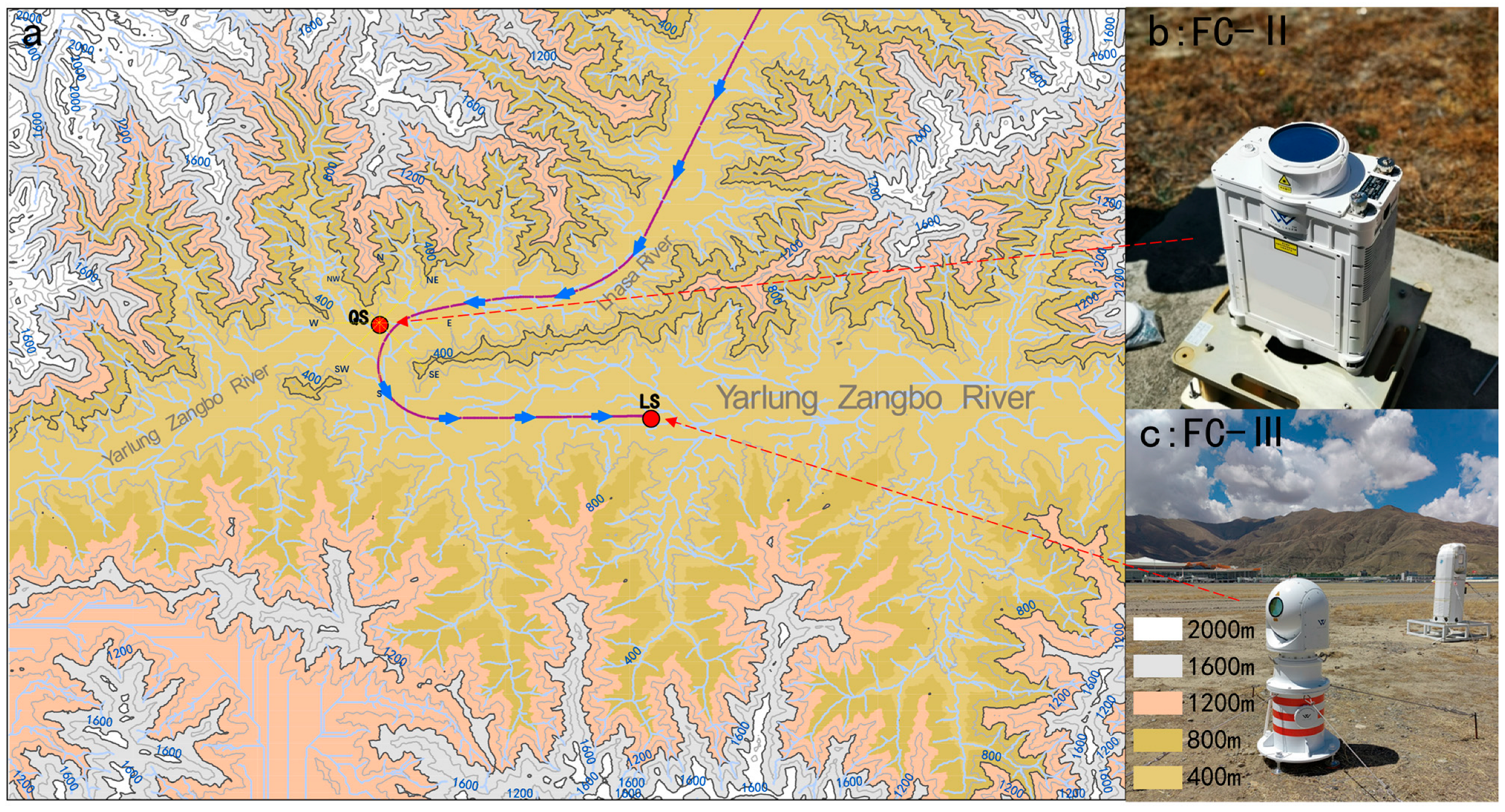
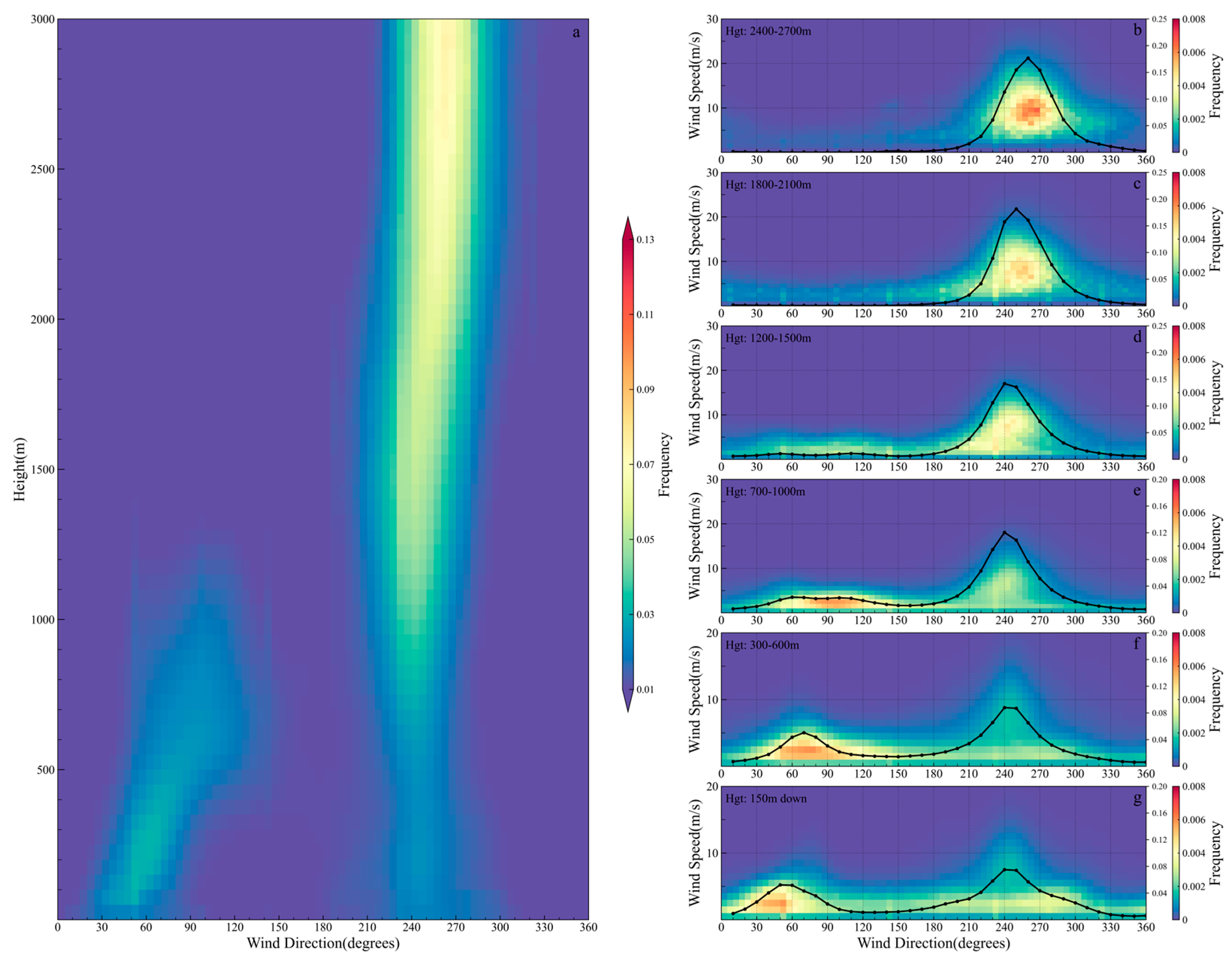
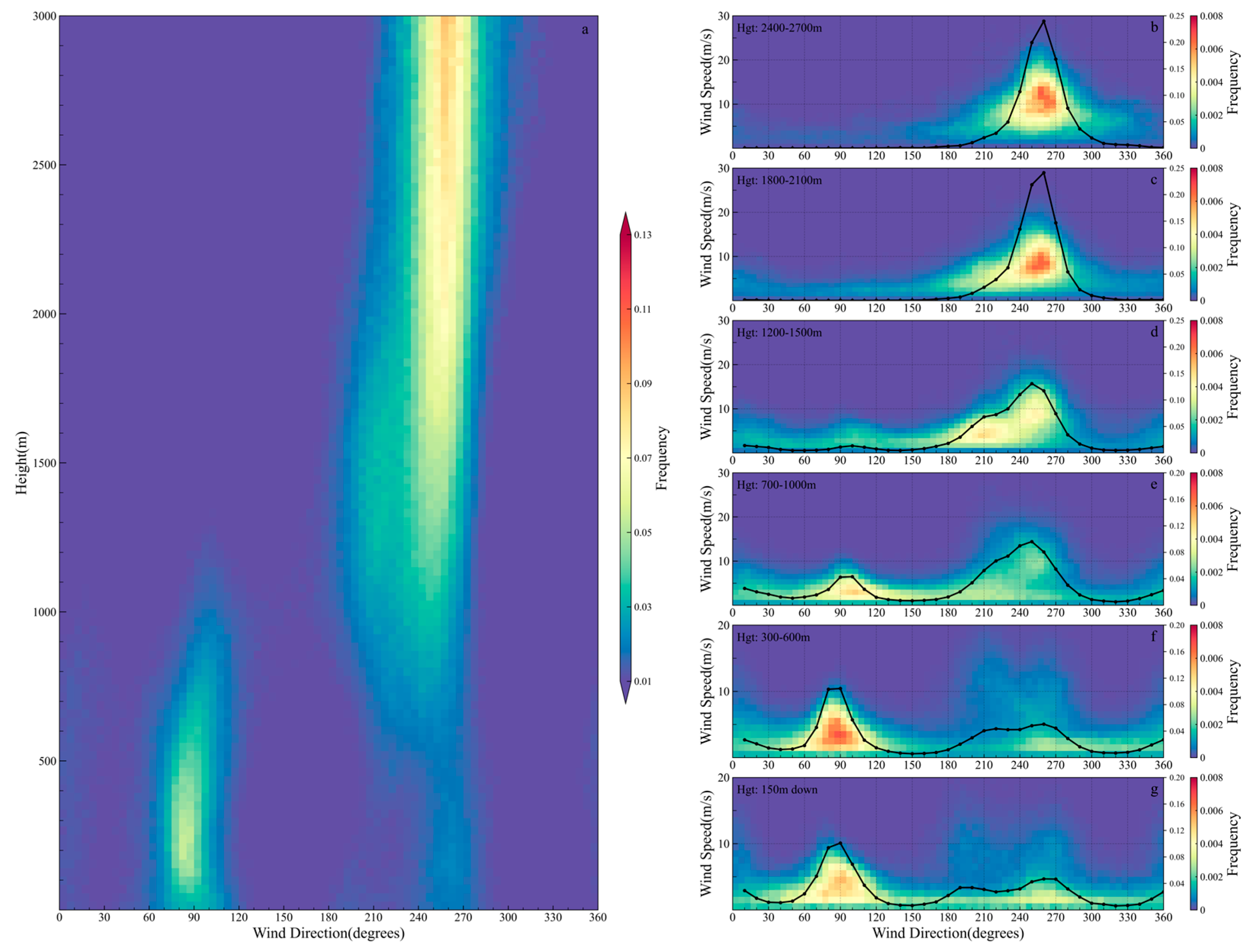
- The vertical structure of wind fields inside and above the Yarlung Zangbo River valley is significantly influenced by terrain, showing pronounced spatial differences. Above the valley, the wind field is dominated by large-scale circulation, with both sites exhibiting westerly prevailing winds. Strong winds are concentrated between 240° and 270°, and upper-level wind speeds at LS are generally higher than those at QS. Below the valley, the prevailing wind directions are almost opposite to those aloft, indicating a clear terrain modulation effect. At LS, the canyon channeling effect is significant, with strong winds primarily concentrated around 90°, and additional contributions from winds around 270°, 210°, and 10° are also observed. At QS, the Y-shaped terrain structure leads to a more dispersed wind direction distribution, with the valley dominated by northeasterly winds, and the prevailing wind direction rotates clockwise along the mountain ridges. The heights at which prevailing wind directions shift differ significantly between the two sites, occurring at approximately 600–800 m at LS and around 300 m at QS, indicating that terrain exerts a decisive influence on the vertical structure and distribution of strong winds within the valley.
- (2)
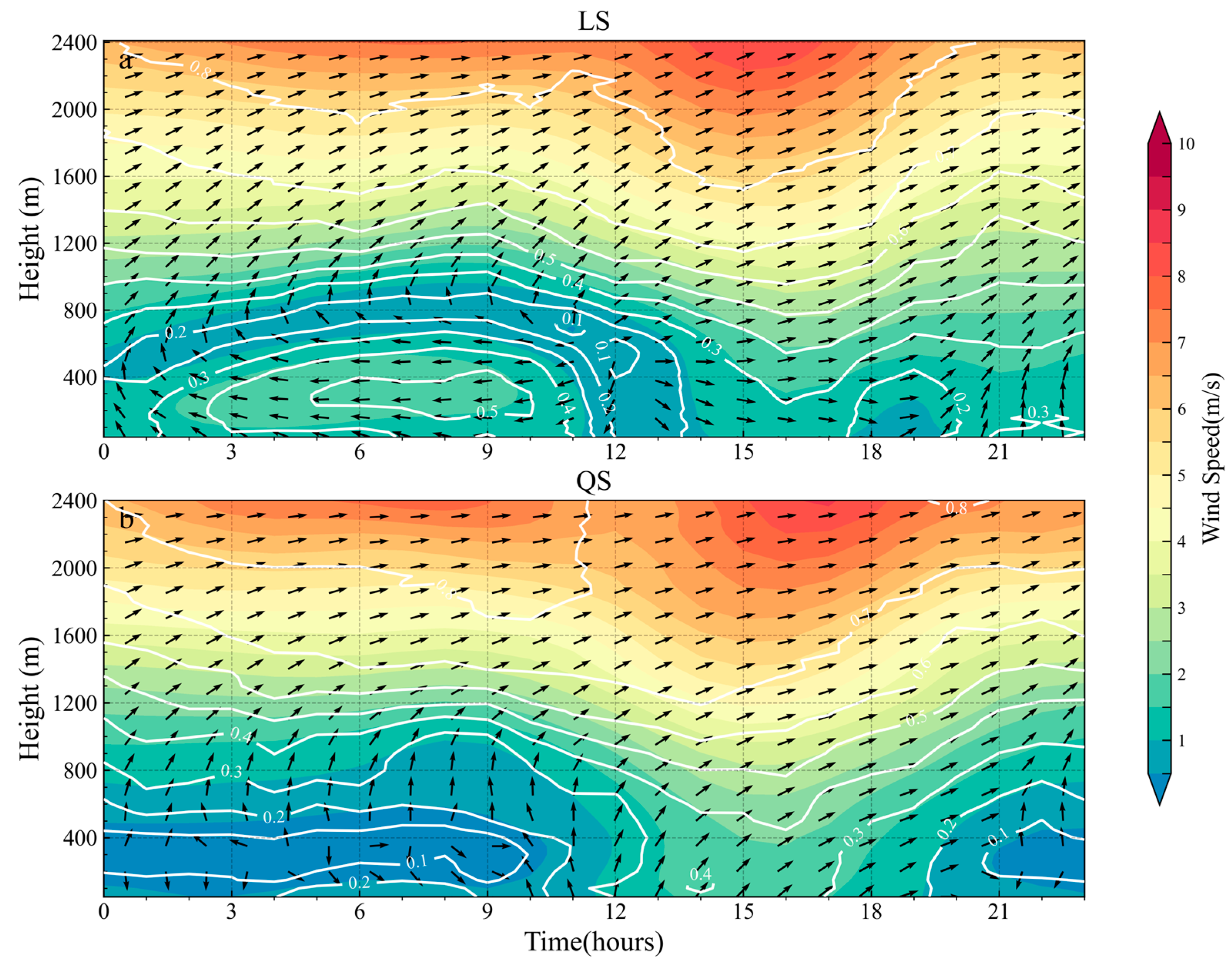
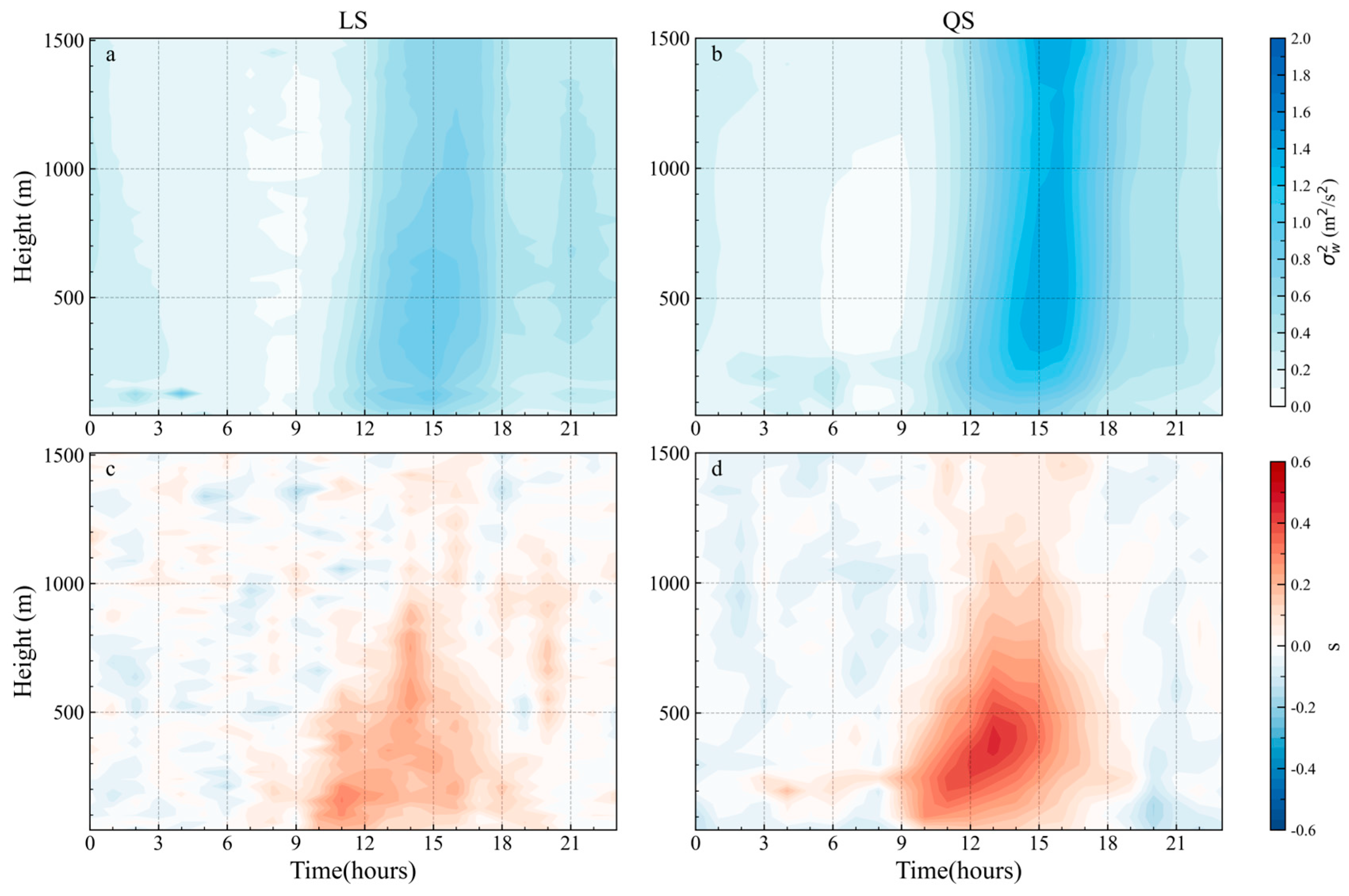
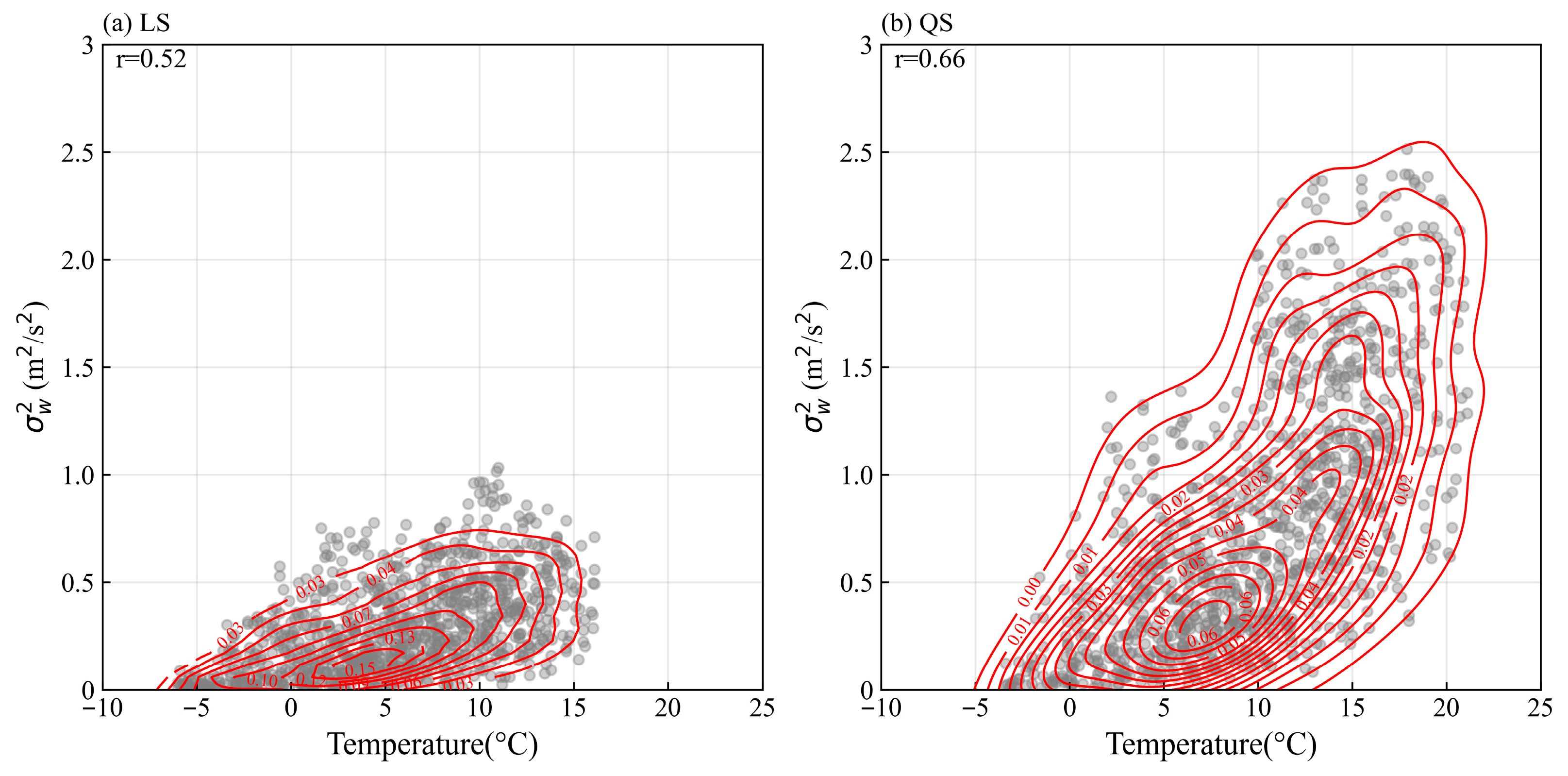
- The overall wind field in the terminal area exhibits a structure characterized by stable upper-level southwesterly flow throughout the day and pronounced diurnal variations in the lower levels. However, the depth of upper-level momentum penetration and the response of the low-level wind field differ significantly between the two locations. At LS, the wind field below 1200 m shows significant diurnal variation. A stable easterly layer dominates in the morning. Wind direction is most stable and wind speed is highest from 06:00 to 10:00 BJT. A transition layer with a thickness of about 200–300 m exists between the easterly flow and the southwesterly flow aloft. Below 400 m at QS, wind direction is highly variable and wind speed is weak. A shallow relatively stable layer appears from 04:00 to 09:00 BJT. In the afternoon (14:00–17:00 BJT), under enhanced surface heating, downward transport of southwesterly momentum from aloft leads to a significant increase in wind speed within the valley and an increase in directional stability. The flow also shows a more pronounced westerly component. At LS, the narrow valley terrain limits the downward transport of momentum. The influence does not reach the valley floor. In contrast, at QS, the relatively open terrain allows upper-level momentum to reach the surface directly. This results in a marked increase in near-surface wind speed and a modification of wind direction structure. Turbulence characteristics further indicate that strong turbulence at both sites mainly occurs between 14:00 and 17:00 BJT. It is closely related to enhanced surface heating in the afternoon. This reflects a clear thermally driven process. The turbulence intensity at QS is stronger, indicating a more pronounced response to thermal forcing.
- (3)
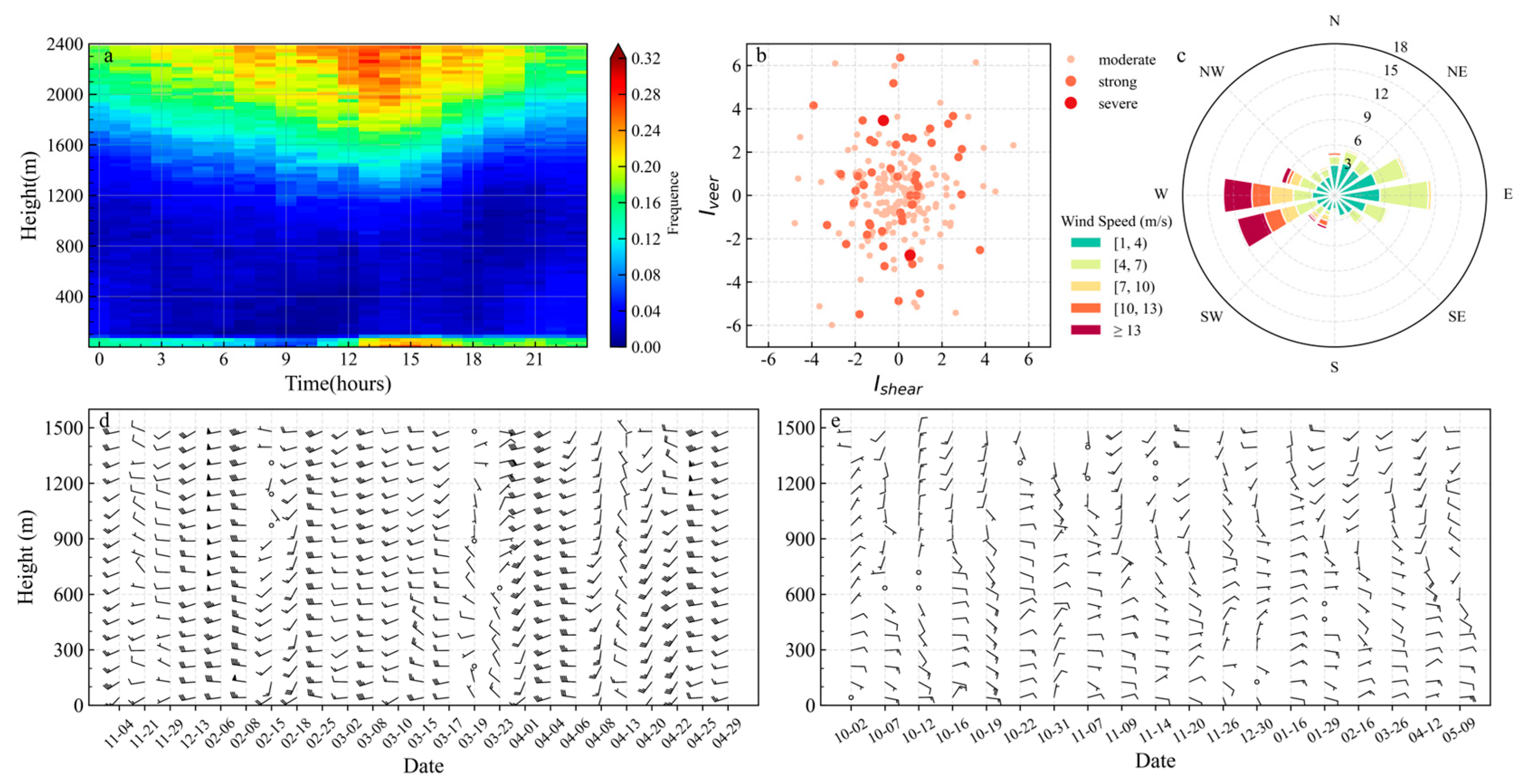
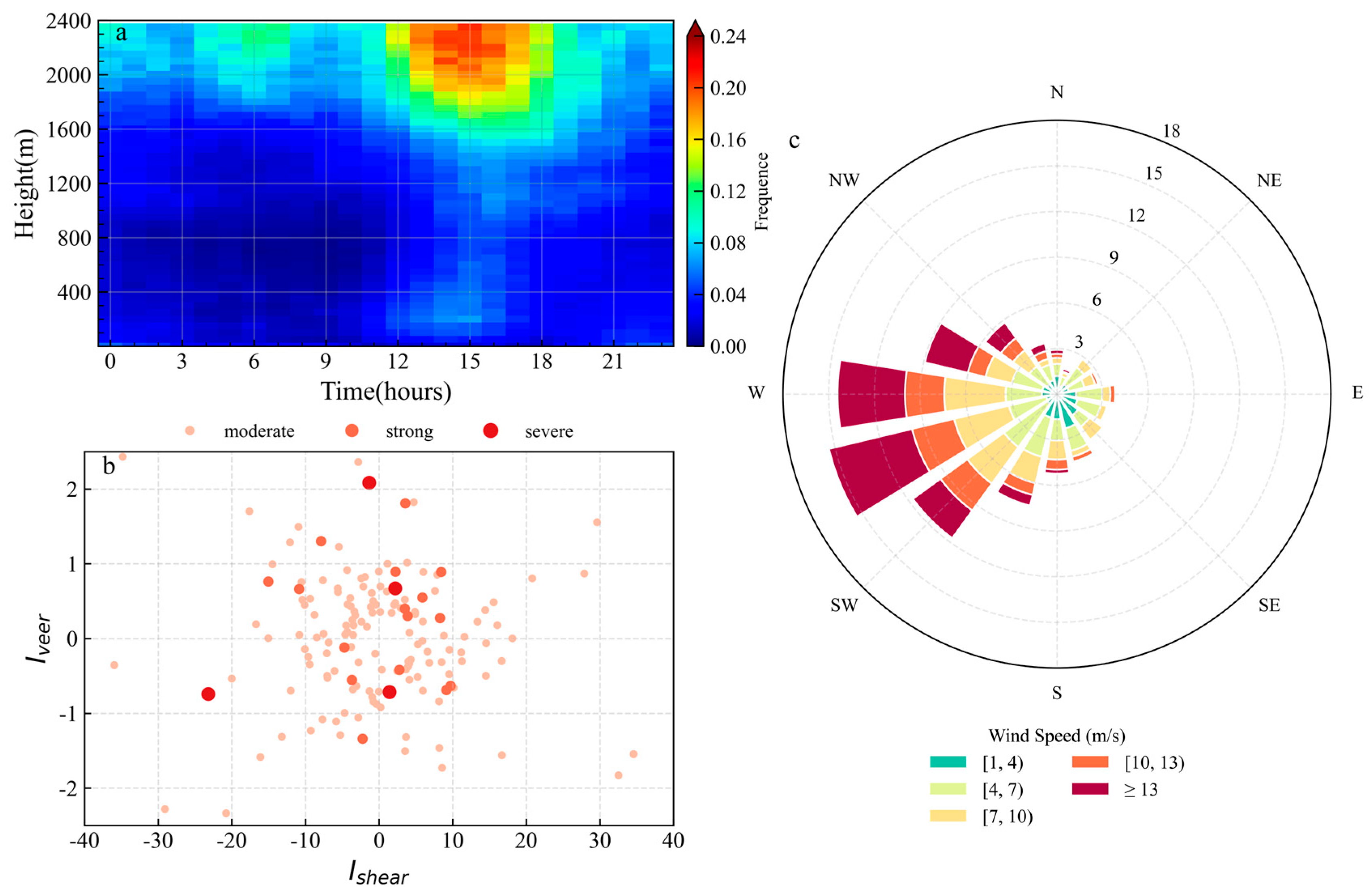
- The frequency of wind shear at LS is significantly higher than at QS. Above 1500 m, wind shear occurs frequently between 13:00 and 17:00 BJT. At LS, the maximum occurrence frequency reaches about 32% at 15:00 BJT, while at QS it is about 24%. Wind shear at QS can extend downward from upper levels. At 16:00 BJT, high-level wind shear descends to around 1000 m, while low-level wind shear extends upward. The two layers become vertically connected between 15:00 and 16:00 BJT, and the frequency at 1000 m reaches a peak of about 10%. Near-surface wind shear at LS is also pronounced, with a maximum frequency at 15:00 BJT. Its formation is closely related to the prevailing wind direction. Under prevailing westerly conditions, afternoon surface heating enhances the vertical wind speed gradient. Under easterly conditions, wind shear is mainly caused by rapid wind direction rotation with height. In practical operations at Lhasa Airport, when aircraft pass over QS or approach landing around 16:00, attention should be paid to downward momentum transport and strong turbulence, which may lead to wind shear.
Author Contributions
Funding
Data Availability Statement
Acknowledgments
Conflicts of Interest
References
- Filippone, A. Flight Performance of Fixed and Rotary Wing Aircraft; Elsevier Ltd.: Oxford, UK, 2006; pp. 77–108. [Google Scholar]
- Sadraey, M. Aircraft Performance: An Engineering Approach; CRC Press: Boca Raton, FL, USA, 2016; pp. 109–155. [Google Scholar]
- Huang, Y. Aeronautical Meteorology; Southwest Jiaotong University Publishing House: Chengdu, China, 2011; pp. 1–348. ISBN 9787564312510. (In Chinese) [Google Scholar]
- Liu, X. Based on Airborne Radar Microburst Wind Shear Signal Processing and Simulation. Sci. Technol. Eng. 2015, 15, 221–224. (In Chinese) [Google Scholar]
- Pan, J.; Chen, B.; Hua, X. Calculation and Analysis of Landing Performance of Plateau Airport. Sci. Technol. Eng. 2020, 20, 2093–2098. (In Chinese) [Google Scholar]
- Jentsch, H.; Weidinger, J. Spatiotemporal Analysis of Valley Wind Systems in the Complex Mountain Topography of the Rolwaling Himal, Nepal. Atmosphere 2022, 13, 1138. [Google Scholar] [CrossRef]
- Cohn, S.A. Flow in complex terrain: Observations by radar wind profilers and anemometers near Juneau, Alaska. J. Appl. Meteorol. Clim. 2004, 43, 437–448. [Google Scholar] [CrossRef]
- Zou, Y.; Yue, P.; Liu, Q.; He, X.; Wang, Z. Wind Field Characteristics of Complex Terrain Based on Experimental and Numerical Investigation. Appl. Sci. 2022, 12, 5124. [Google Scholar] [CrossRef]
- Wang, J.; Zhang, L.; Wang, T.J.; Bao, J.; Cao, X.J.; Zhang, B.D.; Zhou, Z.Y. Comparative Analysis of Mountain–Valley Wind Circulation Characteristics over Semi-Arid Areas Nearby Lanzhou. J. Arid Meteorol. 2012, 30, 169–177. (In Chinese) [Google Scholar]
- Hawkes, H.B. Mountain and Valley Winds with Special Reference to the Diurnal Mountain Winds of the Great Salt Lake Region. Ph.D. Thesis, Ohio State University, Columbus, OH, USA, 1947. [Google Scholar]
- Whiteman, C.D.; Barr, S. Atmospheric Mass Transport by Along-Valley Wind Systems in a Deep Colorado Valley. J. Appl. Meteorol. Climatol. 1986, 25, 1205–1212. [Google Scholar] [CrossRef]
- Leukauf, D.; Gohm, A.; Rotach, M.W.; Wagner, J.S. The Impact of the Temperature Inversion Breakup on the Exchange of Heat and Mass in an Idealized Valley: Sensitivity to the Radiative Forcing. J. Appl. Meteorol. Climatol. 2015, 54, 2199–2216. [Google Scholar] [CrossRef]
- Largeron, Y.; Staquet, C. Persistent Inversion Dynamics and Wintertime PM10 Air Pollution in Alpine Valleys. Atmos. Environ. 2016, 135, 92–108. [Google Scholar] [CrossRef]
- Kossmann, M.; Vögtlin, R.; Corsmeier, U.; Vogel, B.; Fiedler, F.; Binder, H.J.; Kalthoff, N.; Beyrich, F. Aspects of the convective boundary layer structure over complex terrain. Atmos. Environ. 1998, 32, 1323–1348. [Google Scholar] [CrossRef]
- Alexa, A. Atmospheric Boundary Layer Structure at the Head of a Small Alpine Tributary Valley Detected with Uncrewed Aerial Systems (UAS). Ph.D. Thesis, University of Innsbruck, Innsbruck, Austria, 2023. [Google Scholar]
- Wu, B.; Miao, J.; Feng, W. Impact of Land Cover Change on Mountain Circulation over the Hainan Island, China. Sustainability 2022, 14, 11794. [Google Scholar] [CrossRef]
- Zhu, C.; Ullah, W.; Wang, G.; Lu, J.; Li, S.; Feng, A.; Hagan, D.F.T.; Jiang, T.; Su, B. Diagnosing Potential Impacts of Tibetan Plateau Spring Soil Moisture Anomalies on Summer Precipitation and Floods in the Yangtze River Basin. J. Geophys. Res. Atmos. 2023, 128, e2022JD037671. [Google Scholar] [CrossRef]
- Yu, Y.; Chen, S.H.; Huang, C.C.; Paw U, K.T.; Schmitt, C.; Zhao, Z.; Suvočarev, K.; Kisekka, I.; Pyles, R.D.; Avise, J. A Numerical Study of the Agricultural Irrigation Effects on Summer Soil Moisture and Near-Surface Meteorology in California’s Central Valley. J. Hydrometeorol. 2025, 26, 641–659. [Google Scholar] [CrossRef]
- Naranjo-Mendoza, C.; Wright, A.J.; Oyinlola, M.A.; Greenough, R.M. A Comparison of Analytical and Numerical Model Predictions of Shallow Soil Temperature Variation with Experimental Measurements. Geothermics 2018, 76, 38–49. [Google Scholar] [CrossRef]
- Zhong, L.; Ma, Y.; Xue, Y.; Piao, S. Climate Change Trends and Impacts on Vegetation Greening over the Tibetan Plateau. J. Geophys. Res. Atmos. 2019, 124, 7540–7552. [Google Scholar] [CrossRef]
- Rosales, A.G.; Junquas, C.; da Rocha, R.P.; Condom, T.; Espinoza, J.C. Valley–Mountain Circulation Associated with the Diurnal Cycle of Precipitation in the Tropical Andes (Santa River Basin, Peru). Atmosphere 2022, 13, 344. [Google Scholar] [CrossRef]
- De Wekker, S.F.J.; Godwin, K.S.; Emmitt, G.D.; Greco, S. Airborne Doppler Lidar Measurements of Valley Flows in Complex Coastal Terrain. J. Appl. Meteorol. Climatol. 2012, 51, 1558–1574. [Google Scholar] [CrossRef]
- Wang, K.; Lyu, X.; Huang, J.; Luo, M.; Xu, F. Influence of Topography and the Underlying Surface of the Bohai Sea on Wind and Gust Forecasts. Earth Space Sci. 2023, 10, e2022EA002705. [Google Scholar] [CrossRef]
- Yu, B.; Zhu, B.; Miao, S.; Kang, H.; He, X.; Liu, H.; Liang, Z.; Chen, F. Observational Signal of the Interaction Between Mountain–Plain Wind and Urban Breeze under Weak Synoptic Systems. J. Geophys. Res. Atmos. 2021, 126, e2020JD032809. [Google Scholar] [CrossRef]
- Shi, T.; Yang, Y.; Qi, P.; Lolli, S. Diurnal Variation in an Amplified Canopy Urban Heat Island During Heat Wave Periods in the Megacity of Beijing: Roles of Mountain–Valley Breeze and Urban Morphology. Atmos. Chem. Phys. 2024, 24, 12807–12822. [Google Scholar] [CrossRef]
- Bischoff-Gauß, I.; Kalthoff, N.; Fiebig-Wittmaack, M. The Influence of a Storage Lake in the Arid Elqui Valley in Chile on Local Climate. Theor. Appl. Climatol. 2006, 85, 227–241. [Google Scholar] [CrossRef]
- Laiti, L.; Zardi, D.; De Franceschi, M.; Rampanelli, G. Atmospheric Boundary Layer Structures Associated with the Ora del Garda Wind in the Alps as Revealed from Airborne and Surface Measurements. Atmos. Res. 2013, 132, 473–489. [Google Scholar] [CrossRef]
- Yang, X.; Lü, Y.; Ma, Y.; Wen, J. Summertime Thermally-Induced Circulations over the Lake Nam Co Region of the Tibetan Plateau. J. Meteorol. Res. 2015, 29, 305–314. [Google Scholar] [CrossRef]
- Whiteman, C.D.; Doran, J.C. The Relationship Between Overlying Synoptic-Scale Flows and Winds within a Valley. J. Appl. Meteorol. 1993, 32, 1669–1682. [Google Scholar] [CrossRef]
- Adler, B.; Caicedo, V.; Butterworth, B.J.; Bianco, L.; Cox, C.J.; de Boer, G.; Gutman, E.; Intrieri, J.M.; Meyers, T.; Sedlar, J. The Short Life of Upvalley Wind in a High-Altitude Valley in the Colorado Rocky Mountains. J. Geophys. Res. Atmos. 2025, 130, e2025JD043455. [Google Scholar] [CrossRef]
- Ye, D.Z.; Gao, Y.X. Meteorology of the Qinghai-Xizang Plateau; Science Press: Beijing, China, 1979; ISBN 130311072. (In Chinese) [Google Scholar]
- Bai, H.Z.; Dong, A.X.; Li, D.L.; Fang, F. Temporal and Spatial Characteristics of Strong Wind and Dust Days in Qinghai-Xizang Plateau and along Qingzang Railway. Plateau Meteor. 2005, 24, 311–315. (In Chinese) [Google Scholar]
- Zhou, W.; Lou, W.; Huang, M.; Liu, J.; Liang, M. Two-Year Wind Field Measurements near the Ground at a Site of the Tibetan Plateau. J. Wind Eng. Ind. Aerodyn. 2024, 245, 105636. [Google Scholar] [CrossRef]
- Gao, Y.; Tang, M.; Luo, S.; Shen, Z.; Li, C. Some Aspects of Recent Research on the Qinghai–Xizang Plateau Meteorology. Bull. Am. Meteorol. Soc. 1981, 62, 31–35. [Google Scholar] [CrossRef]
- Wu, G.; Duan, A.; Liu, Y.; Mao, J.; Ren, R.; Bao, Q.; He, B.; Liu, B.; Hu, W. Tibetan Plateau Climate Dynamics: Recent Research Progress and Outlook. Natl. Sci. Rev. 2015, 2, 100–116. [Google Scholar] [CrossRef]
- Wu, G.; Liu, Y. Impacts of the Tibetan Plateau on Asian Climate. Meteorol. Monogr. 2016, 56, 7.1–7.29. [Google Scholar] [CrossRef]
- He, B.; Liu, Y.; Wu, G.; Wang, Z.; Bao, Q. The Role of Air–Sea Interactions in Regulating the Thermal Effect of the Tibetan–Iranian Plateau on the Asian Summer Monsoon. Clim. Dyn. 2019, 52, 4227–4245. [Google Scholar] [CrossRef]
- Wu, G.; Zhou, X.; Xu, X.; Huang, J.; Duan, A.; Yang, S.; Hu, W.; Ma, Y.; Liu, Y.; Bian, J. An Integrated Research Plan for the Tibetan Plateau Land–Air Coupled System and Its Impacts on the Global Climate. Bull. Am. Meteorol. Soc. 2023, 104, E158–E177. [Google Scholar] [CrossRef]
- Ma, Y.M.; Zhong, L.; Su, Z.B.; Ishikawa, H.; Menenti, M.; Koike, T. Determination of regional distributions and seasonal variations of land surface heat fluxes from Landsat-7 enhanced Thematic Mapper data over the central Tibetan Plateau area. J. Geophys. Res. Atmos. 2006, 111, D10. [Google Scholar] [CrossRef]
- Liu, X.; Chen, B. Climatic warming in the Tibetan Plateau during recent decades. Int. J. Climatol. 2000, 20, 1729–1742. [Google Scholar] [CrossRef]
- Yang, K.; Guo, X.F.; Wu, B.Y. Recent trends in surface sensible heat flux on the Tibetan Plateau. Sci. China Earth Sci. 2011, 54, 19–28. [Google Scholar] [CrossRef]
- Lai, Y.; Chen, X.; Ma, Y.M.; Chen, D.L.; Zhaxi, S.L. Impacts of the westerlies on planetary boundary layer growth over a valley on the north side of the central Himalayas. J. Geophys. Res. Atmos. 2021, 126, e2020JD033928. [Google Scholar] [CrossRef]
- Cao, Y.; He, W.; Shi, H.; Wang, P. Analysis of Wind Field Characteristics within the Lower Atmosphere in Urban and Suburban Areas of Beijing in 2018. Clim. Environ. Res. 2021, 26, 403–412. (In Chinese) [Google Scholar] [CrossRef]
- Xu, J.; Song, L.; Chen, J.; Yang, L.; Chen, M.; Han, L. Comparative Study on Fine Characteristics of Surface Wind Field in Winter and Early Spring over Yanqing Complex Terrain during the Beijing Winter Olympics. Plateau Meteorol. 2025, 44, 378–392. (In Chinese) [Google Scholar]
- Zheng, J.; Liu, Y.; Peng, T.; Wan, X.; Huang, X.; Wang, Y.; Che, Y.; Xu, D. Investigating Wind Characteristics and Temporal Variations in the Lower Troposphere over the Northeastern Qinghai–Tibet Plateau Using a Doppler LiDAR. Remote Sens. 2024, 16, 1840. [Google Scholar] [CrossRef]
- Wu, J.J.; Du, H.Y.; Xia, C.J.; Huang, X.Y. Assessment of Doppler Wind Lidar Detection Efficiency and Influencing Factors at Plateau Airport: A Case Study of Lhasa Gonggar Airport. Atmosphere 2024, 15, 1530. [Google Scholar] [CrossRef]
- Huang, X.; Zheng, J.; Shao, A.; Xu, D.; Tian, W.; Li, J. Study of Low-Level Wind Shear at a Qinghai–Tibetan Plateau Airport. Atmos. Res. 2024, 311, 107680. [Google Scholar] [CrossRef]
- Chan, P.W. Application of LIDAR-based F-factor in windshear alerting. Meteorol. Z. 2012, 21, 193–204. [Google Scholar] [CrossRef] [PubMed]
- Zhang, H.W.; Wu, S.H.; Wang, Q.C.; Liu, B.; Yin, B.; Zhai, X. Airport low-level wind shear lidar observation at Beijing Capital International Airport. Infrared Phys. Technol. 2019, 96, 113–122. [Google Scholar] [CrossRef]
- Huang, X.; Zheng, J.F.; Zhang, X.; Ma, X.; Tian, W.; Hua, Z. Study on the structure and characteristic of a low-level wind shear process that happened over Xining Airport. Laser Technol. 2022, 46, 206–212. (In Chinese) [Google Scholar]
- Chen, J.F.; Xie, C.B.; Ji, J.; Lu, J. Multi-scale wind shear at a plateau airport: Insights from lidar and radiosonde observations. Remote Sens. 2025, 17, 2762. [Google Scholar] [CrossRef]
- Gu, J.; Qiu, Y.; Zhang, S.; Yang, X.; Luo, S.; Zheng, J. Study on characteristics and numerical simulation of a convective low-level wind shear event at Xining Airport. Atmosphere 2025, 16, 1137. [Google Scholar] [CrossRef]
- Zhou, X.; Zhang, C.; Li, Y.; Zhang, Z. Comparison of Spring Wind Gusts in the Eastern Part of the Tibetan Plateau and along the Coast: The Role of Turbulence. Remote Sens. 2023, 15, 3655. [Google Scholar] [CrossRef]
- Zhou, X.; Zhang, C.; Li, Y.; Chen, Z.; Zhang, J.; Ding, X. Wind Gust Parameters in the Lower Troposphere Based on Doppler Lidar Data. J. Geophys. Res. Atmos. 2023, 128, e2022JD038156. [Google Scholar] [CrossRef]
- Huang, X.; Zheng, J.; Che, Y.; Wang, G.; Ren, T.; Hua, Z.; Tian, W.; Su, Z.; Su, L. Evolution and Structure of a Dry Microburst Line Observed by Multiple Remote Sensors in a Plateau Airport. Remote Sens. 2022, 14, 3841. [Google Scholar] [CrossRef]
- Niu, X.H.; Huang, X.; Zhu, W.H.; Zheng, J.F.; Tang, S.X.; Ren, T.; Chen, Z. Application research of 1.55 μm wind LiDAR in detecting downburst on a plateau airport. Laser Technol. 2024, 48, 318–326. (In Chinese) [Google Scholar]
- Zhao, G.; Huang, X.; Hua, Z.Q. Research and analysis of low-level wind shear warning algorithm in LiDAR. Laser Technol. 2025, 49, 203–209. (In Chinese) [Google Scholar]
- Fan, Q.; Zheng, J.F.; Zhou, D.F.; Zhu, K.; Zhang, J.; Tong, W.; Luo, X. Research on airport low-level wind shear identification algorithm based on laser wind radar. J. Infrared Millim. Waves 2020, 39, 462–472. [Google Scholar]
- Song, M.Q.; Wang, Y.; Mamtimin, A.; Gao, J.C.; Aihaiti, A.; Zhou, C.L.; Yang, F.; Huo, W.; Wen, C.; Wang, B. Applicability Assessment of Coherent Doppler Wind LiDAR for Monitoring during Dusty Weather at the Northern Edge of the Tibetan Plateau. Remote Sens. 2022, 14, 5264. [Google Scholar] [CrossRef]
- Wang, L.; Yuan, J.; Xia, H.; Zhao, L.J.; Wu, Y.B. Marine Mixed Layer Height Detection Using Ship-Borne Coherent Doppler Wind Lidar Based on Constant Turbulence Threshold. Remote Sens. 2022, 14, 745. [Google Scholar] [CrossRef]
- Wang, Q.Q.; Zhang, X.Z.; Wang, S.K. Comparison between Windcube laser radar and wind tower data. Meteorol. Sci. Technol. 2013, 41, 20–26. (In Chinese) [Google Scholar]
- Chen, W.C.; Song, L.L.; Wang, Z.C.; Liu, A.J. The wind measuring performance of WINDCUBEV2 pulse laser wind profiler under different weather conditions. J. Appl. Meteorol. Sci. 2017, 28, 327–339. (In Chinese) [Google Scholar]
- Shi, W.H.; Tang, J.; Chen, Y.H. Study on the accuracy of Doppler wind lidar in measuring the boundary layer wind field of typhoon Lekima. J. Trop. Meteorol. 2020, 36, 577–589. (In Chinese) [Google Scholar]
- Fan, Q.; Zhu, K.; Zheng, J.; Zhang, J.; Zhou, D.; Zhang, F. Detection performance analysis of all-fiber coherent wind lidar under different weather types. Chin. J. Lasers 2017, 44, 10. (In Chinese) [Google Scholar] [CrossRef]
- Bothe, O.; Fraedrich, K.F.; Zhu, X. The Large-Scale Circulations and Summer Drought and Wetness on the Tibetan Plateau. Int. J. Climatol. 2010, 30, 844–855. [Google Scholar] [CrossRef]
- Lai, H.W.; Chen, H.W.; Kukulies, J.; Ou, T.; Chen, D. Regionalization of Seasonal Precipitation over the Tibetan Plateau and Associated Large-Scale Atmospheric Systems. J. Clim. 2021, 34, 2635–2651. [Google Scholar] [CrossRef]
- Ding, J.; Cuo, L.; Zhang, Y.; Zhang, C.; Liang, L.; Liu, Z. Annual and Seasonal Precipitation and Their Extremes over the Tibetan Plateau and Its Surroundings in 1963–2015. Atmosphere 2021, 12, 620. [Google Scholar] [CrossRef]
- Wang, K.; Zhou, L.; Lu, X.; Ding, M.L.; Qimei, W.Z. Application of Wind LiDAR in Wind Turning Forecast at Lhasa Gongga Airport. Laser Technol. 2025, 49, 437–443. (In Chinese) [Google Scholar]
- Aitken, M.L.; Rhodes, M.E.; Lundquist, J.K. Performance of a Wind-Profiling Lidar in the Region of Wind Turbine Rotor Disks. J. Atmos. Ocean. Technol. 2012, 29, 347–355. [Google Scholar] [CrossRef]
- Hogan, R.J.; Grant, A.L.M.; Illingworth, A.J.; Pearson, G.N.; O’Connor, E.J. Vertical Velocity Variance and Skewness in Clear and Cloud-Topped Boundary Layers as Revealed by Doppler Lidar. Q. J. R. Meteorol. Soc. 2009, 135, 635–643. [Google Scholar] [CrossRef]
- Stewart, J.Q.; Whiteman, C.D.; Steenburgh, W.J.; Bian, X. A climatological study of thermally driven wind systems of the US Intermountain West. Bull. Am. Meteorol. Soc. 2002, 83, 699–708. [Google Scholar] [CrossRef]
- Zhong, S.; Whiteman, C.D.; Bian, X. Diurnal evolution of three-dimensional wind and temperature structure in California’s Central Valley. J. Appl. Meteorol. Clim. 2004, 43, 1679–1699. [Google Scholar] [CrossRef]
- Murphy, P.; Lundquist, J.K.; Fleming, P. How wind speed shear and directional veer affect the power production of a megawatt-scale operational wind turbine. Wind Energy Sci. Discuss. 2019, 5, 1169–1190. [Google Scholar] [CrossRef]
- Mikkola, J.; Bister, M.; Sinclair, V.A.; Bianchi, F. Daytime along-valley winds in the Himalayas as simulated by the Weather Research and Forecasting (WRF) model. Atmos. Chem. Phys. 2023, 23, 821–842. [Google Scholar] [CrossRef]
- Schmid, F.; Schmidli, J.; Hervo, M.; Haefele, A. Diurnal Valley Winds in a Deep Alpine Valley: Observations. Atmosphere 2020, 11, 54. [Google Scholar] [CrossRef]
- Whiteman, C.D. Mountain Meteorology: Fundamentals and Applications; Oxford University Press: New York, NY, USA, 2000. [Google Scholar]
- Chen, W.L. Analysis of Wind Conditions in Canyon. J. Nanjing Inst. Meteorol. 1979, 1, 28–33. (In Chinese) [Google Scholar] [CrossRef]





| Parameter | Technical Specifications | |
|---|---|---|
| FC-II (QS) | FC-III (LS) | |
| Wavelength | 1.55 μm | |
| Elevation angle | 75° | |
| Azimuth range | 0°\45°\90°\135°\180°\225°\270°\315°\360° | |
| Maximum detection range | ≥3 km <3 km (lack of aerosols) | |
| Range resolution | 50 m | 28 m |
| Vertical minimum detection height | 50 m | 100 m |
| temporal resolution | <3 s | 8 min |
| Intensity | Numerical Standards | |
|---|---|---|
| (m·s−1)/30 m | 1/s | |
| light | 0~2 | 0~0.07 |
| moderate | 2.1~4 | 0.08~0.13 |
| strong | 4.1~6 | 0.14~0.20 |
| severe | >6 | >0.20 |
| Sites | LS | QS | |
|---|---|---|---|
| hour (BJT) | 14 | 0.40 | 0.41 |
| 15 | 0.41 | 0.44 | |
| 16 | 0.40 | 0.46 | |
| 17 | 0.41 | 0.46 | |
| 18 | 0.39 | 0.42 | |
Disclaimer/Publisher’s Note: The statements, opinions and data contained in all publications are solely those of the individual author(s) and contributor(s) and not of MDPI and/or the editor(s). MDPI and/or the editor(s) disclaim responsibility for any injury to people or property resulting from any ideas, methods, instructions or products referred to in the content. |
© 2026 by the authors. Licensee MDPI, Basel, Switzerland. This article is an open access article distributed under the terms and conditions of the Creative Commons Attribution (CC BY) license.
Share and Cite
Wu, J.; Shi, Z.; Lu, M.; Li, X.; Zhang, T.; Luo, W. Comparative Study of Low-Level Wind Fields Characteristics at Two Critical Locations in the Terminal Area of Plateau Mountain Airports During the Dry-Season Using Coherent Doppler Wind Lidars. Remote Sens. 2026, 18, 1224. https://doi.org/10.3390/rs18081224
Wu J, Shi Z, Lu M, Li X, Zhang T, Luo W. Comparative Study of Low-Level Wind Fields Characteristics at Two Critical Locations in the Terminal Area of Plateau Mountain Airports During the Dry-Season Using Coherent Doppler Wind Lidars. Remote Sensing. 2026; 18(8):1224. https://doi.org/10.3390/rs18081224
Chicago/Turabian StyleWu, Junjie, Zhuoqun Shi, Mingrui Lu, Xiaojing Li, Tinglong Zhang, and Wanyin Luo. 2026. "Comparative Study of Low-Level Wind Fields Characteristics at Two Critical Locations in the Terminal Area of Plateau Mountain Airports During the Dry-Season Using Coherent Doppler Wind Lidars" Remote Sensing 18, no. 8: 1224. https://doi.org/10.3390/rs18081224
APA StyleWu, J., Shi, Z., Lu, M., Li, X., Zhang, T., & Luo, W. (2026). Comparative Study of Low-Level Wind Fields Characteristics at Two Critical Locations in the Terminal Area of Plateau Mountain Airports During the Dry-Season Using Coherent Doppler Wind Lidars. Remote Sensing, 18(8), 1224. https://doi.org/10.3390/rs18081224