Article

Impact of Climatic Variability and Mining Activities on Net Primary Productivity in the High-Intensity Open-Pit Mining Area


1
College of Mining Engineering, North China University of Science and Technology, Tangshan 063000, China
2
Xiangyang Institute of Surveying and Mapping, Xiangyang 441000, China
3
Hebei Industrial Technology Institute of Mine Ecological Remediation, Tangshan 063000, China
4
Collaborative Innovation Center of Green Development and Ecological Restoration of Mineral Resources, Tangshan 063000, China
5
Tangshan Open University, Tangshan 063000, China
*
Author to whom correspondence should be addressed.
Remote Sens. 2026, 18(8), 1204; https://doi.org/10.3390/rs18081204
Submission received: 1 March 2026 / Revised: 2 April 2026 / Accepted: 15 April 2026 / Published: 16 April 2026

Highlights

What are the main findings?
  • Mining activities primarily drove a severe decline in actual Net Primary Productivity (ANPP) in the high-intensity open-pit mining area from 2016 to 2022.
  • Mining activities were identified as the dominant driver, with a contribution rate of 61.33% to ANPP variations, significantly exceeding that of climatic variability.
  • Precipitation enhanced vegetation productivity, whereas rising temperatures significantly inhibited ANPP in the mining area.
What are the implications of the main findings?
  • Isolating the impacts of mining from climatic variability provides a scientific foundation for optimizing ecological restoration strategies.
  • Quantifying carbon sequestration potential helps align mining rehabilitation efforts with regional carbon neutrality objectives.

Abstract

Evaluating Net Primary Productivity (NPP) variations driven by climatic variability and mining activities is fundamental for understanding ecological dynamics in high-intensity open-pit mining areas. Focusing on high-intensity open-pit mining areas of Qian’an, China, from 2016 to 2022, by integrating Sentinel-2, ERA-5 Land reanalysis dataset and Dynamic World V1, we employed an improved Carnegie–Ames–Stanford Approach (CASA) framework alongside the Thornthwaite Memorial algorithm to quantify actual NPP (ANPP) and potential NPP (PNPP). Additionally, the Relative Contribution Index (RCI) was utilized to explicitly isolate mining-driven NPP (MNPP) variations. The results revealed a significant downward trajectory in ANPP within the high-intensity open-pit mining area, with a cumulative reduction of 5.3 × 10⁸ gC a−1. This productivity loss exhibited significant spatial heterogeneity, with the most severe degradation concentrated in core mining districts, including Malanzhuang, Caiyuan, Yangdianzi, and Muchangkou. ANPP, MNPP, and PNPP maintained relative stability overall but displayed significant interannual fluctuations during 2019–2022. RCI analysis indicated MNPP dominated ANPP in 62.67% of the study area, with mining impacts intensifying in 62.83% of the region. Driver mechanisms identified precipitation as the dominant climatic factor enhancing ANPP, whereas mining activities constituted the primary driver of ANPP reduction. Mining accounted for 61.33% of ANPP changes, significantly exceeding climatic variability’s 38.67% contribution. In conclusion, these findings provide a scientific foundation for developing ecological carbon sink systems and optimizing ecological restoration strategies.

1. Introduction

Economic and social advancement relies heavily on the essential material support provided by mineral resources [1]. However, the intensive exploitation and inadequate management of these resources have precipitated progressive environmental degradation across mining landscapes, profoundly disrupting ecological equilibrium [2]. Effective ecological restoration in these disturbed ecosystems is fundamentally contingent upon the accurate assessment of ecosystem health status and its spatiotemporal dynamics [3]. Vegetation represents a critical component of restoration strategies, with its carbon sequestration capacity serving as the principal ecological service for mining area rehabilitation [4] and functioning as a pivotal mechanism for stabilizing carbon fluxes within mining ecosystems [5,6]. Considering the distinctive ecological functions of vegetation in mining environments, variations in vegetation cover significantly influence both soil properties and atmospheric conditions [7,8]. However, the concurrent progression of mineral resource exploitation and ecological restoration initiatives has induced marked dynamics in vegetation cover. Timely monitoring of vegetation productivity enables precise quantification of carbon sequestration potential, thereby facilitating the strategic alignment of ecological rehabilitation measures with carbon peak and neutrality objectives in mining areas [9].
Net Primary Productivity (NPP) is defined as the net photosynthetic carbon gain per unit spatiotemporal scale with the deduction of autotrophic respiratory costs. It is widely regarded as the definitive gauge of terrestrial carbon sequestration competence [10,11,12]. NPP dynamics emerge from the complex interplay between climatic variability and human disturbance [13,14,15]. Climatic variability directly modifies vegetation growth conditions, thereby altering regional NPP patterns [16]. Previous studies have demonstrated that climatic drivers of vegetation NPP vary along altitudinal gradients: precipitation dominated in densely vegetated high-altitude regions, whereas temperature governed NPP variability in low-altitude zones such as the Yangtze River Basin [17,18]. Mining activities modify plant community structure and spatial distribution, thereby indirectly regulating vegetation growth dynamics [19]. Yang et al. quantitatively assessed open-pit mining’s impacts on grassland NPP, revealing strong correlations between NPP dynamics, mining intensity and ecological restoration implementation [20]. Although mineral resource exploitation reduces NPP through landscape alteration and ecosystem degradation, strategically designed ecological restoration can counteract these effects and potentially increase the regional NPP above pre-disturbance levels [21]. Consequently, rigorously decoupling the distinct impacts of climate variability and extraction activities on NPP evolution is a prerequisite for devising scientifically grounded reclamation schemes [22,23].
NPP monitoring employs two primary approaches: field measurements and remote sensing inversion. While field-based methods yield high-precision data, their scalability remains constrained [24]. Remote sensing-based modeling has accordingly become the principal approach for large-scale NPP estimation. The landscape of contemporary modeling approaches is characterized by four primary categories: models driven by climatic factors, physiological–ecological process mechanisms, light use efficiency (LUE) models, and integrated remote sensing-process systems. Climate-driven models establish statistical regression relationships between meteorological variables, including temperature, precipitation, solar radiation and field-measured NPP; widely used climate models include the Miami, Thornthwaite Memorial, and Chikugo models [25]. Prominent physiological–ecological process models include FOREST-BGC [26], TEM [27], CEVSA [28], and 3PG [29]. Prominent LUE models comprise the GLO-PEM [30], the C-Fix [31], and the Carnegie–Ames–Stanford Approach (CASA) [32]. The CASA model has been validated across various spatial scales and land cover types, including urban ecosystems [33] and open-pit mining areas [34], utilizing data ranging from 1 km resolution MODIS NPP products to integration of sub-meter (<1 m) spaceborne observations with heterogeneous remote sensing datasets [35,36,37]. However, while coarse-resolution earth observation data are well suited for macro-scale ecological investigations, they fail to capture the fine-scale spatial heterogeneity of complex mining landscapes. Consequently, accurately decoupling the dual pressures of local mining activities and regional climate change at a high spatial resolution remains a significant challenge.
To address the above-mentioned scientific problem, this study utilizes Google Earth Engine (GEE), which serves as a high-performance cloud computing infrastructure, synthesizing massive Earth observation datasets with advanced geospatial analytics [38]. Streamlined retrieval of standardized imagery is a key feature of GEE, which houses extensive datasets such as the multitemporal Landsat and Sentinel series [39,40]. Therefore, our study focuses on the high-intensity open-pit mining area as a representative study. By integrating an improved CASA model with multi-source datasets, including the Dynamic World V1 land cover product, Sentinel-2 multispectral imagery, and meteorological observations, we assessed NPP and carbon sequestration potential at the mining landscape scale. The research objectives are to: (1) quantify current NPP and carbon sequestration potential; (2) identify the spatial configuration of vegetation carbon sequestration potential; (3) assess the heterogeneity and intensity of NPP variations driven by mining activities and climatic variability, thereby elucidating the carbon sequestration mechanisms in the high-intensity open-pit mining area and offering a theoretical basis for ecological carbon management.

2. Materials and Methods

2.1. Study Area

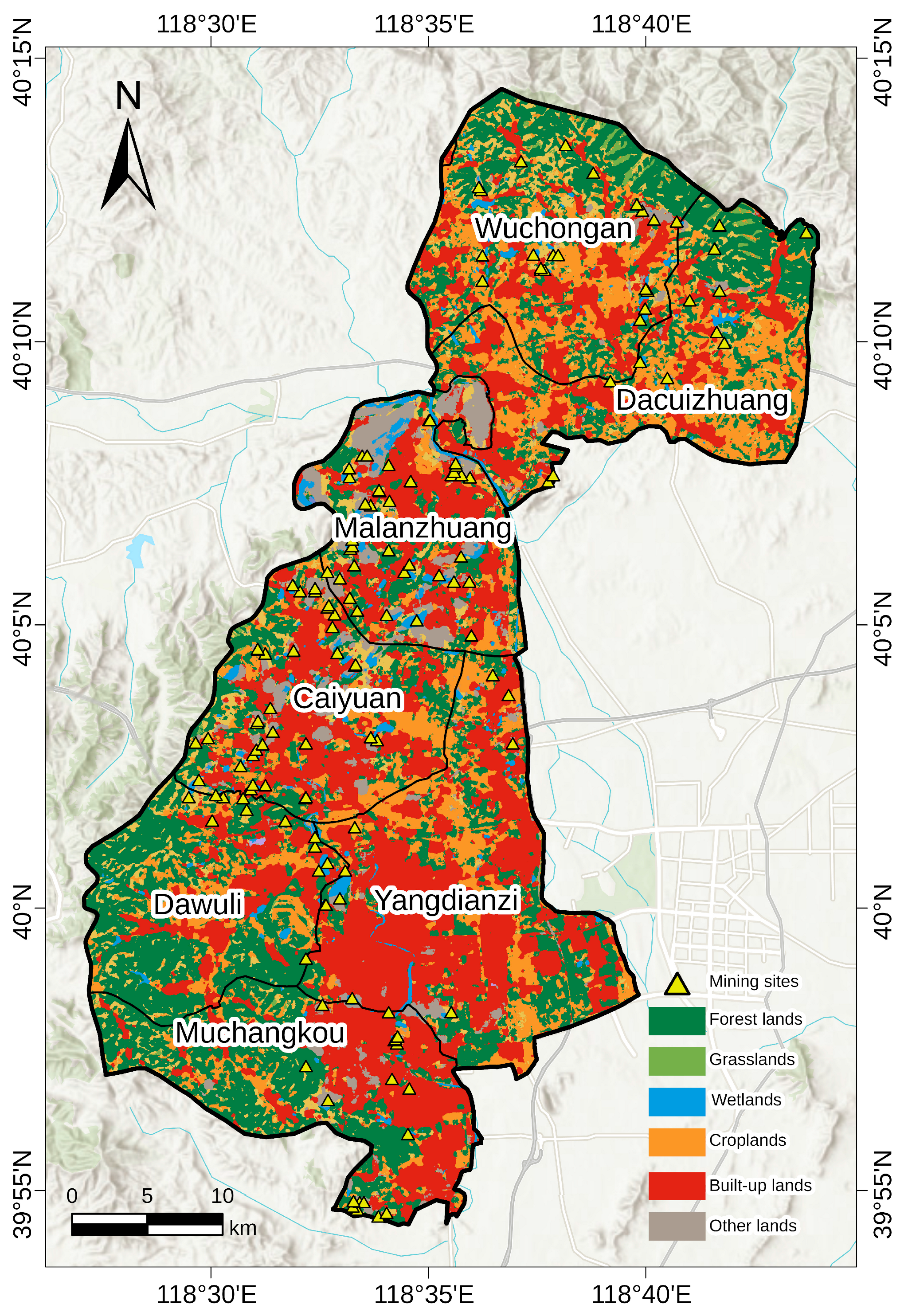
The study area located in Qian’an, China (118°26′–118°55′E, 39°51′–40°15′N), lies along the southern edge of the Yanshan Mountain range. It covers an approximately 431.3 km2 area encompassing seven administrative divisions: Caiyuan, Malanzhuang, Dacuizhuang, Wuchongan, Yangdianzi, Dawuli and Muchangkou (Figure 1). Topographically, the area exhibits complex topography, including hills, mountains, lakes and plains with a general northwest-to-southeast elevation gradient. Climatically, it lies within the warm temperate semi-humid continental monsoon zone, featuring a mean annual temperature of 10.8 °C and an average annual precipitation of 700 mm. This precipitation is highly uneven, mainly concentrated in July and August, which perfectly coincides with the vegetation’s peak growing season and plays a decisive role in NPP accumulation. This region was selected as a typical representative of a “high-intensity open-pit mining” zone because it contains abundant mineral resources, particularly non-ferrous metals such as gold, copper, nickel, and zirconium. Notably, its proven iron ore reserves exceed 2.72 billion metric tons. Long-term, large-scale open-pit mining activities in this concentrated area have resulted in significant surface disturbance, landscape fragmentation, and ecological degradation. This dense anthropogenic interference makes it an ideal and highly representative site for evaluating the coupled impacts of climate change and mining activities on ecosystem succession and Net Primary Productivity.

2.2. Data

The implementation of the optimized CASA framework relies on the assimilation of diverse geospatial inputs, primarily Normalized Difference Vegetation Index (NDVI), climatic forcing data, and LULC categorization [41].

2.2.1. Normalized Difference Vegetation Index Data

NDVI was derived from Sentinel-2 multispectral imagery (COPERNICUS/S2) accessed via the GEE cloud platform (https://code.earthengine.google.com/). To fully capture intra-annual phenological dynamics, we retrieved the full archive of Red (665 nm) and Near-Infrared (842 nm) bands at their original 10 m granularity spanning 2016–2022. Scenes with <10% cloud cover and optimal quality were selected. Because this Level-2A product has already undergone rigorous atmospheric correction via the SEN2COR algorithm provided by the European Space Agency (ESA) [42], the data natively represents bottom-of-atmosphere (BOA) reflectance, ensuring high radiometric quality for subsequent NDVI calculations. Subsequently, a maximum value composite method was applied to generate monthly NDVI maps, which further minimized residual cloud and atmospheric contamination.

2.2.2. Meteorological Dataset

Climatic archives covering the 2016–2022 period encompassed average monthly temperatures, total monthly precipitation, and daily sunshine hours, from which the solar radiation was calculated. The temperature and precipitation data originated from the ERA5-Land reanalysis dataset (0.1° × 0.1° resolution; https://cds.climate.copernicus.eu/datasets accessed on 28 May 2023) and was subsequently spatially downscaled to 10 m using bilinear interpolation. The sunshine duration, collected from 18 regional meteorological stations via the China Meteorological Data Service Center (https://data.cma.cn/ accessed on 28 May 2023), was first converted to monthly solar radiation using the Ångström–Prescott model and then spatially interpolated to a 10 m resolution utilizing the Ordinary Kriging algorithm. All resulting raster datasets were reprojected to align with the NDVI coordinate reference system, ensuring spatial consistency.

2.2.3. Land Use/Land Cover (LULC) Dataset

A multitemporal LULC dataset for the high-intensity open-pit mining area was generated using the Dynamic World V1 dataset, accessed via GEE for the study period (Figure 1). Dynamic World V1 represents the first global-scale, 10 m resolution near-real-time (NRT) LULC dataset. Synchronized with satellite image acquisition frequencies, it provides continuously updated global coverage since June 2015, enabling user-defined temporal synthesis for research across climate science, ecology, and policy formulation domains [43]. Annual LULC maps were generated from these high-frequency observations by applying mode compositing in GEE for each calendar year, assigning the most frequent land-cover class to effectively minimize transient noise.

2.3. Evaluation of Vegetation Carbon Sink Capacity Based on ANPP

Assessment of ANPP within the high-intensity open-pit mining area relied on an improved CASA model. The basic structure of the model is as follows [44]:
N P P ( x , t ) = A P A R ( x , t ) × ε ( x , t )
where it is determined by the absorption ratio of photosynthetically active radiation (APAR) [45]. ε represents the light energy utilization rate of pixel x in month t (gC·MJ−1). Calculated as follows:
A P A R ( x , t ) = S O L ( x , t ) × F P A R ( x , t ) × 0.5
ε ( x , t ) = T ε 1 ( x , t ) × T ε 2 ( x , t ) × W ε ( x , t ) × ε max
where S O L x , t represents the total solar radiation amount of pixel x in month t (MJ·m−2·month−1), and F P A R x , t is the proportion of incident photosynthetically active radiation absorbed by the vegetation layer. The constant 0.5 represents the proportion of effective solar radiation that vegetation can utilize to total solar radiation. T ε 1 x , t and T ε 2 ( x , t ) represent the stress effects of low temperature and high temperature on light energy utilization; W ε ( x , t ) is the water stress coefficient; ε m a x is the maximum light energy utilization.
F P A R can be determined based on the maximum and minimum values of NDVI of a certain vegetation type and the corresponding maximum and minimum values of F P A R . The formula is as follows:
F P A R ( x , t ) = ( N D V I ( x , t ) N D V I min ) ( N D V I max N D V I min ) × ( F P A R max F P A R min ) + F P A R min
where N D V I i , m a x and N D V I i , m i n correspond to the maximum and minimum N D V I values of the i vegetation type respectively.
Mining-induced NPP ( M N P P ) is calculated according to the definition and method of Haberlde et al. [46,47]:
M N P P = P N P P A N P P
where P N P P represents NPP only under the influence of climate action and is considered to be the maximum NPP of the ecosystem. The Thornthwaite Memorial model served to quantify P N P P [48]. The calculation formula is as follows:
P N P P = 3000 1 e 0.0009695 ( v 20 )
where v is the average annual actual evapotranspiration (mm), and the calculation formula is as follows:
v = 1.05 r 1 + 1.05 r / L 2
L = 3000 + 25 q + 0.05 q 3
where L is the annual average evapotranspiration (mm); r is the annual total precipitation (mm); and q is the annual average temperature (°C).

2.4. Validation of the Estimated ANPP

Field measurements were conducted to validate the improved CASA model for estimating ANPP in mining areas. Field investigations were conducted using 10 m × 10 m quadrats. We quantified tree dimensions by assessing DBH at 1.3 m above the soil surface with calipers and obtaining vertical height via laser ranging technology. A total of 50 sample plots were recorded. Aboveground biomass derived from field measurements was converted to carbon storage, serving as ground-truth data to verify CASA model accuracy.

2.5. Quantitative and Trend Analysis of Mining Impacts

Quantification of mining-induced perturbations on NPP was achieved through the formulation of the Relative Contribution Index (RCI) metric. R C I < 0 indicates that the ecological restoration measures exert a protective effect on vegetation, promoting increased productivity; an R C I > 0 signifies negative interference from mining activities on vegetation, leading to reduced productivity, while an R C I > 0.5 identifies mining as the dominant driver of vegetation productivity changes [49]. The calculation formula is as follows:
R C I = M N P P P N P P
Based on the least squares method, the change rate of R C I is analyzed at the pixel scale, and the linear change rate of R C I is analyzed [50]. The calculation formula is as follows:
S l o p e = n i = 1 n ( i × R C I i ) i = 1 n i × i = 1 n R C I i n i = 1 n i 2 i = 1 n i 2
where n represents the number of years ( n = 7); R C I i is the R C I of the i year; S l o p e is the change slope of a single pixel. S l o p e < 0 means a downward trend: the smaller the value, the greater the decreasing trend; S l o p e > 0 means an upward trend: the larger the value, the greater the increasing trend.

2.6. Quantifying Climate-Driven NPP Changes

NPP changes are affected by climate, land use and other factors, and the coupling process is relatively complex [51]. The correlation between NPP and temperature, precipitation and total solar radiation can be analyzed by calculating the Pearson correlation coefficient. Calculated as follows:
r = i = 1 n ( x i x ¯ ) ( y i y ¯ ) i = 1 n ( x i x ¯ ) 2 × i = 1 n ( y i y ¯ ) 2
where r is the correlation coefficient, and the value range is [−1, 1]. r > 0 means that the meteorological factors are positively correlated with NPP, and r < 0 means that the weather is negatively correlated; n is the time span, and the value is 7; x is the meteorological factor, and x ¯ is the 7-year average of temperature or precipitation or total solar radiation; y is NPP, and y ¯ is the 7-year average of NPP.

3. Results

3.1. Estimation of ANPP and Model Validation

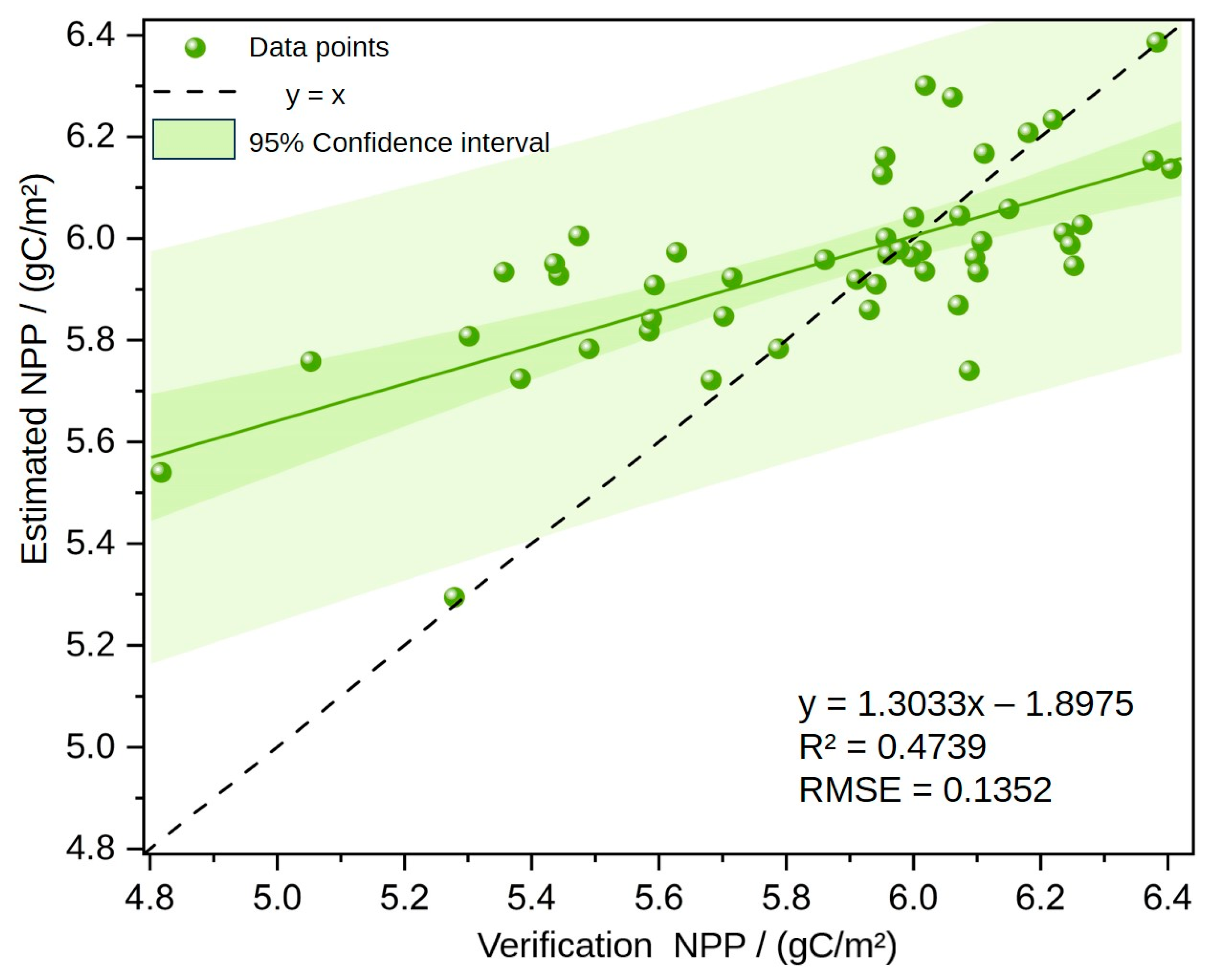
NPP was expressed in units of carbon mass per unit area per year (gC·m−2·a−1), derived by converting dry matter weight using a carbon content coefficient of 0.475. To verify model accuracy, we conducted a regression analysis correlating the CASA-simulated NPP with field-observed biomass converted into carbon units (Figure 2). The regression analysis revealed that the CASA model estimates that ANPP and biomass data have a good linear regression relationship (y = 1.3033x − 1.8957, R2 = 0.4739, p < 0.05). The correlation R between the two is 0.6884. Consequently, the coupling of high-resolution NDVI and climatic variables significantly enhances model performance, validating its applicability for monitoring productivity dynamics in the high-intensity open-pit mining area.

3.2. Interannual Declines in ANPP, MNPP, PNPP

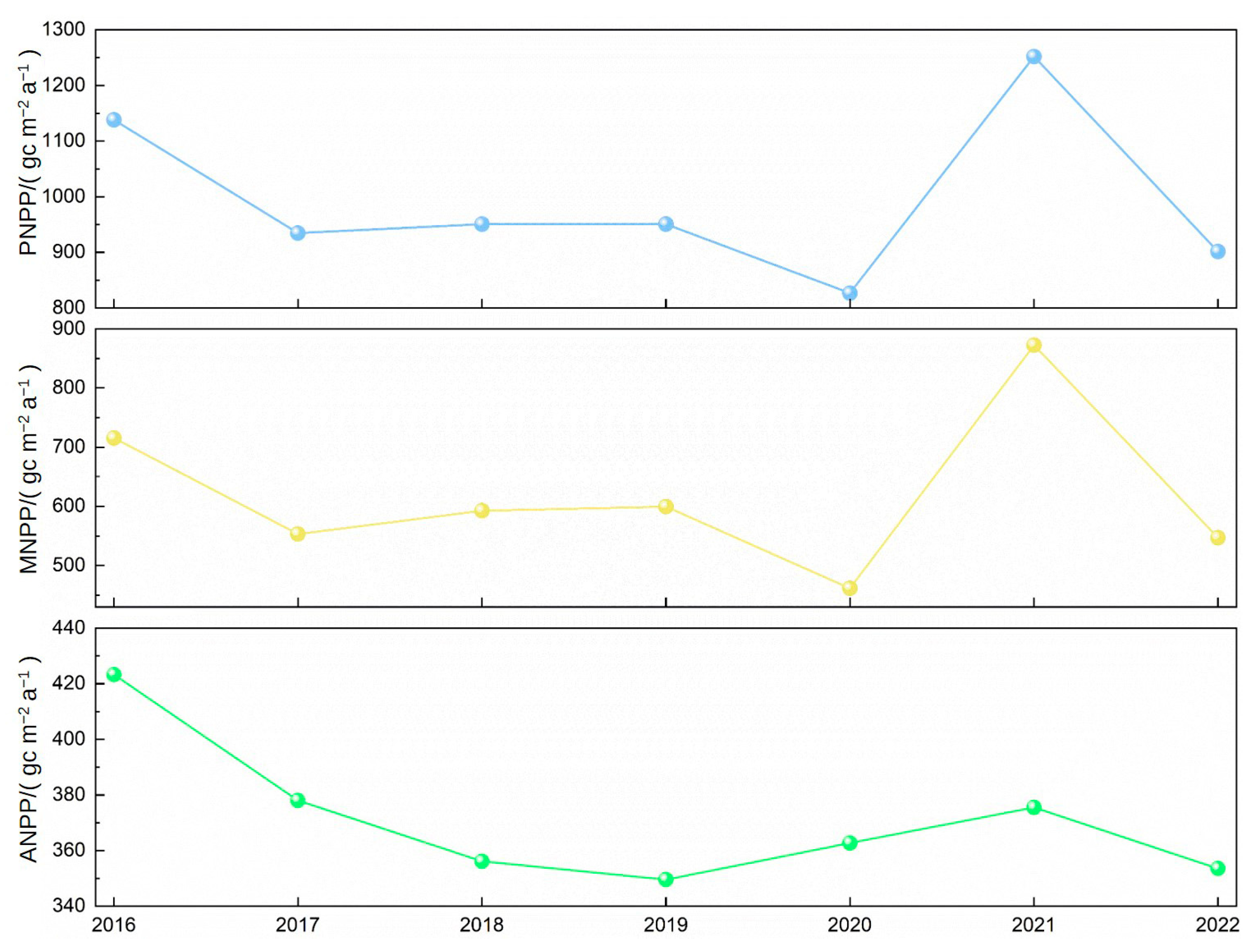
The annual average values of PNPP, MNPP and ANPP exhibited a fluctuating downward trend from 2016 to 2022 (Figure 3). During 2019–2021, ANPP, MNPP and PNPP exhibited distinct fluctuation patterns. ANPP demonstrated a marginal increase, while PNPP declined to its nadir in 2020 due to extreme temperatures and precipitation deficits, subsequently rebounding significantly in 2021 under the synergistic effects of adequate precipitation and diminished extreme thermal events. MNPP exhibited synchronous fluctuations with PNPP dynamics. Over the seven-year period, the mean annual ANPP for the study period was calculate at 374.10 gC m−2 a−1, with its annual mean showing a fluctuating downward trend; ANPP peaked at 426.35 gC m−2 a−1 in 2016 as the period’s highest value and declined to its lowest value of 352.08 gC m−2 a−1 in 2019. The mining area experienced a cumulative ANPP reduction of 3 × 10⁸ gC a−1 during the study period. The trends of MNPP and PNPP were largely consistent. The multi-year average MNPP was 621.15 gC m−2 a−1 with significant fluctuations, reaching the lowest recorded level of 463.36 gC m−2 a−1 in 2020 and climbing to the highest level of 873.51 gC m−2 a−1 in 2021. Additionally, the total carbon sequestration potential in the high-intensity open-pit mining area showed a cumulative reduction of 1.73 × 10⁹ gC m−2 a−1 by 2022 compared with 2016.

3.3. Spatial Heterogeneity of Interannual ANPP, MNPP, PNPP

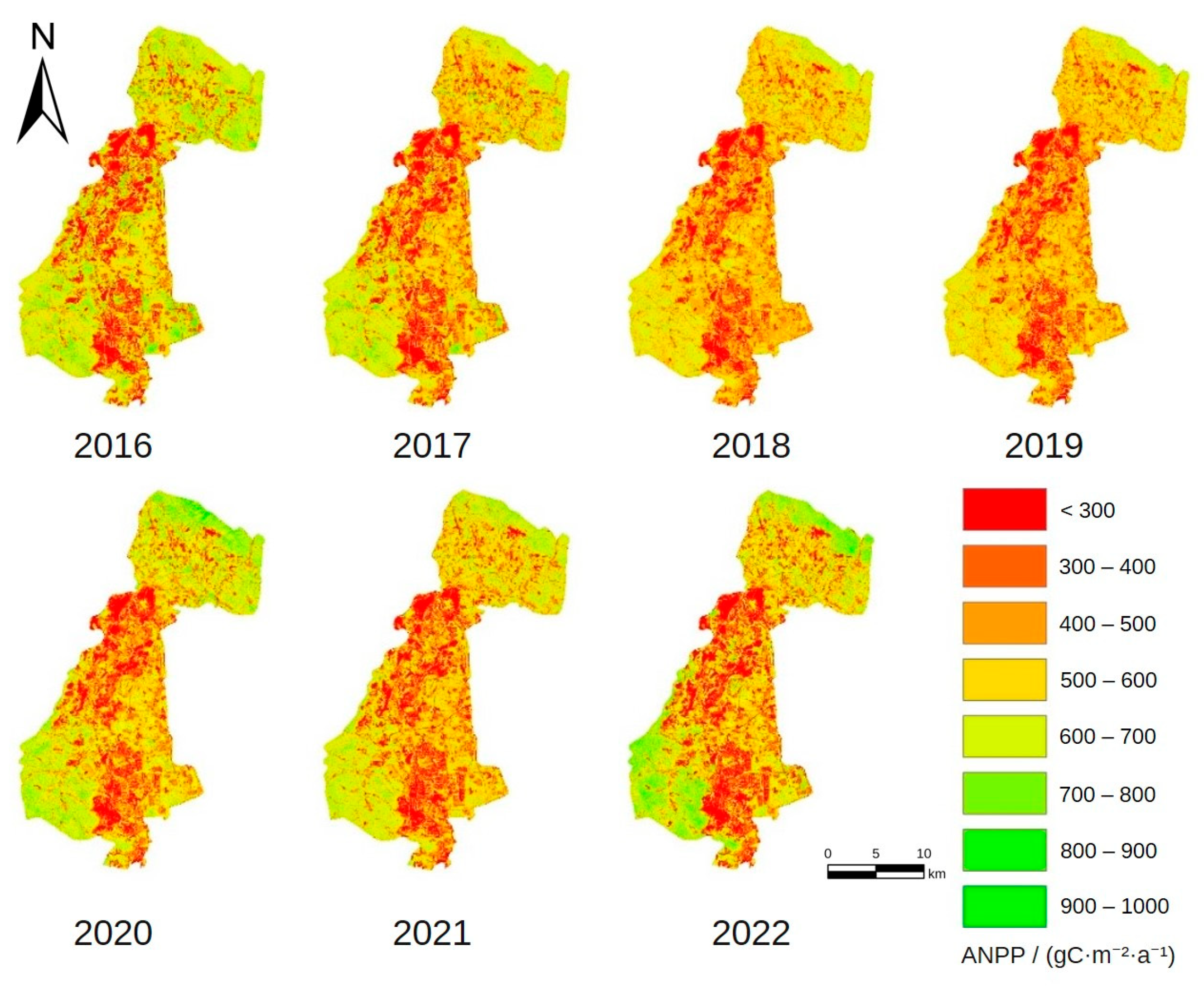
From 2016 to 2022, the high-intensity open-pit mining area exhibited significant spatial variability in ANPP, with lower values concentrated centrally and higher productivity in southwestern and northern sectors (Figure 4). ANPP hotspots (>700 gC·m−2·a−1) primarily occurred in Wuchongan and Dacuizhuang and in the western regions of Muchangkou and Dawuli; these areas are dominated by minimally disturbed forest lands, croplands, and grasslands. Conversely, persistent low-value zones (<300 gC·m−2·a−1) were concentrated in the central mining districts of Malanzhuang and Caiyuan, along with Yangdianzi’s industrial cluster and southern Muchangkou. By 2022, these degraded areas constituted 36.71% of the mining landscape, while high-productivity zones covered merely 1.29%. This distribution pattern indicates widespread ecosystem degradation, with 85% of the study area exhibiting moderate-to-low productivity (300–700 gC·m−2·a−1).
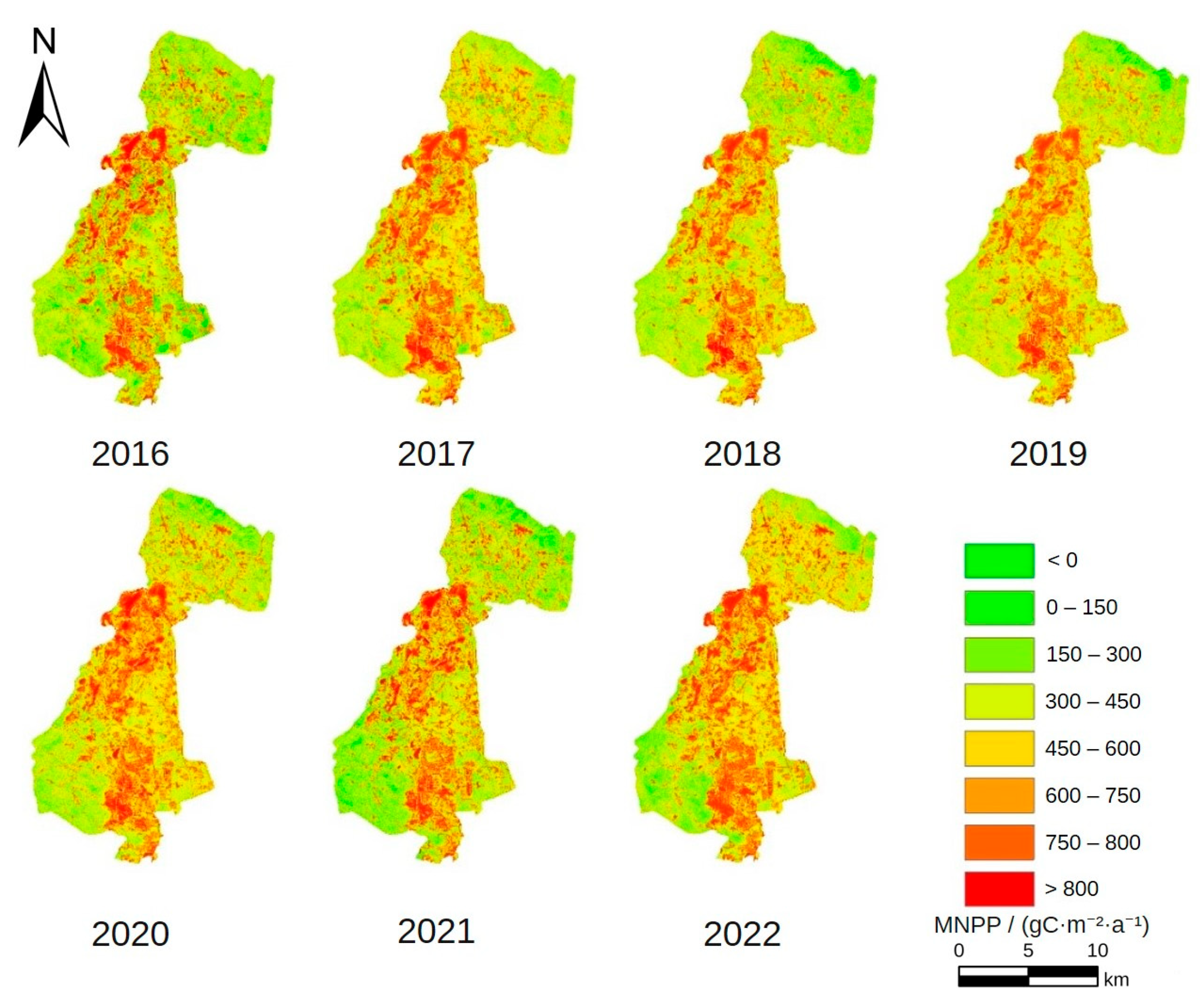
MNPP quantifies vegetation’s realized carbon sequestration capacity in mining-impacted areas. Elevated MNPP values indicate greater mining-induced degradation, corresponding to diminished carbon sequestration. Conversely, lower MNPP values reflect enhanced vegetation carbon sequestration potential. From 2016 to 2022, the high-intensity open-pit mining area MNPP was mainly concentrated in Malanzhuang, Caiyuan, and Muchangkou areas. The Yangdianzi industrial area was transferred to Wuchongan, and the low-value areas such as Dacuizhuang, Dawuli and Muchangkou West showed an expansion trend (Figure 5). As of 2022, mining activities occupied 16.26% of the high-MNPP zones, compared with negligible coverage in low-value areas. This distribution suggests a significant discrepancy between current carbon sinks and their natural state, highlighting a substantial potential for ecological recovery.
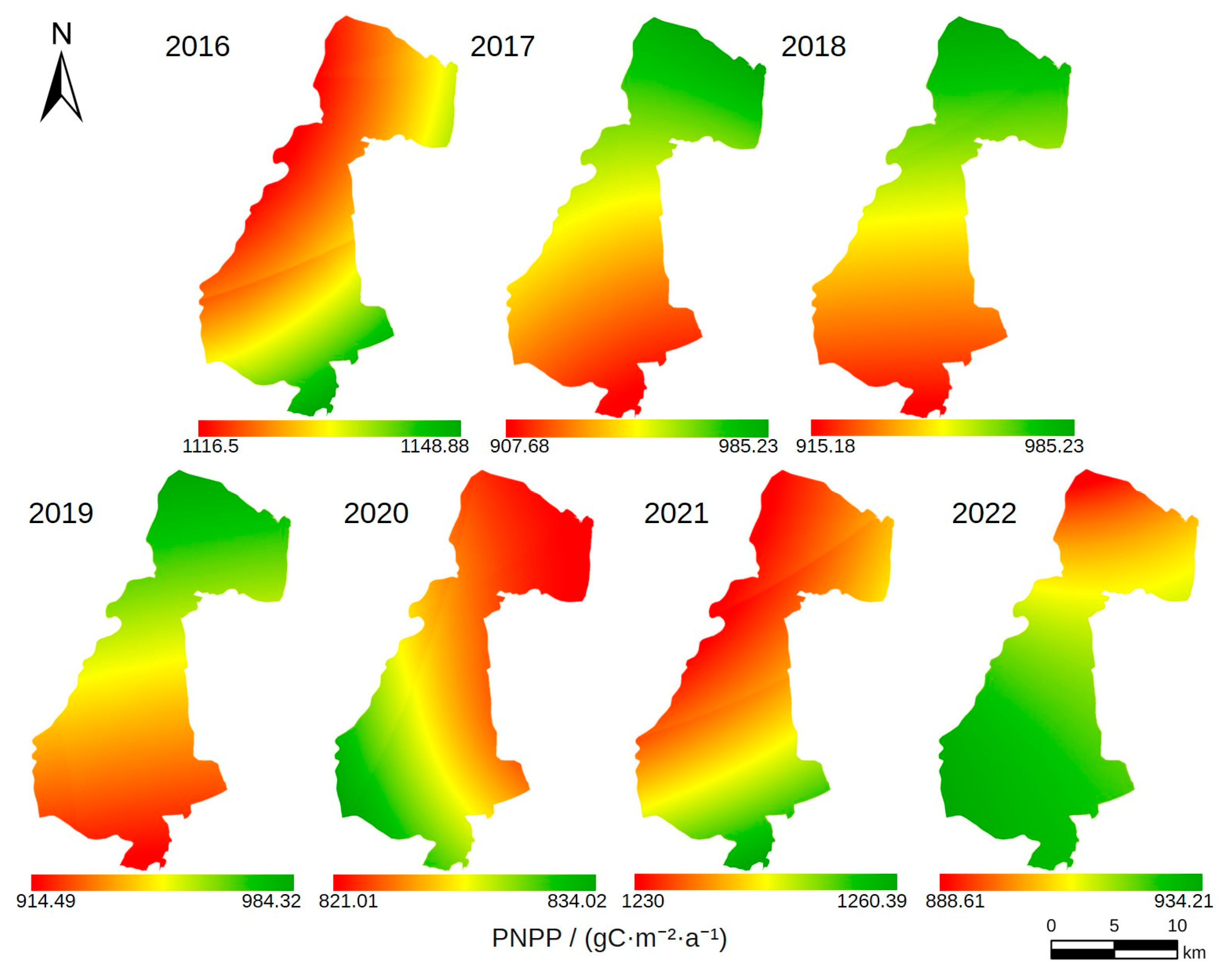
The spatial heterogeneity of PNPP was pronounced across the study area, with values consistently and significantly exceeding ANPP (Figure 6). This analytical outcome further confirms substantial carbon sequestration potential within the regional vegetation. Specifically, elevated PNPP values predominantly clustered in Wuchongan, Dacuizhuang, and Dawuli; these townships are characterized by lower mining intensity and tree-dominated land cover. Depressed PNPP values concentrated in Malanzhuang, Yangdianzi and Caiyuan, consistent with MNPP spatial distribution patterns.

3.4. Spatiotemporal Dynamic of RCI

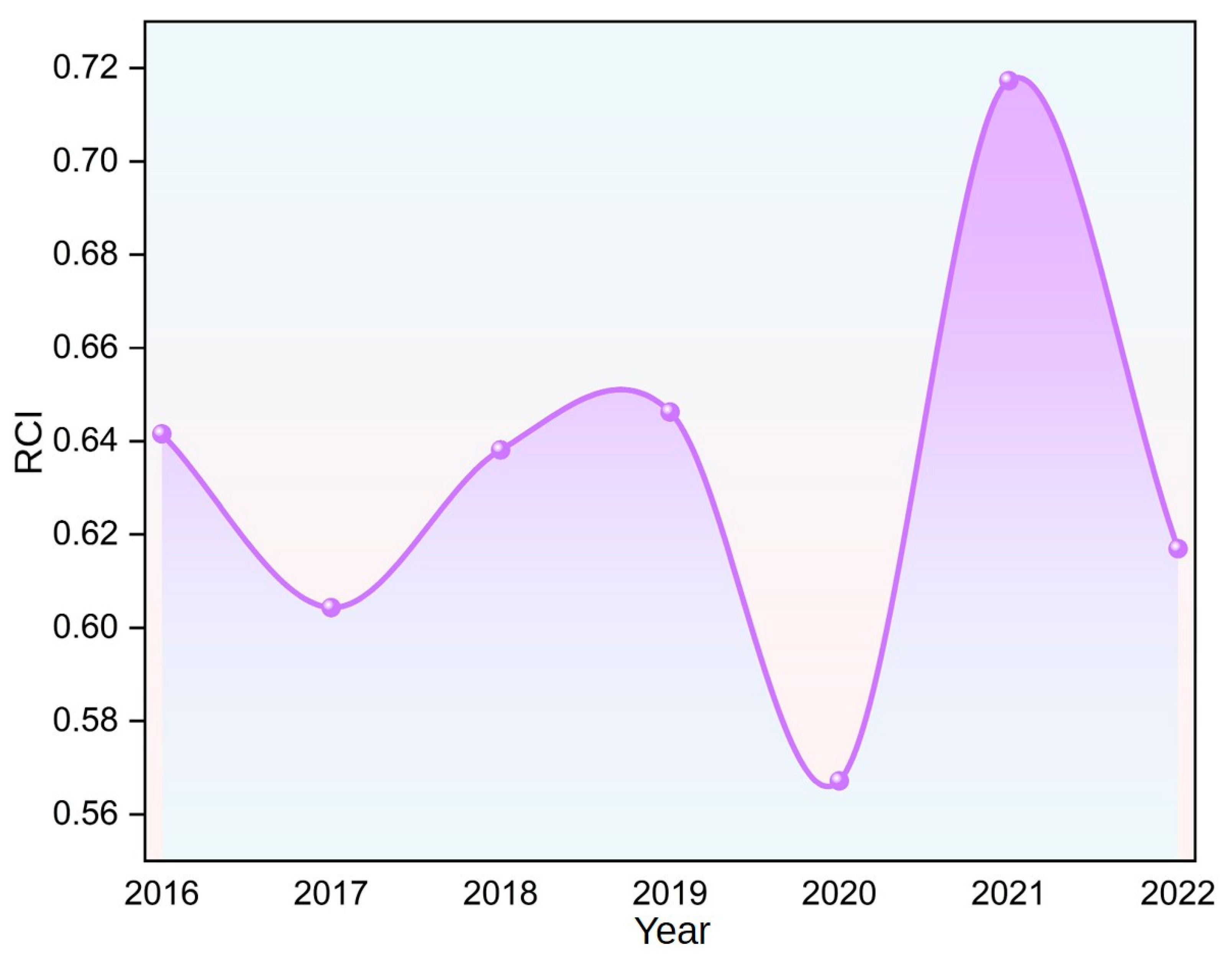
From 2016 to 2019, RCI in the study area exhibited relative stability with minor fluctuations; however, the high-intensity open-pit mining area exhibited a rising but variable trend in RCI from 2019 to 2022 (Figure 7). Throughout the study period, RCI values consistently exceeded 0.559, ranging between 0.559 and 0.698, with a seven-year mean of 0.62. Notably, RCI declined to its lowest recorded value in 2020. Following adjustments in pandemic control measures and the resumption of industrial production, RCI surged to its peak of 0.698 in 2021, indicating the maximum negative interference intensity from mining activities on vegetation during the study period; by 2022, the RCI returned to a relatively stable state. Mining activities caused vegetation NPP losses ranging from 463.36 to 873.51 gC m−2 a−1, averaging 621.15 gC m−2 a−1 annually, confirming mining activities as the dominant factor influencing ANPP.
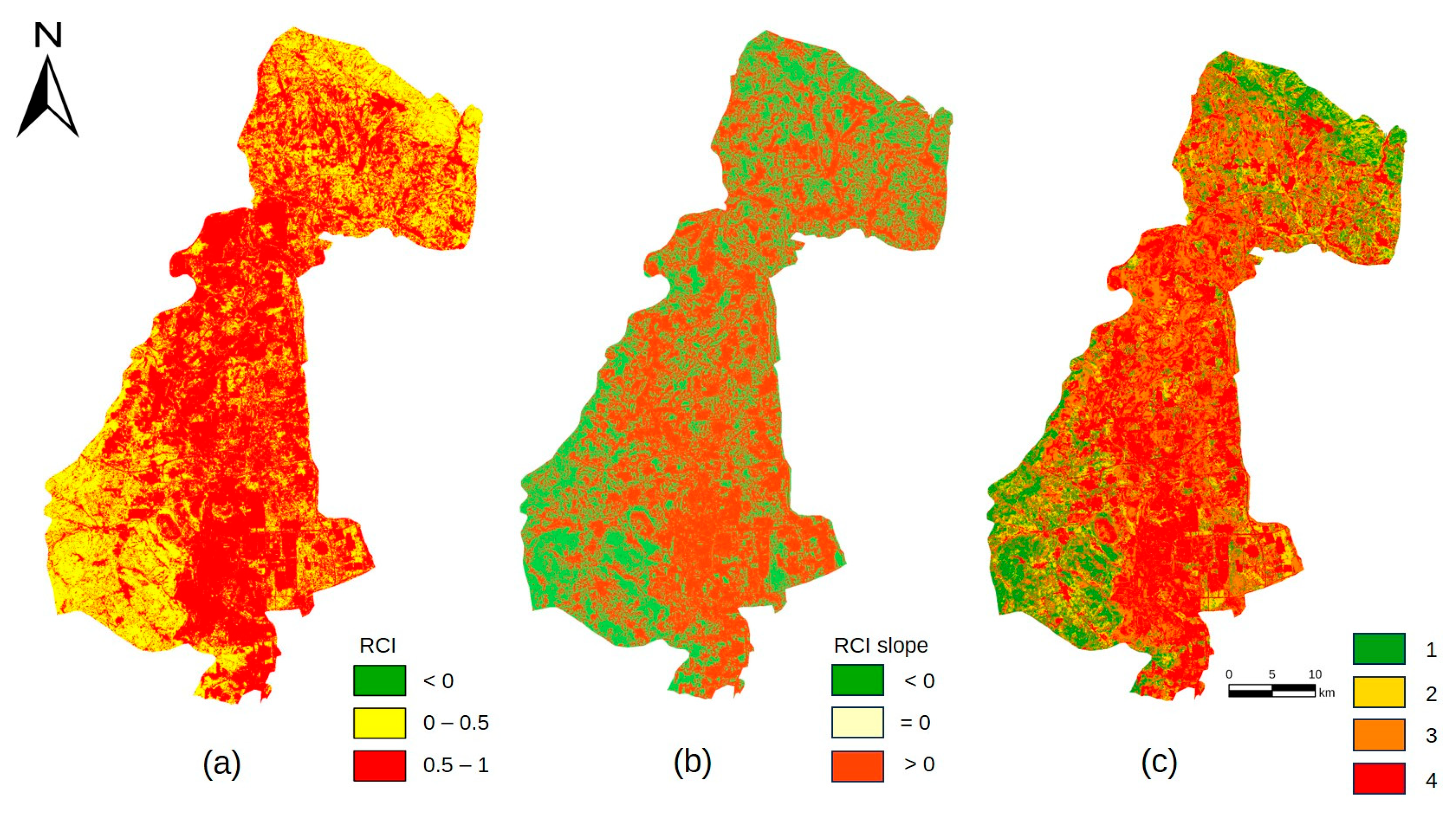
Mining activities exhibit predominantly adverse interference effects across the study area. Spatially, the RCI of the high-intensity open-pit mining area exhibited exclusively positive values (Figure 8a). Approximately 62.67% of the study area RCI > 0.5, constituted the highest proportion, spatially concentrated in core mining zones including Malanzhuang, Caiyuan, Yangdianzi, and eastern Muchangkou. These areas are characterized by dense mining operations, high-intensity activities, and concentrated extraction, resulting in significant suppression of ANPP. Regions with RCI values between 0 and 0.5 were predominantly distributed in western Dawuli and central and western Muchangkou. This area primarily features arboreal tree cover and lower mining density, consequently experiencing reduced mining disturbance intensity. Notably, no regions exhibited significant protective effects of mining on vegetation. Pixel-based analysis of RCI change rate during the study period (Figure 8b) showed an overall mean change rate of 0.02695 for 2016–2022. The spatial distribution of RCI change rates revealed that areas with an RCI slope > 0 constituted 62.83% of the study area, indicating a widespread trend of gradually intensifying negative interference of mining activities on vegetation productivity, with both spatial extent and intensity demonstrating ongoing expansion. These areas predominantly occurred in Malanzhuang, Caiyuan, Dawuli, and Yangdianzi, with scattered distributions in Wuchongan, Dawuli, and Muchangkou. Regions with an RCI slope < 0 represented a negligible proportion, primarily concentrated in Muchangkou. No areas exhibited unchanging mining activity levels throughout the study period.
To further elucidate the spatiotemporal coupling between mining disturbance intensity and its evolutionary trajectories, this study conducted a spatial overlay and cross-tabulation analysis of the multi-year average RCI status and its slope, classifying the study area into four risk levels (Figure 8c). Among these, Level 4 is the high-risk deterioration zone (RCI > 0.5 and Slope > 0), indicating that the negative interference driven by mining activities as the absolute dominant factor is intensifying year by year. This zone accounts for the largest proportion at 42.21% of the total area and is predominantly concentrated in core mining districts such as Caiyuan, Malanzhuang, and Yangdianzi. Level 3 is the high-risk mitigation zone (RCI > 0.5 and Slope < 0), signifying that, although the area has historically suffered severe damage, recent negative interferences are gradually weakening. It covers approximately 22.26% of the area and is primarily distributed along the periphery of the high-risk deterioration zones. Level 1 is the low-risk stable zone (RCI < 0.5 and Slope < 0), representing areas with minimal mining disturbance and relatively stable ecosystems. It comprises 20.70% of the region, mainly located in western Dawuli, central-western Muchangkou, and the northern part of the study area. Lastly, Level 2 is the low-risk deterioration zone (RCI < 0.5 and Slope > 0), serving as an ecological “warning zone” where the negative impacts of mining are expanding outward. It represents the smallest proportion at 14.83% and is spatially embedded mainly within the transitional interfaces between the low-risk stable zones and high-risk zones.

4. Discussion

4.1. Influence of Climatic Variability on ANPP

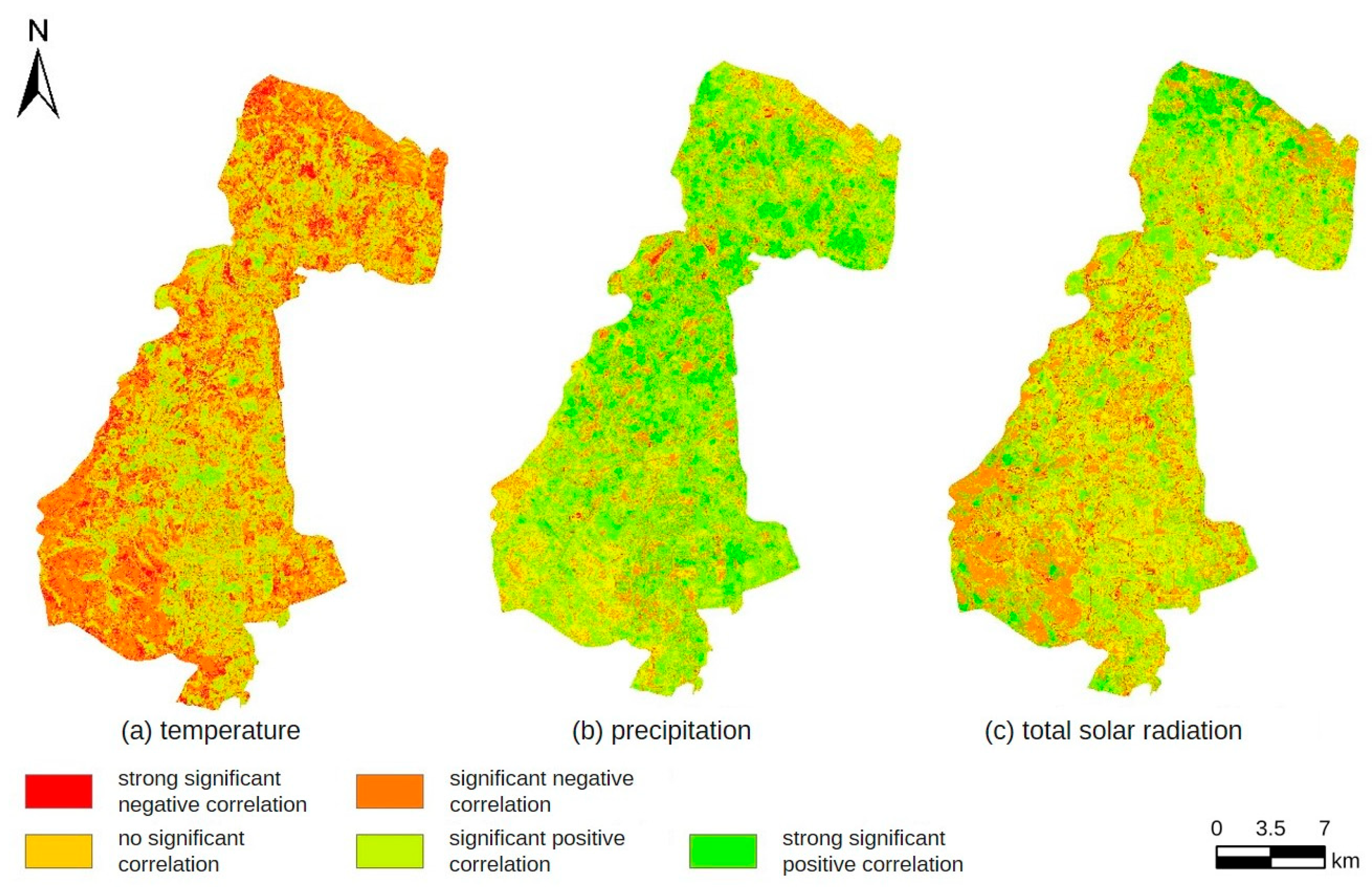
Climatic variability functions as a primary regulator of vegetation dynamics, imposing complex, bidirectional influences on physiological development [52,53]. Hydrothermal and radiative conditions fundamentally shape the geographic layout of vegetation, resulting in substantial spatiotemporal variability [54]. The sensitivity of ANPP to meteorological forcing was assessed via spatially explicit Pearson correlation coefficients calculated for the seven-year study window [55]. ANPP variability exhibited significant correlations with all measured climatic parameters (Figure 9). ANPP in the high-intensity open-pit mining area demonstrated a consistent negative relationship with regional temperature patterns (Figure 9a). This phenomenon may arise from elevated temperatures enhancing plant respiration, thereby reducing vegetation productivity [56]. Strongly negative correlations covered 9.83% of the study area, while significantly negative correlations accounted for 33.76%. Geographically, pronounced inverse correlations were primarily clustered within the northern forest land, specifically in Wuchongan, the western forest land of Dacuizhuan, and the eastern forest land of Dawuli and Muchangkou. The relationship between ANPP and total solar radiation exhibits pronounced spatial heterogeneity across the high-intensity open-pit mining area (Figure 9c). Negative correlation dominated in the southwest and the northern forest lands, accounting for 26.80%. Central and northern areas showed non-significant correlation, accounting for 35.65% percent.
ANPP in the high-intensity open-pit mining area demonstrated a consistent positive correlation between ANPP and precipitation (Figure 9b). Among them, areas with a strong positive correlation comprised 10.38% of the total, contrasting with 38.4% exhibiting significant positive correlation. Forest cover in the northern and southwestern sectors presents a fragmented mosaic, interspersed with open-pit mining sites and residential settlements. During the mining process, much of the rock and soil is stripped away, resulting in the destruction of the original vegetation on the surface. Disturbance processes such as occupancy, accumulation and mining affect the water evapotranspiration cycle, alter surface water runoff and water harvesting conditions, and reduce soil water retention, which in turn affects the surface thermal environment and produces heat island effects [57,58,59]. Excessive temperatures increase surface evapotranspiration and increase vegetation water consumption, leading to NPP declines and counteracting the positive effects of precipitation on vegetation NPP [60,61].

4.2. Analysis of the Impact of Mining Activity on ANPP

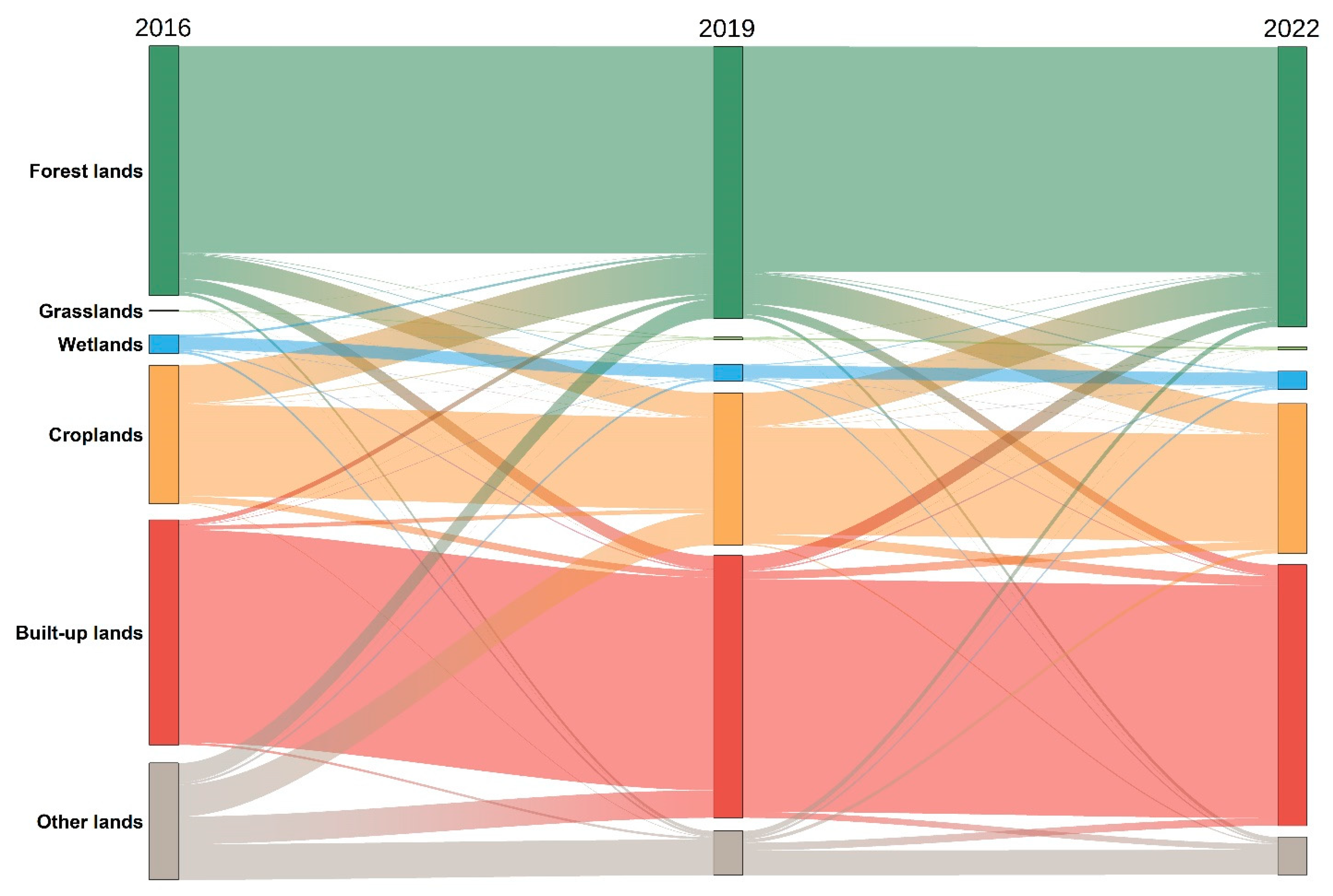
Mining-driven activities disrupt native land cover through urban expansion and resource extraction, driving LULC changes that impose significant negative impacts on ANPP [62,63,64]. Significant LULC transformations occurred in high-intensity opencast mining zones during the study period: approximately 5.33% of forest, grassland, wetlands, and croplands ecosystems converted to built-up lands between 2016 and 2019, directly driving marked ANPP decline (Figure 10). Notably, ecological restoration projects implemented through land leveling, soil amelioration, and vegetation rehabilitation enhanced secondary vegetation coverage in some forest lands, grasslands, wetlands, and croplands ecosystems, elevating ANPP levels. During 2019–2022, 8.48% of built-up lands and 21.5% of other lands transitioned to forest land, grassland, cropland, and wetland ecosystems in these zones (Figure 10). Collectively, mining activities in the study area induced surface subsidence and ground fissures, altering micro-topography, disrupting root-zone growth environments, and degrading soil physicochemical properties. This impaired vegetation nutrient and moisture absorption efficiency, ultimately leading to significant ANPP decline, though ecological restoration measures mitigated or even reversed this trend [65,66].

4.3. Dominant Role of Mining Activities on ANPP

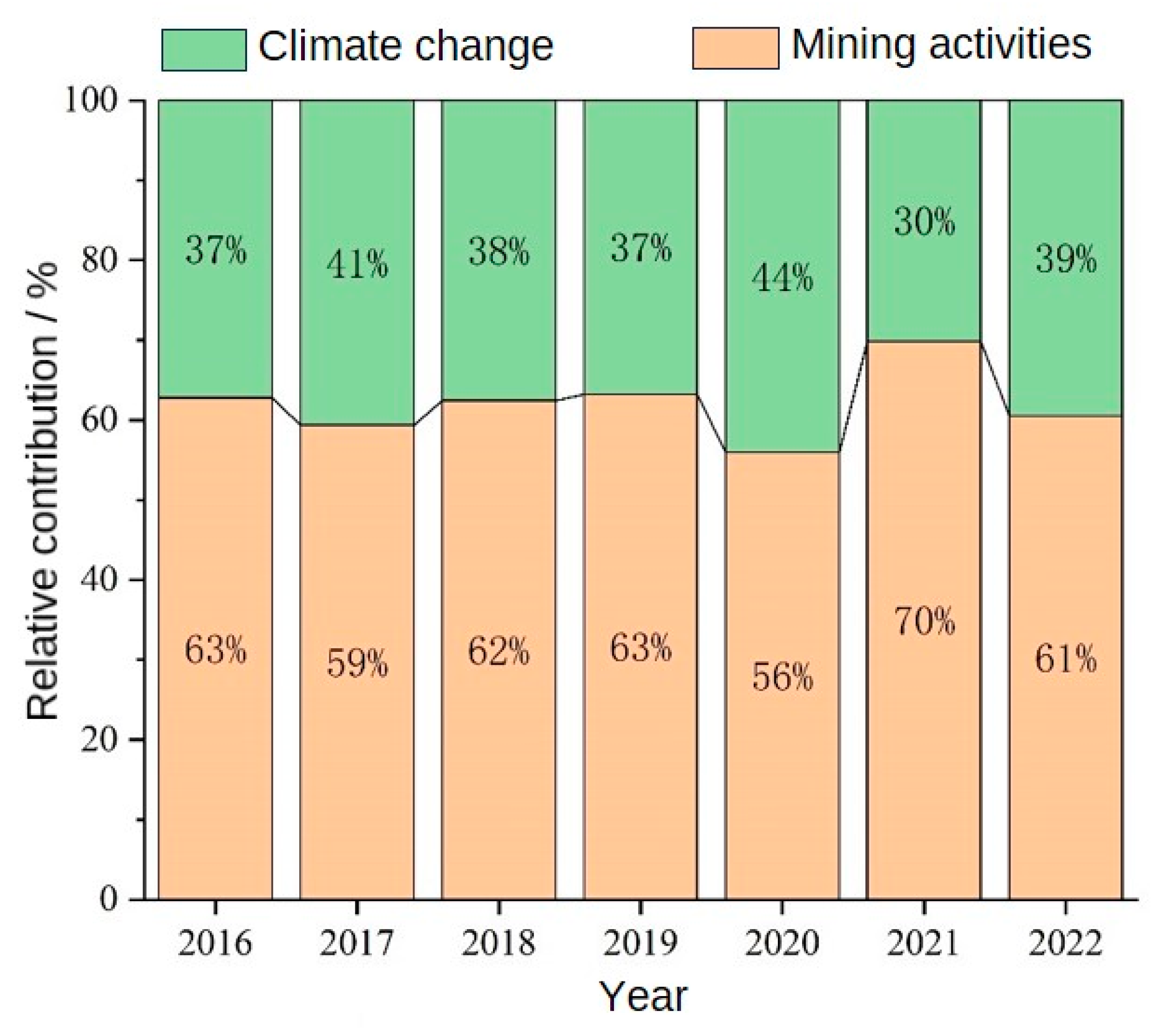
Certain studies indicate that climatic variability constitutes a primary driver of ANPP [67]. However, within the high-density open-pit mining area, although ANPP is partially influenced by climatic variability, mining intensity alterations remain the dominant controlling factor for ANPP variations [68]. We disentangled the separate contributions of mining activities and climatic variability to annual ANPP fluctuations (Figure 11), assuming ANPP was solely influenced by these factors with their contribution rates summing to unity. The seven-year mean RCI value of 62% indicates that climate factors account for the remaining 38% of ANPP variability. Ample precipitation and suitable temperatures enhance vegetation carbon sequestration efficiency in forest lands and grasslands ecosystems, thereby promoting regional ANPP [69]. Nevertheless, MNPP functions as the primary negative contributor, driving the overall declining trajectory of ANPP across the study area. This further substantiates that anthropogenic mining activities predominantly govern ANPP dynamics in high-intense open-pit mining areas [70,71]. Notably, given the persistent upward trajectory in MNPP contribution rates, ANPP within high-density opencast mining zones will continue to be dominantly driven by mining activities.

5. Conclusions

This research successfully derived NPP values for a large-scale high-intensity open-pit mining area through the application of the improved CASA and Thornthwaite Memorial models. This methodological framework facilitated the decoupling of climatic influences from mining-induced perturbations regarding their effects on NPP evolution. The primary conclusions as follows: (1) Total NPP followed a fluctuating downward trajectory during the 2016–2022, with a cumulative reduction of 5.3 × 10⁸ gC a−1. Regional vegetation carbon sequestration potential similarly declined, with a cumulative diminution of 1.73 × 10⁹ gC relative to 2016. (2) ANPP remained elevated in Wuchongan, Dacuizhuang, and western Muchangkou and Dawuli. Conversely, significantly depressed ANPP values characterized central mining zones, specifically Malanzhuang and Caiyuan, alongside southern industrial regions, particularly the Yangdianzi industrial zone and Muchangkou mining area. (3) In the high-intensity open-pit mining area, mining-dominated areas constituted the highest proportion, spatially concentrated in core mining districts including Malanzhuang, Caiyuan, and Yangdianzi, demonstrating a sustained intensification of mining activity intensity. (4) ANPP reduction is more sensitive to mining activities than to climatic variability. Mining activities contributed dominantly, accounting for 61.33% of ANPP reduction on average, compared with 38.67% from climatic variability. Among meteorological determinants, precipitation demonstrated the most robust positive coupling with ANPP, a relationship that was especially distinct in arboreal ecosystems. Ultimately, these findings underscore the severe constraints mining places on regional carbon sinks, providing a critical scientific foundation for optimizing localized ecological restoration and aligning mining management with carbon neutrality objectives.

Author Contributions

X.G.: data curation, methodology and original draft writing; H.G.: data curation, validation and investigation; M.L.: conceptualization, funding acquisition and review and editing; J.Z.: resources; F.L.: review and editing, funding acquisition and conceptualization; Y.Z.: review and editing, funding acquisition; M.C.: review and editing; X.L.: investigation; G.T.: supervision; X.C.: review and editing; W.M.: conceptualization, funding acquisition and review and editing. All authors have read and agreed to the published version of the manuscript.

Funding

This research was funded by the National Natural Science Foundation of China (No. 52274166), Central Guided Local Science and Technology Development Fund Project of Hebei Province (Grant No. 254Z7601G and 246Z4201G), the Natural Science Foundation of Hebei Province (Grant No. D2025209005 and D2025209012), Hebei Province Graduate Innovation Funding Project (No. CXZZBS2025153), and North China University of Science and Technology Medical Engineering Integration Project (No. ZD-YG-202403).

Data Availability Statement

NDVI data derived from Sentinel-2 multispectral imagery are available through Google Earth Engine (https://code.earthengine.google.com/). Monthly mean temperature and cumulative precipitation data are available through the ERA5-Land reanalysis dataset via the Copernicus Climate Data Store (https://cds.climate.copernicus.eu/datasets accessed on 28 May 2023). Sunshine duration data from 18 regional meteorological stations are available through the China Meteorological Data Service Center (https://data.cma.cn/ accessed on 28 May 2023). Annual 10 m resolution LULC datasets are available through the Dynamic World V1 dataset via GEE as described by [43].

Acknowledgments

We gratefully acknowledge the Copernicus program, Google Earth Engine and China Meteorological Data Service Center for providing critical datasets, including Sentinel-2 multispectral imagery, ERA5-Land reanalysis datasets, NDVI composites, Dynamic World V1 global 10 m resolution LULC dataset and regional sunshine duration records. We extend special appreciation to field investigation teams for their rigorous collection of ground-truth samples across the high-intensity mining area, which provided essential validation data for model calibration.

Conflicts of Interest

The authors declare no conflicts of interest.

References

  1. Wang, C.; Li, J.; Yi, Y.; Yang, S. Crowding in or Crowding out? Executive Environmental Attention and ESG Performance of Mining Listed Companies. Miner. Econ. 2024, 37, 897–913. [Google Scholar] [CrossRef]
  2. Dong, J.; Dai, W.; Xu, J.; Zhang, H.; Li, Y.; Xie, F. Impact and Elastic Modulus of Coal Mining on Terrestrial Ecosystems. Sci. Rep. 2025, 15, 9454. [Google Scholar] [CrossRef]
  3. Ma, J.; Gonzalez-Ollauri, A.; Zhang, Q.; Xiao, D.; Chen, F. Ecological Network Analysis to Assess the Restoration Success of Disturbed Mine Soil in Zoucheng, China. Land. Degrad. Dev. 2021, 32, 5393–5411. [Google Scholar] [CrossRef]
  4. Xu, Y.; Li, J.; Zhang, C.; Raval, S.; Guo, L.; Yang, F. Dynamics of Carbon Sequestration in Vegetation Affected by Large-Scale Surface Coal Mining and Subsequent Restoration. Sci. Rep. 2024, 14, 13479. [Google Scholar] [CrossRef]
  5. Rousvel, S.; Armand, N.; Andre, L.; Tengeleng, S.; Alain, T.; Armel, K. Comparison between Vegetation and Rainfall of Bioclimatic Ecoregions in Central Africa. Atmosphere 2013, 4, 411–427. [Google Scholar] [CrossRef]
  6. Hu, Y.; Gong, J.; Zhang, S.; Zhang, W.; Dong, X.; Yang, G.; Yan, C.; Liu, Y. Monitoring Carbon Dynamics and Driving Forces in Arid and Semi-Arid River Basin: A Case Study of China’s West Liao River Basin. Environ. Model. Softw. 2025, 193, 106625. [Google Scholar] [CrossRef]
  7. Ahirwal, J.; Maiti, S.K. Assessment of Soil Properties of Different Land Uses Generated Due to Surface Coal Mining Activities in Tropical Sal (Shorea robusta) Forest, India. CATENA 2016, 140, 155–163. [Google Scholar] [CrossRef]
  8. Yang, R.; Liu, M.; Zhang, Y.; Man, W.; Tong, J.; Liu, D.; Zhang, Q.; Kou, C.; Li, X.; Liu, Y.; et al. Estimation of Soil Organic Carbon Stocks Utilizing Machine Learning Algorithms and Multi-Source Geospatial Data in Coastal Wetlands of Tianjin and Hebei, China. Chin. Geogr. Sci. 2025, 35, 707–721. [Google Scholar] [CrossRef]
  9. Fang, J.; Chen, A.; Peng, C.; Zhao, S.; Ci, L. Changes in Forest Biomass Carbon Storage in China Between 1949 and 1998. Science 2001, 292, 2320–2322. [Google Scholar] [CrossRef]
  10. Chen, X.; Gong, Z.; Huang, H. The Effect of the Grain for Green Program on Regional Carbon Sinks—Empirical Analysis Based on PSM-DID Model. Landsc. Ecol. Eng. 2025, 22, 19–35. [Google Scholar] [CrossRef]
  11. Gu, F.; Zhang, Y.; Huang, M.; Tao, B.; Liu, Z.; Hao, M.; Guo, R. Climate-Driven Uncertainties in Modeling Terrestrial Ecosystem Net Primary Productivity in China. Agric. For. Meteorol. 2017, 246, 123–132. [Google Scholar] [CrossRef]
  12. Zhu, W.; Pan, Y.; He, H.; Yu, D.; Hu, H. Simulation of Maximum Light Use Efficiency for Some Typical Vegetation Types in China. Chin. Sci. Bull. 2006, 51, 457–463. [Google Scholar] [CrossRef]
  13. Bao, G.; Bao, Y.; Qin, Z.; Xin, X.; Bao, Y.; Bayarsaikan, S.; Zhou, Y.; Chuntai, B. Modeling Net Primary Productivity of Terrestrial Ecosystems in the Semi-Arid Climate of the Mongolian Plateau Using LSWI-Based CASA Ecosystem Model. Int. J. Appl. Earth Obs. Geoinf. 2016, 46, 84–93. [Google Scholar] [CrossRef]
  14. Sun, H.; Chen, Y.; Xiong, J.; Ye, C.; Yong, Z.; Wang, Y.; He, D.; Xu, S. Relationships between Climate Change, Phenology, Edaphic Factors, and Net Primary Productivity across the Tibetan Plateau. Int. J. Appl. Earth Obs. Geoinf. 2022, 107, 102708. [Google Scholar] [CrossRef]
  15. Wu, C.; Chen, K.; E, C.; You, X.; He, D.; Hu, L.; Liu, B.; Wang, R.; Shi, Y.; Li, C.; et al. Improved CASA Model Based on Satellite Remote Sensing Data: Simulating Net Primary Productivity of Qinghai Lake Basin Alpine Grassland. Geosci. Model. Dev. 2022, 15, 6919–6933. [Google Scholar] [CrossRef]
  16. Wang, Y.; Chen, X.; Gao, M.; Dong, J. The Use of Random Forest to Identify Climate and Human Interference on Vegetation Coverage Changes in Southwest China. Ecol. Indic. 2022, 144, 109463. [Google Scholar] [CrossRef]
  17. Jia, L.; Yu, K.; Li, Z.; Li, P.; Xu, G.; Cong, P.; Li, B. Spatiotemporal Pattern of NPP and Its Response to Climatic Factors in the Yangtze River Economic Belt. Ecol. Indic. 2024, 162, 112017. [Google Scholar] [CrossRef]
  18. Tang, H.; Fang, J.; Yuan, J. Climate Change and Land Use/Land Cover Change (LUCC) Leading to Spatial Shifts in Net Primary Productivity in Anhui Province, China. PLoS ONE 2024, 19, e0307516. [Google Scholar] [CrossRef]
  19. Yu, Z.; Ciais, P.; Piao, S.; Houghton, R.A.; Lu, C.; Tian, H.; Agathokleous, E.; Kattel, G.R.; Sitch, S.; Goll, D.; et al. Forest Expansion Dominates China’s Land Carbon Sink since 1980. Nat. Commun. 2022, 13, 5374. [Google Scholar] [CrossRef]
  20. Yang, F.; Wang, J.; Zhang, C.; Li, J.; Xie, H.; Zhuoge, Z. The Impact of Human Activities on Net Primary Productivity in a Grassland Open-Pit Mine: The Case Study of the Shengli Mining Area in Inner Mongolia, China. Land 2022, 11, 743. [Google Scholar] [CrossRef]
  21. Yang, Y.; Li, G.; Wang, Y.; Wu, L.; Ding, K.; Xing, S.; Zhang, Y.; Zhang, L. Dynamic Response of Vegetation Net Primary Productivity to Climate and Human Impacts in Mining-Dominated Basin in Inner Mongolia, China. Atmosphere 2024, 15, 1457. [Google Scholar] [CrossRef]
  22. Xu, Y.; Yang, G.; Zhang, Y.; Guo, J.; Zhang, C. Mapping and Interpreting Spatio-Temporal Trends in Vegetation Restoration Following Mining Disturbances in Large-Scale Surface Coal Mining Areas. Front. Environ. Sci. 2025, 13, 1531424. [Google Scholar] [CrossRef]
  23. Long, B.; Zeng, C.; Zhou, T.; Yang, Z.; Rao, F.; Li, J.; Chen, G.; Tang, X. Quantifying the Relative Importance of Influencing Factors on NPP in Hengduan Mountains of the Tibetan Plateau from 2002 to 2021: A Dominance Analysis. Ecol. Inform. 2024, 81, 102636. [Google Scholar] [CrossRef]
  24. Chen, A.; Zhong, X.; Wang, J.; Li, J. Spatiotemporal Patterns and Driving Forces of Net Primary Productivity in South and Southeast Asia Based on Google Earth Engine and MODIS Data. CATENA 2025, 249, 108689. [Google Scholar] [CrossRef]
  25. Ma, F.; Jiang, Q.; Xu, L.; Lv, K.; Chang, G. Processes, Potential, and Duration of Vegetation Restoration under Different Modes in the Eastern Margin Ecotone of Qinghai-Tibet Plateau. Ecol. Indic. 2021, 132, 108267. [Google Scholar] [CrossRef]
  26. Running, S.W.; Coughlan, J.C. A General Model of Forest Ecosystem Processes for Regional Applications I. Hydrologic Balance, Canopy Gas Exchange and Primary Production Processes. Ecol. Model. 1988, 42, 125–154. [Google Scholar] [CrossRef]
  27. Raich, J.W.; Rastetter, E.B.; Melillo, J.M.; Kicklighter, D.W.; Steudler, P.A.; Peterson, B.J.; Grace, A.L.; Moore, B.; Vorosmarty, C.J. Potential Net Primary Productivity in South America: Application of a Global Model. Ecol. Appl. 1991, 1, 399–429. [Google Scholar] [CrossRef]
  28. Cao, M.; Woodward, F.I. Dynamic Responses of Terrestrial Ecosystem Carbon Cycling to Global Climate Change. Nature 1998, 393, 249–252. [Google Scholar] [CrossRef]
  29. Landsberg, J.J.; Waring, R.H. A Generalised Model of Forest Productivity Using Simplified Concepts of Radiation-Use Efficiency, Carbon Balance and Partitioning. For. Ecol. Manag. 1997, 95, 209–228. [Google Scholar] [CrossRef]
  30. Monteith, J.L. Solar Radiation and Productivity in Tropical Ecosystems. J. Appl. Ecol. 1972, 9, 747. [Google Scholar] [CrossRef]
  31. Potter, C.S.; Randerson, J.T.; Field, C.B.; Matson, P.A.; Vitousek, P.M.; Mooney, H.A.; Klooster, S.A. Terrestrial Ecosystem Production: A Process Model Based on Global Satellite and Surface Data. Glob. Biogeochem. Cycles 1993, 7, 811–841. [Google Scholar] [CrossRef]
  32. Veroustraete, F.; Sabbe, H.; Eerens, H. Estimation of Carbon Mass Fluxes over Europe Using the C-Fix Model and Euroflux Data. Remote Sens. Environ. 2002, 83, 376–399. [Google Scholar] [CrossRef]
  33. Peng, J.; Shen, H.; Wu, W.; Liu, Y.; Wang, Y. Net Primary Productivity (NPP) Dynamics and Associated Urbanization Driving Forces in Metropolitan Areas: A Case Study in Beijing City, China. Landsc. Ecol. 2016, 31, 1077–1092. [Google Scholar] [CrossRef]
  34. Liu, D.; He, Z.; Shi, H.; Zhao, Y.; Liu, J.; Liu, A.; Li, L.; Zhu, R. Drivers of Vegetation Cover and Carbon Sink Dynamics in Abandoned Shaoyang City Open-Pit Coal Mines. Sustainability 2025, 17, 7816. [Google Scholar] [CrossRef]
  35. Huang, Y.; Tian, F.; Wang, Y.; Wang, M.; Hu, Z. Effect of Coal Mining on Vegetation Disturbance and Associated Carbon Loss. Environ. Earth Sci. 2015, 73, 2329–2342. [Google Scholar] [CrossRef]
  36. Niedballa, J.; Sollmann, R.; Mohamed, A.B.; Bender, J.; Wilting, A. Defining Habitat Covariates in Camera-Trap Based Occupancy Studies. Sci. Rep. 2015, 5, 17041. [Google Scholar] [CrossRef]
  37. Yuan, K.; Zhu, Z.; Pang, Y.; Pang, J.; Hou, C.; Tang, C. FireRisk-Multi: A Dynamic Multimodal Fusion Framework for High-Precision Wildfire Risk Assessment. ISPRS Int. J. Geo-Inf. 2025, 14, 426. [Google Scholar] [CrossRef]
  38. Fan, D.; Wang, M.; Liang, T.; He, H.; Zeng, Y.; Fu, B. Estimation and Trend Analysis of Carbon Emissions from Forest Fires in Mainland China from 2011 to 2021. Ecol. Inform. 2024, 81, 102572. [Google Scholar] [CrossRef]
  39. Mahdianpari, M.; Jafarzadeh, H.; Granger, J.E.; Mohammadimanesh, F.; Brisco, B.; Salehi, B.; Homayouni, S.; Weng, Q. A Large-Scale Change Monitoring of Wetlands Using Time Series Landsat Imagery on Google Earth Engine: A Case Study in Newfoundland. GISci. Remote Sens. 2020, 57, 1102–1124. [Google Scholar] [CrossRef]
  40. Zhang, J.; Wang, J.; Chen, Y.; Huang, S.; Liang, B. Spatiotemporal Variation and Prediction of NPP in Beijing-Tianjin-Hebei Region by Coupling PLUS and CASA Models. Ecol. Inform. 2024, 81, 102620. [Google Scholar] [CrossRef]
  41. Cao, F.; Li, J.; Fu, X.; Wu, G. Impacts of Land Conversion and Management Measures on Net Primary Productivity in Semi-Arid Grassland. Ecosyst. Health Sustain. 2020, 6, 1749010. [Google Scholar] [CrossRef]
  42. Shi, B.; Zhou, L.; Yang, F.; Jiang, F.; Zhang, J.; Huang, X.; Wei, W.; Jiang, L. Monitoring Vegetation Recovery in Abandoned Mining Areas Using Sentinel-2A and UAV Data: Evidence from the Hengshanli Mine. J. Environ. Manag. 2025, 395, 127982. [Google Scholar] [CrossRef]
  43. Brown, C.F.; Brumby, S.P.; Guzder-Williams, B.; Birch, T.; Hyde, S.B.; Mazzariello, J.; Czerwinski, W.; Pasquarella, V.J.; Haertel, R.; Ilyushchenko, S.; et al. Dynamic World, Near Real-Time Global 10 m Land Use Land Cover Mapping. Sci. Data 2022, 9, 251. [Google Scholar] [CrossRef]
  44. Yin, L.; Dai, E.; Zheng, D.; Wang, Y.; Ma, L.; Tong, M. What Drives the Vegetation Dynamics in the Hengduan Mountain Region, Southwest China: Climate Change or Human Activity? Ecol. Indic. 2020, 112, 106013. [Google Scholar] [CrossRef]
  45. Feng, H.; Kang, P.; Deng, Z.; Zhao, W.; Hua, M.; Zhu, X.; Wang, Z. The Impact of Climate Change and Human Activities to Vegetation Carbon Sequestration Variation in Sichuan and Chongqing. Environ. Res. 2023, 238, 117138. [Google Scholar] [CrossRef]
  46. Yan, Y.; Xu, X.; Liu, X.; Wen, Y.; Ou, J. Assessing the Contributions of Climate Change and Human Activities to Cropland Productivity by Means of Remote Sensing. Int. J. Remote Sens. 2020, 41, 2004–2021. [Google Scholar] [CrossRef]
  47. Tong, L.; Liu, Y.; Wang, Q.; Zhang, Z.; Li, J.; Sun, Z.; Khalifa, M. Relative Effects of Climate Variation and Human Activities on Grassland Dynamics in Africa from 2000 to 2015. Ecol. Inform. 2019, 53, 100979. [Google Scholar] [CrossRef]
  48. Lieth, H. Modeling the Primary Productivity of the World. In Primary Productivity of the Biosphere; Lieth, H., Whittaker, R.H., Eds.; Ecological Studies; Springer: Berlin/Heidelberg, Germany, 1975; Volume 14, pp. 237–263. ISBN 978-3-642-80915-6. [Google Scholar]
  49. Mao, D.; Wang, Z.; Li, L.; Song, K.; Jia, M. Quantitative Assessment of Human-Induced Impacts on Marshes in Northeast China from 2000 to 2011. Ecol. Eng. 2014, 68, 97–104. [Google Scholar] [CrossRef]
  50. Wu, S.; Zhou, S.; Chen, D.; Wei, Z.; Dai, L.; Li, X. Determining the Contributions of Urbanisation and Climate Change to NPP Variations over the Last Decade in the Yangtze River Delta, China. Sci. Total Environ. 2014, 472, 397–406. [Google Scholar] [CrossRef] [PubMed]
  51. Zhao, L.; Chen, Y.; Wang, X.; Su, M.; Xu, H.; Zhang, P. Spatiotemporal Changes in Net Primary Productivity before and after the Development of Unused Land in the Hilly Areas of Hebei, China. PLoS ONE 2022, 17, e0270010. [Google Scholar] [CrossRef] [PubMed]
  52. Gong, X.; Li, Y.; Wang, X.; Zhang, Z.; Lian, J.; Ma, L.; Chen, Y.; Li, M.; Si, H.; Cao, W. Quantitative Assessment of the Contributions of Climate Change and Human Activities on Vegetation Degradation and Restoration in Typical Ecologically Fragile Areas of China. Ecol. Indic. 2022, 144, 109536. [Google Scholar] [CrossRef]
  53. Zhou, X.; Peng, B.; Zhou, Y.; Yu, F.; Wang, X.-C. Quantifying the Influence of Climate Change and Anthropogenic Activities on the Net Primary Productivity of China’s Grasslands. Remote Sens. 2022, 14, 4844. [Google Scholar] [CrossRef]
  54. Jia, Z.; Tao, L. Relative Contributions of Climate Change and Human Activities on Vegetation Productivity Variation in National Nature Reserves on the Qinghai–Tibetan Plateau. Remote Sens. 2022, 14, 4626. [Google Scholar] [CrossRef]
  55. Wu, Y.; Luo, Z.; Wu, Z. Net primary productivity dynamics and driving forces in Guangzhou City, China. Appl. Ecol. Environ. Res. 2018, 16, 6667–6690. [Google Scholar] [CrossRef]
  56. Naeem, S.; Zhang, Y.; Tian, J.; Qamer, F.M.; Latif, A.; Paul, P.K. Quantifying the Impacts of Anthropogenic Activities and Climate Variations on Vegetation Productivity Changes in China from 1985 to 2015. Remote Sens. 2020, 12, 1113. [Google Scholar] [CrossRef]
  57. Luan, J.; Zhang, Y.; Tian, J.; Meresa, H.; Liu, D. Coal Mining Impacts on Catchment Runoff. J. Hydrol. 2020, 589, 125101. [Google Scholar] [CrossRef]
  58. Sun, W.; Yu, Q.; Xu, C.; Zhao, J.; Wang, Y.; Miao, Y. Construction and Optimization of Ecological Spatial Network in Typical Mining Cities of the Yellow River Basin: The Case Study of Shenmu City, Shaanxi. Ecol. Process 2024, 13, 60. [Google Scholar] [CrossRef]
  59. Worlanyo, A.S.; Li, J. Evaluating the Environmental and Economic Impact of Mining for Post-Mined Land Restoration and Land-Use: A Review. J. Environ. Manag. 2021, 279, 111623. [Google Scholar] [CrossRef]
  60. Bao, G.; Tuya, A.; Bayarsaikhan, S.; Dorjsuren, A.; Mandakh, U.; Bao, Y.; Li, C.; Vanchindorj, B. Variations and Climate Constraints of Terrestrial Net Primary Productivity over Mongolia. Quat. Int. 2020, 537, 112–125. [Google Scholar] [CrossRef]
  61. Chen, T.; Bao, A.; Jiapaer, G.; Guo, H.; Zheng, G.; Jiang, L.; Chang, C.; Tuerhanjiang, L. Disentangling the Relative Impacts of Climate Change and Human Activities on Arid and Semiarid Grasslands in Central Asia during 1982–2015. Sci. Total Environ. 2019, 653, 1311–1325. [Google Scholar] [CrossRef]
  62. Du, J.; Quan, Z.; Fang, S.; Liu, C.; Wu, J.; Fu, Q. Spatiotemporal Changes in Vegetation Coverage and Its Causes in China since the Chinese Economic Reform. Environ. Sci. Pollut. Res. 2020, 27, 1144–1159. [Google Scholar] [CrossRef] [PubMed]
  63. Li, H.; Zhang, H.; Li, Q.; Zhao, J.; Guo, X.; Ying, H.; Deng, G.; Rihan, W.; Wang, S. Vegetation Productivity Dynamics in Response to Climate Change and Human Activities under Different Topography and Land Cover in Northeast China. Remote Sens. 2021, 13, 975. [Google Scholar] [CrossRef]
  64. Prăvălie, R.; Patriche, C.; Tişcovschi, A.; Dumitraşcu, M.; Săvulescu, I.; Sîrodoev, I.; Bandoc, G. Recent Spatio-Temporal Changes of Land Sensitivity to Degradation in Romania Due to Climate Change and Human Activities: An Approach Based on Multiple Environmental Quality Indicators. Ecol. Indic. 2020, 118, 106755. [Google Scholar] [CrossRef]
  65. He, T.; Guo, J.; Xiao, W.; Xu, S.; Chen, H. A Novel Method for Identification of Disturbance from Surface Coal Mining Using All Available Landsat Data in the GEE Platform. ISPRS J. Photogramm. Remote Sens. 2023, 205, 17–33. [Google Scholar] [CrossRef]
  66. Xu, H.; Waheed, A.; Kuerban, A.; Muhammad, M.; Aili, A. Dynamic Approaches to Ecological Restoration in China’s Mining Regions: A Scientific Review. Ecol. Eng. 2025, 214, 107577. [Google Scholar] [CrossRef]
  67. Zhou, L.; Dong, Q.; Pan, Y.; Yang, F.; He, M.; Huang, X.; Xu, J. Spatiotemporal Variations and Driving Forces of Regional-Scale NPP Based on a Multi-Method Integration: A Case Study in the Beibu Gulf Economic Zone. Ecol. Indic. 2025, 174, 113453. [Google Scholar] [CrossRef]
  68. Chen, L.; Zhang, H.; Zhang, X.; Liu, P.; Zhang, W.; Ma, X. Vegetation Changes in Coal Mining Areas: Naturally or Anthropogenically Driven? CATENA 2022, 208, 105712. [Google Scholar] [CrossRef]
  69. Sun, X.; Zhou, Y.; Jia, S.; Shao, H.; Liu, M.; Tao, S.; Dai, X. Impacts of Mining on Vegetation Phenology and Sensitivity Assessment of Spectral Vegetation Indices to Mining Activities in Arid/Semi-Arid Areas. J. Environ. Manag. 2024, 356, 120678. [Google Scholar] [CrossRef]
  70. Zhang, X.; Chen, Z.; Jiao, Y.; Cheng, Y.; Zhu, Z.; Wang, S.; Zhang, H. Vegetation Growth Changes and Their Constraining Effects on Ecosystem Services Under Ecological Restoration in the Shendong Mining Area. Remote Sens. 2025, 17, 1674. [Google Scholar] [CrossRef]
  71. Wang, J.; Cui, K.; Yang, F.; Li, J.; Zhang, C.; Du, T.; Zhang, H. Evaluation of Spatiotemporal Variation and Impact Factors for Vegetation Net Primary Productivity in a Typical Open-pit Mining Ecosystem in Northwestern China. Land Degrad. Dev. 2024, 35, 3756–3770. [Google Scholar] [CrossRef]
Figure 1. Sketch map of the study area. The high-intensity open-pit mining area (118°26′–118°55′E, 39°51′–40°15′N) encompasses seven administrative divisions.
Remotesensing 18 01204 g001
Figure 2. CASA-model-estimated NPP’s accuracy. The scatter plot illustrates the linear regression analysis between the CASA-estimated ANPP and the field-measured biomass carbon storage, showing a significant correlation.
Remotesensing 18 01204 g002
Figure 3. Variation process of NPP average values in high-intensity open-pit mining area. All three exhibited a fluctuating downward trend, with ANPP reaching its lowest value in 2019.
Remotesensing 18 01204 g003
Figure 4. Spatial distribution of ANPP gross value during 2016–2022. Significant spatial heterogeneity was observed, with low values concentrated in core mining districts (e.g., Malanzhuang, Caiyuan) and high values in the vegetated southwest and north.
Remotesensing 18 01204 g004
Figure 5. Spatial distribution of MNPP gross value during 2016–2022. High-MNPP zones, reflecting intense mining disturbance, were concentrated in Malanzhuang, Caiyuan, ad Muchangkou.
Remotesensing 18 01204 g005
Figure 6. Spatial distribution of PNPP gross value during 2016–2022. PNPP significantly exceeded ANPP, peaking in the forest-dominated, low-mining regions of Wuchongan and Dacuizhuang.
Remotesensing 18 01204 g006
Figure 7. Variation process of RCI average value in high-intensity open-pit mining area. RCI values consistently exceeded 0.559 and reached a peak in 2021.
Remotesensing 18 01204 g007
Figure 8. Spatial distribution of RCI. (a) Average RCI spatial distribution from 2016 to 2022. (b) RCI change rate. (c) The binary space superposition of RCI and RCI change rate.
Remotesensing 18 01204 g008
Figure 9. Spatial distribution of Pearson correlation coefficients between ANPP and major climatic change (temperature, precipitation, and solar radiation). (a) Temperature was primarily negatively correlated with ANPP. (b) Precipitation was mainly positively correlated with ANPP. (c) The correlation between solar radiation and ANPP exhibited significant spatial heterogeneity.
Remotesensing 18 01204 g009
Figure 10. LULC transformation between 2016 and 2022 in high-intensity open-pit mining area. The figure visually illustrates the ecosystem conversion process induced by mining activities.
Remotesensing 18 01204 g010
Figure 11. Relative contribution of mining activities and climatic variability from 2016 to 2022 in high-intensity open-pit mining area.
Remotesensing 18 01204 g011
Disclaimer/Publisher’s Note: The statements, opinions and data contained in all publications are solely those of the individual author(s) and contributor(s) and not of MDPI and/or the editor(s). MDPI and/or the editor(s) disclaim responsibility for any injury to people or property resulting from any ideas, methods, instructions or products referred to in the content.