Article

Auto-Focusing Imaging and Performance Analysis of Ka-Band Carrier-Frequency-Agility SAR

1
National Key Laboratory of Microwave Imaging, Aerospace Information Research Institute, Chinese Academy of Sciences, Beijing 100090, China
2
School of Electronic, Electrical and Communication Engineering, University of Chinese Academy of Sciences, Beijing 100049, China
3
School of Space Exploration, University of Chinese Academy of Sciences, Beijing 100049, China
*
Author to whom correspondence should be addressed.
Remote Sens. 2026, 18(8), 1197; https://doi.org/10.3390/rs18081197
Submission received: 23 February 2026 / Revised: 2 April 2026 / Accepted: 11 April 2026 / Published: 16 April 2026
(This article belongs to the Section Remote Sensing Image Processing)

Highlights

What are the main findings?
  • By using a novel auto-focusing imaging framework, the phase discontinuity and motion errors in Ka-band carrier-frequency-agility (CFA) SAR are effectively corrected, achieving a robust high-resolution imaging method.
  • By analyzing the imaging performance under different CFA modes and ranges, the trade-off between frequency randomness and imaging quality is revealed, providing a theoretical basis for CFA SAR evaluation.
What are the implications of the main findings?
  • The proposed framework achieves well-focused images with 5 cm resolution, demonstrating the practical capability of vehicle-mounted Ka-band CFA SAR.
  • The established performance analysis provides a practical guideline for the parameter selection and optimization of CFA SAR systems.

Abstract

Ka-band carrier-frequency-agility (CFA) synthetic aperture radar (SAR) employs pulse-to-pulse random wide-range frequency hopping to enhance anti-interference capability. However, the random hopping disrupts the azimuth phase continuity, and the millimeter-wave wavelength of the Ka band makes the imaging quality extremely sensitive to motion errors. To address these challenges, this paper proposes an auto-focusing imaging framework and performs a performance analysis for Ka-band CFA SAR. First, a back-projection (BP)-based imaging model is derived to restore the coherent phase history from the hopped echoes. Second, to compensate for the residual phase errors inevitable in high-resolution millimeter-wave imaging, an auto-focusing framework is developed. This framework incorporates a dynamic sub-aperture strategy and an adaptive spectral notching mechanism to ensure precise phase error estimation in complex scattering environments. Furthermore, the imaging performance under different frequency-selection modes is analyzed to provide a guideline for the parameter selection of the Ka-band CFA SAR. Experiments with a vehicle-mounted Ka-band SAR system demonstrate that the proposed method achieves well-focused images with 5 cm resolution.

1. Introduction

Synthetic aperture radar (SAR) as an active microwave imaging sensor can provide two-dimensional images in all-day and all-weather conditions, which plays a significant role in high-resolution Earth observation under complex conditions [1,2]. Conventional SAR commonly uses a fixed carrier frequency that easily suffers from external jamming due to the deterministic spectral characteristic. The external jamming source is produced not only by the direct high-power suppression but also by the coherent deceptive jamming, degrading the imaging quality and data reliability significantly.
To address the jamming problem in complex environments, the carrier frequency agility (CFA) can effectively reduce the impact of interference signals [3,4,5]. On the one hand, an extremely wide CFA range can prevent the interference spectrum from entering the target spectrum, thus avoiding the narrow-band high-power suppression jamming effectively [6,7,8,9,10]. On the other hand, the random jump sequence significantly degrades the coherence between echoes and jamming signals, making the deceptive jamming invalid [11,12,13,14,15].
Often, SAR imaging researchers focus on the low-frequency bands, such as the X band, in which the available bandwidth is less than 4 GHz [16]. Therefore, the achievement of the wide-range CFA is limited, degrading the anti-interference performance significantly [17]. By comparison, the Ka-band can offer 14 GHz spectrum resources to CFA SAR, enabling to achieve an ultra-wide CFA range and high-resolution imaging simultaneously. Consequently, the Ka-band CFA SAR is desired.
In CFA SAR, the whole transmit band is divided into multiple sub-bands based on the number of carrier frequencies. After the azimuth sampling in CFA SAR, echoes of each sub-band can be viewed as a non-uniform down sampling in azimuth. Some frequency-domain and sparse CFA SAR imaging methods are proposed to recover the whole two-dimensional (2-D) spectrum [18,19,20,21]. In sparse-based methods, the azimuth sub-bands can be recovered by using the compressed sensing technique [22,23,24]. In frequency-domain methods, the random stepped-frequency CFA is adopted, and the azimuth sub-band recovery can be seen as an azimuth resampling [25,26]. However, these methods can be hardly implemented in Ka-band CFA SAR due to the gigahertz-level frequency hopping and maximum randomness, such as the pure random CFA. Therefore, in Ka-band CFA SAR, all the sub-bands have to be shifted into the same reference sub-band, and the doppler phase history is discontinuous in azimuth due to the randomly hopping of the carrier frequency in every pulse repetition interval (PRI). In addition, the motion errors of the vehicle or airplane deteriorate the imaging performance, which is more serious in Ka-band CFA SAR due to the gigahertz-level frequency hopping [27,28,29,30,31]. PGA-type auto-focusing methods [32,33,34,35] estimate and compensate the phase errors in the Doppler phase-history domain, which requires a continuous and well-defined azimuth spectrum. However, in CFA SAR, the pulse-to-pulse random carrier-frequency hopping results in a discontinuous azimuth phase. Therefore, the PGA-type methods cannot be applied in CFA SAR.
In this paper, an auto-focusing CFA imaging process framework based on the dynamic sub-aperture division and the self-adaptive notching is proposed, which directly tackles the two key issues above: the discontinuous Doppler phase caused by pulse-to-pulse frequency hopping, and severe motion sensitivity in the Ka CFA SAR. Different from the spectrum recovery or sparse reconstruction, the echoes are mixed with the individual hopped carrier frequency and down-converted to the same base band. Accordingly, a time-domain back-projection (BP)-based CFA SAR imaging method is proposed to achieve coherent image formation, by which the discontinuous Doppler phase can be compensated. To reduce the motion error, the coarse focusing is achieved by the position and orientation system (POS)-based motion compensation, and fine auto-focusing is achieved by a novel dynamic sub-aperture division and self-adaptive notching method, by which the residual phase error can be estimated accurately. In addition, the performance of the CFA SAR imaging with different CFA operation, i.e., random stepped-frequency, periodic repetition random, and pure random modes, is analyzed, providing a guideline for the CFA parameter selection.
This paper is organized as follows. In Section 2, CFA-SAR is first introduced, and the effects of CFA operations on imaging performance are analyzed. Then, a novel auto-focusing CFA SAR imaging framework is proposed in Section 3. The vehicle-mounted experimental results of Ka-band CFA-SAR are presented in Section 4. The discussion of the proposed method is provided in Section 5. Finally, the conclusions are drawn in Section 6.

2. CFA SAR Modeling and Analysis

2.1. Imaging Geometry and Echo Construction

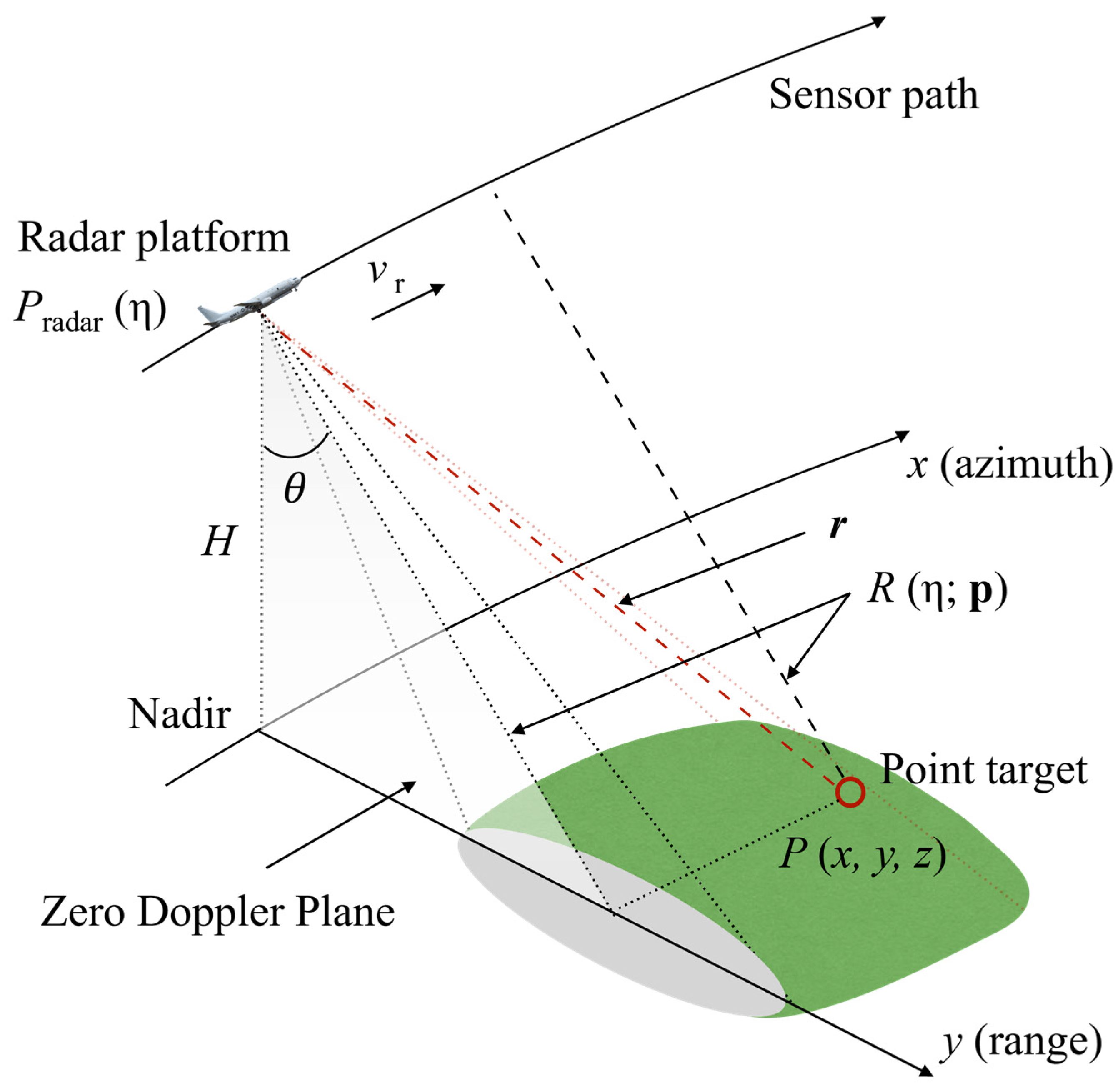
The stripmap SAR mode is adopted in this paper, and the corresponding imaging geometry based on the Cartesian coordinate is shown in Figure 1. For simplicity, assume that the imaging targets are located at a flat terrain, where z = 0 . The radar mounted on an airplane or vehicle is moving along the x -axis with a constant speed v r , and it transmits the pulses and receives the echoes in proper sequence. The height of the moving platform is z = H , and the radar beam is steering along the y -axis. The incident angle is θ .
The CFA-SAR is achieved by changing the carrier frequency at pulse repetition interval (PRI) periods. For a simple description of the CFA strategy, the carrier frequency is selected randomly in a finite set of discrete frequencies, D = { f c , 0 , f c , 1 , , f c , n 1 } . Therefore, assume that the slow time is denoted as η ; then, the carrier frequency of the CFA-SAR can be derived as f 0 + Δ f c ( η ) , where f 0 is the center of the carrier frequencies, Δ f c ( η ) = f c ( η ) f 0 and f c ( η ) D . At slow time η , the instantaneous radar phase center can be described as a position vector p radar ( η ) = [ v r η , 0 , H ] . The position vector of an arbitrary point target P ( x , y , z ) in the imaging area can be denoted as p = [ x , y , z ] . Thus, the instantaneous slant range can be derived as
R ( η ; p ) = p radar ( η ) p 2 = ( v r η x ) 2 + y 2 + ( H z ) 2
where | | | | 2 is the Euclidean norm. The instantaneous echo from the target can be derived as
s 0 ( τ , η ) = σ ( p )   w r τ 2 R ( η ; p ) c w a ( η ) e x p j   2 π ( f 0 + Δ f c ( η ) ) 2 R ( η ; p ) c e x p j   π K r τ 2 R ( η ; p ) c 2
where σ ( p ) is the radar cross-section (RCS), τ is the fast time, w r ( ) is the range envelope, w a ( ) is the azimuth envelope, K r is the chirp rate, and c is the light speed. It is obvious that the range envelope is independent of the carrier frequency and the echo after the range compression can be derived as
s r c ( τ , η ) = σ ( p ) ρ r τ 2 R ( η ; p ) c w α η e x p j   2 π f 0 2 R ( η ; p ) c e x p j   2 π Δ f c ( η ) 2 R ( η ; p ) c
where ρ r ( ) denotes the range envelope after the compression, which is a sinc function. As seen from Equation (3), the CFA changing is revealed in the azimuth phase variation. The azimuth phase is modulated by both the round-trip slant range delay and the carrier frequency agility, which is the difference from the traditional SAR echo.

2.2. Frequency Agility Analysis

Different from traditional SAR imaging, the additive term e x p j 2 π Δ f c η R η ; p / c leads to the phase discontinuity, since Δ f c ( η ) is actually a random variable for each PRI. Given the same system configuration, the agile frequency difference Δ f c ( η ) of Ka-band SAR imaging is much larger than that of L, S, and X-band SAR imaging. To improve the anti-interference performance, the transmit sub-bands for difference carrier frequencies in the Ka-band are not overlapped, further increasing the value of Δ f c ( η ) .
The CFA can be categorized into random stepped-frequency, periodic repetition random and pure random modes, as shown in Figure 2. The random stepped-frequency mode is illustrated in Figure 2a, showing that the transmit pulses is composed of multiple identical pulse groups, each of which contains N stepped-frequency chirps randomly and have the same carrier frequency sequence. The periodic repetition random mode is similar to the former, but each in the group has a different random carrier frequency sequence. In pure random mode, the carrier frequency of all the transmit pulses is random.
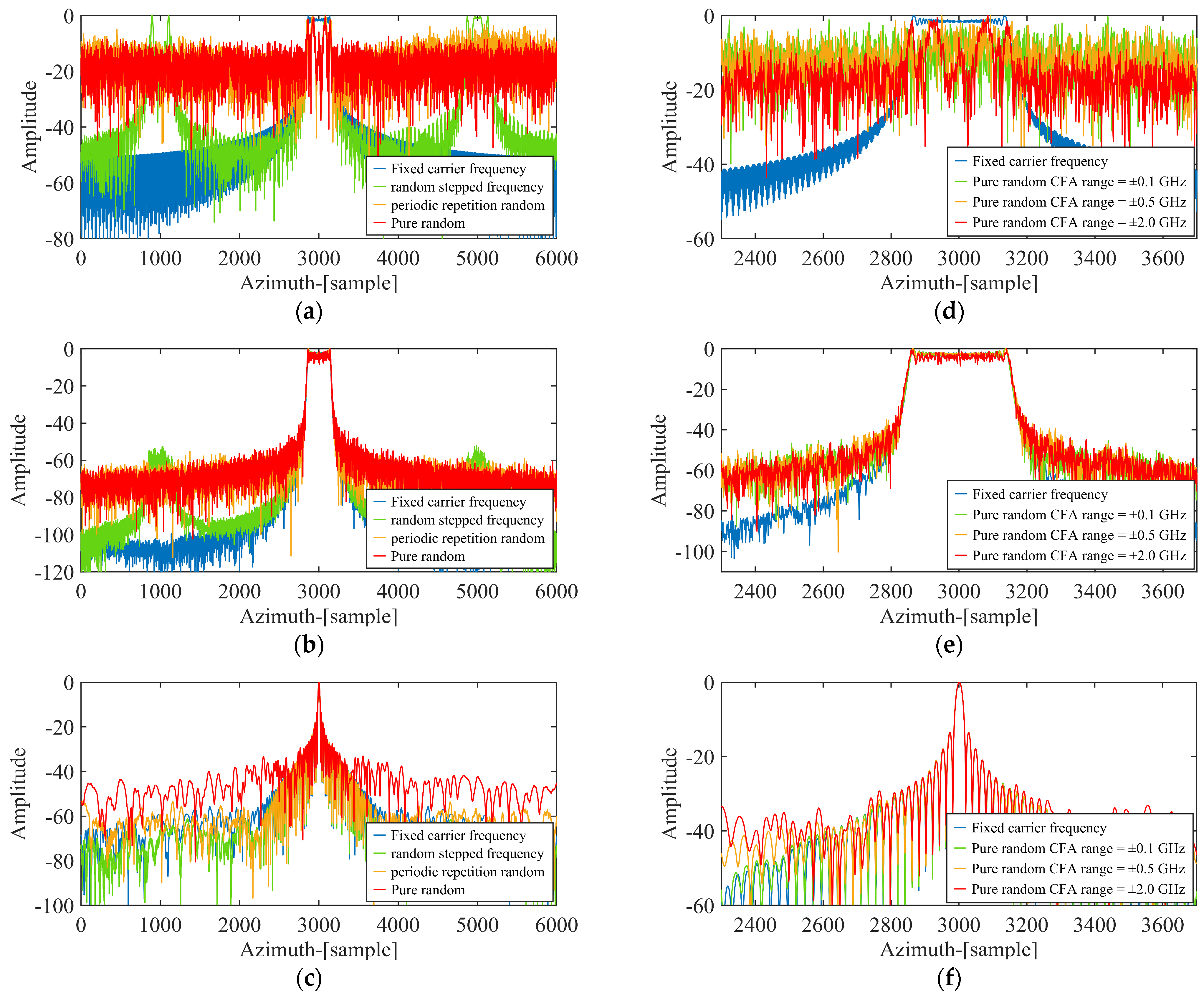
To investigate the performance of different CFA modes, the point target imaging with a 2 GHz transmitted bandwidth and a random carrier frequency from D = { 33,35,37 } GHz is shown in Figure 3. The azimuth spectrum of the range-compressed echoes is shown in Figure 3a. We can see that the fixed carrier frequency of the carrier frequency sequence in random stepped-frequency mode leads to the cycle expansion of the Doppler spectrum. With the increase in the randomness of the carrier frequency sequence, the expanded Doppler spectrum in periodic repetition random and pure random modes becomes more irregular, degrading the imaging performance. Figure 3c shows the azimuth slice of the back-projection (BP) image, where the integral sidelobe ratio (ISLR) of the pure random mode is worst.
To investigate the pure random mode imaging performance with different CFA ranges, the point target imaging with a 2 GHz transmit bandwidth and three carrier frequency sets where D = { 34.9 , 35 , 35.1 } GHz , D = { 34.5 , 35 , 35.5 } GHz and D = { 33 , 35 , 37 } GHz is shown in Figure 3. Obviously, the Doppler spectrum of the CFA imaging performs worse than that of the fixed carrier frequency. With the increase in the CFA range, the energy of the expanded Doppler spectrum decreases due to the narrow Doppler bandwidth, which is always at a kHz level. Conversely, after the BP imaging, the CFA imaging with the smaller CFA range performs better, since the discontinuous azimuth phase can be compensated, as shown in Figure 3e, and a smaller CFA range has less influence on the azimuth imaging.
Consequently, CFA SAR has a trade-off between the anti-interference ability and imaging performance. The CFA range and imaging modes can be selected properly to meet the requirement of the practical CFA imaging scene. The parameters can be acquired from the point target imaging simulation results.
To quantify the imaging performance, the azimuth and range impulse response width (IRW), peak sidelobe ratio (PSLR), and ISLR are calculated. The results are summarized in Table 1 for different CFA modes and different CFA ranges. It can be observed that as the randomness of the carrier frequency sequence increases, the azimuth IRW and PSLR become better. However, the ISLR is degraded due to the irregular expansion of the Doppler spectrum, aligning with the analysis results. When the agility range of the CFA is reduced or the randomness of the CFA mode is weakened, the imaging performs gradually, which is the same as the fixed carrier frequency one.
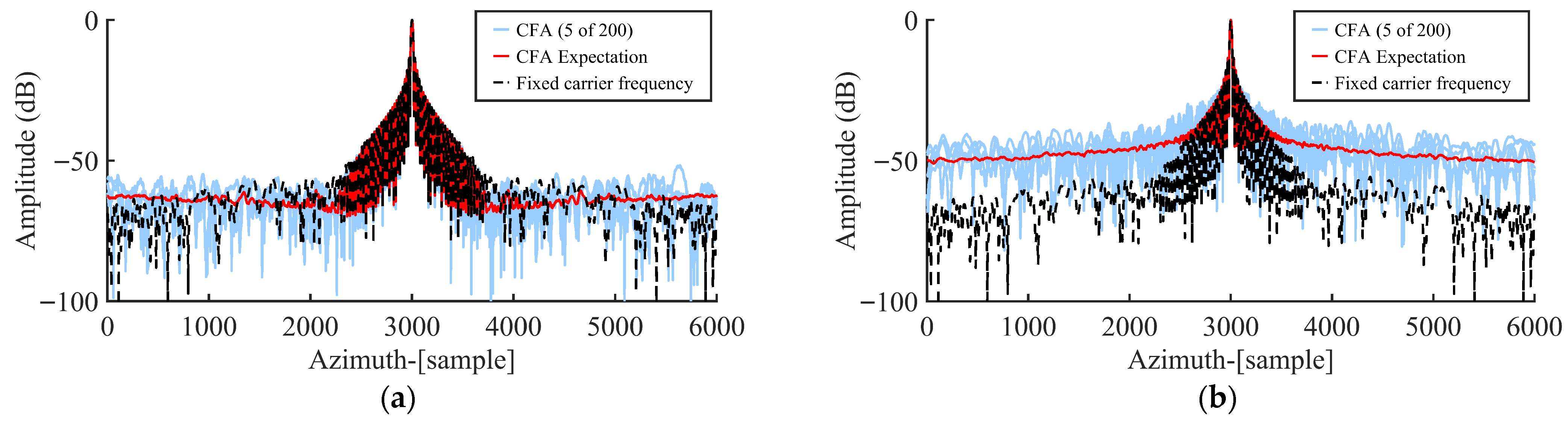
In CFA SAR imaging, the frequency agility is actually a random variable. To give a more comprehensive analysis, the CFA SAR in periodic repetition random and pure random mode imaging simulations with 200 independent CFA sequences are conducted. The expectation of the imaging results in both modes can accurately describe the phenomenon of the high sidelobe level, as shown in Figure 4. In pure random mode, the expectation sidelobe level is at approximately −48 dB larger than that of the SAR imaging in periodic repetition random, i.e., −62 dB, due to the greater variance of the pure random CFA sequences.

3. Imaging Framework

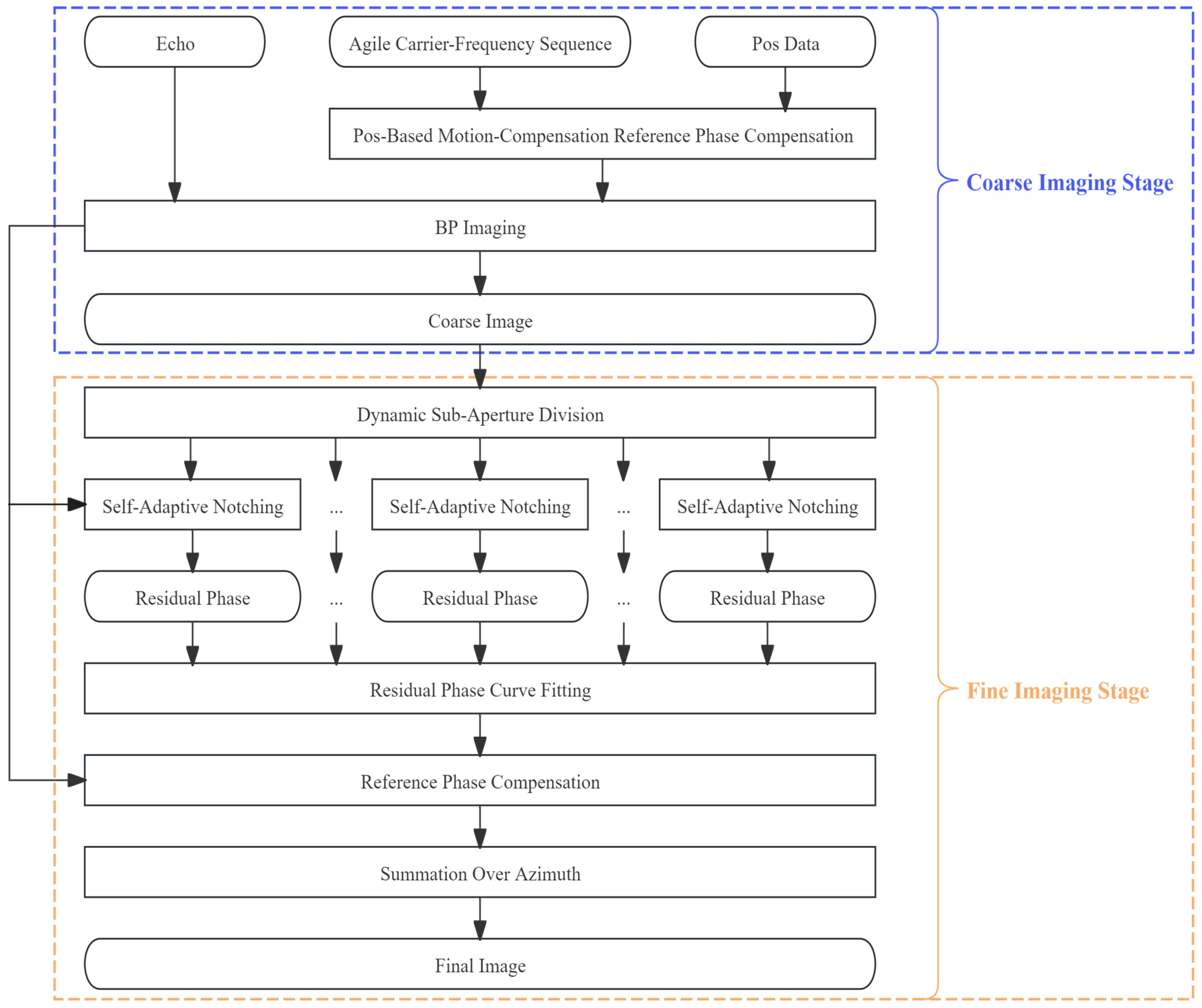
The Ka-band pure random CFA SAR can have the best anti-interference performance due to the maximum randomness, which can avoid suppression and deception interference effectively. To address the issues of the discontinuous Doppler phase history and the motion error, this section proposes a novel auto-focusing CFA SAR imaging process framework, by which the discontinuous Doppler phase is compensated in each PRI individually and the phase error caused by the non-uniform motion is estimated based on the dynamic sub-aperture division and the self-adaptive notching. The specific processing flow is summarized in Figure 5.

3.1. Coarse Imaging Using the Motion Compensation Based on POS Data

First, the CFA BP imaging based on the POS data motion compensation is performed. In a practical CFA SAR, the moving trajectory of the platform can be seen as a non-uniform motion with respect to η expressed as
p radar ( η ) = p radar ( η ) + Δ p radar ( η ) = [ v r η , 0 , H ] T + [ Δ x ( η ) , Δ y ( η ) , Δ z ( η ) ] T      
where Δ p radar ( η ) denotes the motion error vector [ Δ x ( η ) , Δ y ( η ) , Δ z ( η ) ] T . Assuming that the POS-based estimation is [ Δ x p o s ( η ) ,   Δ y p o s ( η ) ,   Δ z p o s ( η ) ] T , the motion error can be further derived as
Δ r radar ( η ) = [ Δ x ( η ) ,   Δ y ( η ) ,   Δ z ( η ) ] T = [ Δ x p o s ( η ) ,   Δ y p o s ( η ) ,   Δ z p o s ( η ) ] T + [ Δ x e r r o r ( η ) , Δ y e r r o r ( η ) , Δ z e r r o r ( η ) ] T        
where the [ Δ x e r r o r ( η ) , Δ y e r r o r ( η ) , Δ z e r r o r ( η ) ] T is the residual motion error vector. After the range compression, the CFA SAR echoes with motion error can be derived as
s r c τ , η = σ p ρ r τ 2 R η ; p c w α η + Δ y η v r e x p j 2 π f 0 2 R η ; p c e x p j 2 π Δ f c η 2 R η ; p c .
Based on the BP imaging principle, given an arbitrary point target located at p and the corresponding CFA sequence and POS-based position estimation, the reference azimuth phase can be described as exp j 2 π f c η 2 [ v r η + Δ x p o s ( η ) ,   Δ y p o s ( η ) ,   H + Δ z p o s ( η ) ] T p 2 c . The synthetic aperture time is defined as T . Multiplying the conjugate of the reference azimuth phase by the range compressed echoes after the range cell migration compensation (RCMC), the imaging at p can be derived as
I m x , y = η = x v r T 2 η = x v r + T 2 σ p ρ r τ = 2 R η ; p c w α η + Δ y η v r e x p j 2 π f c η 2 R η ; p 2 [ v r η + Δ x p o s ( η ) ,     Δ y p o s ( η ) ,     H + Δ z p o s ( η ) ] T p 2 c
where the phase Δ ϕ η =   e x p j 2 π f c η 2 R η ; p 2 [ v r η + Δ x p o s ( η ) , Δ y p o s ( η ) , H + Δ z p o s ( η ) ] T p 2 c is the residual azimuth phase error.

3.2. Residual Error Estimation and Compensation Based on the Adaptive Notching

Due to the high-resolution in Ka-band CFA SAR, the above-mentioned residual motion error cannot be neglected. In this section, a novel residual azimuth phase errors estimation based on the dynamic sub-aperture division and the self-adaptive notching is proposed.

3.2.1. Strong Scattering Point Extraction Strategy

Generally, the residual azimuth phase error is always estimated from the echoes of the strong scattering point in the imaging scene. To extract the isolated strong scatterer, an iterative screening strategy based on the amplitude ratio is proposed in this section. This strategy aims to eliminate sidelobe interference and non-isolated clutter points, ensuring that the selected points have significant local maximum values. First, the pixel with the maximum amplitude within the search region is identified as a candidate target. Next, a local neighborhood around this candidate point is defined, and the amplitude ratio between each point within this neighborhood and the central strong point is calculated. If this ratio is below a predefined isolation threshold, the candidate point is judged as an isolated strong scatterer and retained. Then, the candidate point and its neighborhood are removed from the search region to eliminate their influence on subsequent iterations. Finally, this process repeats iteratively until the coverage requirement for each azimuth synthetic aperture unit is satisfied.

3.2.2. Dynamic Sub-Aperture Division

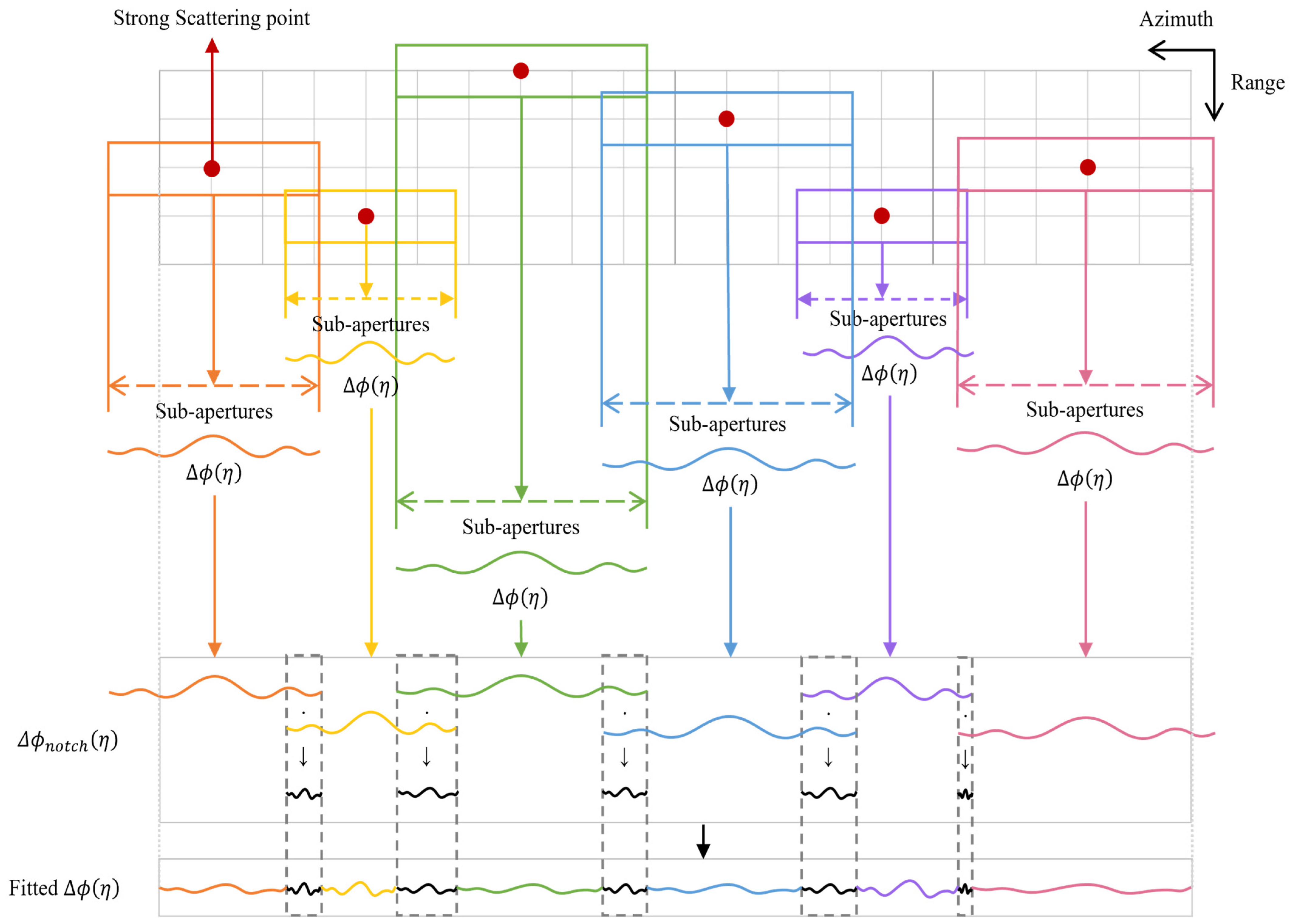
The sub-aperture division is illustrated in Figure 6. For each selected strong scattering point, a sub-aperture is defined as the azimuth slow-time interval during which the radar beam illuminates that point, i.e., the interval over which the target contributes coherent echo returns. The length of each sub-aperture is bounded by the target’s illumination time, which is governed by the azimuth beamwidth, the slant range, and the platform velocity. By selecting multiple strong scattering points distributed at different azimuth positions across the imaging scene, the corresponding sub-apertures collectively span the full azimuth extent of the processed data. In this way, the sub-aperture division adapts dynamically to the spatial distribution of the strong scattering points, ensuring that the residual phase error can be estimated over the entire aperture.

3.2.3. Self-Adaptive Notching

Given an arbitrary sub-aperture, the azimuth residual phase error can be theoretically obtained by Equation (7). However, in practice, the azimuth phase of a strong scatterer is contaminated by the sidelobes from scatterers at other locations. Therefore, the azimuth residual phase error extracted from the measured data can be further described as
Δ ϕ η = e x p j   2 π f c η 2 R η ; p 0 c + p = 1 P sin c 2 R η ; p p c 2 R η ; p 0 c e x p j   2 π f c η 2 R η ; p p R η ; p 0 c
where the candidate scattering point is located at p 0 , the number of other strong scattering points is denoted as P , and R ( η ; p p ) represents the instantaneous slant range of the p-th point at η . Assuming that R ( η ; p p ) 1 / 2 ( v r η x p ) 2 + y p + H , Equation (8) can be further derived as
Δ ϕ ( η ) = e x p j   2 π f c ( η ) 2 R ( η ; p 0 ) c + p = 1 P s i n c ( x 0 x p ) 2 v r η + 2 ( y p y 0 ) x 0 2 + x p 2 c e x p j   2 π f c ( η ) ( x 0 x p ) 2 v r η + 2 ( y p y 0 ) x 0 2 + x p 2 c
showing that the phase term e x p j   2 π f c ( η ) ( x 0 x p ) 2 v r η + 2 ( y p y 0 ) x 0 2 + x p 2 c caused by the sidelobes of the p-th point is added into the actual residual phase error. Note that this parabolic range approximation is introduced only to reveal the spectral structure of the sidelobe contamination. After the notching screening of the s i n c function in range, the phase terms corresponding to the points at same range are retained and greatly impact the residual phase error.
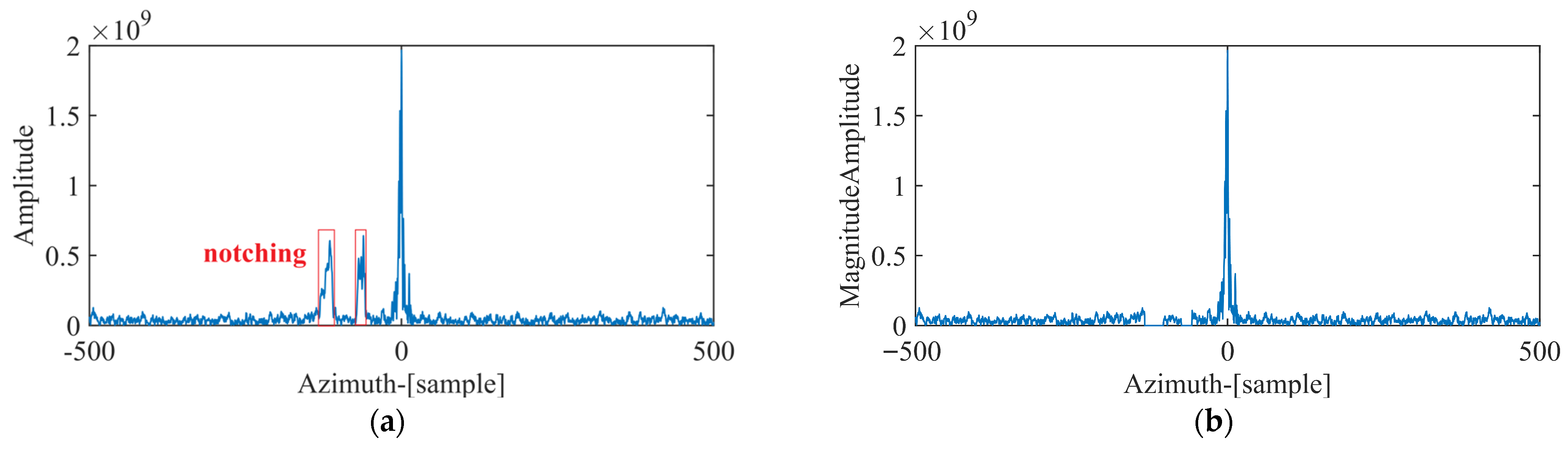
Given the same parameters listed in Table 1, an additive strong scattering point is displaced at the same range but at a different azimuth near the candidate. The simulated spectrum of Δ ϕ ( η ) is shown in Figure 7a. It is evident that the most energy in the spectrum is concentrated in a specific frequency value. From Equation (10), the phase term is approximated as a linear phase term but with a CFA. To move the interference, self-adaptive notching can be adopted to eliminate these phase terms. Assuming that K phase terms are required to be notched, where k { 1 , , K }  denotes the index of the notches, the notching process can be derived as
Δ ϕ n o t c h η = I F F T k = 0 K 1 rect f f η c , k T w F F T Δ ϕ η
where f η c denotes the frequency position corresponding to the linear phase term and T w is the length of the notch. T w can be set to the double distance from the peak to the average value of the ideal residual phase. The simulation result of the notching is shown in Figure 7b.

3.2.4. Error Compensation

After the estimation of the residual phase error in each sub-aperture, the phase error over the whole synthetic aperture can be obtained by fitting them into one residual phase error curve, as shown in Figure 7. Assuming that the residual phase terms are not space-variant in each sub-aperture, they can be directly compensated during the BP process multiplied by Δ ϕ ( η ) .

3.2.5. Computational Complexity Analysis

The computational complexity of the proposed framework is analyzed as follows. Let N x × N y denote the imaging grid size, N s u b the number of pulses within a single target’s synthetic aperture, and P the number of extracted strong scattering points. The coarse BP imaging and the phase-compensated accumulation each have complexity O ( N x N y N s u b ) , which is identical to the standard BP algorithm. The auto-focusing steps have a combined cost of O ( P N x N y + P N s u b l o g N s u b ) with P N s u b , contributing negligible overhead. The overall complexity is therefore O ( N x N y N s u b ) , which is the same order as a standard BP. The per-pixel independence of BP and the per-sub-aperture independence of the auto-focusing stage make the algorithm amenable to GPU and multi-core parallel acceleration.
As discussed in the Introduction, frequency-domain CFA imaging methods are restricted to small CFA ranges with overlapping sub-bands, and PGA-type methods require a continuous azimuth spectrum that is disrupted by the random hopping. CS-based sparse methods require O ( N i t e r N x N y l o g ( N x N y ) ) with tens to hundreds of iterations, which is substantially higher than the proposed method. The proposed framework imposes no restriction on the CFA range or mode and preserves the full scene reflectivity. Note that the imaging results of the time/frequency-domain imaging and sparse imaging are quite different.

4. Experiment Results

Imaging experiments were conducted to demonstrate the validity of the proposed framework. The CFA SAR modes are achieved by reconstructing the frequency sources of a Ka-band SAR prototype, in which the carrier frequency can be hopped in pulse-to-pulse. The detailed experimental scenario and the CFA SAR prototype are described in Section 4.1. The imaging results of the three different CFA SAR modes are presented in Section 4.2 and Section 4.3.

4.1. Experimental Scenario

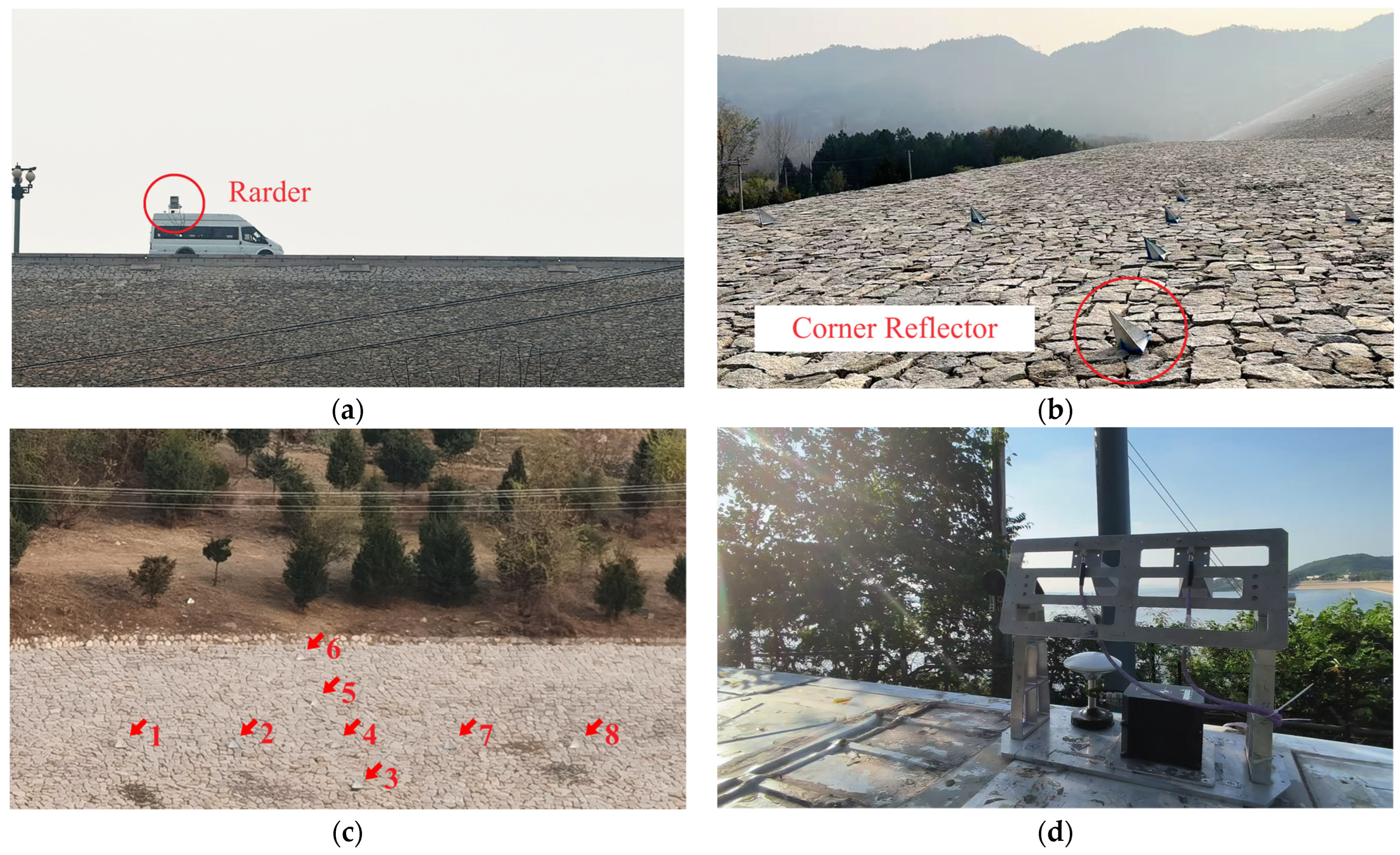
The radar was installed on the vehicle roof shown in Figure 8a. The platform moved along the dam-crest road, and the imaged area was located at the toe of the dam. The line-of-sight (LOS) distance between the trajectory and the scene center was approximately 120 m. The measured scene consisted of rocky ground and background objects, e.g., vegetation and overhead wires, which produced clutter returns. Eight trihedral corner reflectors (CR) with an inner edge length of approximately 30 cm were placed in the scene in a cross-shaped layout to provide point-target responses for performance evaluation. The nominal adjacent spacing was about 3.4 m in azimuth and about 3.2 m in ground range. A close-up view of the deployed CRs is shown in Figure 8b. An overview of the measurement area is shown in Figure 8c, where the CRs are numbered 1–8.
The Ka-band CFA SAR prototype is comprised of antennas, radio frequency transmit/receive chains, a frequency source, and digital subsystems. Different from the conventional Ka-band SAR, the frequency source subsystem is implemented by three phase-coherent local oscillators (LOs) and a switch to realize a pulse-to-pulse CFA. One of the LOs is directly produced by a phase-locked loop; others are produced by mixing this LO with a 2 GHz source derived from the same 100 MHz reference clock, thus maintaining a fixed phase offset among all the LOs. The CFA can be achieved by switching the three LOs in every PRI. To compensate for the channel errors, an internal calibration loop is designed in the CFA SAR prototype to collect the calibration data. Note that the POS system is installed near the antenna to provide the trajectory measurements for the coarse CFA SAR imaging. During the experiment, the calibration data are collected when the vehicle is stopped. The main parameters are listed in Table 2.

4.2. Measured Point-Target Imaging Results

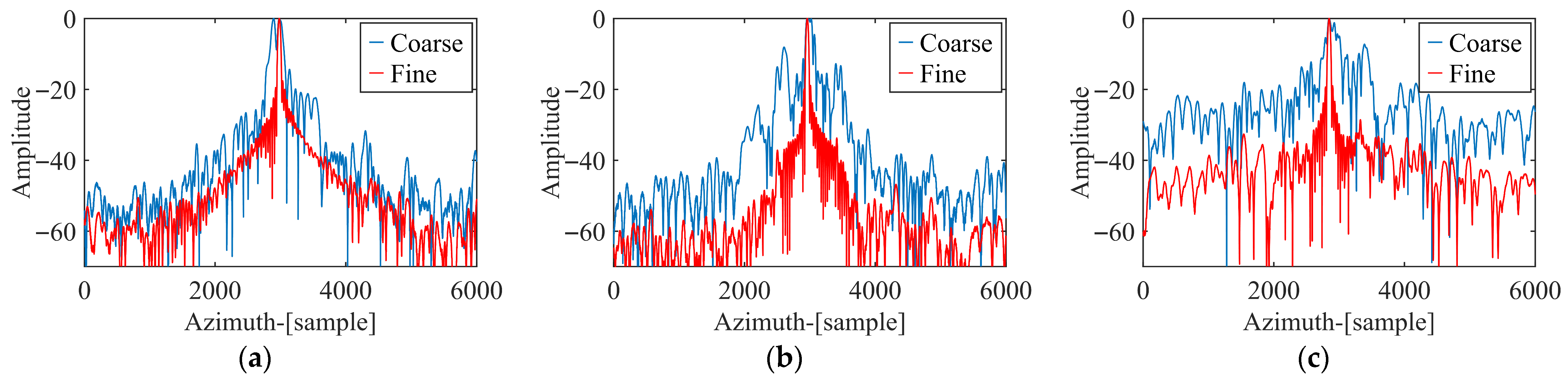
CFA SAR point-target imaging is performed under three modes. A trihedral CR was deployed and was used as the reference target for point-response evaluation. The CR response in the azimuth after the coarse imaging stage is shown in Figure 9. In this stage, motion compensation was first achieved using the recorded POS data and the transmitted CFA sequence, and BP imaging was then performed. It is obvious that the CR can be imaged but the azimuth response cannot be focused accurately despite the use of a centimeter-level POS, demonstrating the auto-focusing requirement of the Ka-band CFA SAR.
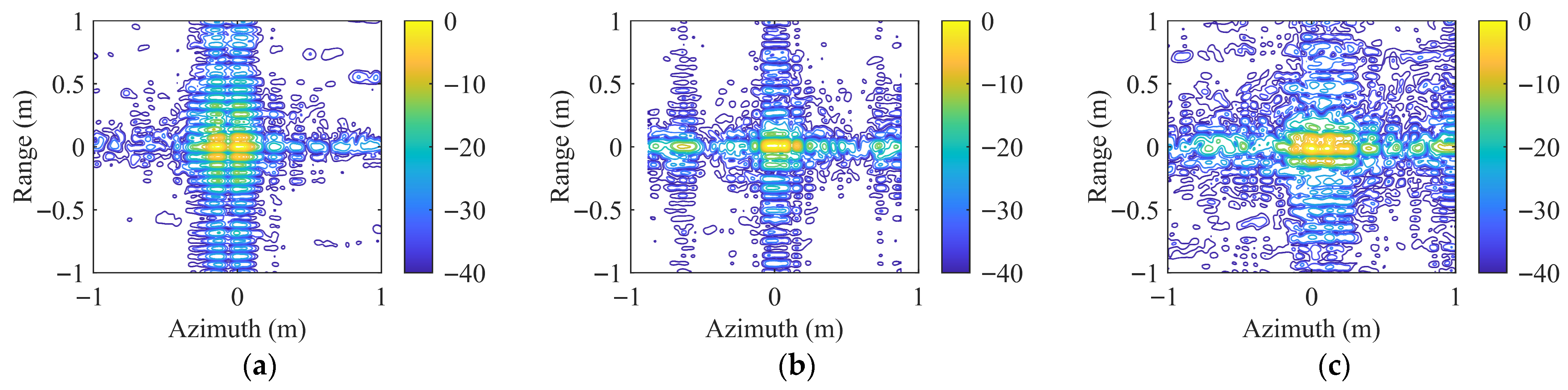
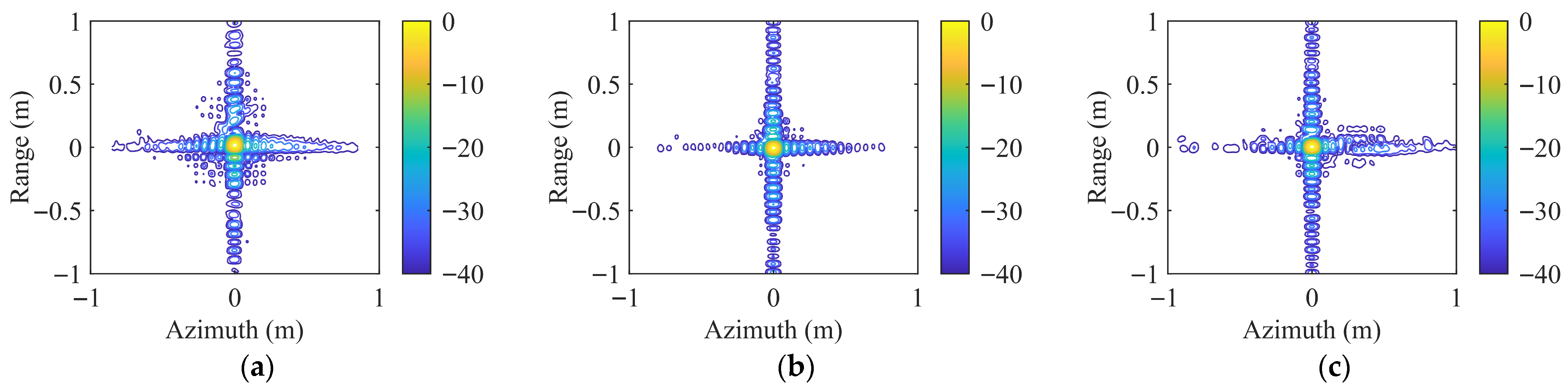
The focused point-target imaging results under three modes with the proposed framework are presented in Figure 10 and Figure 11. We can see that the energy concentrated in a narrower azimuth main lobe and the sidelobes are suppressed, validating the effectiveness of the proposed residual-error correction. It is also observed that the measured CFA SAR data perform similar to the simulated results shown in Figure 3, validating the correctness of the analysis.

4.3. Measured Scene Imaging Results

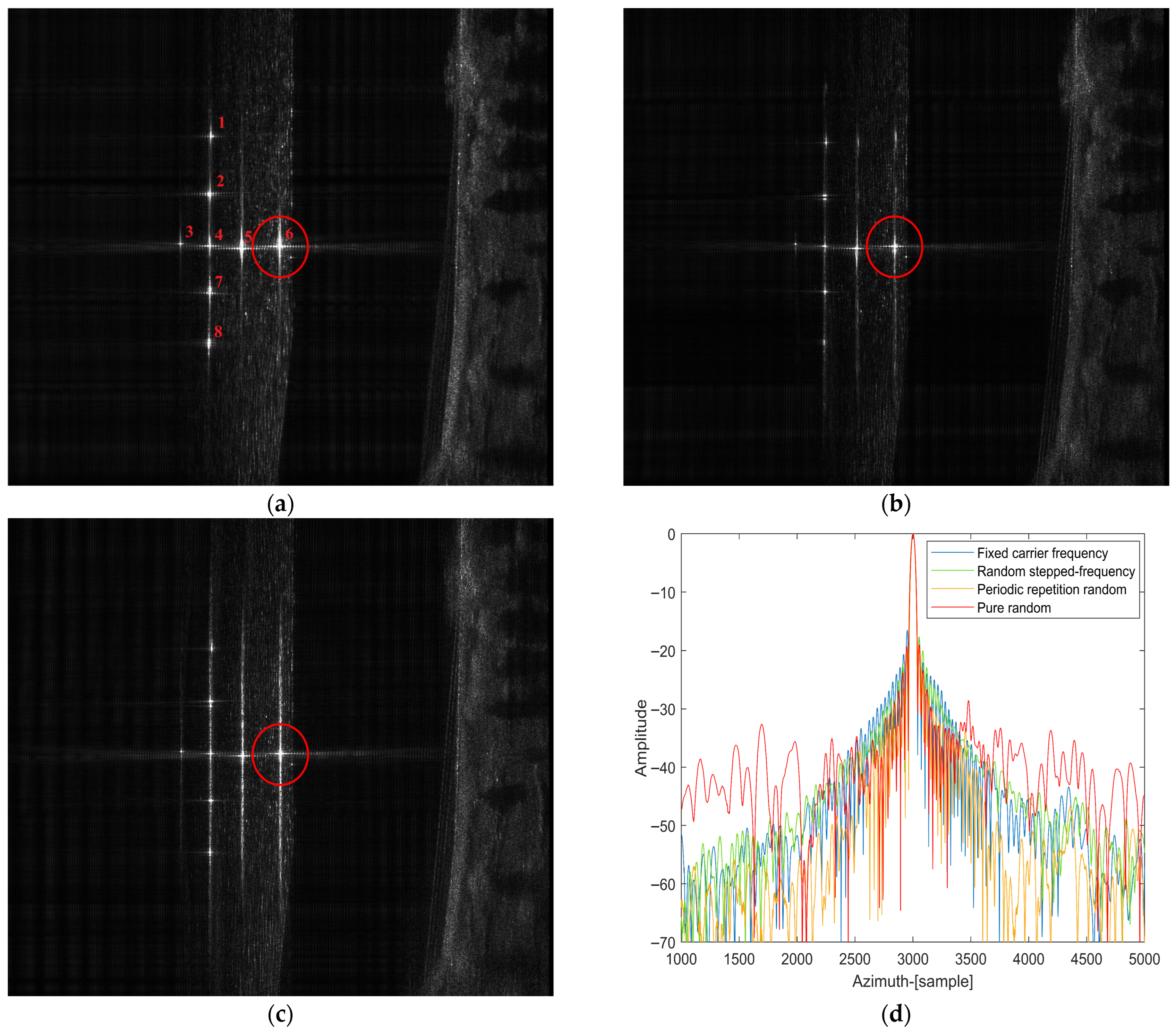
To evaluate the detailed imaging performance, the reconstructed images under three CFA selection modes are shown in Figure 12a–c. The azimuth slice of the CRs marked by the red circle is plotted in Figure 12d, avoiding azimuth interference from other CRs. The main lobes of all CFA modes are well focused, demonstrating the validity of the proposed methods. We can see from Figure 12d that the pure random mode exhibits slightly higher sidelobe levels, with the 2 GHz CFA range, which appears as a bright azimuth line in Figure 12c. This bright line is caused by the strong CR echo, whose sidelobe energy remains higher than the ground-scene echoes. When the wide range of the imaging signal-to-noise ratio (SNR) is not required, e.g., the imaging area in the right part of Figure 12c, this impact can be neglected. Consequently, the CFA SAR imaging parameters and mode can be selected properly to adapt the SAR imaging scenario.
To quantify the imaging performance of the measured data, the azimuth and range IRW, PSLR, and ISLR of the corner reflector under different CFA modes are calculated and summarized in Table 3. It can be observed that after the fine imaging with the proposed auto-focusing framework, approximately 5 cm azimuth resolution is achieved in all CFA modes with improved PSLR and ISLR, validating the effectiveness of the proposed method on the measured data.

5. Discussion

The proposed auto-focusing framework assumes the existence of at least one identifiable strong scatterer within each synthetic aperture. In scenarios dominated by homogeneous distributed clutter without any prominent scatterer, such as open water bodies or uniformly vegetated terrain, the strong-scatterer extraction step may fail. In general, the existence of the strong scatterers is always assumed in auto-focusing algorithms. Due to the very short wavelength and wide bandwidth, the Ka-band SAR is commonly used for high-resolution fine imaging of high-value targets with narrow-swath scene. Therefore, the strong scatterers often exist in the imaging scenes of the Ka-band SAR applications. In future work, this algorithm will be further optimized to reduce computational complexity and enhance processing efficiency.

6. Conclusions

To achieve high-resolution imaging and evaluate the system performance in Ka-band carrier-frequency-agility (CFA) SAR, this paper proposes an auto-focusing imaging framework and a comprehensive performance analysis. First, we characterized the phase discontinuity caused by pulse-to-pulse frequency hopping and established a BP-based imaging model accordingly. Furthermore, the sensitivity of Ka-band imaging to residual motion errors was analyzed based on the signal model, leading to a novel auto-focusing approach that integrates dynamic sub-aperture division and self-adaptive notching. This framework ensures well-focused imaging for CFA SAR even in complex scattering environments. Finally, real-data experiments conducted with a vehicle-mounted system demonstrate the effectiveness of the proposed framework. The work presented in this paper provides an efficient method for CFA SAR imaging, and the performance analysis can provide a guideline for the CFA SAR parameter selection, significantly supporting the CFA SAR applications.

Author Contributions

Conceptualization, Y.Z. (Yushan Zhou) and Y.N.; methodology, Y.Z. (Yushan Zhou), Y.N. and D.L.; software, Y.Z. (Yushan Zhou) and Z.X.; validation, Y.Z. (Yushan Zhou), Y.N., Z.X. and H.Z.; formal analysis, Y.Z. (Yushan Zhou) and Y.N.; investigation, Y.Z. (Yushan Zhou) and Y.Z. (Yawei Zhao); writing—original draft preparation, Y.Z. (Yushan Zhou); writing—review and editing, Y.Z. (Yushan Zhou), Y.N., Y.C. and D.L.; visualization, Y.Z. (Yushan Zhou). All authors have read and agreed to the published version of the manuscript.

Funding

This work was supported in part by the National Natural Science Foundation of China Excellent Young Scientists Project under Grant E4JZ010200 and in part by the National Natural Science Foundation of China under Grant 62231024.

Data Availability Statement

The data presented in this study are available on request from the corresponding author due to proprietary restrictions.

Acknowledgments

During the preparation of this manuscript, the authors used Gemini-3.1-pro-preview and GPT-v5.2 for the purpose of grammar checking. The authors have reviewed and edited the output and take full responsibility for the content of this publication.

Conflicts of Interest

The authors declare no conflicts of interest.

Abbreviations

The following abbreviations are used in this manuscript:
LOLocal Oscillator
BPBack Projection
CFACarrier-Frequency-Agility
CRCorner Reflector
IRWImpulse Response Width
ISLRIntegral Sidelobe Ratio
LOSLine-of-Sight
PRIPulse Repetition Interval
POSPosition and Orientation System
PSLRPeak Sidelobe Ratio
RCSRadar Cross-Section
SARSynthetic Aperture Radar

References

  1. Curlander, J.C.; McDonough, R.N. Synthetic Aperture Radar; Wiley: New York, NY, USA, 1991. [Google Scholar]
  2. Cumming, I.G.; Wong, F.H. Digital processing of synthetic aperture radar data. Artech House 2005, 1, 108–110. [Google Scholar]
  3. Liu, Z.; Cheng, D.; Li, N.; Min, L.; Guo, Z. Two-Dimensional Precise Controllable Smart Jamming Against SAR via Phase Errors Modulation of Transmitted Signal. IEEE Geosci. Remote Sens. Lett. 2024, 21, 4000705. [Google Scholar] [CrossRef]
  4. Wang, Z.; Guo, Z.; Shu, G.; Li, N. Radar Jamming Recognition: Models, Methods, and Prospects. IEEE J. Sel. Top. Appl. Earth Obs. Remote Sens. 2025, 18, 3315–3343. [Google Scholar] [CrossRef]
  5. Huber, S.; de Almeida, F.Q.; Villano, M.; Younis, M.; Krieger, G.; Moreira, A. Tandem-L: A Technical Perspective on Future Spaceborne SAR Sensors for Earth Observation. IEEE Trans. Geosci. Remote Sens. 2018, 56, 4792–4807. [Google Scholar] [CrossRef]
  6. Liu, Z.; Quan, Y.; Du, S.; Wu, Y.; Sha, M.; Xing, M. A novel ECCM scheme against interrupted-sampling repeater jamming using intra-pulse dual-parameter agile waveform. Digit. Signal Process. 2022, 129, 103652. [Google Scholar] [CrossRef]
  7. Wang, C.; Zhang, Q.; Hu, J.; Shi, S.; Li, C.; Cheng, W.; Fang, G. An efficient algorithm based on frequency scaling for THz stepped-frequency SAR imaging. IEEE Trans. Geosci. Remote Sens. 2022, 60, 5225815. [Google Scholar] [CrossRef]
  8. Zhang, Y.; Hu, W.; Wang, L.; Zhang, L. A novel random stepped frequency radar using chaos. In Proceedings of the 2014 IEEE Radar Conference, Cincinnati, OH, USA, 19–23 May 2014; pp. 0662–0665. [Google Scholar]
  9. Yang, D.; Liang, B.; Zhao, D.; Shi, W. MIMO-SAR orthogonal waveform set design based on random subcarriers OFDM signal. J. Electromagn. Waves Appl. 2017, 31, 1722–1738. [Google Scholar] [CrossRef]
  10. Correll, B.; Beard, J.K.; Swanson, C.N. Waveform diversity for SAR ECCM based on random phase and code rate transition. IEEE Trans. Aerosp. Electron. Syst. 2019, 56, 1045–1076. [Google Scholar]
  11. Li, Y.; Huang, D.; Xing, S.; Wang, X. A review of synthetic aperture radar jamming technique. J. Radars 2020, 9, 753–764. [Google Scholar]
  12. Cheng, D.; Liu, Z.; Guo, Z.; Shu, G.; Li, N. A repeater-type SAR deceptive jamming method based on joint encoding of amplitude and phase in the intra-pulse and inter-pulse. Remote Sens. 2022, 14, 4597. [Google Scholar] [CrossRef]
  13. Dong, J.; Zhang, Q.; Huang, W.; Wang, H.; Lu, W.; Liu, X. Deceptive jamming algorithm against synthetic aperture radar in large squint angle mode based on non-linear chirp scaling and low azimuth sampling reconstruction. Remote Sens. 2023, 15, 5446. [Google Scholar] [CrossRef]
  14. Chen, S.; Liu, L.; Wang, X.; Wang, L.; Yang, G. Research on sar active anti-jamming imaging based on joint random agility of inter-pulse multi-parameters in the presence of active deception. Remote Sens. 2024, 16, 3303. [Google Scholar] [CrossRef]
  15. Chen, Y.; Nan, Y.; Cai, Y.; Lu, P.; Wang, R. Joint Narrowband RFI Suppression and Phase Synchronization Signal Retrieval for BiSAR via Robust Principal Component Analysis. IEEE J. Sel. Top. Appl. Earth Obs. Remote Sens. 2024, 17, 17461–17470. [Google Scholar] [CrossRef]
  16. Cantalloube, H.; Dubois-Fernandez, P. Airborne X-band SAR imaging with 10 cm resolution: Technical challenge and preliminary results. IEE Proc. Radar Sonar Navig. 2006, 153, 163–176. [Google Scholar] [CrossRef]
  17. Xin, S.; Ge, J.; Wu, B. Research on high resolution SAR based on frequency-stepped chirps. In Proceedings of the 2nd Asian-Pacific Conference on Synthetic Aperture Radar, Xian, China, 26–30 October 2009; pp. 103–107. [Google Scholar]
  18. Nel, W.; Tait, J.; Lord, R.; Wilkinson, A. The use of a frequency domain stepped frequency technique to obtain high range resolution on the CSIR X-band SAR system. In Proceedings of the 6th Africon Conference in Africa (IEEE AFRICON), George, South Africa, 2–4 October 2002. [Google Scholar]
  19. Scheiber, R.; Barbosa, F.; Nottensteiner, A.; Horn, R. E-SAR upgrade to stepped-frequency mode: System description and data processing approach. In Proceedings of the European Conference on Synthetic Aperture Radar (EUSAR), Dresden, Germany, 16–18 May 2006. [Google Scholar]
  20. Chen, S.; Liu, L.; Wang, X.; Zeng, H.; Liu, Y.; Liu, X. A Fast Compensated Frequency-Domain Imaging Processing Algorithm for Inter-Pulse Frequency Agile SAR. Syst. Eng. Electron. 2025, 47, 797–806. [Google Scholar]
  21. Jin, Z.; Jiang, S.; Liu, Y.; Cao, Y.; Yu, Z. Low-Altitude Spotlight SAR Fast Imaging Algorithm Based on Inter-Pulse Frequency Agility. Syst. Eng. Electron. 2025, 99, 1–12. [Google Scholar]
  22. Anitori, L.; Maleki, A.; Otten, M.; Baraniuk, R.G.; Hoogeboom, P. Design and analysis of compressed sensing radar detectors. IEEE Trans. Signal Process. 2012, 61, 813–827. [Google Scholar] [CrossRef]
  23. Zhou, K.; Li, D.; He, F.; Quan, S.; Su, Y. A Sparse Imaging Method for Frequency Agile SAR. IEEE Trans. Geosci. Remote Sens. 2022, 60, 5223616. [Google Scholar] [CrossRef]
  24. Liu, T.P.; Liu, Z.; Wei, X.Z. Research on interpulse frequency agility SAR imaging via compressed sensing. Acta Electron. Sinica 2012, 40, 1073–1078. [Google Scholar]
  25. Zeng, T.; Liu, L.; Ding, Z. Improved Stepped-Frequency SAR Imaging Algorithm with the Range Spectral-Length Extension Strategy. IEEE J. Sel. Top. Appl. Earth Obs. Remote Sens. 2012, 5, 1483–1494. [Google Scholar] [CrossRef]
  26. Dai, G.; Zhang, L.; Huan, S.; Wang, Z. Random stepped-frequency SAR imagery with full cell Doppler coherent processing. IEEE Geosci. Remote Sens. Lett. 2021, 19, 4009505. [Google Scholar] [CrossRef]
  27. Chen, Y.C.; Li, G.; Zhang, Q.; Zhang, Q.J.; Xia, X.G. Motion compensation for airborne SAR via parametric sparse representation. IEEE Trans. Geosci. Remote Sens. 2016, 55, 551–562. [Google Scholar] [CrossRef]
  28. Nan, Y.; Huang, X.; Guo, Y.J. Piecewise Constant Doppler Algorithm: Performance Analysis, Further Simplification, and Motion Compensation. IEEE Trans. Aerosp. Electron. Syst. 2020, 56, 3613–3631. [Google Scholar] [CrossRef]
  29. Wu, Y.; Qi, X.; Huang, L. Enhanced BP Algorithm Combined with Semantic Segmentation and Subaperture for Improving Agricultural Scene Image Quality in GEO SAR. IEEE J. Sel. Top. Appl. Earth Obs. Remote Sens. 2024, 18, 3043–3056. [Google Scholar] [CrossRef]
  30. Chen, S.; Wang, Y.; Zhang, Y. Compensation for high-frequency vibration of SAR imaging in the terahertz band based on linear chirplet transform and empirical mode decomposition. IEEE J. Sel. Top. Appl. Earth Obs. Remote Sens. 2023, 16, 1427–1446. [Google Scholar] [CrossRef]
  31. Han, J.; Tang, S.; Chen, Z.; Ren, Y.; Lian, Z.; Guo, P.; Li, Y.; Zhang, L.; So, H.C. Precise motion compensation approach for high-resolution multirotor UAV SAR in the presence of multiple errors. IEEE J. Sel. Top. Appl. Earth Obs. Remote Sens. 2024, 17, 15148–15165. [Google Scholar] [CrossRef]
  32. Chen, X.; Dong, Z.; Zhang, Z.; Tu, C.; Yi, T.; He, Z. Very high resolution synthetic aperture radar systems and imaging: A review. IEEE J. Sel. Top. Appl. Earth Observ. Remote Sens. 2024, 17, 7104–7123. [Google Scholar] [CrossRef]
  33. Wahl, D.; Eichel, P.; Ghiglia, D.; Jakowatz, C. Phase gradient autofocus—A robust tool for high resolution SAR phase correction. IEEE Trans. Aerosp. Electron. Syst. 1994, 30, 827–835. [Google Scholar] [CrossRef]
  34. Reigber, A.; Scheiber, R.; Jager, M.; Prats-Iraola, P.; Hajnsek, I.; Jagdhuber, T.; Papathanassiou, K.P.; Nannini, M.; Aguilera, E.; Baumgartner, S.; et al. Very-high-resolution airborne synthetic aperture radar imaging: Signal processing and applications. Proc. IEEE 2013, 101, 759–783. [Google Scholar] [CrossRef]
  35. Ji, Y.; Dong, Z.; Zhang, Y.; Wang, C.; Hu, C.; Xu, Z. Transionospheric synthetic aperture radar observation: A comprehensive review. IEEE Geosci. Remote Sens. Mag. 2025, 13, 273–313. [Google Scholar] [CrossRef]
Figure 1. Illustration of the imaging geometry.
Remotesensing 18 01197 g001
Figure 2. CFA modes illustration. (a) Random stepped-frequency mode; (b) periodic repetition random mode; (c) pure random mode. The blue, yellow, and red blocks represent the carrier frequencies at 33, 35, and 37 GHz, respectively.
Remotesensing 18 01197 g002
Figure 3. Simulation results of point target imaging performance. (a) The azimuth spectrum of the range-compressed echoes investigating the performance of different CFA modes, with the carrier frequency set D = { 33 , 35 , 37 } GHz ; (b) the final image after BP imaging investigating the performance of different CFA modes, with the same carrier frequency set as in (a); (c) the azimuth imaging of the point target investigating the performance of different CFA modes, with the same carrier frequency set as in (a); (d) the azimuth spectrum of the range-compressed echoes investigating the performance of different CFA ranges in pure random mode, with three carrier frequency sets: D = { 34.9 , 35 , 35.1 } GHz , D = { 34.5 , 35 , 35.5 } GHz and D = { 33 , 35 , 37 } GHz ; (e) the final image after BP imaging investigating the performance of different CFA ranges in pure random mode, with the same carrier frequency sets as in (d); (f) the azimuth imaging of the point target investigating the performance of different CFA ranges in pure random mode, with the same carrier frequency sets as in (d).
Remotesensing 18 01197 g003
Figure 4. The expectation of the azimuth imaging results with 200 independent CFA sequences in periodic repetition random and pure random modes. (a) Periodic repetition random mode; (b) pure random mode.
Remotesensing 18 01197 g004
Figure 5. Flowchart of the proposed auto-focusing CFA SAR imaging process framework.
Remotesensing 18 01197 g005
Figure 6. The illustration of the sub-aperture division, where the red dots represent the strong scattering points, the dashed lines indicate the sub-apertures, and different colors distinguish individual sub-apertures.
Remotesensing 18 01197 g006
Figure 7. Spectrum of Δ ϕ ( η ) before and after the proposed self-adaptive multi-notch filtering. (a) Spectrum before notching, where the red box shows the range of the notching; (b) spectrum after notching.
Remotesensing 18 01197 g007
Figure 8. Photographs of the vehicle-borne Ka-band CFA SAR experiment: (a) Radar mounted on the vehicle roof; (b) close-up of a trihedral corner reflector deployed on the rocky ground; (c) overview of the measurement scene; red arrows indicate the corner reflectors; (d) radar antenna.
Remotesensing 18 01197 g008
Figure 9. The CR response in azimuth after the coarse imaging stage: (a) random stepped-frequency mode; (b) periodic repetition random mode; (c) pure random carrier-frequency selection mode.
Remotesensing 18 01197 g009
Figure 10. Azimuth CR response magnitude cuts through the peak (dB, peak-normalized) corresponding to the modes in Figure 9a. (a) Random stepped-frequency mode; (b) periodic repetition random mode; (c) pure random carrier-frequency selection mode. The coarse-focused profiles are shown in blue, and the fine-focused profiles are shown in red.
Remotesensing 18 01197 g010
Figure 11. Point-target 2D response magnitude contours (dB, peak-normalized) under three frequency-selection modes: (a) random stepped-frequency mode; (b) periodic repetition random mode; and (c) pure random carrier-frequency selection mode.
Remotesensing 18 01197 g011
Figure 12. SAR images under three CFA frequency-selection frameworks: (a) random stepped-frequency, where the numbers 1–8 indicate the corner reflectors corresponding to those numbered in Figure 8c; (b) periodic-repetition random; (c) pure random; (d) the azimuth imaging results of the specific CR highlighted by the red circles in (ac).
Remotesensing 18 01197 g012
Table 1. Quantitative imaging metrics of the isolated corner reflector. The metrics including the IRW, PSLR, and ISLR in range and azimuth are reported for the fixed carrier frequency, the random stepped-frequency mode, the random periodic repetition mode, the pure random mode with the carrier frequency set D = { 33 , 35 , 37 } GHz , and for the pure random mode with carrier frequency sets D = 34.9 , 35 , 35.1 GHz and D = { 34.5 , 35 , 35.5 } GHz .
CFA Modes and RangesAzimuthRange
IRW (m)PSLR (dB)ISLR (dB)IRW (m)PSLR (dB)ISLR (dB)
Fixed carrier frequency0.0434−13.4490−10.18350.0668−13.3180−10.3510
Random stepped frequency0.0434−13.4462−10.18080.0577−18.9948−12.9773
Periodic repetition random0.0434−13.4449−10.17260.0577−18.9919−12.9760
Pure random CFA range = ±2.0 GHz0.0432−13.4929−9.56200.0577−18.8363−12.8551
Pure random CFA range = ±0.5 GHz0.0434−13.4563−10.03340.0577−18.9600−12.9350
Pure random CFA range = ±0.1 GHz0.0434−13.4417−10.17960.0663−13.9249−12.2014
Table 2. System parameters of the Ka-band CFA SAR.
ParameterSymbolValue
Platform speed v 8.3 m/s
Azimuth beamwidth β a
Slant range to scene center R 0 120 m
Carrier frequency f c f c { 33,35,37 } GHz
Pulse repetition frequencyPRF5000 Hz
Range bandwidth B r 2 GHz
Pulse duration T r 20 μs
Sampling rate F s 2.5 GHz
Duty cycle 10 %
Table 3. Quantitative imaging metrics of the measured corner reflector, where IRW, PSLR, and ISLR in azimuth and range are reported for different CFA modes after the coarse and fine imaging stages.
Sub-ApertureImageAzimuthRange
IRW (m)PSLR (dB)ISLR (dB)IRW (m)PSLR (dB)ISLR (dB)
Fixed periodCoarse0.0702−7.5837−7.29170.0544−9.9109−8.3767
Fine0.0523−30.4706−24.91800.0556−14.5705−10.3555
Random stepped-frequencyCoarse0.0603−21.7032−28.41740.0539−15.5855−8.4472
Fine0.0571−25.5839−20.00160.0564−13.0673−10.0206
Periodic repetition randomCoarse0.1414−29.6724−55.67120.0510−5.7351−3.1405
Fine0.0540−19.4713−16.13750.0560−11.9792−9.1932
Pure randomCoarse0.1039−8.0506−9.85030.0588−7.5054−7.4182
Fine0.0574−19.2988−18.30400.0581−15.2185−12.2696
Disclaimer/Publisher’s Note: The statements, opinions and data contained in all publications are solely those of the individual author(s) and contributor(s) and not of MDPI and/or the editor(s). MDPI and/or the editor(s) disclaim responsibility for any injury to people or property resulting from any ideas, methods, instructions or products referred to in the content.