Incremental Pavement Distress Classification in UAV-Based Remote Sensing via Analytic Geometric Alignment

Highlights
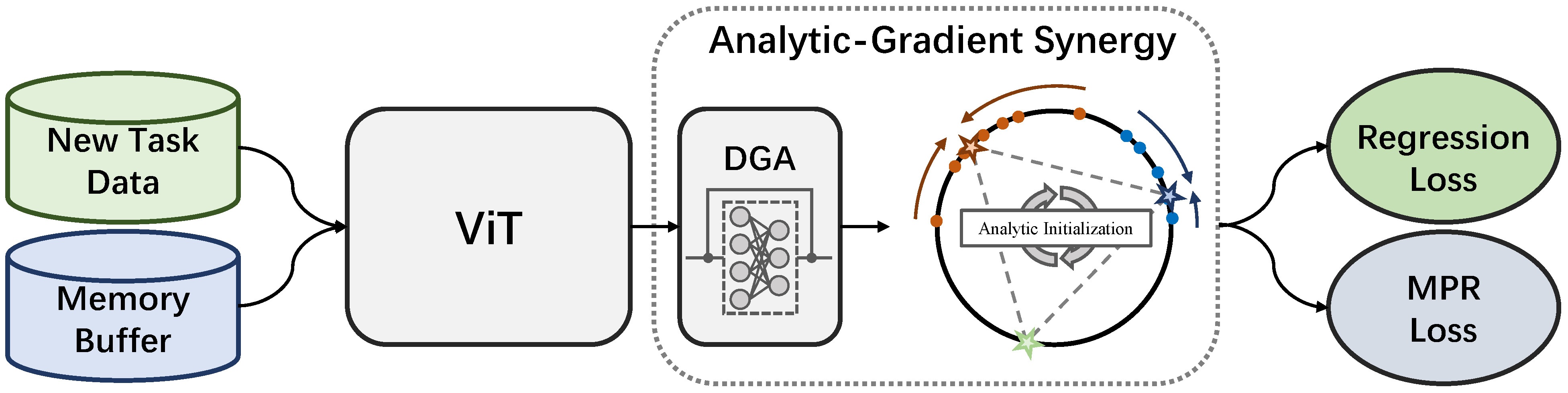
- We propose a novel Analytic Geometric Alignment (AGA) framework for class-incremental pavement distress classification in UAV-based remote sensing, which innovatively integrates three key components: Subspace-Aware Analytic Initialization (SAI) to mathematically bridge the optimization gap for novel classes, a Decoupled Geometric Adapter (DGA) to decouple the global geometric aligment and local feature adaptation, and the Memory-Prioritized Regression (MPR) loss to enhance inter-class feature separability against complex UAV remote sensing backgrounds.
- On the UAV-PDD2023 dataset, AGA achieves state-of-the-art accuracy and stability in fine-grained pavement distress classification, which is also demonstrated on the auxiliary RDD2022 dataset. Notably, the model maintains robust performance even under extreme low-memory conditions (e.g., retaining only 100–200 exemplar samples), significantly alleviating catastrophic forgetting without incurring massive computational overhead.
- The exceptional resource efficiency and anti-forgetting capability of AGA provide a highly deployable technical solution for continuous, long-term infrastructure monitoring on edge devices within UAV air–ground collaborative systems.
- This framework establishes a novel, data-efficient paradigm for processing streaming UAV imagery, offering robust support for dynamic remote sensing applications addressing critical challenges such as memory constraints, evolving target categories, and background interference.
Abstract
1. Introduction
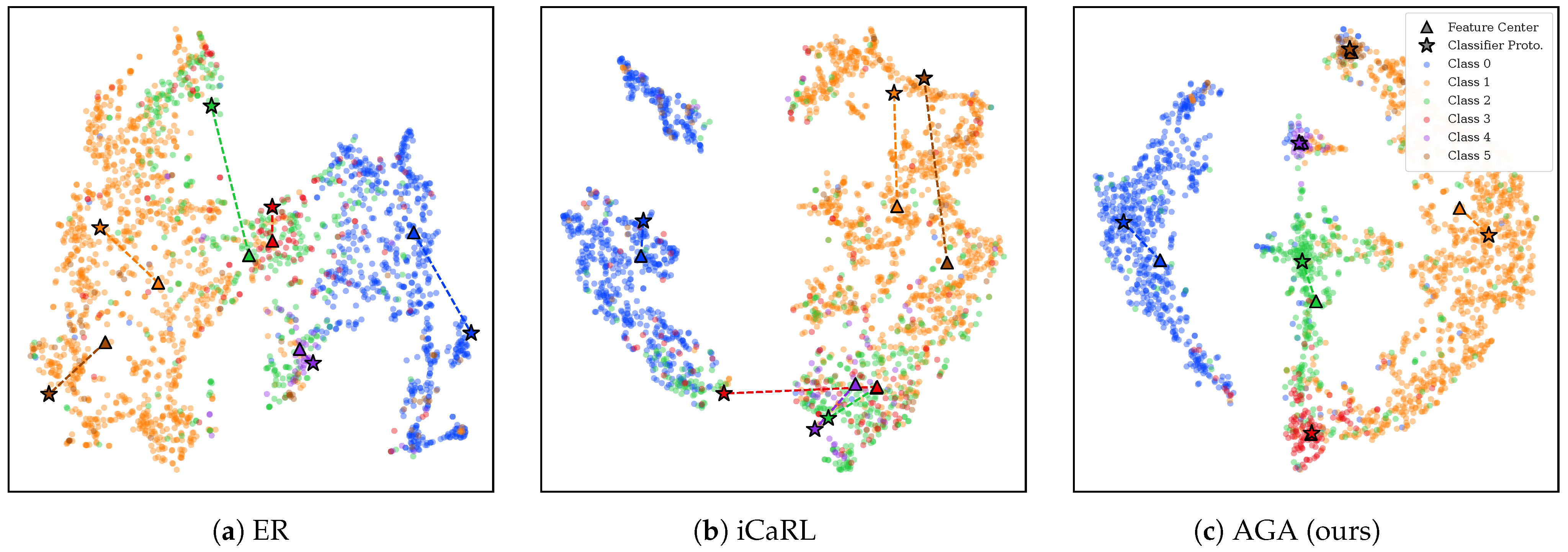
- To address the classifier drift caused by fine-grained similarity in pavement distresses, we propose the Analytic Geometric Alignment (AGA) framework. By replacing learnable classifiers with a fixed Simplex ETF, we provide a stable geometric anchor that maximizes inter-class separability under strict memory constraints.
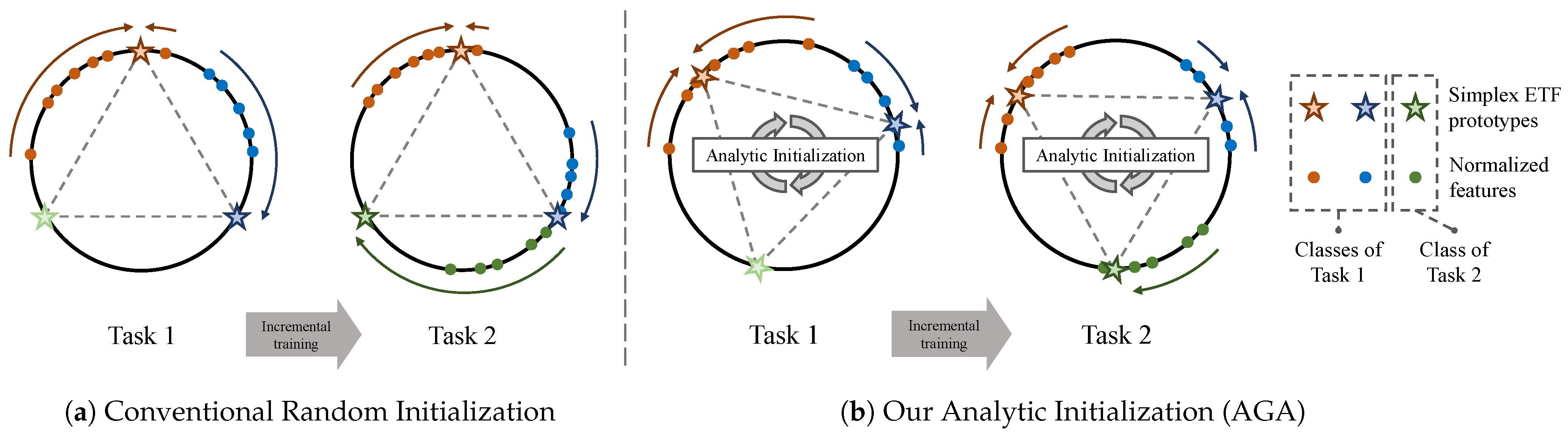
- To bridge the optimization gap between pre-trained features and the fixed geometric target, we propose the Subspace-Aware Analytic Initialization (SAI) to analytically align feature subspaces before training. On this aligned basis, we introduce a Decoupled Geometric Adapter (DGA) to maintain plasticity for complex aerial textures.
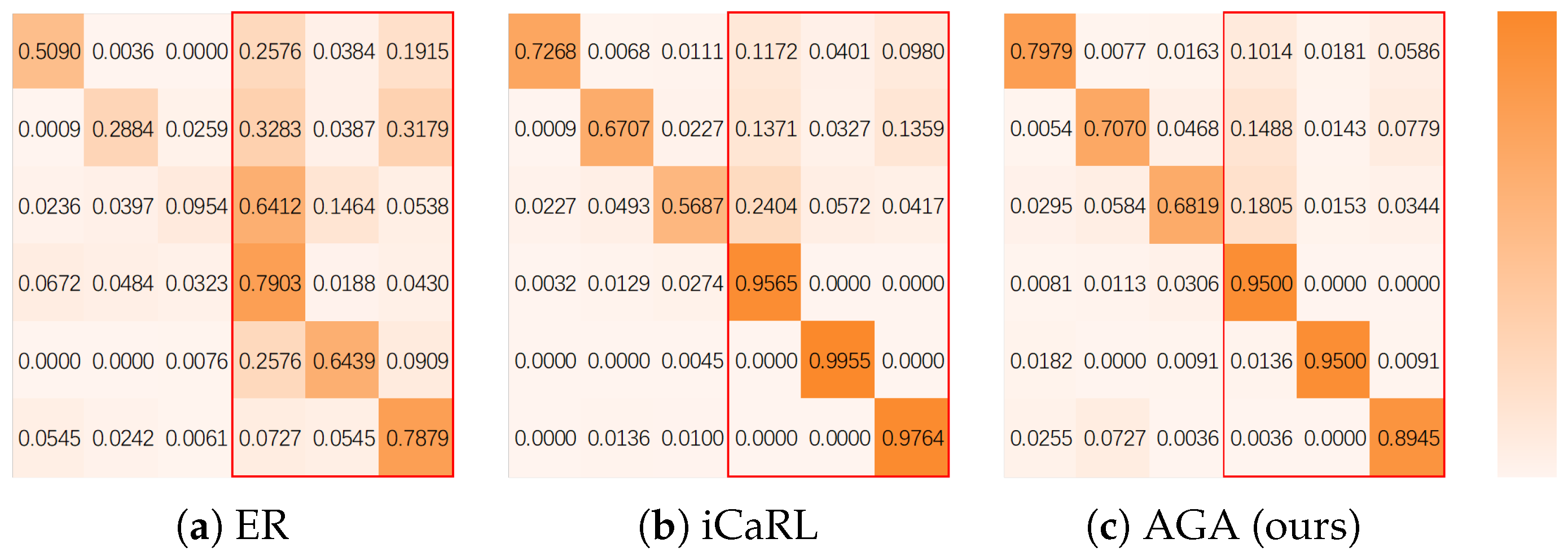
- To mitigate catastrophic forgetting under extreme data imbalance, we propose a Memory-Prioritized Regression (MPR) loss. It imposes asymmetric geometric constraints on replay samples, ensuring that historical knowledge remains robust despite the scarcity of memory data.
- Extensive experiments on the UAV-PDD2023 dataset demonstrate that AGA achieves state-of-the-art accuracy and stability. The results confirm its superior data efficiency, making it highly suitable for resource-constrained UAV edge deployment.
2. Materials and Methods
2.1. Dataset and Materials
2.2. Motivation and Framework Overview
2.3. Geometric Stability: The Simplex ETF Framework
2.4. Bridging the Optimization Gap in Simplex ETF
2.4.1. Subspace-Aware Analytic Initialization (SAI): Global Realignment
2.4.2. Decoupled Geometric Adapter (DGA): Continuous Plasticity
2.5. Optimization with Memory-Prioritized Constraints
| Algorithm 1 Analytic Geometric Alignment (AGA) Training Process |
|
3. Experiments
3.1. Experimental Setup
3.1.1. Implementation Details
3.1.2. Evaluation Metrics
- Average Accuracy (ACC ↑): This metric reports the mean classification accuracy on all encountered classes after the final task. Let denote the accuracy on task j after training on task i. The Average Accuracy is defined as . The symbol ↑ indicates that higher scores denote better performance.
- Forgetting Measure (FM ↓): This metric quantifies the degradation of performance on previous tasks. It is defined as . Conversely, ↓ signifies that lower values indicate better stability.
- Macro Metrics: To account for potential class imbalances in dynamic inspection data, we also report the Macro-Precision (↑), Macro-Recall (↑), and Macro-F1 Score (↑), which are calculated by averaging the respective metric across all classes independently. High values in these metrics indicate that the model achieves a reliable balance between minimizing false positives (Precision) and avoiding missed detections (Recall), ensuring comprehensive classification capability across all distress types.
3.2. Comparative Results
3.2.1. Baselines and Comparison Methods
- Replay-based Methods: We include classic methods like ER (Experience Replay) [31] and iCaRL [32], as well as the recent state-of-the-art DGR [47]. ER maintains a memory buffer to rehearse old samples via cross-entropy loss, while iCaRL combines representation learning with a Nearest Class Mean (NCM) classifier to mitigate catastrophic forgetting. DGR specifically tackles the severe class imbalance issue in incremental tasks by employing gradient reweighting and distribution-aware knowledge distillation. All these methods utilize a memory buffer to rehearse old knowledge.
- Geometric Methods: We compare with NC-FSCIL [35], which leverages the geometry of Neural Collapse. Unlike replay-based baselines, NC-FSCIL adopts a prototype-based strategy, storing only the mean feature vector for each class rather than raw images. This offers extreme memory efficiency but lacks the capability to rehearse fine-grained data distribution details.
- Parameter-Efficient Fine-Tuning (PEFT) Methods: This stream includes prompt-based methods (L2P [27] and DualPrompt [28]) and adapter-based methods (TUNA [48]). Prompt learning methods were originally designed for exemplar-free settings and achieved sound performance on incremental natural image classification. To ensure a fair comparison under our replay protocol (), we integrate them with the same rehearsal mechanism used in our method, denoted as L2P* and DualPrompt*. Conversely, TUNA integrates task-specific and universal adapters to capture both specialized and shared knowledge. We retain TUNA’s original rehearsal-free design to evaluate its innate anti-forgetting capacity, as it operates entirely without storing historical exemplars.
- Incremental Pavement Distress Methods: We also include DML-PDI [5], a state-of-the-art method specifically designed for incremental UAV pavement anomaly detection. DML-PDI adopts a training-free, metric-learning paradigm. However, it requires storing features of all encountered samples to compute precise prototypes for inference, resulting in high storage costs that scale linearly with the dataset size.
3.2.2. Performance on UAV-PDD2023
3.2.3. Performance on RDD2022
3.3. Detailed Analysis and Additional Experiments
3.3.1. Ablation Study
3.3.2. Geometric Visualization
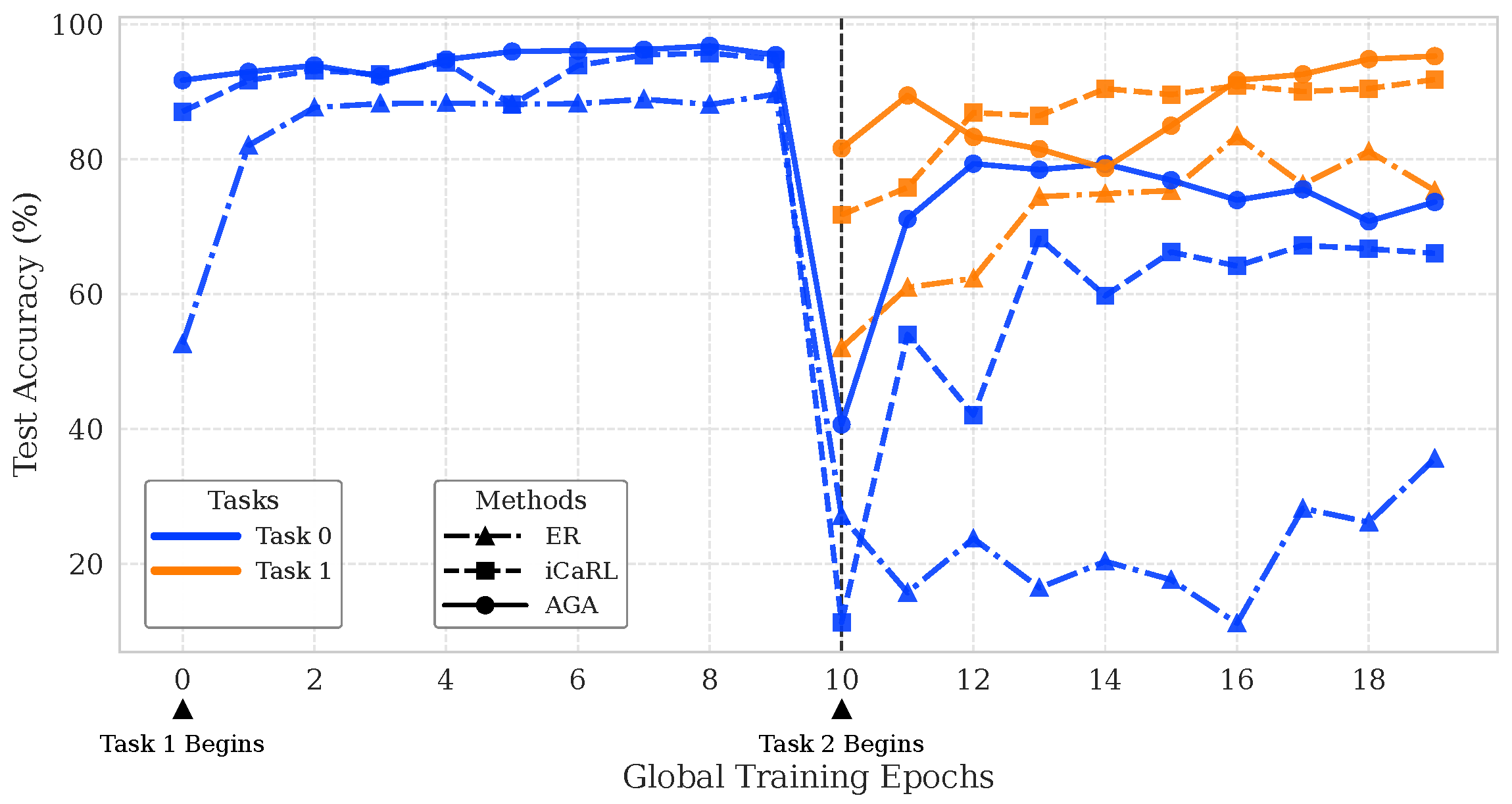
3.3.3. Learning Dynamics and Stability
3.3.4. Hyperparameter Sensitivity Analysis
3.3.5. Computational Overhead Analysis
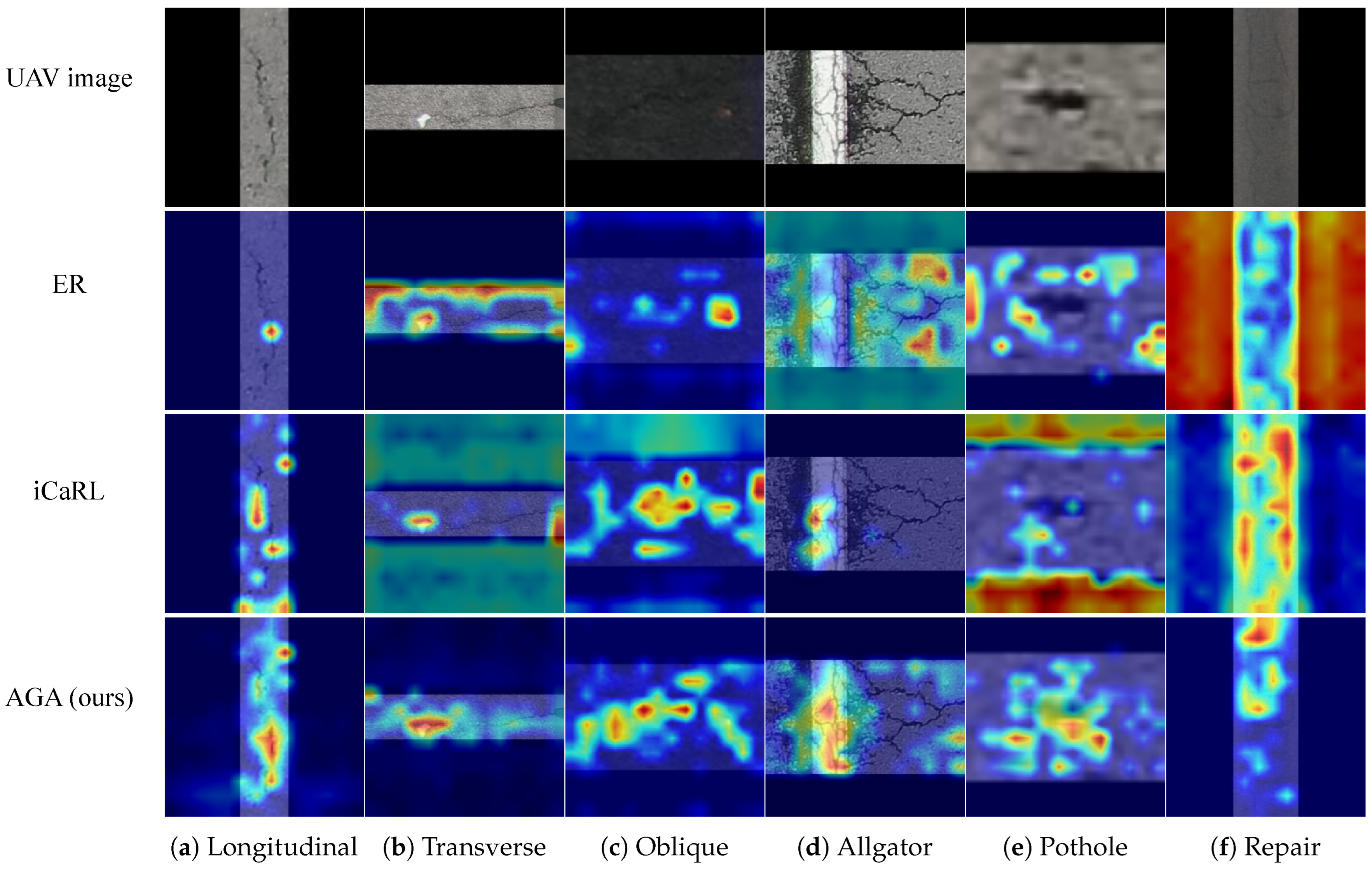
3.3.6. Attention Visualization
4. Discussion
5. Conclusions
Author Contributions
Funding
Data Availability Statement
Conflicts of Interest
References
- Arya, D.; Maeda, H.; Ghosh, S.K.; Toshniwal, D.; Mraz, A.; Kashiyama, T.; Sekimoto, Y. Deep Learning-based Road Damage Detection and Classification for Multiple Countries. Autom. Constr. 2021, 132, 103935. [Google Scholar] [CrossRef]
- Arya, D.; Maeda, H.; Ghosh, S.K.; Toshniwal, D.; Sekimoto, Y. RDD2022: A Multi-National Image Dataset for Automatic Road Damage Detection. Geosci. Data J. 2024, 11, 846–862. [Google Scholar] [CrossRef]
- Arya, D.; Maeda, H.; Ghosh, S.K.; Toshniwal, D.; Omata, H.; Kashiyama, T.; Sekimoto, Y. Crowdsensing-based Road Damage Detection Challenge (CRDDC’2022). In Proceedings of the IEEE International Conference on Big Data; IEEE: Piscataway, NJ, USA, 2022; pp. 6378–6386. [Google Scholar]
- Yan, H.; Zhang, J. UAV-PDD2023: A Benchmark Dataset for Pavement Distress Detection based on UAV Images. Data Brief 2023, 51, 109692. [Google Scholar] [CrossRef] [PubMed]
- Li, Y.; Wang, J.; Lü, B.; Yang, H.; Wu, X. Deep Metric Learning-Based Classification for Pavement Distress Images. Sensors 2025, 25, 4087. [Google Scholar] [CrossRef]
- Guo, H.; Wu, Q.; Wang, Y. Auhf-detr: A Lightweight Transformer with Spatial Attention and Wavelet Convolution for Embedded UAV Small Object Detection. Remote Sens. 2025, 17, 1920. [Google Scholar] [CrossRef]
- Li, H.; Ma, J.; Zhang, J. ELNet: An Efficient and Lightweight Network for Small Object Detection in UAV Imagery. Remote Sens. 2025, 17, 2096. [Google Scholar] [CrossRef]
- Huang, J.; Jin, W.; Tao, H.; Feng, Y.; Shang, Y.; Wang, S.; Liu, A. EFPNet: An Efficient Feature Perception Network for Real-Time Detection of Small UAV Targets. Remote Sens. 2026, 18, 340. [Google Scholar] [CrossRef]
- Barburiceanu, S.; Terebes, R.; Meza, S. 3D Texture Feature Extraction and Classification Using GLCM and LBP-based Descriptors. Appl. Sci. 2021, 11, 2332. [Google Scholar] [CrossRef]
- Fujita, Y.; Shimada, K.; Ichihara, M.; Hamamoto, Y. A Method based on Machine Learning Using Hand-crafted Features for Crack Detection from Asphalt Pavement Surface Iages. In Proceedings of the Thirteenth International Conference on Quality Control by Artificial Vision 2017; SPIE: Bellingham, WA, USA, 2017; Volume 10338, pp. 117–124. [Google Scholar]
- Guan, S.; Liu, H.; Pourreza, H.R.; Mahyar, H. Deep Learning Approaches in Pavement Distress Identification: A Review. arXiv 2023, arXiv:2308.00828. [Google Scholar] [CrossRef]
- Li, D.; Duan, Z.; Hu, X.; Zhang, D.; Zhang, Y. Automated Classification and Detection of Multiple Pavement Distress Images based on Deep Learning. J. Traffic Transp. Eng. (Engl. Ed.) 2023, 10, 276–290. [Google Scholar] [CrossRef]
- Maeda, H.; Sekimoto, Y.; Seto, T.; Kashiyama, T.; Omata, H. Road Damage Detection and Classification Using Deep Neural Networks with Smartphone Images. Comput.-Aided Civ. Infrastruct. Eng. 2018, 33, 1127–1141. [Google Scholar] [CrossRef]
- Zhang, S.; Wang, K.; Liu, Z.; Huang, M.; Huang, S. The Fine Feature Extraction and Attention Re-Embedding Model Based on the Swin Transformer for Pavement Damage Classification. Algorithms 2025, 18, 369. [Google Scholar] [CrossRef]
- Chen, Y.; Gu, X.; Liu, Z.; Liang, J. A Fast Inference Vision Transformer for Automatic Pavement Image Classification and Its Visual Interpretation Method. Remote Sens. 2022, 14, 1877. [Google Scholar] [CrossRef]
- Ali, L.; Jassmi, H.A.; Khan, W.; Alnajjar, F. Crack45K: Integration of Vision Transformer with Tubularity Flow Field (TuFF) and Sliding-window Approach for Crack-segmentation in Pavement Structures. Buildings 2023, 13, 55. [Google Scholar] [CrossRef]
- Liu, B.; Ding, J.; Zou, J.; Wang, J.; Huang, S. LDANet: A Lightweight Dynamic Addition Network for Rural Road Extraction from Remote Sensing Images. Remote Sens. 2023, 15, 1829. [Google Scholar] [CrossRef]
- Song, W.; Zhang, Z.; Zhang, B.; Jia, G.; Zhu, H.; Zhang, J. ISTD-PDS7: A Benchmark Dataset for Multi-type Pavement Distress Segmentation from CCD Images in Complex Scenarios. Remote Sens. 2023, 15, 1750. [Google Scholar] [CrossRef]
- Han, F.; Gu, C. Surface Damage Detection in Hydraulic Structures from UAV Images Using Lightweight Neural Networks. Remote Sens. 2025, 17, 2668. [Google Scholar] [CrossRef]
- Peng, R.; Zhao, W.; Li, K.; Ji, F.; Rong, C. Continual Contrastive Learning for Cross-dataset Scene Classification. Remote Sens. 2022, 14, 5105. [Google Scholar] [CrossRef]
- French, R.M. Catastrophic Forgetting in Connectionist Networks. Trends Cogn. Sci. 1999, 3, 128–135. [Google Scholar] [CrossRef]
- Zhou, D.W.; Sun, H.L.; Ning, J.; Ye, H.J.; Zhan, D.C. Continual Learning with Pre-trained Models: A Survey. arXiv 2024, arXiv:2401.16386. [Google Scholar] [CrossRef]
- Wang, L.; Zhang, X.; Su, H.; Zhu, J. A Comprehensive Survey of Continual Learning: Theory, Method and Application. IEEE Trans. Pattern Anal. Mach. Intell. 2024, 46, 5362–5383. [Google Scholar] [CrossRef] [PubMed]
- Kirkpatrick, J.; Pascanu, R.; Rabinowitz, N.; Veness, J.; Desjardins, G.; Rusu, A.A.; Milan, K.; Quan, J.; Ramalho, T.; Grabska-Barwinska, A.; et al. Overcoming Catastrophic Forgetting in Neural Networks. Proc. Natl. Acad. Sci. USA 2017, 114, 3521–3526. [Google Scholar] [CrossRef] [PubMed]
- Li, Z.; Hoiem, D. Learning without Forgetting. IEEE Trans. Pattern Anal. Mach. Intell. 2017, 40, 2935–2947. [Google Scholar] [CrossRef] [PubMed]
- Zenke, F.; Poole, B.; Ganguli, S. Continual Learning through Synaptic Intelligence. In Proceedings of the International Conference on Machine Learning; PMLR: Cambridge, MA, USA, 2017; pp. 3987–3995. [Google Scholar]
- Wang, Z.; Zhang, Z.; Lee, C.Y.; Zhang, H.; Sun, R.; Ren, X.; Su, G.; Perot, V.; Dy, J.; Pfister, T. Learning to Prompt for Continual Learning. In Proceedings of the IEEE/CVF Conference on Computer Vision and Pattern Recognition; IEEE: Piscataway, NJ, USA, 2022; pp. 139–149. [Google Scholar]
- Wang, Z.; Zhang, Z.; Ebrahimi, S.; Sun, R.; Zhang, H.; Lee, C.Y.; Ren, X.; Su, G.; Perot, V.; Dy, J.; et al. DualPrompt: Complementary Prompting for Rehearsal-free Continual Learning. In Proceedings of the European Conference on Computer Vision; Springer: Cham, Switzerland, 2022; pp. 631–648. [Google Scholar]
- Wang, Y.; Huang, Z.; Hong, X. S-prompts Learning with Pre-trained Transformers: An Occam’s Razor for Domain Incremental Learning. Adv. Neural Inf. Process. Syst. 2022, 35, 5682–5695. [Google Scholar]
- Liang, Y.S.; Li, W.J. InfLoRA: Interference-free Low-Rank Adaptation for Continual Learning. In Proceedings of the IEEE/CVF Conference on Computer Vision and Pattern Recognition; IEEE: Piscataway, NJ, USA, 2024; pp. 23638–23647. [Google Scholar]
- Rolnick, D.; Ahuja, A.; Schwarz, J.; Lillicrap, T.; Wayne, G. Experience Replay for Continual Learning. In Proceedings of the 33rd International Conference on Neural Information Processing Systems; Curran Associates Inc.: Red Hook, NY, USA, 2019; pp. 350–360. [Google Scholar]
- Rebuffi, S.A.; Kolesnikov, A.; Sperl, G.; Lampert, C.H. iCaRL: Incremental Classifier and Representation Learning. In Proceedings of the IEEE Conference on Computer Vision and Pattern Recognition; IEEE: Piscataway, NJ, USA, 2017; pp. 2001–2010. [Google Scholar]
- Buzzega, P.; Boschini, M.; Porrello, A.; Abati, D.; Calderara, S. Dark Experience for General Continual Learning: A Strong, Simple Baseline. Adv. Neural Inf. Process. Syst. 2020, 33, 15920–15930. [Google Scholar]
- Wang, Q.; Wang, R.; Wu, Y.; Jia, X.; Meng, D. CBA: Improving Online Continual Learning via Continual Bias Adaptor. In Proceedings of the IEEE/CVF International Conference on Computer Vision; IEEE: Piscataway, NJ, USA, 2023; pp. 19082–19092. [Google Scholar]
- Yang, Y.; Yuan, H.; Li, X.; Lin, Z.; Torr, P.; Tao, D. Neural Collapse Inspired Feature-Classifier Alignment for Few-Shot Class-Incremental Learning. In Proceedings of the Eleventh International Conference on Learning Representations, Kigali, Rwanda, 1–5 May 2023. [Google Scholar]
- Zhang, E.; Li, C.; Geng, C.; Chen, S. All-around Neural Collapse for Imbalanced Classification. IEEE Trans. Knowl. Data Eng. 2025, 37, 4460–4470. [Google Scholar] [CrossRef]
- Seo, M.; Koh, H.; Jeung, W.; Lee, M.; Kim, S.; Lee, H.; Cho, S.; Choi, S.; Kim, H.; Choi, J. Learning Equi-angular Representations for Online Continual Learning. In Proceedings of the IEEE/CVF Conference on Computer Vision and Pattern Recognition; IEEE: Piscataway, NJ, USA, 2024; pp. 23933–23942. [Google Scholar]
- Dang, T.A.; Nguyen, V.; Vu, N.S.; Vrain, C. Memory-efficient Continual Learning with Neural Collapse Contrastive. In Proceedings of the 2025 IEEE/CVF Winter Conference on Applications of Computer Vision (WACV); IEEE: Piscataway, NJ, USA, 2025; pp. 7950–7959. [Google Scholar]
- Zhou, Z.; Peng, Y.; Yi, P.; Zhu, M.; Shen, C. Fresh-CL: Feature Realignment through Experts on Hypersphere in Continual Learning. In Proceedings of the ICASSP 2025—2025 IEEE International Conference on Acoustics, Speech and Signal Processing (ICASSP); IEEE: Piscataway, NJ, USA, 2025; pp. 1–5. [Google Scholar]
- Papyan, V.; Han, X.; Donoho, D.L. Prevalence of Neural Collapse During the Terminal Phase of Deep Learning Training. Proc. Natl. Acad. Sci. USA 2020, 117, 24652–24663. [Google Scholar] [CrossRef] [PubMed]
- Fang, C.; He, H.; Long, Q.; Su, W.J. Exploring Deep Neural Networks via Layer-peeled Model: Minority Collapse in Imbalanced Training. Proc. Natl. Acad. Sci. USA 2021, 118, e2103091118. [Google Scholar] [CrossRef]
- Kothapalli, V. Neural Collapse: A Review on Modelling Principles and Generalization. arXiv 2022, arXiv:2206.04041. [Google Scholar]
- Tirer, T.; Huang, H.; Niles-Weed, J. Perturbation Analysis of Neural Collapse. In Proceedings of the International Conference on Machine Learning; PMLR: Cambridge, MA, USA, 2023; pp. 34301–34329. [Google Scholar]
- He, K.; Zhang, X.; Ren, S.; Sun, J. Deep Residual Learning for Image Recognition. In Proceedings of the IEEE Conference on Computer Vision and Pattern Recognition; IEEE: Piscataway, NJ, USA, 2016; pp. 770–778. [Google Scholar]
- Dosovitskiy, A. An Image is Worth 16x16 Words: Transformers for Image Recognition at Scale. arXiv 2020, arXiv:2010.11929. [Google Scholar]
- Deng, J.; Dong, W.; Socher, R.; Li, L.J.; Li, K.; Fei-Fei, L. ImageNet: A Large-scale Hierarchical Image Database. In Proceedings of the 2009 IEEE Conference on Computer Vision and Pattern Recognition; IEEE: Piscataway, NJ, USA, 2009; pp. 248–255. [Google Scholar]
- He, J. Gradient reweighting: Towards imbalanced class-incremental learning. In Proceedings of the IEEE/CVF Conference on Computer Vision and Pattern Recognition; IEEE: Piscataway, NJ, USA, 2024; pp. 16668–16677. [Google Scholar]
- Wang, Y.; Zhou, D.W.; Ye, H.J. Integrating Task-Specific and Universal Adapters for Pre-Trained Model-based Class-Incremental Learning. In Proceedings of the IEEE/CVF International Conference on Computer Vision; IEEE: Piscataway, NJ, USA, 2025; pp. 806–816. [Google Scholar]
- Hou, S.; Pan, X.; Loy, C.C.; Wang, Z.; Lin, D. Learning a Unified Classifier Incrementally via Rebalancing. In Proceedings of the IEEE/CVF Conference on Computer Vision and Pattern Recognition; IEEE: Piscataway, NJ, USA, 2019; pp. 831–839. [Google Scholar]
- De Lange, M.; van de Ven, G.M.; Tuytelaars, T. Continual Evaluation for Lifelong Learning: Identifying the Stability Gap. arXiv 2023, arXiv:2205.13452. [Google Scholar] [CrossRef]
- Zhang, T.; Gao, G.; Ke, X.; Zhang, X. Swarm Learning: Perception-Retrieval-Localization for Ship Detection from Synthetic Aperture Radar Remote Sensing Imagery. IEEE J. Sel. Top. Appl. Earth Obs. Remote Sens. 2026, 1–11. [Google Scholar]
- Zhang, T.; Zhang, X.; Liu, C.; Shi, J.; Wei, S.; Ahmad, I.; Zhan, X.; Zhou, Y.; Pan, D.; Li, J.; et al. Balance Learning for Ship Detection from Synthetic Aperture Radar Remote Sensing Imagery. ISPRS J. Photogramm. Remote Sens. 2021, 182, 190–208. [Google Scholar] [CrossRef]
- Zhang, T.; Zhang, X. Triple-Level Sparsity Awareness for Marine Ship Surveillance Using Satellite Synthetic Aperture Radar. IEEE Trans. Autom. Sci. Eng. 2026, 23, 5155–5166. [Google Scholar] [CrossRef]
- Zhang, T.; Gao, G.; Zhang, X. Glance-Focus-Gaze: A Novel Eagle-Eye Vision-Inspired Panorama-Population-Individual Progressive Screening Paradigm to Capture Ships in SAR Images. ISPRS J. Photogramm. Remote Sens. 2026, 235, 241–260. [Google Scholar] [CrossRef]





| Memory Cost | Method | Precision ↑ | Recall ↑ | F1-Score ↑ | Acc ↑ | FM ↓ |
|---|---|---|---|---|---|---|
| Features | NC-FSCIL | 0.4770 | 0.4605 | 0.4314 | 56.58 | 20.27 |
| DML-PDI | 0.6022 | 0.7547 | 0.6185 | 74.27 | 16.99 | |
| TUNA | 0.5907 | 0.7407 | 0.6218 | 74.48 | 12.99 | |
| 100 samples | ER | 0.3861 | 0.4263 | 0.1609 | 43.79 | 82.99 |
| iCaRL | 0.5794 | 0.7519 | 0.5042 | 74.81 | 44.73 | |
| L2P* | 0.5319 | 0.7265 | 0.4775 | 72.76 | 44.45 | |
| DualPrompt* | 0.5824 | 0.6892 | 0.4143 | 68.32 | 50.36 | |
| DGR | 0.5903 | 0.7923 | 0.5667 | 78.37 | 31.65 | |
| AGA (ours) | 0.5938 | 0.7856 | 0.5567 | 78.50 | 39.01 | |
| 200 samples | ER | 0.4144 | 0.4904 | 0.2868 | 52.05 | 63.18 |
| iCaRL | 0.6283 | 0.8389 | 0.6314 | 84.30 | 26.01 | |
| L2P* | 0.5805 | 0.7982 | 0.5802 | 80.02 | 30.39 | |
| DualPrompt* | 0.5777 | 0.7860 | 0.5837 | 78.58 | 24.10 | |
| DGR | 0.6224 | 0.8286 | 0.6573 | 82.56 | 20.19 | |
| AGA (ours) | 0.6586 | 0.8578 | 0.6909 | 86.55 | 20.77 | |
| 500 samples | ER | 0.4973 | 0.5851 | 0.4511 | 62.96 | 31.94 |
| iCaRL | 0.7288 | 0.8983 | 0.7732 | 90.72 | 10.67 | |
| L2P* | 0.6455 | 0.8519 | 0.6844 | 84.64 | 18.28 | |
| DualPrompt* | 0.6207 | 0.8350 | 0.6619 | 82.03 | 16.93 | |
| DGR | 0.6802 | 0.8484 | 0.7270 | 84.37 | 12.22 | |
| AGA (ours) | 0.7713 | 0.9134 | 0.8193 | 91.52 | 8.85 |
| Memory Cost | Method | Precision ↑ | Recall ↑ | F1-Score ↑ | Acc ↑ | FM ↓ |
|---|---|---|---|---|---|---|
| 100 samples | ER | 0.8771 | 0.6666 | 0.7337 | 69.45 | 43.26 |
| iCaRL | 0.8749 | 0.6968 | 0.7578 | 73.03 | 38.01 | |
| AGA (ours) | 0.8855 | 0.7325 | 0.7772 | 77.48 | 30.98 | |
| 200 samples | ER | 0.8939 | 0.7242 | 0.7794 | 75.59 | 33.97 |
| iCaRL | 0.8919 | 0.7619 | 0.8121 | 80.09 | 27.36 | |
| AGA (ours) | 0.8962 | 0.8012 | 0.8300 | 83.28 | 21.98 | |
| 500 samples | ER | 0.9066 | 0.8299 | 0.8613 | 83.84 | 21.43 |
| iCaRL | 0.9105 | 0.8471 | 0.8636 | 87.06 | 16.74 | |
| AGA (ours) | 0.9159 | 0.8529 | 0.8653 | 87.70 | 15.09 |
| Method | Precision ↑ | Recall ↑ | F1-Score ↑ | Acc ↑ | FM ↓ |
|---|---|---|---|---|---|
| Baseline (ER) | 0.4144 | 0.4904 | 0.2868 | 52.05 | 63.18 |
| +Fixed ETF | 0.5878 | 0.7743 | 0.5831 | 77.95 | 33.06 |
| +SAI | 0.6494 | 0.8312 | 0.6472 | 83.49 | 25.85 |
| +DGA | 0.6287 | 0.8417 | 0.6470 | 84.67 | 25.06 |
| +MPR Loss | 0.6586 | 0.8578 | 0.6909 | 86.55 | 20.77 |
| (a) | |||
| F1-Score↑ | ACC↑ | FM ↓ | |
| 0.0000 | 0.4361 | 53.91 | 28.64 |
| 0.0005 | 0.6640 | 83.82 | 23.09 |
| 0.0010 | 0.6681 | 84.62 | 22.97 |
| 0.0015 | 0.6698 | 84.87 | 23.07 |
| 0.0020 | 0.6664 | 84.69 | 23.03 |
| (b) | |||
| F1-Score↑ | ACC↑ | FM ↓ | |
| 0.00 | 0.6441 | 83.68 | 26.55 |
| 0.05 | 0.6498 | 84.55 | 24.80 |
| 0.10 | 0.6681 | 84.62 | 22.97 |
| 0.15 | 0.6675 | 84.87 | 23.05 |
| 0.20 | 0.6662 | 84.61 | 23.18 |
| (c) | |||
| F1-Score↑ | ACC↑ | FM ↓ | |
| 0.1 | 0.5891 | 81.07 | 31.51 |
| 0.3 | 0.6521 | 85.01 | 24.24 |
| 0.5 | 0.6681 | 84.62 | 22.97 |
| 0.7 | 0.6677 | 84.39 | 21.30 |
| 0.9 | 0.6320 | 68.54 | 14.86 |
| Method | Task 1 | Task 2 | ||||||
|---|---|---|---|---|---|---|---|---|
|
Training
Time (s) |
Testing
Time (s) |
Calculation of
(ms) |
Memory
Usage (MB) |
Training
Time (s) |
Testing
Time (s) |
Calculation of
(ms) |
Memory
Usage (MB) | |
| ER | 345.15 | 4.02 | - | 10,328 | 130.71 | 8.64 | - | 10,610 |
| iCaRL | 333.01 | 3.71 | - | 16,438 | 133.71 | 8.09 | - | 17,754 |
| AGA (ours) | 338.68 | 3.96 | 25.12 | 10,326 | 141.67 | 9.01 | 16.82 | 11,479 |
Disclaimer/Publisher’s Note: The statements, opinions and data contained in all publications are solely those of the individual author(s) and contributor(s) and not of MDPI and/or the editor(s). MDPI and/or the editor(s) disclaim responsibility for any injury to people or property resulting from any ideas, methods, instructions or products referred to in the content. |
© 2026 by the authors. Licensee MDPI, Basel, Switzerland. This article is an open access article distributed under the terms and conditions of the Creative Commons Attribution (CC BY) license.
Share and Cite
Wang, Q.; Li, X.; Peng, J.; Jia, X.; Wang, R. Incremental Pavement Distress Classification in UAV-Based Remote Sensing via Analytic Geometric Alignment. Remote Sens. 2026, 18, 1141. https://doi.org/10.3390/rs18081141
Wang Q, Li X, Peng J, Jia X, Wang R. Incremental Pavement Distress Classification in UAV-Based Remote Sensing via Analytic Geometric Alignment. Remote Sensing. 2026; 18(8):1141. https://doi.org/10.3390/rs18081141
Chicago/Turabian StyleWang, Quanziang, Xin Li, Jiangjun Peng, Xixi Jia, and Renzhen Wang. 2026. "Incremental Pavement Distress Classification in UAV-Based Remote Sensing via Analytic Geometric Alignment" Remote Sensing 18, no. 8: 1141. https://doi.org/10.3390/rs18081141
APA StyleWang, Q., Li, X., Peng, J., Jia, X., & Wang, R. (2026). Incremental Pavement Distress Classification in UAV-Based Remote Sensing via Analytic Geometric Alignment. Remote Sensing, 18(8), 1141. https://doi.org/10.3390/rs18081141