High-Resolution 3D Structural Documentation of the Saqqara Pyramids, Egypt, Using Terrestrial Laser Scanning and Integrated Geomatics Techniques for Heritage Preservation




Highlights
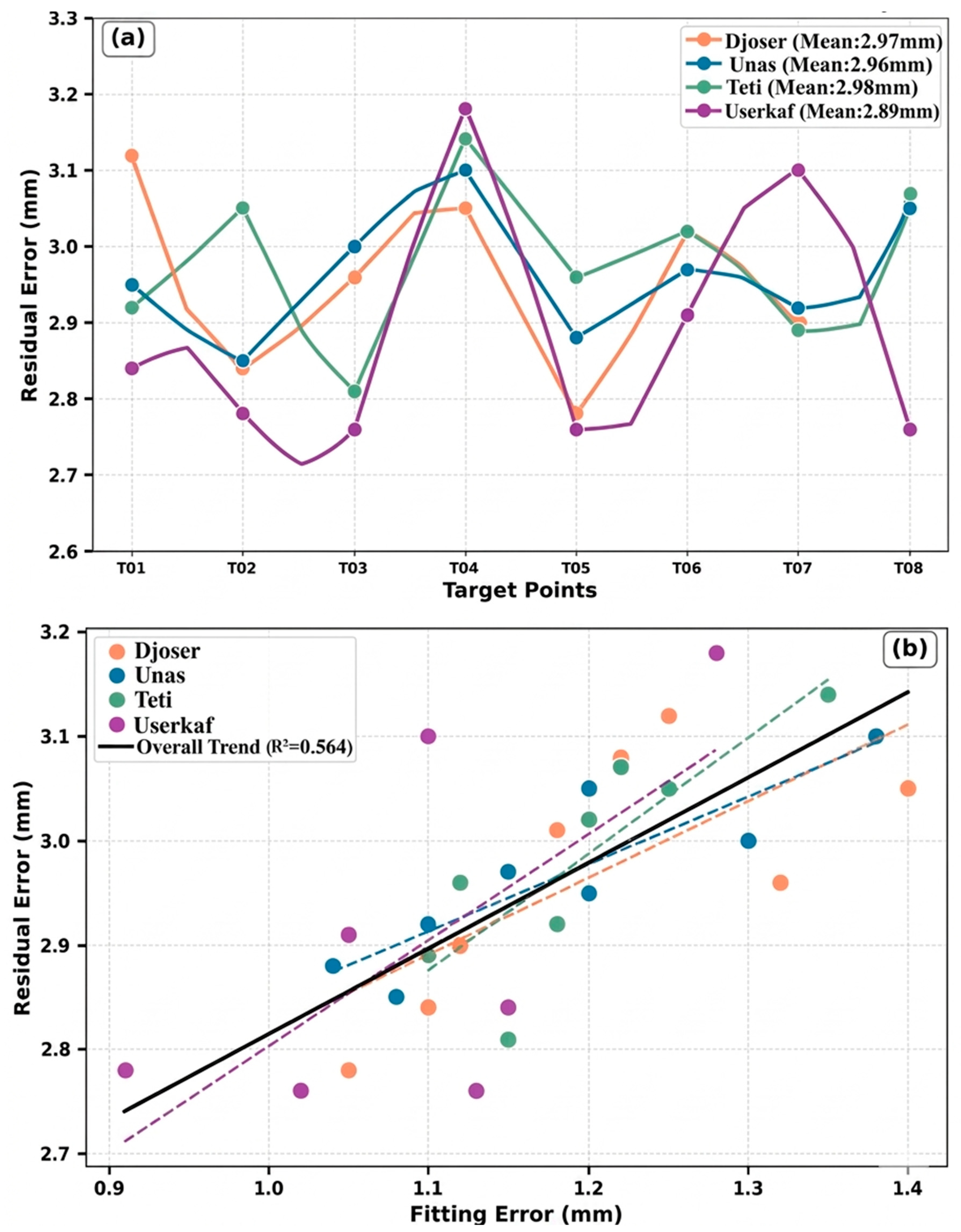
- Integrated Terrestrial Laser Scanning (TLS), GNSS, and Total Station techniques produced sub-centimeter georeferenced 3D models of the Djoser, Unas, Teti, and Userkaf pyramids, generating over 2.1 billion high-resolution points with registration errors below 4 mm.
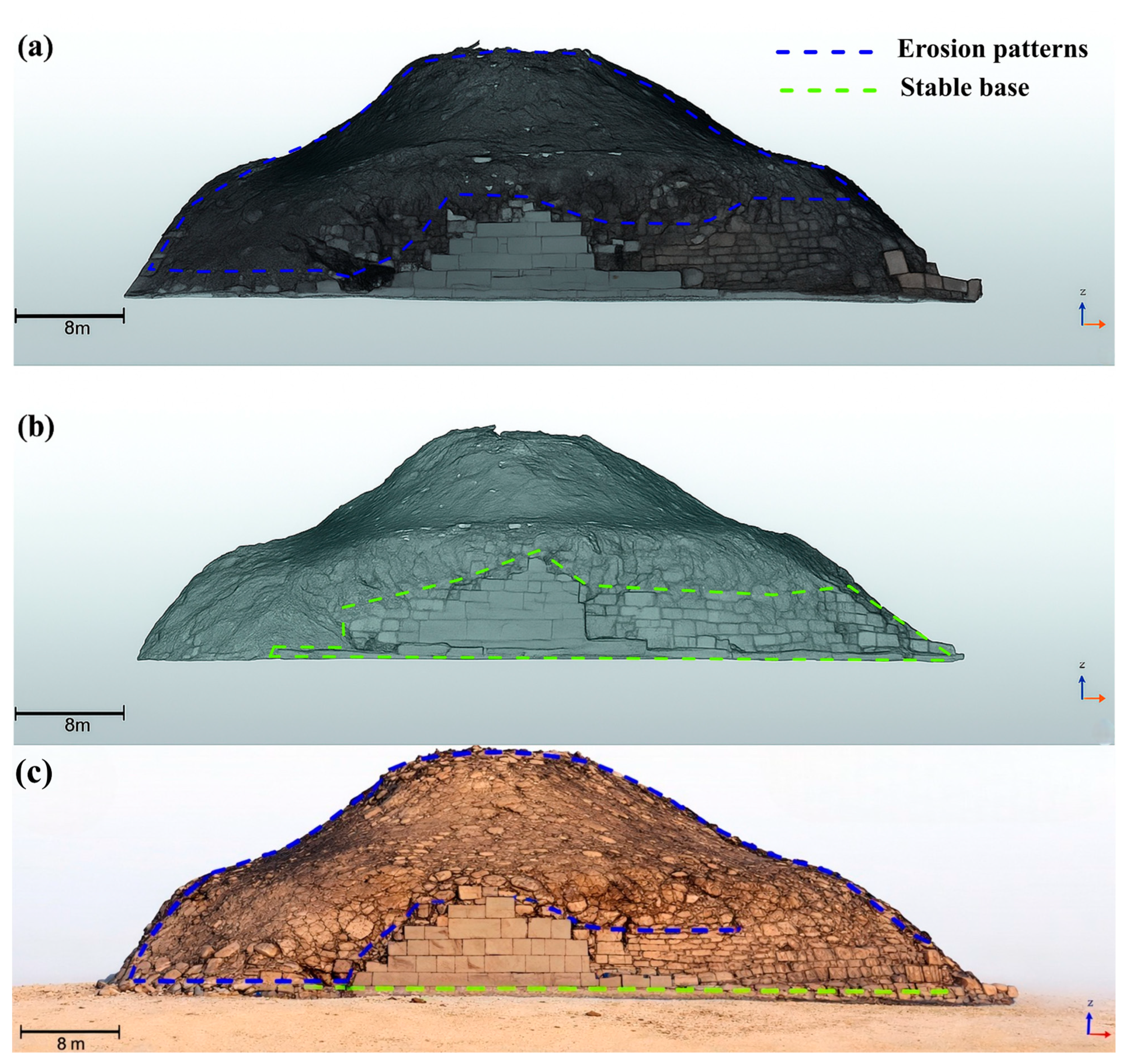
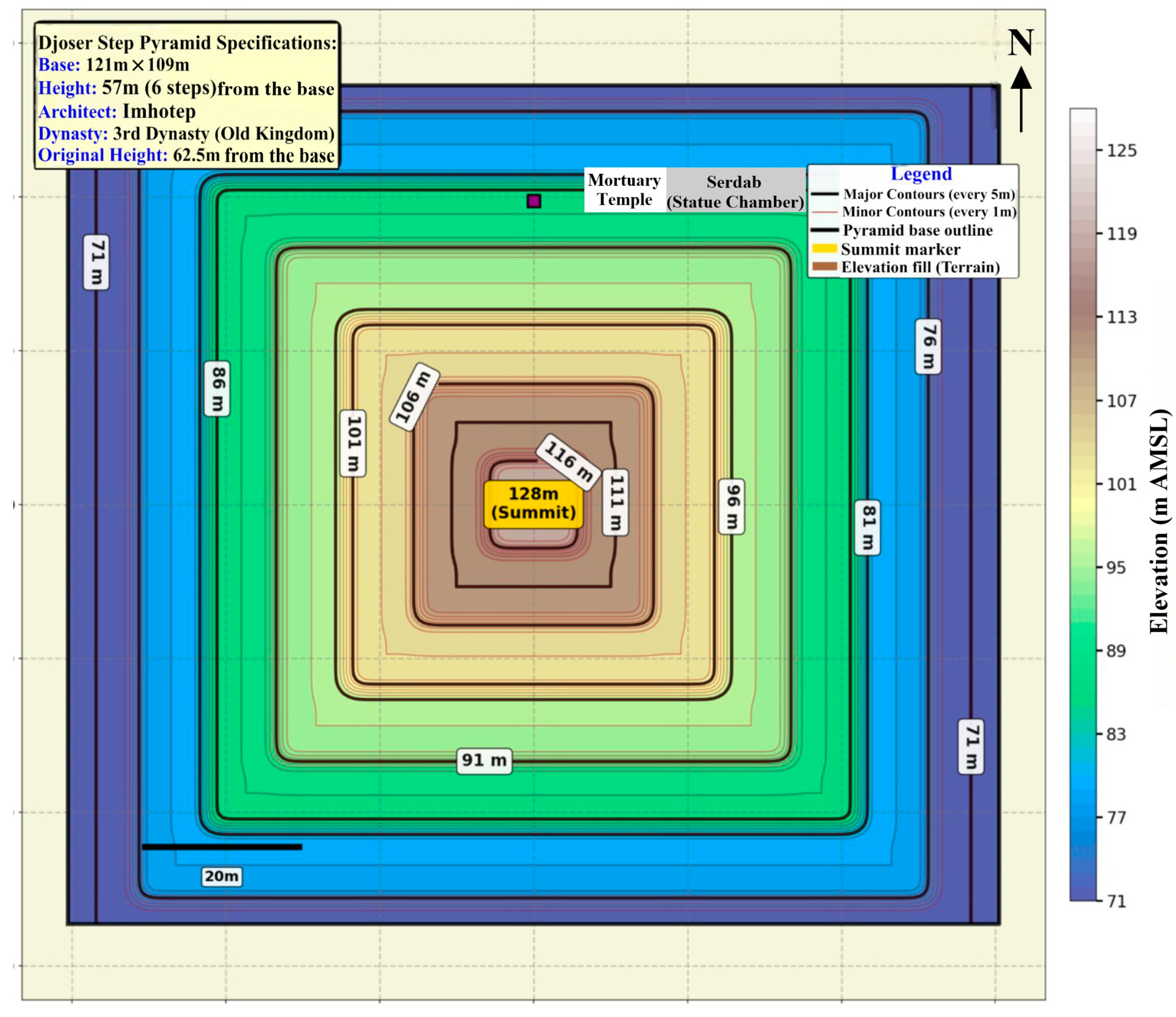
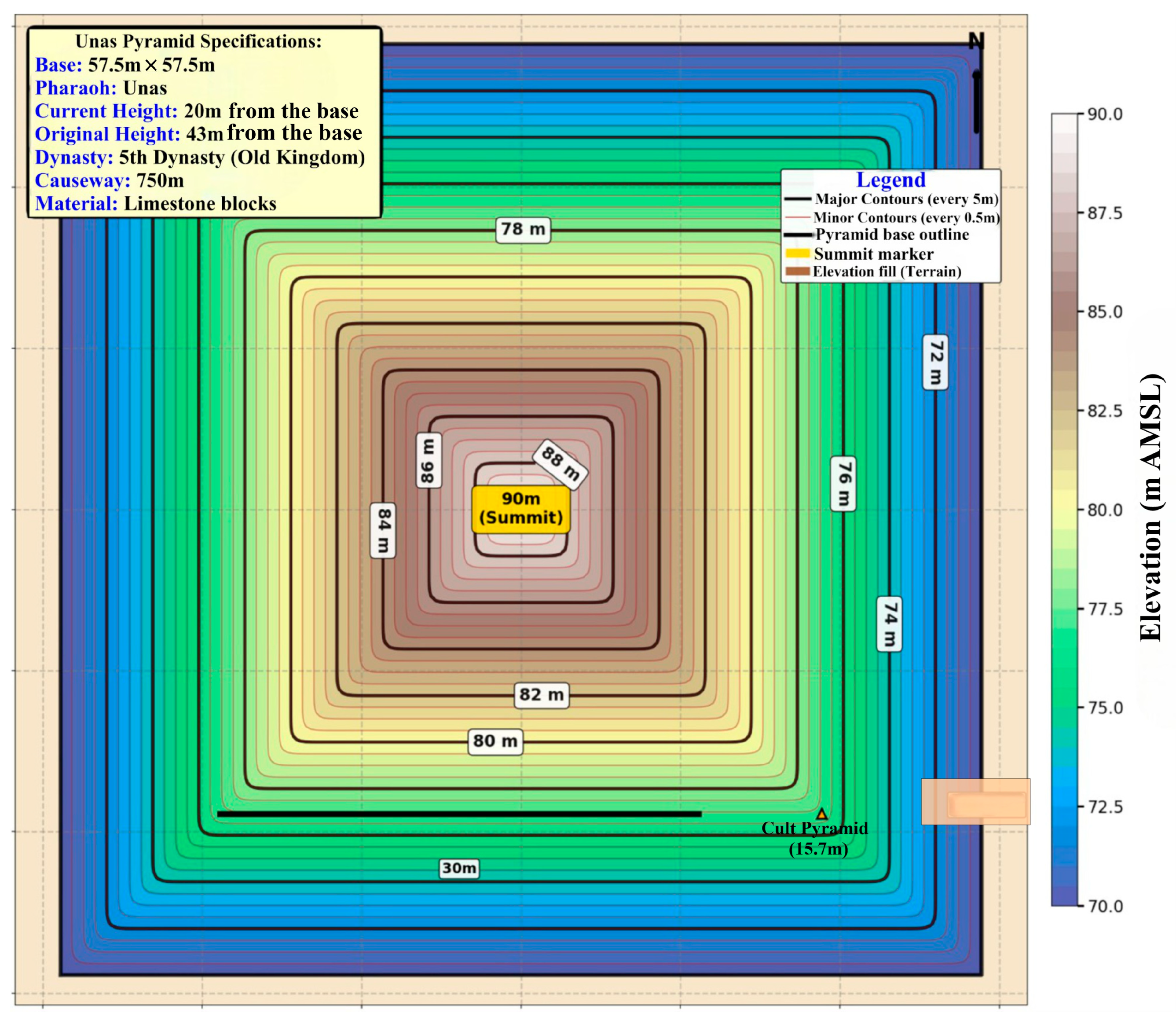
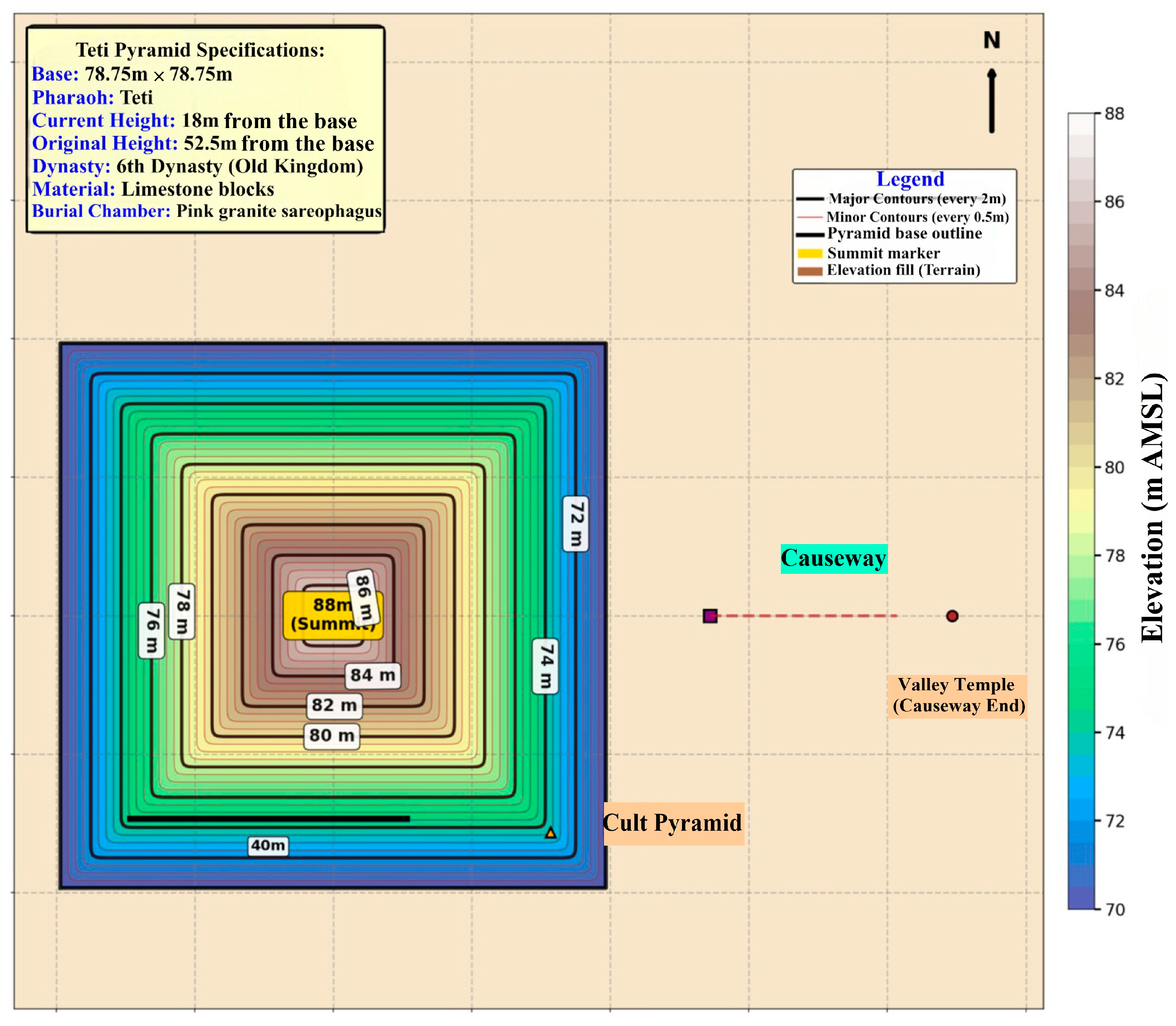
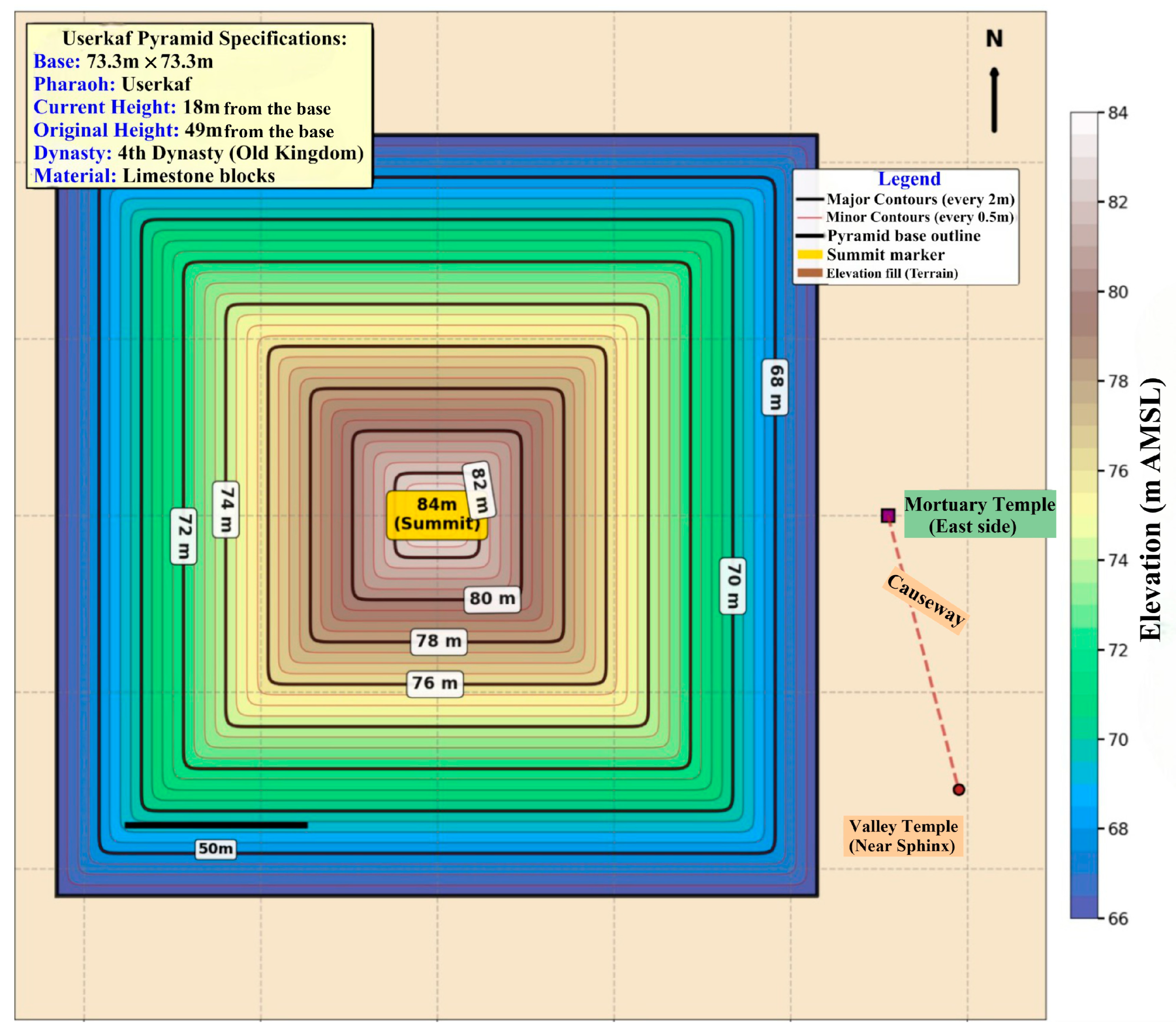
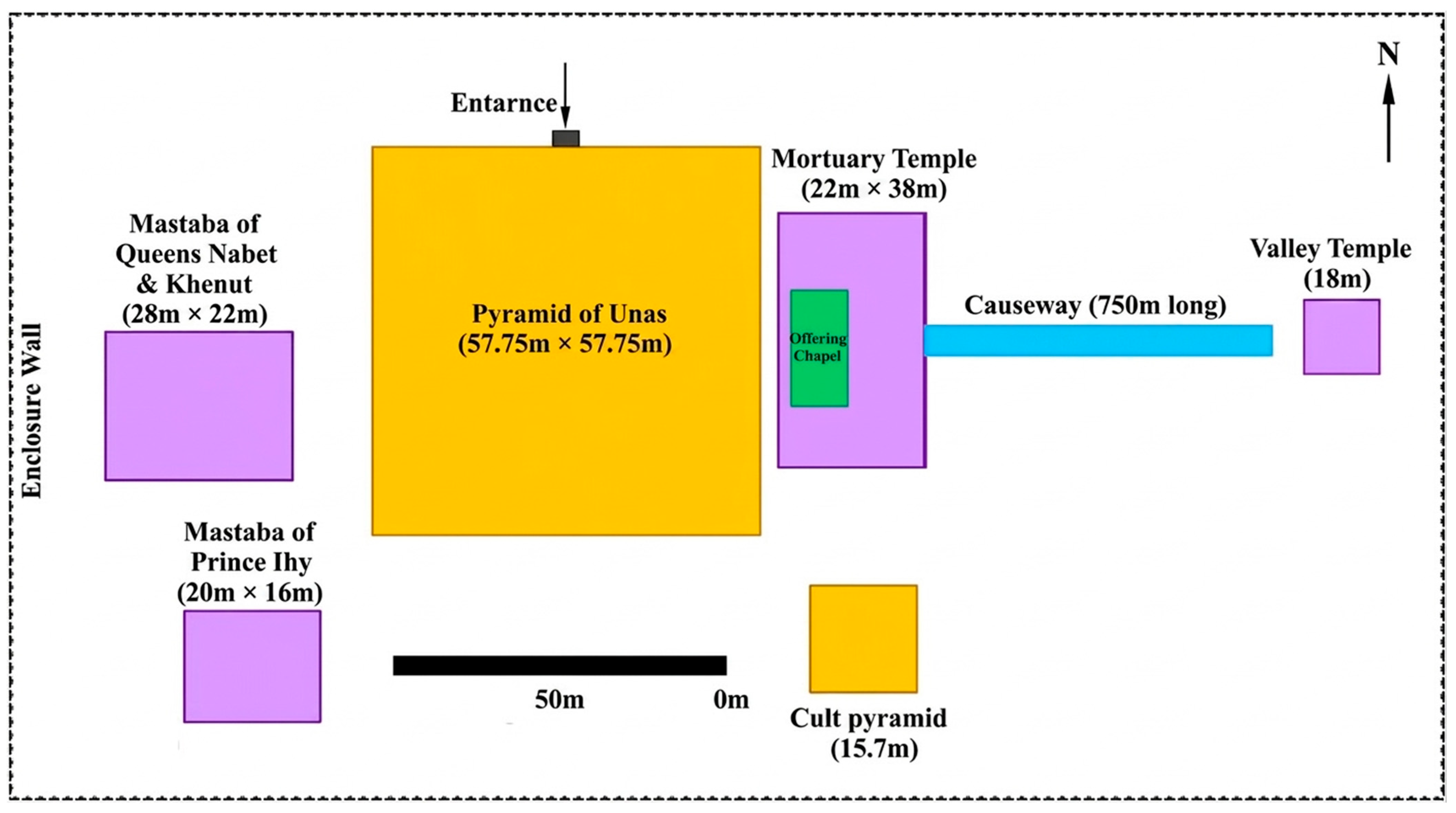
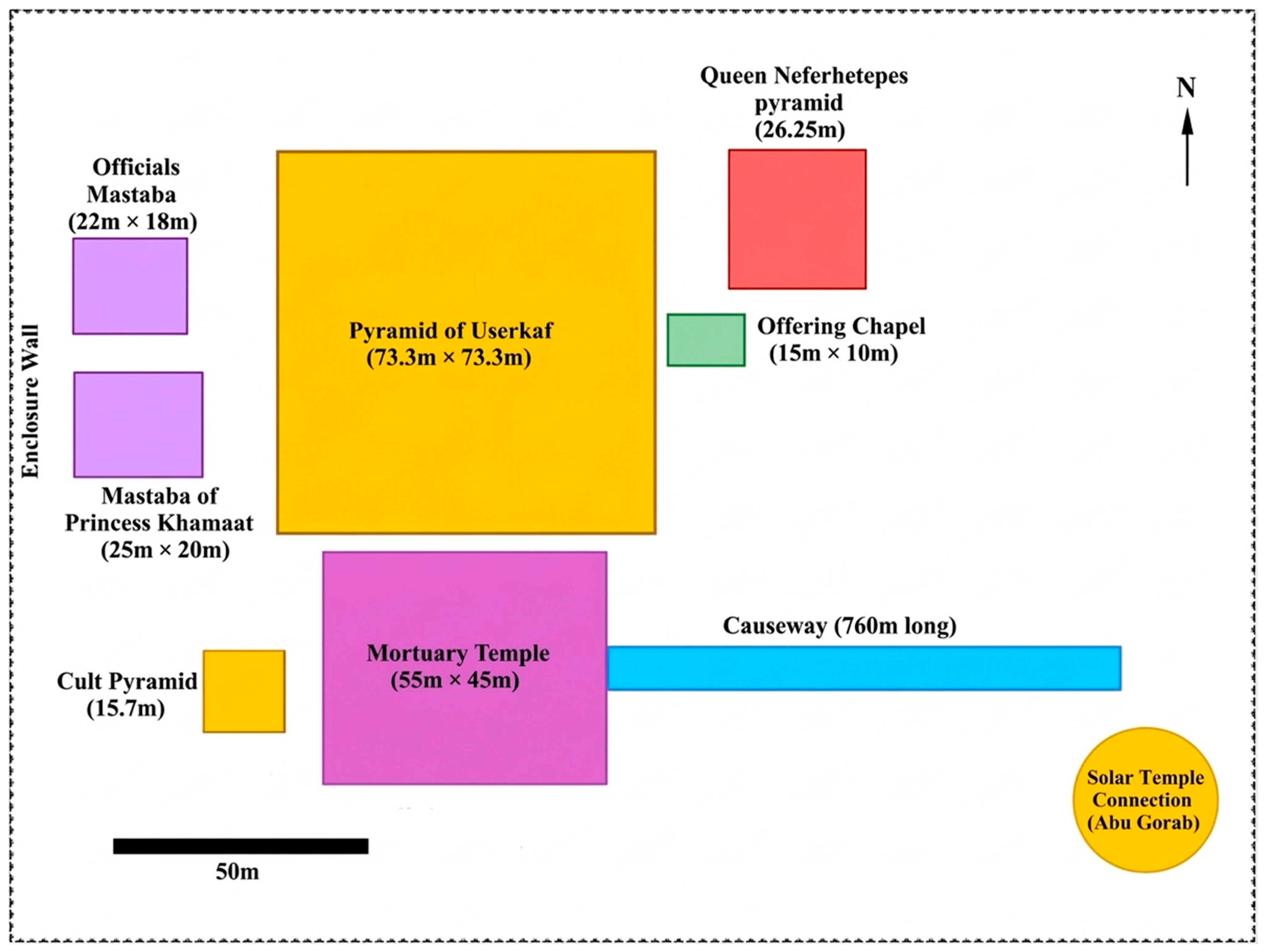
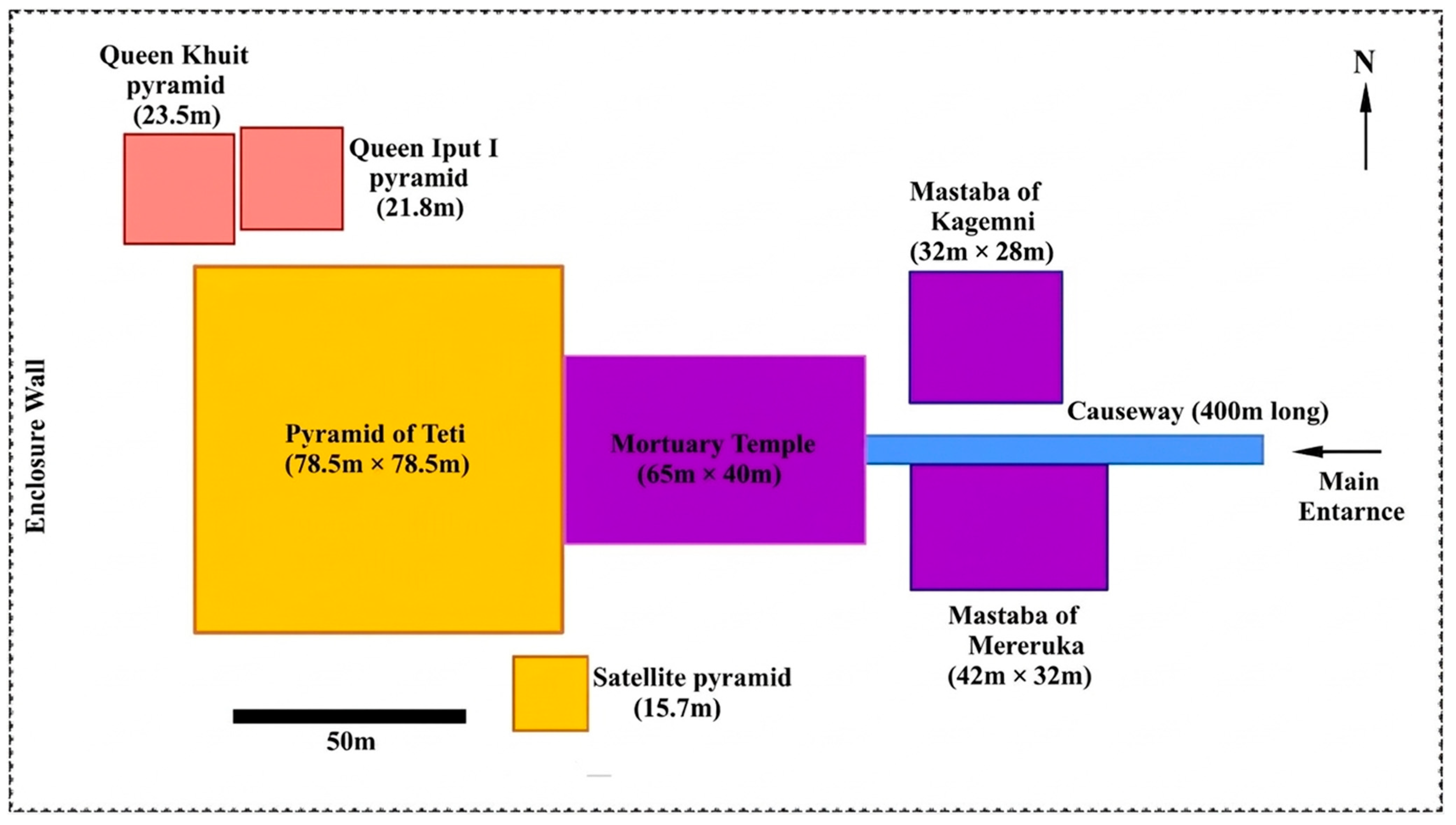
- Quantitative analysis revealed major structural degradation, including height losses of ~53% (Unas), ~66% (Teti), and ~63% (Userkaf), and localized deformation up to 4.2 cm at Teti’s southern flank.
- The generated georeferenced digital twins establish an accurate baseline for long-term deformation monitoring, structural stability assessment, and climate-related risk evaluation at large archaeological sites.
- The integrated geomatics workflow provides a scalable and transferable framework for high-precision documentation and conservation planning of complex heritage structures worldwide.
Abstract
1. Introduction
2. Methodology and Workflow
2.1. Terrestrial Laser Scanning (TLS)
2.2. Instrumentation
2.3. Field Procedure and Scan Strategy
2.4. Geodetic Control Network
2.4.1. GNSS Survey Planning and Satellite Availability Analysis
2.4.2. Reference Station and Receiver Configuration
2.4.3. Observation Parameters and Session Duration
2.4.4. GNSS Data Processing and Atmospheric Corrections
2.4.5. Network Adjustment and Accuracy Assessment
2.4.6. Total Station Densification
2.5. Workflow
3. Data Acquisition
3.1. Planning and Geodetic Control
3.2. Laser Scanning Execution
4. Data Processing
5. Results
5.1. Point Cloud Models
5.2. Three-Dimensional Mesh Models
5.3. Elevation Changes and 2D Mapping of Saqqara Pyramids
6. Discussion
7. Conclusions
Author Contributions
Funding
Data Availability Statement
Acknowledgments
Conflicts of Interest
Abbreviations
| AMSL | Above Mean Sea level |
| ASPRS | American Society for Photogrammetry and Remote Sensing |
| BCE | Before Common Era |
| DEM | Digital Elevation Model |
| CORS | Continuously Operating Reference Station |
| GCP | Ground control point |
| GIS | Geographic Information System |
| GNSS | Global Navigation Satellite System |
| HDR | High dynamic range |
| ICP | Iterative Closest Point |
| ISO | International Organization for Standardization |
| NSSDA | National Standard for Spatial Data Accuracy |
| PDOP | Position Dilution of Precision |
| RGB | Red, Green, and Blue |
| RMSE | Root Mean Squared Error |
| SDG | Sustainable Development Goal |
| STANAG | Standardization Agreement (NATO) |
| TBC | Trimble Business Center |
| TLS | Terrestrial Laser Scanning |
| UNESCO | United Nations Educational, Scientific and Cultural Organization |
| UTM | Universal Transverse Mercator |
| WGS84 | World Geodetic System 1984 |
Appendix A

| Point ID | Pyramid Zone | Easting (m) | Northing (m) | Height (m) | Position Relative to Pyramid |
|---|---|---|---|---|---|
| D-01 | Djoser | 327,832.450 | 3,306,312.680 | 69.215 | North face, NW corner |
| D-02 | Djoser | 327,878.320 | 3,306,298.540 | 69.087 | North face, NE corner |
| D-03 | Djoser | 327,893.670 | 3,306,248.390 | 68.743 | East face, NE corner |
| D-04 | Djoser | 327,889.140 | 3,306,198.760 | 68.512 | East face, SE corner |
| D-05 | Djoser | 327,848.920 | 3,306,178.430 | 68.334 | South face, SE corner |
| D-06 | Djoser | 327,808.650 | 3,306,183.270 | 68.621 | South face, SW corner |
| D-07 | Djoser | 327,791.380 | 3,306,231.540 | 68.896 | West face, SW corner |
| D-08 | Djoser | 327,796.240 | 3,306,278.910 | 69.102 | West face, NW corner |
| UN-01 | Unas | 327,558.730 | 3,306,091.840 | 73.654 | North face, NW corner |
| UN-02 | Unas | 327,604.580 | 3,306,085.270 | 73.521 | North face, NE corner |
| UN-03 | Unas | 327,621.340 | 3,306,048.930 | 73.298 | East face, NE corner |
| UN-04 | Unas | 327,618.870 | 3,306,008.640 | 73.187 | East face, SE corner |
| UN-05 | Unas | 327,597.430 | 3,305,986.510 | 73.076 | South face, SE corner |
| UN-06 | Unas | 327,558.920 | 3,305,991.380 | 73.143 | South face, SW corner |
| UN-07 | Unas | 327,541.670 | 3,306,024.760 | 73.312 | West face, SW corner |
| UN-08 | Unas | 327,544.190 | 3,306,063.450 | 73.468 | West face, NW corner |
| T-01 | Teti | 327,661.840 | 3,305,641.270 | 70.812 | North face, NW corner |
| T-02 | Teti | 327,708.920 | 3,305,636.580 | 70.743 | North face, NE corner |
| T-03 | Teti | 327,728.450 | 3,305,598.340 | 70.621 | East face, NE corner |
| T-04 | Teti | 327,725.670 | 3,305,554.870 | 70.489 | East face, SE corner |
| T-05 | Teti | 327,701.230 | 3,305,532.410 | 70.312 | South face, SE corner |
| T-06 | Teti | 327,657.890 | 3,305,537.960 | 70.387 | South face, SW corner |
| T-07 | Teti | 327,638.540 | 3,305,574.320 | 70.498 | West face, SW corner |
| T-08 | Teti | 327,641.780 | 3,305,618.940 | 70.654 | West face, NW corner |
| US-01 | Userkaf | 327,403.560 | 3,305,264.730 | 74.698 | North face, NW corner |
| US-02 | Userkaf | 327,448.730 | 3,305,259.840 | 74.621 | North face, NE corner |
| US-03 | Userkaf | 327,466.890 | 3,305,224.180 | 74.512 | East face, NE corner |
| US-04 | Userkaf | 327,463.540 | 3,305,182.650 | 74.389 | East face, SE corner |
| US-05 | Userkaf | 327,440.280 | 3,305,160.430 | 74.276 | South face, SE corner |
| US-06 | Userkaf | 327,398.750 | 3,305,165.870 | 74.312 | South face, SW corner |
| US-07 | Userkaf | 327,381.640 | 3,305,199.540 | 74.401 | West face, SW corner |
| US-08 | Userkaf | 327,384.920 | 3,305,241.870 | 74.534 | West face, NW corner |
References
- Mamo, A.R.; Ibraheem, I.M.; Al Kassem, A.; Al-Khalil, A.; Hopper, K. The Impact of the Syrian Conflict on Archaeological Sites in Al-Hasakah Province. J. Archaeol. Sci. Rep. 2022, 43, 103486. [Google Scholar] [CrossRef]
- Elbshbeshi, A.; Gomaa, A.; Mohamed, A.; Othman, A.; Ibraheem, I.M.; Ghazala, H. Applying Geomatics Techniques for Documenting Heritage Buildings in Aswan Region, Egypt: A Case Study of the Temple of Abu Simbel. Heritage 2023, 6, 742–761. [Google Scholar] [CrossRef]
- Al Kassem, A.; Hopper, K.; Ibraheem, I.M.; el Hajj, H.; Maier, A.; Ali, A.A.; Richter, J. Assessment of the impact of the Syrian conflict on archaeological sites in the Daraa region. Levant 2024, 56, 425–446. [Google Scholar] [CrossRef]
- Koukouvelas, I.K.; Kyriou, A.; Nikolakopoulos, K.G.; Dimaris, G.; Pantelidis, I.; Tsikos, H. Geological and 3D Image Analysis Toward Protecting a Geosite: The Case Study of Falakra, Limnos, Greece. Minerals 2025, 15, 148. [Google Scholar] [CrossRef]
- Kyriou, A.; Filippa, T.; Pappas, C.; Nikolakopoulos, K.G.; Koukouvelas, I. Generation of high-quality 3D models of a monastery located in Western Greece. In Earth Resources and Environmental Remote Sensing/GIS Applications; SPIE: Bellingham, WA, USA, 2023; Volume 12734, pp. 99–111. [Google Scholar] [CrossRef]
- Landreau, X.; Piton, G.; Morin, G.; Bartout, P.; Touchart, L.; Giraud, C.; Barre, J.-C.; Guerin, C.; Alibert, A.; Lallemand, C. On the possible use of hydraulic force to assist with building the step pyramid of saqqara. PLoS ONE 2024, 19, e0306690. [Google Scholar] [CrossRef]
- Hawass, Z. The Discovery of the Sarcophagus of Djoser and the Restoration of the Step Pyramid. J. Gen. Union Arab Archaeol. 2021, 6, 83–107. [Google Scholar] [CrossRef]
- Lauer, J.P. Saqqara: The Royal Cemetery of Memphis: Excavations and Discoveries Since 1850; Scribner: New York, NY, USA, 1976. [Google Scholar]
- Staring, N. The Saqqara Necropolis Through the New Kingdom: Biography of an Ancient Egyptian Cultural Landscape; Brill: Leiden, The Netherlands, 2022; Volume 131. [Google Scholar]
- Mysliwiec, K.J. In the Shadow of Djoser’s Pyramid: Research of Polish Archaeologists in Saqqara; Peter Lang International Academic Publishers: New York, NY, USA, 2020; p. 478. [Google Scholar]
- La Torre, C. Risk Assesment of the Archaelogical Site of Saqqara. In North Saqqara Archaeological Site: Handbook for the Environmental Risk Analysis; Abdelrahman, M., Ed.; Consiglio Nazionale delle Ricerche (CNR), Istituto per le Tecnologie Applicate ai Beni Culturali: Rome, Italy, 2003; pp. 1000–1024. [Google Scholar] [CrossRef]
- Fahmy, A.; Molina-Piernas, E.; Domínguez-Bella, S.; Martínez-López, J.; Helmi, F. Geoenvironmental investigation of Sahure’s pyramid, Abusir archeological site, Giza, Egypt. Herit. Sci. 2022, 10, 61. [Google Scholar] [CrossRef]
- Soliman, M.; Ali, D.; Elbshbeshi, A.; Ibrahim, M.G. Digitization of Qaitbay Fort in Alexandria (884AH/ 1479 CE) -Simplification of Modelling Techniques to Safeguard Vulnerable Cultural Heritage. Art Res. J. 2025, 25, 109–121. [Google Scholar]
- Yilmaz, Y.; Gamil, R.E. The role of heritage impact assessment in safeguarding World Heritage Sites: Application study on historic areas of Istanbul and Giza Pyramids. J. Herit. Manag. 2018, 3, 127–158. [Google Scholar] [CrossRef]
- Madkour, F.S.; Khallaf, M.K. Alteration processes and deterioration phenomena of faience tiles in the complex of king Djoser at Saqqara, Egypt. Asian J. Behav. Stud. 2013, 3, 25–37. [Google Scholar] [CrossRef]
- Ewais, A.Y.; Kamal, M.; Mahgoub, G. Artistic Study of the wildlife scene at the burial chamber of Rashepses in Saqqara, Egypt. J. Cent. Glob. Study Cult. Herit. Cult. 2018, 5, 93–101. [Google Scholar] [CrossRef]
- Mohamed, H.M.; Khamis, Z.A.E.-T.R. Diagnosis of the Deterioration and Conservation of Bes Pottery Jar from the Tomb of Petah Umm Uya in Saqqara. Int. J. Conserv. Sci. 2024, 15, 449–460. [Google Scholar] [CrossRef]
- Elbshbeshi, A.; Gomaa, A.; Mohamed, A.; Othman, A.; Ibraheem, I.M.; Ghazala, H. Assessing the Impact of Water Level Fluctuations on Philae Island’s, Aswan, Egypt Stability and Seismic Vulnerability Using Global Positioning System and Horizontal to Vertical Spectral Ratio Techniques. Results Eng. 2025, 27, 107026. [Google Scholar] [CrossRef]
- Remondino, F. Advanced 3D recording techniques for the digital documentation and conservation of heritage sites and objects. Change Over Time 2011, 1, 198–214. [Google Scholar] [CrossRef]
- Stylianidis, E. Recording and Documenting Cultural Heritage. In Exploring the Ethical Dimension in Recording and Documenting Cultural Heritage; Springer: Berlin/Heidelberg, Germany, 2025; pp. 25–46. [Google Scholar] [CrossRef]
- Kyriou, A.; Nikolakopoulos, K.; Koukouvelas, I. How image acquisition geometry of UAV campaigns affects the derived products and their accuracy in areas with complex geomorphology. ISPRS Int. J. Geo-Inf. 2021, 10, 408. [Google Scholar] [CrossRef]
- Sammartano, G.; Spanò, A. Point clouds by SLAM-based mobile mapping systems: Accuracy and geometric content validation in multisensor survey and stand-alone acquisition. Appl. Geomat. 2018, 10, 317–339. [Google Scholar] [CrossRef]
- Dominika, S.; Bartłomiej, Ć.; Krzysztof, W.; Dąbek, P.B.; Bastante, J.M.; Izabela, W. Inca water channel flow analysis based on 3D models from terrestrial and UAV laser scanning at the Chachabamba archaeological site (Machu Picchu National Archaeological Park, Peru). J. Archaeol. Sci. 2022, 137, 105515. [Google Scholar] [CrossRef]
- Alshawabkeh, Y.; Bal’awi, F.; Haala, N. 3D digital documentation, assessment, and damage quantifi cation of the Al-Deir monument in the ancient city of Petra, Jordan. Conserv. Manag. Archaeol. Sites 2010, 12, 124–145. [Google Scholar] [CrossRef]
- Krusche, K. 3D documentation and visualization of the Forum Romanum: The DHARMA Forum Project. In Euro-Mediterranean Conference; Euromed: Rabat, Morocco, 2018; pp. 281–300. [Google Scholar] [CrossRef]
- Lichti, D.D.; Glennie, C.L.; Jahraus, A.; Hartzell, P. New approach for low-cost TLS target measurement. J. Surv. Eng. 2019, 145, 04019008. [Google Scholar] [CrossRef]
- Wu, C.; Yuan, Y.; Tang, Y.; Tian, B. Application of terrestrial laser scanning (TLS) in the architecture, engineering and construction (AEC) industry. Sensors 2021, 22, 265. [Google Scholar] [CrossRef]
- Lemmens, M. Terrestrial Laser Scanning. In Geo-Information: Geotechnologies and Environment; Springer: Dordrecht, The Netherlands, 2011; pp. 101–121. [Google Scholar] [CrossRef]
- Muralikrishnan, B. Performance evaluation of terrestrial laser scanners A review. Meas. Sci. Technol. 2021, 32, 072001. [Google Scholar] [CrossRef] [PubMed]
- Petrovič, D.; Grigillo, D.; Kosmatin Fras, M.; Urbančič, T.; Kozmus Trajkovski, K. Geodetic methods for documenting and modelling cultural heritage objects. Int. J. Archit. Herit. 2021, 15, 885–896. [Google Scholar] [CrossRef]
- Vileikis, O.; Khabibullaeyev, F. Application of digital heritage documentation for condition assessments and monitoring change in Uzbekistan. ISPRS Ann. Photogramm. Remote Sens. Spat. Inf. Sci. 2021, 8, 179–186. [Google Scholar] [CrossRef]
- Rashdi, R.; Garrido, I.; Balado, J.; Del Río-Barral, P.; Rodríguez-Somoza, J.L.; Martínez-Sánchez, J. Comparative Evaluation of LiDAR systems for transport infrastructure: Case studies and performance analysis. Eur. J. Remote Sens. 2024, 57, 2316304. [Google Scholar] [CrossRef]
- ISO 17123-9:2018; Optics and Optical Instruments Field Procedures for Testing Geodetic and Surveying Instruments Part 9: Terrestrial Laser Scanners. International Organization for Standardization: Geneva, Switzerland, 2018. Available online: https://www.iso.org/standard/68382.html (accessed on 29 March 2026).
- ISO 17123-5:2018; Optics and Optical Instruments Field Procedures for Testing Geodetic and Surveying Instruments Part 5: Total Stations. International Organization for Standardization: Geneva, Switzerland, 2018. Available online: https://www.iso.org/standard/71689.html (accessed on 29 March 2026).
- ISO 17123-11:2025; Optics and Optical Instruments Field Procedures for Testing Geodetic and Surveying Instruments Part 11: GNSS Instruments. International Organization for Standardization: Geneva, Switzerland, 2025. Available online: https://www.iso.org/standard/85271.html (accessed on 29 March 2026).
- Golparvar-Fard, M.; Bohn, J.; Teizer, J.; Savarese, S.; Peña-Mora, F. Evaluation of image-based modeling and laser scanning accuracy for emerging automated performance monitoring techniques. Autom. Constr. 2011, 20, 1143–1155. [Google Scholar] [CrossRef]
- Xu, Y.; Wang, Y.; Yang, J.; Zhang, J. Two-stage terrestrial laser scan planning framework for geometric measurement of civil infrastructures. Measurement 2025, 242, 115785. [Google Scholar] [CrossRef]
- Su, K.; Jin, S.; Hoque, M.M. Evaluation of ionospheric delay effects on multi-GNSS positioning performance. Remote Sens. 2019, 11, 171. [Google Scholar] [CrossRef]
- Li, X.; Shen, Z.; Li, X.; Liu, G.; Zhou, Y.; Li, S.; Lyu, H.; Zhang, Q. Continuous decimeter-level positioning in urban environments using multi-frequency GPS/BDS/Galileo PPP/INS tightly coupled integration. Remote Sens. 2023, 15, 2160. [Google Scholar] [CrossRef]
- Sabzali, M.; Jazirian, I. Improvement the modelling of atmospheric effects for electronic distance measurement (EDM): Analysis of air temperature, atmospheric pressure and relative humidity of air. Geod. Cartogr. 2022, 48, 20–30. [Google Scholar] [CrossRef]
- Treccani, D.; Adami, A.; Brunelli, V.; Fregonese, L. Mobile mapping system for historic built heritage and GIS integration: A challenging case study. Appl. Geomat. 2024, 16, 293–312. [Google Scholar] [CrossRef]
- Grimaud, V.; Cassen, S. Implementing a protocol for employing three-dimensional representations in archaeology (PETRA) for the documentation of neolithic funeral architecture in Western France. Digit. Appl. Archaeol. Cult. Herit. 2019, 13, e00096. [Google Scholar] [CrossRef]
- Cheng, L.; Chen, S.; Liu, X.; Xu, H.; Wu, Y.; Li, M.; Chen, Y. Registration of laser scanning point clouds: A review. Sensors 2018, 18, 1641. [Google Scholar] [CrossRef]
- Urbančič, T.; Roškar, Ž.; Kosmatin Fras, M.; Grigillo, D. New target for accurate terrestrial laser scanning and unmanned aerial vehicle point cloud registration. Sensors 2019, 19, 3179. [Google Scholar] [CrossRef] [PubMed]
- Zong, Y.; Liang, J.; Pai, W.; Ye, M.; Ren, M.; Zhao, J.; Tang, Z.; Zhang, J. A high-efficiency and high-precision automatic 3D scanning system for industrial parts based on a scanning path planning algorithm. Opt. Lasers Eng. 2022, 158, 107176. [Google Scholar] [CrossRef]
- Liu, J.; Azhar, S.; Willkens, D.; Li, B. Static terrestrial laser scanning (TLS) for heritage building information modeling (HBIM): A systematic review. Virtual Worlds 2023, 2, 90–114. [Google Scholar] [CrossRef]
- Baik, A. A Comprehensive Heritage BIM Methodology for Digital Modelling and Conservation of Built Heritage: Application to Ghiqa Historical Market, Saudi Arabia. Remote Sens. 2024, 16, 2833. [Google Scholar] [CrossRef]
- Kaasalainen, S.; Jaakkola, A.; Kaasalainen, M.; Krooks, A.; Kukko, A. Analysis of incidence angle and distance effects on terrestrial laser scanner intensity: Search for correction methods. Remote Sens. 2011, 3, 2207–2221. [Google Scholar] [CrossRef]
- Soudarissanane, S.; Lindenbergh, R.; Menenti, M.; Teunissen, P. Scanning geometry: Influencing factor on the quality of terrestrial laser scanning points. ISPRS J. Photogramm. Remote Sens. 2011, 66, 389–399. [Google Scholar] [CrossRef]
- Damięcka-Suchocka, M.; Katzer, J.; Suchocki, C. Application of TLS technology for documentation of brickwork heritage buildings and structures. Coatings 2022, 12, 1963. [Google Scholar] [CrossRef]
- Tan, K.; Cheng, X. Correction of incidence angle and distance effects on TLS intensity data based on reference targets. Remote Sens. 2016, 8, 251. [Google Scholar] [CrossRef]
- Remondino, F.; Rizzi, A. Reality-based 3D documentation of natural and cultural heritage sites—Techniques, problems, and examples. Appl. Geomat. 2010, 2, 85–100. [Google Scholar] [CrossRef]
- Trillo, C.; Aburamadan, R.; Mubaideen, S.; Salameen, D.; Makore, B.C.N. Towards a systematic approach to digital technologies for heritage conservation. Insights from Jordan. Preserv. Digit. Technol. Cult. 2020, 49, 121–138. [Google Scholar] [CrossRef]
- Willkens, D.S.; Liu, J.; Alathamneh, S. A case study of integrating terrestrial laser scanning (TLS) and building information modeling (BIM) in heritage bridge documentation: The Edmund Pettus Bridge. Buildings 2024, 14, 1940. [Google Scholar] [CrossRef]
- Remondino, F.; El-Hakim, S. Image-based 3D modelling: A review. Photogramm. Rec. 2006, 21, 269–291. [Google Scholar] [CrossRef]
- Özkan, T.; Lavric, I.; Hochreiner, G.; Pfeifer, N. Automated 3D modeling vs. manual methods: A comparative study on historic timber tower structure assessment. Remote Sens. 2025, 17, 448. [Google Scholar] [CrossRef]
- Liu, J.; Willkens, D.; Gentry, R. Developing a Practice-Based Guide to Terrestrial Laser Scanning (TLS) for Heritage Documentation. Heritage 2025, 8, 313. [Google Scholar] [CrossRef]
- Hawass, Z. A fragmentary monument of Djoser from Saqqara. J. Egypt. Archaeol. 1994, 80, 45–56. [Google Scholar] [CrossRef]
- Casas, J.E.; Cañizares, M.; Baritto, I. The Great Step Pyramid of Djoser: History, Geology and Nanoplankton Content from its Rock Casing. J. Geol. Resour. Eng. 2023, 11, 1–9. [Google Scholar] [CrossRef]
- Ali, M.J. The Great Pyramid at Giza is a 60-degree Pyramid According to Early Authors’ Writings. Minia J. Tour. Hosp. Res. 2022, 14, 91–112. [Google Scholar] [CrossRef]
- Hamilton, J.C. Satinteti’s Offering Table: A Reused Block from Princess Watetkhethor Zeshzeshet’s Chapel in the Teti Pyramid Cemetery, Saqqara. J. Egypt. Archaeol. 2022, 108, 93–103. [Google Scholar] [CrossRef]
- Hays, H.M. On the Architectural Development of Monumental Tombs South of the Unas Causeway at Saqqara from the Reigns of Akhenaten to Ramses II. Abus. Saqqara Year 2010, 1, 84–105. [Google Scholar]
- El-Khouly, A. Excavations at the Pyramid of Userkaf, 1976: Preliminary Report. J. Egypt. Archaeol. 1978, 64, 35–43. [Google Scholar] [CrossRef]
- Hussein, S.K.; Abdulla, K.Y. Surveying with GNSS and total station: A comparative study. Eurasian J. Sci. Eng. 2021, 7, 59–73. [Google Scholar] [CrossRef]
- Li, X.; Zhang, X.; Ren, X.; Fritsche, M.; Wickert, J.; Schuh, H. Precise positioning with current multi-constellation global navigation satellite systems: GPS, GLONASS, Galileo and BeiDou. Sci. Rep. 2015, 5, 8328. [Google Scholar] [CrossRef]
- Beckers, B.; Schütt, B.; Tsukamoto, S.; Frechen, M. Age determination of Petra’s engineered landscape–optically stimulated luminescence (OSL) and radiocarbon ages of runoff terrace systems in the Eastern Highlands of Jordan. J. Archaeol. Sci. 2013, 40, 333–348. [Google Scholar] [CrossRef]
- Sacco, G.L.S.; Battini, C.; Calderini, C. A case study of preliminary damage detection of two heritage vaults through geometric deformation analysis on 3D point clouds. Structures 2024, 68, 107175. [Google Scholar] [CrossRef]
- Zhou, Y.; Zhang, M.; Li, L.; Huang, W. Parametric 3D reconstructing and interpreting iconographic evidence: Case of the Song Dynasty architectural massing typologies. npj Herit. Sci. 2025, 13, 300. [Google Scholar] [CrossRef]



| Characteristic | Specification |
|---|---|
| Scanner Type | Phase-based 3D Terrestrial Laser Scanner |
| Technology | Trimble Lightning technology (phase-shift measurement) |
| Maximum Range | 80 m (standard), up to 120 m (extended mode) |
| Scanning Speed | Up to 500,000 points per second |
| Distance Accuracy | ±2 mm |
| Angular Accuracy | Horizontal: 25 µrad (0.0014°) Vertical: 25 µrad (0.0014°) |
| Field of View (FOV) | 360° (horizontal) × 317° (vertical) |
| Resolution | Adjustable (standard scans 6.3 mm at 10 m; high resolution <3 mm at 10 m) |
| Integrated Camera | High Dynamic Range (HDR) panoramic camera (color imagery) |
| Scan Time per Station | ~10–15 min (site-dependent) |
| Protection Class | IP54 (dust- and splash-resistant) |
| Operating Temperature | −10 °C to +50 °C |
| Weight | Approx. 11.5 kg (including battery) |
| Data Output Formats | Compatible with Trimble RealWorks, E57, LAZ, PTS, PTX, etc. |
| Positioning and Integration | Integrated with GNSS and Total Station control points (for georeferencing) |
| Parameter | Value |
|---|---|
| Observation mode | Static differential baseline |
| GNSS constellations tracked | GPS (L1/L2/L2C/L5) + GLONASS (L1/L2) |
| Elevation mask angle | 15° |
| Recording interval | 5 s |
| Minimum session duration | 4 Days |
| Minimum satellites tracked | 6 (GPS + GLONASS combined) |
| Maximum PDOP | <3 |
| Reference station | REF (ESA CORS, fixed constraint) |
| Point ID | Easting (m) | Northing (m) | Ellipsoidal Height (m) | σE (mm) | σN (mm) | σH (mm) |
|---|---|---|---|---|---|---|
| REF (ESA) | 327,791.812 | 3,306,859.282 | 47.187 | ±1 | ±1 | ±4 |
| GPS1 | 327,857.087 | 3,306,262.841 | 68.928 | ±3 | ±4 | ±5 |
| GPS2 | 327,582.021 | 3,306,041.723 | 73.371 | ±4 | ±3 | ±7 |
| GPS3 | 327,688.795 | 3,305,591.995 | 70.508 | ±3 | ±2 | ±6 |
| GPS4 | 327,430.711 | 3,305,217.091 | 74.397 | ±3 | ±4 | ±7 |
| Quality Metric | Achieved Value |
|---|---|
| Number of secondary points established | 32 |
| Measurement methodology | Free stationing (resection) + radiation |
| Minimum known points per resection | 3 |
| Mean resection RMS (distance residuals) | <3 mm |
| Mean resection RMS (angular residuals) | <5″ |
| Max. σ planimetric (secondary points) | ±5 mm |
| Max. σ height (secondary points) | ±8 mm |
| Adjustment type | Constrained least-squares (GNSS GCPs fixed) |
| Processing software | TBC |
| Min. control targets per TLS scan station | 2 |
| Parameter | Djoser | Unas | Teti | Userkaf |
|---|---|---|---|---|
| Current height (m) | ~57 | ~20 | ~18 | ~18 |
| Approximate base dimensions (m) | ~125 × 109 | ~57 × 57 | ~78 × 78 | ~73 × 73 |
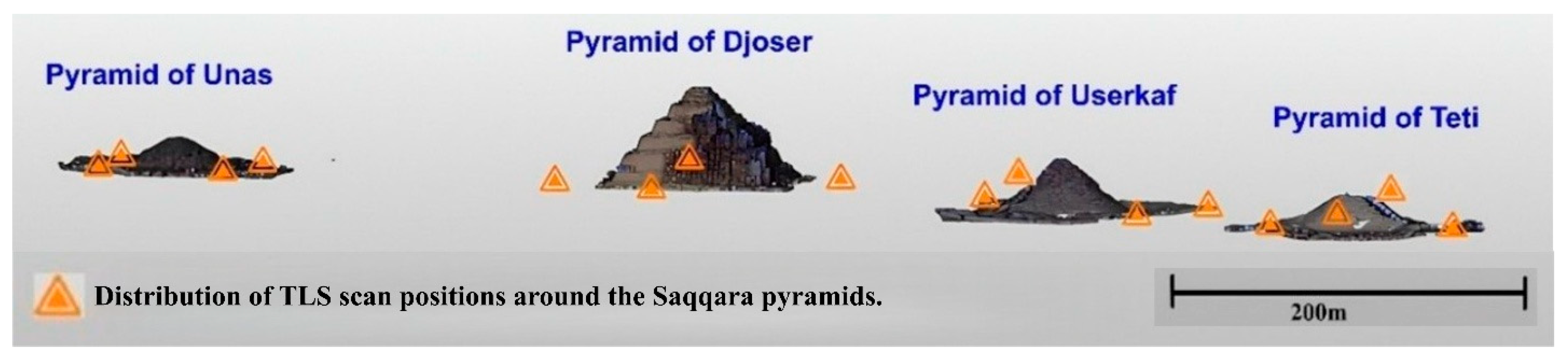
| Number of scan stations | 4 | 4 | 4 | 4 |
| Station distribution | Cardinal azimuths | Cardinal azimuths | Cardinal azimuths | Cardinal azimuths |
| Average scanning distance (m) | ~50–80 | ~25–40 | ~35–50 | ~30–45 |
| Maximum scanning distance (m) | ~80 | ~50 | ~60 | ~55 |
| Number of registration targets placed | 8 | 8 | 8 | 8 |
| Min. targets visible per station | 2 | 2 | 2 | 2 |
| Scan resolution level | TX6 Level 3 | TX6 Level 3 | TX6 Level 3 | TX6 Level 3 |
| Approx. scan time per station (min) | ~21 | ~21 | ~21 | ~21 |
| Scan overlap between adjacent stations | 30–40% | 30–40% | 30–40% | 30–40% |
| Approx. points acquired (millions) | ~700 | ~450 | ~500 | ~450 |
| Phase | Task | Team | Required Time |
|---|---|---|---|
| Planning Phase | Site reconnaissance, scan station plan, geodetic network design, safety and access planning | 1 researcher and 1 survey engineer (2 persons) | 5 working days total (2 × 5 × 8 = 80 h) |
| Fieldwork Geodetic Control | Establish GNSS/Total Station GCPs, survey targets | 1 researcher and 1 technician (2 persons) | 6 working days total (2 × 6 × 8 = 96 h) |
| Fieldwork TLS Acquisition | Trimble TX6 scanning (16 stations total across 4 pyramids), target placement, HDR imagery, daily calibration and backups | 2 researchers and 1 technician (3 persons) | 4 working days total (3 × 4 × 8 = 96 h) |
| Office GNSS/TS Processing | Process GNSS static/rapid-static results and produce control coordinates | 1 geodesist (1 person) | 4 working days total (1 × 4 × 8 = 32 h) |
| Office TLS Registration and Cleaning | Import scans to Trimble RealWorks, target-based + cloud-to-cloud registration, noise filtering and quality checks | 1 TLS specialist and 2 researchers (3 persons) | 6 working days total (3 × 6 × 8 = 144 h) |
| Office 3D Modeling and Derivatives | Mesh generation, orthophoto generation and DEM/contour extraction | 1 3D modeler and 1 GIS specialist (2 persons) | 3 working days total (2 × 3 × 8 = 48 h) |
| Office Deliverables and Archiving | Prepare E57/LAZ exports, metadata, GIS/BIM packaging and final reporting | 1 researcher (1 person) | 5 working days total (1 × 5 × 8 = 40 h) |
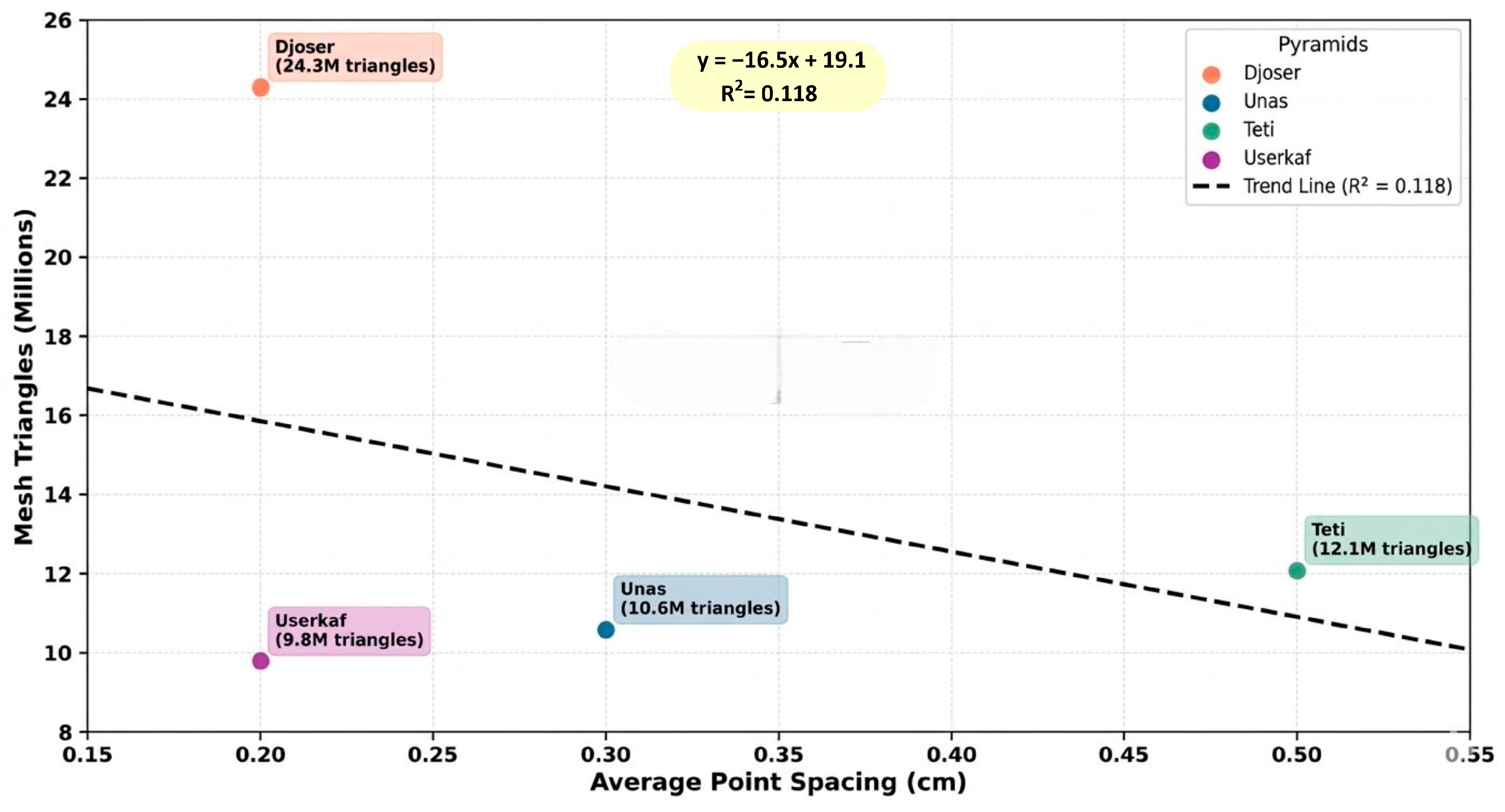
| Pyramid | Avg. Point Spacing (cm) | Approx. Triangles in Mesh Model (Million) | Notable Features Captured |
|---|---|---|---|
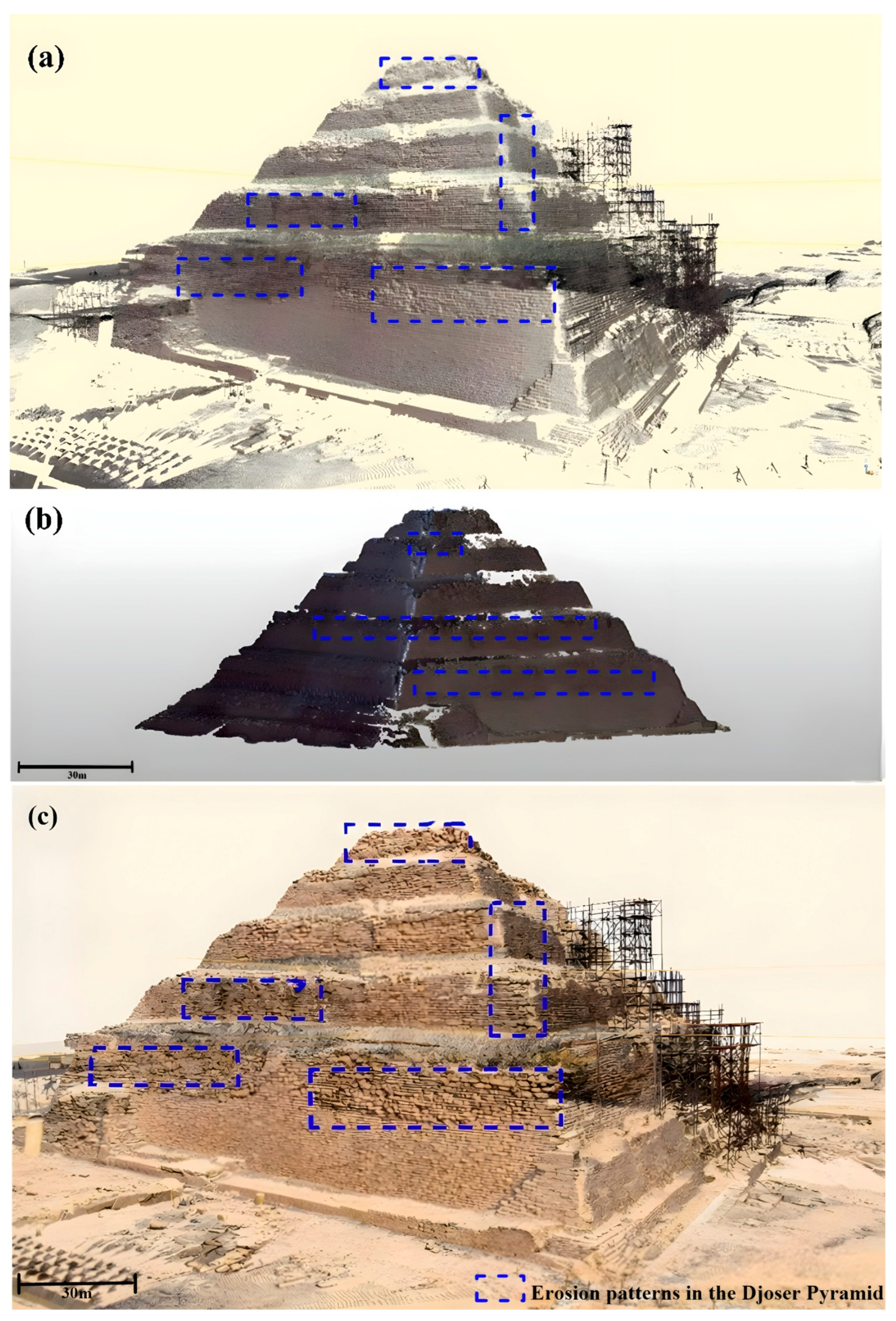
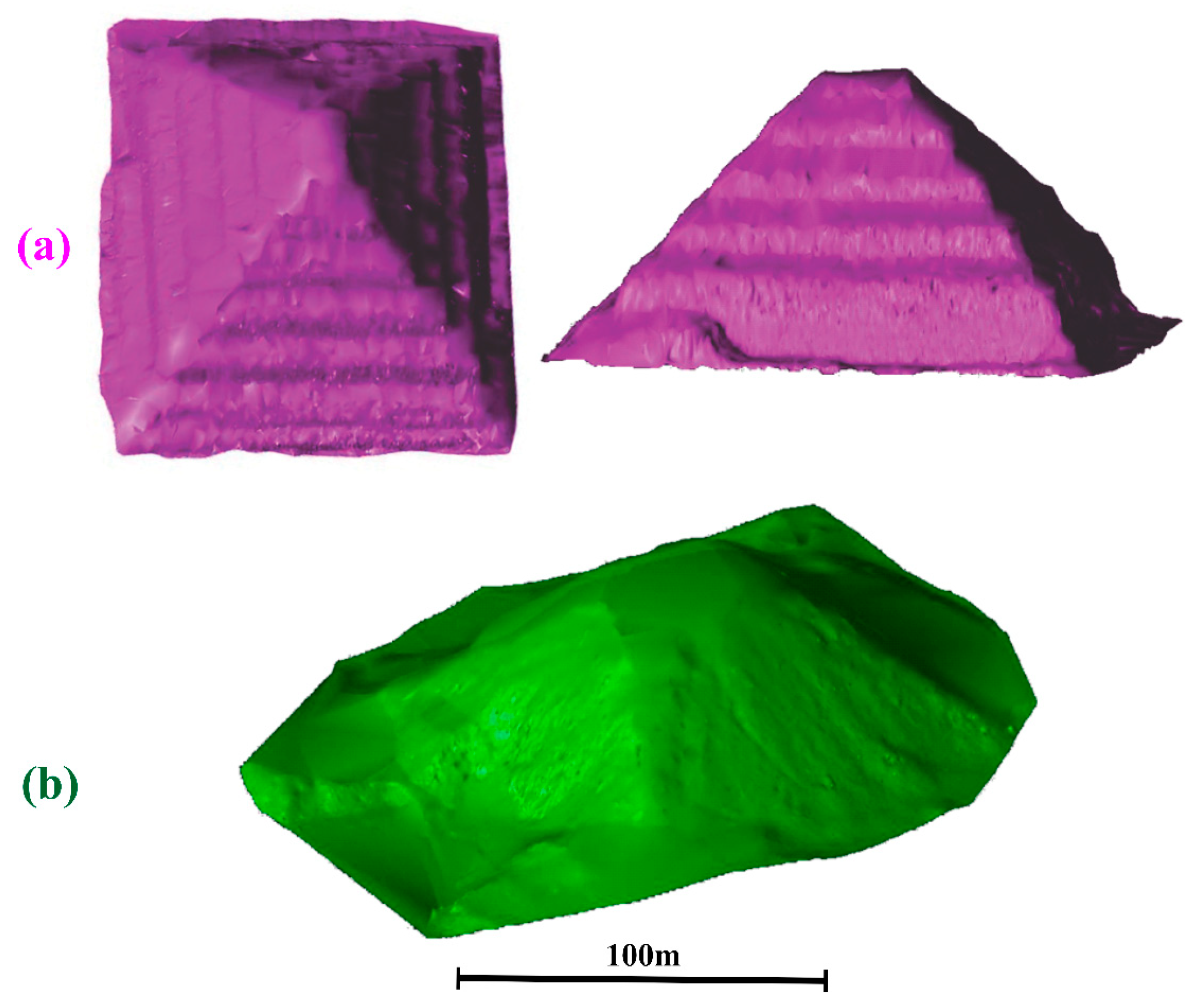
| Djoser | 0.2 | ~24.3 | Stepped terraces, tier deformations, casing stone erosion patterns |
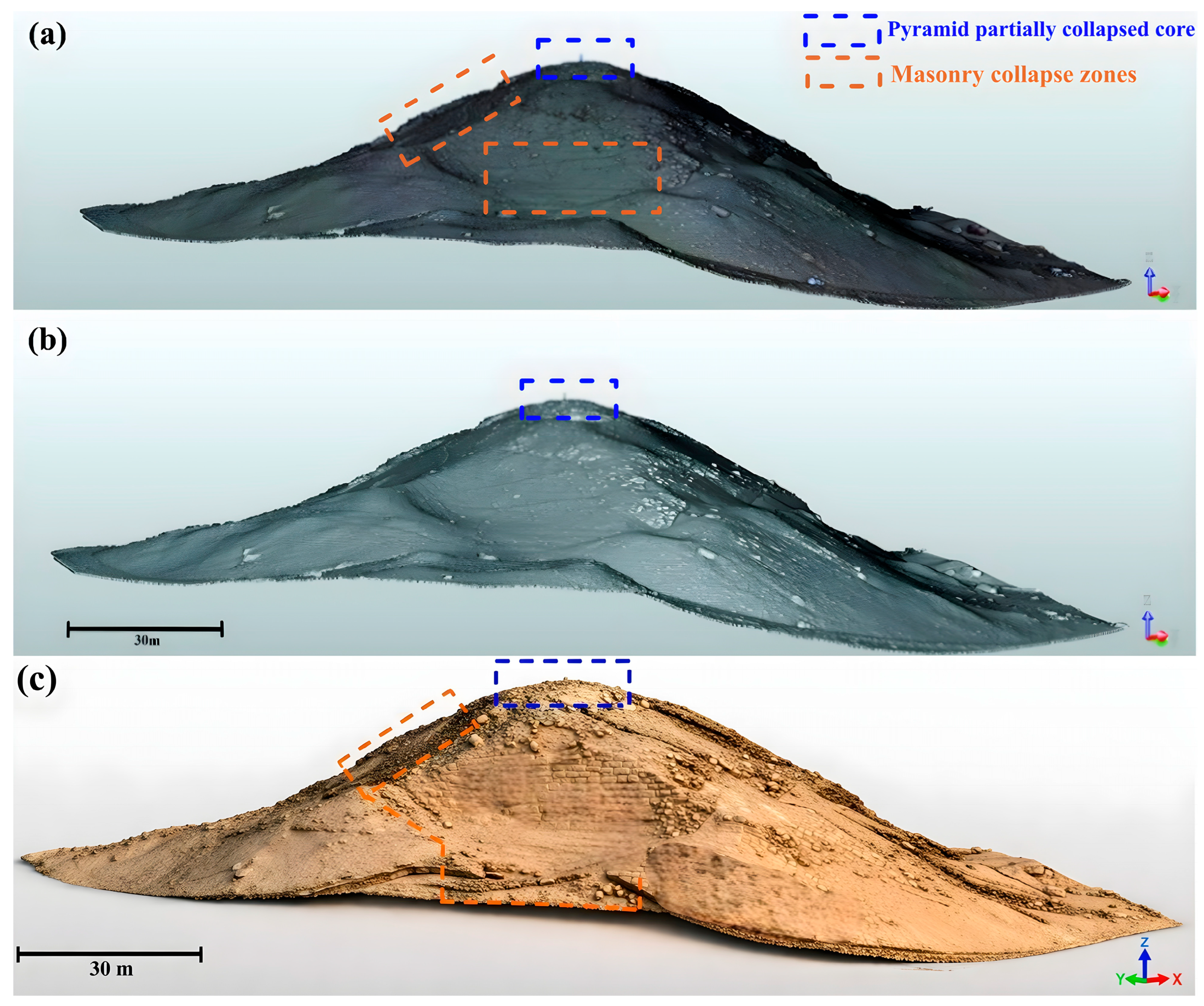
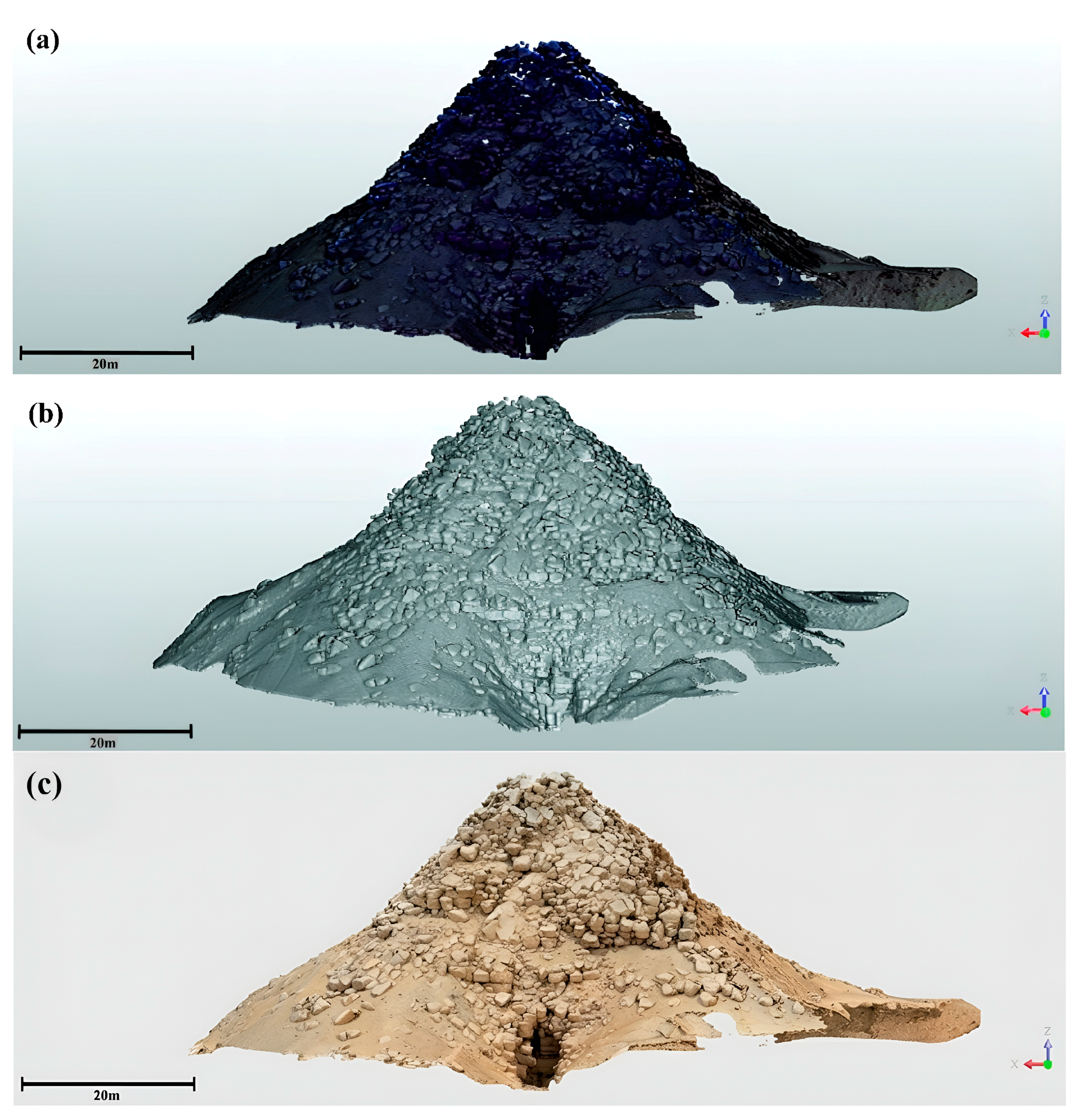
| Unas | 0.3 | ~10.6 | Collapsed sections, preserved core masonry courses, slope remnants |
| Teti | 0.5 | ~12.1 | Stable lower courses, foundational alignment, measurable south-side deformation |
| Userkaf | 0.2 | ~9.8 | Severe erosion, block displacement, remnants of internal structural elements |
Disclaimer/Publisher’s Note: The statements, opinions and data contained in all publications are solely those of the individual author(s) and contributor(s) and not of MDPI and/or the editor(s). MDPI and/or the editor(s) disclaim responsibility for any injury to people or property resulting from any ideas, methods, instructions or products referred to in the content. |
© 2026 by the authors. Licensee MDPI, Basel, Switzerland. This article is an open access article distributed under the terms and conditions of the Creative Commons Attribution (CC BY) license.
Share and Cite
Elbshbeshi, A.; Mohamed, A.; Ibraheem, I.M. High-Resolution 3D Structural Documentation of the Saqqara Pyramids, Egypt, Using Terrestrial Laser Scanning and Integrated Geomatics Techniques for Heritage Preservation. Remote Sens. 2026, 18, 1138. https://doi.org/10.3390/rs18081138
Elbshbeshi A, Mohamed A, Ibraheem IM. High-Resolution 3D Structural Documentation of the Saqqara Pyramids, Egypt, Using Terrestrial Laser Scanning and Integrated Geomatics Techniques for Heritage Preservation. Remote Sensing. 2026; 18(8):1138. https://doi.org/10.3390/rs18081138
Chicago/Turabian StyleElbshbeshi, Abdelhamid, Abdelmonem Mohamed, and Ismael M. Ibraheem. 2026. "High-Resolution 3D Structural Documentation of the Saqqara Pyramids, Egypt, Using Terrestrial Laser Scanning and Integrated Geomatics Techniques for Heritage Preservation" Remote Sensing 18, no. 8: 1138. https://doi.org/10.3390/rs18081138
APA StyleElbshbeshi, A., Mohamed, A., & Ibraheem, I. M. (2026). High-Resolution 3D Structural Documentation of the Saqqara Pyramids, Egypt, Using Terrestrial Laser Scanning and Integrated Geomatics Techniques for Heritage Preservation. Remote Sensing, 18(8), 1138. https://doi.org/10.3390/rs18081138