Article

A Hapke Physics-Guided Deep Autoencoder for Lunar Hyperspectral Unmixing

1
School of Aeronautics and Astronautics, University of Chinese Academy of Sciences, Beijing 101408, China
2
Technology and Engineering Center for Space Utilization, Chinese Academy of Sciences, Beijing 100094, China
*
Author to whom correspondence should be addressed.
Remote Sens. 2026, 18(8), 1123; https://doi.org/10.3390/rs18081123
Submission received: 9 February 2026 / Revised: 29 March 2026 / Accepted: 3 April 2026 / Published: 10 April 2026

Highlights

What are the main findings?
  • The proposed PGU-Net integrates a dual-attention encoder with a nonlinear decoder and Hapke-guided constraints, enabling unsupervised intimate-mixture unmixing with interpretable SSA endmembers and abundances.
  • PGU-Net achieves consistently lower endmember SAD and abundance aRMSE on the synthetic lunar regolith dataset and produces physically plausible mineral distributions on AVIRIS Cuprite and M 3 observations near the Chang’e-5/6 landing regions.
What are the implications of the main findings?
  • Physics-guided reconstruction improves robustness to noise and model mismatch, reducing reliance on pure-pixel assumptions and endmember labels in lunar hyperspectral unmixing.
  • The framework provides a practical and physically interpretable approach for mineral mapping on real lunar scenes, supporting the characterization of spatial mineral abundance patterns when pixel-wise ground truth is unavailable.

Abstract

Accurate mapping of lunar mineral distributions is essential for understanding the Moon’s origin and evolution and for enabling future in situ resource utilization (ISRU). Yet mineralogical inversion from orbital hyperspectral observations remains challenging due to limited spatial resolution, complex photometric conditions, and sparse returned samples. We present PGU-Net, a Hapke physics-guided deep autoencoder for nonlinear blind unmixing of lunar hyperspectral data. The encoder adopts a dual-attention design to enhance discriminative spectral features. The decoder performs linear mixing in the SSA domain and then reconstructs reflectance through a lightweight nonlinear module, while physics-consistent losses encourage radiative-transfer plausibility. Experiments on a synthetic lunar regolith dataset demonstrate that PGU-Net achieves consistently lower endmember SAD and abundance aRMSE than representative baselines across multiple noise levels. Additional validations on the terrestrial AVIRIS Cuprite benchmark and on Moon Mineralogy Mapper ( M 3 ) observations near the Chang’e-5 (CE-5) and Chang’e-6 (CE-6) landing regions yield physically plausible mineral distributions. The M 3 maps are broadly consistent with Kaguya MI mineral products and returned-sample constraints, supporting the practicality of PGU-Net for lunar mineralogical mapping.

1. Introduction

Accurate characterization of lunar surface mineralogy is essential for understanding the Moon’s origin and evolution, and spatial mineral distributions provide critical constraints. Mineralogical maps are primarily obtained by spectroscopic inversion of orbital hyperspectral imagery [1,2]. However, limited spatial resolution and fine-scale regolith heterogeneity produce mixed pixels with spectra that combine multiple materials. Spectral unmixing is a principal approach to address mixed pixels, aiming to estimate the spectral signatures of pure materials (endmembers) and their corresponding proportions (abundances) within each pixel [3].
Available algorithms for lunar hyperspectral unmixing are commonly categorized into physics-based and data-driven methods. Among physics-based models, the Hapke [4] and Shkuratov [5] radiative transfer formulations are widely used for lunar mineral retrieval. The Hapke model links single-scattering albedo (SSA) to bidirectional reflectance and is widely used in planetary remote sensing. The Shkuratov model uses endmember absorption and scattering coefficients to derive an analytical expression for mixture albedo as a function of optical properties and grain size and thus offers a compact description of nonlinear intimate-mixing effects. In practice, reflectance is first mapped to SSA with linear mixture characteristics using a radiative transfer model. Inversion is then performed based on a linear mixing model (LMM), in which the mixture SSA is approximated as a linearly weighted sum of the endmember SSAs [6,7,8,9]. For example, Yan et al. combined Clementine UVVIS/NIR with the Hapke model and LMM to map lunar minerals [7] while Liu et al. computed grain-size-dependent SSA via the Shkuratov and Hapke models before linear unmixing [8]. Space weathering terms can also be incorporated in the Hapke framework, enabling abundance retrievals for mature regolith [9,10].
Recently, data-driven methods have shown superior performance over classical approaches for lunar hyperspectral unmixing by modeling latent spectral nonlinearities and handling spectral variability, attracting increasing attention. Unsupervised strategies include the automatic extraction of endmember bundles to mitigate spectral variability and reduce dependence on spectral libraries [11,12], as well as the combination of the Fisher transformation with Multiple Endmember Spectral Mixture Analysis (MESMA) to improve abundance estimation [13]. Supervised models trained on data from returned samples learn nonlinear mappings from mixed reflectance to endmembers or compositional abundances [14,15]. For example, in [14], a convolutional inversion model was introduced using data from Apollo, Luna, and CE-5 sites to map Multiband Imager (MI) spectra to major oxide abundances.
Driven by advances in deep learning, autoencoder (AE)-based hyperspectral unmixing has progressed substantially. When endmembers are unknown, these methods perform unsupervised joint recovery of endmembers and abundances while capturing latent spectral nonlinearities [16]. AEs learn low-dimensional representations by minimizing a reconstruction objective within an encoder–decoder architecture [17]. In the unmixing context, the latent code is interpreted as the abundance vector, and the weights of a linear decoder represent the endmember matrix [18]. Accordingly, AE-based methods typically employ only a linear decoder to explicitly recover endmembers [18,19,20,21]. Initial lunar applications have also emerged. For example, a diffusion autoencoder was applied to hyperspectral data from the Yutu rover to retrieve mineral abundances near the landing site [22].
To better account for multiple scattering, recent studies have extended AE decoders beyond the purely linear form. Some studies have adopted a decoder symmetric to the encoder to stabilize abundance estimation [23], while others have appended a nonlinear block after a linear stage to capture endmember–endmember interactions [24]. Building on these ideas, dual-stream decoders with linear and nonlinear branches have been proposed, with learnable weights that adaptively balance the two branches across scenes [25,26,27,28].
Hybrid unmixing methods that integrate physical models with data-driven learning have emerged as a way to improve accuracy while maintaining interpretability. Shkuratov’s nonlinear mixing model has been coupled with neural networks to retrieve lunar composition and physical parameters [29]. An autoencoder design implemented the multilinear mixing model (MLM) to jointly estimate endmembers, abundances, and transition probabilities [30]. Another study embedded a physics-driven polynomial post-nonlinear mixing model (PPNM) in the decoder to strengthen nonlinear unmixing [31]. In addition, HapkeCNN coupled the Hapke radiative-transfer model with a CNN via Hapke-based losses, enabling effective blind unmixing under intimate-mixing conditions [32].
Despite recent advances, physics-guided, data-driven approaches tailored to lunar hyperspectral unmixing remain underexplored. Moreover, available returned samples are sparse and not globally representative, limiting the generalization of supervised inversion schemes that rely solely on them. To address these limitations, we propose an unsupervised lunar hyperspectral unmixing framework that does not rely exclusively on returned samples. The framework integrates the Hapke radiative transfer model into a deep autoencoder to capture the intimate mixing behavior of lunar regolith, thereby enhancing the accuracy and robustness of abundance estimation. The main contributions are summarized as follows:
(1)
We propose PGU-Net, an unsupervised framework tailored for lunar regolith unmixing. The encoder integrates gated spectral attention and squeeze-and-excitation channel attention to extract discriminative features despite noise and variability. Uniquely, the decoder explicitly models the Hapke radiative transfer process by performing linear mixing in the SSA domain, followed by a lightweight nonlinear mapping to compensate for residual effects. Coupled with physics-consistent losses, this design enables the blind extraction of physically meaningful endmembers and abundances.
(2)
To address the scarcity of ground-truth data in lunar remote sensing, we establish a robust three-tier validation strategy: (i) A synthetic lunar regolith dataset derived from laboratory spectra of returned samples for quantitative benchmarking; (ii) The AVIRIS Cuprite benchmark for assessing nonlinear unmixing behavior in a controlled terrestrial setting; and (iii) Real M 3 observations over the CE-5 and CE-6 landing sites. Crucially, for the lunar experiments, we introduce a sample-anchored cross-validation strategy, combining in situ returned sample measurements with independent Kaguya MI products to confirm physical plausibility and spatial consistency.
The remainder of this article is organized as follows. Section 2 describes the datasets used in this study and presents the proposed physics-guided unmixing method. Section 3 details the experimental settings and reports the corresponding results, followed by further discussion in Section 4. Finally, Section 5 concludes the paper.

2. Materials and Methods

In this section, we first describe the datasets and preprocessing procedures used in this study. This includes the composition and synthesis protocol of the lunar regolith dataset, the real-scene benchmark with complex spectral mixing, and the M 3 observations over the CE-5 and CE-6 landing regions, together with the continuum-removal preprocessing applied to the lunar spectra. We then present the proposed physics-guided autoencoder (PGU-Net), detailing its network architecture and major components.

2.1. Data and Preprocessing

2.1.1. Synthetic Lunar Regolith Dataset

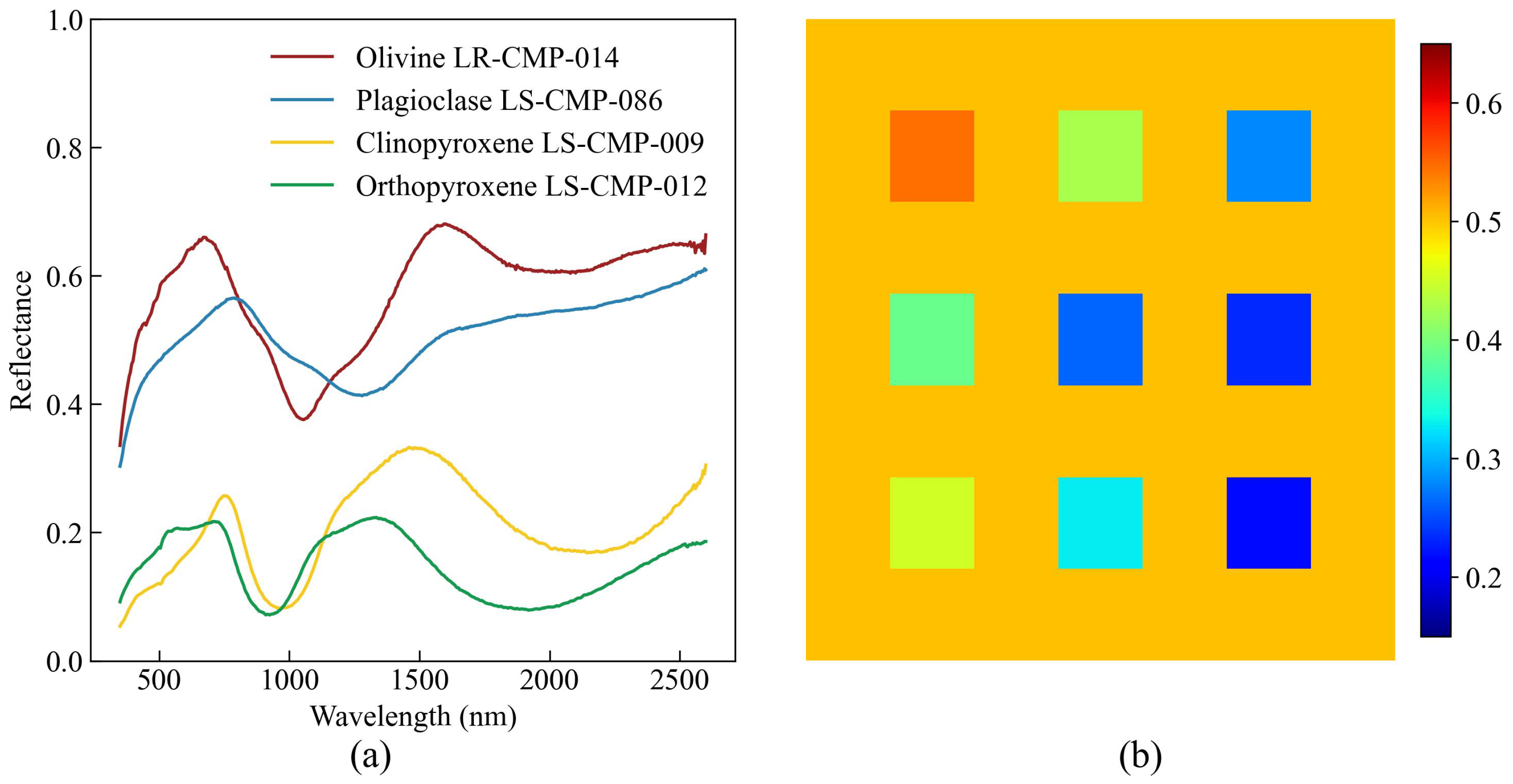
The synthetic dataset was constructed as a controlled benchmark for quantitative evaluation. It has a spatial size of 70 × 70 pixels and contains 451 spectral bands spanning 350–2600 nm. Four representative lunar minerals, clinopyroxene (CPX), orthopyroxene (OPX), olivine (OLV), and plagioclase (PLG), were selected as endmembers, and their spectra were taken from lunar-return samples measured at NASA’s Reflectance Experiment Laboratory (RELAB), as shown in Figure 1a.
To generate the synthetic hyperspectral image, the scene was divided into nine spatial patches, each associated with a predefined three-endmember or four-endmember abundance pattern representing a distinct mixture class, while the remaining area was filled with another mixture class as background. For each pixel, the endmembers were first linearly mixed in the single-scattering albedo (SSA) domain according to the prescribed abundances, and the mixed SSA was then converted into reflectance using the Hapke forward model. Figure 1b shows the reflectance image at 1500 nm. To evaluate robustness under different noise conditions, additive Gaussian white noise was further introduced to generate three noisy versions with signal-to-noise ratios (SNRs) of 20, 30, and 50 dB.
Although this synthetic dataset provides known abundance labels for controlled quantitative evaluation, it is not intended to fully reproduce the complexity of natural lunar regolith mixtures, which may additionally involve stronger intimate-mixing effects, space-weathering-related spectral variability, and grain-size-dependent scattering behavior.

2.1.2. Cuprite Dataset

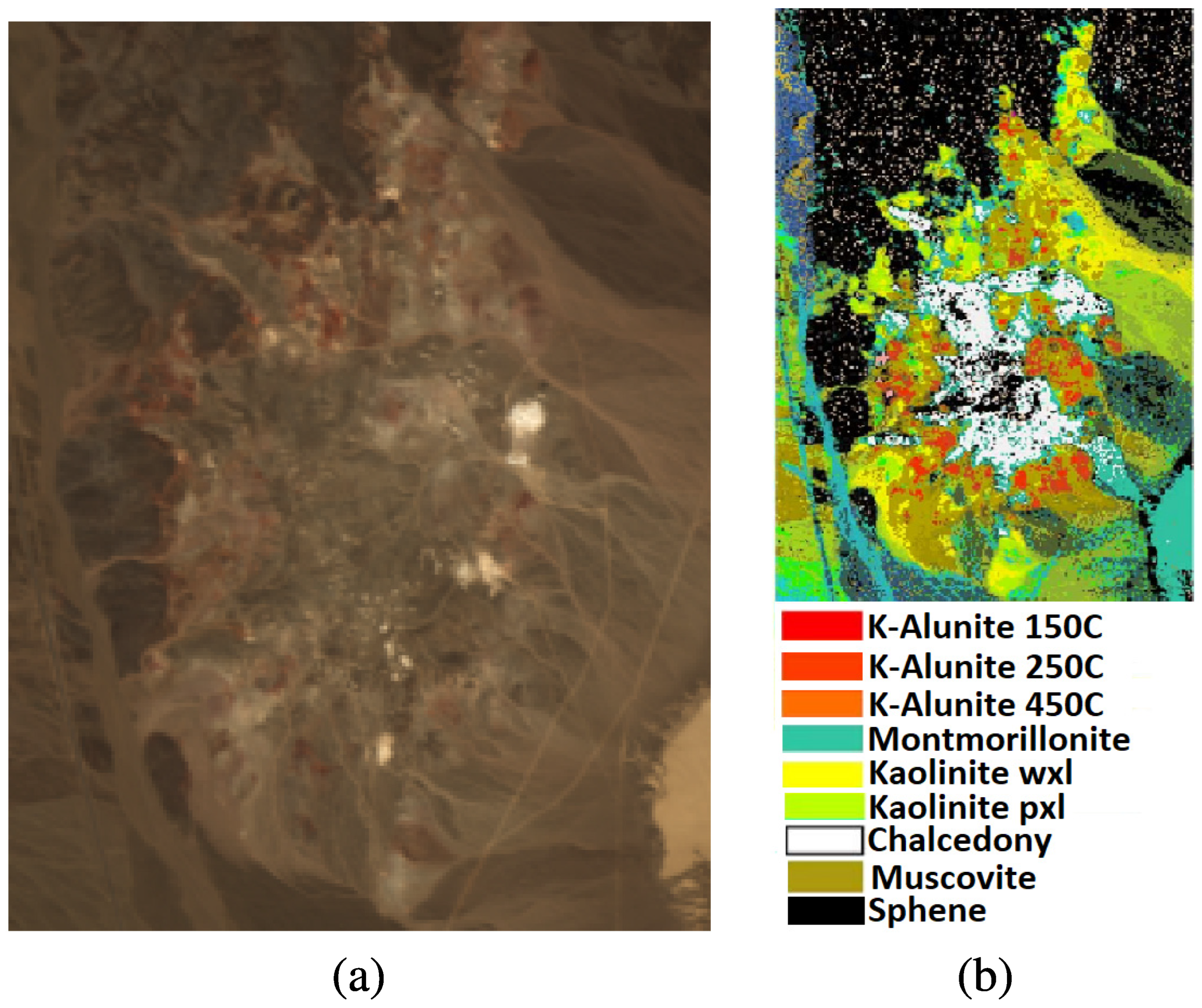
The Cuprite mining district in Nevada, United States is characterized by sparse vegetation and diverse mineralogy with complex spectral signatures. It is widely used to evaluate nonlinear spectral unmixing methods. In this study, we use the 1997 AVIRIS Cuprite scene, which contains 224 spectral bands spanning 370–2480 nm. After removing noisy bands (1–2 and 221–224) and strong water-vapor absorption bands (104–113 and 148–167), 187 valid bands remain. A 250 × 190 pixel region of interest (ROI) is selected for the experiments, covering approximately twelve major minerals. Commonly used reference endmember spectra are available for this scene. However, pixel-level abundance ground truth is unavailable. The only available ancillary information is a mineral map produced using the Tetracorder system [33], as shown in Figure 2b.

2.1.3. M3 Image Data

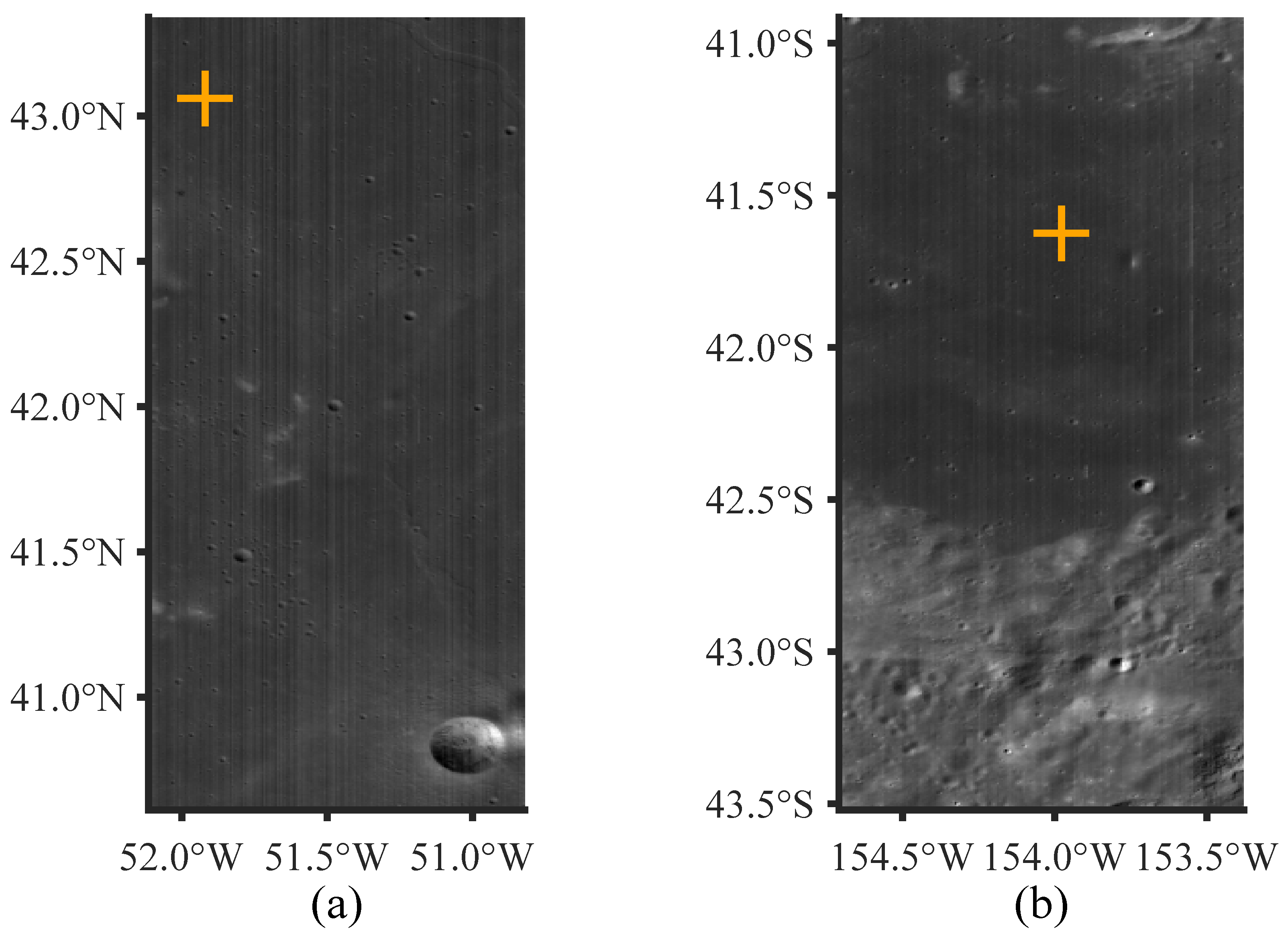
The Moon Mineralogy Mapper (M3) onboard Chandrayaan-1 provides global lunar hyperspectral observations spanning 460–2970 nm, with spatial resolutions of 140 and 280 m in global mode. In this study, Level-2 reflectance products were used to analyze mineral distributions around the CE-5 and CE-6 landing sites at ( 51.916 ° W , 43.058 ° N ) and ( 153.978 ° W , 41.625 ° S ) , respectively. We selected scenes M3G20090516T040653_V01_RFL and M3G20090426T180800_V01_RFL and cropped 500 × 200 pixel regions around each site for unmixing analysis (Figure 3).
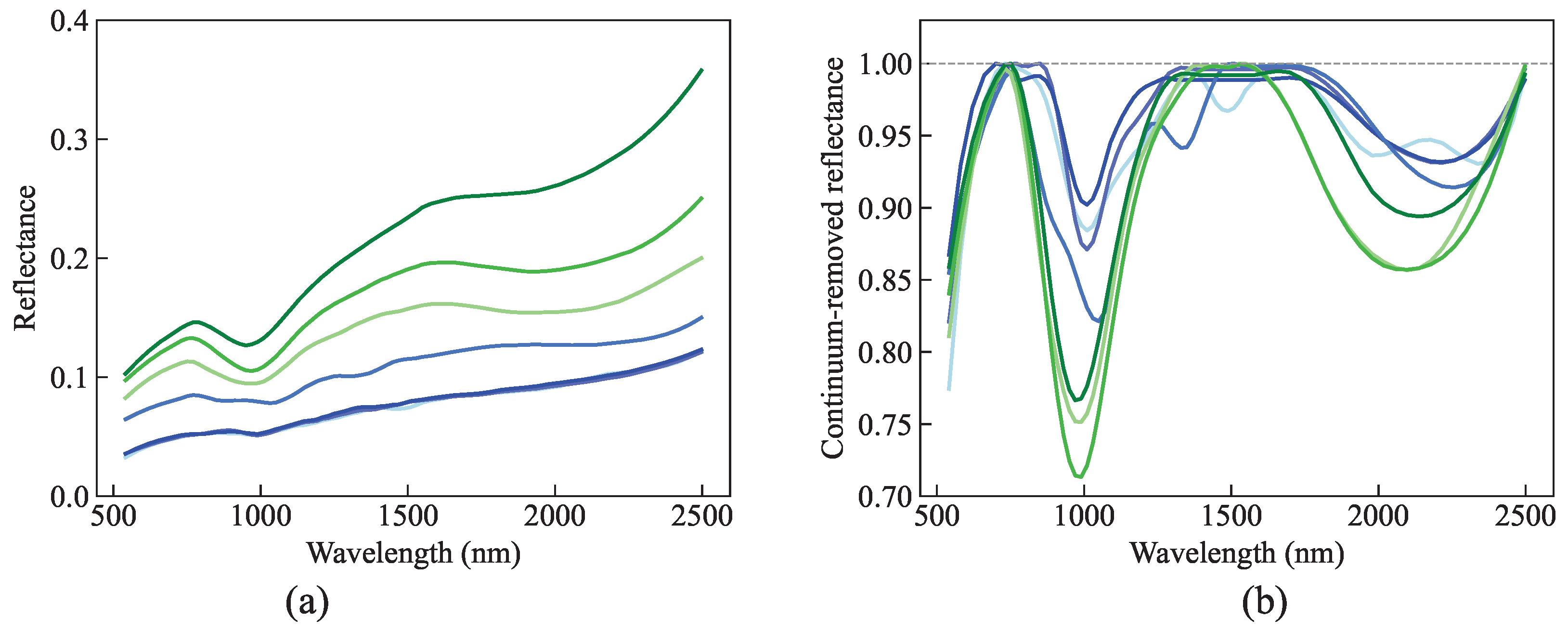
During preprocessing, we subsetted 71 high-quality bands within the 540–2500 nm range and applied a Savitzky–Golay filter [34] for spectral smoothing. Given that space weathering typically induces spectral darkening and attenuates diagnostic absorption features (Figure 4a), which hinders mineral discrimination, we employed continuum removal following the classical reflectance-spectroscopy formulation of Clark and Roush [35] to isolate absorption characteristics. Specifically, the continuum tie points were anchored at 600–900 nm and 1300–1800 nm for the 1 μm band, and at 1300–1800 nm and 2500 nm for the 2 μm band. The spectra were then normalized by the fitted continuum to yield the continuum-removed spectra shown in Figure 4b.
The lunar regolith is primarily composed of plagioclase and mafic minerals, with minor opaque phases. In the visible–near-infrared (VNIR) domain, the dominant spectrally active minerals include plagioclase, olivine, and pyroxenes. Notably, pyroxenes exhibit distinct absorption band centers depending on their calcium/magnesium ratio. Consequently, we categorize the endmembers into four representative classes for unmixing: plagioclase (PLG), high-Ca pyroxene (HCP), low-Ca pyroxene (LCP), and olivine (OLV).

2.2. Preliminaries: LMM and Hapke Model

This subsection defines the unmixing notation under the linear mixing model (LMM) and summarizes the Hapke reflectance–SSA relationship. These preliminaries establish the physical and mathematical basis for the decoder formulation and the physics-guided loss terms.

2.2.1. Linear Mixing Model (LMM)

Given a hyperspectral image Y R L × N with N pixels and L spectral bands, the LMM model assumes the observed spectral reflectance can be formulated as
Y = E A + N ,
where E R L × R is the endmember matrix with R endmembers, and A R R × N is the corresponding abundance matrix, N R L × N denotes additive noise. Under the LMM, abundances satisfy the abundance nonnegativity constraint (ANC) and the abundance sum-to-one constraint (ASC).

2.2.2. Hapke Radiative Transfer Model and SSA Inversion

For particulate intimate mixtures such as lunar regolith, multiple scattering makes the mapping from composition to bidirectional reflectance nonlinear in the reflectance domain, so the linear mixing model (LMM) is generally inadequate. We therefore adopt the Hapke radiative-transfer formulation [4] to relate bidirectional reflectance to single-scattering albedo (SSA):
r ( ω , μ , μ 0 , g ) = F ( ω ) = ω 4 ( μ + μ 0 ) [ 1 + B ( g ) ] P ( g ) + H ( ω , μ ) H ( ω , μ 0 ) 1
where r is the reflectance factor (REFF), i, e, and g are the incidence, emission, and phase angles with μ 0 = cos i and μ = cos e , and ω denotes SSA. B ( g ) is the opposition-effect term, P ( g ) is the single-particle phase function, and H ( ω , μ ) is the Chandrasekhar H-function. Following the common approximation, we use
H ( ω , μ ) 1 + 2 μ 1 + 2 μ 1 ω .
Under the adopted assumptions (e.g., isotropic scattering with P ( g ) = 1 and negligible opposition effect at moderate phase angles), Equations (2) and (3) define an inverse mapping F 1 , which provides a reflectance–SSA bridge used in our decoder design and physics-guided loss formulation.

2.3. Physics-Guided Unmixing Network

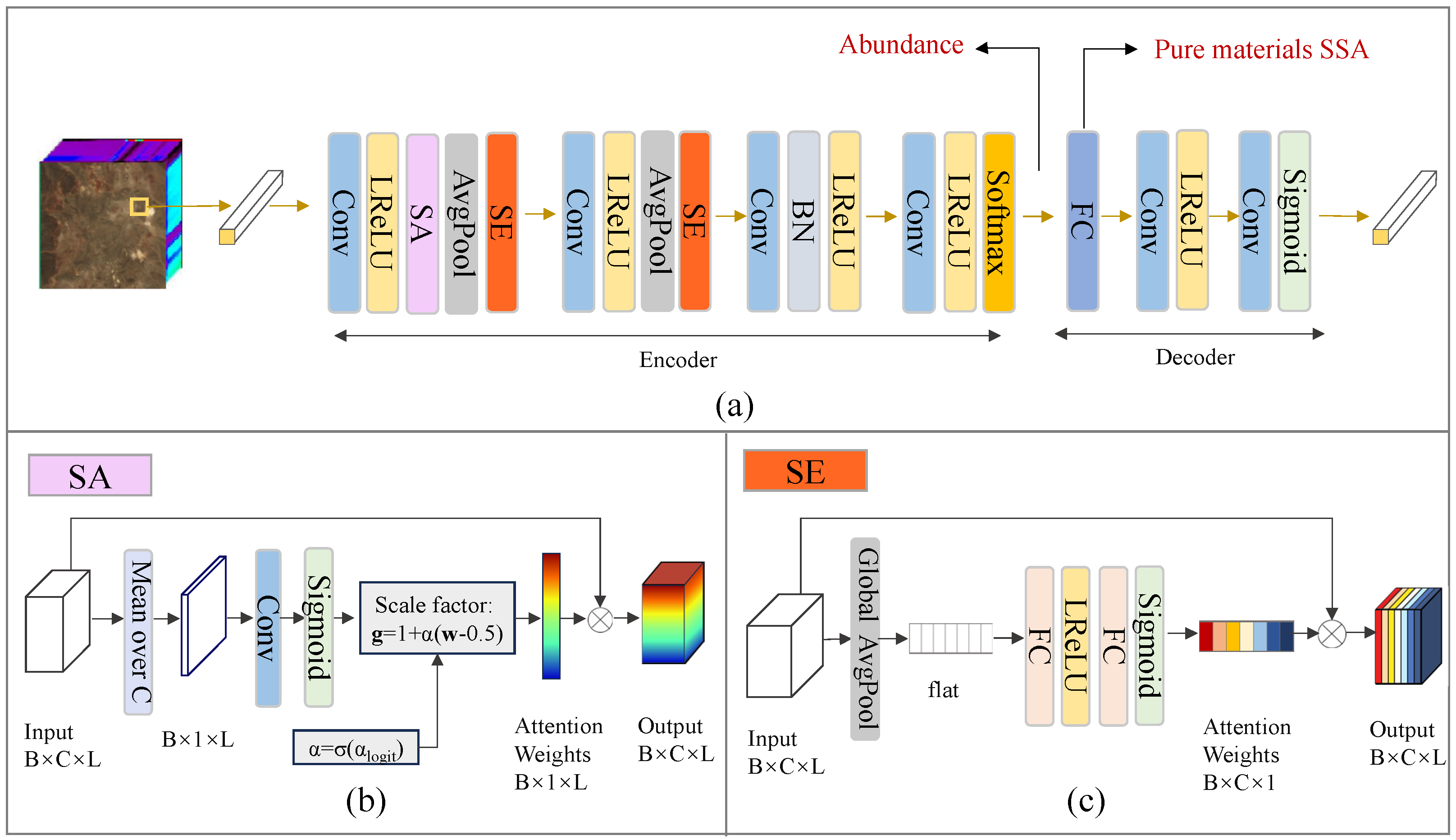
As illustrated in Figure 5, the proposed framework follows an encoder–decoder paradigm for hyperspectral unmixing. Given an input pixel spectrum, the encoder maps the high-dimensional reflectance vector to a low-dimensional abundance vector. The decoder reconstructs the spectrum with a physics-inspired design that mirrors the reflectance formation process. Specifically, a linear mixing layer first generates a mixture spectrum in the single-scattering-albedo (SSA) domain, whose weight matrix is interpreted as a learnable SSA endmember dictionary. A subsequent nonlinear module then maps the mixed SSA to reflectance, capturing the nonlinearities induced by multiple scattering and residual modeling mismatch. The network is trained in a fully unsupervised manner by minimizing a composite objective that combines reconstruction fidelity with Hapke-consistency constraints, enabling physically plausible unmixing without requiring prior knowledge of endmembers. The structural details of PGU-Net are summarized in Table 1.

2.3.1. Encoder

As detailed in Figure 5a and Table 1, the encoder comprises four cascaded blocks that map each input pixel spectrum to a latent abundance representation. Given a reflectance spectrum x R L , we employ a hierarchical stack of 1D convolutions together with pooling and attention modules. The encoder adopts an expansion–compression channel design: the feature channels are first expanded to enhance discriminative representation capacity and are then progressively reduced to R channels, where R is the number of endmembers, to produce the final abundance vector.
Specifically, Blocks 1–2 consist primarily of a 1D convolution followed by LeakyReLU (slope 0.2 ) and an average pooling layer. The convolution layers are responsible for expanding and compressing the feature channels, while the subsequent pooling layers effectively suppress high-frequency spectral variations and downsample the spectral dimension. Block 3 adopts a convolution with stride 2, batch normalization, and LeakyReLU to further aggregate features and obtain R channels. Block 4 applies a final convolution and LeakyReLU, and the output is squeezed and normalized by a Softmax along the endmember dimension to enforce the abundance non-negativity and sum-to-one constraints. The kernel sizes of the four convolution layers are 9, 9, 7, and 5, with all strides set to 1 except Block 3 (stride 2). The average pooling layers use a kernel size of 5 with a stride of 5. All convolutions are implemented as valid convolutions.
To enhance discriminative spectral responses, we incorporate a dual-attention mechanism in the early stages (Blocks 1–2), specifically a Gated Spectral Attention (SA) module and a Squeeze-and-Excitation (SE) module, as illustrated in Figure 5b,c.
Given an intermediate feature map X R C × L , SA aims to adaptively recalibrate the importance of spectral bands. We first aggregate channel-wise statistics via global mean pooling along the channel dimension to obtain a spectral descriptor m R 1 × L :
m k = 1 C c = 1 C X c , k , k = 1 , , L .
A 1D convolution (kernel size 7) followed by a Sigmoid function generates a raw spectral attention map w = σ ( Conv 1 D ( m ) ) ( 0 , 1 ) 1 × L . Unlike standard attention, which uses direct multiplication, we propose a residual gating mechanism to ensure training stability and facilitate gradient flow:
X SA = X 1 + α ( w 0.5 ) , α = σ ( α logit ) ( 0 , 1 ) ,
where ⊙ denotes element-wise multiplication with broadcasting. Here, α is a learnable scalar gate initialized to a small value. This design allows the module to approximate an identity mapping at the beginning of training, preventing performance degradation in the early stages.
Complementary to SA, the SE module models inter-channel dependencies. A global average pooling operation along the spectral dimension compresses the feature map into a channel descriptor z R C :
z c = 1 L k = 1 L X c , k .
A lightweight gating network then generates channel-wise weights s :
s = σ U 2 δ ( U 1 z ) ,
where δ denotes the ReLU activation and U 1 R C r × C and U 2 R C × C r are weights of the fully connected layers with reduction ratio r ( r = 4 for Block 1, r = 2 for Block 2). Finally, the feature map is recalibrated by X ˜ c = s c · X c , adaptively emphasizing informative feature channels while suppressing redundant ones.

2.3.2. Decoder

As illustrated in Figure 5a and summarized in Table 1, the decoder follows a Hapke-inspired two-stage design, mirroring the physical abundance-to-reflectance generation process. It consists of a linear mixing layer in the single-scattering albedo (SSA) domain, followed by a lightweight nonlinear correction module to simulate the radiative transfer to reflectance.
Given the estimated abundance vector a ^ R R , an FC layer performs linear mixing to reconstruct the mixture single-scattering albedo (SSA) spectrum:
ω ^ = W a ^ , ω ^ R L ,
where W R L × R is the learnable weight matrix. Each column of W corresponds to the SSA of a pure material, and thus W can be interpreted as an endmember SSA dictionary learned in an unsupervised manner.
To account for nonlinear effects when mapping SSA to reflectance, including multiple scattering and residual discrepancies between the simplified physics and the observations, we employ a compact 1D convolutional module operating along the spectral dimension:
y ^ = f θ ( ω ^ ) ,
where f θ ( · ) consists of two convolutional layers: Block 6 uses Conv1D with kernel size 5, stride 1, and padding p = 2 followed by LeakyReLU to expand features from 1 to 64 channels. Block 7 applies Conv1D with kernel size 1 and stride 1, followed by Sigmoid to project back to a single reflectance channel. The Sigmoid activation bounds the reconstructed reflectance y ^ ( 0 , 1 ) L , which is consistent with the physical range of reflectance. This decoder design is physics-inspired in structure, while the explicit physical consistency is further encouraged during training via the reconstruction and physics-guided losses described in Section 2.3.3.

2.3.3. Objective Functions

To bridge data-driven representation learning and physically motivated radiative-transfer modeling, PGU-Net is optimized with a composite objective.
(1)
Hapke-consistency constraint.
This term regularizes the latent space toward physically plausible solutions. We let Y R L × N denote the observed reflectance spectra of N pixels with L bands, A R R × N the estimated abundance matrix, and W R L × R the learned SSA endmember matrix. Using the Hapke forward model F ( · ) in Equation (2), we map the linearly mixed SSA to a physics-predicted reflectance and define
L hapke = 1 2 Y F W A F 2 .
Minimizing L hapke encourages the learned SSA endmembers and abundances to yield reflectance consistent with the Hapke-based radiative-transfer mapping, thereby improving interpretability and training stability in the unsupervised setting.
(2)
Reconstruction fidelity.
In addition to the physics-consistency term, we impose a reconstruction loss on the network output Y ^ :
L rec = 1 2 Y Y ^ F 2 .
This term enforces data fidelity and allows the learnable decoder to absorb residual discrepancies between the simplified physical forward model and real measurements, leading to more accurate reconstructions.
(3)
Endmember smoothness regularization.
Since SSA spectra are typically smooth across neighboring wavelengths, we penalize spurious oscillations in the learned endmembers via a second-order finite-difference regularizer:
L smooth = 1 R ( L 2 ) i = 1 R l = 2 L 1 W l + 1 , i 2 W l , i + W l 1 , i 2 .
(4)
Total objective.
The overall training objective is
L total = L hapke + α L rec + β L smooth ,
where the Hapke-consistency term is kept with unit weight and α and β control the relative contributions of the reconstruction fidelity and smoothness regularization terms. The selection of these hyperparameters is further discussed in Section 3.5.

3. Results

In this section, we compare the proposed method with several state-of-the-art approaches to demonstrate its effectiveness. To ensure the reliability of the experimental results, evaluations are conducted on a synthetic lunar regolith dataset and a real dataset. Finally, we apply the model to mineral inversion using M3 data over the CE-5 and CE-6 landing regions.

3.1. Experimental Setup

3.1.1. Comparison Algorithms

To evaluate the performance of PGU-Net, we select five representative baselines covering both classical and recent state-of-the-art hyperspectral unmixing methods. For classical baselines, endmembers are extracted using vertex component analysis (VCA) [36] and simplex volume maximization (SiVM) [37], and abundances are estimated using fully constrained least squares (FCLS) [38]. For the deep-learning-based unmixing schemes, we select CyCU-Net [39], which employs cascaded autoencoders with cycle-consistency constraints to enhance spectral reconstruction and abundance consistency; A2SAN [40], which leverages abundance-guided self-attention for end-to-end unmixing; and HapkeCNN [32], which couples the Hapke radiative-transfer mechanism with convolutional networks to characterize intimate mixtures. Regarding the traditional unmixing approaches, for a fair comparison, reflectance is first converted to SSA using the Hapke model. For consistency, methods requiring endmember initialization use VCA. These baselines were chosen to cover traditional unmixing, generic deep autoencoder-based unmixing, attention-based deep unmixing, and physics-related nonlinear unmixing.

3.1.2. Parameter Settings

The proposed PGU-Net is implemented in PyTorch 2.7.0 and trained on an Intel i9-12900K CPU and an NVIDIA RTX 3090 GPU. The network is trained for 1000 epochs using the Adam optimizer with an initial learning rate of 10 2 . The Hapke model parameters are fixed at μ 0 = 0.866 and μ = 1 , and the loss weights are set to α = 10 4 and β = 10 2 . The batch size is 128 for the synthetic dataset and 512 for the real-data experiments. To improve robustness, the reported endmember extraction and abundance estimation results are averaged over ten independent runs with different random initializations. For visualization and case study analysis, the run achieving the lowest total loss is used.

3.1.3. Evaluation Metrics

To quantitatively assess unmixing performance, we compute the abundance root-mean-square error (aRMSE) between the estimated and reference abundances for each pixel, defined as
aRMSE = 1 R i = 1 R 1 N a i a ^ i 2 .
The spectral angle distance (SAD) is further employed to measure the similarity between the estimated and reference endmembers, defined as
SAD = 1 R i = 1 R arccos e i T e ^ i e i e ^ i .
Since the linear layer of our decoder outputs endmember albedos, these must be converted into reflectance through the Hapke model before evaluation. It should also be noted that when datasets have many endmembers, we employ the Hungarian algorithm [41] to ensure an exact matching between estimated and reference abundances.

3.2. Results on the Synthetic Lunar Regolith Dataset

On the synthetic lunar regolith dataset, Table 2 reports the endmember SAD, abundance aRMSE, and their mean values under SNR levels of 20, 30, and 50 dB. Across all noise conditions, PGU-Net achieves the lowest mean endmember SAD and the lowest mean abundance aRMSE among all compared methods, indicating consistently strong quantitative performance and robustness to noise. HapkeCNN generally ranks second, whereas CyCU-Net and A2SAN yield larger errors. The classical VCA–FCLS and SiVM–FCLS baselines exhibit substantially higher SAD/aRMSE than the deep learning-based approaches.
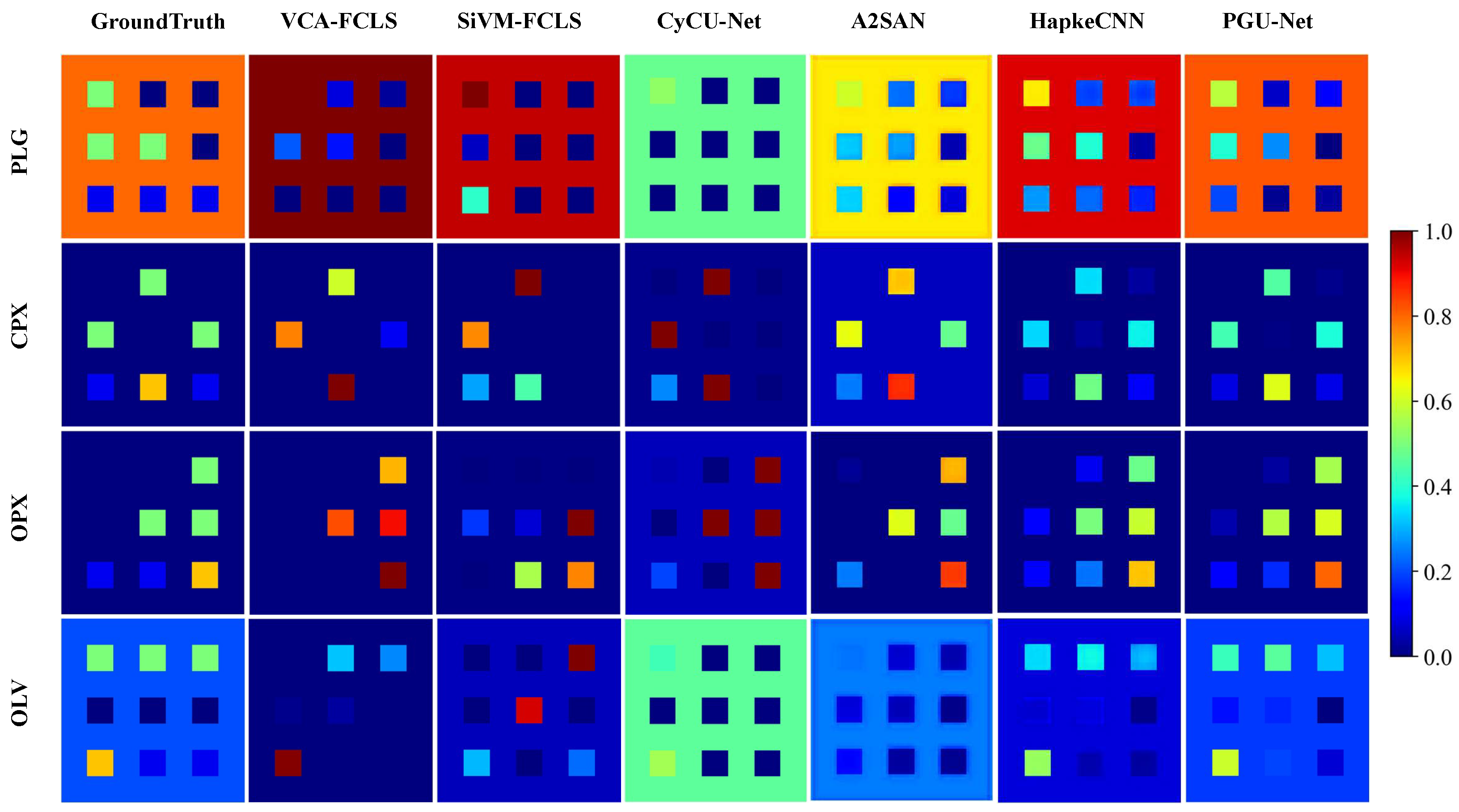
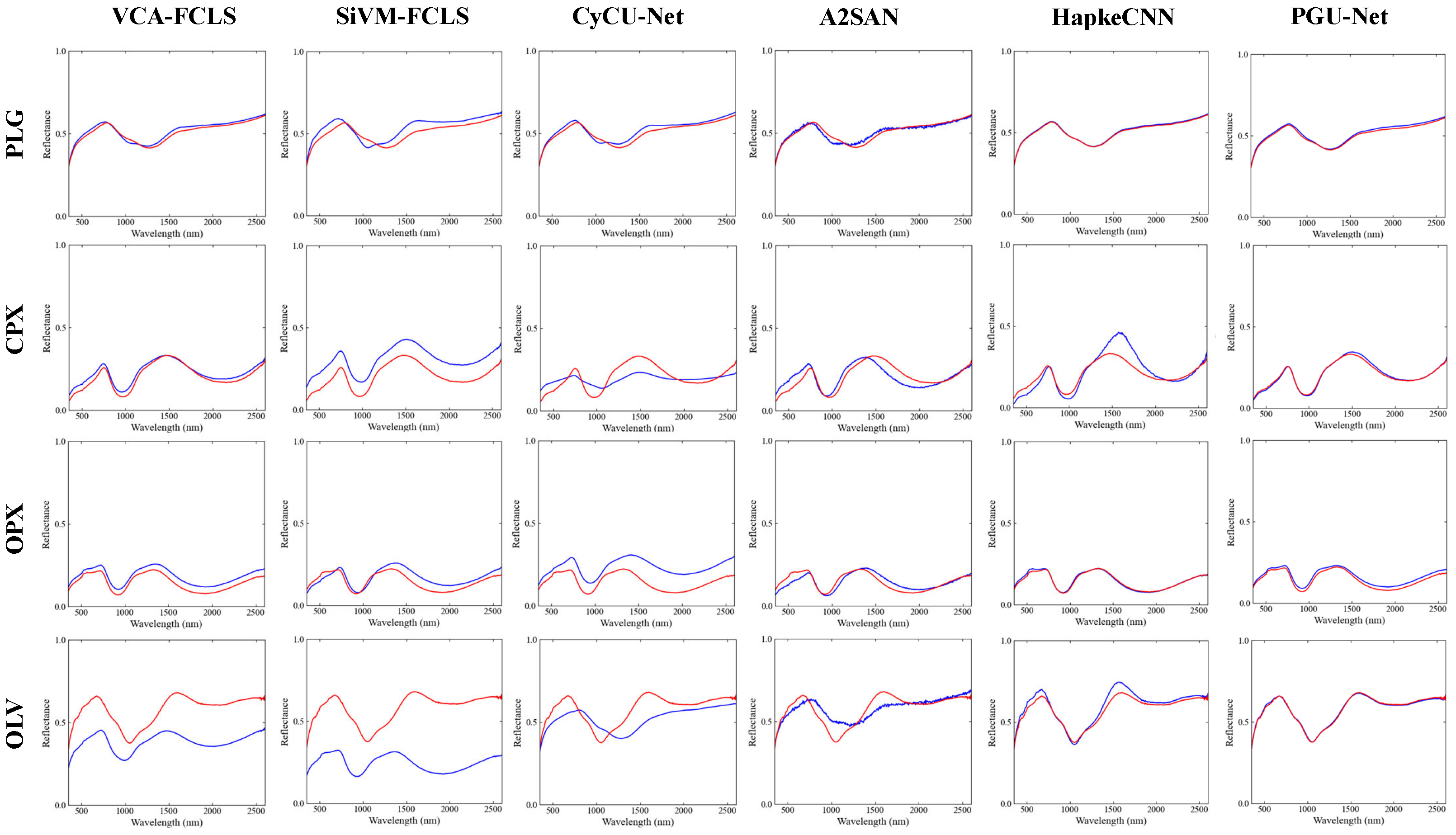
Figure 6 and Figure 7 provide qualitative comparisons at SNR = 50 dB. PGU-Net produces abundance maps and reconstructed endmember spectra that are visually closer to the ground truth, with fewer artifacts and improved spectral fidelity compared with competing methods. Across methods, plagioclase (PLG) generally yields the smallest endmember SAD, indicating that its spectrum is easier to recover. In contrast, the two pyroxenes (CPX and OPX) tend to achieve lower abundance aRMSE than the other minerals, suggesting that their abundances are more readily estimated. Overall, olivine (OLV) remains the most challenging component, as reflected by consistently larger SAD/aRMSE across methods; nevertheless, PGU-Net still provides competitive reconstructions for OLV.

3.3. Results on Cuprite Dataset

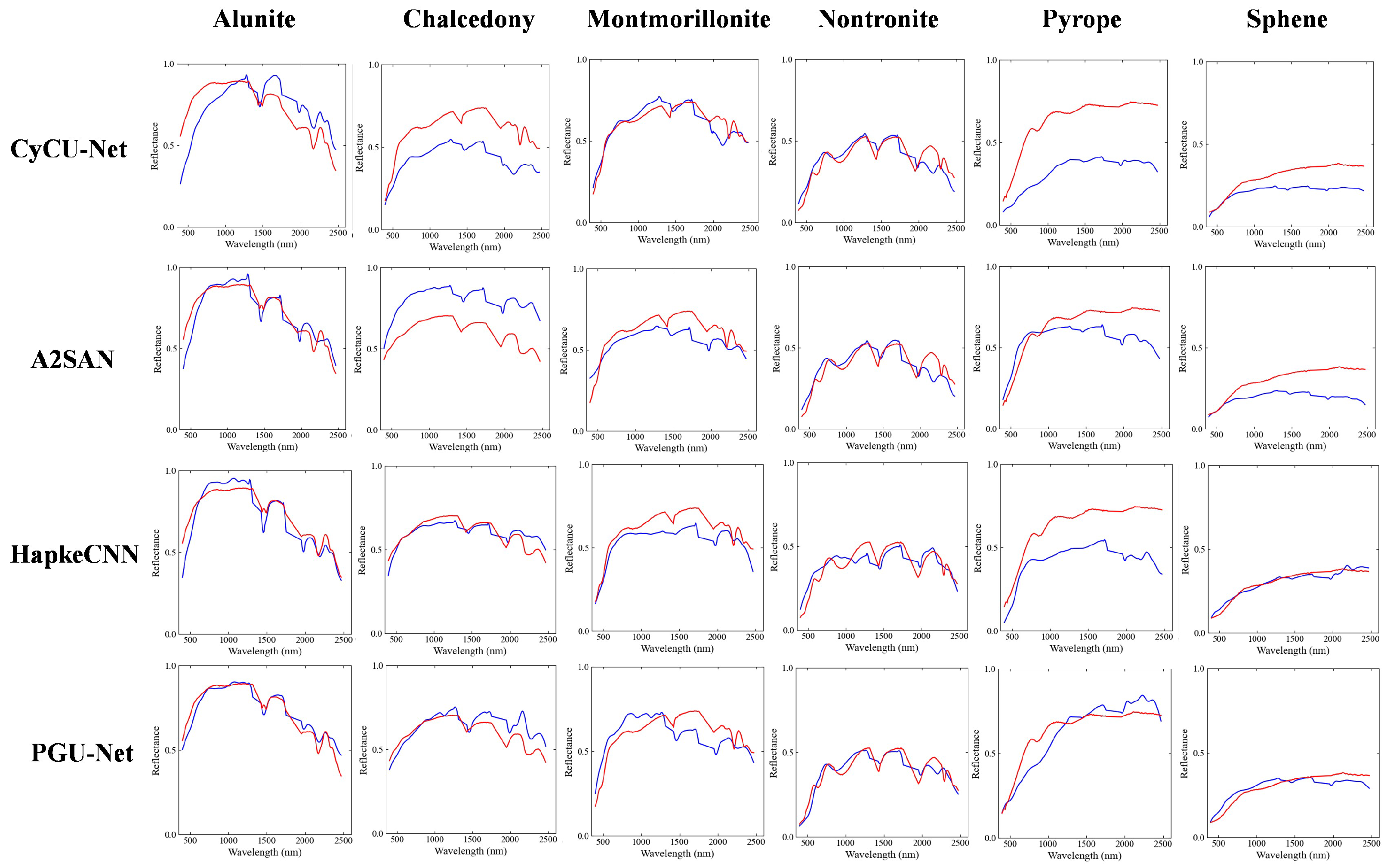
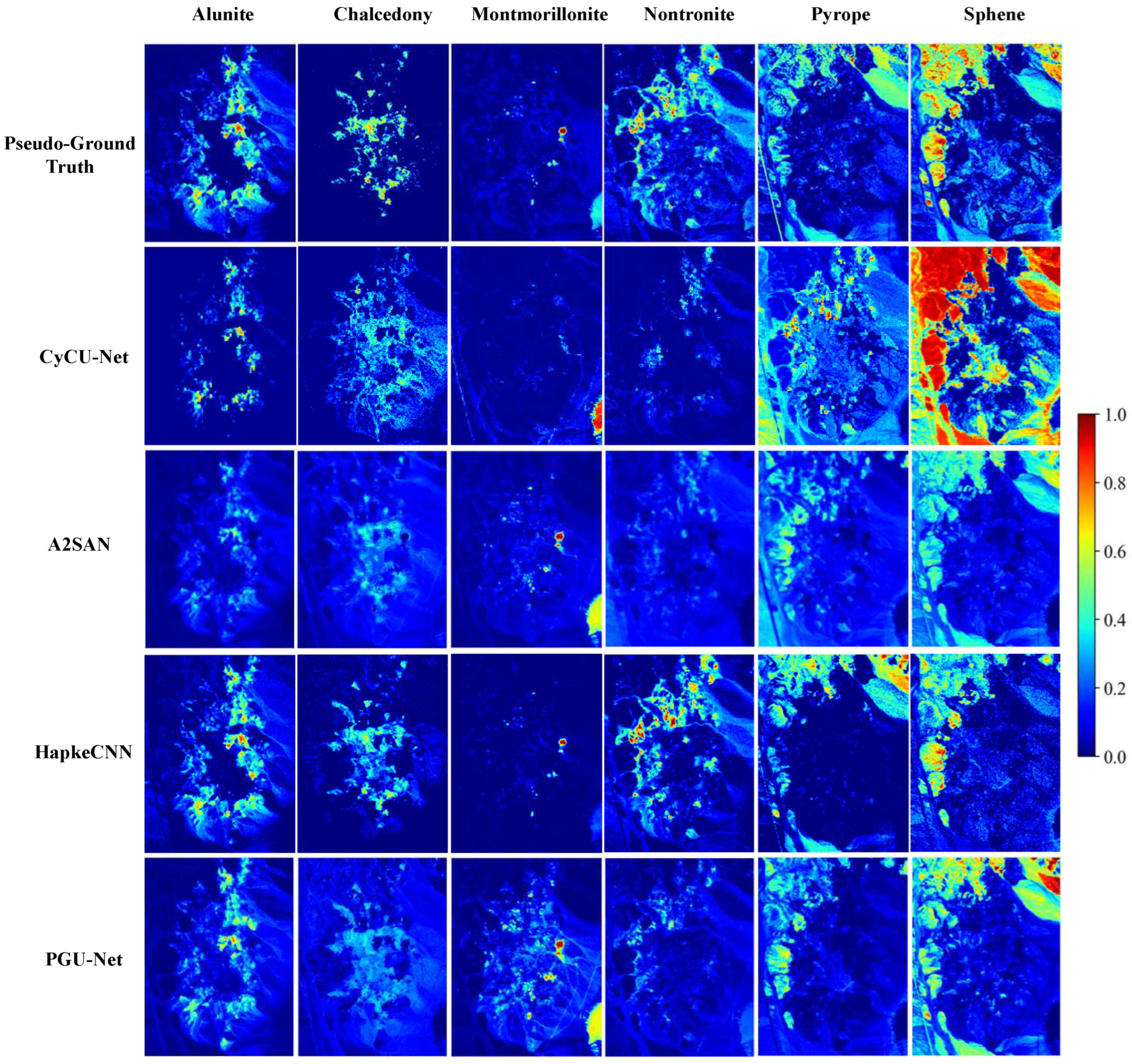
The AVIRIS Cuprite benchmark provides reference endmember spectra but does not offer ground-truth abundance maps. Therefore, following [32], abundance estimation is evaluated qualitatively using pseudo-reference maps. Specifically, the reference abundance maps are obtained by applying FCLSU in the SSA domain with the provided reference endmembers. These FCLSU-based maps are used only for visual comparison, together with the RGB composite in Figure 2b, while the endmember SAD values are reported in Table 3. Figure 8 and Figure 9 present the endmember spectra and abundance maps produced by CyCU-Net, A2SAN, HapkeCNN, and PGU-Net for six representative minerals, showing the performance of different methods on this real scene.
As listed in Table 3, PGU-Net achieves the lowest mean SAD among the compared methods. For Alunite, Nontronite, and Pyrope, it also yields the lowest individual SAD values. The endmember curves in Figure 8 further show that the spectra extracted by PGU-Net generally follow the reference signatures more closely, particularly around the main diagnostic absorption features. As for the abundance maps in Figure 9, the spatial distributions estimated by PGU-Net are generally more consistent with the pseudo-reference maps for Alunite, Montmorillonite, Pyrope, and Sphene, while exhibiting relatively fewer scattered responses in background regions.

3.4. Results on M3 Data

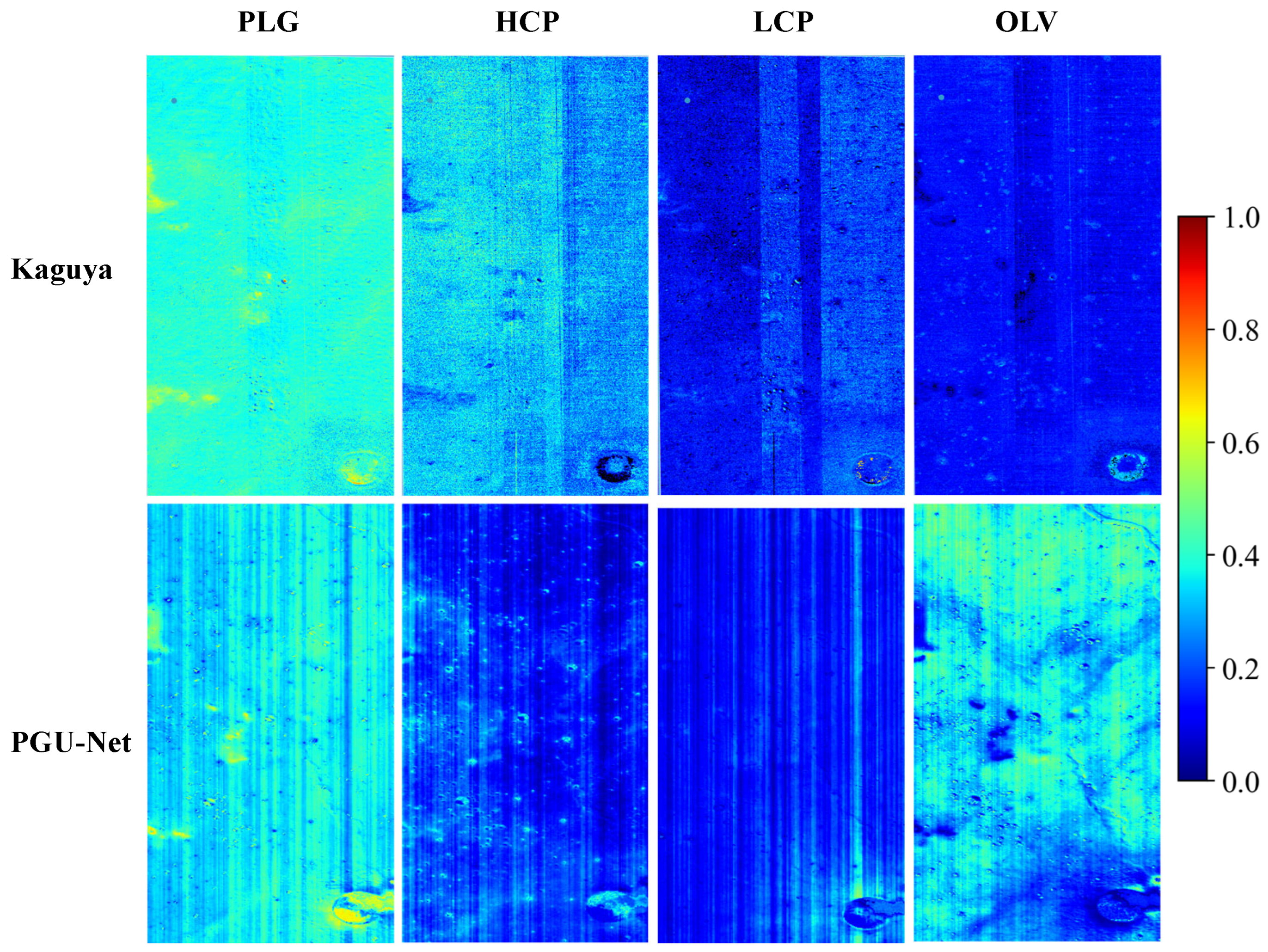
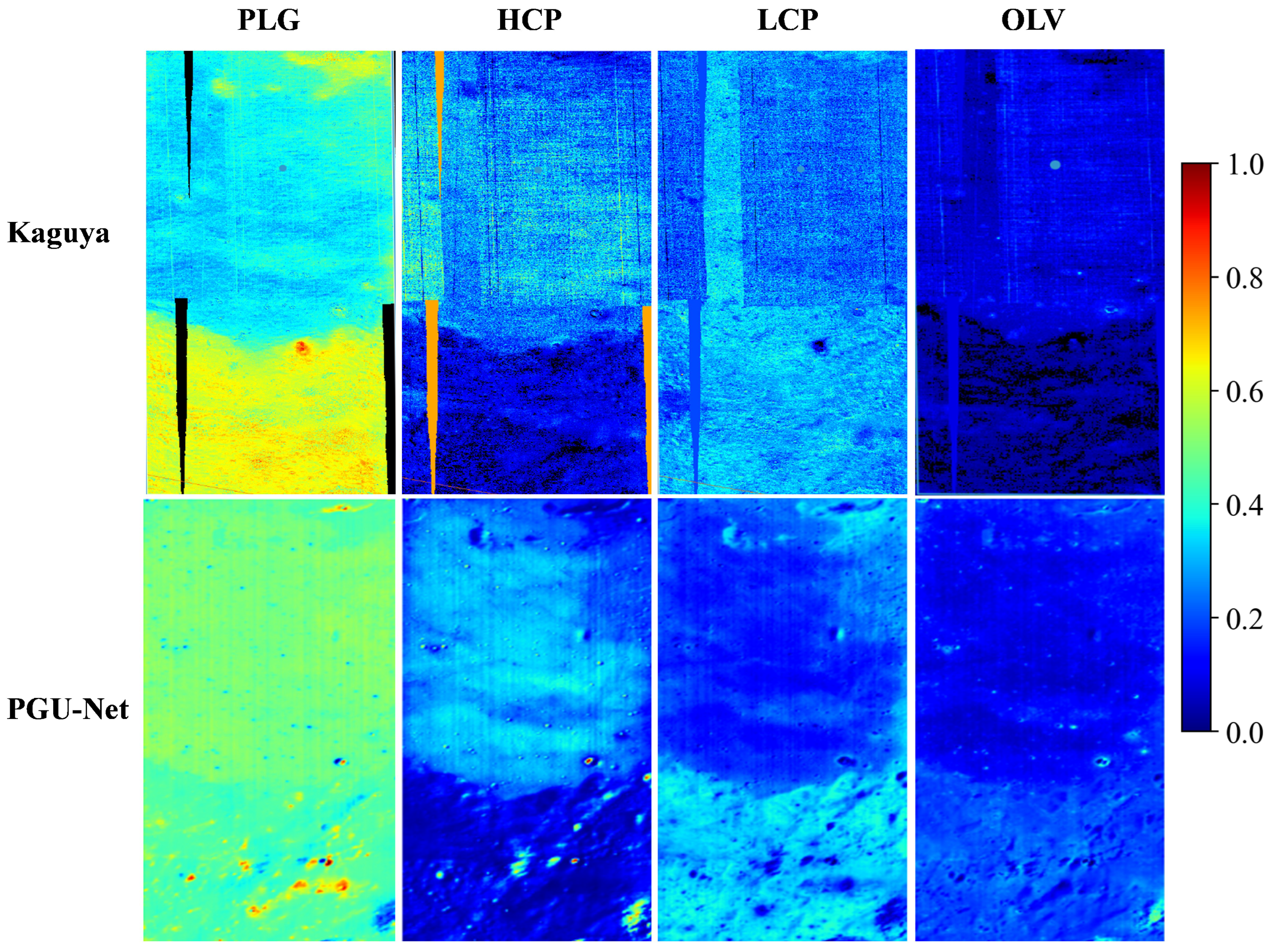
Due to the unavailability of pixel-level ground-truth mineral abundance maps for the CE-5 and CE-6 landing regions, we evaluate the unmixing performance using a twofold strategy. First, we conduct an approximate quantitative assessment by comparing the estimated abundances at the landing-site pixels with laboratory measurements of returned samples [42,43]. For consistency with our four-phase unmixing setting, the laboratory volume fractions are re-normalized to sum to unity over the four major mineral phases (PLG, HCP, LCP, and OLV). Second, we perform a qualitative spatial comparison against previously published Kaguya MI mineral abundance products available through the LROC QuickMap platform (available online: https://quickmap.lroc.asu.edu/, 10 January 2026), which were derived using Hapke radiative-transfer-based spectral modeling [44]. Specifically, Table 4 and Table 5 report the approximate quantitative comparisons at the CE-5 and CE-6 landing-site pixels, respectively, whereas Figure 10 and Figure 11 present the corresponding qualitative spatial comparisons over the surrounding 500 × 200 -pixel regions.
Table 4 reports the laboratory sample abundances and the abundances estimated at the CE-5 landing-site pixel by PGU-Net and the Kaguya MI product. Both inversion results indicate a mare-basalt assemblage dominated by pyroxene. Relative to the laboratory reference, the mean absolute error (MAE) across the four endmembers is reduced from 4.60 vol% (Kaguya) to 2.80 vol% (PGU-Net), and the corresponding RMSE decreases from 5.46 vol% to 3.20 vol%. This performance gain is primarily driven by the substantial accuracy improvement in Low-Ca Pyroxene (LCP) estimation, where the absolute error diminishes from 8.7 vol% to nearly 0.6 vol%. A notable reduction in error is also observed for Plagioclase (PLG) (from 5.3 vol% to 2.9 vol%). Figure 10 presents the abundance maps, where PGU-Net remains broadly consistent with Kaguya while better capturing local variations—such as low plagioclase and high pyroxene concentrations near impact craters—consistent with lunar geological evolution.
Similarly, Table 5 summarizes the laboratory sample abundances and the estimated abundances at the CE-6 landing-site pixel. Relative to the laboratory reference, PGU-Net reduces the MAE from 6.13 vol% (Kaguya) to 4.18 vol% and the RMSE from 7.70 vol% to 5.03 vol%. The largest gain is observed for PLG, where the absolute error decreases from 10.1 to 0.5 vol%, and OLV is also improved (from 11.4 to 8.3 vol%). Figure 11 further shows that PGU-Net yields spatial abundance maps with improved continuity and clearer structural details compared with the Kaguya product.

3.5. Parameter Analysis and Ablation Experiments

In this section, we analyze the sensitivity of PGU-Net to key hyperparameters and conduct ablation studies on the encoder attention and the decoder nonlinear module. All experiments are performed on the Synthetic Lunar Regolith Dataset, and performance is evaluated using endmember SAD and abundance aRMSE.
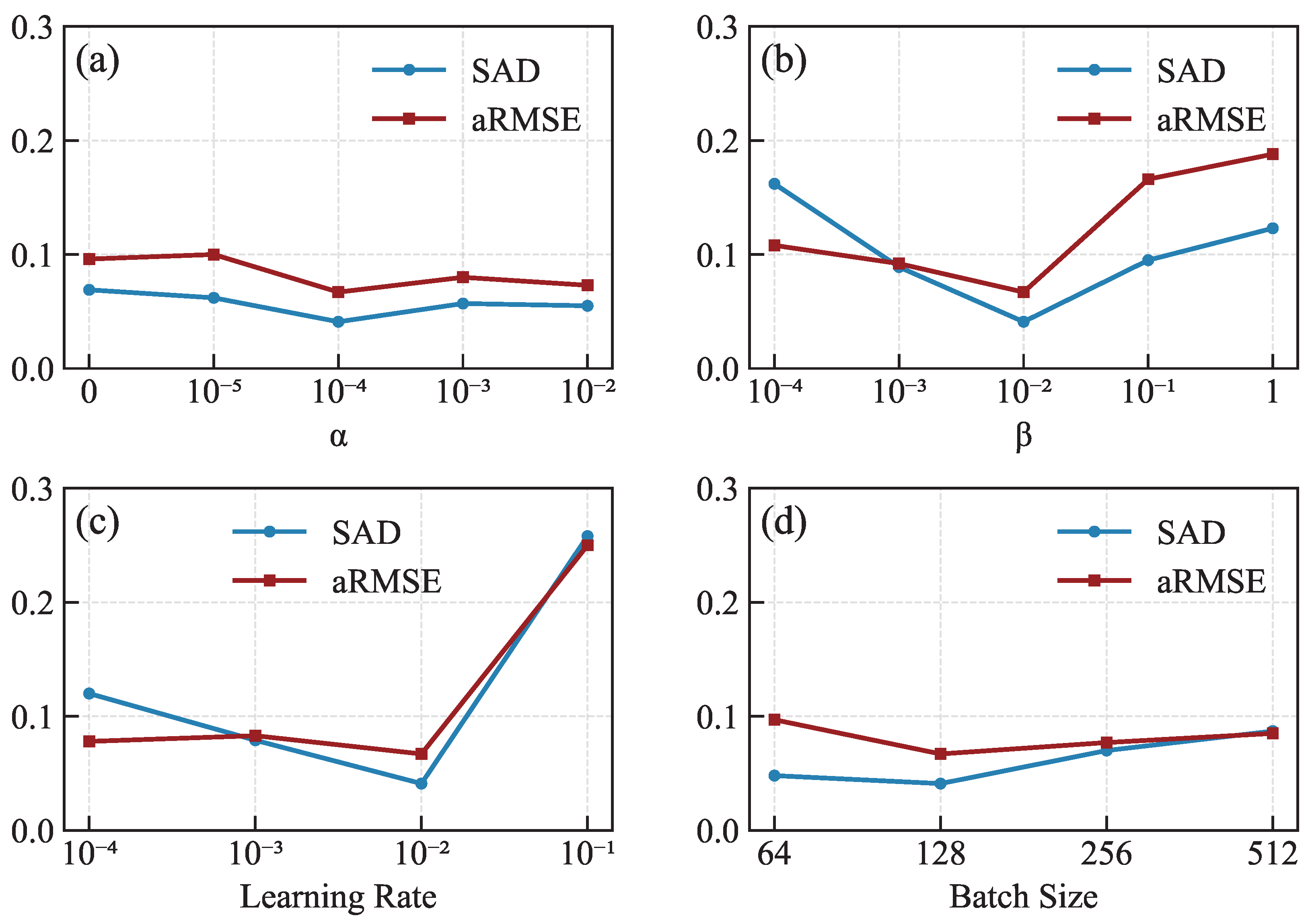
Figure 12 summarizes the sensitivity of PGU-Net to the loss weights α and β in Equation (13), as well as the learning rate and batch size. Here, α controls the contribution of the reconstruction term L rec , whereas β weights the endmember smoothness regularizer L smooth .
As shown in Figure 12a,b, the best performance is obtained at α = 10 4 and β = 10 2 , where both SAD and aRMSE reach their minima. In particular, increasing α beyond 10 4 leads to a clear degradation in both metrics, suggesting that an overly strong reconstruction term can interfere with the physics-guided optimization trajectory. By contrast, β exhibits a clearer optimum: values smaller than 10 2 are insufficient to regularize the learned endmembers effectively, whereas larger values over-constrain the solution and degrade the preservation of diagnostic spectral features. To further interpret this scale separation, we examine the gradient norms of the three loss terms with respect to the decoder mixing matrix during training. Our analysis shows that, in the early stage, the unweighted L hapke typically produces the largest gradients (approximately on the order of 10 2 ), while L rec yields intermediate gradients (approximately on the order of 10 1 ), and L smooth produces substantially smaller gradients (approximately on the order of 10 4 ). As training proceeded, the gradients of L hapke gradually decreased, and the relative contribution of the unweighted L rec became more noticeable; however, due to the small weighting factor α , its effective contribution to the total gradient remained much smaller than that of the Hapke term.
If α were set too large, L rec would interfere with the physics-guided optimization in the early stage, potentially leading to solutions that fit the data well but violate physical consistency. Therefore, a small α ( 10 4 ) is chosen to prevent excessive interference with the Hapke-driven optimization while still allowing L rec to contribute to refining the final reconstruction in later training stages. Conversely, the larger β ( 10 2 ) compensates for the intrinsically small gradient magnitude of L smooth and ensures that the regularization term has a non-negligible effect. This configuration balances the relative contributions of the auxiliary terms while preserving the dominant role of the physics-guided Hapke term, thereby supporting stable optimization and strong unmixing performance.
For the optimization hyperparameters [see Figure 12c,d], PGU-Net is relatively robust to the learning rate within 10 4 10 2 , whereas performance degrades sharply at 10 1 . Regarding batch size, stable results are achieved across 64–512, with slightly better performance at 128. These findings indicate that careful tuning of β and the learning rate is more critical for accurate and robust unmixing, while PGU–Net is comparatively insensitive to batch size.
To assess the contribution of individual components in PGU-Net, we perform an ablation study by removing the Spectral Attention (SA), Channel Attention (CA), and the decoder nonlinear module (NL), respectively. Quantitative results on the synthetic lunar regolith dataset are reported in Table 6. The full PGU-Net achieves the best overall performance (Mean SAD/aRMSE = 0.32/0.67). Removing SA degrades the results to 0.48/0.84, and removing CA yields 0.47/0.89, showing that both attention mechanisms contribute to improved unmixing accuracy. The impact of SA is most pronounced for olivine: the OLV SAD increases from 0.20 to 0.88 without SA, indicating that band-wise reweighting is important for recovering challenging minerals with less separable spectral signatures. Removing NL causes the largest performance drop, with the mean error increasing to 0.64/1.05. All minerals exhibit higher SAD and aRMSE in this setting, indicating that the nonlinear decoder component is necessary to account for intimate-mixture nonlinearity and residual mismatch beyond linear SSA mixing.

4. Discussion

This work investigates whether embedding radiative-transfer-inspired structure into an autoencoder can improve hyperspectral unmixing for lunar intimate mixtures, where nonlinear scattering effects and limited ground truth pose major challenges. We discuss the results from three complementary perspectives: (i) controlled synthetic experiments that quantify accuracy and noise robustness; (ii) the AVIRIS Cuprite benchmark that probes generalization when abundance ground truth is unavailable; and (iii) M 3 unmixing around the CE-5/CE-6 landing regions, where validation relies on returned-sample constraints and cross-sensor mineral products. Across these settings, PGU-Net consistently achieves competitive or better results, indicating that the physics-guided reconstruction pathway helps the network learn physically plausible unmixing.

4.1. Discussion on the Synthetic Lunar Regolith Dataset

The consistent gains of PGU-Net across all SNR settings support the effectiveness of the proposed physics-guided encoder–decoder design for intimate-mixture unmixing on the synthetic lunar regolith dataset. PGU-Net achieves the best overall performance, and HapkeCNN ranks second in terms of the mean endmember SAD and mean abundance aRMSE (Table 2), highlighting the benefit of incorporating radiative-transfer-inspired structure and constraints into an autoencoder framework.
Compared with HapkeCNN, PGU-Net yields consistently lower errors across noise levels. At an SNR of 50 dB, the mean endmember SAD decreases from 0.56 to 0.32, and the mean abundance aRMSE decreases from 0.89 to 0.67. These gains can be attributed to two design choices in PGU-Net. First, the dual-attention encoder emphasizes informative spectral responses and suppresses nuisance variations, which is beneficial under noise and spectral variability. Second, the decoder follows a Hapke-consistent reconstruction pathway: it performs linear mixing in the SSA domain and then maps SSA to reflectance, aligning the network forward process with the radiative-transfer formation mechanism. The lightweight nonlinear component further compensates for residual model mismatch and unmodeled scattering effects. This interpretation is supported by the ablation results in Table 6, where removing the attention module or the nonlinear module degrades both endmember and abundance accuracy.
By contrast, CyCU-Net and A2SAN rely on a predominantly linear decoder, which is less expressive for intimate mixtures on this benchmark and leads to larger errors, especially at lower SNR. Although VCA–FCLS and SiVM–FCLS are classical linear baselines based on the pure-pixel assumption, their performance benefits from conducting unmixing in the SSA domain rather than directly in the reflectance domain. In addition, VCA adopts an SNR-aware dimensionality reduction step, which may partly explain its relatively stronger endmember recovery among classical baselines under certain conditions.
From a mineral-specific perspective, the relative difficulty of unmixing different components can be partly explained by their diagnostic absorption characteristics and spectral separability. Pyroxenes (OPX and CPX) typically exhibit pronounced absorption features near ∼1 μm and ∼2 μm, with CPX bands often shifted to longer wavelengths than OPX, which can improve identifiability and lead to lower abundance errors across methods. Plagioclase (PLG) tends to be easier to recover in terms of endmember SAD under the current synthetic setting, likely because its diagnostic absorption feature around ∼1.2 μm is more spectrally separable from the absorptions of pyroxenes and olivine in the considered wavelength range. In contrast, olivine (OLV) is more challenging: its broad ∼1 μm absorption can overlap with pyroxene features, and its lower abundance fraction in mixtures reduces the effective signal-to-noise ratio for estimation. These factors likely contribute to the consistently larger SAD/aRMSE observed for OLV, while PGU-Net still provides competitive reconstructions, benefiting from physics-guided regularization and the nonlinear correction capacity.

4.2. Discussion on Cuprite Dataset

Compared with CyCU-Net, A2SAN, and HapkeCNN, PGU-Net shows better overall performance on the real Cuprite scene in terms of both endmember recovery and abundance estimation. Specifically, the lower mean SAD and the generally closer agreement between the estimated and reference spectra suggest that the proposed method is more effective in capturing representative spectral characteristics under complex real-scene conditions. The abundance maps further show that, for several representative minerals, PGU-Net yields spatial distributions that are generally more consistent with the pseudo-reference maps.
These results indicate that the proposed physics-guided autoencoder framework is beneficial for real-scene hyperspectral unmixing. Relative to the other three deep learning-based methods, PGU-Net provides more competitive results on the Cuprite dataset, suggesting its potential for mineral mapping in complex scenes where abundance labels are unavailable.
It should be noted, however, that Cuprite is a terrestrial dataset, and its scattering characteristics are not fully consistent with the lunar regolith scenario considered in this work. Therefore, the Hapke-guided prior may introduce some modeling bias when applied to this dataset. In addition, for certain minerals, such as Chalcedony and Nontronite, the estimated abundance maps still show visible discrepancies from the pseudo-reference maps, indicating that mineral discrimination remains challenging in the presence of complex spectral variability and spectral overlap.

4.3. Discussion on M3 Data

The M 3 unmixing results around the CE-5 and CE-6 landing regions provide a lunar-specific test case where pixel-level mineral-abundance ground truth is unavailable. Here we evaluate PGU-Net using two complementary sources of indirect evidence: (i) an approximate quantitative comparison at the landing-site pixels against laboratory modal abundances of returned samples [42,43] and (ii) a qualitative spatial comparison against the Kaguya MI mineral abundance product. It should be noted that the returned-sample comparison is affected by an inherent scale mismatch, because each M 3 pixel represents the average composition of a mixed surface area at the orbital-footprint scale, whereas the returned samples characterize only local materials collected at the landing site. Therefore, this comparison should be regarded as an approximate local compositional reference rather than a strict pixel-level ground-truth validation.
At the CE-5 landing site, both PGU-Net and the Kaguya product indicate a mare-basalt assemblage dominated by pyroxene, consistent with typical mare mineralogy where pyroxene is abundant and high-Ca pyroxene can exceed low-Ca pyroxene [45]. At the landing-site pixel, PGU-Net yields a lower overall discrepancy with the returned-sample reference than the Kaguya product. Spatially, the abundance maps (Figure 10) show that PGU-Net remains broadly consistent with the Kaguya product while exhibiting more pronounced local contrast, such as the distinct depletion of plagioclase and enrichment of pyroxene near impact craters, suggesting a greater ability to capture local spatial variations in mineral composition.
For the CE-6 landing site, the estimated mineral proportions are more consistent with a highland-dominated assemblage, where plagioclase is expected to be more abundant than pyroxene [46]. At the landing-site pixel, PGU-Net again yields a lower overall discrepancy with the returned-sample reference than the Kaguya product, and the spatial abundance maps (Figure 11) exhibit improved continuity and fewer noise-like artifacts. These observations suggest that the proposed physics-guided reconstruction remains effective under the more complex spectral variability encountered in real lunar observations.
Overall, the comprehensive evaluations across synthetic simulations and real lunar observations suggest that embedding a radiative-transfer-consistent structure into an autoencoder can improve robustness and physical consistency for intimate-mixture unmixing. However, rigorous validation of lunar unmixing algorithms remains constrained by the absence of standardized pixel-level ground-truth abundance benchmarks for the lunar surface and by the inherent scale mismatch between orbital observations and returned-sample measurements. Nevertheless, although the returned samples do not constitute strict pixel-level ground truth, they remain the most direct local compositional reference currently available for the CE-5 and CE-6 landing regions. Future work incorporating high-resolution imagery (e.g., from the Narrow Angle Camera) or developing statistical upscaling frameworks may help better account for this scale mismatch in quantitative evaluation.

5. Conclusions

In this paper, we present PGU-Net, a physics-guided autoencoder for hyperspectral unmixing of lunar regolith under intimate-mixing conditions. The proposed framework adopts a Hapke-consistent reconstruction pathway by performing linear mixing in the single-scattering-albedo (SSA) domain and enforcing radiative-transfer consistency through physics-guided constraints, thereby balancing physical interpretability and representation learning. Compared with purely data-driven approaches, PGU-Net promotes a physically meaningful SSA latent representation and enables unsupervised learning of endmember-like spectra and abundance estimates without requiring endmember or abundance labels.
Experiments on the synthetic lunar regolith dataset show that PGU-Net achieves consistently improved unmixing accuracy and stronger noise robustness, supported by the dual-attention encoder and the physics-consistent decoding design. Additional evaluations on real-world benchmarks, including the AVIRIS Cuprite scene and M 3 observations near the CE-5 and CE-6 landing regions, further suggest good generalization and physically plausible mineral distributions under indirect validation. Future work will incorporate sample-informed priors from returned lunar materials and explicitly model spectral variability to further improve reliability on diverse lunar terrains.

Author Contributions

Conceptualization, Q.L., D.H., W.L. and P.Z.; methodology, Q.L., D.H. and C.L.; validation, Q.L.; formal analysis, Q.L.; investigation, Q.L.; resources, Q.L., Z.B. and P.Z.; data curation, Q.L., Z.B. and C.L.; writing—original draft preparation, Q.L.; writing—review and editing, W.L. and C.L.; visualization, Q.L.; supervision, W.L., C.L. and P.Z.; project administration, C.L. and P.Z.; funding acquisition, P.Z. All authors have read and agreed to the published version of the manuscript.

Funding

This research was supported by the internal operating budget of the Technology and Engineering Center for Space Utilization, Chinese Academy of Sciences.

Data Availability Statement

The synthetic lunar regolith dataset used in this study was generated using mineral endmember spectra from the RELAB spectral library, which is publicly available at https://pds-speclib.rsl.wustl.edu/search.aspx?catalog=RELAB (accessed on 30 March 2026). The AVIRIS Cuprite hyperspectral dataset is publicly available from the Remote Sensing Laboratory, University of Tehran at http://rslab.ut.ac.ir/data (accessed on 30 March 2026). The Moon Mineralogy Mapper ( M 3 ) data are available from the NASA Planetary Data System (PDS) Geosciences Node/ODE at https://ode.rsl.wustl.edu/moon/download (accessed on 30 March 2026).

Conflicts of Interest

The authors declare no conflicts of interest.

References

  1. Zeng, X.; Liu, D.; Chen, Y.; Zhou, Q.; Ren, X.; Zhang, Z.; Yan, W.; Chen, W.; Wang, Q.; Deng, X.; et al. Landing site of the Chang’e-6 lunar farside sample return mission from the Apollo basin. Nat. Astron. 2023, 7, 1188–1197. [Google Scholar] [CrossRef]
  2. Zhao, S.; Qian, Y.; Xiao, L.; Zhao, J.; He, Q.; Huang, J.; Wang, J.; Chen, H.; Xu, W. Lunar mare Fecunditatis: A science-rich region and a concept mission for long-distance exploration. Remote Sens. 2022, 14, 1062. [Google Scholar] [CrossRef]
  3. Keshava, N.; Mustard, J.F. Spectral unmixing. IEEE Signal Process. Mag. 2002, 19, 44–57. [Google Scholar] [CrossRef]
  4. Hapke, B. Bidirectional reflectance spectroscopy: 1. Theory. J. Geophys. Res. 1981, 86, 3039–3054. [Google Scholar] [CrossRef]
  5. Shkuratov, Y.; Starukhina, L.; Hoffmann, H.; Arnold, G. A model of spectral albedo of particulate surfaces: Implications for optical properties of the Moon. Icarus 1999, 137, 235–246. [Google Scholar] [CrossRef]
  6. Goudge, T.A.; Mustard, J.F.; Head, J.W.; Salvatore, M.R.; Wiseman, S.M. Integrating CRISM and TES hyperspectral data to characterize a halloysite-bearing deposit in Kashira crater, Mars. Icarus 2015, 250, 165–187. [Google Scholar] [CrossRef]
  7. Yan, B.; Wang, R.; Gan, F.; Wang, Z. Minerals mapping of the lunar surface with Clementine UVVIS/NIR data based on spectra unmixing method and Hapke model. Icarus 2010, 208, 11–19. [Google Scholar] [CrossRef]
  8. Liu, Y.; Glotch, T.D.; Scudder, N.A.; Kraner, M.L.; Condus, T.; Arvidson, R.E.; Guinness, E.A.; Wolff, M.J.; Smith, M.D. End-member identification and spectral mixture analysis of CRISM hyperspectral data: A case study on southwest Melas Chasma, Mars. J. Geophys. Res. Planets 2016, 121, 2004–2036. [Google Scholar] [CrossRef]
  9. Liu, D.; Li, L.; Sun, Y. An improved radiative transfer model for estimating mineral abundance of immature and mature lunar soils. Icarus 2015, 253, 40–50. [Google Scholar] [CrossRef]
  10. Gou, S.; Yue, Z.; Di, K.; Wan, W.; Liu, Z.; Liu, B.; Peng, M.; Wang, Y.; He, Z.; Xu, R. In situ spectral measurements of space weathering by Chang’e-4 rover. Earth Planet. Sci. Lett. 2020, 535, 116117. [Google Scholar] [CrossRef]
  11. Yin, J.; Huang, C.; Luo, X.; Du, Q. Automatic endmember bundle unmixing methodology for lunar regional area mineral mapping. Icarus 2019, 319, 349–362. [Google Scholar] [CrossRef]
  12. Rommel, D.; Grumpe, A.; Felder, M.P.; Wöhler, C.; Mall, U.; Kronz, A. Automatic endmember selection and nonlinear spectral unmixing of Lunar analog minerals. Icarus 2017, 284, 126–149. [Google Scholar] [CrossRef]
  13. Jin, M.; Ding, X.; Han, H.; Pang, J.; Wang, Y. An improved method combining Fisher transformation and multiple endmember spectral mixture analysis for lunar mineral abundance quantification using spectral data. Icarus 2022, 380, 115008. [Google Scholar] [CrossRef]
  14. Yang, C.; Zhang, X.; Bruzzone, L.; Liu, B.; Liu, D.; Ren, X.; Benediktsson, J.A.; Liang, Y.; Yang, B.; Yin, M.; et al. Comprehensive mapping of lunar surface chemistry by adding Chang’e-5 samples with deep learning. Nat. Commun. 2023, 14, 7554. [Google Scholar] [CrossRef]
  15. Wang, Y.; Cao, H.; Chen, J.; Liu, C.; Lu, X.; Yin, C.; Fu, X.; Qiao, L.; Zhang, G.; Liu, C.; et al. New maps of mafic mineral abundances in global mare units on the Moon. Isprs J. Photogramm. Remote Sens. 2025, 224, 348–360. [Google Scholar] [CrossRef]
  16. Bhatt, J.S.; Joshi, M.V. Deep learning in hyperspectral unmixing: A review. In Proceedings of the Igarss 2020–2020 IEEE International Geoscience and Remote Sensing Symposium, Waikoloa, HI, USA, 26 September–2 October 2020; IEEE: Piscataway, NJ, USA, 2020; pp. 2189–2192. [Google Scholar]
  17. Bank, D.; Koenigstein, N.; Giryes, R. Autoencoders. In Machine Learning for Data Science Handbook: Data Mining and Knowledge Discovery Handbook; Rokach, L., Maimon, O., Shmueli, E., Eds.; Springer International Publishing: Cham, Switzerland, 2023; pp. 353–374. [Google Scholar]
  18. Su, Y.; Li, J.; Plaza, A.; Marinoni, A.; Gamba, P.; Chakravortty, S. DAEN: Deep autoencoder networks for hyperspectral unmixing. IEEE Trans. Geosci. Remote Sens. 2019, 57, 4309–4321. [Google Scholar] [CrossRef]
  19. Su, Y.; Marinoni, A.; Li, J.; Plaza, J.; Gamba, P. Stacked nonnegative sparse autoencoders for robust hyperspectral unmixing. IEEE Geosci. Remote Sens. Lett. 2018, 15, 1427–1431. [Google Scholar] [CrossRef]
  20. Xu, C.; Ye, F.; Kong, F.; Li, Y.; Lv, Z. MSCC-ViT: A Multiscale Visual-Transformer Network Using Convolution Crossing Attention for Hyperspectral Unmixing. IEEE J. Sel. Top. Appl. Earth Obs. Remote Sens. 2024, 17, 18070–18082. [Google Scholar] [CrossRef]
  21. Wang, P.; Liu, R.; Zhang, L. MAT-Net: Multiscale Aggregation Transformer Network for Hyperspectral Unmixing. IEEE Trans. Geosci. Remote Sens. 2024, 62, 1–15. [Google Scholar] [CrossRef]
  22. Zheng, P.; Wu, Z.; Paoletti, M.E.; Haut, J.M.; Hu, J.; Su, H. Typical Mineral Abundance Estimation of Chang’e-3 Yutu Rover with Hyperspectral Data Based on Diffusion Autoencoder Unmixing Model. In Proceedings of the IGARSS 2024–2024 IEEE International Geoscience and Remote Sensing Symposium, Athens, Greece, 7–12 July 2024; IEEE: Piscataway, NJ, USA, 2024; pp. 6109–6112. [Google Scholar]
  23. Hong, D.; Gao, L.; Yao, J.; Yokoya, N.; Chanussot, J.; Heiden, U.; Zhang, B. Endmember-guided unmixing network (EGU-Net): A general deep learning framework for self-supervised hyperspectral unmixing. IEEE Trans. Neural Netw. Learn. Syst. 2021, 33, 6518–6531. [Google Scholar] [CrossRef]
  24. Wang, M.; Zhao, M.; Chen, J.; Rahardja, S. Nonlinear unmixing of hyperspectral data via deep autoencoder networks. IEEE Geosci. Remote Sens. Lett. 2019, 16, 1467–1471. [Google Scholar] [CrossRef]
  25. Zhao, M.; Wang, M.; Chen, J.; Rahardja, S. Hyperspectral unmixing for additive nonlinear models with a 3-D-CNN autoencoder network. IEEE Trans. Geosci. Remote Sens. 2021, 60, 1–15. [Google Scholar] [CrossRef]
  26. Chen, X.; Zhang, X.; Ren, M.; Zhou, B.; Feng, Z.; Cheng, J. An improved hyperspectral unmixing approach based on a spatial–spectral adaptive nonlinear unmixing network. IEEE J. Sel. Top. Appl. Earth Obs. Remote Sens. 2023, 16, 9680–9696. [Google Scholar] [CrossRef]
  27. Dhaini, M.; Berar, M.; Honeine, P.; Van Exem, A. End-to-end convolutional autoencoder for nonlinear hyperspectral unmixing. Remote Sens. 2022, 14, 3341. [Google Scholar] [CrossRef]
  28. Aala, S.; Pavuluri, P.K.; Deshpande, A.; Sikhakolli, S.K.; Elumalai, K.; Chinnadurai, S.; Panchakarla, E.; Sarker, M.A.L.; Han, D.S. DMAE-HU: A novel deep multitasking autoencoder for hybrid hyperspectral unmixing in remote sensing. ICT Express 2025, 11, 329–334. [Google Scholar] [CrossRef]
  29. Korokhin, V.; Surkov, Y.; Mall, U.; Kaydash, V.; Velichko, S.; Velikodsky, Y.; Shalygina, O. Applying machine learning to a nonlinear spectral mixing model for mapping lunar soils composition using CHANDRAYAAN-1 M3 data. Planet. Space Sci. 2024, 244, 105870. [Google Scholar] [CrossRef]
  30. Fang, T.; Zhu, F.; Chen, J. Hyperspectral unmixing based on multilinear mixing model using convolutional autoencoders. IEEE Trans. Geosci. Remote Sens. 2024, 62, 1–16. [Google Scholar] [CrossRef]
  31. Jin, D.; Yang, B. Graph attention convolutional autoencoder-based unsupervised nonlinear unmixing for hyperspectral images. IEEE J. Sel. Top. Appl. Earth Obs. Remote Sens. 2023, 16, 7896–7906. [Google Scholar] [CrossRef]
  32. Rasti, B.; Koirala, B.; Scheunders, P. Hapkecnn: Blind nonlinear unmixing for intimate mixtures using hapke model and convolutional neural network. IEEE Trans. Geosci. Remote Sens. 2022, 60, 1–15. [Google Scholar] [CrossRef]
  33. Swayze, G.A.; Clark, R.N.; Goetz, A.F.H.; Livo, K.E.; Breit, G.N.; Kruse, F.A.; Sutley, S.J.; Snee, L.W.; Lowers, H.A.; Post, J.L.; et al. Mapping Advanced Argillic Alteration at Cuprite, Nevada, Using Imaging Spectroscopy. Econ. Geol. 2014, 109, 1179–1221. [Google Scholar] [CrossRef]
  34. Savitzky, A.; Golay, M.J. Smoothing and differentiation of data by simplified least squares procedures. Anal. Chem. 1964, 36, 1627–1639. [Google Scholar] [CrossRef]
  35. Clark, R.N.; Roush, T.L. Reflectance Spectroscopy: Quantitative Analysis Techniques for Remote Sensing Applications. J. Geophys. Res. Solid Earth 1984, 89, 6329–6340. [Google Scholar] [CrossRef]
  36. Nascimento, J.M.; Dias, J.M. Vertex component analysis: A fast algorithm to unmix hyperspectral data. IEEE Trans. Geosci. Remote Sens. 2005, 43, 898–910. [Google Scholar] [CrossRef]
  37. Heylen, R.; Burazerovic, D.; Scheunders, P. Fully constrained least squares spectral unmixing by simplex projection. IEEE Trans. Geosci. Remote Sens. 2011, 49, 4112–4122. [Google Scholar] [CrossRef]
  38. Heinz, D.C. Fully constrained least squares linear spectral mixture analysis method for material quantification in hyperspectral imagery. IEEE Trans. Geosci. Remote Sens. 2001, 39, 529–545. [Google Scholar] [CrossRef]
  39. Gao, L.; Han, Z.; Hong, D.; Zhang, B.; Chanussot, J. CyCU-Net: Cycle-consistency unmixing network by learning cascaded autoencoders. IEEE Trans. Geosci. Remote Sens. 2021, 60, 1–14. [Google Scholar] [CrossRef]
  40. Tao, X.; Paoletti, M.E.; Wu, Z.; Haut, J.M.; Ren, P.; Plaza, A. An abundance-guided attention network for hyperspectral unmixing. IEEE Trans. Geosci. Remote Sens. 2024, 62, 1–14. [Google Scholar] [CrossRef]
  41. Kuhn, H.W. The Hungarian method for the assignment problem. Nav. Res. Logist. Q. 1955, 2, 83–97. [Google Scholar] [CrossRef]
  42. Li, C.; Hu, H.; Yang, M.F.; Pei, Z.Y.; Zhou, Q.; Ren, X.; Liu, B.; Liu, D.; Zeng, X.; Zhang, G.; et al. Characteristics of the lunar samples returned by the Chang’E-5 mission. Natl. Sci. Rev. 2022, 9, nwab188. [Google Scholar] [CrossRef]
  43. Li, C.; Hu, H.; Yang, M.F.; Liu, J.; Zhou, Q.; Ren, X.; Liu, B.; Liu, D.; Zeng, X.; Zuo, W.; et al. Nature of the lunar far-side samples returned by the Chang’E-6 mission. Natl. Sci. Rev. 2024, 11, nwae328. [Google Scholar] [CrossRef] [PubMed]
  44. Lemelin, M.; Lucey, P.G.; Miljković, K.; Gaddis, L.R.; Hare, T.; Ohtake, M. The compositions of the lunar crust and upper mantle: Spectral analysis of the inner rings of lunar impact basins. Planet. Space Sci. 2019, 165, 230–243. [Google Scholar] [CrossRef]
  45. Cao, H.; Chen, J.; Qiao, L.; Fu, X.; Lu, X.; Qi, X.; Wan, S.; Ling, Z.; Liu, J. Compositional characteristics and remote sensing of regional geology at the Chang’E-5 landing site. Sci. China Phys. Mech. Astron. 2023, 53, 239605. [Google Scholar]
  46. Wang, Z.; Li, Y.; Li, J.; Zong, K.; She, Z.; He, Q.; Zhao, J.; Zhang, W.; Zheng, J.; Pan, F.; et al. Chemical compositions of Chang’e-6 lunar soil and substantial addition of noritic crust ejecta from Apollo basin. Geology 2025, 53, 557–561. [Google Scholar] [CrossRef]
Figure 1. Synthetic lunar regolith dataset: (a) selected endmembers, (b) spatial reflectance map at 1500 nm.
Remotesensing 18 01123 g001
Figure 2. Cuprite dataset. (a) True-color image (red: 654 nm, green: 550 nm, blue: 455 nm). (b) Mineral distribution map from Tetracorder.
Remotesensing 18 01123 g002
Figure 3. Locations of the study areas for CE-5 (a) and CE-6 (b) on the M3 reflectance map at 1508 nm. The “ + ” symbol marks the CE-5 and CE-6 landing sites. Location coordinates are extracted from the LOC product of the L1B data.
Remotesensing 18 01123 g003
Figure 4. Spectra from the M3 dataset near the CE-5 landing site: (a) raw spectra; (b) continuum-removed spectra. The green curves are spectra extracted from pixels inside impact craters, whereas the blue curves are from pixels outside craters.
Remotesensing 18 01123 g004
Figure 5. Overview of the proposed unmixing framework (PGU-Net): (a) overall encoder–decoder architecture for lunar hyperspectral unmixing; (b) gated spectral attention (SA) module; (c) squeeze-and-excitation (SE) channel attention module.
Remotesensing 18 01123 g005
Figure 6. Visual comparison of the abundance maps estimated by different unmixing methods on the synthetic lunar regolith dataset.
Remotesensing 18 01123 g006
Figure 7. Visual comparison of the endmembers extracted by different unmixing methods on the synthetic lunar regolith dataset. Ground-truth endmembers (red). Estimated endmembers (blue).
Remotesensing 18 01123 g007
Figure 8. Visual comparison of the endmembers extracted by different unmixing methods on the Cuprite dataset. Ground-truth endmembers (red). Estimated endmembers (blue).
Remotesensing 18 01123 g008
Figure 9. Visual comparison of the abundance maps estimated by different unmixing methods on the Cuprite dataset.
Remotesensing 18 01123 g009
Figure 10. Estimated abundance maps for different endmembers on M3 near CE-5 landing region. Left to right: PLG, HCP, LCP, OLV. Top to bottom: Kaguya and PGU-Net.
Remotesensing 18 01123 g010
Figure 11. Estimated abundance maps for different endmembers on M3 near CE-6 landing region. Left to right: PLG, HCP, LCP, OLV. Top to bottom: Kaguya and PGU-Net.
Remotesensing 18 01123 g011
Figure 12. Parameter sensitivity analysis of PGU-Net with respect to (a) α , (b) β , (c) learning rate, and (d) batch size, evaluated using SAD and aRMSE metrics. The experiments were performed on the Synthetic Lunar Regolith Dataset.
Remotesensing 18 01123 g012
Table 1. Detailed architecture of the proposed PGU-Net (input size: 1 × L ).
Arch.BlockLayer/ModuleKernel (k)Stride (s)In Ch.Out Ch.
EncoderBlock 1Conv1d + LReLU911 4 R
Spectral Attention71 4 R 4 R
AvgPool1d55 4 R 4 R
SE Block 4 R 4 R
Block 2Conv1d + LReLU91 4 R 2 R
AvgPool1d55 2 R 2 R
SE Block 2 R 2 R
Block 3Conv1d + BN + LReLU72 2 R R
Block 4Conv1d + LReLU51RR
FlattenRR
Softmax (ASC)RR
DecoderBlock 5FC (Linear Mixing)RL
Block 6Conv1d + LReLU51164
Block 7Conv1d + Sigmoid11641
Table 2. Quantitative results for the synthetic dataset with Gaussian noise at different levels. The best one is shown in bold.
VCA-FCLSSiVM-FCLSCyCU-NetA2SANHapkeCNNPGU-Net
SNR = 20 dB ( × 10 1 )
PLG0.53/2.310.97/2.410.59/2.050.45/2.790.32/1.680.69/1.36
CPX0.95/0.683.36/1.063.73/3.831.72/0.752.68/0.551.42/0.69
OPX0.93/0.693.14/0.893.54/3.752.09/1.340.46/0.470.41/0.65
OLV2.68/2.414.04/2.331.87/1.851.85/2.481.92/1.871.68/1.33
Mean1.28/1.522.88/1.672.43/2.871.53/1.841.35/1.141.05/1.01
SNR = 30 dB ( × 10 1 )
PLG0.52/2.390.55/2.240.25/2.840.30/1.410.19/0.720.26/0.98
CPX0.93/0.840.95/0.621.45/2.461.88/0.711.42/0.560.59/0.40
OPX1.08/0.951.16/0.472.71/1.711.68/0.500.65/0.500.49/0.46
OLV2.43/2.522.95/2.541.92/2.780.87/1.331.26/1.320.98/1.12
Mean1.24/1.681.40/1.471.58/2.451.18/0.990.88/1.030.58/0.74
SNR = 50 dB ( × 10 1 )
PLG0.20/2.100.50/2.050.26/3.130.32/1.180.14/1.380.14/1.00
CPX0.85/0.920.74/0.872.33/1.341.87/0.411.73/0.430.42/0.31
OPX1.16/1.051.72/0.812.09/1.401.65/0.290.28/0.360.50/0.38
OLV0.75/2.060.99/2.221.11/2.600.91/1.390.72/1.380.20/0.97
Mean0.74/1.530.99/1.491.45/2.121.18/0.800.56/0.890.32/0.67
In this article, the numbers in “./.” denote SAD for endmember errors and the aRMSE for abundance errors.
Table 3. SAD ( 10 1 ) results for the Cuprite dataset. The best results are shown in bold.
CyCU-NetA2SANHapkeCNNPGU-Net
Alunite1.760.810.810.54
Chalcedony1.090.900.720.88
Montmorillonite0.840.850.880.90
Nontronite1.401.251.230.93
Pyrope0.981.561.170.97
Sphene1.311.830.811.19
Mean1.231.200.940.90
Table 4. Mineral abundances for the CE-5 landing region (vol%).
PLGHCPLCPOLV
Sample38.739.714.37.3
Kaguya4439.25.611.2
PGU-Net41.634.713.710.0
Table 5. Mineral abundances for the CE-6 landing region (vol%).
PLGHCPLCPOLV
Sample49.129.720.50.8
Kaguya39.030.518.312.2
PGU-Net48.626.415.99.1
Table 6. Ablation results on the synthetic lunar regolith dataset. Each entry is reported as SAD/aRMSE ( × 10 1 ).
MaterialPGU-NetWithout Spectral AttentionWithout Channel AttentionWithout Nonlinear Module
PLG0.14/1.000.20/1.290.36/1.350.42/1.45
CPX0.42/0.310.37/0.340.42/0.410.51/0.62
OPX0.50/0.380.45/0.410.50/0.470.73/0.67
OLV0.20/0.970.88/1.310.61/1.320.90/1.44
Mean0.32/0.670.48/0.840.47/0.890.64/1.05
Disclaimer/Publisher’s Note: The statements, opinions and data contained in all publications are solely those of the individual author(s) and contributor(s) and not of MDPI and/or the editor(s). MDPI and/or the editor(s) disclaim responsibility for any injury to people or property resulting from any ideas, methods, instructions or products referred to in the content.