Article

A Mask-Guided Multigranular Mamba Network for Remote Sensing Change Captioning

School of Future Technology, South China University of Technology, Guangzhou 511442, China
*
Author to whom correspondence should be addressed.
Remote Sens. 2026, 18(7), 1048; https://doi.org/10.3390/rs18071048
Submission received: 27 February 2026 / Revised: 27 March 2026 / Accepted: 27 March 2026 / Published: 31 March 2026

Highlights

What are the main findings?
  • PM3Net introduces a dual-source mask generation mechanism fusing L2 norm spatial differences with cosine distance semantic differences, coupled with a progressive Mamba-based encoder architecture, achieving less computational complexity while capturing multigranular change patterns from local texture variations to global semantic transformations.
  • Comprehensive experiments on the LEVIR-MCI and WHU-CDC benchmarks demonstrate that PM3Net outperforms the state-of-the-art model by 1.4% and 2.7% in terms of CIDEr score, and 2.5% and 2.7% in terms of BLEU-4 score, respectively, with particularly significant improvements on disaster-related change scenarios requiring robust multi-scale modeling.
What are the implications of the main findings?
  • This work establishes the first successful application of progressive mask-guided state space models to remote sensing image change captioning, demonstrating that Mamba architectures can effectively balance computational efficiency and performance for high-resolution satellite imagery analysis, opening new directions for efficient vision-language modeling in remote sensing.
  • The proposed framework provides a practical solution for automated interpretation of multi-temporal satellite imagery in operational applications including disaster assessment, urban planning monitoring, and environmental change tracking, where both accuracy and computational efficiency are critical requirements.

Abstract

Remote sensing image change captioning (RSICC) aims to generate semantic textual descriptions characterizing changes between bi-temporal remote sensing images, with wide applications in disaster assessment and urban planning. However, existing methods face specific drawbacks: CNN-based models have limited ability to capture long-range spatial correlations due to local receptive fields, and Transformer-based models suffer from quadratic complexity while distributing attention uniformly across all spatial positions, resulting in weak perception of salient changes in background-dominated scenes. In this paper, we present PM3Net (Progressive Mask-guided Multigranular Mamba Network), which leverages Mamba state space models with linear complexity for efficient spatiotemporal change modeling. The Progressive Mask-guided Encoder (PME) creates dual-source change masks combining L2 norm spatial differences with cosine distance semantic differences for progressive change feature extraction from detailed structures to high-level semantics. The Mask-guided Feature Enhancement (MFE) module applies mask-weighted refinement and cross-layer fusion to emphasize salient change regions while suppressing background interference, producing multigranular visual representations. Experiments on LEVIR-MCI and WHU-CDC datasets show PM3Net achieves superior results compared to existing methods, with BLEU-4 scores of 66.89 and 73.05, respectively. The results confirm PM3Net’s ability to solve the RSICC task while demonstrating how Mamba models can succeed in this specific field.

1. Introduction

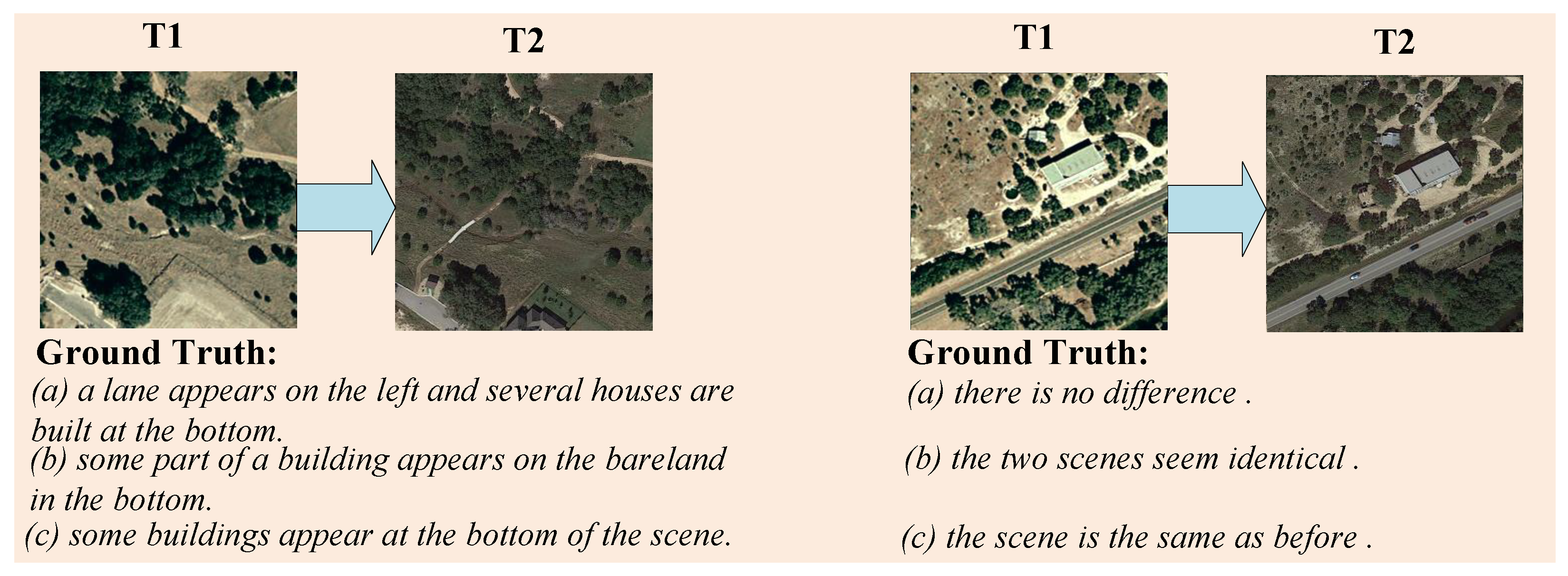
Earth observation technology has advanced at a fast pace which makes multi-temporal remote sensing imagery an essential data source for tracking surface changes. The trend demonstrates that RSICC has become more vital for implementation in disaster emergency response, urban planning decisions, and ecological environment assessment [1,2]. As shown in Figure 1, this technology enables users to understand remote sensing data better through its ability to convert remote sensing data into human-readable semantic information for land surface dynamics monitoring [3,4].
RSICC represents an upcoming research field that develops from the combination of remote sensing image change detection (RSICD) and image captioning (IC). Traditional change detection methods evolved from early change vector analysis [5] to deep learning-based Siamese network structures [6,7], and finally achieve significant progress in pixel-level and object-level change localization [8,9]. Meanwhile, remote sensing image captioning technology has evolved from using CNN-RNN networks to Transformer networks which have improved both semantic understanding and language generation capabilities [10,11,12]. RSICC inherits the spatial localization capability of change detection for bi-temporal image differences while adopting the language expression mechanism of image captioning, realizing the transformation from pixel-level changes to semantic-level descriptions through vision-language cross-modal learning [13,14]. The release of large-scale annotated datasets such as LEVIR-CC and LEVIR-MCI in 2022 brought this new field into existence while drawing numerous researchers to study it [15,16].
Current mainstream RSICC methods adopt encoder–decoder architectures. The encoder extracts visual change features from bi-temporal remote sensing images, experiencing an evolution from local to global modeling. CNN backbones (such as ResNet [17] and VGG [18]) long dominated visual feature extraction through Siamese structures or difference networks for bi-temporal difference modeling, though the local receptive field of convolutions limited the model’s ability to capture long-range spatial correlations. In recent years, Transformer architectures have demonstrated significant advantages in RSICC tasks through the global modeling capability of self-attention mechanisms [15,19,20,21], with multi-scale feature aggregation and hierarchical attention mechanisms further improving change localization accuracy [22,23]. Concurrently, large-scale pre-trained vision-language models such as CLIP [24] have enhanced the cross-modal representation capability of encoders [25,26]. The decoder side has similarly undergone technological iterations: while recurrent networks like LSTM can model sequential dependencies, they suffer from long-range information decay; Transformer-based autoregressive decoders [27] align visual features with text embeddings through multi-head cross-attention, addressing long-distance dependency modeling while maintaining parallel computation efficiency.
Despite the promising application prospects of RSICC, its practical deployment still faces several technical bottlenecks. First, the severe foreground-background imbalance problem cannot be ignored [8]. In urban monitoring scenarios, for instance, change regions usually occupy a small fraction of the image, while the vast majority consists of unchanged elements such as roads and buildings. Current global attention mechanisms distribute computation uniformly across all spatial positions, resulting in insufficient focus on the actual locations of change. Second, the multi-scale characteristics of remote sensing scenes further exacerbate modeling difficulty [28,29]. The extent of object-level changes including building demolition and road construction reaches hundreds of meters but vegetation degradation and surface texture changes appear at scales of less than fifty meters. Models require multigranular representation capabilities from local to global to simultaneously comprehend these change phenomena spanning two orders of magnitude. Third, the Vision Transformers widely used in current methods suffer from quadratic computational complexity with respect to sequence length, resulting in prohibitive inference costs when processing high-resolution remote sensing images whose token sequences far exceed those of natural images.
Recently, The State Space Model (particularly Mamba [30]) have emerged in computer vision as a promising alternative that addresses the above challenges simultaneously. Mamba’s selective state space mechanism offers a principled solution: its input-dependent filtering can naturally prioritize change-relevant tokens over static background, alleviating the foreground-background imbalance; meanwhile, its linear complexity O ( L ) overcomes the quadratic bottleneck of Transformers for long sequences. Subsequent works such as LocalMamba [31] and PlainMamba [32] further refined scanning strategies for visual tasks. In the remote sensing domain, RSCaMa [33] and ChangeMamba [34] validated SSMs’ efficiency advantages for bi-temporal analysis.
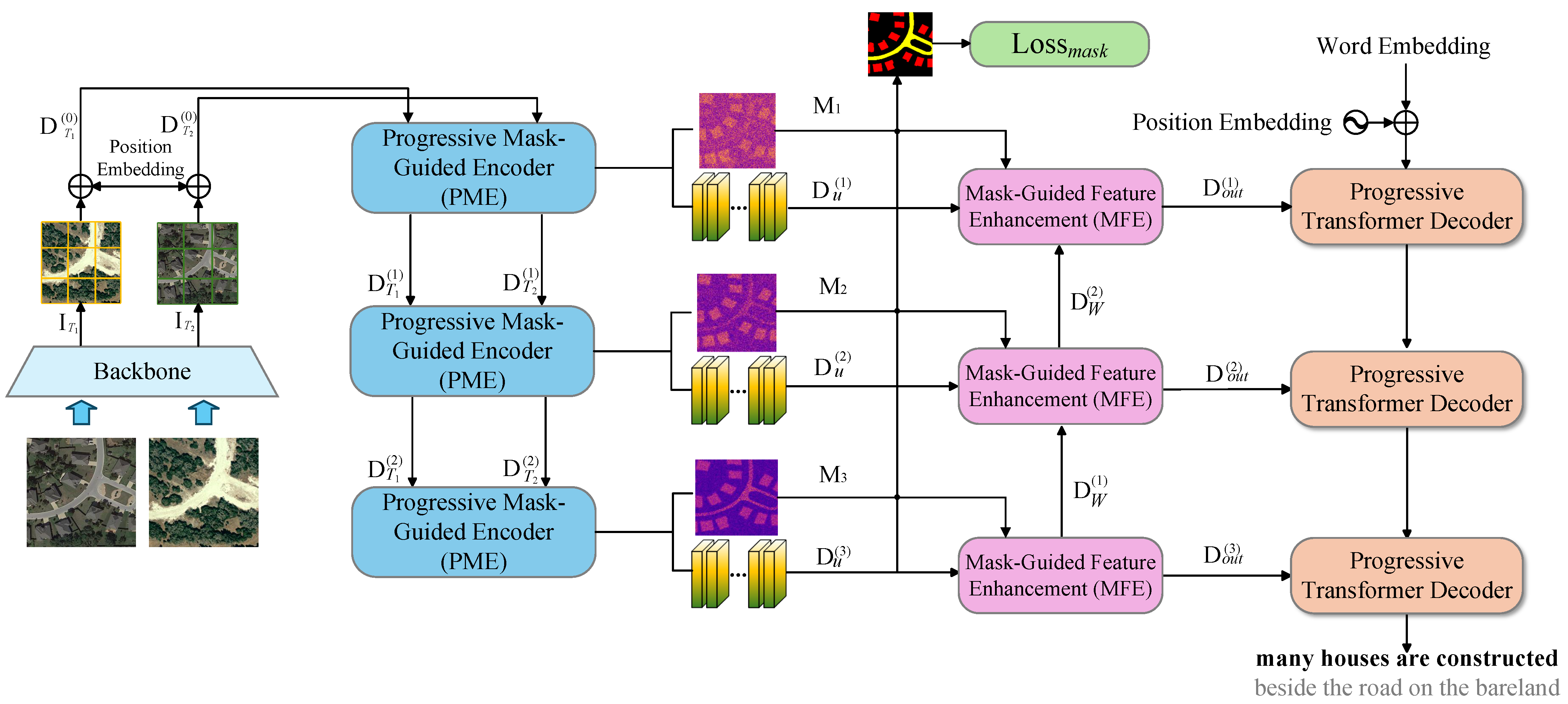
However, existing Mamba-based methods still exhibit limitations [33,35]: models lack effective multi-granularity modeling from detailed spatial patterns to high-level semantic representations, leading to insufficient localization of salient change regions. To systematically address these challenges, we propose PM3Net (Progressive Mamba Mask-guided Multigranular Network), an efficient change captioning framework specifically designed for RSICC tasks. The model comprises four core modules: a Progressive Mask-guided Encoder (PME), a Mask-guided Feature Enhancement (MFE) module, a visual feature extractor, and a language decoder. The pre-trained CLIP vision transformer [24] extracts bi-temporal remote sensing images into token sequences, then passing through N PME layers for progressive change modeling. PME layers in the model use spatial and semantic dual-source differences to create change masks directing bidirectional Mamba [30,36,37] to detect spatial change patterns through mask-modulated difference features. Subsequently, the framework uses aggregated features to guide temporal interaction for modeling inter-temporal evolution relationships. The MFE module accepts all PME layer outputs to generate multigranular visual embeddings { D o u t ( l ) } l = 1 N through mask weighting and cross-layer fusion. Finally, an N-layer Transformer decoder hierarchically receives visual features of corresponding granularity, generating change description sentences autoregressively through cross-attention mechanisms.
The main contributions of this paper are summarized as follows:
  • We introduce a dual-source change mask generation mechanism that fuses spatial differences (L2 norm) and semantic differences (cosine distance) to construct change saliency maps, enabling more robust localization of multi-scale change regions.
  • We design the Progressive Mask-guided Encoder (PME), where each PME layer comprises two stages: mask-modulated spatial difference modeling and aggregated feature-guided temporal interaction. Multi-layer cascaded structure allows multigranular change modeling starting with specific details before moving to semantic understanding through its different layers. This module contains shallow layers detecting small surface pattern and boundary line changes, while deep layers identify both object categories and their spatial connections to achieve human-like change perception beginning with specific details and ending with general understanding.
  • We propose the Mask-guided Feature Enhancement (MFE) module, performing mask weighting and learnable cross-layer fusion on each PME layer output. It preserves multi-scale semantics while effectively suppressing background interference in description generation. MFE produces detailed multi-scale feature sets used to feed the Transformer decoder layers processing PME outputs. The decoder uses this hierarchical alignment mechanism to focus on visual changes at their correct scales, helping it use the encoder’s multiple visual embedding scales effectively.
The remainder of this paper is organized as follows: Section 2 reviews related work on remote sensing image change captioning and state space models; Section 3 elaborates on PM3Net’s architectural design, including dual-source mask generation, PME, and MFE module implementation details; Section 4 introduces experimental setup, datasets, and evaluation metrics, and presents experimental results, ablation studies, and visualization analysis; Section 5 concludes the paper and discusses future research directions.

2. Related Work

2.1. Remote Sensing Image Change Captioning

Early studies relied on CNN–RNN frameworks, combining VGG-16 for visual feature extraction with LSTM-based sequence modeling for caption generation [13,14]. Although these works verified the effectiveness of deep learning for RSICC, they also exposed fundamental limitations: ImageNet-pretrained CNNs show weak ability to handle overhead-view remote sensing data because their local receptive fields prevent them from detecting distant spatial relationships in extensive scenes.
The advent of Transformer architectures brought major advancements to RSICC. By leveraging self-attention, these models are able to establish direct relationships between any two spatial locations, allowing them to perform deep bi-temporal feature interaction through dual-branch encoders and cross-attention mechanisms [15]. Subsequent studies introduced multi-scale attention to capture change patterns at varying granularities [22], adopted progressive decoding strategies to further strengthen multi-level discriminative feature extraction [23], and investigated prompt learning paradigms to improve adaptability to diverse change scenarios [38]. Concurrently, large-scale pre-trained vision-language models such as CLIP [24] have enhanced the cross-modal representation capability of encoders [25,26]. Nevertheless, self-attention operations in remote sensing image processing become less efficient because they require quadratic computational resources to process high-resolution data.

2.2. State Space Models in Vision Tasks

State space models originate from linear system modeling in control theory [39]. The S4 model achieved its first success with SSM deep learning applications, outperforming Transformers in handling extended sequence data [40]. Gu and Dao [30] addressed S4’s restricted parameter choices through input-dependent selective mechanisms that dynamically modulate state transition matrices, achieving linear complexity O ( L ) . This characteristic has attracted widespread attention to SSM as a new-generation alternative architecture to Transformers [41].
The main difficulty when using Mamba for vision applications stems from its inability to process the non-linear structure in two-dimensional visual data. Vision Mamba uses two separate scanning methods which scan images from start to end and then from end to start before uniting their results [36]. VMamba further designed cross-scan modules scanning tokens in four directions, more comprehensively modeling 2D spatial dependencies [37]. These scanning strategies designed have been rapidly adopted in remote sensing, where high-resolution inputs particularly benefit from Mamba’s linear complexity. The Mamba architectures have proven successful in image classification [42] and semantic segmentation [43] in the remote sensing domain.
For RSICC tasks specifically, RSCaMa [33] first introduced Mamba through its CaMa layers, where SD-SSM uses L2 difference features as multiplicative gates on bidirectional SSM outputs for spatial change perception, and TT-SSM interleaves bi-temporal tokens for temporal interaction. IHM-SNet [35] further cascades multi-layer Mamba blocks with aggregated bi-temporal features as activation branches, enabling hierarchical feature extraction. Despite their contributions, both methods share notable limitations in multigranular change perception. RSCaMa’s L2 gating signal operates at pixel intensity level, making it sensitive to illumination and seasonal variations that produce large differences without genuine semantic changes, while its uniform CaMa layers perform identical operations across depths without progressive abstraction from local textures to global semantics. IHM-SNet introduces multi-layer cascading but lacks explicit spatial saliency guidance, relying on implicit learning to separate change from background, which weakens the detection of sparse small-scale changes in background-dominated remote sensing scenes. To address these gaps, PM3Net introduces a dual-source mask generation strategy that fuses L2 spatial and cosine semantic differences for robust change localization. It further employs progressive mask-guided encoding, where each layer operates at a distinct granularity from fine-grained details to high-level semantics, and applies mask-weighted cross-layer fusion to explicitly suppress background interference during feature enhancement.

3. Methodology

Intuitively, PM3Net follows a three-stage pipeline: detect where changes occur, understand what changes mean at multiple scales, and describe them in natural language. As shown in Figure 2, PM3Net employs an encoder–decoder structure containing four essential components that include visual feature extraction, Progressive Mask-guided Encoder (PME), Mask-guided Feature Enhancement (MFE) module, and language decoder. This system processes two remote sensing images I T 1 , I T 2 R H × W × 3 containing independent visual token sequences that result from a pre-trained CLIP Vision Transformer followed by N PME layers for sequential change modeling. PME produces change masks through dual-source spatial and semantic differences, then using Mamba to find spatial changes before applying these masks to difference features for spatial pattern detection and using combined features to model how elements change between time points. The “progressive” property is visualized in this part, where masks evolve from capturing low-level textures in shallow layers to highlighting high-level semantic change objects in deeper layers. This hierarchical refinement enables the model to transition from pixel-level discrepancy detection to object-level change perception. MFE accepts all PME layer outputs to generate multigranular visual embeddings { D o u t ( l ) } l = 1 N through mask weighting and cross-layer fusion. An N-layer Transformer decoder receives visual features of different scales through its hierarchical structure to produce change description sentences through cross-attention mechanisms.

3.1. Visual Feature Extraction

Remote sensing image change captioning relies on successful semantic alignment between visual and language representation spaces because it functions as a cross-modal task. We employ a pre-trained CLIP Vision Transformer (ViT) [24] as the visual feature extraction backbone. Pre-training CLIP through contrastive learning on extensive image-text datasets enables its visual encoder to transform visual data into a common representation which matches language embedding spaces thus creating an optimal starting point for visual-text interaction.
Given bi-temporal remote sensing images I T 1 , I T 2 R H × W × 3 , we independently encode both images to preserve the independence of each temporal phase’s features, avoiding information confusion from premature fusion. ViT [44] divides each image into L patches transforming them into token sequences through linear projection to obtain feature representations D T 1 , D T 2 R L × C through multiple Transformer encoding layers. Encoded features receive learnable positional embeddings E p o s R L × C which produce the first set of feature representations.
D T 1 ( 0 ) = D T 1 + E p o s , D T 2 ( 0 ) = D T 2 + E p o s
Position-aware token sequences serve as inputs to PME modules, functioning to generate detailed visual semantic representations for multiple levels of change modeling.

3.2. Progressive Mask-Guided Encoder (PME)

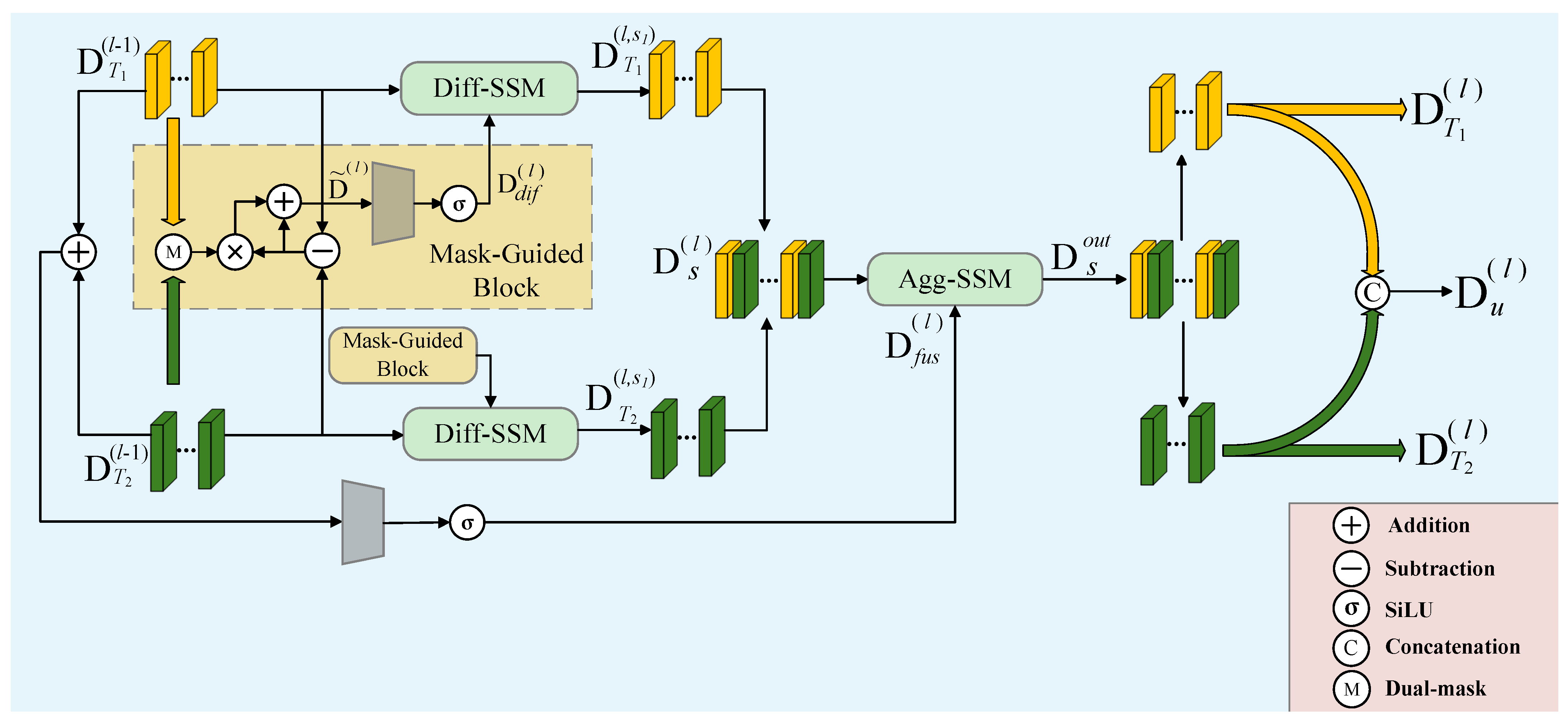
The PME module consists of three layers, answering three questions in sequence: where did changes occur (dual-source mask generation), what are the spatial change patterns (DiffSSM), and how do bi-temporal features relate (AggSSM). The progressive hierarchy of N stacked layers begins with shallow layers which identify small texture variations before deep layers identify semantic changes. The PM3Net system uses PME as its fundamental component by handling changes at different scales and distant spatial relationships, addressing two critical RSICC task requirements. Conventional approaches mainly depend on two main techniques: the fixed receptive field convolution and the global attention mechanisms, resulting in O ( L 2 ) computational operations for their execution [27]. Multi-layer cascaded structure of PME enables progressive change modeling through three layers producing fused features D u ( l ) and change masks M ( l ) at each level.
Figure 3 illustrates the detailed architecture of PME. Each of its three layers contains three essential elements. These components include: (1) dual-source mask generation, (2) spatial difference modeling (DiffSSM), and (3) aggregated feature-guided temporal interaction (AggSSM).
Selective State Space Model (SSM) constitute the core computational unit of PME for efficient long-range dependency modeling. SSM performs sequence modeling at a time complexity of O(L) through discretized state space equations, lower than traditional self-attention mechanisms. Given input sequence X R L × C , SSM performs modeling through the following state space equations:
h t = A ¯ h t 1 + B ¯ x t , y t = C h t
Four main components comprise this model: the hidden state h t R N and three discretized state matrices A ¯ , B ¯ , C . Input-dependent functions define its parameters, enabling Mamba to choose what information will be transmitted. Better expressiveness is achieved through its bidirectional scanning mechanism running forward scan ϕ S S M ( X ) and backward scan flip ( ϕ S S M ( flip ( X ) ) ) at the same time to detect both forward and backward sequence relationships.

3.2.1. Dual-Source Mask Generation Module

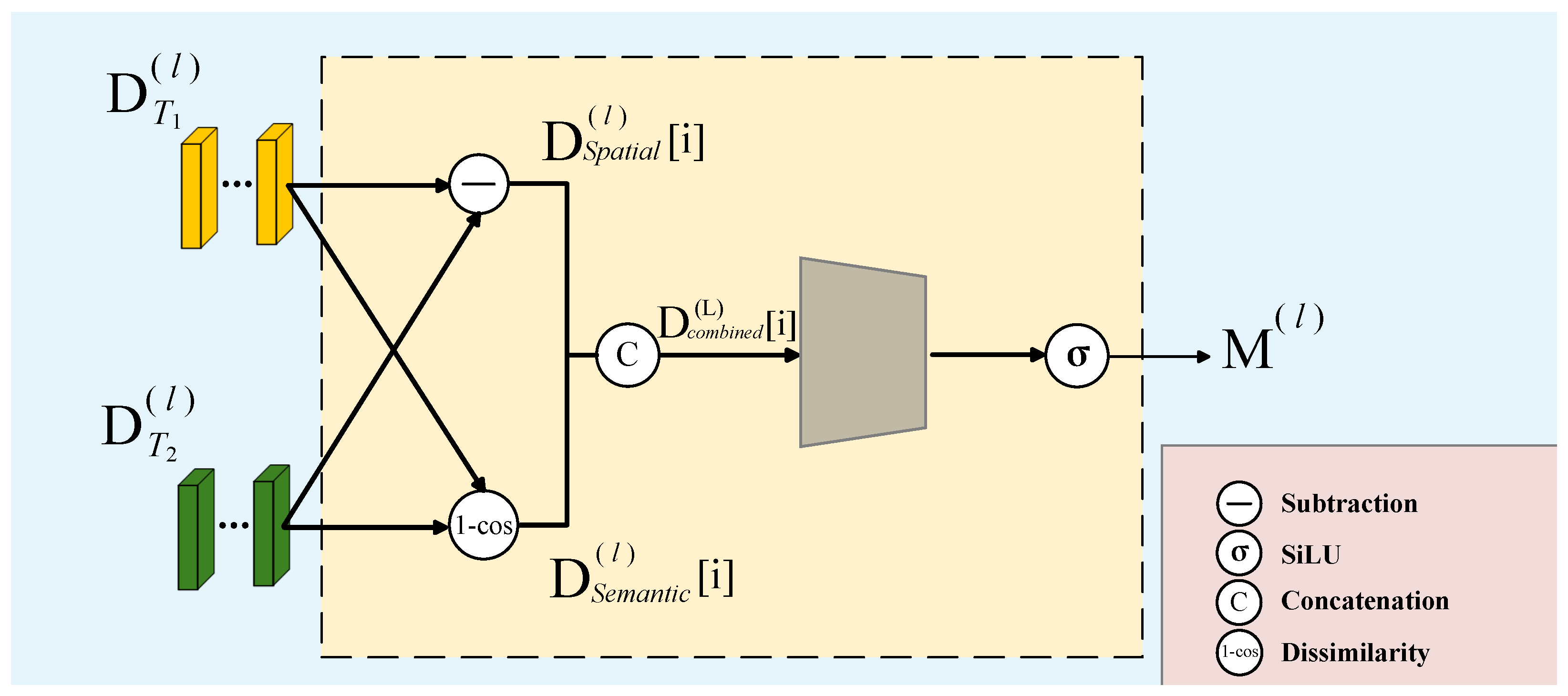
Change masks serve as the core guidance signal of PME to determine model performance in detecting high-quality change regions. Unlike methods using only the L2 norm for spatial difference construction [33], we propose a dual-source mask generation mechanism fusing spatial and semantic complementary measures to address their respective theoretical restrictions. Specifically, the L2 norm effectively captures the magnitude of intensity variations (e.g., brightness or color shifts) but remains vulnerable to illumination and seasonal noise. In contrast, the cosine distance measures the orientation shift in high-dimensional feature space, which corresponds to semantic category transitions while being invariant to absolute intensity changes. By integrating these two distinct geometric measures, the generated masks remain robust against imaging interference while staying highly sensitive to substantial geographical alterations.
Figure 4 shows the detailed structure of the dual-source mask generation module. Given layer l input features D T 1 ( l 1 ) , D T 2 ( l 1 ) R L × C , the module first computes spatial and semantic difference measures, concatenates them, and fuses them through a learnable linear layer to produce the final change mask:
D s p a t i a l ( l ) [ i ] = D T 2 ( l 1 ) [ i , : ] D T 1 ( l 1 ) [ i , : ] 2 , i = 1 , , L
D s e m a n t i c ( l ) [ i ] = 1 D T 1 ( l 1 ) [ i , : ] · D T 2 ( l 1 ) [ i , : ] | D T 1 ( l 1 ) [ i , : ] | 2 · | D T 2 ( l 1 ) [ i , : ] | 2
D c o m b i n e d ( l ) = [ D s p a t i a l ( l ) , D s e m a n t i c ( l ) ] R L × 2
M ( l ) = Sigmoid ( W m a s k · ( D c o m b i n e d ( l ) ) T + b m a s k ) R L × 1
where W m a s k R 1 × 2 and b m a s k R are globally shared fusion parameters. We deliberately employ the shared fusion weights between all layers to decrease parameter numbers while maintaining mask comparison ability between different network levels. Rather than introducing heavy attention-based fusion resulting in quadratic complexity, this design relies on the inherent filtering capability of the mask-guided weighting to suppress background noise. The linear fusion acts as a learned gate that aligns the confidence levels of spatial and semantic differences, ensuring that only regions verified by both measures are emphasized in the subsequent progressive encoding stages. The mask value range [ 0 , 1 ] represents each token’s change confidence.

3.2.2. Spatial Difference Modeling Module

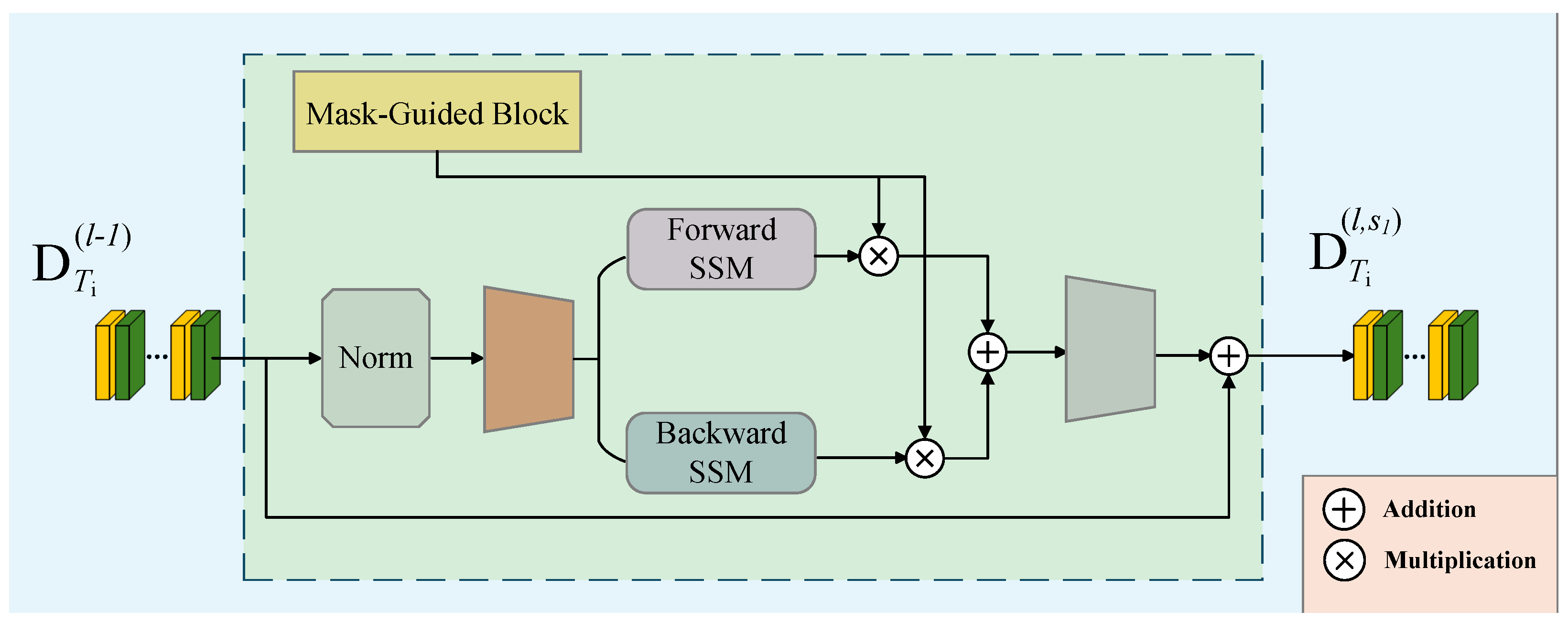
DiffSSM uses the change mask to amplify difference features in high-confidence change regions while preserving original information elsewhere (Figure 5). The raw difference D r a w ( l ) = D T 2 ( l 1 ) D T 1 ( l 1 ) captures bi-temporal variations but does not distinguish changed from unchanged areas in signal strength. Mask modulation adaptively enhances this signal to construct the difference activation branch:
D ( l ) ˜ = ( 1 + M ( l ) ) D r a w ( l )
D d i f ( l ) = Sigmoid ( ϕ L ( D ( l ) ˜ ) ) R L × C
For each temporal phase feature D T i ( l 1 ) ( i { 1 , 2 } ), spatial difference modeling proceeds through preprocessing, bidirectional SSM scanning, and gated fusion with the difference activation branch:
D T i p = Sigmoid ( ϕ D w c ( ϕ L ( ϕ N o r m ( D T i ( l 1 ) ) ) ) )
D T i f = ϕ S S M ( D T i p ) , D T i b = flip ( ϕ S S M ( flip ( D T i p ) ) )
D T i ( l , s 1 ) = ϕ L ( D T i f D d i f ( l ) + D T i b D d i f ( l ) ) + D T i ( l 1 )
Difference features control information weight distribution between forward and backward paths, concentrating on complete bidirectional context in areas with major changes while maintaining the original features in unmodified areas through residual connections.

3.2.3. Aggregated Feature-Guided Temporal Interaction

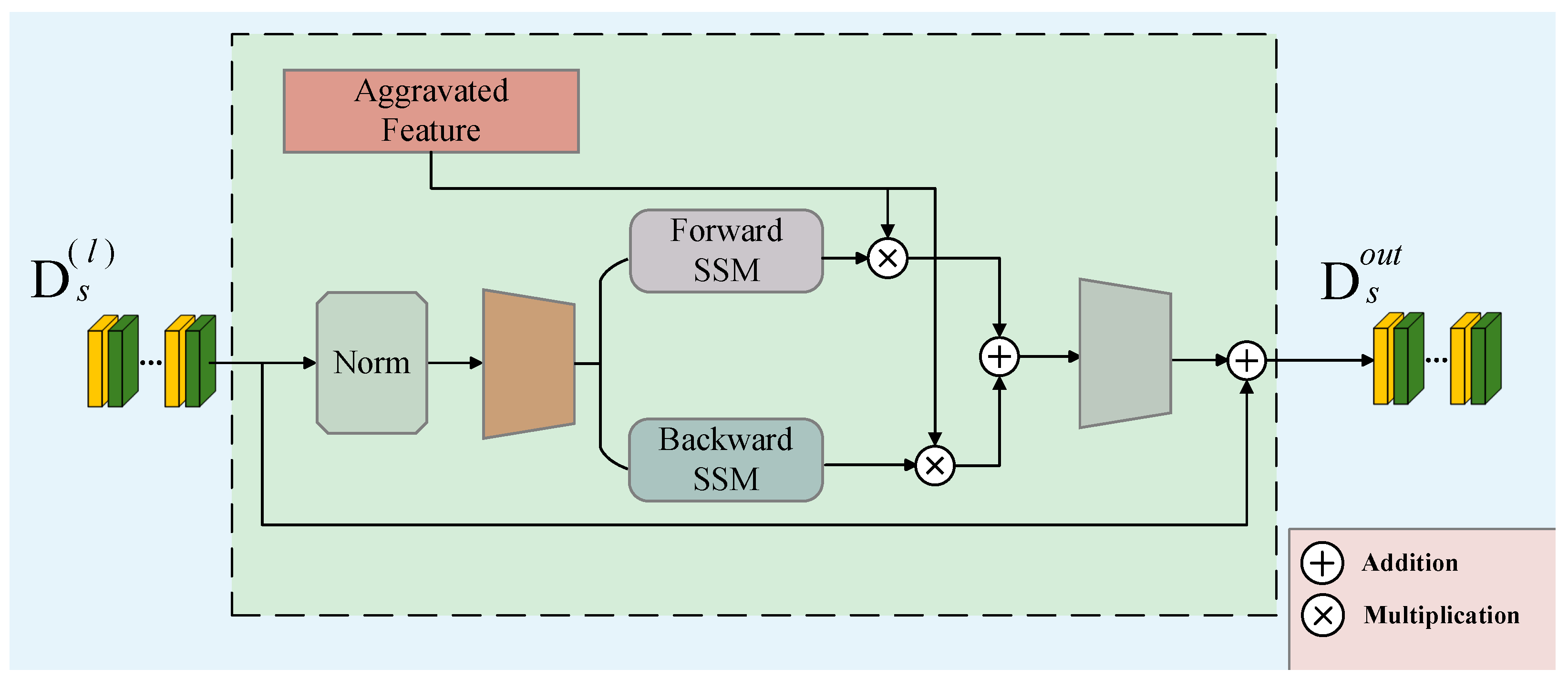
DiffSSM models spatial change patterns within each temporal phase independently; AggSSM complements this by explicitly modeling cross-temporal relationships through bi-temporal token interleaving (Figure 6). Aggregated features combine information from both time periods through element-wise addition, serving as activation gates to emphasize shared context:
A ( l ) = D T 1 ( l 1 ) + D T 2 ( l 1 )
D f u s ( l ) = Sigmoid ( ϕ L ( A ( l ) ) ) R L × C
Bi-temporal tokens are interleaved into a single sequence for explicit inter-temporal interaction, then processed through preprocessing and bidirectional SSM scanning:
D S ( l ) = ϕ R e c ( D T 1 ( l , s 1 ) , D T 2 ( l , s 1 ) ) = [ v T 1 , 1 , v T 2 , 1 , , v T 1 , L , v T 2 , L ] R 2 L × C
D S p = Sigmoid ( ϕ D w c ( ϕ L ( ϕ N o r m ( D S ( l ) ) ) ) )
D S f = ϕ S S M ( D S p ) , D S b = flip ( ϕ S S M ( flip ( D S p ) ) )
The aggregated activation branch is expanded to match the interleaved sequence length, then fused outputs are split to recover bi-temporal features:
D f u s e x p a n d = Repeat ( D f u s ( l ) , 2 ) = [ f 1 , f 1 , f 2 , f 2 , , f L , f L ] R 2 L × C
D S o u t = ϕ L ( D S f D f u s e x p a n d + D S b D f u s e x p a n d ) + D S ( l )
D u ( l ) = D T 1 ( l ) + D T 2 ( l ) R L × C
where D T 1 ( l ) and D T 2 ( l ) are recovered by extracting odd and even positions from D S o u t respectively. D u ( l ) is the final fused feature output of layer l PME.

3.3. Mask-Guided Feature Enhancement (MFE)

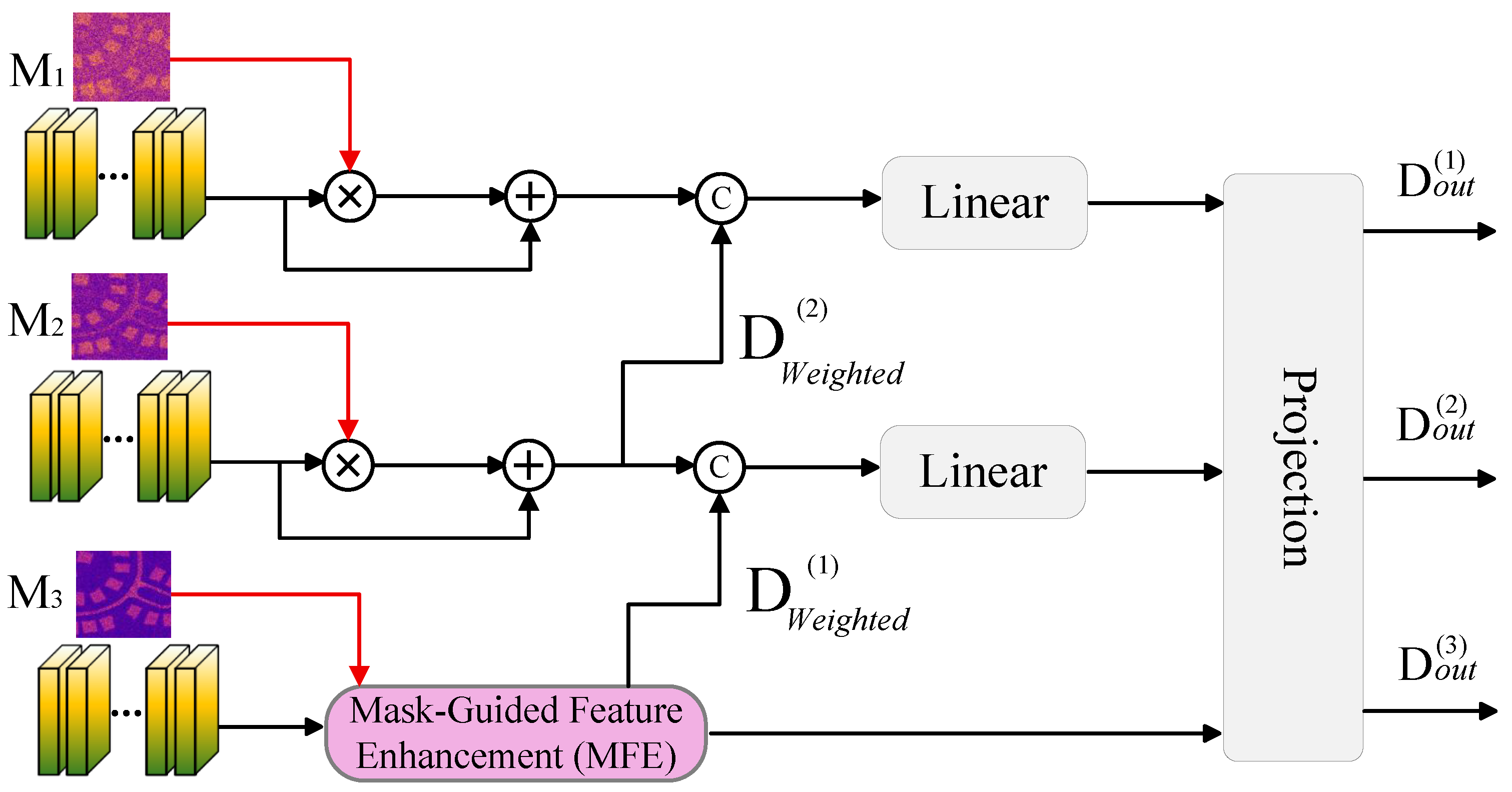
While PME extracts change features at each granularity independently, MFE integrates them into a coherent multi-scale representation by using masks to re-weight features and fusing adjacent layers so that shallow features inherit semantic context from deeper ones. As shown in Figure 7, MFE combines multigranular features from all PME outputs through three sequential operations: mask weighting, cross-layer fusion, and residual projection.
First, mask-weighted enhancement amplifies change regions across all layers:
D w e i g h t e d ( l ) = D u ( l ) ( 1 + M ( l ) )
Then, cross-layer fusion enables shallow features to incorporate deeper semantic information. For the deepest layer ( l = N ), weighted features are directly output; for other layers ( l { 1 , , N 1 } ), current and next layer features are concatenated and fused:
D f u s e d ( N ) = D w e i g h t e d ( N )
D c a t ( l ) = [ D w e i g h t e d ( l ) , D w e i g h t e d ( l + 1 ) ] R L × 2 C
D f u s e d ( l ) = W f u s e ( l ) · ( D c a t ( l ) ) T R L × C
where W f u s e ( l ) R C × 2 C is the layer-specific fusion weight matrix.
Finally, residual projection enhances feature expressiveness:
D p r o j ( l ) = W p r o j ( l ) · LayerNorm ( D f u s e d ( l ) )
D o u t ( l ) = D w e i g h t e d ( l ) + D p r o j ( l )
MFE output produces improved feature representations D o u t ( l ) R L × C representing each PME output. Multigranular visual embeddings pass through the decoder layers, performing hierarchical visual-text alignment operations.
Notably, the MFE module adopts a simple concatenation followed by linear projection instead of complex gated fusion mechanisms, such as the CFS module used in IHM-SNet [35]. This design is motivated by two considerations. First, it preserves the linear-time complexity O ( L ) of the Mamba architecture, which is important for modeling long-sequence remote sensing data. Second, since the primary selective capability is already introduced by the mask-guided weighting strategy, additional heavy fusion operators may provide limited benefit.

3.4. Language Decoder

The decoder uses a multi-layer Transformer structure that matches the encoder structure having three layers ( N = 3 ). Decoder layers receive output features from MFE as D o u t ( l ) to achieve step-by-step visual-text alignment. After N decoder layers, the final layer hidden state H ( N ) R S × C is projected to vocabulary space through a linear projection layer:
Logits = H ( N ) W v o c a b + b v o c a b R S × V
P ( t s | t < s ) = Softmax ( Logits [ s , : ] )
t s ^ = arg max P ( t s | t < s )
where V denotes the size of the vocabulary. Hierarchical structure allows decoder layers at various depths to process visual features at their respective detail levels: early decoder layers process detailed features to produce particular descriptive words while deeper layers process semantic information to create abstract relation words and logical connectives.

3.5. Training Objective

Training process of PM3Net occurs through end-to-end learning using a combined loss function that includes both language generation accuracy and specific mask prediction evaluation. Through this joint training approach, PME module learns to detect important changes in space while also enabling the decoder to produce meaningful text descriptions from better visual inputs.

3.5.1. Caption Generation Loss

Primary training objective for the language decoder is the standard cross-entropy loss. Caption loss function maximizes the probability of correct captions for given bi-temporal image pairs ( I T 1 , I T 2 ) and their corresponding ground truth change descriptions T g t = [ t 1 g t , t 2 g t , , t S g t ] .
L C E = 1 S s = 1 S log P ( t s g t | t < s g t ) = 1 S s = 1 S v = 1 V y s ( v ) log p s ( v )
where y s ( v ) is the one-hot label vector and p s ( v ) the model-predicted probability distribution. Teacher forcing supervises the decoder output through this loss function during training.

3.5.2. Mask Supervision Loss

To provide explicit guidance for the PME module’s change region perception, we introduce mask supervision using the binary change masks M g t provided by datasets such as LEVIR-MCI. Each PME layer mask M ( l ) produces one loss function which unites pixel accuracy with region overlap evaluation.
L m a s k ( l ) = BCE ( M ( l ) , M g t ) + λ · ( 1 Dice ( M ( l ) , M g t ) )
Pixel-wise differences between ground truth and predicted images are calculated through BCE loss and region overlap is evaluated through Dice loss. Hyperparameter λ (set to 0.5 in our experiments) balances these two complementary objectives.
Progressive nature of PME requires us to use a layer-wise weighting scheme giving more weight to masks that appear near the output:
L m a s k = l = 1 N β ( N l ) L m a s k ( l )
The layer-wise decay factor β = 0.8 assigns progressively higher weights to deeper PME layers, reflecting that deeper layers produce masks closer to the final representation consumed by the decoder and thus merit stronger supervision, while shallower layers benefit from relaxed constraints to preserve fine-grained local patterns. Both L m a s k and L C E gradients jointly flow through the shared fused features D u ( l ) , enabling cross-modal alignment between visual encoding and language generation.

3.5.3. Joint Training Objective

Final training objective combines both losses:
L t o t a l = L C E + α L m a s k
where α determines how much visual supervision affects the language processing task. We selected α = 0.2 through grid search over { 0.05 , 0.1 , 0.2 , 0.5 , 0.8 } on the LEVIR-MCI validation set. The sensitivity analysis of the hyperparameter is provided in Section 4.6.5.
It is important to note that the ground truth masks M g t are used only during training as supervision signals and do not participate in the forward pass. During inference, the model relies entirely on its learned dual-source mask generation mechanism.

4. Experiments

4.1. Datasets

We evaluate PM3Net’s performance on two public benchmarks: LEVIR-MCI and WHU-CDC. Both datasets offer complete testing environments including different scenes with varying levels of complexity, locations across the globe and multiple types of changes.
LEVIR-MCI: As an extension of LEVIR-CC [15], LEVIR-MCI adds detailed pixel-level change detection mask annotations [16]. This dataset includes 10,077 pairs of remote sensing images which monitor building changes throughout different Texas cities. Each image pair is accompanied by five human-annotated change description sentences and precise binary change masks. Images have 256 × 256 pixel resolution at 0.5-m spatial resolution, with primary change types including building construction, demolition, expansion, and road network changes. Three parts comprise this dataset: training data, validation data, and test data at a 7:1:2 ratio.
WHU-CDC: Released by Wuhan University, this building change detection and captioning dataset [2] contains 6096 aerial image pairs covering urban building changes before and after Christchurch, New Zealand earthquakes. Aerial and satellite data are united in this collection, which contains images with spatial details from 0.075 to 2.5 m. Change patterns in WHU-CDC exceed those of LEVIR-MCI because they show how earthquakes cause buildings to collapse and then how the area gets rebuilt through extensive urban planning changes. A 7:1:2 split ratio organizes its data distribution. These two datasets work together because LEVIR-MCI tracks standard urban growth patterns through its defined change areas while WHU-CDC monitors disaster-related changes having unpredictable patterns to verify the model’s ability to handle complex land use transformations.

4.2. Evaluation Metrics

We adopt standard evaluation metrics for image captioning tasks [45]:
BLEU-4 [46]: An n-gram overlap measure based on 4-g exact matching, computing the matching proportion of the longest consecutive four words between generated and reference sentences to measure local language pattern similarity.
METEOR [47]: This system performs synonym detection and word sequence analysis to assess text expressions which enables it to find equivalent semantic expressions by using WordNet resources thus achieving improved results for both precision and recall.
CIDEr [48] serves as a consensus evaluation metric which targets image captioning tasks to evaluate description informativeness and accuracy through TF-IDF weighted n-gram matching that gives more importance to infrequent discriminative words.
ROUGE-L [49] uses recall to measure sentence structure similarity through longest common subsequence analysis which detects word order dependencies at extended distances.
S m [33,35]: Following previous work, we adopt the composite metric S m as an overall performance indicator, which averages four complementary metrics to provide a balanced evaluation across precision, recall, and semantic consensus:
S m = 1 4 ( BLEU-4 + METEOR + ROUGE-L + CIDEr-D )

4.3. Implementation Details

Our model is implemented using the PyTorch 2.0 deep learning framework, trained on an NVIDIA RTX 4090 GPU (24 GB memory). Pre-trained CLIP ViT-B/16 [24] serves as the visual encoder, partitioning 256 × 256 input images into 16 × 16 patches to generate 256 visual tokens. PME and MFE module layers are set to N = 3 , with feature dimension C = 768 consistent with the CLIP encoder. A state dimension of 64 with an expansion factor of 2 configures the Mamba module. AdamW optimizer [50] implements the optimization strategy with initial learning rate 5 × 10⁻⁵ and weight decay 1 × 10⁻⁴. Fine-tuning the visual encoder requires a 1 × 10⁻⁵ learning rate because it needs to maintain its pre-trained knowledge. Training employs cosine annealing scheduling over 40 total epochs with batch size 64. Maximum decoder generation length is set to 50 tokens. Beam search with a beam size of 3 performs the inference process. Five experimental runs with result averaging achieve stable outcomes.

4.4. Comparison with State-of-the-Art

4.4.1. Quantitative Results

We comprehensively compare PM3Net with various representative change captioning methods. Comparison methods include: (1) early attention-based methods Capt-Dual-Att, DUDA [51]; (2) Transformer-based methods MCCFormer-S, MCCFormer-D [52], RSICCformer [15], PSNet [23], PromptCC [38], Chg2Cap [22], SFT [53], SEN [54]; and (3) state space model-based methods RSCaMa [33] and IHM-SNet [35]. Table 1 and Table 2 present quantitative results on LEVIR-MCI and WHU-CDC datasets respectively.
Experimental results demonstrate that PM3Net achieves optimal performance across all evaluation metrics on both datasets. On the LEVIR-MCI dataset, IHM-SNet surpasses RSCaMa as the strongest Mamba-based baseline, yet PM3Net still outperforms it by 1.4% in CIDEr (139.82 vs. 137.92) and 2.0% in BLEU-4 (66.89 vs. 65.59). On the WHU-CDC dataset, compared to the strongest baseline RSCaMa, PM3Net improves CIDEr by 2.7% (148.26 vs. 144.38) and BLEU-4 by 2.7% (73.05 vs. 71.12).
Notably, PM3Net achieves more significant relative improvements on the WHU-CDC dataset, with CIDEr improving by 2.7% over the strongest baseline compared to 1.4% on LEVIR-MCI. This larger margin is consistent with the greater complexity of WHU-CDC, which contains irregular earthquake-induced change morphologies and complex semantic transitions that pose stronger challenges for change modeling. The architectural factors underlying this performance gap are further analyzed in the ablation studies.

4.4.2. Qualitative Analysis

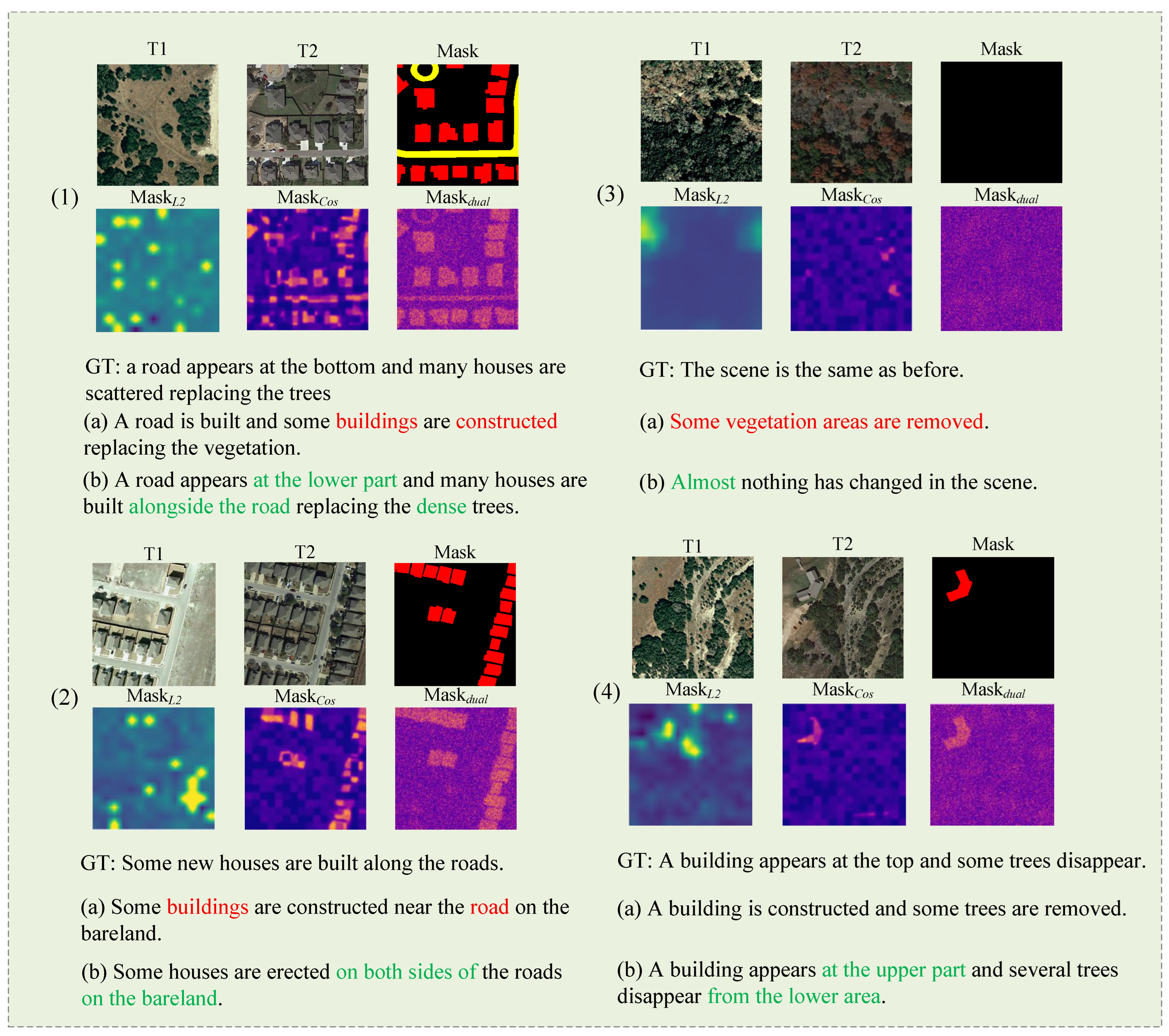
We select four representative case categories from the test set for qualitative analysis of PM3Net’s change captioning capability. These cases cover typical challenges in RSICC tasks: composite changes with coexisting multi-scales, sparsely distributed weak signals, robustness testing under illumination variations, and collaborative modeling of dual changes. Figure 8 presents visual comparisons between PM3Net and baseline methods.
In the first scenario, forest transforms into residential area accompanied by road construction. The baseline method’s description “A road is built and some buildings are constructed replacing the vegetation.” uses broad terminology while missing the road—a key element. PM3Net generates “a road appears at the lower part and many houses are scattered alongside the road replacing the dense trees,” selecting precise vocabulary while constructing complete spatial information through expressions like “at the lower part,” “scattered,” and “alongside.”
In the second scenario, scattered buildings appear on barren land. The baseline describes “some buildings are constructed near the road on the bareland,” where “near” cannot specify the exact positional relationship between buildings and roads. PM3Net’s “some houses are erected on both sides of the roads on the bareland” not only replaces the generic “buildings” with “houses,” but “on both sides” also indicates the symmetric distribution of buildings along the road.
The third scenario involves vegetation tone changes caused by seasonal illumination. Such scenarios contain no genuine object transitions, but traditional difference methods are sensitive to photometric changes. The baseline incorrectly judges “some vegetation areas are removed,” while PM3Net generates “almost nothing has changed in the scene,” acknowledging minor apparent differences through “almost” while determining no substantial change occurred. The semantic distance’s robustness to illumination perturbations plays a key role in the dual-source mask strategy.
The fourth scenario contains both building appearance and tree disappearance. The baseline’s “a building is constructed and some trees are removed” identifies dual changes but lacks spatial information. PM3Net establishes upper-lower spatial contrast through “a building appears at the upper part and several trees disappear from the lower area,” with “several” also providing a more specific quantity range than “some.”

4.5. Computational Efficiency Analysis

To substantiate Mamba’s linear complexity advantage, Table 3 compares model parameters and FLOPs on 256 × 256 inputs.
Among CLIP-based methods, PM3Net achieves the second-lowest FLOPs (16.19 G), only slightly above PSNet (13.78 G) while substantially lower than RSICCFormer (27.10 G, −40.3%) and PromptCC (19.88 G, −18.6%). In terms of parameters, PM3Net (191.30 M) incurs only 10.7% overhead compared to RSICCFormer (172.80 M), yet is far more compact than PromptCC (408.58 M) and PSNet (319.76 M). This favorable efficiency stems from the PME module’s reliance on Mamba layers with O ( L ) complexity, which avoids the quadratic scaling of attention-based alternatives despite the three-layer progressive design introducing moderate additional parameters. Inference time measurements further confirm this advantage: PM3Net achieves 26.94 ms per sample, substantially faster than Transformer-based methods such as RSICCFormer (44.30 ms, −39.5%) and PromptCC (57.59 ms, −53.4%).

4.6. Ablation Studies

To deeply understand contributions from each PM3Net component, we design systematic ablation experiments. The core module and mask generation strategy experiments are conducted on both LEVIR-MCI and WHU-CDC datasets to validate cross-dataset generalizability.

4.6.1. Effectiveness of Core Modules

Table 4 presents ablation results for core modules on both datasets. The baseline model adopts a standard CLIP encoder plus Transformer decoder architecture, progressively adding PME and MFE modules to verify their respective contributions.
On LEVIR-MCI, adding the PME module improves CIDEr from 132.58 to 136.74 (+3.1%), indicating that the Progressive Mask-guided Encoder effectively enhances change region feature expression. Introducing the MFE module further improves CIDEr to 139.82 (+2.3%), and it validates the importance of cross-layer feature fusion for multigranular information integration. The cumulative improvement of 5.5% demonstrates the synergistic effect of both modules. On WHU-CDC, the PME module also improves the CIDEr scores from 139.65 to 143.87 by 3.0%, and MFE further raises it to 148.26 (+3.1%), with a cumulative gain of 6.2%. Notably, MFE yields a larger improvement on WHU-CDC (+3.1%) than on LEVIR-MCI (+2.3%). The consistent improvements across both datasets confirm that the contributions of PME and MFE are not dataset-specific but reflect genuine architectural advantages.

4.6.2. Impact of Mask Generation Strategies

Table 5 compares all of the three mask generation strategies on both datasets: L2 norm only, cosine distance only, and dual-source fusion. In addition to captioning metrics, we report token-level mean Intersection over Union (mIoU) [55] of the final layer ( l = 3 ) masks against ground truth to evaluate the PME module’s change localization capability independently of the language decoder. Since PME operates at the token level ( 16 × 16 grid for 256 × 256 inputs), ground truth masks are downsampled to match this resolution: a token is labeled as changed if more than 50% of its corresponding patch pixels are changed. Note that PM3Net’s masks serve as intermediate guidance signals for caption generation rather than pixel-level detection outputs; the mIoU reported here reflects localization quality at token resolution, not change detection performance comparable to dedicated detection models.
The dual-source fusion strategy outperforms single measures across all metrics on both datasets. On LEVIR-MCI, dual-source fusion improves CIDEr by 1.9% over cosine distance and 2.7% over L2 norm. Specifically, L2 norm alone is sensitive to illumination and seasonal variations that produce large intensity differences without genuine semantic changes, while cosine distance alone captures semantic orientation shifts but discards magnitude information relevant to spatial extent. The dual-source design compensates for both limitations by capturing both pixel-level intensity changes and high-level semantic transitions. On WHU-CDC, dual-source fusion similarly achieves the best CIDEr of 148.26, outperforming cosine distance only (+1.4%) and L2 norm only (+3.1%). The gap between L2 and cosine strategies widens substantially on WHU-CDC (CIDEr difference of 2.37) compared to LEVIR-MCI (1.08), indicating that semantic difference signals carry greater relative importance in cross-sensor scenarios. These cross-dataset comparisons further explain the larger overall performance margin of PM3Net on WHU-CDC: the dual-source mask mechanism provides stronger robustness under irregular change morphologies and cross-sensor variations, yielding greater benefits on more challenging scenes. The mIoU column further corroborates these trends: the L2-cosine gap on WHU-CDC (3.27) exceeds that on LEVIR-MCI (1.37), confirming that the captioning improvements are grounded in genuinely better spatial localization of change regions.

4.6.3. Effect of PME Layer Numbers

Table 6 investigates the impact of PME layer numbers on model performance on LEVIR-MCI.
The results indicate that a three-layer PME achieves optimal performance. Single-layer architecture struggles to capture multigranular changes; increasing from one to two layers improves CIDEr by 2.1% (134.86 to 137.65), and from two to three layers by a further 1.6% (137.65 to 139.82), showing diminishing but still meaningful gains as progressive abstraction deepens. Further increasing to four layers slightly decreases performance (139.24), suggesting that three layers provide a favorable trade-off between performance and efficiency, as additional depth yields no further gain while increasing parameters by 11.0% (191.3 M to 212.4 M).
The consistent gains from N = 1 to N = 3 reveal that progressive abstraction is essential for RSICC, and cannot be compensated by simply widening a single-layer design. This progressive hierarchy constitutes a key architectural distinction from RSCaMa’s uniform single-layer CaMa and IHM-SNet’s implicit hierarchical cascading, directly contributing to the performance gaps reported in Table 1 and Table 2.

4.6.4. Effect of Mask Supervision

Table 7 examines the contribution of explicit mask supervision during training on LEVIR-MCI.
The joint training strategy with explicit mask supervision improves CIDEr by 1.7% compared to training with caption loss alone. This demonstrates that utilizing the dataset-provided binary masks as additional supervision signals enhances the PME module’s ability to localize change regions, subsequently benefiting the language generation quality.

4.6.5. Sensitivity Analysis of Loss Hyperparameters

Table 8 reports the sensitivity of the mask supervision coefficient α on the LEVIR-MCI validation set.
When α is too small, the mask supervision signal is insufficient to guide the PME module toward accurate change localization, and the dual-source mask must rely primarily on implicit gradients from the caption loss alone. When α is too large, mask loss dominates training and the encoder over-optimizes pixel-level detection at the expense of caption generation quality. The setting α = 0.2 best balances spatial guidance with caption generation.

5. Conclusions

This paper introduces PM3Net as a progressive mask-guided multigranular network for RSICC tasks. The dual-source mask generation mechanism fusing spatial L2 norm and semantic cosine distance differences produces robust change localization results, leading to 2.7% CIDEr improvement over L2-only guidance. The Progressive Mask-guided Encoder performs multigranular modeling through cascaded Mamba layers with linear complexity, improving CIDEr by 3.1% over the baseline. The Mask-guided Feature Enhancement module produces multi-scale visual embeddings through cross-layer fusion, adding a further 2.3% gain. On LEVIR-MCI, PM3Net achieves CIDEr of 139.82 and BLEU-4 of 66.89, surpassing RSCaMa by 2.4% and 2.5%. On WHU-CDC, CIDEr reaches 148.26 and BLEU-4 reaches 73.05, with 2.7% improvements on both metrics.
However, the research contains multiple restrictions that need to be addressed. The dual-source mask generation relies on ground truth binary masks during training, limiting the model’s applicability to datasets without pixel-level annotations. Nevertheless, this reliance is not intrinsic to the architecture: our ablation (Table 7) shows that training without mask supervision still achieves CIDEr of 137.48, only 1.7% below the supervised setting, suggesting that the dual-source mechanism can learn effective change localization from caption gradients alone. While PM3Net shows strong resistance to changes in lighting conditions, its performance becomes less accurate when clouds heavily block the view. The present system design supports processing of bi-temporal data pairs, but it may need major design changes to process multiple time sequences for ongoing surveillance operations.
Our future work will explore adapting PME to visual encoders of varying scales, developing cross-dataset transfer learning, and extending to video-level temporal change captioning.


Author Contributions

Conceptualization, Y.Q.; methodology, Y.Q.; software, Y.Q.; validation, Y.Q.; formal analysis, Y.Q.; investigation, Y.Q.; resources, Y.Q.; writing—original draft preparation, Y.Q.; writing—review and editing, Y.Q.; visualization, Y.Q.; supervision, H.Z.; funding acquisition, H.Z. All authors have read and agreed to the published version of the manuscript.

Funding

The work is supported by National Natural Science Foundation of China (No.62302170) and Guangdong Basic and Applied Basic Research Foundation (No. 2024A1515010187).

Data Availability Statement

The LEVIR-MCI dataset is available at https://github.com/Chen-Yang-Liu/Change-Agent (accessed on 26 March 2026). The WHU-CDC dataset is available upon request from https://huggingface.co/datasets/hygge10111/RS-CDC (accessed on 26 March 2026).

Conflicts of Interest

The authors declare no conflicts of interest.

References

  1. Drusch, M.; Del Bello, U.; Carlier, S.; Colin, O.; Fernandez, V.; Gascon, F.; Hoersch, B.; Isola, C.; Laberinti, P.; Martimort, P. Sentinel-2: ESA’s Optical High-Resolution Mission for GMES Operational Services. Remote Sens. Environ. 2012, 120, 25–36. [Google Scholar] [CrossRef] [Scilit]
  2. Ji, S.; Wei, S.; Lu, M. Fully Convolutional Networks for Multisource Building Extraction from an Open Aerial and Satellite Imagery Data Set. IEEE Trans. Geosci. Remote Sens. 2019, 57, 574–586. [Google Scholar] [CrossRef] [Scilit]
  3. Liu, C.; Zhang, J.; Chen, K.; Wang, M.; Zou, Z.; Shi, Z. Remote Sensing Spatio-Temporal Vision-Language Models: A Comprehensive Survey. IEEE Geosci. Remote Sens. Mag. 2026, 14, 383–423. [Google Scholar] [CrossRef] [Scilit]
  4. Wang, L.; Zhang, M.; Gao, X.; Shi, W. Advances and Challenges in Deep Learning-Based Change Detection for Remote Sensing Images: A Review Through Various Learning Paradigms. Remote Sens. 2024, 16, 804. [Google Scholar] [CrossRef] [Scilit]
  5. Malila, W.A. Change Vector Analysis: An Approach for Detecting Forest Changes with Landsat. In Proceedings of the LARS Symposia; IEEE: Piscataway, NJ, USA, 1980; p. 385. [Google Scholar]
  6. Tang, X.; Zhang, H.; Mou, L.; Liu, F.; Zhang, X.; Zhu, X.X.; Jiao, L. An Unsupervised Remote Sensing Change Detection Method Based on Multiscale Graph Convolutional Network and Metric Learning. IEEE Trans. Geosci. Remote Sens. 2021, 60, 5609715. [Google Scholar] [CrossRef] [Scilit]
  7. Liu, Y.; Pang, C.; Zhan, Z.; Zhang, X.; Yang, X. Building Change Detection for Remote Sensing Images Using a Dual-Task Constrained Deep Siamese Convolutional Network Model. IEEE Geosci. Remote Sens. Lett. 2020, 18, 811–815. [Google Scholar] [CrossRef] [Scilit]
  8. Chen, H.; Qi, Z.; Shi, Z. Remote Sensing Image Change Detection with Transformers. IEEE Trans. Geosci. Remote Sens. 2022, 60, 5607514. [Google Scholar] [CrossRef] [Scilit]
  9. Zhang, H.; Chen, H.; Zhou, C.; Chen, K.; Liu, C.; Zou, Z.; Shi, Z. BiFa: Remote Sensing Image Change Detection with Bitemporal Feature Alignment. IEEE Trans. Geosci. Remote Sens. 2024, 62, 5614317. [Google Scholar] [CrossRef] [Scilit]
  10. Qu, B.; Li, X.; Tao, D.; Lu, X. Deep Semantic Understanding of High Resolution Remote Sensing Image. In Proceedings of the 2016 International Conference on Computer, Information and Telecommunication Systems (CITS), Kunming, China, 6–8 July 2016. [Google Scholar]
  11. Wang, Q.; Huang, W.; Zhang, X.; Li, X. Word–Sentence Framework for Remote Sensing Image Captioning. IEEE Trans. Geosci. Remote Sens. 2020, 59, 10532–10543. [Google Scholar] [CrossRef] [Scilit]
  12. Liu, C.; Zhao, R.; Shi, Z. Remote-Sensing Image Captioning Based on Multilayer Aggregated Transformer. IEEE Geosci. Remote Sens. Lett. 2022, 19, 6506605. [Google Scholar] [CrossRef] [Scilit]
  13. Chouaf, S.; Hoxha, G.; Smara, Y.; Melgani, F. Captioning Changes in Bi-Temporal Remote Sensing Images. In Proceedings of the IEEE International Geoscience and Remote Sensing Symposium IGARSS, Brussels, Belgium, 11–16 July 2021. [Google Scholar]
  14. Hoxha, G.; Chouaf, S.; Melgani, F.; Smara, Y. Change Captioning: A New Paradigm for Multitemporal Remote Sensing Image Analysis. IEEE Trans. Geosci. Remote Sens. 2022, 60, 5627414. [Google Scholar] [CrossRef] [Scilit]
  15. Liu, C.; Zhao, R.; Chen, H.; Zou, Z.; Shi, Z. Remote Sensing Image Change Captioning with Dual-Branch Transformers: A New Method and a Large Scale Dataset. IEEE Trans. Geosci. Remote Sens. 2022, 60, 5633520. [Google Scholar] [CrossRef] [Scilit]
  16. Liu, C.; Chen, K.; Zhang, H.; Qi, Z.; Zou, Z.; Shi, Z. Change-Agent: Toward Interactive Comprehensive Remote Sensing Change Interpretation and Analysis. IEEE Trans. Geosci. Remote Sens. 2024, 62, 5635616. [Google Scholar] [CrossRef] [Scilit]
  17. He, K.; Zhang, X.; Ren, S.; Sun, J. Deep Residual Learning for Image Recognition. In Proceedings of the IEEE Conference on Computer Vision and Pattern Recognition (CVPR), Las Vegas, NV, USA, 26–30 June 2016. [Google Scholar]
  18. Simonyan, K.; Zisserman, A. Very Deep Convolutional Networks for Large-Scale Image Recognition. In Proceedings of the International Conference on Learning Representations (ICLR), San Diego, CA, USA, 7–9 May 2015. [Google Scholar]
  19. Zhao, R.; Shi, Z.; Zou, Z. High-Resolution Remote Sensing Image Captioning Based on Structured Attention. IEEE Trans. Geosci. Remote Sens. 2022, 60, 5603814. [Google Scholar] [CrossRef] [Scilit]
  20. Wang, Y.; Zhang, W.; Zhang, Z.; Gao, X.; Sun, X. Multiscale Multiinteraction Network for Remote Sensing Image Captioning. IEEE J. Sel. Top. Appl. Earth Obs. Remote Sens. 2022, 15, 2154–2165. [Google Scholar] [CrossRef] [Scilit]
  21. Cai, C.; Wang, Y.; Yap, K.-H. Interactive Change-Aware Transformer Network for Remote Sensing Image Change Captioning. Remote Sens. 2023, 15, 5611. [Google Scholar] [CrossRef] [Scilit]
  22. Chang, S.; Ghamisi, P. Changes to Captions: An Attentive Network for Remote Sensing Change Captioning. IEEE Trans. Image Process. 2023, 32, 6047–6060. [Google Scholar] [CrossRef] [Scilit]
  23. Liu, C.; Yang, J.; Qi, Z.; Zou, Z.; Shi, Z. Progressive Scale-Aware Network for Remote Sensing Image Change Captioning. In Proceedings of the IGARSS 2023, Pasadena, CA, USA, 16–21 July 2023. [Google Scholar]
  24. Radford, A.; Kim, J.W.; Hallacy, C.; Ramesh, A.; Goh, G.; Agarwal, S.; Sastry, G.; Askell, A.; Mishkin, P.; Clark, J.; et al. Learning Transferable Visual Models from Natural Language Supervision. In Proceedings of the International Conference on Machine Learning, PMLR 2021, Virtual, 18–24 July 2021. [Google Scholar]
  25. Guo, Z.; Wang, T.-J.J.; Laaksonen, J. CLIP4IDC: CLIP for Image Difference Captioning. In Proceedings of the 2nd Conference of the Asia-Pacific Chapter of the Association for Computational Linguistics and the 12th International Joint Conference on Natural Language Processing (AACL-IJCNLP), Taipei, Taiwan, 20–23 November 2022. [Google Scholar]
  26. Yao, L.; Wang, W.; Jin, Q. Image Difference Captioning with Pre-Training and Contrastive Learning. In Proceedings of the AAAI Conference on Artificial Intelligence 2022, Online, 22 February–1 March 2022. [Google Scholar]
  27. Vaswani, A.; Shazeer, N.; Parmar, N.; Uszkoreit, J.; Jones, L.; Gomez, A.N.; Kaiser, L.; Polosukhin, I. Attention Is All You Need. Adv. Neural Inf. Process. Syst. 2017, 30, 5998–6008. [Google Scholar]
  28. Peng, X.; Zhong, R.; Li, Z.; Li, Q. Optical Remote Sensing Image Change Detection Based on Attention Mechanism and Image Difference. IEEE Trans. Geosci. Remote Sens. 2020, 59, 7296–7307. [Google Scholar] [CrossRef] [Scilit]
  29. Chen, L.; Liu, C.; Chang, F.; Li, S.; Nie, Z. Adaptive Multi-Level Feature Fusion and Attention-Based Network for Arbitrary-Oriented Object Detection in Remote Sensing Imagery. Neurocomputing 2021, 451, 67–80. [Google Scholar] [CrossRef] [Scilit]
  30. Gu, A.; Dao, T. Mamba: Linear-Time Sequence Modeling with Selective State Spaces. In Proceedings of the First Conference on Language Modeling (COLM), Philadelphia, PA, USA, 7–9 October 2024; Available online: https://openreview.net/forum?id=tEYskw1VY2 (accessed on 26 March 2026).
  31. Huang, T.; Pei, X.; You, S.; Wang, F.; Qian, C.; Xu, C. LocalMamba: Visual State Space Model with Windowed Selective Scan. In Computer Vision—ECCV 2024 Workshops; Del Bue, A., Canton, C., Pont-Tuset, J., Tommasi, T., Eds.; Lecture Notes in Computer Science, volume 15633; Springer: Cham, Switzerland, 2025. [Google Scholar] [CrossRef] [Scilit]
  32. Yang, C.; Chen, Z.; Espinosa, M.; Ericsson, L.; Wang, Z.; Liu, J.; Crowley, E.J. PlainMamba: Improving Non-Hierarchical Mamba in Visual Recognition. In Proceedings of the 35th British Machine Vision Conference (BMVC), Glasgow, UK, 25–28 November 2024. [Google Scholar]
  33. Liu, C.; Chen, K.; Chen, B.; Zhang, H.; Zou, Z.; Shi, Z. RSCaMa: Remote Sensing Image Change Captioning with State Space Model. IEEE Geosci. Remote Sens. Lett. 2024, 21, 6010405. [Google Scholar] [CrossRef] [Scilit]
  34. Chen, H.; Song, J.; Han, C.; Xia, J.; Yokoya, N. ChangeMamba: Remote Sensing Change Detection with Spatiotemporal State Space Model. IEEE Trans. Geosci. Remote Sens. 2024, 62, 4409720. [Google Scholar] [CrossRef] [Scilit]
  35. Ma, C.; Gao, J.; Lv, X.; Zhang, H. IHM-SNet: An Interactive Hierarchical Mamba-Based Screening Network for Remote Sensing Image Change Captioning. In Proceedings of the 2025 28th International Conference on Computer Supported Cooperative Work in Design (CSCWD), Compiègne, France, 5–7 May 2025. [Google Scholar]
  36. Zhu, L.; Liao, B.; Zhang, Q.; Wang, X.; Liu, W.; Wang, X. Vision Mamba: Efficient Visual Representation Learning with Bidirectional State Space Model. In Proceedings of the Forty-First International Conference on Machine Learning (ICML), Vienna, Austria, 21–27 July 2024. [Google Scholar]
  37. Liu, Y.; Tian, Y.; Zhao, Y.; Yu, H.; Xie, L.; Wang, Y.; Ye, Q.; Liu, Y. VMamba: Visual State Space Model. In Proceedings of the NeurIPS 2024, Vancouver, BC, Canada, 9–15 December 2024. [Google Scholar]
  38. Liu, C.; Zhao, R.; Chen, J.; Qi, Z.; Zou, Z.; Shi, Z. A Decoupling Paradigm With Prompt Learning for Remote Sensing Image Change Captioning. IEEE Trans. Geosci. Remote Sens. 2023, 61, 5622018. [Google Scholar] [CrossRef] [Scilit]
  39. Kalman, R.E. A New Approach to Linear Filtering and Prediction Problems. J. Basic Eng. 1960, 82, 35–45. [Google Scholar] [CrossRef] [Scilit]
  40. Gu, A.; Goel, K.; Ré, C. Efficiently Modeling Long Sequences with Structured State Spaces. In Proceedings of the 10th International Conference on Learning Representations (ICLR), Online, 25–29 April 2022. [Google Scholar]
  41. Wang, X.; Wang, S.; Ding, Y.; Li, Y.; Wu, W.; Rong, Y.; Kong, W.; Huang, J.; Li, S.; Yang, H.; et al. State Space Model for New-Generation Network Alternative to Transformers: A Survey. arXiv 2024, arXiv:2404.09516. [Google Scholar] [CrossRef] [Scilit]
  42. Chen, K.; Chen, B.; Liu, C.; Li, W.; Zou, Z.; Shi, Z. RSMamba: Remote Sensing Image Classification with State Space Model. IEEE Geosci. Remote Sens. Lett. 2024, 21, 8002605. [Google Scholar] [CrossRef] [Scilit]
  43. Zhu, Q.; Cai, Y.; Fang, Y.; Yang, Y.; Chen, C.; Fan, L.; Nguyen, A. Samba: Semantic Segmentation of Remotely Sensed Images with State Space Model. IEEE Geosci. Remote Sens. Lett. 2024. Early access. [Google Scholar] [CrossRef] [Scilit]
  44. Dosovitskiy, A.; Beyer, L.; Kolesnikov, A.; Weissenborn, D.; Zhai, X.; Unterthiner, T.; Dehghani, M.; Minderer, M.; Heigold, G.; Gelly, S.; et al. An Image is Worth 16x16 Words: Transformers for Image Recognition at Scale. In Proceedings of the ICLR 2021, Virtual, 3–7 May 2021. [Google Scholar]
  45. Guo, J.; Li, Z.; Song, B.; Chi, Y. TSFE: Two-Stage Feature Enhancement for Remote Sensing Image Captioning. Remote Sens. 2024, 16, 1843. [Google Scholar] [CrossRef] [Scilit]
  46. Papineni, K.; Roukos, S.; Ward, T.; Zhu, W.-J. BLEU: A Method for Automatic Evaluation of Machine Translation. In Proceedings of the 40th Annual Meeting of the Association for Computational Linguistics, Philadelphia, PA, USA, 7–12 July 2002. [Google Scholar]
  47. Banerjee, S.; Lavie, A. METEOR: An Automatic Metric for MT Evaluation with Improved Correlation with Human Judgments. In Proceedings of the ACL Workshop on Intrinsic and Extrinsic Evaluation Measures for Machine Translation and/or Summarization, Ann Arbor, MI, USA, 29 June 2005. [Google Scholar]
  48. Vedantam, R.; Lawrence Zitnick, C.; Parikh, D. CIDEr: Consensus-based Image Description Evaluation. In Proceedings of the IEEE Conference on Computer Vision and Pattern Recognition (CVPR), Boston, MA, USA, 7–12 June 2015. [Google Scholar]
  49. Lin, C.-Y. ROUGE: A Package for Automatic Evaluation of Summaries. In Proceedings of the Text Summarization Branches Out Workshop, Barcelona, Spain, 25–26 July 2004. [Google Scholar]
  50. Kingma, D.P.; Ba, J. Adam: A Method for Stochastic Optimization. In Proceedings of the 3rd International Conference on Learning Representations (ICLR 2015), San Diego, CA, USA, 7–9 May 2015. [Google Scholar]
  51. Park, D.H.; Darrell, T.; Rohrbach, A. Robust Change Captioning. In Proceedings of the 2019 IEEE/CVF International Conference on Computer Vision (ICCV), Seoul, Republic of Korea, 27 October–2 November 2019. [Google Scholar]
  52. Qiu, Y.; Yamamoto, S.; Nakashima, K.; Suzuki, R.; Iwata, K.; Kataoka, H.; Satoh, Y. Describing and Localizing Multiple Changes with Transformers. In Proceedings of the 2021 IEEE/CVF International Conference on Computer Vision (ICCV), Montreal, QC, Canada, 10–17 October 2021. [Google Scholar]
  53. Sun, D.; Bao, Y.; Liu, J.; Cao, X. A Lightweight Sparse Focus Transformer for Remote Sensing Image Change Captioning. IEEE J. Sel. Top. Appl. Earth Obs. Remote Sens. 2024, 17, 18727–18738. [Google Scholar] [CrossRef] [Scilit]
  54. Zhou, Q.; Gao, J.; Yuan, Y.; Wang, Q. Single-Stream Extractor Network with Contrastive Pre-Training for Remote-Sensing Change Captioning. IEEE Trans. Geosci. Remote Sens. 2024, 62, 5624514. [Google Scholar] [CrossRef] [Scilit]
  55. Garcia-Garcia, A.; Orts, S.; Oprea, S.; Villena-Martinez, V.; Rodríguez, J.G. A Review on Deep Learning Techniques Applied to Semantic Segmentation. Appl. Sci. 2017, 7, 534. [Google Scholar]
Figure 1. Examples of remote sensing image change captioning (RSICC), where the model takes a pair of bi-temporal images as input and generates a natural language sentence describing the changes.
Remotesensing 18 01048 g001
Figure 2. PM3Net contains its complete system structure in this diagram. This framework consists of a visual feature extractor based on CLIP ViT, N-layer Progressive Mask-guided Encoders (PME), a Mask-guided Feature Enhancement (MFE) module, and an N-layer Transformer decoder. Bi-temporal images are processed by converting them into token sequences, then passing through PME layers for multiple stages of change modeling before MFE enhances the features from different granular levels and finally produces change descriptions through visual-text alignment at different hierarchy levels.
Remotesensing 18 01048 g002
Figure 3. Architecture of the Progressive Mask-guided Encoder (PME). Each layer consists of three elements. Dual-source mask generation unites spatial and semantic information for mask generation. Spatial difference modeling (DiffSSM) uses mask-modulated bidirectional scanning to detect patterns of change in the data. AggSSM uses interleaved token sequences to study how features interact with each other throughout time.
Remotesensing 18 01048 g003
Figure 4. Dual-source mask generation module. Spatial differences are calculated through L2 norm analysis determining Euclidean distance variations and semantic differences through cosine distance measurement showing how feature directions change.
Remotesensing 18 01048 g004
Figure 5. Spatial Difference Modeling module (DiffSSM).
Remotesensing 18 01048 g005
Figure 6. Aggregated feature-guided temporal interaction module (AggSSM). Aggregated features from both temporal phases guide the bidirectional SSM scanning of interleaved token sequences.
Remotesensing 18 01048 g006
Figure 7. Mask-guided feature enhancement (MFE) module. Fused features and change masks from all PME layers serve as inputs. Mask-weighted enhancement is applied to all features in each layer before cross-layer fusion allowing deeper layers to share their information with shallower layers. Final multi-scale visual embeddings for hierarchical decoder input emerge from residual projection with LayerNorm.
Remotesensing 18 01048 g007
Figure 8. Qualitative comparison of change captioning results. Four representative scenarios are shown: (1) forest-to-residential conversion with road construction; (2) scattered building appearance on barren land; (3) seasonal illumination variation without substantial change; (4) dual changes involving building appearance and tree disappearance. For each scenario, we display the bi-temporal image pair, ground truth description, baseline prediction, and PM3Net prediction. PM3Net demonstrates superior spatial localization, precise vocabulary selection, and robustness to illumination perturbations.
Remotesensing 18 01048 g008
Table 1. Performance comparison on the LEVIR-MCI dataset. PM3Net reports mean ± std over five runs. Best results are shown in bold.
TypeMethodB-1B-2B-3B-4MR-LC S m
CNNCapt-Dual-Att [51]79.5170.5763.2357.4636.5670.69124.4272.28
DUDA [51]81.4472.2264.2457.7937.1571.04124.3272.58
Trans.MCCFormers-S [52]79.9070.2662.6856.6836.1769.46120.3970.68
MCCFormers-D [52]80.4270.8762.8656.3837.2970.32124.4472.11
RSICCFormer [15]84.7276.1268.8762.7739.6174.12134.1277.65
PSNet [23]83.8675.1367.8962.1138.8073.60132.6276.78
PromptCC [38]83.6675.7369.1063.5438.8273.72136.4478.13
Chg2Cap [22]86.1476.0870.6663.3640.0375.12134.5578.27
SFT [53]84.4275.5268.2262.5139.6974.62136.4878.33
SEN [54]85.1077.0570.1064.0939.5974.57136.0278.57
MambaRSCaMa [33]85.7977.9971.0465.2439.9175.24136.5679.24
IHM-SNet [35]86.2178.2371.2665.5940.1575.42137.9279.77
PM3Net (Ours)87.1278.4572.6866.8940.6776.58139.8280.99
±0.18±0.21±0.24±0.26±0.15±0.19±0.42±0.18
B-1/2/3/4: BLEU-1/2/3/4; M: METEOR; R-L: ROUGE-L; C: CIDEr; S m : composite metric. PM3Net results averaged over 5 runs with standard deviations.
Table 2. Performance comparison on the WHU-CDC dataset. PM3Net reports mean ± std over five runs. Best results are shown in bold.
TypeMethodB-1B-2B-3B-4MR-LC S m
CNNCapt-Dual-Att [51]77.1568.4760.8155.4234.2268.04121.4569.78
DUDA [51]79.0469.5361.5755.6434.2968.98121.8570.19
Trans.MCCFormers-S [52]77.1870.4865.4561.7643.1774.97138.9979.72
MCCFormers-D [52]82.2876.6472.0568.8043.7976.48139.7982.22
RSICCFormer [15]81.5976.0571.4868.3344.4076.50141.8482.77
PSNet [23]83.9877.6872.1668.3842.6376.55141.6382.30
PromptCC [38]82.0675.7570.2165.9741.0674.44136.0679.38
Chg2Cap [22]83.3778.3074.0070.7844.5677.14142.3383.70
SFT [53]82.4576.1870.8266.8541.5275.26140.7281.09
SEN [54]83.3178.0273.1869.6142.7976.35142.6582.85
MambaRSCaMa [33]84.2679.1574.5871.1243.8577.82144.3884.29
PM3Net (Ours)85.7480.8975.4273.0544.7879.35148.2686.36
±0.22±0.25±0.28±0.31±0.18±0.23±0.51±0.22
B-1/2/3/4: BLEU-1/2/3/4; M: METEOR; R-L: ROUGE-L; C: CIDEr; S m : composite metric. PM3Net results averaged over 5 runs with standard deviations.
Table 3. Computational efficiency comparison on 256 × 256 bi-temporal inputs.
MethodBackboneParams (M)FLOPs (G)Time (Sample/ms)
DUDAResNet-10180.3120.2830.18
MCCFormers-SResNet-101162.5525.0936.11
MCCFormers-DResNet-101162.5525.0935.71
Chg2CapResNet-101231.4937.3649.10
RSICCFormerCLIP ViT-B/16172.8027.1044.30
PromptCCCLIP ViT-B/16408.5819.8857.59
PSNetCLIP ViT-B/16319.7613.78
PM3Net CLIP ViT-B/16191.3016.1926.94
Table 4. Ablation study of core modules on LEVIR-MCI and WHU-CDC.
DatasetConfigurationBLEU-4METEORROUGE-LCIDEr
LEVIR-MCIBaseline (CLIP+Trans.)63.4538.9274.35132.58
+ PME65.2139.8575.68136.74
+ PME + MFE (Full)66.8940.6776.58139.82
WHU-CDCBaseline (CLIP+Trans.)67.8243.1575.92139.65
+ PME70.4843.9877.58143.87
+ PME + MFE (Full)73.0544.7879.35148.26
Table 5. Comparison of mask generation strategies on LEVIR-MCI and WHU-CDC.
DatasetMask StrategyBLEU-4METEORROUGE-LCIDErmIoU
LEVIR-MCICosine Distance Only65.4739.9275.84137.2379.82
L2 Norm Only64.8939.5675.42136.1578.45
Dual-Source Fusion66.8940.6776.58139.8282.16
WHU-CDCCosine Distance Only71.5844.2278.42146.1577.65
L2 Norm Only70.4243.6877.53143.7874.38
Dual-Source Fusion73.0544.7879.35148.2680.23
Table 6. Effect of PME layer numbers on LEVIR-MCI.
Layers (N)BLEU-4METEORROUGE-LCIDErParams (M)
164.1239.2474.92134.86149.0
265.7840.1275.89137.65170.2
366.8940.6776.58139.82191.3
466.7240.5376.41139.24212.4
Table 7. Effect of mask supervision loss on LEVIR-MCI.
Training StrategyBLEU-4METEORROUGE-LCIDEr
L C E only (implicit)65.8340.0275.94137.48
L C E + L m a s k (joint)66.8940.6776.58139.82
Table 8. Sensitivity analysis of α on LEVIR-MCI validation set.
α BLEU-4METEORROUGE-LCIDEr
0.0565.8340.1275.78137.45
0.166.2440.3876.15138.63
0.266.8940.6776.58139.82
0.566.3540.3176.12138.27
0.865.5639.9475.61137.08
Disclaimer/Publisher’s Note: The statements, opinions and data contained in all publications are solely those of the individual author(s) and contributor(s) and not of MDPI and/or the editor(s). MDPI and/or the editor(s) disclaim responsibility for any injury to people or property resulting from any ideas, methods, instructions or products referred to in the content.