Feature Selection Based on Height Mutual Information in Airborne LiDAR Filtering


Highlights
- To address the essential role of height data in airborne LiDAR filtering, a novel feature selection method is proposed strategically based on height mutual information.
- The proposed feature selection method demonstrates enhanced effectiveness and reliability for filtering, as evidenced by a statistically significant improvement in the average kappa coefficient.
- Height-related features serve as pivotal discriminative factors in filtering airborne LiDAR data, playing a central role in separating ground points from non-ground points and significantly enhancing the accuracy of point cloud classification.
- The proposed feature selection method effectively identifies and eliminates contextually redundant geometric features, thereby enhancing filtering efficiency and improving the discriminative power of the final feature set for more accurate ground point classification.
Abstract
1. Introduction
2. Materials and Methods
2.1. Features Generation
2.2. Classifier
2.3. Mutual Information
2.3.1. Definition of Mutual Information
2.3.2. MI Calculation
2.3.3. Determination of Histogram Interval
3. Experimental Results
4. Discussion
5. Conclusions
Author Contributions
Funding
Data Availability Statement
Acknowledgments
Conflicts of Interest
References
- Chen, R.; Wu, J.; Zhao, X.; Luo, Y.; Xu, G. SC-CNN: LiDAR point cloud filtering CNN under slope and copula correlation constraint. ISPRS-J. Photogramm. Remote Sens. 2024, 212, 381–395. [Google Scholar] [CrossRef]
- Cao, D.; Wang, C.; Du, M.; Xi, X. A Multiscale Filtering Method for Airborne LiDAR Data Using Modified 3D Alpha Shape. Remote Sens. 2024, 16, 1443. [Google Scholar] [CrossRef]
- Yan, W.Y.; Shaker, A.; El-Ashmawy, N. Urban land cover classification using airborne LiDAR data: A review. Remote Sens. Environ. 2015, 158, 295–310. [Google Scholar] [CrossRef]
- Meng, X.; Wang, L.; Silván-Cárdenas, J.L.; Currit, N. A multi-directional ground filtering algorithm for airborne LIDAR. ISPRS-J. Photogramm. Remote Sens. 2009, 64, 117–124. [Google Scholar] [CrossRef]
- Shan, J.; Sampath, A. Urban DEM generation from raw lidar data: A labeling algorithm and its performance. Photogramm. Eng. Remote Sens. 2005, 71, 217–226. [Google Scholar] [CrossRef]
- Sithole, G.; Vosselman, G. Experimental comparison of filter algorithms for bare-Earth extraction from airborne laser scanning point clouds. ISPRS-J. Photogramm. Remote Sens. 2004, 59, 85–101. [Google Scholar] [CrossRef]
- Lodha, S.K.; Fitzpatrick, D.M.; Helmbold, D.P. Aerial Lidar Data Classification using AdaBoost. In Proceedings of the Sixth International Conference on 3-D Digital Imaging and Modeling (3DIM 2007), Montreal, QC, Canada, 21–23 August 2007; pp. 435–442. [Google Scholar]
- Cai, Z.; Ma, H.; Zhang, L. Feature selection for airborne LiDAR data filtering: A mutual information method with Parzon window optimization. GIScience Remote Sens. 2020, 57, 323–337. [Google Scholar] [CrossRef]
- Zhuo, S.D.; Qiu, J.J.; Wang, C.D.; Huang, S.Q. Online Feature Selection With Varying Feature Spaces. IEEE Trans. Knowl. Data Eng. 2024, 36, 4806–4819. [Google Scholar] [CrossRef]
- Luo, W.; Ma, H.; Yuan, J.; Zhang, L.; Ma, H.; Cai, Z.; Zhou, W. High-Accuracy Filtering of Forest Scenes Based on Full-Waveform LiDAR Data and Hyperspectral Images. Remote Sens. 2023, 15, 3499. [Google Scholar] [CrossRef]
- Huan, L.; Lei, Y. Toward integrating feature selection algorithms for classification and clustering. IEEE Trans. Knowl. Data Eng. 2005, 17, 491–502. [Google Scholar] [CrossRef]
- Wu, Y.; Li, P.; Zou, Y. Partial multi-label feature selection with feature noise. Pattern Recognit. 2025, 162, 111310. [Google Scholar] [CrossRef]
- Duan, Z.; Li, T.; Ling, Z.; Wu, X.; Yang, J.; Jia, Z. Fair streaming feature selection. Neurocomputing 2025, 624, 129394. [Google Scholar] [CrossRef]
- Hassan, A.; Paik, J.H.; Khare, S.R.; Hassan, S.A. A wrapper feature selection approach using Markov blankets. Pattern Recognit. 2025, 158, 111069. [Google Scholar] [CrossRef]
- Yin, L.; Ge, Y.; Xiao, K.; Wang, X.; Quan, X. Feature selection for high-dimensional imbalanced data. Neurocomputing 2013, 105, 3–11. [Google Scholar] [CrossRef]
- Herman, G.; Zhang, B.; Wang, Y.; Ye, G.; Chen, F. Mutual information-based method for selecting informative feature sets. Pattern Recognit. 2013, 46, 3315–3327. [Google Scholar] [CrossRef]
- Zhang, P.; Li, T.; Yuan, Z.; Luo, C.; Liu, K.; Yang, X. Heterogeneous Feature Selection Based on Neighborhood Combination Entropy. IEEE Trans. Neural Netw. Learn. Syst. 2024, 35, 3514–3527. [Google Scholar] [CrossRef]
- Bouchene, M.M.; Fatima, M. Normalized mean difference (NMD): A novel filter-based feature selection method. Int. J. Mach. Learn. Cybern. 2025, 16, 6837–6855. [Google Scholar] [CrossRef]
- Kohavi, R.; John, G.H. Wrappers for feature subset selection. Artif. Intell. 1997, 97, 273–324. [Google Scholar] [CrossRef]
- De Stefano, C.; Fontanella, F.; Marrocco, C.; Scotto di Freca, A. A GA-based feature selection approach with an application to handwritten character recognition. Pattern Recognit. Lett. 2014, 35, 130–141. [Google Scholar] [CrossRef]
- Mafarja, M.; Mirjalili, S. Whale optimization approaches for wrapper feature selection. Appl. Soft. Comput. 2018, 62, 441–453. [Google Scholar] [CrossRef]
- Chaudhuri, A. Search space division method for wrapper feature selection on high-dimensional data classification. Knowl.-Based Syst. 2024, 291, 111578. [Google Scholar] [CrossRef]
- JimÉnez-Navarro, M.J.; MartÍnez-Ballesteros, M.; Brito, I.S.; MartÍnez-Álvarez, F.; Asencio-CortÉs, G. Embedded feature selection for neural networks via learnable drop layer. Log. J. IGPL 2025, 33, jzae062. [Google Scholar] [CrossRef]
- Wang, S.; Tang, J.; Liu, H. Embedded unsupervised feature selection. Proc. AAAI Conf. Artif. Intell. 2015, 29, 470–476. [Google Scholar] [CrossRef]
- Shiri, M.A.; Omidi, M.; Mansouri, N. A New Hybrid Filter-Wrapper Feature Selection using Equilibrium Optimizer and Simulated Annealing. J. Mahani Math. Res. 2023, 13, 293–332. [Google Scholar] [CrossRef]
- Hu, P.; Zhu, J. A filter-wrapper model for high-dimensional feature selection based on evolutionary computation. Appl. Intell. 2025, 55, 581. [Google Scholar] [CrossRef]
- Li, B.; Zhang, P.-l.; Tian, H.; Mi, S.-s.; Liu, D.-s.; Ren, G.-q. A new feature extraction and selection scheme for hybrid fault diagnosis of gearbox. Expert Syst. Appl. 2011, 38, 10000–10009. [Google Scholar] [CrossRef]
- Xu, M.; Lin, S.; Wang, J.; Chen, Z. A LiDAR SLAM System With Geometry Feature Group-Based Stable Feature Selection and Three-Stage Loop Closure Optimization. IEEE Trans. Instrum. Meas. 2023, 72, 8504810. [Google Scholar] [CrossRef]
- Guo, B.; Huang, X.; Zhang, F.; Sohn, G. Classification of airborne laser scanning data using JointBoost. ISPRS-J. Photogramm. Remote Sens. 2015, 100, 71–83. [Google Scholar] [CrossRef]
- Kim, H.B.; Sohn, G. 3D classification of power-line scene from airborne laser scanning data using random forests. In Proceedings of the International Archives of the Photogrammetry, Remote Sensing and Spatial Information Sciences (IAPRS), Vienna, Austria, 5–7 July 2010; pp. 126–132. [Google Scholar]
- Freund, Y.; Schapire, R.E. Experiments with a new boosting algorithm. In Proceedings of the Thirteenth International Conference on International Conference on Machine Learning, Bari, Italy, 3–6 July 1996; pp. 148–156. [Google Scholar]
- Pingel, T.J.; Clarke, K.C.; McBride, W.A. An improved simple morphological filter for the terrain classification of airborne LIDAR data. ISPRS-J. Photogramm. Remote Sens. 2013, 77, 21–30. [Google Scholar] [CrossRef]
- Shannon, C.E. A mathematical theory of communication. Bell Syst. Tech. J. 1948, 27, 379–423. [Google Scholar] [CrossRef]






| Feature Number | Feature Name | Descriptions | Reference |
|---|---|---|---|
| 1 | step-off counts | The number of step-off directions. | [29] |
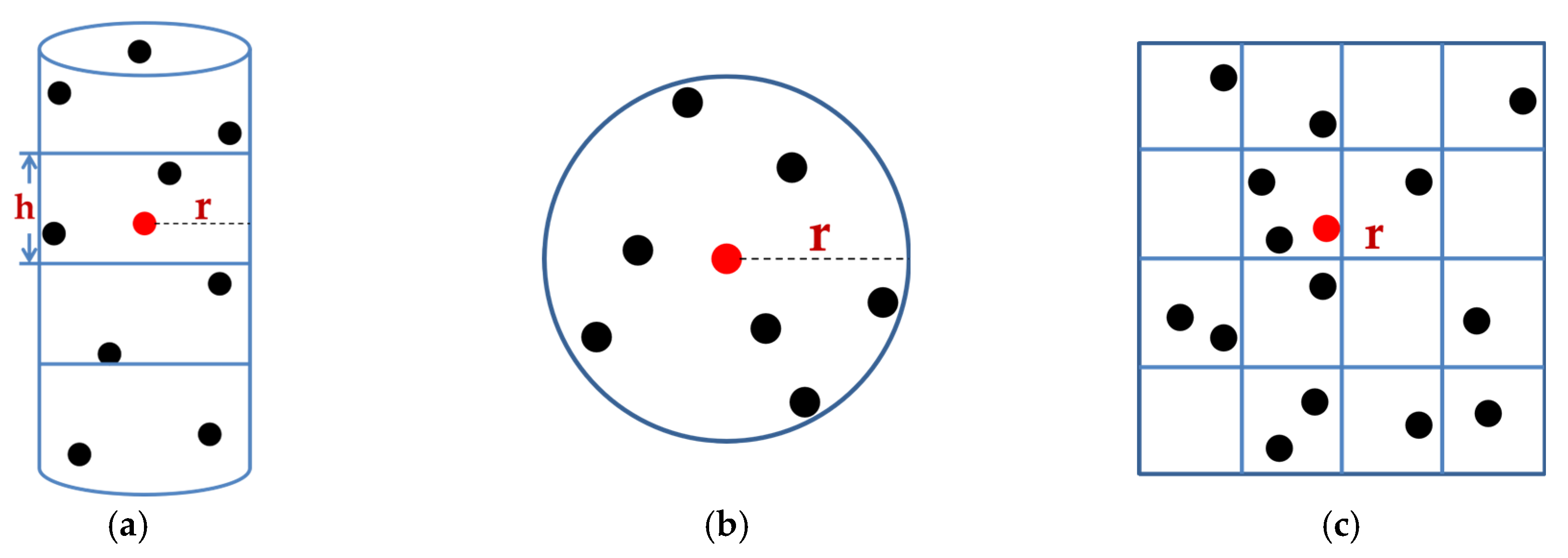
| 2 | point density | This is the number of points within a given neighborhood. | [30] |
| 3 | point density ratio | This is the ratio between the number of points in the sphere-based neighborhood and the number of points in the cylinder-based neighborhood. | [30] |
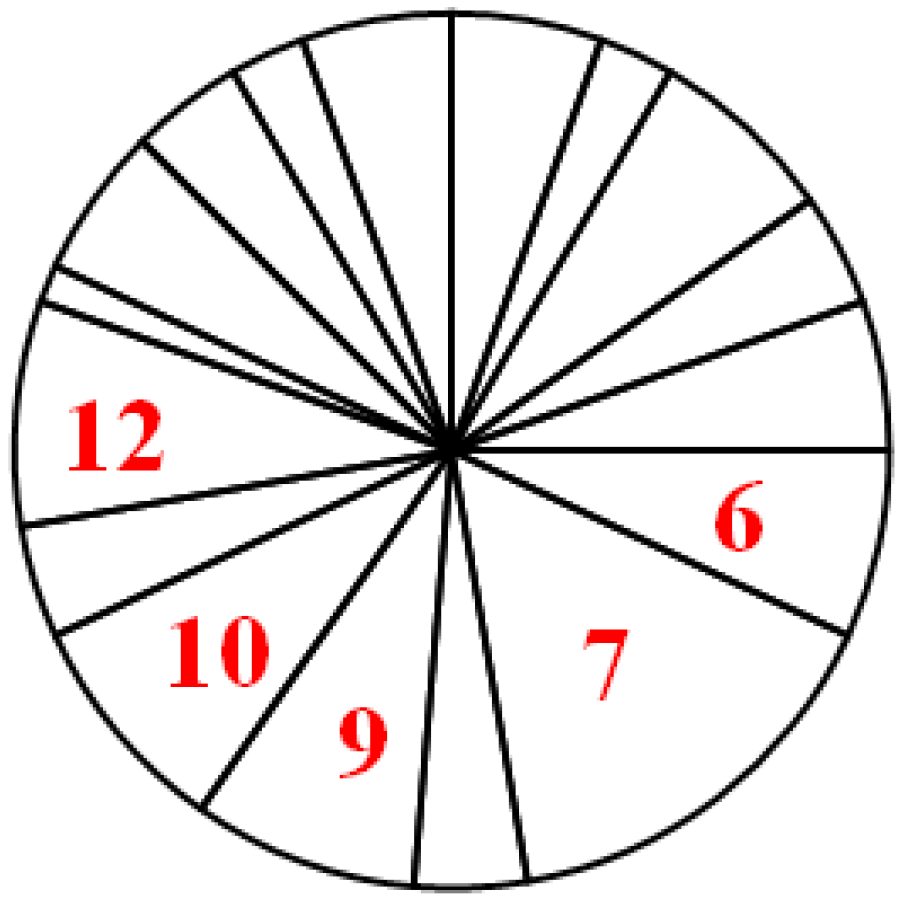
| 4 | count of non-empty bins | The number of non-empty bins. | [8] |
| 5 | count of continuous non-empty bins | The maximum number of continuous non-empty bins. | |
| 6 | count of continuous empty bins | The maximum number of continuous empty bins. | |
| 7 | anisotropy | This value is equal to (1—sphericity). | [30] |
| 8 | linearity | This value is large if the points in the neighborhood are linear. | |
| 9 | planarity | This value is large if the points in the neighborhood are coplanar. | |
| 10 | sphericity | This value is large if the points in the neighborhood are discrete. | |
| 11 | the biggest height deviation | Absolute value of maximum height difference. | [8] |
| 12 | signed biggest height deviation | True value of maximum height difference. | |
| 13 | positive biggest height deviation | The maximum positive height difference between the center point and points in its neighborhood is higher than itself. | |
| 14 | negative biggest height deviation | The maximum negative height difference between the center point and points in its neighborhood is lower than itself. | |
| 15 | max point number deviation | This feature considers all bins except the lowest one. Maximum difference between the average point counts and the point counts in each bin should be recorded. | |
| 16 | count of height classification | Through clustering analysis, height in the neighborhood can be roughly categorized into several classes. | |
| 17 | plane slope | The slope of the fitted plane. | [30] |
| 18 | surface roughness | The standard variance of the distance between the points and the fitted surface. | |
| 19 | distance to surface | The distance between the current point and the fitted surface. |
| Process | Description |
|---|---|
| Input | Training samples with labels Component learning algorithm; Number of cycles T. |
| Initiation Loop | Weights of training samples are for all i = 1, …, N for t = 1, …, T (1) Use component learning algorithm to train a component classifier, ht, on the updated training samples (2) Calculate training error of ht: (3) if then break (4) Calculate weight for component classifier ht: (5) Update weights of training samples: i = 1,…, N, where Ct is a normalization constant, and (6) end for |
| Output |
| Features | 1 | 2 | 3 | 4 | 5 | 6 | 7 | 8 | 9 | 10 | 11 | 12 | 13 | 14 | 15 | 16 | 17 | 18 | 19 | |
|---|---|---|---|---|---|---|---|---|---|---|---|---|---|---|---|---|---|---|---|---|
| Frequency | ||||||||||||||||||||
| three | 3 | 1 | 1 | 1 | 3 | 4 | 9 | 3 | 3 | 4 | 2 | 1 | 1 | 3 | 0 | 2 | 0 | 3 | 0 | |
| five | 4 | 2 | 5 | 3 | 4 | 5 | 11 | 3 | 6 | 6 | 3 | 6 | 1 | 4 | 0 | 3 | 2 | 4 | 0 | |
| Sample Datasets | Kappa | Original Features | Eliminating Feature 7 | Eliminating Features 7/10 | Eliminating Features 7/10/6 |
|---|---|---|---|---|---|
| Type of Errors /% | |||||
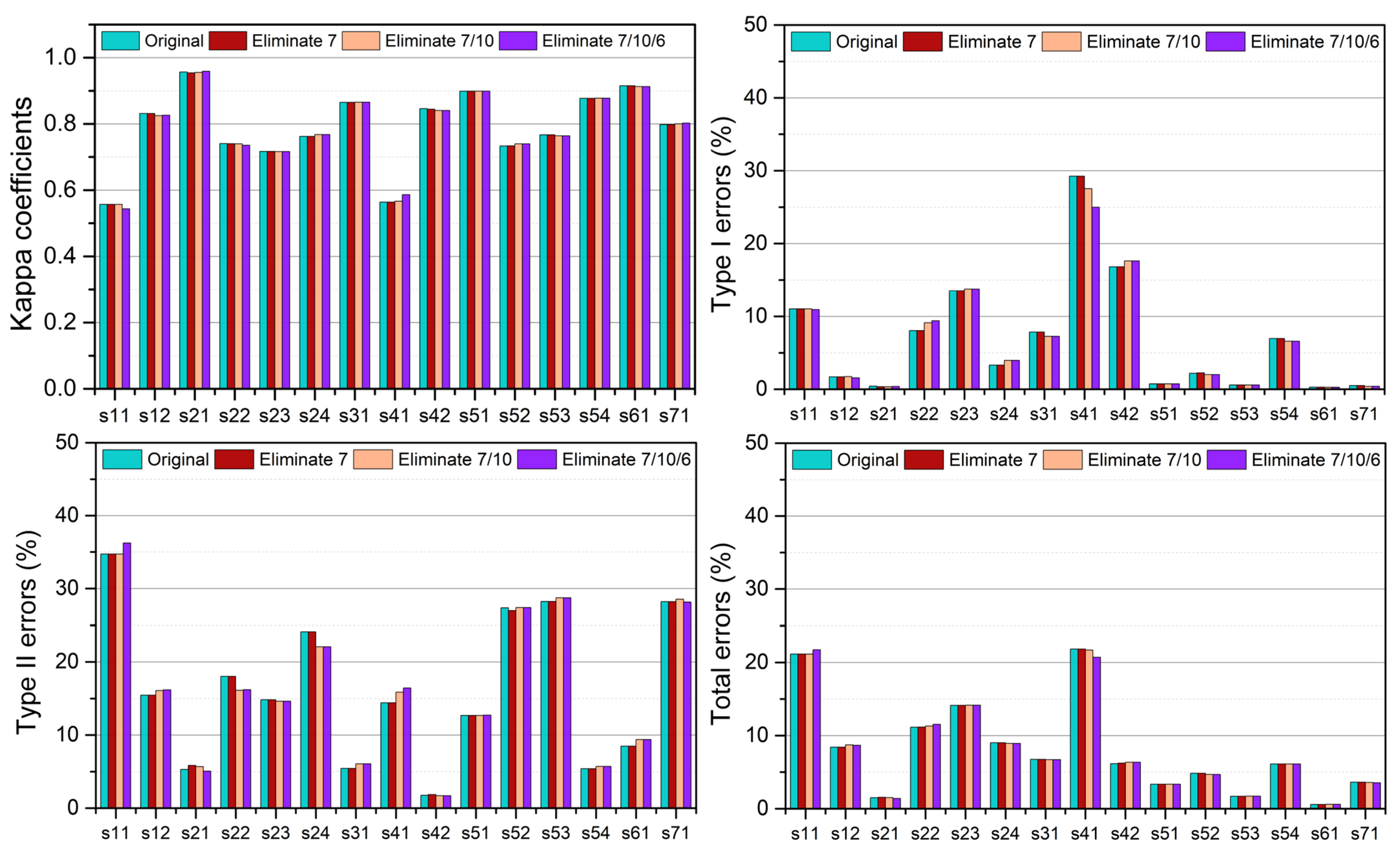
| s11 | kappa | 0.5566 * | 0.5566 | 0.5566 | 0.5433 |
| I | 11.03 | 11.03 | 11.03 | 10.93 | |
| II | 34.72 | 34.72 | 34.72 | 36.23 | |
| Total | 21.14 | 21.14 | 21.14 | 21.73 | |
| s12 | kappa | 0.8313 | 0.8313 | 0.8248 | 0.8258 |
| I | 1.69 | 1.69 | 1.72 | 1.55 | |
| II | 15.44 | 15.44 | 16.07 | 16.16 | |
| Total | 8.40 | 8.40 | 8.72 | 8.67 | |
| s21 | kappa | 0.9563 | 0.9541 | 0.9553 | 0.9588 |
| I | 0.41 | 0.34 | 0.34 | 0.37 | |
| II | 5.29 | 5.84 | 5.67 | 5.04 | |
| Total | 1.49 | 1.56 | 1.52 | 1.40 | |
| s22 | kappa | 0.7402 | 0.7401 | 0.7395 | 0.7350 |
| I | 8.03 | 8.04 | 9.12 | 9.40 | |
| II | 18.02 | 18.01 | 16.11 | 16.19 | |
| Total | 11.14 | 11.15 | 11.30 | 11.52 | |
| s23 | kappa | 0.7168 | 0.7168 | 0.7164 | 0.7164 |
| I | 13.50 | 13.50 | 13.73 | 13.73 | |
| II | 14.82 | 14.82 | 14.61 | 14.61 | |
| Total | 14.12 | 14.12 | 14.14 | 14.14 | |
| s24 | kappa | 0.7622 | 0.7622 | 0.7678 | 0.7678 |
| I | 3.31 | 3.31 | 3.94 | 3.94 | |
| II | 24.10 | 24.10 | 22.06 | 22.06 | |
| Total | 9.02 | 9.02 | 8.92 | 8.92 | |
| s31 | kappa | 0.8650 | 0.8650 | 0.8653 | 0.8653 |
| I | 7.83 | 7.83 | 7.25 | 7.25 | |
| II | 5.43 | 5.43 | 6.06 | 6.06 | |
| Total | 6.73 | 6.73 | 6.70 | 6.70 | |
| s41 | kappa | 0.5637 | 0.5637 | 0.5663 | 0.5861 |
| I | 29.24 | 29.24 | 27.53 | 24.97 | |
| II | 14.41 | 14.41 | 15.86 | 16.43 | |
| Total | 21.81 | 21.81 | 21.68 | 20.69 | |
| s42 | kappa | 0.8458 | 0.8441 | 0.8403 | 0.8403 |
| I | 16.79 | 16.80 | 17.61 | 17.61 | |
| II | 1.75 | 1.84 | 1.69 | 1.69 | |
| Total | 6.15 | 6.22 | 6.35 | 6.35 | |
| s51 | kappa | 0.8986 | 0.8986 | 0.8986 | 0.8986 |
| I | 0.72 | 0.72 | 0.72 | 0.72 | |
| II | 12.68 | 12.68 | 12.68 | 12.71 | |
| Total | 3.33 | 3.33 | 3.33 | 3.33 | |
| s52 | kappa | 0.7330 | 0.7336 | 0.7396 | 0.7396 |
| I | 2.18 | 2.24 | 2.01 | 2.01 | |
| II | 27.35 | 26.97 | 27.39 | 27.39 | |
| Total | 4.83 | 4.84 | 4.68 | 4.68 | |
| s53 | kappa | 0.7666 | 0.7666 | 0.7638 | 0.7638 |
| I | 0.56 | 0.56 | 0.56 | 0.56 | |
| II | 28.22 | 28.22 | 28.73 | 28.73 | |
| Total | 1.68 | 1.68 | 1.70 | 1.70 | |
| s54 | kappa | 0.8770 | 0.8770 | 0.8773 | 0.8773 |
| I | 6.95 | 6.95 | 6.58 | 6.58 | |
| II | 5.38 | 5.38 | 5.69 | 5.69 | |
| Total | 6.11 | 6.11 | 6.10 | 6.10 | |
| s61 | kappa | 0.9148 | 0.9148 | 0.9124 | 0.9124 |
| I | 0.28 | 0.28 | 0.26 | 0.26 | |
| II | 8.46 | 8.46 | 9.37 | 9.37 | |
| Total | 0.56 | 0.56 | 0.58 | 0.58 | |
| s71 | kappa | 0.7979 | 0.7979 | 0.8000 | 0.8020 |
| I | 0.49 | 0.49 | 0.38 | 0.40 | |
| II | 28.19 | 28.19 | 28.53 | 28.14 | |
| Total | 3.62 | 3.62 | 3.57 | 3.54 | |
| Minimum | kappa | 0.5566 | 0.5566 | 0.5566 | 0.5433 |
| I | 0.28 | 0.28 | 0.26 | 0.26 | |
| II | 1.75 | 1.84 | 1.69 | 1.69 | |
| Total | 0.56 | 0.56 | 0.58 | 0.58 | |
| Maximum | kappa | 0.9563 | 0.9541 | 0.9553 | 0.9588 |
| I | 29.24 | 29.24 | 27.53 | 24.97 | |
| II | 34.72 | 34.72 | 34.72 | 36.23 | |
| Total | 21.81 | 21.81 | 21.68 | 21.73 | |
| Average | kappa | 0.7884 | 0.7882 | 0.7883 | 0.7888 |
| I | 6.87 | 6.87 | 6.86 | 6.68 | |
| II | 16.28 | 16.30 | 16.35 | 16.43 | |
| Total | 8.01 | 8.02 | 8.03 | 8.00 |
| Eliminate Features | Stages | Better | Unchanged | Worse | Maximum of Better (Sample) | Maximum of Worse (Sample) | |
|---|---|---|---|---|---|---|---|
| Evaluation Criterion | Average of Better | Average of Worse | |||||
| Feature 7 | Kappa | 1 | 11 | 3 | 0.06% (s52) | 0.22% (s21) | |
| 0.06% | 0.13% | ||||||
| Type I errors | 1 | 11 | 3 | 0.07% (s21) | 0.06% (s52) | ||
| 0.07% | 0.03% | ||||||
| Type II errors | 2 | 11 | 2 | 0.38% (s52) | 0.55% (s21) | ||
| 0.20% | 0.32% | ||||||
| Total errors | 0 | 11 | 4 | 0% | 0.07% (s21) | ||
| 0% | 0.04% | ||||||
| Features 7/10 | Kappa | 6 | 2 | 7 | 0.66% (s52) | 0.65% (s12) | |
| 0.29% | 0.28% | ||||||
| Type I errors | 7 | 3 | 5 | 1.71% (s41) | 1.09% (s22) | ||
| 0.43% | 0.56% | ||||||
| Type II errors | 4 | 2 | 9 | 2.04% (s24) | 1.45% (s41) | ||
| 1.06% | 0.58% | ||||||
| Total errors | 6 | 2 | 7 | 0.15% (s52) | 0.32% (s12) | ||
| 0.08% | 0.11% | ||||||
| Features 7/10/6 | Kappa | 7 | 1 | 7 | 2.24% (s41) | 1.33% (s11) | |
| 0.60% | 0.50% | ||||||
| Type I errors | 9 | 2 | 4 | 4.27% (s41) | 1.37% (s22) | ||
| 0.64% | 0.76% | ||||||
| Type II errors | 6 | 0 | 9 | 2.04% (s24) | 2.02% (s41) | ||
| 0.74% | 0.74% | ||||||
| Total errors | 7 | 1 | 7 | 1.12% (s41) | 0.59% (s11) | ||
| 0.23% | 0.21% | ||||||
Disclaimer/Publisher’s Note: The statements, opinions and data contained in all publications are solely those of the individual author(s) and contributor(s) and not of MDPI and/or the editor(s). MDPI and/or the editor(s) disclaim responsibility for any injury to people or property resulting from any ideas, methods, instructions or products referred to in the content. |
© 2026 by the authors. Licensee MDPI, Basel, Switzerland. This article is an open access article distributed under the terms and conditions of the Creative Commons Attribution (CC BY) license.
Share and Cite
Cai, Z.; Zhao, L.; Chen, Q.; He, Z.; Bi, S.; Xu, X. Feature Selection Based on Height Mutual Information in Airborne LiDAR Filtering. Remote Sens. 2026, 18, 1031. https://doi.org/10.3390/rs18071031
Cai Z, Zhao L, Chen Q, He Z, Bi S, Xu X. Feature Selection Based on Height Mutual Information in Airborne LiDAR Filtering. Remote Sensing. 2026; 18(7):1031. https://doi.org/10.3390/rs18071031
Chicago/Turabian StyleCai, Zhan, Luying Zhao, Qiuli Chen, Zhijun He, Shaoyun Bi, and Xiaolong Xu. 2026. "Feature Selection Based on Height Mutual Information in Airborne LiDAR Filtering" Remote Sensing 18, no. 7: 1031. https://doi.org/10.3390/rs18071031
APA StyleCai, Z., Zhao, L., Chen, Q., He, Z., Bi, S., & Xu, X. (2026). Feature Selection Based on Height Mutual Information in Airborne LiDAR Filtering. Remote Sensing, 18(7), 1031. https://doi.org/10.3390/rs18071031