Article

Hyperspectral Imaging Reveals Chlorophyll Temporal Dynamics in Masson Pine Under Pine Wood Nematode and Abiotic Stresses

1
Anhui Provincial Key Laboratory of Biological Control, Anhui Agricultural University, Hefei 230036, China
2
Key Laboratory of Pine Wood Nematode Disease Prevention and Control, State Forestry and Grassland Administration, Hefei 230031, China
3
China Inner Mongolia Forest Industry Group Co., Ltd., Yakeshi 022150, China
4
Anhui Province Key Laboratory of Forest Resources and Silviculture, No. 130 Changjiang West Road, Hefei 230036, China
*
Author to whom correspondence should be addressed.
These authors contributed equally to this work.
Remote Sens. 2026, 18(7), 1032; https://doi.org/10.3390/rs18071032
Submission received: 27 January 2026 / Revised: 26 March 2026 / Accepted: 27 March 2026 / Published: 30 March 2026

Highlights

What are the main findings?
  • Identification of stress-specific spectral fingerprints: This study identified unique hyperspectral signatures for Masson pine under different lethal stressors. Waterlogging stress was characterized by sensitivity in the green band (534–536 nm), while pine wood nematode infection triggered a response in the blue to red edge region (450–760 nm). A “linear-dominant, nonlinearly-mixed” link between spectral indices and needle chlorophyll content was also revealed for the first time.
  • Superior performance of optimized narrow-band indices and machine learning models: Optimized narrow-band spectral indices, particularly NDSI (689, 907) and continuum-removed spectra at 534–536 nm, strongly correlated with needle chlorophyll content (R2 ≈ 0.84), surpassing previous studies. RF and XGBoost models showed the best accuracy and robustness for needle chlorophyll content inversion in multi-stress conditions.
What are the implications of the main findings?
  • Provides a reliable methodology for early stress diagnosis: The stress-specific spectral imagings and the high-accuracy inversion models enable the early detection and differentiation of pine wilt disease, drought, and waterlogging stress before visible symptoms appear, which is crucial for proactive forest management.
  • Offers practical tools for large-scale forest health monitoring: The findings demonstrate the high efficiency of combining hyperspectral imaging (especially UAV-based) with machine learning models. This provides a viable technical solution for non-destructive, real-time monitoring of Masson pine health status over large areas, supporting precision forestry and pest control strategies.

Abstract

Masson Pine (Pinus massoniana), an important afforestation species in southern China, is severely threatened by pine wilt disease caused by pine wood nematode (Bursaphelenchus xylophilus, PWN). To differentiate mortality induced by B. xylophilus from that caused by abiotic environmental factors, hyperspectral imaging and needle chlorophyll content were measured and analyzed for the early detection physiological changes in Masson pine seedlings under various environmental stressors. Four-year-old Masson pine seedlings were subjected to PWN inoculation, mechanical injury, drought, and waterlogging treatments. Hyperspectral reflectance and needle chlorophyll content of Masson pine were measured concurrently at 7-day intervals. The results showed that hyperspectral imaging responses varied among the stressors. Both PWN and waterlogging stress induced rapid mortality, with spectral changes observed as early as the 3rd week and reaching statistical significance by the 5th week. Under PWN infection, hyperspectral reflectance increased markedly in the 405–580 nm range, accompanied by a pronounced blue-shift of the red edge position (680–750 nm), while needle chlorophyll content declined sharply from approximately 0.8 mg g−1 to 0.48 mg g−1. Waterlogging stress produced a uniform increase in reflectance within the 500–580 nm range, with the hyperspectral curve gradually flattening, and needle chlorophyll content decreasing from 0.75 mg g−1 to 0.6 mg g−1. Conversely, drought-stressed seedlings exhibited only minor hyperspectral changes and maintained relatively stable chlorophyll levels, demonstrating the inherent drought tolerance of Masson pine. The RF and XGBoost models performed best in fitting the entire process of pine wood nematode infection and waterlogging stress, with all R2 values greater than 0.69. The distinct hyperspectral imaging patterns under nematode infection and water-related stresses provide a reliable basis for early diagnosis and monitoring pine wilt disease in Masson pine stands.

1. Introduction

Pine wilt disease, caused by Bursaphelenchus xylophilus, the pine wood nematode (PWN), is one of the most damaging emerging pest problems in forests around the world [1,2,3,4,5]. Since the introduction of PWD into China, its affected area continued to expand. By 2025, PWD has been detected in 455 county-level administrative regions across 20 provinces in China [6]. Masson Pine (Pinus massoniana) is a major coniferous species in southern China [7], valued for its rapid growth, high productivity, and economic value, and is extensively cultivated in the region. Although it exhibits strong environmental adaptability and is distributed in regions with plentiful annual rainfall, the species confronts three major threats in summer: (1) pine wilt disease caused by B. xylophilus [8], (2) recurrent high-temperature extremes [9], and (3) excessive rainfall during certain subtropical periods [10].
Currently, PWD caused by the pine wood nematode remains the most severe threat to Masson pine survival [11]. The occurrence and prevalence of PWD are strongly linked to climatic factors, such as high temperatures [12,13], which intensify the damage caused by nematode infestation in heat-stressed Masson pine. Under global warming, the impacts of high-temperature stress on Masson pine are expected to intensify, leading to decreased photosynthetic capacity and increased mortality [14,15,16]. Beyond high-temperature stress, water-related abiotic stresses have also become a major threat to Masson pine in tropical and subtropical regions [17,18]. Frequent typhoons and severe convective weather during summer in these areas often lead to surges in rainfall, causing temporary water accumulation in low-lying forest areas and subsequent waterlogging stress [19]. Early monitoring of Masson pine health is therefore critical for distinguishing and addressing the combined threats posed by PWD and abiotic stresses.
In recent years, hyperspectral remote sensing has become a key tool for the efficient monitoring of forest health and PWD [20]. This technique captures spectral data across very narrow wavelength intervals, enabling the precise extraction of spectral signatures from ground objects, and has been widely applied in monitoring plant health and pest infestation [21]. For example, Zhang et al. combined hyperspectral data with field measurements of sugar and moisture content in Masson pine, and identified the 455–677 nm spectral region as diagnostic for the early detection of PWN infestation [22]. Zhang also reported that drought stress reduces the photosynthetic rate in Masson pine [23], further leading to a decline in chlorophyll content [24]. Similarly, Huang’s hyperspectral analysis of black pine needles revealed a significant linear relationship between needle chlorophyll content and the progression of PWD [25]. These studies indicate that plant physiological indicators can be effectively used to evaluate plant physiological status [26,27,28].
Currently, remote estimation of physiological parameters using hyperspectral data is commonly based on the construction of spectral indices. Compared with broadband indices derived from multispectral sensors, narrowband indices take full advantage of the high spectral resolution of hyperspectral data to capture subtle biochemical and physiological variations associated with plant stress [29]. For early stress detection, narrowband indices provide superior sensitivity, as they can precisely target the characteristic absorption features of key pigments and detect minor shifts in the red edge position (REP)—signals that are often obscured or smoothed by the broadband channels of conventional sensors [29]. The construction of spectral indices, including both traditional vegetation indices and narrow-band spectral indices, typically relies on combinations of two or more spectral bands, often enhanced by mathematical transformations. Regression-based modeling enables the accurate identification of sensitive spectral intervals associated with plant physiological parameters, thereby enhancing the predictive performance of estimation models [30,31].
With the rapid advancement of deep learning, advanced models based on attention mechanisms including Transformers and their variants have achieved breakthrough performance in remote sensing image processing, especially in semantic segmentation and fine-grained classification of hyperspectral images. For example, Liu et al. reported that the SegHSI model, which employs clustered attention, enables efficient and accurate segmentation with limited labeled samples, addressing the challenges of high labeling costs and complex spatial contexts in hyperspectral data [32]. Meanwhile, Multi-Scale Multi-Attention Networks that integrate self-attention and cross-attention modules have been widely used to fully exploit multi-scale and multi-modal information in remote sensing data, greatly improving the ability to identify complex scenes and subtle stress characteristics [33]. These cutting-edge algorithms provide effective tools for the automated extraction of highly discriminative stress-related features from high-dimensional complex spectral data.
In this study, we weekly measured the chlorophyll content and hyperspectral characteristics of needles on Masson pine under PWN, drought, and waterlogging stresses, to explore the hyperspectral responses of Masson pine to different stressors and the relationship between needle chlorophyll content and hyperspectral features. We identified the characteristic spectral bands under each stress condition and developed four machine learning models. This research provides a scientific basis for the remote sensing monitoring of PWD and the health status of Masson pine forests.

2. Materials and Methods

2.1. Experimental Materials

Pine wood nematodes: The nematodes (B. xylophilus) used in this study were isolated from a Masson pine tree with PWD in the Washan Forest Farm, Chuzhou City, Anhui Province, China. The species of the nematodes was confirmed as B. xylophilus by morphological and molecular identification and subsequently preserved at 4 °C in the Anhui Provincial Key Laboratory of Biological Control, Anhui Agricultural University.
Masson pine seedlings: Four-year-old Masson pine seedlings, approximately 1.2–1.4 m in height, were purchased from Anhui Siji Forestry Co., Ltd. (Huangshan, Anhui, China). The seedlings were acclimatized for one month at the Hefei Base of the Anhui Academy of Forestry Sciences before the experiments.
Hefei City (31°49′14″N, 117°13′38″E) and Chuzhou City (32°15′22″N, 118°19′59″E) in Anhui Province share a subtropical monsoon climate characterized by distinct seasons, with hot and humid summers and cold, damp winters. The annual average temperature ranges from 15 to 16 °C, and the annual precipitation falls between 900 and 1000 mm. The terrain of Hefei is predominantly plains and hills, while Chuzhou is mainly composed of hilly and mountainous areas, with Masson pine being the predominant tree species.

2.2. Experimental Methods

2.2.1. Cultivation and Harvest of Pine Wood Nematodes

Artificial cultivation: Botrytis cinerea was inoculated onto Potato Dextrose Agar (PDA; 200 g potato, 20 g glucose, 20 g agar, 1000 mL distilled water) and incubated at 25–28 °C. After the fungus completely covered the medium (approximately 5 days), a liquid of B. xylophilus was introduced onto the PDA and further incubated at 25–28 °C to propagate the nematodes.
Nematode harvest: The Baermann funnel method was used to harvest the well-cultivated nematodes [31]. A sterilized glass funnel (12 cm in diameter) was placed on a stand. Sterile water was added to the funnel, and the PDA medium with B. xylophilus well cultured was wrapped in tissue paper and submerged in the water for 12 h. Then the pinch clamp was released, and 10 mL of the nematode liquid was collected in a centrifuge tube. The liquid was centrifuged at 3500 rpm for 3 min at room temperature. The supernatant was discarded, and the nematode sediment was washed 2–3 times with sterile water before storage at 4 °C.

2.2.2. Stress Treatments and Sample Collection

The experiments were conducted at the Hefei Base of the Anhui Academy of Forestry Sciences, located more than 1 km from any known PWD outbreak area. A 15 m × 15 m experimental plot was set up under a shading shelter (2.5 m height, 50% shading rate) enclosed with 40 mesh insect-proof netting on all sides to ensure adequate ventilation and stable temperature and humidity. A total of 250 Masson pine seedlings were selected. The seedlings were transplanted with a spacing of 1.5 m × 1.5 m and allowed to grow for one month under standard watering practices. Five treatments were established, each with five replicates of 10 seedlings per replicate: (1) Pine wood nematode inoculation group (A): A wedge-shaped incision, not exceeding one-third of the stem diameter, was made into the xylem at the midpoint of the first and second branches at the bottom using a sterile scalpel. A sterile cotton ball soaked in B. xylophilus liquid (5000 nematodes per seedling) was inserted into the incision, which was then sealed with sealing film and plastic wrap. (2) Mechanical injury group (B): The same procedure as group A, but 20 mL of sterile water instead of the nematode liquid to assess the effects of the mechanical injury. (3) Drought stress group (C): Watering was completely halted. Soil water content was monitored until it dropped below 10% and this level was maintained. No nematode inoculation was performed in this group. (4) Waterlogging stress group (D): Seedlings were transferred to a tank containing field soil, and the water level was maintained 5 cm above the root zone throughout the experiment. No nematode inoculation was performed in this group. (5) Control group (E): No treatment; plants were allowed to grow naturally. Hyperspectral data and needle samples from Masson pine seedlings were collected at 3 h after the treatments and periodically measured and sampled at 7-day intervals. The collected needles were sealed in plastic bags, stored in an insulated box with ice packs, and immediately transported to the laboratory for chlorophyll determination.

2.2.3. Determination of Needle Chlorophyll Content

Freshly conifer needles from 10 Masson pine seedlings were randomly sampled for chlorophyll content extraction and measurement. Fresh needle leaves from each treatment were uniformly mixed. A 0.25 g sample of needles was randomly selected and cut into 0.2 cm segments. These segments were ground into a homogenate in a mortar with 80% acetone, 2–3 g CaCO3, and quartz sand. The homogenate was filtered into a 25 mL volumetric flask. The mortar, pestle, and glass rod were rinsed several times with 80% acetone, and the rinses were also filtered into the same volumetric flask. The final volume was adjusted to the 25 mL mark with 80% acetone. The absorbance of the solution was measured at 663, 646, and 470 nm using a spectrophotometer. Chlorophyll and carotenoid contents were determined using standard formulas [34]:
C a   =   ( 12.21 A 663 2.81 A 646 )   ×   V / 1000   m
C b = ( 20.13 A 646 5.03 A 663 )   ×   V / 1000   m
C total = C a +   C b
In the equations, C a ,   C b and C total represent the contents (mg g−1) of chlorophyll a, chlorophyll b, and total chlorophyll (sum of chlorophyll a and b), respectively. A 663 and A 646 denote the absorbance of the chloroplast pigment extract at 663 nm and 646 nm, respectively.

2.3. Hyperspectral Data Acquisition and Preprocessing

2.3.1. ASD Spectroradiometer Measurements

From each Masson pine seedling, 3–5 clusters of needles were randomly sampled from the middle-upper part of the crown as measurement targets, thus ensuring the spectral data reflected the natural progression of plant physiological status. Hyperspectral reflectance of Masson pine needles was measured using a portable spectroradiometer (ASD FieldSpec4 Wide-Res, Malvern Panalytical Ltd., Malvern, Worcestershire, UK), which has a mean spectral resolution of 1 nm and a spectral range of 350–2500 nm. All measurements were conducted around noon. The instrument was placed in a well-ventilated, dry location and allowed to warm up for at least 30 min prior to use to ensure stable operation. The needle samples cover an area of approximately 2 cm × 3 cm, fully encompassing the probe’s field of view, preventing spectral interference from the background. A standard Spectralon whiteboard was used for reference calibration before each measurement to eliminate errors caused by fluctuations in natural light intensity and instrument drift.

2.3.2. Data Preprocessing

Raw hyperspectral data were exported using MATLAB R2022b, then organized and standardized in Microsoft Excel 2021. Preprocessing was performed to minimize environmental noise, instrument baseline drift, and spectral scattering. The aim was to improve the signal-to-noise ratio and feature discriminability. Several preprocessing methods were evaluated, including multiplicative scatter correction, normalization, moving window smoothing, first and second-order differentiation, and Savitzky–Golay smoothing. Comparative assessments indicated Savitzky–Golay smoothing was optimal for analysis. The core parameters for the Savitzky–Golay smoothing and derivative transformations were set as follows: a window width of 7 data points and a polynomial order of 3. First-derivative spectra (derivative order = 1) were subsequently calculated based on the smoothed spectra for further analysis. The preprocessed hyperspectral data were used to construct a comprehensive library of narrow-band spectral indices, including ratio, normalized difference, and difference types. All data computations and processing were performed in the Python 3.9 environment, by utilizing scientific computing libraries such as Pandas and NumPy. Dynamic variations in measured needle chlorophyll content and needle spectral reflectance were analyzed across different stressing stages. Correlations between each spectral index and needle chlorophyll content were calculated to identify key narrow-band combinations most sensitive to different stressors. Specifically, Pearson correlation analysis was adopted to calculate the correlation coefficient (r) between each constructed narrow-band spectral index (NDSI, DSI, RSI) and the measured needle chlorophyll content of Masson pine under different stressors. The absolute value of r was used to evaluate the strength of the correlation. The narrow-band combinations with |r| > 0.6 (p < 0.01) were defined as highly sensitive combinations to chlorophyll content variation. These sensitive combinations were then ranked by the absolute value of the correlation coefficient, and the top-ranked combinations were selected as the key narrow-band combinations for each stress type. All correlation analyses and significance tests were performed using SPSS 26.0 software, with a 95% confidence interval.
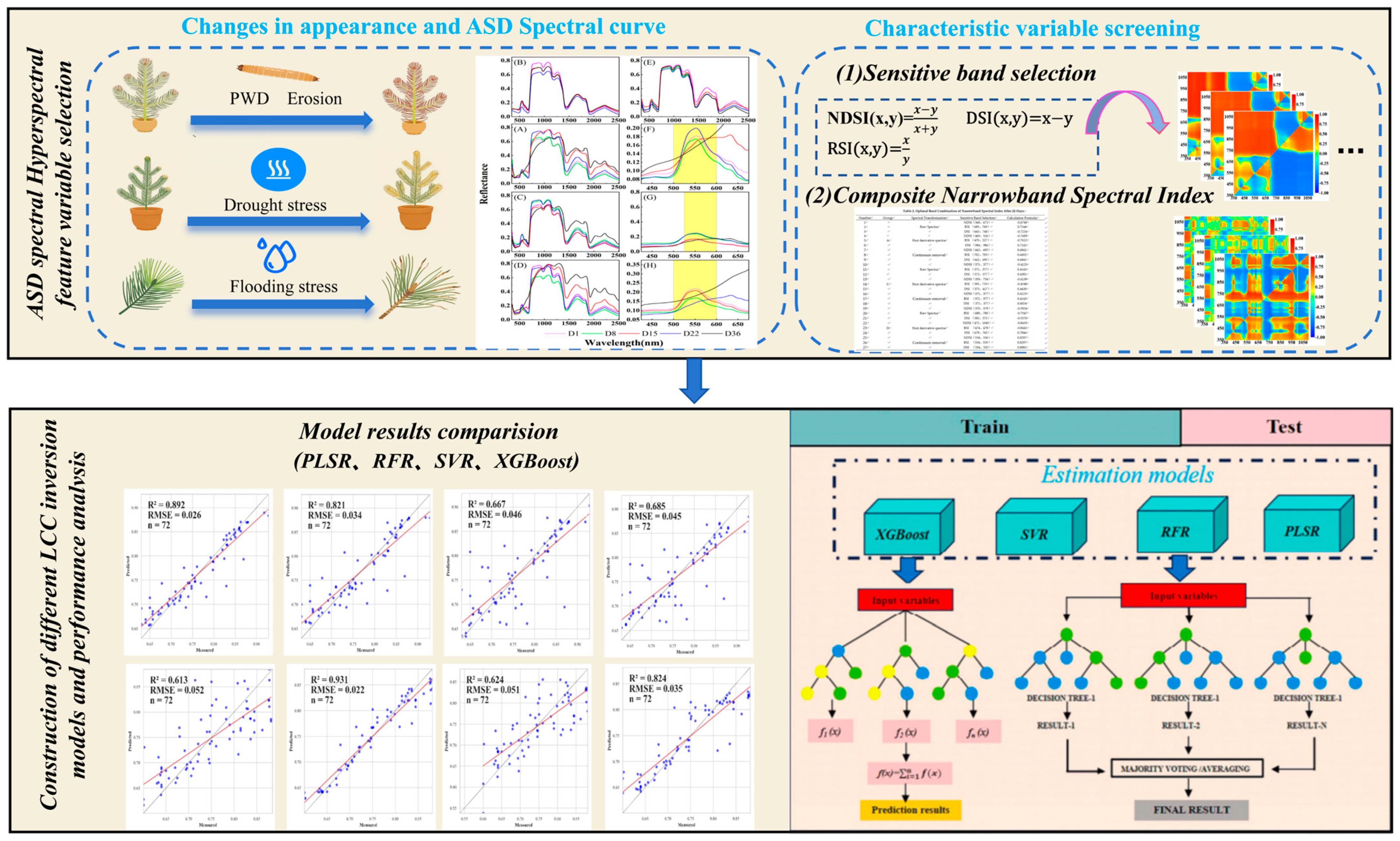
These sensitive bands were used as specific spectral markers to distinguish between the different stressors. Given the challenges in acquiring the stringent input parameters required by fully physical radiative transfer models (RTMs) under complex field conditions, which would introduce significant uncertainties. We opted for a hybrid approach combining empirical spectral indices with machine learning algorithms. To develop high accuracy chlorophyll content inversion models and enable early diagnosis of stress types, four widely used machine learning regression models, Random Forest Regression (RFR), Partial Least Squares Regression (PLSR), Support Vector Regression (SVR), and Extreme Gradient Boosting (XGBoost), were developed and compared. All models were implemented using the Scikit-learn and XGBoost libraries in Python. The datasets were divided into training and testing subsets. Model performance was evaluated using the coefficient of determination ( R 2 ) and the root mean square error (RMSE) to identify the model with the highest inversion accuracy under different lethal stress conditions (see Figure 1). This methodology provides a core algorithmic foundation for real-time, non-destructive monitoring of Masson pine growth status.

2.4. Construction of Narrow Band Spectral Indices from Needle Hyperspectral Data

By pairwise combination of any two bands within the hyperspectral range, narrow band spectral indices can be constructed. Three index formulations, including the Normalized Difference Spectral Index (NDSI), the Difference Spectral Index (DSI), and the Ratio Spectral Index (RVI), were used to investigate the relationship between narrow band spectral indices derived from Masson pine needle hyperspectral data across the 350–1050 nm range and needle chlorophyll content. Specifically, NDSI, DSI, and RVI were systematically constructed for the original reflectance spectra, first derivative spectra, and continuum-removed spectra, based on all possible two-band combinations. The formulas are given in Equations (4)–(6):
  N D S I = R i R j R j + R i
R S I = R i R j
  D S I = R i R j
In the equations, i and j represent the hyperspectral wavelengths, and R i and R j denote the hyperspectral reflectance values at wavelengths i and j, respectively. This study takes the original spectrum, the first derivative spectrum, and the continuum-removed spectrum separately.

3. Results and Analysis

3.1. Effects of Different Stressors on Needle Chlorophyll Content of Masson Pine

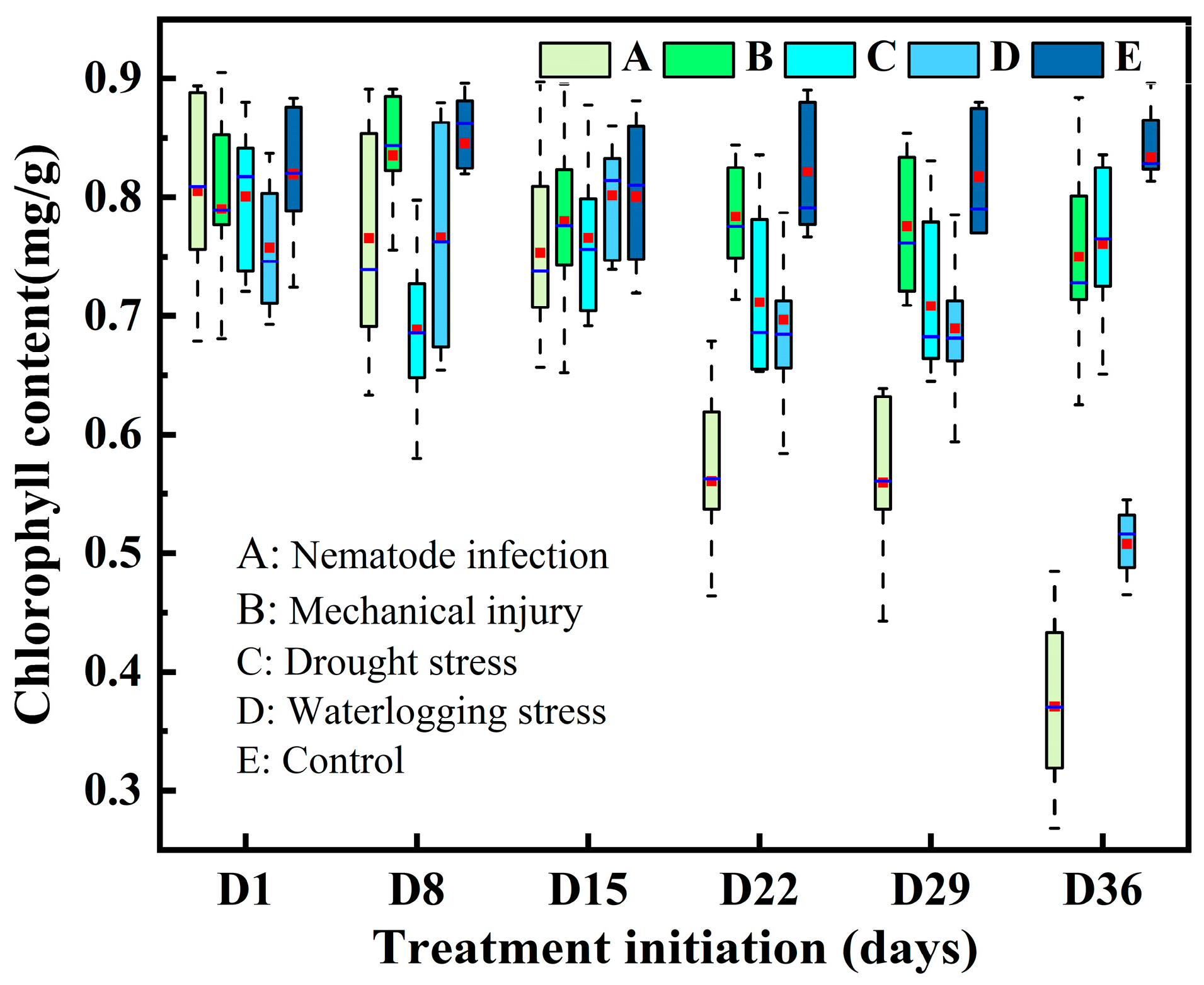
Continuous morphological observations revealed different temporal changes in needle symptoms under different stressors. Temporal variation in needle chlorophyll contents for different treatments exhibited a high degree of distinctiveness. A summary of these findings is presented in Table 1 and Figure 2.
Needle chlorophyll content of Masson pine for all treatments remained almost stable in the first two weeks (Figure 2). No significant difference in needle chlorophyll content between different treatments and the control, except for Group C (Drought stress) on the eighth day. A transient but obvious drop in chlorophyll content was observed in Group C on day 8. This likely reflects a short-term shock response to sudden watering cessation, rather than sustained drought stress. This initial fluctuation did not form a trend, and chlorophyll levels subsequently recovered and stabilized.
After one additional week, needle chlorophyll contents in Group A (Nematode stress) and Group D (Waterlogging stress) notably declined to 0.55 mg g−1 and 0.68 mg g−1, respectively. These values were significantly lower than that of the control, indicating obvious physiological deterioration. In the 5th week, chlorophyll content in Groups A and D reached lower levels of less than 0.50 mg g−1 and 0.55 mg g−1, significantly lower than that of the control (0.85 mg g−1). Needle chlorophyll content in Group C showed fluctuations over time, indicating that the effect of drought stress on Masson pine needs a longer time. No significant difference appeared between Group B (Mechanical injury) and Group E (Control), verifying that the mechanical injury had a minor effect on needle chlorophyll content.
According to morphological observations, there was one week of potential before morphological abnormalities appeared on needles in Groups A and D. Meanwhile, needle chlorophyll content in the two groups did not change much until the 3rd week. This represents a key time point at which chlorophyll metabolism in Masson pine underwent significant alteration, serving as a distinguishing marker for the health detection of Masson pine.

3.2. Spectral Characteristics of Masson Pine Needles

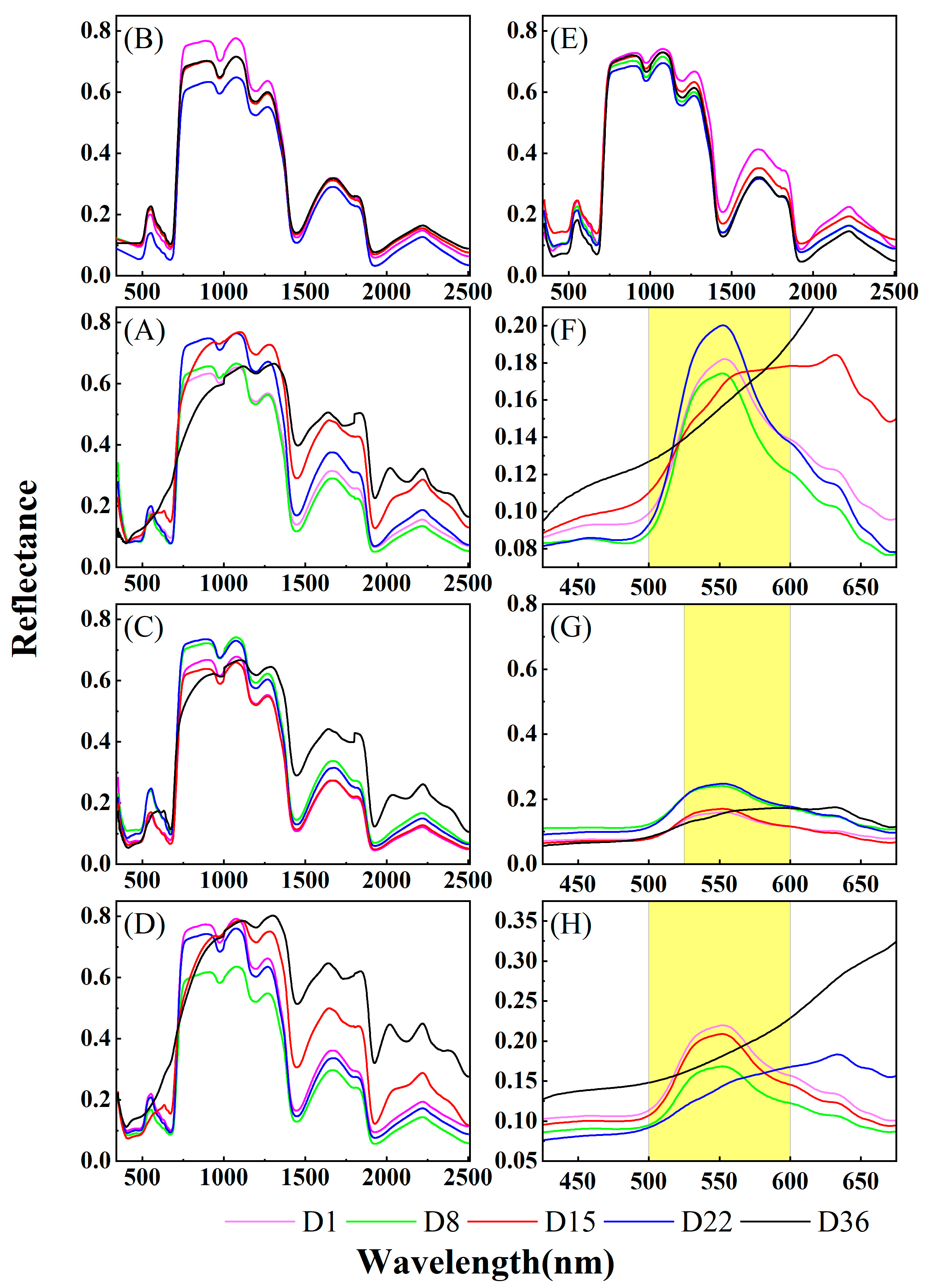
The spectral curves of all treatment groups in the first two weeks maintained relative stability, while some early features appeared in Groups C (drought stress) and D (Waterlogging stress) (Figure 3). A typical spectral curve of “two valleys one peak” representing absorption valleys in the 450–550 nm and 600–750 nm ranges and a reflectance peak near 550 nm in Groups B and E exhibited spectral features of healthy Masson pine. The spectral curve in Group A (nematode infection) did not show any obvious change in the visible and near-infrared regions, while reflectance in the visible region increased slightly in Group C. Similarly, there was a mild rise in reflectance in the green light region in Group D.
The spectral curves exhibited marked divergence under different stressors between the 3rd and 5th weeks. In Group A, reflectance increased significantly in the 405–505 nm range, the absorption valley disappeared, the reflectance peak in the 505–600 nm range diminished, and the red edge feature became indistinct after 5 weeks of nematode infection. This is because stressed plants produce less chlorophyll, leading to reduced light absorption associated with chlorophyll decreases [35]. Consequently, reflectance in the red and green regions increases, resulting in leaf chlorosis and yellowing. In Group C, reflectance gradually decreased in the 520–680 nm range and beyond 680 nm. Because the contents of soluble protein and soluble sugar showed no significant changes under moderate and severe drought stress, the seedlings exhibited lower oxidative damage and enhanced drought resistance [7,36]. Therefore, the early-stage spectra of Masson pine in Group C may undergo slight changes, but due to its inherent drought resistance, it does not exhibit disease symptoms. In Group D, reflectance increased uniformly across the 500–600 nm range, leading to an overall flattening of the spectral curve. According to Chen Wei’s research, the main reason for the prolonged waterlogging of Masson pine is that the fallen debris of coniferous trees contains a large amount of tannins, resins, lignin, etc. These substances will produce acidic substances after decomposition, and the acidic soil will increase with the length of waterlogging time, resulting in an increase in soil organic matter content [37]. The quantity decreases, leading to the death of Masson pine. This effect was more pronounced in the 5th week. The spectral curves of the 3rd week and 5th week almost completely overlapped in Groups B (Mechanical injury) and E (Control), indicating a consistently healthy spectral profile. These distinct temporal changes in spectral curves provide a reliable method to distinguish between different stressors.
Significant differences in needle chlorophyll content and narrow band spectral indices were observed before and after three weeks (D22) of treatment. The observation period was therefore divided into pre-D22 (potential) and post-D22 (symptom) stages. Separate spectral inversion models were developed for each stage.

3.3. Correlation Analysis Between Narrow Band Spectral Indices and Chlorophyll Content in Masson Pine

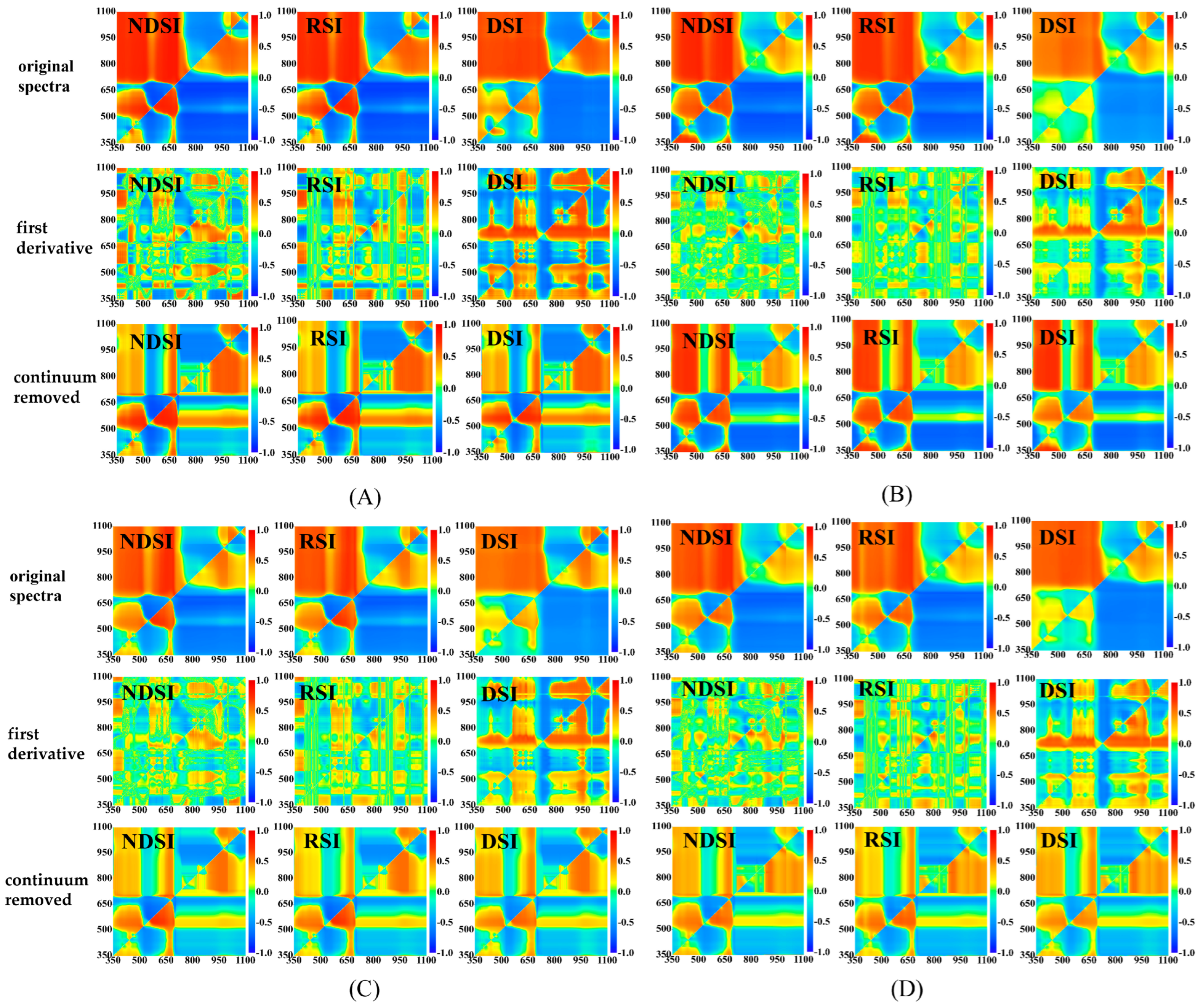
Based on needle spectral reflectance data collected with an ASD spectroradiometer, dual band spectral indices derived from three types of transformed spectra (original, first derivative, and continuum-removed spectra) were constructed in Python 3.9. The correlation between narrow-band spectral indices and needle chlorophyll content under different stressors was investigated through correlation isoplots (Figure 4).
In the pre-D22 stage, the original pine needle spectra of Group A were negatively correlated with needle chlorophyll content in the 450–700 nm and 750–1000 nm ranges. The maximum correlation coefficients between the nine narrow band spectral indices and needle chlorophyll content ranged from 0.5416 to 0.6628. The correlation between first derivative spectra and needle chlorophyll content was variable. A positive correlation was observed in the 750–950 nm range, but the correlation index was lower than that of the original spectra. Continuum-removed spectra exhibited a negative correlation in the 650–750 nm range, with a maximum correlation coefficient of 0.6296 at 663 nm. In Group C, original needle spectra exhibited a strong correlation with needle chlorophyll content, forming concentrated and continuous high-correlation zones in the combined regions of 700–800 nm and 1000–1050 nm. The absolute correlation coefficients for NDSI and RSI exceeded 0.7500. The index derived from first-derivative spectra showed a maximum correlation of 0.668 (DSI), with multiple isolated strong correlations observed, typically in the 550–750 nm range and above 1000 nm. Continuum-removed spectra displayed negative correlations in the 500–600 nm and 650–720 nm ranges, with correlation coefficients exceeding 0.7200 near 550 nm. In Group D, the original spectrum-based NDSI (689,907) exhibited a very high positive correlation with chlorophyll (r = 0.8372). The optimal RSI derived from first-derivative spectra showed a correlation above 0.6. Continuum-removed spectra in Group D showed negative correlations in the 350–450 nm range; the optimal indices were RSI (352,444) and DSI (359,435), with correlation coefficients of −0.7412 and −0.7392, respectively, presenting a shift of the most sensitive bands to the blue-violet region. In Group E, continuum-removed spectra directly reflected chlorophyll absorption features at the sensitive wavelengths of 560 nm and 690 nm.
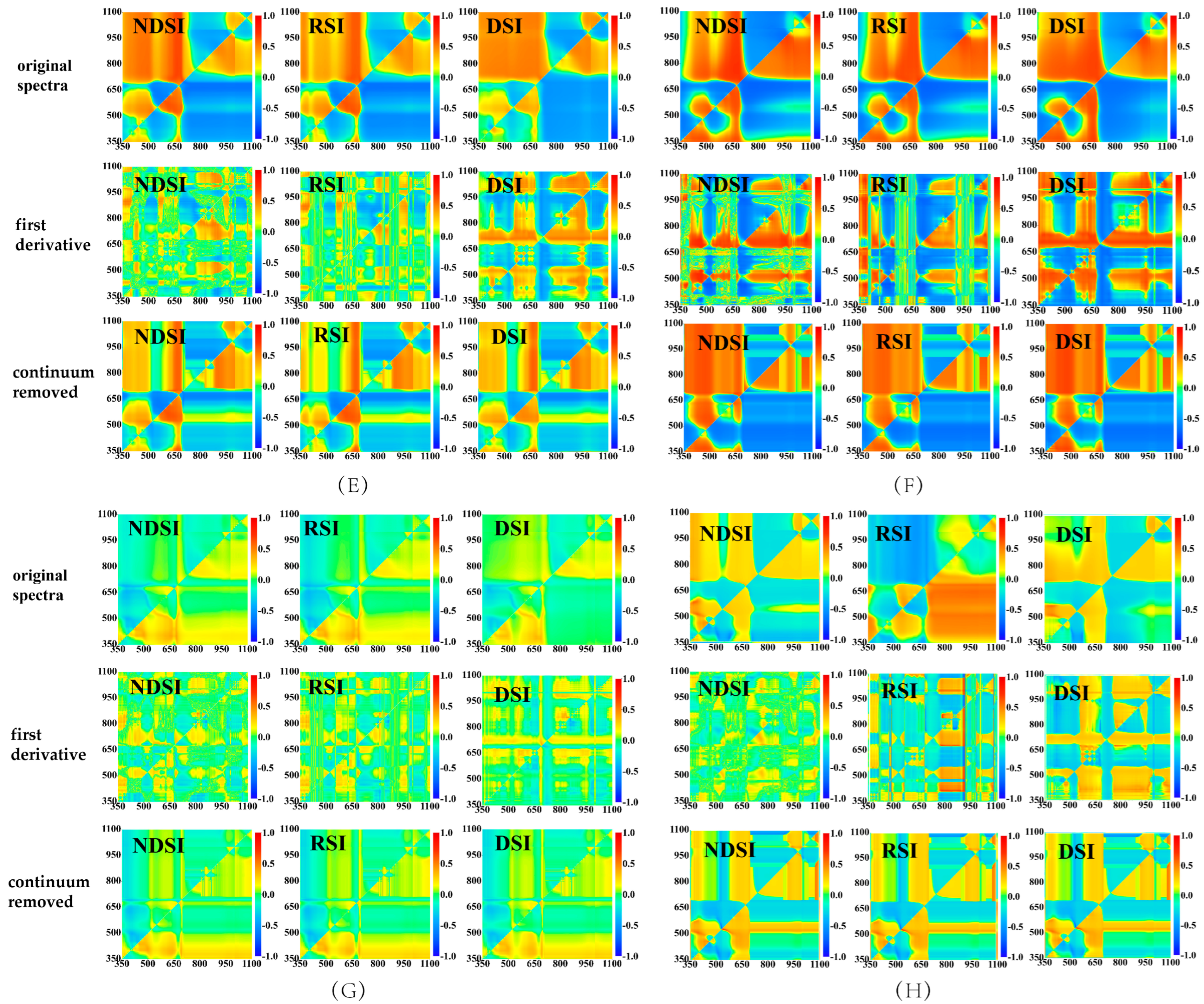
In the post-D22 stage, the NDSI and RSI indices of Group A were concentrated in the bands (664,748) and (664,749), with correlation coefficients exceeding 0.66. The inversion performance in Group C was poor, with correlations only above 0.4. Conversely, the original spectrum-based NDSI (471,1045) in Group D achieved a correlation coefficient of –0.8433 with chlorophyll, and the continuum-removed spectra in the extremely narrow 534–535 nm ranges reached correlations of 0.8297 and 0.8081. First-derivative spectra consistently demonstrated high sensitivity to stressors across all groups, with the NDSI (474,478) band expressing a very strong correlation of –0.8441, and continuum-removed spectra near 534 nm provided the best inversion capability in Group D. Notably, a weakened response in spectral band information appeared in Group C (Figure 5).
When performing data inversion on the chlorophyll content of Masson pine, the transformed spectra from first derivative and continuum-removed performed better than the original spectra, yielding higher and more stable correlation coefficients. First derivative processing effectively highlighted subtle variations in spectral curves, responding more rapidly to changes in chlorophyll and showing extremely high sensitivity in specific narrow bands. At the same time, continuum-removed spectra, with appropriate band combinations, also proved to be an effective method for spectral transformation in chlorophyll inversion. The optimal band combinations for narrow band spectral indices of chlorophyll under the stressors were selected for both the pre-D22 and post-D22 stages, according to their maximum correlation coefficient (Table 2 and Table 3).

3.4. Regression Models Based on Narrow Band Spectral Indices

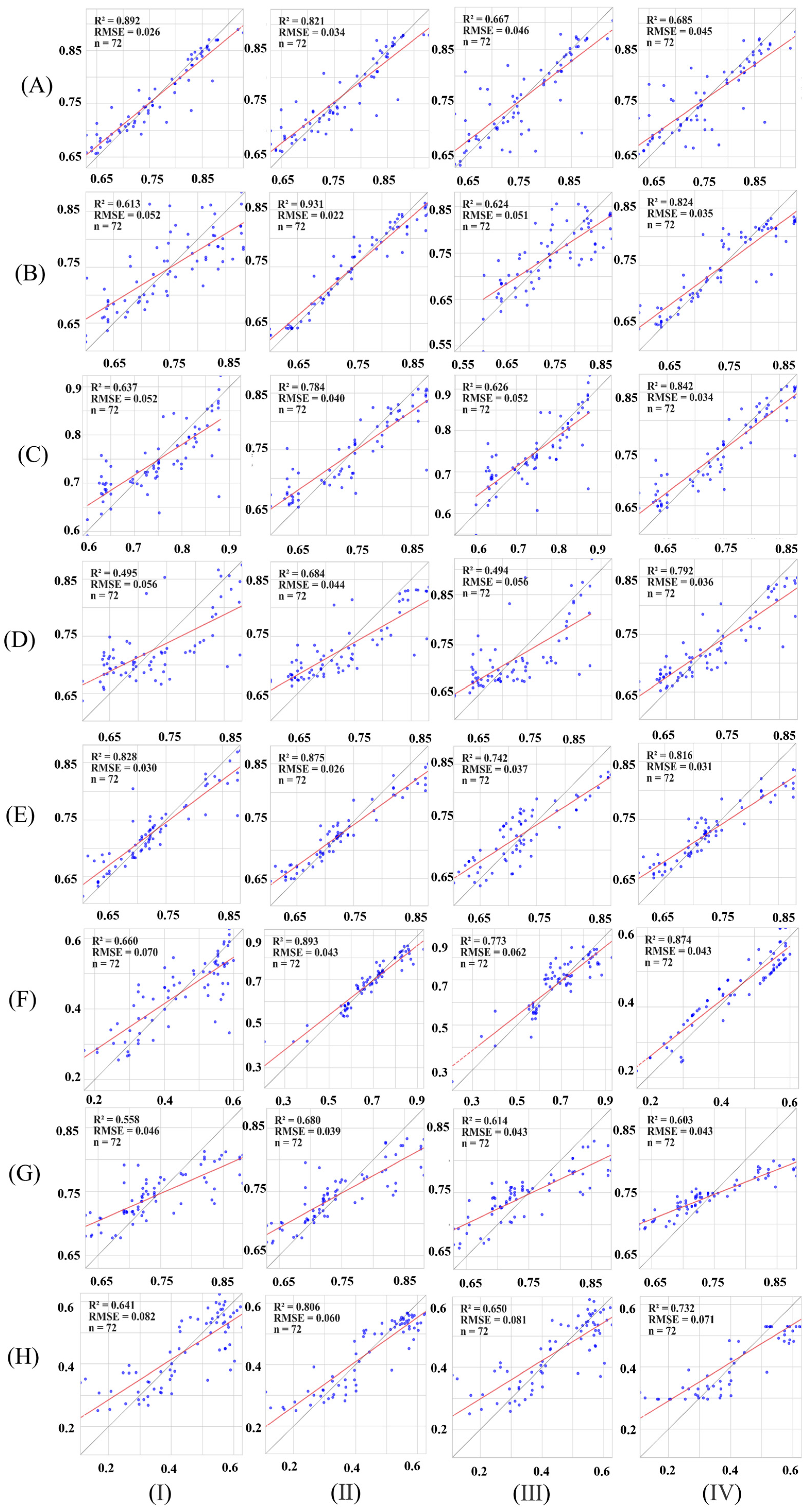
Linear regression models were developed with needle chlorophyll content as the dependent variable. The independent variables included the optimal band combinations of the Difference Spectral Index, Ratio Spectral Index, and Normalized Spectral Index derived from original, first-derivative, and continuum-removed spectra. The best univariate prediction model for each spectral transformation was selected, as shown in Figure 6. The results indicated that the optimal narrow-band spectral indices exhibited a linear relationship with needle chlorophyll contents in all cases. The coefficient of determination ( R 2 ) exceeded 0.50 for all stress groups, except for the drought-treated group in the post-D22 stage under the three spectral transformations. Among the four constructed machine learning regression models, the RFR and XGBoost models performed best in predicting needle chlorophyll content of Masson pine under multi-stress conditions. Specifically, RFR and XGBoost consistently achieved the highest coefficient of determination and the lowest root mean square error across all stress groups, both in the pre-D22 (potential) stage and post-D22 (symptom) stage. Conversely, PLSR and SVR models presented relatively lower prediction accuracy, particularly in the post-D22 stage under drought stress.

4. Discussion

4.1. Needle Chlorophyll Content Response to Pine Nematodes and Water Stresses

A rapid and accurate determination of needle chlorophyll content enables a precise assessment of the growth status and photosynthetic capacity of Masson pine [36]. Changes in needle chlorophyll content reflect the physiological and survival status of the trees. When Masson pine is inoculated with pine wood nematodes, the transport of water and nutrients is hindered, chlorophyll synthesis is suppressed, and needle chlorophyll content decreases [38]. Chen et al. verified that chlorophyll a and b decreased as the infection severity of PWD increased [39].
Various stressors induce distinct temporal changes in needle chlorophyll content. For instance, following inoculation with pine wood nematodes, needle chlorophyll content in Masson pine declines sharply within a short period [40]. In contrast, needle chlorophyll content remains elevated to maintain normal photosynthetic function during prolonged drought stress [41]. Under waterlogging stress, fine roots can recover within one week after drainage if the flooding persists for less than 17 days. However, waterlogging lasting 17–32 days causes irreversible damage, including decreased photosynthetic rate and reduced needle chlorophyll content [42]. Consistent with these findings, the present study observed a significant reduction in needle chlorophyll content within 3 weeks under PWN and waterlogging stresses, whereas no such decrease was detected under drought and mechanical injury. Notably, although external symptoms were not obvious in the early stages under PWN and waterlogging stress, changes in needle chlorophyll content were already evident.

4.2. Hyperspectral Response to Different Environmental Stressors

Remote estimation of vegetation biophysical and biochemical parameters using hyperspectral imagery has been widely validated [43,44]. For example, Kim et al. analyzed hyperspectral data of needles infected with PWD and observed changes in red-band reflectance in adult Masson pine within two months of infection [45]. Selection of the most sensitive wavelength bands to specific stressors is crucial for reducing data redundancy and avoiding model overfitting in hyperspectral analysis [44]. In the present study, hyperspectral changes revealed that PWN infection mainly affected the blue-green region (405–580 nm) and the red edge region (680–750 nm), whereas waterlogging stress primarily influenced the green reflectance peak (505–580 nm). These findings are generally consistent with some previous research [46,47]. Li et al. reported that the red edge band at 714 nm alone could detect early symptoms of nematode infection in Masson pine. Similarly [48], Kathrin et al. found that the red edge band at 721 nm could identify diseased spruce trees [49]. These studies suggest that combining hyperspectral measurements—especially narrow-band data—with physiological indices such as needle chlorophyll content can significantly improve the monitoring precision of health status of Masson pine.

4.3. Comparison of Different Spectral Preprocessing Methods, Underlying Mechanisms, and Model Construction

4.3.1. Sensitivity of Spectral Preprocessing Methods

In the present study, the first-derivative transformation was more sensitive in monitoring spectral changes in leaf needles during the potential period, particularly in detecting chlorophyll responses to waterlogging and nematode infection. Meanwhile, continuum removal transformation showed a clear advantage in extracting absorption features directly associated with needle chlorophyll content, especially in key bands such as 534–536 nm, 663 nm, and 697–698 nm. These results align with previous studies by Pan et al. [50,51], Gong et al. [52], and Zhang et al. [53], verifying that transforming original spectra for physiological parameter inversion in Masson pine is feasible.
This study demonstrated that first-derivative and continuum-removal transformations significantly enhance the sensitivity of spectral data to variations in needle chlorophyll content—a result consistent with earlier findings by Ta et al. [54] and Tsuchiya et al. [55]. Building on analyses of spectral transformations and chlorophyll-sensitive bands, Masson pine exhibited distinct spectral responses under different stress conditions: it was particularly sensitive to the green light region (534–536 nm) under waterlogging stress, whereas sensitivity shifted to the blue–red edge range (450–760 nm) during nematode infection. These stress-specific spectral signatures align with those reported by Zhu et al. [56] for waterlogged winter wheat and Pan et al. [38] for nematode-infested Masson pine, collectively supporting the notion that physiological disturbances in plants are reliably encoded in characteristic spectral features—a pattern that appears to hold across species and stress types.

4.3.2. Physiological Mechanisms Underlying Stress-Type-Specific Spectral Sensitivities

The stress-specific spectral sensitive regions identified in this study can be traced to different physiological and pathological disturbance processes. The significant sensitivity to waterlogging stress in the green light region (534–536 nm) is primarily due to the cascade of physiological responses induced by root hypoxia. Waterlogging stress significantly inhibits the net photosynthetic rate and transpiration rate of Masson pine [57], which not only directly suppresses chlorophyll synthesis but also accelerates chlorophyll degradation due to the accumulation of reactive oxygen species [58]. In addition, waterlogging-induced changes in leaf cell structure (such as increased intercellular spaces in spongy tissue) further alter the light scattering pathways within the leaves [59]. Therefore, the high sensitivity of indices such as NDSI (534,535) results from the combined effects of pigment changes driven by chlorophyll degradation and alterations in cell structure, leading to changes in optical properties [60]. The primary factor driving the increase in reflectance within the blue-green region following PWN infection is the severe loss of chlorophyll, particularly chlorophyll a. This phenomenon fundamentally results from the water stress and physiological collapse induced by PWN-related vascular damage, which ultimately leads to the depletion of essential leaf pigments responsible for light energy capture [61].

4.3.3. Performance of Optimized Narrow-Band Indices and the Hybrid Response Pattern

Notably, the narrow-band spectral indices optimized in this study achieved markedly higher correlations with needle than previously reported. Specifically, NDSI (689,907) and the continuum-removed reflectance in the 534–536 nm band yielded R2 values of 0.84 and 0.83, respectively—surpassing the performance of spectral indices of Masson pine evaluated by AlDwairi et al. [62]. In this study, the proposed algorithm achieved an approximately 8.7% improvement in explanatory power ( R 2 ) for chlorophyll content estimation, increasing from 0.70 to 0.84. This indicates that the selected band combinations more effectively capture chlorophyll-related variability, thereby strengthening the explanatory power of linear models.
Beyond confirming the widely reported linear relationships between optimized narrow-band spectral indices and chlorophyll content, this study is the first to identify a hybrid spectral–chlorophyll response pattern in Masson pine under multiple stresses, characterized by a predominantly linear relationship with localized nonlinear deviations. For example, in the post-D22 stage of the waterlogging group, the first-derivative spectrum at 474–478 nm exhibited peak correlation (r = 0.8441), yet data points showed obvious nonlinear dispersion. With decreasing chlorophyll content, some observations diverged from the linear trend and instead followed an exponential decay trajectory. Similarly, the continuum-removed spectra in the blue region revealed multiple local extrema. These findings go beyond the strictly linear associations reported by Zhang et al. [63], providing a more refined and comprehensive understanding of the mechanistic relationship between spectral dynamics and chlorophyll status.
In addition to comparing model accuracy, this study systematically evaluates model suitability within the complex context of temporal chlorophyll dynamics in Masson pine under concurrent abiotic and biotic stresses. Random forest and XGBoost consistently achieved the highest inversion accuracy, with overfitting effectively mitigated through rigorous hyperparameter optimization. However, in the post-D22 stage, Group C exhibited significantly reduced inversion performance, due to the physiological resilience of Masson pine under drought stress. Unlike nematodes or waterlogging stress that directly disrupts chlorophyll synthesis, drought stress typically causes a delayed response in chlorophyll degradation [64]. Despite these conditions, RF and XGBoost maintained superior performance, consistent with previous research [65], demonstrating that ensemble tree models, such as XGBoost, are effective at capturing the complex nonlinear relationships associated with drought-induced physiological changes. In contrast to the single-target modeling approach of Zhang et al. [66], which focused exclusively on chlorophyll mass fraction, the comparative framework employed here offers greater methodological breadth and practical relevance for real-world monitoring applications.
RF and XGBoost models demonstrated superior performance, providing a robust algorithmic foundation. Their inherent resilience to noise and overfitting, proven scalability for large-area applications, and successful track record in forest health surveillance collectively support their technical feasibility for transitioning from controlled experiments to operational UAV or satellite-based monitoring systems [67,68,69,70,71].

4.4. Implications for Compound Stress Scenarios: Interactive Mechanisms

Natural stresses in forest ecosystems rarely occur separately. The interaction between drought and PWD is one of the most concerning compound stresses in reality. Drought stress significantly accelerates the lethal process of pine trees by PWN. This is because drought weakens tree physiological vigor and disrupts their protective enzyme systems, thereby synergistically increasing susceptibility to nematode infection [72]. However, drought-induced stomatal closure may temporarily reduce transpiration pull, which in the short term can mitigate embolism caused by nematodes, reflecting a potential complex antagonistic relationship between stresses. At the molecular level, Masson pine activates complex defense metabolic pathways against biotic stresses [73], whereas abiotic stresses such as drought may disturb these signaling networks, resulting in an extremely sophisticated physiological stat. This study provided critical knowledge for future analysis and differentiation of dominant stress factors under compound stresses. The next step involves advanced algorithms such as spectral unmixing and deep learning to quantify the contribution rates of different stresses from the mixed spectral signals of trees under compound stressors and to develop an intelligent monitoring system.

4.5. Future Implications

The highly sensitive narrow-band spectral indices identified in this study, together with optimized and validated machine learning models, establish a robust algorithmic foundation for translating laboratory findings into real-time field monitoring tools. The most practical application involves hyperspectral remote sensing mounted on unmanned aerial vehicle (UAV) platforms. The sensitive spectral bands identified all fall within the effective detection range of mainstream commercial UAV-hyperspectral sensors [46,66]. Recent studies have demonstrated that stress-related characteristic bands from UAV-acquired hyperspectral imagery enable effective identification of early symptoms of pine wilt disease (PWD) and accurate delineation of infested areas [8,48]. As a result, forest management departments can deploy such UAV platforms to conduct targeted, high-frequency patrol surveys, facilitating the generation of high-resolution stress distribution maps at the stand level. Additionally, by leveraging the stress-specific spectral fingerprints revealed in this study, it is possible to directly differentiate and locate PWD infection hotspots, waterlogging stress areas, or drought-affected zones within the imagery. This approach supports early warning, precise localization, and classified management, thereby significantly improving the timeliness and accuracy of forest health monitoring.

5. Conclusions

Temporal variations in hyperspectral reflectance data and needle chlorophyll content were evaluated under pine wood nematode and water stress to assess the feasibility of early detection of healthy conditions in Masson pine. The main conclusions are as follows:
(1)
Needle chlorophyll content exhibited distinct temporal responses under different stressors. Pine wood nematode infection and waterlogging stress resulted in a continuous, steady decline in needle chlorophyll content, and a significant decline after 3 weeks. Chlorophyll changes were minor under the stressors of drought and mechanical injury within 5 weeks.
(2)
Each stressor caused diagnostic changes in specific spectral regions. The pine wood nematode caused a notable increase in reflectance in the 405–580 nm region and a distinct blue-shift of the red edge (680–750 nm), while waterlogging stress produced a uniform rise in reflectance of the green band (505–580 nm) and a flattened spectral curve. Furthermore, drought stress had only a weak effect on the visible and near-infrared spectral regions.
(3)
Continuum removal and first-derivative spectral transformations significantly improved the sensitivity and accuracy of stress identification. Continuum removal effectively enhanced chlorophyll absorption features in the 534–536 nm and 663 nm bands, while first-derivative transformation captured subtle spectral changes during early stress stages, such as in the 474–478 nm band. Combined, these methods provide high-dimensional spectral features for early-stage stress classification.
(4)
Machine learning models demonstrate strong performance in chlorophyll inversion and stress classification. RF and XGBoost consistently achieve the highest accuracy among spectral models for both pine wood nematode infestation and waterlogging stress. The R2 values for groups A and D range from 0.68 to 0.82, with RMSE values between 0.034 and 0.044. In the post-D22 stage, for groups F and H, the R 2 values remain high, all exceeding 0.73.
(5)
There was a potential period before obvious symptoms appeared under different stressors. Early differentiation and monitoring of pine wood nematode, drought, and waterlogging stress can be achieved by a combination analysis on temporal changes in spectral indices and needle chlorophyll content.
This study achieved for the first time an effective distinction between biological stress (PWN) and abiotic stress (drought, watering) experienced by Masson Pine. Its core innovations lie in, firstly, constructing a high-precision chlorophyll inversion method that integrates narrow-band spectral indices and machine learning models; secondly, identifying and clarifying specific spectral response characteristics that distinguish the three types of stress, thus providing a new methodological basis for early monitoring and early warning of Masson pine forests under multi-source stress environments.

Author Contributions

Conceptualization, B.W. and J.G.; methodology, J.G. and W.G.; formal analysis, J.G., R.S. and X.L. (Xin Lu); writing—original draft preparation, J.G.; writing—review and editing, B.W., X.L. (Xiaojuan Li), X.T. and Z.Z.; visualization, J.G.; supervision, W.G. and B.W.; project administration, X.L. (Xiaojuan Li); funding acquisition, X.L. (Xiaojuan Li) and B.W. All authors have read and agreed to the published version of the manuscript.

Funding

This research was funded by the Anhui Provincial Department Budget Project, grant number Anhui Financial Budget [2023–2025] No. 41, for the project titled “Enhancement of Modern Forestry Research Capacity in Key Laboratories”.

Data Availability Statement

The raw data supporting the conclusions of this article will be made available by the authors upon request.

Acknowledgments

The authors thank the editor and the anonymous reviewers for their valuable comments and helpful suggestions.

Conflicts of Interest

Author Zhendong Zhou is employed by China Inner Mongolia Forest Industry Group Co., Ltd. The remaining authors declare that the research was conducted in the absence of any commercial or financial relationships that could be construed as a potential conflict of interest.

Abbreviations

The following abbreviations are used in this manuscript:
NDSINormalized Difference Spectral Index
DSIDifference Spectral Index
RSIRatio Spectral Index
PWNPine Wood Nematode
PWDPine Wilt Disease
RFRandom Forest
XGBoostExtreme Gradient Boosting
SVRSupport Vector Regression
PCAPrincipal Component Analysis
PDAPotato Dextrose Agar
ASDAnalytical Spectral Devices
C a Chlorophyll a
C b Chlorophyll b
C total Total Chlorophyll
R2Coefficient of Determination

References

  1. Jiang, X.; Liu, T.; Bao, G.; Zhai, C.; Ren, Z.; Ding, M.; Xu, X.; Xu, S. Spatial diffusion characteristics of pine wilt disease at the forest stand scale and prediction of individual tree mortality risk. Remote Sens. 2025, 17, 3930. [Google Scholar] [CrossRef]
  2. Li, X.; Liu, Y.; Huang, P.; Tong, T.; Li, L.; Chen, Y.; Hou, T.; Su, Y.; Lv, X.; Fu, W. Integrating multi-scale remote-sensing data to monitor severe forest infestation in response to pine wilt disease. Remote Sens. 2022, 14, 5164. [Google Scholar] [CrossRef]
  3. Mota, M.M.; Braasch, H.; Bravo, M.A.; Penas, A.C.; Burgermeister, W.; Metge, K.; Sousa, E. First report of Bursaphelenchus xylophilus in Portugal and in Europe. Nematology 1999, 1, 727–734. [Google Scholar] [CrossRef]
  4. Ichihara, Y.; Fukuda, K.; Suzuki, K. Early symptom development and histological changes associated with migration of Bursaphelenchus xylophilus in seedling tissues of Pinus thunbergii. Plant Dis. 2000, 84, 675–680. [Google Scholar] [CrossRef] [PubMed]
  5. Sousa, E.; Naves, P.; Vieira, M. Prevention of pine wilt disease induced by Bursaphelenchus xylophilus and Monochamus galloprovincialis by trunk injection of emamectin benzoate. Phytoparasitica 2013, 41, 143–148. [Google Scholar] [CrossRef]
  6. Zhou, H.; Chen, J.; Chen, Y.; Wang, C.; Zhang, S.; Jiang, K.; Yang, W.; Yue, Q. Unveiling the spatiotemporal dynamics and severity patterns of pine wilt disease in China: Insights from fuzzy logic and data mining. Trees For. People 2025, 21, 100957. [Google Scholar] [CrossRef]
  7. Li, M.; Wang, H.; Zhao, X.; Lu, Z.; Sun, X.; Ding, G. Role of Suillus placidus in improving the drought tolerance of Masson Pine (Pinus massoniana Lamb.) seedlings. Forests 2021, 12, 332. [Google Scholar] [CrossRef]
  8. Yu, R.; Ren, L.; Luo, Y. Early detection of pine wilt disease in Pinus tabuliformis in North China using a field portable spectrometer and UAV-based hyperspectral imagery. For. Ecosyst. 2021, 8, 44. [Google Scholar] [CrossRef]
  9. Fang, D.; Yao, H.; Huang, Y.; Li, W.; Mei, T.; Jin, S. The composite physiological response of hydraulic and photosynthetic traits and nonstructural carbon in Masson pine seedlings to drought associated with high temperature. Forests 2023, 14, 2320. [Google Scholar] [CrossRef]
  10. Wang, X.; Tao, Y.-M.; Fang, N.-N.; Zheng, W.-L.; Yu, F.-H.; Li, M.-H. Impact of growing season precipitation regime on the performance of Masson pine saplings. Forests 2022, 13, 627. [Google Scholar] [CrossRef]
  11. Li, M.; Li, H.; Ding, X.; Wang, L.; Wang, X.; Chen, F. The detection of pine wilt disease: A literature review. Int. J. Mol. Sci. 2022, 23, 10797. [Google Scholar] [CrossRef] [PubMed]
  12. Ha, M.; Lee, C.; Kim, H. Modeling the climate-driven spread of pine wilt disease for forest pest risk assessment and management using MaxEnt. Forests 2025, 16, 1677. [Google Scholar] [CrossRef]
  13. Wang, J.; Deng, J.; Yan, W.; Zheng, Y. Habitat suitability of pine wilt disease in Northeast China under climate change scenario. Forests 2023, 14, 1687. [Google Scholar] [CrossRef]
  14. Sekyere, C.K.; Odoi-Yorke, F.; Baah, B.; Oppon, J.A.; Agbenorhevi, A.E.; Atepor, L. Mapping urban climate change research: Insights from 20 years of global research trends, thematic evolution, and future perspectives. Nat.-Based Solut. 2025, 8, 100271. [Google Scholar] [CrossRef]
  15. Li, L.; Li, Y.; Ding, G. Response mechanism of carbon metabolism of Pinus massoniana to gradient high temperature and drought stress. BMC Genom. 2024, 25, 166. [Google Scholar] [CrossRef]
  16. Allen, C.D.; Breshears, D.D.; McDowell, N.G. On underestimation of global vulnerability to tree mortality and forest die-off from hotter drought in the Anthropocene. Ecosphere 2015, 6, 1–55. [Google Scholar] [CrossRef]
  17. Nan, W.; Ta, F.; Meng, X.; Dong, Z.; Xiao, N. Effects of age and density of Pinus sylvestris var. mongolica on soil moisture in the semiarid Mu Us Dunefield, northern China. For. Ecol. Manag. 2020, 473, 118313. [Google Scholar] [CrossRef]
  18. Liu, Y.; Huang, J.; Yang, T. Natural factors play a dominant role in the short-distance transmission of pine wilt disease. Forests 2023, 14, 1059. [Google Scholar] [CrossRef]
  19. Kumar, S.; Silva, Y.; Moya-Álvarez, A.S.; Martínez-Castro, D. Seasonal and regional differences in extreme rainfall events and their contribution to the world’s precipitation: GPM Observations. Adv. Meteorol. 2019, 2019, 4631609. [Google Scholar] [CrossRef]
  20. Golhani, K.; Balasundram, S.K.; Vadamalai, G.; Pradhan, B. A review of neural networks in plant disease detection using hyperspectral data. Inf. Process. Agric. 2018, 5, 354–371. [Google Scholar] [CrossRef]
  21. Qiao, X.; Wang, J.; Jing, B.; Zhang, X.; Jia, Y.; Huang, K.; Yang, W.; Feng, M.; Zhang, Z.; Zhao, Y. Hyperspectral assessment of bacterial blight disease in red kidney beans by feature selection and machine learning algorithms. Precis. Agric. 2025, 26, 60. [Google Scholar] [CrossRef]
  22. Zhang, X.; Gao, Y.; Fu, L.; Zhang, Y.; Li, Z.; Shu, Q. Early feature study of Yunnan pine pinewood nematode disease based on hyperspectral remote sensing of ground objects. Sci. Rep. 2025, 15, 26490. [Google Scholar] [CrossRef] [PubMed]
  23. Wang, Y.; Ren, Y.; Tu, G.; Luo, X.; Zhang, Z. Light drought stress positively influenced root morphological and endogenous hormones in Pinus massoniana seedlings inoculated with Suillus luteus. Forests 2024, 15, 1997. [Google Scholar] [CrossRef]
  24. Jung, C.; Arar, M. Natural vs. Artificial light: A study on the influence of light source on chlorophyll content and photosynthetic rates on indoor plants. Buildings 2023, 13, 1482. [Google Scholar] [CrossRef]
  25. Huang, B. Monitoring Bursaphelenchus xylophilus with multispectrum camera in UAV. Guangxi For. Sci. 2020, 49, 380–384. [Google Scholar]
  26. He, K.S.; Bradley, B.A.; Cord, A.F.; Rocchini, D.; Tuanmu, M.N.; Schmidtlein, S.; Turner, W.; Wegmann, M.; Pettorelli, N. Will remote sensing shape the next generation of species distribution models? Remote Sens. Ecol. Conserv. 2015, 1, 4–18. [Google Scholar] [CrossRef]
  27. De Klerk, H.M.; Buchanan, G. Remote sensing training in African conservation. Remote Sens. Ecol. Conserv. 2017, 3, 7–20. [Google Scholar] [CrossRef]
  28. Hou, R.; Zhang, B.; Fang, G.; Yang, S.; Guo, L.; Huang, W.; Yao, J.; Jiao, Q.; Sun, H.; Yan, J. Early detection of pine wilt disease by combining pigment and moisture content indices using UAV-based hyperspectral imagery. Remote Sens. 2025, 17, 1833. [Google Scholar] [CrossRef]
  29. Carter, G.A.; Cibula, W.G.; Miller, R.L. Narrow-band reflectance imagery compared with thermalimagery for early detection of plant stress. J. Plant Physiol. 1996, 148, 515–522. [Google Scholar] [CrossRef]
  30. Wang, L.; Chang, Q.; Yang, J.; Zhang, X.; Li, F. Estimation of paddy rice leaf area index using machine learning methods based on hyperspectral data from multi-year experiments. PLoS ONE 2018, 13, e0207624. [Google Scholar] [CrossRef] [PubMed]
  31. Wang, F.-M.; Huang, J.-F.; Lou, Z.-H. A comparison of three methods for estimating leaf area index of paddy rice from optimal hyperspectral bands. Precis. Agric. 2011, 12, 439–447. [Google Scholar] [CrossRef]
  32. Liu, H.; Li, W.; Xia, X.-G.; Zhang, M.; Guo, Z.; Song, L. SegHSI: Semantic segmentation of hyperspectral images with limited labeled pixels. IEEE Trans. Image Process. 2024, 33, 6469–6482. [Google Scholar] [CrossRef]
  33. Huang, X.; Zhang, X.; Wang, L.; Yuan, D.; Xu, S.; Zhou, F.; Zhou, Z. MMA-Net: A semantic segmentation network for high-resolution remote sensing images based on multimodal fusion and multi-scale multi-attention mechanisms. Remote Sens. 2025, 17, 3572. [Google Scholar] [CrossRef]
  34. Li, B.; Li, W.; Saha, S.; Ma, X.; Liu, Y.; Wu, H.; Zhang, P.; Shen, H. Hierarchic branch morphology, needle chlorophyll content, and needle and branch non-structural carbohydrate concentrations (NSCs) imply young Pinus koraiensis trees exhibit diverse responses under different light conditions. Horticulturae 2025, 11, 844. [Google Scholar] [CrossRef]
  35. Merchant, J.W. Remote Sensing of the Environment: An earth resource perspective. Cartogr. Geogr. Inf. Sci. 2000, 27, 311. [Google Scholar]
  36. Feng, H.; Xue, L.; Ren, X.; Fu, J.; Zheng, W.; Shi, X. Physiological responses of four broadleaved seedlings to drought stress simulated by PEG. Acta Ecol. Sin. 2011, 31, 371–382. [Google Scholar]
  37. Chen, W.; Hong, H.; Li, C.; Lei, M.; Gao, W.; Zhou, J.; Wang, Z. Soil fertility changes in different land-use types in the Three Gorges Reservoir Region: A case study in Ruxihe watershed. Artif. Intell. Sci. Eng. 2013, 38, 96–100. [Google Scholar]
  38. Pan, W.; Jie, L.Y. A hyperspectral assessment model for leaf chlorophyll content of Pinus massoniana based on neural network. Chin. J. Appl. Ecol. 2017, 28, 1128–1136. [Google Scholar]
  39. Li, S.; Zhang, D. The effects of disease stress on spectra reflectance and chlorophyll fluorescence characteristics of cotton leaves. Trans. Chin. Soc. Agric. Eng. 2011, 27, 86–93. [Google Scholar]
  40. Li, N.; Huo, L.; Zhang, X. Classification of pine wilt disease at different infection stages by diagnostic hyperspectral bands. Ecol. Indic. 2022, 142, 109198. [Google Scholar] [CrossRef]
  41. Wang, X.; Huang, H.; Wang, F.; Wang, C.; Yu, S.; Zhang, Z. Growth and physiological responses of seedlings with different leaf Shapes to drought and re-watering in Pinus massoniana. J. Northeast For. Univ. 2018, 46, 1–6. [Google Scholar]
  42. Fujita, S.; Noguchi, K.; Tange, T. The effects of waterlogging duration on responses of above-and belowground organs of Pinus thunbergii seedlings after the release from waterlogging. J. For. Res. 2025, 30, 200–212. [Google Scholar] [CrossRef]
  43. Zhang, X.; Bi, P.; Zhou, Q.; Liu, L.; Ren, L.; Luo, Y. Monitoring of yellow leaf disease (YLD) damage based on ground-based LiDAR and UAV multispectral data. Comput. Electron. Agric. 2025, 236, 110461. [Google Scholar] [CrossRef]
  44. Huang, W.; Lei, L.; Han, X.; Wang, G.; Qian, Z.; Yan, X.; Zhang, X. Chlorophyll fluorescence response mechanism to pine wilt disease infection and the potential of combining green light and SWIR bands for early diagnosis. Pest Manag. Sci. 2026, 82, 1776–1788. [Google Scholar] [CrossRef]
  45. Kim, N.; Jeon, H.W.; Mannaa, M.; Jeong, S.I.; Kim, J.; Kim, J.; Lee, C.; Park, A.R.; Kim, J.C.; Seo, Y.S. Induction of resistance against pine wilt disease caused by Bursaphelenchus xylophilus using selected pine endophytic bacteria. Plant Pathol. 2019, 68, 434–444. [Google Scholar] [CrossRef]
  46. Guo, J.; Kang, R.; Xu, T.; Deng, C.; Zhang, L.; Yang, S.; Pan, G.; Si, L.; Lu, Y.; Kaufmann, H. Detection of pine wilt disease using a VIS-NIR slope-based index from Sentinel-2 data. Forests 2025, 16, 1170. [Google Scholar] [CrossRef]
  47. Zhang, H. Research on the Hyperspetral Response Mechanism of Pine Plants Under Different Stress. Master’s Thesis, Nanjing Forestry University, Nanjing, China, 2015. [Google Scholar]
  48. Li, N.; Huo, L.; Zhang, X. Using only the red-edge bands is sufficient to detect tree stress: A case study on the early detection of PWD using hyperspectral drone images. Comput. Electron. Agric. 2024, 217, 108665. [Google Scholar] [CrossRef]
  49. Einzmann, K.; Atzberger, C.; Pinnel, N.; Glas, C.; Böck, S.; Seitz, R.; Immitzer, M. Early detection of spruce vitality loss with hyperspectral data: Results of an experimental study in Bavaria, Germany. Remote Sens. Environ. 2021, 266, 112676. [Google Scholar] [CrossRef]
  50. Ju, Y.; Pan, J.; Wang, X.; Zhang, H. Detection of Bursaphelenchus xylophilus infection in Pinus massoniana from hyperspectral data. Nematology 2014, 16, 1197–1207. [Google Scholar] [CrossRef]
  51. Pan, J.; Xie, T.; You, C.; Xia, X. Dynamic analysis of early stage pine wilt disease in Pinus massoniana using ground-level hyperspectral imaging. For. Sci. 2023, 69, 529–537. [Google Scholar] [CrossRef]
  52. Gong, P.; Yu, B. Conifer species recognition: Effects of data transformation. Int. J. Remote Sens. 2001, 22, 3471–3481. [Google Scholar] [CrossRef]
  53. Zhang, S.; Huang, J.; Hanan, J.; Qin, L. A hyperspectral GA-PLSR model for prediction of pine wilt disease. Multimed. Tools Appl. 2020, 79, 16645–16661. [Google Scholar] [CrossRef]
  54. Ta, N.; Li, Y.; Yu, X.; Gao, J.; Ma, D.; Chen, J.; Dou, X. Research on water and fertilizer diagnosis of maize using visible–near-infrared hyperspectral technology. Agriculture 2025, 16, 84. [Google Scholar] [CrossRef]
  55. Tsuchiya, Y.; Yoshida, K.; Ishiguro, Y.; Kawaki, J.; Yamashita, H.; Ikka, T.; Sonobe, R. Optimizing chlorophyll content prediction in tea leaves via spectral transformations and deep learning. BMC Plant Biol. 2025, 26, 26. [Google Scholar] [CrossRef]
  56. Zhu, Z.; Wang, C.; Yong, F.; Ma, J.; Ji, L.; Liu, B.; Huang, H.; Li, H. Response of winter wheat canopy spectra to chlorophyll changes under water stress based on unmanned aerial vehicle remote sensing. Spectrosc. Spectr. Anal. 2023, 43, 3524–3534. [Google Scholar]
  57. Zhang, X.F.; Wang, Y.J.; Wang, Y.Q. Effects of soil water stress on photosynthetic characteristics of Pinus massoniana. J. Cent. South Univ. For. Technol. 2012, 32, 58–63. [Google Scholar]
  58. Cao, H.H.; Zhang, H.X.; Xue, F. Membrane lipid peroxidation damage effect of chlorophyll degradation in malus seedlings under water stress. Sci. Agric. Sin. 2003, 10, 1191–1195. [Google Scholar]
  59. Wang, H.T.; Su, M.G.; Wei, L.J.; Zhang, Y. Effects of waterlogging stress on ultra structure and photosynthetic characteristics of one-year-old leaves in two poplar species. Sci. Silvae Sin. 2010, 46, 58–64+183. [Google Scholar]
  60. Bai, X.Q.; Zhang, N.; Zhang, L.S.; Ma, Y.B. Monitoring model of Dendrolimus tabulaeformis disaster using hyperspectral remote sensing technology. J. Beijing For. Univ. 2016, 38, 16–22. [Google Scholar]
  61. Xu, H.; Luo, Y.; Zhang, T.; Shi, Y. Changes of reflectance spectra of pine needles in different stage after being infected by pine wood nematode. Spectrosc. Spectr. Anal. 2011, 31, 1352–1356. [Google Scholar]
  62. AlDwairi, M.; Gafoor, F.A.; Alcibahy, M.; Alsaleh, A.R.; AlMahdouri, A.; Alyounis, S.; AlMomani, D.E.; Zhang, T.; AlShehhi, M.R. Hyperspectral spectroscopy and machine learning for non-destructive monitoring of leaf water and chlorophyll content under greenhouse lighting conditions. Environ. Technol. Innov. 2025, 40, 104432. [Google Scholar] [CrossRef]
  63. Zhang, S.Q.; Ju, T.; Xiao, D.; Wang, Y.; Huang, J.; Song, Q.; Min, J. Spectral characteristics and evaluation model of Pinus massoniana suffering from Bursaphelenchus xylophilus disease. Spectrosc. Spectr. Anal. 2019, 39, 865–872. [Google Scholar]
  64. Li, L.; Huang, G.; Wu, J.; Yu, Y.; Zhang, G.; Su, Y.; Wang, X.; Chen, H.; Wang, Y.; Wu, D. Combine photosynthetic characteristics and leaf hyperspectral reflectance for early detection of water stress. Front. Plant Sci. 2025, 16, 1520304. [Google Scholar] [CrossRef] [PubMed]
  65. Hu, H.; Zheng, M.; Niu, Y.; Shen, Q.; Ren, Q.; You, Y. Modeling of drought-induced crop yield loss based on solar-induced chlorophyll fluorescence by machine learning methods. Atmosphere 2026, 17, 42. [Google Scholar] [CrossRef]
  66. Pan, J.; Zhang, H.; Ju, Y.; Liao, Z. Early monitoring of pine wilt disease in Pinus massioniana based on hyperspectral data. Plant Dis. Pests 2014, 42, 115–119. [Google Scholar]
  67. Novo, A.; Regos, A.; Fernández, C. Machine learning-based predictions of soil burn severity using spectral and LiDAR remote sensing data. For. Ecol. Manag. 2025, 596, 123094. [Google Scholar] [CrossRef]
  68. Sornkitja, B.; Chunxiang, C.; Wei, C.; Xiliang, N.; Min, X.; Bipin, A. The classification of noise-afflicted remotely sensed data using three machine-learning techniques: Effect of different levels and types of noise on Accuracy. ISPRS Int. J. Geo-Inf. 2018, 7, 274. [Google Scholar]
  69. de Conto, T.; Armston, J.; Dubayah, R. Scalable deep fusion of spaceborne lidar and synthetic aperture radar for global forest structural complexity mapping. Mach. Learn. Earth 2026, 2, 015002. [Google Scholar]
  70. Shao, Z.; Ahmad, M.N.; Javed, A. Comparison of random Forest and XGBoost classifiers using integrated optical and SAR features for mapping urban impervious surface. Remote Sens. 2024, 16, 665. [Google Scholar] [CrossRef]
  71. Nuamah, J.A.; Child, B.; Okyere, E.Y.; Adams, O.; Danquah, J.A. Applications of artificial intelligence in forest health surveillance and management. Discov. For. 2025, 1, 56. [Google Scholar] [CrossRef]
  72. Qin, K.; Xu, W.L.; Ge, M.H.; Zhou, Y.S.; Zhang, P. Effects of drought stress on the occurrence of pine wilt disease. J. Nanjing For. Univ. (Nat. Sci. Ed.) 1996, 2, 81–84. [Google Scholar]
  73. Xie, Y.; Liu, B.; Zhou, Z.; Gao, K.; Yin, H.; Zhao, Y.; Liu, Q. PmHs1pro-1 monitors Bsursaphelenchus xylophilus infection and activates defensive response in resistant Pinus massoniana. Plant Cell Environ. 2024, 47, 4369–4382. [Google Scholar] [CrossRef] [PubMed]
Figure 1. Experimental flowchart.
Remotesensing 18 01032 g001
Figure 2. Temporal variation in needle chlorophyll content of Masson pine under different stressors.
Remotesensing 18 01032 g002
Figure 3. Temporal change of spectral reflectance of Masson pine needles under different stressors (Notes: (AE) represent spectral reflectance throughout the entire experimental period; (FH) are zoom views of the spectral regions where (A,C,D) show significant changes at the 5th week (D36). In (F,G,H), the yellow band represents the interval where the spectral curve on Day 36 shows significant changes).
Remotesensing 18 01032 g003
Figure 4. Contour maps of correlation between narrow band spectral indices and needle chlorophyll contents in the pre-D22 stage (Notes: Labels (AD) represent nematode stress, mechanical injury, drought stress and waterlogging stress, respectively).
Remotesensing 18 01032 g004
Figure 5. Contour maps of correlation between narrow band spectral indices and needle chlorophyll contents in the post-D22 stage (Notes: (E) represents Control group, (FH) represent nematode stress, drought stress and waterlogging stress in the post-D22 stage, respectively).
Remotesensing 18 01032 g005
Figure 6. Chlorophyll content inversion models for Masson pine at different stress stages (Notes: Panels: (I) PLSR, (II) RF, (III) SVR, (IV) XGBoost. Labels (AE) represent nematode stress, mechanical injury, drought stress, waterlogging stress and Control group in the pre-D22 stage, (FH) represent nematode stress, drought stress and waterlogging stress in the post-D22 stage, respectively).
Remotesensing 18 01032 g006
Table 1. Temporal changes in symptoms of Masson pine under different treatments.
Stress TreatmentD1–D8D9–D15D16–D22D22–D36
AGreenNeedles turned yellowish-brownNeedles turned yellowish-brownNeedles turned yellowish-brown
BGreenGreenGreenGreen
CGreenNeedles appeared dark greenNeedles appeared dark greenNeedles appeared dark green
DGreenYellow spots appeared at leaf tipsYellow spots appeared at leaf tipsYellow spots appeared at leaf tips
EGreenGreenGreenGreen
Notes: D1–D8 represents the first week, D9–D15 the second week, D16–D22 the third week, and D22–D36 the fourth and fifth weeks.
Table 2. Optimal band combinations of narrow band spectral indices in the pre-D22 stage.
GroupSpectral TransformationBand CombinationCorrelation (r)
A NDSI (664,748)0.6610
Original spectrumRSI (664,749)0.6628
DSI (900,902)0.5630
NDSI (377,900)−0.5238
First derivative spectrumRSI (401,899)0.5416
DSI (900,1045)−0.5441
NDSI (655,706)−0.6272
Continuum RemovalRSI (701,653)−0.5932
DSI (663,710)−0.6296
B NDSI (690,959)0.7496
Original spectrumRSI (690,958)−0.7496
DSI (699,902)0.6467
NDSI (783,798)0.6308
First derivative spectrumRSI (765,798)0.6288
DSI (622,753)0.6464
NDSI (696,698)0.6025
Continuum RemovalRSI (696,698)0.6225
DSI (663,706)0.6024
C NDSI (689,769)0.7547
Original spectrumRSI (689,780)−0.7547
DSI (699,1045)0.626
NDSI (379,1034)−0.5928
First derivative spectrumRSI (378,750)−0.5812
DSI (633,757)−0.668
NDSI (563,566)−0.7265
Continuum RemovalRSI (549,577)−0.7269
DSI (651,704)−0.6338
D NDSI (687,1000)0.7858
Original spectrumRSI (506,786)−0.7851
DSI (752,754)−0.6181
NDSI (774,798)−0.5973
First derivative spectrumRSI (774,798)−0.6026
DSI (634,752)−0.5973
NDSI (359,376)0.7335
Continuum RemovalRSI (352,444)−0.7412
DSI (359,435)−0.7392
E NDSI (689,907)0.8368
Original spectrumRSI (689,907)0.8372
DSI (751,752)0.6846
NDSI (370,1045)0.6806
First derivative spectrumRSI (370,751)0.7298
DSI (557,764)0.7225
NDSI (697,698)0.7971
Continuum RemovalRSI (697,698)0.7975
Notes: NDSI is the Normalized Difference Spectral Index, RSI is the Ratio Spectral Index, and DSI is the Difference Spectral Index. The same as below.
Table 3. Optimal band combinations of narrow band spectral indices in the post-D22 stage.
GroupSpectral TransformationBand CombinationCorrelation (r)
A NDSI (368,673)−0.6749
Original spectrumRSI (685,769)0.7144
DSI (663,748)−0.7224
NDSI (469,526)−0.7609
First derivative spectrumRSI (470,527)−0.7612
DSI (984,986)0.7142
NDSI (662,695)0.6841
Continuum RemovalRSI (702,703)0.6692
DSI (662,695)0.6841
C NDSI (371,377)−0.4123
Original spectrumRSI (371,377)0.4143
DSI (372,377)0.4381
NDSI (359,754)−0.4139
First derivative spectrumRSI (393,733)−0.4548
DSI (375,417)0.4430
NDSI (371,377)0.4123
Continuum RemovalRSI (371,377)0.4143
DSI (371,377)0.6024
D NDSI (370,579)−0.5924
Original spectrumRSI (689,780)−0.7547
DSI (392,571)−0.5570
NDSI (471,1045)−0.8433
First derivative spectrumRSI (474,478)−0.8441
DSI (679,765)0.7046
NDSI (534,536)0.8297
Continuum RemovalRSI (534,535)0.8297
DSI (534,535)0.8081
Notes: NDSI is the Normalized Difference Spectral Index, RSI is the Ratio Spectral Index, and DSI is the Difference Spectral Index.
Disclaimer/Publisher’s Note: The statements, opinions and data contained in all publications are solely those of the individual author(s) and contributor(s) and not of MDPI and/or the editor(s). MDPI and/or the editor(s) disclaim responsibility for any injury to people or property resulting from any ideas, methods, instructions or products referred to in the content.