Next Article in Journal
Structurally Consistent and Grounding-Aware Stagewise Reasoning for Referring Remote Sensing Image Segmentation
Previous Article in Journal
Enhancement of the Operational GK2A Fog Detection Product over South Korea Through Integrated Surface–Satellite Post-Processing (2021–2023, Part II)
 
 
Due to scheduled maintenance work on our servers, there may be short service disruptions on this website between 11:00 and 12:00 CEST on March 28th.
Article

Remote Sensing Data-Based Modelling for Analyzing Green Tide Proliferation Drivers in the Yellow Sea

1
State Key Laboratory of Satellite Ocean Environment Dynamics, National Marine Environmental Forecasting Center, Beijing 100081, China
2
Key Laboratory of Marine Hazards Forecasting, Ministry of Natural Resources, Beijing 100081, China
3
College of Oceanography, Hohai University, Nanjing 210024, China
*
Author to whom correspondence should be addressed.
Remote Sens. 2026, 18(7), 1014; https://doi.org/10.3390/rs18071014 (registering DOI)
Submission received: 13 February 2026 / Revised: 16 March 2026 / Accepted: 20 March 2026 / Published: 28 March 2026

Highlights

What are the main findings?
  • Changes in attachment substrates (e.g., aquaculture rafts) are identified as a significant contributing factor to the 2021 Yellow Sea green tide outbreak, exerting dual effects on green tide dynamics.
  • Substrate alterations increase the wind drag coefficient of Ulva prolifera, accelerating northward drift and coastal accumulation, while also enhancing spore germination to boost initial biomass.
What are the implications of the main findings?
  • The findings provide a scientific basis for refining green tide prevention strategies, such as strengthening the management of aquaculture raft disposal during extreme weather.
  • The findings improve understanding of green tide formation mechanisms, highlighting the need to integrate substrate-related factors into future green tide causal analysis and prediction frameworks.

Abstract

Since 2007, green tides have recurrently occurred in the Yellow Sea during spring and summer, with a massive outbreak recorded in 2021. Given the critical significance of green tide monitoring and prediction for marine ecological security and sustainable development, this study developed a satellite remote sensing-validated coupled simulation system for green tide drift and growth, by integrating multi-source satellite remote sensing data and oceanographic reanalysis datasets. Leveraging this system, we systematically analyzed the spatiotemporal evolution characteristics and underlying driving mechanisms of both routine green tide processes in 2014–2015 and the extreme 2021 event. Satellite images with low cloud cover and extensive green tide distribution were screened to confirm the accuracy of green tide drift trajectories and distribution ranges for validating the model’s reliability, and the results demonstrated the spatial consistency between simulation results and satellite observations. The validated model was used to track the drift and growth–decline processes of green tides and investigate the underlying cause of high-biomass appearance in 2021. Combined with environmental parameters, our analyses revealed that variations in attachment substrates alter wind resistance coefficients, thereby potentially accelerating the northward drift velocity of green tides. Furthermore, substrate properties may exert a significant regulatory effect on the attachment, germination, and biomass accumulation of Ulva prolifera spores, which could be a leading factor driving the massive green tide outbreak.

1. Introduction

An increasing number of global reports have documented the rising frequency and unpredictability of green tide events, which have affected more than 37 countries worldwide [1,2,3]. The Yellow Sea of China stands out as one of the most severely affected regions, where recurrent Ulva prolifera green tides pose substantial threats to coastal ecosystems, including the destruction of benthic habitats, decline in aquatic biodiversity, and disruption of marine ecological balance, and also exert adverse impacts on fishery industries and tourism economies [4,5]. It is estimated that the total economic loss caused by green tides in 2008 alone reached about RMB 1.3 billion [6]. Among these events, the 2021 U. prolifera green tide in the Yellow Sea was unexpectedly massive in scale, with a maximum coverage area of 1746 km2 that was approximately nine times larger than the minimum coverage (192 km2) recorded in 2020 [7]. This extreme outbreak has attracted widespread public and scientific attention, despite prior effective control efforts.
To mitigate U. prolifera green tides, source control and preventive strategies have been proposed based on the mechanisms of green tide formation and algal developmental processes [8]. In 2018, Shandong and Jiangsu provinces launched large-scale source prevention and offshore interception campaigns, salvaging over 187,000 tons of U. prolifera [9]. Following the implementation of prevention and control measures, the maximum coverage area of U. prolifera green tides decreased to a minimum of 192 km2 in 2020, which is approximately one-third of the previous decade [7]. Given the documented positive correlation between coverage area and biomass [10], such changes may reflect the potential effects of the implemented control measures. However, the unexpected outbreak of the 2021 exceptional green tide disrupted this decreasing trend, thus calling for renewed attention and further investigation into the potential contributing factors.
Numerous studies have investigated the drivers of the 2021 exceptional outbreak, but consensus remains elusive. From an environmental perspective, some studies attribute the outbreak to eutrophication along the Jiangsu coast, coupled with favourable sea surface temperature, light intensity, and sea surface salinity, which facilitated early formation of floating U. prolifera, exacerbated by abundant precipitation [11]. From a human activity perspective, early recycling of seaweed cultivation rafts in 2021 has been proposed as a potential source of additional floating propagules, while nutrient inputs from anthropogenic activities may have fueled algal growth [12]. In contrast, other studies argue that nutrient concentrations and sea surface temperatures in 2021 were not anomalously high compared to previous years, suggesting unresolved uncertainties in the outbreak mechanism [13]. A noteworthy phenomenon associated with the 2021 event is the beaching of massive aquaculture rafts due to extreme weather in May–June 2021, which re-dispersed stranded U. prolifera back into the sea; subsequently, approximately 130,000 bamboo poles were salvaged from the southern Yellow Sea [13]. This raises the hypothesis that aquaculture raft equipment may provide favourable substrates for U. prolifera, as previous research has shown that U. prolifera microscopic propagules—abundant in the waters and sediments of the northern Jiangsu shallow seas—exhibit superior attachment and germination on plastic, wood, and mesh materials compared to fine sand and marine mud [14,15]. Appropriate substrates can enhance propagule germination, thereby increasing U. prolifera biomass [16]. Yet, the role of such substrates in the 2021 exceptional outbreak remains unquantified.
While the scientific community generally acknowledges that environmental factors (eutrophication, light, temperature) and biological characteristics are key drivers of green tide outbreaks [17,18], the combined effects of human activities (e.g., aquaculture practices) and extreme weather events, particularly the role of substrates, remain insufficiently understood. Therefore, this study integrates comprehensive satellite-derived data, operational oceanographic forecasts, and environmental reanalysis datasets to investigate the 2021 exceptional U. prolifera green tide in the Yellow Sea. Three specific objectives are set for this research: first, to simulate the spatiotemporal distribution of the 2021 U. prolifera green tide via a previously validated numerical model, with accompanying details of the model design and data sources; second, to analyze the drivers responsible for massive biomass accumulation amid the 2021 extreme weather events; and third, to quantify the impact of substrates on this abnormal green tide outbreak. This research aims to deepen our understanding of the occurrence and development mechanisms of U. prolifera green tides, and provide a scientific basis for future prevention and control strategies.

2. Materials and Methods

2.1. Model Description

The Yellow Sea U. prolifera green tides’ physical-and-ecological-coupled model mainly consists of a drift transport module and an ecological module (Figure 1). The drift module utilizes the Lagrangian particle tracking method, with the wind field and sea surface current as inputs to determine the paths of particle drift. In the ecological module, environmental factors such as sea surface temperature and light intensity are taken into account to calculate the growth and decline in U. prolifera particles.
The particle movement process accounts for the impact of wind and currents. It employs the Lagrangian method to precisely compute the drift trajectory of particles. The equation describing the movement of U. prolifera particles is as follows:
V g = R 1 · V c + R 2 · V w · ζ ( α , β ) ,
In Equation (1), V g represents the drift speed of the U. prolifera particles; V c and V w denote the flow velocity and wind speed, respectively; R 1 is an empirical coefficient for ocean currents; R 2 is the wind drag coefficient, indicating the contribution of wind to U. prolifera drift. The wind drag coefficient is a dimensionless parameter characterizing the wind-induced drag on floating sea surface objects, and is generally calibrated through sensitivity experiments or observational data. ζ ( α , β ) signifies the effect of wind on the direction of U. prolifera movement, α is the angle between the wind and the x-axis direction, and β is the wind drag deflection angle (the angle to the right of the prevailing wind direction). In the x-direction, there are terms ζ x = cos ( α β ) , and in the y-direction, there is ζ y = sin ( α β ) .
Given the particle’s initial position at the beginning of a time step, ( l o n 0 , l a t 0 ), its position after one-time step, ( l o n 1 , l a t 1 ), can be expressed as follows:
l o n 1 = l o n 0 + d x · 360 2 π · r a d · c o s ( l a t 0 )
l a t 1 = l a t 0 + d y · 360 2 π · r a d
dx and dy represent the particle’s movement distances in the x and y directions over one-time step, and rad is the radius of the Earth at the equator.
The determination of U. prolifera particles reaching the shore depends on whether the current point is on land. If the current longitude and latitude of an U. prolifera particle are on land, it is considered to have landed. Once on land, the U. prolifera particle remains stationary without further drift movement or changes in biomass.
Laboratory studies indicate that temperature, light, and nutrients significantly influence the growth of U. prolifera [17,18,19]. The growth rate formula for Yellow Sea U. prolifera can be expressed as follows:
G = G m a x · f T · f I · f N , P
G represents the growth rate of U. prolifera, Gmax is the maximum daily growth rate, and f(T), f(I), and f(N,P) are the impact coefficients of temperature, light intensity, and nutrients on the growth rate of U. prolifera. In this study, the influence of nutrients is not considered, so f(N,P) is set to one.
Referring to the plankton dynamic growth–temperature model by Moisan et al. [20], the function representing the effect of water temperature on the growth rate of U. prolifera is defined as follows:
f ( T ) = θ 1 T T 1 ,     T < T 1 1 ,       T 1 T T 2 θ 2 T 2 T ,     T > T 2 ,
In Equation (5), [T1, T2] is the optimal temperature range for U. prolifera growth; θ1 and θ2 are temperature-dependent growth rate coefficients.
The influence of light intensity on U. prolifera growth is modelled using the optimal curve formula of Steele [21]:
f I = I I o p t e 1 I I o p t ,
In Equation (6), Iopt represents the optimal light intensity for the growth of U. prolifera macroalgae.
The net growth rate of the U. prolifera biomass is given by the following:
N g r o w t h = G D T ,
Based on the findings of Eppley [22], a direct correlation exists between the death rate of plankton and temperature. The specific formula is given by the following:
D T = D m a x θ 3 T T 3 ,       T < T 3 D m a x                   ,         T T 3   ,  
In Equation (8), DT represents the temperature-influenced death rate of U. prolifera; Dmax is the maximum daily death rate; θ3 is the temperature-dependent death rate coefficient; T3 is the critical temperature for the maximum death rate.
The integral formula for the U. prolifera growth–death model is as follows:
B i o t = N g r o w t h B i o = G · B i o D T · B i o ,
In Equation (9), Bio represents the relative biomass of U. prolifera. It is assumed in this study that the relative biomass of U. prolifera particles remains unchanged after landing. Parameter settings for Equations (4)–(9) are provided in Table 1.

2.2. Data Resources

The green tide data used in this study were obtained from the operational remote sensing monitoring products for the Yellow Sea issued by the National Satellite Ocean Application Service (NSOAS) [24,25,26]. These products are derived from multi-source satellite observations, including HY-1B/C/D, Radarsat1/2, Aqua/Terra, and the GF series. The original remote sensing inputs are satellite raster images from both optical and synthetic aperture radar (SAR) sensors. Based on the operational monitoring workflow, the green tide information is extracted from these images through standard preprocessing and interpretation procedures, including geometric correction, cloud and land masking, and bloom identification using remotely sensed image features. The resulting green tide products are provided as spatial distribution maps from which the distribution area (km2) and coverage area (km2) are calculated. Here, the distribution area is defined as the sea area within the envelope of the green tide distribution, whereas the coverage area refers to the total sea surface area actually covered by the green tide, which can be further used to estimate green tide biomass [10]. Therefore, the satellite-derived green tide monitoring products were used in this study as the key observational benchmark to evaluate the simulated drift pathways and biomass evolution of U. prolifera in the Yellow Sea.
Sea surface current data is obtained from the Chinese Global operational Oceanography Forecasting System (CGOFS) [27,28], with the regional range of 114°~143°E, 22.3°~53.1°N and horizontal resolution of 1/30°. The Yellow Sea regional reanalysis dataset is generated by assimilating various satellite altimeter data, buoy observations, and sea surface temperature remote sensing data [29]. The temporal resolution of the current data used in this study is 1 h.
Furthermore, reanalysis data on sea surface temperature, light intensity, and wind speed are sourced from the European Centre for Medium-Range Weather Forecasts (ECMWF) ERA5 dataset (https://www.ecmwf.int/en/forecasts/dataset/ecmwf-reanalysis-v5, accessed on 29 June 2024), featuring a spatial resolution of 0.25° and a temporal resolution of 1 h. The research employs the sea surface wind field data from ERA5 reanalysis and surface currents from CGOFS as primary drivers for the drift module governing U. prolifera particles. Moreover, the study integrates light intensity and sea surface temperature data from ERA5 reanalysis as limiting factors influencing the growth dynamics of U. prolifera within the ecological module.

2.3. Model Setup

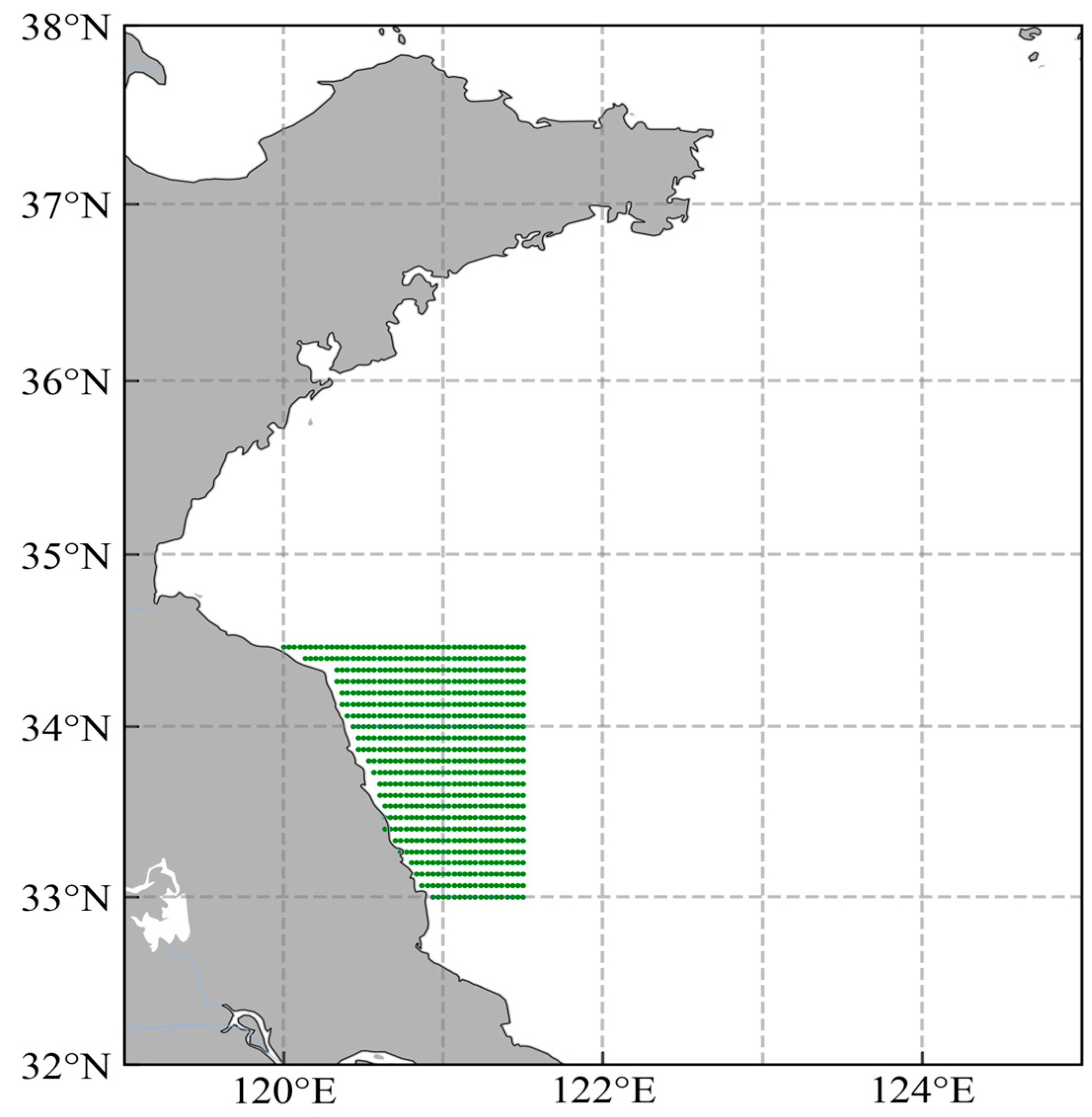
Reasonable settings for the initial zones and release times of U. prolifera particles play a key role in the simulation results. Previous studies have shown that the U. prolifera green tide in the Yellow Sea primarily originates from the coast of Jiangsu Province, mainly in the offshore regions in Yancheng and Nantong [30,31]. Based on the years of satellite remote sensing monitoring, it is revealed that the initial occurrences of green tides were predominantly concentrated within a 100–150 km range offshore of Subei Shoal [9,31]. Subsequently, the initial floating algal mass were drifted northward and offshore, driven by seasonal monsoon and surface currents [32,33]. Various studies have reported that the initial discovery of green tides mainly occurred in mid- or late-May or in early June [34,35,36]. Statistical analysis of the initial outbreak location of U. prolifera in the Yellow Sea based on multi-source satellite data shows that the initial outbreak was concentrated in the Subei Shoal within the range of 119.8–121.5°E and 33–34.5°N [9]. Accordingly, in this study, the initial release zones for U. prolifera particles were defined as the same region (Figure 2), with an initial release scheduled for 15 May. Considering the continuous generation of U. prolifera on Subei Shoal from May to early June, 687 particles were released every ten days and the initial relative biomass of each particle is set to 10 g, with a wind drag coefficient of 1%. The model output time step is 12 min, including information such as the latitude and longitude of particles, particle biomass, and environmental parameters at the particle’s location, such as sea surface temperature, current velocity, light intensity, and wind speed.
Taking into account anthropogenic intervention activities, such as the pre-harvesting experiment conducted in the southern part of the South Yellow Sea and the “harmless” offshore disposal of macroalgae in the northern region since 2016, this study validates the model’s efficacy by utilizing data from the years of 2014 and 2015 (May to August). Building upon this validation, numerical simulations and experiments for the year 2021 are carried out.
To further quantify the agreement between the model results and the satellite-derived green tide distribution, the percentage of modelled particles located within the satellite-derived plume was introduced under different biomass thresholds, in addition to the original spatial comparison. For each comparison date, the satellite-derived bloom envelope was used to represent the observed bloom extent, and the area enclosed by the envelope was defined as the satellite plume. The modelled particle positions and corresponding biomass were then spatially overlaid with the satellite plume to determine whether individual particles fell within the observed bloom extent.
Because particles with different biomass levels may exhibit substantially different spatial distributions, three biomass thresholds (>0 g, >200 g, and >500 g) were applied to the model output, and the percentage of particles located within the satellite-derived plume was calculated as follows:
P τ = N i n , τ N τ × 100 %
where N τ   is the total number of modelled particles with biomass greater than the threshold τ , N i n , τ is the number of such particles located within the satellite-derived plume, and P τ is the corresponding in-plume percentage. This metric was used to describe the spatial correspondence between modelled particles at different biomass levels and the remotely sensed bloom extent. If no particles satisfied a given threshold on a specific date, the corresponding percentage was not calculated.
A total of 18 comparison cases from 2014, 2015, and 2021 were evaluated in this way. These statistics were used to complement the original visual comparison and spatial overlap analysis, thereby providing a more objective assessment of the agreement between the model simulations and satellite observations. The overlap rate is defined as the ratio of the overlap area between the satellite distribution area and the simulation results to the satellite distribution area of green tide.

2.4. Simulation Design

Against the backdrop that marine temperature and nutrients in the study area in 2021 exhibited no significant differences from those in previous years [13], this study focused on analyzing the impact of extreme weather events, which reintroduced a large quantity of U. prolifera and raft equipment that had been salvaged and placed on the shore back into the sea, thereby providing suitable attachment substrates for U. prolifera growth. To quantify the influence of substrate changes on U. prolifera outbreaks, sensitivity experiments were designed by considering two key aspects: drift paths and biomass.
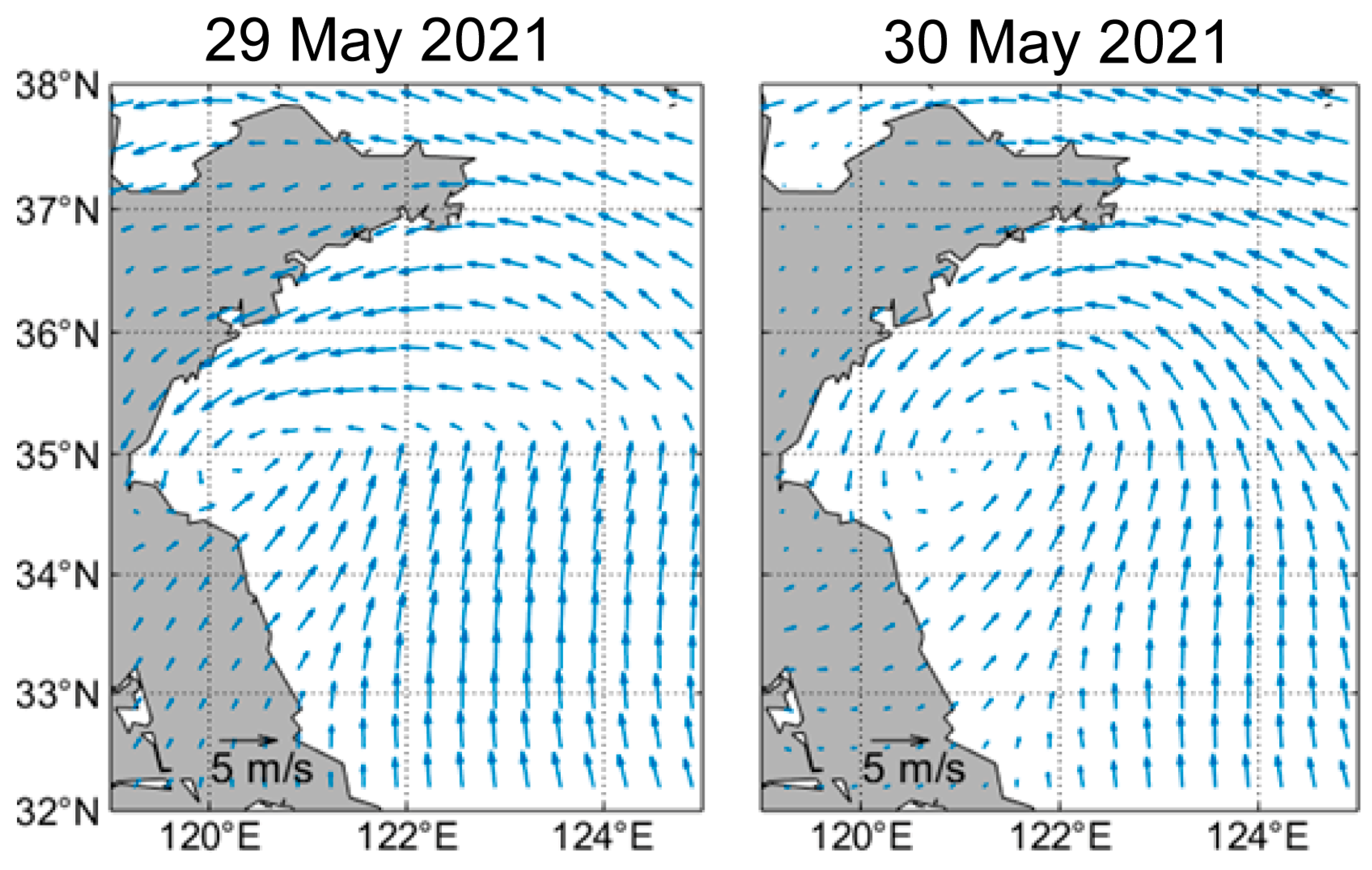
Extreme weather events involving gales and rainstorms during May and June 2021 may result in the re-entry at sea of culture rafts collected on the shore [13]. Analysis of wind field data from May to June 2021 indicates that a significant cyclonic process occurred in the coastal waters of northern Jiangsu during 29–30 May (Figure 3). This event likely promoted the offshore dispersal of abundant raft facilities, bamboo pieces, floating plastics and accumulated mature U. prolifera. Among these materials, bamboo pieces and plastics served as attachment substrates for U. prolifera propagules and facilitated their germination [13,16]. This process effectively constituted an additional pulse input of algal propagules during the critical initial stage of green tide development. Accordingly, to analyze the potential impact of substrate changes, an additional release of U. prolifera particles was implemented on 29 May within the original model configuration, with the release locations and quantities consistent with those in the baseline simulation.
With respect to the impact on U. prolifera drift paths, the wind effect on the aquaculture rafts (including bamboo, plastics, and fishing nets) differs from that on free-floating U. prolifera. Once U. prolifera attaches to the rafts, the overall wind-driven drift characteristics of the algae-laden complex are changed. This change was incorporated into the model by adjusting the wind drag coefficient, which is a core parameter in Equation (1) that characterizes the contribution of wind force to drift processes. It is found that the drift of floating objects in many geophysical settings is predominantly determined by a balance of near surface winds and water currents, and the sensitivity to wind forcing falls in the relatively narrow range of g 2–4% [37,38]. Theoretical analyses further indicate that, despite differences in extreme cases, such objects drift at approximately 3% of the free-stream wind velocity [37]. For the numerical simulation focusing solely on U. prolifera drift, the wind drag coefficient is generally set in the range of 1–2% [9,23,39]. Therefore, five sensitivity scenarios were designed to examine the impact of the wind drag coefficient, with coefficients of 1%, 1.5%, 2%, 2.5%, and 3% applied to the particle release on 29 May, respectively. Cloud-free satellite images with clear green tide distributions were compared with the corresponding model results, and the analysis was performed by calculating the overlap rate.
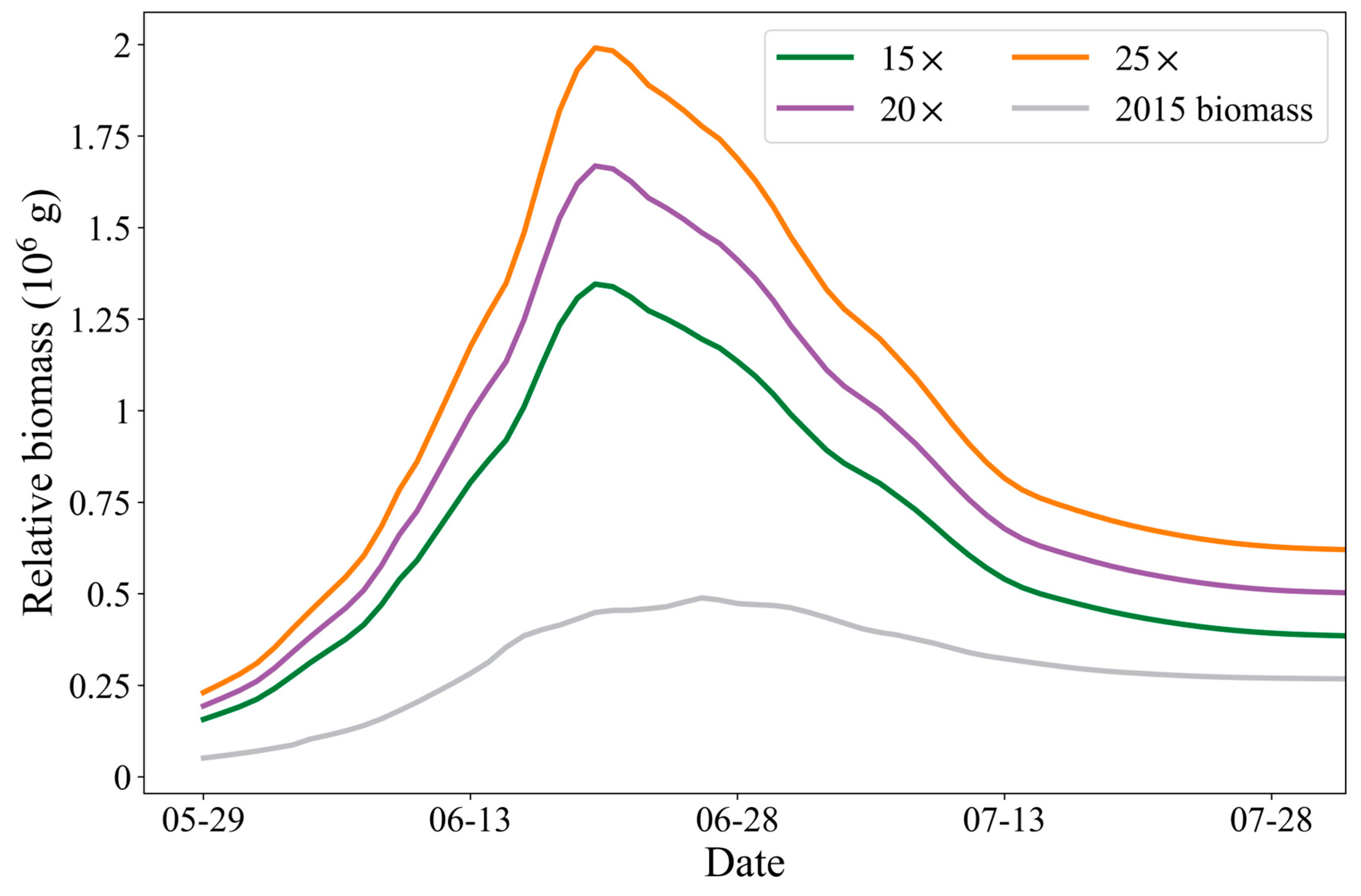
Regarding the impact of substrate changes on U. prolifera biomass, laboratory studies have demonstrated that the wet weight of germinated U. prolifera spores on raft materials is approximately 20 times higher than that on shallow shoal substrates such as fine sand and marine mud [17]. Consequently, the initial biomass on 29 May 2021 was increased to simulate the input of U. prolifera spores carried by raft materials into the sea following extreme weather events. All other numerical configurations remained unchanged, and only the multiple of the sea-entering biomass relative to the standard experiment was increased. Numerical simulation experiments were designed with three initial biomass gradients (15, 20, and 25 times the original amount) to evaluate the impact of initial biomass input from substrates on the annual maximum biomass of U. prolifera. Among these gradients, the 20-fold value was derived from laboratory-measured data, while the 15-fold and 25-fold values were set to account for the variability in spore attachment and germination efficiency under natural environmental conditions.

3. Results

3.1. Validation of Green Tide Development in 2014 and 2015

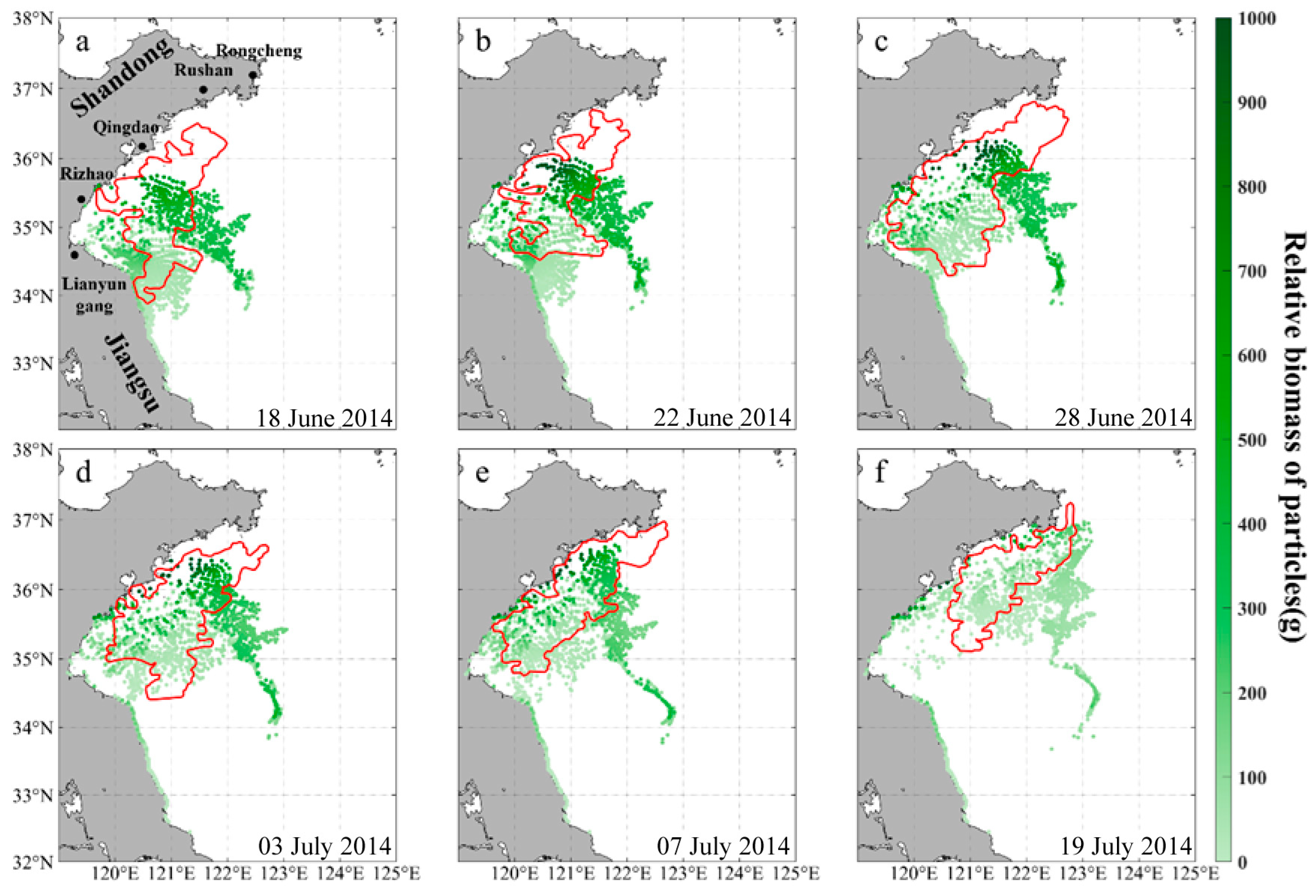
The simulation results for 2014 and 2015 are compared and validated against satellite remote sensing observations. Satellite images with relatively low cloud interference and clear green tide monitoring results were selected for each year as the objects of comparison with the model. As illustrated in Figure 4 for 2014, the simulated drift path and spatiotemporal evolution of U. prolifera are generally consistent with satellite observations. The distribution U. prolifera expanded rapidly in mid-June and drifted northeastward along the coastline from late June to mid-July, affecting the coastal areas of Qingdao, Lianyungang, Rizhao, Rushan, and Rongcheng. From early July to mid-July, as seawater temperature exceeded the optimal range for growth, the photosynthetic activity and growth of U. prolifera were inhibited, resulting in a rapid decrease in biomass and the onset of the decline phase.
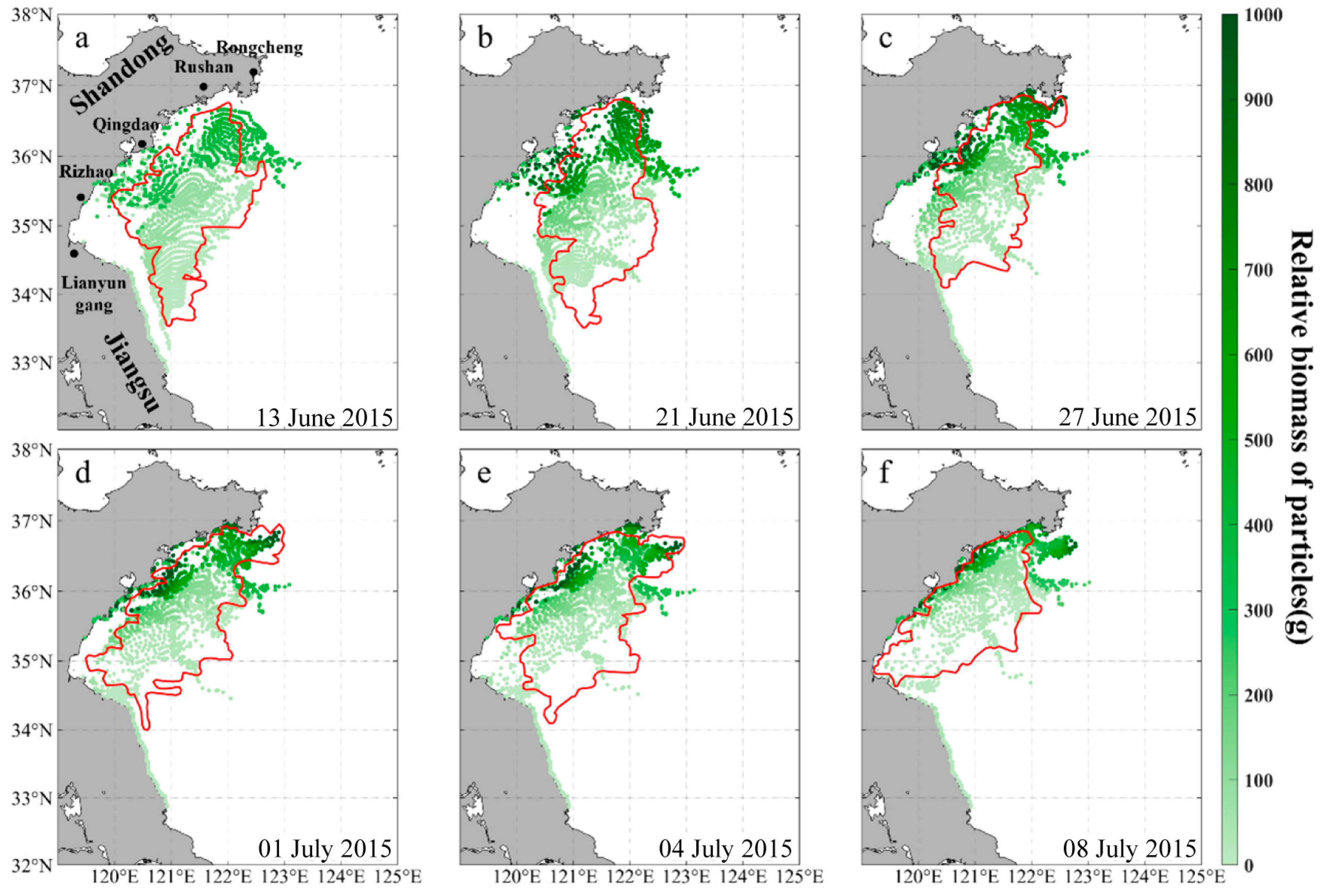
Figure 5 presents the comparison between the simulated results and satellite remote sensing data for the year 2015. The results indicate reasonable agreement between the simulation and the observations in 2015. From mid-June to the end of June, the individual biomass of U. prolifera gradually increases, and the majority of the green tide moves northwestward. The accumulation of U. prolifera along the Qingdao and Rizhao coastlines shows a gradual rise, while a minor portion of it was transported northeastward towards Rongcheng (Figure 5a–c). In early July, the majority of the green tide moves westward, and a large amount of U. prolifera lands along the Lianyungang to Rongcheng coastline. However, due to environmental constraints, the biomass of U. prolifera gradually decreases, and the offshore areas mainly consist of particles with smaller biomass (Figure 5d–f). By mid-June in 2015, the simulated drift of the primary U. prolifera mass had reached the Qingdao area, exerting a continuous impact on the northern coast of Qingdao in the following weeks. Throughout June, the prevailing drift direction was northward. In July, the U. prolifera mass starts to move closer to the shoreline, gradually aligning its distribution with the coastline. This observed pattern is generally consistent with the satellite remote sensing data, indicating a close correlation between the simulated drift and the actual movement of the green tide.
To further quantify the agreement between the model results and the satellite-derived green tide distribution, the percentage of modelled particles located within the satellite-derived plume was calculated under different biomass thresholds (Table 2). For 2014, the in-plume percentages were 38.15%, 41.04%, and 83.48% for the >0 g, >200 g, and >500 g thresholds, respectively. The much higher value under the >500 g threshold indicates that the highest-biomass particles in 2014 were more strongly concentrated within the satellite-observed core bloom area, whereas lower-biomass particles remained more broadly distributed outside the observed plume. For 2015, the overall agreement was better, with in-plume percentages of 71.37%, 55.16%, and 63.30% for the >0 g, >200 g, and >500 g thresholds, respectively. In particular, the relatively high percentage under the >0 g threshold suggests that the overall particle distribution was broadly consistent with the bloom extent detected by satellite observations. The values above 55% under the higher thresholds further indicate that a substantial proportion of medium- and high-biomass particles was also located within the satellite-derived plume.
In summary, there was a measurable spatial correspondence between the modelled particles and the remotely sensed bloom extent, although the degree of agreement varied with year and biomass threshold. The model was able to reproduce the satellite-observed bloom extent to some degree, especially the core bloom area in some years, while non-negligible amounts of high-biomass particles still occurred outside the satellite-derived plume in several cases.

3.2. The Temporal and Spatial Distribution of the Green Tide in 2021

According to the Bulletin of China Marine Disaster, the Yellow Sea experienced the largest recorded green tide from April to August 2021 [7]. In mid-April, isolated patches of U. prolifera were discovered in the shoal area of Jiangsu. On 17 May, satellites detected a significant U. prolifera green tide near the shallow waters of northern Jiangsu for the first time. Subsequently, the U. prolifera green tide drifted north-northwestward, rapidly expanding in distribution and coverage. The green tide continued to grow, impacting the coastal areas of Qingdao, Rizhao, Yantai, and Weihai, and reached its peak in late June. Then the distribution and coverage of the green tide began to gradually decrease in July, with the U. prolifera green tide entering a period of decline in August.
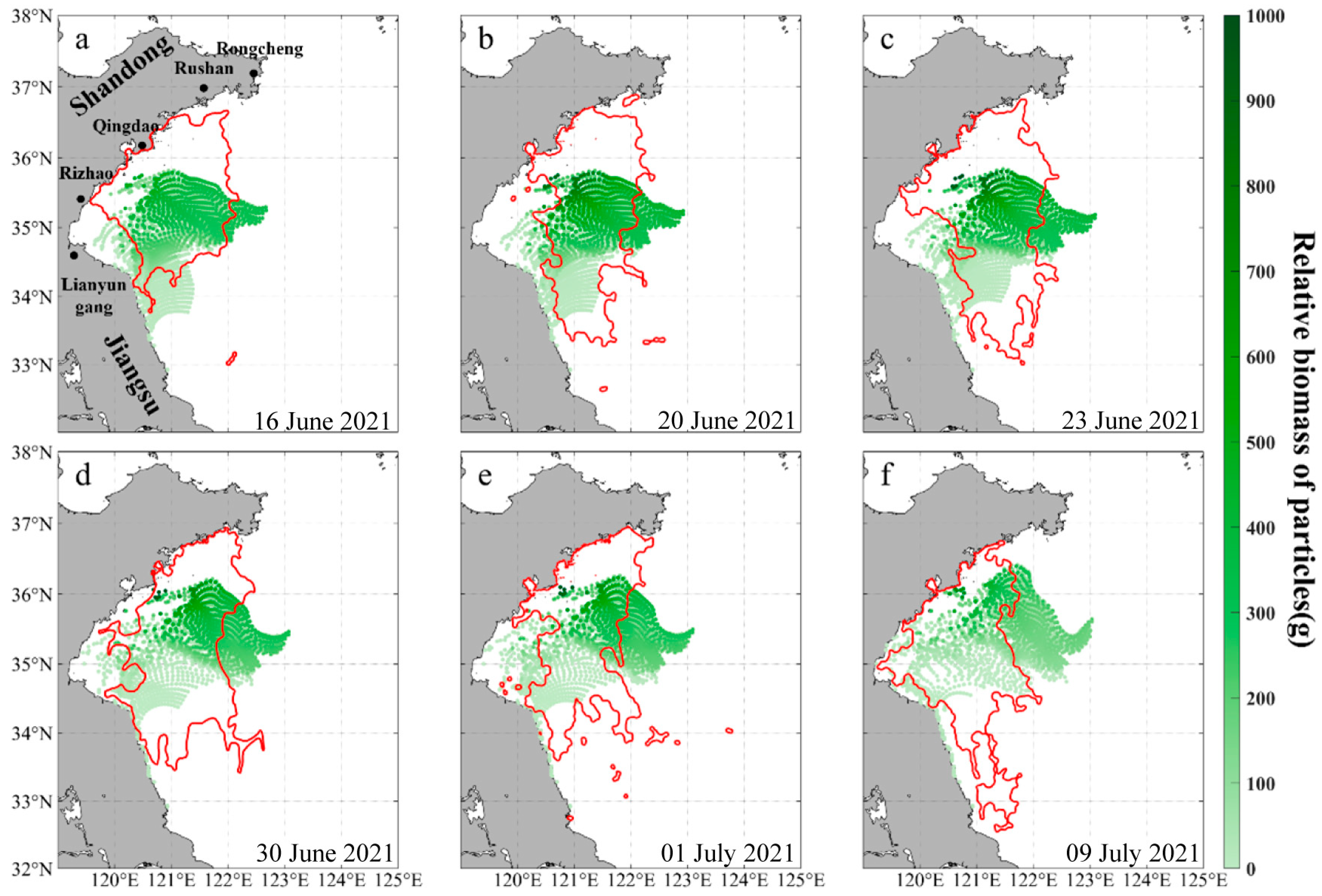
Figure 6 presents a comparison between the simulated particle distribution of U. prolifera in 2021 and the observed distribution area from satellites. The simulation results demonstrate a similar pattern, with a trend of northeastward movement in early July. Nevertheless, during the simulation period from mid-June to early July, a notable discrepancy is observed north of 36°N compared to satellite observations. The spatial correspondence was weaker in 2021, with in-plume percentages of 50.40%, 47.27%, and 39.94% for the >0 g, >200 g, and >500 g thresholds, respectively. The further decline under the >500 g threshold indicates that a considerable fraction of the highest-biomass particles remained outside the satellite-derived plume in 2021. This pattern is broadly consistent with the spatial mismatch visible in the northwestern part of the modelled bloom. In addition to the different environments in 2021 compared to previous years, errors may come from changes in growth conditions caused by extreme weather events involving gales and rainstorms [13,14]. The occurrence of severe weather conditions may result in a significant quantity of U. prolifera and equipment, previously harvested and stored on the coast, re-entering the sea, thereby offering additional substrate for U. prolifera proliferation. The substantial influx of substrate into the sea has altered the drift direction and velocity of U. prolifera, which will be further elaborated upon in Section 3.4.

3.3. Analysis of the Causes of Massive Green Tide Biomass Outbreak in 2021

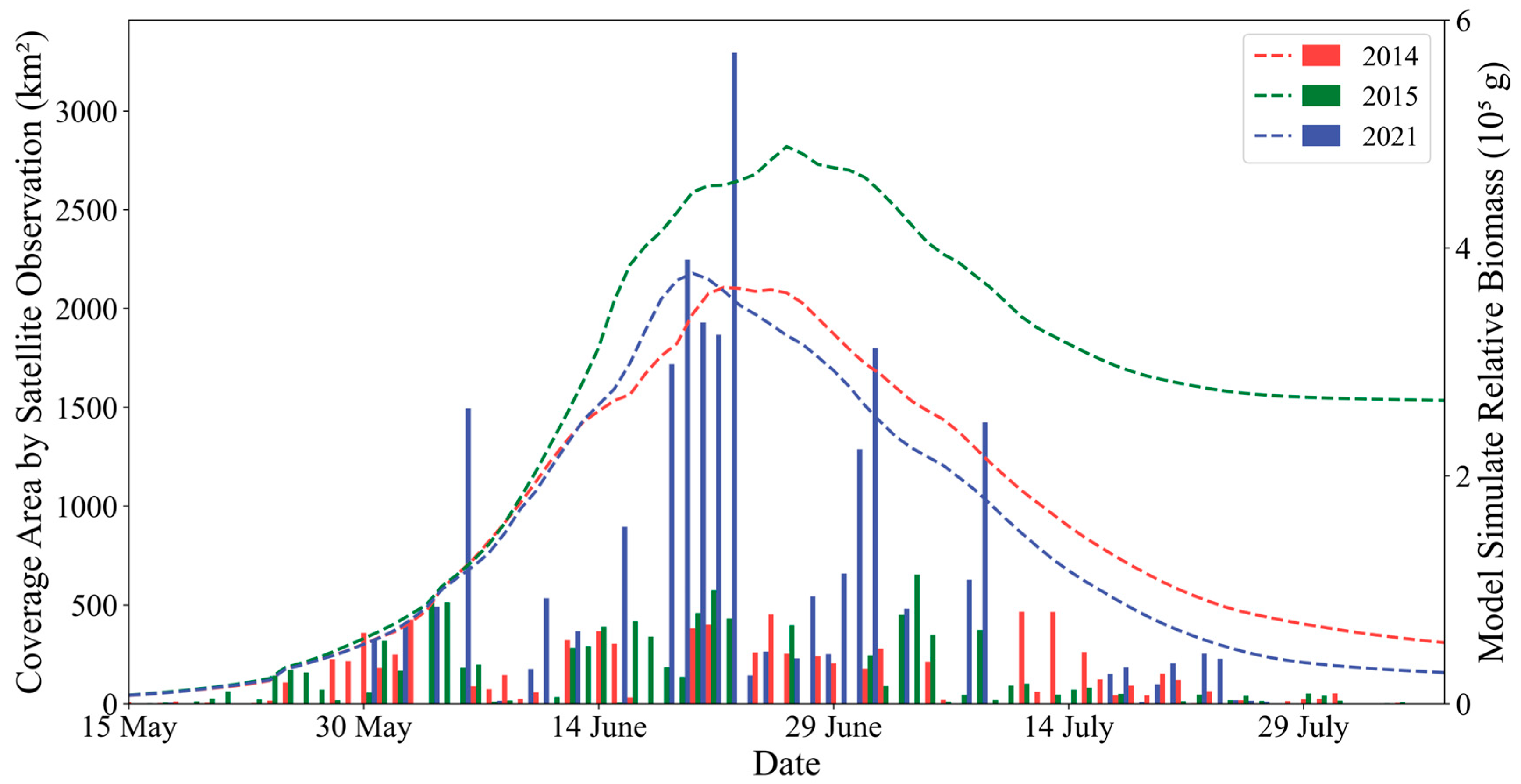
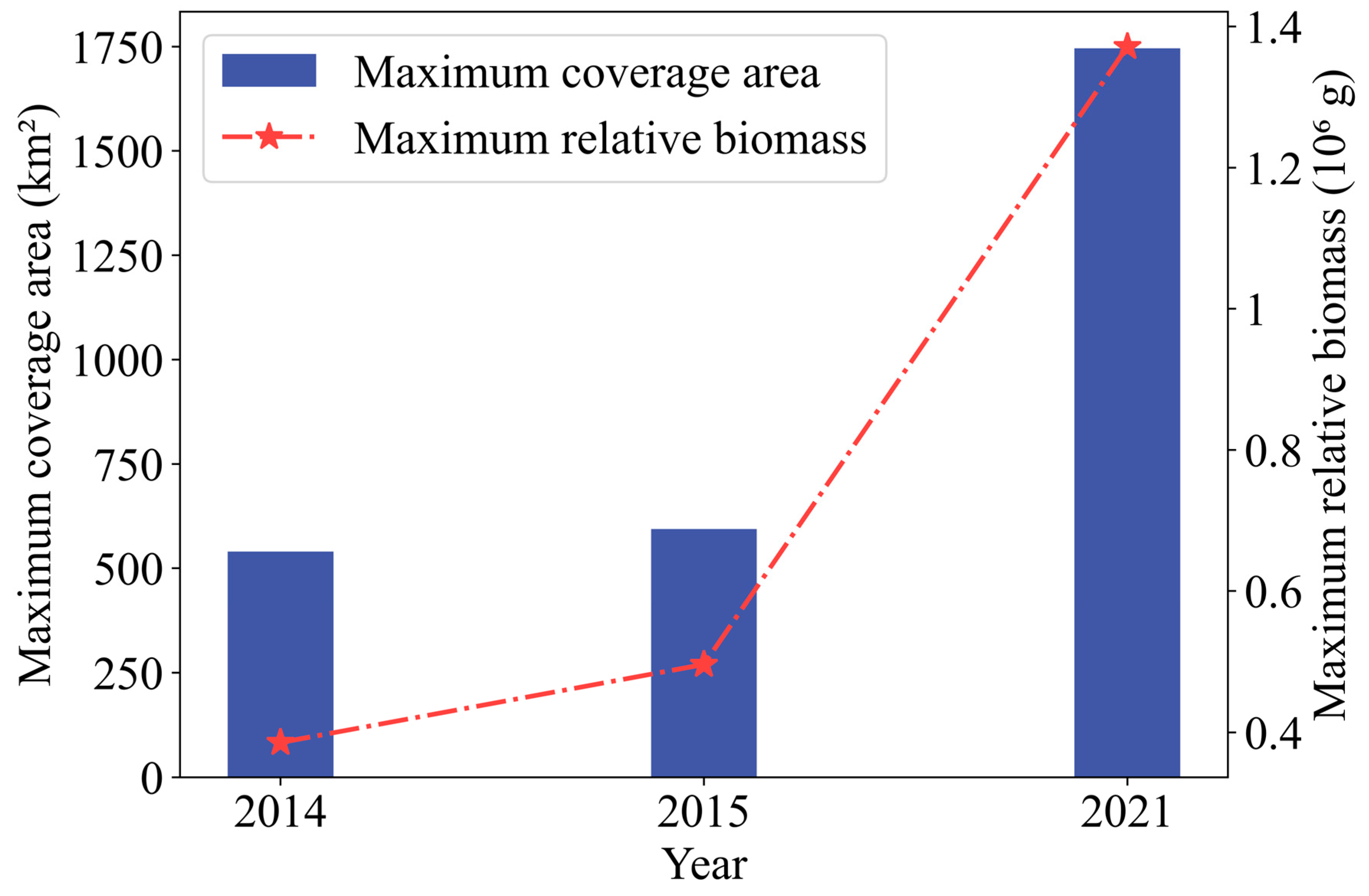
Presently, the assessment of U. prolifera biomass is predominantly derived by multiplying the unit area biomass obtained through horizontal trawl net methods by the green tide coverage area in satellite imagery [11]. The strong correlation between green tide biomass and coverage area suggested that changes in the green tide coverage area can mirror biomass dynamics. The maximum coverage area serves as a representation of the peak biomass of green tides for the given year. Therefore, we conducted a trend comparison between the simulated relative biomass of U. prolifera green tides and the coverage area of satellite.
Figure 7 presents statistical analysis of biomass trends and satellite-observed coverage area trends for each year in the basic simulation. The figure demonstrates a degree of consistency between the simulated U. prolifera biomass and coverage area changes. The coverage area of green tides typically displays a increasing trend from May to June, reaching its peak by the end of June. Subsequently, the coverage area starts to decrease from July and enters a declining stage. In the later stages of the simulation, the biomass does not decrease further, as the remaining biomass particles have landed during the drift process. These particles retain the biomass they possessed upon landing and are no longer factored into the ecological module calculations.
The simulated relative biomass of U. prolifera in July 2015 was higher than that in the same period of 2014 and 2021. This pattern can be explained by the model’s biomass calculation rules and by differences in the spatiotemporal evolution of green tides among years. The coupled model specifies that the relative biomass of landed U. prolifera particles is retained without further decline, which is consistent with the ecological reality that stranded algae are no longer regulated by marine environmental factors controlling growth and mortality. The 2015 green tide exhibited early beaching and large-scale coastal accumulation in early July, and the high-biomass stranded particles formed a stable biomass reservoir, resulting in sustained high total relative biomass in July. In contrast, the 2014 green tide experienced rapid biomass loss of floating particles due to elevated seawater temperature beyond the optimal range in early July.
The maximum coverage area of the 2015 green tide was larger than that in 2014 [7], reflecting its higher peak biomass, and early landing allowed this signal to be preserved in the July simulation results. However, when identical model parameters and data sources were applied to 2021, a noticeable discrepancy emerged between the simulated maximum relative biomass and the peak satellite-observed coverage area. Studies indicate that 2021 had the most extensive green tide coverage area from 2013 to 2021 [8], yet the simulated maximum relative biomass was close to that of 2015, with relatively less landing.
Compared with recent years, no significant environmental anomalies were observed in the South Yellow Sea except for the extreme weather events in spring 2021 [13]. Extreme weather may have caused large amounts of previously harvested U. prolifera and rafting facilities stored onshore to be washed back into the sea, which could provide additional favourable attachment substrates for U. prolifera and thus contribute to its abnormal outbreak. To further quantify the influence of such substrate changes on the biomass accumulation and outbreak scale of U. prolifera, the dual effects of substrate changes induced by extreme weather should be incorporated into the simulation

3.4. Impact of Changes in Substrate on Drift Paths

The reintroduction of a large amount of bamboo pieces and floating plastic into the sea provided more favourable substrates for the attachment of microscopic propagules of U. prolifera, leading to increased germination and growth. The heightened susceptibility of algae-laden complex to wind effects highlights the importance of considering adjustments to the wind drag coefficient, which could potentially alter the drift paths of U. prolifera particles.
Five scenarios were designed to investigate the sensitivity of the simulation results to changes in the wind drag coefficient. Satellite images with less cloud cover and distinct green tide distributions were selected to calculate the overlap rates. As shown in the overlap rates data in Table 3, the model achieved the highest average overlap rate (63.11%) with satellite observations when the wind drag coefficient was 2.5%.
For a clearer comparative analysis of the impacts caused by the changes in U. prolifera attachment substrate environment due to the re-entry of aquaculture facilities and harvested algae accumulated along the shore, we selected the simulated drift trajectories of U. prolifera corresponding to the minimum wind drag coefficient of 1% and the optimal wind drag coefficient of 2.5% from the sensitivity experiments for further analysis. Additionally, the relative biomass curves were compared to assess any effects of the wind drag coefficient change on biomass characteristics, including the timing and magnitude of maximum relative biomass.
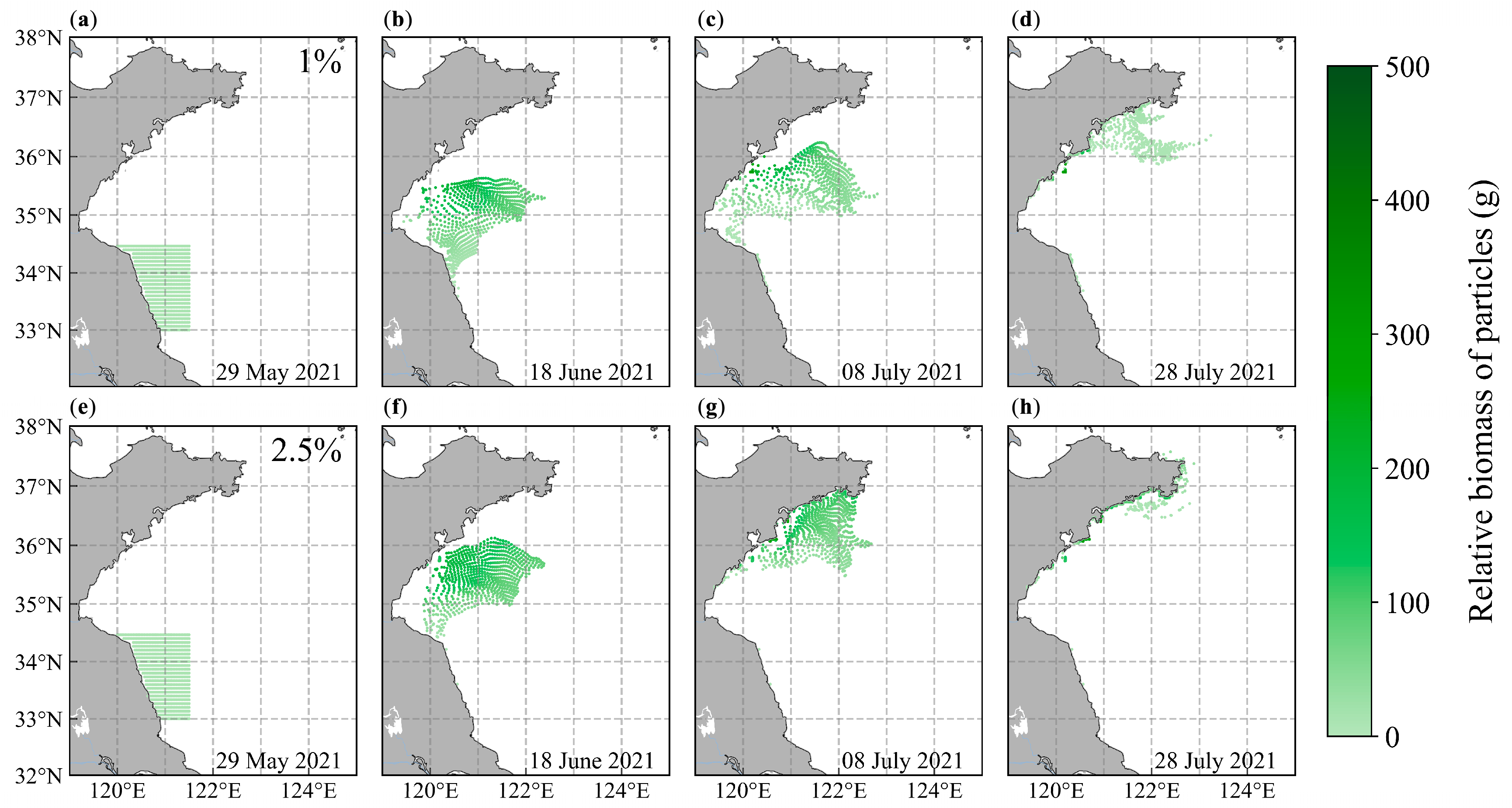
In terms of drift paths (Figure 8), particles with a wind drag coefficient of 2.5% exhibit notably faster northward drift compared to those with a wind drag coefficient of 1%. They reach the Qingdao coast sooner and are more likely to make coastal landings earlier. Moreover, a higher number of particles with a wind drag coefficient of 2.5% come ashore, better reflecting the conditions observed in 2021.
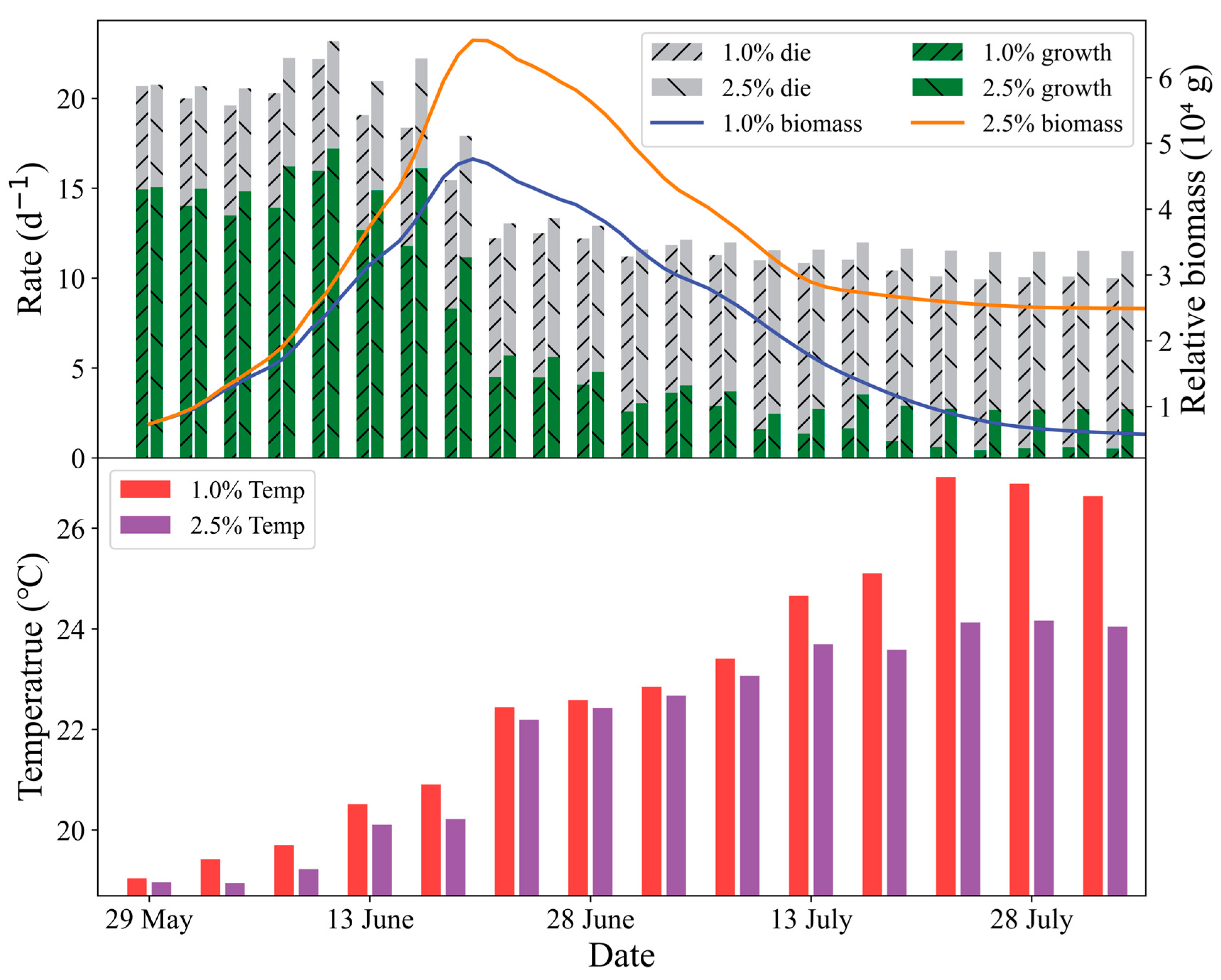
It is evident that the relative biomass with a wind drag coefficient of 2.5% surpasses that with a wind drag coefficient of 1% (Figure 9). This disparity can be attributed to temperature variations resulting from distinct particle drift paths. During the period of rapid growth, particles with a wind drag coefficient of 2.5% experience an average temperature approximately 0.8 °C lower than particles with a wind drag coefficient of 1%. This temperature variance contributes to a higher net growth rate (Net Growth Rate = Growth Rate − Death Rate) for particles with a wind drag coefficient of 2.5% in the ecological model compared to those with a wind drag coefficient of 1%. As the net growth rate falls below zero during the green tide decline period, the U. prolifera biomass diminishes rapidly until complete extinction.
The simulation results indicate that the model agrees best with satellite observations when a wind drag coefficient of 2.5% is applied to the drift of the algae-laden complex. A comparative analysis between simulations using 2.5% and 1% wind drag coefficients further reveals that a higher wind drag coefficient corresponds to a stronger wind-driven force exerted on the algae complex, which accelerates the northward drift of U. prolifera particles under the prevailing southerly winds in the study area during the green tide period. This results in an earlier beaching time, which is more consistent with the observed conditions in 2021. In addition, simulations employing the 2.5% coefficient also yield a higher relative biomass of particles.

3.5. Impact of Changes in Substrate on Biomass

Studies found significant variations in germination rates of U. prolifera spores on different substrates. Specifically, the wet weight of germinated spores on raft materials was approximately 20 times higher than that on shallow shoals such as fine sand and marine mud [17]. However, it is crucial to acknowledge that under real-life environmental conditions, not all spores adhere to raft materials for germination and growth. Only a portion of spores released from raft materials can successfully attach and germinate in the marine environment, rather than achieving the full 20-fold germination advantage observed in controlled laboratory settings. Consequently, to comprehensively evaluate the impact of attachment substrates on biomass, the enlargement factor necessitates determination through sensitivity experiments.
The model configuration was adjusted to increase the initial biomass on 29 May 2021, reflecting the introduction of spores from raft materials into the sea, particularly after extreme weather events. Numerical simulation experiments were designed with initial biomass values set at 15, 20, and 25 times the original amount to assess the impact of the substantial initial biomass influx from attached substrates on the annual maximum biomass of U. prolifera. The 20-fold value was derived directly from the laboratory-measured germination advantage of spores on raft materials [17], while the 15-fold and 25-fold values were set to account for the potential variability in real-world spore attachment and germination efficiency (e.g., environmental disturbances, spore loss during transport, and limited substrate availability in natural waters). In other words, while keeping all other numerical configurations constant, only the biomass entering the sea relative to the standard experimental multiple is increased.
In order to quantify the impact of biomass from substrate germination entering the sea on the maximum biomass of the entire growth cycle, multiple changes in the maximum area of different experimental results were analyzed. As observed from the data curves in Figure 10, when the multiplier is 15 times, the maximum relative biomass is 1.37 × 10⁶ g, whereas the maximum relative biomass in 2015 was 4.98 × 10⁵ g. This signifies that the maximum relative biomass in 2021 is 2.75 times that of 2015. When the multiplier is 20 times, the maximum relative biomass is 1.70 × 10⁶ g, making it 3.41 times that of 2015. Similarly, with a multiplier of 25 times, the maximum relative biomass is 2.02 × 10⁶ g, making it 4.06 times that of 2015.
Based on investigation, the maximum coverage area in 2021 expanded significantly to 1746 km2, which is 2.94 times compared to the 594 km2 recorded in 2015 [7]. Considering the comprehensive results of the experiments, the amplification factor of 15–25× can yield simulated biomass consistent with field observations. Among these values, 15× provides the optimal fit between the simulated relative biomass and the observed maximum coverage area in 2021, and is therefore adopted as the preferred parameter in this study.
Taking into account the factors mentioned above, the specific simulation setup for the release on 29 May 2021 in the model simulation was configured as follows: the release area was the same as the basic release, ranging from 119.8° to 121.5°E and 33.0° to 34.5°N. The wind drag coefficient was set to 2.5%, and the initial biomass was 6870 × 15 g (i.e., 15 times the initial biomass of the basic release).
After calibrating and modifying the parameters and release settings for 29 May 2021, the simulation of the U. prolifera process in 2021 was conducted. Comparing the maximum coverage area data for the years 2014, 2015, and 2021 with the model-simulated maximum relative biomass for these three years (Figure 11), it can be observed that the model-simulated maximum relative biomass aligns highly consistently with the reported maximum coverage area for U. prolifera in these years.
After considering the influence of attachment substrates on U. prolifera growth and germination, the relative biomass of U. prolifera in the simulated green tide in 2021 exhibited significant changes compared to previous simulations. The comparison between the corrected simulation results and actual observation data, as well as reported data, indicates that after a certain degree of calibration, the simulation results indeed align more closely with reality. This provides evidence that changes in attachment substrates contributed to the enlargement of the U. prolifera green tide in 2021.
This outcome emphasizes the importance of accounting for ecological factors, such as attachment substrates, in accurately simulating and predicting the dynamics of algal blooms. By refining the model based on observed data and considering the ecological intricacies, the simulation becomes a more reliable tool for understanding and forecasting the behaviour of U. prolifera and similar green tide phenomena.

4. Discussion

The continuous and dynamic monitoring of the green tide via satellite remote sensing not only furnishes validation datasets and critical boundary condition support for green tide numerical simulations, but also establishes a robust foundation for unravelling the driving mechanisms governing green tide proliferation and development. This study identified attachment substrate changes as a key driver of the extreme 2021 green tide outbreak in the Yellow Sea, supplementing the existing understanding of green tide formation mechanisms dominated by environmental factors (e.g., temperature, light) and anthropogenic activities (e.g., aquaculture expansion). The dual effects of aquaculture raft substrates entering the marine environment under extreme weather conditions are particularly noteworthy. On one hand, the altered wind drag coefficient accelerated the northward drift of U. prolifera and promoted its rapid accumulation along the Shandong coastline. On the other hand, these substrates provided optimal adhesion and germination carriers for U. prolifera spores, significantly boosting initial biomass and expanding the overall scale of the green tide. This finding highlights the intricate synergistic effects of natural processes and human activities in green tide outbreaks, suggesting that future causal analysis frameworks may benefit from integrating biological substrate factors with meteorological and oceanographic conditions.
It should be clarified that extreme weather events may induce the upwelling of subsurface nutrients or changes in riverine discharge and associated nutrient loads, and the regulatory mechanisms underlying these potential confounding factors still require further in-depth investigation.
In coastal waters, extreme weather events such as gales and rainstorms mainly manifest as short-term meteorological processes, which are mostly triggered by strong convection and frontal activities and characterized by rapid onset and strong local impacts. Based on in situ nutrient monitoring data for the southern Yellow Sea in 2021 reported in previous studies [11,13], no abnormal increases in inorganic nitrogen and phosphorus concentrations were observed in the study area. This observation, combined with the short-term nature of such meteorological processes, indicates that the additional nutrient input induced by these short-term weather processes is localized and limited in coastal waters, resulting in a relatively weak independent effect on the biomass accumulation of U. prolifera owing to their short duration and restricted spatial coverage. Nevertheless, the potential synergistic effects between these nutrient-related processes and other biotic or abiotic factors cannot be completely ruled out. For instance, at specific spatiotemporal scales, nutrient upwelling may act synergistically with substrate availability to affect the local proliferation of U. prolifera. Such potential synergistic mechanisms warrant further verification through high-resolution in situ observations and controlled laboratory experiments in future research.
Beyond the aforementioned nutrient-related factors, the synergistic effects of short-term meteorological processes represent a critical perspective for understanding the extreme 2021 green tide outbreak in the Yellow Sea. Specifically, these meteorological processes can generate localized changes in coastal environmental heterogeneity, with their key contribution being the re-entry of aquaculture rafts and stranded U. prolifera into the marine environment. This process alters the initial abundance of U. prolifera propagules entering the open sea and indirectly modulates their subsequent drift, dispersion, and growth dynamics in the Yellow Sea.
Compared with previous studies that predominantly focused on environmental factor variations, this study quantified the contribution of substrate changes to green tide biomass and drift paths through controlled sensitivity experiments. However, the current model still has limitations that need to be addressed. First, the ecological module does not incorporate the regulatory role of nutrient concentrations (nitrogen, phosphorus) in U. prolifera growth and mortality, which may underestimate the impact of coastal eutrophication on green tide expansion. Second, the dynamic processes of propagule release, dispersal, and settlement are not explicitly parameterized, restricting the model’s ability to simulate the initial outbreak stage of green tides accurately.
To address these limitations and advance the predictive capability of green tide models, future research should prioritize two key avenues of improvement. On one hand, datasets of nutrient concentrations (e.g., nitrogen and phosphorus) should be integrated into the model to refine the ecological growth module, enabling a more realistic representation of how nutrient availability regulates U. prolifera growth dynamics across different spatial and temporal scales. On the other hand, high-resolution satellite imagery could be leveraged to quantify the spatiotemporal variability of propagule release events, which would facilitate the optimization of propagule-related parameterization schemes. By incorporating these improvements, the overall accuracy and reliability of green tide simulation models can be substantially enhanced, providing a more robust scientific basis for the early warning and mitigation of green tide.

5. Conclusions

This study integrated the Chinese Global Operational Oceanography Forecasting System (CGOFS) reanalysis dataset and the European Centre for Medium-Range Weather Forecasts (ECMWF) ERA5 reanalysis dataset, encompassing sea surface wind, current, temperature, and light intensity parameters. A high-resolution physical–ecological-coupled model for U. prolifera in the Yellow Sea, composed of a Lagrangian particle drift module and an ecological growth–mortality module, was established to simulate the unprecedented 2021 large-scale green tide outbreak and clarify the driving factors of explosive biomass growth.
The model was validated using satellite remote sensing observations of green tide distributions in 2014 and 2015, demonstrating robust reliability in reproducing the spatiotemporal evolution trajectories of green tides from initial occurrence to dissipation. Based on this validation, numerical sensitivity experiments were designed to explore the impact of attachment substrate changes induced by extreme weather events on green tide dynamics. The results confirmed that substrate alterations exerted dual effects on the 2021 massive green tide outbreak: (1) The attachment of U. prolifera to aquaculture rafts alters the original wind-driven drift characteristics of free-floating U. prolifera, as reflected by an increased windage coefficient in the model, which in turn accelerates the northward drift of U. prolifera particles under the prevailing southerly winds in the study area during the green tide period. This advances landing time along the Shandong coastline and increases coastal accumulation frequency. (2) The substrates provided optimal adhesion and germination surfaces for spores, significantly elevating initial biomass; sensitivity experiments showed that the magnitude of initial biomass enhancement directly determined the maximum relative biomass of the entire green tide event.
This study quantitatively investigated the impact of attachment substrate variations on the 2021 green tide outbreak, supplying a different perspective to enrich the understanding of extreme green tide formation mechanisms. The coupled model developed in this study is capable of reasonably reproducing the development process of U. prolifera, and the findings may offer scientific support for the prevention and control of green tide disasters in the Yellow Sea. Future improvements to the model, including integrating nutrient factors and optimizing propagule dynamics parameterization, could potentially further improve its application value in marine ecological disaster management.

Author Contributions

Conceptualization and methodology, J.Y. and Q.G.; software, X.J. and S.G.; validation, E.H. and Y.J.; formal analysis, J.Y. and S.G.; visualization, Q.G. All authors have read and agreed to the published version of the manuscript.

Funding

This research was funded by the National Key Research and Development Programme of China; grant numbers 2023YFC3107705, 2023YFC3107702.

Data Availability Statement

The raw data from the coupled simulation system over the Yellow Sea that support the findings of this study are available from the authors upon reasonable request. The ECMWF data of 0.25-degree resolution used in this study is openly available in the Web Services at https://www.ecmwf.int/en/forecasts/dataset/ecmwf-reanalysis-v5, accessed on 29 June 2024.

Acknowledgments

We gratefully acknowledge the support from the National Key Research and Development Program of China (No. 2023YFC3107705 & 2023YFC3107702).

Conflicts of Interest

The authors declare no conflicts of interest.

References

  1. Yang, L.; Zhang, R.; Zhuo, L.; Xie, B.-B.; Lin, J.; Li, S. Stemming Green Tides in the Yellow Sea. Science 2025, 390, 248. [Google Scholar] [CrossRef] [PubMed]
  2. Sun, Y.; Liu, J.; Xia, J.; Tong, Y.; Li, C.; Zhao, S.; Zhuang, M.; Zhao, X.; Zhang, J.; He, P. Research Development on Resource Utilization of Green Tide Algae from the Southern Yellow Sea. Energy Rep. 2022, 8, 295–303. [Google Scholar] [CrossRef]
  3. Sun, Y.; Yao, L.; Liu, J.; Tong, Y.; Xia, J.; Zhao, X.; Zhao, S.; Fu, M.; Zhuang, M.; He, P.; et al. Prevention Strategies for Green Tides at Source in the Southern Yellow Sea. Mar. Pollut. Bull. 2022, 178, 113646. [Google Scholar] [CrossRef] [PubMed]
  4. Zhang, Y.; He, P.; Li, H.; Li, G.; Liu, J.; Jiao, F.; Zhang, J.; Huo, Y.; Shi, X.; Su, R.; et al. Ulva prolifera Green-Tide Outbreaks and Their Environmental Impact in the Yellow Sea, China. Natl. Sci. Rev. 2019, 6, 825–838. [Google Scholar] [CrossRef]
  5. Zhou, M.-J.; Liu, D.-Y.; Anderson, D.M.; Valiela, I. Introduction to the Special Issue on Green Tides in the Yellow Sea. Estuar. Coast. Shelf Sci. 2015, 163, 3–8. [Google Scholar] [CrossRef]
  6. Wang, C.; Yu, R.; Zhou, M. Acute toxicity of live and decomposing green alga Ulva (Enteromorpha) prolifera to abalone Haliotis discus hannai. Chin. J. Oceanol. Limnol. 2011, 29, 541–546. [Google Scholar] [CrossRef]
  7. Ministry of Natural Resources (MNR). The Bulletin of China Marine Disaster; Ministry of Natural Resources of the People’s Republic of China: Beijing, China, 2022. [Google Scholar]
  8. Yan, T.; Yu, R.; Zhou, M.; Sun, S. Mechanism of Massive Formation and Prevention Strategy against Large-Scale Green Tides in the South Yellow Sea. Oceanol. Limnol. Sin. 2018, 49, 950–958. (In Chinese) [Google Scholar] [CrossRef]
  9. He, E.; Ji, X.; Gao, S.; Zhao, L.; Wang, Y.; Li, Y.; Yang, J. Numerical Simulation and Forecasting of Drift, Growth, and Death of Enteromorpha in the Yellow Sea. Oceanol. Limnol. Sin. 2021, 52, 39–50. [Google Scholar]
  10. Hu, L.; Zeng, K.; Hu, C.; He, M.-X. On the Remote Estimation of Ulva prolifera Areal Coverage and Biomass. Remote Sens. Environ. 2019, 223, 194–207. [Google Scholar] [CrossRef]
  11. Li, D.; Gao, Z.; Wang, Z. Analysis of the Reasons for the Outbreak of Yellow Sea Green Tide in 2021 Based on Long-Term Multi-Source Data. Mar. Environ. Res. 2022, 178, 105649. [Google Scholar] [CrossRef]
  12. Zheng, L.; Wu, M.; Cui, Y.; Tian, L.; Yang, P.; Zhao, L.; Xue, M.; Liu, J. What Causes the Great Green Tide Disaster in the South Yellow Sea of China in 2021? Ecol. Indic. 2022, 140, 108988. [Google Scholar] [CrossRef]
  13. Song, M.; Kong, F.; Li, Y.; Zhao, J.; Yu, R.; Zhou, M.; Jiang, P.; Yan, T. A Massive Green Tide in the Yellow Sea in 2021: Field Investigation and Analysis. Int. J. Environ. Res. Public Health 2022, 19, 11753. [Google Scholar] [CrossRef] [PubMed]
  14. Geng, H.; Yan, T.; Zhou, M.; Liu, Q. Comparative Study of the Germination of Ulva prolifera Gametes on Various Substrates. Estuar. Coast. Shelf Sci. 2015, 163, 89–95. [Google Scholar] [CrossRef]
  15. Liu, F.; Pang, S.J.; Zhao, X.B.; Hu, C.M. Quantitative, Molecular and Growth Analyses of Ulva Microscopic Propagules in the Coastal Sediment of Jiangsu Province Where Green Tides Initially Occurred. Mar. Environ. Res. 2012, 74, 56–63. [Google Scholar] [CrossRef]
  16. Geng, H.; Yan, T.; Yu, R.; Zhang, Q.; Kong, F.; Zhou, M. Comparative Study on Germination of Ulva prolifera Spores on Different Substrates. Oceanol. Limnol. Sin. 2018, 49, 1006–1013. (In Chinese) [Google Scholar] [CrossRef]
  17. Li, S.; Yu, K.; Huo, Y.; Zhang, J.; Wu, H.; Cai, C.; Liu, Y.; Shi, D.; He, P. Effects of Nitrogen and Phosphorus Enrichment on Growth and Photosynthetic Assimilation of Carbon in a Green Tide-Forming Species (Ulva prolifera) in the Yellow Sea. Hydrobiologia 2016, 776, 161–171. [Google Scholar] [CrossRef]
  18. Xiao, J.; Zhang, X.; Gao, C.; Jiang, M.; Li, R.; Wang, Z.; Li, Y.; Fan, S.; Zhang, X. Effect of Temperature, Salinity and Irradiance on Growth and Photosynthesis of Ulva prolifera. Acta Oceanolog. Sin. 2016, 35, 114–121. [Google Scholar] [CrossRef]
  19. Feng, L.; Shi, X.; Chen, Y.; Tang, H.; Wang, L. Effects of Temperature on the Nitrate Reductase Activity and Growth of Ulva prolifera. J. Phycol. 2021, 57, 955–966. [Google Scholar] [CrossRef]
  20. Moisan, J.R.; Moisan, T.A.; Abbott, M.R. Modelling the Effect of Temperature on the Maximum Growth Rates of Phytoplankton Populations. Ecol. Modell. 2002, 153, 197–215. [Google Scholar] [CrossRef]
  21. Steele, J.H. Environmental Control of Photosynthesis in the Sea. Limnol. Oceanogr. 1962, 7, 137–150. [Google Scholar] [CrossRef]
  22. Richard, W.E. Temperature and Phytoplankton Growth in the Sea. Fish. Bull. 1971, 70, 1063. [Google Scholar]
  23. Wang, S.; Zhao, L.; Zhang, H.; Li, F. Green Tide in the Yellow Sea from Generation to Extinction and the Controlling Factor. Oceanol. Limnol. Sin. 2022, 53, 1338–1348. (In Chinese) [Google Scholar] [CrossRef]
  24. Jiang, X.W.; Liu, J.Q.; Zou, B.; Wang, Q.M.; Zeng, T.; Guo, M.H.; Zhu, H.T.; Zou, Y.R.; Tang, J.W. The Satellite Remote Sensing System Used in Emergency Response Monitoring for Entermorpha Prolifera Disaster and Its Application. Acta Oceanolog. Sin. 2009, 31, 52–64. (In Chinese) [Google Scholar]
  25. Pan, X.; Cao, M.; Zheng, L.; Xiao, Y.; Qi, L.; Xing, Q.; Kim, K.; Sun, D.; Wang, N.; Guo, M.; et al. Remote Sensing of Ulva prolifera Green Tide in the Yellow Sea Using Multisource Satellite Data: Progress and Prospects. IEEE Geosci. Remote Sens. Mag. 2024, 12, 110–131. [Google Scholar] [CrossRef]
  26. Zheng, H.Y.; Liu, Z.; Chen, B.; Xu, H. Quantitative Ulva prolifera Bloom Monitoring Based on Multi-Source Satellite Ocean Color Remote Sensing Data. Appl. Ecol. Environ. Res. 2020, 18, 4897–4913. [Google Scholar] [CrossRef]
  27. Li, Z.; Wang, Z.; Li, Y.; Zhang, Y.; Zheng, J.; Gao, S. Evaluation of Global High-Resolution Reanalysis Products Based on the Chinese Global Oceanography Forecasting System. Atmos. Oceanic Sci. Lett. 2021, 14, 100032. [Google Scholar] [CrossRef]
  28. Wang, H.; Wan, L.; Qin, Y.; Wang, Y.; Yang, X.; Liu, Y.; Xing, J.; Chen, L.; Wang, Z.; Zhang, T.; et al. Development and Application of the Chinese Global Operational Oceanography Forecasting System. Adv. Earth Sci. 2016, 31, 1090–1104. (In Chinese) [Google Scholar] [CrossRef]
  29. Ji, X.; Kwon, K.M.; Choi, B.-J.; Liu, G.; Park, K.-S.; Wang, H.; Byun, D.-S.; Li, Y.; Ji, Q.; Zhu, X. Assimilating OSTIA SST into Regional Modeling Systems for the Yellow Sea Using Ensemble Methods. Acta Oceanolog. Sin. 2017, 36, 37–51. [Google Scholar] [CrossRef]
  30. Liu, D.; Keesing, J.K.; He, P.; Wang, Z.; Shi, Y.; Wang, Y. The World’s Largest Macroalgal Bloom in the Yellow Sea, China: Formation and Implications. Estuar. Coast. Shelf Sci. 2013, 129, 2–10. [Google Scholar] [CrossRef]
  31. Son, Y.B.; Choi, B.-J.; Kim, Y.H.; Park, Y.-G. Tracing Floating Green Algae Blooms in the Yellow Sea and the East China Sea Using GOCI Satellite Data and Lagrangian Transport Simulations. Remote Sens. Environ. 2015, 156, 21–33. [Google Scholar] [CrossRef]
  32. Bao, M.; Guan, W.; Yang, Y.; Cao, Z.; Chen, Q. Drifting Trajectories of Green Algae in the Western Yellow Sea during the Spring and Summer of 2012. Estuar. Coast. Shelf Sci. 2015, 163, 9–16. [Google Scholar] [CrossRef]
  33. Keesing, J.K.; Liu, D.; Fearns, P.; Garcia, R. Inter- and Intra-Annual Patterns of Ulva prolifera Green Tides in the Yellow Sea during 2007–2009, Their Origin and Relationship to the Expansion of Coastal Seaweed Aquaculture in China. Mar. Pollut. Bull. 2011, 62, 1169–1182. [Google Scholar] [CrossRef]
  34. Zhan, Y.; Qiu, Z.; Wang, Y.; Su, Y.; Li, Y.; Cui, Y.; Qu, S.; Wang, P.; Rong, X. Long-Term Spatiotemporal Characteristics of Ulva prolifera Green Tide and Effects of Environmental Drivers on Its Monitoring by Satellites: A Case Study in the Yellow Sea, China, from 2008 to 2023. J. Mar. Sci. Eng. 2024, 12, 630. [Google Scholar] [CrossRef]
  35. Huang, J.; Wu, L.; Gao, S.; Li, J. Analysis on the Interannual Distribution Variation of Green Tide in Yellow Sea. Acta Laser Biol. Sin. 2014, 23, 572–578. (In Chinese) [Google Scholar]
  36. Wang, Z.; Fu, M.; Xiao, J.; Zhang, X.; Song, W. Progress on the Study of the Yellow Sea Green Tides Caused by Ulva prolifera. Acta Oceanologica Sinica 2018, 40, 1–13. (In Chinese) [Google Scholar] [CrossRef]
  37. Wagner, T.J.W.; Eisenman, I.; Ceroli, A.M.; Constantinou, N.C. How winds and ocean currents influence the drift of floating objects. J. Phys. Oceanogr. 2022, 52, 907–916. [Google Scholar] [CrossRef]
  38. Rial-Osorio, M.; Pérez-Muñuzuri, V.; Cloux, S. Tracking marine debris in Northwest Spain: Assessing wind influence with a Lagrangian transport model. Ocean Sci. 2026, 22, 777–790. [Google Scholar] [CrossRef]
  39. Zhang, C.; Lv, X.; Qiao, F. The modelling of Ulva prolifera transport in the yellow sea and its application. Oceanol. Limnol. Sin. 2018, 49, 1019–1028. [Google Scholar] [CrossRef]
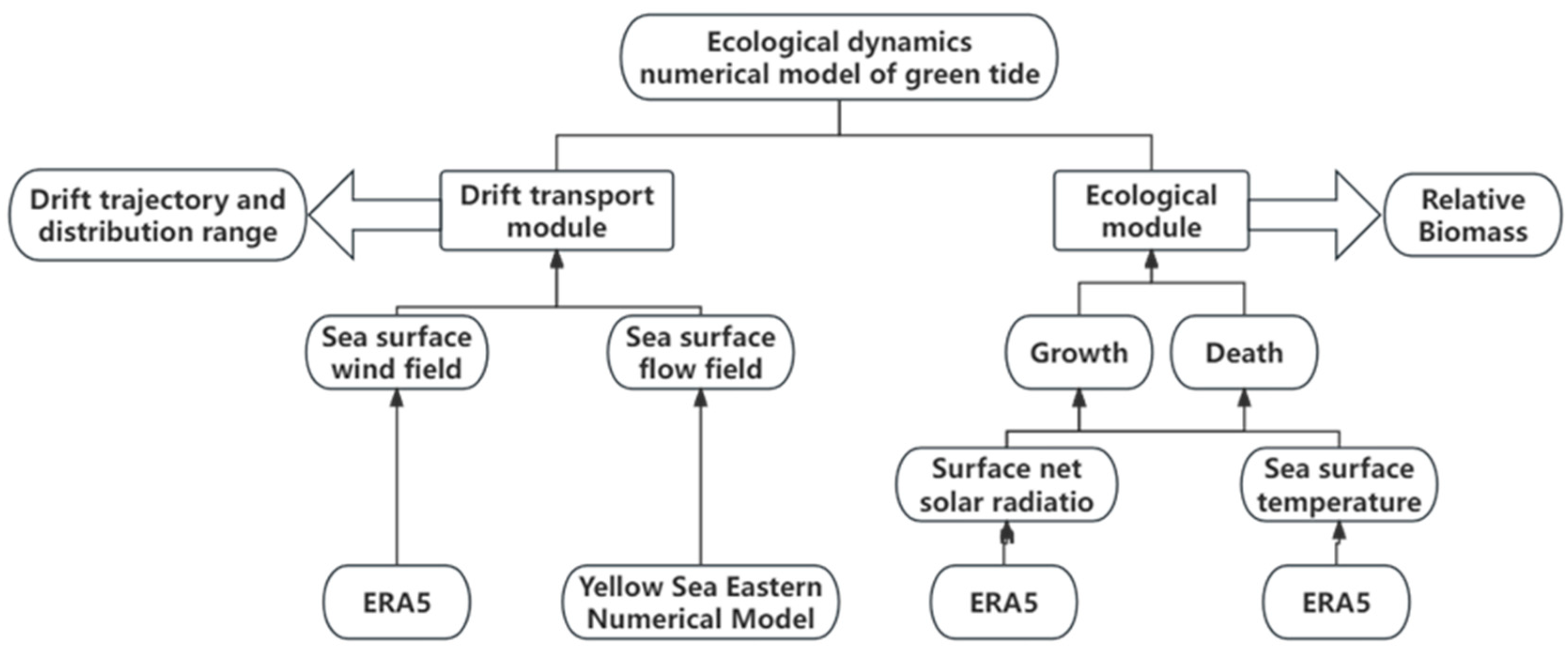
Figure 1. Framework of the Yellow Sea U. prolifera green tides’ physical-and-ecological-coupled model.
Remotesensing 18 01014 g001
Figure 2. The initial release zones for the U. prolifera particles in the model. Green dots represent U. prolifera particles.
Remotesensing 18 01014 g002
Figure 3. The 10 m wind field over the sea surface near northern Jiangsu area from 29 May to 30 May 2021. The blue arrows indicate wind direction.
Remotesensing 18 01014 g003
Figure 4. Comparison between simulation and remote sensing observation of green tide in 2014. (af) show the results on 18, 24, 30 June and 3, 7, 19 July. The green dot indicates the simulated U. prolifera particles, and the red envelope curve indicates the satellite-derived distribution area of U. prolifera.
Remotesensing 18 01014 g004
Figure 5. Comparison between simulation and remote sensing observation of green tide in 2015. (af) show the results on 13, 21, 27 June and 1, 4, 8 July. The green dot indicates the simulated U. prolifera particles, and the red envelope curve indicates the satellite-derived distribution area of U. prolifera.
Remotesensing 18 01014 g005
Figure 6. Comparison between simulation and remote sensing observation of green tide in 2021. (af) show the results on 16, 20, 23, 30 June and 1, 9 July. The green dot indicates the simulated U. prolifera particles, and the red envelope curve indicates the satellite-derived distribution area of U. prolifera.
Remotesensing 18 01014 g006
Figure 7. Comparison between simulation and satellite observation of green tide for the year of 2014, 2015 and 2021. The bar chart represents satellite coverage area, while the dash lines represent simulated relative biomass. (It should be noted that the relative biomass is an initial assumption assigned to each U. prolifera particle in the model for biomass calculation. It is a relative indicator based on the initial biomass of a single particle (10 g) as the baseline reference, rather than the actual observed biomass).
Remotesensing 18 01014 g007
Figure 8. The drift path simulation from a single U. prolifera particle release on 29 May 2021 with wind drag coefficients of 2.5% and 1%. The results for cases (ad) are obtained on 13, 28 June, and 13, 28 July 2021, with a wind drag coefficient of 1%. The results for cases (eh) are obtained on 13, 28 June, and 13, 28 July 2021, with a wind drag coefficient of 2.5%.
Remotesensing 18 01014 g008
Figure 9. Relative biomass, growth rate, mortality rate, and average temperature on drift paths for single releases of 1% and 2.5% Wind drag coefficient on 29 May (the grey portion of the bar represents the mortality rate, while the green portion represents the growth rate. Different filling patterns indicate distinct wind drag coefficient).
Remotesensing 18 01014 g009
Figure 10. Sensitivity experiment of initial biomass expansion factor.
Remotesensing 18 01014 g010
Figure 11. Simulated maximum relative biomass versus observed maximum coverage area for 2014, 2015, and 2021.
Remotesensing 18 01014 g011
Table 1. Model parameters.
ParameterDescriptionUnitValueReference
R1Empirical coefficient of ocean current-1.0[9]
R2Wind drag coefficient-1%[9]
βWind drag deflection Angledeg20[9]
GmaxMaximum daily growth rate-45%[23]
DmaxMaximum daily mortality rate-10%[9]
T1The low end of the optimum temperature range for growth°C15[9]
T2The high end of the optimum temperature range for growth°C20[9]
T3The critical temperature for maximum mortality°C25[23]
θ1The coefficient of growth rate affected by temperature-1.10[23]
θ2The coefficient of growth rate affected by temperature-1.80[23]
θ3The coefficient of mortality rate affected by temperature-1.10[23]
IoptOptimum light intensity for growthμmol E m−2 s−1400[9]
Table 2. Percentage of modelled particles located within the satellite-derived plume under different biomass thresholds, where N is the total number of modelled particles above a given biomass threshold, In is the number of those particles located within the satellite-derived plume, and P is the corresponding in-plume percentage.
Case NameN
(≥0 g)
In
(≥0 g)
P
(≥0 g)
N (≥200 g)In (≥200 g)P
(≥200 g)
N (≥500 g)In (≥500 g)P
(≥500 g)
20148908339838.15%2678109941.04%58148583.48%
20159928708671.37%3461190955.16%1586100463.30%
202111,855597550.40%4320204247.27%173569339.94%
Average30,69116,45953.31%10,459505047.82%3902218262.24%
Table 3. Overlap rates in sensitivity experiments of wind drag coefficient.
Wind Drag
Coefficient
1%1.5%2%2.5%3%
16 June61.75%60.83%66.63%75.50%74.12%
20 June48.04%48.05%57.15%65.36%65.22%
23 June41.92%42.32%51.66%58.60%56.95%
1 July35.42%39.08%48.84%52.98%50.84%
Average46.78%47.58%56.07%63.11%61.78%
Disclaimer/Publisher’s Note: The statements, opinions and data contained in all publications are solely those of the individual author(s) and contributor(s) and not of MDPI and/or the editor(s). MDPI and/or the editor(s) disclaim responsibility for any injury to people or property resulting from any ideas, methods, instructions or products referred to in the content.