Nonlinear Impacts of Interannual Temperature and Precipitation Changes on Spring Phenology in China’s Provincial Capitals

 and
and
Highlights
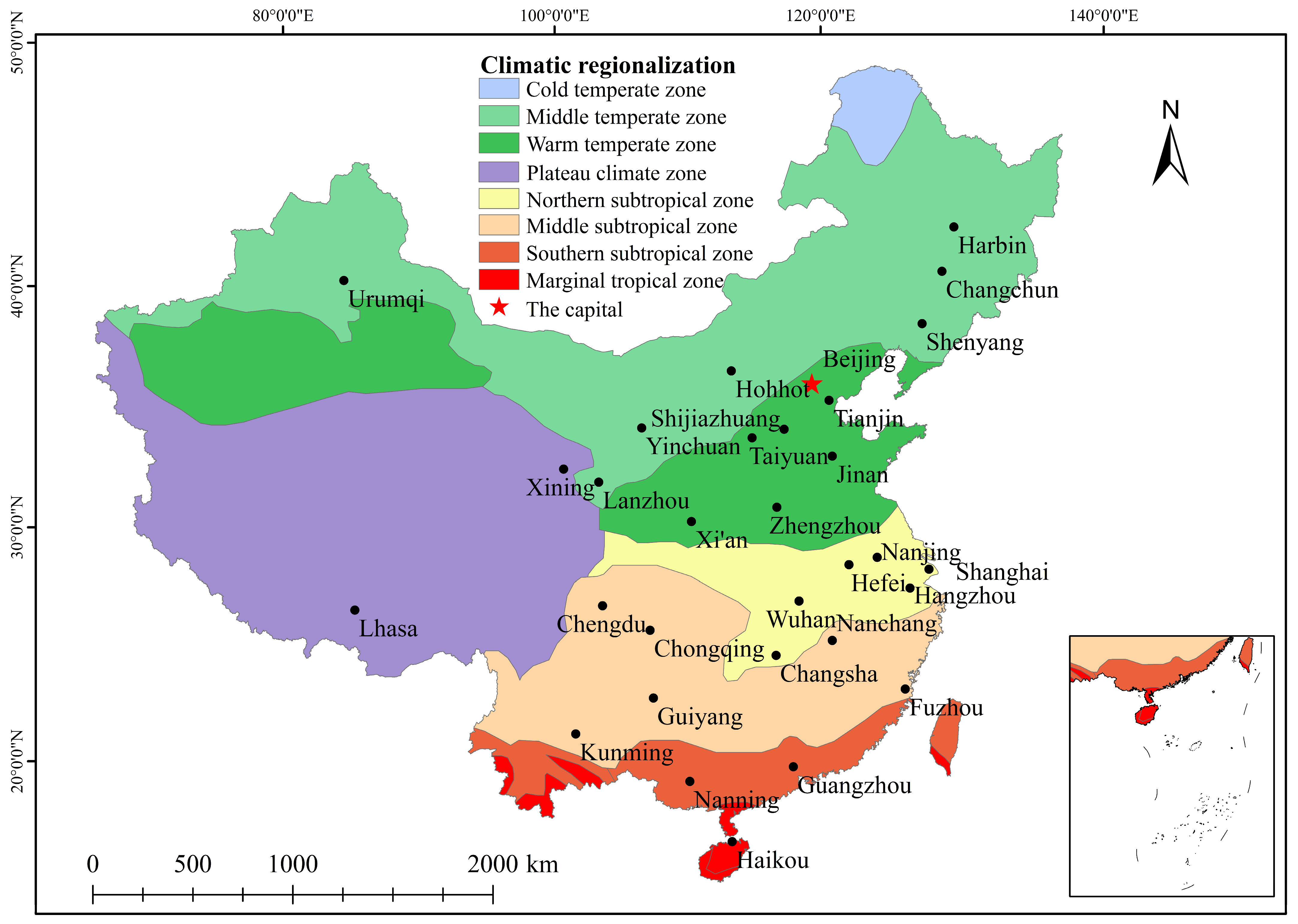
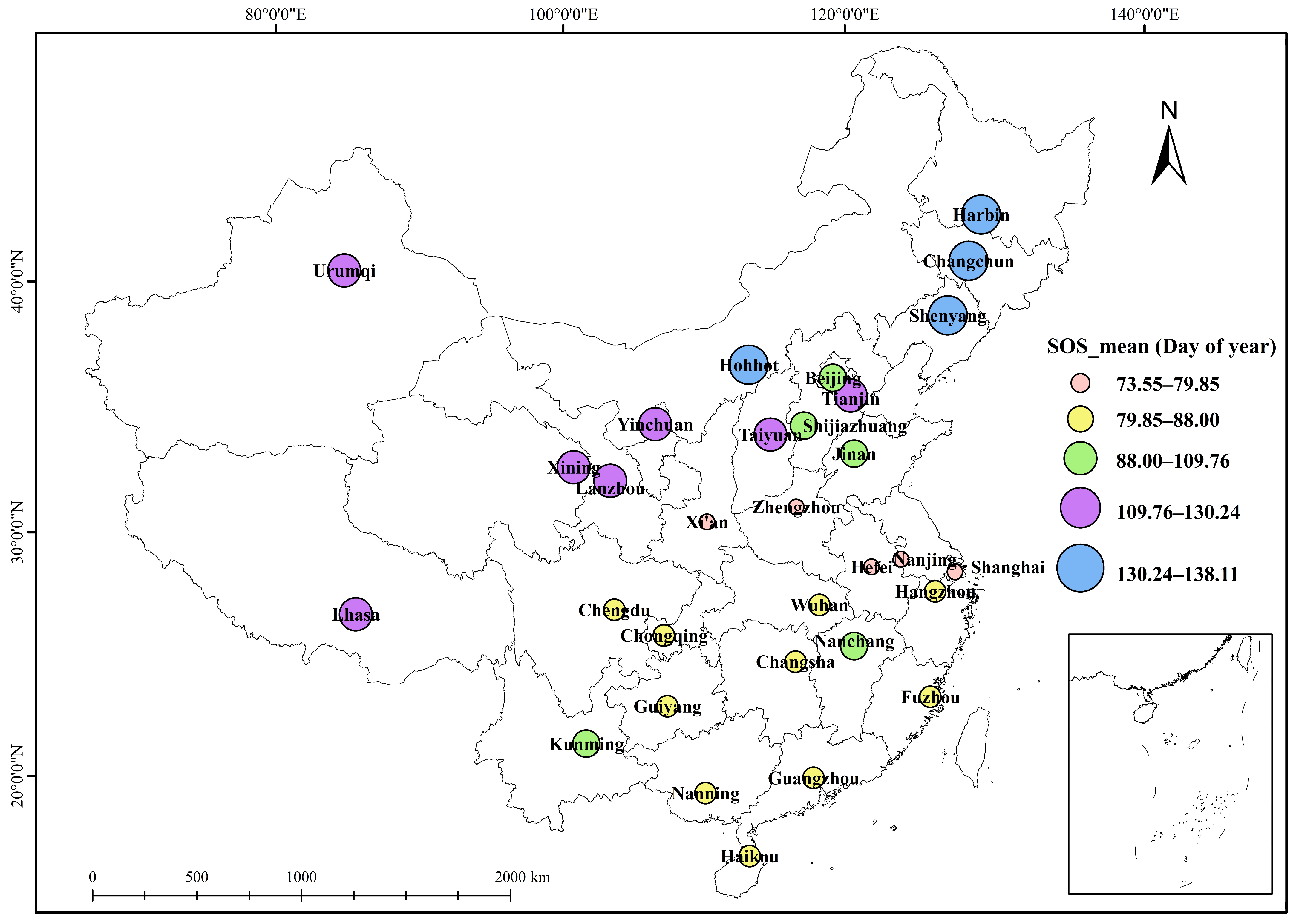
- For 31 provincial capitals and municipalities in mainland China (2001–2023), the start-of-season (SOS) date, derived from MODIS MCD12Q2 Greenup_1 as the spring green-up transition metric, is primarily distributed within approximately DOY 73.55–138.11 and advances by 0.81 d·yr−1 on average, exhibiting earlier timing in the south, later timing in the north, and delayed timing over plateau regions.
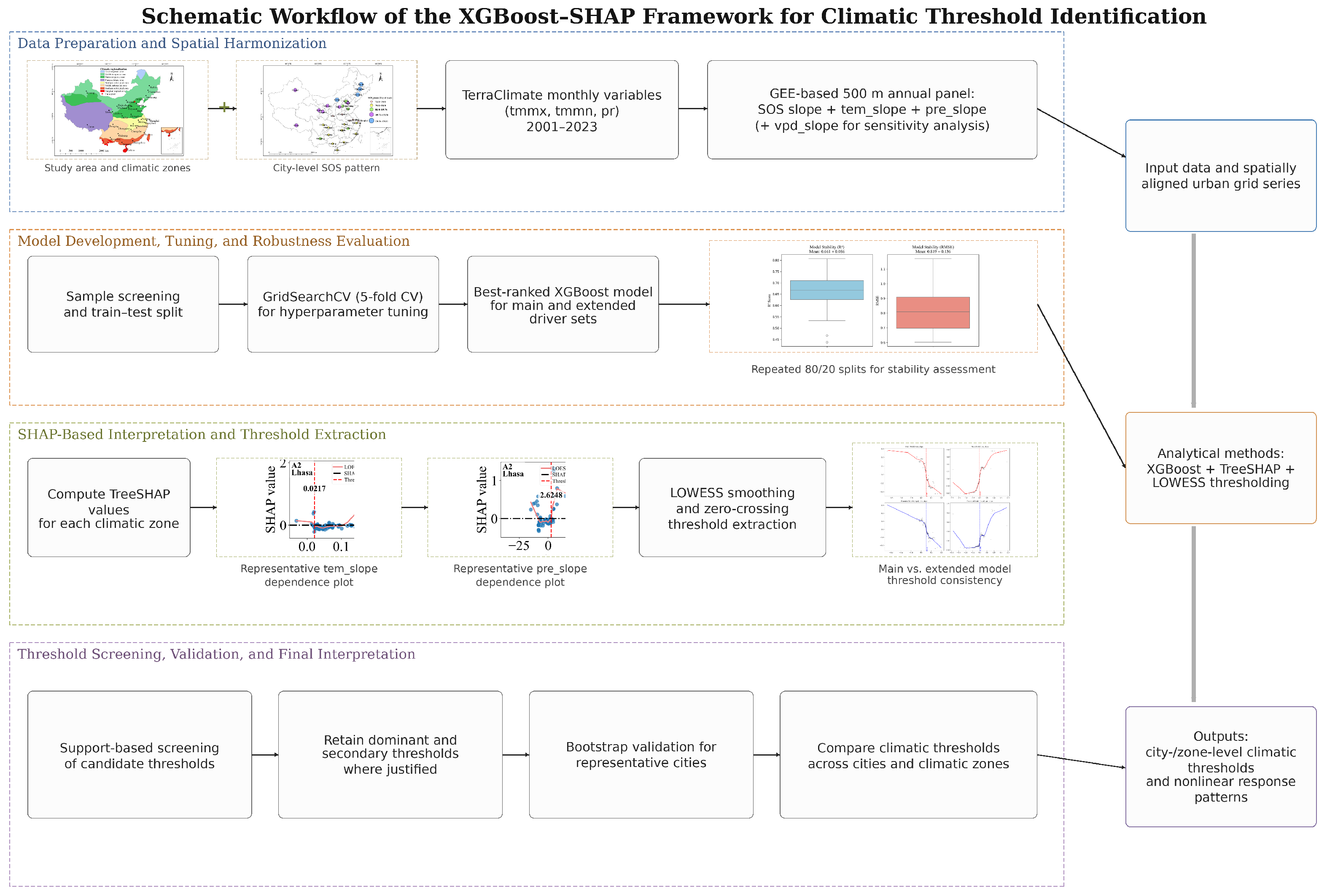
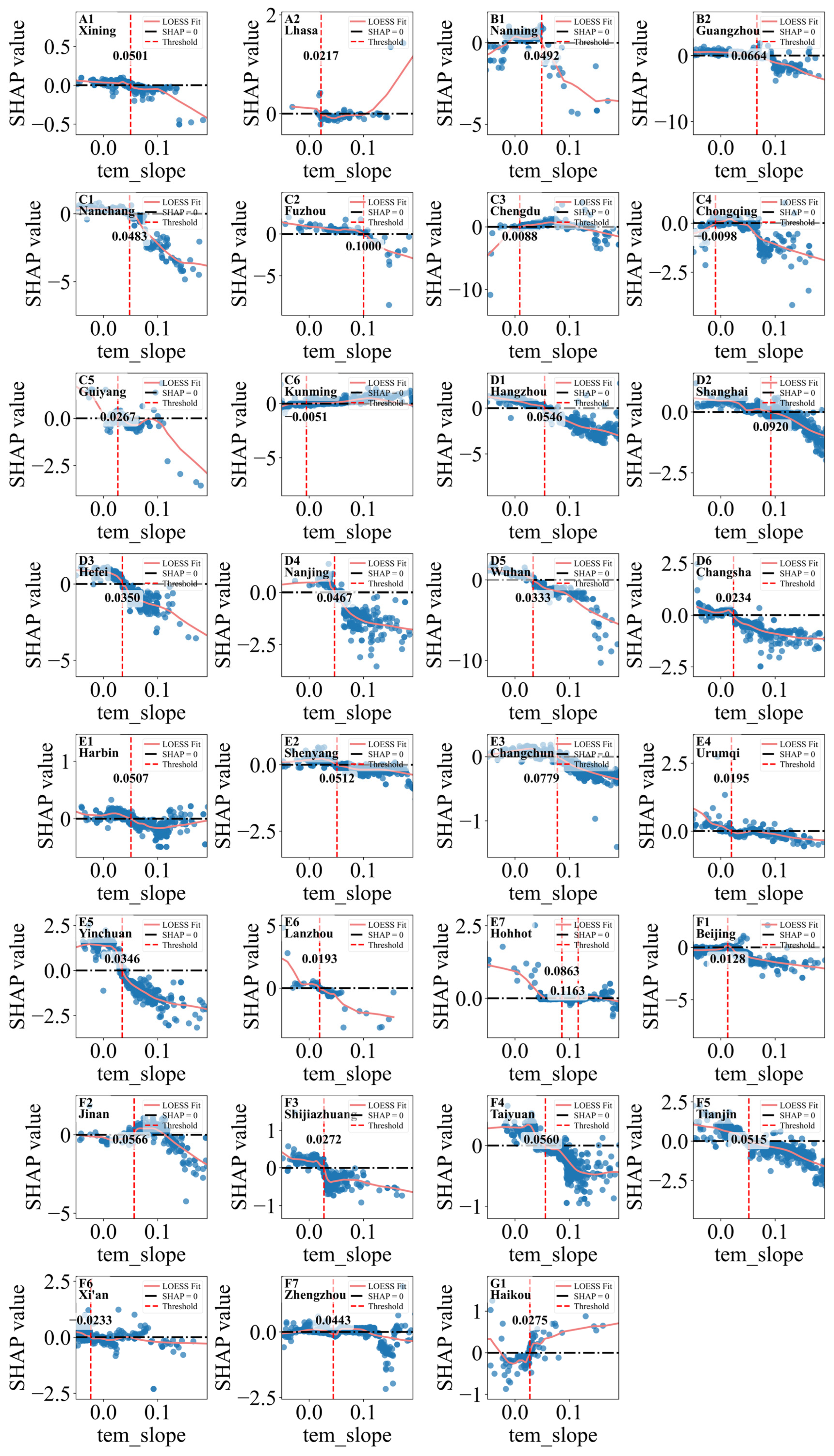
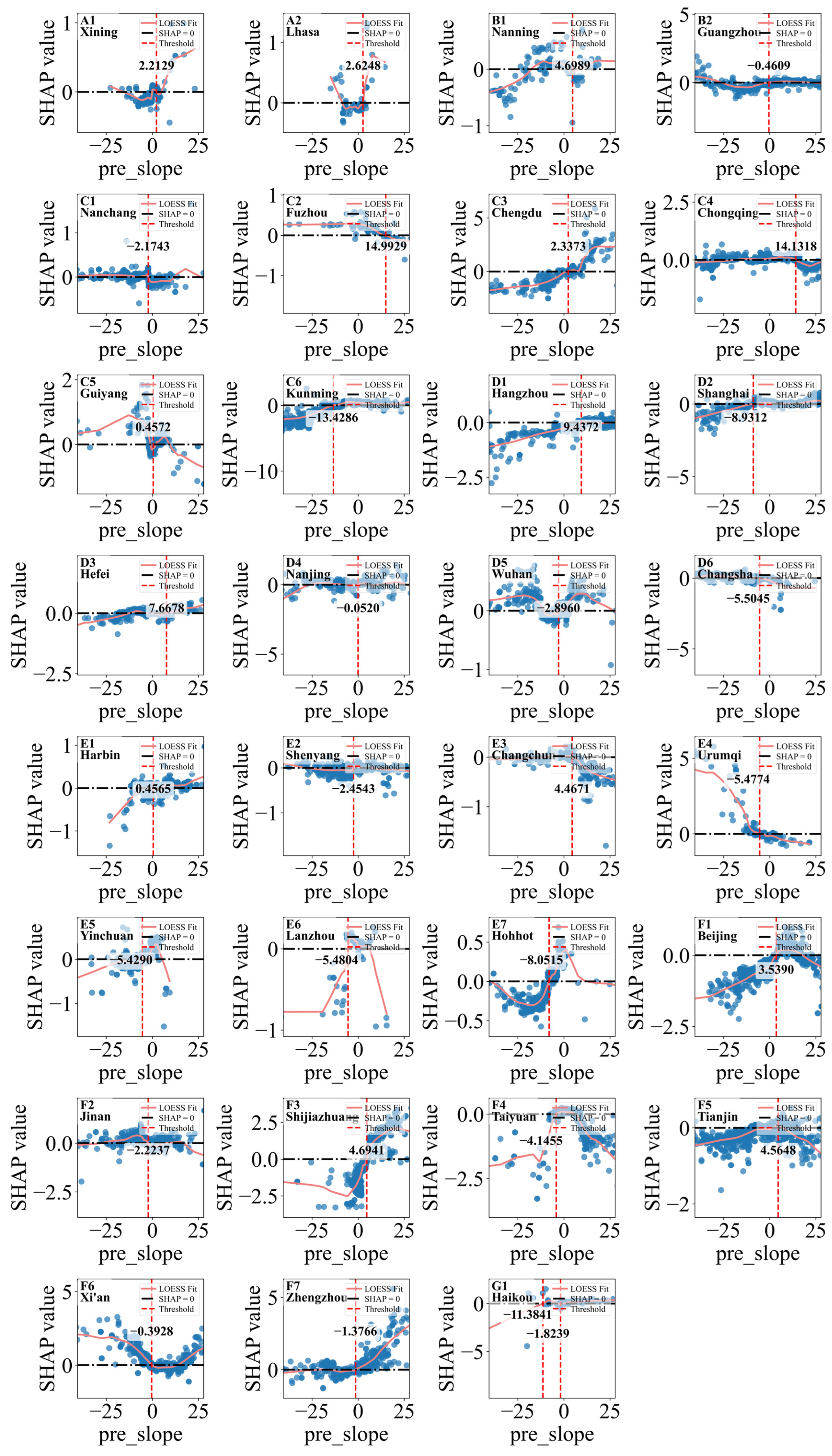
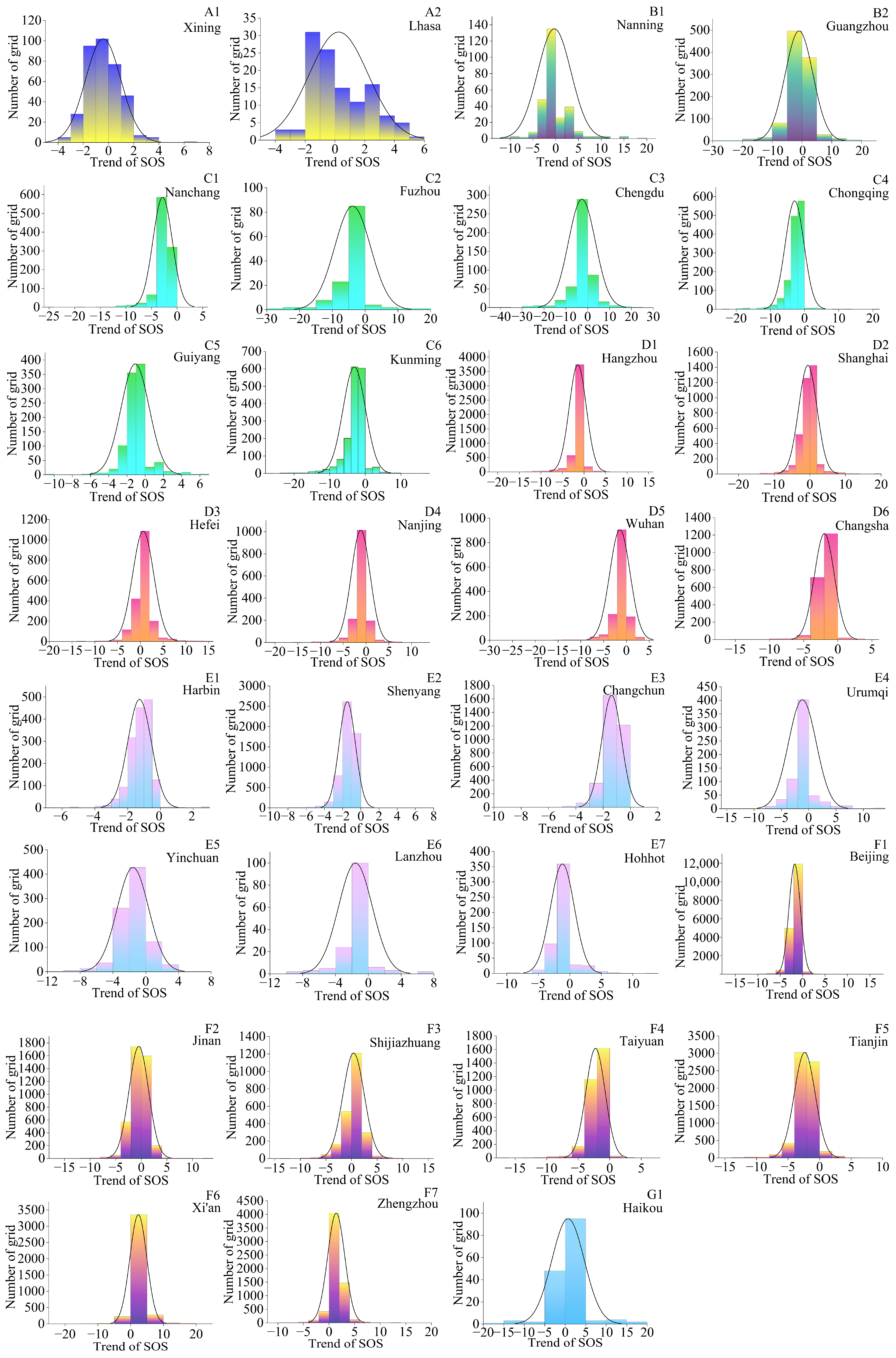
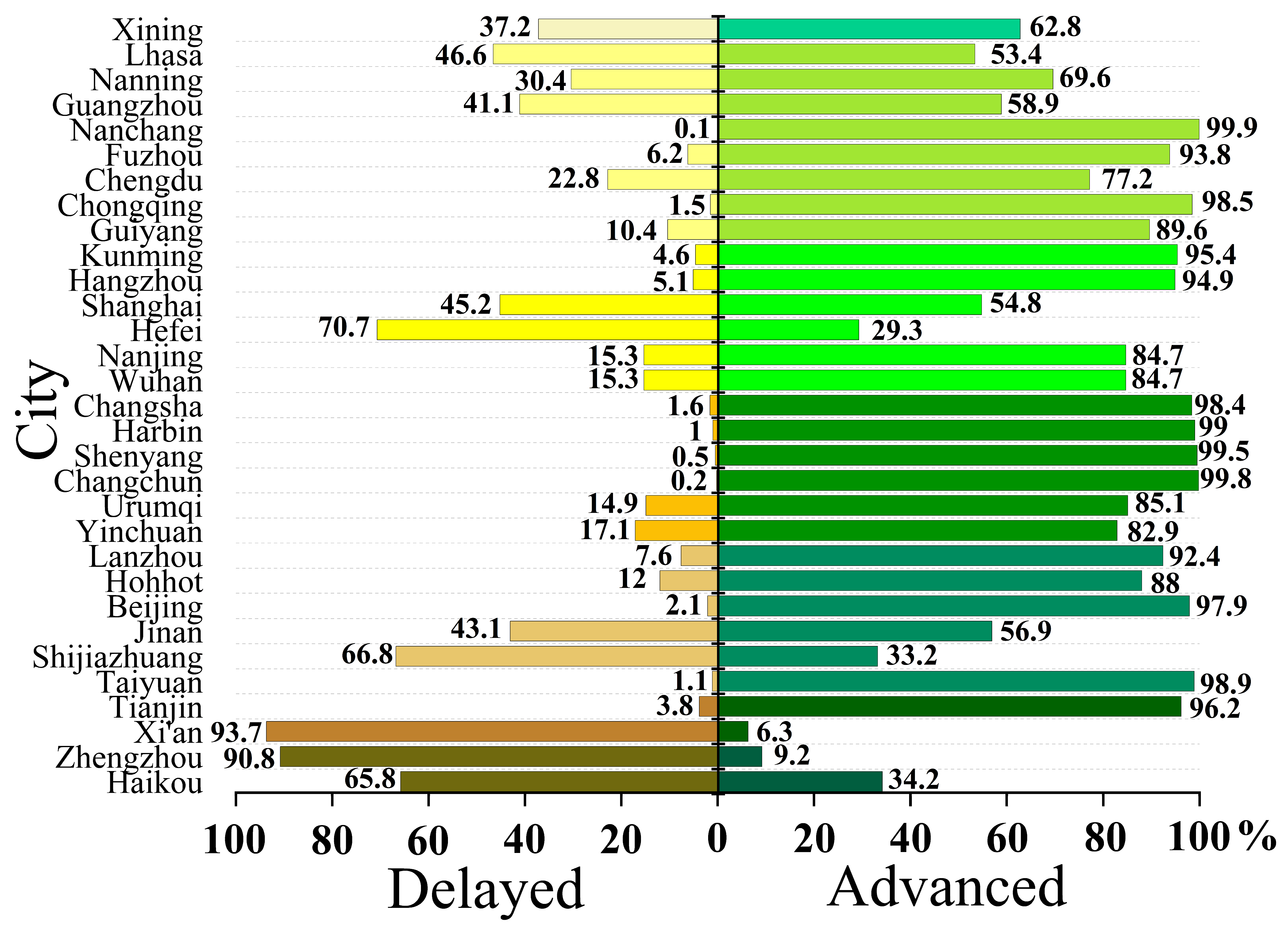
- Among pixels with significant or marginally significant SOS trends identified by the Mann–Kendall test (MK p < 0.10), advancing and delaying SOS trends commonly coexist within most cities, while advancing pixels dominate overall (75.02% vs. 24.98%). SHAP dependence relationships further reveal generally nonlinear and piecewise effects of interannual temperature- and precipitation-change rates (tem_slope, pre_slope), delineating spatially differentiated climate-sensitive intervals via tipping points.
- The identified tipping points and associated sensitive ranges provide quantitative, interpretable climate thresholds that can support urban greening design and climate-adaptive management under sustained warming and precipitation changes.
- The unified 500 m grid workflow integrating MK–Sen trend characterization with XGBoost–SHAP attribution and threshold identification offers a transferable framework for diagnosing spatially heterogeneous, nonlinear climate–phenology relationships across cities.
Abstract
1. Introduction
2. Materials and Methods
2.1. Study Area
2.2. Datasets and Processing
2.2.1. Urban Boundaries and Definition of Analysis Units
2.2.2. Vegetation Phenology Data
2.2.3. Climate Data
2.2.4. Construction of Annual Panel Datasets for Temperature and Precipitation
2.3. Methods
2.3.1. Pixel-Scale SOS Trend Testing and Significance Classification
2.3.2. Estimation of Long-Term Change Rates in Climatic Drivers
2.3.3. XGBoost Model Development and Evaluation
2.3.4. SHAP Interpretation Framework and Threshold Extraction
3. Results
3.1. Spatial Pattern of Mean SOS Across Provincial Capitals and Municipalities in Mainland China
3.2. Distributional Characteristics of City-Level SOS Within Different Climatic Zones
3.3. Pixel-Scale and City-Scale SOS Trend Patterns and Spatial Heterogeneity
3.4. Key Climatic Drivers and Threshold Differences Revealed by XGBoost–SHAP
4. Discussion
4.1. Spatial Pattern of Urban Spring SOS and the Climatic Background
4.2. Climatic-Zonal Attribution of Spring SOS and Differences in Relative Constraints
4.3. Climatic Thresholds and Nonlinear Responses of SOS
4.4. Methodological Implications and Limitations
5. Conclusions
- (1)
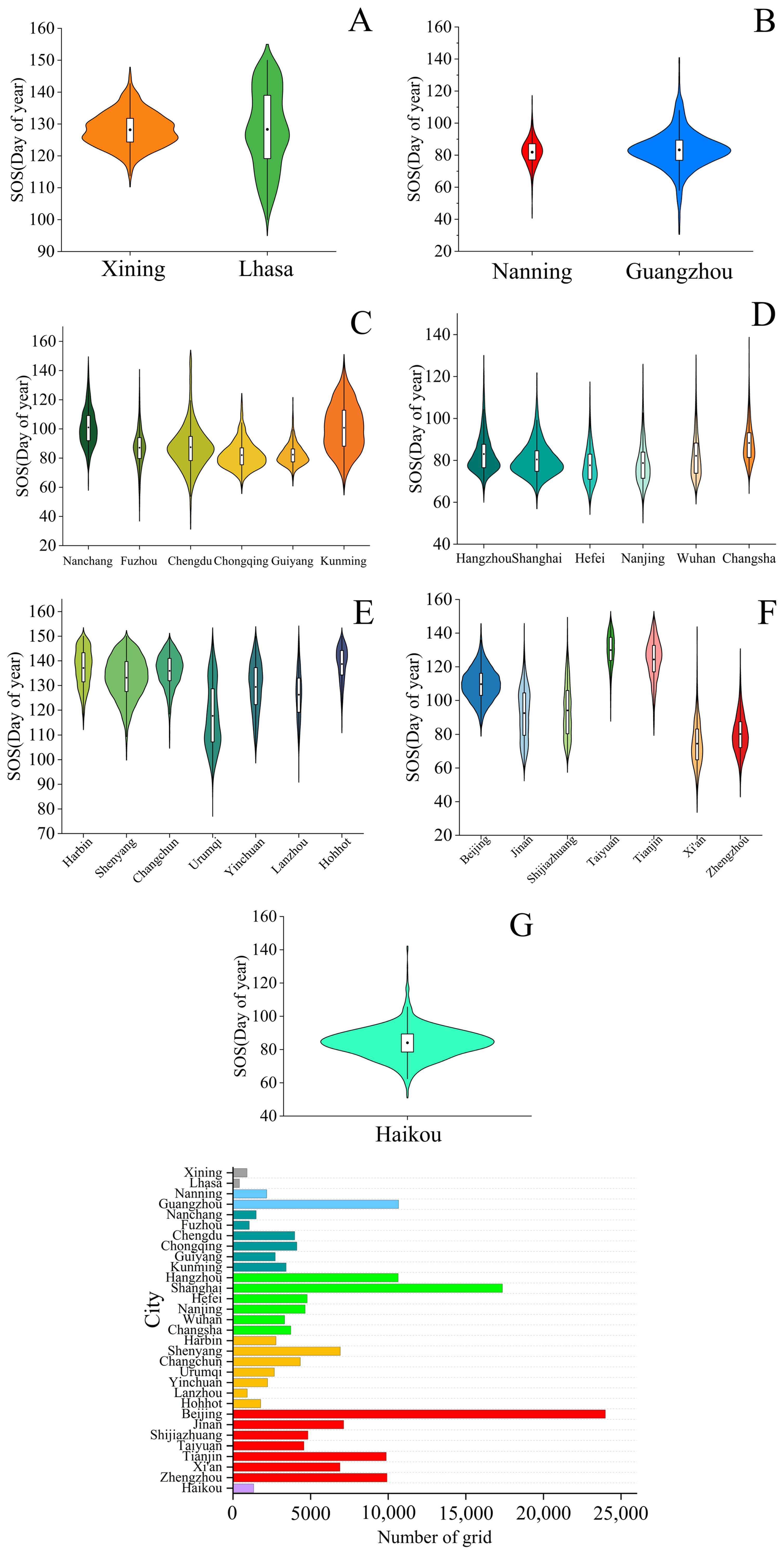
- The multi-year mean SOS exhibits a clear large-scale spatial gradient characterized by earlier green-up in the south, later green-up in the north, and delayed green-up over plateau regions. City-level mean SOS values are mainly distributed within approximately 74–138 DOY, with pronounced differences among climatic zones. Cities in the southern subtropical and marginal tropical zones generally show earlier green-up with relatively smaller within-city dispersion, whereas the middle subtropical zone exhibits the largest inter-city dispersion, spanning from the low 80 s to around 101 DOY. These patterns are consistent with the combined influences of large-scale climatic gradients and local geographic conditions (e.g., topography and underlying-surface heterogeneity). Pixel-scale MK–Sen results further show that advancing and delaying pixels commonly coexist within most cities. When trend directions of significant and marginally significant pixels are summarized at the city scale, marked inter-city differences emerge in the proportions of β < 0 and β > 0 pixels, manifesting as cities dominated by advancing trends, cities dominated by delaying trends, or cities in which the two types occur at comparable proportions. Overall, these results highlight substantial geographic heterogeneity in both the direction and magnitude of SOS changes within and across cities.
- (2)
- XGBoost–SHAP attribution reveals that the impacts of climatic-change rates on SOS trends are predominantly nonlinear and piecewise at the city scale. For temperature, most cities exhibit a positive tem_slope threshold (typically ~0.02–0.08 °C·year−1), indicating that marginal temperature contributions become evidently non-neutral only after warming exceeds a minimum rate; threshold ranges vary across climatic zones, with plateau cities clustering around 0.02–0.05 °C·year−1 and middle subtropical cities spanning from slightly negative to clearly positive values (−0.0267 to 0.1000 °C·year−1). In contrast, precipitation-related thresholds, expressed on an annual total precipitation basis, span an overall range of −13.4286 to 14.9929 mm·year−1, indicating that transitions into moisture-sensitive regimes can occur under relatively modest long-term wetting or drying trends, with substantial inter-city heterogeneity. Under our strict screening criteria, most cities are characterized by a single main turning point for each driver, while multi-threshold patterns are rare and retained only when strongly supported (e.g., Hohhot for tem_slope and Haikou for pre_slope). Collectively, these turning points delineate comparable climatic thresholds and sensitive intervals that enable cross-city comparisons of nonlinear climate–SOS linkages across climatic zones.
- (3)
- By integrating gridded MK–Sen trend analysis with XGBoost–SHAP attribution and threshold identification, this study provides a transferable and interpretable framework for examining urban phenology–climate relationships that can be extended to other phenological indicators and ecological response processes. Meanwhile, given the spatiotemporal resolutions of MCD12Q2 and TerraClimate and the lack of explicit representation of anthropogenic influences (e.g., land-use change, greening management, and urban heat-island effects), the thresholds reported here should be interpreted as statistical response turning points within an observational, model-interpretation framework under a regional climatic background rather than as strict causal tipping points. Future work should combine higher-resolution phenological products with refined urban climate datasets and incorporate urban morphology and management factors to better resolve intra-urban heterogeneity, and to evaluate the potential ecological risks and management implications associated with crossing these statistically identified response regimes using process-based models and scenario simulations.
Supplementary Materials
Author Contributions
Funding
Data Availability Statement
Acknowledgments
Conflicts of Interest
References
- Cleland, E.E.; Chuine, I.; Menzel, A.; Mooney, H.A.; Schwartz, M.D. Shifting plant phenology in response to global change. Trends Ecol. Evol. 2007, 22, 357–365. [Google Scholar] [CrossRef] [PubMed]
- Walther, G.-R.; Post, E.; Convey, P.; Menzel, A.; Parmesan, C.; Beebee, T.J.C.; Fromentin, J.-M.; Hoegh-Guldberg, O.; Bairlein, F. Ecological responses to recent climate change. Nature 2002, 416, 389–395. [Google Scholar] [CrossRef]
- Parmesan, C.; Yohe, G. A globally coherent fingerprint of climate change impacts across natural systems. Nature 2003, 421, 37–42. [Google Scholar] [CrossRef]
- Richardson, A.D.; Keenan, T.F.; Migliavacca, M.; Ryu, Y.; Sonnentag, O.; Toomey, M. Climate change, phenology, and phenological control of vegetation feedbacks to the climate system. Agric. For. Meteorol. 2013, 169, 156–173. [Google Scholar] [CrossRef]
- Zhang, X.; Friedl, M.A.; Schaaf, C.B.; Strahler, A.H.; Hodges, J.C.; Gao, F.; Reed, B.C.; Huete, A. Monitoring vegetation phenology using MODIS. Remote Sens. Environ. 2003, 84, 471–475. [Google Scholar] [CrossRef]
- Reed, B.C.; Brown, J.F.; VanderZee, D.; Loveland, T.R.; Merchant, J.W.; Ohlen, D.O. Measuring phenological variability from satellite imagery. J. Veg. Sci. 1994, 5, 703–714. [Google Scholar] [CrossRef]
- Zhang, X.; Friedl, M.A.; Schaaf, C.B. Global vegetation phenology from Moderate Resolution Imaging Spectroradiometer (MODIS): Evaluation of global patterns and comparison with in situ measurements. J. Geophys. Res. Biogeosci. 2006, 111, G04017. [Google Scholar] [CrossRef]
- Schwartz, M.D.; Ahas, R.; Aasa, A. Onset of spring starting earlier across the Northern Hemisphere. Glob. Change Biol. 2006, 12, 343–351. [Google Scholar] [CrossRef]
- Jeong, S.-J.; Ho, C.-H.; Gim, H.-J.; Brown, M.E. Phenology shifts at start vs. end of growing season in temperate vegetation over the Northern Hemisphere for the period 1982–2008. Glob. Change Biol. 2011, 17, 2385–2399. [Google Scholar] [CrossRef]
- Chen, X.; Yang, Y.; Du, J. Distribution and Attribution of Earlier Start of the Growing Season over the Northern Hemisphere from 2001–2018. Remote Sens. 2022, 14, 2964. [Google Scholar] [CrossRef]
- Richardson, A.D.; Andy Black, T.; Ciais, P.; Delbart, N.; Friedl, M.A.; Gobron, N.; Hollinger, D.Y.; Kutsch, W.L.; Longdoz, B.; Luyssaert, S.; et al. Influence of spring and autumn phenological transitions on forest ecosystem productivity. Philos. Trans. R. Soc. B Biol. Sci. 2010, 365, 3227–3246. [Google Scholar] [CrossRef] [PubMed]
- Barichivich, J.; Briffa, K.R.; Myneni, R.B.; Osborn, T.J.; Melvin, T.M.; Ciais, P.; Piao, S.; Tucker, C. Large-scale variations in the vegetation growing season and annual cycle of atmospheric CO2 at high northern latitudes from 1950 to 2011. Glob. Change Biol. 2013, 19, 3167–3183. [Google Scholar] [CrossRef] [PubMed]
- Bennie, J.; Kubin, E.; Wiltshire, A.; Huntley, B.; Baxter, R. Predicting spatial and temporal patterns of bud-burst and spring frost risk in north-west Europe: The implications of local adaptation to climate. Glob. Change Biol. 2010, 16, 1503–1514. [Google Scholar] [CrossRef]
- Gu, L.; Hanson, P.J.; Post, W.M.; Kaiser, D.P.; Yang, B.; Nemani, R.; Pallardy, S.G.; Meyers, T. The 2007 Eastern US Spring Freeze: Increased Cold Damage in a Warming World? BioScience 2008, 58, 253–262. [Google Scholar] [CrossRef]
- Yu, H.; Luedeling, E.; Xu, J. Winter and spring warming result in delayed spring phenology on the Tibetan Plateau. Proc. Natl. Acad. Sci. USA 2010, 107, 22151–22156. [Google Scholar] [CrossRef]
- Wang, H.; Wu, C.; Ciais, P.; Peñuelas, J.; Dai, J.; Fu, Y.; Ge, Q. Overestimation of the effect of climatic warming on spring phenology due to misrepresentation of chilling. Nat. Commun. 2020, 11, 4945. [Google Scholar] [CrossRef]
- Basler, D.; Körner, C. Photoperiod sensitivity of bud burst in 14 temperate forest tree species. Agric. For. Meteorol. 2012, 165, 73–81. [Google Scholar] [CrossRef]
- Piao, S.; Tan, J.; Chen, A.; Fu, Y.H.; Ciais, P.; Liu, Q.; Janssens, I.A.; Vicca, S.; Zeng, Z.; Jeong, S.-J.; et al. Leaf onset in the northern hemisphere triggered by daytime temperature. Nat. Commun. 2015, 6, 6911. [Google Scholar] [CrossRef] [PubMed]
- Zhou, Y.-Z.; Jia, G.-S. Precipitation as a control of vegetation phenology for temperate steppes in China. Atmos. Ocean. Sci. Lett. 2016, 9, 162–168. [Google Scholar] [CrossRef]
- Cui, X.; Xu, G.; He, X.; Luo, D. Influences of Seasonal Soil Moisture and Temperature on Vegetation Phenology in the Qilian Mountains. Remote Sens. 2022, 14, 3645. [Google Scholar] [CrossRef]
- Yan, Z.; Xu, J.; Wang, X.; Yang, Z.; Liu, D.; Li, G.; Huang, H. Continued spring phenological advance under global warming hiatus over the Pan-Third Pole. Front. Plant Sci. 2022, 13, 1071858. [Google Scholar] [CrossRef]
- Bao, F.; Liu, M.; Cao, Y.; Li, J.; Yao, B.; Xin, Z.; Lu, Q.; Wu, B. Water Addition Prolonged the Length of the Growing Season of the Desert Shrub Nitraria tangutorum in a Temperate Desert. Front. Plant Sci. 2020, 11, 1099. [Google Scholar] [CrossRef]
- Park, H.; Jeong, S.-J.; Ho, C.-H.; Kim, J.; Brown, M.E.; Schaepman, M.E. Nonlinear response of vegetation green-up to local temperature variations in temperate and boreal forests in the Northern Hemisphere. Remote Sens. Environ. 2015, 165, 100–108. [Google Scholar] [CrossRef]
- Fu, Y.H.; Zhao, H.; Piao, S.; Peaucelle, M.; Peng, S.; Zhou, G.; Ciais, P.; Huang, M.; Menzel, A.; Peñuelas, J.; et al. Declining global warming effects on the phenology of spring leaf unfolding. Nature 2015, 526, 104–107. [Google Scholar] [CrossRef] [PubMed]
- Oke, T.R. The energetic basis of the urban heat island. Q. J. R. Meteorol. Soc. 1982, 108, 1–24. [Google Scholar] [CrossRef]
- Arnfield, A.J. Two decades of urban climate research: A review of turbulence, exchanges of energy and water, and the urban heat island. Int. J. Climatol. 2003, 23, 1–26. [Google Scholar] [CrossRef]
- Zipper, S.C.; Schatz, J.; Kucharik, C.J.; Loheide, S.P., II. Urban heat island-induced increases in evapotranspirative demand. Geophys. Res. Lett. 2017, 44, 873–881. [Google Scholar] [CrossRef]
- Huang, F.; Zhan, W.; Wang, Z.; Wang, K.; Chen, J.M.; Liu, Y.; Lai, J.; Ju, W. Positive or Negative? Urbanization-Induced Variations in Diurnal Skin-Surface Temperature Range Detected Using Satellite Data. J. Geophys. Res. Atmos. 2017, 122, 13229–13244. [Google Scholar] [CrossRef]
- Zhou, D.; Zhao, S.; Zhang, L.; Liu, S. Remotely sensed assessment of urbanization effects on vegetation phenology in China’s 32 major cities. Remote Sens. Environ. 2016, 176, 272–281. [Google Scholar] [CrossRef]
- Melaas, E.K.; Wang, J.A.; Miller, D.L.; Friedl, M.A. Interactions between urban vegetation and surface urban heat islands: A case study in the Boston metropolitan region. Environ. Res. Lett. 2016, 11, 054020. [Google Scholar] [CrossRef]
- Tian, J.; Zhu, X.; Wu, J.; Shen, M.; Chen, J. Coarse-Resolution Satellite Images Overestimate Urbanization Effects on Vegetation Spring Phenology. Remote Sens. 2020, 12, 117. [Google Scholar] [CrossRef]
- Jochner, S.; Menzel, A. Urban phenological studies—Past, present, future. Environ. Pollut. 2015, 203, 250–261. [Google Scholar] [CrossRef]
- Neil, K.L.; Landrum, L.; Wu, J. Effects of urbanization on flowering phenology in the metropolitan phoenix region of USA: Findings from herbarium records. J. Arid Environ. 2010, 74, 440–444. [Google Scholar] [CrossRef]
- Meng, L.; Mao, J.; Zhou, Y.; Richardson, A.D.; Lee, X.; Thornton, P.E.; Ricciuto, D.M.; Li, X.; Dai, Y.; Shi, X.; et al. Urban warming advances spring phenology but reduces the response of phenology to temperature in the conterminous United States. Proc. Natl. Acad. Sci. USA 2020, 117, 4228–4233. [Google Scholar] [CrossRef]
- Toms, J.D.; Lesperance, M.L. Piecewise Regression: A Tool for Identifying Ecological Thresholds. Ecology 2003, 84, 2034–2041. [Google Scholar] [CrossRef]
- Groffman, P.M.; Baron, J.S.; Blett, T.; Gold, A.J.; Goodman, I.; Gunderson, L.H.; Levinson, B.M.; Palmer, M.A.; Paerl, H.W.; Peterson, G.D.; et al. Ecological Thresholds: The Key to Successful Environmental Management or an Important Concept with No Practical Application? Ecosystems 2006, 9, 1–13. [Google Scholar] [CrossRef]
- Murdoch, W.J.; Singh, C.; Kumbier, K.; Abbasi-Asl, R.; Yu, B. Definitions, methods, and applications in interpretable machine learning. Proc. Natl. Acad. Sci. USA 2019, 116, 22071–22080. [Google Scholar] [CrossRef] [PubMed]
- Gevaert, C.M. Explainable AI for earth observation: A review including societal and regulatory perspectives. Int. J. Appl. Earth Obs. Geoinf. 2022, 112, 102869. [Google Scholar] [CrossRef]
- Friedman, J.H. Greedy function approximation: A gradient boosting machine. Ann. Stat. 2001, 29, 1189–1232. [Google Scholar] [CrossRef]
- Chen, T.; Guestrin, C. XGBoost: A Scalable Tree Boosting System. In Proceedings of the 22nd ACM SIGKDD International Conference on Knowledge Discovery and Data Mining, San Francisco, CA, USA, 13–17 August 2016; pp. 785–794. [Google Scholar]
- Rudin, C. Stop explaining black box machine learning models for high stakes decisions and use interpretable models instead. Nat. Mach. Intell. 2019, 1, 206–215. [Google Scholar] [CrossRef]
- Lundberg, S.M.; Lee, S.-I. A unified approach to interpreting model predictions. In Proceedings of the 31st International Conference on Neural Information Processing Systems, Long Beach, CA, USA, 4–9 December 2017; pp. 4768–4777. [Google Scholar]
- Lundberg, S.M.; Erion, G.; Chen, H.; DeGrave, A.; Prutkin, J.M.; Nair, B.; Katz, R.; Himmelfarb, J.; Bansal, N.; Lee, S.-I. From local explanations to global understanding with explainable AI for trees. Nat. Mach. Intell. 2020, 2, 56–67. [Google Scholar] [CrossRef]
- Meng, X.; Ling, Z.; Chen, Y.; Kuang, J.; Zhang, L.; Wu, Z.; Zheng, Z.; Wang, J. From Coast to Inland: Nonlinear and Temperature-Mediated Urbanization Effects on Vegetation Phenology in Shandong Province, China. Remote Sens. 2025, 17, 3833. [Google Scholar] [CrossRef]
- GB/T 17297–1998; Names and Codes for Climate Regionalization in China—Climatic Zones and Climatic Regions. Standards Press of China: Beijing, China, 1998.
- Li, X.; Gong, P.; Zhou, Y.; Wang, J.; Bai, Y.; Chen, B.; Hu, T.; Xiao, Y.; Xu, B.; Yang, J.; et al. Mapping global urban boundaries from the global artificial impervious area (GAIA) data. Environ. Res. Lett. 2020, 15, 094044. [Google Scholar] [CrossRef]
- Gorelick, N.; Hancher, M.; Dixon, M.; Ilyushchenko, S.; Thau, D.; Moore, R. Google Earth Engine: Planetary-scale geospatial analysis for everyone. Remote Sens. Environ. 2017, 202, 18–27. [Google Scholar] [CrossRef]
- Friedl, M.; Gray, J.; Sulla-Menashe, D. MODIS/Terra+Aqua Land Cover Dynamics Yearly L3 Global 500m SIN Grid V061 [Data Set]. 2022. Available online: https://www.earthdata.nasa.gov/data/catalog/lpcloud-mcd12q2-061 (accessed on 17 March 2026).
- Gray, J.; Sulla-Menashe, D.; Friedl, M.A. User Guide to Collection 6.1 MODIS Land Cover Dynamics (MCD12Q2) Product; Land Processes Distributed Active Archive Center (LP DAAC): Sioux Falls, SD, USA, 2022. [Google Scholar]
- Moon, M.; Zhang, X.; Henebry, G.M.; Liu, L.; Gray, J.M.; Melaas, E.K.; Friedl, M.A. Long-term continuity in land surface phenology measurements: A comparative assessment of the MODIS land cover dynamics and VIIRS land surface phenology products. Remote Sens. Environ. 2019, 226, 74–92. [Google Scholar] [CrossRef]
- Stanimirova, R.; Cai, Z.; Melaas, E.K.; Gray, J.M.; Eklundh, L.; Jönsson, P.; Friedl, M.A. An Empirical Assessment of the MODIS Land Cover Dynamics and TIMESAT Land Surface Phenology Algorithms. Remote Sens. 2019, 11, 2201. [Google Scholar] [CrossRef]
- Meng, L.; Zhou, Y.; Xuecao, L.; Asrar, G.; Mao, J.; Wanamaker, A.; Wang, Y. Divergent responses of spring phenology to daytime and nighttime warming. Agric. For. Meteorol. 2019, 281, 107832. [Google Scholar] [CrossRef]
- Chen, Y.; Lin, M.; Lin, T.; Zhang, J.; Jones, L.; Yao, X.; Geng, H.; Liu, Y.; Zhang, G.; Cao, X.; et al. Spatial heterogeneity of vegetation phenology caused by urbanization in China based on remote sensing. Ecol. Indic. 2023, 153, 110448. [Google Scholar] [CrossRef]
- Yin, P.; Li, X.; Pellikka, P. Asymmetrical Impact of Daytime and Nighttime Warming on the Interannual Variation of Urban Spring Vegetation Phenology. Earth’s Future 2024, 12, e2023EF004127. [Google Scholar] [CrossRef]
- Abatzoglou, J.T.; Dobrowski, S.Z.; Parks, S.A.; Hegewisch, K.C. TerraClimate: Monthly Climate and Climatic Water Balance for Global Terrestrial Surfaces, Version 1. Available online: https://www.climatologylab.org/terraclimate.html (accessed on 26 December 2025).
- Abatzoglou, J.T.; Dobrowski, S.Z.; Parks, S.A.; Hegewisch, K.C. TerraClimate, a high-resolution global dataset of monthly climate and climatic water balance from 1958–2015. Sci. Data 2018, 5, 170191. [Google Scholar] [CrossRef]
- Mann, H.B. Nonparametric Tests Against Trend. Econometrica 1945, 13, 245–259. [Google Scholar] [CrossRef]
- Kendall, M.G. Rank Correlation Methods; Charles Griffin: London, UK, 1970. [Google Scholar]
- Sen, P.K. Estimates of the Regression Coefficient Based on Kendall’s Tau. J. Am. Stat. Assoc. 1968, 63, 1379–1389. [Google Scholar] [CrossRef]
- Theil, H. A Rank-Invariant Method of Linear and Polynomial Regression Analysis, Part I. Proc. K. Ned. Akad. Van Wet. 1950, 53, 386–392. [Google Scholar]
- Hamed, K.H.; Ramachandra Rao, A. A modified Mann-Kendall trend test for autocorrelated data. J. Hydrol. 1998, 204, 182–196. [Google Scholar] [CrossRef]
- Yue, S.; Wang, C. The Mann-Kendall Test Modified by Effective Sample Size to Detect Trend in Serially Correlated Hydrological Series. Water Resour. Manag. 2004, 18, 201–218. [Google Scholar] [CrossRef]
- Li, X.; Du, H.; Zhou, G.; Mao, F.; Zhu, D.e.; Zhang, M.; Xu, Y.; Zhou, L.; Huang, Z. Spatiotemporal patterns of remotely sensed phenology and their response to climate change and topography in subtropical bamboo forests during 2001–2017: A case study in Zhejiang Province, China. GISci. Remote Sens. 2023, 60, 2163575. [Google Scholar] [CrossRef]
- Gutiérrez-Hernández, O.; García, L.V. Robust Trend Analysis in Environmental Remote Sensing: A Case Study of Cork Oak Forest Decline. Remote Sens. 2024, 16, 3886. [Google Scholar] [CrossRef]
- Zhen, J.; Mao, D.; Shen, Z.; Zhao, D.; Xu, Y.; Wang, J.; Jia, M.; Wang, Z.; Ren, C. Performance of XGBoost Ensemble Learning Algorithm for Mangrove Species Classification with Multisource Spaceborne Remote Sensing Data. J. Remote Sens. 2024, 4, 0146. [Google Scholar] [CrossRef]
- Fox, J.; Monette, G. Generalized Collinearity Diagnostics. J. Am. Stat. Assoc. 1992, 87, 178–183. [Google Scholar] [CrossRef]
- O’brien, R.M. A Caution Regarding Rules of Thumb for Variance Inflation Factors. Qual. Quant. 2007, 41, 673–690. [Google Scholar] [CrossRef]
- Hastie, T.; Tibshirani, R.; Friedman, J. The Elements of Statistical Learning: Data Mining, Inference, and Prediction; Springer: New York, NY, USA, 2009. [Google Scholar]
- Xue, Z.; Diao, S.; Yang, F.; Fei, L.; Wang, W.; Fang, L.; Liu, Y. Identifying Forest Drought Sensitivity Drivers in China Under Lagged and Accumulative Effects via XGBoost-SHAP. Remote Sens. 2025, 17, 2903. [Google Scholar] [CrossRef]
- He, R.; Wang, Q.; Liu, K.; Shi, X.; Jiang, X. Impacts of climatic factors and landscape patterns on megacity carbon sink in the mountain–basin transition region: A study based on the XGBoost–SHAP model in Chengdu, China. Ecol. Inform. 2025, 92, 103528. [Google Scholar] [CrossRef]
- Lundberg, S.M.; Erion, G.G.; Lee, S.-I. Consistent individualized feature attribution for tree ensembles. arXiv 2018, arXiv:1802.03888. [Google Scholar]
- Qu, Y.; Peñuelas, J.; Yu, Z.; Zeng, X.; Zhang, Y.; He, Y.; Wu, Y.; Wang, J. Quantifying the Rate and Extent of Urbanization Effects on Vegetation Phenology in Mainland China. Remote Sens. 2025, 17, 2758. [Google Scholar] [CrossRef]
- Yang, H.; Zhang, Q.; Zhang, S.; Wang, X.; Yu, H. Joint control of urban expansion and climate change on urban-rural vegetation phenology gradient in 31 cities of China. Front. Ecol. Evol. 2025, 13, 1637210. [Google Scholar] [CrossRef]
- Jia, W.; Zhao, S.; Zhang, X.; Liu, S.; Henebry, G.M.; Liu, L. Urbanization imprint on land surface phenology: The urban–rural gradient analysis for Chinese cities. Glob. Change Biol. 2021, 27, 2895–2904. [Google Scholar] [CrossRef]
- Yuan, Z.; Bao, G.; Dorjsuren, A.; Oyont, A.; Chen, J.; Li, F.; Dong, G.; Guo, E.; Shao, C.; Du, L. Climatic Constraints of Spring Phenology and Its Variability on the Mongolian Plateau From 1982 to 2021. J. Geophys. Res. Biogeosci. 2024, 129, e2023JG007689. [Google Scholar] [CrossRef]
- Zhu, W.; Lu, Y. Spatio-temporal patterns and climatic drivers of spring phenology in eight forest communities across the north-south transitional zone of China. J. Geogr. Sci. 2025, 35, 17–38. [Google Scholar] [CrossRef]
- Li, C.; Wang, R.; Cui, X.; Wu, F.; Yan, Y.; Peng, Q.; Qian, Z.; Xu, Y. Responses of vegetation spring phenology to climatic factors in Xinjiang, China. Ecol. Indic. 2021, 124, 107286. [Google Scholar] [CrossRef]
- Li, K.; Wang, C.; Sun, Q.; Rong, G.; Tong, Z.; Liu, X.; Zhang, J. Spring Phenological Sensitivity to Climate Change in the Northern Hemisphere: Comprehensive Evaluation and Driving Force Analysis. Remote Sens. 2021, 13, 1972. [Google Scholar] [CrossRef]
- Xiong, T.; Du, S.; Zhang, H.; Zhang, X. Decreasing temperature sensitivity of spring phenology decelerates the advance of spring phenology in northern temperate and boreal forests. Ecol. Indic. 2024, 161, 111983. [Google Scholar] [CrossRef]
- Menzel, A.; Sparks, T.H.; Estrella, N.; Koch, E.; Aasa, A.; Ahas, R.; Alm-Kübler, K.; Bissolli, P.; Braslavská, O.G.; Briede, A.; et al. European phenological response to climate change matches the warming pattern. Glob. Change Biol. 2006, 12, 1969–1976. [Google Scholar] [CrossRef]
- Cook, B.I.; Wolkovich, E.M.; Davies, T.J.; Ault, T.R.; Betancourt, J.L.; Allen, J.M.; Bolmgren, K.; Cleland, E.E.; Crimmins, T.M.; Kraft, N.J.B.; et al. Sensitivity of Spring Phenology to Warming Across Temporal and Spatial Climate Gradients in Two Independent Databases. Ecosystems 2012, 15, 1283–1294. [Google Scholar] [CrossRef]
- Qi, M.; Guo, L.; Liu, W.; Wang, W.; Jiang, C.; Bai, Y. Climate drivers of forest ecosystem services supply in the hilly mountainous regions of southern China based on SHAP-enhanced machine learning. Ecol. Indic. 2025, 178, 114085. [Google Scholar] [CrossRef]
- Li, Z. Extracting spatial effects from machine learning model using local interpretation method: An example of SHAP and XGBoost. Comput. Environ. Urban Syst. 2022, 96, 101845. [Google Scholar] [CrossRef]
- Xie, Y.; Liu, S.; Pang, B.; Wang, N.; Xu, J.; Huang, H.; Cui, Y.; Yang, J.; Liu, Y.; Liu, Y. Dual pathways of forest landscape dynamics in China: Integrating ecological land evolution index (ELEI) and machine learning to decipher fragmentation and restoration. Int. J. Appl. Earth Obs. Geoinf. 2025, 142, 104724. [Google Scholar] [CrossRef]
- Du, P.; Huai, H.; Wu, X.; Wang, H.; Liu, W.; Tang, X. Using XGBoost-SHAP for understanding the ecosystem services trade-off effects and driving mechanisms in ecologically fragile areas. Front. Plant Sci. 2025, 16, 1552818. [Google Scholar] [CrossRef] [PubMed]





| City | Province-Level Unit | Climate Zone Code | Climate Zone Name |
|---|---|---|---|
| Harbin | Heilongjiang Province | 12 | Middle temperate zone |
| Shenyang | Liaoning Province | 12 | Middle temperate zone |
| Changchun | Jilin Province | 12 | Middle temperate zone |
| Yinchuan | Ningxia Hui Autonomous Region | 12 | Middle temperate zone |
| Urumqi | Xinjiang Uygur Autonomous Region | 12 | Middle temperate zone |
| Lanzhou | Gansu Province | 12 | Middle temperate zone |
| Hohhot | Inner Mongolia Autonomous Region | 12 | Middle temperate zone |
| Beijing | Beijing Municipality | 13 | Warm temperate zone |
| Jinan | Shandong Province | 13 | Warm temperate zone |
| Shijiazhuang | Hebei Province | 13 | Warm temperate zone |
| Taiyuan | Shanxi Province | 13 | Warm temperate zone |
| Tianjin | Tianjin Municipality | 13 | Warm temperate zone |
| Xi’an | Shaanxi Province | 13 | Warm temperate zone |
| Zhengzhou | Henan Province | 13 | Warm temperate zone |
| Hangzhou | Zhejiang Province | 21 | Northern subtropical zone |
| Hefei | Anhui Province | 21 | Northern subtropical zone |
| Shanghai | Shanghai Municipality | 21 | Northern subtropical zone |
| Changsha | Hunan Province | 21 | Northern subtropical zone |
| Nanjing | Jiangsu Province | 21 | Northern subtropical zone |
| Wuhan | Hubei Province | 21 | Northern subtropical zone |
| Chengdu | Sichuan Province | 22 | Middle subtropical zone |
| Chongqing | Chongqing Municipality | 22 | Middle subtropical zone |
| Fuzhou | Fujian Province | 22 | Middle subtropical zone |
| Guiyang | Guizhou Province | 22 | Middle subtropical zone |
| Nanchang | Jiangxi Province | 22 | Middle subtropical zone |
| Kunming | Yunnan Province | 22 | Middle subtropical zone |
| Nanning | Guangxi Zhuang Autonomous Region | 23 | Southern subtropical zone |
| Guangzhou | Guangdong Province | 23 | Southern subtropical zone |
| Haikou | Hainan Province | 31 | Marginal tropical zone |
| Xining | Qinghai Province | 43 | Plateau climate zone |
| Lhasa | Tibet Autonomous Region | 44 | Plateau climate zone |
| Data Type | Data Product | Native Resolution | Time Range | Source |
|---|---|---|---|---|
| Urban boundary | Global Urban Boundary | Vector (no native pixel size; boundary delineation derived from 30 m GAIA impervious surface; effective mapping precision approximately 30 m) | 2018 | http://data.ess.tsinghua.edu.cn (accessed on 17 March 2026) |
| Spring phenology (SOS) | MCD12Q2 (Collection 6.1) | 500 m | 2001–2023 | https://www.earthdata.nasa.gov/data/catalog/lpcloud-mcd12q2-061 (accessed on 17 March 2026) |
| Climate variables | TerraClimate | 1/24° (approximately 4 km) | 2001–2023 | https://www.climatologylab.org/terraclimate.html (accessed on 17 March 2026) |
| Climate Zone Code (A–G) | Climate Zone | n (Cities) | Mean SOS (DOY) ± SD | Mean SOS Trend (d·Year−1) ± SD | Significant Grids (%) (p < 0.05) |
|---|---|---|---|---|---|
| A | Plateau climate zone | 2 | 126.73 ± 1.66 | 0.04 ± 0.46 | 30.79 |
| B | Southern subtropical zone | 2 | 83.13 ± 1.19 | −0.28 ± 0.29 | 5.84 |
| C | Middle subtropical zone | 6 | 89.92 ± 8.78 | −1.75 ± 0.74 | 28.24 |
| D | Northern subtropical zone | 6 | 81.20 ± 3.92 | −0.67 ± 0.65 | 27.79 |
| E | Middle temperate zone | 7 | 130.72 ± 7.45 | −1.04 ± 0.30 | 57.74 |
| F | Warm temperate zone | 7 | 100.47 ± 21.62 | −0.44 ± 1.56 | 62.25 |
| G | Marginal tropical zone | 1 | 83.56 ± — | 0.12 ± — | 6.16 |
Disclaimer/Publisher’s Note: The statements, opinions and data contained in all publications are solely those of the individual author(s) and contributor(s) and not of MDPI and/or the editor(s). MDPI and/or the editor(s) disclaim responsibility for any injury to people or property resulting from any ideas, methods, instructions or products referred to in the content. |
© 2026 by the authors. Licensee MDPI, Basel, Switzerland. This article is an open access article distributed under the terms and conditions of the Creative Commons Attribution (CC BY) license.
Share and Cite
Zhou, Z.; Huang, S.; Wang, L.; Li, Y.; Li, R.; Zhang, X.; Wang, J. Nonlinear Impacts of Interannual Temperature and Precipitation Changes on Spring Phenology in China’s Provincial Capitals. Remote Sens. 2026, 18, 952. https://doi.org/10.3390/rs18060952
Zhou Z, Huang S, Wang L, Li Y, Li R, Zhang X, Wang J. Nonlinear Impacts of Interannual Temperature and Precipitation Changes on Spring Phenology in China’s Provincial Capitals. Remote Sensing. 2026; 18(6):952. https://doi.org/10.3390/rs18060952
Chicago/Turabian StyleZhou, Zhengming, Shaodong Huang, Longhuan Wang, Yujie Li, Rui Li, Xinyang Zhang, and Jia Wang. 2026. "Nonlinear Impacts of Interannual Temperature and Precipitation Changes on Spring Phenology in China’s Provincial Capitals" Remote Sensing 18, no. 6: 952. https://doi.org/10.3390/rs18060952
APA StyleZhou, Z., Huang, S., Wang, L., Li, Y., Li, R., Zhang, X., & Wang, J. (2026). Nonlinear Impacts of Interannual Temperature and Precipitation Changes on Spring Phenology in China’s Provincial Capitals. Remote Sensing, 18(6), 952. https://doi.org/10.3390/rs18060952