Terrain-Aware Self-Supervised Representation Learning for Tree Species Mapping in Mountainous Regions Under Limited Field Samples

 ,
,
Highlights
- Self-supervised representation learning provides a practical solution for large-area tree species mapping in mountainous regions where field inventory samples are scarce, imbalanced, or temporally inconsistent.
- The proposed framework offers transferable insights for operational forest inventory and ecological monitoring by improving mapping robustness without increasing field survey costs.
- The framework offers transferable methodological insights for operational forest inventory and ecological monitoring in data-scarce mountainous regions.
- Improved mapping robustness can be achieved without increasing field survey intensity or associated costs, supporting cost-effective large-area forest assessments.
Abstract
1. Introduction
2. Study Area and Datasets
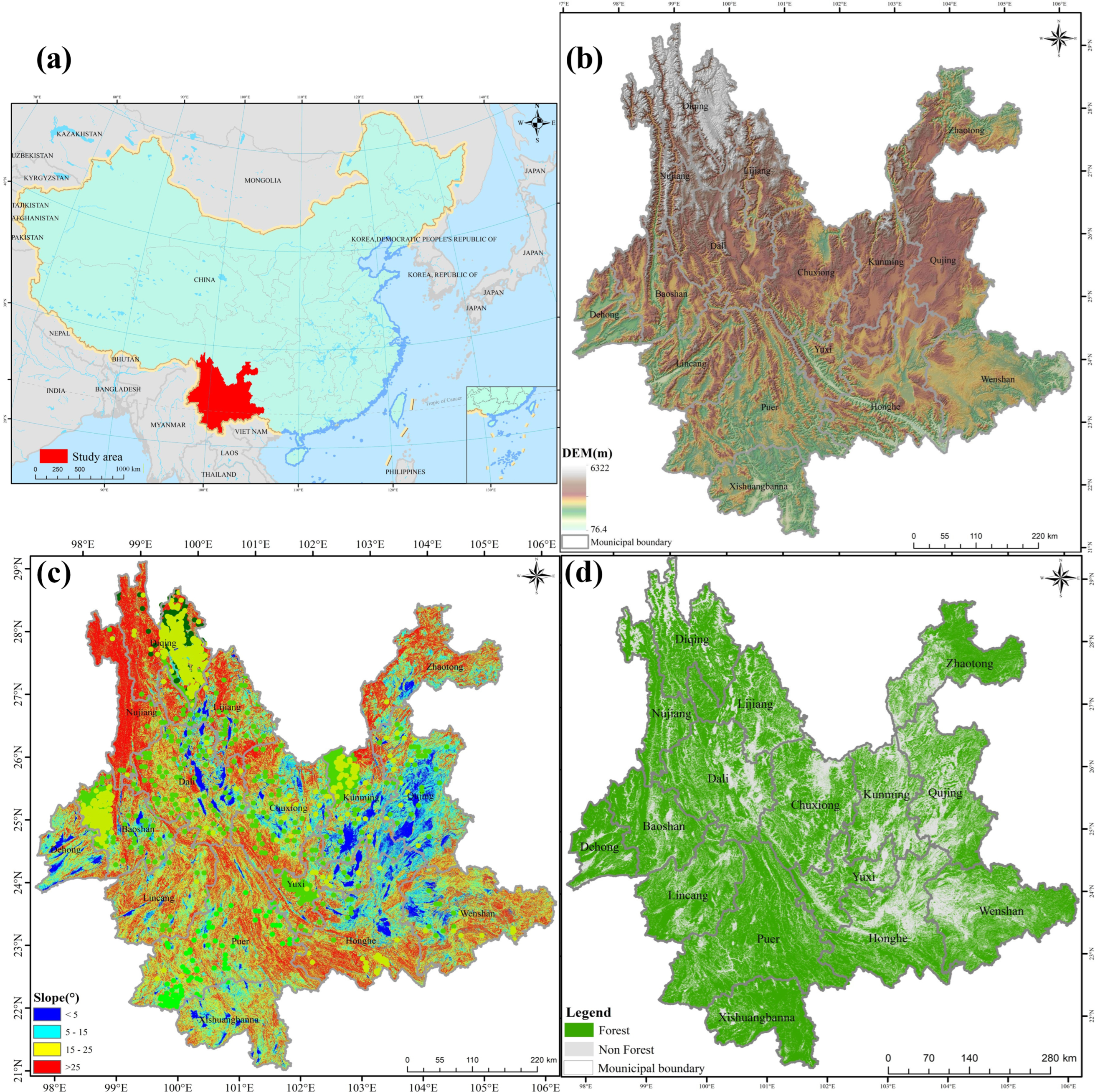
2.1. Study Area
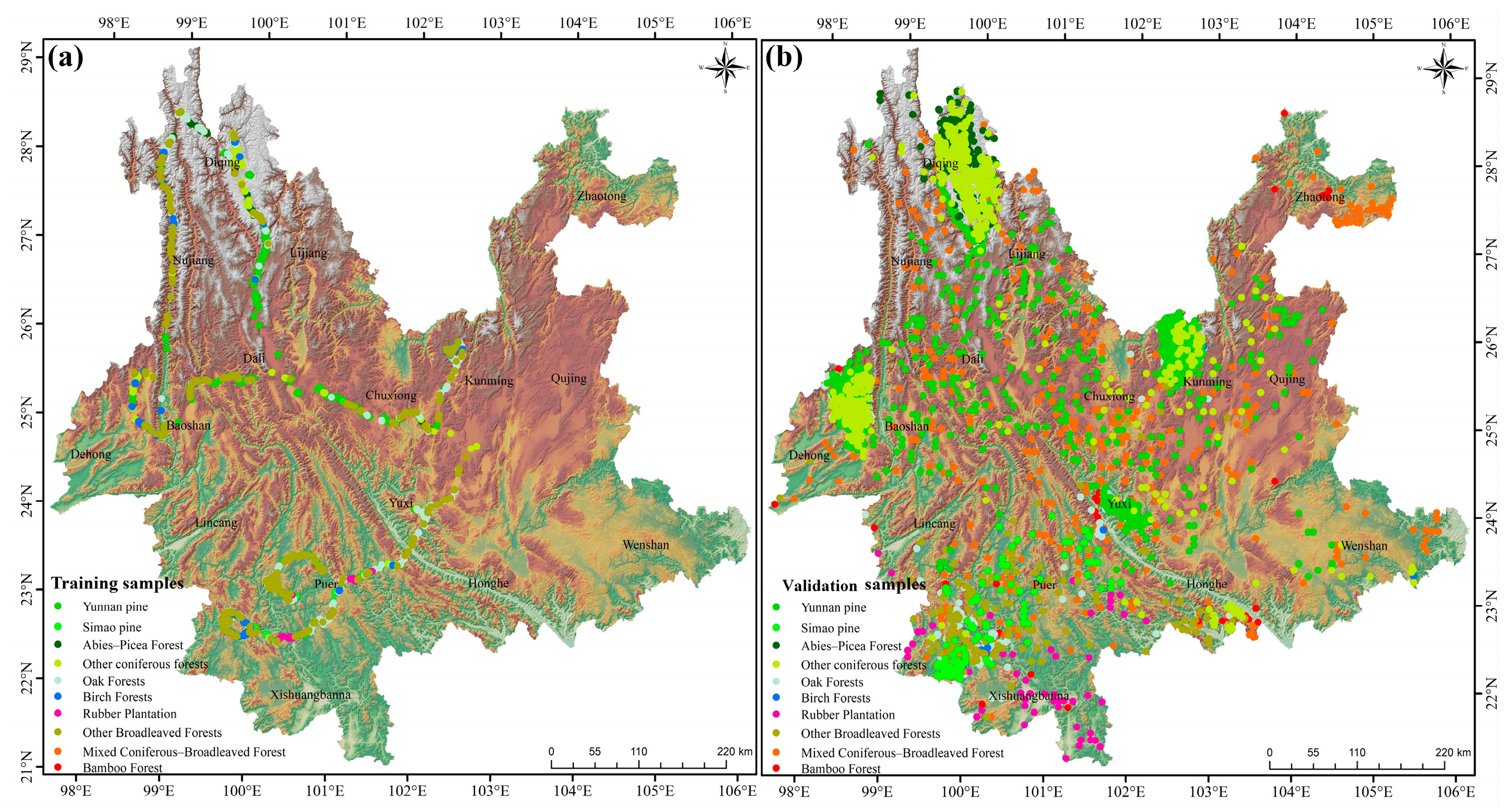
2.2. Collecting Field Survey Samples for Tree Species
2.3. Multi-Source Remote Sensing Data Acquisition and Preprocessing
2.3.1. Optical Remote Sensing Data
2.3.2. SAR Data
2.3.3. Environmental Condition
3. Method
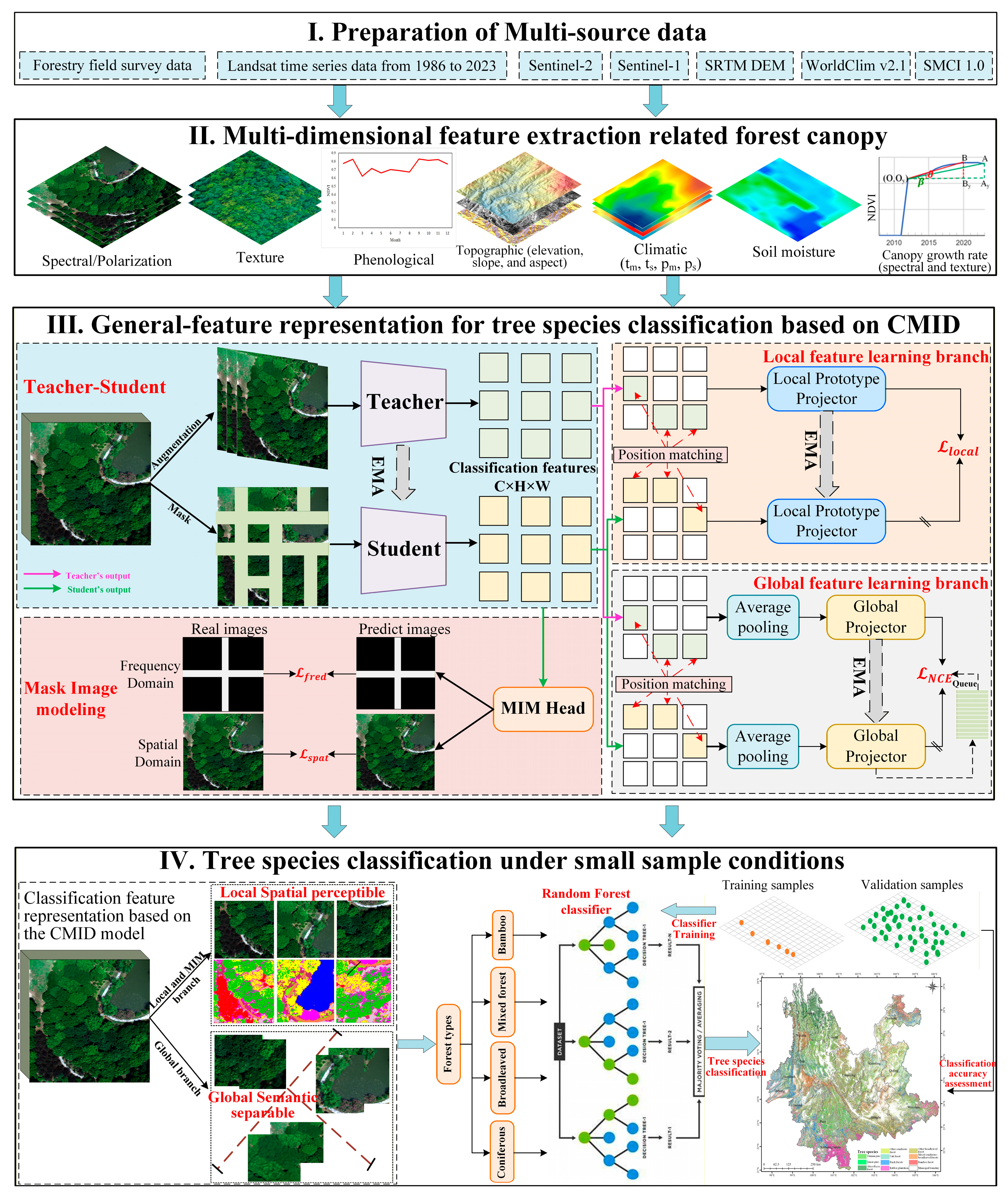
3.1. Overall Workflow
3.2. Construction of Unlabeled Multi-Source Image Patches
3.3. Terrain-Aware Self-Supervised Representation Learning
3.3.1. Local Structural Representation Learning
- (1)
- Masked images reconstruction
- (2)
- Prototype-based local contrastive learning
3.3.2. Global Semantic Representation Learning
3.3.3. Joint Optimization of Local and Global Representation
3.3.4. Training Configuration
3.4. Tree Species Classification
3.5. Comparative Experiments
3.6. Classification Accuracy Assessment
4. Results
4.1. Overall Classification Performance
4.2. Classification Performance Across Individual Tree Species
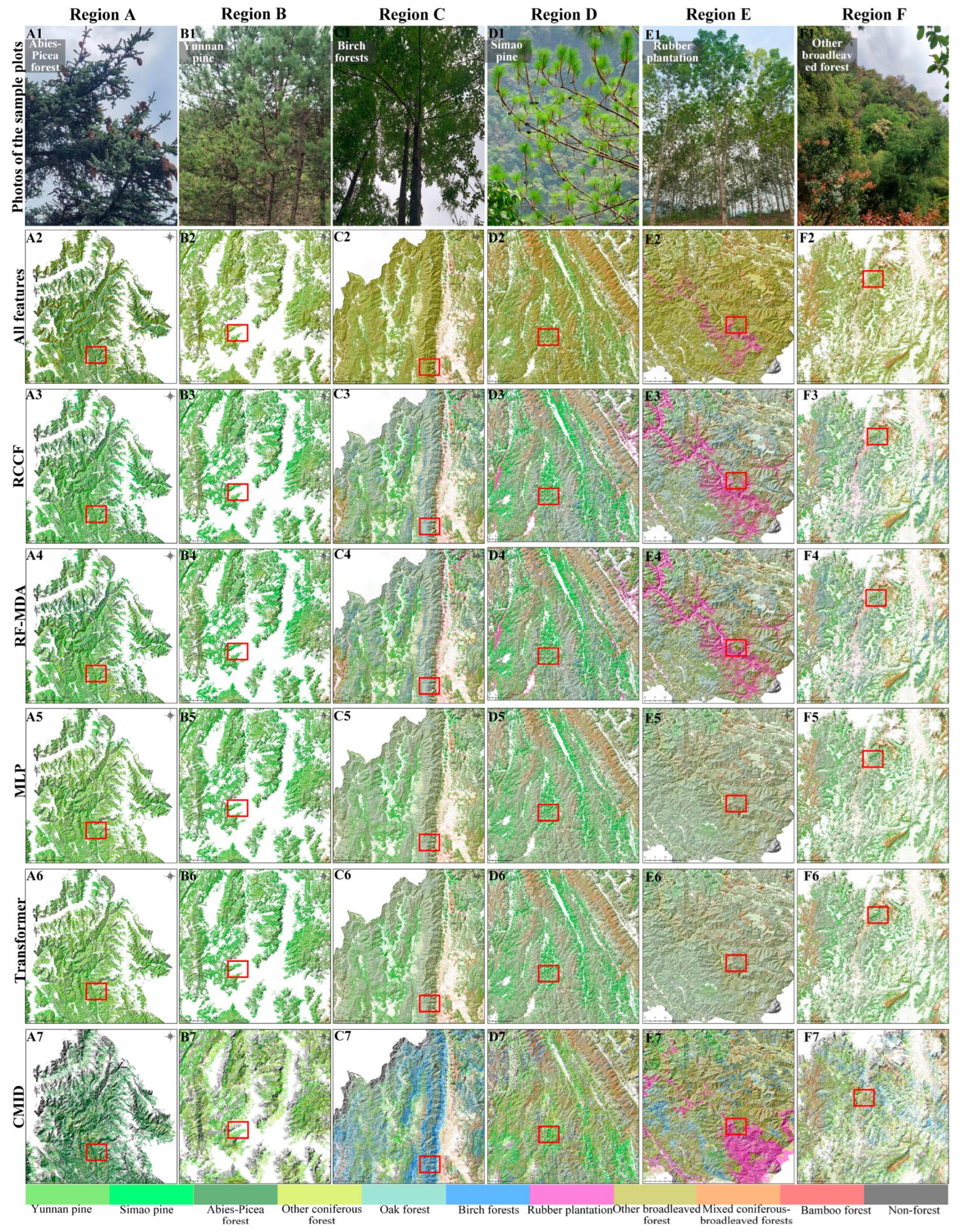
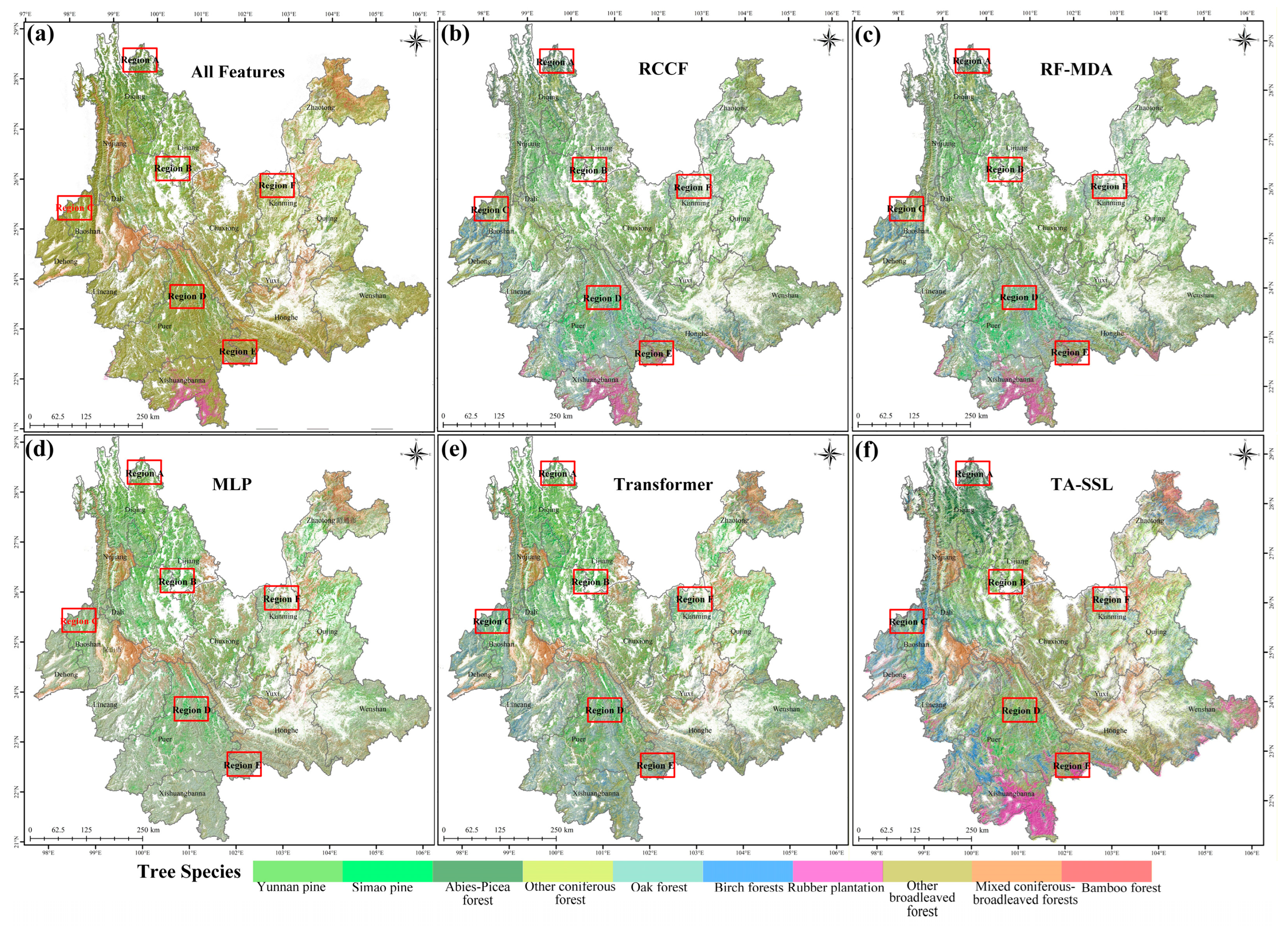
4.3. Spatial Comparison of Tree Species Classification Maps
4.4. Local-Scale Validation and Detailed Spatial Consistency
5. Discussions
5.1. Terrain Robustness of TA-SSL in Mountainous Environments
5.2. Complementarity of Self-Supervised Learning Objectives
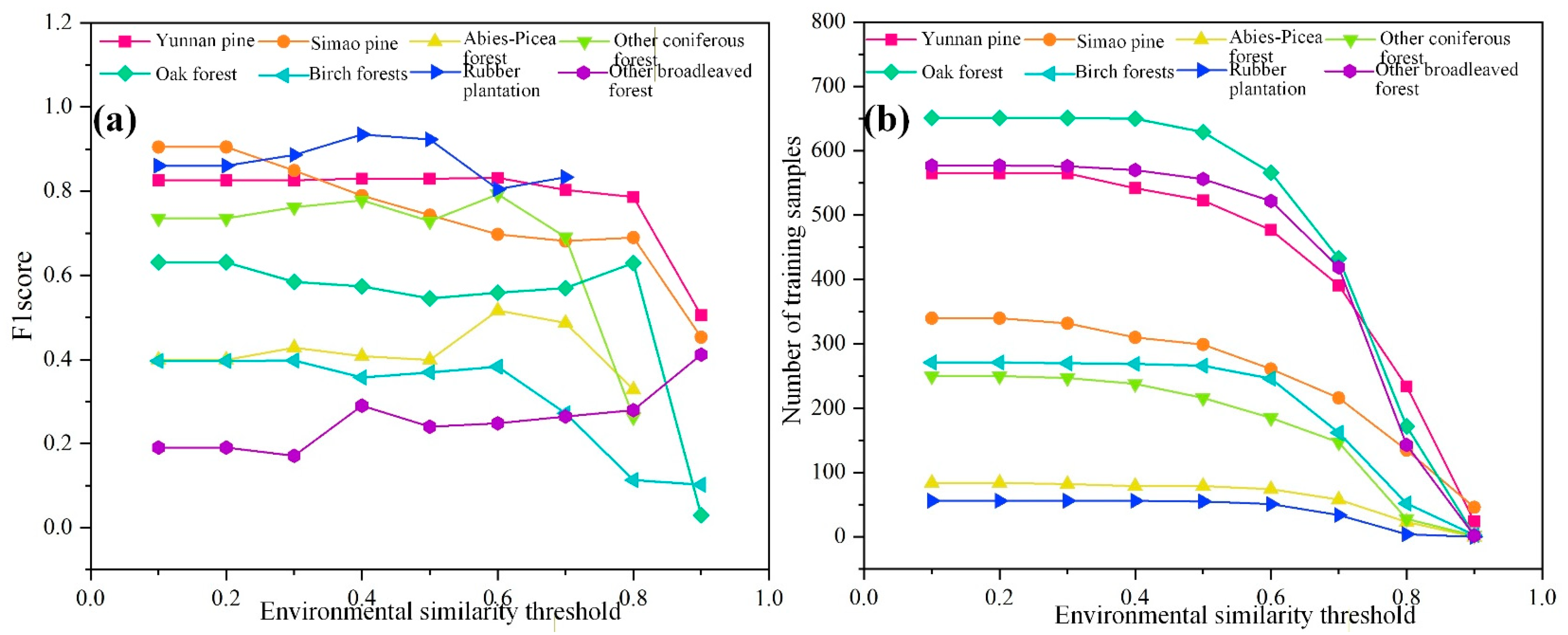
5.3. Environmentally Representativeness as the True Constraint of Small-Sample Learning
5.4. Ecological Separability as an Intrinsic Limit of Representation Learning
5.5. Implication for Forest Inventory and Mountainous Tree Species Mapping
6. Conclusions
Author Contributions
Funding
Data Availability Statement
Acknowledgments
Conflicts of Interest
Appendix A

| Data Source | Indices | Formulation | Reference |
|---|---|---|---|
| Sentinel-1 | VV/VH | [67] | |
| DIF | [68] | ||
| AVE | [69] | ||
| NDI | [70] | ||
| RVI4S1 | [71] | ||
| mRVI | [72] | ||
| VDDPI | [73] | ||
| mRVI_summerwinter | [44] | ||
| Sentinel-2 | NDVI | [74] | |
| EVI | [75] | ||
| REP | [76] | ||
| SVVI | [77] | ||
| NDRE | [78] | ||
| MCARI | [79] | ||
| MSRre | [80] | ||
| NDPI | [81] | ||
| NDre1 | [82] | ||
| IRECI | [83] | ||
| NDVIre2 | [82] | ||
| NDVI_maxsummer | [37] | ||
| Landsat time series data | GrowthrateL | ||
| Growthrate_2023 | |||
| WorldClim | PrecMs/TemMs | [47] | |
| SMCI 1.0 | SMRI | Soil Moisture Response Index | [48] |
| Feature Category | Description | Number of Features |
|---|---|---|
| Spectral | 10 spectral bands from Sentinel-2, tasseled cap greenness index (TC_greenness), and vegetation indices: NDVI, SVVI, EVI, NDRE, REPI, REI, MCARI, NDPI, MCR, IRECI, NDVIR1, TC_Greenness | 22 |
| SAR backscatter polarization | Sentinel-1 backscatter coefficients: VV and VH | 2 |
| SAR polarization indices | Polarimetric indices derived from VV and VH: VV/VH, DIF, AVE, NDI, RVI, mRVI, VDDPI | 7 |
| Texture | Texture metrics (e.g., Asm, contrast, dvar…) derived from the red_edge1 band using the Gray-Level Co-occurrence Matrix (GLCM) | 18 |
| Phenology | REPI (std, mean, median, min, max, Q25, Q75, IQR, cv, zf), std of mRVI, VV, and VH, mRVI_summerwinter, NDVI_maxsummer | 15 |
| Environmental | Elevation, Slope, Aspect, Mean Annual Precipitation (PrecMean), Mean seasonal Precipitation (PrecMs), Mean Annual Temperature (TemMean), Mean seasonal Temperature (TemMs), Soil Moisture Response Index (SMRI) | 8 |
| Spectral growth rate | NDVI-derived metrics: mean, median, std, zf, cv, Growthrate_2023, Growthrate_Longterm | 6 |
| Texture growth rate | SVVI_svar-derived metrics: mean, median, std, zf, cv, Growthrate_2023, GrowthrateL | 6 |
| Forest Type | Feature Types | Selected Features | Dimension |
|---|---|---|---|
| Coniferous forests | Spectral/Polarization | B1, B2, B3, B4, B5, B6, B8, B8A, B9, REPI, NDVIR1, MCARI, REI, mRVI, NDRE, NDVI, Ratio, EVI, NDPI, MCR, VDDPI, RVI, DIF | 23 |
| Phenological | REPI_median, NDVI_shixu, REPI_min, REPI_minQ1d, REPI_maxQ3d | 5 | |
| Environmental | PrecMean, PrecMs, TemMs, TemMean, Elevation, SMRI | 8 | |
| Growth-rate | NDVI_cvL, NDVI_speedyL | 2 | |
| Broadleaved forests | Spectral/Polarization | B1, B2, B3, B4, B5, B6, B7, B8A, B9, B11, B12, DIF, REI, SVVI, NDVIR1, NDRE, RVI, REPI, MCR, TC_greenness, AVE, VV, VH, NDPI | 24 |
| Texture | B5_corr, B5_shade | 2 | |
| Phenological | REPI_Q3Q1zfd, REPI_meand, mRVI_sumwinter, REPI_zhenfud, REPI_maxQ3d, DIF_std, REPI_maxd, NDVI_shixu | 9 | |
| Environmental | Elevation, TemMs, TemMean, PrecMs, Aspect, SMRI | 6 | |
| Growth-rate | NDVI_speedyL, NDVI_speedy2023L, NDVI_cvL, NDVI_meanL | 4 |
| Forest Type | Feature Types | Selected Features | Dimension |
|---|---|---|---|
| Coniferous forests | Spectral/Polarization | B1, B2, B5, B9, REPI, MCARI | 6 |
| Phenological | REPI_median, NDVI_shixu | 2 | |
| Environmental | PrecMean, TemMs, TemMean, Elevation, PrecMs | 5 | |
| Growth-rate | NDVI_speedyL | 1 | |
| Broadleaved forests | Spectral/Polarization | B1, B2, B3, B4, B5, B7, B8A, B9, B11, DIF, NDRE, REPI, IRECI, RVI, AVE, TC_greenness, SVVI, MCARI, MCR, NDVIR1, VDDPI | 21 |
| Phenological | NDVI_shixu, REPI_mediand, REPI_maxd, REPI_Q3Q1zfd | 4 | |
| Environmental | Elevation, TemMs, TemMean, PrecMean, PrecMs, SMRI | 6 | |
| Growth-rate | NDVI_speedyL, NDVI_speedy2023L, NDVI_cvL | 3 |
References
- Hemmerling, J.; Pflugmacher, D.; Hostert, P. Mapping temperate forest tree species using dense Sentinel-2 time series. Remote Sens. Environ. 2021, 267, 112743. [Google Scholar] [CrossRef]
- Pereira Martins-Neto, R.; Garcia Tommaselli, A.M.; Imai, N.N.; Honkavaara, E.; Miltiadou, M.; Saito Moriya, E.A.; David, H.C. Tree Species Classification in a Complex Brazilian Tropical Forest Using Hyperspectral and LiDAR Data. Forests 2023, 14, 945. [Google Scholar] [CrossRef]
- Liu, F.; Hu, J.; Yang, F.; Li, X. Heterogeneity-diversity Relationships in Natural Areas of Yunnan, China. Chin. Geogr. Sci. 2021, 31, 506–521. [Google Scholar] [CrossRef]
- Kluczek, M.; Zagajewski, B.; Zwijacz-Kozica, T. Mountain Tree Species Mapping Using Sentinel-2, PlanetScope, and Airborne HySpex Hyperspectral Imagery. Remote Sens. 2023, 15, 844. [Google Scholar] [CrossRef]
- Liu, P.; Ren, C.; Wang, Z.; Jia, M.; Yu, W.; Ren, H.; Xia, C. Evaluating the Potential of Sentinel-2 Time Series Imagery and Machine Learning for Tree Species Classification in a Mountainous Forest. Remote Sens. 2024, 16, 293. [Google Scholar] [CrossRef]
- Jia, K.; Liang, S.L.; Zhang, L.; Wei, X.; Yao, Y.; Xie, X. Forest cover classification using Landsat ETM+ data and time series MODIS NDVI data. Int. J. Appl. Earth Obs. Geoinf. 2014, 33, 32–38. [Google Scholar] [CrossRef]
- Griffiths, P.; Kuemmerle, T.; Baumann, M.; Radeloff, V.C.; Abrudan, I.V.; Lieskovsky, J.; Munteanu, C.; Ostapowicz, K.; Hostert, P. Forest disturbances, forest recovery, and changes in forest types across the Carpathian ecoregion from 1985 to 2010 based on Landsat image composites. Remote Sens. Environ. 2014, 151, 72–88. [Google Scholar] [CrossRef]
- Shimada, M.; Itoh, T.; Motooka, T.; Watanabe, M.; Shiraishi, T.; Thapa, R.; Lucas, R. New global forest/non-forest maps from ALOS PALSAR data (2007–2010). Remote Sens. Environ. 2014, 155, 13–31. [Google Scholar] [CrossRef]
- Zhang, X.; Long, T.; He, G.; Guo, Y.; Yin, R.; Zhang, Z.; Xiao, H.; Li, M.; Cheng, B. Rapid generation of global forest cover map using Landsat based on the forest ecological zones. J. Appl. Remote Sens. 2020, 14, 022211. [Google Scholar] [CrossRef]
- Svoikin, F.; Zhuk, K.; Svoikin, V.; Ugryumov, S.; Bacherikov, I.; Iniesta, D.V.; Ryapukhin, A. Classification of Tree Species in the Process of Timber-Harvesting Operations Using Machine-Learning Methods. Inventions 2023, 8, 57. [Google Scholar] [CrossRef]
- Wang, X.; Wang, J.; Lian, Z.; Yang, N. Semi-Supervised Tree Species Classification for Multi-Source Remote Sensing Images Based on a Graph Convolutional Neural Network. Forests 2023, 14, 1211. [Google Scholar] [CrossRef]
- Zheng, P.; Fang, P.; Wang, L.; Ou, G.; Xu, W.; Dai, F.; Dai, Q. Synergism of Multi-Modal Data for Mapping Tree Species Distribution—A Case Study from a Mountainous Forest in Southwest China. Remote Sens. 2023, 15, 979. [Google Scholar] [CrossRef]
- Goodchild, M.F. The validity and usefulness of laws in geographic information science and geography. Ann. Assoc. Am. Geogr. 2004, 94, 300–303. [Google Scholar] [CrossRef]
- Cheng, K.; Wang, J. Forest-Type Classification Using Time-Weighted Dynamic Time Warping Analysis in Mountain Areas: A Case Study in Southern China. Forests 2019, 10, 1040. [Google Scholar] [CrossRef]
- Chen, L.; Wu, J.; Xie, Y.; Chen, E.; Zhang, X. Discriminative feature constraints via supervised contrastive learning for few-shot forest tree species classification using airborne hyperspectral images. Remote Sens. Environ. 2023, 295, 113710. [Google Scholar] [CrossRef]
- Dieste, Á.G.; Argüello, F.; Heras, D.B. ResBaGAN: A Residual Balancing GAN with Data Augmentation for Forest Mapping. IEEE J. Sel. Top. Appl. Earth Obs. Remote Sens. 2023, 16, 6428–6447. [Google Scholar] [CrossRef]
- Shi, Y.; Ma, D.; Lv, J.; Li, J. ACTL: Asymmetric Convolutional Transfer Learning for Tree Species Identification Based on Deep Neural Network. IEEE Access 2021, 9, 13643–13654. [Google Scholar] [CrossRef]
- Wang, N.; Pu, T.; Zhang, Y.; Liu, Y.; Zhang, Z. More appropriate DenseNetBL classifier for small sample tree species classification using UAV-based RGB imagery. Heliyon 2023, 9, e20467. [Google Scholar] [CrossRef]
- Liu, X.; Bo, Y.; Zhang, J.; He, Y. Classification of C3 and C4 Vegetation Types Using MODIS and ETM+ Blended High Spatio-Temporal Resolution Data. Remote Sens. 2015, 7, 15244–15268. [Google Scholar] [CrossRef]
- Zhang, X.; Yu, L.; Zhou, Q.; Wu, D.; Ren, L.; Luo, Y. Detection of Tree Species in Beijing Plain Afforestation Project Using Satellite Sensors and Machine Learning Algorithms. Forests 2023, 14, 1889. [Google Scholar] [CrossRef]
- Tao, C.; Qi, J.; Guo, M.; Zhu, Q.; Li, H. Self-Supervised Remote Sensing Feature Learning: Learning Paradigms, Challenges, and Future Works. IEEE Trans. Geosci. Remote Sens. 2023, 61, 5610426. [Google Scholar] [CrossRef]
- Wang, X.; Yang, N.; Liu, E.; Gu, W.; Zhang, J.; Zhao, S.; Sun, G.; Wang, J. Tree Species Classification Based on Self-Supervised Learning with Multisource Remote Sensing Images. Appl. Sci. 2023, 13, 1928. [Google Scholar] [CrossRef]
- Xie, L.; You, S.; Liu, A.; He, Y.; Huang, C.; Deng, J. Mitigating data Constraints in crop mapping: A self-supervised framework integrating adaptive clustering, graph convolution and global spatiotemporal attention. Int. J. Appl. Earth Obs. Geoinf. 2025, 144, 104951. [Google Scholar] [CrossRef]
- Sharma, R.C.; Hara, K. Self-Supervised Learning of Satellite-Derived Vegetation Indices for Clustering and Visualization of Vegetation Types. J Imaging 2021, 7, 30. [Google Scholar] [CrossRef] [PubMed]
- Liu, B.; Gao, K.; Yu, A.; Ding, L.; Qiu, C.; Li, J. ES2FL: Ensemble Self-Supervised Feature Learning for Small Sample Classification of Hyperspectral Images. Remote Sens. 2022, 14, 4236. [Google Scholar] [CrossRef]
- Muhtar, D.; Zhang, X.; Xiao, P.; Li, Z.; Gu, F. CMID: A Unified Self-Supervised Learning Framework for Remote Sensing Image Understanding. IEEE Trans. Geosci. Remote Sens. 2023, 61, 5607817. [Google Scholar] [CrossRef]
- Zhang, Z.; van Coillie, F.; Ou, X.; de Wulf, R. Integration of Satellite Imagery, Topography and Human Disturbance Factors Based on Canonical Correspondence Analysis Ordination for Mountain Vegetation Mapping: A Case Study in Yunnan, China. Remote Sens. 2014, 6, 1026–1056. [Google Scholar] [CrossRef]
- Li, Y.; Xu, X.; Wu, Z.; Fan, H.; Tong, X.; Liu, J. A forest type-specific threshold method for improving forest disturbance and agent attribution mapping. GIScience Remote Sens. 2022, 59, 1624–1642. [Google Scholar] [CrossRef]
- Takasu, T.; Yasuda, A. Development of the low-cost RTK-GPS receiver with an open source program package RTKLIB. In Proceedings of the International Symposium on GPS/GNSS, Jeju Island, Republic of Korea, 4–6 November 2009; pp. 1–6. [Google Scholar]
- Bahamondez, C.; Álvarez, O.; Itzelcoaut, M. Global Forest Resources Assessment 2010 Main Report; Food and Agriculture Organization of the United Nations: Rome, Italy, 2010. [Google Scholar]
- He, L.; Hong, L.; Dai, Q.; He, G.; Du, X.; Liu, J.; Xie, J. Enhancing forest-type classification in mountainous regions using a forest-succession-aware sample transfer strategy with multi-source remote sensing data. Int. J. Appl. Earth Obs. Geoinf. 2026; under review. [Google Scholar]
- Oreopoulos, L.; Wilson, M.J.; Várnai, T. Implementation on Landsat Data of a Simple Cloud-Mask Algorithm Developed for MODIS Land Bands. IEEE Geosci. Remote Sens. Lett. 2011, 8, 597–601. [Google Scholar] [CrossRef]
- Xiao, C.; Li, P.; Feng, Z.; Liu, Y.; Zhang, X. Sentinel-2 red-edge spectral indices (RESI) suitability for mapping rubber boom in Luang Namtha Province, northern Lao PDR. Int. J. Appl. Earth Obs. Geoinf. 2020, 93, 102176. [Google Scholar] [CrossRef]
- Powell, M.J. A Direct Search Optimization Method that Models the Objective and Constraint Functions by Linear Interpolation; Springer: Berlin/Heidelberg, Germany, 1994. [Google Scholar]
- Press, W.H.; Teukolsky, S.A. Savitzky-Golay Smoothing Filters. Comput. Phys. 1990, 4, 669–672. [Google Scholar] [CrossRef]
- Grabska, E.; Frantz, D.; Ostapowicz, K. Evaluation of machine learning algorithms for forest stand species mapping using Sentinel-2 imagery and environmental data in the Polish Carpathians. Remote Sens. Environ. 2020, 251, 112103. [Google Scholar] [CrossRef]
- Li, R.; Xia, H.; Zhao, X.; Guo, Y. Mapping evergreen forests using new phenology index, time series Sentinel-1/2 and Google Earth Engine. Ecol. Indic. 2023, 149, 110157. [Google Scholar] [CrossRef]
- Ma, M.; Liu, J.; Liu, M.; Zeng, J.; Li, Y. Tree Species Classification Based on Sentinel-2 Imagery and Random Forest Classifier in the Eastern Regions of the Qilian Mountains. Forests 2021, 12, 1736. [Google Scholar] [CrossRef]
- Foga, S.; Scaramuzza, P.L.; Guo, S.; Zhu, Z.; Dilley, R.D.; Beckmann, T.; Schmidt, G.L.; Dwyer, J.L.; Joseph Hughes, M.; Laue, B. Cloud detection algorithm comparison and validation for operational Landsat data products. Remote Sens. Environ. 2017, 194, 379–390. [Google Scholar] [CrossRef]
- Chen, J.; Zhu, X.; Vogelmann, J.E.; Gao, F.; Jin, S. A simple and effective method for filling gaps in Landsat ETM+ SLC-off images. Remote Sens. Environ. 2011, 115, 1053–1064. [Google Scholar] [CrossRef]
- Roy, D.P.; Kovalskyy, V.; Zhang, H.K.; Vermote, E.F.; Yan, L.; Kumar, S.S.; Egorov, A. Characterization of Landsat-7 to Landsat-8 reflective wavelength and normalized difference vegetation index continuity. Remote Sens. Environ. 2016, 185, 57–70. [Google Scholar] [CrossRef] [PubMed]
- He, L.; Hong, L.; Zhu, A. A modified LandTrendr for forest disturbance detection using Landsat time-series data: A case study in Yunnan Province, China. J. Sel. Top. Appl. Earth Obs. Remote Sens. 2024; Submitted for publication. [Google Scholar]
- Dostálová, A.; Lang, M.; Ivanovs, J.; Waser, L.T.; Wagner, W. European Wide Forest Classification Based on Sentinel-1 Data. Remote Sens. 2021, 13, 337. [Google Scholar] [CrossRef]
- Szigarski, C.; Jagdhuber, T.; Baur, M.; Thiel, C.; Parrens, M.; Wigneron, J.-P.; Piles, M.; Entekhabi, D. Analysis of the Radar Vegetation Index and Potential Improvements. Remote Sens. 2018, 10, 1776. [Google Scholar] [CrossRef]
- Farr, T.G.; Rosen, P.A.; Caro, E.; Crippen, R.; Duren, R.; Hensley, S.; Kobrick, M.; Paller, M.; Rodriguez, E.; Roth, L.; et al. The Shuttle Radar Topography Mission. Rev. Geophys. 2007, 45, RG2004. [Google Scholar] [CrossRef]
- Fick, S.E.; Hijmans, R.J. WorldClim 2: New 1-km spatial resolution climate surfaces for global land areas. Int. J. Climatol. 2017, 37, 4302–4315. [Google Scholar] [CrossRef]
- Su, Y.; Guo, Q.; Jin, S.; Guan, H.; Sun, X.; Ma, Q.; Hu, T.; Wang, R.; Li, Y. The Development and Evaluation of a Backpack LiDAR System for Accurate and Efficient Forest Inventory. IEEE Geosci. Remote Sens. Lett. 2021, 18, 1660–1664. [Google Scholar] [CrossRef]
- Einzmann, H.J.; Beyschlag, J.; Hofhansl, F.; Wanek, W.; Zotz, G. Host tree phenology affects vascular epiphytes at the physiological, demographic and community level. AoB Plants 2014, 7, plu073. [Google Scholar] [CrossRef]
- Li, Q.; Shi, G.; Shangguan, W.; Nourani, V.; Li, J.; Li, L.; Huang, F.; Zhang, Y.; Wang, C.; Wang, D.; et al. A 1 km daily soil moisture dataset over China using in situ measurement and machine learning. Earth Syst. Sci. Data 2022, 14, 5267–5286. [Google Scholar] [CrossRef]
- Xie, Z.; Zhang, Z.; Cao, Y.; Lin, Y.; Bao, J.; Yao, Z.; Dai, Q.; Hu, H. Simmim: A simple framework for masked image modeling. In Proceedings of the IEEE/CVF Conference on Computer Vision and Pattern Recognition, New Orleans, LA, USA, 18–24 June 2022; pp. 9653–9663. [Google Scholar]
- Li, S.; Wu, D.; Wu, F.; Zang, Z.; Li, S. Architecture-Agnostic Masked Image Modeling--From ViT back to CNN. arXiv 2022, arXiv:2205.13943. [Google Scholar]
- Chen, X.; Fan, H.; Girshick, R.; He, K. Improved baselines with momentum contrastive learning. arXiv 2020, arXiv:2003.04297. [Google Scholar] [CrossRef]
- Belgiu, M.; Drăguţ, L. Random forest in remote sensing: A review of applications and future directions. ISPRS J. Photogramm. Remote Sens. 2016, 114, 24–31. [Google Scholar] [CrossRef]
- Fang, P.; Ou, G.; Li, R.; Wang, L.; Xu, W.; Dai, Q.; Huang, X. Regionalized classification of stand tree species in mountainous forests by fusing advanced classifiers and ecological niche model. GIScience Remote Sens. 2023, 60, 2211881. [Google Scholar] [CrossRef]
- Li, R.; Fang, P.; Xu, W.; Wang, L.; Ou, G.; Zhang, W.; Huang, X. Classifying Forest Types over a Mountainous Area in Southwest China with Landsat Data Composites and Multiple Environmental Factors. Forests 2022, 13, 135. [Google Scholar] [CrossRef]
- Breiman, L. Random forests. Mach. Learn. 2001, 45, 5–32. [Google Scholar] [CrossRef]
- D’Amico, G.; Francini, S.; Giannetti, F.; Vangi, E.; Travaglini, D.; Chianucci, F.; Mattioli, W.; Grotti, M.; Puletti, N.; Corona, P.; et al. A deep learning approach for automatic mapping of poplar plantations using Sentinel-2 imagery. GIScience Remote Sens. 2021, 58, 1352–1368. [Google Scholar] [CrossRef]
- Sun, P.; Yuan, X.; Li, D. Classification of Individual Tree Species Using UAV LiDAR Based on Transformer. Forests 2023, 14, 484. [Google Scholar] [CrossRef]
- Chen, R.; Yin, G.; Zhao, W.; Yan, K.; Wu, S.; Hao, D.; Liu, G. Topographic correction of optical remote sensing images in mountainous areas: A systematic review. IEEE Geosci. Remote Sens. Mag. 2023, 11, 125–145. [Google Scholar]
- Yin, H.; Tan, B.; Frantz, D.; Radeloff, V.C. Integrated topographic corrections improve forest mapping using Landsat imagery. Int. J. Appl. Earth Obs. Geoinf. 2022, 108, 102716. [Google Scholar] [CrossRef]
- Adhikari, H.; Heiskanen, J.; Maeda, E.E.; Pellikka, P.K.E. The effect of topographic normalization on fractional tree cover mapping in tropical mountains: An assessment based on seasonal Landsat time series. Int. J. Appl. Earth Obs. Geoinf. 2016, 52, 20–31. [Google Scholar] [CrossRef]
- Meng, Q.; Wang, J.; Yang, K.; He, Y.; Xiao, L.; Zhou, H. Evaluating the Performance of Land Use Products in Mountainous Regions: A Case Study in the Wumeng Mountain Area, China. Land 2025, 14, 1730. [Google Scholar] [CrossRef]
- Zhu, X.; Wang, T.; Skidmore, A.K.; Duporge, I. A deep learning framework for mapping evergreen conifer fractional cover at 30 m resolution using fused bi-temporal WorldView and time-series Landsat imagery in mixed mountain forests. Remote Sens. Environ. 2025, 331, 115055. [Google Scholar] [CrossRef]
- Xue, Z.; Yu, X.; Yu, A.; Liu, B.; Zhang, P.; Wu, S. Self-Supervised Feature Learning for Multimodal Remote Sensing Image Land Cover Classification. IEEE Trans. Geosci. Remote Sens. 2022, 60, 5533815. [Google Scholar] [CrossRef]
- Pang, S.; Xiang, J.; Zuo, Z.; Hu, H.; Jiang, H. Contrastive Masked Feature Modeling for Self-Supervised Representation Learning of High-Resolution Remote Sensing Images. Remote Sens. 2026, 18, 626. [Google Scholar] [CrossRef]
- Zhu, A.X.; Turner, M. How is the Third Law of Geography different? Ann. GIS 2022, 28, 57–67. [Google Scholar] [CrossRef]
- Bazzi, H.; Baghdadi, N.; El Hajj, M.; Zribi, M.; Minh, D.H.T.; Ndikumana, E.; Courault, D.; Belhouchette, H. Mapping Paddy Rice Using Sentinel-1 SAR Time Series in Camargue, France. Remote Sens. 2019, 11, 887. [Google Scholar] [CrossRef]
- Zhao, F.; Wang, T.; Zhang, L.; Feng, H.; Yan, S.; Fan, H.; Xu, D.; Wang, Y. Polarimetric Persistent Scatterer Interferometry for Ground Deformation Monitoring with VV-VH Sentinel-1 Data. Remote Sens. 2022, 14, 309. [Google Scholar] [CrossRef]
- Tazmul Islam, M.; Meng, Q. An exploratory study of Sentinel-1 SAR for rapid urban flood mapping on Google Earth Engine. Int. J. Appl. Earth Obs. Geoinf. 2022, 113, 103002. [Google Scholar] [CrossRef]
- Sarzynski, T.; Giam, X.; Carrasco, L.; Lee, J.S.H. Combining Radar and Optical Imagery to Map Oil Palm Plantations in Sumatra, Indonesia, Using the Google Earth Engine. Remote Sens. 2020, 12, 1220. [Google Scholar]
- Snevajs, H.; Charvat, K.; Onckelet, V.; Kvapil, J.; Zadrazil, F.; Kubickova, H.; Seidlova, J.; Batrlova, I. Crop Detection Using Time Series of Sentinel-2 and Sentinel-1 and Existing Land Parcel Information Systems. Remote Sens. 2022, 14, 1095. [Google Scholar]
- Gella, G.W.; Bijker, W.; Belgiu, M. Mapping crop types in complex farming areas using SAR imagery with dynamic time warping. ISPRS J. Photogramm. Remote Sens. 2021, 175, 171–183. [Google Scholar] [CrossRef]
- Periasamy, S. Significance of dual polarimetric synthetic aperture radar in biomass retrieval: An attempt on Sentinel-1. Remote Sens. Environ. 2018, 217, 537–549. [Google Scholar] [CrossRef]
- Gorelick, N.; Hancher, M.; Dixon, M.; Ilyushchenko, S.; Thau, D.; Moore, R. Google Earth Engine: Planetary-scale geospatial analysis for everyone. Remote Sens. Environ. 2017, 202, 18–27. [Google Scholar] [CrossRef]
- Liu, H.Q.; Huete, A. A feedback based modification of the NDVI to minimize canopy background and atmospheric noise. IEEE Trans. Geosci. Remote Sens. 1995, 33, 457–465. [Google Scholar] [CrossRef]
- Schlerf, M.; Atzberger, C.; Hill, J. Remote sensing of forest biophysical variables using HyMap imaging spectrometer data. Remote Sens. Environ. 2005, 95, 177–194. [Google Scholar] [CrossRef]
- Coulter, L.L.; Stow, D.A.; Tsai, Y.-H.; Ibanez, N.; Shih, H.-c.; Kerr, A.; Benza, M.; Weeks, J.R.; Mensah, F. Classification and assessment of land cover and land use change in southern Ghana using dense stacks of Landsat 7 ETM+ imagery. Remote Sens. Environ. 2016, 184, 396–409. [Google Scholar] [CrossRef]
- Ahamed, T.; Tian, L.; Zhang, Y.; Ting, K.C. A review of remote sensing methods for biomass feedstock production. Biomass Bioenergy 2011, 35, 2455–2469. [Google Scholar] [CrossRef]
- Daughtry, C.S.; Walthall, C.; Kim, M.; De Colstoun, E.B.; McMurtrey, J.E., III. Estimating corn leaf chlorophyll concentration from leaf and canopy reflectance. Remote Sens. Environ. 2000, 74, 229–239. [Google Scholar] [CrossRef]
- Wu, C.; Niu, Z.; Tang, Q.; Huang, W. Estimating chlorophyll content from hyperspectral vegetation indices: Modeling and validation. Agric. For. Meteorol. 2008, 148, 1230–1241. [Google Scholar] [CrossRef]
- Wang, C.; Chen, J.; Wu, J.; Tang, Y.; Shi, P.; Black, T.A.; Zhu, K. A snow-free vegetation index for improved monitoring of vegetation spring green-up date in deciduous ecosystems. Remote Sens. Environ. 2017, 196, 1–12. [Google Scholar] [CrossRef]
- Gitelson, A.; Merzlyak, M.N. Spectral reflectance changes associated with autumn senescence of Aesculus hippocastanum L. and Acer platanoides L. leaves. Spectral features and relation to chlorophyll estimation. J. Plant Physiol. 1994, 143, 286–292. [Google Scholar] [CrossRef]
- Rozenstein, O.; Haymann, N.; Kaplan, G.; Tanny, J. Validation of the cotton crop coefficient estimation model based on Sentinel-2 imagery and eddy covariance measurements. Agric. Water Manag. 2019, 223, 105715. [Google Scholar] [CrossRef]




| Tree Species | Training Samples | Validation Samples |
|---|---|---|
| Yunnan pine | 565 | 2007 |
| Simao pine | 340 | 497 |
| Abies-Picea forest | 84 | 604 |
| Other coniferous forest | 250 | 3295 |
| Oak forest | 651 | 3302 |
| Birch forests | 271 | 2134 |
| Rubber plantation | 56 | 117 |
| Other broadleaved forest | 577 | 3144 |
| Mixed coniferous-broadleaved forests | 289 | 369 |
| Bamboo forest | 37 | 41 |
| Total | 3120 | 15,510 |
| Feature Category | Description | Data Source | Dimensionality |
|---|---|---|---|
| Spectral | Sentinel-2 multispectral bands, tasseled cap greenness index (TC_greenness) and commonly used vegetation indices describing canopy reflectance | Sentinel-2 | 22 |
| Polarization | Sentinel-1 backscatter coefficients and polarization-based indices characterizing forest structural features | Sentinel-1 | 9 |
| Texture | Gray-level co-occurrence matrix (GLCM) based texture metrics derived from red-edge1 band | Sentinel-2 | 18 |
| Phenological | Optical- and SAR-based phenological metrics describing intra-annual and seasonal canopy dynamics | Sentinel-1/2 | 15 |
| Environmental variables | Topographic, climatic, and soil moisture variables representing forest site conditions | SRTM, WorldClim, SMCI | 8 |
| Spectral growth features | Growth-rate metrics derived from long-term NDVI time series data | Landsat time series data | 6 |
| Texture growth features | Growth-rate metrics derived from time-series texture features | 6 |
| Feature Representation Strategies | OA (%) | Kappa | |
|---|---|---|---|
| Feature selection–based methods | All features | 40.55 | 0.2953 |
| RF–MDA | 38.33 | 0.2831 | |
| RCCF | 39.28 | 0.2883 | |
| Supervised deep learning models | MLP | 47.83 | 0.3396 |
| Transformer | 37.33 | 0.2296 | |
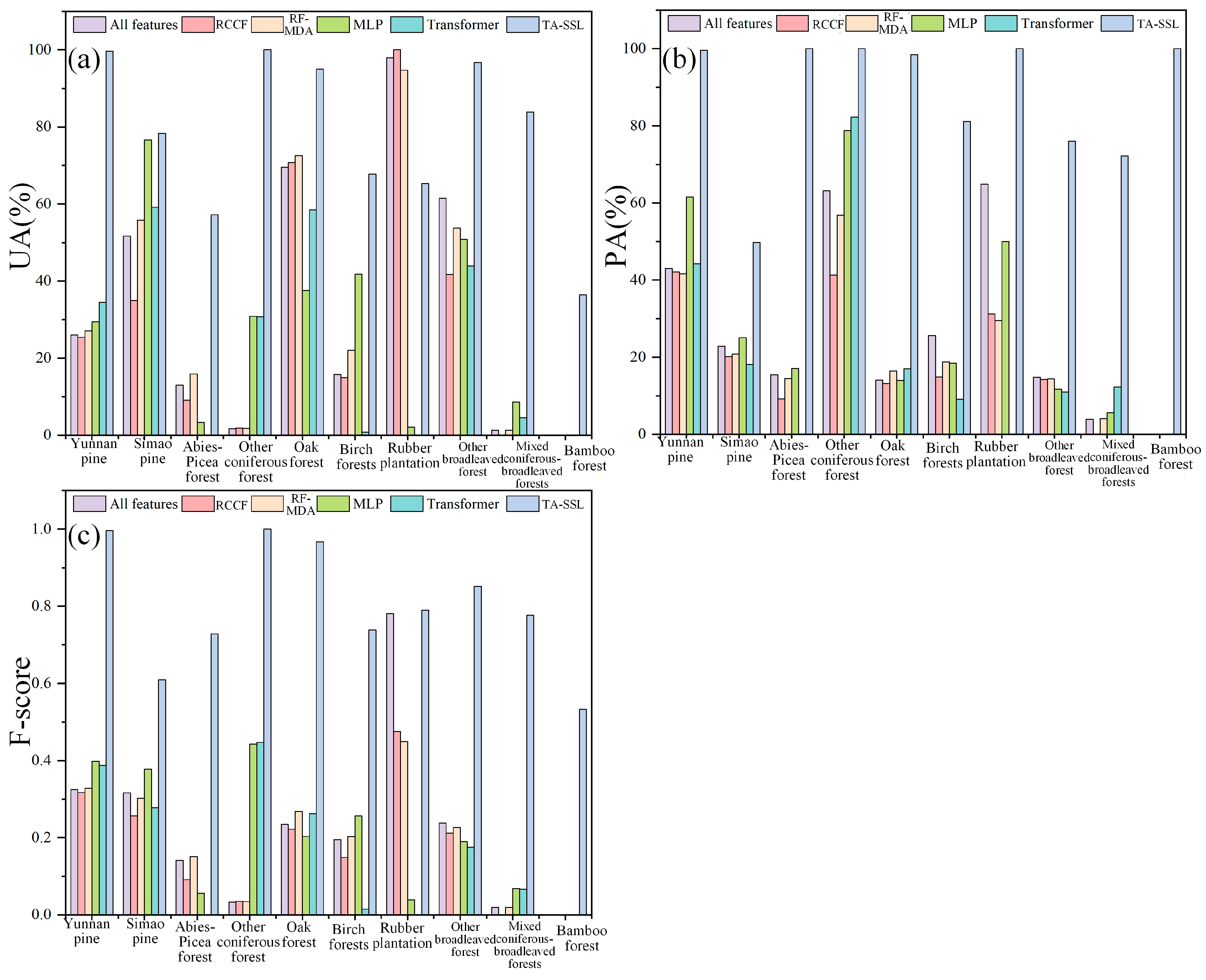
| Self-supervised method | TA-SSL | 75.80 | 0.6868 |
Disclaimer/Publisher’s Note: The statements, opinions and data contained in all publications are solely those of the individual author(s) and contributor(s) and not of MDPI and/or the editor(s). MDPI and/or the editor(s) disclaim responsibility for any injury to people or property resulting from any ideas, methods, instructions or products referred to in the content. |
© 2026 by the authors. Licensee MDPI, Basel, Switzerland. This article is an open access article distributed under the terms and conditions of the Creative Commons Attribution (CC BY) license.
Share and Cite
He, L.; Wang, L.; Hong, L.; Dai, Q.; Gu, W.; Du, X.; Yang, M.; Liu, J.; Feng, Y. Terrain-Aware Self-Supervised Representation Learning for Tree Species Mapping in Mountainous Regions Under Limited Field Samples. Remote Sens. 2026, 18, 951. https://doi.org/10.3390/rs18060951
He L, Wang L, Hong L, Dai Q, Gu W, Du X, Yang M, Liu J, Feng Y. Terrain-Aware Self-Supervised Representation Learning for Tree Species Mapping in Mountainous Regions Under Limited Field Samples. Remote Sensing. 2026; 18(6):951. https://doi.org/10.3390/rs18060951
Chicago/Turabian StyleHe, Li, Leiguang Wang, Liang Hong, Qinling Dai, Wei Gu, Xingyue Du, Mingqi Yang, Juanjuan Liu, and Yaoming Feng. 2026. "Terrain-Aware Self-Supervised Representation Learning for Tree Species Mapping in Mountainous Regions Under Limited Field Samples" Remote Sensing 18, no. 6: 951. https://doi.org/10.3390/rs18060951
APA StyleHe, L., Wang, L., Hong, L., Dai, Q., Gu, W., Du, X., Yang, M., Liu, J., & Feng, Y. (2026). Terrain-Aware Self-Supervised Representation Learning for Tree Species Mapping in Mountainous Regions Under Limited Field Samples. Remote Sensing, 18(6), 951. https://doi.org/10.3390/rs18060951