Estimating the Aboveground Biomass of Shrubland and Savanna Ecosystems Using High-Resolution Small UAV Systems: A Systematic Review
 , ,
, ,  , and
, and
Highlights
- Tundra vegetation, as well as shrubs, half-shrubs, and low-stature trees (<2 m height), in drylands are the least studied lifeforms in the selected remote sensing literature.
- Incorporation of spectral and structural predictors did not improve aboveground biomass model performance within the reviewed studies (n = 50) compared to the use of spectral or structural predictors alone.
- As species and structural diversity increase within shrubland or savanna systems, species-specific allometric equations and more complex UAV remote sensing data captures (LiDAR, hyperspectral, multispectral, and RGB) may be necessary to estimate aboveground biomass within REDD+ standards with <10% uncertainty.
- Increased research investments should be made into development of allometric models for shrubs and multi-branching tree species based on variables that can be estimated with UAV-mounted sensors and associated models.
Abstract
1. Introduction
2. The Case for Estimating Aboveground Biomass in Shrublands and Savannas
3. Systematic Review and Assessment Methods
3.1. Remote Sensing Literature Assessment Methods
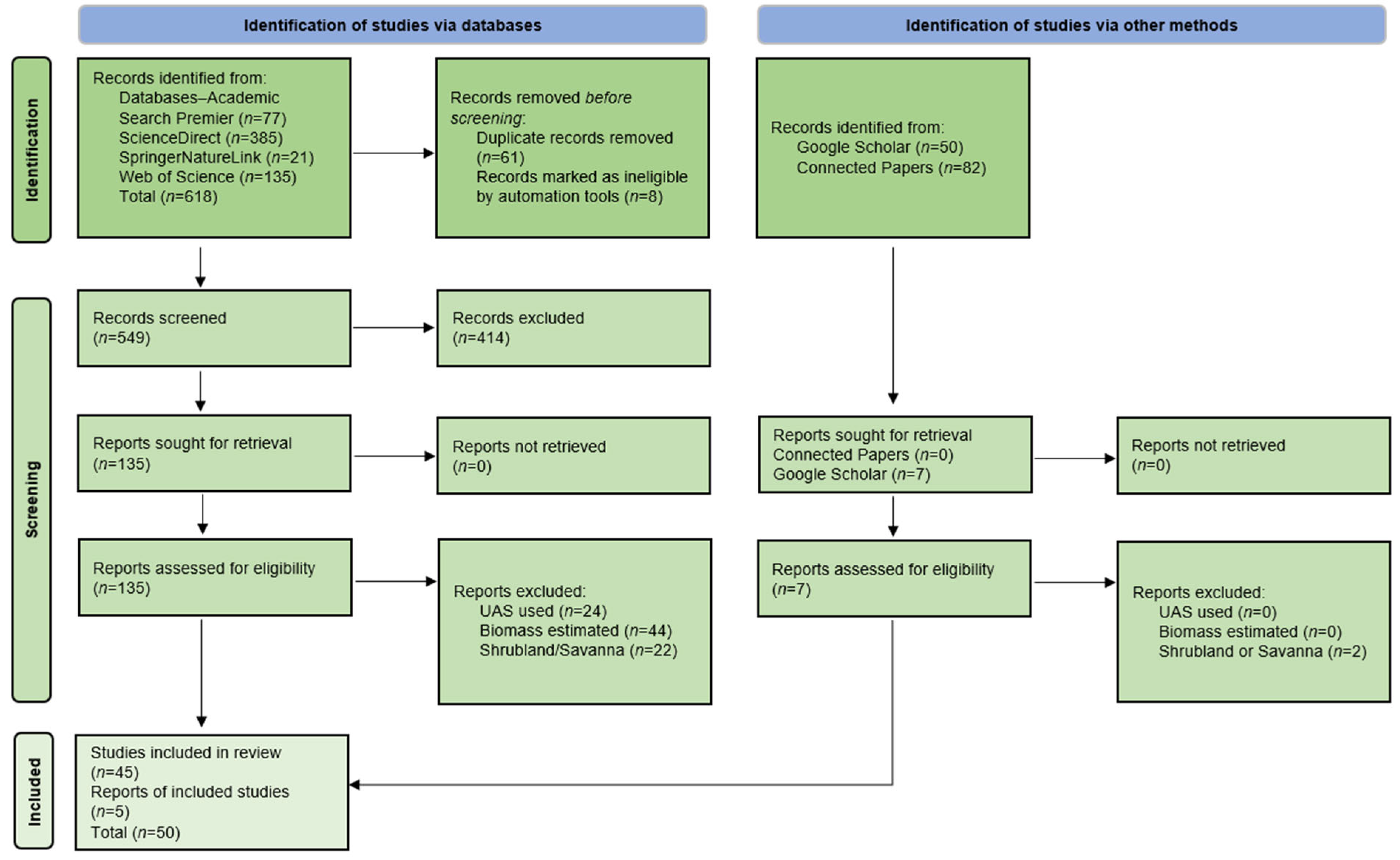
3.2. Systematic Literature Review Methods
3.3. Data Analysis
4. Results
4.1. Ecosystem Representation in the Remote Sensing Literature
4.2. Results of Systematic Literature Review
4.2.1. Description of Reviewed Papers
4.2.2. Aboveground Biomass UAV Mission Planning
4.2.3. Aboveground Biomass Data Processing Workflows
4.2.4. Field Data Collection Methods for Ground Truth
4.2.5. Statistical Analyses
4.2.6. Best-Performing Aboveground Biomass Models
5. Discussion, Knowledge Gaps, and Future Directions
5.1. Discussion of Ecosystem Representation in the Remote Sensing Literature
5.2. Discussion of UAV Methodologies for Estimating Aboveground Biomass
5.2.1. Temporal Frequency of Data Collection
5.2.2. Mission Planning and Reporting
5.2.3. Effectiveness of Aboveground Biomass Models
5.2.4. Insights from UAV/Satellite Scaling Studies
5.2.5. Emerging Technologies and Future Directions
6. Conclusions
- Hyperspectral sensors were underrepresented in the published datasets (<7% of the reviewed papers).
- We found no consistent UAV-based sensor combinations, platforms, or workflows that resulted in improved estimates of aboveground biomass.
- Structural data (from CHM) was useful in many of the best-performing models.
- Building models and estimates of aboveground biomass appears to increase in difficulty as the diversity of physiognomic forms increases.
- (1)
- Development of a database linking shrubland and savanna plant traits to allometric equations of aboveground biomass, along with further development of species-specific allometric models using plant traits easily measured both in the field and with UAV-mounted sensors;
- (2)
- Additional research into UAV-mounted sensor system workflow development could improve UAV-based sensory system scaling with satellite-based remote sensing products;
- (3)
- Further research into the application of multitemporal UAV-acquired datasets is also needed to temporally capture ecosystem changes;
- (4)
- Research and development investments are needed to manufacture low-cost co-aligned multispectral (or hyperspectral), RGB, and LiDAR sensors for mounting on UAVs, as current costs could be contributing to the underrepresentation of research in less wealthy nations;
- (5)
- Universities should invest in engaging lawmakers and regulators in countries with strict or limiting UAV policies to allow policy flexibility for ecological research purposes, or when barriers are insurmountable, they should invest in aerial photogrammetry or high spatial resolution satellite imagery to improve scaling of ground-based aboveground biomass estimates;
- (6)
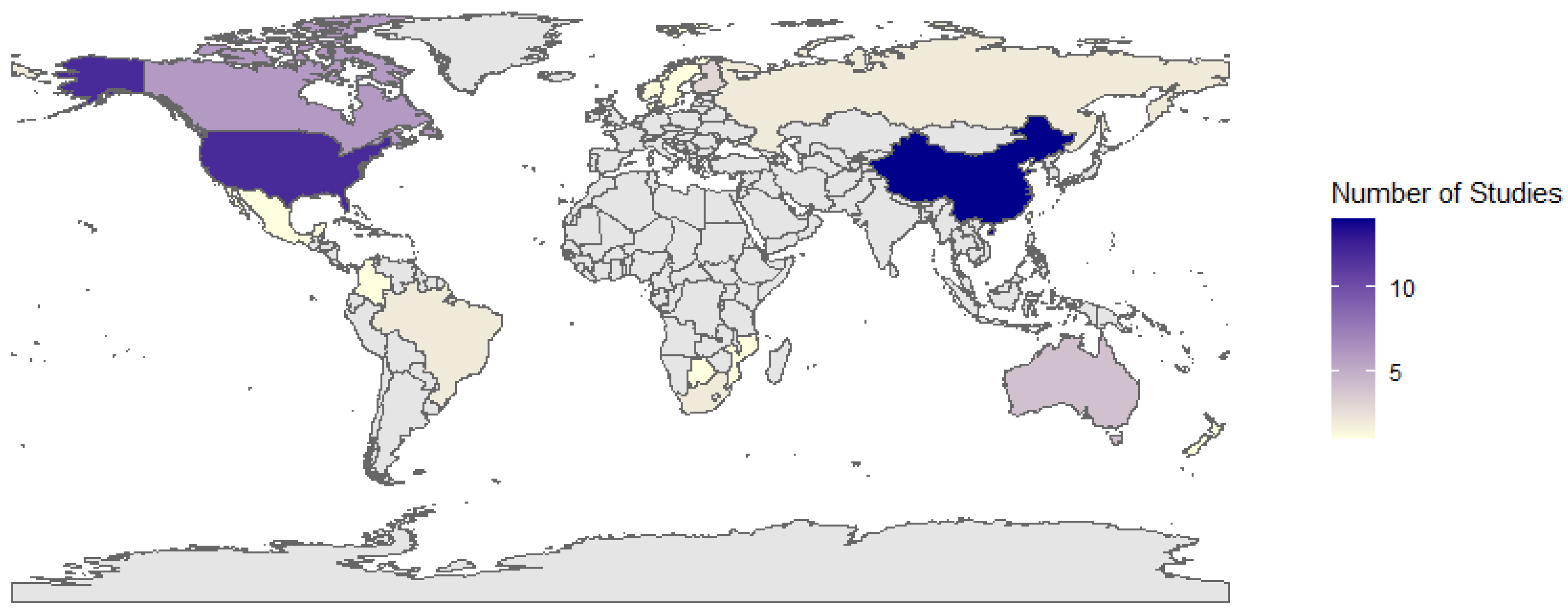
- Researchers and land managers should attend UAV-based vegetation monitoring conferences together, engage in collaborative efforts across institutions, similar to Cunliff et al. [48], collaboratively develop UAV-assisted vegetation monitoring manuals, and foster sharing of expertise and research equipment, such as high-end GNSS receivers, to reduce uncertainty in aboveground biomass models while increasing representation of research in shrubland and savanna ecosystems outside the U.S. and China.
Supplementary Materials
Author Contributions
Funding
Data Availability Statement
Acknowledgments
Conflicts of Interest
Abbreviations
| 3D | Three-dimensional |
| AGB | Aboveground biomass |
| AGL | Aboveground level |
| ANN | Artificial neural network |
| CA | Crown area |
| CART | Classification and regression tree |
| CHM | Canopy height model |
| CNN | Convolutional neural network |
| CFS | Cloth simulation filter |
| DBH | Diameter breast height |
| DGH | Diameter ground height |
| DRC | Diameter root collar |
| DSM | Digital surface model |
| DTM | Digital terrain model |
| GCP | Ground control point |
| GEDI | Global Ecosystem Dynamics Investigation |
| GIS | Geographic Information System |
| GNSS | Global Navigation Satellite System |
| GSD | Ground sampling distance |
| HSD | Honestly Significant Difference |
| ICESat-2 | Ice, cloud and land elevation satellite-2 |
| ISPRS | International Society for Photogrammetry and Remote Sensing |
| Landsat MSS | Multispectral scanner |
| Landsat TM | Thematic mapper |
| Landsat OLI | Operational land imager |
| LiDAR | Light detection and ranging |
| LR | Linear regression |
| ML | Machine learning |
| MLR | Multiple linear regression |
| MTP | Manual tie point |
| NGO | Non-governmental organization |
| NISAR | NASA-ISRO Synthetic Aperture Radar |
| OBIA | Object-based image analysis |
| OLS | Ordinary least squares |
| PCA | Principle components analysis |
| PFT | Plant functional type |
| PMF | Progressive morphological filter |
| PPK | Post-processing kinematic |
| PRISMA | Preferred Reporting Items for Systematic reviews and Meta-Analyses |
| REDD+ | Reduced Emissions from Deforestation and Forest Degradation plus role of forest management for the enhancement of carbon stocks |
| RF | Random Forest |
| RGB | Red, green, blue |
| RMSE | Root mean square error |
| SfM | Structure-from-motion |
| SVM | Support vector machine |
| TIN | Triangulated irregular network |
| TLS | Terrestrial laser scanner |
| UAV | Uncrewed aerial vehicle |
| UNFCCC | United Nationals Framework Convention on Climate Change |
| YOLO | You Only Look Once |
References
- Bar-On, Y.M.; Phillips, R.; Milo, R. The biomass distribution on Earth. Proc. Natl. Acad. Sci. USA 2018, 115, 6506–6511. [Google Scholar] [CrossRef] [PubMed]
- Schulze, I.-M.; Bolte, A.; Schmidt, W.; Eichhorn, J. Phytomass, litter and net primary production of herbaceous layer. In Functioning and Management of European Beech Ecosystems; Brumme, R., Khanna, P.K., Eds.; Springer: Berlin/Heidelberg, Germany, 2009; pp. 155–181. [Google Scholar] [CrossRef]
- Asner, G.P.; Brodrick, P.G.; Philipson, C.; Vaughn, N.R.; Martin, R.E.; Knapp, D.E.; Heckler, J.; Evans, L.J.; Jucker, T.; Goossens, B.; et al. Mapped aboveground carbon stocks to advance forest conservation and recovery in Malaysian Borneo. Biol. Conserv. 2018, 217, 289–310. [Google Scholar] [CrossRef]
- de Oliveira, C.P.; Francelino, M.R.; Daher, M.; de Araújo, E.J.G.; de Souza Sanches, L.; de Andrade, K.D.C.; de Campos, J.S.N. Estimation of the aboveground biomass and carbon stocks in open Brazilian savannah developed on sandy soils. Carbon Balance Manag. 2019, 14, 5. [Google Scholar] [CrossRef] [PubMed]
- Costanza, R.; de Groot, R.; Sutton, P.; van der Ploeg, S.; Anderson, S.J.; Kubiszewski, I.; Farber, S.; Turner, R.K. Changes in the global value of ecosystem services. Glob. Environ. Change 2014, 26, 152–158. [Google Scholar] [CrossRef]
- Wang, L.; Jiao, W.; MacBean, N.; Rulli, M.C.; Manzoni, S.; Vico, G.; D’Odorico, P. Dryland productivity under a changing climate. Nat. Clim. Change 2022, 12, 981–994. [Google Scholar] [CrossRef]
- Maestre, F.T.; Benito, B.M.; Berdugo, M.; Concostrina-Zubiri, L.; Delgado-Baquerizo, M.; Eldridge, D.J.; Guirado, E.; Gross, N.; Kéfi, S.; Le Bagousse-Pinguet, Y.; et al. Biogeography of global drylands. New Phytol. 2021, 231, 540–558. [Google Scholar] [CrossRef]
- Schimel, D.S. Drylands in the earth system. Science 2010, 327, 418–419. [Google Scholar] [CrossRef]
- Ludwig, J.A. Primary productivity in arid lands: Myths and realities. J. Arid Environ. 1987, 13, 1–7. [Google Scholar] [CrossRef]
- Rotenberg, E.; Yakir, D. Contribution of semi-arid forests to the climate system. Science 2010, 327, 451–454. [Google Scholar] [CrossRef]
- Poulter, B.; Frank, D.; Ciais, P.; Myneni, R.B.; Andela, N.; Bi, J.; Broquet, G.; Canadell, J.G.; Chevallier, F.; Liu, Y.Y.; et al. Contribution of semi-arid ecosystems to interannual variability of the global carbon cycle. Nature 2014, 509, 600–603. [Google Scholar] [CrossRef]
- Houghton, R.A.; Hackler, J.L.; Lawrence, K.T. The U.S. carbon budget: Contributions from land-use change. Science 1999, 285, 574–578. [Google Scholar] [CrossRef]
- Pacala, S.W.; Hurtt, G.C.; Baker, D.; Peylin, P.; Houghton, R.A.; Birdsey, R.A.; Heath, L.; Sundquist, E.T.; Stallard, R.F.; Ciais, P.; et al. Consistent land- and atmosphere-based U.S. Carbon Sink. Estim. Sci. 2001, 292, 2316–2320. [Google Scholar] [CrossRef]
- McDermot, C.; Elavarthi, S. Rangelands as carbon sinks to mitigate climate change: A review. J. Earth Sci. Clim. Change 2014, 5, 221. [Google Scholar]
- Greenville, A.C.; Dickman, C.R.; Wardle, G.M. 75 years of dryland science: Trends and gaps in arid ecology literature. PLoS ONE 2017, 12, e0175014. [Google Scholar] [CrossRef] [PubMed]
- Smith, W.K.; Dannenberg, M.P.; Yan, D.; Herrmann, S.; Barnes, M.L.; Barron-Gafford, G.A.; Biederman, J.A.; Ferrenberg, S.; Fox, A.M.; Hudson, A.; et al. Remote sensing of dryland ecosystem structure and function: Progress, challenges, and opportunities. Remote Sens. Environ. 2019, 233, 111401. [Google Scholar] [CrossRef]
- dos Santos, W.M.; Martins, L.D.; Bezerra, A.C.; Souza, L.S.; Jardim, A.M.; Silva, M.V.; Souza, C.A.; Silva, T.G. Use of uncrewed aerial vehicles for monitoring pastures and forages in agricultural sciences: A systematic review. Drones 2024, 8, 585. [Google Scholar] [CrossRef]
- Poley, L.G.; McDermid, G.J. A systematic review of the factors influencing the estimation of vegetation aboveground biomass using unmanned aerial systems. Remote Sens. 2020, 12, 1052. [Google Scholar] [CrossRef]
- Bazrafkan, A.; Delavarpour, N.; Oduor, P.G.; Bandillo, N.; Flores, P. An overview of using unmanned aerial system mounted sensors to measure plant above-ground biomass. Remote Sens. 2023, 15, 3543. [Google Scholar] [CrossRef]
- Lyu, X.; Li, X.; Dang, D.; Dou, H.; Wang, K.; Lou, A. Unmanned aerial vehicle (UAV) remote sensing in grassland ecosystem monitoring: A Systematic Review. Remote Sens. 2022, 14, 1096. [Google Scholar] [CrossRef]
- Tian, L.; Wu, X.; Tao, Y.; Li, M.; Qian, C.; Liao, L.; Fu, W. Review of remote sensing-based methods for forest aboveground biomass estimation: Progress, challenges, and prospects. Forests 2023, 14, 1086. [Google Scholar] [CrossRef]
- Guimarães, N.; Pádua, L.; Marques, P.; Silva, N.; Peres, E.; Sousa, J.J. Forestry remote sensing from unmanned aerial vehicles: A review focusing on the data, processing and potentialities. Remote Sens. 2020, 12, 1046. [Google Scholar] [CrossRef]
- Dainelli, R.; Toscano, P.; Di Gennaro, S.F.; Matese, A. Recent advances in unmanned aerial vehicle forest remote sensing—A systematic review. Part I: A General Framework. Forests 2021, 12, 327. [Google Scholar] [CrossRef]
- Dainelli, R.; Toscano, P.; Di Gennaro, S.F.; Matese, A. Recent advances in unmanned aerial vehicles forest remote sensing—A systematic review. Part II: Research Applications. Forests 2021, 12, 397. [Google Scholar] [CrossRef]
- Bazzo, C.O.G.; Kamali, B.; Hütt, C.; Bareth, G.; Gaiser, T. A review of estimation methods for aboveground biomass in grasslands using UAV. Remote Sens. 2023, 15, 639. [Google Scholar] [CrossRef]
- Istiak, M.A.; Syeed, M.M.M.; Hossain, M.S.; Uddin, M.F.; Hasan, M.; Khan, R.H.; Azad, N.S. Adoption of unmanned aerial vehicle (UAV) imagery in agricultural management: A systematic literature review. Ecol. Inform. 2023, 78, 102305. [Google Scholar] [CrossRef]
- Wang, T.; Liu, Y.; Wang, M.; Fan, Q.; Tian, H.; Qiao, X.; Li, Y. Applications of UAS in crop biomass monitoring: A review. Front. Plant Sci. 2021, 12, 616689. [Google Scholar] [CrossRef]
- Okafor, J.C. Trees for food and fodder in the savanna areas of Nigeria. Int. Tree Crops J. 1980, 1, 131–141. [Google Scholar] [CrossRef]
- Conti, G.; Gorné, L.D.; Zeballos, S.R.; Lipoma, M.L.; Gatica, G.; Kowaljow, E.; Whitworth-Hulse, J.I.; Cuchietti, A.; Poca, M.; Pestoni, S.; et al. Developing allometric models to predict the individual aboveground biomass of shrubs worldwide. Glob. Ecol. Biogeogr. 2019, 28, 961–975. [Google Scholar] [CrossRef]
- Paul, K.I.; Roxburgh, S.H.; Chave, J.; England, J.R.; Zerihun, A.; Specht, A.; Lewis, T.; Bennett, L.T.; Baker, T.G.; Adams, M.A.; et al. Testing the generality of above-ground biomass allometry across plant functional types at the continent scale. Glob. Change Biol. 2016, 22, 2106–2124. [Google Scholar] [CrossRef]
- Jucker, T.; Gosper, C.R.; Wiehl, G.; Yeoh, P.B.; Raisbeck-Brown, N.; Fischer, F.J.; Graham, J.; Langley, H.; Newchurch, W.; O’Donnell, A.J.; et al. Using multi-platform LiDAR to guide the conservation of the world’s largest temperate woodland. Remote Sens. Environ. 2023, 296, 113745. [Google Scholar] [CrossRef]
- Cleary, M.B.; Pendall, E.; Ewers, B.E. Testing sagebrush allometric relationships across three fire chronosequences in Wyoming, USA. J. Arid Environ. 2008, 72, 285–301. [Google Scholar] [CrossRef]
- Ross, D.W.; Walstad, J.D. Estimating Aboveground Biomass of Shrubs and Young Ponderosa and Lodgepole Pines in Southcentral OREGON; Research bulletin 57; Oregon State University, Forest Research Laboratory: Corvallis, OR, USA, 1986. [Google Scholar]
- Uresk, D.W.; Gilbert, R.O.; Rickard, W.H. Sampling big sagebrush for phytomass. J. Range Manag. 1977, 30, 311–314. [Google Scholar] [CrossRef]
- Vora, R.S. Predicting biomass of five shrub species in northeastern California. J. Range Manag. 1988, 41, 63–65. [Google Scholar] [CrossRef]
- Roxburgh, S.H.; Paul, K.I.; Clifford, D.; England, J.R.; Raison, R.J. Guidelines for constructing allometric models for the prediction of woody biomass: How many individuals to harvest? Ecosphere 2015, 6, 38. [Google Scholar] [CrossRef]
- Snell, O.; Shour, R. Otto Snell’s 1892 Hirngewichtes von Dem Körpergewicht, Translated into English (Die Abhängigkeit Des Hirngewichtes von Dem Körpergewicht und Den Geistigen Fähigkeiten); Springer Nature: Berlin/Heidelberg, Germany, 2021. [Google Scholar] [CrossRef]
- Huxley, J.S. Problems of Relative Growth; (reprinted Dover, New York, 1972); Methuen: London, UK, 1932; p. 273. [Google Scholar]
- West, G.B.; Brown, J.H.; Enquist, B.J. A general model for the origin of allometric scaling laws in biology. Science 1997, 276, 122–126. [Google Scholar] [CrossRef]
- Kerkhoff, A.J.; Enquist, B.J. Multiplicative by nature: Why logarithmic transformation is necessary in allometry. J. Theor. Biol. 2009, 257, 519–521. [Google Scholar] [CrossRef]
- Chave, J.; Condit, R.; Aguilar, S.; Hernandez, A.; Lao, S.; Perez, R. Error propagation and scaling for tropical forest biomass estimates. Phil. Trans. R. Soc. Lond. Ser. B Biol. Sci. 2004, 359, 409–420. [Google Scholar] [CrossRef]
- Chave, J.; Réjou-Méchain, M.; Búrquez, A.; Chidumayo, E.; Colgan, M.S.; Delitti, W.B.C.; Duque, A.; Eid, T.; Fearnside, P.M.; Goodman, R.C.; et al. Improved allometric models to estimate the aboveground biomass of tropical trees. Glob. Change Biol. 2014, 20, 3177–3190. [Google Scholar] [CrossRef] [PubMed]
- Page, M.J.; McKenzie, J.E.; Bossuyt, P.M.; Boutron, I.; Hoffmann, T.C.; Mulrow, C.D.; Shamseer, L.; Tetzlaff, J.M.; Akl, E.A.; Brennan, S.E.; et al. The PRISMA 2020 statement: An updated guideline for reporting systematic reviews. BMJ-Brit. Med. J. 2021, 372, n71. [Google Scholar] [CrossRef] [PubMed]
- R Core Team. R, version 4.2.2; R: A Language and Environment for Statistical Computing; R Foundation for Statistical Computing: Vienna, Austria, 2024; Available online: https://www.R-project.org (accessed on 17 December 2024).
- Fox, J.; Weisberg, S. An R Companion to Applied Regression, 3rd ed.; Sage Publications: Thousand Oaks, CA, USA, 2019; pp. 1–608. [Google Scholar]
- World Bank. The Changing Wealth of Nations 2024: Revisiting the Measurement of Comprehensive Wealth; World Bank Wealth Accounts: Washington, DC, USA, 2024; Available online: https://databank.worldbank.org/source/wealth-accounts (accessed on 27 December 2024).
- Brede, B.; Terryn, L.; Barbier, N.; Bartholomeus, H.M.; Bartolo, R.; Calders, K.; Derroire, G.; Moorthy, S.M.K.; Lau, A.; Levick, S.R.; et al. Non-destructive estimation of individual tree biomass: Allometric models, terrestrial and UAV laser scanning. Remote Sens. Environ. 2022, 280, 113180. [Google Scholar] [CrossRef]
- Cunliffe, A.M.; Anderson, K.; Boschetti, F.; Brazier, R.E.; Graham, H.A.; Myers-Smith, I.H.; Astor, T.; Boer, M.M.; Calvo, L.G.; Clark, P.E.; et al. Global application of an unoccupied aerial vehicle photogrammetry protocol for predicting aboveground biomass in non-forest ecosystems. Remote Sens. Ecol. Conserv. 2022, 8, 57–71. [Google Scholar] [CrossRef]
- Orndahl, K.M.; Ehlers, L.P.W.; Herriges, J.D.; Pernick, R.E.; Hebblewhite, M.; Goetz, S.J. Mapping tundra ecosystem plant functional type cover, height, and aboveground biomass in Alaska and northwest Canada using unmanned aerial vehicles. Arct. Sci. 2022, 8, 1165–1180. [Google Scholar] [CrossRef]
- Orndahl, K.M.; Macander, M.J.; Berner, L.T.; Goetz, S.J. Plant functional type aboveground biomass change within Alaska and northwest Canada mapped using a 35-year satellite time series from 1985 to 2020. Environ. Res. Lett. 2022, 17, 115010. [Google Scholar] [CrossRef]
- Abdullah, M.M.; Al-Ali, Z.M.; Abdullah, M.T.; Srinivasan, S.; Assi, A.T.; Atiqi, S.A. Investigating the applicability of UAVs in characterizing desert shrub biomass and developing biological indicators for the selection of suitable revegetation sites. J. Environ. Manag. 2021, 288, 112416. [Google Scholar] [CrossRef]
- Abdullah, M.M.; Al-Ali, Z.M.; Srinivasan, S. The use of UAV-based remote sensing to estimate biomass and carbon stock for native desert shrubs. MethodsX 2021, 8, 101399. [Google Scholar] [CrossRef]
- Cunliffe, A.M.; Brazier, R.E.; Anderson, K. Ultra-fine grain landscape-scale quantification of dryland vegetation structure with drone-acquired structure-from-motion photogrammetry. Remote Sens. Environ. 2016, 183, 129–143. [Google Scholar] [CrossRef]
- Ding, J.; Li, Z.; Zhang, H.; Zhang, P.; Cao, X.; Feng, Y. Quantifying the aboveground biomass (AGB) of Gobi Desert shrub communities in northwestern China based on unmanned aerial vehicle (UAV) RGB images. Land 2022, 11, 543. [Google Scholar] [CrossRef]
- Liu, W.; Wang, J.; Hu, Y.; Ma, T.; Otgonbayar, M.; Li, C.; Li, Y.; Yang, J. Mapping shrub biomass at 10 m resolution by integrating field measurements, unmanned aerial vehicles, and multi-source satellite observations. Remote Sens. 2024, 16, 3095. [Google Scholar] [CrossRef]
- Mao, P.; Ding, J.; Jiang, B.; Qin, L.; Qiu, G.Y. How can UAV bridge the gap between ground and satellite observations for quantifying the biomass of desert shrub community? ISPRS J. Photogramm. Remote Sens. 2022, 192, 361–376. [Google Scholar] [CrossRef]
- Mao, P.; Jiang, B.; Shi, Z.; He, Y.; Shen, T.; Qiu, G.Y. Effects of UAV flight height on biomass estimation of desert shrub communities. Ecol. Indic. 2023, 54, 110698. [Google Scholar] [CrossRef]
- Mao, P.; Qin, L.; Hao, M.; Zhao, W.; Luo, J.; Qiu, X.; Xu, L.; Xiong, Y.; Ran, Y.; Yan, C.; et al. An improved approach to estimate above-ground volume and biomass of desert shrub communities based on UAV RGB images. Ecol. Indic. 2021, 125, 107494. [Google Scholar] [CrossRef]
- Sankey, T.T.; Jackson, L.; Moore, M.M.; Sankey, J.B.; Belmonte, A. Carbon and ecohydrological priorities in managing woody encroachment: UAV perspective 63 years after a control treatment. Environ. Res. Lett. 2021, 16, 124053. [Google Scholar] [CrossRef]
- Sun, B.; Rong, R.; Cui, H.; Guo, Y.; Yue, W.; Yan, Z.; Wang, H.; Gao, Z.; Wu, Z. How can integrated space-air-ground observation contribute in aboveground biomass of shrub plants estimation in shrub-encroached Grasslands? Int. J. Appl. Earth Obs. Geoinf. 2024, 130, 103856. [Google Scholar] [CrossRef]
- Vega-Puga, M.G.; Romo-León, J.R.; Castellanos, A.E.; Castillo-Gámez, R.A.; Garatuza-Payán, J. Uso de vehículos aéreos no tripulados para la estimación de almacén de carbono en biomasa aérea de matorral subtropical. Rev. Chapingo Ser. Cie. Forest. Amb. 2024, 30, 1–18. [Google Scholar] [CrossRef]
- Zhao, Y.; Liu, X.; Wang, Y.; Zheng, Z.; Zheng, S.; Zhao, D.; Bai, Y. UAV-based individual shrub aboveground biomass estimation calibrated against terrestrial LiDAR in a shrub-encroached grassland. Int. J. Appl. Earth Obs. Geoinf. 2021, 101, 102358. [Google Scholar] [CrossRef]
- Guo, Z.-C.; Wang, T.; Liu, S.-L.; Kang, W.-P.; Chen, X.; Feng, K.; Zhang, X.-Q.; Zhi, Y. Biomass and vegetation coverage survey in the Mu Us sandy land—Based on unmanned aerial vehicle RGB images. Int. J. Appl. Earth Obs. Geoinf. 2021, 94, 102239. [Google Scholar] [CrossRef]
- Eames, T.; Russell-Smith, J.; Yates, C.; Edwards, A.; Vernooij, R.; Ribeiro, N.; Steinbruch, F.; van der Werf, G.R. Instantaneous pre-fire biomass and fuel load measurements from multi-spectral UAS mapping in southern African savannas. Fire 2021, 4, 2. [Google Scholar] [CrossRef]
- Leite, R.V.; Silva, C.A.; Broadbent, E.N.; Hummel do Amaral, C.; Liesenberg, V.; de Almeida, D.R.A.; Mohan, M.; Godinho, S.; Cardil, A.; Hamamura, C.; et al. Large scale multi-layer fuel load characterization in tropical savanna using GEDI spaceborne lidar data. Remote Sens. Environ. 2022, 268, 112764. [Google Scholar] [CrossRef]
- Levick, S.R.; Whiteside, T.; Loewensteiner, D.A.; Rudge, M.; Bartolo, R. Leveraging TLS as a calibration and validation tool for MLS and ULS mapping of savanna structure and biomass at landscape-scales. Remote Sens. 2021, 13, 257. [Google Scholar] [CrossRef]
- Matyukira, C.; Mhangara, P. Utilising RGB drone imagery and vegetation indices for accurate above-ground biomass estimation: A case study of the cradle nature reserve, Gauteng Province, South Africa. Geocarto Int. 2024, 39, 2390512. [Google Scholar] [CrossRef]
- McCann, J.A.; Keith, D.A.; Kingsford, R.T. Measuring plant biomass remotely using drones in arid landscapes. Ecol. Evol. 2022, 12, e8891. [Google Scholar] [CrossRef]
- Pan, H.-L.; Huang, C.-M.; Huang, C. Mapping aboveground carbon density of subtropical subalpine dwarf bamboo (Yushania niitakayamensis) vegetation using UAV-lidar. Int. J. Appl. Earth Obs. Geoinf. 2023, 123, 103487. [Google Scholar] [CrossRef]
- Sagang, L.B.T.; Ploton, P.; Viennois, G.; Féret, J.-B.; Sonké, B.; Couteron, P.; Barbier, N. Monitoring vegetation dynamics with open earth observation tools: The case of fire-modulated savanna to forest transitions in Central Africa. ISPRS J. Photogramm. Remote Sens. 2022, 188, 142–156. [Google Scholar] [CrossRef]
- Singh, J.; Boucher, P.B.; Hockridge, E.G.; Davies, A.B. Effects of long-term fixed fire regimes on African savanna vegetation biomass, vertical structure and tree stem density. J. Appl. Ecol. 2023, 60, 1223–1238. [Google Scholar] [CrossRef]
- Teixeira da Costa, M.B.; Silva, C.A.; Broadbent, E.N.; Leite, R.V.; Mohan, M.; Liesenberg, V.; Stoddart, J.; Hummel do Amaral, C.; Alves de Almeida, D.R.; da Silva, A.L.; et al. Beyond trees: Mapping total aboveground biomass density in the Brazilian savanna using high-density UAV-lidar data. For. Ecol. Manag. 2021, 491, 119155. [Google Scholar] [CrossRef]
- Alonzo, M.; Dial, R.J.; Schulz, B.K.; Andersen, H.-E.; Lewis-Clark, E.; Cook, B.D.; Morton, D.C. Mapping tall shrub biomass in Alaska at landscape scale using structure-from-motion photogrammetry and lidar. Remote Sens. Environ. 2020, 245, 111841. [Google Scholar] [CrossRef]
- Cunliffe, A.M.; Assmann, J.J.; Daskalova, G.N.; Kerby, J.T.; Myers-Smith, I.H. Aboveground biomass corresponds strongly with drone-derived canopy height but weakly with greenness (NDVI) in a shrub tundra landscape. Environ. Res. Lett. 2020, 15, 125004. [Google Scholar] [CrossRef]
- Han, S.; Meng, Q.; Liu, H.; Peng, Y.; Han, J.; Jin, S.; Fan, S.; Xin, B.; He, L.; Li, H. Refined land-cover classification mapping using a multi-scale transformation method from remote sensing, unmanned aerial vehicle, and field surveys in Sanjiangyuan National Park, China. J. Appl. Remote Sens. 2021, 15, 1. [Google Scholar] [CrossRef]
- Osorio-Castiblanco, D.F. Biomass and bioethanol production of the shrub Ulex europaeus (Fabaceae) estimated with remote sensing imagery in the Andean paramos. Rev. Biol. Trop. 2024, 72, e56364. [Google Scholar] [CrossRef]
- Poley, L.G.; Laskin, D.N.; McDermid, G.J. Quantifying aboveground biomass of shrubs using spectral and structural metrics derived from UAS imagery. Remote Sens. 2020, 12, 2199. [Google Scholar] [CrossRef]
- Putkiranta, P.; Räsänen, A.; Korpelainen, P.; Erlandsson, R.; Kolari, T.H.M.; Pang, Y.; Villoslada, M.; Wolff, F.; Kumpula, T.; Virtanen, T. The value of hyperspectral UAV imagery in characterizing tundra vegetation. Remote Sens. Environ. 2024, 308, 114175. [Google Scholar] [CrossRef]
- Talucci, A.C.; Forbath, E.; Kropp, H.; Alexander, H.D.; DeMarco, J.; Paulson, A.K.; Zimov, N.S.; Zimov, S.; Loranty, M.M. Evaluating post-fire vegetation recovery in Cajander larch forests in northeastern Siberia using UAV derived vegetation indices. Remote Sens. 2020, 12, 2970. [Google Scholar] [CrossRef]
- Villoslada, M.; Ylanne, H.; Juutinen, S.; Kolari, T.H.M.; Korpelainen, P.; Tahvanainen, T.; Wolff, F.; Kumpula, T. Reindeer control over shrubification in subarctic wetlands: Spatial analysis based on unoccupied aerial vehicle imagery. Remote Sens. Ecol. Conserv. 2023, 9, 687–706. [Google Scholar] [CrossRef]
- Chen, A.; Xu, C.; Zhang, M.; Guo, J.; Xing, X.; Yang, D.; Xu, B.; Yang, X. Cross-scale mapping of above-ground biomass and shrub dominance by integrating UAV and satellite data in temperate grassland. Remote Sens. Environ. 2024, 304, 114024. [Google Scholar] [CrossRef]
- Hartley, R.J.L.; Davidson, S.J.; Watt, M.S.; Massam, P.D.; Aguilar-Arguello, S.; Melnik, K.O.; Pearce, H.G.; Clifford, V.R. A mixed methods approach for fuel characterisation in gorse (Ulex europaeus L.) scrub from high-density UAV laser scanning point clouds and semantic segmentation of UAV imagery. Remote Sens. 2022, 14, 4775. [Google Scholar] [CrossRef]
- Madsen, B.; Treier, U.A.; Zlinszky, A.; Lucieer, A.; Normand, S. Detecting shrub encroachment in seminatural grasslands using UAS LiDAR. Ecol. Evol. 2020, 10, 4876–4902. [Google Scholar] [CrossRef] [PubMed]
- Herzog, M.M.; Hudak, A.T.; Weise, D.R.; Bradley, A.M.; Tonkyn, R.G.; Banach, C.A.; Myers, T.L.; Bright, B.C.; Batchelor, J.L.; Kato, A.; et al. Point cloud based mapping of understory shrub fuel distribution, estimation of fuel consumption and relationship to pyrolysis gas emissions on experimental prescribed burns. Fire 2022, 5, 118. [Google Scholar] [CrossRef]
- Shrestha, M.; Broadbent, E.N.; Vogel, J.G. Using GatorEye UAV-Borne LiDAR to quantify the spatial and temporal effects of a prescribed fire on understory height and biomass in a pine savanna. Forests 2021, 12, 38. [Google Scholar] [CrossRef]
- Jucker, T.; Caspersen, J.; Chave, J.; Antin, C.; Barbier, N.; Bongers, F.; Dalponte, M.; Van Ewijk, K.Y.; Forrester, D.I.; Haeni, M.; et al. Allometric equations for integrating remote sensing imagery into forest monitoring programmes. Glob. Change Biol. 2017, 23, 177–190. [Google Scholar] [CrossRef]
- Slavskiy, V.; Matveev, S.; Sheshnitsan, S.; Litovchenko, D.; Larionov, M.V.; Shokurov, A.; Litovchenko, P.; Durmanov, N. Assessment of phytomass and carbon stock in the ecosystems of the central forest steppe of the east European plain: Integrated approach of terrestrial environmental monitoring and remote sensing with unmanned aerial vehicles. Life 2024, 14, 632. [Google Scholar] [CrossRef]
- Husson, E.; Lindgren, F.; Ecke, F. Assessing biomass and metal contents in riparian vegetation along a pollution gradient using an unmanned aircraft system. Water Air Soil Poll. 2014, 225, 1957. [Google Scholar] [CrossRef]
- Li, Z.; Zan, Q.; Yang, Q.; Zhu, D.; Chen, Y.; Yu, S. Remote estimation of mangrove aboveground carbon stock at the species level using a low-cost unmanned aerial vehicle system. Remote Sens. 2019, 11, 1018. [Google Scholar] [CrossRef]
- Navarro, A.; Young, M.; Allan, B.; Carnell, P.; Macreadie, P.; Ierodiaconou, D. The application of Unmanned Aerial Vehicles (UAVs) to estimate above-ground biomass of mangrove ecosystems. Remote Sens. Environ. 2020, 242, 111747. [Google Scholar] [CrossRef]
- Combs, T.P.; Didan, K.; Dierig, D.; Jarchow, C.J.; Barreto-Muñoz, A. Estimating productivity measures in guayule using UAS imagery and Sentinel-2 satellite data. Remote Sens. 2022, 14, 2867. [Google Scholar] [CrossRef]
- Elshikha, D.E.M.; Hunsaker, D.J.; Waller, P.M.; Thorp, K.R.; Dierig, D.; Wang, G.; Cruz, V.M.V.; Katterman, M.E.; Bronson, K.F.; Wall, G.W.; et al. Estimation of direct-seeded guayule cover, crop coefficient, and yield using UAS-based multispectral and RGB data. Agric. Water Manag. 2022, 265, 107540. [Google Scholar] [CrossRef]
- Tamiminia, H.; Salehi, B.; Mandianpari, M.; Beier, C.M.; Klimkowski, D.J.; Volk, T.A. Comparison of machine and deep learning methods to estimate shrub willow biomass from UAS Imagery. Can. J. Rem. Sens. 2021, 47, 209–227. [Google Scholar] [CrossRef]
- Tao, Z.; Yi, L.; Bao, A.; Xu, W.; Wang, Z.; Xiong, S.; Bing, H. UAV or satellites? How to find the balance between efficiency and accuracy in above ground biomass estimation of artificial young coniferous forest? Int. J. Appl. Earth Obs. Geoinf. 2024, 134, 104173. [Google Scholar] [CrossRef]
- Zhang, X. Quick aboveground carbon stock estimation of densely planted shrubs by using point cloud derived from unmanned aerial vehicle. Remote Sens. 2019, 11, 2914. [Google Scholar] [CrossRef]
- Cheng, H.; Wang, Y.; Shan, L.; Chen, Y.; Yu, K.; Liu, J. Mapping fine-scale carbon sequestration benefits and landscape spatial drivers of urban parks using high-resolution UAV data. J Environ. Manag. 2024, 370, 122319. [Google Scholar] [CrossRef]
- Zhao, X.; Guo, Q.; Su, Y. Improved progressive TIN densification filtering algorithm for airborne LiDAR data in forested areas. ISPRS J. Photogramm. Remote Sens. 2016, 117, 79–91. [Google Scholar] [CrossRef]
- Rifai, S.W.; West, T.A.P.; Putz, F.E. “Carbon Cowboys” could inflate REDD+ payments through positive measurement bias. Carbon Manag. 2015, 6, 151–158. [Google Scholar] [CrossRef]
- Bjorkman, A.D.; Myers-Smith, I.H.; Elmendorf, S.C.; Normand, S.; Thomas, H.J.D.; Alatalo, J.M.; Alexander, H.; Anadon-Rosell, A.; Angers-Blondin, S.; Bai, Y.; et al. Tundra Trait Team: A database of plant traits spanning the tundra biome. Glob. Ecol. Biogeogr. 2018, 27, 1402–1411. [Google Scholar] [CrossRef]
- Martin, L.J.; Blossey, B.; Ellis, E. Mapping where ecologists work: Biases in the global distribution of terrestrial ecological observations. Front. Ecol. Environ. 2012, 10, 195–201. [Google Scholar] [CrossRef]
- Gao, M.; Hugenholtz, C.H.; Fox, T.A.; Kucharczyk, M.; Barchyn, T.E.; Nesbit, P.R. Weather constraints on global drone flyability. Sci. Rep. 2021, 11, 12092. [Google Scholar] [CrossRef]
- Heim, R.J.; Rocha, A.V.; Zemlianskii, V.; Barrett, K.; Bültmann, H.; Breen, A.; Frost, G.V.; Hollingsworth, T.N.; Jandt, R.; Kozlova, M.; et al. Arctic tundra ecosystems under fire—Alternative ecosystem states in a changing climate? J. Ecol. 2025, 113, 1042–1056. [Google Scholar] [CrossRef]
- Piccolo, R.L.; Warnken, J.; Chauvenet, A.L.M.; Castley, J.G. Location biases in ecological research on Australian terrestrial reptiles. Sci Rep 2020, 10, 9691. [Google Scholar] [CrossRef]
- Guerra, C.A.; Heintz-Buschart, A.; Sikorski, J.; Chatzinotas, A.; Guerrero-Ramírez, N.; Cesarz, S.; Beaumelle, L.; Rillig, M.C.; Maestre, F.T.; Delgado-Baquerizo, M.; et al. Blind spots in global soil biodiversity and ecosystem function research. Nat. Commun. 2020, 11, 3870. [Google Scholar] [CrossRef]
- Parker, E.J.; Weiskopf, S.R.; Oliver, R.Y.; Rubenstein, M.A.; Jetz, W. Insufficient and biased representation of species geographic responses to climate change. Glob. Change Biol. 2024, 30, e17408. [Google Scholar] [CrossRef]
- Brede, B.; Bartholomeus, H.M.; Barbier, N.; Pimont, F.; Vincent, G.; Herold, M. Peering through the thicket: Effects of UAV LiDAR scanner settings and flight planning on canopy volume discovery. Int. J. Appl. Earth Obs. Geoinf. 2022, 114, 103056. [Google Scholar] [CrossRef]
- Gallacher, D. Drone-Based Vegetation Assessment in Arid Ecosystems. In Sabkha Ecosystems: Volume VI: Asia/Pacific; Gul, B., Böer, B., Khan, M.A., Clüsener-Godt, M., Hameed, A., Eds.; Springer International Publishing: Cham, Switzerland, 2019; pp. 91–98. ISBN 978-3-030-04417-6. [Google Scholar]
- Peguero-Pina, J.J.; Vilagrosa, A.; Alonso-Forn, D.; Ferrio, J.P.; Sancho-Knapik, D.; Gil-Pelegrín, E. Living in drylands: Functional adaptations of trees and shrubs to cope with high temperatures and water scarcity. Forests 2020, 11, 1028. [Google Scholar] [CrossRef]
- Hernández-Clemente, R.; Hornero, A.; Mottus, M.; Penuelas, J.; González-Dugo, V.; Jiménez, J.C.; Suárez, L.; Alonso, L.; Zarco-Tejada, P.J. Early diagnosis of vegetation health From high-resolution hyperspectral and thermal imagery: Lessons learned from empirical relationships and radiative transfer modelling. Curr. For. Rep. 2019, 5, 169–183. [Google Scholar] [CrossRef]
- Gillan, J.K.; McClaran, M.P.; Swetnam, T.L.; Heilman, P. Estimating forage utilization with drone-based photogrammetric point clouds. Rangel. Ecol. Manag. 2019, 72, 575–585. [Google Scholar] [CrossRef]
- Malambo, L.; Popescu, S. Mapping vegetation canopy height across the contiguous United States using ICESat-2 and ancillary datasets. Remote Sens. Environ. 2024, 309, 114226. [Google Scholar] [CrossRef]
- Tucker, C.; Brandt, M.; Hiernaux, P.; Kariryaa, A.; Rasmussen, K.; Small, J.; Igel, C.; Reiner, F.; Melocik, K.; Meyer, J.; et al. Sub-continental-scale carbon stocks of individual trees in African drylands. Nature 2023, 615, 80–86. [Google Scholar] [CrossRef]
- Albinet, C.; Whitehurst, A.S.; Jewell, L.A.; Bugbee, K.; Laur, H.; Murphy, K.J.; Frommknecht, B.; Scipal, K.; Costa, G.; Jai, B.; et al. A joint ESA-NASA multi-mission algorithm and analysis platform (MAAP) for Biomass, NISAR, and GEDI. Surv. Geophys. 2019, 40, 1017–1027. [Google Scholar] [CrossRef]
- Allred, B.W.; McCord, S.E.; Morford, S.L. Canopy height model and NAIP imagery pairs across CONUS. Nature 2025, 12, 322. [Google Scholar] [CrossRef]
- Asner, G.P.; Martin, R.E. Airborne spectranomics: Mapping canopy chemical and taxonomic diversity in tropical forests. Front. Ecol. Environ. 2009, 7, 269–276. [Google Scholar] [CrossRef]
- Zhang, Y.; Zou, Y.; Wang, Y. Remote sensing of forest above-ground biomass dynamics: A review. Forests 2025, 16, 821. [Google Scholar] [CrossRef]
- Bai, J.; Huang, H.; He, B.; Ma, L.; Gao, S.; Peng, S.; Yang, X.; Hao, Y.; Dong, Y.; Bi, K.; et al. The first large-footprint hyperspectral LiDAR model to attempt to reveal forest chlorophyll distribution heterogeneity from vertically layered spectral perspective utilizing 3D radiative transfer modeling. Int. J. Appl. Earth Obs. Geoinf. 2026, 146, 105060. [Google Scholar] [CrossRef]
- Wang, A.; Shi, S.; Yang, J.; Zhou, B.; Luo, Y.; Tang, X.; Du, J.; Bi, S.; Qu, F.; Gong, C.; et al. Potential of Hyperspectral LiDAR in Individual Tree Segmentation: A Comparative Study with Multispectral LiDAR. Urban For. Urban Green. 2025, 104, 128658. [Google Scholar] [CrossRef]



| Ecosystem Group | Search Terms |
|---|---|
| Drylands | Dryland, Rangeland, Desert |
| Grasslands | Grassland, Pasture, Plains, Prairie |
| Savannas | Savanna, Woodland |
| Tundra | Tundra, Arctic, Antarctic, Alpine, Glacial, Glacier, Ice, Snow |
| Forests | Fores, Boreal, Mountain |
| Wetland | Wetland, Riparian, Ocean, Oceanic, Lake, Pelagic, Reef, Coastal, River, Aquatic |
| Farmland | Crop, Cropland |
| Urban | Urban, Suburban |
| Atmosphere | Atmosphere, Atmospheric |
| Search Categories | Search Terms |
|---|---|
| Technology | “UAS”OR “UAV” OR “sUAS” OR “drone” OR “unmanned aerial system” OR “unmanned aerial vehicle” OR “uncrewed aerial system” OR “uncrewed aerial vehicle” |
| AND | |
| Ecosystem | “brush” OR “shrub” OR “chamise” OR “chaparral” OR “savanna” OR “shrubland” OR “heath” OR “heather” OR “sparse woodlands” OR “steppe” |
| AND | |
| Characteristic | “aboveground biomass” OR “AGB” OR “productivity” OR “production” OR “annual production” OR “standing crop” OR “biomass” |
| Search Terms | Remote Sensing | Remote Sensing of Environment | Photogrammetric Engineering & Remote Sensing | International Journal of Remote Sensing | Total # of Articles | % of Articles | % of Articles by Group | Standardized Residual Rank |
|---|---|---|---|---|---|---|---|---|
| Drylands | 726 | 74 | 25 | 86 | 911 | 0.5 | ||
| Rangeland | 743 | 108 | 106 | 196 | 1153 | 0.6 | ||
| Desert | 2495 | 271 | 139 | 571 | 3476 | 1.8 | 2.8 | 8 |
| Grassland | 3747 | 397 | 223 | 710 | 5077 | 2.6 | ||
| Pasture | 1341 | 90 | 130 | 335 | 1896 | 1.0 | ||
| Plains | 3845 | 202 | 214 | 680 | 4941 | 2.5 | ||
| Prairie | 564 | 120 | 57 | 118 | 859 | 0.4 | 6.5 | 6 |
| Savanna | 1566 | 221 | 97 | 317 | 2201 | 1.1 | ||
| Woodland | 1388 | 127 | 136 | 330 | 1981 | 1.0 | 2.1 | 7 |
| Tundra | 642 | 128 | 19 | 100 | 889 | 0.5 | ||
| Arctic | 1756 | 383 | 50 | 280 | 2469 | 1.3 | ||
| Antarctic | 772 | 131 | 31 | 202 | 1136 | 0.6 | ||
| Alpine | 1500 | 112 | 67 | 184 | 1863 | 0.9 | ||
| Snow | 4212 | 778 | 172 | 619 | 5781 | 2.9 | ||
| Ice | 4032 | 683 | 156 | 614 | 5485 | 2.8 | ||
| Glacial | 865 | 106 | 51 | 94 | 1116 | 0.6 | ||
| Glacier | 1342 | 250 | 63 | 137 | 1792 | 0.9 | 10.4 | 9 |
| Forest | 9898 | 2980 | 900 | 1899 | 15,677 | 7.9 | ||
| Boreal | 2037 | 600 | 118 | 381 | 3136 | 1.6 | ||
| Mountain | 4886 | 490 | 459 | 836 | 6671 | 3.4 | 12.9 | 3 |
| Wetland | 2946 | 374 | 257 | 456 | 4033 | 2.0 | ||
| Riparian | 650 | 58 | 89 | 144 | 941 | 0.5 | ||
| Ocean | 6301 | 5452 | 1212 | 3930 | 16,895 | 8.6 | ||
| Oceanic | 2882 | 830 | 119 | 1191 | 5022 | 2.5 | ||
| Lake | 4688 | 603 | 477 | 805 | 6573 | 3.3 | ||
| Pelagic | 139 | 34 | 2 | 42 | 217 | 0.1 | ||
| Reef | 532 | 92 | 46 | 92 | 762 | 0.4 | ||
| Coastal | 5264 | 823 | 380 | 1005 | 7472 | 3.8 | ||
| River | 7303 | 708 | 633 | 1364 | 10,008 | 5.1 | ||
| Aquatic | 17,904 | 2076 | 131 | 899 | 21,010 | 10.6 | 36.9 | 2 |
| Crop | 5842 | 691 | 392 | 1072 | 7997 | 4.1 | ||
| Cropland | 2495 | 215 | 126 | 291 | 3127 | 1.6 | 5.6 | 5 |
| Urban | 7766 | 813 | 878 | 1181 | 10,638 | 5.5 | ||
| Suburban | 606 | 35 | 126 | 140 | 907 | 0.5 | 5.8 | 4 |
| Atmosphere | 6815 | 1091 | 255 | 1743 | 9904 | 5.0 | ||
| Atmospheric | 18,362 | 1945 | 526 | 2549 | 23,382 | 11.8 | 16.9 | 1 |
| Total Articles | 138,852 | 24,091 | 8862 | 25,593 | 197,398 |
| Drone System Terms | Number of Usages |
|---|---|
| UAS | 24 |
| sUAS | 0 |
| UAV(s) | 147 |
| Drone(s) | 18 |
| unpiloted | 1 |
| unmanned | 41 |
| unoccupied | 6 |
| uncrewed | 3 |
| Vegetation Type | Authors |
|---|---|
| Deserts or Xeric Grassland/Shrubland | Abdullah et al. [51], Abdullah et al. [52], Cunliffe et al. [53], Ding et al. [54], Liu et al. [55], Mao et al. [56], Mao et al. [57], Mao et al. [58], Sankey et al. [59], Sun et al. [60], Vega-Puga et al. [61], Zhao et al. [62], Zi-chen et al. [63] |
| Tropical and Subtropical Grasslands/Savannas/Shrublands | Eames et al. [64], Leite et al. [65], Levick et al. [66], Matyukira and Mhangara [67], McCann et al. [68], Pan et al. [69], Sagang et al. [70], Singh et al. [71], Teixeira da Costa et al. [72] |
| Arctic/Montane Shrub/Willow/ Tundra/Páramo | Alonzo et al. [73], Cunliffe et al. [74], Han et al. [75], Orndahl et al. [49], Orndahl et al. [50], Osorio-Castiblanco [76], Poley et al. [77], Putkiranta et al. [78], Talucci et al. [79], Villoslada et al. [80] |
| Temperate Grassland or Shrubland | Chen et al. [81], Hartley et al. [82], Madsen et al. [83] |
| Temperate Coniferous Forest | Herzog et al. [84], Shrestha et al. [85] |
| Temperate Woodland | Jucker et al. [86], Slavskiy et al. [87] |
| Riparian Willows/Shrubs | Husson et al. [88] |
| Mangroves | Li et al. [89], Navarro et al. [90] |
| Experimental Plantings | Combs et al. [91], Elshikha et al. [92], Tamiminia et al. [93], Tao et al. [94], Zhang et al. [95] |
| Park/Urban Planting | Cheng et al. [96] |
| Global Plant Communities | Brede et al. [47], Cunliffe et al. [48] |
| Equipment Type | Percent of Studies | Sensor Type | Percent of Studies 1 |
|---|---|---|---|
| Rotorcraft | 80% | RGB | 62% (n = 31) |
| Fixed wing | 14% | Multispectral | 34% (n = 17) |
| Various or not reported | 6% | Hyperspectral | 6% (n = 3) |
| Thermal | 4% (n = 2) | ||
| LiDAR | 30% (n = 15) |
| Model Type | Percent of Studies | Model Performance Range 1 | Mean Model Performance 1 | One-Way ANOVA p-Value 2 |
|---|---|---|---|---|
| Structural | 62% | 0.28–0.99 | 0.78 (±0.03), n = 24 | 0.8512 |
| Spectral or VI | 14% | 0.55–0.95 | 0.73 (±0.05), n = 7 | 0.9589 |
| Structural and Spectral | 16% | 0.07–0.90 | 0.71 (±0.08), n = 8 | 0.6312 |
| Other | 8% | 0.51–0.60 | 0.55, n = 2 |
| Study | Best Model Method | Model Performance 1 | Vegetation Type | Best Model Predictor Variables 2 |
|---|---|---|---|---|
| Alonzo et al. [73] | Multiple linear regression | 0.88 | Tall shrubs | Mean height of returns between 0.1 and 5 m, mean height of returns/median height of returns, and % canopy pixels between 1 and 4 m |
| Cheng et al. [96] | RF | 0.85 | City park shrubs and trees | NDRE, RECI, WDRVI, NDVI, RVI, GNDVI, GLCM mean, entropy, and correlation |
| Cunliffe et al. [74] | Simple linear model | 0.90 | Willow | SfM canopy height |
| Cunliffe et al. [48] | Simple linear model | 0.91 and 0.99 | Succulents and ferns | SfM mean canopy height (shrubs only had an R2 of 0.59 and trees 0.71) |
| Ding et al. [54] | Power function regression model | 0.897 | Desert shrubs | Shrub coverage estimate |
| Hartley et al. [82] | Multiple linear regression | 0.99 | Gorse shrublands | Cumulative percentage of returns below the 90th height decile, kurtosis of height distribution of returns, percentage of voxels within the total voxelized area that contain at least one return for voxels of 5 cm |
| Herzog et al. [84] | Simple linear regression | 0.95–0.99 | Sparkleberry | Shrub coverage estimate |
| Leite et al. [65] | RF | 0.88 | Tree fuels (Cerrado) | Relative height at 98th percentile, plant area index, canopy cover fraction, foliage height diversity index |
| Mao et al. [56] | Simple linear regression | 0.749–0.919 | Desert shrubs | Canopy volume (one species 0.749, the other species 0.919) |
| Mao et al. [58] | Multiple linear regression | 0.929 | Desert shrubs | Entropy of GLCM, canopy volume, and color intensity index |
| Navarro et al. [90] | UAV derived allometry values | 0.917–0.932 | Mangrove | Maximum height, canopy diameter (all trees and top canopy only) |
| Sun et al. [60] | RF | 0.85 (training), 0.84 (testing) | Single desert shrub species | Crown area, crown perimeter, long-to-short crown dimension ratio, crown height variation, density variable |
| Tamiminia et al. [93] | RF | 0.95 | Willow | DVI, GLI, NDVI, Red, and NIR, Green, VARI, CVI, RedEdge, NGRDI, SAVI, CI green, CI rededge, WDRVI, NDRE, RVI, Blue EXG |
| Villoslada et al. [80] | XGBoost | 0.90 | Willow | For total woody AGB (canopy height NDVI, GRVI, CVI, DIS, Datt4, GRDI) |
| Zhao et al. [62] | Multiple linear regression | 0.86 | Single desert shrub species | Contrast-SUM, volume, thickness, RVI-SUM, Major axis, DVI-Range, Mean_Range, 50thPercentile_height, RVI-Max, Variance-sd |
| Key Findings | Knowledge Gaps | Recommendations for Future Research |
|---|---|---|
| Improved workflow testing across different vegetation characteristics is needed |
|
| Researchers are having to harvest vegetation at considerable time and expense to conduct AGB research |
|
| There is a need to standardize some of the language used to describe UAV-based research to improve literature searches and definitions |
|
| Need to improve understanding of shrubland and savanna contributions to global carbon stocks |
|
| There are no standardized procedures yet in place for monitoring changes in AGB over two or more time periods using UAVs |
|
| Challenges | Recommendations for Overcoming Challenges | Citations |
|---|---|---|
|
| Brede et al. [47] |
|
| Brede et al. [47], Levick et al. [66] |
|
| Alonzo et al. [73], Brede et al. [47] |
|
| Orndahl et al. [49], Matyukira and Mhangara [67] |
|
| Orndahl et al. [49], Poley and McDermid [18] |
Disclaimer/Publisher’s Note: The statements, opinions and data contained in all publications are solely those of the individual author(s) and contributor(s) and not of MDPI and/or the editor(s). MDPI and/or the editor(s) disclaim responsibility for any injury to people or property resulting from any ideas, methods, instructions or products referred to in the content. |
© 2026 by the authors. Licensee MDPI, Basel, Switzerland. This article is an open access article distributed under the terms and conditions of the Creative Commons Attribution (CC BY) license.
Share and Cite
Shane, T.L.; Waaswa, A.; Williams, P.J.; Reeves, M.C.; Washington-Allen, R.A.; Perryman, B.L. Estimating the Aboveground Biomass of Shrubland and Savanna Ecosystems Using High-Resolution Small UAV Systems: A Systematic Review. Remote Sens. 2026, 18, 942. https://doi.org/10.3390/rs18060942
Shane TL, Waaswa A, Williams PJ, Reeves MC, Washington-Allen RA, Perryman BL. Estimating the Aboveground Biomass of Shrubland and Savanna Ecosystems Using High-Resolution Small UAV Systems: A Systematic Review. Remote Sensing. 2026; 18(6):942. https://doi.org/10.3390/rs18060942
Chicago/Turabian StyleShane, Tracy L., Andrew Waaswa, Perry J. Williams, Matthew C. Reeves, Robert A. Washington-Allen, and Barry L. Perryman. 2026. "Estimating the Aboveground Biomass of Shrubland and Savanna Ecosystems Using High-Resolution Small UAV Systems: A Systematic Review" Remote Sensing 18, no. 6: 942. https://doi.org/10.3390/rs18060942
APA StyleShane, T. L., Waaswa, A., Williams, P. J., Reeves, M. C., Washington-Allen, R. A., & Perryman, B. L. (2026). Estimating the Aboveground Biomass of Shrubland and Savanna Ecosystems Using High-Resolution Small UAV Systems: A Systematic Review. Remote Sensing, 18(6), 942. https://doi.org/10.3390/rs18060942