Self-Supervised Reservoir Water Area Detection Across Multi-Source Optical Imagery

Highlights
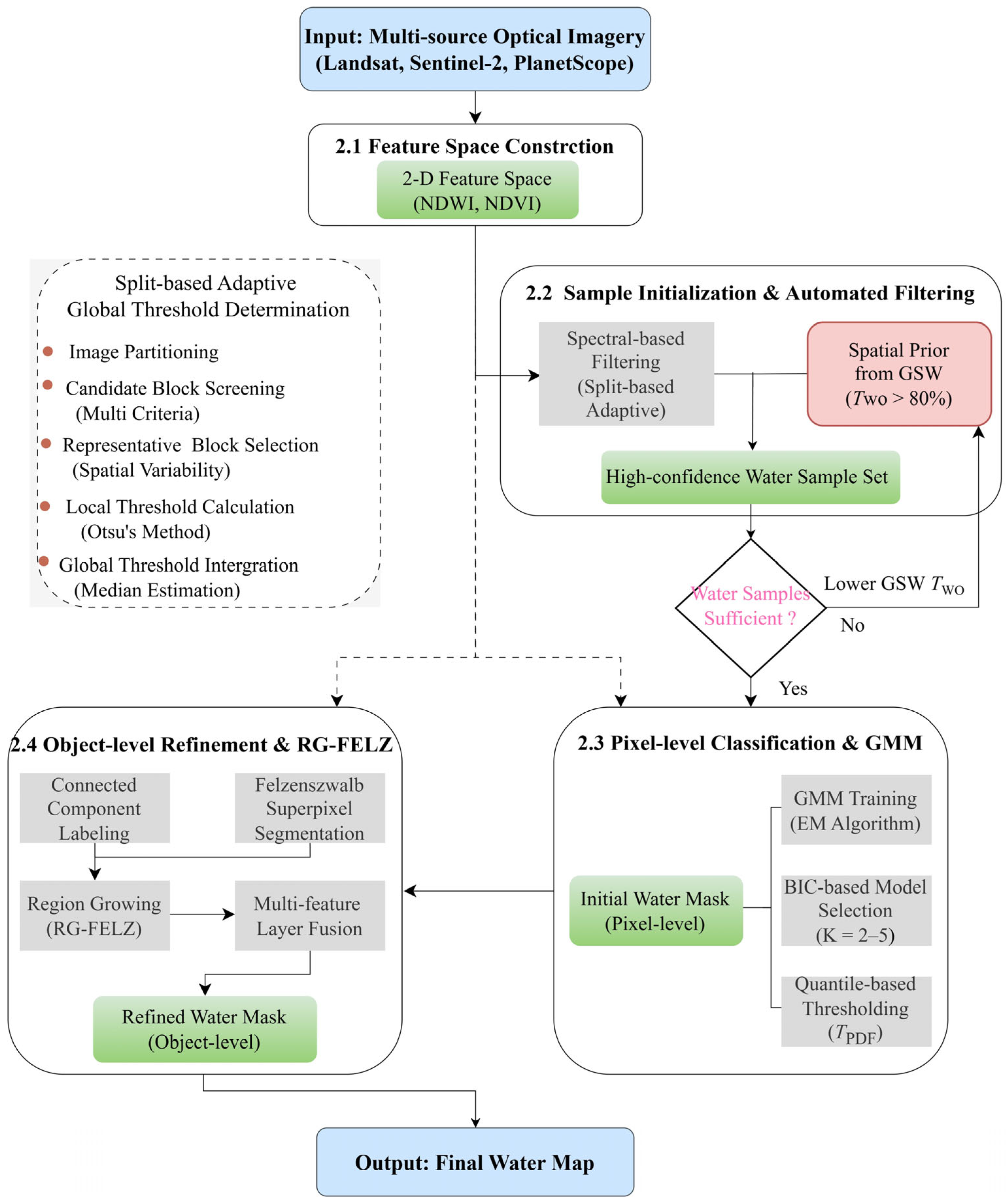
- We develop a label-free Self-Supervised Water Detection (SWD) framework. It automates sample initialization using geo-spectral features and addresses spectral variability and surface complexity through per-scene adaptive learning.
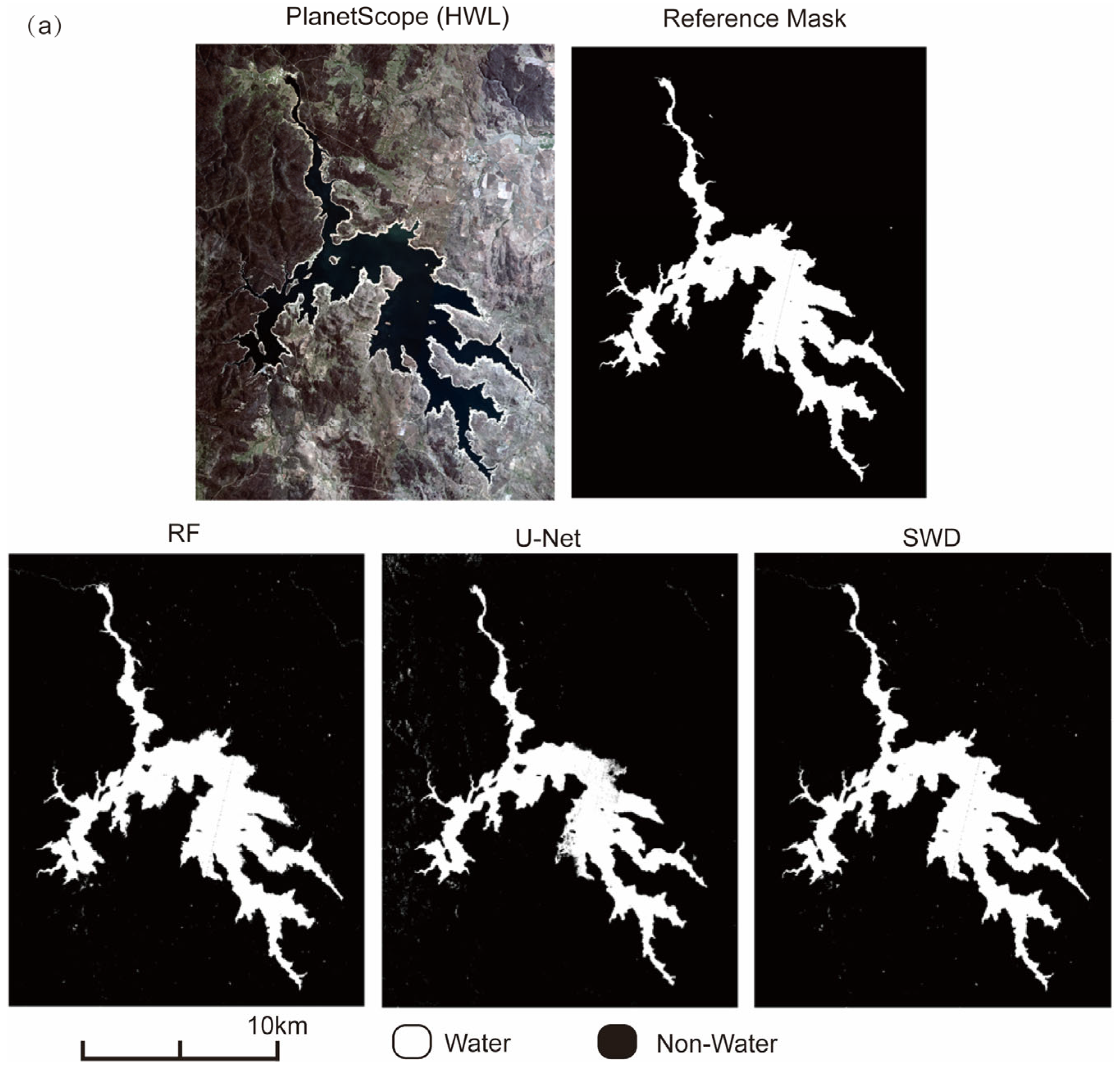
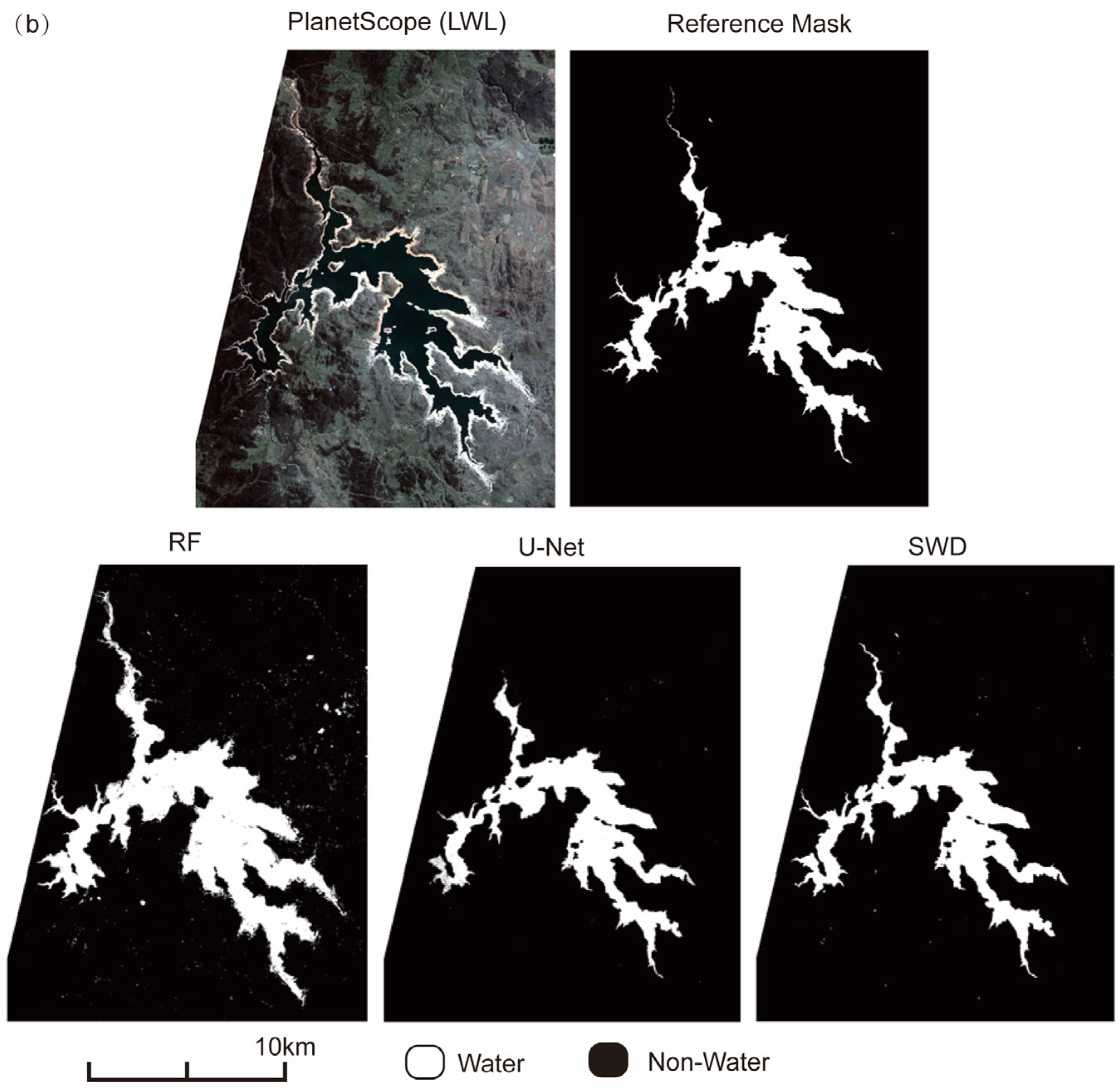
- Consistent and transferable performance is demonstrated across 36 test cases (3 sensors × 6 reservoirs × 2 hydrological conditions). SWD achieves high cross-scale consistency (IoU ≥ 0.774), stable cross-region generalization (SD: 0.010), and accurate hydrological tracking (minimal bias variation, ΔRE < 1%), without manual labels.
- The high cross-scale consistency of the framework allows for the seamless integration of historical and current satellite archives to reconstruct reliable long-term surface water extent in ungauged basins.
- Without the need for site/sensor-specific training and specialized hardware, the proposed framework provides a scalable solution for near-real-time monitoring of hydrological emergencies and large-scale water resource management.
Abstract
1. Introduction
2. Materials and Methods
2.1. Self-Supervised Water Detection Framework
2.1.1. Reservoir-Sensitive Feature Space Construction
2.1.2. Spatio-Temporal Automated Sample Initialization
- (1)
- Spatial Priors from Historical Water Occurrence
- (2)
- Spectral filtering and Sample Initialization
2.1.3. Multi-Modal Modeling and Pixel Discrimination
- (1)
- Adaptive GMM Construction
- (2)
- Probability-based Discrimination
2.1.4. Object-Level Morphological Refinement
2.2. Study Areas and Datasets
2.2.1. Representative Reservoir Scenarios
2.2.2. Hydrological Conditions
2.2.3. Multi-Source Optical Data
2.2.4. Data Preprocessing and Normalization
2.3. Experimental Design and Evaluation Metrics
2.3.1. Comparative Baselines
- (1)
- Random Forest Baseline
- (2)
- Deep Learning Baseline
- (3)
- Baseline Training Data Independence
2.3.2. Full-Factorial Experimental Design
2.3.3. Comprehensive Evaluation Metrics
- (1)
- Pixel-level Accuracy via Cross-scale Validation
- (2)
- Hydrological Consistency via EAC Curves
- (3)
- Performance Stability and Variation
3. Results
3.1. Assessment of Cross-Scale Consistency
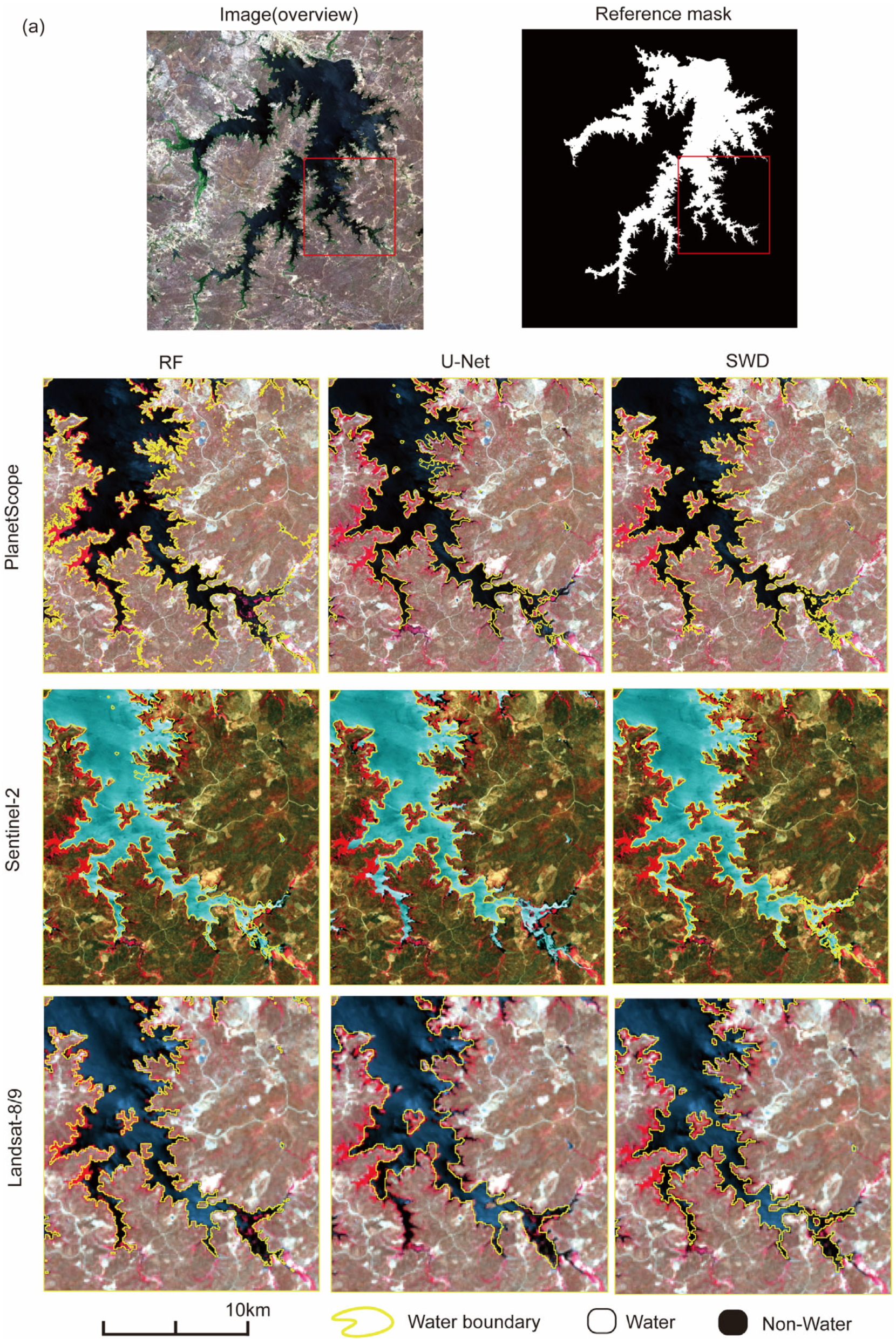
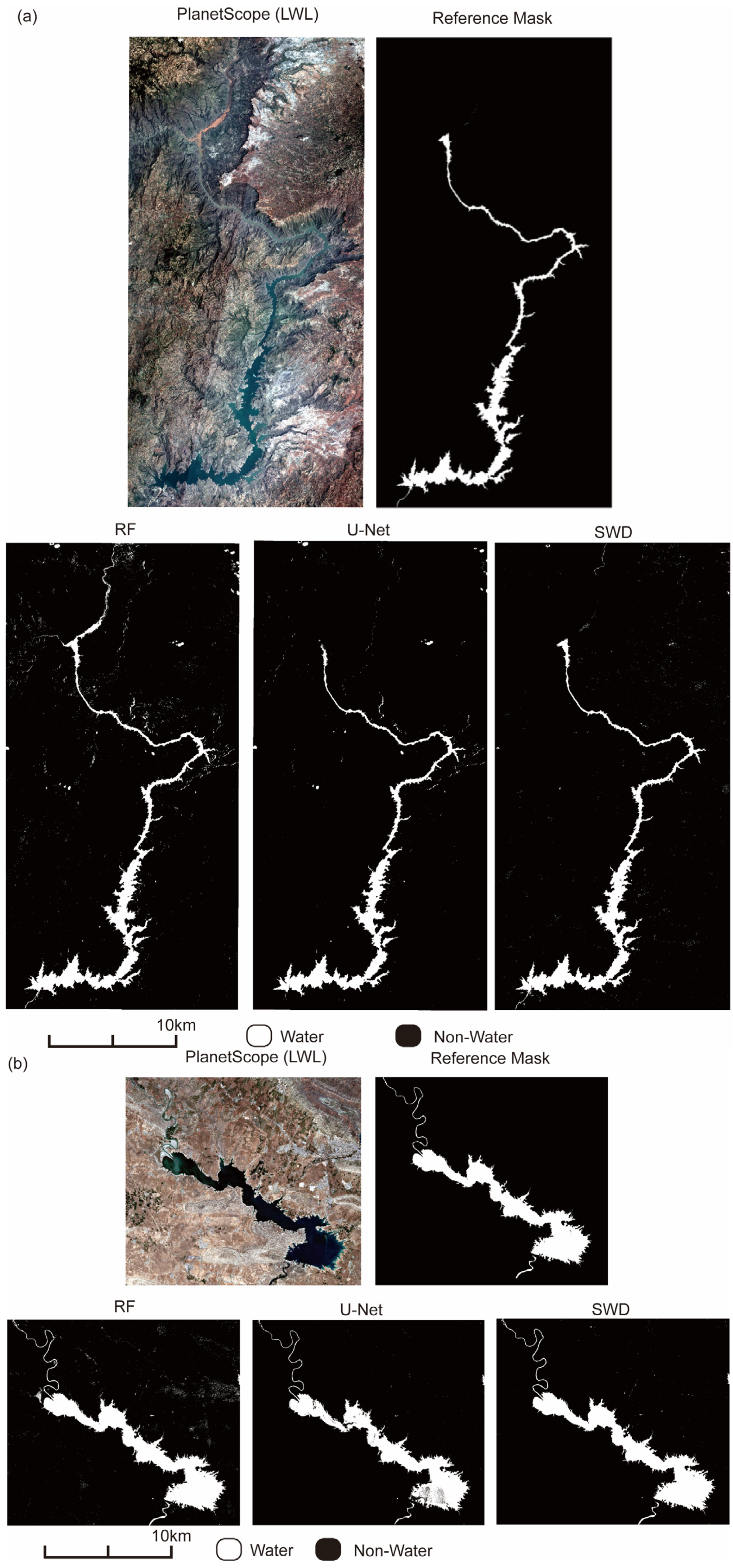
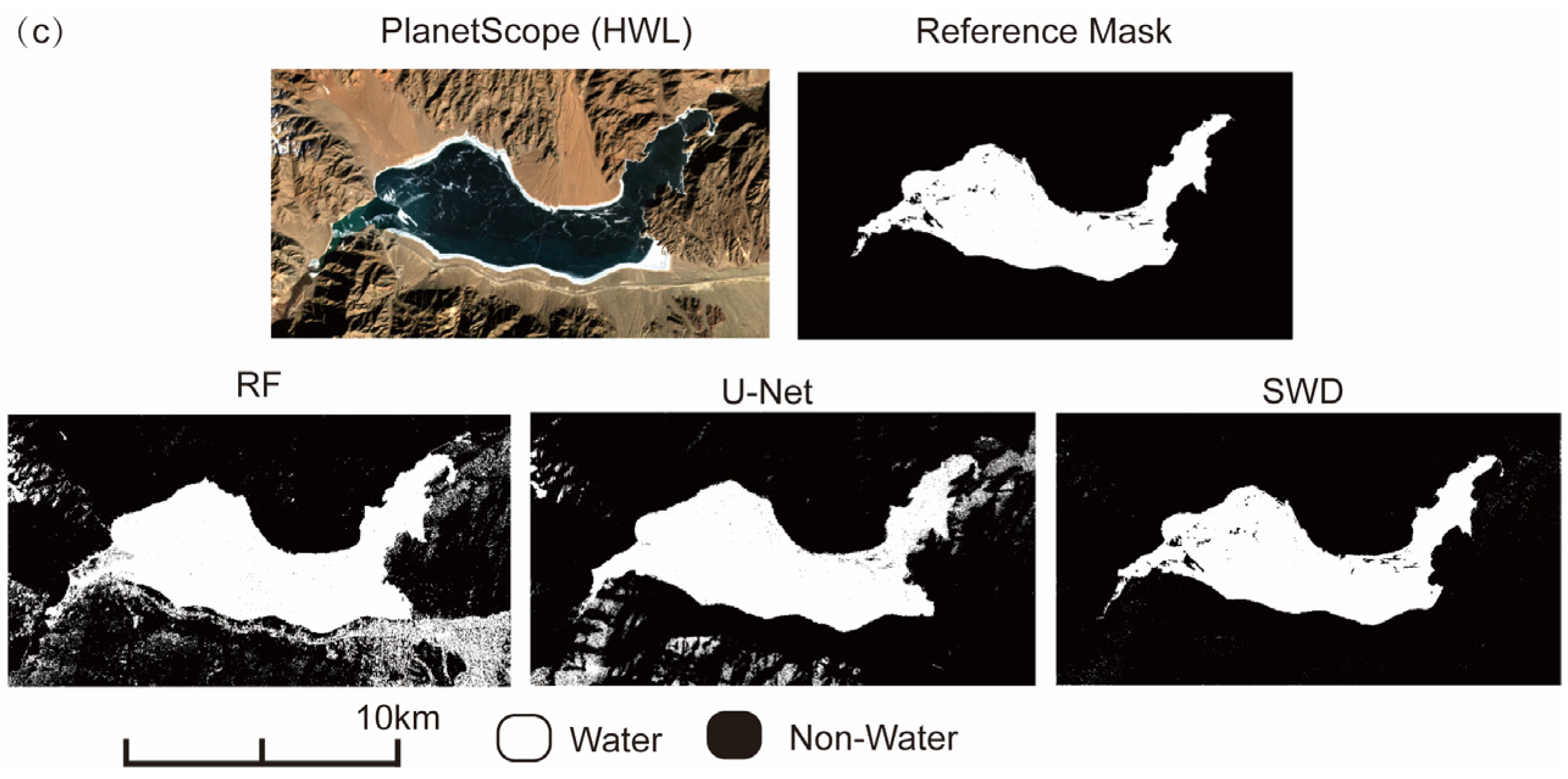
3.1.1. Qualitative Comparative Analysis
3.1.2. Quantitative Performance Evaluation
3.2. Evaluation of Cross-Region Robustness
3.3. Assessment of Cross-Temporal Adaptability
- (1)
- Trend Consistency
- (2)
- Response Sensitivity
- (3)
- Shoreline Topological Stability
3.4. Operational Utility and Efficiency
4. Discussion
4.1. Robustness via Per-Scene Adaptive Learning
4.2. Performance Divergence Analysis
4.3. Operational Applicability in Hydrology
4.4. Limitations and Future Directions
5. Conclusions
Supplementary Materials
Author Contributions
Funding
Data Availability Statement
Acknowledgments
Conflicts of Interest
References
- Eekhout, J.P.C.; Boix-Fayos, C.; Pérez-Cutillas, P.; De Vente, J. The Impact of Reservoir Construction and Changes in Land Use and Climate on Ecosystem Services in a Large Mediterranean Catchment. J. Hydrol. 2020, 590, 125208. [Google Scholar] [CrossRef]
- Xu, A.; Yang, L.E.; Yang, W.; Chen, H. Water Conservancy Projects Enhanced Local Resilience to Floods and Droughts over the Past 300 Years at the Erhai Lake Basin, Southwest China. Environ. Res. Lett. 2020, 15, 125009. [Google Scholar] [CrossRef]
- Cooley, S.W.; Ryan, J.C.; Smith, L.C. Human Alteration of Global Surface Water Storage Variability. Nature 2021, 591, 78–81. [Google Scholar] [CrossRef] [PubMed]
- Yang, Q.; Shen, X.; He, K.; Zhang, Q.; Helfrich, S.; Straka, W.; Kellndorfer, J.M.; Anagnostou, E.N. Pre-Failure Operational Anomalies of the Kakhovka Dam Revealed by Satellite Data. Commun. Earth Environ. 2024, 5, 230–238. [Google Scholar] [CrossRef]
- Shah, D.; Gao, H. Global Patterns of Reservoir Fullness and Fluctuations during Droughts. Environ. Res. Lett. 2025, 20, 124060. [Google Scholar] [CrossRef]
- Ficklin, D.L.; Null, S.E.; Abatzoglou, J.T.; Novick, K.A.; Myers, D.T. Hydrological Intensification Will Increase the Complexity of Water Resource Management. Earth’s Future 2022, 10, e2021EF002487. [Google Scholar] [CrossRef]
- Li, D.; Lu, X.; Walling, D.E.; Zhang, T.; Steiner, J.F.; Wasson, R.J.; Harrison, S.; Nepal, S.; Nie, Y.; Immerzeel, W.W.; et al. High Mountain Asia Hydropower Systems Threatened by Climate-Driven Landscape Instability. Nat. Geosci. 2022, 15, 520–530. [Google Scholar] [CrossRef]
- Ye, X.; Zhu, H.-H.; Chang, F.-N.; Xie, T.-C.; Tian, F.; Zhang, W.; Catani, F. Revisiting Spatiotemporal Evolution Process and Mechanism of a Giant Reservoir Landslide during Weather Extremes. Eng. Geol. 2024, 332, 107480. [Google Scholar] [CrossRef]
- Huang, C.; Chen, Y.; Zhang, S.; Wu, J. Detecting, Extracting, and Monitoring Surface Water from Space Using Optical Sensors: A Review. Rev. Geophys. 2018, 56, 333–360. [Google Scholar] [CrossRef]
- Pekel, J.-F.; Cottam, A.; Gorelick, N.; Belward, A.S. High-Resolution Mapping of Global Surface Water and Its Long-Term Changes. Nature 2016, 540, 418–422. [Google Scholar] [CrossRef]
- Liang, X.; Mao, W.; Yang, K.; Ji, L. Automated Small River Mapping (ASRM) for the Qinghai-Tibet Plateau Based on Sentinel-2 Satellite Imagery and MERIT DEM. Remote Sens. 2022, 14, 4693. [Google Scholar] [CrossRef]
- Perin, V.; Roy, S.; Kington, J.; Harris, T.; Tulbure, M.G.; Stone, N.; Barsballe, T.; Reba, M.; Yaeger, M.A. Monitoring Small Water Bodies Using High Spatial and Temporal Resolution Analysis Ready Datasets. Remote Sens. 2021, 13, 5176. [Google Scholar] [CrossRef]
- Kimijima, S.; Nagai, M. High Spatiotemporal Flood Monitoring Associated with Rapid Lake Shrinkage Using Planet Smallsat and Sentinel-1 Data. Remote Sens. 2023, 15, 1099. [Google Scholar] [CrossRef]
- Jiang, W.; Li, W.; Zhou, J.; Wang, P.; Xiao, H. Drone-Based Investigation of Natural Restoration of Vegetation in the Water Level Fluctuation Zone of Cascade Reservoirs in Jinsha River. Sci. Rep. 2022, 12, 12895. [Google Scholar] [CrossRef]
- Tate, C.G.; Cave, J.; Moyers, R.L. Segmenting Water and Shadow Regions within WorldView Imagery Using Local Binary Patterns. J. Appl. Remote Sens. 2022, 16, 034532. [Google Scholar] [CrossRef]
- Li, T.; Pasternack, G.B. Water Transfer Redistributes Sediment in Small Mountain Reservoirs. Water Resour. Manag. 2022, 36, 5033–5048. [Google Scholar] [CrossRef]
- Li, S.; Cheng, L.; Chang, L.; Fu, C.; Guo, Z.; Liu, P. Multi-Factor Weighted Image Fusion Method for High Spatiotemporal Tracking of Reservoir Drawdown Area and Its Vegetation Dynamics. Int. J. Appl. Earth Obs. Geoinf. 2024, 129, 103855. [Google Scholar] [CrossRef]
- Rajeswari, S.; Rathika, P. Emerging Methodologies in Waterbody Delineation: An in-Depth Review. Int. J. Remote Sens. 2024, 45, 5789–5819. [Google Scholar] [CrossRef]
- McFeeters, S.K. The Use of the Normalized Difference Water Index (NDWI) in the Delineation of Open Water Features. Int. J. Remote Sens. 1996, 17, 1425–1432. [Google Scholar] [CrossRef]
- Guo, Q.; Pu, R.; Li, J.; Cheng, J. A Weighted Normalized Difference Water Index for Water Extraction Using Landsat Imagery. Int. J. Remote Sens. 2017, 38, 5430–5445. [Google Scholar] [CrossRef]
- Khalid, H.W.; Khalil, R.M.Z.; Qureshi, M.A. Evaluating Spectral Indices for Water Bodies Extraction in Western Tibetan Plateau. Egypt. J. Remote Sens. Space Sci. 2021, 24, 619–634. [Google Scholar] [CrossRef]
- Otsu, N. A Threshold Selection Method from Gray-Level Histograms. IEEE Trans. Syst. Man Cybern. 1979, 9, 62–66. [Google Scholar] [CrossRef]
- Zhao, C.; Wei, H.; Feyisa, G.L.; De Castro Tayer, T.; Ma, G.; Wu, H.; Pan, Y. Evaluating Spectral Indices for Water Extraction: Limitations and Contextual Usage Recommendations. Int. J. Appl. Earth Obs. Geoinf. 2025, 139, 104510. [Google Scholar] [CrossRef]
- Sheykhmousa, M.; Mahdianpari, M.; Ghanbari, H.; Mohammadimanesh, F.; Ghamisi, P.; Homayouni, S. Support Vector Machine Versus Random Forest for Remote Sensing Image Classification: A Meta-Analysis and Systematic Review. IEEE J. Sel. Top. Appl. Earth Obs. Remote Sens. 2020, 13, 6308–6325. [Google Scholar] [CrossRef]
- Bangira, T.; Alfieri, S.M.; Menenti, M.; van Niekerk, A. Comparing Thresholding with Machine Learning Classifiers for Mapping Complex Water. Remote Sens. 2019, 11, 1351. [Google Scholar] [CrossRef]
- Tahir, A.; Cheng, L.; Guo, R.; Liu, H. Distributional Shift Adaptation Using Domain-Specific Features. In Proceedings of the 2022 IEEE International Conference on Big Data (Big Data); IEEE: New York, NY, USA, 2022; pp. 5593–5597. [Google Scholar]
- Ronneberger, O.; Fischer, P.; Brox, T. U-Net: Convolutional Networks for Biomedical Image Segmentation. In Proceedings of the Medical Image Computing and Computer-Assisted Intervention—MICCAI 2015; Navab, N., Hornegger, J., Wells, W.M., Frangi, A.F., Eds.; Springer International Publishing: Cham, Switzerland, 2015; Volume 9351, pp. 234–241. [Google Scholar]
- Vaswani, A.; Shazeer, N.; Parmar, N.; Uszkoreit, J.; Jones, L.; Gomez, A.N.; Kaiser, L.; Polosukhin, I. Attention Is All You Need 2023. arXiv 2023, arXiv:1706.03762. [Google Scholar]
- Mienye, I.D.; Swart, T.G. A Comprehensive Review of Deep Learning: Architectures, Recent Advances, and Applications. Information 2024, 15, 755. [Google Scholar] [CrossRef]
- Song, H.; Kim, M.; Park, D.; Shin, Y.; Lee, J.-G. Learning From Noisy Labels With Deep Neural Networks: A Survey. IEEE Trans. Neural Netw. Learn. Syst. 2023, 34, 8135–8153. [Google Scholar] [CrossRef] [PubMed]
- Chen, C.; Zhang, P.; Zhang, H.; Dai, J.; Yi, Y.; Zhang, H.; Zhang, Y. Deep Learning on Computational-Resource-Limited Platforms: A Survey. Mob. Inf. Syst. 2020, 2020, 8454327. [Google Scholar] [CrossRef]
- Albelwi, S. Survey on Self-Supervised Learning: Auxiliary Pretext Tasks and Contrastive Learning Methods in Imaging. Entropy 2022, 24, 551. [Google Scholar] [CrossRef]
- Wang, Y.; Albrecht, C.M.; Braham, N.A.A.; Mou, L.; Zhu, X.X. Self-Supervised Learning in Remote Sensing: A Review. IEEE Geosci. Remote Sens. Mag. 2022, 10, 213–247. [Google Scholar] [CrossRef]
- Ericsson, L.; Gouk, H.; Loy, C.C.; Hospedales, T.M. Self-Supervised Representation Learning: Introduction, Advances, and Challenges. IEEE Signal Process. Mag. 2022, 39, 42–62. [Google Scholar] [CrossRef]
- Doubek, J.P.; Carey, C.C. Catchment, Morphometric, and Water Quality Characteristics Differ between Reservoirs and Naturally Formed Lakes on a Latitudinal Gradient in the Conterminous United States. Inland Waters 2017, 7, 171–180. [Google Scholar] [CrossRef]
- Zhuang, W.-E.; Chen, W.; Yang, L. Coupled Effects of Dam, Hydrology, and Estuarine Filtering on Dissolved Organic Carbon and Optical Properties in the Reservoir-River-Estuary Continuum. J. Hydrol. 2023, 617, 128893. [Google Scholar] [CrossRef]
- Tucker, C.J. Red and Photographic Infrared Linear Combinations for Monitoring Vegetation. Remote Sens. Environ. 1979, 8, 127–150. [Google Scholar] [CrossRef]
- Martinis, S.; Twele, A.; Voigt, S. Towards Operational near Real-Time Flood Detection Using a Split-Based Automatic Thresholding Procedure on High Resolution TerraSAR-X Data. Nat. Hazards Earth Syst. Sci. 2009, 9, 303–314. [Google Scholar] [CrossRef]
- Taylor, N.C.; Kudela, R.M. Spatial Variability of Suspended Sediments in San Francisco Bay, California. Remote Sens. 2021, 13, 4625. [Google Scholar] [CrossRef]
- Zhou, B.; Shang, M.; Feng, L.; Shan, K.; Feng, L.; Ma, J.; Liu, X.; Wu, L. Long-Term Remote Tracking the Dynamics of Surface Water Turbidity Using a Density Peaks-Based Classification: A Case Study in the Three Gorges Reservoir, China. Ecol. Indic. 2020, 116, 106539. [Google Scholar] [CrossRef]
- Ni, L.; Wang, D.; Wu, J.; Wang, Y.; Tao, Y.; Zhang, J.; Liu, J. Streamflow Forecasting Using Extreme Gradient Boosting Model Coupled with Gaussian Mixture Model. J. Hydrol. 2020, 586, 124901. [Google Scholar] [CrossRef]
- You, J.; Li, Z.; Du, J. A New Iterative Initialization of EM Algorithm for Gaussian Mixture Models. PLoS ONE 2023, 18, e0284114. [Google Scholar] [CrossRef]
- Xiang, J.; Guo, G.; Li, J. Determining the Number of Factors in Constrained Factor Models via Bayesian Information Criterion. Econom. Rev. 2023, 42, 98–122. [Google Scholar] [CrossRef]
- Zhang, L.; Xie, L.; Han, Q.; Wang, Z.; Huang, C. Probability Density Forecasting of Wind Speed Based on Quantile Regression and Kernel Density Estimation. Energies 2020, 13, 6125. [Google Scholar] [CrossRef]
- Qingling, L.; Ye, L.; Siddiqui, F.A. Region Growing and Level Set Synergetic Algorithms for Image Segmentation. In Proceedings of the Proceedings of the 2020 4th International Conference on Digital Signal Processing; Association for Computing Machinery: New York, NY, USA, 2020; pp. 12–16. [Google Scholar]
- Shih, F.Y.; Wu, Y.-T. The Efficient Algorithms for Achieving Euclidean Distance Transformation. IEEE Trans. Image Process. 2004, 13, 1078–1091. [Google Scholar] [CrossRef]
- Li, H.; Jia, Y.; Cong, R.; Wu, W.; Kwong, S.T.W.; Chen, C. Superpixel Segmentation Based on Spatially Constrained Subspace Clustering. IEEE Trans. Ind. Inform. 2021, 17, 7501–7512. [Google Scholar] [CrossRef]
- Di, S.; Liao, M.; Zhao, Y.; Li, Y.; Zeng, Y. Image Superpixel Segmentation Based on Hierarchical Multi-Level LI-SLIC. Opt. Laser Technol. 2021, 135, 106703. [Google Scholar] [CrossRef]
- Lehner, B.; Liermann, C.R.; Revenga, C.; Vörösmarty, C.; Fekete, B.; Crouzet, P.; Döll, P.; Endejan, M.; Frenken, K.; Magome, J.; et al. High-Resolution Mapping of the World’s Reservoirs and Dams for Sustainable River-Flow Management. Front. Ecol. Environ. 2011, 9, 494–502. [Google Scholar] [CrossRef]
- Zhu, Z.; Woodcock, C.E. Object-Based Cloud and Cloud Shadow Detection in Landsat Imagery. Remote Sens. Environ. 2012, 118, 83–94. [Google Scholar] [CrossRef]
- Wieland, M.; Martinis, S.; Kiefl, R.; Gstaiger, V. Semantic Segmentation of Water Bodies in Very High-Resolution Satellite and Aerial Images. Remote Sens. Environ. 2023, 287, 113452. [Google Scholar] [CrossRef]
- Mukherjee, R.; Policelli, F.; Wang, R.; Arellano-Thompson, E.; Tellman, B.; Sharma, P.; Zhang, Z.; Giezendanner, J. A Globally Sampled High-Resolution Hand-Labeled Validation Dataset for Evaluating Surface Water Extent Maps. Earth Syst. Sci. Data 2024, 16, 4311–4323. [Google Scholar] [CrossRef]
- Wieland, M.; Fichtner, F.; Martinis, S.; Groth, S.; Krullikowski, C.; Plank, S.; Motagh, M. S1S2-Water: A Global Dataset for Semantic Segmentation of Water Bodies from Sentinel-1 and Sentinel-2 Satellite Images. IEEE J. Sel. Top. Appl. Earth Obs. Remote Sens. 2024, 17, 1084–1099. [Google Scholar] [CrossRef]
- Alemohammad, H.; Booth, K. LandCoverNet: A Global Benchmark Land Cover Classification Training Dataset 2020. arXiv 2020, arXiv:2012.03111. [Google Scholar]
- Storvik, G.; Fjortoft, R.; Solberg, A.H.S. A Bayesian Approach to Classification of Multiresolution Remote Sensing Data. IEEE Trans. Geosci. Remote Sens. 2005, 43, 539–547. [Google Scholar] [CrossRef]
- Schwatke, C.; Dettmering, D.; Bosch, W.; Seitz, F. DAHITI—An Innovative Approach for Estimating Water Level Time Series over Inland Waters Using Multi-Mission Satellite Altimetry. Hydrol. Earth Syst. Sci. 2015, 19, 4345–4364. [Google Scholar] [CrossRef]
- Patil, S.; Stieglitz, M. Hydrologic Similarity among Catchments under Variable Flow Conditions. Hydrol. Earth Syst. Sci. 2011, 15, 989–997. [Google Scholar] [CrossRef]
- Chang, G.J.; Oh, Y.; Goldshleger, N.; Shoshany, M. Biomass Estimation of Crops and Natural Shrubs by Combining Red-Edge Ratio with Normalized Difference Vegetation Index. J. Appl. Remote Sens. 2022, 16, 014501. [Google Scholar] [CrossRef]
- Zhou, Y.; Rangarajan, A.; Gader, P.D. A Gaussian Mixture Model Representation of Endmember Variability for Spectral Unmixing. In Proceedings of the 2016 8th Workshop on Hyperspectral Image and Signal Processing: Evolution in Remote Sensing (WHISPERS); IEEE: New York, NY, USA, 2016; pp. 1–5. [Google Scholar]
- Darrell, T.; Kloft, M.; Pontil, M.; Rätsch, G.; Rodner, E. Machine Learning with Interdependent and Non-Identically Distributed Data (Dagstuhl Seminar 15152). Dagstuhl Rep. DagRep 2015, 5, 18–55. [Google Scholar] [CrossRef]
- Yan, T.; Shi, J.; Li, H.; Luo, Z.; Wang, Z. Discriminative Information Restoration and Extraction for Weakly Supervised Low-Resolution Fine-Grained Image Recognition. Pattern Recognit. 2022, 127, 108629. [Google Scholar] [CrossRef]
- Saltiel, T.M.; Dennison, P.E.; Campbell, M.J.; Thompson, T.R.; Hambrecht, K.R. Tradeoffs between UAS Spatial Resolution and Accuracy for Deep Learning Semantic Segmentation Applied to Wetland Vegetation Species Mapping. Remote Sens. 2022, 14, 2703. [Google Scholar] [CrossRef]
- Gawlikowski, J.; Saha, S.; Kruspe, A.; Zhu, X.X. Towards Out-of-Distribution Detection for Remote Sensing. In Proceedings of the 2021 IEEE International Geoscience and Remote Sensing Symposium IGARSS; IEEE: New York, NY, USA, 2021; pp. 8676–8679. [Google Scholar]
- Zhang, X.; Cui, P.; Xu, R.; Zhou, L.; He, Y.; Shen, Z. Deep Stable Learning for Out-of-Distribution Generalization. In Proceedings of the 2021 IEEE/CVF Conference on Computer Vision and Pattern Recognition (CVPR); IEEE: New York, NY, USA, 2021; pp. 5368–5378. [Google Scholar]
- Zhou, Y.; Li, W.; Cao, X.; He, B.; Feng, Q.; Yang, F.; Liu, H.; Kutser, T.; Xu, M.; Xiao, F.; et al. Spatial-Temporal Distribution of Labeled Set Bias Remote Sensing Estimation: An Implication for Supervised Machine Learning in Water Quality Monitoring. Int. J. Appl. Earth Obs. Geoinf. 2024, 131, 103959. [Google Scholar] [CrossRef]
- Hao, Z.; Chen, F.; Jia, X.; Cai, X.; Yang, C.; Du, Y.; Ling, F. GRDL: A New Global Reservoir Area-Storage-Depth Data Set Derived Through Deep Learning-Based Bathymetry Reconstruction. Water Resour. Res. 2024, 60, e2023WR035781. [Google Scholar] [CrossRef]
- Schwatke, C.; Dettmering, D.; Seitz, F. Volume Variations of Small Inland Water Bodies from a Combination of Satellite Altimetry and Optical Imagery. Remote Sens. 2020, 12, 1606. [Google Scholar] [CrossRef]
- Liu, Z.; Zhu, D.; Wang, L.; Li, D. Enhancing Surface Water Mapping and Monthly Dynamics Monitoring with a Stepwise Gap-Filling Method. Int. J. Digit. Earth 2024, 17, 2413882. [Google Scholar] [CrossRef]
- Markert, K.N.; Williams, G.P.; Nelson, E.J.; Ames, D.P.; Lee, H.; Griffin, R.E. Dense Time Series Generation of Surface Water Extents through Optical–SAR Sensor Fusion and Gap Filling. Remote Sens. 2024, 16, 1262. [Google Scholar] [CrossRef]
- Kutser, T.; Hedley, J.; Giardino, C.; Roelfsema, C.; Brando, V.E. Remote Sensing of Shallow Waters—A 50 Year Retrospective and Future Directions. Remote Sens. Environ. 2020, 240, 111619. [Google Scholar] [CrossRef]
- Uudeberg, K.; Ansko, I.; Põru, G.; Ansper, A.; Reinart, A. Using Optical Water Types to Monitor Changes in Optically Complex Inland and Coastal Waters. Remote Sens. 2019, 11, 2297. [Google Scholar] [CrossRef]
- Lan, L.; Wang, Y.-G.; Chen, H.-S.; Gao, X.-R.; Wang, X.-K.; Yan, X.-F. Improving on Mapping Long-Term Surface Water with a Novel Framework Based on the Landsat Imagery Series. J. Environ. Manag. 2024, 353, 120202. [Google Scholar] [CrossRef] [PubMed]
- León-López, K.M.; Mouret, F.; Arguello, H.; Tourneret, J.-Y. Anomaly Detection and Classification in Multispectral Time Series Based on Hidden Markov Models. IEEE Trans. Geosci. Remote Sens. 2022, 60, 5402311. [Google Scholar] [CrossRef]





| Reservoir (Location) | Center Coordinates | Environmental Conditions | Key Geo-Spectral Characteristic | Validation Objective |
|---|---|---|---|---|
| Eucumbene (Australia) | 36°05′S, 148°42′E | High-altitude terrain; seasonal snowmelt | Dendritic shoreline with narrow tributaries | Connectivity preservation and delineation of narrow water bodies |
| Pires Ferreira (Brazil) | 04°03′S, 40°37′W | Tropical semi-arid; dense tributary network | Narrow channels and shallow patches prone to fragmentation | Connectivity preservation in fragmented narrow waters |
| Gilgel Gibe (Ethiopia) | 07°49′N, 37°19′E | Tropical basin; high sediment inflow | Longitudinal spectral gradient | Multi-modal spectral modeling under turbidity gradients |
| Mosul (Iraq) | 36°37′N, 42°49′E | Arid plateau; high-albedo bare soil/sand | Bright background near shoreline | False-positive suppression under high-albedo background |
| Orto-Tokoy (Kyrgyzstan) | 42°23′N, 75°51′E | Mountainous; snow/ice and terrain shadows | Snow/ice and terrain shadows | Water discrimination under snow/ice and shadow interference |
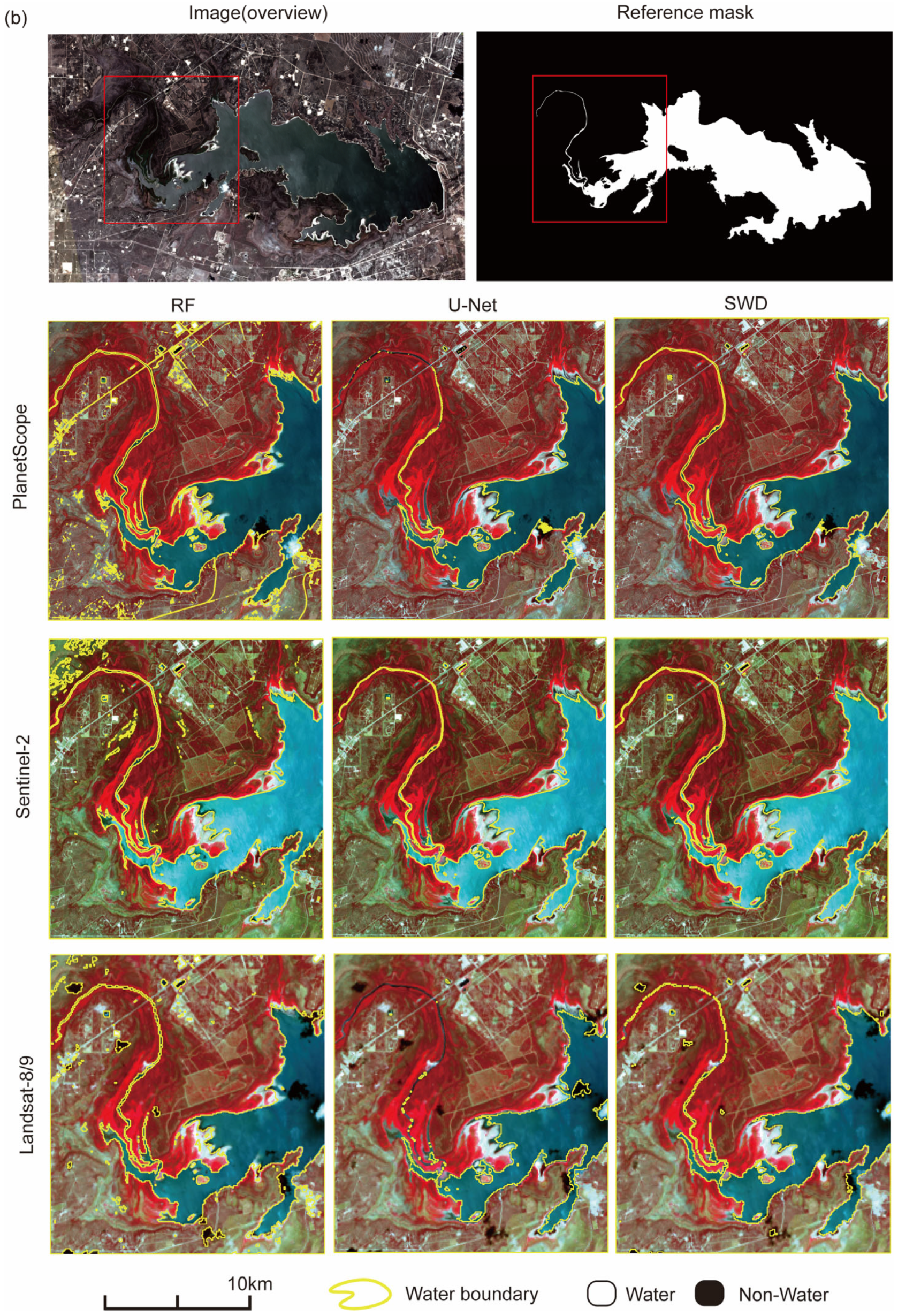
| Choke Canyon (USA) | 28°30′N, 98°15′W | Semiarid; extensive drawdown zones | Wet soil and pioneer vegetation in drawdown areas | Separation of open water from mixed pixels in drawdown zones |
| Dataset Name | Target Sensor | Dataset Scale | Key Pre-Processing | Reference |
|---|---|---|---|---|
| PlanetScope Dataset | PlanetScope (3 m) | 100 scenes (1024 × 1024) | Acquisition 4-band surface reflectance data (Blue/Green/Red/NIR; 3–7 days) | Mukherjee et al. (2024) [52] |
| S1S2-Water | Sentinel-2 (10 m) | 65 tiles | Band Selection (B2/B3/B4/B8) | Wieland et al. (2024) [53] |
| LandCoverNet | Landsat-8/9 (30 m) | 1980 image chips (256 × 256) | Stratified Sampling; 4-band inputs (Blue/Green/Red/NIR) | Alemohammad et al. (2020) [54] |
| Method | Metric | PlanetScope (3 m) | Sentinel-2 (10 m) | Landsat-8/9 (30 m) | Cross-Scale Mean | Cross-Scale SD |
|---|---|---|---|---|---|---|
| SWD | IoU | 0.822 | 0.805 | 0.774 | 0.800 | 0.024 |
| RE (%) | 5.12 | 5.96 | 7.15 | 6.08 | 1.02 | |
| U-Net | IoU | 0.816 | 0.785 | 0.741 | 0.781 | 0.038 |
| RE (%) | 5.46 | 7.00 | 9.32 | 7.26 | 1.95 | |
| RF | IoU | 0.707 | 0.685 | 0.644 | 0.679 | 0.032 |
| RE (%) | 10.03 | 11.37 | 13.91 | 11.77 | 1.97 |
| Reservoir | SWD | U-Net | RF | |||
|---|---|---|---|---|---|---|
| IoU | AE (km2) | IoU | AE (km2) | IoU | AE (km2) | |
| Eucumbene | 0.806 | 5.54 | 0.810 | 5.59 | 0.703 | 10.75 |
| PireseFerreira | 0.815 | 2.17 | 0.785 | 2.52 | 0.736 | 4.37 |
| GilgelGibe | 0.793 | 8.71 | 0.793 | 9.01 | 0.698 | 15.50 |
| Mosul | 0.802 | 11.02 | 0.757 | 17.13 | 0.660 | 23.92 |
| Orto-Tokoy | 0.785 | 1.21 | 0.738 | 1.65 | 0.617 | 2.43 |
| ChokeCanyon | 0.803 | 3.55 | 0.800 | 3.84 | 0.703 | 6.21 |
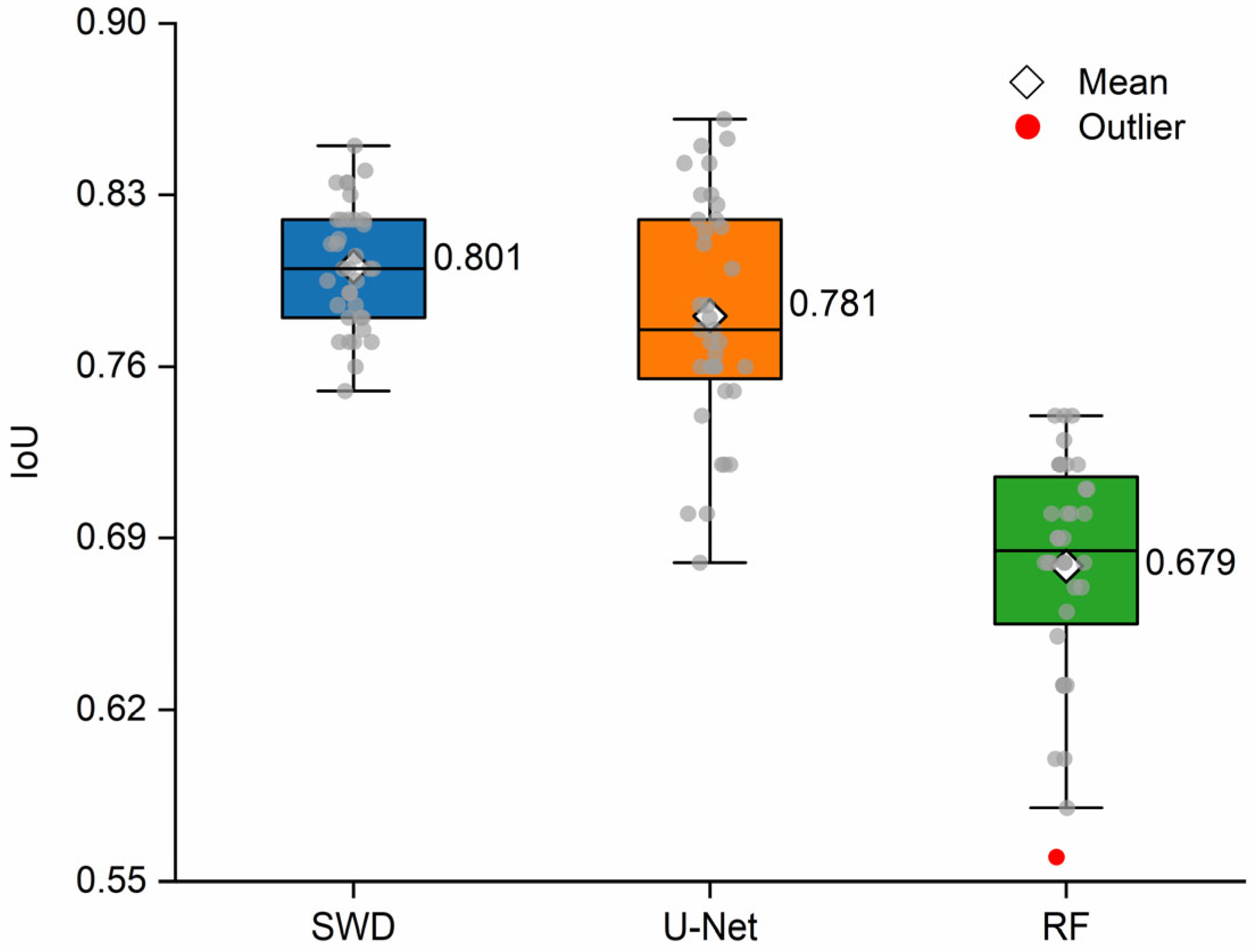
| Inter-reservoir Mean | 0.801 | -- | 0.781 | -- | 0.679 | -- |
| Inter-reservoir SD | 0.010 | -- | 0.025 | -- | 0.031 | -- |
| Method | IoU (HWL) | IoU (LWL) | ΔIoU (%) | RE (HWL), % | RE (LWL), % | ΔRE (%) | σIoU | CVIoU, % |
|---|---|---|---|---|---|---|---|---|
| SWD | 0.810 | 0.791 | −2.35 | 5.58 | 6.56 | 0.98 | 0.02 | 2.50 |
| U-Net | 0.799 | 0.762 | −4.63 | −6.31 | −8.20 | 1.89 | 0.05 | 6.41 |
| RF | 0.693 | 0.664 | −4.18 | 10.49 | 13.04 | 2.55 | 0.05 | 7.37 |
| Reservoir | Method | Areaest (HWL) | Areaest (LWL) | ΔAreaest | ΔArearef | Arearef (HWL) | Arearef (LWL) |
|---|---|---|---|---|---|---|---|
| Mosul | SWD | 312.97 | 242.10 | 70.87 | 69.84 | 301.43 | 231.59 |
| U-Net | 286.56 | 212.20 | 74.36 | 69.84 | 301.43 | 231.59 | |
| RF | 324.58 | 256.21 | 68.37 | 69.84 | 301.43 | 231.59 | |
| Gilgel Gibe | SWD | 183.55 | 146.90 | 36.65 | 37.00 | 175.04 | 138.04 |
| U-Net | 166.70 | 128.36 | 38.34 | 37.00 | 175.04 | 138.04 | |
| RF | 189.27 | 154.69 | 34.58 | 37.00 | 175.04 | 138.04 | |
| Eucumbene | SWD | 101.29 | 82.91 | 18.38 | 18.20 | 95.66 | 77.46 |
| U-Net | 90.20 | 71.74 | 18.46 | 18.20 | 95.66 | 77.46 | |
| RF | 105.96 | 88.66 | 17.30 | 18.20 | 95.66 | 77.46 |
| Method | Inference Time (Mean ± SD, s/Mpx) | Training Required | Hardware Requirement | Deployment Flexibility |
|---|---|---|---|---|
| SWD | 0.858 ± 0.372 | No | CPU only | High |
| RF | 0.956 ± 0.011 | Yes | CPU only | Medium |
| U-Net | 1.864 ± 0.1518 (CPU) 0.031 ± 0.0008 (GPU) | Yes | GPU dependent | Low |
Disclaimer/Publisher’s Note: The statements, opinions and data contained in all publications are solely those of the individual author(s) and contributor(s) and not of MDPI and/or the editor(s). MDPI and/or the editor(s) disclaim responsibility for any injury to people or property resulting from any ideas, methods, instructions or products referred to in the content. |
© 2026 by the authors. Licensee MDPI, Basel, Switzerland. This article is an open access article distributed under the terms and conditions of the Creative Commons Attribution (CC BY) license.
Share and Cite
Mo, G.; Yang, Q.; Zhou, X. Self-Supervised Reservoir Water Area Detection Across Multi-Source Optical Imagery. Remote Sens. 2026, 18, 918. https://doi.org/10.3390/rs18060918
Mo G, Yang Q, Zhou X. Self-Supervised Reservoir Water Area Detection Across Multi-Source Optical Imagery. Remote Sensing. 2026; 18(6):918. https://doi.org/10.3390/rs18060918
Chicago/Turabian StyleMo, Guiyan, Qing Yang, and Xiaofeng Zhou. 2026. "Self-Supervised Reservoir Water Area Detection Across Multi-Source Optical Imagery" Remote Sensing 18, no. 6: 918. https://doi.org/10.3390/rs18060918
APA StyleMo, G., Yang, Q., & Zhou, X. (2026). Self-Supervised Reservoir Water Area Detection Across Multi-Source Optical Imagery. Remote Sensing, 18(6), 918. https://doi.org/10.3390/rs18060918