Article

Detecting and Predicting Vegetation Transitions Based on Resilience Dynamics and Land-Cover Changes


1
State Key Laboratory of Remote Sensing and Digital Earth, Aerospace Information Research Institute, Chinese Academy of Sciences, Beijing 100101, China
2
College of Resources and Environment, University of Chinese Academy of Sciences, Beijing 100049, China
3
Key Laboratory of Earth Observation of Hainan Province, Hainan Aerospace Information Research Institute, Wenchang 571300, China
*
Author to whom correspondence should be addressed.
Remote Sens. 2026, 18(6), 889; https://doi.org/10.3390/rs18060889
Submission received: 5 February 2026 / Revised: 10 March 2026 / Accepted: 11 March 2026 / Published: 13 March 2026
(This article belongs to the Section Ecological Remote Sensing)

Highlights

What are the main findings?
  • Resilience of terrestrial vegetation is widespread, declining in the past two decades in China, especially in semi-arid grasslands and high-altitude subtropical forests. The vegetation transition type was dominated by grassland to shrubland, i.e., shrub encroachment.
  • Machine learning models showed robustness in predicting tipping points’ occurrence across one to five years ahead. The risk of vegetation transitions was strongly influenced by rainfall level, soil properties and the internal vegetation functions.
What are the implications of the main findings?
  • The actual occurrence of vegetation type transitions (land-cover changes) reverse-verifies that the resilience indicator (AC1) could serve as an effective early warning signal of regime shifts.
  • The detection and prediction of the probability of transition risk provide valuable insights into hotspots of vegetation vulnerability and targeted conservation strategies.

Abstract

Tipping points of vegetation transitions represent the thresholds beyond which ecosystems can no longer maintain their stable states. Approaching these critical points may result in declined resilience or irreversible vegetation transitions. Detecting and predicting tipping points remains notably challenging, yet it is essential for guiding the preservation and restoration of terrestrial ecosystems. In this study, lag-1 temporal autocorrelation (AC1) derived from the Kernel Normalized Difference Vegetation Index (kNDVI) was utilized as an early warning signal to monitor resilience dynamics. We developed a new tipping-point detection method by combining land-cover changes, time series segmentations and temporal–spatial filters. We revealed a widespread resilience decline in China, with the dominant transition type as shrub encroachment. Then, two machine learning models coupled with temporal cross-validation were employed to predict the probabilities of abrupt shifts in the near future. The results showed that Random Forest models (accuracy > 70%) demonstrated robustness across lead times. High probabilities of transitions in 2024 were concentrated along the 400 mm annual isohyet, mainly affected by decreased water availability, lower soil acidity and degraded vegetation functions. Our study provides an effective methodology to pinpoint hotspots of vegetation vulnerability and to support the conservation of ecosystems for a sustainable future.

1. Introduction

Ecosystems are dynamically complex and may exist in alternative stable states under similar climatic conditions [1]. These systems can undergo abrupt and irreversible transitions from one state to another when pushed beyond a critical tipping point by minor climatic or human-induced changes [2]. In terrestrial vegetation, such regime shifts may manifest as tree mortality, the conversion of tropical forests into savannas, grassland desertification, and shrub encroachment [3,4,5]. These vegetation transitions may not only alter the land cover but also trigger long-term lagged feedbacks on land surface temperatures and soil hydraulic properties, ultimately threatening the stability of carbon sequestration [6,7,8]. Therefore, in the face of accelerating climate change, identifying and foreseeing potential tipping points is crucial for early warning of high-risk areas and supporting effective conservation efforts.
Ecological resilience, defined as the capacity of a system to maintain its current state, typically declines as the system approaches a tipping point [9,10]. This decline represents a slower recovery rate from small perturbations, which can be indicated by increased temporal autocorrelation index at lag-1 (AC1) [11,12,13]. AC1 is a data-driven indicator that allows for assessing resilience by monitoring vegetation fluctuations without needing to know the specific type or magnitude of perturbations [14]. The expanding availability of multi-decadal Earth observations has enabled large-scale resilience assessments via satellite-derived metrics. In particular, the Kernel Normalized Difference Vegetation Index (kNDVI) has emerged as a superior proxy for vegetation conditions due to its robustness against noise and saturation effects. kNDVI-derived AC1 has been theoretically and empirically validated and is now widely adopted for assessing vegetation resilience. Recent studies revealed a marked decrease in vegetation resilience since the early 21st century in regional and global studies, especially in the Amazon rainforest and drylands [15,16,17,18]. However, the high-resolution dynamics assessment of resilience trends in China still remains under-explored.
Some ecosystems have already approached their tipping points, leading to massive tree mortality and state transitions [19,20,21]. Methodologies of detecting critical thresholds have been developed in recent years from basic statistical indicators to complex models [22]. For instance, Forzieri et al. [17] identified abrupt declines by detecting negative anomalies in kNDVI relative to local historical means. To enable a more nuanced detection of tipping points, Y Liu et al. [23] introduced the Bayesian Dynamic Linear Model to isolate resilience signals from environmental noise. To precisely detect the timestamps of historical transitions, Bernardino et al. [24] applied time series segmentation to NDVI time series. A recent study has utilized known land-cover changes as a benchmark, but their analyses primarily focused on characterizing resilience retrospectively, rather than improving the detection method [25]. While these studies provide valuable insights into specific aspects of tipping-point detection through time series analyses, they often lack the empirical verification of actual ecological state shifts, which are defined as land-cover changes between alternative stable vegetation types. Integrating observed changes from long-term land-cover data provides ground-truth confirmation of state shifts, thereby bridging the gap between statistical signals and real-world ecological changes. Given that China’s natural ecosystems have experienced drastic changes, developing an integrated detection method by linking resilience indicators to land-cover changes would be more effective for ecosystem conservation.
Beyond detecting historical transitions, it is also critical to predict future ecosystem vulnerability to abrupt shifts and identify their drivers. Large-scale forecasting in terrestrial vegetation remains limited by the short duration and inherent noise of remote sensing data, which makes it difficult to extract reliable temporal signals for resilience indicator calculation [2,26]. To address these data constraints, Yao et al. [27] utilized earth system model outputs to project future resilience trends. However, their reliance on simulated data may introduce biases that mask real-world resilience dynamics and fail to predict specific tipping-point events. By introducing temporal cross-validation in machine learning models, Bernardino et al. [28] improved the method for predicting the future probability of transitions with high accuracy. This approach overcomes the lack of future data by training models on earlier historical periods to forecast shifts in subsequent years. Yet, the sensitivity and applicability of this approach in diverse ecosystems require further investigation. Moreover, identifying the dominant environmental drivers that may threaten ecosystem stability is also crucial for risk assessment and targeted management.
In this study, we bridge the gap between theoretical early warning signals and actual evidence of vegetation state transitions using remote sensing data. Specifically, we (1) quantify the fine-resolution spatial patterns of resilience trends across China by kNDVI-derived AC1 from 2000 to 2020; (2) develop a new method for historical tipping-point detection and investigate the areas where abrupt shifts occurred; and (3) evaluate the probability of transitions in the near future based on machine learning models and identify the underlying environmental drivers.

2. Materials and Methods

2.1. Overview of Methodology

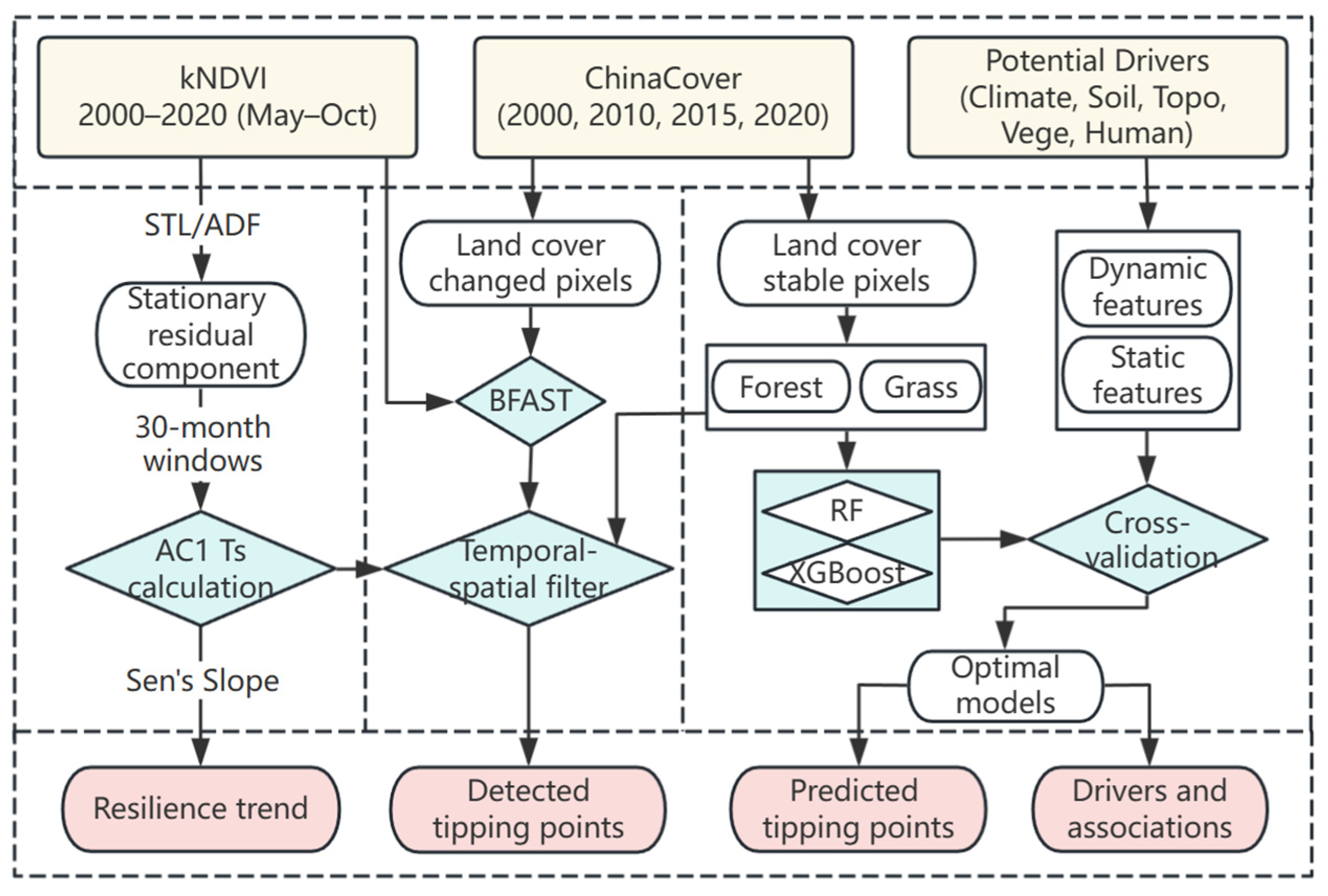
The overall roadmap of this study was divided into three steps (Figure 1): (1) the calculation of the AC1 time series and the resilience trend based on the time series of growing season kNDVI during 2000–2020; (2) the detection of tipping points based on land-cover changes, time segmentation algorithm and temporal–spatial filtering; (3) the development of machine learning models with temporal cross-validation to predict tipping points and the analysis of the potential drivers.

2.2. Data

2.2.1. Vegetation Index

Vegetation index was characterized using growing season (May–October) NDVI derived from the MOD13Q1 product at 250 m spatial resolution and 16-day temporal resolution during 2000–2020. The MOD13Q1 dataset was a L3 product provided from the Moderate Resolution Imaging Spectroradiometer (MODIS) instrument aboard the Terra satellite. Its spatio-temporal consistency avoids biases that can arise from the integration of mixed signals from various sensors [29]. Missing NDVI values were filled using temporal linear interpolation based on valid data from adjacent months and the preceding and succeeding months. Pixels containing invalid values (exceeding the range of [−1, 1]) or missing values for three or more consecutive months were excluded. Compared to traditional indices, kNDVI provides superior robustness against noise and saturation and enables consistent monitoring of vegetation conditions across varied biomes [15]. Crucially, kNDVI-based resilience metrics have been empirically validated through their spatial consistency with observed recovery rates following large-scale disturbances. Given these advantages, we employed kNDVI as the preferred vegetation index to assess the vegetation resilience of terrestrial ecosystems in this study.
k N D V I = tanh N D V I 2
where tanh represents the hyperbolic tangent function.

2.2.2. Land-Cover and Ecogeographical Data

Spatial–temporal changes in land cover were identified using the China National Land Cover Database at a 30 m spatial resolution (ChinaCover in the following text). ChinaCover data employed an object-oriented multi-level classification methodology using Landsat and Chinese Environmental Satellite images as well as a large number of field investigation data, with an overall accuracy of 94% [30]. In this study, we focused on natural vegetation by extracting forest, shrubland and grassland pixels from four ChinaCover maps (2000, 2010, 2015 and 2020). Urban areas, croplands, bareland and artificial areas were excluded, as anthropogenic land-cover changes (e.g., deforestation, afforestation and cropland expansion) often occur abruptly without precursory early-warning signals and may introduce biases into resilience assessments. To further account for deforestation, we utilized the Global Forest Change dataset (GFC, 1 arc-second resolution) from the Google Earth Engine platform [31]. The ‘Forest loss Year’ band was used to filter out human-induced forest loss. Pixels that were detected as forest changes in the ChinaCover dataset and possessed a corresponding GFC loss year within the study period were removed, thereby ensuring that our study focused on natural vegetation dynamics.
Additionally, we used an ecogeographical regionalization map to divide China into eight ecoregions [32]. We divided them into five forest-dominated regions (FDRs), including cold temperate needleleaf forest (1, CTempNLF), temperate needleleaf broadleaf mixed forest (2, TempNBMF), warm temperate deciduous broadleaf forest (3, WTempDBF), subtropical evergreen broadleaf forest (4, SubtroEBF), and tropical rainforest (5, TroRF); and three grass-dominated regions (GDRs), including temperate steppe (6, TempS), temperate desert (7, TempD) and the Qinghai–Tibetan Plateau alpine vegetation (8, QTPVege).

2.2.3. Potential Drivers

Following our prior work [33], we prioritized variables with proven influence on resilience to mitigate feature redundancy. These variables were classified into five categories: climate, vegetation, soil, topography, and human activities.
Climate variables included Monthly Mean Precipitation (MMP, https://doi.org/10.5281/zenodo.3114194, accessed on 26 July 2023), Monthly Mean Temperature (MMT, https://doi.org/10.5281/zenodo.3185722, accessed on 26 July 2023) [34] and Monthly Potential Evapotranspiration (PET, https://doi.org/10.11866/db.loess.2021.001, accessed on 26 July 2023) [35] at 1 km resolution during 2000–2020. The annual Standardized Precipitation Evapotranspiration Index (SPEI) at 1 km spatial resolution was obtained from the GPRChinaSPEI1km dataset (https://zenodo.org/record/8312201, accessed on 29 January 2025) [36]. The annual Aridity Index (AI) was specifically calculated for GDRs as the ratio of PET to MMP because of the higher sensitivity of grassland resilience to water-limited environments [37].
Vegetation variables, including annual mean of Fractional Vegetation Cover (FVC), Enhanced Vegetation Index (EVI), Soil Adjusted Vegetation Index (SAVI), and Leaf Area Index (LAI), were calculated from the Google Earth Engine platform at 250 m spatial resolution during 2000–2020. In addition, we also obtained annual Net Primary Production estimated by the LSWI-based CASA ecosystem model (NPP, 250m, provided by Inner Mongolia Normal University) [38], Aboveground Biomass calculated by machine learning models (AGB, 250 m, provided by the Chinese Academy of Agricultural Sciences) [39], Richness (5 km, https://doi.org/10.25829/idiv.3506-p4c0mo, accessed on 14 June 2024) [40], Forest Canopy Height (FCH, 250 m, www.3decology.org/dataset-software, accessed on 1 October 2024) [41] and annual Forest Age (FA, 30 m, https://doi.org/10.6084/m9.figshare.24464170, accessed on 14 June 2024) [42]. Nine above-mentioned annual variables (MMP, MMT, PET, SPEI, FVC, EVI, SAVI, LAI, NPP) were selected as dynamic variables to represent the influence of short-term fluctuations on vegetation resilience (see more details in Section 2.5), which have been reported to be more representative of resilience drivers than static long-term means in previous studies [28,43].
Soil variables were obtained from the China Soil Information Grids dataset (http://soil.geodata.cn/data/datadetails.html?dataguid=36810085119113, accessed on 1 February 2023) [44,45], including soil thickness, along with five key physicochemical properties, namely soil organic carbon (SOC), pH, total nitrogen (TN), total phosphorus (soil TP) and total potassium (TK). For each soil property, we calculated the depth-weighted mean for the top 0–30 cm soil layers (detailed formulas are shown in Table S1). Topography variables included elevation derived from the ASTER GDEM V003 Digital Elevation Model (DEM, https://doi.org/10.5067/ASTER/ASTGTM.003, accessed on 1 February 2023) and slope calculated from the same dataset at 30 m resolution. Human activities were represented by China’s Population Spatial Distribution Grid Dataset (POP, 1 km, https://doi.org/10.12078/2017121101, accessed on 1 February 2023) [46] and the Long-term High-resolution Grazing Intensity (LHGI) dataset (Graze, 0.0025°, only for GDRs, https://doi.org/10.6084/m9.figshare.26195684, accessed on 16 November 2024) [47]. All datasets were resampled to a 250 m spatial resolution under the WGS 1984 Albers projection using the nearest-neighbor method (see Table S1 for detailed data sources).

2.3. Trend Analysis of Vegetation Resilience

To accurately estimate the resilience indicator, we first extracted the stationary residual component of the kNDVI time series, which captured the ecosystem’s specific response to unpredictable disturbances [14]. To achieve this, seasonal-trend decomposition by Loess (STL) was applied using the stl function in Python 3.9, with the trend-smoother and low-pass filter lengths set to 11 and 7, respectively [48]. Only the residuals that passed the augmented Dickey–Fuller (ADF) test for stationarity (p < 0.05) were retained [49]. From these residuals, we calculated the AC1 time series within a 30-month sliding window using the following autocorrelation function:
A C 1 = E z t μ z t + 1 μ σ z 2
where z t refers to the stationary residual components of the kNDVI time series. z t + 1 refers to the first-order lag time series. µ and σ refer to the mean and variance of z t , respectively.
Sen’s slope estimator [50] was used in this study to analyze the temporal trend of the AC1 series based on Equation (3). Subsequently, the Mann–Kendall (MK) test was used in our study with a 95% significance level.
δ A C 1 = M e d i a n X j X i j 1
where X i and X j were the AC1 values of the sequence in years i and j, respectively. A marked increase in AC1 reflects that the system is taking longer to recover from disturbances and thus has a lower resilience [51]. Given this inverse relationship, we used the inverted slope (-δAC1) as the indicator of resilience trend (δR) to represent the directions and strength of change in vegetation resilience in subsequent analyses.

2.4. Detection of Potential Tipping Points

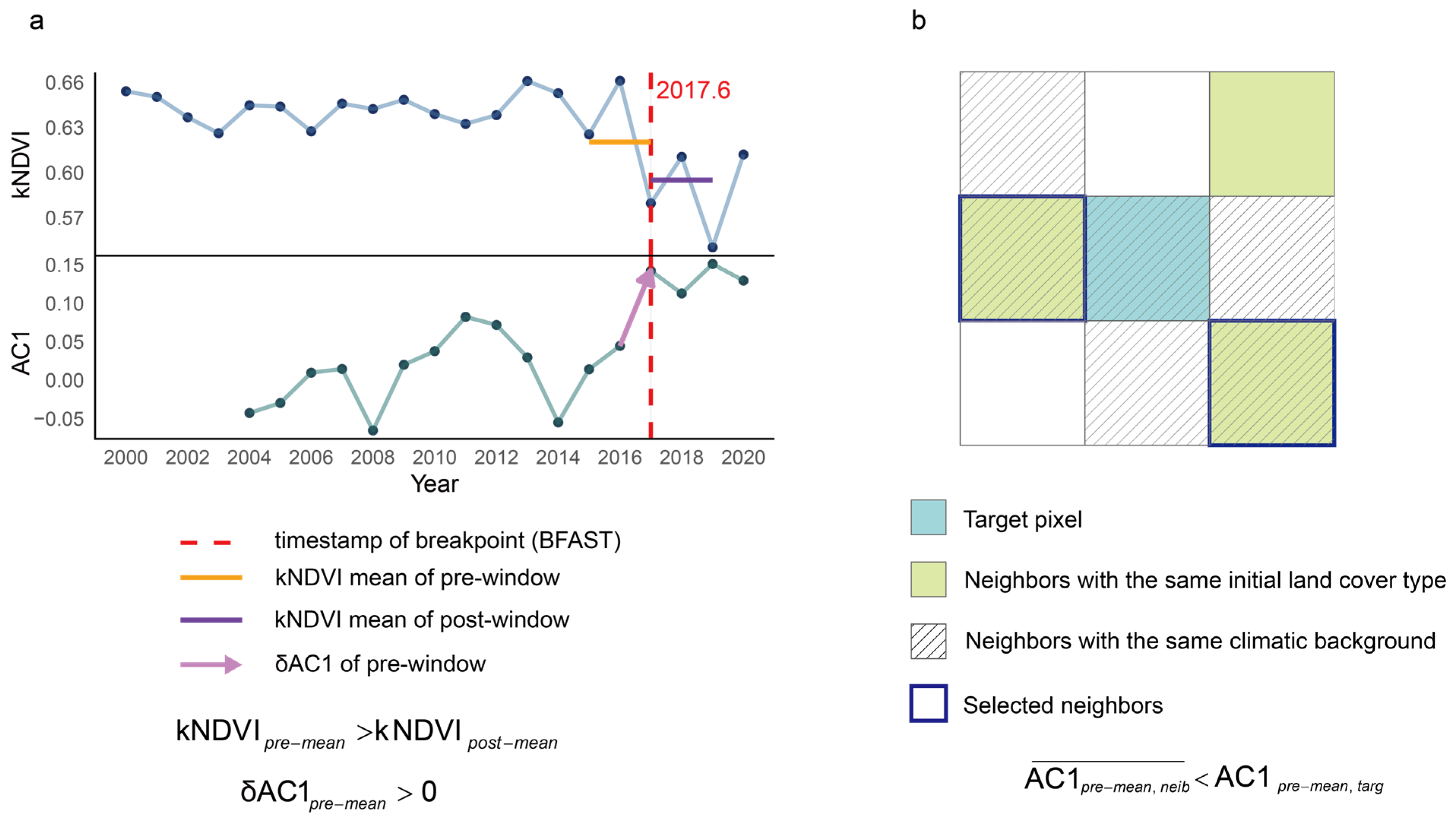
To detect climate-driven tipping points, we temporally and spatially filtered land-cover-changed pixels based on both kNDVI and AC1 time series by the following steps: (1) detecting breakpoints in kNDVI time series using the segmentation method; (2) temporal filtering based on AC1 time series; and (3) spatial filtering based on climatic background and neighbor pixels near the target pixels (Figure 2).
To enhance the reliability of the detected transitions and minimize the effect of short-term fluctuations or classification noise, the study period was divided into a baseline period (2000–2010) and a change detection period (2011–2020) [17]. Pixels that remained stable during the baseline period but changed during the detection period were identified as candidate pixels. Specifically, we derived three types of stable vegetation: stable forests, stable shrublands, and stable grasslands; and focused on three types of vegetation change: forests to shrublands (F to S), forests to grasslands (F to G) and grasslands to shrub (G to S). These transitions represent typical pathways of ecosystem degradation and resilience loss and thus hold higher priority for conservation.
The breaks for additive seasonal and trend (BFAST) algorithm was employed to detect breakpoints and their actual timestamps representing abrupt changes in the kNDVI time series. BFAST is a robust method widely used for decoupling trend and seasonal components to identify abrupt interruptions [52]. We utilized the harmonic seasonal model, setting the shortest segment length to 0.1 of the total data length to limit the minimum number of observations in each segment using the bfast package (v 1.7.1) [53].
To ensure the reliable identification of tipping points, a temporal filtering consisting of the following four criteria was developed (Figure 2a). First, we retained only those breakpoints occurring between 2010 and 2020, using the 2000–2010 period as a stable baseline. Second, we required a 24-month complete analysis window without additional breakpoints (±12 months pre/post the breakpoint) to eliminate edge effects. Third, consistent with the theory of critical slowing down, the mean kNDVI was kept higher in the pre-window than in the post-window (Equation (4)). Finally, Sen’s slope of the pre-window of AC1 time series was kept significantly positive (Equation (5)). These criteria guaranteed the rationality of our method by confirming that every detected tipping point was both consistent with resilience theory and supported by actual vegetation state changes.
k N D V I p r e m e a n > k N D V I p o s t m e a n
δ A C 1 p r e m e a n > 0
Following temporal filtering, we conducted spatial background filtering to compare the AC1 of the target pixel with its stable neighbors (Figure 2b). For each target pixel, we identified neighboring control pixels within a 10 km buffer as a spatial baseline. This distance was selected to define a local baseline that ensures environmental homogeneity while providing a sufficient sample size of stable pixels [25]. These control pixels needed to meet three criteria: (1) shared the same initial land-cover type as the target pixel but remained stable (no state changes) from 2000 to 2020; (2) experienced statistically similar climate conditions to minimize the risk of confounding factors, i.e., the Euclidean distance in the space of the standardized (z-scores) MMT was less than the 10th percentile relative to the target pixel [54,55]; and (3) exhibited a lower mean AC1 value than the target pixel during the pre-window period (Equation (6)), confirming that the target system was uniquely losing its resilience compared to its stable surroundings.
A C 1 p r e m e a n ,   n e i b ¯ < A C 1 p r e m e a n ,    t a r g
where neib and targ represent neighbor pixels and target pixels. Pixels that satisfied all temporal and spatial filtering criteria were identified as detected tipping points, representing actual evidence of regime shifts, and were subsequently used as positive samples in the following machine learning models.

2.5. Machine Learning Models for Tipping Point Prediction Using Temporal Cross-Validation

Predicting ecological tipping points is inherently challenging due to the nonlinear dynamics, high-dimensional environmental drivers, and complex interactions. Two tree-based ensemble methods, Random Forest (RF) and BRT model (XGBoost), were chosen to address these challenges. These algorithms are particularly suited for capturing non-monotonic relationships because they do not require strict parametric assumptions inherent in traditional statistical models [56]. RF is a bagging-based ensemble algorithm that reduces variance and prevents overfitting through bootstrap aggregating, although it can be computationally intensive with very large datasets and may exhibit limitations in extrapolation beyond the training data range [57]. XGBoost is a sophisticated gradient-boosting framework that sequentially builds trees to minimize errors. It incorporates L1 (Lasso) and L2 (Ridge) regularization to prevent excessive model complexity, though it is more sensitive to hyperparameter tuning and potential overfitting if not carefully calibrated [58]. In this study, we first compared the performance of both algorithms in classifying detected tipping points and subsequently selected the optimal model for the final predictive analysis.
The stable pixels (labeled as ‘0’) used in binary models were randomly selected to balance the number of tipping points (labeled as ‘1’). Predictors included both static variables and dynamic variables (see Section 2.2.3). For dynamic variables, we calculated three statistical features (mean, CV, and Sen’s slope) over the ten-year window leading up to the detected tipping point. To ensure optimal performance, the RF models were tuned using the ranger (v 0.17.0) and finetune (v 1.2.1) packages [59,60], and the XGBoost models by learning rate, tree depth, and subsampling ratios using the xgboost package (3.2.0.1) [61].
To generate a risk map highlighting areas susceptible to a future shift, we adopted temporal cross-validation by creating time-slice folds, which involve sliding training and testing subsets along the timeline [62]. Unlike standard cross-validation, this approach maintains the time order of tipping points and ensures the temporal independence between training and testing subsets, thereby preventing data leakage. Each fold consists of a training subset and a testing subset based on a specific prediction lead time (k = 1, 2, …, 5 years). For a given fold, the model was trained using tipping points occurring in Y e a r t , with dynamic features calculated from a 10-year dynamic window ending k years prior (from t-k-9 to t-k). To evaluate the model’s ability to generalize to subsequent transitions, tipping points occurring in the following year ( Y e a r t + 1 ) with one-year forward features (from t − k − 8 to t − k + 1) were used as the testing subset. For example, with a lead time k = 4, the first fold used tipping points from 2013 with features from 2000 to 2009 for training. It was tested by tipping points from 2014 with features from 2001 to 2010 (Table S2). By repeating this rolling process across the study period, we created successive time-slice folds. Within each of these folds, an internal 10-fold cross-validation was performed to validate the model’s performance and stability.
Standard performance metrics, including ROC-AUC (the receiver operating characteristic curve and the area under the curve value), kappa and accuracy, were averaged across all temporal folds to provide a comprehensive assessment of the model’s stability. After comparing the performances of RF and XGBoost models across lead times of one to five years, we chose the optimal models with refined parameters and a four-year lead time for forests and grasslands, respectively. Using the 2000–2020 period as the training window, these finalized models were applied to all the stable forest and grassland pixels across China to predict the probability of regime shifts for the year 2024 and identify critical conservation hotspots. Spatial cross-validation was then performed to account for potential spatial autocorrelation and ensure robustness [63]. Finally, to investigate the influence of five categories of potential drivers, we generated partial dependence plots to visualize how specific factors affect the probability of vegetation transitions [64]. They allow us to detect nonlinear responses and identify the critical thresholds at which different ecosystems become most vulnerable. The detection, prediction, machine learning and statistical analyses were conducted in R 4.5.1.

3. Results

3.1. Patterns of Resilience Dynamics and Detected Tipping Points

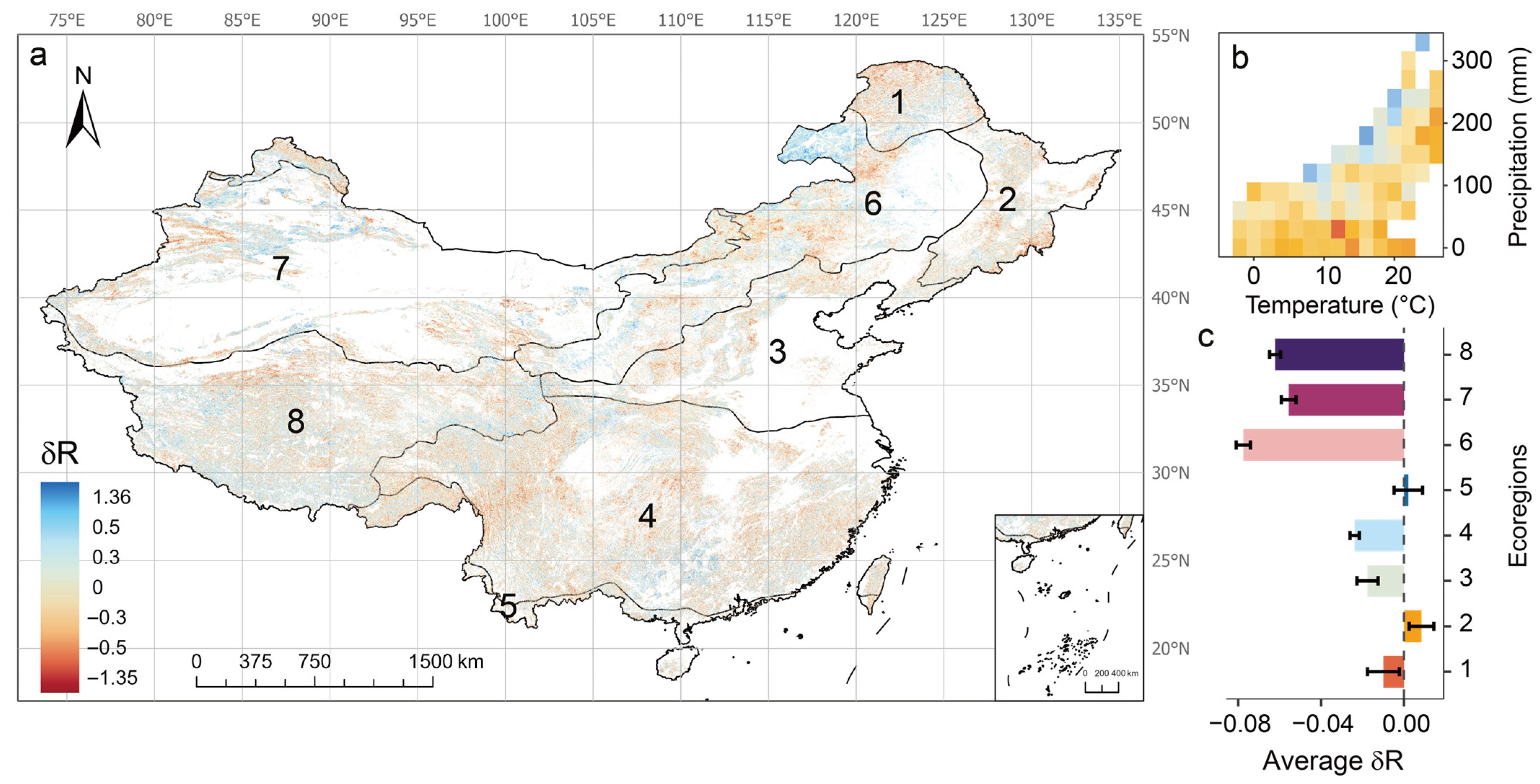
The spatial distribution map revealed widespread and significant spatial heterogeneity in resilience declines across China (Figure 3a). Hotspots of decreasing resilience were concentrated in cold temperate forests, the temperate grasslands of Inner Mongolia, and high-altitude subtropical forests. Resilience was primarily constrained by water deficits. However, it also declines in areas with high water availability when paired with high temperatures (Figure 3b). δR significantly differed between forests and grasslands (two-sided test, p < 0.05), with grasslands experiencing more severe degradation over the past two decades. Conversely, temperate and tropical forests (ecoregions 2 and 5) exhibited divergent local patterns with an average increasing trend, suggesting that these forests remained stable or even benefited from climate change (Figure 3c).
A total of 8019 tipping points were identified across China, with the highest spatial densities in warm temperate forests, subtropical forests and temperate steppe (Table S3). When categorized by transition type, forest-to-shrubland (F to S) accounted for 1929 pixels, forest-to-grassland (F to G) for 1032 pixels, and grassland-to-shrubland (G to S) for the majority, with 4793 pixels. Transitions in most FDRs were dominated by F to S, whereas F to G prevailed in cold temperate forests. Transitions in GDRs were dominated by G to S, while such transitions were not restricted to GDRs and were also frequently detected within temperate, subtropical and tropical forests, with nearly a 50% proportion (Figure S1).

3.2. Model Performance and Comparison

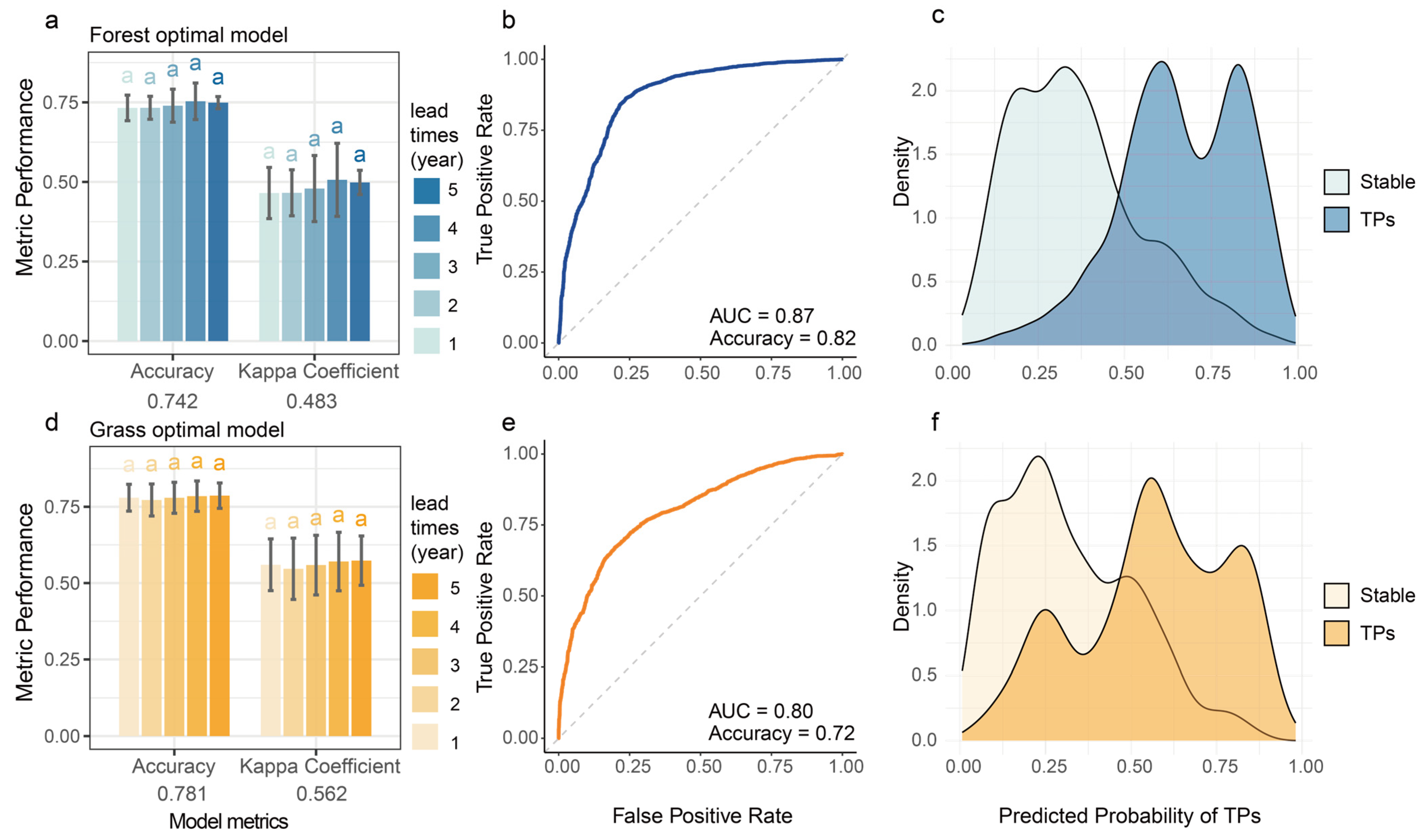
The binary classification results showed that over 70% of historical abrupt shifts were correctly predicted. RF models exhibited better performance than XGBoost with higher average accuracy and kappa scores in both FDRs and GDRs (Figure S1). Both models remained stable with no significant decline as prediction lead times increased (Tukey’s test, Figure 4a,d). This indicated their robustness in long-term prediction, enabling spatially explicit risk estimation several years in advance. We selected RF models with a 4-year lead time as the predicting model for this study. The ROC curves indicated that both models were capable of predicting tipping points with high AUC values of 0.87 and 0.80, respectively (Figure 4b,e). Distinct probability density distributions for stable points and tipping points revealed a clear separation between stable and tipping-point assignments, which also confirmed effective model discrimination (Figure 4c,f).

3.3. Drivers of Vegetation Transition Probability

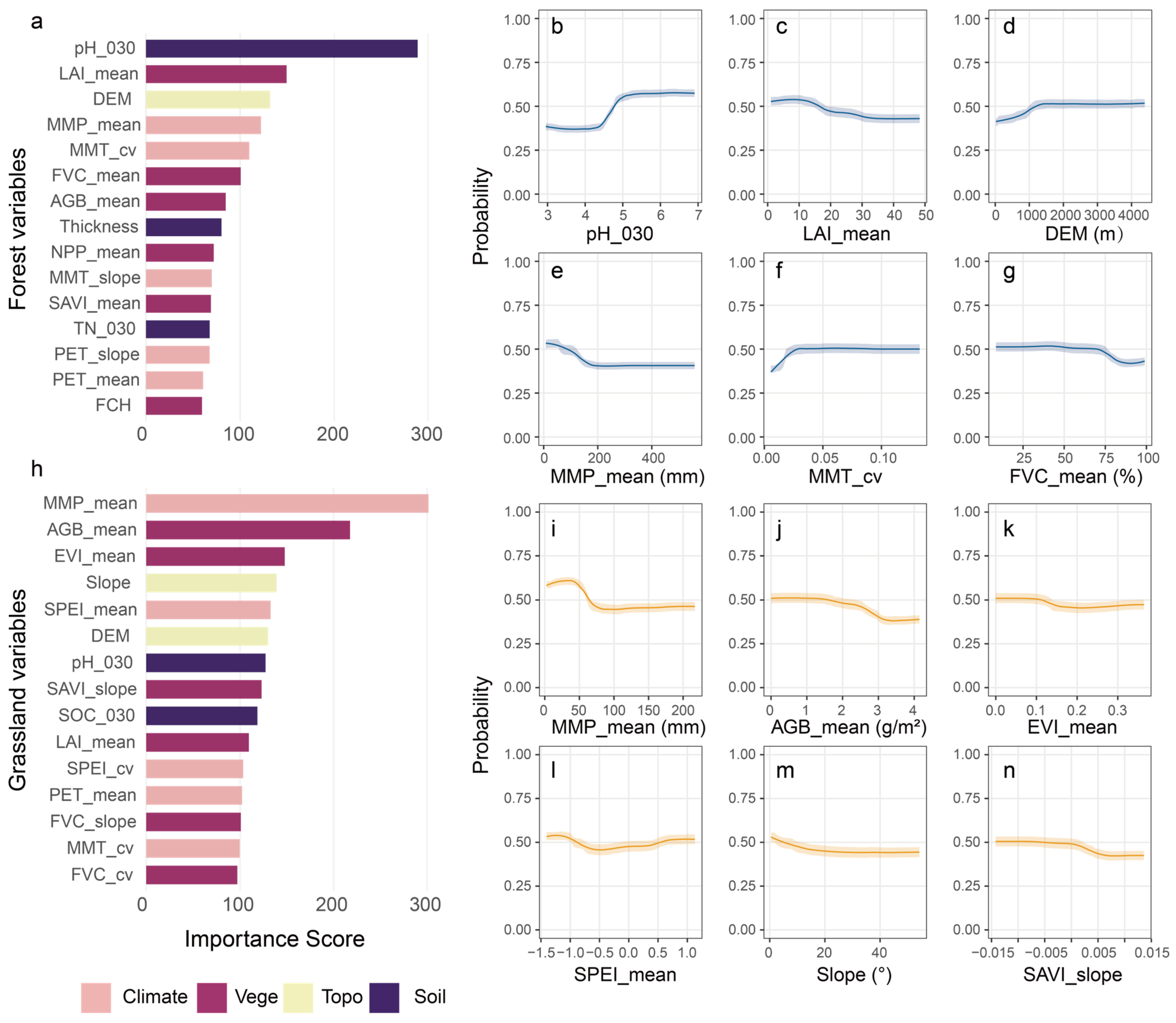
The top 15 variables ranked by Gini importance in forest and grassland models included four categories of influencing variables except for human activities. The results indicated that precipitation and soil pH were the most influential variables driving ecosystem shifts across China (Figure 5a,h). Both forests and grasslands became more vulnerable under low rainfall and impaired vegetation functions (Figure 5c,d,i,l). Soil pH exerted a more pronounced effect on forests than on grasslands, with higher pH levels significantly increasing the risk of forest die-off (Figure 5b,j). Specifically, the probability of forest transition was strongly associated with elevation, peaking at 1500 m (Figure 5e). Grassland transitions were also driven by both the average intensity and the variability of warm droughts (indicated by SPEI), suggesting that intensified and frequent droughts had negative impacts on grassland stability (Figure 5m,n).

3.4. Forecasting Vegetation Transitions in the near Future

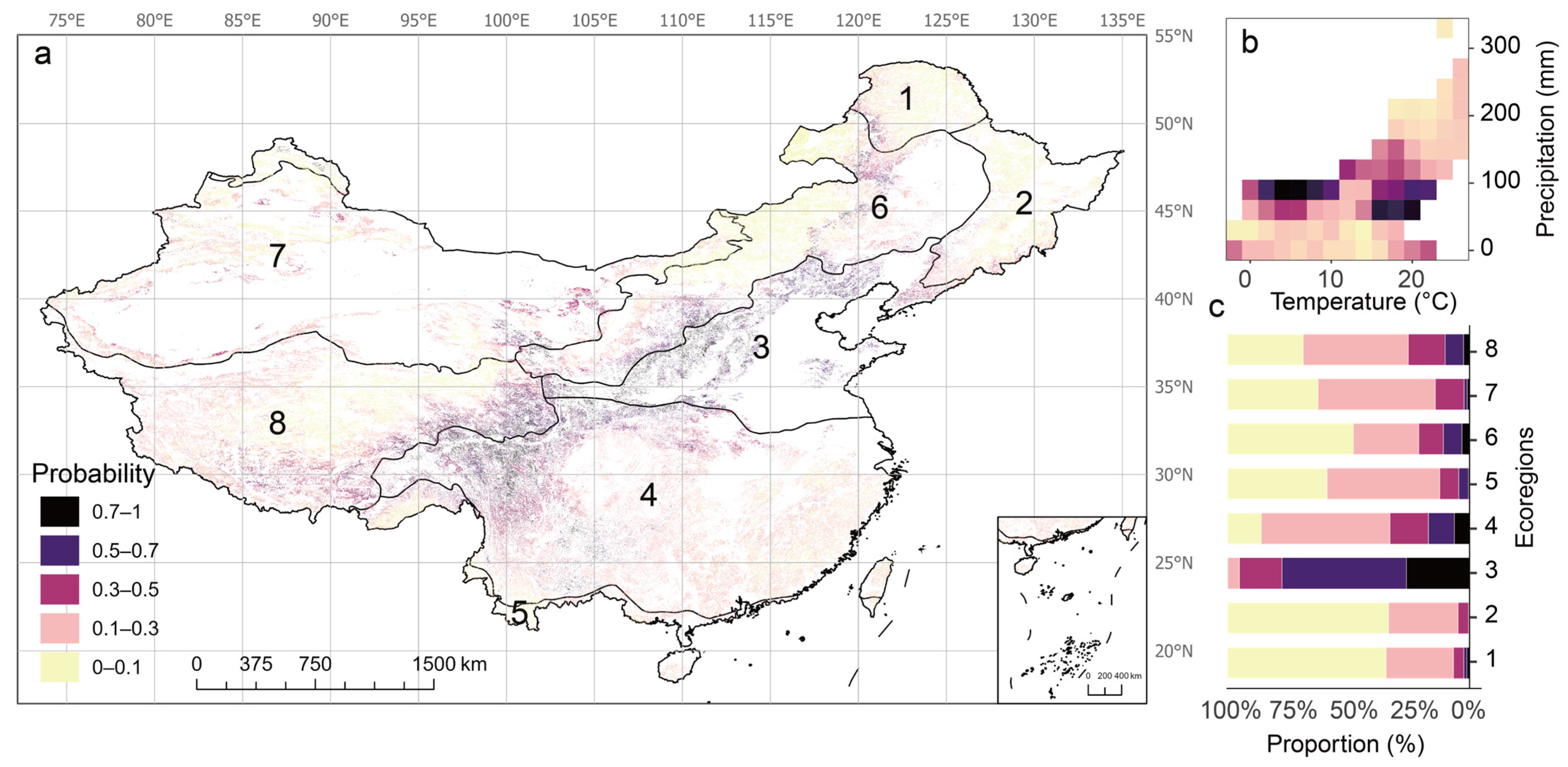
By applying the optimal RF models to the currently stable forest and grassland pixels, we generated a spatial risk map across China. It highlights hotspots that are most susceptible to near-future abrupt vegetation shifts in 2024. Inner Mongolia, the Qilian Mountains, the Loess Plateau, the Hengduan Mountains, and the southeastern Qinghai–Tibetan Plateau were the most vulnerable regions (Figure 6a). Consistent with the key drivers identified by RF models, high-risk areas were closely tied to low precipitation, especially in regions where MMP was approximately 100 mm (Figure 6b). Notably, forests, particularly in the temperate Loess Plateau and high-altitude subtropical regions, faced a significantly higher risk of state transition compared to grasslands, suggesting that forest ecosystems in these marginal environments may be approaching their physiological tolerance limits under continuous disturbance (Figure 6c).

4. Discussion

Our results highlight a pervasive decline in vegetation resilience over the past two decades, particularly in semi-arid grasslands and high-altitude subtropical forests (Figure 3). We complement previous studies that grassland resilience is sharply declining over time at a finer resolution, suggesting that they are fragile in both current state and future trajectory [65,66]. Although grasslands may naturally evolve to adapt to the climate shifts, such diminishing resilience may hinder this ability and potentially exceed their adaptive limits [67,68]. In contrast, the decline of forest resilience is widespread yet mild and fragmented. While some studies suggest that forests have remained stable or have even shown greening trends in recent decades, this underlying decline in resilience reveals that their capacity to withstand future perturbations is eroding due to human-induced climate change, with the risk of transition continuously increasing [69,70]. Therefore, ecosystem conservation strategies should not only focus on increasing the biomass or greenness but also enhance biodiversity and ecological functions at a local scale [71,72], which are all essential for long-term vegetation persistence under a changing climate.
By bridging the gap between theoretical early warning signals and land-cover changes, the methodology developed in this study facilitates a more precise detection of the historical vegetation tipping points. Rather than observable physical thresholds, the detected tipping points represent realized vegetation transitions where the vegetation’s internal functional capacity eroded to a level insufficient to withstand external stressors [8,22]. Our result was consistent with recent studies [17,73,74], indicating that ecosystems in temperate and subtropical regions are currently under elevated climatic pressure and exhibit lower resilience, making them more susceptible to crossing tipping points (Table S3). The transition from grassland to shrubland is the dominant type of tipping point detected in China, especially in high-altitude grasslands of the Qinghai–Tibetan Plateau (Figure S1). Large-scale shrub encroachment may lead to significant eco-hydrological feedbacks by altering soil moisture redistribution. Due to their deeper root systems and higher transpiration rates, shrubs typically consume more water than grass communities and substantially diminish surface runoff and groundwater recharge, thereby threatening long-term water security [75,76]. Furthermore, this transition introduces complex trade-offs in carbon sequestration. While shrub encroachment enhances aboveground biomass, it may concurrently accelerate the decomposition of deep-soil organic carbon, potentially compromising the net carbon sink capacity of semi-arid ecosystems in the long term [77]. While shrub encroachment in semi-arid regions has received significant attention [78], it is equally vital to address these transitions in alpine ecosystems to ensure their critical role as global carbon sinks and stable habitats for unique alpine species.
Combining machine learning models with temporal cross-validation proved effective in predicting tipping points (Figure 4). The highest probabilities of regime shifts are predominantly concentrated along the 400 mm annual isohyet (Figure 6), which serves as a fundamental climatic divide between semi-humid and semi-arid regions [79]. The spatial alignment suggests that vegetation transitions are primarily driven by water availability and variability (Figure 5), which also act as primary constraints on vegetation resilience [37,54,80]. Consistent with previous studies, the compound drought–heatwave events were also one of the important variables in grassland stability. These events may exacerbate water scarcity and eventually compromise the physiological capacity of grassland to persist in its current stable state [81]. Grasslands have higher sensitivity to climatic fluctuations such as droughts due to the lack of buffering effect from tree canopy, further resulting in declined productivity and recovery rate [82,83]. Soil properties are important drivers in maintaining the vegetation states as well, potentially because the belowground systems serve as a crucial mediating role in determining the health and function of aboveground vegetation [84]. Therefore, the implementation of scientific, biome-specific management approaches remains a critical subject for effective grassland conservation.
This study developed an integrated method for detecting tipping points and employed machine learning methods to predict the probability of vegetation transitions. However, several limitations warrant attention in future research. First, shrubland and bareland were not included in our model since they might be affected by human activities [85,86]. Future research could incorporate these land-cover dynamics in the transition analysis with rigorous consideration of disentangling natural variability from anthropogenic disturbances [87]. Second, accounting for extreme events, such as flash droughts and wildfires, in the model would further refine our understanding of how climate change influences the ecosystem resilience [88,89]. The impacts of regional climate oscillations, such as the variability of the East Asian Summer Monsoon along the 400 mm isohyet [90], warrant more in-depth and targeted investigation in future research, particularly through the incorporation of regional climate models. Third, due to the inherent spatio-temporal resolution trade-off of available remote sensing data and the insufficient amount of the detected tipping points for training, the predictability of abrupt shifts in this study using 2000–2020 MODIS kNDVI was limited to a five-year lead time, which can only reflect near-future risks. Fourth, the prediction models focus on the susceptibility assessment of future shifts, instead of predicting where or when abrupt shifts will occur. Therefore, if long-term time series data are available, our prediction models will be extended to capture the shift risk at decadal scales (e.g., 10 years or longer). Meanwhile, to validate the remote sensing-based transition probability, it is also necessary to develop standardized, long-term field sites to monitor the ground-truth state transition across diverse ecosystems, which is currently lacking.

5. Conclusions

This study provides a comprehensive work for resilience trend estimation, tipping-point detection and future risk prediction for natural ecosystems. The actual occurrence of vegetation type transitions reverse-verifies resilience indicators as an effective early warning signal before regime shifts. Our novel tipping-point detection method combining resilience dynamics and actual land-cover changes reveals that historical vegetation transitions in China were primarily characterized by shrub encroachment. Machine learning models combined with temporal cross-validation are demonstrated to be robust in forecasting tipping points with over 70% accuracy. Semi-arid grasslands and high-altitude subtropical forests emerged as critical hotspots, exhibiting both declined resilience and high transition risks. In addition, the probability of transition is predominantly driven by decreased precipitation and lower soil acidity, combined with degraded vegetation functions. We advance the development of refined early warning methodologies and the identification of areas facing high-risk vegetation transitions. This study offers actionable insights for climate-adaptive management in a rapidly changing world.

Supplementary Materials

The following supporting information can be downloaded at: https://www.mdpi.com/article/10.3390/rs18060889/s1, Figure S1: Percentage of different types of tipping points (TPs) within each ecoregion; Table S1: Descriptions of all the potential explanatory variables of five groups; Table S2: The detailed information of temporal cross-validation of a 4-year lead time using 10 years of training data; Table S3: Spatial density of detected tipping points pixels for each ecoregion.

Author Contributions

Conceptualization, X.Z.; methodology, X.Z., Z.Z. and Y.Z.; software, X.Z.; validation, X.Z., Z.Z. and Y.Z.; formal analysis, X.Z. and Z.Z.; investigation, X.Z. and Z.Z.; resources, X.Z. and Z.Z.; data curation, X.Z., Z.Z. and D.Z.; writing—original draft preparation, X.Z.; writing—review and editing, X.Z., Z.Z., D.Z., S.Y., C.X. and Y.Z.; visualization, X.Z., Z.Z. and Y.Z.; supervision, Y.Z.; project administration, Z.Z. and Y.Z.; funding acquisition, Z.Z. and Y.Z. All authors have read and agreed to the published version of the manuscript.

Funding

This research was funded by the Hainan Provincial Natural Science Foundation of China (grant No. 423CXTD389), the National Natural Science Foundation of China (grant Nos. 42571414 and 42301410) and the China Postdoctoral Science Foundation (grant No. 2025T180100).

Data Availability Statement

The environmental and satellite datasets used in this study are largely publicly accessible, including the MOD13Q1 and the ecogeographical regionalization map of China. ChinaCover data is available by contacting the corresponding author upon reasonable request. For detailed information for other data sources, see Table S1.

Acknowledgments

Acknowledgement for the data support from the Loess Plateau SubCenter (http://loess.geodata.cn) and Soil SubCenter (http://soil.geodata.cn), National Earth System Science Data Center, National Science & Technology Infrastructure of China.

Conflicts of Interest

The authors declare no conflicts of interest.

References

  1. Beisner, B.E.; Haydon, D.T.; Cuddington, K. Alternative stable states in ecology. Front. Ecol. Environ. 2003, 1, 376–382. [Google Scholar] [CrossRef]
  2. Dakos, V.; Carpenter, S.R.; van Nes, E.H.; Scheffer, M. Resilience indicators: Prospects and limitations for early warnings of regime shifts. Philos. Trans. R. Soc. B Biol. Sci. 2015, 370, 20130263. [Google Scholar] [CrossRef]
  3. Liu, M.; Liu, S.; Xu, X.; Soromotin, A.V.; Kuzyakov, Y. Does restoration of degraded grasslands follow the theory of multiple stable states? Agric. Ecosyst. Environ. 2025, 383, 109508. [Google Scholar] [CrossRef]
  4. van Nes, E.H.; Hirota, M.; Holmgren, M.; Scheffer, M. Tipping points in tropical tree cover: Linking theory to data. Glob. Change Biol. 2014, 20, 1016–1021. [Google Scholar] [CrossRef]
  5. Hirota, M.; Holmgren, M.; Van Nes, E.H.; Scheffer, M. Global Resilience of Tropical Forest and Savanna to Critical Transitions. Science 2011, 334, 232–235. [Google Scholar] [CrossRef]
  6. Shen, X.; Liu, Y.; Liu, B.; Zhang, J.; Wang, L.; Lu, X.; Jiang, M. Effect of shrub encroachment on land surface temperature in semi-arid areas of temperate regions of the Northern Hemisphere. Agric. For. Meteorol. 2022, 320, 108943. [Google Scholar] [CrossRef]
  7. Zhu, J.; Wang, H.; Wang, H.; Pan, Y.; Bai, Y.; Li, W.; Zheng, S. Precipitation and nitrogen enrichment impact carbon exchange and stability: From antagonism to synergy with increasing shrub encroachment. Funct. Ecol. 2025, 39, 1001–1015. [Google Scholar] [CrossRef]
  8. Scheffer, M.; Carpenter, S.R. Catastrophic regime shifts in ecosystems: Linking theory to observation. Trends Ecol. Evol. 2003, 18, 648–656. [Google Scholar] [CrossRef]
  9. Dakos, V.; Scheffer, M.; van Nes, E.H.; Brovkin, V.; Petoukhov, V.; Held, H. Slowing down as an early warning signal for abrupt climate change. Proc. Natl. Acad. Sci. USA 2008, 105, 14308–14312. [Google Scholar] [CrossRef]
  10. Scheffer, M.; Carpenter, S.; Foley, J.A.; Folke, C.; Walker, B. Catastrophic shifts in ecosystems. Nature 2001, 413, 591–596. [Google Scholar] [CrossRef]
  11. Veraart, A.J.; Faassen, E.J.; Dakos, V.; van Nes, E.H.; Lürling, M.; Scheffer, M. Recovery rates reflect distance to a tipping point in a living system. Nature 2012, 481, 357–359. [Google Scholar] [CrossRef]
  12. van de Leemput, I.A.; Dakos, V.; Scheffer, M.; van Nes, E.H. Slow Recovery from Local Disturbances as an Indicator for Loss of Ecosystem Resilience. Ecosystems 2017, 21, 141–152. [Google Scholar] [CrossRef]
  13. Scheffer, M.; Bascompte, J.; Brock, W.A.; Brovkin, V.; Carpenter, S.R.; Dakos, V.; Held, H.; van Nes, E.H.; Rietkerk, M.; Sugihara, G. Early-warning signals for critical transitions. Nature 2009, 461, 53–59. [Google Scholar] [CrossRef] [PubMed]
  14. Dakos, V.; Kéfi, S. Ecological resilience: What to measure and how. Environ. Res. Lett. 2022, 17, 043003. [Google Scholar] [CrossRef]
  15. Camps-Valls, G.; Campos-Taberner, M.; Moreno-Martínez, A.; Walther, S.; Duveiller, G.; Cescatti, A.; Mahecha, M.D.; Muñoz-Marí, J.; García-Haro, F.J.; Guanter, L.; et al. A unified vegetation index for quantifying the terrestrial biosphere. Sci. Adv. 2021, 7, eabc7447. [Google Scholar] [CrossRef] [PubMed]
  16. Smith, T.; Traxl, D.; Boers, N. Empirical evidence for recent global shifts in vegetation resilience. Nat. Clim. Change 2022, 12, 477–484. [Google Scholar] [CrossRef]
  17. Forzieri, G.; Dakos, V.; McDowell, N.G.; Ramdane, A.; Cescatti, A. Emerging signals of declining forest resilience under climate change. Nature 2022, 608, 534–539. [Google Scholar] [CrossRef]
  18. Chen, J.; Wang, S.; Shi, H.; Chen, B.; Wang, J.; Zheng, C.; Zhu, K. Radiation and temperature dominate the spatiotemporal variability in resilience of subtropical evergreen forests in China. Front. For. Glob. Change 2023, 6, 1166481. [Google Scholar] [CrossRef]
  19. Berdugo, M.; Gaitán, J.J.; Delgado-Baquerizo, M.; Crowther, T.W.; Dakos, V. Prevalence and drivers of abrupt vegetation shifts in global drylands. Proc. Natl. Acad. Sci. USA 2022, 119, e2123393119. [Google Scholar] [CrossRef]
  20. Yan, Y.; Piao, S.; Hammond, W.M.; Chen, A.; Hong, S.; Xu, H.; Munson, S.M.; Myneni, R.B.; Allen, C.D. Climate-induced tree-mortality pulses are obscured by broad-scale and long-term greening. Nat. Ecol. Evol. 2024, 8, 912–923. [Google Scholar] [CrossRef]
  21. McDowell, N.G.; Allen, C.D.; Anderson-Teixeira, K.; Aukema, B.H.; Bond-Lamberty, B.; Chini, L.; Clark, J.S.; Dietze, M.; Grossiord, C.; Hanbury-Brown, A.; et al. Pervasive shifts in forest dynamics in a changing world. Science 2020, 368, eaaz9463. [Google Scholar] [CrossRef]
  22. Smith, S.R.; Milkoreit, M.; Geels, F.W.; Lenton, T.M. Advancing science, policy and action in tipping points research. Nat. Clim. Change 2025, 15, 576–577. [Google Scholar] [CrossRef]
  23. Liu, Y.; Kumar, M.; Katul, G.G.; Porporato, A. Reduced resilience as an early warning signal of forest mortality. Nat. Clim. Change 2019, 9, 880–885. [Google Scholar] [CrossRef]
  24. Bernardino, P.N.; De Keersmaecker, W.; Fensholt, R.; Verbesselt, J.; Somers, B.; Horion, S.; Silva, T. Global-scale characterization of turning points in arid and semi-arid ecosystem functioning. Glob. Ecol. Biogeogr. 2020, 29, 1230–1245. [Google Scholar] [CrossRef]
  25. Zhang, Y.; Wang, J.A.; Berner, L.T.; Goetz, S.J.; Zhao, K.; Liu, Y. Warming and disturbances affect Arctic-boreal vegetation resilience across northwestern North America. Nat. Ecol. Evol. 2024, 8, 2265–2276. [Google Scholar] [CrossRef] [PubMed]
  26. Hillebrand, H.; Donohue, I.; Harpole, W.S.; Hodapp, D.; Kucera, M.; Lewandowska, A.M.; Merder, J.; Montoya, J.M.; Freund, J.A. Thresholds for ecological responses to global change do not emerge from empirical data. Nat. Ecol. Evol. 2020, 4, 1502–1509. [Google Scholar] [CrossRef] [PubMed]
  27. Yao, Y.; Liu, Y.; Fu, F.; Song, J.; Wang, Y.; Han, Y.; Wu, T.; Fu, B. Declined terrestrial ecosystem resilience. Glob. Change Biol. 2024, 30, e17291. [Google Scholar] [CrossRef]
  28. Bernardino, P.N.; De Keersmaecker, W.; Horion, S.; Oehmcke, S.; Gieseke, F.; Fensholt, R.; Van De Kerchove, R.; Lhermitte, S.; Abel, C.; Van Meerbeek, K.; et al. Predictability of abrupt shifts in dryland ecosystem functioning. Nat. Clim. Change 2025, 15, 86–91. [Google Scholar] [CrossRef]
  29. Didan, K. MODIS/Terra Vegetation Indices 16-Day L3 Global 250m SIN Grid V061, Edited; NASA EOSDIS Land Processes Distributed Active Archive Center: Sioux Falls, SD, USA, 2021. [CrossRef]
  30. Wu, B.; Qian, J.; Zeng, Y. Land Cover Atlas of the People’s Republic of China (1:1,000,000); SinoMaps Press: Beijing, China, 2017. [Google Scholar]
  31. Hansen, M.C.; Potapov, P.V.; Moore, R.; Hancher, M.; Turubanova, S.A.; Tyukavina, A.; Thau, D.; Stehman, S.V.; Goetz, S.J.; Loveland, T.R.; et al. High-resolution global maps of 21st-century forest cover change. Science 2013, 342, 850–853. [Google Scholar] [CrossRef]
  32. Ni, J.; Chen, Z.; Dong, M.; Chen, X.; Zhang, X. An Ecogeographical Regionalization for Biodiversity in China, Edited; Acta Botanica Sinica: Beijing, China, 1998; pp. 370–382. [Google Scholar]
  33. Zhao, X.; Zheng, Z.; Schmid, B.; Zhao, Y.; Zhao, D.; Wu, B.; Zeng, Y. Patterns and drivers of vegetation resilience across China and the negative impact of warm droughts. Geogr. Sustain. 2026, 100448. [Google Scholar] [CrossRef]
  34. Peng, S.; Ding, Y.; Liu, W.; Li, Z. 1 km monthly temperature and precipitation dataset for China from 1901 to 2017. Earth Syst. Sci. Data 2019, 11, 1931–1946. [Google Scholar] [CrossRef]
  35. Peng, S. 1-km Monthly Potential Evapotranspiration Dataset For CHINA (1901–2023); National Tibetan Plateau Data Center, Ed.; National Tibetan Plateau Data Center: Beijing, China, 2024. [CrossRef]
  36. He, Q.; Wang, M.; Liu, K.; Wang, B. High-resolution Standardized Precipitation Evapotranspiration Index (SPEI) reveals trends in drought and vegetation water availability in China. Geogr. Sustain. 2025, 6, 100228. [Google Scholar] [CrossRef]
  37. Smith, T.; Boers, N. Global vegetation resilience linked to water availability and variability. Nat. Commun. 2023, 14, 498. [Google Scholar] [CrossRef]
  38. Bao, G.; Bao, Y.; Qin, Z.; Xin, X.; Bao, Y.; Bayarsaikan, S.; Zhou, Y.; Chuntai, B. Modeling net primary productivity of terrestrial ecosystems in the semi-arid climate of the Mongolian Plateau using LSWI-based CASA ecosystem model. Int. J. Appl. Earth Obs. Geoinf. 2016, 46, 84–93. [Google Scholar] [CrossRef]
  39. Li, H.; Li, F.; Xiao, J.; Chen, J.; Lin, K.; Bao, G.; Liu, A.; Wei, G. A machine learning scheme for estimating fine-resolution grassland aboveground biomass over China with Sentinel-1/2 satellite images. Remote Sens. Environ. 2024, 311, 114317. [Google Scholar] [CrossRef]
  40. Sabatini, F.M.; Jiménez-Alfaro, B.; Jandt, U.; Chytrý, M.; Field, R.; Kessler, M.; Lenoir, J.; Schrodt, F.; Wiser, S.K.; Khan, M.A.S.A.; et al. Global patterns of vascular plant alpha diversity. Nat. Commun. 2022, 13, 4683. [Google Scholar] [CrossRef]
  41. Liu, X.; Su, Y.; Hu, T.; Yang, Q.; Liu, B.; Deng, Y.; Tang, H.; Tang, Z.; Fang, J.; Guo, Q. Neural network guided interpolation for mapping canopy height of China’s forests by integrating GEDI and ICESat-2 data. Remote Sens. Environ. 2022, 269, 112844. [Google Scholar] [CrossRef]
  42. Lin, X.; Shang, R.; Chen, J.M.; Zhao, G.; Zhang, X.; Huang, Y.; Yu, G.; He, N.; Xu, L.; Jiao, W. High-resolution forest age mapping based on forest height maps derived from GEDI and ICESat-2 space-borne lidar data. Agric. For. Meteorol. 2023, 339, 109592. [Google Scholar] [CrossRef]
  43. Das, P.; Behera, M.D.; Roy, P.S.; Barik, S.K. Predicting tipping points of vegetation resilience as a response to precipitation: Implications for understanding impacts of climate change in India. Biodivers. Conserv. 2024, 33, 3441–3458. [Google Scholar] [CrossRef]
  44. Liu, F.; Zhang, G.-L.; Song, X.; Li, D.; Zhao, Y.; Yang, J.; Wu, H.; Yang, F. High-resolution and three-dimensional mapping of soil texture of China. Geoderma 2020, 361, 114061. [Google Scholar] [CrossRef]
  45. Liu, F.; Wu, H.; Zhao, Y.; Li, D.; Yang, J.-L.; Song, X.; Shi, Z.; Zhu, A.-X.; Zhang, G.-L. Mapping high resolution National Soil Information Grids of China. Sci. Bull. 2022, 67, 328–340. [Google Scholar] [CrossRef] [PubMed]
  46. Xu, X. China Population Spatial Distribution Kilometer Grid DataSet. 2017. Available online: https://doi.org/10.12078/2017121101 (accessed on 10 March 2026).
  47. Wang, D.; Peng, Q.; Li, X.; Zhang, W.; Xia, X.; Qin, Z.; Ren, P.; Liang, S.; Yuan, W. A long-term high-resolution dataset of grasslands grazing intensity in China. Sci. Data 2024, 11, 1194. [Google Scholar] [CrossRef] [PubMed]
  48. Cleveland, R.B.; Cleveland, W.S.; McRae, J.E.; Terpenning, I. STL: A seasonal-trend decomposition. J. Off. Stat. 1990, 6, 3–73. [Google Scholar]
  49. Mushtaq, R. Augmented dickey fuller test. SSRN Electron. J. 2011. [Google Scholar] [CrossRef]
  50. Forthofer, R.N.; Lehnen, R.G. Rank Correlation Methods. In Public Program Analysis: A New Categorical Data Approach; Forthofer, R.N., Lehnen, R.G., Eds.; Springer: Boston, MA, USA, 1981; pp. 146–163. [Google Scholar] [CrossRef]
  51. Holling, C.S. Resilience and Stability of Ecological Systems. Annu. Rev. Ecol. Evol. Syst. 1973, 4, 1–23. [Google Scholar] [CrossRef]
  52. Verbesselt, J.; Hyndman, R.; Zeileis, A.; Culvenor, D. Phenological change detection while accounting for abrupt and gradual trends in satellite image time series. Remote Sens. Environ. 2010, 114, 2970–2980. [Google Scholar] [CrossRef]
  53. Verbesselt, J.; Hyndman, R.; Newnham, G.; Culvenor, D. Detecting trend and seasonal changes in satellite image time series. Remote Sens. Environ. 2010, 114, 106–115. [Google Scholar] [CrossRef]
  54. Verbesselt, J.; Umlauf, N.; Hirota, M.; Holmgren, M.; Van Nes, E.H.; Herold, M.; Zeileis, A.; Scheffer, M. Remotely sensed resilience of tropical forests. Nat. Clim. Change 2016, 6, 1028–1031. [Google Scholar] [CrossRef]
  55. Yang, C.; Cui, T.; Fan, L.; Wang, J.; Wigneron, J.-P. Temperature and Moisture Variability Drive Resilience Shifts in Canada’s Undisturbed Forests During 2001–2018. Remote Sens. 2026, 18, 190. [Google Scholar] [CrossRef]
  56. Maxwell, A.E.; Warner, T.A.; Fang, F. Implementation of machine-learning classification in remote sensing: An applied review. Int. J. Remote Sens. 2018, 39, 2784–2817. [Google Scholar] [CrossRef]
  57. Breiman, L. Random forests. Mach. Learn. 2001, 45, 5–32. [Google Scholar] [CrossRef]
  58. Chen, T.; He, T.; Benesty, M.; Khotilovich, V.; Tang, Y.; Cho, H.; Chen, K.; Mitchell, R.; Cano, I.; Zhou, T.; et al. Xgboost: Extreme Gradient Boosting, Version 3.2.0.1; R Foundation: Vienna, Austria, 2025. [Google Scholar] [CrossRef]
  59. Wright, M.N.; Ziegler, A. ranger: A Fast Implementation of Random Forests for High Dimensional Data in C++ and R. J. Stat. Softw. 2017, 77, 1–17. [Google Scholar] [CrossRef]
  60. Kuhn, M. Finetune: Additional Functions for Model Tuning, Version 1.2.1; R Foundation: Vienna, Austria, 2025. [Google Scholar] [CrossRef]
  61. Shao, J.; Zhou, X.; van Groenigen, K.J.; Zhou, G.; Zhou, H.; Zhou, L.; Lu, M.; Xia, J.; Jiang, L.; Hungate, B.A.; et al. Warming effects on grassland productivity depend on plant diversity. Glob. Ecol. Biogeogr. 2021, 31, 588–598. [Google Scholar] [CrossRef]
  62. Roberts, D.R.; Bahn, V.; Ciuti, S.; Boyce, M.S.; Elith, J.; Guillera-Arroita, G.; Hauenstein, S.; Lahoz-Monfort, J.J.; Schröder, B.; Thuiller, W.; et al. Cross-validation strategies for data with temporal, spatial, hierarchical, or phylogenetic structure. Ecography 2017, 40, 913–929. [Google Scholar] [CrossRef]
  63. Mushagalusa, C.A.; Fandohan, A.B.; Kakaï, R.G. Random forest and spatial cross-validation performance in predicting species abundance distributions. Environ. Syst. Res. 2024, 13, 23. [Google Scholar] [CrossRef]
  64. Inglis, A.; Parnell, A.; Hurley, C.B. Visualizing Variable Importance and Variable Interaction Effects in Machine Learning Models. J. Comput. Graph. Stat. 2022, 31, 766–778. [Google Scholar] [CrossRef]
  65. Wang, Z.; Fu, B.; Wu, X.; Li, Y.; Feng, Y.; Wang, S.; Wei, F.; Zhang, L. Vegetation resilience does not increase consistently with greening in China’s Loess Plateau. Commun. Earth Environ. 2023, 4, 336. [Google Scholar] [CrossRef]
  66. Wu, J.; Sun, Z.; Yao, Y.; Liu, Y. Trends of Grassland Resilience under Climate Change and Human Activities on the Mongolian Plateau. Remote Sens. 2023, 15, 2984. [Google Scholar] [CrossRef]
  67. Loarie, S.R.; Duffy, P.B.; Hamilton, H.; Asner, G.P.; Field, C.B.; Ackerly, D.D. The velocity of climate change. Nature 2009, 462, 1052–1055. [Google Scholar] [CrossRef]
  68. Dakos, V.; Matthews, B.; Hendry, A.P.; Levine, J.; Loeuille, N.; Norberg, J.; Nosil, P.; Scheffer, M.; De Meester, L. Ecosystem tipping points in an evolving world. Nat. Ecol. Evol. 2019, 3, 355–362. [Google Scholar] [CrossRef]
  69. Tao, S.; Wigneron, J.-P.; Chave, J.; Tang, Z.; Wang, Z.; Zhu, J.; Guo, Q.; Liu, Y.Y.; Ciais, P. Little evidence that Amazonian rainforests are approaching a tipping point. Nat. Clim. Change 2023, 13, 1317–1320. [Google Scholar] [CrossRef]
  70. Yi, K.; Zhao, X.; Zheng, Z.; Zhao, D.; Zeng, Y. Trends of greening and browning in terrestrial vegetation in China from 2000 to 2020. Ecol. Indic. 2023, 154, 110587. [Google Scholar] [CrossRef]
  71. Folke, C.; Carpenter, S.; Walker, B.; Scheffer, M.; Elmqvist, T.; Gunderson, L.; Holling, C.S. Regime Shifts, Resilience, and Biodiversity in Ecosystem Management. Annu. Rev. Ecol. Evol. Syst. 2004, 35, 557–581. [Google Scholar] [CrossRef]
  72. Zheng, Z.; Schmid, B.; Zeng, Y.; Schuman, M.C.; Zhao, D.; Schaepman, M.E.; Morsdorf, F. Remotely sensed functional diversity and its association with productivity in a subtropical forest. Remote Sens. Environ. 2023, 290, 113530. [Google Scholar] [CrossRef]
  73. Millar, C.I.; Stephenson, N.L. Temperate forest health in an era of emerging megadisturbance. Science 2015, 349, 823–826. [Google Scholar] [CrossRef] [PubMed]
  74. Mahaut, L.; Choler, P.; Denelle, P.; Garnier, E.; Thuiller, W.; Kattge, J.; Lemauviel-Lavenant, S.; Lavorel, S.; Munoz, F.; Renard, D.; et al. Trade-offs and synergies between ecosystem productivity and stability in temperate grasslands. Glob. Ecol. Biogeogr. 2023, 32, 561–572. [Google Scholar] [CrossRef]
  75. Zhao, L.; Li, K.; Fang, N.; Jia, S.; Cui, Z.; Liu, Y.-F.; Li, S.; Wang, X.; Liu, Y. Shrub encroachment and degradation impact water balance by altering water fluxes in alpine meadows. CATENA 2025, 258, 109231. [Google Scholar] [CrossRef]
  76. Zhou, L.; Shen, H.; Chen, L.; Li, H.; Zhang, P.; Zhao, X.; Liu, T.; Liu, S.; Xing, A.; Hu, H.; et al. Ecological consequences of shrub encroachment in the grasslands of northern China. Landsc. Ecol. 2019, 34, 119–130. [Google Scholar] [CrossRef]
  77. Li, H.; Shen, H.; Chen, L.; Liu, T.; Hu, H.; Zhao, X.; Zhou, L.; Zhang, P.; Fang, J. Effects of shrub encroachment on soil organic carbon in global grasslands. Sci. Rep. 2016, 6, 28974. [Google Scholar] [CrossRef]
  78. Chen, A.; Zhang, M.; Xu, C.; Xing, X.; Yang, D.; Xu, B.; Yang, X. Remote sensing assessment of shrub encroachment and its driving mechanisms in semi-arid grasslands. GISci. Remote Sens. 2025, 62, 2555073. [Google Scholar] [CrossRef]
  79. Jiang, J.; Qin, Y.; Liu, G.; Li, Y.; Xia, H. Fluctuations of the 400 mm precipitation line under the influence of multiple factors. Glob. Planet. Change 2026, 256, 105179. [Google Scholar] [CrossRef]
  80. Tian, J.; Zhang, Z.; Zhao, T.; Tao, H.; Zhu, B. Warmer and wetter climate induced by the continual increase in atmospheric temperature and precipitable water vapor over the arid and semi–arid regions of Northwest China. J. Hydrol. Reg. Stud. 2022, 42, 101151. [Google Scholar] [CrossRef]
  81. Schwalm, C.R.; Anderegg, W.R.L.; Michalak, A.M.; Fisher, J.B.; Biondi, F.; Koch, G.; Litvak, M.; Ogle, K.; Shaw, J.D.; Wolf, A.; et al. Global patterns of drought recovery. Nature 2017, 548, 202–205. [Google Scholar] [CrossRef] [PubMed]
  82. Hu, Y.; Fu, B.; Michaelides, K.; De Kauwe, M.G.; Wang, J.; Shen, M.; Zhang, W.; Wang, Y.; Xiao, X.; Qin, Y.; et al. Contrasting Trends in Onset of Spring Green-Up Between Grasslands and Forests in China. Earth’s Future 2025, 13, e2024EF005379. [Google Scholar] [CrossRef]
  83. Ohlert, T.; Smith, M.D.; Collins, S.L.; Knapp, A.K.; Dukes, J.S.; Sala, O.; Wilkins, K.D.; Munson, S.M.; Anderson, M.I.; Avolio, M.L.; et al. Drought intensity and duration interact to magnify losses in primary productivity. Science 2025, 390, 284–289. [Google Scholar] [CrossRef]
  84. Zhang, Z.; Liu, H.; Li, Z.; Liang, B.; Qi, J.; Li, J.; Hautier, Y. Decoupled Stability of Above- and Belowground Productivity Across Global Change Drivers. Glob. Change Biol. 2026, 32, e70668. [Google Scholar] [CrossRef]
  85. Burrell, A.L.; Evans, J.P.; De Kauwe, M.G. Anthropogenic climate change has driven over 5 million km2 of drylands towards desertification. Nat. Commun. 2020, 11, 3853. [Google Scholar] [CrossRef]
  86. Hou, H.; Yan, H.; Bai, X.; Zhang, Y.; Guo, Y.; Zhou, J.; Gao, S. A Synthetic Review of Feedbacks and Drivers of Shrub–Grass Interaction in the Process of Grassland Shrub Encroachment. Plants 2025, 14, 605. [Google Scholar] [CrossRef]
  87. Bastin, J.-F.; Latte, N.; Bogaert, J.; Garcia, C.A.; Berzaghi, F.; Maestre, F.T.; Svenning, J.-C.; Assede, E.; Barima, S.; Besisa, T.; et al. Global alternatives of natural vegetation cover. Nat. Commun. 2025, 16, 6484. [Google Scholar] [CrossRef]
  88. Wang, L.; Yuan, X.; Xie, Z.; Wu, P.; Li, Y. Increasing flash droughts over China during the recent global warming hiatus. Sci. Rep. 2016, 6, 30571. [Google Scholar] [CrossRef]
  89. Niu, S.; Luo, Y.; Li, D.; Cao, S.; Xia, J.; Li, J.; Smith, M.D. Plant growth and mortality under climatic extremes: An overview. Environ. Exp. Bot. 2014, 98, 13–19. [Google Scholar] [CrossRef]
  90. Cheng, J.; Wu, H.; Liu, Z.; Gu, P.; Wang, J.; Zhao, C.; Li, Q.; Chen, H.; Lu, H.; Hu, H.; et al. Vegetation feedback causes delayed ecosystem response to East Asian Summer Monsoon Rainfall during the Holocene. Nat. Commun. 2021, 12, 1843. [Google Scholar] [CrossRef]
Figure 1. Roadmap of this study: STL, ADF and AC1 Ts represent seasonal-trend decomposition by Loess, the augmented Dickey–Fuller (ADF) test and time series of the lag-1 temporal autocorrelation, respectively. BFAST, RF and XGBoost represent the breaks for the additive seasonal and trend algorithm, random forest and BRT model, respectively.
Remotesensing 18 00889 g001
Figure 2. An illustration of the integrated tipping-point detection method. (a) Temporal filtering criteria. The blue and green lines represent the time series of kNDVI and AC1, respectively. The AC1 time series is derived using a 30-month sliding window applied to the kNDVI residuals. The red dashed line indicates the timestamp of breakpoint detected in the kNDVI time series via the BFAST algorithm. Orange and purple lines represent the mean kNDVI values calculated from the pre- and post-windows (12-month periods preceding and following the detected breakpoint). The violet arrow represents the AC1 trend (δAC1) within the pre-window. (b) Spatial filtering criteria. Squares represent pixels, where the central blue square represents the target pixel that passed the temporal filter, and the remaining represent neighbors within a 10 km buffer. Green squares indicate neighbors with the same initial land cover type as the target pixel, while hatched squares indicate neighbors sharing the same climatic background. Squares outlined in blue are the selected neighbors. A C 1 p r e m e a n , n e i b ¯ and A C 1 p r e m e a n , t a r g represent the mean AC1 value of the selected neighbor pixels during the pre-window, and the specific AC1 of the target pixel during the same period, respectively.
Remotesensing 18 00889 g002
Figure 3. Spatial pattern and climate sensitivity of resilience trend (δR) across China. (a) Spatial pattern of δR calculated from kNDVI time series during 2000–2020 at a spatial resolution of 250 m. (b) Bivariate climate space of δR across mean temperature and precipitation intervals, sharing the color ramp with panel a. (c) The average and standard error bar plots of δR in eight ecoregions. Numbers of 1–8 indicate: 1. CTempNLF: cold temperate needleleaf forest; 2. TempNBMF: temperate needleleaf broadleaf mixed forest; 3. WTempDBF: warm temperate deciduous broadleaf forest; 4. SubtroEBF: subtropical evergreen broadleaf forest; 5. TroRF: tropical rain forest; 6. TempS: temperate steppe; 7. TempD: temperate desert; 8. QTPVege: the Qinghai–Tibetan Plateau alpine vegetation.
Remotesensing 18 00889 g003
Figure 4. RF model performance of forests (the upper panel) and grasslands (the bottom panel). (a,d) represent model performance at different lead times. Average values of model performance for the five-year lead time are displayed below the corresponding x-axis labels. The same letter represents no significant (at p > 0.05) differences between groups according to Tukey’s test. (b,e) represent the receiver operating characteristic (ROC) curves and the area under the curve (AUC) values of two models based on spatial cross-validation. (c,f) represent the density of the predicted probability of stable pixels and tipping points (TPs).
Remotesensing 18 00889 g004
Figure 5. Variable importance and partial dependence plots for the RF models in forests (top panels, (ag)) and grasslands (bottom panels, (hn)), ranked by Gini importance. Partial dependence plots show the marginal effect of the top six influential variables on the probability of an abrupt shift. The shaded areas indicate the standard errors of the estimated mean probability. For the abbreviations of variables, see Section 2.2.
Remotesensing 18 00889 g005
Figure 6. Spatial pattern of the probability of vegetation transition in 2024 predicted by optimal RF models. (a) Vegetation transition probabilities pattern in 2024 predicted by the RF model based on stable forests and grasslands pixels at a spatial resolution of 250 m in China. (b) Bivariate climate space of probability across mean temperature and precipitation intervals. (c) Percentage composition of each level of probability within eight ecoregions. The three panels share the same color ramp. Numbers of 1–8 indicate: 1. CTempNLF: cold temperate needleleaf forest; 2. TempNBMF: temperate needleleaf broadleaf mixed forest; 3. WTempDBF: warm temperate deciduous broadleaf forest; 4. SubtroEBF: subtropical evergreen broadleaf forest; 5. TroRF: tropical rain forest; 6. TempS: temperate steppe; 7. TempD: temperate desert; 8. QTPVege: the Qinghai–Tibetan Plateau alpine vegetation.
Remotesensing 18 00889 g006
Disclaimer/Publisher’s Note: The statements, opinions and data contained in all publications are solely those of the individual author(s) and contributor(s) and not of MDPI and/or the editor(s). MDPI and/or the editor(s) disclaim responsibility for any injury to people or property resulting from any ideas, methods, instructions or products referred to in the content.