Article

10 Years of Lidar Observations of Polar Stratospheric Clouds at Concordia Station
1
CNR-Institute of Atmospheric Sciences and Climate, Via Fosso del Cavaliere 100, 00133 Roma, Italy
2
ENEA, Via Enrico Fermi 45, 00044 Frascati, Italy
3
CNR-ISMAR, Institute of Marine Science, Via Fosso del Cavaliere 100, 00133 Roma, Italy
*
Author to whom correspondence should be addressed.
Remote Sens. 2026, 18(6), 874; https://doi.org/10.3390/rs18060874
Submission received: 5 February 2026 / Revised: 2 March 2026 / Accepted: 4 March 2026 / Published: 12 March 2026
(This article belongs to the Section Atmospheric Remote Sensing)

Highlights

  • What are the main findings?
    • Polar stratospheric clouds observed at Concordia are in good agreement with CALIOP data and represent a large area of the Antarctic plateau.
    • Strong inter-annual variations in PSC occurrences have been observed, mainly due to the vortex conditions.
  • What are the implications of the main findings?
    • Long-term ground-based lidar observations provide a tool for calibration and validation of satellite measurements.
    • Multi-decadal measurements are required to determine long-term trends of PSC occurrences

Abstract

Polar Stratospheric Clouds (PSC) have been observed by the lidar observatory at Concordia station since 2014. The Concordia lidar is one of a few primary lidar stations in Antarctica of the Network for the Detection of Atmospheric Composition Change (NDACC). The lidar system was deployed at McMurdo from 2004 to 2010 and has been upgraded before its installation at Concordia. Concordia station is one of the most favourable locations for the observation of polar stratospheric clouds, due to the limited cloud cover by tropospheric clouds and the ubiquitous presence of PSCs throughout the Antarctic winter. The PSCs observations have been synchronized with the overpasses of satellite borne lidars, CALIOP (Cloud-Aerosol Lidar with Orthogonal Polarization) on the CALIPSO (Cloud-Aerosol Lidar and Infrared Pathfinder Satellite Observation) satellite from 2014 to June 2023, and the Atmospheric Lidar (ATLID) on the EarthCARE (Earth, Cloud, Aerosol and Radiation Explorer) mission since September 2024. A modified v2 algorithm, used for the detection and classification of PSCs as observed by CALIOP, has been used to determine detection limits and classification criteria. This facilitates comparison with CALIOP PSC profiles during quasi-coincident overpasses of the CALIPSO with respect to Concordia station. A local PSC climatology has been produced, with typically more than 150 profiles per PSC season. Considerable inter-annual variations have been observed, mostly depending on the local temperature. The data have been used to infer a decadal trend of PSC occurrences, although the large inter-annual variability renders such an approach difficult. The occurrences of the different PSC types show a strong correlation with the local temperature and depend on the formation processes and the formation temperatures of the different PSCs.

1. Introduction

Polar stratospheric clouds play an important role in stratospheric chemistry, providing a surface for heterogeneous reactions leading to the conversion of stable chlorine reservoir species such as HCl and ClONO2 to chlorine radicals which contribute to the catalytic depletion of ozone. The sedimentation of PSC particles containing water and nitric acid molecules leads to the dehydration and denitrification of the stratosphere.
The formation of PSCs depends mainly on temperature and the availability of condensation nuclei, water vapour, nitric acid and sulphuric acid. Polar stratospheric clouds nucleate heterogeneously on solid aerosol particles; in particular, meteoric dust (meteoric smoke particles) has been shown to act as efficient nucleation sites for NAT (Nitric Acid Trihydrate) and ice PSCs, and stratospheric aerosol from volcanic injections (sulfate and refractory material) likewise provides surfaces that facilitate condensation and heterogeneous nucleation under cold polar conditions [1,2,3,4], while particles injected into the stratosphere by intense biomass-burning events may also provide condensation and heterogeneous nucleation sites [5]. The ozone depletion caused by the PSCs, as well as the removal of water vapour and nitric acid has been implemented in many chemistry-climate models (CCMs) and chemical transport models (CTMs), that usually use parametrizations that do not explicitly resolve the full complexity of PSC formation processes and their interactions with stratospheric chemistry, but nevertheless provide a reasonable simulation of chlorine activation, denitrification and polar ozone loss. Since PSC formation depends strongly on temperature, an accurate representation of stratospheric conditions is essential. CTMs use temperatures from assimilated data and provide quite realistic synoptic scale temperatures, although their spatial resolution is often insufficient to capture mesoscale temperature variations. The temperature fields in CTMs and in specified-dynamics (nudged) CCM simulations are typically constrained by reanalyses. Differences and biases in polar stratospheric temperatures - including cold biases - may affect PSC thresholds, thereby impacting PSC occurrence and associated ozone loss [6,7,8,9,10]. Model parametrization can be tuned by PSC observations, as has been shown by Steiner et al. [9], who compared a state-of-the-art CCM with CALIPSO space-borne lidar measurements.
Here we present 10 years of PSC observation at the Antarctic station of Concordia, in order to provide a long-term record of PSC observations at the Antarctic plateau, where synoptic conditions prevail. These data may provide a local data set for calibration and validation for space-borne lidars, based on PSC observations in quasi coincidence with overpasses of the CALIOP lidar on CALIPSO during large part of the CALIPSO mission and will be exploited for synchronous measurements with the ATLID lidar on board the EarthCARE mission. In Section 2 we give a short overview of the Concordia lidar hardware and operation and the data processing. Section 3 describes the detection and classification algorithms used to obtain occurrences of the different PSC species and mixtures, as well as a comparison of these occurrences with the local temperatures. In Section 4 the decadal time series of PSC observations from 2014 to 2024 will be discussed in terms of inter-annual variations and long term trends.

2. Materials and Methods

2.1. Description of the Concordia Lidar

In 2005 Concordia Station became a permanent research station with a winter staff of about 12 to 15 technicians and scientists mainly from France and Italy. Its location on the Antarctic Plateau at 3233 m above sea level (75.1°S 123.3°E) is ideal for the observation of polar stratospheric clouds [11] (see Figure 1). The Antarctic plateau covers large part of the continent, including South Pole (about 1670 km from Concordia) where synoptic conditions prevail, and the PSC observations at Concordia are to a high extent representative for this area.
Concordia Station and Dumont D’Urville are the only two lidar stations included in the Network for the Detection of Atmospheric Composition Change (NDACC) in Antarctica. The stratospheric lidar was operated at McMurdo Station from 2004 to 2010 [7] and was transferred to Concordia station in 2014, where it is presently. The observatory was upgraded since its early deployment and will be further equipped with a UV emitting laser in 2026. The technical features of the lidar, including its remote control, have been described in detail before [12,13]. Here we give a short description of the most important system parameters (see also Table 1). The core of the system is a rugged Quantel Big Sky laser (Big Sky, Bozeman, Montana, USA, model CFR400) which emits 180 mJ per pulse at 532 nm with a repetition rate of 10 Hz. The backscattered lidar signal is collected by two receivers and the optical signals are recorded with a photon-counting system. A Schmidt Cassegrain telescope (Celestron model C14-AF XLT) with a diameter of 14 inch (355.6 mm) is used for the observation of PSCs at ranges between 10 and 30 km, while a smaller 6-inch (152.4 mm) telescope (Celestron model C6S GT XLT) is aligned to observe tropospheric clouds. The larger receiver is coupled to an optical box where the optical signal is separated in different components and detected by miniaturized photomultipliers (Hamamatsu models H6780-20, H5783P and H10721P-210) for the optical wavelengths or by an avalanche photo diode (APD, EG&G, Perkin-Elmer model SPCM-AQR-14) for the infrared signal. Details of the optical system can be found in [14]. Observations at Concordia are made with a polarization lidar, using a laser emitting linearly polarized light and a receiver detecting the polarization of the lidar signal. The two parameters representing the polarization of the lidar signal allow to distinguish between liquid and solid particles. A certain redundancy, ensuring that the observatory continues to function in case of failure of one or more components, has been obtained by having a spare laser available as well as several electronic components and optics. The photon counting system has 10 channels available for the 7 optical signals. The optical channels include three 532 nm channels recorded by the large telescope (parallel, perpendicular and attenuated parallel polarization with respect to the laser emission) and two 532 nm channels from the small telescope (parallel and perpendicular), and furthermore the Raman channel at 308 nm and the infrared channel at 1064 nm, both recorded by the large telescope.

2.2. Measurement Protocols

Since the main goal of the Concordia lidar is the observation of polar stratospheric clouds, operation is focused on the period when PSCs are predominantly present, typically from the second half of June to September. Often the measurement sessions, usually 2 to 4 sessions of 32 min per day, were synchronized with overpasses of the CALIOP lidar on the CALIPSO satellite, with a footprint within 300 km from Concordia station. The satellite borne lidar (CALIOP) on the CALIPSO satellite was active from 2006 to June 2023. With 14 or 15 orbits per day CALIPSO covers large part of the polar regions up to 82° in latitude. This results in a few quasi-coincident overpasses per day with respect to Concordia (see also [7,13]). The comparison of a large data set of quasi-coincident PSC occurrences recorded by ground-based and satellite borne lidar has been reported in [13].

2.3. Preprocessing of the Raw Lidar Data

A polarization lidar is equipped with a laser source emitting a polarized laser beam. The polarized laser emission is backscattered by aerosols and molecules present in the illuminated airmass, which may cause a partial depolarization. In order to distinguish between polarizing and non-polarizing aerosol and molecules, a polarization lidar ideally separates the optical signal in two parts by using polarizing beam-splitters; one part with the same polarization as the emitting laser, the other with an orthogonal polarization.
However, the separation of signals with different polarization is not straightforward, for a variety of reasons. Among these are the imperfect polarization of the laser emission, crosstalk between the two optical channels and the depolarization caused by optical interfaces, such as the viewport. A crosstalk correction was applied after a careful calibration of the two polarization channels [15]. The two polarization channels have been calibrated by using a method which is similar to that reported by Alvarez et al. [16], and uses a rotatable polarizing film which transmits only along a specific axis. The polarizing film is inserted in the collimated optical beam exiting the telescope and before the polarizing beam splitter cubes. Measurements in clear sky conditions (i.e., absence of aerosols and clouds) while rotating the polarizing film can be fitted to a theoretical formula [15] to obtain the electro-optic gain ratio G r between the two channels as well as the depolarization ratio δ . The preprocessing of the raw optical signals includes the correction for the background signal (i.e., photon counts in absence of laser emission, due to dark counts of the photomultipliers) and the attenuation by molecules and aerosols. The attenuation was corrected by using a fixed lidar ratio (the ratio of the particle extinction coefficient and the particle backscattering coefficient). The fixed lidar ratio of 70 sr used in this work has been determined by considering observations with a negligible aerosol load below and above a well defined PSC. The method proposed by Young and Vaughan [17] has been applied to a selected set of measurements obtained with the Concordia lidar to obtain lidar ratios for different kinds of PSCs and cirrus clouds, but it is difficult to apply in case of layered clouds which often occur at Concordia. After the preprocessing of the raw data the total backscatter ratio and the perpendicular backscatter coefficient β were determined on altitude levels spaced by 180 m, to facilitate comparison with the CALIOP PSC special product. Uncertainties due to systematic and statistical errors u( β ) and u(R) are determined along with these parameters.

2.4. Detection and Classification of PSCs

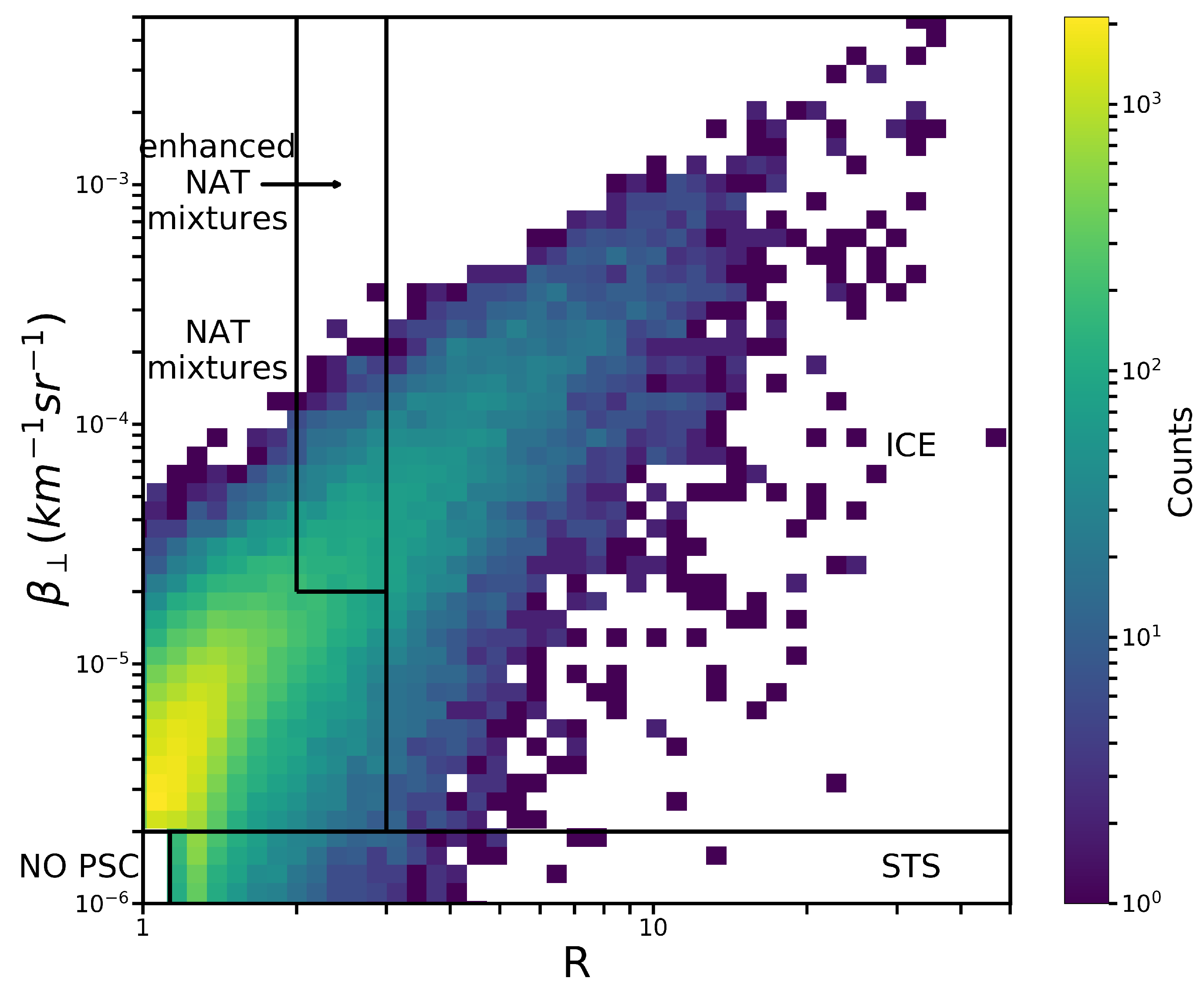
The two optical parameters, resulting from the lidar measurements, allow for the detection and classification of the observed PSCs. We adapted the v2 CALIOP algorithm (see Figure 2) [7,18] used for the CALIOP PSC data, facilitating the comparison of the ground-based data with nearby overpasses of CALIPSO. A similar approach has been used for the PSCs observed at Dumont D’Urville [19]. Some criteria are different, however, for a ground-based lidar. Notably, while CALIOP determines the detection threshold from the signal due to background aerosol from measurements where no PSCs are present, taken at different locations on the same orbit, the background signal for the ground-based observations has been determined from apparently clear sky observations, which are not very frequent during winter when PSC observations dominate. In addition, similar to the CALIOP measurements, Poisson statistical errors of the photon counting process, depending on the number of counts and thus on altitude and attenuation by clouds, were used to calculate the errors of the optical parameters u( β ) and u(R) and determine the dynamic thresholds for detection and classification. Figure 2 shows the thresholds for detection and classification, where some of the thresholds are dynamic (the detection thresholds for PSC detection, determined by the background values of the two optical parameters and their errors), while others are fixed values (R = 2 and β = 2 × 10⁻⁵ km−1sr−1 separate NAT mixtures from enhanced NAT). The threshold between enhanced NAT and ice, RNAT|ice, has been calculated dynamically according to the total abundances of HNO3 and H2O vapours [18] and has been obtained from the auxiliary data included in the CALIOP v2 special product dataset.
If one of the two parameters, the backscatter ratio R and the perpendicular backscatter coefficient β , exceeds the threshold value, a PSC detection is recorded. The CALIOP classification algorithm distinguishes 5 classes; STS (Supercooled Ternary Solutions), NAT (Nitric Acid Trihydrates) mixtures, enhanced NAT mixtures, ice and wave ice. Often PSCs consist of mixtures of different aerosol species, and the optical parameters obtained with lidar measurements are an average of the backscatter coefficient and depolarization of each species. For instance the NAT mixture class contains principally NAT with a variable contribution of non-polarizing aerosol. Enhanced NAT particles are defined in [18] as small NAT ( r N A T < 3 μm) with a large volume density (>1 μm3cm−3) and corresponds roughly with NAT heterogeneously nucleated in wave ice PSCs. Wave ice PSCs are ice PSCs with a very large backscatter ratio (R > 50). Wave ice is practically absent above Concordia, due to its flat orography. Also enhanced NAT is rarely observed. The main class at Concordia consists of NAT mixtures, followed by STS and ice as can be observed in Figure 2.

3. Results and Discussion

3.1. Quasi-Coincident Ground-Based and CALIOP PSC Observations

Often the ground-based lidar observations at Concordia station were recorded when nearby overpasses of the CALIPSO satellite, with an space-borne lidar (CALIOP) on board were available. One must bear in mind that very few overpasses occur at less than 50 km from Concordia station, implying that both lidars rarely observe the same airmass although they might observe clouds with a large extension. However, it was shown in a previous work [13], that considering these quasi-coincident observations both lidars produced similar data in terms of detection and classification. When comparing observations made by different instruments one should use similar algorithms and thresholds. A study by Achtert and Tesche [20] showed how different criteria applied to the same data resulted in significant differences in PSC classification. Due to a different observation geometry it is even more troublesome to compare PSC data recorded by ground-based and satellite borne lidars. Adverse weather conditions might inhibit PSC observations from the ground while such problems do not exist for space-borne lidars. The signal-to-noise ratio is strongly influenced by the observation geometry, where the distances to the target vary enormously. In addition, ground-based lidar observations are essentially Eulerian, sampling air masses as they advect over a fixed site, whereas satellite-borne lidars provide quasi-Lagrangian observations along the orbital track. This leads to substantially different spatial and temporal averaging between the two measurement approaches. During the polar winter PSCs are ubiquitous at Concordia and clear sky measurements seldom occur. The satellite borne lidar observes both PSCs and clear sky profiles during each orbit, which is important for calibration purposes. On the other hand, the use of clear sky profiles which are distant in time from the PSC observations may introduce major calibration errors for ground-based systems. While CALIOP had a nominal lifetime of 3 years, its operation was extended until 2023. However, since mid-2016, the lidar exhibited an increasing number of low energy laser pulses, due to pressure losses of the lidar housing. These low energy pulses were mostly produced in the South Atlantic Anomaly region(SAA) and to a much lesser extent elsewhere. A low energy mitigation (LEM) algorithm was developed to mitigate the effect on the level 4 data [21], resulting in an almost complete recovery of the data. The CALIOP data used here are practically unaffected by the low energy pulses of the CALIOP laser.
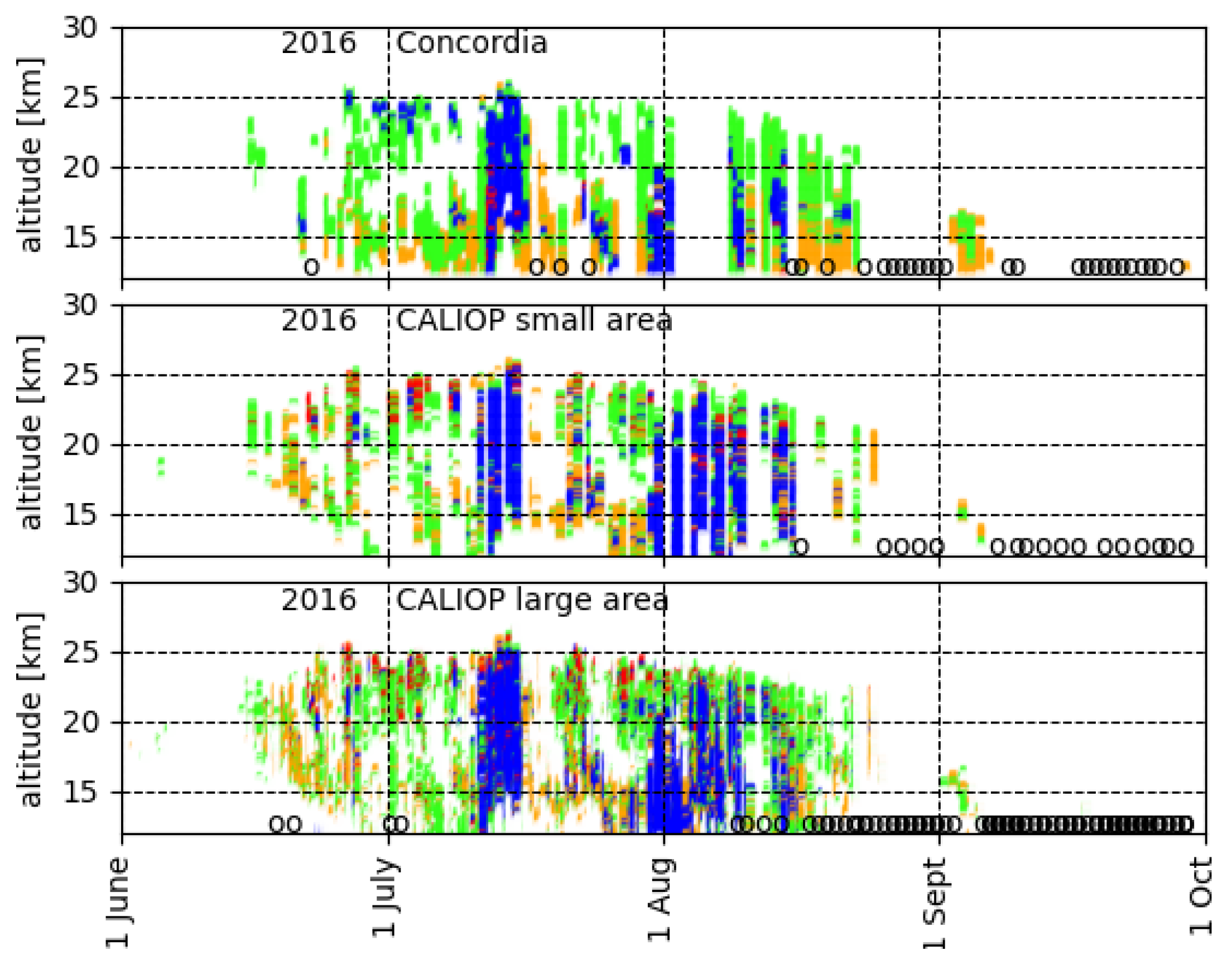
We show here as an example a comparison for the 2016 data (see Figure 3), due to the large amount of data from both instruments in that year. For other years, fewer data are available and often do not cover a full season, which make comparison more difficult. From June to September 2016, 153 PSC profiles were observed by the ground-based lidar and comparison with 132 CALIOP profiles recorded in the same period and at distances below 150 km show a good agreement between PSCs observed by the two lidars. Figure 3 has been obtained as follows: the ground-based data have been gridded on a 180 m grid, thus matching the vertical resolution of the CALIOP data. The colour codes identify the different PSC classes as follows: NAT mixtures, STS, ice and enhanced NAT mixtures are displayed in green, orange, blue and red, respectively. From the global CALIOP data, all overpasses within a latitude-longitude range defined by the following coordinates (74.1°S < lat < 76.1°S and 119.8°E < lon < 126.8°E) centred on Concordia station were selected. The nearest profile with respect to Concordia Station, was used to obtain the PSC classification according to the PSC special product data set, and compared with the ground based profiles. The average distance of the CALIOP footprints was 75 km while the largest distance was 150 km. We also compared CALIOP data at larger distances from Concordia base, to explore the representativeness of Concordia for a larger area. We thus considered all CALIOP overpasses within the following coordinates (73.1°S < lat < 77.1°S and 100°E < lon < 150°E) with the exclusion of the smaller inner area (74.1°S < lat < 76.1°S and 119.8°E < lon < 126.8°E). This resulted in overpasses with an average distance of 368 km and a maximum distance of 810 km. The results are displayed in the lower panel of Figure 3. Note that the large area (with exclusion of the smaller area) has an area of 516,000 square km, 11.6 times larger than the small area. As a results many more profiles were available due to CALIOP overpasses (684 instead of 132). The comparison with CALIOP profiles recorded at small and larger distances demonstrates that the ground-based data produce a reasonable representation of a large area on the Antarctic plateau. The comparison shows that in many cases PSC detection by both lidars occur, while the classification is not always the same, with the exception of ice PSCs. Ice PSCs are relatively easy to detect, having a large back scatter ratio, and are also easily classified for the same reason. Liquid PSCs (STS) and NAT mixtures have average backscatter ratio and it is difficult to distinguish STS with negligible depolarization from NAT mixtures with small depolarization. However, an overall agreement between ground-based and CALIOP data can be observed and indicates that the PSC fields above Concordia station consist of rather extended and homogeneous clouds, as has been demonstrated previously by Snels et al. [13].
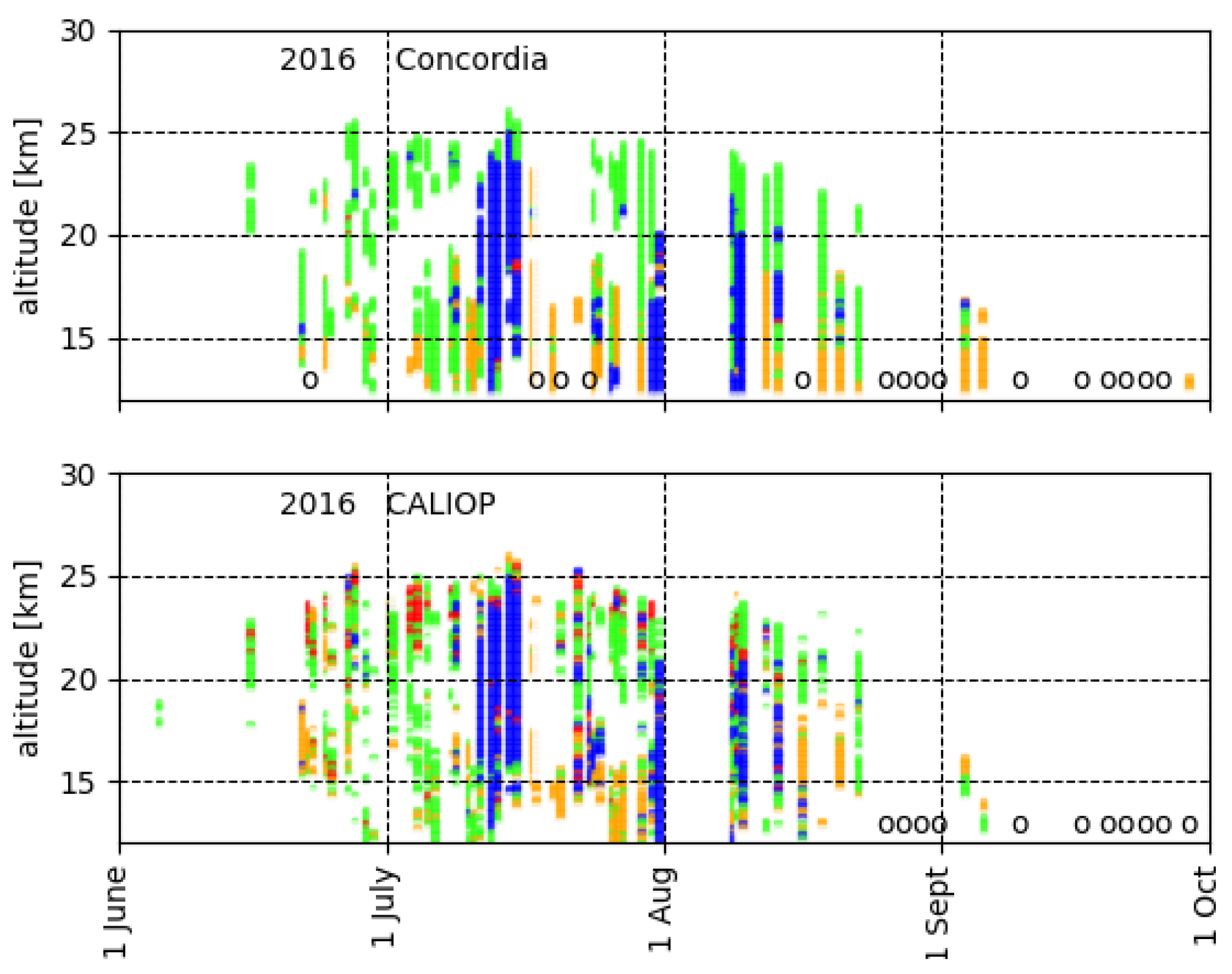
If we now limit the comparison to ground-based data and quasi-coincident CALIOP overpasses, meaning overpasses that occur within one hour of the ground-based measurement in the smaller area, we reduce the number of data to be compared to 76 instead of 132 profiles. This produces a better agreement with respect to Figure 3, where all data were considered, but some discrepancies remain, due to the fact that the two lidars do not observe the same airmass, and the better sensitivity of the ground-based lidar for PSCs with a small depolarization. This is demonstrated by the observation of liquid PSCs (STS) in August and September by the ground-based lidar, which went undetected by CALIOP (see Figure 4). We performed a statistical analysis for all coincident observations, considering all cases when both lidars observed a PSC. Here a PSC observation consists of a positive detection in a 180 m interval of the lidar profile. The detection correlation is quite good; in 82% of all observations ground-based and space-borne detections agreed, meaning that both detected presence or absence of PSCs. In 18% of the cases, only one of the two lidars detected a PSC. When comparing the classifcations of the positive detections we observe that in 65% of all cases both lidars produce the same PSC class. See Table 2 for the correlation between the two classifications.
Of course the classification depends on the chosen thresholds between STS and NAT mixtures and between enhanced NAT and ice and NAT mixtures and ice (RNAT|ice). These thresholds have been determined following the algorithm adopted for the CALIOP v2 classification [18], but some differences are inevitable. To explore small the effect of small changes in these thresholds, we performed a second correlation analysis with a ±10% change of these thresholds. The result is that about half of the observations classified as enhanced NAT by the ground-based lidar might now be classified as NAT mixtures or ice, while also the balance between NAT mixtures and STS is shifted. Overall a 77% agreement between the classification of the two lidars might be obtained if one considers a small (10%) shift of the thresholds, as can be seen in Table 3.

3.2. Temperature Dependence of PSCs

It is well known that different PSC aerosol species exist in a limited temperature range (see [22,23,24]). Threshold temperatures have been calculated for their existence indicating an approximate upper limit for their observation. However, one must consider different pathways during the formation processes, with local temperature variations induced by either large synoptic fields or mesoscale features. The nucleation and growth of the different PSCs has been extensively discussed elsewhere [25]. Since the temperature plays such an important role in the formation processes of PSCs, a careful choice of temperature data is mandatory. Among the major reanalysis models ERA5 (ECMWF ReAnalysis version 5) and MERRA2 (Modern-Era Retrospective analysis for Research and Applications, Version 2) are considered to be the most accurate. Lambert and Santee [26] investigated the accuracy and precision of polar lower stratospheric temperatures (100–10 hPa during 2008–2013) reported in several contemporary reanalysis datasets, including MERRA2. They concluded that the biases of the reanalyses with respect to COSMIC (Constellation Observing System for Meteorology, Ionosphere and Climate) temperatures for both polar regions fall within the narrow range of −0.6 K to +0.5 K. Several studies compared ERA5 and MERRA2 temperatures [27,28], focusing on different aspects and regions. We compared MERRA2 and ERA5 temperatures at Concordia between 15 and 21 km from 2014 to 2024 and found an average cold bias of MERRA2 with respect to ERA5 of 0.3 K.
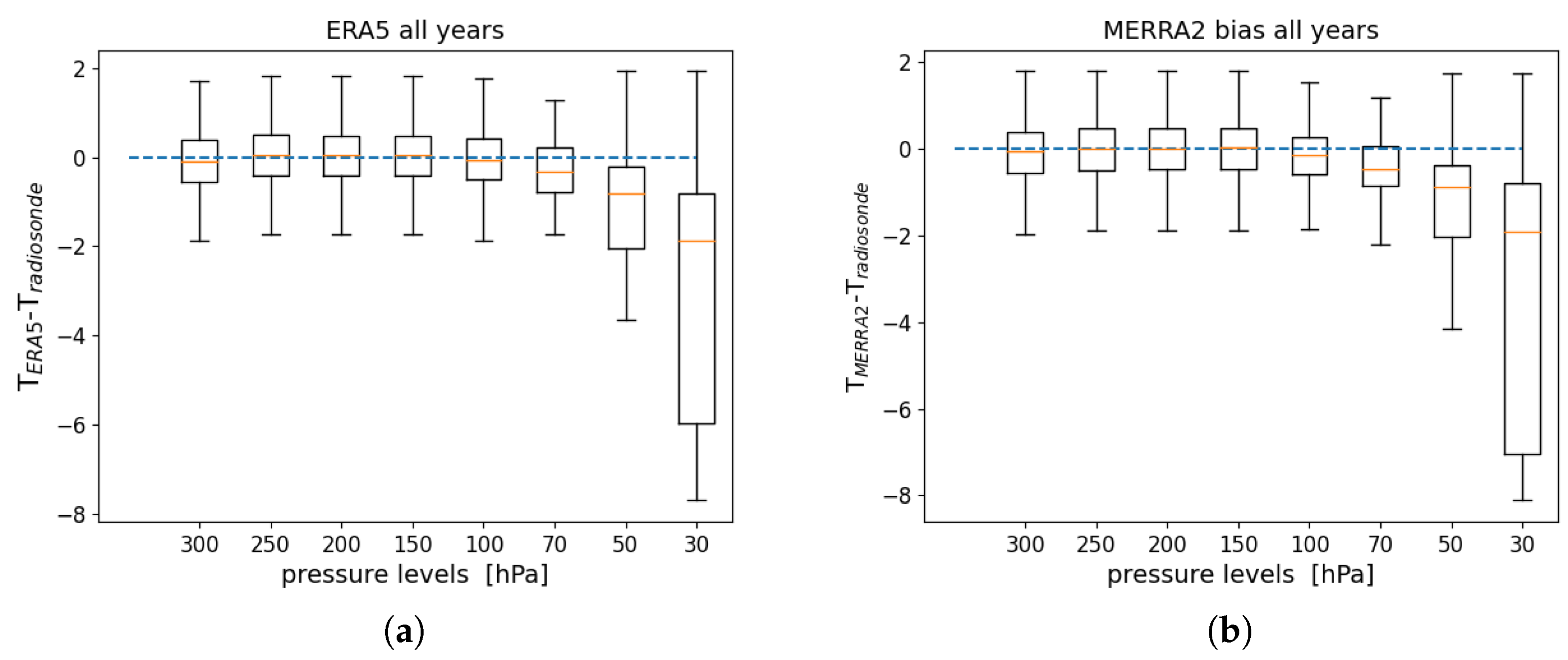
Radiosondes are launched every day at Concordia at 12:00 UTC and provide accurate temperature measurements as well as pressure, wind and humidity data [29]. Unfortunately during winter the balloons explode at altitudes varying from 13 to 16 km. Rarely the balloons reach pressure levels below 70 hPa. Figure 5 shows the biases of ERA5 and MERRA2 temperatures with respect to the radiosondes launched at Concordia station at 12:00 UTS from June to September from 2014 to 2024. ERA5 and MERRA-2 exhibit broadly comparable temperature biases with respect to radiosondes up to about 100–70 hPa, while a larger, increasingly negative bias and a marked spread emerge at 50 and 30 hPa. We note that the highest levels are poorly constrained by the radiosonde sample size in our dataset (only 23 and 10 profiles at 50 and 30 hPa, respectively, were available), so robust inferences from these results are limited. Beyond this statistical limitation, the interpretation at 50–30 hPa is further complicated by the increasing uncertainty of radiosonde temperature measurements in the lower-to-middle stratosphere, where reduced ventilation and radiative effects can induce systematic errors (warm biases in sunlight and cold biases at night) that grow with decreasing pressure [30].
At the same time, reanalyses are progressively more constrained by satellite radiances and by the model’s radiative balance and parametrized wave forcing, rather than by dense in situ observations, so small errors in stratospheric radiation or assimilation settings can induce biases in the upper levels. For ERA5, documented issues include a lower-stratospheric cold bias in the early 2000s and associated changes addressed through the ERA5.1 reanalysis and evolving observational constraints (e.g., increased GNSS-RO availability after 2006) [31] For MERRA-2, the reanalysis and its sensitivity to satellite radiance usage and bias correction are documented, and stratospheric temperature behavior can be influenced by the availability and consistency of observations [32]. Overall, the combination of sparse radiosonde sampling at 50–30 hPa, increasing radiosonde uncertainties, and a transition to a more model- and satellite-dominated constraint regime provides a likely explanation for the growing negative bias and dispersion in both reanalyses. Here we used MERRA2, also for consistency with the ancillary data used by MLS, although ERA5 is probably equally valid.
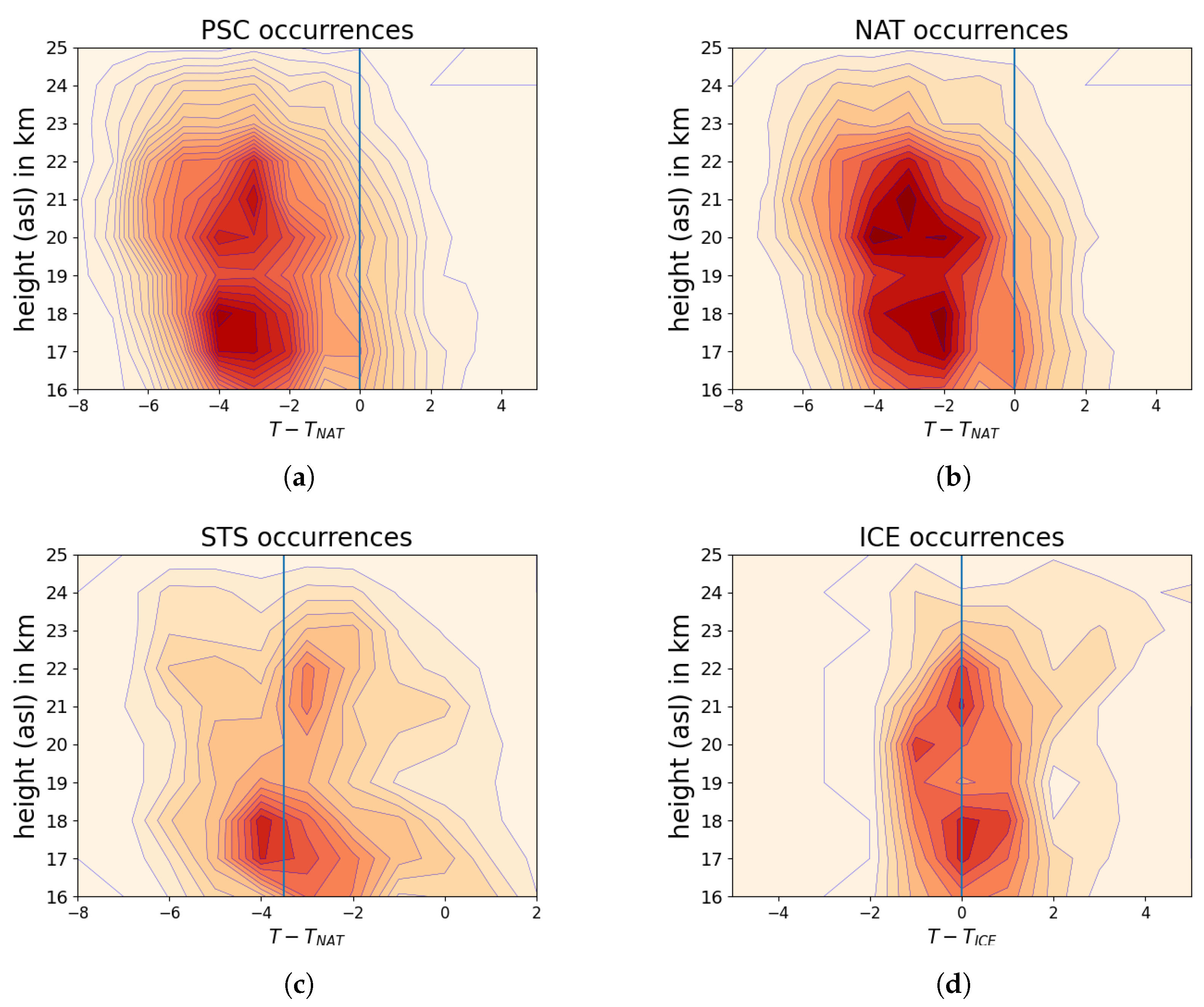
Since NAT is the most readily formed PSC class, one assumes that PSCs form below the formation temperature for NAT (TNAT). TNAT can be calculated from the water vapour and nitric acid mixing ratios, local pressure and temperatures [33]. Figure 6a shows the occurrences of PSCs at Concordia from 2014 to 2024, with respect to the difference of the local temperature with TNAT. It is evident that most PSCs have been observed at temperatures below TNAT, although a small fraction exists up to 2 or 3 K above TNAT.
Different pathways have been proposed by Peter and Grooβ [34] for the formation of NAT particles. NAT can be formed by heterogeneous nucleation on ice particles, meaning that the temperature should be below the frostpoint. However, heterogeneous nucleation on background aerosols containing meteoritic material [35], or other condensation nuclei might occur readily below TNAT. Koop et al. [36] rejected the possibility of NAT formation by homogeneous nucleation on STS. Figure 6b shows the number of occurrences of NAT PSCs from 2014 to 2024 at Concordia as a function of T-TNAT and height. TNAT has been calculated using the formula reported in [33], using MERRA2 temperatures and pressures as well as H2O and HNO3 concentrations obtained from MLS (Microwave Limb Sounder) data. It can be seen that NAT has been mainly observed between 1 and 4 K below TNAT, with a maximum occurrence at 2.5 K below TNAT (Figure 6b). This is in good agreement with Pitts et al. [18] who reports the observation of NAT at about 2.5–3 K below TNAT.
Liquid STS droplets, being ternary solutions with a variable stoichiometry, do not form below a definite threshold temperature but rather grow by a continuous uptake of nitric acid by sulphuric acid aerosols, which becomes massive below 195 K [37]. Several authors reported that STS form typically ≈3.5 K below TNAT [38,39,40,41]. Figure 6c shows the STS occurrences with respect to T-TNAT. Most STS were observed around 3.5 K below the NAT formation temperature. Water-ice PSCs have the lowest formation temperature (about 188 K), the so-called frost temperature Tice (see e.g., [42] or [43] for different methods to calculate the frost point). Homogeneous ice nucleation from SSA (Supercooled sulphuric acid) or from STS occurs typically at Tice − 4 K [36,44,45], while heterogeneous nucleation on NAT particles, occurs already below Tice, but above Tice − 4 K [46,47]. Figure 6d shows the occurrence of ice PSCs at Concordia, showing a maximum around the frost point (Tice). This seems to favour the hypothesis of heterogeneous nucleation on NAT particles. The distribution of the PSC occurrences around their formation temperatures is narrow for STS and ice and broader for NAT mixtures, which is in good agreement with the results reported in Pitts et al. [18] for CALIOP observations in Antarctica between 2006 and 2017 at an altitude of 21 km. Also Tencé et al. [19] reported density distributions of PSCs observed at Dumont D’Urville between 2007 and 2020. It is remarkable that their data, classified using the algorithm proposed by Pitts et al. [18] and thus very similar to the one used in this work, show a different behaviour. STS and ice were observed mainly above their threshold temperature, while NAT mixtures were mostly observed below TNAT. An explanation for observing ice PSCs at Dumont D’Urville above Tice might be that the ERA5 model does not capture local small scale temperature variations while the observation of STS above TSTS is probably due to the fact that STS does not have a well defined stoichiometry and might also include sulfate solutions (H2SO4-H2O) with an less defined threshold temperature.

3.3. Inter-Annual Variations and Long-Term Trends

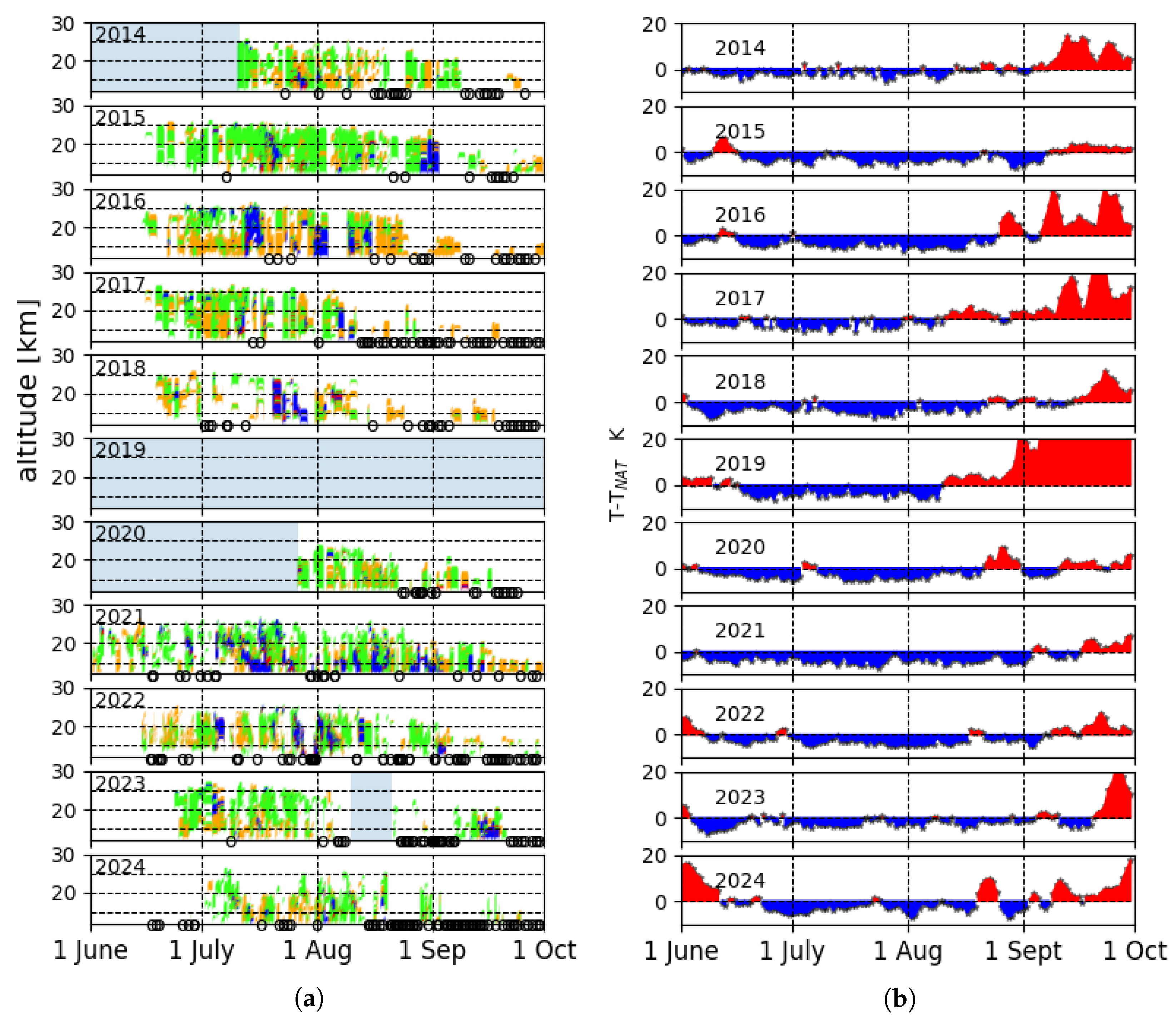
The PSC data recorded from 2014 to 2024 are displayed in Figure 7b. The analysis presented in this section is intended as an exploratory assessment of inter-annual variability and potential tendencies in PSC occurrence. Given the relatively short duration of the observational record, the results should not be interpreted as evidence of robust long-term trends. In 2014, the first year of lidar observations in Concordia, the measurements started at the 11th of July, due to some alignment issues, while in 2020 the first data have been recorded at the 26th of July, due to problems with the laser. In 2019 severe simultaneous instrument failures occurred, causing the shutdown of the observatory. During the other years data have been recorded regularly, with the exception of August 2023, when the laser had to be substituted with the spare one. This caused a loss of data for about two weeks. The periods of missing data due to instrument failures have been indicated with shaded areas in Figure 7a. Note that the small circles on the baseline of every year-plot indicate that the lidar was recording normally, but no PSCs were observed on that occasion. The very few occasions of inactivity due to adverse meteorological conditions, such as storm, precipitation or strongly absorbing tropospheric clouds can be observed as white columns. Some examples of these can be seen in July 2017 and 2018, August 2016 and 2018 and September 2015, 2016 and 2020.
PSCs are ubiquitous in July, and to a lesser extent in August, when some periods without PSCs can be observed. The most obvious absence of PSCs was observed in August 2024, when a sudden warming of the lower stratosphere occurred. Other short periods of warming in August occurred in 2016, 2017 and 2020 as can be seen in Figure 7b. We would not expect to observe PSCs when the temperature exceeds TNAT + 3 K, based on Figure 6a. In Figure 7b we compare the average values of T-TNAT − 3 K between 15 and 21 km for all the 10 years of measurements. The temperatures were taken from MERRA2. and the NAT formation temperatures were calculated from MLS data. Comparing Figure 7b with Figure 7a we observe that in June and July, PSCs are ubiquitous, due to a rather constant low temperature regime, while in August some warming periods can be observed. We found prohibitive temperature conditions from 26 to 31 August 2016, several days in 2017 (13, 14, 17, 18, 20, 22 August), and in 2019 (17–19, 24, 27–31 August) and 23–30 August 2020 and 20–25 August 2024. During these periods the lowest temperature in the 15 to 21 km interval was at least 3 K higher than the NAT formation temperature at 20 km. These warmer periods in August correspond with the absence of PSCs as observed by the ground-based lidar (see Figure 7a), except for 2019 when the lidar was non active. It appears that NAT mixtures are the most frequently observed PSC class (see e.g., Figure 2). It must be stressed that NAT mixtures may contain an important contribution of liquid PSCs, since these have negligible depolarization and usually a small backscatter ratio. Ice PSCs are observed during the coldest periods, mainly in July and the first half of August, although exceptionally they might be observed in September. This occurred in 2023, as a result of the impact of the Hunga eruption [48].
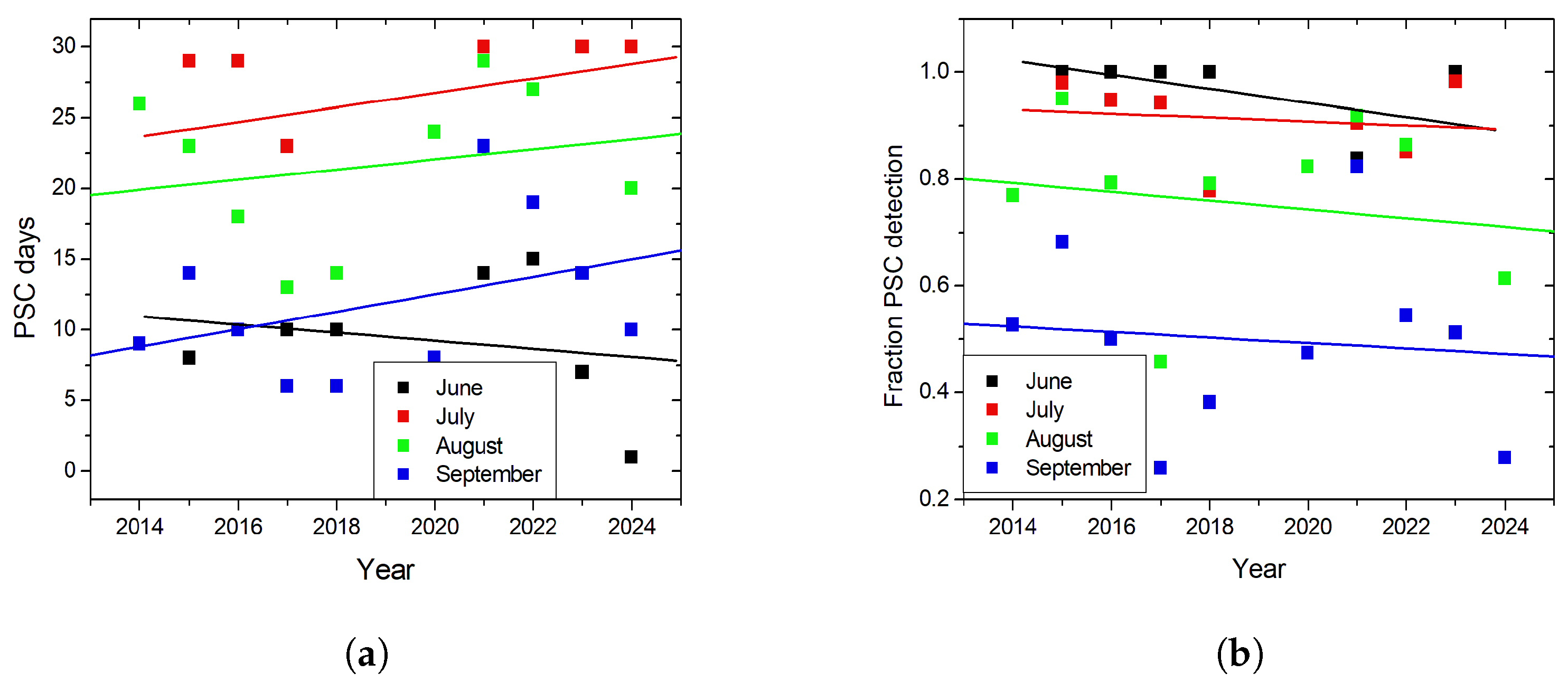
A statistical analysis of PSC occurrences can be performed in several ways (see Figure 8). One is to consider the number of days per month when PSCs have been observed (see e.g., [19]). Figure 8a displays the number of days with positive PSC detection per month. Please note that June and July 2014 and 2020 as well as August 2023 were excluded, due to instrumental issues. Only the second half of June was considered since most years the measurements started after 15 June. It can be observed that during the month of July PSCs have been observed practically every day, except for 2017 and 2018, when several days of adverse meteorological conditions prohibited the measurements. The PSC occurrence in August is less frequent, mostly due to vortex dynamics, leading to sudden warming of the lower stratosphere in 2016, 2020 and 2024, as has been discussed above. The lower values for 2017 can be ascribed to higher temperatures with respect to the other years, while the same might be the case for the second half of August 2018. It is remarkable that the occurrences in June are quite high, considering the 15 days taken in consideration. Please note that in 2014 and 2020 the lidar was not active in June. This approach suffers from several possible biases, such as the absence of data when prohibitive meteorological conditions occur, or the number of measurement sessions recorded, which varies from 2 to 4 sessions per day. A different approach can be made by considering the number of profiles with a positive detection divided by the total number of recorded profiles per month (Figure 8b). This method reduces the impact of “lost measurements” due to bad weather conditions or inactivity of the lidar. While the number of days when PSCs were observed exhibit a small increase during the 2014–2024 period, except for June (see Figure 8a), the second approach, which considers the fraction PSC observations with respect to the total number of observations per month shows a negative trend (see Figure 8b). The absence of obvious biases would lead us to prefer the second approach, indicating a small negative trend, but on the other hand 10 years are still a short period and probably not sufficient to extract a long-term trend. It should be emphasized that PSC occurrence is strongly and non-linearly controlled by stratospheric temperature. Therefore, any apparent tendency in PSC frequency primarily reflects inter-annual variability in polar temperature and vortex dynamics rather than an independent long-term change in PSC microphysical processes. In addition, PSC occurrences are temporally correlated, reflecting the persistence of polar vortex conditions, which further limits the applicability of simple linear trend estimates based on yearly or monthly statistics. It should be noted that both metrics shown in Figure 8a,b are sensitive to data availability, measurement frequency, and temporal sampling, and are therefore primarily intended to illustrate inter-annual variability rather than to infer statistically robust long-term trends. Previous studies on long-term trends of PSC occurrences were reported in [25] for the ground-based lidars at McMurdo, Dumont D’Urville and Ny-Alesund, combined with co-located CALIOP data, but no discernible multi-decadal trend could be determined.

4. Conclusions

From July 2014 to September 2024, a large number of lidar measurements of PSCs has been performed at Concordia station, many of these in quasi-coincidence with overpasses of the CALIPSO satellite, boarding the CALIOP lidar, allowing a long-term comparison and providing a benchmark for present and future satellite observations of PSCs. Due to the orography of the Antarctic plateau, synoptic meteorological conditions are prevailing and a uniform cloud cover can be expected. This is confirmed by the comparison of the local Concordia observations with a larger area (more than 500,000 square km) covered by many CALIPSO overpasses in the same time frame. The Concordia station, being one of the most suitable locations for ground-based lidar observations of PSCs [11] is also representative for a large part of the Antarctic plateau. The temperature dependence of PSC observations, considering the different classes (liquid, NAT mixtures and ice) was shown to be consistent with the expected thermodynamic regimes. Strong inter-annual variations in PSC occurrences have been observed, mainly due to the vortex conditions. Several periods of sudden thermal warming have been observed, the most important in August 2024. While the present dataset provides a valuable baseline for PSC occurrence over the Antarctic plateau, the identification of robust long-term trends will require longer observational records, ideally spanning multiple decades, in order to disentangle inter-annual variability from potential climate-driven changes.

Author Contributions

Conceptualization, M.S., L.D.L. and F.C. (Francesco Cairo); methodology, M.S., L.D.L. and F.C. (Francesco Colao); software, F.C. (Francesco Colao), M.S. and F.S.; validation, L.D.L., A.B. and F.S.; formal analysis, L.D.L., M.S. and F.S.; investigation, F.C. (Francesco Cairo), A.B. and F.C. (Francesco Colao); resources, M.S. and F.C. (Francesco Colao); data curation, L.D.L. and M.S.; writing—original draft preparation, M.S. and L.D.L.; writing—review and editing, all authors; visualization, all authors; supervision, M.S.; project administration, M.S.; funding acquisition, M.S. and F.C. (Francesco Colao). All authors have read and agreed to the published version of the manuscript.

Funding

This research was funded by the Piano Nazionale della Ricerca in Antartide (PNRA) in the frame work of the projects 2009/B.08, OSS-12. and LIDAROBS.

Data Availability Statement

The raw ground-based lidar data are available from the NDACC website: https://www-air.larc.nasa.gov/missions/ndacc/data.html?station=dome.c/ames/lidar/, accessed on 11 March 2026. The PSC special product has been made available by Michael Pitts, NASA.

Acknowledgments

The authors acknowledge the financial support by PNRA in the frame work of the projects 2009/B.08, OSS-12, LIDAROBS and the SH-YOPP project. We also acknowledge the support of the ISSI-PSC initiative project. Logistical and winter-time technical support was provided by the Programma Nazionale delle Ricerche in Antartide (PNRA). The authors thank Igor Petenko, Giampietro Casasanta, Simonetta Montaguti, Alfonso Ferrone, Filippo Cali Quaglia, Meganne Christian, Alberto Salvati, Rodolfo Canestrari, Angelo Galeandro and Davide Carlucci for performing the ground-based lidar measurements at Dome C during the winter and Maurizio Viterbini and Ilir Shuli for their valuable technical support. A special thanks goes to Michael Pitts, NASA, for supplying us with the CALIOP PSC special product data.

Conflicts of Interest

The authors declare no conflict of interest. The funders had no role in the design of the study; in the collection, analyses, or interpretation of data; in the writing of the manuscript; or in the decision to publish the results.

Abbreviations

The following abbreviations are used in this manuscript:
PSCPolar Stratospheric Cloud
LIDARLIght Detecting And Ranging
CALIOPCloud-Aerosol Lidar with Orthogonal Polarization
CALIPSOCloud-Aerosol Lidar and Infrared Pathfinder Satellite Observation
EarthCAREEarth, Cloud, Aerosol and Radiation Explorer
CCMChemistry-Climate Model
CTMChemical Transport Model
NATNitric Acid Trihydrate
STSSupercooled Ternary Solution
MLSMicrowave Limb Sounder
PNRAProgramma Nazionale delle Ricerche in Antartide
NDACCNetwork for the Detection of Stratospheric Change
NCEPNational Centers for Environmental Prediction
ERA-5ECMWF ReAnalysis version 5
MERRA2Modern-Era Retrospective analysis for Research and Applications, Version 2
COSMICConstellation Observing System for Meteorology, Ionosphere and Climate

References

  1. Engel, I.; Luo, B.P.; Pitts, M.C.; Poole, L.R.; Hoyle, C.R.; Grooß, J.U.; Dörnbrack, A.; Peter, T. Heterogeneous formation of polar stratospheric clouds—Part 2; Nucleation of ice on synoptic scales. Atmos. Chem. Phys. 2013, 13, 10769–10785. [Google Scholar] [CrossRef]
  2. Pitts, M.C.; Poole, L.R.; Lambert, A.; Thomason, L.W. An assessment of CALIOP polar stratospheric cloud composition classification. Atmos. Chem. Phys. 2013, 13, 2975–2988. [Google Scholar] [CrossRef]
  3. Hoyle, C.R.; Engel, I.; Luo, B.P.; Pitts, M.C.; Poole, L.R.; Grooß, J.U.; Peter, T. Heterogeneous formation of polar stratospheric clouds—Part 1: Nucleation of nitric acid trihydrate (NAT). Atmos. Chem. Phys. 2013, 13, 9577–9595. [Google Scholar] [CrossRef]
  4. Kremser, S.; Thomason, L.W.; von Hobe, M.; Hermann, M.; Deshler, T.; Timmreck, C.; Toohey, M.; Stenke, A.; Schwarz, J.P.; Weigel, R.; et al. Stratospheric aerosol—Observations, processes, and impact on climate. Rev. Geophys. 2016, 54, 278–335. [Google Scholar] [CrossRef]
  5. Yu, P.; Toon, O.B.; Bardeen, C.G.; Zhu, Y.; Rosenlof, K.H.; Portmann, R.W. Black carbon lofts wildfire smoke high into the stratosphere to form a persistent plume. Science 2019, 365, 587–590. [Google Scholar] [CrossRef] [PubMed]
  6. Lawrence, Z.D.; Manney, G.L.; Wargan, K. Reanalysis intercomparisons of stratospheric polar processing diagnostics. Atmos. Chem. Phys. 2018, 18, 13547–13579. [Google Scholar] [CrossRef] [PubMed]
  7. Snels, M.; Scoccione, A.; Di Liberto, L.; Colao, F.; Pitts, M.; Poole, L.; Deshler, T.; Cairo, F.; Cagnazzo, C.; Fierli, F. Comparison of Antarctic polar stratospheric cloud observations by ground-based and space-borne lidar and relevance for chemistry-climate models. Atmos. Chem. Phys. 2019, 19, 955–972. [Google Scholar] [CrossRef]
  8. Austin, J.; Shindell, D.; Beagley, S.R.; Brühl, C.; Dameris, M.; Manzini, E.; Nagashima, T.; Newman, P.A.; Pawson, S.; Pitari, G.; et al. Uncertainties and assessments of chemistry-climate models of the stratosphere. Atmos. Chem. Phys. 2003, 3, 1–27. [Google Scholar] [CrossRef]
  9. Steiner, M.; Luo, B.P.; Peter, T.; Pitts, M.C.; Stenke, A. Evaluation of polar stratospheric clouds in the global chemistry-climate model SOCOLv3.1 by comparison with CALIPSO spaceborne lidar measurements. Geosci. Model Dev. 2021, 14, 935–959. [Google Scholar] [CrossRef]
  10. Butchart, N.; Charlton-Perez, A.J.; Cionni, I.; Hardiman, S.C.; Haynes, P.H.; Krüger, K.; Kushner, P.J.; Newman, P.A.; Osprey, S.M.; Perlwitz, J.; et al. Multimodel climate and variability of the stratosphere. J. Geophys. Res. Atmos. 2011, 116, D05102. [Google Scholar] [CrossRef]
  11. Tesche, M.; Achtert, P.; Pitts, M.C. On the best locations for ground-based polar stratospheric cloud (PSC) observations. Atmos. Chem. Phys. 2021, 21, 505–516. [Google Scholar] [CrossRef]
  12. Di Liberto, L.; Colao, F.; Serva, F.; Bracci, A.; Cairo, F.; Snels, M. Polar stratospheric cloud observations at Concordia station by remotely controlled lidar observatory. Remote Sens. 2024, 16, 2228. [Google Scholar] [CrossRef]
  13. Snels, M.; Colao, F.; Cairo, F.; Shuli, I.; Scoccione, A.; De Muro, M.; Pitts, M.; Poole, L.; Di Liberto, L. Quasi-coincident observations of polar stratospheric clouds by ground-based lidar and CALIOP at Concordia (Dome C, Antarctica) from 2014 to 2018. Atmos. Chem. Phys. 2021, 21, 2165–2178. [Google Scholar] [CrossRef]
  14. Di Liberto, L.; Cairo, F.; Fierli, F.; Di Donfrancesco, G.; Viterbini, M.; Deshler, T.; Snels, M. Observation of polar stratospheric clouds over McMurdo (77.85°S, 166.67°E) (2006–2010). J. Geophys. Res. Atmos. 2014, 119, 5528–5541. [Google Scholar] [CrossRef]
  15. Snels, M.; Cairo, F.; Colao, F.; Di Donfrancesco, G. Calibration method for depolarization lidar measurements. Int. J. Remote Sens. 2009, 30, 5725–5736. [Google Scholar] [CrossRef]
  16. Alvarez, J.M.; Vaughan, M.A.; Hostetler, C.A.; Hunt, W.H.; Winker, D.M. Calibration technique for polarization-sensitive lidars. J. Atmos. Ocean. Technol. 2006, 23, 683–699. [Google Scholar] [CrossRef]
  17. Young, S.A.; Vaughan, M.A. The retrieval of profiles of particulate extinction from cloud-aerosol lidar infrared pathfinder satellite observations (CALIPSO) Data: Algorithm Description. J. Atmos. Ocean. Technol. 2009, 26, 1105–1119. [Google Scholar] [CrossRef]
  18. Pitts, M.C.; Poole, L.R.; Gonzalez, R. Polar stratospheric cloud climatology based on CALIPSO spaceborne lidar measurements from 2006–2017. Atmos. Chem. Phys. 2018, 2018, 10881–10913. [Google Scholar] [CrossRef]
  19. Tencé, F.; Jumelet, J.; Bouillon, M.; Cugnet, D.; Bekki, S.; Safieddine, S.; Keckhut, P.; Sarkissian, A. 14 years of lidar measurements of polar stratospheric clouds at the French Antarctic station Dumont d’Urville. Atmos. Chem. Phys. 2023, 23, 431–451. [Google Scholar] [CrossRef]
  20. Achtert, P.; Tesche, M. Assessing lidar-based classification schemes for polar stratospheric clouds based on 16 years of measurements at Esrange, Sweden. J. Geophys. Res. Atmos. 2014, 119, 1386–1405. [Google Scholar] [CrossRef]
  21. Tackett, J.; Ryan, R.; Vaughan, M.; Garnier, A.; Getzewich, B.; Winker, D.; Trepte, C. Mitigation Strategy for the Impact of Low Energy Laser Pulses in CALIOP Calibration and Level 2 Retrievals; Technical Report; NASA: Washington, DC, USA, 2022.
  22. Tabazadeh, A.; Toon, O.; Hamill, P. Freezing behaviour of stratospheric sulfate aerosols inferred from trajectory studies. Geophys. Res. Lett. 1995, 22, 1725–1728. [Google Scholar] [CrossRef]
  23. Larsen, N.; Knudsen, B.; Rosen, J.; Kjome, N.; Neuber, R.; Kyro, E. Temperature histories in liquid and solid polar stratospheric cloud formation. J. Geophys. Res. Atmos. 1997, 102, 23505–23517. [Google Scholar] [CrossRef]
  24. Toon, O.; Tabazadeh, A.; Browell, E.; Jordan, J. Analysis of lidar observations of Arctic polar stratospheric clouds during January 1989. J. Geophys. Res. Atmos. 2000, 105, 20589–20615. [Google Scholar] [CrossRef]
  25. Tritscher, I.; Pitts, M.C.; Poole, L.R.; Alexander, S.P.; Cairo, F.; Chipperfield, M.P.; Grooß, J.U.; Höpfner, M.; Lambert, A.; Luo, B.; et al. Polar stratospheric clouds: Satellite observations, processes, and role in ozone depletion. Rev. Geophys. 2021, 59, e2020RG000702. [Google Scholar] [CrossRef]
  26. Lambert, A.; Santee, M.L. Accuracy and precision of polar lower stratospheric temperatures from reanalyses evaluated from A-Train CALIOP and MLS, COSMIC GPS RO, and the equilibrium thermodynamics of supercooled ternary solutions and ice clouds. Atmos. Chem. Phys. 2018, 18, 1945–1975. [Google Scholar] [CrossRef]
  27. Kozubek, M.; Krizan, P.; Lastovicka, J. Homogeneity of the temperature data series from ERA5 and MERRA2 and temperature trends. Atmosphere 2020, 11, 235. [Google Scholar] [CrossRef]
  28. Essa, Y.H.; Cagnazzo, C.; Madonna, F.; Cristofanelli, P.; Yang, C.; Serva, F.; Caporaso, L.; Santoleri, R. Intercomparison of atmospheric upper-air temperature from recent global reanalysis datasets. Front. Earth Sci. 2022, 10, 935139. [Google Scholar] [CrossRef]
  29. Grigioni, P.; Ciardini, V.; Camporeale, G.; De Silvestri, L.; Iaccarino, A.; Proposito, M.; Scarchilli, C. Dati Meteorologici della Stazione di Radiosondaggio presso la Base CONCORDIA STATION (DomeC); Technical Report; ENEA: Rome, Italy, 2022. [Google Scholar] [CrossRef]
  30. Sun, B.; Reale, A.; Schroeder, S.; Seidel, D.J.; Ballish, B. Toward improved corrections for radiation-induced biases in radiosonde temperature observations. J. Geophys. Res. Atmos. 2013, 118, 4231–4243. [Google Scholar] [CrossRef]
  31. Simmons, A.; Soci, C.; Nicolas, J.; Bell, B.; Berrisford, P.; Dragani, R.; Flemming, J.; Haimberger, L.; Healy, S.; Hersbach, H.; et al. Global stratospheric temperature bias and other stratospheric aspects of ERA5 and ERA5.1. In ECMWF Technical Memoranda; European Centre for Medium Range Weather Forecasts: Berkshire, UK, 2020. [Google Scholar]
  32. Gelaro, R.; McCarty, W.; Suárez, M.J.; Todling, R.; Molod, A.; Takacs, L.; Randles, C.A.; Darmenov, A.; Bosilovich, M.G.; Reichle, R.; et al. The Modern-Era Retrospective Analysis for Research and Applications, Version 2 (MERRA-2). J. Clim. 2017, 30, 5419–5454. [Google Scholar] [CrossRef]
  33. Hanson, D.; Mauersberger, K. Laboratory studies of the nitric acid trihydrate: Implications for the south polar stratosphere. Geophys. Res. Lett. 1988, 15, 855–858. [Google Scholar] [CrossRef]
  34. Peter, T.; Grooß, J.U. Polar stratospheric clouds and sulfate aerosol particles: Microphysics, denitrification and heterogeneous chemistry. In Stratospheric Ozone Depletion and Climate Change; The Royal Society of Chemistry: London, UK, 2012; pp. 108–144. [Google Scholar] [CrossRef]
  35. Curtius, J. Observations of meteoritic material and implications for aerosol nucleation in the winter Arctic lower stratosphere derived from in situ particle measurements. Atmos. Chem. Phys. Disc 2005, 5, 5039–5080. [Google Scholar]
  36. Koop, T.; Biermann, U.; Raber, W.; Luo, B.; Crutzen, P.; Peter, T. Do stratospheric droplets freeze above the ice frost point? Geophys. Res. Lett. 1995, 22, 917–920. [Google Scholar] [CrossRef]
  37. Carslaw, K.; Luo, B.; Peter, T. An analytic expression for the composition of acqueous HNO3-H2SO4 stratospheric aerosols including gas-phase removal of HNO3. Geophys. Res. Lett. 1995, 22, 1877–1880. [Google Scholar] [CrossRef]
  38. McDonald, A.J.; George, S.E.; Woollands, R.M. Can gravity waves significantly impact PSC occurrence in the Antarctic? Atmos. Chem. Phys. 2009, 9, 8825–8840. [Google Scholar] [CrossRef]
  39. Carslaw, K.; Luo, B.; Clegg, S.; Peter, T.; Brimblecombe, P.; Crutzen, P. Stratospheric aerosol growth and HNO3 gas-phase depletion from coupled HNO3 and water-uptake by liquid particles. Geophys. Res. Lett. 1994, 21, 2479–2482. [Google Scholar] [CrossRef]
  40. Voigt, C.; Schlager, H.; Luo, B.; Dörnbrack, A.; Roiger, A.; Stock, P.; Curtius, J.; Vössing, H.J.; Borrmann, S.; Davies, S.; et al. Nitric Acid Trihydrate (NAT) formation at low NAT supersaturation in Polar Stratospheric Clouds (PSCs). Atmos. Chem. Phys. 2005, 5, 1371–1380. [Google Scholar] [CrossRef]
  41. Drdla, K.; Gandrud, B.W.; Baumgardner, D.; Wilson, J.C.; Bui, T.P.; Hurst, D.; Schauffler, S.M.; Jost, H.; Greenblatt, J.B.; Webster, C.R. Evidence for the widespread presence of liquid-phase particles during the 1999–2000 Arctic winter. J. Geophys. Res. Atmos. 2002, 107, SOL 61-1–SOL 61-17. [Google Scholar] [CrossRef]
  42. Murphy, D.M.; Koop, T. Review of the vapour pressures of ice and supercooled water for atmospheric applications. Quart. J. R. Meteor. Soc. 2005, 131, 1539–1565. [Google Scholar] [CrossRef]
  43. Romps, D.M. Accurate expressions for the dewpoint and frost point derived from the Rankine–Kirchhoff approximations. J. Atmos. Sci. 2021, 78, 2113–2116. [Google Scholar] [CrossRef]
  44. Carslaw, K.S.; Wirth, M.; Tsias, A.; Luo, B.P.; Dörnbrack, A.; Leutbecher, M.; Volkert, H.; Renger, W.; Bacmeister, J.T.; Peter, T. Particle microphysics and chemistry in remotely observed mountain polar stratospheric clouds. J. Geophys. Res. Atmos. 1998, 103, 5785–5796. [Google Scholar] [CrossRef]
  45. Koop, T.; Ng, H.P.; Molina, L.T.; Molina, M.J. A new optical technique to study aerosol phase transitions: The nucleation of ice from H2SO4 aerosols. J. Phys. Chem. A 1998, 102, 8924–8931. [Google Scholar] [CrossRef]
  46. Koop, T.; Carslaw, K.S.; Peter, T. Thermodynamic stability and phase transitions of PSC particles. Geophys. Res. Lett. 1997, 24, 2199–2202. [Google Scholar] [CrossRef]
  47. Peter, T. Microphysics and heterogeneous chemistry of polar stratospheric clouds. Annu. Rev. Phys. Chem. 1997, 48, 785–822. [Google Scholar] [CrossRef] [PubMed]
  48. Serva, F.; Liberto, L.D.; Colao, F.; Bracci, A.; Cairo, F.; Pitts, M.C.; Snels, M. Impact of the Hunga eruption on polar stratospheric clouds as seen by the lidar observatory at Concordia station. Antarct. Sci. 2026; accepted. [Google Scholar]
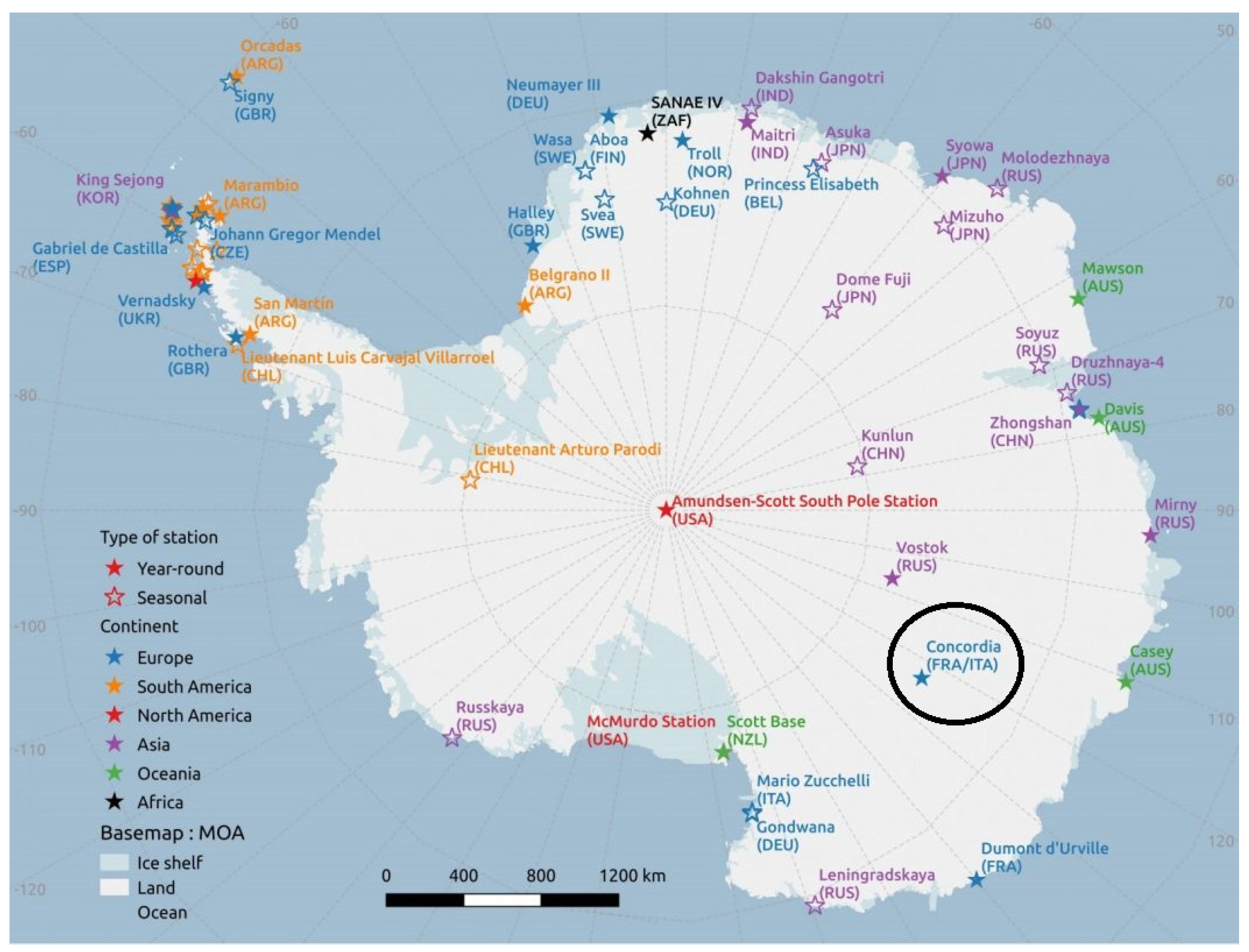
Figure 1. The figure shows a map of the most important Antarctic stations. Concordia station is indicated with a circle.
Remotesensing 18 00874 g001
Figure 2. The figure shows the criteria using the backscatter ratio R and the perpendicular backscatter coefficient β to classify the different PSC types. A density plot of the optical parameters observed for all PSC occurrences from 2014 to 2024 has been overlaid.
Remotesensing 18 00874 g002
Figure 3. The figure shows the PSCs observed by LIDAR at Concordia in 2016. The upper panel shows all ground-based observations, while the other two panels represent the closest profiles during CALIOP overpasses, considering two areas centred on Concordia The colour codes indicate the different PSC classes, orange stands for STS, green for NAT mixtures, blue for ice and red for enhanced NAT mixtures. The small circles indicate that a measurement was performed, but no PSCs were observed.
Remotesensing 18 00874 g003
Figure 4. The figure shows quasi-coincident observations of PSCs by LIDAR and CALIOP at Concordia in 2016. The upper panel shows the ground-based observations, while the lower panel represents the closest profiles during CALIOP overpasses, within one hour of the ground-based measurement. The colour codes indicate the different PSC classes, orange stands for STS, green for NAT mixtures, blue for ice and red for enhanced NAT mixtures. The small circles indicate that a measurement was performed, but no PSCS were observed.
Remotesensing 18 00874 g004
Figure 5. (a) A box–whisker graph shows the temperature bias of ERA5 with respect to the radiosondes for 2014–2024 (June–September) at 8 pressure levels. The minimum and maximum values are indicated by whiskers, first and third quartiles by boxes and the median value by an orange line. (b) A box-whisker graph shows the temperature bias of MERRA2 with respect to the radiosondes for 2014–2024 (June–September) at 8 pressure levels.
Remotesensing 18 00874 g005
Figure 6. The figure shows the occurrences of all PSCs (a), and NAT (b), STS (c) and ice (d) PSCs with respect to height and TNAT (ac) and TICE (d) based on Concordia measurements. The black lines are contour lines, the outer lines correspond with low occurrences, the inner lines with higher occurrences. The dark red regions correspond with the highest occurrences.
Remotesensing 18 00874 g006
Figure 7. (a) The PSCs observed by LIDAR at Concordia station from 2014 to 2024 are shown. The colour codes indicate the different PSC classes; orange stands for STS, green for NAT mixtures, blue for ice and red for enhanced NAT mixtures. The small circles indicate that a measurement was performed, but no PSCSs were observed. (b) Average T-TNAT − 3 K between 15 and 21 km at Concordia station from 2014 to 2024 is shown. Positive ad negative values have been coloured red respectively blue.
Remotesensing 18 00874 g007
Figure 8. (a) The figure shows the PSC occurrences at Concordia station from 2014 to 2024, defined as the number of days per month when a positive PSC detection has been made. (b) The figure shows the fraction of profiles with a positive PSC detection with respect to the total number of recorded profiles per month. In both frames we considered only the second half of June and we excluded July 2014 and 2020 as well as August 2023, when instrument issues rendered the lidar inactive for part of the month.
Remotesensing 18 00874 g008
Table 1. Technical specifications of the Concordia lidar.
Laser energy per pulse180 mJ
Pulse repetition frequency10 Hz
Laser pulse duration9 ns
Laser divergence full angle1.5 mrad
Laser pointing stability100 μrad
Main telescope diameter355.6 mm
Main telescope focal length3910 mm
Main telescope field of view4 mrad
Small telescope diameter152.4 mm
Small telescope focal length1500 mm
Small telescope field of view2 mrad
FWHM interference filter @ 532 nm2 nm
Table 2. Correlation table for Concordia versus CALIOP PSC classification for 2016.
CALIOPSTSNATenhNATice
CONCORDIA
STS0.060.080.000.05
NAT0.040.320.000.04
enh NAT0.000.070.000.02
ice0.010.050.000.27
Table 3. Correlation table for Concordia versus CALIOP PSC classification for 2016, with 10% tollerance on threshold values.
CALIOPSTSNATenhNATice
CONCORDIA
STS0.070.050.000.03
NAT0.030.380.000.03
enh NAT0.000.040.000.01
ice0.000.030.000.32
Disclaimer/Publisher’s Note: The statements, opinions and data contained in all publications are solely those of the individual author(s) and contributor(s) and not of MDPI and/or the editor(s). MDPI and/or the editor(s) disclaim responsibility for any injury to people or property resulting from any ideas, methods, instructions or products referred to in the content.