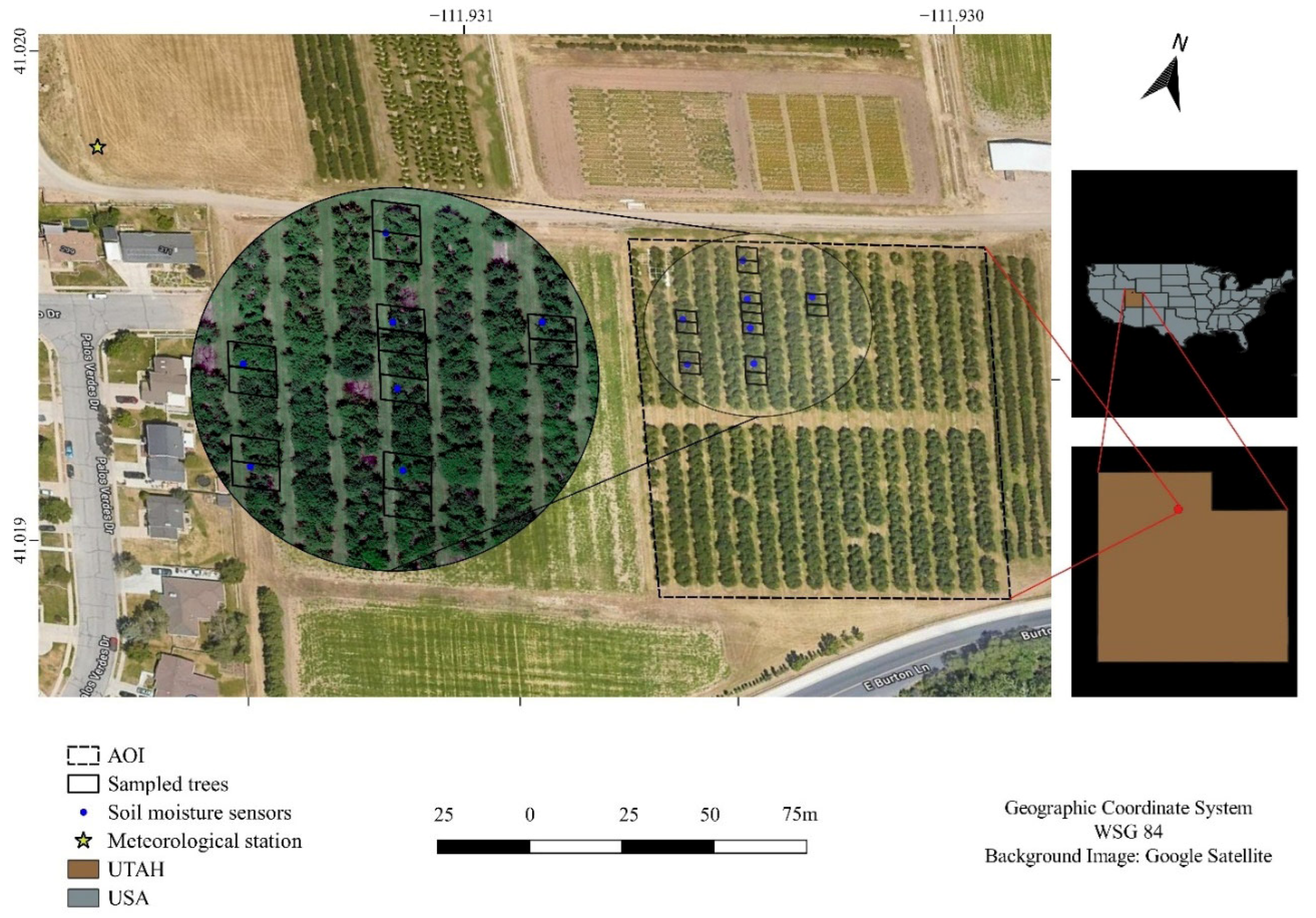
Figure 1.
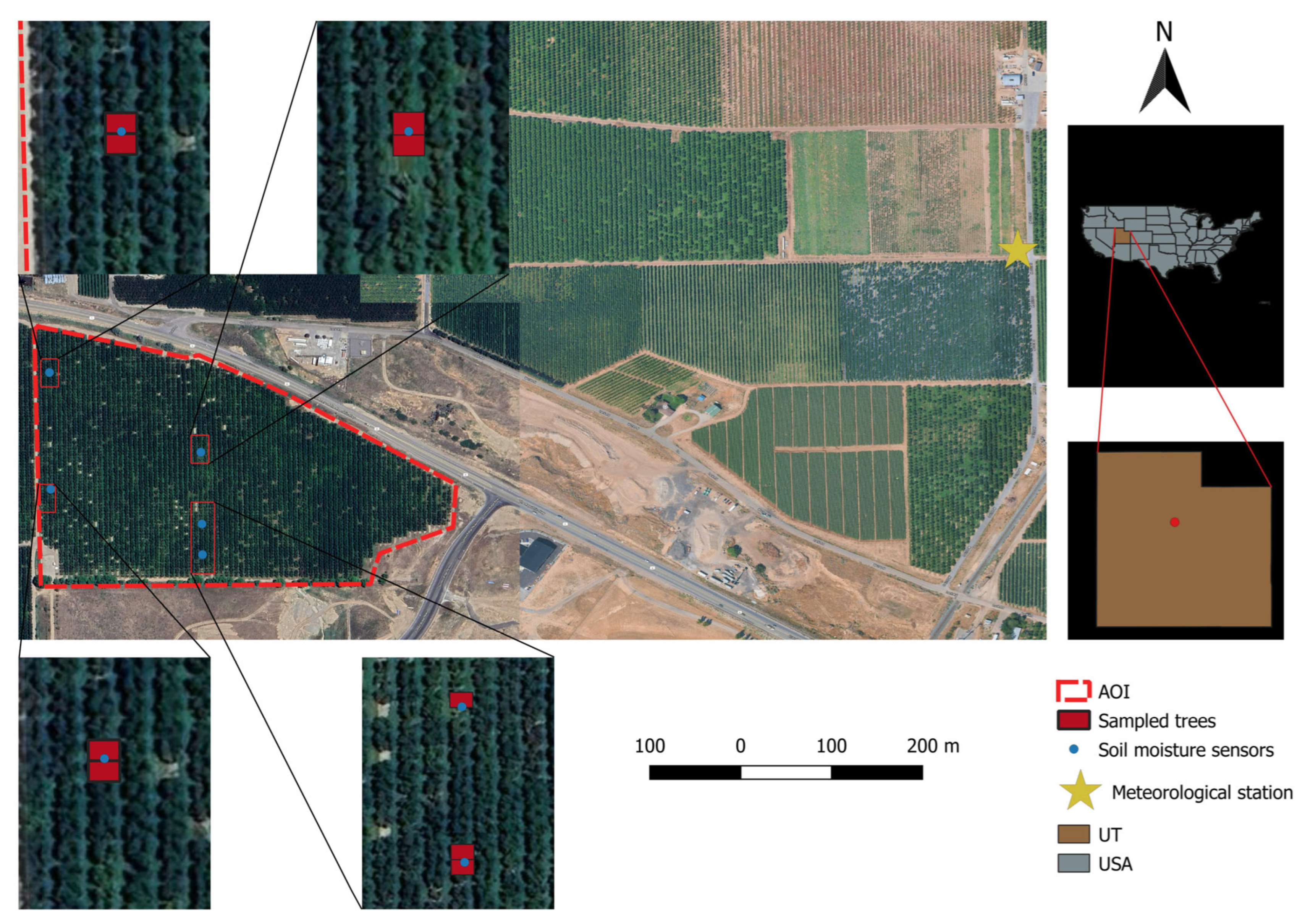
Location of the experimental tart cherry orchard and layout of the study area. The area of interest (AOI) is delineated by dashed lines, with sampled trees indicated by black rectangles. Blue points represent soil moisture sensor locations, and the meteorological station is indicated by the yellow star. The red dot in the locator map indicates the study site location in Utah.
Figure 1.
Location of the experimental tart cherry orchard and layout of the study area. The area of interest (AOI) is delineated by dashed lines, with sampled trees indicated by black rectangles. Blue points represent soil moisture sensor locations, and the meteorological station is indicated by the yellow star. The red dot in the locator map indicates the study site location in Utah.
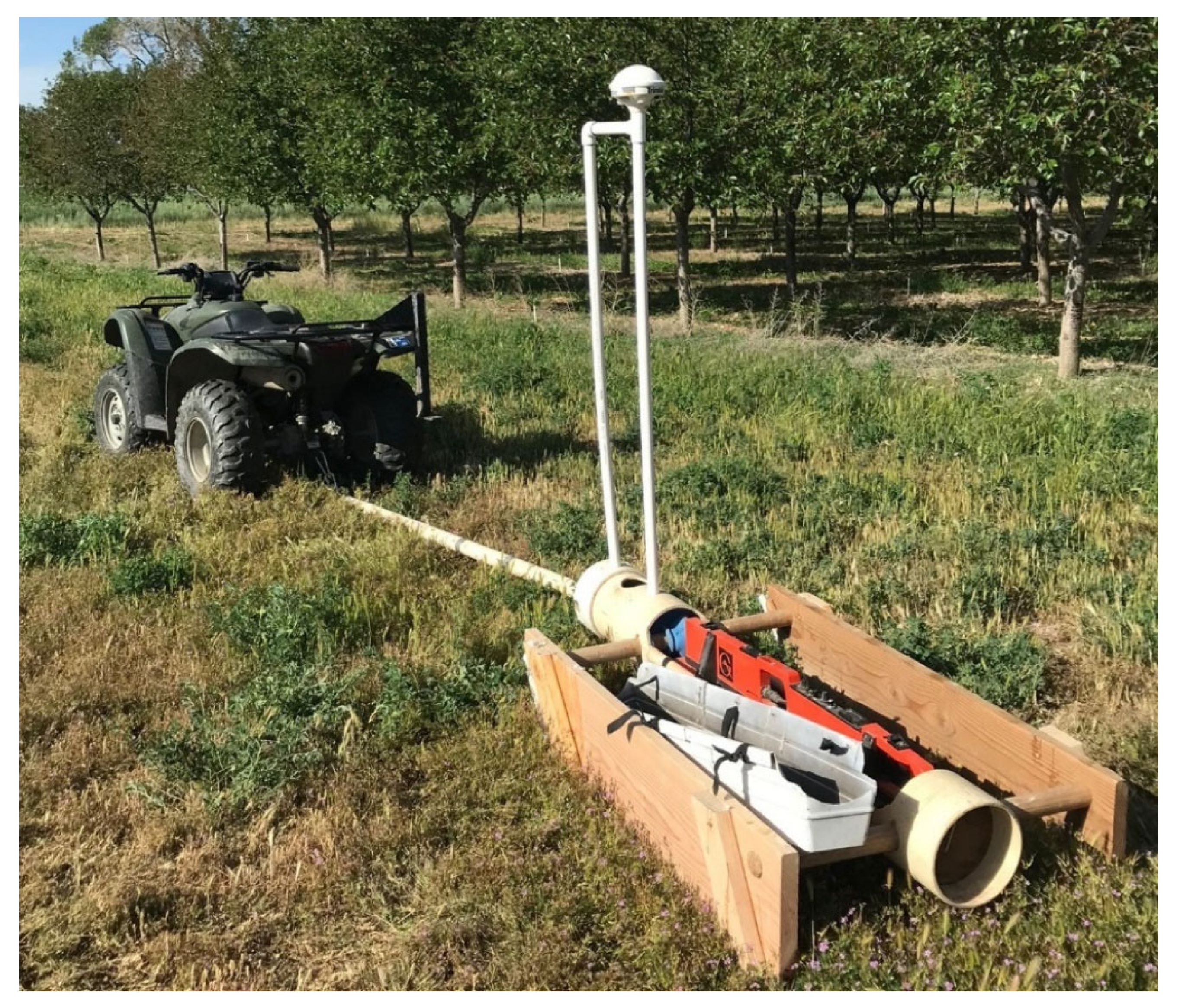
Figure 2.
Geonics EM38 probe mounted on a wooden sled with an attached GNSS receiver for soil ECa measurements.
Figure 2.
Geonics EM38 probe mounted on a wooden sled with an attached GNSS receiver for soil ECa measurements.
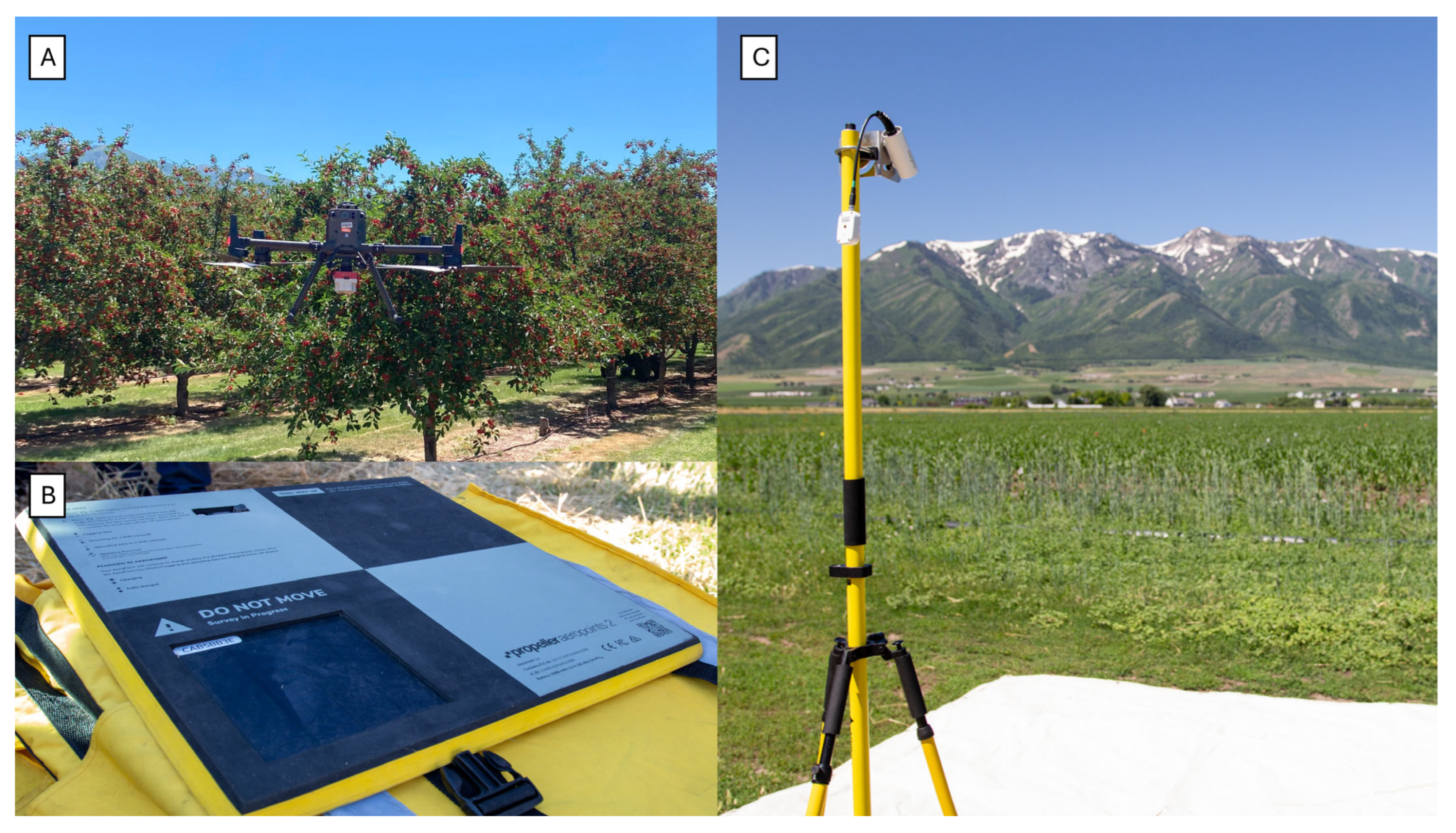
Figure 3.
(A) DJI Matrice 300 aircraft and Altum-PT multispectral camera; (B) Aeropoints GCPs; (C) and instruments for thermal calibration.
Figure 3.
(A) DJI Matrice 300 aircraft and Altum-PT multispectral camera; (B) Aeropoints GCPs; (C) and instruments for thermal calibration.
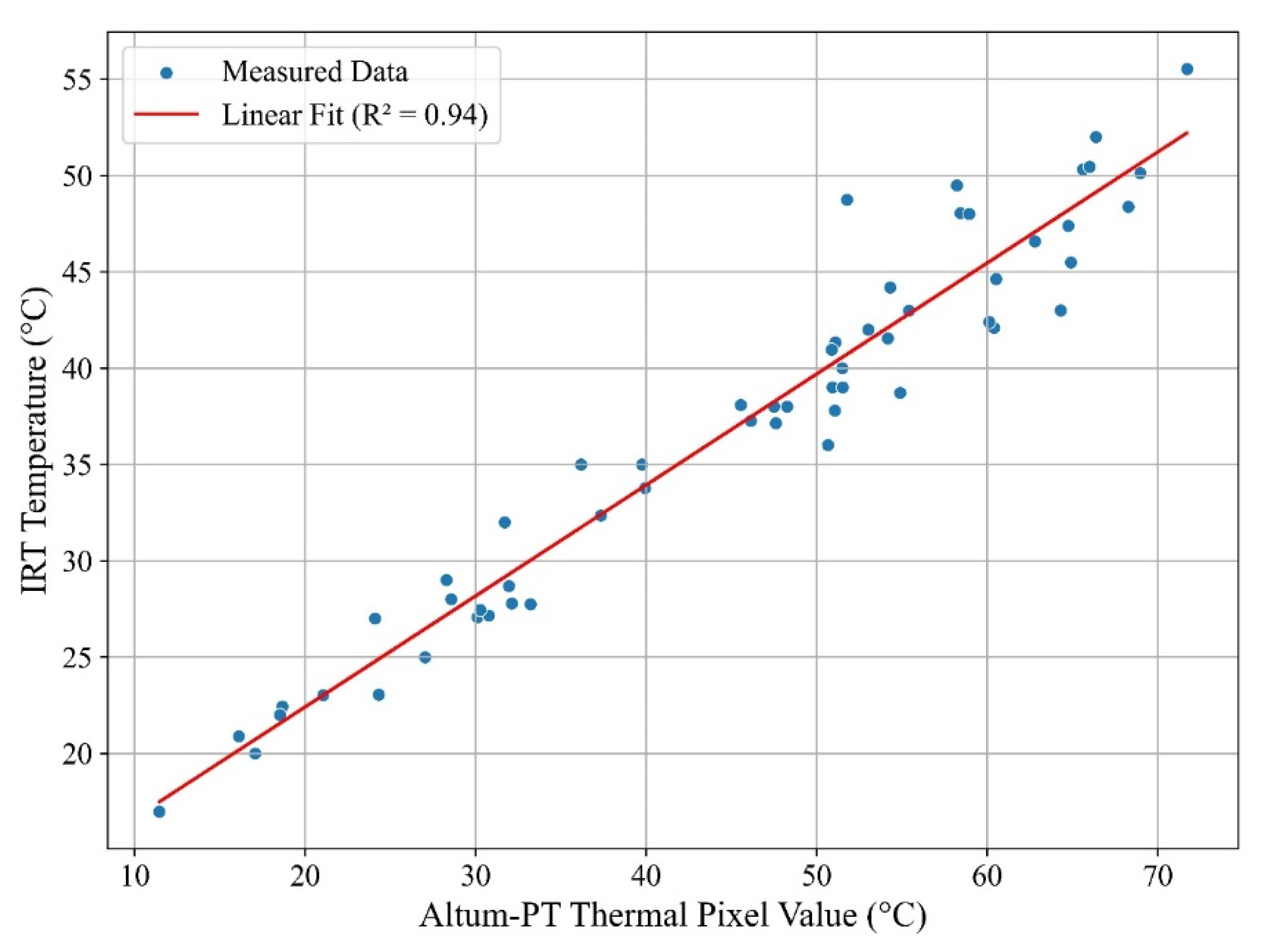
Figure 4.
Calibration of Altum-PT thermal imagery against ground-based infrared radiometer (IRT) measurements. Scatter points represent paired temperature observations, and the solid red line indicates the linear regression fit.
Figure 4.
Calibration of Altum-PT thermal imagery against ground-based infrared radiometer (IRT) measurements. Scatter points represent paired temperature observations, and the solid red line indicates the linear regression fit.
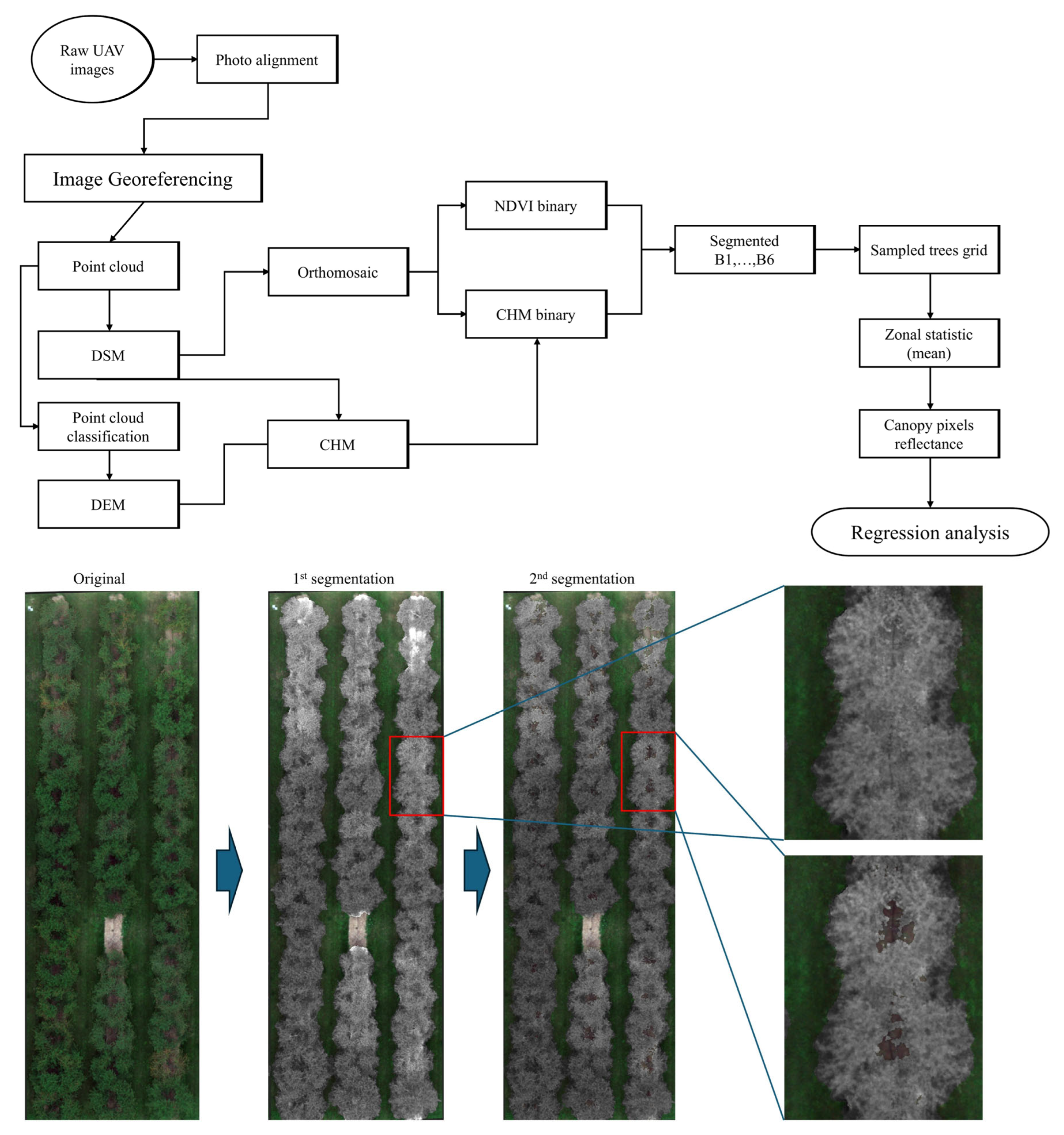
Figure 5.
Top half: flowchart of the steps for acquiring the mean reflectance value from canopy pixels. Bottom half: results of the two-stage segmentation process.
Figure 5.
Top half: flowchart of the steps for acquiring the mean reflectance value from canopy pixels. Bottom half: results of the two-stage segmentation process.
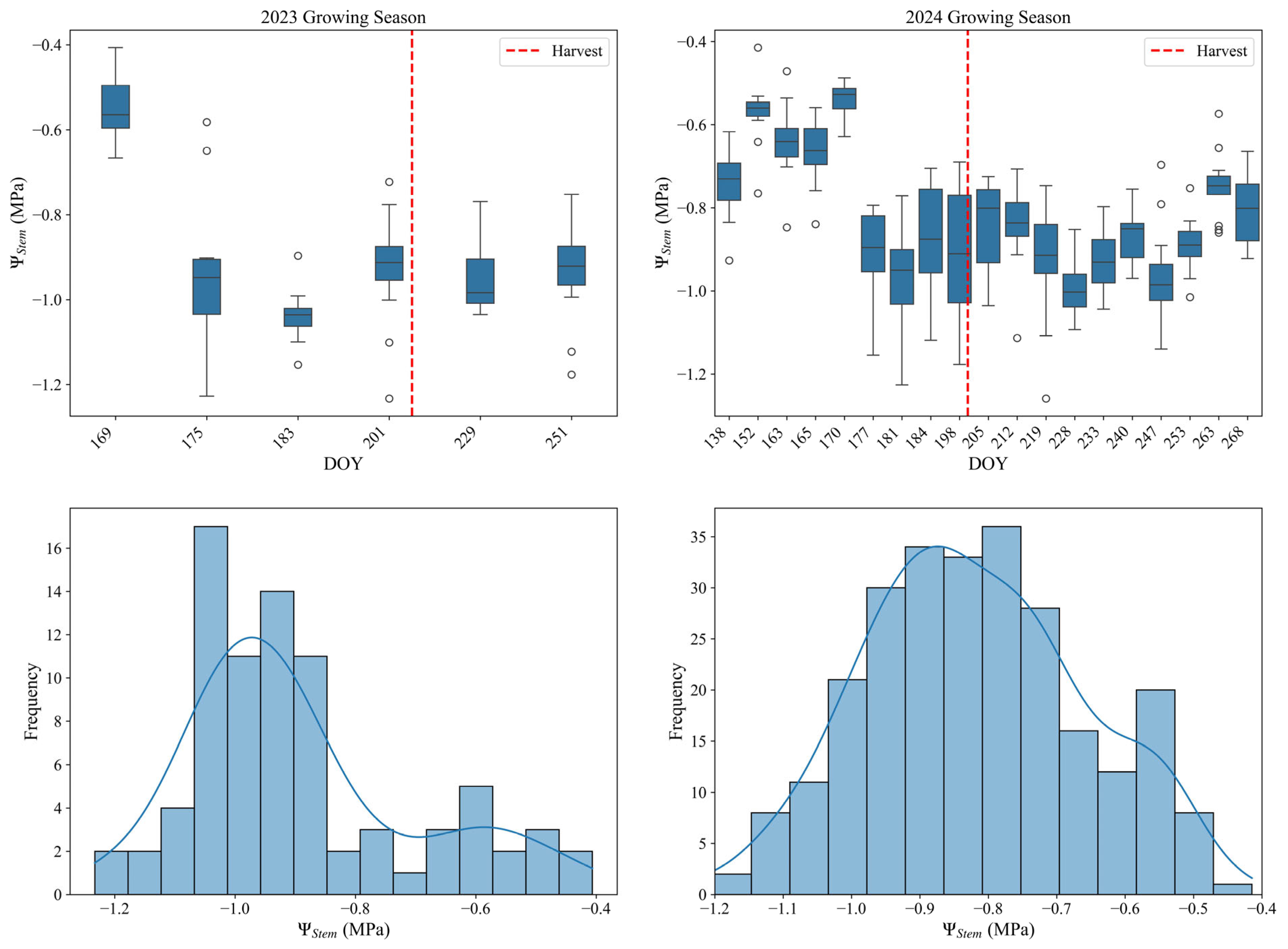
Figure 6.
Distribution of Ψstem measurements across the 2023 and 2024 growing seasons. Boxplots and histograms summarize the seasonal range and variability of Ψstem for all sampling dates. The approximate harvest date is indicated by a vertical red dashed line. Circles represent outliers.
Figure 6.
Distribution of Ψstem measurements across the 2023 and 2024 growing seasons. Boxplots and histograms summarize the seasonal range and variability of Ψstem for all sampling dates. The approximate harvest date is indicated by a vertical red dashed line. Circles represent outliers.
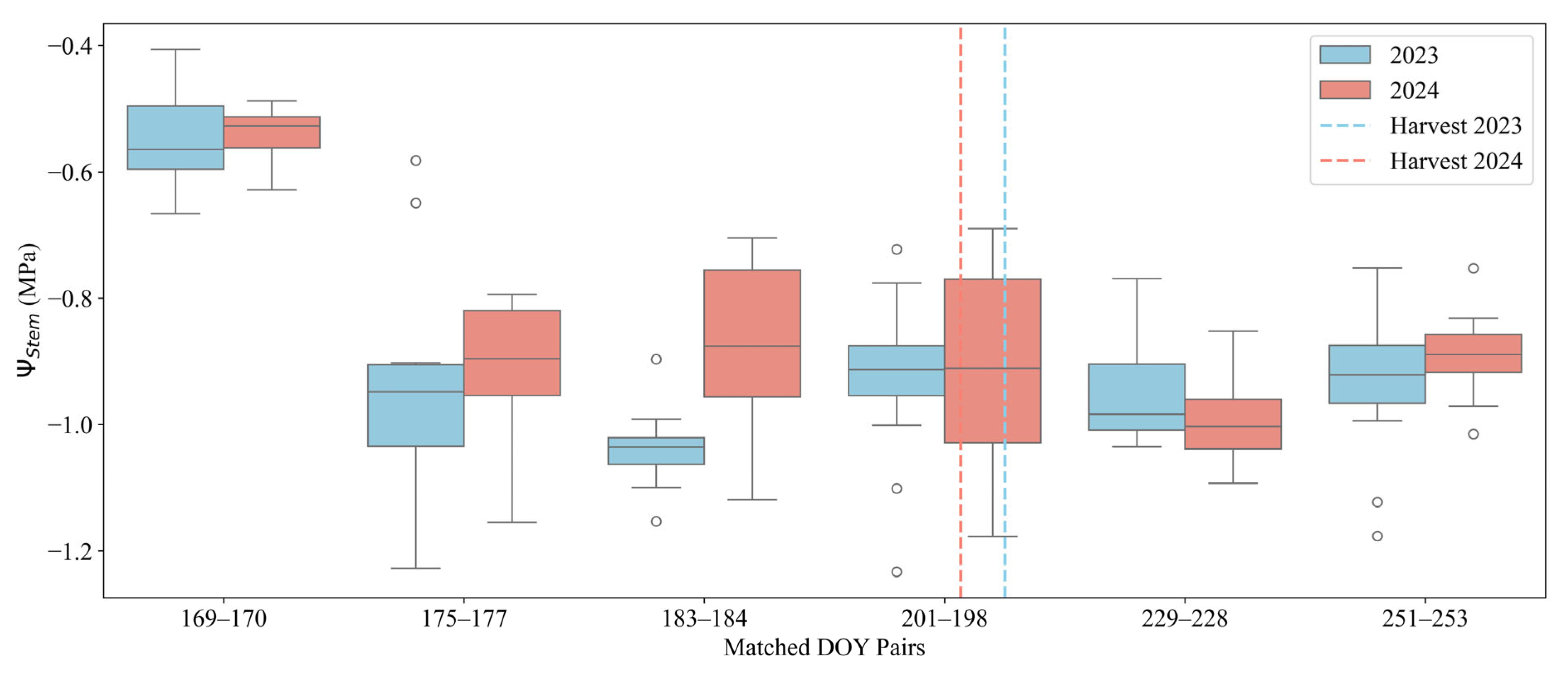
Figure 7.
Boxplot of Ψstem measurements taken on similar days during the two growing seasons of the experiment. The x-axis represents the DOY from 2023 (on the left) and 2024 (on the right) on which the measurements were taken. Circles represent outliers.
Figure 7.
Boxplot of Ψstem measurements taken on similar days during the two growing seasons of the experiment. The x-axis represents the DOY from 2023 (on the left) and 2024 (on the right) on which the measurements were taken. Circles represent outliers.
Figure 8.
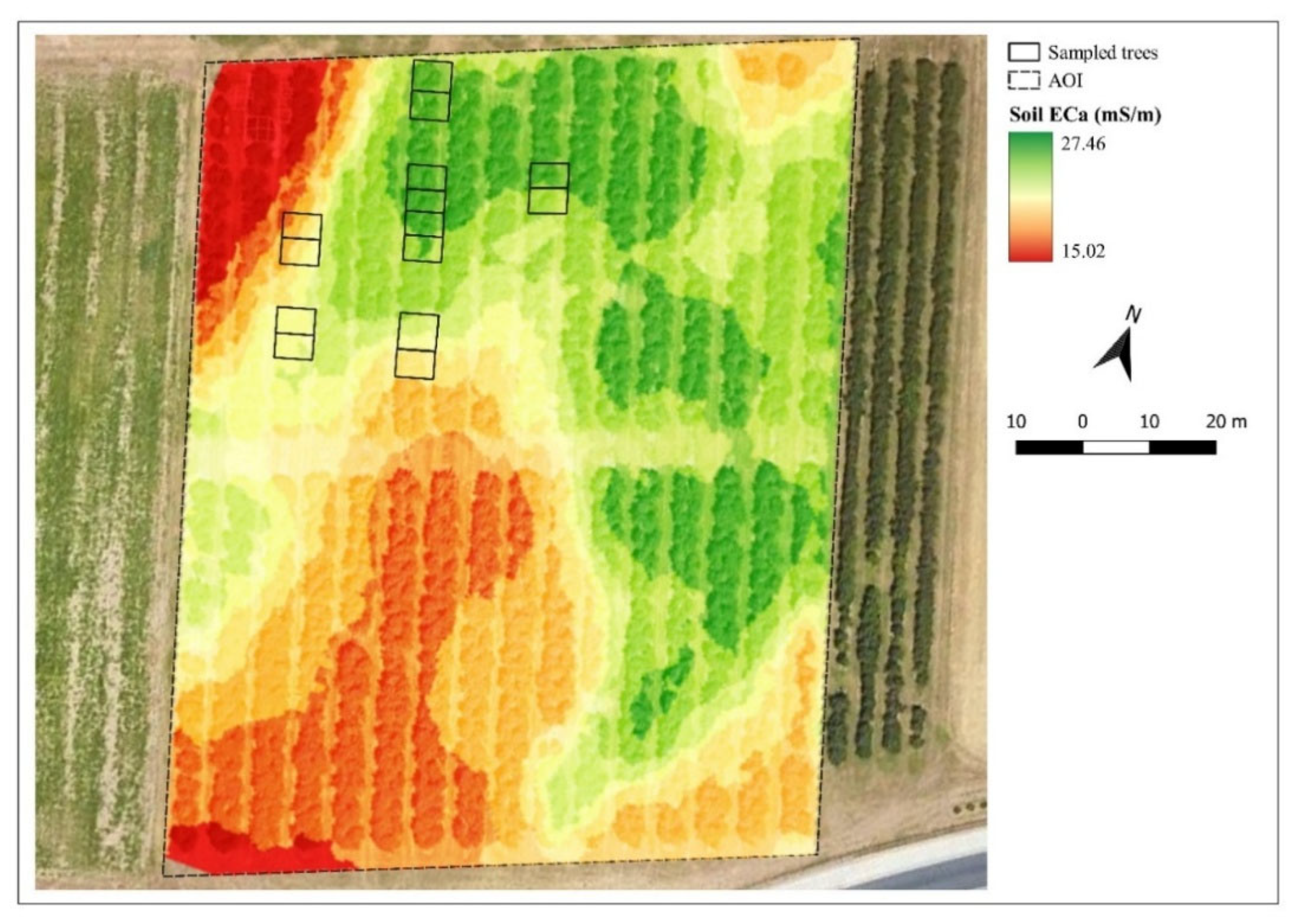
Spatial distribution of soil apparent electrical conductivity (ECa) measured with the EM38 probe. Higher ECa values are observed in the eastern and northern regions of the orchard, though overall variability is low across the study area.
Figure 8.
Spatial distribution of soil apparent electrical conductivity (ECa) measured with the EM38 probe. Higher ECa values are observed in the eastern and northern regions of the orchard, though overall variability is low across the study area.
Figure 9.
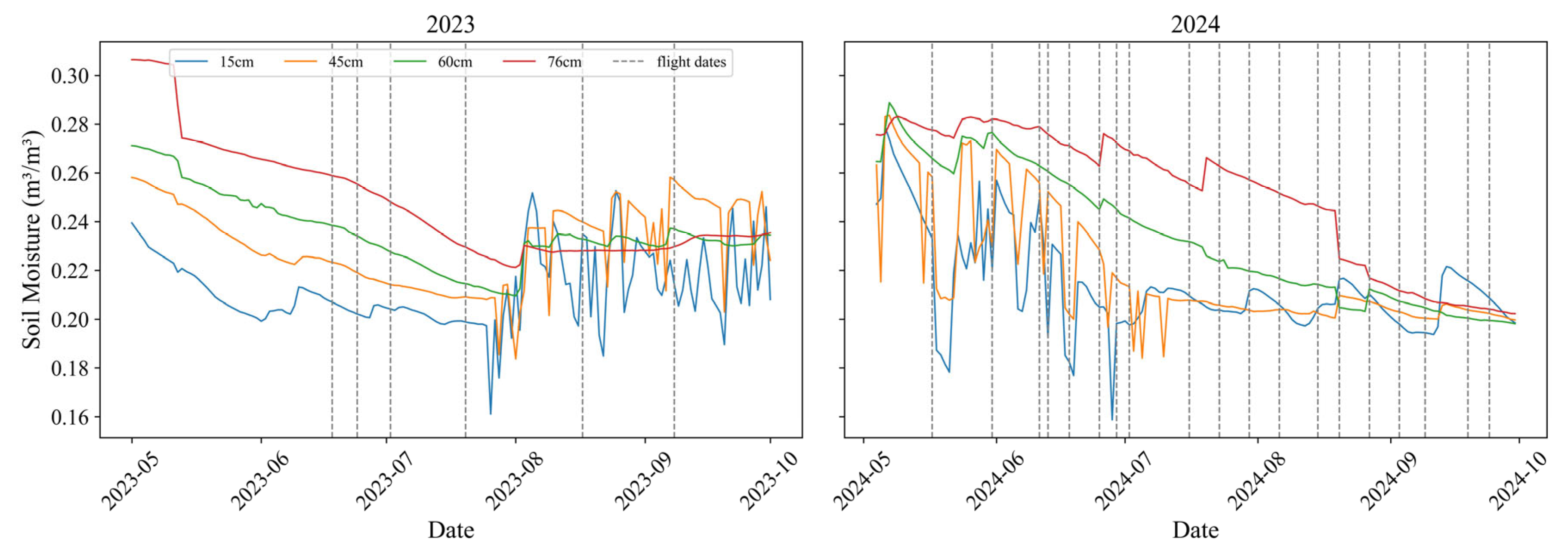
Daily soil water content (SWC) at four depths (15, 45, 60, and 75 cm) was measured by seven sensor nodes throughout the growing seasons. Gray vertical dashed lines indicate UAV image acquisition dates.
Figure 9.
Daily soil water content (SWC) at four depths (15, 45, 60, and 75 cm) was measured by seven sensor nodes throughout the growing seasons. Gray vertical dashed lines indicate UAV image acquisition dates.
Figure 10.
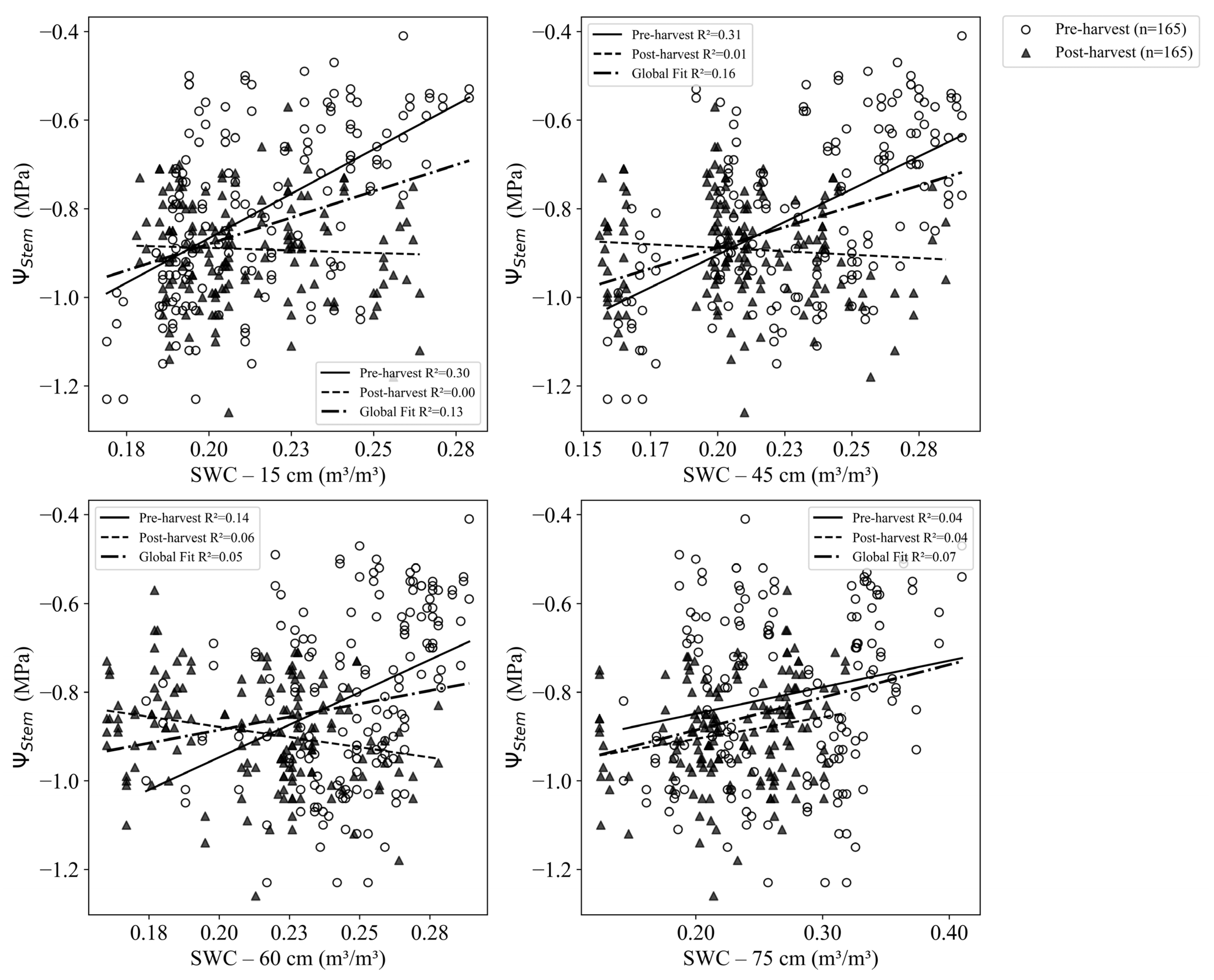
Scatterplots showing the relationship between Ψstem and soil water content (SWC) at four depths (15, 45, 60, and 75 cm) across pre-harvest and post-harvest periods. Each point represents an individual sensor observation from the seven sensor nodes. Solid regression lines represent pre-harvest relationships, dashed lines represent post-harvest relationships, and dash-dot lines show the global fit using all data. Corresponding R2 values are shown within each panel.
Figure 10.
Scatterplots showing the relationship between Ψstem and soil water content (SWC) at four depths (15, 45, 60, and 75 cm) across pre-harvest and post-harvest periods. Each point represents an individual sensor observation from the seven sensor nodes. Solid regression lines represent pre-harvest relationships, dashed lines represent post-harvest relationships, and dash-dot lines show the global fit using all data. Corresponding R2 values are shown within each panel.
Figure 11.
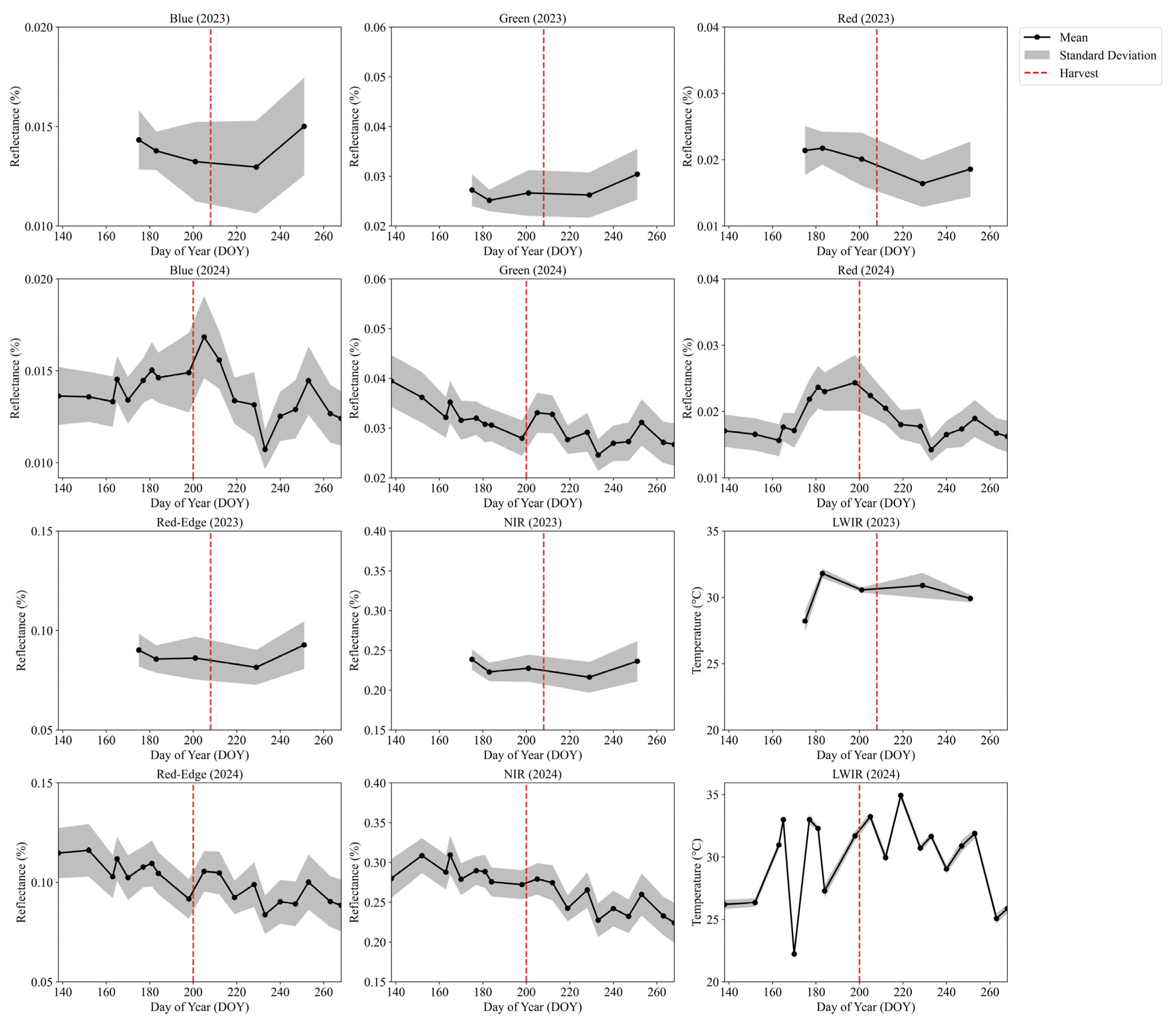
Time series of average reflectance from six spectral bands (blue, green, red, red-edge, NIR) and canopy temperature (LWIR) across all sampled trees during 2023 and 2024. The first row shows the average reflectance and standard deviation in the blue, green, and red bands for 2023; the second row presents the same bands for 2024. The third and fourth rows display red-edge, NIR, and LWIR measurements for 2023 and 2024, respectively. The bold black line represents the mean reflectance (or canopy temperature) across all 14 trees, and the shaded area represents the standard deviation. The vertical red dashed line denotes the approximate harvest date for each year.
Figure 11.
Time series of average reflectance from six spectral bands (blue, green, red, red-edge, NIR) and canopy temperature (LWIR) across all sampled trees during 2023 and 2024. The first row shows the average reflectance and standard deviation in the blue, green, and red bands for 2023; the second row presents the same bands for 2024. The third and fourth rows display red-edge, NIR, and LWIR measurements for 2023 and 2024, respectively. The bold black line represents the mean reflectance (or canopy temperature) across all 14 trees, and the shaded area represents the standard deviation. The vertical red dashed line denotes the approximate harvest date for each year.
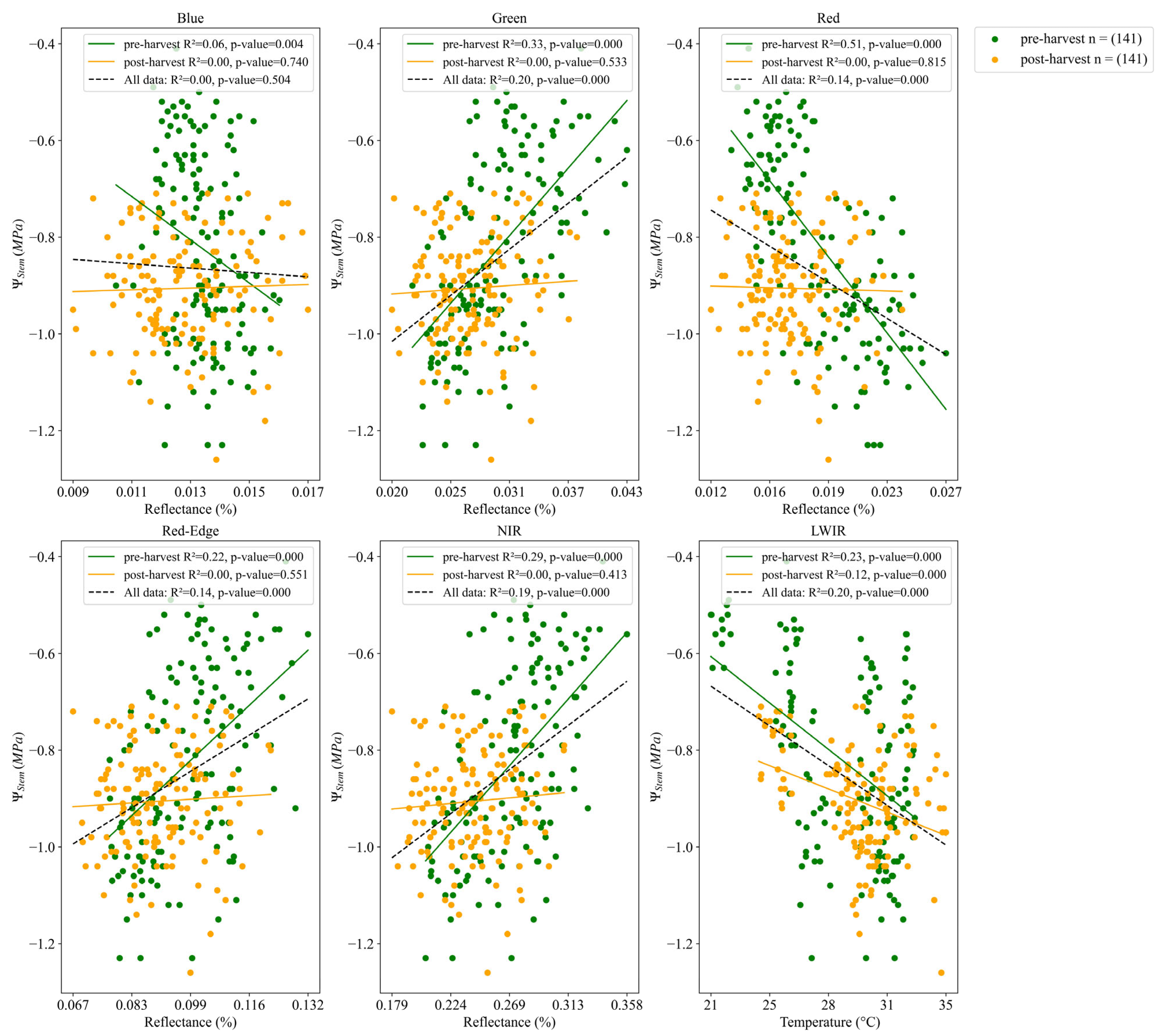
Figure 12.
Relationships between ΨStem and reflectance in six spectral bands (blue, green, red, red-edge, NIR, and LWIR) for pre-harvest and post-harvest periods. Green points represent pre-harvest measurements, and yellow points represent post-harvest measurements. Solid lines indicate linear regressions fitted to pre-harvest data (green), post-harvest data (yellow), and dotted lines show global fits using all observations. Corresponding R2 and p-values are shown within each panel.
Figure 12.
Relationships between ΨStem and reflectance in six spectral bands (blue, green, red, red-edge, NIR, and LWIR) for pre-harvest and post-harvest periods. Green points represent pre-harvest measurements, and yellow points represent post-harvest measurements. Solid lines indicate linear regressions fitted to pre-harvest data (green), post-harvest data (yellow), and dotted lines show global fits using all observations. Corresponding R2 and p-values are shown within each panel.
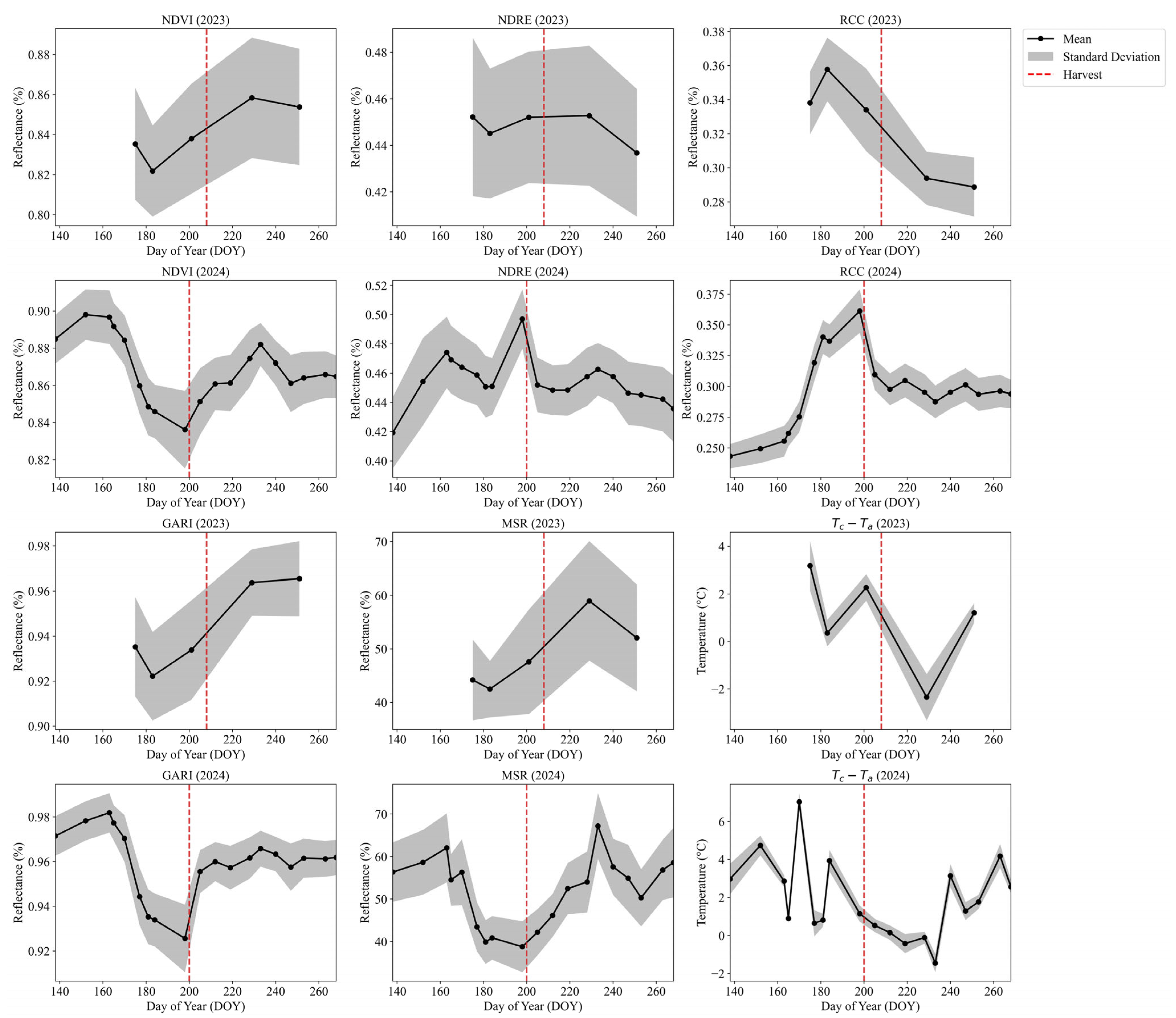
Figure 13.
Time series of average values from six vegetation indices (NDVI, NDRE, RCC, GARI, MSR) and canopy and air temperature difference (Tc − Ta) across all sampled trees during 2023 and 2024. The first row shows average and standard deviation values in NDVI, NDRE, and RCC for 2023; the second row presents the same indices for 2024. The third and fourth rows display GARI, MSR, and Tc − Ta measurements for 2023 and 2024, respectively. The bold black line represents the mean value across all 14 trees, and the shaded area represents the standard deviation. The vertical red dashed line denotes the approximate harvest date for each year.
Figure 13.
Time series of average values from six vegetation indices (NDVI, NDRE, RCC, GARI, MSR) and canopy and air temperature difference (Tc − Ta) across all sampled trees during 2023 and 2024. The first row shows average and standard deviation values in NDVI, NDRE, and RCC for 2023; the second row presents the same indices for 2024. The third and fourth rows display GARI, MSR, and Tc − Ta measurements for 2023 and 2024, respectively. The bold black line represents the mean value across all 14 trees, and the shaded area represents the standard deviation. The vertical red dashed line denotes the approximate harvest date for each year.
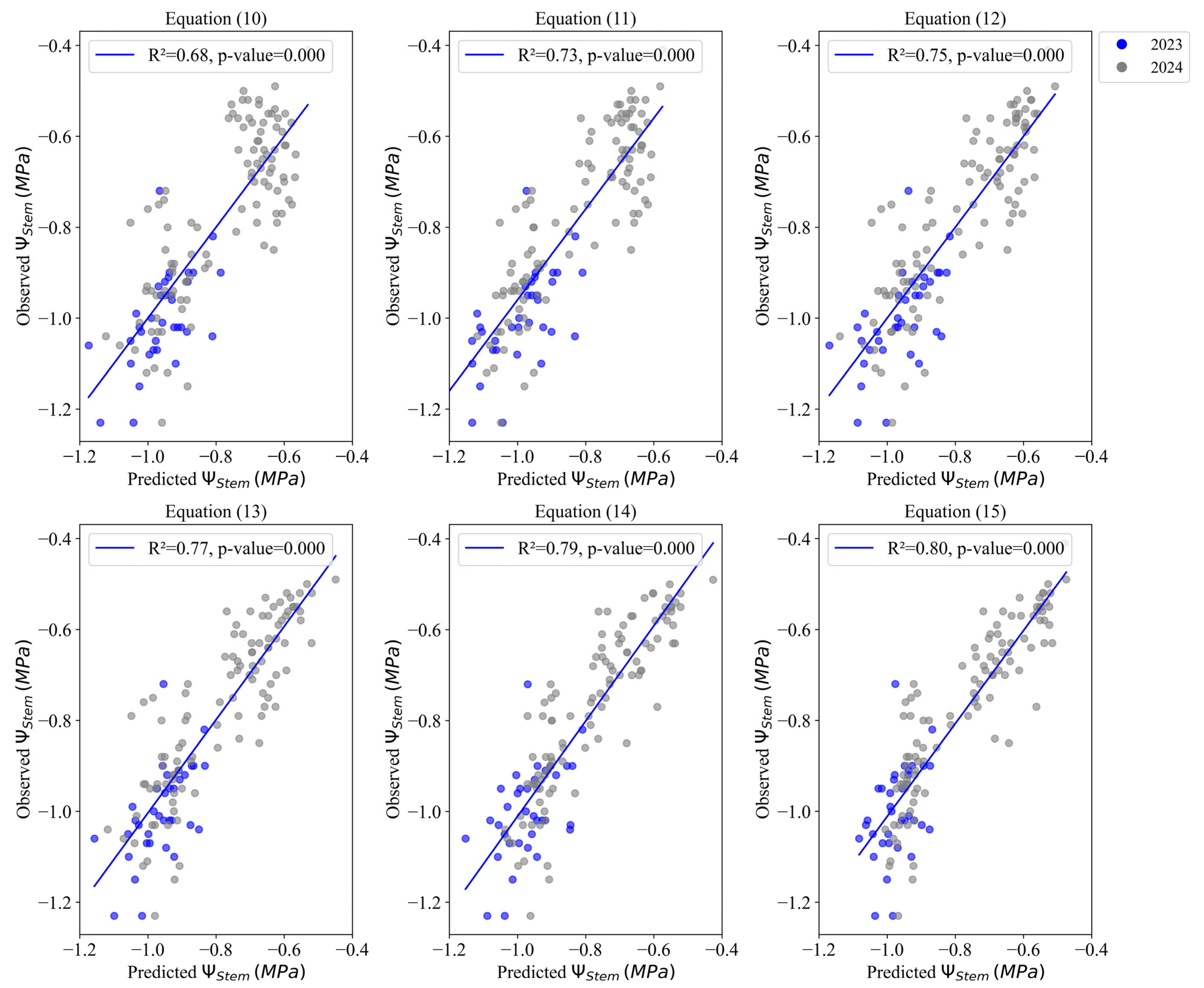
Figure 14.
Observed versus predicted Ψstem values for the six proposed estimation models (Equations (8)–(13)). Each panel shows the fitted regression line (blue) and corresponding R2 and p-values. All predictors are based on pre-harvest data (n = 141).
Figure 14.
Observed versus predicted Ψstem values for the six proposed estimation models (Equations (8)–(13)). Each panel shows the fitted regression line (blue) and corresponding R2 and p-values. All predictors are based on pre-harvest data (n = 141).
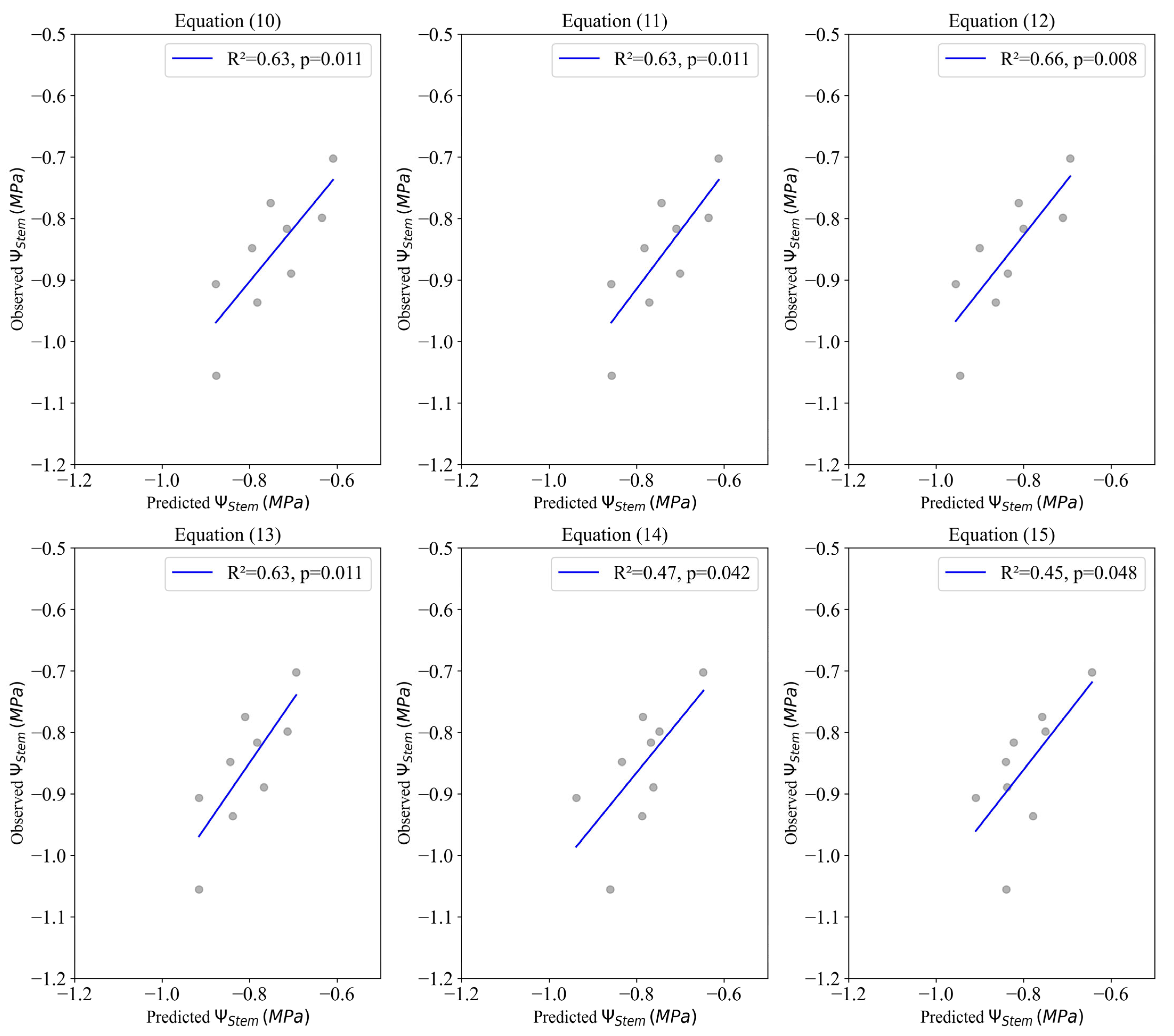
Figure 15.
Observed versus predicted Ψstem values for the six proposed estimation models (Equations (10)–(15)) obtained on the external validation orchard. Each panel shows the fitted regression line (blue) and corresponding R2 and p-values. Gray dots represent individual observations from the external validation dataset.
Figure 15.
Observed versus predicted Ψstem values for the six proposed estimation models (Equations (10)–(15)) obtained on the external validation orchard. Each panel shows the fitted regression line (blue) and corresponding R2 and p-values. Gray dots represent individual observations from the external validation dataset.
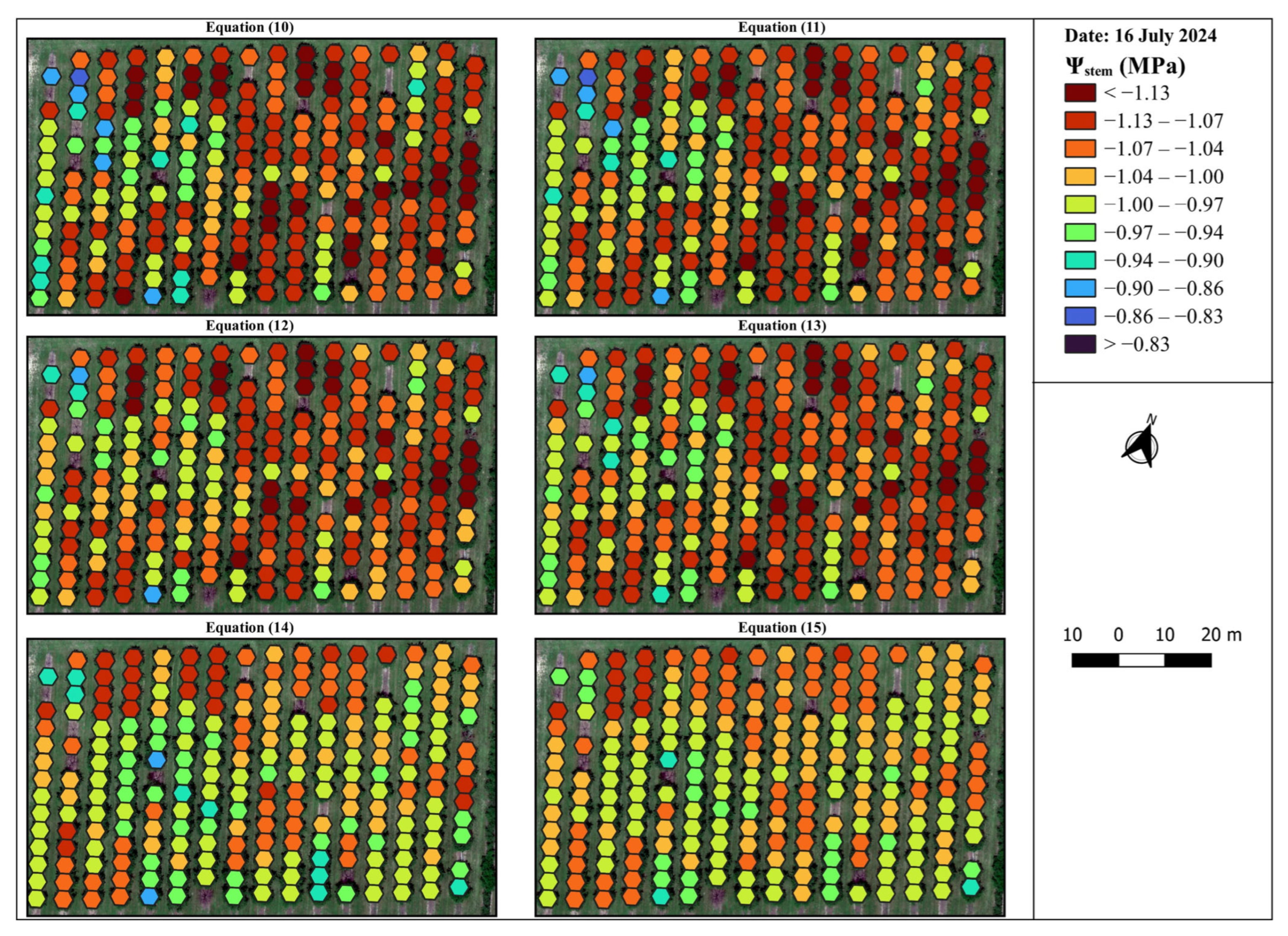
Figure 16.
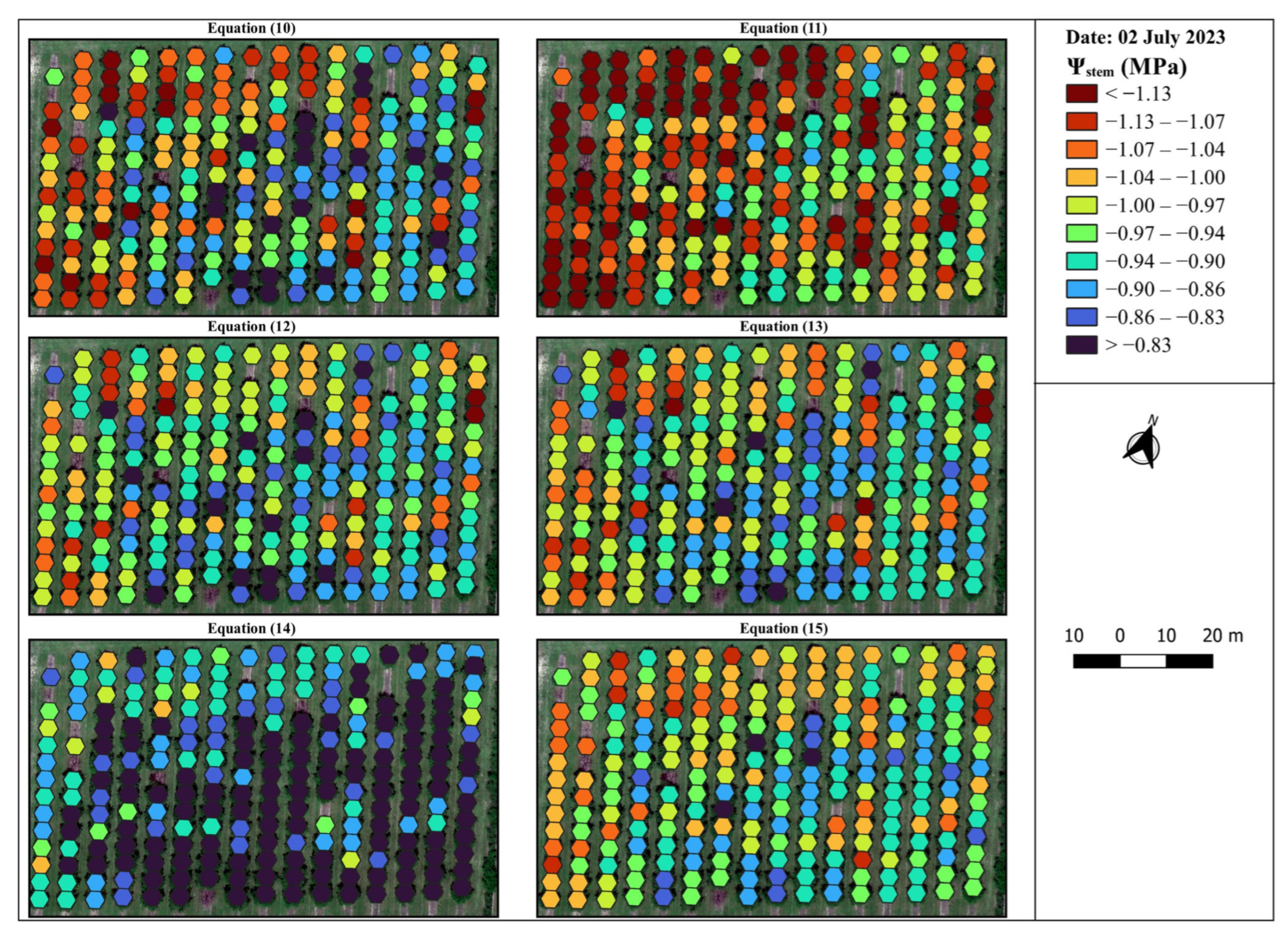
Spatial maps of predicted Ψstem generated using six proposed estimation equations, based on multispectral imagery collected on 2 July 2023 (DOY 183) in Kaysville, UT, USA.
Figure 16.
Spatial maps of predicted Ψstem generated using six proposed estimation equations, based on multispectral imagery collected on 2 July 2023 (DOY 183) in Kaysville, UT, USA.
Figure 17.
Spatial maps of predicted Ψstem generated using six proposed estimation equations, based on multispectral imagery collected on 16 July 2023 (DOY 198) in Kaysville, UT, USA.
Figure 17.
Spatial maps of predicted Ψstem generated using six proposed estimation equations, based on multispectral imagery collected on 16 July 2023 (DOY 198) in Kaysville, UT, USA.
Table 1.
Best performing regression models describing the relationship between Ψ
stem and four meteorological variables: air temperature (T
a), vapor pressure deficit (VPD), solar radiation, and reference evapotranspiration (ET
0). Values represent the highest coefficient of determination (R
2) obtained across linear and quadratic models and across instantaneous and daily time scales for each driver. Results are shown for the year and period in which the strongest relationship was observed. Significance levels: T
p < 0.001 (***). Full comparison is provided in
Table A2.
Table 1.
Best performing regression models describing the relationship between Ψ
stem and four meteorological variables: air temperature (T
a), vapor pressure deficit (VPD), solar radiation, and reference evapotranspiration (ET
0). Values represent the highest coefficient of determination (R
2) obtained across linear and quadratic models and across instantaneous and daily time scales for each driver. Results are shown for the year and period in which the strongest relationship was observed. Significance levels: T
p < 0.001 (***). Full comparison is provided in
Table A2.
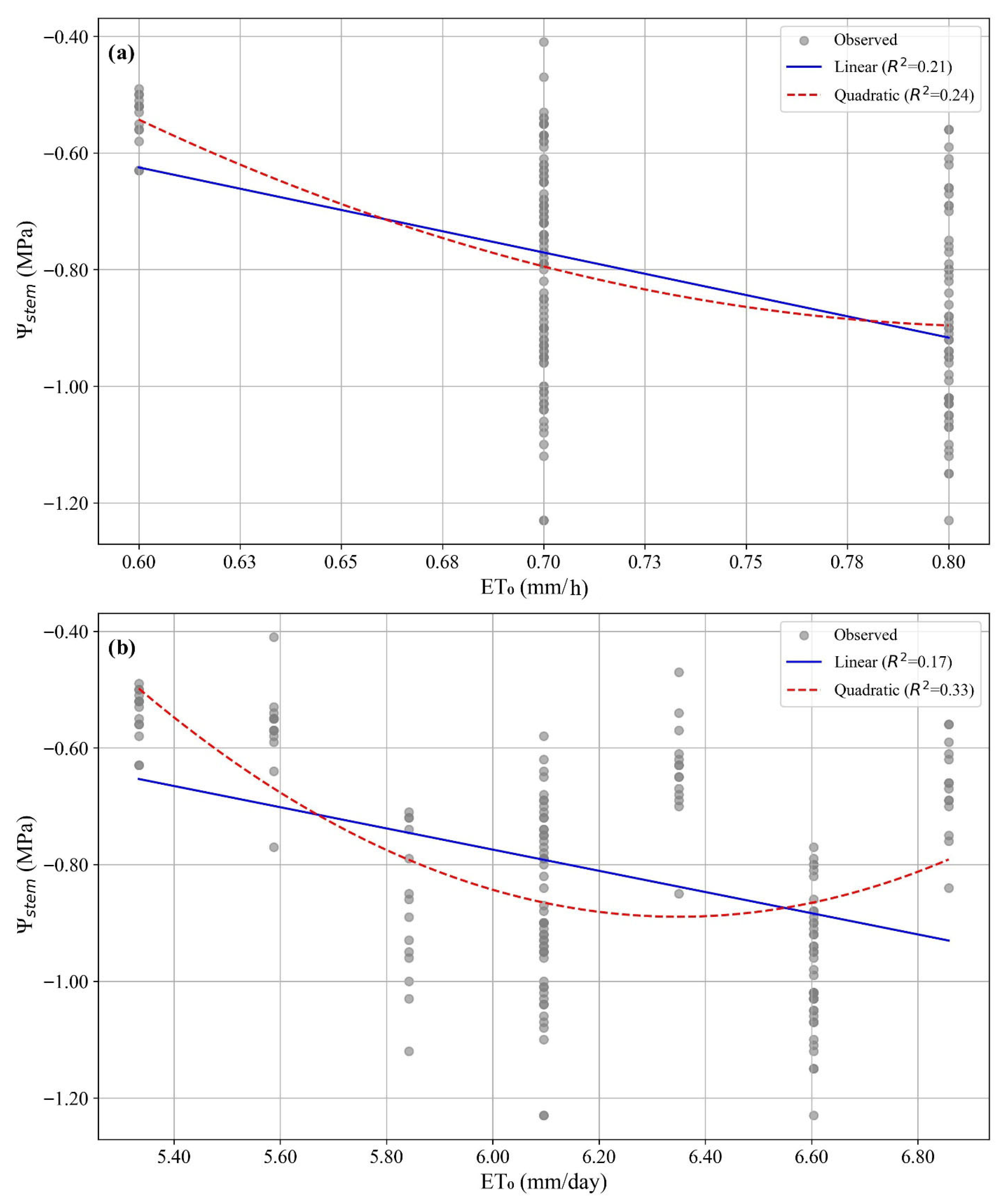
| Year | Period | Driver | Model | Time Scale | R2 |
|---|
| 2024 | Pre-h | Ta | Linear | Daily | 0.30 *** |
| 2024 | Pre-h | VPD | Linear | Daily | 0.30 *** |
| Both | Pre-h | Solar radiation | Quadratic | Daily | 0.30 *** |
| Both | Pre-h | ET0 | Quadratic | Daily | 0.33 *** |
Table 2.
Coefficient of determination (R2) between multispectral bands and Ψstem during the pre-harvest and post-harvest periods when restricting Ψstem values to their overlapping range (−0.7 to −1.2 MPa).
Table 2.
Coefficient of determination (R2) between multispectral bands and Ψstem during the pre-harvest and post-harvest periods when restricting Ψstem values to their overlapping range (−0.7 to −1.2 MPa).
| Period | Blue | Green | Red | Red-Edge | NIR | LWIR |
|---|
| Pre | 0.01 | 0.25 | 0.19 | 0.10 | 0.11 | 0.08 |
| Post | 0.00 | 0.00 | 0.00 | 0.00 | 0.00 | 0.12 |
Table 3.
Vegetation indices and thermal metrics showing the strongest relationships with Ψstem. The table includes index names, formulas, R2 values, and primary literature sources.
Table 3.
Vegetation indices and thermal metrics showing the strongest relationships with Ψstem. The table includes index names, formulas, R2 values, and primary literature sources.
Vegetation
Index | Full Name | Formula | R2 | Reference |
|---|
| RCC | Red Chromatic Coordinate | R/(R + G + B) | 0.68 | [43] |
| GARI | Green Atmospherically Resistant Vegetation Index | (N − (G − (B − R)))/(N − (G + (B − R))) | 0.67 | [44] |
| MSR | Modified Simple Ratio | (N/R − 1)/((N/R + 1)0.5) | 0.66 | [45] |
| SR | Simple Ratio | N/R | 0.66 | [46] |
| Tc − Ta | Canopy Temperature and Air Temperature Difference | LWIR − Ta | 0.35 | [47] |
Table 4.
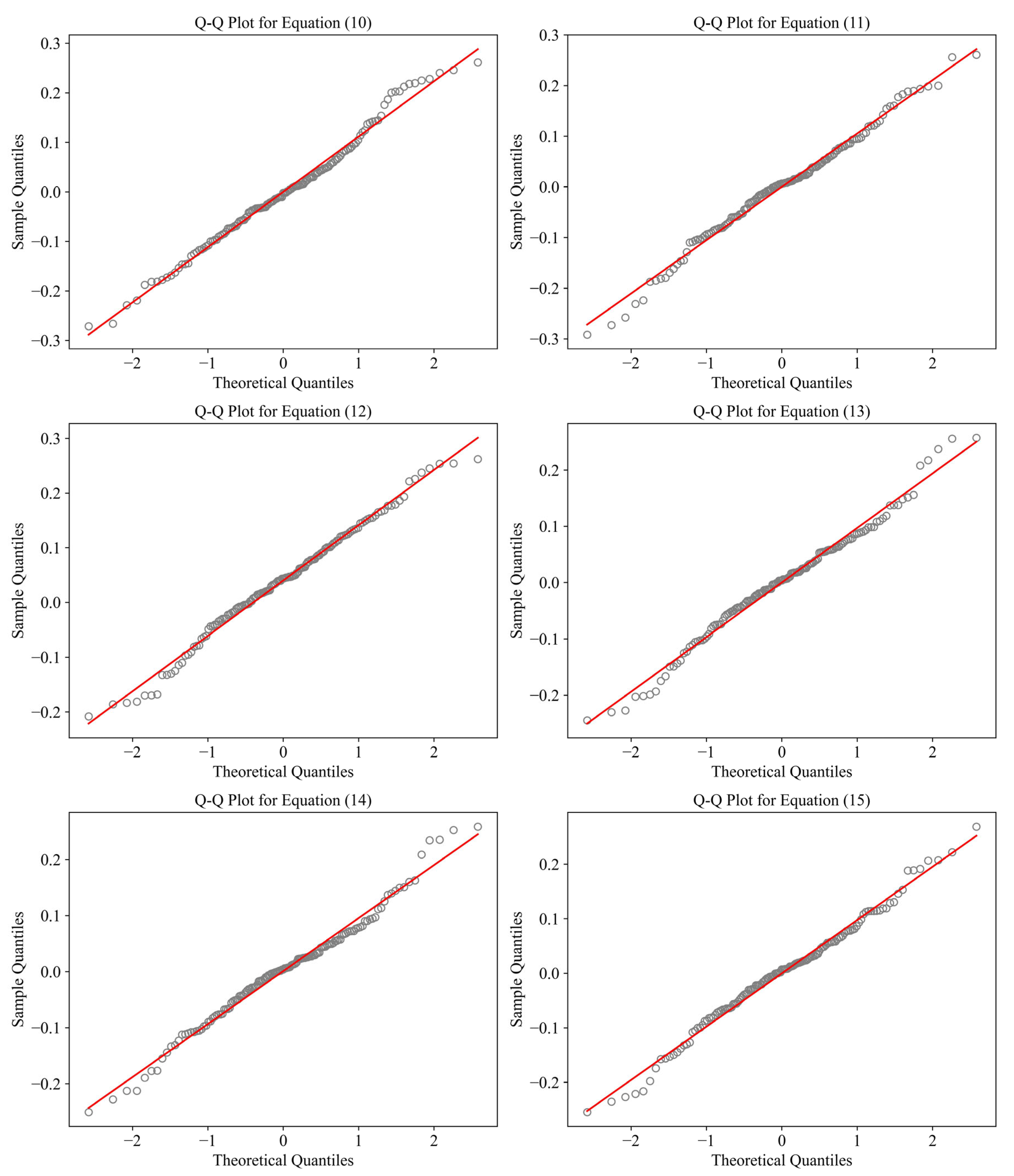
Complexity and performance metrics for the six Ψstem estimation equations developed using symbolic regression.
Table 4.
Complexity and performance metrics for the six Ψstem estimation equations developed using symbolic regression.
| Equation | Complexity | R2 | RMSE (MPa) | MAE (MPa) | MAPE (%) | AIC | BIC |
|---|
| (10) | 4 | 0.67 | 0.11 | 0.08 | 11.4 | −615.19 | −606.34 |
| (11) | 6 | 0.73 | 0.10 | 0.08 | 11.7 | −620.36 | −608.56 |
| (12) | 10 | 0.75 | 0.09 | 0.07 | 9.3 | −654.27 | −645.42 |
| (13) | 12 | 0.77 | 0.09 | 0.07 | 8.9 | −661.27 | −652.42 |
| (14) | 16 | 0.79 | 0.08 | 0.06 | 8.3 | −519.94 | −505.20 |
| (15) | 13 | 0.80 | 0.08 | 0.06 | 7.6 | −672.81 | −661.02 |
Table 5.
Leave-one-tree-out cross-validation performance of the six estimation models, compared with a generalized additive model (GAM) and a null model. Metrics include RMSE, MAE, and MAPE.
Table 5.
Leave-one-tree-out cross-validation performance of the six estimation models, compared with a generalized additive model (GAM) and a null model. Metrics include RMSE, MAE, and MAPE.
| Equation | RMSE (MPa) | MAE (MPa) | MAPE (%) |
|---|
| (10) | 0.11 | 0.08 | 11.5 |
| (11) | 0.10 | 0.08 | 10.3 |
| (12) | 0.09 | 0.07 | 9.5 |
| (13) | 0.09 | 0.07 | 9.0 |
| (14) | 0.09 | 0.07 | 8.7 |
| (15) | 0.09 | 0.06 | 8.2 |
| GAM | 0.09 | 0.06 | 8.5 |
| Null | 0.19 | 0.17 | 22.7 |
Table 6.
Coefficients re-calibrated using 2024 data and validation performance on 2023 observations for SR-derived equations.
Table 6.
Coefficients re-calibrated using 2024 data and validation performance on 2023 observations for SR-derived equations.
| Equation | Coef_1 | Coef_2 | Intercept | RMSE | MAE |
|---|
| (10) | 3.2326 | -- | 0.1730 | 0.11 | 0.08 |
| (11) | 2.9069 | −0.9606 | 0.7718 | 0.11 | 0.09 |
| (12) | 0.0287 | −2.9099 | -- | 0.10 | 0.08 |
| (13) | 0.0042 | −2.8160 | -- | 0.10 | 0.07 |
| (14) | 0.2530 | −0.0159 | −1.4334 | 0.11 | 0.08 |
| (15) | 1.1201 | 0.02714 | −1.9337 | 0.09 | 0.07 |
Table 7.
Performance metrics of the six Ψstem equations evaluated using an external validation dataset collected from an orchard in Santaquin, UT, USA.
Table 7.
Performance metrics of the six Ψstem equations evaluated using an external validation dataset collected from an orchard in Santaquin, UT, USA.
| Equation | RMSE (MPa) | MAE (MPa) | MAPE (%) |
|---|
| (10) | 0.12 | 0.10 | 12.5 |
| (11) | 0.13 | 0.11 | 13.4 |
| (12) | 0.06 | 0.05 | 6.09 |
| (13) | 0.07 | 0.05 | 6.61 |
| (14) | 0.09 | 0.07 | 8.38 |
| (15) | 0.09 | 0.06 | 6.85 |






 ,
,