Article

Geomorphological Evidence of Active Faulting on Alluvial Fan Along Northeastern Margin of Tibetan Plateau (NW China)

Institute of Neotectonics and Natural Hazards, RWTH Aachen University, Lochnerstr. 4-20, 52064 Aachen, Germany
*
Author to whom correspondence should be addressed.
Remote Sens. 2026, 18(5), 778; https://doi.org/10.3390/rs18050778
Submission received: 15 December 2025 / Revised: 26 February 2026 / Accepted: 27 February 2026 / Published: 4 March 2026

Highlights

What are the main findings?
  • Fault scarps in the Longshou Shan Mountains have recorded at least 17–20 paleoearthquake cycles since the Quaternary.
  • Remote sensing-based geomorphological analysis of fault scarps, alluvial fans, and river beds constrains past fault activity.
  • The results reveal surface-rupturing active faults at the northeastern margin of the Tibetan Plateau.
What are the implications of the main findings?
  • Fault propagation controls alluvial fan sequences, linking tectonic activity with landscape evolution.
  • This study demonstrates the value of fault-scarp records for paleoseismology and regional tectonic assessment.

Abstract

Complete records of fault activity are very valuable for assessing possible earthquakes. Fault scarps are one key to exploring past fault activity. Through the records of fault scarps, we can obtain evidence of fault activity and faulting events in paleoseismology. The Longshou Shan Mountains are located at the northeastern edge of the Tibetan Plateau. Here, through the measurement of fault scarps and the geomorphological analysis of alluvial fans and river beds, we have found that fault scarps here have experienced long earthquake cycles, and the propagation of the fault system has created the alluvial fan sequence. We provide evidence of active faults that ruptured the surface in Quaternary times and further deduce the regional landscape development process.

1. Introduction

Complete records of tectonic activity for a certain fault are essential for assessing possible earthquakes and magnitude. If there are long-term records, it is even possible to infer the earthquake recurrence cycle [1,2,3,4,5,6]. Methods used to obtain evidence of active fault activity include modern instrumental earthquake research (e.g., [7,8,9,10]), paleoseismic documentary records (e.g., [11,12,13]), and paleoseismic trenching (e.g., [2,14,15,16]). Instrumental earthquakes provide a complete record of the last ~100 years [17], but the time scale of the record is limited and may rarely cover a complete earthquake cycle, as recurrence periods are usually significantly longer. Ancient documentary records only record main earthquakes but ignore low-magnitude earthquakes or remote earthquakes, which may not be well recorded. Trench studies can only identify a few earthquakes at the shallow surface if the magnitude was strong enough to rupture the surface, and cannot provide records below the trench depth. Biological agents’ destruction of strata and strata with low sedimentation rates also affect the identification of paleoearthquakes [18]. Deformed geomorphic markers, such as river terraces and alluvial fans, record the deformation of geomorphic markers over long time scales, providing a record of tectonic activity that can be traced back hundreds of thousands of years [6,19,20]. The longer the recording period, the more accurate the earthquake recurrence period can be, if individual earthquakes can be separated.
The interaction of tectonics and surface processes has created the current landscape [21,22]. In contrast, current landforms can also be used as indicators to quantify tectonic activity. In arid areas, because there is less erosion, landforms can be preserved for a long time [23,24], providing us with a record of tectonic activity for hundreds of thousands of years, perhaps over multiple earthquake cycles. The northeastern margin of the Tibetan Plateau, with its arid climate and active tectonics, has developed and preserved a large number of landforms related to tectonic activity [25], providing us with a natural laboratory to study the tectonic activity and landscape. Previous researchers have successfully obtained information on fault activity records for Quaternary tectonics from deformed river terraces [26,27], alluvial fans [28], and fault scarps [6,20,24], expanding the temporal history of fault activity.
Here we focused on the Longshou Shan Mountains at the northeastern edge of the Tibetan Plateau and measured the alluvial fan and two exposed fault scarps in the northern front of Longshou Shan, providing geomorphic evidence of fault activity and expanding the record of active tectonics in this area. Our study provides an example of how geomorphic evidence can be used to evaluate the activity of active faults in an area lacking long-term seismic records and trench studies. Our results also suggest that in arid active tectonic areas, active tectonics dominates the geomorphic evolution of the region as erosional and depositional processes do not dominate.

2. Regional Setting

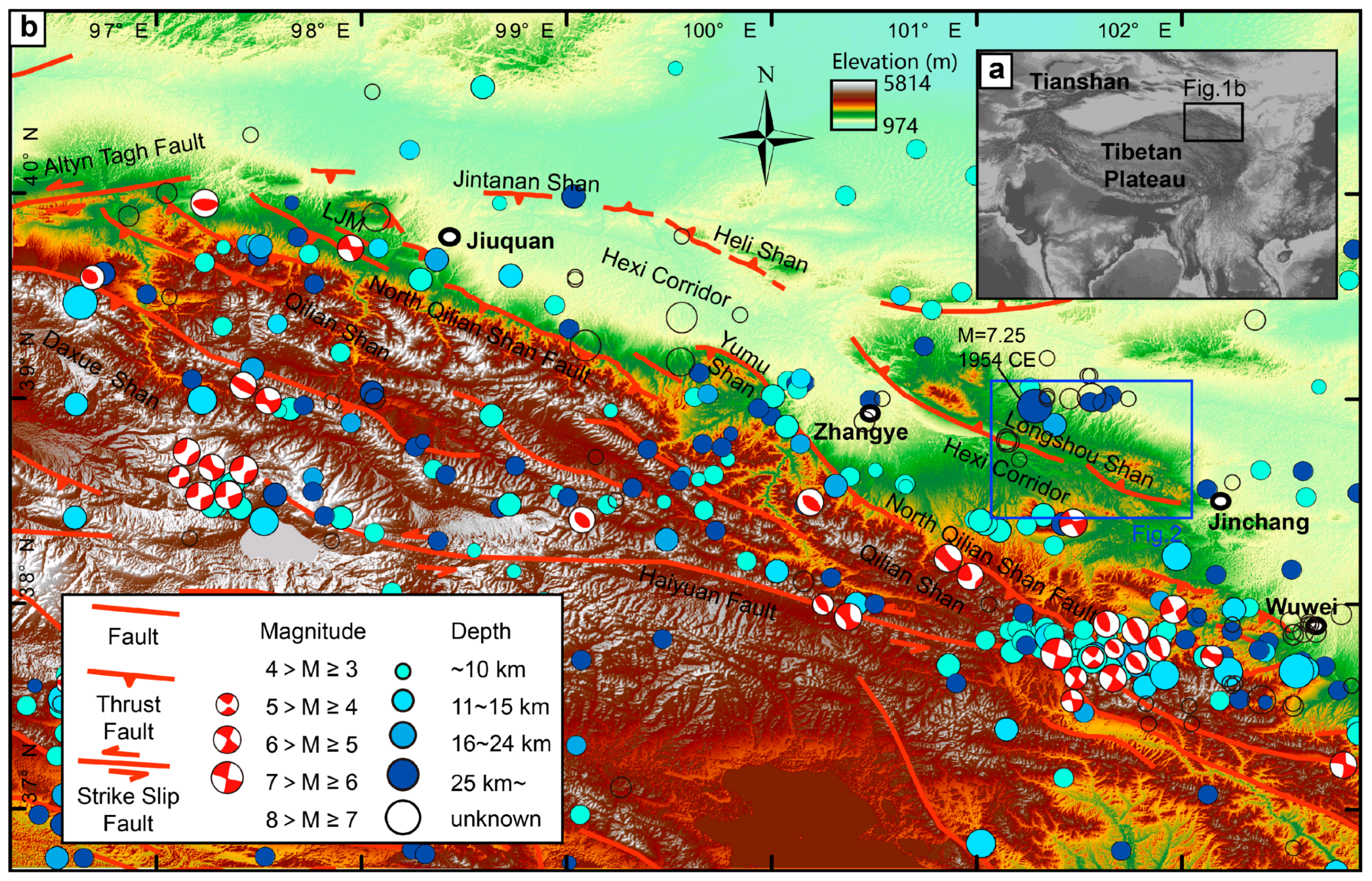
The collision between India and the Eurasian plate led to the uplift of the Tibetan Plateau, the highest and largest plateau on Earth [29,30,31,32]. The uplift of the plateau had a huge impact and was one of the most important geological events of the Cenozoic era. The Qilian Shan Mountains form the northeastern margin of the Tibetan Plateau. It is an active thrust fold belt with frequent earthquakes [30,32,33,34]. The thrust system accommodates the crustal shortening caused by continental convergence [35,36]. North Qilian Shan is the most recent part involved in the plateau [37]. The Altyn Tagh Fault in the west defines the northwestern boundary of the plateau, and the mountains on the north side of the Hexi Corridor define the northeast boundary of the plateau [38,39,40] (Figure 1). Longshou Shan is the northeastern mountain range of the Hexi Corridor and is at the front of the northeastern expansion of the plateau. Due to well-exposed faults and folds and convenient transportation possibilities, the Hexi Corridor has attracted many geologists to investigate and research it. The onset, rate, and kinematics of Quaternary tectonics on both sides of the corridor have been studied in detail [38,40,41,42,43,44,45,46].
There are many studies focused on active tectonics and mountain uplift for the intensely deformed main part of the plateau and its northern edge areas [32,36,37,38,40,47]; Some studies have shown that the Tianshan Mountains and the northwest outside of the main part of the plateau are also closely related to the collision of India and Eurasia and the uplift of the plateau [48,49]. Although there are no spectacular mountain ranges such as the Tianshan Mountains or extremely active tectonic activities in the northeast outside of the plateau, some recent studies have shown that desert-covered Inner Mongolia and southern Mongolia, located farther to the northeast of the plateau, have tectonic activities related to continental convergence [50], and the spatial range of related structures may far exceed southern Mongolia, as far as the Sea of Okhotsk [51]. Tectonic activity in the vast areas in the northeast outside the main plateau has usually been ignored; neotectonic evidence and seismic activity outside of the plateau suggest that these areas still deserve to be examined [50]. Longshou Shan is located at the junction of the Tibetan Plateau and the Alxa Block, and can be used as a starting point for research in areas outside the northeast of the plateau.
Figure 1. (a) Map of the Tibetan Plateau, Tianshan and surrounding regions, showing the location of Figure 1b; (b) earthquakes and neotectonic fault map of Qilian Shan (northeastern Tibetan Plateau) and adjacent regions. Fault data are from Hetzel et al. (2004); Yuan et al. (2013); and Zheng et al. (2013) [25,37,52]. The blue stars and fault plane solution earthquake data are from USGS (https://earthquake.usgs.gov/earthquakes/search/, accessed on 1 October 2023) and Trabant et al. (2012) (IRIS) [8], and the historical earthquakes are from Gu et al. (1983); Lanzhou Institute of Seismology (1985); and the Earthquake Disaster Prevention Department (1999) [11,12,13].
Remotesensing 18 00778 g001
The deformation and uplift of Longshou Shan from the Late Miocene represent the most recent outward expansion of the Tibetan Plateau [40]. Other studies also confirm that the deformation of the Plateau has crossed the Hexi Corridor [39,40,53]. Sedimentological and geochronological studies indicate that deformation began in the Longshoushan area during the Miocene, with significant deformation appearing around 5 Ma. By 2.5 Ma, changes in sediments in the basin north of the mountain revealed the development of new faults (f1 in this study) [54,55]. Geological studies and relocation of small earthquakes show that these faults have steep dips near the surface and are interconnected at depth [40,52]. Seismic profiles defined the southdipping faults north of the Hexi Corridor as the northern border thrust of the plateau, also showing large fault dip angles [56]. The main faults in the south and north of Longshou Shan, as well as the f1 fault in the north, all originate from the Qilian Shan thrust system [52,54,55].

3. Materials and Methods

3.1. Materials

In order to obtain evidence of fault activity in this area, we used the ArcGis Pro 3.3.2 geographic information system platform to measure two fault scarps and the Longshou Shan foreland alluvial fan in the 12.5 m high-resolution digital elevation model ALOS PALSAR DEM (https://search.asf.alaska.edu/, accessed on 1 October 2023). In order to classify the alluvial fan and outline the specific fault location, we also used Google Earth and Gaofen-1 (GF-1) satellite imagery. In addition, regional geological maps and related geological data are also important references (https://geocloud.cgs.gov.cn). Previous earthquake-related research also provides valuable information on structures and faults [52].

3.2. Methods

3.2.1. Offset Measurements

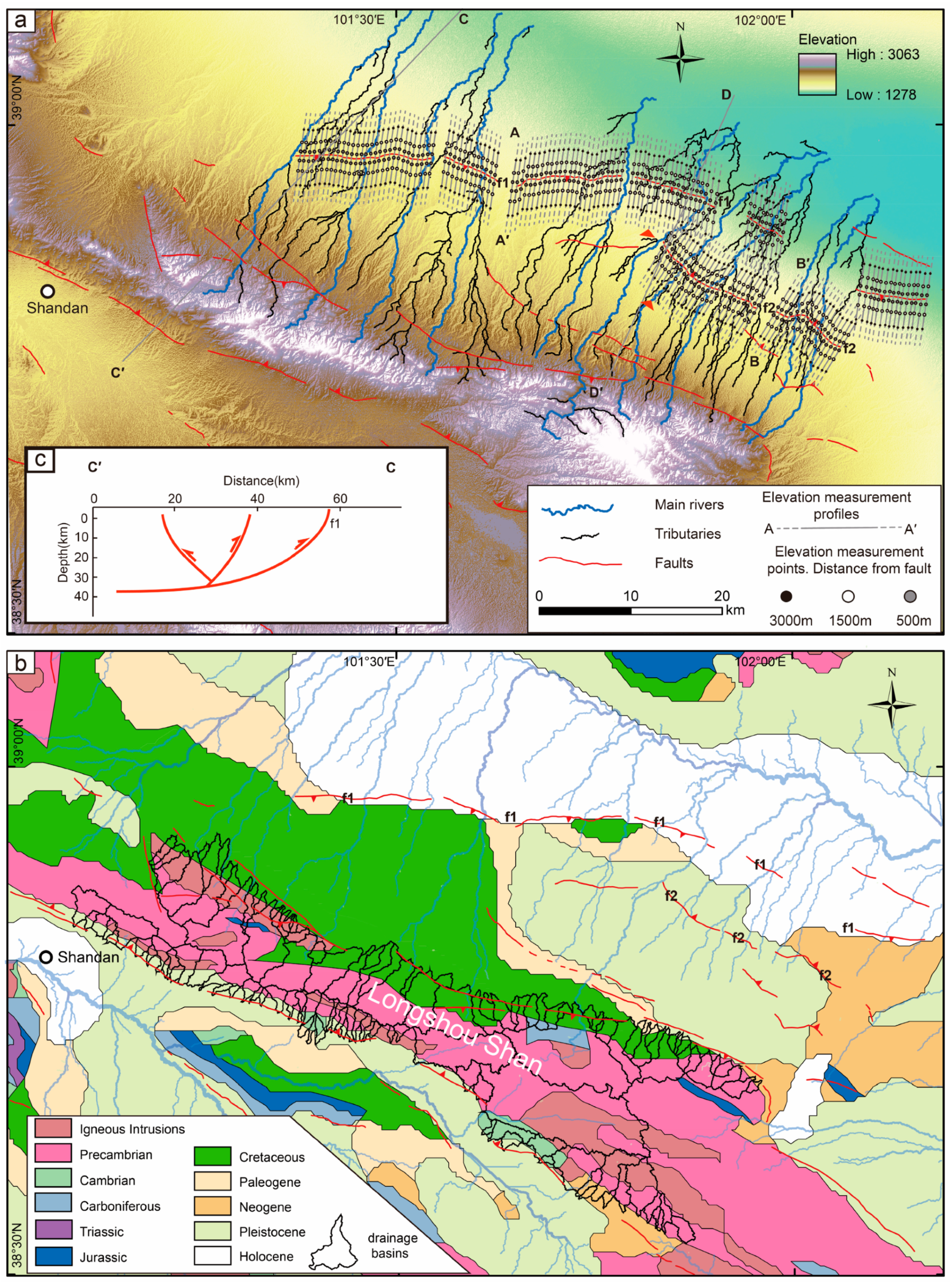
Previous researchers used historical earthquake data from all over the world to compile an empirical relationship between rupture length, earthquake magnitude and average slip. These relationships give us the opportunity to infer other data by measuring some of them [57,58,59]. There are two significant fault systems on the alluvial fan in the north front of Long shou Shan, which are oblique or nearly parallel to the mountain front. The longer one is located at the northern edge of the alluvial fan and defines the foot of the fan system. In previous studies, this fault was called the Sabuertai-Chenjiajing Fault [52]; in our study, we refer to this fault as f1. The shorter one in the middle cuts off the alluvial fan system. In previous studies, this fault was called the Yuquantan Fault [52]. We refer to it as f2 (Figure 2).
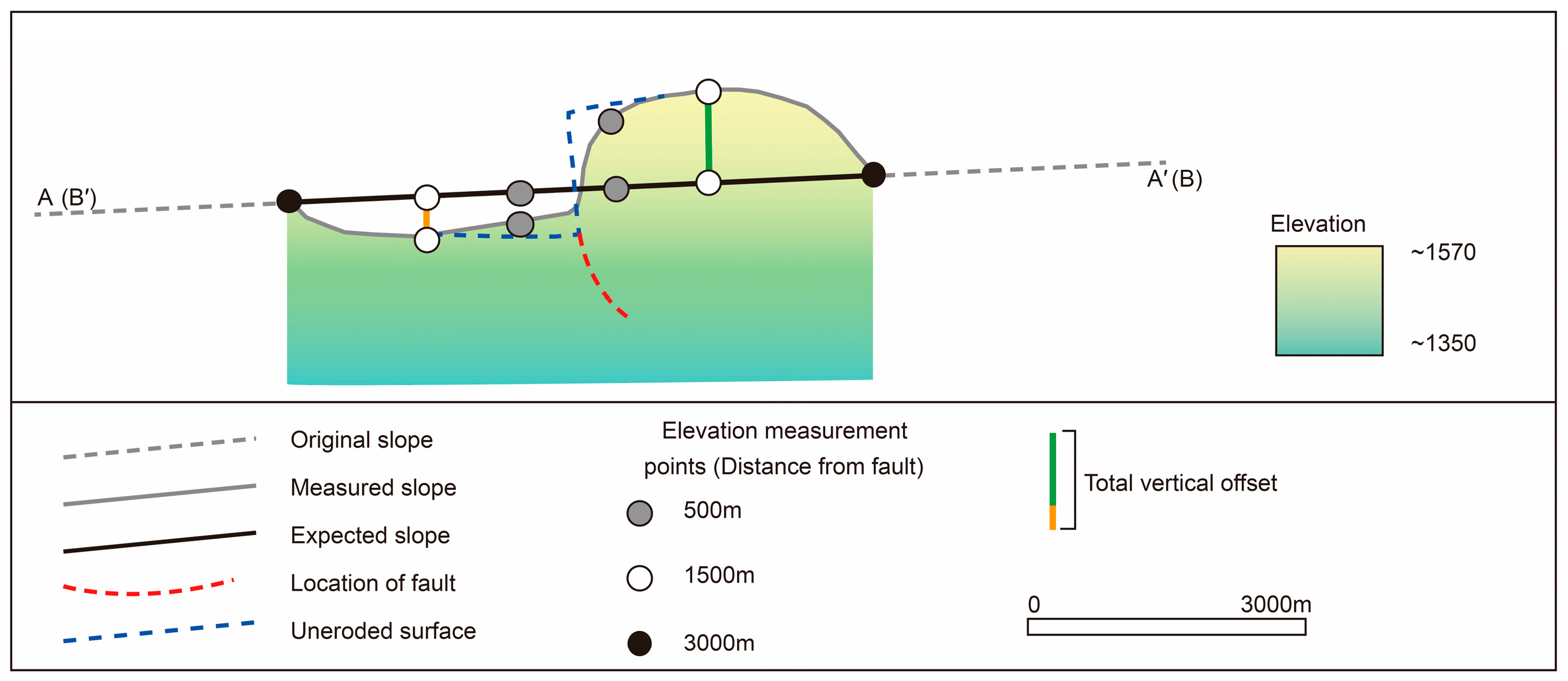
In order to obtain the vertical offset of the fault, we adopted a method from a previous study to measure the vertical displacement [24]. After determining the fault strike, parallel measuring lines were constructed along the strike at intervals of 500 m (Figure 2a). Points 500 m, 1500 m and 3000 m away from the fault were taken as measuring points on the measuring lines. The measuring points at 3000 m on both sides were connected in the cross section, as the expected original surface was not affected by deformation. The elevations at 500 m and 1500 m on the original surface were the expected undeformed elevations. The actual measured elevations were then compared with the expected elevations. The maximum difference is the vertical offset caused by the slip in the fault. The sum of the differences on both sides of the fault represented the total offset of the fault (Figure 3). Another advantage of this measurement method is that it minimizes the impact of erosion, as shown in the figure, where erosion and deposition mainly occur near faults.

3.2.2. Alluvial Fans and Inclinations

Alluvial fans are a type of landform formed in front of a mountain due to changes in gradient (knickpoint at the mountain front) and hydraulic conditions [60,61]. Also, climatic reasons (dryness, wetness) can modify the shape and function of alluvial fans. When the fan surface no longer accumulates sediments, due to fracturing, weathering, etc., the characteristics of the fan surface begin to be modified, so that we can estimate the relative age by the drainage density, roughness of the fan surface, erosional conditions, etc. Many alluvial fans in arid areas are built up by debris flow sediments, and the relative age can be speculated based on the difference in color (because of different rocks in source areas). Therefore, in arid areas, they can be used as landform markers even if the surface is rough [22].
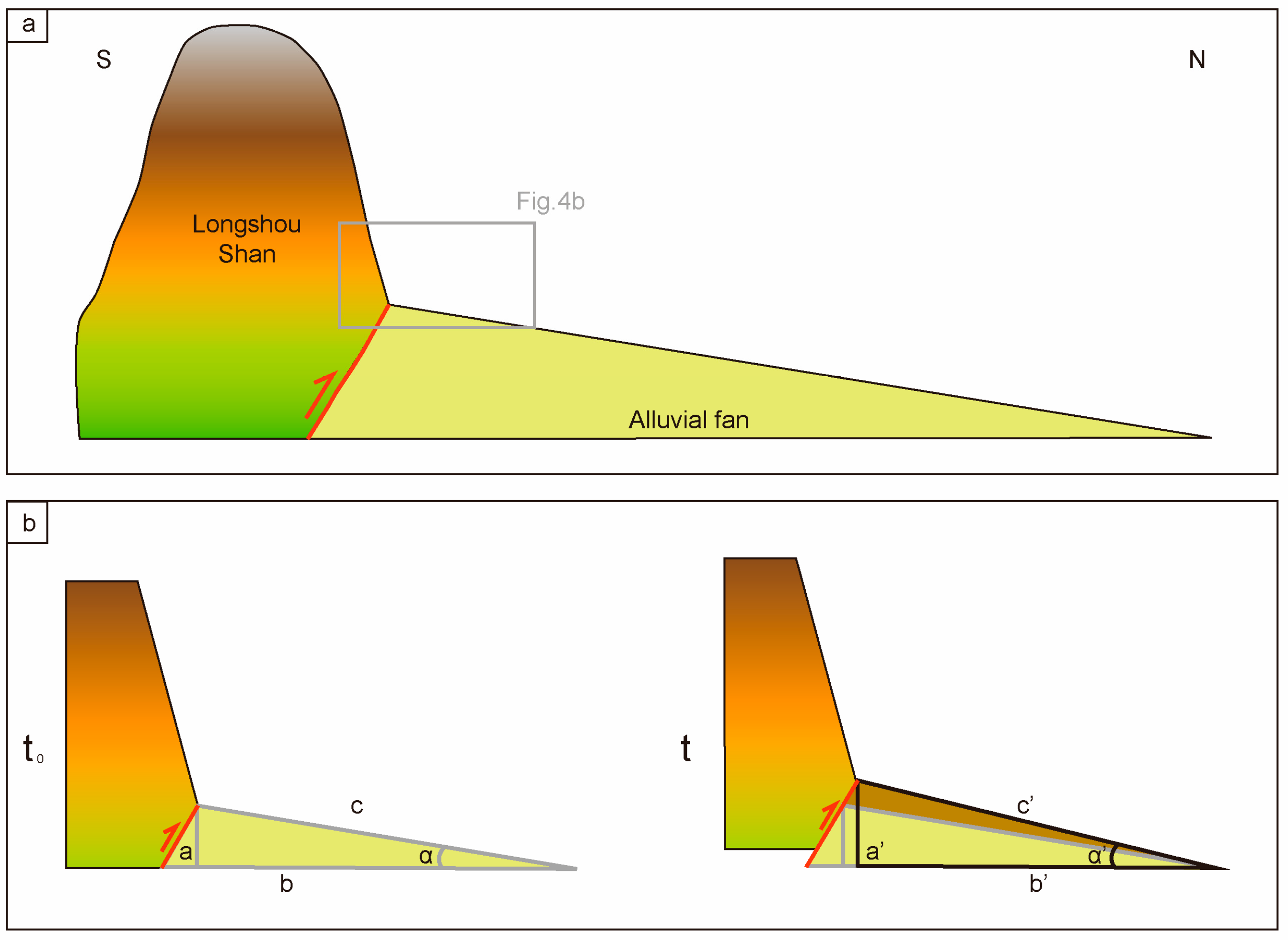
We measured the dip angle of the alluvial fans using a simplified model to reflect the tectonic activity of the alluvial fan, assuming that deformation occurred at or close to the fan apex and measuring the average slope angle of the fan from the apex to the toe (Figure 4). We also divided the alluvial fan levels based on the differences between drainage density (Supplementary Materials), color, roughness, erosion pattern and extent, and altitude, trying to define the extent of thrust uplift by comparing the elevation and dip angle of the alluvial fan.

3.2.3. River Incision

Seasonal or perennial rivers occupy many surface landscapes and transform the landforms by erosion, transport and deposition of materials [21]. As the most sensitive geomorphic units in the Holocene, the landforms left by river erosion and/or deposition, river terraces, alluvial fans and longitudinal profiles can be used to study the interaction between tectonic and surface processes. The erosion base level is the bottom surface of river erosion; erosion will not occur below this surface. Usually, the ultimate erosion base level is the sea level [22]. In the current regional case, many longitudinal rivers start from the interior of Longshou Shan, pass through the alluvial fan area in front of the mountain in the northeast, and finally join into the axial river on the north side. Therefore, the axial river, which is the valley filled with Holocene deposits at the north of f1 (Figure 2b), is the relative erosion base level of the longitudinal river.

4. Results

4.1. Offset Measurements

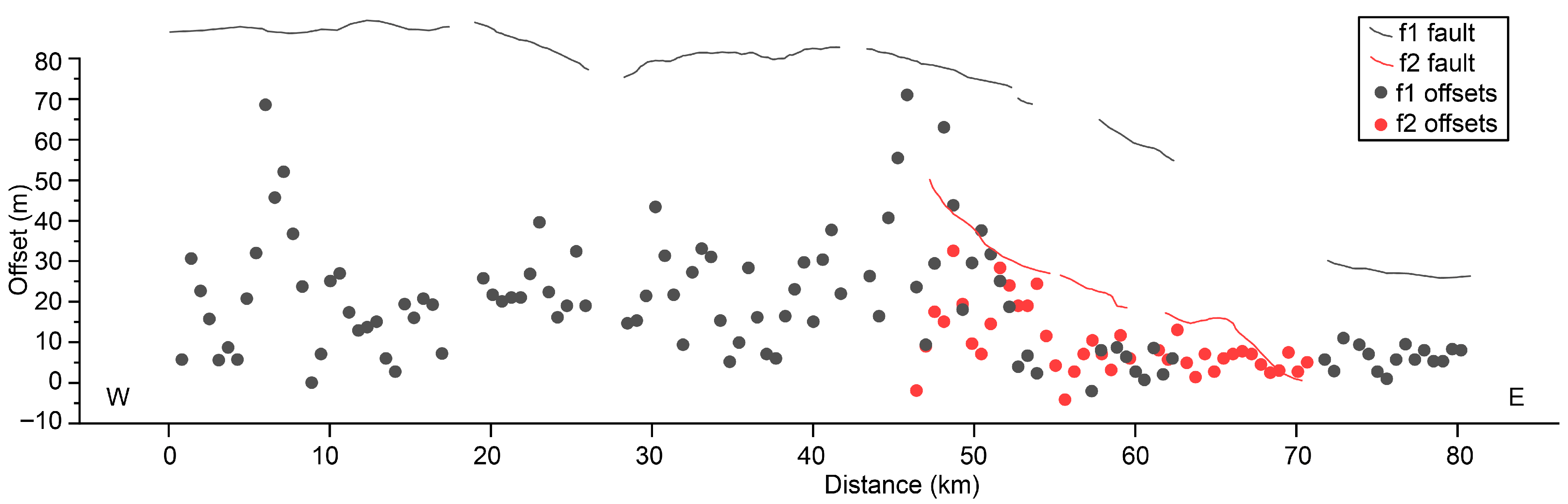
The length of f1 is 74.4 km and its strike is nearly E–W. The maximum measured displacement value occurs at the center of the fault. As shown in Figure 2a, the vertical offset is as high as 71 m. Based on previous studies [33,40,52,56], the near-surface dip angle of the fault can be determined to be 70°, and the relative dip slip is 75.6 m. Considering fault growth theory [62,63], we believe this location represents the earliest point where a fault segment began to rupture, recording more earthquakes. There are smaller offset values in the eastern part of the fault. Usually, the maximum displacement value on the fault occurs in the middle of the fault, and the displacement value decreases in a bow-like distribution toward both sides on high-angle reverse faults [44] and normal faults [64]. Therefore, we speculate that the fault may continue to extend westward, but the fault scarp has been modified by multiple rivers passing through it, so the fault length we measured is only a minimum estimate. The error in moment magnitude comes from the results calculated using different empirical formulas. These formulas differ slightly from each other, but the differences are all within 0.1.
The length of f2 is 23.3 km and the strike is nearly NW–SE. The maximum measured displacement value appears on the west side of the fault. On the fifth measuring line (Figure 2a) from west to east, the vertical offset is as high as 28.3 m, and the relative dip slip is 30.1 m. The offset value decreases on both sides. To the west, the fault scarp is crossed by a river and a road, so the fault scarp has been modified and cannot be measured. The measured fault length is also a minimum estimate. The offset error comes from the standard deviation of the offset (Table 1) and the detailed offset data shown in Figure 5.

4.2. Alluvial Fan and Inclinations

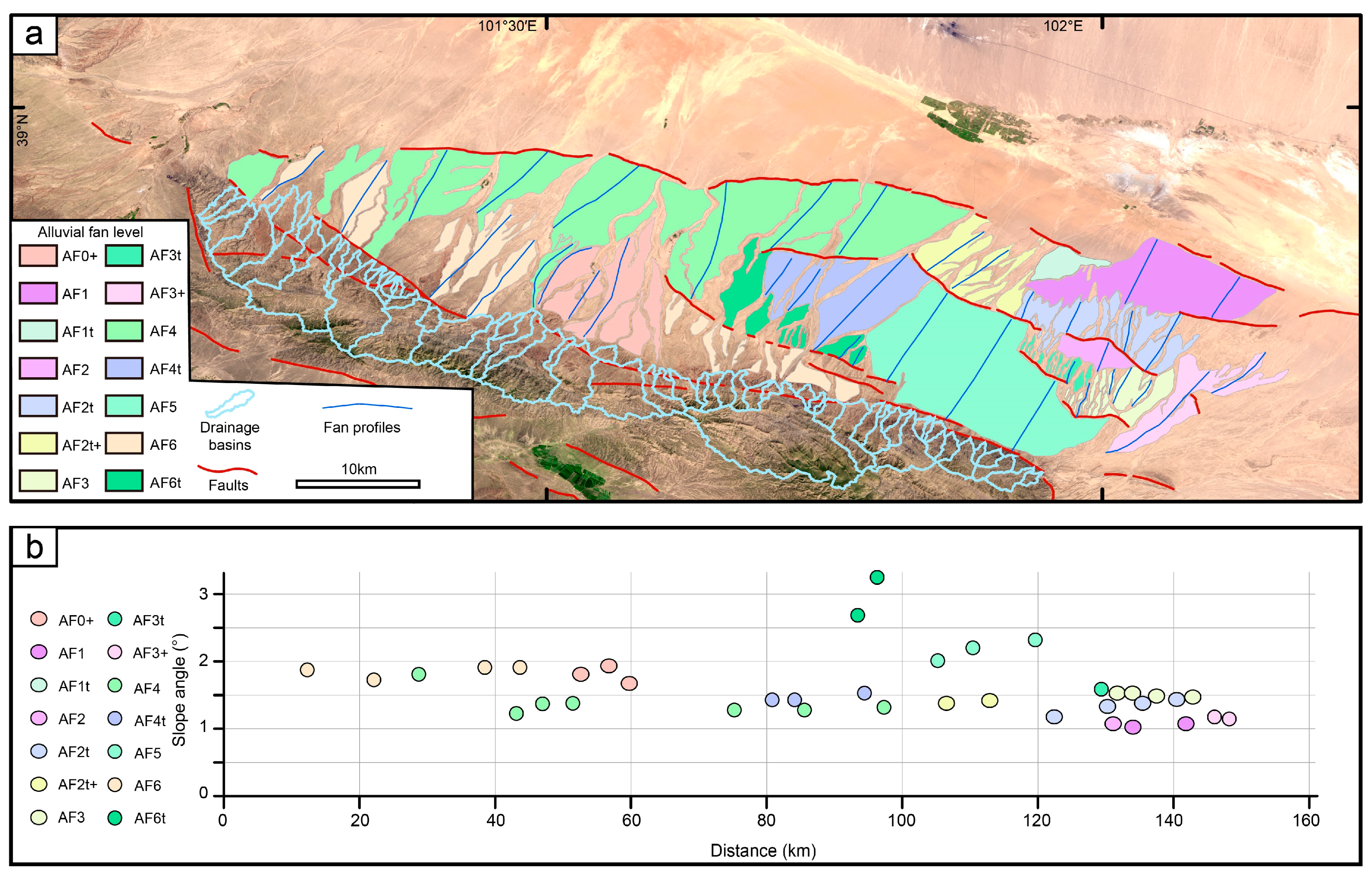
The alluvial fan map is drawn along the entire Longshou Shan front. Due to the different development of faults on the east and west sides of the Longshou Shan front (Figure 6a), the characteristics of the alluvial fans are also different. To eliminate the influence of lithological differences between the east and west sides of the mountain front, we will discuss the two regions separately. The west side of the front is mainly controlled by two active faults, the North Longshou Shan Fault and f1. The lithology in this area is uniform and no multilevel fans have been formed. Since the range of the active alluvial fan is limited to the south of f1, to the north of f1 are the Quaternary river sediments from the axial river. This can be seen from the regional geological map (Figure 2b). It is also obvious in the satellite image that the color of the river sediments is red (Figure 6a). The area between f1 and the North Longshou Shan Fault is distributed as a broad alluvial fan, AF4. After the uplift of f1, its surface began to deteriorate, showing a slightly darker color in satellite images. Afterward, several rivers crossed this vast fan surface, leaving another lower surface. The sediments left by the rivers showed the same reddish color as the river sediments north of f1. We named this surface AF6, and the part of this level that cut deeper was named AF0+.
In the eastern section, the alluvial fan was cut off by f2, forming a multilevel alluvial fan. The fan surface north of AF2 was relatively elevated, causing the northern fan surface to begin to undergo erosion and weathering. At the same time, the southern fan surface continued to receive sediments from the upstream and continued to grow. This is reflected in the smooth fan surface and the significantly increased inclination of the fan surface AF5 relative to the other fans (Figure 6b). The river on the steep AF5 fan surface cut the southern fan surface, causing the fan surface to be cut into small pieces by the water flow and then weathered. Later, this process occurred again on the new fault on the south side of f2.

4.3. River Incision

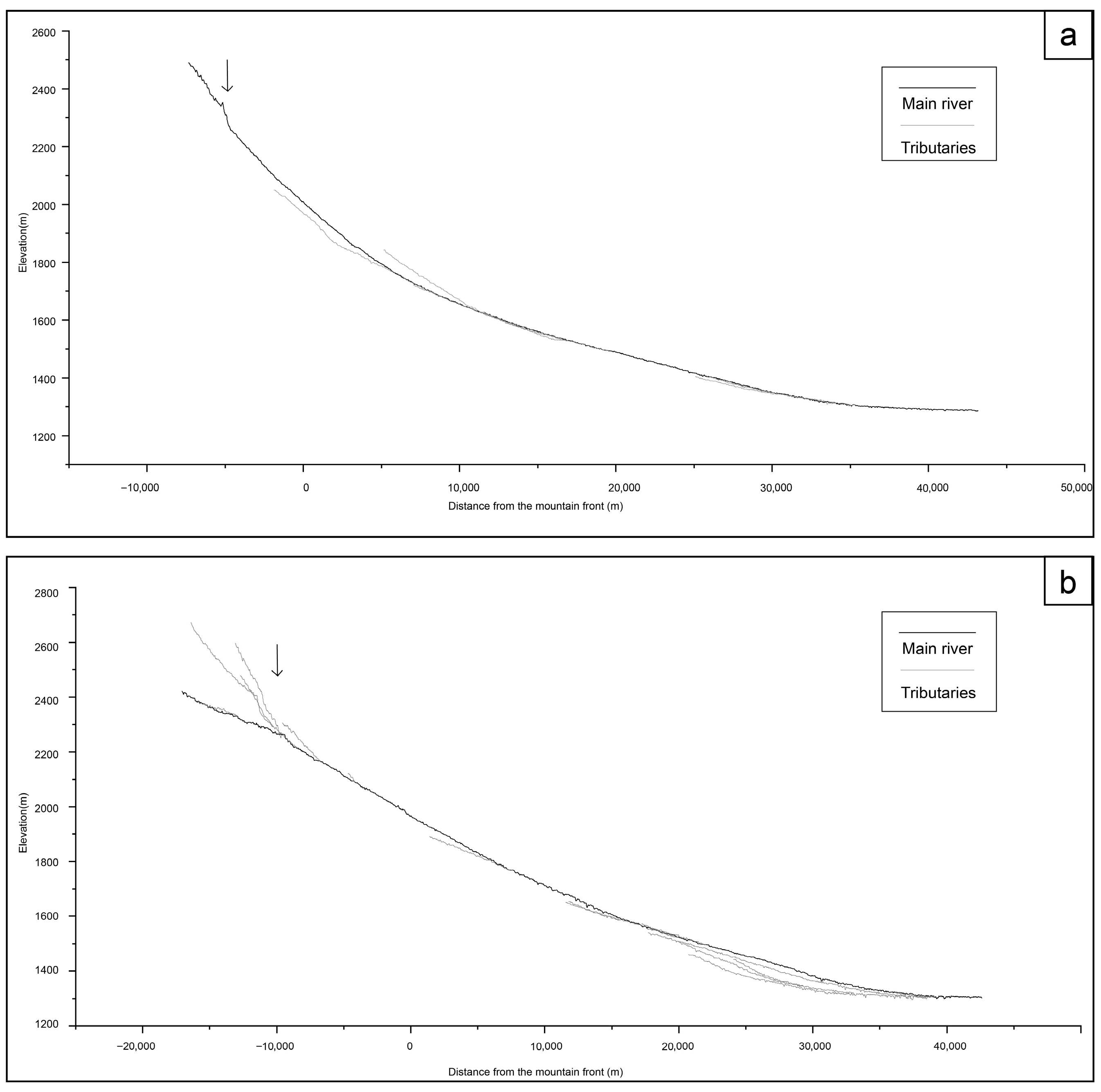
We extracted 10 river profiles, including tributaries that pass through the alluvial fan in front of Longshou Shan, from the high-resolution digital elevation model (Figure 2a). We call these 10 rivers River 1 to River 10 from east to west. River 4 and River 5 pass through three main faults in North Longshou Shan, and also pass the place where the displacement of f2 is the largest and the middle part of f1, leaving traces of tectonic activity in the longitudinal profile of the river. The knickpoint of River 4 at ~−5000 m may be a sign of the activity of the North Longshou Shan Fault in front of the mountain. The knickpoint of River 5 appears at ~−10,000 m and is also recorded in the tributaries (Figure 7).
In the downstream parts of these two rivers, all tributaries appear below the main river in the profile, which is somewhat different from the common pattern. We analyzed this because the fan between f1 and f2 was blocked by tectonic uplift, which prevented the river from passing through. The AF5 fan began to accumulate and the inclination of the AF5 fan increased significantly. Then rivers on the AF5 surface cut downward through the F2t+ and F4 fans. The river channels on the AF5, AF2t+ and AF4 surfaces were connected to form the main river channel, while the downstream tributaries used the axial river as the relative erosion base level. As AF2t+ and AF4 uplifted and source erosion occurred on the tributaries, the tributaries eventually became lower than the main river in the longitudinal profile.

5. Discussion

5.1. Regional Landform Evolution

In the Hexi Corridor, the Late Quaternary sedimentary record is dominated by the strong sediment pulse associated with the Pleistocene–Holocene transition, followed by relatively subdued aeolian and alluvial sedimentation throughout most of the Holocene. Optical Stimulated Luminescence (OSL) dating reveals frequent recycling of sediments rather than distinct phases of climatically driven deposition in the Holocene, suggesting that major climatic oscillations after the glacial–interglacial transition had limited influence on regional sediment flux. In this context, the aeolian system appears to be largely controlled by the availability of fluvial supplied sediment, indicating a decoupling of the geomorphic surface from direct climatic forcing [65]. The fluvial network provides a persistent sediment supply despite modest variability in monsoonal precipitation, while the stability of landform surfaces reflects a limited response to Holocene climate variability, implying that rates of catchment-scale erosion were not substantially amplified by post-glacial climatic change [65]. Under such conditions, the geomorphic surface could be preserved for a very long time [66], and it can be assumed that there was almost no erosion before loess deposition [25].
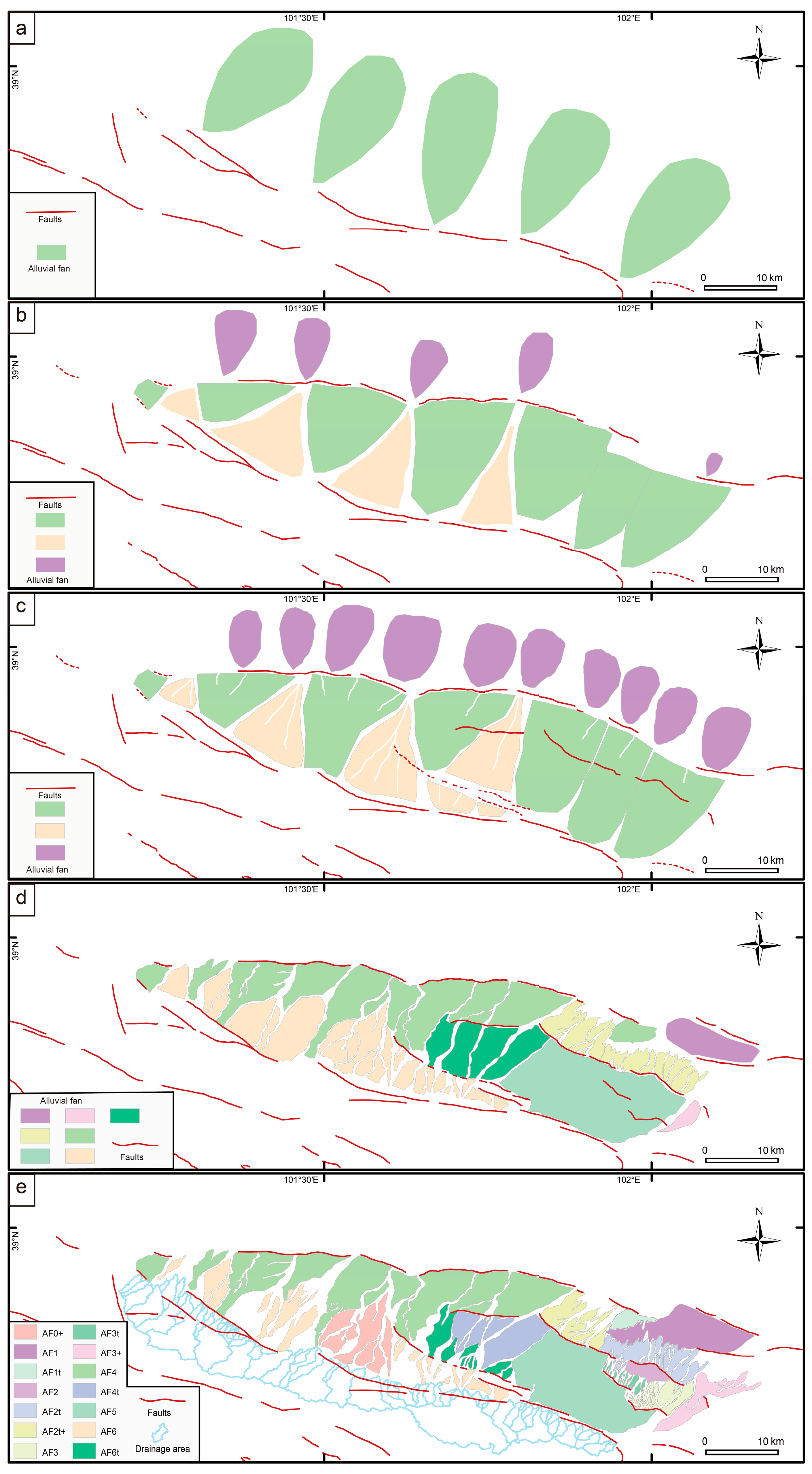
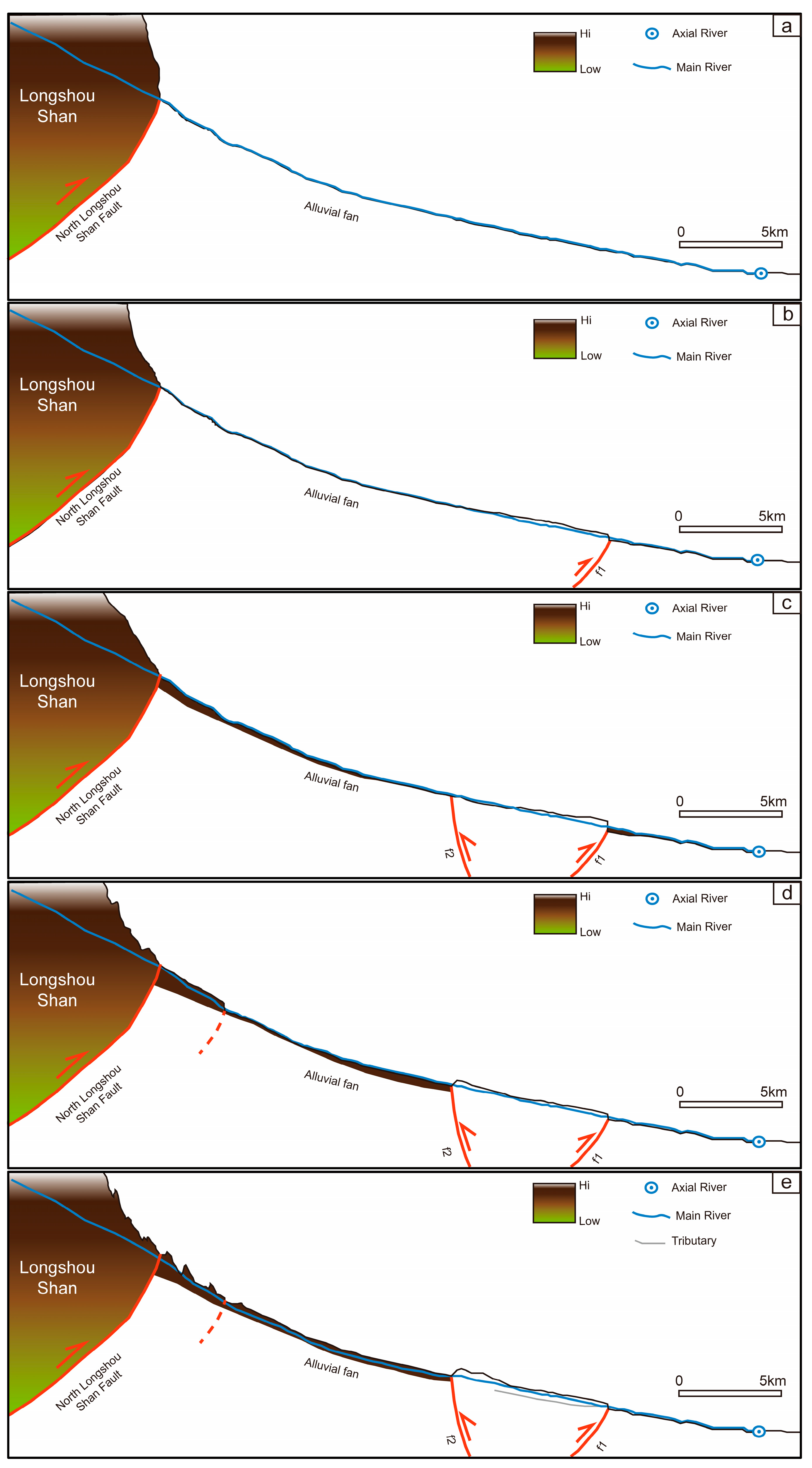
Based on the information provided by fault displacement, alluvial fan distribution and dip angle, and river incision, we have deduced and reconstructed the geomorphic development history of the region. Although we do not have accurate dating results to define the time of specific stages, our work provides a rough development framework for the landscape development of the region, as well as the relative order of events. The geomorphology of this area can be roughly divided into three stages along with the development of the structure. First, the fault activity of the North Longshou Shan Fault in front caused the uplift of Longshou Shan. The rivers originating from the mountain range flowed through the main fault to form a first-order fan widely distributed in front of the mountain (Figure 8a and Figure 9a). Subsequently, f1 on the north side began to develop, outlining the contours of the alluvial fan area (Figure 8b and Figure 9b).
Later, due to the onset of f2 and some surrounding faults, the east and west sides of the mountain front began to develop differently (Figure 8c). The vast fan surface in the original area on the east side was cut vertically, and the south side continued to receive sediments from the mountain range; the dip angle of the alluvial fan increased (Figure 8d). The northern part began to uplift due to the activity of the complex fault system, forming an intricate alluvial fan sequence. After that, the dip angle of the alluvial fan on the south side gradually increased, and the rivers on the alluvial fan cut through the alluvial fan sequence on the north side of f2 and continued to flow to the axial river farther north (Figure 8e). In the western part, the rivers on the vast fan surface began to erode, leaving other surfaces with lower elevations, and the rivers also flowed to the axial river in the north. Finally, the river sediments of the axial river covered the area north of fault F1, forming a mud pan and forming today’s regional landforms (Figure 8d,e).

5.2. Regional Tectonic Activity

Through the fault displacement measurement, we found that the maximum vertical displacement and average vertical displacement of fault f1 are 71 ± 13.7 and 19.12 m, respectively, and the maximum vertical displacement and average vertical displacement of f2 are 28.3 ± 7.9 m and 9.57 m, respectively. Considering the dip angle of 70°, the dip slip values of f1 and f2 are 75.6 ± 14.6 m and 30.1 ± 8.4 m. The maximum displacements of a single event for f1 and f2 are 3.38 and 1.03, respectively. A recent study indicates that the shallow thrust faults in the North Qilian Mountains are locked, and the thrust zones themselves do not exhibit creep [67]. Another study also confirmed the clustered release of regional strain in this area [20], supporting the view that the observed deformation was caused by discrete seismic events. Since all conditions are set at extreme values, such as calculating the maximum slip using the minimum value and taking into account factors like fault creep, dividing the minimum total maximum slip by the slip of a single earthquake provides a boundary estimate for the number of earthquakes. f1 has experienced at least 18 earthquake cycles and f2 has experienced at least 21 earthquake cycles. In addition to the major event of 1954, modern instrumental seismic records in the region show five earthquakes of magnitudes 4.2 to 5.1. Although there are no chronological data to define the earthquake recurrence cycle, the fault records we provide show that the fault activity history in the region far exceeds modern instrumental seismic records.
The dip direction of the f2 fault is opposite to that of f1. Combined with the characteristics of geomorphic surface development discussed above and in previous studies, we inferthat in the regional background of compression, the fault system first passed through the front of the mountain to form the fault f1 and then formed the backthrust fault f2 during the subsequent compression process (Figure 9e).

6. Conclusions

We employed high-resolution DEMs and satellite imagery to derive morphometric parameters of the alluvial fan fronting the Longshou Shan, including fan-surface dip and the history of two surface-breaking faults. Longitudinal river profiles were also extracted to support the geomorphic analysis, leading to the following results:
  • The alluvial fan at the north of Longshou Shan records past tectonic activity that has a much longer history than in the modern instrumental seismic record. This fills a gap in the long-term earthquake record of this region.
  • Tectonic activity and surface ruptures during major earthquakes played an important role in the formation of landforms in this region. The interaction between tectonics and surface erosion has shaped the current surface landscape.
  • The northern front of the Longshou Shan is an earthquake-prone area and should be considered in hazard assessments.

Supplementary Materials

The following supporting information can be downloaded at https://www.mdpi.com/article/10.3390/rs18050778/s1. Figure S1. The profile location map shows the location distribution of eight of the measurement profiles. Figure S2. Comparison of Measurement Profile No. 87: (a) High-resolution satellite imagery (Gaofen); (b) Topographic profile based on DEM. Figure S3. Comparison of Measurement Profile No. 67: (a) High-resolution satellite imagery (Gaofen); (b) Topographic profile based on DEM. Figure S4. Comparison of Measurement Profile No. 45: (a) High-resolution satellite imagery (Gaofen); (b) Topographic profile based on DEM. Figure S5. Comparison of Measurement Profile No. 26: (a) High-resolution satellite imagery (Gaofen); (b) Topographic profile based on DEM. Figure S6. Comparison of Measurement Profile No. 8: (a) High-resolution satellite imagery (Gaofen); (b) Topographic profile based on DEM. Figure S7 Comparison of Measurement Profile No. 137: (a) High-resolution satellite imagery (Gaofen); (b) Topographic profile based on DEM. Figure S8. Comparison of Measurement Profile No. 179: (a) High-resolution satellite imagery (Gaofen); (b) Topo-graphic profile based on DEM. Figure S9. Comparison of Measurement Profile No. 167: (a) High-resolution satellite imagery (Gaofen); (b) Topo-graphic profile based on DEM. Figure S10. The drainage density map. Shows the water systems on all surfaces; drainage density is marked for sur-faces larger than 10 square kilometers, in kilometers per square kilometer.

Author Contributions

Conceptualization, X.J. and K.R.; methodology, X.J.; software, X.J.; validation, X.J. and K.R.; formal analysis, X.J.; investigation, X.J.; resources, K.R.; data curation, X.J.; writing—original draft preparation, X.J.; writing—review and editing, X.J. and K.R.; visualization, X.J.; supervision, K.R.; project administration, X.J.; funding acquisition, X.J. All authors have read and agreed to the published version of the manuscript.

Funding

This research received no external funding.

Data Availability Statement

No new data were created or analyzed in this study. Data sharing is not applicable to this article.

Acknowledgments

This work was supported by the China Scholarship Council (CSC) under Grant No. 202106180008. The authors would like to thank Vanessa Steinritz, Napoleon Njeng, and Rashid Haider for their valuable discussions and support. We thank the three anonymous reviewers for their valuable comments, which made our research more reliable.

Conflicts of Interest

The authors declare no conflicts of interest.

References

  1. Ambraseys, N.N. Value of Historical Records of Earthquakes. Nature 1971, 232, 375–379. [Google Scholar] [CrossRef]
  2. Pinzon, N.; Klinger, Y.; Xu, X.; Tapponnier, P.; Liu-Zeng, J.; Van Der Woerd, J.; Li, K.; Gao, M. Spatiotemporal Clustering of Large Earthquakes Along the Central-Eastern Sections of the Altyn Tagh Fault, China. J. Geophys. Res. Solid Earth 2024, 129, e2024JB028912. [Google Scholar] [CrossRef]
  3. Shimazaki, K.; Nakata, T. Time-predictable Recurrence Model for Large Earthquakes. Geophys. Res. Lett. 1980, 7, 279–282. [Google Scholar] [CrossRef]
  4. Storchak, D.A.; Di Giacomo, D.; Engdahl, E.R.; Harris, J.; Bondár, I.; Lee, W.H.K.; Bormann, P.; Villaseñor, A. The ISC-GEM Global Instrumental Earthquake Catalogue (1900–2009): Introduction. Phys. Earth Planet. Inter. 2015, 239, 48–63. [Google Scholar] [CrossRef]
  5. Yeats, S.; Prentice, S. Introduction to Special Section: Paleoseismology Corvallis A Proverb States. J. Geophys. Res. Solid Earth 1996, 101, 5847–5853. [Google Scholar] [CrossRef]
  6. Li, Z.; Xu, X.; Tapponnier, P.; Chen, G.; Li, K.; Luo, J.; Cheng, J.; Kang, W. Post-20 Ka Earthquake Scarps Along NE-Tibet’s Qilian Shan Frontal Thrust: Multi-Millennial Return, ∼Characteristic Co-Seismic Slip, and Geological Rupture Control. J. Geophys. Res. Solid Earth 2021, 126, e2021JB021889. [Google Scholar] [CrossRef]
  7. Shen, Z.K.; Sun, J.; Zhang, P.; Wan, Y.; Wang, M.; Bürgmann, R.; Zeng, Y.; Gan, W.; Liao, H.; Wang, Q. Slip Maxima at Fault Junctions and Rupturing of Barriers during the 2008 Wenchuan Earthquake. Nat. Geosci. 2009, 2, 718–724. [Google Scholar] [CrossRef]
  8. Trabant, C.; Hutko, A.R.; Bahavar, M.; Karstens, R.; Ahern, T.; Aster, R. Data Products at the IRIS DMC: Stepping Stones for Research and Other Applications. Seismol. Res. Lett. 2012, 83, 846–854. [Google Scholar] [CrossRef]
  9. Qi, W.; Xuejun, Q.; Qigui, L.; Freymueller, J.; Shaomin, Y.; Caijun, X.; Yonglin, Y.; Xinzhao, Y.; Kai, T.; Gang, C. Rupture of Deep Faults in the 2008 Wenchuan Earthquake and Uplift of the Longmen Shan. Nat. Geosci. 2011, 4, 634–640. [Google Scholar] [CrossRef]
  10. Zhao, D.; Qu, C.; Bürgmann, R.; Shan, X. Characterizing Deep, Shallow, and Surface Fault Zone Deformation of the 2021 Mw 7.4 Maduo, China, Earthquake. Seismol. Res. Lett. 2024, 95, 277–287. [Google Scholar] [CrossRef]
  11. Gu, G.; Lin, T.; Shi, Z. China Earthquake Catalog; Science Press: Beijing, China, 1983. (In Chinese) [Google Scholar]
  12. Lanzhou Institute of Seismology, National Seismological Bureau. Catalogue of Strong Earthquakes in Shaanxi, Gansu, Ningxia and Qinghai; Shaanxi Science and Technology Press: Xi’an, China, 1985. (In Chinese) [Google Scholar]
  13. Earthquake Disaster Prevention Department. Catalogue of Modern Earthquakes in China (1912~1990, MS ≥ 4.7); China Science and Technology Press: Beijing, China, 1999. (In Chinese) [Google Scholar]
  14. Ren, J.; Xu, X.; Zhang, S.; Ding, R.; Liu, H.; Liang, O.; Zhao, J. Late Quaternary Slip Rates and Holocene Paleoearthquakes of the Eastern Yumu Shan Fault, Northeast Tibet: Implications for Kinematic Mechanism and Seismic Hazard. J. Asian Earth Sci. 2019, 176, 42–56. [Google Scholar] [CrossRef]
  15. Pena-Castellnou, S.; Hürtgen, J.; Baize, S.; Jomard, H.; Cushing, E.M.; Abbas, W.; Reicherter, K. Active Faulting of the Southern Segment of the Rhine River Fault, Southern Germany: Geomorphological and Paleoseismological Evidence. Quat. Int. 2025, 716, 109589. [Google Scholar] [CrossRef]
  16. Sébrier, M.; Ghafiri, A.; Bles, J.L. Paleoseismicity in France: Fault Trench Studies in a Region of Moderate Seismicity. J. Geodyn. 1997, 24, 207–217. [Google Scholar] [CrossRef]
  17. Li, Z. Recent Advances in Earthquake Monitoring i: Ongoing Revolution of Seismic Instrumentation. Earthq. Sci. 2021, 34, 177–188. [Google Scholar] [CrossRef]
  18. Yeats, R.S.; Sieh, K.; Allen, C.R. The Geology of Earthquakes; Oxford University Press: New York, NY, USA, 1997; ISBN 0195078276. [Google Scholar]
  19. Cao, X.; Hu, X.; Pan, B.; Zhang, J.; Wang, W.; Mao, J.; Liu, X. A Fluvial Record of Fault-Propagation Folding along the Northern Qilian Shan Front, NE Tibetan Plateau. Tectonophysics 2019, 755, 35–46. [Google Scholar] [CrossRef]
  20. Li, Z.; Xu, X.; Tapponnier, P.; Chen, G.; Ren, J.; Li, K.; Cheng, J.; Kang, W.; Luo, J. Long, Regular Return of Four Large Earthquakes on Qilian Shan’s Minle-Damaying Frontal Thrust (NE Tibet): Partial Clustering with Great Events on the Leng Long Ling Fault? J. Geophys. Res. Solid Earth 2022, 127, e2021JB022800. [Google Scholar] [CrossRef]
  21. Bull, W.B. Geomorphic Responses to Climatic Change; Oxford University Press: New York, NY, USA, 1991; ISBN 2013206534. [Google Scholar]
  22. Burbank, D.W.; Anderson, R.S. Tectonic Geomorphology; Wiley: Hoboken, NJ, USA, 2013; ISBN 9781444338867. [Google Scholar]
  23. Arrowsmith, J.R.; Zielke, O. Tectonic Geomorphology of the San Andreas Fault Zone from High Resolution Topography: An Example from the Cholame Segment. Geomorphology 2009, 113, 70–81. [Google Scholar] [CrossRef]
  24. Van der Wal, J.L.N.; Nottebaum, V.C.; Stauch, G.; Binnie, S.A.; Batkhishig, O.; Lehmkuhl, F.; Reicherter, K. Geomorphological Evidence of Active Faulting in Low Seismicity Regions—Examples from the Valley of Gobi Lakes, Southern Mongolia. Front. Earth Sci. 2021, 8, 589814. [Google Scholar] [CrossRef]
  25. Hetzel, R.; Tao, M.; Stokes, S.; Niedermann, S.; Ivy-Ochs, S.; Gao, B.; Strecker, M.R.; Kubik, P.W. Late Pleistocene/Holocene Slip Rate of the Zhangye Thrust (Qilian Shan, China) and Implications for the Active Growth of the Northeastern Tibetan Plateau. Tectonics 2004, 23, TC6006. [Google Scholar] [CrossRef]
  26. Lei, J.; Li, Y.; Oskin, M.E.; Wang, Y.; Xiong, J.; Xin, W.; Hu, X.; Zhong, Y.; Liu, F. Segmented Thrust Faulting: Example from the Northeastern Margin of the Tibetan Plateau. J. Geophys. Res. Solid Earth 2020, 125, e2019JB018634. [Google Scholar] [CrossRef]
  27. Zhong, Y.; Xiong, J.; Li, Y.; Zheng, W.; Zhang, P.; Lu, H.; Liu, Q.; Lei, J.; Chen, G.; Gong, Z.; et al. Constraining Late Quaternary Crustal Shortening in the Eastern Qilian Shan from Deformed River Terraces. J. Geophys. Res. Solid Earth 2020, 125, e2020JB020631. [Google Scholar] [CrossRef]
  28. Van der Wal, J. Active Tectonics of a Slowly Deforming Continental Interior: Deformation and Quaternary Landscape Evolution in Southern Mongolia. Doctoral Dissertation, RWTH-Aachen University, Aachen, Germany, 2020. [Google Scholar]
  29. Royden, L.H.; Burchfiel, B.C.; Van Der Hilst, R.D. The Geological Evolution of the Tibetan Plateau. Science 2008, 321, 1054–1058. [Google Scholar] [CrossRef]
  30. Tapponnier, P.; Zhiqin, X.; Roger, F.; Meyer, B.; Arnaud, N.; Wittlinger, G.; Jingsui, Y. Oblique Stepwise Rise and Growth of the Tibet Plateau. Science 2001, 294, 1671–1677. [Google Scholar] [CrossRef]
  31. Molnar, P.; Tapponnier, P. Cenozoic Tectonics of Asia: Effects of a Continental Collision. Science 1975, 189, 419–426. [Google Scholar] [CrossRef] [PubMed]
  32. Yin, A.; Harrison, T.M. Geologic Evolution of the Himalayan-Tibetan Orogen. Annu. Rev. Earth Planet. Sci. 2000, 28, 211–280. [Google Scholar] [CrossRef]
  33. Institute of Seismology, China Earthquake Administration; Lanzhou Institute of Geology, China Earthquake Administration. QilianShan-Hexi Corridor Active Fault System; Seismological Press: Beijing, China, 1993. (In Chinese) [Google Scholar]
  34. Tapponnier, P.; Meyer, B.; Avouac, J.P.; Peltzer, G.; Gaudemer, Y.; Guo, S.; Xiang, H.; Yin, K.; Chen, Z.; Cai, S.; et al. Active Thrusting and Folding in the Qilian Shan, and Decoupling between Upper Crust and Mantle in Northeastern Tibet. Earth Planet. Sci. Lett. 1990, 97, 382–383. [Google Scholar] [CrossRef]
  35. Zheng, W.; Zhang, P.; He, W.; Yuan, D.; Shao, Y.; Zheng, D.; Ge, W.; Min, W. Transformation of Displacement between Strike-Slip and Crustal Shortening in the Northern Margin of the Tibetan Plateau: Evidence from Decadal GPS Measurements and Late Quaternary Slip Rates on Faults. Tectonophysics 2013, 584, 267–280. [Google Scholar] [CrossRef]
  36. Zuza, A.V.; Cheng, X.; Yin, A. Testing Models of Tibetan Plateau Formation with Cenozoic Shortening Estimates across the Qilian Shan-Nan Shan Thrust Belt. Geosphere 2016, 12, 501–532. [Google Scholar] [CrossRef]
  37. Yuan, D.Y.; Ge, W.P.; Chen, Z.W.; Li, C.Y.; Wang, Z.C.; Zhang, H.P.; Zhang, P.Z.; Zheng, D.W.; Zheng, W.J.; Craddock, W.H.; et al. The Growth of Northeastern Tibet and Its Relevance to Large-Scale Continental Geodynamics: A Review of Recent Studies. Tectonics 2013, 32, 1358–1370. [Google Scholar] [CrossRef]
  38. Hetzel, R. Active Faulting, Mountain Growth, and Erosion at the Margins of the Tibetan Plateau Constrained by in Situ-Produced Cosmogenic Nuclides. Tectonophysics 2013, 582, 1–24. [Google Scholar] [CrossRef]
  39. Zheng, W.-J.; Zhang, H.-P.; Zhang, P.-Z.; Peter, M.; Liu, X.-W.; Yuan, D.-Y. Late Quaternary Slip Rates of the Thrust Faults in Western Hexi Corridor (Northern Qilian Shan, China) and Their Implications for Northeastward Growth of the Tibetan Plateau. Geosphere 2013, 9, 342–354. [Google Scholar] [CrossRef]
  40. Wu, C.; Zuza, A.V.; Li, J.; Haproff, P.J.; Yin, A.; Chen, X.; Ding, L.; Li, B. Late Mesozoic–Cenozoic Cooling History of the Northeastern Tibetan Plateau and Its Foreland Derived from Low-Temperature Thermochronology. Bull. Geol. Soc. Am. 2021, 133, 2393–2417. [Google Scholar] [CrossRef]
  41. Hetzel, R.; Hampel, A.; Gebbeken, P.; Xu, Q.; Gold, R.D. A Constant Slip Rate for the Western Qilian Shan Frontal Thrust during the Last 200 Ka Consistent with GPS-Derived and Geological Shortening Rates. Earth Planet. Sci. Lett. 2019, 509, 100–113. [Google Scholar] [CrossRef]
  42. Hu, X.; Chen, D.; Pan, B.; Chen, J.; Zhang, J.; Chang, J.; Gong, C.; Zhao, Q. Sedimentary Evolution of the Foreland Basin in the NE Tibetan Plateau and the Growth of the Qilian Shan since 7 Ma. Bull. Geol. Soc. Am. 2019, 131, 1744–1760. [Google Scholar] [CrossRef]
  43. Wang, Y.; Oskin, M.E.; Zhang, H.; Li, Y.; Hu, X.; Lei, J. Deducing Crustal-Scale Reverse-Fault Geometry and Slip Distribution from Folded River Terraces, Qilian Shan, China. Tectonics 2020, 39, e2019TC005901. [Google Scholar] [CrossRef]
  44. Hetzel, R.; Tao, M.; Niedermann, S.; Strecker, M.R.; Ivy-Ochs, S.; Kubik, P.W.; Gao, B. Implications of the Fault Scaling Law for the Growth of Topography: Mountain Ranges in the Broken Foreland of North-East Tibet. Terra Nov. 2004, 16, 157–162. [Google Scholar] [CrossRef]
  45. Seong, Y.B.; Kang, H.C.; Ree, J.H.; Choi, J.H.; Lai, Z.; Long, H.; Yoon, H.O. Geomorphic Constraints on Active Mountain Growth by the Lateral Propagation of Fault-Related Folding: A Case Study on Yumu Shan, NE Tibet. J. Asian Earth Sci. 2011, 41, 184–194. [Google Scholar] [CrossRef]
  46. Hu, X.; Wen, Z.; Pan, B.; Guo, L.; Cao, X. Constraints on Deformation Kinematics across the Yumu Shan, NE Tibetan Plateau, Based on Fluvial Terraces. Glob. Planet. Change 2019, 182, 103023. [Google Scholar] [CrossRef]
  47. Li, B.; Chen, X.; Zuza, A.V.; Hu, D.; Ding, W.; Huang, P.; Xu, S. Cenozoic Cooling History of the North Qilian Shan, Northern Tibetan Plateau, and the Initiation of the Haiyuan Fault: Constraints from Apatite- and Zircon-Fission Track Thermochronology. Tectonophysics 2019, 751, 109–124. [Google Scholar] [CrossRef]
  48. Hendrix, M.S.; Dumitru, T.A.; Graham, S.A. Late Oligocene-Early Miocene Unroofing in the Chinese Tian Shan: An Early Effect of the India-Asia Collision. Geology 1994, 22, 487–490. [Google Scholar] [CrossRef]
  49. Tapponnier, P.; Molnar, P. Active Faulting and Cenozoic Tectonics of the Tien Shan, Mongolia, and Baykal Regions. J. Geophys. Res. Solid Earth 1979, 84, 3425–3459. [Google Scholar] [CrossRef]
  50. Rudersdorf, A.; Hartmann, K.; Yu, K.; Stauch, G.; Reicherter, K. Seismites as Indicators for Holocene Seismicity in the Northeastern Ejina Basin, Inner Mongolia. Geol. Soc. Spec. Publ. 2017, 432, 213–231. [Google Scholar] [CrossRef]
  51. Darby, B.J.; Ritts, B.D.; Yue, Y.; Meng, Q. Did the Altyn Tagh Fault Extend beyond the Tibetan Plateau? Earth Planet. Sci. Lett. 2005, 240, 425–435. [Google Scholar] [CrossRef]
  52. Zheng, W.; Zhang, Z.; Zhang, P.; Liu, X.; Guo, X.; Pang, J.; Ge, W.; Yu, J. Seismogenic Structure and Mechanism of the 1954 M 71/4 Shandan Earthquake, Gansu Province, Western China. Acta Geophys. Sin. 2013, 56, 916–928. [Google Scholar] [CrossRef]
  53. Zheng, W.J.; Zhang, P.Z.; Ge, W.P.; Molnar, P.; Zhang, H.P.; Yuan, D.Y.; Liu, J.H. Late Quaternary Slip Rate of the South Heli Shan Fault (Northern Hexi Corridor, NW China) and Its Implications for Northeastward Growth of the Tibetan Plateau. Tectonics 2013, 32, 271–293. [Google Scholar] [CrossRef]
  54. Zhang, B.; Zhang, J.; Wang, Y.; Zhao, H.; Yanfeng, L.I. Late Mesozoic-Cenozoic Exhumation of the Northern Hexi Corridor: Constrained by Apatite Fission Track Ages of the Longshoushan. Acta Geol. Sin. Engl. Ed. 2017, 91, 1624–1643. [Google Scholar] [CrossRef]
  55. Zhao, D.; Chen, P.; Li, R.; Wu, X.; Liu, X. Basin Response of Muti-Stage Tectonic Uplift of the Longshoushan Area since the Late Cenozoic in Northeastern Margin of the Qinghai-Tibet Plateau. Acta Prtrological Sin. 2023, 39, 3759–3774. [Google Scholar] [CrossRef]
  56. Gao, R.; Cheng, X.; Wu, G. Lithospheric Structure and Geodynamic Model of the Golmud-Ejin Transect in Northern Tibet. Geol. Soc. Am. Spec. Pap. 1999, 328, 9–16. [Google Scholar] [CrossRef]
  57. Wells, D.L.; Coppersmith, K.J. New Empirical Relationships among Magnitude, Rupture Length, Rupture Width, Rupture Area, and Surface Displacement. Bull. Seismol. Soc. Am. 1994, 84, 974–1002. [Google Scholar] [CrossRef]
  58. Strasser, F.O.; Arango, M.C.; Bommer, J.J. Scaling of the Source Dimensions of Interface with Moment Magnitude. Seismol. Res. Lett. 2010, 81, 941–950. [Google Scholar] [CrossRef]
  59. Blaser, L.; Krüger, F.; Ohrnberger, M.; Scherbaum, F. Scaling Relations of Earthquake Source Parameter Estimates with Special Focus on Subduction Environment. Bull. Seismol. Soc. Am. 2010, 100, 2914–2926. [Google Scholar] [CrossRef]
  60. Bull, W.B. Alluvial Fans. J. Geol. Educ. 1968, 16, 101–106. [Google Scholar] [CrossRef]
  61. Bull, W.B.; McFadden, L.D. Tectonic Geomorphology North and South of the Garlock Fault, California. Geomorphol. In Geomorphology in Arid Regions; Routledge: London, UK, 1977; Volume 1, pp. 115–138. [Google Scholar] [CrossRef]
  62. Cowie, P.A.; Christopher, H. Displacement-Length Scaling Relationship for Faults: Data Synthesis and Discussion. J. Struct. Geol. 1992, 14, 1149–1156. [Google Scholar] [CrossRef]
  63. Manighetti, I.; Campillo, M.; Bouley, S.; Cotton, F. Earthquake Scaling, Fault Segmentation, and Structural Maturity. Earth Planet. Sci. Lett. 2007, 253, 429–438. [Google Scholar] [CrossRef]
  64. Roberts, G.P. Fault Orientation Variations along the Strike of Active Normal Fault Systems in Italy and Greece: Implications for Predicting the Orientations of Subseismic-Resolution Faults in Hydrocarbon Reservoirs. Am. Assoc. Pet. Geol. Bull. 2007, 91, 1–20. [Google Scholar] [CrossRef]
  65. Nottebaum, V.; Lehmkuhl, F.; Stauch, G.; Lu, H.; Yi, S. Geomorphology Late Quaternary Aeolian Sand Deposition Sustained by Fl Uvial Reworking and Sediment Supply in the Hexi Corridor—An Example from Northern Chinese Drylands. Geomorphology 2015, 250, 113–127. [Google Scholar] [CrossRef]
  66. Hetzel, R.; Niedermann, S.; Tao, M.; Kubik, P.W.; Ivy-Ochsk, S.; Gao, B.; Strecker, M.R. Low Slip Rates and Long-Term Preservation of Geomorphic Features in Central Asia. Nature 2002, 417, 428–432. [Google Scholar] [CrossRef]
  67. Zhang, Y.; Wimpenny, S.; Zilio, L.D.; Shan, X. Strain Partitioning and Fault Kinematics in the Northern Qilian Shan (NE Tibet) Determined from Bayesian Inference of Geodetic Data. Geophys. Res. Lett. 2024, 51, e2023GL107324. [Google Scholar] [CrossRef]
Figure 2. (a) Stream network, faults in Longshou Shan and the adjacent area. A, A’ are measured profiles for fault 1 (f1); B, B’ are measured profiles for fault 2 (f2); C, C’ is the position of the profiles in Zheng et al., 2013 [52]; D, D’ is the profile for a regional tectonic model. The red triangle marks the maximum offset position. (b) Stream network, drainage basins and a geological map of Longshou Shan and adjacent areas; the geological map is from https://geocloud.cgs.gov.cn. (c) Cross section under Longshou Shan to illustrate the fault relationship, modified from Zheng et al., 2013 [52].
Remotesensing 18 00778 g002
Figure 3. Measurement of the vertical offset of the fault. A, A’ and B, B’ are cross sectional view of the measured profile. Profiles location are shown in Figure 2. The black solid line represents the expected undeformed surface, the blue dashed line is the uneroded deformed surface and the gray solid line represents the actual measured surface. The difference between them represents the deformation, and the sum of the deformation on both sides of the fault is the total vertical deformation.
Remotesensing 18 00778 g003
Figure 4. (a) Simplified cross section of Longshou Shan and fan located at mountain front; (b) process of fan deformation; left panel is before deformation and right is after.
Remotesensing 18 00778 g004
Figure 5. Vertical offset values of faults.
Remotesensing 18 00778 g005
Figure 6. (a) Alluvial fan sequences along the Longshou Shan. The alluvial fan sequences in the west are few, while there are more in the east. (b) Alluvial fan slope angles measured across the different fan surfaces mapped in panel A.
Remotesensing 18 00778 g006
Figure 7. (a) River profile of River 4 showing the knickpoint and the relationship of the main river and tributaries. (b) River profile of River 5 showing the knickpoint and the relationship of the main river and tributaries.
Remotesensing 18 00778 g007
Figure 8. (a) The landforms of the Longshou Shan area in the early stage, when the North Longshou Shan Fault began to develop. (b) The development of the fault in the north of Longshou Shan delineated today’s alluvial fan area. (c) The onset of f2. (d) The fan divided by f2 has sedimentation upstream and erosion downstream. (e) As new faults slip, the fan is further divided.
Remotesensing 18 00778 g008
Figure 9. (a) In the initial stage of the regional landscape, the North Longshou Shan Fault continued to be active and the alluvial fan in front of the mountain developed. (b) After the onset of the f1 fault, river erosion begins near the F1 fault. (c) Onset of the f2 fault, and continued erosion near f1. (d) The river cuts down the raised fan surface near f2 and sedimentation continues upstream. (e) The tributaries begin to erode, expanding the uplifted area, and this plays an important role in the uplift and expansion of the plateau.
Remotesensing 18 00778 g009
Table 1. Fault data and earthquake correlation inferences based on empirical data.
FaultLength (km)Measured avg.offset (m)Measured max.offset (m)Moment MagnitudeMax. Offset per Event (m)
f174.419.1271 ± 13.77.4 ± 0.13.38
f223.39.5728.3 ± 7.96.7 ± 0.11.03
Disclaimer/Publisher’s Note: The statements, opinions and data contained in all publications are solely those of the individual author(s) and contributor(s) and not of MDPI and/or the editor(s). MDPI and/or the editor(s) disclaim responsibility for any injury to people or property resulting from any ideas, methods, instructions or products referred to in the content.