Article

Developing a Cross-Platform Transferable Spectral Index for Soda Saline–Alkali Soils: A Case Study in the Songnen Plain, Northeast China


by
He Gu
1,2,
Kun Shang
1,*,
Weichao Sun
3,
Chenchao Xiao
1 and
Yisong Xie
3
1
Land Satellite Remote Sensing Application Center, Ministry of Natural Resources of China, Beijing 100048, China
2
Beijing SatImage Information Technology Co., Ltd., Beijing 100040, China
3
Aerospace Information Research Institute, Chinese Academy of Sciences, Beijing 100094, China
*
Author to whom correspondence should be addressed.
Remote Sens. 2026, 18(5), 758; https://doi.org/10.3390/rs18050758
Submission received: 30 January 2026 / Revised: 23 February 2026 / Accepted: 27 February 2026 / Published: 2 March 2026
(This article belongs to the Special Issue Hyperspectral Data Analysis of Vegetation and Soil Monitoring)

Highlights

What are the main findings?
  • A cross-platform transferable spectral index for soda saline–alkali soils was developed using laboratory spectra and hyperspectral satellite observations through a collaborative, cross-dataset spectral feature selection framework.
  • The proposed Difference Index based on Square Root Reflectance at 520 nm and 900 nm (DISRR520900) showed consistent relationships with log-transformed soil electrical conductivity across datasets (R = 0.60 for hyperspectral satellite data; R = 0.82 for laboratory spectra).
What are the implications of the main findings?
  • The integration of multi-source remote sensing data enhances soil salinization monitoring sensitivity and continuity in large-scale applications.
  • The resulting soil salinization maps can provide an operational tool for regional monitoring, agricultural management, and ecological restoration planning.

Abstract

Soil salinization is a widespread form of land degradation that severely constrains agricultural productivity and ecosystem stability. Efficient and transferable monitoring methods are therefore essential for large-scale salinization assessment. Remote sensing provides timely and synoptic observations, while the integration of multi-source datasets offers complementary spectral and spatial information. In this study, we developed a cross-platform spectral index specifically for soda saline–alkali (carbonate/bicarbonate-dominated) soils by integrating laboratory spectra and hyperspectral satellite observations through a collaborative, cross-dataset spectral feature selection framework. Dual-band spectral indices were constructed from transformed reflectance spectra, and a stepwise coupled correlation analysis was applied to identify representative candidates that consistently exhibited strong associations with log-transformed soil electrical conductivity (logEC) across datasets. An optimal central-wavelength analysis was then performed to determine a stable and transferable band pair. The study was conducted in the Songnen Plain of Northeast China using laboratory-measured soil spectra and Ziyuan-1 02D Advanced Hyperspectral Imager data, and the proposed index was further validated using Landsat-8 and Sentinel-2 Multispectral data. Results show that the proposed Difference Index based on Square Root Reflectance at 520 nm and 900 nm (DISRR520900) exhibited consistent relationships with logEC (R = 0.60 for hyperspectral satellite data and R = 0.82 for laboratory spectral data), outperforming commonly used salinity indices in terms of cross-sensor stability. The spatial distribution of soil salinization derived from DISRR520900 is highly consistent with true-color imagery, and multi-source data fusion further improves mapping continuity and spatial coverage. It should be noted that the proposed index is primarily applicable to bare or sparsely vegetated soil surfaces in soda saline–alkali regions. Under dense vegetation cover, substantial crop residue, or wet surface conditions, additional masking or correction may be required. These results demonstrate that DISRR520900 provides a stable cross-sensor solution for large-scale soil salinization mapping within comparable soil chemical contexts.

1. Introduction

Soil salinization is a typical form of land degradation and has become a major constraint on global agricultural production and ecosystem stability [1]. According to the Food and Agriculture Organization of the United Nations, approximately 1 billion hectares of land are threatened by salinization [2]. The problem is particularly severe in arid and semi-arid regions, including large areas of Asia such as China, India, and Pakistan [3]. Increasing soil salinity suppresses vegetation growth, reduces soil fertility, threatens biodiversity, and poses serious risks to food security and sustainable development [4]. Timely and accurate monitoring is therefore essential for understanding its spatial patterns and dynamic evolution, as well as for supporting land management and ecological restoration efforts [5].
Remote sensing provides an effective means for monitoring soil salinization due to its non-invasive nature, broad spatial coverage, and high temporal frequency. These advantages enable long-term and continuous observation of salinization processes and support the analysis of their physical mechanisms, spatiotemporal dynamics, and driving factors [6]. Common indicators used in remote sensing studies of soil salinization include soil electrical conductivity (EC) and soil salt content (SSC) [7]. Among them, EC is the most direct and widely adopted indicator, as it reflects the concentration and mobility of soluble salts in soil [8]. Numerous studies have demonstrated strong relationships between soil EC and spectral reflectance characteristics. In saline soils dominated by chloride and sulfate salts (e.g., NaCl and Na2SO4), high salinity often leads to surface salt crystallization, resulting in lighter soil color and increased reflectance in the visible and near-infrared (VNIR) regions. These types of saline soils are common in arid and semi-arid regions, where intense evaporation promotes salt accumulation. In contrast, saline soils in the Songnen Plain are primarily composed of carbonates and bicarbonates (e.g., Na2CO3 and NaHCO3), forming highly alkaline, sodium-dominated soils. This chemical composition promotes clay particle dispersion, enhances soil hydrophilicity, and suppresses microbial decomposition, resulting in darker soil color and reduced VNIR reflectance [9]. In addition, saline soils are commonly enriched with minerals such as gypsum and halite, which exhibit diagnostic absorption features in the shortwave infrared (SWIR) region [10]. These spectral characteristics provide a solid theoretical basis for remote sensing-based monitoring of soil salinization.
Two main approaches are commonly used to estimate soil salinization from spectral data. The first approach involves developing quantitative inversion models, in which regression algorithms or machine learning methods are employed to establish relationships between spectral features and soil EC. Techniques such as partial least squares regression and random forest have achieved high estimation accuracy under controlled conditions [11]. However, these models typically require large and representative ground-sample datasets for training and validation, which limits their transferability across regions, soil types, and sensor platforms [12]. The second approach focuses on the development of spectral indices specifically designed for soil salinization monitoring. These indices combine salinity-sensitive spectral bands and have proven effective for identifying and mapping salt-affected soils [13]. Compared with inversion models, spectral indices are computationally simple, require fewer samples, and are more easily transferable across multi-source remote sensing datasets, making them particularly suitable for large-scale applications.
Early studies on soil salinization monitoring primarily relied on single-source optical imagery, especially medium-resolution multispectral data, due to their broad coverage, high revisit frequency, and long-term availability [14]. Various vegetation and salinity-related indices derived from multispectral data have been applied to detect vegetation stress and surface salt accumulation [15]. However, multispectral sensors are limited by their coarse spectral resolution and relatively wide bandwidths, which restrict their ability to capture narrow and subtle spectral features associated with soil salinity [16]. As a result, indices developed from multispectral imagery often show reduced sensitivity to mild or moderate salinization and exhibit limited robustness across different sensors and environmental conditions.
Recent studies have increasingly focused on improving the transferability of soil salinity indices across datasets and platforms to enable regional or large-scale mapping. For example, Jiang et al. [17] developed a salinity index based on unmanned aerial vehicle (UAV) hyperspectral data and validated its performance using Landsat-9 Operational Land Imager (OLI) imagery in the Yellow River Delta. Ma et al. [18] improved soil salinity inversion accuracy by spectrally correcting Sentinel-2 Multispectral Imager (MSI) data using UAV observations. Although these studies demonstrated the potential of cross-scale or cross-sensor applications, most existing approaches still construct spectral indices using a single primary dataset and subsequently test their performance on other datasets. Relatively few studies have explored the collaborative construction of salinity indices by explicitly integrating multi-source datasets during the feature selection and index development stages.
The launch of spaceborne hyperspectral sensors, such as Gaofen-5, Ziyuan-1 02D (ZY1-02D), PRISMA, and EnMAP, has created new opportunities for soil salinization monitoring [19]. Compared with multispectral imagery, hyperspectral data provide hundreds of contiguous narrow bands that can resolve subtle absorption features related to soil composition, mineralogy, and salinity [20]. In particular, diagnostic absorption features of salt-bearing minerals in the SWIR region are critical for distinguishing salinity-related mineralogical variations, thereby enhancing sensitivity to soil salinization and potentially improving estimation accuracy [21]. Nevertheless, hyperspectral satellite data are often constrained by limited spatial coverage, longer revisit cycles, and higher data costs [22]. In addition, their spectral responses are strongly influenced by environmental factors such as soil moisture, surface roughness, topography, and land cover conditions [23]. These factors can significantly reduce the generalizability of spectral features or indices derived from a single hyperspectral dataset.
Multi-source remote sensing data fusion has therefore emerged as an effective strategy for large-scale soil salinization assessment [24]. By combining the complementary strengths of different sensors, data fusion can enhance spatial continuity, temporal coverage, and spectral sensitivity. However, substantial differences among sensors—including spectral band definitions, radiometric responses, and spatial resolutions—often lead to inconsistent feature selection results across datasets. Feature selection plays a critical role in identifying informative spectral variables, reducing redundancy, and improving model robustness. Common approaches include correlation analysis and feature importance ranking [25]. Although such methods have been successfully applied to individual datasets [26], they are rarely designed to identify spectral features that remain stable and informative across multiple sensors and observation conditions. Developing a unified feature selection framework that explicitly accounts for multi-source consistency therefore remains a key challenge for transferable soil salinization monitoring.
To address these challenges, this study conducted extensive field sampling in the Songnen Plain and developed a cross-platform transferable soil salinization spectral index through the coupled analysis of laboratory spectra and hyperspectral satellite observations. The main objectives of this study are to: (1) analyze the spectral characteristics of soil salinization using laboratory spectra (LS) and hyperspectral satellite data (HS); (2) develop a robust spectral index that maintains stable correlations with log-transformed soil EC (logEC) across multi-source datasets; (3) evaluate the performance and transferability of the proposed index using both hyperspectral and multispectral satellite data; and (4) demonstrate the application of the index for soil salinization mapping and multi-source remote sensing data fusion in the Songnen Plain of Northeast China. This study aims to provide a cross-platform transferable spectral index for mapping soil salinization in soda saline–alkali soils, along with a methodological reference for large-scale soil salinization monitoring using multi-source remote sensing data.

2. Materials and Methods

2.1. Study Area and Sampling Sites

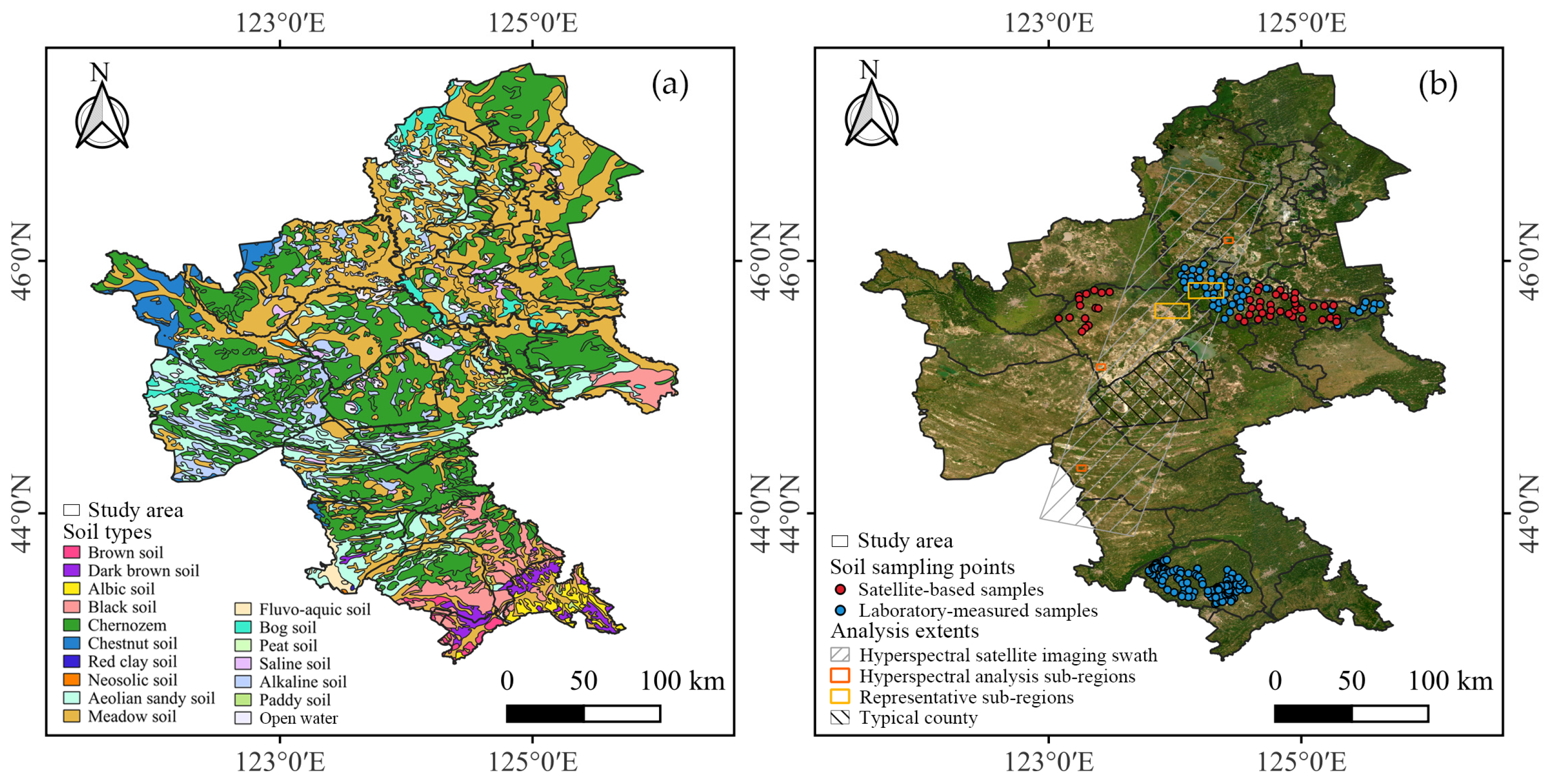
This study was conducted within the Songnen Plain of Northeast China. The Songnen Plain is one of China’s major grain-producing regions and is also among the areas most severely affected by soil salinization [27]. The study area experiences a temperate continental monsoon climate with semi-humid to semi-arid conditions. The average annual precipitation ranges from 400 to 600 mm, whereas annual evaporation reaches approximately 1600–1800 mm, resulting in a pronounced water deficit that favors salt accumulation in surface soils. Topographically, the study area is relatively flat, consisting mainly of plains and gently undulating hills. Land use is dominated by cropland, grassland, and wetlands. The main soil types include black soil, saline–alkali soil, and sandy soil (Figure 1a). Major crops grown include maize, peanuts, soybeans, and rice. Due to the combined effects of shallow groundwater, poor natural drainage, and strong surface evaporation, soluble salts tend to accumulate near the soil surface. This process accelerates soil salinization and poses serious challenges to agricultural productivity and ecosystem stability in the Songnen Plain.
To evaluate the applicability of the constructed spectral index, four analysis regions within the study area were defined to characterize variations in soil types, topographic conditions, and salinization levels. First, a continuous hyperspectral satellite imaging swath was selected based on data coverage to generate soil salinization maps. Second, three hyperspectral analysis sub-regions within this swath were identified to examine the spatial consistency between hyperspectral salinization mapping results and high-resolution optical imagery. Furthermore, considering the environmental background and soil sampling distribution, two representative sub-regions were selected to assess its transferability across multispectral satellite platforms. Finally, to address the management needs in practical applications, a typical county was chosen to verify its feasibility for large-scale soil salinization mapping.

2.2. Soil Sampling and Laboratory Spectral Measurements

Field soil sampling was conducted in the Songnen Plain of Northeast China, a typical soda saline–alkali region characterized by heterogeneous salinization levels and diverse soil surface conditions. A total of 225 surface soil samples (0–10 cm) were collected during the spring and autumn of 2022 and 2023, when soil surfaces were relatively exposed and vegetation cover was minimal, to represent a wide range of soil salinity conditions, from non-saline to severely saline soils. Sampling sites were selected to ensure spatial representativeness and minimize the influence of vegetation cover, surface moisture, and anthropogenic disturbance, as shown in Figure 1b.
At each sampling location, soil samples were collected after removing surface debris and vegetation residues. Soil EC was measured in the laboratory using a standardized soil–water extract method (soil-to-water ratio of 1:5), following conventional procedures for salinity assessment. In addition, SSC was determined through standard chemical analysis procedures.
Laboratory spectral measurements were conducted for all soil samples using an ASD FieldSpec spectroradiometer (Analytical Spectral Devices, Inc., Boulder, CO, USA), covering a spectral range of 350–2500 nm. Prior to measurement, soil samples were air-dried, gently ground, and sieved through a 2 mm mesh to reduce the effects of surface roughness and moisture variability. Spectral measurements were performed under controlled illumination conditions using a halogen light source, and each sample was measured three times to minimize random noise. The final laboratory reflectance spectrum for each sample was obtained by averaging repeated measurements.
To improve spectral quality, LS were preprocessed by removing noisy bands at the edges of the spectral range and applying smoothing where necessary. The retained spectral range was selected to ensure compatibility with hyperspectral satellite sensors used in this study. LS were subsequently resampled to a common wavelength interval to facilitate direct comparison and integrated analysis with satellite-derived hyperspectral reflectance in subsequent steps.

2.3. Multi-Source Remote Sensing Data and Pre-Processing

To evaluate the robustness and transferability of the proposed soil salinization spectral index, multiple remote sensing datasets from hyperspectral and multispectral sensors were used in this study. These datasets were selected to represent different spectral resolutions, spatial resolutions, and observation conditions, thereby providing a comprehensive basis for multi-source collaborative analysis.

2.3.1. Hyperspectral Satellite Data

Hyperspectral satellite imagery was acquired from the Advanced Hyperspectral Imager (AHSI) onboard the ZY1-02D satellite. AHSI provides continuous spectral coverage from 400 to 2500 nm with narrow bandwidths, enabling the detailed characterization of soil spectral features associated with salinization. The spatial resolution of the AHSI data is approximately 30 m, and the revisit cycle is 55 days. The hyperspectral imagery used in this study was acquired under cloud-free conditions and temporally matched with field sampling as closely as possible.
Raw AHSI data were first converted to surface reflectance through radiometric calibration and atmospheric correction. Atmospheric correction was performed using the Fast Line-of-sight Atmospheric Analysis of Spectral Hypercubes (FLAASH) model. To reduce noise and ensure spectral reliability, bands affected by strong atmospheric absorption and low signal-to-noise ratios were removed. After per-band quality assessment, we retained three high-quality spectral range for subsequent analysis: 438–1290 nm, 1492–1745 nm, and 2081–2450 nm. All hyperspectral data were geometrically corrected and co-registered to a common coordinate system to ensure spatial consistency with multispectral imagery.

2.3.2. Multispectral Satellite Data

Multispectral data from Landsat-8 OLI and Sentinel-2 MSI were used to assess the transferability of the proposed spectral index across commonly used satellite platforms. Landsat-8 OLI provides multispectral imagery with a spatial resolution of 30 m and a revisit period of 16 days, while Sentinel-2 MSI offers higher spatial resolution (10–20 m) and a shorter revisit cycle.
Level-2 surface reflectance products for both OLI and MSI were obtained and used directly to ensure radiometric consistency and reduce preprocessing uncertainty. Cloud-contaminated pixels were identified and removed using quality assurance masks provided with the products.

2.3.3. Data Harmonization and Resampling

To facilitate integrated analysis across laboratory, hyperspectral, and multispectral imagery, all datasets were harmonized to a consistent spectral and spatial framework. LS and HS were resampled to a common wavelength grid prior to spectral index construction. For multispectral data, LS and HS were resampled according to the spectral response functions of Landsat-8 OLI and Sentinel-2 MSI to simulate sensor-specific reflectance.
Spatial resampling was performed using nearest-neighbor interpolation to preserve original reflectance values and avoid artificial smoothing. All datasets were projected to the same coordinate reference system and spatially aligned to ensure pixel-level correspondence during spectral index calculation and mapping. To minimize the influence of vegetation and surface water, pixels corresponding to dense vegetation and water bodies were excluded based on thresholding of the normalized difference vegetation index (NDVI) and the modified normalized difference water index (MNDWI). Specifically, NDVI > 0.3 was used to exclude densely vegetated pixels, as vegetation can substantially obscure or replace soil spectral signals and thereby reduce the reliability of the soil salinity map. In addition, MNDWI > 0 was applied to mask open-water pixels, a commonly adopted criterion for separating water bodies from land surfaces in this region. These preprocessing steps ensured that the analysis focused primarily on bare soil and sparsely vegetated areas with dominant soil signals.

2.4. Methodology for Transferable Spectral Index Development

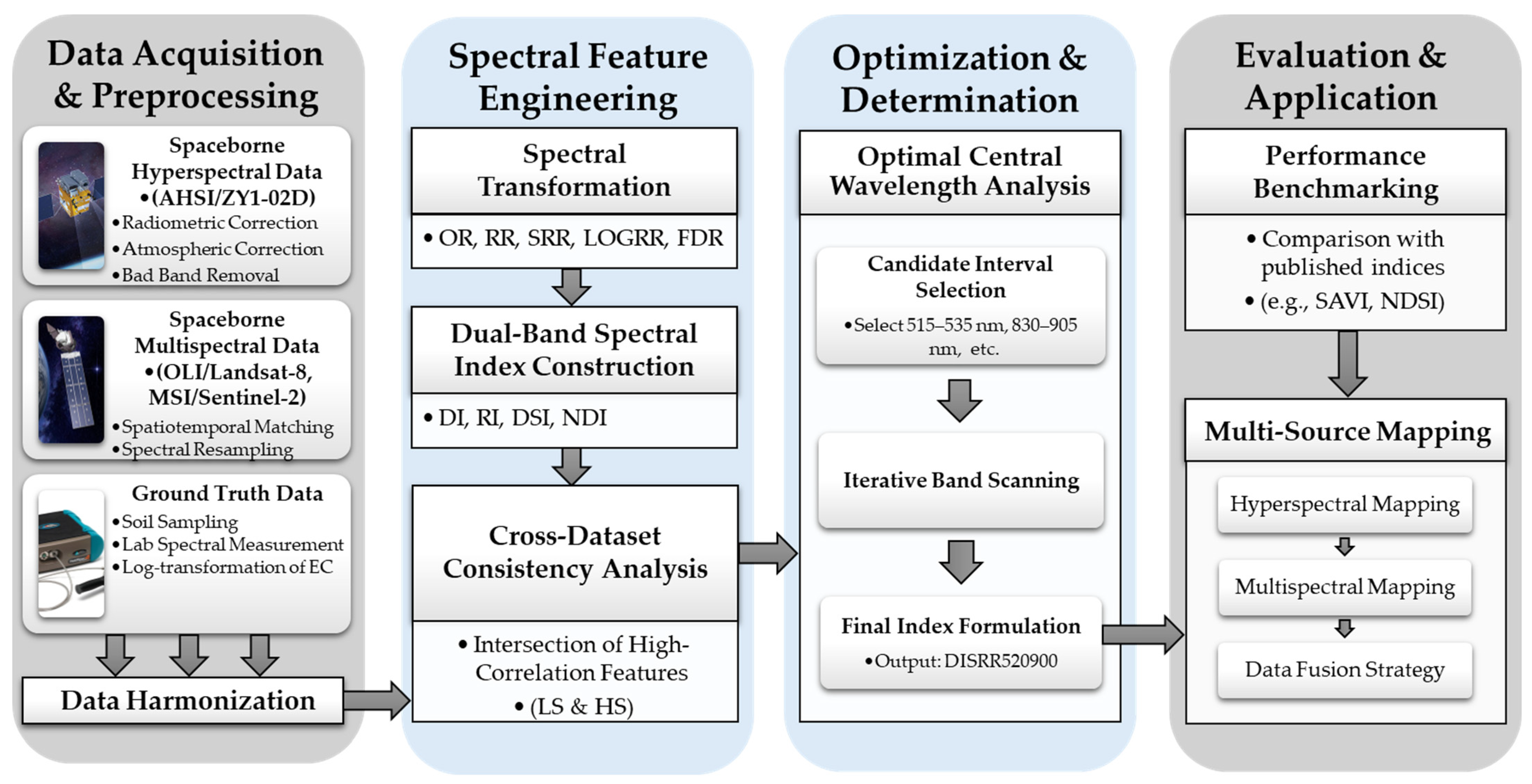
The methodological framework adopted in this study is illustrated in Figure 2, which consists of four main stages: (1) preprocessing of multi-source remote sensing data and construction of dual-band spectral indices; (2) integrated correlation analysis of spectral indices across LS and HS; (3) determination of optimal central wavelengths and formulation of the final soil salinization spectral index; and (4) evaluation and mapping of soil salinization using hyperspectral, multispectral, and fused multi-source remote sensing data.

2.4.1. Construction of Dual-Band Spectral Indices

To enhance the spectral response of soil salinization, five commonly used spectral transformations were applied to the original surface reflectance, including original reflectance (OR), reciprocal reflectance (RR), square-root reflectance (SRR), log-reciprocal reflectance (LOGRR), and first derivative reflectance (FDR). These transformations are widely adopted in soil spectroscopy studies to amplify weak salinity-related signals and to reduce the influence of background effects such as illumination and soil texture variability. The mathematical definitions of each transformation are summarized in Table 1.
Based on the transformed spectra, four types of dual-band spectral index formulations were calculated for all permissible band pairs within the retained spectral ranges (Table 2): the difference index (DI), ratio index (RI), square-root index of difference (DSI), and normalized difference index (NDI). Dual-band indices were selected because they provide a balance between sensitivity to salinity-related spectral features and robustness against radiometric and environmental variability.

2.4.2. Integrated Correlation Analysis Across Multi-Source Data

To identify spectral indices that exhibited stable and consistent relationships with soil salinization across different data sources, a stepwise coupled correlation analysis was developed. First, the Pearson correlation coefficient (R) between each constructed spectral index and logEC was calculated independently for each dataset using Equation (1).
R = i = 1 n x i x ¯ y i y ¯ i = 1 n x i x ¯ 2 i = 1 n y i y ¯ 2
where n is the number of soil samples; x i and y i represent the i -th values of the two variables; x ¯ and y ¯ are their respective mean values. The R quantifies the strength of linear association between two variables, with larger absolute values indicating stronger correlations.
For each dataset, all spectral indices were ranked in descending order according to the absolute R values. Rather than selecting a single best-performing index from one dataset, the top-ranked indices within a specified percentile threshold were retained to form an initial candidate set. In this study, the top 0.1% of indices were selected as the initial threshold, ensuring that only indices with the strongest salinity sensitivity were considered while retaining sufficient candidates for cross-dataset comparison. The index set for each dataset is expressed as Equation (2).
I t o p = i   |   | r i | T o p p %
where r i denotes the R between the i -th spectral index and logEC.
Subsequently, an intersection operation was performed on the candidate index sets derived from LS and HS. A non-empty intersection indicates the presence of spectral indices that consistently exhibit strong correlations with logEC across multiple data sources. If no common indices were identified under the initial threshold, the percentile threshold was iteratively relaxed in increments of 0.1%, and newly selected indices were merged into the existing candidate set, as defined by Equation (3).
I n e w = I o l d i   |   | r i | T o p n e w
where I n e w is the updated index set after each iteration, I o l d is the previous set, and T o p n e w represents the adjusted percentile threshold.
This iterative process continued until a stable and non-empty intersection was obtained. The intersection was considered stable when further relaxation of the percentile threshold no longer resulted in changes to the composition of the overlapping index set, indicating convergence in the selection of salinity-sensitive spectral indices across datasets. Through this procedure, spectral indices were selected based not only on their correlation strength but also on their robustness and consistency across data sources.

2.4.3. Optimal Central Wavelength Analysis

Although the stepwise correlation analysis identified spectral indices that were robust across datasets, differences in sensor spectral response functions may still affect the practical transferability of specific band combinations. To further reduce sensor-dependent effects such as band shifts and band loss, an optimal central wavelength analysis was conducted.
First, the wavelength ranges involved in the retained spectral indices were extracted to define candidate spectral intervals. The spectral transformation that exhibited the most stable performance in the previous step was then selected for subsequent analysis. Within each candidate interval, central wavelengths were uniformly sampled at 5 nm increments to generate a set of candidate band centers. All possible dual-band indices were constructed using these candidate wavelengths and the selected index formulation.
For each candidate index, the R between index values and logEC was calculated separately from LS and HS. To evaluate overall performance while avoiding bias toward a single dataset, a combined correlation score was calculated by averaging the two R values. Candidate indices were ranked according to this mean R, and the optimal band combination was selected based on both high average correlation and consistent performance across datasets. The resulting band pair defines the final soil salinization spectral index.

2.4.4. Comparison with Existing Soil Salinization Spectral Indices

To benchmark the performance of the proposed spectral index, several widely used soil salinization indices reported in previous studies were selected for comparison [28]. The formulations of these indices are listed in Table 3. All indices were calculated using LS and HS. To enable comparison across multispectral platforms, LS and HS were resampled according to the spectral response functions of Landsat-8 OLI and Sentinel-2 MSI. This procedure yielded four additional datasets: OLI-resampled hyperspectral satellite reflectance (HS-OLI), MSI-resampled hyperspectral satellite reflectance (HS-MSI), OLI-resampled laboratory reflectance (LS-OLI), and MSI-resampled laboratory reflectance (LS-MSI). In total, six reflectance datasets were used to calculate the spectral indices, and their correlations with logEC were evaluated to assess robustness and transferability across sensors.

2.4.5. Soil Salinization Mapping and Multi-Source Data Fusion

To investigate the applicability of the proposed spectral index for spatial mapping, soil salinization maps were generated using hyperspectral, multispectral, and fused multi-source remote sensing data. First, the optimal spectral index was applied to ZY1-02D AHSI imagery to produce hyperspectral soil salinization maps after masking water bodies and impervious surfaces. Second, the index was applied to Landsat-8 OLI and Sentinel-2 MSI imagery to evaluate its transferability across multispectral platforms. Because these sensors do not directly provide reflectance at the exact wavelengths of the selected band centers, inverse distance weighting (IDW) interpolation was used to approximate reflectance values.
Finally, to integrate the high spectral sensitivity of hyperspectral data with the broad spatial coverage of multispectral imagery, a multi-source remote sensing data fusion approach was implemented. Hyperspectral salinization maps were used as reference data, and multispectral index maps were fused using overlap histogram matching and feathering techniques to ensure smooth spatial transitions. The final fused soil salinization map was generated using nearest-neighbor resampling and used for large-scale salinization assessment.

3. Results

3.1. Characteristics of Soil EC

The statistical characteristics of soil EC at the sampling sites are summarized in Table 4. For HS, the mean EC value was 246.52 μS·cm−1, with values ranging from 26 to 1416 μS·cm−1. LS exhibited a lower mean EC value of 118.21 μS·cm−1, with a wider range from 10 to 2180 μS·cm−1. Both datasets showed substantial variability, as reflected by standard deviations exceeding 200 μS·cm−1.
The coefficients of variation were 1.01 for HS and 1.86 for LS, indicating pronounced spatial heterogeneity in soil salinity. In both datasets, the standard deviation exceeded the corresponding mean value, suggesting a right-skewed distribution dominated by low EC values with relatively few highly saline samples. After logarithmic transformation, EC values exhibited an approximately normal distribution, providing a suitable basis for subsequent correlation analyses.

3.2. Spectral Reflectance Characteristics Under Different Soil Salinization Levels

Salinization levels were classified based on SSC thresholds specified in the Rules for Cultivated Land Quality Monitoring (NY/T 1119-2019) [33]: non-salinized (<1 g·kg−1), mildly salinized (1–2 g·kg−1), moderately salinized (2–4 g·kg−1), severely salinized (4–6 g·kg−1), and saline (>6 g·kg−1). Although soil EC is a widely used indicator of soil salinity, it is strongly influenced by soil moisture conditions and lacks a universally accepted classification scheme. To enable consistent grading based on EC, an empirical linear regression between the measured EC and SSC was established using field-measured samples collected in the study area, allowing SSC-based classification thresholds to be translated into corresponding EC thresholds (Equation (4)).
E C = a × S S C + b
where EC is the soil electrical conductivity (µS·cm−1), SSC is the soil salt content (g·kg−1). a and b are the regression coefficients determined empirically from measured samples. Specifically, for the Songnen Plain, the fitted regression parameters were a = 223.30 and b = 6.60, with a coefficient of determination R2 = 0.87 based on n = 446 samples, indicating a statistically significant linear relationship between SSC and EC under local soil conditions.
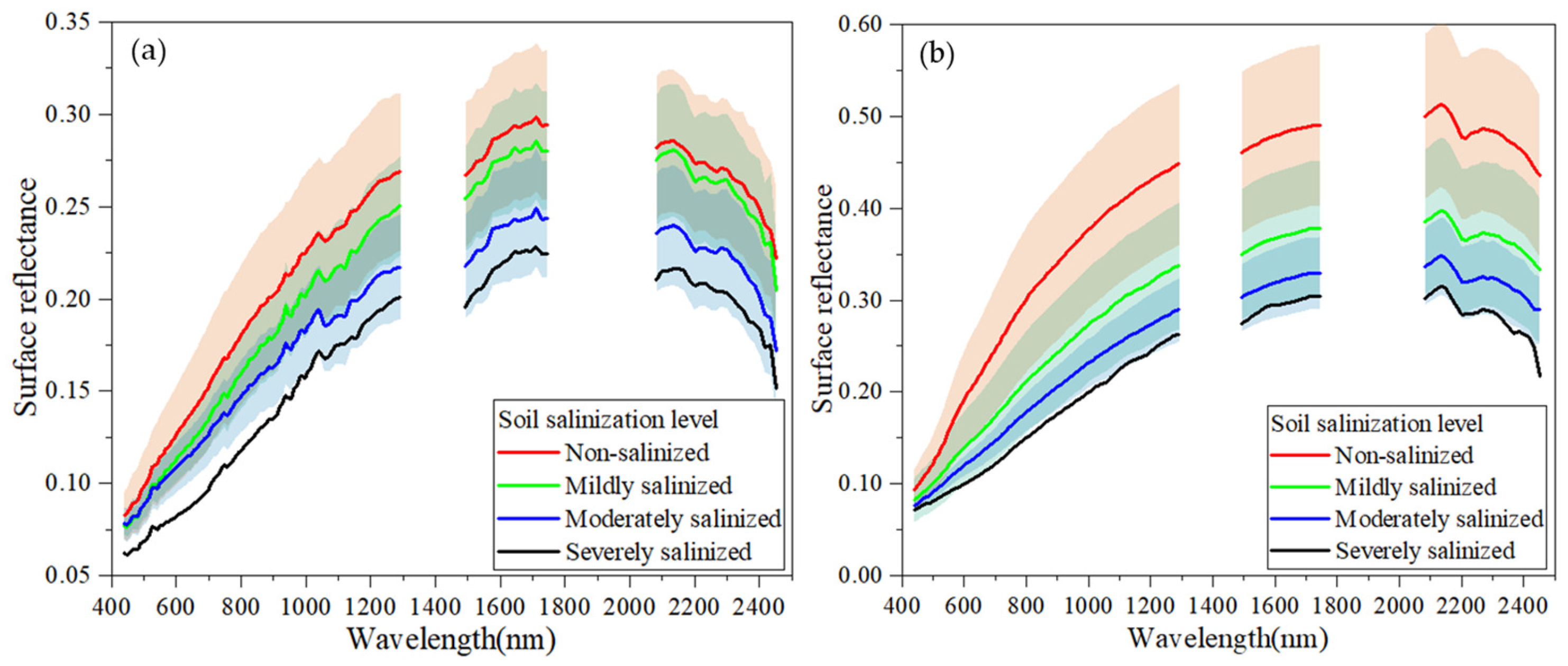
Figure 3 illustrates the spectral reflectance curves corresponding to different soil salinization levels derived from HS and LS. In both datasets, the spectral curves displayed consistent patterns across the VNIR and SWIR regions. It is noteworthy that mildly saline soils exhibited higher reflectance than severely saline soils, showing a negative correlation between salinity and reflectance. This phenomenon, which differs from the typical ‘salt-whitening’ effect, is attributed to the higher soil moisture and organic matter content often associated with saline-sodic soils in the Songnen Plain [34]. Reflectance increased gradually with wavelength in the VNIR region, reached a maximum in the SWIR region, and then decreased at longer wavelengths. Despite differences in measurement conditions and spectral resolution, the consistency between satellite-derived and laboratory-measured spectra indicates that soil salinization exerts a systematic influence on spectral reflectance characteristics.

3.3. Performance Evaluation of Dual-Band Spectral Indices

3.3.1. Correlation Between Transformed Spectra and logEC

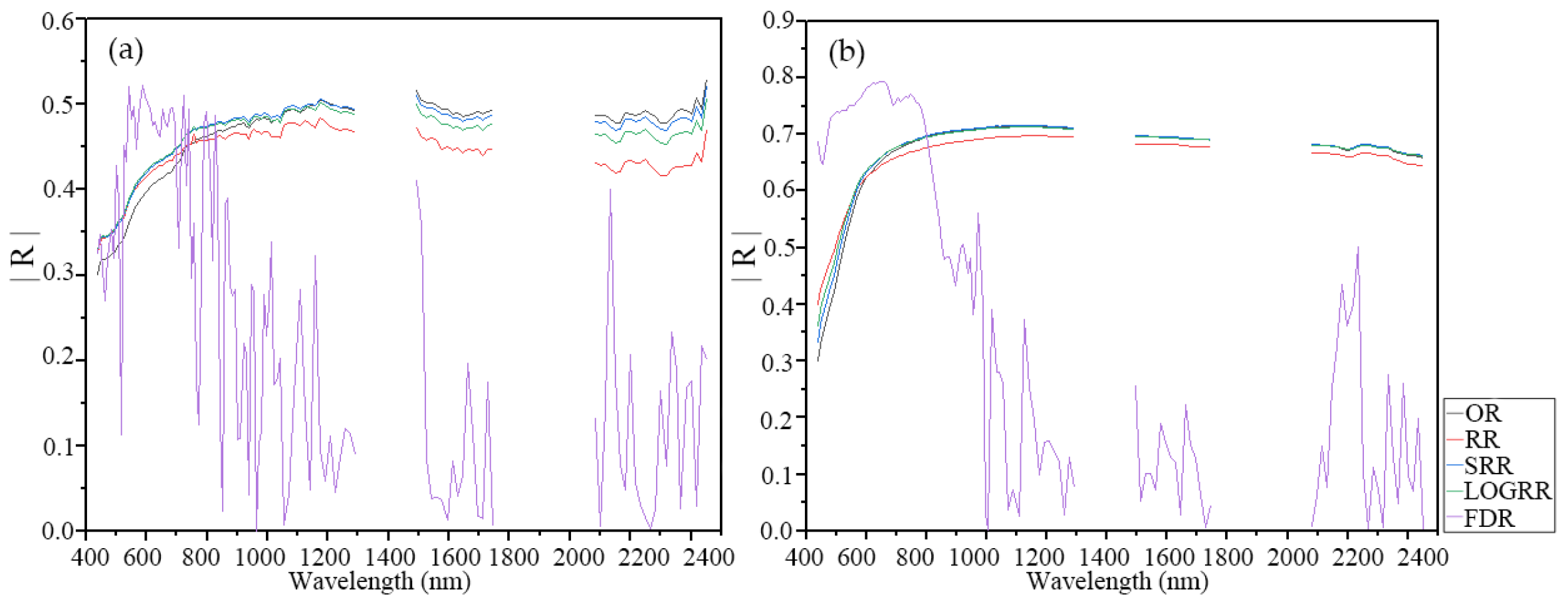
Figure 4 presents the R between the logEC and reflectance spectra subjected to different spectral transformations. In the HS (Figure 4a), the FDR exhibited relatively strong correlations with logEC in the 400–800 nm range, with local maximal observed near 542 nm and 585 nm. At longer wavelengths, correlation strength generally decreased, although distinct peaks were observed near 1492 nm and 2132 nm. In the HS dataset (Figure 4a), the FDR transformation exhibited sharp correlation peaks in the visible region (e.g., 542 nm) but suffered from high volatility and noise sensitivity in the SWIR region. Conversely, the OR, RR, SRR, and LOGRR transformations showed smoother and more robust correlation patterns beyond 800 nm. Although FDR achieved high local correlations, the SRR transformation demonstrated a superior balance between correlation strength and spectral stability across the full wavelength range, making it a suitable candidate for index construction.
In the LS (Figure 4b), the FDR transformation demonstrated strong correlations with logEC across the 400–800 nm range, with prominent peaks near 490 nm, 645 nm, and 756 nm, reaching a maximum correlation coefficient of approximately 0.8. Correlations in the SWIR region were generally lower, although a distinct peak was observed near 2200 nm. The remaining transformations exhibited gradually increasing correlations in the visible region, with peak values approaching 0.71. Overall, both datasets exhibited consistent trends, with FDR showing stronger correlations in the visible region and OR- and SRR-based transformations exhibiting more stable correlations at longer wavelengths.

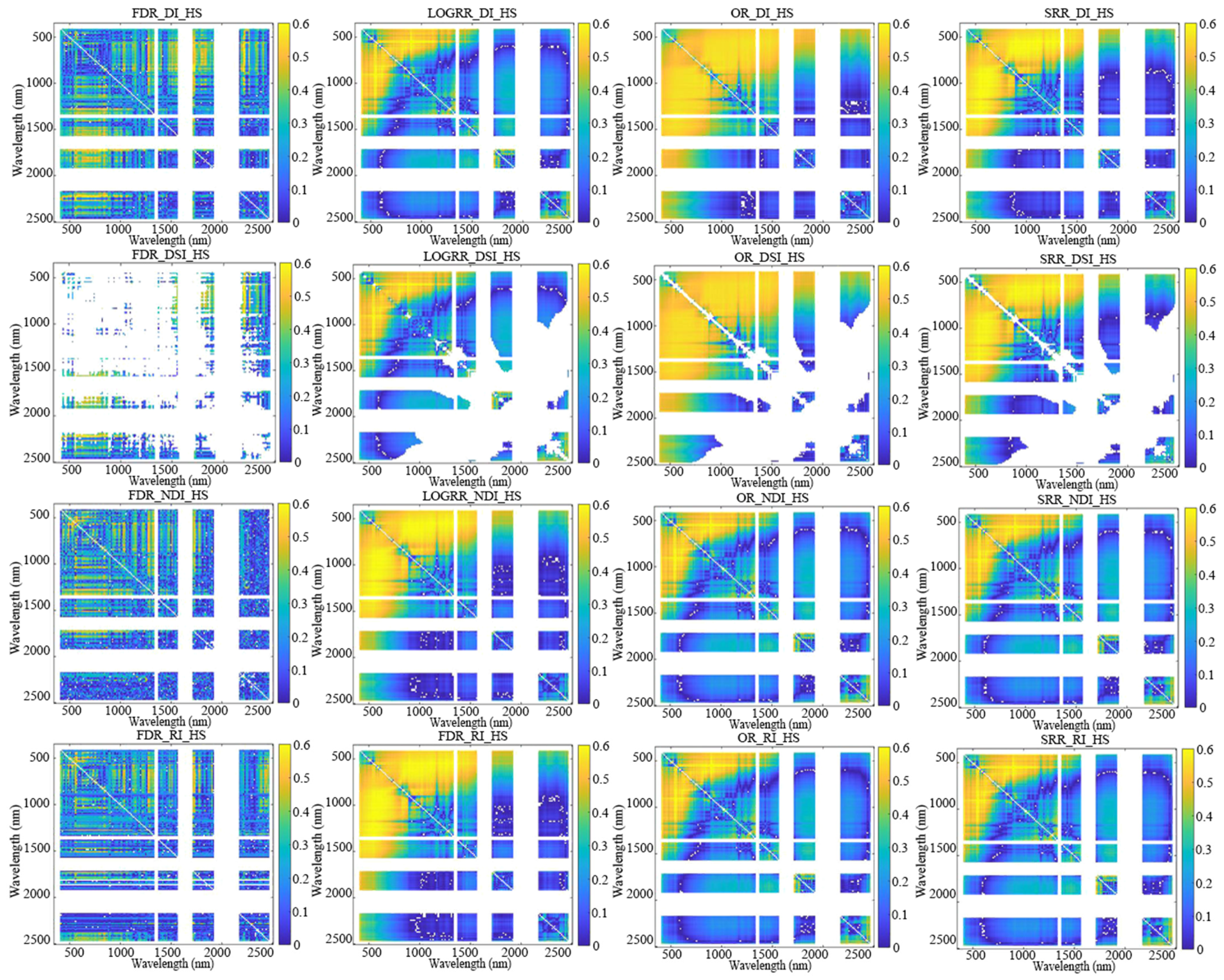
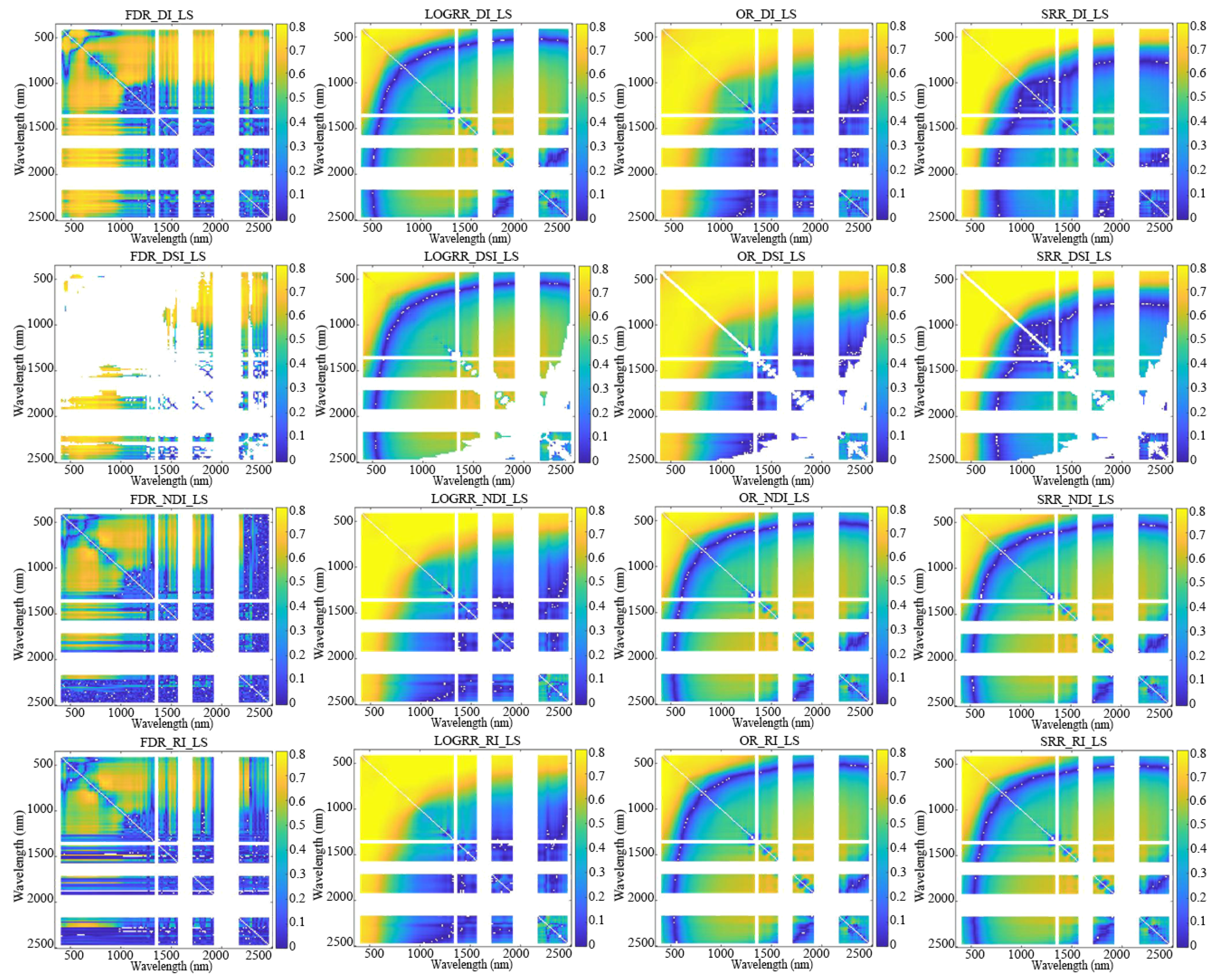
3.3.2. Correlation Between Dual-Band Spectral Indices and logEC

Figure 5 and Figure 6 illustrate the absolute R between dual-band spectral indices and logEC from HS and LS, respectively. Across both datasets, the DI demonstrated strong correlations under the OR, SRR, and FDR transformations, indicating effective enhancement of salinity-related spectral signals. The NDI also exhibited strong correlations under the LOGRR transformation.
In the HS, the overall correlation strength of spectral indices was lower than that observed in the LS. In particular, indices derived from the FDR transformation showed relatively weak correlations, potentially reflecting the influence of noise and environmental variability in satellite observations. The highest correlation in this dataset was achieved by the Difference Index based on log-reciprocal reflectance at 524 nm and 756 nm (DILOGRR524756) index, with an R of 0.653. In the LS, several indices exhibited strong correlations with logEC. The Difference Index based on square root reflectance at 455 nm and 1005 nm (DISRR4551005) index achieved the highest correlation, with an R of 0.826. Differences in the optimal band combinations between the LS and HS highlight the influence of measurement conditions and spectral resolution on index performance.

3.3.3. Cross-Dataset Consistency of Spectral Indices from Multi-Source Data

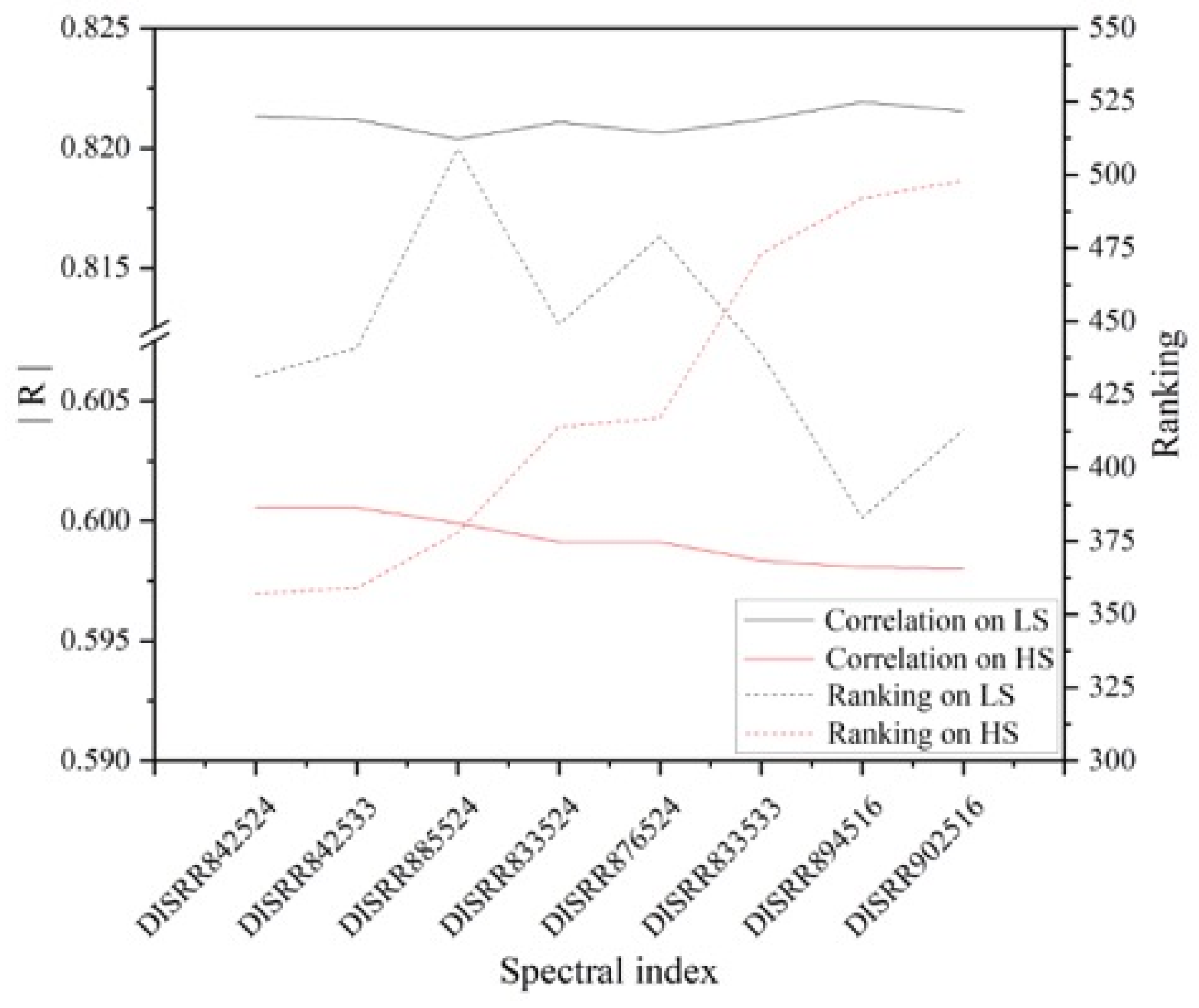
A stepwise correlation analysis was conducted to identify spectral indices exhibiting consistent salinity sensitivity across HS and LS. At a top-ranked selection threshold of 0.4%, a subset of overlapping spectral indices was identified between the two datasets. Figure 7 presents the correlation strength and ranking of these shared indices.
All overlapping indices belonged to the Difference Index based on square root reflectance (DISRR) type. The corresponding band combinations exhibited strong consistency across datasets. Specifically, one band was concentrated in the 516–533 nm range, while the other was primarily distributed across the 833–842 nm and 876–902 nm ranges. In the HS, these indices exhibited correlation coefficients of approximately 0.60, whereas correlations in the LS reached approximately 0.82.
The consistent performance of these indices across datasets indicates that the DISRR formulation provides robust sensitivity to soil salinity under varying observation conditions.

3.3.4. Determination of the Optimal Soil Salinization Spectral Index

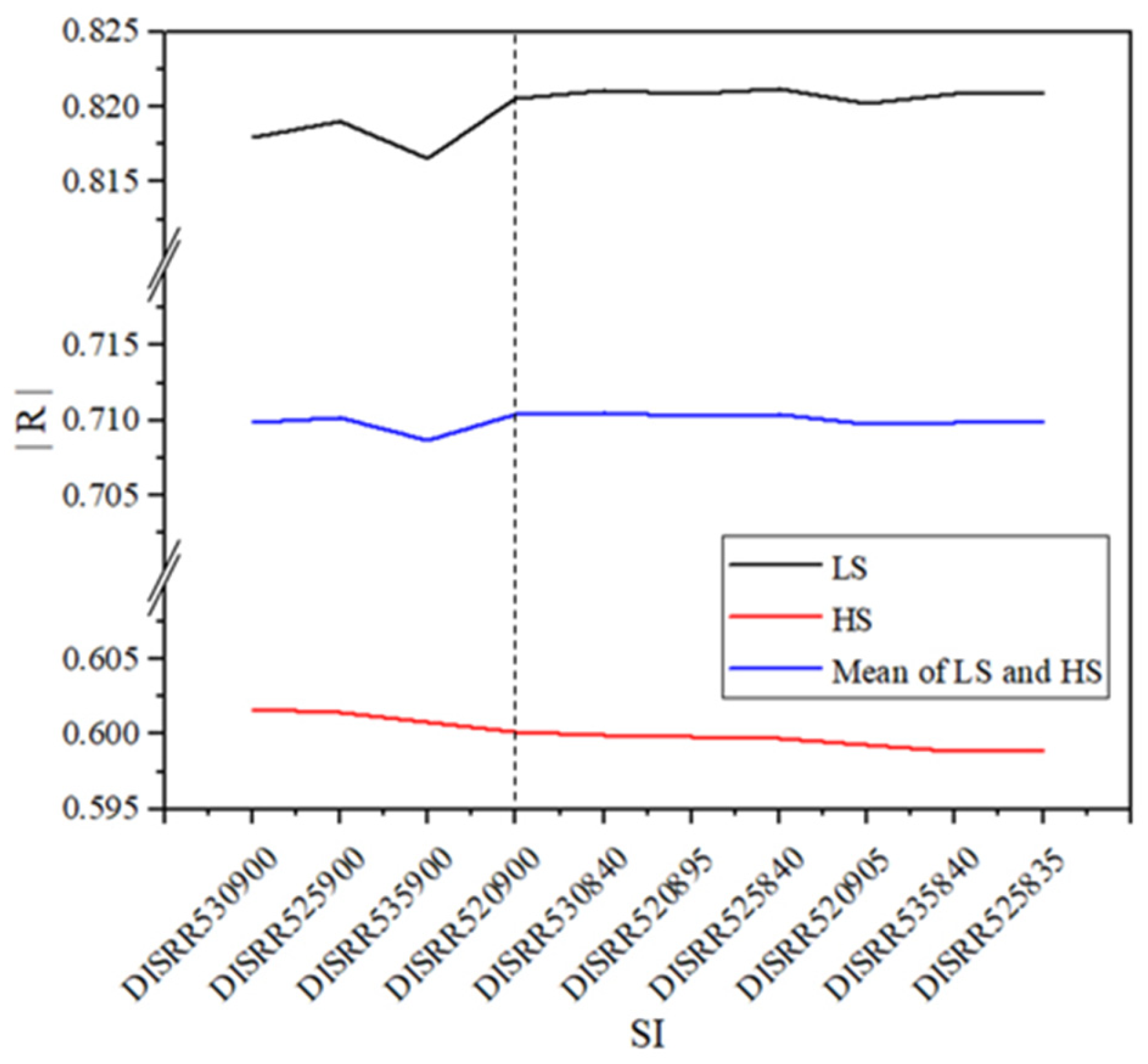
Based on the overlapping spectral indices identified in the previous analysis, two wavelength intervals, 515–535 nm and 830–905 nm, were selected for further optimization. Candidate central wavelengths were sampled at 5 nm intervals within each range, and all possible DISRR combinations were evaluated. In total, 55 candidate indices were generated.
Figure 8 presents the correlation strength of these candidate indices. Although minor fluctuations were observed among the top-ranked indices in the LS, correlation values stabilized beyond the top three candidates. To identify band combinations exhibiting balanced performance across both datasets, candidate indices were first ranked according to the arithmetic mean of R from the LS and HS datasets, ensuring equal contribution from each dataset. Subsequently, additional filtering criteria (R > 0.82 for LS and R > 0.60 for HS) were applied to retain band combinations that maintained consistently high correlations in both datasets. These threshold values correspond to the upper-performing group of candidate indices in each dataset and were used to ensure cross-dataset consistency rather than optimization within a single dataset. Under this screening, the band combination centered at 520 nm and 900 nm was ultimately selected because it demonstrated consistently high correlations with logEC in both the LS and HS datasets. This combination was therefore defined as the optimal soil salinization spectral index, denoted as the Difference Index based on Square Root Reflectance at 520 nm and 900 nm (DISRR520900). The calculation formula of the index is expressed as follows:
D I S R R 520900 = R 520   n m R 900   n m
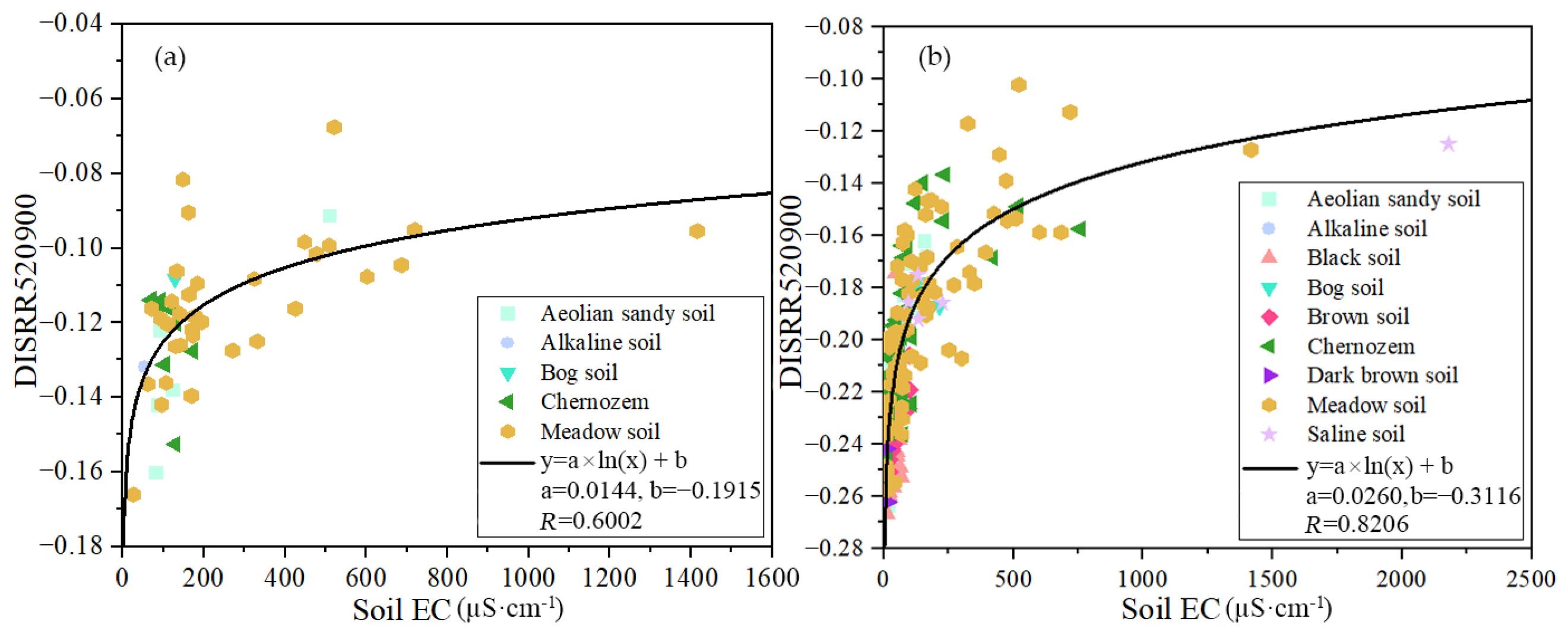
Figure 9 illustrates the relationships between DISRR520900 and soil EC for both datasets. In both cases, the index exhibited a clear logarithmic relationship with EC, indicating sensitivity across a wide range of salinization levels. Consistent distribution patterns were observed across different soil types, suggesting good generalizability of the proposed index.

3.4. Comparison of DISRR520900 with Existing Spectral Indices

Table 5 summarizes the correlation coefficients between logEC and different spectral indices across six datasets, including HS, LS, and multispectral simulations based on the Landsat-8 OLI and Sentinel-2 MSI spectral response functions.
Across all six datasets, DISRR520900 consistently achieved the highest or near-highest correlation with logEC. In the LS, the SI5 and SI6 indices also exhibited relatively strong correlations, whereas the SI9 and SAVI indices performed better in the HS. However, none of the existing indices matched the overall consistency and robustness of DISRR520900 across multiple data sources and sensor configurations.

3.5. Soil Salinization Mapping Based on the Optimal Spectral Index

3.5.1. Soil Salinization Mapping Using Hyperspectral Data

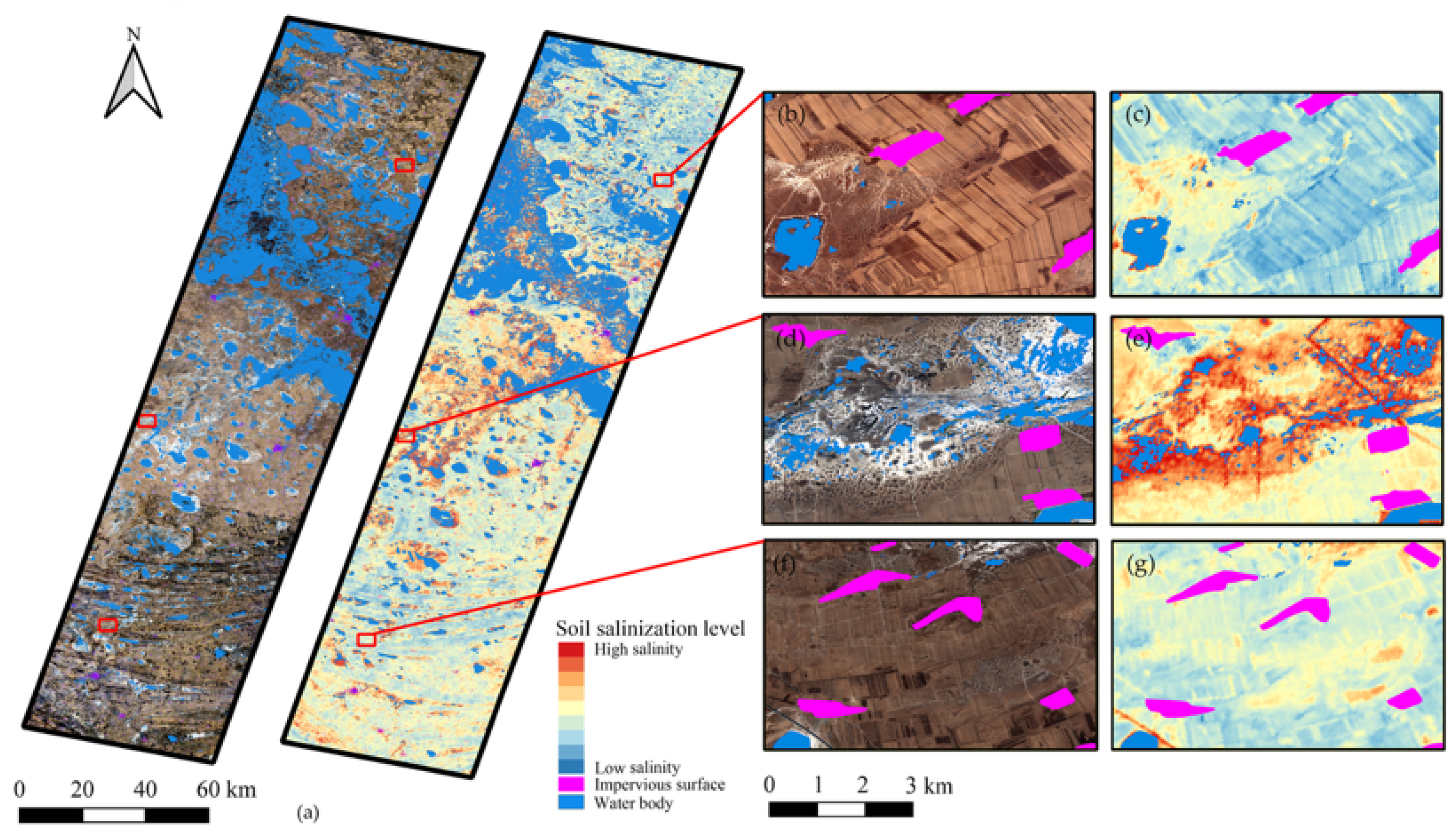
Figure 10 presents the soil salinization map derived from ZY1-02D AHSI hyperspectral imagery using DISRR520900. The spatial distribution exhibited a clear gradient, with higher salinization levels in the southern part of the study area and lower levels toward the north. This pattern was consistent with the corresponding true-color imagery. Detailed comparisons in three hyperspectral analysis sub-regions further demonstrated strong spatial agreement between mapped salinization levels and surface features. Areas adjacent to water bodies generally exhibited higher salinization levels, reflecting pronounced spatial heterogeneity within the region.

3.5.2. Comparative Soil Salinization Mapping Using Multispectral Data

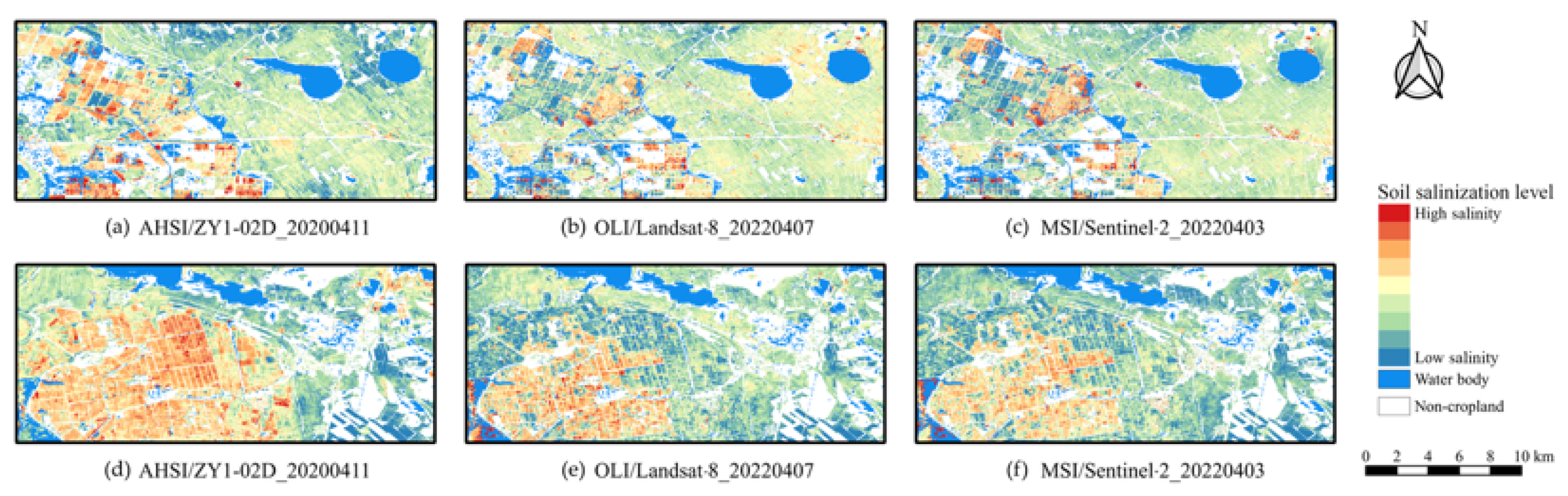
Figure 11 compares the soil salinization maps derived from hyperspectral data with those obtained from Landsat-8 OLI and Sentinel-2 MSI imagery. Despite differences in spectral and spatial resolution, the overall salinization patterns are consistent across data sources. In the representative sub-region A (Figure 11a–c), soil salinization exhibited a west-to-east decreasing trend, while in the representative sub-region B (Figure 11d–f), salinization levels were markedly higher in the western portion of the region than in the surrounding areas. These spatial patterns were consistently captured by DISRR520900 across different multispectral platforms.

3.5.3. Soil Salinization Mapping Using Fused Multi-Source Remote Sensing Data

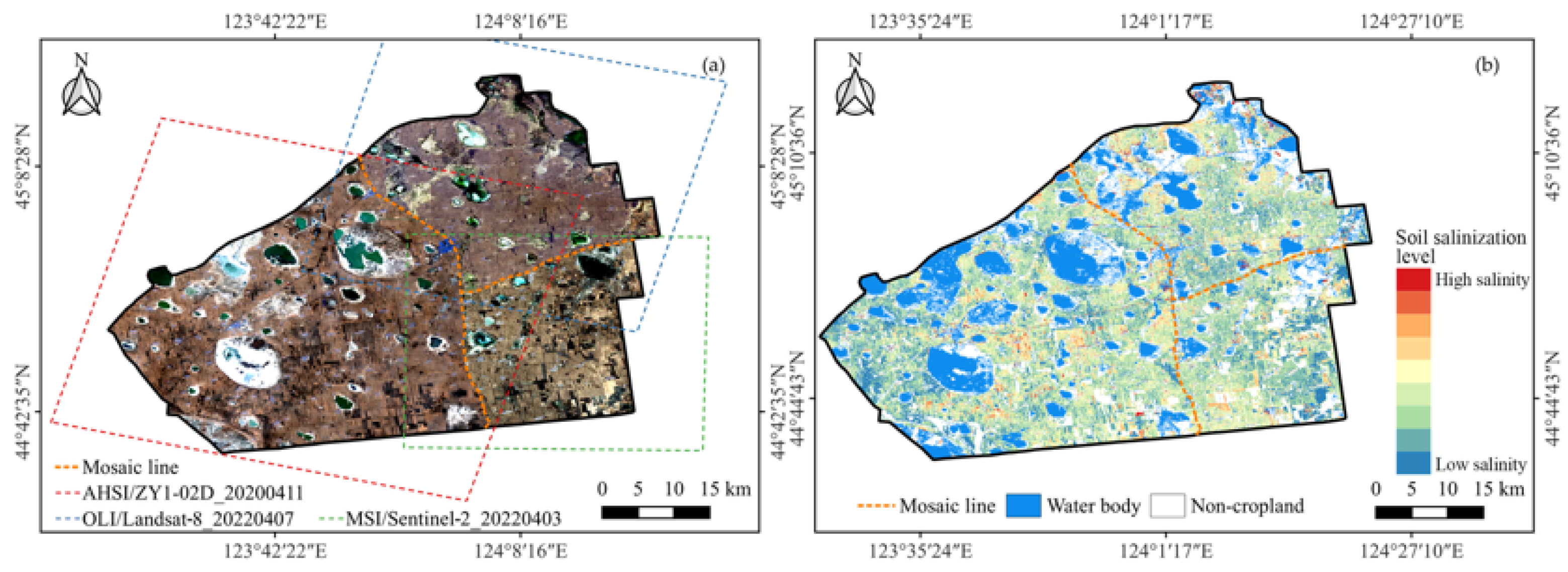
Figure 12 presents the soil salinization map for a typical county generated through multi-source remote sensing data fusion. The results revealed pronounced spatial heterogeneity in soil salinization, with moderate salinization representing the dominant class across the region. Higher salinization levels were mainly concentrated in the central-western areas, whereas the central-eastern region exhibited relatively lower salinization levels.
The fused map provides improved spatial continuity and coverage compared with single-source results, demonstrating the applicability of DISRR520900 for large-scale soil salinization mapping using integrated multi-source remote sensing data.

4. Discussion

4.1. Physical Significance of the Characteristic Bands in DISRR520900

Clear and systematic spectral differences associated with soil salinization were observed in the VNIR region, as illustrated in Figure 3. Consistent with previous findings, increasing soil salinity was generally accompanied by reduced surface reflectance in the VNIR range [35]. In the soil samples analyzed in this study, highly saline soils exhibited lower reflectance than low-salinity soils across most of the visible spectrum. This behavior reflects the combined influence of soil physicochemical properties, including moisture content, organic matter concentration, and surface structure.
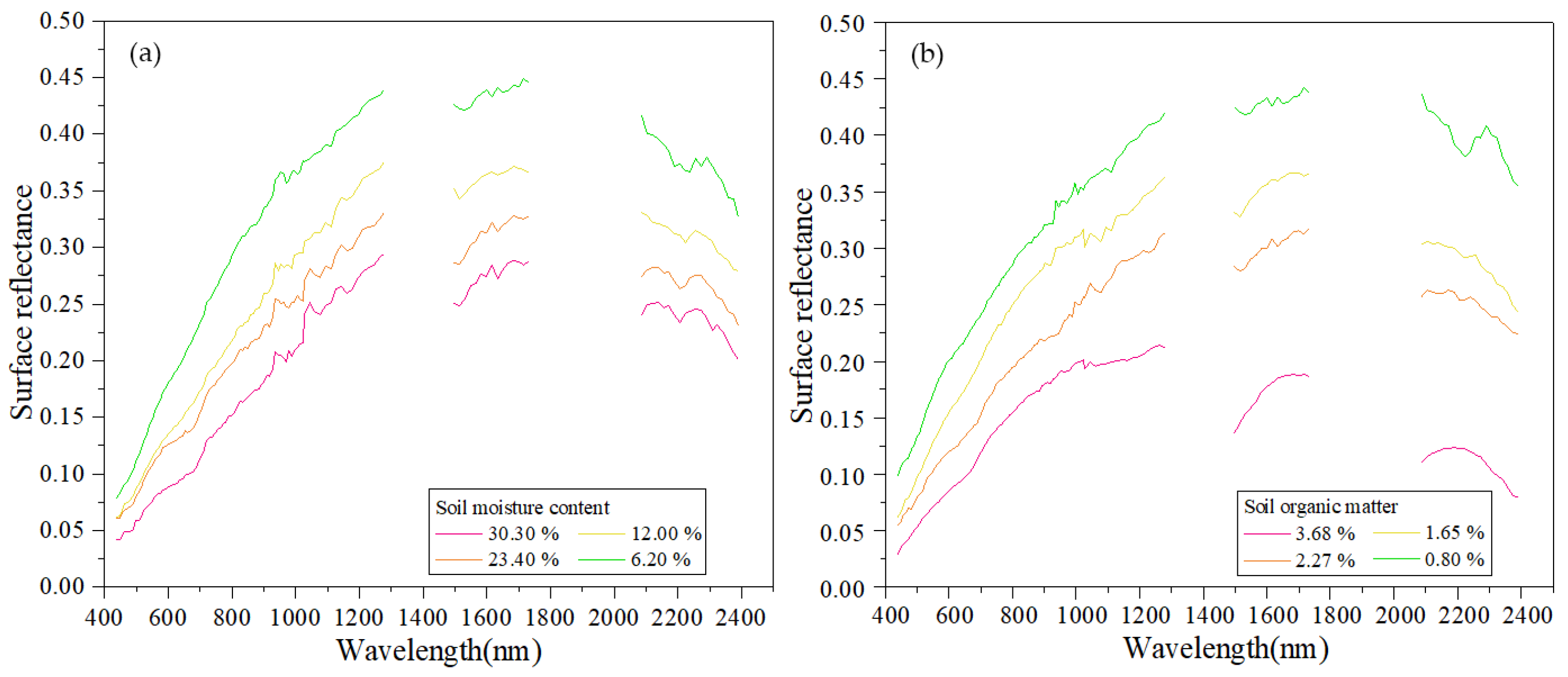
Correlation analysis indicates that soil moisture content and soil organic matter were negatively correlated with soil reflectance, particularly in the visible region (Figure 13). Similar relationships have been reported in previous studies, which demonstrated that soils with higher organic matter content and improved aggregation tend to exhibit lower visible reflectance due to enhanced light absorption [36,37]. In the Songnen Plain, soil salinity is positively associated with soil moisture and organic matter, a pattern that is characteristic of carbonate- and bicarbonate-driven salinization processes. As a result, salinity is indirectly associated with reduced surface reflectance through its coupling with moisture retention and organic matter accumulation [38]. In contrast, non-salinized soils in the Songnen Plain often exhibit lighter surface color and coarser surface texture, which can contribute to relatively higher reflectance values [39]. Collectively, these interacting factors help explain the observed spectral contrasts across different levels of soil salinization.
The characteristic wavelengths identified in the proposed index, centered at 520 nm and 900 nm, have clear physical and spectral significance. The 520 nm band lies within a region sensitive to iron-related electronic transitions and surface color variations, both of which are closely linked to soil chemical composition and salinity-induced mineral alterations [40]. The 900 nm band, located in the near-infrared region, is comparatively less influenced by surface color and is more sensitive to soil structure and moisture-related absorption features [41]. By combining these two bands, the DISRR520900 amplifies salinity-related spectral differences while mitigating the influence of confounding background factors.
Compared with indices that rely solely on visible or shortwave infrared bands, DISRR520900 adopts a complementary dual-band design consisting of a salinity-sensitive band and a relatively stable reference band. This strategy is consistent with the conceptual framework proposed by Fan et al. [42], who emphasized that combining sensitive and reference wavelengths enhances index robustness. Moreover, the selected band positions closely correspond to characteristic absorption features reported for saline soils in Northeast China and other representative salt-affected regions of China [43,44,45], further supporting the physical interpretability and regional relevance of the proposed index.

4.2. Comparison of Multi-Source Remote Sensing Data for Soil Salinization Mapping

Soil salinization monitoring can be supported by a variety of remote sensing data sources, including optical, microwave, and other geophysical observations [46]. Among these, optical remote sensing remains one of the most widely applied approaches due to its sensitivity to surface reflectance variations caused by salt accumulation. However, the effectiveness of optical data for salinity mapping depends strongly on sensor characteristics, particularly spectral resolution, spatial resolution, and temporal coverage.
In this study, multispectral data from Landsat-8 OLI and Sentinel-2 MSI produced soil salinization patterns that were broadly consistent with those derived from hyperspectral imagery. Sentinel-2 MSI, benefiting from finer spatial resolution, demonstrated enhanced capability in capturing small and fragmented saline patches, consistent with previous studies [47,48]. Nevertheless, when MSI data were resampled to coarser grids for data fusion, the advantages of higher spatial resolution were partially reduced, highlighting the inherent trade-off between spatial detail and spatial consistency in multi-source applications. When transferring a hyperspectral-derived index to multispectral imagery, reflectance at the exact target wavelengths cannot be directly obtained. In this study, IDW interpolation was adopted to approximate the reflectance at 520 nm and 900 nm. It should be noted that multispectral reflectance represents a band-integrated response defined by the sensor’s spectral response function (SRF), rather than reflectance at a single wavelength. Consequently, minor deviations may arise due to differences in SRF shape, center wavelength offsets, and bandwidth disparities among sensors. However, the consistent performance of DISRR520900 across hyperspectral and multispectral platforms suggests that the selected band combination is located within relatively stable spectral regions, thereby reducing sensitivity to minor inter-sensor spectral mismatches [49].
Hyperspectral data acquired by the ZY1-02D AHSI sensor exhibited higher correlations with soil EC than multispectral datasets, primarily due to dense spectral sampling that enables the detection of subtle spectral features related to soil composition and salinization processes [50]. These spectral features are particularly important for identifying mild-to-moderate salinization, which often manifests weak reflectance contrasts that are difficult to resolve using broad multispectral bands [51,52]. In addition, the spatial patterns derived from hyperspectral imagery are consistent with known environmental controls on soil salinization in the Songnen Plain, including topographic depressions, poor natural drainage, and long-term land-use pressure reported in regional studies [53,54,55]. This consistency further supports the reliability of hyperspectral observations for capturing salinization processes at the regional scale.
Despite their spectral advantages, hyperspectral satellite data are typically constrained by limited spatial coverage and longer revisit cycles, which restrict their independent applicability for operational large-scale monitoring. Integrating hyperspectral and multispectral data therefore represents a practical and scalable solution for regional soil salinization assessment. Within this framework, the proposed DISRR520900 functions as an effective bridging index that preserves consistent physical meaning across sensors with different spectral configurations. Its stable performance on both hyperspectral and multispectral platforms enables harmonized salinization mapping and facilitates seamless multi-source remote sensing data fusion. This cross-sensor transferability is particularly important for large-area applications, where no single sensor can simultaneously meet the requirements for spectral sensitivity, spatial coverage, and temporal continuity.

4.3. Limitations and Future Perspectives

Despite the robust performance of DISRR520900 across multiple datasets, several limitations should be acknowledged. First, inherent differences between laboratory-measured spectra and satellite-derived reflectance introduce uncertainty in index performance. Laboratory spectra are collected under controlled illumination and surface conditions, whereas satellite observations are influenced by atmospheric effects, surface roughness, soil moisture variability, and mixed pixels [56]. These factors can reduce correlation strength with soil EC, particularly under heterogeneous field conditions.
Second, although this study incorporated samples from multiple regions within the Songnen Plain, certain soil types and salinization grades remain underrepresented. Limited sample diversity may influence the stability and generalizability of the proposed index when applied to other saline environments with different soil compositions or climatic conditions [57,58]. The regional variations observed in index performance further suggest that background environmental factors can modulate spectral–salinity relationships.
Future research should therefore aim to expand sampling coverage across broader salinity gradients and diverse soil types, including saline–alkali regions beyond Northeast China. Incorporating ancillary variables such as soil moisture, surface roughness, and crop residue information may further reduce uncertainty and enhance index robustness. In addition, while spectral indices offer a simple and transferable solution for large-scale mapping, integrating DISRR520900 into quantitative inversion or hybrid machine-learning frameworks could enable more a accurate estimation of soil salinity levels while preserving cross-sensor transferability.

5. Conclusions

In this study, a cross-platform transferable spectral index (DISRR520900) for soda saline–alkali soils was developed by identifying characteristic spectral responses to soil salinity through comprehensive laboratory and satellite observations. The selected band combination captures salinity-related reflectance differences while reducing the influence of confounding factors such as soil moisture and surface color variability.
Validation with field-measured soil EC confirmed that DISRR520900 maintains consistent correlations across both hyperspectral and multispectral remote sensing datasets, supporting its cross-sensor transferability. Compared with conventional salinity indices, the proposed index exhibited enhanced consistency across sensors with distinct spectral configurations, establishing its suitability for multi-source salinization mapping.
Application of DISRR520900 in the study area produced spatial patterns that align with known environmental controls on soil salinization, indicating the index’s potential for regional-scale monitoring and large-area assessment.
Despite these promising results, uncertainties remain due to differences between laboratory and satellite spectra, limited sample diversity, and environmental heterogeneity. Future work should expand sampling coverage across broader soil types and salinity gradients, and explore integration with ancillary environmental variables or hybrid inversion frameworks to further enhance quantitative accuracy and robustness.

Author Contributions

Conceptualization, K.S. and H.G.; methodology, K.S. and H.G.; software, H.G.; validation, H.G. and K.S.; formal analysis, H.G.; investigation, C.X. and W.S.; resources, K.S., W.S. and C.X.; data curation, H.G. and K.S.; writing—original draft preparation, H.G.; writing—review and editing, K.S., W.S. and Y.X.; visualization, H.G.; supervision, K.S. and C.X.; project administration, K.S.; funding acquisition, K.S. All authors have read and agreed to the published version of the manuscript.

Funding

This work was supported by the National Key R&D Program of China (2021YFD1500102).

Data Availability Statement

The datasets used and analyzed during the current study are available from the corresponding author on reasonable request.

Conflicts of Interest

Author He Gu was employed by the company Beijing SatImage Information Technology Co., Ltd. The remaining authors declare that the research was conducted in the absence of any commercial or financial relationships that could be construed as potential conflicts of interest.

Abbreviations

The following abbreviations are used in this manuscript:
AHSIAdvanced Hyperspectral Imager
BIBrightness Index
DIDifference Index
DILOGRR524756Difference Index Based on Log-Reciprocal Reflectance at 524 nm and 756 nm
DISRRDifference Index Based on Square Root Reflectance
DISRR4551005Difference Index Based on Square Root Reflectance at 455 nm and 1005 nm
DISRR520900Difference Index Based on Square Root Reflectance at 520 nm and 900 nm
DSISquare-Root Index of Difference
ECElectrical Conductivity
FDRFirst Derivative Reflectance
FLAASHFast Line-of-Sight Atmospheric Analysis of Spectral Hypercubes
HSHyperspectral Satellite Data
HS-MSIMSI-Resampled Hyperspectral Satellite Reflectance
HS-OLIOLI-Resampled Hyperspectral Satellite Reflectance
IDWInverse Distance Weighting
Int1Intensity Index 1
Int2Intensity Index 2
LogECLog-Transformed Soil Electrical Conductivity
LOGRRLog-Reciprocal Reflectance
LSLaboratory Spectra
LS-MSIMSI-Resampled Laboratory Reflectance
LS-OLIOLI-Resampled Laboratory Reflectance
MNDWIModified Normalized Difference Water Index
MSIMultispectral Imager
NDINormalized Difference Index
NDSINormalized Difference Salinity index
NDVINormalized Difference Vegetation Index
OLIOperational Land Imager
OROriginal Reflectance
RPearson Correlation Coefficient
RIRatio Index
RRReciprocal Reflectance
SAVISoil-Adjusted Vegetation Index
SI1Salinity Index 1
SI2Salinity Index 2
SI3Salinity Index 3
SI4Salinity Index 4
SI5Salinity Index 5
SI6Salinity Index 6
SI7Salinity Index 7
SI8Salinity Index 8
SI9Salinity Index 9
SRFSpectral Response Function
SRRSquare-Root Reflectance
SSCSoil Salt Content
SWIRShortwave Infrared
UAVUnmanned Aerial Vehicle
VNIRVisible and Near-Infrared
ZY1-02DZiyuan-1 02D

References

  1. Lal, R. Restoring Soil Quality to Mitigate Soil Degradation. Sustainability 2015, 7, 5875–5895. [Google Scholar] [CrossRef]
  2. Batjes, N.H. Harmonized Soil Property Values for Broad-Scale Modelling (WISE30sec) with Estimates of Global Soil Carbon Stocks. Geoderma 2016, 269, 61–68. [Google Scholar] [CrossRef]
  3. Callow, J.N.; Hipsey, M.R.; Vogwill, R.I.J. Surface Water as a Cause of Land Degradation from Dryland Salinity. Hydrol. Earth Syst. Sci. 2020, 24, 717–734. [Google Scholar] [CrossRef]
  4. Metternicht, G.I.; Zinck, J.A. Remote Sensing of Soil Salinity: Potentials and Constraints. Remote Sens. Environ. 2003, 85, 1–20. [Google Scholar] [CrossRef]
  5. Zeng, Y. The Storing Salt Condition of Saline-Alkali Soil in Songnen Plain and the Space Distribution Research of Salt Supplying Type. Master’s Thesis, Northeast Normal University, Changchun, China, 2006. [Google Scholar]
  6. Sahbeni, G.; Ngabire, M.; Musyimi, P.K.; Székely, B. Challenges and Opportunities in Remote Sensing for Soil Salinization Mapping and Monitoring: A Review. Remote Sens. 2023, 15, 2540. [Google Scholar] [CrossRef]
  7. Yang, J.; Jiang, Q.; Zhao, J.; Wu, Y. Quantitative Retrieval and Classification of Saline Soil Using HJ-1A Hyperspectral Data. Trans. Chin. Soc. Agri. Eng. 2011, 27, 118–124. [Google Scholar] [CrossRef]
  8. Peng, J.; Biswas, A.; Jiang, Q.; Zhao, R.; Hu, J.; Hu, B.; Shi, Z. Estimating Soil Salinity from Remote Sensing and Terrain Data in Southern Xinjiang Province, China. Geoderma 2019, 337, 1309–1319. [Google Scholar] [CrossRef]
  9. Sun, M.; Liu, H.; Li, P.; Gong, P.; Yu, X.; Ye, F.; Guo, Y.; Wu, Z. Effects of Salt Content and Particle Size on Spectral Reflectance and Model Accuracy: Estimating Soil Salt Content in Arid, Saline-Alkali Lands. Microchem. J. 2024, 207, 111666. [Google Scholar] [CrossRef]
  10. Farifteh, J.; Van Der Meer, F.; Atzberger, C.; Carranza, E.J.M. Quantitative Analysis of Salt-Affected Soil Reflectance Spectra: A Comparison of Two Adaptive Methods (PLSR and ANN). Remote Sens. Environ. 2007, 110, 59–78. [Google Scholar] [CrossRef]
  11. Qi, G.; Chang, C.; Yang, W.; Gao, P.; Zhao, G. Soil Salinity Inversion in Coastal Corn Planting Areas by the Satellite-UAV-Ground Integration Approach. Remote Sens. 2021, 13, 3100. [Google Scholar] [CrossRef]
  12. He, Y.; Yin, H.; Xiang, R.; Chen, H.; Du, R.; Zhang, Z. Monitoring Soil Salinity Based on Sentinel-1/2 Remote Sensing Parameters and Two-Dimensional Space Theory. Infrared Phys. Technol. 2024, 140, 105361. [Google Scholar] [CrossRef]
  13. Zhang, Z.; Fan, Y.; Zhang, A.; Jiao, Z. Baseline-Based Soil Salinity Index (BSSI): A Novel Remote Sensing Monitoring Method of Soil Salinization. IEEE J. Sel. Top. Appl. Earth Obs. Remote Sens. 2023, 16, 202–214. [Google Scholar] [CrossRef]
  14. Li, Y.; Li, M.; Li, C.; Liu, Z. Forest Aboveground Biomass Estimation Using Landsat 8 and Sentinel-1A Data with Machine Learning Algorithms. Sci. Rep. 2020, 10, 9952. [Google Scholar] [CrossRef]
  15. Bitella, G.; Rossi, R.; Bochicchio, R.; Perniola, M.; Amato, M. A Novel Low-Cost Open-Hardware Platform for Monitoring Soil Water Content and Multiple Soil-Air-Vegetation Parameters. Sensors 2014, 14, 19639–19659. [Google Scholar] [CrossRef]
  16. Zhao, Y.; Miao, Q.; Shi, H.; Li, X.; Yan, J.; Yang, S.; Hou, C.; Yu, C.; Feng, W.; Hao, J. Inversion of Soil Salinization at the Branch Canal Scale in the Hetao Irrigation District Based on Improved Spectral Indices. Agric. Water Manag. 2025, 316, 109608. [Google Scholar] [CrossRef]
  17. Jiang, L.; Qiu, G.; Yu, X. Identification and Spatial Analysis of Land Salinity in China’s Yellow River Delta Using a Land Salinity Monitoring Index from Harmonized UAV-Landsat Imagery. Sensors 2023, 23, 7584. [Google Scholar] [CrossRef] [PubMed]
  18. Ma, Y.; Chen, H.; Zhao, G.; Wang, Z.; Wang, D. Spectral Index Fusion for Salinized Soil Salinity Inversion Using Sentinel-2A and UAV Images in a Coastal Area. IEEE Access 2020, 8, 159595–159608. [Google Scholar] [CrossRef]
  19. Ding, S.; Zhang, X.; Shang, K.; Xiao, Q.; Wang, W.; Ur Rehman, A. Removal of Environmental Influences for Estimating Soil Texture Fractions Based on ZY1 Satellite Hyperspectral Images. Catena 2024, 236, 107713. [Google Scholar] [CrossRef]
  20. Ding, S.; Zhang, X.; Sun, W.; Shang, K.; Wang, Y. Estimation of Soil Lead Content Based on GF-5 Hyperspectral Images, Considering the Influence of Soil Environmental Factors. J. Soils Sediments 2022, 22, 1431–1445. [Google Scholar] [CrossRef]
  21. Weng, Y.; Gong, P.; Zhu, Z. A Spectral Index for Estimating Soil Salinity in the Yellow River Delta Region of China Using EO-1 Hyperion Data. Pedosphere 2010, 20, 378–388. [Google Scholar] [CrossRef]
  22. Chen, C.; Yuan, X.; Gan, S.; Kang, X.; Luo, W.; Li, R.; Bi, R.; Gao, S. A New Strategy Based on Multi-Source Remote Sensing Data for Improving the Accuracy of Land Use/Cover Change Classification. Sci. Rep. 2024, 14, 26855. [Google Scholar] [CrossRef] [PubMed]
  23. Kahaer, Y.; Tashpolat, N.; Shi, Q.; Liu, S. Possibility of Zhuhai-1 Hyperspectral Imagery for Monitoring Salinized Soil Moisture Content Using Fractional Order Differentially Optimized Spectral Indices. Water 2020, 12, 3360. [Google Scholar] [CrossRef]
  24. Wang, D.; Chen, H.; Wang, Z.; Ma, Y. Inversion of Soil Salinity According to Different Salinization Grades Using Multi-Source Remote Sensing. Geocarto Int. 2022, 37, 1274–1293. [Google Scholar] [CrossRef]
  25. Mohamed, S.A.; Metwaly, M.M.; Metwalli, M.R.; AbdelRahman, M.A.E.; Badreldin, N. Integrating Active and Passive Remote Sensing Data for Mapping Soil Salinity Using Machine Learning and Feature Selection Approaches in Arid Regions. Remote Sens. 2023, 15, 1751. [Google Scholar] [CrossRef]
  26. Luo, C.; Zhang, X.; Wang, Y.; Men, Z.; Liu, H. Regional Soil Organic Matter Mapping Models Based on the Optimal Time Window, Feature Selection Algorithm and Google Earth Engine. Soil Tillage Res. 2022, 219, 105325. [Google Scholar] [CrossRef]
  27. Cui, W. Soil Salinization in Daqing Area Based on GIS Technology Feature Analysis. Master’s Thesis, Heilongjiang University, Harbin, China, 2024. [Google Scholar]
  28. Wang, J.; Ding, J.; Ge, X.; Peng, J.; Hu, Z. Monitoring Soil Salinization Based on Remote Sensing and Proximal Soil Sensing: Progress and Perspective. Natl. Remote Sens. Bull. 2023, 28, 2187–2208. [Google Scholar] [CrossRef]
  29. Douaoui, A.E.K.; Nicolas, H.; Walter, C. Detecting Salinity Hazards within a Semiarid Context by Means of Combining Soil and Remote Sensing Data. Geoderma 2006, 134, 217–230. [Google Scholar] [CrossRef]
  30. Khan, N.M.; Rastoskuev, V.V.; Sato, Y.; Shiozawa, S. Assessment of Hydrosaline Land Degradation by Using a Simple Approach of Remote Sensing Indicators. Agric. Water Manag. 2005, 77, 96–109. [Google Scholar] [CrossRef]
  31. Salem, O.H.; Jia, Z. Evaluation of Different Soil Salinity Indices Using Remote Sensing Techniques in Siwa Oasis, Egypt. Agronomy 2024, 14, 723. [Google Scholar] [CrossRef]
  32. Wang, J.; Ding, J.; Yu, D.; Ma, X.; Zhang, Z.; Ge, X.; Teng, D.; Li, X.; Liang, J.; Lizaga, I.; et al. Capability of Sentinel-2 MSI Data for Monitoring and Mapping of Soil Salinity in Dry and Wet Seasons in the Ebinur Lake Region, Xinjiang, China. Geoderma 2019, 353, 172–187. [Google Scholar] [CrossRef]
  33. NY/T 1119-2019; Rules for Cultivated Land Quality Monitoring. Ministry of Agriculture and Rural Affairs of the People’s Republic of China: Beijing, China, 2019.
  34. Luo, X.; Zhang, X.; Zhang, L.; Guo, L.; Nie, Z.; Zhou, J.; Wang, R.; Zhang, T.; Miao, Y.; Ma, L.; et al. Characteristics of Clay Dispersion and Its Influencing Factors in Saline-Sodic Soils of Songnen Plain, China. Agric. Water Manag. 2024, 303, 109033. [Google Scholar] [CrossRef]
  35. Nawar, S.; Buddenbaum, H.; Hill, J.; Kozak, J. Modeling and Mapping of Soil Salinity with Reflectance Spectroscopy and Landsat Data Using Two Quantitative Methods (PLSR and MARS). Remote Sens. 2014, 6, 10813–10834. [Google Scholar] [CrossRef]
  36. Schmid, T.; Koch, M.; Gumuzzio, J. Applications of Hyperspectral Imagery to Soil Salinity Mapping. In Remote Sensing of Soil Salinization; Metternicht, G., Zinck, J.A., Eds.; CRC Press: Boca Raton, FL, USA, 2008; pp. 113–137. [Google Scholar] [CrossRef]
  37. Fallah Shamsi, S.R.; Zare, S.; Abtahi, S.A. Soil Salinity Characteristics Using Moderate Resolution Imaging Spectroradiometer (MODIS) Images and Statistical Analysis. Arch. Agron. Soil Sci. 2013, 59, 471–489. [Google Scholar] [CrossRef]
  38. Luo, S.; Yuan, J.; Song, Y.; Ren, J.; Qi, J.; Zhu, M.; Feng, Y.; Li, M.; Wang, B.; Li, X.; et al. Elevated Salinity Decreases Microbial Communities Complexity and Carbon, Nitrogen and Phosphorus Metabolism in the Songnen Plain Wetlands of China. Water Res. 2025, 276, 123285. [Google Scholar] [CrossRef]
  39. Liu, H.; Zhang, B.; Wang, Z.; Song, K.; Hu, M.; Duan, H. Soil Saline-Alkalization Evaluation Based on Spectral Reflectance Characteristics. J. Infrared Milllim. Waves 2008, 27, 138–142. [Google Scholar] [CrossRef]
  40. Mougenot, B.; Pouget, M.; Epema, G.F. Remote Sensing of Salt Affected Soils. Remote Sens. Rev. 1993, 7, 241–259. [Google Scholar] [CrossRef]
  41. Ge, X.; Ding, J.; Teng, D.; Xie, B.; Zhang, X.; Wang, J.; Han, L.; Bao, Q.; Wang, J. Exploring the Capability of Gaofen-5 Hyperspectral Data for Assessing Soil Salinity Risks. Int. J. Appl. Earth Obs. Geoinf. 2022, 112, 102969. [Google Scholar] [CrossRef]
  42. Fan, X.; Liu, Y.; Tao, J.; Weng, Y. Soil Salinity Retrieval from Advanced Multi-Spectral Sensor with Partial Least Square Regression. Remote Sens. 2015, 7, 488–511. [Google Scholar] [CrossRef]
  43. Liu, H.; Zhang, B.; Song, K.; Wang, Z.; Duan, H.; Yang, F.; Zhang, X. Soil Line Influence Factors Analysis Based on Laboratory Soil Hyperspectral Reflectance. J. Remote Sens. 2008, 12, 119–127. [Google Scholar] [CrossRef]
  44. Weng, Y.; Gong, P.; Zhu, Z. Reflectance Spectroscopy for the Assessment of Soil Salt Content in Soils of the Yellow River Delta of China. Int. J. Remote Sens. 2008, 29, 5511–5531. [Google Scholar] [CrossRef]
  45. Metternicht, G.; Zinck, J.A. Spatial Discrimination of Salt- and Sodium-Affected Soil Surfaces. Int. J. Remote Sens. 1997, 18, 2571–2586. [Google Scholar] [CrossRef]
  46. Liu, X.; Zhang, Z.; Lu, M.; Wang, Y.; Ren, J. Research on Ground-Based Remote-Sensing Inversion Method for Soil Salinity Information Based on Crack Characteristics and Spectral Response. Agronomy 2024, 14, 1837. [Google Scholar] [CrossRef]
  47. Ge, X.; Ding, J.; Teng, D.; Wang, J.; Huo, T.; Jin, X.; Wang, J.; He, B.; Han, L. Updated Soil Salinity with Fine Spatial Resolution and High Accuracy: The Synergy of Sentinel-2 MSI, Environmental Covariates and Hybrid Machine Learning Approaches. Catena 2022, 212, 106054. [Google Scholar] [CrossRef]
  48. Wang, Z.; Zhang, F.; Zhang, X.; Chan, N.W.; Kung, H.; Ariken, M.; Zhou, X.; Wang, Y. Regional Suitability Prediction of Soil Salinization Based on Remote-Sensing Derivatives and Optimal Spectral Index. Sci. Total Environ. 2021, 775, 145807. [Google Scholar] [CrossRef]
  49. Xiong, J.; Ge, X.; Ding, J.; Wang, J.; Zhang, L.; Zhu, C.; Han, L.; Wang, J. Optimal Time-Window for Assessing Soil Salinity via Sentinel-2 Multitemporal Synthetic Data in the Arid Agricultural Regions of China. Ecol. Indic. 2025, 176, 113642. [Google Scholar] [CrossRef]
  50. Li, C.; Zhang, C.; Zhang, H.; Yang, C.; Li, S.; Yun, W. Inversion of Soil Salinization in Western Jilin Province Based on XGBoost and Geographically Weighted Regression. J. China Agric. Univ. 2024, 29, 1–10. [Google Scholar] [CrossRef]
  51. Huang, X.; Wang, X.; Guo, Y.; An, B. Spatial Inversion of Soil Organic Carbon Content Based on Hyperspectral Data and Sentinel-2 Images. Land Degrad. Dev. 2025, 36, 3527–3544. [Google Scholar] [CrossRef]
  52. Bai, L.; Wang, C.; Zang, S.; Wu, C.; Luo, J.; Wu, Y. Mapping Soil Alkalinity and Salinity in Northern Songnen Plain, China with the HJ-1 Hyperspectral Imager Data and Partial Least Squares Regression. Sensors 2018, 18, 3855. [Google Scholar] [CrossRef]
  53. Zhang, Z.; Ma, H.; Liu, Q.; Zhu, W.; Zhang, T. Development and Drives of Land Salinization in Songnen Plain. Geol. Resour. 2007, 16, 120–124. [Google Scholar] [CrossRef]
  54. Yang, J.; Zhang, S.; Li, Y.; Bu, K.; Zhang, Y.; Chang, L.; Zhang, Y. Dynamics of Saline-Alkali Land and Its Ecological Regionalization in Western Songnen Plain, China. Chin. Geogr. Sci. 2010, 20, 159–166. [Google Scholar] [CrossRef]
  55. Sun, Y. Remote Sensing Retrieval of Electrical Conductivity of Saline Soil in West Jilin Province and Research on Temporal Variation in Thirty Years. Master’s Thesis, University of Chinese Academy of Sciences, Beijing, China, 2021. [Google Scholar]
  56. Gholizadeh, A.; Žižala, D.; Saberioon, M.; Borůvka, L. Soil Organic Carbon and Texture Retrieving and Mapping Using Proximal, Airborne and Sentinel-2 Spectral Imaging. Remote Sens. Environ. 2018, 218, 89–103. [Google Scholar] [CrossRef]
  57. Gomez, C.; Adeline, K.; Bacha, S.; Driessen, B.; Gorretta, N.; Lagacherie, P.; Roger, J.M.; Briottet, X. Sensitivity of Clay Content Prediction to Spectral Configuration of VNIR/SWIR Imaging Data, from Multispectral to Hyperspectral Scenarios. Remote Sens. Environ. 2018, 204, 18–30. [Google Scholar] [CrossRef]
  58. Peng, J.; Liu, H.; Shi, Z.; Xiang, H.; Chi, C. Regional Heterogeneity of Hyperspectral Characteristics of Salt-Affected Soil and Salinity Inversion. Trans. Chin. Soc. Agric. Eng. 2014, 30, 167–174. [Google Scholar] [CrossRef]
Figure 1. Overview of the study area in the Songnen Plain of Northeast China. (a) Spatial distribution of major soil types in the study area. (b) True-color high-resolution satellite image showing satellite-based and laboratory-measured soil sampling points, the hyperspectral satellite imaging swath, selected hyperspectral analysis sub-regions, representative sub-regions, and a typical county used for subsequent analyses.
Remotesensing 18 00758 g001
Figure 2. Methodological framework for developing a transferable soil salinization spectral index through the collaborative analysis of laboratory and spaceborne hyperspectral data.
Remotesensing 18 00758 g002
Figure 3. Mean spectral reflectance characteristics of soils with varying salinization levels derived from (a) hyperspectral satellite data (HS) and (b) laboratory spectra (LS). Solid lines represent the mean reflectance values, while shaded areas represent the spectral standard deviation for each level. The severely salinized level contained only one sample (n = 1); therefore, its standard deviation was not included.
Remotesensing 18 00758 g003
Figure 4. Comparative analysis of absolute Pearson correlation coefficients (|R|) between the logEC and reflectance spectra under five transformations derived from (a) HS and (b) LS.
Remotesensing 18 00758 g004
Figure 5. Two-dimensional correlation matrices showing the correlations between logEC and dual-band spectral indices derived from HS data. The color gradient represents the magnitude of the absolute Pearson correlation coefficient (|R|).
Remotesensing 18 00758 g005
Figure 6. Two-dimensional correlation matrices showing the correlations between logEC and dual-band spectral indices derived from the LS data. The color gradient represents the magnitude of the absolute Pearson correlation coefficient (|R|).
Remotesensing 18 00758 g006
Figure 7. Evaluation of cross-platform consistency for the top-ranked candidate indices. The plot compares the correlation strength (left axis, solid lines) and performance ranking (right axis, dashed lines) across both LS and HS datasets. Indices with high correlations and consistent rankings across datasets were prioritized for the final selection.
Remotesensing 18 00758 g007
Figure 8. Sensitivity analysis of candidate band combinations centered around the optimal intervals. The blue solid line represents the arithmetic mean of the R values for the LS and HS. The dashed line marks the selected combination (520 nm and 900 nm), which showed consistently strong correlations with logEC across both LS and HS datasets.
Remotesensing 18 00758 g008
Figure 9. Quantitative evaluation of the proposed index (DISRR520900). Scatter plots and logarithmic regression models between the index and soil EC derived from (a) HS and (b) LS. Different colors represent distinct soil types sampled in the study area.
Remotesensing 18 00758 g009
Figure 10. Soil salinization mapping based on the DISRR520900 index derived from AHSI/ZY1-02D hyperspectral imagery. (a) Overview of the hyperspectral imaging swath, with the locations of three representative analysis sub-regions indicated by red boxes. (b,d,f) True-color (RGB) images of the three hyperspectral sub-regions exhibiting different soil salinization levels. (c,e,g) Corresponding soil salinization maps for each sub-region.
Remotesensing 18 00758 g010
Figure 11. Cross-sensor consistency assessment. Comparison of soil salinization spatial patterns derived from (a,d) hyperspectral (ZY1-02D), (b,e) multispectral (Landsat-8), and (c,f) multispectral (Sentinel-2) imagery.
Remotesensing 18 00758 g011
Figure 12. Application of the proposed index (DISRR520900) for regional-scale mapping using a multi-source data fusion strategy. (a) Spatial coverage and mosaic footprint of the utilized hyperspectral and multispectral datasets. (b) The generated seamless soil salinization map of the typical county.
Remotesensing 18 00758 g012
Figure 13. Spectral reflectance characteristics of soils with varying (a) soil moisture content and (b) soil organic matter.
Remotesensing 18 00758 g013
Table 1. Summary of spectral transformation methods applied to surface reflectance data.
Transformation TypeFormula
Original reflectance, OR R λ i
Reciprocal reflectance, RR 1 / R λ i
Square-root reflectance, SRR R λ i
Log-reciprocal reflectance, LOGRR log 10 ( 1 / R λ i )
First derivative reflectance, FDR 1 2 R λ i + 1 R λ i λ i + 1 λ i + R λ i R λ i 1 λ i λ i 1
Table 2. Mathematical definitions of dual-band spectral indices constructed and evaluated.
Index TypeFormula
Difference index, DI R i R j
Ratio index, RI R j / R i
Square-root index of difference, DSI R i R j
Normalized difference index, NDI ( R i R j ) / ( R i + R j )
Table 3. Summary of commonly used soil salinization spectral indices.
AcronymSpectral IndexFormulationReference
BIBrightness Index(R2 + NIR2)1/2[29]
Int1Intensity Index 1(G + R)/2[29]
Int2Intensity Index 2(G + R + NIR)/2[29]
NDSINormalized Difference Salinity index(R − NIR)/(R + NIR)[30]
SAVISoil-Adjusted Vegetation index(NIR − R)/(NIR + R + L)(1 + L)[31]
SI1Salinity Index 1(B + R)1/2[32]
SI2Salinity Index 2(G × R)1/2[29]
SI3Salinity Index 3(G2 + R2 + NIR2)1/2[29]
SI4Salinity Index 4(R2 + G2)1/2[29]
SI5Salinity Index 5B/R[32]
SI6Salinity Index 6(B − R)/(B + R)[32]
SI7Salinity Index 7(G × R)/B[32]
SI8Salinity Index 8(B × R)/G[32]
SI9Salinity Index 9(R × NIR)/G[32]
Note: B, G, R, and NIR denote reflectance values at 450, 550, 650, and 850 nm, respectively. L is the soil adjustment factor in SAVI and was set to 1, following common practice.
Table 4. Statistical characteristics of soil sampling points.
DatasetHSLS
Number of samples50210
Max (µS·cm−1)14162180
Min (µS·cm−1)2610
Mean (µS·cm−1)246.52118.21
SD (µS·cm−1)249.74219.42
CV1.011.86
Table 5. Comparison of absolute Pearson correlation coefficients (|R|) between logEC and various spectral indices derived from multi-source datasets.
Spectral IndexHSLSHS-OLILS-OLIHS-MSILS-MSI
DISRR5209000.60020.82060.57540.82260.57440.8210
BI0.45030.68680.45030.68670.44950.6862
Int10.39420.61680.39570.61860.39600.6186
Int20.42800.65740.42890.65820.42840.6577
NDSI0.25040.11240.25600.09320.23150.1352
SAVI0.56170.75450.56190.76070.55870.7477
SI10.37630.52650.37570.52650.37600.5267
SI20.39190.60980.39360.61230.39390.6120
SI30.43660.66970.43730.67010.43660.6696
SI40.39630.62330.39770.62440.39810.6247
SI50.46530.79320.49210.79270.48870.7927
SI60.47050.78710.49490.78690.49210.7867
SI70.42250.72840.42490.72970.42560.7293
SI80.38370.49120.37860.48150.37980.4843
SI90.49590.75470.49380.75320.49310.7535
Note: HS and LS denote hyperspectral satellite data and laboratory spectra, respectively. HS-OLI and LS-OLI refer to HS and LS data resampled using the OLI spectral response function, respectively, while HS-MSI and LS-MSI refer to HS and LS data resampled using the MSI spectral response function. Bold values indicate the top three spectral indices with the highest |R| within each dataset.
Disclaimer/Publisher’s Note: The statements, opinions and data contained in all publications are solely those of the individual author(s) and contributor(s) and not of MDPI and/or the editor(s). MDPI and/or the editor(s) disclaim responsibility for any injury to people or property resulting from any ideas, methods, instructions or products referred to in the content.