1. Introduction
Seismic signals provide crucial insights into volcanic activity [
1,
2], but detecting them is challenging due to their low signal-to-noise ratio, topographic scattering, and the hazardous nature of volcanic environments. Traditional seismometers must be placed near the source to capture high-frequency events, but such placement risks sensor damage, destruction, or inaccessibility due to extreme terrain and eruptive activity [
3,
4].
To overcome these challenges, various remote sensing techniques have been explored. Laser Doppler interferometry (LDI) measures surface vibration via Doppler frequency shifts induced by ground velocity [
5]. Berni [
6] showed that LDI data from a laser 800 m from the target agree reasonably with geophones during strong ground motions, but degrade under weak-motion conditions due to atmospheric turbulence. This turbulence, driven by solar heating and convective air currents, introduces random frequency fluctuations that contaminate the Doppler signal. To mitigate this effect, Berni [
6] proposed differential LDI (DLDI) using a reflector and beam splitter at the target. Despite successful use in structural monitoring (e.g., [
7]), LDI/DLDI has seen limited application in seismology, particularly in volcanic settings. Remote measurements require high-power lasers that raise eye-safety concerns [
1]. In addition, DLDI depends on precise reflector placement, which is difficult when deployment must rely on UAVs, and reflectors may be easily misaligned by volcanic activity or wind.
Video vibrometry, also known as phase-based motion magnification, has emerged as a non-contact optical approach for measuring structural and ground vibrations. By extracting temporal phase variations from image sequences, the method can recover sub-pixel motion and visualize subtle oscillatory behavior without physical sensors [
8,
9]. Under controlled laboratory conditions, phase-based techniques can achieve sub-pixel sensitivity corresponding to micrometer-scale displacement resolution, making them attractive for structural health monitoring applications [
10]. However, performance degrades significantly in field environments, where atmospheric turbulence, camera instability, and image noise introduce phase errors and reduce accuracy. In practice, both spatial and temporal noise strongly affect phase-based motion processing, particularly for long-distance observations [
11]. Furthermore, reliable measurements require sufficient surface texture, stable illumination, and minimal platform motion [
12], which limits the practicality of video vibrometry for continuous passive seismic monitoring in complex volcanic settings.
Rapstine et al. [
13] proposed a stereo-vision alternative using two laterally offset cameras to estimate 3D ground motion from image disparities. Although Unmanned Aircraft Vehicle (UAV) deployment makes the approach practical for remote sensing, an accurate camera position and orientation are required. Rapstine [
14] addressed this requirement but assumed (1) analytically describable UAV motion, (2) strong seismic amplitudes, and (3) rigid ground translation. These conditions may hold in active surveys (e.g., seismic explorations) but are typically violated in passive volcanic monitoring, limiting the method’s practicality.
Interferometric synthetic aperture radar (InSAR) has been used for monitoring ground deformation over broad areas. By comparing phase differences between successive radar images, InSAR can detect millimeter- to centimeter-scale surface displacements associated with volcanic inflation and deflation [
15,
16,
17,
18]. Although InSAR provides excellent spatial coverage, its temporal resolution is constrained by satellite revisit intervals and by atmospheric artifacts, which require sophisticated correction techniques. Moreover, because InSAR measures cumulative displacement between acquisitions, it cannot capture the high-frequency, continuous ground motion associated with seismic wave propagation, limiting its applicability for real-time or passive seismic monitoring.
To address the limitations of satellite InSAR, ground-based InSAR (GB-InSAR) has been used for near-real-time monitoring of surface deformation in landslide and volcanic environments [
19]. By repeatedly acquiring radar measurements from a fixed ground platform, GB-InSAR can estimate line-of-sight displacement with sub-millimeter to millimeter accuracy under favorable conditions [
20]. Despite its high sensitivity and improved temporal sampling, several practical limitations remain. The measurements are strongly affected by atmospheric phase delays caused by variations in humidity, temperature, and pressure, which require careful correction. In addition, GB-InSAR requires a stable ground installation with a clear line of sight and sufficient radar backscatter. Because the technique primarily measures cumulative displacement along the radar line of sight and is optimized for relatively slow deformation, it generally lacks the bandwidth required to resolve high-frequency, continuous seismic ground motion, limiting its effectiveness for passive seismic monitoring in volcanic settings.
Another promising approach is the use of fiber-optic sensors, particularly distributed acoustic sensing (DAS). DAS systems leverage optical fibers to record strain variations along their entire length, enabling the detection of seismic waves over extensive areas [
21,
22]. Although this capability supports monitoring in environments that are hazardous for conventional point sensors, DAS is fundamentally an in situ technique because it requires physical fiber deployment along the measurement path. Consequently, it lacks true stand-off remote sensing capability and often requires extensive calibration and signal processing to isolate volcanic signals from background noise. Another unconventional seismic recording method is based on Global Navigation Satellite System (GNSS) observations. Similar to DAS, this approach requires recording hardware to be deployed at the measurement location and therefore does not constitute true stand-off remote sensing. Although GNSS observations have demonstrated capability for seismic and coseismic displacement monitoring [
23,
24,
25,
26], their deployment in hazardous volcanic environments remains challenging because sensors must be installed and maintained in situ, where they are vulnerable to damage or loss.
A promising alternative for remote ground motion monitoring is a Moiré-based sensing apparatus that is inexpensive, self-sustaining, and capable of capturing ground motion from a safe distance [
27]. This technique exploits the fringe pattern generated when two periodic gratings are overlaid: one fixed, the other subject to displacement. Any relative motion between the gratings produces a shift in the Moiré fringes, amplified by a known magnification factor. This inherent amplification allows the system to detect minute displacements, rendering it especially suitable for monitoring small-scale ground motion. Its simplicity, scalability, and ability to operate in hazardous or inaccessible environments make it an attractive solution for geophysical remote sensing.
Although initial demonstrations of this concept have been reported [
27,
28,
29], a comprehensive understanding of its physical implementation, accounting for real-world constraints, component-level limitations, and achievable resolution, remains incomplete. The present manuscript advances the method through systematic experimental validation and quantitative performance characterization.
In this study, we conduct a detailed investigation of the component-level design of a Moiré-based apparatus, including grating configuration, camera selection, telescope optics, optical alignment, and mechanical stability. We assess the trade-offs associated with each element and analyze their collective impact on measurement accuracy. Furthermore, we demonstrate experimental results obtained from our custom-built setup, and report on the minimum measurable displacement, establishing the resolution limits under multiple conditions.
2. Moiré-Based Apparatus
This section outlines the components and design considerations central to configuring the Moiré apparatus for high-precision displacement measurement and structural monitoring. We detail the critical specifications and selection criteria for each element, namely the gratings, camera, and telescope, highlighting their respective roles in enhancing system sensitivity, measurement accuracy, and practical deployment. Through a comparative evaluation of component options and configurations, we identify an optimized setup aligned with the experimental objectives and resolution requirements.
2.1. Gratings
Moiré patterns have long been employed in precision measurement systems, with applications ranging from extensometry to displacement and rotational sensing [
30,
31,
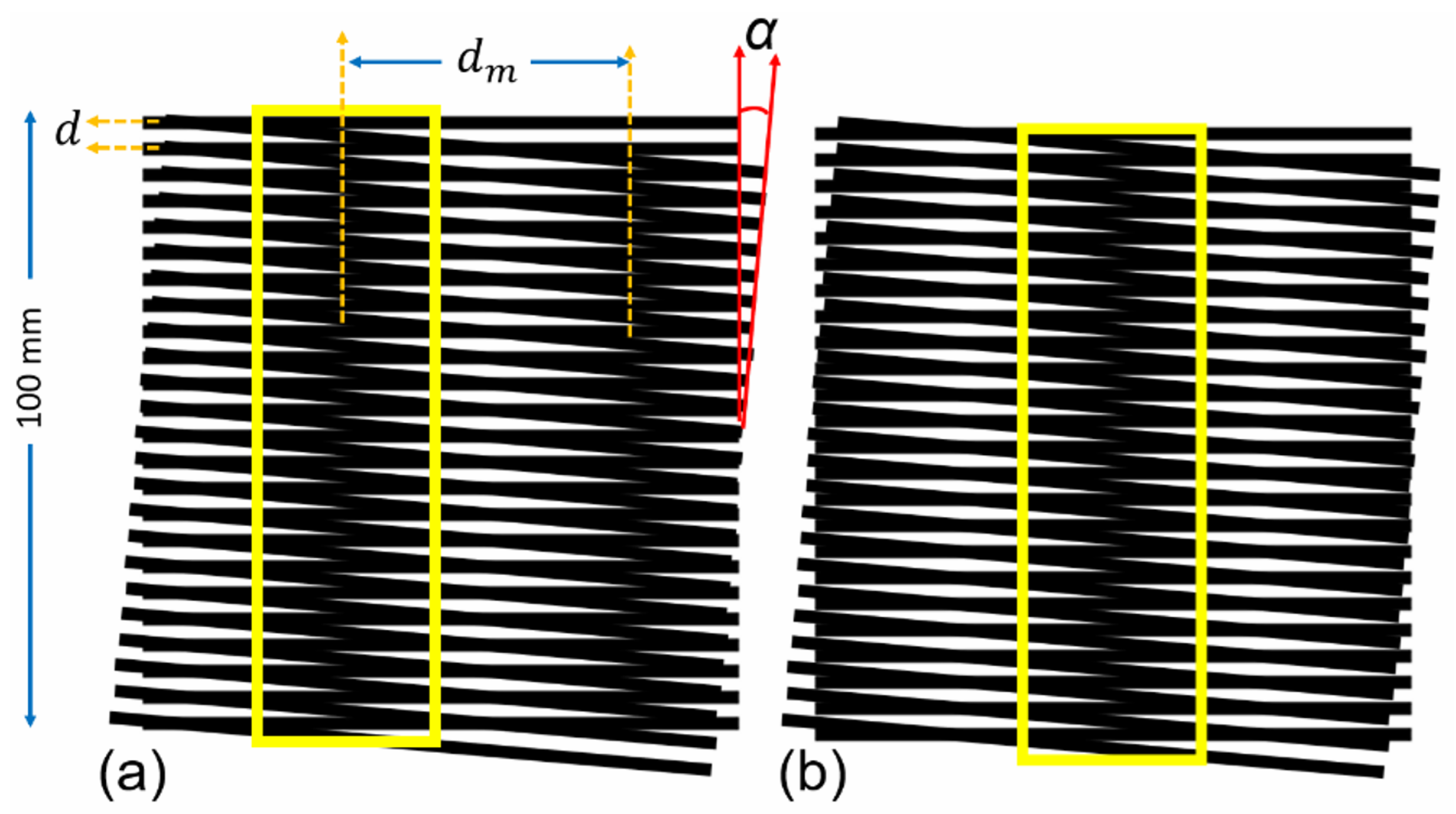
32]. When two straight-line grid patterns (gratings) are overlaid at a small angle
(
Figure 1), Moiré fringes are formed [
33,
34]. This interference pattern magnifies the relative displacement or rotation between the gratings. The magnification factor is
where
d and
denote the spacings of the original grating and the resulting Moiré fringe, respectively [
33]. As illustrated in
Figure 1, a small vertical displacement between the gratings produces a much larger lateral shift of the Moiré fringe within the highlighted region. For example, when one grating is displaced upward by 0.6 mm, the corresponding Moiré fringe shifts approximately 7 mm laterally (yellow boxes). Here,
, yielding a magnification factor of approximately 11.5. Thus, conventional linear gratings are sensitive to displacements perpendicular to their orientation.
In addition to the linear grating, other Moiré pattern geometries, including circular, radial, curved, and grid-based configurations, have been proposed. Circular and concentric Moiré patterns (ring gratings) are formed by superimposing two sets of circular gratings. These patterns exhibit increasing fringe density with radial displacement and are highly sensitive to both the magnitude and direction of such motion, while remaining invariant under rotation [
30,
35,
36]. However, effective fringe generation requires different grating pitches, which inherently limits the magnification factor. The closer the pitch values, the higher the magnification—but this gain becomes impractical in low-resolution imaging, where fine fringes cannot be adequately resolved. Furthermore, fringe centers shift during displacement, potentially moving key features outside the camera’s field of view or into regions of fringe crowding where interpretation becomes difficult. Although circular gratings benefit from reduced lens aberrations and produce more stable fringes than linear ones [
37], their limited measurement range and operational complexity reduce their utility for large-scale or robust displacement tracking.
Radial (fan-line) Moiré patterns consist of lines radiating from a central origin and respond primarily to angular changes [
38]. Translational displacement induces minimal fringe variation, while even small angular rotations generate pronounced fringe shifts. This makes radial patterns highly effective for precise angular measurements [
39], yet impractical for linear displacement assessments.
Curved Moiré patterns, such as elliptical or parabolic gratings, offer directionally selective sensitivity, allowing displacement detection along preferred axes while suppressing orthogonal noise [
40,
41]. For example, elliptical patterns can emphasize sensitivity along one direction, effectively isolating relevant motion in structurally complex environments [
42]. These geometries generate two-dimensional fringe patterns and richer spatial data, but require advanced analysis techniques, thereby increasing computational load and implementation difficulty.
Grid-based Moiré patterns, including orthogonal grids or dot matrices, enable full-field displacement mapping across both
X and
Y axes. These patterns allow for detailed strain and deformation analysis across large areas [
43,
44], but often require higher-resolution imaging systems and more sophisticated algorithms for fringe decoding and interpretation.
Ultimately, parallel linear gratings were determined to provide the best balance of measurement precision, implementation simplicity, and robustness for our application in ground displacement and structural monitoring. Unlike circular or radial configurations, parallel gratings maintain fringe consistency within the camera’s field of view throughout displacement, avoiding center-shift artifacts and resolution drop-off. Their simplicity facilitates efficient data extraction and interpretation, making them the most practical and effective choice for our experimental objectives.
2.2. Camera
The selection of the imaging system is critical to the accuracy, reliability, and robustness of Moiré-based displacement measurements. Key camera parameters, including spatial resolution, sensitivity, dynamic range, and frame rate, directly influence the system’s ability to resolve fine fringe structures and detect subtle displacements. High spatial resolution is essential for capturing detailed fringe patterns, which in turn determines the precision of displacement estimation. Likewise, high sensitivity and a wide dynamic range improve fringe contrast under variable lighting conditions, improving measurement reliability, particularly in low-light or non-uniform environments.
In applications involving subtle displacements, high-resolution sensors reduce ambiguity by precisely resolving small fringe shifts. However, this comes at a cost: very high resolutions can lower frame rates and significantly increase computational and storage burdens, often without yielding proportional gains in measurement precision. Frame rate becomes particularly critical in dynamic scenarios involving rapid displacement, where insufficient temporal resolution can lead to aliasing and degraded tracking performance. Additionally, to further improve precision, sub-pixel registration, phase correlation with a locally upsampled discrete Fourier transform (DFT), can be applied to yield fractional-pixel shift estimates, enabling the model to resolve displacements smaller than a single camera pixel [
45,
46].
The camera resolution must be appropriately matched to the optical limit of the telescope. The angular resolution of a telescope is given by , where is the wavelength of light and D is the telescope aperture diameter. To ensure optimal performance, the camera’s spatial resolution should correspond to this angular resolution. If the camera resolution is significantly higher, it offers no practical advantage, as the telescope’s diffraction limit already constrains image detail; moreover, higher pixel counts can reduce frame rates and increase data volume unnecessarily. Conversely, if the camera resolution is lower than the telescope’s limit, the system cannot fully exploit the telescope’s resolving capability, resulting in loss of spatial detail.
For low-light or nighttime operations, thermal infrared (IR) imaging offers a viable solution, enabling fringe capture without an external light source. Thermal IR systems are eye-safe, resilient to visible light scattering, and generally more robust under turbulent atmospheric conditions. However, in high-temperature environments, elevated ambient IR radiation can diminish fringe contrast, adversely affecting measurement precision. Moreover, thermal IR cameras are typically costly and less accessible, which may constrain their use in field deployments.
An alternative, cost-effective approach employs standard CMOS detectors in conjunction with external incoherent near-IR illumination. High-power LEDs operating in the 900–1000 nm range can illuminate the first grating, enabling fringe detection with conventional sensors even in dark environments, while keeping the overall system simple and economically viable.
Balancing these considerations, we selected a high-speed Basler acA640 camera operating at a wavelength of , with a resolution of pixels and a pixel pitch of . The system is capable of capturing up to 751 frames per second (FPS), enabling the measurement of ground motion signals up to approximately . This camera provides an optimal trade-off among spatial resolution, sensitivity, and frame rate, ensuring reliable fringe detection under a range of operational conditions without introducing excessive cost or system complexity.
2.3. Telescope
The telescope in the Moiré apparatus plays a pivotal role by providing the necessary optical magnification and maintaining the stability of fringe patterns observed over long distances. Its design and selection are guided by several key criteria, including magnification power, optical quality, focal length, mechanical stability, and the suppression of optical aberrations. Adequate magnification is essential to enlarge the fringe pattern to a level resolvable by the imaging sensor, particularly when the apparatus operates at extended distances from the target surface. Insufficient magnification would cause the fringes to be undersampled, reducing the precision of displacement extraction, while excessive magnification could increase sensitivity to turbulence and alignment errors. Thus, the telescope must achieve a balanced magnification that preserves both fringe visibility and geometric stability.
High-grade optical components are critical for minimizing aberrations, such as chromatic, spherical, and coma distortions, that can degrade fringe contrast and phase accuracy. Even small aberrations can alter the spatial frequency content of the fringes, introducing systematic errors into displacement measurements. To mitigate chromatic effects, the imaging system is operated at a single wavelength using a monochromatic camera, which not only eliminates chromatic dispersion but also enhances signal-to-noise ratio by maximizing detector sensitivity near the design wavelength. Because the Moiré pattern is generated and analyzed at a fixed optical wavelength, a monochromatic imaging approach removes the need for more complex and costly color sensors while maintaining uniform optical fidelity across the image plane.
The focal length of the telescope is particularly critical, as it governs both the system’s magnification and its effective field of view, directly affecting the ability to resolve and record fine fringe details. A longer focal length increases magnification, enabling finer spatial sampling of the grating pattern on the camera sensor and improving displacement measurement precision. However, excessive focal length narrows the field of view, increases alignment sensitivity, and limits the observable region. Moreover, while telescopes are typically designed for astronomical imaging at infinity, our application requires focusing at finite distances, typically within a few hundred meters to a few kilometers. Thus, the telescope must allow precise focus adjustment to achieve sharp imaging without introducing defocus or distortion. The selected telescope was optimized to balance high optical quality, sufficient magnification, and flexible focusing capability, ensuring stable and high-fidelity fringe capture for accurate displacement estimation.
For remote monitoring applications, the telescope is coupled with a high-speed camera, enabling continuous, long-distance observation of the grating. To ensure measurement reliability, the telescope is mechanically isolated from external vibrations. Ground-transmitted disturbances, including low-frequency seismic activity, environmental fluctuations, and anthropogenic noise, are mitigated by mounting the system on a vibration isolation platform. The isolator must effectively attenuate external motion within the frequency band corresponding to the measured displacements to minimize interference with the detected signal. This combination of optical design and environmental control preserves high-fidelity fringe imaging, which is essential for detecting subtle ground displacements with confidence.
3. Results
3.1. Experimental Setup
To evaluate the performance of the Moiré-based apparatus for remote sensing of ground displacement, we conducted a series of controlled experiments. The experimental setup consisted of a telescope–camera assembly positioned at varying distances (10 to 50 m) from the target grating. The objective was to investigate both the physical implementation challenges and the performance limits of the system. This configuration also allowed us to evaluate how sensitive the system is to both distance-related image degradation and component alignment tolerances, which are critical factors in field deployment scenarios.
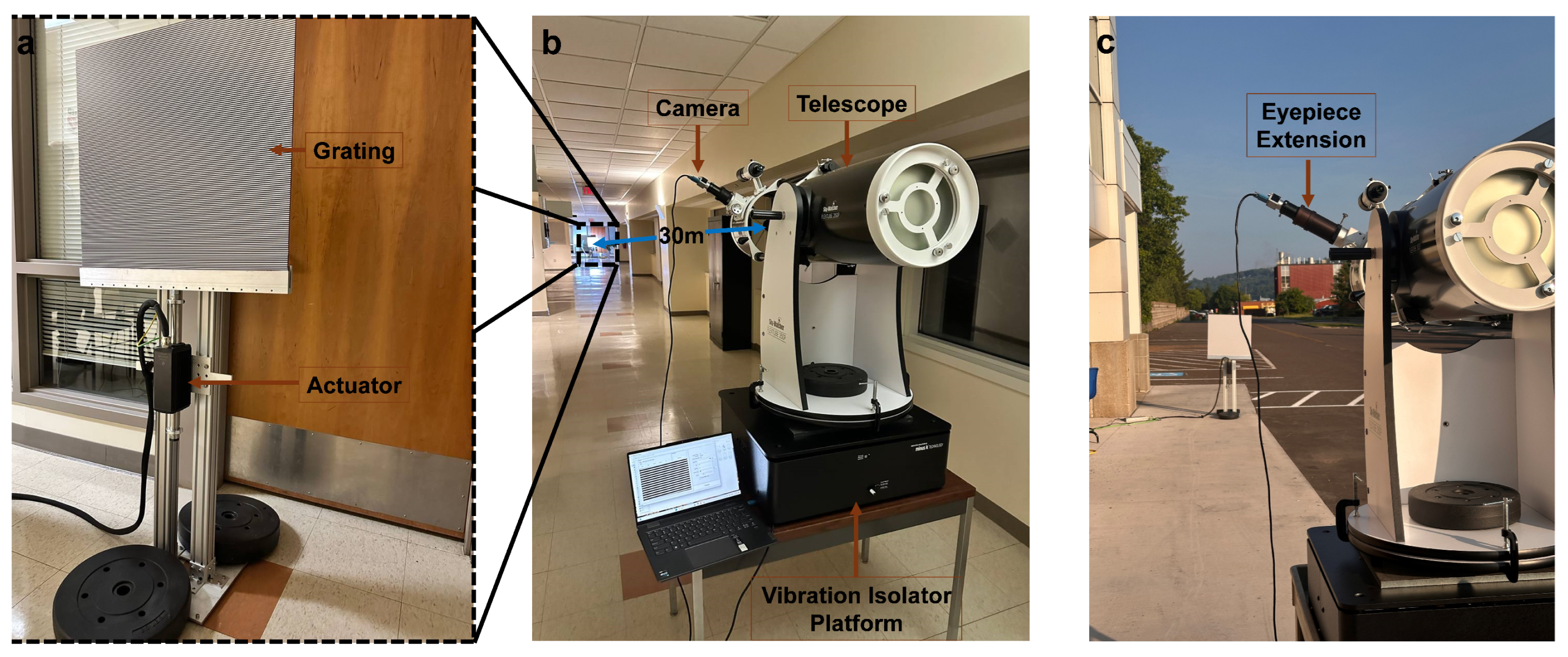
The target grating was securely mounted on a precision linear actuator to simulate ground motion through well-controlled incremental displacements. The overall indoor experimental setup is illustrated in
Figure 2a,b. As shown in
Figure 2b, the telescope, equipped with a high-speed camera, was mounted on a Minus K Technology 100BM-1 (Minus K Technology, Inglewood, CA, USA) vibration isolation platform to suppress ground vibrations. The grating–actuator assembly was fixed onto a distant frame, as shown in
Figure 2a. These experiments were performed in a long indoor hallway with multiple air vents; however, due to minimal airflow and reduced thermal gradients, atmospheric distortions were expected to be lower than in outdoor conditions. We refer to these as the indoor experiments. The indoor setting minimized environmental variables such as wind, atmospheric turbulence and solar heating, isolating system-level factors like optical quality, actuator repeatability, and camera performance.
To evaluate the system under more realistic environmental conditions, we also conducted outdoor experiments, shown in
Figure 2c. In this case, the telescope and actuator–grating assembly were placed across a parking lot adjacent to the Portage Canal in Houghton, MI, USA. Relevant environmental data, including temperature and wind speed during the measurements, were recorded from the nearest weather station and are summarized in
Table 1 and
Table 2 by measurement date.
For optical imaging, we used the Sky-Watcher Flextube 10″ 250P telescope (Sky-Watcher, Suzhou, China) with a focal length of . Since the telescope is not designed to focus at close ranges, a custom extension for the eyepiece was fabricated to allow proper focusing at our experimental distances. A high-speed Basler acA640 camera (Basler AG, Ahrensburg, Germany) was mounted on the telescope to record the fringe patterns and measure ground motion signals. Although the camera was originally designed for outdoor applications and exhibits relatively low native sensitivity, its performance was optimized using custom acquisition software that enabled manual control of exposure time and sensor gain, ensuring stable and high-contrast imaging under varying illumination and turbulence conditions.
To ensure consistent imaging conditions and computational feasibility, all experiments were conducted at a fixed frame rate of 500 FPS. This frame rate was sufficient to capture the target displacements, which were not expected to exceed frequencies in the high hundreds of Hz. This sampling rate is sufficient to capture turbulence-driven image motion, which is dominated below the Greenwood frequency
(where
V is the transverse wind speed and
is the Fried parameter) [
47,
48], implying that the stabilization/control bandwidth should extend to at least tens of hertz for typical near-surface paths. The camera was connected to a dedicated computer for real-time control, data acquisition, and initial processing.
On the grating side, the grating pattern was printed on paper, mounted on a Plexiglas plate, and affixed to a precision linear actuator (ORCA-6-48V (Iris Dynamics Ltd., Victoria, BC, Canada)). This actuator provides a resolution of and is equipped with an internal position sensor with relative positioning repeatability and absolute positioning accuracy. Minor discrepancies observed in the actuator movement can therefore be attributed to the actuator’s intrinsic positioning accuracy. Position data were recorded at a sampling rate of . The actuator was mounted on a stable metal frame, allowing simulation of ground displacement under controlled conditions.
Table 1.
Weather data for 3 July 2025 from the closest weather station to the measurement site [
49].
Table 1.
Weather data for 3 July 2025 from the closest weather station to the measurement site [
49].
| Time | Temp (°C) | Humidity (%) | Avg Wind Speed (km/h) |
|---|
| 08:00 | 16 | 88 | 2 |
| 08:30 | 17 | 87 | 3 |
| 09:00 | 17 | 81 | 3 |
| 09:30 | 17 | 85 | 5 |
| 10:00 | 18 | 87 | 5 |
| 10:30 | 19 | 85 | 3 |
| 11:00 | 19 | 78 | 5 |
| 11:30 | 21 | 70 | 5 |
| 12:00 | 22 | 70 | 5 |
| 12:30 | 23 | 63 | 5 |
| 13:00 | 24 | 57 | 3 |
Table 2.
Weather data for 28 July 2025, from the closest weather station to the measurement site [
49].
Table 2.
Weather data for 28 July 2025, from the closest weather station to the measurement site [
49].
| Time | Temp (°C) | Humidity (%) | Avg Wind Speed (km/h) |
|---|
| 08:00 | 21 | 86 | 5 |
| 09:00 | 22 | 81 | 5 |
| 10:00 | 22 | 81 | 14 |
| 11:00 | 23 | 77 | 8 |
| 12:00 | 24 | 72 | 3 |
| 13:00 | 25 | 72 | 8 |
| 14:00 | 26 | 66 | 6 |
| 15:00 | 26 | 70 | 10 |
| 16:00 | 26 | 67 | 13 |
| 17:00 | 27 | 63 | 13 |
3.2. Displacement Extraction Process
Once the system was fully aligned, the actuator was controlled via a laptop to apply precise, user-defined displacements to the grating. Simultaneously, the camera captured high-frame-rate images of the moving grating. To generate a Moiré pattern, two gratings must be superimposed with a small angular offset between them. This can be achieved either physically, by introducing a second grating, or digitally. In our implementation, we adopted a digital approach for greater flexibility and control. This approach avoiding alignment errors associated with physical gratings, while also simplifying the experimental setup.
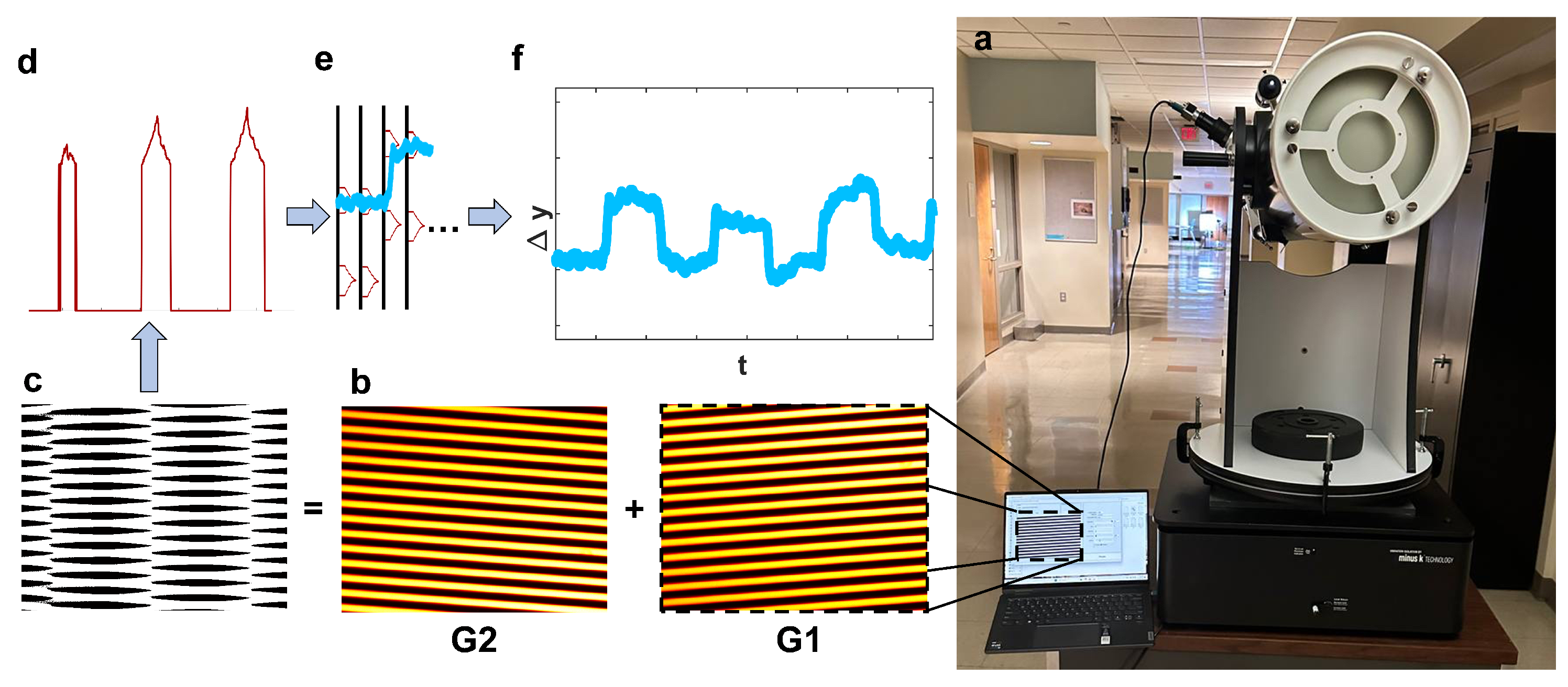
In this digital method, the second grating can either be synthetically generated or derived directly from the captured grating image. We employed the latter strategy. Specifically, we slightly rotated the camera (e.g., by 3°), which is equivalent to capturing the grating at a small angular offset. The captured image was then vertically flipped, effectively generating a mirrored version of the grating with an angular offset of −3°. By superimposing the original and mirrored images, we created a composite Moiré pattern with a relative angular difference of 6°. This process is illustrated in
Figure 3a,b.
In this configuration, when the original grating (G1) undergoes an upward displacement along the y-axis by an amount , the mirrored grating (G2), reflected about the x-axis, appears to move downward by the same amount. A 180° vertical flip reverses the sign of motion in the mirrored image, yielding a relative motion of ; accordingly, the fringe shift doubles, effectively amplifying the resulting Moiré fringe shift and improving the sensitivity to small displacements. This effective doubling of the displacement signal not only improves detection precision but also reduces the required resolution from the camera, which is particularly beneficial for longer-range imaging. The digital superposition (mirror plus a small relative roll) produces classical small-angle Moiré magnification: the fringe period is governed by the magnitude of the difference wavevector, , so the apparent displacement sensitivity scales as and increases as the relative grating angle decreases. This accounts for the improved resolution observed at longer ranges.
As shown in G1 in
Figure 3a, the captured grating is not purely black and white, unlike the pattern shown in
Figure 2a. Nevertheless, as long as the grating remains visible with sufficient contrast, the image intensity doesn’t need to reach the camera’s saturation point; the grating position can still be reliably tracked. This tolerance enables displacement measurements to remain effective even in darker regions where the camera’s sensitivity may be limited. This robustness to low contrast and uneven illumination is important for outdoor or field applications where lighting conditions cannot be controlled, and it demonstrates the practical viability of the system in real-world deployments.
The resulting Moiré pattern, shown in
Figure 3c, exhibits a fringe pattern whose spatial position encodes displacement information. A custom image processing pipeline was developed to extract fringe locations from each frame, as depicted in
Figure 3d. By tracking the temporal evolution of the fringe positions across sequential frames (
Figure 3e), we reconstructed the displacement trajectory over time, as shown in
Figure 3f.
3.3. Indoor Measurement
Initial experiments were conducted under controlled indoor conditions to assess the system’s baseline performance in the absence of significant external disturbances. To minimize atmospheric turbulence effects, the distance between the telescope and the grating was initially set to 10 m. Under these conditions, we aimed to evaluate the maximum achievable sensitivity of the Moiré-based apparatus.
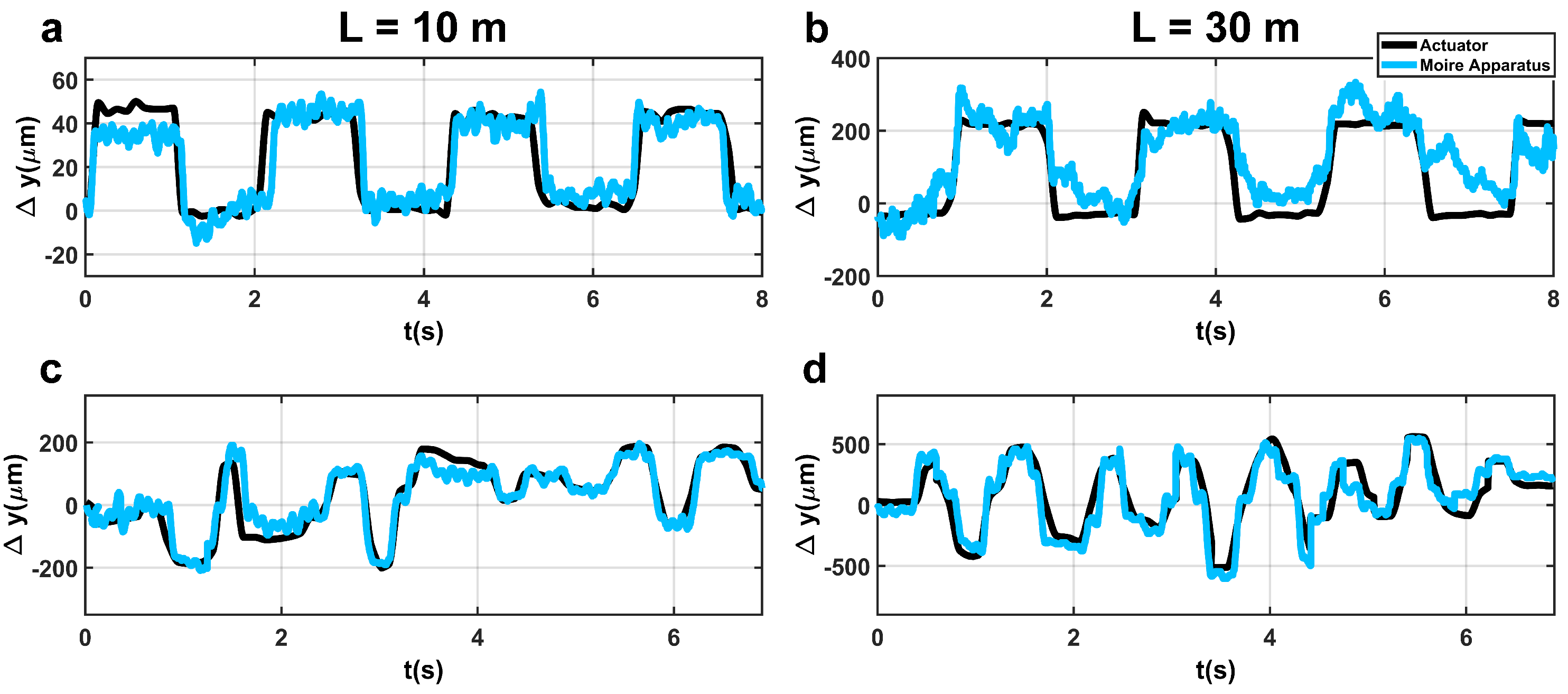
To ensure ease of interpretability and consistent reference, we programmed the actuator to generate a square-wave-like displacement profile. This signal structure allows straightforward evaluation of system response and displacement resolution. In this study, each measurement was repeated multiple times to confirm consistency. Representative results are illustrated in
Figure 4a. Here, the black line represents the ground truth position obtained from the actuator’s internal position sensor, while the blue line shows the displacement extracted using the Moiré-based apparatus. As shown, the system was able to resolve displacements as small as
under these conditions.
To explore the effect of distance and increased turbulence, we repeated the experiment at a
separation between the telescope and the grating. The corresponding results are shown in
Figure 4b. At this distance, the impact of indoor air movement and turbulence, partly due to multiple active ventilation ducts, became more pronounced, slightly affecting the measurement fidelity. This observation highlights the system’s sensitivity to mild turbulence, which becomes relevant when extrapolating results to more complex outdoor environments. Nevertheless, the displacement signal remains traceable, indicating tolerance to moderate optical distortion.
To further test the system’s performance under more realistic signal profiles, we generated actuator movements mimicking seismic-like displacements. The corresponding results are presented in
Figure 4. Similar to the square-wave test, the actuator’s position (black line) and the Moiré-based measurement (blue line) are shown for both
and
distances in subfigures (c) and (d), respectively. Due to actuator limitations, these signals were measured in two segments and subsequently concatenated together. The results confirm the system’s ability to capture dynamic, non-periodic displacements (essential for applications like seismic monitoring) even at extended ranges under controlled indoor conditions.
3.4. Outdoor Measurement
To evaluate the system’s performance in real-world conditions, we relocated the setup outdoors to a parking lot. The weather data for 3 July 2025, recorded by the nearest local weather station, are summarized in
Table 1. The parking area was flanked by tall buildings on one side and the Portage Canal on the other, suggesting that wind exposure may have been higher than what was recorded by the weather station. This discrepancy suggests the importance of localized turbulence modeling and real-time adaptive filtering in future implementations, especially for high-precision outdoor measurements.
Outdoor experiments were conducted at
and
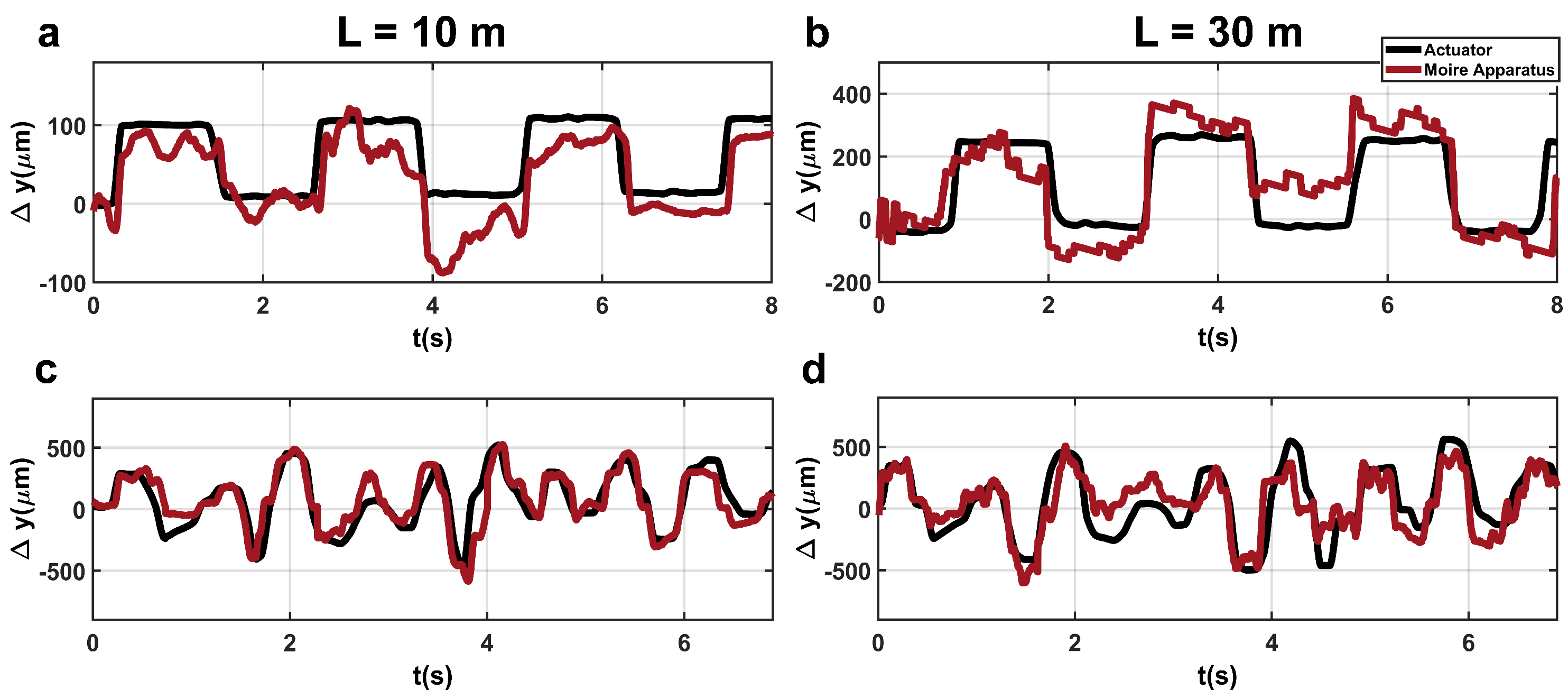
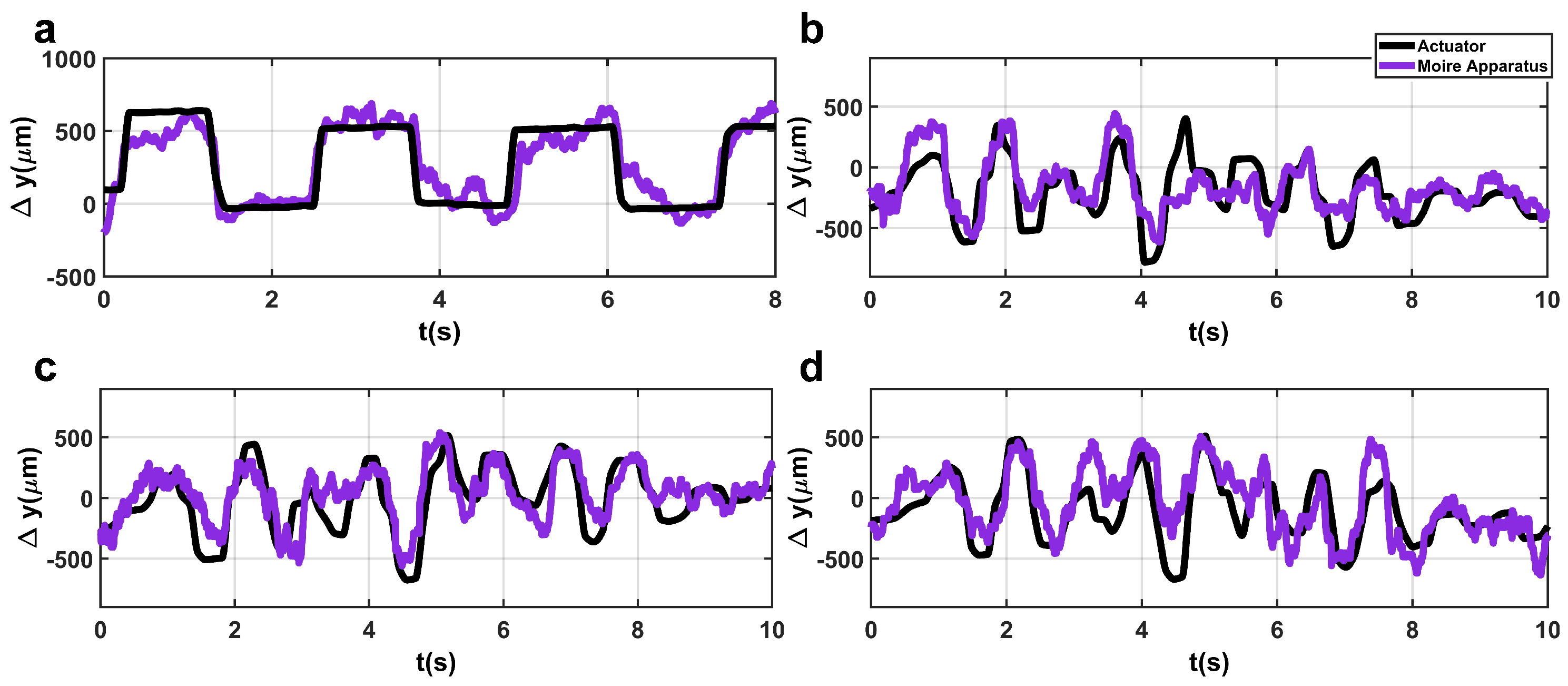
distances between the telescope and the grating. As in the indoor experiments, both square-wave and seismic-like displacement signals were generated using the actuator. In total, we acquired more than 100 measurement runs; representative results are reported here. The square-wave results are shown in
Figure 5, where actuator displacements are represented by the black line and Moiré-based measurements by the red line, for 10 m in (a) and 30 m in (b). Compared to the indoor results, slight deviations are observed in outdoor measurements, particularly at longer distances. These discrepancies are likely due to increased atmospheric turbulence and local wind fluctuations, which introduce optical distortion and reduce fringe contrast.
Seismic-like displacement measurements in the outdoor setting are presented in
Figure 5. Again, the actuator movement is shown by the black line, while the red line represents the Moiré-based measurement. Subfigures (c) and (d) correspond to
and
telescope–grating distances, respectively. These results highlight the system’s robustness and its capability to detect transient displacement signals under variable outdoor conditions.
During outdoor measurements, we deployed the system to capture the combined effects of temperature gradients and wind. Although wind-driven refractive-index fluctuations contribute to turbulence, they should not be the dominant error source for our measurements. This trend implicates mechanical wind loading of the telescope and grating frame as the primary driver, with wind-induced vibrations emerging as the dominant disturbance. To mitigate this effect, ideally, the telescope can be enclosed in a specially designed observatory tent that shields it from air currents. This configuration suppresses mechanically induced errors.
3.5. Indoor Configuration with an Outdoor Turbulence Path
For the controlled tests, the telescope was placed indoors behind a window in Building A, roughly
above ground level, facing the grating pattern positioned behind a window in Building B, approximately
away. This configuration decoupled the effects of atmospheric turbulence on measurement fidelity while minimizing wind-induced mechanical perturbations. The weather data for 28 July 2025, recorded by the nearest local weather station, are summarized in
Table 2. In this configuration, both the telescope and target were isolated from direct wind, while the open-air path between the buildings preserved real-world atmospheric turbulence. Owing to the local geometry (i.e., urban canyon effects), the turbulence between buildings can be more severe than in open fields [
50,
51].
For all scenarios, more than 100 measurement runs were acquired, and representative results are reported here. For each scenario, a square-wave displacement was first applied to characterize the measurement capability, as a case, illustrated in
Figure 6a. A seismic-like displacement was then commanded through the actuator, and the corresponding telescope response was recorded, as an example, shown in
Figure 6b.
Figure 6b–d present multiple examples of measured seismic-like displacement signals. In some instances, significant discrepancies are observed between the measured response and the actual displacement. Because the grating was not mounted on a vibration isolation platform, it remained susceptible to external disturbances. Potential sources of these external perturbations were investigated and are discussed in
Section 4.3.
4. Discussion
4.1. System Design Considerations
The geometric and optical configuration of the Moiré apparatus must be carefully designed to ensure reliable displacement measurement. Among the key parameters, the grating size and pitch play a decisive role in determining both the displacement resolution and the visibility of the Moiré fringes. A finer grating pitch allows smaller displacements to be detected, as the sensitivity of the Moiré pattern increases inversely with the grating spacing [
27]. However, the grating pitch must be chosen in conjunction with the telescope–camera angular resolution and the observation distance. If the grating lines are too fine to be optically resolved by the telescope, the fringes will blur and no meaningful displacement can be extracted. Conversely, if the grating pitch is excessively large, the displacement resolution decreases, and the number of observable lines within the field of view (FOV) becomes limited, reducing the ability to generate well-defined Moiré fringes.
To form a clear Moiré pattern, the number of overlapping grating lines within the telescope’s FOV must be sufficient. Thus, the telescope’s focal length should be selected to provide an appropriate field of view that includes enough parallel grating lines for the fringe pattern to appear distinctly. The grating size also affects this relationship: if the grating does not fully occupy the FOV, the number of observable fringe patterns will be restricted, displacement can still be measured, but the reduced number of fringes may compromise measurement robustness and repeatability. Ideally, the grating should fill the entire FOV of the telescope. While using a grating larger than the FOV offers no improvement in measurement resolution, it simplifies alignment and facilitates telescope targeting during system setup.
The relative angular orientation between the two gratings determines the number and spacing of the Moiré fringes. When the angle between gratings is small, only a few fringes appear; as the angle increases, the fringe density rises. The displacement estimation relies on tracking these Moiré fringes, as shown in
Figure 3. Under atmospheric conditions, parts of the pattern may be distorted by local turbulence or geometric aberrations, which can obscure portions of the Moiré pattern. Therefore, maintaining several fringes within the FOV increases measurement reliability, since additional fringes remain usable even if some are distorted or lost. While a single-fringe configuration offers higher theoretical resolution, it becomes unreliable in the presence of atmospheric perturbations. Our experiments showed that using approximately three Moiré fringes provided an optimal balance between displacement resolution and robustness. This configuration ensures measurable and stable displacement even under partial fringe distortion [
27].
Temperature conditions in volcanic or tectonically active regions may differ from those encountered in the present experiments. Variations in temperature and humidity primarily affect performance through refractive index fluctuations along the optical path. In the absence of strong thermal gradients, the impact on measurement accuracy is expected to remain limited; however, significant gradients may increase turbulence-induced image motion and reduce fringe stability. Rain or snow may temporarily degrade performance by partially occluding the grating and reducing fringe contrast. In such cases, the optical and computational mitigation strategies discussed in
Section 4.4 may help restore measurement reliability.
For long-term operation, environmental exposure may gradually degrade the grating due to ultraviolet radiation, dust accumulation, or mechanical wear, requiring periodic maintenance or replacement. The telescope–camera assembly can be housed within a protective enclosure to minimize environmental disturbances and improve system durability during extended deployments.
Regarding the operational range limits, the theoretical maximum distance in a turbulence-free environment is governed by the optical diffraction limit described in
Section 2.2. The telescope’s angular resolution determines the minimum resolvable grating pitch at a given distance. With appropriate scaling of the grating pitch to satisfy the camera’s Nyquist sampling condition, the system could, in principle, operate over paths approaching 1 km, as previously reported [
27]. In practice, however, atmospheric turbulence imposes a more restrictive effective range limit, as turbulence-induced image motion and contrast degradation typically constrain performance well before the diffraction limit is reached.
For measurements, one of the gratings must be positioned near the region of interest where motion or deformation is to be monitored. One proposed approach involves mounting the target grating on a tetrahedral frame that can be transported and deployed to the measurement site using an unmanned aerial vehicle (UAV) [
27]. This method enables flexible and safe placement of the target in hazardous or inaccessible environments, such as volcanic craters or inaccessible locations. However, wind plays a critical role in the stability of such configurations. Vibrations or oscillations of the grating induced by wind can introduce significant measurement errors, as the apparent fringe shifts may no longer correspond solely to ground displacement.
To better understand the influence of wind-induced vibrations on measurement accuracy, we performed outdoor experiment under windier conditions using the same setup described in
Section 3.4. This test was conducted on 24 July 2025, at 9:30 a.m., when the ambient temperature was approximately 16 °C, the relative humidity was
, and the average wind speed, recorded by the Portage Cove weather station in Houghton, MI [
49], was
km/h.
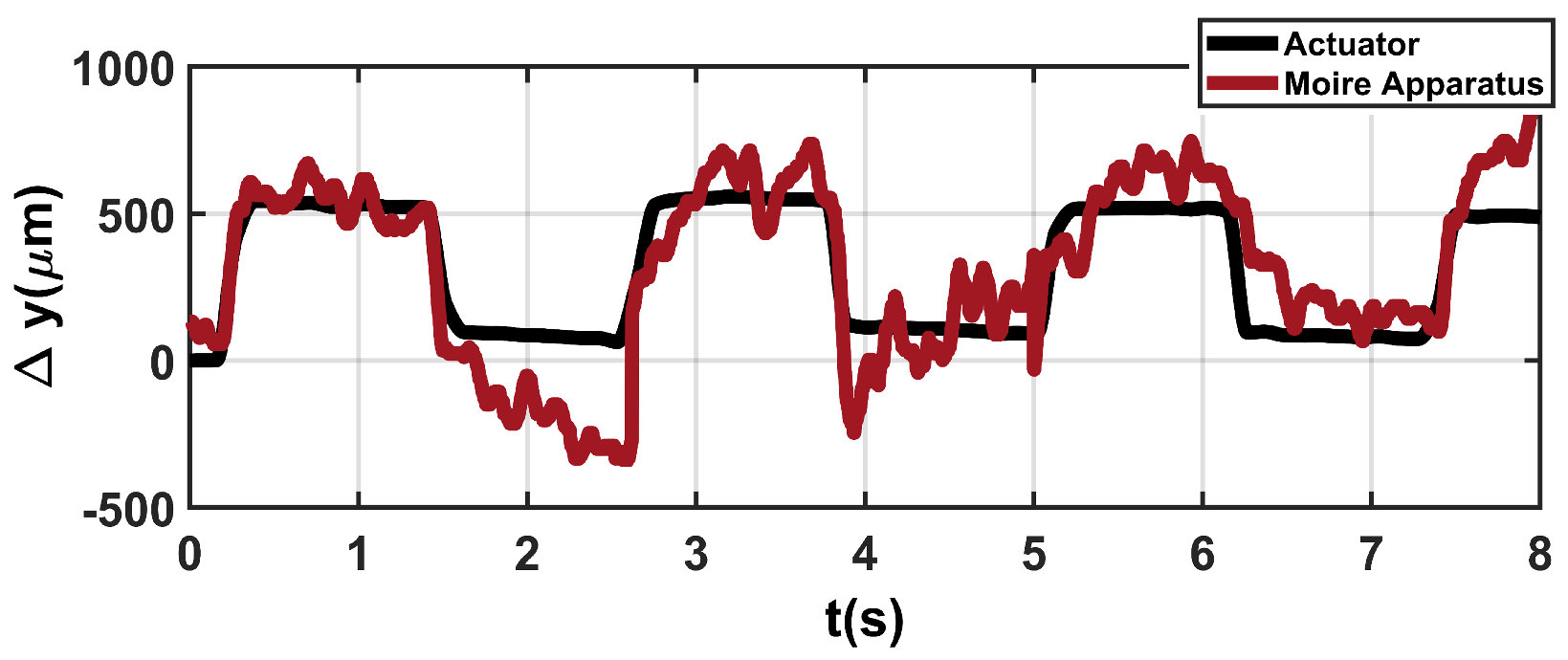
An example of the measured displacement for a square-wave motion profile under these conditions is presented in
Figure 7. The measurement scenario in this figure closely resembles that of
Figure 5d, with only minor differences in temperature and humidity; however, the wind speed during this test was approximately twice the maximum average value observed during the measurements reported in
Section 3.4. As can be observed, the measured range of motion appears larger, and the induced measurement error is significantly higher. These results confirm that wind vibrations acting on the grating can cause apparent displacements in the Moiré pattern, leading to inaccurate estimation of the true motion. In our configuration, the grating was mounted on an exposed frame (as shown in
Figure 2a), which was not aerodynamically optimized and therefore highly susceptible to wind excitation.
To address this issue, for less hazardous and more accessible locations, such as dormant volcanoes or stable terrain, the grating can instead be affixed or directly printed onto a large rock boulder. This approach offers natural mechanical stability and immunity to wind-induced motion. The boulder should be sufficiently large to fully accommodate the grating pattern and provide a rigid, vibration-free surface for measurement. Additionally, because the grating is part of the solid substrate, it is less susceptible to damage or displacement from environmental disturbances, ensuring long-term stability even under varying weather. This configuration also minimizes the risk of grating destruction in the event of mild eruptive activity, making it a practical solution for continuous remote monitoring.
4.2. Turbulence-Induced Temporal Centroid Shift
In a weakly turbulent medium, the displacement reported by the Moiré apparatus contains two components: (i) the true physical displacement of the grating and (ii) the turbulence-induced image-centroid (tip/tilt) shift (“beam wander”) [
52]. This superposition explains the small offset between the measured trace and the ground truth in
Figure 6. Because centroid motion is indistinguishable from real motion in the image plane, turbulence can be misinterpreted as displacement; when the wander amplitude approaches or exceeds the grating’s motion, separating the two becomes challenging.
Under Taylor’s frozen-flow hypothesis, turbulence is advected across the line of sight at an effective transverse wind speed (
V). The measured vertical displacement
from the Moiré apparatus for a static target is proportional to the image centroid motion
, so
and the displacement power spectral density (PSD) (
) inherits the image centroid motion PSD’s slopes (
. Projecting the Kolmogorov spatial spectrum along the wind and integrating over the transverse wavenumber yields two asymptotic temporal regimes for image-centroid (tip/tilt) shift [
53,
54,
55,
56,
57]. This proportionality holds primarily under weak turbulence, where the displacement measured by the Moiré apparatus is dominated by beam centroid shifts (beam wandering). Under stronger turbulence, however, the measured misinterpreted displacement also arises from higher-order aberrations in addition to beam wandering, and in such cases the displacement PSD can no longer be assumed directly proportional to the image centroid motion PSD [
57]. Consequently, the displacement PSD is expected to follow
The transition frequency separating these regimes is
reflecting how the transition frequency
decreases with increasing aperture diameter
D [
53,
54,
56]. A broader bandwidth scale for higher-order phase dynamics is the Greenwood frequency (
), [
47,
56]. In our weak-turbulence regime with
, making
the most relevant marker for analysis and system design.
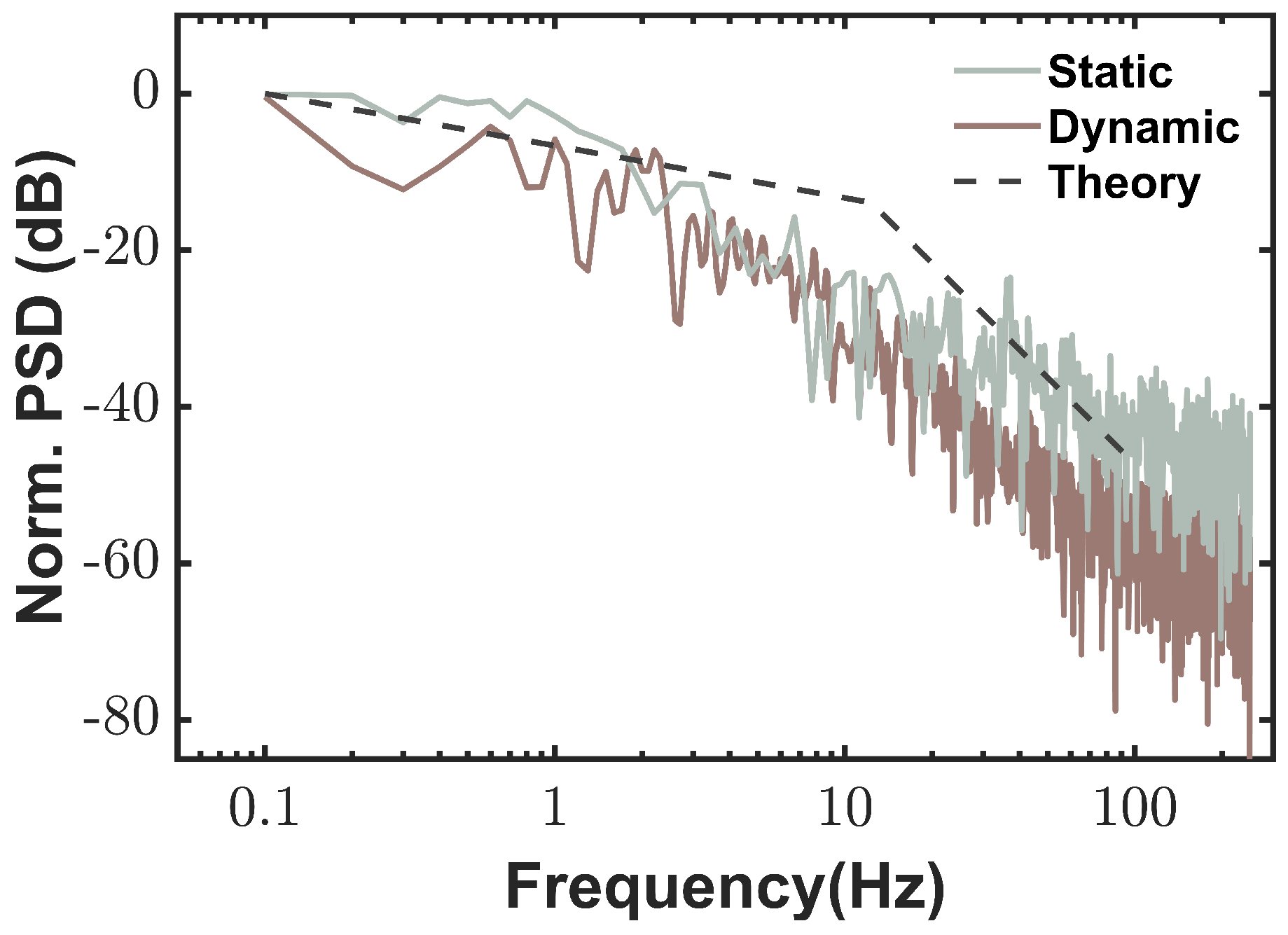
To quantify the atmospheric contribution, we recorded the vertical displacement using the indoor configuration with an outdoor turbulence path, keeping the grating stationary. The resulting time series characterizes the temporal evolution of the atmosphere for the grating. In
Figure 8, we plot the PSD of this series, normalized to its maximum, for the static grating case and compare it with the PSD obtained when the grating was moving (
Figure 6b). We also include the theoretical prediction derived from Equation (
2), assuming a transverse wind speed of
to determine the transition frequency. This wind speed was selected to be slightly higher than the average value reported in
Table 2, reflecting the expectation that local wind velocities along the optical path can exceed those recorded at nearby weather stations, particularly in the presence of tall buildings, as reported by Kang et al. [
58]. Since the wind speed fluctuates over time, the corresponding transition frequency can vary accordingly, although the PSD slope remains consistent for both static and dynamic cases. To characterize the turbulence-induced noise, we monitored and measured the apparent motion of a static grating to evaluate the PSD of the atmospheric contribution. While the measured displacement amplitude varied throughout the day, particularly during periods with larger temperature gradients, the resulting PSDs exhibited very similar spectral shapes, indicating that the turbulence statistics remained stationary despite temporal fluctuations in strength. Consistent with these predictions, our measured PSDs show low-frequency dominance (pink-to-red appearance over a finite band), a knee near
, and a rapid high-frequency decay.
4.3. Investigation of External Vibration Sources
In both the indoor and outdoor measurement scenarios, no instances of large measurement errors were observed. However, in the final configuration, where the telescope and the grating were placed on upper floors of different buildings, a few cases exhibited substantial discrepancies between the measured and applied displacements, as shown in
Figure 6b–d. These observations motivated further investigation into potential external noise sources. During the measurements, error contributions beyond atmospheric turbulence were considered. While the telescope was mounted on a vibration-isolation platform, significantly reducing its sensitivity to external mechanical vibrations, the grating itself was not isolated and therefore remained susceptible to external disturbances.
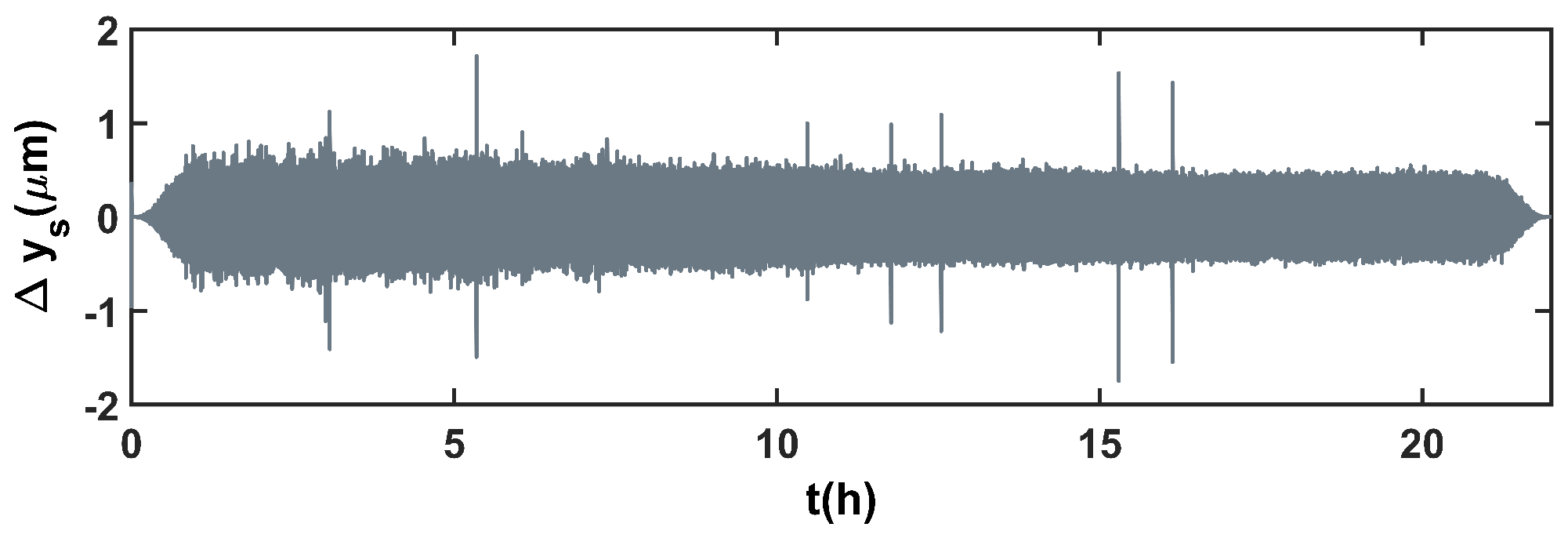
To evaluate the influence of building motion and other environmental disturbances, including human activity, nearby equipment, and elevator operation, two seismometers were deployed at the grating location to monitor structural motion over a 22-h period. A Raspberry Shake and a Tromino seismometer were used in this study. Because both instruments reported vibration amplitudes within a comparable range, only the Raspberry Shake measurements are presented here for brevity. The Raspberry Shake operates as a velocity sensor. The recorded velocity signals were corrected by deconvolving the instrument response function, after which the displacement was extracted. The Raspberry Shake has an operating frequency range of 0.5–50
and may therefore miss very low-frequency vibrations. However, the observed measurement discrepancies are most likely associated with disturbances at frequencies above
. The resulting displacement data are shown in
Figure 9.
The seismometer measurements indicate vibration amplitudes on the order of a few micrometers due to external sources. This level of motion is insufficient to account for the observed measurement errors in the indoor configuration with an outdoor propagation path, where discrepancies were on the order of few hundred micrometers. We therefore largely rule out building-induced vibrations as the dominant source of error in this configuration. Instead, the observed discrepancies are most likely attributable to turbulence-induced beam wander and distortion. The magnitude of these effects is consistent with values reported in prior studies, including those by Laserna et al. [
52].
4.4. Enhancing Long-Range Moiré Apparatus Performance Through Optical and Computational Integration
The measurement distance between the telescope and the target grating plays a critical role in determining both the optical fidelity of the captured fringes and the robustness of displacement extraction. At shorter ranges (on the order of a few tens of meters), atmospheric distortions are minimal, and system performance is primarily limited by intrinsic factors such as camera pixel resolution and the telescope’s optical performance. As the distance increases (from a few hundred meters to several kilometers), it becomes essential to match the telescope’s angular resolution with sufficient camera sampling, as additional distance-related effects begin to dominate. The longer propagation path increases susceptibility to turbulence-induced distortions, particularly beam wander, which introduces errors in displacement measurement and reduces fringe contrast, thereby complicating displacement recovery. Increasing the grating size can extend the operational range of the apparatus; however, this comes at the cost of reduced displacement resolution. Despite these challenges, the Moiré apparatus remains highly effective, maintaining reliable performance under a wide range of propagation distances.
Beyond optical and mechanical optimization, the performance of the Moiré apparatus can be significantly enhanced through the integration of advanced optical and computational techniques. Promising complementary approaches, adaptive optics, active convolved illumination (ACI) [
27], machine learning (ML), and hybrid frameworks that integrate ACI with ML [
59] can be employed to mitigate atmospheric distortions, improve fringe visibility, and increase the reliability of displacement estimation under challenging conditions.
ACI introduces an auxiliary beam via an active convolution with the optical signal (i.e., target grating) to compensate for stochastic fluctuations caused by atmospheric turbulence [
60]. This process effectively suppresses distortion, enhances fringe contrast, and stabilizes the fringe pattern. Within the Moiré apparatus, ACI increases the signal-to-noise ratio, improves temporal stability, and extends the operational range, enabling accurate displacement measurements over longer distances and under varying environmental conditions [
27,
60].
ML may offer a powerful computational complement to ACI. Data-driven models, particularly convolutional neural networks (CNNs), can be trained to restore turbulence-degraded images and improve the fidelity of fringe-based displacement extraction. For instance, ML has been successfully applied to compensate for geometric distortion, blur and intensity irregularities caused by atmospheric turbulence [
61,
62,
63]. By learning the mapping between clean and distorted fringe patterns, ML algorithms can correct nonlinear phase distortions and intensity irregularities that traditional image-processing methods fail to address.
5. Conclusions
This study presents a comprehensive experimental validation of a Moiré-based apparatus for remote ground displacement sensing in environments where conventional contact sensors or laser-based optical systems face deployment, safety, or durability challenges. By systematically optimizing grating geometry, telescope optics, camera sampling parameters, and mechanical vibration isolation, the proposed system achieves reliable sub-millimeter displacement resolution while maintaining operational simplicity and cost efficiency.
A digital Moiré fringe generation strategy was introduced to eliminate the need for physical dual-grating alignment, thereby reducing mechanical complexity and improving robustness. Controlled angular superposition in the digital domain enhances displacement sensitivity while preserving fringe stability. Indoor experiments established a baseline displacement resolution of approximately m at distances up to 30 m, defining the intrinsic optical and sampling limits of the configuration under low-turbulence conditions. Subsequent outdoor measurements at 10 m and 30 m demonstrated reliable tracking of both square-wave and seismic-like displacement profiles in the presence of atmospheric turbulence and wind-induced disturbances, confirming the practical viability of the approach under realistic environmental conditions.
To isolate and quantify environmental effects, a semi-controlled configuration incorporating an outdoor turbulence path was implemented. This setup enabled systematic characterization of turbulence-induced image centroid motion and separation of atmospheric contributions from mechanical vibration sources. Power spectral density analysis of static and dynamic measurements showed strong agreement with theoretical turbulence models, identifying beam wander and higher-order aberrations as the dominant performance limitations at extended propagation distances. Independent seismometer measurements further confirmed that structural vibrations were not the primary source of observed discrepancies, reinforcing the interpretation that atmospheric effects govern long-range performance constraints.
Collectively, these results establish both the achievable resolution and the practical deployment boundaries of the Moiré-based sensing approach. The system offers a scalable, low-cost, and stand-off alternative for monitoring dynamic ground motion, particularly in hazardous or inaccessible environments such as volcanic and tectonically active regions. Future efforts will focus on extending the operational range to meet the requirements of real-world volcanic monitoring scenarios through advanced optics and higher-resolution detectors, integrating optical methods such as ACI, adaptive optics, and other turbulence-mitigation strategies, as well as post-processing approaches like deep learning to suppress atmospheric distortion, and deploying the system in volcanic and tectonically active regions to validate its long-term reliability and geophysical utility. These advances will position the Moiré-based apparatus as a valuable complement to existing seismic and geodetic networks for real-time hazard monitoring.




 ,
,