Multi-Sensor Analysis of Predicted and Observed Glacier Instabilities in the Hissar–Alay of Central Asia

 ,
,  ,
,
Highlights
- Dedicated processing of multi-sensor satellite data finds a much higher prevalence of unstable glacier flow than previously known in the Hissar–Alay mountain range.
- A rediscovered statistical model by Soviet glaciologists from 1980 correctly predicted the high prevalence but not the identification of individual unstable glaciers.
- Dedicated reprocessing of multi-sensor raw satellite data should be further explored to improve historical reconstructions of glacier dynamics compared with commonly used existing products.
- Historical investigations from the Soviet period, not always known to the international community, are an invaluable but often overlooked resource for glaciological information in Central Asia.
Abstract
1. Introduction
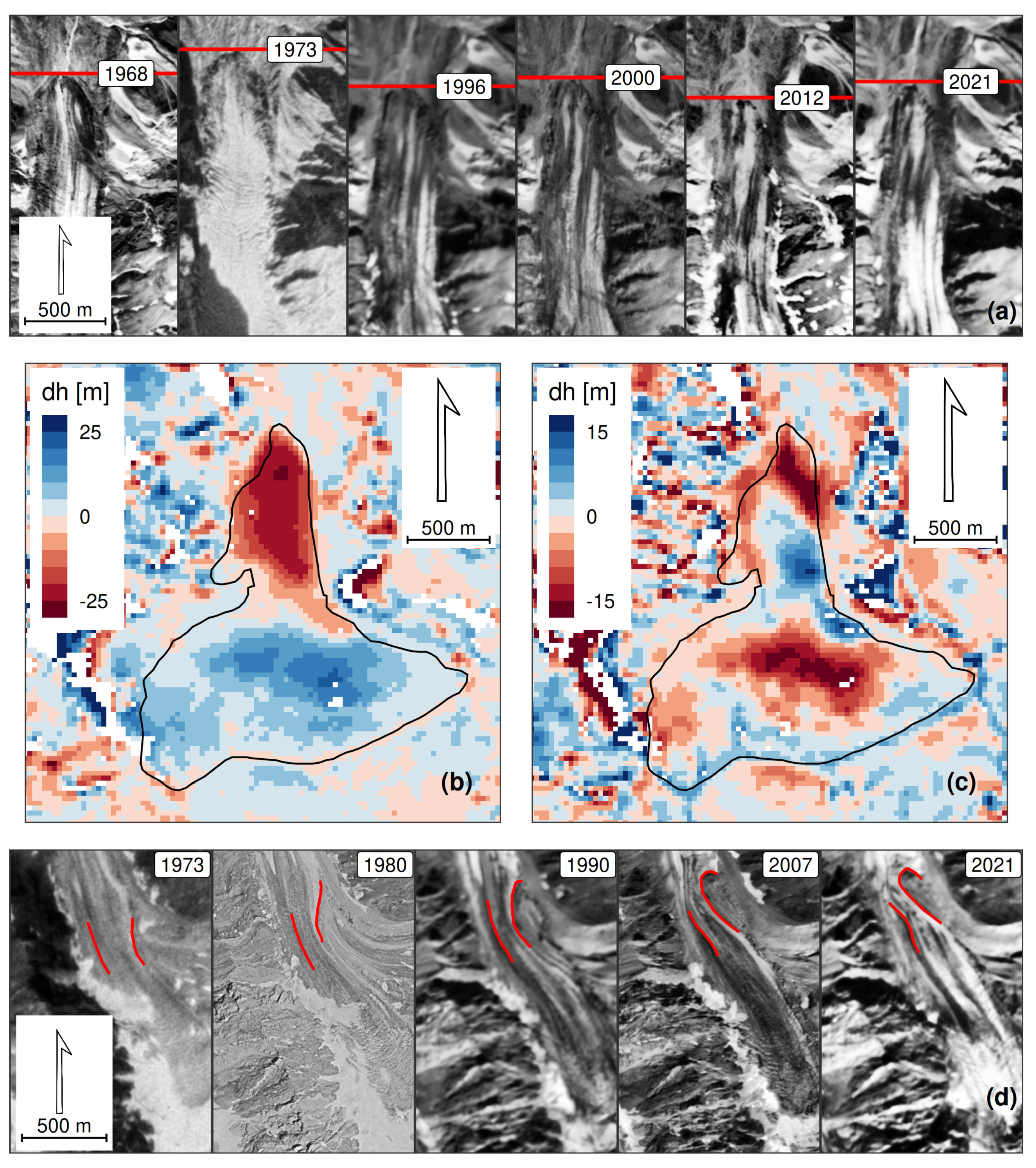
- Contrasting patterns of ice thickness change between the reservoir and receiving areas.
- An increase in ice velocity due to enhanced sliding, often leading to plug-like flow.
- Rapid terminus advance.
- Geomorphological signs such as distorted or looped moraines, sheared margins, increased and expanded crevassing, visible fronts, and kinematic waves traveling along the glacier surface.
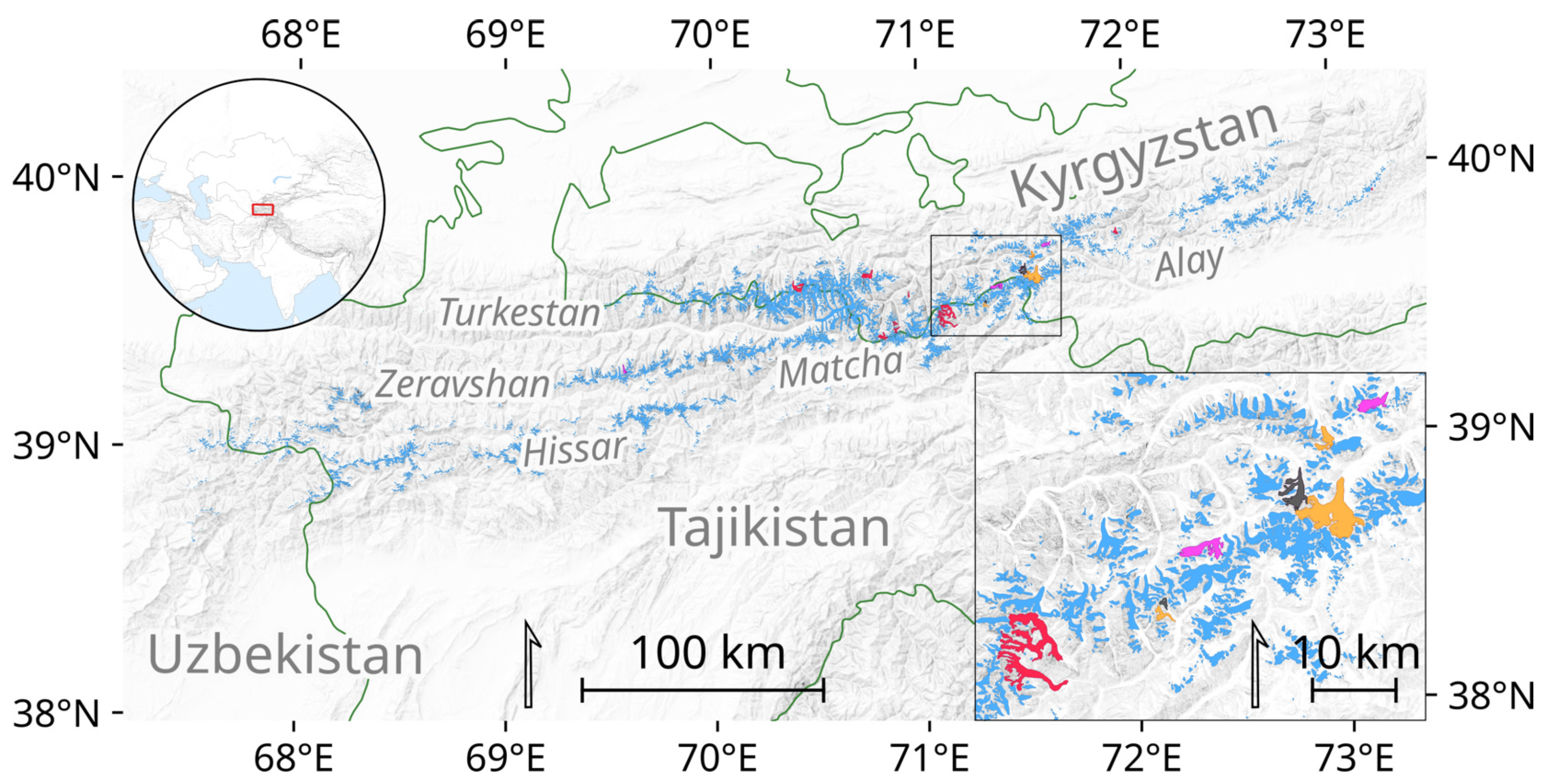
2. Study Region
3. Materials and Methods
3.1. Data
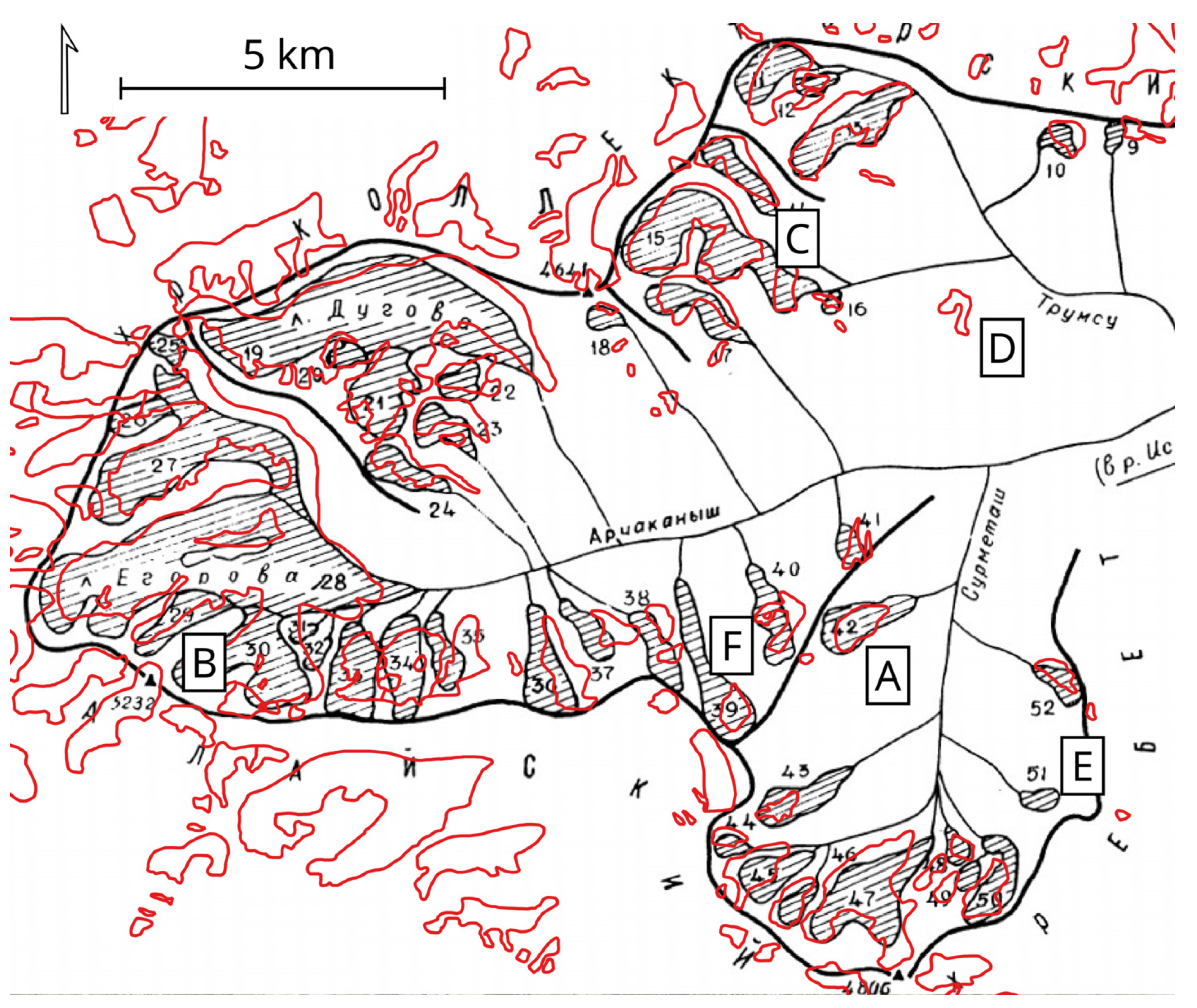
3.1.1. List of Predicted Pulsations by GS1980
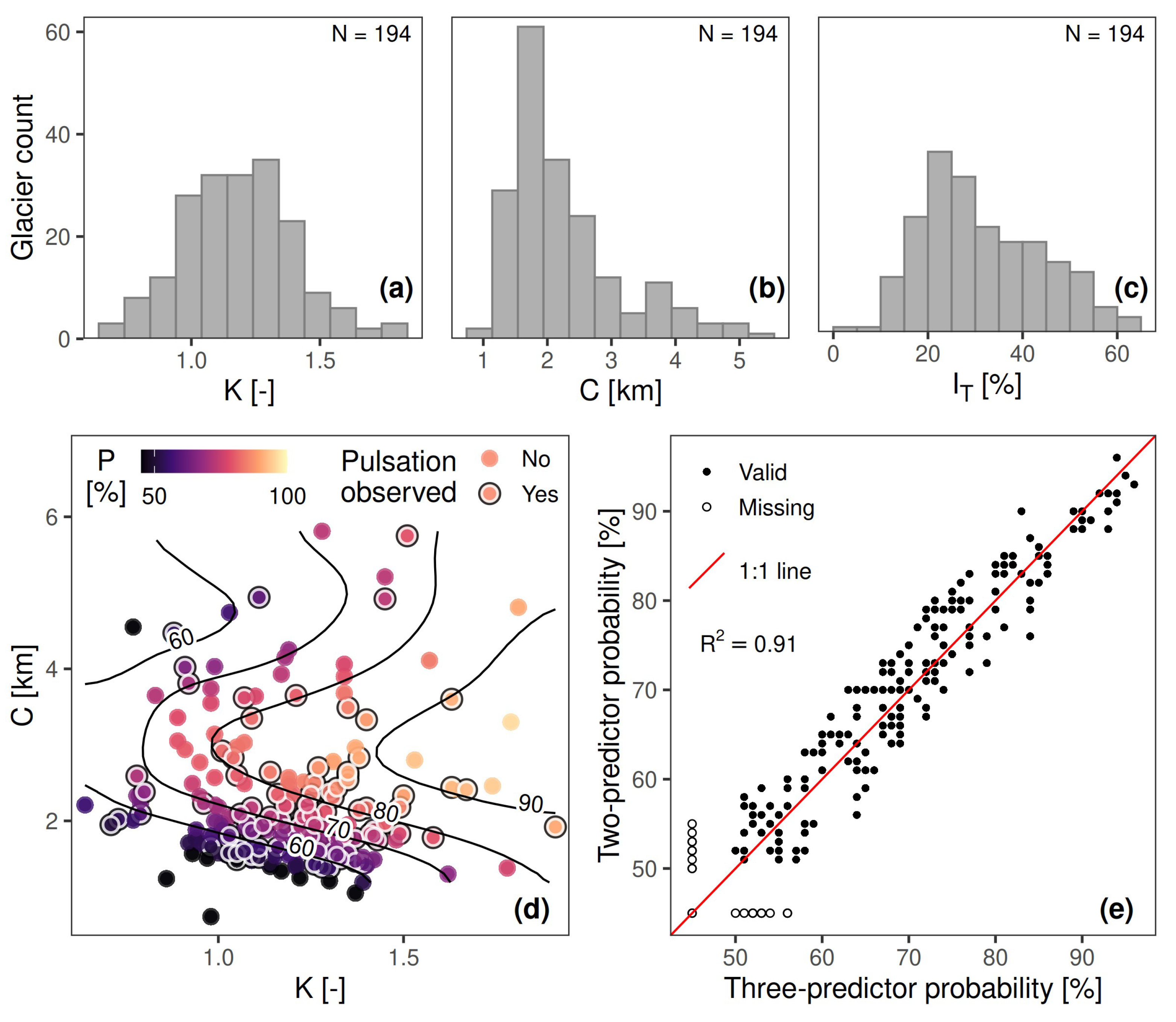
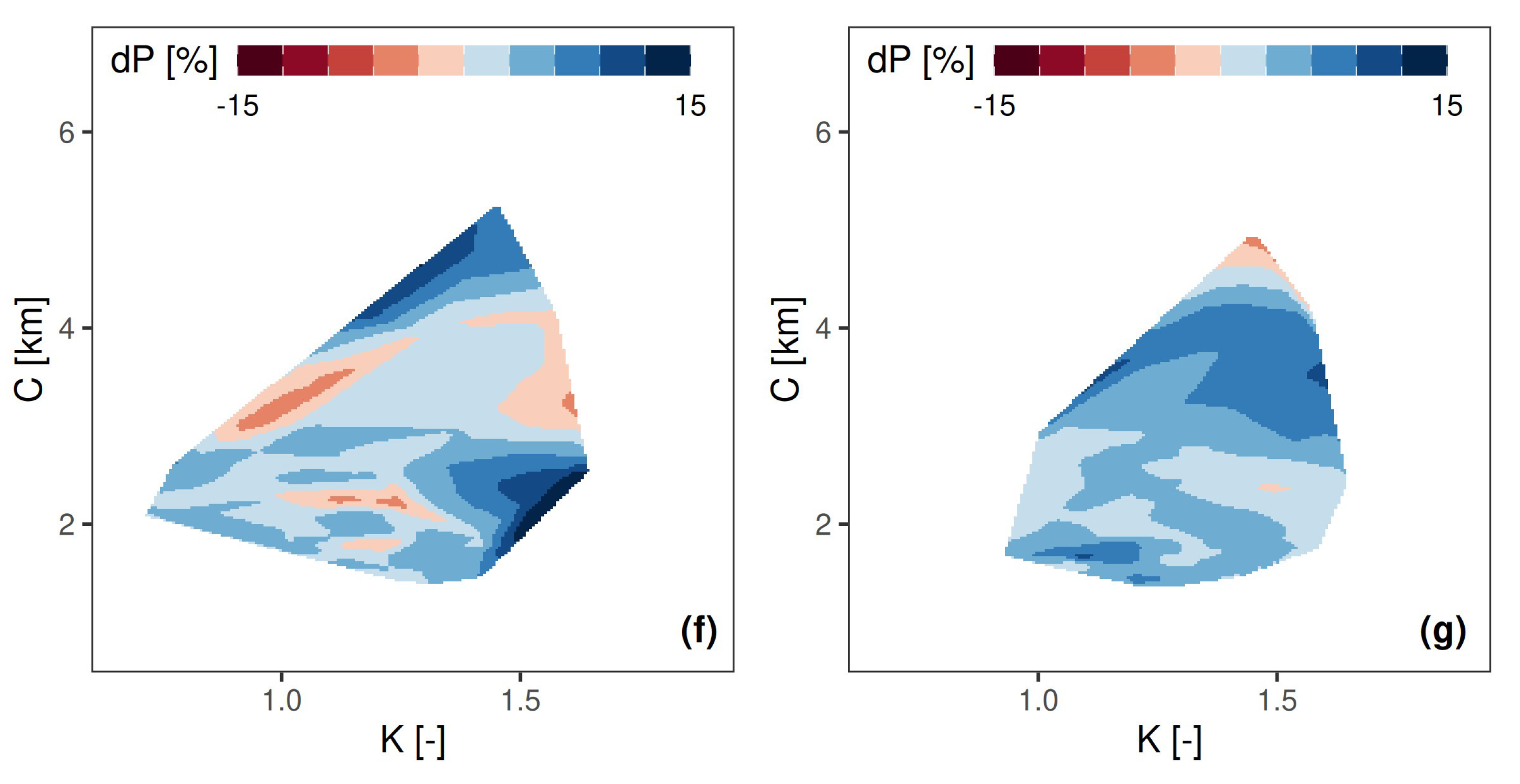
- K, the glacial coefficient (ratio of accumulation to ablation area extents);
- C, the ratio of accumulation area extent to mean width of the tongue (the latter being defined as the area between the firn line and the glacier terminus);
- , the average surface slope of the tongue.
3.1.2. Glacier Inventories
- RGI7.0 [50].
3.1.3. Optical Satellite Archives
3.1.4. Analysis-Ready Data
3.2. Methods
3.2.1. Identification of Glaciers of Interest
3.2.2. Processing of Raw Satellite Archives
3.2.3. Glacier-Wise Standardization
3.2.4. Detection of Pulsation Events
3.2.5. Performance of the Predictive Model
3.2.6. Spatio-Temporal Analysis
4. Results
4.1. Overview
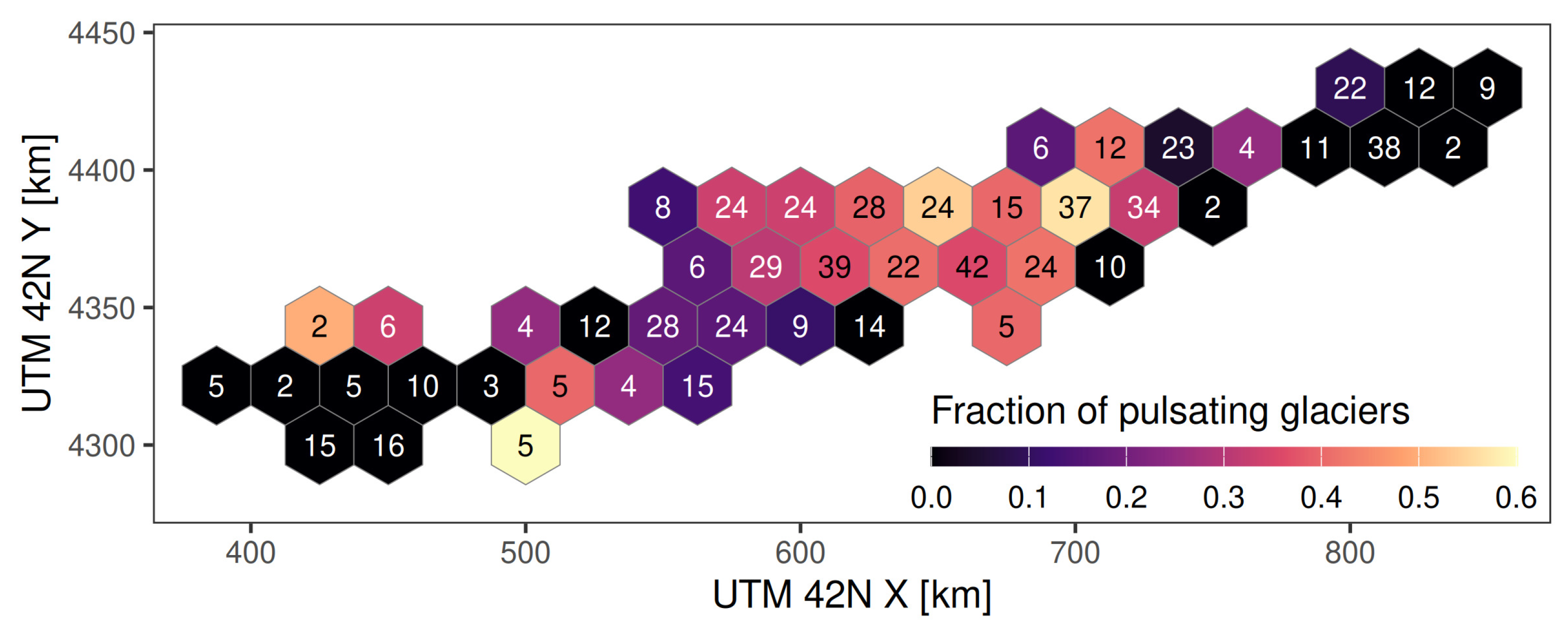
4.2. Pulsations Distribution and Characteristics
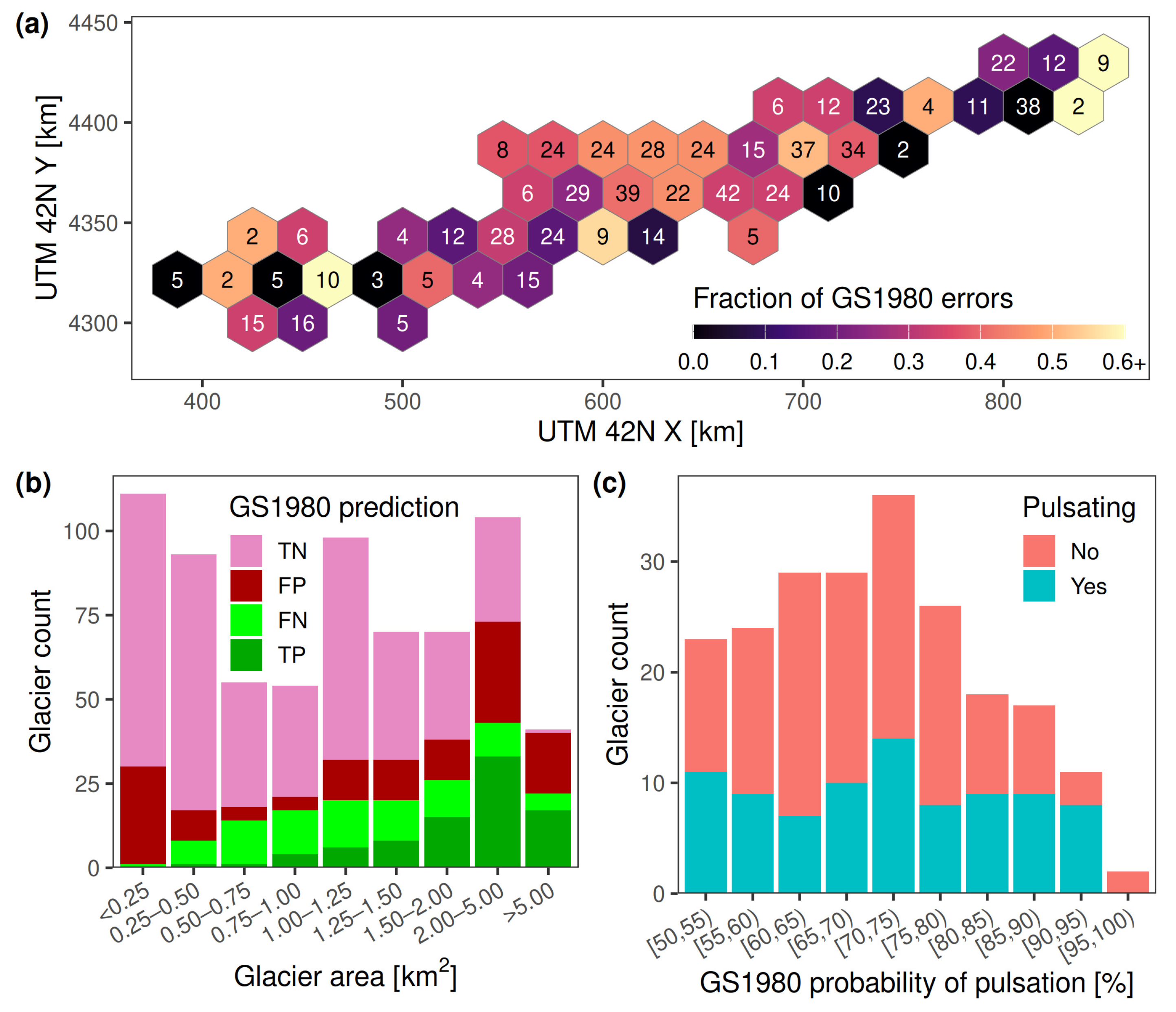
4.3. Assessment of the GS1980 Predictive Model
5. Discussion
5.1. Evaluation of GS1980
5.2. Pulsating Glacier Dynamics
5.3. Study Uncertainties and Limitations
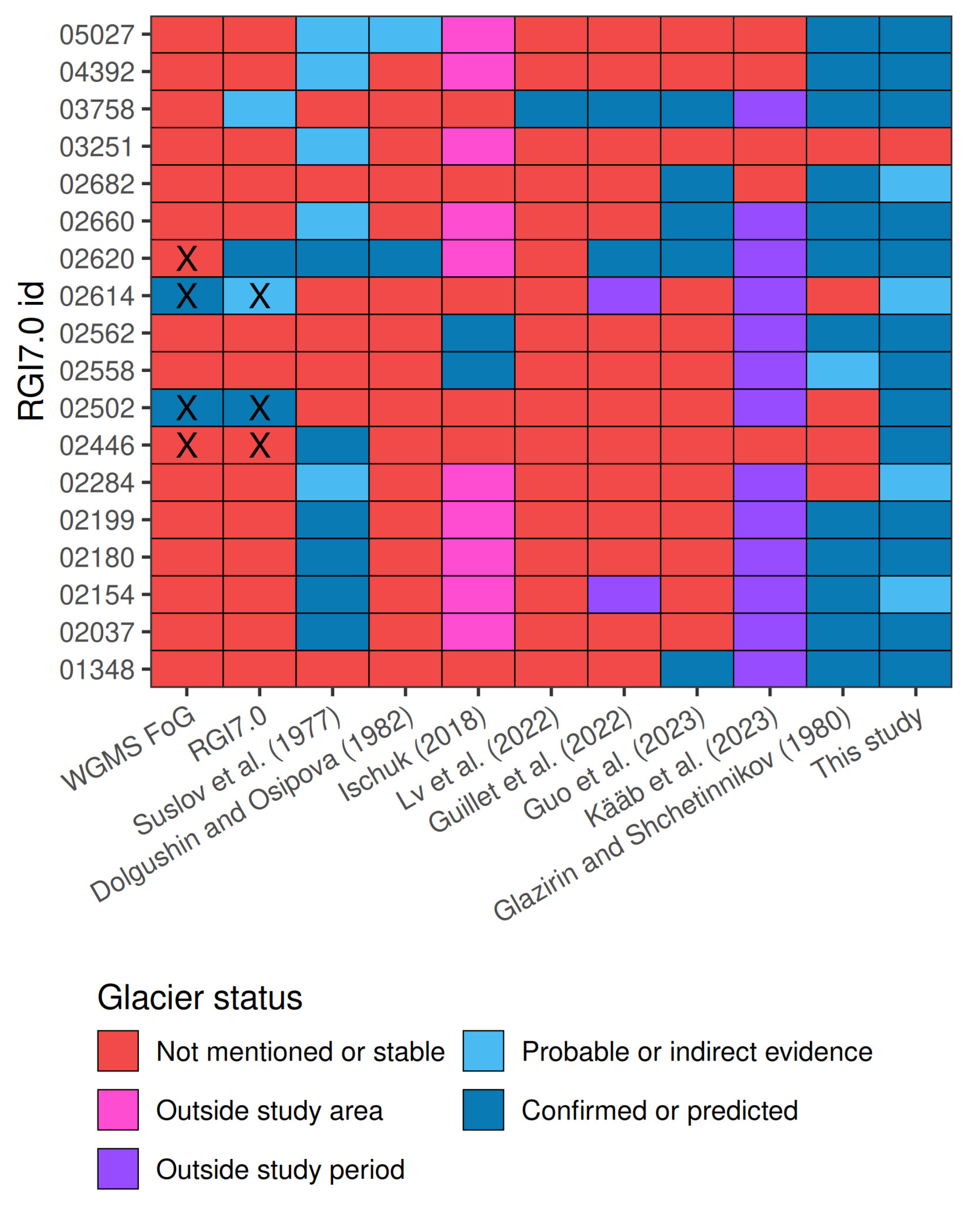
5.4. Significance and Comparison with Previous Studies
- Our selection of multi-source satellite data provides finer spatial resolution and longer temporal coverage than previous studies, enabling better detection of the low-intensity events that characterize the region.
- Larger-area studies usually set thresholds for automated detection of glacier surges, and those are probably not matched by the observed low-intensity pulsations.
- Manual identification of the highest-quality satellite scenes, later processed via a specifically tuned, glacier-wise pipeline (Section 3.2.2), can likely extract and preserve detail better than the standardized data aggregation and automated selection methods used within HMA-wide or global studies.
6. Conclusions
Author Contributions
Funding
Data Availability Statement
Acknowledgments
Conflicts of Interest
Abbreviations
| ALOS | Advanced Land Observing Satellite |
| ASP | Ames Stereo Pipeline |
| ASTER | Advanced Spaceborne Thermal Emission and Reflection Radiometer |
| AT | Along-Track |
| CNES | Centre National d’Études Spatiales |
| CT | Cross-Track |
| DEM | Digital Elevation Model |
| DLR | Deutsches Zentrum für Luft- und Raumfahrt (German Aerospace Center |
| ESA | European Space Agency |
| FN | False Negative |
| FP | False Positive |
| GAMDAM | Glacier Area Mapping for Discharge from the Asian Mountains |
| GCP | Ground Control Point |
| GS1980 | Glazirin and Shchetinnikov 1980 |
| HMA | High Mountain Asia |
| HRG | High Resolution Geometric |
| HRS | High Resolution Stereoscopic |
| HRV | High Resolution Visible |
| HRVIR | High Resolution Visible and InfraRed |
| KH | KeyHole |
| LEGOS | Laboratoire d’Etudes en Géophysique et Océanographie Spatiales |
| MC | Mapping Camera |
| MSI | Multi-Spectral Instrument |
| NPC | Non-Pulsating Complex |
| PC | Panoramic Camera |
| PPC | Predicted Pulsating Complex |
| RGI7.0 | Randolph Glacier Inventory version 7.0 |
| RPC | Rational Polynomial Coefficient |
| RSM | Rigorous Sensor Model |
| SPOT | Satellite Pour l’Observation de la Terre |
| TN | True Negative |
| TP | True Positive |
| USSR | Union of Soviet Socialist Republics |
| UTM | Universal Transverse Mercator |
| WGMS | World Glacier Monitoring Service |
Appendix A. The Classification Method of GS1980
Appendix B. List of Satellite Scenes

| Date | Sensor | Identifier |
|---|---|---|
| 18 August 1968 | KH-4 PC | DS1104-2169DF090–093 |
| DS1104-2169DA096–099 | ||
| 15 September 1971 | KH-4 PC | DS1115-1072DF185 |
| DS1115-1072DA191 | ||
| 16 July 1973 | KH-9 MC | DZB1206-500007L015001 |
| DZB1206-500007L016001 | ||
| 3 August 1973 | KH-9 MC | DZB1206-500080L016001 |
| DZB1206-500080L017001 | ||
| DZB1206-500080L018001 | ||
| DZB1206-500080L019001 | ||
| 22 November 1973 | KH-9 MC | DZB1207-500041L001001 |
| DZB1207-500041L002001 | ||
| DZB1207-500041L003001 | ||
| 25 July 1980 | KH-9 PC | D3C1216-200279F036–039 |
| D3C1216-200279A037–040 | ||
| 20 August 1980 | KH-9 MC | DZB1216-500273L006001 |
| DZB1216-500273L007001 | ||
| DZB1216-500273L008001 |
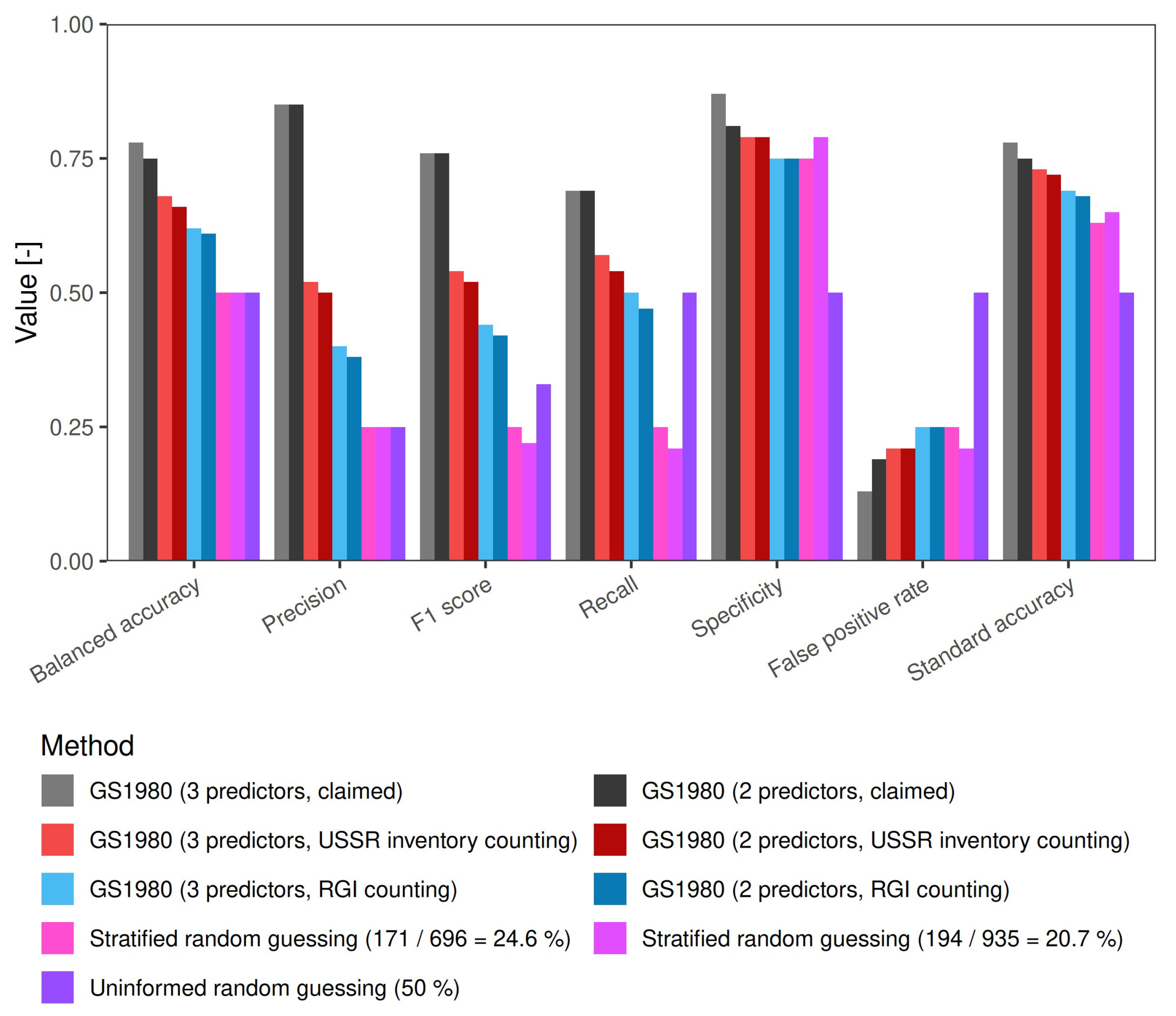
Appendix C. Metrics of Classifier Performance
References
- Meier, M.F.; Post, A. What are glacier surges? Can. J. Earth Sci. 1969, 6, 807–817. [Google Scholar] [CrossRef]
- Jiskoot, H. Glacier Surging. In Encyclopedia of Snow, Ice and Glaciers; Singh, V.P., Singh, P., Haritashya, U.K., Eds.; Springer: Dordrecht, The Netherlands, 2011; pp. 415–428. [Google Scholar] [CrossRef]
- Herreid, S.; Truffer, M. Automated detection of unstable glacier flow and a spectrum of speedup behavior in the Alaska Range. J. Geophys. Res. Earth Surf. 2016, 121, 64–81. [Google Scholar] [CrossRef]
- Raymond, C.F. How do glaciers surge? A review. J. Geophys. Res. Solid Earth 1987, 92, 9121–9134. [Google Scholar] [CrossRef]
- Dowdeswell, J.A.; Hamilton, G.S.; Hagen, J.O. The duration of the active phase on surge-type glaciers: Contrasts between Svalbard and other regions. J. Glaciol. 1991, 37, 388–400. [Google Scholar] [CrossRef]
- Murray, T.; Strozzi, T.; Luckman, A.; Jiskoot, H.; Christakos, P. Is there a single surge mechanism? Contrasts in dynamics between glacier surges in Svalbard and other regions. J. Geophys. Res. Solid Earth 2003, 108, 2237. [Google Scholar] [CrossRef]
- Benn, D.I.; Fowler, A.C.; Hewitt, I.; Sevestre, H. A general theory of glacier surges. J. Glaciol. 2019, 65, 701–716. [Google Scholar] [CrossRef]
- Ke, L.; Wang, R.; Zhang, J.; Ding, X. Remote-sensing characterization of surging glaciers in High Mountain Asia in the past two decades. Front. Earth Sci. 2024, 12, 1499882. [Google Scholar] [CrossRef]
- Krenke, A. Current ideas about rapid glacier movements. Mater. Gliatsiologicheskikh Issled. 1974, 24, 274–289. [Google Scholar]
- Lv, M.; Guo, H.; Lu, X.; Liu, G.; Yan, S.; Ruan, Z.; Ding, Y.; Quincey, D.J. Characterizing the behaviour of surge- and non-surge-type glaciers in the Kingata Mountains, eastern Pamir, from 1999 to 2016. Cryosphere 2019, 13, 219–236. [Google Scholar] [CrossRef]
- Jiskoot, H.; Boyle, P.; Murray, T. The incidence of glacier surging in Svalbard: Evidence from multivariate statistics. Comput. Geosci. 1998, 24, 387–399. [Google Scholar] [CrossRef]
- Quincey, D.J.; Braun, M.; Glasser, N.F.; Bishop, M.P.; Hewitt, K.; Luckman, A. Karakoram glacier surge dynamics. Geophys. Res. Lett. 2011, 38, L18504. [Google Scholar] [CrossRef]
- Quincey, D.J.; Glasser, N.F.; Cook, S.J.; Luckman, A. Heterogeneity in Karakoram glacier surges. J. Geophys. Res. Earth Surf. 2015, 120, 1288–1300. [Google Scholar] [CrossRef]
- Bhambri, R.; Hewitt, K.; Kawishwar, P.; Pratap, B. Surge-type and surge-modified glaciers in the Karakoram. Sci. Rep. 2017, 7, 15391. [Google Scholar] [CrossRef] [PubMed]
- King, O.; Bhattacharya, A.; Bolch, T. The presence and influence of glacier surging around the Geladandong ice caps, North East Tibetan Plateau. Adv. Clim. Chang. Res. 2021, 12, 299–312. [Google Scholar] [CrossRef]
- Chudley, T.R.; Willis, I.C. Glacier surges in the north-west West Kunlun Shan inferred from 1972 to 2017 Landsat imagery. J. Glaciol. 2019, 65, 1–12. [Google Scholar] [CrossRef]
- Lv, M.; Guo, H.; Yan, J.; Wu, K.; Liu, G.; Lu, X.; Ruan, Z.; Yan, S. Distinguishing Glaciers between Surging and Advancing by Remote Sensing: A Case Study in the Eastern Karakoram. Remote Sens. 2020, 12, 2297. [Google Scholar] [CrossRef]
- Goerlich, F.; Bolch, T.; Paul, F. More dynamic than expected: An updated survey of surging glaciers in the Pamir. Earth Syst. Sci. Data 2020, 12, 3161–3176. [Google Scholar] [CrossRef]
- Glazirin, G. Identification of surging glaciers by morphometric characteristics. Mater. Gliatsiologicheskikh Issled. 1978, 33, 136–138. [Google Scholar]
- Mayo, L. Identification of unstable glaciers intermediate between normal and surging glaciers. Mater. Gliatsiologicheskikh Issled. 1978, 33, 133–135. [Google Scholar]
- Terleth, Y.; Bartholomaus, T.C.; Enderlin, E.; Mikesell, T.D.; Liu, J. Glacier Surges and Seasonal Speedups Integrated Into a Single, Enthalpy-Based Model Framework. Geophys. Res. Lett. 2024, 51, e2024GL112514. [Google Scholar] [CrossRef]
- Thøgersen, K.; Gilbert, A.; Bouchayer, C.; Schuler, T.V. Glacier Surges Controlled by the Close Interplay Between Subglacial Friction and Drainage. J. Geophys. Res. Earth Surf. 2024, 129, e2023JF007441. [Google Scholar] [CrossRef]
- Hansen, S. From surge-type to non-surge-type glacier behaviour: Midre Lovénbreen, Svalbard. Ann. Glaciol. 2003, 36, 97–102. [Google Scholar] [CrossRef]
- Sevestre, H.; Benn, D.I. Climatic and geometric controls on the global distribution of surge-type glaciers: Implications for a unifying model of surging. J. Glaciol. 2015, 61, 646–662. [Google Scholar] [CrossRef]
- Emelyianov, Y.; Nozdriukhin, V.; Suslov, V. Dynamics of the Abramov Glacier during the 1972–1973 surge. Mater. Gliatsiologicheskikh Issled. 1974, 24, 87–96. [Google Scholar]
- Eisen, O.; Harrison, W.D.; Raymond, C.F. The surges of Variegated Glacier, Alaska, U.S.A., and their connection to climate and mass balance. J. Glaciol. 2001, 47, 351–358. [Google Scholar] [CrossRef]
- Flowers, G.E.; Roux, N.; Pimentel, S.; Schoof, C.G. Present dynamics and future prognosis of a slowly surging glacier. Cryosphere 2011, 5, 299–313. [Google Scholar] [CrossRef]
- Pitte, P.; Berthier, E.; Masiokas, M.H.; Cabot, V.; Ruiz, L.; Ferri Hidalgo, L.; Gargantini, H.; Zalazar, L. Geometric evolution of the Horcones Inferior Glacier (Mount Aconcagua, Central Andes) during the 2002–2006 surge. J. Geophys. Res. Earth Surf. 2016, 121, 111–127. [Google Scholar] [CrossRef]
- Mattea, E.; Berthier, E.; Dehecq, A.; Bolch, T.; Bhattacharya, A.; Ghuffar, S.; Barandun, M.; Hoelzle, M. Five decades of Abramov glacier dynamics reconstructed with multi-sensor optical remote sensing. Cryosphere 2025, 19, 219–247. [Google Scholar] [CrossRef]
- Hewitt, K. Tributary glacier surges: An exceptional concentration at Panmah Glacier, Karakoram Himalaya. J. Glaciol. 2007, 53, 181–188. [Google Scholar] [CrossRef]
- Kääb, A.; Bazilova, V.; Leclercq, P.W.; Mannerfelt, E.S.; Strozzi, T. Global clustering of recent glacier surges from radar backscatter data, 2017–2022. J. Glaciol. 2023, 69, 1515–1523. [Google Scholar] [CrossRef]
- Glazovskiy, A. The Problem of Surge-Type Glaciers. In Variations of Snow and Ice in the Past and at Present on a Global and Regional Scale; Number SC.96/WS/13, IHP/V/PROJ. H-4.1 in Technical Documents in Hydrology, 1; UNESCO: Moscow, Russia, 1991; pp. 27–34. [Google Scholar]
- Kotlyakov, V.; Osipova, G.; Tsvetkov, D. Monitoring surging glaciers of the Pamirs, central Asia, from space. Ann. Glaciol. 2008, 48, 125–134. [Google Scholar] [CrossRef]
- Guillet, G.; King, O.; Lv, M.; Ghuffar, S.; Benn, D.; Quincey, D.; Bolch, T. A regionally resolved inventory of High Mountain Asia surge-type glaciers, derived from a multi-factor remote sensing approach. Cryosphere 2022, 16, 603–623. [Google Scholar] [CrossRef]
- Guo, L.; Li, J.; Dehecq, A.; Li, Z.; Li, X.; Zhu, J. A new inventory of High Mountain Asia surging glaciers derived from multiple elevation datasets since the 1970s. Earth Syst. Sci. Data 2023, 15, 2841–2861. [Google Scholar] [CrossRef]
- Beraud, L.; Brun, F.; Dehecq, A.; Hugonnet, R.; Shekhar, P. Glacier surge monitoring from temporally dense elevation time series: Application to an ASTER dataset over the Karakoram region. Cryosphere 2025, 19, 5075–5094. [Google Scholar] [CrossRef]
- Guillet, G.; Benn, D.; King, O.; Shean, D.; Mannerfelt, E.S.; Hugonnet, R. Global detection of glacier surges from surface velocities, elevation change, and SAR backscatter data between 2000 and 2024: A test of surge mechanism theories. J. Glaciol. 2025, 71, e88. [Google Scholar] [CrossRef]
- Jiskoot, H.; Murray, T.; Boyle, P. Controls on the distribution of surge-type glaciers in Svalbard. J. Glaciol. 2000, 46, 412–422. [Google Scholar] [CrossRef]
- Bouchayer, C.; Aiken, J.M.; Thøgersen, K.; Renard, F.; Schuler, T.V. A Machine Learning Framework to Automate the Classification of Surge-Type Glaciers in Svalbard. J. Geophys. Res. Earth Surf. 2022, 127, e2022JF006597. [Google Scholar] [CrossRef]
- Glazirin, G.; Shchetinnikov, A. Pulsating glaciers of the Gissar-Alay Mountains. Tr. Sredneaziat. Reg. Nauchno-Issledovatel’skiy Inst. 1980, 71, 81–100. [Google Scholar]
- Pegoev, A.N. Probabilistic algorithm for classifying objects and estimating an unknown parameter using a training data set. Proc. Inst. Exp. Meteorol. 1977, 6, 77–82. [Google Scholar]
- Barry, R.G. Mountain Weather and Climate, 2nd ed.; Routledge Physical Environment Series; Routledge: London, UK, 1992. [Google Scholar]
- Aizen, V.B.; Aizen, E.M.; Melack, J.M. Climate, Snow Cover, Glaciers, and Runoff in the Tien Shan, Central Asia. JAWRA J. Am. Water Resour. Assoc. 1995, 31, 1113–1129. [Google Scholar] [CrossRef]
- Gvozdetsky, N.A.; Golubchikov, Y.N. The Mountains; Nature of the World; Misl’: Moscow, Russia, 1987; p. 403. [Google Scholar]
- Kotlyakov, V.M. Mountains, Ice and Hypotheses; Hydrometeoizdat: Leningrad, Russia, 1977; p. 167. [Google Scholar]
- Rototaeva, O.V. Plotting elevations of the alimentation and accumulation lines for Gissar-Alay glaciers. Mater. Gliatsiologicheskikh Issled. 1979, 35, 42–51. [Google Scholar]
- Shchetinnikov, A. Glaciation of Hissaro-Alay; Hydrometeoizdat: Leningrad, Russia, 1981; p. 120. [Google Scholar]
- Shchetinnikov, A. Changes in the size of the Pamir-Alai glaciation in 1957–1980. Mater. Gliatsiologicheskikh Issled. 1993, 76, 77–83. [Google Scholar]
- Konovalov, V.G.; Shchetinnicov, A. Evolution of glaciation in the Pamiro-Alai mountains and its effect on river run-off. J. Glaciol. 1994, 40, 149–157. [Google Scholar] [CrossRef]
- RGI 7.0 Consortium. Randolph Glacier Inventory—A Dataset of Global Glacier Outlines; National Snow and Ice Data Center: Boulder, CO, USA, 2023. [Google Scholar] [CrossRef]
- Shchetinnikov, A. Changes in water resources in the glaciers of the Pamir-Alai region in 1957–1980. Mater. Gliatsiologicheskikh Issled. 1993, 76, 83–89. [Google Scholar]
- Suslov, V. Characteristics of the glaciation of the Alay mountain system. USSR Acad. Sciences. Interdep. Geophys. Committee. Glaciol. Res. 1973, 25, 97–104. [Google Scholar]
- Hoelzle, M.; Azisov, E.; Barandun, M.; Huss, M.; Farinotti, D.; Gafurov, A.; Hagg, W.; Kenzhebaev, R.; Kronenberg, M.; Machguth, H.; et al. Re-establishing glacier monitoring in Kyrgyzstan and Uzbekistan, Central Asia. Geosci. Instrum. Methods Data Syst. 2017, 6, 397–418. [Google Scholar] [CrossRef]
- World Glacier Monitoring Service. Global Glacier Change Bulletin No. 5 (2020–2021); ISC(WDS)/IUGG(IACS)/UNEP/UNESCO/WMO; World Glacier Monitoring Service: Zurich, Switzerland, 2023; p. 134. [Google Scholar]
- Barandun, M.; Huss, M.; Sold, L.; Farinotti, D.; Azisov, E.; Salzmann, N.; Usubaliev, R.; Merkushkin, A.; Hoelzle, M. Re-analysis of seasonal mass balance at Abramov glacier 1968–2014. J. Glaciol. 2015, 61, 1103–1117. [Google Scholar] [CrossRef]
- Denzinger, F.; Machguth, H.; Barandun, M.; Berthier, E.; Girod, L.; Kronenberg, M.; Usubaliev, R.; Hoelzle, M. Geodetic mass balance of Abramov Glacier from 1975 to 2015. J. Glaciol. 2021, 67, 331–342. [Google Scholar] [CrossRef]
- Kronenberg, M.; Van Pelt, W.; Machguth, H.; Fiddes, J.; Hoelzle, M.; Pertziger, F. Long-term firn and mass balance modelling for Abramov Glacier in the data-scarce Pamir Alay. Cryosphere 2022, 16, 5001–5022. [Google Scholar] [CrossRef]
- Shean, D.E.; Bhushan, S.; Montesano, P.; Rounce, D.R.; Arendt, A.; Osmanoglu, B. A Systematic, Regional Assessment of High Mountain Asia Glacier Mass Balance. Front. Earth Sci. 2020, 7, 363. [Google Scholar] [CrossRef]
- Hugonnet, R.; McNabb, R.; Berthier, E.; Menounos, B.; Nuth, C.; Girod, L.; Farinotti, D.; Huss, M.; Dussaillant, I.; Brun, F.; et al. Accelerated global glacier mass loss in the early twenty-first century. Nature 2021, 592, 726–731. [Google Scholar] [CrossRef]
- Fan, Y.; Ke, C.Q.; Zhou, X.; Shen, X.; Yu, X.; Lhakpa, D. Glacier mass-balance estimates over High Mountain Asia from 2000 to 2021 based on ICESat-2 and NASADEM. J. Glaciol. 2023, 69, 500–512. [Google Scholar] [CrossRef]
- Barandun, M.; Pohl, E.; Naegeli, K.; McNabb, R.; Huss, M.; Berthier, E.; Saks, T.; Hoelzle, M. Hot Spots of Glacier Mass Balance Variability in Central Asia. Geophys. Res. Lett. 2021, 48, e2020GL092084. [Google Scholar] [CrossRef] [PubMed]
- Dussaillant, I.; Hugonnet, R.; Huss, M.; Berthier, E.; Bannwart, J.; Paul, F.; Zemp, M. Annual mass change of the world’s glaciers from 1976 to 2024 by temporal downscaling of satellite data with in situ observations. Earth Syst. Sci. Data 2025, 17, 1977–2006. [Google Scholar] [CrossRef]
- Mushketov, D.I. Glaciation of the eastern part of the Alay ridge. Bull. Russ. Geogr. Soc. 1913, 49, 757–779. [Google Scholar]
- Kotlyakov, V.M. World Atlas of Snow and Ice Resources; Institute of Geography, Russian Academy of Sciences: Moscow, Russia, 1997. [Google Scholar]
- Narama, C. Glacier variations in the Pamir-Alai and West Tien Shan mountains, central Asia over the last ninety years. Geogr. Rep. Tokyo Metropol. Univ. 2001, 36, 37–48. [Google Scholar]
- Narama, C. Glacier Variations in Central Asia during the 20th Century. J. Geogr. 2002, 111, 486–497. [Google Scholar] [CrossRef]
- Dolgoushin, L. Pulsating glaciers. Mater. Gliatsiologicheskikh Issled. 1968, 14, 298–301. [Google Scholar]
- Dolgoushin, L.; Osipova, G. Pulsating Glaciers; Hydrometeoizdat: Leningrad, Russia, 1982; p. 192. [Google Scholar]
- Suslov, V.; Shchetinnikov, A.; Podkopaeva, L. Dangerous glacial phenomena. In Dangerous Hydrometeorological Phenomena in Central Asia; Hydrometeoizdat: Leningrad, Russia, 1977; pp. 313–327. [Google Scholar]
- Ischuk, N. Assessment and Distribution of Glaciers in Tajikistan. In Natural Hazards in Tajikistan; OSCE Technical Report; OSCE: Dushanbe, Tajikistan, 2018; pp. 19–27. [Google Scholar]
- Lv, M.; Guo, H.; Yan, S.; Li, G.; Jiang, D.; Zhang, H.; Zhang, Z. A dataset of surge-type glaciers in the High Mountain Asia based on elevation change and satellite imagery. China Sci. Data 2022, 7. [Google Scholar] [CrossRef]
- Vinogradov, O.; Krenke, A.; Oganovsky, P. Guide to Compiling a Glacier Inventory of the USSR; Hydrometeoizdat: Leningrad, Russia, 1966. [Google Scholar]
- Grosval’d, M.G.; Kotlyakov, V.M. Present-Day Glaciers in the U.S.S.R. and Some Data on their Mass Balance. J. Glaciol. 1969, 8, 9–22. [Google Scholar] [CrossRef]
- Vinogradov, O. Completion of the Glacier Inventory of the USSR. Mater. Gliatsiologicheskikh Issled. 1984, 51, 10–16. [Google Scholar]
- World Glacier Monitoring Service. World Glacier Inventory: Status 1988; IAHS: Harare, Zimbabwe; UNEP: Nairobi, Kenya; UNESCO: Paris, France, 1989. [Google Scholar]
- Kotlyakov, V.M. XX century: Brief historical outline of Soviet/Russian glaciology. Ice Snow 2019, 59, 401–410. [Google Scholar] [CrossRef]
- Shchetinnikov, A. Morphology of Glaciations of Pamiro-Alay River Basins as of 1980 (Reference Book); SANIGMI: Tashkent, Uzbekistan, 1997; p. 150. [Google Scholar]
- UNDP. Catalogue of Pamir and Hissaro-Alay Glaciation for 1980 (Database of A.S. Schetinnikov); Technical report; UNDP: Almaty, Kazakhstan, 2012. [Google Scholar]
- Sakai, A. Brief communication: Updated GAMDAM glacier inventory over high-mountain Asia. Cryosphere 2019, 13, 2043–2049. [Google Scholar] [CrossRef]
- Riazanoff, S. SPOT Satellite Geometry Handbook; Technical Report S-NT-73-12-SI; SPOT IMAGE/GAEL Consultant: Toulouse, France, 2002; Available online: https://www.engesat.com.br/wp-content/uploads/S-NT-73-12-SI-Geometry-Handbook.pdf (accessed on 20 February 2026).
- Nosavan, J.; Moreau, A.; Hosford, S. SPOT World Heritage Catalogue: 30 Years of SPOT 1-to-5 Observation. In Proceedings of the 22nd EGU General Assembly, Online, 4–8 May 2020. [Google Scholar] [CrossRef]
- Tyc, G.; Tulip, J.; Schulten, D.; Krischke, M.; Oxfort, M. The RapidEye mission design. Acta Astronaut. 2005, 56, 213–219. [Google Scholar] [CrossRef]
- Planet Labs. Education and Research Program. 2024. Available online: https://www.planet.com/industries/education-and-research/ (accessed on 20 February 2026).
- Earth Resources Observation And Science (EROS) Center. Declassified Satellite Imagery-1. 2017. Available online: https://www.usgs.gov/centers/eros/science/usgs-eros-archive-declassified-data-declassified-satellite-imagery-1?qt-science_center_objects=0#qt-science_center_objects (accessed on 20 February 2026).
- Earth Resources Observation And Science (EROS) Center. Declassified Satellite Imagery-2. 2017. Available online: https://www.usgs.gov/centers/eros/science/usgs-eros-archive-declassified-data-declassified-satellite-imagery-2?qt-science_center_objects=0#qt-science_center_objects (accessed on 20 February 2026).
- Earth Resources Observation And Science (EROS) Center. Declassified Satellite Imagery-3. 2017. Available online: https://www.usgs.gov/centers/eros/science/usgs-eros-archive-declassified-data-declassified-satellite-imagery-3 (accessed on 20 February 2026).
- Drusch, M.; Del Bello, U.; Carlier, S.; Colin, O.; Fernandez, V.; Gascon, F.; Hoersch, B.; Isola, C.; Laberinti, P.; Martimort, P.; et al. Sentinel-2: ESA’s Optical High-Resolution Mission for GMES Operational Services. Remote Sens. Environ. 2012, 120, 25–36. [Google Scholar] [CrossRef]
- Kasturirangan, K.; Aravamudan, R.; Deekshatulu, B.; Joseph, G.; Chandrasekhar, M. Indian remote sensing satellite (IRS)-1C–The beginning of a new era. Curr. Sci. 1996, 70, 495–500. [Google Scholar]
- Antrix Corporation Limited. Company Profile, 2019. Available online: https://www.antrix.co.in/company-profile (accessed on 20 February 2026).
- NASA JPL. NASADEM Merged DEM Global 1 Arc Second V001, 2020. Available online: https://www.earthdata.nasa.gov/data/catalog/lpcloud-nasadem-hgt-001 (accessed on 20 February 2026).
- Takaku, J.; Tadono, T.; Tsutsui, K. Generation of High Resolution Global DSM from ALOS PRISM. Int. Arch. Photogramm. Remote Sens. Spat. Inf. Sci. 2014, XL-4, 243–248. [Google Scholar] [CrossRef]
- Tadono, T.; Nagai, H.; Ishida, H.; Oda, F.; Naito, S.; Minakawa, K.; Iwamoto, H. Generation of the 30-m mesh global Digital Surface Model by ALOS PRISM. Int. Arch. Photogramm. Remote Sens. Spat. Inf. Sci. 2016, XLI-B4, 157–162. [Google Scholar] [CrossRef]
- European Space Agency; Airbus. Copernicus DEM; European Space Agency: Paris, France, 2022. [Google Scholar] [CrossRef]
- Millan, R.; Dehecq, A.; Trouve, E.; Gourmelen, N.; Berthier, E. Elevation changes and X-band ice and snow penetration inferred from TanDEM-X data of the Mont-Blanc area. In Proceedings of the 2015 8th International Workshop on the Analysis of Multitemporal Remote Sensing Images (Multi-Temp), Annecy, France, 22–24 July 2015; pp. 1–4. [Google Scholar] [CrossRef]
- Li, C.; Jiang, L.; Liu, L.; Wang, H. Regional and Altitude-Dependent Estimate of the SRTM C/X-Band Radar Penetration Difference on High Mountain Asia Glaciers. IEEE J. Sel. Top. Appl. Earth Obs. Remote Sens. 2021, 14, 4244–4253. [Google Scholar] [CrossRef]
- Bannwart, J.; Piermattei, L.; Dussaillant, I.; Krieger, L.; Floricioiu, D.; Berthier, E.; Roeoesli, C.; Machguth, H.; Zemp, M. Elevation bias due to penetration of spaceborne radar signal on Grosser Aletschgletscher, Switzerland. J. Glaciol. 2024, 70, e1. [Google Scholar] [CrossRef]
- Shean, D. High Mountain Asia 8-Meter DEMs Derived from Along-Track Optical Imagery, Version 1. 2017. Available online: https://nsidc.org/data/hma_dem8m_at/versions/1 (accessed on 20 February 2026).
- Shean, D. High Mountain Asia 8-Meter DEMs Derived from Cross-Track Optical Imagery, Version 1. 2017. Available online: https://nsidc.org/data/hma_dem8m_ct/versions/1 (accessed on 20 February 2026).
- Bedford, D.; Haggerty, C. New digitized glacier inventory for the former Soviet Union and China. Earth Syst. Monit. 1996, 6, 8–10. [Google Scholar]
- Haggerty, C.; Fetterer, F.; Ballagh, L.; Windnagel, A.K. World Glacier Inventory, Version 1—User Guide; Technical report; National Snow and Ice Data Center (NSIDC): Boulder, CO, USA, 1999. [Google Scholar]
- Nuimura, T.; Sakai, A.; Taniguchi, K.; Nagai, H.; Lamsal, D.; Tsutaki, S.; Kozawa, A.; Hoshina, Y.; Takenaka, S.; Omiya, S.; et al. The GAMDAM glacier inventory: A quality-controlled inventory of Asian glaciers. Cryosphere 2015, 9, 849–864. [Google Scholar] [CrossRef]
- Aati, S.; Avouac, J.P.; Rupnik, E.; Deseilligny, M.P. Potential and Limitation of PlanetScope Images for 2-D and 3-D Earth Surface Monitoring With Example of Applications to Glaciers and Earthquakes. IEEE Trans. Geosci. Remote Sens. 2022, 60, 4512919. [Google Scholar] [CrossRef]
- Aati, S.; Milliner, C.; Avouac, J.P. A new approach for 2-D and 3-D precise measurements of ground deformation from optimized registration and correlation of optical images and ICA-based filtering of image geometry artifacts. Remote Sens. Environ. 2022, 277, 113038. [Google Scholar] [CrossRef]
- Leprince, S.; Barbot, S.; Ayoub, F.; Avouac, J.P. Automatic and Precise Orthorectification, Coregistration, and Subpixel Correlation of Satellite Images, Application to Ground Deformation Measurements. IEEE Trans. Geosci. Remote Sens. 2007, 45, 1529–1558. [Google Scholar] [CrossRef]
- Beyer, R.A.; Alexandrov, O.; McMichael, S. The Ames Stereo Pipeline: NASA’s Open Source Software for Deriving and Processing Terrain Data. Earth Space Sci. 2018, 5, 537–548. [Google Scholar] [CrossRef]
- Dehecq, A.; Gardner, A.S.; Alexandrov, O.; McMichael, S.; Hugonnet, R.; Shean, D.; Marty, M. Automated Processing of Declassified KH-9 Hexagon Satellite Images for Global Elevation Change Analysis Since the 1970s. Front. Earth Sci. 2020, 8, 566802. [Google Scholar] [CrossRef]
- Bhattacharya, A.; Bolch, T.; Mukherjee, K.; King, O.; Menounos, B.; Kapitsa, V.; Neckel, N.; Yang, W.; Yao, T. High Mountain Asian glacier response to climate revealed by multi-temporal satellite observations since the 1960s. Nat. Commun. 2021, 12, 4133. [Google Scholar] [CrossRef]
- Ghuffar, S.; Bolch, T.; Rupnik, E.; Bhattacharya, A. A Pipeline for Automated Processing of Declassified Corona KH-4 (1962–1972) Stereo Imagery. IEEE Trans. Geosci. Remote Sens. 2022, 60, 5629614. [Google Scholar] [CrossRef]
- Ghuffar, S.; King, O.; Guillet, G.; Rupnik, E.; Bolch, T. Brief communication: Glacier mapping and change estimation using very high-resolution declassified Hexagon KH-9 panoramic stereo imagery (1971–1984). Cryosphere 2023, 17, 1299–1306. [Google Scholar] [CrossRef]
- xDEM Contributors. xDEM, Version v0.1.0; 2023 . Available online: https://zenodo.org/records/11492983 (accessed on 20 February 2026). (In English)
- Nuth, C.; Kääb, A. Co-registration and bias corrections of satellite elevation data sets for quantifying glacier thickness change. Cryosphere 2011, 5, 271–290. [Google Scholar] [CrossRef]
- Pizer, S.M.; Amburn, E.P.; Austin, J.D.; Cromartie, R.; Geselowitz, A.; Greer, T.; Ter Haar Romeny, B.; Zimmerman, J.B.; Zuiderveld, K. Adaptive histogram equalization and its variations. Comput. Vis. Graph. Image Process. 1987, 39, 355–368. [Google Scholar] [CrossRef]
- Van Wyk De Vries, M.; Wickert, A.D. Glacier Image Velocimetry: An open-source toolbox for easy and rapid calculation of high-resolution glacier velocity fields. Cryosphere 2021, 15, 2115–2132. [Google Scholar] [CrossRef]
- Hugonnet, R.; Brun, F.; Berthier, E.; Dehecq, A.; Mannerfelt, E.S.; Eckert, N.; Farinotti, D. Uncertainty Analysis of Digital Elevation Models by Spatial Inference From Stable Terrain. IEEE J. Sel. Top. Appl. Earth Obs. Remote Sens. 2022, 15, 6456–6472. [Google Scholar] [CrossRef]
- McNabb, R.; Nuth, C.; Kääb, A.; Girod, L. Sensitivity of glacier volume change estimation to DEM void interpolation. Cryosphere 2019, 13, 895–910. [Google Scholar] [CrossRef]
- Mukherjee, K.; Bolch, T.; Goerlich, F.; Kutuzov, S.; Osmonov, A.; Pieczonka, T.; Shesterova, I. Surge-Type Glaciers in the Tien Shan (Central Asia). Arct. Antarct. Alp. Res. 2017, 49, 147–171. [Google Scholar] [CrossRef]
- Cohen, J. A Coefficient of Agreement for Nominal Scales. Educ. Psychol. Meas. 1960, 20, 37–46. [Google Scholar] [CrossRef]
- Saito, T.; Rehmsmeier, M. The Precision-Recall Plot Is More Informative than the ROC Plot When Evaluating Binary Classifiers on Imbalanced Datasets. PLoS ONE 2015, 10, e0118432. [Google Scholar] [CrossRef]
- Kamb, B. Glacier surge mechanism based on linked cavity configuration of the basal water conduit system. J. Geophys. Res. Solid Earth 1987, 92, 9083–9100. [Google Scholar] [CrossRef]
- Fowler, A.C. A theory of glacier surges. J. Geophys. Res. Solid Earth 1987, 92, 9111–9120. [Google Scholar] [CrossRef]
- Clarke, G.K.C. Length, width and slope influences on glacier surging. J. Glaciol. 1991, 37, 236–246. [Google Scholar] [CrossRef][Green Version]
- Barandun, M.; Pohl, E. Central Asia’s spatiotemporal glacier response ambiguity due to data inconsistencies and regional simplifications. Cryosphere 2023, 17, 1343–1371. [Google Scholar] [CrossRef]
- World Glacier Monitoring Service. Fluctuations of Glaciers Database; 2024. Available online: https://wgms.ch/data_databaseversions/ (accessed on 20 February 2026).
- Fisher, A. Cloud and Cloud-Shadow Detection in SPOT5 HRG Imagery with Automated Morphological Feature Extraction. Remote Sens. 2014, 6, 776–800. [Google Scholar] [CrossRef]
- Maslov, K.A.; Persello, C.; Schellenberger, T.; Stein, A. Globally scalable glacier mapping by deep learning matches expert delineation accuracy. Nat. Commun. 2025, 16, 43. [Google Scholar] [CrossRef]
- Barnes, T.J.; Schuler, T.V.; Filhol, S.; Lilleøren, K.S. A machine learning approach to the geomorphometric detection of ribbed moraines in Norway. Earth Surf. Dyn. 2024, 12, 801–818. [Google Scholar] [CrossRef]
- Fix, E.; Hodges, J. Discriminatory Analysis-Nonparametric Discrimination: Small Sample Performance; Technical Report 11; USAF School of Aviation Medicine: Dayton, OH, USA, 1952. [Google Scholar]
- Parzen, E. On Estimation of a Probability Density Function and Mode. Ann. Math. Stat. 1962, 33, 1065–1076. [Google Scholar] [CrossRef]
- Bishop, C.M. Pattern Recognition and Machine Learning; Information Science and Statistics; Springer: New York, NY, USA, 2006. [Google Scholar]


| Volume | Issue | Section | Map Numbers | Notes |
|---|---|---|---|---|
| 14 | 1 | 9 | 22, 23, 26–28, 30, 33, 35 | Northern slope of Alay ridge |
| 14 | 1 | 10 | 14–18 | Northern slope of Turkestan ridge |
| 14 | 3 | 1/2 | 10–14, 16, 18, 20 | Two sections in a single book; Zeravshan ridge |
| 14 | 3 | 4 | 14 | Southern slope of Hissar ridge: Western half |
| 14 | 3 | 5 | 10, 12 | Southern slope of Hissar ridge: Eastern half |
| 14 | 3 | 6 | 30–32, 34–37 | Southern slope of Alay ridge: Western half |
| 14 | 3 | 7 | 18, 20, 21 | Southern slope of Alay ridge: Eastern half |
| Indicator | Identification Criteria |
|---|---|
| Terminus behavior | Sudden switch from terminus retreat to advance, larger than pixel uncertainty |
| Multi-year advance, asynchronous compared with similar neighboring glaciers | |
| Downwasting terminus overrun by an active front | |
| Surface morphology | Actively deforming moraines |
| Expansion of crevassed areas by multiple times | |
| Appearance of sheared margins | |
| Thickness changes | Downstream mass redistribution, spatially coherent and exceeding the uncertainty of thickness change by a factor of two or more |
Disclaimer/Publisher’s Note: The statements, opinions and data contained in all publications are solely those of the individual author(s) and contributor(s) and not of MDPI and/or the editor(s). MDPI and/or the editor(s) disclaim responsibility for any injury to people or property resulting from any ideas, methods, instructions or products referred to in the content. |
© 2026 by the authors. Licensee MDPI, Basel, Switzerland. This article is an open access article distributed under the terms and conditions of the Creative Commons Attribution (CC BY) license.
Share and Cite
Mattea, E.; Bhattacharya, A.; Ghuffar, S.; Khatun, J.; Barandun, M.; Hoelzle, M. Multi-Sensor Analysis of Predicted and Observed Glacier Instabilities in the Hissar–Alay of Central Asia. Remote Sens. 2026, 18, 699. https://doi.org/10.3390/rs18050699
Mattea E, Bhattacharya A, Ghuffar S, Khatun J, Barandun M, Hoelzle M. Multi-Sensor Analysis of Predicted and Observed Glacier Instabilities in the Hissar–Alay of Central Asia. Remote Sensing. 2026; 18(5):699. https://doi.org/10.3390/rs18050699
Chicago/Turabian StyleMattea, Enrico, Atanu Bhattacharya, Sajid Ghuffar, Julekha Khatun, Martina Barandun, and Martin Hoelzle. 2026. "Multi-Sensor Analysis of Predicted and Observed Glacier Instabilities in the Hissar–Alay of Central Asia" Remote Sensing 18, no. 5: 699. https://doi.org/10.3390/rs18050699
APA StyleMattea, E., Bhattacharya, A., Ghuffar, S., Khatun, J., Barandun, M., & Hoelzle, M. (2026). Multi-Sensor Analysis of Predicted and Observed Glacier Instabilities in the Hissar–Alay of Central Asia. Remote Sensing, 18(5), 699. https://doi.org/10.3390/rs18050699