Article

Remote Sensing Applications for Assessment of White-Tailed Deer Overabundance in Forested Ecosystems

1
Department of Geography, Binghamton University, State University of New York, Binghamton, NY 13902, USA
2
Environmental Studies Program, Binghamton University, State University of New York, Binghamton, NY 13902, USA
*
Author to whom correspondence should be addressed.
Remote Sens. 2026, 18(5), 690; https://doi.org/10.3390/rs18050690
Submission received: 29 December 2025 / Revised: 13 February 2026 / Accepted: 23 February 2026 / Published: 26 February 2026

Highlights

What are the main findings?
  • Semi-automated UAV-based thermal surveys enhanced detection and spatial characterization of white-tailed deer, allowing improved identification of group size, movement patterns, and distribution across heterogeneous forested environments.
  • Trail cameras provided continuous, low-maintenance, high-temporal resolution observations at site-specific locations, enabling detailed analysis of activity patterns and localized abundance over extended periods.
What are the implications of the main findings?
  • Trail cameras are well-suited for long-term population trend analysis and behavioral monitoring, whereas UAV surveys are most effective for evaluating spatial movement patterns and landscape-scale distributions of White-tailed Deer.
  • The combined use of UAV thermal imagery and trail cameras represents a flexible, cost-effective, and non-invasive monitoring framework for wildlife population assessment and management in forested environments.

Abstract

White-tailed Deer (Odocoileus virginianus) overabundance has emerged as a significant ecological concern in recent decades. With current populations exceeding 30 million, White-tailed Deer (WTD) are now one of the most spatially abundant ungulate species across both natural and human-altered environments. High densities have led to considerable ecological and economic impacts, including forest understory degradation, biodiversity loss, and increased deer-vehicle collisions. This study examines the spatiotemporal distribution of WTD within three sites at Binghamton University, a heavily wooded campus in the Appalachian Upland region of New York State. To monitor population densities and movement patterns, a combination of remote sensing techniques was employed, including six Assark PH960W trail cameras and a DJI Mavic 3T UAV equipped with an uncooled VOx microbolometer thermal infrared (IR) sensor. Data were collected between 31 October 2024 and 10 March 2025, in relation to three deer culling events on 18 December 2024, 2 January 2025, and 9 January 2025. While Unoccupied Aerial Vehicle (UAV) based thermal imaging proved effective for estimating population dynamics, its utility is constrained by environmental and logistical limitations. In contrast, WiFi-enabled trail cameras provide a cost-efficient approach for capturing high-temporal resolution data at localized sites. Density estimates were derived from UAV thermal imaging and Random Encounter and Staying Time (REST) model calculations, ranging from 13.2 to 26.8 deer/km2 across the region. Findings underscore the need for ongoing deer management strategies on campus to support long-term forest ecosystem health.

1. Introduction

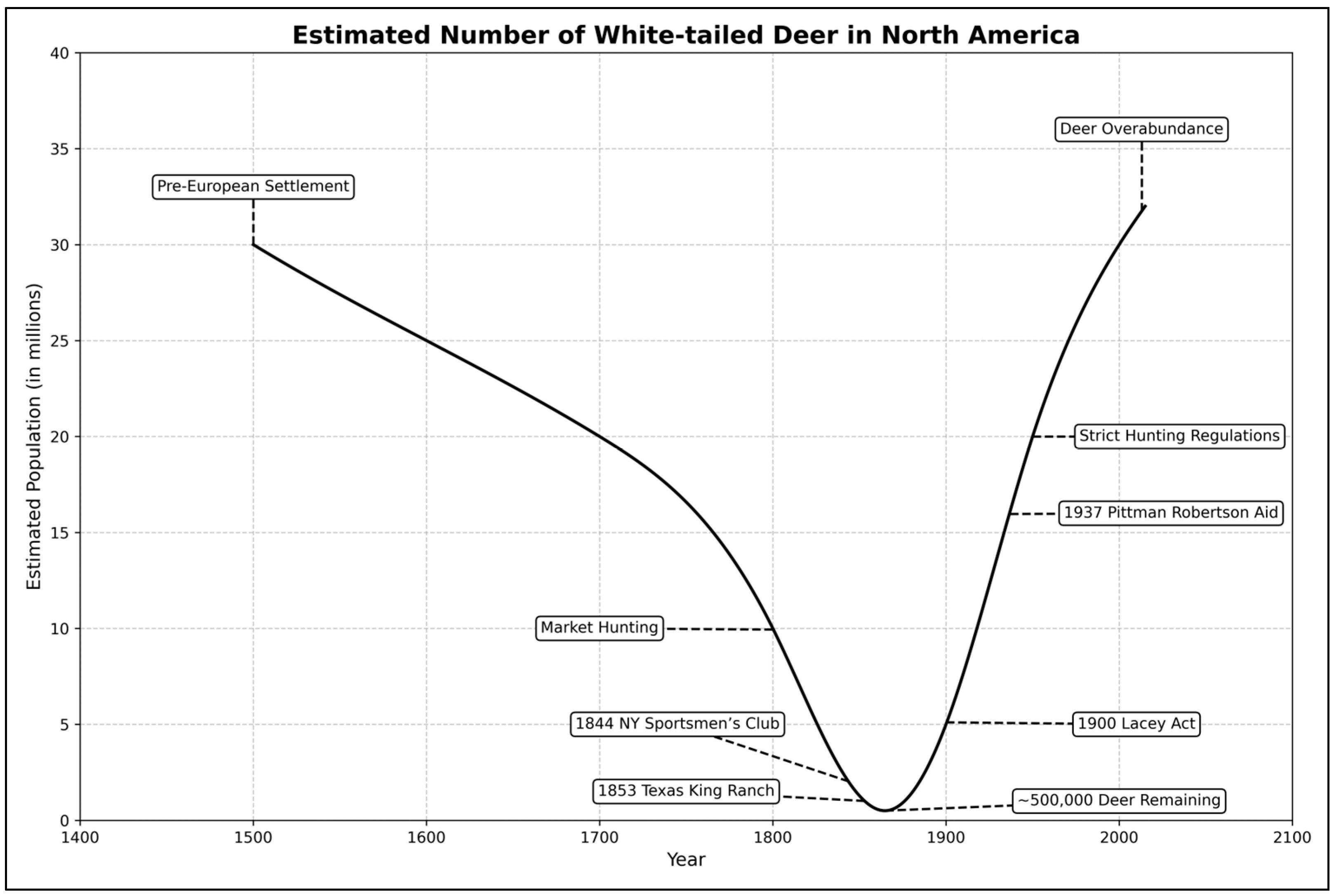
With populations surpassing 30 million in recent years, White-tailed Deer (Odocoileus virginianus) overabundance has become an area of increasing ecological concern [1,2,3]. Historic conservation policies such as the Lacey Act and the Pittman-Robertson Federal Aid in Wildlife Restoration Act played pivotal roles in reversing declining deer populations—once estimated below 500,000 in the late 19th and early 20th centuries [2,3,4,5]. While these measures successfully facilitated species recovery, their long-term effects have led to unchecked population growth. Today, deer densities exceeding 10 deer/km2 are common across many forested landscapes within suburban and peri-urban ecosystems [6,7]. In the absence of natural predator populations—such as coyotes (Canis latrans), bobcats (Lynx rufus), gray wolves (Canis lupus), and black bears (Ursus americanus)—these environments offer abundant forage and favorable habitat conditions [7,8]. Wildlife professionals are increasingly concerned about the negative effects of overabundant deer on biodiversity, forest regeneration, and public health.
White-tailed Deer (WTD) are the most popular and culturally significant game animal in North America due to their abundance and broad distribution [9,10]. They occupy a broad range of lands from Southern Canada through the United States and into Mexico, Central America, and South America [11,12]. The history of deer overabundance is best attributed to a two-century-long legislative and wildlife policy process. Indigenous populations prior to and throughout the 1600s hunted deer for food and resources. They would intentionally set controlled fires to mature forests, creating transitional zones between forests and grasslands that favored WTD [11]. As mature forested lands declined, WTD carrying capacity increased, and populations grew. Tribal boundaries, disputes, and alliances over lands with high populations of deer often occurred due to the high value placed on the animal [5].
Changes due to European colonialism led to intensive farming, subsistence hunting, and logging, which exploited deer populations and caused significant declines in deer abundance until the early 1900s. Europeans placed high economic value on deer hides and meat/venison for trade [4]. As a result, deer populations decreased precipitously throughout the 18th and 19th centuries. By 1865, deer populations in the U.S. had been reduced to a mere half-million [13]. Rich, politically influential hunters recognized the economic value of deer and began enforcing new, more comprehensive regulations to support deer populations. The 1844 New York Sportsmen’s Club and the 1853 Texas King Ranch began buying and leasing land to protect deer populations and implemented strict regulations to prevent overkilling [5]. Educational campaigns throughout the 1900s supported these efforts, encouraging hunters to shoot only male deer. The Lacey Act of 1900 provided the first real protection of wildlife, preventing the transport of illegally killed wildlife, and brought an end to market hunting (Figure 1).
By 1937, the Pittman-Robertson Federal Aid in Wildlife Restoration Act expanded restocking efforts [4]. Relocation initiatives expanded during this time, and by the early 1980s, deer populations were rising rapidly past 14 million [1]. Eastern states, such as New York and Pennsylvania, were some of the first to experience population recovery. Anthropogenic habitat changes associated with urbanization promoted the development of coniferous forests, again advantaging WTD. Due to their flexible diets and declining predator populations, the genetic fitness and survivability of WTD further improved [14], enabling them to thrive in spatially fragmented pockets of diverse vegetation and to adapt easily to urban landscapes alongside humans. Consequently, deer populations quickly reached 30 million by 2000 and continue to rise [1,8]. Deer overabundance has become endemic across the U.S., causing billions in economic damages each year [15,16].
As populations surpass sustainable thresholds, WTD exerts significant ecological pressures on forested ecosystems and contributes to millions of annual agricultural losses [17,18]. Chronic overbrowsing contributes to the degradation of understory vegetation, unfavorable soil structures, and declines in overall biodiversity across both plant and animal species [19,20,21]. A study by Harada et al. (2020) [20] highlighted the impact of rising deer populations on soil quality. Over a 30-year period, deer densities increased across approximately 75% of the study area in the Boso Peninsula and Chiba Prefectures in central Japan, leading to reductions in soil porosity and increases in bulk density. These changes were associated with significant declines in the health of evergreen shrubs, grasses, and ferns in broadleaf forests and cedar plantations, suggesting that the forests’ regenerative capacity and nutrient cycling were greatly diminished by deer populations.
Moreover, dense deer populations have been linked to increased incidences of vector-borne illnesses [22]. WTD overabundance elevates intra- and interspecies competition for limited resources, compromising species’ immune function and increasing susceptibility to infectious diseases. Overpopulated deer herds are frequently associated with the prevalence of Chronic Wasting Disease (CWD), a fatal prion disease, and Bovine Tuberculosis (bTB), a chronic bacterial infection [23]. Encephalopathic CWD continues to affect a growing number of cervid populations and raises concerns regarding its potential to spread to other ungulate species [24]. Similarly, bTB poses a zoonotic risk to human populations, particularly as eradication efforts decline [25]. Most notably, as deer interact with black-legged tick (Ixodes scapularis) populations, they become key amplification hosts of Borrelia burgdorferi—the causative agent of Lyme disease [8,26]. According to the Centers for Disease Control and Prevention (CDC), approximately 89,000 new cases of the disease are reported in the U.S. annually, underscoring the public health risks associated with high deer densities [27].
Economically, expanding deer populations are attributed to over 1 million motor vehicle collisions with a 92% animal fatality rate, resulting in an estimated 58,000 human injuries, 440 human fatalities, and $1.1 billion in property damages annually [16,28,29]. Accidents typically occur during low-light periods (early morning or late evening), when deer are more active and exhibit maladaptive responses to approaching vehicles (e.g., freezing or fleeing) [16]. During the rut, deer also tend to be less cautious and more curious about their surroundings, increasing the likelihood of a DVC [30]. These combined ecological, health, and economic impacts emphasize the urgent need for accurate population monitoring and sustainable management strategies [31].
Effective wildlife management protocols depend on reliable, repeatable, and cost-efficient methods to monitor deer population dynamics. Traditional tracking techniques—such as pellet counts and GPS collaring—are often labor-intensive, costly, and difficult to replicate [32,33]. Many studies lack the funding or technical resources to support these intensive methodologies, limiting the frequency of data collection efforts [34]. However, emerging remote sensing techniques offer powerful alternatives to ecological monitoring. Unoccupied Aerial Vehicles (UAVs) equipped with thermal imaging sensors provide cost-effective alternatives for non-invasively monitoring and estimating wildlife populations in forested landscapes [35,36,37]. When combined with Light Detection and Ranging (lidar), UAVs can also provide detailed information on vegetation structures and forest trails, contextualizing spatial movement patterns [38]. Texas researchers at the Kerr Wildlife Management Area used a DJI Matrice 210 UAV equipped with a ZenMuse XT2 thermal camera to monitor WTD populations. The team estimated true deer abundance with a mean accuracy of 75.6–93.9%, suggesting that drone surveys can reliably estimate mammalian populations in small areas [39]. Similarly, Larsen et al. (2023) [36] equipped a DJI Matrice 300 RTK drone with a Zenmuse H20N thermal camera to monitor mammalian populations within Borvst, Denmark. At heights of 55–120 m, individual measurements of 36 animals were possible using still frames obtained from thermal videos. The team successfully identified individual badgers, cows, hares, stone martens, and deer with significant distinctiveness using thermal imagery.
Compared with other methods, trail cameras offer a low-maintenance, 24-h passive surveillance approach capable of capturing high-resolution, time-stamped data on localized mammalian activity and behavior [40,41]. With strategic placement, trail cameras can uniquely identify individual animals at night and during inclement weather, providing information on naturalized behavioral patterns [42]. These surveys can be used to support population density estimates through models such as the Mark-Resight Model, Distance Sampling with trail cameras (CT-DS), or Random Encounter and Staying Time (REST) frameworks [41,43,44]. Wiegers et al. (2024) [45] compared three camera-trap density estimation methods—Camera Trap Distance Sampling (CT-DS), Random Encounter Model (REM), and Time-to-Event (TTE) models—against reference spatial capture-recapture frameworks across ten mammalian species. All three approaches yielded comparable accuracy and precision for medium to large-sized terrestrial species, validating camera traps as effective tools for non-invasive wildlife population monitoring.
This research focuses on the combined integration of UAV thermal imagery and automated trail camera networks to enable comprehensive characterization of WTD population dynamics, spatial distribution, and behavioral responses to management in forested systems—providing quantitative data to inform evidence-based wildlife management strategies. Using novel semi-automated flight protocols, UAV-acquired thermal imagery was employed to estimate deer density and assess spatial distribution across heterogeneous habitats. Similarly, Wi-Fi-enabled trail cameras were deployed throughout the study area to provide continuous, long-term observations of deer activity and behavior. Trail camera data were further analyzed using a novel implementation of the REST model to refine density estimates. Notably, three managed deer culling events occurred during the study period—on 18 December 2024, 2 January 2025, and 9 January 2025—offering a unique opportunity to evaluate the spatial and temporal responses of WTD populations to targeted management interventions.
This research addressed four primary objectives:
  • Evaluate the effectiveness of several remote sensing technique(s) and strategies for monitoring WTD populations,
  • Examine changes in the spatial distributions of deer populations in response to each culling event,
  • Estimate deer density (per km2) using UAV-thermal imaging and trail camera assessments, and
  • Evaluate relationships between remote sensing assessments and deer-vehicle collisions in the surrounding Binghamton and Broome County, NY, environments.
Specifically, we hypothesize that these complementary methods would: (1) converge on consistent density estimates validating their collective reliability, (2) detect measurable deer responses to culling interventions through changes in spatial distribution and detection rates, and (3) reveal relationships between deer activity patterns and deer-vehicle collisions that connect localized monitoring data to landscape-scale human–wildlife conflict. The results of this research are intended to offer valuable insights into wildlife management decisions and support efforts toward ecological sustainability.

2. Materials and Methods

2.1. Study Area

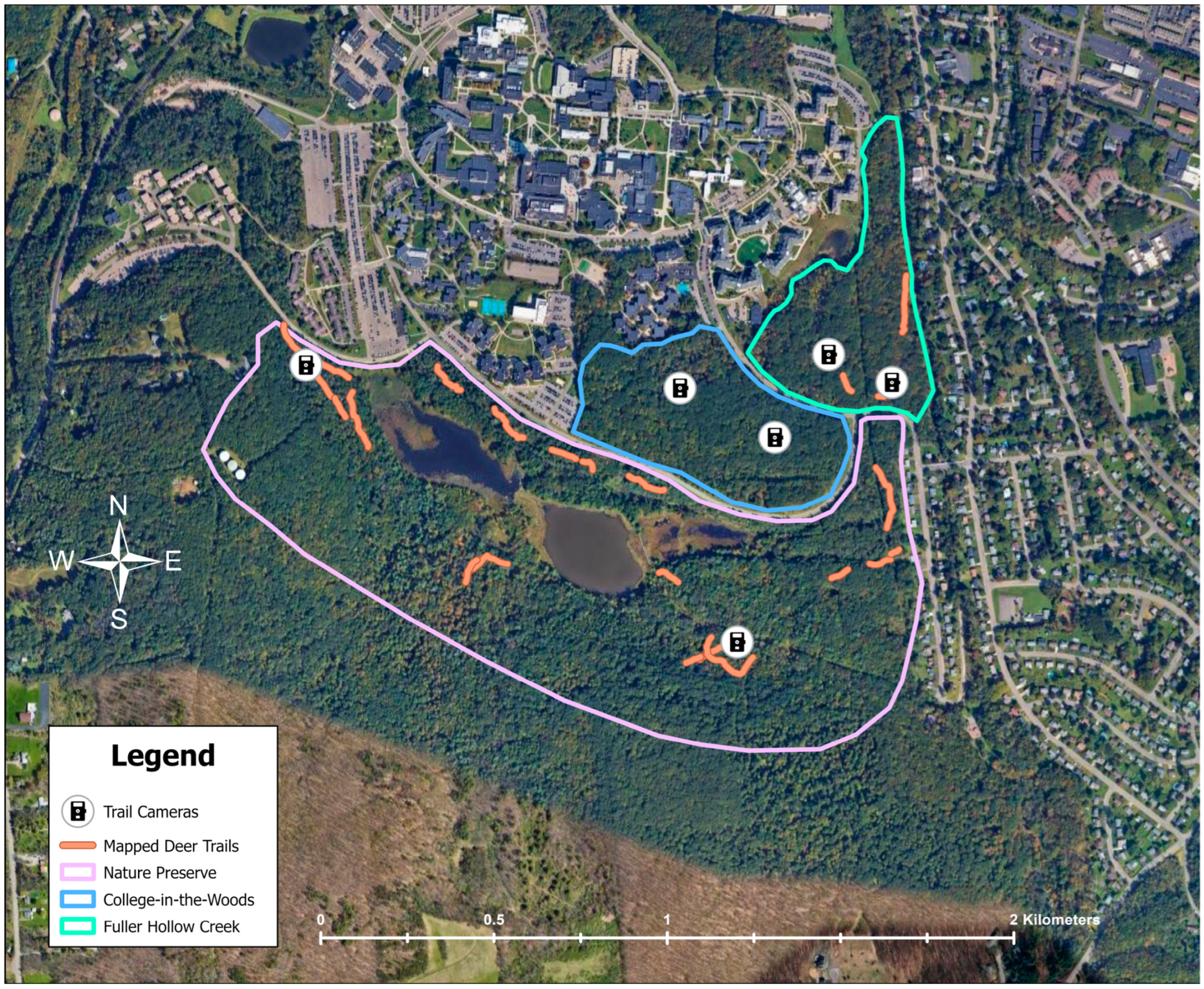
This study was conducted within the forested environments of Binghamton University, encompassing a total area of 1.23 km2. The study area was subdivided into three distinct regions: Fuller Hollow Creek (FHC), College-in-the-Woods (CIW), and a portion of the university Nature Preserve (NP), each 0.22 km2, 0.26 km2, and 0.75 km2, respectively (Figure 2). These ecosystems support a diverse array of wildlife, ranging from black bears (Ursus americanus), coyotes (Canis latrans), and beavers (Castor canadensis) to a variety of salamander species. The dominant vegetation is maple, hemlock, and oak trees, including sugar maple (Acer saccharum), red maple (Acer rubrum), striped maple (Acer pensylvanicum), eastern hemlock (Tsuga canadensis), white oak (Quercus coccinea), black oak (Quercus veluntina), red oak (Quercus rubra), and pignut hickory (Carya glabra). Additionally, well-defined hiking trails are present within the CIW and NP regions. These trails are typically stripped of vegetation and loop through the entirety of each environment, with moderate anthropogenic activity common during daylight hours, with wildlife activity typically increasing from dusk to dawn [46].
To address the ecological impacts of over-browsing by WTD, Binghamton University’s NP and the adjacent CIW residential areas have implemented Deer Exclusion Fences as part of the Forest Regeneration Demonstration Project. These enclosures are designed to restrict deer access to specific areas, thereby protecting vegetation regeneration and promoting the recovery of plant species diversity [47]. By limiting herbivore pressure, the project aims to support understory regeneration, improve soil health, and enhance overall forest resilience.
In addition to passive management strategies, the NP conducts annual deer population control measures through regulated culling events. These are scheduled in winter during the academic intersession (December–January) when campus activity is minimal. During the 2024–2025 winter break, three culling operations were carried out within the preserve on 18 December 2024 (culling 14 males and 6 females); 2 January 2025 (culling 7 males and 9 females); and 9 January 2025 (culling 6 males and 8 females). A total of 50 deer were killed, marking the most substantial culling effort to date. All harvested venison products were donated to the Community Hunger Outreach Warehouse (CHOW).

2.2. Trail Camera Monitoring of White-Tailed Deer

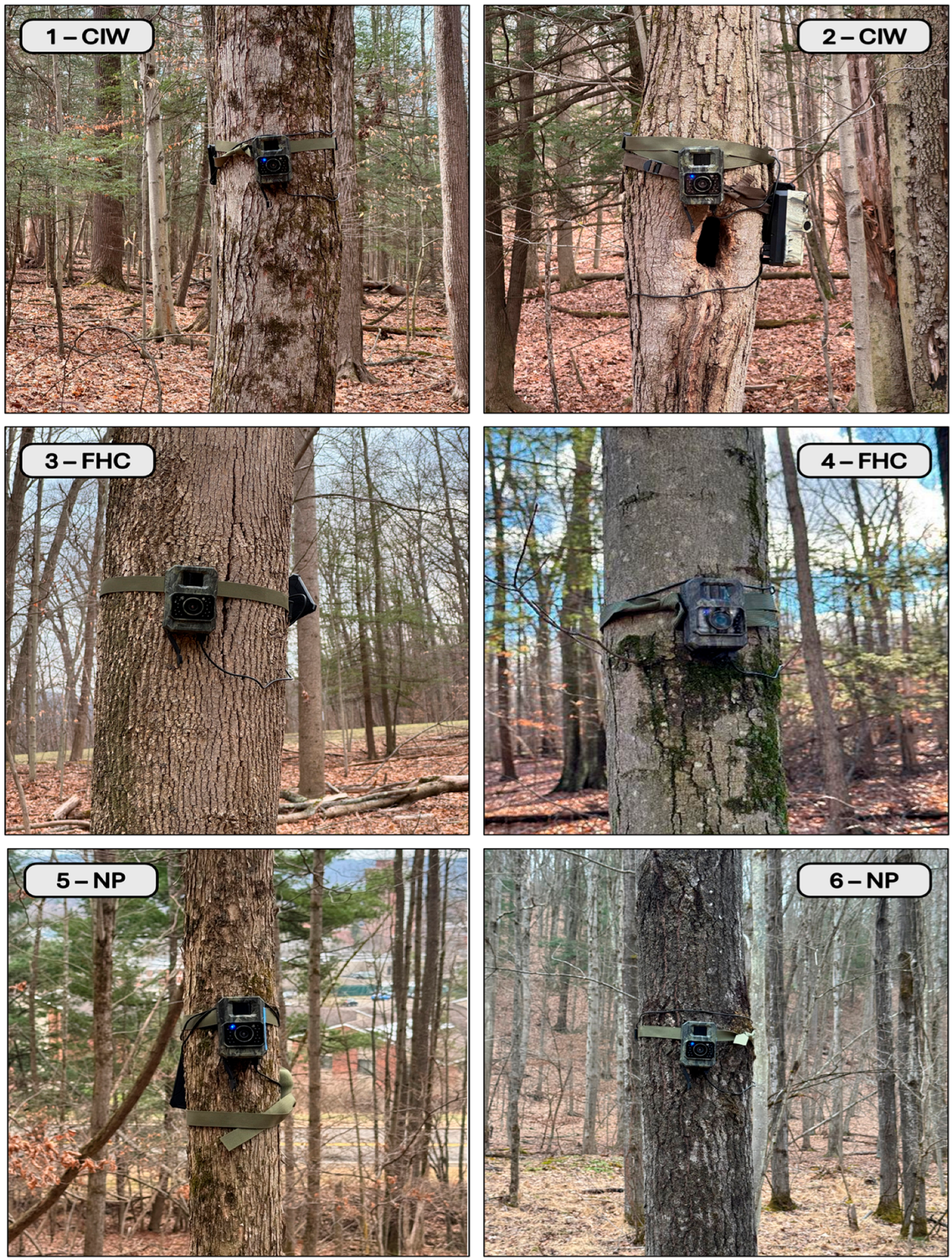
To passively and non-invasively monitor WTD populations, six Assark PH960W trail cameras (Shenzhen Zerce Technology Co., Ltd., Shenzhen, Guangdong, China), weighing approximately 14.9 oz and measuring 4.13 × 2.56 × 1.36 inches, were strategically deployed across the study area in consultation with the Steward of Natural Areas. Data collection commenced on 31 October 2024 and concluded on 10 March 2025. Two cameras were installed within each designated forested region, with the following labeling scheme: 1—CIW, 2—CIW, 3—FHC, 4—FHC, 5—NP, and 6—NP (Figure 3).
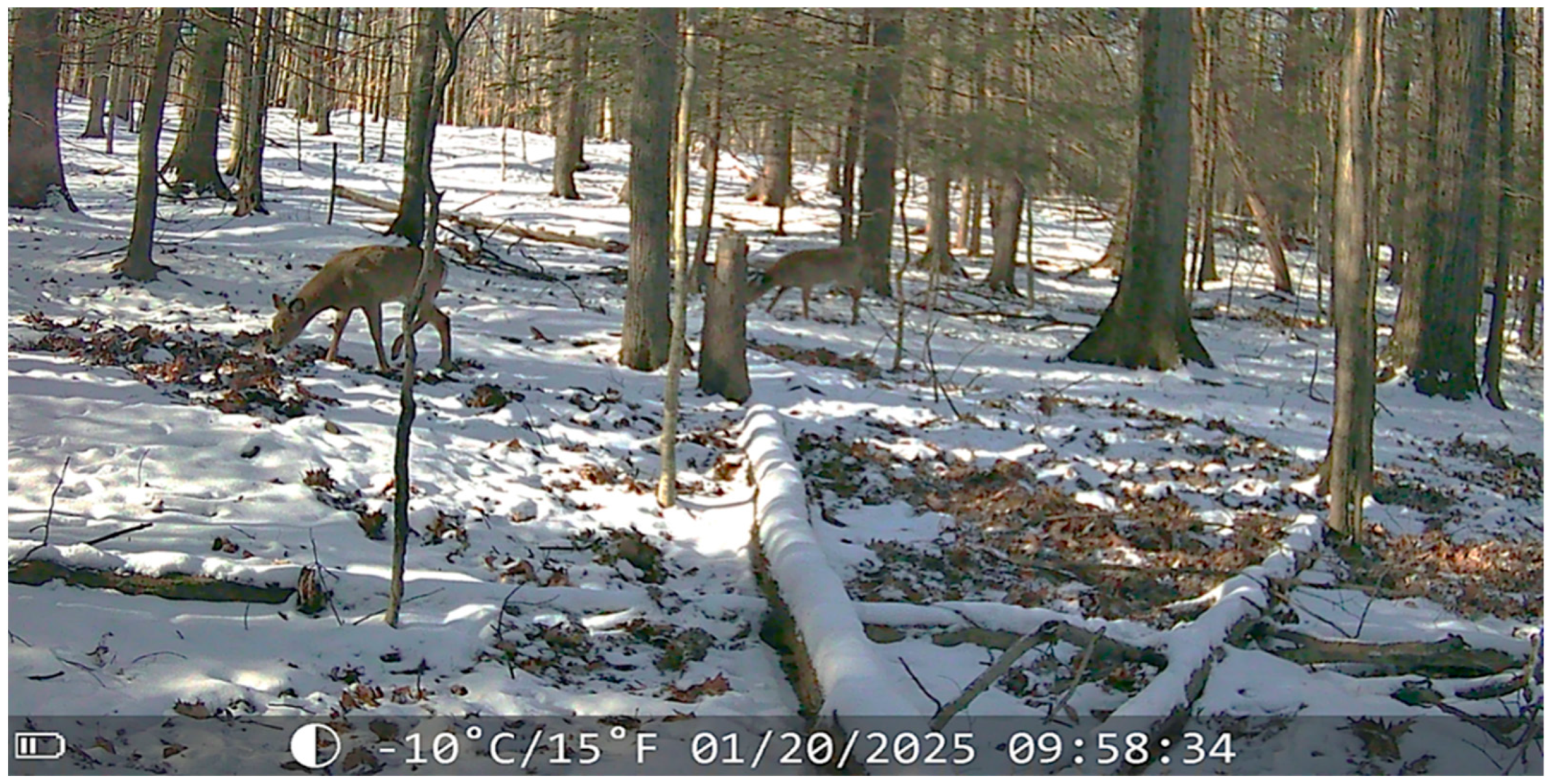
Each trail camera was equipped with a 48 MP RGB sensor for daytime and an infrared (IR) sensor with a 65-foot maximum detection range and a 0.2 to 0.6 trigger speed, utilizing a 100° FOV and a detection angle for nighttime. A 30-s detection interval was established between consecutive motion triggers, with each activation recording a 10-s 1080P MP4 video file with a corresponding JPEG image. The cameras are designed to operate within extreme outdoor temperatures ranging from −20 °C to 60 °C (−4 °F to 140 °F) and are battery-powered. Each unit was securely strapped to a tree at approximately 5 ft (1.5 m) above ground. To ensure continuous operation, a small 5″ × 3″ lightweight solar panel was affixed to each camera unit with a USB-C cable connection for supplemental power. Each recorded capture contained metadata including a timestamp (HH/MM/SS), date, ambient temperature (°C/°F), moon phase, and battery level. The collected data facilitated the assessment of WTD activity patterns and habitat utilization across the study regions (Figure 4).
All trail camera video data were visually analyzed. Data on the number of deer present in each video, temperature, date, start time, end time, hour (0–23), location, video filename, duration (MM/SS), and additional notes were recorded in a Microsoft Excel (v2601) spreadsheet. Daily WTD encounters were treated as independent events, allowing for repeated observations of distinct individuals across multiple days. When consecutive videos captured the same individual within a short time interval (typically within the same hour), records were merged by assigning the earliest start time and latest end time across files to preserve encounter continuity; corresponding video capture file names were consolidated into a single entry. Hourly deer activity was documented based on the hour in which the observation occurred. For example, if deer were recorded between 08:00:00 and 08:59:59, their activity was attributed to the 8th hour of the day, whereas activity from 09:00:00–09:59:59 was assigned to the 9th hour of the day. In cases where deer were active between hours, the hour with the greater proportion of activity was documented.
Pre-processing criteria were applied to ensure data quality and adherence to REST model assumptions. Specifically: (1) all false triggers caused by vegetation movement, precipitation, or non-target species were removed; (2) detections with obscured visibility, incomplete metadata, or camera malfunctions were excluded; (3) consecutive triggers of the same individual(s) within the 30-s delay interval were treated as a single encounter to maintain independence; and (4) only events occurring within the defined focal detection zone were retained. Due to manual inspection of individual RGB and infrared video frames, some uncertainty remained in distinguishing WTD across multiple captures within a single day, introducing minor sample bias.

2.3. UAV-Thermal Monitoring of White-Tailed Deer

A mix of fully and semi-automated UAV missions was conducted to enhance the analysis of White-tailed Deer populations within the study area. A total of 40 UAV flights were performed between 16 October 2024 and 4 March 2025 using a DJI Mavic 3T quadcopter drone (SZ DJI Technology Co., Ltd., Shenzhen, Guangdong, China). The DJI Mavic 3T is a lightweight UAV weighing 1050 g (~2.3 lbs) and equipped with a 1/2-inch 48 MP CMOS camera and a 640 × 512-pixel resolution uncooled VOx microbolometer thermal infrared (IR) sensor. The CMOS camera features a 162 mm focal length and supports up to 56× hybrid zoom, while the thermal imaging sensor has a 40 mm focal length, a 61° Display Field of View (DFOV), and multiple color palette options for enhanced visualization. The drone uses a Real-Time-Kinematic (RTK) positioning system to geotag each media file captured during flight operations. The UAV has a maximum flight duration of 45 min and is capable of surveying up to 2 km2. Pre-flight checks were conducted to stabilize the drone’s thermal sensor temperature readings, ensure strong communication with the controller, and assess the drone’s maneuvering capabilities, reducing the risk of malfunctions during flights. Both RGB and thermal IR imagery were collected simultaneously during preprogrammed flight missions.
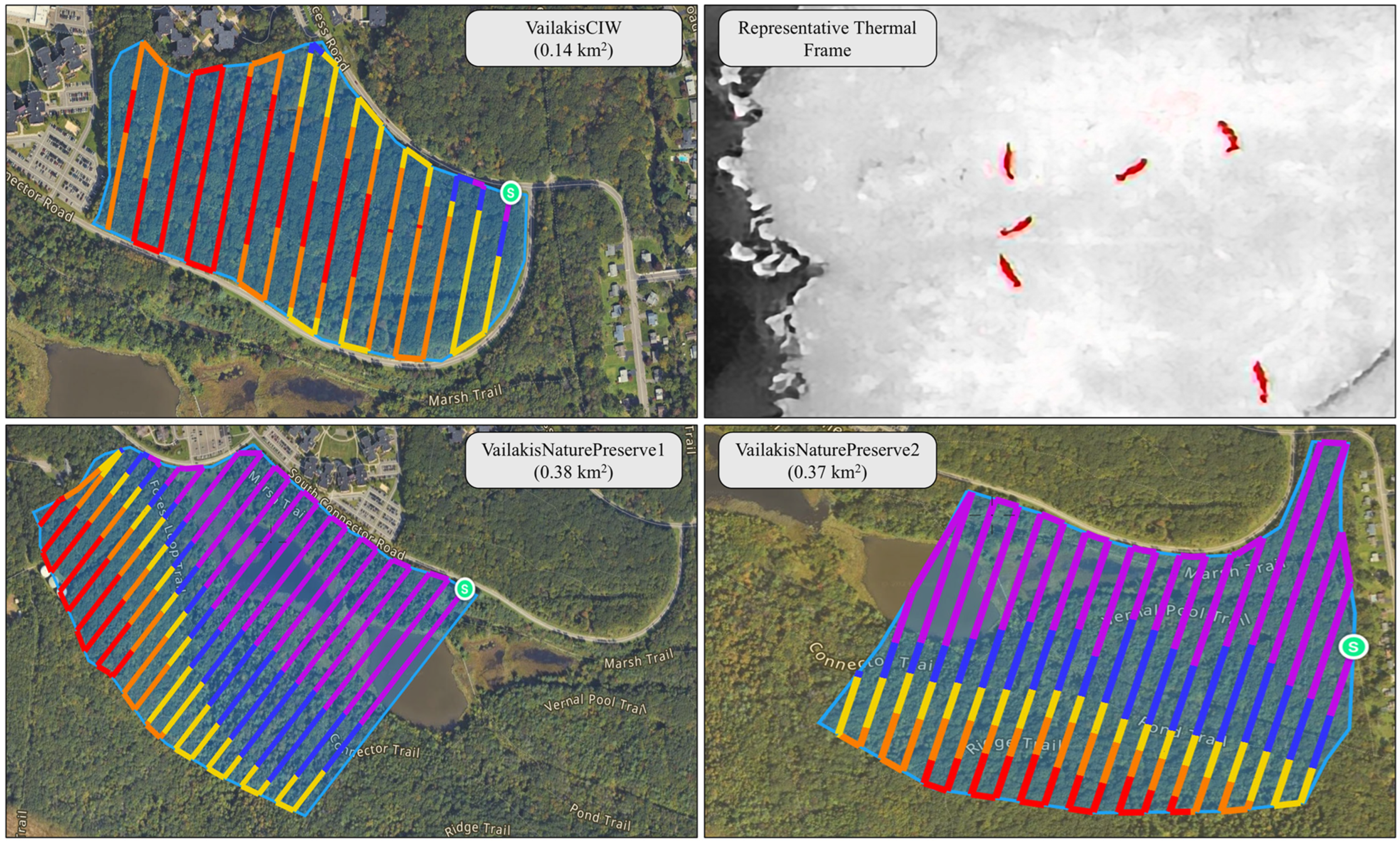
Three predefined flight paths were designed for CIW and NP regions using DJI’s proprietary Pilot 2 software (v14.1.0.45). A single flight path was established for CIW, while two distinct flight paths were required to comprehensively survey the section of the NP (Figure 5). These paths were designed to ensure optimal UAV visibility and minimize flight durations, promoting repeatability. UAV flights were not conducted over FHC due to its proximity to residential buildings and the lack of a clear line of sight due to dense tree canopy.
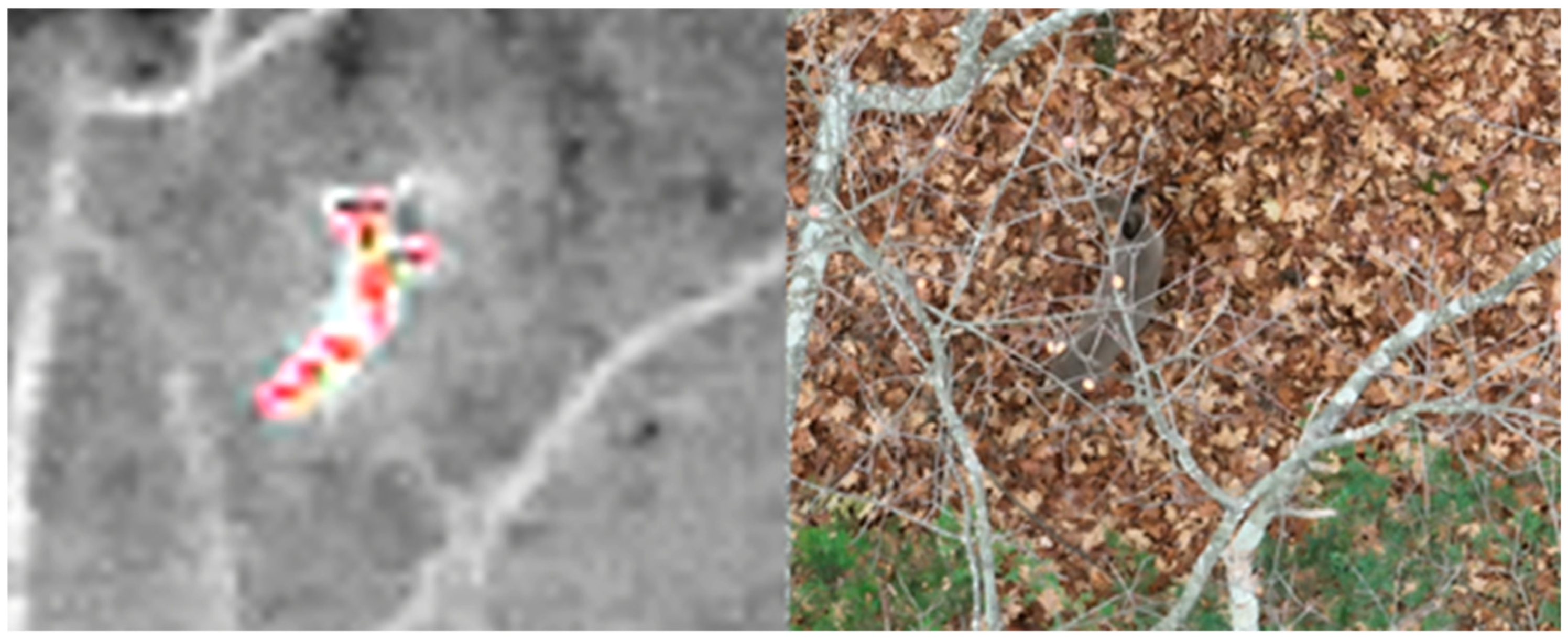
Between 16 October 2024 and 12 November 2024, eight fully automated test flights were conducted to capture thermal imagery using a blue-green-yellow-red color palette. During each flight, parameters such as altitude (m), speed (m/s), side-lap, and overlap were adjusted to determine the most efficient flight settings. Preliminary analysis of imagery suggested WTD were too challenging to identify with this color palette; therefore, the subsequent 32 flight missions employed a gray–white–red color palette, typically utilized in search-and-rescue missions. The semi-automated survey period ran from 20 November 2024 to 4 March 2025. These missions employed pre-programmed flight paths but were manually interrupted when potential WTD were visually detected. Imagery analyses were enhanced with side-by-side thermal and RGB video footage during these flight missions (Figure 6). Among all UAV-based surveys conducted in this study, semi-automated missions proved the most effective in capturing WTD observations. The final flight parameters for each mission included a flight speed of 9.6 m/s, an altitude of 50 m AGL, 10% side-lap, and 80% overlap. These parameters were identified as the most effective for surveying each flight polygon and detecting WTD.
All UAV flight data were handled at Binghamton University’s Near Earth Imaging Lab (NEIL) using an Intel® Core™ i9-10980XE processor CPU @ 3.00 GHz with installed RAM of 256 GB and NVIDIA RTX A2000 GPU system. Each dataset was categorized into three primary folders: CIW, NaturePreserve1, and NaturePreserve2. Within these folders, missions were labeled according to the YYYYMMDD_Flight# format (e.g., 20241016_Flight1). The captured thermal and RGB images were sorted into separate directories titled: RGB and Thermal JPGs, respectively. Any video captures were designated into Manual Captures folders. Lastly, if any WTD were identified during an individual flight mission, a representative thermal image over the capture site containing the highest number of visible deer was extracted and placed into a Representative Frames folder (Figure 5). All corresponding UAV data underwent standardized pre-processing prior to analysis, including (1) individual frames exhibiting motion blur, incomplete spatial coverage, sensor saturation, or severe canopy occlusion were removed prior to analysis; (2) all thermal signatures identified as WTD were manually verified, and ambiguous heat sources such as sunlit ground features or non-target wildlife were excluded; and (3) overlapping imagery within a single flight was cross-checked to prevent double counting of individuals moving between adjacent frames. Overall, sample bias during data processing was considered minimal, as WTD were typically distinguishable across successive thermal frames, aided by side-by-side comparison of thermal and RGB video captures. All UAV flight data were recorded in two Excel spreadsheets: (1) an aggregated dataset of all flight missions, and (2) a record of the number of WTD identified in each corresponding representative frame. The aggregated mission dataset documented data on all 40 flights, including date, location, drone model (Mavic 3T), mission name, mission day, mission sequence, flight number, WTD detection status (yes or no), deer count, remote pilot in command, visual observers, start and end times, flight duration, wind speed (kt), weather conditions, relative temperature (°F), flight altitude AGL (m), flight speed (m/s), side-lap, overlap, and additional notes on mission success, cancelations, or emergency failures.
Mission name was designated as the specific flight mission title (e.g., VailakisCIW, VailakisNaturePreserve1, or VailakisNaturePreserve2). Mission day referred to the chronological order of flight days. The mission sequence recorded the order of flights within a single day, with 1 representing the first mission and 3 representing the last, and the flight number indicated the frequency of a specific mission’s implementation. Of the 40 total flights, 15 were conducted over VailakisCIW, 12 over VailakisNaturePreserve1, and 13 over VailakisNaturePreserve2. Relative daytime temperature was recorded in 10° intervals, as precise measurements were deemed unnecessary for the scope of this study. Spatial assessments and kernel density mapping of WTD distributions were conducted in ESRI’s ArcGIS Pro v3.4.

2.4. Mapping Deer Trails

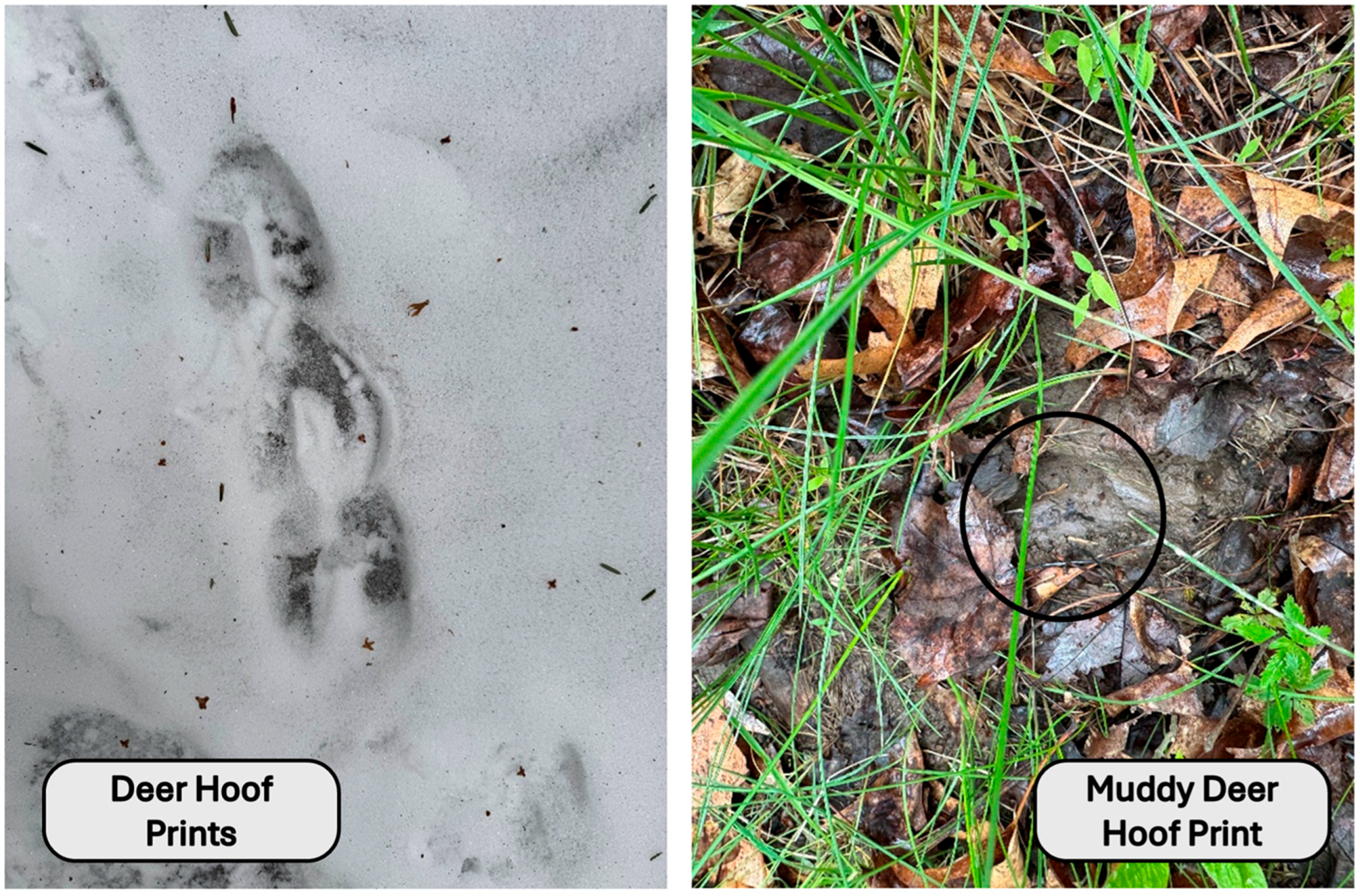
Primary deer trails in the NP and FHC were geolocated using ESRI’s QuickCapture (v1.20.22) mobile application. Deer trails were identified by the presence of flattened vegetation or bare soil, compressed leaves, and by deer hoof prints (Figure 7). Deer trails typically ranged from 6 to 12 inches wide and followed relatively straight paths through forested or brushy areas. Muddy and snowy conditions during the study period aided trail identification by providing clear evidence of recent deer activity. Predominant deer trails across the NP and FHC were mapped throughout the study period, with a 10–20 ft positional accuracy. Deer trails in CIW were not marked due to the diffuse and ambiguous nature of the trail patterns, which made it difficult to reliably distinguish and document definitive paths. Maps and infographics were further developed in ArcGIS Pro v3.4.

2.5. Tracking Deer Vehicular Collisions and Deer Density Calculations

Data on deer–vehicle collisions were collected from the New York Department of Motor Vehicles database (Motor Vehicle Crashes—Case Information: Three-Year Window | State of New York). The dataset was queried to include all motor vehicle collisions across Broome County, NY, from 2018 to 2023, totaling 24,997 records. Due to limited data, trends in Binghamton vehicular collisions were generalized to all of Broome County, assuming spatial homogeneity. Analyses were conducted and visualized in Excel and Python Jupyter Notebook v7.4.0.
UAV-derived deer densities were calculated using only flight mission data in which WTD were detected. Density estimates assume (1) near-perfect detection of WTD within the surveyed area during a given flight, (2) independence among flight observations, and (3) spatial representativeness of sampled flight extents. Two density models were developed: a per-flight model that calculated density from individual flights, and a daily aggregate model that combined observations from multiple flights on the same day. These complementary approaches address potential double-counting bias: the per-flight model may overestimate density when the same individuals appear in overlapping portions of flight paths, while the daily model may underestimate density when multiple flights sample distinct individuals. Median density values from each model were calculated to minimize the influence of outliers, and results were combined to produce a density range reflecting methodological uncertainty. Density was computed as follows:
D e n s i t y p e r   f l i g h t = m e d i a n   N 1 A 1 , N 2 A 2   , , N k A k
D e n s i t y p e r   d a y = m e d i a n i = 1 f d N i A t o t a l  
For the per-flight density model, N k can be defined as the deer count from each survey flight, A k is the corresponding survey area, and k is the total number of survey flights across all sites and dates. In the per-day density model, f d corresponds to the number of flights conducted on day d , N i represents the number of observed deer in flight i on that day, and A t o t a l accounts for the total area surveyed across all flights that day. Combining both models, the density range can be expressed as follows:
D e s n i t y   R a n g e =   m e d i a n   N k A i p e r   d a y ,     m e d i a n   i = 1 f d N i A t o t a l p e r   f l i g h t  
Trail camera deer densities were modeled using a Random Encounter and Staying Time model (REST). The REST model is an adaptation of the Random Encounter Model (REM), which typically requires telemetry data to estimate the average distance traveled by individuals of a species and, thus, density. Unlike the REM, the REST model estimates density relative to an animal species’ encounter rate and stay time [43]. Staying time is inversely proportional to the day range, requires no telemetry data, and is therefore better suited for this study. Application of the REST model assumes (1) random movement of deer relative to camera placement, (2) consistent detection probability within a defined focal area, (3) independence among encounters, and (4) accurate estimation of staying time from video observations. Density was estimated as follows:
D e n s i t y = Y × T s × H = W T D   E n c o u n t e r s × ( S t a y i n g   T i m e ) F o c a l   A r e a × S u r v e y   E f f o r t
where Y can be defined as the expected number of encounters over the study period, T is the average staying time or duration per encounter, s is the detection zone or focal area (i.e., the area in front of a trail camera where a deer is certain to be detected), and H is the total camera survey effort. Trail camera deer density assessments were processed and visualized in Python-based Jupyter Notebook 7.4.0.
To account for variation in WTD social grouping behavior, two REST density models were developed based on (1) the frequency of camera activation per study region (treating each trigger event as one detection regardless of group size) and (2) the frequency of WTD observations per study (accounting for each WTD observed during individual camera triggers). Only encounters occurring within the defined detection zone were retained. Staying time was calculated from the first entry to the final exit of an individual within the focal area, and averaged across all encounters.
This simplified approach to the REST model was adopted due to study-scale constraints, as robust statistical modeling of the parameters was not feasible. The absence of GPS-collared individuals prevented empirical staying time validation, limited camera deployment ( n = 6 ), and the 130-day study duration restricted temporal variance estimation. Consequently, density estimates represent methodologically derived bounds that bracket true density with reasonable confidence, despite limited capacity for robust statistical modeling.
D e n s i t y   R a n g e = F r e q .     C a m e r a   A c t i v a t i o n s × T s × H   ,   F r e q .   W T D   O b s e r v a t i o n s × T s × H

3. Results

3.1. UAV Thermal Imagery Assessments

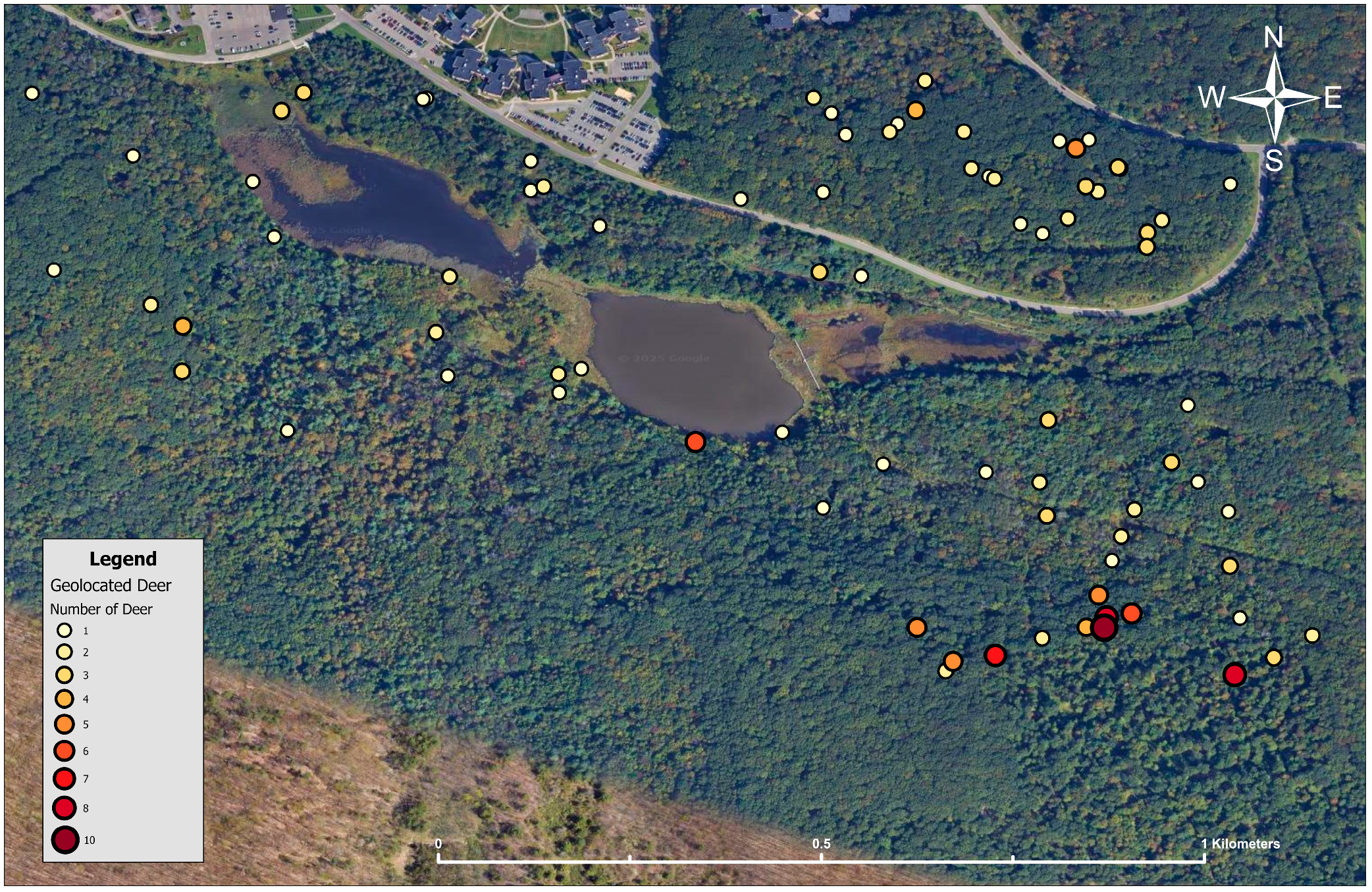
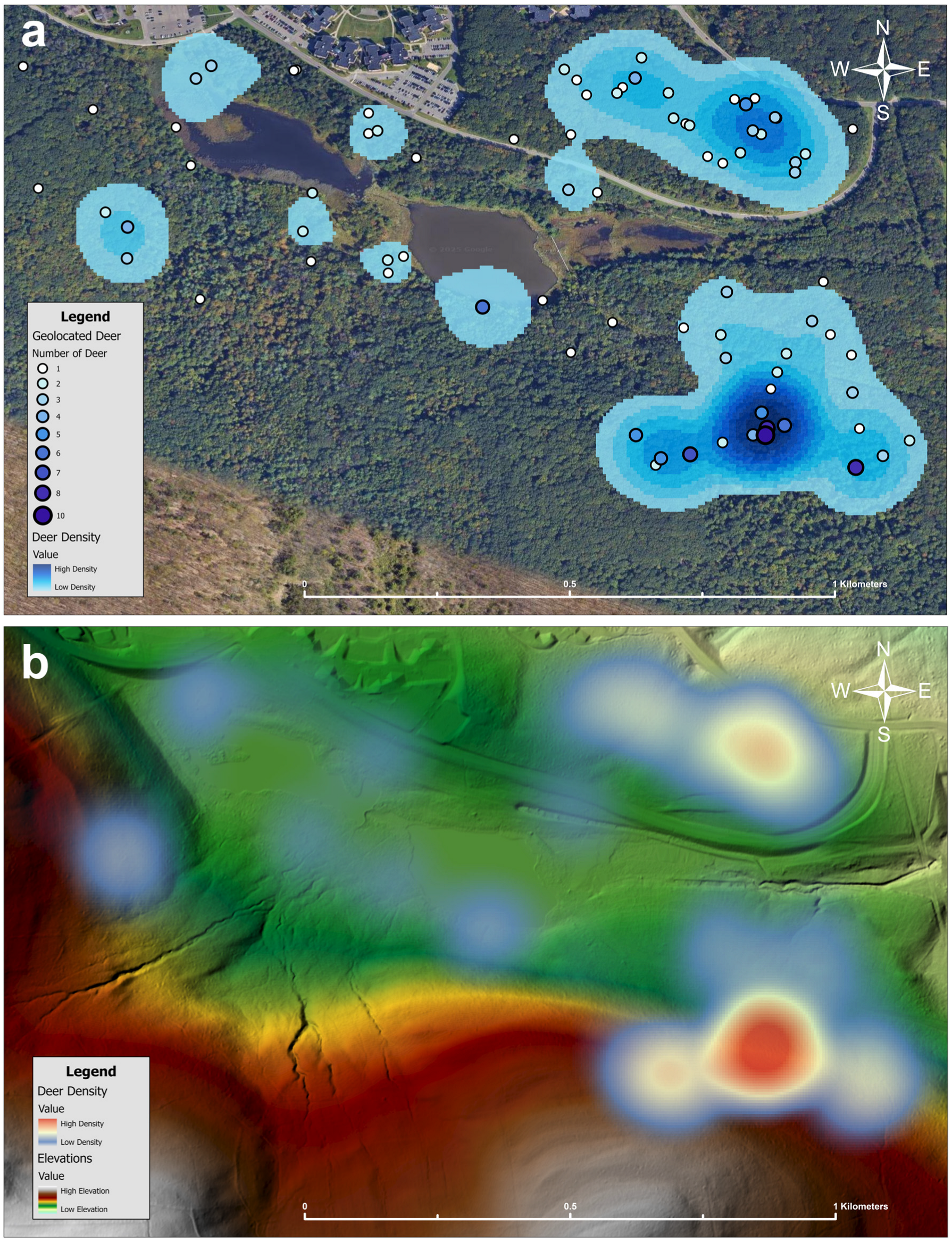
Across 40 UAV flights, 84 representative frames captured 196 WTD observations. Detections were unevenly distributed throughout the study area, concentrating primarily in CIW and the southeastern NP (Figure 8). Herd sizes varied by region. The southeastern NP hosted the largest groups, with herds reaching up to 10 individuals (mean = 3.09 ± 2.43 SD) within a single representative frame capture. The western NP (mean = 1.64 ± 0.90 SD) and CIW (mean = 1.93 ± 1.03 SD) regions supported smaller aggregations of WTD, with maximum herd sizes reaching four and five individuals, respectively.
Spatial analysis suggests consistent habitat use in CIW and the southeastern NP, where deer were repeatedly detected at similar locations across multiple flights. This pattern indicates regular use of preferred areas rather than temporary passage through the landscape. By contrast, the western NP showed a markedly different pattern: detections were more dispersed and infrequent, suggesting this region holds lower habitat favorability for WTD.
The kernel density model was weighted by the number of observable deer present in each UAV-representative thermal frame (Figure 9). The highest frequency of deer detections occurred in the CIW area and the southeastern portion of the Nature Preserve. The model further indicated that the largest groupings of WTD were concentrated in the southeastern NP region, with larger herd sizes concentrated toward areas of higher elevation. Several environmental factors may explain why larger herds favor elevated terrain: enhanced predator detection from elevated vantage points, reduced anthropogenic disturbance in topographically complex terrain, and upland vegetation communities may provide superior forage or cover. In contrast, weaker associations between deer encounters and herding behavior were observed in the western portions of the NP, where solitary individuals or small groups dominated. This disparity in social grouping patterns across the landscape suggests that habitat quality or resource distribution may vary considerably between regions, influencing not only deer presence but also their social organization.

3.2. Trail Camera Analyses

During the 130-day study period, the deployed trail cameras recorded 1183 WTD observations. Cameras located in CIW experienced the highest levels of activity, with 526 total activations and 855 deer observations—accounting for 72% of all deer detections despite representing only one-third of the study area. Following CIW, trail cameras in FHC recorded 104 total activations with 183 deer observations—representing 16% of all deer detections—and cameras situated in the NP experienced the lowest activity, with 92 total activations and 145 total deer observations—accounting for 12% of WTD observations (Table 1). This disparity in detection rates across regions is suggestive of CIW’s role as a core habitat area, providing ample forage and bedding zones.
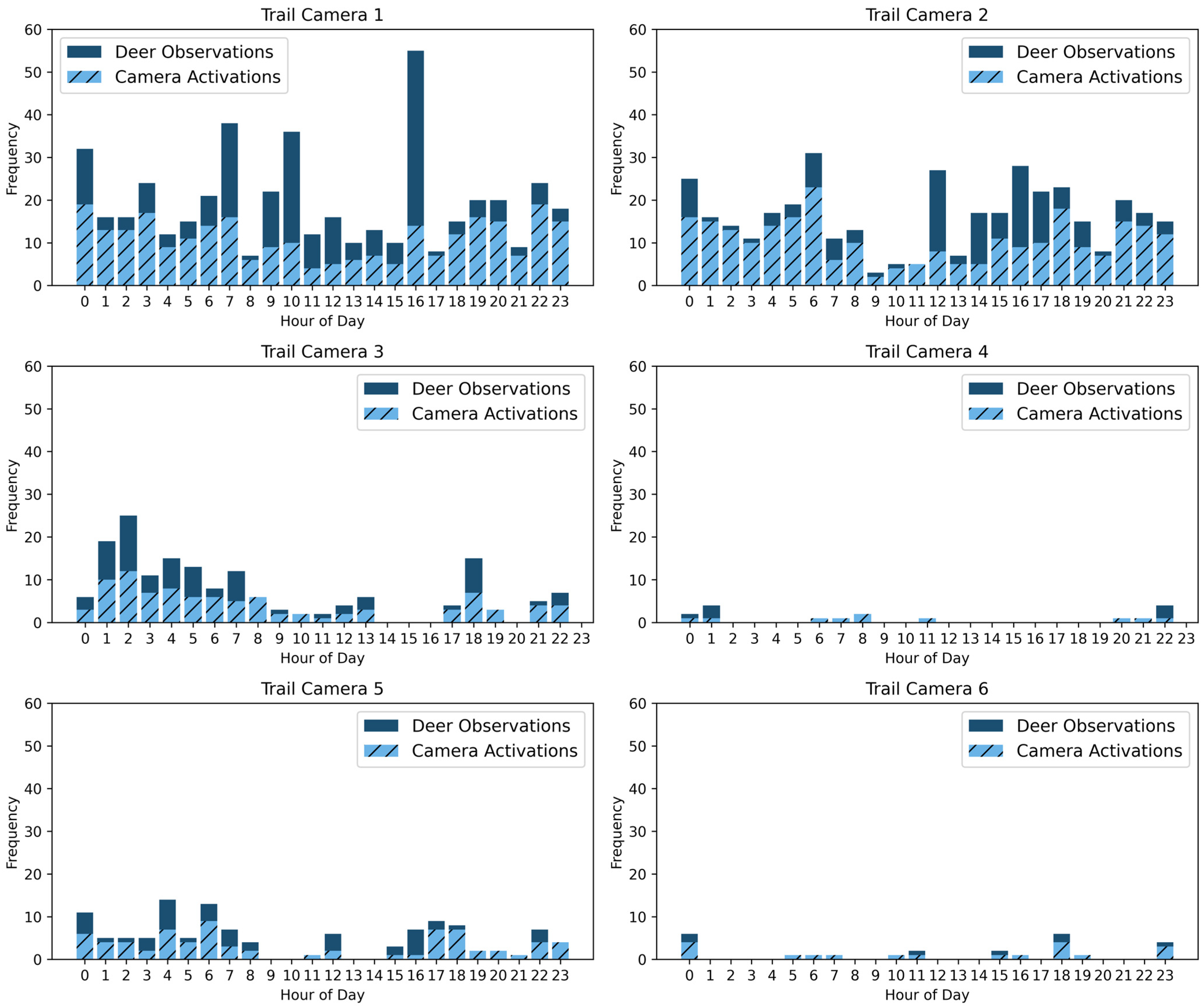
Hourly activity level charts for individual trail cameras were generated to provide insights into WTD movement patterns (Figure 10). Trail cameras 4 and 6 experienced significantly lower activity levels with 10 and 19 camera activations, respectively. Correspondingly, their frequency charts represent sparse data with no visible temporal patterns—underscoring suboptimal placement or positioning outside primary deer travel routes. All remaining activity models are suggestive of bimodality with higher camera activations between dusk and dawn, a pattern consistent with typical WTD behaviors. Trail cameras 1 and 2 experienced the highest deer activity levels with 269 and 257 camera activations corresponding to 469 and 386 total deer observations, respectively, suggesting these cameras were optimally positioned along high-traffic corridors or near focal resource areas.
Similarly, hourly activity charts of each study region are suggestive of biomodality (Figure 11). Camera activations and deer observations were highest in CIW, with a peak of 37 camera activations (52 total deer observations) at 0600 h and a minimum of 9 activations (17 total deer observations) at 1100 h. Surprisingly, a maximum of 83 deer were recorded at 1600 h when camera activations were proportionally low, with only 23 camera triggers. This disproportionate relationship suggests afternoon periods coincide with large herd movements through CIW, whereas morning activity involves smaller groups or solitary movement patterns. In FHC, activity peaked at 0200 h with 12 total activations and 25 total deer observations, while no detections were recorded between 1400 and 1600 and at 2300 h. Within the NP, peak activity occurred at 1800 h with 11 activations and 14 total deer observations, while no deer were detected at 0900 or 1300–1400 h. The nocturnal peak and midday detection gaps in FHC and NP may reflect natural foraging behaviors or shifts in activity to nighttime hours in response to anthropogenic disturbances.
Hourly activity patterns aggregated across all trail cameras over the entire study period were visualized in a bar chart, showing the total frequency of camera activations and deer observations per hour (Figure 12). The resulting distribution of deer activity appears bimodal, with the highest levels occurring during crepuscular hours (dusk to dawn) and significantly reduced activity between 0800 and 1500 h. The peak number of camera activations was recorded at 0600 h, with 54 triggers, while the lowest was at 1400 h, with only 12. Notably, a maximum of 91 deer were observed at 1600 h, corresponding to only 25 camera activations, while a minimum of 23 deer were observed at 1100 h (13 camera activations) and 1300 h (14 camera activations). These activity patterns appear consistent with WTD behavior toward thermoregulation, optimized foraging efficiency, and reduced exposure to predator populations.
Daily WTD observations were aggregated into a scatter plot to visualize overall activity patterns. Each culling event was marked with a dashed gray line, and a 7-day rolling average was applied to smooth short-term fluctuations and highlight broader temporal trends in WTD activity throughout the study period (Figure 13). The highest number of daily observations occurred on 7 December 2024, with 42 total deer observations—notably occurring between culling events, suggesting a potential rebound or concentration effect as deer redistribute. An average of 9.70 deer were observed per day, with a median of eight WTD observations per day. No deer activity was observed on 4 November 2024; 18–20 November 2024; 22–23 November 2024; 11 December 2024; 1 January 2025; and 4 February 2025. While zero-detection days could reflect true absences, they more likely indicate spatial shifts in deer activity beyond camera detection zones, underscoring an inherent limitation of fixed-point sampling: cameras only document deer presence when animals move through the narrow detection field. However, the three consecutive zero-detection days in November suggest these gaps may be linked to specific events rather than random sampling variation. This pattern reinforces the value of complementary survey methods, as UAV flights provided landscape-level snapshots that confirmed deer remained present within the study area even during periods of low or zero trail camera activity.

3.3. UAV Deer Density Calculations

Two UAV deer density models were developed to estimate spatial distribution patterns: (1) a cumulative average based on per-flight density estimates, and (2) a cumulative average derived from per-mission-day density estimates. UAV flight data that contained no observations of WTD were excluded. Both methodologies were employed to generate a density range across the study area, providing a comprehensive overview of deer population spatial variability over time.
The highest observed per-flight WTD density was recorded over CIW on November 11, where 17 individuals were detected within 0.14 km2, yielding an estimated density of 121.43 deer/km2 (Table 2). In contrast, the lowest densities were documented on October 17, November 6, December 13, February 11, and March 4, during which only a single deer was observed within each forested region, estimating 2.63–7.14 deer/km2. The detection of solitary individuals during these flights may underscore detection bias, as other deer may have been present but were undetectable due to dense canopy cover.
To mitigate the influence of outliers, median density values were calculated for each study site, given the non-normal distribution and presence of extreme values. Among the surveyed regions, CIW exhibited the highest median deer density, averaging 39.27 deer/km2, followed by the southeastern section of the Nature Preserve (i.e., Nature Preserve 2) at 21.62 deer/km2. The western section of the Nature Preserve (i.e., Nature Preserve 1) recorded the lowest average density at 15.79 deer/km2. These relative differences remained consistent across survey dates, suggesting stable movement patterns and habitat preferences among WTD. Across the total 0.89 km2 of monitored land, the average density observed across all UAV flight missions was 25.57 deer/km2.
Per-flight density estimates (Table 2) capture localized spatial patterns, while daily density estimates offer a complementary view by aggregating observations from multiple flights within the same 24-h period (Table 3). The highest recorded daily WTD density estimate occurred over the CIW study area on November 26, when 8 deer were observed, resulting in an estimated density of 57.14 deer/km2 (Table 3). Notably, a total of 42 deer were detected during two separate UAV flights conducted during the same mission, representing the highest overall count recorded on any single mission day and yielding an estimated density of approximately 56 deer/km2. The lowest daily estimates mirrored those in Table 2, occurring on 17 October, 13 December, 11 February, and 4 March, each with only one deer observation across the combined survey areas. A median of 14.29 deer/km2 over the study region was estimated across all survey days—considerably lower than the per-flight median density of 25.57 deer/km2, as daily estimates averaged across multiple flights that included observations of both high and low WTD density. Based on both per-flight and daily density estimates, the average deer density across the surveyed area is estimated to range from 14.29 to 25.57 deer/km2, suggesting elevated WTD abundance throughout the study area.

3.4. Trail Camera Density Estimates

Two REST density models were developed based on (1) the frequency of camera activations per study region and (2) the frequency of WTD observations per study region (Table 4). The first model uses the frequency of individual camera activations (number of triggers), treating each camera event as an independent detection regardless of how many deer were present. The second model uses the frequency of individual deer observations per activation event. The focal area for each density model was estimated based on the trail camera’s 100° FOV and a 2–65 ft detection window, parameters derived from the manufacturer’s specifications. With these parameters, the focal area was calculated to be approximately 3.42 × 10⁻⁴ km2. The average staying time of WTD across all trail cameras was estimated using a weighted mean that incorporated herd size as a weighting factor, accounting for the fact that larger groups may exhibit different movement rates than solitary individuals. This approach yielded an estimated staying time of 124.32 s (~ 2.1 min) per individual deer (Table 5), representing the average duration a deer remains within the camera’s detection zone during a passage event.
Trail cameras in this study employed a 30-s lockout period between consecutive triggers—a common configuration that creates a detection gap when the same deer or group remains within view. To address this technical constraint, REST densities were calculated using a standardized 30-s staying time interval (Table 4). The two REST density models were aggregated based on changes in staying times for individual deer over a 30-s period. These weighting factors were included to account for potential confounding variables and variations in detection rates, while accounting for any unrecorded WTD movements experienced during the 30-s lockout window. As a result, this novel application of the REST methodology yielded estimated deer densities ranging from 13.18 to 26.81 deer/km2 (Table 4). Notably, the lower bound (13.18 deer/km2) corresponds closely to the UAV-derived daily density median of 14.29 deer/km2. In comparison, the upper bound (26.81 deer/km2) aligns closely with the UAV per-flight median of 25.57 deer/km2, suggesting both REST models and both UAV metrics converge on a consistent density range despite methodological differences.

3.5. Deer Vehicular Collision Trends

From 2018 to 2023, there were 24,997 reported vehicular collisions across Broome County, NY. Non-Deer Vehicle Collisions (nDVCs) accounted for 87.37% (21,839) of all accidents, while Deer Vehicle Collisions (DVCs) accounted for 12.63% (3158) of all reported collisions, averaging 631 DVCs per year, or approximately 1.75 DVCs per day across the county. The temporal distributions of these collision types were inversely proportional (Figure 14). The highest frequency of nDVCs occurred at hour 15 (3:00 PM) with 1917 (8.78%) reported nDVCs, representing a 10.2-fold increase over the minimum at hour 4 (4:00 AM) with 188 (0.86%) total reported incidents. This pattern reflects typical traffic volume fluctuations tied to human activity patterns. DVCs exhibited an inverse pattern. Peak frequency occurred at 8:00 PM (hour 20) with 292 collisions (9.25%), while the lowest rate was recorded at 1:00 PM (hour 13) with only 47 incidents (1.50%)—a 6.2-fold difference. The proportion of DVCs relative to total collisions varied markedly by time of day across the 6-year period: during early morning hours (5:00–6:00 AM), DVCs comprised 35–41% of all collisions; during evening hours (7:00 PM–11:00 PM), they accounted for 20–28%; whereas during midday hours (8:00 AM–6:00 PM), DVCs represented less than 18% of incidents. This disproportionate concentration during crepuscular and nighttime periods indicates that DVC risk increases substantially during low-light conditions—aligning with documented deer activity patterns and reduced driver visibility during these hours.
To examine the annual dynamics of DVCs, 2023 Broome County collision data were aggregated into daily counts (Figure 15). A trend line of daily DVCs was computed based on a 14-day rolling average. The highest recorded number of DVCs occurred on 12 November 2023, with 13 incidents reported, notably occurring during the rutting season when male WTD exhibit increased movement rates and reduced vigilance. DVCs were moderately frequent between May and August, with an average of 2.40 collisions per day, corresponding to the post-fawning period when does expand their movement patterns. Collision frequency peaked between October and January, averaging 3.28 collisions per day—a 37% increase over the summer period. In contrast, the period from January to May exhibited the lowest frequency of DVCs, averaging 1.48 collisions per day—less than half the autumn rate. This shift likely corresponds to energy-conservation behaviors typical of WTD during late winter and early spring. These temporal patterns demonstrate that DVC risk is not uniformly distributed across the year but instead fluctuates predictably in response to deer reproductive cycles, energetic constraints, and seasonal shifts in habitat use.
Hourly DVCs were normalized by total daily counts and plotted alongside hourly percentages of deer activity derived from trail camera data. A moderate positive association was observed between deer activity and DVC frequency, as indicated by a Spearman rank correlation coefficient of ρ = 0.41 (p = 0.044), suggesting that increased deer activity correlates with a higher likelihood of vehicular collisions. However, the moderate strength of this correlation (ρ = 0.41) indicates that deer activity alone explains only approximately 17% of the variance in DVC timing (r2 ≈ 0.17), implying that other factors—such as traffic volume, driver visibility, vehicle speed, and road geometry— may contribute to collision risk beyond simple deer presence. Both deer activity and DVCs peaked during twilight periods, specifically in the early morning hours—between 0400 and 0800 h—and in the evening—between 1700 and 2200 h. Meanwhile, deer activity and collisions were lowest during daylight hours from 0800 to 1700 h. This dual-peak pattern creates a dangerous overlap with human commuting patterns, particularly during evening rush hour when fatigued drivers navigate poorly lit roads during heightened WTD movement.
The highest proportion of deer activity was recorded at hour 6 (7.48%), which coincided with an 8.01% probability of experiencing a DVC. Interestingly, the highest DVC probability occurred at hour 20 (9.25%) despite relatively low deer activity (3.46%), indicating a potential behavioral or environmental deviation between movement patterns and collision risk during this period (Figure 16). This contrast between deer activity and DVC probability at 8:00 PM likely reflects compounding effects of reduced visibility after sunset, higher vehicle speeds on dark rural roads compared to morning commutes, driver fatigue accumulating throughout the workday, and possible behavioral differences in deer road-crossing decisions (e.g., deer may cross roads more hesitantly or pause mid-crossing during evening hours when headlight glare is more intense).

4. Discussion

4.1. Deer Spatial Distributions and Behavioral Patterns in Relation to DVCs

This study monitored the spatiotemporal distribution and behavioral patterns of White-tailed Deer (WTD) across Binghamton University’s forested environments between October 2024 and March 2025. This study did not account for seasonal migration or behavioral changes during the spring and summer months, when fawning occurs and food sources shift. Deer activity consistently peaked during twilight hours, with the highest levels observed around 0600 and 1800 h—findings that align with established literature on WTD crepuscular movement patterns [32,48]. This bimodal activity pattern represents WTD minimized exposure to midday heat stress and predation, while maximizing forage efficiency [49].
The CIW forested area exhibited the highest levels of deer activity, with a median estimated density of 39.27 deer/km2. This elevated activity is likely influenced by the mature forest structure and minimal human disturbance, which provides a stable core area for WTD with access to secure bedding and light forage resources. Conversely, the western region of the Nature Preserve recorded the lowest levels of deer activity with a median estimated density of 15.79 deer/km2—roughly 2.5 times lower than CIW. This area is characterized by moderate to high anthropogenic presence and the installation of multiple deer-exclusion fences to protect vegetation restoration areas. These factors may contribute to decreased habitat suitability, as WTD may avoid the area due to perceived predation risk associated with human activity. The exclusion fencing further fragments available habitat, increasing energy expenditures and potentially rendering the area less favorable even when forage is abundant. Interestingly, the trail camera (5-NP) positioned between the NP and more disturbed areas recorded variable detection rates, suggesting this zone may function as a transitional zone used opportunistically rather than as a core range.
Deer activity levels peaked during the rutting season, between November 19th and December 17th. Trail camera logs and UAV flight missions recorded a maximum of 42 WTD on December 7th and December 10th, respectively. These findings align with previously studied deer behavior, as WTD are most active during the rutting season, when bucks increase their home ranges by two to five times as competition for potential mates intensifies [48,50]. The rut also represents a period of increased mortality risk for WTD, as deer exhibit heightened curiosity and reduced wariness of their surroundings, contributing to a greater likelihood of DVCs [28]. Analysis of 2023 Broome County collision data corroborated this pattern, as DVC occurrences were highest during the rutting season between October and December, averaging 3.28 collisions per day—representing a 1.22-fold increase in DVCs over the winter–spring baseline (1.48 collisions/day). The increase in collisions also corresponded with the crepuscular activity patterns of deer, with incidents concentrated during twilight hours. While deer activity peaked at 0600 (7.48%), the highest DVC probability occurred at 2000 h (9.25%) when deer activity was relatively low (3.46%), yielding a Spearman correlation of only ρ = 0.41. This moderate correlation suggests deer activity is necessary but insufficient to predict collision risk; rather, DVCs emerge from the interaction of deer movement, traffic volume, driver visibility, and road geometry. This evening peak likely reflects compounding risk factors, such as WTD transitioning from daytime bedding areas to nighttime forage sites, reduced driver visibility and higher vehicular speed on poorly lit roadways, and accumulated driver fatigue—a “perfect storm” of circumstance absent during dawn hours despite comparable deer activity levels. This finding challenges simplistic assumptions that reducing deer abundance will proportionally reduce DVCs; instead, it suggests that collision mitigation requires addressing multiple risk factors simultaneously.
Notably, a secondary rise in DVCs was documented between May and August (averaging 2.40 collisions/day), aligning with the seasonal fawning period for WTD [48]. During late spring and early summer, pregnant does seek isolated parturition sites with dense cover, often crossing roads repeatedly as they shuttle between fawning areas and preferred foraging sites to meet the elevated nutritional demands of lactation [12]. Additionally, juvenile dispersal occurs during this period as yearling deer (particularly males) are expelled from maternal home ranges and undertake exploratory movements that bring naive individuals into contact with roadways they have not previously encountered [51]. The May–August DVC elevation, while less pronounced than the autumn rut peak, thus warrants consideration in year-round collision mitigation planning. Future research targeting WTD movement during the spring–summer months could inform targeted public awareness campaigns to reduce DVC occurrence.

4.2. The Effect of Culling on Deer Spatial Distribution

The deer culling operations conducted between December 2024 and January 2025 represented the most significant management interventions during the study period, resulting in the removal of 50 individuals over three distinct efforts. Prior to the culling events, an average of 10.76 deer were observed per day, whereas an average of 6.36–9.70 deer were spotted per day upon the conclusion of each culling operation. The initial culling event on December 18th resulted in the killing of 14 males and 6 females and was followed by a noticeable decline in deer activity between December 20th and December 30th—a pattern consistent with short-term displacement as deer typically avoid disturbance zones. In contrast, the subsequent culling events, on January 2nd (culling 7 males and 9 females) and January 9th (culling 6 males and 8 females), were associated with an increase in observed deer activity (Figure 13)—a counterintuitive result that contradicts expectations of cumulative population reduction.
This pattern indicates that although the initial cull briefly reduced the local WTD population, deer quickly recolonized the area. Subsequent culling events may have triggered behavioral shifts that increased movement and trail-camera detections, such as disruption of established social hierarchies—forcing subordinate deer to explore new areas —or heightened wariness—causing deer to alter travel routes in ways that increased detection probability. Notably, the sex ratio of removed deer shifted across culling events: the December cull was male-biased (14 males vs. 6 females, 70% male), while January culls were female-biased (13 males vs. 17 females across both events, 43% male). This shift may reflect behavioral differences in culling vulnerability, as males are more susceptible during peak rut due to increased movement and reduced vigilance. Meanwhile, females become more vulnerable post-rut as they seek safe, high-quality foraging areas to rebuild body condition for spring parturition [12]. While deer activity temporarily rose following the culls, population levels did not return to the early-December peak, suggesting a potential longer-term reduction in overall abundance.
The culling operations occurred in portions of the NP, away from CIW and FHC, and during or immediately following the rutting season—a period naturally characterized by elevated deer movement and activity [48]. This spatial concentration of management efforts and associated anthropogenic disturbances likely contributed to observable shifts in WTD movement patterns toward less-disturbed areas, such as CIW and FHC, which may offer greater refuge to deer populations due to the mature forested landscape structures and reduced human activity. This finding aligns with the “landscape of fear” concept, wherein prey species avoid areas associated with predation risk even when those areas contain suitable forage [51,52]. The kernel density model (Figure 9) supports this interpretation, as CIW exhibited some of the highest WTD concentrations throughout the study area, suggesting it functioned as a refugium. These findings suggest that sustainable population management requires either of the following: (1) expanding the spatial scale of culling to encompass the all management areas; (2) implementing movement barriers, such as exclusion fencing, to protect vegetation and detract WTD populations; or (3) shifting management strategies from population reduction to non-lethal means, such as landscape planting that reduce deer attractiveness.

4.3. Accuracy of Density Models

UAV deer density estimates were calculated using a basic formula that accounts for the total number of individuals observed over the total land cover [35]. This straightforward approach was selected for several reasons: (1) the study prioritized characterizing spatiotemporal distribution patterns over generating absolute population estimates, (2) the study area’s small spatial extent (0.89 km2) and easily detectable WTD in thermal imagery reduced the need for complex statistical modeling, and (3) the computation simplicity facilitated rapid density estimation, clearly identifying areas of high deer activity. Two density models, based on per-flight missions and aggregated daily deer counts, were provided to account for variation in deer density estimates. This approach provided a general overview of relative WTD abundance; however, it does not account for detectability bias, multiple sightings of the same deer, or movement across boundaries. Observations may count the same deer over multiple days or consecutive flight missions, and not all deer present in the survey areas may be detected. Future studies could address these limitations through more robust modeling techniques, such as distance sampling or occupancy modeling, to improve the precision and accuracy of results [33].
The REST model estimation was determined to be the most optimal density estimate for the trail camera dataset, as it accounts for repeated detections of the same individuals and does not require independent telemetry data collections [43]. Due to the scope and logistical constraints of this study, a novel application of the REST model was employed to estimate WTD density. Parameter estimation involved weighting detections based on observed herd size and total number of WTD encounters. Two REST-based models were developed—one based on camera activation frequency and the other on deer observation frequency—to provide a range of density estimates across Binghamton University’s forested ecosystems. By comparing the two approaches, the analysis addresses a key question: Does herding behavior systematically bias density estimates when we assume each camera event represents a single “passage” through the detection zone? The two models bracket this uncertainty, with individual camera activation frequency potentially underestimating density when large groups are common, while individual observation frequency may overestimate density if grouped deer exhibit correlated movement that inflates apparent staying time. This novel application of the REST methodology produced density estimates ranging from 13.18 to 26.81 deer/km2, accounting for differences in WTD herding dynamics and detection errors.
Staying time metrics were calculated by weighting herd size observations relative to the total number of individual encounters, yielding a weighted mean staying time of 124.32 s (~2.1 min). To account for the trail cameras’ 30-s delay between successive triggers, this interval was incorporated as a representative time segment in the weighted average staying time. Detection frequency was similarly estimated using a weighted average of camera activations and deer observations across each study area. Focal area was calculated geometrically from the manufacturer-specified 100° FOV and the empirically determined 2–65 ft detection window, yielding 3.42 × 10⁻⁴ km2 per camera.
While most studies employing the REST model rely on formal statistical distributions such as Poisson or negative binomial approaches to estimate staying time and encounter frequency (e.g., Palencia et al. (2021) [41], and Nakashima et al. (2018) [43]), this study applied a simplified version of the model due to limited data availability and methodological constraints. Additionally, precise calibration of camera detection zones, often used in traditional REST applications, was not conducted. As a result, the model presented here may not capture true WTD density with the same accuracy as more robust implementations. Nevertheless, this adapted use of the REST model illustrates its flexibility and potential for application in urban and peri-urban environments, where logistical and financial constraints limit the use of gold-standard methods. It offers a practical, replicable framework for assessing ungulate populations in areas where comprehensive field validation may not be feasible, particularly for wildlife managers who need actionable density estimates but lack the resources for intensive research designs. The convergence between REST estimations and UAV-derived densities suggests this simplified approach can yield reasonable approximations despite its limitations.

4.4. UAV Flight Operations

UAV flight operations were carried out on a semi-regular basis throughout the study period, with a temporary suspension from 14 December 2024 to 23 January 2025, due to the academic intercession. Additionally, the UAV sampling strategy excluded FHD due to canopy cover and its proximity to buildings, potentially introducing spatial bias in density estimates and distribution mapping. All semi-automated flight missions were optimized and flown at an altitude of 50 m AGL at a speed of 9.8 m/s. Flight paths were designed with 80% forward overlap and 10% side-lap to reduce the likelihood of recording duplicate detections of individual deer. Post-processing review of georeferenced thermal imagery allowed for the identification and removal of obvious duplicates. Most UAV flights were conducted between 1300 and 1800 h to (1) align with increasing WTD activity—as WTD transitioned from midday bedding to evening foraging—and (2) to avoid night flights both to comply with FAA regulatory compliance and to prevent poor validation of thermal frames with RGB imagery. Limited morning flights between 0700 and 1000 h were also tested but yielded minimal WTD detections—a result supported by trail camera findings, which showed that WTD activity patterns tended to decrease during this time, as deer became more stationary to meet their digestive requirements.
Ideal flight conditions were characterized by overcast skies, wind speeds below 7 knots, and temperatures above freezing. These environmental parameters not only enhanced drone stability but also improved the quality of thermal imagery by minimizing temperature noise and increasing contrast between WTD and their surroundings. Specifically, overcast conditions reduced solar-heated “hot spots” on slopes and sun-exposed rocks that created false thermal signatures and provided optimal contrast between WTD and ground features, while temperatures above 0 °C (32 °F) ensured optimal drone performance with limited malfunctions. Battery management protocols were strictly followed, with return-to-home (RTH) thresholds set at 40% to ensure safe operation. Notably, thermal sensors were allowed a 10-to-15-min adjustment period prior to each mission to stabilize sensor readings, and pre-flight system checks—including verification of IMU calibration, gimbal stabilization, thermal sensor responsiveness, and the drone’s GNSS RTK positional accuracy—were consistently performed to identify technical or calibration issues.
Semi-automated flight missions—in which flights were pre-programmed, but the operator supervised the flight-in-progress and paused the drone to conduct manual WTD inspections—proved to be the most effective in detecting and identifying WTD across the study area. This hybrid approach combined the spatial coverage efficiency of autonomous flight with the interpretive advantages of human observation. The operator could pause over suspicious thermal signatures, adjust altitude or viewing angles to confirm species, and track moving WTD in real time to distinguish genuine detections from false positives. Thermal videos from these missions captured clear outlines and movement patterns of WTD, further enabling confident species identification. However, this method was considerably more time-intensive than automated flight routines, with mission durations averaging 15–75% longer than initial projections. Despite the increased time commitment, the improved detection accuracy supports the continued use of semi-automated UAV flights for future wildlife monitoring efforts. This approach effectively balanced spatial coverage with real-time interpretive decision-making, yet remains surprisingly underrepresented in UAV wildlife survey literature. Most studies evaluate only fully manual or fully automated methods, overlooking this hybrid strategy that may optimize the accuracy-efficiency tradeoff for cryptic or patchily distributed ungulate species. Given the substantial detection improvements observed within this study, continued research comparing semi-automated protocols against alternative approaches should be further explored to create evidence-based best practices and guide method selection for future wildlife surveys.

4.5. Deer Trail Identification and Distribution

Deer trails throughout the NP and FHC were most readily identifiable following snowfall events. Tracks were clearly visible and formed distinct, narrow pathways approximately 6–12 inches wide, indicating consistent spatial movement patterns similar to those described by D’Eon (2001) [53]. In the absence of snow, trails were identified through hoof prints and visibly compressed vegetation, including flattened leaves and twigs. Each observed trail was mapped in the field until significant physical obstructions or loss of line of sight prevented further tracking, resulting in 1828.37 km of documented trails across the study area (Figure 2).
These trails were often located adjacent to human-made hiking paths and near natural water bodies, suggesting an avoidance of human activity while maintaining access to essential forested habitat and water sources, supporting claims set forth by prior studies noting that proximity to water and vegetation-rich patches serve as key predictors of deer trail formations [48,54]. Hemlock, maple, oak, and hickory stands throughout the study area, common forage resources for WTD [47,55], were frequently intersected by these trails. These resource-rich areas were typically situated at higher elevations, providing both nourishment and protection from predators. UAV thermal imagery effectively identified deer trails. Movement heat signatures, water aggregation, and subtle vegetation depressions were visible in trail formations, particularly during flights under low-light conditions. Future research may develop workflows for thermal orthomosaicking as a novel method for extracting ungulate trail networks in forested environments. Automated extraction of trail networks from thermal orthomosaics could enable rapid assessment of habitat fragmentation effects, identification of priority areas for wildlife crossings, and evaluation of whether management interventions (e.g., fencing, culling) alter established movement patterns.

4.6. Trail Cameras vs. UAV Flight Missions

This study employed the combined utilization of trail cameras and UAV-based survey methods to comprehensively monitor WTD populations across the study area. Each method contributed distinct advantages that enhanced the spatial and temporal resolution of monitoring efforts. This integrated approach stems from fundamental limitations of single-method wildlife surveys: few techniques simultaneously capture fine-scale temporal patterns, landscape-level spatial distributions, density estimates, and behavioral dynamics. UAV operations provided valuable insights into generalized WTD movement patterns, group-size estimates, and landscape-level deer distributions. The aerial perspective provided two critical advantages over ground-based methods: (1) synoptic coverage of forested areas to readily identify landscape-wide spatial patterns, and (2) reduced double counts of individuals due to the bird’s-eye-view perspective that captured entire herds in single frames. These advantages directly address key ground-based survey limitations to accurately distinguish detection rates from the true number of individuals interacting with survey equipment.
Despite their spatial utility, UAV surveys faced several operational limitations that constrained their effectiveness for routine monitoring. Adverse weather conditions, dense vegetation cover, and frequent maintenance requirements reduced the frequency and reliability of drone flights, especially during winter months when suitable survey conditions occurred infrequently. UAV missions were further constrained by limited battery capacity. Each mission was typically supported by three to four fully charged batteries; however, due to the spatial extent of survey areas and the time-intensive semi-automated nature of flight missions, an average of two batteries was consumed per flight, often proving insufficient to complete coverage of multiple environments in a single session. Several missions were aborted when battery thresholds were reached and no replacements were available, resulting in spatial and temporal data gaps.
In contrast, trail cameras provided localized, high-resolution data on deer presence, social interactions, and foraging behaviors at site-specific locations. Trail cameras enabled continuous passive surveillance throughout the study period with minimal maintenance. Their 24-h monitoring enabled a more consistent temporal dataset, a decisive advantage for detecting WTD activity patterns and assessing their response to disturbance events (e.g., cullings) that may have been missed by periodic UAV surveys. Some performance issues arose under extreme environmental conditions. Temperatures below −15 °C and transitions from daylight to low-light conditions occasionally caused camera malfunctions, resulting in blacked-out images and the absence of distinguishable animal activity. Although rare, these failures may have led to undocumented WTD activity with potential bias toward underrepresented WTD. Additionally, instances of rapid animal movement through a camera’s detection zone maintained auditory distinctions of animal activity without corresponding visual confirmation, highlighting potential underreporting in the dataset as these events were excluded from the final counts due to identification ambiguity. Anthropogenic disturbances also appeared to influence data quality, particularly at sites 2-CIW and 6-NP, where frequent human presence may have displaced WTD. The presence of human activity may have confounded density estimates and behavioral observations. Future monitoring efforts should consider repositioning trail cameras to areas with minimal human activity to reduce this source of bias.
Overall, trail cameras outperformed UAV operations in terms of temporal coverage and volume of deer detections. A total of 1183 WTD observations were recorded via trail cameras across 130 days (9.1 observations/day), whereas UAVs captured 196 observations across 40 missions (4.9 observations/flight). The robust dataset collected from cameras facilitated more accurate estimation of site-specific activity patterns and behavioral trends. Their continuous operation, low maintenance requirements, and resilience under most environmental conditions underscore their effectiveness for long-term wildlife monitoring in this region. UAVs remain particularly useful for rapid assessment of comprehensive spatial distributions across large areas, whereas trail cameras are most useful for low-cost, low-maintenance, and temporally intensive monitoring of ungulates at particular locations.

4.7. Limitations

Multiple constraints limit interpretation and generalizability. Spatially, UAV surveys excluded FHC (~18% of the area) due to canopy cover and building proximity, while the 0.89 km2 study extent samples rather than containing populations, given typical deer home ranges of 1–15 km2. Temporally, the October–March study period missed the spring–summer fawning/dispersal seasons; the 40-day intercession gap obscured late-rut transitions in UAV-derived data; and the absence of non-culled control sites prevents distinguishing management effects from seasonal variation. Methodological limitations included the following: (1) The lack of unique individual WTD identification in both UAV- and camera-derived datasets likely enabled unavoidable double-counting of WTD. (2) UAV-trail camera convergence in density models only indicates consistency, not accuracy, as no independent ground-truthing (e.g., GPS collaring or direct counts) was implemented to validate the results. (3) The REST implementation used inferred rather than empirically measured parameters (staying times from herd observations, not GPS data; detection zones from specifications, not field calibration); this may compromise model robustness. Additionally, trail cameras may have overrepresented primary WTD corridors versus proportional habitat use, and the majority of UAV flights were conducted between 1300 and 1800 h, limiting spatial surveillance of dawn activity peaks.
Despite these limitations, multi-method triangulation provides convincing evidence: convergence between independent techniques, consistent spatial patterns (CIW/southeastern NP highest density across dates), alignment between local behavior and county-wide DVCs, and concordance with browsing damage support core findings. Future research should prioritize GPS-collaring for detection validation, year-round multi-year monitoring, decomposing management from seasonal effects, and formal error propagation to improve density calculations. Generalizability beyond suburban university contexts—to rural hunted populations, higher-disturbance urban parks, or working forests with different predation/resource regimes—requires cautious extrapolation and system-specific validation.


5. Conclusions

According to the New York State Department of Environmental Conservation (DEC), sustainable deer density is defined as a population level that maximizes ecological benefits while minimizing negative impacts. Multi-method density estimates (UAV: 14.29–25.57 deer/km2; REST camera models: 13.18–26.81 deer/km2) consistently exceeded DEC sustainability thresholds of 2–8 deer/km2 [55,56]. Deer activity was most concentrated in the CIW area and the southeastern NP, where estimated densities reached 39.27 and 21.62 deer/km2, respectively. Higher elevations within the NP supported larger populations, likely attributed to reduced disturbance and greater access to primary vegetation—hemlock, maple, oak, and hickory trees. Field observations revealed severe understory damage throughout all three study environments, with little evidence of natural forest regeneration, suggesting chronic overbrowsing by WTD. Temporal analysis confirmed crepuscular activity peaks during twilight hours but uncovered a critical management insight: peak DVC risk occurred at 2000 h (9.25%) despite decreased deer activity, suggesting visibility and traffic factors compound collision risk beyond deer abundance alone. Despite the short-term effectiveness of removing 50 deer across three culling events, detection rates declined only modestly, and densities remained elevated, likely due to rapid immigration from adjacent unmanaged areas. These results challenge assumptions underlying current management approaches and indicate that complementary strategies, such as fertility control or exclusion fencing, should be considered alongside continued lethal removal.
Deer movement patterns frequently paralleled existing human hiking trails, with major “deer highways” connecting core forested zones and foraging areas. Future research should consider integrating UAV-based thermal imagery with lidar data to develop novel techniques for extracting ungulate trail networks in complex forested environments. Semi-automated UAV surveys reliably detected WTD more than fully automated approaches, enabling real-time operator verification and video capture of ambiguous thermal signatures. Small networks of Wi-Fi-enabled trail cameras proved cost-effective for collecting high-temporal-resolution data at site-specific locations, while the dual REST density model provided a straightforward, reproducible framework for estimating population dynamics. Subsequent surveys should incorporate automated workflows (e.g., cellular or Long Range Radio/LoRa transmission) and integrate artificial intelligence (AI) for real-time detection and classifications of deer. Expanding surveys to also include spring and summer migratory periods would further strengthen assessments of seasonal WTD activity. Sustained management efforts to reduce deer densities are ultimately essential for protecting forest ecosystem health, preserving biodiversity, and promoting long-term ecological resilience.

Author Contributions

Conceptualization, P.G.V., T.J.P. and A.J.M.; methodology, P.G.V., T.J.P. and D.H.; software, P.G.V. and T.J.P.; writing—review and editing, P.G.V., T.J.P., A.J.M., D.H. and M.B.; visualization, P.G.V. and T.J.P.; supervision, T.J.P.; project administration, T.J.P., A.J.M., D.H. and M.B.; funding acquisition, T.J.P. All authors have read and agreed to the published version of the manuscript.

Funding

This research received no external funding.

Data Availability Statement

Copies of data provided upon request.

Acknowledgments

The authors are grateful to the students, faculty, and staff of Binghamton University and the Department of Geography for providing the resources and technology to support this research. Special thanks to colleagues in First-Year Research Immersion (FRI) program and the Near Earth Imaging Lab (NEIL) for their collaboration, insightful discussions, and camaraderie.

Conflicts of Interest

The authors declare no conflicts of interest.

Abbreviations

The following abbreviations are used in this manuscript:
AGLAbove Ground Level
CIWCollege-in-the-Woods
CMOSComplementary Metal-Oxide Semiconductor
CWDChronic Wasting Disease
DEMDigital Elevation Model
DFOVDiagonal Field of View
DJIDa-Jiang Innovations
DVCDeer Vehicle Collision
nDVCNon-Deer Vehicle Collision
FHCFuller Hollow Creek
FOVField of View
GISGeographic Information Systems
GPSGlobal Positioning System
IRInfrared
LidarLight Detection and Ranging
NEILNear Earth Imaging Lab
NPNature Preserve
PIRPassive Infrared
REMRandom Encounter Model
RESTRandom Encounter and Staying Time
RTHReturn-to-Home
RTKReal-Time Kinematics
UAVUncrewed Aerial Vehicle
WTDWhite-tailed Deer

References

  1. Hanberry, B.B.; Hanberry, P. Regaining the History of Deer Populations and Densities in the Southeastern United States. Wildl. Soc. Bull. 2020, 44, 512–518. [Google Scholar] [CrossRef]
  2. Hygnstrom, K.C.V.; Hygnstrom, S.E. Managing White-Tailed Deer: Midwest North America. In Biology and Management of White-tailed Deer; CRC Press: Boca Raton, FL, USA, 2011; ISBN 978-0-429-07875-0. [Google Scholar]
  3. Waller, D.M.; Gaston, A.; Golumbia, T.; Martin, J.; Sharpe, S. White-Tailed Deer Impacts in North America and the Challenge of Managing a Hyperabundant Herbivore. In Proceedings from the Research Group on Introduced Species 2002 Symposium, Queen Charlotte City, Queen Charlotte Islands, British Columbia, Canada. Canadian Wildlife Service, Environment Canada, Ottawa, Ontario, Canada; Canadian Wildlife Service: Ottawa, ON, Canada, 2008; pp. 135–147. [Google Scholar]
  4. Adams, K.P.; Hamilton, R.J. Management History. In Biology and Management of White-tailed Deer; CRC Press: Boca Raton, FL, USA, 2011. [Google Scholar]
  5. Hewitt, D.G. Hunters and the Conservation and Management of White-Tailed Deer (Odocoileus virginianus). Int. J. Environ. Stud. 2015, 72, 839–849. [Google Scholar] [CrossRef]
  6. Rooney, T.P. Deer Impacts on Forest Ecosystems: A North American Perspective. Forestry 2001, 74, 201–208. [Google Scholar] [CrossRef]
  7. Connors, J.P.; Short Gianotti, A. Becoming Killable: White-Tailed Deer Management and the Production of Overabundance in the Blue Hills. Urban Geogr. 2023, 44, 2121–2143. [Google Scholar] [CrossRef]
  8. Rochlin, I.; Kenney, J.; Little, E.; Molaei, G. Public Health Significance of the White-Tailed Deer (Odocoileus virginianus) and Its Role in the Eco-Epidemiology of Tick- and Mosquito-Borne Diseases in North America. Parasites Vectors 2025, 18, 43. [Google Scholar] [CrossRef]
  9. Combe, F.J.; Jaster, L.; Ricketts, A.; Haukos, D.; Hope, A.G. Population Genomics of Free-Ranging Great Plains White-Tailed and Mule Deer Reflects a Long History of Interspecific Hybridization. Evol. Appl. 2022, 15, 111–131. [Google Scholar] [CrossRef]
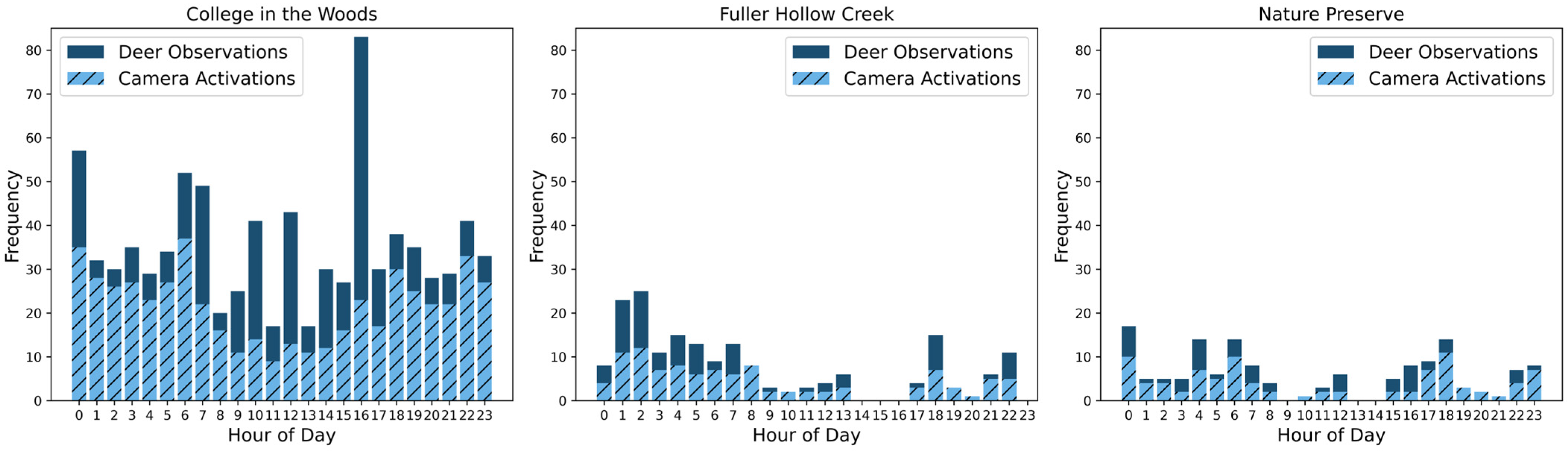
  10. Lynch, M.J.; Genco, L.J. Deer Slayers: Examining the Scope of and Arguments for and against Legal Deer Theriocide in the US. Sustainability 2023, 15, 5987. [Google Scholar] [CrossRef]
  11. VerCauteren, K. The Deer Boom: Discussions on Population Growth and Range Expansion of the White-Tailed Deer. United States Department of Agriculture Wildlife Services: Staff Publications. 2003. Available online: https://digitalcommons.unl.edu/cgi/viewcontent.cgi?article=1276&context=icwdm_usdanwrc (accessed on 6 October 2024).
  12. Hewitt, D.G. (Ed.) Biology and Management of White-Tailed Deer; CRC Press: Boca Raton, FL, USA, 2011; ISBN 978-0-429-07875-0. [Google Scholar]
  13. Curtis, P.D.; Sullivan, K.L. White-Tailed Deer, Wildlife Damage Management Fact Sheet Series. Available online: https://deeradvisor.dnr.cornell.edu/sites/default/files/resources/White-tailed%20Deer.pdf (accessed on 5 October 2025).
  14. Staudenmaier, A.R.; Shipley, L.A.; Camp, M.J.; Forbey, J.S.; Hagerman, A.E.; Brandt, A.E.; Thornton, D.H. Mule Deer Do More with Less: Comparing Their Nutritional Requirements and Tolerances with White-Tailed Deer. J. Mammal. 2022, 103, 178–195. [Google Scholar] [CrossRef]
  15. Lichtenauer, C.; Heby, E.; Halper, N. An Economic Assessment of the Impacts of White-Tailed Deer Overabundance in Town of Hamilton, New York; Upstate Institute Student Research: Hamilton, NY, USA, 2013; Paper 10. [Google Scholar]
  16. Pakula, C.J.; D’Angelo, G.J.; Mowrer, A.; Rhodes, O.E.; DeVault, T.L. Caught in Headlights: Captive White-Tailed Deer Responses to Variations in Vehicle Lighting during Imminent Collision Scenarios. Appl. Anim. Behav. Sci. 2025, 287, 106652. [Google Scholar] [CrossRef]
  17. Reed, S.P.; Royo, A.A.; Fotis, A.T.; Knight, K.S.; Flower, C.E.; Curtis, P.S. The Long-Term Impacts of Deer Herbivory in Determining Temperate Forest Stand and Canopy Structural Complexity. J. Appl. Ecol. 2022, 59, 812–821. [Google Scholar] [CrossRef]
  18. Yates, M.; Scheyett, A.; Hand, L. Bite-Sized Damage, Big-Time Stress: Deer Pressure in Cotton Is Relentless. Available online: https://www.researchgate.net/profile/Lavesta-Hand/publication/398655377_Bite-sized_Damage_Big-time_Stress_Deer_Pressure_in_Cotton_is_Relentless/links/694081cc0c98040d481e1da4/Bite-sized-Damage-Big-time-Stress-Deer-Pressure-in-Cotton-is-Relentless.pdf (accessed on 12 February 2026).
  19. Laurent, L.; Mårell, A.; Balandier, P.; Holveck, H.; Saïd, S. Understory Vegetation Dynamics and Tree Regeneration as Affected by Deer Herbivory in Temperate Hardwood Forests. iForest—Biogeosci. For. 2017, 10, 837–844. [Google Scholar] [CrossRef]
  20. Harada, K.; Ang Meng Ann, J.; Suzuki, M. Legacy Effects of Sika Deer Overpopulation on Ground Vegetation and Soil Physical Properties. For. Ecol. Manag. 2020, 474, 118346. [Google Scholar] [CrossRef]
  21. McShea, W.J. Ecology and Management of White-Tailed Deer in a Changing World. Ann. N. Y. Acad. Sci. 2012, 1249, 45–56. [Google Scholar] [CrossRef] [PubMed]
  22. Ballard, K.; Bone, C. Exploring Spatially Varying Relationships between Lyme Disease and Land Cover with Geographically Weighted Regression. Appl. Geogr. 2021, 127, 102383. [Google Scholar] [CrossRef]
  23. Pandey, A.; Feuka, A.B.; Cosgrove, M.; Moriarty, M.; Duffiney, A.; VerCauteren, K.C.; Iii, H.C.; Pepin, K.M. Wildlife Vaccination Strategies for Eliminating Bovine Tuberculosis in White-Tailed Deer Populations. PLoS Comput. Biol. 2024, 20, e1011287. [Google Scholar] [CrossRef]
  24. Jack, A.R.; Sansom, W.C.; Wolf, T.M.; Zhang, L.; Schultze, M.L.; Wells, S.J.; Forester, J.D. Assessment of Mammalian Scavenger and Wild White-Tailed Deer Activity at White-Tailed Deer Farms. Viruses 2025, 17, 1024. [Google Scholar] [CrossRef]
  25. O’Brien, D.J.; Thacker, T.C.; Salvador, L.C.M.; Duffiney, A.G.; Robbe-Austerman, S.; Camacho, M.S.; Lombard, J.E.; Palmer, M.V. The Devil You Know and the Devil You Don’t: Current Status and Challenges of Bovine Tuberculosis Eradication in the United States. Ir. Vet. J. 2023, 76, 16. [Google Scholar] [CrossRef]
  26. Roome, A.; Hill, L.; Al-Feghali, V.; Murnock, C.G.; Goodsell, J.A.; Spathis, R.; Garruto, R.M. Impact of White-Tailed Deer on the Spread of Orrelia Burgdorferi. Med. Vet. Entomol. 2017, 31, 1–5. [Google Scholar] [CrossRef] [PubMed]
  27. CDC. Lyme Disease Surveillance and Data. Available online: https://www.cdc.gov/lyme/data-research/facts-stats/index.html (accessed on 23 April 2025).
  28. Sudharsan, K.; Riley, S.J.; Winterstein, S.R. Relationship of Autumn Hunting Season to the Frequency of Deer-Vehicle Collisions in Michigan. J. Wildl. Manag. 2006, 70, 1161–1164. [Google Scholar] [CrossRef]
  29. Bissonette, J.A.; Kassar, C.A.; Cook, L.J. Assessment of Costs Associated with Deer–Vehicle Collisions: Human Death and Injury, Vehicle Damage, and Deer Loss. Hum.-Wildl. Confl. 2008, 2, 17–27. [Google Scholar]
  30. Mayer, M.; Coleman Nielsen, J.; Elmeros, M.; Sunde, P. Understanding Spatio-Temporal Patterns of Deer-Vehicle Collisions to Improve Roadkill Mitigation. J. Environ. Manag. 2021, 295, 113148. [Google Scholar] [CrossRef]
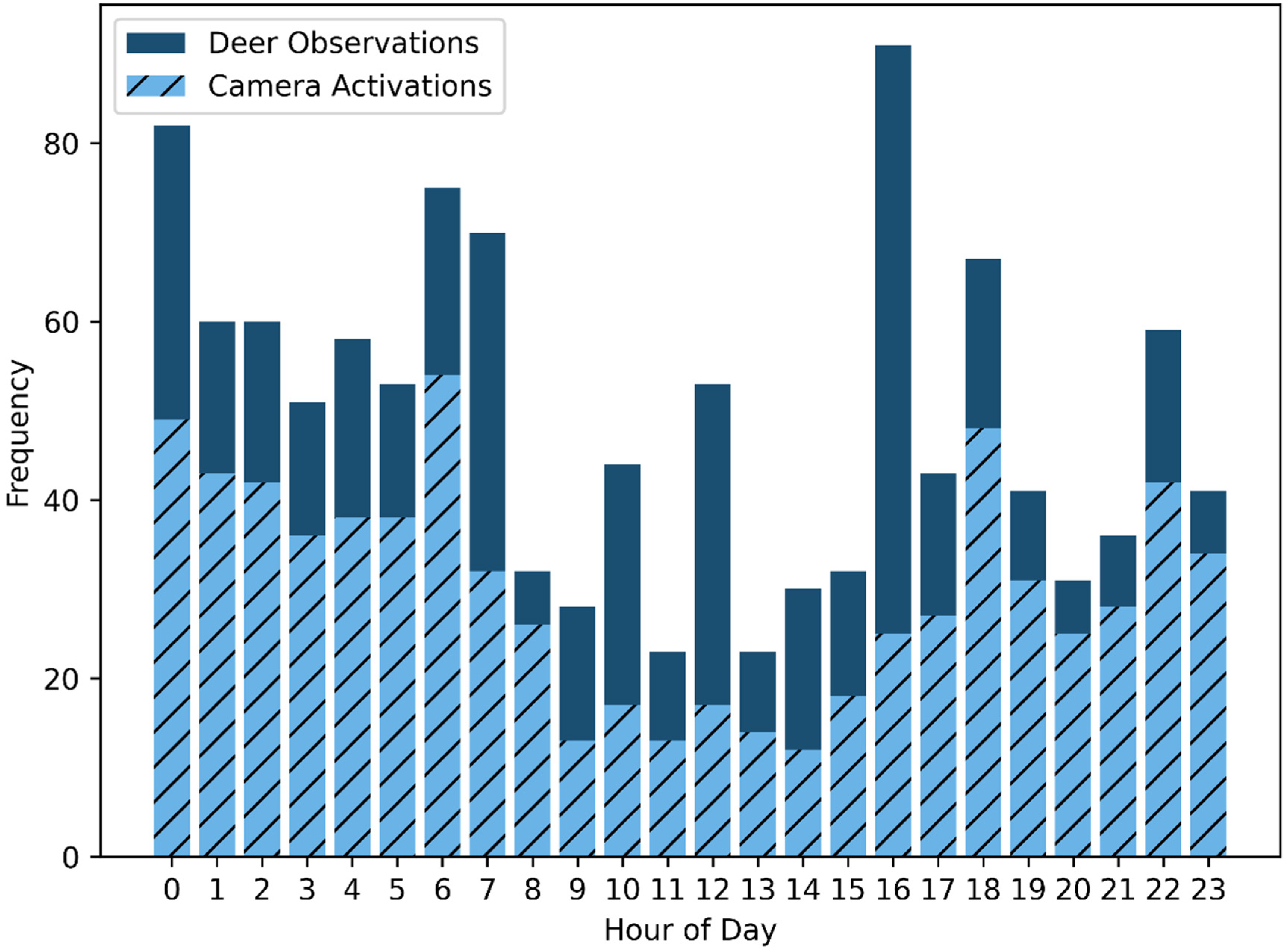
  31. Roberts, C.W.; Pierce, B.L.; Braden, A.W.; Lopez, R.R.; Silvy, N.J.; Frank, P.A.; Ransom, D., Jr. Comparison of Camera and Road Survey Estimates for White-Tailed Deer. J. Wildl. Manag. 2006, 70, 263–267. [Google Scholar] [CrossRef]
  32. Webb, S.L.; Gee, K.L.; Strickland, B.K.; Demarais, S.; DeYoung, R.W. Measuring Fine-Scale White-Tailed Deer Movements and Environmental Influences Using GPS Collars. Int. J. Ecol. 2010, 2010, 459610. [Google Scholar] [CrossRef]
  33. Anderson, C.W.; Nielsen, C.K.; Hester, C.M.; Hubbard, R.D.; Stroud, J.K.; Schauber, E.M. Comparison of Indirect and Direct Methods of Distance Sampling for Estimating Density of White-Tailed Deer. Wildl. Soc. Bull. 2013, 37, 146–154. [Google Scholar] [CrossRef]
  34. McMahon, M.C.; Ditmer, M.A.; Forester, J.D. Comparing Unmanned Aerial Systems with Conventional Methodology for Surveying a Wild White-Tailed Deer Population. Wildl. Res. 2021, 49, 54–65. [Google Scholar] [CrossRef]
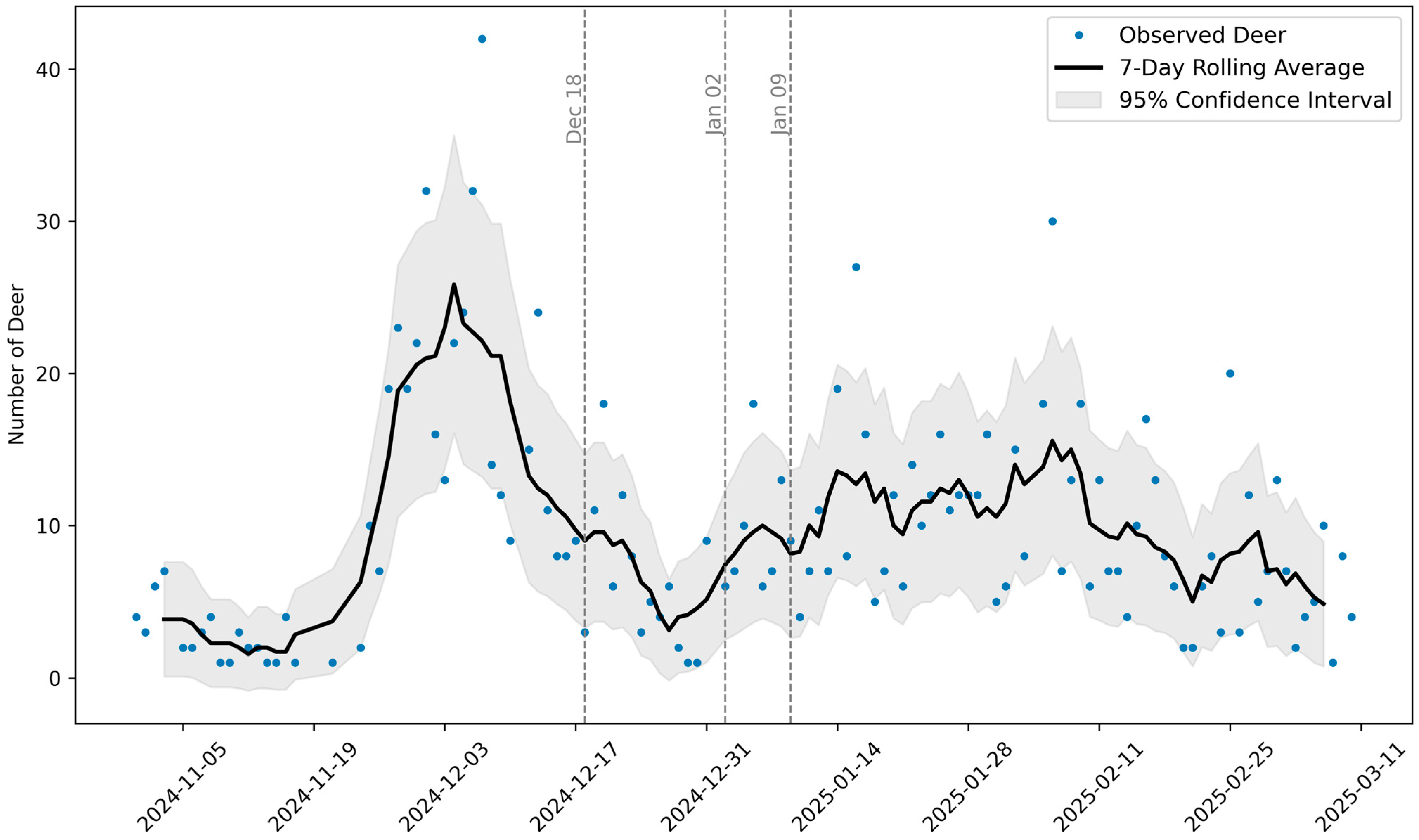
  35. Preston, T.M.; Wildhaber, M.L.; Green, N.S.; Albers, J.L.; Debenedetto, G.P. Enumerating White-Tailed Deer Using Unmanned Aerial Vehicles. Wildl. Soc. Bull. 2021, 45, 97–108. [Google Scholar] [CrossRef]
  36. Larsen, H.L.; Møller-Lassesen, K.; Enevoldsen, E.M.E.; Madsen, S.B.; Obsen, M.T.; Povlsen, P.; Bruhn, D.; Pertoldi, C.; Pagh, S. Drone with Mounted Thermal Infrared Cameras for Monitoring Terrestrial Mammals. Drones 2023, 7, 680. [Google Scholar] [CrossRef]
  37. Zabel, F.; Findlay, M.A.; White, P.J.C. Assessment of the Accuracy of Counting Large Ungulate Species (Red Deer Cervus Elaphus) with UAV-Mounted Thermal Infrared Cameras during Night Flights. Wildl. Biol. 2023, 2023, e01071. [Google Scholar] [CrossRef]
  38. Münzinger, M.; Prechtel, N.; Behnisch, M. Mapping the Urban Forest in Detail: From LiDAR Point Clouds to 3D Tree Models. Urban For. Urban Green. 2022, 74, 127637. [Google Scholar] [CrossRef]
  39. Pfeffer, D.G.; Foster, J.A.; Kinsey, J.C. Using Unmanned Aerial Vehicles Equipped with Thermal Cameras to Survey a Known Population of White-Tailed Deer. J. Fish Wildl. Manag. 2024, 15, 283–288. [Google Scholar] [CrossRef]
  40. Macaulay, L.T.; Sollmann, R.; Barrett, R.H. Estimating Deer Populations Using Camera Traps and Natural Marks. J. Wildl. Manag. 2020, 84, 301–310. [Google Scholar] [CrossRef]
  41. Palencia, P.; Rowcliffe, J.M.; Vicente, J.; Acevedo, P. Assessing the Camera Trap Methodologies Used to Estimate Density of Unmarked Populations. J. Appl. Ecol. 2021, 58, 1583–1592. [Google Scholar] [CrossRef]
  42. Larrucea, E.S.; Brussard, P.F.; Jaeger, M.M.; Barrett, R.H. Cameras, Coyotes, and the Assumption of Equal Detectability. J. Wildl. Manag. 2007, 71, 1682–1689. [Google Scholar] [CrossRef]
  43. Nakashima, Y.; Fukasawa, K.; Samejima, H. Estimating Animal Density without Individual Recognition Using Information Derivable Exclusively from Camera Traps. J. Appl. Ecol. 2018, 55, 735–744. [Google Scholar] [CrossRef]
  44. Nakashima, Y.; Yajima, G.; Matsuoka, R. Reducing Data Processing Effort in Camera Trap Density Estimation: Extending the REST Model by Explicitly Modelling Animal Detection Processes. Methods Ecol. Evol. 2026; Early View. [Google Scholar] [CrossRef]
  45. Wiegers, J.N.; Richard-Hansen, C.; Blok, J.E.; van der Kuil, R.; Gradoz, M.; van Kuijk, M. Can We Count You: Validating Density Estimation Methods for Unmarked Wildlife with Camera Traps. Biodivers. Conserv. 2025, 34, 255–270. [Google Scholar] [CrossRef]
  46. Flora and Fauna—Nature Preserve | Binghamton University. Available online: https://www.binghamton.edu/nature-preserve/flora-funa/index.html (accessed on 24 March 2025).
  47. Horvath, D.; Parisio, M. Deer Management Plan–Binghamton University. Available online: https://www.binghamton.edu/nature-preserve/docs/deer-management-rationale.pdf (accessed on 4 September 2024).
  48. Miller, K.V.; DeYoung, R.W. White-Tailed Deer Behavior. In Biology and Management of White-Tailed Deer; CRC Press: Boca Raton, FL, USA, 2011; ISBN 978-0-429-07875-0. [Google Scholar]
  49. Higdon, S.D.; Diggins, C.A.; Cherry, M.J.; Ford, W.M. Activity Patterns and Temporal Predator Avoidance of White-Tailed Deer (Odocoileus virginianus) during the Fawning Season. J. Ethol. 2019, 37, 283–290. [Google Scholar] [CrossRef]
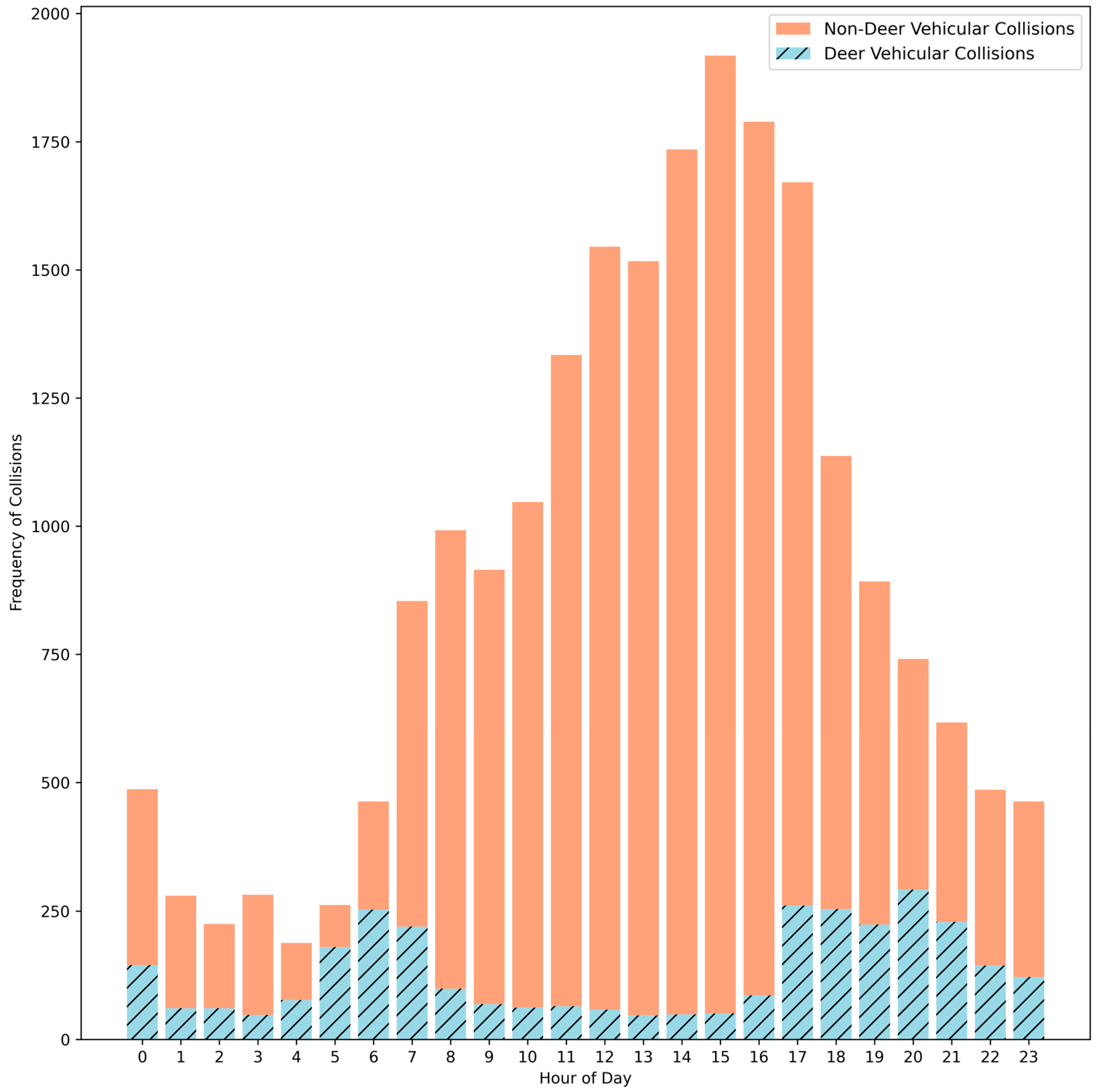
  50. Stewart, J.L.; Shipley, C.F.; Ellerbrock, R.E.; Schmidt, L.; Lima, F.S.; Canisso, I.F. Physiological Variations in Reproductive and Metabolic Features of White-Tailed Deer (Odocoileus virginianus) Bucks throughout the Rutting Season. Theriogenology 2018, 114, 308–316. [Google Scholar] [CrossRef]
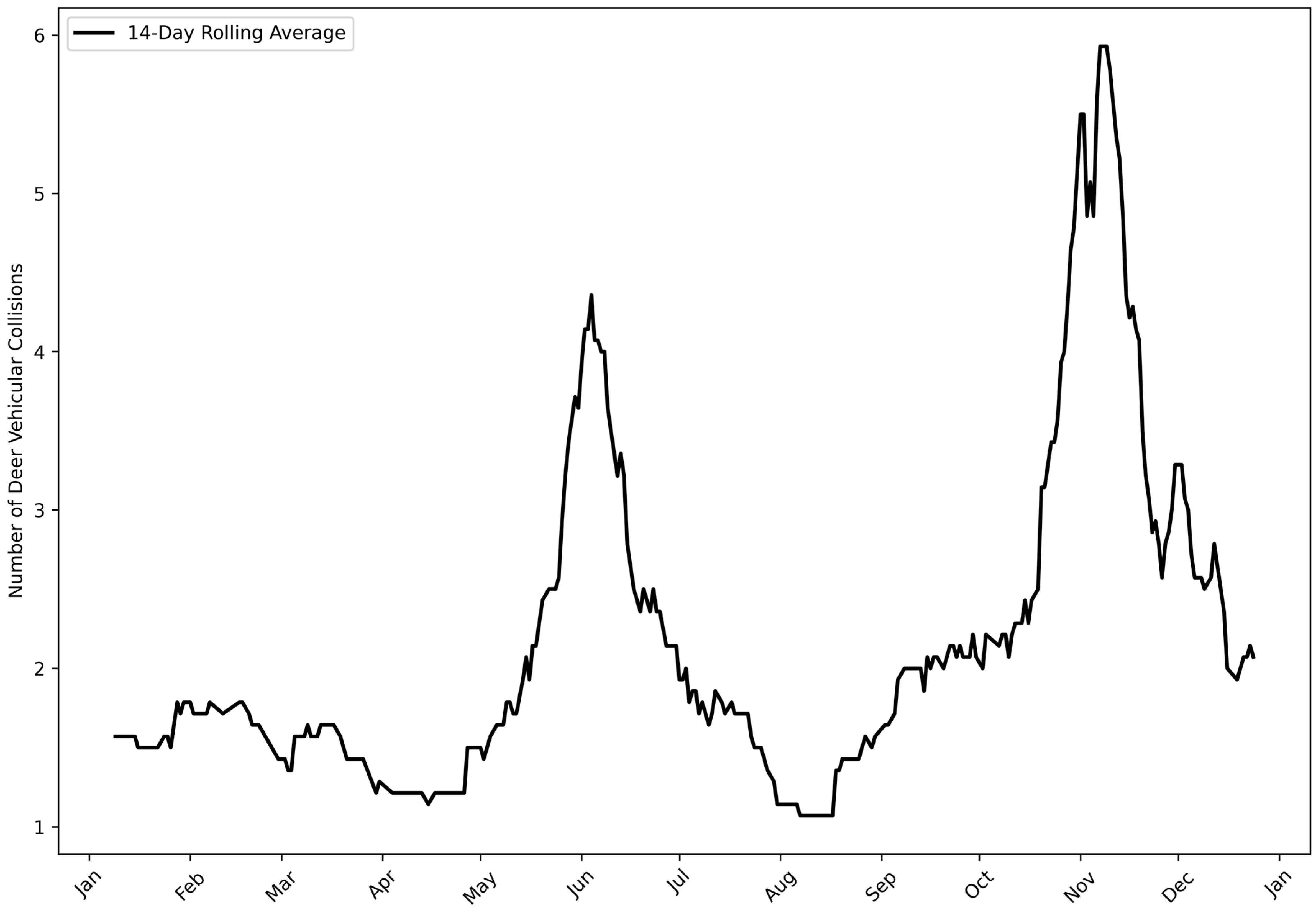
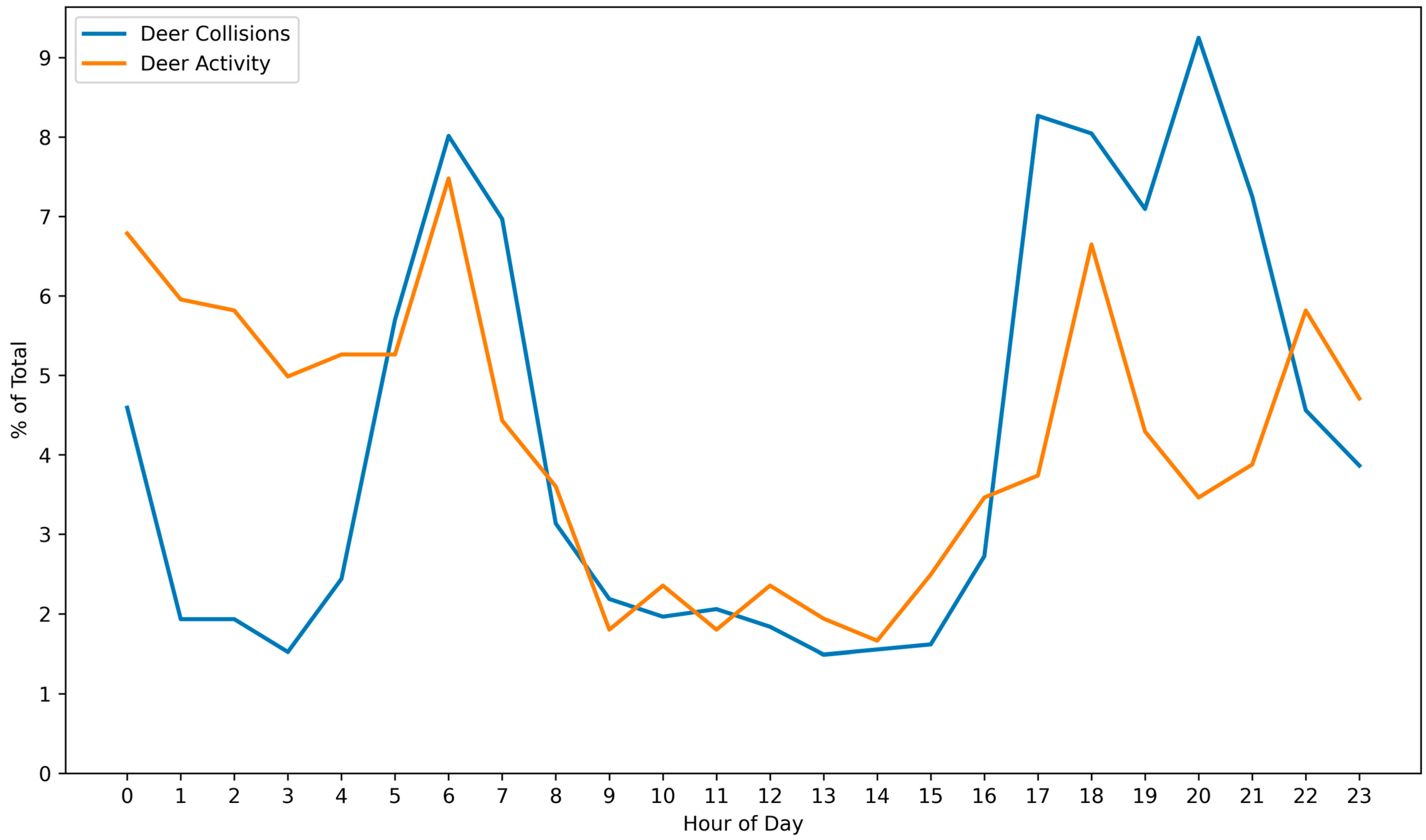
  51. Gilbertson, M.L.J.; Ketz, A.C.; Hunsaker, M.; Jarosinski, D.; Ellarson, W.; Walsh, D.P.; Storm, D.J.; Turner, W.C. Agricultural Land Use Shapes Dispersal in White-Tailed Deer (Odocoileus virginianus). Mov. Ecol. 2022, 10, 43. [Google Scholar] [CrossRef]
  52. Ciuti, S.; Northrup, J.M.; Muhly, T.B.; Simi, S.; Musiani, M.; Pitt, J.A.; Boyce, M.S. Effects of Humans on Behaviour of Wildlife Exceed Those of Natural Predators in a Landscape of Fear. PLoS ONE 2012, 7, e50611. [Google Scholar] [CrossRef]
  53. D’Eon, R.G. Using Snow-Track Surveys to Determine Deer Winter Distribution and Habitat. Wildl. Soc. Bull. 2001, 29, 879–887. [Google Scholar]
  54. Newmark, W.; Rickart, E. High-Use Movement Pathways and Habitat Selection by Ungulates. Mamm. Biol.—Z. Säugetierkunde 2012, 77, 293–298. [Google Scholar] [CrossRef]
  55. Horsley, S.B.; Stout, S.L.; deCalesta, D.S. White-Tailed Deer Impact on the Vegetation Dynamics of a Northern Hardwood Forest. Ecol. Appl. 2003, 13, 98–118. [Google Scholar] [CrossRef]
  56. Nagy, C.; Ng, C.; Veverka, N.; Weckel, M. Assessment of a 15-Year White-Tailed Deer Management Program and Woody Recovery in a Suburban Forest Preserve. For. Ecol. Manag. 2022, 503, 119748. [Google Scholar] [CrossRef]
Figure 1. A diagram representing the estimated total White-tailed Deer (WTD) population across North America from 1500 to the present (2025). Time stamps are marked to represent significant organizations, legislation, and events that contributed to substantial increases and decreases in WTD populations.
Remotesensing 18 00690 g001
Figure 2. The defined study area within the forested regions of Binghamton University, encompassing a total of 1.23 km2. The area is subdivided into the three distinct regions: (1) the Nature Preserve (NP—0.75 km2) highlighted in lavender, (2) College-in-the-Woods (CIW—0.26 km2) marked in blue, and (3) Fuller Hollow Creek (FHC—0.22 km2) denoted in green. Trail camera locations (trail camera icons) and observed deer trails (orange lines) have been denoted throughout the study environment.
Remotesensing 18 00690 g002
Figure 3. Trail camera locations and labels (16) across the study area. Each camera was strap-mounted to a tree at approximately 5 ft (~1.5 m) and equipped with a 48 MP RGB sensor for daytime captures and an infrared (IR) sensor for nighttime captures. Supplemental power was provided via a 5″ × 3″ solar panel connected by USB-C, allowing for continuous operation.
Remotesensing 18 00690 g003
Figure 4. Example RGB image captured by a trail camera. For both RGB and infrared (IR) captures, metadata included current battery level, moon phase, ambient temperature (°C/°F), date, and time, providing context for WTD activity and environmental conditions.
Remotesensing 18 00690 g004
Figure 5. Preprogrammed UAV flight paths over the adjacent College-in-the-Woods (CIW) and Nature Preserve (NP) regions. Each flight path is labeled according to its region: CIW—VailakisCIW (0.14 km2), Western NP—VailakisNaturePreserve1 (0.38 km2), and Southeastern NP—VailakisNaturePreserve2 (0.37 km2). Flight transects were color-coded by elevation, ranging from red (highest elevation) through orange and yellow to blue and purple (lowest elevation). Thermal infrared (IR) imagery of WTD, denoted as “Representative Thermal Frames,” was captured using a black–gray–white–red color scheme to enhance contrast, as illustrated in the top-right panel.
Remotesensing 18 00690 g005
Figure 6. Example semi-automated UAV thermal (left) and RGB (right) video frame capture, showing a White-tailed Deer partially concealed beneath forest canopy. Semi-automated flights employed pre-programmed flight paths that were manually interrupted to manually inspect suspect thermal signatures in real time.
Remotesensing 18 00690 g006
Figure 7. Geolocated WTD tracks identified using ESRI’s QuickCapture (v1.20.22) mobile application throughout the study period. Snowy and muddy conditions facilitated detection by providing clear evidence of recent activity. Positional accuracy of mapped trails was estimated at 10–20 ft.
Remotesensing 18 00690 g007
Figure 8. Spatial distribution of WTD derived from 84 UAV thermal representative frames collected across 40 flights (n = 196 observations). Symbol size and color intensity (bright yellow to dark red) indicate the number of deer detected per frame, with smaller, brighter symbols representing smaller group sizes and larger, darker symbols representing larger group sizes. The highest concentrations of WTD occurred in CIW (mean = 1.93 ± 1.03 SD; max = 5) and southeastern NP (mean = 3.09 ± 2.43 SD; max = 10), where deer were repeatedly observed at similar locations across multiple flights; whereas the western NP (mean = 1.64 ± 0.90 SD; max = 4) illustrated smaller WTD group sizes.
Remotesensing 18 00690 g008
Figure 9. UAV-derived kernel density (a) and digital elevation modeling (DEM) profiling (b) spatial distribution patterns of WTD across both CIW and NP generated in ArcGIS Pro v3.4. In image (a), circular symbol size and color intensity (white to dark blue) represent observed group sizes, while light-to-dark blue shaded zones indicate deer density, with darker areas corresponding to higher concentrations. In image (b), deer density is displayed using a blue-to-red color scale (low to high), overlaid on terrain elevation represented by a green-to-white color gradient (lowest to highest elevation, respectively). Pronounced concentrations of WTD occurred in the CIW and southeastern NP, whereas the western section of the NP was dominated by solitary individuals or small groups, reflecting spatial variation in deer presence and social organization.
Remotesensing 18 00690 g009
Figure 10. Hourly WTD activity patterns across individual camera locations (1–6) throughout the study period. Camera locations and naming conventions corresponding to Figure 3. Each panel displays total camera activations (hatched blue bars) and total deer observations (solid navy bars) per hour, aggregated across all study days. Cameras 1 and 2 recorded the highest activity (269 and 257 activations, respectively) with pronounced bimodal crepuscular peaks, while Cameras 4 and 6 exhibited minimal detections (10 and 19 activations) with no discernible temporal patterns.
Remotesensing 18 00690 g010
Figure 11. Using trail camera data, hourly WTD activity patterns were monitored across each individual study region over the 130-day study period. Each panel shows camera activations (hatched blue bars) and total deer observations (solid navy bars) per hour for College-in-the-Woods (n = 2 cameras, 526 activations, 855 observations), and Fuller Hollow Creek (n = 2 cameras, 104 activations, 183 observations), and Nature Preserve (n = 2 cameras, 92 activations, 145 observations).
Remotesensing 18 00690 g011
Figure 12. Aggregated hourly WTD activity patterns across all trail cameras (n = 6) and study regions throughout the 130-day monitoring period. Hatched blue bars represent total camera activations per hour (n = 722 total triggers), while solid navy bars show total deer observations (n = 1183 WTD observations). Activity exhibits a pronounced bimodal crepuscular pattern with peaks during twilight hours, and minimal activity during midday hours (0800–1500 h).
Remotesensing 18 00690 g012
Figure 13. Total daily WTD observations from trail cameras across the study period in relation to three culling events (marked by gray vertical dashed lines). Raw observation counts (blue points) represent the total daily number of deer detected across all cameras. The black solid line represents a 7-day rolling average applied to smooth short-term fluctuations and reveal underlying temporal trends in deer activity. Shaded regions indicate a 95% confidence envelope derived using a Poisson error assumption (estimated as N   ± 1.96   N where N is the expected number of WTD per day).
Remotesensing 18 00690 g013
Figure 14. Comparison of 2018–2023 Broome County DVCs vs. nDVCs. Of 24,997 total collisions, nDVCs comprised 87.37% (21,839) and DVCs 12.63% (3158). The two collision types exhibited contrasting hourly patterns: nDVCs peaked at 1500 h (8.78% risk), whereas DVCs peaked at 2000 h (9.25% risk), highlighting elevated DVC risk during low-light periods.
Remotesensing 18 00690 g014
Figure 15. Daily DVCs recorded in Broome County, NY, during 2023, aggregated over a 24-day rolling average. Collision frequency peaked between October and January (mean = 3.28 DVCs/day), representing a 37% increase over summer levels (May–August: mean = 2.40 DVCs/day). The lowest rates occurred from January to May (mean = 1.48 DVCs/day), reflecting seasonal variations in DVC risk.
Remotesensing 18 00690 g015
Figure 16. Hourly comparison of normalized 2018–2023 DVC risk and trail camera-derived WTD activity. A moderate positive association was detected between deer activity and DVC frequency (Spearman ρ = 0.41, p = 0.044), indicating that periods of increased deer movement correspond with elevated collision risk. Both variables displayed crepuscular peaks during 0400–0800 and 1700–2200 h.
Remotesensing 18 00690 g016
Table 1. Trail camera data by site, including camera activations and White-tailed Deer (WTD) observations.
LocationTrail CameraTotal Camera
Activations
Total Deer
Observations
CIW1269469
2257386
FHC394166
41017
NP573119
61926
Table 2. Estimated WTD densities from UAV surveys using per-flight mission data.
College-in-the-Woods
(0.14 km 2)
DateMission DayDeer SpottedDensity (per km2)
17 October 2024217.14
7 November 20244214.29
13 November 20246428.57
14 November 2024717121.43
19 November 20248321.43
20 November 202491071.43
26 November 202410857.14
6 December 202411750.00
Median CIW Density39.29
Nature Preserve 1 (0.38 km2)6 November 2024312.632
6 November 2024325.263
14 November 202471128.95
19 November 20248718.42
20 November 20249513.16
10 December 2024121026.32
Median NP1 Density15.79
Nature Preserve 2
(0.37 km2)
20 November 20249718.92
6 December 2024111540.54
10 December 2024123286.49
13 December 20241312.70
3 February 2025171232.43
5 February 2025182875.68
11 February 20251912.70
26 February 20252025.41
3 March 202521924.32
4 March 20252212.70
Median NP2 Density21.62
Table 3. Estimated WTD densities from UAV surveys using per-mission-day cumulative average.
Mission Day Date Location(s) Deer Spotted Density (km2)
2 17 October 2024College in the Woods17.14
3 6 November 2024Nature Preserve 137.90
4 7 November 2024College in the Woods214.29
6 13 November 2024Nature Preserve 1, College in the Woods47.69
7 14 November 2024Nature Preserve 1, College in the Woods2853.85
8 19 November 2024Nature Preserve 1, College in the Woods1019.23
9 20 November 2024Nature Preserve 1, Nature Preserve 2, College in the Woods2224.72
10 26 November 2024College in the Woods857.14
11 6 December 2024Nature Preserve 2, College in the Woods2243.14
12 10 December 2024Nature Preserve 2, College in the Woods4256.00
13 13 December 2024Nature Preserve 212.70
17 3 February 2025Nature Preserve 1, Nature Preserve 21216.00
18 5 February 2025Nature Preserve 1, Nature Preserve 2, College in the Woods2831.46
19 11 February 2025Nature Preserve 1, Nature Preserve 211.33
20 26 February 2025Nature Preserve 1, Nature Preserve 2, College in the Woods22.25
21 3 March 2025Nature Preserve 1, Nature Preserve 2912.00
22 4 March 2025Nature Preserve 2, College in the Woods11.96
Median Density 14.29
Table 4. Estimated deer densities from the dual REST model approach, incorporating a 30-s staying-time interval to correct for the trail camera lockout period.
Weighted Staying TimeFrequency of Camera
Activations Density (km2)
Frequency of Deer
Observations Density (km2)
124.3213.1821.60
129.3213.7122.47
134.3214.2423.36
139.3214.7724.20
144.3215.3025.07
149.3215.8325.94
154.3216.3626.81
Table 5. Herd size and average staying time of WTD within the trail camera detection zones.
Herd SizeTotal ObservationsAverage Staying Time (Sec)
147380.04
2148214.81
346184.63
432263.56
5892.00
65247.80
7519.60
83170.67
91558.00
10141.00
Weighted Average Staying Time124.32
Disclaimer/Publisher’s Note: The statements, opinions and data contained in all publications are solely those of the individual author(s) and contributor(s) and not of MDPI and/or the editor(s). MDPI and/or the editor(s) disclaim responsibility for any injury to people or property resulting from any ideas, methods, instructions or products referred to in the content.