Article

A New Model Incorporating Soil–Vegetation Interaction Scattering for Improving SAR-Based Soil Moisture Retrieval in Croplands

1
Faculty of Land Resources Engineering, Kunming University of Science and Technology, Kunming 650093, China
2
Yunnan Key Laboratory of Quantitative Remote Sensing, Kunming 650093, China
3
Yunnan International Joint Laboratory for Integrated Sky-Ground Intelligent Monitoring of Mountain Hazards, Kunming 650093, China
*
Author to whom correspondence should be addressed.
Remote Sens. 2026, 18(5), 673; https://doi.org/10.3390/rs18050673
Submission received: 5 January 2026 / Revised: 8 February 2026 / Accepted: 15 February 2026 / Published: 24 February 2026
(This article belongs to the Special Issue Remote Sensing of Agricultural Water Resources)

Highlights

What are the main findings?
  • Soil–vegetation interaction scattering is identified as a critical component of total vegetation forward scattering.
  • A new semi-empirical model is proposed to parameterize vegetation effects on radar backscattering.
What are the implications of the main findings?
  • Soil moisture retrieval in areas with varying vegetation cover should explicitly account for soil–vegetation interaction scattering to avoid systematic bias in SAR-based estimates.
  • The accuracy of radar backscatter simulation and subsequent soil moisture retrieval is strongly influenced by surface conditions and by the relative contributions of different polarization channels, highlighting the need for polarization-aware modeling strategies.

Abstract

The Water Cloud Model (WCM) provides a simple and effective framework for quantifying vegetation canopy absorption and scattering components and has been widely applied to active microwave-based soil moisture retrieval on vegetated areas. However, under conditions of dense vegetation, the WCM neglects soil–vegetation interaction scattering, which limits its retrieval accuracy. To mitigate this limitation, this study analyzes the active microwave radiative transfer process under vegetated conditions and proposes an approach to explicitly quantify soil–vegetation interaction scattering by incorporating the first-order soil–vegetation-scattering component into the WCM, thereby enhancing the performance of the WCM at high vegetation coverage. The effectiveness of the proposed model is validated using in situ observations from three study areas with different vegetation characteristics: (a) a pure farmland area, (b) a mixed landscape with small forest and shrubland patches and large cropland areas, and (c) a mixed landscape with large forest and shrubland patches and small cropland areas. Data from 2020–2022 were used for model training and parameter calibration, while independent datasets from 2023 and 2024 were employed to validate the model performance. In both the model training and validation phases, the proposed model improved the soil moisture retrieval accuracy across all study areas while exhibiting slight differences in the backscatter simulation performance. During the model training period, the root-mean-square error (RMSE) between simulated and measured backscatter in study area (a) increased slightly by 1.9%, whereas it decreased by 2.79% and 2.0% in study areas (b) and (c), respectively. In terms of soil moisture retrieval, the RMSEs in study areas (a), (b), and (c) decreased by 6.66%, 1.18%, and 6.03%, respectively. In the validation experiments, for the year 2023, the RMSEs of simulated versus observed backscatter in study areas (a), (b), and (c) were reduced by 9.6%, 1.51%, and 4.35%, respectively, while the corresponding soil moisture retrieval RMSEs decreased by 12.6%, 4.53%, and 7.24%. For the year 2024, the backscatter RMSE in study area (a) increased by 6.07%, whereas it decreased by 2.17% and 6.47% in study areas (b) and (c), respectively; meanwhile, the soil moisture retrieval RMSEs were reduced by 2.81%, 3.69%, and 9.45%, respectively. In summary, this study improves the accuracy of active microwave remote sensing-based soil moisture retrieval in areas with different vegetation cover by explicitly quantifying soil–vegetation interaction scattering.

1. Introduction

Soil moisture is a fundamental state variable controlling energy and water fluxes between terrestrial ecosystems and the atmosphere. By directly influencing processes such as evapotranspiration, runoff generation, precipitation redistribution, and water infiltration, soil moisture plays a crucial role in the hydrological cycle [1,2,3,4,5]. Soil moisture conditions not only affect crop yield and agricultural management but also closely relate to regional drought monitoring and water resource allocation. Therefore, the accurate long-term and large-scale monitoring of soil moisture is of significant scientific importance and practical value. Although traditional ground-based observation methods provide high accuracy, they are constrained by sparse spatial coverage, high costs, and limited capabilities for large-area monitoring, making it difficult to meet the requirements of regional and global soil moisture dynamics observation. In recent years, satellite-based soil moisture retrieval studies have made substantial progress, leading to the development of soil moisture climate datasets with global seamless coverage, long-term temporal continuity, and high stability, which provide a critical data foundation for climate change analysis and hydrological process studies [6].
Remote sensing technology, particularly Synthetic Aperture Radar (SAR), has become an important tool for soil moisture retrieval owing to its active microwave imaging capability and its ability to operate under all-day and all-weather conditions. Active microwave remote sensing estimates soil moisture by establishing a relationship between the radar backscatter coefficient and the soil dielectric constant. Previous studies have employed time-series satellite SAR data (e.g., Sentinel-1, RADARSAT, and ALOS) to retrieve vegetation descriptors and biophysical parameters [7,8,9,10]. However, SAR backscatter is strongly influenced by surface conditions, including topographic factors (slope and aspect), surface roughness (characterized by root-mean-square height and correlation length), vegetation properties (structure and water content), and soil characteristics (texture, moisture, and salinity) [11,12,13,14]. To address the highly nonlinear relationship between SAR signals and soil moisture, machine learning approaches have been widely applied to soil moisture retrieval. However, systematic evaluations have shown that under limited training samples and evaluation scenarios that more closely resemble realistic global mapping conditions, the performance of existing methods degrades markedly in temporally and spatially independent validations, as well as in independent regional tests, indicating that their generalization capability remains limited [15]. To overcome these limitations, recent studies have incorporated transfer learning and domain adaptation strategies, among which the multi-scale domain adaptation (MSDA) approach has demonstrated the ability to retrieve soil moisture at 50 m resolution under extremely sparse in situ observations, with improved cross-regional robustness [16].
In vegetated areas, electromagnetic waves propagating through the canopy undergo attenuation, volume scattering, and soil–vegetation interaction scattering, leading to pronounced mixed effects from vegetation and soil scattering. This complex scattering behavior substantially increases the uncertainty of soil moisture retrieval, particularly for cross-polarization signals [10,17,18]. Accurately characterizing the influence of vegetation on radar signals and effectively separating the scattering contributions from soil and vegetation remain core scientific challenges for improving the accuracy of radar-based soil moisture retrieval. Cui et al. improved the Beer–Lambert law to more accurately quantify the attenuation of microwave signals by the vegetation layer [19]. Building upon existing microwave-scattering models, Xue W. and Dou Q. proposed a dual-component polarimetric decomposition method, in which three generalized volume-scattering models were incorporated into the decomposition framework, achieving improved accuracy in soil moisture retrieval [20,21]. In addition, the wavelength dependence of radar signals affects the dominant scattering mechanisms from soil and vegetation, further complicating the separation of contributions from each layer [22,23,24]. Long wavelengths, such as the L-band, exhibit strong vegetation penetration capability but are less sensitive to fine-scale canopy structures, resulting in limited information on canopy characteristics. In contrast, shorter wavelengths, such as the C-band, are better matched to the scale of leaves and small branches, enabling more effective characterization of the canopy structure [25]. Therefore, to investigate soil–vegetation interaction scattering, this study focuses on the C-band, which provides more detailed information about the vegetation canopy.
The Water Cloud Model (WCM) [26], a semi-empirical and semi-physical model, has been widely applied to soil moisture retrieval in agricultural and natural vegetation areas owing to its ability to represent the soil and vegetation scattering through a concise mathematical formulation. By incorporating parameters such as the vegetation optical thickness, transmissivity, and volume scattering, the WCM effectively describes the propagation and scattering of electromagnetic waves within the vegetation layer. Xing et al. proposed a ratio-based approach combined with the weather-independent radar vegetation index (RVI) to optimize the estimation of vegetation transmissivity, thereby enhancing the accuracy of soil moisture estimation [6]. Another widely used model is the Michigan Microwave Canopy Scattering (MIMICS) model proposed by Ulaby et al. (1990) [27], which is a physically based model designed to simulate scattering from vegetation and the underlying soil surface. However, due to its high complexity and the large number of required input parameters, MIMICS is less practical for operational applications than the WCM.
The WCM still faces several challenges in practical applications. First, key vegetation parameters are difficult to obtain through direct measurements and often need to be indirectly estimated using optical remote sensing indices, such as the normalized difference vegetation index (NDVI) [28], leaf area index (LAI) [29], and vegetation water content (VWC) [30], derived from optical bands. Second, many studies adopt a unified approach for model parameter calibration, which fails to fully account for the differences in the soil–vegetation-scattering mechanisms across different polarization channels. For instance, Attema [25] applied identical calibration parameters for both VV and VH polarizations, whereas Baghdadi [31] demonstrated that vegetation parameters differ significantly between polarizations. Third, in areas with medium-to-high vegetation cover, soil–vegetation interaction scattering contributes substantially to backscatter, particularly in VH polarization; if this contribution is not explicitly considered, the scattering intensity is often underestimated, leading to reduced soil moisture retrieval accuracy [32].
In summary, although the traditional WCM is widely used for vegetation-scattering simulation and soil moisture retrieval because of its simplicity and effectiveness, it still faces challenges, including difficulties in obtaining key parameters and inadequate representation of soil–vegetation interaction scattering. In this study, within the WCM framework, the NDVI is employed to parameterize the vegetation optical thickness and transmissivity, and vegetation coverage is incorporated to characterize the dynamic modulation of radar wave propagation by vegetation. Building on this framework, soil–vegetation interaction scattering is explicitly included in the improved model to enhance the accuracy of backscatter simulation and soil moisture retrieval.

2. Methods

2.1. Radar-Scattering Process Analysis

In vegetated areas, the WCM primarily characterizes vegetation volume scattering and soil surface scattering, while representing the vegetation-induced attenuation effect of radar waves using an exponential decay term, and the volume-scattering component mainly describes single or multiple random scattering processes occurring within the vegetation canopy, with the scattered energy originating solely from the vegetation medium itself and without interaction with the soil surface. However, it does not explicitly account for first-order soil–vegetation interaction scattering, arising from multiple interactions of radar waves between the soil and the vegetation layers. Consequently, its capability of describing backscattering mechanisms under complex vegetation conditions remains limited. To address this issue, this study systematically analyzes the physical processes of radar wave propagation, reflection, and re-scattering between the vegetation layer and soil surface within the WCM framework, explicitly considering multiple interaction scattering (Figure 1). Based on this analysis, interaction-scattering components are classified according to their respective scattering paths, and the corresponding mathematical formulations are derived and incorporated into an improved WCM. This enhancement provides a more comprehensive representation of backscattering mechanisms over vegetated surfaces and enhances the model’s ability to reproduce observed backscatter and its simulation accuracy.

2.2. Improvement of the Water Cloud Model

In the WCM, only soil surface scattering (Figure 1a) and vegetation volume scattering (Figure 1d) are considered:
σ t o t a l 0 = σ v e g 0 + L 2 σ s o i l 0
σ v e g 0 = A cos θ ( 1 L 2 )
L 2 = exp ( 2 τ / cos ( θ ) )
τ = b v w c
In the above expressions, σ t o t a l 0 represents the total backscatter, σ v e g 0 denotes the vegetation scattering, and σ s o i l 0 denotes the soil scattering. L2 is the two-way attenuation factor that accounts for radar signal penetration through the vegetation layer, τ represents the vegetation optical thickness, and θ is the incidence angle. Parameters A and b are empirical parameters associated with vegetation structural characteristics.
Based on the above model, this study incorporates the two soil–vegetation interaction-scattering paths represented by components (b) and (c) in Figure 1 to propose a Modified WCM (MWCM):
σ t o t a l 0 = σ v e g 0 + L 2 σ s o i l 0 + σ int 0
σ int 0 = 2 L ( 1 L 2 ) σ s o i l 0
The interaction scattering consists of two components, which occur simultaneously and are mathematically identical: (b) the radar signal first penetrates the vegetation layer, is reflected by the soil surface, and is subsequently scattered by the vegetation; (c) the radar signal is initially scattered within the vegetation layer, reaches the soil surface, and is then transmitted through the vegetation.

2.3. SAR Backscattering Modeling

To evaluate the accuracy of the proposed MWCM, we assumed that the surface parameters were known and used both the traditional WCM and the MWCM to simulate SAR backscatter. The simulated backscattering coefficients were then compared with satellite observations.
Specifically, we first employed the Mironov model [33] to simulate the soil dielectric constant under given soil moisture and texture conditions, which can be expressed as follows:
ε s = ε j ε
ε = ε d + ( ε b 1 ) m s , m s m s t ε d + ε b 1 m s t + ( ε u 1 ) ( m s m s t ) , m s > m s t
where ε s represents the dielectric constant of the soil, the real part of the dielectric constant (ε′) describes the energy storage and polarization capability of the medium, while the imaginary part (ε″) represents the dielectric and conductive losses. The “jε” term accounts for phase delay and energy attenuation. At C-band frequencies and under low-to-moderate soil moisture conditions, radar backscattering shows higher sensitivity to ε′ than to ε″. Consequently, only the real part of the dielectric constant is used in this study. Where ε b and ε u denote the dielectric constants of bound water and unbound water, respectively; ε d represents the dielectric constant of absolutely dry soil; m s is the volumetric soil moisture; and m s t is the maximum bound-water fraction. The parameter m s t is a function of the SAR frequency, soil texture (clay fraction), and soil moisture [33].
Next, the OH model [34] was used to simulate the intensity of soil backscattering based on the computed soil dielectric constant and surface roughness conditions:
σ v v 0 = g cos 3 θ Γ v ( θ ) + Γ h ( θ ) p
σ v h 0 = σ v v 0 q
g = 0.7 1 exp ( 0.65 ( k s ) 1.8
where σ v v 0 represents soil backscattering under VV polarization, σ v h 0 represents soil backscatter under VH polarization, h represents the vertical and horizontal polarization modes, s is the root-mean-square height, k is the radar wave number, and θ is the angle of incidence. p is a surface-related parameter, which is often related to the correlation length or surface structure, and q is an empirical factor, representing the proportional relationship between cross-polarization and co-polarization, depending on roughness and humidity. g is an empirical coefficient related to the surface roughness, wave number (k), and soil dielectric constant. Γ v θ and Γ h θ respectively represent the Fresnel reflectance at V and H polarizations.
Finally, both the traditional WCM and the proposed MWCM were applied to simulate the effect of vegetation and estimate the total backscattering under the given surface conditions. The simulated backscattering coefficients were then compared with satellite observations.

2.4. Soil Moisture Retrieval

To further demonstrate the advantages of the proposed model, soil moisture retrievals derived from the WCM and MWCM using satellite backscattering data were compared. However, before performing soil moisture retrieval, it is necessary to determine the empirical parameters of the WCM and MWCM, primarily the vegetation structure parameters (A, b) and the long-term soil roughness parameters ( s 0 ) [35]. Using the approach described in the previous section, we simulated backscattering based on ground-measured soil moisture data and compared the simulated total backscattering with satellite observations. The optimal model parameters were then calibrated by iteratively adjusting them to minimize the difference between simulated and observed backscattering [36]. The calibration produced is formulated as follows:
min C 1 ( A , b , s 0 ) = 1 2 p q = v v / v h i = 1 n ( σ mod _ p q 0 σ o b s _ p q 0 ) 2
Here, C 1 donates the cost function for parameter calibration, pq represents the polarization information, σ mod _ p q 0 is the model-simulated backscattering, and σ o b s _ p q 0 is the backscattering observed by the satellite.
After obtaining the optimal model parameters, the soil moisture is treated as unknown, and an iterative approach is employed to simultaneously estimate the soil moisture and surface roughness by minimizing the discrepancy between forward model simulations and satellite backscatter observation [36]:
min C 2 ( s m , s ) = p q = v v / v h ω σ mod _ p q 0 ( s m , s ) σ o b s _ p q 0 σ o b s _ p q 0 2 + ( 1 ω ) s s 0 s 0 2
In the equation, C 2 is the cost function for soil moisture retrieval, sm and s denote the retrieved instantaneous soil moisture and surface roughness, respectively, and ω is a weighting parameter, which is set to 0.5 in this study [36].

3. Results and Validation

3.1. Study Area and Data

3.1.1. Study Area

This study was conducted in the REMEDHUS soil moisture monitoring area in Spain (Table 1). The region is characterized by uneven precipitation distribution, primarily concentrated in spring and autumn, with pronounced drought conditions during the summer. The annual mean precipitation ranges from 350 to 500 mm, which is relatively low and reflects typical semi-arid characteristics. Due to the large spatiotemporal variability of the soil moisture, this area has been widely used as a test site for soil moisture observations and remote sensing retrieval experiments [37].
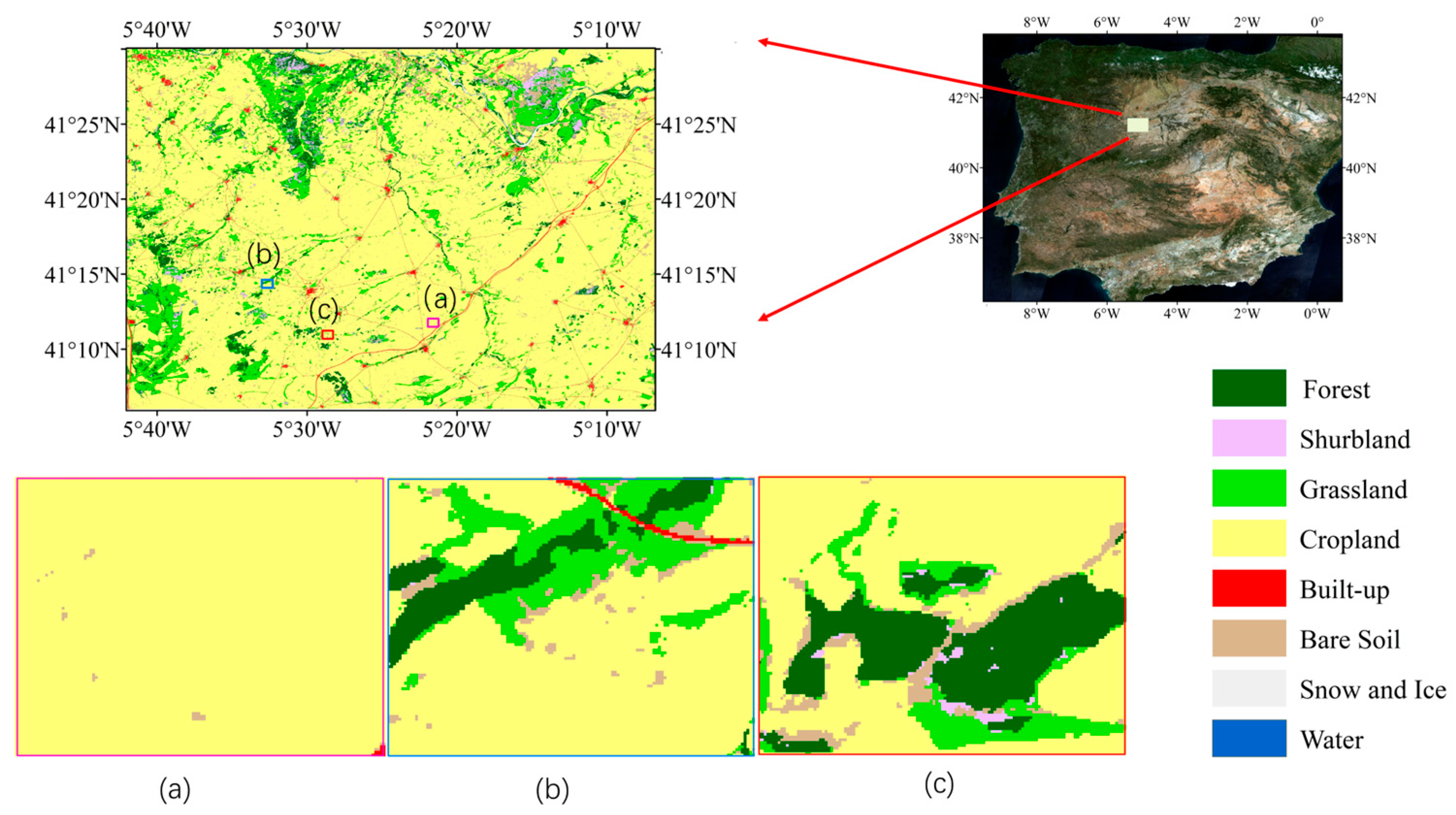
The WCM treats vegetation as an internally homogeneous scattering medium with a specific thickness, achieving relatively high accuracy over land surface types with uniform vegetation cover, such as croplands [26]. Therefore, a pure cropland area (Canizal) was selected as the primary study site. In addition, a small mixed-land-cover site consisting of forest, shrubland, and cropland (Zamarron), as well as a large mixed-land-cover site comprising forest, shrubland, and cropland (Las Bodegas), were selected to evaluate the effectiveness of the proposed method under heterogeneous land cover conditions. The geographic locations and land cover types of the three study sites are shown in Figure 2.

3.1.2. Data

Abba Aliyu Kasim’s study roughly classifies the existing methods for root-zone soil moisture (RZSM) retrieval into two categories: one estimates RZSM under known surface soil moisture (SSM) conditions, while the other directly estimates RZSM under unknown SSM conditions [38]. In this study, corresponding to the first category, data from 2020–2022 were used to jointly calibrate the key model parameters under known SSM conditions, and the RZSM was retrieved based on these parameters, making full use of multi-year observations to enhance the stability and representativeness of the parameter estimates. Subsequently, corresponding to the second category, independent observations from 2023 and 2024 were used to directly estimate the RZSM under unknown SSM conditions using the previously calibrated parameters, thereby assessing the model’s generalization ability and temporal transferability across different years. In this study, C-band (5.405 GHz) dual-polarization (VV and VH) backscatter data acquired in the IW mode were used. The IW mode provides an incidence angle range from 29.1° to 46.0° [39].
To reduce noise effects and minimize experimental uncertainty, a 1 × 1 km2 study area centered on each soil moisture station was selected as the analysis window. Within this area, backscatter data were masked to exclude non-surface scattering contributions from buildings, roads, and other artificial structures. During the study period, only Sentinel-1 descending-orbit observations were consistently available in the study area, whereas ascending-orbit data lacked sufficient temporal continuity and coverage, making them unsuitable for the time-series consistency analysis required in this study. To ensure the completeness of the experimental data and the reliability of the results, only Sentinel-1 descending-orbit data were used for the analyses in this study. Therefore, ascending-orbit data were not included.
To further reduce uncertainty associated with vegetation parameterization, Sentinel-2-derived NDVI data with a spatial resolution of 10 m were employed. Sentinel-2 provides NDVI observation at a temporal resolution of approximately 5 days. The Scene Classification Layer (SCL) was applied as a mask to clouds, cloud shadows, and other low-quality pixels, ensuring the retention of high-quality observations within the study area. To mitigate data gaps caused by cloud cover and precipitation in optical imagery, all available NDVI images from 2020 to 2023 were collected, and the mean NDVI value corresponding to the same temporal periods was computed and used as representative NDVI values for each epoch. The vegetation water content was subsequently estimated by integrating ESA World Cover land cover data with the NDVI, following the approach proposed by O’Neill et al. [40].

3.2. Decoupled Soil Scattering, Vegetation Scattering, and Interaction Scattering

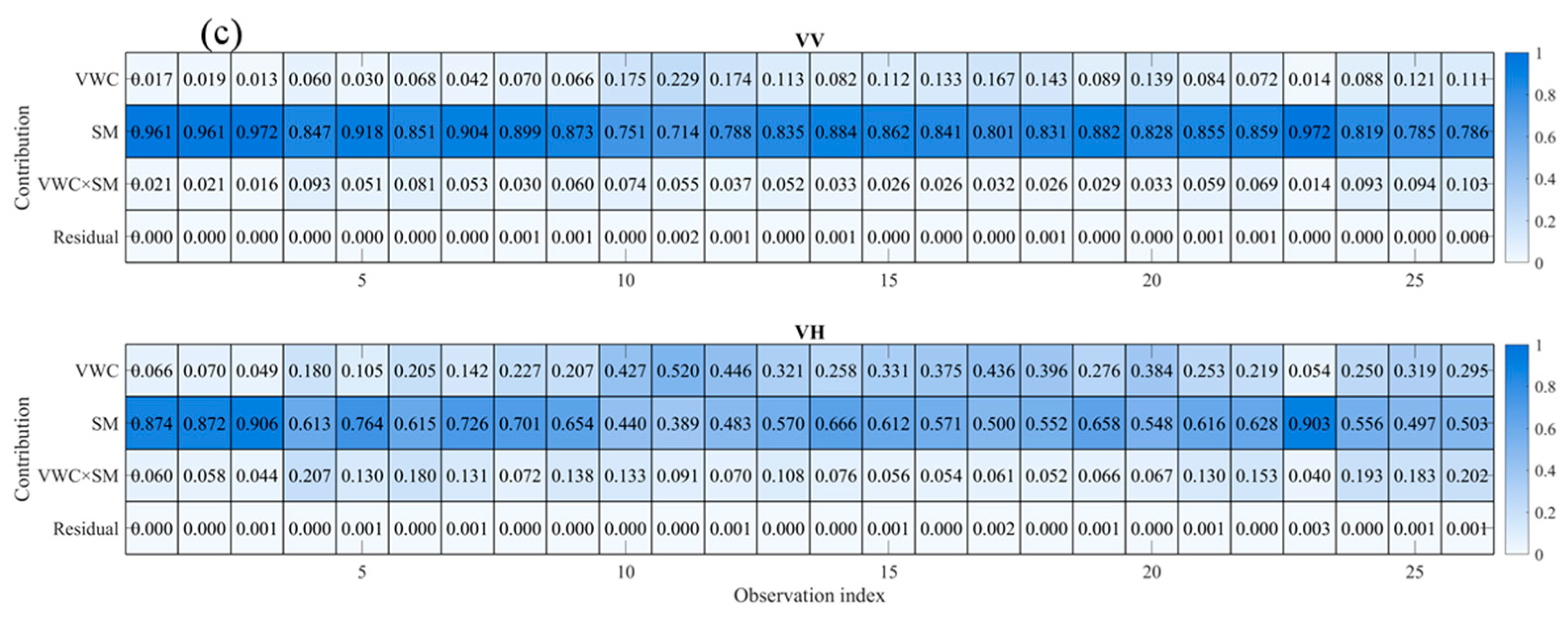
The traditional WCM considers only soil scattering and vegetation scattering. However, interaction scattering also occurs between soil and vegetation. In this study, we used the linear fitting approach [41] and variance decomposition techniques [42] to decompose microwave observations into different variance components associated with land surface parameters. Specifically, vegetation scattering (vwc), soil scattering (sm), and interaction scattering (vwc·sm) were simultaneously considered, and their respective contributions were quantitatively assessed:
Y = a v w c + b s m + c v w c s m + d + r
In the above expression, Y is the response variable observed by microwave and to be analyzed, vwc is the vegetation water content, and sm is the soil moisture. a·vwc, b·sm, and c·vwc·sm represent the contributions of the vegetation, soil, and soil–vegetation interactions to Y, respectively. d is a constant, and r is the residual. In regression analysis, the coefficient of determination ( R 2 ) is generally defined as the fraction of variance explained, as shown below:
R 2 = S S e x p l a i n e d S S t o t a l = 1 S S r S S t o t a l = 1 η r 2
η v w c 2 = S S v w c S S t o t a l
η s m 2 = S S s m S S t o t a l
η vwc s m 2 = S S v w c s m S S v w c s m
where S S t o t a l is the total sum of squares of the response variable, S S e x p l a i n e d is the explain sum of squares, S S ε is the residual sum of squares, which is also called the unexplained sum of squares, and η 2 is the proportion of variance.
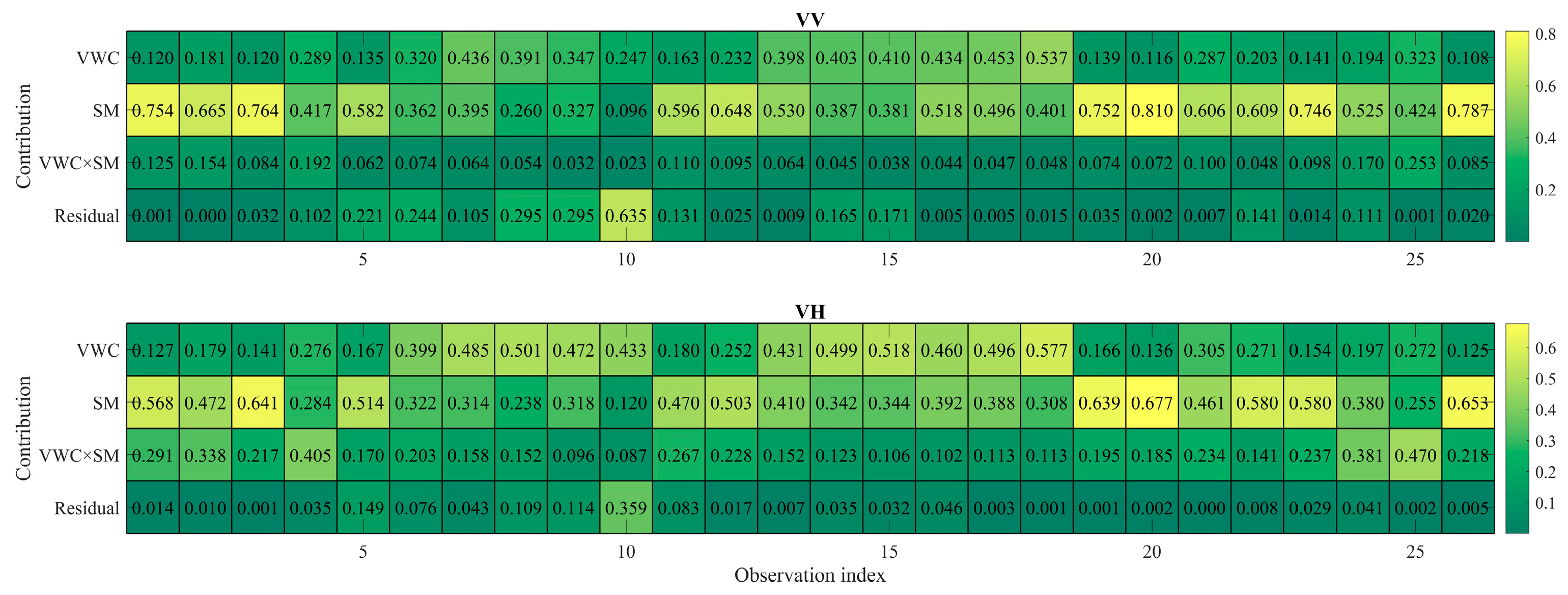
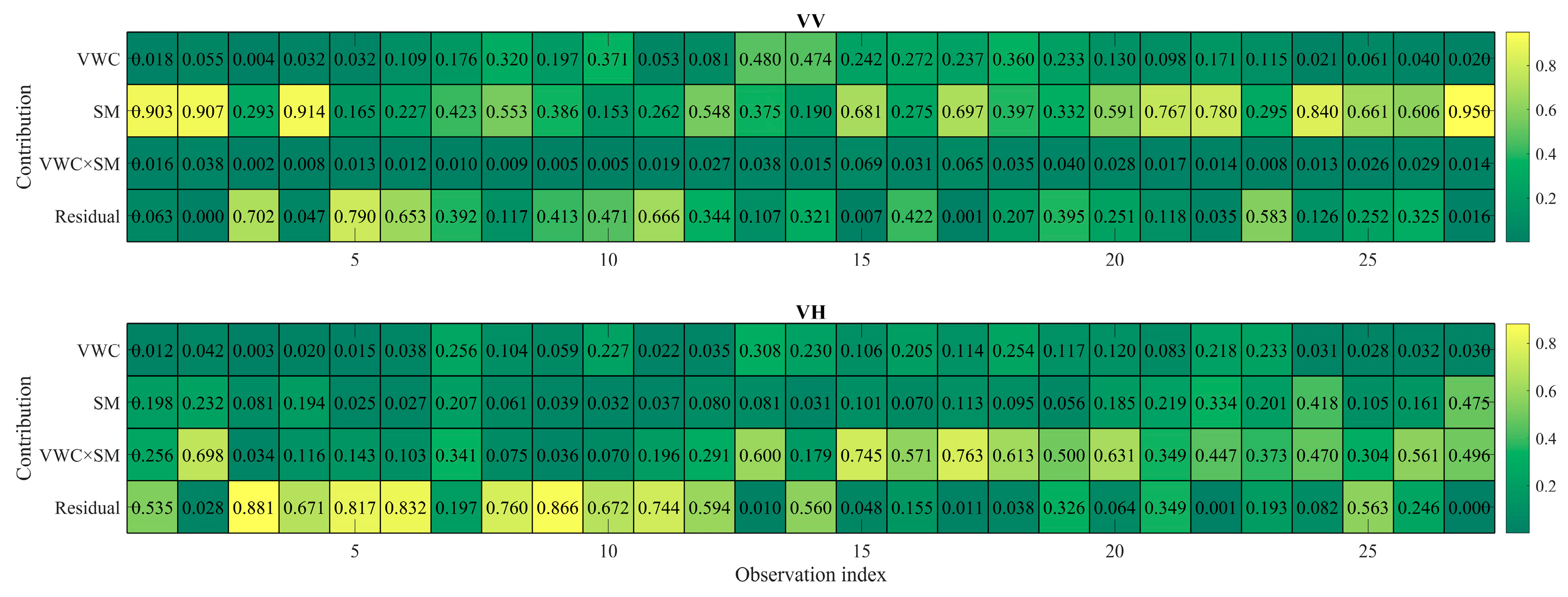
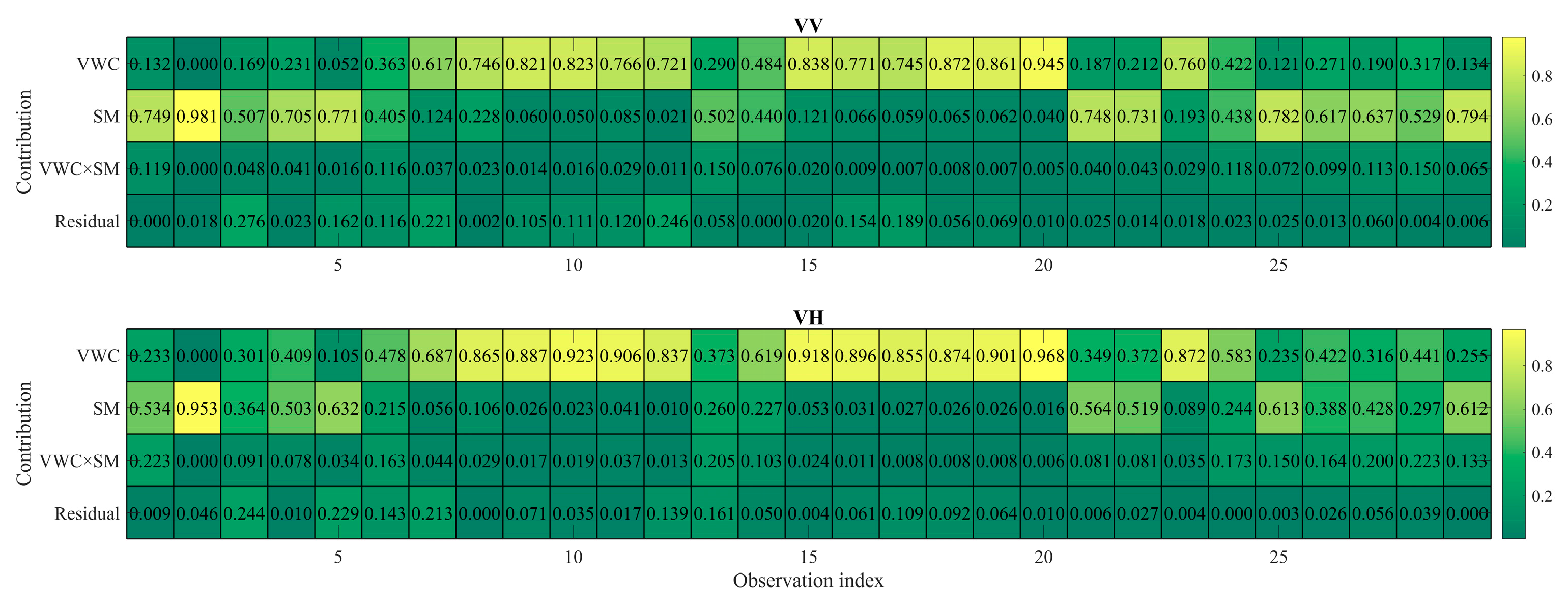
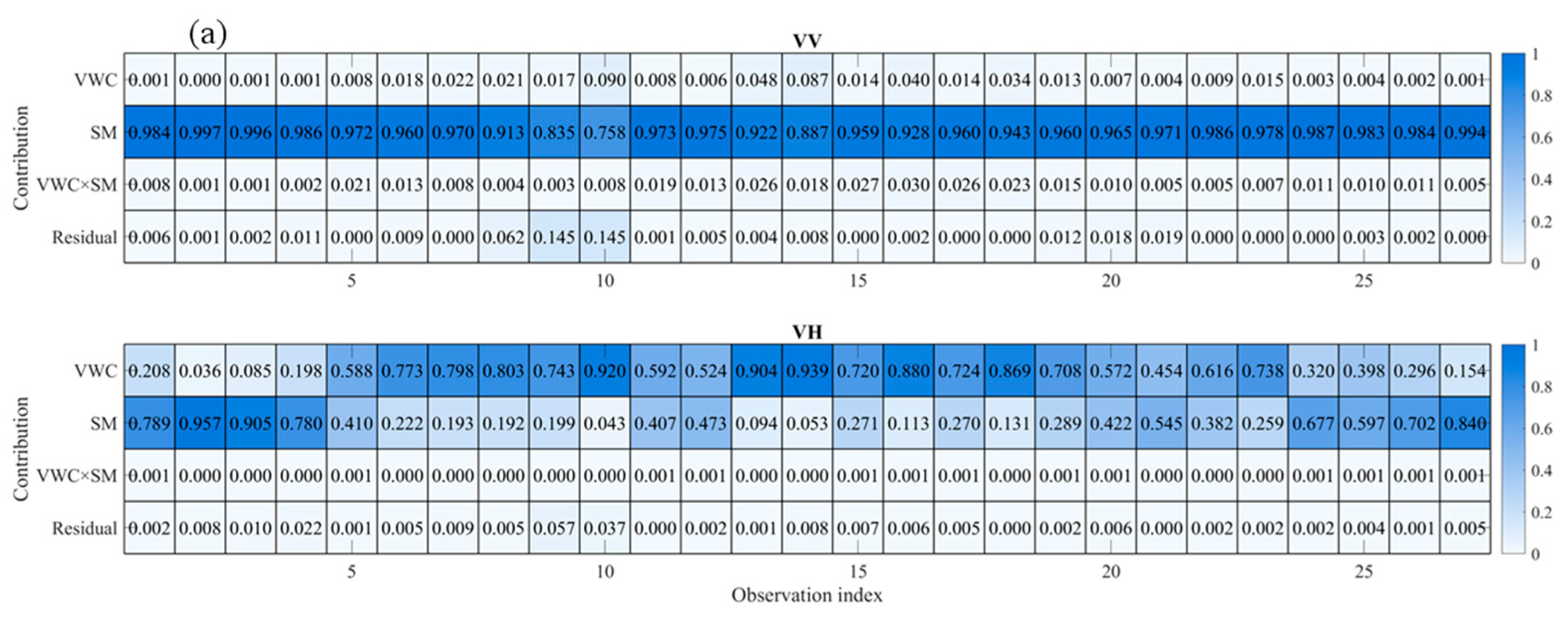
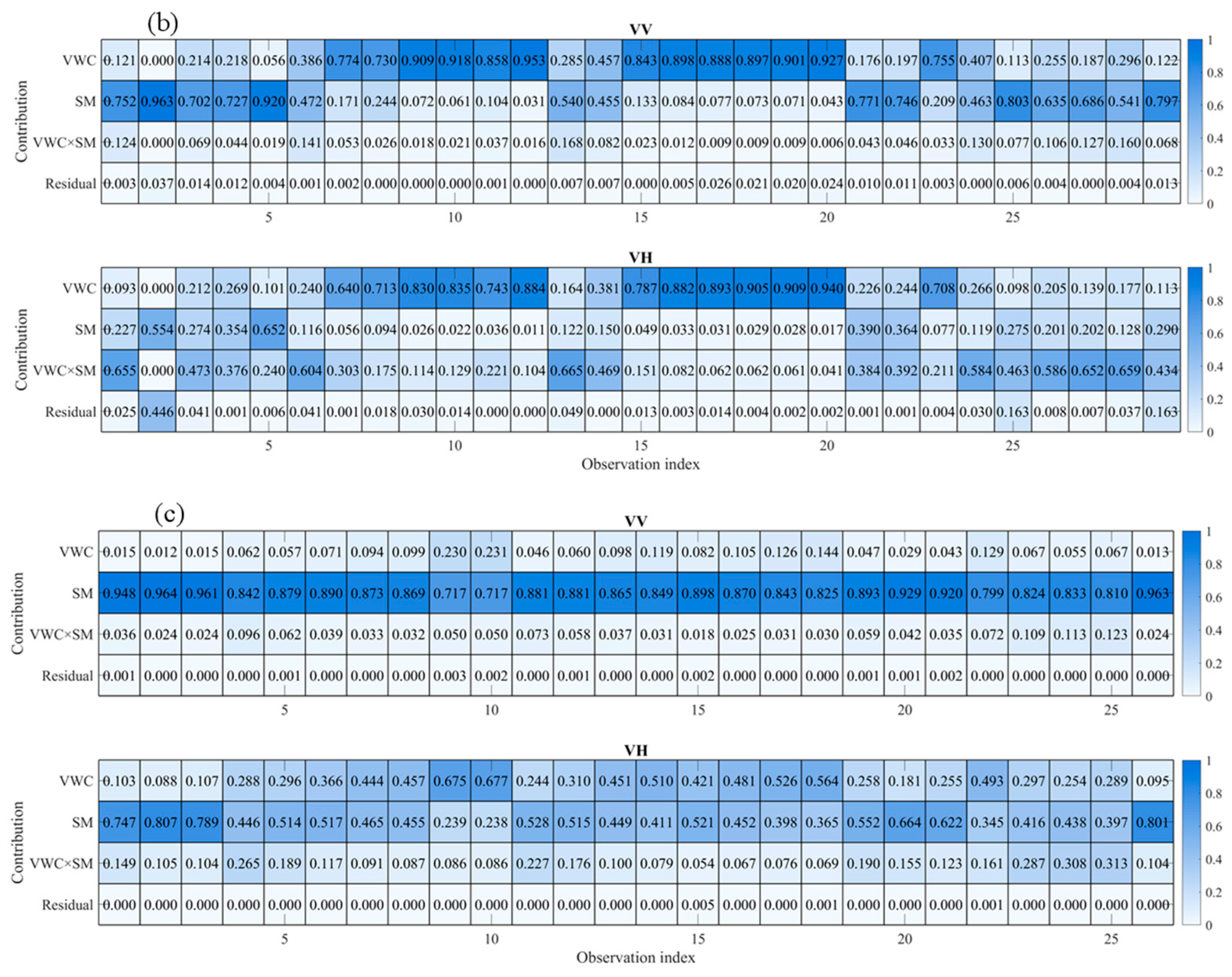
We selected the observed backscattering data acquired in 2023 from the three study sites to calculate the variance contributions of different parameters, as shown in Figure 3, Figure 4 and Figure 5. The variance explanation ratios of different scattering contributions at the three sites are presented below. The “Observation index” is used to represent the number of observation samples with available bckscattering data in the study area.
The findings indicate that across the three study sites with varying vegetation cover, the contribution of interaction scattering under VH polarization is consistently and substantially higher than that under VV polarization. Moreover, differences in the relative contribution under VV polarization significantly affect the soil moisture retrieval accuracy. For instance, at the Canizal site (a), the interaction-scattering contribution under VV polarization is extremely low, reaching a maximum of only 6.9%, whereas under VH polarization, it increases to as high as 76.3%. Under such pronounced asymmetric conditions, applying the same WCM parameterization with interaction scattering to both polarizations fails to adequately represent their respective scattering mechanisms, thereby leading to noticeable differences in the backscatter simulation performance (see Section 3.3).

3.3. Training Results

3.3.1. Comparison of Forward Model Simulation Results

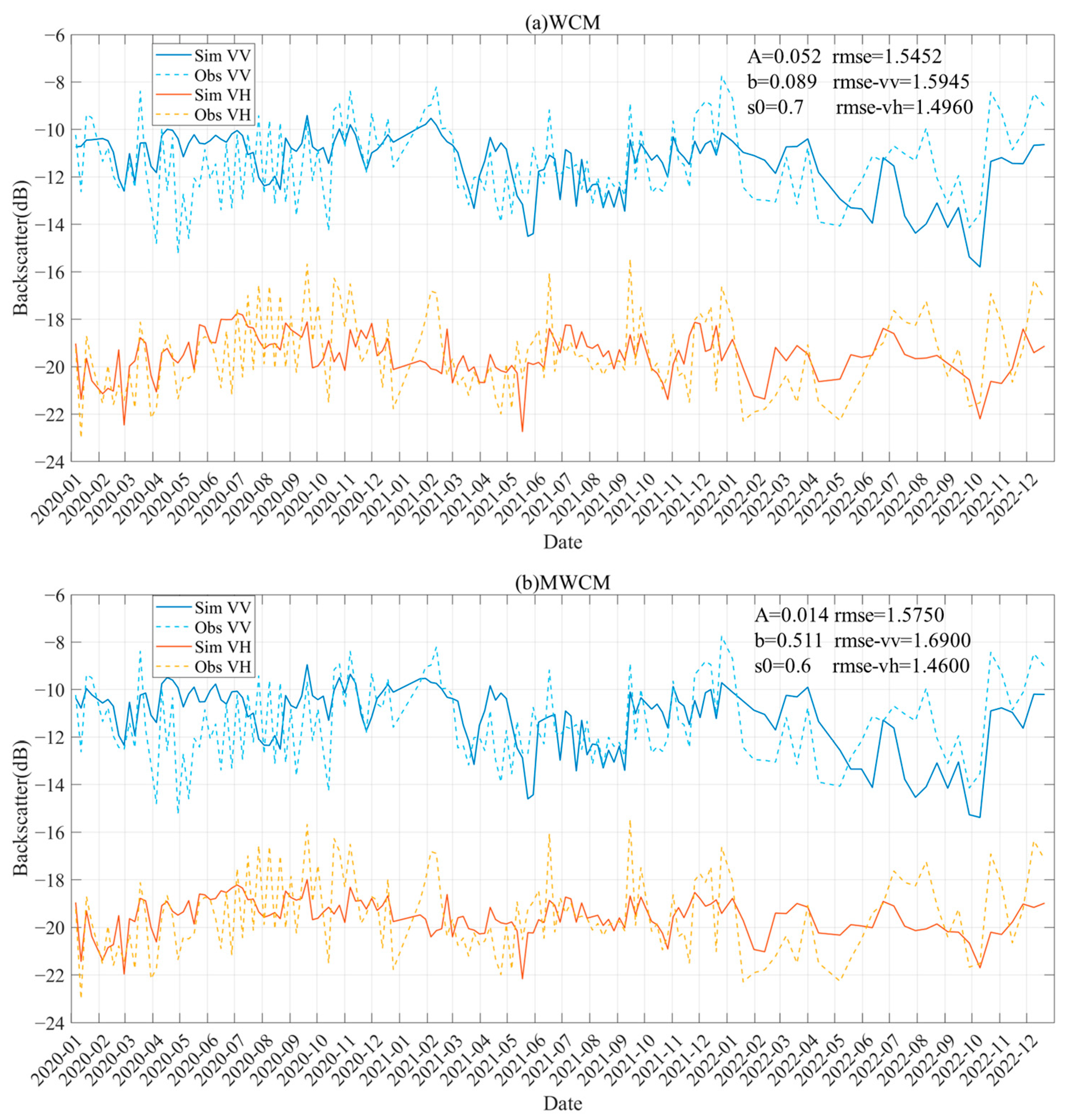
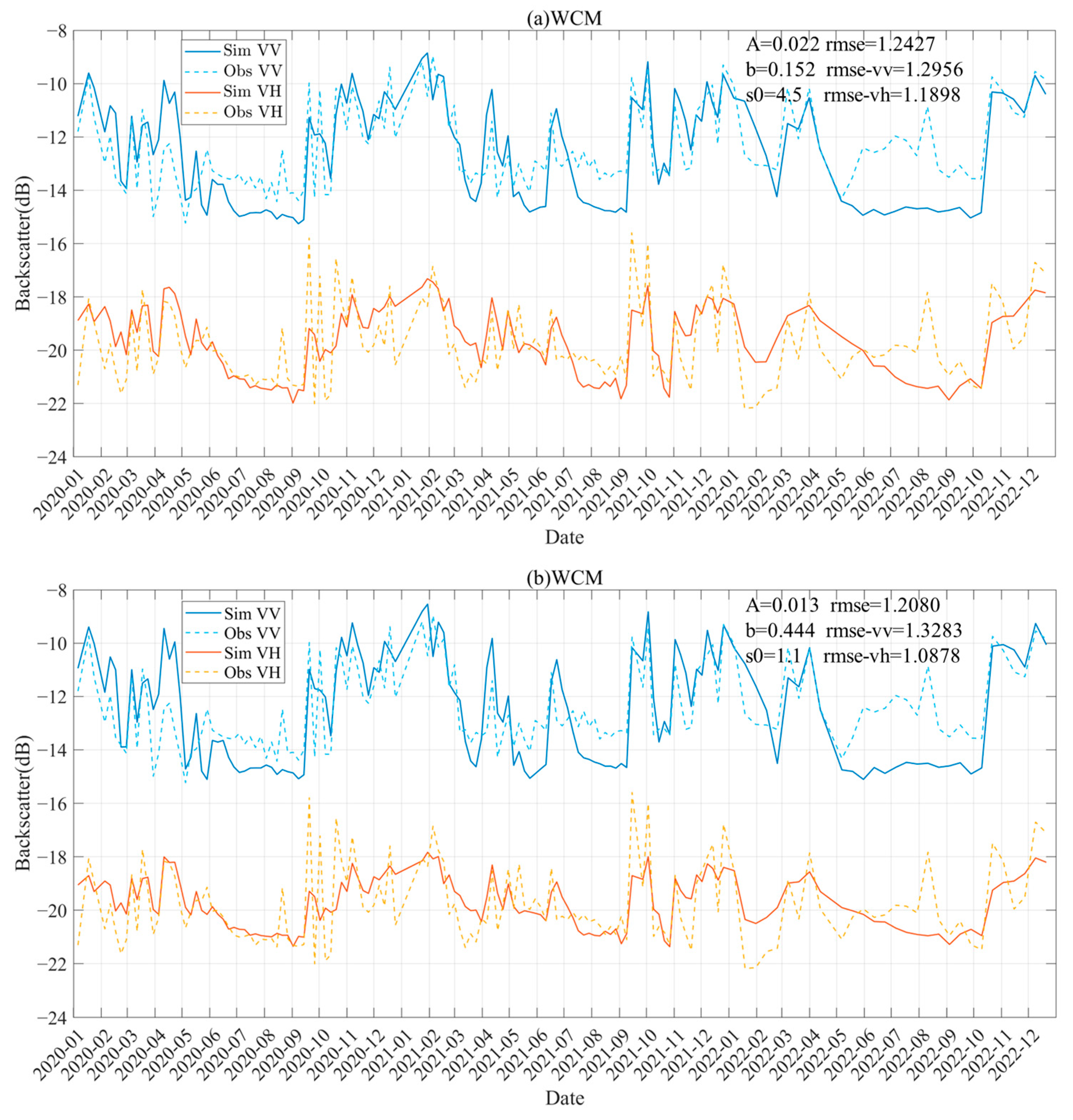
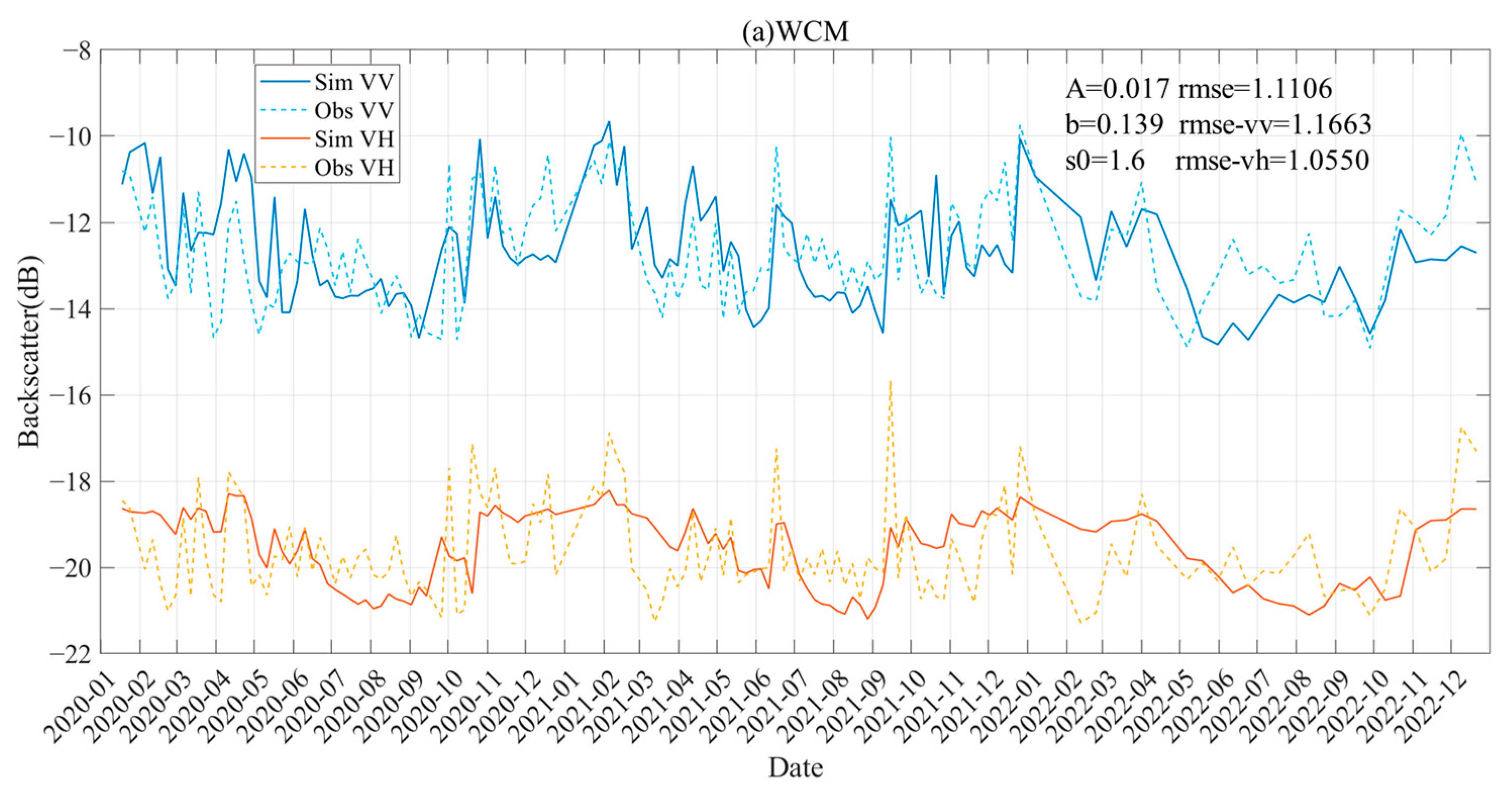
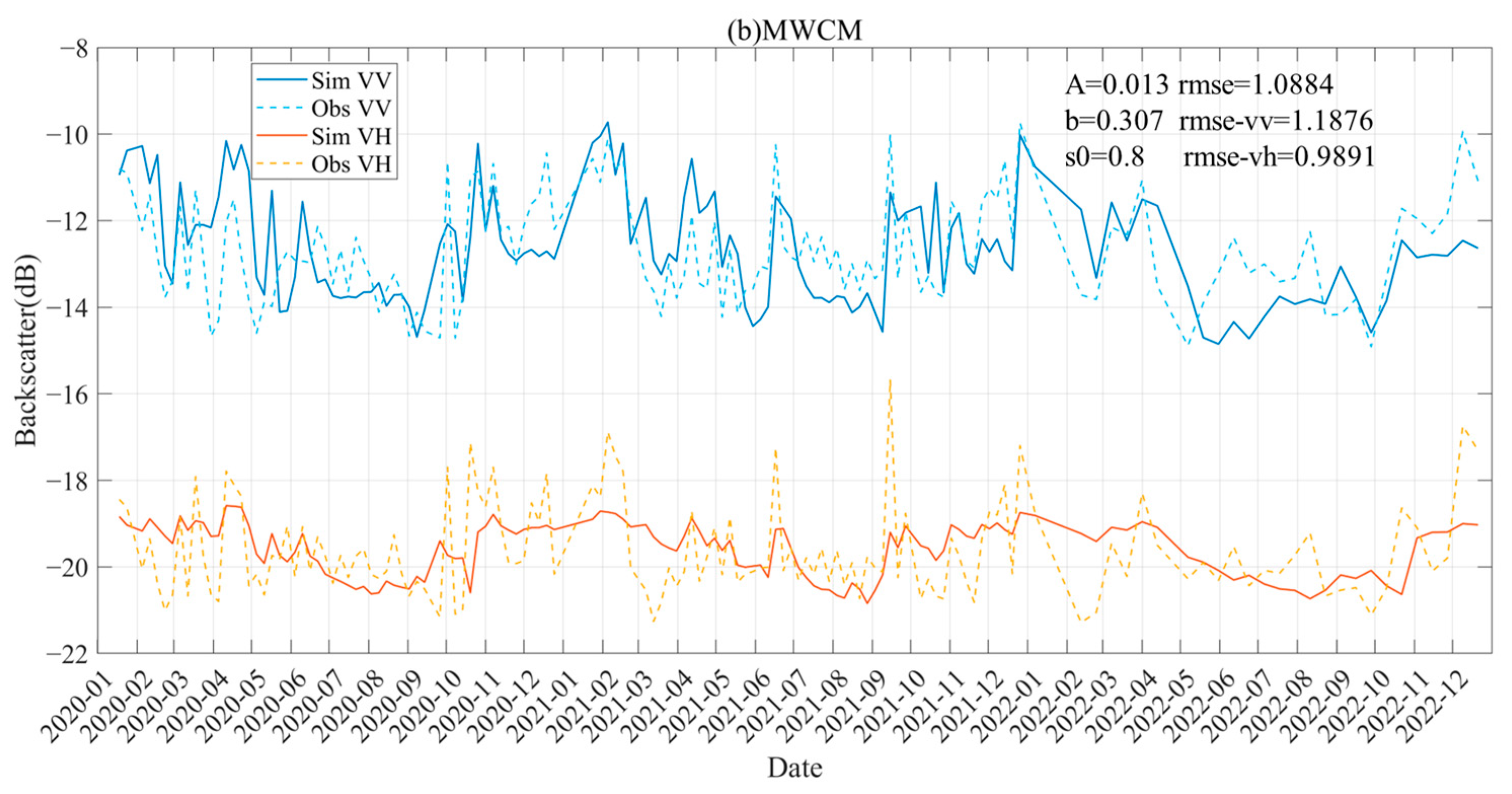
For the three sites (Figure 6, Figure 7 and Figure 8), at site Canizal, the RMSE of backscatter simulated by the MWCM is slightly higher than that of the WCM, whereas at sites Zamarron and Las Bodegas, the proposed MWCM consistently exhibits lower RMSE values than those of the WCM. Specifically, at site a (Canizal), the RMSE of the WCM is 1.5452 dB, while that of the MWCM increases to 1.5750 dB; at site b (Zamarron), the RMSE values of the WCM and MWCM are 1.2427 dB and 1.2080 dB, respectively; and at site c (Las Bodegas), the RMSE of the WCM is 1.1106 dB, which is further reduced to 1.0884 dB by the MWCM.

3.3.2. Comparison of Soil Moisture Retrieval Results

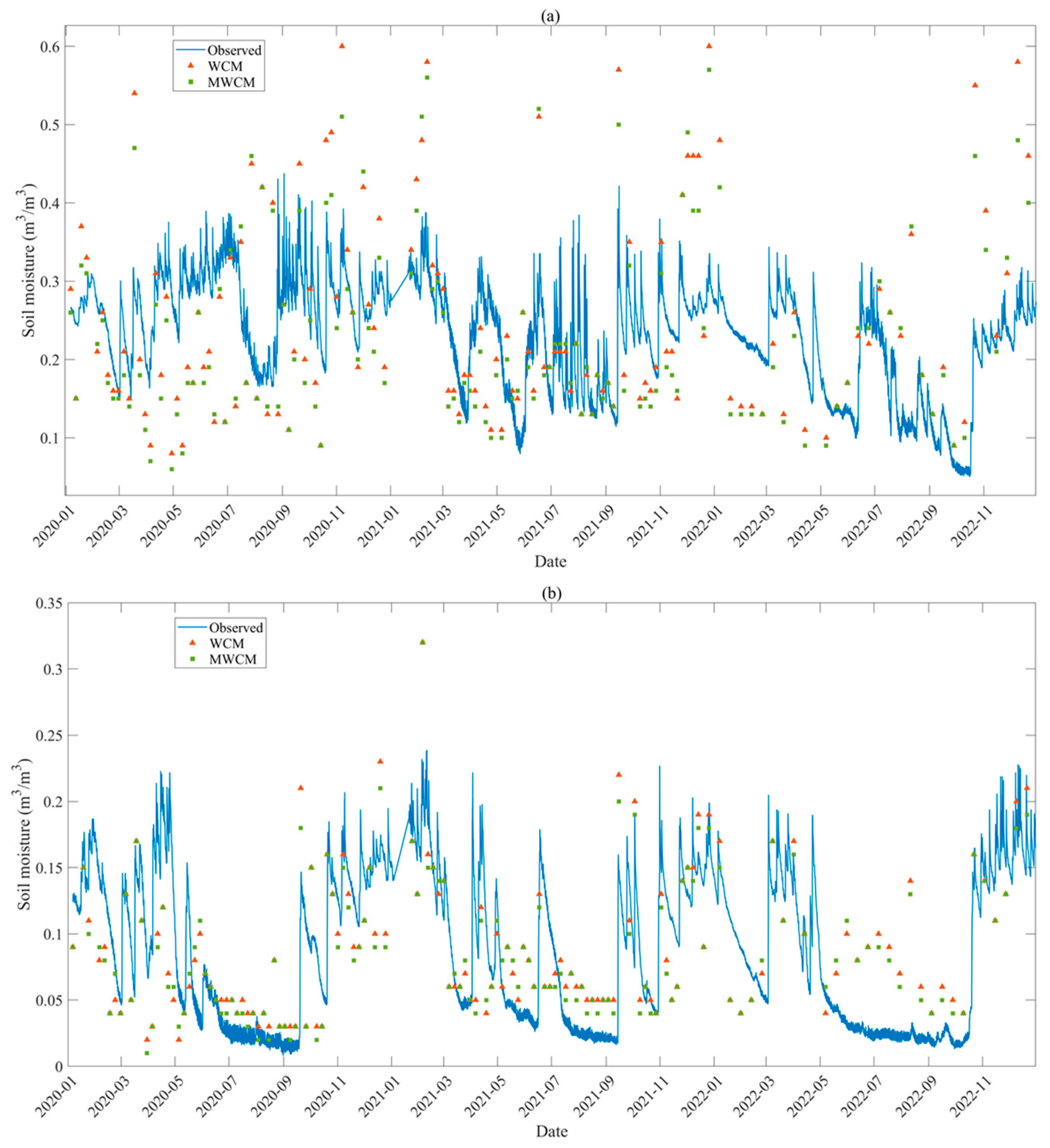
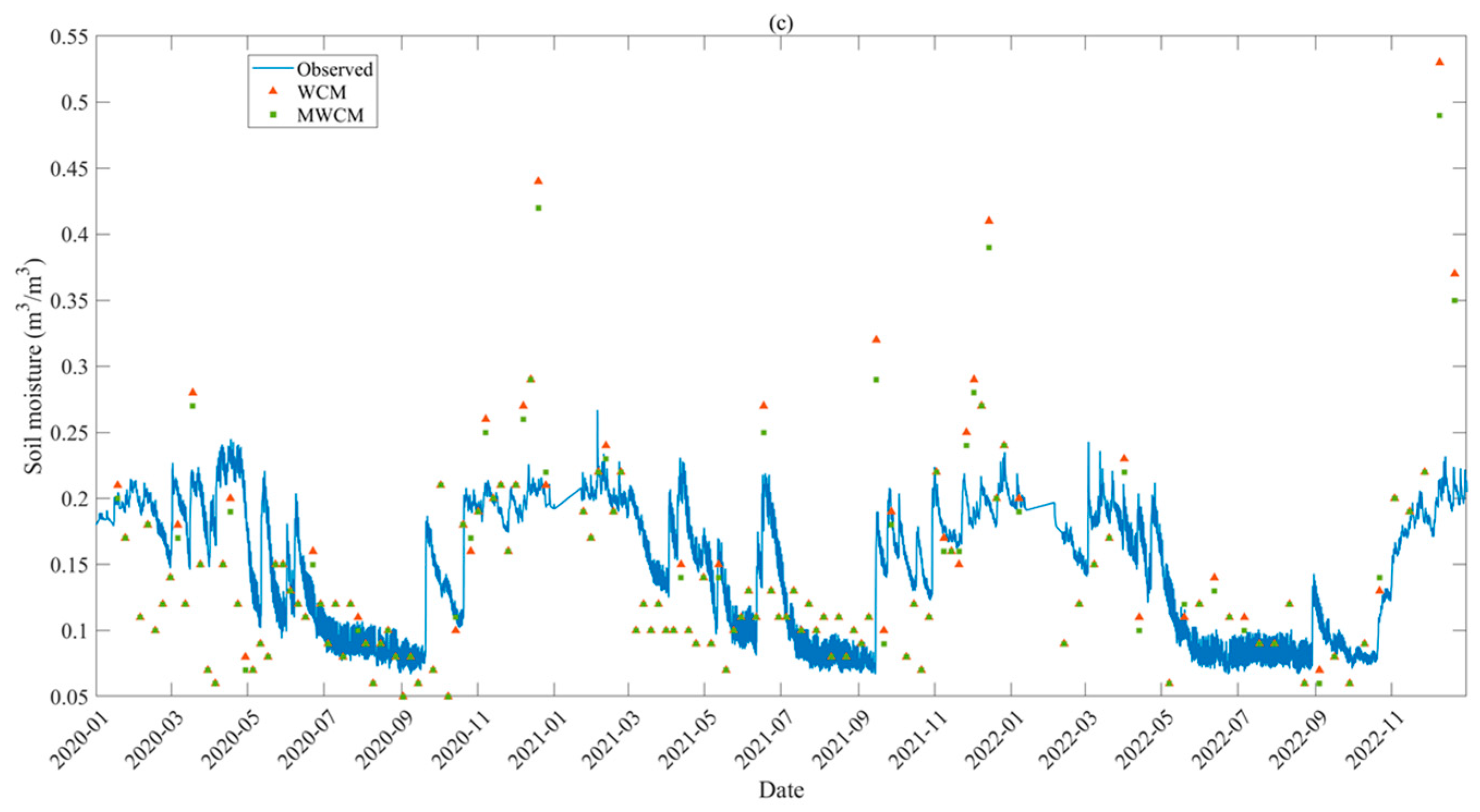
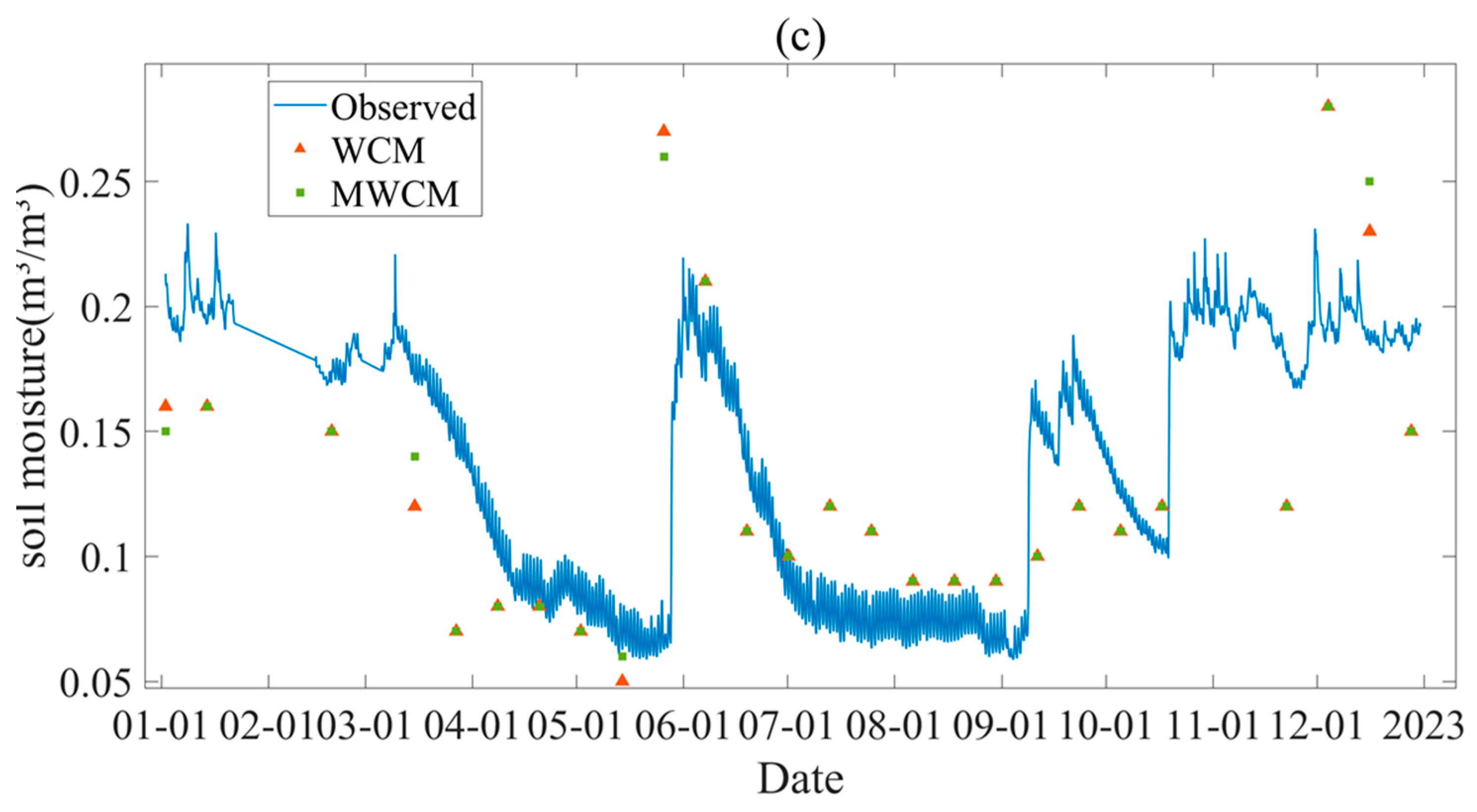
Figure 9 presents the soil moisture retrieval results of WCM and MWCM using the training data from the three study sites. At site a (Canizal), the RMSE of the WCM is 0.1171 m3/m3, while the RMSE of the MWCM is 0.1093 m3/m3. At site b (Zamarron), the RMSE of the WCM is 0.0422 m3/m3, whereas that of the MWCM is reduced to 0.0417 m3/m3. At site c (Las Bodegas), the RMSE of the WCM is 0.0614 m3/m3, and the MWCM further improves the performance with an RMSE of 0.0577 m3/m3.

3.4. Validation Results

3.4.1. Backscatter Validation Results

We calibrated the vegetation parameters and surface roughness parameters using data from 2020–2022 and applied them to independent validation using data from 2023 and 2024. Figure 10, Figure 11 and Figure 12 present the simulated backscatter results for the three sites over the two-year validation period using the two models (WCM and MWCM).
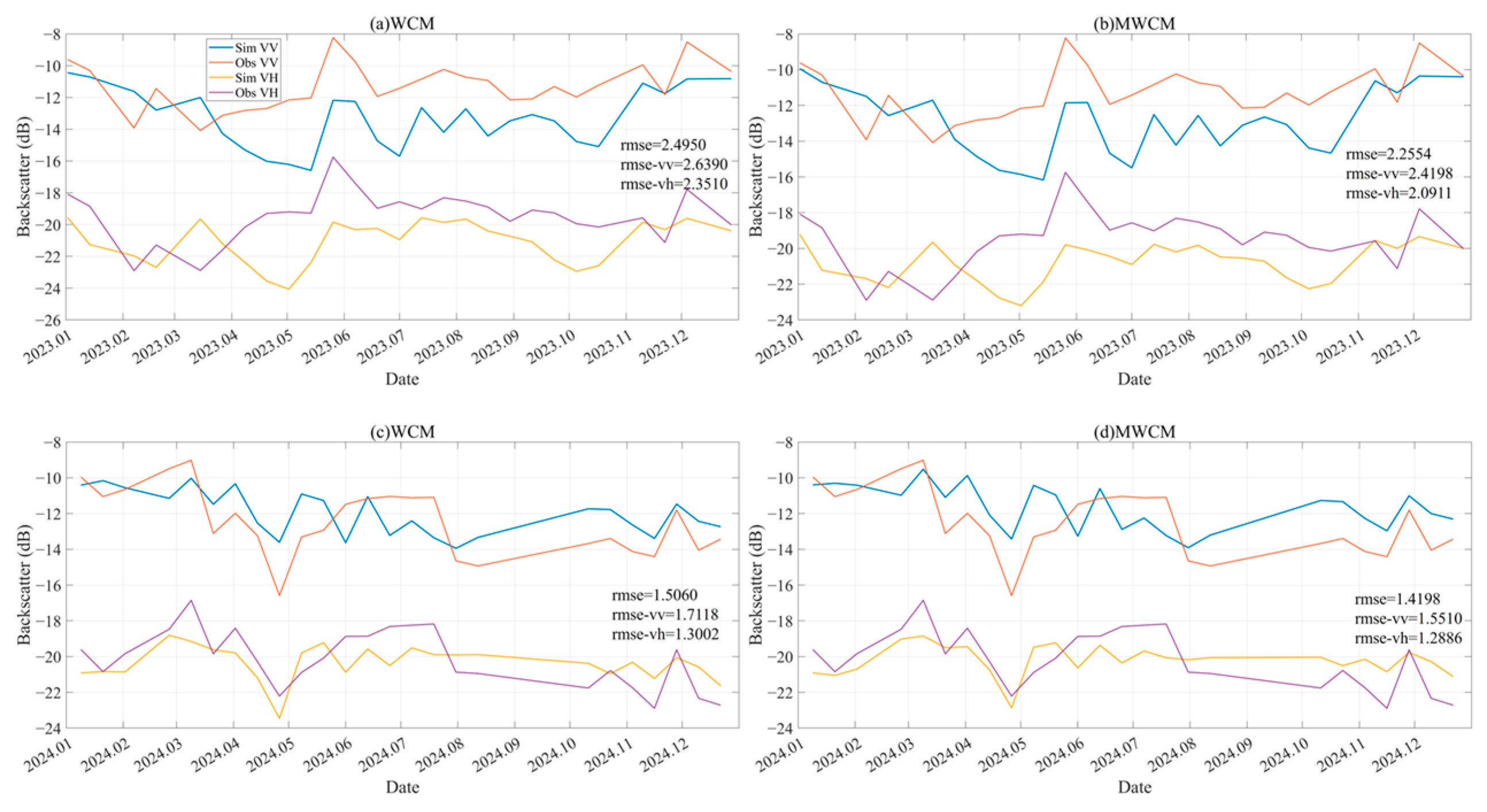
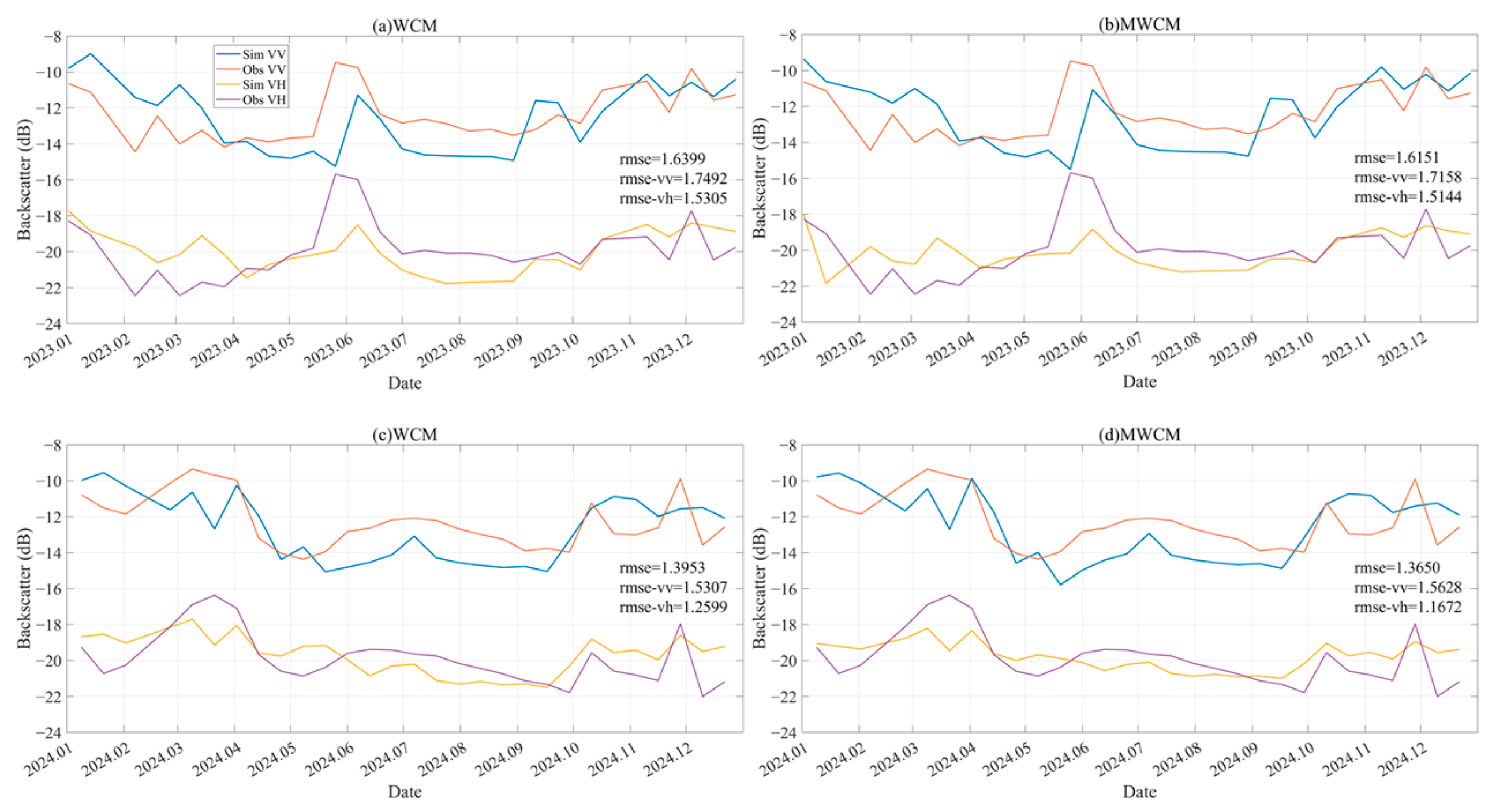
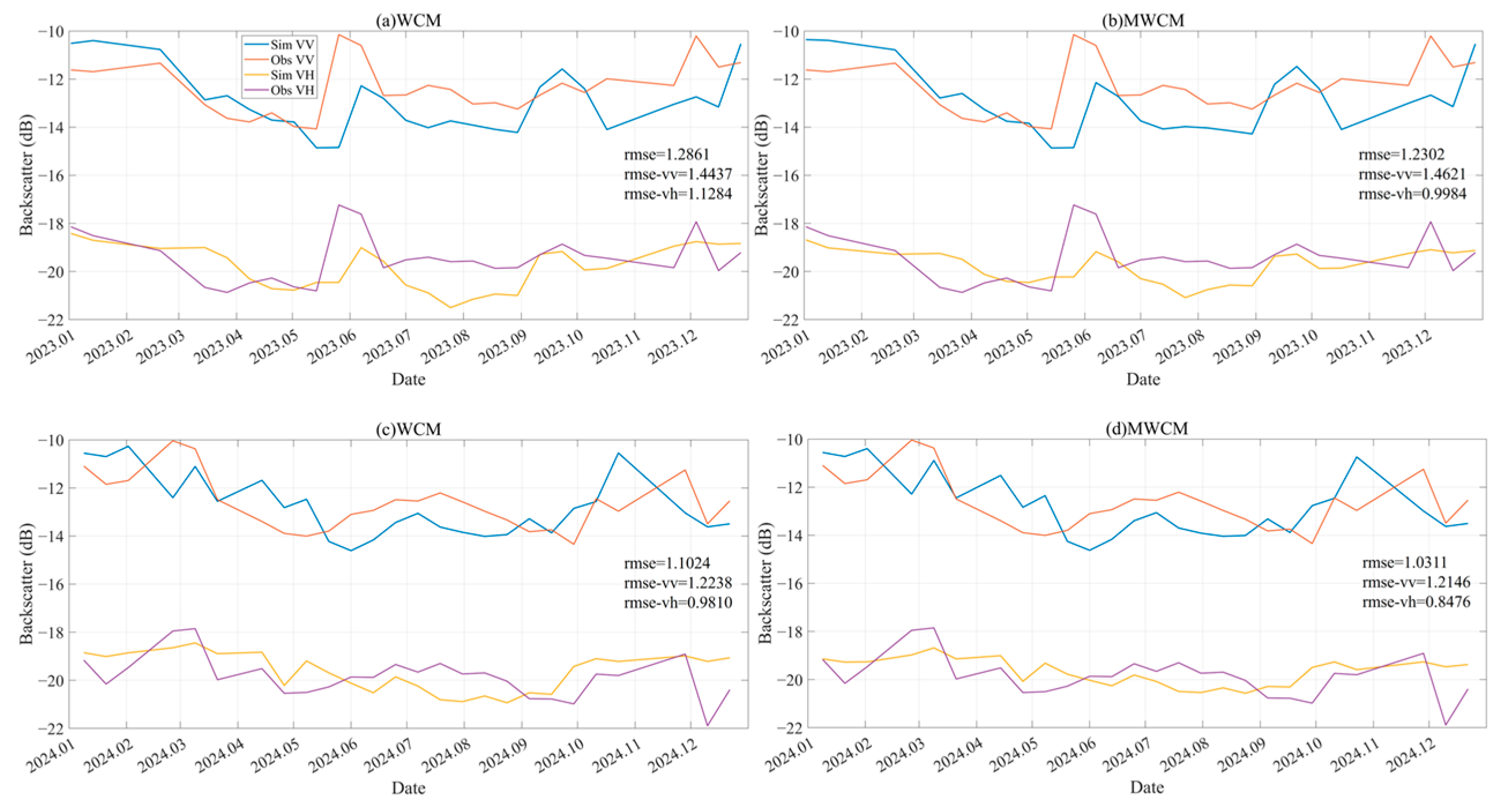
In Figure 10, at site Canizal, the RMSE of the backscatter simulation in 2023 decreases from 2.4950 dB (WCM) to 2.2554 dB (MWCM), whereas in 2024, the RMSE increases from 1.4198 dB to 1.5060 dB; in Figure 11, at site Zamarron, the RMSE of the WCM is 1.6399 dB in 2023, while that of the MWCM is 1.6151 dB. In 2024, the RMSE of the WCM is 1.3953 dB, which is reduced to 1.3650 dB when using the MWCM; in Figure 12, at site Las Bodegas, the RMSE values of the WCM and MWCM in 2023 are 1.2861 dB and 1.2302 dB, respectively. In 2024, the corresponding RMSE values for the WCM and MWCM are 1.1024 dB and 1.0311 dB, respectively.

3.4.2. Scattering Component Results

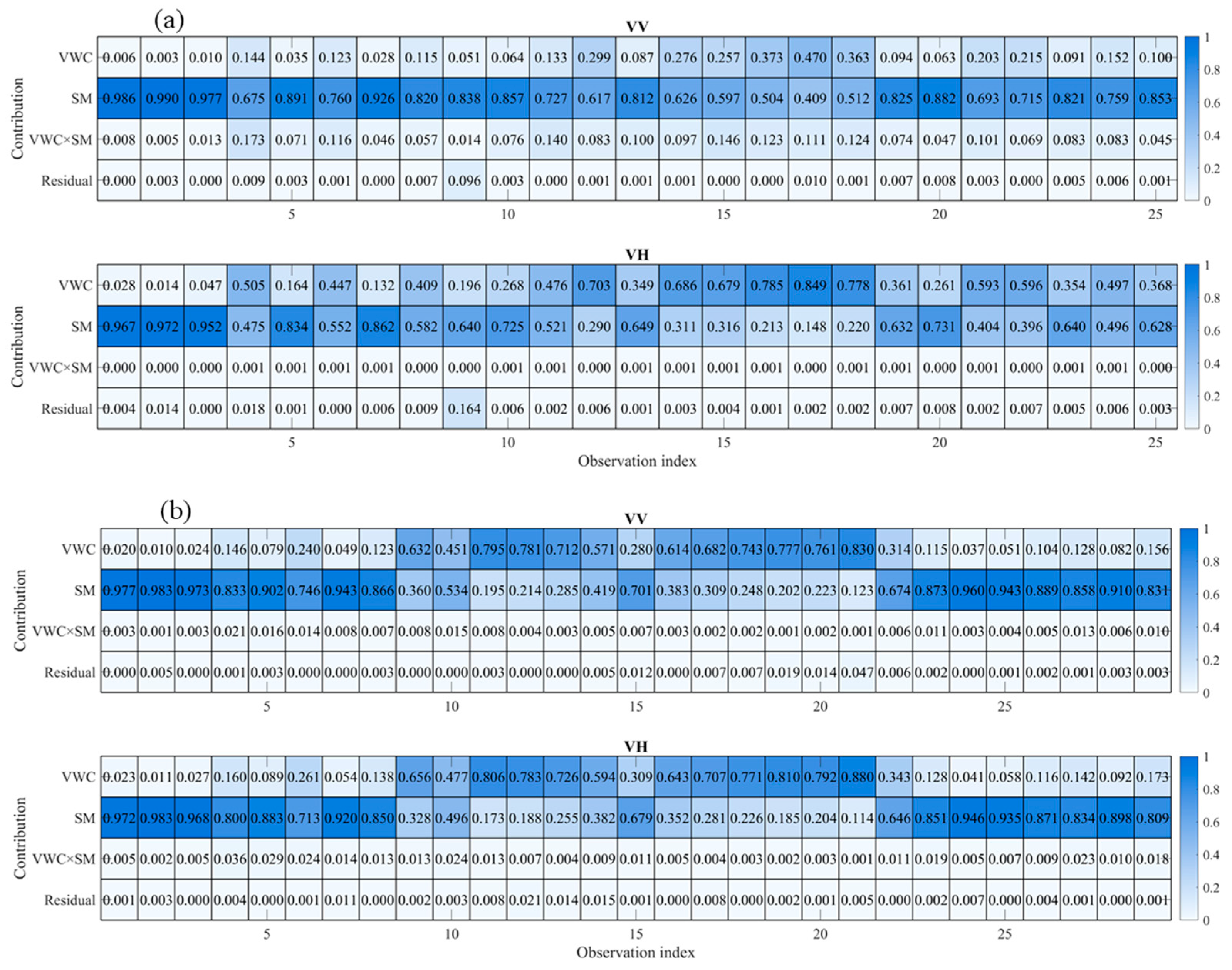
Figure 13 and Figure 14 illustrate the relative contributions of different simulated backscatter components—vegetation scattering (vwc), soil scattering (sm), and soil–vegetation interaction scattering ( v w c s m )—for the three sites in 2023 and 2024, respectively, after incorporating the interaction-scattering term.

3.4.3. Soil Moisture Retrieval Results

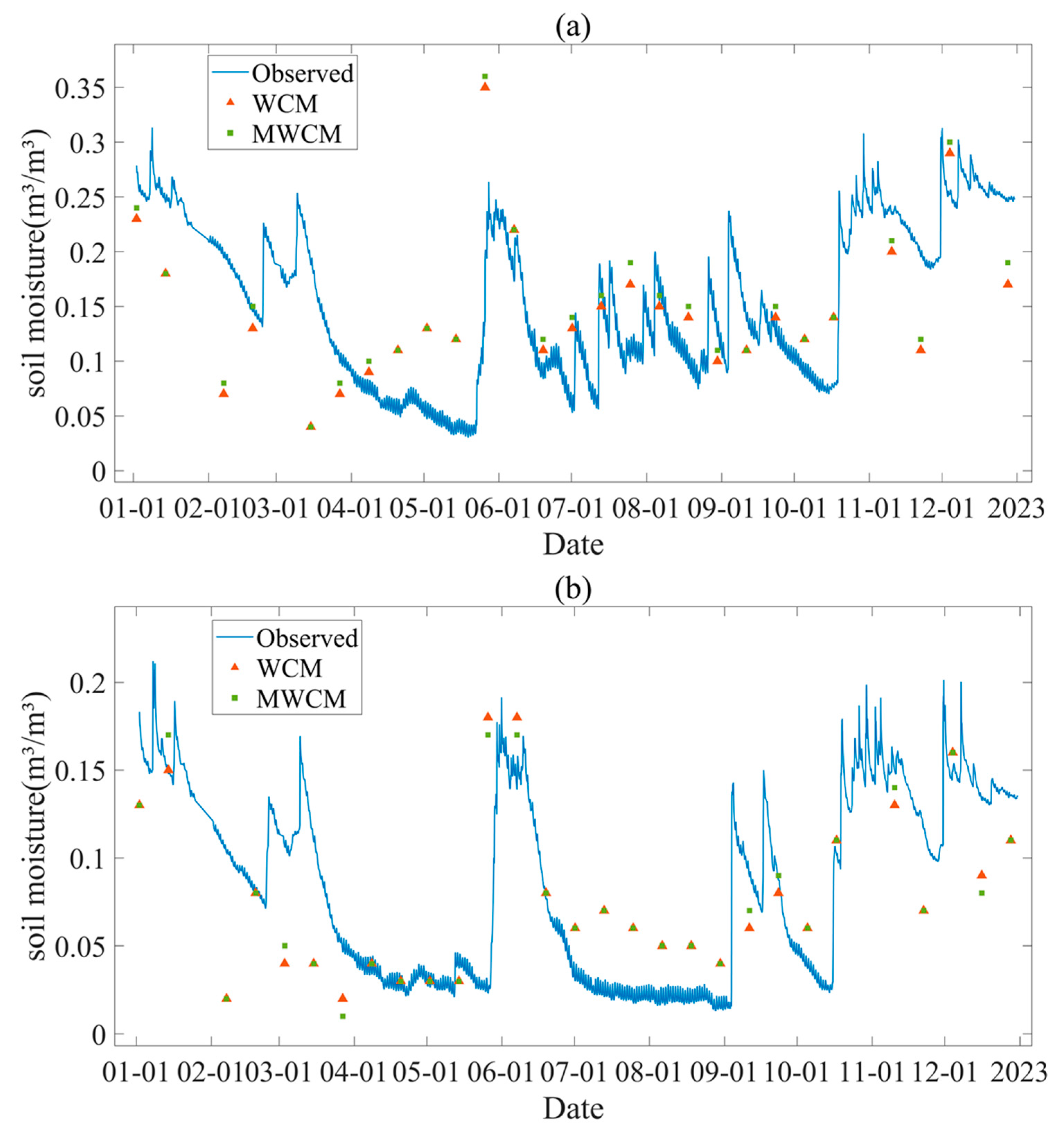
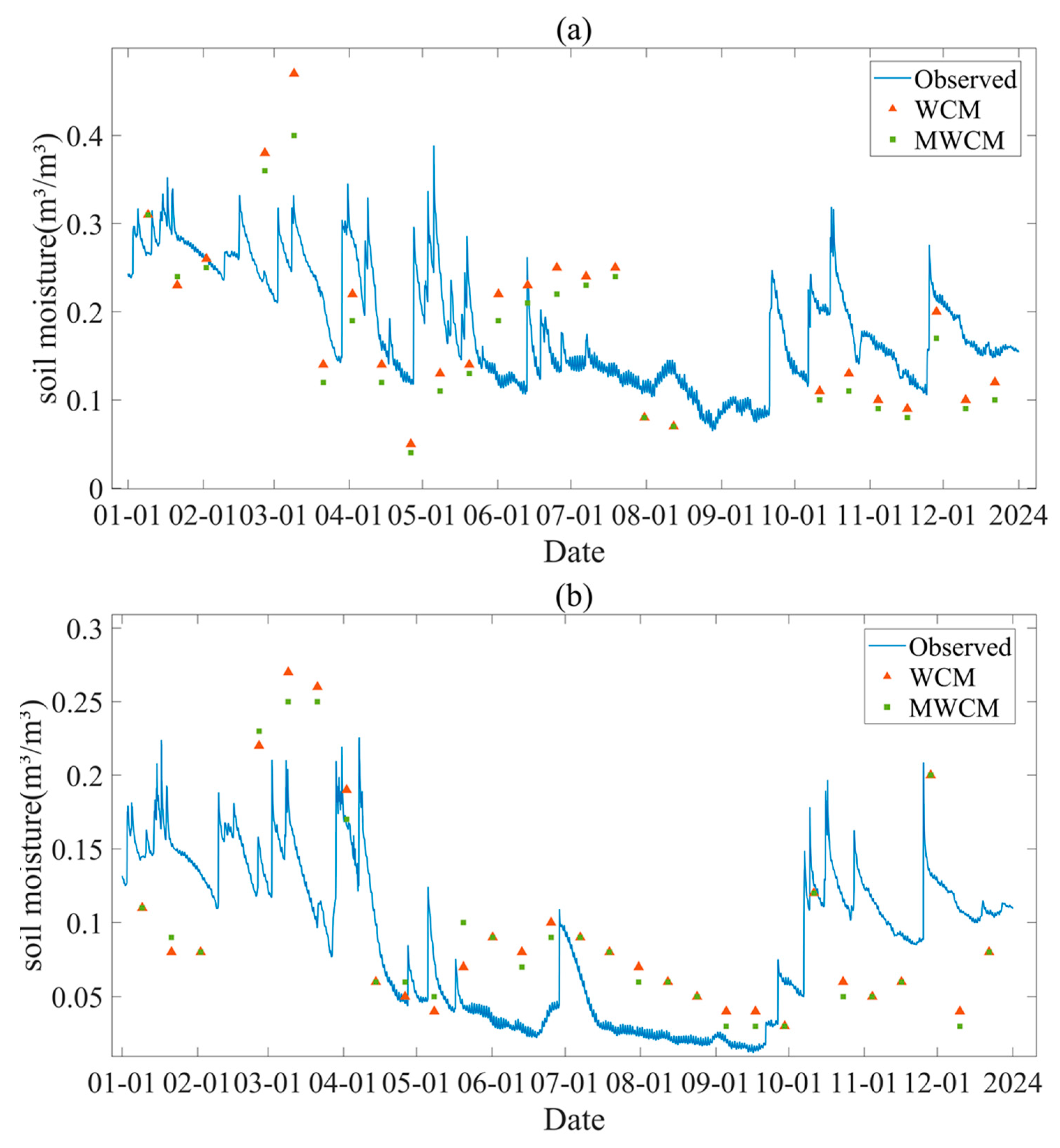
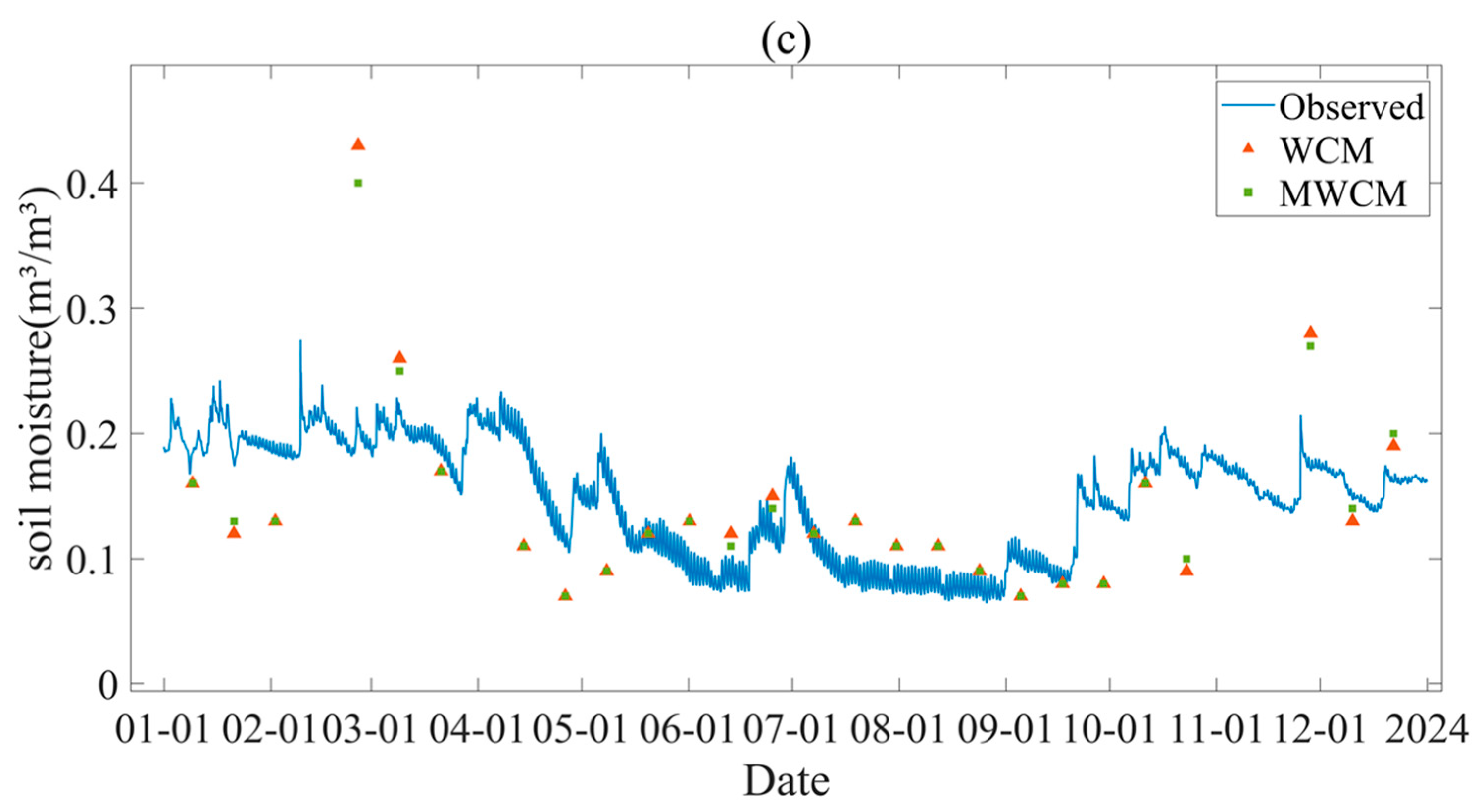
Figure 15 and Figure 16 show the validation results of the soil moisture retrieval accuracy for 2023 and 2024, respectively, based on the parameters calibrated using the training dataset.
Specifically, in 2023, at site a (Canizal), the RMSE of the WCM was 0.1452 m3/m3, while that of the MWCM was reduced to 0.1269 m3/m3. At site b (Zamarron), the RMSE values were 0.0685 m3/m3 for the WCM and 0.0654 m3/m3 for the MWCM. At site c (Las Bodegas), the RMSE of the WCM was 0.0801 m3/m3, and the MWCM achieved a lower RMSE of 0.0743 m3/m3.
In 2024, at site a (Canizal), the RMSE of the WCM was 0.0781 m3/m3, compared with 0.0759 m3/m3 for the MWCM. At site b (Zamarron), the RMSE decreased from 0.0554 m3/m3 for the WCM to 0.0537 m3/m3 for the MWCM. At site c (Las Bodegas), the RMSE of the WCM was 0.0635 m3/m3, whereas the MWCM further improved the performance with an RMSE of 0.0575 m3/m3.

4. Discussion

4.1. Sensitivity Analysis of Forward Simulations Under Different Vegetation Cover Levels

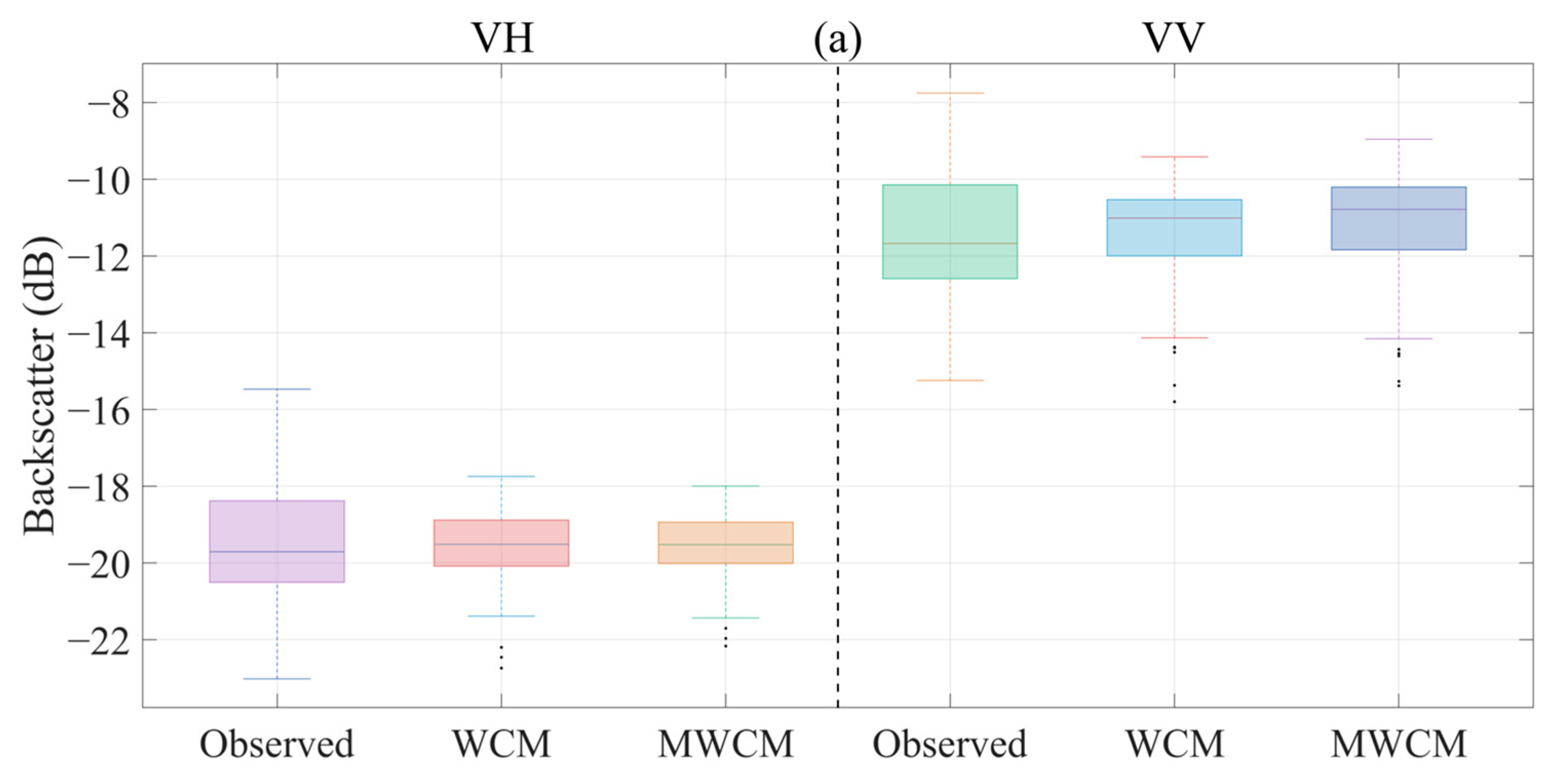
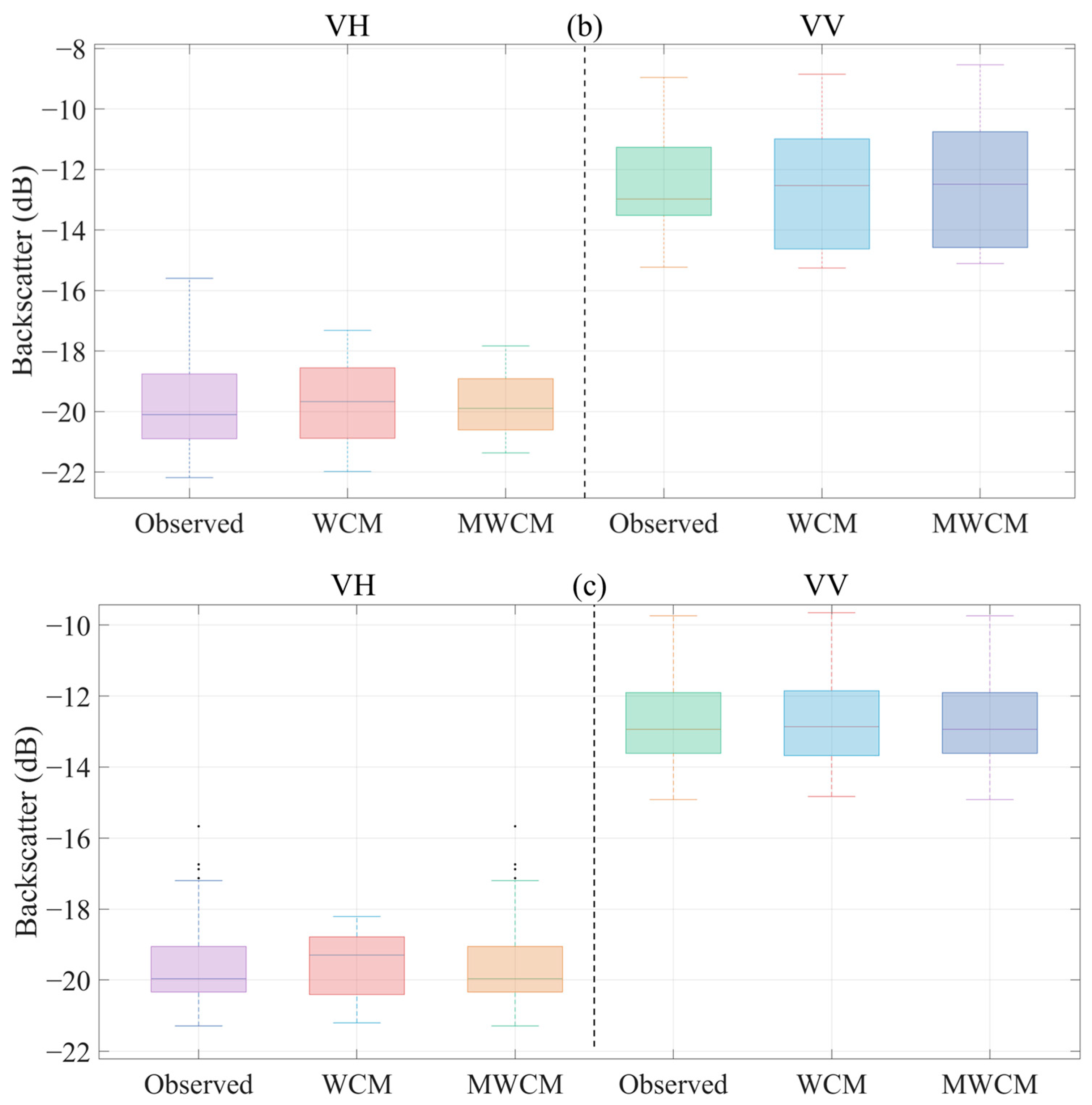
Based on the training data from 2020–2022, the backscatter simulation accuracies of the WCM and MWCM were analyzed as follows in (Figure 17).
At site a (Canizal): VH polarization: The whisker lengths of both models are shorter than those of the observed data, indicating that the simulated variability is compressed. Compared to the WCM, the MWCM’s median is closer to that of the observations, the interquartile range is more concentrated, and the deviations of outliers are smaller; VV polarization: Both the WCM and MWCM exhibit deviations in the median, with the WCM’s median closer to the observed value and a denser interquartile range, indicating that the WCM produces more stable simulated data and higher backscatter simulation accuracy. However, the WCM’s outliers show larger deviations, even extending beyond the lower limit of the observed data, whereas the MWCM’s box height is closer to the observed data, suggesting that it captures the dynamic features of the observations. This also explains why, at site a, the MWCM’s backscatter simulation accuracy is slightly lower, yet its soil moisture retrieval performance is better.
At site b (Zamarron): VH polarization: The MWCM outperforms the WCM, with a median closer to the observations and a more concentrated interquartile range that falls entirely within the observed data’s quartile range. In contrast, the WCM’s interquartile range is expanded, even exceeding the range of the observed data, indicating lower stability compared to the MWCM; VV polarization: The box heights of both the WCM and MWCM increase, indicating enhanced data variability and reduced stability.
At site c (Las Bodegas): VH polarization: The MWCM’s median, box height, and outliers almost entirely coincide with the observed data, whereas the WCM shows significant deviations, with an expanded interquartile range that exceeds the actual observed values and fails to capture true outlier behavior; VV polarization: Both the WCM and MWCM distributions closely match the observed data, showing no significant differences.
In the three study areas with different vegetation cover, in the purely agricultural area, the backscatter simulation accuracy of the MWCM actually decreases, while it shows a stable improvement in the other two study areas, which corresponds to Bai X’s finding that sparsely vegetated areas tend to enhance backscatter anomalies [43]. Overall, the WCM can produce more stable simulations in certain cases, with smaller median deviations, resulting in higher backscatter simulation accuracy. In contrast, although the MWCM exhibits greater variability and some median deviations, it better captures the dynamic features of the observed data, leading to a superior performance in soil moisture retrieval, especially in areas with medium-to-high vegetation coverage.

4.2. Sensitivity Analysis of Soil Moisture Retrieval

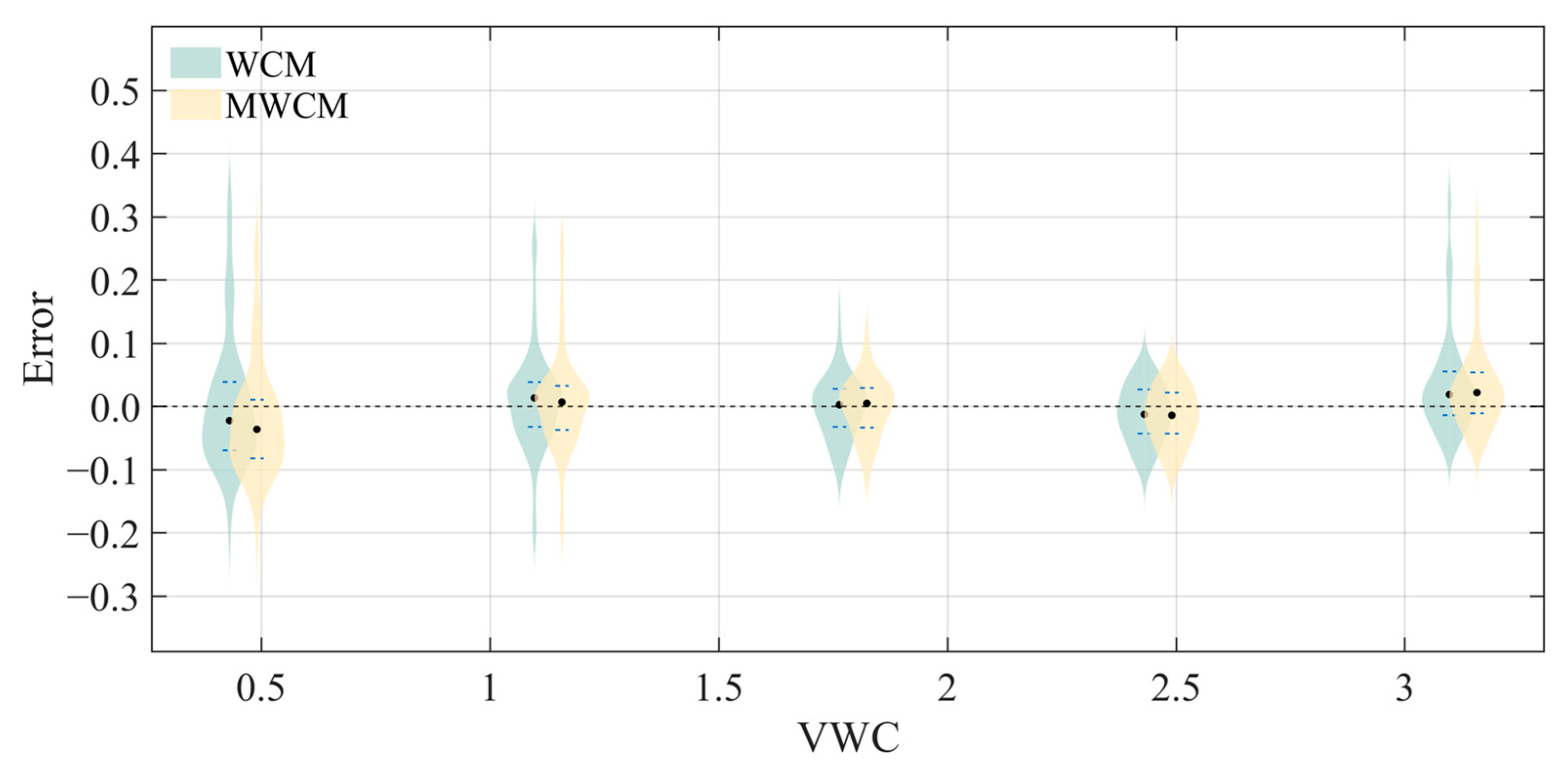
Figure 18 shows the sensitivity analysis of soil moisture retrieval accuracy and vegetation water content.
When VWC is lower than 0.5, the median error of the WCM is closer to zero than that of the MWCM, indicating a smaller systematic bias. However, the MWCM exhibits a markedly reduced interquartile range, reflecting a substantial decrease in error dis-persion. In addition, its density peak is more concentrated, and the error tails are sig-nificantly shorter, suggesting improved robustness against extreme errors.
For VWC values between 1.0 and 1.5, the MWCM shows a median error closer to zero, while the interquartile ranges of the two models are comparable. The error dis-tribution of the MWCM is more concentrated, and although both models exhibit con-vergent positive and negative tails, this convergence is more pronounced for the MWCM.
When VWC ranges from 1.5 to 2.0, the median errors of both models are very close to zero, with the WCM being marginally better in terms of bias. No significant differ-ences are observed in the interquartile range or density peak; nevertheless, the MWCM still presents shorter error tails, indicating better control of extreme deviations.
In the VWC interval of 2.0–2.5, both models exhibit a negative bias in their central tendencies. Compared with the WCM, the MWCM shows a more compact interquartile range, while the density peaks are generally similar and the error tails of both models remain relatively constrained.
When VWC exceeds 3.0, the median errors of both models shift toward positive values. The MWCM maintains a tighter interquartile range, with density peaks com-parable to those of the WCM. Although both models display evident elongation of the positive error tail under dense vegetation conditions, the tail length of the MWCM is still shorter than that of the WCM.
Overall, these results demonstrate that the MWCM consistently outperforms the conventional WCM across different vegetation cover conditions. By reducing error dispersion and mitigating vegetation-induced systematic bias, the MWCM provides a more stable and reliable framework for soil moisture retrieval, with particularly pro-nounced advantages under moderate-to-high vegetation cover.

4.3. Analysis of Differences in Backscatter Simulation Soil Moisture Retrieval Accuracy Under Different Vegetation Cover Levels

Whether using the training data or the validation data, for the three study areas with different vegetation cover levels, the MWCM consistently achieves higher accuracy in soil moisture retrieval than the WCM; however, in terms of backscatter simulation, the MWCM does not always outperform the WCM, and its performance varies depending on the site and conditions. All variables are manifested in a pure cropland study area (Canizal). In the training dataset (2020–2022), the RMSE of backscatter simulation using the MWCM is slightly higher than that of the WCM, increasing from 1.5452 dB to 1.5750 dB. In the validation dataset, in 2024, the RMSE values of backscatter simulation are 1.4198 dB and 1.5060 dB, respectively.
After analyzing the training dataset, this phenomenon can be attributed to several factors. First, the pure cropland study area undergoes multiple cycles of crop planting, harvesting, and bare-soil conditions, resulting in less stable surface roughness compared with the other two study areas. However, during the experiment, a fixed roughness parameter was calibrated and applied, which can have a pronounced impact on areas where roughness varies substantially. Second, the soil moisture time series from 2020 to 2022 differs markedly among the three study areas. In the pure cropland site, the soil moisture exhibits large fluctuations during certain periods, characterized by rapid increases and decreases over short time intervals, with relatively large amplitude. At site b, large soil moisture fluctuations are also observed, but their frequency is lower than that at the pure cropland site. At site c, which has the highest vegetation cover, soil moisture variations are more limited, with smaller fluctuation ranges. Consequently, during backscatter simulation, the absolute accuracy of simulated backscatter tends to improve with increasing vegetation cover.
In terms of soil moisture retrieval, the retrieval accuracy is not strictly positively correlated with the absolute accuracy of backscatter simulation. For both the WCM and MWCM, site b (Zamarron) exhibits the highest absolute retrieval accuracy, followed by site c (Las Bodegas), while site a (Canizal) shows the lowest accuracy. This can be attributed to the fact that site b (Zamarron) has a moderate level of vegetation cover, which helps mitigate the errors induced by surface roughness variations in pure cropland areas while also partially alleviating the limitation of C-band radar penetration through dense vegetation observed at site c (Las Bodegas). As a result, site b achieves the highest absolute accuracy in soil moisture retrieval. Moreover, the higher retrieval accuracy at site c compared with site a further indicates that, under the vegetation cover conditions of these three study areas, variations in surface roughness exert a more pronounced influence on soil moisture retrieval accuracy.

5. Conclusions

This study quantifies the respective contributions of soil surface scattering, vegetation scattering, and soil–vegetation interaction scattering to the total backscatter by applying variance decoupling to ground-measured soil moisture and Sentinel-1 backscatter data. A semi-empirical vegetation-scattering model that explicitly incorporates soil–vegetation interaction scattering is proposed. The proposed MWCM is systematically compared with the traditional WCM from two perspectives: backscatter simulation and soil moisture retrieval. In addition, the variation in the retrieval accuracy between the two models under different vegetation cover conditions is further analyzed.
The results indicate that soil–vegetation interaction scattering contributes up to 76.3% of the total backscatter, demonstrating that this interaction component is non-negligible, particularly for VH polarization. By explicitly accounting for interaction scattering, the proposed MWCM more accurately quantifies backscattering components over surfaces with complex vegetation structures, thereby improving point-scale SAR backscatter simulation and soil moisture retrieval accuracy. The contribution of interaction scattering and the accuracy of backscatter simulation both increase with vegetation cover. The performance of backscatter simulation and soil moisture retrieval is strongly dependent on the underlying surface conditions and the stability of soil moisture fluctuations.
Further research will validate the effectiveness of the proposed model across a wider range of land cover types, extending from point scale to regional scale, and will constrain the WCM as done by Xiaojing Bai [44]. Additionally, based on the radiative transfer characteristics of the VV and VH polarization channels, polarization-specific and more physically reasonable parameter calibration methods will be explored to further improve the accuracy of backscatter simulation and soil moisture retrieval.

Author Contributions

Conceptualization, J.H. and D.F.; methodology, D.F.; software, J.H.; validation, J.H., D.F. and X.-M.Z.; formal analysis, B.-H.T. and X.-M.Z.; investigation, J.H.; resources, D.F.; data curation, J.H. and D.F.; writing—original draft preparation, J.H.; writing—review and editing, J.H. and D.F.; visualization, X.-M.Z.; supervision, B.-H.T.; project administration, D.F.; funding acquisition, D.F. All authors have read and agreed to the published version of the manuscript.

Funding

This work was supported by the National Natural Science Foundation of China (No. 42401464), the “Xingdian Talent Support Program” of Yunnan Province, and Yunnan Fundamental Research Projects (No. 202401CF070161).

Data Availability Statement

The data presented in this study are available upon request from the corresponding author.

Conflicts of Interest

The authors declare no conflicts of interest.

References

  1. Brocca, L.; Ciabatta, L.; Massari, C.; Camici, S.; Tarpanelli, A. Soil Moisture for Hydrological Applications: Open Questions and New Opportunities. Water 2017, 9, 140. [Google Scholar] [CrossRef]
  2. Corradini, C. Soil moisture in the development of hydrological processes and its determination at different spatial scales. J. Hydrol. 2014, 516, 1–5. [Google Scholar] [CrossRef]
  3. Seneviratne, S.I.; Corti, T.; Davin, E.L.; Hirschi, M.; Jaeger, E.B.; Lehner, I.; Orlowsky, B.; Teuling, A.J. Investigating soil moisture–climate interactions in a changing climate: A review. Earth-Sci. Rev. 2010, 99, 125–161. [Google Scholar] [CrossRef]
  4. Vereecken, H.; Huisman, J.A.; Bogena, H.; Vanderborght, J.; Vrugt, J.A.; Hopmans, J.W. On the value of soil moisture measurements in vadose zone hydrology: A review. Water Resour. Res. 2008, 44, W00D06. [Google Scholar] [CrossRef]
  5. Zhao, T.J.; Shi, J.; Lv, L.; Xu, H.; Chen, D.; Cui, Q.; Jackson, T.J.; Yan, G.; Jia, L.; Chen, L.; et al. Soil moisture experiment in the Luan River supporting new satellite mission opportunities. Remote Sens. Environ. 2020, 240, 111680. [Google Scholar] [CrossRef]
  6. Xing, M.; Cui, K.; Dong, T.; Ma, M.; Zhou, X.; Zhang, Y. Improved soil moisture retrieval during crop growing season using passive microwave data at L-band. Int. J. Appl. Earth Obs. Geoinf. 2025, 143, 104788. [Google Scholar] [CrossRef]
  7. Kim, Y.; van Zyl, J.J. A Time-Series Approach to Estimate Soil Moisture Using Polarimetric Radar Data. IEEE Trans. Geosci. Remote Sens. 2009, 47, 2519–2527. [Google Scholar] [CrossRef]
  8. Periasamy, S. Significance of dual polarimetric synthetic aperture radar in biomass retrieval: An attempt on Sentinel-1. Remote Sens. Environ. 2018, 217, 537–549. [Google Scholar] [CrossRef]
  9. Li, S.; Xu, L.; Jing, Y.H.; Yin, H.; Li, X.H.; Guan, X.B. High-quality vegetation index product generation: A review of NDVI time series reconstruction techniques. Int. J. Appl. Earth Obs. Geoinf. 2021, 105, 102640. [Google Scholar] [CrossRef]
  10. Mandal, D.; Kumar, V.; Ratha, D.; Dey, S.; Bhattacharya, A.; Lopez-Sanchez, J.M.; McNairn, H.; Rao, Y.S. Dual polarimetric radar vegetation index for crop growth monitoring using sentinel-1 SAR data. Remote Sens. Environ. 2020, 247, 111954. [Google Scholar] [CrossRef]
  11. Zhu, L.J.; Yuan, S.S.; Liu, Y.; Chen, C.; Walker, J.P. Time series soil moisture retrieval from SAR data: Multi-temporal constraints and a global validation. Remote Sens. Environ. 2023, 287, 113466. [Google Scholar] [CrossRef]
  12. Wagner, W.; Lindorfer, R.; Melzer, T.; Hahn, S.; Bauer-Marschallinger, B.; Morrison, K.; Calvet, J.-C.; Hobbs, S.; Quast, R.; Greimeister-Pfeil, I.; et al. Widespread occurrence of anomalous C-band backscatter signals in arid environments caused by subsurface scattering. Remote Sens. Environ. 2022, 276, 113025. [Google Scholar] [CrossRef]
  13. Zhu, L.; Dai, J.; Jin, J.; Yuan, S.; Xiong, Z.; Walker, J.P. Are the current expectations for SAR remote sensing of soil moisture using machine learning overoptimistic? IEEE Trans. Geosci. Remote Sens. 2025, 63, 1–15. [Google Scholar] [CrossRef]
  14. Zhu, L.; Cai, Q.; Jin, J.; Yuan, S.; Shen, X.; Walker, J.P. Multi-scale domain adaptation for high-resolution soil moisture retrieval from synthetic aperture radar in data-scarce regions. J. Hydrol. 2025, 657, 133073. [Google Scholar] [CrossRef]
  15. Li, Z.L.; Leng, P.; Zhou, C.H.; Chen, K.S.; Zhou, F.C.; Shang, G.F. Soil moisture retrieval from remote sensing measurements: Current knowledge and directions for the future. Earth-Sci. Rev. 2021, 218, 103673. [Google Scholar] [CrossRef]
  16. Peng, J.; Albergel, C.; Balenzano, A.; Brocca, L.; Cartus, O.; Cosh, M.H.; Crow, W.T.; Dabrowska-Zielinska, K.; Dadson, S.; Davidson, M.W.; et al. A roadmap for high-resolution satellite soil moisture applications—Confronting product characteristics with user requirements. Remote Sens. Environ. 2021, 252, 112162. [Google Scholar] [CrossRef]
  17. Holah, N.; Baghdadi, N.; Zribi, M.; Bruand, A.; King, C. Potential of ASAR/ENVISAT for the characterization of soil surface parameters over bare agricultural fields. Remote Sens. Environ. 2005, 96, 78–86. [Google Scholar] [CrossRef]
  18. Li, Y.Y.; Zhao, K.; Ren, J.H.; Ding, Y.L.; Wu, L.L. Analysis of the Dielectric Constant of Saline-Alkali Soils and the Effect on Radar Backscattering Coefficient: A Case Study of Soda Alkaline Saline Soils in Western Jilin Province Using RADARSAT-2 Data. Sci. World J. 2014, 2014, 563015. [Google Scholar] [CrossRef]
  19. Cui, K.; Xing, M.; Shang, J.; Zhou, X.; Wang, J. Enhanced L-MEB Model for Soil Moisture Retrieval Over Soybean Fields During the Growing Season. IEEE Trans. Geosci. Remote Sens. 2025, 63, 1–16. [Google Scholar] [CrossRef]
  20. Xue, W.; Xie, Q.; Peng, X.; Ballester-Berman, J.D.; Wang, J.; Shang, J.; Fu, H.; Zhu, J. Soil Moisture Retrieval in Winter Wheat Fields at Different Growth Stages: Integrating a Two-Component Polarimetric SAR Decomposition with CIEM. IEEE J. Sel. Top. Appl. Earth Obs. Remote Sens. 2025, 18, 20315–20332. [Google Scholar] [CrossRef]
  21. Dou, Q.; Xie, Q.; Peng, X.; Lai, K.; Wang, J.; Lopez-Sanchez, J.M.; Shang, J.; Shi, H.; Fu, H.; Zhu, J. Soil moisture retrieval over crop fields based on two-component polarimetric decomposition: A comparison of generalized volume scattering models. J. Hydrol. 2022, 615, 128696. [Google Scholar] [CrossRef]
  22. Bindlish, R.; Barros, A.P. Parameterization of vegetation backscatter in radar-based, soil moisture estimation. Remote Sens. Environ. 2001, 76, 130–137. [Google Scholar] [CrossRef]
  23. Dobson, M.C.; Ulaby, F.T. Active Microwave Soil Moisture Research. IEEE Trans. Geosci. Remote Sens. 1986, 24, 23–36. [Google Scholar] [CrossRef]
  24. Zribi, M.; Saux-Picart, S.; André, C.; Descroix, L.; Ottlé, C.; Kallel, A. Soil moisture mapping based on ASAR/ENVISAT radar data over a Sahelian region. Int. J. Remote Sens. 2007, 28, 3547–3565. [Google Scholar] [CrossRef]
  25. Wang, H.; Magagi, R.; Goïta, K.; Duguay, Y.; Trudel, M.; Muhuri, A. Retrieval performances of different crop growth descriptors from full- and compact-polarimetric SAR decompositions. Remote Sens. Environ. 2023, 285, 113381. [Google Scholar] [CrossRef]
  26. Attema, E.P.W.; Ulaby, F.T. Vegetation modeled as a water cloud. Radio Sci. 1978, 13, 357–364. [Google Scholar] [CrossRef]
  27. Ulaby, F.T.; Sarabandi, K.; Mcdonald, K.; Whitt, M.W.; Dobson, M.C. Michigan microwave canopy scattering model. Int. J. Remote Sens. 1990, 11, 1223–1253. [Google Scholar] [CrossRef]
  28. Verma, B.; Prasad, R.; Srivastava, P.K.; Yadav, S.A.; Singh, P.; Singh, R.K. Investigation of optimal vegetation indices for retrieval of leaf chlorophyll and leaf area index using enhanced learning algorithms. Comput. Electron. Agric. 2022, 192, 106581. [Google Scholar] [CrossRef]
  29. Yadav, V.P.; Prasad, R.; Bala, R.; Srivastava, P.K.; Vanama, K.V.S. Appraisal of dual polarimetric radar vegetation index in first order microwave scattering algorithm using sentinel-1A (C-band) and ALOS-2 (L-band) SAR data. Geocarto Int. 2022, 37, 6232–6250. [Google Scholar] [CrossRef]
  30. Park, S.E.; Jung, Y.T.; Cho, J.H.; Moon, H.; Han, S.H. Theoretical Evaluation of Water Cloud Model Vegetation Parameters. Remote Sens. 2019, 11, 894. [Google Scholar] [CrossRef]
  31. Baghdadi, N.; El Hajj, M.; Zribi, M.; Bousbih, S. Calibration of the Water Cloud Model at C-Band for Winter Crop Fields and Grasslands. Remote Sens. 2017, 9, 969. [Google Scholar] [CrossRef]
  32. Alemohammad, S.H.; Konings, A.G.; Jagdhuber, T.; Moghaddam, M.; Entekhabi, D. Characterization of vegetation and soil scattering mechanisms across different biomes using P-band SAR polarimetry. Remote Sens. Environ. 2018, 209, 107–117. [Google Scholar] [CrossRef]
  33. Mironov, V.L.; Dobson, M.C.; Kaupp, V.H.; Komarov, S.A.; Kleshchenko, V.N. Generalized refractive mixing dielectric model for moist soils. IEEE Trans. Geosci. Remote Sens. 2004, 42, 773–785. [Google Scholar] [CrossRef]
  34. Oh, Y.; Sarabandi, K.; Ulaby, F.T. An empirical model and an inversion technique for radar scattering from bare soil surfaces. IEEE Trans. Geosci. Remote Sens. 1992, 30, 370–381. [Google Scholar] [CrossRef]
  35. Fan, D.; Zhao, T.; Jiang, X.; García-García, A.; Schmidt, T.; Samaniego, L.; Attinger, S.; Wu, H.; Jiang, Y.; Shi, J.; et al. Sentinel-1 SAR-based global 1-km resolution soil moisture data product: Algorithm and preliminary assessment. Remote Sens. Environ. 2025, 318, 114579. [Google Scholar] [CrossRef]
  36. Fan, D.; Zhao, T.; Jiang, X.; Xue, H.; Moukomla, S.; Kuntiyawichai, K.; Shi, J. Soil Moisture Retrieval From Sentinel-1 Time-Series Data Over Croplands of Northeastern Thailand. IEEE Geosci. Remote Sens. Lett. 2022, 19, 4011105. [Google Scholar] [CrossRef]
  37. Pablos, M.; González-Zamora, A.; Sánchez, N.; Martínez-Fernández, J. Assessment of Root Zone Soil Moisture Estimations from SMAP, SMOS and MODIS Observations. Remote Sens. 2018, 10, 981. [Google Scholar] [CrossRef]
  38. Abba, A.A.K.; Leng, P.; Li, Y.-X.; Liao, Q.-Y.; Geng, Y.-J.; Ma, J.; Sun, Y.; Song, X.; Duan, S.-B.; Li, Z.-L. Remote sensing of root zone soil moisture: A review of methods and products. J. Hydrol. 2025, 656, 133002. [Google Scholar] [CrossRef]
  39. European Space Agency (ESA). Sentinel-1 User Handbook. 2013. Available online: https://ftp.itc.nl/pub/Dragon4_Lecturer_2018/ESA%20EEs%20and%20Sentinels%20Brochures%20pdf/Copernicus%20Sentinels%201,2,3/Sentinel-1%20User%20Handbook.pdf (accessed on 14 February 2026).
  40. O’Neill, P.; Chan, S.; Njoku, E.; Jackson, T.; Bindlish, R. Algorithm Theoretical Basis Document (ATBD) SMAP Level 2 & 3 Soil Moisture (Passive); Jet Propulsion Laboratory, NASA: Pasadena, CA, USA, 2015. Available online: https://smap.jpl.nasa.gov/files/smap2/L2%263_SM_P_InitRel_v1_filt2.pdf (accessed on 1 January 2025).
  41. Zhao, T.; Shi, J.; Entekhabi, D.; Jackson, T.J.; Hu, L.; Peng, Z.; Yao, P.; Li, S.; Kang, C.S. Retrievals of soil moisture and vegetation optical depth using a multi-channel collaborative algorithm. Remote Sens. Environ. 2021, 257, 112321. [Google Scholar] [CrossRef]
  42. Gelman, A. Analysis of variance—Why it is more important than ever. Ann. Stat. 2005, 33, 1–31. [Google Scholar] [CrossRef]
  43. Bai, X.; Zheng, D.; Liu, X. Mapping of anomalous C-band backscatter signals caused by subsurface scattering and their correlations with land surface characteristics over the Tibetan Plateau. Sci. Remote Sens. 2025, 12, 100295. [Google Scholar] [CrossRef]
  44. Bai, X.; Zheng, D.; Liu, X.; Fan, L.; Zeng, J.; Li, X. Simulation of Sentinel-1A observations and constraint of water cloud model at the regional scale using a discrete scattering model. Remote Sens. Environ. 2022, 283, 113308. [Google Scholar] [CrossRef]
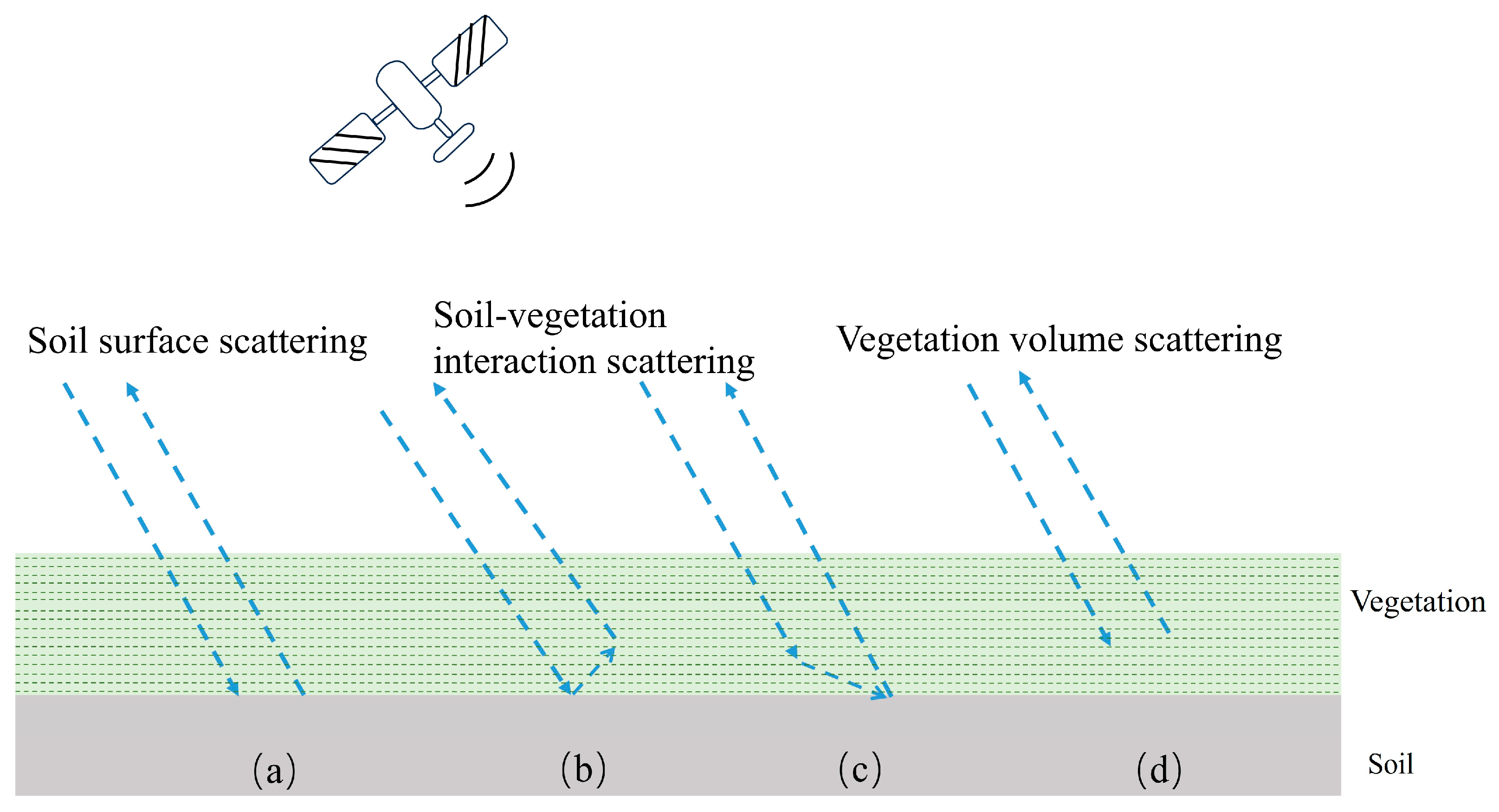
Figure 1. Schematic illustration of backscatter components: (a) soil surface scattering, (b,c) soil–vegetation interaction scattering, and (d) vegetation volume scattering. The green layer denotes vegetation, while the gray layer denotes soil.
Remotesensing 18 00673 g001
Figure 2. The geographical location and land cover distribution of the study area: (a) Canizal, (b) Zamarron, and (c) Las Bodegas.
Remotesensing 18 00673 g002
Figure 3. Variance contribution ratio of each scattering component to the NPDI for VV and VH polarizations at Canizal.
Remotesensing 18 00673 g003
Figure 4. Variance contribution ratio of each scattering component to the NPDI for VV and VH polarizations at Zamarron.
Remotesensing 18 00673 g004
Figure 5. Variance contribution ratio of each scattering component to the NPDI for VV and VH polarizations at Las Bodegas.
Remotesensing 18 00673 g005
Figure 6. Comparison of simulated and Sentinel-1-observed backscattering at Canizal. (a) Simulation results from WCM under two polarization conditions, and (b) simulation results from proposed MWCM.
Remotesensing 18 00673 g006
Figure 7. Comparison of simulated and Sentinel-1-observed backscattering at Zamarron. (a) Simulation results from WCM under two polarization conditions, and (b) simulation results from proposed MWCM.
Remotesensing 18 00673 g007
Figure 8. Comparison of simulated and Sentinel-1-observed backscattering at Las Bodegas. (a) Simulation results from WCM under two polarization conditions, and (b) simulation results from proposed MWCM.
Remotesensing 18 00673 g008aRemotesensing 18 00673 g008b
Figure 9. Temporal variations in soil moisture derived from the WCM, MWCM, and ground measurements at Canizal (a), Zamarron (b), and Las Bodegas (c).
Remotesensing 18 00673 g009aRemotesensing 18 00673 g009b
Figure 10. A comparison of simulated and Sentinel-1-observed backscattering at Canizal. (a) WCM simulation results in 2023; (b) MWCM simulation results in 2023; (c) WCM simulation results in 2024; (d) MWCM simulation results in 2024.
Remotesensing 18 00673 g010
Figure 11. A comparison of simulated and Sentinel-1-observed backscattering at Zamarron. (a) WCM simulation results in 2023; (b) MWCM simulation results in 2023; (c) WCM simulation results in 2024; (d) MWCM simulation results in 2024.
Remotesensing 18 00673 g011
Figure 12. A comparison of simulated and Sentinel-1 observed backscattering at Las Bodegas. (a) WCM simulation results in 2023; (b) MWCM simulation results in 2023; (c) WCM simulation results in 2024; (d) MWCM simulation results in 2024.
Remotesensing 18 00673 g012
Figure 13. The relative contributions of the scattering components at the three sites in 2023 after considering the soil–vegetation interaction-scattering term: (a) Canizal, (b) Zamarron, and (c) Las Bodegas.
Remotesensing 18 00673 g013aRemotesensing 18 00673 g013b
Figure 14. The relative contributions of the scattering components at the three sites in 2024 after considering the soil–vegetation interaction-scattering term: (a) Canizal, (b) Zamarron, and (c) Las Bodegas.
Remotesensing 18 00673 g014aRemotesensing 18 00673 g014b
Figure 15. Temporal variations in the soil moisture in 2023 derived from the WCM, MWCM, and ground measurements at Canizal (a), Zamarron (b), and Las Bodegas (c).
Remotesensing 18 00673 g015aRemotesensing 18 00673 g015b
Figure 16. Temporal variations in the soil moisture in 2024 derived from the WCM, MWCM, and ground measurements at Canizal (a), Zamarron (b), and Las Bodegas (c).
Remotesensing 18 00673 g016aRemotesensing 18 00673 g016b
Figure 17. Backscatter observed by Sentinel-1 and simulated by the WCM and MWCM under different polarization channels at Canizal (a), Zamarron (b), and Las Bodegas (c).
Remotesensing 18 00673 g017aRemotesensing 18 00673 g017b
Figure 18. The sensitivity of the soil moisture retrieval accuracy with respect to the vegetation water content (VWC). “Error” is defined as the difference between the simulated value and true (observed) value. The black dot represents the median, and the upper and lower dashed lines correspond to the 75th (Q3) and 25th (Q1) percentiles, respectively.
Remotesensing 18 00673 g018
Table 1. Basic information of the soil moisture observation sites.
SiteLocationData Acquisition TimeLand Cover
(a) Canizal−5.35997, 41.196032020–2024Cropland
(b) Zamarron−5.54427, 41.239232020–2024A mixed landscape with small forest and shrubland patches and large cropland areas
(c) Las Bodegas−5.47708, 41.182642020–2024A mixed landscape with large forest and shrubland patches and small cropland areas
Disclaimer/Publisher’s Note: The statements, opinions and data contained in all publications are solely those of the individual author(s) and contributor(s) and not of MDPI and/or the editor(s). MDPI and/or the editor(s) disclaim responsibility for any injury to people or property resulting from any ideas, methods, instructions or products referred to in the content.