Video SAR Enhanced Imaging Using a Self-Supervised Super-Resolution Reconstruction Network


Highlights
- A deep learning-based super-resolution reconstruction framework is proposed for video synthetic aperture radar (SAR) to overcome the contradiction of high-resolution imaging and high-frame-rate imaging.
- We present a mathematical model for video SAR image super-resolution reconstruction. Building on this model, we design a self-supervised super-resolution reconstruction network, achieving good image reconstruction performance and strong generalization ability.
- By formulating the problem of achieving high-frame-rate and high-resolution imaging as a deep learning-based image super-resolution reconstruction task, the proposed approach paves a new way for the high-frame-rate microwave video SAR imaging with low system complexity and low cost.
- Thanks to the proposed self-supervised learning strategy, the designed network does not rely on unavailable high-resolution images with unblurred shadows as ground truth for the training, which is suitable for real world applications.
Abstract
1. Introduction
- To the best of our knowledge, this is the first work to formulate the problem of achieving high-frame-rate and high-resolution imaging as a deep learning-based image super-resolution reconstruction task, pioneering the high-frame-rate microwave video SAR imaging with low system complexity and low cost.
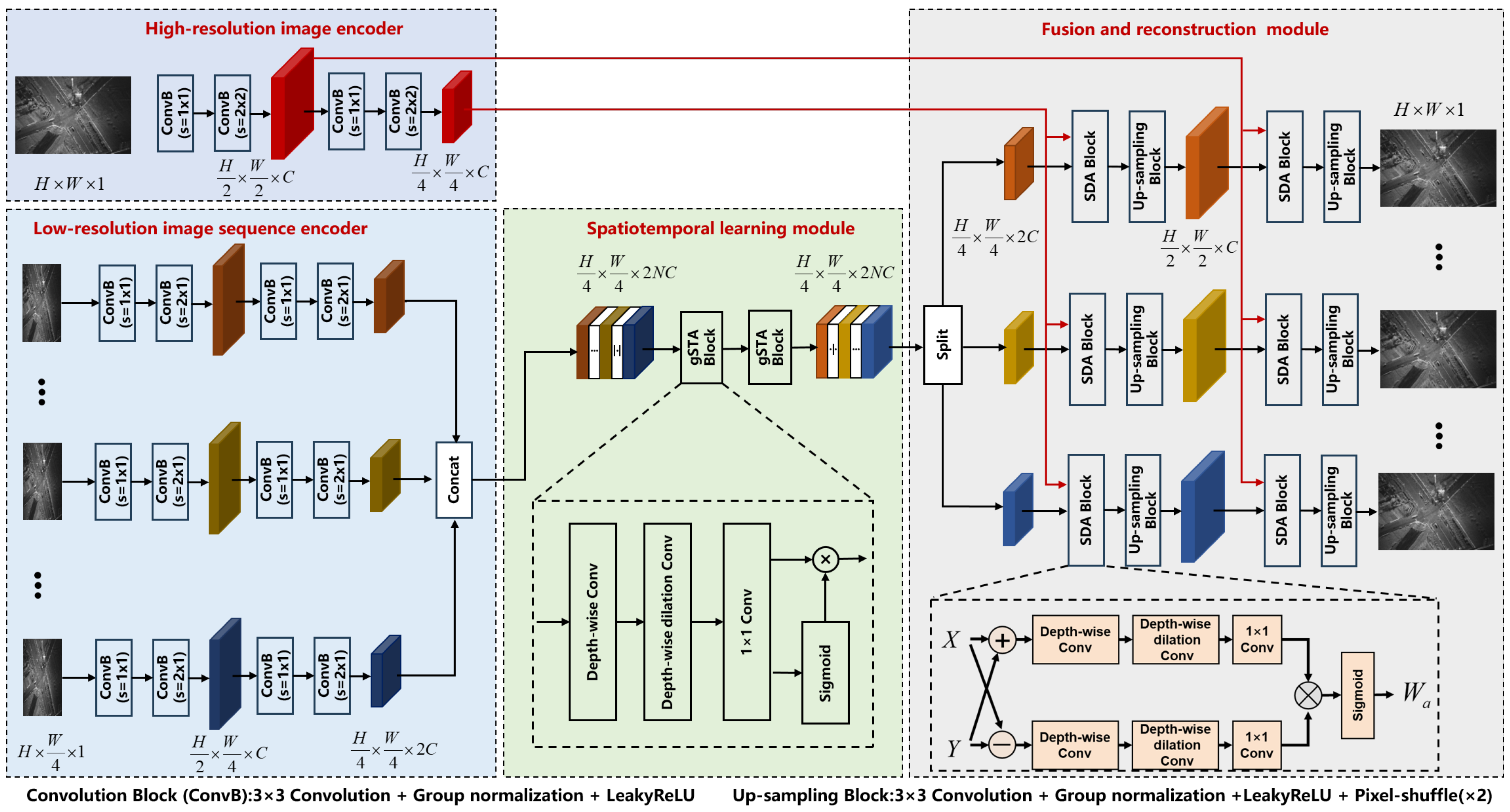
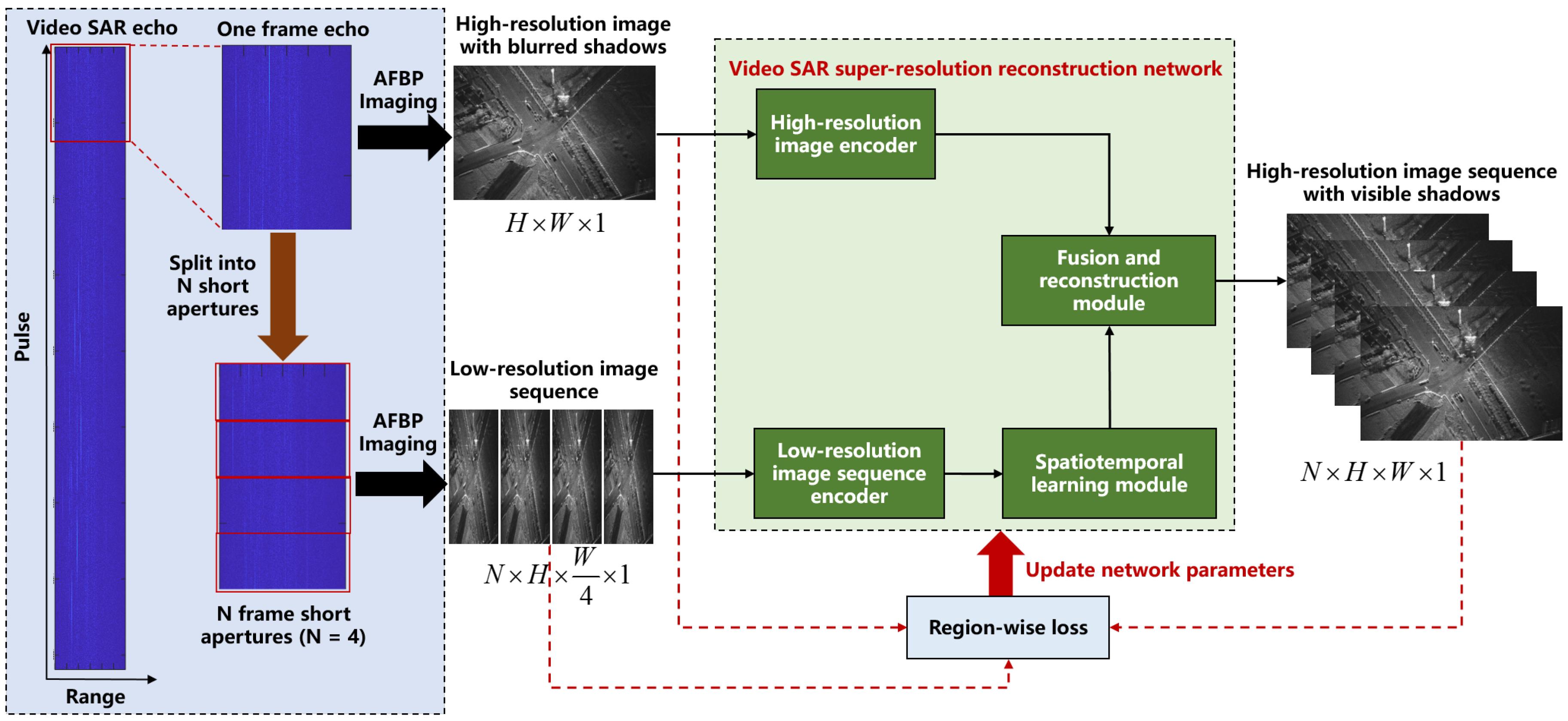
- We propose a mathematical model for video SAR image super-resolution reconstruction, which simplifies the reconstruction task as the nonlinear mapping from a low-resolution image sequence to the desired high-resolution sequence with assistance from a shadow-blurred high-resolution image. Building on this model, we design a simple yet effective network that can be trained in a self-supervised manner. Therefore, unavailable high-resolution images with unblurred shadows are not required as ground truth for the training.
- Experiments on the real data recorded by two different video SAR systems demonstrate that the proposed approach achieves excellent reconstruction performance and good generalization to the unseen data during the training.
2. Related Work
2.1. Microwave Video SAR Imaging
2.2. SAR Image Super-Resolution Based on Deep Learning
3. Methodology
3.1. Mathematical Model for Super-Resolution Reconstruction
3.2. Imaging Framework
3.3. Super-Resolution Reconstruction Network
3.3.1. High-Resolution Image Encoder
3.3.2. Low-Resolution Image Sequence Encoder
3.3.3. Spatiotemporal Learning Module
3.3.4. Fusion and Reconstruction Module
3.4. Loss Function
4. Experiments
4.1. Datasets and Training Strategy
4.2. Evaluation Metrics
4.3. Comparison Methods
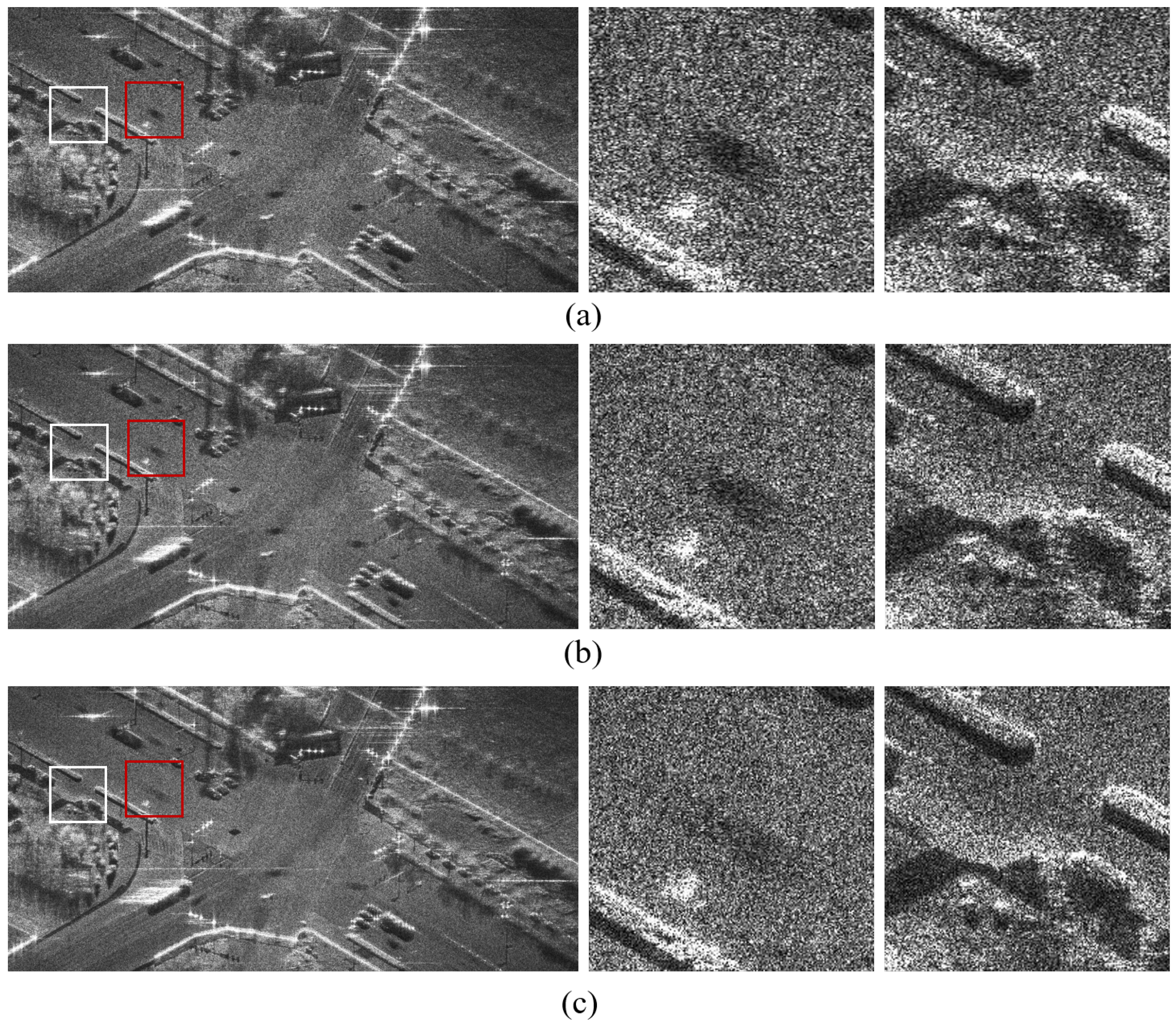
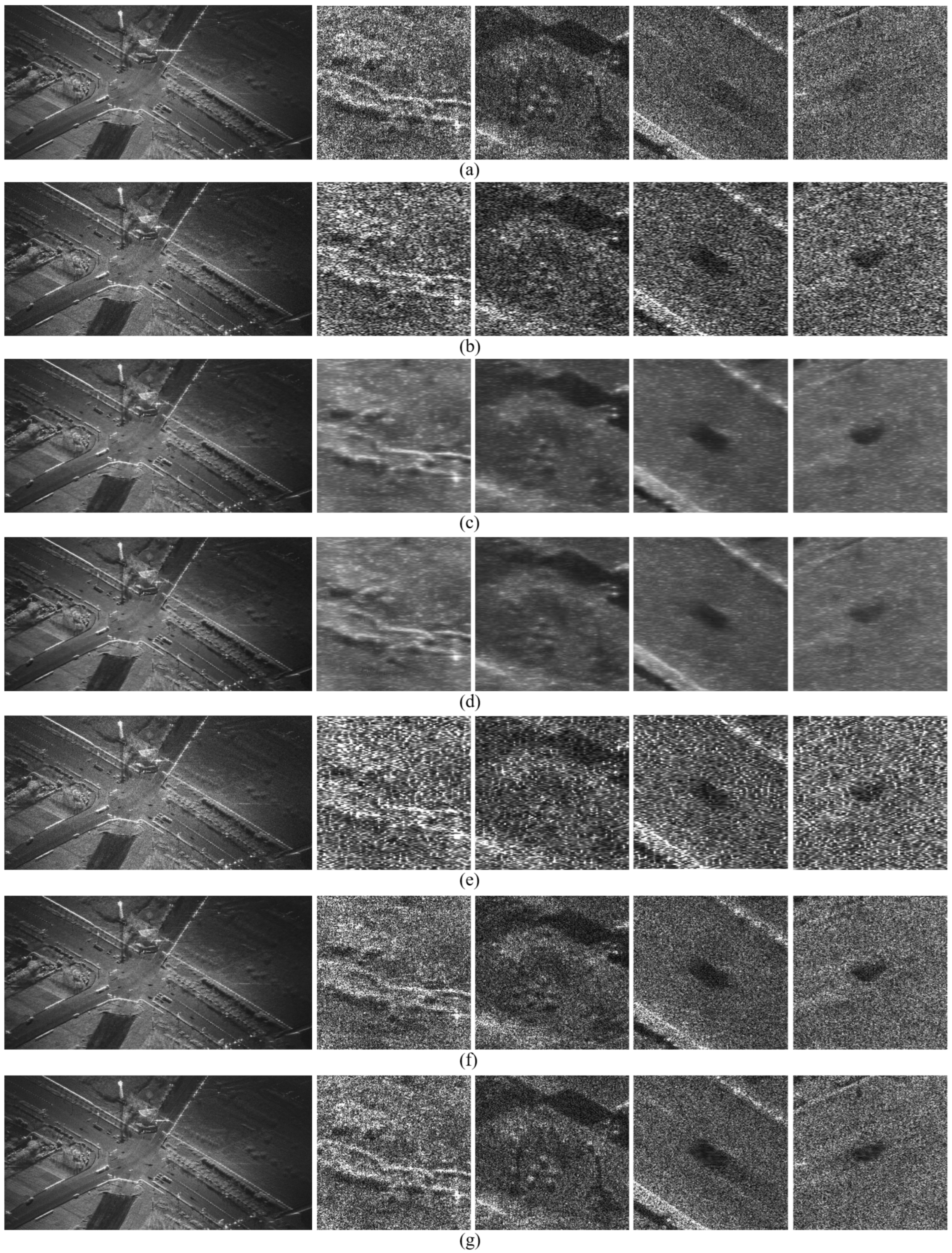
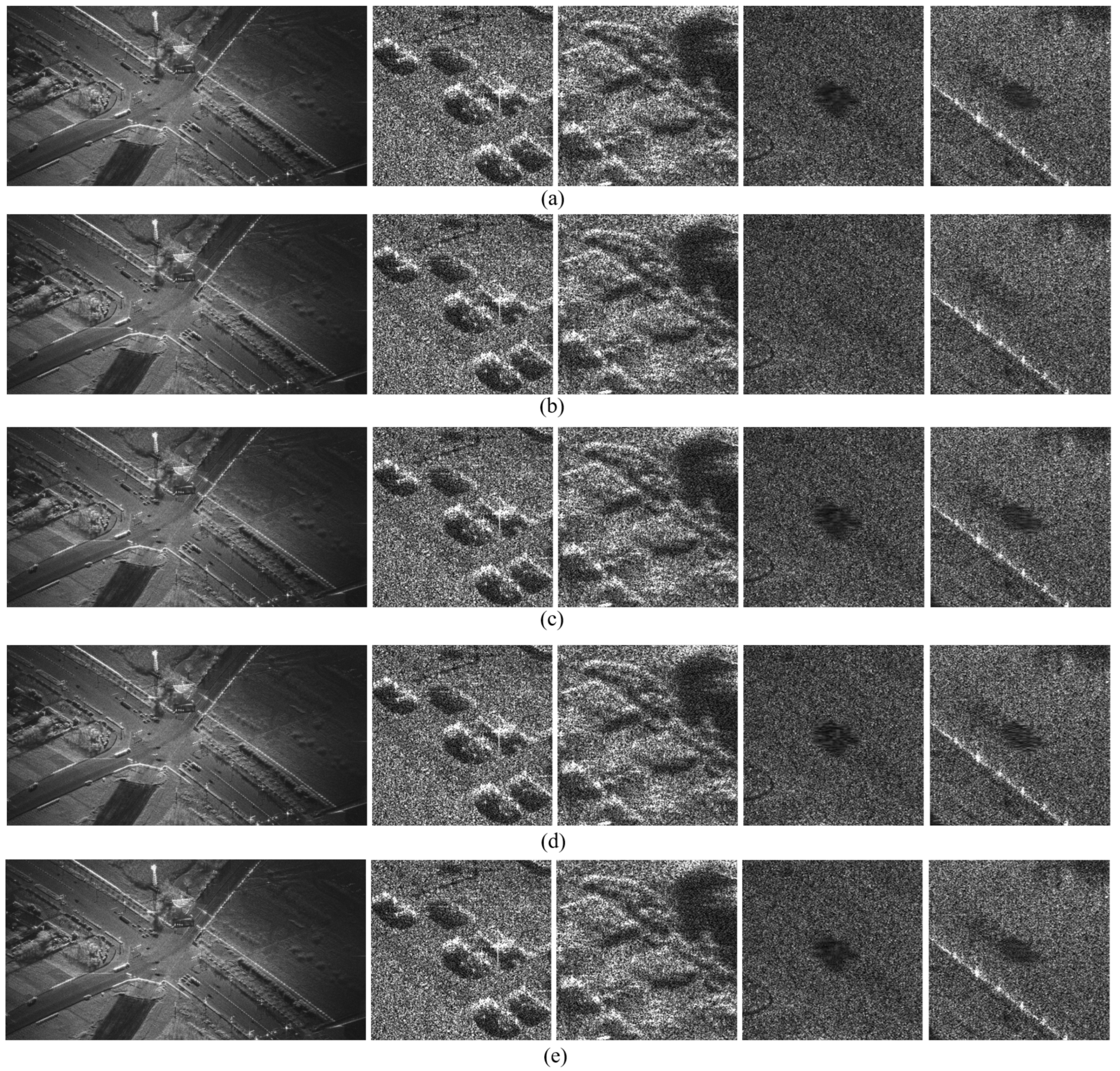
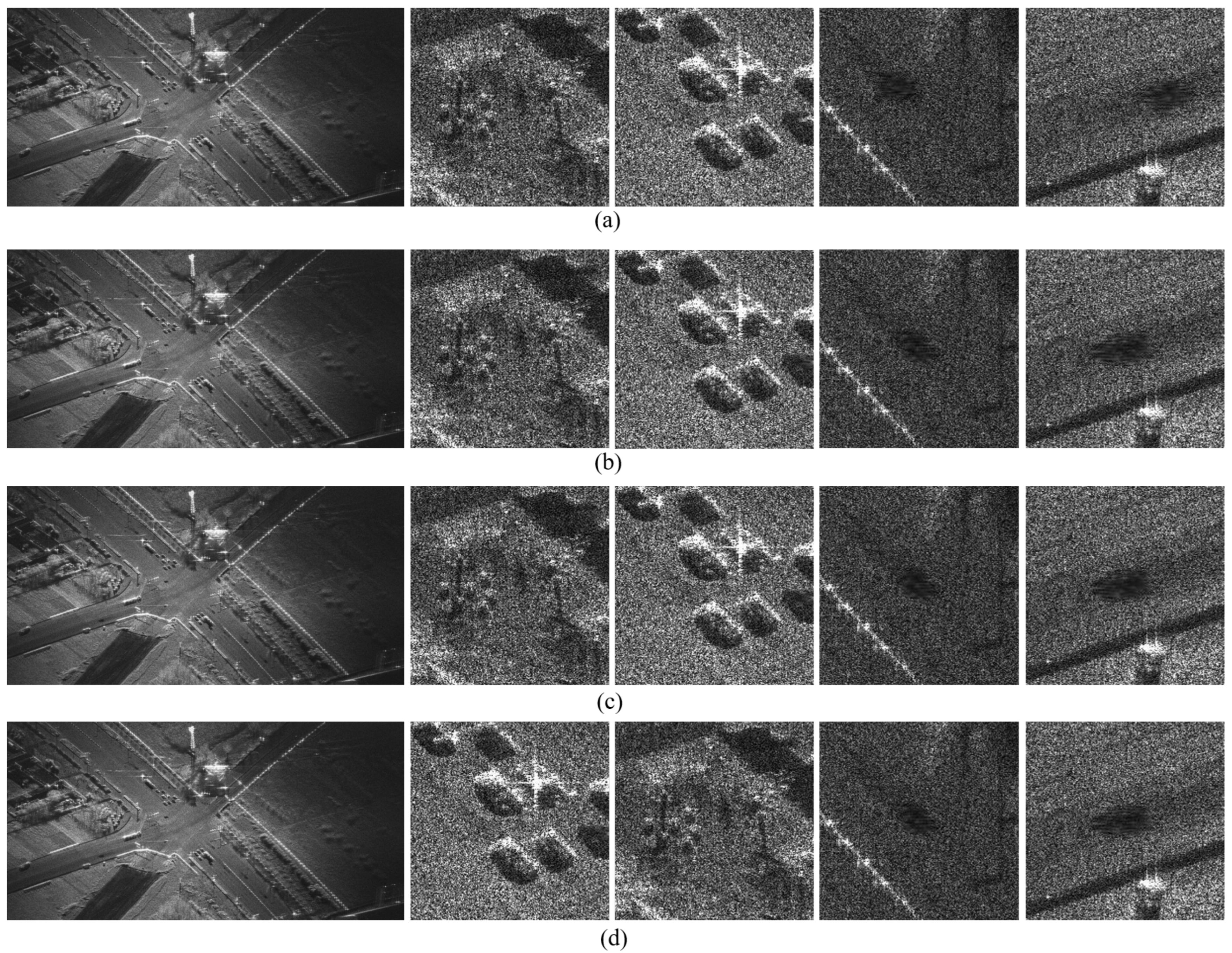
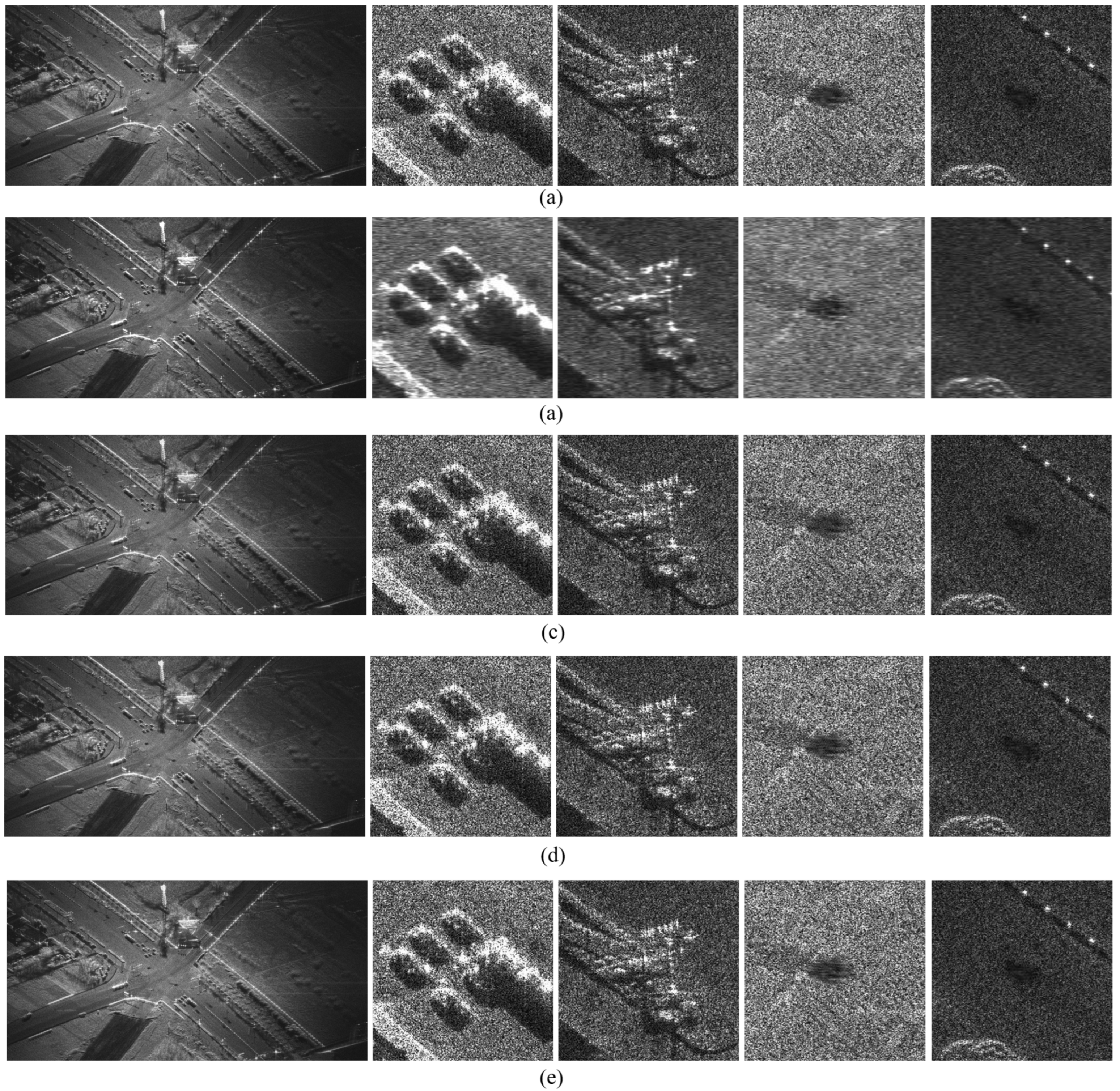
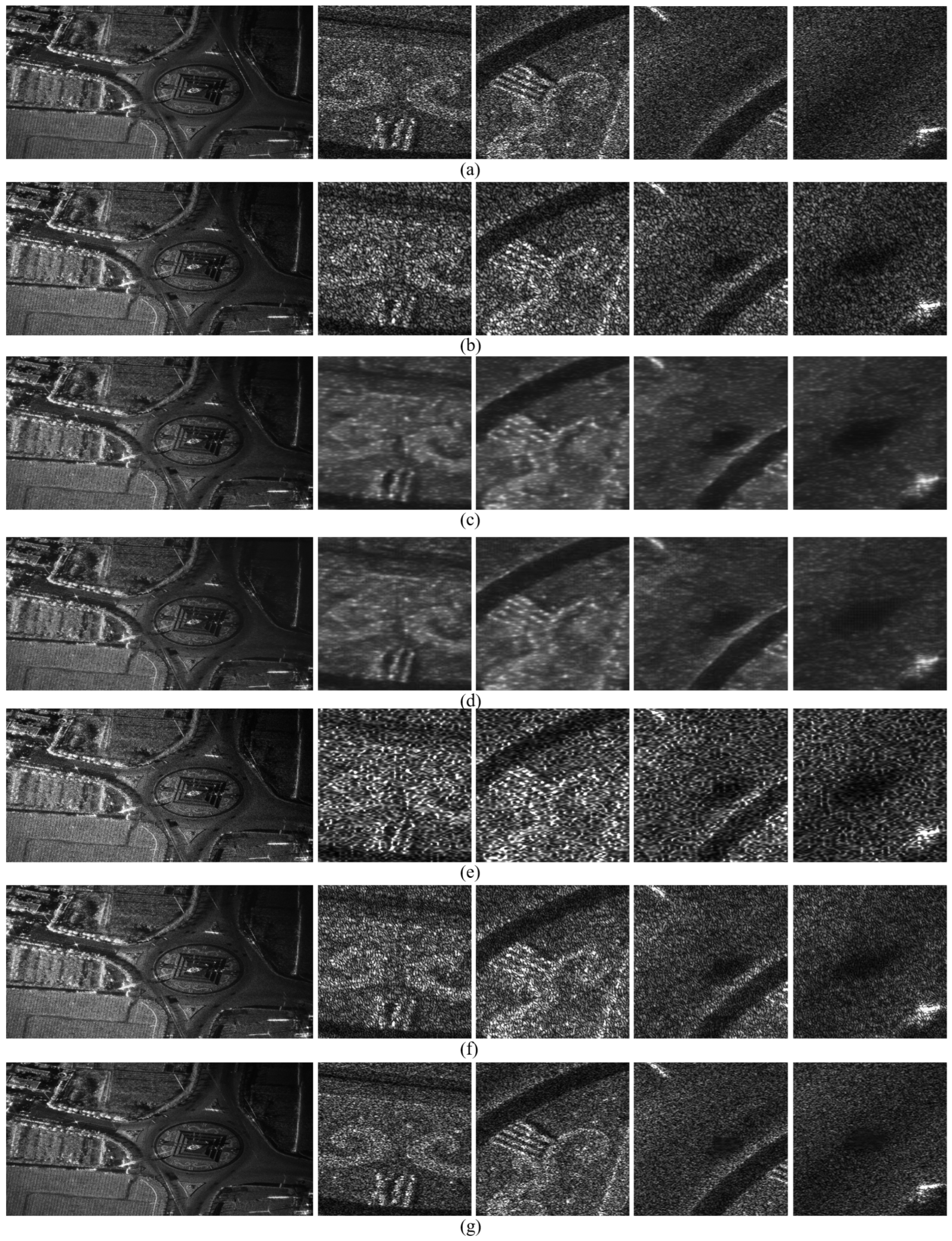
- Video SAR imaging based on overlapping aperture processing (VSAR-OAP) and low-resolution video SAR imaging (LR-VSAR) are traditional high-frame-rate imaging methods. VSAR-OAP obtains high-frame-rate and high-resolution SAR images by overlapping aperture processing while LR-VSAR achieves high-frame-rate imaging at the expense of azimuth resolution.
- IFSRCNN and lightweight SRGAN are supervised learning-based algorithms for SAR image super-resolution reconstruction. IFSRCNN is derived from the fast super-resolution convolutional neural network, adapted and optimized for SAR imagery. LSRGAN follows SRGAN to learn the mapping from low-resolution to high-resolution SAR images and further introduces depth-wise separable convolution to compress residual blocks in SRGAN, aiming to reduce computational and storage costs.
- ZSR [39] and BSR are unsupervised learning-based image super-resolution reconstruction algorithms. ZSR is originally developed for optical images, which leverages the internal self-similarity within an image to train the network. BSR explicitly considers real SAR degradations and speckle noise by introducing SAR priors and a learnable probabilistic degradation model within a CycleGAN framework, which translates low-resolution SAR images to high-resolution images without requiring paired training data.
4.4. Super-Resolution Imaging Results
4.5. Ablation Study
4.6. Generalization Ability
5. Discussion
6. Conclusions
Author Contributions
Funding
Data Availability Statement
Conflicts of Interest
References
- Damini, A.; Balaji, B.; Parry, C.; Mantle, V. A VideoSAR mode for the x-band wideband experimental airborne radar. In Proceedings of the SPIE, Algorithms for Synthetic Aperture Radar Imagery XVII, Orlando, FL, USA, 5–9 April 2010; pp. 135–145. [Google Scholar]
- Wallace, H.B. Development of a video SAR for FMV through clouds. In Proceedings of the SPIE, Algorithms for Synthetic Aperture Radar Imagery XXII, Baltimore, MD, USA, 20–24 April 2015; pp. 64–65. [Google Scholar]
- Wells, L.; Sorensen, K.; Doerry, A.; Remund, B. Developments in SAR and IFSAR systems and technologies at Sandia National Laboratories. In Proceedings of the 2003 IEEE Aerospace Conference, Big Sky, MT, USA, 8–15 March 2003; pp. 1085–1095. [Google Scholar]
- Raynal, A.M.; Bickel, D.L.; Doerry, A.W. Stationary and moving target shadow characteristics in synthetic aperture radar. In Proceedings of the SPIE, Algorithms for Synthetic Aperture Radar Imagery XXI, Baltimore, MD, USA, 5–9 May 2014; pp. 413–427. [Google Scholar]
- Wang, H.; Chen, Z.; Zheng, S. Preliminary Research of Low-RCS Moving Target Detection Based on Ka-Band Video SAR. IEEE Geosci. Remote Sens. Lett. 2017, 14, 811–815. [Google Scholar] [CrossRef]
- Ding, J.; Wen, L.; Zhong, C.; Loffeld, O. Video SAR Moving Target Indication Using Deep Neural Network. IEEE Trans. Geosci. Remote Sens. 2020, 58, 7194–7204. [Google Scholar] [CrossRef]
- Zhong, C.; Ding, J.; Zhang, Y. Joint Tracking of Moving Target in Single-Channel Video SAR. IEEE Trans. Geosci. Remote Sens. 2022, 60, 5212718. [Google Scholar] [CrossRef]
- Tian, X.; Liu, J.; Mallick, M.; Huang, K. Simultaneous detection and tracking of moving-target shadows in ViSAR imagery. IEEE Trans. Geosci. Remote Sens. 2020, 59, 1182–1199. [Google Scholar] [CrossRef]
- Palm, S.; Sommer, R.; Janssen, D.; Tessmann, A.; Stilla, U. Airborne Circular W-Band SAR for Multiple Aspect Urban Site Monitoring. IEEE Trans. Geosci. Remote Sens. 2019, 57, 6996–7016. [Google Scholar] [CrossRef]
- Kim, S.H.; Fan, R.; Dominski, F. ViSAR: A 235 GHz radar for airborne applications. In Proceedings of the 2018 IEEE Radar Conference (RadarConf18), Oklahoma City, OK, USA, 23–27 April 2018; pp. 1549–1554. [Google Scholar]
- Zuo, F.; Li, J.; Hu, R.; Pi, Y. Unified Coordinate System Algorithm for Terahertz Video-SAR Image Formation. IEEE Trans. Terahertz Sci. Technol. 2018, 8, 725–735. [Google Scholar] [CrossRef]
- Hawley, R.W.; Garber, W.L. Aperture weighting technique for video synthetic aperture radar. In Proceedings of the SPIE, Algorithms for Synthetic Aperture Radar Imagery XVIII, Orlando, FL, USA, 25–29 April 2011; pp. 67–73. [Google Scholar]
- Moses, R.L.; Ash, J.N. An autoregressive formulation for SAR backprojection imaging. IEEE Trans. Aerosp. Electron. Syst. 2011, 47, 2860–2873. [Google Scholar] [CrossRef]
- Miller, J.; Bishop, E.; Doerry, A. An application of backprojection for video SAR image formation exploiting a subaperature circular shift register. In Proceedings of the SPIE, Algorithms for Synthetic Aperture Radar Imagery XX, Baltimore, MD, USA, 29 April–3 May 2013; pp. 66–79. [Google Scholar]
- Song, X.; Yu, W. Processing video-SAR data with the fast backprojection method. IEEE Trans. Aerosp. Electron. Syst. 2016, 52, 2838–2848. [Google Scholar] [CrossRef]
- Cheng, Y.; Ding, J.; Sun, Z.; Zhong, C. Processing of Airborne Video SAR Data Using the Modified Back Projection Algorithm. IEEE Trans. Geosci. Remote Sens. 2022, 60, 1–13. [Google Scholar] [CrossRef]
- Kim, S.; Yu, J.; Jeon, S.-Y.; Dewantari, A.; Ka, M.-H. Signal processing for a multiple-input, multiple-output (MIMO) video synthetic aperture radar (SAR) with beat frequency division frequency-modulated continuous wave (FMCW). Remote Sens. 2017, 9, 491. [Google Scholar] [CrossRef]
- Ding, J.; Zhang, K.; Huang, X.; Xu, Z. High Frame-Rate Imaging Using Swarm of UAV-Borne Radars. IEEE Trans. Geosci. Remote Sens. 2024, 62, 5204912. [Google Scholar] [CrossRef]
- Dong, C.; Loy, C.C.; He, K.; Tang, X. Image super-resolution using deep convolutional networks. IEEE Trans. Pattern Anal. Mach. Intell. 2016, 38, 295–307. [Google Scholar] [CrossRef] [PubMed]
- Zhang, Y.; Tian, Y.; Kong, Y.; Zhong, B.; Fu, Y. Residual dense network for image super-resolution. In Proceedings of the 2018 IEEE/CVF Conference on Computer Vision and Pattern Recognition, Salt Lake City, UT, USA, 18–23 June 2018; pp. 2472–2481. [Google Scholar]
- Moser, B.B.; Raue, F.; Frolov, S.; Palacio, S.; Hees, J.; Dengel, A. Hitchhiker’s Guide to Super-Resolution: Introduction and Recent Advances. IEEE Trans. Pattern Anal. Mach. Intell. 2023, 45, 9862–9882. [Google Scholar] [CrossRef]
- Dong, C.; Loy, C.C.; Tang, X. Accelerating the super-resolution convolutional neural network. In Proceedings of the European Conference on Computer Vision (ECCV 2016), Amsterdam, The Netherlands, 8–16 October 2016; pp. 391–407. [Google Scholar]
- Luo, Z.; Yu, J.; Liu, Z. The super-resolution reconstruction of SAR image based on the improved FSRCNN. J. Eng. 2019, 2019, 5975–5978. [Google Scholar] [CrossRef]
- Sun, G.; Zhang, F. Convolutional neural network (CNN)-based fast back projection imaging with noise-resistant capability. IEEE Access 2020, 8, 117080–117085. [Google Scholar] [CrossRef]
- Wei, Y.; Li, Y.; Ding, Z.; Wang, Y.; Zeng, T.; Long, T. SAR parametric super-resolution image reconstruction methods based on ADMM and deep neural network. IEEE Trans. Geosci. Remote Sens. 2021, 59, 10197–10212. [Google Scholar] [CrossRef]
- Wang, L.; Zheng, M.; Du, W.; Wei, M.; Li, L. Super-resolution SAR image reconstruction via generative adversarial network. In Proceedings of the 12th International Symposium on Antennas, Propagation and EM Theory (ISAPE), Hangzhou, China, 3–6 December 2018; pp. 1–4. [Google Scholar]
- Shen, H.; Lin, L.; Li, J.; Yuan, Q.; Zhao, L. A residual convolutional neural network for polarimetric SAR image super-resolution. ISPRS J. Photogramm. Remote Sens. 2020, 161, 90–108. [Google Scholar] [CrossRef]
- Li, Y.; Zhou, L.; Xu, F.; Chen, S. OGSRN: Optical-guided super-resolution network for SAR image. Chin. J. Aeronaut. 2022, 35, 204–219. [Google Scholar] [CrossRef]
- Zhang, C.; Zhang, Z.; Deng, Y.; Zhang, Y.; Chong, M.; Tan, Y.; Liu, P. Blind Super-Resolution for SAR Images with Speckle Noise Based on Deep Learning Probabilistic Degradation Model and SAR Priors. Remote Sens. 2023, 15, 330. [Google Scholar] [CrossRef]
- Kong, Y.; Liu, S. DMSC-GAN: A c-GAN-Based Framework for Super-Resolution Reconstruction of SAR Images. Remote Sens. 2024, 16, 50. [Google Scholar] [CrossRef]
- Jiang, N.; Zhao, W.; Wang, H.; Luo, H.; Chen, Z.; Zhu, J. Lightweight Super-Resolution Generative Adversarial Network for SAR Images. Remote Sens. 2024, 16, 1788. [Google Scholar] [CrossRef]
- Dong, G.; Wang, Y.; Liu, H.; Liu, S. Complex-Valued SAR Image Super-Resolution via Subaperture Learning and Fusion. IEEE Trans. Geosci. Remote Sens. 2025, 63, 5209714. [Google Scholar] [CrossRef]
- Yan, S. Review of the development status for ViSAR techniques. Syst. Eng. Electron. 2024, 46, 2650–2666. [Google Scholar]
- Zhang, L.; Li, H.; Qiao, Z.; Xu, Z. A Fast BP Algorithm With Wavenumber Spectrum Fusion for High-Resolution Spotlight SAR Imaging. IEEE Geosci. Remote Sens. Lett. 2014, 11, 1460–1464. [Google Scholar] [CrossRef]
- Tan, C.; Gao, Z.; Li, S.; Li, S.Z. SimVPv2: Towards Simple yet Powerful Spatiotemporal Predictive Learning. IEEE Trans. Multimed. 2025, 27, 5170–5184. [Google Scholar] [CrossRef]
- Guo, M.H.; Lu, C.Z.; Liu, Z.N.; Cheng, M.M.; Hu, S.M. Visual attention network. Comput. Vis. Media 2023, 9, 733–752. [Google Scholar] [CrossRef]
- Conradsen, K.; Nielsen, A.A.; Schou, J.; Skriver, H. A test statistic in the complex Wishart distribution and its application to change detection in polarimetric SAR data. IEEE Trans. Geosci. Remote Sens. 2003, 41, 4–19. [Google Scholar] [CrossRef]
- Lee, J.S. Speckle analysis and smoothing of synthetic aperture radar images. Comput. Graph. Image Process. 1981, 17, 24–32. [Google Scholar] [CrossRef]
- Shocher, A.; Cohen, N.; Irani, M. “Zero-Shot” Super-Resolution Using Deep Internal Learning. In Proceedings of the 2018 IEEE/CVF Conference on Computer Vision and Pattern Recognition, Salt Lake City, UT, USA, 18–23 June 2018; pp. 3118–3126. [Google Scholar]




| Parameters | Radar A | Radar B |
|---|---|---|
| Center frequency | 94 GHz | 92.92 GHz |
| Bandwidth | 1000 MHz | 900 MHz |
| Pulse width | 12 s | 20 s |
| Platform velocity | 46 m/s | 75 m/s |
| Platform height | 1263 m | 2470 m |
| Number of pulses | 1,600,000 | 145,000 |
| Radius of circular flight path | 2400 m | 6650 m |
| Methods | MPSNR (dB) ↑ | AISR ↓ |
|---|---|---|
| VSAR-OAP | - | 0.3317 |
| LR-VSAR | 14.1413 | 0.2002 |
| IFSRCNN | 15.5998 | 0.2302 |
| LSRGAN | 15.8491 | 0.2268 |
| ZSR | 12.9469 | 0.2329 |
| BSR | 13.5244 | 0.2026 |
| Proposed approach | 48.2291 | 0.2057 |
| Methods | IFSRCNN | LSRGAN | ZSR | BSR | Proposed Approach |
|---|---|---|---|---|---|
| FPS | 18.748 | 2.270 | 0.002 | 2.067 | 10.341 |
| Parameter | Kernel Size | MPSNR (dB) ↑ | AISR ↓ |
|---|---|---|---|
| 0.2 | 5 × 9 | 48.2291 | 0.2057 |
| 0 | 5 × 9 | 51.8546 | 0.3416 |
| 0.4 | 5 × 9 | 41.6733 | 0.2028 |
| 0.2 | 1 × 1 | 44.8726 | 0.2070 |
| 0.2 | 7 × 13 | 49.5854 | 0.2109 |
| Number of gSTA Blocks | MPSNR (dB) ↑ | AISR ↓ |
|---|---|---|
| 0 | 44.0777 | 0.2819 |
| 1 | 46.5003 | 0.2125 |
| 2 | 48.2291 | 0.2057 |
| 3 | 48.4652 | 0.2067 |
| Cases | MPSNR (dB) ↑ | AISR ↓ |
|---|---|---|
| Fusion by two SDA blocks | 48.2291 | 0.2057 |
| Without the shadow-blurred high-resolution image as assistance | 16.1459 | 0.2067 |
| Only using the first SDA block for fusion | 30.9863 | 0.2043 |
| Only using the second SDA block for fusion | 46.7100 | 0.2077 |
| Fusion by channel concatenation | 46.4654 | 0.2055 |
| Methods | MPSNR (dB) ↑ | AISR ↓ |
|---|---|---|
| VSAR-OAP | - | 0.1542 |
| LR-VSAR | 15.6533 | 0.0967 |
| IFSRCNN | 17.4123 | 0.1505 |
| LSRGAN | 17.4237 | 0.1096 |
| ZSR | 13.8451 | 0.1016 |
| BSR | 14.7652 | 0.1016 |
| Proposed approach | 44.1817 | 0.0999 |
Disclaimer/Publisher’s Note: The statements, opinions and data contained in all publications are solely those of the individual author(s) and contributor(s) and not of MDPI and/or the editor(s). MDPI and/or the editor(s) disclaim responsibility for any injury to people or property resulting from any ideas, methods, instructions or products referred to in the content. |
© 2026 by the authors. Licensee MDPI, Basel, Switzerland. This article is an open access article distributed under the terms and conditions of the Creative Commons Attribution (CC BY) license.
Share and Cite
Huang, X.; Zhang, Y.; Zhong, C.; Ding, J.; Wen, L. Video SAR Enhanced Imaging Using a Self-Supervised Super-Resolution Reconstruction Network. Remote Sens. 2026, 18, 670. https://doi.org/10.3390/rs18050670
Huang X, Zhang Y, Zhong C, Ding J, Wen L. Video SAR Enhanced Imaging Using a Self-Supervised Super-Resolution Reconstruction Network. Remote Sensing. 2026; 18(5):670. https://doi.org/10.3390/rs18050670
Chicago/Turabian StyleHuang, Xuejun, Yan Zhang, Chao Zhong, Jinshan Ding, and Liwu Wen. 2026. "Video SAR Enhanced Imaging Using a Self-Supervised Super-Resolution Reconstruction Network" Remote Sensing 18, no. 5: 670. https://doi.org/10.3390/rs18050670
APA StyleHuang, X., Zhang, Y., Zhong, C., Ding, J., & Wen, L. (2026). Video SAR Enhanced Imaging Using a Self-Supervised Super-Resolution Reconstruction Network. Remote Sensing, 18(5), 670. https://doi.org/10.3390/rs18050670