Article

TiARA (Version 2.1): Simulations of Particle Microphysical Parameters Retrievals Based on MERRA-2 Synthetic Organic Carbon–Dust Mixtures in the Context of Multiwavelength Lidar Data


1
A.M. Prokhorov General Physics Institute, 119991 Moscow, Russia
2
School of Remote Sensing and Information Engineering, Wuhan University, Wuhan 430072, China
3
Consiglio Nazionale delle Ricerche–Istituto di Metodologie per l’Analisi Ambientale (CNR-IMAA), Contrada S. Loja–Zona Industriale, I-85050 Potenza, Italy
*
Author to whom correspondence should be addressed.
Remote Sens. 2026, 18(4), 658; https://doi.org/10.3390/rs18040658
Submission received: 5 December 2025 / Revised: 13 February 2026 / Accepted: 15 February 2026 / Published: 21 February 2026

Highlights

What are the main findings?
  • The particle microphysical parameters (PMPs) of the fine (organic carbon) and coarse (dust) modes of the mixtures can be separately estimated from lidar observations of particle backscatter coefficients at 355, 532, and 1064 nm, and particle extinction coefficients at 355 and 532 nm. However, the retrieval uncertainties of the PMPs of these modes may considerably exceed the retrieval uncertainties of the respective PMPs of the mixtures.
  • The measurement uncertainty of the optical data is the main source of retrieval uncertainty of the PMPs. If the measurement uncertainty exceeds 10%, the impact of an incorrect light-scattering model on the retrieval uncertainty is negligible in data inversion.
What are the implications of the main findings?
  • Particle parameters retrieved with TiARA (version 2.1) are physically meaningful even (a) if the lidar measurement uncertainty is high, (b) for complex aerosol mixtures that contain non-spherical particles and (c) if the particle complex refractive index is spectrally dependent.
  • The results of this study will form the baseline for future work, where we plan to apply TiARA (version 2.1) to optical data products obtained from real lidar observations in the framework of the SCC (Single Calculus Chain) of EARLINET (European Aerosol Research Lidar Network).

Abstract

Numerical simulations of (1) two aerosol types such as organic carbon (i.e., spherical) and dust (i.e., non-spherical) particles, and (2) their mixtures are carried out. Optical and microphysical parameters of these aerosols in our simulations are provided by MERRA-2 (Modern-Era Retrospective Analysis for Research and Applications, version 2). The inversion routine is performed with TiARA (Tikhonov Advanced Regularization Algorithm) using the Lorenz–Mie (i.e., spherical) light-scattering model in unsupervised and automated, i.e., autonomous mode. The results of our numerical simulations show that the accuracy of the inversion results for the aerosol mixtures from synthetic optical data perturbed by ±10% random error is comparable to the accuracy observed for the inversion results of the “pure” spherical particles. In particular, the retrieval uncertainties of effective radius, and number, surface-area, and volume concentrations of these mixtures are ±30%, ±10%, between −50% and +100% and ±30%, respectively. However, we need to apply a modified version of the gradient correlation method (GCM) to stabilize the inversion results. The results of this study will form the baseline for future work, where we plan to apply TiARA to optical data products obtained from real lidar observations in the framework of the SCC (Single Calculus Chain) of EARLINET (European Aerosol Research Lidar Network).

1. Introduction

Aerosols are important in atmospheric processes, such as aerosol–cloud interaction, radiative impact, and transport by wind. As such, they have profound influence on human health, air quality and climate [1,2]. Lidar monitoring of the atmosphere has been intensively applied over the past two decades. The goal of this research work has been to quantify the vertical and temporal aerosol distribution and to quantify the contribution of aerosol pollution to atmospheric processes [3] that influence weather and climate. One of the main challenges in further improving our knowledge of aerosols is related to aerosol characterization in terms of their microphysical and optical properties from lidar measurements in the troposphere. Progress in solving this challenge can be achieved by carrying out the following computational stages.
The first stage is the range-resolved optical remote sensing of the atmosphere with lidar. Raman [4] and high-spectral-resolution [5] lidars (RLs and HSRLs, respectively) allow for remote measurements and are thus denoted as aerosol lidar in the following text. These aerosol lidars, in particular multiwavelength aerosol lidars, now use Nd:YAG lasers that allow for measurements of the backscatter signals at wavelengths of 355, 532 and 1064 nm, and in the case of Raman lidar, backscatter signals are obtained at Raman-shifted wavelengths of nitrogen molecules at 387 and 607 nm.
The next stage is the computation of the optical properties from the lidar signals. The results of this computation step are particle backscatter coefficients at 355, 532 and 1064 nm, particle extinction coefficients at 355 and 532 nm and particle linear depolarization ratios at 355, 532 and 1064 nm [6,7,8,9]. Recent progress in instrument hardware shows that measurements of particle extinction coefficients at 1064 nm are also possible [10,11].
In the final stage, inversion of the optical coefficients to microphysical properties is carried out. The data products of this computation step are particle size distributions and their complex refractive indices [12,13,14,15,16]. The microphysical properties allow us to calculate parameters such as particle effective radius, number, surface-area and volume concentrations, and single scattering albedo (the ratio of light scattering to light extinction of the investigated particles), and thus the light-absorption coefficient at given wavelengths.
One of the advantages of global monitoring of aerosols on a vertically resolved scale under ambient atmospheric conditions over a long-term timescale is that it allows for obtaining improved insight into the impact of aerosol pollution on atmospheric processes. To meet these observation requirements, state-of-the-art air- and spaceborne lidars have been developed [3,17]. Another approach to meet the requirements is the operation of coordinated ground-based lidar networks [18,19,20,21,22].
The most advanced, representative and sustainable network among these activities is EARLINET (European Aerosol Research Lidar Network; www.earlinet.eu), which has been operational in Europe since 2000. EARLINET, as part of ACTRIS (Aerosol, Clouds and Trace Gases Research Infrastructure; www.actris.eu), aims for continuously monitoring the four-dimensional distribution of aerosols (3-d space and time) in the atmosphere [23,24,25,26,27,28,29,30,31].
The inversion of the optical coefficients to microphysical properties has proven to have its own special challenges. Eventually, after approximately 25 years of algorithm and software development, TiARA emerged as software that is applicable, also from a practical point of view, to microphysical property retrievals [32]. Müller et al. in 1999 marked the start of this work and showed the first results of inversion with regularization of multiwavelength aerosol lidar data [33]. In view of the complexity of the underlying inversion problem, the first results required in-depth analysis of the solution space by expert data analysts to retrieve the physically reasonable microphysical parameters. The analysis was effortful and took a long time even when only single datasets (i.e., data pixels) were considered. Therefore, the automated and unsupervised retrieval of microphysical particle properties marked a milestone achievement in what we denote as the autonomous data-processing mode. This data-analysis mode does not require an expert decision, and computations are reduced to a near-real-time data-processing problem. A comparative analysis of the results retrieved with the different data-inversion approaches developed in EARLINET (including the mathematical approach based on the TiARA algorithm) can be found in [31].
In view of the results obtained in previous studies [12,13,14,15,16,31,32] the following challenges need to be solved if we want to apply the developed methodologies in numerical simulations and real lidar data in future work:
  • Aerosols in most cases are represented by particles in the fine and coarse modes of particle size distributions (PSDs), respectively. A typical example of such a PSD is the mixture of organic carbon and dust particles. The optical and microphysical parameters of both modes need to be estimated separately.
  • Particle shape is not known in most cases. The particle depolarization ratio, which can be measured with lidar, only shows if particles are spherical or not. We do not have light-scattering models that strictly describe the optical properties of non-spherical atmospheric aerosols from the mathematical point of view. We use the Lorenz–Mie light-scattering model [34] to describe the light-scattering behavior of spherical particles. However, in the case of aspherical particles, e.g., dust, we still lack suitable light-scattering models. Accordingly, an estimation of the retrieval uncertainties of microphysical properties due to the asphericity of the particles is needed. In the present work, we provide an assessment of such uncertainties on the basis of numerical simulations.
  • Even in the case of spherical particles their light-scattering properties cannot be assessed without information on the complex refractive index (CRI). Moreover, the CRI of atmospheric particles is spectrally dependent on the wavelength range [355 to 1064] nm of the lidar observations. In addition, the CRI will most likely also depend on particle size [35]. In summary, the unknown CRI and its dependence on wavelength and particle radius (size) induce an extra layer of uncertainty in data inversion.
  • Optical data are inverted from signals of backscattered light (lidar signals) which are always affected by measurement uncertainty. The uncertainty can be 10% or more depending on many factors, such as the efficiency of the signal receiver system (optics and detectors), emitted laser power, optical depth of aerosol layers, duration of the observation time, vertical range resolution, etc. Simultaneously, if the magnitude of uncertainty of the optical data exceeds 10–15%, we obtain retrieval uncertainties of particle microphysical parameters that may permit arbitrary solutions, and thus the inversion results lose their physical meaning [36]. Therefore, some sort of pre-filter analysis of optical data is necessary to assess the optical data quality before the inversion to microphysical properties starts. Reference [37] shows a practical solution to this pre-filter analysis.
In our study we investigate if the challenges A–D can be resolved with TiARA version 2.1. This version is an upgrade of versions 1.0 [32] and 2.0 [38]. We consider aerosol pollution in terms of a curtain (i.e., time-altitude) plot that contains 150 data pixels. These data pixels were generated by the MERRA-2 model. The MERRA-2 model is suitable for this work because it contains various aerosol components such as sulfate, black and organic carbon, sea salt and dust particles, which can be combined into complex aerosol mixtures (CAMs). Such mixtures can be characterized as aerosol types. Aerosol types are part of elaborate aerosol characterization schemes that are used in present-day aerosol-lidar network observations [39].
The retrieval schemes based on the concept of aerosol typing use extra information about CAMs: the number of aerosol types in the CAM, aerosol types in the CAM and their optical intensive parameters. This extra information is significant and allows for deriving more accurate results on PMPs compared to the results retrieved with classical inversion (with regularization) like TiARA. In this study we show how this information about aerosol types improves the results retrieved with TiARA2.1. This version of TiARA uses the extra constraints for the identification of the final solution space (see Appendix D for details).
We focus on a mixture of organic carbon (OC) and mineral dust (D). MERRA-2 provides optical and microphysical parameters for both OC and D particles as tabular data. Mixtures of OC and D are interesting for at least three reasons.
First, OC-D mixtures are frequently observed in the troposphere. Sources of OC and D particles are products of biomass burning and desert regions, respectively. In particular, deserts cover approximately one-third of Earth’s landmass. Second, OC-D mixtures provide a particular challenge in data inversion with TiARA because of the bimodal nature of the particle size distributions. These PSDs consist of fine-mode OC particles that are spherical and relatively small and of dust particles that are larger and non-spherical. Finally, the CRIs of both aerosol types are spectrally dependent. Numerical simulations with such mixtures allow us to analyze the uncertainty of the inversion results for cases where the initial (true) CRI depends on both wavelength and particle radius.
The numerical simulations methodology is described in Section 2. In Section 3 we analyze the quality of the optical data we used for the inversion into PMPs with TiARA. The results of the PMP retrievals from these synthetic optical data are presented in Section 4. In Section 5 we discuss the results obtained in our simulations. Section 6 presents the conclusion of this research work.

2. Methodology

We consider two aerosol types, i.e., “organic carbon” (OC) and “dust” (D) particles. These pure aerosol types are used to generate mixtures characterized by varying proportions of OC and D. The optical and microphysical properties of OC and D, i.e., the pure aerosol types, can be described by the MERRA-2 model [40].
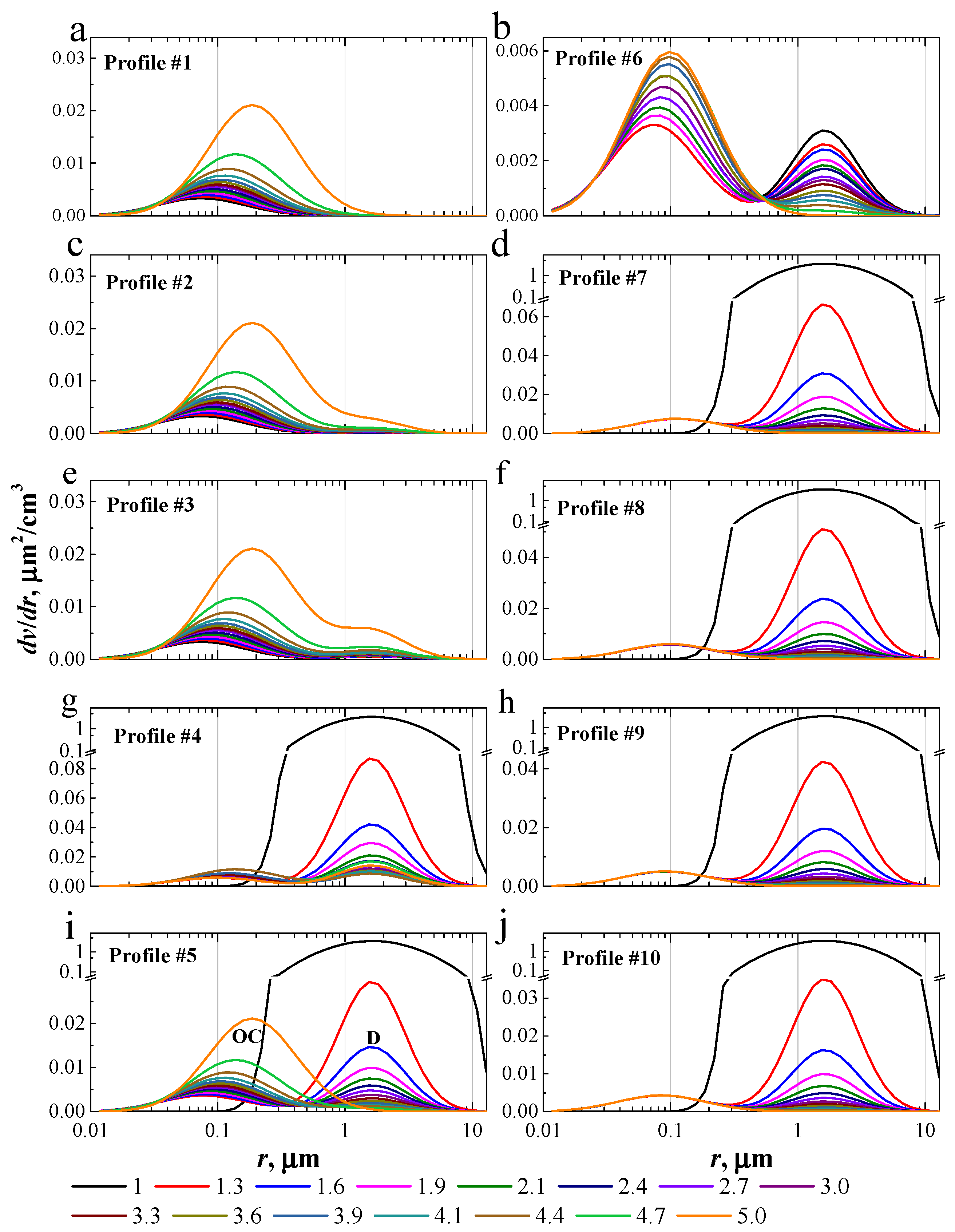
Figure 1 shows the volume PSDs (dv/dr in μm2cm−3) of the mixtures used in the numerical simulations [see Equation (2) in the following text]. We emphasize that the choice of model for the numerical simulations in this work is not of crucial importance. For example, equivalent data products are available from Copernicus Atmosphere Monitoring Service, CAMS (https://atmosphere.copernicus.eu, accessed on 14 September 2025), and Goddard Chemistry Aerosol Radiation and Transport, GOCART (https://tropo.gsfc.nasa.gov/gocart, accessed on 14 September 2025). These two models are suitable and can also be considered in future numerical simulations.
MERRA-2 itself contains uncertainties. However, we do not study PMPs of the real organic carbon and dust. We study the PMP retrieval uncertainties that TiARA delivers. In this sense it is not important what model we use (MERRA-2, CAMS, GOCART or any other) in a numerical simulation. The estimation of the disagreements between the retrieved and the model (initial, “true”) values (i.e., uncertainties) is the most important aspect of our study in this research work (see Section 5).
Each aerosol type in the model is represented by its own PSD and CRI versus relative humidity (RH) conditions, respectively. The PSDs, in terms of number concentration (dn/dr in μm−1cm−3), are described by lognormal functions with Gaussian parameters, i.e., mean radius μ and standard deviation σ. Effective radius (reff), surface-area (s) and volume (v) concentration can be estimated from the PSDs of number concentrations and the pairs of (μ, σ), respectively. The total number concentration (n) has been fixed to 1 cm−3 in this work. We note that this value is not known in the routine retrieval of experimental data. In turn, the quality of the retrieval results of the numerical simulation does not depend on that value, as it merely acts as a scaling factor. The CRI m = mRimI (R stands for the real part and I for the imaginary part) depends on the wavelength λ for each aerosol type. The parameters describing OC and D particles vs. RH are shown in Table 1 and Table 2, respectively.
The optical parameters such as backscatter (β) and extinction (α) coefficients, and single scattering albedo (SSA) are provided for the PSDs, CRIs and the respective cross-sections of backscatter and extinction at the given wavelengths λ = 355, 532 and 1064 nm for each aerosol type by the MERRA-2 model. Lorenz–Mie scattering theory has been used for the calculations of the OC cross-sections [34], whereas the D cross-sections have been mimicked by a model of randomly oriented spheroids [41]. The particle linear depolarization ratio (PLDR) at 532 nm is set to δ = 0.05 for OC and to δ = 0.35 for D particles. More details about the OC and D optical intensive parameters (IP) we used in this study are presented in Table 1 and Table 2, respectively. We use the following definitions for the lidar ratios, extinction- and backscatter-related Ångström exponents, respectively:
Λ ( λ ) = α ( λ ) / β ( λ )   α ˙ = α ˙   ( 355 / 532 ) = l n [ α ( 532 ) / α ( 355 ) ] l n 1 ( 355 / 532 )   β ˙   ( 355 / 532 ) = l n [ β ( 532 ) / β ( 355 ) ] l n 1 ( 355 / 532 )   β ˙   ( 532 / 1064 ) = l n [ β ( 1064 ) / β ( 532 ) ] l n 1 ( 532 / 1064 )  
We note that OC particles are described by small mean radii, i.e., μ ≤ 0.054 μm. The retrieval algorithm works by construction of PSDs in the radius domain r ∈ [0.03; 10] μm. This particle radius range covers the optically most active particles, given the remote sounding wavelength range [355; 1064] nm. Further investigations will show whether a larger radius range can be considered in the retrievals for the same wavelength range. The domain [0.03; 10] μm means, however, that a portion of the OC particles, i.e., the ones with radii below the mean radius of the OC PSDs, are not considered. This fact creates a challenge in regard to the accurate estimation of the microphysical parameters of the investigated PSDs.
Therefore, for estimating the retrieval uncertainty, we take into account the true microphysical parameters of representative CCN (cloud condensation nuclei) particles, i.e., effective radius reff,CCN,mo, number nCCN,mo, surface-area sCCN,mo and volume vCCN,mo concentrations (subscript mo stands for particle mode, which, in this study, denotes OC or D particles). These parameters (reff,CCN,mo, nCCN,mo, sCCN,mo and vCCN,mo) are calculated in addition to the respective total parameters of the lognormal distributions, but only for particles whose radius exceeds 0.05 μm [42].
In this contribution we use the terminology CCN for particles with a radius larger than 0.05 μm. We note that the use of the term CCN, strictly speaking, needs to be based on thermodynamic mechanisms rather than particle size. Thus, our use of CCN includes inaccuracies regarding the important physical processes that lead to declaring a particle as a potential candidate for CCN. However, for the sake of explaining the usefulness of this novelty in TiARA, i.e., the use of a non-spherical light-scattering model in the context of future research work on mineral dust, including dust-cloud interactions, we will use CCN based on a radius threshold throughout this research paper.
In the worst case, the set of true CCN parameters, which include particles with radii above 0.05 μm, underestimates the respective set of total parameters of OC particles by
2% for the respective optical data,
50% for surface-area concentration (sCCN,OC),
10% for volume concentration (vCCN,OC),
7 times for number concentration (nCCN,OC).
In view of the definition of the CCN particle domain (i.e., r > 0.05 μm) the dust CCN and the dust total parameters almost coincide in MERRA-2.
The particle optical and microphysical properties of the external mixtures are estimated from the respective OC and D parameters. In this study we consider OC-D mixtures that describe different fractions (contributions) of OC and D. The value of the fraction of OC particles, in terms of the extinction coefficient at 355 nm, ranges from φα(355) = 0 to 1 with a stepsize of 0.04–0.07 (depending on the profile number). Simultaneously, we keep the total number concentration of these external mixtures fixed at n = 1 cm−3. Besides, we varied the RH between 0 and 0.99 with a stepsize between 0.05 and 0.10; for further details see Table 1.
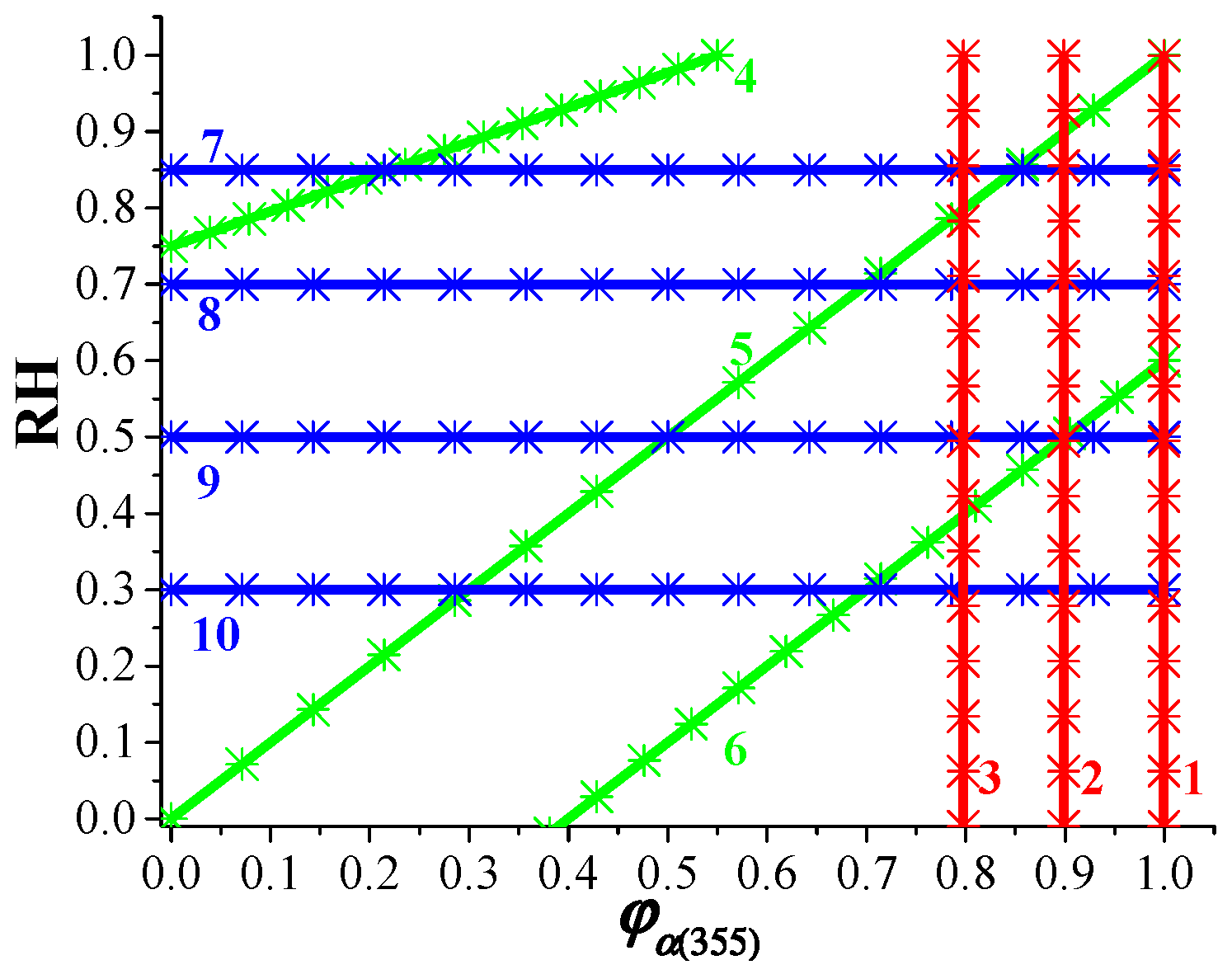
Figure 2 shows the interdependencies between RH and the OC-fraction φα(355) used for the creation of the 10 synthetic profiles.
These 10 synthetic profiles include
profiles #1–#3 described by the fractions φα(355) fixed at 1, 0.9 and 0.8, respectively, and RH growing from 0 to 0.99 with height (shown in red in Figure 2);
profiles #4–#6 described by the fractions φα(355) and RH (green). These two parameters increase from 0 to 0.55 and from 0.75 to 1 in profile #4, from 0 to 1 and from 0 to 1 in profile #5, and from 0.4 to 1 and from 0 to 0.6 in profile #6;
profiles #7–#10 described by the fractions φα(355) that grow from 0 to 1 with height and with the aforementioned stepsize 0.07 (blue). RH was set to 0.85, 0.7, 0.5, and 0.3, respectively.
Each profile contains 15 height bins that are equidistantly distributed from 1 to 5 km above ground, i.e., we consider the case (scene) of 15 × 10 = 150 pixels and a vertical resolution of approximately 0.3 km, which is a realistic value for lidar measurements. It is necessary to stress once more that the total number concentration is assumed to be 1 cm−3 for each pixel.
We note that these 150 data pixels represent optical data sets of 150 different external mixtures (in terms of different OC-D proportions and RH conditions). The optical and microphysical properties and the retrieval results of each of these 150 mixtures need to be separately studied. However, we have adopted a methodology to highlight the important features of this large dataset in a convenient way. Firstly, we visualize the results of all 150 mixtures in a compact form using curtain plots. Secondly, the results obtained for these 150 pixels can be generalized to any MERRA-2 OC-D mixture, since all other mixtures are merely intermediate values of the 150 combinations considered in this study. In the second part of our numerical simulation study, we will use this methodology for the analysis of other external mixtures like black carbon–dust, sulfate–dust, organic carbon–sea salt particles, etc.
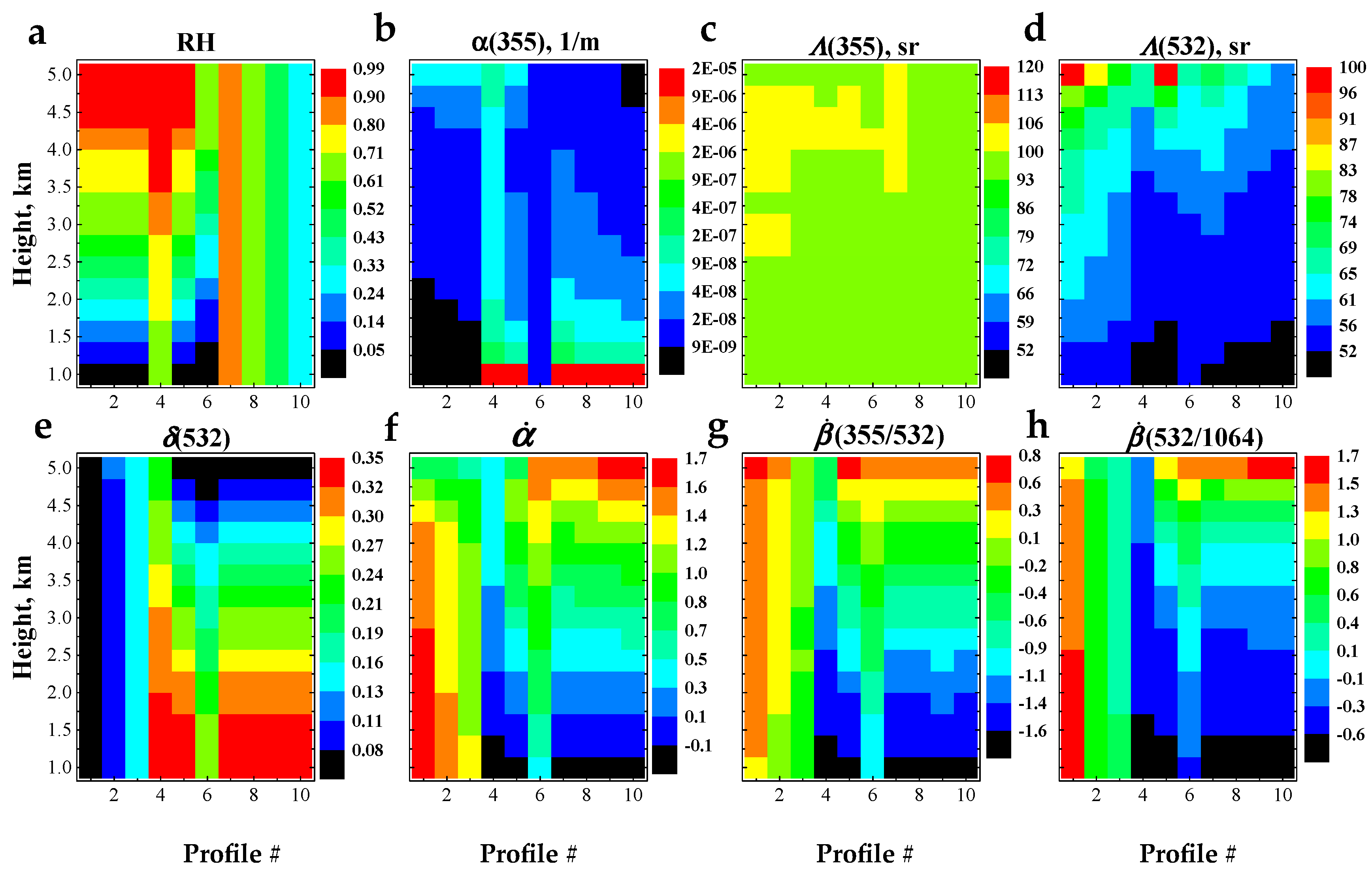
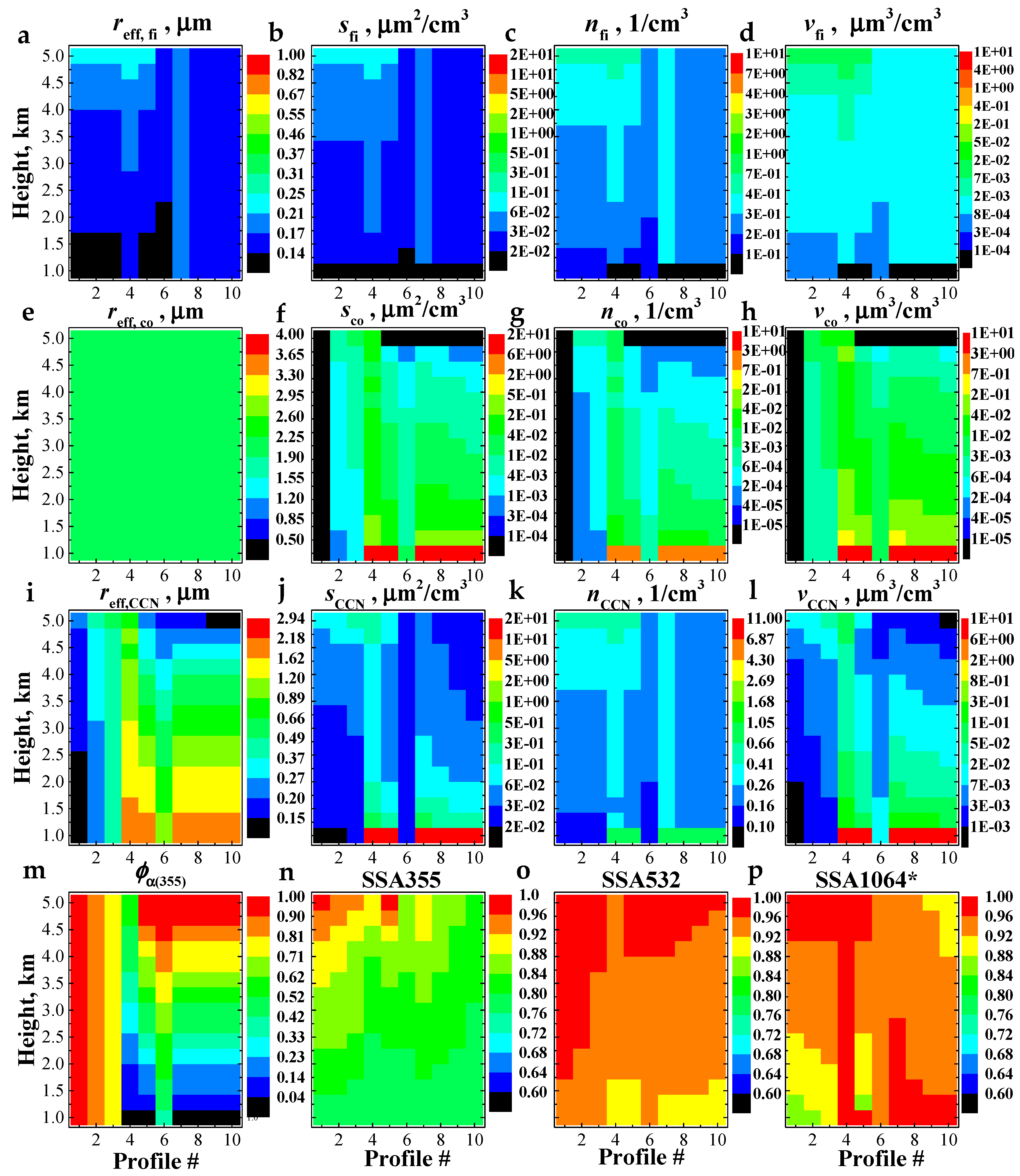
Figure 3 summarizes the initial (true) information about RH and the optical properties of the OC–D mixtures. Figure 4 shows the initial (true) effective radii, number concentrations, surface-area concentrations and volume concentrations of OC (fine mode; 1st row) and of D (coarse mode; 2nd row). The 3rd row of Figure 4 reports the parameters corresponding to the external mixtures. These parameters are analytically calculated based on the fine (fi) and coarse (co) mode parameters:
  vCCN = φn vfi + (1 − φn) vco   sCCN = φn sfi + (1 − φn) sco
nCCN = φn nfi + (1 − φn) nco  reff,CCN = 3vCCN/sCCN
where the OC fraction φn in terms of number concentration is found from φα(355) (see details in Ref. [37]) and
vfi = vCCN,OCsfi = sCCN,OCnfi = nCCN,OCvco = vCCN,Dsco = sCCN,Dnco = nCCN,D
In Figure 4, the 4th row shows the true values of the OC fractions in terms of the extinction coefficient at 355 nm and the SSA at the available wavelengths. SSA is defined as
SSAtrue(λ) = φα(λ)SSAOC(λ) + (1 − φα(λ))SSAD(λ)
This 150-pixel case can be treated as a merging of two aerosol types. The 1st aerosol type, i.e., OC, enters the plots from the left. The 2nd aerosol type, i.e., D, enters the plots from the right and “visually submerges” under the first aerosol type. In addition, the OC properties change according to the changes in RH because of hygroscopic effects.
The 150-pixel case provides us with most of the different combinations of OC and D fractions that can possibly be obtained from a theoretical point of view. However, the relationships between RH and the OC fraction can be chosen so that RH and OC conditions and the respective profiles become more representative for different geographical locations, seasons, water-vapor saturation heights, data continuity, etc. (see Figure 2). We note that any other combinations of OC fractions and RH will not influence the statistics that describe the relationships between the specific retrieved parameters and the optical data (see Section 4 for details) in this study.
Numerical simulations of true lidar measurements need to take measurement uncertainties into account. This was done by adding random numbers to the initial (true and exact) three backscatter coefficients at 355, 532 and 1064 nm and the two extinction coefficients at 355 and 532 nm, denoted as 3β + 2α optical data. An in-depth analysis of the retrieval results versus the magnitude of the random errors (i.e., 0, ±5, ±10, ±15, ±20%) was carried out in many studies before [31,32,43,44]. In the present work we focus on ±10% random error, which is an uncertainty that can be achieved with a well-calibrated aerosol lidar system under moderate to strong pollution levels, e.g., optical depths above about 0.15 at 532 nm [45]. More details about the errors and perturbed optical data used in our simulation can be found in Appendix A.
A distinguished feature of the bimodal PSDs is that they contain a considerable fraction of coarse mode particles (see profiles #3, #4 and the lower parts of profiles #5–#10 in Figure 1 and Figure 3). These PSDs are characterized by low values of the BAE532/1064 (backscatter-related Ångström exponent at the wavelength pair 532/1064 nm), which are less than 0.5. Apart from bimodal PSDs, only highly light-absorbing particles with a CRI imaginary part larger than 0.03 may produce such low BAE532/1064 values. Our interpretation of this feature is that highly light-absorbing particles appear “optically large” when 180-degree backscatter geometry is considered.
There is a high variability of the extinction-related Ångström exponents at the wavelength pair 355/532 nm (EAE) in the interval (0; 1.7). This variability covers almost the full theoretically possible domain for this IP [46]. However, this variability in a profile is only possible if particles of the fine mode are fully transformed into coarse-mode particles (or vice versa), e.g., in the case of particle coalescence (particle sedimentation). The changes of the EAE between 0.7 and 1.7 (i.e., by 1.0) can be considered an extreme situation, too, because in this case RH varies across the full domain from 0 to 1 (see profiles #1–#3 in Figure 1 and Figure 3).
However, negligible variations of some IPs are possible even if the aerosol types, i.e., the mixing ratio of OC and D, change in a profile. In our numerical simulation the lidar ratio (LR) at 355 nm slightly varies around 100 sr in all 10 profiles. All these features may be useful in practical work in future.

3. Optical Data Analysis

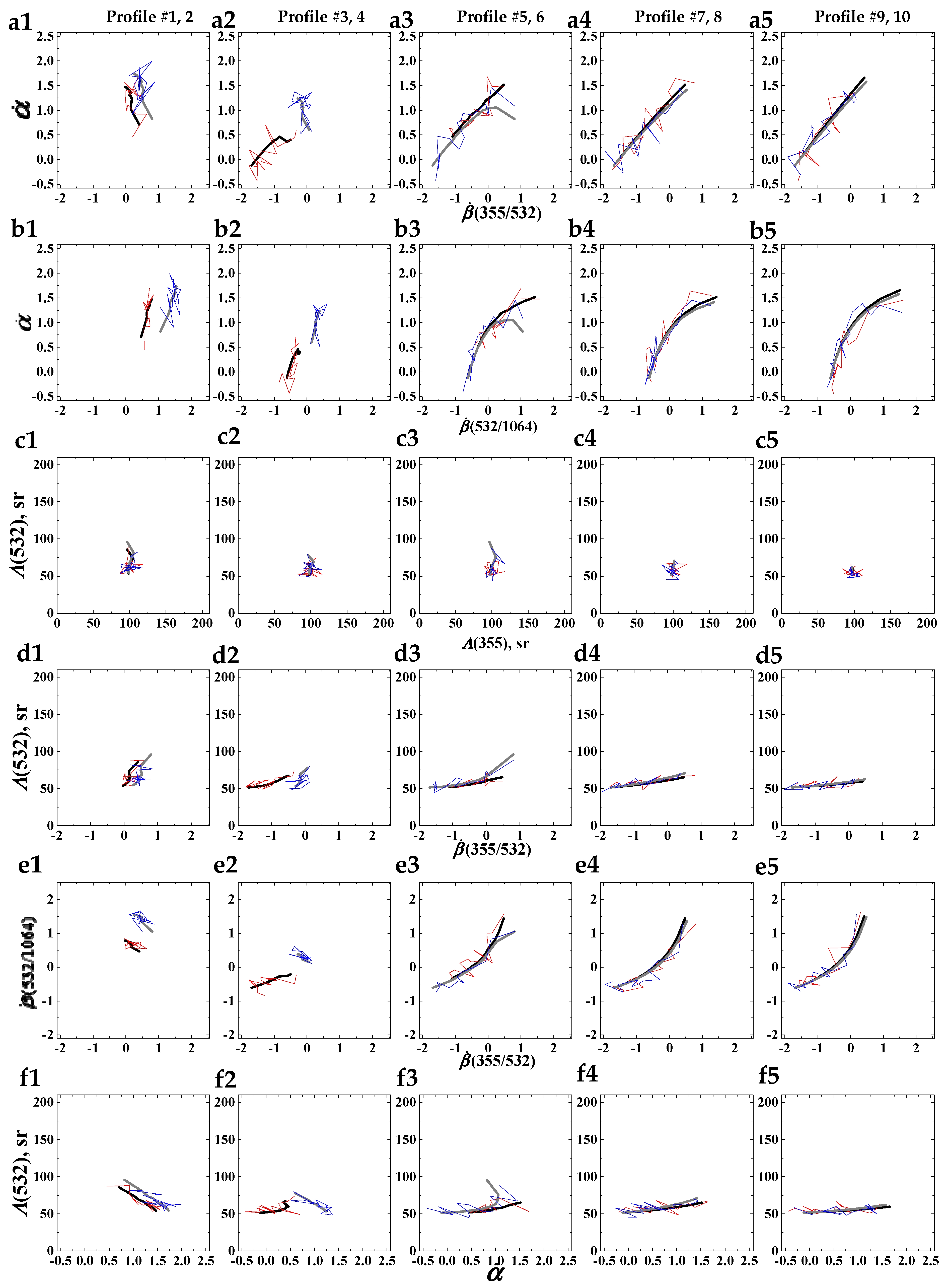
A qualitative analysis of the synthetic 3β + 2α data sets based on the approach described in [37] has been carried out. Our analysis considers interdependencies between the IPs of each profile #1, #2, …, #10. For this analysis we use intensive parameters, i.e., BAE and EAE at the available wavelength pairs (532/1064 and/or 355/532), and LRs at 355 and 532 nm. The results for all 10 profiles are shown in Figure 5 for the true (black and gray) and the perturbed (colored) data.
One of the main features of the interdependencies of the IPs is smoothness (see black and grey curves in Figure 5). Any distortion of the 3β + 2α optical data violates this property of smoothness. As a result, some variations (or rather oscillations) exist for the interdependencies (see colored curves in Figure 5). The magnitude of the variations allows us to apply the condition of smoothness to the quantitative analysis of the uncertainty of the perturbed optical data; see [37] for a detailed explanation of this condition. In particular, the EAE can vary by up to 0.5 between neighboring height bins (see the 1st, 2nd, and 5th rows in Figure 5). If the height resolution of the profile is sufficiently high and the particle properties do not significantly change between neighboring height bins, the variation of 0.5 in the EAE can be caused by measurement errors. The error can be as high as εα ≈ 10%, see [37]. A similar error magnitude corresponds to LR variations of 20% between neighboring height bins (see the 3rd row in Figure 5). We used a distortion of 10% (uniformly distributed) of the optical data in our numerical simulations. Such a measurement uncertainty of the simulated optical data produces the following retrieval uncertainties of effective radius, volume, surface-area, and number concentrations, respectively [36]:
|εreff| ≈ |εv| ≈ 30% εn ≈ −50…100% |εs| ≈ 10%.

4. Retrieval of Particle Microphysical Parameters from 3β + 2α Optical Data with TiARA Version 2.1

We use the perturbed optical data (see Figure A1 in Appendix A) as input for the PMP retrieval with TiARA v. 2.1. This version is an upgrade from versions 1.0 [32] and 2.0 [38]. The retrieval process used in TiARA2.1 consists of two stages:
  • A data processor that converts, in this example, the 150 3β + 2α optical data sets into PMPs. The full solution space is saved to a separate master solution set file for each optical data set. In contrast to the numerical simulations carried out in [32], we use a wider inversion domain (see (6)) in the present study.
  • A data post-processor that carries out the following tasks: the previously saved solution set files are uploaded to the working memory, the final solutions are computed, and the results are saved as ASCII and NetCDF files for each optical dataset, respectively. If the results do not meet the pre-set requirements of retrieval quality (see Appendix C and Appendix D),
the stage post-processor will be restarted and
constraints regarding the solution space will be applied.
In this case the option GCM (gradient correlation method) will be activated [38].
We note that in our simulation (for details see Ref. [32]:
the retrieval process uses the optimized databank that contains the weighted backscatter and extinction efficiency functions. These functions have been computed for spherical particles by Lorenz-Mie theory of light scattering [32]. The spherical databank covers the following radius and CRI domains:
r ∈ [0.03; 10] µm mR ∈ [1.325; 1.8] mI ∈ [0; 0.1],
the retrieval process uses as input a wavelength-independent CRI,
the constraints on the magnitudes of the maximal discrepancy (δmax) and the threshold uncertainties of effective radius (δr) and number concentration (δn) are not used for the identification of the final solution space,
the final solution space is the result of averaging the 100 individual solutions out of 103,600 solutions we obtain for each pixel.
We classify the TiARA2.1 results as follows:
solutions that do not depend on wavelength: μ, σ, reff, n, s, v, i.e., “pure” microphysical parameters;
solutions that depend on wavelength: backcalculated values of β, α, Λ, α ˙ , β ˙ and SSA, i.e., “pure” optical parameters;
solutions that may depend on wavelength: mR, mI, i.e., both microphysical and optical parameters.
Commonly, all three classes of the solutions are PMPs. However, in view of the specific properties of the retrieved parameters of the underlying problem [36] we distinguish CRI and SSA as separate elements of the solution spaces and uncertainties.
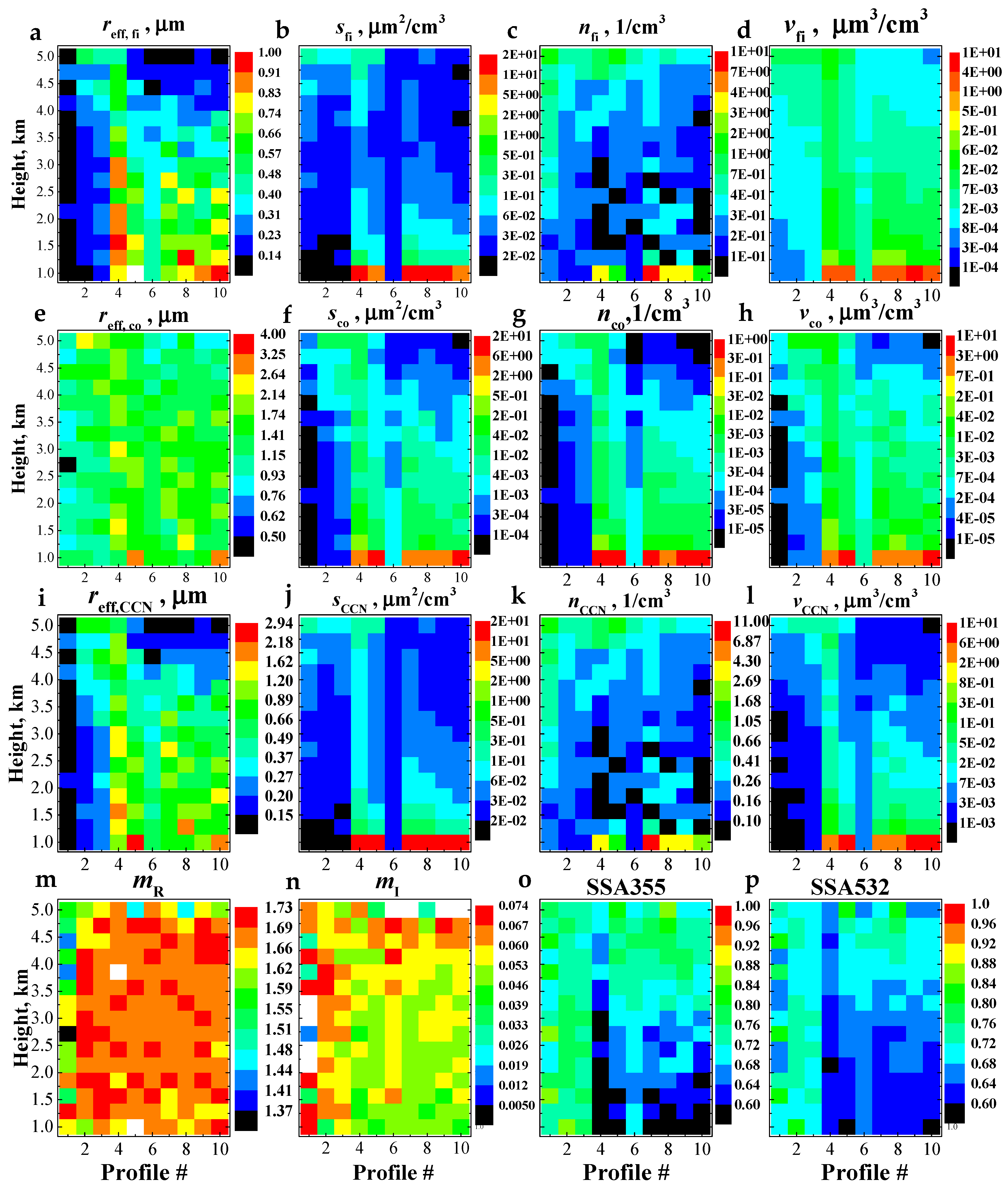
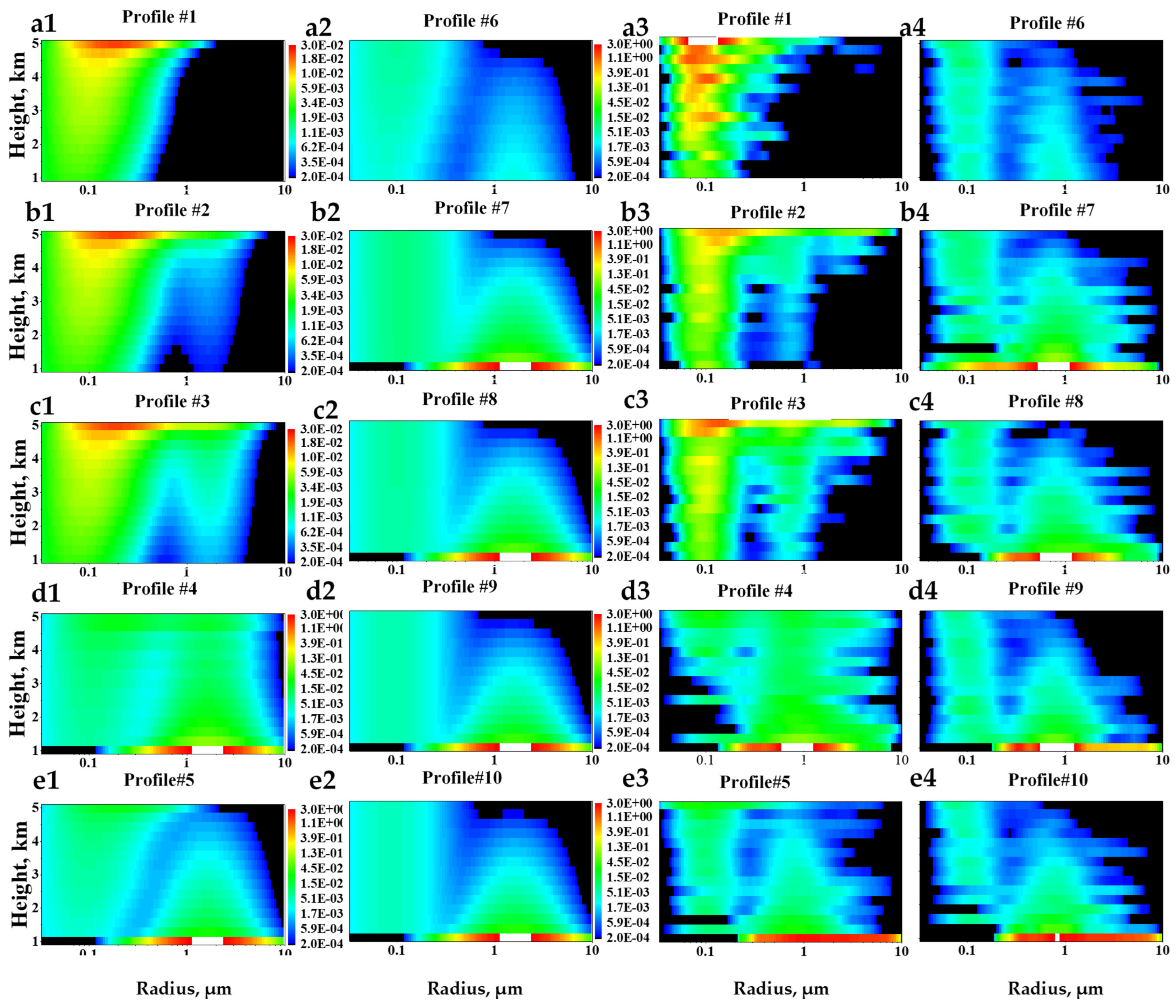
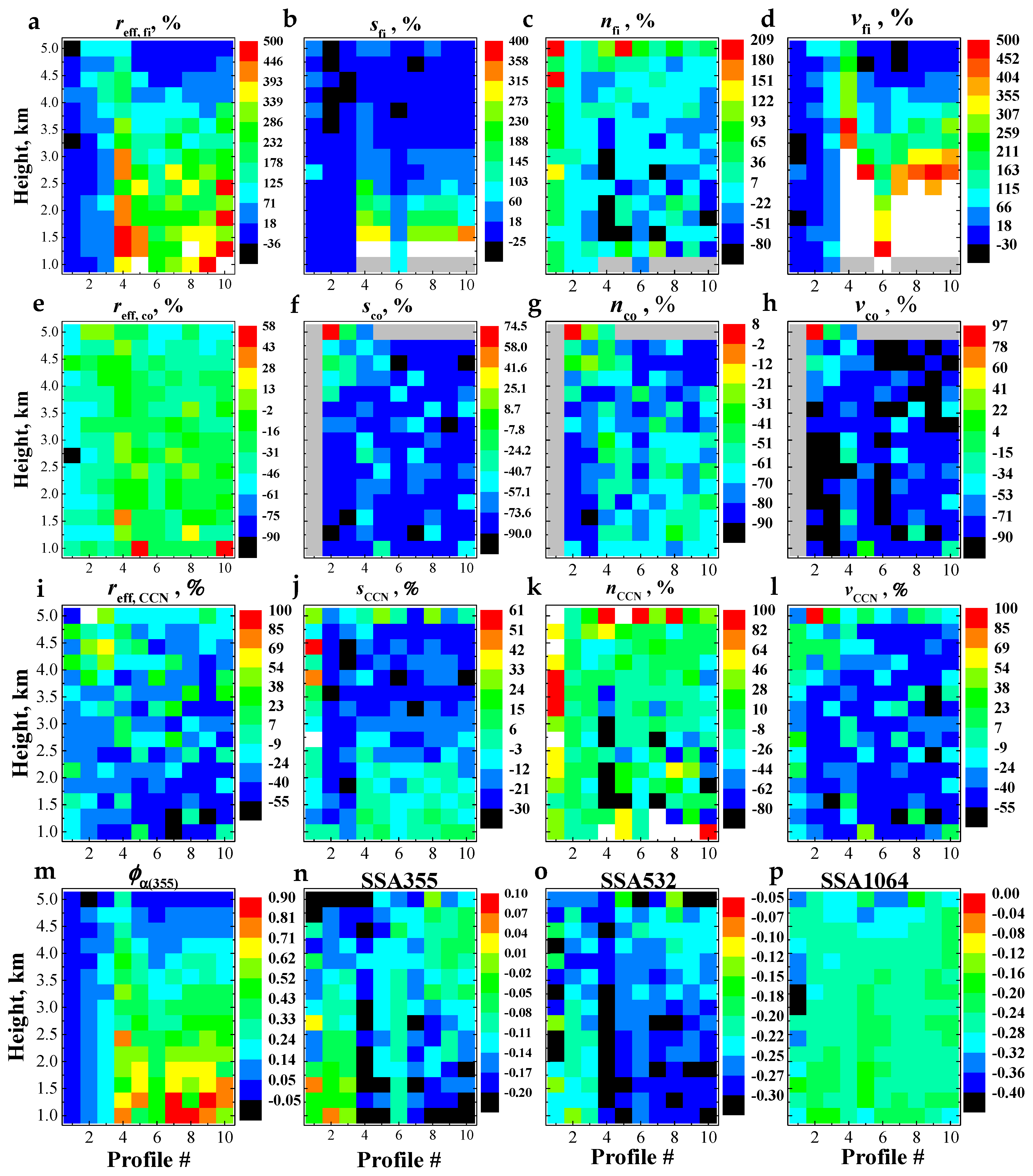
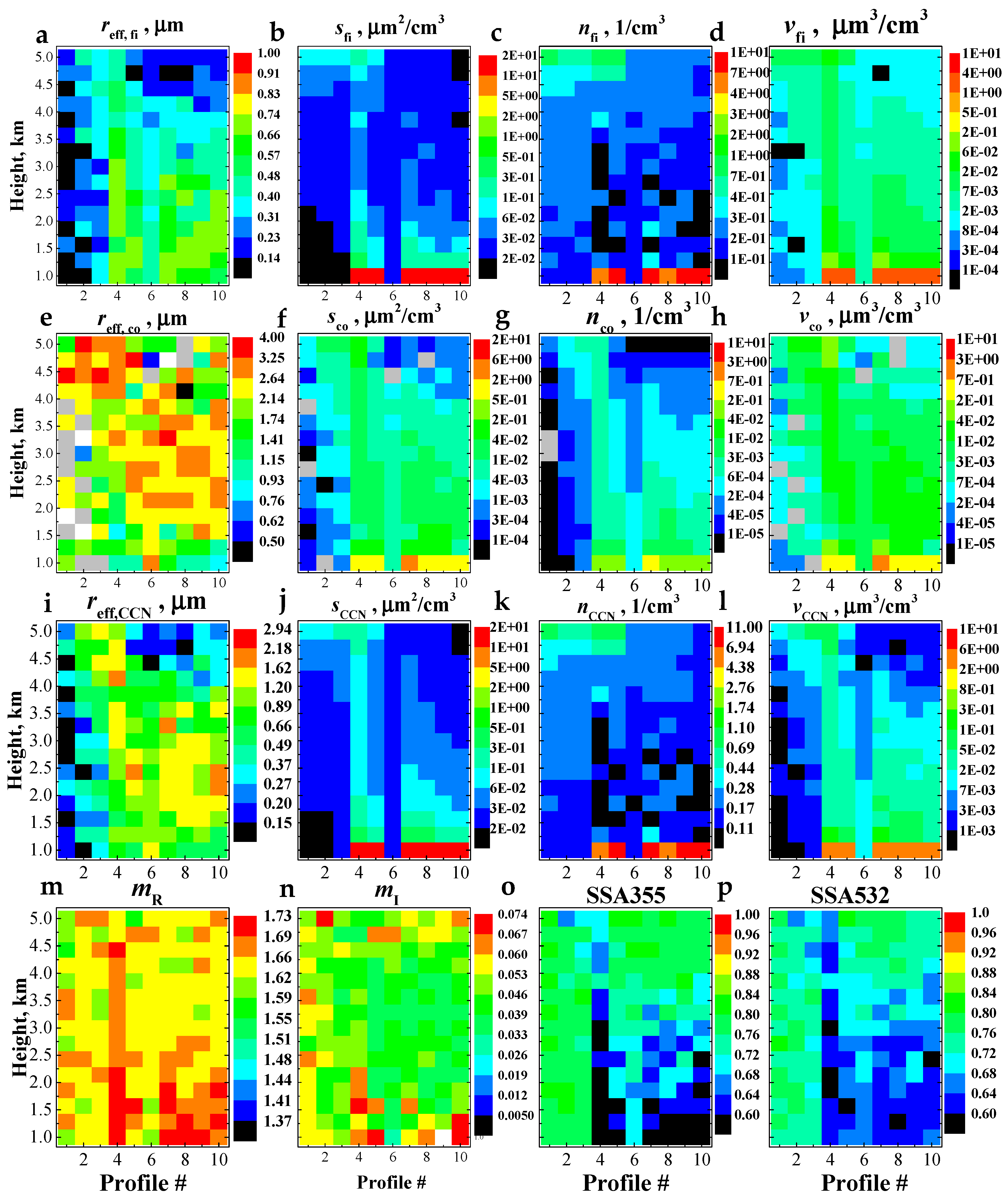
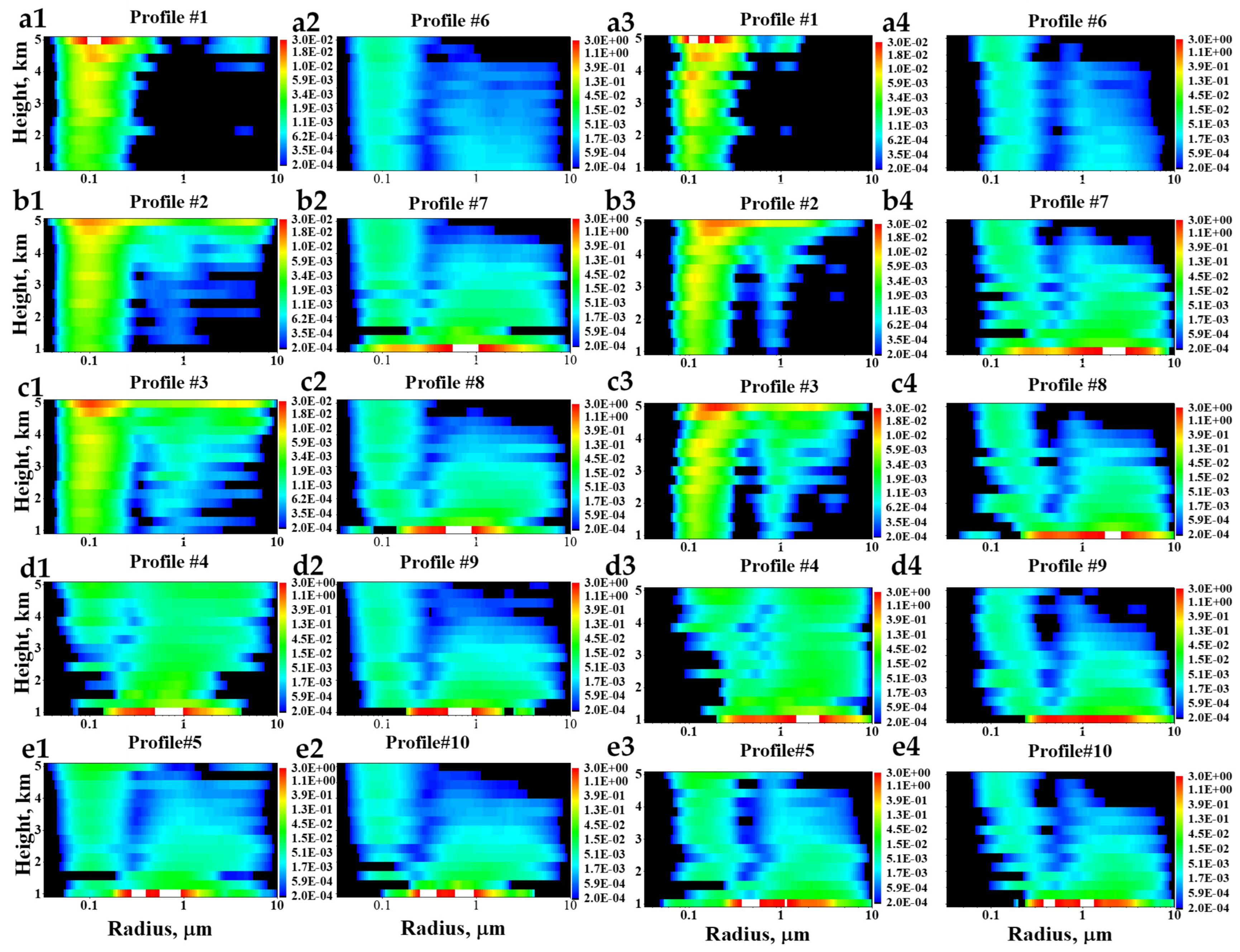
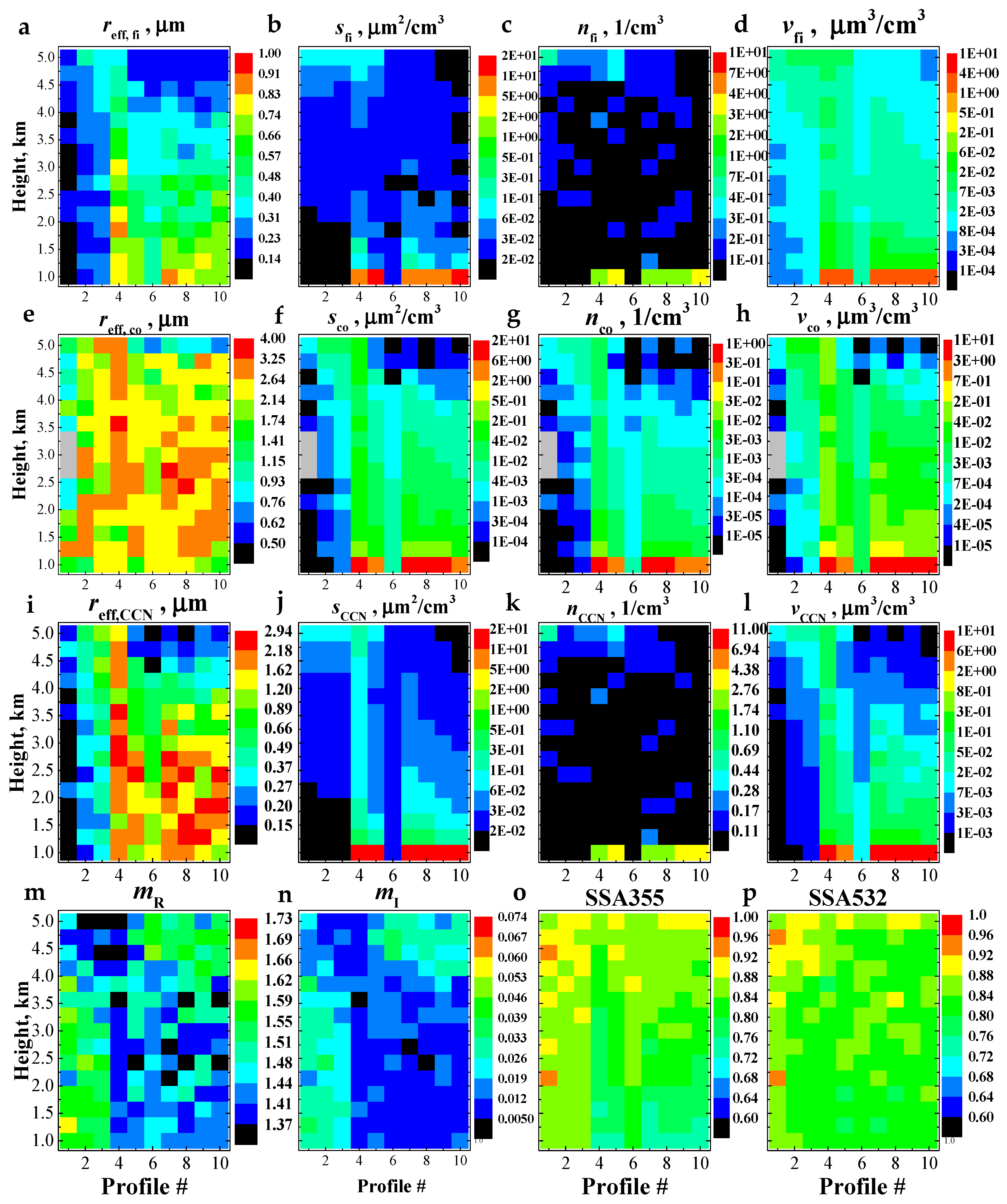
Figure 6 and Figure 7 show the results retrieved with TiARA2.1 from the 3β + 2α perturbed optical data of the profiles #1–#10 (see Appendix A, 3rd and 4th rows of Figure A1) without the use of GCM. The retrieved PMPs of the fine mode, i.e., OC (1st row) and the coarse mode, i.e., D (2nd row) are shown in Figure 6. We also show the respective PMPs of the external mixture (3rd row in Figure 6) which consists of the fine (OC) and coarse (D) mode. The SSAs at 355 and 532 nm and the CRI of the external mixture (4th row) are shown in Figure 6, too. Figure 7 shows the true PSDs (columns 1 and 2) and the results (columns 3 and 4) of the retrieved PSD (dv/dr in μm2cm−3) for all 10 profiles and all height bins. The retrieval results of the individual profiles can be found in Appendix B.
We use extra criteria (for example, the ones described above, i.e., δmax, δr, δn, or number of the averaged solutions, respectively) for the analysis of the large amount of the retrieval results. The criteria are to look for specific characteristics of the solution space, which allow us to achieve the necessary quality of the results obtained by the automated unsupervised (autonomous) retrieval mode of TiARA.
One of the criteria that can be used to check the quality of the retrieval results is the magnitude of maximal discrepancy between the input and the back-calculated optical data. In our simulation the maximal value of the discrepancy does not exceed 9% in any of the 150 retrieval cases. The mean value of all 150 discrepancies is 1%. These magnitudes are typical for 10% measurement error [44].
Another more sophisticated way to check the quality of the retrieval results is to analyze the correlation relationships between the retrieved parameters and the input optical data. Theoretical estimations [46] and numerical simulations [47] as well as the case studies presented in [15,38] reveal that the interdependencies between the specific parameters and the underlying optical data are smooth, linearly correlated and described by the restricted regression coefficients of the respective regression equations.
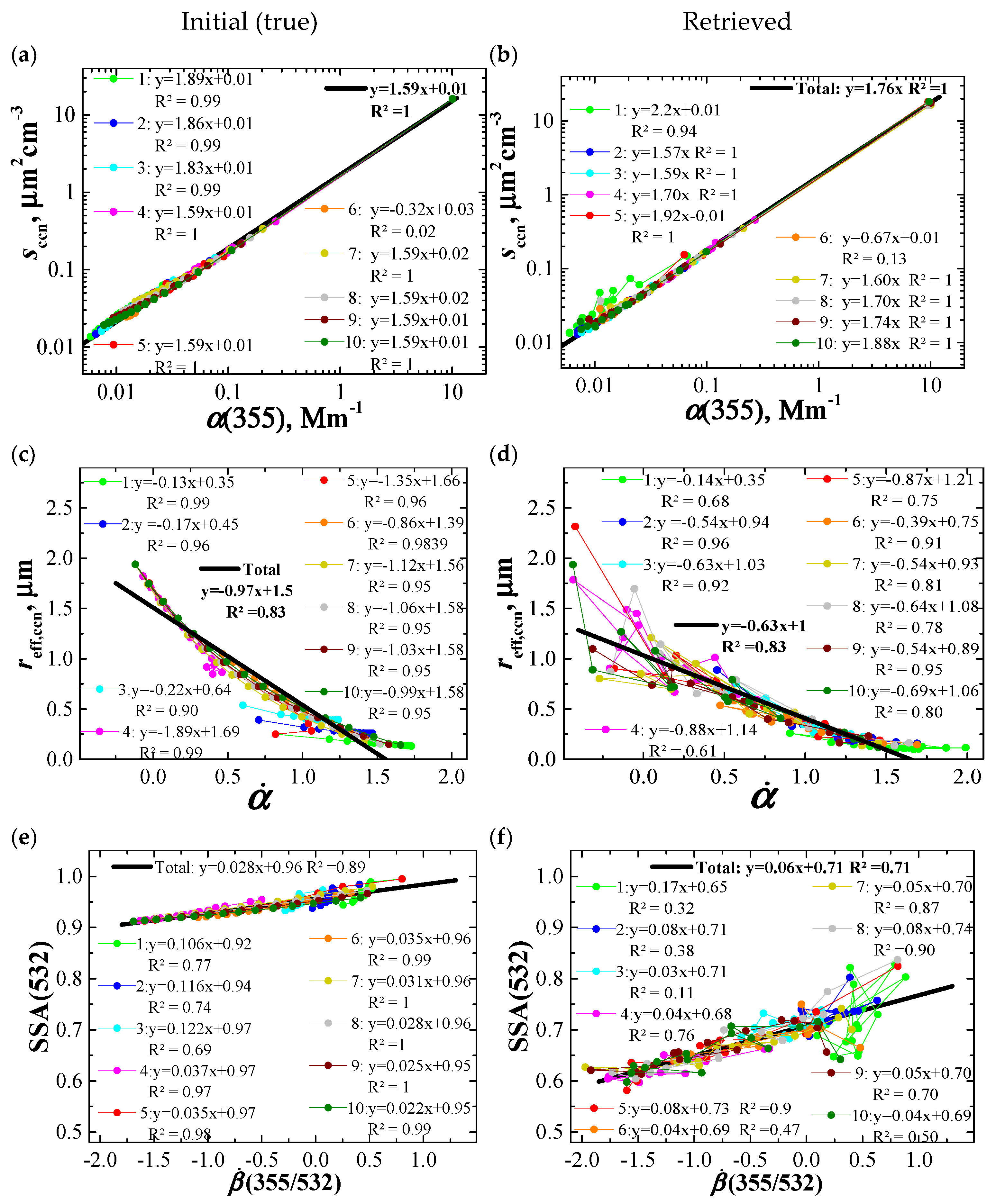
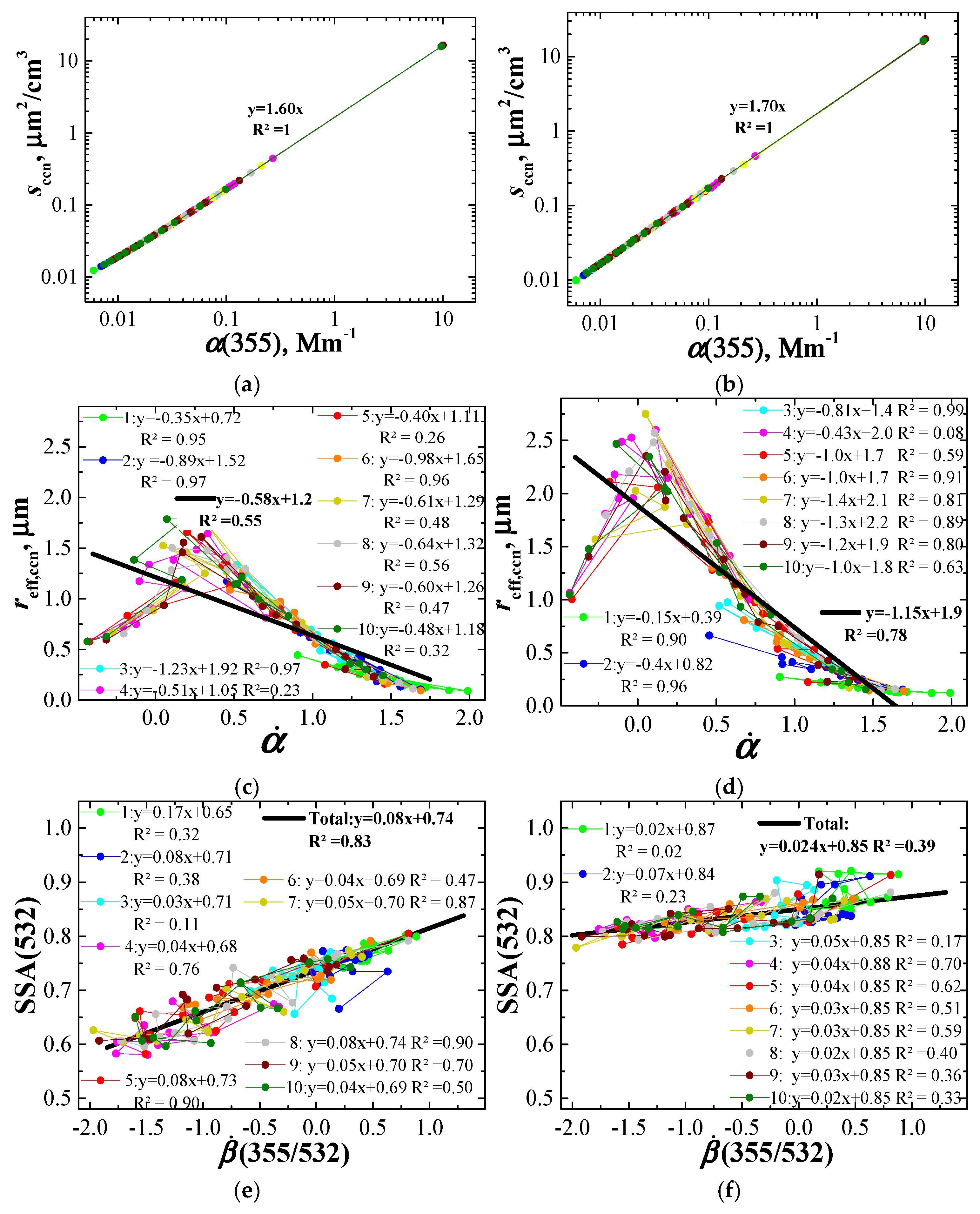
Figure 8 shows the following statistics, which belong to the most obvious set of correlations we found in previous research works:
  • surface-area concentration (in [μm2cm−3 = Mm−1]) of the mixture of OC with D versus the extinction coefficient (in [Mm−1]) at 355 nm (1st row),
  • effective radius (in [μm]) of the mixture versus EAE (2nd row), and
  • SSA at 532 nm versus BAE355/532 (3rd row).
Note: The length unit Mm−1 is important in the context of Equations (7) and (8).
Figure 8. Initial (true) statistics (left column) and statistics retrieved without the use of GCM (right column) for all 10 profiles: (a,b) surface-area concentration versus extinction coefficient at 355 nm, (c,d) effective radius versus EAE, and (e,f) SSA at 532 nm versus BAE at the wavelength pair 355 and 532 nm. The legend presents the regression equations for all 10 profiles.
Remotesensing 18 00658 g008
We collected these statistics for all 10 true (left panel) and retrieved (right panel) profiles. We also determined the regression equations that describe the statistics for each profile (see legend).
We find the highest linear correlation for the statistical relationship that describes “s vs. α(355)”. The correlation coefficient of the retrieved and true results is R2 ≈ 1. The statistics of all 10 true (input) profiles, denoted as total true statistics, are described by the regression equation
y = 1.5875x + 0.0108,
where x and y correspond to the α(355)- and s-axis, respectively. Some cases of the OC-D mixture are described by regression equations that are quite different from this general regression Equation (7). For example, profile #1 is described by y = 1.8945x + 0.0066 (green) and profile #6 is described by y = −0.3189x + 0.0316 (orange). However, all individual regression equations are covered by the “total” trend; see Equation (7) and the previous description.
The statistics of all 10 retrieved profiles, denoted as total retrieved statistics, are described by the regression equation
y = 1.758x
This regression equation differs a bit from the true one (7) [see the 1st row in Figure 8]. Some data that describe the total trend are outliers [see profile #1 with y = 2.2021x + 0.0069 (green)]. The slope that is described by the regression equation of profile #1 is overestimated. This overestimation is a warning signal in the sense that the retrieval quality of profile #1 is poor from a theoretical point of view, and this result shows that the solution can be improved if GCM is used (see Appendix C of this study and discussions in reference [38]).
We also find a high linear correlation for the statistics that describe the totalreff vs. EAE”. The correlation coefficients of the retrieved and the true results are R2 = 0.81 and 0.92, respectively. The statistics are described by the regression equations
y = −0.9692x + 1.5092
and
y = −0.6266x + 1.0331
for the true and the retrieved results, respectively (see the 2nd row in Figure 8). Unfortunately, our experience with experimental data shows that the EAE is the parameter with the poorest quality. Hence the use of the regression Equation (9) as an extra constraint in GCM may reduce the quality of the final solution. However, we hope that lidar extinction measurements will become more accurate in the foreseeable future, thanks to the development of new detectors with significantly higher signal-detection efficiency.
From the measurement point of view, the BAE355/532 is the most stable and accurate parameter. The use of BAE355/532 could significantly improve the retrieval results. Our analysis of the data shows that the parameter total true statistics (i.e., the statistical relationship among all 10 input profiles) of “SSA at 532 nm vs. BAE355/532” can be described by the linear regression equation
y = 0.028x + 0.956
We find a high correlation coefficient of R2 = 0.89. We observed a similar pattern in one of our previous OC-D case studies (see Ref. [15]). Simultaneously, the parameter total retrieved statistics (i.e., the statistical relationship among all 10 retrieved profiles) is described by the regression equation
y = 0.059x + 0.708
We find a correlation coefficient of R2 = 0.71 (see the 3rd row in Figure 8). The regression coefficients of Equations (11) and (12) differ considerably from each other. Obviously, it would be useful if we updated GCM with the extra constraint described by Equation (11) as this step could help with deriving more precise retrieval results for SSA and hence the CRI (see Appendix D).
We find high correlation coefficients of R2 ≈ 1 and 0.81 for the parameters s and reff versus α(355) and α ˙ , respectively, for the statistical relationships shown in points 1–2 of this section; see above. We emphasize that this combination of high correlation coefficients and the regression coefficient 1.758 [see Equation (8) and more details are given in Appendix C] is an indication that the quality of the retrieval results is good. In practice, it may be unnecessary to restart the stage post-processor with the use of GCM if the correlation coefficients are that high and if simultaneously the regression coefficient [see Equations (8) and (A1)] is restricted, i.e., belongs to the limited interval [1.3; 1.9] [46]. Results retrieved by applying
only one constraint, i.e., GCM1 uses the constraint on concentrations (n, s and v), and
both constraints, i.e., GCM2 uses the constraints on concentrations (n, s, and v) and SSA at 532 nm,
are described in Appendix C and Appendix D, respectively.

5. Discussion

In this section we analyze the retrieval results obtained from using NoGCM (see Section 2, Section 3 and Section 4 and Appendix B) and the two methodologies denoted as GCM1 (Appendix C) and GCM2 (Appendix D). We investigated the accuracy of the approaches and determined the uncertainties of the PMP retrievals.
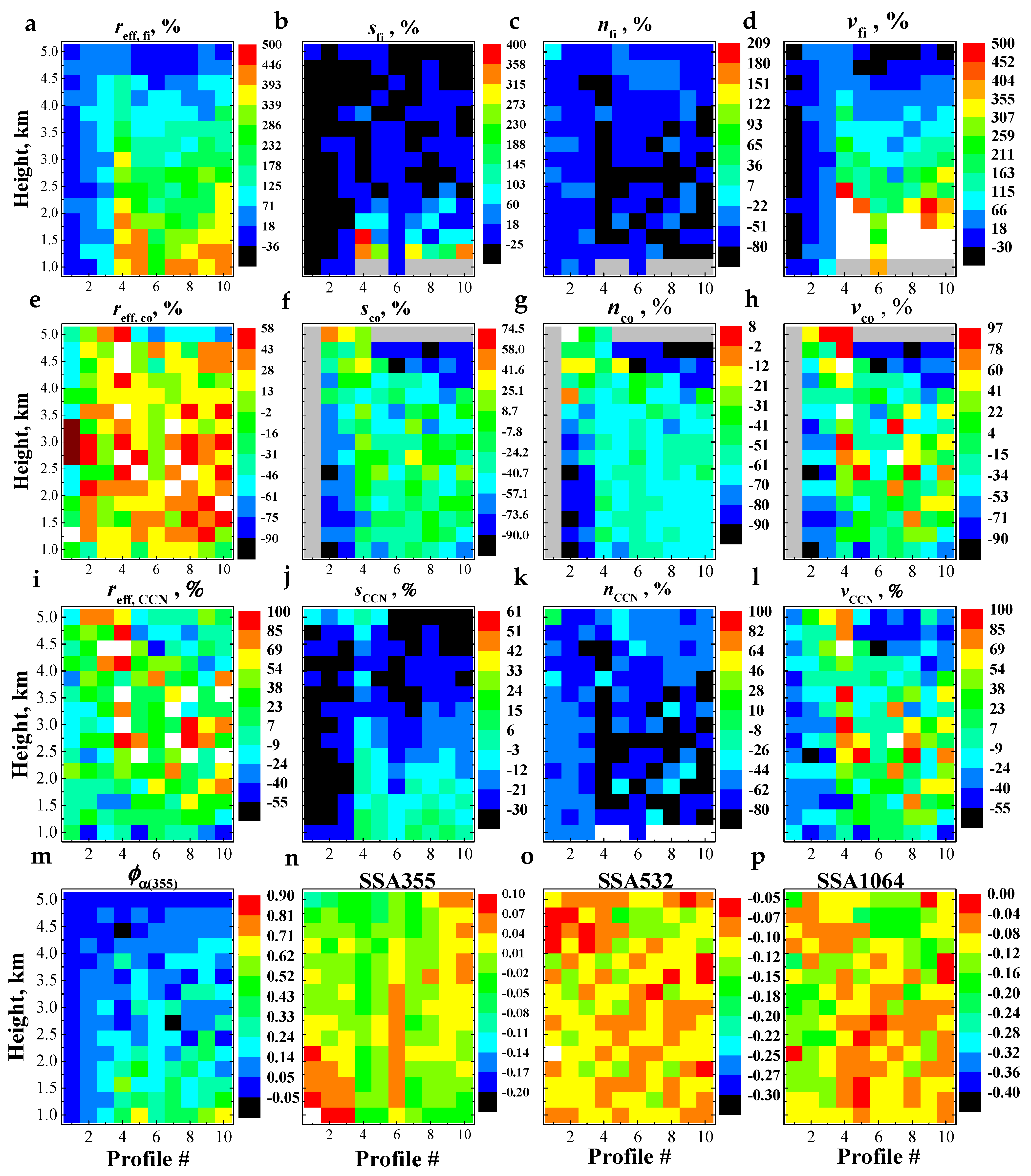
For our estimation of the retrieval uncertainties, we use the relative deviation of the retrieved PMPs from the true values for each data pixel, i.e.,
εp = (pretrieved/ptrue − 1) × 100%
where p stands for the different PMPs, i.e., fine mode, coarse mode and total effective radius, and number, surface-area, and volume concentrations, respectively. For the fraction of the extinction coefficient φα(355) (at 355 nm wavelength) of the fine mode particles and for SSA at 355, 532 and 1064 nm, we use the absolute deviations of the retrieved optical parameters from the true (input) values:
Δp = pretrievedptrue
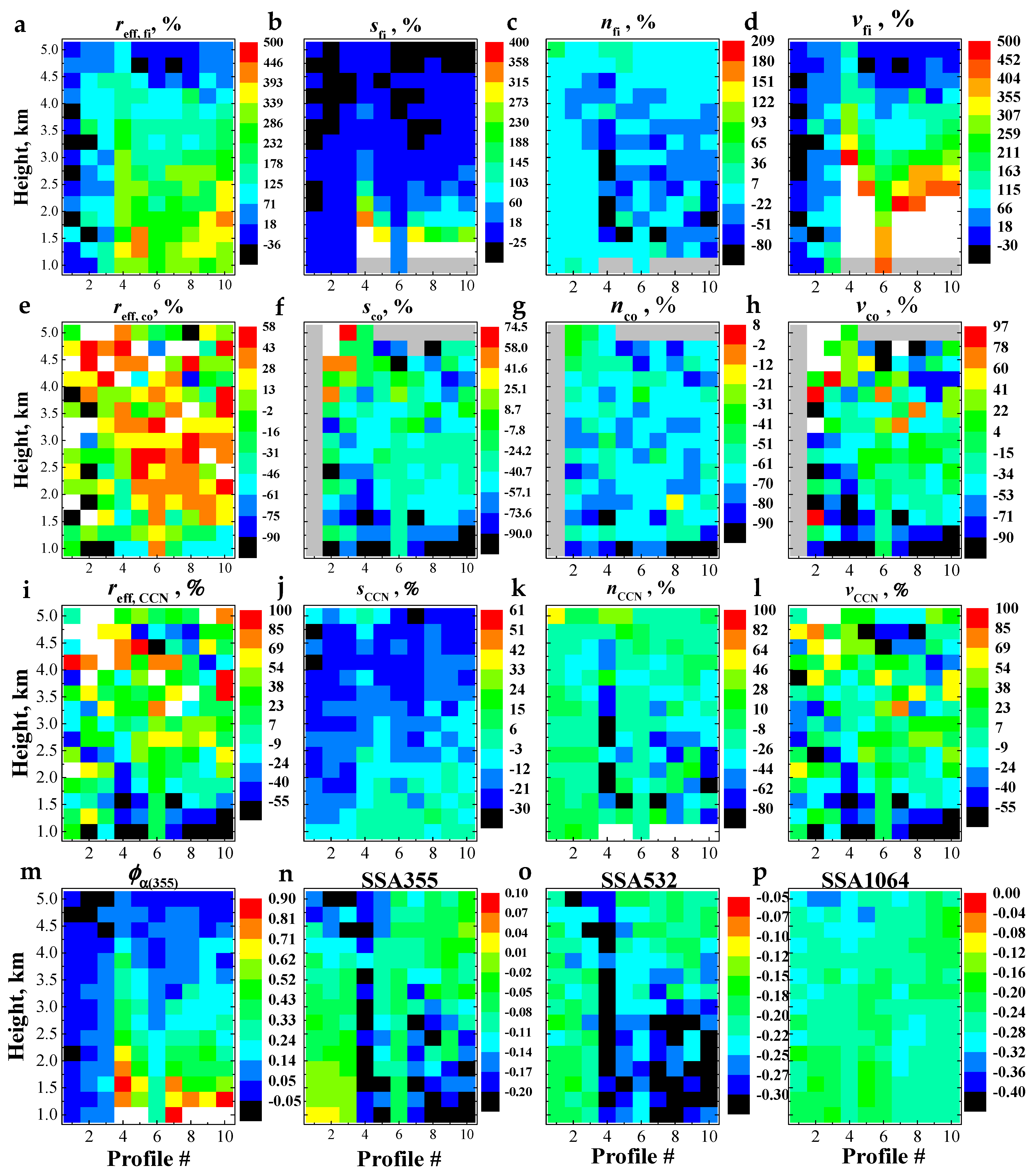
Figure 9 shows the relative/absolute deviations of the parameters retrieved with NoGCM from the true values in %/dimensionless. The fine-mode PMPs are systematically overestimated, whereas the coarse-mode PMPs are systematically underestimated; see the 1st and 2nd rows of Figure 9 and Figure A2 (shown in the Appendix B). The overestimation and underestimation are as high as 500% and 90%, respectively. We can explain these considerably large values by several reasons.
Firstly, we deal with a significantly underdetermined inverse problem. This inverse problem permits a high degree of freedom in the solution space, which may allow for an infinite number of bimodal PSDs (as solutions). The results fully corroborate theoretical estimations [36,48]. Therefore, a higher retrieval accuracy simultaneously for both fine and coarse mode particles from 3β + 2α optical data would be speculative and too optimistic in view of the current stage of algorithm development.
Secondly, we define the particle radius of 0.5 μm as the separation point between the fine mode and coarse part of the retrieved PSDs for all 150 pixels. In the case of a strong coarse mode (or even only a coarse mode) in a PSD, a considerable share of particles falls in the interval that corresponds to the fine mode particles, i.e., r < 0.5 μm (see the lower parts of profiles #4/#5 and #7–#10). As a result, the (intensive and extensive) parameters of the fine mode particles are overestimated, whereas the (extensive) parameters of the coarse mode particles are underestimated.
The relative deviations of the external mixture PMPs (retrieved with NoGCM) from the true values are much less than the relative deviations of the respective retrieval results for the fine and coarse mode particles. The relative deviations do not exceed 100% for the effective radius, and for volume and surface-area concentrations (see the 3rd row in Figure 9 and Figure A2). In the case of number concentration, the relative deviation can be as large as 900% at the lowest height level of profiles #7–#10, i.e., in the height layer that contains only coarse mode (dust) particles. The SSA of the external mixture retrieved with NoGCM underestimates, in the worst case, the true values by 0.2, 0.3, and 0.4 at 355, 532 and 1064 nm, respectively.
We note one specific feature of the retrieval results. The retrieved PSDs reproduce both the fine and the coarse modes (if available) of the input (theoretical) PSDs that were used for this simulation study. This point is particularly noteworthy because
the initial (true) PSDs are superpositions of spherical particles (OC) and non-spherical particles (D), and
TiARA2.1 uses the light-scattering kernels of spherical particles also for non-spherical particle geometry.
The implications of this approximation will be discussed later in the text. The identification of a suitable light-scattering model for non-spherical particles is a work in progress, and we plan to include such a light-scattering model in one of the next TiARA versions.
For an in-depth analysis of the accuracy of the solution space, we consider the mean/minimal/maximal absolute values of the relative and absolute deviations of the PMPs and the values of the optical parameters, all of which can be estimated as
e ¯ p = 1 150 i = 1 150 | e p ( i ) | ;         e p m i n = min i = 1 150 | e p i | ;         e p m a x = max i = 1 150 | e p i | ;   e   =   ε   or   Δ
We use this computation step for each of the 150-pixel curtain plots (i = 1…150). The mean deviations of effective radius, number, surface-area, and volume concentrations of the external OC-D mixture are ε ¯ r e f f =   31%, ε ¯ n = 46%, ε ¯ s = 17%, and ε ¯ v = 36%, respectively (see Table 3 and the 3rd row in Figure 9). The deviations are similar in size to the theoretical estimations of the error (5) we derived for the majority of optically active monomodal spherical PSDs.
As mentioned before, the deviations we separately find for the fine and coarse mode particles considerably exceed the respective (total) values of the PSDs (i.e., mixtures of fine and coarse modes).
The definition of the CRI of an external mixture of different components, i.e., different aerosol types, is a complicated task. Moreover, aerosol types in a mixture can be characterized by spectrally dependent CRIs. The algorithm development in its present status, i.e., TiARA version 2.1, allows us to find mean values of CRIs that are independent of particle radius and wavelength. These CRI values are determined for each data pixel and allow us to compute the SSA at the three available wavelengths we are interested in, i.e., 355, 532, and 1064 nm. We see that the SSA systematically underestimates the true values (see the 4th row in Figure 9). This means TiARA2.1 overestimates the CRIs (both real and imaginary parts and hence its absolute values) that are shown in Figure 6. Even if we are aware of this retrieval problem, from a practical point of view it cannot be solved without the use of extra constraints/information, like knowledge of aerosol types and/or relative humidity.
The results obtained with NoGCM show that the PMPs of the non-spherical PSDs, or the PMPs of the mixtures of the non-spherical with spherical PSDs, can be estimated with a spherical light-scattering model within the uncertainties given by (5), but at the cost of an overestimation of the CRI. Similar results on that topic were obtained in previous studies [41].
We deal with three major factors that influence the magnitude of the retrieval uncertainty in our numerical simulations, i.e.,
  • optical data measurement uncertainty,
  • dependence of the CRI on wavelength and particle size, and
  • an incorrectly given (Lorenz–Mie) light-scattering model that accurately works only for spherical particles.
The mean retrieval uncertainties of the mixtures of the PMPs such as ε ¯ r e f f , ε ¯ n , ε ¯ s , and ε ¯ v in Equation (15) are in agreement with results of respective estimations (5), in which we considered only measurement errors. This result means that the measurement error (point a.) mainly contributes to the retrieval uncertainty. The other two factors (points b. and c.) can be neglected in our simulation for the case of the sphere–spheroid mixture.
This result can become important in future work as it allows us to decide if we need to develop a robust and fully validated light-scattering model for irregularly shaped particles. For example, if the measurement error exceeds 10%, the development of such a model may be unnecessary and we can use the available (Lorenz–Mie) light-scattering model for dust particles, too.
We continue with our analysis of the results retrieved with GCM1. We find extra stabilization of the results, in particular for the fine mode particles. This stabilization decreases the mean retrieval uncertainties of the fine mode parameters (15) from ε ¯ n f i = 34% to 26% for number concentration, from ε ¯ s f i = 72% to 67% for surface-area concentration and from ε ¯ v f i = 463% to 395% for volume concentration (see Table 3).
The retrieval results are described by a multiparametric solution space that includes 13 output parameters simultaneously (see Table 3). Therefore, we use a specific measure that considers the sums of the mean/minimal/maximal errors of all 13 parameters simultaneously (SSA, nfi, nco, etc.) for the comparison of the different multiparametric solution spaces. The sums of the mean/minimal/maximal errors of all parameters shown in Table 3 decrease from 1123%/29%/10,317% for NoGCM to 1014%/24%/9151% for GCM1 as well.
We finalize our discussion by analyzing the results retrieved with GCM2. GCM2 produces the lowest sums of the mean/minimal/maximal errors among the 3 approaches we use in this simulation study. We find 838%/21%/4654% (see Table 3) which means the extra constraints on all three concentrations (n, s, v) and SSA at 532 nm (i.e., on the CRI) improve the retrieval accuracy. The results also allow us to modify the error analysis (EA) we developed in [36] for the cases when we use the spherical (Lorenz–Mie) light scattering model for the inversion of the optical data of irregularly shaped particles. Our EA is based on the principle of polydisperse particle optical invariance (PPPOI). This principle can be formulated as follows: the same 3β + 2α dataset can be simultaneously reproduced by
smaller particles, and larger number concentration and CRI, as well as
larger particles, and smaller number concentration and CRI.
Accordingly, the PPPOI allows us to construct on the (mR, mI) plane a CRI solution trajectory that crosses the plane from (mRmin, mImin) to (mRmax, mImax). An important property of the trajectory is that it always crosses the point that describes the true solution, i.e., the true set of PMPs and CRI.
The results retrieved with GCM2 show that the solution space is distributed along a similar trajectory on the (mR, mI) plane but the true PMPs and the true CRI can lie on different parts of the trajectory. However, we always can collect a set of true solutions (PMPs and CRI) on this trajectory if we simultaneously consider both NoGCM and GCM results.
We thus developed the modified EA scheme and briefly describe it. Table 4 shows the PMPs, CRI, and SSA at 532 nm retrieved with NoGCM, GCM1 and GCM2 for profile #4 (at 4.7 km height). We also show the true solutions.
The solution retrieved with NoGCM corresponds to (mRmax, mImax) = (1.688, i0.048) of the (mR, mI) plane. The CRI overestimates the true values, whereas the PMPs are close to the true values within the uncertainties (5). In contrast, the solutions retrieved with GCM2 correspond to (mRmin, mImin) = (1.37, i0.005) of the (mR, mI) plane, which means we obtain a CRI close to the minimal value in domain (6). Simultaneously, in view of the aforementioned PPPOI, the effective radius increases and overestimates the true value, whereas number concentration decreases and underestimates the true value. Therefore, the results retrieved with both approaches, i.e., NoGCM and GCM2, allow us to define the space of the PMPs and CRI (spread) that contains the true solution. We note that the GCM1 solution is intermediate between the NoGCM and GCM2 solutions and lies on the CRI solution trajectory.
We can conclude that the use of extra constraints for SSA at 532 nm (i.e., CRI) and for the three concentrations is useful and in fact essential for improving the retrieval routine in TiARA’s autonomous (automated and unsupervised) mode.

6. Conclusions

We carried out a comprehensive simulation study with TiARA. We considered 150 different bimodal PSDs and their respective optical datasets 3β + 2α, i.e., backscatter coefficients at 355, 532, and 1064 nm, and extinction coefficients at 355 and 532 nm. These bimodal PSDs consisted of organic carbon (OC) and dust (D) particles. The goal of this study included testing how automated and unsupervised, i.e., autonomous retrievals of 3 backscatter + 2 extinction lidar observations could be carried out if TiARA is included in the Single Calculus Chain (SCC) of ACTRIS/EARLINET lidars.
We grouped these 150 data pixels into 10 individual vertical profiles of 15 data pixels each. The profiles extended from 1 to 5 km in height. In this way we mimicked lidar observations of aerosol pollution without explicitly referring to any specific aerosol distributions under atmospheric conditions. One of the main goals of this study could thus be fulfilled, i.e., to show that autonomous data processing of time series of vertically resolved lidar data is feasible.
In our simulation study the contributions of the fine (OC) and coarse (D) modes of these bimodal PSDs varied from 0 to 1 in terms of the extinction coefficient at 355 nm. Based on these extinction coefficients (fine-mode and coarse-mode contributions), we could determine the different combinations of the peak values of the fine mode (for OC) and the coarse mode (for D) of the volume PSDs. Hence, the initial (true) PSDs are superpositions of spherical (OC) and non-spherical (D) particles. We used the MERRA-2 model and the information on the microphysical and optical properties of these two aerosol types given therein. Both aerosol types are characterized by CRIs that are dependent on wavelength. The CRIs of the mixtures depend on particle size, too.
The 150 optical datasets were perturbed with a 10% random error and subsequently inverted into PSDs and PMPs by TiARA version 2.1, which uses light-scattering kernels of spherical particles only. Consequently, we used the assumption of spherical particles for dust particles, too.
The performed numerical simulations of the OC–D mixtures (covering also the case of OC-only and D-only PSDs) provide the following main results (see also challenges A–D in the introduction):
  • The retrieved PSDs reproduce both the fine and the coarse modes of the mixtures.
  • The PMPs of the fine and coarse modes of the mixtures can be separately estimated.
  • The retrieval uncertainties of the PMPs of these mixtures, i.e., effective radius, and number, surface-area, and volume concentrations, agree with theoretical estimations that follow from the use of Equation (5).
  • We find that the CRI is overestimated, and SSA accordingly is underestimated, in cases where the retrieved values of effective radius, and number, surface-area, and volume concentrations are in agreement with the true values.
  • The retrieval uncertainties of the fine and coarse modes of the PMPs may considerably exceed the retrieval uncertainties of the PMPs that describe the total PSDs.
  • If the measurement uncertainty exceeds 10%, the impact of an incorrect light-scattering model in data inversion is negligible for the particle size ranges that have been investigated in this study.
The 150 3β + 2α datasets we used in this study cannot cover “all possible combinations” in the sense of a continuum distribution between OC and D concentrations. However, all remaining combinations would be intermediate to these 150 datasets. Therefore, we expect that the retrieval results for the intermediate combinations will also be intermediate to the results we retrieved for these 150 datasets.
We also applied GCM using the same constraints on number, surface-area, and volume concentrations (denoted as GCM1) to retrieve the PMPs, CRI, and SSA in the numerical simulations. We found extra stabilization of the results for the parameters of the fine mode particles. We obtained solution spaces for the PMPs (except for CRI and SSA) that include the true values.
Furthermore, we investigated the results retrieved with GCM by using two constraint types (denoted as GCM2), i.e., constraints on the concentrations of number, surface-area, and volume, and constraints on SSA at 532 nm. We found additional stabilization of the retrieval results compared to the results we obtained with GCM1 and NoGCM. Moreover, we showed that the use of TiARA without constraints (NoGCM) and the one with constraints (GCM2) allows us to identify a solution space that contains all true PMPs, CRIs and SSAs at 532 nm investigated in this study.
In summary, the results obtained in this study show that TiARA version 2.1 can be used for the inversion of a large (arbitrary) volume of optical data sets into microphysical particle characteristics in the unsupervised and automatic, i.e., autonomous mode, even in the case of high PLDRs (i.e., irregularly shaped particles). Simultaneously, we can achieve an accuracy of the inversion results that is equal in quality to the accuracy we observe for spherical particles. In the next part of our research work, we will (1) continue the numerical simulations with external mixtures for other aerosol types and (2) carry out organic carbon–dust case studies in the framework of ACTRIS/EARLINET, where we will apply TiARA inversions to real EARLINET lidar data.

Author Contributions

Conceptualization, G.D., D.M., L.M. and A.K.; methodology, A.K.; software, A.K.; writing—original draft preparation, A.K.; writing—review and editing, G.D., D.M. and A.K.; supervision, L.M. All authors have read and agreed to the published version of the manuscript.

Funding

This research was funded by (a) ATMO-ACCESS (Access to Atmospheric Research Facilities) in the frame of the program H2020-EU.1.4.1.2—Grant Agreement n. 101008004—(1 April 2021–30 September 2025); (b) ITINERIS (Italian Integrated Environmental Research Infrastructures System). PIANO NAZIONALE DI RIPRESA E RESILIENZA (PNRR) MISSIONE 4, COMPONENTE 2, INVESTIMENTO 3.1 “Fondo per la realizzazione di un sistema integrato di infrastrutture di ricerca e innovazione”, Project code IR0000032 (1 November 2022–30 April 2026).

Data Availability Statement

Data is unavailable due to privacy restrictions.

Conflicts of Interest

The authors declare no conflicts of interest.

Abbreviations

The following abbreviations are used in this manuscript:
ACTRISAerosol, Clouds and Trace Gases Research Infrastructure
BAEBackscatter-related Ångström Exponent
CAMComplex Aerosol Mixture
CCNCloud Condensation Nuclei
CRIComplex Refractive Index
DDust
EAError Analysis
EAEExtinction-related Ångström Exponent
EARLINETEuropean Aerosol Research Lidar Network
GCMGradient Correlation Method
HSRLHigh-Spectral-Resolution Lidar
IPIntensive Parameter
LRLidar Ratio
MERRAModern-Era Retrospective Analysis for Research and Applications
OCOrganic Carbon
PLDRParticle Linear Depolarization Ratio
PMPParticle Microphysical Parameter
PPPOIPrinciple of Polydisperse Particle Optical Invariance
PSDParticle Size Distribution
RHRelative Humidity
RLRaman Lidar
SCCSingle Calculus Chain
SSASingle Scattering Albedo
TiARATikhonov Advanced Regularization Algorithm

Appendix A. Errors and Perturbed Optical Data Used in the Numerical Simulations

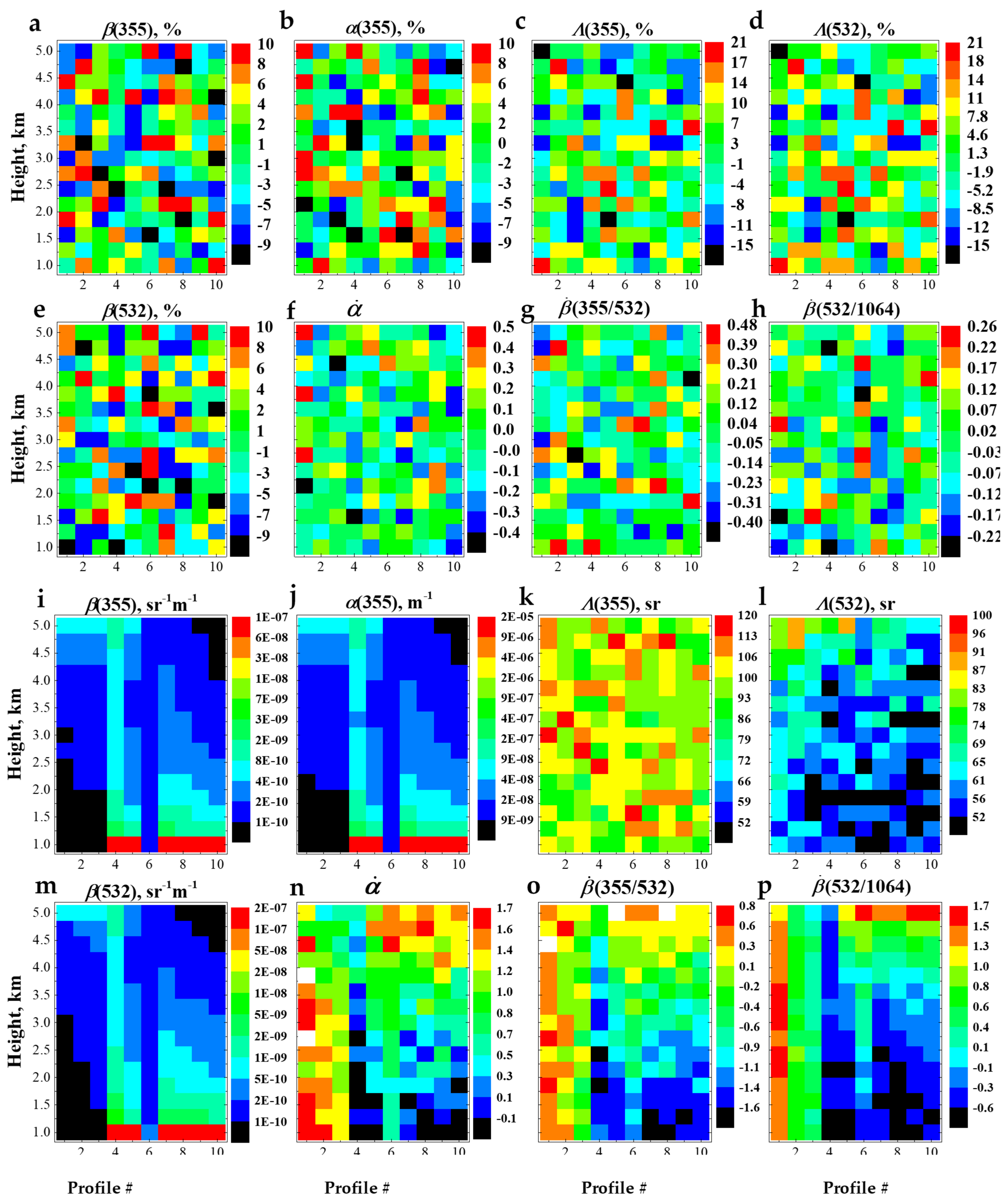
The 10 initial synthetic optical data profiles of OC–D mixtures (see Figure 3) are perturbed by ±10% random error to mimic the lidar measurements. Figure A1 shows the curtain plots that describe the uncertainties (1st and 2nd rows) and the perturbed optical data (3rd and 4th rows) in profiles #1–#10. Moreover, the interdependencies between the perturbed IPs of profiles #1–#10 we used for qualitative analysis are shown in Figure 5. The perturbed 3β + 2α optical data are input for TiARA to obtain the PSDs and the PMPs in our numerical simulations without the use of GCM (see Section 4), with the use of GCM1 (see Appendix C) and with the use of GCM2 (see Appendix D).
Figure A1. Relative (in %) and absolute (dimensionless) errors used for the input (true) information (1st and 2nd rows) and respective perturbed information (3rd and 4th rows) used as input for the microphysical retrievals in the numerical simulations. Shown are the relative errors of the backscatter coefficients at (a) 355 and (e) 532 nm, (b) extinction coefficient at 355 nm, and LRs at (c) 355 and (d) 532 nm. Also shown are the absolute errors of (f) EAE and BAE at the wavelength pairs (g) 355 and 532 nm and (h) 532 and 1064 nm. Furthermore, the plots show the perturbed values of the backscatter coefficients at (i) 355 and (m) 532 nm, (j) extinction coefficient at 355 nm, LRs at (k) 355 and (l) 532 nm, (n) EAE and BAE at the wavelength pairs (o) 355 and 532 nm, and BAE at the wavelength pair (p) 532 and 1064 nm.
Remotesensing 18 00658 g0a1

Appendix B. Retrieval Results of Separate Profiles

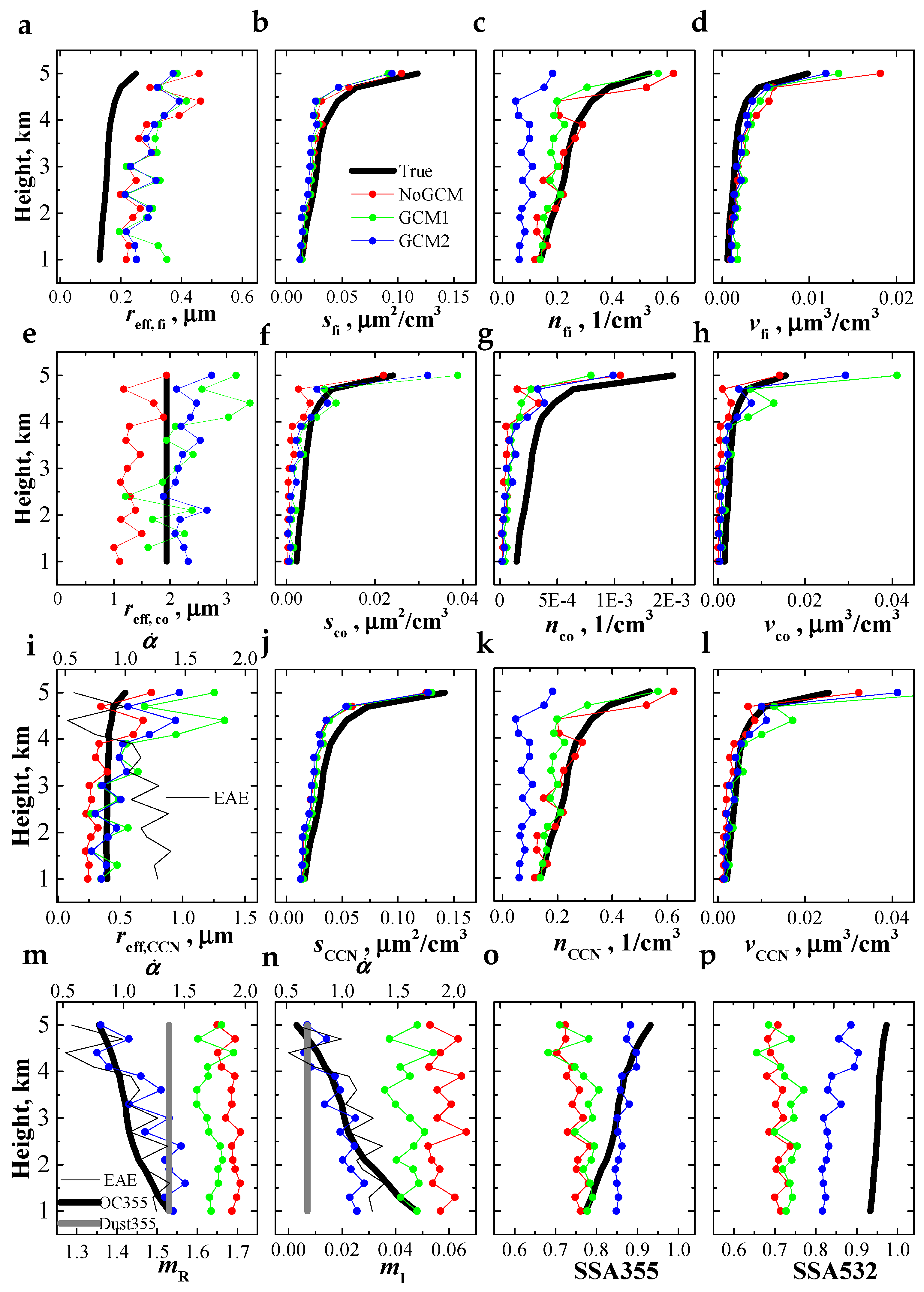
Figure A2 shows the retrieved PMPs for the fine mode, i.e., OC (1st row) and the coarse mode, i.e., D (2nd row) of profile #3 (red curves). We show for profile #3 the respective PMPs of the external mixture (3rd row), which consists of the fine (OC) and coarse (D) modes (red). SSA at 355 and 532 nm and the CRI of the external mixture (4th row) are shown, too (red).
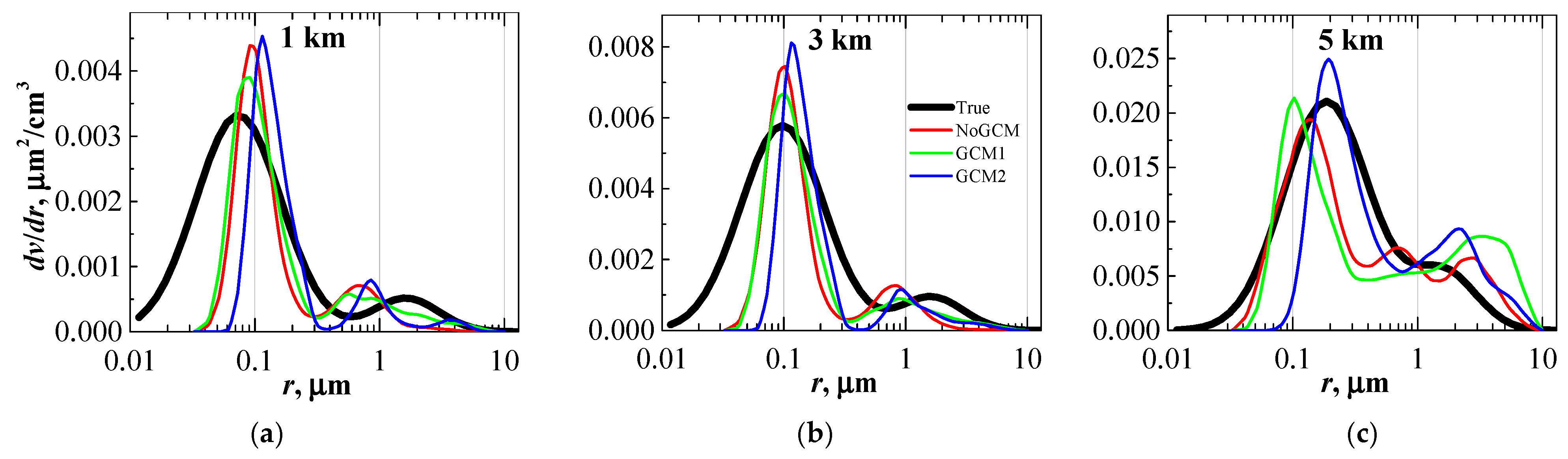
Figure A3 shows the true PSDs (black) and the results of the retrieved PSDs (dv/dr in μm2cm−3) for profile #3 for height levels 1 (left panel), 2 (middle panel) and 5 (right panel) km.
The results were obtained without the use of GCM (red, see Section 4), with the use of GCM1 (green, see Appendix C) and with the use of GCM2 (blue, see Appendix D).
Figure A2. Particle microphysical parameters retrieved without the use of GCM (red, see Appendix B), with the use of constraints on number, surface-area, and volume concentrations (green, see Appendix C), and with the use of constraints on number, surface-area, and volume concentrations and SSA at 532 nm (blue, see Appendix D). 3β + 2α perturbed data of profile #3 were used as input. Black and gray thick curves describe the true values. Thin black curves show the perturbed EAE. Shown are the particle (a,e,i) effective radius, (b,f,j) surface-area, (c,g,k) number and (d,h,l) volume concentrations for the fine, coarse and bimodal (fine and coarse) distributions respectively, CRI (m) real and (n) imaginary parts, and the single-scattering albedo at (o) 355 and (p) 532 nm.
Remotesensing 18 00658 g0a2
Figure A3. Particle size distributions retrieved without the use of GCM (red, see Appendix B), with the use of constraints on number, surface-area, and volume concentrations (green, see Appendix C), and with the use of constraints on number, surface-area, and volume concentrations and SSA at 532 nm (blue, see Appendix D). 3β + 2α perturbed data of profile #3 at three height levels (a) 1, (b) 3 and (c) 5 km were used as input. The black curves describe the true solution.
Remotesensing 18 00658 g0a3

Appendix C. GCM1: Use of GCM, Only with the Constraint on Number, Surface-Area, and Volume Concentrations

We consider the results retrieved with the use of GCM. TiARA version 2.1 allows us to simultaneously activate the constraints for the following statistics [38]:
p = s vs. α(355)”,
p = 3v/reff vs. α(355)”,
p = 4πn2 + σ2) vs. α(355)”.
The statistics of the retrieval results are described by the following regression equation if we apply post-processing with GCM:
p = asα(355) ± εp   p = s, 3v/reff, 4πn2 + σ2)
The regression coefficient belongs to the interval [1.3; 1.9]. The parameter εp defines the limit up to which the data points are allowed to scatter, i.e., are different from the trend line p = asα(355). More details on GCM can be found in Ref. [46].
Figure A4, Figure A5 (columns 1 and 2), Figure A6 (column 1) and Figure A7 present the results for as = 1.6, i.e., the center of the interval [1.3; 1.9], εp = 0.5% and the use of GCM. The presentation style is the same as in Figure 6, Figure 7, Figure 8 and Figure 9, respectively, which show the results obtained without the use of GCM.
We see that the deviations of the retrieved PMPs from the corresponding true values are similar, regardless of whether we use GCM or not. The same holds true for the retrieved and the true PSDs. Despite this result, GCM allows us to find an extra stabilization of the PSDs that describe the PMPs of the fine mode. This additional stabilization effect is more obvious for profile #1 than for the other profiles.
Our analysis of the quality of the results (obtained from using GCM) shows that the discrepancy between the input and back-calculated optical data does not exceed 30% for any of the 150 cases. The mean value of the discrepancy across all cases is 10%.
The correlation coefficient for s (R2 = 1) is larger than the respective coefficient derived without the use of GCM. The regression (ap) and correlation (R) coefficients of the retrieval results are quite similar for all three statistics (see Equation (A1)). We find a larger correlation coefficient for SSA at 532 nm (R2 = 0.83).
In contrast, the correlation coefficient for reff is equal to R2 = 0.55, which is lower compared to the correlation we obtain without the use of GCM. The reason for this behavior can be found from the results retrieved for the lowest EAEs (see Figure A6c), which describe the lowest height layer of profiles #8–#10. This low EAE corresponds to a significantly smaller effective radius compared to the true value. Accordingly, this “outlier” leads to a lower value of R2.
As we have mentioned a few times before, the EAE is the most error-prone parameter that can be measured by lidar. Hence the use of EAE can also destabilize a solution if the quality of the EAE is not sufficiently high. Our simulation results show that the instability of the solution profiles of effective radius and CRI occurs even in the case of small oscillations of ±0.25 of the EAE (see Figure A2). In Appendix D we investigate whether the use of an extra constraint in GCM, such as the strong correlation described by Equation (11), could improve the quality of the retrieval results.
Figure A4. Same as Figure 6, but GCM is used with constraints on number, surface-area, and volume concentrations [see Equation (A1)]. Shown are the retrieved particle (a,e,i) effective radius, (b,f,j) surface-area, (c,g,k) number and (d,h,l) volume concentrations for the fine, coarse and bimodal (fine and coarse) distributions, respectively; CRI (m) real and (n) imaginary parts; and the single-scattering albedo at (o) 355 and (p) 532 nm.
Remotesensing 18 00658 g0a4
Figure A5. Same as the right panels in Figure 7, but (a1e1,a2e2) GCM is used with the constraint on number, surface-area, and volume concentrations [see Equation (A1)] and (a3e3,a4e4) GCM is used with both constraints, i.e., for the concentrations of number, surface-area, and volume [see Equation (A1)] and SSA at 532 nm [see Equation (A2)].
Remotesensing 18 00658 g0a5
Figure A6. Same as the right panel in Figure 8, but (left column) GCM is used with the constraint on number, surface-area, and volume concentrations [see Equation (A1)] and (right column) GCM is used with both constraints on the concentrations [see Equation (A1)] and SSA at 532 nm [see Equation (A2)]. Shown are (a,b) surface-area concentration versus extinction coefficient at 355 nm, (c,d) effective radius versus EAE, and (e,f) SSA at 532 nm versus BAE at the wavelength pair 355 and 532 nm.
Remotesensing 18 00658 g0a6
Figure A7. Same as Figure 9, but GCM is used with the constraint on number, surface-area, and volume concentrations [see Equation (A1)]. Shown are the relative deviations of (a,e,i) effective radius, (b,f,j) surface-area, (c,g,k) number and (d,h,l) volume concentrations for the fine, coarse and bimodal (fine and coarse) distributions, respectively; absolute deviations of (m) OC fractions in terms of the extinction coefficient at 355 nm, and the single-scattering albedo at (n) 355, (o) 532 nm and (p) 1064 nm.
Remotesensing 18 00658 g0a7

Appendix D. GCM2: Use of GCM with Both Constraints, i.e., on the Concentrations of Number, Surface-Area and Volume and on SSA at 532 nm

We consider the results retrieved with the use of GCM in which both constraints are applied, as described by Equations (A1) and (A2). We denote this situation as GCM2, and in view of Equation (11) we also use the equation
SSA ( 532 ) = 0.028   β ˙ ( 355 / 532 )   +   0.956   ±   ε SSA
as a constraint. The constraint is applied to retrieve SSA at 532 nm more accurately. When both constraints (A1) and (A2) are simultaneously activated, we must increase the spreads εp and εSSA to ensure that the retrieval results remain consistent. Reducing the allowed spreads too much may result in an empty solution space. Figure A5 (columns 3 and 4), Figure A6 (column 2), Figure A8 and Figure A9 present the results for as = 1.6, εp = 10%, εSSA = 0.15 and the use of GCM2. The presentation style is the same as in Figure 6, Figure 7, Figure 8 and Figure 9, respectively, which show the results obtained without the use of GCM.
The results retrieved with GCM and constraints (A1) and (A2), i.e., GCM2, show a new structure of the solution space that we did not see when GCM was not used. On the one hand, the SSAs retrieved at 355 and 532 nm became larger. Moreover, the true and retrieved values of SSA(355) almost coincide. On the other hand, the particle effective radius (number concentration) is much higher (lower) than what we obtain without the use of GCM. Simultaneously, surface-area and volume concentrations retrieved with both approaches are similar.
Our analysis of the quality of the results obtained with GCM2 shows that the discrepancy between input and back-calculated optical data (3β + 2α) does not exceed 25% for any of the 150 cases. The mean value of the discrepancy of all cases is 5%.
The correlation coefficients for the retrieved parameters s, 3v/reff, and 4πn2 + σ2) are equal to R2 = 1. However, the regression coefficient as for the retrieved statistics increases to 1.7 because of the larger spread of εp. Among all 3 approaches used in this study, i.e., NoGCM, GCM1 and GCM2, SSA at 532 nm shows the lowest correlation coefficient, i.e., R2 = 0.39 for the GCM2 results. The reason for this behavior is the relatively large spread of εSSA. However, the correlation coefficient retrieved with GCM2 increases for reff to R2 = 0.78.
The results retrieved by using GCMs agree with our theoretical studies (see Refs. [36,46]). Our studies show that in view of the PPPOI, a decreasing CRI imaginary part (i.e., higher value of SSA) in the solution space causes a higher (lower) value of effective radius (number concentration) in the retrieved solution space for a fixed 3β + 2α dataset. The opposite behavior holds true, too, i.e., effective radius (number concentration) decreases (increases) and simultaneously the imaginary part of the CRI increases (i.e., lower value of SSA).
Figure A8. Same as Figure 6, but GCM is used with both constraints, i.e., for the concentrations of number, surface-area, and volume [see Equation (A1)] and SSA at 532 nm [see Equation (A2)]. Shown are the retrieved particle (a,e,i) effective radius, (b,f,j) surface-area, (c,g,k) number and (d,h,l) volume concentrations for the fine, coarse and bimodal (fine and coarse) distributions, respectively; CRI (m) real and (n) imaginary parts; and the single-scattering albedo at (o) 355 and (p) 532 nm.
Remotesensing 18 00658 g0a8
Figure A9. Same as Figure 9, but GCM is used with both constraints (i.e., GCM2) applied to the concentrations [see Equation (A1)] and SSA at 532 nm [see Equation (A2)]. Shown are the relative deviations of (a,e,i) effective radius, (b,f,j) surface-area, (c,g,k) number and (d,h,l) volume concentrations for the fine, coarse and bimodal (fine and coarse) distributions, respectively; absolute deviations of (m) OC fractions in terms of the extinction coefficient at 355 nm, and the single-scattering albedo at (n) 355, (o) 532 nm and (p) 1064 nm.
Remotesensing 18 00658 g0a9

References

  1. IPCC. Sections. In Climate Change 2023: Synthesis Report. Contribution of Working Groups I, II and III to the Sixth Assessment Report of the Intergovernmental Panel on Climate Change; Core Writing Team, Lee, H., Romero, J., Eds.; IPCC: Geneva, Switzerland, 2023; pp. 35–115. [Google Scholar]
  2. Dusek, U.; Frank, G.P.; Hildebrandt, L.; Curtius, J.; Schneider, J.; Walter, S.; Chand, D.; Drewnick, F.; Hings, S.; Jung, D.; et al. Size matters more than chemistry for cloud-nucleating ability of aerosol particles. Science 2006, 312, 1375–1378. [Google Scholar] [CrossRef]
  3. Illingworth, A.J.; Barker, H.W.; Beljaars, A.; Ceccaldi, M.; Chepfer, H.; Clerbaux, N.; Cole, J.; Delanoë, J.; Domenech, C.; Donovan, D.P.; et al. The EARTHCARE satellite: The next step forward in global measurements of clouds, aerosols, precipitation, and radiation. Bull. Am. Meteorol. Soc. 2015, 96, 1311–1332. [Google Scholar] [CrossRef]
  4. Ansmann, A.; Müller, D. Lidar and atmospheric aerosol particles. In Lidar: Range-Resolved Optical Remote Sensing of the Atmosphere; Weitkamp, C., Ed.; Springer: New York, NY, USA, 2005; pp. 105–142. [Google Scholar]
  5. Hair, J.W.; Hostetler, C.A.; Cook, A.L.; Harper, D.B.; Ferrare, R.A.; Mack, T.L.; Welch, W.; Izquierdo, L.R.; Hovis, F.E. Airborne High Spectral Resolution Lidar for profiling aerosol optical properties. Appl. Opt. 2008, 47, 6734–6752. [Google Scholar] [CrossRef]
  6. Esselborn, M.; Wirth, M.; Fix, A.; Tesche, M.; Ehret, G. Airborne high spectral resolution lidar for measuring aerosol extinction and backscatter coefficients. Appl. Opt. 2008, 47, 346–358. [Google Scholar] [CrossRef]
  7. Ansmann, A.; Riebesell, M.; Wandinger, U.; Weitkamp, C.; Voss, E.; Lahmann, W.; Michaelis, W. Combined Raman elastic-backscatter lidar for vertical profiling of moisture, aerosols extinction, backscatter, and lidar ratio. Appl. Phys. B 1992, 55, 18–28. [Google Scholar] [CrossRef]
  8. Groß, S.; Tesche, M.; Freudenthaler, V.; Toledano, C.; Wiegner, M.; Ansmann, A.; Althausen, D.; Seefeldner, M. Characterization of Saharan dust, marine aerosols and mixtures of biomass-burning aerosols and dust by means of multi-wavelength depolarization and Raman lidar measurements during SAMUM 2. Tellus Ser. B Chem. Phys. Meteorol. 2011, 63, 706–724. [Google Scholar] [CrossRef]
  9. Yin, Z.; Baars, H. PollyNET/Pollynet_Processing_Chain: Version 3.0; Zenodo: Geneva, Switzerland, 2021. [Google Scholar] [CrossRef]
  10. Wang, A.; Yin, Z.; Mao, S.; Wang, L.; Yi, Y.; Chen, Q.; Müller, D.; Wang, X. Measurements of particle extinction coefficients at 1064 nm with lidar: Temperature dependence of rotational Raman channels. Opt. Express 2024, 32, 4650–4667. [Google Scholar] [CrossRef] [PubMed]
  11. Haarig, M.; Engelmann, R.; Ansmann, A.; Althausen, D.; Veselovskii, I.; Whiteman, D.N. 1064 nm rotational Raman lidar for particle extinction and lidar-ratio profiling: Cirrus case study. Atmos. Meas. Tech. 2016, 9, 4269–4278. [Google Scholar] [CrossRef]
  12. Böckmann, C.; Miranova, I.; Müller, D.; Scheidenbach, L.; Nessler, R. Microphysical aerosol parameters from multiwavelength lidar. J. Opt. Soc. Am. A 2005, 22, 518–528. [Google Scholar] [CrossRef]
  13. Chang, Y.; Hu, Q.; Goloub, P.; Veselovskii, I.; Podvin, T. Retrieval of aerosol microphysical properties from multi-wavelength Mie–Raman lidar using maximum likelihood estimation: Algorithm, performance, and application. Remote Sens. 2022, 14, 6208. [Google Scholar] [CrossRef]
  14. de Graaf, M.; Apituley, A.; Donovan, D. Feasibility study of integral property retrieval for tropospheric aerosol from Raman lidar data using principal component analysis. Appl. Opt. 2013, 52, 2173–2186. [Google Scholar] [CrossRef]
  15. Kolgotin, A.; Müller, D.; Korenskiy, M.; Veselovskii, I. ORACLES campaign, September 2016: Inversion of HSRL-2 observations with regularization algorithm into particle microphysical parameters and comparison to airborne in situ data. Atmosphere 2023, 14, 1661. [Google Scholar] [CrossRef]
  16. Samaras, S.; Nicolae, D.; Böckmann, C.; Vasilescu, J.; Binietoglou, I.; Labzovskii, L.; Toanca, F.; Papayannis, A. Using Raman-lidar-based regularized microphysical retrievals and aerosol mass spectrometer measurements for the characterization of biomass burning aerosols. J. Comput. Phys. 2015, 299, 156–174. [Google Scholar] [CrossRef]
  17. Winker, D.M.; Vaughan, M.A.; Omar, A.H.; Hu, Y.; Powell, K.A.; Liu, Z.; Hunt, W.H.; Young, S.A. Overview of the CALIPSO mission and CALIOP data processing algorithms. J. Atmos. Ocean. Tech. 2009, 26, 2310–2323. [Google Scholar] [CrossRef]
  18. Papagiannopoulos, N.; Mona, L.; Amodeo, A.; D’Amico, G.; Gumà Claramunt, P.; Pappalardo, G.; Alados-Arboledas, L.; Guerrero-Rascado, J.L.; Amiridis, V.; Kokkalis, P.; et al. An automatic observation-based aerosol typing method for EARLINET. Atmos. Chem. Phys. 2018, 18, 15879–15901. [Google Scholar] [CrossRef]
  19. Nishizawa, T.; Sugimoto, N.; Matsui, I.; Shimizu, A.; Higurashi, A.; Jin, Y. The Asian dust and aerosol lidar observation network (AD-net): Strategy and progress. EPJ Web Conf. 2016, 119, 19001. [Google Scholar] [CrossRef]
  20. Guerrero-Rascado, J.L.; Landulfo, E.; Antuña, J.C.; Barbosa, H.D.M.J.; Barja, B.; Bastidas, Á.E.; Bedoya, A.E.; da Costa, R.F.; Estevan, R.; Forno, R.; et al. Latin American Lidar Network (LALINET) for aerosol research: Diagnosis on network instrumentation. J. Atmos. Sol.-Terr. Phys. 2016, 138, 112–120. [Google Scholar] [CrossRef]
  21. Huang, Z.; Huang, J.; Bi, J.; Wang, T.; Zhou, T.; Dong, Q.; Shi, J.; Liu, Q.; Li, W.; Li, Z.; et al. Dust observation by a ground-based lidar network along the global dust belt. E3S Web Conf. 2024, 575, 02006. [Google Scholar] [CrossRef]
  22. Moshary, F.; Han, Z.; Wu, Y.; Gross, B.; Wesloh, D.; Hoff, R.M.; Delgado, R.; Su, J.; Lei, L.; Lee, R.B., III; et al. New results from the NOAA CREST lidar network (CLN) observations in the US Eastcoast. EPJ Web Conf. 2016, 119, 19005. [Google Scholar] [CrossRef]
  23. Pappalardo, G.; Amodeo, A.; Apituley, A.; Comeron, A.; Freudenthaler, V.; Linné, H.; Ansmann, A.; Bösenberg, J.; D’Amico, G.; Mattis, I.; et al. EARLINET: Towards an advanced sustainable European aerosol lidar network. Atmos. Meas. Tech. 2014, 7, 2389–2409. [Google Scholar] [CrossRef]
  24. Wandinger, U.; Freudenthaler, V.; Baars, H.; Amodeo, A.; Engelmann, R.; Mattis, I.; Gross, S.; Pappalardo, G.; Giunta, A.; D’Amico, G.; et al. EARLINET instrument intercomparison campaigns: Overview on strategy and results. Atmos. Meas. Tech. 2016, 9, 1001–1023. [Google Scholar] [CrossRef]
  25. Janicka, L.; Stachlewska, I.S.; Veselovskii, I.; Baars, H. Temporal variations in optical and microphysical properties of mineral dust and biomass burning aerosol derived from daytime Raman lidar observations over Warsaw, Poland. Atmos. Environ. 2017, 169, 162–174. [Google Scholar] [CrossRef]
  26. Preißler, J.; Wagner, F.; Guerrero-Rascado, J.L.; Silva, A.M. Two years of free-tropospheric aerosol layers observed over Portugal by lidar. J. Geophys. Res.-Atmos. 2013, 118, 3676–3686. [Google Scholar] [CrossRef]
  27. Sicard, M.; Guerrero-Rascado, J.L.; Navas-Guzmán, F.; Preißler, J.; Molero, F.; Tomás, S.; Bravo-Aranda, J.A.; Comerón, A.; Rocadenbosch, F.; Wagner, F.; et al. Monitoring of the Eyjafjallajökull volcanic aerosol plume over the Iberian Peninsula by means of four EARLINET lidar stations. Atmos. Chem. Phys. 2012, 12, 3115–3130. [Google Scholar] [CrossRef]
  28. Soupiona, O.; Samaras, S.; Ortiz-Amezcua, P.; Böckmann, C.; Papayannis, A.; Moreira, G.A.; Benavent-Oltra, J.A.; Guerrero-Rascado, J.L.; Bedoya-Velásquez, A.E.; Olmo, F.J.; et al. Retrieval of optical and microphysical properties of transported Saharan dust over Athens and Granada based on multi-wavelength Raman lidar measurements: Study of the mixing processes. Atmos. Environ. 2019, 214, 116824. [Google Scholar] [CrossRef]
  29. D’Amico, G.; Amodeo, A.; Mattis, I.; Freudenthaler, V.; Pappalardo, G. EARLINET Single Calculus Chain—Technical—Part 1: Pre-processing of raw lidar data. Atmos. Meas. Tech. 2016, 9, 491–507. [Google Scholar] [CrossRef]
  30. Mattis, I.; D’Amico, G.; Baars, H.; Amodeo, A.; Madonna, F.; Iarlori, M. EARLINET Single Calculus Chain—Technical—Part 2: Calculation of optical products. Atmos. Meas. Tech. 2016, 9, 3009–3029. [Google Scholar] [CrossRef]
  31. Müller, D.; Böckmann, C.; Kolgotin, A.; Schneidenbach, L.; Chemyakin, E.; Rosemann, J.; Znak, P.; Romanov, A. Microphysical particle properties derived from inversion algorithms developed in the framework of EARLINET. Atmos. Meas. Tech. 2016, 9, 5007–5035. [Google Scholar] [CrossRef]
  32. Müller, D.; Chemyakin, E.; Kolgotin, A.; Ferrare, R.A.; Hostetler, C.A.; Romanov, A. Automated, unsupervised inversion of multiwavelength lidar data with TiARA: Assessment of retrieval performance of microphysical parameters using simulated data. Appl. Opt. 2019, 58, 4981–5008. [Google Scholar] [CrossRef]
  33. Müller, D.; Wandinger, U.; Ansmann, A. Microphysical particle parameters from extinction and backscatter lidar data by inversion with regularization: Theory. Appl. Opt. 1999, 38, 2346–2357. [Google Scholar] [CrossRef]
  34. Bohren, C.F.; Huffman, D.R. (Eds.) Absorption and Scattering of Light by Small Particles; Wiley: New York, NY, USA, 1983. [Google Scholar]
  35. Miffre, A.; Cholleton, D.; Rairoux, P. On the use of light polarization to investigate the size, shape, and refractive index dependence of backscattering Ångström exponents. Opt. Lett. 2020, 45, 1084–1087. [Google Scholar] [CrossRef]
  36. Kolgotin, A.; Müller, D.; Romanov, A. Particle microphysical parameters and the complex refractive index from 3β + 2α HSRL/Raman lidar measurements: Conditions of accurate retrieval, retrieval uncertainties and constraints to suppress the uncertainties. Atmosphere 2023, 14, 1159. [Google Scholar] [CrossRef]
  37. Kolgotin, A.; Müller, D.; Veselovskii, I.; Korenskiy, M.; Wang, X. Pre-filter analysis for retrieval of microphysical particle parameters: A quality-assurance method applied to 3 backscatter (β) +2 extinction (α) optical data taken with HSRL/Raman lidar. Appl. Opt. 2023, 62, 5203–5223. [Google Scholar] [CrossRef] [PubMed]
  38. Kolgotin, A.; Müller, D.; Chemyakin, E.; Romanov, A.; Alehnovich, V. Improved identification of the solution space of aerosol microphysical properties derived from the inversion of profiles of lidar optical data, part 3: Case studies. Appl. Opt. 2018, 57, 2499–2513. [Google Scholar] [CrossRef] [PubMed]
  39. Floutsi, A.; Baars, H.; Wandinger, U. HETEAC-Flex: An optimal estimation method for aerosol typing based on lidar-derived intensive optical properties. Atmos. Meas. Tech. 2024, 17, 693–714. [Google Scholar] [CrossRef]
  40. Veselovskii, I.; Goloub, P.; Podvin, T.; Tanré, D.; da Silva, A.; Colarco, P.; Castellanos, P.; Korenskiy, M.; Hu, Q.; Whiteman, D.N.; et al. Characterization of smoke/dust episode over West Africa: Comparison of MERRA-2 modeling with multiwavelength Mie-Raman lidar observations. Atmos. Meas. Tech. 2018, 11, 949–969. [Google Scholar] [CrossRef] [PubMed]
  41. Veselovskii, I.; Dubovik, O.; Kolgotin, A.; Lapyonok, T.; Di Girolamo, P.; Summa, D.; Whiteman, D.N.; Mishchenko, M.; Tanré, D. Application of randomly oriented spheroids for retrieval of dust particle parameters from multiwavelength lidar measurements. J. Geophys. Res. 2010, 115, D21203. [Google Scholar] [CrossRef]
  42. Mamouri, R.-E.; Ansmann, A. Potential of polarization lidar to provide profiles of CCN- and INP-relevant aerosol parameters. Atmos. Chem. Phys. 2016, 16, 5905–5931. [Google Scholar] [CrossRef]
  43. Müller, D.; Wandinger, U.; Ansmann, A. Microphysical particle parameters from extinction and backscatter lidar data by inversion with regularization: Simulation. Appl. Opt. 1999, 38, 2358–2368. [Google Scholar] [CrossRef]
  44. Veselovskii, I.; Kolgotin, A.; Griaznov, V.; Müller, D.; Franke, K.; Whiteman, D.N. Inversion of multiwavelength Raman lidar data for retrieval of bimodal aerosol size distribution. Appl. Opt. 2004, 43, 1180–1195. [Google Scholar] [CrossRef]
  45. Baars, H.; Kanitz, T.; Engelmann, R.; Althausen, D.; Heese, B.; Komppula, M.; Preißler, J.; Tesche, M.; Ansmann, A.; Wandinger, U.; et al. An overview of the first decade of PollyNET: An emerging network of automated Raman-polarization lidars for continuous aerosol profiling. Atmos. Chem. Phys. 2016, 16, 5111–5137. [Google Scholar] [CrossRef]
  46. Kolgotin, A.; Müller, D.; Chemyakin, E.; Romanov, A. Improved identification of the solution space of aerosol microphysical properties derived from the inversion of profiles of lidar optical data, part 1: Theory. Appl. Opt. 2016, 55, 9839–9849. [Google Scholar] [CrossRef] [PubMed]
  47. Kolgotin, A.; Müller, D.; Chemyakin, E.; Romanov, A. Improved identification of the solution space of aerosol microphysical properties derived from the inversion of profiles of lidar optical data, part 2: Simulations with synthetic optical data. Appl. Opt. 2016, 55, 9850–9865. [Google Scholar] [CrossRef] [PubMed]
  48. Kolgotin, A.; Müller, D. Aerosol Typing from Linear-estimations for the Analytical Separation (ATLAS) of complex aerosol mixtures and improved identification of microphysical parameters from multiwavelength lidar data, part 1: Theory and numerical simulations. JOSA A 2025, 42, 221–232. [Google Scholar] [CrossRef]
Figure 1. (aj) Initial (true) PSDs of all 10 profiles (see subpanel caption) and all height bins in the numerical simulation (dv/dr in μm2cm−3). The legend refers to height (in [km]).
Remotesensing 18 00658 g001
Figure 2. Interdependencies between relative humidity RH and OC fraction φα(355) that were used to generate the initial (true) information for the 10 different profiles, i.e., profiles #1–#3 (red), #4–#6 (green) and #7–#10 (blue). The symbols correspond to the values for which the optical data have been computed (150 optical data sets in total).
Remotesensing 18 00658 g002
Figure 3. Initial, i.e., true (a) RH, (b) particle extinction coefficient at 355 nm, LRs at (c) 355 and (d) 532 nm, (e) PLDR at 532 nm, (f) EAE at the wavelength pairs 355 and 532 nm, BAEs at the wavelength pairs (g) 355 and 532 nm, and (h) 532 and 1064 nm used for the numerical simulation.
Remotesensing 18 00658 g003
Figure 4. Results of the numerical simulations. Shown are the initial (true) particle (a,e,i) effective radius, (b,f,j) surface-area, (c,g,k) number and (d,h,l) volume concentrations for the fine, coarse and bimodal (fine and coarse) distributions, respectively; (m) OC fractions in terms of the extinction coefficient at 355 nm and the single-scattering albedo at (n) 355, (o) 532 and (p) 1064 nm.
Remotesensing 18 00658 g004
Figure 5. Initial, or true (black and gray), and perturbed (colored) interdependencies between (a1a5) EAE at the wavelength pair 355 and 532 nm and BAE at the wavelength pair 355 and 532 nm, (b1b5) EAE at the wavelength pair 355 and 532 nm and BAE at the wavelength pair 532 and 1064 nm, (c1c5) LR at 532 nm and LR at 355 nm, (d1d5) LR at 532 nm and BAE at the wavelength pair 355 and 532 nm, (e1e5) BAE at the wavelength pair 532 and 1064 nm and BAE the at wavelength pair 355 and 532 nm, and (f1f5) LR at 532 nm and EAE for all 10 profiles used in the numerical simulations. The black and red curves correspond to odd-numbered profiles, while the gray and blue curves correspond to even-numbered profiles.
Remotesensing 18 00658 g005
Figure 6. Particle microphysical parameters retrieved from the perturbed 3β + 2α data (see Figure A1) without the use of GCM in profiles #1–#10. Shown are the retrieved particle (a,e,i) effective radius, (b,f,j) surface-area, (c,g,k) number and (d,h,l) volume concentrations for the fine, coarse and bimodal (fine and coarse) distributions, respectively; CRI (m) real and (n) imaginary parts; and the single-scattering albedo at (o) 355 and (p) 532 nm.
Remotesensing 18 00658 g006
Figure 7. (a1e1,a2e2) Initial, i.e., true PSDs and (a3e3,a4e4) PSDs retrieved without the use of GCM from the perturbed 3β + 2α data shown in Figure A1 for all 10 simulated profiles (see subpanel caption) and all height bins (dv/dr in µm2cm−3). See also Figure 1 for details.
Remotesensing 18 00658 g007
Figure 9. Relative/absolute deviations (from the true values in %/dimensionless) of the results retrieved without the use of GCM in profiles #1–#10 in the numerical simulation. Shown are the relative deviations of (a,e,i) effective radius, (b,f,j) surface-area, (c,g,k) number and (d,h,l) volume concentrations for the fine, coarse and bimodal (fine and coarse) distributions, respectively; absolute deviations of (m) OC fractions in terms of the extinction coefficient at 355 nm, and the single-scattering albedo at (n) 355, (o) 532 nm and (p) 1064 nm.
Remotesensing 18 00658 g009
Table 1. Organic carbon properties used in the MERRA-2 model versus relative humidity conditions. CRI, RH, λ, μ, LR, EAE and BAE denote the complex refractive index, relative humidity, wavelength, mean radius, lidar ratio, and extinction- and backscatter-related Ångström exponents, respectively. LR is defined at the wavelength 532 nm (LR532). EAE and BAE355/532 are defined for the wavelength pair 355/532 nm. BAE532/1064 is defined for the wavelength pair 532/1064. Standard deviation and particle linear depolarization ratio are equal to σ = 2.2 and δ(532) = 0.05, respectively, in all cases.
RH μ, μmCRIEAEBAE
355/532
BAE
532/1064
LR532,
sr
λ = 355 nmλ = 532 nmλ = 1064 nm
0.000.0211.530i0.04771.530i0.00891.517i0.01641.730.251.5454
0.100.0221.505i0.04121.503i0.00771.491i0.01421.710.341.5356
0.200.0231.487i0.03681.485i0.00681.474i0.01271.680.361.5258
0.300.0241.469i0.03221.466i0.00601.455i0.01111.660.421.5060
0.400.0251.454i0.02831.450i0.00531.440i0.00971.620.451.4961
0.500.0261.441i0.02501.437i0.00461.426i0.00861.580.481.4862
0.600.0271.430i0.02221.425i0.00411.415i0.00761.580.461.4664
0.650.0281.424i0.02071.419i0.00391.409i0.00711.520.431.4564
0.700.0281.421i0.01981.415i0.00371.406i0.00681.520.481.4365
0.750.0301.413i0.01781.407i0.00331.397i0.00611.480.481.4067
0.800.0311.406i0.01601.399i0.00301.390i0.00551.460.521.3869
0.850.0321.396i0.01361.390i0.00251.381i0.00471.410.531.3571
0.900.0351.386i0.01081.378i0.00201.369i0.00371.300.501.3574
0.950.0401.371i0.00721.363i0.00131.355i0.00251.180.511.3081
0.990.0541.355i0.00301.346i0.00061.338i0.00100.820.801.0596
Table 2. Dust properties used in the MERRA-2 model versus relative humidity conditions. The meaning of the parameters is the same as in Table 1.
RH μ, μmσCRIδ(532)EAEBAE
355/532
BAE
532/1064
LR532,
sr
355 nm532 nm1064 nm
0.00–0.990.7881.8221.530i0.00701.530i0.00261.517i0.00220.35−0.12−1.69−0.6151
Table 3. Mean/minimal/maximal retrieval uncertainties (15). These values have been obtained using three approaches, i.e., NoGCM (as described in Section 4 and Appendix B), GCM1 (see Appendix C) and GCM2 (see Appendix D), for all 150 pixels of the numerical simulations.
ParameterNoGCMGCM1GCM2
MeanMin.Max.MeanMin.Max.MeanMin.Max.
SSA(355)0.130.00.230.110.00.280.030.00.10
reff,fi, %164366716404161522445
reff,co, %29010039016231177
reff, %310127450211380185
nfi, %3402092609366697
nco, %6889267199163499
n, %460993500869715312
sfi, %7209826701099412363
sco, %7389547213739099
s, %170811603521040
vfi, %463167653952555823512676
vco, %77997551306460131
v, %36086320146320120
Sum of errors, %11232910,3171014249151838214654
Table 4. PMP, CRI and SSA at 355 and 532 nm retrieved with NoGCM, GCM1 and GCM2 together with the true values for profile #4 at 4.7 km height.
ParameterTrueNoGCMGCM1GCM2
SSA(355)0.8840.6840.6980.855
SSA(532)0.9510.6630.6740.863
mfi(355)1.355 − i0.003- -
mco(355)1.530 − i0.007- -
m-1.688 − i0.0481.642 − i0.0371.370 − i0.005
reff, μm0.9101.0111.4121.776
n, cm−30.5370.8030.4940.163
s, μm2cm−30.1940.1790.1760.173
v, μm3cm−30.0600.0620.0830.103
Disclaimer/Publisher’s Note: The statements, opinions and data contained in all publications are solely those of the individual author(s) and contributor(s) and not of MDPI and/or the editor(s). MDPI and/or the editor(s) disclaim responsibility for any injury to people or property resulting from any ideas, methods, instructions or products referred to in the content.