Article

Enhancement of Cyanobacterial Bloom Monitoring in Lake Taihu Using Dual Red-Edge Bands of GF-6/WFV: Multi-Dimensional Feature Combination and Extraction Accuracy Analysis

1
School of Geology and Geomatics, Tianjin Chengjian University, Tianjin 300384, China
2
College of Geomatics, Xi’an University of Science and Technology, Xi’an 710054, China
3
Aerospace Information Research Institute, Chinese Academy of Sciences, Beijing 100094, China
4
University of Chinese Academy of Sciences, Beijing 100049, China
5
China Electronics Data Industry Group Co., Ltd., Shenzhen 518000, China
6
China Electronics Data Science and Intelligent Engineering Research Institute, Shenzhen 518000, China
7
Institute of Geographic Sciences and Natural Resources Research, Chinese Academy of Sciences, Beijing 100101, China
8
Operations Research Center, Massachusetts Institute of Technology, Cambridge, MA 02139, USA
*
Author to whom correspondence should be addressed.
Remote Sens. 2026, 18(4), 653; https://doi.org/10.3390/rs18040653
Submission received: 23 December 2025 / Revised: 11 February 2026 / Accepted: 17 February 2026 / Published: 20 February 2026
(This article belongs to the Special Issue Remote Sensing in Water Quality Monitoring)

Highlights

What are the main findings?
  • The dual red-edge bands of GF-6/WFV significantly enhance cyanobacterial bloom identification accuracy in Lake Taihu, with red-edge indices contributing most to accuracy gains.
  • The red-edge 710 nm band outperforms the 750 nm band in spectral separability and feature utility, while their combined use further improves model robustness and spatial characterization of bloom heterogeneity.
What are the implications of the main findings?
  • This study systematically developed and validated an extraction framework that comprehensively utilizes the multi-dimensional features of the GF-6/WFV red-edge bands, including spectral, textural, and index-based characteristics, thereby providing a practical and operational solution for cyanobacterial bloom monitoring using this satellite data.
  • The findings clarify the contributions of different red-edge features in distinguishing cyanobacterial blooms from water, offering an experimental basis for extending the red-edge feature analysis framework to other inland waters or sensors equipped with red-edge bands.

Abstract

Cyanobacterial blooms pose a serious threat to freshwater ecosystems, necessitating accurate remote sensing monitoring. Although red-edge bands show potential in terrestrial monitoring, their multi-dimensional features (i.e., spectral, textural, and index-based characteristics) remain underutilized for aquatic blooms. This study leverages the dual red-edge bands (710 nm and 750 nm) of GF-6/WFV to enhance cyanobacterial bloom identification in Lake Taihu. Multi-temporal images from 2019–2023 were used to construct red-edge features in three dimensions: spectral (evaluated via adaptive band selection method) and Jeffries–Matusita–Bhattacharyya distance), texture (based on Gray Level Co-occurrence Matrix and principal component analysis), and indices (nine vegetation indices ranked by Random Forest importance). Twelve feature-combination schemes were designed and implemented with a Random Forest classifier. Results show that red-edge features consistently improve identification accuracy. Quantitatively, compared to the basic four-band (RGBN) combination, the 710 nm band improved spectral separability by an average of 9.63%, whereas the 750 nm band yielded a lower average improvement of 5.69%. Red-edge indices, especially the modified chlorophyll absorption reflectance index 1 (MCARI1) and normalized difference red-edge index (NDRE), exhibited higher importance than non-red-edge indices. All schemes incorporating red-edge features achieved mean overall accuracies of 92.8–94.9% and Kappa coefficients of 0.86–0.94, surpassing the basic four-band scheme. Among these features, red-edge indices contributed most significantly to accuracy gains, increasing the overall accuracy by an average of 0.36–6.06% and the Kappa coefficient by up to 0.06. The enhancement effect of the red-edge 710 nm band features was superior to that of the 750 nm band. This study demonstrates that multi-dimensional red-edge features effectively enhance the identification accuracy of cyanobacterial blooms and provides a methodological reference for operational GF-6 applications in water quality monitoring.

1. Introduction

Cyanobacterial blooms represent a major environmental threat to global freshwater ecosystems. Their outbreaks not only lead to sharp declines in dissolved oxygen and mortality of aquatic organisms but also release harmful substances such as microcystins, posing risks to drinking water safety and human health [1]. Lake Taihu, the largest freshwater lake in the eastern plain region of China, frequently experiences cyanobacterial blooms due to industrial and agricultural pollution within its basin and the impacts of climate change. This issue has become a critical bottleneck constraining regional ecological security and sustainable economic development [2,3]. Therefore, achieving accurate identification and dynamic monitoring of cyanobacterial blooms in Lake Taihu is of great significance for formulating scientific management strategies and ensuring the health of lake ecosystems.
Remote sensing technology has become a mainstream method for cyanobacterial bloom monitoring due to its advantages of large-scale, multi-temporal, and non-contact observation. Traditional cyanobacterial remote sensing monitoring primarily relies on visible and near-infrared bands of medium-to-high-resolution multispectral satellites, extracting blooms by constructing vegetation indices or spectral threshold models [4,5]. However, these methods have notable limitations. First, the spectral characteristics of cyanobacteria, eutrophic water, and aquatic vegetation overlap in the visible-near-infrared region, easily leading to misclassification [6]. Second, the spectral signals of low-biomass cyanobacterial blooms are weak, making them difficult to capture with traditional bands, and extraction accuracy is significantly affected by environmental noise [7]. Consequently, exploring more discriminative spectral features to improve cyanobacterial bloom identification accuracy has become a core requirement in current bloom remote sensing monitoring.
The red-edge region (680–750 nm), as a transition zone between red and near-infrared bands, exhibits high sensitivity to chlorophyll content and can precisely capture changes in vegetation pigments and physiological status [8,9]. It has demonstrated significant advantages in fields such as vegetation classification, crop monitoring, and ecological assessment [10,11,12,13]. For instance, Zhou [14] found through experiments covering the entire rice growth cycle that vegetation indices using red-edge bands correlated more significantly with leaf nitrogen concentration than indices using other bands. Kang [15] utilized the spectral data and extracted textural features of the red-edge bands from Gaofen-6 (GF-6)/WFV data for crop classification, finding they improved accuracy by 8–12%. Focusing on salinized soils in oasis bare land and areas covered by alfalfa and wheat in the arid area of Northwest China, Zhao [16] constructed inversion models combining UAV red-edge bands and other multispectral data, confirming that red-edge bands effectively improved the estimation accuracy of soil salt content in vegetated areas. These successful applications provide strong evidence for the potential of red-edge bands in water environment monitoring.
In recent years, some studies have attempted to apply red-edge bands to monitor cyanobacterial blooms or chlorophyll-a concentration in water, yielding exploratory results. Caballero [17] used the red-edge bands of Sentinel-2 and Sentinel-3 to calculate the normalized difference chlorophyll index (NDCI) and set thresholds (0 for bloom areas, 0.62 for high-concentration bloom areas), successfully identifying and quantifying the spatial distribution of Lingulodinium polyedra blooms. Rodríguez-Benito [18] also calculated NDCI based on Sentinel satellite red-edge bands, using NDCI > 0 as the bloom identification threshold. This approach achieved dynamic monitoring of Cochlodinium polykrikoides and Lepidodinium chlorophorum blooms, confirming the high sensitivity of red-edge bands to blooms and their ability to characterize spatial distribution. Coffer [19] modified the maximum chlorophyll index (MCI) using the red-edge band as the central peak band, combined with red and near-infrared bands, to adapt to the spectral characteristics of WorldView-3 and Sentinel-2, effectively improving the estimation accuracy of relative chlorophyll abundance in inland waters. Choi [20], focusing on cyanobacterial monitoring in the Nakdong River, South Korea, constructed the normalized difference red-edge index (NDREI) based on UAV multispectral red-edge bands and found the highest correlation between NDREI and phycocyanin in June, verifying the applicability of red-edge-related indices in cyanobacterial monitoring. Xu [21] improved the normalized difference vegetation index by combining the red-edge band and the blue band, enhancing the recognition accuracy of cyanobacterial blooms in the presence of interferences such as ships, duckweed, and river surface garbage. Xu [22] confirmed through comparative analysis that red-edge and near-infrared bands are superior to visible bands in distinguishing inland water cyanobacterial blooms and combined red-edge bands with the local indicators of spatial association (LISA) method to assist bloom extraction through pixel spatial autocorrelation analysis.
However, compared to mature applications in terrestrial contexts, the aforementioned studies on cyanobacteria in water still have two main limitations. First, feature utilization is relatively singular; most studies focus on constructing and testing individual red-edge indices, failing to systematically explore the multi-dimensional information value of red-edge bands, which encompasses not only the spectral information content of the bands themselves but also the spatial textural features and derived spectral indices that can be extracted from them. For example, the studies by Caballero [17], Rodríguez-Benito [18], Coffer [19], and Choi [20] primarily concentrated on the application of red-edge indices (NDCI, modified MCI, NDREI, etc.), capturing cyanobacterial spectral responses only through index features without further analyzing the spectral information content of the red-edge bands themselves or attempting to extract red-edge texture features to characterize the patchy and streaky spatial heterogeneity of cyanobacterial blooms, thus leaving the informational potential of red-edge bands underutilized. Second, methodological integration is insufficient; existing extraction methods mostly rely on single thresholds or simple feature combinations, failing to achieve effective synergy between multi-dimensional features and machine learning algorithms. For instance, Xu [21] primarily relied on red-edge band spectra and indices as input features for cyanobacterial bloom identification based on a Transformer model, but did not assess or incorporate red-edge textural features that could provide auxiliary information for the extraction task. Although Xu [22] combined red-edge bands with the LISA method, they did not integrate multiple types of features such as red-edge spectral, texture, and indices with machine learning algorithms, limiting the model’s adaptability to seasonal variations in bloom biomass and distribution patterns.
The launch of the GF-6 satellite provides new opportunities for the application of red-edge bands in water environment monitoring. In the field of cyanobacterial monitoring, the GF-6/WFV red-edge bands show strong suitability. Its two red-edge bands (710 nm, 750 nm) have spectral response ranges that completely and continuously cover the characteristic absorption slope of cyanobacterial chlorophyll-a, enabling the precise capture of their unique spectral signatures. This capability is particularly sensitive to low-concentration cyanobacteria, thereby providing a reliable spectral basis for biomass inversion and early identification [23]. Simultaneously, GF-6/WFV combines an 800-km swath width with a 16-m high spatial resolution. The wide swath adapts to large-scale monitoring scenarios such as large lakes and basins, while the high resolution can clearly delineate the boundaries and distribution details of cyanobacterial bloom patches, achieving a synergistic monitoring effect combining macroscopic coverage and microscopic identification [24]. However, systematic answers are still lacking regarding the applicability of GF-6 red-edge bands in cyanobacterial bloom monitoring, the synergistic mechanisms of red-edge spectral, texture, and index features, and the construction of optimal extraction schemes.
This study takes Lake Taihu as the study area and uses multi-temporal GF-6/WFV imagery acquired at different periods between 2019 and 2023. Focusing on how red-edge features can enhance cyanobacterial bloom identification, this study pursues the following objectives: (1) Assess the spectral separability between cyanobacteria and water contributed by the red-edge bands. (2) Characterize the spatial heterogeneity of cyanobacterial blooms and evaluate the effectiveness of textural information derived from red-edge bands. (3) Identify the optimal spectral indices, particularly those leveraging red-edge bands, for bloom detection. (4) Compare the performance of 12 multi-dimensional red-edge feature combination schemes for cyanobacterial bloom extraction.
The innovation of this study lies in systematically extending the application of red-edge bands from terrestrial vegetation monitoring to cyanobacterial bloom identification in inland waters and constructing a multi-dimensional red-edge feature integration framework. Specifically, it integrates spectral, texture, and index features derived from the dual red-edge bands of GF-6 to compare their contributions. By combining machine learning classification with multi-feature fusion, the study overcomes the previous reliance on single red-edge indices and addresses the limited robustness of threshold methods. Ultimately, by comparatively validating the advantages of GF-6 red-edge bands over traditional bands, it provides a practical methodological framework for deepening the application of red-edge in freshwater ecosystem monitoring. The research outcomes can not only offer technical support for cyanobacterial bloom management in Lake Taihu but also serve as a transferable methodological reference for remote sensing monitoring of similarly eutrophic lakes worldwide.

2. Materials and Methods

2.1. Study Area

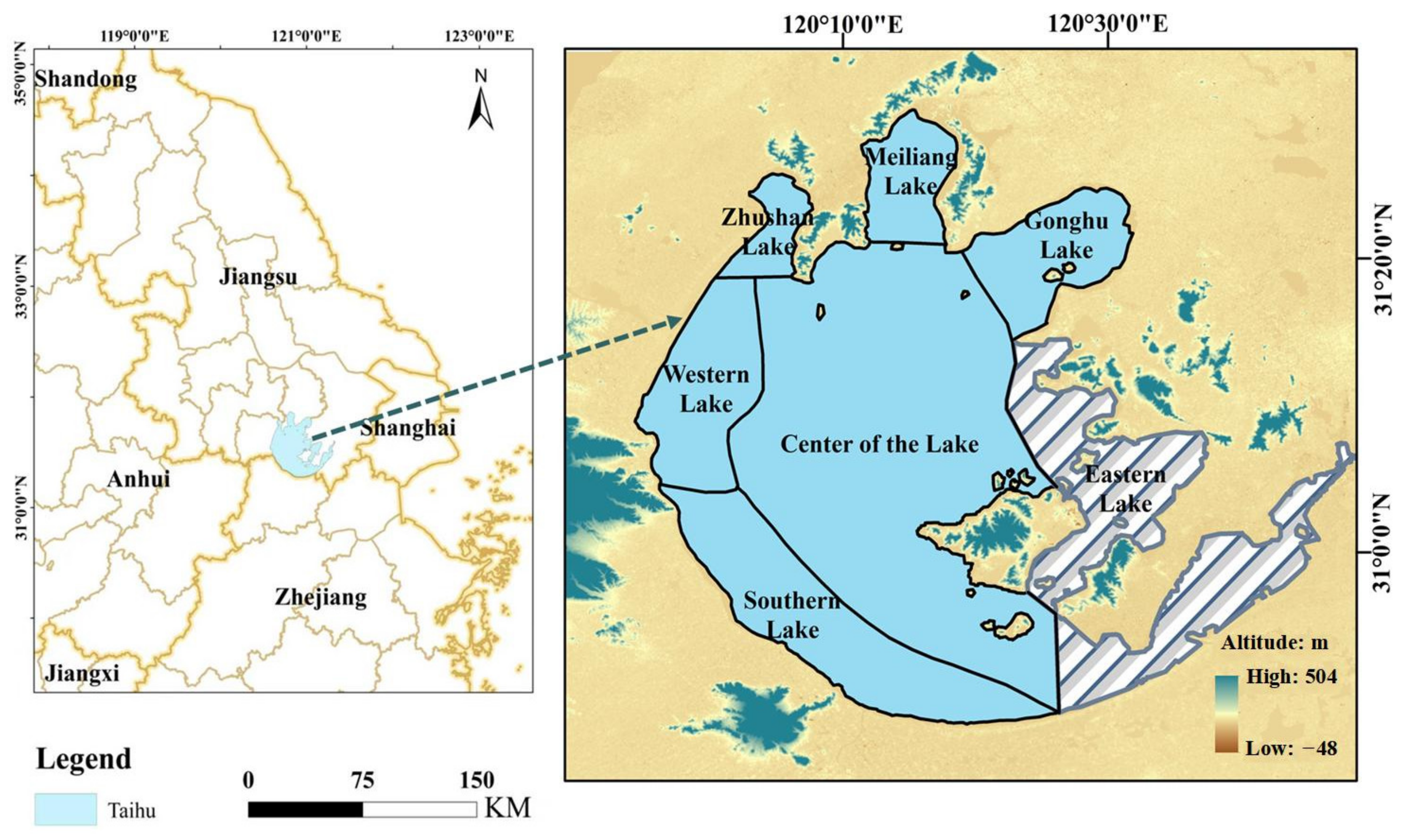
Lake Taihu, located in the Yangtze River Delta region of eastern China (Figure 1), is the third largest freshwater lake in China. Its geographical scope is between 30°55′40″N–31°32′58″N and 119°52′32″E–120°36′10″E. The lake area is about 2338 km2, the total length of the lake shoreline is 393.2 km, the average water depth is about 1.9 m, which is a typical inland shallow lake [25]. The hydrodynamic conditions of the lake are weak, and the water mobility is poor, which is prone to water retention and eutrophication. The climate and hydrological characteristics of the Taihu Basin have an important impact on the lake water quality and ecological environment. Especially under the conditions of high temperature and heavy rainfall in summer, the water quality is prone to apparent changes, and environmental problems such as cyanobacterial blooms are more prominent [26].
Lake Taihu has a vast water area and an irregular shape, with typical characteristics of a source lake. There are multiple sub-lakes, islands, and wetland ecosystems in the lake area. According to geographical differences, Lake Taihu can be divided into seven lake regions, including Meiliang Bay, Zhushan Bay, and Gonghu Bay. This study aims to improve the identification of cyanobacterial blooms by using multi-dimensional features from the GF-6/WFV dual red-edge bands. However, this objective conflicts with the ecological conditions of the eastern region of Lake Taihu, an area recognized as a core zone of dense aquatic vegetation, including submerged and emergent plants [27,28]. Both aquatic vegetation and cyanobacterial blooms contain high chlorophyll, causing their spectral profiles to overlap significantly across the visible near-infrared bands. This spectral confusion makes it difficult for classifiers to distinguish between cyanobacteria and aquatic plants, likely leading to misclassification and obscuring the true accuracy of bloom versus water discrimination. To avoid interference from this non-target factor and to ensure focused and reliable results, the eastern vegetated region was excluded from the analysis. This study focuses its monitoring on six main lake regions, such as the western and the central areas.

2.2. Satellite Data and Preprocessing

As China’s first high-resolution remote sensing satellite equipped with red-edge bands, GF-6 was successfully launched on 2 June 2018, and officially delivered for user operation on 21 March 2019. The satellite is equipped with two types of sensors: a high-resolution Panchromatic and Multispectral Sensor (PMS) with 2 m panchromatic/8 m multispectral resolution, and a 16 m resolution Wide Field View (WFV) multispectral sensor. Notably, the WFV sensor is capable of capturing images with a swath width of 800 km, enabling extensive coverage of terrestrial surfaces. This makes it particularly suitable for large-scale resource monitoring and analysis of environmental changes. A standout feature of GF-6 is the first-time incorporation of red-edge bands in its WFV sensor. Existing studies have fully confirmed that the newly added bands are highly sensitive to changes in vegetation water content and chlorophyll concentration, effectively achieving the sensor’s design objective of improving vegetation classification accuracy [29]. This innovation enables the satellite to more accurately characterize the spectral features of vegetation and water, offering distinct advantages particularly in monitoring aquatic ecological environment such as cyanobacterial blooms [30].
The GF-6/WFV satellite data used in this study were obtained from the Land Observation Satellite Data Service Platform of the China Centre for Resources Satellite Data and Application (CRESDA). The main parameters of its multispectral bands are shown in Table 1. A phased data screening strategy was adopted to accommodate the needs of different analytical tasks. First, a total of 72 scenes of L1A-level images with cloud coverage below 20% were acquired between 2019 and 2023. These images cover the entire Lake Taihu area and exhibit a wide temporal distribution, providing a sufficient data basis for the statistical analysis of red-edge texture features. On this basis, to support high-precision spectral and index feature analysis and cyanobacterial bloom extraction modeling, four images were further selected from the overall dataset. These images are of flawless quality, completely cloud-free over the lake area, and representative of the four typical seasons, thereby capturing the lake’s conditions over time. Details of the selected four images are provided in Table 2. All images underwent preprocessing, including radiometric calibration, atmospheric correction, orthorectification, and image cropping [31,32], to ensure the accuracy of subsequent analysis.

2.3. Reference Data and Sample Design

In the study, a false-color composite was first generated from the preprocessed im-agery, causing cyanobacterial bloom accumulations to appear in a magenta hue in the composite image, thereby enhancing the accuracy of visual interpretation. Subsequently, 300 samples were randomly generated within the study area (excluding the eastern lake region). This set of samples was applied to the false-color composite of each date. For each date, the samples were interpreted and adjusted to ensure comparable sample sizes between the two categories, minimizing sampling bias. Finally, the samples were labeled as cyanobacterial blooms and lake water, respectively. To guarantee the accuracy of sample classification, this study integrated visual interpretation with the Lake Taihu cyanobacterial bloom monitoring reports published by the Jiangsu Environmental Monitoring Center to repeatedly verify and refine the interpretation results. To construct a cyanobacterial bloom extraction model and validate its accuracy, the final sample set was divided into a training set and a validation set at a ratio of 70% to 30%. The training set was used for training the Random Forest model to learn the spectral and spatial features of cyanobacterial blooms, while the validation set was employed to evaluate the model’s extraction accuracy and generalization ability.

2.4. Input Variables

The input variables for the cyanobacterial bloom extraction model encompassed three feature categories derived from the preprocessed GF-6/WFV imagery: spectral bands, texture features, and spectral indices.
Spectral bands served as the foundational inputs. Based on the characteristics of the GF-6 red-edge bands, four band combinations were compared: the basic four bands (R, G, B, NIR), the four bands plus red-edge 710 nm (RGBN + RE1), the four bands plus red-edge 750 nm (RGBN + RE2), and the four bands plus dual red-edge bands (RGBN + RE1 + RE2). By incrementally introducing red-edge bands, the study investigated the differences in spectral response between cyanobacterial blooms and lake water under different band combinations, thereby analyzing the enhancement of separability achieved by incorporating red-edge bands, and quantifying the contribution of the red-edge 710 nm and 750 nm bands in GF-6/WFV data to cyanobacterial bloom extraction.
Texture features were extracted to quantify the spatial heterogeneity of cyanobacterial aggregations. The distribution of cyanobacterial blooms typically appears patchy or streaky, and their texture features significantly differ from those of water or vegetation, providing rich information for distinguishing cyanobacterial blooms from interfering components. Commonly used texture feature indicators include homogeneity, contrast, and correlation [33]. Gray Level Co-occurrence Matrix (GLCM) is a classical method for extracting texture features, proposed by Haralick [34] in 1973. Its core involves generating a two-dimensional matrix by statistically analyzing the co-occurrence frequency of pixel gray value pairs in specific directions and distances, thereby quantifying the spatial distribution patterns between pixels. Its mathematical expression is:
P ( i , j ; d , θ ) = { ( x , y ) , ( x , y ) I ( x , y ) = i , I ( x , y ) = j }
here, P ( i , j ; d , θ ) represents the frequency of occurrence of pixel pairs with gray values i and j at distance d and direction θ. I ( x , y ) is the gray value of the pixel at position   ( x , y ) . (x’, y’) = (x + d cosθ, y + dsinθ) are the coordinates of the adjacent pixel. d represents the distance between pixel pairs (e.g., 1 or 2 pixels). θ represents the directional angle between pixel pairs (e.g., 0°, 45°, 90°, or 135°).
Based on the GLCM, various statistical measures can be calculated to describe image texture features. Common GLCM texture measures include: mean, variance, dissimilarity, homogeneity, angular second moment (ASM), and entropy. The eight statistical measures used in this study and their corresponding statistical characteristics are shown in Table 3.
Spectral indices are parameters formed by linear or nonlinear combinations of spectral band reflectances from remote sensing imagery and are used to extract vegetation characteristics. Due to the similarity between the spectral characteristics of cyanobacteria and terrestrial vegetation, various established vegetation index algorithms can be employed for cyanobacterial extraction [35]. For example, commonly used indices such as NDVI [36] utilize the reflectance difference between the red and near-infrared bands to sensitively capture the growth dynamics of cyanobacteria in water, thus enabling the extraction of cyanobacterial bloom distribution information. The enhanced vegetation index (EVI) [37] is an improvement over NDVI, compensating for shortcomings such as NDVI’s high susceptibility to atmospheric noise. It expresses a linear relationship between vegetation density and the vegetation index, reducing the impact of suspended sediment and background water on the vegetation index. The ratio vegetation index (RVI) [38] can identify high-coverage vegetation. The difference vegetation index (DVI) [39] is more sensitive for monitoring low-coverage vegetation. Existing research shows that using vegetation indices for cyanobacterial bloom extraction can not only overcome the issue of single bands being easily affected by environmental noise but also improve the accuracy and robustness of cyanobacterial extraction through the combination of multi-band information [40].
Furthermore, reflectance changes in the red-edge band are closely related to plant chlorophyll content, making it a key band for assessing plant pigment status and health, and thus an ideal indicator for monitoring vegetation status via remote sensing technology. Cyanobacterial blooms, containing large amounts of chlorophyll and phycocyanin, exhibit a more sensitive response in the red-edge band [41]. Red-edge indices can more acutely capture spectral changes, thereby effectively improving the accuracy of cyanobacterial extraction. The normalized difference red-edge index (NDRE) [42] uses the two red-edge bands of GF-6/WFV instead of the red and near-infrared bands, allowing for a rapid response to subtle changes in the vegetation leaf canopy. The normalized difference vegetation index red-edge1 (NDVIre1) and red-edge2 (NDVIre2) are constructed by replacing the red band (B3) in the NDVI formula with the red-edge 710 nm (B5) and red-edge 750 nm (B6) bands of GF-6/WFV data, respectively. The modified chlorophyll absorption reflectance index (MCARI) [43] is sensitive to chlorophyll content, and its value can reflect the level of chlorophyll content. Given that GF-6/WFV data has two red-edge bands, and referencing the relevant domestic and international literature, this study constructed nine indices for cyanobacterial bloom extraction research. The calculation formulas for these indices are shown in Table 4.

2.5. Input Variable Analysis and Selection

2.5.1. Spectral Feature Analysis

This study conducted diagnostic spectral analysis from two perspectives, namely band information content and sample separability, employing the adaptive band selection (ABS) method based on all image pixels and the Jeffries–Matusita–Bhattacharyya (JBh) distance method based on training samples. The above analyses aimed to evaluate the information content of individual bands and the spectral separability differences among different band combinations. ABS index and JBh distance served only as pre-classification evaluation metrics rather than model predictors.
The ABS method is a ranking-based band selection technique first proposed by Liu [44]. This method builds upon the optimal index factor (OIF) method by incorporating a ranking concept for selecting the optimal combination of bands from multiple candidate bands. It allows the selection of bands with high information content and low correlation with other bands. The core of the ABS method lies in combining the ranking mechanism with the OIF model, automatically selecting bands in an adaptive manner that fully considers the spatial and inter-band correlation of each band. The calculation principle of the ABS method is shown in Equation (1). The criteria for band selection include: ① the spectral information content of the selected bands must be as large as possible to ensure the bands can effectively reflect the characteristics of the target objects; and ② the correlation between the selected bands and other bands needs to be minimized to avoid the impact of information redundancy. This method fully considers the standard deviation of each band and the correlation with adjacent bands, screening out the most effective band combination by balancing independence and information content between bands. Compared to the traditional OIF method, the ABS method offers higher computational efficiency and flexibility. Furthermore, the ABS method can calculate a separate evaluation index for each band, facilitating spectral analysis and research on specific bands of remote sensing imagery.
I i = σ i ( r i 1 , i + r i . i + 1 ) 2
In the formula, σ i is the standard deviation of the i-th band; r i 1 , i and r i . i + 1 are the correlation coefficients between the i-th band and its two adjacent bands (before and after); I i represents the ABS index. A larger value indicates greater information content and representativeness of the corresponding band. To optimize the band combination, this study reconstructed the original bands of the GF-6/WFV imagery by defining the purple band as the first band and the yellow band as the last, ensuring uniform coverage from the visible to the red-edge spectral range. The goal of band reconstruction was to highlight spectral features closely related to cyanobacterial blooms while reducing interference from redundant bands [15]. On this basis, the ABS indices for all bands except the purple and yellow bands were calculated to evaluate their information content.
The JBh distance is a spectral separability measure based on conditional probability theory, primarily used to evaluate the degree of separability between different feature categories [45]. It uses the Bhattacharyya distance algorithm to measure the probability density difference between different feature categories and incorporates prior probabilities to weight the categories, thereby quantifying the inter-class separability. The JBh distance can assign greater weight to categories with higher prior probabilities, considering differing sample sizes, thus more accurately measuring the separability among multiple feature categories. Compared to the Jeffries–Matusita distance, the JBh distance not only considers the spectral differences between classes but also more reasonably handles inter-class differences through weighting. Its calculation method is shown in Equation (3).
J B h = i = 1 N j = i N p ( w i ) × p ( w j ) × J M 2 ( i , j )
In the formula, N is the number of categories; P ( w i ) and P ( w j ) are the prior probabilities of the i-th and j-th classes, respectively, where the prior probability is calculated based on the sample size.

2.5.2. Texture Analysis

Based on GF-6/WFV satellite imagery from 2019 to 2023, this study selected the red-edge bands (RE1, RE2) and the near-infrared band (NIR) to calculate the eight texture features as described in Section 2.4, using a 3 × 3 pixel window. Subsequently, principal component analysis (PCA) [46] was applied to reduce the dimensionality of the texture features from these three bands, and the first principal component (PC1) was selected to represent the comprehensive texture feature for each band. The variance contribution rate of the PC1 was used to quantify the information-representation efficacy of this selected component. The resulting PC1-based features were then incorporated as predictive variables in the subsequent cyanobacterial bloom extraction schemes.
PCA operates by performing eigen-decomposition on the covariance matrix. First, the data are standardized to eliminate differences in scale and value ranges among the features (bands), transforming the data to have a mean of 0 and a variance of 1, thereby avoiding the influence of extreme values on the dimensionality reduction outcome. Next, the covariance matrix of the standardized data is computed to quantify the linear correlations between features. This is followed by eigenvalue decomposition of the covariance matrix, yielding eigenvalues that reflect the variance magnitude along the principal component directions and the corresponding eigenvectors that define these directions. The eigenvalues are then sorted in descending order, and their contribution ratios (variance explained) are calculated. Based on a predefined contribution ratio threshold or by selecting the top K eigenvectors corresponding to the largest eigenvalues, the principal components are determined to construct a lower-dimensional space that retains the essential information. Finally, using the projection matrix formed by the selected principal components, the original data are projected into the new space, completing the dimensionality reduction process. The variance contribution rate ( V C 1 ) of PC1 for each band was calculated using the following formula:
V C 1 = λ 1 i = 1 p λ i × 100 %
where λ 1 denotes the eigenvalue corresponding to PC1; p is the total number of original features; i = 1 p λ i represents the sum of all eigenvalues, i.e., the total variance of the original data. V C 1 quantifies the proportion of the total variance explained by PC1; a higher value indicates a stronger capacity of PC1 to comprehensively represent the texture information of the corresponding band. By comparing the variance contribution rates of PC1 across the three bands, the potential and characteristic differences of the red-edge bands relative to the traditional NIR band in terms of providing texture information were assessed quantitatively.

2.5.3. Index Importance Ranking

Based on training samples, this study employed the Random Forest algorithm, an Embedded method [47], to assess the importance of the nine spectral indices derived from GF-6/WFV data. To maintain consistency with the scheme design for other feature types and to ensure comparable performance evaluation across different feature categories, based on the feature selection results, the top four spectral indices in terms of importance were selected for each study period and used as spectral index inputs in subsequent cyanobacterial bloom extraction schemes, thereby exploring their effectiveness and optimization potential in cyanobacterial bloom monitoring.
The Random Forest algorithm uses two methods to rank feature importance [48]: one is a ranking method based on the Gini Coefficient, which calculates the decrease in Gini impurity contributed by each feature during node splitting, then aggregates the importance scores of each feature across all trees for ranking; the other is based on a permutation concept, where the core idea involves shuffling the values of a feature and observing the change in the model’s prediction accuracy to evaluate the feature’s importance. This paper adopted the former, the Gini impurity decrease method, to ensure the stability and interpretability of the feature evaluation. The algorithm was implemented using the Python(3.11.3) open-source library Scikit-learn, with the number of trees set to 1000 and the default stopping criteria applied. The specific operational steps are as follows: Denote the feature importance score as VIM and the Gini Coefficient as GI. Assume there are J features X1, X2, X3, …, Xⱼ, I decision trees, and C categories. Calculate the Gini Coefficient V I M j ( G I ) for each feature Xⱼ, which is the average reduction in node impurity splits for the j-th feature across all decision trees in the Random Forest. The formula for the Gini index of node q in the i-th tree is:
G I q ( i ) = c = 1 | C | c c P q c ( i ) P q c ( i ) = 1 c = 1 | C | ( P q c ( i ) ) 2
where P q c represents the proportion of category c in node q, i.e., the probability that two samples randomly drawn from node q have inconsistent category labels. The importance of feature Xⱼ at node q in the i-th tree, i.e., the change in the Gini index before and after the split at node q, is:
V I M j q ( G I ) ( i ) = G I q ( i ) G I I ( i ) G I r ( i )
where G I I ( i ) and G I r ( i ) represent the Gini indices of the two new nodes after the split, respectively. If the nodes where feature Xⱼ appears in decision tree i form the set Q, then the importance of Xⱼ in the i-th tree is:
V I M j ( G I ) ( i ) = q Q V I M j q ( G I ) ( i )
assuming there are I trees in the Random Forest, then:
V I M j ( G I ) = i = 1 I V I M j ( G I ) ( i )
finally, normalize all obtained importance scores:
V I M j ( G I ) = V I M j ( G I ) j = 1 J V I M j ( G I )

2.6. Cyanobacterial Bloom Extraction Models

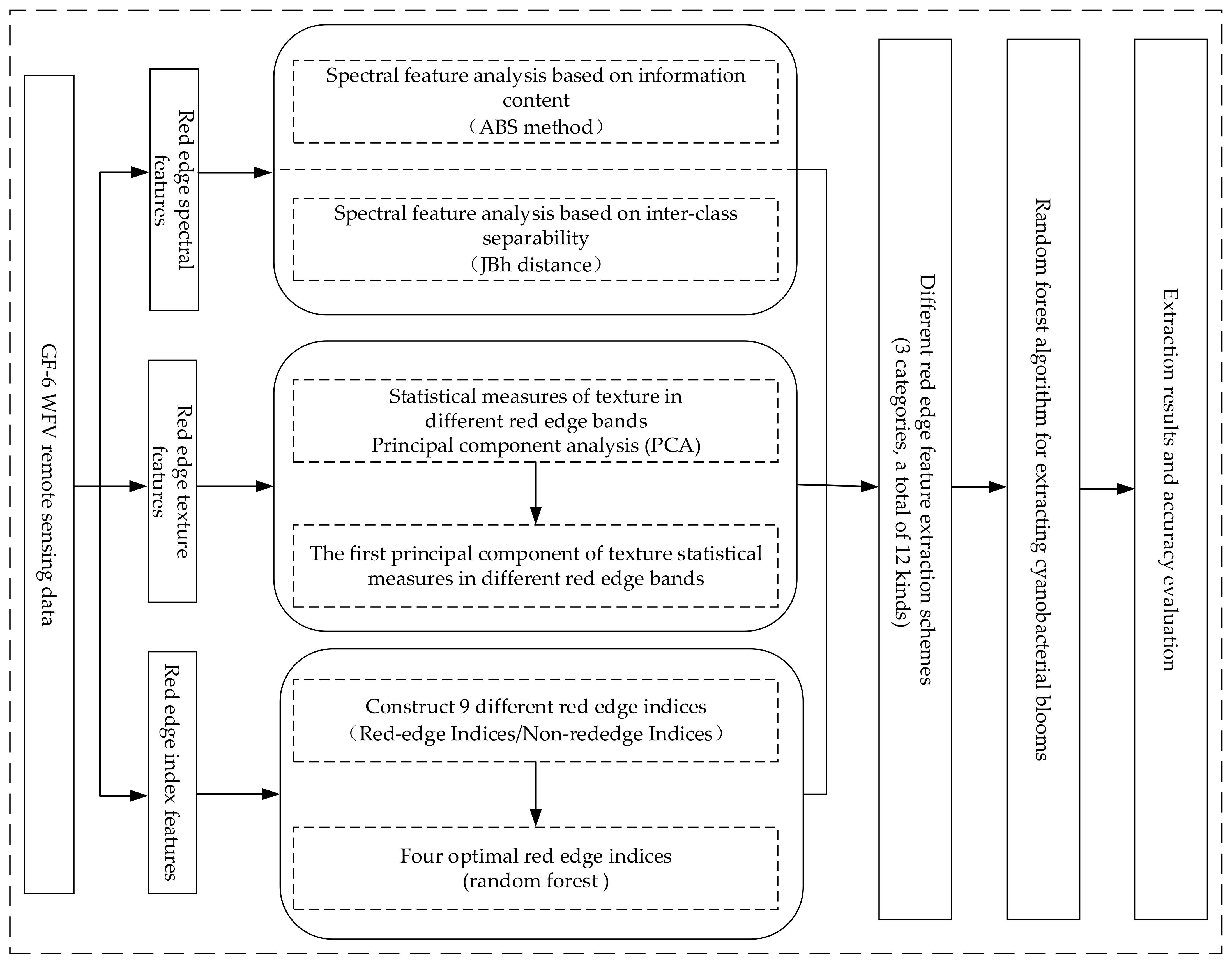
Integrating spectral, texture, and index analysis results, this study designed a series of cyanobacterial bloom extraction schemes based on red-edge features. The Random Forest classifier was then trained and validated under multiple feature schemes for bloom extraction and accuracy assessment. The technical route of the study is shown in Figure 2.

2.6.1. Extraction Schemes Based on Different Features

Using the four basic bands (R, G, B, NIR), this study incrementally added 1–2 features of spectral, texture, and indices based on red-edge bands. The aim was to improve the extraction accuracy of cyanobacterial blooms and explore the application potential of red-edge bands in remote sensing classification. The research focused on analyzing the spectral response characteristics of the red-edge 710 nm, red-edge 750 nm, and near-infrared bands and their contribution to cyanobacterial bloom extraction. In terms of scheme design, the study first categorized the spectral, texture, and index features of the red-edge bands into three groups: A, B, and C. Subsequently, based on combinations of different red-edge bands, 12 schemes were derived (as shown in Table 5) to systematically evaluate the impact of different feature combinations on cyanobacterial bloom extraction accuracy.
Figure 2. Technical route of the study.
Remotesensing 18 00653 g002

2.6.2. Random Forest Algorithm

This study employed the Random Forest algorithm to perform remote sensing extraction of cyanobacterial blooms in Taihu Lake, based on spectral, texture, and index features. Random Forest is an ensemble learning algorithm based on decision trees, proposed by Breiman [49] in 2001. Its core idea is to use Bootstrap sampling to randomly draw samples from the original data, generating multiple training subsets. Multiple decision trees are then constructed based on these subsets, and the final classification result is determined through a voting mechanism among these trees, thereby improving extraction accuracy and robustness. During the construction of a single decision tree, the algorithm recursively selects the optimal feature for node splitting. The Mean Decrease in Impurity algorithm is a commonly used calculation method in decision tree construction. Its principle is to select the optimal splitting method for the current node to partition the dataset into several subsets, reducing the impurity of the subsets and thus facilitating the growth of the decision tree. Common impurity metrics include Information Entropy and the Gini Coefficient. Higher entropy indicates higher impurity, while a smaller Gini Coefficient indicates lower impurity. During the growth of the decision tree, each split selects the feature that results in the greatest mean decrease in impurity as the basis for partitioning, ultimately generating a decision tree with excellent generalization performance. The calculation formulas for the Gini Coefficient and Information Entropy are shown in Equations (10) and (11), respectively:
Gini   Coefficient:   G i n i ( X ) = k = 1 k p k ( 1 p k ) = 1 k = 1 k p k 2
Information   Entropy:   E n t ( X ) = k = 1 k p k log p k
In the formulas, X represents the sample set, and p k is the proportion of samples of the k-th category in sample set X.
Random Forest is a non-parametric classification method that does not require pre-assumed data distribution characteristics and can be widely applied to various classification tasks. Existing research has confirmed that the Random Forest algorithm has significant advantages compared to other extraction methods [50], especially for categories with similar spectral characteristics. Regarding the algorithm’s parameter settings, the number of trees (ntree) was set to 100, the number of features considered for splitting a node (mtry) was set to the square root of the total number of features, and the impurity function was set to the Gini Coefficient.

2.7. Accuracy Assessment

This study employed a method combining visual interpretation with the Lake Taihu cyanobacterial bloom monitoring reports from the Jiangsu Environmental Monitoring Center to assess the accuracy of the extraction results. The evaluation metrics used include overall accuracy (OA), Kappa coefficient, F1 score, and relative error (RE). These accuracy metrics reflect the actual extraction effectiveness from different dimensions. Specifically, OA and Kappa coefficient are used to represent the overall accuracy of the remote sensing extraction. The F1 score is used to reflect the extraction accuracy for a specific feature type; it integrates both the producer’s accuracy (PA) and user’s accuracy (UA). A higher F1 value indicates higher accuracy; it approaches 100% when both PA and UA are high and approaches 0 when PA and UA differ significantly. RE quantifies the deviation between the extracted bloom area and the reference area obtained from the monitoring reports. The calculation methods for each evaluation metric are as follows:
O A = i = 1 n X i i i = 1 n j = 1 n X i j
K a p p a = N i = 1 n X i i i = 1 n ( X i + × X + i ) N 2 i = 1 n ( X i + × X + i )
F 1 = 2 P A U A P A + U A
R E = | X E s t X O b s | X O b s × 100 %
In the formulas, N represents the total number of validation samples, n represents the number of classes, i represents a specific class, UA is user’s accuracy, PA is producer’s accuracy, F1 reflects the extraction accuracy for a specific type, X E s t represents the extracted cyanobacterial bloom area, and X O b s represents the actual area from the report.

3. Results

3.1. Red-Edge Feature Analysis

3.1.1. Spectral Analysis of Red-Edge Bands

ABS index values and rankings for all GF-6/WFV bands except the purple and yellow bands are presented in Table 6. The results showed that during the spring phase, the blue and near-infrared bands ranked first and second in ABS index, indicating their strong spectral response to cyanobacterial blooms in spring. The red-edge 750 nm and red-edge 710 nm bands also exhibited high ABS indices, ranking third and fourth, respectively. In the summer phase, the green band ranked first with an ABS index of 440.7, followed by the red-edge 750 nm and near-infrared bands in 2nd and 3rd places, while the red-edge 710 nm band contained relatively less information. The autumn phase showed the most prominent performance of the red-edge bands: the red-edge 750 nm band ranked first with an ABS index of 834.5, followed closely by the near-infrared and red-edge 710 nm bands with ABS indices of 830.6 and 766.8, respectively, indicating a significant response of red-edge and near-infrared bands to cyanobacterial blooms. The winter phase exhibited distinct characteristics: the red-edge 750 nm band was particularly outstanding, with an ABS index of 2596.5 far exceeding other bands. The information content of the remaining bands was relatively balanced, with ABS indices fluctuating around 400. The red-edge 710 nm band had an ABS index of 475.7, ranking third, indicating it still retained good information content. Overall, the near-infrared and red-edge bands of GF-6/WFV data provide more abundant feature information and show higher information content, especially in autumn and winter, where the red-edge 750 nm band has the highest ABS index, facilitating the extraction of cyanobacterial blooms.
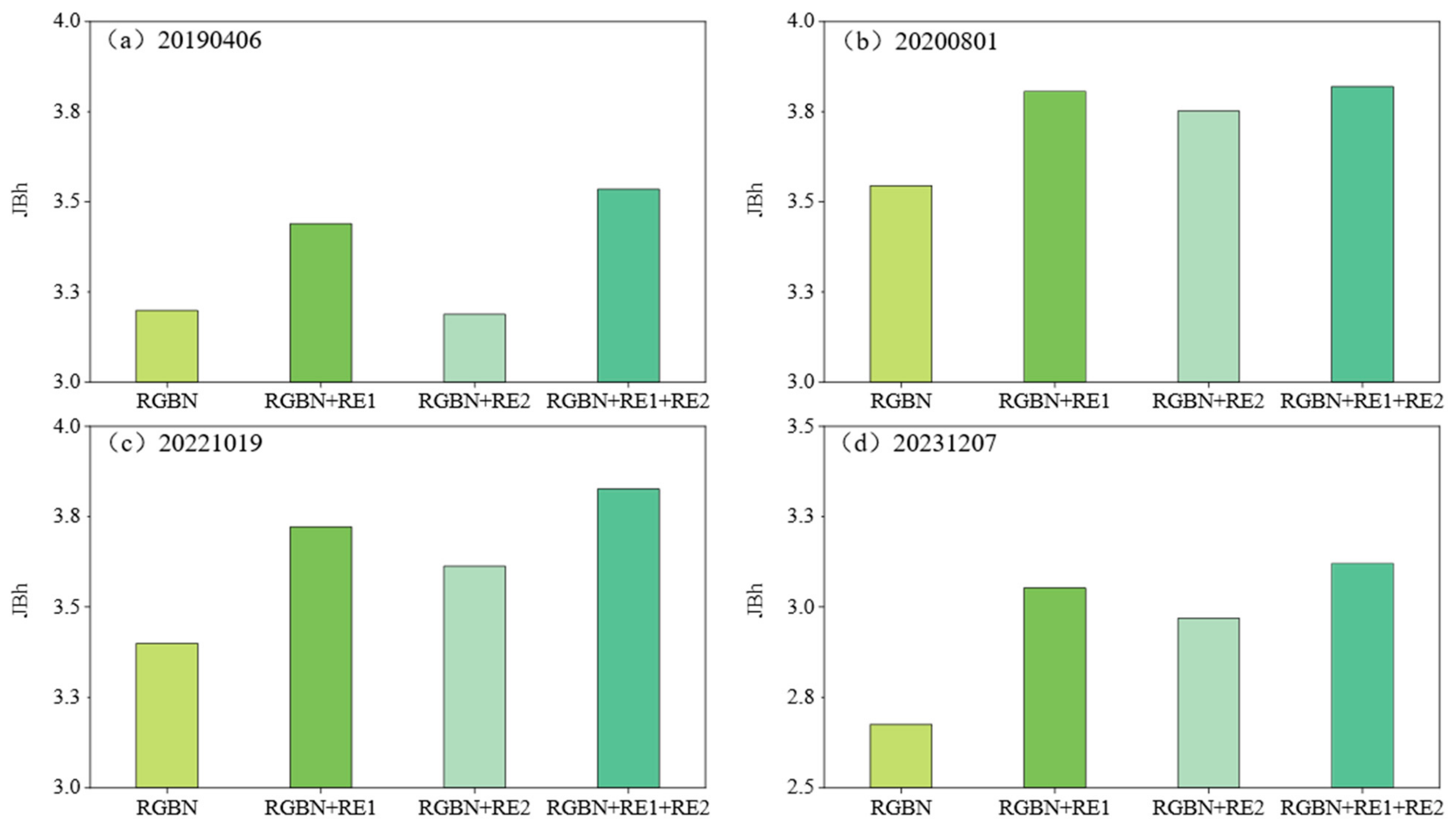
Figure 3 presents the JBh distances for the four band combination schemes. Analysis of the JBh distances indicates that incorporating red-edge bands significantly enhances sample separability. When a single red-edge band is introduced, the JBh distance for the red-edge 710 nm band (RGBN + RE1) is greater than that for the red-edge 750 nm band (RGBN + RE2), indicating a better improvement in sample separability. Quantitatively, compared to the basic four-band (RGBN) combination, the 710 nm band improved spectral separability by an average of 9.63%, whereas the 750 nm band yielded a lower average improvement of 5.69%. The dual red-edge band combination (RGBN + RE1 + RE2) performs slightly better than the single red-edge 710 nm band (RGBN + RE1); both can adequately reflect spectral differences between features, significantly enhancing the separation ability of different feature categories. In comparison, the basic four-band (RGBN) combination shows relatively weaker JBh distance performance, further confirming that the introduction of red-edge bands in GF-6/WFV data can effectively improve the separability between cyanobacterial blooms and other features, thereby enhancing the extraction accuracy of cyanobacterial blooms.

3.1.2. Texture Analysis of Red-Edge Bands

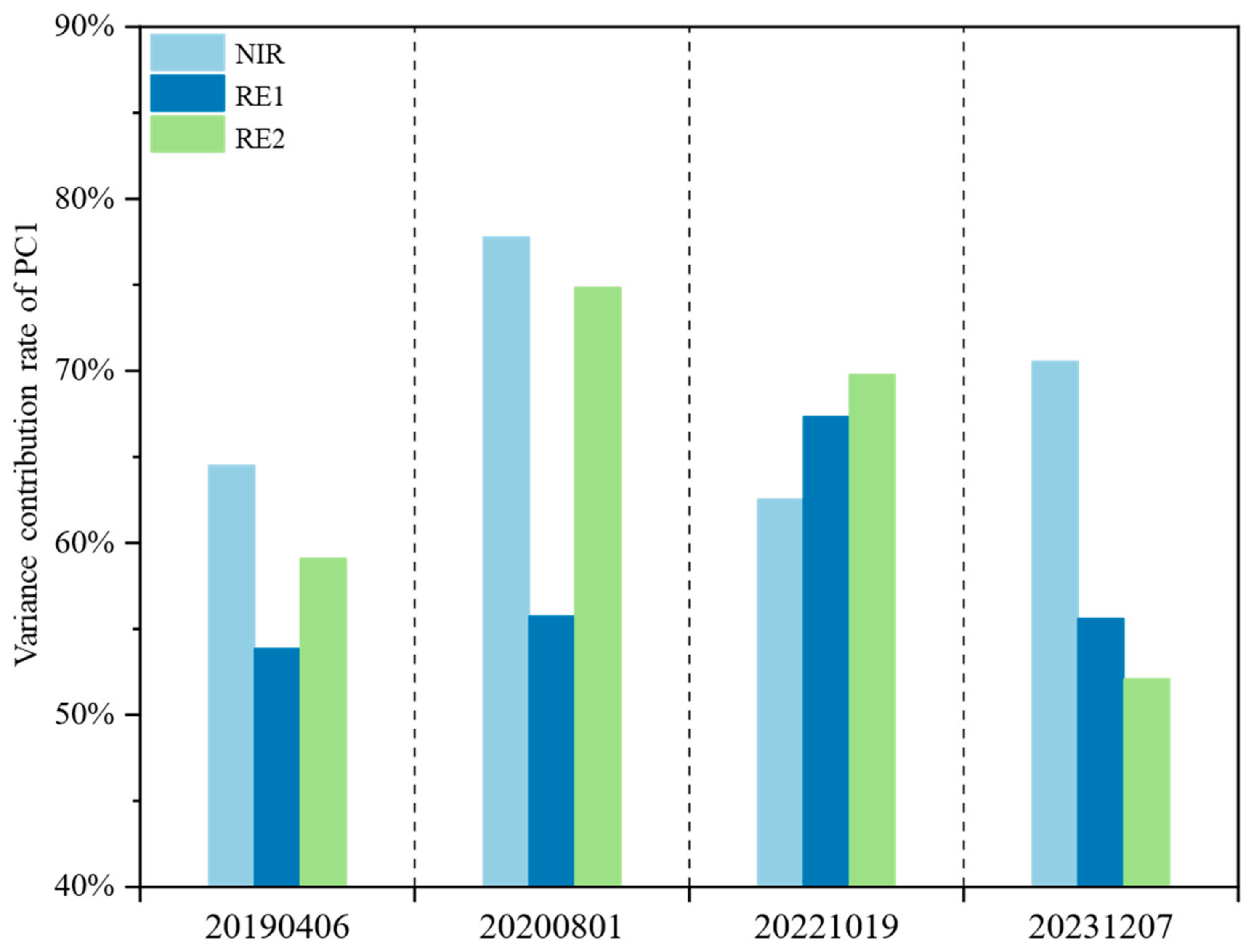
After calculation, the average variance contribution rate of PC1 for all bands across all images over the five years exceeded 60%, indicating that the principal component effectively retains the main information of the original texture features. Among them, the near-infrared band (NIR) had the best variance contribution rate, with an average of 71%, followed by the red-edge 750 nm (RE2) and red-edge 710 nm (RE1) bands, with average variance contribution rates of 68% and 64%, respectively. These values indicated that PC1 contained most of the information from the eight texture statistical measures. Therefore, the PC1 of these texture statistical measures can be used to represent the texture features of each band, enabling the analysis of the impact of the texture features of different red-edge bands on cyanobacterial bloom extraction.
The variance contribution rates of different bands for the four multi-temporal GF-6/WFV images are shown in Figure 4. The NIR band exhibits high and stable variance contribution rates across all four images, reaching 77.78% in the summer phase. Although fluctuating at other times, it consistently remains above 60%, indicating the significant role of the NIR band in texture analysis. The variance contribution rates of the red-edge bands (RE1 and RE2) also fluctuate over time: the red-edge 710 nm band shows relatively higher contributions in autumn and winter, peaking at 67.34%, while the red-edge 750 nm band shows higher contributions in summer and autumn, peaking at 74.84%, with contribution rates in summer and autumn close to or exceeding that of the NIR band. Overall, the NIR band’s contribution to texture features is relatively stable, while the red-edge bands (RE1 and RE2) show significant improvements in certain periods, indicating differences in the importance of their texture features under varying environmental conditions.

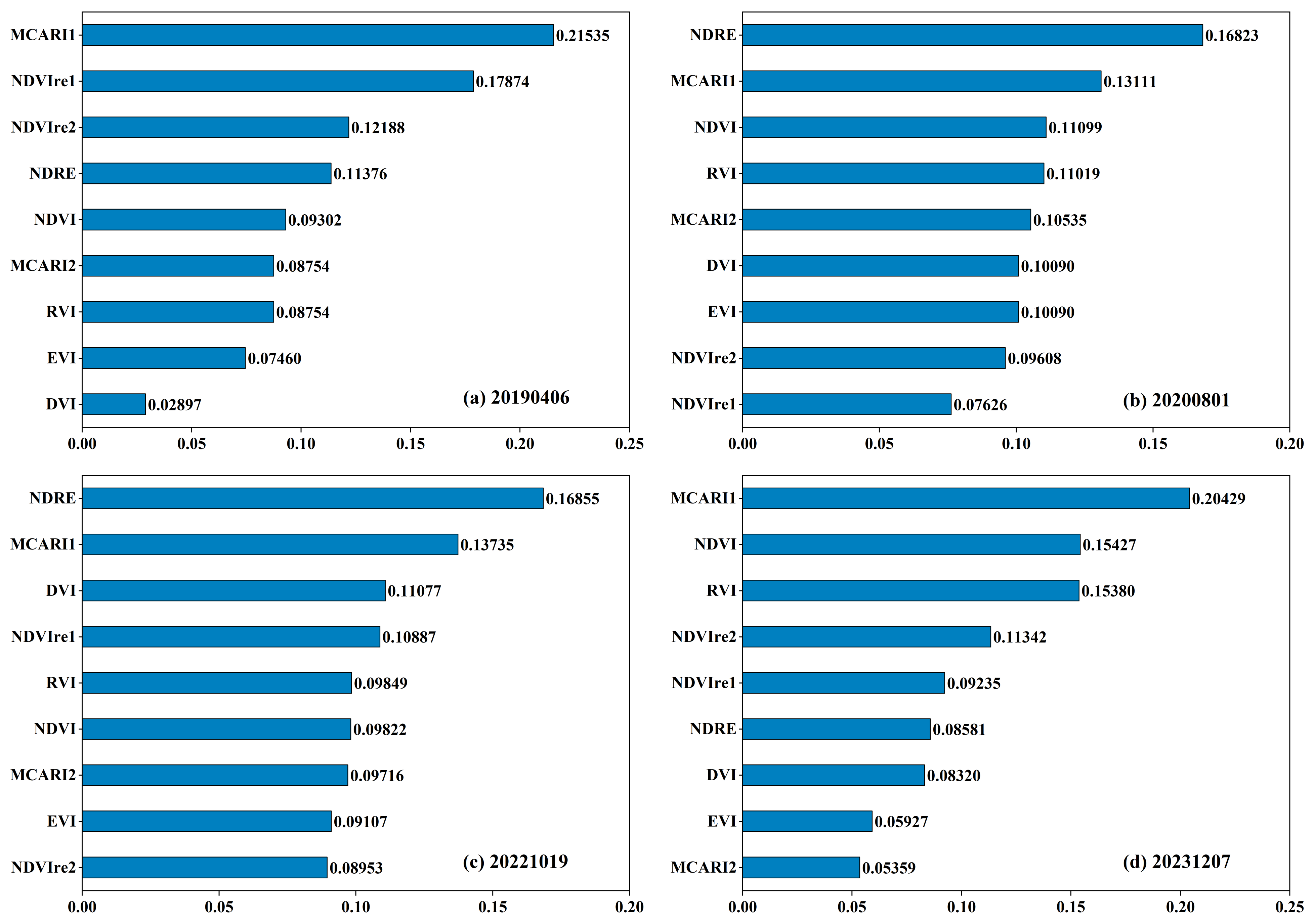
3.1.3. Evaluation of Index Feature Importance

The index importance scores based on the Random Forest algorithm are shown in Figure 5. Specifically, the ranking results of indices vary temporally, but red-edge indices generally show higher feature importance. Except for winter, the top two indices in other periods are all red-edge-related indices. This result indicates that red-edge bands exhibit strong adaptability and sensitivity and can play a core role in cyanobacterial bloom monitoring. Among them, NDRE ranked first in importance score in both summer and autumn, indicating its high sensitivity to chlorophyll concentration and growth status during high-bloom periods. MCARI1 performed more stably, maintaining high importance across all dates, indicating its significant value in monitoring cyanobacterial blooms at different growth stages. The calculation shows that the cumulative contribution rate of the top four indices in each period exceeded 50%. This result demonstrates that selecting the top four indices not only ensures comparability among schemes of different feature types but also effectively captures the essential information required for identifying cyanobacterial blooms across different periods.
Based on the above importance ranking, optimal index 1–4 for constructing the extraction schemes C1–C4 in Table 5 were determined for each date. For 6 April 2019 they were MCARI1, NDVIre1, NDVIre2, and NDRE; for 1 August 2020 they were NDRE, MCARI1, NDVI, and RVI; for 19 October 2022 they were NDRE, MCARI1, DVI, and NDVIre1; and for 7 December 2023 they were MCARI1, NDVI, RVI, and NDVIre2. These indices were respectively assigned as inputs to schemes C1 through C4 to evaluate the improvement in cyanobacterial bloom extraction accuracy contributed by the index features.
Figure 5. Evaluation of index feature importance.
Remotesensing 18 00653 g005

3.2. Cyanobacterial Bloom Extraction Results

3.2.1. Extraction Results of Different Schemes

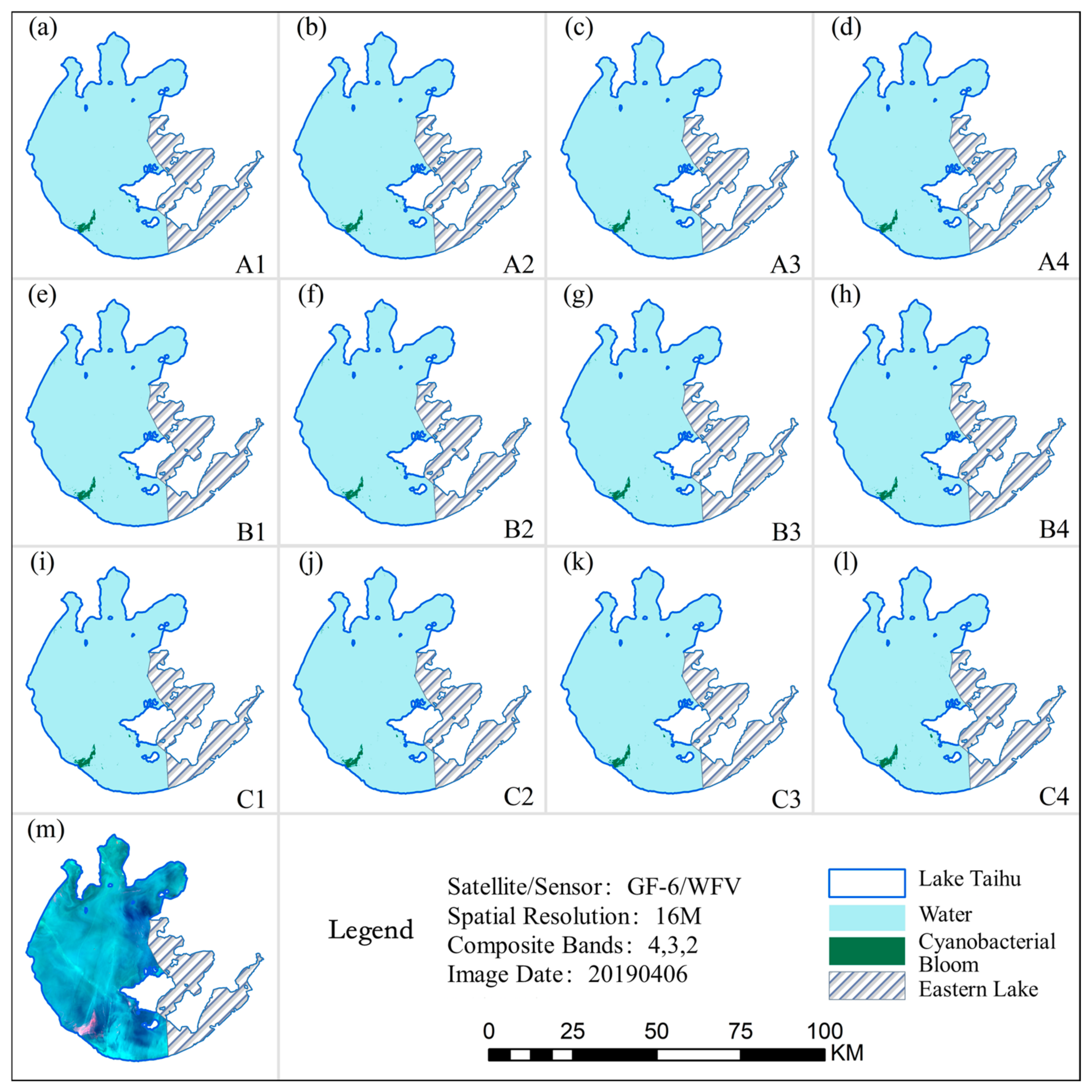
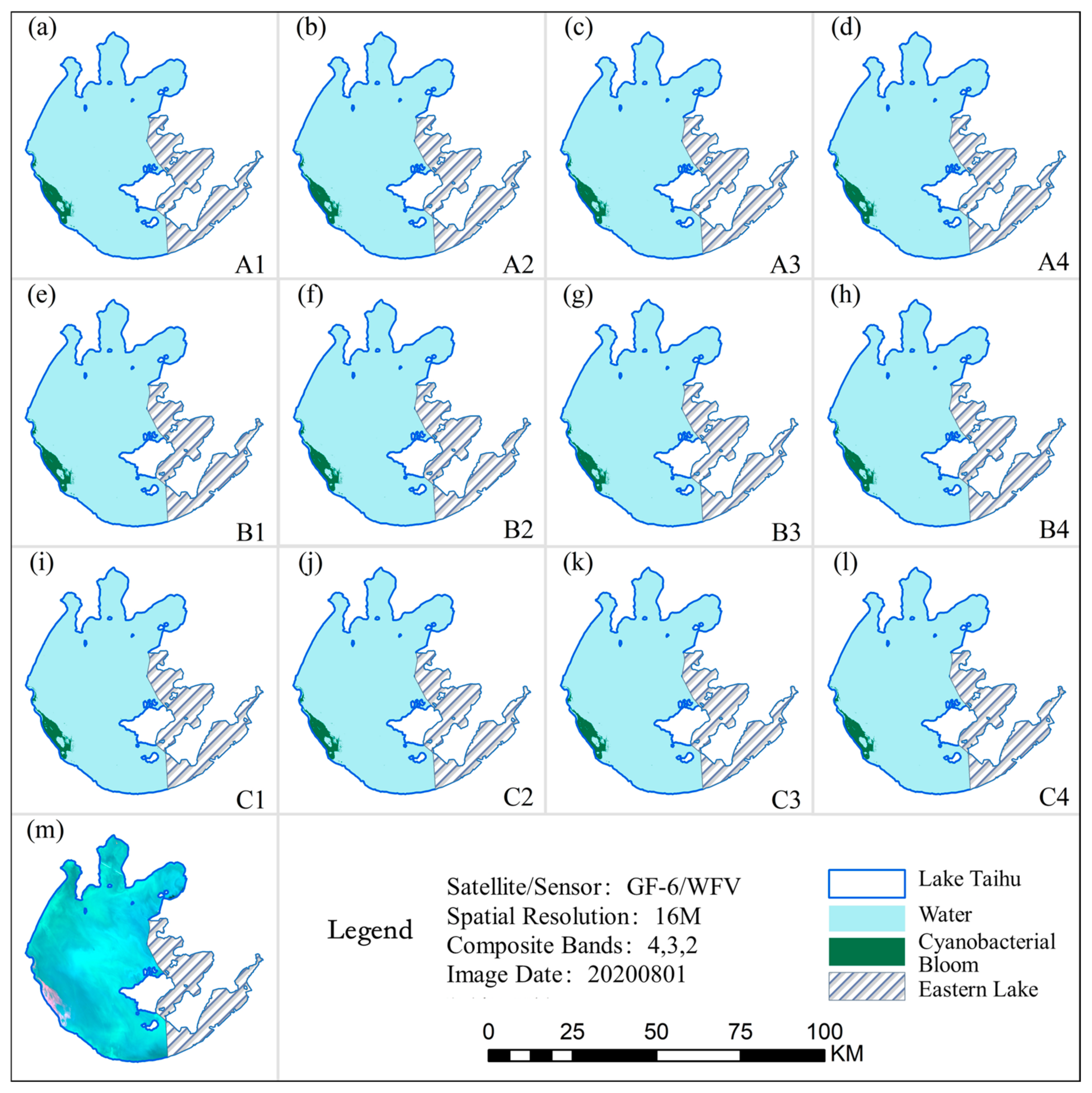
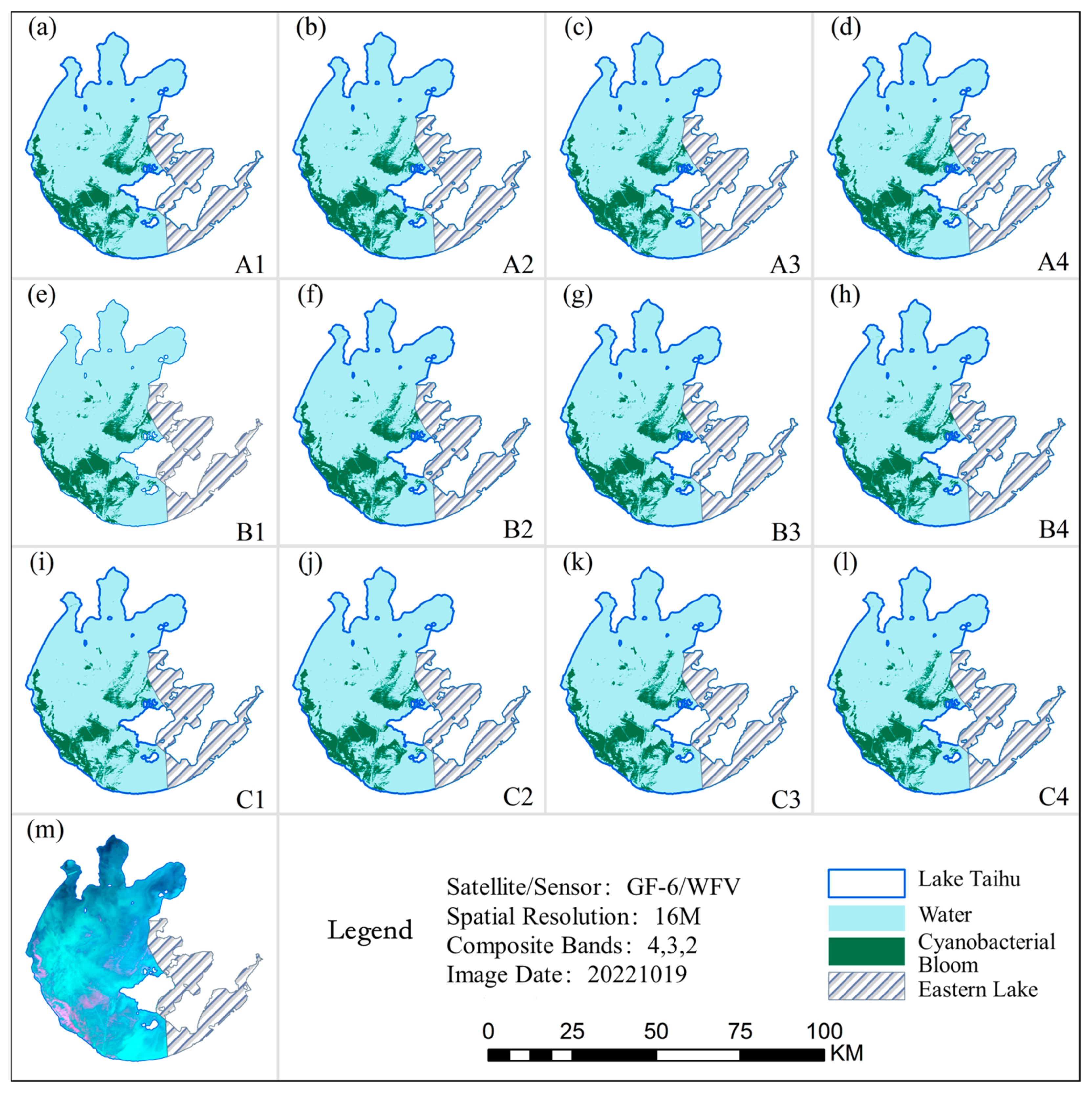
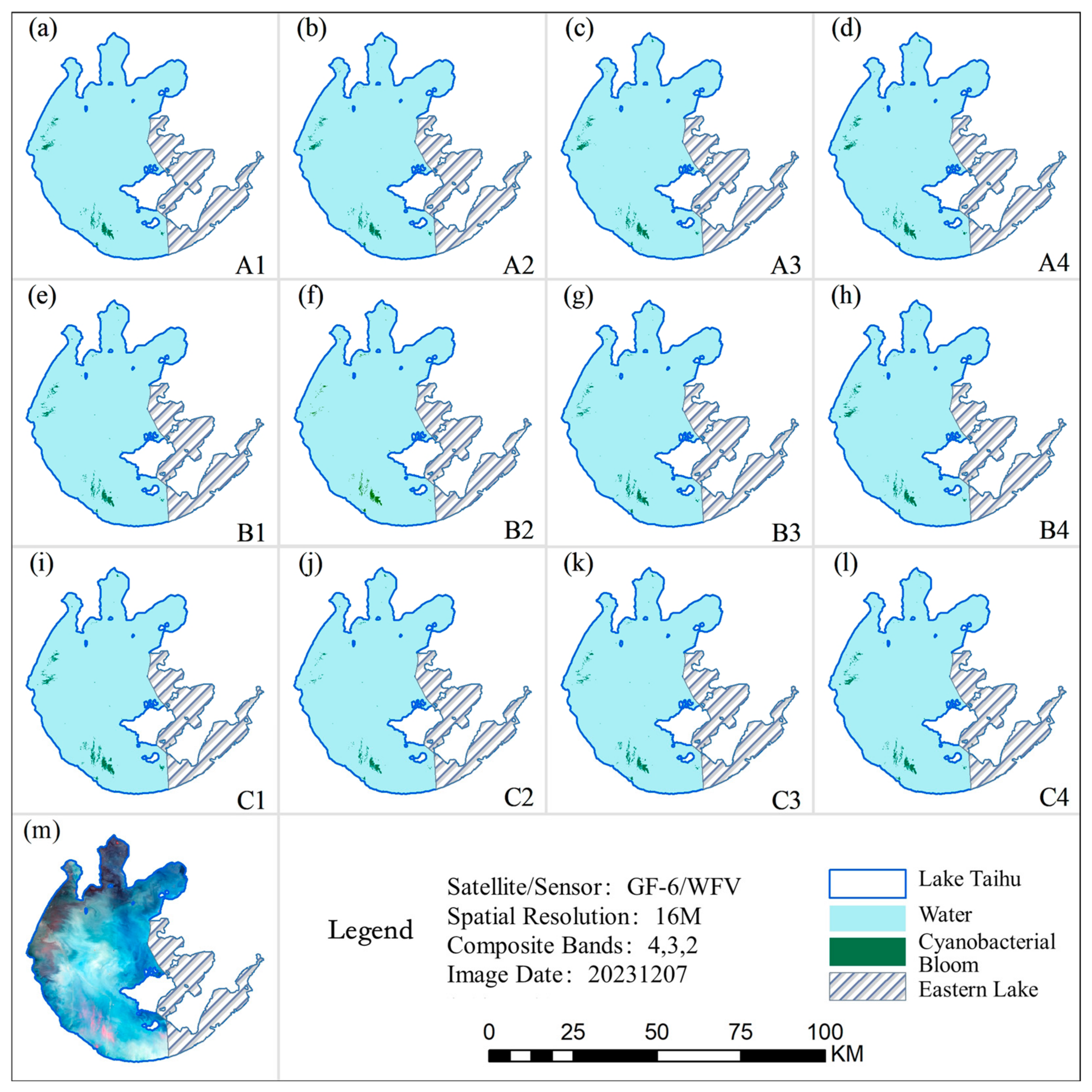
Using multi-temporal GF-6/WFV data, this study extracted cyanobacterial blooms in Lake Taihu with 12 feature schemes across three groups using the Random Forest algorithm, and performed an analysis incorporating accuracy evaluation metrics. The extraction results are presented through spatial distribution maps of cyanobacterial blooms for the 12 schemes (Figure 6, Figure 7, Figure 8 and Figure 9). Each map is accompanied by a standard false-color reference image and compared with the Lake Taihu cyanobacterial bloom reports, visually demonstrating the comprehensive effect of different features on cyanobacterial bloom monitoring. The relative errors between the extraction results and the report data for each phase are summarized in Table 7.
Data from 6 April 2019, show that the reported cyanobacterial area was 14 km2. The extraction area errors of the 12 schemes ranged from 2.38% to 18.44%. Among them, schemes A2 (red-edge 710 nm spectral feature), B2 (red-edge 710 nm textural feature), and C1 (optimal index 1, MCARI1) achieved the highest accuracy, with relative errors of 2.38%, 4.73%, and 5.80%, respectively. The extracted cyanobacterial areas were 14.33 km2, 14.66 km2, and 14.81 km2, showing the smallest deviations from the actual value.
The reported cyanobacterial area for 1 August 2020 was 57 km2. The extraction accuracy for this phase was generally high, with all schemes having relative errors below 9%. Among them, schemes C1 and A4 (dual red-edge spectral feature) performed best, with an extracted area of 57.55 km2 and a relative error of only 0.97%. Scheme C3 (optimal index 3, NDVI) had the largest error of 8.75%, with an area of 61.99 km2, yet the absolute deviation from the reported data was merely 4.99 km2, still maintaining high consistency.
Figure 6. Cyanobacterial bloom extraction results with different features on 6 April 2019. (al) results corresponding to all schemes from A1 to C4; (m) false-color composite image (RGB: Bands 4, 3, 2).
Remotesensing 18 00653 g006
Figure 7. Cyanobacterial bloom extraction results with different features on 1 August 2020. (al) results corresponding to all schemes from A1 to C4; (m) false-color composite image (RGB: Bands 4, 3, 2).
Remotesensing 18 00653 g007
On 19 October 2022, the cyanobacterial bloom area was large, with a reported monitoring area of 387 km2. The relative errors of the 12 schemes ranged from 4.26% to 11.05%. Schemes A3 (red-edge 750 nm spectral feature), A4, B4 (dual red-edge textural feature), and A2 achieved the highest accuracy, with extracted areas of 403.48 km2, 405.54 km2, 409.35 km2, and 411.17 km2, and relative errors of 4.26%, 4.79%, 5.77%, and 6.25%, respectively.
For 7 December 2023, no relative error calculation was performed as the Jiangsu Environmental Monitoring Center did not release monitoring data. However, from the perspective of spatial distribution, cyanobacterial blooms were mainly concentrated in the western and southern coastal areas, consistent with the typical distribution characteristics of cyanobacterial growth in Lake Taihu during winter.
Comprehensive analysis shows that although there are slight errors in the extraction results across the analyzed periods, the cyanobacterial areas and spatial distributions extracted by all schemes are highly consistent with the report data. In spring and summer, cyanobacteria are mainly distributed in the southwestern coastal area; in autumn, they cover the western coastal area, southern coastal area, and central lake area; and in winter, they are distributed in the western and southern coastal areas, further verifying the reliability of the extraction schemes in this study [51].
Figure 8. Cyanobacterial bloom extraction results with different features on 19 October 2022. (al) results corresponding to all schemes from A1 to C4; (m) false-color composite image (RGB: Bands 4, 3, 2).
Remotesensing 18 00653 g008

3.2.2. Comparison of Extraction Results from Different Features

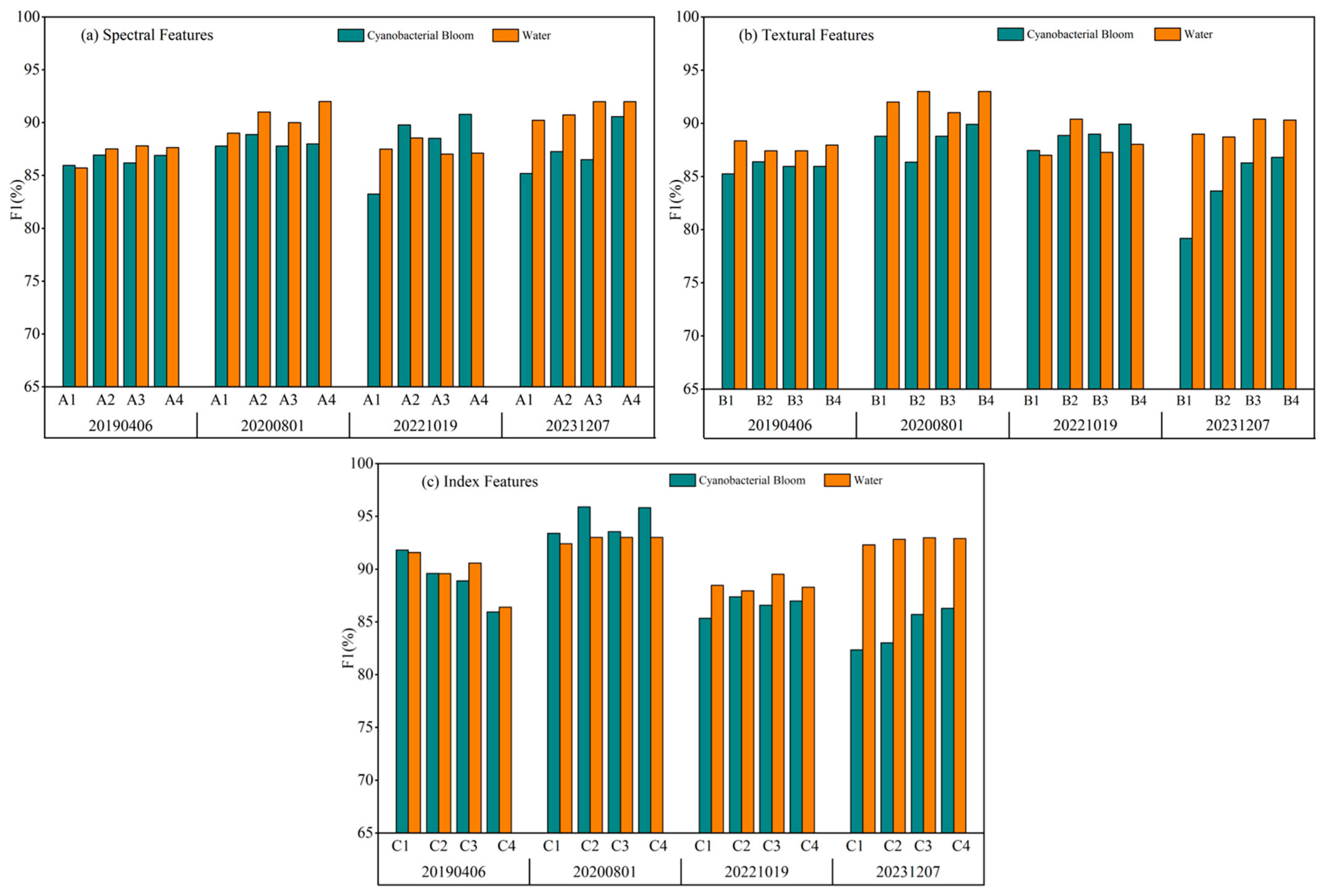
This study systematically analyzed how various features improved the accuracy of cyanobacterial bloom extraction by comparing the performance of red-edge spectral, texture, and index features in multi-temporal imagery. The statistical results of OA and Kappa coefficient are summarized in Table 8, while the F1 scores for different red-edge features are shown in Figure 10. It is evident that the inclusion of red-edge features significantly enhanced extraction accuracy across all periods, with different types of red-edge features exhibiting certain variations in performance.
Figure 9. Cyanobacterial bloom extraction results with different features on 7 December 2023. (al) results corresponding to all schemes from A1 to C4; (m) false-color composite image (RGB: Bands 4, 3, 2).
Remotesensing 18 00653 g009
Regarding red-edge spectral features, the introduction of red-edge bands improved both OA and Kappa coefficients across all periods, compared to the A1 scheme using only the four basic bands (R, G, B, NIR). Specifically, the red-edge 710 nm band showed a more pronounced enhancement, with an average increase in OA of 1.54% and Kappa coefficient of 0.02. The red-edge 750 nm band showed a slightly weaker improvement, with the OA increasing by an average of 0.84% and the Kappa coefficient increasing by an average of 0.01. The dual red-edge band combination yielded an average OA increase of 1.39% and an average Kappa coefficient increase of 0.02. The incorporation of red-edge spectral features also notably elevated the F1 scores for cyanobacterial blooms. The dual red-edge band combination demonstrated the most substantial improvement during the autumn phase, raising the F1 score by 7.5%. The effect of incorporating the red-edge 710 nm band alone was comparable to that of the dual red-edge band combination, with a 6.54% increase in F1 score. In contrast, the red-edge 750 nm band provided limited improvement, particularly in spring, where the F1 score increased by only 0.23%. Overall, the spectral performance of the red-edge 710 nm band surpassed that of the 750 nm band across multiple time periods.
Figure 10. F1 scores for cyanobacterial bloom extraction using feature schemes A1 to C4.
Remotesensing 18 00653 g010
In terms of red-edge texture features (Table 8 and Figure 10b), the texture features of the red-edge 710 nm band also contributed more significantly to accuracy improvement than those of the red-edge 750 nm band. Compared to the A1 scheme, incorporating the red-edge 710 nm texture feature increased OA by an average of 2.36% and the Kappa coefficient by 0.02, whereas the corresponding improvements for the red-edge 750 nm band were 0.76% and 0.01, respectively. The dual red-edge texture combination resulted in an average OA increase of 1.85% and the highest Kappa coefficient improvement of 0.03. When only the near-infrared band texture feature was introduced, both OA and Kappa coefficient improved in all periods except winter, where slight decreases were observed; the average increases were 0.81% in OA and 0.01 in Kappa coefficient. From the perspective of F1 scores, the inclusion of red-edge 710 nm and 750 nm texture features enhanced accuracy to varying degrees, and the dual red-edge texture combination yielded superior results. This indicates that combining red-edge bands with texture features can improve the distinction between cyanobacterial blooms and other features.
The introduction of red-edge index features also effectively improved extraction accuracy (Table 8 and Figure 10c). The optimal indices for different periods increased the average OA by 2.05%. Among them, the optimized red-edge indices (including MCARI1, NDRE, NDVIre1, and NDVIre2) showed more significant improvements, with OA increasing by an average of 0.36–6.06% and the Kappa coefficient increasing by up to 0.06. In comparison, the optimized non-red-edge indices (including NDVI, RVI, and DVI) increased OA by an average of 0.73–3.39% and the Kappa coefficient by 0.03. This demonstrates the superior performance of red-edge indices in cyanobacterial bloom extraction. In terms of F1 scores, the MCARI1 index performed the best, consistent with the feature importance evaluation results from the Random Forest algorithm: it consistently achieved high importance scores across all dates.
A comprehensive evaluation of the extraction results from all features reveals that the mean OA values for all schemes across different periods ranged from 92.5–94.8%, and the mean Kappa coefficients ranged from 0.85–0.94. Red-edge spectral, texture, and index features significantly enhanced extraction accuracy. Among these, index features contributed the most to accuracy improvement, with red-edge indices outperforming non-red-edge indices. Across all experimental schemes, the spectral, texture, and index features of the red-edge 710 nm band provided greater improvements in extraction accuracy than those of the red-edge 750 nm band. Nevertheless, the red-edge 750 nm band still offered valuable auxiliary information, and the combined application of the two bands demonstrated stable and significant enhancement effects.
In summary, the three types of red-edge feature schemes designed in this study exhibit certain differences and emphases in terms of accuracy and efficiency. The red-edge index-based scheme (Category C) holds a clear advantage in extraction accuracy, achieving the highest average OA and Kappa coefficient with the most pronounced improvement, making it the preferred choice when optimal identification performance is desired. The red-edge spectral scheme (Category A) excels in computational efficiency and interpretability; directly incorporating the original bands (especially the 710 nm band) is straightforward and efficient, providing effective accuracy gains and offering a practical improvement path for operational workflows that require rapid processing. The red-edge textural scheme (Category B) can capture the spatial heterogeneity of blooms, but its feature extraction process involves higher computational complexity, and its performance is susceptible to environmental conditions and bloom distribution patterns, rendering it more suitable as an auxiliary tool for fine-scale analysis of bloom spatial patterns.

4. Discussion

4.1. Enhancement Mechanisms of Red-Edge Bands in Cyanobacterial Bloom Identification

Red-edge bands have been widely used in terrestrial vegetation monitoring due to their sensitivity to chlorophyll content and vegetation health status. However, the enhancement mechanism in cyanobacterial bloom identification remains inadequately studied. Based on the dual red-edge bands of GF-6/WFV, this study systematically reveals how red-edge features extract effective information for cyanobacterial bloom identification from spectral, textural, and index-based dimensions, and explains how these features achieve high-precision identification through synergy with a machine learning algorithm.
In the spectral dimension, the chlorophyll-a and phycocyanin abundant in cyanobacteria form unique absorption and reflection characteristics in the red-edge region. This study found that the ABS index of the red-edge 750 nm band was significantly higher than that of other bands in autumn and winter, reaching 2596.5 in winter. This indicates that this band retains high information content even under low-biomass conditions. The JBh distance results demonstrated that incorporating red-edge bands—particularly the 710 nm band—yielded significantly better separability between cyanobacterial blooms and background water compared to traditional visible and near-infrared band combinations. This aligns with the findings of Legleiter [52] in river algae studies, confirming that red-edge bands have a superior ability to capture algal pigments compared to traditional bands. Islam [53] also pointed out that compared to blue, green, red, and near-infrared bands, the red-edge band (715 nm) is more accurate in capturing the spectral signal of phycocyanin due to its alignment with the strong optical activity range of cyanobacterial phycocyanin (620–720 nm), thereby effectively improving the estimation accuracy of phycocyanin concentration. Moreover, red-edge bands exhibit lower sensitivity to suspended particles and non-algal suspended solids, which reduces the risk of misclassification and thus maintains high identification accuracy even in complex water color backgrounds [54].
The textural dimension compensates for the vulnerability of pure spectral information to noise interference in complex aquatic environments. Cyanobacterial blooms often exhibit patchy or streaky aggregation patterns, the spatial heterogeneity of which can be quantified using the GLCM. After dimensionality reduction via PCA, PC1 of red-edge bands exhibited a variance contribution rate exceeding 60%, surpassing that of the near-infrared band on certain dates. Red-edge textures demonstrated advantages in characterizing the aggregation pattern, edge gradient, and spatial heterogeneity of cyanobacterial blooms. For example, the red-edge 710 nm texture improved the F1 score by 6.54% in spring. The underlying mechanism lies in the stronger capability of red-edge bands to capture high-frequency information related to the spatial distribution of cyanobacterial accumulations. This is consistent with the findings of Kang [15] in crop classification using GF-6 data, in which red-edge textures effectively represented spatial details of surface features. The study by Shi [55] on wind speed-texture coupling mechanisms also confirmed that under low wind speeds and calm water surfaces, red-edge textures are particularly sensitive in capturing spatial details of surface-floating algae, further underscoring the unique value of the textural dimension in low-energy water.
Vegetation indices enhance target features by combining reflectances of different bands, and the formulation of red-edge indices significantly optimizes the identification of cyanobacteria. This study constructed a series of red-edge indices based on the GF-6 red-edge bands. Feature importance evaluation indicated that MCARI1 and NDRE were the most significant contributors in most observation periods. By replacing traditional red-NIR-based vegetation indices (e.g., NDVI), red-edge indices effectively mitigate saturation effects under high chlorophyll concentrations and reduce interference from atmospheric aerosols [56]. Taking NDRE as an example, this index utilizes the ratio between red-edge bands to enhance the detection of spectral variations in cyanobacterial blooms with medium and low biomass. The theoretical basis lies in the significant linear relationship between the first derivative of reflectance in the red-edge region and chlorophyll-a concentration. Furthermore, red-edge indices considerably expand the dynamic range and discriminability in high-value regions. This is consistent with the findings of Li [57] in vegetation Leaf Area Index, in which red-edge indices maintained good sensitivity even under high-concentration conditions, avoiding the saturation phenomenon common in traditional indices like NDVI.
In summary, the red-edge bands provide a highly discriminative information source for cyanobacterial bloom identification through three dimensions: spectral sensitivity, textural characterization, and index construction. However, translating this informational advantage into stable, high-precision identification capability hinges on achieving synergistic enhancement between red-edge features and machine learning algorithms. This study accomplished this goal by integrating multi-dimensional red-edge features with a Random Forest classifier: the multi-dimensional red-edge features supply the model with information that captures blooms from distinct physical mechanisms, while the Random Forest algorithm leverages its ability to handle high-dimensional data, evaluate feature contributions, and integrate non-linear decisions in order to adaptively excavate and optimize the discriminative relationships among the features. It is precisely this fusion of features and algorithm that enables the potential of the red-edge bands to be fully exploited and realized in aquatic scenarios, thereby enhancing the model’s overall identification accuracy and robustness. Hence, the effectiveness of the proposed method results from the synergistic interaction between purposely designed red-edge features and a machine learning algorithm capable of thoroughly learning their discriminative patterns.

4.2. Limitations and Future Prospects

Although this study confirms the value of GF-6 red-edge bands in monitoring cyanobacterial blooms in Lake Taihu, it has several limitations. First, there are issues with data timeliness and coverage. The GF-6/WFV sensor provides relatively few usable images per month, and the lack of measured data in winter from the Jiangsu Environmental Monitoring Center meant that the accuracy of winter cyanobacterial extraction could only be validated through the rationality of spatial distribution, without quantitative relative error analysis. Yang [58] pointed out in their study on GF-6 radiometric calibration that the insufficient temporal resolution of medium and high-resolution satellite data limits dynamic monitoring capabilities, especially for capturing the short-term expansion and dissipation processes in the scenario of sudden cyanobacterial blooms. Second, mixed pixels remain a challenge. Influenced by topography and hydrodynamic conditions, the nearshore areas of Lake Taihu are prone to mixed pixels containing cyanobacteria, aquatic vegetation, and suspended sediment. Although this study excluded the eastern lake region with significant aquatic vegetation interference based on prior knowledge, reducing some confounding factors, mixed pixel decomposition techniques were not applied to address complex pixels in the nearshore area. Zhong [59] pointed out in their research that mixed pixels can distort the spectral features of ground objects, failing to accurately represent the spectral response of a single endmember. Given the complex components in the coastal area of shallow lakes, interference with cyanobacterial spectral signals may affect the accuracy of the final extraction results. Third, there exists the potential impact of spectral confusion and interference. This study has confirmed the effectiveness of red-edge features in natural scenarios of Lake Taihu. However, it failed to quantitatively distinguish the signal changes caused by increased cyanobacterial biomass from the similar spectral variations induced by factors such as high concentrations of suspended sediments or complex, variable atmospheric and water-surface conditions. Although results based on random samples demonstrate the overall robustness of the method, its reliability in challenging scenarios dominated by suspended sediments or characterized by abnormal weather conditions still requires further verification through controlled experiments. Fourth, the generalizability of the findings needs verification. This study focused only on Lake Taihu, but the hydrodynamic conditions and nutrient concentrations of different lakes may affect the applicability of red-edge bands. For example, the dominant species of cyanobacteria in lakes such as Chaohu and Dianchi may differ, potentially leading to variations in spectral features. Whether the response patterns of red-edge bands remain consistent requires further study [60].
To address these limitations, future research can advance in four directions. First, strengthen multi-source data fusion and temporal analysis. Combining Sentinel-2/MSI and GF-6 data through spatiotemporal fusion techniques can improve temporal coverage. Meanwhile, introducing temporal red-edge features could enable dynamic monitoring of cyanobacterial blooms. Yang [58] demonstrated through cross-calibration of GF-6 and Landsat-8/OLI data that multi-source data synergy enhances data utilization. This approach can be applied to cyanobacterial early warning—using temporal changes in red-edge indices to identify bloom trends 3–5 days in advance. Second, optimize mixed pixel decomposition and deep learning methods. Introduce fully constrained least squares methods to separate endmembers of cyanobacteria, water, and suspended sediment, or employ U-Net models to integrate red-edge spectral, texture, and index features, improving accuracy in nearshore mixed-pixel areas. She [61] improved the soybean extraction Kappa coefficient to 0.76 by combining SVM with GF-6 feature selection. Similar methods could be transferred to cyanobacterial extraction, thus further reducing mixed-pixel interference. Third, conduct in situ synchronous observations to acquire datasets of aquatic spectral and water quality parameters across a range of turbidity and weather conditions. This will enable the assessment of the stability of red-edge features in response to cyanobacteria under diverse environmental contexts. Furthermore, mechanistic inversion methods based on bio-optical models could be developed to quantitatively separate the contributions of cyanobacteria from other components. This would allow for a more precise definition of the presented method’s applicable conditions and enhance its reliability in complex scenarios. Finally, expand the study area and validate mechanisms. Select typical lakes such as Chaohu and Dianchi to verify the general applicability of GF-6 red-edge bands. Meanwhile, conduct controlled laboratory experiments to quantify the relationship between different cyanobacterial biomass and red-edge reflectance, providing more direct experimental support for the physical mechanisms of red-edge features.

5. Conclusions

This study constructed and validated a multi-dimensional feature analysis framework based on the dual red-edge bands of GF-6/WFV, thereby extending the advantages of red-edge from terrestrial systems to cyanobacterial bloom extraction in Lake Taihu. Through the synergistic utilization of spectral, texture, and index features, the contributions of different red-edge features to bloom extraction were clarified, confirming that the introduction of red-edge features can notably improve extraction accuracy. The results provide theoretical support and a methodological reference for the operational application of GF-6 in aquatic environmental monitoring.
From the perspective of spectral features, the red-edge bands significantly enhanced the separability between cyanobacteria and water and provided abundant spectral information. ABS method analysis showed that the near-infrared and red-edge bands of GF-6/WFV data maintained high information content across all dates. The ABS index of the red-edge 750 nm band was significantly higher than that of others during certain observation periods, enabling effective capture of spectral signals even under low cyanobacterial biomass conditions. JBh distance analysis further confirmed that introducing red-edge bands, particularly the 710 nm band, markedly improved the separability between cyanobacterial samples and background water compared to using only the basic four-band combination (R, G, B, NIR). The dual red-edge band combination performed slightly better than the single 710 nm band. Both effectively compensated for the issue of spectral feature overlap in traditional bands, thereby laying a spectral foundation for the accurate identification of cyanobacterial blooms.
In terms of texture features, red-edge texture features effectively characterized the spatial heterogeneity of cyanobacterial blooms. After extracting texture features of the red-edge bands using the GLCM and performing dimensionality reduction via PCA, it was found that the average variance contribution rates of PC1 for the red-edge 750 nm and 710 nm bands were 68% and 64%, respectively. This confirmed that the principal components sufficiently retained the core information of the original textures, effectively capturing the spatial heterogeneity of cyanobacterial blooms manifested as patchy and streaky aggregations. This provided reliable spatial feature support for the subsequent distinction between cyanobacterial blooms and background water.
Regarding index features, red-edge indices were among the core features for improving the accuracy of cyanobacterial bloom extraction. Random Forest-based feature importance evaluation of nine indices revealed that red-edge indices (MCARI1, NDRE, NDVIre1, NDVIre2) exhibited significantly higher importance scores than those of non-red-edge indices (NDVI, RVI, EVI, etc.). The MCARI1 index ranked in the top two in terms of importance score across all observation dates. Applying the optimized red-edge indices to the extraction schemes increased the OA by an average of 0.36% to 6.06% and raised the Kappa coefficient by up to 0.06, effectively enhancing cyanobacterial bloom identification accuracy.
In the overall scheme comparison, those incorporating red-edge features generally outperformed traditional schemes. Among the 12 feature combination schemes designed in this study, all schemes containing red-edge features achieved an average OA ranging from 92.8% to 94.9% and an average Kappa coefficient between 0.86 and 0.94, higher than the scheme using only the basic four bands. A comparison by feature type showed that index features contributed the most to accuracy improvement. Furthermore, features derived from the red-edge 710 nm band provided greater improvement in extraction accuracy across the spectral, texture, and index dimensions than those of the 750 nm band. The combined application of both bands achieved complementary advantages, further enhancing the model robustness.


Author Contributions

Conceptualization, Y.S., Q.M. and R.Z.; methodology, Y.S., R.Z. and C.Z.; software, R.Z. and C.Z.; validation, R.Z. and J.W. (Jialong Wang); data curation, J.W. (Jialong Wang) and Y.W.; writing—original draft preparation, R.Z.; writing—review and editing, Y.S., Z.S., J.W. (Jun Wu), D.G. and S.G.; visualization, J.W. (Jialong Wang) and Y.W. All authors have read and agreed to the published version of the manuscript.

Funding

This work was supported in part by Tianjin Science and Technology Program Project under Grant 25KPXCRC00030, by the National Natural Science Foundation of China under Grant 42171357, and by the FY-3 Lot 03 Meteorological Satellite Engineering Ground Application System Ecological Monitoring and Assessment Application Project (Phase I) under Grant ZQC-R22227.

Data Availability Statement

The data presented in this study are available on request from the corresponding author. The data are not publicly available due to privacy restrictions.

Acknowledgments

The authors would like to thank the editors and the reviewers for their valuable suggestions.

Conflicts of Interest

Author Jun Wu was employed by China Electronics Data Industry Group Co., Ltd. The remaining authors declare that the research was conducted in the absence of any commercial or financial relationships that could be construed as a potential conflict of interest.

References

  1. Igwaran, A.; Kayode, A.J.; Moloantoa, K.M.; Khetsha, Z.P.; Unuofin, J.O. Cyanobacteria harmful algae blooms: Causes, impacts, and risk management. Water Air Soil Pollut. 2024, 235, 71. [Google Scholar] [CrossRef]
  2. Song, T.; Zhang, H.; Xu, Y.; Dai, X.; Fan, F.; Wang, Y.; Liu, G. Cyanobacterial blooms in Lake Taihu: Temporal trends and potential drivers. Sci. Total Environ. 2024, 942, 173684. [Google Scholar] [CrossRef] [PubMed]
  3. Qin, B.; Zhang, Y.; Deng, J.; Zhu, G.; Liu, J.; Hamilton, D.P.; Paerl, H.W.; Brookes, J.D.; Wu, T.; Peng, K.; et al. Polluted lake restoration to promote sustainability in the Yangtze River Basin, China. Natl. Sci. Rev. 2022, 9, nwab207. [Google Scholar] [CrossRef] [PubMed]
  4. Caballero, C.B.; Martins, V.S.; Paulino, R.S.; Butler, E.; Sparks, E.; Lima, T.M.; Novo, E.M.L.M. The need for advancing algal bloom forecasting using remote sensing and modeling: Progress and future directions. Ecol. Indic. 2025, 172, 113244. [Google Scholar] [CrossRef]
  5. Bartelt, G.; You, J.; Hondzo, M. Remote cyanobacteria detection by multispectral drone imagery. Lake Reserv. Manag. 2024, 40, 236–247. [Google Scholar] [CrossRef]
  6. Huang, C.; Li, Y.; Yang, H.; Sun, D.; Yu, Z.; Zhang, Z.; Chen, X.; Xu, L. Detection of algal bloom and factors influencing its formation in Taihu Lake from 2000 to 2011 by MODIS. Environ. Earth Sci. 2014, 71, 3705–3714. [Google Scholar] [CrossRef]
  7. Jia, T.; Zhang, X.; Dong, R. Long-term spatial and temporal monitoring of cyanobacteria blooms using MODIS on Google Earth Engine: A case study in Taihu Lake. Remote Sens. 2019, 11, 2269. [Google Scholar] [CrossRef]
  8. Guo, J.; Huang, X.; Zhou, D.; Zhang, J.; Bao, G.; Tong, S.; Bao, Y.; Ganbat, D.; Altanchimeg, D.; Enkhnasan, D.; et al. Estimation of the water content of needles under stress by Erannis jacobsoni Djak. via Sentinel-2 satellite remote sensing. Front. Plant Sci. 2025, 16, 1540604. [Google Scholar] [CrossRef]
  9. Horler, D.N.H.; Dockray, M.; Barber, J. The red edge of plant leaf reflectance. Int. J. Remote Sens. 1983, 4, 273–288. [Google Scholar] [CrossRef]
  10. Chen, T.Y.; Chen, H.H.; Teo, T.A.; Shih, P.T.Y. Effectiveness of the red-edge band of RapidEye in land cover classification. J. Chin. Inst. Eng. 2023, 46, 21–30. [Google Scholar] [CrossRef]
  11. Vincent, A.; Kumar, A.; Upadhyay, P. Effect of red-edge region in fuzzy classification: A case study of sunflower crop. J. Indian Soc. Remote Sens. 2020, 48, 645–657. [Google Scholar] [CrossRef]
  12. Fernández-Manso, A.; Fernández-Manso, O.; Quintano, C. Sentinel-2A red-edge spectral indices suitability for discriminating burn severity. Int. J. Appl. Earth Obs. Geoinf. 2016, 50, 170–175. [Google Scholar] [CrossRef]
  13. Li, Z.; Xu, D.; Guo, X. Remote sensing of ecosystem health: Opportunities, challenges, and future perspectives. Sensors 2014, 14, 21117–21139. [Google Scholar] [CrossRef] [PubMed]
  14. Zhou, K.; Cheng, T.; Zhu, Y.; Cao, W.; Ustin, S.L.; Zheng, H.; Yao, X.; Tian, Y. Assessing the impact of spatial resolution on the estimation of leaf nitrogen concentration over the full season of paddy rice using near-surface imaging spectroscopy data. Front. Plant Sci. 2018, 9, 964. [Google Scholar] [CrossRef] [PubMed]
  15. Kang, Y.; Meng, Q.; Liu, M.; Zou, Y.; Wang, X. Crop classification based on red edge features analysis of GF-6 WFV data. Sensors 2021, 21, 4328. [Google Scholar] [CrossRef]
  16. Zhao, W.; Zhou, C.; Zhou, C.; Ma, H.; Wang, Z. Soil salinity inversion model of oasis in arid area based on UAV multispectral remote sensing. Remote Sens. 2022, 14, 1804. [Google Scholar] [CrossRef]
  17. Caballero, I.; Fernández, R.; Escalante, O.M.; Mamán, L.; Navarro, G. New capabilities of Sentinel-2A/B satellites combined with in situ data for monitoring small harmful algal blooms in complex coastal waters. Sci. Rep. 2020, 10, 8743. [Google Scholar] [CrossRef]
  18. Rodríguez-Benito, C.V.; Navarro, G.; Caballero, I. Using Copernicus Sentinel-2 and Sentinel-3 data to monitor harmful algal blooms in Southern Chile during the COVID-19 lockdown. Mar. Pollut. Bull. 2020, 161, 111722. [Google Scholar] [CrossRef]
  19. Coffer, M.M.; Whitman, P.J.; Schaeffer, B.A.; Hill, V.; Zimmerman, R.C.; Salls, W.B.; Lebrasse, M.C.; Graybill, D.D. Vertical artifacts in high-resolution WorldView-2 and WorldView-3 satellite imagery of aquatic systems. Int. J. Remote Sens. 2022, 43, 1199–1225. [Google Scholar] [CrossRef]
  20. Choi, B.; Lee, J.; Park, B.; Sungjong, L. A study of cyanobacterial bloom monitoring using unmanned aerial vehicles, spectral indices, and image processing techniques. Heliyon 2023, 9, e16343. [Google Scholar] [CrossRef]
  21. Xu, W.X. Research on Detection Method of Multispectral Cyanobacterial Blooms in Rivers and Lakes Based on Deep Learning; Zhejiang University: Hangzhou, China, 2022. [Google Scholar]
  22. Xu, D.; Pu, Y.; Zhu, M.; Luan, Z.; Shi, K. Automatic detection of algal blooms using Sentinel-2 MSI and Landsat OLI images. IEEE J. Sel. Top. Appl. Earth Obs. Remote Sens. 2021, 14, 8497–8511. [Google Scholar] [CrossRef]
  23. Poobalasubramanian, M.; Park, E.S.; Faqeerzada, M.A.; Kim, T.; Kim, M.S.; Baek, I.; Cho, B.K. Identification of early heat and water stress in strawberry plants using Chlorophyll-Fluorescence indices extracted via hyperspectral images. Sensors 2022, 22, 8706. [Google Scholar] [CrossRef]
  24. Tan, K.; Sun, M.; Sun, D.; Liu, X.; Liu, X.; Wang, B.; Dou, W.; Zhang, H.; Lun, F. Mapping of nearshore bathymetry using Gaofen-6 images for the Yellow River Delta-Laizhou Bay, China. Ecol. Inform. 2024, 80, 102497. [Google Scholar] [CrossRef]
  25. Yan, X.; Xia, Y.; Ti, C.; Shan, J.; Wu, Y.; Yan, X. Thirty years of experience in water pollution control in Taihu Lake: A review. Sci. Total Environ. 2024, 914, 169821. [Google Scholar] [CrossRef] [PubMed]
  26. Xue, K.; Ma, R.; Zhu, G.; Hu, M.; Cao, Z.; Xiong, J.; Zhang, Y.; Xu, J.; Huang, Z.; Wu, Y. A comprehensive time-series dataset linked to cyanobacterial blooms in Lake Taihu. Sci. Data 2024, 11, 1365. [Google Scholar] [CrossRef]
  27. Liu, X.; Zhang, Y.; Shi, K.; Zhou, Y.; Tang, X.; Zhu, G.; Qin, B. Mapping aquatic vegetation in a large, shallow eutrophic lake: A frequency-based approach using multiple years of MODIS data. Remote Sens. 2015, 7, 10295–10320. [Google Scholar] [CrossRef]
  28. Luo, J.; Pu, R.; Duan, H.; Ma, R.; Mao, Z.; Zeng, Y.; Huang, L.; Xiao, Q. Evaluating the influences of harvesting activity and eutrophication on loss of aquatic vegetations in Taihu Lake, China. Int. J. Appl. Earth Obs. Geoinf. 2020, 87, 102038. [Google Scholar] [CrossRef]
  29. Chen, J.; Xu, H. Analysis of the effectiveness of the red-edge bands of GF-6 imagery in forest health discrimination. IEEE J. Sel. Top. Appl. Earth Obs. Remote Sens. 2024, 17, 5621–5636. [Google Scholar] [CrossRef]
  30. Lu, Z.; Wang, D.; Deng, Z.; Shi, Y.; Ding, Z.; Ning, H.; Zhao, H.; Zhao, J.; Xu, H.; Zhao, X. Application of red edge band in remote sensing extraction of surface water body: A case study based on GF-6 WFV data in arid area. Hydrol. Res. 2021, 52, 1526–1541. [Google Scholar] [CrossRef]
  31. Li, L.; Jiang, Y.; Shen, X.; Li, D. Long-term assessment and analysis of the radiometric quality of standard data products for Chinese Gaofen-1/2/6/7 optical remote sensing satellites. Remote Sens. Environ. 2024, 308, 114169. [Google Scholar] [CrossRef]
  32. Yu, W.; Zhao, P.; Xu, K.; Zhao, Y.; Shen, P.; Ma, J. Evaluation of red-edge features for identifying subtropical tree species based on Sentinel-2 and Gaofen-6 time series. Int. J. Remote Sens. 2022, 43, 3003–3027. [Google Scholar] [CrossRef]
  33. Zhang, X.; Cui, J.; Wang, W.; Lin, C. A study for texture feature extraction of high-resolution satellite images based on a direction measure and Gray Level Co-Occurrence Matrix fusion algorithm. Sensors 2017, 17, 1474. [Google Scholar] [CrossRef]
  34. Haralick, R.M.; Shanmugam, K.; Dinstein, I.H. Textural features for image classification. IEEE Trans. Syst. Man Cybern. 1973, 6, 610–621. [Google Scholar] [CrossRef]
  35. Song, Z.; Xu, W.; Dong, H.; Wang, X.; Cao, Y.; Huang, P.; Hou, D.; Wu, Z.; Wang, Z. Research on cyanobacterial-bloom detection based on multispectral imaging and deep-learning method. Sensors 2022, 22, 4571. [Google Scholar] [CrossRef] [PubMed]
  36. Mugani, R.; El Khalloufi, F.; Kasada, M.; Redouane, E.M.; Haida, M.; Aba, R.P.; Essadki, Y.; Zerrifi, S.E.A.; Herter, S.O.; Hejjaj, A.; et al. Monitoring of toxic cyanobacterial blooms in Lalla Takerkoust reservoir by satellite imagery and microcystin transfer to surrounding farms. Harmful Algae 2024, 135, 102631. [Google Scholar] [CrossRef] [PubMed]
  37. Su, T.; Xu, L.; Liu, X.; Cui, X.; Lei, B.; Di, J.; Xie, T. Study on the applicability of FAI linear fitting model in the extraction of cyanobacterial blooms. Environ. Monit. Assess. 2024, 196, 909. [Google Scholar] [CrossRef] [PubMed]
  38. Silva, T.M.d.A.; Valente, D.S.M.; Pinto, F.d.A.d.C.; de Queiroz, D.M.; Santos, N.T. Sensor system for acquisition of vegetation indexes. Rev. Bras. Eng. Agric. Ambient. 2021, 25, 264–269. [Google Scholar] [CrossRef]
  39. Yan, K.; Gao, S.; Chi, H.; Qi, J.; Song, W.; Tong, Y.; Mu, X.; Yan, G. Evaluation of the vegetation-index-based dimidiate pixel model for fractional vegetation cover estimation. IEEE Trans. Geosci. Remote Sens. 2021, 60, 4400514. [Google Scholar] [CrossRef]
  40. Coffer, M.M.; Schaeffer, B.A.; Salls, W.B.; Urquhart, E.; Loftin, K.A.; Stumpf, R.P.; Werdell, P.J.; Darling, J.A. Satellite remote sensing to assess cyanobacterial bloom frequency across the United States at multiple spatial scales. Ecol. Indic. 2021, 128, 107822. [Google Scholar] [CrossRef]
  41. Fernandez-Figueroa, E.G.; Wilson, A.E.; Rogers, S.R. Commercially available unoccupied aerial systems for monitoring harmful algal blooms: A comparative study. Limnol. Oceanogr. Methods 2022, 20, 131–191. [Google Scholar] [CrossRef]
  42. Choi, H.B.; Han, K.H.; Seo, J. Normalized difference red-edge estimation with modified DiscoGAN model. IEEE Access 2024, 12, 191661–191669. [Google Scholar] [CrossRef]
  43. Daughtry, C.S.T.; Walthall, C.L.; Kim, M.S.; de Colstoun, E.B.; McMurtrey, J.E., III. Estimating corn leaf chlorophyll concentration from leaf and canopy reflectance. Remote Sens. Environ. 2000, 74, 229–239. [Google Scholar] [CrossRef]
  44. Liu, C.; Zhao, C.; Zhang, L. A new method of hyperspectral remote sensing image dimensional reduction. J. Image Graph. 2005, 10, 218–222. [Google Scholar]
  45. Bruzzone, L.; Roli, F.; Serpico, S.B. An extension of the Jeffreys-Matusita distance to multiclass cases for feature selection. IEEE Trans. Geosci. Remote Sens. 1995, 33, 1318–1321. [Google Scholar] [CrossRef]
  46. Daffertshofer, A.; Lamoth, C.J.C.; Meijer, O.G.; Beek, P.J. PCA in studying coordination and variability: A tutorial. Clin. Biomech. 2004, 19, 415–428. [Google Scholar] [CrossRef]
  47. Blum, A.L.; Langley, P. Selection of relevant features and examples in machine learning. Artif. Intell. 1997, 97, 245–271. [Google Scholar] [CrossRef]
  48. Izquierdo-Verdiguier, E.; Zurita-Milla, R. An evaluation of Guided Regularized Random Forest for classification and regression tasks in remote sensing. Int. J. Appl. Earth Obs. Geoinf. 2020, 88, 102051. [Google Scholar] [CrossRef]
  49. Breiman, L. Random forests. Mach. Learn. 2001, 45, 5–32. [Google Scholar] [CrossRef]
  50. Sheykhmousa, M.; Mahdianpari, M.; Ghanbari, H.; Mohammadimanesh, F.; Ghamisi, P.; Homayouni, S. Support Vector Machine versus Random Forest for remote sensing image classification: A meta-analysis and systematic review. IEEE J. Sel. Top. Appl. Earth Obs. Remote Sens. 2020, 13, 6308–6325. [Google Scholar] [CrossRef]
  51. Duan, H.; Loiselle, S.A.; Zhu, L.; Feng, L.; Zhang, Y.; Ma, R. Distribution and incidence of algal blooms in Lake Taihu. Aquat. Sci. 2015, 77, 9–16. [Google Scholar] [CrossRef]
  52. Legleiter, C.J.; Hodges, S.W. Mapping benthic algae and cyanobacteria in river channels from aerial photographs and satellite images: A proof-of-concept investigation on the Buffalo National River, AR, USA. Remote Sens. 2022, 14, 953. [Google Scholar] [CrossRef]
  53. Islam, M.S.; Dash, P.; Liles, J.P.; Ahmad, H.; Nur, A.M.; Panda, R.M.; Wolfe, J.S.; Turnage, G.; Hathcock, L.; Chesser, G.D.; et al. Spatiotemporal dynamics of cyanobacterial blooms: Integrating machine learning and feature selection techniques with uncrewed aircraft systems and autonomous surface vessel data. J. Environ. Manag. 2025, 381, 124878. [Google Scholar] [CrossRef] [PubMed]
  54. Wang, S.; Tedesco, M.; Alexander, P.; Xu, M.; Fettweis, X. Quantifying spatiotemporal variability of glacier algal blooms and the impact on surface albedo in southwestern Greenland. Cryosphere 2020, 14, 2687–2713. [Google Scholar] [CrossRef]
  55. Shi, K.; Zhang, Y.; Zhou, Y.; Liu, X.; Zhu, G.; Qin, B.; Gao, G. Long-term MODIS observations of cyanobacterial dynamics in Lake Taihu: Responses to nutrient enrichment and meteorological factors. Sci. Rep. 2017, 7, 40326. [Google Scholar] [CrossRef] [PubMed]
  56. Gitelson, A.; Merzlyak, M.N. Spectral reflectance changes associated with autumn senescence of Aesculus hippocastanum L. and Acer platanoides L. leaves. Spectral features and relation to chlorophyll estimation. J. Plant Physiol. 1994, 143, 286–292. [Google Scholar] [CrossRef]
  57. Li, W.; Li, D.; Warner, T.A.; Liu, S.; Baret, F.; Yang, P.; Jiang, J.; Dong, M.; Cheng, T.; Zhu, Y.; et al. Improved generality of wheat green LAI models through mitigation of the effect of leaf chlorophyll content variation with red edge vegetation indices. Remote Sens. Environ. 2025, 318, 114589. [Google Scholar] [CrossRef]
  58. Yang, A.; Zhong, B.; Hu, L.; Wu, S.; Xu, Z.; Wu, H.; Wu, J.; Gong, X.; Wang, H.; Liu, Q. Radiometric cross-calibration of the wide field view camera onboard GaoFen-6 in multispectral bands. Remote Sens. 2020, 12, 1037. [Google Scholar] [CrossRef]
  59. Zhong, B.; Wu, S.; Yang, A.; Ao, K.; Wu, J.; Wu, J.; Gong, X.; Wang, H.; Liu, Q. An atmospheric correction method over bright and stable surfaces for moderate to high spatial-resolution optical remotely sensed imagery. Remote Sens. 2020, 12, 733. [Google Scholar] [CrossRef]
  60. Jing, Y.; Zhang, Y.; Hu, M.; Chu, Q.; Ma, R. MODIS-satellite-based analysis of long-term temporal-spatial dynamics and drivers of algal blooms in a plateau Lake Dianchi, China. Remote Sens. 2019, 11, 2582. [Google Scholar] [CrossRef]
  61. She, B.; Hu, J.; Huang, L.; Zhu, M.; Yin, Q. Mapping soybean planting areas in regions with complex planting structures using machine learning models and Chinese GF-6 WFV Data. Agriculture 2024, 14, 231. [Google Scholar] [CrossRef]
Figure 1. Geographical location and regions of Lake Taihu.
Remotesensing 18 00653 g001
Figure 3. JBh distances of different band combinations for GF-6/WFV data.
Remotesensing 18 00653 g003
Figure 4. Variance contribution rates of PC1 for different bands.
Remotesensing 18 00653 g004
Table 1. Main parameters of GF-6/WFV data.
Band No.Band NameCentral Wavelength (nm)Band Range (nm)Swath Width (km)Spatial Resolution (m)Swing Imaging Capability
B1Blue (B)485450–52080016Capable of ±25° maneuverable swing and ±35° emergency swing
B2Green (G)555520–590
B3Red (R)660630–690
B4Near-Infrared (NIR)830770–890
B5Red Edge 1 (RE1)710690–730
B6Red Edge 2 (RE2)750730–770
B7Purple (P)425400–450
B8Yellow(Y)610590–630
Table 2. Acquisition parameters of the representative GF-6/WFV scenes.
DateAcquisition Time (UTC+8)Processing LevelProduct IDScene IDCloud Cover (%)
2019-04-0611:01LEVEL1A11198648131994081
2020-08-0110:53LEVEL1A11200215113554871
2022-10-1911:20LEVEL1A11202596115875765
2023-12-0711:06LEVEL1A142038302210083750
Table 3. Statistical measures and characteristics of the Gray Level Co-occurrence Matrix.
GLCM Texture Statistical MeasuresStatistical Characteristics
    Mean: M e a n = 1 n × n i j f ( i , j ) Represents the average gray level within a window.
    Variance: V A R = i j ( f ( i , j ) μ n × n ) 2 Indicates gray level variation within a window. Greater variation results in a higher value.
    Entropy:   E N T = i j f ( i , j ) log [ f ( i , j ) ] Describes the randomness of the image. More heterogeneous textures correspond to higher entropy values.
Angular Second Moment (ASM): A S M = i j ( f ( i , j ) ) 2 Also known as Energy, it describes local uniformity. Areas with similar pixel values exhibit higher homogeneity and larger ASM values. ASM and Entropy are inversely correlated.
    Homogeneity: H O M = i j f ( i , j ) 1 + ( i j ) 2 Measures the local similarity of gray levels. A higher value indicates a smoother texture.
    Contrast: C O N = i j | i j | f ( i , j ) Measures the difference between the highest and lowest gray levels in a neighborhood. Greater local variation results in a higher value.
  Dissimilarity: D I S = i j | i j | f ( i , j ) Used to measure similarity. Similar to Contrast, higher local contrast results in a larger value.
    Correlation: C O R = i j ( i μ i ) ( i μ i ) f ( i , j ) σ i σ j Measures the linear dependency of gray levels in the neighborhood. An extreme case of linear correlation represents a completely homogeneous texture.
Table 4. Nine vegetation indices and their formulas.
No.CategoryAbbreviationFull NameCalculation Formula
1Red-edge IndicesNDRENormalized Difference Red-edge Index N D R E = ρ R E 2 ρ R E 1 ρ R E 2 + ρ R E 1
2NDVIre1Red-edge Normalized Difference Vegetation Index 1 N D V I r e 1 = ρ N I R ρ R E 1 ρ N I R + ρ R E 1
3NDVIre2Red-edge Normalized Difference Vegetation Index 2 N D V I r e 2 = ρ N I R ρ R E 2 ρ N I R + ρ R E 2
4MCARI1Modified Chlorophyll Absorption Reflectance Index 1 M C A R I 1 = [ ( ρ R E 1 ρ R ) 0.2 ( ρ R E 1 ρ G ) ] ( ρ R E 1 ρ G )
5MCARI2Modified Chlorophyll Absorption Reflectance Index 2 M C A R I 2 = [ ( ρ R E 2 ρ R ) 0.2 ( ρ R E 2 ρ G ) ] ( ρ R E 2 ρ G )
6Non-red-edge IndicesNDVINormalized Difference Vegetation Index N D V I = ρ N I R ρ R E D ρ N I R + ρ R E D
7RVIRatio Vegetation Index R V I = ρ N I R ρ R E D
8EVIEnhanced Vegetation Index E V I = 2.5 ( ρ N I R ρ R E D ρ N I R + 6 ρ R E D 7.5 ρ B L U E + 1 )
9DVIDifference Vegetation Index D V I = ρ N I R ρ R E D
Note: ρ represents the surface reflectance of a specific band of GF-6/WFV.
Table 5. Different feature schemes for cyanobacterial bloom extraction.
Feature CategoryExtraction SchemeScheme Name
Red-edge spectral featuresBasic four bands (R, G, B, NIR)A1
A1 + Red-edge 710 nmA2
A1 + Red-edge 750 nmA3
A1 + Red-edge 710 nm + Red-edge 750 nmA4
Red-edge textural featuresA1 + NIR textural featuresB1
A1 + Red-edge 710 nm textural featuresB2
A1 + Red-edge 750 nm textural featuresB3
A1 + Red-edge 710 nm textural features + Red-edge 750 nm textural featuresB4
Red-edge index featuresA1 + Optimal index 1C1
A1 + Optimal index 2C2
A1 + Optimal index 3C3
A1 + Optimal index 4C4
Note: the specific indices corresponding to optimal index 1–4 for each period are determined based on the importance ranking results of spectral indices presented in Section 3.1.3.
Table 6. ABS index for different bands of GF-6/WFV.
Band
Order
Band Name6 April 20191 August 202019 October 20227 December 2023
ABSRankABSRankABSRankABSRank
1Purple (P)
2Blue (B)556.21311.45690.16135.76
3Green (G)281.96440.71758.34541.82
4Red (R)302.55340.34707.15405.64
5Near-Infrared (NIR)457.62351.33830.62353.75
6Red Edge 1 (RE1)331.44269.46766.83475.73
7Red Edge 2 (RE2)369.23365.72834.512596.51
8Yellow (Y)
Table 7. Relative errors of extraction results across different time periods.
Extraction Scheme6 April 20191 August 202019 October 2022
Extracted Area (km2)Reported Area (km2)Relative Error (%)Extracted Area (km2)Reported Area (km2)Relative Error (%)Extracted Area (km2)Reported Area (km2)Relative Error (%)
A115.681411.9861.81578.44427.2938710.41
A214.332.3860.145.50411.176.25
A315.248.8660.836.73403.484.26
A415.369.6957.550.97405.544.79
B115.5010.6959.955.18429.7611.05
B214.664.7359.243.93413.746.91
B316.1315.2459.935.14415.297.31
B415.9814.1260.285.75409.355.77
C114.815.8057.550.97418.528.14
C214.876.2459.554.47413.196.77
C316.4717.6761.998.75417.958.00
C416.5818.4458.222.15418.678.18
Note: The Jiangsu Environmental Monitoring Center publishes monitoring data from March to October; no winter monitoring data is available.
Table 8. Overall accuracy and Kappa coefficient of extraction results for different schemes.
Category6 April 20191 August 202019 October 20227 December 2023
OAKappaOAKappaOAKappaOAKappa
A190.45%0.824793.73%0.918892.67%0.875891.78%0.8590
A292.88%0.849294.26%0.929493.69%0.889393.97%0.8787
A392.58%0.841793.83%0.918993.08%0.879192.51%0.8645
A492.88%0.850194.73%0.928893.32%0.887693.24%0.8739
B193.48%0.858694.73%0.928893.35%0.887390.32%0.8489
B294.09%0.867795.45%0.937795.74%0.904492.78%0.8684
B391.27%0.836194.77%0.929993.32%0.888692.32%0.8633
B492.88%0.847095.36%0.989494.01%0.899493.78%0.8761
C196.52%0.887594.09%0.928393.30%0.884792.15%0.8600
C294.91%0.869496.36%0.949494.35%0.895592.51%0.8621
C395.70%0.877494.45%0.927596.05%0.914192.51%0.8669
C491.06%0.834195.73%0.938795.03%0.906392.51%0.8695
Disclaimer/Publisher’s Note: The statements, opinions and data contained in all publications are solely those of the individual author(s) and contributor(s) and not of MDPI and/or the editor(s). MDPI and/or the editor(s) disclaim responsibility for any injury to people or property resulting from any ideas, methods, instructions or products referred to in the content.