A Topographic Shadow Effect Correction (TSEC) Method for Correcting Surface Reflectance of Optical Remote Sensing Images in Rugged Terrain

Highlights
- Proposed the TSEC model integrating shadow intensity, band adjustment, and vegetation index factors to effectively restore spectral information in rugged terrain.
- TSEC outperforms traditional methods (MIN, SCS + C) in shadow restoration by effectively avoiding over-correction in self-shadows and under-correction in cast shadows.
- The method ensures high spectral fidelity and stability for key vegetation indices (NDVI and EVI) across varying illumination conditions.
- TSEC offers a robust and effective solution for quantitative remote sensing in complex mountainous areas, requiring only original images and DEM data.
Abstract
1. Introduction
- A physical-based correction model is developed to restore surface reflectance in shadow areas by compensating for missing direct solar radiation, effectively addressing the limitations of traditional topographic correction methods in rugged terrain.
- The Shadow Intensity Factor (SIF), Band Adjustment Factor (BAF), and Vegetation Index Factor (VIF) are introduced and integrated into the model. This mechanism enables adaptive shadow detection and spectrally consistent correction across different bands and illumination conditions.
- The proposed model is rigorously evaluated using multi-temporal Landsat 8 OLI imagery from two distinct mountainous regions. The results demonstrate its superiority in correcting surface reflectance and maintaining the stability of key vegetation indices (NDVI and EVI).
2. Research Area and Data
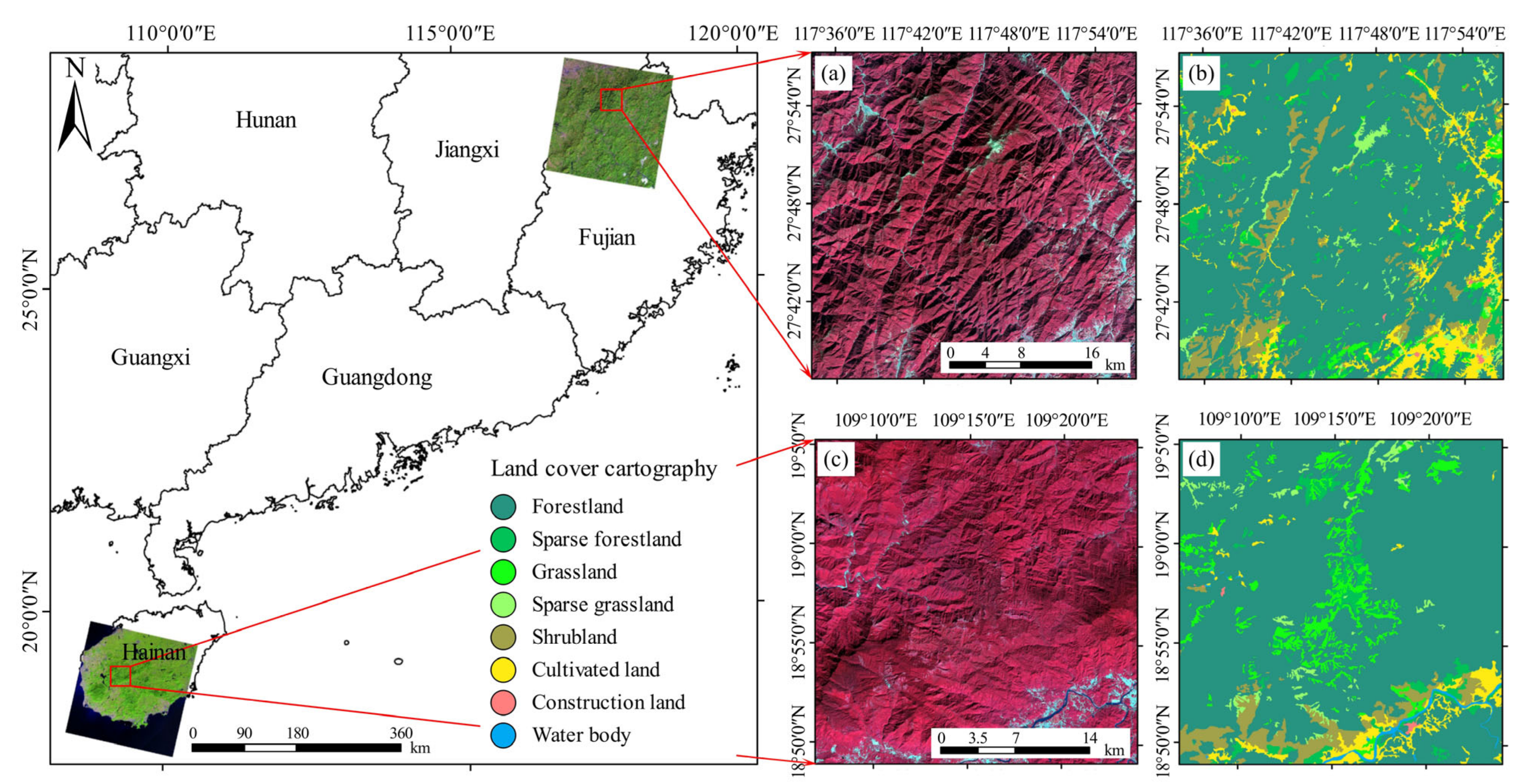
2.1. Study Areas
2.2. Data
3. Methods
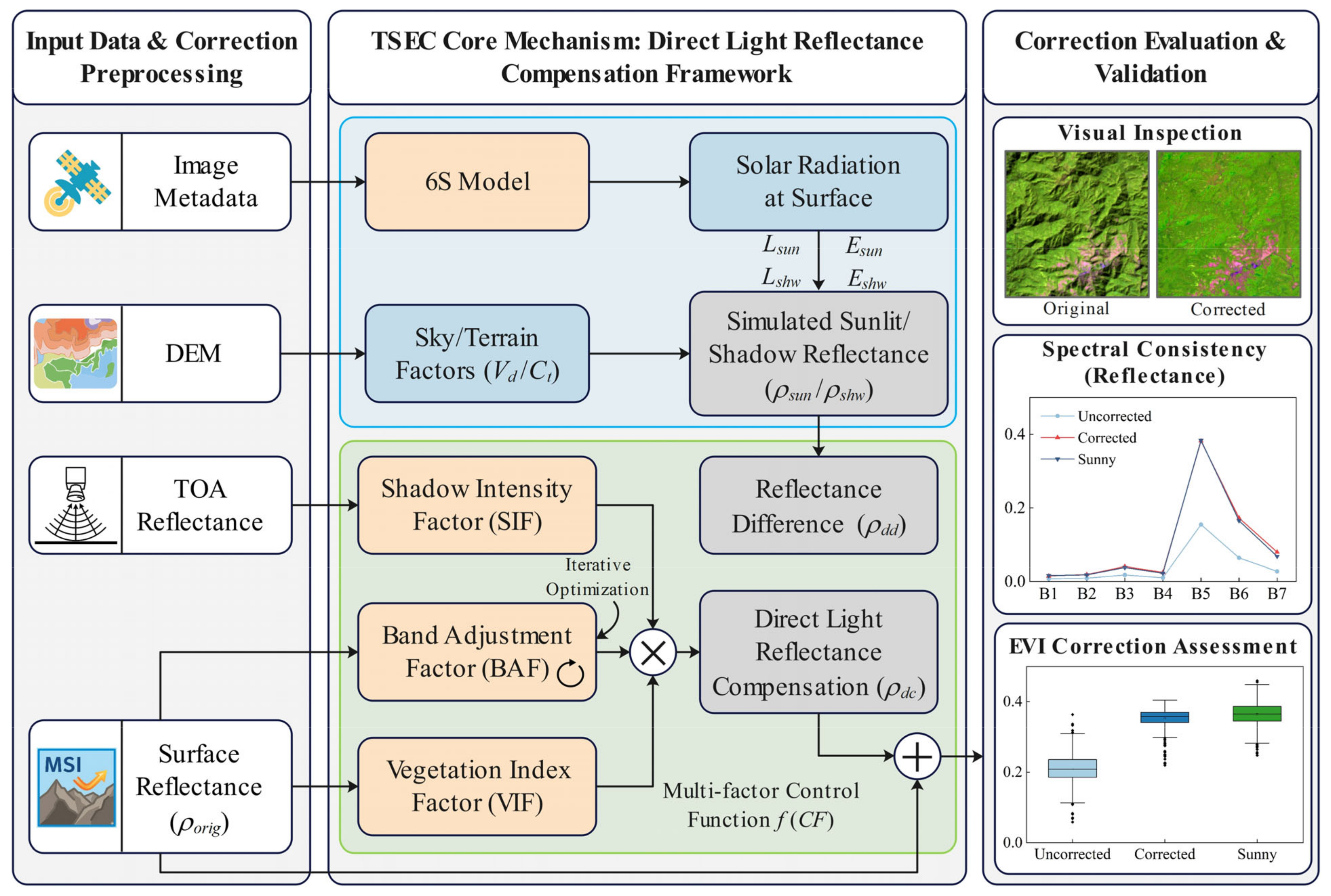
3.1. Conceptual Framework of TSEC Model
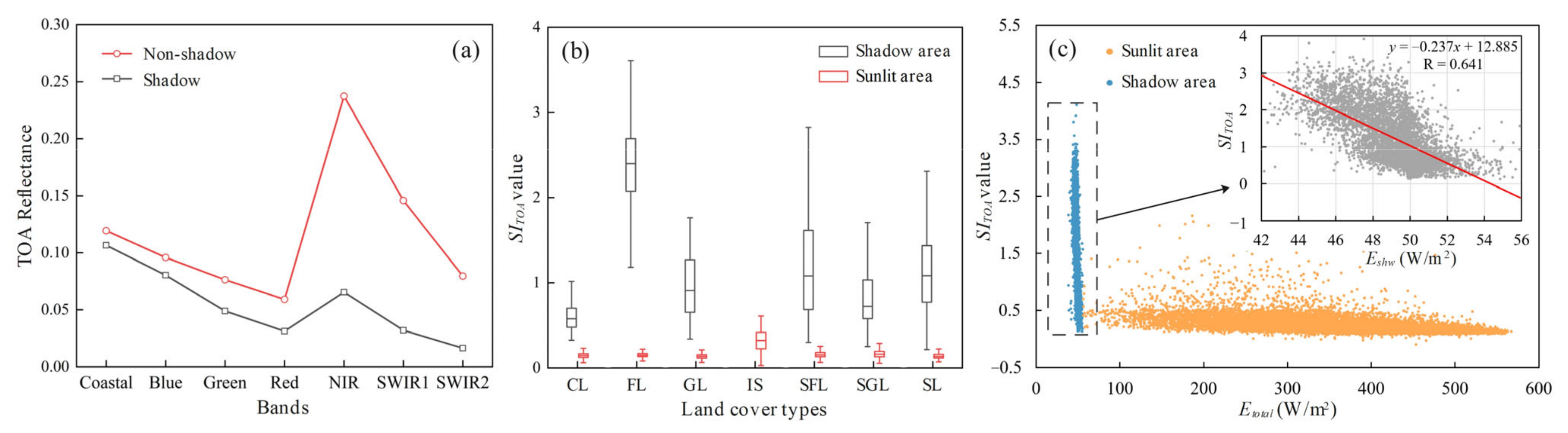
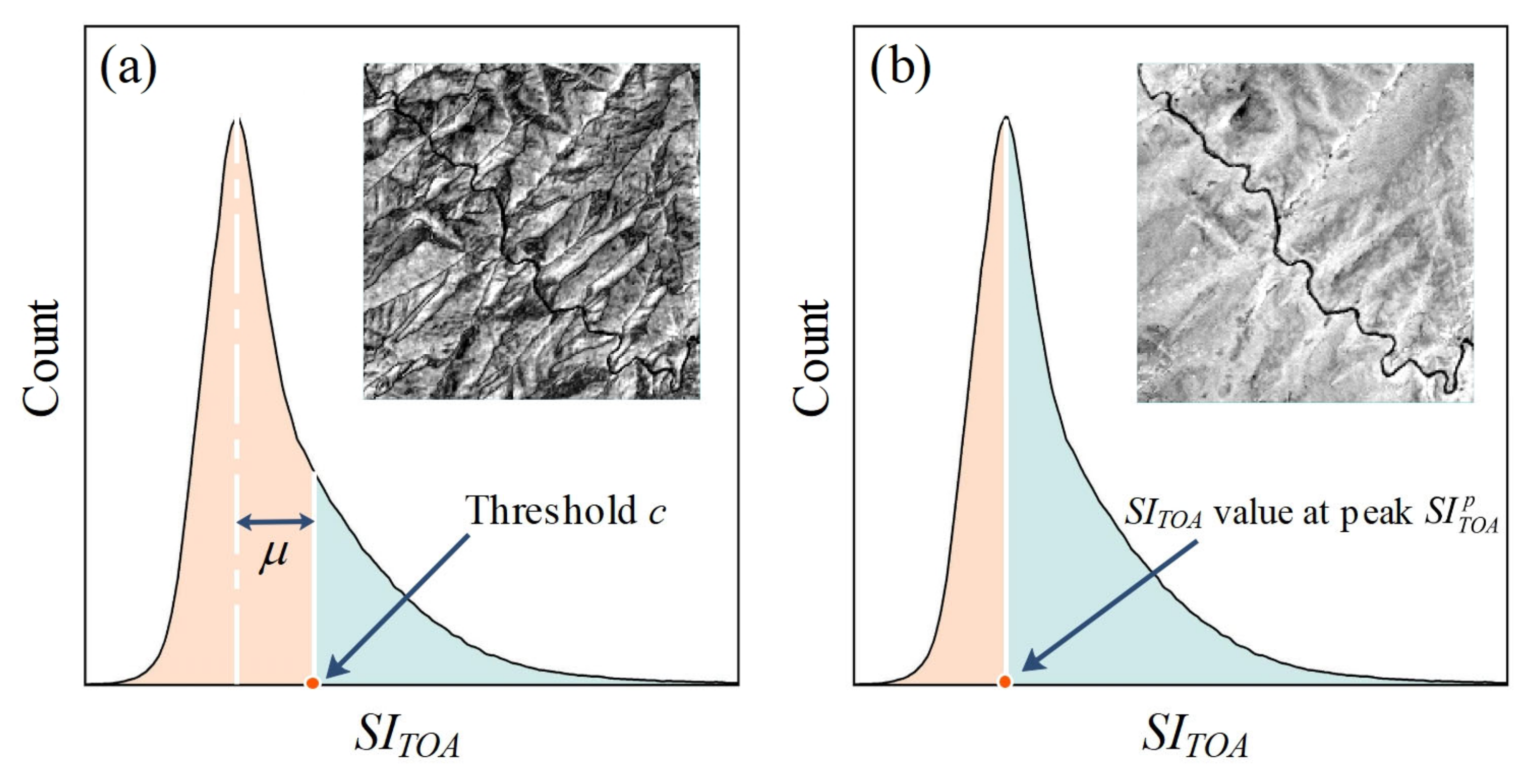
3.2. Shadow Detection and Quantification: SIF
3.3. Core Factor for Spectral Fidelity Correction: BAF
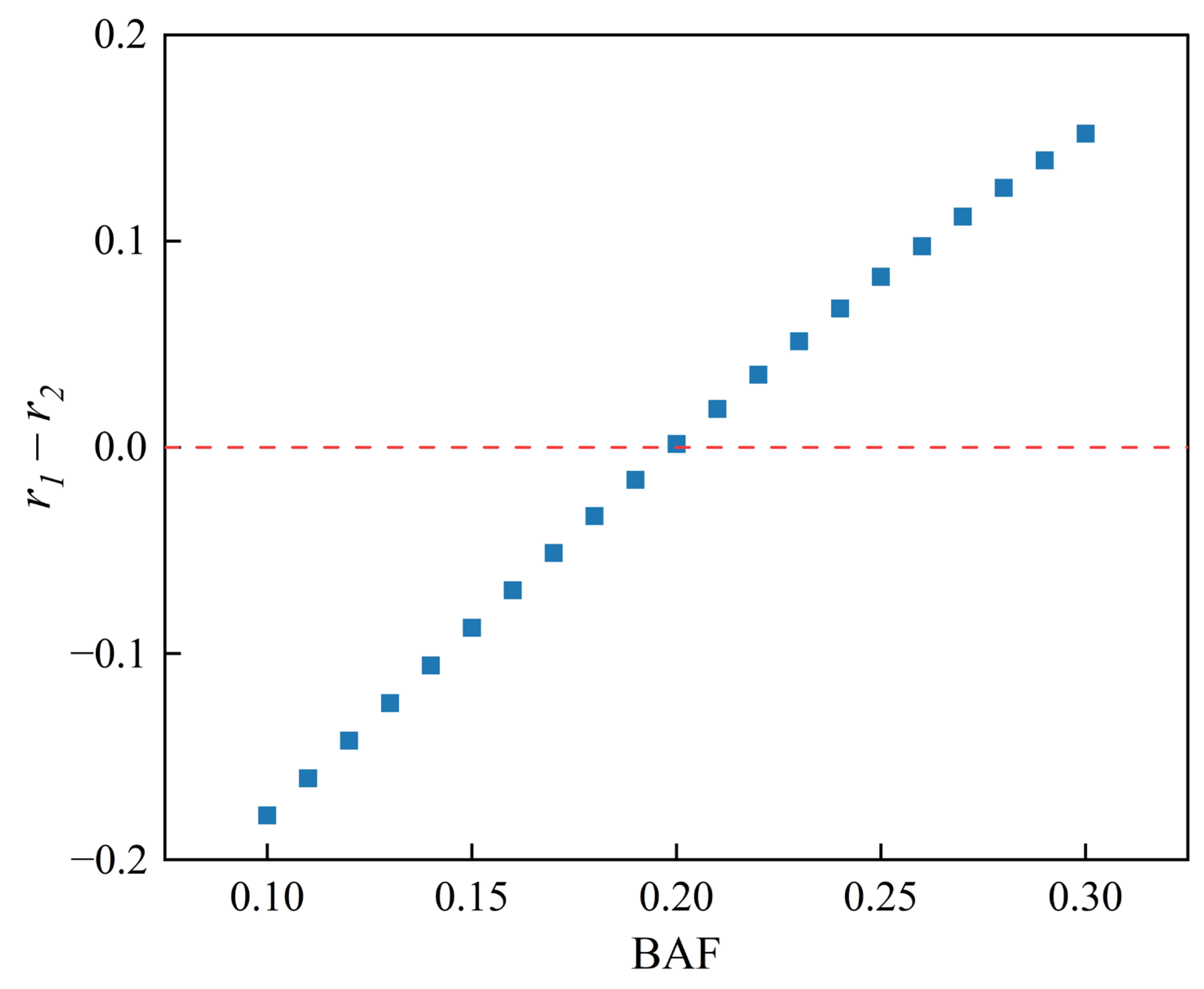
- Parameter initialization: The BAF is initialized as an iterative variable with an incremental step of 0.01;
- Baseline establishment: The correlation coefficient (r1) between the reflectance and cos i is calculated for samples on sunlit slopes;
- Iterative correction: For each BAF increment, the TSEC is applied. The correlation coefficient (r2) between the corrected reflectance and cos i is calculated for shadow samples of the same land cover within the specific interval (, + 2σ), where σ represents the standard deviation of SITOA;
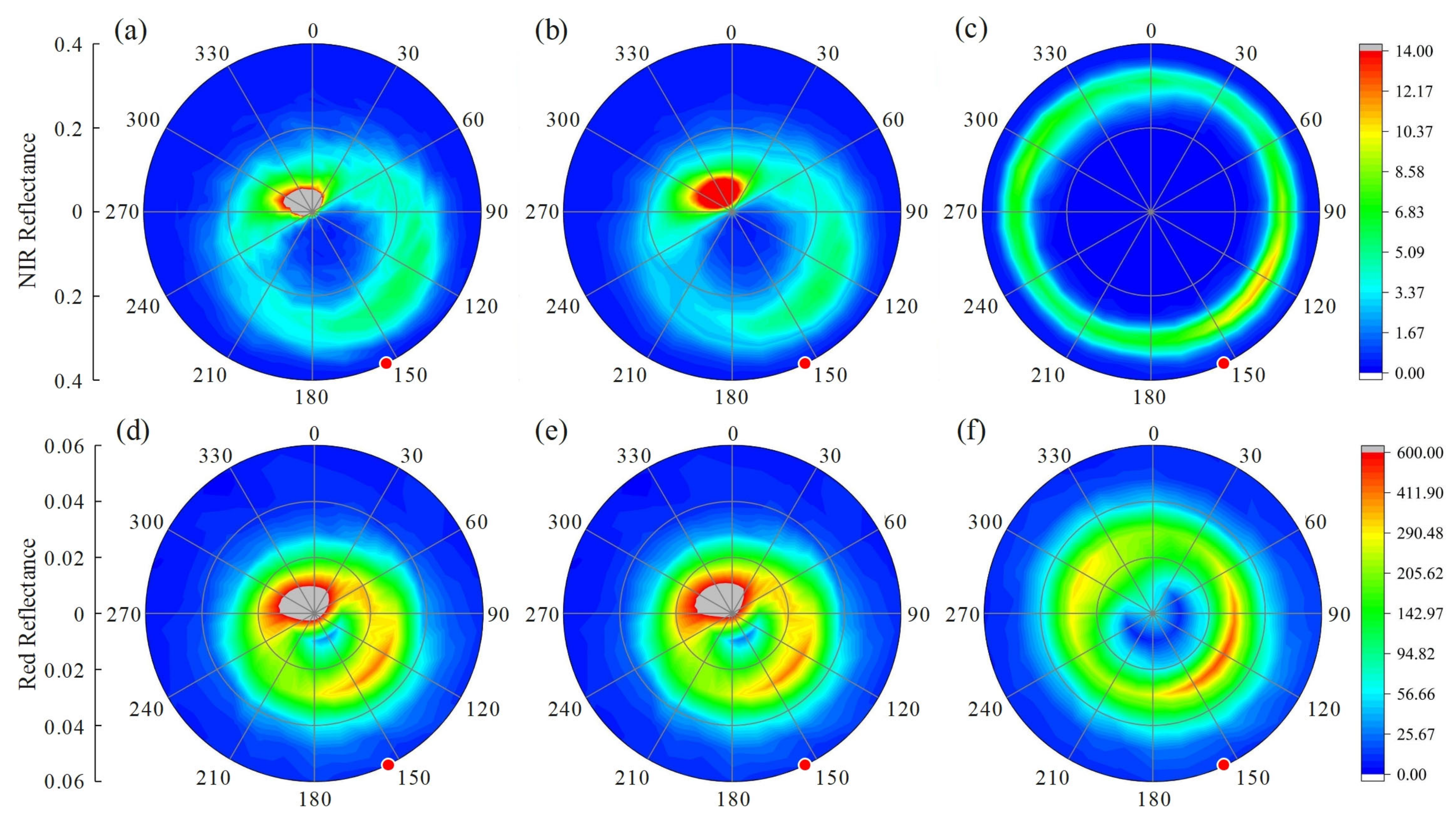
- Optimization: The optimal BAF is identified as the value that minimizes the absolute divergence between the baseline and corrected response (see Figure 5):
3.4. Ensuring Robustness Under Low Signal-to-Noise Conditions: VIF
3.5. Evaluation Strategies
- (1)
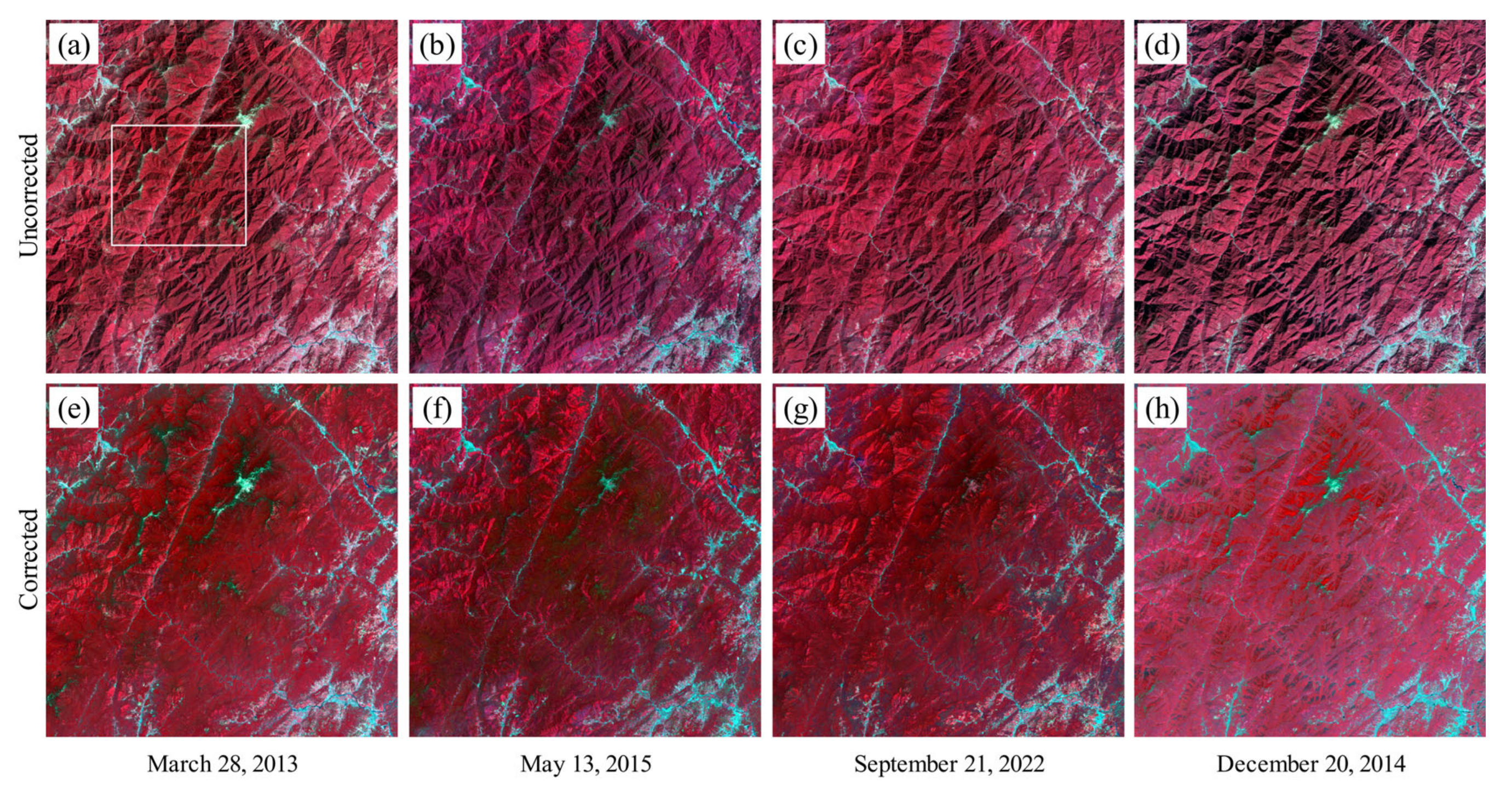
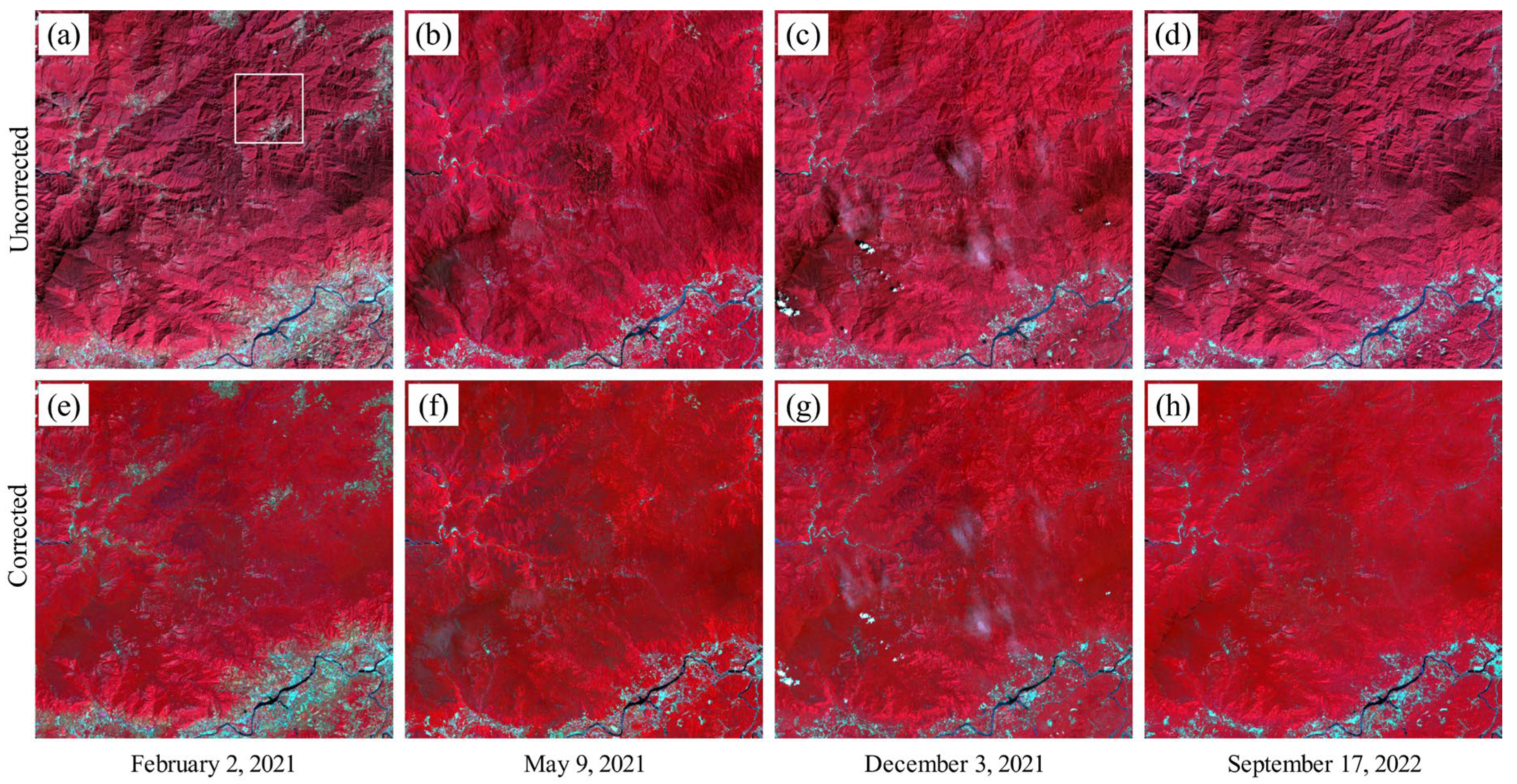
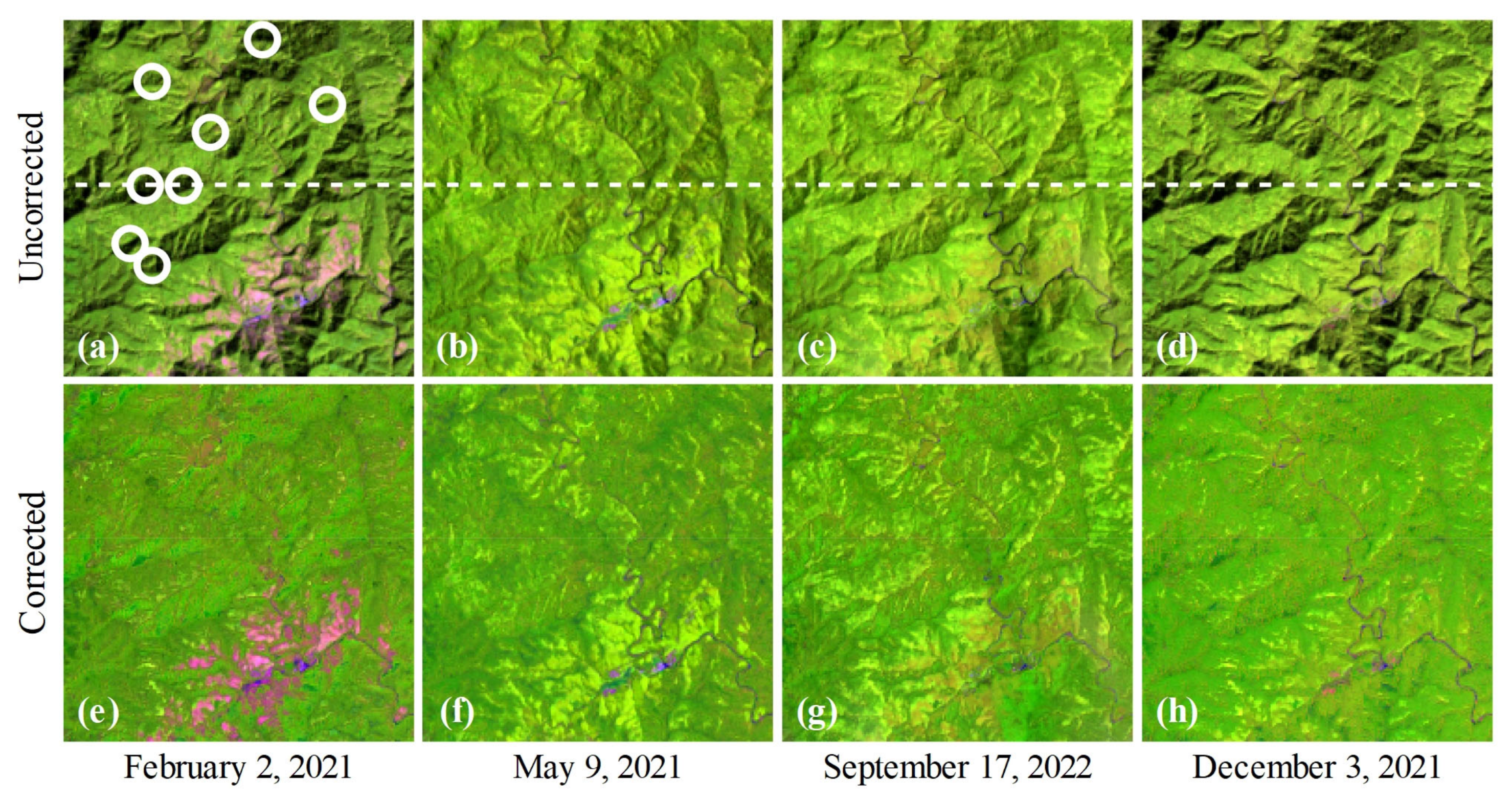
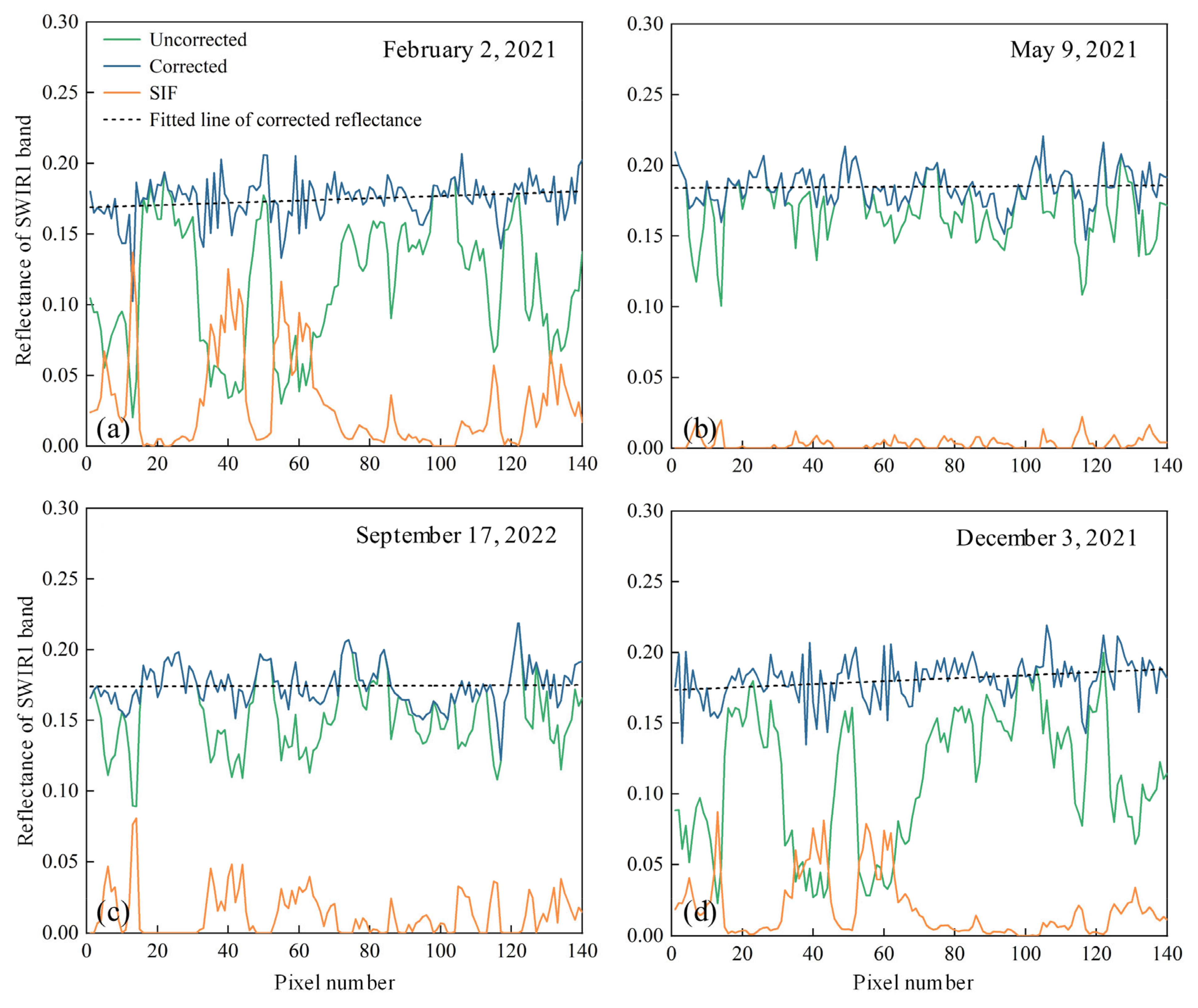
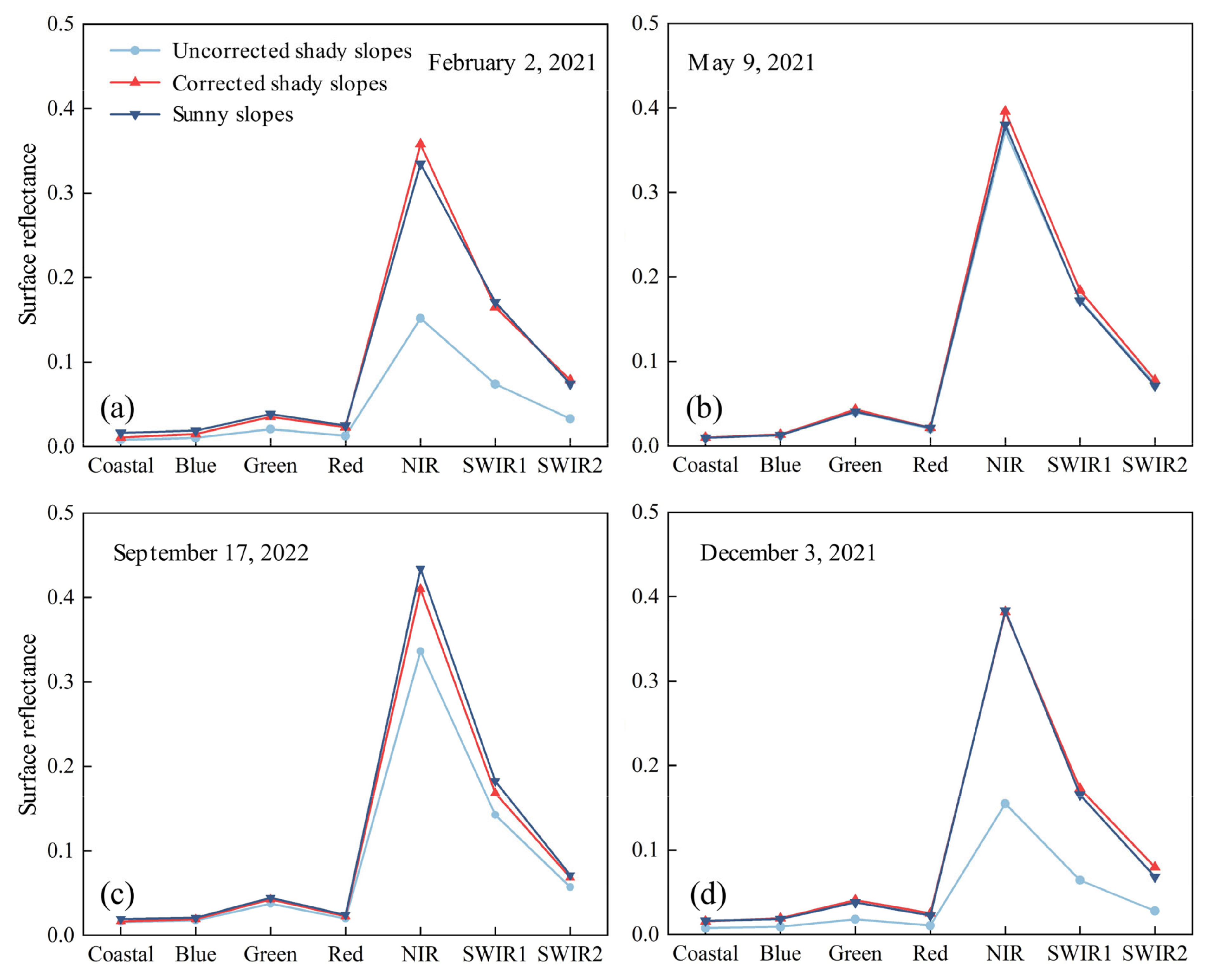
- Sunny versus shady slope reflectance comparison. Due to the low phenological variability of evergreen broadleaf forests in tropical regions, reflectance differences between sunny and shady slopes with homogeneous vegetation should be minimal after effective correction. Thus, significant reduction in differences between these slopes provides direct evidence of successful shadow correction.
- (2)
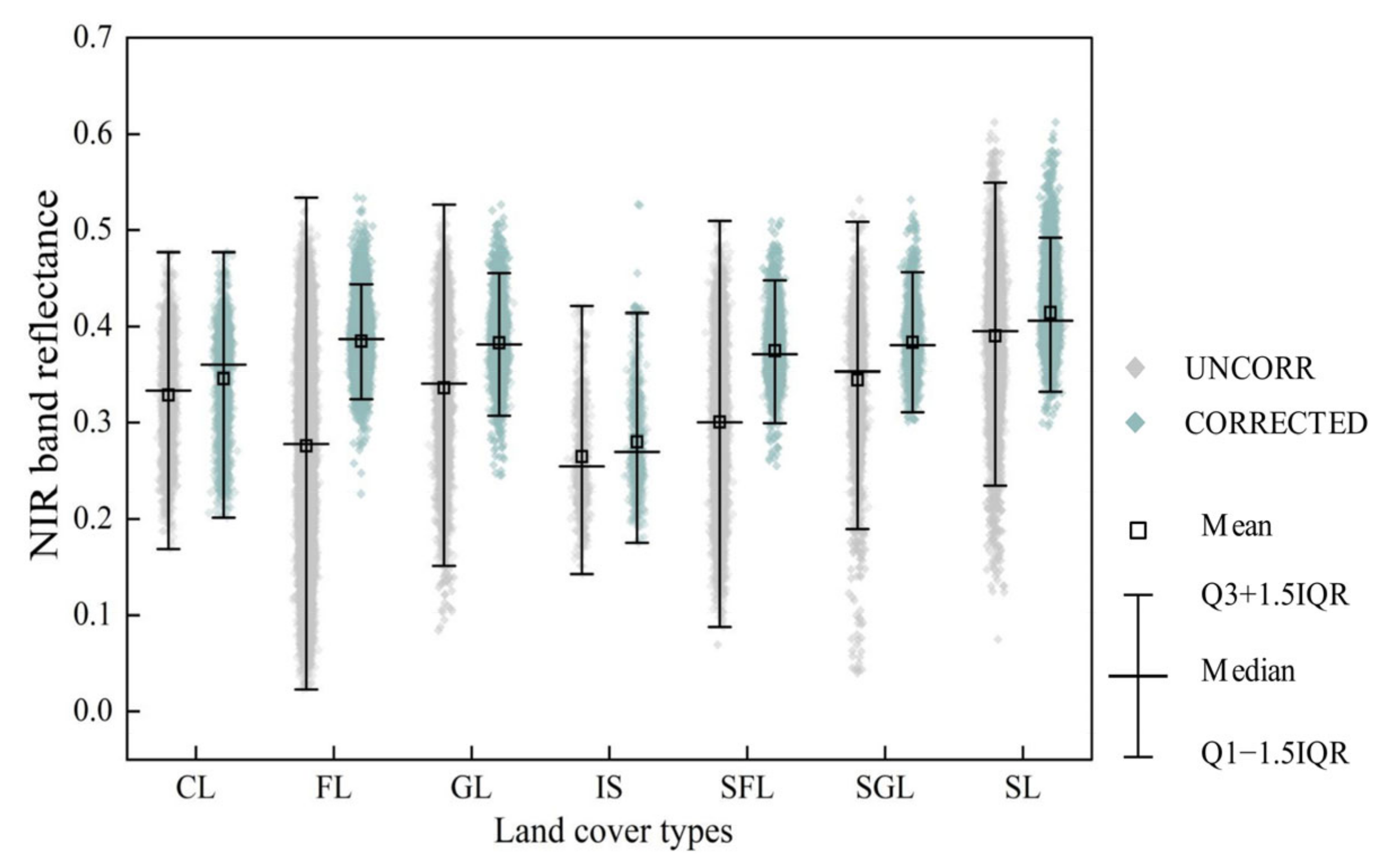
- Intraclass reflectance correction analysis. The upper quartile (Q3), lower quartile (Q1), and interquartile range (IQR) were used to assess the reflectance correction of each land cover type before and after correction [27]. Owing to low-reflectance pixel values in shadow areas, reflectance of uncorrected features has a larger range (Q3 + 1.5IQR to Q1 − 1.5IQR). Theoretically, this range should be reduced after correction because low-reflectance pixels in shadow areas are corrected, and the distribution of reflectance value data points should be skewed toward Q3 + 1.5IQR.
- (3)
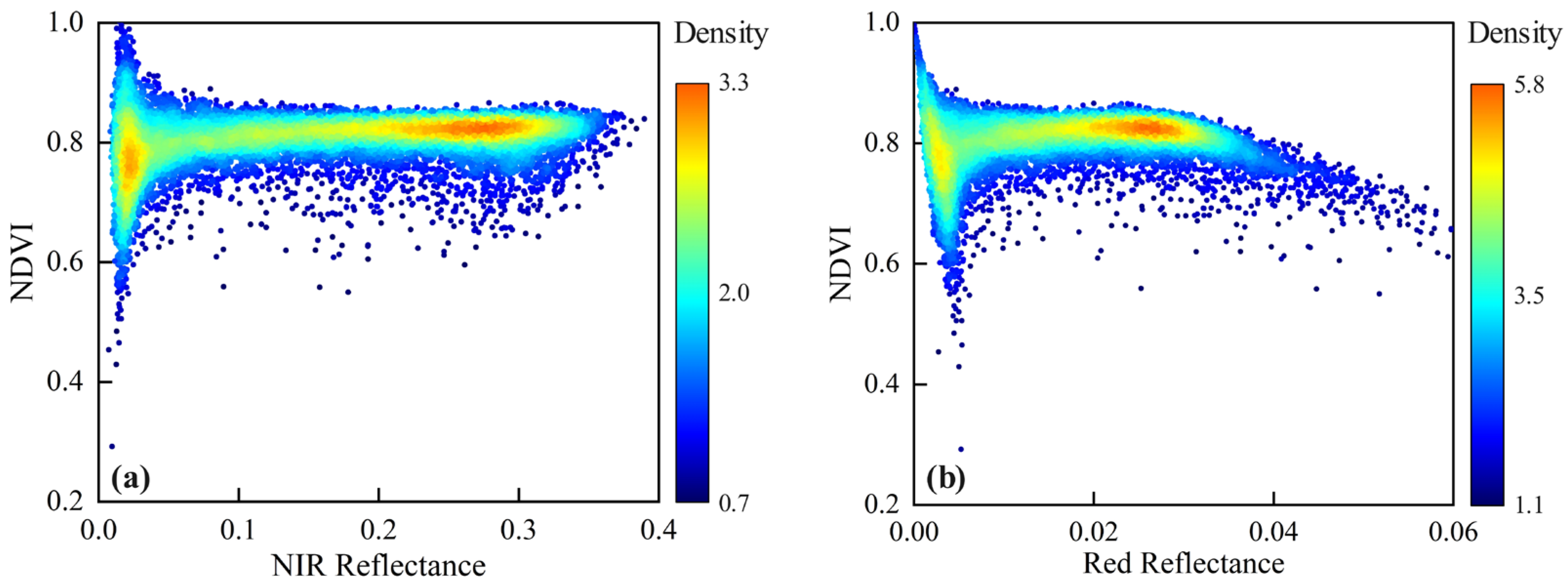
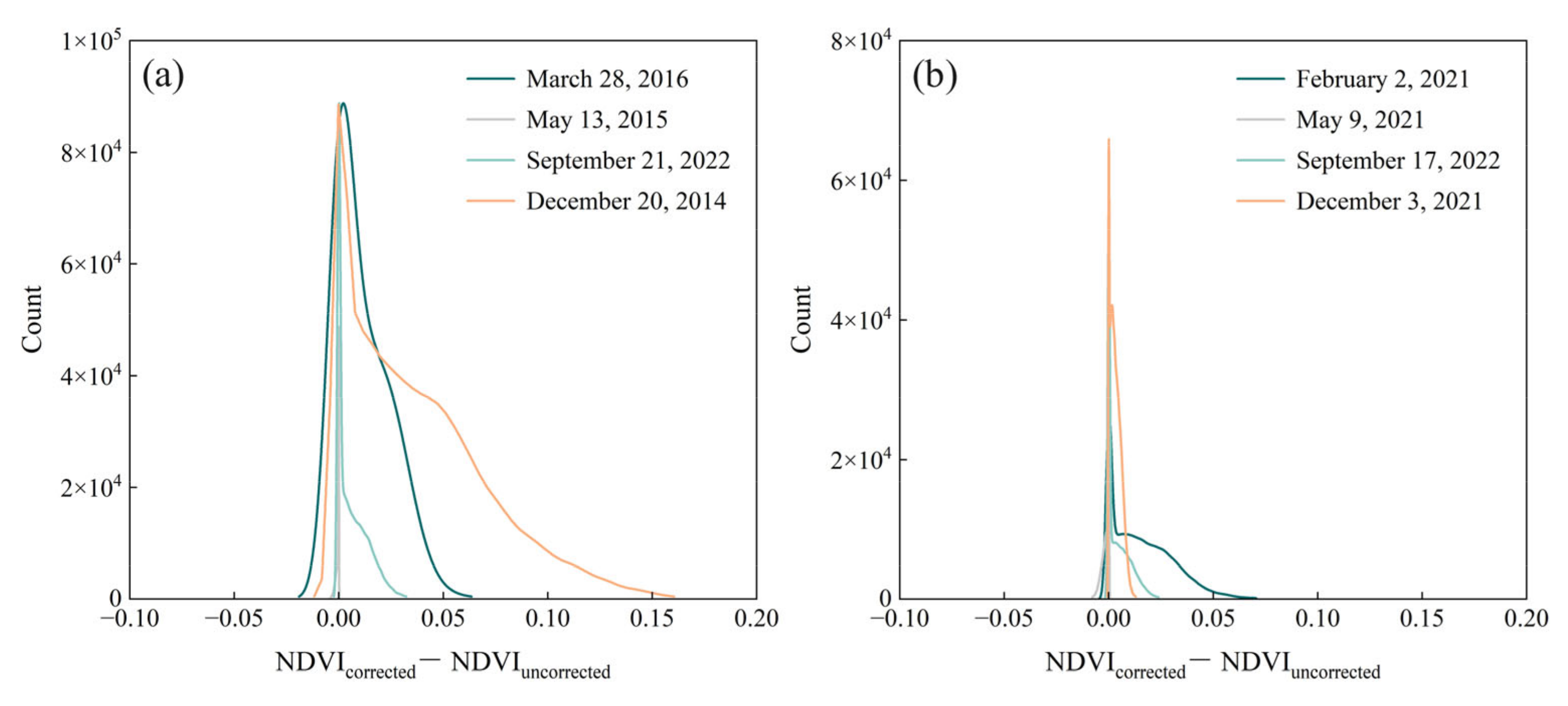
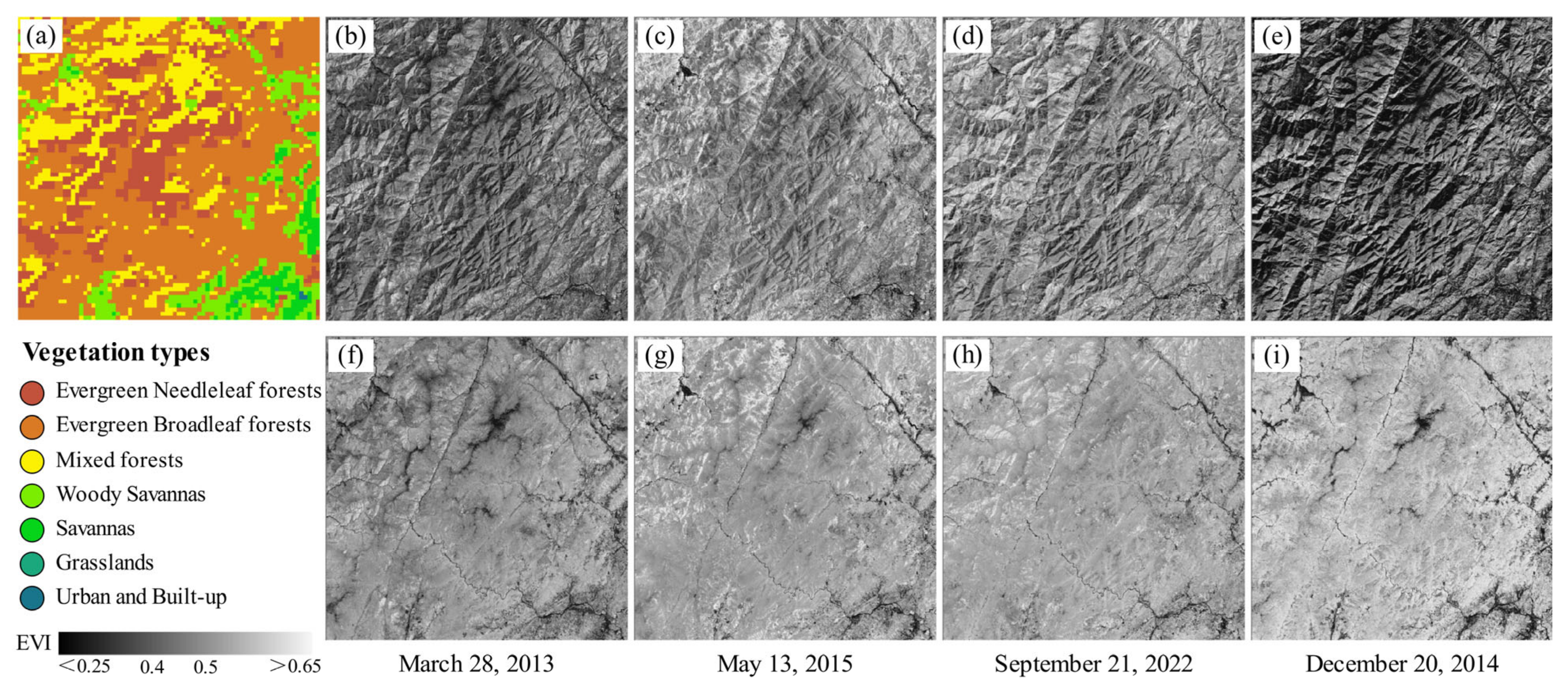
- Performance on key vegetation indices. NDVI can partially eliminate the topographic shadow effect. However, for mountainous areas with complex terrain, especially for images acquired in winter with low solar altitude angles, elimination of the NDVI topographic shadow effect is incomplete [21,47]. Therefore, there should be almost no difference in NDVI before and after correction when the topographic shadow effect is not severe; however, the difference will increase with the severity of the topographic shadow effect. The EVI correction efficacy was evaluated as a more rigorous test of the TSEC framework. EVI is known to be more sensitive to topographic effects than NDVI. The primary metric for its evaluation is the model’s ability to substantially reduce the large EVI discrepancies observed between shady and sunny slopes for homogenous vegetation types.
- (4)
- Comparison between TSEC and TC methods. To benchmark TSEC’s performance and demonstrate its superiority, we compared it against four widely used TC methods, focusing on their weakness: self-shadow and cast shadow correction. The former occur on the back side of the mountains and can be determined as follows [23]:where ξ is the slope angle oriented away from the sun and γ is the sun elevation angle. In contrast, the latter, cast shadows, are formed on surfaces that do not receive direct solar illumination because of shading by other mountains, and they were obtained by removing the self-shadow part from the full shadow. Here, four TC methods (Minnaert (MIN), SCS with C (SCS + C), statistical–empirical (SE), and path length correction (PLC)) were compared (Table 2).
4. Results
4.1. Visual Inspection
4.2. Sunny Versus Shady Slope Reflectance Comparison
4.3. Intraclass Reflectance Correction Analysis
4.4. Performance on Key Vegetation Indices
4.5. Comparison Between TSEC and TC Methods
5. Discussion
5.1. Performance Advancement over NTSEC
5.2. Analysis of Model Components
5.3. Sensitivity to Terrain Data and Sensor Applicability
5.4. Theoretical Limitations and Future Directions
6. Conclusions
Supplementary Materials
Author Contributions
Funding
Data Availability Statement
Acknowledgments
Conflicts of Interest
References
- Guanter, L.; Estellés, V.; Moreno, J. Spectral calibration and atmospheric correction of ultra-fine spectral and spatial resolution remote sensing data. Application to CASI-1500 data. Remote Sens. Environ. 2007, 109, 54–65. [Google Scholar] [CrossRef]
- Schulmann, T.; Katurji, M.; Zawar-Reza, P. Seeing through shadow: Modelling surface irradiance for topographic correction of Landsat ETM+ data. ISPRS J. Photogramm. Remote Sens. 2015, 99, 14–24. [Google Scholar] [CrossRef]
- Wen, J.; Liu, Q.; Xiao, Q.; Liu, Q.; Li, X. Modeling the land surface reflectance for optical remote sensing data in rugged terrain. Sci. China Ser. D Earth Sci. 2008, 51, 1169–1178. [Google Scholar] [CrossRef]
- Balthazar, V.; Vanacker, V.; Lambin, E.F. Evaluation and parameterization of ATCOR3 topographic correction method for forest cover mapping in mountain areas. Int. J. Appl. Earth Obs. Geoinf. 2012, 18, 436–450. [Google Scholar] [CrossRef]
- Yin, H.; Tan, B.; Frantz, D.; Radeloff, V.C. Integrated topographic corrections improve forest mapping using Landsat imagery. Int. J. Appl. Earth Obs. Geoinf. 2022, 108, 102716. [Google Scholar] [CrossRef]
- Dozier, J.; Frew, J. Atmospheric corrections to satellite radiometric data over rugged terrain. Remote Sens. Environ. 1981, 11, 191–205. [Google Scholar] [CrossRef]
- Liang, S.; Fang, H.; Chen, M. Atmospheric correction of Landsat ETM+ land surface imagery. I. Methods. IEEE Trans. Geosci. Remote Sens. 2001, 39, 2490–2498. [Google Scholar] [CrossRef]
- Shunlin, L.; Hongliang, F.; Morisette, J.T.; Mingzhen, C.; Shuey, C.J.; Walthall, C.L.; Daughtry, C.S.T. Atmospheric correction of Landsat ETM+ land surface imagery. II. Validation and applications. IEEE Trans. Geosci. Remote Sens. 2002, 40, 2736–2746. [Google Scholar] [CrossRef]
- Chander, G.; Markham, B.L.; Helder, D.L. Summary of current radiometric calibration coefficients for Landsat MSS, TM, ETM+, and EO-1 ALI sensors. Remote Sens. Environ. 2009, 113, 893–903. [Google Scholar] [CrossRef]
- Jiang, H.; Chen, A.; Wu, Y.; Zhang, C.; Chi, Z.; Li, M.; Wang, X. Vegetation Monitoring for Mountainous Regions Using a New Integrated Topographic Correction (ITC) of the SCS + C Correction and the Shadow-Eliminated Vegetation Index. Remote Sens. 2022, 14, 3073. [Google Scholar] [CrossRef]
- Fahsi, A.; Tsegaye, T.; Tadesse, W.; Coleman, T. Incorporation of digital elevation models with Landsat-TM data to improve land cover classification accuracy. For. Ecol. Manag. 2000, 128, 57–64. [Google Scholar] [CrossRef]
- Gao, Y.; Zhang, W. A simple empirical topographic correction method for ETM+ imagery. Int. J. Remote Sens. 2009, 30, 2259–2275. [Google Scholar] [CrossRef]
- Mishra, V.D.; Sharma, J.K.; Singh, K.K.; Thakur, N.K.; Kumar, M. Assessment of different topographic corrections in AWiFS satellite imagery of Himalaya terrain. J. Earth Syst. Sci. 2009, 118, 11–26. [Google Scholar] [CrossRef]
- Li, Y.; Gong, P.; Sasagawa, T. Integrated shadow removal based on photogrammetry and image analysis. Int. J. Remote Sens. 2007, 26, 3911–3929. [Google Scholar] [CrossRef]
- Fan, Y.; Koukal, T.; Weisberg, P.J. A sun–crown–sensor model and adapted C-correction logic for topographic correction of high resolution forest imagery. ISPRS J. Photogramm. Remote Sens. 2014, 96, 94–105. [Google Scholar] [CrossRef]
- Xue, L.; Yang, S.; Li, Y.; Ma, J. An automatic shadow detection method for high-resolution remote sensing imagery based on polynomial fitting. Int. J. Remote Sens. 2018, 40, 2986–3007. [Google Scholar] [CrossRef]
- Liu, W.; Yamazaki, F. Object-Based Shadow Extraction and Correction of High-Resolution Optical Satellite Images. IEEE J. Sel. Top. Appl. Earth Obs. Remote Sens. 2012, 5, 1296–1302. [Google Scholar] [CrossRef]
- Zhang, H.; Sun, K.; Li, W. Object-Oriented Shadow Detection and Removal From Urban High-Resolution Remote Sensing Images. IEEE Trans. Geosci. Remote Sens. 2014, 52, 6972–6982. [Google Scholar] [CrossRef]
- Xu, N.; Tian, J.; Tian, Q.; Xu, K.; Tang, S. Analysis of Vegetation Red Edge with Different Illuminated/Shaded Canopy Proportions and to Construct Normalized Difference Canopy Shadow Index. Remote Sens. 2019, 11, 1192. [Google Scholar] [CrossRef]
- Bian, J.; Li, A.; Wang, S.; Zhao, W.; Lei, G. Restoration of information obscured by mountain shadows for Landsat TM images based on MODIS NDVI. Remote Sens. Technol. Appl. 2016, 31, 12–22. [Google Scholar]
- Jiao, J.; Shi, J.; Tian, Q.; Gao, L.; Xu, N. Research on multispectral-image-based NDVI shadow-effect-eliminating model. J. Remote Sens. 2020, 24, 53–66. [Google Scholar]
- Tan, B.; Masek, J.G.; Wolfe, R.; Gao, F.; Huang, C.; Vermote, E.F.; Sexton, J.O.; Ederer, G. Improved forest change detection with terrain illumination corrected Landsat images. Remote Sens. Environ. 2013, 136, 469–483. [Google Scholar] [CrossRef]
- Jiang, H.; Wang, S.; Cao, X.; Yang, C.; Zhang, Z.; Wang, X. A shadow- eliminated vegetation index (SEVI) for removal of self and cast shadow effects on vegetation in rugged terrains. Int. J. Digit. Earth 2018, 12, 1013–1029. [Google Scholar] [CrossRef]
- Sandmeier, S.; Itten, K.I. A physically-based model to correct atmospheric and illumination effects in optical satellite data of rugged terrain. IEEE Trans. Geosci. Remote Sens. 1997, 35, 708–717. [Google Scholar] [CrossRef]
- Yin, G.; Li, A.; Wu, S.; Fan, W.; Zeng, Y.; Yan, K.; Xu, B.; Li, J.; Liu, Q. PLC: A simple and semi-physical topographic correction method for vegetation canopies based on path length correction. Remote Sens. Environ. 2018, 215, 184–198. [Google Scholar] [CrossRef]
- Yin, G.; Ma, L.; Zhao, W.; Zeng, Y.; Xu, B.; Wu, S. Topographic Correction for Landsat 8 OLI Vegetation Reflectances Through Path Length Correction: A Comparison Between Explicit and Implicit Methods. IEEE Trans. Geosci. Remote Sens. 2020, 58, 8477–8489. [Google Scholar] [CrossRef]
- Sola, I.; González-Audícana, M.; Álvarez-Mozos, J. Multi-criteria evaluation of topographic correction methods. Remote Sens. Environ. 2016, 184, 247–262. [Google Scholar] [CrossRef]
- Ma, Y.; He, T.; Li, A.; Li, S. Evaluation and Intercomparison of Topographic Correction Methods Based on Landsat Images and Simulated Data. Remote Sens. 2021, 13, 4120. [Google Scholar] [CrossRef]
- Smith, J.A.; Lin, T.L.; Ranson, K.J. The Lambertian assumption and Landsat data. Photogramm. Eng. Rem. S 1980, 16, 1183–1189. [Google Scholar]
- Teillet, P.M.; Guindon, B.; Goodenough, D.G. On the Slope-Aspect Correction of Multispectral Scanner Data. Can. J. Remote Sens. 1982, 8, 84–106. [Google Scholar] [CrossRef]
- Gu, D.; Gillespie, A. Topographic Normalization of Landsat TM Images of Forest Based on Subpixel Sun–Canopy–Sensor Geometry. Remote Sens. Environ. 1998, 64, 166–175. [Google Scholar] [CrossRef]
- Soenen, S.A.; Peddle, D.R.; Coburn, C.A. SCS + C: A modified Sun-canopy-sensor topographic correction in forested terrain. IEEE Trans. Geosci. Remote Sens. 2005, 43, 2148–2159. [Google Scholar] [CrossRef]
- Ge, H.; Lu, D.; He, S.; Xu, A.; Zhou, G.; Du, H. Pixel-based Minnaert Correction Method for Reducing Topographic Effects on a Landsat 7 ETM+ Image. Photogramm. Eng. Remote Sens. 2008, 74, 1343–1350. [Google Scholar] [CrossRef]
- Zhao, W.; Li, X.; Wang, W.; Wen, F.; Yin, G. DSRC: An Improved Topographic Correction Method for Optical Remote-Sensing Observations Based on Surface Downwelling Shortwave Radiation. IEEE Trans. Geosci. Remote Sens. 2022, 60, 5606015. [Google Scholar] [CrossRef]
- Yang, X.; Zuo, X.; Xie, W.; Li, Y.; Guo, S.; Zhang, H. A Correction Method of NDVI Topographic Shadow Effect for Rugged Terrain. IEEE J. Sel. Top. Appl. Earth Obs. Remote Sens. 2022, 15, 8456–8472. [Google Scholar] [CrossRef]
- Gao, M.; Gong, H.; Zhao, W.; Chen, B.; Chen, Z.; Shi, M. An improved topographic correction model based on Minnaert. GIScience Remote Sens. 2015, 53, 247–264. [Google Scholar] [CrossRef]
- Shrestha, D.P.; Saepuloh, A.; van der Meer, F. Land cover classification in the tropics, solving the problem of cloud covered areas using topographic parameters. Int. J. Appl. Earth Obs. Geoinf. 2019, 77, 84–93. [Google Scholar] [CrossRef]
- Dozier, J.; Frew, J. Rapid calculation of terrain parameters for radiation modeling from digital elevation data. IEEE Trans. Geosci. Remote Sens. 1990, 28, 963–969. [Google Scholar] [CrossRef]
- Shepherd, J.D.; Dymond, J.R. Correcting satellite imagery for the variance of reflectance and illumination with topography. Int. J. Remote Sens. 2010, 24, 3503–3514. [Google Scholar] [CrossRef]
- Yang, X.; Zuo, X.; Zhu, D.; Xie, W.; Li, Y.; Guo, S. Multi-criteria evaluation of the shadow index performance of Landsat 8 OLI images. Int. J. Remote Sens. 2022, 43, 5125–5144. [Google Scholar] [CrossRef]
- Polidorio, A.M.; Flores, F.C.; Imai, N.N.; Tommaselli, A.M.G.; Franco, C. Automatic shadow segmentation in aerial color images. In Proceedings of the 16th Brazilian Symposium on Computer Graphics and Image Processing (SIBGRAPI 2003), Sao Carlos, Brazil, 12–15 October 2003; IEEE: New York, NY, USA, 2003; pp. 270–277. [Google Scholar]
- Otsu, N. A Threshold Selection Method from Gray-Level Histograms. IEEE Trans. Syst. Man Cybern. 1979, 9, 62–66. [Google Scholar] [CrossRef]
- Arévalo, V.; González, J.; Ambrosio, G. Shadow detection in colour high-resolution satellite images. Int. J. Remote Sens. 2008, 29, 1945–1963. [Google Scholar] [CrossRef]
- Shahtahmassebi, A.; Yang, N.; Wang, K.; Moore, N.; Shen, Z. Review of shadow detection and de-shadowing methods in remote sensing. Chin. Geogr. Sci. 2013, 23, 403–420. [Google Scholar] [CrossRef]
- Zhu, G.; Liu, Y.; Ju, W.; Chen, J. Evaluation of topographic effects on four commonly used vegetation indices. J. Remote Sens. 2013, 17, 210–234. [Google Scholar]
- Chen, R.; Yin, G.; Liu, G.; Li, J.; Verger, A. Evaluation and Normalization of Topographic Effects on Vegetation Indices. Remote Sens. 2020, 12, 2290. [Google Scholar] [CrossRef]
- Matsushita, B.; Yang, W.; Chen, J.; Onda, Y.; Qiu, G. Sensitivity of the Enhanced Vegetation Index (EVI) and Normalized Difference Vegetation Index (NDVI) to Topographic Effects: A Case Study in High-density Cypress Forest. Sensors 2007, 7, 2636–2651. [Google Scholar] [CrossRef]
- Zhang, L.; Sun, X.; Wu, T.; Zhang, H. An Analysis of Shadow Effects on Spectral Vegetation Indexes Using a Ground-Based Imaging Spectrometer. IEEE Geosci. Remote Sens. Lett. 2015, 12, 2188–2192. [Google Scholar] [CrossRef]
- Li, X.; Wang, Z.; Li, C.; Liu, Y.; Ma, L. Comparative Study on the Application of Terrain Correction Models Based on Different Open-Source DEMs. Geogr. Geo-Inf. Sci. 2023, 39, 22–29. [Google Scholar]
- Liu, G.; Wen, J.; You, D.; Tang, Y.; Han, Y.; Li, Q. Impacts of DEM Geolocation Bias on Multiscale Validation of Land Surface Albedo Over Rugged Terrain. IEEE Geosci. Remote Sens. Lett. 2025, 22, 2504405. [Google Scholar] [CrossRef]
- Yin, G.; Li, J.; Xu, B.; Zeng, Y.; Wu, S.; Yan, K.; Verger, A.; Liu, G. PLC-C: An Integrated Method for Sentinel-2 Topographic and Angular Normalization. IEEE Geosci. Remote Sens. Lett. 2021, 18, 1446–1450. [Google Scholar] [CrossRef]



| Study Area | Acquisition Time | Solar Azimuth Angle | Solar Zenith Angle |
|---|---|---|---|
| Wuyi Mountain | 28 March 2016 | 132.525° | 33.405° |
| 13 May 2015 | 109.698° | 22.192° | |
| 21 September 2022 | 139.711° | 33.316° | |
| 20 December 2014 | 155.285° | 55.089° | |
| Changjiang | 2 February 2021 | 141.060° | 44.668° |
| 9 May 2021 | 89.874° | 22.226° | |
| 17 September 2022 | 123.969° | 27.627° | |
| 3 December 2021 | 151.890° | 45.964° |
| Method | Equation | Source |
|---|---|---|
| SCS + C | [32] | |
| MIN | [33] | |
| SE | [30] | |
| PLC | [25] |
| Vegetation Type | Sunny or Shady Slope | 28 March 2016 | 13 May 2015 | 21 September 2022 | 20 December 2014 | ||||
|---|---|---|---|---|---|---|---|---|---|
| Uncorr | Corr | Uncorr | Corr | Uncorr | Corr | Uncorr | Corr | ||
| Evergreen Needleleaf forests | Sunny | 0.364 | 0.372 | 0.479 | 0.494 | 0.533 | 0.544 | 0.444 | 0.500 |
| Shady | 0.208 | 0.352 | 0.334 | 0.473 | 0.333 | 0.511 | 0.173 | 0.519 | |
| Evergreen Broadleaf forests | Sunny | 0.385 | 0.398 | 0.514 | 0.517 | 0.514 | 0.535 | 0.489 | 0.532 |
| Shady | 0.186 | 0.366 | 0.331 | 0.492 | 0.284 | 0.522 | 0.137 | 0.507 | |
| Mixed forests | Sunny | 0.338 | 0.344 | 0.523 | 0.527 | 0.559 | 0.563 | 0.380 | 0.474 |
| Shady | 0.177 | 0.359 | 0.321 | 0.472 | 0.278 | 0.512 | 0.087 | 0.495 | |
| Woody Savannas | Sunny | 0.392 | 0.398 | 0.576 | 0.578 | 0.545 | 0.552 | 0.510 | 0.548 |
| Shady | 0.250 | 0.382 | 0.376 | 0.504 | 0.352 | 0.526 | 0.187 | 0.511 | |
| Savannas | Sunny | 0.344 | 0.346 | 0.493 | 0.494 | 0.486 | 0.491 | 0.413 | 0.426 |
| Shady | 0.275 | 0.373 | 0.363 | 0.493 | 0.384 | 0.501 | 0.303 | 0.433 | |
| Grasslands | Sunny | 0.373 | 0.373 | 0.502 | 0.502 | 0.425 | 0.425 | 0.408 | 0.426 |
| Shady | / | / | / | / | / | / | / | / | |
| Correction Method | Sunlit Area | Self-Shadow Area | Cast Shadow Area | ||||||
|---|---|---|---|---|---|---|---|---|---|
| Mean | CV (%) | Outliers (%) | Mean | CV (%) | Outliers (%) | Mean | CV (%) | Outliers (%) | |
| Uncorrected | 0.132 | 32.74 | - | 0.013 | 105.81 | - | 0.032 | 65.66 | - |
| MIN | 0.189 | 142.55 | 0.90 | - | - | - | 0.143 | 583.16 | 2.58 |
| SCS + C | 0.107 | 36.23 | 0.03 | 0.231 | 2878.20 | 36.80 | 0.055 | 66.44 | 0.00 |
| SE | 0.104 | 39.54 | 0.05 | 0.118 | 14.98 | 0.00 | 0.075 | 39.41 | 1.74 |
| PLC | 0.080 | 72.92 | 5.34 | 0.021 | 105.19 | 0.00 | 0.038 | 64.72 | 0.18 |
| TSEC | 0.165 | 18.28 | 0.00 | 0.162 | 35.06 | 0.02 | 0.158 | 24.29 | 0.07 |
| Group | Blue | NIR | SWIR1 | |||
|---|---|---|---|---|---|---|
| RE (%) | CV (%) | RE (%) | CV (%) | RE (%) | CV (%) | |
| Uncorrected | 49.30 | 33.65 | 59.62 | 41.05 | 61.12 | 47.31 |
| BAF·VIF (no SIF) | 1585.36 | 32.33 | 1885.17 | 40.48 | 2043.39 | 46.39 |
| SIF·BAF (no VIF) | 14.45 | 23.79 | 8.62 | 2.99 | 15.07 | 11.30 |
| SIF·VIF (no BAF) | 44.29 | 28.90 | 46.47 | 25.12 | 26.93 | 19.53 |
| SIF·BAF·VIF | 5.73 | 21.55 | 0.45 | 4.15 | 4.45 | 11.72 |
Disclaimer/Publisher’s Note: The statements, opinions and data contained in all publications are solely those of the individual author(s) and contributor(s) and not of MDPI and/or the editor(s). MDPI and/or the editor(s) disclaim responsibility for any injury to people or property resulting from any ideas, methods, instructions or products referred to in the content. |
© 2026 by the authors. Licensee MDPI, Basel, Switzerland. This article is an open access article distributed under the terms and conditions of the Creative Commons Attribution (CC BY) license.
Share and Cite
Yang, X.; Xie, W.; Zuo, X.; Guo, S.; Zhu, D.; Li, Y.; Li, J.; Luo, Y. A Topographic Shadow Effect Correction (TSEC) Method for Correcting Surface Reflectance of Optical Remote Sensing Images in Rugged Terrain. Remote Sens. 2026, 18, 642. https://doi.org/10.3390/rs18040642
Yang X, Xie W, Zuo X, Guo S, Zhu D, Li Y, Li J, Luo Y. A Topographic Shadow Effect Correction (TSEC) Method for Correcting Surface Reflectance of Optical Remote Sensing Images in Rugged Terrain. Remote Sensing. 2026; 18(4):642. https://doi.org/10.3390/rs18040642
Chicago/Turabian StyleYang, Xu, Wenbin Xie, Xiaoqing Zuo, Shipeng Guo, Daming Zhu, Yongfa Li, Jiangqi Li, and Yan Luo. 2026. "A Topographic Shadow Effect Correction (TSEC) Method for Correcting Surface Reflectance of Optical Remote Sensing Images in Rugged Terrain" Remote Sensing 18, no. 4: 642. https://doi.org/10.3390/rs18040642
APA StyleYang, X., Xie, W., Zuo, X., Guo, S., Zhu, D., Li, Y., Li, J., & Luo, Y. (2026). A Topographic Shadow Effect Correction (TSEC) Method for Correcting Surface Reflectance of Optical Remote Sensing Images in Rugged Terrain. Remote Sensing, 18(4), 642. https://doi.org/10.3390/rs18040642