
Article

Advancing Precipitation Estimation in Mountainous Regions Through Deep Learning Fusion of Multi-Satellite Products

1
Xizang Autonomous Region Meteorological Information and Network Centre, Lhasa 851000, China
2
National Meteorological Information Center, Beijing 100081, China
3
Xigazê National Climatological Observatory, China Meteorological Administration, Shigatse 857000, China
4
School of Ecology and Environment, Xizang University, Lhasa 850000, China
5
Institute for Disaster Management and Reconstruction, Sichuan University, Chengdu 610200, China
6
State Key Laboratory of Hydraulics and Mountain River Engineering, College of Water Resource & Hydropower, Sichuan University, Chengdu 610065, China
7
Sichuan Hydrological and Water Resources Survey Center, Chengdu 610036, China
*
Author to whom correspondence should be addressed.
These authors contributed equally to this work.
Remote Sens. 2026, 18(4), 615; https://doi.org/10.3390/rs18040615
Submission received: 9 December 2025 / Revised: 4 February 2026 / Accepted: 12 February 2026 / Published: 15 February 2026
(This article belongs to the Section Earth Observation Data)

Highlights

What are the main findings?
  • A Transformer fusion of near-real-time GSMaP-GNRT and IMERG Early effectively reduces systematic bias and improves agreement with gauge observations.
  • At the daily scale, the fused product achieves a balanced performance, with reduced bias, improved RMSE over IMERG, and correlations comparable to GSMaP.
What are the implications of the main findings?
  • The framework enables near-real-time precipitation estimation at stations, suitable for complex-terrain regions.
  • The fused product supports more reliable hydrological and climate analyses in Sichuan and other mountainous areas.

Abstract

Accurate characterization of precipitation in complex terrain is essential for hydrological modeling and climate studies. This study uses daily observations from 156 rain gauges in Sichuan Province (2015–2020) to evaluate two high-resolution satellite products (GSMaP-GNRT and IMERG-Early) and to develop a Transformer-based fusion framework at the gauge scale. All three datasets reproduce the regional seasonal cycle with more rainfall in summer and less in winter. At the daily scale, the fused product attains correlation comparable to GSMaP, while GSMaP and the fusion slightly overestimate precipitation (Bias = 6.24% and 5.21%), and IMERG shows stronger underestimation (Bias = −11.46%). At the monthly scale, the fused dataset achieves the best overall performance in terms of correlation, bias and RMSE. Spatially, the fusion reduces bias and RMSE and yields more homogeneous patterns over Sichuan’s complex terrain. Detection metrics indicate that the fused product increases the probability of detection and slightly improves the critical success index, while the false alarm ratio remains relatively high and comparable to the original products. This implies a gain in event sensitivity and spatial consistency rather than substantially reduced false alarms. Overall, the Transformer-based fusion provides a useful compromise between GSMaP and IMERG, adding value particularly for bias reduction, monthly statistics and event detection. The fused dataset offers a promising input for precipitation monitoring, hydrological simulation and disaster-risk analysis in Sichuan and similar mountainous regions.

1. Introduction

Precipitation is a key component of the climate system, representing a crucial link in the exchange of energy and water between the atmosphere, land surface, and subsurface [1]. Atmospheric water vapor condenses into liquid or solid precipitation and is subsequently delivered to terrestrial and subsurface reservoirs, forming the primary source of surface and groundwater recharge [2,3]. Accurate precipitation information not only improves the reliability of weather and flood forecasting but also underpins effective water resources management, agricultural irrigation, urban water supply, and ecosystem stability [4].
At present, precipitation data are mainly obtained from ground-based observations, weather radar measurements, and satellite remote sensing [5,6]. Ground meteorological stations provide high-accuracy point measurements but are spatially sparse and insufficient to capture the strong spatiotemporal heterogeneity of precipitation [7]. Weather radars offer high temporal and spatial resolution; however, they are prone to errors induced by complex terrain, atmospheric conditions, and high operational costs [8]. With the rapid advancement of remote sensing and retrieval technologies, satellite-based precipitation products—derived from visible, infrared (IR), passive microwave (PMW), active microwave, and multi-sensor fusion techniques—have become increasingly prevalent [9,10]. Widely used datasets include the Integrated Multi-satellite Retrievals for GPM (IMERG), the Global Satellite Mapping of Precipitation (GSMaP), the Tropical Rainfall Measuring Mission (TRMM), the Climate Hazards Group InfraRed Precipitation with Station data (CHIRPS), and the PERSIANN series [11,12,13]. These satellite products provide continuous spatiotemporal coverage with reduced sensitivity to terrain and climatic constraints, effectively compensating for the limitations of ground observations. Consequently, they have been extensively applied in hydrology, meteorology, and environmental studies [14].
In recent years, the accuracy assessment and fusion of satellite precipitation products have become an active area of research [15]. Tian [16] evaluated GSMaP over the contiguous United States (2005–2006) and found that it performed well in identifying spatial precipitation patterns, though it tended to overestimate rainfall in summer and underestimate it in winter. Hisam [17] verified GSMaP in the Mediterranean region of Türkiye and reported good performance under light-to-moderate rainfall conditions but underestimation during heavy rainfall events. Lv [18] evaluates six GSMaP V8 precipitation products across China, revealing that gauge correction markedly enhances accuracy and that errors are strongly influenced by rainfall intensity and elevation. However, the accuracy of a single satellite product remains limited, especially in complex regions. Several studies have focused specifically on GSMaP and IMERG over complex terrain in Southwest China and adjacent regions, which are directly relevant to this study. Tang [19] evaluated IMERG and GSMaP over a mountainous catchment in southwestern China and showed that both products have good detection skill, but their performance deteriorates with increasing elevation and slope; IMERG tends to overestimate total rainfall and heavy events, whereas GSMaP shows smaller bias but still clear dependence on topography and rainfall intensity [20]. Seasonal error-component analyses for the Sichuan Basin further indicate that IMERG exhibits season-dependent biases and difficulties in capturing the timing and magnitude of convective rainstorms [19]. Atmospheric-simulation-based evaluations also report that, in the Chengdu Plain and surrounding complex terrain, GSMaP can generally identify the main precipitation centers, while IMERG tends to produce excessive precipitation in lowland basins, leading to regional overestimation [21]. Event-based studies in Southwest China similarly highlight that IMERG and GSMaP often underestimate extreme rainfall but overestimate light precipitation, and that their hydrological utility is still constrained by residual biases in both magnitude and temporal structure [22,23]. These findings imply that, even for the latest versions, GSMaP and IMERG each have complementary strengths and weaknesses in complex terrain such as Sichuan—GSMaP generally shows better bias characteristics, while IMERG offers rich spatiotemporal detail but can suffer from regional and seasonal overestimation.
To address these limitations, numerous studies have explored multi-source precipitation fusion. Existing work has demonstrated that integrating different satellite and reanalysis datasets can reduce systematic errors and enhance regional applicability. Li [24] constructed a high-accuracy daily rainfall dataset by merging multiple satellite and gauge products over China, showing clear improvements in hydrological simulations compared with any single product. Nan [25] developed a deep-learning-based multi-source merging framework for the Tibetan Plateau and found that a convolutional neural network consistently outperformed artificial neural networks and statistical triple-collocation methods in both meteorological metrics and runoff simulation. Recent work has further proposed multi-source fusion schemes that blend several satellite and reanalysis products (e.g., CMORPH, ERA5, PERSIANN, GSMaP, IMERG, CHIRPS) and demonstrated that suitable fusion strategies can significantly reduce regional biases and improve extreme-precipitation representation [26].
With the emergence of big data and deep learning, machine learning algorithms have been increasingly adopted for satellite precipitation fusion [7,27,28,29,30]. Shen [31] emphasized the transformative potential of deep learning in hydrological sciences, particularly for handling large datasets, learning complex nonlinear relationships, and overcoming the limitations of traditional physical models. Hong [32] applied artificial neural networks (ANNs) to merge ground-based observations, satellite precipitation products, and reanalysis data over the Tibetan Plateau, and found that the fused product outperformed individual datasets in both error statistics and runoff simulation. Building on these developments, recent studies have begun to introduce attention-based and Transformer-like architectures into precipitation-related tasks. Yang [33] proposed a Transformer-based spatiotemporal model for IMERG downscaling, which improved sub-daily precipitation estimates compared with conventional CNN–LSTM approaches; Lei [29] compared deep-learning models including Transformers for downscaling IMERG from 0.1° to 0.01° resolution; and You [34] proposed a self-attention multi-source precipitation fusion model that reduced RMSE and improved event detection by explicitly learning the temporal correlations among multiple satellite products. Yin [35] developed a Transformer-based rainfall–runoff model, while Li [36] proposed a multi-scale spatiotemporal Transformer architecture to capture the dynamic evolution characteristics of precipitation. These studies indicate that attention mechanisms are particularly suitable for capturing long-range temporal dependence and cross-product relationships, but most of them focus on spatial downscaling, forecasting or mixed-source merging at large scales, rather than on station-scale daily fusion of near-real-time GSMaP-GNRT and IMERG-Early in a single mountainous province.
Sichuan Province, characterized by its complex topography and pronounced climatic gradients, is among the regions in China most prone to natural disasters [37,38]. Severe events such as rainstorms, floods, and debris flows are closely linked to precipitation processes, making the acquisition of high-precision precipitation data essential for regional disaster early warning and hydrological modeling [39]. In western Sichuan, vast high-altitude areas are sparsely instrumented, and ground observations are inadequate to represent the spatiotemporal variability of precipitation under complex terrain [40]. Previous evaluations show that GSMaP and IMERG each exhibit distinct regional biases and topographic sensitivities over Sichuan and southwestern China, and that their direct hydrological applicability is limited by these residual errors. Against this background, there is a clear need for a fusion framework that (i) leverages the complementary strengths of GSMaP and IMERG, (ii) explicitly models multi-day temporal dependence and cross-product interactions, and (iii) is applicable to near-real-time satellite products at the gauge scale.
To address these limitations, we develop a deep-learning-based fusion framework that integrates two near-real-time satellite precipitation products (GSMaP-GNRT and IMERG Early) at the gauge scale over Sichuan Province. The proposed approach is designed with three methodological distinctions from much of the previous fusion literature. (1) Rather than targeting retrospective gauge-adjusted products, we focus on near-real-time retrievals and formulate the fusion as a satellite-only inference problem for operational applicability. (2) We implement a station-wise Transformer that operates on co-located daily multivariate sequences (GSMaP and IMERG) using fixed-length rolling windows to represent multi-day temporal dependence and cross-product interactions. (3) The model is trained in a supervised manner using gauge observations as the learning target while keeping gauge data out of the input features, and its generalization across heterogeneous topography and climate conditions is assessed via station-wise three-fold cross-validation together with multi-scale evaluation protocols. Through multi-scale (temporal and spatial) comparative analysis, the study aims to generate a high-quality, high-resolution precipitation dataset that supports improved precipitation estimation, hydrological simulation, and climate change research in complex terrain regions of Sichuan Province.

2. Study Area and Data

2.1. Study Area

Sichuan Province is located in the subtropical zone of southwestern China, where diverse geomorphological features and alternating monsoon circulations jointly shape its distinctive climatic regimes. The province exhibits pronounced spatial heterogeneity in precipitation, with complex variations driven by both topographic and atmospheric factors. The overall precipitation pattern is characterized by less rainfall in the west and more in the east, as well as lower precipitation over the plateau and higher values in the basin, with the mountainous periphery receiving more rainfall than the central hilly basin areas.
The Sichuan Basin has a humid subtropical climate, with a mean annual temperature of approximately 18 °C and annual precipitation ranging from 1000 to 1200 mm. In contrast, southwestern Sichuan receives about 900–1200 mm of annual rainfall, while the northwestern highland regions record much less, at approximately 500–900 mm. These figures highlight the substantial spatial contrasts across the province. The eastern basin experiences a typical humid subtropical climate, whereas the western Sichuan region, dominated by high mountains and plateaus, exhibits an alpine climate with distinct vertical zonation. This region is characterized by mild winters, hot summers, and small annual temperature ranges. Overall, Sichuan has abundant rainfall but exhibits strong regional disparities. Most precipitation occurs during the summer monsoon season, with annual totals ranging from 400 to 1200 mm. The majority of the rainfall is concentrated in the Sichuan Basin and the subtropical semi-humid mountainous areas of southwestern Sichuan, whereas the high-altitude plateau regions receive considerably less precipitation.

2.2. Dataset

2.2.1. GSMaP Data

The Global Satellite Mapping of Precipitation (GSMaP) project, sponsored by the Japan Science and Technology Agency (JST) and developed by the Japan Aerospace Exploration Agency (JAXA), provides a suite of global multi-satellite precipitation products. Most GSMaP datasets feature a temporal resolution of 1 h and a spatial resolution of 0.1° × 0.1° (approximately 10 km × 10 km), covering the latitudinal range 60°S–60°N. Several versions of GSMaP are available, including GSMaP-NRT, GSMaP-GNRT, and GSMaP-Gauge, among others. In this study, we employed the sixth-generation near-real-time product GSMaP-GNRT (hereafter referred to as GSMaP) [41]. As one of the key products of the GSMaP project, GSMaP-GNRT integrates the latest satellite sensor observations to generate real-time precipitation estimates while maintaining a long-term historical archive, enabling more comprehensive precipitation analyses. The GSMaP-GNRT data are freely accessible from the JAXA GSMaP project website (http://sharaku.eorc.jaxa.jp/GSMaP/ (accessed on 11 February 2026)). The data are provided in four-byte little-endian binary format (float32) and can be read using FORTRAN-based decoding scripts, followed by spatial subsetting to the study area. In this work, the GSMaP-GNRT precipitation dataset covering Sichuan Province for the period 2015–2020 [42] was extracted and processed for subsequent analysis and fusion modeling.

2.2.2. IMERG Data

The Global Precipitation Measurement (GPM) mission is a joint international satellite precipitation observation program led by the National Aeronautics and Space Administration (NASA) and the Japan Aerospace Exploration Agency (JAXA). The GPM Core Observatory was successfully launched on 27 February 2014, marking a new era of global high-precision precipitation observation. Among the GPM data products, the Integrated Multi-satellite Retrievals for GPM (IMERG) represents the Level-3 merged precipitation dataset, which integrates three major algorithms: TMPA, CMORPH, and PERSIANN [43]. IMERG employs advanced retrieval techniques such as Bayesian data fusion and spatiotemporal interpolation, performing cross-calibration, integration, and interpolation of all available microwave-based precipitation estimates, microwave-calibrated infrared (IR) observations, and other potential precipitation sources. These processes enable IMERG to provide high-resolution and high-accuracy global precipitation estimates across both fine temporal and spatial scales [44].
The IMERG dataset includes three product versions—Early Run, Late Run, and Final Run—which are released approximately 4 h, 12 h, and 2.5 months after observation, respectively. In this study, we utilized the IMERG Early Run product (hereafter referred to as IMERG) covering Sichuan Province for the period 2015–2020. The IMERG dataset offers a spatial resolution of 0.1° × 0.1° and is distributed in NetCDF4 (nc4) format. To prepare the data for analysis, all IMERG files were batch-processed using an ArcGIS 10.6-based iteration workflow, including reading, subsetting, and reprojection to the Albers Equal-Area projection, followed by conversion to GeoTIFF (TIF) format for subsequent analysis. The GPM IMERG products are freely available from the NASA GPM data portal (https://gpm.nasa.gov/data-access/downloads/gpm (accessed on 11 February 2026)).

2.2.3. Rain Gauge Station Data

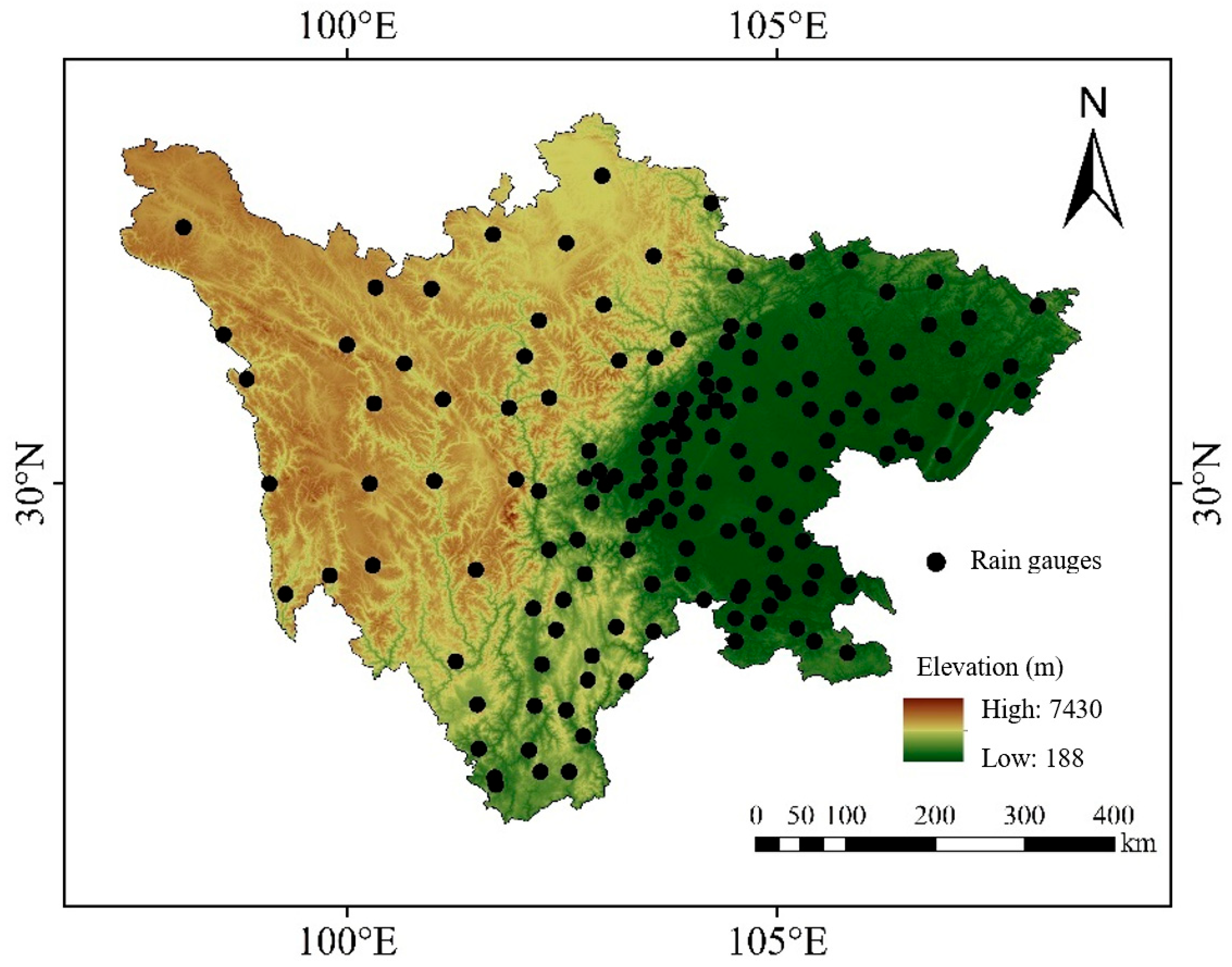
Ground-based precipitation observations were obtained from the National Meteorological Information Center (NMIC) of the China Meteorological Administration (CMA) (http://data.cma.cn/ (accessed on 11 February 2026)), following the principles of data completeness and spatial representativeness. The dataset consists of daily precipitation observations from 156 meteorological stations across Sichuan Province for the period 2015–2020. Due to data transmission uncertainties, observations from 21–30 July 2018 were partially missing; we excluded these days entirely, none of these data were used for training or evaluation. All station data underwent rigorous quality control procedures conducted by CMA to ensure high accuracy and reliability, making them suitable for precipitation evaluation and data fusion analysis. The spatial distribution of the 156 stations is illustrated in Figure 1. For subsequent analysis, daily precipitation records were aggregated and averaged to derive monthly and annual precipitation statistics for each station. These ground-based measurements served as reference data for the accuracy validation of both the satellite precipitation products and the fusion results.
To ensure consistent spatiotemporal matching among the three datasets, we proceeded as follows. For each station location, the corresponding GSMaP and IMERG values were extracted from the nearest 0.1° grid cell, a widely used approach in satellite–gauge comparison studies. All three datasets (GSMaP, IMERG and gauges) were aligned to the common daily period from 1 January 2015 to 31 December 2020. Days on which any of the three sources were missing for a given station were excluded from model training and from the calculation of evaluation metrics for that station and day. This procedure guarantees temporal consistency among the datasets and avoids introducing artificial mismatches due to missing data.

3. Method

3.1. Satellite Precipitation Data Preprocessing

In this study, the satellite precipitation datasets were preprocessed prior to accuracy evaluation. Since there is an inherent spatial representativeness mismatch between the point-based ground observations and the gridded satellite products, a spatial matching procedure was required. Ground meteorological stations are irregularly distributed, whereas satellite precipitation data are provided on a regular grid. To ensure consistency, precipitation values from the satellite datasets were extracted at the grid cell nearest to each ground station (i.e., the nearest-neighbor point-to-grid method). Both satellite products—GSMaP and IMERG—have a spatial resolution of 0.1° × 0.1°, which was retained without any resampling to avoid introducing interpolation errors.

3.2. Transformer Fusion Model

The Transformer model is a deep learning architecture based on the self-attention mechanism, originally proposed by Vaswani [45]. It was developed to overcome the limitations of recurrent neural networks (RNNs) and long short-term memory (LSTM) models, particularly their inefficiency in capturing long-range dependencies within sequential data [46]. Unlike image-based spatiotemporal Transformers that operate on 2-D fields, our model is intentionally kept one-dimensional time- and station-wise, which matches the structure of the available data (co-located daily GSMaP, IMERG and gauge observations) [47]. For each gauge, we construct input sequences by concatenating the two satellite products into a multivariate time series
X t = ( P t G S M a P , P t I M E R G )
and use fixed-length rolling windows X t L + 1 , , X t as model inputs, where L denotes the input sequence length. In this study, we set L = 60 days. This window length provides sufficient temporal context to capture multi-day event persistence and intra-seasonal modulation of satellite retrieval errors, while keeping the model complexity and computational cost manageable. Architecturally, we implement an encoder-only Transformer with 2 encoder layers, 4 attention heads, a hidden dimension of 64, and dropout = 0.1. Standard sinusoidal positional encoding is added to preserve the temporal order within the 60-day window. The encoder output at the last day of the window is passed to a linear layer to predict the fused precipitation for day t. During training, inputs and targets are normalized using Min–Max scaling, with scalers fitted on the training stations only and then applied unchanged to the held-out stations. The model is optimized using Adam (learning rate 1 × 10⁻⁴) to minimize mean squared error (MSE), with a batch size of 32 and training for up to 1000 epochs. Model selection is based on validation loss computed from an internal validation split of the training stations. The Transformer encoder then applies multi-head self-attention along the temporal dimension of the input sequence of shape L × 2 (60 days × two satellite channels), enabling the model to learn: (1) cross-product relationships between GSMaP and IMERG at each day, and (2) multi-day dependencies such as event persistence and seasonal modulation.
Architecturally, we adopt an encoder-only Transformer: several identical encoder blocks, each composed of (1) multi-head self-attention with residual connection and layer normalization, and (2) a position-wise feed-forward sublayer with non-linear activation. Standard sinusoidal positional encodings are added to the input embeddings to retain information about the order of days in the sequence. The hidden representation corresponding to the last time step in the window is passed through a linear output layer to predict the fused precipitation at day t. Model depth (number of encoder layers), the number of attention heads and hidden dimensions are tuned based on validation performance to avoid over-parameterization given the length of the gauge records [48].
We adopt station-wise 3-fold cross-validation to assess spatial generalization of the fusion model across heterogeneous topography and climate conditions within Sichuan. The 156 gauges are randomly partitioned into three mutually exclusive folds at the station level. For each fold, the model is trained using all available rolling-window samples from stations in the other two folds (covering the full period) and evaluated on all samples from the held-out stations. Because the split is performed by station, no rolling windows from the same station can appear in both training and testing, which prevents information leakage due to strong autocorrelation among adjacent windows within a station. All preprocessing steps that could leak information (e.g., normalization/scalers and model-selection decisions) are computed using training stations only and then applied unchanged to the held-out stations.

3.3. Evaluation Metrics

To quantitatively assess the accuracy of satellite-based precipitation datasets, six statistical indicators were employed based on observed precipitation data from 156 meteorological stations across Sichuan Province during 2015–2020. The evaluation was performed at annual, monthly, and daily scales to capture multi-temporal performance characteristics. The selected metrics include the Correlation Coefficient (CC), Bias, Root Mean Square Error (RMSE), Probability of Detection (POD), False Alarm Ratio (FAR), and Critical Success Index (CSI) [49]. These indices collectively evaluate both the continuous error characteristics (CC, Bias, RMSE) and the categorical precipitation detection performance (POD, FAR, CSI). The mathematical formulations of each metric are summarized in Table 1.

4. Results and Discussion

4.1. Accuracy Evaluation of the GSMaP Product

4.1.1. Daily-Scale Evaluation

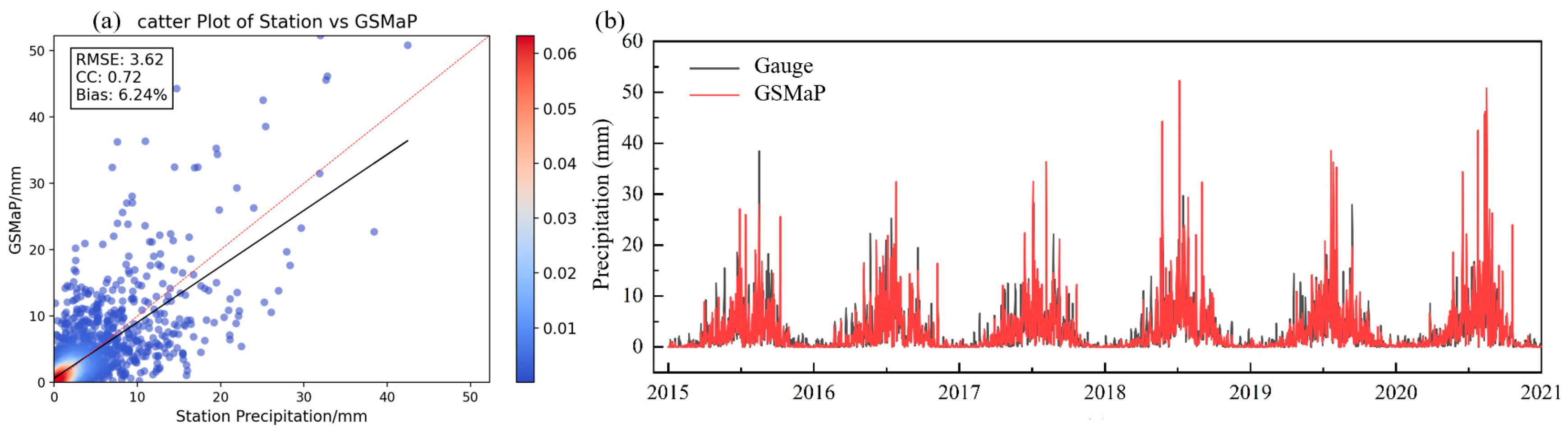
Using the mean daily precipitation observations from meteorological stations as reference data, the GSMaP precipitation estimates for the period 2015–2020 were quantitatively evaluated through simple linear regression analysis. As shown in Figure 2, the GSMaP product exhibits a significant positive correlation with ground-based observations (CC = 0.72, p < 0.001), with a Bias of 6.24% and a RMSE of 3.62 mm. These results indicate that the GSMaP dataset tends to slightly overestimate precipitation on the daily scale. The time series analysis further reveals that the temporal variations in GSMaP precipitation are generally consistent with ground observations, both showing distinct seasonal patterns characterized by less precipitation in spring and winter and abundant rainfall in summer and autumn, which aligns well with the typical monsoon-driven climate of Sichuan Province. However, it is noteworthy that during the rainy season, GSMaP consistently reports higher precipitation values than those observed at the stations, suggesting a systematic overestimation during heavy rainfall events. This bias may be attributed to satellite retrieval uncertainties under complex topographic and convective conditions. Overall, GSMaP captures the temporal variability and seasonal dynamics of daily precipitation over Sichuan Province reasonably well during 2015–2020.

4.1.2. Monthly-Scale Evaluation

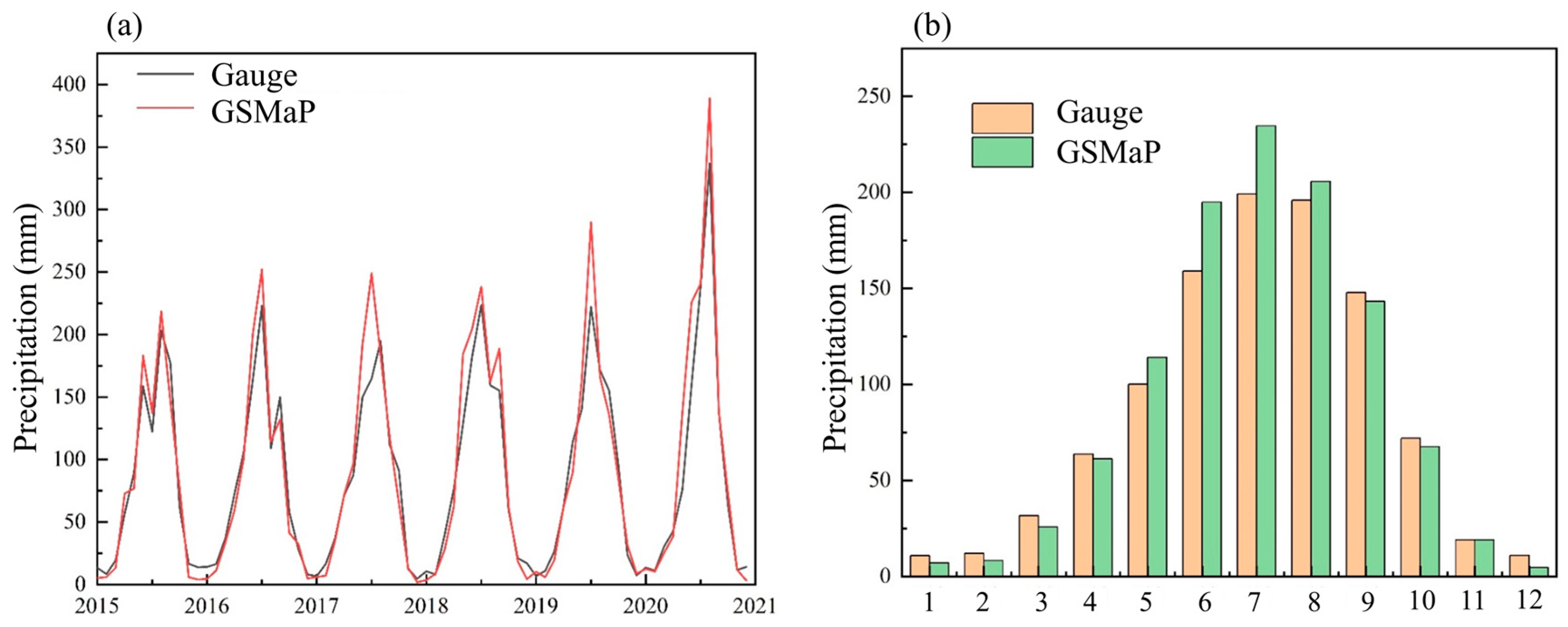
At the monthly scale, GSMaP precipitation estimates show a strong linear relationship with ground-based observations (CC = 0.83, Bias = 6.24%, RMSE = 60.64 mm, p < 0.001), indicating good applicability for monthly precipitation assessment. GSMaP tends to exhibit a slight overall overestimation, with errors mainly concentrated in the rainy season. For example, in July 2017, GSMaP overestimated precipitation by 84.35 mm, while an underestimation of 30.65 mm occurred in September 2015. Despite these deviations, the overall temporal variation in GSMaP precipitation closely follows that of ground observations, effectively capturing the monthly-scale fluctuation patterns of regional rainfall.
Seasonally, precipitation in Sichuan Province exhibits pronounced monsoonal characteristics, with abundant rainfall in summer and autumn and limited precipitation in winter and spring (Figure 3). The largest discrepancy occurred in June, where GSMaP exceeded station observations by 35.84 mm, while the smallest difference appeared in November (a minor overestimation of 0.03 mm). In general, larger errors were observed during the rainy months (May–August), whereas deviations during the dry season were substantially smaller. This pattern likely arises because satellite retrievals are more sensitive to localized heavy rainfall events, leading to cumulative overestimation during the wet season, whereas weaker sensitivity to light rainfall in dry months tends to cause slight underestimation.

4.1.3. Spatial-Scale Evaluation

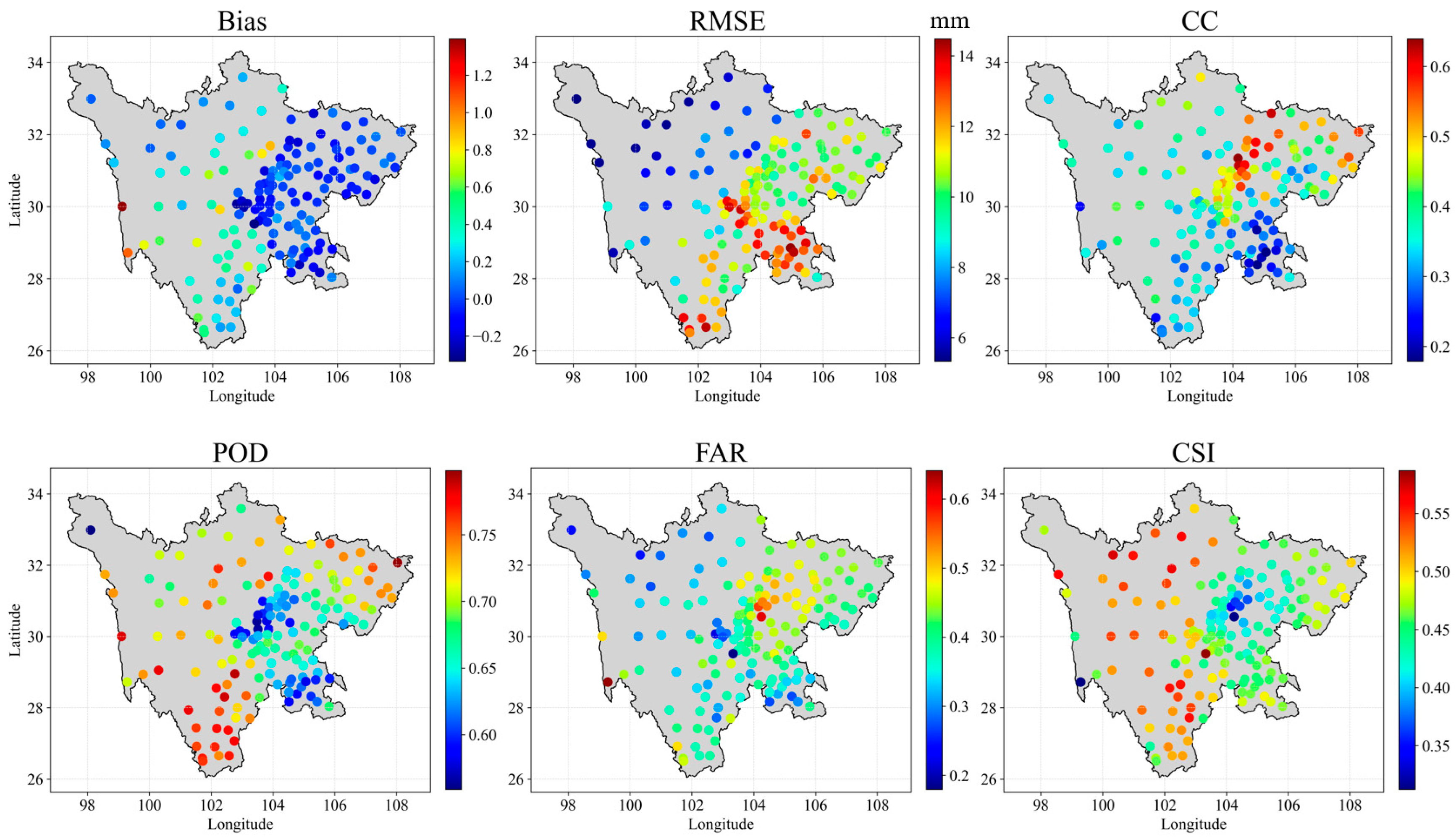
At the spatial scale, the Bias between GSMaP-derived and ground-observed daily precipitation exhibits considerable variation across the 156 meteorological stations. Results show that 58% (91 stations) have positive Bias values, while 42% (65 stations) show negative Bias, indicating that GSMaP generally tends to overestimate precipitation. In the western Sichuan Plateau, several stations recorded Bias values exceeding 100%, likely due to abnormal ground observations on certain dates that led to overestimation by the satellite product. Stations with smaller Bias are mainly distributed in the eastern Sichuan Basin, suggesting higher retrieval accuracy of GSMaP in relatively flat terrains. The RMSE ranges approximately from 6 to 14 mm across stations. Higher RMSE values are mainly observed in the southeastern plains and southern hilly areas, whereas lower RMSE values occur in the western and northern plateau regions. The CC generally falls between 0.20 and 0.60, with higher CC values concentrated in the central and northeastern basin, and lower CC values primarily located in the southeastern plains.
Overall, analysis of the three metrics—CC, Bias, and RMSE—reveals distinct spatial patterns. The eastern basin shows relatively high correlations and small Bias, but moderately large RMSE, indicating residual discrepancies between GSMaP and station data. The southeastern region exhibits near-optimal Bias yet weak correlations and larger errors. In contrast, the western plateau region generally performs poorer across all three indicators but maintains internal consistency among them. In summary, GSMaP precipitation data demonstrate reasonable spatial agreement with ground-based observations across most of Sichuan Province and effectively capture the spatial distribution characteristics of regional precipitation.
Figure 4 illustrates the spatial distribution of the three categorical detection metrics—Probability of Detection (POD), False Alarm Ratio (FAR), and Critical Success Index (CSI)—for GSMaP precipitation data over Sichuan Province. The results reveal clear spatial variability in GSMaP’s precipitation detection capability. Stations with higher POD values are primarily distributed in the western and southern plateau regions of Sichuan, indicating stronger detection performance in these areas. In contrast, lower POD values are mainly observed in the central and southeastern basin, where station density is higher and local convective precipitation is more complex, resulting in reduced detection efficiency. The FAR values are generally low and spatially homogeneous, though slightly higher across the basin, suggesting that GSMaP exhibits a relatively low false-alarm tendency and performs well in minimizing false detections. The CSI, which integrates both POD and FAR to represent overall detection performance, shows high values in the western plateau and low values in the eastern plains, indicating stronger detection reliability in the highland regions.
Overall, the spatial distribution of these three metrics demonstrates distinct spatial heterogeneity in GSMaP’s detection capability. The western plateau region generally achieves higher detection accuracy and consistency, whereas the eastern basin and plains exhibit relatively lower detection skill, reflecting the influence of topographic complexity and precipitation type variability across Sichuan Province.

4.2. IMERG Product Accuracy Evaluation

4.2.1. Daily-Scale Evaluation

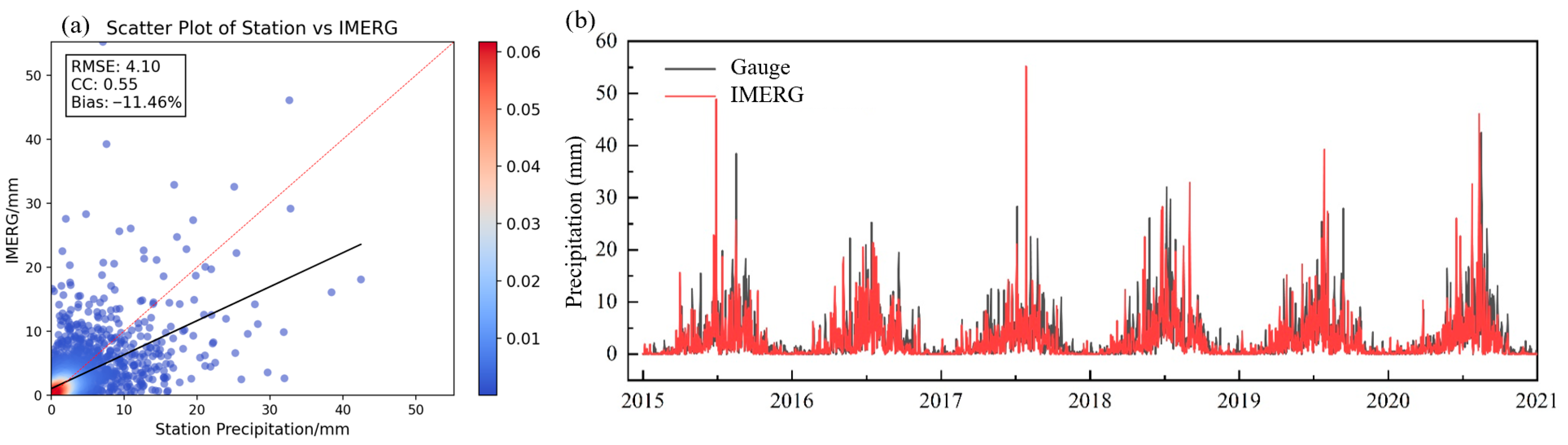
At the daily scale, the IMERG precipitation estimates show a moderate correlation with ground-based observations, with a CC of 0.55 and statistical significance (p < 0.001) (Figure 5). The Bias is −11.46%, and the RMSE is 4.10 mm, indicating that IMERG generally underestimates daily precipitation over Sichuan Province. Compared with the GSMaP product, IMERG exhibits slightly lower accuracy, with weaker correlation, larger systematic deviation, and higher random error. Quantitative comparison reveals that GSMaP outperforms IMERG in terms of correlation strength, bias control, and numerical stability, demonstrating superior capability in capturing precipitation intensity and daily variability. These findings suggest that GSMaP is more suitable for representing daily precipitation dynamics in the complex terrain of Sichuan Province.
To further assess the temporal consistency between IMERG and ground-based precipitation data, daily time series for 2015–2020 were compared (Figure 5). The results show that both datasets exhibit similar temporal variation patterns, characterized by less precipitation in spring and winter and increased rainfall in summer and autumn, consistent with the typical monsoon climate of Sichuan Province. Interannual fluctuations indicate alternating overestimation and underestimation, with an overall tendency toward underestimation. During the rainy season, IMERG exhibits stronger temporal fluctuations than ground observations, reflecting systematic and persistent biases under intense rainfall conditions. Overall, IMERG effectively reproduces the seasonal cycle of daily precipitation, though it tends to underestimate heavy rainfall. Compared with GSMaP, IMERG performs moderately well in capturing temporal variability but shows weaker skill in intensity estimation and error control.

4.2.2. Monthly-Scale Evaluation

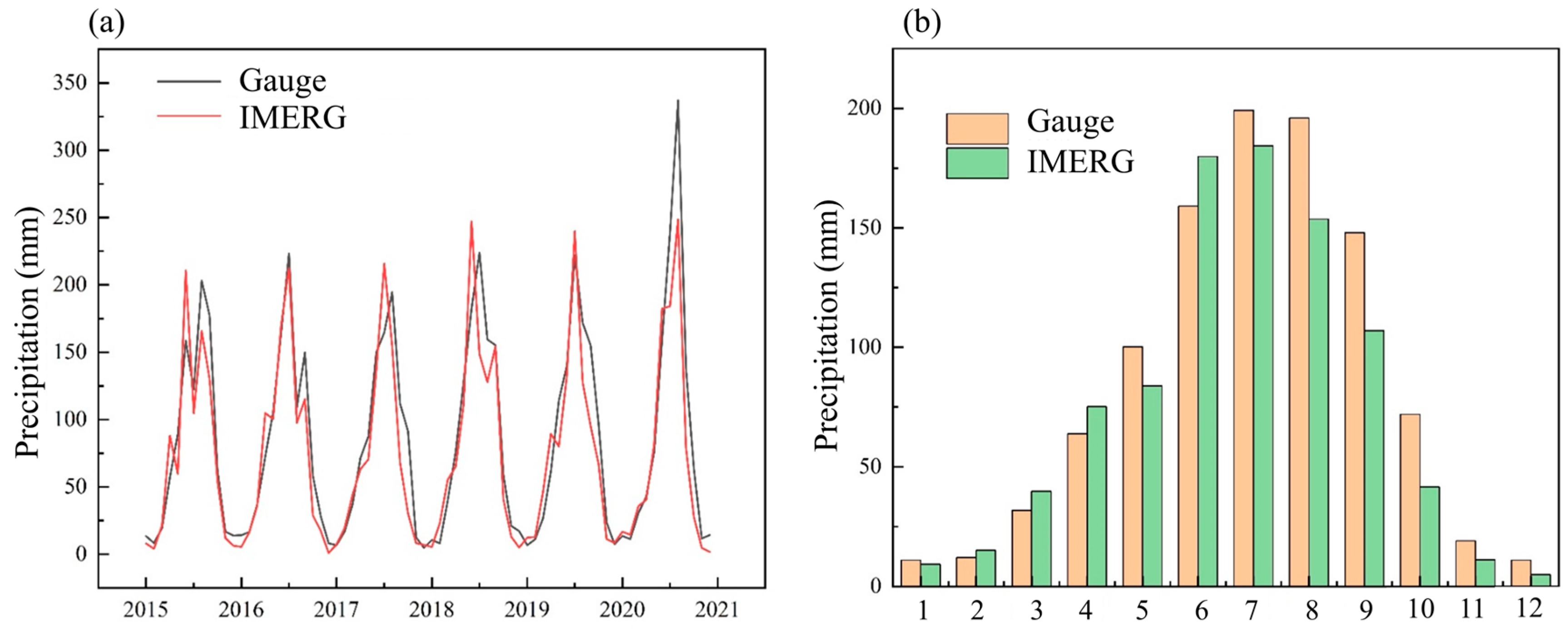
At the monthly scale, the temporal variations in IMERG precipitation also show good agreement with station observations (Figure 6). IMERG successfully captures the monthly precipitation dynamics, although errors are mainly concentrated in the rainy months and are predominantly negative. For instance, in August 2020, IMERG underestimated precipitation by 88.38 mm, while during the rainy seasons of 2015, 2017, and 2018, it overestimated by 52.21 mm, 51.18 mm, and 64.66 mm, respectively. The largest monthly bias occurred in August (−42.26 mm), whereas the smallest appeared in January (−1.67 mm). Larger discrepancies were generally found during the rainy season, while deviations were smaller during dry months, suggesting that IMERG maintains higher estimation stability under low-precipitation conditions.
Overall, IMERG still exhibits greater total error levels than GSMaP, with a systematic underestimation during the main rainy season (July–September). This bias likely arises from IMERG’s multi-sensor fusion algorithm, which may have limited sensitivity to localized heavy rainfall events, and from its 0.5 h temporal resolution, which may not fully capture the rapid evolution of short-duration intense rainfall. A quantitative comparison between the two satellite products confirms that, at the monthly scale, GSMaP outperforms IMERG. GSMaP achieves a higher correlation coefficient, a lower Bias (6.24%), and a smaller RMSE (60.64 mm), demonstrating better stability and reliability in estimating monthly precipitation across Sichuan Province. In summary, GSMaP shows greater potential for capturing both seasonal rainfall variability and rainy-season intensity in regions with complex topography.

4.2.3. Spatial-Scale Evaluation

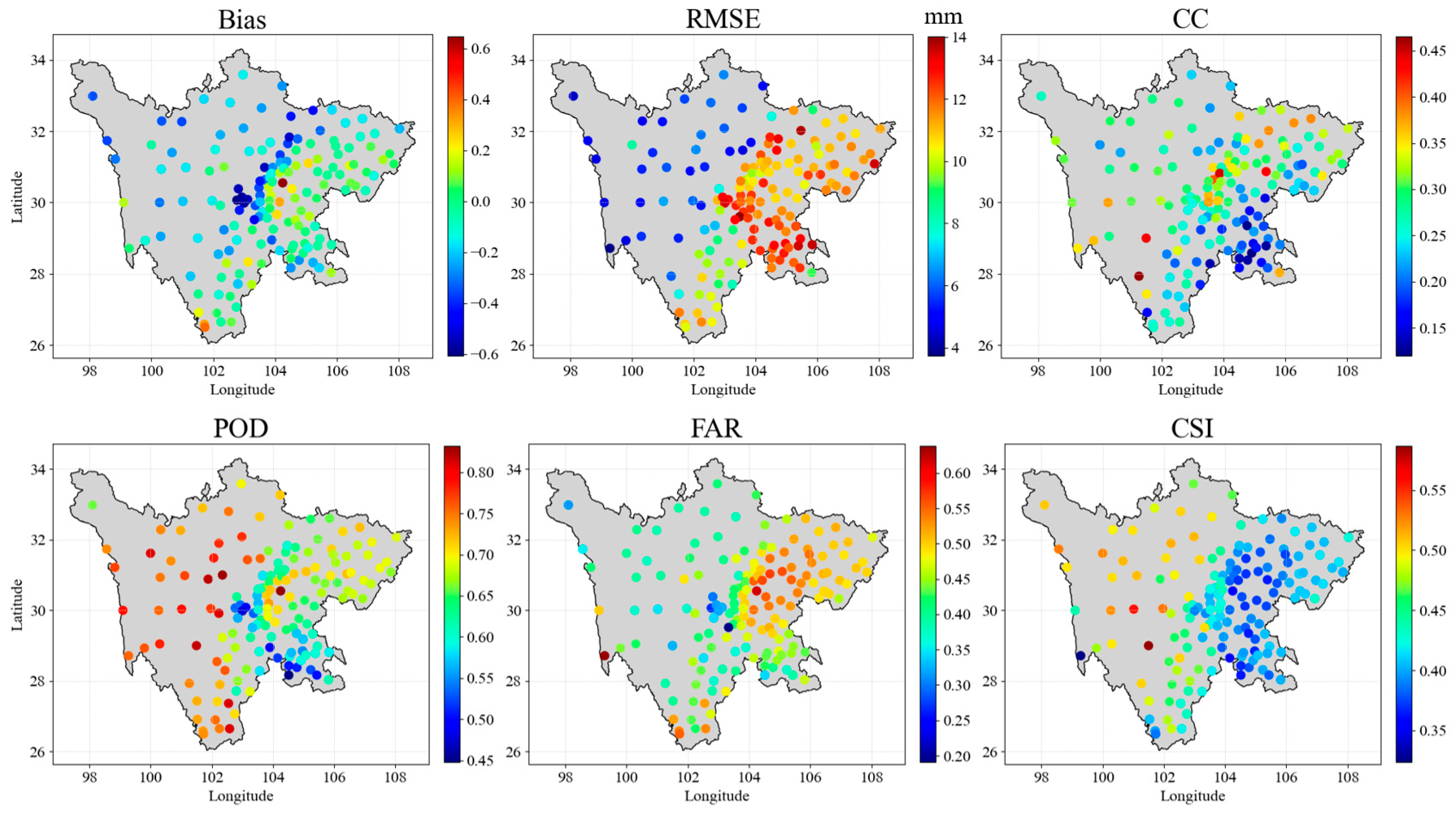
At the spatial scale, the Bias between IMERG-estimated and ground-observed daily precipitation shows relatively small fluctuations across the 156 meteorological stations. Among them, 67% (104 stations) have negative Bias values, and 33% (52 stations) show positive Bias, with most positive values below 0.4, indicating that IMERG generally underestimates precipitation, while severe overestimation is rare. Only a few stations in southern Sichuan exhibit Bias values exceeding 60%, likely related to local observational anomalies. The spatial distribution of Bias is relatively uniform: values are close to optimal in the eastern basin, while moderate underestimation is observed in the central hilly region. The RMSE ranges from 4 to 14 mm, with higher values primarily distributed in the eastern and southern plains, particularly in station-dense areas. Lower RMSE values occur in the western and northern plateau regions, indicating better estimation accuracy in those areas. The CC ranges between 0.15 and 0.45, with higher correlations found in the central hills and northeastern plains, while lower values are mainly located in the southeastern plains.
Overall, analysis of the three indicators (CC, Bias, and RMSE) reveals distinct spatial differences. In the eastern plain region, although Bias values are close to optimal, the RMSE remains relatively large, suggesting considerable residual errors in IMERG’s precipitation estimates. In contrast, the western plateau region shows higher CC values and near-optimal Bias and RMSE, indicating good internal consistency among the metrics. Generally, IMERG exhibits reasonable spatial agreement with ground observations across most of Sichuan Province, and its spatial distribution patterns are broadly consistent with those of GSMaP, though overall accuracy—especially correlation strength—is lower than that of GSMaP.
Figure 7 illustrates the spatial distribution of the three categorical detection metrics—POD, FAR, and CSI—for IMERG precipitation data across the 156 meteorological stations in Sichuan Province. The results show evident regional differences in IMERG’s precipitation detection performance. Stations with higher POD values are mainly distributed in the central and western plateau regions, while lower POD values are observed in the southeastern plains, indicating that IMERG demonstrates better precipitation detection capability in complex topographic regions. The FAR is generally high across the province, with particularly elevated values in the northeastern plains, suggesting that IMERG tends to produce more false alarms, especially in densely populated lowland areas. The CSI, which synthesizes both POD and FAR to represent overall detection performance, shows higher values in the central and western plateau regions and lower values in the eastern plains, implying that IMERG’s comprehensive detection skill is stronger in high-relief areas but weaker in flatter terrains.
Overall, the spatial distribution of the three detection metrics indicates distinct regional disparities in IMERG’s detection capability, characterized by lower skill in the eastern plains and better detection performance in the central–western plateau regions. The three indices exhibit consistent spatial patterns, confirming that IMERG performs more reliably in mountainous regions than in the low-lying eastern basin.

4.3. Fusion Precipitation Data Based on the Transformer Model

4.3.1. Daily- and Monthly-Scale Accuracy Evaluation

At the daily scale, the fused precipitation data and ground-based observations show a correlation coefficient (CC) of 0.64, a bias (Bias) of 5.21%, and a root mean square error (RMSE) of 3.83 mm, indicating that the fused precipitation data overall exhibit an overestimation tendency.
Table 2 presents the error evaluation results of the three precipitation datasets at the daily scale and monthly scales. Compared with the GSMaP precipitation product, the Transformer-fused data show a slightly lower CC, while the RMSE remains stable and the Bias is slightly reduced. Overall, the fused product provides a compromise between GSMaP and IMERG at the daily scale: it reduces Bias relative to both products, improves RMSE relative to IMERG, but its daily CC remains slightly lower than GSMaP. Compared with IMERG, the fused product shows consistent improvements in correlation, bias and RMSE, indicating enhanced ability to capture both the temporal variability and magnitude of precipitation, especially at the monthly scale. Although the correlation coefficient of the fused data is slightly lower than that of GSMaP at the daily scale, the reductions in Bias and RMSE suggest that the Transformer-based fusion method offers advantages in controlling systematic errors and dispersion, rather than a uniform improvement in all metrics. These results suggest that the Transformer-based fusion offers advantages in controlling systematic errors and reducing dispersion in aggregated statistics, rather than uniformly improving all metrics at the daily scale. These properties make the fused dataset a promising input for regional hydrological modeling and disaster prevention over the complex terrain of Sichuan Province, while acknowledging that it does not completely outperform both original products in every aspect.
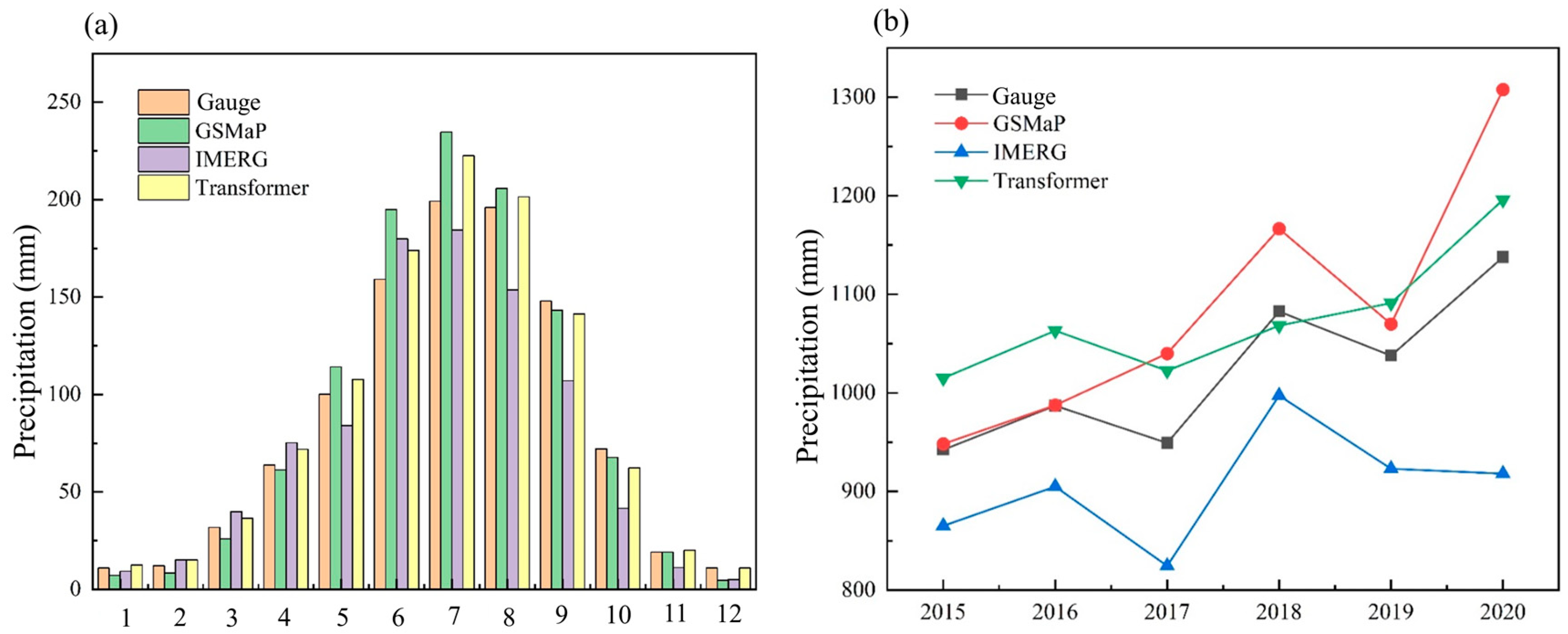
To further verify the performance of the fused data at the monthly scale, the monthly precipitation series from 2015 to 2020 were analyzed (Figure 8). The results show that the temporal trends of the fused data and ground observations are highly consistent, both exhibiting the typical seasonal pattern of Sichuan Province—less precipitation in spring and winter, and abundant rainfall in summer and autumn. Errors are mainly concentrated in the rainy season and are dominated by overestimation, with 2019 showing the most pronounced deviation (a 59.97 mm overestimation in July), while errors in other years are relatively small (all less than 26 mm). Overall, the fused product reproduces the dynamic evolution of precipitation well and shows good temporal consistency. As shown in Figure 9, the largest monthly error occurs in August (an overestimation of 23.29 mm), while the smallest is in December (an underestimation of only 0.06 mm). The larger errors are concentrated in the rainy season, whereas the dry-season errors are much smaller. The overall error magnitude is lower than that of GSMaP and IMERG. The typical patterns of GSMaP overestimation and IMERG underestimation are both improved after fusion. Although slight overestimation remains during the rainy season, the fused series better matches the observed seasonal cycle and reduces systematic bias.
Further statistical comparison of the three datasets at the monthly scale (Table 2) shows that the Transformer-fused data achieve the highest correlation coefficient and the lowest Bias and RMSE, representing the best overall accuracy. The fused product exhibits smaller error dispersion and lower systematic bias, suggesting greater stability and precision in precipitation estimation. In summary, the Transformer-fused data demonstrate significantly better performance than the single-source GSMaP and IMERG products in estimating monthly precipitation across Sichuan Province, providing a more accurate reflection of the spatiotemporal characteristics of regional rainfall.

4.3.2. Spatial-Scale Accuracy Evaluation of the Fused Data

Building on the temporal-scale evaluation in Section 4.3.1, and the pronounced spatial heterogeneity in detection and error characteristics diagnosed for GSMaP and IMERG in Section 4.1 and Section 4.2, we further assess the fusion performance from a spatial perspective. The region-dependent skill patterns observed for the original products motivate a data-driven fusion strategy that can learn nonlinear and site-dependent relationships from co-located satellite–gauge samples. Here, we examine whether the Transformer-based fusion mitigates these regional contrasts and yields a more spatially consistent accuracy pattern across Sichuan.
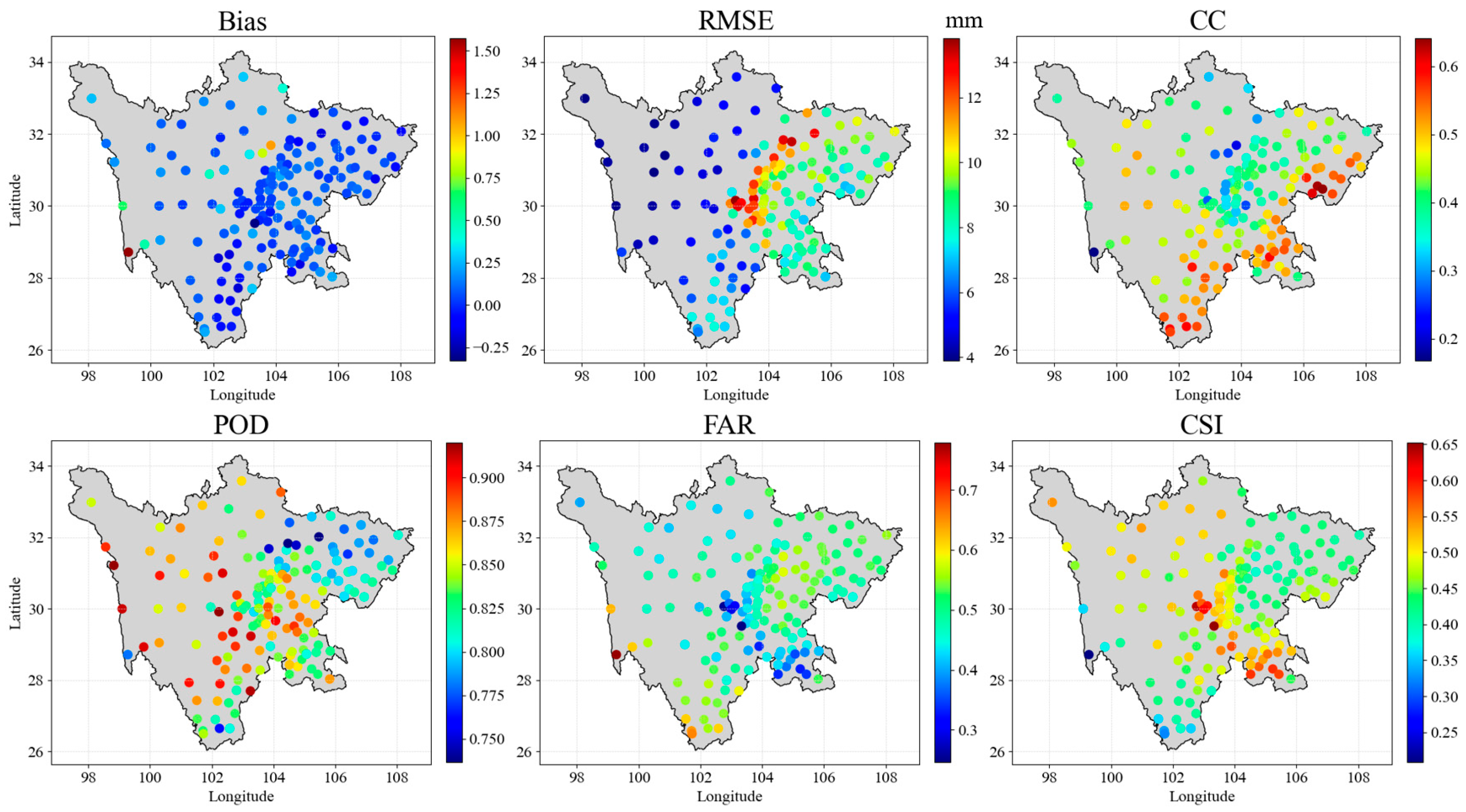
Figure 9 illustrates the spatial distribution characteristics of the daily precipitation accuracy for the Transformer-fused data compared with ground observations. Overall, the Bias exhibits a relatively small fluctuation range. Among the 156 meteorological stations, 74% (115 stations) have positive Bias values, while 26% (41 stations) show negative Bias values, with most negative values greater than −0.2. This indicates that the fused data generally tend to overestimate precipitation, but stations with excessive overestimation are few. A few stations show relatively large positive biases, which may be associated with abnormal observations or localized extreme rainfall events. The spatial distribution of Bias is generally uniform, with most stations showing values close to the optimal level. The RMSE ranges between 4 and 12 mm, with higher values mainly observed in the eastern plain regions where station density is greater, while lower RMSE values occur in the western and central plateau areas, indicating better estimation accuracy in these regions. The station-wise CC ranges from 0.20 to 0.60, indicating low-to-moderate correlation overall, with lower values mainly occurring in parts of the eastern plains.
Overall, these spatial patterns suggest that the fused product provides reasonable agreement with gauge observations across Sichuan, while retaining some tendency toward slight overestimation. Importantly for the study logic, the fusion is intended to reduce the region-dependent discrepancies diagnosed for the original products; consistent with this goal, the fused Bias pattern is comparatively more spatially uniform and closer to zero at most stations. In line with the temporal-scale results (Section 4.3.1), the daily-scale performance of the fusion should be interpreted as a compromise between GSMaP and IMERG: Bias is alleviated relative to both products, RMSE is improved relative to IMERG, while daily correlation remains comparable but may be slightly lower than GSMaP at some stations.
Figure 9 shows the spatial distribution of the three categorical detection metrics: POD, FAR, and CSI, for the Transformer-fused precipitation data across the 156 meteorological stations in Sichuan Province. Overall, the POD values are generally high, with most stations performing well. Only stations in the northeastern plain region exhibit relatively low POD values, indicating that the fused data possess strong precipitation detection capability in most parts of the province. The FAR shows a moderate overall level and a relatively uniform spatial distribution, with slightly lower values in the southeastern plains, where performance is the best. This suggests that the fused product is less affected by spatial factors in precipitation estimation. The CSI values are relatively uniform overall, with higher values mainly concentrated in the southeastern plains, while differences among other regions are small. Only a few stations in the southwestern plateau region exhibit notably low CSI values, possibly related to localized extreme rainfall events or observation anomalies. Overall, the spatial distribution of the three indicators shows that the Transformer-fused product provides a more homogeneous detection performance than the original satellite datasets, characterized by higher POD and CSI values and lower FAR, which aligns with the expected positive and negative correlations among the three metrics.
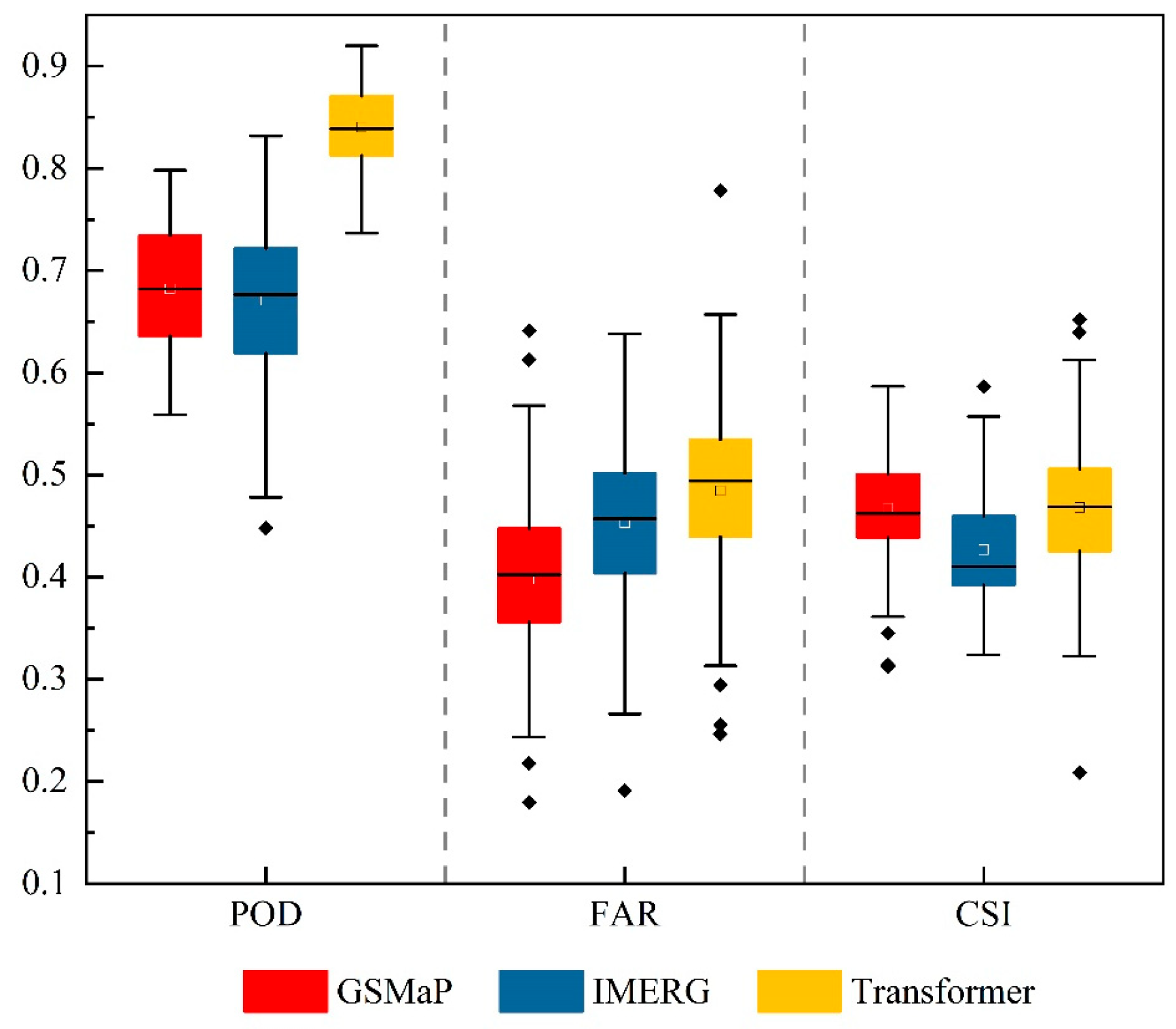
To further quantify the differences in detection performance, boxplots of the three metrics were generated for comparative analysis (Figure 10). For the fused dataset, the POD ranges approximately from 0.80 to 0.875, with a median of about 0.85, indicating a relatively high and spatially consistent sensitivity to precipitation events. The FAR ranges from about 0.45 to 0.55, with four outliers, and a median close to 0.50, which means that false alarms remain frequent and the overall false-alarm rate is still relatively high. The CSI ranges from roughly 0.425 to 0.50, with three outliers and a median of about 0.475, reflecting moderate overall event-detection skill rather than very high performance.
A comparison of the three precipitation datasets shows that, after Transformer-based fusion, the spatial distributions of POD, FAR and CSI become more homogeneous, and the strong regional contrasts seen in the original GSMaP and IMERG products are noticeably reduced. Combined with the boxplot analysis, this indicates that the fused data set exhibits a clear enhancement in detection sensitivity (higher POD) and more spatially uniform CSI, while the FAR does not decrease and is slightly higher in some areas. In other words, the fusion mainly improves the ability to detect precipitation events (sensitivity), at the expense of maintaining a relatively high false-alarm rate. Thus, the Transformer-based fusion yields a more sensitive and spatially consistent detector, but it does not substantially improve false-alarm control or event-level discriminative power, which should be kept in mind when interpreting the detection metrics.
In general, the Transformer-based fusion of GSMaP and IMERG mainly enhances the sensitivity and spatial consistency of precipitation event detection, while the false-alarm rate remains relatively high. Overall, the fused product provides a useful compromise between the two original satellite datasets, offering more stable statistics at aggregated (e.g., monthly) scales and improved bias characteristics over the complex terrain of Sichuan Province. These properties make the fused dataset a promising input for refined precipitation monitoring, hydrological simulation and disaster prevention studies in the region, although it does not fully resolve all limitations of the original satellite products.

5. Conclusions

Based on daily precipitation observations from 156 meteorological stations across Sichuan Province during 2015–2020, this study selected two high-resolution satellite precipitation products, GSMaP and IMERG, and applied a Transformer deep learning model to perform multi-source data fusion, thereby constructing a fused precipitation dataset with improved bias characteristics. Through systematic comparisons of the three datasets at daily, monthly, and spatial scales, the study evaluated their accuracy and detection capabilities in Sichuan’s complex topographic regions. The results provide both a data foundation and methodological reference for improving the applicability of satellite precipitation products in mountainous areas and supporting regional hydrological and climate studies. The main conclusions are as follows:
(1)
All three datasets effectively capture the seasonal precipitation regime of Sichuan, characterized by “more in summer and less in winter”. At the daily scale, the correlation coefficients of GSMaP, IMERG and the fused product are 0.72, 0.55 and 0.64, respectively; at the monthly scale, they increase to 0.83, 0.75 and 0.89. GSMaP and the fused product show slight overestimation (Bias = 6.24% and 5.21%), whereas IMERG underestimates precipitation (Bias = −11.46%). Overall, the fused data achieve comparable correlation to GSMaP at the daily scale, with smaller systematic bias than both GSMaP and IMERG, and show the best performance across correlation, bias and RMSE at the monthly scale, indicating clearer added value of the fusion at aggregated time scales.
(2)
At the spatial scale, the fused product generally exhibits reduced bias and RMSE and more homogeneous spatial patterns compared with the two original products, particularly over complex terrain. The detection metrics (POD, FAR and CSI) indicate that the fused dataset has higher POD and slightly improved CSI, and that the spatial distribution of detection skill becomes more uniform across the province. FAR remains at a relatively high level and is comparable to that of the original products, implying that the main gain of the fusion lies in enhanced event sensitivity and spatial consistency, rather than in substantially reduced false alarms.
(3)
The Transformer-based fusion approach demonstrates that station-scale fusion of near-real-time GSMaP-GNRT and IMERG-Early is feasible and provides added value in several key aspects, especially in terms of bias reduction, improved monthly statistics and enhanced detection sensitivity. While the fused product does not outperform the original satellite products in every metric and at every scale, it offers a useful compromise that combines their complementary strengths and yields a more balanced precipitation dataset over Sichuan’s complex terrain. This fused dataset represents a promising input for refined precipitation monitoring, hydrological modeling and disaster risk assessment in Sichuan and similar mountainous regions.
The fused product still shows limitations, particularly for event-scale variability in complex terrain. Although systematic bias is reduced, daily correlations remain low-to-moderate at many stations, suggesting residual timing/intensity errors. In addition, the model is trained and validated within Sichuan (2015–2020) using station-wise cross-validation; therefore, generalization to other regions, periods, or satellite versions warrants further verification.

Author Contributions

Conceptualization, Y.G., W.X. and Z.G.; methodology, W.X. and Z.Z.; software, J.G.; validation, C.Z. and L.Z.; formal analysis, Z.G., Y.G., L.W. and W.X.; writing—original draft preparation, Y.G. and W.X.; writing—review and editing, Z.G.; funding acquisition, Y.G., Z.G. and L.Z.; All authors have read and agreed to the published version of the manuscript.

Funding

This research was funded by the Science and Technology Projects (XZ202501ZY0145) of Xizang Autonomous Region, and the Natural Science Foundation Youth Project (2024NSFSC0984) from Science and Technology Department of Sichuan Province.

Data Availability Statement

Data will be made available on request.

Conflicts of Interest

The authors declare that they have no known competing financial interests or personal relationships that could have appeared to influence the work reported in this paper.

References

  1. Li, S.; Chen, Y.; Wei, W.; Fang, G.; Duan, W. The increase in extreme precipitation and its proportion over global land. J. Hydrol. 2024, 628, 130456. [Google Scholar] [CrossRef]
  2. Du, J.; Zhou, L.; Yu, X.; Ding, Y.; Zhang, Y.; Wu, L.; Ao, T. Understanding precipitation concentration changes, driving factors, and responses to global warming across mainland China. J. Hydrol. 2024, 645, 132164. [Google Scholar] [CrossRef]
  3. Gupta, V.; Singh, V.; Jain, M.K. Assessment of precipitation extremes in India during the 21st century under SSP1-1.9 mitigation scenarios of CMIP6 GCMs. J. Hydrol. 2020, 590, 125422. [Google Scholar] [CrossRef]
  4. Zhou, L.; Koike, T.; Takeuchi, K.; Rasmy, M.; Onuma, K.; Ito, H.; Selvarajah, H.; Liu, L.; Li, X.; Ao, T. A study on availability of ground observations and its impacts on bias correction of satellite precipitation products and hydrologic simulation efficiency. J. Hydrol. 2022, 610, 127595. [Google Scholar] [CrossRef]
  5. Liu, M.; Wang, H.; Zhai, H.; Zhang, X.; Shakir, M.; Ma, J.; Sun, W. Identifying thresholds of time-lag and accumulative effects of extreme precipitation on major vegetation types at global scale. Agric. For. Meteorol. 2024, 358, 110239. [Google Scholar] [CrossRef]
  6. Fu, Y.; Wu, Q. Recent emerging shifts in precipitation intensity and frequency in the global tropics observed by satellite precipitation data sets. Geophys. Res. Lett. 2024, 51, e2023GL107916. [Google Scholar] [CrossRef]
  7. Liu, Y.; Wei, Z.; Yang, B.; Cui, Y. An unsupervised adaptive fusion framework for satellite-based precipitation estimation without gauge observations. J. Hydrol. 2025, 646, 132341. [Google Scholar] [CrossRef]
  8. Liu, Q.; Yao, X. Evaluation of CLDAS and GPM precipitation products over the Tibetan Plateau in summer 2005–2021 based on hourly rain gauge observations. J. Meteorol. Res. 2024, 38, 749–767. [Google Scholar] [CrossRef]
  9. Eini, M.R.; Olyaei, M.A.; Kamyab, T.; Teymoori, J.; Brocca, L.; Piniewski, M. Evaluating three non-gauge-corrected satellite precipitation estimates by a regional gauge interpolated dataset over Iran. J. Hydrol. Reg. Stud. 2021, 38, 100942. [Google Scholar] [CrossRef]
  10. Sapiano, M.; Arkin, P. An intercomparison and validation of high-resolution satellite precipitation estimates with 3-hourly gauge data. J. Hydrometeorol. 2009, 10, 149–166. [Google Scholar] [CrossRef]
  11. Sinclair, S.; Pegram, G. Combining radar and rain gauge rainfall estimates using conditional merging. Atmos. Sci. Lett. 2005, 6, 19–22. [Google Scholar] [CrossRef]
  12. Tan, J.; Huffman, G.J.; Song, Y. Automated quality control scheme for GPM satellite precipitation products. Geophys. Res. Lett. 2024, 51, e2024GL108963. [Google Scholar] [CrossRef]
  13. Wehbe, Y.; Temimi, M.; Adler, R.F. Enhancing precipitation estimates through the fusion of weather radar, satellite retrievals, and surface parameters. Remote Sens. 2020, 12, 1342. [Google Scholar] [CrossRef]
  14. Islam, M.A.; Yu, B.; Cartwright, N. Assessment and comparison of five satellite precipitation products in Australia. J. Hydrol. 2020, 590, 125474. [Google Scholar] [CrossRef]
  15. Miao, C.; Ashouri, H.; Hsu, K.-L.; Sorooshian, S.; Duan, Q. Evaluation of the PERSIANN-CDR daily rainfall estimates in capturing the behavior of extreme precipitation events over China. J. Hydrometeorol. 2015, 16, 1387–1396. [Google Scholar] [CrossRef]
  16. Tian, P.; Lu, H.; Feng, W.; Guan, Y.; Xue, Y. Large decrease in streamflow and sediment load of Qinghai–Tibetan Plateau driven by future climate change: A case study in Lhasa River Basin. Catena 2020, 187, 104340. [Google Scholar] [CrossRef]
  17. Hisam, E.; Mehr, A.D.; Alganci, U.; Seker, D.Z. Comprehensive evaluation of Satellite-Based and reanalysis precipitation products over the Mediterranean region in Turkey. Adv. Space Res. 2023, 71, 3005–3021. [Google Scholar] [CrossRef]
  18. Lv, X.; Guo, H.; Tian, Y.; Meng, X.; Bao, A.; De Maeyer, P. Evaluation of GSMaP version 8 precipitation products on an hourly timescale over mainland China. Remote Sens. 2024, 16, 210. [Google Scholar] [CrossRef]
  19. Tang, S.; Li, R.; He, J.; Fan, X.; Wang, H.; Yao, S. Seasonal error component analysis of the GPM IMERG version 05 precipitation estimations over Sichuan basin of China. Earth Space Sci. 2021, 8, e2020EA001259. [Google Scholar] [CrossRef]
  20. Tang, X.; Li, H.; Qin, G.; Huang, Y.; Qi, Y. Evaluation of satellite-based precipitation products over complex topography in mountainous Southwestern China. Remote Sens. 2023, 15, 473. [Google Scholar] [CrossRef]
  21. Jiang, Y.; Yang, K.; Li, X.; Zhang, W.; Shen, Y.; Chen, Y.; Li, X. Atmospheric simulation-based precipitation datasets outperform satellite-based products in closing basin-wide water budget in the eastern Tibetan Plateau. Int. J. Climatol. 2022, 42, 7252–7268. [Google Scholar] [CrossRef]
  22. Li, D.; Min, X.; Xu, J.; Xue, J.; Shi, Z. Assessment of three gridded satellite-based precipitation products and their performance variabilities during typhoons over Zhejiang, southeastern China. J. Hydrol. 2022, 610, 127985. [Google Scholar] [CrossRef]
  23. Lyu, X.; Li, Z.; Li, X. Evaluation of gpm imerg satellite precipitation products in event-based flood modeling over the sunshui river basin in southwestern china. Remote Sens. 2024, 16, 2333. [Google Scholar] [CrossRef]
  24. Li, K.; Tian, F.; Khan, M.Y.A.; Xu, R.; He, Z.; Yang, L.; Lu, H.; Ma, Y. A high-accuracy rainfall dataset by merging multiple satellites and dense gauges over the southern Tibetan Plateau for 2014–2019 warm seasons. Earth Syst. Sci. Data 2021, 13, 5455–5467. [Google Scholar] [CrossRef]
  25. Nan, T.; Chen, J.; Ding, Z.; Li, W.; Chen, H. Deep learning-based multi-source precipitation merging for the Tibetan Plateau. Sci. China Earth Sci. 2023, 66, 852–870. [Google Scholar] [CrossRef]
  26. Sun, J.; Li, X.; Yang, Q. Multi-source precipitation product fusion strategy based on a novel ensemble validation framework. Atmos. Res. 2025, 330, 108563. [Google Scholar] [CrossRef]
  27. Shi, J.; Zhang, J.; Bao, Z.; Parajka, J.; Wang, G.; Liu, C.; Jin, J.; Tang, Z.; Ning, Z.; Fang, J. A novel error decomposition and fusion framework for daily precipitation estimation based on near-real-time satellite precipitation product and gauge observations. J. Hydrol. 2024, 640, 131715. [Google Scholar] [CrossRef]
  28. Jin, Q.; Zhang, X.; Xiao, X.; Wang, Y.; Meng, G.; Xiang, S.; Pan, C. Spatiotemporal inference network for precipitation nowcasting with multimodal fusion. IEEE J. Sel. Top. Appl. Earth Obs. Remote Sens. 2023, 17, 1299–1314. [Google Scholar] [CrossRef]
  29. Lei, H.; Li, H.; Zhao, H.; Ao, T.; Li, X. Comprehensive evaluation of satellite and reanalysis precipitation products over the eastern Tibetan plateau characterized by a high diversity of topographies. Atmos. Res. 2021, 259, 105661. [Google Scholar] [CrossRef]
  30. Li, G.; Yu, Z.; Wang, W.; Ju, Q.; Chen, X. Analysis of the spatial Distribution of precipitation and topography with GPM data in the Tibetan Plateau. Atmos. Res. 2021, 247, 105259. [Google Scholar] [CrossRef]
  31. Shen, C. A transdisciplinary review of deep learning research and its relevance for water resources scientists. Water Resour. Res. 2018, 54, 8558–8593. [Google Scholar] [CrossRef]
  32. Hong, Z.; Han, Z.; Li, X.; Long, D.; Tang, G.; Wang, J. Generation of an improved precipitation dataset from multisource information over the Tibetan Plateau. J. Hydrometeorol. 2021, 22, 1275–1295. [Google Scholar]
  33. Yang, F.; Ye, Q.; Wang, K.; Sun, L. Successful precipitation downscaling through an innovative transformer-based model. Remote Sens. 2024, 16, 4292. [Google Scholar] [CrossRef]
  34. You, S.; Zhang, X.; Wang, H.; Quan, C.; Zhao, T.; Zhang, Y.; Liu, C. A self-attention multisource precipitation fusion model for improving long-sequence precipitation estimation accuracy. Appl. Intell. 2025, 55, 960. [Google Scholar] [CrossRef]
  35. Yin, H.; Guo, Z.; Zhang, X.; Chen, J.; Zhang, Y. RR-Former: Rainfall-runoff modeling based on Transformer. J. Hydrol. 2022, 609, 127781. [Google Scholar] [CrossRef]
  36. Li, T.-B.; Su, Y.-T.; Song, D.; Li, W.-H.; Wei, Z.-Q.; Liu, A.-A. Multi-scale spatial-temporal transformer for meteorological variable forecasting. IEEE Trans. Circuits Syst. Video Technol. 2024, 35, 2474–2486. [Google Scholar] [CrossRef]
  37. Xu, X.; Huang, A.; Zhang, Y.; Yang, X.; Zhao, W. Impact of large-scale topography surrounding the Sichuan Basin on its regional hourly extreme precipitation in summer under specific weather patterns: Multi-case study. J. Geophys. Res. Atmos. 2025, 130, e2024JD042239. [Google Scholar] [CrossRef]
  38. Zhang, H.; Zhou, Y.; Lai, Z.; Deng, G. Overshooting convection and torrential precipitation associated with the mesoscale northerly low-level jets in the Sichuan Basin, China. Atmos. Res. 2024, 310, 107604. [Google Scholar] [CrossRef]
  39. Bai, L.; Liu, T.; Sha, A.; Li, D. The Spatiotemporal Fluctuations of Extreme Rainfall and Their Potential Influencing Factors in Sichuan Province, China, from 1970 to 2022. Remote Sens. 2025, 17, 883. [Google Scholar] [CrossRef]
  40. Zhou, C.; Zhou, L.; Du, J.; Yue, J.; Ao, T. Accuracy evaluation and comparison of GSMaP series for retrieving precipitation on the eastern edge of the Qinghai-Tibet Plateau. J. Hydrol. Reg. Stud. 2024, 56, 102017. [Google Scholar] [CrossRef]
  41. Huang, Z.; Wu, H.; Gu, G.; Yilmaz, K.K.; Nanding, N.; Li, C. How GPM IMERG and GSMaP advance hydrological applications: A global perspective. J. Hydrol. 2025, 661, 133514. [Google Scholar] [CrossRef]
  42. Mega, T.; Ushio, T.; Takahiro, M.; Kubota, T.; Kachi, M.; Oki, R. Gauge-adjusted global satellite mapping of precipitation. IEEE Trans. Geosci. Remote Sens. 2018, 57, 1928–1935. [Google Scholar] [CrossRef]
  43. Xiong, J.; Tang, G.; Yang, Y. Continental evaluation of GPM IMERG V07B precipitation on a sub-daily scale. Remote Sens. Environ. 2025, 321, 114690. [Google Scholar] [CrossRef]
  44. Huffman, G.J.; Bolvin, D.T.; Braithwaite, D.; Hsu, K.; Joyce, R.; Xie, P.; Yoo, S.-H. NASA global precipitation measurement (GPM) integrated multi-satellite retrievals for GPM (IMERG). Algorithm Theor. Basis Doc. (ATBD) Version 2015, 4, 30. [Google Scholar]
  45. Vaswani, A.; Shazeer, N.; Parmar, N.; Uszkoreit, J.; Jones, L.; Gomez, A.N.; Kaiser, Ł.; Polosukhin, I. Attention is all you need. Adv. Neural Inf. Process. Syst. 2017, 30. [Google Scholar]
  46. Xiong, T.; Wang, W.; He, J.; Su, R.; Wang, H.; Hu, J. Spatiotemporal feature fusion transformer for precipitation nowcasting via feature crossing. Remote Sens. 2024, 16, 2685. [Google Scholar] [CrossRef]
  47. Zhu, S.; Wang, Z.; Zhang, W.; Yang, J. Application of the ResNet-Transformer Model for Runoff Prediction Based on Multi-source Data Fusion. Water Resour. Manag. 2025, 39, 6073–6092. [Google Scholar] [CrossRef]
  48. Jiang, M.; Weng, B.; Chen, J.; Huang, T.; Ye, F.; You, L. Transformer-enhanced spatiotemporal neural network for post-processing of precipitation forecasts. J. Hydrol. 2024, 630, 130720. [Google Scholar] [CrossRef]
  49. Zhang, L.; Li, X.; Zheng, D.; Zhang, K.; Ma, Q.; Zhao, Y.; Ge, Y. Merging multiple satellite-based precipitation products and gauge observations using a novel double machine learning approach. J. Hydrol. 2021, 594, 125969. [Google Scholar] [CrossRef]
Figure 1. Spatial distribution of meteorological stations in the study area.
Remotesensing 18 00615 g001
Figure 2. Daily-scale comparison between GSMaP and ground-observed precipitation during 2015–2020: (a) scatter plot and (b) time series.
Remotesensing 18 00615 g002
Figure 3. Monthly-scale comparison between GSMaP and ground-observed precipitation during 2015–2020: (a) time series and (b) bar chart.
Remotesensing 18 00615 g003
Figure 4. Spatial distributions of Bias, RMSE, CC, POD, FAR, and CSI for GSMaP precipitation data at the station scale.
Remotesensing 18 00615 g004
Figure 5. Daily-scale comparison between IMERG and ground-observed precipitation during 2015–2020: (a) scatter plot and (b) time series.
Remotesensing 18 00615 g005
Figure 6. Monthly-scale comparison between IMERG and ground-observed precipitation during 2015–2020: (a) time series and (b) bar chart.
Remotesensing 18 00615 g006
Figure 7. Spatial distributions of Bias, RMSE, CC, POD, FAR, and CSI for IMERG precipitation data at the station scale.
Remotesensing 18 00615 g007
Figure 8. Multi-year monthly mean precipitation comparison among the three datasets and ground observations: (a) bar chart and (b) monthly time series.
Remotesensing 18 00615 g008
Figure 9. Spatial distributions of Bias, RMSE, CC, POD, FAR, and CSI for fusion precipitation data at the station scale.
Remotesensing 18 00615 g009
Figure 10. Boxplots of precipitation detection capability metrics (POD, FAR, and CSI) for the three datasets.
Remotesensing 18 00615 g010
Table 1. Evaluation criteria.
Evaluation IndexesEquationsPerfect Value
Pearson correlation coefficient (CC) C C = i = 1 n ( G i G ¯ ) ( S i S ¯ ) i = 1 n ( G i G ¯ ) 2 i = 1 n ( S i S ¯ ) 2 1
Bias B i a s = i = 1 n ( S i G i ) i = 1 n G i × 100 % 0
Root Mean Square Error (RMSE) R M S E = 1 n i = 1 n ( S i G i ) 2 0
POD P O D = H H + M 1
FAR F A R = F H + F 0
CSI C S I = H H + F + M 1
Note: n denotes the sample size; Si and Gi denote ith values of the satellite data and validation data, respectively; S ¯ and G ¯ denote the average values of Si and Gi, respectively. H is the number of observed rainfall events that satellite precipitation products (SPPs) correctly detect, M is the number of rainfall events that SPPs miss, F is the number of false detections of SPPs. Bias is computed as the relative bias of cumulative totals, it is invariant to temporal aggregation over the same evaluation period.
Table 2. Accuracy evaluation metrics of the three datasets at the daily scale.
Precipitation DataCCBias (%)RMSE (mm)
Daily-scaleGSMaP0.726.243.62
IMERG0.55−11.464.10
Transformer0.645.213.83
Monthly-scaleGSMaP0.83−46.5960.64
IMERG0.75−55.4966.67
Transformer0.89−47.1144.98
Disclaimer/Publisher’s Note: The statements, opinions and data contained in all publications are solely those of the individual author(s) and contributor(s) and not of MDPI and/or the editor(s). MDPI and/or the editor(s) disclaim responsibility for any injury to people or property resulting from any ideas, methods, instructions or products referred to in the content.