Article

Ultra-Long-Term Time-Series Subsidence Estimation for Urban Area Based on Combined Interferometric Subset Stacking and Data Fusion Algorithm (ISSDF)

1
School of Aeronautical Engineering, Changsha University of Science and Technology, Changsha 410114, China
2
School of Transportation, Changsha University of Science and Technology, Changsha 410114, China
3
Hunan Tianxianghe Information Technology Company, Changsha 410114, China
*
Author to whom correspondence should be addressed.
Remote Sens. 2026, 18(4), 565; https://doi.org/10.3390/rs18040565
Submission received: 2 November 2025 / Revised: 4 January 2026 / Accepted: 28 January 2026 / Published: 11 February 2026
(This article belongs to the Section Urban Remote Sensing)

Highlights

What are the main findings?
  • For the Beijing Airport test area, the Interferometric Subset Stacking (ISS) approach significantly reduces atmospheric phase delay in both Sentinel-1A and TerraSAR-X data. This reduction lowered the phase standard deviation by 67.7% for Sentinel-1A and by 24.1% for TerraSAR-X.
  • The proposed method, which integrates Interferometric Subset Stacking with spatio-temporal SAR data fusion (ISSDF), successfully produced a continuous 12-year (2012–2024) urban deformation time series in Beijing, demonstrating its capability for ultra-long-term subsidence monitoring.
What are the implications of the main findings?
  • In small-scale urban areas, ISS achieves better local atmospheric phase correction than the Generic Atmospheric Correction Online Service for InSAR (GACOS). This improvement enhances the reliability of deformation measurements and provides a more stable foundation for subsequent multi-platform data fusion and time-series analysis.
  • The ISSDF method makes reliable ultra-long-term urban subsidence monitoring possible. It does so by integrating multi-platform SAR data and effectively suppressing atmospheric phase delay, thus overcoming temporal discontinuities and data missing in conventional SAR ultra-long-term time series analyses.

Abstract

Monitoring urban subsidence over ultra-long periods using time-series Interferometric synthetic aperture radar (InSAR) technology is critically important. Conventional approaches, however, face two main limitations: significant atmospheric phase residuals in complex urban settings, and discontinuous temporal time-series with short temporal coverage due to single-platform data constraints. To address these limitations, this study presents a new method for estimating ultra-long-term subsidence time series in urban areas, which combines Interferometric Subset Stacking (ISS) with multi-platform data fusion (DF). The methodology firstly processes TerraSAR-X and Sentinel-1A datasets through differential interferometry and applies ISS for atmospheric phase suppression. Next, bilinear interpolation unifies the spatial resolution and aligns the spatial reference frames of the two datasets. Subsequently, joint modeling derives subsidence velocities. Finally, temporal integration via linear interpolation and moving averaging produces a unified spatio-temporal deformation sequence. Applied to the Beijing region, China, this approach generated a 12-year ultra-long-term subsidence time series result (2012–2024), revealing maximum cumulative subsidence of 1100 mm spatially correlated with groundwater extraction patterns. Validation against Global Navigation Satellite System (GNSS) data showed strong agreement (correlation coefficient: 0.94, Root Mean Square Error (RMSE): 6.3 mm). The method achieved substantial atmospheric reduction—67.7% for Sentinel-1A and 24.1% for TerraSAR-X—representing approximately 15–20% accuracy improvement over conventional Generic Atmospheric Correction Online Service (GACOS) for InSAR. By effectively utilizing multi-platform data, this approach makes fuller use of the available phase information and compensates for the temporal gaps inherent in single-satellite datasets. It thus offers a valuable framework for long-term urban deformation monitoring.

1. Introduction

Ground subsidence monitoring plays a critical role in urban disaster prevention, infrastructure safety, and sustainable urban development [1]. For example, the Beijing area, located on the North China Plain, hosts a dense concentration of critical infrastructure including airports, highways, buildings, and bridges. Prolonged groundwater over-exploitation spanning more than 15 years has caused severe surface subsidence, necessitating long-term deformation monitoring [2,3].
Multi-Temporal Interferometric Synthetic Aperture Radar (MTInSAR) has emerged as a vital technique for surface deformation monitoring, offering advantages such as extensive coverage, high precision, all-weather operation, and non-contact measurement [4]. However, in complex urban environments, atmospheric phase noise substantially compromises the accurate extraction of deformation signals. Existing atmospheric correction schemes primarily follow two technical paths. One relies on external data or models, with the GACOS, which integrates GNSS and atmospheric reanalysis data, being a prime example. While GACOS improves estimation accuracy over large areas [5,6,7], its performance is constrained by the accuracy and resolution of the external data it uses. This approach struggles to capture local atmospheric heterogeneity in complex terrain and has limited capability to correct for ionospheric delay [8]. The other is the method based on the spatiotemporal characteristics of SAR phase itself, such as the time-series filtering used in PS-InSAR and SBAS-InSAR. The second path does not require external data but depends heavily on the availability of a sufficiently long time series to ensure statistical reliability. In areas with variable weather or significant nonlinear deformation, completely distinguishing the atmospheric phase from the deformation signal proves difficult [9,10,11,12,13]. Both are constrained by “external data dependence” and “long time series requirements”. In this context, the interferometric subset stacking (ISS) method represents a more self-consistent and robust “internal solution” strategy. Its core principle is to directly separate the highly spatially correlated atmospheric components from short-temporal-baseline interferograms through subset stacking, effectively suppressing ionospheric influence as well, all without prior external data or the need for a long time series [14]. This makes ISS especially well-suited for urban areas where data time spans may be limited and terrain is complex. It thus provides a reliable preprocessing step for the subsequent fusion of multi-platform data and the construction of ultra-long deformation time series.
Moreover, current MTInSAR applications for urban subsidence monitoring predominantly rely on single-satellite datasets, with TerraSAR-X (TSX) and Sentinel-1A being the most commonly used platforms. Operated by the German Aerospace Center (DLR), TerraSAR-X is a high-resolution X-band (wavelength 3.1 cm) radar satellite with an 11-day revisit cycle. Its archived data (from 2012 onward, with a latency of at least 18 months) are freely accessible upon request, making it suitable for reconstructing historical deformation, although data within the most recent 18 months require a paid subscription [15]. In contrast, Sentinel-1A, managed by the European Space Agency (ESA), offers globally free, wide-coverage C-band data with a stable revisit of 12 or 6 days and a spatial resolution of about 5 m (azimuth) by 20 m (range) [16]. However, the Sentinel-1 mission began operations in April 2014, leaving no data available before that date. Integrating multi-platform SAR data is therefore essential for achieving seamless, ultra-long-term (e.g., 2012–2024) time-series subsidence estimation in urban areas, overcoming the inherent limitations of individual sensor coverage and temporal availability.
Prior work on multi-source InSAR data fusion has addressed several scenarios key scenarios: fusing data from the same platform at different resolutions (e.g., Radarsat-2 at 30 m and 5 m) [17]; combining observations from ascending and descending orbits of a single platform to derive multi-dimensional displacement [18]; integrating SAR data from different platforms within concurrent time periods, such as Sentinel-1 with TerraSAR-X or ALOS PALSAR with ENVISAT ASAR [19,20,21]; jointly using InSAR with GNSS observations, often by correcting InSAR results using GNSS control points [22,23,24,25]; and merging deformation outputs from different time-series processing methods, such as SBAS-InSAR and DInSAR [26]. However, these approaches often prove less suitable for ultra-long-term urban subsidence monitoring, as they typically require substantial temporal overlap between datasets or depend on reliable ground control points.
To address these challenges, this study proposed an ISSDF method tailored for ultra-long-term subsidence analysis in urban areas. The core innovation of the methos is the integration of SAR observations from diverse platforms, time periods, and characteristics into a single, extended vertical deformation time series via joint inversion. Critically, it accomplished this without requiring extensive temporal overlap between datasets, multi-orbit geometry, or external GNSS constraints. This temporally expanded record established a basis for analyzing correlations between subsidence evolution and its physical drivers across critical transition periods.
This study first introduced the ISSDF methodology. The feasibility of this approach was then validated through real-world data experiments. Beijing Capital International Airport in China was selected as the study area, where TSX data from January 2012 to February 2015 and Sentinel data from October 2014 to October 2024 (with 3.5-month overlapping) were fused to invert time-series deformation results. The accuracy of ISSDF was evaluated by comparing fused deformation rates with GNSS measurements. Further analysis examined atmospheric correction effects and data fusion performance. The discussion addresses subsidence causation mechanisms and assesses ISSDF method performance, followed by concluding remarks.

2. Methodology

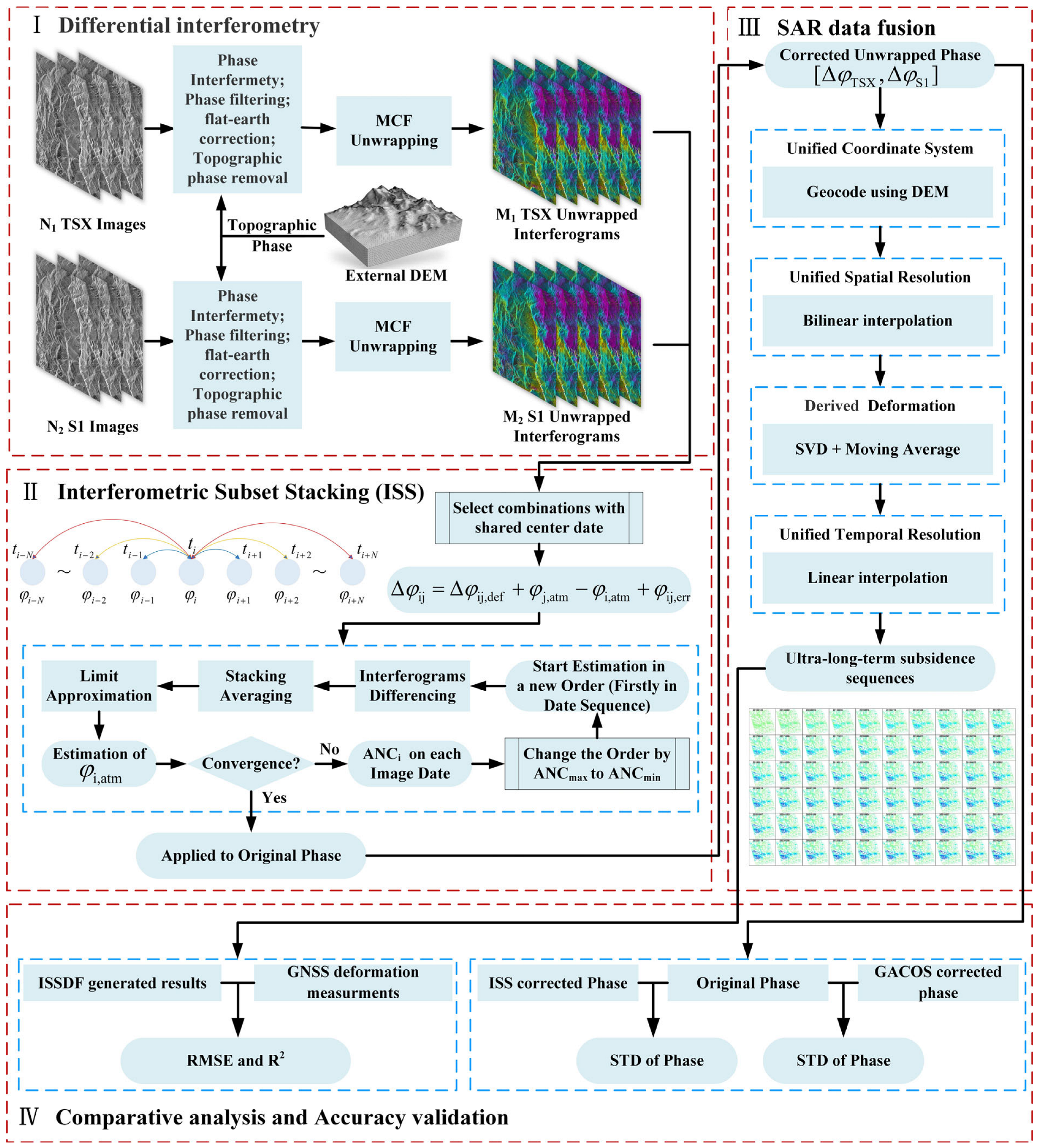
The ISSDF processing (Figure 1) involved four sequential steps: (1) Differential Interferometry: Both TSX and Sentinel-1 datasets underwent phase filtering, flat-earth correction, topographic phase removal, and phase unwrapping; (2) Atmospheric Correction: ISS eliminated atmospheric phases from the unwrapped interferograms.; (3) SAR Data Fusion: The corrected datasets were integrated. This involved geocoding to unify coordinate systems, bilinear interpolation to standardize spatial resolution, and the use of Singular Value Decomposition combined with a Moving Average to align temporal baselines and derive time-series deformation. Linear interpolation then achieved a consistent temporal resolution for the final ultra-long-term sequence; (4) Comparative analysis and Accuracy validation: The results were compared with GACOS atmospheric delay data, and GNSS measurements validated the accuracy of the time-series.

2.1. Atmospheric Phase Removal Based on Interferometric Subset Stacking

The core principle of ISS is the separation of atmospheric delay phases from true surface deformation signals via the stacking of multiple interferograms [27]. Assuming the phase at date t i is φ i , and that N SAR images acquired before and after the central date t i form the interferometric pairs with the t i SAR image, the phase difference Δ φ i j for any interferometric pair can be expressed as:
Δ φ i j = Δ φ i j , def + φ j , atm φ i , atm + φ i j , err
Here, Δ φ i j , def denote the phase shift induced by ground deformation, φ j , atm and φ i , atm represent the atmospheric delay phases at their respective time instants, and φ i j , err signifies the phase shift attributable to random errors. Assuming linear surface deformation and identical temporal baselines for both interferometric pairs, the difference between two pairs sharing the same reference date t i yields:
Δ φ i i j Δ φ i + j i = 2 φ i , atm φ i j , atm + φ i + j , atm + ε i i j ε i + j i
Among these terms, the surface deformation component Δ φ i j , def is eliminated, while ε i ( i j ) ε ( i + j ) i represents the differential random noise with zero mean. Through stacking and averaging of N interferometric pairs described by Equation (2), the following expression is obtained:
1 2 N j = 1 N Δ φ i i j Δ φ i + j i 1 2 N j = 1 N 2 φ i , atm φ i j , atm + φ i + j , atm
The noise term in the original (3) expression was eliminated. In the above equation, when N is sufficiently large, taking the limit of Equation (3) yields an approximate estimate for φ i , atm , namely:
φ i , atm = lim N 1 2 N j = 1 N Δ φ i i j Δ φ i + j i
Equation (4) enables estimation of the atmospheric delay phase for each image at every temporal step. To improve the estimation accuracy, the atmospheric noise coefficient (ANC) of each image guided the iterative estimation of atmospheric delay phases. The iterative process first performed an initial atmospheric phase estimation following Equation (4) in chronological order of image acquisition dates, while calculating the ANC value for each timestamp. Subsequently, atmospheric phase was reestimated according to Equation (4) in order of ANC values. This iteration repeated until convergence, which ultimately yielded the iteratively corrected unwrapped phases [28,29].

2.2. SAR Data Fusion

The TerraSAR-X and Sentinel-1A datasets are incompatible in their spatiotemporal reference systems and spatial resolutions, preventing direct integration. To enable ultra-long-term deformation monitoring, the atmospherically corrected unwrapped phases from both platforms must undergo spatio-temporal data fusion. This procedure started by geocoding both datasets into a unified coordinate system. The TerraSAR-X data were then resampled to match the Sentinel-1A image grid, achieving consistent spatial resolution. Following this, a joint deformation model was applied to both datasets to derive deformation rates, generating time-series displacement data on a unified temporal baseline. Finally, temporal interpolation and time-domain filtering fused the differential interferometric phases from both platforms, yielding the final ultra-long-term deformation sequence.

2.2.1. Uniform Spatial Resolution Based on Bilinear Interpolation Method

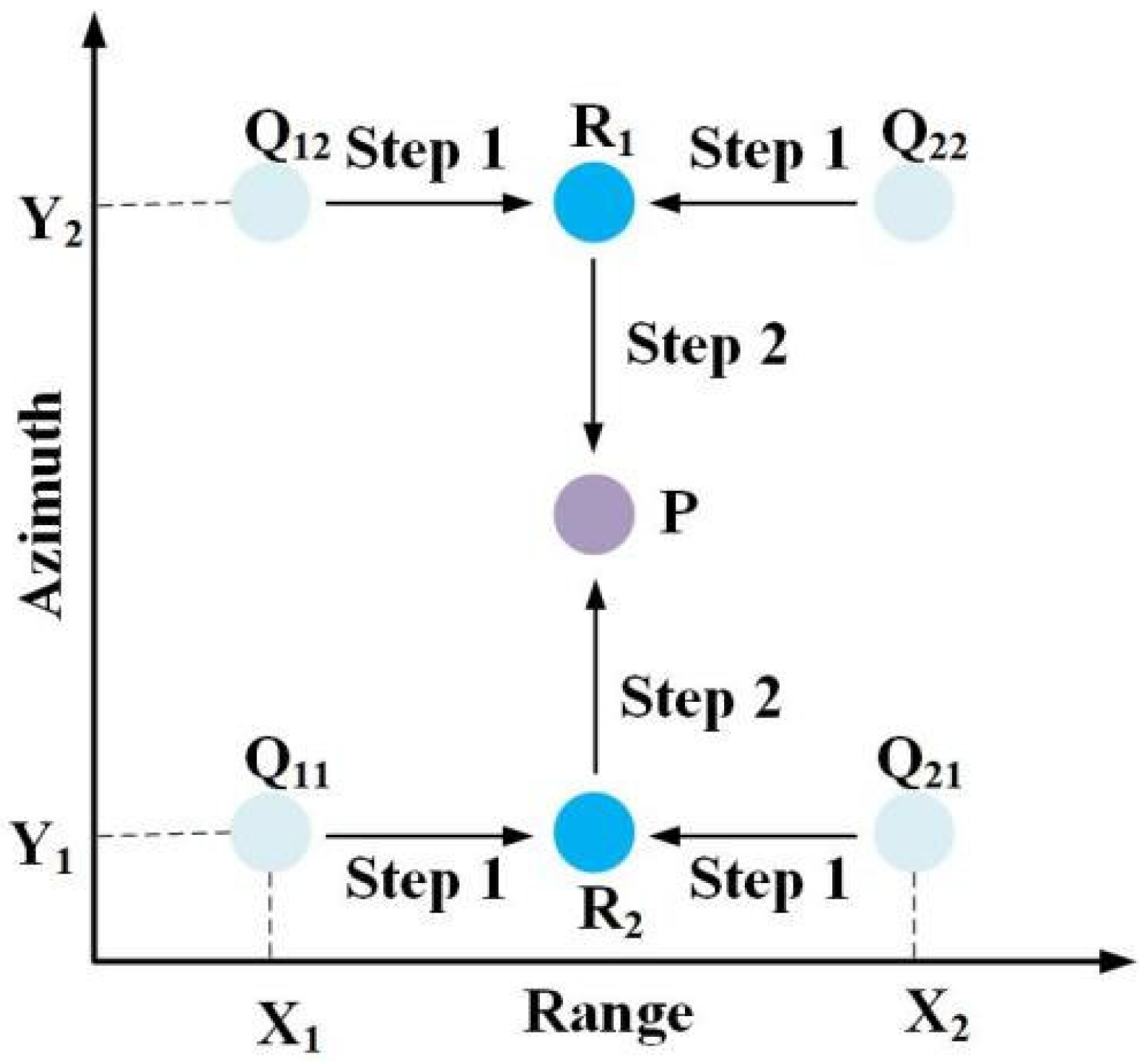
Bilinear interpolation was applied to resample TerraSAR-X pixel values onto the Sentinel-1 image grid, which then unified spatial resolution. As shown in Figure 2, assuming point P is the target resampling point with coordinates X P , Y P in the TerraSAR-X grid and phase value φ P , the four adjacent reference points are identified as: Q 11 at X 1 , Y 1 with phase φ 11 , Q 21 at X 2 , Y 1 with phase φ 21 , Q 12 at X 1 , Y 2 with phase φ 12 , and Q 22 at X 2 , Y 2 with phase φ 22 .
First, linear interpolation along the range direction (x-axis) yields phase values φ R 1 and φ R 2 at intermediate points R 1 and R 2 :
φ R 1 = X 2 X P X 2 X 1 φ 11 + X P X 1 X 2 X 1 φ 21
φ R 2 = X 2 X P X 2 X 1 φ 12 + X P X 1 X 2 X 1 φ 22
Subsequently, linear interpolation along the azimuth direction (y-axis) is performed using R 1 and R 2 to obtain the final phase value at point P :
φ P = Y 2 Y P Y 2 Y 1 R 1 + Y P Y 1 Y 2 Y 1 R 2

2.2.2. Unified Generation of Time-Dependent Deformation and Temporal Resolution

After standardizing the spatial resolution, we jointly constructed phase model equations from both datasets, adapting the SBAS processing framework [30,31,32,33,34,35,36,37]. We then calculated deformation rate parameters to generate ultra-long-term deformation sequences on a unified temporal baseline. Linear interpolation was then applied to standardize temporal resolution. To standardize temporal resolution, assume there are n 1 TSX images forming m 1 interferometric pairs, and n 2 Sentinel-1A images forming m 2 interferometric pairs. The fused dataset then contains N = n 1 + n 2 SAR images and M = m 1 + m 2 interferometric pairs. Given that horizontal displacement in the Beijing Plain was negligible [38,39,40,41], the unwrapped and atmospherically corrected Line-of-Sight (LOS) phase could be directly projected to vertical deformation via D h = D LOS / cos θ . This approach eliminated the need for combined ascending and descending tracks. Therefore, the relationship between the LOS phase and vertical deformation can be established as follows:
Δ φ TSX x , r = 4 π λ 1 cos θ 1 x , r D h t j TSX cos θ 1 x , r D h t i TSX Δ φ S 1 A x , r = 4 π λ 2 cos θ 2 x , r D h t j S 1 A cos θ 2 x , r D h t i S 1 A
where Δ φ TSX represents the TerraSAR-X differential interferometric phase set, with λ 1 and θ 1 denoting its wavelength and incidence angle respectively; Δ φ S 1 A represents the Sentinel-1A differential interferometric phase set, with λ 2 and θ 2 being its corresponding wavelength and incidence angle; (x,r) indicates the pixel coordinates in range and azimuth directions; t i and t j represent the acquisition times of master and slave images respectively; Dh denote the cumulative vertical deformation corresponding to the total time series t 1 TSX , t 2 TSX , , t n 1 TSX , t 1 S 1 A , t 2 S 1 A , , t n 2 S 1 A . We applied exact satellite parameters and pixel-wise incidence angles (derived from the 30 m Copernicus DEM) rather than nominal values. This ensured that the geometric projection from LOS to vertical was precise for every pixel, theoretically eliminating the systematic bias caused by the differing platforms.
Equation (8) represents the combined observation equation for TSX and S1A, which can be represented in matrix form as:
A x = l
Here, l = Δ φ TSX λ 1 / 4 π cos θ 1 ,   Δ φ S 1 A λ 2 / 4 π cos θ 2 represents the M × 1 phase observation vector; A denote a design matrix of dimension M × N , where each row contains −1 at position t j , 1 at position t j , and 0 elsewhere; x = D h t 1 , D h t 1 , D h t N vector of unknown parameters to be solved (Take t 1 = 0 , D h t 1 = 0 as reference).
The inability to form interferograms between heterogeneous SAR sensors inevitably results in a rank-deficient design matrix A . Following the graph theory analysis in Berardino et al. [42], the degree of this rank deficiency corresponds to the number of independent sensor networks minus one ( K 1 ). In this study, with two distinct datasets (TSX and S1A), the system had a rank deficiency of 1. Consequently, introducing just one virtual observation connected the two subsets, restored full rank, and permitted a unique solution with minimal physical assumptions. Considering the continuity of ground subsidence over the 12-year monitoring period, we adopted the physical assumption that deformation increments were negligible within sufficiently short time intervals. By assuming zero deformation difference between quasi-simultaneous acquisitions from different sensors, we derived virtual observation equations ( B x = 0 ). These constraints were then augmented with Equation (9) to construct a new, full-rank system of equations:
A B x = l 0
Analogous to the design matrix A , the constraint matrix B was composed of elements 1 , 1 ; however, the dimension of B was dictated by the temporal density of quasi-simultaneous observations during the overlapping period. Once the number of constructed virtual observation equations (i.e., the row count of B ) exceeded the rank deficiency of A , the combined system became full-rank and could be solved applying SVD. Applying SVD to Equation (10) enabled estimation of the unknown parameter vector x = D h t 1 , D h t 2 , , D h t N , yielding a unified TSX-S1A ultra-long-term deformation sequence. To mitigate temporal discontinuities caused by estimation uncertainties, the derived deformation sequence underwent temporal smoothing using a Moving Average (MA) filter. Analogous to A , the constraint matrix B comprised elements 1 , 1 , yet its dimension was dictated by the density of quasi-simultaneous observations in the overlap period. When the row count of B overcame the rank deficiency of A , the combined full-rank system was solved via SVD. This estimation yielded a unified TSX-S1A deformation time series, which was subsequently smoothed using a Moving Average (MA) filter to suppress artifacts caused by estimation uncertainties.
The deformation sequences obtained from the above processing corresponded to the original, irregular acquisition dates of the TSX and S1A imagery. This irregularity is caused by the different revisit cycles of the two satellites t 1 , t 2 , t N . However, the two satellites operate with different revisit cycles, resulting in irregular temporal sampling. In our experiment, the interval between successive TerraSAR-X acquisitions ranged from 22 to 132 days, while for Sentinel-1A it varied between 12 and 192 days. To achieve uniform temporal resolution, linear interpolation was applied to the deformation sequences, resampling them at consistent 12-day intervals. This procedure yielded a final ultra-long-term deformation sequence with a standardized temporal resolution.

3. Study Area and Dataset

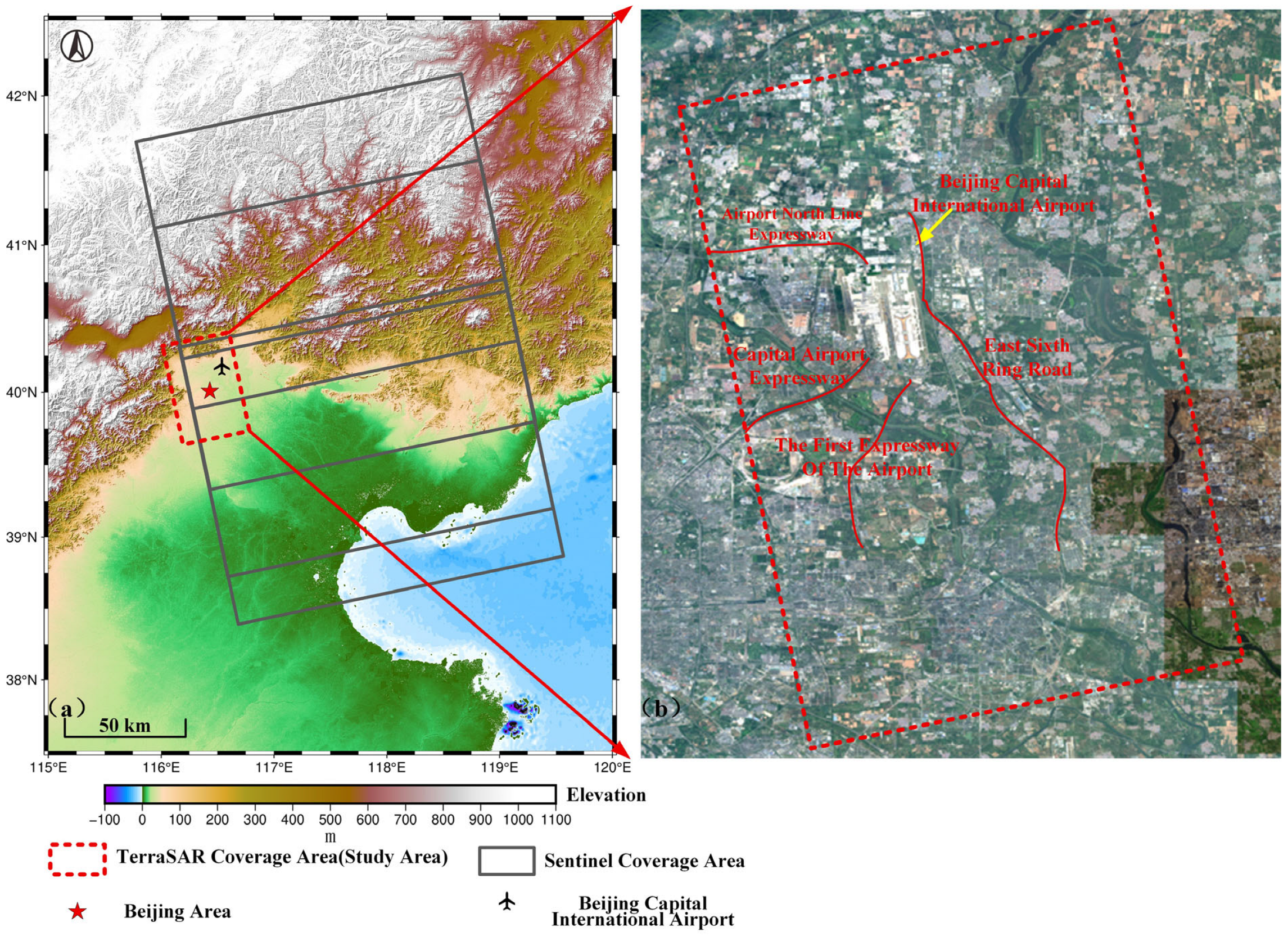
The study area covered the Beijing urban region, including large parts of Shunyi, Chaoyang, and Tongzhou Districts (Figure 3). Specifically, it included Beijing Capital International Airport and its surrounding transportation network, comprising major expressways such as the Airport North Expressway, Capital Airport Expressway, and Eastern Sixth Ring Road, alongside dense building concentrations and extensively distributed infrastructure. Geomorphologically, it is a Quaternary alluvial plain with elevations between 25 and 35 m. Stratigraphically, it is dominated by interbedded silty clay and sand layers reaching 300–500 m in thickness, conditions that are highly susceptible to cumulative surface subsidence [1]. The groundwater in the study area (Beijing) was in a phase of aggressive over-exploitation and rapid water level decline prior to 2012. It was not until the South-to-North Water Diversion Project became fully operational in late 2014 that the extraction rate slowed down, and groundwater levels began to recover [43,44,45,46,47].
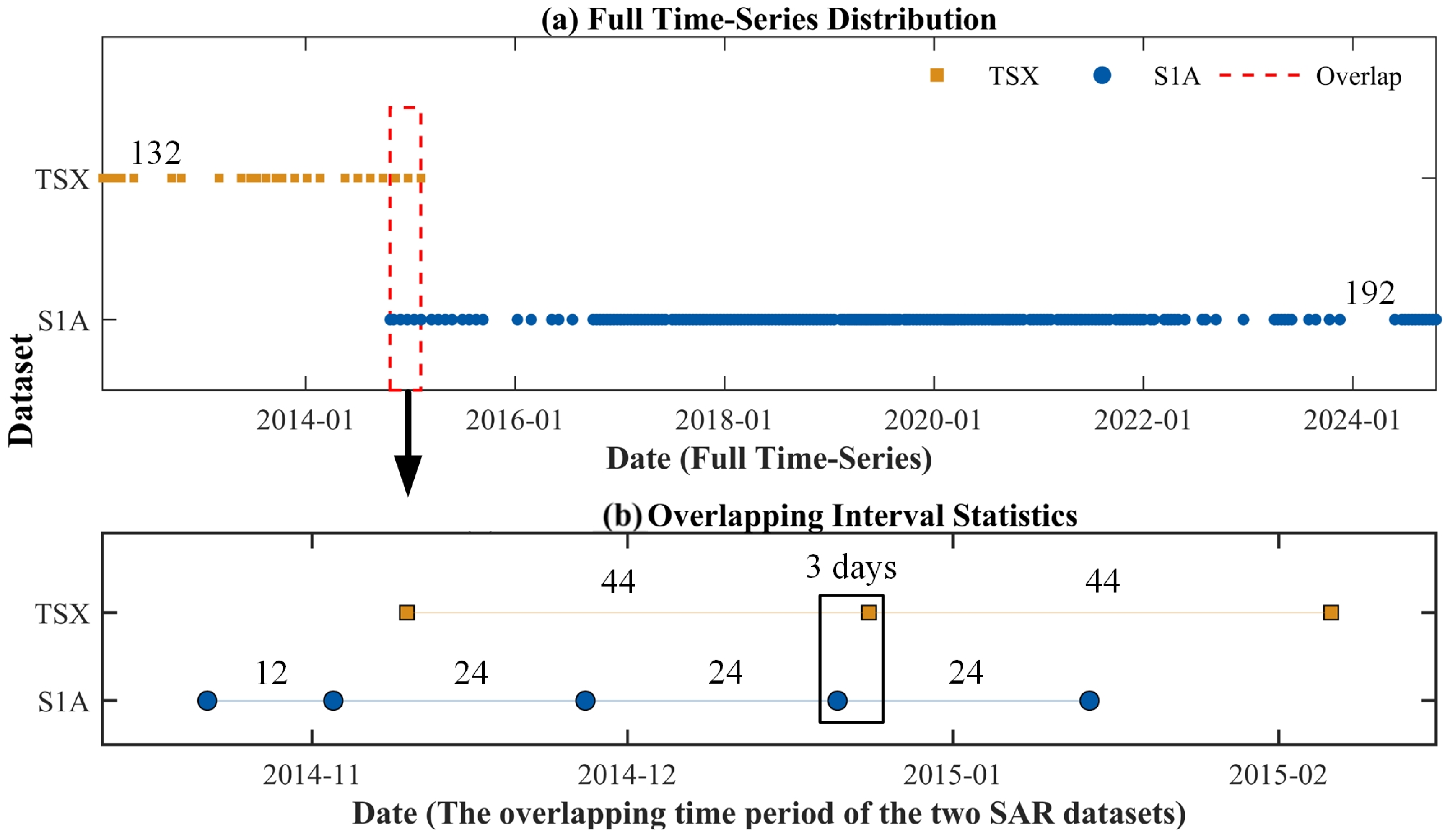
We used high-resolution SAR datasets from the TerraSAR-X (TSX) and Sentinel-1A (S1A) platforms, which cover the Beijing study area (Figure 3a). The acquisition parameters are summarized in Table 1. The temporal overlap between the TSX and S1A datasets spans approximately 3.5 months, as illustrated in Figure 4. Within this overlapping period, the TSX data exhibits a maximum acquisition interval of 44 days, while the S1A data shows a maximum interval of 24 days. Notably, the shortest temporal baseline between the two datasets is 3 days (from 21 to 24 December 2014). We performed differential interferometric processing using GAMMA 18.04 software. To preserve topographic features, we applied multi-looking ratios of 1:1 for TSX and 5:1 for S1A. Temporal baseline thresholds of 300 days were applied to both datasets to minimize seasonal variations and surface change effects, while a perpendicular spatial baseline threshold of 140 m was used to reduce geometric decorrelation. During ISS atmospheric correction, we specifically selected interferometric pairs with equal temporal baselines. This selection criterion aids in distinguishing deformation signals from atmospheric noise. Adaptive Gaussian low-pass filtering was applied to raw interferograms for noise suppression, followed by phase unwrapping using the Minimum Cost Flow (MCF) algorithm. Interferometric pairs were excluded if they exhibited unwrapping residuals exceeding 1.5 rad, coherence below 0.25, or significant atmospheric disturbances. The final dataset comprised 732 qualified interferograms (45 TSX and 687 S1A pairs). A two-stage threshold approach was implemented for coherent point selection: initial filtering based on Amplitude Dispersion Index (ADI < 0.3) to remove unstable scatterers, followed by coherence-based selection (γ > 0.8). Subsequent processing, including ISS atmospheric correction and SAR data fusion, was implemented through MATLAB 2021b programming.

4. Results

4.1. Atmospheric Delay Phase Removal Results

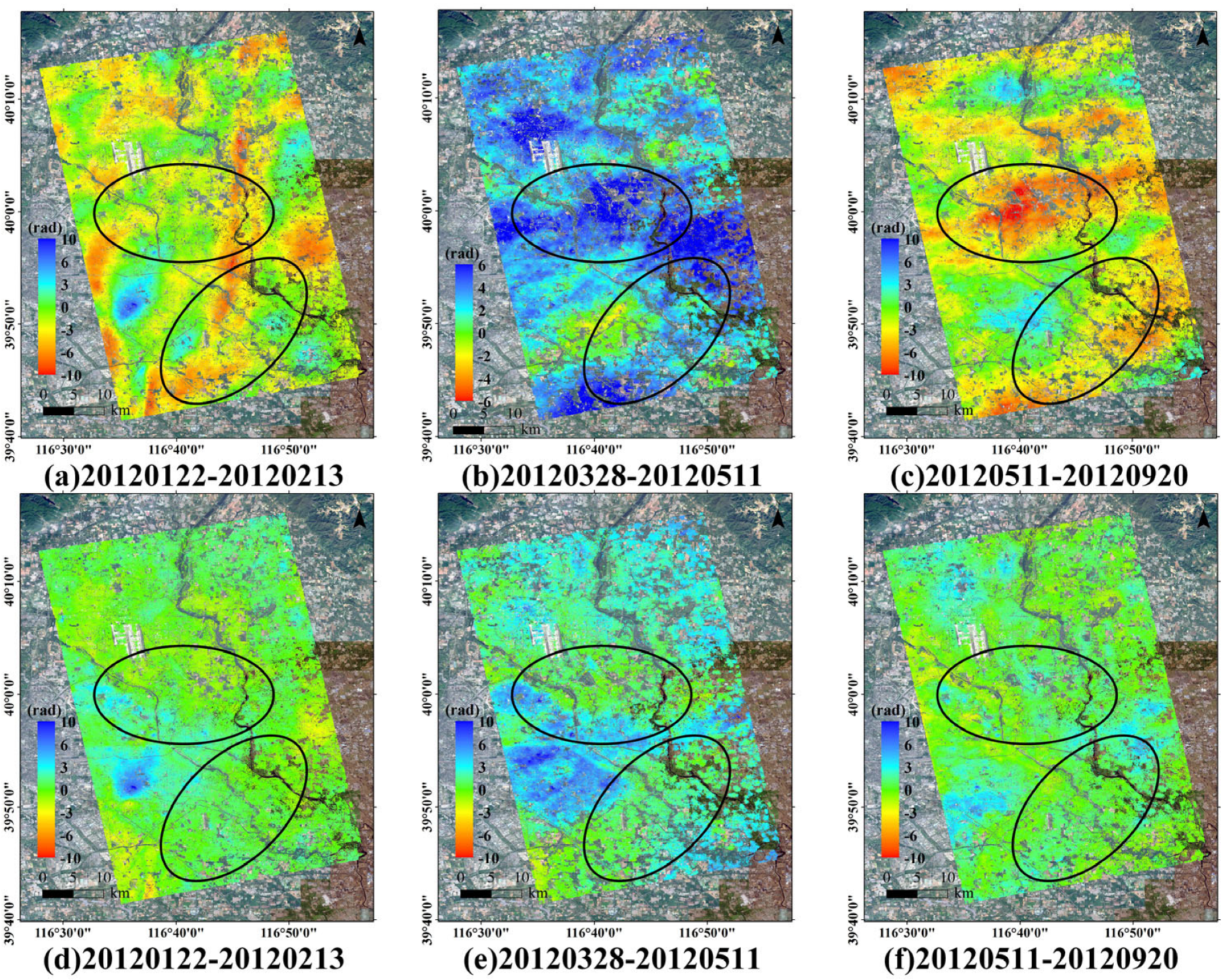
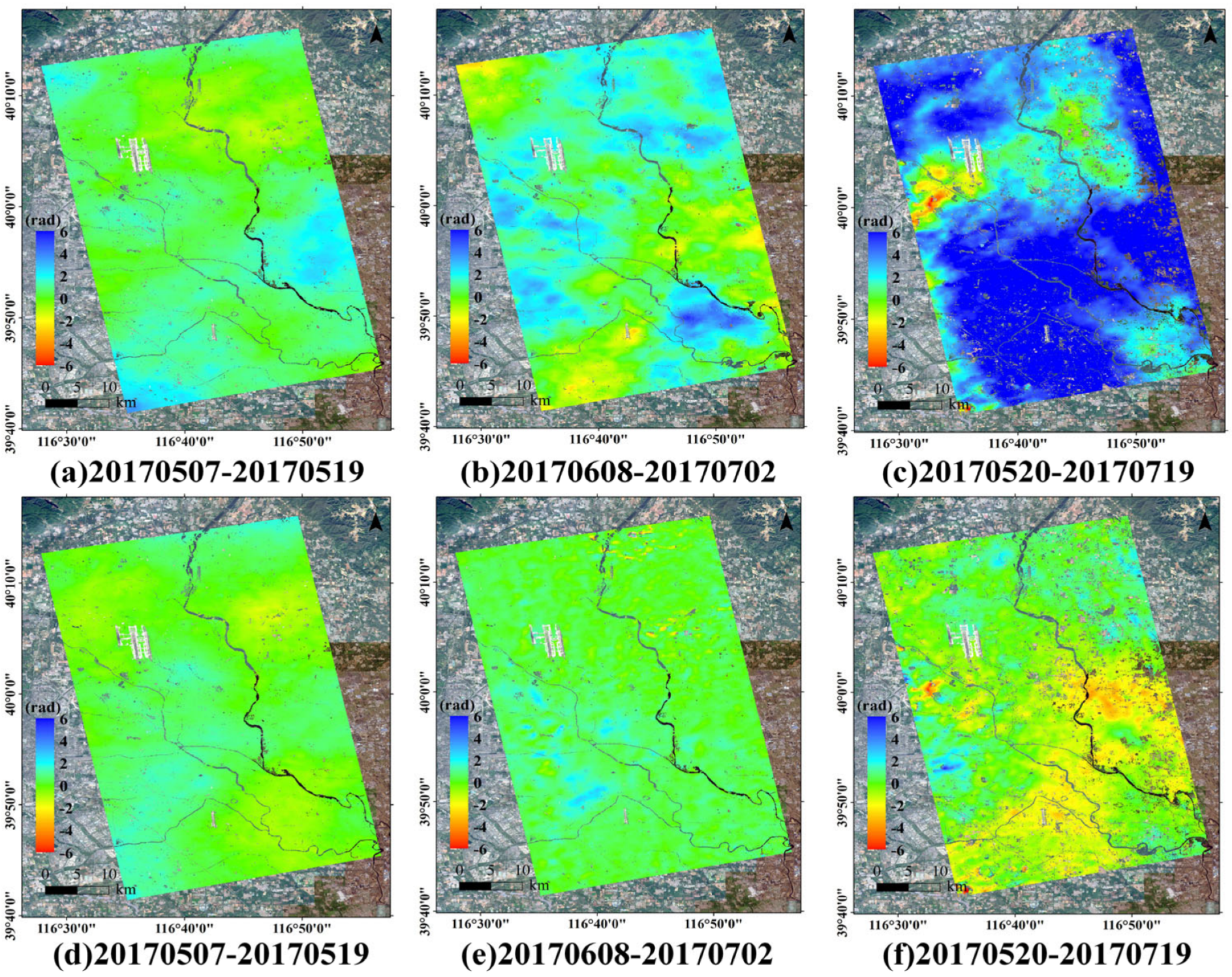
Figure 5 and Figure 6 show representative interferograms before and after atmospheric correction, illustrating the effective phase suppression achieved by ISS. Figure 5a–c show original TerraSAR-X interferograms, while Figure 5d–f display their corrected counterparts. Similarly, Figure 6a–c present original Sentinel-1A interferograms with Figure 6d–f showing atmospherically corrected results. The phase patterns in the original interferograms (Figure 5a–c and Figure 6a–c) are dominated by large-scale fringes characteristic of atmospheric water vapor heterogeneity. These fringes are spatially correlated over large areas, with phase intensities exceeding 8 radians. This corresponds to approximately 35.6 mm of apparent deformation in Sentinel-1A data, substantially obscuring true deformation signals. Following correction in Figure 5d–f and Figure 6d–f, these atmospheric fringes are effectively suppressed. The resulting phase patterns are significantly smoother, allowing for more accurate extraction of the deformation signal.
The TerraSAR-X data in Figure 5, with their high spatial resolution (3 m), reveal an additional detail. The original interferograms show both large-scale atmospheric fringes and considerable localized phase noise originating from building structures, as highlighted by the black circles area. Following ISS processing, this localized noise is substantially suppressed, further validating the method’s effectiveness with high-resolution SAR data.

4.2. Spatial Deformation Fusion Result with ISSDF

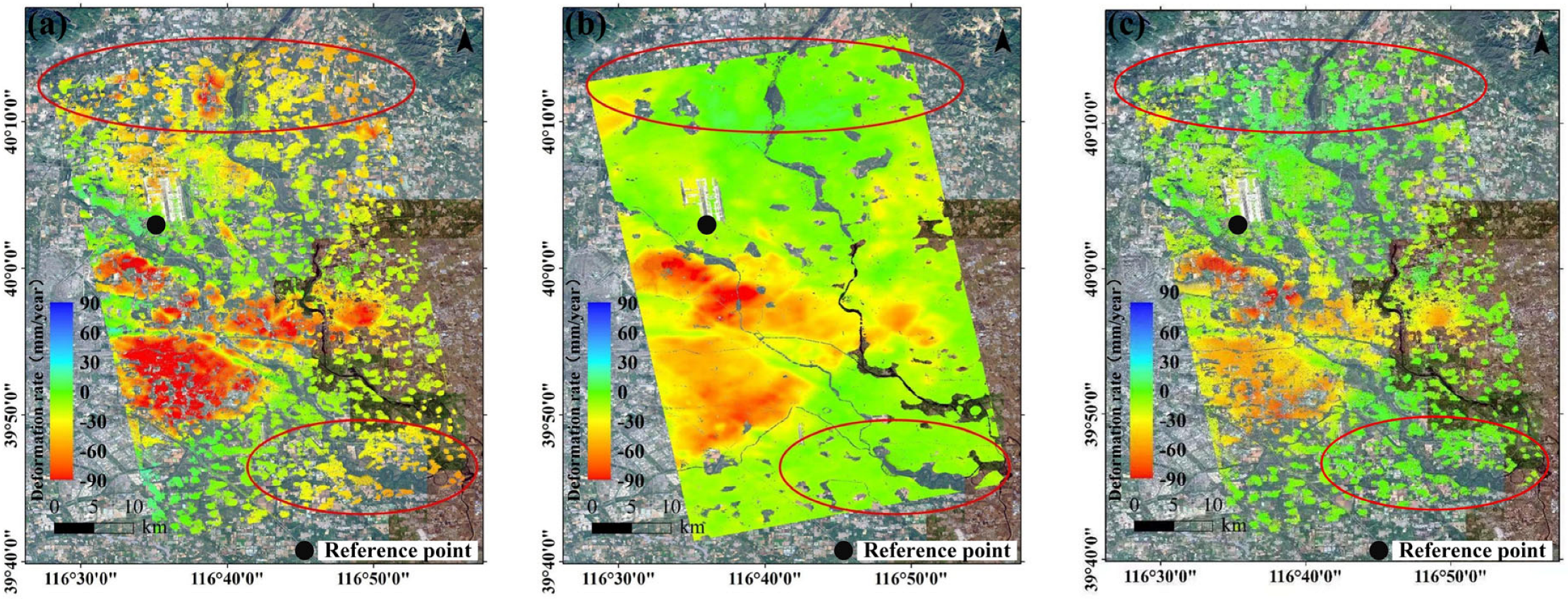
Spatial data fusion was implemented to unify the resolution between TSX and Sentinel-1 datasets, with results presented in Figure 7. Figure 7a shows the deformation rate map derived from TSX dataset. While the high-resolution TSX imagery effectively captures localized subsidence patterns, some areas show substantial noise, evident as anomalous deformation signals within the red circles. The Sentinel-1 derived map (Figure 7b) exhibits greater smoothness but lacks the detail required to resolve fine-scale deformation features typical of urban areas. Additionally, detected subsidence magnitudes in several areas are lower than those observed in TSX data. Figure 7c presents the spatially fused deformation rate map at unified resolution. The integrated results preserve the subsiding field’s overall continuity while maintaining detailed structural information. Compared to single-platform SAR data, the fusion approach reduces noise and enhances the stability and reliability of the estimated deformation rates by capitalizing on the complementary strengths of each dataset.

4.3. Temporal Deformation Fusion Result with ISSDF

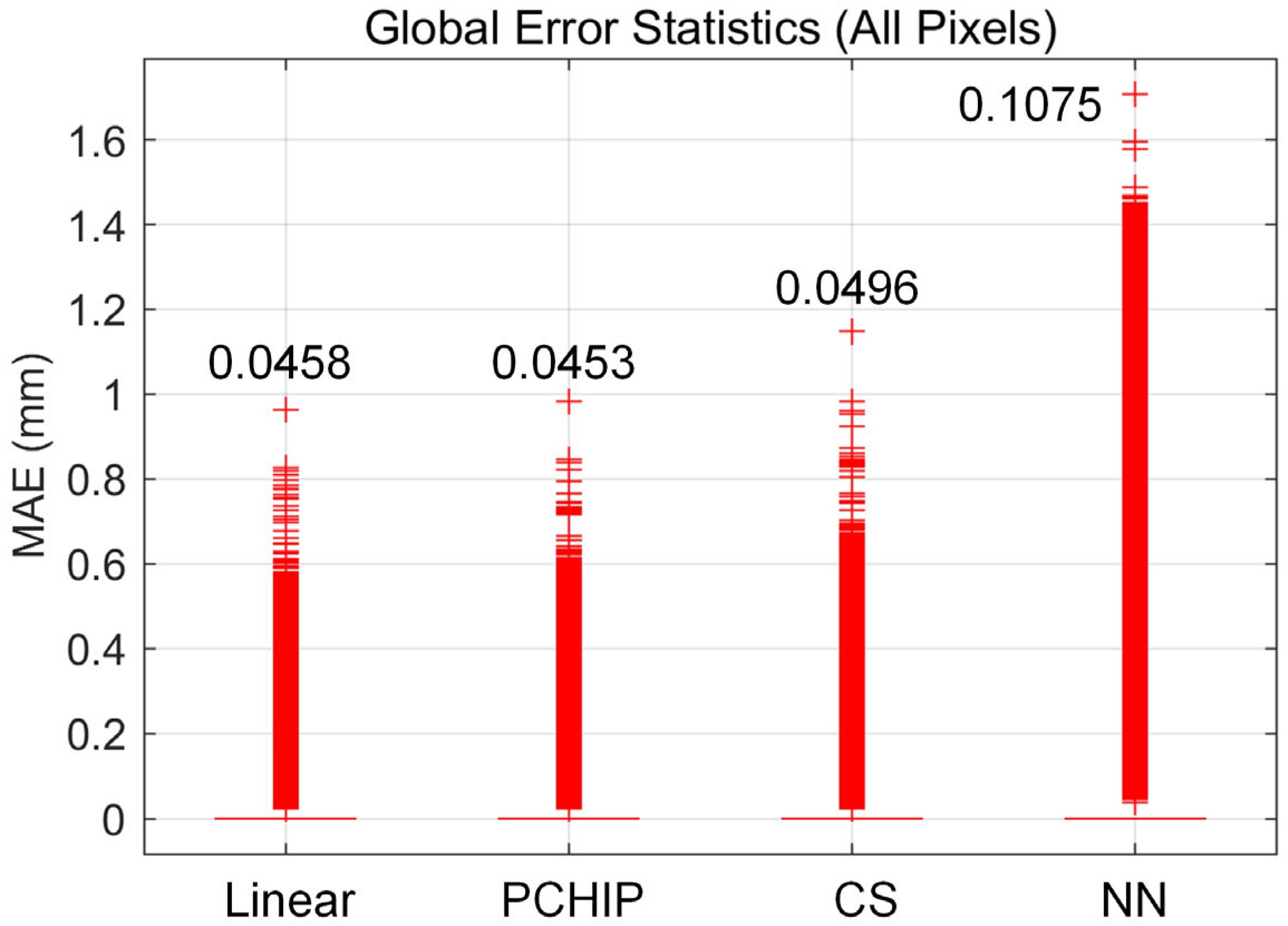
To ensure the reliability of the derived deformation time series, particularly given the potential for rapid subsidence, it is critical to select an interpolation method that accurately reconstructs missing epochs without introducing artifacts. We conducted a comprehensive evaluation using a global Leave-One-Out Cross-Validation (LOOCV) strategy. This involved systematically masking individual observation dates across the entire dataset and reconstructing them using four candidate algorithms: Linear, Cubic Spline (CS), Piecewise Cubic Hermite Interpolating Polynomial (PCHIP), and Nearest Neighbor (NN). The comparative performance with the four methods is quantitatively illustrated in Figure 8. In terms of average accuracy, the PCHIP method achieved the lowest Mean Absolute Error (MAE) of 0.0453 mm, followed by Linear interpolation with an MAE of 0.0458 mm. CS (0.0496 mm) and NN yielded higher errors, suggesting they are less suitable for the dataset. Figure 8 reveals that the accuracy difference between PCHIP and Linear interpolation is very close (<0.001 mm). Considering the both the LOOCV MAE and the computation efficiency, the Linear interpolation was selected for the final temporal unification.
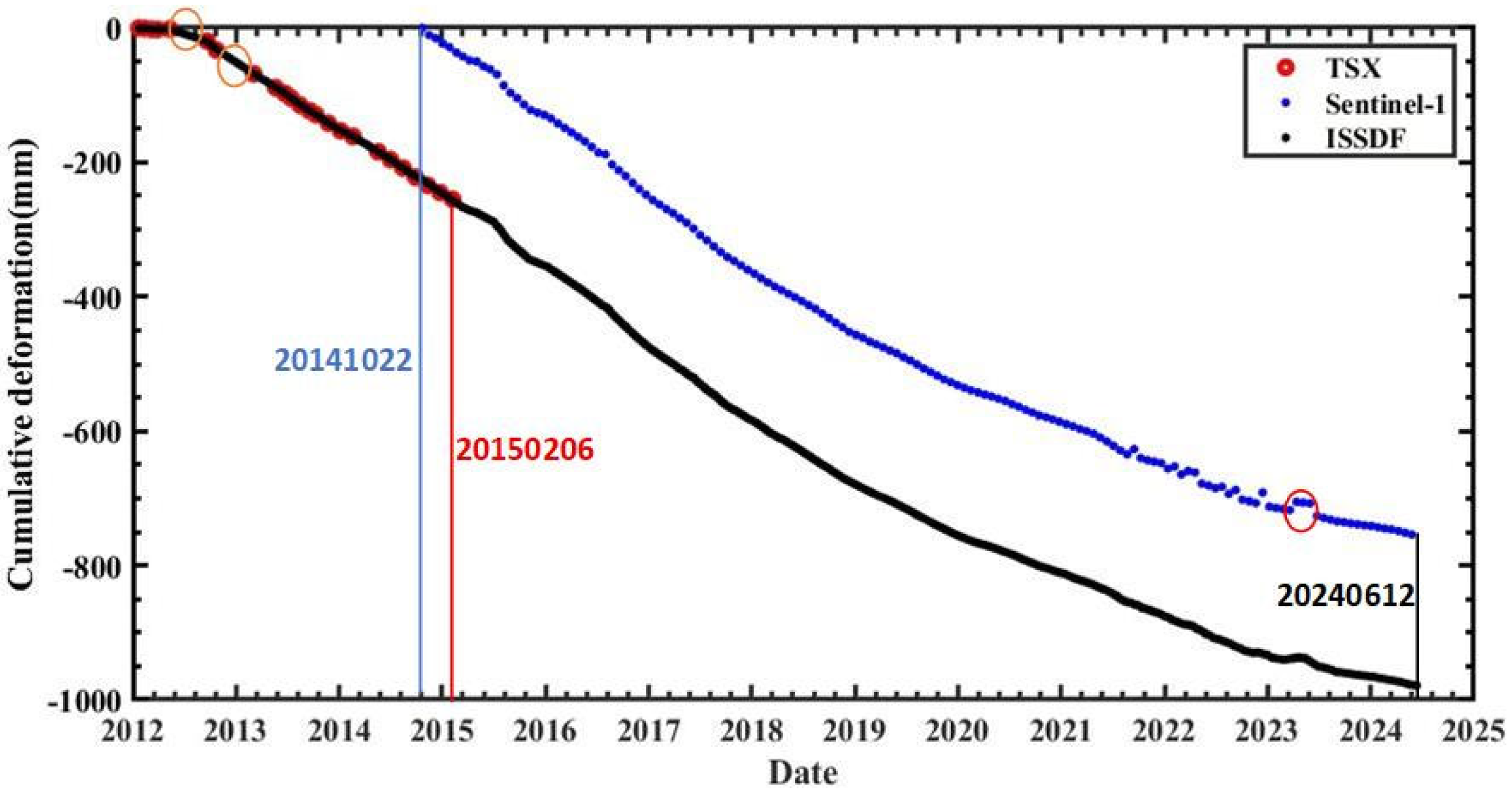
Temporal fusion results are presented in Figure 9. Red circles indicate pre-interpolation TSX deformation measurements with acquisition intervals ranging from 22 to 132 days, while blue dots represent pre-interpolation S1A results with intervals of 12 to 192 days. The black curve shows the fused deformation sequence at 12-day temporal resolution following ISSDF processing. The integrated results demonstrate significant temporal extension, achieving a total monitoring period of 12 years. Temporal interpolation effectively addressed data gaps. For example, the orange circle (upper left) highlights a 132-day gap in the TSX data that was reconstructed, and the red circle (below right) shows a successfully filled gap in the S1A record. The fused sequence maintains temporal continuity while eliminating discontinuities caused by irregular acquisitions.

4.4. Spatial-Temporal Deformation Fusion Results with ISSDF

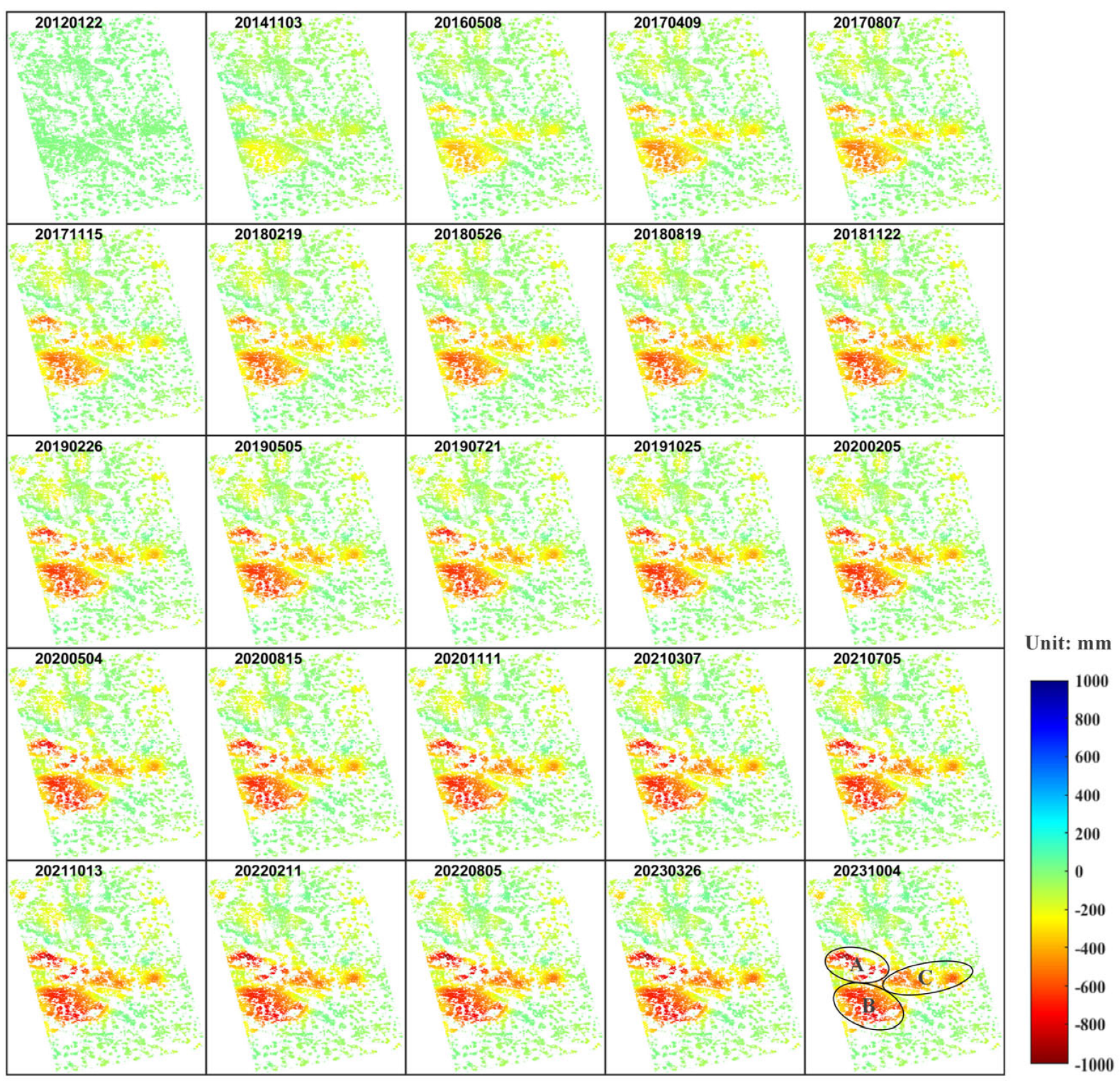
Figure 10 presents the comprehensive time-series deformation results obtained using the ISSDF method for the period from January 2012 to March 2024. The color scheme represents ground displacement, with yellow-to-red hues indicating subsidence and light-to-dark blue tones denoting uplift. Spatial analysis reveals pronounced heterogeneous subsidence across the region, with three distinct subsidence funnels labeled Areas A, B, and C in Figure 10. Areas A and B, located in eastern Chaoyang District, display predominant orange-to-red coloration with maximum cumulative subsidence reaching 1100 mm. Area C, situated in northern Tongzhou District, shows primarily yellow coloration with maximum cumulative subsidence of 730 mm.

4.5. Accuracy Analysis

4.5.1. Accuracy Verification of Atmospheric Phase Removal

To evaluate the effectiveness of the atmospheric corrections, the phase standard deviation (STD), the structure function (SF) [48] and average temporal standard deviation (ATSTD) [49] were adopted.
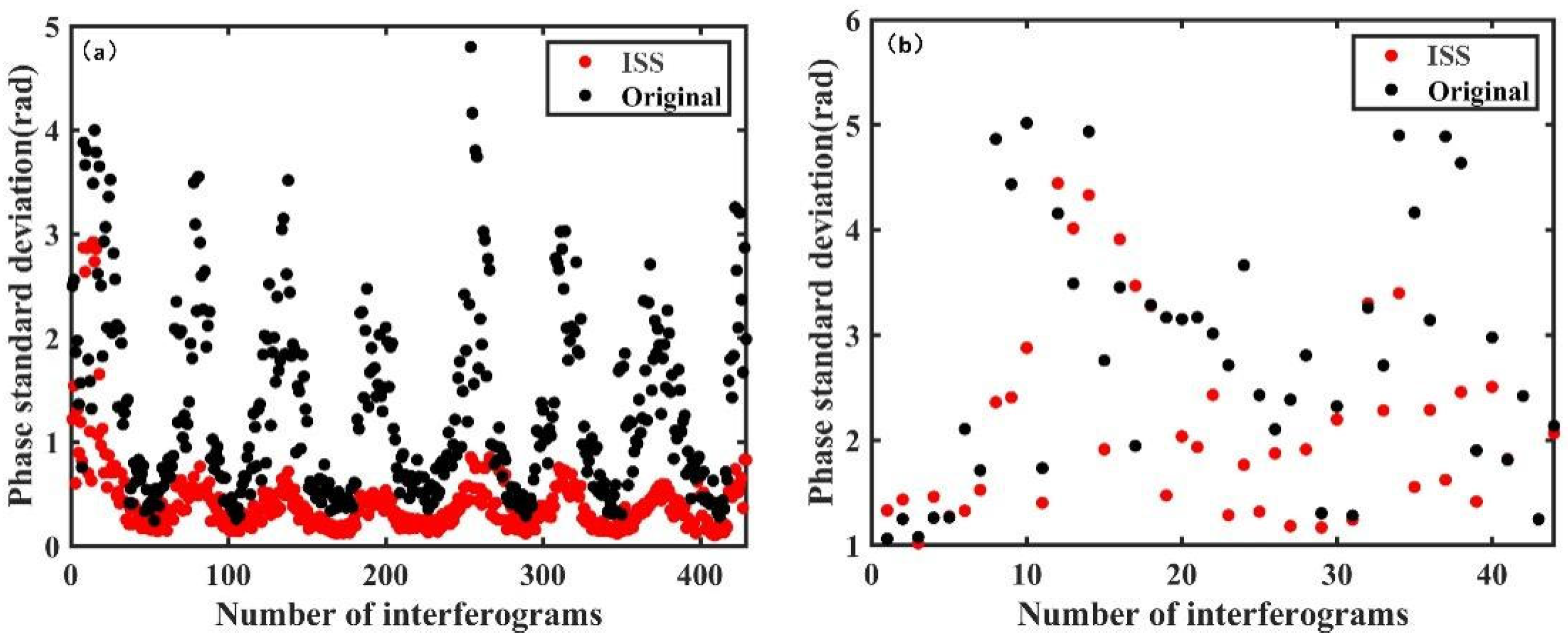
Phase standard deviation (STD): Figure 11 compares phase standard deviation before and after atmospheric correction, with Figure 11a representing Sentinel-1 data and Figure 11b showing TSX results. Lower phase standard deviation values indicate reduced atmospheric influence on subsequent deformation analysis. The method achieved significant atmospheric suppression for both datasets. For Sentinel-1A, the phase standard deviation decreased from 1.30 rad to 0.42 rad (a 67.7% reduction). For TSX, it decreased from 2.82 rad to 2.14 rad (a 24.1% reduction). This performance represents a 15–20% improvement in accuracy compared to conventional GACOS correction.
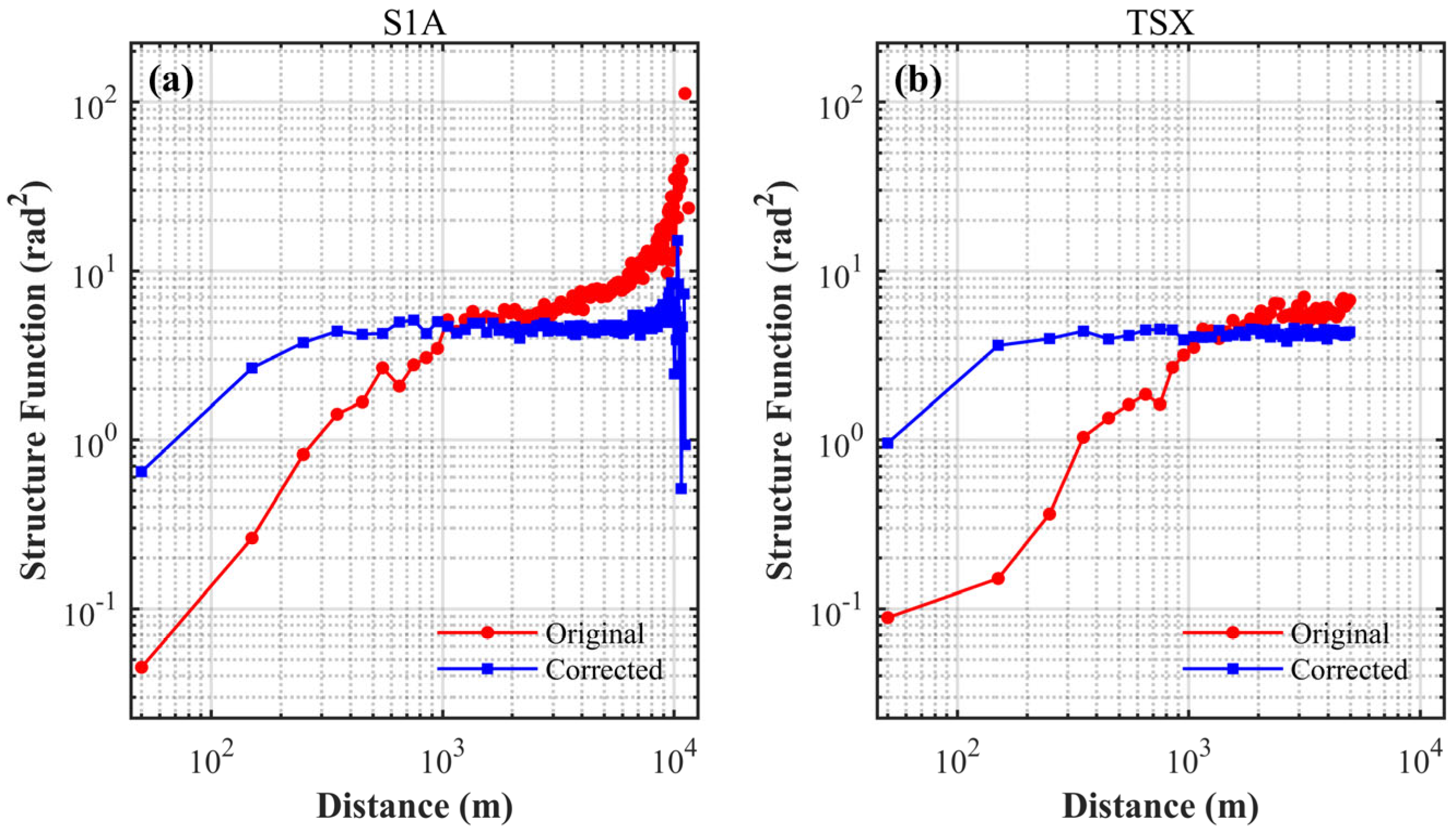
Structure function (SF): The structure function analysis (Figure 12) demonstrates the effectiveness of the subset stacking method across multiple scales, with a particularly pronounced improvement for S1A at regional scales. At micro-scales (<1 km), the corrected curves show a significantly flattened slope compared to the steep original ascent, indicating the conversion of spatially correlated atmospheric turbulence into uncorrelated noise. Beyond 1 km, the corrected functions drop below and approach a stationary trend, contrasting with the continuously increasing uncorrelated data. Critically, at the regional scale (>10 km) captured exclusively by S1A’s wider swath, the method’s capability is most evident: the original data’s exponential rise, indicative of severe long-wavelength errors, is robustly corrected into a decreasing trend. This highlights the method’s superior performance in eliminating broad-scale systematic errors, especially for the S1A dataset over the extensive Beijing plain.
Average temporal standard deviation (ATSTD): To evaluate the temporal smoothness of the InSAR time series, we calculated the average temporal standard deviation ( σ ¯ t ) of the detrended phase residuals using:
σ ¯ t = 1 P n i = 1 P n 1 N 1 t = 1 N φ i , t φ i , t def 2
where i is sequence number of pixel, P n is the number of coherent pixels, t is sequence number of image, N is the number of acquisitions, φ i , t is the observed phase, and φ i , t def represents the estimated low-frequency deformation trend. Results indicate a significant reduction in phase noise for both datasets. For S1A, the σ ¯ t decreased from 1.7 rad to 0.9 rad (47.1% reduction) after correction. Notably, the TSX dataset, which is typically more sensitive to atmospheric disturbances, exhibited a substantial drop from 3.1 rad to 2.3 rad (25.8% reduction). This consistent reduction demonstrates that the proposed method effectively mitigates high-frequency atmospheric turbulence, yielding physically consistent phase evolutions.

4.5.2. Verification of Deformation Result Accuracy

External accuracy validation employed GNSS data collected by Zhang et al. [50]. from the Beijing Institute of Geological Survey and Engineering. Campaign mode data from two bedrock anchor stations (BM1 and BM2 in Figure 13a) were selected to ensure millimetre-level precision. These specific sites were chosen due to their spatial location within the significant subsidence zone detected by InSAR. We calculated the average vertical deformation rate of InSAR pixels within a 100-m radius centered on each GNSS station. Quantitative comparison results are presented in Table 2. The comparison reveals a high time-series correlation coefficient of 0.94 between InSAR subsidence values and GNSS measurements. The root mean square error (RMSE) between the BM1 site time series and the InSAR time series (mean value) was only 4.1 mm, while that for the BM2 site was 6.3 mm. The average RMSE value for both sites was 5.2 mm, meeting the accuracy requirements for urban deformation monitoring (ICAO standard annual error < 10 mm [51]).

5. Discussions

5.1. Potential Reasons for the Derived Deformation

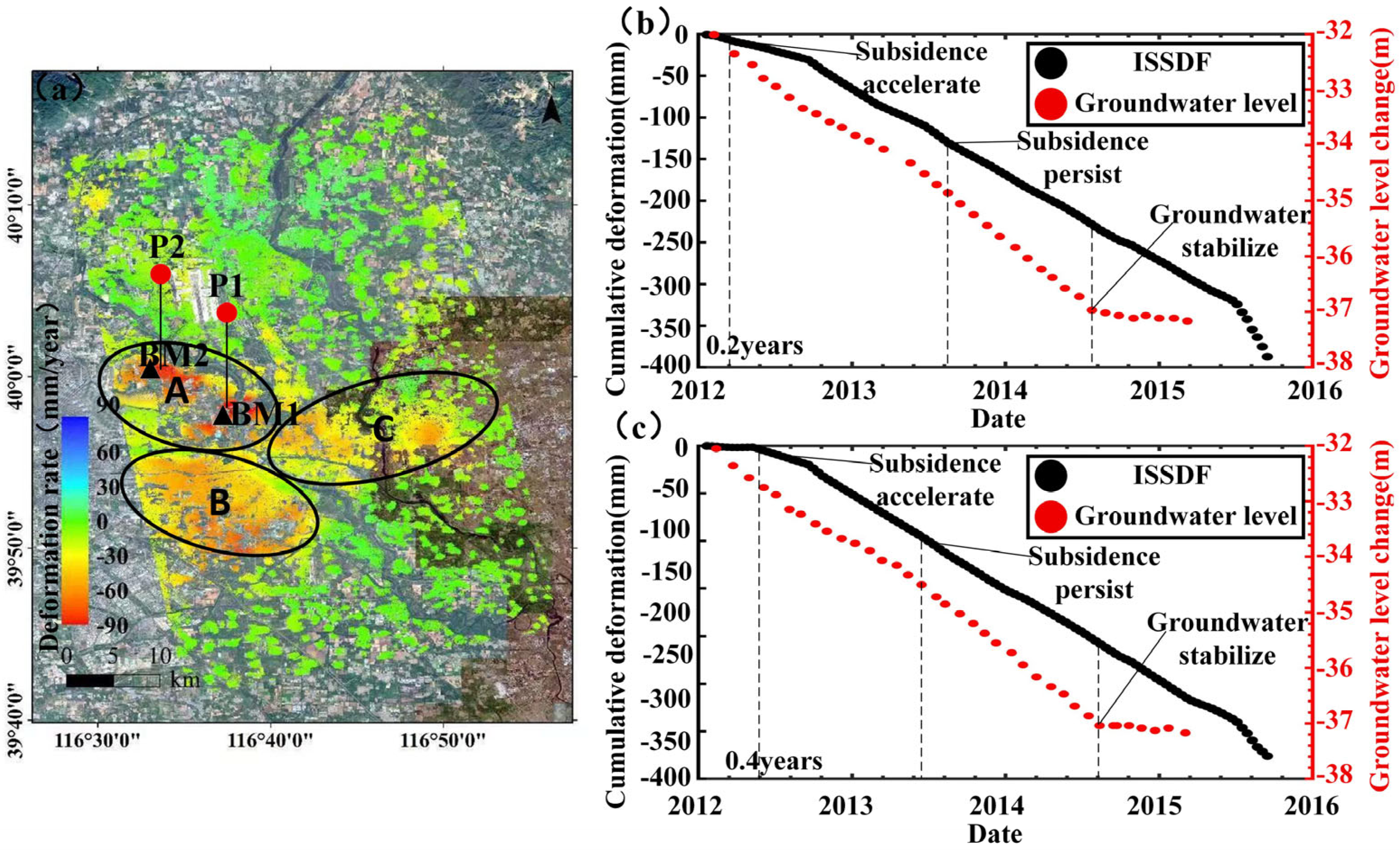
As illustrated in Figure 13, the eastern part of Chaoyang District (Zones A and C) and the northern part of Tongzhou District (Zone B) exhibit the most pronounced subsidence characteristics. Zone A has developed into a well-defined subsidence center with the greatest magnitude and highest spatial continuity. In contrast, subsidence in Zones B and C is of smaller magnitude and more spatially diffuse, lacking stable, distinct subsidence cores. This spatial pattern corresponds closely with zones of known intensive groundwater extraction reported in previous studies [52,53], which indicates that groundwater withdrawal is likely a primary driver of subsidence in these areas.
To investigate the relationship between long-term ground subsidence (derived via ISSDF) and groundwater level changes (a proxy for groundwater extraction effects), we collected groundwater level data from the Beijing Water Resources Bulletin (2012 to 2015). We then conducted a comparative analysis with the InSAR-derived subsidence time series. Zone A contained the most pronounced and spatially continuous subsidence. Subsidence in Zones B and C was less pronounced and more spatially dispersed. It should be noted that although the three subsidence zones A, B, and C are spatially adjacent and may be influenced by similar groundwater systems, only Zone A possesses continuous and relatively reliable groundwater level time series. Consequently, our quantitative correlation and lag analysis focuses on Zone A. Within this zone, we selected two representative points (P1 and P2 in Figure 13a) at locations of peak subsidence. The results are presented in Figure 13b and Figure 13c respectively. The subsidence characteristics of Zones B and C are discussed solely at the spatial distribution level.
Analysis indicates strong temporal consistency between cumulative ground subsidence in Zone A and groundwater level changes. The subsidence displays a pronounced lagged response groundwater fluctuation. At point P1, following the onset of sustained groundwater level decline in January 2012, ground subsidence accumulated slowly at first. The rate then accelerated after approximately 2.4 months and increased further after about 8.5 months. In contrast, subsidence response at point P2 was markedly delayed, with significant acceleration only occurring approximately 4.8 months after the sustained groundwater level decline began. It should be noted that these timescales reflect the observed response characteristics of surface deformation to groundwater level changes, rather than a direct characterization of the initiation time or pumping intensity variations in groundwater extraction activities.
This delayed response characteristic may be associated with the low permeability and viscoelastic mechanical behaviors of thick clay layers within the study area. During groundwater level decline, the gradual reduction in pore water pressure and sustained increase in effective stress drive compression and creep within the clay layers. These processes typically exhibit considerable time lag [54,55,56,57]. Furthermore, ground subsidence continued even after groundwater levels stabilized beginning around June 2014. This persistence indicates that delayed consolidation and viscous compression processes can continue long after groundwater drawdown ceases, exerting significant influence on long-term subsidence evolution.

5.2. Comparison of ISS and GACOS Application

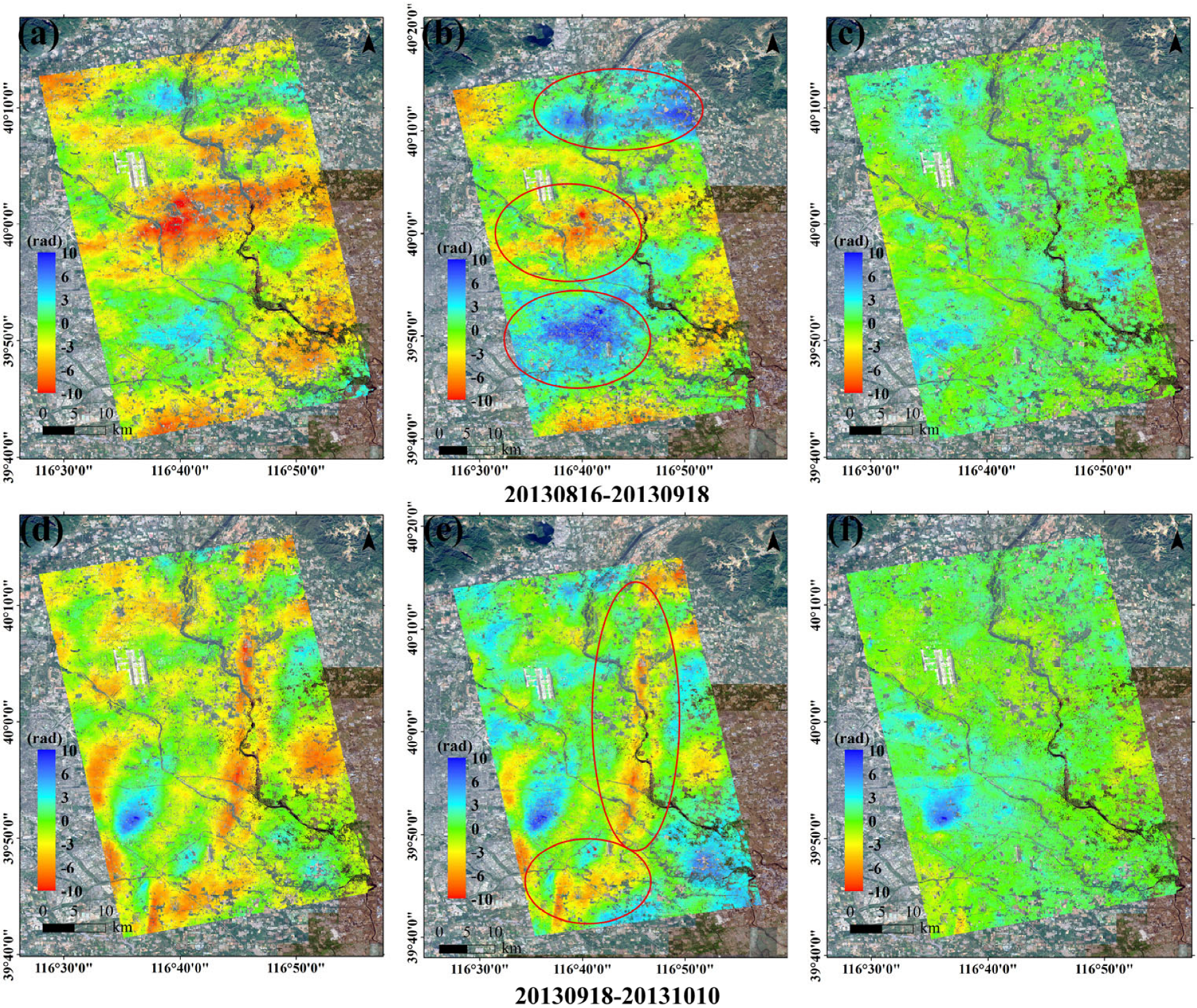
Atmospheric phase correction was performed using both ISS and GACOS, with comparative results shown in Figure 14. While the GACOS achieves partial atmospheric phase reduction in small-scale urban areas, significant residual atmospheric signals persist in localized regions (indicated by red circles). In contrast, the ISS method demonstrates consistently strong performance across the entire study area, achieving more complete suppression of the atmospheric phase.
GACOS estimates atmospheric delay phases using meteorological models and GNSS spatial interpolation at 90 × 90 m resolution, which is considerably coarser than TerraSAR-X or Sentinel-1 imagery. This resolution limitation restricts its ability to capture rapid atmospheric variations over small areas. Additionally, temporal mismatches between GACOS data acquisition and SAR imaging times may introduce asynchronous errors. In contrast, ISS operates through temporal stacking and adjustment processing of multiple interferometric subsets. With a sufficient number of interferograms, ISS shows less sensitivity to specific spatiotemporal scales. By adopting a “time-for-space” approach, it effectively suppresses heterogeneous and rapidly varying atmospheric noise in localized regions.
As an external correction model, the accuracy of GACOS depends critically on the quality of the input meteorological data and the consistency between GNSS observations and atmospheric models. For example, when projecting GACOS correction products to SAR slant-range geometry, error accumulation intensifies with increasing SAR platform diversity due to wavelength and incidence angle variations. In contrast, ISS is a self-contained, internal correction approach with no external data dependencies. It employs a unified statistical framework across all SAR platforms to separate deformation signals from atmospheric noise, thereby avoiding cross-platform error propagation. The atmospheric suppression capability of ISS is positively correlated with dataset size: larger interferometric stacks produce better correction performance. This characteristic makes ISS particularly suitable for long-term monitoring applications with substantial data archives.

5.3. Applicability of ISSDF

5.3.1. Uncertainty Analysis of Resolution Unification

A prerequisite for fusing multi-sensor data is unifying spatial resolution. Downsampling the higher-resolution TSX data sacrifices fine urban details, whereas upsampling the lower-resolution S1 data can introduce substantial interpolation artifacts. We rigorously assessed this risk by quantifying the “reconstruction uncertainty” associated with upsampling. Specifically, we simulated the positional ambiguity of low-resolution pixels via random sub-pixel grid shifts and calculated the sample standard deviation of the interpolated results [58]:
U x , y = std Z k x , y k = 1 K
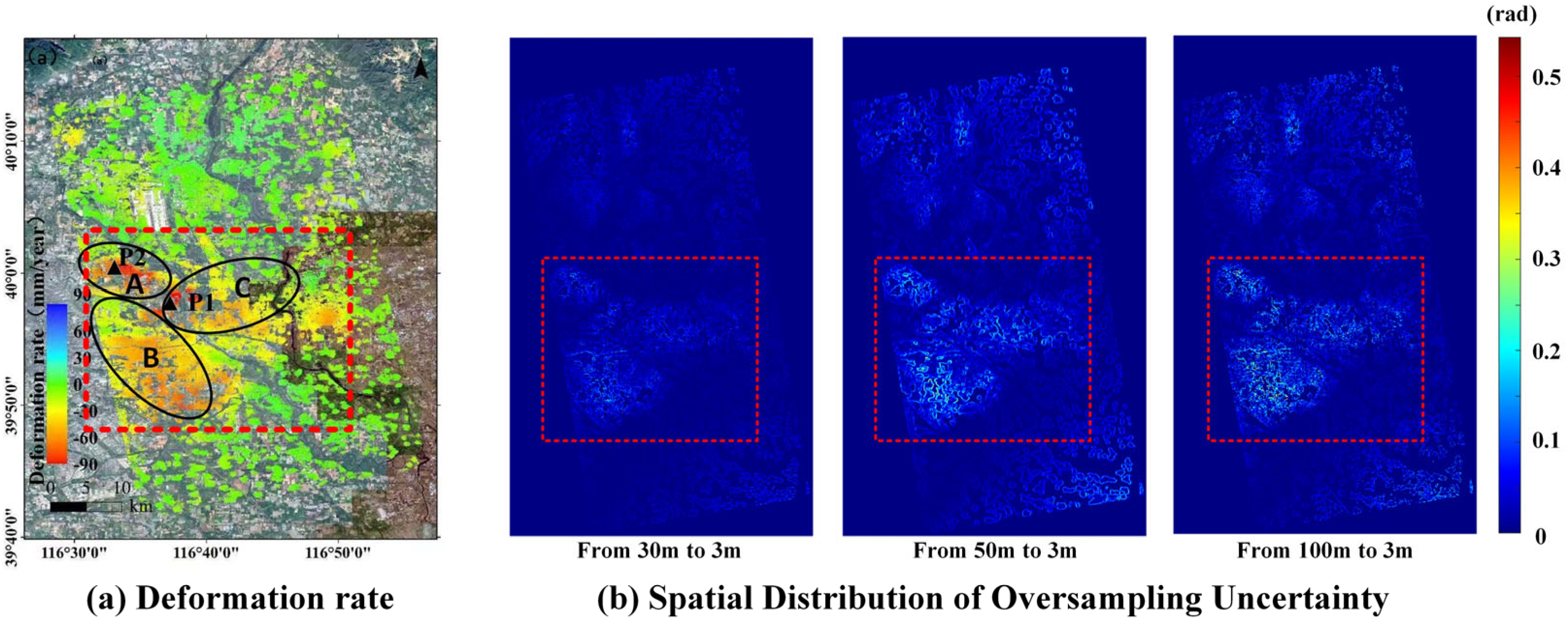
Here, U x , y denotes the sample standard deviation, and Z k x , y k = 1 K denotes the set of samples taken at the k nth sampling interval. As illustrated in Figure 15, upsampling uncertainty is strongly correlated with deformation gradients rather than being randomly distributed. In areas of significant urban subsidence, interpolation artifacts can induce phase errors of up to 0.5 rad (~1.2 mm). For ultra-long-term urban monitoring, where identifying subtle structural instability is paramount, such artificial noise is prohibitive. Consequently, downsampling is identified as the applicable strategy for this framework. It ensures the physical integrity of the long-term trend is preserved, prioritizing the radiometric reliability of the time-series signal over nominal spatial resolution.

5.3.2. Impact of Observation Geometry and Parameter Sensitivity

(1) Complementarity of Ascending and Descending Orbits
Our fusion framework, as applied to the Beijing Plain, assumes that the regional deformation field is dominated by vertical land subsidence, with negligible horizontal motion. Under this assumption, even single-track SAR datasets (ascending-only or descending-only) can yield high-precision vertical deformation estimates. Theoretically, our proposed phase model (Equation (8)) is universally applicable to various observation scenarios. By explicitly incorporating the pixel-wise incidence angle ( θ ) and sensor wavelength ( λ ) into the observation equation, the model mathematically unifies the geometric projection from Line-of-Sight (LOS) to the vertical direction. Consequently, the framework is not strictly limited to multi-track fusion; it is equally valid for single-sensor inversion.
In practical applications, the selection of orbit combinations should be adaptive, depending on the local topography and the expected magnitude of horizontal displacement: In flat regions dominated by vertical subsidence (such as the study area), single-geometry observations are sufficient to satisfy accuracy requirements. However, in areas with complex topography or where significant horizontal movements cannot be ignored, relying on a single geometry may introduce geometric biases. Therefore, while our method is flexible, we suggest employing joint Ascending-Descending observations whenever data availability permits. This combination not only provides redundant observations to mitigate random noise but also further constrains the solution space, thereby maximizing the estimation accuracy of vertical deformation.
(2) Sensitivity Analysis of Wavelength and Angle of Incidence Accuracy
While the combination of diverse orbits resolves the geometric vector components, the accuracy of the projection relies heavily on the precision of the satellite parameters. Systematic errors in wavelength input (e.g., truncation) or incidence angle (e.g., geocoding deviations) can propagate into the vertical velocity solution. To quantify this, we conducted a joint sensitivity analysis based on the differential interferometry model [42]. The relative bias in the estimated velocity ( v esti x , r / v true x , r ) induced by parameter perturbations is modeled as:
v esti x , r v true x , r = λ esti λ true cos θ true x , r cos θ esti x , r
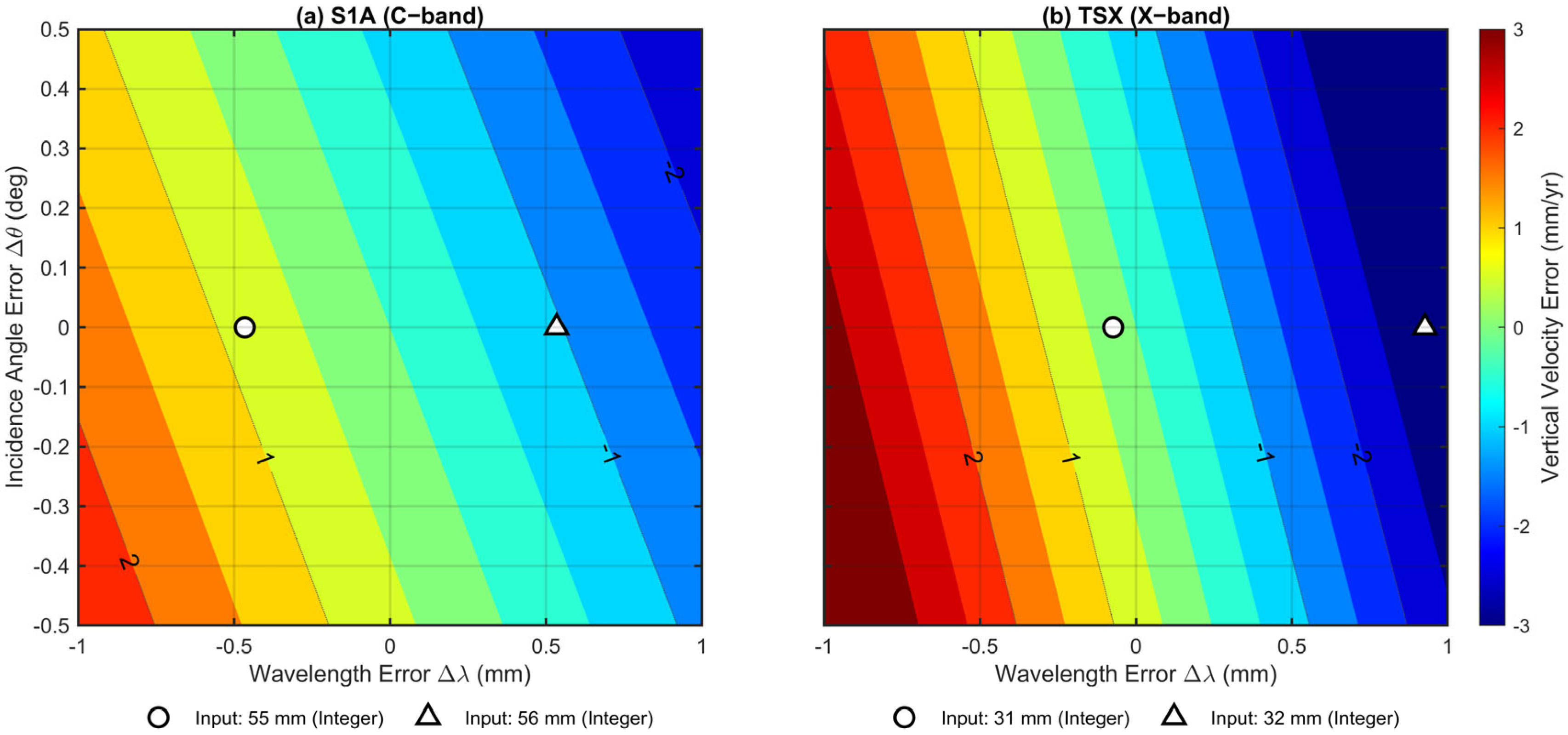
where λ and θ denote the perturbed wavelength and incidence angle, respectively. We simulated the error propagation assuming a wavelength truncation error of up to ±1 mm and an incidence angle uncertainty of ±0.5°. The results, illustrated in Figure 16, reveal a distinct sensitivity difference between sensor frequencies. The X-band platform (TSX) shows significantly greater sensitivity than the C-band (S1A). For a subsidence rate of 100 mm/yr, simply rounding the TSX wavelength (e.g., from 31.07 mm to 32 mm) introduces a systematic bias exceeding 3.0 mm/yr. In contrast, Sentinel-1 shows a lower, albeit non-negligible, sensitivity (~1.0 mm/yr bias for similar truncation). The analysis further indicates a non-linear coupling where incidence angle jitters amplify the errors caused by wavelength inaccuracy.

5.4. Limitations

5.4.1. Global External Accuracy Verification

In this study, the external accuracy verification of the InSAR-derived deformation relies on only two campaign-mode GNSS stations anchored in bedrock. While these stations provide high-precision, point-scale validation and confirm the method’s performance at specific locations (e.g., a correlation coefficient of 0.94), their limited number and spatial distribution limit our ability to fully assess the accuracy of the deformation field across the entire study area. This limitation is primarily due to the general scarcity of publicly available, long-term GNSS observations collocated within the major subsidence zones. Future work would benefit from incorporating data from a denser ground-based monitoring network to more rigorously evaluate the spatial variability of InSAR accuracy and further strengthen the statistical robustness of the validation.

5.4.2. Generalizability and Regional Applicability

Regarding generalizability, we validated the method primarily using data from Beijing. However, this region represents a highly relevant and challenging test case for urban land subsidence. It features complex deformation mechanisms driven by groundwater withdrawal, soft soil consolidation, and static loading from dense infrastructure. Furthermore, the study area presents a challenging mix of strong atmospheric phase screens and a transition from flat alluvial plains to mountainous terrain. While these heterogeneous conditions rigorously test the algorithm’s performance in separating deformation from atmospheric artifacts, its applicability to distinct geological settings, such as steep landslide-prone valleys with severe topographic relief, remains to be verified in future studies.

5.4.3. Constraints in Subsidence Driver Analysis

This study has focused on establishing the correlation between the long-term subsidence trend and groundwater level changes, which is a primary and well-documented driver in the study area. However, a comprehensive mechanistic understanding of urban subsidence requires consideration of additional, often interacting factors. Our current analysis did not incorporate factors such as the precise timing and spatial distribution of groundwater extraction, the depth-dependent compressibility of aquifers, or the long-term cumulative loading from existing infrastructure. These elements are critical for quantifying the individual contribution of each driver and modeling the subsidence process with higher fidelity. Future research should aim to integrate detailed hydrogeological models, historical land-use data, and geotechnical parameters. This integration would help disentangle the complex interplay of these factors and advance from correlation toward a more predictive, causal understanding of subsidence.

6. Conclusions

This study develops an ultra-long-term deformation monitoring method integrating Interferometric Subset Stacking with spatio-temporal SAR Data Fusion algorithm. The method begins by processing TerraSAR-X and Sentinel-1A datasets using differential interferometry, followed by the application of interferometric subset stacking to suppress atmospheric phase. The fusion procedure involves bilinear interpolation for spatial resolution unification, joint modeling for deformation rate estimation, and temporal interpolation with moving averaging for resolution standardization. Experimental implementation in Beijing, China successfully generated a 12-year deformation sequence (2012–2024). This result demonstrates the method’s capability for ultra-long-term urban subsidence monitoring.
The Beijing Airport area served as the experimental zone for atmospheric phase correction and data fusion using 24 TerraSAR-X and 231 Sentinel-1A scenes through ISS. The experimental results show that ISS effectively reduces atmospheric delay, lowering the phase standard deviation by 67.7% for Sentinel-1A and by 24.1% for TerraSAR-X.
The developed ISSDF method enables multi-platform SAR data integration in urban areas, generating exceptionally ultra-long deformation time series. This approach compensates for the absence of Sentinel-1A data prior to 2014 and bridges the temporal gap between the satellite datasets, which then enables extended deformation monitoring. The method proves particularly suitable for tracking ultra-long-term subsidence (>10 years) induced by sustained groundwater extraction in urban environments.
The study successfully derived a 2012–2024 surface deformation sequence for Beijing Capital International Airport, revealing maximum cumulative subsidence of 1100 mm in eastern Chaoyang District. The spatial subsidence pattern shows a strong correlation with zones of groundwater extraction. Validation against GNSS data shows correlation coefficients up to 0.94 with RMSE below 6.3 mm, satisfying accuracy requirements for urban infrastructure safety monitoring. This methodology provides a robust framework for urban subsidence monitoring that balances high precision with long-term temporal coverage. Future research could extend this framework by integrating data from additional SAR platforms (e.g., ALOS-2, Radarsat) to further enhance temporal coverage and robustness, or by combining InSAR-derived deformation time series with machine learning techniques for predictive subsidence modeling and early-warning systems.

Author Contributions

X.X. organized the total manuscript, and designed the experiment; G.Z. drafted the manuscript; Z.X. and H.L. collected the raw data; H.L. carried out the experiment and produced the results; H.L. and X.X. analyzed the experiment results; X.X., G.Z., C.W., X.Y. (Xiangjun Yao) and X.Y. (Xiongwei Yang) contributed to the discussion of the results; All authors have read and agreed to the published version of the manuscript.

Funding

This work was supported by the National Key R&D Program of China under Grant No. 2024YFB2605500; the National Natural Science Foundation of China under Grant No. 42204046 and Grant 52278432; Natural Science Foundation of Hunan Province under Grant No. 2022JJ30589, Grant No. 2022JJ40472; Department of Traffic Transportation of Hunan Province under Grant No. 202211.

Data Availability Statement

The TerraSAR-X satellite imagery utilized in this study was provided by the German Aerospace Centre (DLR). The Sentinel satellite imagery employed in this study was provided by the European Space Agency. The SRTM digital elevation model used in this study was provided by the National Aeronautics and Space Administration (NASA) and the National Geospatial-Intelligence Agency (NGA).

Acknowledgments

The GNSS data used in this study was provided by the Sinohydro Engineering Bureau 8 Co., Ltd. The authors gratefully acknowledge Yongfeng Hu for his support and assistance in the collection of the raw data that made this research possible.

Conflicts of Interest

Authors Xiangjun Yao and Xiongwei Yang was employed by the Hunan Tianxianghe Information Technology Company. The remaining authors declare that the research was conducted in the absence of any commercial or financial relationships that could be construed as a potential conflict of interest.

References

  1. Zhang, X.W.; Ma, J.; Hou, Z.X.; Liu, J.M.; Yang, C.S.; An, D.; Yu, T. InSAR Monitoring on Deformation Time Series of Beijing Daxing International Airport and Its Surrounding Traffic Arteries, China. J. Earth Sci. Environ. 2023, 45, 131–142. [Google Scholar]
  2. Jin, Y.; Shi, X.G.; Wu, Y.L.; Ge, D.Q.; Tang, W.; Zhang, L.; Zhang, S.C.; Zhang, Y. Monitoring Subsidence Characteristics in Southern Tangshan from 2015–2021 Using Multi-temporal Sentinel-1 Data. Geomat. Inf. Sci. Wuhan Univ. 2025, 50, 1648–1656. [Google Scholar]
  3. Ji, Z.N.; Du, Y.N.; Shi, Y.Z.; Liao, C.H.; Feng, G.C.; Yu, W.X.; Li, X.S. Spatiotemporal monitoring and attribution analysis of surface deformation along Guangzhou metro lines based on MTInSAR. Natl. Remote Sens. Bull. 2025, 29, 2429–2441. [Google Scholar]
  4. Zhu, W.X.; Hu, F.M.; Xu, F. Post-Processing of InSAR Deformation Time Series Using Clustering-Based Pattern Identification. J. Beijing Inst. Technol. 2023, 32, 704–716. [Google Scholar]
  5. He, X.S.; Zhou, P.; Chen, G. A StaMPS PSI time series analysis method combined with GACOS and linear atmospheric correction. Bull. Surv. Mapp. 2022, 10, 105–109+128. [Google Scholar]
  6. Lin, N.; Tan, L.B.; Zhang, D.; Ding, K.; Li, S.T.; Xiao, M.C.; Zhang, J.P.; Wang, X.H. Spatiotemporal analysis and prediction of landslide deformation combining time-series InSAR and LSTM. J. Geo-Inf. Sci. 2024, 26, 2772–2787. [Google Scholar]
  7. Samos, I.; Flocas, H.; Louka, P. A Combined Algorithm Approach for Dealiasing Doppler Radar Velocities. Remote Sens. 2025, 17, 4063. [Google Scholar] [CrossRef]
  8. Yu, C.; Li, Z.H.; Bai, L.; Muller, J.P.; Zhang, J.F.; Zeng, Q.M. Successful Applications of Generic Atmospheric Correction Online Service for InSAR (GACOS) to the Reduction of Atmospheric Effects on InSAR Observations. J. Geod. Geoinf. Sci. 2021, 4, 109–115. [Google Scholar]
  9. Ferretti, A.; Prati, C.; Rocca, F. Permanent scatterers in SAR interferometry. IEEE Trans. Geosci. Remote Sens. 2001, 39, 8–20. [Google Scholar] [CrossRef]
  10. Wu, Y.S.; Li, Z.H.; Liu, J.N.; Xu, C.J. Atmospheric Correction Models for InSAR Measurements. Geomat. Inf. Sci. Wuhan Univ. 2006, 10, 862–867. [Google Scholar]
  11. Sun, G.T.; Zhang, Y.H.; Wu, H.A. Review of Atmospheric Correction Methods for Interferometric Synthetic Aperture Radar Measurements. Remote Sens. Inf. 2011, 4, 111–116. [Google Scholar]
  12. Fan, W.Z.; Wang, T. Comparison of Atmospheric Correction Methods for InSAR Interferograms of Sentinel-1 Satellite: Taking the Central Tibet as an Example. Acta Sci. Nat. Univ. Pekin. 2025, 61, 111–120. [Google Scholar]
  13. Guo, S.P.; Zuo, X.Q.; Zhang, J.H.; Yang, X.; Huang, C.; Yue, X.F. Mountain Landslide Monitoring Using a DS-InSAR Method Incorporating a Spatio-Temporal Atmospheric Phase Screen Correction Model. Remote Sens. 2024, 16, 4228. [Google Scholar] [CrossRef]
  14. Tymofyeyeva, E.; Fialko, Y. Mitigation of atmospheric phase delays in InSAR data, with application to the eastern California shear zone. J. Geophys. Res. Solid Earth 2015, 120, 5952–5963. [Google Scholar] [CrossRef]
  15. Liao, M.S.; Wang, R.; Yang, M.S.; Wang, N.; Qing, X.Q.; Yang, T.L. Techniques and applications of spaceborne time-series InSAR in urban dynamic monitoring. J. Radars 2020, 9, 409–424. [Google Scholar]
  16. Ming, X.Y.; Tian, Y.C.; Zhang, Q.; Tao, J.; Zhang, Y.L.; Lin, J.L. Monitoring and analysis of surface deformation of Tidal Flat in Maowei Sea on the basis of Sentinel active and passive remote sensing. Natl. Remote Sens. Bull. 2024, 28, 2306–2319. [Google Scholar]
  17. Weng, H.; Gao, F.; Hu, Z.H.; Zhao, T.Z.; Yao, S.Y.; Wang, Z.B. Fusion method for land subsidence monitoring based on InSAR data: Taking Ningbo city as an example. Bull. Surv. Mapp. 2024, 202, 12–16. [Google Scholar]
  18. Ye, K.; Wang, Z.; Wang, T.; Luo, Y.; Chen, Y.M.; Zhang, J.Q.; Cai, J.L. Deformation Monitoring and Analysis of Baige Landslide (China) Based on the Fusion Monitoring of Multi-Orbit Time-Series InSAR Technology. Sensors 2024, 24, 6760. [Google Scholar] [CrossRef]
  19. Lan, T.L.; Wang, D.H.; Sun, X.Y.; Ding, L.; Du, M.Z. Application of InSAR multi-source monitoring for surface subsidence in intensive mining of extra-thick coal seam. COAL Eng. 2023, 55, 128–133. [Google Scholar]
  20. Ao, M.; Zhang, L.; Liao, M.S.; Zhang, L. Deformation monitoring with adaptive integration of multi-source lnSAR data based on variance component estimation. Geophysics 2020, 63, 2901–2911. (In Chinese) [Google Scholar]
  21. Yang, K.; Yan, L.; Liang, J.; Wang, X.Y. A Unified Fusion Framework with Robust LSA for Multi-Source InSAR Displacement Monitoring. Remote Sens. 2025, 17, 3469. [Google Scholar] [CrossRef]
  22. Liu, S.N.; Tao, J.; Lu, Y.H. Multi-source data fusion analysis of land subsidence monitoring. Bull. Surv. Mapp. 2020, 12, 46–49. [Google Scholar]
  23. Gao, J.D.; Wang, Y.; An, J.L.; Jiang, J.D. A multi-source land subsidence monitoring data fusion method and its application. Bull. Surv. Mapp. 2023, 10, 158–162+172. [Google Scholar]
  24. Liu, H.; Li, M.; Yuan, M.Z.; Li, B.; Jiang, X. A fine subsidence information extraction model based on multi-source inversion by integrating InSAR and leveling data. Nat. Hazards 2022, 114, 2839–2854. [Google Scholar] [CrossRef]
  25. Yan, H.N.; Dai, W.J.; Liu, H.Z.; Gao, H.; Neely, W.R.; Xu, W.B. Fusion of Spatially Heterogeneous GNSS and InSAR Deformation Data Using a Multiresolution Segmentation Algorithm and Its Application in the Inversion of Slip Distribution. Remote Sens. 2022, 14, 3293. [Google Scholar] [CrossRef]
  26. Kou, P.; Dong, X.; Xu, Q.; Yunus, A.P.; Xia, Y.; Tao, Y. Urban subsidence zones prone to flooding: Mitigated deformation trends post-2024 Guilin megaflood. Nat. Hazards 2025, 2, 28. [Google Scholar] [CrossRef]
  27. Barbot, S.; Fialko, Y.; Sandwell, D. Effect of a compliant fault zone on the inferred earthquake slip distribution. J. Geophys. Res. 2008, 113, B06404. [Google Scholar] [CrossRef]
  28. Schmidt, D.A.; Bürgmann, R. Time-dependent land uplift and subsidence in the Santa Clara valley, California, from a large interferometric synthetic aperture radar data set. J. Geophys. Res. Solid Earth 2003, 108. [Google Scholar] [CrossRef]
  29. De, B.C. A Practical Guide to Splines; Springer: New York, NY, USA, 1978. [Google Scholar]
  30. Xu, B.; Feng, G.C.; Li, Z.W.; Wang, Q.J.; Wang, C.C.; Xie, R.G. Coastal subsidence monitoring associated with land reclamation using the point target based SBAS-InSAR method: A case study of Shenzhen, China. Remote Sens. 2016, 8, 652. [Google Scholar] [CrossRef]
  31. Zheng, G.F.; Xing, X.M.; Xu, W.D.; Wang, L. Estimation of InSAR Time-series Deformation for Soft-soil Highways Considering Cyclic Loading. J. Radars 2025, 14, 1480–1500. [Google Scholar]
  32. Tizzani, P.; Berardino, P.; Casu, F.; Euillades, P.; Manzo, M.; Ricciardi, G.P.; Zeni, G.; Lanari, R. Surface deformation of Long Valley caldera and Mono Basin, California, investigated with the SBAS-InSAR approach. Remote Sens. Environ. 2007, 108, 277–289. [Google Scholar] [CrossRef]
  33. Castellazzi, P.; Arroyo-Domínguez, N.; Martel, R.; Calderhead-Angus, I.; Normand-Jonathan, C.L.; Garfias, J.; Rivera, A. Land subsidence in major cities of Central Mexico: Interpreting InSAR-derived land subsidence mapping with hydrogeological data. Int. J. Appl. Earth Obs. Geoinf. 2016, 47, 102–111. [Google Scholar] [CrossRef]
  34. Sun, H.; Zhang, Q.; Zhao, C.Y.; Yang, C.S.; Sun, Q.F.; Chen, W.R. Monitoring land subsidence in the southern part of the lower Liaohe plain, China with a multi-track PS-InSAR technique. Remote Sens. Environ. 2017, 188, 73–84. [Google Scholar] [CrossRef]
  35. Mo, D.D.; Huo, J.Y. Ground deformation monitoring and influence factors analysis of the Gaizivalley near the Karakoram highway based on SBAS-InSAR technology. Bull. Surv. Mapp. 2025, 32–42. [Google Scholar]
  36. Grebby, S.; Orynbassarova, E.; Sowter, A.; Gee, D.; Athab, A. Delineating ground deformation over the Tengiz oil field, Kazakhstan, using the Intermittent SBAS (ISBAS) DInSAR algorithm. Int. J. Appl. Earth Obs. Geoinf. 2019, 81, 37–46. [Google Scholar] [CrossRef]
  37. Chaussard, E.; Amelung, F.; Abidin, H.; Hong, S.H. Sinking cities in Indonesia: ALOS PALSAR detects rapid subsidence due to groundwater and gas extraction. Remote Sens. Environ. 2013, 128, 150–161. [Google Scholar] [CrossRef]
  38. Dong, J.; Guo, S.; Wang, N.; Zhang, L.; Ge, D.; Liao, M. Tri-decadal evolution of land subsidence in the Beijing Plain revealed by multi-epoch satellite InSAR observations. Remote Sens. Environ. 2023, 286, 113446. [Google Scholar] [CrossRef]
  39. Hu, L.; Dai, K.; Xing, C.; Tomás, R.; Clark, B.; Shi, X.; Chen, M.; Zhang, R.; Qiu, Q.; Lu, Y. Land subsidence in Beijing and its relationship with geological faults revealed by Sentinel-1 InSAR observations. Int. J. Appl. Earth Obs. Geoinf. 2019, 82, 101886. [Google Scholar] [CrossRef]
  40. Chen, B.; Gong, H.; Chen, Y.; Li, X.; Zhou, C.; Lei, K.; Zhu, L.; Duan, L.; Zhao, X. Land subsidence and its relation with groundwater aquifers in Beijing Plain of China. Sci. Total Environ. 2020, 735, 139111. [Google Scholar] [CrossRef]
  41. Zhu, L.; Gong, H.; Li, X.; Wang, R.; Chen, B.; Dai, Z.; Teatini, P. Land subsidence due to groundwater withdrawal in the northern Beijing plain, China. Eng. Geol. 2015, 193, 243–255. [Google Scholar] [CrossRef]
  42. Berardino, P.; Fornaro, G.; Lanari, R.; Sansosti, E. A new algorithm for surface deformation monitoring based on small baseline differential SAR interferograms. IEEE Trans. Geosci. Remote Sens. 2002, 40, 2375–2383. [Google Scholar] [CrossRef]
  43. Zhai, Y.; Wang, J.; Huan, H.; Teng, Y. Groundwater dynamic equilibrium evidence for changes of renewability of groundwater in Beijing Plain. J. Jilin Univ. (Earth Sci. Ed.) 2012, 42, 198–205. [Google Scholar]
  44. Lei, K.; Luo, Y.; Chen, B.; Guo, M.; Guo, G.; Yang, Y.; Wang, R. Spatial-temporal variation of groundwater and land subsidence evolution in Beijing area. Proc. Int. Assoc. Hydrol. Sci. 2015, 372, 7–11. [Google Scholar] [CrossRef][Green Version]
  45. Chen, M.; Tomás, R.; Li, Z.; Motagh, M.; Li, T.; Hu, L.; Gong, H.; Li, X.; Yu, J.; Gong, X. Imaging land subsidence induced by groundwater extraction in Beijing (China) using satellite radar interferometry. Remote Sens. 2016, 8, 468. [Google Scholar] [CrossRef]
  46. Guo, H.P.; Wang, L.Y.; Fan, S.S. Prediction and optimization of groundwater development in Beijing Plain. Appl. Mech. Mater. 2014, 477, 878–882. [Google Scholar] [CrossRef]
  47. Yang, Y.; Li, G.M.; Dong, Y.H.; Li, M.; Yang, J.Q.; Zhou, D.; Yang, Z.S.; Zheng, F.D. Influence of South to North Water Transfer on groundwater dynamic change in Beijing plain. Environ. Earth Sci. 2012, 65, 1323–1331. [Google Scholar] [CrossRef]
  48. Zhou, C.; Liu, Q.; Zhong, B.; Sun, L.; Xin, X. Retrieval of aerosol optical thickness from HJ-1A/B images using structure function method. In Proceedings of the IEEE International Geoscience and Remote Sensing Symposium, Cape Town, South Africa, 12–17 July 2009; Volume 5, pp. 413–416. [Google Scholar]
  49. Chen, H.; Shen, Y.; Zhang, L.; Liang, H.; Feng, T.; Song, X. Mitigation of tropospheric turbulent delays in InSAR time series by incorporating a stochastic process. ISPRS J. Photogramm. Remote Sens. 2025, 222, 186–203. [Google Scholar] [CrossRef]
  50. Zhang, S.; Zhang, Y.; Yu, J.; Fan, Q.; Si, J.; Zhu, W.; Song, M. Interpretation of the spatiotemporal evolution characteristics of land deformation in beijing during 2003–2020 using sentinel, ENVISAT, and Landsat data. Remote Sens. 2022, 14, 2242. [Google Scholar] [CrossRef]
  51. Matyáš, R.; Novák, A. Aeronautical Information Service–General Aviation Pilots interface in digital era. MAD Mag. Aviat. Dev. 2016, 4, 9–13. [Google Scholar] [CrossRef][Green Version]
  52. Xing, X.M.; Zhu, L.J.; Liu, B.; Peng, W.; Zhang, R.; Ma, X.J. Measuring Land Surface Deformation over Soft Clay Area Based on an FIPR SAR Interferometry Algorithm—A Case Study of Beijing Capital International Airport (China). Remote Sens. 2022, 14, 4253. [Google Scholar] [CrossRef]
  53. Chen, B.B.; Gong, H.L.; Li, X.J.; Lei, K.C.; Zhu, L.; Gao, M.L.; Zhou, C.F. Characterization and causes of land subsidence in Beijing, China. Int. J. Remote Sens. 2016, 38, 808–826. [Google Scholar] [CrossRef]
  54. Lei, K.C. Characteristics of groundwater and land subsidence evolution before and after the South-to-North Water Diversion Project in Beijing, China. Acta Geol. Sin. 2024, 98, 591–610. [Google Scholar]
  55. Zhao, L. Decadal evolution, driving mechanisms, and prevention strategies of land subsidence in Beijing Plain Region. Geol. Bull. China 2025, 44, 1486–1498. [Google Scholar]
  56. Zhang, J.L.; Kou, P.L.; Tao, Y.X.; Jin, Z.; Huang, Y.J.; Cui, J.H.; Liang, W.L.; Liu, R. Urban ground subsidence monitoring and prediction using time-series InSAR and machine learning approaches: A case study of Tianjin, China. Environ. Earth Sci. 2024, 83, 473. [Google Scholar] [CrossRef]
  57. Yang, J.; Kou, P.; Dong, X.; Xia, Y.; Gu, Q.; Tao, Y.; Feng, J.; Ji, Q.; Wang, W.; Avtar, R. Reservoir water level decline accelerates ground subsidence: InSAR monitoring and machine learning prediction of surface deformation in the Three Gorges Reservoir area. Front. Earth Sci. 2025, 12, 1503634. [Google Scholar] [CrossRef]
  58. Su, Y.; Zhang, Q.; Gao, Z.; Xu, X. Noise-induced bias for convolution-based interpolation in digital image correlation. Opt. Express 2016, 24, 1175–1196. [Google Scholar] [CrossRef] [PubMed]
Figure 1. Flow chart of ISSDF. N 1 and N 2 denote the number of SAR acquisitions for TSX and S1A, while M 1 and M 2 represent the corresponding number of unwrapped interferograms. Abbreviations: MCF, Minimum Cost Flow; DEM, Digital Elevation Model; ANC, Active Noise Cancellation; SVD, Singular Value Decomposition; RMSE, Root Mean Square Error; R 2 , Coefficient of Determination; STD, Standard Deviation.
Remotesensing 18 00565 g001
Figure 2. Schematic Diagram of Bilinear Interpolation.
Remotesensing 18 00565 g002
Figure 3. Study area: (a) SAR Image Coverage; (b) Satellite imagery of the study area.
Remotesensing 18 00565 g003
Figure 4. The temporal distribution of the SAR acquisitions for TSX and S1A with 3.5 months overlap: (a) Full Time-series Distribution; (b) Overlapping Interval Statistics; The maximum interval for TSX is 132 days, while that for S1A is 192 days. The minimum interval for both datasets is 3 days: 21 December 2014 to 24 December 2014.
Remotesensing 18 00565 g004
Figure 5. Atmospheric Delay Phase Removal Results (TSX dataset): (ac) Original unwrapped phase; (df) ISS applied unwrapped phase; The black circles denote both large-scale atmospheric fringes and considerable localized phase noise originating from building structures on the original interferograms.
Remotesensing 18 00565 g005
Figure 6. Atmospheric Delay Phase Removal Results (S1A dataset): (ac) Original unwrapped phase; (df) ISS applied unwrapped phase.
Remotesensing 18 00565 g006
Figure 7. Spatial fusion result of deformation velocity: (a) TSX; (b) S1A; (c) Fusioned; The red circles denote regions exhibiting anomalous deformation signals.
Remotesensing 18 00565 g007
Figure 8. Boxplot of interpolation errors (MAE) derived from Leave-One-Out Cross-Validation. The PCHIP method yields the lowest MAE (0.0453 mm) compared to Linear (0.0458 mm), Cubic Spline (0.0496 mm), and Nearest Neighbor (0.1075 mm). Note that Spline interpolation introduces larger outliers (red crosses) than Linear and PCHIP methods.
Remotesensing 18 00565 g008
Figure 9. Temporal deformation fusion result; Red dots show pre-interpolated TSX deformation measurement data and blue dots show pre-interpolated S1A deformation measurement data; The orange and red circles represent data gaps for TSX and S1, respectively.
Remotesensing 18 00565 g009
Figure 10. Fused time-series deformation (Cumulative deformation from the fused data at selected time points); Zones A, B and C represent the three distinct subsidence funnels detected.
Remotesensing 18 00565 g010
Figure 11. Phase standard deviation before and after atmospheric correction: (a) S1A; (b) TSX.
Remotesensing 18 00565 g011
Figure 12. The average radial spatial correlation functions: (a) S1A; (b) TSX.
Remotesensing 18 00565 g012
Figure 13. Analysis of the Relationship Between Deformation and Groundwater level: (a) Spatial Distribution of InSAR Deformation rate; P1 and P2 denote the settlement peak points within Area A, while BM1 and BM2 represent the GNSS stations; A, B, C represent areas of significant subsidence; (b) Time-series deformation at Point P1 versus groundwater level curve; (c) Time-series deformation at Point P2 versus groundwater level curve.
Remotesensing 18 00565 g013
Figure 14. Comparison of Atmospheric Correction Effects Between ISS and GACOS Methods: (a) Original Interferogram of 20130816–20130918; (b) GACOS applied Interferogram of 20130816–20130918; (c) ISS applied Interferogram of 20130816–20130918; (d) Original Interferogram of 20130918–20131010; (e) GACOS applied Interferogram of 20130918–20131010; (f) ISS applied Interferogram of 20130918–20131010; Red circles denote significant residual atmospheric signals.
Remotesensing 18 00565 g014
Figure 15. Uncertainty estimation for oversampling: (a) Deformation rate; (b) Spatial Distribution of Oversampling Uncertainty; Letters A, B, and C denote areas of significant subsidence; P1 and P2 represent the subsidence peak points in areas A and C, respectively; The red dashed box indicates areas of high uncertainty.
Remotesensing 18 00565 g015
Figure 16. Joint sensitivity analysis of vertical deformation velocity to sensor parameter uncertainties. The color gradients represent the systematic error (mm/yr) induced by the coupling of wavelength precision ( Δ λ ) and incidence angle uncertainty ( Δ θ ). The baseline deformation is set to −100 mm/yr. (a) S1A: Markers indicate errors from integer wavelength inputs. (b) TSX: The white circle marks the precise input (minor error), while the triangle marks the rounded input (32 mm), which leads to a significant overestimation (>2.5 mm/yr), demonstrating the necessity of high-precision parameters for X-band fusion.
Remotesensing 18 00565 g016
Table 1. SAR Dataset Parameters.
ParametersSatellite Platform
TSXS1
Wavelength/mm3156
band of acquisitionXC
Resolution/m315
Incidence angle/(°)32.736.7
Sampling Interval/m1.5 × 1.55 × 20
revisit period/day1112
Orbit directionAscendingAscending
Quantity24231
Imaging dateJanuary 2012–February 2015October 2014–October 2024
Table 2. Quantitative Accuracy Comparison Results.
Verification MetricsBM1 BM2 ICAO Standard Requirements
InSAR monitoring values98.7 mm/y99.6 mm/y-
GNSS monitoring values96.5 mm/y95.3 mm/y-
Difference rate (%)2.34.5-
Correlation coefficient (R2)0.940.87≥0.85
Root mean square error (RMSE/mm)4.16.3<10
Disclaimer/Publisher’s Note: The statements, opinions and data contained in all publications are solely those of the individual author(s) and contributor(s) and not of MDPI and/or the editor(s). MDPI and/or the editor(s) disclaim responsibility for any injury to people or property resulting from any ideas, methods, instructions or products referred to in the content.