Article

3-D Micro-Motion Features Estimation of Smooth Symmetric Nutating Cone Based on Monostatic Radar

1
The Institute of Information and Navigation, Air Force Engineering University, Xi’an 710077, China
2
The Collaborative Innovation Center of Information Sensing and Understanding, Xi’an 710077, China
*
Author to whom correspondence should be addressed.
Remote Sens. 2026, 18(4), 539; https://doi.org/10.3390/rs18040539
Submission received: 14 January 2026 / Revised: 2 February 2026 / Accepted: 4 February 2026 / Published: 8 February 2026

Highlights

What are the main findings?
  • A novel method is proposed for extracting 3-D micro-motion features of smooth symmetric nutating cone targets using monostatic radar echoes.
  • The method distinguishes between two scattering scenarios at the cone bottom and employs tailored signal processing techniques for each case.
What are the implications of the main findings?
  • The approach enables accurate 3-D micro-motion parameter estimation without relying on tail-fin structures, expanding the applicability to smooth symmetric targets.
  • It provides a robust framework for radar-based target recognition and classification in ballistic and space object tracking.

Abstract

Micro-motion features of targets, such as nutation and coning, play a crucial role in radar-based target recognition and classification. This paper addresses the challenge of extracting three-dimensional micro-motion parameters from smooth symmetric nutating cone targets using monostatic radar. Unlike conventional methods that rely on tail-fin structures, the proposed approach leverages the micro-Doppler characteristics of both fixed and sliding scattering points on the cone. The motion model of a nutating cone is established, and the expressions for micro-Doppler frequency shifts are derived. Based on the visibility of scattering points at the cone bottom, two categories of echoes are defined: those containing one or two scattering points. For each category, tailored signal processing methods are developed to estimate micro-motion parameters, including nutation angle, precession angle, coning frequency, wobble frequency, and geometric dimensions. Simulations under both noise-free and noisy conditions validate the effectiveness of the proposed method, demonstrating its robustness and accuracy in 3-D micro-motion feature extraction.

1. Introduction

The micro-Doppler effect is widely applied in target micro-motion feature extraction, providing a crucial basis for target recognition [1,2,3,4,5]. Unlike motion that reflects the overall macro trajectory of a target, micro-motion originates from the slight rotation or oscillation of target components, carrying intrinsic information about the target’s geometric structure and motion mechanism [6,7,8,9,10]. When radar transmits electromagnetic waves, the echo phase undergoes a micro-Doppler modulation effect [11,12,13]. By performing relevant signal processing on echoes containing different scattering points, micro-motion features such as precession angle, nutation angle, coning period, and wobble period, as well as three-dimensional structural information including radius and height, can be inverted [14,15,16].
Cone targets are common ballistic targets, which can be categorized into cone targets with tail fins and smooth symmetric cone targets. Most existing studies focus on cone targets with tail fins. However, in practical scenarios, many cone targets adopt a smooth symmetric design without tail fins to optimize aerodynamic performance or stealth capabilities [17,18]. For smooth symmetric cone targets, sliding scattering points are formed at the intersection of the radar direction and the cone bottom, and their positions slide around the cone with the target’s motion [19]. This dynamic sliding characteristic leads to complex nonlinear coupling between echoes and micro-motion parameters, making it a significant challenge to accurately extract 3-D micro-motion features using conventional methods.
Cone targets typically exhibit micro-motion forms such as spinning, precession, tumbling, and nutation [20,21,22]. Existing research on extracting the 3-D micro-motion parameters of cone targets using monostatic radar has primarily focused on precession cones with fins, smooth symmetric precession cones, and nutation cones with fins. Specifically, refs. [23,24] derived the coefficient equations of micro-motion expressions based on vector and scalar models, respectively, thereby extracting the 3-D micro-motion characteristics of precession cone targets with fins. Ref. [25] exploited the broadband imaging capability of radar to separate the echo signals from the cone apex and bottom; combined with the Orthogonal Matching Pursuit (OMP) algorithm, the method achieved the extraction of 3-D micro-motion features for smooth symmetric precession cone targets. Ref. [26] constructed a novel nutation observation model, deduced the analytical solution by analyzing the echo frequency-shift equations of the cone apex and base, and achieved the extraction of 3-D micro-motion characteristics for nutation cone targets with fins.
Beyond the aforementioned target shapes and micro-motion forms, smooth symmetric nutating conical targets also exist in actual ballistic scenarios. Compared with smooth symmetric precession cones, this type of target involves a more intricate motion process, with two additional micro-motion parameters to be estimated. Most existing methods can only extract partial micro-motion parameters rather than full-dimensional ones. Ref. [24] established a micro-motion matrix model and combined it with the fixed-point scatterer model and time–frequency analysis. However, it only extracted micro-motion features, such as the precession angle and nutation angle, without involving the inversion of 3-D structural parameters. Time–frequency analysis techniques, together with empirical mode decomposition (EMD), were utilized by [27] for the extraction of spin frequency, wobble frequency, and maximum wobble angle within a small range. Ref. [28] improved the phase-derived range (PDR) method by incorporating High-Order Multi-Frame Track-Before-Detect (HO-MF-TBD), which enabled the extraction of micro-motion curves, spin frequency, and precession angle with sub-wavelength accuracy, although it still did not achieve the inversion of 3-D structural parameters. Ref. [29] decomposed the micro-Doppler signal using Bessel functions and distinguished scatterers via spectral entropy to achieve the estimation of nutation parameters under specific conditions; however, this method is not applicable to general scenarios. Ref. [30] proposed a five-dimensional parameter search method for 3-D parameter extraction, but its excessive computational complexity hinders practical application.
To address the above limitations, a method for extracting the 3-D micro-motion characteristics of smooth symmetric nutating cone targets is proposed in this paper. On the one hand, since the echo model of the cone apex is consistent between smooth symmetric nutating cones and nutation cones with fins, the 3-D micro-motion feature extraction method for nutation cones with fins can first be employed. By substituting the coefficients of each component in the range expression of the cone-apex echo into the analytical solution, partial micro-motion features are extracted. Subsequently, the remaining micro-motion features are extracted from the cone-bottom echo using a two-dimensional parameter search method, thus achieving the full 3-D micro-motion feature extraction of the target. On the other hand, for the scenario where the cone bottom contains two scatterers, the micro-Doppler frequency-shift characteristics of sliding scatterers are exploited to decompose the cone-bottom echo into distinct frequency components via operations such as conjugate multiplication and signal separation. First, the cone spin frequency and wobble frequency are extracted from the low-complexity components. Then, the constant term is eliminated through delayed conjugate multiplication, and the time–range curve is obtained using the integral transformation. The initial phase is estimated based on the periodic characteristics of the zero-crossing points of the curve. Subsequently, the frequency-shift curve values at specific time instants are substituted into independent equations to solve for the nutation angle and the precession angle. Next, a compensation function is constructed to compensate for the high-complexity components, and the parameters related to the cone bottom radius are derived via one-dimensional parameter estimation; the half-cone angle is further deduced by combining the already estimated micro-motion features. Finally, the accurate estimation of the cone height is achieved based on prior information, thus completing the extraction of full-dimensional parameters. This method not only reduces the extraction difficulty caused by complex motion but also avoids the excessive computational cost associated with high-dimensional parameter search.
The subsequent sections of this paper are structured as follows. Section 2 establishes the micro-motion model of smooth symmetric nutating conical targets. Section 3 proposes the 3-D micro-motion feature extraction method. Section 4 validates the accuracy and effectiveness of the proposed method through simulation experiments. Finally, Section 5 summarizes this paper.

2. Smooth and Symmetric Nutation Cone Target Motion Model

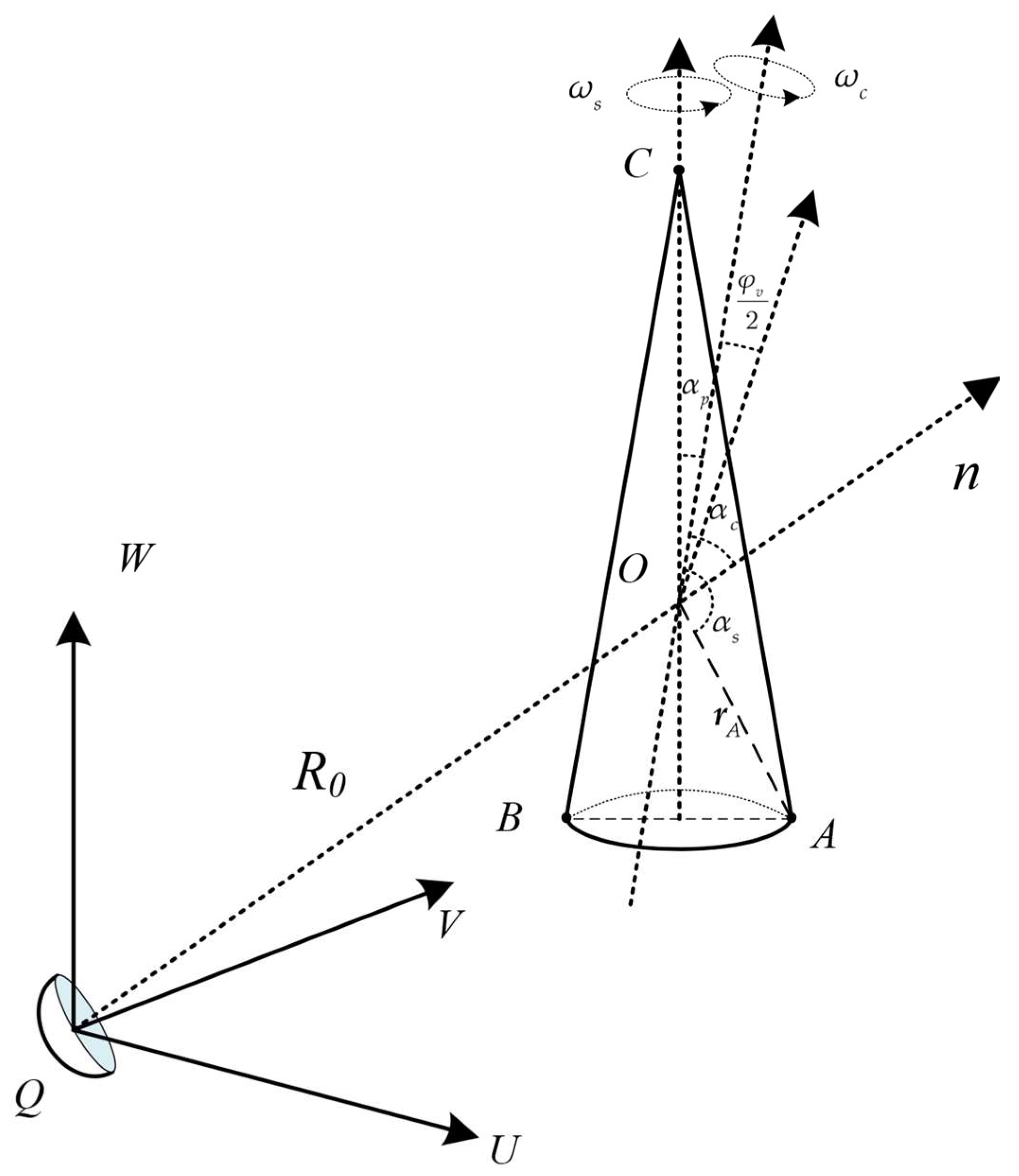
In this section, the motion model of a smooth and symmetric nutation cone target is presented, and the expression of its micro-Doppler frequency shift is derived. Both sliding scattering points (cone bottom) and fixed scattering (cone apex) points exist on the target of a smooth symmetric nutating cone. Nutation is a composite motion of target spin, coning motion, and wobble. Specifically, the target spins around the spin vector and rotates around the coning vector simultaneously, with the coning vector wobbling during the rotation process. For the smooth symmetric nutating cone target studied in this paper, the fixed scattering point at the cone apex is located on the spin axis, so its motion is not affected by spin; the two sliding scattering points at the cone bottom slide along the intersection of the radar beam and the cone cross-section, so their motion is also not affected by spin. Therefore, the smooth and symmetric nutation cone target is only affected by coning motion and wobble, and its motion model is presented in Figure 1.
The target reference coordinate system is OXYZ, where O is the center of mass of the cone. The fin vector from O to A is r A = r a X , r a Y , r a Z T , and the apex vector from O to the cone apex C is r C = r c X , r c Y , r c Z T . Coning motion refers to the rotation of the target around the coning vector ω c / Ω c = ω c X , ω c Y , ω c Z T , with the coning angular velocity given by Ω c = ω c , where denotes the vector norm. The precession angle refers to the angle between the coning vector and the cone’s symmetry axis. Wobble causes periodic variations in the precession angle during motion; the amplitude of this variation is defined as the nutation angle φ v , and the wobble angular velocity is Ω v . The vector connecting the radar to O is r 0 = R 0 n , where n represents the LOS and satisfies n = 1 .
The scattering points at the cone apex of a smooth symmetric cone target are fixed scattering points. The motion expression of the cone apex for the smooth symmetric cone target is consistent with that for the cone target with tail fins. As the motion expression of the cone apex for the cone target with tail fins has been derived in Reference [25], the relevant conclusion of the cone-apex motion expression is presented herein, and the expression is given as follows:
QC r + n T R v R c r C
where R v denotes the wobble matrix, and R c denotes the coning matrix. Based on the motion expression of the cone-apex scattering point, Reference [25] further provides its frequency-shift expression
f C t = 2 f c c D 1 sin ( φ w ) cos Ω v t + D 2 cos ( φ w ) cos Ω v t + D 3 cos ( Ω c t ) + D 4 cos ( φ w ) cos ( Ω c t ) cos Ω v t + D 5 sin ( φ w ) sin ( Ω c t ) + D 7 cos ( φ w ) sin ( Ω c t ) + D 6 sin ( φ w ) cos ( Ω c t ) cos Ω v t
where D 1 D 7 are the coefficients of each component in the expression, and φ w = φ v sin Ω v t .
The scattering points at the cone bottom of a smooth symmetric cone target are sliding scattering points, which always lie on the intersection of the radar beam and the cone cross-section and remain stationary with respect to the target spin. The length of r A is r a , and the angle between the symmetry axis and r A is α s . The half-cone angle is α h . Then, the base radius is r = r a sin α s , and the height from the center of mass to the bottom is h = r a cos α s . The angle between the coning vector and the LOS is α c , and the angle between the coning vector and the cone’s symmetry axis is the precession angle α p . The angle Λ ( t ) between the LOS and r C can be written as
Λ ( t ) = arccos sin α p + φ v sin Ω v t sin α c sin Ω c t + φ + cos α p + φ v sin Ω v t cos α c
where φ is the initial phase. The micro-motion expressions of scattering points A and B can be written as
r A ( t ) = R 0 + r sin Λ ( t ) h cos Λ ( t ) r B ( t ) = R 0 r sin Λ ( t ) h cos Λ ( t )
where R 0 denotes the distance between the radar and the cone’s center of mass. Suppose the radar emits a single-frequency signal with a carrier frequency f c , the time–frequency relations for bottom scattering points can be derived as
f A ( t ) = 2 f c c h cos Λ ( t ) r sin Λ ( t ) f B ( t ) = 2 f c c h cos Λ ( t ) + r sin Λ ( t )
where cos Λ ( t ) and sin Λ ( t ) correspond to the derivatives of cos Λ ( t ) and sin Λ ( t ) . cos Λ ( t ) can be written as
cos Λ ( t ) = φ v Ω v sin α c cos Ω v t sin Ω c t + φ cos α p + φ v sin Ω v t φ v Ω v cos α c cos Ω v t sin α p + φ v sin Ω v t + Ω c sin α c cos Ω c t + φ sin α p + φ v sin Ω v t
sin Λ ( t ) can be written as
sin Λ ( t ) = cos Λ ( t ) cos Λ ( t ) 1 cos 2 Λ ( t )

3. 3-D Micro-Motion Feature Extraction Method

For a smooth symmetric nutation cone target, during the target’s motion, the scattering point at the base of the cone slides over the projectile surface as the incidence angle changes. Therefore, its visibility during the observation process must be considered, as shown in Table 1. In Table 1, 0 indicates that the scattering point is not visible, while 1 indicates that it is visible.
Table 1 reveals that the number of cone bottom scattering points in the target echo can be categorized into two types, based on the visibility of these sliding scattering points. Category 1 is the signal echo, which includes scattering points A and B, corresponding to the intervals Λ ( t ) α h , α h < Λ ( t ) < 0.5 π , 0.5 π Λ ( t ) π α h . In this category, the cone-apex scattering point may appear or vanish. However, the method for category 1 only utilizes the cone-bottom echo. By leveraging the wideband imaging capability of radar, the cone-bottom echo can be isolated to estimate the 3-D micro-motion features. Thus, the presence or absence of the apex scattering point does not impact the method’s performance here. Category 2 corresponds to a single scattering point at the cone bottom. The echo includes scattering points B and C, corresponding to π α h < Λ ( t ) π . Given the distinct scattering point configurations across these two categories, the micro-Doppler characteristics of the echo and the associated micro-motion feature extraction approaches need to be derived independently for each case.

3.1. Only One Scattering Point at the Cone Bottom

First, the 3-D micro-motion feature extraction method for the category where the cone-bottom echo contains a single scattering point is discussed. Reference [25] has proposed a method to estimate partial micro-motion features (precession angle, nutation angle, cone vector, coning frequency, wobble frequency, and α c ) based on the cone apex scattering point echo. Since the micro-Doppler characteristics of the cone-apex echo are identical for both the smooth symmetric nutating cone target and the nutating cone target with tail fins, this method is applicable to the apex echo of the smooth symmetric nutating cone target. Therefore, when only one scattering point exists in the cone bottom, partial micro-motion features of the target can be obtained from the cone-apex echo via the method in [25]. At this point, there are only two unknown parameters r a and α s in the cone-bottom echo. A dictionary D can be constructed, and the OMP algorithm can be used for 2-D parameter estimation. Let the parameters to be estimated be r ˜ a and α ˜ s . Then a column in the dictionary D can be written as
D k 1 , k 2 = exp i 4 π f c c r ˜ a , k 1 sin α ˜ s , k 2 sin Λ t ) + cos α ˜ s , k 2 cos Λ ( t )
The dictionary constructed based on Equation (8) can be used to obtain the target’s parameters to be estimated, r ˜ a and α ˜ 2 , from the cone-bottom echo.

3.2. Two Scattering Points at the Cone Bottom

In this scenario, since the cone bottom is a sliding scattering point, the properties of the cone-bottom echo must first be analyzed to extract the target’s 3-D micro-motion features. The cone-bottom echo s t , which contains the echoes of scattering points A and B, can be formulated as
s t = exp - i 4 π f c R 0   +   r sin Λ ( t )     h cos Λ ( t ) c + exp - i 4 π f c R 0     r sin Λ ( t )     h cos Λ ( t ) c
This expression can be reorganized into a more concise form
s t = 2 cos 4 π r sin Λ ( t ) c exp - i 4 π f c R 0 h cos Λ ( t ) c
By multiplying s t with its own conjugate, s 1 t is obtained as
s 1 ( t ) = s t conj s t = 4 cos 2 4 π r c sin Λ ( t ) = 2 cos 8 π r c sin Λ ( t ) + 2
By dividing the square of s t by s 1 t , s 2 t is obtained as
s 2 ( t ) = s 2 t s 1 ( t ) = exp - i 8 π c f c R 0 h cos Λ ( t )
As can be seen from Equations (11) and (12), the complexity of the cone-bottom echo is further reduced. This reduction in complexity streamlines the subsequent extraction of micro-motion features. Notably, s 2 t is far less complex than s 1 t ; thus, the coning frequency and wobble frequency are first estimated from s 2 t . The derivative of s 2 t is given by
s 2 ( t ) = - i 8 π c f c h exp - i 8 π c f c R 0 h cos Λ ( t ) cos Λ ( t )
Multiply Equation (10) by the conjugate of s 2 t , the result is
s 3 ( t ) = conj s 2 ( t ) s 2 ( t ) = - i 8 π c f c h cos Λ ( t )
The frequency components contained in s 3 ( t ) are sin Ω v t ± φ w , sin Ω c t ± φ w and sin ( φ w ± Ω c t ± Ω v t ) . Practical smooth symmetric nutating cone targets have φ w within 0~0.9 rad, and their influence on frequency components is negligible (relative error ≤3.2%). Since the nutation angle φ w is generally small, its influence on the above components within the nutation period is negligible; thus, the effect of φ w can be ignored during frequency extraction. s 3 ( t ) can be regarded as a superposition of sine functions with four distinct frequencies ( Ω v , Ω c , Ω c + Ω v , Ω c Ω v ). By constructing a dictionary containing sine functions of different frequencies and applying the OMP algorithm, Ω v and Ω c can be estimated.
Once the coning frequency and nutation frequency are determined, the target’s 3-D micro-motion features can be retrieved by leveraging the micro-Doppler characteristics of s 1 t and s 2 t . First, part of the micro-motion features is estimated from s 2 t . To facilitate the elimination of the constant term in s 2 t , s 2 ( t ) can be expanded as
s 2 ( t ) = exp i 8 π c h f c cos α c cos α p + φ v sin Ω v t exp i 8 π c h f c sin α c sin α p + φ v sin Ω v t sin Ω c t + φ
s 2 ( t ) is delayed by 2 π / Ω v and multiplied by its own conjugate; s 4 ( t ) is obtained as
s 4 ( t ) = conj s 2 ( t ) s 2 ( t + 2 π Ω v ) = exp i 8 π c h f c sin α c sin α p + φ v sin Ω v t sin Ω c t + 2 π Ω c Ω v + φ sin Ω c t + φ = exp i 16 π c h f c sin α c sin π Ω c Ω v sin α p + φ v sin Ω v t cos Ω c t + π Ω c Ω v + φ
The time–frequency curve of s 4 ( t ) is
f 4 ( t ) = 8 c h f c sin α c sin π Ω c Ω v Ω c sin α p + φ v sin Ω v t sin Ω c t + π Ω c Ω v + φ + φ v Ω v cos Ω v t cos α p + φ v sin Ω v t cos Ω c t + π Ω c Ω v + φ
By integrating the time–frequency curve, r 4 ( t ) is obtained as
r 4 ( t ) = 8 c h f c sin α c sin π Ω c Ω v sin α p + φ v sin Ω v t cos Ω c t + π Ω c Ω v + φ + C 4
where C 4 denotes an unknown value introduced by integration. Since the nutation angle φ v is typically smaller than α p , the value of sin α p + φ v sin Ω v t in r 4 ( t ) remains greater than 0. Thus, the zero-crossings of r 4 ( t ) repeat periodically with the cone rotation period. Based on this property, the positions of zero-crossings can be determined by searching for periodically repeating points in r 4 ( t ) , thereby estimating the value of φ .
After φ is estimated, the remaining micro-motion features can be estimated from the time–frequency curve. The function f 4 ( t ) contains two time-varying terms; when t = 0.5 π / Ω v , cos Ω v t in the second term equals 0. Specific time instants t 1 = 0.5 π / Ω v and t 2 = 1.5 π / Ω v are thus selected, leading to f 4 ( t 1 ) and f 4 ( t 2 )
f 4 ( t 1 ) = 8 c h f c Ω c sin α c sin π Ω c Ω v sin α p + φ v sin 3 π Ω c 2 Ω v + φ f 4 ( t 2 ) = 8 c h f c Ω c sin α c sin π Ω c Ω v sin α p φ v sin 5 π Ω c 2 Ω v + φ
Similarly, when t = π / Ω v φ / Ω c , sin Ω c t + π Ω c / Ω v + φ in the first term equals 0. Thus, specific time instants t 3 = π / Ω v φ / Ω c and t 4 = π / Ω c π / Ω v φ / Ω c are selected, giving f 4 ( t 3 ) and f 4 ( t 4 )
f 4 ( t 3 ) = A m cos Ω v φ Ω c cos α p φ v sin Ω v φ Ω c f 4 ( t 4 ) = A m cos Ω v φ   +   π Ω c cos α p φ v sin Ω v φ + π Ω c
where A m = 8 φ v Ω v h f c sin α c sin π Ω c / Ω v / c . To facilitate the expression of the relationship between α p and φ v , Equation (16) is rewritten as
G 1 = f 4 ( t 1 ) sin 5 π Ω c 2 Ω v + φ f 4 ( t 2 ) sin 3 π Ω c 2 Ω v + φ = sin α p + φ v sin α p φ v
Further, Equation (18) can be rewritten as
tan α p = G 1 + 1 G 1 1 tan φ v
Similarly, Equation (17) is rewritten as
G 2 = f 4 ( t 3 ) cos Ω v φ + π Ω c f 4 ( t 4 ) cos Ω v φ Ω c = cos α p φ v sin Ω v φ Ω c cos α p φ v sin Ω v φ   +   π Ω c
Equations (19) and (20) are independent equations, containing only two unknown parameters α p and φ v . So α p and φ v can be estimated from Equations (19) and (20). By substituting the estimated results into Equation (16), the estimated value of h sin α c . Through the above steps, some of the target’s micro-motion features ( h sin α c , Ω c , Ω v , φ , α p , φ v ) have been estimated.
To compensate for the high-complexity components of s 2 ( t ) , the compensation function s c o m ( t ) is constructed based on the micro-Doppler frequency-shift mechanism of sliding scattering points. The high complexity of s 2 ( t ) is caused by the joint modulation of coning motion, wobble motion, and geometric structure. Since we have accurately estimated the coning frequency, wobble frequency, nutation angle, precession angle, and initial phase in the previous steps, s c o m ( t ) can replicate the same modulation effect as the high-complexity components in s 2 ( t ) by integrating these estimated parameters into the micro-Doppler expression. When s 2 ( t ) is multiplied by the conjugate of s c o m ( t ) , the mutual cancellation of the same modulation terms occurs, which effectively eliminates the nonlinear coupling effect of multiple micro-motion parameters. This process significantly reduces the complexity of s 2 ( t ) and lays the foundation for subsequent one-dimensional parameter estimation. The expression of s c o m ( t ) is given by
s c o m ( t ) = exp i 8 π c h f c sin α c sin α p + φ v sin Ω v t sin Ω c t + φ
The compensated result is s 5 ( t )
s 5 ( t ) = s 2 ( t ) conj s c o m ( t ) = exp i 8 π c f c h cos α c cos α p + φ v sin Ω v t
Since the term cos α p + φ v sin Ω v t is known, the value of h cos α c can be estimated from s 5 ( t ) by one-dimensional parameter estimation. Combining this with the previously estimated h sin α c , h and α c can be obtained.
Finally, the parameter r needs to be estimated, which can be done based on s 1 ( t ) . Since r is the only unknown parameter in s 1 ( t ) , a dictionary D 2 can be constructed, and the OMP algorithm can be applied for one-dimensional parameter estimation to extract r . The k -th entry in D 2 is expressed as
D 2 , k = cos 8 π c f c r k sin Λ ( t )
where β ( t ) can be represented by the already estimated micro-motion features, and r k denotes the parameter to be estimated.
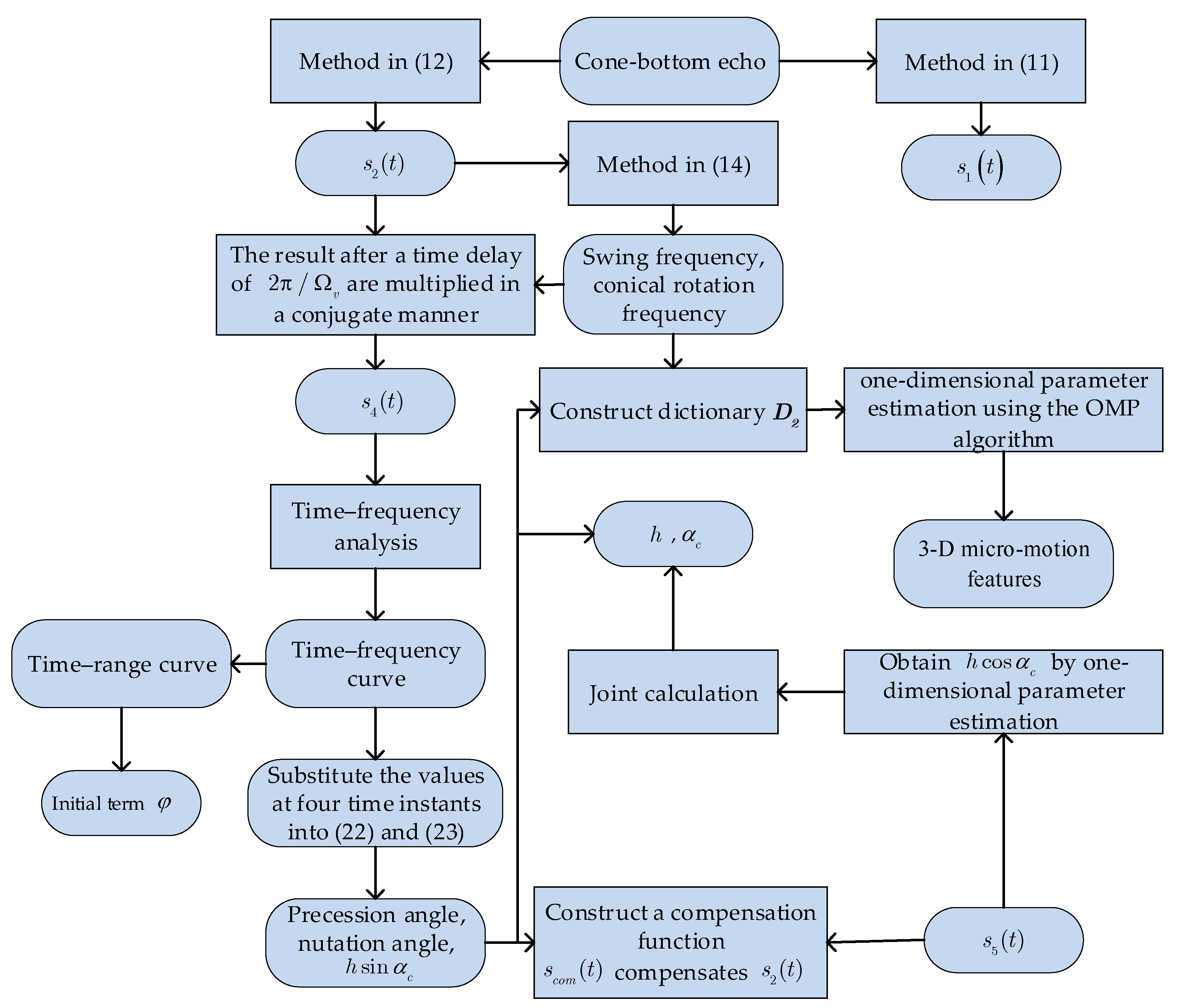
At this point, all micro-motion features contained in the cone-bottom echo have been estimated, and all 3-D micro-motion features (except the cone height) have been obtained. However, since the cone-bottom echo does not contain information about the cone height, the 3-D micro-motion features cannot be extracted solely based on the cone-bottom echo. Prior information is thus introduced: the cone center lies on the axis of symmetry, and its height from the bottom is 1/4 of the cone height. Based on this prior information, the cone height can be estimated as H = 4 h . In summary, a method for extracting the 3-D micro-motion features of a smooth symmetric precession cone target for the category where the cone-bottom echo contains two scattering points is proposed, and its process is illustrated in Figure 2.

4. Simulation Verification

In this section, the 3-D micro-motion feature extraction results of the algorithm are presented for the categories where the cone-bottom echo contains one or two scattering points, and the performance of the method under noisy conditions is discussed.

4.1. Simulation Results of Only One Scattering Point at the Cone Bottom

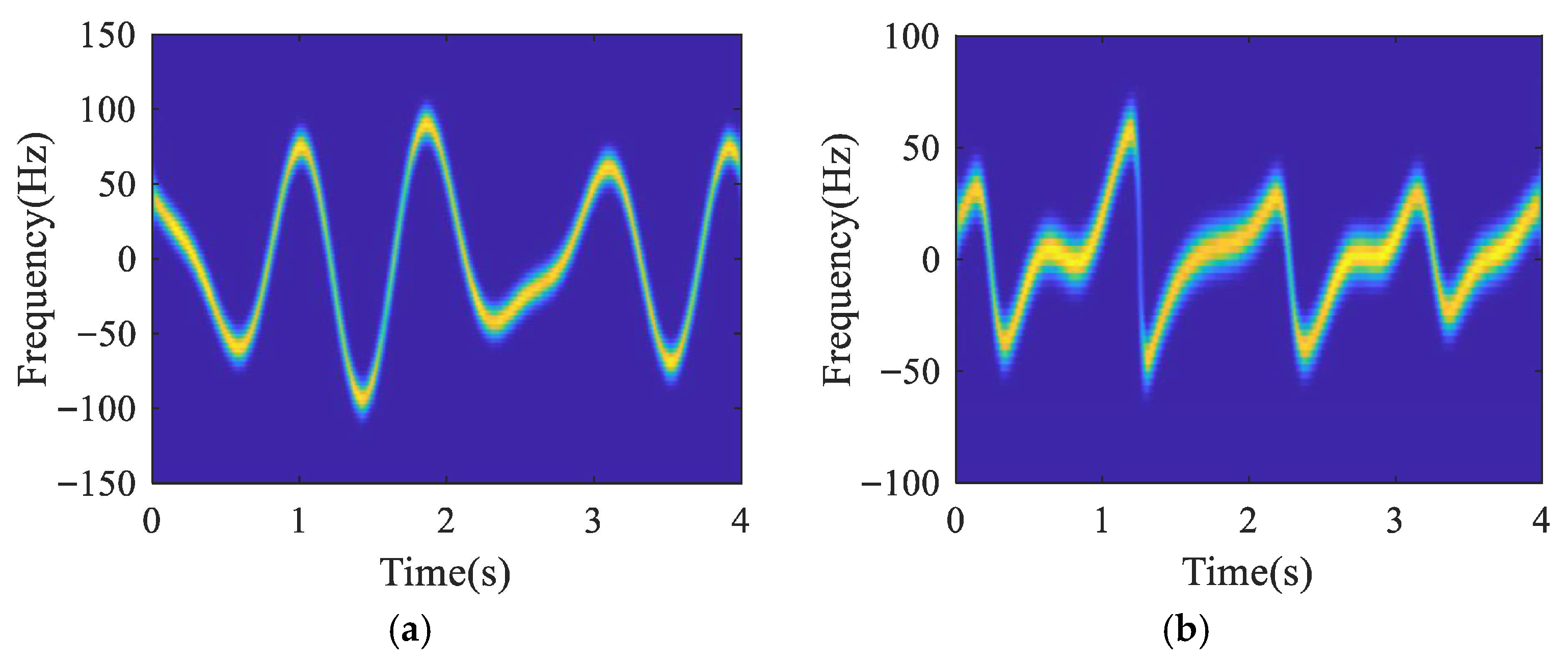
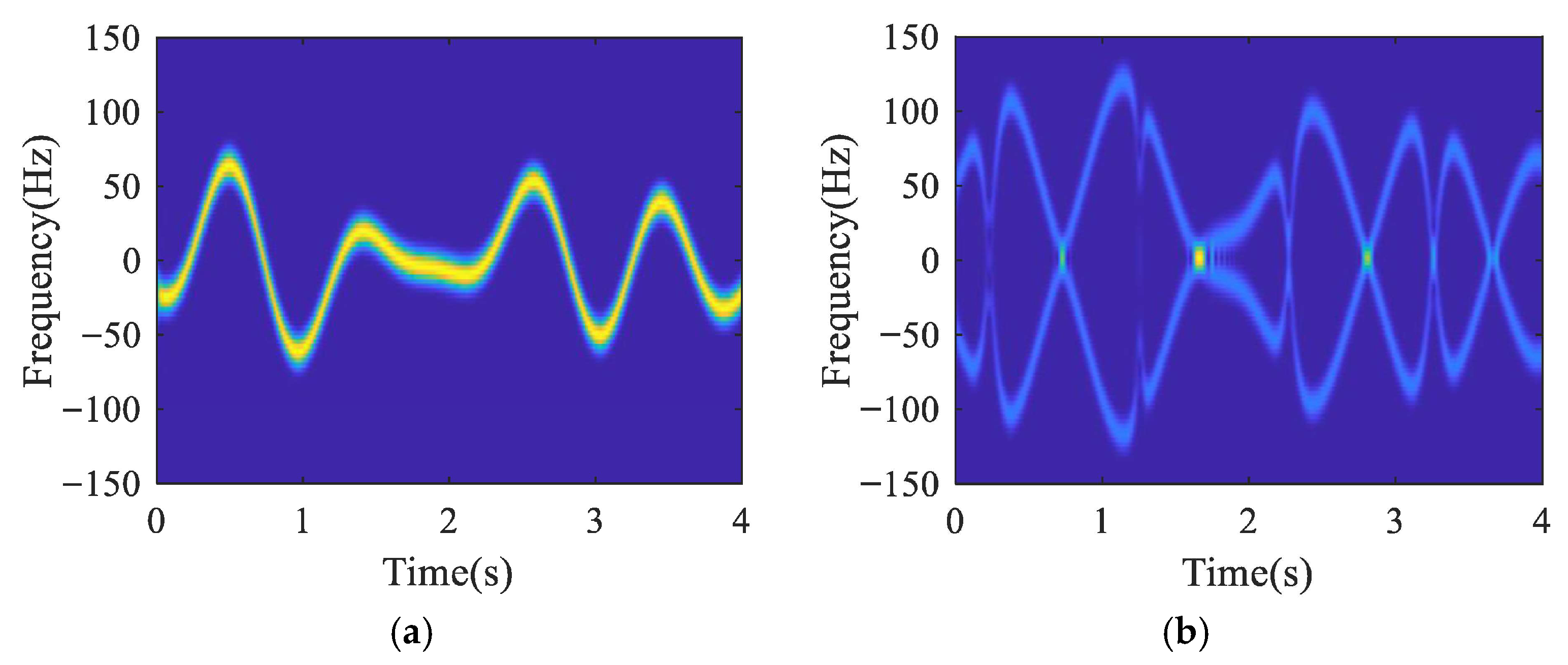
Table 2 lists the simulation parameters for the smooth symmetric nutating cone target and radar system. The radar emits a linear frequency-modulated (LFM) signal with 1 GHz bandwidth. Based on these simulation parameters, the time–frequency diagrams of the echoes from scattering points C and B are generated in Figure 3. The frequency-shift curve of scattering point C approximates a standard sine function, whereas that of point B exhibits significant fluctuations. This is because the frequency-shift curve of scattering point B contains sin Λ ( t ) , which expands into a radical polynomial, leading to large fluctuations in the frequency-shift curve and a significant deviation from the standard sine function.
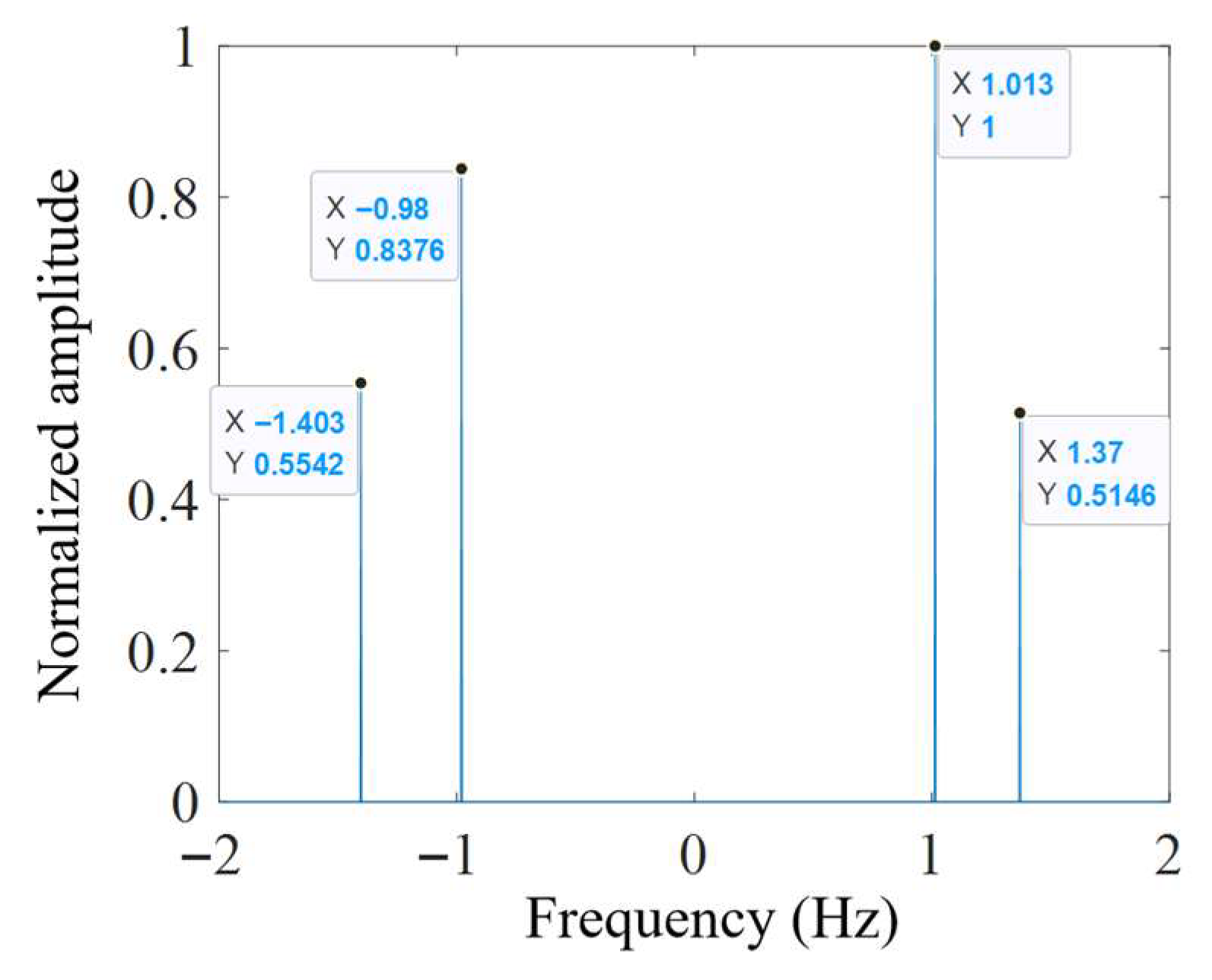
Following the flowchart presented in Figure 2, the nutation frequency and cone rotation frequency are first extracted from scattering point C, with the results presented in Figure 4. The sum of the cone rotation frequency and nutation frequency is 1.3935 Hz, and the cone rotation frequency is typically greater than the nutation frequency. Thus, the cone rotation frequency is 1 Hz, and the nutation frequency is 0.3935 Hz. Partial micro-motion features contained in the cone-apex echo can then be estimated, with the results listed in Table 3.
Subsequently, the remaining micro-motion features are estimated on the cone-bottom echo. The 3-D micro-motion feature estimation is presented in Table 4. Among these features, the extraction error of the half-cone angle is the largest, while the estimation errors of the cone rotation frequency and nutation frequency are the smallest, with an average error of 2.78%. These outcomes verify that the proposed method can precisely capture the target’s micro-motion features in noise-free conditions.
The computational complexity of the OMP-based two-dimensional parameter estimation method in Section 3.1 is analyzed. For a signal length of N = 104, the search ranges of r ˜ a and α ˜ s are 0.2–0.6 m (step size 0.001 m) and 0.1–0.5 rad (step size 0.001 m), respectively, with a total of 40,000 search grid points. A computation time test (AMD Ryzen 7 5800H CPU, 16 GB RAM) shows that the parameter estimation process takes only 0.012 s, which meets the real-time requirements of practical radar systems. Compared with alternative algorithms such as the Iterative Shrinkage-Thresholding Algorithm (ISTA) and the Fast Iterative Shrinkage-Thresholding Algorithm (FISTA), the OMP-based method achieves higher estimation accuracy while maintaining low computational complexity. This is attributed to the narrow search range of the to-be-estimated parameters and the sparse characteristics of the cone-bottom echo in the constructed dictionary. Thus, the OMP-based two-dimensional parameter estimation method is suitable for the proposed approach.
Subsequently, the robustness of the developed approach in noisy scenarios is evaluated. For an SNR of 0 dB, the time–frequency diagrams of echoes from scattering points C and B are shown in Figure 5. In the echo data processing workflow, a slow-time range profile of the target is first obtained via broadband imaging, followed by the accumulation of range bins containing the target signal to form the cone-bottom echo. This process accumulates broadband energy, which significantly mitigates the influence of noise, resulting in the high-quality time–frequency representations presented in Figure 5.
The nutation frequency and cone rotation frequency are extracted from the echo of cone-apex scattering point C, with results shown in Figure 6. The frequency extraction accuracy remains relatively high. The sum of the cone rotation frequency and nutation frequency is 1.3867 Hz, corresponding to a cone rotation frequency of 0.9967 Hz and a nutation frequency of 0.39 Hz. Compared with the noise-free scenario, the frequency extraction error increases at 0 dB SNR.
After extracting the cone frequency and wobble frequency, partial micro-motion features can be extracted from the cone-apex echo, and the results are presented in Table 5. During the micro-motion feature extraction process, the frequency-shift curve needs to be extracted from the time–frequency diagram; this process is highly susceptible to noise, resulting in a reduction in the accuracy of micro-motion feature extraction.
Further, a dictionary is constructed according to Equation (8), and the OMP algorithm is applied to the cone-bottom echo to estimate t r a and α s , thereby obtaining the 3-D micro-motion features of the target, with corresponding outcomes presented in Table 6. Among the metrics, the precession angle exhibits the largest retrieval deviation (14.27%), while the coning and wobble frequencies show the smallest errors (both below 3%). Beyond the precession angle, the cone height also has a relatively large retrieval error of 13.71%. Although the accuracy of micro-motion feature extraction at 0 dB SNR is lower than in the noise-free scenario, the 3-D micro-motion features can still be acquired with reasonable accuracy.
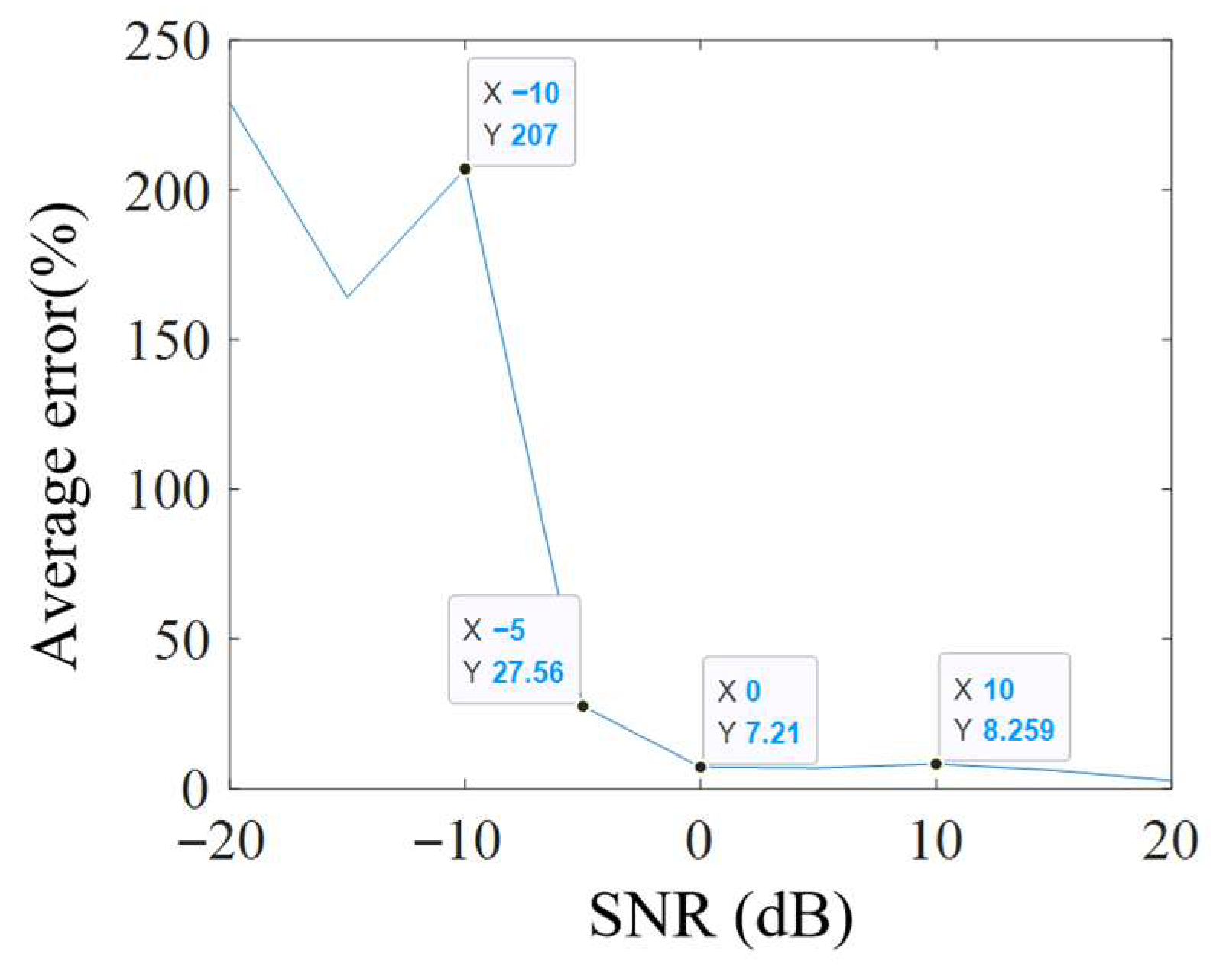
Finally, the behavior of the developed approach across varying SNR levels is analyzed. Figure 7 illustrates the mean retrieval errors of 3-D micro-motion features obtained via the proposed method under different SNR conditions: the mean error rises sharply when the SNR drops below 0 dB. This trend arises because the approach’s performance is strongly dependent on the frequency-shift curve’s retrieval precision. The method will malfunction once this precision degrades beyond a critical threshold. Therefore, if the target’s frequency-shift curve can be accurately extracted under low SNR conditions, it holds promise for achieving higher accuracy in 3-D micro-motion feature extraction.

4.2. Simulation Results of Two Scattering Points at the Cone Bottom

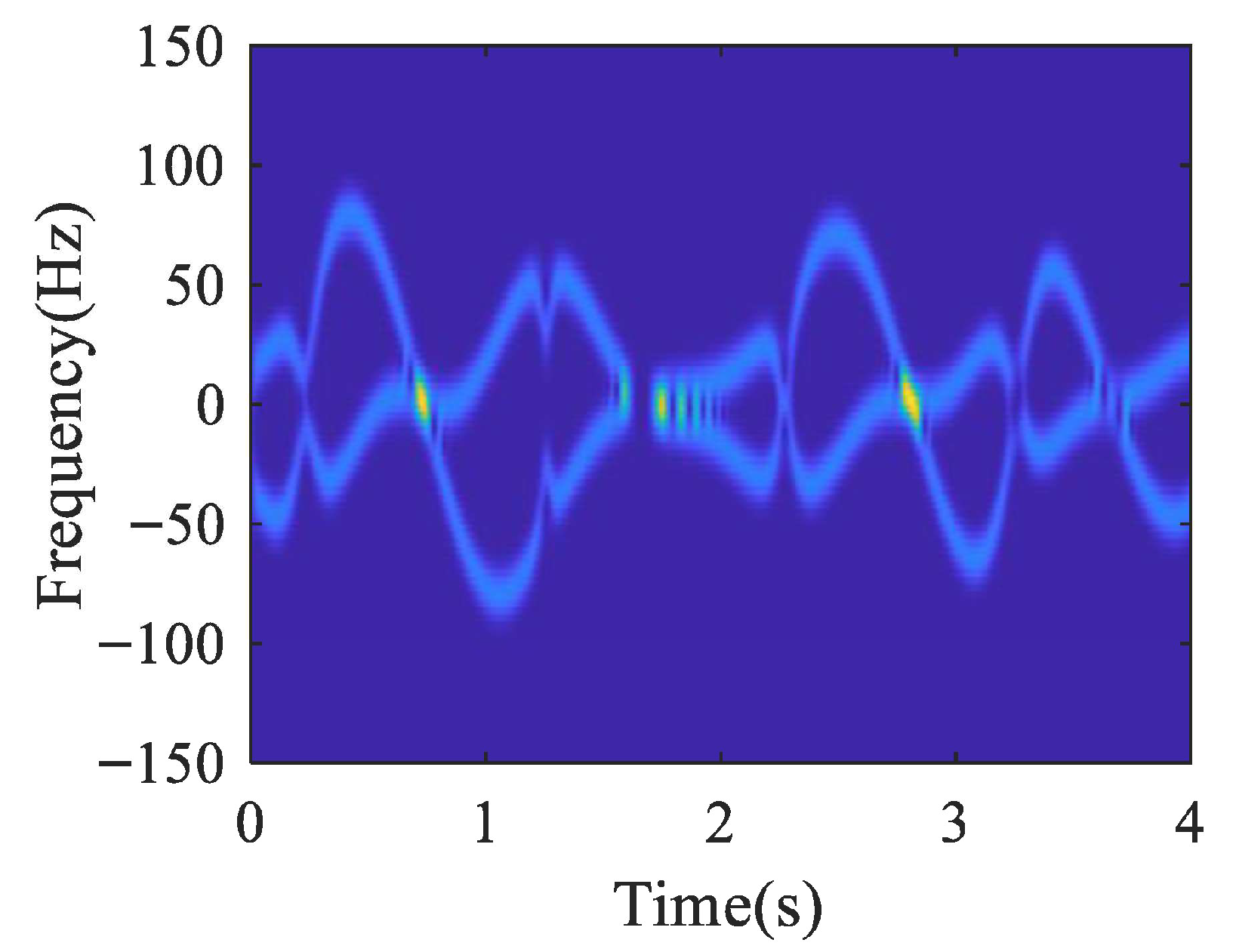
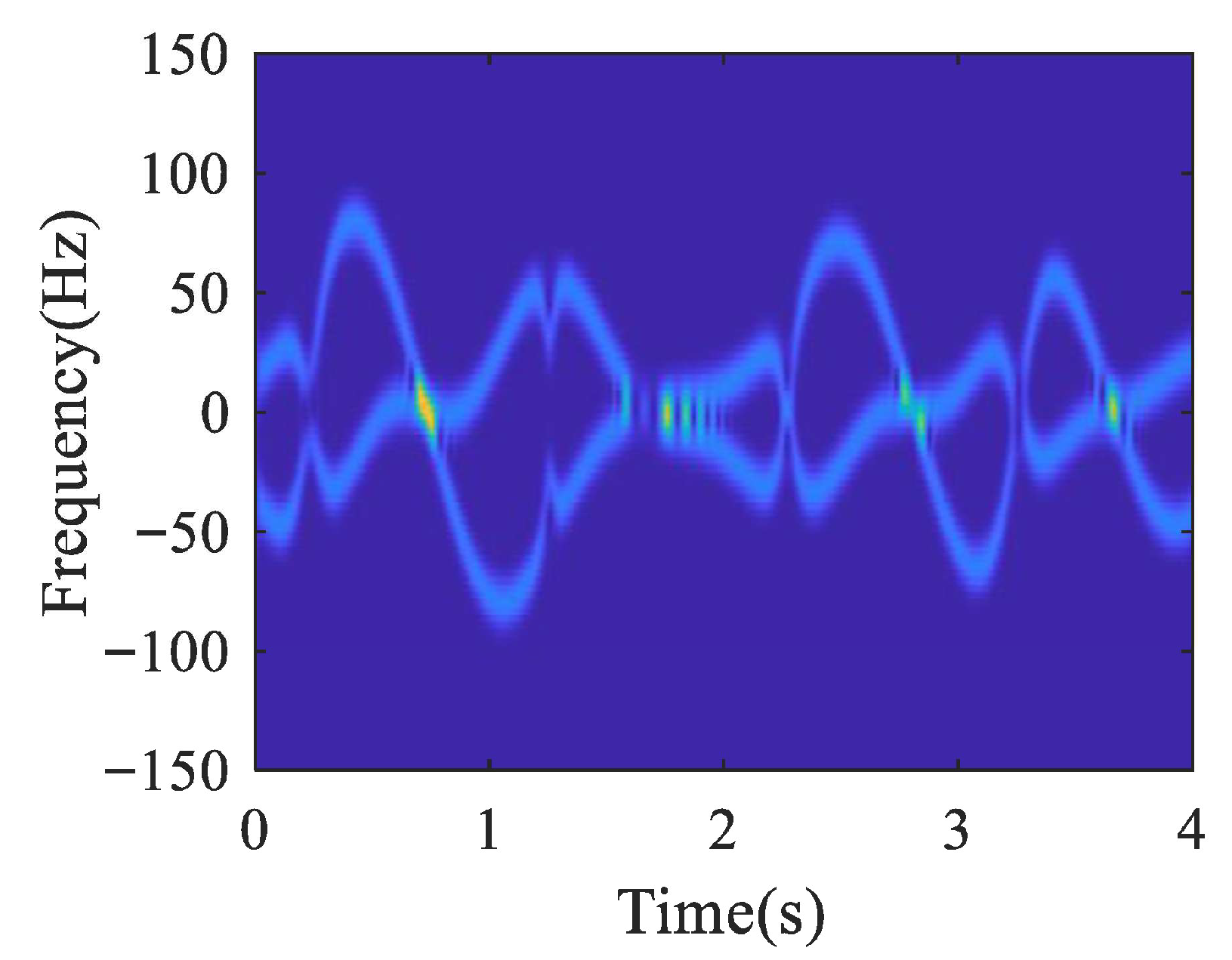
The 3-D micro-motion feature estimation is presented for the scenario where the cone-bottom echo contains two scattering points. Only the radar LOS direction is modified in the simulation parameters, and all other parameters remain consistent with those given above. The time–frequency diagram of the cone-bottom echo containing scattering points A and B is generated based on the simulation parameters, with the results shown in Figure 8. The cone-bottom echo consists of the echoes from scattering points A and B, leading to two time–frequency curves in the diagram with asymmetric profiles.
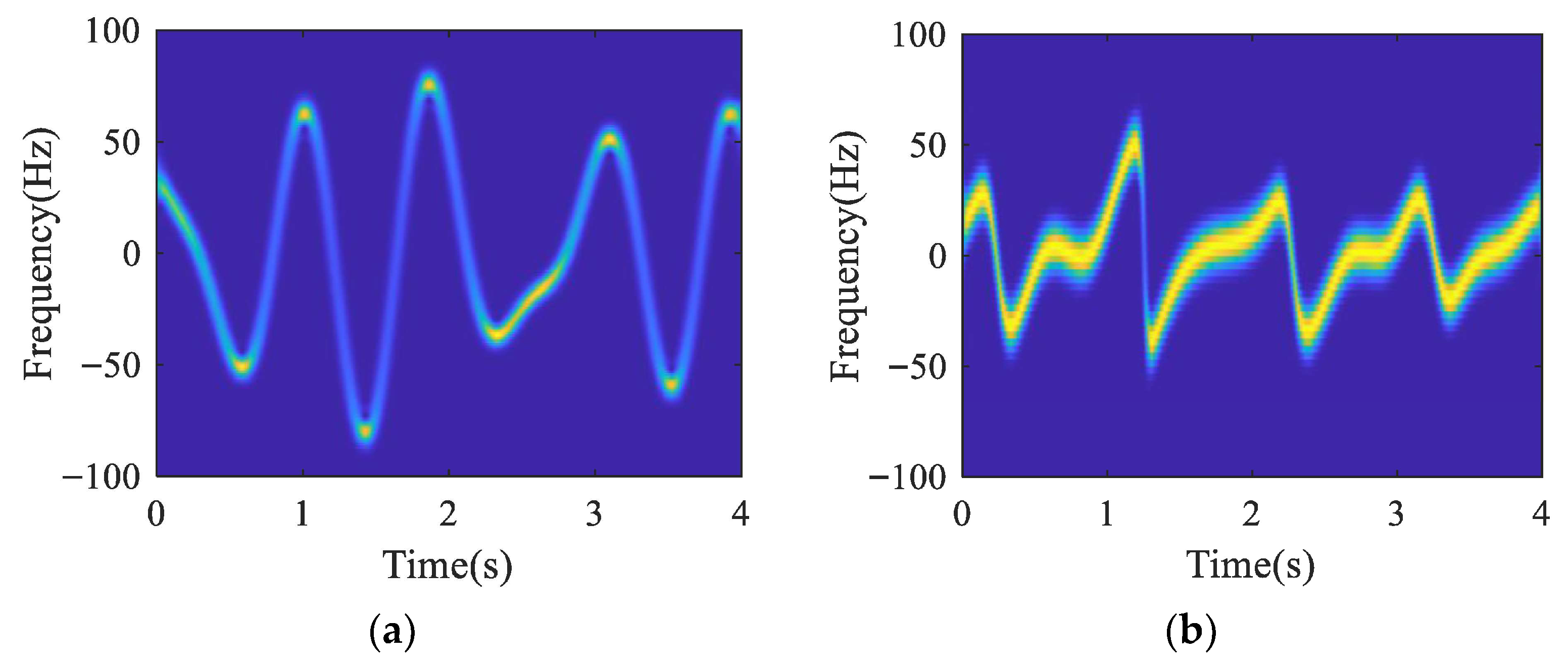
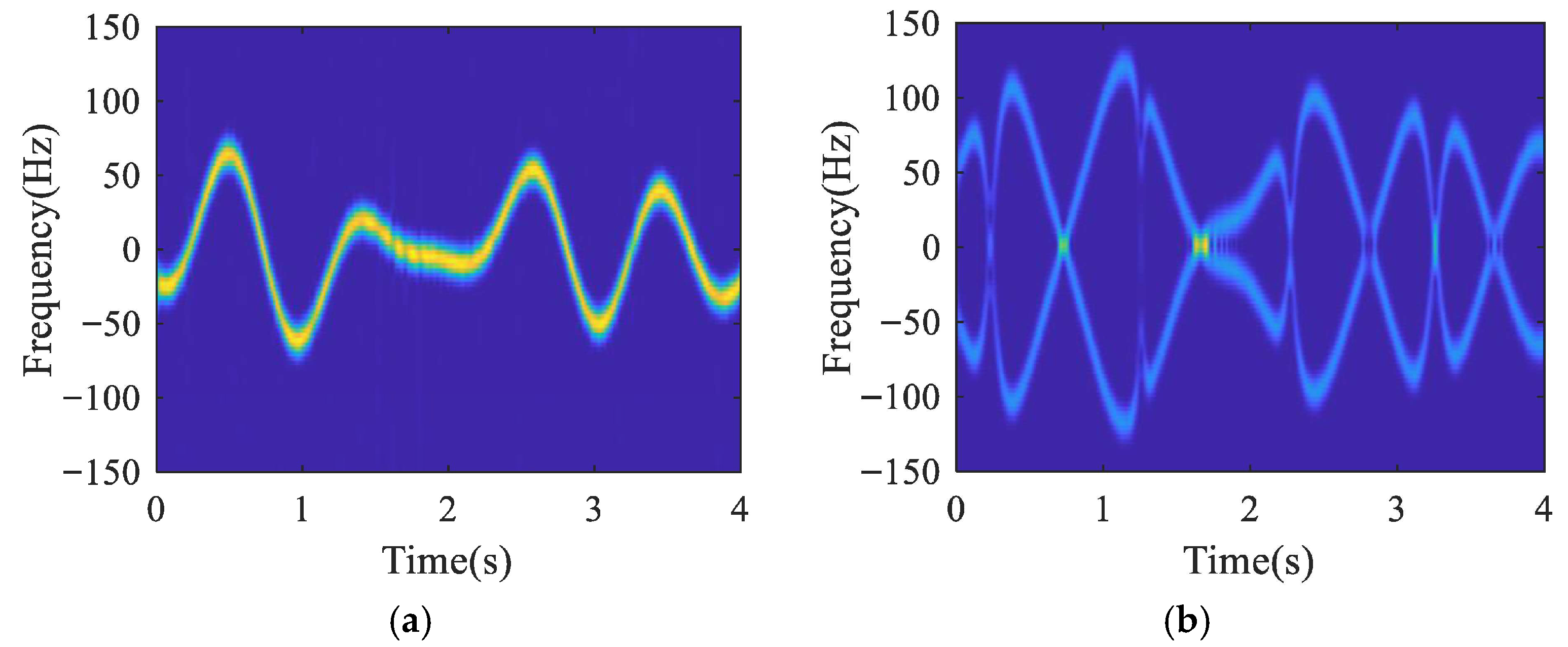
Based on the algorithm flowchart shown in Figure 3 and Equations (11) and (12), s 1 ( t ) and s 2 ( t ) are separated from the cone-bottom echo, and their time–frequency diagrams are presented in Figure 9. The separated s 2 ( t ) is a complex exponential function, so its time–frequency diagram contains only one frequency-shift curve; s 1 ( t ) is a cosine function, so its time–frequency diagram has two frequency-shift curves symmetric about the zero frequency.
Meanwhile, the phase of s 1 ( t ) includes cos β ( t ) , whose expression consists of multiplied sine function terms and has a relatively simple form. Thus, its frequency-shift curve is regular without obvious abrupt changes. In contrast, the phase of s 2 ( t ) includes sin β ( t ) , whose expression is a radical polynomial and has a more complex form. As a result, there are multiple abrupt changes in its frequency-shift curve, leading to greater difficulty in analysis.
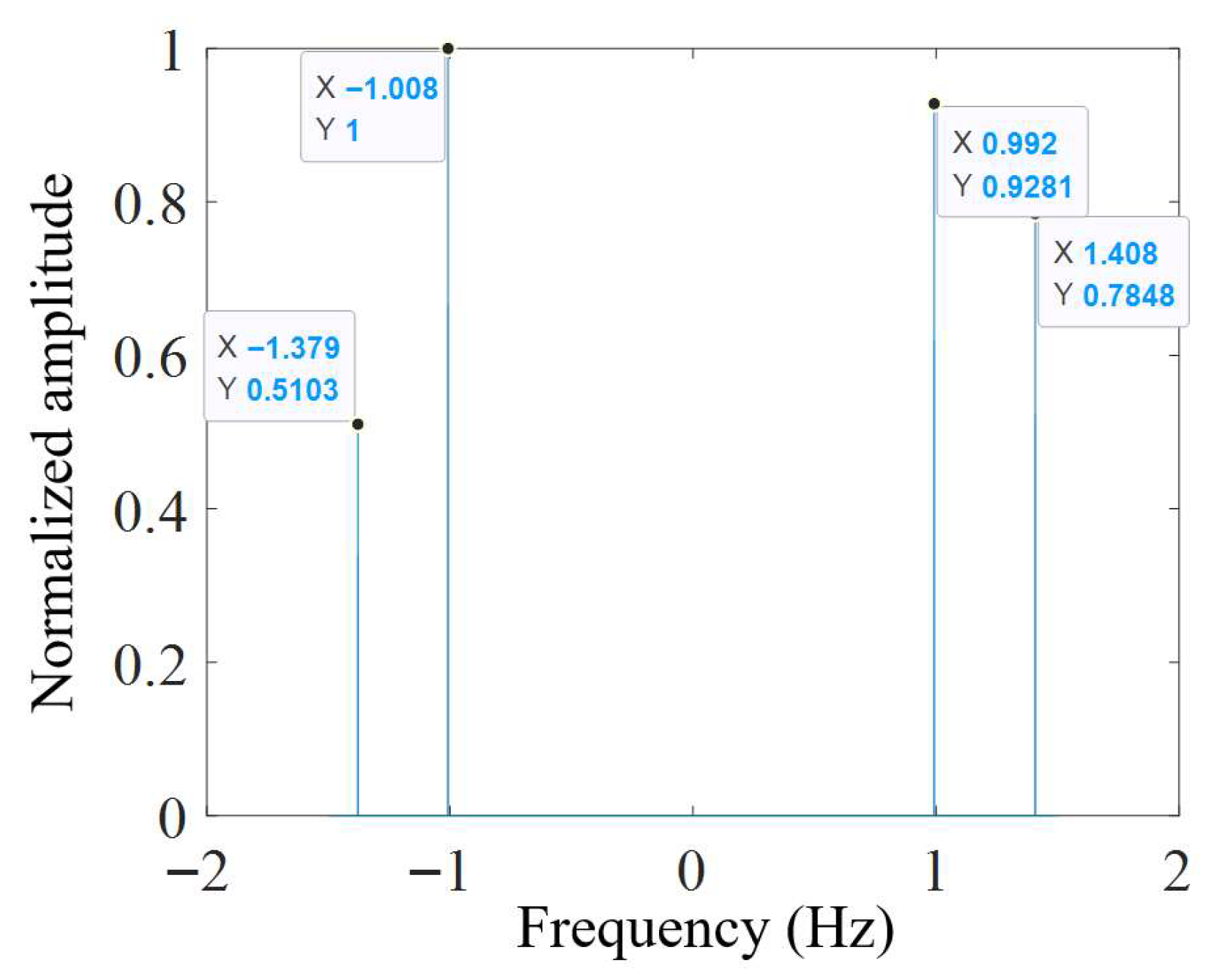
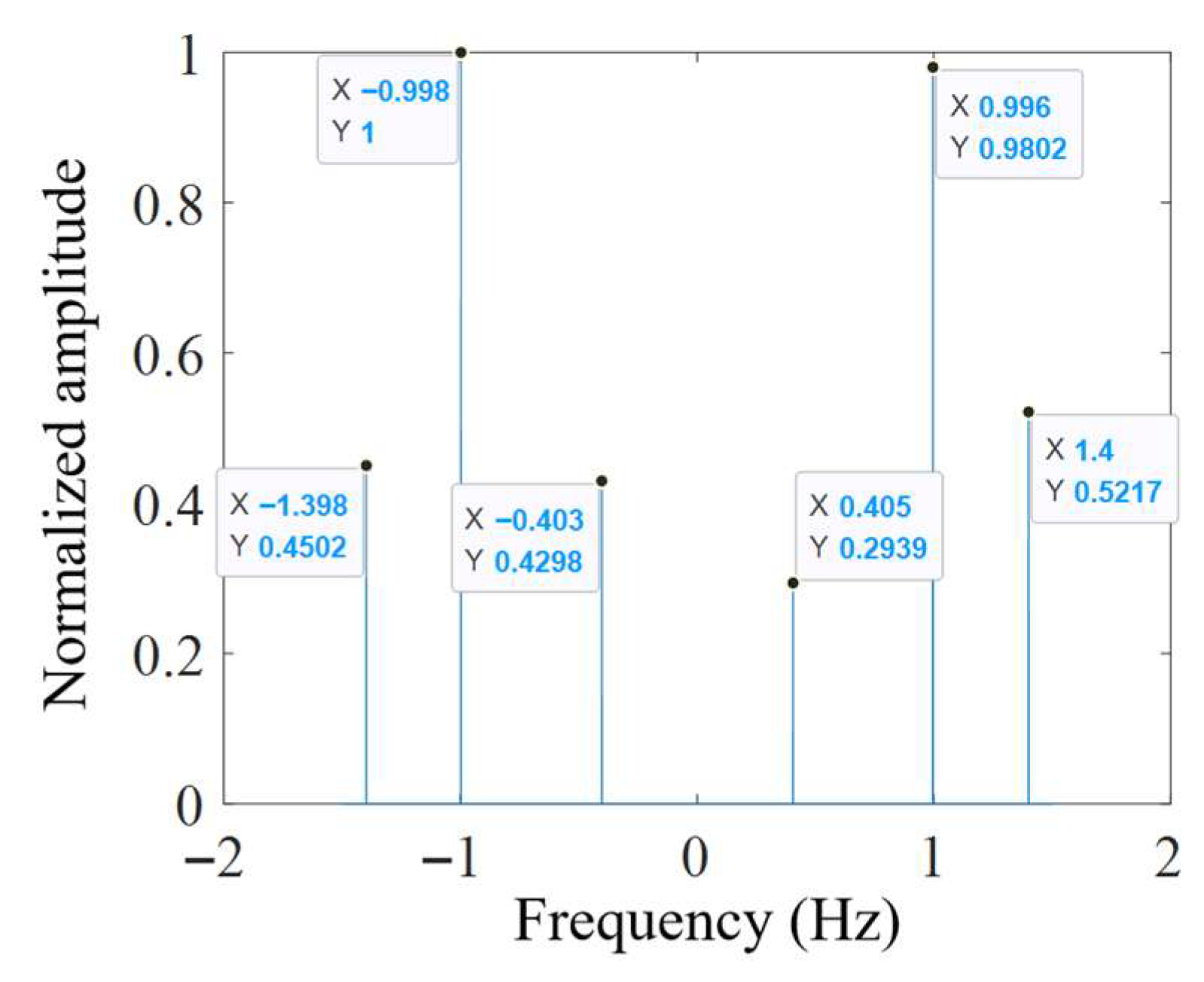
The target’s wobble frequency and coning frequency are extracted from s 2 ( t ) , with the results shown in Figure 10. Three sets of symmetric peaks are observed in this figure: the maximum frequency is 1.399 Hz, the minimum is 0.404 Hz, and the intermediate value is 0.997 Hz. By leveraging the magnitude relationship between coning and wobble frequencies, the coning frequency is estimated as 0.997 Hz, while the wobble frequency is determined to be 0.402 Hz.
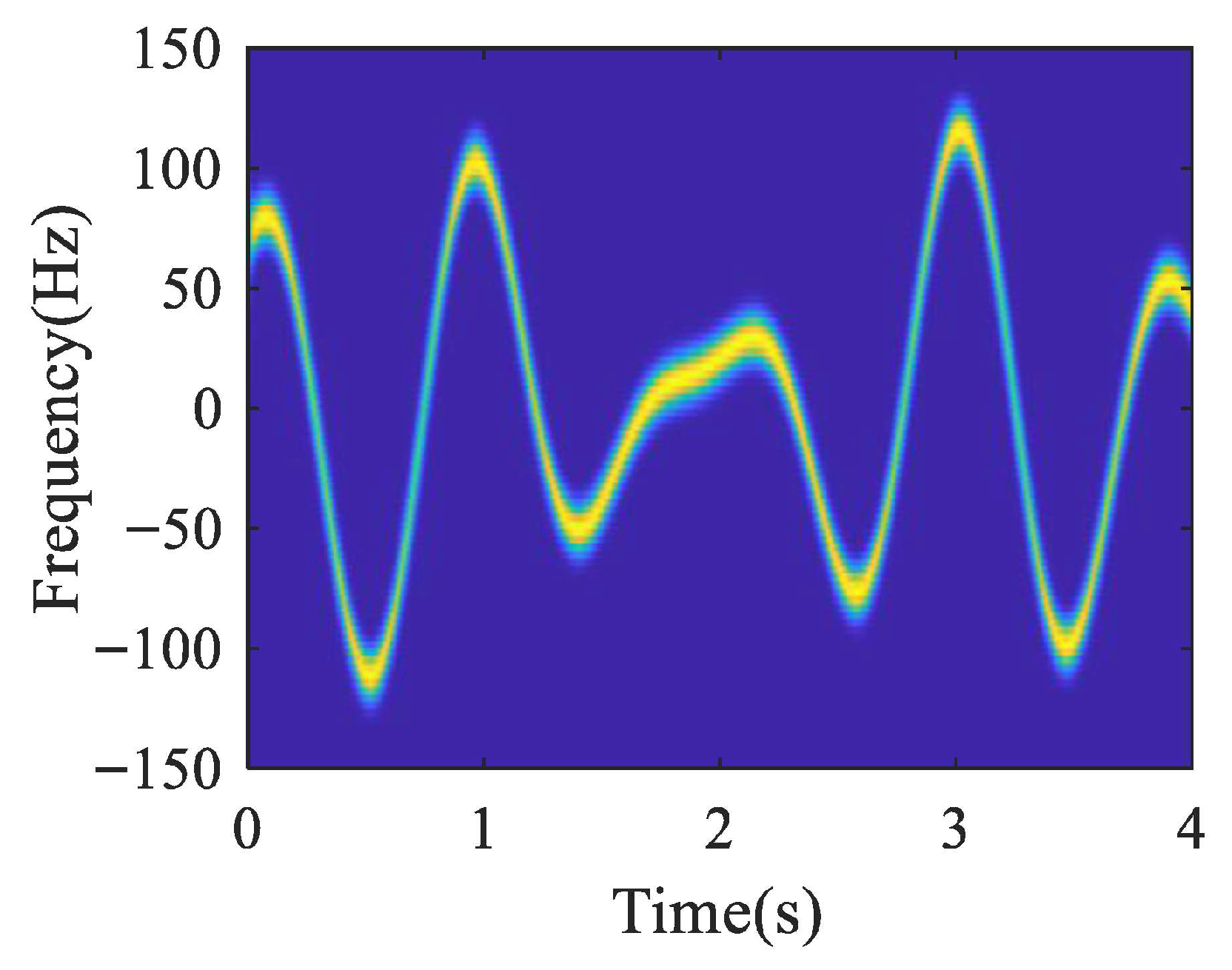
s 2 ( t ) is delayed by 2 π / Ω v and then multiplied by its own conjugate to obtain s 4 ( t ) . This process eliminates some function terms in s 2 ( t ) , which facilitates subsequent analysis. The time–frequency diagram of s 4 ( t ) is presented in Figure 11; its shape is relatively similar to that of s 2 ( t ) , but the maximum frequency shift of s 4 ( t ) is larger than that of s 2 ( t ) .
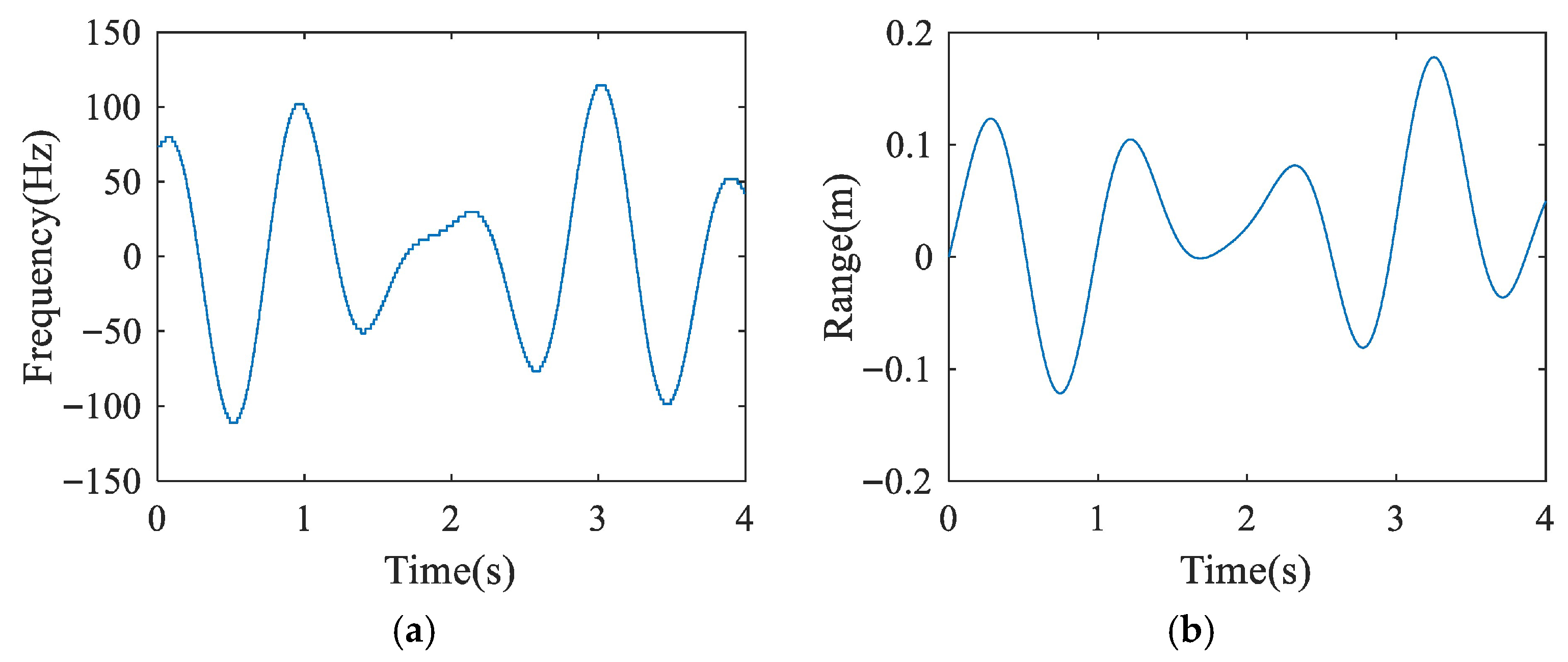
The time–frequency curve is extracted from the time–frequency diagram shown in Figure 11, with the result depicted in Figure 12a. Owing to the influence of quantization errors, the extracted time–frequency curve exhibits slight jitter; however, the overall extraction accuracy of the curve remains high. Integrating the frequency-shift curve yields the range variation curve as illustrated in Figure 12b. The integration process effectively eliminates the jitter of the frequency-shift curve, rendering the range variation curve relatively smooth. The initial phase can be extracted according to the coning rotation period, with an estimated value of 0.1472 rad.
By substituting the values of the frequency-shifted curve at specific moments into Equations (22) and (23), the target’s nutation angle, precession angle, and h sin α c can be estimated, with the estimated values being 0.3759 rad, 0.2501 rad, and 0.1160 m, respectively. Then, a compensation function s c o m ( t ) is constructed to compensate s 2 ( t ) and obtain s 5 ( t ) . A one-dimensional parameter estimation method is applied to get the estimated value of h cos α c , which is 0.3197 m. By combining the estimated values of h cos α c and h sin α c , the estimated values of h and α c are calculated as 0.34 m and 0.3481 rad, respectively. Finally, a dictionary D 2 is constructed based on the micro-motion features extracted above, and the OMP algorithm is utilized for one-dimensional parameter estimation, yielding an estimated value of α s as 2.3078 rad. The 3-D micro-motion feature extraction is summarized in Table 7. Among these metrics, the extraction error of the cone height is the largest, while the estimation errors of the cone rotation frequency and wobble frequency are the smallest. Compared with the category where the cone-bottom echo contains a single scattering point, the extraction accuracy of micro-motion features decreases in this scenario.
The performance of the method under noisy environments is presented here. The SNR is configured to 5 dB, and the time–frequency diagram of the cone-bottom echo is presented in Figure 13. In the processing of echo data, the time–range curve of the target is first obtained via wideband imaging processing, followed by accumulating the range bins containing the target signal to form the cone-bottom echo. This process mitigates the influence of noise on the time–frequency diagram significantly through the accumulation of wideband energy, resulting in a high-quality time–frequency diagram as illustrated in Figure 13.
Based on Equations (11) and (12), s 1 ( t ) and s 2 ( t ) are separated from the cone-bottom echo, and their time–frequency diagrams are presented in Figure 14. Since the above processing involves conjugate multiplication, the noise in the echo will exert a certain impact on the signal separation results. This leads to a certain degree of defocusing in the time–frequency curve around 1.8 s, which degrades the quality of the time–frequency diagram.
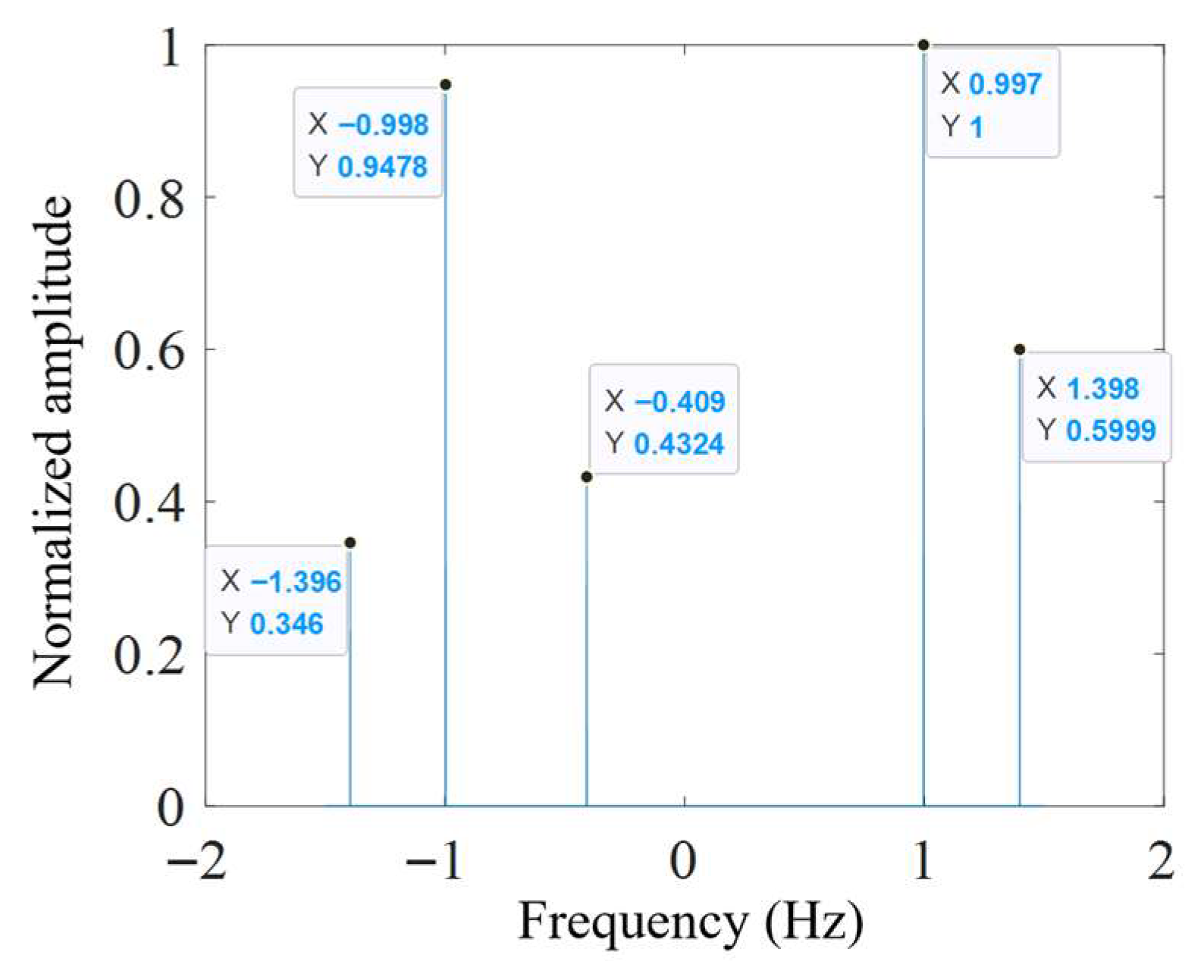
The target wobble frequency and cone rotation frequency are extracted from s 2 ( t ) in Figure 15. Two groups of symmetric peaks appear in Figure 15: the highest frequency is 1.397 Hz, followed by 0.998 Hz. Due to the influence of noise, no symmetric peak is observed at the frequency of 0.409 Hz. Based on the magnitude correspondence between the coning frequency and the wobble frequency, the cone rotation frequency can be estimated as 0.997 Hz, and the wobble frequency as 0.402 Hz.
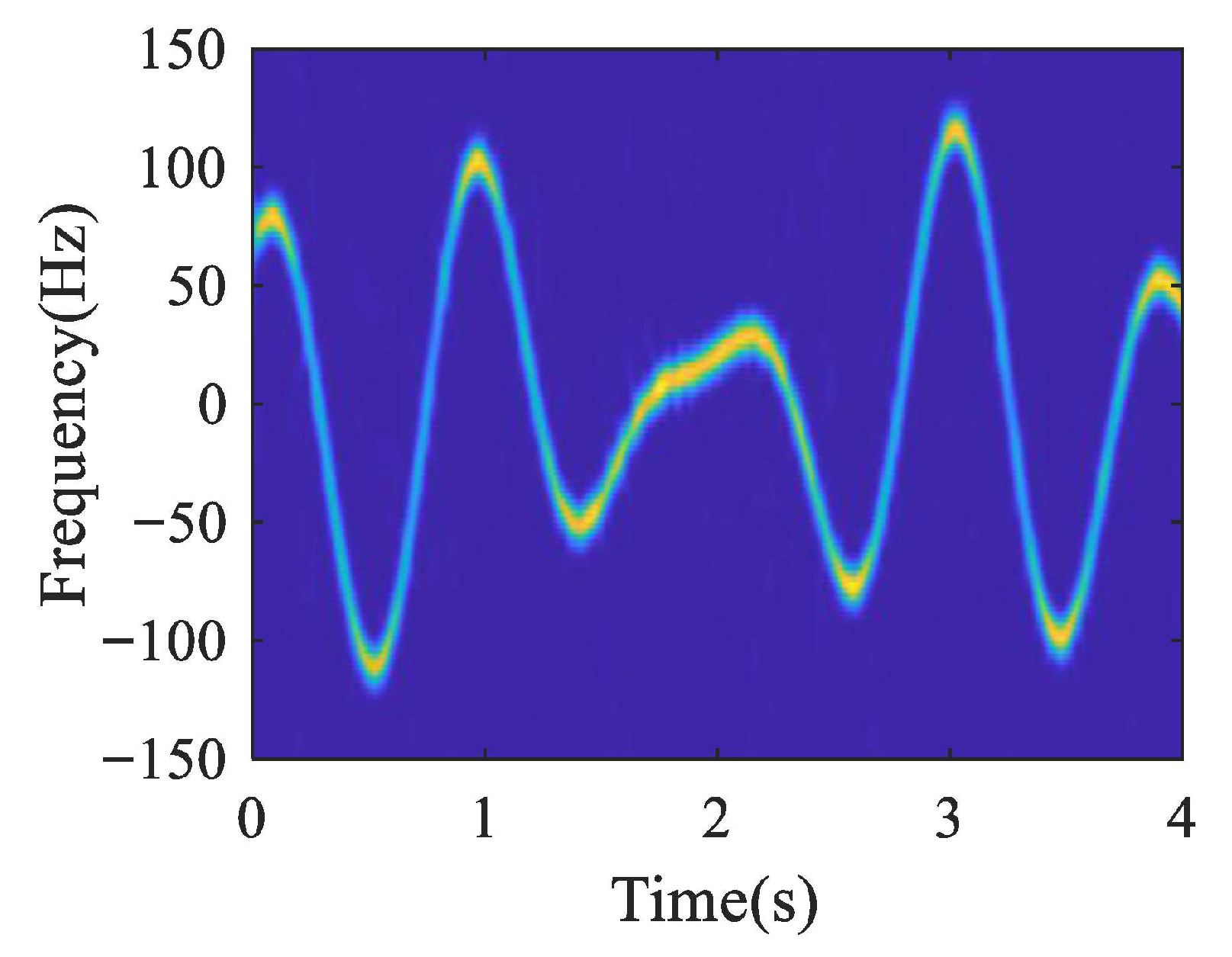
s 2 ( t ) is delayed by 2 π / Ω v and then multiplied by its own conjugate to obtain s 4 ( t ) . The time–frequency diagram of s 4 ( t ) is illustrated in Figure 16. The time–frequency curve also exhibits defocusing around 1.8 s, and this phenomenon will increase the estimation error of the subsequent time–frequency curve.
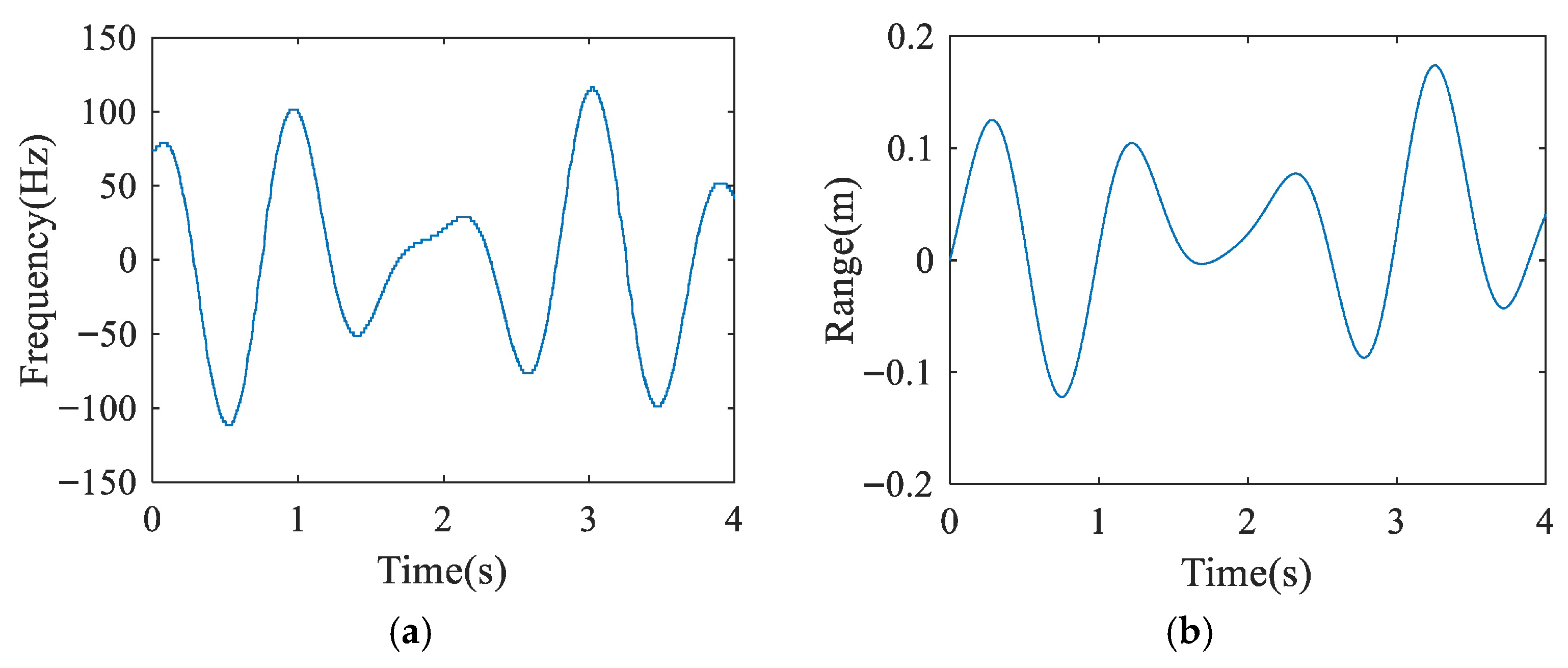
The time–frequency curve is extracted from the time–frequency diagram of s 4 ( t ) shown in Figure 16, and the result is presented in Figure 17a. Integrating the frequency-shift curve yields the range variation curve as illustrated in Figure 17b. Subsequently, the initial phase can be extracted based on the coning period, with an estimated value of 0.1529 rad.
By substituting the values of the frequency-shifted curve at specific moments into Equations (22) and (23), the target’s precession angle, nutation angle, and h sin α c can be estimated. Then, a compensation function s c o m ( t ) is constructed to compensate s 2 ( t ) and obtain s 5 ( t ) . A one-dimensional parameter estimation method is applied to get the estimated value of h cos α c . By combining the estimated values of h cos α c and h sin α c , the estimated values of h and α c can be derived. Finally, based on the micro-motion features extracted above, a dictionary D 2 is built, and the OMP algorithm is used for one-dimensional parameter estimation to obtain the estimated value of α s . For the one-dimensional parameter estimation after dimensionality reduction, the parameter ranges are constrained by the target’s geometric and motion characteristics, resulting in a relatively small estimation space. The constructed dictionary for the OMP algorithm covers all possible parameter values with a reasonable resolution, avoiding mismatching issues. In summary, the estimation of 3-D micro-motion features is presented in Table 8. Among these metrics, the precession angle exhibits the largest estimation errors, while the cone rotation and wobble frequencies show the smallest estimation errors. Compared with the noise-free scenario, the extraction accuracy of 3-D micro-motion features decreases under noisy conditions, but the target’s 3-D micro-motion features can still be obtained relatively accurately.
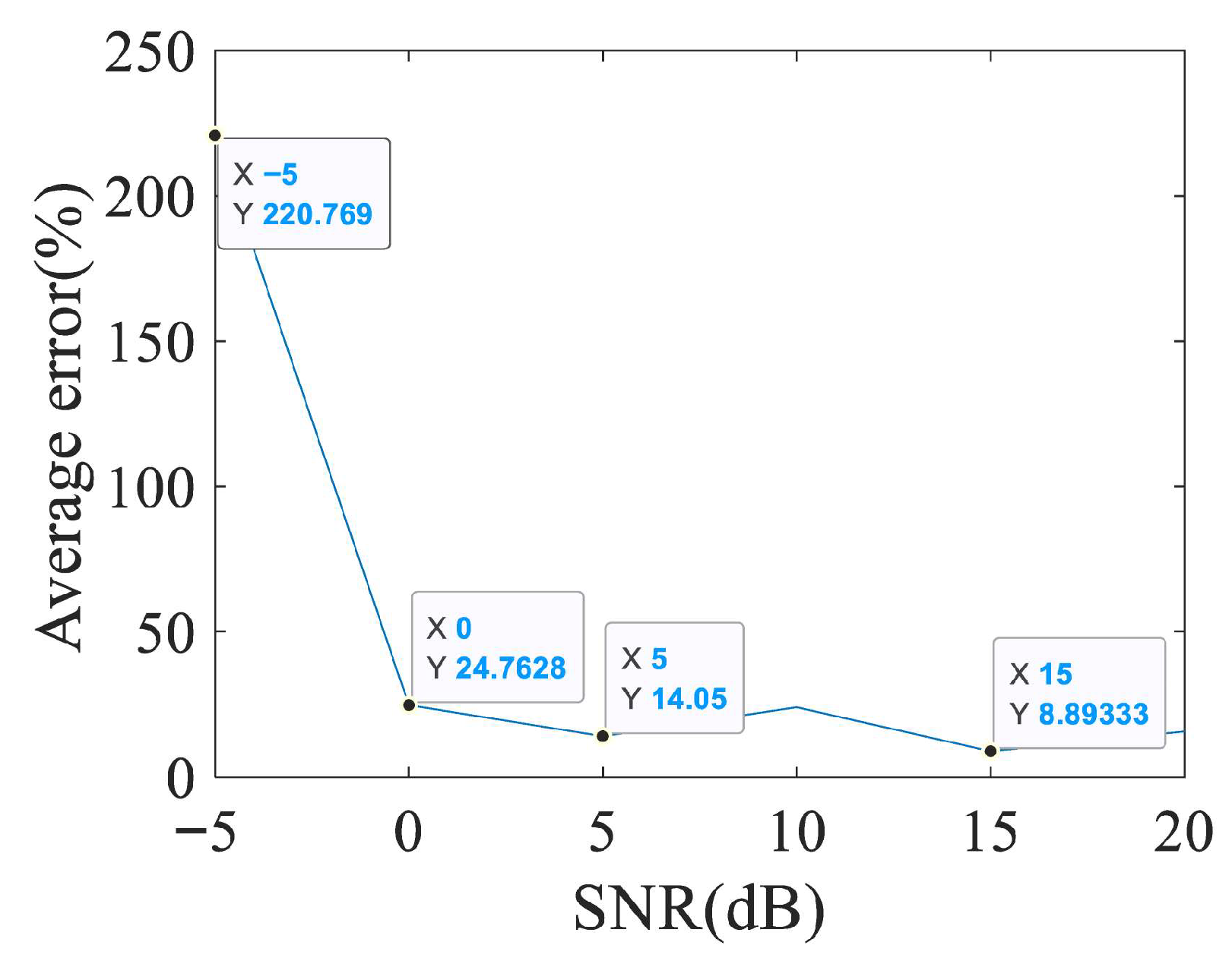
Finally, the performance of the developed approach across varying SNR levels is analyzed. Figure 18 presents the average errors of the 3-D micro-motion feature extraction by the proposed method under different SNRs. The average error increases sharply when the SNR falls below 5 dB. This trend stems from the approach’s high sensitivity to the frequency-shift curve’s retrieval precision, and the method will cease to function once this precision degrades beyond a critical threshold. However, relative to the category where the cone-bottom echo contains a single scattering point, the proposed approach is more severely impacted by noise for the category of cone-bottom echo containing two scattering points, leading to a significant increase in the average error at low SNRs.
To provide practical guidance for the engineering application of the proposed method, a sensitivity analysis of key radar parameters (carrier frequency and bandwidth) on the estimation accuracy of 3-D micro-motion features is conducted. The base simulation parameters are set as fc = 10 GHz and B = 1 GHz, with one parameter varied at a time while the other remains unchanged.
The proposed method exhibits excellent robustness to variations in carrier frequency. Within the 5–15 GHz range (covering typical X and Ku bands), the average estimation error only fluctuates slightly between 9.68 and 15.58%. This stability stems from the stepwise parameter extraction strategy, which eliminates the scaling effect of fc on micro-Doppler frequency shifts, allowing flexible selection of frequency bands in practical radar system design.
Bandwidth directly affects range resolution and echo separation performance. When B ≥ 500 MHz, sufficient range resolution is achieved to clearly separate the echoes from the cone apex and bottom, ensuring a stable average estimation error of approximately 14.56%. In contrast, for a narrower bandwidth, incomplete separation of the apex and bottom echoes leads to a significant increase in average error to 32.93%. Therefore, a bandwidth of no less than 500 MHz is recommended to balance estimation accuracy and system implementation feasibility.
To further verify the superiority of the proposed method, comparative experiments with two typical conventional methods (the five-dimensional parameter search method [30] and Bessel function decomposition method [29]) are conducted under different SNR conditions. The average estimation errors of 3-D micro-motion features are compared in Table 9.
As shown in Table 9, the proposed method outperforms the conventional methods in both accuracy and robustness. Under high SNR (≥5 dB), the proposed method achieves comparable accuracy to the five-dimensional parameter search method [30] but with significantly lower computational complexity. Under low SNR (<0 dB), the proposed method maintains stable performance, while the Bessel function decomposition method [29] suffers from severe divergence due to its sensitivity to frequency-shift curve distortion, and the five-dimensional parameter search method [30] is affected by high-dimensional search noise amplification. The broadband energy accumulation and stepwise parameter extraction strategy of the proposed method effectively suppresses noise interference, making it more suitable for practical scenarios.


5. Discussion

This manuscript focuses on the extraction of three-dimensional micro-motion features of smooth and symmetric nutating cone targets under monostatic radar. Despite the effectiveness of the proposed method in full-dimensional 3-D micro-motion and geometric parameter estimation for smooth symmetric nutating cones, there are still limitations that require further discussion and in-depth research in the future. First, its performance heavily relies on the accuracy of time–frequency curve extraction. When scattering point echoes overlap or interweave, especially under low SNR or multiple target dynamics, separating individual signals becomes challenging and introduces extraction errors. Future work could focus on more robust micro-Doppler signal separation and extraction techniques to refine parameter estimation precision.
Second, the current framework is restricted to smooth symmetric cone targets where the center of mass (COM) aligns with the geometric symmetry axis. For non-symmetric targets or those with non-ideal structures, the COM offset alters the motion characteristics of scattering points and renders the existing model inapplicable. Extending the method to such targets by revising the motion model to account for COM offset and developing adaptive parameter estimation strategies will be the direction of subsequent research, thereby broadening the model’s practical utility in complex scenarios such as damaged ballistic targets or irregular space debris.

6. Conclusions

A method for extracting the 3-D micro-motion features of a smooth symmetric nutating cone target is proposed in this paper. For the category where the cone-bottom echo contains a single scattering point, the 3-D micro-motion feature extraction method for the nutating cone with tail fins can be adopted: the coefficients of each component in the range expression of the cone-apex echo are substituted into the analytical solutions to extract partial micro-motion features, and on this basis, the two-dimensional parameter search method is further used to estimate the remaining micro-motion features from the cone-bottom echo. For the category where the cone-bottom echo contains two scattering points, the time–frequency characteristics of the cone-bottom scattering point echoes of the smooth symmetric cone are utilized to separate each component in the cone-bottom echo. Furthermore, the dimensionality of the to-be-estimated micro-motion feature parameters is reduced by exploiting the characteristics of each component signal, ultimately achieving the extraction of 3-D micro-motion features.

Author Contributions

Conceptualization and methodology & validation: F.X. and H.Y.; writing—original draft preparation, F.X. and H.Y.; writing—review and editing, Y.L. and K.L.; visualization, Z.W. and Y.L.; formal analysis: Z.W. and Y.L.; supervision, H.Y.; project administration and funding acquisition, Y.L. and K.L. All authors have read and agreed to the published version of the manuscript.

Funding

This research was supported by the National Natural Science Foundation of China under grants 62131020, 62371468, 62571551, and 62531020.

Data Availability Statement

The simulation data generated in this study are available from the author upon reasonable request (via email: 15054405755@163.com).

Acknowledgments

Special thanks go to the editorial team and reviewers for their meticulous evaluation and insightful suggestions that improved this manuscript.

Conflicts of Interest

There are no conflicts of interest in the submission of this manuscript.

References

  1. Wu, J.; Ai, X.F.; Xu, Z.M.; Zhu, Y.Q.; Wu, Q.H. Rapid Micro-Motion Feature Extraction of Multiple Space Targets Based on Improved IRT. Remote Sens. 2025, 17, 434. [Google Scholar] [CrossRef]
  2. Yang, L.; Zhang, W.P.; Jiang, W.D. Recognition of Ballistic Targets by Fusing Micro-Motion Features with Networks. Remote Sens. 2022, 14, 5678. [Google Scholar] [CrossRef]
  3. Xu, X.G.; Feng, C.Q. A Long-Term Recurrent Convolutional Network for SNR Estimation of Cone-Shaped Target. IEEE Antennas Wireless Propag. Lett. 2023, 22, 1863–1867. [Google Scholar] [CrossRef]
  4. Zhang, R.Z.; Wang, Y.; Yeh, C.M.; Lu, X.F. Precession Parameter Estimation of Warhead with Fins Based on Micro-Doppler Effect and Radar Network. IEEE Trans. Aerosp. Electron. Syst. 2023, 59, 443–459. [Google Scholar] [CrossRef]
  5. Wu, Q.; Wang, Y.; Liu, X.; Gu, Z.; Xu, Z.; Xiao, S. ISAR Image Transform via Joint Intrapulse and Interpulse Periodic-Coded Phase Modulation. IEEE Sens. J. 2025, 25, 28788–28799. [Google Scholar] [CrossRef]
  6. Xu, Z.; Wu, Q.; Ai, X.; Liu, X.; Wu, J.; Zhao, F. Micromotion Frequency Estimation of Multiple Space Targets Based on RCD Spectrum. IEEE Trans. Aerosp. Electron. Syst. 2025, 61, 14019–14030. [Google Scholar] [CrossRef]
  7. Long, M.; Yang, J.; Wang, Z.Y.; Hong, L.; Xia, S.Q.; Lv, M.J.; Chen, W.F.; Zhuang, P. A Micro-Motion Feature Extraction Method for Rotor Targets Based on Multidomain Parameter Estimation and Phase Compensation. IEEE Sens. J. 2025, 25, 17600–17616. [Google Scholar] [CrossRef]
  8. Xiong, S.C.; Zhang, H.W.; Zhao, S.Y.; Luo, Y.; Zhang, Q. Efficient Time-Frequency Image Recovery Method for Incomplete Data of Micro-Motion Targets. IEEE Trans. Aerosp. Electron. Syst. 2025, 61, 19179–19193. [Google Scholar] [CrossRef]
  9. Liu, X.; Wu, Q.; Pan, X.; Wang, J.; Zhao, F. SAR Image Transform Based on Amplitude and Frequency Shifting Joint Modulation. IEEE Sens. J. 2025, 25, 7043–7052. [Google Scholar] [CrossRef]
  10. Zhu, N.; Hu, J.; Xu, S.; Wu, W.; Zhang, Y.; Chen, Z. Micro-Motion Parameter Extraction for Ballistic Missile with Wideband Radar Using Improved Ensemble EMD Method. Remote Sens. 2021, 13, 3545. [Google Scholar] [CrossRef]
  11. Yang, L.; Zhang, W.P.; Jiang, W.D. Ballistic Target Recognition Based on Deep Learning by Utilizing the Micro-Doppler Feature. In 2022 IEEE 6th Advanced Information Technology, Electronic and Automation Control Conference (IAEAC); IEEE: Piscataway, NJ, USA, 2022; pp. 1628–1632. [Google Scholar] [CrossRef]
  12. Zhang, Y.P.; Zhang, Q.; Kang, L.; Luo, Y.; Zhang, L. End-to-End Recognition of Similar Space Cone–Cylinder Targets Based on Complex-Valued Coordinate Attention Networks. IEEE Trans. Geosci. Remote Sens. 2022, 60, 5106214. [Google Scholar] [CrossRef]
  13. Wang, T.Q.; Zhou, D.Y.; Xie, Y.Q. An Improved Method for Estimating Ballistic Target Micromotion and Structural Parameters Based on ISAR Image Sequences. IEEE Trans. Aerosp. Electron. Syst. 2023, 59, 3129–3141. [Google Scholar] [CrossRef]
  14. Zhang, R.Z.; Wang, Y.; Mao, J. Three-Dimensional Reconstruction of Precession Warhead Based on Multi-View Micro-Doppler Analysis. J. Syst. Eng. Electron. 2024, 35, 541–548. [Google Scholar] [CrossRef]
  15. Tian, X.D.; Bai, X.R.; Zhou, F. Recognition of Micro-Motion Space Targets Based on Attention-Augmented Cross-Modal Feature Fusion Recognition Network. IEEE Trans. Geosci. Remote Sens. 2023, 61, 5104909. [Google Scholar] [CrossRef]
  16. Chen, X.B.; Ye, C.M.; Dong, C.Z.; Wang, Y.; Hu, Q.R. Parameter Estimation for Space Precession Targets With Intermittent Observation. IEEE Geosci. Remote Sens. Lett. 2022, 19, 4027405. [Google Scholar] [CrossRef]
  17. Xu, D.; Zhao, S.Y.; Li, K.M.; Greco, M.S.; Qian, J.; Xing, M.D.; Gini, F. Micro-Doppler Frequency Extraction and Scatterer Classification for a Smooth-Surfaced Cone-Shaped Precession Target Under Narrowband Radar. IEEE J. Sel. Top. Appl. Earth Obs. Remote Sens. 2025, 18, 9368–9379. [Google Scholar] [CrossRef]
  18. Xu, F.L.; Yuan, H.; Luo, Y.; Li, K.M. Three-Dimensional Micro-Motion Parameters Estimation of Precession Cone-Cylinder Targets Based on Monostatic Radar. Syst. Eng. Electron. 2025, 1–13. [Google Scholar]
  19. Liu, Y.L.; Peng, B.; Wei, X.Z. Target Dimensions Estimation Based on Sliding-Type Scattering Centers Analysis. In Proceedings of the 13th European Radar Conference, London, UK, 5–7 October 2016; pp. 290–293. [Google Scholar]
  20. Zhou, X.Y.; Wang, Y.; Yeh, C.M.; Lu, X.F. Precession Parameter Estimation from Wideband Measurements for 3-D ISAR Imaging of Cone-Shaped Targets. IEEE Geosci. Remote Sens. Lett. 2022, 19, 4501305. [Google Scholar] [CrossRef]
  21. Dai, F.Z.; Liu, J.; Tian, L.; Dong, H.; Hong, L. An End-to-End Approach for Rigid-Body Target Micro-Doppler Analysis Based on the Asymmetrical Autoencoding Network. IEEE Trans. Geosci. Remote Sens. 2023, 61, 5102519. [Google Scholar] [CrossRef]
  22. Yuan, H.; Luo, Y.; Chen, Y.J.; Liang, J.; Zhao, S.Y. Three-Dimensional Micro-Motion Parameters Extraction of Nutation Cone Based on Monostatic Radar. IEEE Sens. J. 2025, 25, 9817–9830. [Google Scholar] [CrossRef]
  23. Yuan, H.; Zhao, S.Y.; Chen, Y.J.; Luo, Y.; Liu, Y.X.; Zhang, Y.P. Micromotion Parameters Estimation of Precession Cone Based on Monostatic Radars. IEEE Trans. Antennas Propag. 2024, 72, 2811–2824. [Google Scholar] [CrossRef]
  24. Yuan, H.; Luo, Y.; Chen, Y.J.; Liang, J.; Liu, Y.X.; Li, K.M. Micromotion Parameter Extraction of Precession Cone Based on Analytical Solution in Monostatic Radar. IEEE Trans. Aerosp. Electron. Syst. 2025, 61, 3121–3136. [Google Scholar] [CrossRef]
  25. Yuan, H.; Luo, Y.; Chen, Y.J.; Liang, J.; Kang, L. Three-Dimensional Micromotion Parameter Extraction of Smooth-Symmetrical Cone in Monostatic Radar. IEEE Trans. Aerosp. Electron. Syst. 2025, 61, 5272–5283. [Google Scholar] [CrossRef]
  26. Gao, H.W.; Xie, L.G.; Wen, S.L.; Kuang, Y. Micro-Doppler Signature Extraction from Ballistic Target with Micro-Motions. IEEE Trans. Aerosp. Electron. Syst. 2010, 46, 1969–1982. [Google Scholar] [CrossRef]
  27. Li, M.; Jiang, Y.S. Feature Extraction of Micro-Motion Frequency and the Maximum Wobble Angle in a Small Range. Opt. Spectrosc. 2014, 117, 832–838. [Google Scholar] [CrossRef]
  28. Zhu, N.; Xu, S.; Li, C.; Hu, J.; Fan, X.; Wu, W.; Chen, Z. An Improved Phase-Derived Range Method Based on High-Order Multi-Frame Track-Before-Detect for Warhead Detection. Remote Sens. 2022, 14, 29. [Google Scholar] [CrossRef]
  29. Ji, J.Z.; Jiang, J.X.; Al-Armaghany, A.; Shu, C.Y.; Huang, P.L. Nutation and Geometrical Parameters Estimation of Cone-Shaped Target Based on Micro-Doppler Effect. Optik 2017, 150, 1–10. [Google Scholar] [CrossRef]
  30. Hong, L.; Dai, F.Z.; Liu, H.W. Motion-Parameter Estimation for Precession-With-Nutation Space Targets Based on Wideband Radar Measurements. IEEE Trans. Aerosp. Electron. Syst. 2016, 52, 643–657. [Google Scholar] [CrossRef]
Figure 1. Smooth symmetric nutating cone target motion model.
Remotesensing 18 00539 g001
Figure 2. 3-D micro-motion feature extraction method for smooth symmetric nutating cone targets with two scattering points in cone-bottom echo.
Remotesensing 18 00539 g002
Figure 3. Time–frequency diagram of the echo from the smooth symmetric nutating cone target. (a) Time–frequency diagram of the echo from scattering point C. (b) Time–frequency diagram of the echo from scattering point B.
Remotesensing 18 00539 g003
Figure 4. Estimation results of cone rotation frequency and nutation frequency.
Remotesensing 18 00539 g004
Figure 5. Time–frequency diagram of the smooth nutating cone target echo at an SNR of 0 dB. (a) Time–frequency diagram of the echo from scattering point C at an SNR of 0. (b) Time–frequency diagram of the echo from scattering point B at an SNR of 0.
Remotesensing 18 00539 g005
Figure 6. Frequency extraction results of the echo from a smooth symmetric nutating cone target at an SNR of 0 dB.
Remotesensing 18 00539 g006
Figure 7. Average extraction errors of 3-D micro-motion features for smooth symmetric nutating cone targets under different SNRs.
Remotesensing 18 00539 g007
Figure 8. Time–frequency diagram of the smooth symmetric nutating cone-bottom echo without noise.
Remotesensing 18 00539 g008
Figure 9. Signal separation results of the cone-bottom echo. (a) Time–frequency diagram of s 2 ( t ) . (b) Time–frequency diagram of s 1 ( t ) .
Remotesensing 18 00539 g009
Figure 10. Results of extracting the coning frequency and wobble frequency from s 2 ( t ) .
Remotesensing 18 00539 g010
Figure 11. Time–frequency diagram of s 4 ( t ) .
Remotesensing 18 00539 g011
Figure 12. Frequency-shift curve and range variation curve of s 4 ( t ) . (a) Time–range curve. (b) Time–frequency curve.
Remotesensing 18 00539 g012
Figure 13. Time–frequency diagram of the cone-bottom echo at an SNR of 5 dB.
Remotesensing 18 00539 g013
Figure 14. Signal separation results of the cone-bottom echo at an SNR of 5 dB. (a) Time–frequency diagram of s 2 ( t ) at an SNR of 5 dB. (b) Time–frequency diagram of s 1 ( t ) at an SNR of 5 dB.
Remotesensing 18 00539 g014
Figure 15. Results of extracting the coning frequency and wobble frequency from s 2 ( t ) at an SNR of 5 dB.
Remotesensing 18 00539 g015
Figure 16. Time–frequency diagram of s 4 ( t ) at an SNR of 5 dB.
Remotesensing 18 00539 g016
Figure 17. Frequency-shift curve and range variation curve of s 4 ( t ) at an SNR of 5 dB. (a) Time–frequency curve of s 4 ( t ) at an SNR of 5 dB. (b) Time–range curve of s 4 ( t ) at an SNR of 5 dB.
Remotesensing 18 00539 g017
Figure 18. Curves of average feature extraction errors versus SNR for a cone-bottom echo containing two scattering points.
Remotesensing 18 00539 g018
Table 1. Visibility analysis of target scattering centers.
Scattering Point Λ ( t ) α h α h < Λ ( t ) < π 2 π 2 Λ ( t ) π α h π α h < Λ ( t ) π
A1101
B1111
C0111
Table 2. Simulation parameters of the smooth symmetric nutating cone target and radar.
ParameterParameterUnit
Carrier frequency10GHz
Nutation frequency0.4Hz
Cone frequency1Hz
Moment of inertia ratio0.3197-
Precession angle0.3491rad
Nutation angle0.2618rad
Bottom radius0.4m
Half-cone angle0.2450rad
Cone height1.6m
Table 3. Micro-motion features extracted from the cone-apex echo.
ParameterEstimated ValueActual ValueError
Nutation angle0.2737 rad0.2618 rad4.56%
Precession angle0.3543 rad0.3491 rad1.51%
α c 0.3358 rad0.3051 rad10.1%
Distance from cone apex to centroid1.1634 m1.2 m3.06%
Table 4. 3-D micro-motion feature extraction results of the smooth symmetric nutating cone target without noise.
ParameterEstimated ValueActual ValueError
Nutation angle0.2737 rad0.2618 rad4.56%
Precession angle0.3543 rad0.3491 rad1.51%
Cone frequency1.0017 Hz1 Hz0.17%
Nutation frequency0.3935 Hz0.4 Hz1.63%
Cone height1.5511 m1.5511 m3.05%
Half-cone angle0.2591 rad0.2450 rad5.76%
Bottom radius0.4111 m0.4 m2.78%
Average error2.78%--
Table 5. Micro-motion feature estimation from the cone apex at an SNR of 0 dB.
ParameterEstimated ValueActual ValueError
Nutation angle0.2745 rad0.2618 rad4.84%
Precession angle0.3989 rad0.3491 rad14.26%
α c 0.3378 rad0.3051 rad10.70%
Distance from cone apex to centroid1.0356 m1.2 m13.70%
Table 6. Micro-motion features estimated from the cone-apex echo at an SNR of 0 dB.
ParameterEstimated ValueActual ValueError
Nutation angle0.2745 rad0.2618 rad4.85%
Precession angle0.3989 rad0.3491 rad14.27%
Cone frequency0.9967 Hz1 Hz0.34%
Nutation frequency0.3900 Hz0.4 Hz2.50%
Cone height1.3808 m1.5511 m13.71%
Half-cone angle0.2735 rad0.2450 rad11.63%
Bottom radius0.3873 m0.4 m3.18%
Average error7.21%--
Table 7. 3-D micro-motion feature extraction results for the category of cone-bottom echo containing two scattering points.
ParameterEstimated ValueActual ValueError
Nutation angle0.2501 rad0.2618 rad4.85%
Precession angle0.3759 rad0.3491 rad14.27%
Cone frequency0.9970 Hz1 Hz0.34%
Nutation frequency0.4020 Hz0.4 Hz2.50%
Cone height1.3602 m1.5511 m14.99%
Half-cone angle0.2688 rad0.2450 rad9.73%
Bottom radius0.3747 m0.4 m6.33%
Average error6.29%--
Table 8. 3-D micro-motion feature extraction results for the category of cone-bottom echo containing two scattering points at an SNR of 5 dB.
ParameterEstimated ValueActual ValueError
Nutation angle0.3244 rad0.2618 rad23.91%
Precession angle0.4520 rad0.3491 rad29.49%
Cone frequency0.9975 Hz1 Hz0.25%
Nutation frequency0.3995 Hz0.4 Hz0.125%
Cone height1.2559 m1.5511 m21.51%
Half-cone angle0.2638 rad0.2450 rad7.68%
Bottom radius0.3392 m0.4 m15.21%
Average error14.03%--
Table 9. Average estimation errors (%) of different methods under various SNR conditions.
SNR (dB)Proposed MethodFive-Dimensional Parameter Search [30]Bessel Function Decomposition [29]
−5220.769%222.856%240.526%
024.763%34.452%42.790%
514.050%27.156%29.563%
1024.022%24.801%26.158%
158.893%20.148%25.125%
Disclaimer/Publisher’s Note: The statements, opinions and data contained in all publications are solely those of the individual author(s) and contributor(s) and not of MDPI and/or the editor(s). MDPI and/or the editor(s) disclaim responsibility for any injury to people or property resulting from any ideas, methods, instructions or products referred to in the content.