Technical Note

A Prominent-Reflector-Based Sub-Band Error Estimation Method for Synthetic Bandwidth Synthetic Aperture Radar


1
National Key Laboratory of Microwave Imaging, Aerospace Information Research Institute, Chinese Academy of Sciences, Beijing 100190, China
2
School of Electronic, Electrical and Communication Engineering, University of Chinese Academy of Sciences, Beijing 101408, China
*
Author to whom correspondence should be addressed.
Remote Sens. 2026, 18(3), 503; https://doi.org/10.3390/rs18030503
Submission received: 26 December 2025 / Revised: 24 January 2026 / Accepted: 29 January 2026 / Published: 4 February 2026

Highlights

What is the main finding?
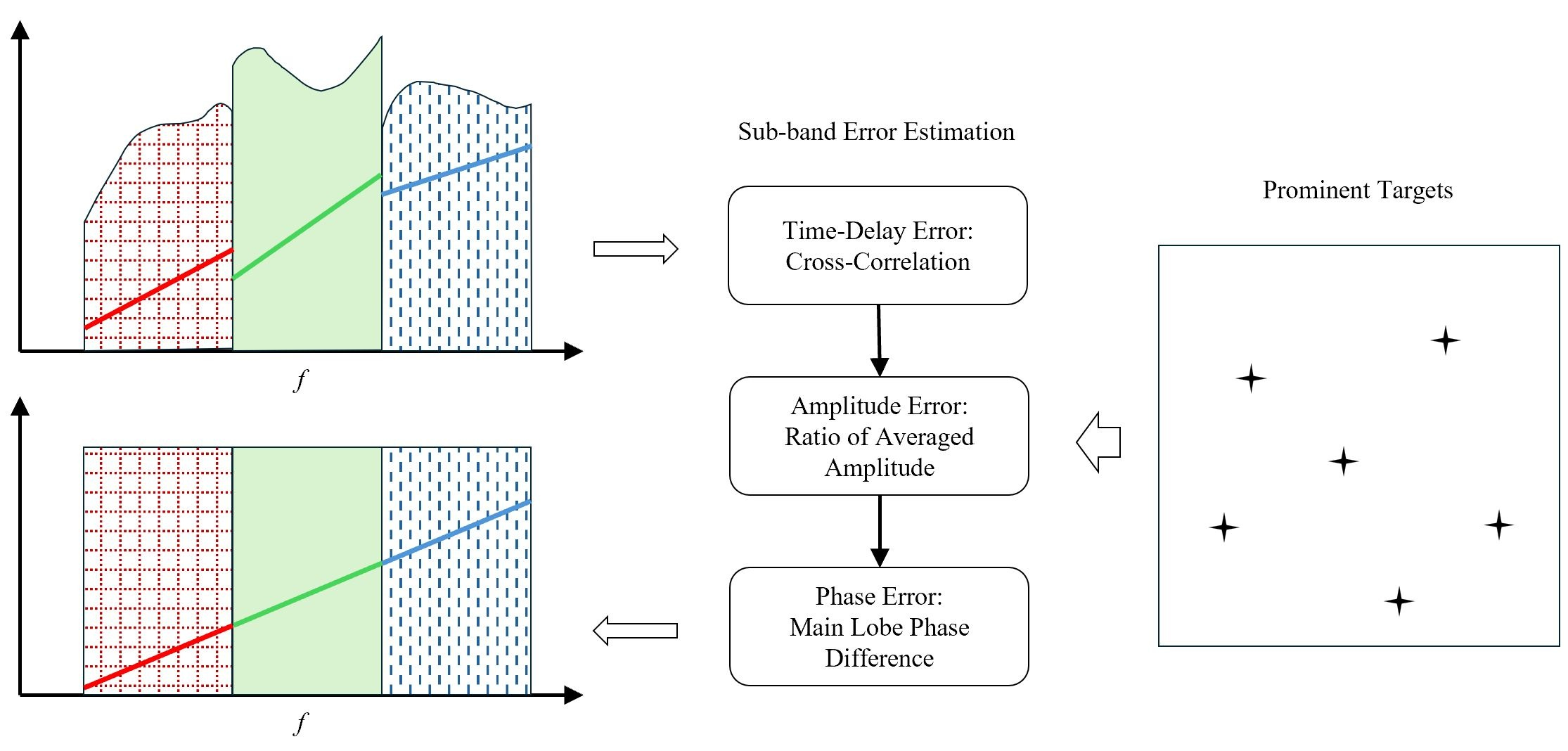
  • By leveraging the stable reflective properties of the prominent reflectors in the scene, the sub-band error estimates can be directly derived from the focused sub-band images in the time domain, leading to a robust estimation method with reduced computation time.
What is the implication of the main finding?
  • The proposed sub-band error estimation method improves the efficiency of synthetic bandwidth synthetic aperture radar image processing.

Abstract
Sub-band errors are inevitable in synthetic bandwidth synthetic aperture radar (SAR) systems due to differences in signal paths and frequency responses of the components used for different sub-bands, which degrade imaging performance if not properly compensated. In this paper, a prominent-reflector-based sub-band error estimation method is proposed for synthetic bandwidth SAR. Based on the analysis of the sources and impacts of sub-band errors, the proposed method estimates and compensates the errors in three steps, corresponding to time-delay error, amplitude error, and phase error. By leveraging the stable reflective properties of prominent reflectors in the scene, the proposed method directly derives sub-band error estimates from focused sub-band images in the time domain. Compared to existing methods, the proposed method achieved robust, high-accuracy performance while requiring less execution time. The effectiveness and efficiency of the proposed method are validated using real data collected by a Ka-band synthetic bandwidth SAR system.

Graphical Abstract

1. Introduction

Synthetic aperture radar (SAR) plays an important role in remote sensing due to its all-day, all-weather imaging capabilities. To better capture the details of the targets of interest, SAR systems with higher resolution have been widely studied. To achieve higher range resolution, the acquisition of a wider bandwidth is desired. However, the directly obtainable maximum bandwidth is limited by the hardware. To address these challenges, synthetic bandwidth SAR has been proposed [1]. In synthetic bandwidth SAR, multiple sub-bands with smaller bandwidths are transmitted and received individually, and the full bandwidth is synthesized in the processing stage. Many synthetic bandwidth SAR systems have been developed [2,3,4,5,6,7], demonstrating the effectiveness of this technique.
Due to the different signal paths used for different sub-bands, errors inevitably exist among the sub-bands, which degrade imaging performance if not properly compensated. To measure and compensate the sub-band errors, one approach is to use an overlapping spectrum between adjacent sub-bands [4]. However, the use of an overlapping spectrum reduces the effective total bandwidth, decreasing the range resolution. Another approach is to use calibration loops, which can be a single internal calibration loop [6] or more complex arrangements with multiple loops using additional antennas and amplifiers [7]. For very-high-resolution synthetic bandwidth SAR, error estimations from the calibration loops may still be insufficiently accurate due to the differences in paths between the calibration signals and the echo signals. In [7], the residual errors after compensation using calibration signals were estimated using the genetic algorithm (GA) [8] by maximizing the contrast of the bandwidth-synthesized image. In [9], a bandwidth synthesis method was proposed for the frequency diverse array, which also used GA to optimize the frequency shift in each sub-band in order to improve the sidelobe performance. However, GA is a global optimization method with high computational complexity, which is inefficient for large-scale applications. In [10], the phase gradient autofocus (PGA) [11,12] was applied in the range dimension to estimate the residual phase errors after calibration-based compensation. In [13], a sidelobe balanced model is developed to estimate the inter-sub-band low-order phase errors. In [14], sub-band errors were estimated based on the range spectra of prominent reflectors using the minimum entropy criterion. These spectrum-based approaches can be sensitive to nearby clutter, especially when the clutter exhibits structured time-domain behavior that produces pronounced spectral spikes.
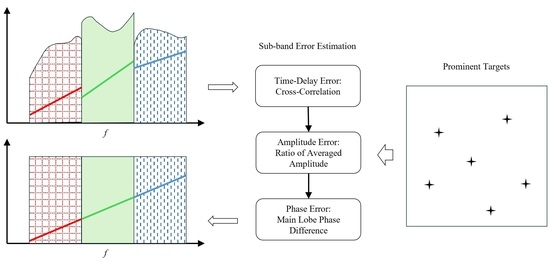
This paper proposes a prominent-reflector-based, three-step sub-band error estimation method based on the analysis of the sources of sub-band errors and their impacts on the time delay, amplitude, and phase of SAR echoes. By leveraging the stable reflective properties of the prominent reflectors in the scene, the proposed method directly derives sub-band error estimates from the focused sub-band images in the time domain. Compared to the spectrum-based method of Hu et al. [14], the proposed method is less sensitive to nearby clutter and achieves better performance in the experiments. Compared to the GA-based method [7], the proposed method significantly reduces the computation time while achieving slightly better performance. The effectiveness and efficiency of the proposed method are validated using real data collected by a Ka-band synthetic bandwidth SAR. The rest of this paper is organized as follows. In Section 2, the sources of the sub-band errors and their impacts on the time-delay, amplitude, and phase of the SAR echoes are analyzed. In Section 3, the proposed sub-band error estimation method is presented in detail. In Section 4, the experimental results are shown and discussed. In Section 5, the advantages and limitations of the proposed method are discussed. Finally, conclusions are drawn in Section 6.

2. Sub-Band Error Analysis

2.1. System Description

A practical synthetic bandwidth SAR system with an internal calibration loop usually consists of a digital module, a frequency source module, a transmitter module, an antenna module, and a receiver module, with an internal calibration link bypassing the antenna module, as represented by Figure 1. The digital-to-analog (D/A) converter in the digital module generates the chirp pulse at intermediate frequency (IF). The frequency source module generates the radio frequency (RF) signal at the frequencies required by each sub-band. The transmitter module up-converts the chirp pulse to the RF band and amplifies it for transmission. The antenna module transmits the RF signal to the scene and receives the echo signals. The receiver module amplifies and down-converts the received echo signals back to the IF band. The analog-to-digital (A/D) converter in the digital module samples the IF echo signals. The digital module, transmitter module, antenna module, and receiver module can be shared among all sub-bands in a time-division multiplexing manner, or can be duplicated for each sub-band to operate in parallel.

2.2. Sources of the Sub-Band Error

For proper SAR functioning, the system needs to work coherently, which means that the time-delay, amplitude, and phase distortions introduced by the system are consistent throughout the entire imaging session for each sub-band. However, among sub-bands, the distortions may vary due to differences in the frequency responses of the components and signal paths. The variations in the distortions among sub-bands are the sources of the sub-band errors. Calibration loops are introduced to measure and compensate for the variations in the distortions. Nevertheless, calibration loops do not fully match the echo-signal paths, leading to residual errors after calibration-based compensation. In [7], the complex calibration setup covers all echo-signal paths, but the use of additional components introduces new distortions, still leading to residual errors. Therefore, for very-high-resolution synthetic bandwidth SAR with low tolerance for sub-band errors, estimation methods are necessary.

2.3. Impacts of the Sub-Band Error

The impacts of the sub-band errors on the SAR echoes can be analyzed based on the SAR imaging model. For simplicity, the effect of the squint angle is neglected in the following analysis. The SAR impulse response [15] can be expressed as
s imp ( τ , η ) = w r τ 2 R ( η ) c w a η η c exp j 4 π f c R ( η ) c exp j π K r τ 2 R ( η ) c 2 ,
where τ is the fast time, η is the slow time, η c is the beam center crossing time, w r ( · ) is the range envelope, w a ( · ) is the azimuth envelope, R ( η ) is the instantaneous slant range at slow time η , c is the speed of light, f c is the carrier frequency, and K r is the chirp rate. After SAR focusing, (1) becomes
s ( τ , η ) = sin c B r τ 2 R ( η c ) c sin c B a η η c exp j 4 π f c R ( η c ) c ,
where B r and B a are the range and azimuth bandwidths, respectively. With the presence of system distortions, τ becomes τ τ 0 , where τ 0 is the time-delay distortion; the amplitude is distorted by a factor of A 0 R ; and an additional phase distortion of ϕ 0 is introduced. Assuming the defocusing effect of τ 0 is compensated by motion-compensation methods, (2) becomes
s ˜ ( τ , η ) = A 0 sin c B r τ τ 0 2 R ( η c ) c sin c B a η η c exp j 4 π f c R ( η c ) c + ϕ 0 ,
where s ˜ ( τ , η ) is the distorted SAR focused impulse response. For synthetic bandwidth SAR, the values of τ 0 , A 0 , and ϕ 0 are different in each sub-band. During bandwidth synthesis, a reference sub-band is selected, and the sub-band errors are the differences in the system distortions between the current sub-band and the reference sub-band. Therefore, the sub-band errors of time-delay, amplitude, and phase can be defined as Δ τ = τ 0 , sub τ 0 , ref , Δ A = A 0 , sub / A 0 , ref , and Δ ϕ = ϕ 0 , sub ϕ 0 , ref , respectively, where the subscripts “sub” and “ref” denote the current and the reference sub-band, respectively. During bandwidth synthesis, the sub-band echo/image needs to be frequency-shifted by multiplying a phase term of exp j 2 π Δ f τ , where
Δ f = f c , sub f c , ref
is the frequency offset between the current sub-band and the reference sub-band. After bandwidth synthesis, the focused sub-band impulse response without sub-band errors can be expressed as
s sub , syn ( τ , η ) = sin c B r τ 2 R ( η c ) c sin c B a η η c exp j 4 π f c , sub R ( η c ) c + 2 π Δ f τ ,
and the focused sub-band impulse response with sub-band errors can be expressed as
s ˜ sub , syn ( τ , η ) = Δ A sin c B r τ Δ τ 2 R ( η c ) c sin c B a η η c exp j 4 π f c , sub R ( η c ) c + 2 π Δ f ( τ Δ τ ) + Δ ϕ .
The differences between (6) and (5) show the impacts of the sub-band errors on the SAR imaging, including misaligned range timing, uneven amplitude, and phase discontinuity among sub-bands. The misaligned range timing and uneven amplitude will lead to reduced range resolution, and the phase discontinuity will lead to sidelobe distortion [7].

3. Sub-Band Error Estimation Methods

3.1. Method Overview

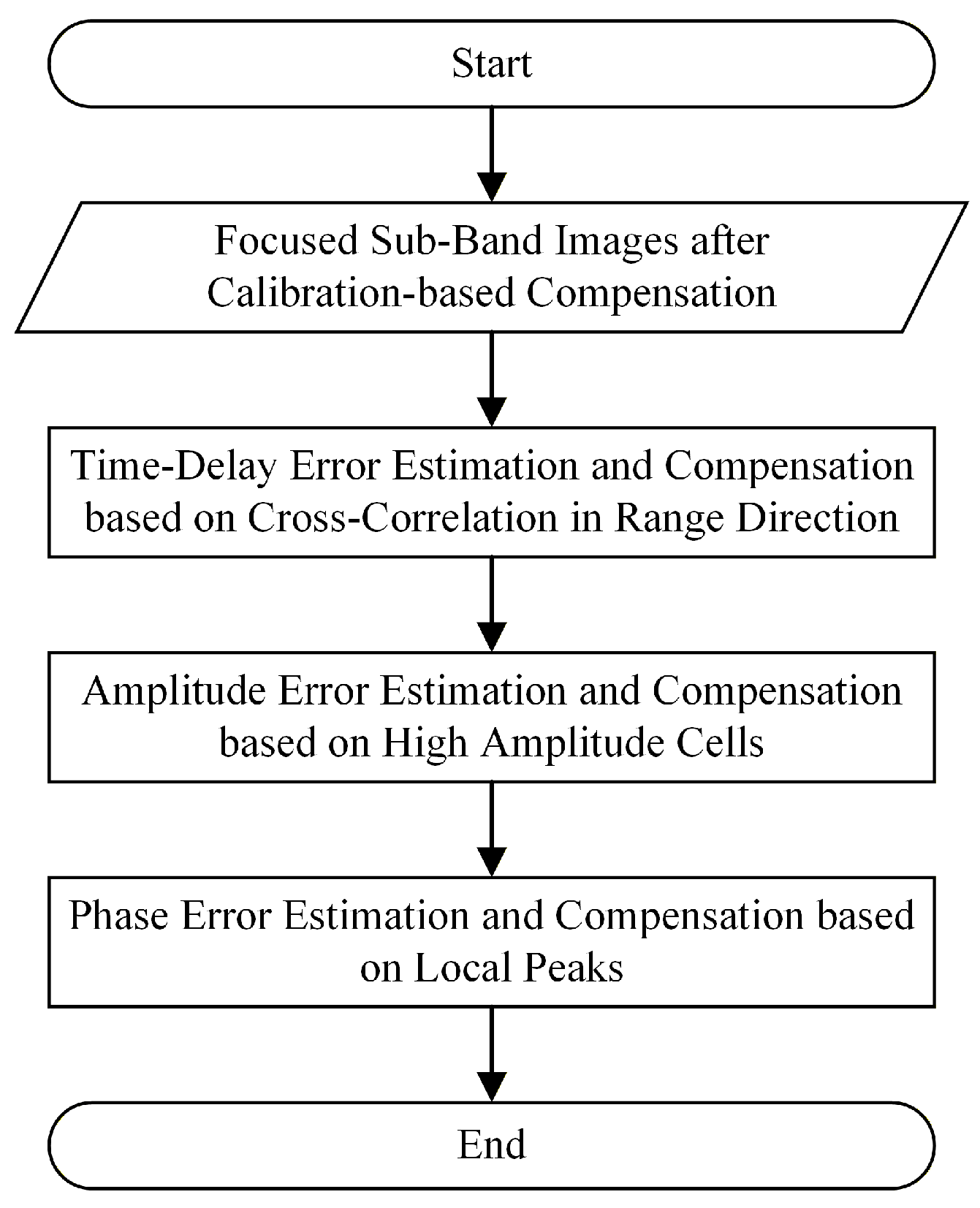
Based on the analysis in Section 2, the sub-band errors impact the time-delay, amplitude, and phase of the SAR imaging. Correspondingly, the proposed sub-band error estimation method mainly consists of three steps, i.e., time-delay error estimation, amplitude error estimation, and phase error estimation. Considering the practicality of the method, prominent reflectors, which are usually artificial corner-shaped structures made of metal, in the imaging scene are used as the targets for error estimation, due to their high signal-to-noise ratio (SNR) and relatively stable reflective properties among sub-bands [16]. The overall flowchart of the proposed method is shown in Figure 2. The method takes the focused sub-band images after calibration-based compensation as inputs. Firstly, the time-delay errors are estimated using cross-correlation and compensated accordingly. Secondly, the amplitude errors are estimated based on the amplitude of the prominent reflectors. Finally, the phase errors are estimated based on the peak phase of several selected prominent reflectors. The detailed implementations of each step are described in the following subsections.

3.2. Pre-Processing

The proposed method requires the focused sub-band images after calibration-based compensation as input. The pre-processing thus includes the internal-calibration-based sub-band error compensation and the sub-band image focusing, which are described as follows.
The internal-calibration-based sub-band error compensation is conducted together with the range compression. The multiple pulses of calibration signal of each sub-band are firstly averaged to reduce noise. Then, the match filter used for range compression is derived from the averaged calibration signal by taking its complex conjugate in the frequency domain, expressed as
H r , sub ( f r ) = S ¯ cal , sub ( f r ) ,
where f r is the range frequency, S ¯ cal , sub ( f r ) is the frequency spectrum of the averaged calibration signal of the current sub-band, and ( · ) denotes the complex conjugate operation. For some systems whose internal calibration signals have a distorted frequency spectrum envelope, additional spectrum envelope compensation is required for better imaging performance. The spectrum envelope compensation uses an ideal chirp signal as a reference. The spectrum envelope within the sub-band bandwidth is compensated by multiplying the square of the ratio between the ideal chirp signal spectrum envelope and the averaged calibration signal spectrum envelope, and the spectrum envelope outside the sub-band bandwidth is set to zero, expressed as
H r , sub , env ( f r ) = H r , sub ( f r ) S ideal , sub ( f r ) S ¯ cal , sub ( f r ) 2 , | f r | B r / 2 0 , | f r | > B r / 2 ,
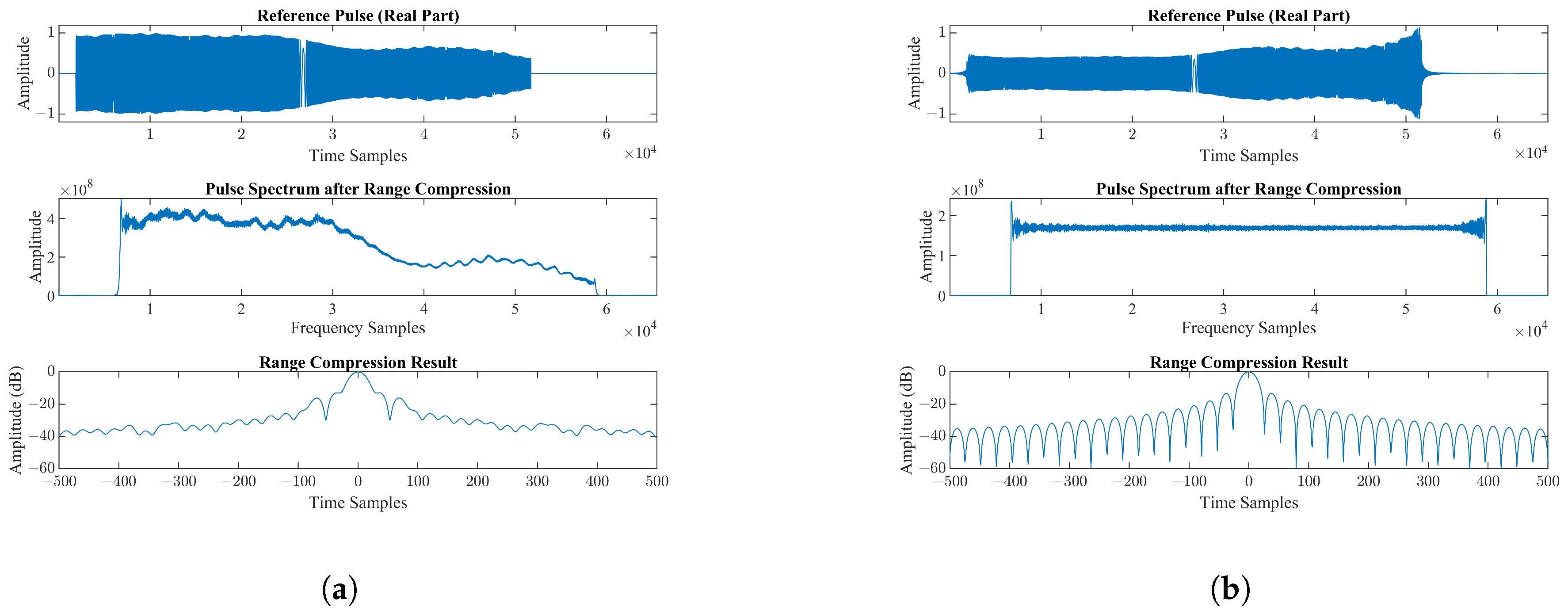
where S ideal , sub ( f r ) is the frequency spectrum of the ideal chirp signal of the current sub-band. Range compression is performed by multiplying the range spectrum of the received echo signal with the frequency-domain match filter. Figure 3 shows the range compression results with/without spectrum envelope compensation of the internal calibration signals having a distorted frequency spectrum envelope. With spectrum envelope compensation, the main lobe widening due to the distorted spectrum envelope is mitigated, leading to better range resolution.
After range compression, image focusing is conducted for each sub-band. The azimuth sampling time needs to be aligned among sub-bands such that the azimuth locations of the reflectors are the same in all sub-band images. For platforms with unstable motion, motion compensation is required. In addition to the navigation-data-based motion compensation, the extended range migration algorithm (ERMA) [17] and the PGA [11,12] can be used to achieve optimal focusing quality. Note that for synthetic bandwidth SAR, the motion compensation for all sub-bands should be conducted based on the same motion errors to avoid introducing additional misalignment among sub-band images. When autofocus methods are used to estimate motion errors, a practical way is to take the average of the estimated motion errors from all sub-bands as the final motion errors for compensation.

3.3. Time-Delay Error Estimation

The time-delay errors are first estimated and compensated, since they affect the accuracy of the subsequent amplitude and phase error estimations. The time-delay error estimation in the proposed method is based on range cross-correlation between the images of the current sub-band and the reference sub-band. The range cross-correlation is calculated using fast Fourier transform (FFT)-based fast convolution, expressed as
C ( τ , η ) = F r 1 F r I sub ( τ , η ) F r I ref ( τ , η ) ,
where I sub ( τ , η ) and I ref ( τ , η ) are the focused images of the current sub-band and the reference sub-band, respectively; F r [ · ] and F r 1 [ · ] denote the range FFT and inverse FFT, respectively; and C ( τ , η ) is the range cross-correlation result. The range cross-correlation result is then averaged in the azimuth direction, as
C ¯ ( τ ) = 1 N η η C ( τ , η ) ,
where N η is the number of azimuth samples. By averaging in the azimuth direction, the prominent reflectors at different azimuth locations together contribute more to the estimation than the weak scatterers, which may have unstable reflective properties among sub-bands. Therefore, the estimation accuracy is improved. To achieve sub-pixel estimation accuracy, the average range cross-correlation result C ¯ ( τ ) is interpolated using zero-padding in the frequency domain before peak searching. The time-delay error Δ τ is estimated by finding the peak location of C ¯ ( τ ) , as
Δ τ ^ = arg max τ C ¯ ( τ ) .
The estimated time-delay error is then compensated by multiplying a linear phase term exp [ j 2 π f r Δ τ ^ ] in the range frequency domain. The focused sub-band impulse response after time-delay error compensation becomes
s ˜ sub , syn , tc ( τ , η ) = Δ A sin c B r τ 2 R ( η c ) c sin c B a η η c exp j 4 π f c , sub R ( η c ) c + 2 π Δ f τ + Δ ϕ .

3.4. Amplitude Error Estimation

After time-delay error compensation, the amplitude errors are estimated based on the prominent reflectors. With peak locations of the prominent reflectors aligned among sub-bands, the amplitude error can be estimated by comparing the absolute values in each imaging cell of the current sub-band and the reference sub-band. To reduce the impact of noise and the unstable reflective properties of some weak scatterers, only the imaging cells with an amplitude above a certain threshold T amp in the reference sub-band image are considered for estimation. The amplitude error Δ A is estimated as the ratio of the sum of amplitudes of the selected imaging cells between the current sub-band and the reference sub-band, expressed as
Δ A ^ = τ , η M ( τ , η ) I sub , tc ( τ , η ) τ , η M ( τ , η ) I ref ( τ , η ) ,
where the mask function M ( τ , η ) is defined as
M ( τ , η ) = 1 , I ref ( τ , η ) > T amp 0 , I ref ( τ , η ) T amp .
The estimated amplitude error is then compensated by dividing the sub-band image by Δ A ^ . The resulting focused sub-band impulse response after amplitude error compensation becomes
s ˜ sub , syn , tac ( τ , η ) = sin c B r τ 2 R ( η c ) c sin c B a η η c exp j 4 π f c , sub R ( η c ) c + 2 π Δ f τ + Δ ϕ .

3.5. Phase Error Estimation

The phase errors are estimated based on the peak phases of several selected prominent reflectors. From (5), the focused sub-band impulse response of the reference sub-band can be expressed as
s ref , syn ( τ , η ) = sin c B r τ 2 R ( η c ) c sin c B a η η c exp j 4 π f c , ref R ( η c ) c .
From (15), (16), and (4), we have
s ˜ sub , syn , tac ( τ , η ) s ref , syn ( τ , η ) = s ˜ sub , syn , tac ( τ , η ) s ref , syn ( τ , η ) = 4 π Δ f R ( η c ) c + 2 π Δ f τ + Δ ϕ ,
where { · } denotes the phase extraction operation. Therefore, the phase error Δ ϕ can be expressed as
Δ ϕ = s ˜ sub , syn , tac ( τ , η ) s ref , syn ( τ , η ) exp j 4 π Δ f R ( η c ) c 2 π Δ f τ .
At the peak locations of the prominent reflectors, τ = 2 R ( η c ) / c ; therefore, the last exponential term in (18) becomes 1 and can be removed. The phase error estimation method is based on (18). Firstly, the peaks of the prominent reflectors are located in the reference sub-band image by searching for the local maxima. The local maxima are defined as the imaging cells whose absolute values are larger than those within a window of a certain size centered at the cell. Then, the local maxima are ranked based on their absolute values from high to low, and the top N p peaks are selected for phase error estimation. Due to the randomness of the deviations in the accurate peak locations away from the center of the imaging cells, the phase error estimation is based on the phase of the averaged values of the selected peaks, expressed as
Δ ϕ ^ = 1 N p i = 1 N p I sub , tac ( τ i , η i ) I ref ( τ i , η i ) exp j 2 π Δ f τ i ,
where τ i and η i denote the peak locations of the selected prominent reflectors in range and azimuth directions, respectively, and the last exponential term exp j 2 π Δ f τ i is the frequency-shifting term for bandwidth synthesis as in (15). The estimated phase error is then compensated by multiplying a phase term of exp [ j Δ ϕ ^ ] to the sub-band image. The resulting focused sub-band impulse response after phase error compensation becomes the same as (5), indicating that all the sub-band errors have been compensated and the bandwidth synthesis can be properly conducted.

4. Experiments and Results

In this section, the effectiveness of the proposed sub-band error estimation method is validated using real data.

4.1. SAR Parameters and Imaging Scenario

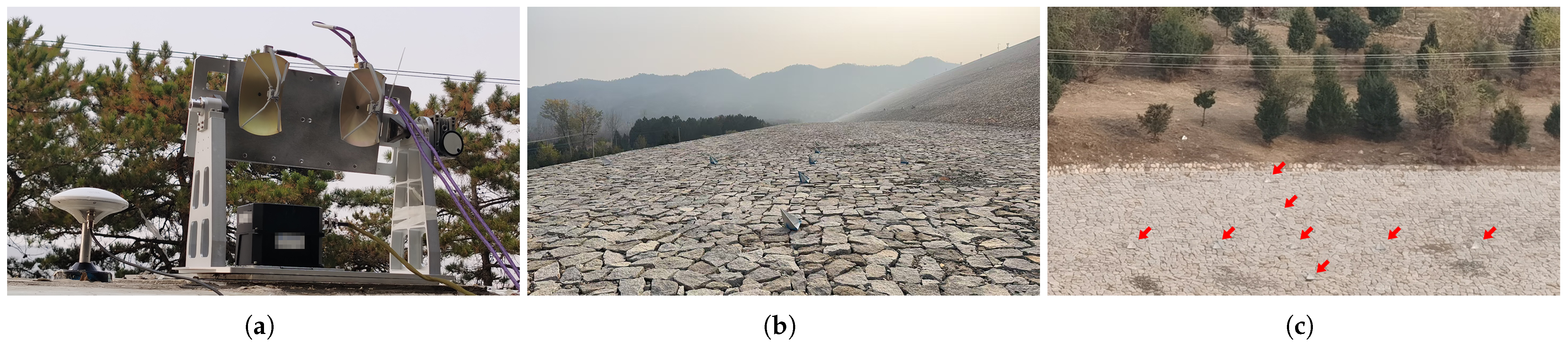
The SAR data were collected using a Ka-band synthetic bandwidth SAR system mounted on a vehicle platform. The imaging parameters are listed in Table 1. The imaging scene was located at the foot of a dam, and contained eight trihedral corner reflectors placed on the rock surface, along with nearby objects such as trees and power lines. The vehicle platform moved along a straight road on top of the dam to collect the SAR echoes. Photos of the mounted SAR antennas and the imaging scene are shown in Figure 4.

4.2. Experiments

In the experiments, the proposed sub-band error estimation method was compared with the GA-based method [7] and Hu et al.’s method [14]. The same focused sub-band images, which were processed according to the steps in Section 3.2, were used as inputs for all three methods. Each sub-band image had a size of 1000 × 1500 cells in range and azimuth directions, respectively. The reference sub-band was set to the middle sub-band (i.e., the one with a center frequency of 35 GHz).
Based on the characteristics of the imaging scene, the parameters of the proposed method were set as follows: The amplitude threshold T amp was set to 15 dB 0.178 times the maximum amplitude in the reference sub-band image, the window size of the local maxima was set to 65 cells in both directions, and the number of selected prominent reflectors N p was set to 5.
For the GA-based method, the search ranges of time-delay, amplitude, and phase errors were set to [ 2 cells ,   2 cells ] , [ 0.8 ,   1.3 ] , and [ π ,   π ] , respectively. The fitness function was defined as the image contrast [18] after bandwidth synthesis, defined as
f Contrast = σ ( I ( τ , η ) 2 ) μ ( I ( τ , η ) 2 ) ,
where μ ( · ) and σ ( · ) are the mean and standard deviation operations, respectively. The GA parameters were set according to [7] as follows: the population size was set to 100, the mutation probability was set to 0.2 , and the elitism rate was set to 0.2 . To speed up the process, only a cropped area of 250 × 900 cells covering the trihedral corner reflectors was used for fitness evaluation.
For Hu et al.’s method, the same five prominent reflectors as in the proposed method were used for error estimation. According to [14], the within-sub-band amplitude and phase distortions were first estimated and compensated based on the range spectra of the selected reflectors. Then, the amplitude errors among sub-bands were estimated and compensated based on the average spectrum amplitude of the selected reflectors. Finally, the time-delay and phase errors among sub-bands were jointly modeled as a linear phase term in the range frequency domain, and the corresponding coefficients were optimized by minimizing the entropy of the synthesized range profiles of the selected reflectors. The image entropy can be expressed as
f Entropy = τ , η p ( τ , η ) ln p ( τ , η ) ,
where p ( τ , η ) = I ( τ , η ) 2 / τ , η I ( τ , η ) 2 is the normalized image intensity.

4.3. Results

The effectiveness of the proposed method was evaluated by comparing the range profiles and the point analysis results of the point targets after bandwidth synthesis, as well as the image contrast in (20), the image entropy in (21), and the execution time. The point analysis results included the impulse response width (IRW), the peak sidelobe ratio (PSLR), and the integrated sidelobe ratio (ISLR). The IRW was defined as the 3dB width of the main lobe of the range profile. The PSLR was defined as the ratio between the peak of the main lobe and the highest sidelobe. The ISLR was defined as the ratio between the energy of the main lobe and the energy of the sidelobes.
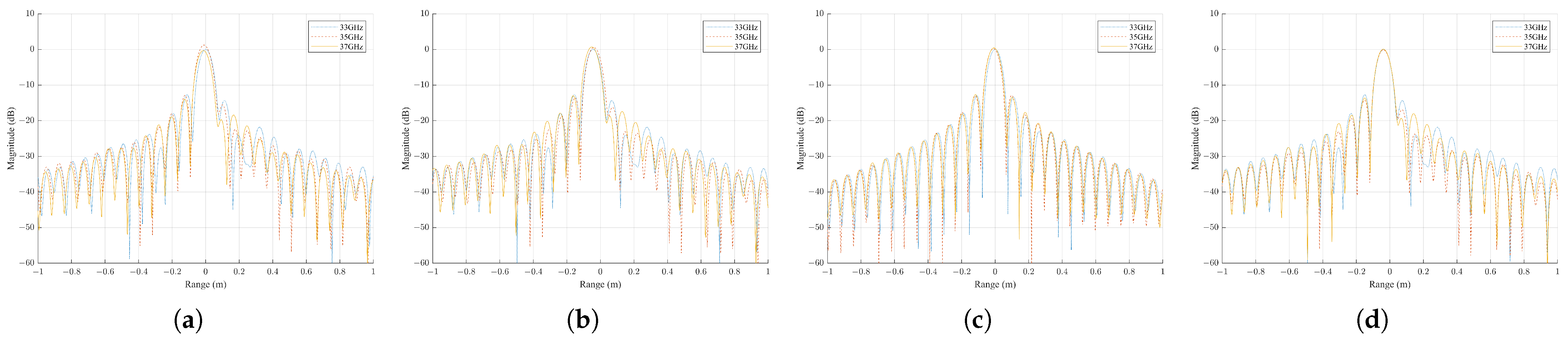
The range profiles of a trihedral corner reflector for all three sub-bands before and after sub-band error compensation using different methods are shown in Figure 5. The time-delay and amplitude errors among sub-bands are clearly observed in Figure 5a. The proposed method achieved better alignment of the range profiles among sub-bands than the GA-based method and Hu et al.’s method, as shown in Figure 5b–d.
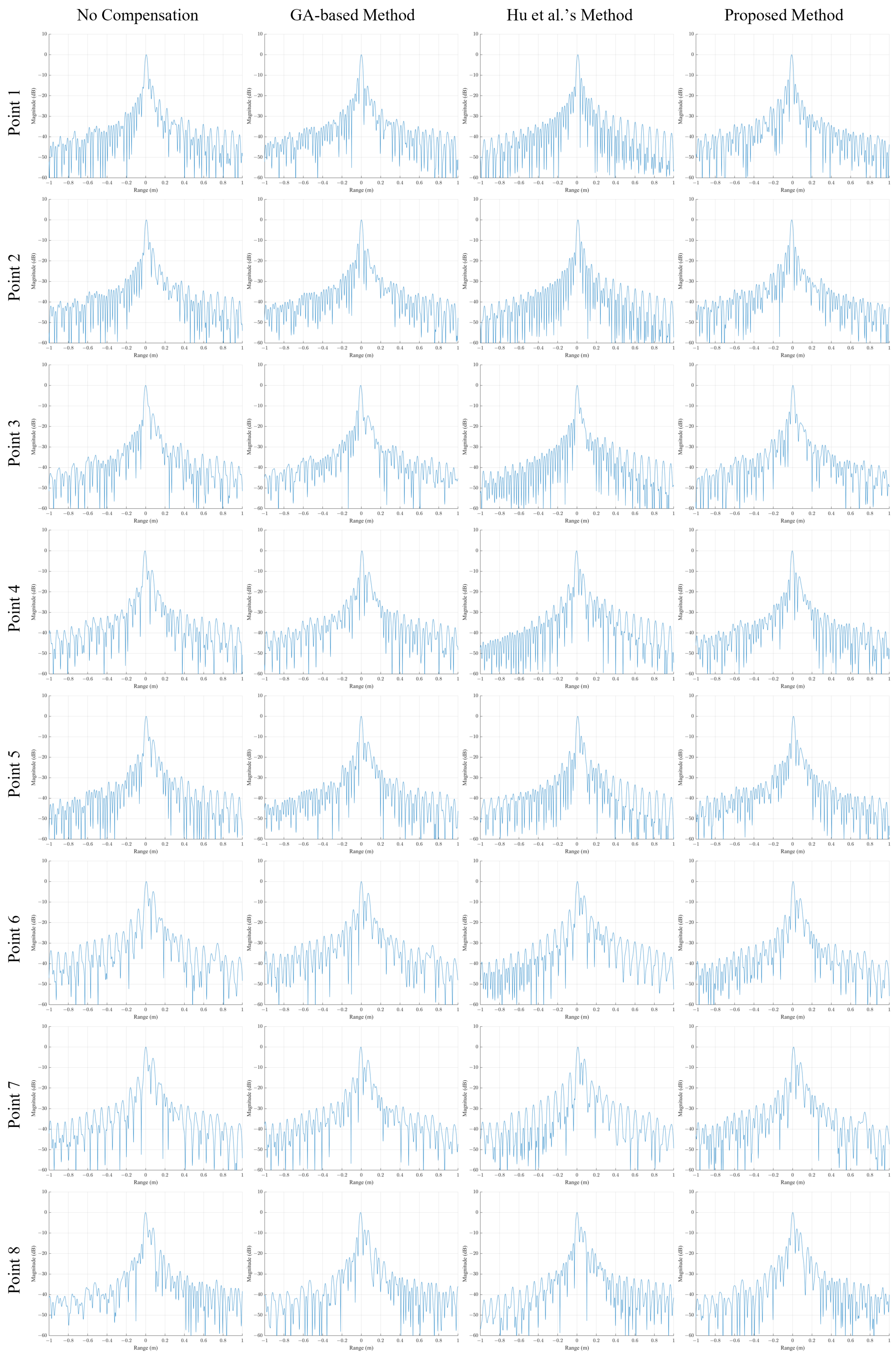
The range profiles of the trihedral corner reflectors after bandwidth synthesis are shown in Figure 6. The point analysis results are listed in Table 2. Compared to the case without residual sub-band error compensation, all three methods improved the IRW. The PSLR and ISLR of the proposed method were slightly better than those of the GA-based method and much better than those of Hu et al.’s method.
The image contrast and entropy after bandwidth synthesis are listed in Table 3. The proposed method achieved the lowest image entropy; however, the image contrast was low. The GA-based method achieved the highest image contrast and an image entropy very close to that of the proposed method. Hu et al.’s method achieved the lowest image contrast and the highest image entropy.
The execution time of all three methods is listed in Table 4. The proposed method was significantly faster than the GA-based method and slightly faster than Hu et al.’s method.
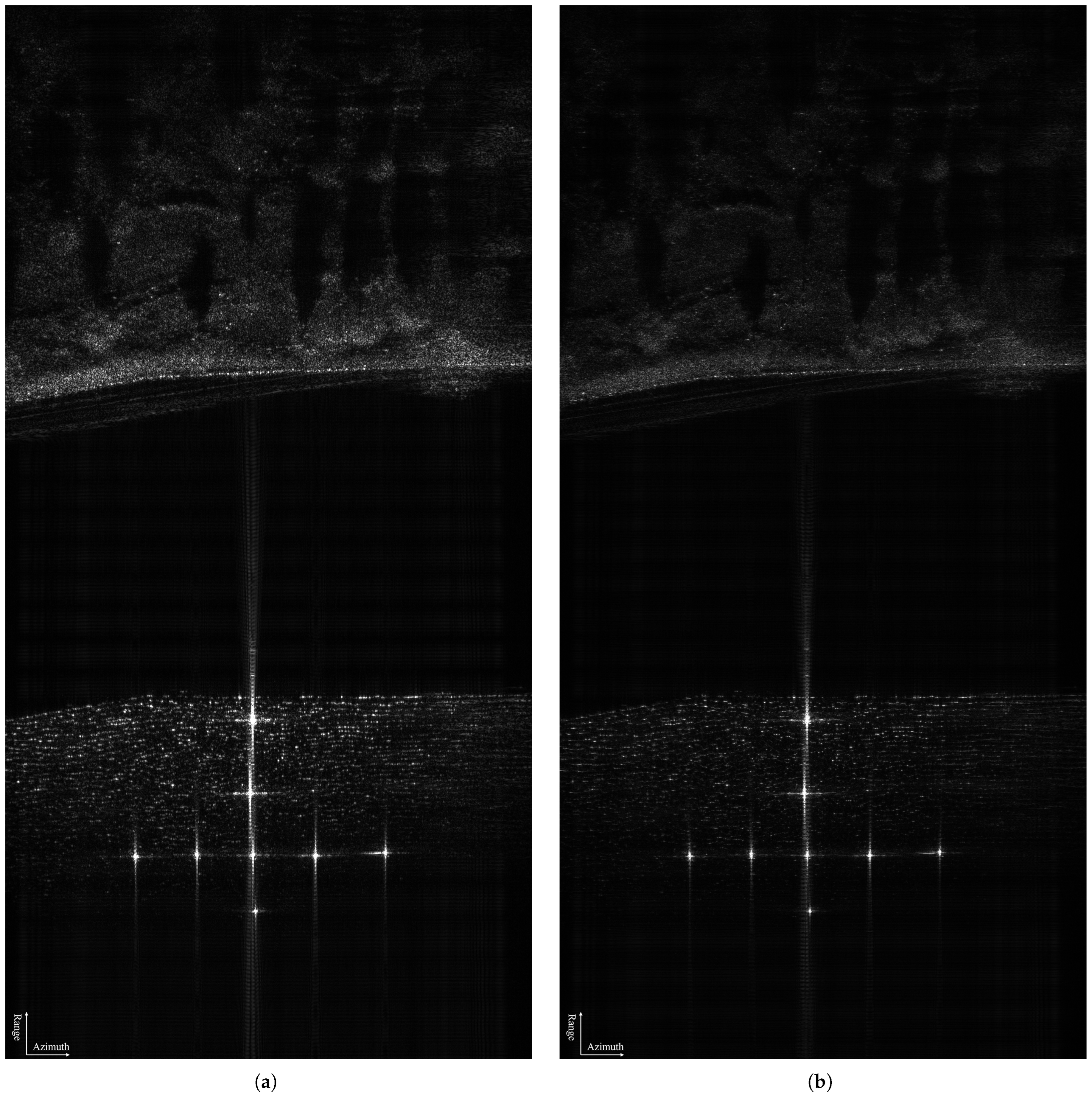
The SAR images before and after bandwidth synthesis using the proposed method are shown in Figure 7. The range resolution improvement is clear in Figure 7b, indicating the high quality of the bandwidth synthesis and the effectiveness of the proposed sub-band error estimation method.

5. Discussion

Overall, the results in Section 4 demonstrate the effectiveness and efficiency of the proposed sub-band error estimation method. Compared to the GA-based method, the proposed method achieved comparable or better performance except for the image contrast, which is the fitness function used in the GA-based method, while requiring significantly less execution time. The efficiency advantage of the proposed method is mainly due to the avoidance of iterative optimization. Compared to Hu et al.’s method, the proposed method achieved better performance in all aspects. This is because Hu et al.’s method is based on range spectra of selected reflectors, which are more sensitive to nearby clutter. In the test image, the clutter near the selected reflectors is made of the echoes from the rock surface and exhibits patterned fluctuations in the range direction, as shown in Figure 7. These fluctuations affect the range spectra of the selected reflectors, leading to inaccurate error estimations. The proposed method estimates the sub-band errors in the time domain, where the energy of the selected reflectors is more concentrated, making the method more robust to nearby clutter.
While the above results demonstrate the effectiveness and efficiency of the proposed method, several limitations need to be noted and discussed below.
The proposed method only estimates and compensates the errors between sub-bands, while the distortions within each sub-band are not considered. As shown in Figure 5a,b,d, the range profiles of each sub-band still exhibit some distortions after internal-calibration-based compensation. In this case, the distortions are not severe; thus, the proposed method can still achieve good performance. However, if the within-sub-band distortions are significant, additional pre-processing steps, e.g., external calibration [7] or the methods in [10,14], need to be applied to reduce the distortions before applying the proposed method.
The proposed method relies on the presence of prominent reflectors in the imaging scene for estimating sub-band errors. If there are too few prominent reflectors in the imaging scene, the estimation accuracy may be degraded. In this case, global-optimization-based methods, e.g., the GA-based method, may be more suitable.
The proposed method also relies on the focused sub-band images. Although the steps used in the proposed method can also be applied to the range-compressed sub-band data before azimuth focusing, the estimation accuracy may be affected due to the lack of azimuth focusing SNR gain. Estimating the sub-band errors based on the focused sub-band images is a common practice in the literature [7,10,14].
The theoretical analysis in Section 2 and Section 3 assumes a zero squint angle. With a non-zero squint angle, the time-delay error and the frequency-shifting term 2 π Δ f τ for bandwidth synthesis will have components in the azimuth direction. In this case, the time-delay and phase error estimations can be conducted based on the sub-band images counter-rotated to a zero squint angle, such that the azimuth components of the time-delay error and the frequency-shifting term are removed. After the counter-rotation, the origin of the range timing used for the frequency-shifting term also needs to follow the rotated radar trajectory in each azimuth cell. The amplitude error estimation is not affected by the squint angle.

6. Conclusions

In this paper, a prominent-reflector-based sub-band error estimation method for synthetic bandwidth SAR was proposed. The impacts of sub-band errors on SAR imaging were analyzed, demonstrating that time-delay, amplitude, and phase errors cause range-timing misalignment, amplitude inconsistency, and inter-sub-band phase discontinuities, respectively. The proposed method estimates and compensates sub-band errors in the time domain through three successive steps, each targeting a specific type of error. The effectiveness and efficiency of the proposed method are demonstrated using real data acquired by a Ka-band synthetic bandwidth SAR system. Compared to existing methods, the proposed method achieved robust, high-accuracy performance while requiring less execution time. The proposed method can be applied to various synthetic bandwidth SAR imaging to improve the image processing efficiency.

Author Contributions

Conceptualization, Z.X. and Y.N.; methodology, Z.X.; software, Z.X.; validation, Z.X. and Y.N.; formal analysis, Z.X.; investigation, Z.X., Y.N., H.Z. and W.W.; writing—original draft preparation, Z.X.; writing—review and editing, Y.N. and L.L.; visualization, Z.X. All authors have read and agreed to the published version of the manuscript.

Funding

This work was supported in part by the National Natural Science Foundation of China Excellent Young Scientists Project under Grant E4JZ010200 and in part by the National Natural Science Foundation of China under Grant 62231024.

Data Availability Statement

The data presented in this study are available on request from the corresponding author due to proprietary restrictions.

Acknowledgments

During the preparation of this manuscript, the authors used GPT-v4.1, GPT-v5.2, and Grammarly for the purpose of grammar checking. The authors have reviewed and edited the output and take full responsibility for the content of this publication.

Conflicts of Interest

The authors declare no conflicts of interest.

Abbreviations

The following abbreviations are used in this manuscript:
A/DAnalog-to-Digital
D/ADigital-to-Analog
ERMAExtended Range Migration Algorithm
FFTFast Fourier Transform
GAGenetic Algorithm
IFIntermediate Frequency
IRWImpulse Response Width
ISLRIntegrated Sidelobe Ratio
PGAPhase Gradient Autofocus
PSLRPeak Sidelobe Ratio
RFRadio Frequency
SARSynthetic Aperture Radar
SNRSignal-to-Noise Ratio

References

  1. Berens, P. SAR with Ultra-High Range Resolution Using Synthetic Bandwidth. In Proceedings of the IEEE 1999 International Geoscience and Remote Sensing Symposium IGARSS99 Cat No99CH36293, June 1999; IEEE: Piscataway, NJ, USA, 2022; Volume 3, pp. 1752–1754. [Google Scholar] [CrossRef]
  2. Ender, J.H.G.; Brenner, A.R. PAMIR—A Wideband Phased Array SAR/MTI System. IEE Proc.-Radar Sonar Navig. 2003, 150, 165–172. [Google Scholar] [CrossRef]
  3. Cantalloube, H.; Dubois-Fernandez, P. Airborne X-band SAR Imaging with 10 Cm Resolution: Technical Challenge and Preliminary Results. IEE Proc.-Radar Sonar Navig. 2006, 153, 163–176. [Google Scholar] [CrossRef]
  4. Scheiber, R.; Barbosa, F.; Nottensteiner, A.; Horn, R. E-SAR Upgrade to Stepped-Frequency Mode: System Description and Data Processing Approach. In Proceedings of the European Conference on Synthetic Aperture Radar EUSAR, Dresden, Germany, May 2006; VDE: Berlin, Germany, 2026; p. 4. [Google Scholar]
  5. Horn, R.; Nottensteiner, A.; Scheiber, R. F-SAR—DLR’s Advanced Airborne SAR System Onboard DO228. In Proceedings of the 7th European Conference on Synthetic Aperture Radar, June 2008; VDE: Berlin, Germany, 2011; pp. 1–4. [Google Scholar]
  6. Deng, Y.; Zheng, H.; Wang, R.; Feng, J.; Liu, Y. Internal Calibration for Stepped-Frequency Chirp SAR Imaging. IEEE Geosci. Remote Sens. Lett. 2011, 8, 1105–1109. [Google Scholar] [CrossRef]
  7. Wang, X.; Wang, R.; Deng, Y.; Wang, P.; Li, N.; Yu, W.; Wang, W. Precise Calibration of Channel Imbalance for Very High Resolution SAR With Stepped Frequency. IEEE Trans. Geosci. Remote Sens. 2017, 55, 4252–4261. [Google Scholar] [CrossRef]
  8. Holland, J.H. Genetic Algorithms. Sci. Am. 1992, 267, 66–73. [Google Scholar] [CrossRef]
  9. Wang, K.; Liao, G.; Xu, J.; Xu, Y.; Zhang, Y. General Bandwidth Synthesis Approach for Multiresolution SAR Imaging with Frequency Diverse Array. IEEE Trans. Geosci. Remote Sens. 2024, 62, 5222315. [Google Scholar] [CrossRef]
  10. Li, J.; Chen, J.; Liu, W.; Wang, P.; Li, C.; Li, J.; Chen, J.; Liu, W.; Wang, P.; Li, C. A Synthetic Bandwidth Method for High-Resolution SAR Based on PGA in the Range Dimension. Sensors 2015, 15, 15339–15362. [Google Scholar] [CrossRef] [PubMed]
  11. Wahl, D.; Eichel, P.; Ghiglia, D.; Jakowatz, C. Phase Gradient Autofocus-a Robust Tool for High Resolution SAR Phase Correction. IEEE Trans. Aerosp. Electron. Syst. 1994, 30, 827–835. [Google Scholar] [CrossRef]
  12. Zhang, L.; Qiao, Z.; Xing, M.d.; Yang, L.; Bao, Z. A Robust Motion Compensation Approach for UAV SAR Imagery. IEEE Trans. Geosci. Remote Sens. 2012, 50, 3202–3218. [Google Scholar] [CrossRef]
  13. Jing, G.B.; Sun, G.C.; Xia, X.G.; Xing, M.D.; Bao, Z. A Novel Two-Step Approach of Error Estimation for Stepped-Frequency MIMO-SAR. IEEE Geosci. Remote Sens. Lett. 2017, 14, 2290–2294. [Google Scholar] [CrossRef]
  14. Hu, J.; Wang, Y.; Xie, J.; Fang, G.; Chen, H.; Shen, Y.; Yang, Z.; Zhang, X.; Hu, J.; Wang, Y.; et al. Channel Amplitude and Phase Error Estimation of Fully Polarimetric Airborne SAR with 0.1 m Resolution. Remote Sens. 2025, 17, 2699. [Google Scholar] [CrossRef]
  15. Cumming, I.G.; Wong, F.H. Digital Processing of Synthetic Aperture Radar Data: Algorithms and Implementation; Artech House Print on Demand: Boston, MA, USA, 2005. [Google Scholar]
  16. Ulaby, F.T. Microwave Remote Sensing: Active and Passive. Vol 1: Microwave Remote Sensing Fundamentals and Radiometry; Artech House: Norwood, MA, USA, 1981. [Google Scholar]
  17. Reigber, A.; Alivizatos, E.; Potsis, A.; Moreira, A. Extended Wavenumber-Domain Synthetic Aperture Radar Focusing with Integrated Motion Compensation. IEE Proc.-Radar Sonar Navig. 2006, 153, 301–310. [Google Scholar] [CrossRef]
  18. Berizzi, F.; Martorella, M.; Cacciamano, A.; Capria, A. A Contrast-Based Algorithm For Synthetic Range-Profile Motion Compensation. IEEE Trans. Geosci. Remote Sens. 2008, 46, 3053–3062. [Google Scholar] [CrossRef]
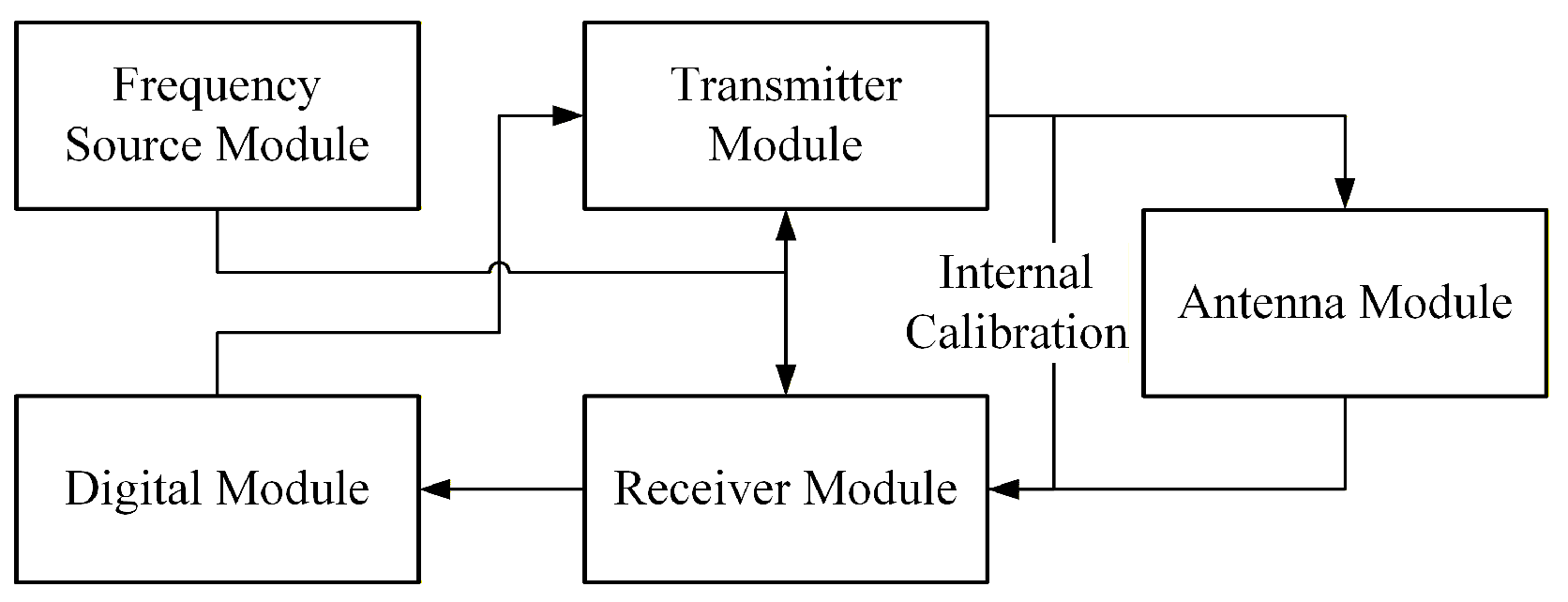
Figure 1. Block diagram of a synthetic bandwidth SAR system with an internal calibration loop. The arrows denote the directions of signal flow.
Remotesensing 18 00503 g001
Figure 2. Flowchart of the proposed prominent-reflector-based sub-band error estimation method.
Remotesensing 18 00503 g002
Figure 3. Range compression results with/without spectrum envelope compensation of the internal calibration signals having a distorted frequency spectrum envelope: (a) Without spectrum envelope compensation; (b) with spectrum envelope compensation.
Remotesensing 18 00503 g003
Figure 4. Photos depicting the imaging scenario: (a) SAR antennas mounted on the roof of the vehicle platform. (b) Trihedral corner reflectors placed at the foot of the dam. (c) The whole imaging scene (red arrows indicate the trihedral corner reflectors).
Remotesensing 18 00503 g004
Figure 5. Range profiles of a trihedral corner reflector for all three sub-bands: (a) Without residual sub-band error compensation. (b) Residual sub-band errors compensated using the GA-based method. (c) Residual sub-band errors compensated using Hu et al.’s method. (d) Residual sub-band errors compensated using the proposed method.
Remotesensing 18 00503 g005
Figure 6. Range profiles of the trihedral corner reflectors after bandwidth synthesis.
Remotesensing 18 00503 g006
Figure 7. SAR images before and after bandwidth synthesis. (a) Image of the reference sub-band before bandwidth synthesis, interpolated three times in the range direction via spectrum zero-padding. (b) Image after sub-band error compensation using the proposed method and bandwidth synthesis.
Remotesensing 18 00503 g007
Table 1. Imaging parameters of the Ka-band synthetic bandwidth SAR.
ParameterValue
Number of sub-bands3
Bandwidth of each sub-band2 GHz
Sampling frequency of each sub-band2.5 GHz
Center frequency of each sub-band33/35/37 GHz
Total synthesized bandwidth6 GHz
Azimuth antenna beamwidth
Platform velocity8.45 m · s 1
Total Pulse repetition frequency5000 Hz
Slant range resolution0.025 m
Azimuth resolution0.05 m
Slant range to scene center135 m
Table 2. Point analysis results of the range profiles of the trihedral corner reflector after bandwidth synthesis.
PointMethodIRW (m)PSLR (dB)ISLR (dB)
1No Compensation0.0236−11.79−9.95
GA-based Method0.0229−11.43−8.96
Hu et al.’s Method0.0223−11.45−8.98
Proposed Method0.0228−12.17−9.22
2No Compensation0.0235−10.91−8.73
GA-based Method0.0227−11.66−8.58
Hu et al.’s Method0.0221−10.60−8.57
Proposed Method0.0226−12.35−9.03
3No Compensation0.0250−13.77−10.47
GA-based Method0.0239−12.27−8.52
Hu et al.’s Method0.0231−10.85−8.72
Proposed Method0.238−12.85−9.02
4No Compensation0.0237−9.45−6.22
GA-based Method0.0227−10.39−6.19
Hu et al.’s Method0.0223−8.89−6.32
Proposed Method0.0227−10.63−7.19
5No Compensation0.0241−10.06−7.38
GA-based Method0.0230−12.50−7.45
Hu et al.’s Method0.0225−9.64−7.58
Proposed Method0.0230−11.55−8.17
6No Compensation0.0239−4.84−2.62
GA-based Method0.0226−5.68−2.88
Hu et al.’s Method0.0226−6.91−3.45
Proposed Method0.0231−8.25−4.77
7No Compensation0.0242−5.45−3.29
GA-based Method0.0229−6.42−3.43
Hu et al.’s Method0.0224−5.84−3.04
Proposed Method0.0228−7.54−4.32
8No Compensation0.0250−7.52−4.85
GA-based Method0.0241−8.48−4.80
Hu et al.’s Method0.0235−7.07−4.33
Proposed Method0.0241−7.94−4.91
Table 3. Image contrast and entropy after bandwidth synthesis.
MethodImage ContrastImage Entropy
No Compensation401.545.366
GA-based Method464.095.276
Hu et al.’s Method387.925.374
Proposed Method397.145.275
Table 4. Execution time of the residual sub-band error estimation methods.
MethodExecution Time (s)
GA-based Method267.5
Hu et al.’s Method3.3
Proposed Method3.1
Disclaimer/Publisher’s Note: The statements, opinions and data contained in all publications are solely those of the individual author(s) and contributor(s) and not of MDPI and/or the editor(s). MDPI and/or the editor(s) disclaim responsibility for any injury to people or property resulting from any ideas, methods, instructions or products referred to in the content.