Article

Quantifying Agricultural Flooding Practices for Migratory Bird Populations: A Test Case of Incentivized Habitat Management in the Yazoo–Mississippi Delta (USA) Using In Situ Sensors, Digital Elevation Models, and PlanetScope Imagery


by
Lucas J. Heintzman
1,2,*,
Eddy J. Langendoen
3,
Matthew T. Moore
1,
Damien E. Barrett
1,
Nancy E. McIntyre
4,
Lindsey M. Witthaus
1,
Richard E. Lizotte, Jr.
1,
Frank E. Johnson II
1,
Martin A. Locke
5,
Victoria M. Blocker
1,
Michael E. Ursic
3,
Amanda M. Nelson
6,
Jason M. Taylor
7 and
Jason D. Hoeksema
7
1
USDA-ARS National Sedimentation Laboratory, Water Quality and Ecology Research Unit, 598 McElroy Drive, Oxford, MS 38655, USA
2
Applied Ecology, Inc., 780 S. Apollo Blvd, Melbourne, FL 32901, USA
3
USDA-ARS National Sedimentation Laboratory, Watershed Physical Processes Research Unit, 598 McElroy Drive, Oxford, MS 38655, USA
4
Department of Biological Sciences, Texas Tech University, Box 43131, Lubbock, TX 79409, USA
5
USDA-ARS National Sedimentation Laboratory, 598 McElroy Drive, Oxford, MS 38655, USA
6
USDA-ARS Sustainable Water Management Research Unit, National Center for Alluvial Aquifer Research, 4006 Old Leland Road, Leland, MS 38756, USA
7
Department of Biology, University of Mississippi, P.O. Box 1848, University, MS 38677-1848, USA
*
Author to whom correspondence should be addressed.
Remote Sens. 2026, 18(3), 477; https://doi.org/10.3390/rs18030477
Submission received: 22 September 2025 / Revised: 15 January 2026 / Accepted: 20 January 2026 / Published: 2 February 2026

Highlights

What are the main findings?
  • Using remotely sensed imagery, we developed the Field Inundation Tool/Survey.
  • Inundation metrics derived from the Field Inundation Tool/Survey were comparable to those determined from in situ water sensors and digital elevation models.
What are the implications of the main findings?
  • The Field Inundation Tool/Survey allows for quantification of spatial and temporal patterns of flooding in the Yazoo–Mississippi Delta; a similar approach could be applied elsewhere.
  • The Field Inundation Tool/Survey provides a relatively straightforward assessment of flooding without on-the-ground measures.

Abstract

The Yazoo–Mississippi Delta is an agricultural production zone and flyway for migratory birds. During winter, agricultural field-flooding practices are routinely used to support bird conservation and local recreational hunting opportunities. In response to the 2010 Deepwater Horizon oil spill, federal agencies incentivized flooding in summer and fall to mitigate the risks to migratory bird populations. This funding ceased in 2017, yet the United States Department of Agriculture Natural Resources Conservation Service Environmental Quality Incentives Program Practice 644 and a local non-profit continue to incentivize flooding during fall. Ensuring that contractual water levels are met is challenging to determine. To that end, we developed the Field Inundation Tool/Survey, an integrated remote sensing approach using PlanetScope imagery (Planet Labs, San Francisco, CA, USA) to quantify associated hydrology patterns. We used the Normalized Difference Water Index and an Iso Cluster Unsupervised Classification to estimate field inundation and associated habitat types over a three-year period. The results indicate dynamic field inundation can be estimated via PlanetScope imagery. Derived inundation metrics were comparable with in situ sensor and digital elevation models among some treatment types. We documented future refinements for image quality and soil patterns. Our work can improve conservation incentivization by tracking spatial and temporal patterns in adoption and has applicability to other agroecosystems.

1. Introduction

Aquatic environments provide numerous ecosystem services for human and wildlife populations. Mosaics of wetland habitats, varying in depth, provide an important stopover or overwintering habitat for a diverse array of migratory bird species as they traverse dynamic landscapes [1,2]. The Mississippi Alluvial Plain (MAP), an ecoregion in the United States that extends from Illinois to the Gulf of Mexico [3], is recognized as a critical zone for migratory shorebirds and waterfowl [4]. This region was historically characterized by complex networks of braided streams and wetlands, common to many large river floodplain ecosystems [5], serving as a crucial habitat for migratory birds by providing foraging opportunities during stopovers in autumn migration and winter [6]. Currently, the MAP is among the most intensively managed production zones in the world, with extensive alterations to local hydrology [7,8]. Flood control efforts combined with riparian forest clearing and engineered drainage networks have allowed for the expansion of agricultural production in the MAP over the last 200 years [9]. This conversion has significantly reduced wetland habitat availability within the MAP through decreased acreage and duration of flooded conditions [10,11]. Despite significant alteration, the MAP ecoregion continues to be an important migratory corridor for shorebirds and waterfowl, and this important service can be maintained and conserved through multi-use management of the agricultural lands.
Resource managers are increasingly interested in agricultural practices that can support avian conservation efforts and enhance agroecosystem sustainability within alluvial landscapes. Flooding agricultural fields in the fall and winter, for example, can provide critical habitat for shorebirds and waterfowl, while not interfering with agricultural productivity [12,13,14,15]. This practice provides additional wetland ecosystem services, including nutrient retention and removal, and reducing runoff of total suspended and dissolved solids, nitrates (NO3), and sulfates [16,17]. Importantly, this approach of inserting wetland structure and function into agricultural production schedules is potentially scalable across alluvial agroecosystem landscapes because it overcomes hesitancy related to taking agricultural land out of production. This flooding practice approach offers differential habitat availability simultaneously for various bird species, given the variation of field inundation patterns and depths.
Periodic flooding of fields during the winter (non-agricultural production season) months (November–February) has been a common practice to support waterfowl conservation and recreational hunting opportunities within northwestern Mississippi, a subregion often referred to as the Yazoo–Mississippi Delta (YMD). Use of water-control structures such as flashboard risers (USDA Natural Resources Conservation Service [NRCS] Conservation Practice 587) in conjunction with infield or edge-of-field levees (USDA NRCS Conservation Practice 356) can be managed to create temporary wetland wildlife habitat (USDA NRCS Conservation Practice 644) to attract migratory waterfowl within the Mississippi Flyway. These practices have added a significant amount of temporary and localized aquatic habitat to the YMD. However, there has been extensive spatial–temporal variation in these practices. As this type of flooding generally occurs at later stages of the avian fall migration window, other potential target groups (such as threatened migratory shorebirds) may receive limited practical benefits.
As a management response to the Deepwater Horizon oil spill in 2010, numerous federal agencies incentivized flooding during late summer and fall (July–November) to prevent migratory birds from interacting with the oil-spill affected coastal zones between 2012 and 2017 [18]. As federal incentives expired, the prevalence of late summer and fall flooding diminished. Local non-profit organizations are sustaining fall flooding through non-federal mechanisms to smaller extents, and additional incentives are now available to support fall flooding for migratory shorebirds through USDA NRCS Environmental Quality Incentive Program Practice 644. However, the funding agencies often lack an efficient monitoring tool to ensure that contractual water levels are met. There is also a flooding practice that relies on capturing precipitation rather than pumping. Monitoring dynamic flooding conditions through space and time at large spatial scales is critical to (1) understanding and managing aquatic habitats with their associated avian wildlife communities and (2) enhancing the efficacy of financial incentive programs aimed at meeting multiple ecological and agricultural objectives.
There are numerous techniques to locate potential areas of aquatic habitat. Perhaps the simplest approach uses a digital elevation model (DEM) to identify the lowest-lying portions of a region as locations most likely to have standing water and/or moist soil, but this procedure requires a very fine-grained DEM in flat landscapes like the YMD and fails to account for landscape features or anthropogenic practices that may alter the percolation or ponding of water (e.g., levees, pumps). In situ field sensors can be used, but these may be unavailable or costly to deploy at large spatial extents over long periods of time. Remotely sensed imagery has thus become the most widely used way to identify and monitor aquatic habitat at a landscape scale over time [19]. For example, the Normalized Difference Water Index (NDWI) is a very commonly used metric derived from remotely sensed imagery [20,21]. Alternatively, unsupervised classification can be used to identify the locations of potential aquatic habitat. Both methods, however, may confuse spectrally similar landcover types.
A critical need is present for the development of a method to rapidly quantify the aquatic habitat associated with incentivized field-flooding dynamics in the YMD to better inform and support agricultural producers and wildlife managers interested in increasing the sustainability of alluvial agroecosystems. We have addressed this need through the application of remote-sensing approaches using PlanetScope imagery (Planet Labs, San Franciso, CA, USA) to quantify aquatic habitat distributions across different flooding practices, comparing the NDWI to results from unsupervised classification, cross-referenced against values from in situ sensors and a DEM. We analyzed images collected from 1 September 2021 to 30 January 2024 that coincided with a field experiment of different flooding practices over three years at two production sites [Site A (west) and Site B (east)] in Sunflower County, Mississippi (Figure 1). By these analyses, we developed the Field Inundation Tool/Survey (FITS), a set of procedures and models that can be applied to other regions with agricultural flooding practices.

2. Materials and Methods

2.1. Flooding Treatments

We examined inundation patterns annually over a three-year span (2021–2024) for three fall–winter sampling campaigns at two test-case locations in Sunflower County, Mississippi (Figure 1). Campaign 1 (C1) occurred from 21 September 2021 to 31 January 2022. Campaign 2 (C2) occurred from 19 September 2022 to 6 February 2023. Campaign 3 (C3) occurred from 16 September 2023 to 29 January 2024. At each location, five fields (one field per treatment) were randomly assigned to one of five shallow water management practices through management of drainage with slotted pipes and riser boards coupled with surface water pumping from an adjacent irrigation storage pond. Treatments included the following: (i) Control (C), no active or passive flooding; (ii) Passive Flooding (PF), riser boards installed after harvest but flooding dependent on precipitation (this treatment was only applied during Campaign 1 due to lack of sufficient rainfall in subsequent years); (iii) Fall Flooding (FF), water actively pumped to maintain shallow standing water from mid-September to mid-November; (iv) Winter Flooding (WF), water actively pumped to maintain shallow standing water from mid-November to the end of January; and (v) Fall and Winter Flooding (FWF), water actively pumped to maintain shallow standing water from mid-September to the end of January. The water level in the treatments was maintained by access to pumped surface water from irrigation reservoirs combined with tailwater recovery systems. Field-specific treatments varied from year to year because of differences in precipitation (observed flooding patterns) (Table S1). The dominant soil series at both locations included Alligator, Dowling, Dundee, and Forestdale. Formed by alluvium, these soils are very deep and drainage ranges from poorly drained to very poorly drained (Web Soil Survey 2019). Our sampling design created a dynamic testing scenario confined to a relatively small area for the parameterization of the FITS model.

2.2. Overview of the FITS Model

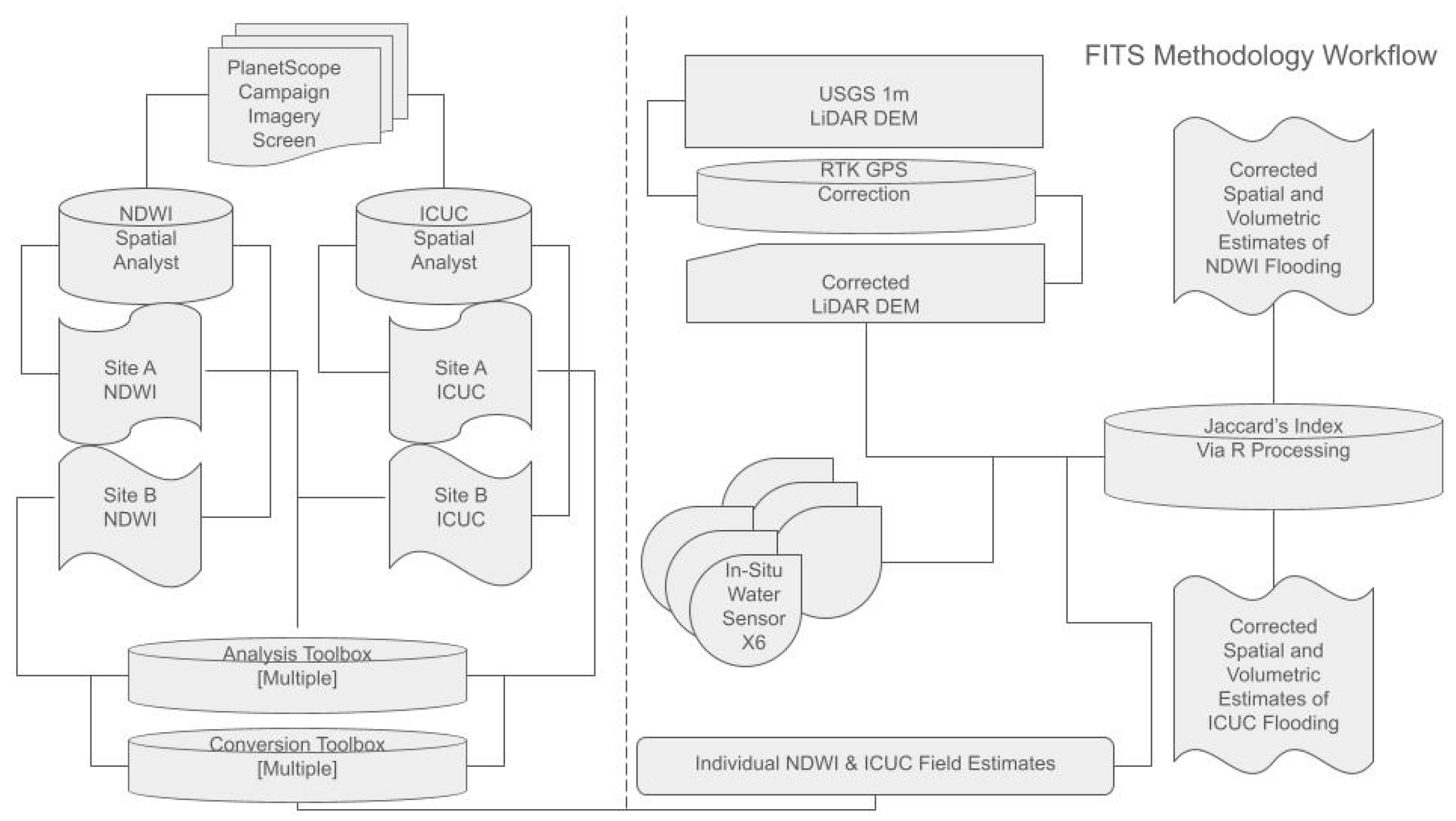
A workflow diagram of how the FITS model was developed is provided in Figure 2. Briefly, remotely sensed imagery that met certain quality criteria were downloaded from PlanetScope for the focal region and timeframe. For each image, we then calculated the NDWI to identify open water and performed an unsupervised classification to identify saturated soils; these two procedures yielded maps of overall aquatic habitat at the two sites. The volume of aquatic habitat for each site was then calculated based on the water levels from in situ sensors and a high-resolution digital elevation model from lidar. The Jaccard index was then used to quantify the similarities between the approaches (i.e., spatial extent and volume of aquatic habitat based on the NDWI and unsupervised classification to that based on in situ sensors with a DEM). Details are provided in Section 2.3, Section 2.4 and Section 2.5.

2.3. Imagery Selection for the FITS

We collected PlanetScope images during timeframes that corresponded with the three sampling campaigns. We limited our selection of PlanetScope imagery to that captured from the Super Dove (PSB.SD) satellite sensor (https://developers.planet.com/docs/apis/data/sensors/, accessed on 19 January 2025). We only considered images that met the following characteristics: area coverage > 90%, cloud cover < 10%, with surface reflectance information, ground control points, and of standard quality (or better). Next, we only retained images that occurred within ±1 day from the date of a corresponding field sampling event during each campaign. All data were prepared for direct download as formatted GeoTIFFs, with a usable data mask (i.e., preliminary data quality check) and composed of surface reflectance—4 band information (RGBNIR). These files were clipped to our search AOI (bounding polygon encompassing test-case location) and harmonized to Sentinel 2 radiometry (https://www.planet.com/explorer/, accessed on 19 January 2025). We used a total of 40 images for subsequent analyses for the FITS (C1 = 13 images, C2 =11 images, C3 = 16 images, Table 1).

2.4. Imagery Processing and Conceptual Representations for the FITS

We performed a time-series analysis of aquatic habitat occurrence [22,23] using 4-band PlanetScope imagery. For each date, imagery was ocularly inspected in ArcMap 10.8.1 and ArcGIS Pro (ESRI, Redlands, CA, USA) to review image quality and ecological conditions (e.g., harvest status and presence of ice/snow). Our first assay used the NDWI metric, with a threshold value of −0.3 to delineate inundated areas in Sites A and B. Next, we conducted an Iso Cluster Unsupervised Classification (ICUC) (binary classes of water/non-water [derived from all four bands], minimum class size = 20, with sample interval = 10; ESRI 2024, https://pro.arcgis.com/en/pro-app/latest/tool-reference/spatial-analyst/iso-cluster-unsupervised-classification.htm, accessed on 19 January 2025) to delineate the aquatic habitat in Sites A and B. We expected the NDWI to emphasize “open water” (aquatic habitat sensu stricto; teal color in Figure 1B) within portions of the flooded fields; whereas, the ICUC was expected to also include “saturated soils” (aquatic habitat sensu lato; purple color in Figure 1C) within portions of the flooded fields. These processes fostered the identification of potential high and low habitat concentrations per field [24].
Saturated soils and open water are the two components of a flooded field that represent a differential habitat status for various species, especially when considering migratory shorebirds and waterfowl [25]. Individual field estimates for the NDWI and ICUC water detections were determined through a combination of the Image Analyst Toolbox, the Spatial Analyst Toolbox, the Analysis Toolbox, and the Conversion Toolbox in ArcMap 10.8.1 and ArcGIS Pro. Because we envisioned the FITS model as a tool to be used by non-experts in remote sensing, we used standard geospatial tools at their default parameter values. We did explore how varying minimum class size and sample intervals beyond their default values and categories beyond the binary (water/non-water) affected detections. By decreasing the minimum class size and sample interval, more numerous small patches of aquatic habitat could be classified, and increasing the number of categories beyond the presence/absence of water allowed for different types of waterbodies to be discriminated. However, in some cases, the results were inconsistent with what we observed in the field. Therefore, we used default parameter values for the greatest user ease and potential for consistent comparisons. Future applications of the FITS model may wish to explore how different parameter combinations affect the classification results of aquatic habitats in their specific test systems.

2.5. Use of In Situ Sensors and a DEM for Aquatic Habitat Estimates for the FITS

The aquatic habitat volume at Sites A and B was calculated from (i) the NDWI and ICUC water detections (Section 2.4) and (ii) the water level measured by the in situ sensors. The general water volume calculation procedure comprised the following two steps: (i) determine the area inundated and the corresponding water surface elevation, and (ii) calculate the volume of water contained between the water surface and the ground surface provided by the digital elevation model.
A 1 m horizontal resolution DEM of the study area was made available through the US Geological Survey 3DEP LidarExplorer (https://www.usgs.gov/tools/lidarexplorer, accessed on 19 January 2025) and was derived from Class 2 lidar flown between February 2018 and December 2020. Unfortunately, about half of fields 4 through 6 were inundated when the lidar-collection flights took place, yielding incorrect ground elevations for the inundated areas. On 14 February 2025, the ground elevations of each field were surveyed using Real-Time Kinematic (RTK) GPS to 0.02 m vertical accuracy every 10 m along its perimeter together with two equidistant transects oriented along the long axis and two equidistant transects oriented along the short axis of the rectangular field. These data were used to correct the ground surface elevations of the inundated areas by a bilinear interpolation of the survey point elevations to the DEM raster cell elevations. This approach was assumed to be adequate because the field slope is near-linear, as the field grade was established by laser leveling to support furrow irrigation. We did not quantify errors in the corrected DEM after interpolation, but errors should be more likely and more problematic in areas with less uniformly level terrain than the YMD or when using a DEM with a coarser resolution. Furthermore, the GPS-derived DEM errors in elevation will be smaller or of similar magnitude as the lidar-derived DEM errors in elevation (vertical accuracy of 0.12 m at 95% confidence level) on a terrain with large furrows. Although not correcting for such potential errors may influence our estimates of water volume, our efforts nonetheless represent a potentially useful and practical avenue to explore incentivized flooding patterns at large spatial scales.
Table S1 identifies the six fields instrumented with a water level sensor during Campaigns 1 through 3, which varied during the three campaigns. The water level sensor was a HOBO® U20L Water Level Logger (Onset Computer Corporation, Borne, MA, USA, https://www.onsetcomp.com/products/data-loggers/u20l-0x, accessed on 1 December 2025). Sensors were attached onto T-bar posts driven into the soil near the slotted pipe and riser board control structures. The bottom of the logger was located close to the soil surface. Water level was measured continuously at a fixed 15-min logging interval. Logging typically started within a week before the beginning of a campaign and ended at the conclusion of the campaign, when data was downloaded and the instruments and posts were removed to not impede farming operations. Logger elevations were surveyed using RTK GPS only for Campaign 1. For Campaigns 2 and 3, if loggers were installed in the same fields as during Campaign 1, they were placed in the same locations. For the water volume calculation, we assumed sensor elevations equaled those surveyed during Campaign 1. For instruments installed in fields different from Campaign 1, sensor elevations were calculated by determining the mean (0.088 m) and standard deviation (0.060 m) for the distances of surveyed sensors to the DEM ground surface. These values were then used to calculate the expected elevation and its uncertainty for the affected sensors. For a constant water level, sensor measurements generally varied around 0.03 m about the mean. This variation was used as measurement uncertainty. Daily inundation maps for each monitored field were derived for the mean and mean ± uncertainty water surface elevation values. The inundation extent was calculated as the intersect of water surface and the DEM ground surface. Flow depth was calculated for each DEM raster cell within the inundated area and then summed over the inundated raster cells (cells have an area of 1 m2) to obtain the volume of the inundated water.
For the NDWI and ICUC inundation surfaces, the DEM ground elevations along the surface perimeter were assumed to represent the water surface elevation. These elevations typically followed a normal distribution. We equated the mean of the distribution to the water surface elevation and used the standard deviation to quantify the uncertainty. With water elevation and inundation extent determined, the calculation of water volume was determined, as presented in the previous paragraph.
The similarity between the NDWI and the ICUC inundation extent to that calculated from the in situ sensors was expressed using the Jaccard index, a pairwise measure that is calculated by dividing the size of the intersection by the size of the union of the calculated inundation extent and the in situ sensor inundation extent. The Jaccard index ranges from zero to one. When the two inundation extents are spatially identical, the Jaccard index equals one. When there is no overlap between inundation extents, the Jaccard index equals zero.

3. Results

3.1. Aquatic Habitat Detection Characteristics During C1 (Via PlanetScope Imagery)

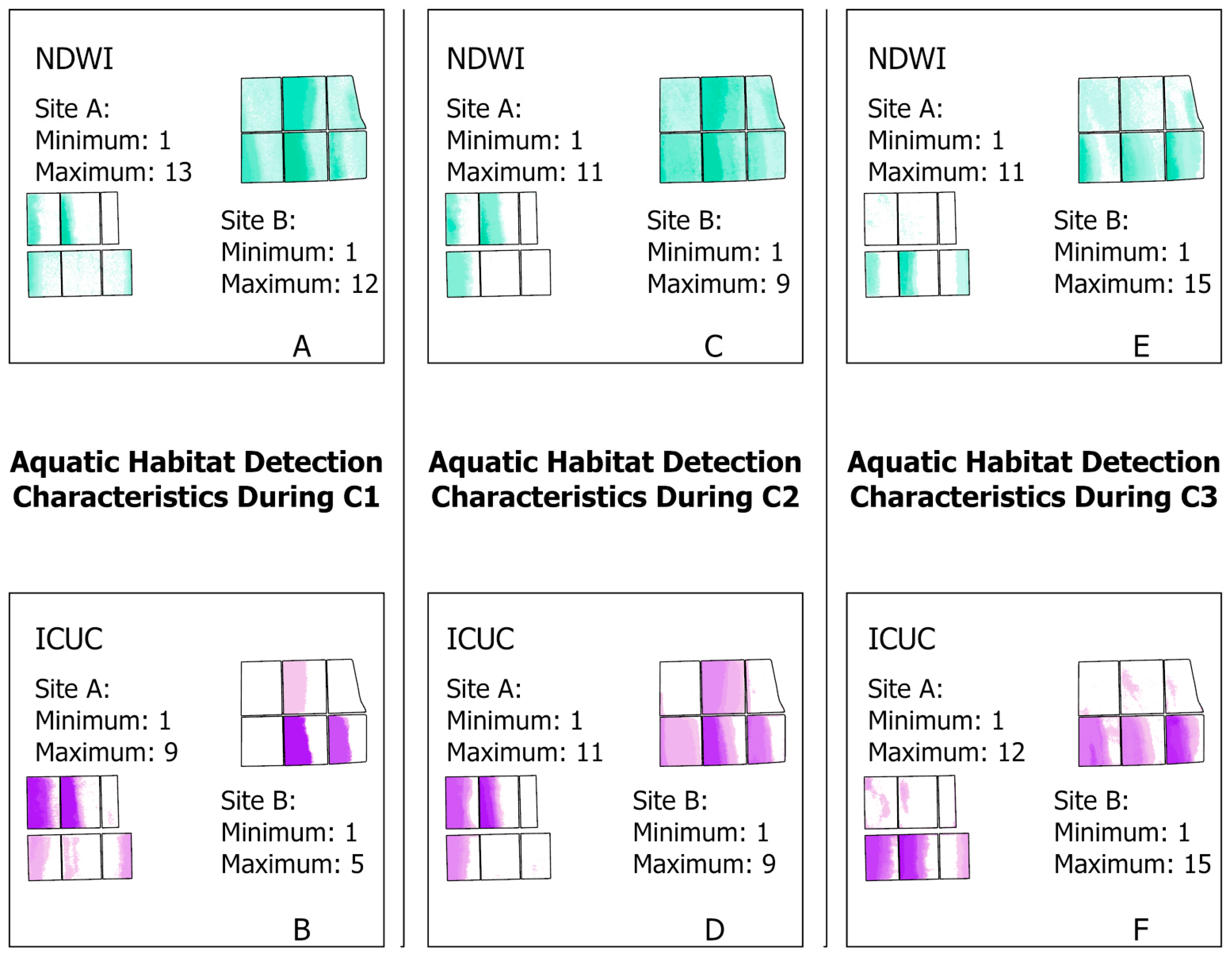
The NDWI returned aquatic habitat detections on 13 days for 21 sampling events for Site A locations and on 12 days for 21 sampling events for Site B locations. Minor habitat detections on 22 September 2021 in Site B during that delayed onset period likely represented precipitation runoff and are not directly related to incentivization. The ICUC returned habitat detections on nine days for 21 sampling events for Site A locations and five days for 21 sampling events for Site B. These differences occurred during September 2021, December 2021, and January 2022. For C1, the NDWI produced more consistent detections across the seasons, most notably in winter (Tables S2 and S3). In terms of mean percent area inundation for Site A, the NDWI indicated the highest values in Field 2 (15%) and the lowest values in Field 3 (0.1%). For Site B, the NDWI indicated the highest values in Field 11 (53%) and the lowest values in Field 9 (14%) (Figure 3). When Site A was evaluated using the ICUC, the highest values were indicated for Field 1 (66%), with the lowest values indicated for Field 3 (1.0%). For Site B, the ICUC indicated the highest values for Field 11 (55%). The lowest non-zero values were indicated for Field 8 (10%), whereas Fields 7, 9, and 10 had no indicated inundation (0.0%) (Tables S2 and S3, Figure 3A,B).

3.2. Aquatic Habitat Estimates During C1 via the In Situ Sensors and the DEM

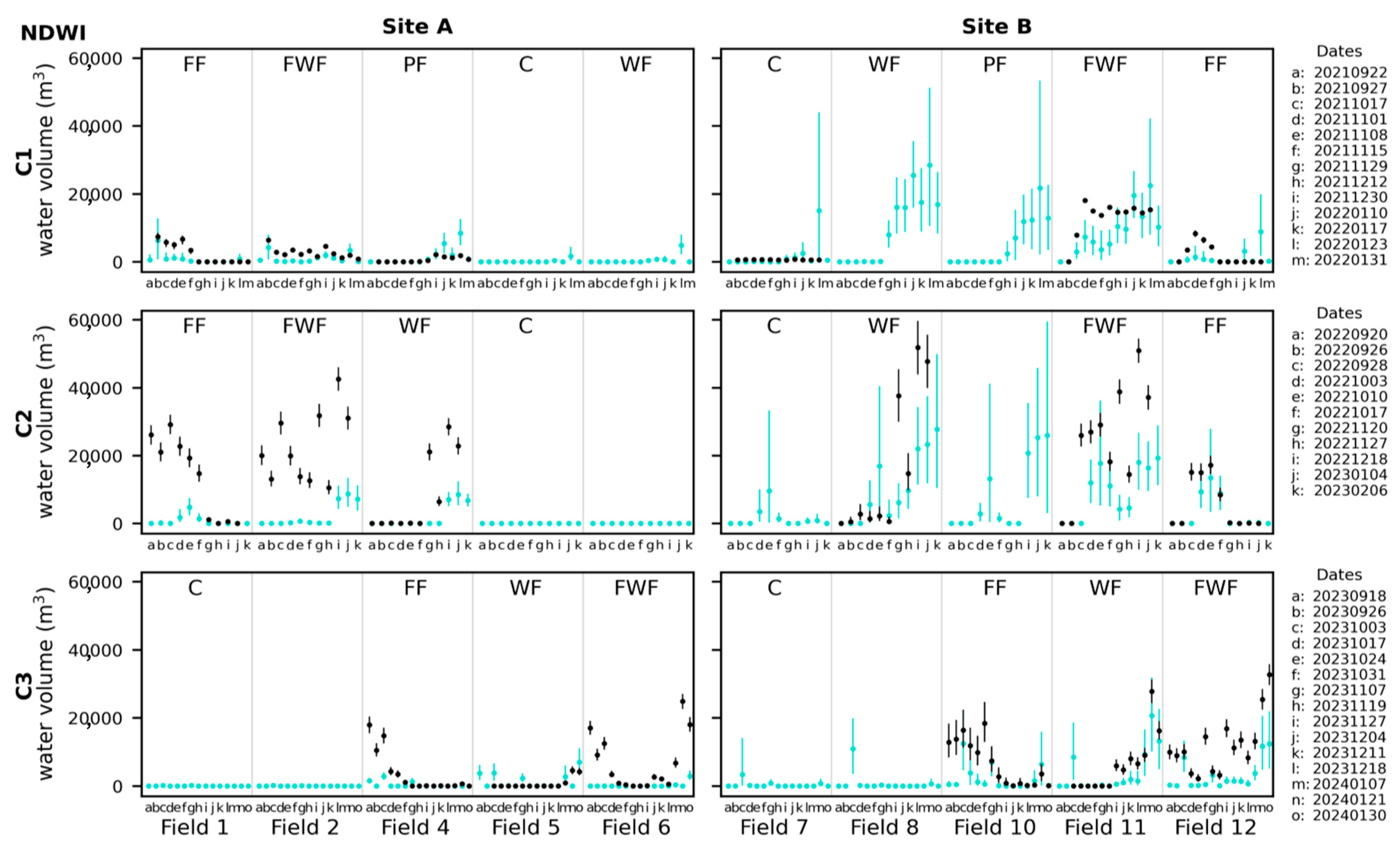
For Site A during C1, the in situ sensors were located within Field 1 with the FF treatment, Field 2 with the FWF treatment, and Field 4 with the PF treatment. Mean area inundation was the highest in Field 2 (30%) and the lowest in Field 4 (12%). For Site B during C1, the in situ sensors were located within Field 7 with the C treatment, Field 11 with the FWF treatment, and Field 12 with the FF treatment. Mean inundation was the highest in Field 11 (64%) and the lowest in Field 7 (12%). Neither site recorded information on 22 September 2021 and Site B did not record data on 31 January 2022 (Table S4, Figure 4).

3.3. Aquatic Habitat Detection Characteristics During C2 (Via PlanetScope Imagery)

The NDWI returned habitat detections on 11 days for 21 sampling events for Site A locations and nine days for 21 sampling events for Site B locations. The 20 September 2022 and 26 September 2022 discrepancies were attributed to the delayed onset of incentivized flooding in Site B during C2. The ICUC returned habitat detections on 11 days for 21 sampling events for Site A locations and nine days for 21 sampling events for Site B locations. Detections via the ICUC on 26 September 2022 appear to be related to residual runoff, rather than incentivized flooding. The lack of detections via the ICUC on 18 December 2022 was attributed to bright white/green imagery for flooded areas, likely a function of ice and snow. For C2, the NDWI produced more consistent detections across the seasons, but to a lesser degree compared to C1 (Tables S5 and S6).
In terms of mean percent area inundation for Site A, the NDWI indicated the highest values in Field 2 (19%). The lowest non-zero values were indicated for Field 5 (0.01%), whereas Field 6 had no indicated inundation (0.0%). For Site B, the NDWI indicated the highest values in Field 8 (60%) and the lowest values in Field 7 (19%). When Site A was evaluated using the ICUC, the highest values were indicated for Field 1 (46%), with the lowest values indicated for Field 3 (0.1%). For Site B, the ICUC indicated the highest values in Field 11 (46%) and the lowest values in Field 7 (1.0%) (Tables S5 and S6, Figure 3C,D).

3.4. Aquatic Habitat Estimates During C2 via the In Situ Sensors and the DEM

For Site A during C2, the in situ sensors were located within Field 1 with the FF treatment, Field 2 with the FWF treatment, and Field 4 with the WF treatment. Mean area inundation was the highest in Field 2 (82%) and the lowest in Field 4 (36%). For Site B during C2, the in situ sensors were located within Field 8 (WF), Field 11 (FWF), and Field 12 (FF). Mean inundation was the highest in Field 11 (73%) and the lowest in Field 12 (32%). Neither site recorded information on 6 February 2023 (Table S7).

3.5. Aquatic Habitat Detection Characteristics During C3 (Via PlanetScope Imagery)

The NDWI returned habitat detections on 11 days for 19 sampling events for Site A locations and 15 days for 19 sampling events for Site B locations. The 16 September 2023 date produced no habitat detections via the NDWI for either site, although field records indicated flooding began on that date. Imagery may have been acquired before flooding started. The lack of NDWI returns for Site A on 31 October 2023 was a result of no values meeting our threshold value. By contrast, the NDWI returns from 27 November 2023, 11 December 2023, and 21 January 2023 reflected mixed data quality among the fields, potentially a function of dry conditions or dense vegetation. The ICUC returned habitat detections on 12 days for 19 sampling events for Site A and returned 15 days for 19 sampling events for Site B. Differences were identified on 31 October 2023, 7 November 2023, and 19 November 2023, which were potentially a function of dry conditions and soil masking effects (Tables S8 and S9).
In terms of mean percent inundation for Site A, the NDWI indicated the highest values in Field 5 (15%) and the lowest values in Field 3 (0.02%). For Site B, the NDWI indicated the highest values in Field 12 (13%) and the lowest values in Field 8 (4.7%). When Site A was evaluated using the ICUC, the highest values were indicated for Field 5 (58%) with the lowest values found in Field 2 (1.7%). For Site B, the ICUC indicated the highest values for Field 12 (53%) with the lowest value indicated for Field 7 (0.2%) (Tables S8 and S9, Figure 3E,F).

3.6. Aquatic Habitat Detection Characteristics During C3 (Via the In Situ Sensors and the DEM)

For Site A during C3, the in situ sensors were located within Field 4 (FF), Field 5 (WF), and Field 6 (FWF). Mean inundation was the highest in Field 6 (42%) and the lowest in Field 5 (6.6%). For Site B during C3, the in situ sensors were located within Field 10 (FF), Field 11 (WF), and Field 12 (FWF). Mean inundations were the highest in Field 12 (70%) and the lowest in Field 11 (32%). Neither of the sites recorded information on 16 September 2023. Also, Field 5 and Field 11 did not have records on 18 September 2023 or 26 September 2023 (Table S10).

3.7. Relationships Among Methods and Accuracy

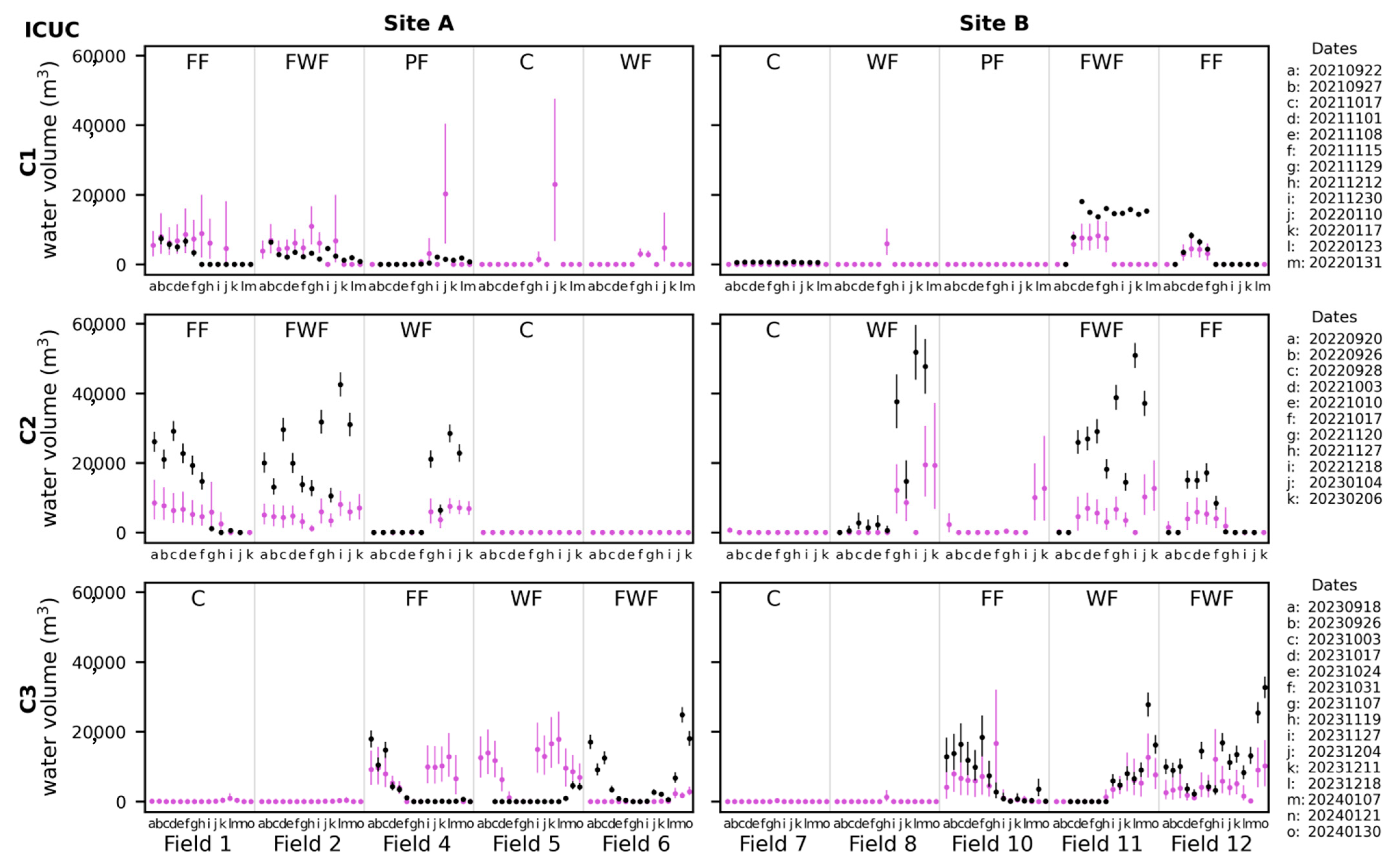
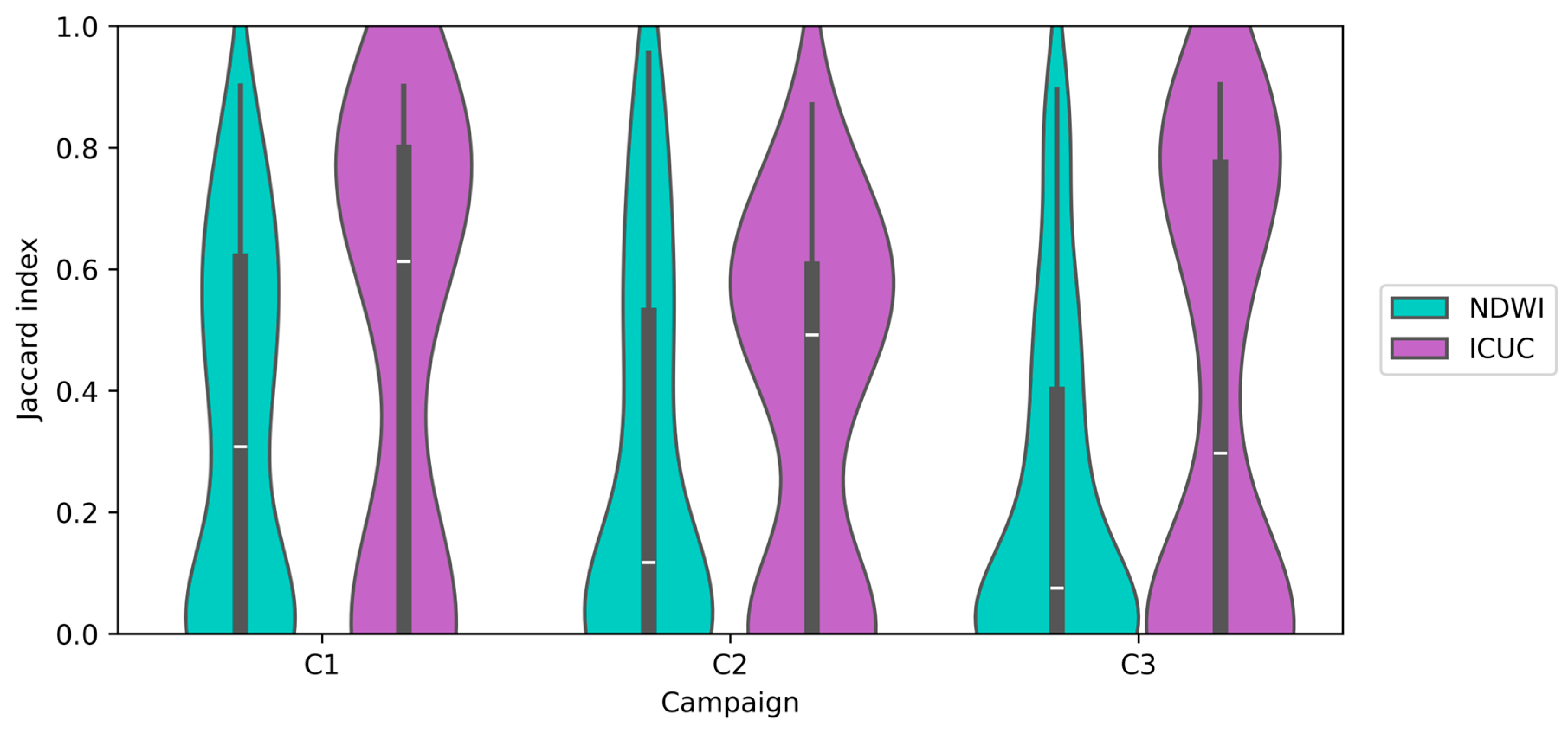
Across the campaigns for Site A and Site B, the NDWI (Figure 4) and ICUC (Figure 5) exhibited a range of overestimates and underestimates of water volume compared to the in situ sensors and using a DEM. For each campaign, the ICUC had distributions containing higher Jaccard index values across treatments and imagery dates than the NDWI (Figure 6). The mean Jaccard index value for the ICUC was about twice that of the NDWI. The distribution of the ICUC Jaccard index values was bimodal, showing that fields with good similarity between the ICUC and the in situ sensor inundation extents (Jaccard index values > 0.7) and poor similarity were relatively balanced (Figure 6). For the NDWI, the distributions of Jaccard index values generally indicate that estimated inundation extents had a poor similarity compared to those calculated from the in situ sensors (Figure 6).

4. Discussion

4.1. Overall Trends for the FITS

In general, both the NDWI and the ICUC provided value to the FITS model. However, we found that the ICUC offered a more applicable means of screening for aquatic habitat for management planning purposes for several reasons. Detection of aquatic habitat sensu lato may better align with management goals, as open water may not be preferred for some migratory species. The ICUC offered more flexibility when accounting for observed water quality changes (e.g., turbidity) and weather conditions (e.g., haze). Such flexibility was also applicable to seasonal variation and corresponding imagery quality concerns (i.e., ice/snow). The ICUC was more accurate in most management treatments that were monitored with the in situ sensors and the use of DEMs. Although fewer ICUC detections were available overall, they often encompassed areas found by the NDWI. Both the ICUC and the NDWI produced results that were sensitive to ground conditions (i.e., mixed quality data attributed to dry conditions, dense vegetation, or soil masking). These weaknesses were observed more often at Site B (see Figure 1, e.g., Fields 7, 8, 9). Given the test-case nature of this FITS model iteration, and inherent limitations of image quality through time, we feel these challenges are outweighed by the utility of a rapid assessment for management.

4.2. Agroecological and Avian Conservation Applications

The spatial and temporal distribution of flooded habitat in agricultural fields can lead to shifts in soil biological, physical, and chemical properties; therefore, the detection of these areas have widespread agroecological application possibilities. For example, inundation creates reducing conditions that promote anaerobic conditions in the soil. Under these anaerobic conditions, microorganisms use electron acceptors other than oxygen to perform their function [26]. This has major implications for N-cycling dynamics, as nitrogen (N) transformations are dependent on soil oxygens status. Aerobic conditions promote the oxidation of ammonium (NH4+) to nitrate (NO3) via nitrification. Under anoxic conditions, the reduction of NO3 to dinitrogen (N2) through denitrification is likely to increase [27]. This has the potential to reduce NO3 concentrations in runoff during winter storms [28]. Current studies are examining how flooding agricultural fields for migratory shorebirds influences the factors that drive nutrient cycling in soils [28]. Our tool provides an option for integrating smaller scale measurements with inundation patterns at the field and farm scale to make inferences on how flooding influences agroecosystem nutrient cycles.
With respect to avian conservation, Site A and Site B hosted substantial abundances of birds during the study period. Surveys during C1 and C2 indicated that, during the fall period, the actively flooded treatments (FF and FWF) attracted an average of approximately 125 shorebirds per field [29]. In winter, the actively flooded treatments (FWF and WF) attracted approximately 25–50 shorebirds per field. The Passive Flooding treatment only attracted significant numbers of shorebirds in winter, likely due to a lack of sufficient rainfall during the fall period. Analyses indicated that the variation in shorebird abundances were partially predicted by densities of macroinvertebrates, although a high proportion of variation remained unexplained. The FITS model may allow for a more accurate prediction of shorebird abundances, as variation could be partly explained by habitat extents as indicated by the ICUC and NDWI indices.
Our area estimates also contribute to a better understanding of the costs and additional benefits of flooded habitat practices in the MAP. First, volume estimates can help better constrain the costs associated with the active management of a shallow water habitat through pumping surface water. A major consideration for the adoption of any conservation practice by producers is economics. Coupling the estimated volumes associated with different acreage amounts of habitat and pumping costs (per unit volume) can provide better estimates for producers when weighing whether shallow water management practices can fit into their operation. Second, better estimates of how much water individual fields can hold based on slopes and elevation of riser boards could be used to estimate storm water retention. While passive flooding options lack predictability in providing shorebird habitat, particularly in the fall migration season, they do potentially provide additional ecosystem services through the retention of heavy rainfall events, at a lower cost than active pumping practices. Their benefits are not reliable, however, because they are dependent on precipitation, unlike other techniques. Incorporating output from the FITS into watershed models could help quantify the potential reduction in downstream flood risk provided by implementing widespread passive management of a shallow water habitat.

4.3. Future Directions

The FITS model and its application to seasonal flooding assessments in our study was conservatively limited to ±1 day from field sampling schedules. This restriction was initially aimed to be prudent toward assessing water quality considerations yet could be amended to prioritize inundation dynamics. Additionally, the FITS model was conservatively built using imagery from a single satellite platform and sensor array—Super Dove (PSB.SD). Temporal gaps in imagery (true for all sources of imagery, not just PlanetScope) can potentially influence assessments of habitat availability. Including data from cohort platforms and sensors (PS2 and PS2.SD) and supplementing with other sources of remotely sensed imagery (e.g., Landsat, Sentinel) may mitigate some temporal gaps in the results, thereby improving temporal coverage and reducing uncertainty. Adjusting the quality settings of candidate imagery could provide a similar effect. This would be especially important to capture rapid flood events. Short-term or transient events may not have been captured by our PlanetScope imagery, but all remotely sensed imagery is subject to a similar limitation, since it is not collected continuously. If one wanted to create as continuous a time-series as possible, then combining data sources would be necessary. That requires more detailed knowledge of remote sensing (e.g., how to deal with differences in data resolution, atmospheric calibration, etc.), which is something we were trying to avoid so as to allow the FITS model to be used by someone without training in remote sensing. The FITS model was integrated with in situ data collection; these in situ collectors are more likely to capture acute events. Alternatively, something like cameras could also be used to capture the short-term dynamics that may be critical for ecological and management decision-making. Without continuous data, system variability is underestimated.
These considerations are also applicable to issues related to spatial scaling of the FITS model beyond the test-case locations to include the entire YMD, or to areas outside the Yazoo–Mississippi Delta. There are numerous other locations where agricultural flooding practices are applied to benefit wildlife and agricultural producers (e.g., Spain [30] and California [31]). Remotely sensed imagery has been used in both of these areas to evaluate the efficacy of these management practices on bird populations [32,33]. It would be instructive to apply the FITS model to these regions.
The FITS model can provide near real-time estimates of the effectiveness of incentivized flooding activity, from which management may ascertain quantifiable evidence of contractual agreement adherence. Such information is useful to stakeholders to identify areas where incentivization may be more effective than others. Thus, the FITS model of volume and inundation frequency could be used to modulate payments based on some benchmark (e.g., inundation duration or depth of water). As such, the FITS model may be able to highlight portions of the landscape where incentivized flooding should be prioritized, whether passive or active. Moreover, the FITS results could be used in conjunction with benchmarks to identify windows where the flooding type could switch from one form to the other based on agroecological needs. Specifically, the FITS outputs can be operationalized to provide actionable monitoring tools for policymakers or other stakeholders through the generation of near real-time habitat mapping and live-feeds for field conditions (via returns from level loggers or application of cameras), and could be conjoined into additional conservation initiatives for other aspects of water quality (e.g., algal activity).
Future application of the FITS model in conjunction with the USDA NRCS Soil Survey Geographic Database represents a logical next step in regionalization efforts. Such integrations could streamline the optimization of incentivized field flooding practices among specific soil series. Indeed, mapping the distribution of aquatic habitat availability from recent historical periods to the near present using other broader-scale imagery could bolster the FITS model. Another important aspect of this study was the comparison of imagery-based tools versus on the ground level logger measurements coupled with high resolution DEMs for estimating the inundation area and volumes. Both approaches have positive and negative aspects. Imagery-based approaches allow for a widespread evaluation and assessment of patterns in the implementation of a shallow water habitat provision by the farming community. However, this comes at a cost of access to expertise and imagery that may not always be available at the conservation practitioner level. By contrast, expertise and relatively inexpensive level logger technology are more readily available at local conservation offices and may provide a relatively straightforward monitoring approach for individual fields or farms. It also provides more temporal resolution that can be used to map the intensity of different shorebird habitat characteristics through time based on changing depths. Incorporating both methods into monitoring and research programs related to migratory shorebird and waterfowl habitat may be beneficial for these reasons. Finally, because there was much variation that remained unexplained, expanding habitat quality indicators to include biota other than shorebird populations or biogeochemical parameters may strengthen the ecological relevance and validation of the inundation metrics.

5. Conclusions

Quantifying the agricultural flooding practices for migratory birds represents a challenging task for managers. Accurate inundation estimates from an integrated remote-sensing approach has shown the promise to streamline the process of incentivization. Our three-year test case in the YMD highlights the results of adopting the FITS model to estimate inundation patterns. We conducted a parallel comparison of two widely used methods to detect water (NDWI and ICUC). Our results indicate that actionable estimates of inundation for management are possible and may be commensurate with results from use of in situ sensors and a DEM. However, the more applicable method varied among the years and treatment types. Moreover, while the use of in situ sensors and DEMs provided the most accurate results, they may not be cost-effective for regional assessments. The FITS model was able to capture variation in local hydrologic conditions due to interannual differences in environmental conditions, which bodes well for its ability to capture other kinds of changes due to, e.g., shifting landowner activities. While neither the NDWI nor the ICUC produced flawless detections, the overall applicability of the research directly addressed stakeholder requests. Indeed, further integration of our FITS model with additional datasets and imagery sources has the potential to provide both historical and contemporaneous inventories of agricultural field flooding practices across the YMD. Such future work represents an on-going stakeholder need.

Supplementary Materials

The following supporting information can be downloaded at: https://www.mdpi.com/article/10.3390/rs18030477/s1, Table S1: Distribution of field treatment types among Site A (1–6) and Site B (7–12) in C1, C2, and C3. Passive Flooding as a treatment type only occurred in C1. Fields instrumented with a water level logger have their treatments highlighted; Table S2: Distribution of NDWI detections (as % inundated) for Site A (1–6) and Site B (7–12) during C1, “-” indicates no applicable imagery available and blank cells indicate no useful detections returned for those fields; Table S3: Distribution of ICUC detections (as % inundated) for Site A (1–6) and Site B (7–12) during C1, “-” indicates no applicable imagery available and blank cells indicate no useful detections returned for those fields; Table S4: Distribution of aquatic habitats (as % inundated) for Site A (Fields 1, 2, and 4) and Site B (Fields 7, 11, and 12) via in situ sensors and DEM processing during imagery dates of C1, blank cells indicate no data returned for those fields; Table S5: Distribution of NDWI detections (as % inundated) for Site A (1–6) and Site B (7–12) during C2, “-” indicates no applicable imagery available and blank cells indicate no useful detections returned for those fields; Table S6: Distribution of ICUC detections (as % inundated) for Site A (1–6) and Site B (7–12) during C2, “-” indicates no applicable imagery available and blank cells indicate no useful detections returned for those fields; Table S7: Distribution of aquatic habitats (as % inundated) for Site A (Fields 1, 2, and 4) and Site B (Fields 8, 11, and 12) via in situ sensors and DEM processing during imagery dates of C2, blank cells indicate no data returned for those fields; Table S8: Distribution of NDWI detections (as % inundated) for Site A (1–6) and Site B (7–12) during C3, “-” indicates no applicable imagery available and blank cells indicate no useful detections returned for those fields; Table S9: Distribution of ICUC detections (as % inundated) for Site A (1–6) and Site B (7–12) during C3, “-” indicates no applicable imagery available and blank cells indicate no useful detections returned for those fields; Table S10: Distribution of aquatic habitats (as % inundated) for Site A (Fields 4, 5, and 6) and Site B (Fields 10, 11, and 12) via in situ sensors and DEM processing during imagery dates of C3, blank cells indicate no data returned for those fields.

Author Contributions

Conceptualization, L.J.H., J.M.T., J.D.H., M.T.M., D.E.B., E.J.L., N.E.M. and M.A.L.; methodology, L.J.H., J.M.T., J.D.H., M.T.M., D.E.B., E.J.L., M.A.L., V.M.B. and M.E.U.; software, L.J.H., E.J.L., V.M.B. and M.E.U.; validation, L.J.H., J.M.T., E.J.L., V.M.B. and M.E.U.; formal analysis, L.J.H., J.M.T., J.D.H., M.T.M., D.E.B., E.J.L., V.M.B. and M.E.U.; investigation, L.J.H., J.M.T., J.D.H., M.T.M., D.E.B., E.J.L., V.M.B. and M.E.U.; resources, J.M.T., J.D.H., M.T.M. and M.A.L.; data curation, L.J.H., J.M.T., J.D.H., M.T.M., D.E.B., E.J.L., V.M.B. and M.E.U.; writing—original draft preparation, L.J.H., J.M.T., J.D.H., M.T.M., D.E.B., E.J.L., N.E.M., L.M.W., R.E.L.J., F.E.J.II and M.A.L.; writing—review and editing, L.J.H., J.M.T., J.D.H., M.T.M., D.E.B., E.J.L., N.E.M., L.M.W., R.E.L.J., A.M.N., F.E.J.II and M.A.L.; visualization, L.J.H., J.M.T., D.E.B. and E.J.L.; supervision, L.J.H., J.M.T., J.D.H., M.T.M. and M.A.L.; project administration, J.M.T., J.D.H., M.T.M. and M.A.L.; funding acquisition, J.M.T., J.D.H., M.T.M. and M.A.L. All authors have read and agreed to the published version of the manuscript.

Funding

This research was funded in part by a subaward (Agreement No. 58-6060-2-0003) from the US Environmental Protection Agency’s Gulf of Mexico Division Farmer-to-Farmer Program (02DO1321).

Data Availability Statement

Raw data supporting the conclusions of this article will be made available by the authors upon request. Note that CSDA- and/or USDA-level restrictions may apply in some instances.

Acknowledgments

Comments from two anonymous reviewers greatly improved this manuscript. This research was a contribution to the Long-Term Agroecosystem Research (LTAR) Project, supported by the United States Department of Agriculture (USDA). This work utilized data made available through the NASA Commercial SmallSat Data Acquisition (CSDA) Program (https://www.earthdata.nasa.gov/esds/csda/csda-vendor-planet). Data products are © Planet Labs PBC 2021, © Planet Labs PBC 2022, © Planet Labs PBC 2023, and © Planet Labs PBC 2024. All rights reserved. Data derivatives include the copyrighted material of Planet Labs PBC. All rights reserved. Mention of trade names or commercial products in this publication is solely for the purpose of providing specific information and does not imply recommendation or endorsement by the USDA. The USDA is an equal opportunity provider, employer, and lender.

Conflicts of Interest

Author Lucas J. Heintzman had been a member of the USDA during the submission, and became employed by the company Applied Ecology, Inc. during the review phase. The remaining authors declare that the research was conducted in the absence of any commercial or financial relationships that could be construed as a potential conflict of interest. The funders had no role in the design of this study; in the collection, analyses, or interpretation of the data; in the writing of the manuscript; or in the decision to publish the results.

Abbreviations

The following abbreviations are used in this manuscript:
3DEPThree-dimensional Elevation Program
AOIArea of Interest
ArcGISAeronautical Reconnaissance Coverage Geographic Information System
ARSAgricultural Research Service
CControl
C1Campaign 1
C2Campaign 2
C3Campaign 3
CACalifornia
DEMDigital Elevation Model
ESRIEnvironmental Systems Research Institute
FITSField Inundation Tool/Survey
GPSGlobal Positioning System
lidarLight Detection and Ranging
mMeter
MAPMississippi Alluvial Plain
MSMississippi
NNitrogen
N2Dinitrogen
NH4+Ammonium
NO3-Nitrate
NDWINormalized Difference Water Index
NRCSNatural Resources Conservation Service
ICUCIso Cluster Unsupervised Classification
PFPassive Flooding
FFFall Flooding
WFWinter Flooding
FWFFall and Winter Flooding
PS2PlanetScope Two-Dimensional Imagery
PS2.SDPlanetScope Two-Dimensional Imagery and Super Dove Satellite Sensor
PSB.SDPlanetScope Imagery captured from Super Dove Satellite Sensor
RGBNIRRed–Green–Blue Near-Infrared
RTKReal-time Kinematic
TXTexas
USAUnited States of America
USDAUnited States Department of Agriculture
YMDYazoo–Mississippi Delta

References

  1. Myers, J.P.; McClain, P.D.; Morrison, R.I.; Antas, P.Z.; Canevari, P.; Harrington, B.A.; Lovejoy, T.E.; Pulido, V.; Sallaberry, M.; Senner, S.E. Western Hemisphere Shorebird Reserve Network. Wader Study Group Bull. 1987, 49, 122–124. [Google Scholar]
  2. Loesch, C.R.; Twedt, D.J.; Tripp, K.; Hunter, W.C.; Woodrey, M.S. Development of Management Objectives for Waterfowl and Shorebirds in the Mississippi Alluvial Valley. In Proceedings of the USDA Forest Service RMRS-P-16, Cape May, NJ, USA, 1–5 October 1995. [Google Scholar]
  3. Omernik, J.; Griffith, G. Ecoregions of the conterminous United States: Evolution of a hierarchical spatial framework. Environ. Manag. 2014, 54, 1249–1266. [Google Scholar] [CrossRef]
  4. Roberts, A.; Scarpignato, A.L.; Huysman, A.; Hostetler, J.A.; Cohen, E.B. Migratory connectivity of North American waterfowl across administrative flyways. Ecol. Appl. 2023, 33, e2788. [Google Scholar] [CrossRef]
  5. Klimas, C.; Murray, E.; Foti, T.; Pagan, J.; Williamson, M.; Langston, H. An ecosystem restoration model for the Mississippi Alluvial Valley based on geomorphology, soils, and hydrology. Wetlands 2009, 29, 430–450. [Google Scholar] [CrossRef]
  6. Twedt, D.J.; Nelms, C.O.; Rettig, V.E.; Aycock, S.R. Shorebird use of managed wetlands in the Mississippi Alluvial Valley. Am. Midl. Nat. 1998, 140, 140–152. [Google Scholar] [CrossRef]
  7. Yasarer, L.M.W.; Taylor, J.M.; Rigby, J.R.; Locke, M.A. Trends in land use, irrigation, and streamflow alteration in the Mississippi River Alluvial Plain. Front. Environ. Sci. 2020, 8, 66. [Google Scholar] [CrossRef]
  8. Locke, M.A.; Witthaus, L.M.; Lizotte, R.E.; Heintzman, L.J.; Moore, M.T.; O’Reilly, A.; Wells, R.R.; Langendoen, E.J.; Bingner, R.L.; Gohlson, D.M.; et al. The LTAR cropland common experiment in the Lower Mississippi River Basin. J. Environ. Qual. 2024, 53, 957–967. [Google Scholar] [CrossRef] [PubMed]
  9. Faulkner, S.; Barrow, W.; Keeland, B.; Walls, S.; Telesco, D. Effects of conservation practices on wetland ecosystem services in the Mississippi Alluvial Valley. Ecol. Appl. 2011, 21, S31–S48. [Google Scholar] [CrossRef]
  10. United States Geological Survey (USGS). National Water Summary on Wetland Resources; USGS Report Series 2425; US Government Printing Office: Washington, DC, USA, 1996; 431p. [Google Scholar] [CrossRef]
  11. Mitsch, W.J.; Gosselink, J.G. Wetlands, 5th ed.; John Wiley & Sons, Inc.: Hoboken, NJ, USA, 2015. [Google Scholar]
  12. Twedt, D.J.; Nelms, C.O. Waterfowl density on agricultural fields managed to retain water in winter. Wild. Soc. Bull. 1999, 27, 924–930. [Google Scholar]
  13. Lehnen, S.E.; Krementz, D.G. Use of aquaculture ponds and other habitats by autumn migrating shorebirds along the Lower Mississippi River. Environ. Manag. 2013, 52, 417–426. [Google Scholar] [CrossRef] [PubMed]
  14. Golet, G.H.; Low, C.; Avery, S.; Andrews, K.; McColl, C.J.; Laney, R.; Reynolds, M.D. Using ricelands to provide temporary shorebird habitat during migration. Ecol. Appl. 2018, 28, 409–426. [Google Scholar] [CrossRef] [PubMed]
  15. Malone, K.M.; Webb, E.B.; Mengel, D.C.; Kearns, L.J.; McKellar, A.E.; Matteson, S.W.; Williams, B.R. Wetland management practices and secretive marsh bird habitat in the Mississippi Flyway: A review. J. Wild. Manag. 2023, 87, e22451. [Google Scholar] [CrossRef]
  16. Manley, S.W.; Kaminski, R.M.; Rodrigue, P.B.; Dewey, J.C.; Schoenholtz, S.H.; Gerard, P.D.; Reinecke, K.J. Soil and nutrient retention in winter-flooded ricefields with implications for watershed management. J. Soil Water Conserv. 2009, 64, 173–182. [Google Scholar] [CrossRef]
  17. Firth, A.G.; Baker, B.H.; Brooks, J.P.; Smith, R.; Iglay, R.B.; Davis, J.B. Low external input sustainable agriculture: Winter flooding in rice fields increases bird use, fecal matter and soil health, reducing fertilizer requirements. Agric. Ecosyst. Environ. 2020, 300, 106962. [Google Scholar] [CrossRef]
  18. Davis, J.B.; Webb, E.; Kaminski, R.M.; Barbour, P.J.; Vilella, F.J. Comprehensive framework for ecological assessment of migratory bird habitat initiative following the Deepwater Horizon oil spill. Southeast. Nat. 2014, 13, G66–G81. [Google Scholar] [CrossRef]
  19. Lausch, A.; Bannehr, L.; Berger, S.A.; Borg, E.; Bumberger, J.; Hacker, J.M.; Heege, T.; Hupfer, M.; Jung, A.; Kuhwald, K.; et al. Monitoring water diversity and water quality with remote sensing and traits. Remote Sens. 2024, 16, 2425. [Google Scholar] [CrossRef]
  20. McFeeters, S.K. The use of the Normalized Difference Water Index (NDWI) in the delineation of open water features. Int. J. Remote Sens. 1996, 17, 1425–1432. [Google Scholar] [CrossRef]
  21. McFeeters, S.K. Using the Normalized Difference Water Index (NDWI) within a Geographic Information System to detect swimming pools for mosquito abatement: A practical approach. Remote Sens. 2013, 5, 3544–3561. [Google Scholar] [CrossRef]
  22. Collins, S.D.; Heintzman, L.J.; Starr, S.M.; Wright, C.K.; Henebry, G.M.; McIntyre, N.E. Hydrological dynamics of temporary wetlands in the southern Great Plains as a function of surrounding land use. J. Arid Environ. 2014, 109, 6–14. [Google Scholar] [CrossRef]
  23. Heintzman, L.J.; Starr, S.M.; Mulligan, K.R.; Barbato, L.S.; McIntyre, N.E. Using satellite imagery to examine the relationship between surface-water dynamics of the salt lakes of western Texas and Ogallala Aquifer depletion. Wetlands 2017, 37, 1055–1065. [Google Scholar] [CrossRef]
  24. Heintzman, L.J.; Auerbach, E.S.; Kilborn, D.H.; Starr, S.M.; Mulligan, K.R.; Barbato, L.S.; McIntyre, N.E. Identifying areas of wetland and wind turbine overlap in the south-central Great Plains of North America. Landsc. Ecol. 2020, 35, 1995–2011. [Google Scholar] [CrossRef]
  25. Isola, C.R.; Colwell, M.A.; Taft, O.W.; Safran, R.J. Interspecific differences in habitat use of shorebirds and waterfowl foraging in managed wetlands of California’s San Joaquin Valley. Waterbirds 2000, 23, 196–203. [Google Scholar]
  26. Tercero, M.C.; Álvarez-Rogel, J.; Conesa, H.M.; Ferrer, M.A.; Calderón, A.A.; López-Orenes, A.; González-Alcaraz, M.N. Response of biochemical processes of the water-soil-plant system to experimental flooding-drying conditions in a eutrophic wetland: The role of Phragmites australis. Plant Soil 2015, 396, 109–125. [Google Scholar] [CrossRef]
  27. Yu, L.; Liu, Y.; Wang, G. Identification of novel denitrifying bacteria Stenotrophomonas sp. ZZ15 and Oceanimonas sp. YC13 and application for removal of nitrate from industrial wastewater. Biodegradation 2009, 20, 391–400. [Google Scholar] [CrossRef] [PubMed]
  28. Chatterjee, A.; Taylor, J.M.; Read, Q.D.; Moore, M.T.; Locke, M.A.; Hoeksema, J.D. Water quality and soil nutrient availability trade-offs associated with timing and duration of managed flooding for migratory bird habitat. Soil Sci. Soc. Am. J. 2025, 89, e70077. [Google Scholar] [CrossRef]
  29. Counce, E.M. How Does the Creation of Temporary Wetland Habitation on Agricultural Fields in the Mississippi Alluvial Valley Affect the Abundance of Migratory Shorebirds? Master’s Thesis, The University of Mississippi, University, MS, USA, December 2023. [Google Scholar]
  30. Ibáñez, C.; Curcó, A.; Riera, X.; Ripoll, I.; Sánchez, C. Influence on birds of rice field management practices during the growing season: A review and an experiment. Waterbirds 2010, 33, 167–180. [Google Scholar] [CrossRef]
  31. Shuford, W.D.; Reiter, M.E.; Strum, K.M.; Gilbert, M.M.; Hickey, C.M.; Golet, G.H. The benefits of crops and field management practices to wintering waterbirds in the Sacramento-San Joaquin River Delta of California. Renew. Agric. Food Syst. 2016, 31, 495–506. [Google Scholar] [CrossRef]
  32. Toral, G.M.; Aragonés, D.; Bustamante, J.; Figuerola, J. Using Landsat images to map habitat availability for waterbirds in rice fields. Ibis 2011, 153, 684–694. [Google Scholar] [CrossRef]
  33. Reiter, M.E.; Elliott, N.K.; Jongsomjit, D.; Golet, G.H.; Reynolds, M.D. Impact of extreme drought and incentive programs on flooded agriculture and wetlands in California’s Central Valley. PeerJ 2018, 6, e5147. [Google Scholar] [CrossRef]
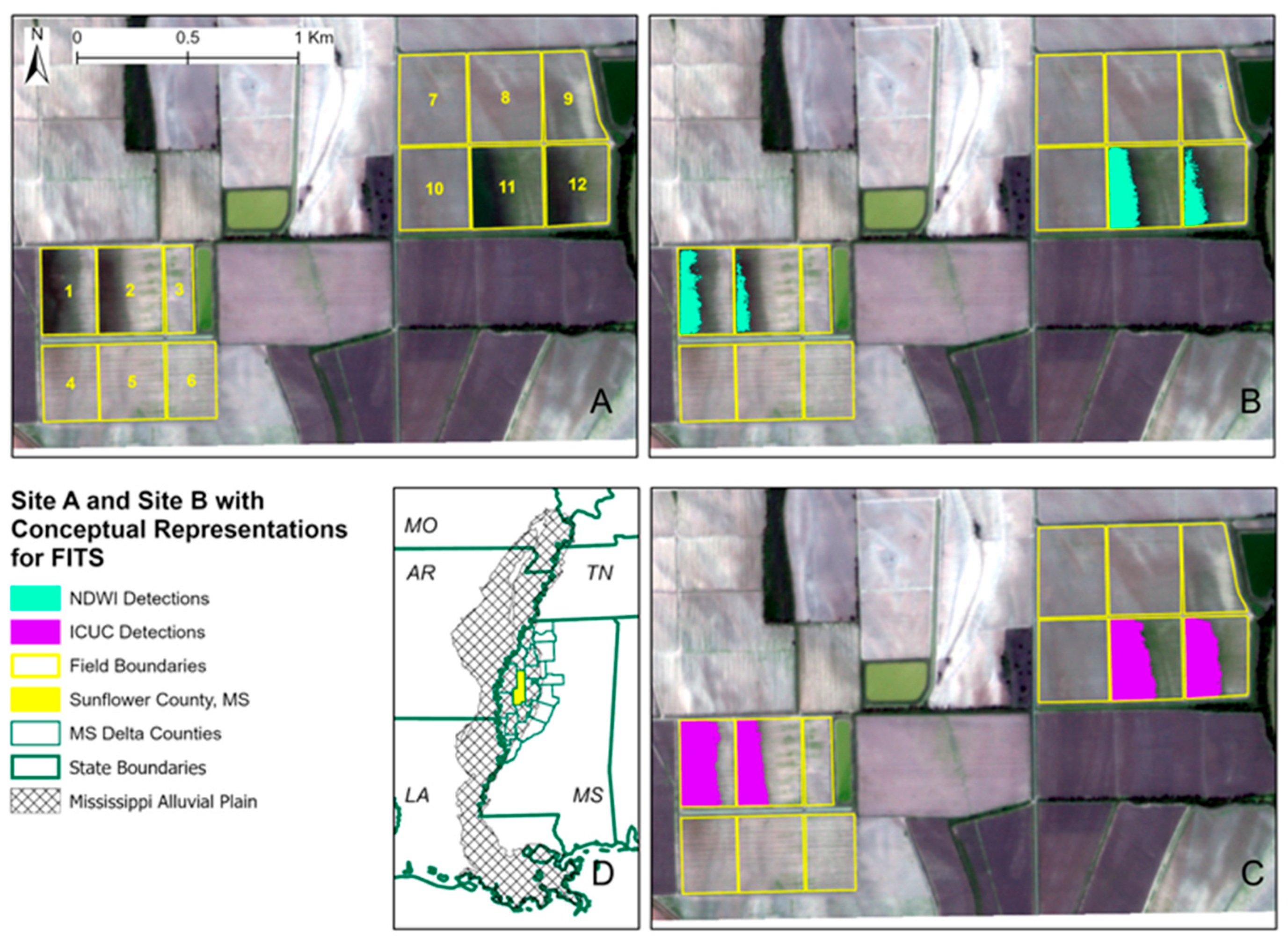
Figure 1. (A) View of individual fields and nearby agroecological conditions at Site A (1–6) and Site B (7–12); (B) Corresponding detections of aquatic habitat via the NDWI; (C) Detections of aquatic habitat via the ICUC; (D) Regional context.
Remotesensing 18 00477 g001
Figure 2. Diagrammatic illustration of the FITS workflow, with steps performed and the tools used for each (ArcMap 10.3.1 or ArcGIS Pro 3.5 unless otherwise indicated with R).
Remotesensing 18 00477 g002
Figure 3. (A,C,E) Distribution of water detected via the NDWI across Site A and Site B through time; (B,D,F) Distribution of water detected via the ICUC across Site A and Site B through time. Color shade ramps indicate patterns in maximum (darkest) to minimum (lightest) number of days inundated.
Remotesensing 18 00477 g003
Figure 4. Comparison of estimated water volume (m3) during each campaign for Site A and Site B using in situ sensors and DEMs (black color) versus the NDWI (teal color).
Remotesensing 18 00477 g004
Figure 5. Comparison of estimated water volume (m3) during each campaign for Site A and Site B using in situ sensors and DEMs (black color) versus the ICUC (purple color).
Remotesensing 18 00477 g005
Figure 6. Comparison of inundation area accuracy estimated by the NDWI (teal color) and the ICUC (purple color) relative to that obtained from the in situ sensor data across treatments and imagery dates for each campaign. The similarity between imagery-derived and in situ sensor-derived inundation is expressed by the Jaccard index, with 1.0 indicating an exact match. The white linear mark represents the mean value for similarity.
Remotesensing 18 00477 g006
Table 1. Distribution of sampling dates and corresponding PlanetScope imagery dates for C1, C2, and C3. Bold font indicates same day occurrences; “-“ indicates no applicable imagery available.
Sampling Dates: C1Imagery Dates: C1Sampling Dates: C2Imagery Dates: C2Sampling Dates: C3Imagery Dates: C3
21 September 202122 September 202119 September 202220 September 202216 September 202316 September 2023
27 September 202127 September 202126 September 202226 September 202218 September 202318 September 2023
29 September 2021-28 September 202228 September 202225 September 202326 September 2023
4 October 2021-3 October 20223 October 20222 October 20233 October 2023
12 October 2021-11 October 202210 October 202210 October 2023-
18 October 202117 October 202117 October 202217 October 202216 October 202317 October 2023
25 October 2021-24 October 2022-23 October 202324 October 2023
1 November 20211 November 202131 October 2022-30 October 202331 October 2023
8 November 20218 November 20217 November 2022-6 November 20237 November 2023
15 November 202115 November 202114 November 2022-13 November 2023-
22 November 2021-19 November 2022-20 November 202319 November 2023
29 November 202129 November 202121 November 202220 November 202227 November 202327 November 2023
6 December 2021-28 November 202227 November 20224 December 20234 December 2023
13 December 202112 December 20215 December 2022-11 December 202311 December 2023
20 December 2021-12 December 2022-18 December 202318 December 2023
29 December 202130 December 202119 December 202218 December 20228 January 20247 January 2024
3 January 2022-3 January 20234 January 202315 January 2024-
10 January 202210 January 20229 January 2023-22 January 202421 January 2024
18 January 202217 January 202217 January 2023-29 January 202430 January 2024
24 January 202223 January 202223 January 2023-
31 January 202231 January 202230 January 2023-
6 February 20236 February 2023
Disclaimer/Publisher’s Note: The statements, opinions and data contained in all publications are solely those of the individual author(s) and contributor(s) and not of MDPI and/or the editor(s). MDPI and/or the editor(s) disclaim responsibility for any injury to people or property resulting from any ideas, methods, instructions or products referred to in the content.