Spatiotemporal Dynamics of Tree Species-Level Aboveground Carbon Storage at the Canal Scale Under Green Engineering with a Random Forest Model
 , ,
, ,  and
and
Highlights
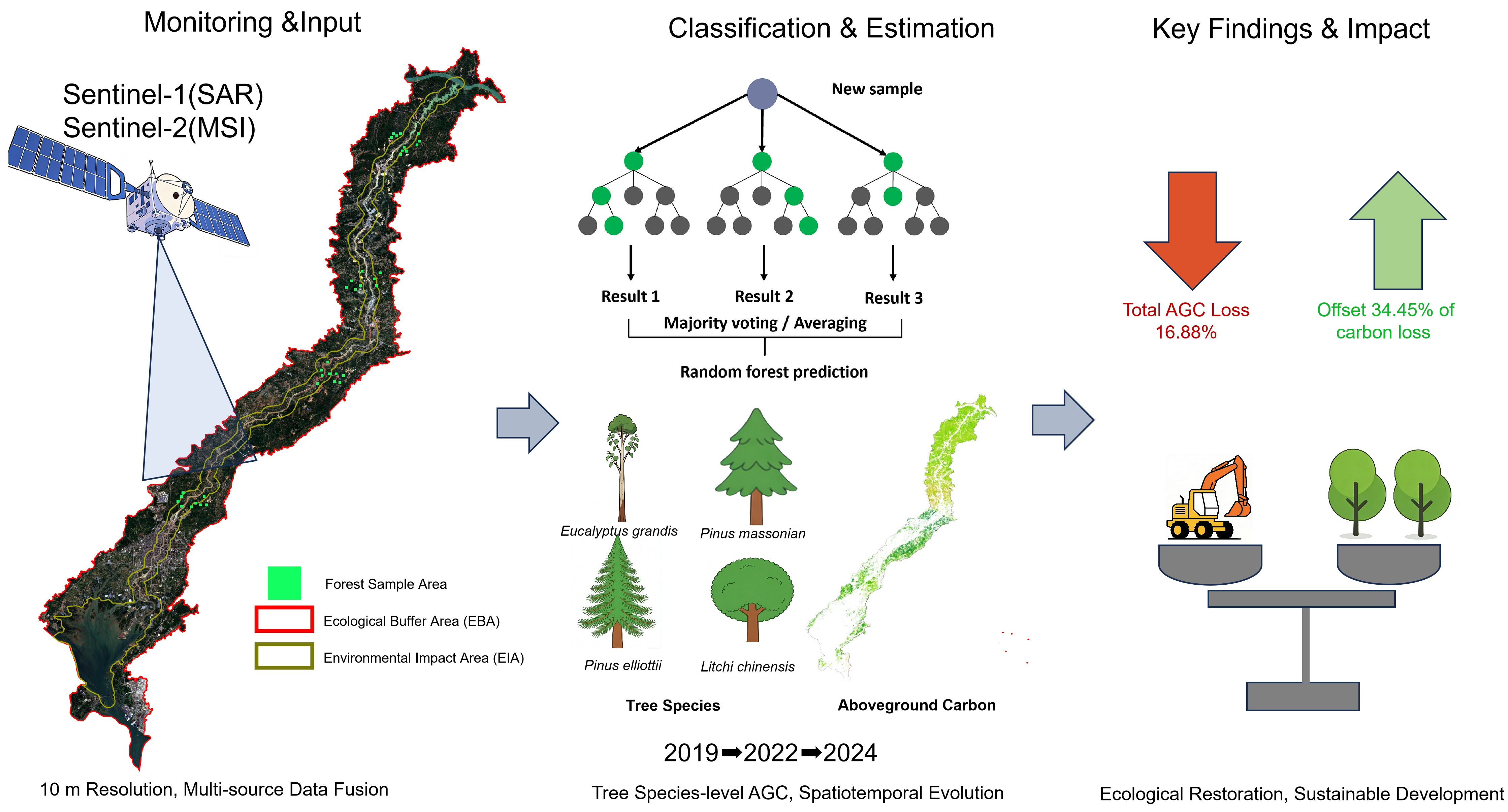
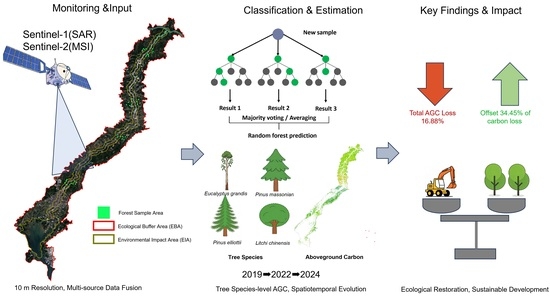
- A 10 m species-level aboveground carbon (AGC) mapping framework was developed coupling Sentinel-1/2 and the random forest (RF) algorithm, enabling fine-scale carbon monitoring during canal construction.
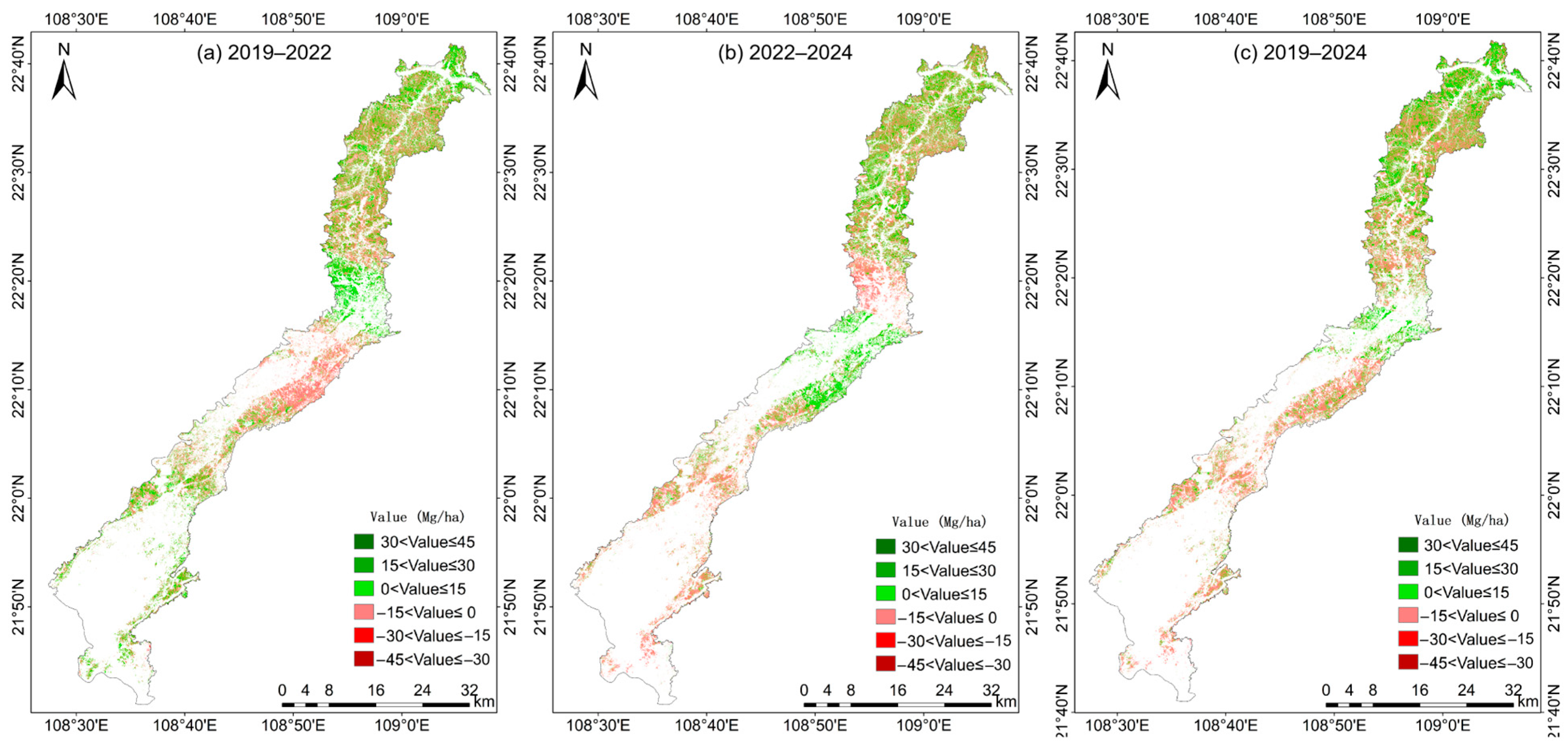
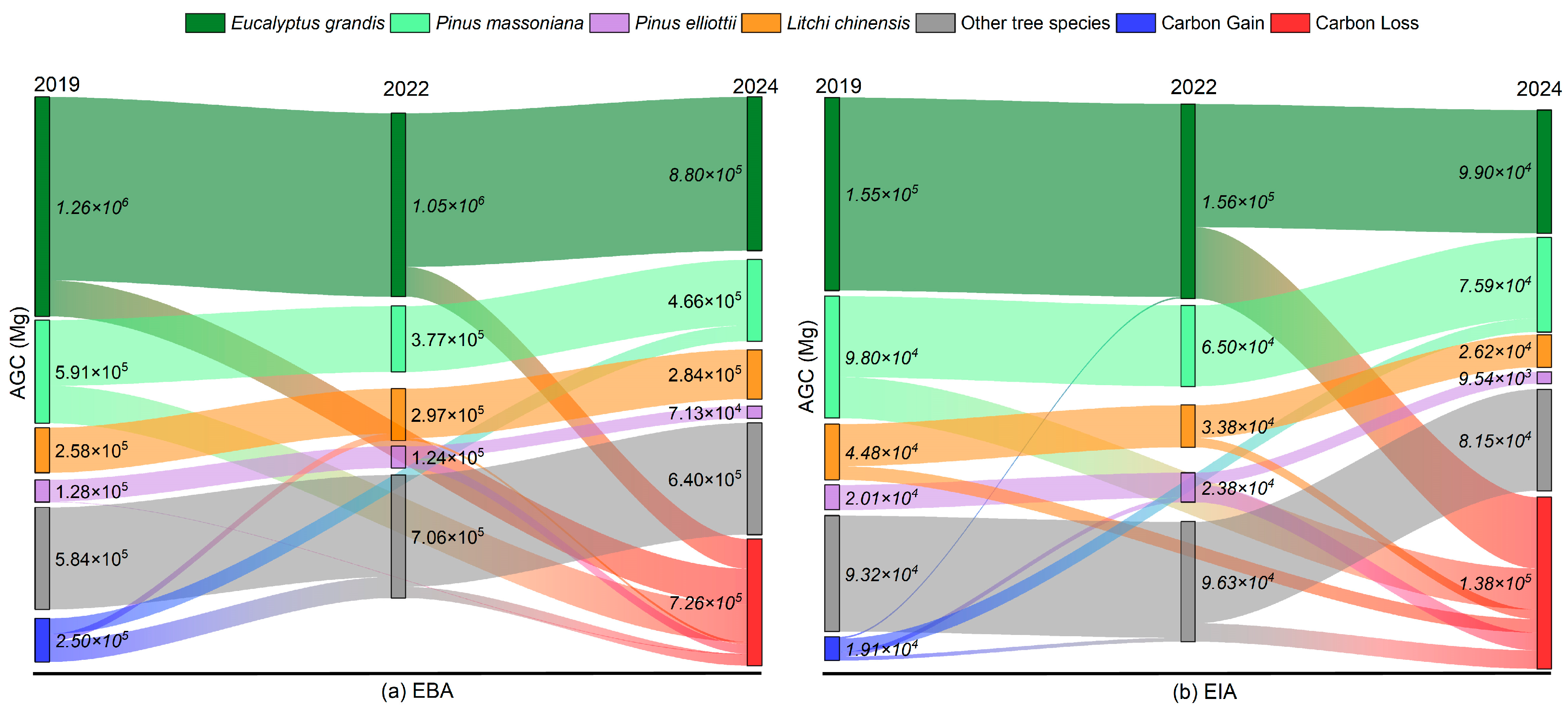
- Total AGC decreased by 16.88%, dominated by losses from Eucalyptus grandis, yet the rebound of Pinus massoniana, carbon gain of Litchi chinensis and other native species effectively offset 34.45% of the carbon loss in the buffer area.
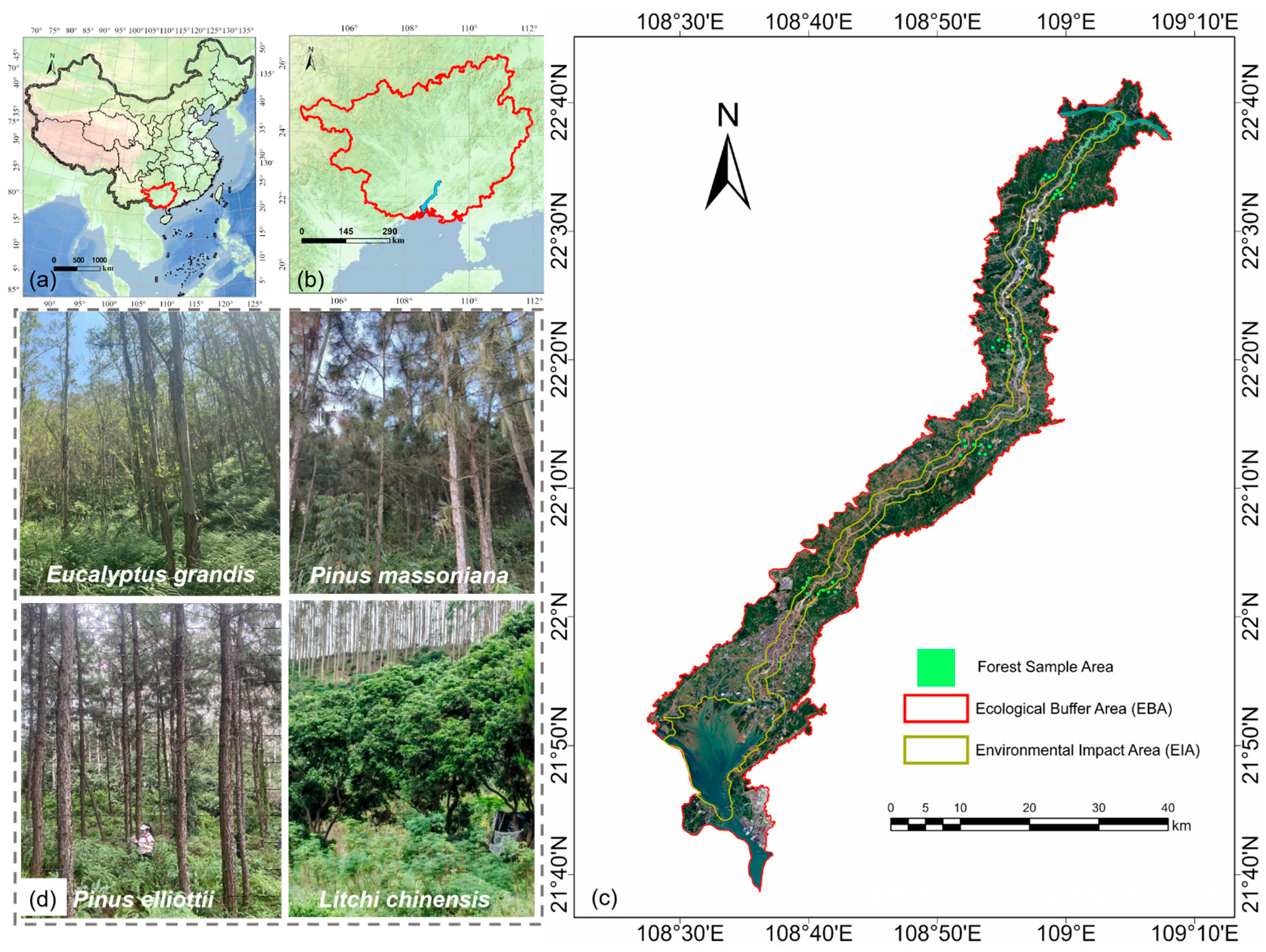
- Spatial AGC patterns reveal the Environmental Impact Area (EIA) as the disturbance core, while the Ecological Buffer Area (EBA) functioned as a carbon stabilizer, guiding targeted restoration planning.
- This study provides quantitative evidence for green engineering efficacy and supports SDG 15 by enabling precise monitoring of low-carbon infrastructure.
Abstract
1. Introduction
2. Materials and Methods
2.1. Study Area
2.2. Datasets
2.2.1. Satellite Imagery Acquisition and Processing
2.2.2. Field Data Collection
2.3. Methods
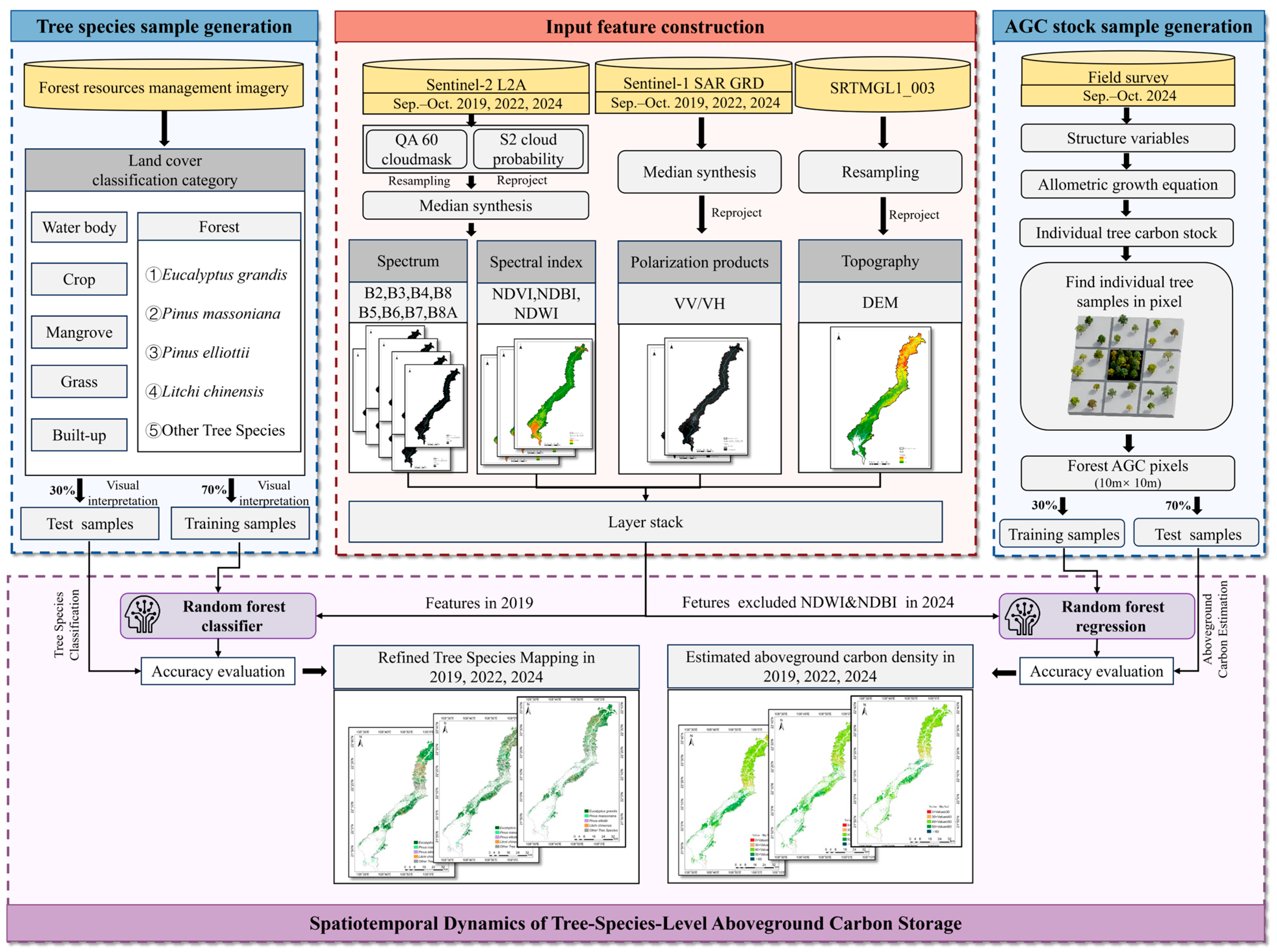
2.3.1. Overall Technique Flowchart
2.3.2. Feature Extraction
2.3.3. Random Forest Algorithm
2.3.4. Refined Tree Species Mapping Method
2.3.5. Carbon Stock Estimation Model
3. Results
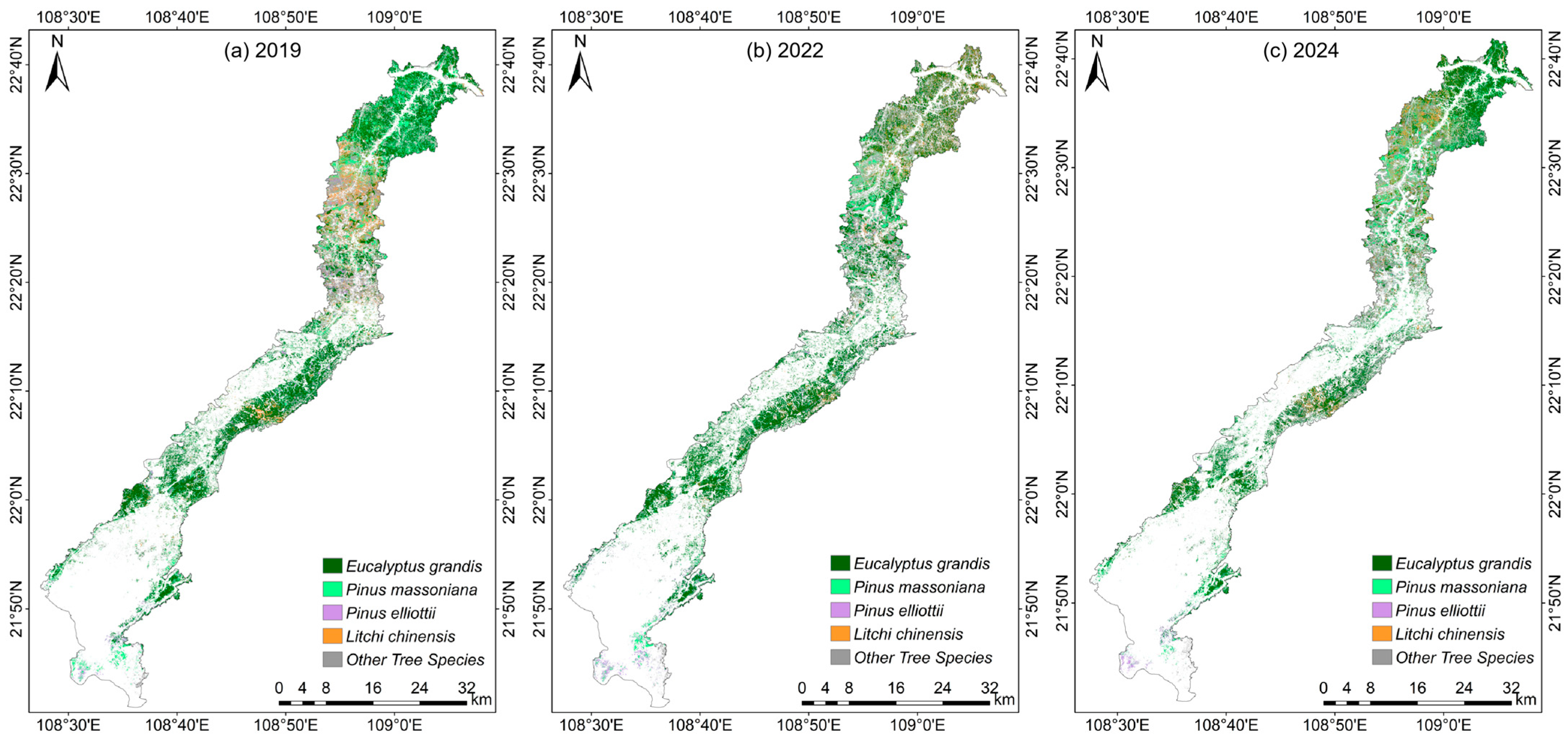
3.1. Refined Tree Species Mapping and Distribution Characters
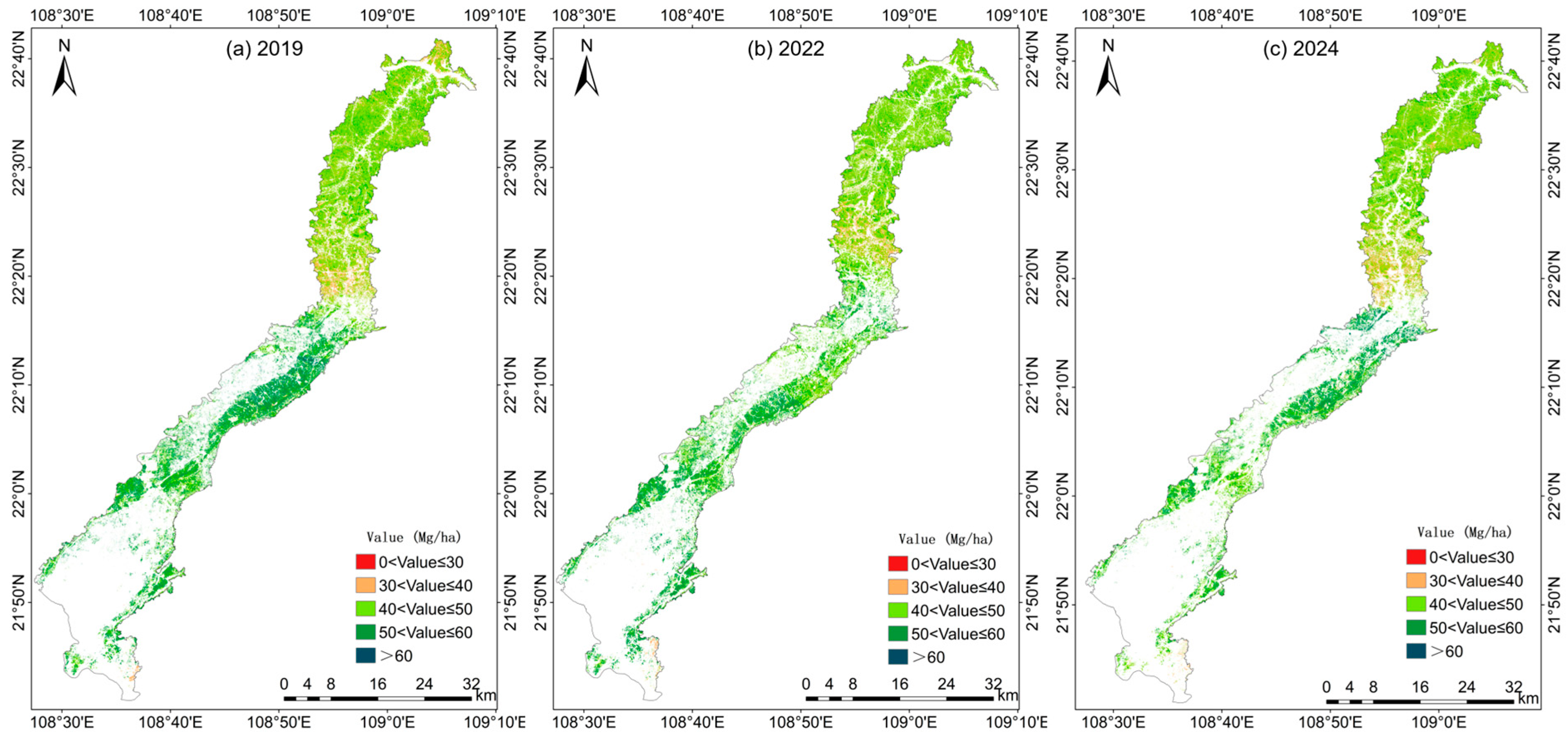
3.2. Spatial Characteristics of Aboveground Carbon Storage
3.3. Variation in Aboveground Carbon Storage by Tree Species
4. Discussion
4.1. Reliability, Transferability, and Uncertainty of the Framework
4.2. Spatial–Temporal Evolution of AGC Under Green Engineering Intervention
4.3. Carbon Sequestration Benefits and Management Strategies
4.4. Limitations and Future Directions
5. Conclusions
Author Contributions
Funding
Data Availability Statement
Conflicts of Interest
References
- Pan, Y.; Birdsey, R.A.; Fang, J.; Houghton, R.; Kauppi, P.E.; Kurz, W.A.; Phillips, O.L.; Shvidenko, A.; Lewis, S.L.; Canadell, J.G.; et al. A large and persistent carbon sink in the world’s forests. Science 2011, 333, 988–993. [Google Scholar] [CrossRef] [PubMed]
- IPCC. Climate Change and Land: An IPCC Special Report on Climate Change, Desertification, Land Degradation, Sustainable Land Management, Food Security, and Greenhouse Gas Fluxes in Terrestrial Ecosystems; Intergovernmental Panel on Climate Change: Geneva, Switzerland, 2019. [Google Scholar]
- Noulekoun, F.; Mensah, S.; Kim, H.; Jo, H.; Gouwakinnou, G.N.; Houehanou, T.D.; Mensah, M.; Naab, J.; Son, Y.; Khamzina, A. Tree size diversity is the major driver of aboveground carbon storage in dryland agroforestry parklands. Sci. Rep. 2023, 13, 22210. [Google Scholar] [CrossRef] [PubMed]
- Shen, F.; Haseeb, M.; Tahir, Z.; Mahmood, S.A.; Tariq, A. Reimagining land use policies: Carbon trade-offs between urbanization and ecological restoration. Land Use Policy 2025, 158, 107770. [Google Scholar] [CrossRef]
- Babar, M.A.; Shaha, M.R.D. A review paper on principles of green engineering. Int. J. Eng. Appl. Sci. Technol. 2024, 9, 112–114. [Google Scholar] [CrossRef]
- Information Office of the People’s Government of Guangxi Zhuang Autonomous Region. Guangxi Accelerates the Construction of Major Infrastructure and Builds the Pinglu Canal with High Standards and Quality; Information Office of the People’s Government of Guangxi Zhuang Autonomous Region: Nanning, China, 2024.
- Guangxi Zhuang Autonomous Region Department of Ecology and Environment. Special Action Plan for Green Engineering of the Pinglu Canal; Guangxi Zhuang Autonomous Region Department of Ecology and Environment: Nanning, China, 2023.
- Rodríguez-Veiga, P.; Wheeler, J.; Louis, V.; Tansey, K.; Balzter, H. Quantifying Forest Biomass Carbon Stocks from Space. Curr. For. Rep. 2017, 3, 1–18. [Google Scholar] [CrossRef]
- Issa, S.; Dahy, B.; Ksiksi, T.; Saleous, N. A Review of Terrestrial Carbon Assessment Methods Using Geo-Spatial Technologies with Emphasis on Arid Lands. Remote Sens. 2020, 12, 2008. [Google Scholar] [CrossRef]
- Chen, Y.; Feng, X.; Fu, B.; Ma, H.; Zohner, C.M.; Crowther, T.W.; Huang, Y.; Wu, X.; Wei, F. Maps with 1 km resolution reveal increases in above- and belowground forest biomass carbon pools in China over the past 20 years. Earth Syst. Sci. Data 2023, 15, 897–910. [Google Scholar] [CrossRef]
- Santoro, M.; Cartus, O.; Carvalhais, N.; Rozendaal, D.M.A.; Avitabile, V.; Araza, A.; de Bruin, S.; Herold, M.; Quegan, S.; Rodríguez-Veiga, P.; et al. The global forest above-ground biomass pool for 2010 estimated from high-resolution satellite observations. Earth Syst. Sci. Data 2021, 13, 3927–3950. [Google Scholar] [CrossRef]
- Potapov, P.; Li, X.; Hernandez-Serna, A.; Tyukavina, A.; Hansen, M.C.; Kommareddy, A.; Pickens, A.; Turubanova, S.; Tang, H.; Silva, C.E.; et al. Mapping global forest canopy height through integration of GEDI and Landsat data. Remote Sens. Environ. 2021, 253, 112165. [Google Scholar] [CrossRef]
- Gonzalez, P.; Asner, G.P.; Battles, J.J.; Lefsky, M.A.; Waring, K.M.; Palace, M. Forest carbon densities and uncertainties from Lidar, QuickBird, and field measurements in California. Remote Sens. Environ. 2010, 114, 1561–1575. [Google Scholar] [CrossRef]
- Ghamisi, P.; Gloaguen, R.; Atkinson, P.M.; Benediktsson, J.A.; Rasti, B.; Yokoya, N.; Wang, Q.; Hofle, B.; Bruzzone, L.; Bovolo, F.; et al. Multisource and Multitemporal Data Fusion in Remote Sensing: A Comprehensive Review of the State of the Art. IEEE Geosci. Remote Sens. Mag. 2019, 7, 6–39. [Google Scholar] [CrossRef]
- Zhu, N.N.; Yang, B.S.; Dong, Z. A novel framework for forest vegetation carbon stock estimation based on remote sensing. Natl. Remote Sens. Bull. 2025, 29, 134–146. [Google Scholar]
- Jiang, W.; Zhang, L.; Zhang, X.; Gao, S.; Gao, H.; Sun, L.; Yan, G. Multi-Decision Vector Fusion Model for Enhanced Mapping of Aboveground Biomass in Subtropical Forests Integrating Sentinel-1, Sentinel-2, and Airborne LiDAR Data. Remote Sens. 2025, 17, 1285. [Google Scholar] [CrossRef]
- Talukdar, S.; Singha, P.; Mahato, S.; Shahfahad; Pal, S.; Liou, Y.; Rahman, A. Land-Use Land-Cover Classification by Machine Learning Classifiers for Satellite Observations—A Review. Remote Sens. 2020, 12, 1135. [Google Scholar] [CrossRef]
- Chen, C.; Da Qi, Y.; Qin, Z.; Li, Y.; Li, Y. Pine wood species identification based on random forest transformer and near infrared spectroscopy. Talanta 2026, 297, 128599. [Google Scholar] [CrossRef]
- Suárez-Fernández, G.E.; Martínez-Sánchez, J.; Arias, P. Enhancing carbon stock estimation in forests: Integrating multi-data predictors with random forest method. Ecol. Inform. 2025, 86, 102997. [Google Scholar] [CrossRef]
- Tian, S.; Sha, A.; Luo, Y.; Ke, Y.; Spencer, R.; Hu, X.; Ning, M.; Zhao, Y.; Deng, R.; Gao, Y.; et al. A novel framework for river organic carbon retrieval through satellite data and machine learning. ISPRS-J. Photogramm. Remote Sens. 2025, 221, 109–123. [Google Scholar] [CrossRef]
- Li, H.; Hiroshima, T.; Li, X.; Hayashi, M.; Kato, T. High-resolution mapping of forest structure and carbon stock using multi-source remote sensing data in Japan. Remote Sens. Environ. 2024, 312, 114322. [Google Scholar] [CrossRef]
- Li, Z.; Bi, S.; Hao, S.; Cui, Y. Aboveground biomass estimation in forests with random forest and Monte Carlo-based uncertainty analysis. Ecol. Indic. 2022, 142, 109246. [Google Scholar] [CrossRef]
- Wang, Z.; Gong, H.; Huang, M.; Gu, F.; Wei, J.; Guo, Q.; Song, W. A multimodel random forest ensemble method for an improved assessment of Chinese terrestrial vegetation carbon density. Methods Ecol. Evol. 2023, 14, 117–132. [Google Scholar] [CrossRef]
- Jung, J.; Kim, S.; Hong, S.; Kim, K.; Kim, E.; Im, J.; Heo, J. Effects of national forest inventory plot location error on forest carbon stock estimation using k-nearest neighbor algorithm. ISPRS-J. Photogramm. Remote Sens. 2013, 81, 82–92. [Google Scholar] [CrossRef]
- Lee, T.R.; Wood, W.T.; Phrampus, B.J. A Machine Learning (kNN) Approach to Predicting Global Seafloor Total Organic Carbon. Glob. Biogeochem. Cycles 2019, 33, 37–46. [Google Scholar] [CrossRef]
- Campbell, M.J.; Eastburn, J.F.; Dennison, P.E.; Vogeler, J.C.; Stovall, A.E.L. Evaluating the performance of airborne and spaceborne lidar for mapping biomass in the United States’ largest dry woodland ecosystem. Remote Sens. Environ. 2024, 308, 114196. [Google Scholar] [CrossRef]
- Yuan, Y.; Guo, W.; Tang, S.; Zhang, J. Effects of patterns of urban green-blue landscape on carbon sequestration using XGBoost-SHAP model. J. Clean. Prod. 2024, 476, 143640. [Google Scholar] [CrossRef]
- Cheng, F.; Ou, G.; Wang, M.; Liu, C. Remote Sensing Estimation of Forest Carbon Stock Based on Machine Learning Algorithms. Forests 2024, 15, 681. [Google Scholar] [CrossRef]
- Arantes, A.E.; Ferreira, L.G.; Coe, M.T. The seasonal carbon and water balances of the Cerrado environment of Brazil: Past, present, and future influences of land cover and land use. ISPRS-J. Photogramm. Remote Sens. 2016, 117, 66–78. [Google Scholar] [CrossRef]
- Wu, Y.; Zheng, J.; Gao, J.; He, X.; Liu, X. Functional Diversity Explains Ecosystem Carbon Storage in Subtropical Forests. Glob. Change Biol. 2025, 31, e70120. [Google Scholar] [CrossRef]
- Xu, H.; Yue, C.; Zhang, Y.; Liu, D.; Piao, S. Forestation at the right time with the right species can generate persistent carbon benefits in China. Proc. Natl. Acad. Sci. USA 2023, 120, e1989979176. [Google Scholar] [CrossRef]
- Bai, Y.; Pang, Y.; Kong, D. Integrating remote sensing and 3-PG model to simulate the biomass and carbon stock of Larix olgensis plantation. For. Ecosyst. 2024, 11, 100213. [Google Scholar] [CrossRef]
- Kunert, N.; El-Madany, T.S.; Aparecido, L.M.T.; Wolf, S.; Potvin, C. Understanding the controls over forest carbon use efficiency on small spatial scales: Effects of forest disturbance and tree diversity. Agric. For. Meteorol. 2019, 269–270, 136–144. [Google Scholar] [CrossRef]
- Li, F.; Jia, Z.; Zhou, X. Establishing Natural Resources Monitoring Systems in China: Situation, Problem and Suggestion. Int. Arch. Photogramm. Remote Sens. Spat. Inf. Sci. 2024, XLVIII-4-2024, 599–606. [Google Scholar] [CrossRef]
- Zhao, Y.; Guo, F.; Wang, Y.; Huang, J.; Peng, D. Estimating Forest Growing Stock Volume Using Feature Selection and Advanced Remote Sensing Algorithm. Remote Sens. Appl. Soc. Environ. 2025, 37, 101458. [Google Scholar] [CrossRef]
- Drusch, M.; Del Bello, U.; Carlier, S.; Colin, O.; Fernandez, V.; Gascon, F.; Hoersch, B.; Isola, C.; Laberinti, P.; Martimort, P.; et al. Sentinel-2: ESA’s Optical High-Resolution Mission for GMES Operational Services. Remote Sens. Environ. 2012, 120, 25–36. [Google Scholar] [CrossRef]
- Torres, R.; Snoeij, P.; Geudtner, D.; Bibby, D.; Davidson, M.; Attema, E.; Potin, P.; Rommen, B.; Floury, N.; Brown, M.; et al. GMES Sentinel-1 mission. Remote Sens. Environ. 2012, 120, 9–24. [Google Scholar] [CrossRef]
- Ma, M.; Liu, J.; Liu, M.; Zeng, J.; Li, Y. Tree Species Classification Based on Sentinel-2 Imagery and Random Forest Classifier in the Eastern Regions of the Qilian Mountains. Forests 2021, 12, 1736. [Google Scholar] [CrossRef]
- GB/T 43648-2024; State Administration for Market Regulation; Standardization Administration of the People’s Republic of China; Tree Biomass Models and Related Parameters to Carbon Accounting for Major Tree Species. Standards Press of China: Beijing, China, 2024.
- Xu, W.; Cheng, Y.; Luo, M.; Mai, X.; Wang, W.; Zhang, W.; Wang, Y. Progress and Limitations in Forest Carbon Stock Estimation Using Remote Sensing Technologies: A Comprehensive Review. Forests 2025, 16, 449. [Google Scholar] [CrossRef]
- Dong, H.; Tang, L.; Liu, J.; Hu, X.; Shao, G. Remote sensing of urban tree carbon stocks: A methodological review. ISPRS-J. Photogramm. Remote Sens. 2025, 227, 570–593. [Google Scholar] [CrossRef]
- Guo, H.; Boonprong, S.; Wang, S.; Zhang, Z.; Liang, W.; Xu, M.; Yang, X.; Wang, K.; Li, J.; Gao, X.; et al. Dominant Tree Species Mapping Using Machine Learning Based on Multi-Temporal and Multi-Source Data. Remote Sens. 2024, 16, 4674. [Google Scholar] [CrossRef]
- Taşkın, G.; Kaya, H.; Bruzzone, L. Feature Selection Based on High Dimensional Model Representation for Hyperspectral Images. IEEE Trans. Image Process. 2017, 26, 2918–2928. [Google Scholar] [CrossRef]
- Qadeer, A.; Shakir, M.; Wang, L.; Talha, S.M. Evaluating machine learning approaches for aboveground biomass prediction in fragmented high-elevated forests using multi-sensor satellite data. Remote Sens. Appl. Soc. Environ. 2024, 36, 101291. [Google Scholar] [CrossRef]
- Zhou, J.; Zan, M.; Zhai, L.; Yang, S.; Xue, C.; Li, R.; Wang, X. Remote sensing estimation of aboveground biomass of different forest types in Xinjiang based on machine learning. Sci. Rep. 2025, 15, 6187. [Google Scholar] [CrossRef]
- Xu, W.; Mai, X.; Deng, S.; Wang, W.; Wu, W.; Zhang, W.; Wang, Y. High-Resolution Mapping and Impact Assessment of Forest Aboveground Carbon Stock in the Pinglu Canal Basin: A Multi-Sensor and Multi-Model Machine Learning Approach. Forests 2025, 16, 1130. [Google Scholar] [CrossRef]
- Wang, Y.; Cong, N.; Zhong, Y.; Fu, Y.; Wang, N.; Ouyang, L.; Yao, W. Impacts of cascade dam construction on riparian vegetation in an alpine region. J. Hydrol. 2025, 652, 132665. [Google Scholar] [CrossRef]
- Dullah, H.; Malek, M.A.; Omar, H.; Mangi, S.A.; Hanafiah, M.M. Assessing changes of carbon stock in dipterocarp forest due to hydro-electric dam construction in Malaysia. Environ. Sci. Pollut. Res. 2021, 28, 44264–44276. [Google Scholar] [CrossRef] [PubMed]
- Main-Knorn, M.; Cohen, W.B.; Kennedy, R.E.; Grodzki, W.; Pflugmacher, D.; Griffiths, P.; Hostert, P. Monitoring coniferous forest biomass change using a Landsat trajectory-based approach. Remote Sens. Environ. 2013, 139, 277–290. [Google Scholar] [CrossRef]
- Ploton, P.; Mortier, F.; Réjou-Méchain, M.; Barbier, N.; Picard, N.; Rossi, V.; Dormann, C.; Cornu, G.; Viennois, G.; Bayol, N.; et al. Spatial validation reveals poor predictive performance of large-scale ecological mapping models. Nat. Commun. 2020, 11, 4540. [Google Scholar] [CrossRef]
- Mensah, S.; Salako, V.K.; Seifert, T. Structural complexity and large-sized trees explain shifting species richness and carbon relationship across vegetation types. Funct. Ecol. 2020, 34, 1731–1745. [Google Scholar] [CrossRef]
- Qiu, S.; Yu, Q.; Niu, T.; Fang, M.; Guo, H.; Liu, H.; Li, S.; Zhang, J. Restoration and renewal of ecological spatial network in mining cities for the purpose of enhancing carbon Sinks: The case of Xuzhou, China. Ecol. Indic. 2022, 143, 109313. [Google Scholar] [CrossRef]
- Li, S.; Yang, P.; Yang, C.; Zhang, H.; Gao, X. The Impact of Ecological Restoration Measures on Carbon Storage: Spatio-Temporal Dynamics and Driving Mechanisms in Karst Desertification Control. Land 2025, 14, 1903. [Google Scholar] [CrossRef]
- Hua, F.; Bruijnzeel, L.A.; Meli, P.; Martin, P.A.; Zhang, J.; Nakagawa, S.; Miao, X.; Wang, W.; McEvoy, C.; Peña-Arancibia, J.L.; et al. The biodiversity and ecosystem service contributions and trade-offs of forest restoration approaches. Science 2022, 376, 839–844. [Google Scholar] [CrossRef]
- Osuri, A.M.; Gopal, A.; Raman, T.R.S.; DeFries, R.; Cook-Patton, S.C.; Naeem, S. Greater stability of carbon capture in species-rich natural forests compared to species-poor plantations. Environ. Res. Lett. 2020, 15, 34011. [Google Scholar] [CrossRef]
- Chen, Y.; Hu, B.; Tang, J.; Wang, Y. Comprehensive consolidation and ecological restoration projects drive the variation of ecosystem services and their terrain gradient effect in Jiangxi Province, China. Ecol. Eng. 2025, 220, 107728. [Google Scholar] [CrossRef]
- Magnabosco Marra, D.; Trumbore, S.E.; Higuchi, N.; Ribeiro, G.H.P.M.; Negrón Juárez, R.I.; Holzwarth, F.; Rifai, S.W.; Dos Santos, J.; Lima, A.J.N.; Kinupp, V.F.; et al. Windthrows control biomass patterns and functional composition of Amazon forests. Glob. Change Biol. 2018, 24, 5867–5881. [Google Scholar] [CrossRef] [PubMed]
- Pires Coelho, A.J.; Ribeiro Matos, F.A.; Villa, P.M.; Heringer, G.; Pontara, V.; de Paula Almado, R.; Alves Meira-Neto, J.A. Multiple drivers influence tree species diversity and above-ground carbon stock in second-growth Atlantic forests: Implications for passive restoration. J. Environ. Manag. 2022, 318, 115588. [Google Scholar] [CrossRef]
- Warner, E.; Cook-Patton, S.C.; Lewis, O.T.; Brown, N.; Koricheva, J.; Eisenhauer, N.; Ferlian, O.; Gravel, D.; Hall, J.S.; Jactel, H.; et al. Young mixed planted forests store more carbon than monocultures—A meta-analysis. Front. For. Glob. Change 2023, 6, 1226514. [Google Scholar] [CrossRef]
- Diaz-Balteiro, L.; Rodriguez, L.C.E. Optimal rotations on Eucalyptus plantations including carbon sequestration—A comparison of results in Brazil and Spain. For. Ecol. Manag. 2006, 229, 247–258. [Google Scholar] [CrossRef]
- Benítez, G.; Ruelas-Monjardín, L.C.; Von Thaden, J.; Acosta-Rosado, I.; Alvarado-Castillo, G.; Equihua, M. Carbon storage in a peri-urban neotropical forest: Assessing its potential and patterns of change over half a century. Urban For. Urban Green. 2023, 86, 128009. [Google Scholar] [CrossRef]
- Bustamante, M.M.C.; Roitman, I.; Aide, T.M.; Alencar, A.; Anderson, L.O.; Aragao, L.; Asner, G.P.; Barlow, J.; Berenguer, E.; Chambers, J.; et al. Toward an integrated monitoring framework to assess the effects of tropical forest degradation and recovery on carbon stocks and biodiversity. Glob. Change Biol. 2016, 22, 92–109. [Google Scholar] [CrossRef]
- Duncanson, L.; Kellner, J.R.; Armston, J.; Dubayah, R.; Minor, D.M.; Hancock, S.; Healey, S.P.; Patterson, P.L.; Saarela, S.; Marselis, S.; et al. Aboveground biomass density models for NASA’s Global Ecosystem Dynamics Investigation (GEDI) lidar mission. Remote Sens. Environ. 2022, 270, 112845. [Google Scholar] [CrossRef]
- Bai, J.; Niu, Z.; Wang, L. A theoretical demonstration on the independence of distance and incidence angle effects for small-footprint hyperspectral LiDAR: Basic physical concepts. Remote Sens. Environ. 2024, 315, 114452. [Google Scholar] [CrossRef]
- Bai, J.; Niu, Z.; Huang, Y.; Bi, K.; Fu, Y.; Gao, S.; Wu, M.; Wang, L. Full-waveform hyperspectral LiDAR data decomposition via ranking central locations of natural target echoes (Rclonte) at different wavelengths. Remote Sens. Environ. 2024, 310, 114227. [Google Scholar] [CrossRef]
- Meroni, M.; Schucknecht, A.; Fasbender, D.; Rembold, F.; Fava, F.; Mauclaire, M.; Goffner, D.; Di Lucchio, L.M.; Leonardi, U. Remote sensing monitoring of land restoration interventions in semi-arid environments with a before–after control-impact statistical design. Int. J. Appl. Earth Obs. Geoinf. 2017, 59, 42–52. [Google Scholar]
- Zhai, T.; Chang, M.; Ma, Y.; Huang, L.; Li, L. Exploring the changes and driving mechanisms in the production-transport-consumption process of ecosystem services flow in the Yellow River Basin under the background of policy changes. Ecol. Indic. 2023, 151, 110316. [Google Scholar] [CrossRef]





| Data Category | Data Products | Predictor | Definition/Formulation |
|---|---|---|---|
| Multispectral imagery data | Sentinel-2 L2A | Band 2 | Blue, central wavelength (CWL): 490 nm Spatial resolution (SR): 10 m |
| Band 3 | Green (G), CWL: 560 nm, SR: 10 m | ||
| Band 4 | Red (R), CWL: 660 nm, SR: 10 m | ||
| Band 5 | Red Edge 1, CWL: 705 nm, SR: 20 m | ||
| Band 6 | Red Edge 2, CWL: 740 nm, SR: 20 m | ||
| Band 7 | Red Edge 3, CWL: 782 nm, SR: 20 m | ||
| Band 8 | Near-Infrared (NIR), CWL: 835 nm, SR: 10 m | ||
| Band 8A | Red Edge 4, CWL: 842 nm, SR: 20 m | ||
| Polarimetric data | Sentinel-1 GRD | VV | Vertical emission—vertical receipt |
| VH | Vertical emission—horizontal receipt | ||
| DEM | / | SRTMGL1_003 | SR: 30 m, free available |
| Spectral index data | / | NDVI | (NIR − R)/(NIR + R) |
| NDBI | (SWIR − NIR)/(SWIR + NIR); Short-wavelength infrared (SWIR), Band 11, SR: 20 m | ||
| NDWI | (G − NIR)/(G + NIR) |
| True/ Predicted | Eucalyptus grandis | Pinus massoniana | Pinus elliottii | Litchi chinensis | Other Tree Species | Mangrove | Built -Up | Water Body | Cropland | Grassland | Producer Accuracy |
|---|---|---|---|---|---|---|---|---|---|---|---|
| Eucalyptus grandis | 532 | 27 | 4 | 11 | 29 | 0 | 4 | 0 | 10 | 2 | 0.8595 |
| Pinus massoniana | 33 | 496 | 15 | 5 | 18 | 2 | 3 | 2 | 4 | 1 | 0.8566 |
| Pinus elliottii | 10 | 37 | 190 | 8 | 14 | 0 | 1 | 0 | 1 | 0 | 0.7280 |
| Litchi chinensis | 20 | 10 | 2 | 267 | 16 | 0 | 3 | 0 | 5 | 2 | 0.8215 |
| Other tree species | 31 | 30 | 4 | 25 | 463 | 1 | 11 | 2 | 16 | 1 | 0.7928 |
| Mangrove | 0 | 0 | 0 | 0 | 0 | 181 | 0 | 5 | 5 | 0 | 0.9476 |
| Built-up | 1 | 2 | 0 | 0 | 2 | 0 | 522 | 18 | 27 | 0 | 0.9126 |
| Water body | 1 | 2 | 0 | 0 | 4 | 2 | 18 | 535 | 13 | 0 | 0.9304 |
| Cropland | 7 | 4 | 0 | 2 | 19 | 2 | 38 | 24 | 482 | 2 | 0.8310 |
| Grassland | 0 | 0 | 0 | 0 | 8 | 1 | 6 | 3 | 18 | 91 | 0.7165 |
| User accuracy | 0.8378 | 0.8158 | 0.8837 | 0.8396 | 0.8080 | 0.9577 | 0.8614 | 0.9083 | 0.8296 | 0.9192 | / |
| Overall accuracy: 85.18%; Kappa coefficient: 0.8319 | |||||||||||
| Tree Species | Equation Model | Parameter a | Parameter b | Parameter c | Carbon Factor () |
|---|---|---|---|---|---|
| Eucalyptus grandis | 0.1746 | 2.333 | - | 0.5253 | |
| Pinus massoniana | 0.06662 | 2.09317 | 0.49763 | 0.5254 | |
| Pinus elliottii | 0.04744 | 2.10359 | 0.63108 | 0.4756 | |
| Litchi chinensis | 0.1875 | 2.333 | - | 0.4834 |
| Tree Species | EBA (ha) | EIA (ha) | ||||
|---|---|---|---|---|---|---|
| 2019 | 2022 | 2024 | 2019 | 2022 | 2024 | |
| Eucalyptus grandis | 23,178.77 | 19,550.40 | 16,685.50 | 3126.13 | 3210.83 | 2068.23 |
| Pinus massoniana | 11,486.38 | 7116.60 | 9066.46 | 2088.15 | 1351.47 | 1626.98 |
| Pinus elliottii | 2429.36 | 2295.16 | 1371.15 | 413.17 | 497.49 | 201.59 |
| Litchi chinensis | 5287.18 | 6055.11 | 5843.60 | 1001.74 | 758.46 | 585.47 |
| Other tree species | 12,550.33 | 14,738.59 | 13,617.49 | 2166.80 | 2212.22 | 1907.16 |
| Total | 54,932.02 | 49,755.86 | 46,584.20 | 8795.99 | 8030.47 | 6389.43 |
| Area | AGC (Mg) | Rate of AGC Change (%) | ||||
|---|---|---|---|---|---|---|
| 2019 | 2022 | 2024 | 2022–2019 | 2024–2022 | 2024–2019 | |
| EBA | 2,817,465.51 | 2,554,916.11 | 2,341,779.61 | −9.32% | −8.34% | −16.88% |
| EIA | 411,023.91 | 375,311.27 | 292,176.64 | −8.69% | −22.15% | −28.91% |
Disclaimer/Publisher’s Note: The statements, opinions and data contained in all publications are solely those of the individual author(s) and contributor(s) and not of MDPI and/or the editor(s). MDPI and/or the editor(s) disclaim responsibility for any injury to people or property resulting from any ideas, methods, instructions or products referred to in the content. |
© 2026 by the authors. Licensee MDPI, Basel, Switzerland. This article is an open access article distributed under the terms and conditions of the Creative Commons Attribution (CC BY) license.
Share and Cite
Wang, W.; Wu, W.; Zhang, W.; Hu, D.; Xu, W.; Bai, J.; Wang, Y. Spatiotemporal Dynamics of Tree Species-Level Aboveground Carbon Storage at the Canal Scale Under Green Engineering with a Random Forest Model. Remote Sens. 2026, 18, 475. https://doi.org/10.3390/rs18030475
Wang W, Wu W, Zhang W, Hu D, Xu W, Bai J, Wang Y. Spatiotemporal Dynamics of Tree Species-Level Aboveground Carbon Storage at the Canal Scale Under Green Engineering with a Random Forest Model. Remote Sensing. 2026; 18(3):475. https://doi.org/10.3390/rs18030475
Chicago/Turabian StyleWang, Wenhuan, Wenqian Wu, Wei Zhang, Dongdong Hu, Weifeng Xu, Jie Bai, and Yinghui Wang. 2026. "Spatiotemporal Dynamics of Tree Species-Level Aboveground Carbon Storage at the Canal Scale Under Green Engineering with a Random Forest Model" Remote Sensing 18, no. 3: 475. https://doi.org/10.3390/rs18030475
APA StyleWang, W., Wu, W., Zhang, W., Hu, D., Xu, W., Bai, J., & Wang, Y. (2026). Spatiotemporal Dynamics of Tree Species-Level Aboveground Carbon Storage at the Canal Scale Under Green Engineering with a Random Forest Model. Remote Sensing, 18(3), 475. https://doi.org/10.3390/rs18030475