Review

Research Progress of Deep Learning in Sea Ice Prediction
by
Junlin Ran
,
Weimin Zhang
and
Yi Yu
*,†
College of Meteorology and Oceanography, National University of Defense Technology, Changsha 410073, China
*
Author to whom correspondence should be addressed.
These authors contributed equally to this work.
Remote Sens. 2026, 18(3), 419; https://doi.org/10.3390/rs18030419
Submission received: 30 November 2025 / Revised: 6 January 2026 / Accepted: 13 January 2026 / Published: 28 January 2026

Highlights

What are the main findings?
  • Although deep learning has emerged as a promising alternative, current research remains fragmented. This manuscript fills a critical gap in existing knowledge by synthesizing these disparate methodologies, providing a unified framework that bridges data-driven efficiency with physical consistency to propel the field forward.
  • We comprehensively analyze three core deep learning architectures—sequence learning, image learning, and spatiotemporal learning—and their integration with the physical mechanisms governing sea ice variability (thermodynamic and dynamic processes).
What is the implication of the main finding?
  • By addressing prevailing challenges—such as data scarcity and generalization limits—and proposing concrete pathways for advancement, this review serves as a roadmap for developing the next generation of robust, interpretable, and operational sea ice prediction systems.

Abstract
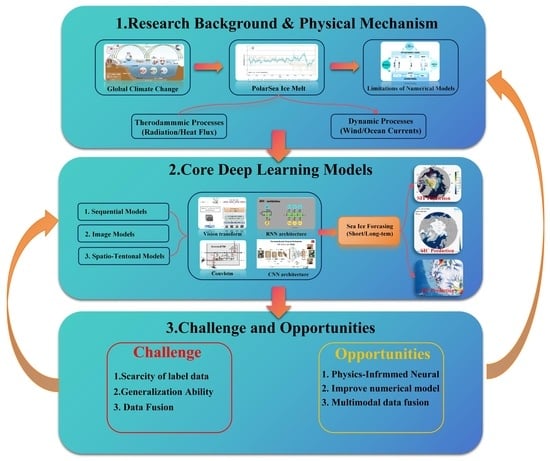
Polar sea ice is undergoing rapid change, with recent record-low extents in both hemispheres, raising the demand for skillful predictions from days to seasons for navigation, ecosystem management, and climate risk assessment. Accurate sea ice prediction is essential for understanding coupled climate processes, supporting safe polar operations, and informing adaptation strategies. Physics-based numerical models remain the backbone of operational forecasting, but their skill is limited by uncertainties in coupled ocean–ice–atmosphere processes, parameterizations, and sparse observations, especially in the marginal ice zone and during melt seasons. Statistical and empirical models can provide useful baselines for low-dimensional indices or short lead times, yet they often struggle to represent high-dimensional, nonlinear interactions and regime shifts. This review synthesizes recent progress of DL for key sea ice prediction targets, including sea ice concentration/extent, thickness, and motion, and organizes methods into (i) sequential architectures (e.g., LSTM/GRU and temporal Transformers) for temporal dependencies, (ii) image-to-image and vision models (e.g., CNN/U-Net, vision Transformers, and diffusion or GAN-based generators) for spatial structures and downscaling, and (iii) spatiotemporal fusion frameworks that jointly model space–time dynamics. We further summarize hybrid strategies that integrate DL with numerical models through post-processing, emulation, and data assimilation, as well as physics-informed learning that embeds conservation laws or dynamical constraints. Despite rapid advances, challenges remain in generalization under non-stationary climate conditions, dataset shift, and physical consistency (e.g., mass/energy conservation), interpretability, and fair evaluation across regions and lead times. We conclude with practical recommendations for future research, including standardized benchmarks, uncertainty-aware probabilistic forecasting, physics-guided training and neural operators for long-range dynamics, and foundation models that leverage self-supervised pretraining on large-scale Earth observation archives.

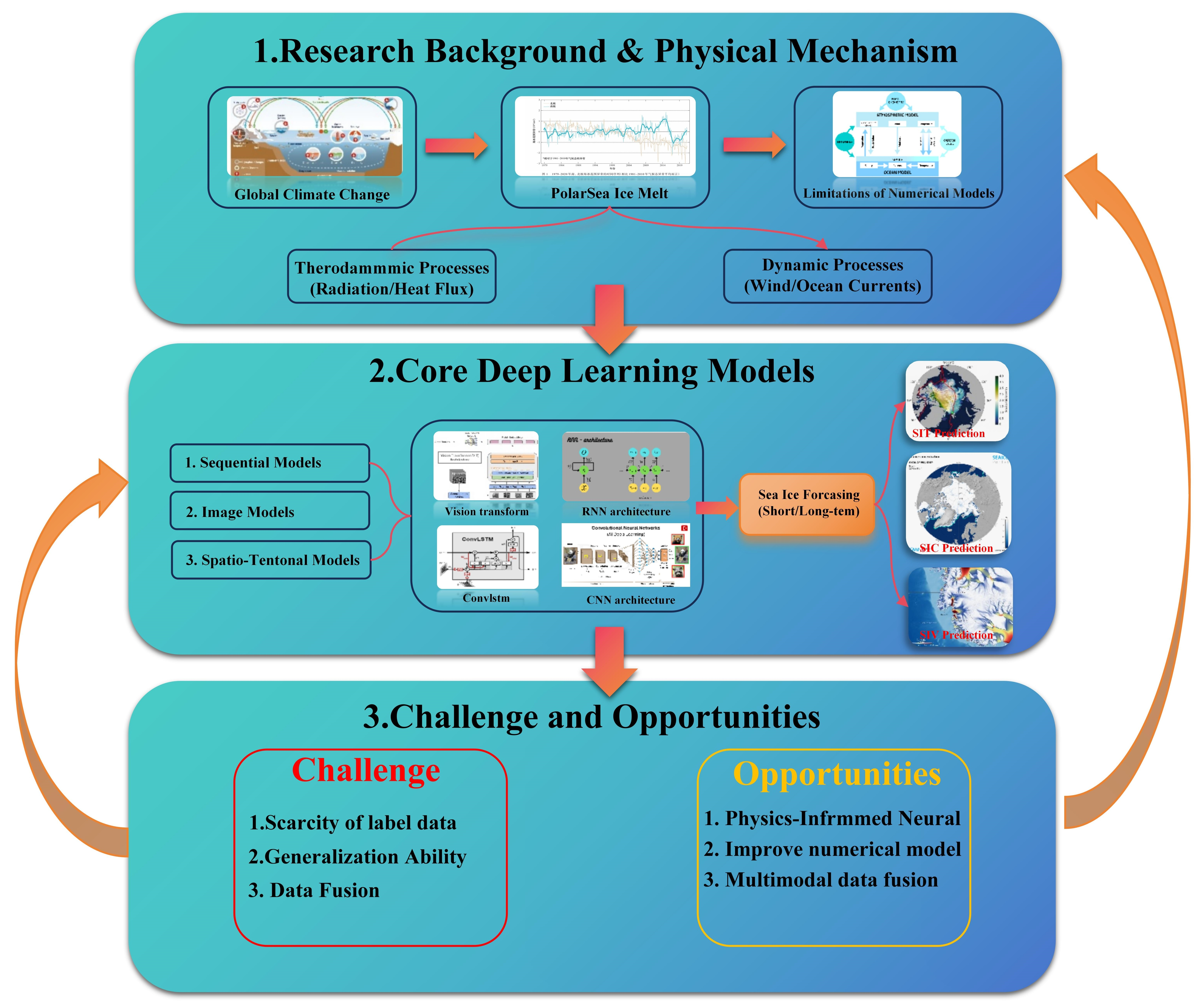
Graphical Abstract

1. Introduction

Under ongoing global warming, polar sea ice has experienced unprecedented extremes in both hemispheres. In the Southern Hemisphere, Antarctic summer minimum sea ice extent set record lows three times since 2016 (e.g., 2.07 × 10⁶ km2 on 1 March 2017) [1]. More recently, Antarctic sea ice likely reached its annual minimum on 21 February 2023 at 1.79 × 10⁶ km2—the lowest in the 45-year satellite record—about 1.05 × 10⁶ km2 below the 1981–2010 average minimum (≈37%) and ~0.136 × 10⁶ km2 below the previous record low in 2022 [2]. In 2025, the Antarctic minimum remained exceptionally low (1.98 × 10⁶ km2, tied for the second lowest) [3]. In the Northern Hemisphere, Arctic winter sea ice extent at its annual maximum reached a record low of 14.33 × 10⁶ km2 on 22 March 2025, as reported by NASA/NSIDC. Shrinking sea ice amplifies polar warming through the ice–albedo feedback and can influence large-scale atmospheric circulation, with potential implications for the persistence of some extreme events [4]. Meanwhile, reduced seasonal sea ice cover weakens the nearshore ice buffer and increases open-water fetch, enhancing wave action, storm surge/wave runup, coastal erosion, and flooding hazards along polar shorelines [5]. At the same time, declining Arctic ice cover increases the accessibility of trans-Arctic passages connecting the Atlantic and Pacific, raising the strategic and economic importance of Arctic shipping routes [6,7]. Therefore, accurate prediction of sea ice variability is crucial for understanding climate change mechanisms, supporting safe polar operations, and informing response strategies.
Satellite observations show a pronounced, sustained decline in Arctic sea ice extent since 1979. By contrast, Antarctic sea ice exhibited a complex changing trend in recent years [8,9]. Extreme Antarctic sea ice losses have challenged climate model simulations and projections: CMIP6 models rarely reproduce anomalies as large as those observed in 2023, and the skill of modeled trends requires reassessment in light of the abrupt post-2016 loss [10,11]. The divergent behavior between the two hemispheres reflects the complex ocean–ice–atmosphere interactions governing sea ice variability. This coupling is especially strong in summer, yet the key mechanisms driving rapid melt and low-ice extremes remain incompletely understood, complicating sea ice predictability [12].
Sea ice prediction methodologies are generally classified into numerical and statistical approaches. Numerical models employ coupled thermodynamic and dynamic equations to simulate the intricate dynamics of the coupled ice–ocean–atmosphere system. However, model fidelity is materially constrained by the highly pronounced spatiotemporal variability in polar regions and a deficient characterization of energy exchange processes within the marginal ice zone (MIZ). These challenges are acutely exacerbated during the summer melt season, wherein complex ocean boundary conditions (OBCs) diminish model sensitivity to melt processes, posing a central impediment to robust numerical prediction. Furthermore, such models are characterized by their substantial computational intensity. Consequently, high-resolution coupled models (e.g., MITgcm) mandate supercomputing resources, a constraint effectively precluding their application for operational forecasting [13]. While MITgcm-based models are capable of yielding physically consistent predictions, extant literature consistently indicates a persistent systematic underestimation of sea ice change trends [14]. Despite augmentation with data assimilation techniques, non-trivial deviations persist, attributable to uncertainties in parametrization, unresolved or poorly represented physical processes, and the relative sparsity of observational data [13].
To surmount the limitations inherent in conventional methodologies, polar researchers have increasingly adopted deep learning (DL) approaches. DL models can learn nonlinear mappings from heterogeneous inputs and support multi-source data fusion, enabling tasks such as sea ice concentration/extent forecasting, thickness retrieval, and ice-motion prediction from satellite observations (e.g., passive microwave, SAR, and altimetry-derived products), reanalysis fields, and numerical model outputs. In this review, we focus on DL methods directly relevant to sea ice prediction and monitoring, and discuss how physical constraints and process knowledge can improve robustness and interpretability.
Specific to the sea ice domain, DL research applications focus predominantly on sea ice concentration (SIC) prediction, type classification, and thickness retrieval. These applications leverage large-scale spatiotemporal models that utilize data from satellite radar and optical imagery. Exemplifying this, models based on U-Net and Transformer architectures have demonstrated superior performance in both short-term and seasonal forecasting of Arctic SIC [15]. Their integrated attention mechanisms adeptly capture the dynamics of the ice cover, yielding predictive accuracies exceeding those of conventional numerical models. Moreover, the robustness of daily SIC forecasting has been enhanced through the integration of domain knowledge, such as teleconnections and lagged effects into interpretable DL models, thereby enhancing early warning capabilities for extreme melt events.
Notwithstanding the substantial advancements deep learning has introduced to the field of sea ice prediction, its practical application has, to date, been largely restricted to short- and medium-range forecasting horizons. Nonetheless, persistent challenges remain conspicuous, notably: suboptimal modeling of multi-scale coupling mechanisms; a paucity of observational data pertaining to extreme events; and a deficit in physical interpretability. These unresolved issues collectively hinder the attainment of high-fidelity predictions for critical parameters, including sea ice extent, thickness, and the dynamic characteristics of the melt season. As a result, substantial obstacles persist in the development of operationally viable, interpretable models, as well as in the requisite enhancement of contemporary numerical modeling frameworks [16,17].
Section 1: Outlines the context of rapid polar sea ice change and its climate implications. It evaluates the proven efficacy of deep learning in related sciences and analyzes its potential to overcome the limitations of traditional sea ice prediction. Section 2: Explains the multi-scale physical drivers of sea ice variability and their integration with deep learning models. A quantitative parameter system is formulated to link these physical processes to specific data-driven model architectures. Section 3: Presents a technical analysis of core deep learning architectures (sequential, spatial, and spatiotemporal) and reviews their suitability for specific sea ice monitoring and prediction scenarios. Section 4: Explores deep learning’s practical applications, focusing on four key tasks: short- and long-term forecasting, concentration/extent prediction, thickness inversion, and drift tracking. Representative algorithms are reviewed, highlighting their innovations and performance. Section 5: Analyzes key challenges, including the lack of high-quality data and data fusion difficulties. It also outlines emerging opportunities like Physics-Informed Neural Networks (PINNs), hybrid models, multi-modal fusion, and eXplainable AI (XAI). Section 6: Summarizes the review and outlines future research pathways. It emphasizes the need for a closer integration of deep learning methods with governing physical mechanisms.

2. Physical Mechanisms of Sea Ice Variability

2.1. Mechanism of Sea Ice Change

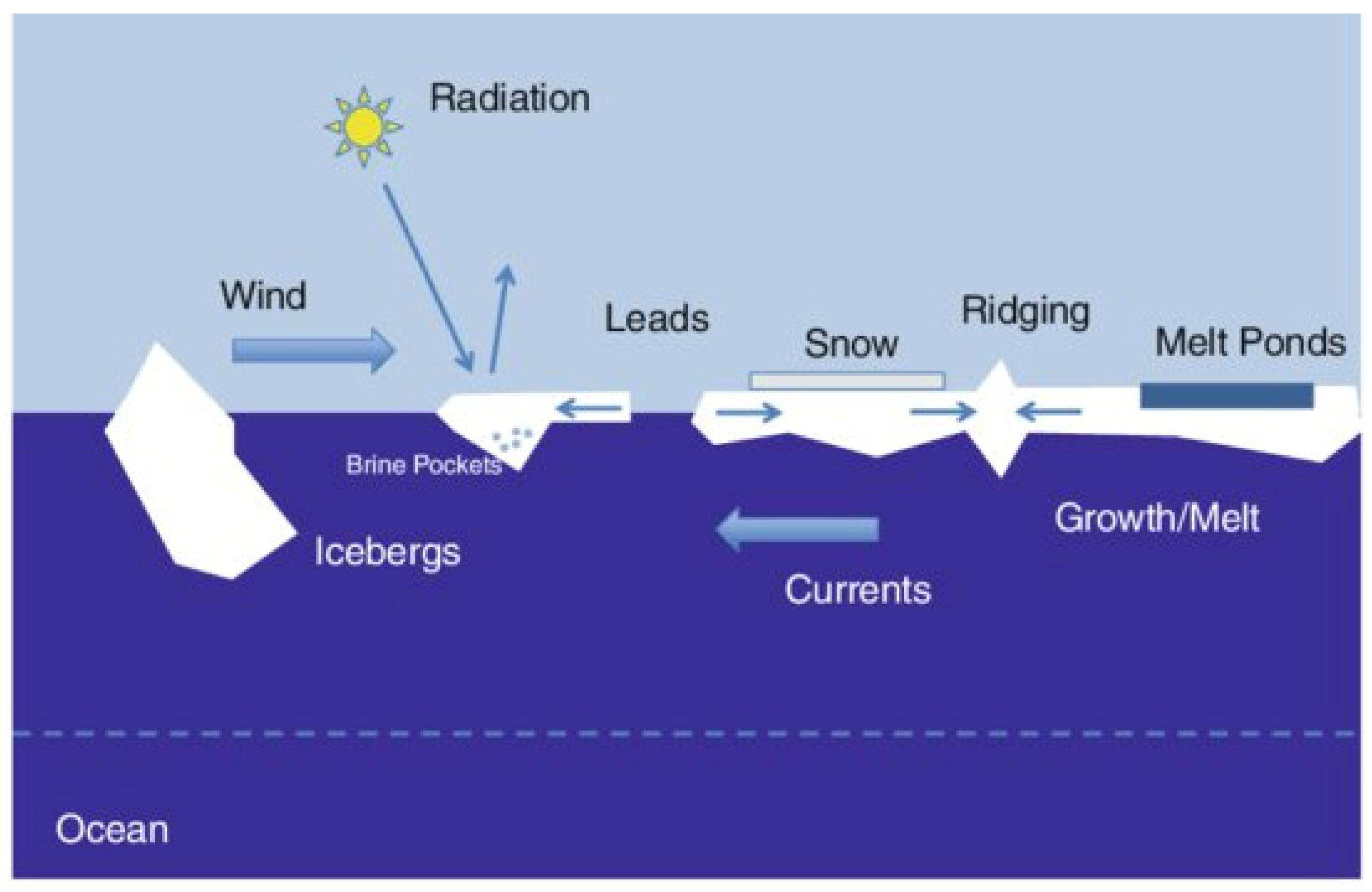
Arctic sea ice has exhibited a sustained decline driven by coupled thermodynamic and dynamic processes (Figure 1). Thermodynamic changes arise from surface energy exchanges at the ice–atmosphere and ice–ocean interfaces and from feedbacks such as ice–albedo amplification [18]. Recent radiative-effect estimates indicate that the solar cooling effect of sea ice has weakened substantially since the early 1980s, consistent with a strengthening sea ice albedo feedback [19]. Dynamic processes also play a key role: sea ice drift responds to wind stress, ocean currents, sea-surface tilt, and the Coriolis force, and can be approximated by free-drift theory [20]. Extreme and rapid-change events often reflect episodes of strong atmospheric and oceanic forcing, including warm-air intrusions/atmospheric rivers that suppress winter growth or promote melt, and ocean heat content anomalies that precondition marginal seas. Long-term assessment of thickness/volume trends further depends on consistent multi-mission altimetry records; for example, neural-network calibration has been used to harmonize radar freeboard time series across ERS-2/Envisat/CryoSat-2 missions [21]. Together, forced change and internal variability contribute to observed sea ice evolution, with their relative roles varying across regions and timescales.
Contrary to Arctic trends, Antarctic sea ice exhibited a marginal positive trend in the early 21st century, yet has experienced a precipitous decline post-2016 [8]. This complexity is attributable to the distinct geographical and physical characteristics of the Antarctic continent. The Antarctic Circumpolar Current (ACC) and the Weddell Gyre fundamentally govern sea ice distribution. Concurrently, basal meltwater from Antarctic ice shelves is discharged into the ocean, thereby altering ocean stratification and the conditions for sea ice formation [22]. Variations in Antarctic sea ice are also modulated by large-scale climate modes, notably the Southern Annular Mode (SAM) and the El Niño-Southern Oscillation (ENSO) [23]. Furthermore, alterations in atmospheric circulation, driven by stratospheric ozone depletion, have exerted long-term impacts on Antarctic sea ice [24].
Figure 1. Key factors influencing sea ice variability (adapted from Gettelman et al., 2016 [25]).
Remotesensing 18 00419 g001

2.2. Application of Sea Ice Physical Process Parameters

Decades of research have established a systematic framework for quantitatively parameterizing sea ice physics, typically summarized into four groups: thermodynamic (e.g., albedo, conductivity, turbulent heat fluxes, longwave radiation), dynamic (e.g., ice strength, internal stress and rheology, fracture), geometric (e.g., ice thickness distribution and concentration, roughness and ridge statistics), and state parameters (e.g., salinity, temperature profiles, ice age). These parameters not only underpin conventional numerical models but also provide physically meaningful constraints and inductive biases for deep-learning approaches.
To meet operational and climate-model efficiency requirements, numerical models often simplify parameterizations in three main aspects. First, thermodynamics: detailed 1-D formulations that resolve vertical heat conduction and surface/basal energy budgets [26] are commonly reduced to low-order multi-layer schemes to lower computational cost [27]. Such reductions often rely on simplified heat storage and conductivity treatments, and may further simplify snow insulation/albedo effects and ocean heat-flux contributions [28]. Salinity, despite its strong spatiotemporal variability and influence on thermal properties and ice–ocean exchanges, is also frequently simplified or neglected for efficiency [29]. Second, dynamics/rheology: although more sophisticated rheologies can better represent deformation statistics, their cost limits large-scale use; thus, operational models commonly adopt simplified yield/flow laws (e.g., cavitating-fluid-type approximations; [30]) and treat key rheological parameters (e.g., P* and ellipticity e) as empirical constants, even though allowing them to vary in space and time may improve performance [31,32]. Third, geometry: advanced schemes represent the ice thickness distribution (ITD) g(h) and its evolution under advection, ridging, and thermodynamic growth/melt [33,34], whereas practical models reduce category numbers (typically 5–20) to balance realism and computational burden; category choice affects effective ice strength and thickness outcomes [35].
These simplifications motivate physics-informed deep learning in two complementary directions. On the one hand, hybrid methods can learn sub-grid parameter relationships while retaining the governing physical structure, improving sea ice thickness prediction [19]. On the other hand, embedding known mechanisms (e.g., ice–albedo feedback) can enhance the interpretability of neural networks [36]. A persistent challenge for both physical and data-driven models is extreme events—specifically those driven by combinations of anomalous atmospheric circulation (e.g., storms causing wind-driven divergence and warm-air advection), marine heatwaves or subsurface heat anomalies, and amplifying feedbacks. Since these mechanisms remain incompletely parameterized and samples are sparse, incorporating physical constraints (e.g., energy balance and stability conditions) can improve generalization and prediction skill for extremes [37].

3. Overview of Deep Learning

This section summarizes the main deep learning architectures commonly used in sea ice research, grouped into sequence/temporal models, image/spatial models, and spatiotemporal models. The emphasis is on the modeling capabilities most relevant to sea ice prediction and monitoring rather than on a general-purpose deep learning background.

3.1. Sequence Learning Models

Sequence modeling has long represented a cornerstone domain within the field of deep learning, with broad applications in diverse sectors such as stock market forecasting, meteorological prediction, medical signal processing, and anomaly detection [38,39]. Propelled by concurrent advancements in computational capacity and algorithmic innovation, deep learning methodologies predicated on sequence models have demonstrated significant efficacy in capturing the dynamic patterns and protracted temporal dependencies intrinsic to time-series data.
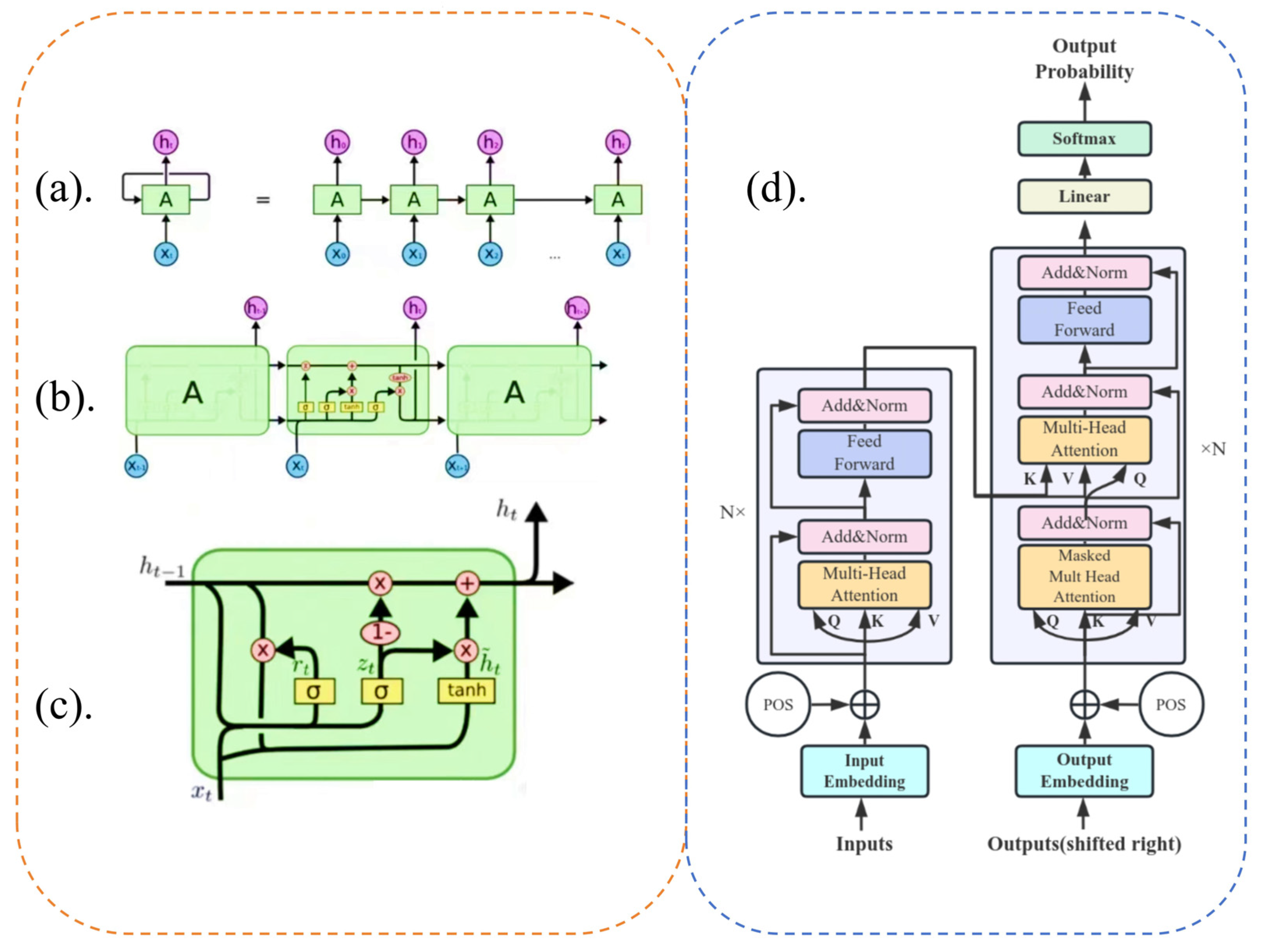
Among the initial approaches, Recurrent Neural Networks (RNNs) were engineered to process sequential time data by incorporating a self-recurrent mechanism through hidden states. This architecture enabled information to be conveyed across discrete time steps (illustrated in Figure 2a). Notwithstanding this innovation, RNNs exhibit a well-documented susceptibility to the vanishing or exploding gradient problem, particularly during training on extended sequences. This inherent limitation consequently degrades their performance and limits their efficacy when applied to complex time-series analysis tasks [40].
To overcome these limitations, Long Short-Term Memory (LSTM) networks were proposed. LSTMs utilize a sophisticated gated mechanism, which comprises an input gate, a forget gate, and an output gate. This structure is designed to precisely regulate the flow of information—specifically, its storage, modification, and selective removal (as depicted in Figure 2b). This architectural design effectively mitigates the well-known exploding gradient problem, concurrently augmenting the model’s capability to capture long-term temporal dependencies that are inherent within time-series data [41]. Subsequently, the Gated Recurrent Unt (GRU) was introduced as a computationally streamlined variant of the LSTM, designed for architectural simplification. The GRU architecture achieves this simplification by amalgamating the input and forget gates into a unified ‘update gate’ and by integrating the cell state directly with the hidden state (illustrated in Figure 2c). This modification yields a model that is computationally more efficient yet often yields performance comparable to that of the standard LSTM [40].
The introduction of the Transformer model, illustrated in Figure 2d, marked a revolutionary transformation within the domain of sequence modeling. As delineated in the seminal paper “Attention Is All You Need,” the Transformer architecture fundamentally diverges from prior models by eschewing recurrent structures; it relies instead upon a multi-head self-attention mechanism engineered to facilitate parallel processing. In the context of forecasting, temporal Transformers replace recurrence with self-attention, enabling parallel training and improved modeling of long-range dependencies in time series [42]. This architectural paradigm permits the model to dynamically allocate attention across disparate segments of a sequence—conceptually analogous to RNN/LSTM models but avoiding vanishing gradients by attending directly across distant time steps. Consequently, the model exhibits exceptional performance, most notably in its application to large-scale time-series datasets. Specific to sea ice applications, temporal Transformers can be applied to basin-scale indices or to tokenized representations of gridded fields. While the substantial resource consumption associated with the Transformer model constitutes a notable limitation, subsequent derivative architectures exemplified by the Temporal Fusion Transformer (TFT) have successfully extended its applicability within the time-series domain.
Sequential models are the predominant methodology in cryospheric time-series analysis. For sea ice extent, these models integrate satellite and climatological data to characterize complex dynamic and thermodynamic interactions. Meanwhile, sea ice thickness forecasting relies on historical time-series training, enabling deep learning architectures to capture temporal evolution patterns and ensure predictive reliability.

3.2. Image Learning Models

The ascendancy of deep learning within the image processing domain has precipitated a fundamental paradigm shift in computer vision, catalyzing a methodological evolution from antecedent approaches reliant upon manual feature engineering to sophisticated, end-to-end learning frameworks. This transformative shift has not only yielded marked improvements in the precision of foundational tasks such as image classification, segmentation, and generation, but has also substantially broadened the applicability of these technologies across diverse sectors, including medical diagnostics, remote sensing analysis, and autonomous navigation systems. Concurrently, progressive developments in computational infrastructure and algorithmic innovation have enhanced models’ capacity to discern both pixel-level details and global semantic information with greater efficacy, thereby accelerating the sophisticated automation and cognitive processing required for complex visual tasks.
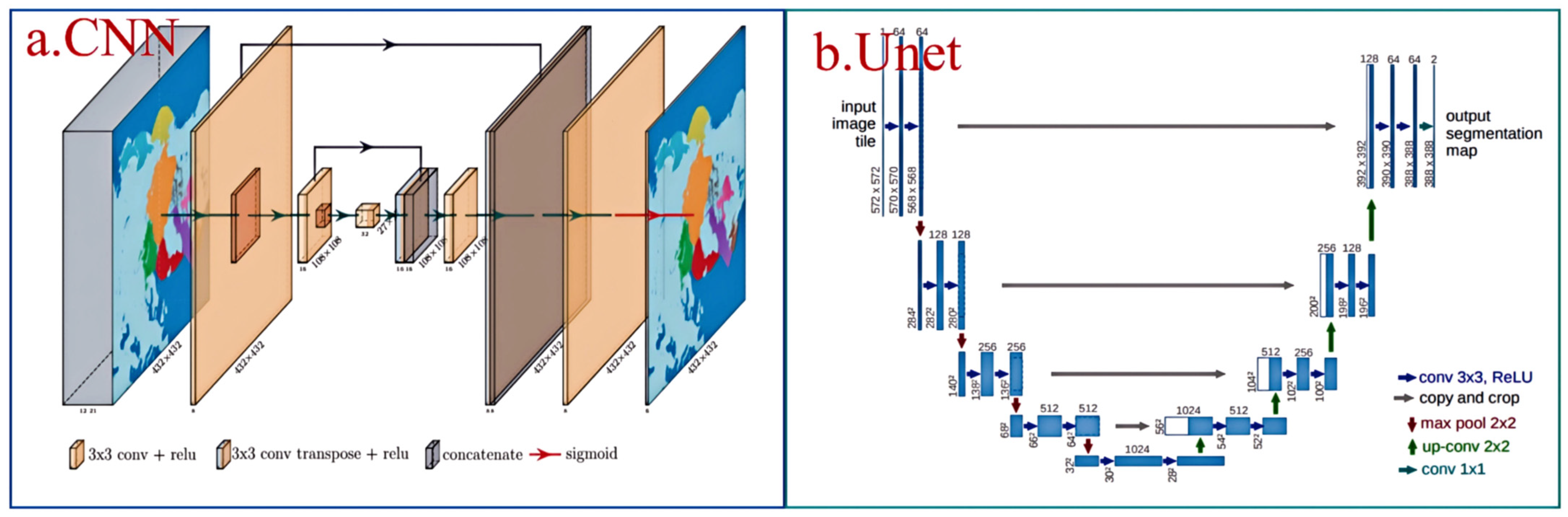
In response to this requirement, Fully Convolutional Networks (FCN) heralded a paradigm shift from classification to dense prediction (Figure 3a). By replacing fully connected layers with a fully convolutional architecture, FCNs enabled end-to-end segmentation capabilities applicable to inputs of arbitrary dimensionality. The U-Net architecture (Figure 3b), introduced as an extension, utilized a symmetric encoder–decoder pathway augmented by skip connections, yielding substantial enhancements in performance for medical imaging—particularly in applications such as the precise delineation of tumor boundaries. This architectural design proved effective in facilitating the integration of low-level feature representations with high-level semantic context [43,44].
Contemporaneously, the introduction of Generative Adversarial Networks (GANs) significantly advanced the generative capabilities within image processing. GANs achieve realistic image synthesis through an adversarial training regimen involving a generator and a discriminator. Subsequent iterations, notably StyleGAN, integrated style-based control mechanisms, thereby broadening their applicability to domains such as artistic content generation and high-resolution facial synthesis [46,47]. Notwithstanding the breakthroughs these methods achieved in local feature representation and adversarial learning, their efficacy in capturing global contextual dependencies remained a notable limitation, necessitating further optimization. This limitation consequently catalyzed the exploration and integration of attention mechanisms and Transformer-based architectures.
To address the local receptive-field limitations of purely convolutional encoders, Vision Transformers (ViT) and hierarchical variants such as Swin-Transformers treat an image as a set of patch tokens and use self-attention to model long-range spatial dependencies. Unlike temporal Transformers (used for time-series forecasting), these vision models are designed for spatial fields and are particularly effective for segmentation, classification, and high-resolution reconstruction in remote-sensing imagery. In practice, hybrid CNN–Transformer designs are also common, combining convolutional inductive biases with attention-based global context.
Visual models in remote sensing image processing are vital for automated monitoring and quantitative assessment of sea ice dynamics, supporting decision-making in climate research and environmental management. Using satellite-derived data (e.g., SAR and optical imagery), they analyze sea ice extent, concentration gradients, and melt processes, revealing global warming’s impacts on polar ecosystems [48,49]. Various model architectures serve specific roles: image segmentation models delineate sea ice boundaries via pixel-level classification for precise area/thickness measurement and multi-temporal change tracking; object detection models locate anomalous sea ice events (e.g., lead formation, melt pond expansion) for rapid screening of large-scale datasets and prioritized risk assessment [50,51,52]; and image classification models distinguish discrete ice types (e.g., new ice, multi-year ice, brash ice) by extracting distinguishing textural and spectral features, enhancing the accuracy of sea ice change detection and furnishing reliable foundational data for predictive modeling.

3.3. Spatiotemporal Learning Models

As a prominent sub-field within deep learning, spatiotemporal learning is characterized by its defining objective: the concurrent modeling of spatial correlations and temporal dynamics inherent in complex datasets. This intrinsic dual complexity underpins its critical applicability across a spectrum of domains, such as traffic flow forecasting, meteorological prediction, video content analysis, and Earth system monitoring. Distinct from methodologies focused exclusively on either temporal or spatial dimensions, spatiotemporal learning must address the formidable high-dimensional challenges posed by spatial heterogeneity, temporal non-stationarity, and the intricate interplay of these spatiotemporal actors [53].
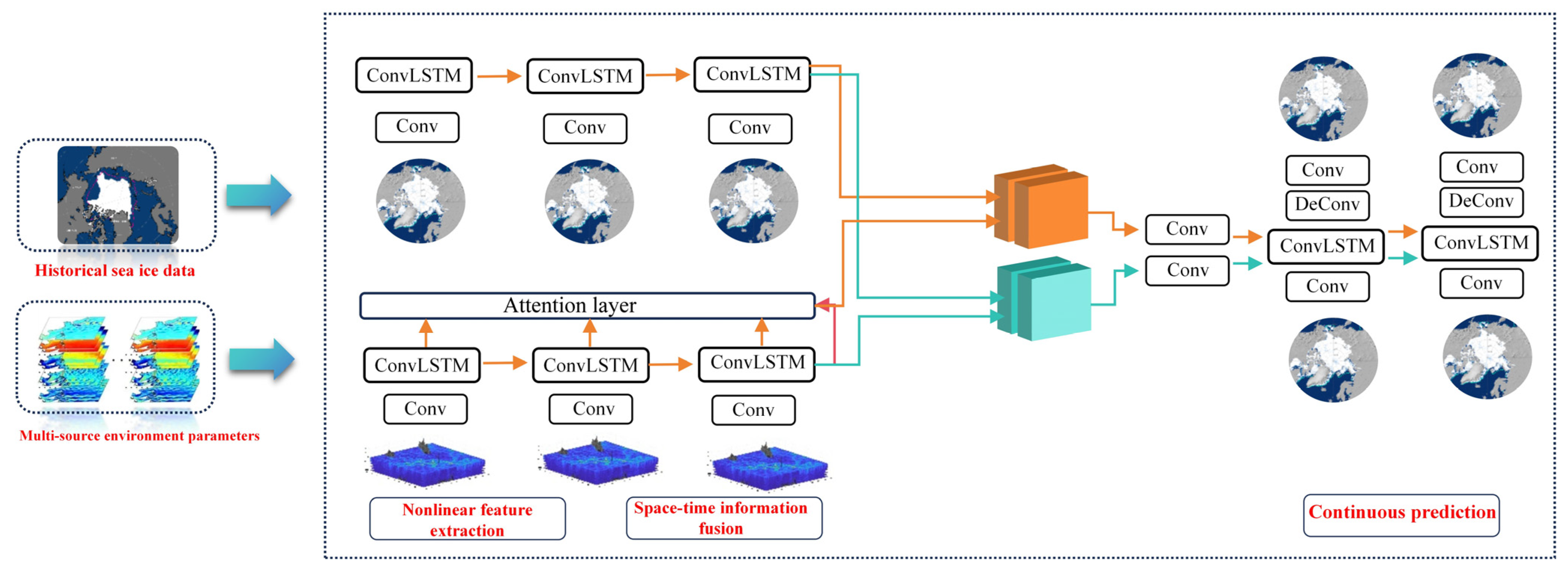
Current research in deep learning for spatiotemporal forecasting is predominantly structured around three distinct paradigms. The initial paradigm centers on spatiotemporal fusion methodologies utilizing convolutional operations; prominent examples, including the Convolutional Long Short-Term Memory (ConvLSTM) [53] and PredRNN [54] series, achieve the joint modeling of spatial features and temporal evolution by integrating convolutional computations directly within recurrent neural units. A secondary paradigm involves the integration of Graph Neural Networks (GNNs) with sequential modeling techniques. This approach, exemplified by models such as DCRNN [55] and STGCN [56], is expressly engineered for non-Euclidean spatial data. These models function by capturing intricate dependencies within irregular spatial structures through graph convolutions, while simultaneously managing temporal dynamics via sophisticated gating mechanisms. The tertiary paradigm is characterized by spatiotemporal architectures that leverage attention mechanisms. In these frameworks, illustrated by STAR and STemGNN [57], the synergistic interplay of spatial and temporal attention facilitates an adaptive focus on salient spatiotemporal features.
Early spatiotemporal approaches for sea ice commonly relied on ConvLSTM and related recurrent-convolutional hybrids [53], which integrate convolutional feature extraction with temporal recurrence. While foundational, ConvLSTM can be computationally expensive and may struggle to retain information over long lead times. Recent research therefore increasingly explores more efficient architectures, including attention-based space–time Transformers (e.g., Earthformer; [58]) and neural-operator methods such as the Fourier Neural Operator (FNO; [59]) that can better scale to high-resolution fields and long-range dependencies.
In sea ice applications, spatiotemporal models are often combined with multi-task learning, uncertainty estimation, and physical constraints to improve robustness. Physics-informed learning and hybrid data–model frameworks are particularly promising for reducing physically implausible artifacts (e.g., unphysical discontinuities or mass inconsistencies) and for improving generalization under non-stationary climate conditions.
The main advantage of spatiotemporal learning models in sea ice research is their ability to capture spatial heterogeneity and temporal dynamics simultaneously. Architectures like ConvLSTM and 3D-CNN help track the sea ice edge migration and monitor sea ice concentration by integrating multi-temporal remote sensing data. This end-to-end learning paradigm improves the precision of sea ice parameter retrieval and the model’s adaptability to complex conditions. Spatiotemporal predictive models are a significant innovation in short-term and seasonal sea ice forecasting [21,53,60,61]. Spatiotemporal Graph Neural Networks (ST-GNNs) and Spatiotemporal Transformer architectures can model long-range spatiotemporal dependencies in the sea ice system. They are effective in capturing multi-scale interactions in atmosphere–ocean–sea-ice processes (see Figure 4) [62]. Using physics-constrained, data-driven methods, these models explain complex sea ice dynamics and outperform traditional numerical models in tasks like Arctic sea ice extent prediction and Antarctic sea ice anomaly detection. They also offer new ways to retrieve sea ice physical parameters and improve understanding of underlying processes. RNNs and their variants are proficient in interpolating and extrapolating satellite observation data with irregular temporal distributions. They can reconstruct sea ice conditions in cloud-obscured regions and generate spatiotemporally continuous sea ice datasets. Integrating attention mechanisms and memory augmented modules allows these models to identify and prioritize key spatiotemporal features of sea ice variability. This advancement provides data-driven support for understanding the feedback between sea ice and climate [63].

4. Applications of Deep Learning in Sea Ice Change

Polar sea ice variability is a critical indicator of the global climate system with profound implications for Earth’s energy balance, ocean circulation, polar ecosystems, and maritime activities. Sea ice dynamics result from complex interactions between the atmosphere, ocean, and cryosphere, regulated by physical parameters such as ice thickness, concentration, and surface temperature. External factors—including anthropogenic warming, oceanic heat transport, and meteorological variability—substantially influence sea ice patterns. The nonlinear feedback mechanisms inherent in these systems complicate accurate prediction using traditional models, motivating the adoption of data-driven approaches [39,64,65].
Recent advancements in deep learning have demonstrated a robust capability for automatically extracting sea ice characteristics from multi-source satellite observations [49]. The synergy between deep learning and advanced satellite remote sensing technologies—such as Synthetic Aperture Radar (SAR), passive microwave radiometers, and optical sensors—has provided researchers with novel methodologies for monitoring and predicting sea ice dynamics [66]. Leveraging this synergy, research efforts are broadly categorized into two primary domains.
The first domain centers on the real-time monitoring and forecasting of sea ice, utilizing multi-source remote sensing data (including SAR imagery, passive microwave data, and optical-infrared observations) in conjunction with environmental data (e.g., atmospheric temperature, ocean temperature, wind fields, and ocean currents) to predict short-term and seasonal variations in sea ice. This domain encompasses critical tasks such as sea ice concentration (SIC) forecasting [36] and sea ice thickness (SIT) estimation [67]. Another key domain involves sea ice drift forecasting, which aims to predict the future position and velocity of sea ice based on historical motion trajectories and key atmospheric and oceanic drivers [68].
In parallel, scholarly efforts have been directed towards the development of algorithms for sea ice classification and edge detection, each serving distinct yet complementary objectives. Sea ice classification represents a holistic paradigm, employing deep learning algorithms to differentiate among diverse ice types (e.g., first-year ice, multi-year ice, thin ice) and to quantify their relative distributions [69]. This methodology is crucial for elucidating the age structure of sea ice and evaluating its susceptibility to climate change. Conversely, sea ice edge detection leverages semantic segmentation techniques as a fine-grained, pixel-based methodology for the precise delineation of the interface between open water and sea ice [70], yielding a pixel-level accurate definition of sea ice extent, thereby furnishing critical data for applications in navigational safety, ecosystem management, and climate model validation.
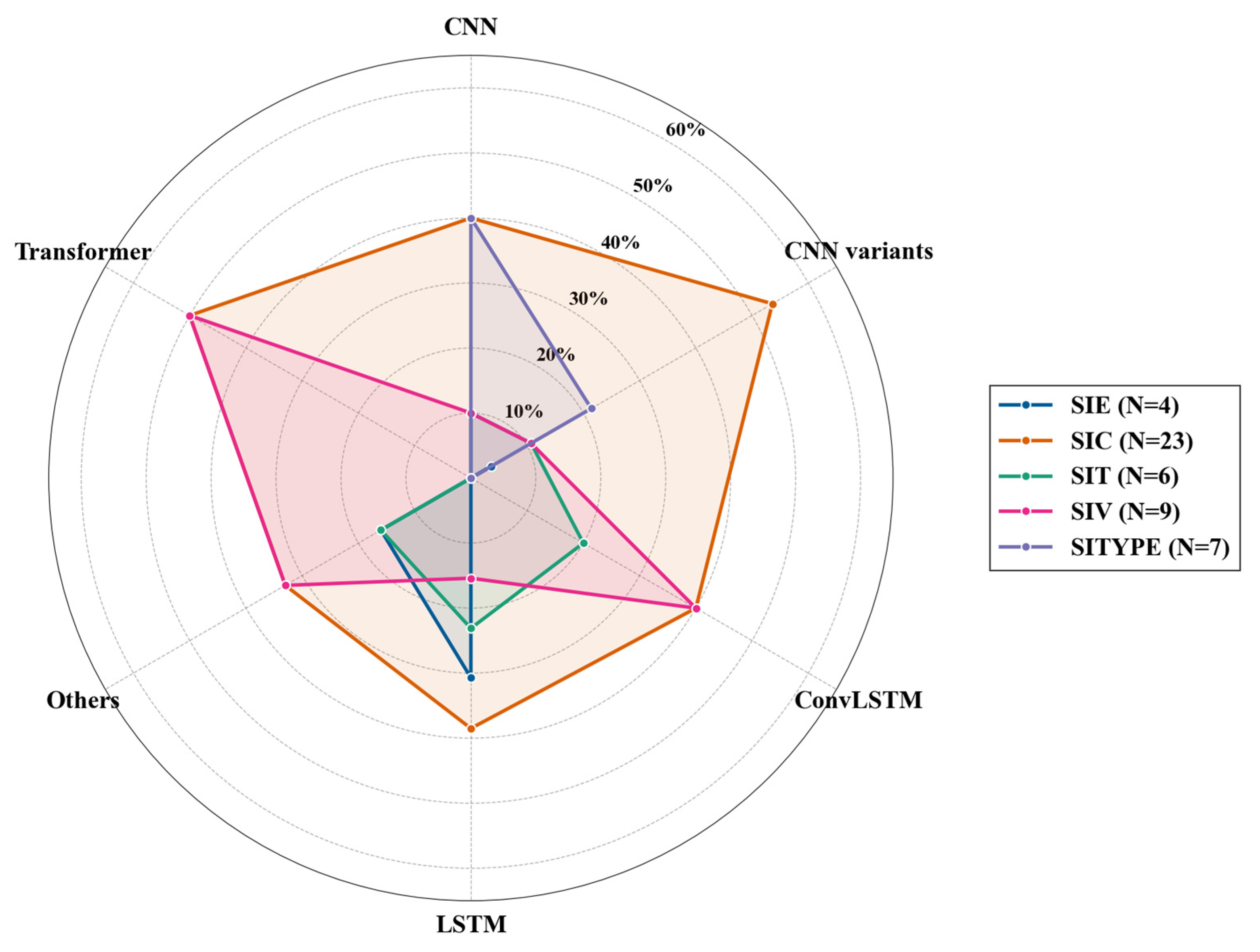
Current trends in model selection reveal a distinct correlation between the target task and the preferred deep learning architecture (Figure 5). Tasks dominated by spatial pattern recognition, such as sea ice segmentation and type classification from SAR/optical imagery, commonly rely on convolutional neural network (CNN)/U-Net style encoders and their attention-enhanced variants. In contrast, forecasting problems that require modeling long temporal dependencies increasingly adopt temporal Transformers or hybrid spatiotemporal architectures. Recent studies also explore neural operators and state-space models to improve computational efficiency and long-range memory, indicating a gradual shift beyond ConvLSTM-centric designs.

4.1. Short-Term Sea Ice Forecasting

Deep learning models are data-driven and can approximate complex, nonlinear relationships in the sea ice system without explicitly solving the underlying thermodynamic-dynamic equations. For operational applications, short-range forecasts (roughly 1–10 d) typically target SIC, ice edge position, and/or sea ice drift to support navigation along Arctic routes. Early work emphasized sequence models to represent temporal dependence. Chi and Kim (2017) [71] demonstrated that a fully data-driven neural network can skillfully predict pan-Arctic SIC at a monthly lead time. Building on this line, Kim et al. (2020) [36] integrated satellite SIC with reanalysis-based oceanic and atmospheric predictors in a CNN framework for one-month SIC forecasting, reporting an anomaly correlation coefficient of 0.98 and a Root Mean Square Error (RMSE) of 5.76% over hindcast validations. For truly day-to-day route support, Liu et al. (2021) [72] developed a ConvLSTM-based daily SIC prediction model for the Northeast Passage; in 10-day iterative forecasts, ConvLSTM achieved a higher average structural similarity (SSIM = 0.923) and lower RMSE (11.238%) than a CNN baseline.
In parallel, the rapid adoption of CNNs in remote-sensing image analysis has improved the representation of fine-scale spatial patterns (e.g., marginal ice zones and coastal complexity) that are often blurred in coarser statistical models. A key development has been the use of fully convolutional encoder–decoder networks (U-Net-type architectures) for gridded forecast fields and for ice-edge-sensitive metrics. Palerme et al. (2024) [16] demonstrated that supervised deep-learning post-processing can substantially improve short-term (1–10 d) SIC forecasts from the TOPAZ4 prediction system by combining dynamical model outputs, weather forecasts, and satellite SIC observations as predictors. Their U-Net-based models reduced RMSE by 41% relative to raw TOPAZ4 forecasts and by 29% relative to persistence, while also improving ice-edge location skill.
More recently, attention-based architectures have been explored to better capture long-range spatial–temporal dependencies. proposed SICFormer [73], which uses a 3D-Swin Transformer encoder for end-to-end daily SIC prediction and reported strong 8-day forecast performance (mean MAE 1.89%, RMSE 5.99%, NSE 0.98). At longer lead times, probabilistic systems such as IceNet [38] provide calibrated probabilities for whether SIC exceeds 15%, supporting risk-aware decision making. The push toward kilometer-scale products has also motivated high-resolution deep-learning systems. Kvanum et al. (2025) [74] presented a short-term, high-resolution forecasting system that predicts sea ice charts at 1 km resolution for 1–3 d lead times and achieves lower contour-based errors than both simple baselines and two dynamical systems.
Despite these advances, purely data-driven models can suffer from physical inconsistency and limited robustness under regime shifts or data sparsity. Two complementary directions have therefore attracted increasing attention: (i) physics-constrained learning and (ii) interpretability/diagnosis. For example, Liu et al. (2024) [75] proposed dual-task models for SIC and sea ice velocity that incorporate dynamic constraints from sea ice control equations directly into the loss function, improving the physical plausibility of short-term predictions. For interpretability, Hoffman et al. (2023) [76] compared linear regression and CNN approaches for daily Arctic sea ice motion forecasting and emphasized the role of physically meaningful predictors such as wind velocity and the prior-day ice state, providing a transparent basis for understanding model behavior. Finally, observational advances remain essential for expanding forecast targets beyond SIC
Looking ahead, persistent challenges include class imbalance (especially near the ice edge), incomplete representation of coupled ocean–ice–atmosphere feedbacks, and the lack of standardized, community-wide benchmarks. Promising research directions include self-supervised pretraining on large spatiotemporal archives, joint multivariate modeling of concentration–drift–thickness, deeper physics–ML hybridization, and transparent evaluation protocols that quantify both skill and uncertainty for decision support.

4.2. Long-Term Sea Ice Forecasting

DL to long-term sea ice forecasting has delivered major advances in recent years, largely by formulating sea ice variability as a complex spatiotemporal sequence prediction problem and exploiting intrinsic memory effects in the climate system to achieve skillful predictions from seasonal to interannual timescales. While early seasonal-forecasting efforts often relied on data-driven improvements to traditional statistical models, the development of the IceNet system by Andersson et al. (2021) [39] represents a landmark step for DL in this field; it uses a U-Net ensemble architecture—an image-to-image convolutional network that has proven highly effective for learning precise pixel-level mappings—pre-trained on CMIP6 climate simulations (1850–2100) and then fine-tuned on observational records (1979–2011) to produce probabilistic forecasts of monthly mean SIC at lead times of up to six months. Empirical evidence indicates that IceNet surpasses leading physics-based/dynamical models in seasonal Arctic sea ice prediction, showing higher summer binary accuracy at 2–4-month lead times than the ECMWF SEAS5 system, and it has also emerged as a widely used benchmark for extreme summer probabilistic sea ice forecasting by providing skillful predictions of sea ice events, concentration, and ice-edge metrics at subseasonal lead times [39]. Its performance is particularly notable for extremes, including the 2012 record-low minimum, the anomalous 2013 high, and the 2020 s-lowest minimum sea ice extent, marking the first documented case of a DL-based model achieving seasonal forecast skill beyond state-of-the-art dynamical models while offering improved uncertainty quantification through calibrated confidence levels. Nevertheless, as a purely data-driven approach and a significant departure from prior deterministic, physics-constrained models, IceNet directly predicts the probability of sea ice occurrence without explicitly enforcing physical constraints (e.g., conservation of sea ice mass/volume or energy balance), and it can therefore yield physically inconsistent fields under certain conditions (for instance, spurious local gains/losses that do not conserve integrated quantities over space). In addition, like other supervised CNN-based models, its performance depends on the stationarity of the training distribution and may degrade under regime shifts or truly unseen extremes. These limitations motivate PINN and hybrid data–model approaches that incorporate governing equations, process constraints, or numerical-model priors to enhance physical consistency and improve out-of-distribution robustness.
As research extends to interannual timescales, the synthesis of multivariate data and the elucidation of underlying physical mechanisms have emerged as pivotal areas of inquiry. Kim et al. (2025) [77] formulated a U-Net-based deep learning architecture tailored to Arctic sea ice prediction, which assimilates heterogeneous environmental parameters including surface temperature, solar radiation, and wind fields. This model demonstrates high-fidelity forecasting capabilities for SIC with a lead time of up to 12 months. Hindcast validation procedures spanning the 2001–2022 period confirmed that the model’s RMSE for 3–12-month forecasts was 7.07–17.35% lower than those of the Copernicus C3S climate prediction system and the damped anomaly persistence model. Furthermore, a variable importance analysis elucidated that historical SIC and sea surface temperature (SST) are instrumental to predictive accuracy within the marginal ice zone (MIZ). In contrast, solar radiation and wind fields were identified as more pronounced determinants of predictive accuracy in thin ice regions. This finding quantifies the synergistic interplay between thermodynamic and dynamic processes in the context of extended-range prediction.
Wei et al. (2022) [60] utilized an attention-enhanced LSTM network for multi-source data fusion, resulting in a 15–20% enhancement in seasonal forecast skill for September Arctic sea ice extent, relative to persistence-based predictions. Furthermore, the model’s attention weights elucidated the critical influence of early spring sea ice conditions on subsequent summer melt, thereby corroborating the temporal scale of the sea ice memory effect. In a comparable study, Wang (2025) [78] implemented an LSTM-based Seq2Seq strategy, leveraging 24 months of historical data to forecast sea ice extent over the succeeding 12-month period. This methodology yielded an RMSE of merely 3.30 × 10⁵ km2, significantly surpassing traditional methods, such as recursive prediction, and underscoring the superior capability of the sequence-to-sequence architecture in capturing long-range temporal dependencies.
A major challenge for seasonal sea ice concentration forecasting is the Spring Predictability Barrier (SPB), in which forecast skill often drops for summer outcomes when initialized in spring. Physically, spring sea ice concentration acts as a weak predictor for subsequent summer melt because concentration is frequently near saturation (≈100%) and is strongly influenced by dynamic redistribution. In contrast, the melt-season evolution depends heavily on the ice’s thermodynamic state (heat content) and ocean–atmosphere energy fluxes. Deep learning models that fuse sea ice concentration with supplementary physical constraints therefore have a stronger basis for bridging the SPB.
Zhu et al. (2023) [79] addressed this by incorporating atmospheric drivers. They introduced the Attention Convolutional Long Short-Term Memory Ensemble Network (Atsicn), a model that integrates atmospheric factors—including air temperature and pressure—with linear sea ice trend data. By optimizing predictive accuracy via the dynamic weighting of key variables, the Atsicn model attained a 3-month lead forecast correlation coefficient of 0.93 during validation (2012–2022), representing a 12% improvement over standard CNN models. Moreover, it achieved a 30% reduction in prediction errors during extreme anomaly years (e.g., 2012, 2016), demonstrating the efficacy of the ensemble strategy. However, to fully capture the ice’s thermodynamic state, SIT is critical. SIT provides the missing “thermal memory”: thicker ice has larger latent-heat content and is more resilient to melt, allowing spring SIT anomalies to better constrain late-summer survival. Recognizing this, Ren et al. (2025) [80] presented a subsequent advancement with the SICNetseason model, which fuses a Swin-Transformer architecture with spring SIT data. This model enhanced the prediction skill for September Arctic sea ice extent (SIE) by 7–10% and improved edge delineation accuracy by 14%. Critically, the inclusion of spring SIT data accounted for over 20% of the observed enhancement, successfully surmounting the challenge where conventional models fail prior to May.
The long-range forecasting of Antarctic sea ice presents considerable challenges, primarily attributable to its unique climate-driven mechanisms. Contemporary scientific inquiry has increasingly focused on the quantification of teleconnection impacts originating from large-scale climate modes. In this context, the Subseasonal Prediction Network (SIPNet) model, developed by Wang et al. (2023) [81], employs a deep learning framework to evaluate the influence of the El Niño-Southern Oscillation (ENSO) and the Southern Annular Mode (SAM) on the subseasonal predictability of Antarctic sea ice within distinct geographic sectors. The findings reveal that the highest degree of predictability is observed during the autumn season, whereas predictability is demonstrably lower within the Western Pacific sector. Furthermore, the model effectively captures the complex modulatory influences of ENSO and SAM signals on the overall variability of sea ice.
Wang et al. (2025) [17] employed SIPNet to further quantify the influence of distinct ENSO phases on the predictability of Antarctic sea ice across multiple timescales. For forecasts with an 8-week lead time, El Niño events amplified atmospheric teleconnections, consequently elevating linear predictability within the Amundsen-Bellingshausen Seas, Ross Sea, and Indian Ocean sector by 25.6%, 19.6%, and 30.4%, respectively. In contrast, La Niña events yielded significant enhancements in predictability specifically within the Ross Sea, an effect ascribed to the intensification of nonlinear ocean–atmosphere coupling processes. These findings indicate that ENSO functions as an auxiliary source of predictability through the generation of more extensive sea ice anomalies, thereby substantiating tropical-polar teleconnection mechanisms. Separately, Lin et al. (2025) [82] developed Ice-kNN-South, a computationally efficient model for Antarctic sea ice, employing a k-nearest neighbors (kNN) algorithm to predict sea ice concentration anomalies. The model demonstrates substantial advancements in seasonal-scale forecasting without requiring iterative processes, exemplifying an equilibrium between computational efficiency and predictive accuracy within machine learning frameworks.
To address the persistent challenges of data scarcity and the preservation of physical consistency, hybrid methodologies coupled with interpretability analysis constitute a key frontier in contemporary research. A ConvLSTM network, developed by Dong et al. (2024) [83] specifically for Antarctic sea ice, integrates ocean–atmosphere variables across multiple timescales. This approach achieves enhanced seasonal forecasting performance by capturing critical spatiotemporal coupling characteristics. Significantly, the model demonstrates a reduction in prediction error within critical regions, such as the Weddell and Ross Seas, of 18–25% relative to the persistence benchmark. In addressing the nonlinear characteristics of the Sea Ice Predictability Index (SPI), a coupled framework has been introduced, integrating Self-Organizing Maps (SOM) with feed-forward neural networks to quantify the joint effects of factors such as sea ice thickness and boundary constraints. Illustratively, the SICNet-season model, which fuses spring thickness data with a Transformer architecture, not only demonstrates improved prediction accuracy but also facilitates the identification of key spatiotemporal driving patterns via interpretability analysis. This subsequent analysis serves to validate the physical plausibility of the underlying mechanisms learned by the model.
Despite progress, long-term sea ice forecasting remains constrained by critical bottlenecks: abbreviated observational data time series (satellite records 1979) limiting model generalization for decadal variability, paucity of extreme event data degrading fidelity under rapid climate change, and divergent Arctic-Antarctic responses to climate drivers requiring regionally adaptive models. Key research directions include integrating paleoclimate proxies with reanalysis datasets to extend training temporal horizons, developing causal inference-based deep learning architectures to distinguish physical linkages from spurious correlations, constructing physics-constrained neural networks ensuring energy/momentum conservation in long-term forecasts, and establishing a unified polar benchmarking platform for systematic evaluation of methodology efficacy in predicting extreme events, interannual variability, and secular trends. The overarching goal is full-spectrum forecasting capabilities spanning seasonal to decadal timescales, providing robust scientific underpinning for polar climate assessments and adaptive strategy formulation.
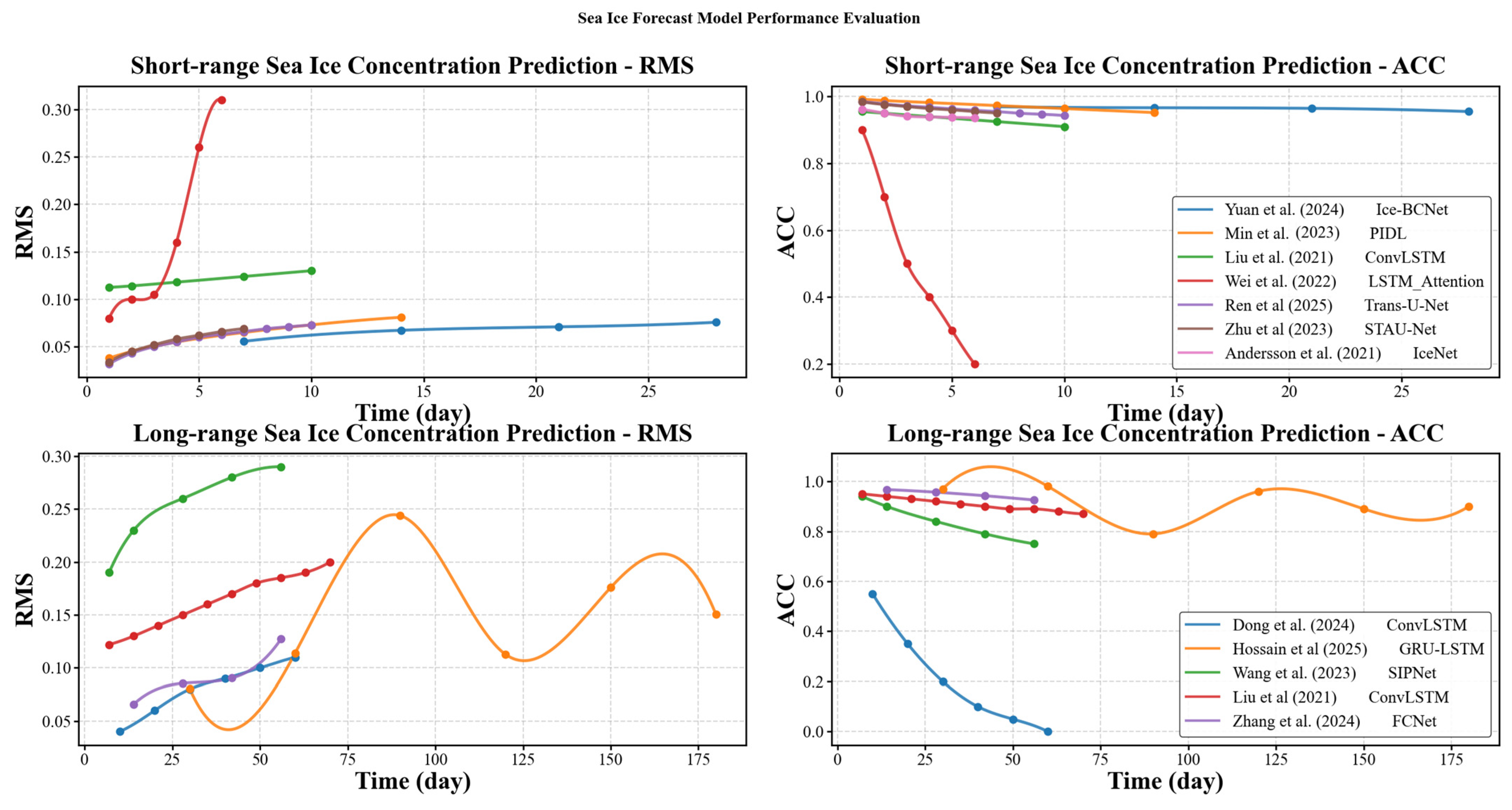
The comparative performance of these emerging architectures is quantitatively synthesized in the accompanying Figure 6, “Sea Ice Forecast Model Performance Evaluation.” The visual analysis distinguishes between short-range (0–25 days) and long-range (0–180 days) forecast horizons across two key metrics: Root Mean Square (RMS) error and Anomaly Correlation Coefficient (ACC). In the short-range domain, architectures such as Ice-BCNet and PIDL demonstrate exceptional stability, maintaining low RMS values (below 0.10) and high ACC scores (above 0.95) with minimal degradation over time. In contrast, the specific attention-based LSTM variants analyzed exhibit a steeper error accumulation trajectory. The long-range evaluation reveals a more pronounced divergence in model capability among the specific studies analyzed. The GRU-LSTM model introduced by Hossain et al. (2025) [84] displays oscillating RMS patterns. Rather than implying a recovery of predictive skill, these oscillations likely reflect the model’s response to the natural, expected seasonal variations in sea ice predictability. Conversely, the ConvLSTM implementation by Dong et al. (2024) [85] shows a sharp decline in ACC beyond the 50-day mark. This visual evidence reinforces the textual findings: while short-term forecasting has achieved high-fidelity precision in these reported cases, long-term prediction remains a complex challenge requiring sophisticated handling of seasonal memory effects and nonlinear climate interactions.

4.3. Sea Ice Concentration and Extent Forecasting

The forecasting of SIC constitutes a pivotal task within polar climate research and marine environmental monitoring. SIE, which is fundamentally contingent upon the spatial distribution of SIC, is utilized for monitoring trends in polar ice cover. This objective specifically entails predicting the spatiotemporal evolution and variability of the ice cover. This undertaking is rendered exceptionally challenging, owing to the profound complexity of sea ice-atmosphere-ocean interactions and the system’s inherent multi-scale variability. Despite these complexities, DL methodologies, given their capacity to process high-dimensional data and capture complex nonlinear relationships, present innovative solutions to this intricate challenge. Within this domain, two principal deep learning frameworks are predominantly employed: time-series frameworks and spatiotemporal fusion frameworks. Time-series frameworks are primarily dedicated to capturing the temporal evolution patterns of SIC. In contrast, spatiotemporal fusion frameworks are engineered to concurrently integrate spatial distribution characteristics with temporal dynamic patterns, thereby enabling a more comprehensive and holistic analysis.
Time-series frameworks employ deep sequential networks to model SIC temporal dynamics and forecast future evolution. Trained on historical observations and environmental variables (SST, atmospheric temperature, wind speed, ocean heat flux, pressure fields), these networks capture complex nonlinear interactions and temporal interdependencies for high-fidelity predictions.
In seminal investigations, RNN and LSTM networks were among the initial deep learning architectures leveraged for sea ice prediction, chosen for their intrinsic capacity to process sequential data. Chi and Kim (2017) [71] pioneered the application of deep neural networks to forecast Arctic sea ice concentration. Their methodology involved the construction of an LSTM-based architecture designed to analyze historical sea ice data alongside relevant meteorological variables. This investigation substantiated the enhanced efficacy of deep learning approaches over conventional statistical models, particularly in capturing complex nonlinear relationships. Consequently, the study provided a critical foundation for subsequent research in this field [71]. LSTM networks have emerged as a primary methodology for SIC prediction, owing to their distinct efficacy in capturing long-term temporal dependencies. Building upon this, Wei et al. (2022) [60] developed an attention-mechanism-enhanced LSTM prediction system specifically for pan-Arctic monthly sea ice forecasting. The proposed model utilizes historical SIC observational data spanning the period 1979–2020 and employs an attention mechanism to discern the temporal variation patterns from the observational data [61]. Findings from the study indicated that the integration of this attention mechanism significantly enhanced the model’s predictive accuracy for sea ice. Specifically, a correlation coefficient of 0.8 was achieved for the one-month lead forecast of sea ice extent anomalies relative to observed values [61].
The GRU, a streamlined version of LSTM, offers greater computational efficiency without sacrificing performance, making it widely used in sea ice prediction. A recent hybrid model combining GRU and LSTM was developed to predict Arctic sea ice extent [64]. Using a 43-year dataset of ocean–atmosphere variables and methods like MVGC and PCMCI+, the study identified causal predictors, improving prediction robustness and interpretability by focusing only on causal drivers. Meanwhile, the Transformer architecture has shown strong potential in sea ice forecasting. Mu et al. (2023) [89] proposed the IceTFT model for long-term Arctic sea ice prediction. It includes a variable selection network, an LSTM encoder, and multi-head attention, enabling 12-month forecasts based on prior 12-month data. The model uses LSTM for local information and attention for long-range dependencies, achieving high accuracy with less than 0.21 × 10⁶ km2 average monthly error and below 0.1 × 10⁶ km2 for nine-month-ahead September forecasts.
Spatiotemporal Fusion Framework: A hybrid spatiotemporal framework, which integrates the spatio-analytical capabilities of CNN with the temporal modeling proficiency of RNN, exhibits notable efficacy in the prediction of SIC. Within this methodology, the spatial networking module extracts and analyzes spatial features derived from satellite remote sensing imagery and gridded sea ice data. This process facilitates the identification of critical patterns, including the sea ice edge, leads and polynyas, and regional sea ice distribution patterns. Subsequently, these extracted high-level features are utilized as sequential input for a temporal network, such as a standard RNN, an LSTM, or a GRU. These networks are highly adept at capturing complex temporal dependencies, encompassing seasonal variations and inter-annual trends inherent in sea ice dynamics. This integrated framework, therefore, facilitates a comprehensive and holistic analysis of the spatiotemporal aspects of sea ice dynamics, thereby yielding more accurate and reliable SIC forecasts.
Driven by rapid advancements in deep learning methodologies, an increasing body of research has initiated systematic comparisons of the performance of different architectures in sea ice forecasting(see Table 1). A deep learning methodology based on the ConvLSTM architecture was proposed by Liu et al. (2021) [86] for the prediction of sea ice in the Barents Sea, across temporal scales ranging from synoptic (weather) to sub-seasonal. As an unsupervised learning paradigm, this approach utilizes historical datasets and leverages the covariance among disparate variables, thereby incorporating complex spatial and temporal interrelationships [86]. By utilizing input fields derived from reanalysis data, the investigation demonstrated that ConvLSTM effectively captures the variability of Arctic sea ice and generates skillful forecasts of regional sea ice concentration over weekly to monthly durations [86]. Furthermore, the research employed both ConvLSTM and PredRNN++ models for continuous 10-day, short-term daily forecasting of sea ice concentration; the results indicated that ConvLSTM outperformed the PredRNN model, particularly under conditions where the input was restricted solely to historical sea ice concentration data [86].
A recent study introduced the SICFormer model, which leverages a 3D-Swin Transformer as its encoder and integrates a PixelShuffle-based decoder to reconstruct the predicted image [74]. The model was trained and evaluated using a dataset comprising daily SIC observations sourced from the NSIDC, covering the period from 2006 to 2022. In an empirical evaluation of 8-day short-term forecasting, the SICFormer model achieved a five-year average performance on the test set, registering a Mean Absolute Error (MAE) of 1.89% and a RMSE of 5.99% [74]. A key component, the 3D-Swin Transformer, extends the sliding window mechanism into the temporal dimension, facilitating the concurrent execution of window sliding operations and the computation of spatiotemporal attention scores across both spatial and temporal channels. This architectural design enables the model to effectively capture localized, time-specific features while modeling the intricate spatiotemporal dependencies between a given point, its spatial neighbors, and adjacent time steps.

4.4. Sea Ice Thickness Estimation

The estimation of SIT constitutes a critical component of climate monitoring and polar navigation, which involves assessing the probability and spatial extent of sea ice formation and persistence under diverse environmental conditions. Notwithstanding the significant complexity inherent in sea ice dynamics, rapid advancements in deep learning methodologies have markedly enhanced SIT estimation capabilities. A review of recent progress in the field indicates that deep learning methodologies for SIT estimation are broadly classifiable into three principal frameworks: classification, sequential, and hybrid. Each of these frameworks employs distinct techniques to address the specific challenges inherent in SIT estimation. This paper examines in depth the application of these frameworks within SIT research. The analysis is further contextualized by referencing representative publications—including both comprehensive surveys and specific model innovations—to broaden the analytical scope and provide a more comprehensive perspective(see Table 2).
Classification frameworks: Classification frameworks leverage CNN and Transformer-based architectures to process multi-source geospatial and remote-sensing inputs for prediction. In practice, variables such as brightness temperature, radar backscatter, and elevation are encoded as distinct channels within an input tensor. These networks learn spatial feature representations from the inputs and identify patterns indicative of SIT variability; the extracted features are then passed to a classification head to generate SIT maps. A key advantage of this framework lies in its ability to capture spatial interconnections among multiple drivers, thereby enabling a more comprehensive analysis of the spatial distribution of sea ice thickness.
For instance, many traditional SIT retrieval approaches based on passive microwave observations neglect the spatial structure of influencing factors. To address this limitation, Wang et al. (2023) [81] developed a CNN model for daily Arctic winter SIT estimation using thermodynamic predictors such as ERA5 reanalysis fields and AMSR2 brightness temperatures. When applied to Arctic winter months, the model achieved a RMSE of 0.32 m and a correlation coefficient of 0.85, outperforming conventional empirical algorithms by more effectively accounting for the influence of each pixel’s surrounding context [82]. In addition, Chi et al. (2021) [92] proposed an ensemble CNN approach to retrieve daily SIT from AMSR2 passive microwave data. By combining multiple models, the ensemble improved robustness and achieved an RMSE of approximately 0.35 m for Arctic winter conditions—substantially better than a single CNN or traditional physics-based inversion methods—highlighting the advantages of deep learning for extracting information from low-resolution passive microwave observations [92].
Beyond CNNs, Transformer-based models have been extensively explored for SIT estimation owing to their self-attention mechanisms and strong capacity for integrating multi-source inputs, often delivering marked improvements over traditional approaches. For example, Ren et al. (2025) [80] developed a Transformer-based model, SICNetseason V1.0, which integrates sea ice thickness information with sea ice concentration for Arctic seasonal prediction. Trained on diverse data sources including reanalysis products and satellite observations, the model demonstrated strong performance over the Arctic by effectively capturing global dependencies, reducing RMSE by up to 15% relative to baseline CNN and random-forest models [80]. To provide a broader perspective on Transformer applications, Wang et al. (2024) [96] reviewed Transformer variants (e.g., Vision Transformers) and discussed their potential for global feature extraction in SIT estimation, noting that multimodal data fusion (such as SAR and optical imagery) can enhance generalization capability—particularly improving thickness estimation accuracy in marginal-ice and thin-ice regions [96].
Sequential Frameworks: Sequential frameworks, encompassing RNN and their derivatives such as LSTM and GRU, are distinguished by their efficacy in analyzing and modeling sequential and time-series data. In the context of SIT estimation, these architectures are frequently employed to integrate multifaceted geospatial factors, which often exhibit significant temporal dependencies. A principal objective is the delineation of the intricate interdependencies among contributory variables—including, but not limited to, thermal fluctuations, oceanic currents, and atmospheric forcing. Through the systematic processing of these covariates, such models facilitate predicting the spatial heterogeneity of sea ice thickness, consequently underscoring the differential influence of each factor on ice dynamics.
Gao et al. (2025) [95], among others, have demonstrated the robust capabilities of RNN variants in this domain. For instance, Gao et al. (2025) [95] concentrated on Arctic SIT hindcasting, employing LSTMs integrated with generative models, a methodology informed by sparse in situ data (including those from SIMBA buoys. The findings revealed that the LSTM component substantially augmented performance in handling temporal dependencies, improving comprehensive metrics (such as RMSE and correlation) by over 50%. In a separate study focused on Arctic sea ice thickness prediction, a hyperparameter optimization analysis was conducted on an LSTM model designed for monthly forecasting. By leveraging historical satellite and reanalysis data, the optimized LSTM model exhibited superior performance in capturing long-term trends, attaining an RMSE of 0.25 m and an R2 value in excess of 0.80. This outcome underscores the model’s potential applicability for sea ice risk assessment.
Hybrid Framework (Spatiotemporal): This hybrid methodology integrates the complementary strengths of spatial and temporal neural network architectures. Within this framework, a spatial network, such as a CNN, is initially employed to process input data, extracting salient features from heterogeneous geospatial factors. Subsequently, these extracted features are fed into a temporal network, such as a RNN, which analyzes the complex dependencies among these features to predict sea ice thickness. This combinatorial approach, capitalizing on the robust spatial feature extraction capabilities of CNN and the sophisticated sequence modeling proficiency of RNNs, renders the hybrid framework highly effective for addressing the complexities associated with SIT prediction tasks.
In their most basic structural configuration, hybrid models integrate two foundational architectures: the CNN and the RNN. As a case in point, Andersson et al. (2021) [39] developed a ConvLSTM model for the prediction of Arctic sea ice extent within the Barents Sea, integrating variables pertinent to ice thickness. Operationally, this framework demonstrated correlation coefficients up to 0.75 for sea ice parameter prediction while concurrently achieving a 20% reduction in RMSE, thereby exhibiting superior performance relative to non-integrated standalone CNN or LSTM models. Addressing the distinct challenge of historical SIT reconstruction, Edel et al. (2025) [19] formulated a hybrid methodology combining machine learning with data assimilation, which utilized an LSTM for the correction of systematic biases inherent in the TOPAZ4 model. The methodology, which entailed Empirical Orthogonal Function (EOF) decomposition coupled with an LSTM to forecast SIT discrepancies from 1992 onward, was subsequently validated against observational mooring data. The findings indicated a significant reduction in RMSE from 0.42 m to 0.28 m, accompanied by a pronounced decrease in bias from -0.18 m to 0.01 m. This result attests to its superior efficacy for long-term Arctic SIT hindcasting when contrasted with conventional non-hybrid approaches [19]. Furthermore, Min et al. (2023) [58] introduced a hybrid CNN-LSTM framework designed to integrate CryoSat-2 summer observational data for the purpose of SIT assimilation. This technique afforded significant improvements in the precision of summer thin ice estimation, culminating in an RMSE reduction of approximately 15%. Moreover, the framework surpassed the performance of purely physical models during pan-Arctic validation trials, a finding which underscores the synergistic potential of combining deep learning paradigms with data assimilation techniques [93].
Beyond the purview of CNN, Transformer-based architectures have been subject to extensive investigation for SIT estimation, representing a substantial advancement over traditional methodologies. This progression is primarily ascribed to their inherent self-attention mechanisms and advanced capacity for processing multi-source inputs. As a case in point, Ren et al. (2025) [80] engineered SICNet-season V1.0, a Transformer-based model that integrates sea ice thickness data with concentration metrics for Arctic seasonal forecasting. Employing a diverse training corpus comprising both reanalysis data and satellite observations, the model exhibited remarkable efficacy in capturing global dependencies within its Arctic application. This resulted in a reduction in RMSE of up to 15% in comparison with baseline CNN or Random Forest models [80], an outcome which underscores the model’s enhanced capability for integrated SIT prediction and its demonstrable superiority over conventional approaches. In a panoramic survey of Transformer applications, Wang et al. (2024) [96] examined the potential of Transformer variants, as typified by the Vision Transformer (ViT), within the context of global feature extraction for SIT estimation. The authors posited that the amalgamation of multi-modal data, such as Synthetic Aperture Radar (SAR) and optical imagery, not only bolsters generalization capabilities but also enhances the accuracy of thickness estimation, particularly within marginal thin ice zones.

4.5. Sea Ice Trajectory Forecasting

The estimation of sea ice motion is a critical component of polar maritime monitoring and climate change research. The intricate spatiotemporal variability of sea ice dynamics presents formidable challenges for conventional methodologies. However, the conceptual re-framing of sea ice motion estimation as a spatiotemporal sequence prediction problem has facilitated the deployment of deep learning. Advanced network architectures within this paradigm furnish robust solutions. These frameworks enable the precise and rapid prediction of sea ice motion trajectories, consequently enhancing polar navigational safety and improving climate forecasting capabilities [62]. This analysis surveys recent advancements in the application of deep learning frameworks for sea ice motion estimation, underscoring their transformative impact on the capacity to monitor and forecast these dynamic cryospheric systems (see Table 3).
The U-Net network, a seminal architecture in semantic segmentation, alongside its variants, has been extensively applied to the prediction of sea ice dynamics. Notably, Andersson et al. (2021) [39] employed a U-Net ensemble network, designated IceNet, to forecast sea ice concentration distributions over a six-month lead time. This system demonstrated superior prognostic capabilities relative to the SEAS5 dynamical model for seasonal sea ice forecasting, exhibiting notable efficacy in predicting extreme events. Furthermore, its experimental results indicated a comprehensive surpassing of traditional methods in both accuracy and stability, thereby highlighting the significant potential of U-Net architectures for operational sea ice prediction systems [40]. To further enhance the precision of sea ice motion estimation, Yuan et al. (2024) [87] formulated an advanced U-Net variant, Ice-BCNet. This architecture enhances the original U-Net by integrating a ConvLSTM structure, which facilitates the effective extraction of spatiotemporal features. When empirically applied to the Arctic region, Ice-BCNet yielded a substantial reduction in the RMSE of corrected weekly sea ice concentration, exceeding 41% in comparison to MITgcm outputs. Such findings substantiate the model’s capacity for accurate and efficient estimation of sea ice movement directly from satellite-derived data [87].
Given the intrinsic spatiotemporal dynamics of sea ice motion, the application of ConvLSTM networks has been an area of extensive investigation. Petrou and Tian (2019) [101], for instance, introduced a predictive methodology for sea ice motion utilizing a ConvLSTM framework. This methodology first involves computing optical flow from sequential timestamped image pairs, thereby generating two-dimensional displacement fields that delineate the patterns of sea ice movement. Subsequently, these optical flow data are integrated into the ConvLSTM model to facilitate the forecasting of future motion trajectories [101]. Experimental results indicated that this method could effectively predict sea ice motion with a lead time of up to 10 days, yielding an MAE within the range of 2.5–3.1 km/day and an RMSE between 3.7–4.2 km/day. In a related study, Liu et al. (2021) [72] engineered a ConvLSTM network specifically for extended-range sea ice prediction within the Barents Sea. Their research substantiated ConvLSTM’s capacity to discern and model the variability inherent in Arctic sea ice, enabling proficient prediction of regional sea ice concentration across sub-seasonal to seasonal (i.e., weekly to monthly) timescales. A particularly salient finding from their investigation was the identification of surface energy budget components as significantly influencing sea ice predictability over synoptic (weather-related) timescales.
Beyond the conventional architectures of UNet and ConvLSTM, researchers have begun investigating Vision Transformer-based networks for the estimation of sea ice motion. Emerging evidence from recent literature suggests that the integration of self-attention mechanisms—a core component of these Transformer-based models— can yield substantial enhancements in the predictive accuracy for sea ice motion [99]. Specifically, a novel network topology, designated Self-Attention ConvLSTM (SA-ConvLSTM), has been proposed for short-term Arctic sea ice motion forecasting. This particular model, leveraging AMSR-E 36.5 GHz data, is engineered to concurrently capture global spatial dependencies and intricate spatiotemporal dynamics. Empirical validation demonstrated that the SA-ConvLSTM model surpassed the performance of the traditional ConvLSTM benchmark over a 10-day forecast horizon. This superiority was particularly evident in its capacity to accurately model complex sea ice drift patterns.
To enhance the predictive accuracy of sea ice motion estimation, a comprehensive suite of model comparison experiments has been undertaken. A seminal study by Zhong et al. (2023) [102] comparatively evaluated multiple machine learning paradigms, encompassing persistence models, linear regression, and CNN, specifically for the task of 1-day sea ice velocity forecasting. The findings revealed that CNNs, owing to their capacity to model complex nonlinear interdependencies among input variables, demonstrated markedly superior predictive skill over traditional linear models within the central Arctic deep-water region. Within this specific geographic domain, wind velocity was identified as the predominant determinant of ice motion. Building on such findings, research by Koo & Rahnemoonfar (2024) [97] introduced the HIS-Unet model, a novel architecture that integrates SIC and sea ice velocity (SIV) data through a sophisticated hierarchical information-sharing mechanism. In validation experiments conducted during 2022, this model yielded the highest correlation coefficients (0.978 for SIC; 0.834 for SIV) and the minimal RMSE (6.122% for SIC; 2.677 km/day for SIV). These metrics confirm its superior performance, surpassing that of FCN7, the standard UNet, and other established benchmark models [77,88].

5. Challenges and Opportunities of Deep Learning in Sea Ice Research

While deep learning techniques have yielded substantial advancements in the domain of sea ice research, their application is concurrently confronted with a multitude of significant challenges. This section examines the primary technical impediments in applying deep learning methodologies to sea ice dynamics. Particular emphasis is accorded to pivotal issues such as the acquisition and quality of labeled data, model generalization, and heterogeneous data fusion. Through this analysis, this paper aims to provide guidance for future research directions

5.1. Challenges

5.1.1. Limitations of Model Generalization

Marked spatiotemporal variability in the sea ice environment poses a stringent challenge to the generalizability of deep learning models. Models trained within a single region or season often degrade when deployed under different geographic or temporal regimes, indicating persistent cross-scene and cross-season generalization gaps in automated sea ice mapping [51,103]. Spatial heterogeneity is a primary contributor: contrasts among ice regimes (e.g., multi-year versus first-year/seasonal ice) lead to distinct physical properties and radar-scattering responses, and SAR-based ice-type separability remains ambiguous under certain conditions [49,70]. Analyses based on the AutoICE benchmark further show that many high-scoring solutions incorporate explicit geospatial encoding; although this can improve performance on the predefined test split, spatial cross-validation and interpretability diagnostics reveal over-reliance on location cues and limited geographic transferability [103,104].
Temporal non-stationarity introduces additional complexity. Microwave observables evolve strongly from winter through melt onset and freeze-up, and first-year and multi-year ice can exhibit contrasting seasonal backscatter trajectories [105,106]. During melt, surface wetness and melt ponds measurably modulate SAR polarimetric features [107], which can reduce class separability and thereby increase the difficulty of robust summer-time ice-type discrimination. Beyond mapping, analogous non-stationarity affects forecasting: IceNet improved six-month pan-Arctic forecasts of monthly sea ice concentration and demonstrated skill for extreme summer events, underscoring both the potential of data-driven methods and the need for rigorous out-of-sample stress tests [40].
To enhance robustness across space and time, recent work has explored transfer learning, self-supervised representation learning, and domain adaptation to mitigate distribution shifts across regions and seasons. For example, MFDA combines multimodal self-supervised pretraining with an explicit domain-adaptation module to improve cross-scene sea ice classification [108]. The emergence of remote-sensing foundation models further enables learning more transferable representations, and recent benchmarking studies have begun to quantify their temporal and spatial generalization performance for Sentinel-1 sea ice segmentation [51]. Finally, physics-informed learning—by embedding governing constraints into the training objective or network architecture—offers a pathway to improve interpretability and reduce non-physical extrapolation in data-sparse regimes [109].

5.1.2. Effective Integration of Multi-Source Heterogeneous Data

Sea ice monitoring is critically dependent upon the synchronized deployment of heterogeneous remote sensing modalities, comprising Synthetic Aperture Radar (SAR), passive microwave radiometry, and optical sensors. Each modality, while offering unique contributions, is intrinsically constrained by distinct operational advantages and inherent technical limitations [110].
The harmonization of these highly disparate datasets, characterized by fundamental variances in spatial, temporal, and physical measurement characteristics, constitutes a critical challenge for deep learning applications. The inherent structural and observational heterogeneity of the data is identified as the paramount impediment.
Specifically, the scattering ambiguity inherent to SAR, notwithstanding its high spatial fidelity (typically 40 m), is markedly exacerbated when distinguishing quiescent open water from level sea ice [111]. Furthermore, passive microwave data offers robust temporal continuity and universal observational capability; however, it is fundamentally restricted by its coarse spatial resolution (ranging from 6.25–25 km) and is demonstrably influenced by atmospheric water vapor and coastal boundary effects. Conversely, while optical data furnishes intuitive visual information, its utility is critically circumscribed by persistent cloud cover and the endemic conditions of the polar night. Consequently, the limitations imposed by these fundamental discrepancies render simple data superposition unviable for fully leveraging the collective, synergistic potential inherent in this multi-source observational paradigm.
Spatiotemporal registration complexities heighten data fusion challenges. Sensor overpass times vary from hours to days, during which sea ice drifts and changes morphologically [112]. Under high winds, sea ice can drift over 50 km daily, necessitating explicit motion models in fusion algorithms [113]. Additionally, diverse data modalities require geometric rectification and resampling due to differing projections and grid resolutions. Fusion approaches mainly follow three paradigms: early, late, and hybrid fusion. Early fusion concatenates multi-source inputs at the feature level but often overlooks feature scale disparities among modalities [114]. Late fusion integrates decisions independently but may miss complementary insights [115]. Adaptive fusion frameworks address these limitations by dynamically optimizing fusion criteria through learned weight distributions across data sources. For instance, ViSual_IceD uses a dual-encoder to autonomously select relevant data modalities, improving F1 score by 1.30% over conventional methods [116].

5.2. Opportunities

5.2.1. Substantial Potential of Physics-Informed Neural Networks in Sea Ice Studies

PINNs hold significant unrealized potential for sea ice research. While PINNs have demonstrated efficacy in modeling glaciers and ice sheets [117,118], their application to sea ice dynamics remains nascent, indicating a research gap. Recent studies nevertheless illustrate practical entry points for physics–data fusion in sea ice learning systems: physics-informed loss terms can be used to regularize data-driven predictions of sea ice concentration and velocity toward dynamically consistent states [111], while physics-aware constraints can also be coupled with resolution-enhancement pipelines to improve the physical plausibility of downscaled sea ice concentration fields in narrow Arctic passages [119].
Future work should integrate coupled sea ice thermo-dynamic and dynamic equations into neural networks, drawing on methodologies like Cheng et al. (2024) [120] that encode Hibler’s (1979) [30] rheology, thermo-dynamic equations, and boundary conditions. This physics-based approach enhances predictive reliability in data-sparse Arctic regions, especially during polar night. Another key area is developing sub-grid scale parameterizations for sea ice fracturing and melt pond evolution. Unlike conventional models with computational limits, PINNs provide efficient representations, as demonstrated by Riel and Minchew (2021) [121] in inverting for basal sliding parameters. Similarly, PINNs can infer poorly constrained sea ice parameters like basal roughness and ice ridge distribution.
A critical and transformative advance in multi-scale sea ice modeling necessitates the construction of a comprehensive cross-scale Physics-Informed Neural Networks (PINNs) framework. This framework must possess the capacity to address concurrently the disparate physical processes spanning the spectrum from meter-scale leads and cracks to thousand-kilometer-scale circulation dynamics across the pan-Arctic domain. Recent physics-informed, strait-focused SIC super-resolution (e.g., ICE-GAN in Vilkitsky Strait) underscores why such a cross-scale framework must explicitly bridge resolution gaps between climate-model grids and operationally relevant passages, and why physics-aware generative/downsaling components may become essential “glue” between pan-Arctic PINN solvers and local navigation-scale constraints. The flexible foundational architecture established by the PINNICLE library [78] for ice sheet simulations provides a viable precedent. Consequently, the sea ice research community is strategically positioned to leverage this architecture for the development of specialized PINNs toolkits dedicated to sea ice applications. These requisite toolkits ought to facilitate the seamless integration of sea ice models exhibiting disparate levels of complexity, ranging from elementary thermodynamic models to sophisticated viscous-elastic-plastic (VEP) formulations. Future applications indicate that PINNs possess considerable strategic value in the domain of extreme event prediction. Substantial enhancement in predictive capability for future extreme scenarios may be achieved by directly embedding the governing physical mechanisms of infrequent occurrences—for example, the processes underlying the historical 2012 Arctic sea ice minimum—into the neural network architecture. Moreover, the inherent capacity of PINNs for inverse problem resolution can be effectively utilized to reconstruct historical sea ice states from limited observational constraints, thereby furnishing climate reconstruction research with a novel and robust analytical instrument

5.2.2. Transformative Opportunities of Deep Learning for Enhancing Numerical Models

Integrating DL with conventional numerical models is a key way to advance sea ice forecasting. Existing research shows DL can reduce prediction error by 20–50% [16,39], but these are just the beginning of its potential. One promising innovation is developing foundation models for sea ice applications. Similarly to meteorological models like GraphCast and FourCastNet, the sea ice research community needs large—scale, pre—trained architectures. These models should process multi—source data (satellite observations, reanalysis products, climate simulations) and incorporate physical consistency constraints. They will be trained on large datasets and fine—tuned for specialized applications such as shipping route optimization and sustainable fisheries management.
Hybrid modeling architectures have significant potential in developing frameworks that integrate physical processes with data-driven components. Research may use neural networks to reduce biases in numerical models while preserving physical laws. For example, Transformer-based models like IceMamba can capture long-range spatiotemporal correlations, and residual learning ensures consistency with physical models [78]. Advances in computational efficiency could revolutionize sea ice prediction. Although deep learning models show 2000-fold accelerations, new architectures like neural operators and GNNs enable real-time ensemble forecasting. This would make probabilistic prediction and uncertainty quantification standard, providing better information for decision-making.
The potential for breakthrough in Subseasonal-to-Seasonal (S2S) prediction represents a major focus of research. DL models have already demonstrated superior predictive skill over conventional dynamical models across forecast horizons ranging from two to six months. Surmounting the existing predictability limitations in S2S forecasting necessitates the comprehensive integration of pivotal physical mechanisms, including oceanic memory effects, stratosphere-troposphere coupling, and tropical-polar teleconnections. A second critical research area involves the intelligent innovation of Data Assimilation (DA) techniques. Deep Learning methodologies facilitate the formulation of adaptive observation strategies, enabling the dynamic optimization of observation placement and timing to achieve maximal information gain. Furthermore, neural networks can be deployed to learn or parameterize complex observation operators, thereby improving the assimilation efficacy of novel satellite measurements, including ICESat-2 laser altimetry and SMOS L-band radiometry [121].

5.2.3. Deep Learning for Sea Ice Parameterization and Model Emulation

Deep learning also provides a pathway to improve or emulate sea ice parameterizations that remain uncertain in coupled numerical models. Many key processes—such as sub-grid-scale deformation and ridging, melt-pond evolution, variable drag coefficients, and mixed-layer heat exchange—are represented through empirical closures that can limit fidelity, especially under changing climate regimes. Data-driven parameterization aims to learn these closures from high-resolution simulations, reanalyses, and observations while retaining physical constraints and conservation laws.
Early examples include learning sub-grid tendencies or model-error corrections from model diagnostics or data-assimilation increments. For instance, Edel et al. (2025) [19] demonstrated that neural networks can learn complex parametric relationships to improve sea ice thickness prediction in hybrid frameworks. Gregory et al. (2023) [122] further showed that systematic sea ice model errors can be learned from data-assimilation increments, providing a practical route for online correction and improved forecast skill without replacing the underlying dynamical core.
Related efforts in resolution enhancement and downscaling can also be viewed as an emulation layer that bridges coarse-model outputs and fine-scale decision needs. For example, generative models have been used to enhance the spatial resolution of sea ice concentration in operationally relevant straits [120]. Future work should clarify how learned parameterizations generalize across regions, seasons, and forcing regimes, and how they can be constrained to respect mass/energy budgets and uncertainty bounds.

5.2.4. Breakthrough Opportunities for AI in Sea Ice Research

The application of explainable AI (XAI) within sea ice research is situated at a pivotal juncture, progressing from technical validation to the facilitation of novel scientific discovery. While contemporary methodologies rely predominantly on ex post hoc interpretation [123,124], the frontier of this research lies in the development of intrinsically explainable models and the refinement of robust causal discovery methodologies.
The automated identification of causal mechanisms represents a primary pathway for scientific advancement. The integration of causal inference methods (e.g., PCMCI+, causal forests) with deep learning frameworks enables the principal drivers and feedback mechanisms governing sea ice change to be identified directly from observational data. Hossain et al. (2025) [84] have previously demonstrated the potential of this approach, a foundation upon which future work can build to identify intricate causal chains across diverse spatiotemporal scales, such as elucidating the multifaceted linkages inherent in the Arctic amplification effect.
Furthermore, neural symbolic representations of physical processes serve as a critical conduit between purely data-driven models and a fundamental, physically grounded understanding. Subsequent research endeavors may concentrate on developing symbolic regression methods capable of learning and articulating physical laws, potentially culminating in the automated discovery of the governing equations for sea ice evolution. Such advancements would not only augment model interpretability but also hold the potential to reveal novel physical interrelationships or simplify extant theoretical frameworks.

6. Conclusions

For over a century, the variability of polar sea ice has constituted a primary subject of investigation for climatologists and oceanographers. Accordingly, extensive scholarly inquiry has been directed toward elucidating its dynamic mechanisms, variability patterns, and relevant prognostic methodologies. Deep learning, a prominent sub-field of machine learning, is increasingly being applied in sea ice monitoring and prediction, attributable to its inherent capacity for autonomously learning complex spatiotemporal relationships from large-scale, multi-source observational datasets in an end-to-end manner. The integration of deep learning into sea ice science not only presents novel approaches to surmounting the limitations inherent in conventional numerical models and traditional statistical methods, but it also opens new avenues for prognostic sea ice modeling.
Extensive research indicates that significant progress has been attained in sea ice prediction—spanning extent, concentration, thickness, and trajectory—through the application of both purely data-driven methodologies and hybrid models that integrate deep learning with physical constraints or numerical simulations. Nevertheless, the deployment of deep learning within sea ice forecasting continues to face persistent obstacles. These challenges encompass inadequacies in multi-scale coupled modeling, a dearth of extreme event samples, constraints on model interpretability, and the scarcity of observational data. Opportunities for advancement are present in the suboptimal utilization of multi-source sea ice observational data and high-performance computing (HPC), in addition to the considerable, yet largely unrealized, potential of synergistic deep learning and physical process integration. Conversely, the aforementioned challenges are fundamentally rooted in the complex and highly variable nature of the polar environment, characterized by incompletely elucidated physical mechanisms. Furthermore, the restricted availability of labeled datasets presents a formidable obstacle to the effective application of supervised learning methodologies.
In conclusion, the integration of deep learning into sea ice research and forecasting domains presents both substantial potential and formidable challenges. This necessitates that researchers possess a profound, integrated understanding that encompasses not only sea ice dynamics and climate system mechanisms but also the intricate methodologies of deep learning. This synthesis of expertise is indispensable for accurately identifying core scientific inquiries and formulating robust solutions. Through a comprehensive synthesis of contemporary advancements in deep learning for sea ice prediction, the present review endeavors to furnish the readership with a systematic comprehension of this nascent interdisciplinary domain. Moreover, it aims to establish a foundational framework for the prospective development of sea ice forecasting models characterized by enhanced accuracy, superior interpretability, and practical operational viability.

Author Contributions

J.R. contributed to investigation, collection and organization of literature, framework, original draft preparation, improvement and revision, and final manuscript. Y.Y. contributed to theme selection methodology, framework, supervision, and manuscript revision. W.Z. contributed to framework, improvement, and manuscript revision. All authors have read and agreed to the published version of the manuscript.

Funding

This research was funded by Weiming Zhang the National Key R&D Program of China grant Number. 2021YFC3101500, Pinqiang Wang the National Natural Science Foundation of China, grant Number 42306040.

Data Availability Statement

No new data were created or analyzed in this study. Data sharing is not applicable to this article.

Acknowledgments

Most of the cases in this review are included in Web of Science, so we are very grateful for the Foreign Language Database containing the Web of Science provided by the Library of the National University of Defense Technology. We would also like to thank P.W. for contributing to the framework, improvement, and manuscript revision, and C.H. for providing guidance on the sea-ice perspective of the study and assisting in improving the manuscript.

Conflicts of Interest

The authors declare no conflicts of interest.

Abbreviations

The following abbreviations are used in this manuscript:
NASANational Aeronautics and Space Administration
NSIDCNational Snow and Ice Data Center
MIZMarginal Ice Zone
OBCsOcean Boundary Conditions
MITgcmMIT General Circulation Model
DLDeep Learning
NWPNumerical Weather Prediction
LSTMLong Short-Term Memory
ConvLSTMConvolutional Long Short-Term Memory
FNOFourier Neural Operators
CNNConvolutional Neural Networks
GANsGenerative Adversarial Networks
SICSea Ice Concentration
PINNsPhysics-Informed Neural Networks
XAIeXplainable AI
ACCAntarctic Circumpolar Current
SAMSouthern Annular Mode
ENSOEl Niño-Southern Oscillation
SITDSea Ice Thickness Distribution
SGSSub-Grid Scale
MLMachine Learning
RNNsRecurrent Neural Networks
DBNsDeep Belief Networks
GRUGated Recurrent Unit
TFTTemporal Fusion Transformer
ReLURectified Linear Unit
FCNFully Convolutional Networks
ViTVision Transformer
SARSynthetic Aperture Radar
RMSERoot Mean Square Error
SITSea Ice Thickness
MAEMean Absolute Error
SIVSea Ice Velocity
FCNFully Convolutional Network
MISRMulti-Image Super-Resolution
WSLWeakly Supervised Learning
SSLSemi-Supervised Learning
SIGRID-3SIGRID-3 (Sea Ice Chart Format)
AI4ArcticAI4Arctic (Dataset)
NODEsNeural Ordinary Differential Equations
CLIPContrastive Language-Image Pretraining
CRISTALCopernicus Polar Ice and Snow Topography Altimeter
CIMRCopernicus Imaging Microwave Radiometer
UAVUnmanned Aerial Vehicle
HPCHigh-Performance Computing
DAData Assimilation
S2SSubseasonal-to-Seasonal
VEPViscous-Elastic-Plastic
PMPassive Microwave
BBMMaxwell Elasto-Brittle
EBElasto-Brittle
ITDIce Thickness Distribution
EOFEmpirical Orthogonal Function
SIESea Ice Extent
ECMWFEuropean Centre for Medium-Range Weather Forecasts
CMIP6Coupled Model Intercomparison Project Phase 6
SSTSea Surface Temperature
SPBSpring Predictability Barrier
AtsicnAttention Convolutional Long Short-Term Memory Ensemble Network
SPISea Ice Predictability Index
SOMSelf-Organizing Maps
Seq2SeqSequence-to-Sequence
ELDEOF-LSTM-DNN
MVGCMultivariate Granger Causality
PCMCI+PCMCI+ (Causal Inference Method)
IceTFTIce Temporal Fusion Transformer
SICFormerSICFormer (Sea Ice Concentration Model)
FCNetFrequency Compensation Network
Ice-BCNetIce Bias Correction Network
SICNet-seasonSICNet-season (Sea Ice Concentration Seasonal Model)
HIS-UnetHierarchical Information-Sharing U-Net
STGCNSpatiotemporal Graph Convolutional Network
Neural ODEsNeural Ordinary Differential Equations
3D-CNNThree-Dimensional Convolutional Neural Network

References

  1. Turner, J.; Phillips, T.; Marshall, G.J.; Hosking, J.S.; Pope, J.O.; Bracegirdle, T.J.; Deb, P. Unprecedented springtime retreat of Antarctic sea ice in 2016. Geophys. Res. Lett. 2017, 44, 6868–6875. [Google Scholar] [CrossRef]
  2. National Snow and Ice Data Center (NSIDC). Antarctic Sea Ice Settles at Record Low in 2023. News Release, 27 February 2023. Available online: https://nsidc.org/news-analyses/news-stories/antarctic-sea-ice-settles-record-low-2023 (accessed on 24 December 2025).
  3. National Snow and Ice Data Center (NSIDC). Arctic Sea Ice Sets a Record Low Maximum in 2025. Sea Ice Today Analysis, 27 March 2025. Available online: https://nsidc.org/sea-ice-today/analyses/arctic-sea-ice-sets-record-low-maximum-2025 (accessed on 24 December 2025).
  4. Coumou, D.; Di Capua, G.; Vavrus, S.; Wang, L.; Wang, S. The influence of Arctic amplification on mid-latitude summer circulation. Nat. Commun. 2018, 9, 2959. [Google Scholar] [CrossRef]
  5. Overeem, I.; Anderson, R.S.; Wobus, C.W.; Clow, G.D.; Urban, F.E.; Matell, N. Sea ice loss enhances wave action at the Arctic coast. Geophys. Res. Lett. 2011, 38, L17503. [Google Scholar] [CrossRef]
  6. Melia, N.; Haines, K.; Hawkins, E. Sea ice decline and 21st century trans-Arctic shipping routes. Geophys. Res. Lett. 2016, 43, 9720–9728. [Google Scholar] [CrossRef]
  7. Stephenson, S.R.; Smith, L.C.; Brigham, L.W.; Agnew, J.A. Projected 21st-century changes to Arctic marine access. Clim. Change 2013, 118, 885–899. [Google Scholar] [CrossRef]
  8. Parkinson, C.L. A 40-y record reveals gradual Antarctic sea ice increases followed by decreases at rates far exceeding the rates seen in the Arctic. Proc. Natl. Acad. Sci. USA 2019, 116, 14414–14423. [Google Scholar] [CrossRef]
  9. Purich, A.; Doddridge, E.W. Record low Antarctic sea ice coverage indicates a new sea ice state. Commun. Earth Environ. 2023, 4, 314. [Google Scholar] [CrossRef]
  10. Diamond, R.; Sime, L.C.; Holmes, C.R.; Schroeder, D. CMIP6 models rarely simulate Antarctic winter sea-ice anomalies as large as observed in 2023. Geophys. Res. Lett. 2024, 51, e2024GL109265. [Google Scholar] [CrossRef]
  11. Holmes, C.R.; Bracegirdle, T.J.; Holland, P.R.; Stroeve, J.; Wilkinson, J. Brief communication: New perspectives on the skill of modelled sea ice trends in light of recent Antarctic sea ice loss. Cryosphere 2024, 18, 5641–5652. [Google Scholar] [CrossRef]
  12. Jung, T.; Gordon, N.D.; Bauer, P.; Bromwich, D.H.; Chevallier, M.; Day, J.J.; Dawson, J.; Doblas-Reyes, F.; Fairall, C.; Goessling, H.F.; et al. Advancing polar prediction capabilities on daily to seasonal time scales. Bull. Am. Meteorol. Soc. 2016, 97, 1631–1647. [Google Scholar] [CrossRef]
  13. Zheng, F.; Sun, Y.; Yang, Q.; Mu, L. Evaluation of Arctic Sea-Ice Cover and Thickness Simulated by MITgcm. Adv. Atmos. Sci. 2021, 38, 29–48. [Google Scholar] [CrossRef]
  14. Hunke, E.C.; Lipscomb, W.H. The Los Alamos Sea Ice Model, Documentation and Software. Version 3.1; Los Alamos National Laboratory: Los Alamos, NM, USA, 2004. [Google Scholar]
  15. Grigoryev, T.; Verezemskaya, P.; Krinitskiy, M.; Anikin, N.; Gavrikov, A.; Trofimov, I.; Balabin, N.; Shpilman, A.; Eremchenko, A.; Gulev, S.; et al. Data-Driven Short-Term Daily Operational Sea Ice Regional Forecasting. Remote Sens. 2022, 14, 5837. [Google Scholar] [CrossRef]
  16. Palerme, C.; Lavergne, T.; Rusin, J.; Melsom, A.; Brajard, J.; Kvånum, A.F.; Sørensen, A.M.; Bertino, L.; Müller, M. Improving short-term sea ice concentration forecasts using deep learning. Cryosphere 2024, 18, 2161–2176. [Google Scholar] [CrossRef]
  17. Wang, Y.; Yuan, X.; Ren, Y.; Li, X.; Gordon, A.L. ENSO’s impact on linear and nonlinear predictability of Antarctic sea ice. npj Clim. Atmos. Sci. 2025, 8, 77. [Google Scholar] [CrossRef]
  18. Perovich, D.K. The changing Arctic sea ice cover. Oceanography 2011, 24, 162–173. [Google Scholar] [CrossRef]
  19. Edel, L.; Xie, J.; Korosov, A.; Brajard, J.; Bertino, L. Reconstruction of Arctic sea ice thickness (1992–2010) based on a hybrid machine learning and data assimilation approach. Cryosphere 2025, 19, 731–747. [Google Scholar] [CrossRef]
  20. Thorndike, A.S.; Colony, R. Sea ice motion in response to geostrophic winds. J. Geophys. Res. 1982, 87, 5845–5852. [Google Scholar] [CrossRef]
  21. Xie, J.; Zhao, S. Advances in sea ice concentration retrieval based on satellite remote sensing. Adv. Mar. Sci. 2022, 40, 351–366. (In Chinese) [Google Scholar] [CrossRef]
  22. Paolo, F.S.; Fricker, H.A.; Padman, L. Volume loss from Antarctic ice shelves is accelerating. Science 2015, 348, 327–331. [Google Scholar] [CrossRef] [PubMed]
  23. Stammerjohn, S.E.; Martinson, D.G.; Smith, R.C.; Yuan, X.; Rind, D. Trends in Antarctic annual sea ice retreat and advance and their relation to El Niño–Southern Oscillation and Southern Annular Mode variability. J. Geophys. Res. 2008, 113, C03S90. [Google Scholar] [CrossRef]
  24. Thompson, D.W.J.; Solomon, S.; Kushner, P.J.; England, M.H.; Grise, K.M.; Karoly, D.J. Signatures of the Antarctic ozone hole in Southern Hemisphere surface climate change. Nat. Geosci. 2011, 4, 741–749. [Google Scholar] [CrossRef]
  25. Gettelman, A.; Rood, R.B. Simulating the Ocean and Sea Ice. In Demystifying Climate Models; Earth Systems Data and Models; Springer: Berlin/Heidelberg, Germany, 2016; Volume 2. [Google Scholar] [CrossRef]
  26. Maykut, G.A.; Untersteiner, N. Some results from a time-dependent thermodynamic model of sea ice. J. Geophys. Res. 1971, 76, 1550–1575. [Google Scholar] [CrossRef]
  27. Semtner, A.J. A model for the thermodynamic growth of sea ice in numerical investigations of climate. J. Phys. Oceanogr. 1976, 6, 379–389. [Google Scholar] [CrossRef]
  28. Winton, M. A reformulated three-layer sea ice model. J. Atmos. Ocean. Technol. 2000, 17, 525–531. [Google Scholar] [CrossRef]
  29. Vancoppenolle, M.; Fichefet, T.; Goosse, H. Simulating the mass balance and salinity of Arctic and Antarctic sea ice. 2. Importance of sea ice salinity variations. Ocean Model. 2009, 27, 54–69. [Google Scholar] [CrossRef]
  30. Hibler, W.D. A dynamic thermodynamic sea ice model. J. Phys. Oceanogr. 1979, 9, 815–846. [Google Scholar] [CrossRef]
  31. Panteleev, G.; Yaremchuk, M.; Stroh, J.N.; Francis, O.P.; Allard, R. Parameter optimization in sea ice models with elastic–viscoplastic rheology. Cryosphere 2020, 14, 4427–4451. [Google Scholar] [CrossRef]
  32. Ólason, E.; Boutin, G.; Korosov, A.; Rampal, P.; Williams, T.; Kimmritz, M.; Dansereau, V.; Samaké, A. A new brittle rheology and numerical framework for large-scale sea-ice models. J. Adv. Model. Earth Syst. 2022, 14, e2021MS002685. [Google Scholar] [CrossRef]
  33. Thorndike, A.S.; Rothrock, D.A.; Maykut, G.A.; Colony, R. The thickness distribution of sea ice. J. Geophys. Res. 1975, 80, 4501–4513. [Google Scholar] [CrossRef]
  34. Castro-Morales, K.; Kauker, F.; Losch, M.; Hendricks, S.; Riemann-Campe, K.; Gerdes, R. Sensitivity of simulated Arctic sea ice to realistic ice thickness distributions and snow parameterizations. J. Geophys. Res. Oceans 2014, 119, 559–571. [Google Scholar] [CrossRef]
  35. Ungermann, M.; Tremblay, L.B.; Martin, T.; Losch, M. Impact of the ice strength formulation on the performance of a sea ice thickness distribution model in the Arctic. J. Geophys. Res. Oceans 2017, 122, 2090–2107. [Google Scholar] [CrossRef]
  36. Kim, Y.J.; Kim, H.C.; Han, D.; Lee, S.; Im, J. Prediction of monthly Arctic sea ice concentrations using satellite and reanalysis data based on convolutional neural networks. Cryosphere 2020, 14, 1083–1104. [Google Scholar] [CrossRef]
  37. Raissi, M.; Perdikaris, P.; Karniadakis, G.E. Physics-informed neural networks: A deep learning framework for solving forward and inverse problems involving nonlinear partial differential equations. J. Comput. Phys. 2019, 378, 686–707. [Google Scholar] [CrossRef]
  38. Bocquet, M.; Fleury, S.; Piras, F.; Rinne, E.; Sallila, H.; Garnier, F.; Rémy, F. Arctic sea ice radar freeboard retrieval from the European Remote-Sensing Satellite (ERS-2) using altimetry: Toward sea ice thickness observation from 1995 to 2021. Cryosphere 2023, 17, 3013–3039. [Google Scholar] [CrossRef]
  39. Andersson, T.R.; Hosking, J.S.; Pérez-Ortiz, M.; Paige, B.; Elliott, A.; Russell, C.; Law, S.; Jones, D.C.; Wilkinson, J.; Phillips, T.; et al. Seasonal Arctic sea ice forecasting with probabilistic deep learning. Nat. Commun. 2021, 12, 5124. [Google Scholar] [CrossRef] [PubMed]
  40. Cho, K.; van Merriënboer, B.; Gulcehre, C.; Bahdanau, D.; Bougares, F.; Schwenk, H.; Bengio, Y. Learning Phrase Representations using RNN Encoder–Decoder for Statistical Machine Translation. arXiv 2014, arXiv:1406.1078. [Google Scholar]
  41. Hochreiter, S.; Schmidhuber, J. Long short-term memory. Neural Comput. 1997, 9, 1735–1780. [Google Scholar] [CrossRef]
  42. Vaswani, A.; Shazeer, N.; Parmar, N.; Uszkoreit, J.; Jones, L.; Gomez, A.N.; Kaiser, Ł.; Polosukhin, I. Attention Is All You Need. In Proceedings of the Advances in Neural Information Processing Systems 30 (NeurIPS 2017), Long Beach, CA, USA, 4–9 December 2017; pp. 5998–6008. [Google Scholar] [CrossRef]
  43. Ronneberger, O.; Fischer, P.; Brox, T. U-Net: Convolutional networks for biomedical image segmentation. In Proceedings of the International Conference on Medical Image Computing and Computer-Assisted Intervention (MICCAI) 2015, Munich, Germany, 5–9 October 2015; pp. 234–241. [Google Scholar]
  44. Long, J.; Shelhamer, E.; Darrell, T. Fully convolutional networks for semantic segmentation. In Proceedings of the IEEE Conference on Computer Vision and Pattern Recognition (CVPR) 2015, Boston, MA, USA, 7–12 June 2015; pp. 3431–3440. [Google Scholar]
  45. Epifani, L.; Caruso, A. A survey on deep learning in UAV imagery for precision agriculture and wild flora monitoring: Datasets, models and challenges. Smart Agric. Technol. 2024, 9, 100625. [Google Scholar] [CrossRef]
  46. Goodfellow, I.J.; Pouget-Abadie, J.; Mirza, M.; Xu, B.; Warde-Farley, D.; Ozair, S.; Courville, A.C.; Bengio, Y. Generative Adversarial Nets. In Proceedings of the Advances in Neural Information Processing Systems 27 (NeurIPS 2014), Montreal, QC, Canada, 8–13 December 2014; pp. 2672–2680. [Google Scholar] [CrossRef]
  47. Karras, T.; Laine, S.; Aila, T. A style-based generator architecture for generative adversarial networks. In Proceedings of the IEEE/CVF Conference on Computer Vision and Pattern Recognition (CVPR) 2019, Long Beach, CA, USA, 15–20 June 2019; pp. 4401–4410. [Google Scholar]
  48. Khaleghian, S.; Ullah, H.; Kræmer, T.; Hughes, N.; Eltoft, T.; Marinoni, A. Sea ice classification of SAR imagery based on convolution neural networks. Remote Sens. 2021, 13, 1734. [Google Scholar] [CrossRef]
  49. Chi, J.; Kim, H.-C.; Lee, S.; Crawford, M.M. Deep learning based retrieval algorithm for Arctic sea ice concentration from AMSR2 passive microwave and MODIS optical data. Remote Sens. Environ. 2019, 231, 111204. [Google Scholar] [CrossRef]
  50. Taleghan, S.A.; Karimzadeh, M.; Barrett, A.P.; Meier, W.N.; Banaei-Kashani, F. Assessing Foundation Models for Sea Ice Type Segmentation in Sentinel-1 SAR Imagery. arXiv 2025, arXiv:2503.22516. [Google Scholar] [CrossRef]
  51. Shafique, A.; Cao, G.; Khan, Z.; Asad, M.; Aslam, M. Deep Learning-Based Change Detection in Remote Sensing Images: A Review. Remote Sens. 2022, 14, 871. [Google Scholar] [CrossRef]
  52. Huang, W.; Yu, A.; Xu, Q.; Sun, Q.; Guo, W.; Ji, S.; Wen, B.; Qiu, C. Sea Ice Extraction via Remote Sensing Imagery: Algorithms, Datasets, Applications and Challenges. Remote Sens. 2024, 16, 842. [Google Scholar] [CrossRef]
  53. Shi, X.; Chen, Z.; Wang, H.; Yeung, D.-Y.; Wong, W.-K.; Woo, W.-C. Convolutional LSTM network: A machine learning approach for precipitation nowcasting. In Advances in Neural Information Processing Systems; Cortes, C., Lawrence, N.D., Lee, D.D., Sugiyama, M., Garnett, R., Eds.; Curran Associates, Inc.: New York, NY, USA, 2015; Volume 28, pp. 802–810. [Google Scholar]
  54. Wang, Y.; Long, M.; Wang, J.; Gao, Z.; Yu, P.S. PredRNN: Recurrent Neural Networks for Predictive Learning Using Spatiotemporal LSTMs. In Proceedings of the Advances in Neural Information Processing Systems 30 (NeurIPS 2017), Long Beach, CA, USA, 4–9 December 2017; pp. 879–888. [Google Scholar]
  55. Li, Y.; Yu, R.; Shahabi, C.; Liu, Y. Diffusion convolutional recurrent neural network: Data-driven traffic forecasting. In Proceedings of the International Conference on Learning Representations 2018, Vancouver, BC, Canada, 30 April–3 May 2018. [Google Scholar]
  56. Yu, B.; Yin, H.; Zhu, Z. Spatio-temporal graph convolutional networks: A deep learning framework for traffic forecasting. arXiv 2017, arXiv:1709.04875. [Google Scholar]
  57. Cao, D.; Wang, Y.; Duan, J.; Zhang, C.; Zhu, X.; Huang, C.; Tong, Y.; Xu, B.; Bai, J.; Tong, J.; et al. Spectral Temporal Graph Neural Network for Multivariate Time-Series Forecasting. In Proceedings of the Advances in Neural Information Processing Systems 33 (NeurIPS 2020), Virtual, 6–12 December 2020; pp. 17766–17778. [Google Scholar]
  58. Min, C.; Mu, L.; Dagestad, K.-F.; Müller, M.; Bertino, L.; Lavergne, T. Improving Arctic Sea-Ice Thickness Estimates with the Assimilation of CryoSat-2 Summer Observations. Ocean-Land-Atmos. Res. 2023, 2, 0025. [Google Scholar] [CrossRef]
  59. Li, Z.; Kovachki, N.; Azizzadenesheli, K.; Liu, B.; Bhattacharya, K.; Stuart, A.; Anandkumar, A. Fourier Neural Operator for Parametric Partial Differential Equations. arXiv 2020, arXiv:2010.08895. [Google Scholar] [CrossRef]
  60. Wei, J.; Hang, R.; Luo, J. Prediction of Pan-Arctic Sea Ice Using Attention-Based LSTM Neural Networks. Front. Mar. Sci. 2022, 9, 860403. [Google Scholar] [CrossRef]
  61. Li, W.; Hsu, C.-Y.; Tedesco, M. Advancing Arctic Sea Ice Remote Sensing with AI and Deep Learning: Opportunities and Challenges. Remote Sens. 2024, 16, 3764. [Google Scholar] [CrossRef]
  62. He, J.; Zhao, Y.; Yang, S.; Wu, W.; Wang, J.; Deng, X. Explainable spatiotemporal deep learning for subseasonal super-resolution forecasting of Arctic sea ice concentration during the melting season. ISPRS J. Photogramm. Remote Sens. 2026, 232, 1–17. [Google Scholar] [CrossRef]
  63. Li, Y.; Qiu, Y.; Jia, G.; Yu, S.; Zhang, Y.; Huang, L.; Leppäranta, M. An Explainable Deep Learning Model for Daily Sea Ice Concentration Forecasts Considering Teleconnections. IEEE Trans. Geosci. Remote Sens. 2024, 62, 3386930. [Google Scholar]
  64. Stroeve, J.; Notz, D. Changing state of Arctic sea ice across all seasons. Environ. Res. Lett. 2018, 13, 103001. [Google Scholar] [CrossRef]
  65. Perovich, D.; Meier, W.; Tschudi, M. Arctic Report Card 2020: Sea ice. NOAA 2020. [Google Scholar] [CrossRef]
  66. Wang, L.; Scott, K.A.; Xu, L.; Clausi, D.A. Sea ice concentration estimation during melt from dual-pol SAR scenes using deep convolutional neural networks: A case study. IEEE Trans. Geosci. Remote Sens. 2016, 54, 4524–4533. [Google Scholar] [CrossRef]
  67. Liang, Z.; Ji, Q.; Pang, X.; Fan, P.; Yao, X.; Chen, Y.; Chen, Y.; Yan, Z. Estimation of Daily Arctic Winter Sea Ice Thickness from Thermodynamic Parameters Using a Self-Attention Convolutional Neural Network. Remote Sens. 2023, 15, 1887. [Google Scholar] [CrossRef]
  68. Peng, B.; Zhang, K.; Jin, L.; Shang, M. A Transfer-Learning-Like Neural Dynamics Algorithm for Arctic Sea Ice Extraction. Neural Process. Lett. 2024, 56, 234. [Google Scholar] [CrossRef]
  69. Boulze, H.; Korosov, A.; Brajard, J. Classification of sea ice types in Sentinel-1 SAR data using convolutional neural networks. Remote Sens. 2020, 12, 2165. [Google Scholar] [CrossRef]
  70. Kruk, R.; Fuller, M.C.; Komarov, A.S.; Isleifson, D.; Jeffrey, I. Proof of concept for sea ice stage of development classification using deep learning. Remote Sens. 2020, 12, 2486. [Google Scholar] [CrossRef]
  71. Chi, J.; Kim, H.C. Prediction of Arctic sea ice concentration using a fully data driven deep neural network. Remote Sens. 2017, 9, 1305. [Google Scholar] [CrossRef]
  72. Liu, Q.; Zhang, R.; Wang, Y.; Yan, H.; Hong, M. Daily Prediction of the Arctic Sea Ice Concentration Using Reanalysis Data Based on a Convolutional LSTM Network. J. Mar. Sci. Eng. 2021, 9, 330. [Google Scholar] [CrossRef]
  73. Jiang, Z.; Guo, B.; Zhao, H.; Jiang, Y.; Sun, Y. SICFormer: A 3D-Swin Transformer for Sea Ice Concentration Prediction. J. Mar. Sci. Eng. 2024, 12, 1424. [Google Scholar] [CrossRef]
  74. Kvanum, A.F.; Palerme, C.; Müller, M.; Rabault, J.; Hughes, N. Developing a deep learning forecasting system for short-term and high-resolution prediction of sea ice concentration. Cryosphere 2025, 19, 4149–4166. [Google Scholar] [CrossRef]
  75. Liu, Q.; Wang, Y.; Zhang, R.; Zhang, L.; Yan, H.; Liu, K. Physics-informed deep convolutional network for combined sea ice concentration and velocity prediction. Ocean Eng. 2024, 313, 119440. [Google Scholar] [CrossRef]
  76. Hoffman, L.; Mazloff, M.R.; Gille, S.T.; Giglio, D.; Bitz, C.M.; Heimbach, P.; Matsuyoshi, K. Machine Learning for Daily Forecasts of Arctic Sea Ice Motion: An Attribution Assessment of Model Predictive Skill. Artif. Intell. Earth Syst. 2023, 2, 230004. [Google Scholar] [CrossRef]
  77. Kim, Y.J.; Kim, H.-C.; Han, D.; Stroeve, J.; Im, J. Long-term prediction of Arctic sea ice concentrations using deep learning: Effects of surface temperature, radiation, and wind conditions. Remote Sens. Environ. 2025, 318, 114568. [Google Scholar] [CrossRef]
  78. Wang, W.; Yang, W.; Wang, L.; Wang, G.; Lei, R. Seasonal forecasting of Pan-Arctic sea ice with state space model. npj Clim. Atmos. Sci. 2025, 8, 172. [Google Scholar] [CrossRef]
  79. Zhu, Y.; Qin, M.; Dai, P.; Wu, S.; Fu, Z.; Chen, Z.; Zhang, L.; Wang, Y.; Du, Z. Deep learning-based seasonal forecast of sea ice considering atmospheric conditions. J. Geophys. Res. Atmos. 2023, 128, e2023JD039521. [Google Scholar] [CrossRef]
  80. Ren, Y.; Li, X.; Wang, Y. SICNetseason (V1.0): A transformer-based deep learning model for seasonal Arctic sea ice concentration prediction. Geosci. Model Dev. 2025, 18, 2665–2685. [Google Scholar] [CrossRef]
  81. Wang, Y.; Yuan, X.; Ren, Y.; Bushuk, M.; Shu, Q.; Li, C.; Li, X. Subseasonal Prediction of Regional Antarctic Sea Ice by a Deep Learning Model. Geophys. Res. Lett. 2023, 50, e2023GL104347. [Google Scholar] [CrossRef]
  82. Lin, Y.-C.; Wu, C.-C.; Lee, T.-C. Ice-kNN-South: A lightweight machine learning model for Antarctic sea ice prediction. J. Geophys. Res. Mach. Learn. Comput. 2025, 1, e2024JH000433. [Google Scholar] [CrossRef]
  83. Dong, X.; Yang, Q.; Nie, Y.; Zampieri, L.; Wang, J.; Liu, J.; Chen, D. Antarctic sea ice prediction with A convolutional long short-term memory network. Ocean Model. 2024, 190, 102386. [Google Scholar] [CrossRef]
  84. Hossain, E.; Gani, M.O. Learning What Matters: Causal Time Series Modeling for Arctic Sea Ice Prediction. arXiv 2025, arXiv:2509.09128. [Google Scholar] [CrossRef]
  85. Dong, X.; Nie, Y.; Wang, J.; Luo, H.; Gao, Y.; Wang, Y.; Liu, J.; Chen, D.; Yang, Q. Deep learning shows promise for seasonal prediction of Antarctic sea ice in a rapid decline scenario. Adv. Atmos. Sci. 2024, 41, 1569–1573. [Google Scholar] [CrossRef]
  86. Liu, Y.; Bogaardt, L.; Attema, J.; Hazeleger, W. Extended-range Arctic sea ice forecast with convolutional long short-term memory networks. Mon. Weather. Rev. 2021, 149, 1673–1693. [Google Scholar] [CrossRef]
  87. Yuan, S.; Zhu, S.; Luo, X.; Mu, B. A deep learning-based bias correction model for Arctic sea ice concentration towards MITgcm. Ocean Model. 2024, 188, 102326. [Google Scholar] [CrossRef]
  88. Zhang, L.; Shi, Q.; Leppäranta, M.; Liu, J.; Yang, Q. Estimating Winter Arctic Sea Ice Motion Based on Random Forest Models. Remote Sens. 2024, 16, 581. [Google Scholar] [CrossRef]
  89. Mu, B.; Luo, X.; Yuan, S.; Liang, X. IceTFT v1. 0.0: Interpretable long-term prediction of Arctic sea ice extent with deep learning. Geosci. Model Dev. 2023, 16, 4677–4697. [Google Scholar] [CrossRef]
  90. Wang, Y.; Wu, H.; Zhang, J.; Gao, Z.; Wang, J.; Yu, P.S.; Long, M. PredRNN: A Recurrent Neural Network for Spatiotemporal Predictive Learning. IEEE Trans. Pattern Anal. Mach. Intell. 2023, 45, 2208–2225. [Google Scholar] [CrossRef]
  91. Chen, X.; Cantu, F.J.P.; Patel, M.; Xu, L.; Brubacher, N.C.; Scott, K.A.; Clausi, D.A. A comparative study of data input selection for deep learning-based automated sea ice mapping. Int. J. Appl. Earth Obs. Geoinf. 2023, 120, 103350. [Google Scholar] [CrossRef]
  92. Chi, J.; Kim, H.-C. Retrieval of daily sea ice thickness from AMSR2 passive microwave data using ensemble convolutional neural networks. GIScience Remote Sens. 2021, 58, 812–833. [Google Scholar] [CrossRef]
  93. Song, C.; Zhu, J.; Li, X. Assessments of data-driven deep learning models of one-month prediction of pan-Arctic sea ice thickness. Adv. Atmos. Sci. 2024, 41, 1379–1390. [Google Scholar] [CrossRef]
  94. Moreau, L.; Seydoux, L.; Weiss, J.; Campillo, M. Analysis of Microseismicity in Sea Ice with Deep Learning and Bayesian Inference: Application to High-Resolution Thickness Monitoring. Cryosphere 2023, 17, 1327–1347. [Google Scholar] [CrossRef]
  95. Gao, B.; Liu, Y.; Lu, P.; Wang, L.; Liao, H. Advancing Sea Ice Thickness Hindcast with Deep Learning: A WGAN-LSTM Approach. Water 2025, 17, 1263. [Google Scholar] [CrossRef]
  96. Wang, K.; Wang, C.; Dinessen, F.; Spreen, G.; Ricker, R.; Tian-Kunze, X. Multisensor data fusion of operational sea ice observations. Front. Mar. Sci. 2024, 11, 1366002. [Google Scholar] [CrossRef]
  97. Koo, Y.; Rahnemoonfar, M. Hierarchical Information-Sharing Convolutional Neural Network for the Prediction of Arctic Sea Ice Concentration and Velocity. In IEEE Transactions on Geoscience and Remote Sensing; IEEE: Piscataway, NJ, USA, 2024. [Google Scholar] [CrossRef]
  98. Petrou, Z.I.; Tian, Y. Prediction of sea ice motion with recurrent neural networks. In Proceedings of the 2017 IEEE International Geoscience and Remote Sensing Symposium (IGARSS), Fort Worth, TX, USA, 23–28 July 2017; pp. 5422–5425. [Google Scholar]
  99. Martin, D.; Hutchings, J.; Kambhamettu, C. Pixel-Level Motion Estimation of Arctic Sea Ice Using Vision Transformer, Deep Learning Techniques, and SAR Imagery. ESS Open Arch. 2024. ahead of print. [Google Scholar] [CrossRef]
  100. Xian, Y.; Petrou, Z.I.; Tian, Y.; Meier, W.N. Super-Resolved Fine-Scale Sea Ice Motion Tracking. IEEE Trans. Geosci. Remote Sens. 2017, 55, 5427–5439. [Google Scholar] [CrossRef]
  101. Petrou, Z.I.; Tian, Y. Prediction of Sea Ice Motion with Convolutional Long Short-Term Memory Networks. IEEE Trans. Geosci. Remote Sens. 2019, 57, 6865–6876. [Google Scholar] [CrossRef]
  102. Zhong, D.; Liu, N.; Yang, L.; Lin, L.; Chen, H. Self-Attention Convolutional Long Short-Term Memory for Short-Term Arctic Sea Ice Motion Prediction Using Advanced Microwave Scanning Radiometer Earth Observing System 36.5 GHz Data. Remote Sens. 2023, 15, 5437. [Google Scholar] [CrossRef]
  103. Jalayer, S.; Taleghan, S.A.; Pires de Lima, R.; Vahedi, B.; Hughes, N.; Banaei-Kashani, F.; Karimzadeh, M. Enhancing and Interpreting Deep Learning for Sea Ice Charting using the AutoICE Benchmark. Remote Sens. Appl. Soc. Environ. 2025, 38, 101538. [Google Scholar] [CrossRef]
  104. Stokholm, A.; Buus-Hinkler, J.; Wulf, T.; Korosov, A.; Saldo, R.; Pedersen, L.T.; Arthurs, D.; Dragan, I.; Modica, I.; Pedro, J.; et al. The AutoICE Challenge. Cryosphere 2024, 18, 3471–3494. [Google Scholar] [CrossRef]
  105. Mahmud, M.S.; Nandan, V.; Howell, S.E.L.; Geldsetzer, T.; Yackel, J. Seasonal evolution of L-band SAR backscatter over landfast Arctic sea ice. Remote Sens. Environ. 2020, 251, 112049. [Google Scholar] [CrossRef]
  106. Shokr, M.; Dabboor, M. Observations of SAR polarimetric parameters of lake and fast sea ice during the early growth phase. Remote Sens. Environ. 2020, 247, 111910. [Google Scholar] [CrossRef]
  107. Fors, A.S.; Divine, D.V.; Doulgeris, A.P.; Renner, A.H.H.; Gerland, S. Signature of Arctic first-year ice melt pond fraction in X-band SAR imagery. Cryosphere 2017, 11, 755–771. [Google Scholar] [CrossRef]
  108. Chen, Y.; Yan, Q.; Bashmachnikov, I.; Huang, K.; Mu, F.; Zhang, Z.; Xu, M.; Zhao, J. MFDA: Unified Multi-Task Architecture for Cross-Scene Sea Ice Classification. IEEE Trans. Geosci. Remote Sens. 2024, 62, 1–21. [Google Scholar] [CrossRef]
  109. Koo, Y.; Rahnemoonfar, M. Physics-Informed Machine Learning for Prediction of Sea Ice Dynamics Derived from Spaceborne Passive Microwave Data. In Proceedings of the 2024 IEEE Radar Conference (RadarConf24), Denver, CO, USA, 6–10 May 2024; pp. 1–6. [Google Scholar] [CrossRef]
  110. Khachatrian, E.; Dierking, W.; Chlaily, S.; Eltoft, T.; Dinessen, F.; Hughes, N.; Marinoni, A. SAR and Passive Microwave Fusion Scheme: A Test Case on Sentinel-1/AMSR-2 for Sea Ice Classification. Geophys. Res. Lett. 2023, 50, e2022GL102083. [Google Scholar] [CrossRef]
  111. Karvonen, J. Baltic sea ice concentration estimation using Sentinel-1 SAR and AMSR2 microwave radiometer data. IEEE Trans. Geosci. Remote Sens. 2017, 55, 2871–2883. [Google Scholar] [CrossRef]
  112. Wulf, T.; Buus-Hinkler, J.; Singha, S.; Shi, H.; Kreiner, M.B. Pan-Arctic sea ice concentration from SAR and passive microwave. Cryosphere 2024, 18, 5277–5299. Available online: https://tc.copernicus.org/articles/18/5277/2024/ (accessed on 11 November 2025). [CrossRef]
  113. Radhakrishnan, K.; Scott, K.A.; Clausi, D.A. Sea ice concentration estimation: Using passive microwave and SAR data with U-Net and curriculum learning. IEEE J. Sel. Top. Appl. Earth Obs. Remote Sens. 2021, 14, 5339–5351. [Google Scholar] [CrossRef]
  114. Malmgren-Hansen, D.; Pedersen, L.T.; Nielsen, A.A.; Kreiner, M.B.; Saldo, R.; Skriver, H.; Lavelle, J.; Buus-Hinkler, J.; Krane, K.H. A convolutional neural network architecture for Sentinel-1 and AMSR2 data fusion. IEEE Trans. Geosci. Remote Sens. 2021, 59, 1890–1902. [Google Scholar] [CrossRef]
  115. de Gelis, I.; Colin, A.; Longepe, N. Prediction of categorized sea ice concentration from Sentinel-1 SAR images based on a fully convolutional network. IEEE J. Sel. Top. Appl. Earth Obs. Remote Sens. 2021, 14, 5831–5841. [Google Scholar] [CrossRef]
  116. Rogers, M.S.; Fox, M.; Fleming, A.; van Zeeland, L.; Wilkinson, J.; Hosking, J.S. Sea ice detection using concurrent multispectral and synthetic aperture radar imagery. Remote. Sens. Environ. 2024, 305, 114073. [Google Scholar] [CrossRef]
  117. Riel, B. Variational inference of ice shelf rheology with physics-informed machine learning. J. Glaciol. 2023, 69, 1167–1186. [Google Scholar] [CrossRef]
  118. Jouvet, G.; Cordonnier, G. Ice-flow model emulator based on physics-informed deep learning. J. Glaciol. 2023, 69, 1941–1955. [Google Scholar] [CrossRef]
  119. Rocha, M.L.; Lynch, A.; Bergen, K.J. Enhancing Sea Ice Concentration Resolution in a Northern Sea Route Strait Using a Generative Adversarial Network. J. Geophys. Res. Mach. Learn. Comput. 2025, 2, e2024JH000281. [Google Scholar] [CrossRef]
  120. Cheng, G.; Morlighem, M.; Francis, S. Forward and inverse modeling of ice sheet flow using physics-informed neural networks: Application to Helheim Glacier, Greenland. J. Geophys. Res. Mach. Learn. Comput. 2024, 1, e2024JH000169. [Google Scholar] [CrossRef]
  121. Riel, B.; Minchew, B. Data-Driven Inference of the Mechanics of Slip Along Glacier Beds Using Physics-Informed Neural Networks: Case Study on Rutford Ice Stream, Antarctica. J. Adv. Model. Earth Syst. 2021, 13, e2021MS002621. [Google Scholar] [CrossRef]
  122. Gregory, W.; Bushuk, M.; Adcroft, A.; Zhang, Y.; Zanna, L. Deep learning of systematic sea ice model errors from data assimilation increments. J. Adv. Model. Earth Syst. 2023, 15, e2023MS003757. [Google Scholar] [CrossRef]
  123. Eayrs, C.; Lee, W.S.; Jin, E.; Lemieux, J.-F.; Massonnet, F.; Vancoppenolle, M.; Zampieri, L.; Bennetts, L.G.; Blockley, E.; Chung, E.-S.; et al. Advances in Machine Learning Techniques Can Assist Across a Variety of Stages in Sea Ice Applications. Bull. Am. Meteorol. Soc. 2024, 105, E527–E531. [Google Scholar] [CrossRef]
  124. Duspayev, A.; Flanner, M.G.; Riihelä, A. Earth’s Sea Ice Radiative Effect From 1980 to 2023. Geophys. Res. Lett. 2024, 51, e2024GL109608. [Google Scholar] [CrossRef]
Figure 2. Architecture diagrams of sequence models: (a) RNN; (b) LSTM; (c) GRU; (d) Transformer (adapted from [40,41,42]).
Remotesensing 18 00419 g002
Figure 3. Convolutional neural network architectures: (a) CNN; (b) U-Net (adapted from [43,45]).
Remotesensing 18 00419 g003
Figure 4. Schematic illustration of spatiotemporal modeling for seasonal sea ice forecasting.
Remotesensing 18 00419 g004
Figure 5. Summary of deep learning applications and commonly used architectures in sea ice research in recent years.
Remotesensing 18 00419 g005
Figure 6. Sea ice forecast model performance evaluation [39,58,60,79,80,81,84,85,86,87,88].
Remotesensing 18 00419 g006
Table 1. Deep learning in sea ice concentration and extent forecasting.
Author
(Year)
ModelDataPeriodTarget VariableTarget RegionPerformanceLimitations
Chi et al. (2019) [49]MLP (retrieval)AMSR2 TB + MODIS SIC2012–2017Daily sea ice concentration (retrieval)Arctic (pan-Arctic)RMSE 5.19% (AMSR2+MODIS), vs. 6.54% (AMSR2-only) and 7.38% (MODIS-only)Requires collocated optical + PMW data; MODIS gaps (cloud/polar night); designed for retrieval rather than forecast
Yuan et al. (2024) [87]Ice-BCNet (U-Net + ConvLSTM)MITgcm SIC + satellite SIC2011–2019Weekly SIC bias correction/motion-consistent SIC updateArcticWeekly SIC RMSE reduced >41% vs. MITgcm; monthly RMSE < 0.1 (SIC fraction)Depends on availability/quality of model forecasts; post-processing (not fully end-to-end); transfer to other regions/models untested
Dong et al. (2024) [85]ConvLSTMNSIDC SIC1989–2022Seasonal SIA/SIE (Decemeber–June) derived from SICAntarcticExample forecast: February 2024 SIA 1.441 ± 0.303 and SIE 2.105 ± 0.453 million km2SIC-only input may miss driver variability; basin-scale target; performance under rapid regime shifts uncertain
Andersson et al. (2021) [39]IceNet (U-Net ensemble)CMIP6 + reanalysis + obs (SIC)1979–2020Probabilistic monthly SIC forecast (1–6 month lead)ArcticOutperforms SEAS5 and statistical baselines (skill assessed via binary accuracy/Brier-type metrics); small generalization gap (~0.12% in mean binary accuracy between validation and test years)Relies on climate-model simulations and reanalysis; coarse resolution; potential domain shift as climate changes; ensemble training cost
Chi & Kim (2017) [71]MLP; LSTMNSIDC SIC1979–2015Monthly SIC/SIE forecast (1–12 months; multi-step via recursion)Arctic (pan-Arctic)Sep SIC RMSE (1-step): 9.69 (MLP) vs. 9.41 (LSTM); 8-month-lead Sep SIC RMSE: 17.47 (MLP) vs. 12.44 (LSTM); Sep SIE error 7.87% (DL) vs. 28.66% (AR)Monthly scale; melt-season errors larger; recursive multi-step accumulates error; lacks explicit physical drivers
Zhang et al. (2024) [88]FCNet (frequency-compensated)CMIP6 + NSIDC SIC1979–2024Daily SIC forecast (e.g., 14-day lead)Arctic14-day forecasts (2016–2020): mean MAE ≈ 2.13%, mean RMSE ≈ 6.59% (reported per-year RMSE 6.23–7.05%)Evaluation focused on limited years/lead times; sensitivity to preprocessing and frequency-domain design; no explicit physics constraints
Wang et al. (2023) [90]SIPNet (seq2seq DL)NSIDC SIC1979–2018Subseasonal SIC prediction (weeks 1–8)AntarcticACC > 0.5 at 1–4 lead weeks; integrated ice-edge error (IIEE) < 1.78 × 10⁶ km2 across lead timesSkill varies by sector/season; data/compute intensive training; limited interpretability of error sources
Ren et al. (2025) [80]SICNetseason (Transformer)SIC + spring SIT (e.g., PIOMAS)2000–2019 (test)Seasonal Arctic SIC/SIE prediction; SPB mitigation (Apr–May initializations)ArcticDetrended ACC of Sep SIE improved by 7.7% (May) and 10.61% (Apr) vs. ECMWF SEAS5Requires SIT inputs (uncertain in some regimes); focuses on September skill; results depend on detrending and verification choices
Kim et al. (2020) [36]LSTMNSIDC SIC + meteorological reanalysis2006–2017Short-term SIC forecast (1–3 days)Arctic1-day: MAE 2.62%, ACC 0.66, RMSE 5.76%; 3-day: r ≈ 0.92 and RMSE ≈ 8% (reported)Limited lead time; performance degrades near ice edge and during melt; depends on reanalysis forcing availability/quality
Liu et al. (2021) [86]ConvLSTMNSIDC SIC + ERA-Interim + ORAS41979–2016Weekly-to-monthly regional SIC forecast (weather–subseasonal)Barents Sea (Arctic)Skillful weekly–monthly forecasts reported (metrics include RMSE/MAE; comparable to baseline statistical/dynamical benchmarks in the study)Paper reports region-specific tuning; limited generalization evidence beyond Barents Sea; interpretability of learned dynamics limited
Wang et al. (2016) [66]CNN (SAR regression)RADARSAT-2 dual-pol SAR (HH/HV)2010–2011 (Jul–Sep)High-resolution SIC mapping during melt seasonBeaufort Sea (Arctic)Mean absolute error < 10% vs. expert ice analysis (no post-processing)Small case-study dataset (11 scenes); label uncertainty (~10% in ice charts); region/season specificity; SAR availability constraints
Chen et al. (2023) [91]Weakly supervised U-NetSentinel-1 SAR + AMSR2 + ice charts (AI4Arctic)2020–2021Pixel-level SIC extraction from region-level ice-chart labelsArctic (AI4Arctic domain)Testing (vs ice-chart derived SIC): pixel-level R2 ≈ 0.84, RMSE ≈ 0.74; polygon-based R2 ≈ 0.98 (reported)Ground truth derived from ice charts (coarse/uncertain); performance sensitive to chart quality and regional domain; limited transfer evidence
Table 2. Deep learning in sea ice thickness estimation.
Author
(Year)
ModelDataPeriodTarget VariableTarget RegionPerformanceLimitations
Liang et al. (2023) [67]SAC-Net (self-attention CNN)ERA5 thermo vars + CS2SMOS SIT (+SIMBA for eval)2012–2019 (train); 2020–2021 (eval)Daily winter sea ice thickness (SIT) estimationArctic (>60°N)Against SIMBA: r = 0.58, RMSE = 0.43 m, MAE = 0.37 m (reported comparison among products)Winter-only (CS2SMOS availability); relies on reanalysis thermodynamic inputs; limited skill for melt season and thin ice edge regimes
Chi & Kim (2021) [92]Ensemble 1D-CNN (feature augmentation)AMSR2 TB + CryoSat-2 SIT2010–2019Daily pan-Arctic SIT retrievalArctic (pan-Arctic)MAE 11.99 cm, RMSE 18.38 cm (vs baseline 1D-CNN MAE 25.00 cm, RMSE 35.33 cm)Accuracy bounded by CS2 uncertainties (esp. thin ice); passive microwave limitations in melt/flooded snow; coastal contamination and scale mismatch
Song et al. (2024) [93]ConvLSTM; FC-Unet (transfer learning)CMIP6 transfer + reanalysis/obs SIT Monthly pan-Arctic SIT anomaly prediction (1-month lead)Arctic (pan-Arctic)FC-Unet SIT-anomaly spatial correlation with reanalysis averages 0.89; temporal anomaly correlations close to 1 in most cases (reported)Access/verification often depends on reanalysis products; inherits CMIP6 biases via transfer; monthly anomalies (not absolute SIT); limited physical consistency checks
Moreau et al. (2023) [94]CNN clustering + Bayesian inversion (ScatSeisNet pipeline)Geophone microseismic data (icequakes)March 2019 (4 weeks)High-resolution landfast ice thickness monitoringVan Mijen Fjord, Svalbard (Arctic field site)Recovered thickness evolution shows increasing trend consistent with temperature evolution; supports near-daily thickness mapping when icequake rates are highRequires in situ seismic arrays (local scale); computational cost for Bayesian inversion; transfer to drifting pack ice conditions not established
Edel et al. (2025) [19]Hybrid ML + data assimilation (LSTM correction)TOPAZ4 SIT reanalysis + ERA5 + CS2SMOS (as reference)1992–2010 (recon); 2011–2013 (test)Historical SIT reconstruction/bias correctionArcticArctic-mean SIT RMSE reduced 0.42→0.28 m; bias −0.18→0.01 m (2011–2013 test)Depends on TOPAZ4 system and observation products; reconstruction uncertainty in data-sparse regions; may smooth small-scale variability
Gao et al. (2025) [95]WGAN-LSTM (+ MC dropout)SIMBA buoys + ERA5 forcing (MOSAiC)2019–2020Single-step SIT prediction at buoy locationsCentral Arctic/Fram Strait/North Pole buoy sitesAcross buoys: MAE 0.242, RMSD 0.887, R ≈ 0.999; overall performance improved 51.9–75.2% vs. LSTM (depending on loss)Pointwise (buoy) modeling; sparse training data and site dependence; limited spatial generalization without additional constraints/data
Table 3. Deep learning in sea ice motion prediction.
Author (Year)ModelDataPeriodTarget VariableTarget RegionPerformanceLimitations
Koo & Rahnemoonfar (2024) [97]HIS-Unet (physics-informed)Passive microwave–derived inputs2002–2022Daily SIC and sea ice velocity (SIV) predictionArcticSIC: r = 0.978, RMSE = 6.122%; SIV: r = 0.834, RMSE = 2.677 km/dayPassive microwave resolution limits fine deformation; physics constraints depend on chosen loss terms; generalization beyond training regime requires validation
Hoffman et al. (2023) [76]CNN vs. LR vs persistenceNSIDC motion + ERA-Interim winds1989–2020Daily sea ice motion prediction (drift vectors)ArcticCNN correlation ≈ 0.81 (reported), outperforming linear regression and persistence baselinesSkill depends on wind forcing quality; may underperform during highly nonlinear deformation events; temporal horizon limited
Petrou & Tian (2017) [98]RNNSatellite imagery pairs2006–2012Sea ice drift estimation between imagesArctic (case studies)Optical-flow drift estimates reported to outperform traditional pattern matching in the studyNot a true forecast (estimation only); sensitive to image artifacts and feature ambiguity; limited under cloud/polar night conditions
Martin et al. (2024) [99]Vision TransformerSatellite motion products2010–2018Pixel-level sea ice motion predictionArcticPrediction error reduced by ~23.6% vs. baseline (reported)Requires substantial labeled data; compute-heavy; may struggle with domain shift across sensors/regions
Xian et al. (2017) [100]Hybrid SR + motion trackingSatellite imagery2005–2010Ice motion tracking with enhanced resolutionArctic (case studies)Improved motion estimation accuracy compared with MCC baseline (reported)Multi-stage pipeline can propagate errors; performance sensitive to SR artifacts and tuning
Petrou & Tian (2019) [101]ConvLSTMOptical-flow drift fields2002–2015Short-term drift forecast (up to 10 days)ArcticMAE 2.5–3.1 km/day; RMSE 3.7–4.2 km/day (10-day forecasts)Forecast quality depends on upstream optical-flow estimation; may smooth sharp gradients/leads; longer horizons degrade rapidly
Zhong et al. (2023) [102]SA-ConvLSTMAMSR-E BT (36.5 GHz) + optical flow2002–2011Short-term drift forecast (up to 10 days)ArcticDrift error reduced by 0.80–1.18 km relative to optical-flow baseline (reported)Coarse BT inputs; limited ability to resolve fine-scale kinematics; relies on optical-flow preprocessing and its biases
Disclaimer/Publisher’s Note: The statements, opinions and data contained in all publications are solely those of the individual author(s) and contributor(s) and not of MDPI and/or the editor(s). MDPI and/or the editor(s) disclaim responsibility for any injury to people or property resulting from any ideas, methods, instructions or products referred to in the content.