Author Contributions
Conceptualization, M.C. and P.L.; methodology, D.P., M.C., P.L., S.X. and Y.S.; software, M.C. and Y.S.; validation, M.C., Y.Z. and Q.X.; formal analysis, D.P.; investigation, M.C.; data curation, D.P., Y.Z. and Y.S.; writing—original draft preparation, D.P. and M.C.; writing—review and editing, D.P., M.C., Y.Z., P.L., S.X., B.T. and L.K.; project administration, D.P. and Q.X.; funding acquisition, D.P. and Q.X. All authors have read and agreed to the published version of the manuscript.
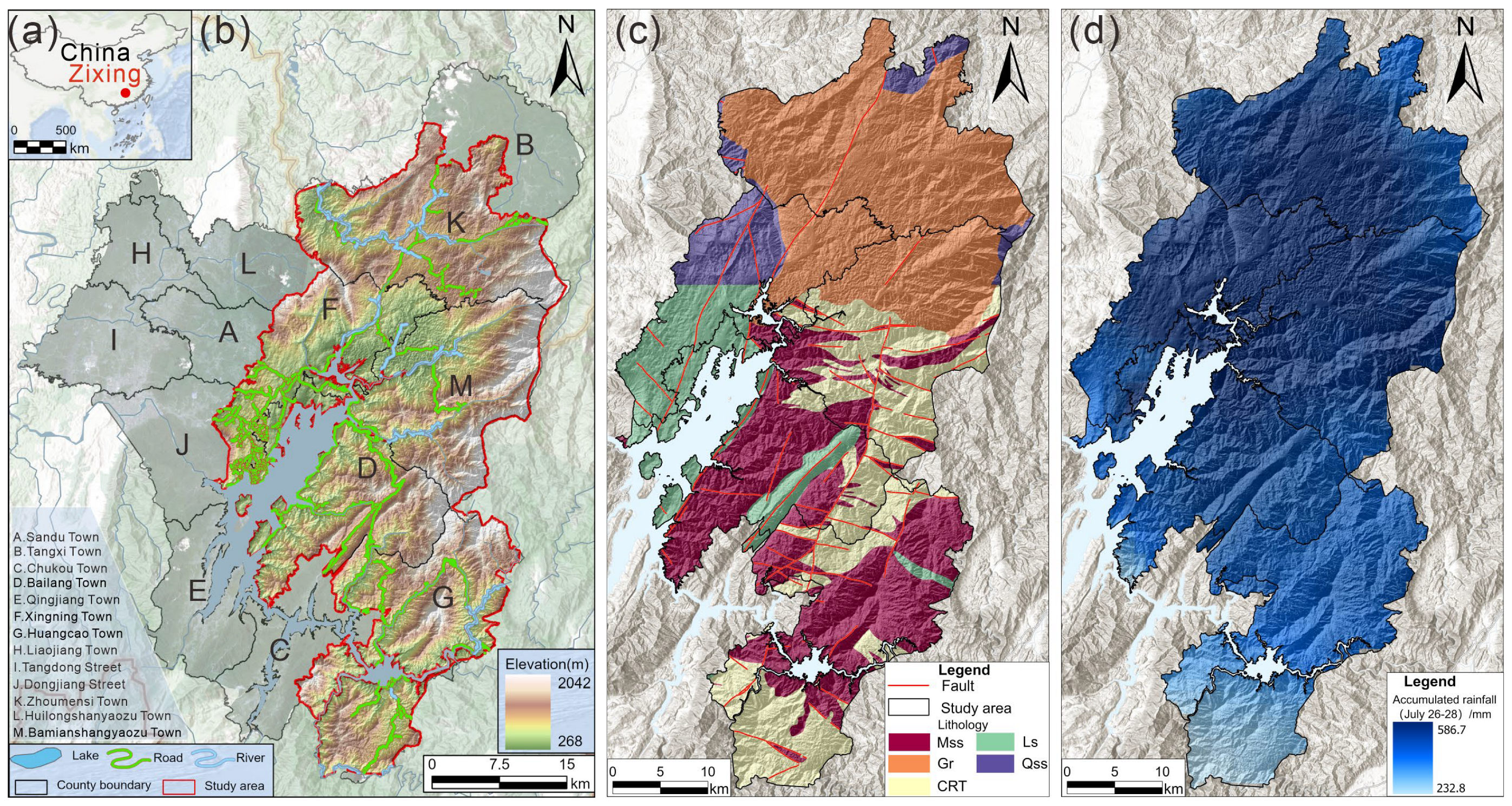
Figure 1.
Location, topography, lithology, and accumulated rainfall during July 26–28 in the study area. (a) Location of Zixing County, Hunan Province, China; (b) Topography and main towns in Zixing County; (c) Lithology and main faults; (d) Accumulated rainfall (26–28 July 2024) triggered by the 2024 Typhoon Gaemi.
Figure 1.
Location, topography, lithology, and accumulated rainfall during July 26–28 in the study area. (a) Location of Zixing County, Hunan Province, China; (b) Topography and main towns in Zixing County; (c) Lithology and main faults; (d) Accumulated rainfall (26–28 July 2024) triggered by the 2024 Typhoon Gaemi.
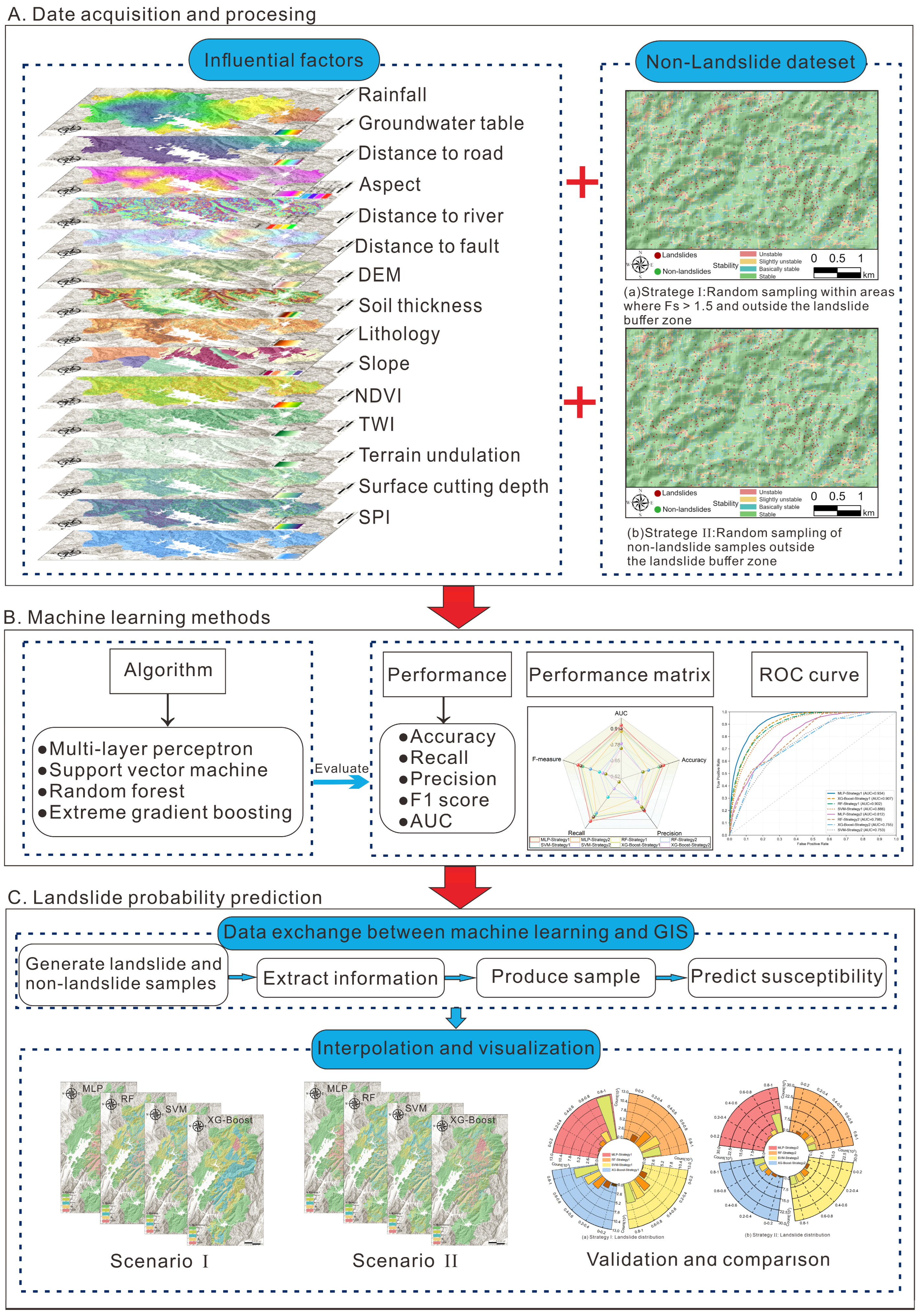
Figure 2.
Methodological flowchart of this study.
Figure 2.
Methodological flowchart of this study.
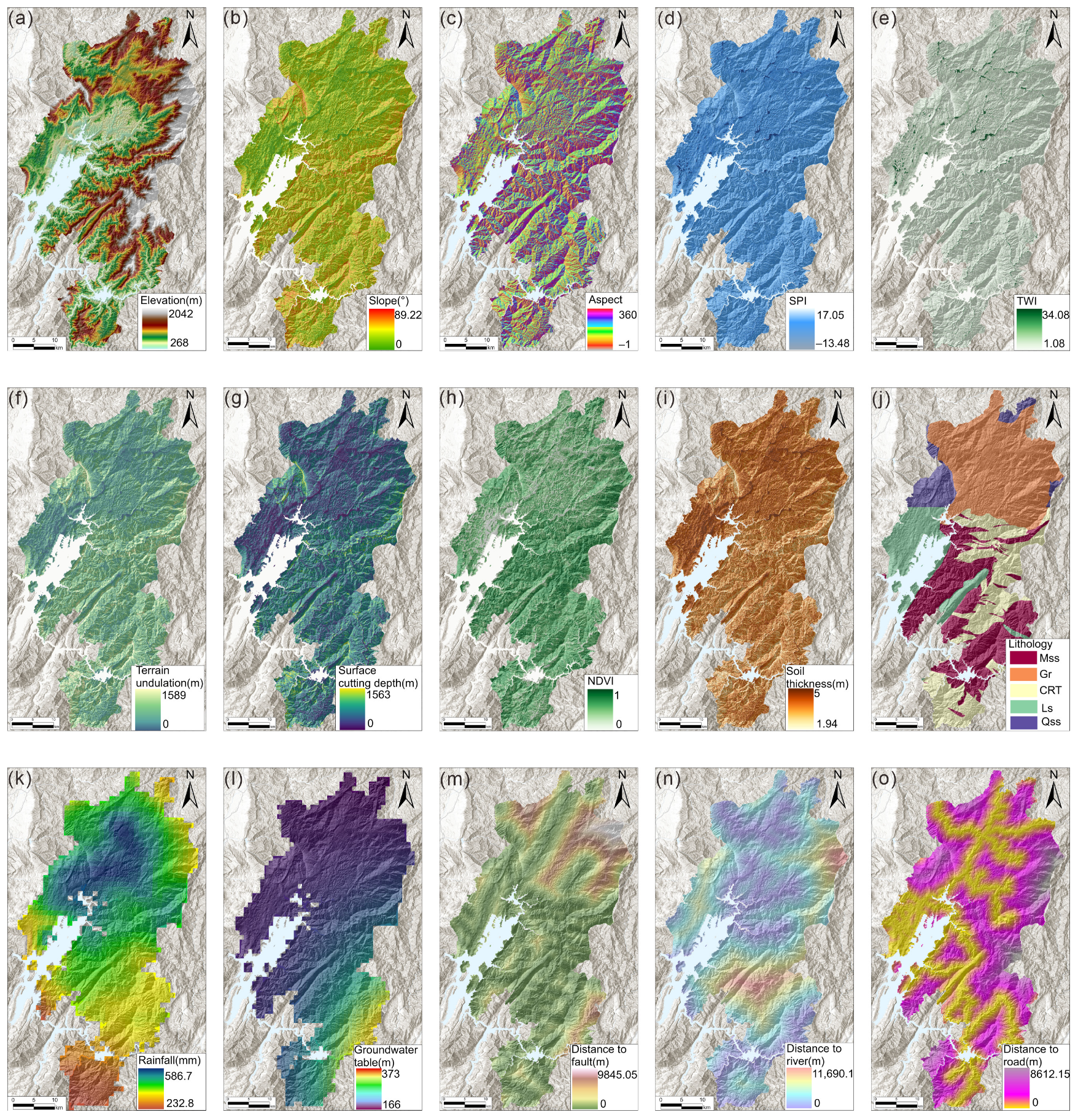
Figure 3.
Spatial distribution of the fifteen landslide–influencing factors. (a) Elevation; (b) Slope; (c) Aspect; (d) Stream power index; (e) Topographic wetness index; (f) Terrain undulation; (g) Surface cutting depth; (h) Normalized Difference Vegetation Index (NDVI); (i) Soil thickness; (j) Lithology; (k) Accumulated rainfall during July 26–28; (l) Groundwater table; (m) Distance to fault; (n) Distance to river; (o) Distance to road.
Figure 3.
Spatial distribution of the fifteen landslide–influencing factors. (a) Elevation; (b) Slope; (c) Aspect; (d) Stream power index; (e) Topographic wetness index; (f) Terrain undulation; (g) Surface cutting depth; (h) Normalized Difference Vegetation Index (NDVI); (i) Soil thickness; (j) Lithology; (k) Accumulated rainfall during July 26–28; (l) Groundwater table; (m) Distance to fault; (n) Distance to river; (o) Distance to road.
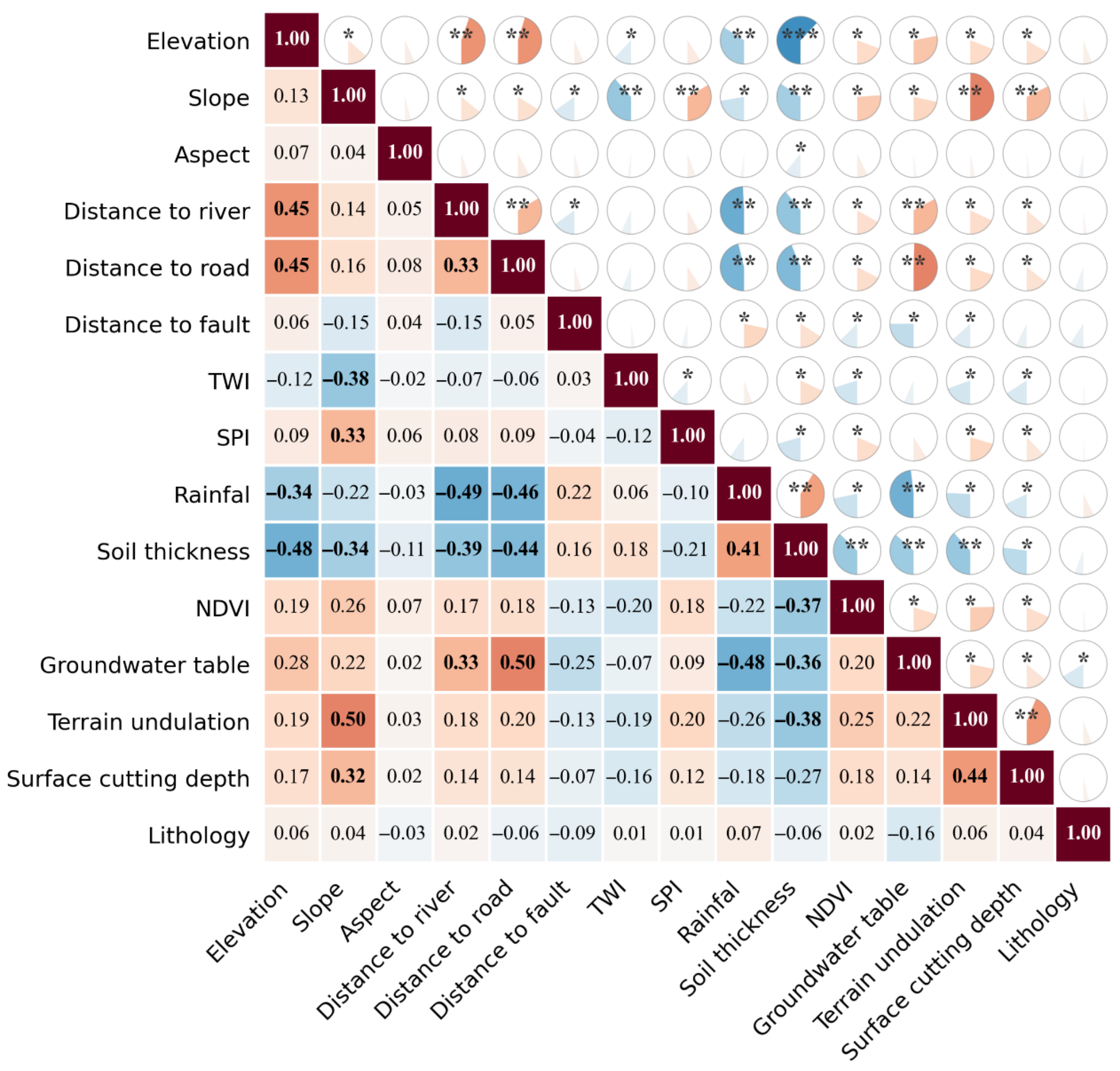
Figure 4.
Heatmap of Pearson correlation coefficients among the influencing factors. The color scale indicates the correlation coefficient values, with red representing positive correlation and blue representing negative correlation. Asterisks indicate statistical significance: * p < 0.05, ** p < 0.01, and *** p < 0.001.
Figure 4.
Heatmap of Pearson correlation coefficients among the influencing factors. The color scale indicates the correlation coefficient values, with red representing positive correlation and blue representing negative correlation. Asterisks indicate statistical significance: * p < 0.05, ** p < 0.01, and *** p < 0.001.
Figure 5.
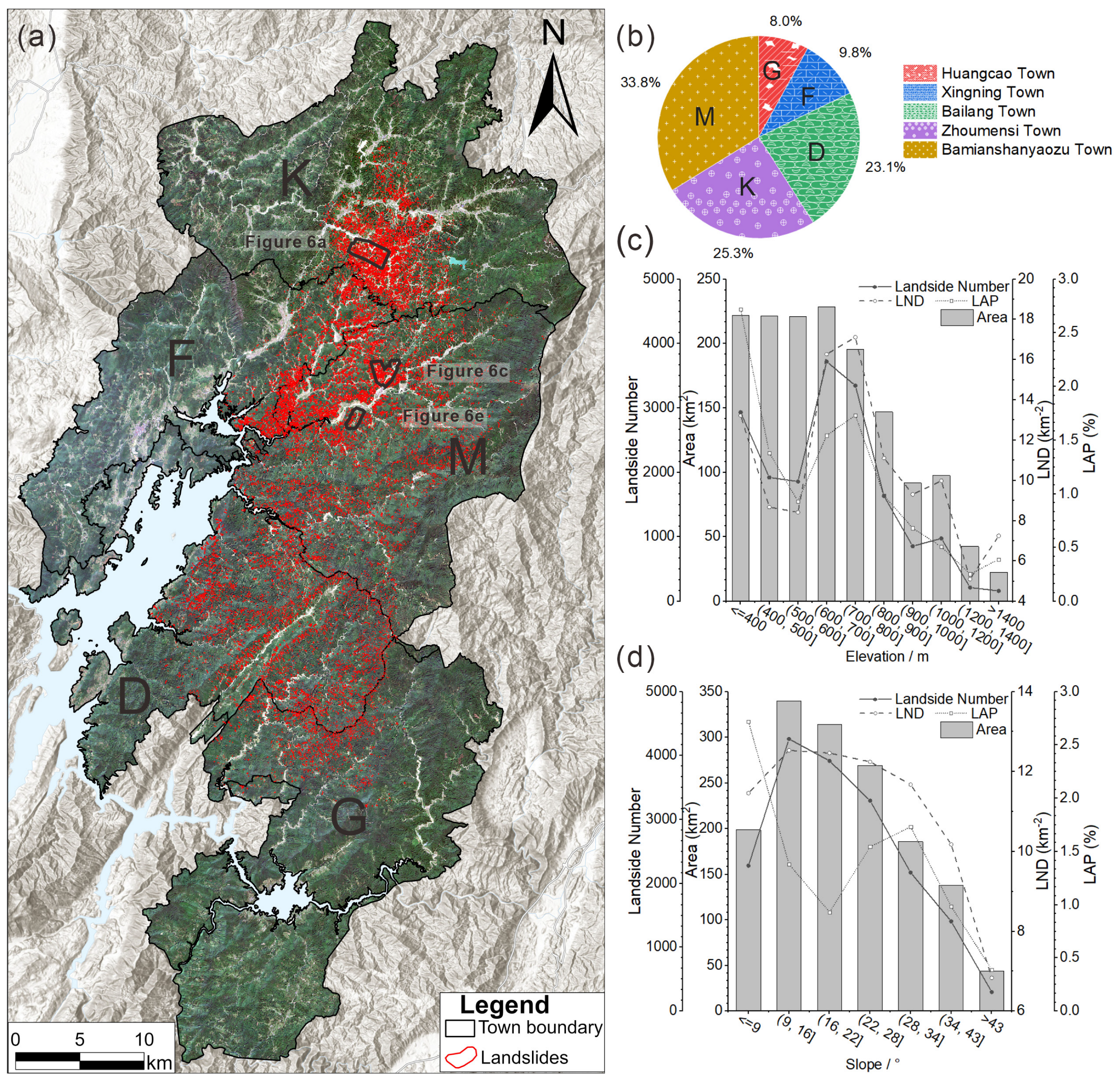
Spatial distribution and statistics of the landslide inventory. (a) Spatial clustering of landslides triggered by the extreme rainstorm event; (b) Landslide reporting statistics for towns within the study area; (c) Statistical analysis of landslides and elevation; (d) Statistical analysis of landslides and slope.
Figure 5.
Spatial distribution and statistics of the landslide inventory. (a) Spatial clustering of landslides triggered by the extreme rainstorm event; (b) Landslide reporting statistics for towns within the study area; (c) Statistical analysis of landslides and elevation; (d) Statistical analysis of landslides and slope.
Figure 6.
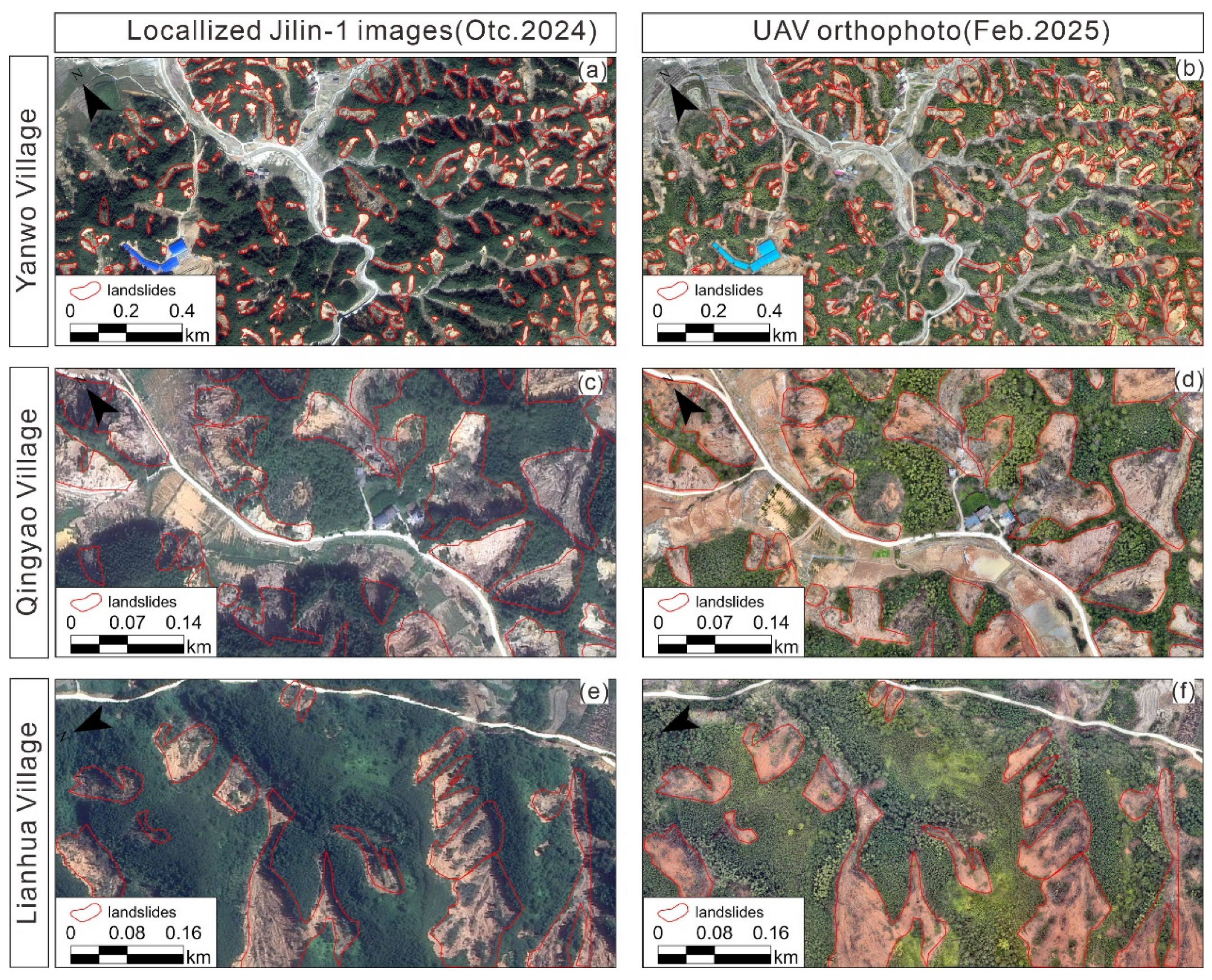
Validation of the landslide inventory using UAV images in three typical villages. (a,b) Pre– and post–event interpretation in Yanwo Village; (c,d) Pre– and post–event interpretation in Qingyao Village; (e,f) Pre– and post–event interpretation in Lianhua Village.
Figure 6.
Validation of the landslide inventory using UAV images in three typical villages. (a,b) Pre– and post–event interpretation in Yanwo Village; (c,d) Pre– and post–event interpretation in Qingyao Village; (e,f) Pre– and post–event interpretation in Lianhua Village.
Figure 7.
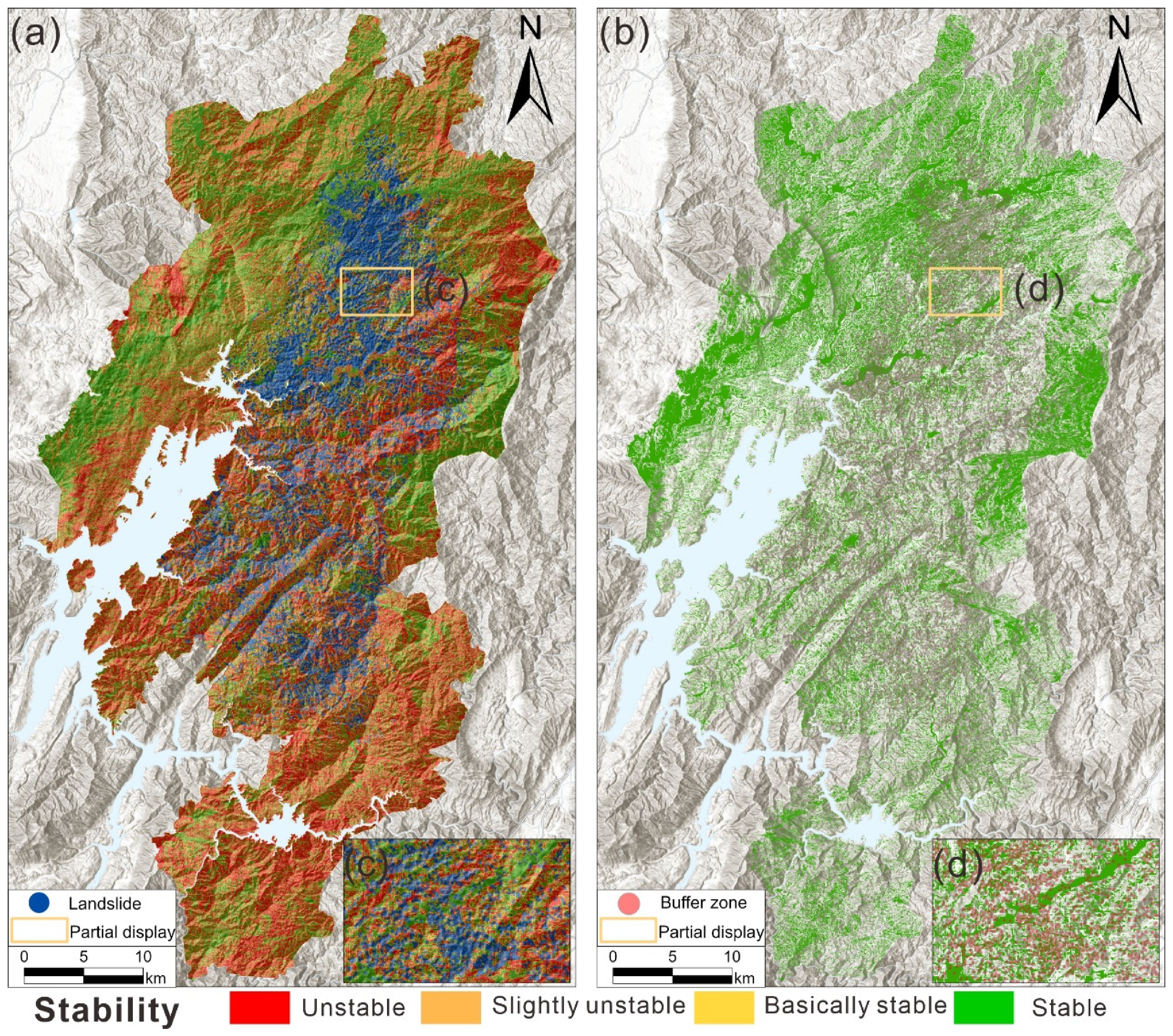
Illustration of the improved non–landslide sampling strategy (Strategy I). (a) Factor of safety (FoS) in the study area; (b) Areas with FoS > 1.5 and located outside landslide buffer zones; (c) Detailed view showing the overlay of FoS values on landslide locations; (d) Detailed view of areas with FoS > 1.5 overlaid on landslide buffer zones.
Figure 7.
Illustration of the improved non–landslide sampling strategy (Strategy I). (a) Factor of safety (FoS) in the study area; (b) Areas with FoS > 1.5 and located outside landslide buffer zones; (c) Detailed view showing the overlay of FoS values on landslide locations; (d) Detailed view of areas with FoS > 1.5 overlaid on landslide buffer zones.
Figure 8.
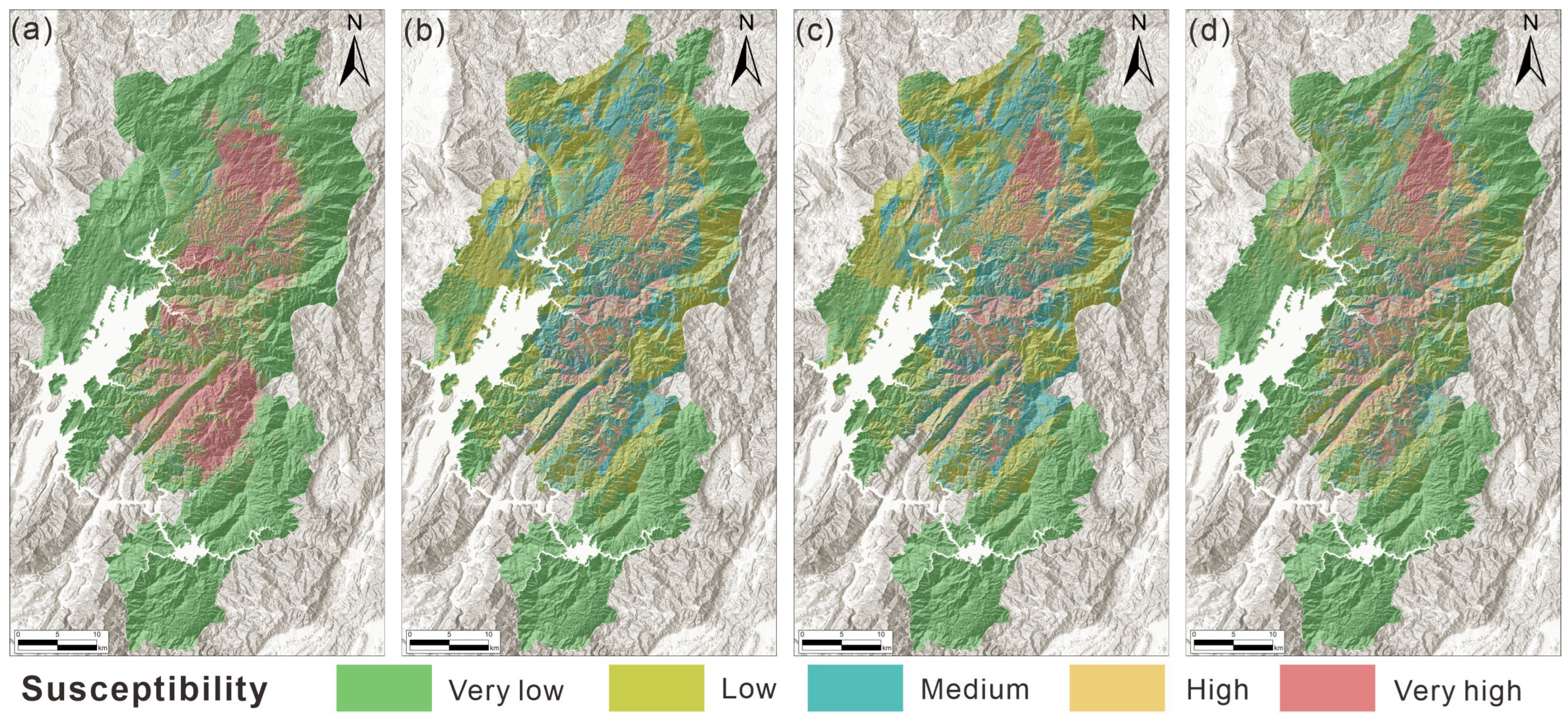
Landslide susceptibility maps generated by four machine learning models using the improved non–landslide sampling strategy (Strategy I). (a) MLP model; (b) RF model; (c) SVM model; (d) XGBoost model.
Figure 8.
Landslide susceptibility maps generated by four machine learning models using the improved non–landslide sampling strategy (Strategy I). (a) MLP model; (b) RF model; (c) SVM model; (d) XGBoost model.
Figure 9.
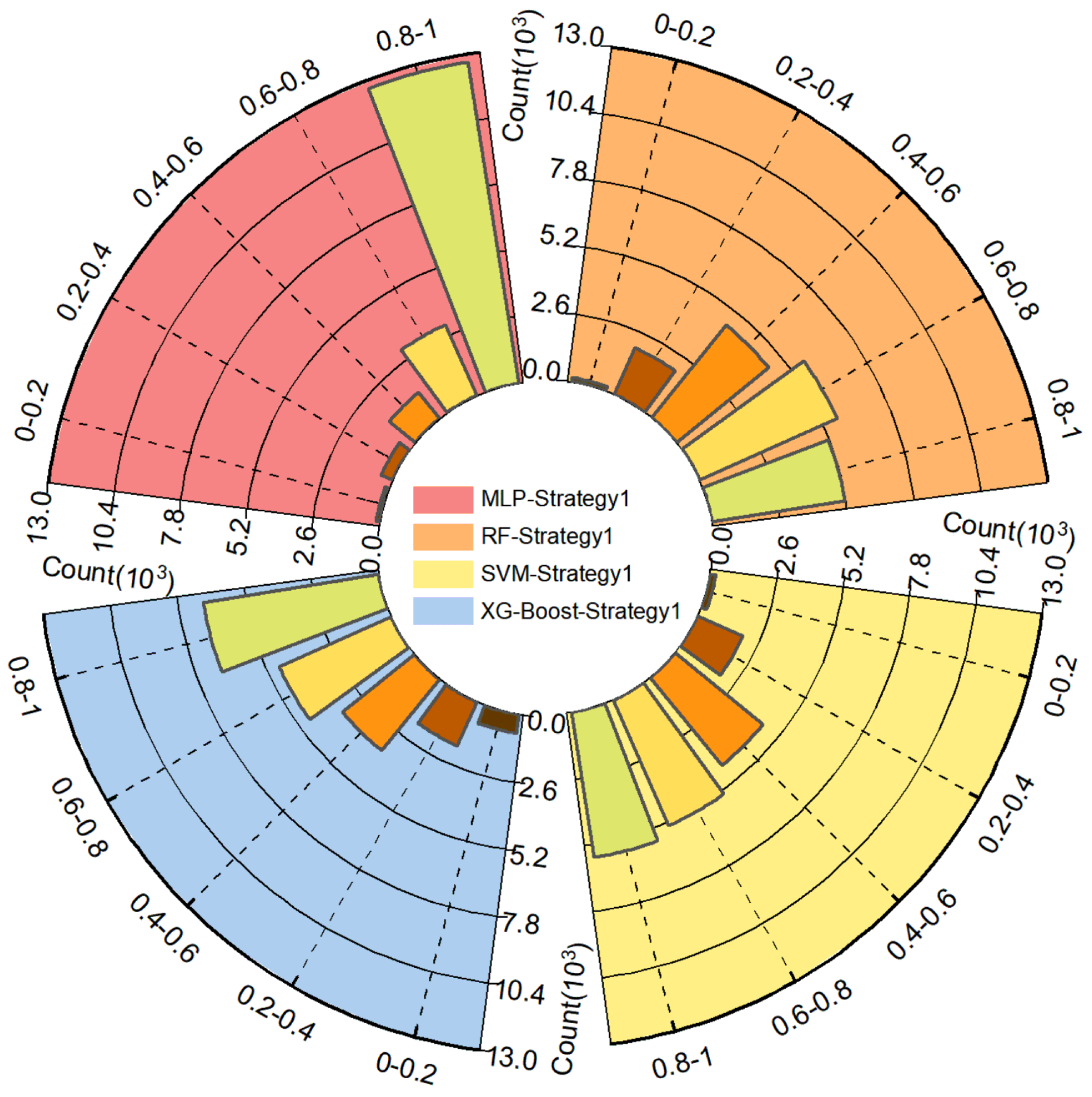
Distribution of landslides across different susceptibility zones under Strategy I.
Figure 9.
Distribution of landslides across different susceptibility zones under Strategy I.
Figure 10.
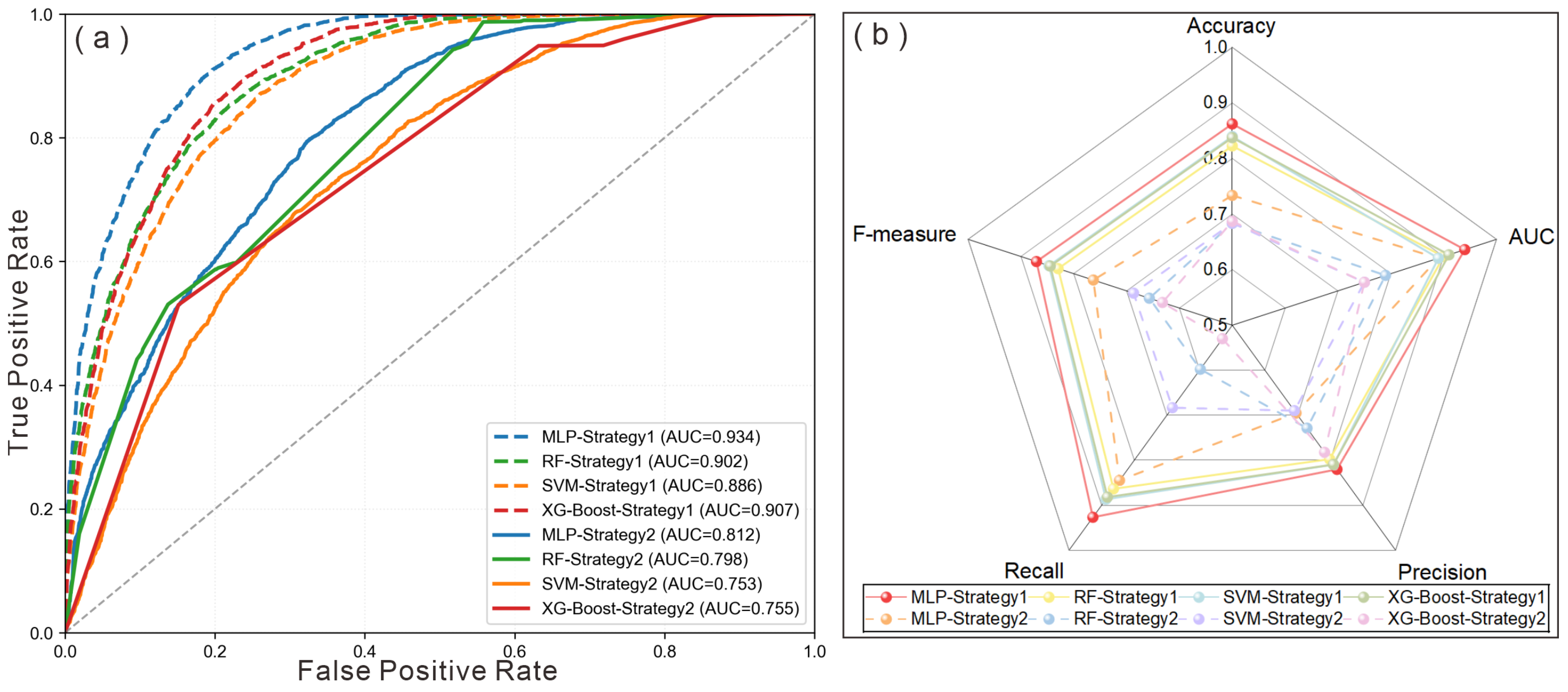
Performance evaluation of eight susceptibility models. (a) ROC curves of eight models; (b) Radar chart showing secondary performance metrics for the eight models.
Figure 10.
Performance evaluation of eight susceptibility models. (a) ROC curves of eight models; (b) Radar chart showing secondary performance metrics for the eight models.
Figure 11.
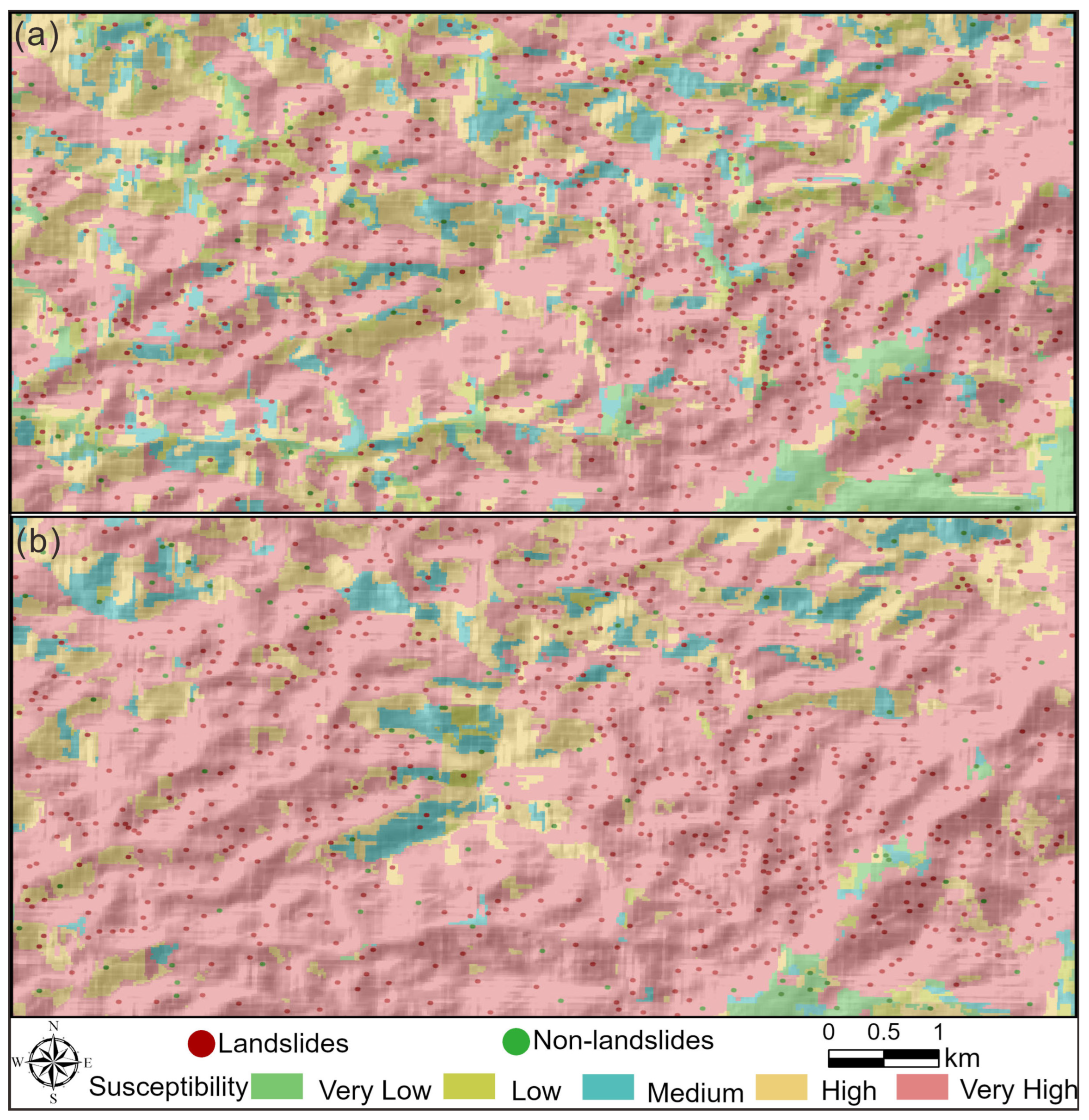
Comparison of two non–landslide sampling methods for constructing MLP–based susceptibility maps. (
a) Strategy I: Non–landslide samples are selected from physically stable areas (FoS > 1.5) excluding landslide buffer zones; (
b) Strategy II: traditional buffering method where non–landslide samples are selected randomly from any area outside the landslide buffer zones, without physical stability constraints. (Locations as shown in
Figure 7c).
Figure 11.
Comparison of two non–landslide sampling methods for constructing MLP–based susceptibility maps. (
a) Strategy I: Non–landslide samples are selected from physically stable areas (FoS > 1.5) excluding landslide buffer zones; (
b) Strategy II: traditional buffering method where non–landslide samples are selected randomly from any area outside the landslide buffer zones, without physical stability constraints. (Locations as shown in
Figure 7c).
Figure 12.
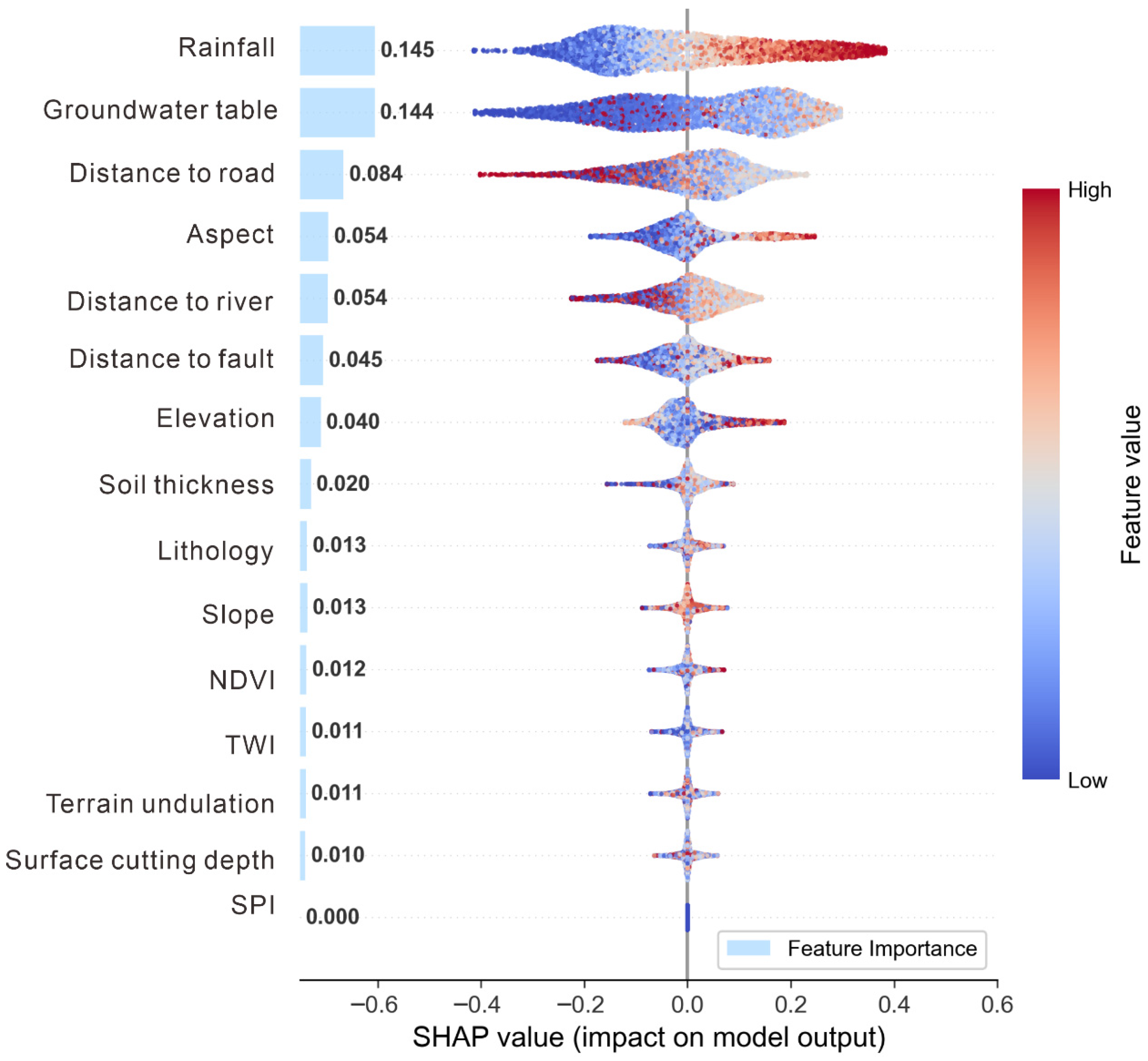
Feature importance from SHAP analysis.
Figure 12.
Feature importance from SHAP analysis.
Figure 13.
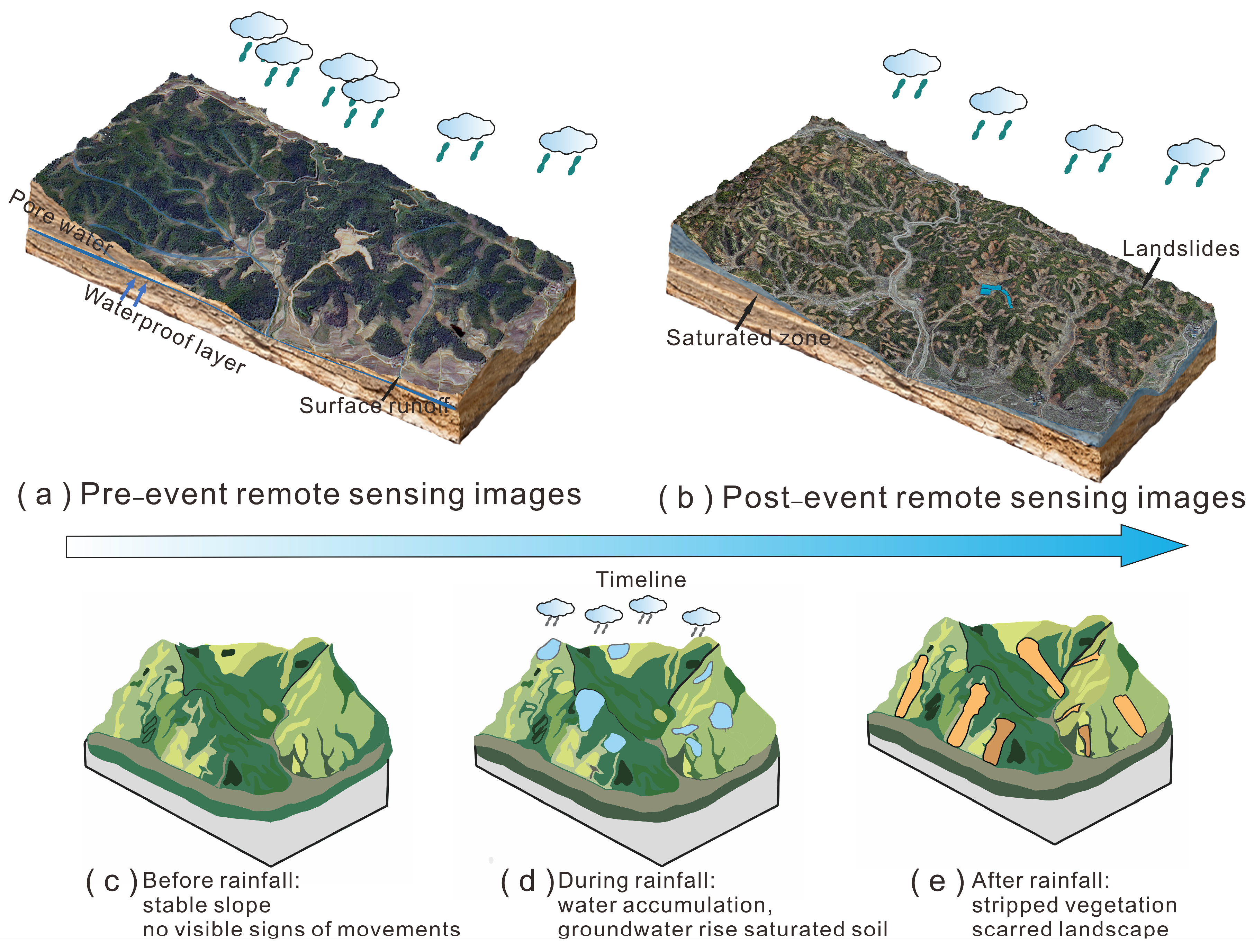
Schematic diagram of the physical mechanism driving rainfall–induced landslides. (a) pre–event remote sensing images; (b) post–event remote sensing images; (c) before rainfall stable slope no visible signs of movements; (d) during rainfall water accumulation, groundwater rise saturated soil; (e) after rainfall stripped vegetation scarred landscape.
Figure 13.
Schematic diagram of the physical mechanism driving rainfall–induced landslides. (a) pre–event remote sensing images; (b) post–event remote sensing images; (c) before rainfall stable slope no visible signs of movements; (d) during rainfall water accumulation, groundwater rise saturated soil; (e) after rainfall stripped vegetation scarred landscape.
Table 1.
Data sources and spatial resolutions.
Table 1.
Data sources and spatial resolutions.
| Type | Indicators | Spatial Resolution | Source |
|---|
| Remote sensing imagery | Pre–event images | 2.0 m | ZY–3 satellite–FWD |
| Post–event images | 0.7 m | Jilin–1 satellite–PMS |
| Topography | Elevation (m) | 5 m | ZY–3 satellite–FWD |
| Geological environment | Normalized difference vegetation index | 10 m | Sentinel–2 |
| Soil thickness (m) | 0.5 m | Calculated based on empirical Equation (1) |
| Lithology | 1:200,000 | National Geological Data Center (https://www.resdc.cn/) |
| Accumulated rainfall (mm) | 1 km | Radar–based precipitation data produced by Caiyun Technology Company |
| Groundwater table (m) | 1 km | National Geological Data Center (https://www.resdc.cn/) |
| Distance to fault (m) | 5 m | Derived from Euclidean distance to fault lines referring to https://www.resdc.cn/ |
| Distance to river (m) | 5 m | Derived from Euclidean distance to river lines referring to https://www.resdc.cn/ |
| Human activity | Distance to road (m) | 5 m | Derived from Euclidean distance to road lines referring to https://www.resdc.cn/ |
Table 2.
Multicollinearity analysis of the conditioning factors.
Table 2.
Multicollinearity analysis of the conditioning factors.
| Factor Category | Conditioning Factor | Variance Inflation Factor | Result |
|---|
| Topography | Terrain undulation | 4.97 | No multicollinearity |
| Surface cutting depth | 4.32 | No multicollinearity |
| Elevation | 3.21 | No multicollinearity |
| Slope | 2.02 | No multicollinearity |
| Aspect | 1.02 | No multicollinearity |
| TWI | 1.22 | No multicollinearity |
| SPI | 1.15 | No multicollinearity |
| Hydrology | Distance to river | 1.84 | No multicollinearity |
| Rainfall | 2.01 | No multicollinearity |
| Groundwater table | 1.88 | No multicollinearity |
| Geology | Lithology | 1.08 | No multicollinearity |
| Soil thickness | 2.33 | No multicollinearity |
| Environment | Distance to fault | 1.22 | No multicollinearity |
| Distance to road | 2.37 | No multicollinearity |
| NDVI | 1.23 | No multicollinearity |
| Conclusion | All values | <5 | Independent |
Table 3.
Soil physical and mechanical parameters of five lithological types used in TRIGRS model.
Table 3.
Soil physical and mechanical parameters of five lithological types used in TRIGRS model.
| Parameter | Unit | Lithological Types |
|---|
| Mss | Gr | Crt | Ls | Qss |
|---|
| Cohesion (c′) | KN/m2 | 22 | 33.28 | 2340 | 800 | 247 |
| Friction angle (φ′) | ° | 37 | 41.37 | 35 | 40 | 40 |
| Unit weight of soil (γs) | KN/m3 | 26.8 | 18.2 | 27 | 26 | 24.9 |
Table 4.
Classification of slope stability based on the factor of safety (FoS).
Table 4.
Classification of slope stability based on the factor of safety (FoS).
| Stability | Unstable | Slightly Unstable | Basically Stable | Stable |
|---|
| Factor of safety | FoS ≤ 1.0 | 1.0 < FoS ≤ 1.25 | 1.25 < FoS ≤ 1.5 | FoS > 1.5 |
Table 5.
Hyperparameter search spaces and optimal settings for the four ML models.
Table 5.
Hyperparameter search spaces and optimal settings for the four ML models.
| ML Models | Hyperparameter | Search Space (Range) | Optimal Value |
|---|
| MLP | Hidden Layers | [3, 7] | 3 |
| Learning Rate | [5 × 10⁻⁵, 5 × 10⁻²] (log) | 0.001 |
| Batch Size | [16, 128] | 128 |
| Optimizer | [Adam, SGD] | Adam |
| SVM | Kernel | [RBF] | RBF |
| C (Regularization) | [0.1, 100] (log) | 1 |
| Gamma | [0.001, 1] (log) | Scale |
| RF | n_estimators | [100, 2000] | 1000 |
| Max Depth | [5, 30] | 15 |
| Max Features | [0.1, 0.9] | 0.45 |
| XGBoost | Learning Rate | [0.01, 0.3] | 0.02 |
| Max Depth | [3, 15] | 10 |
| Subsample | [0.5, 1.0] | 0.95 |
| Colsample_bytree | [0.5, 1.0] | 0.73 |
Table 6.
The number of grid cells at each susceptibility level for the four models under sampling strategy I.
Table 6.
The number of grid cells at each susceptibility level for the four models under sampling strategy I.
| Sampling Strategy | LSM Class |
|---|
| Very Low | Low | Medium | High | Very High |
|---|
| MLP–Strategy I | 269,343 | 28,468 | 36,111 | 40,826 | 60,169 |
| RF–Strategy I | 150,643 | 115,865 | 94,983 | 51,003 | 22,423 |
| SVM–Strategy I | 156,116 | 108,768 | 94,472 | 50,106 | 25,455 |
| XGBoost–Strategy I | 222,863 | 65,797 | 64,644 | 49,491 | 32,122 |
Table 7.
Quantitative comparison of model performance (AUC) under sampling strategy I using random 5–fold cross–validation and paired t–tests.
Table 7.
Quantitative comparison of model performance (AUC) under sampling strategy I using random 5–fold cross–validation and paired t–tests.
| Fold | MLP (Proposed) | RF | SVM | XGBoost |
|---|
| Fold 1 | 0.932 | 0.900 | 0.879 | 0.905 |
| Fold 2 | 0.933 | 0.901 | 0.883 | 0.910 |
| Fold 3 | 0.935 | 0.901 | 0.887 | 0.899 |
| Fold 4 | 0.937 | 0.903 | 0.890 | 0.915 |
| Fold 5 | 0.931 | 0.905 | 0.891 | 0.906 |
| Mean AUC | 0.934 | 0.902 | 0.886 | 0.907 |
| Std. dev | ±0.002 | ±0.002 | ±0.005 | ±0.006 |
| p–value (vs. MLP) | – | <0.001 | <0.001 | <0.001 |
Table 8.
Detailed performances of four machine learning models under two sampling strategies.
Table 8.
Detailed performances of four machine learning models under two sampling strategies.
| Model | Strategy | AUC | Accuracy | Precision | Recall | Specificity | F1–Score |
|---|
| MLP | Strategy I | 0.934 | 0.862 | 0.821 | 0.927 | 0.798 | 0.871 |
| Strategy II | 0.812 | 0.734 | 0.695 | 0.845 | 0.619 | 0.763 |
| RF | Strategy I | 0.902 | 0.823 | 0.798 | 0.864 | 0.781 | 0.830 |
| Strategy II | 0.798 | 0.683 | 0.729 | 0.598 | 0.771 | 0.654 |
| SVM | Strategy I | 0.886 | 0.840 | 0.810 | 0.887 | 0.792 | 0.847 |
| Strategy II | 0.753 | 0.684 | 0.690 | 0.683 | 0.684 | 0.687 |
| XGBoost | Strategy I | 0.907 | 0.837 | 0.810 | 0.882 | 0.793 | 0.844 |
| Strategy II | 0.755 | 0.687 | 0.783 | 0.530 | 0.849 | 0.632 |
Table 9.
Spatial cross–validation results of the MLP model under two sampling strategies.
Table 9.
Spatial cross–validation results of the MLP model under two sampling strategies.
| Test Region (Town) | Strategy I AUC | Strategy I Accuracy | Strategy I Specificity | Strategy II AUC | Strategy II Accuracy | Strategy II Specificity | Improvement (AUC) |
|---|
| K | 0.799 | 0.622 | 0.830 | 0.589 | 0.539 | 0.589 | 35.65% |
| F | 0.767 | 0.631 | 0.774 | 0.636 | 0.459 | 0.733 | 20.60% |
| G | 0.908 | 0.855 | 0.931 | 0.585 | 0.494 | 0.322 | 55.21% |
| D | 0.879 | 0.754 | 0.634 | 0.762 | 0.608 | 0.348 | 15.35% |
| M | 0.916 | 0.788 | 0.891 | 0.754 | 0.547 | 0.163 | 21.49% |
| Mean ± Std. | 0.854 ± 0.067 | 0.730 ± 0.101 | 0.812 ± 0.116 | 0.665 ± 0.087 | 0.529 ± 0.057 | 0.431 ± 0.227 | 29.66% ± 16.14% |




 ,
,