Article

A SNR-Based Adaptive Goldstein Filter for Ionospheric Faraday Rotation Estimation Using Spaceborne Full-Polarimetric SAR Data


1
CAS Key Laboratory of Microwave Remote Sensing, National Space Science Center, Chinese Academy of Sciences, Beijing 100190, China
2
School of Electronic, Electrical, and Communication Engineering, University of Chinese Academy of Sciences, Beijing 100049, China
*
Author to whom correspondence should be addressed.
Remote Sens. 2026, 18(2), 378; https://doi.org/10.3390/rs18020378
Submission received: 13 October 2025 / Revised: 8 January 2026 / Accepted: 15 January 2026 / Published: 22 January 2026

Highlights

What are the main findings?
  • The developed denoising approach appropriate for ionospheric Faraday rotation angle (FRA) estimation based on spaceborne full-polarimetric radar observations integrates the adaptive Goldstein filter in radar interferometric processing and the signal-to-noise ratio (SNR) definitions commonly used in image processing.
  • The developed SNR-based Goldstein denoising method demonstrates superior noise suppression performance for the Bickel–Bates estimator signal compared to other alternatives, thereby facilitating the acquisition of higher-quality FRA estimates.
What are the implications of the main findings?
  • The developed method provides a viable technical reference for noise reduction in ionospheric FRA estimation using spaceborne full-polarimetric radar data.
  • The higher-quality FRA estimates obtained through the developed method not only contribute to refining the correction effect of the ionospheric Faraday rotation but also aid in acquiring higher-quality two-dimensional absolute ionospheric total electron content.

Abstract

The spaceborne full-polarimetric (FP) synthetic aperture radar (SAR) is an advanced sensor for high-resolution Earth observation. However, FP data acquired by such a system are prone to distortions induced by ionospheric Faraday rotation (FR). From the perspective of exploiting these distortions, this enables the estimation of the ionospheric FR angle (FRA), and consequently the total electron content, across most global regions (including the extensive ocean areas) using spaceborne FP SAR measurements. The accuracy of FRA estimation, however, is highly sensitive to noise interference. This study addresses denoising in FRA retrieval based on the Bickel–Bates estimator, with a specific focus on noise reduction methods built upon the adaptive Goldstein filter (AGF) that was originally designed for radar interferometric processing. For the first time, three signal-to-noise ratio (SNR)-based AGFs suitable for FRA estimation are investigated. A key feature of these filters is that their SNRs are all defined using the amplitude of the Bickel–Bates estimator signal rather than the FRA estimates themselves. Accordingly, these AGFs are applied to the estimator signal instead of the estimated FRAs. Two of the three AGFs are developed by adopting the mathematical forms of SNRs and filter parameters consistent with the existing SNR-based AGFs for interferogram. The third AGF is newly proposed by utilizing more general mathematical forms of SNR and filter parameter that differ from the first two. Specifically, its SNR definition aligns with that widely used in image processing, and its filter parameter is derived as a function of the defined SNR plus an additionally introduced adjustable factor. The three SNR-based AGFs tailored for FRA estimation are tested and evaluated against existing AGF variants and classical image denoising methods using three sets of FP SAR Datasets acquired by the L-band ALOS PALSAR sensor, encompassing an ocean-only scene, a plain land–ocean combined scene, and a more complex land–ocean combined scene. Experimental results demonstrate that all three filters can effectively mitigate noise, with the newly proposed AGF achieving the best performance among all denoising methods included in the comparison.

1. Introduction

As a magneto-ionic medium, the ionosphere is the ionized part of the Earth’s upper atmosphere and contains a large number of free electrons and ions [1,2,3]. This medium can exert various effects on the radio waves propagating through it, such as group delay, phase advance, dispersion, Faraday rotation (FR), and scintillation, which may influence space-based communication, navigation, and remote sensing [4,5,6]. Therefore, obtaining ionospheric information through effective detection means is indispensable for ensuring the reliable operation of multifarious space information systems.
The existing traditional ionospheric detection techniques can be divided into two categories: ground- and space-based methods [7,8]. The ionosonde and incoherent scatter radar are two representative ground-based ionospheric sounding instruments, capable of achieving long-term, stable observation of the regional ionosphere [9,10,11,12]. The former is extensively deployed, with the merits of facile construction, convenient maintenance, relatively low cost, easy networking, and straightforward operation. However, it is constrained by limited detection altitude and spatial resolution. The latter, recognized as the most powerful ground-based ionospheric sounding means, can retrieve a more comprehensive set of ionospheric parameters with high accuracy and broad altitude coverage. Nevertheless, it is hindered by extremely high costs, complex operation and maintenance, as well as scarce deployment-induced limited spatial coverage [9,10]. In addition, the ground-based technique based on Global Navigation Satellite Systems (GNSS) plays an essential role in monitoring the ionosphere due to continuous all-weather observation capability and high temporal resolution, whereas the resolution of such a technique is closely related to the number and location distribution of ground stations, typically tens to hundreds of kilometers in the horizontal direction [13,14]. In areas where the GNSS ground receivers are not easy to be deployed, such as oceans, this technique cannot provide high-accuracy and reliable ionospheric observations. The above-mentioned ground-based detection methods share a common limitation that they are difficult to achieve global coverage [13,14]. Space-based ionospheric detection techniques can better overcome this limitation. Among these, the radio occultation based on GNSS and low Earth orbit satellite stands out as a representative method, which exhibits the unique advantage of high vertical resolution, albeit with low horizontal resolution [8,15,16]. In general, these traditional methods cannot simultaneously achieve high spatial resolution and global coverage in ionospheric detection.
Polarization is an essential property of electromagnetic waves [17]. Full-polarimetric (FP) synthetic aperture radar (SAR) serves as a powerful high-resolution imaging sensor to acquire the FP scattering information of targets by transmitting and receiving orthogonally polarized electromagnetic waves [18,19,20,21]. However, the FP measurements obtained by a spaceborne low-frequency (such as L- or P-band) SAR system can be significantly affected by the ionospheric Faraday rotation [22,23,24]. This ionospheric effect refers to the rotation of the polarization plane of a linearly polarized wave, and is quantitatively described by the FR angle (FRA) that is proportional to the ionospheric total electron content (TEC) [23,24]. Over the past decade or so, the space-based ionospheric detection methods based on the FR effect experienced by spaceborne low-frequency FP SAR measurements have attracted widespread attention and demonstrated the advantage of high spatial resolution [25,26,27,28,29]. Compared with the traditional ionospheric detection methods, this spaceborne FP SAR-based FR detection approach enables the retrieval of higher-resolution, two-dimensional distributions of ionospheric FRA and TEC, benefiting from the inherent high-resolution imaging capability of SAR systems. Consequently, it allows capturing fine ionospheric structures in two dimensions with spatial resolutions ranging from sub-kilometer to a few kilometers [26,28,29]. In addition, as this method does not rely on ground stations, it can achieve ionospheric observation across the globe, encompassing vast oceanic areas [29,30], with a swath width of tens to hundreds of kilometers [31]. These combined advantages render this method a highly promising candidate for ionospheric detection.
The prerequisite for obtaining ionospheric parameters such as TEC is retrieving the ionospheric FRAs from the spaceborne low-frequency FP SAR observations. Numerous FRA estimators have been developed hitherto [32,33,34,35,36], among which the estimator proposed by Bickel and Bates [32] has the best overall performance and is the most commonly used [37]. Noise interference is one of the most important factors affecting the performance of these estimators and thus the accuracy of the derived FRA estimates [38,39]. Therefore, it is essential to perform the denoising treatment in FRA estimation. Some noise reduction methods applied to the Bickel–Bates estimator signal Z R L Z L R * , i.e., the complex conjugate product between the cross-circular polarized components Z R L and Z L R , have been proposed. The frequently employed one is the averaging filter (AF) [33,37,38]. This method is straightforward to implement and its filtering effect depends on the size of the filtering window. Although a larger window size corresponds to a stronger filtering effect, this may decrease the spatial resolution and cause loss of key details in the filtered signal [38]. Considering that the application of AF to Z R L Z L R * cannot fully remove the noise, and that extracting FRAs from Z R L Z L R * is analogous to obtaining the interferometric phase from S 1 S 2 * constructed by the interferometric pair S 1 and S 2 , the adaptive Goldstein filter (AGF) [40] initially meant for suppressing the interferometric phase noise has been introduced into the FRA estimation to further alleviate the noise [41,42,43]. To date, two distinct AGFs applicable to the FRA estimation based on the Bickel–Bates estimator have been explicitly reported [43]. Their difference lies in the different filter parameters applied to the Bickel–Bates estimator signal Z R L Z L R * . As shown in [43], one utilizes a parameter that is a function of the absolute value of the complex correlation coefficient between Z R L and Z L R (similar to the coherence between S 1 and S 2 used in the interferometric phase AGF proposed by Baran et al. [44]), whereas the other employs a parameter based on the normalized value of Z R L Z L R * . Experimental results on the real spaceborne low-frequency FP SAR data show that these two AGFs can achieve effective noise suppression and the latter has a better denoising effect.
The signal-to-noise ratio (SNR) is a quantity closely related to the noise level. In radar interferometric processing, two SNR-based AGFs have been developed by Sun et al. [45,46] to reduce the interferometric phase noise. These two AGFs adopted different filter parameters based on different definitions of SNR. The first proposed earlier defined the SNR as the ratio of the maximum to minimum local variances of interferometric phase [45], and the second improved this definition of SNR into the ratio of the maximum local variance to the local variance [46]. According to the experimental evaluation, these two AGFs bear a nice interferometric phase denoising performance better than that of the AGF proposed by Baran et al. To the best of our knowledge, Sun et al. conducted the earliest research on SNR-based AGFs. Besides their work, other studies on SNR-related AGFs for interferogram denoising have also been reported [47,48,49], which are either extensions or adaptations of the work by Sun et al. Consistent with Sun et al. [45,46], these studies define the SNR as the ratio of two variances, with the numerator and denominator term corresponding to the signal and noise, respectively. Furthermore, the specific metrics adopted to quantify the signal and noise variances, along with the definition of the filter parameter, either differ from those in Sun et al. [45,46] or are consistent with them, while also varying from one another across these studies.
This article is dedicated to investigating the SNR-based AGFs applicable to FRA estimation. Firstly, the two interferometric phase AGFs proposed by Sun et al. are modified to adapt to the FRA estimation based on the Bickel–Bates estimator, by substituting the interferometric phase with Z R L Z L R * and following the same mathematical form of both SNR and filter parameter. Secondly, a novel SNR-based AGF appropriate for FRA estimation is proposed on the basis of a more general mathematical form of both SNR and filter parameter. Its SNR accords with the definition way popularly used in the field of image processing [50,51,52] and is defined as the ratio of the local mean of Z R L Z L R * to the corresponding local standard deviation (STD), i.e., the reciprocal of the coefficient of variation (CV) defined by Wang et al. [53] when they analyzed the influence of the variability of Z R L Z L R * on the FRA estimates. Its filter parameter is then derived from the defined SNR, incorporating an additional adjustable factor. The proposed method has been experimentally validated on the spaceborne L-band FP SAR data across three distinct scenarios: an ocean-only scene, a plain land–ocean combined scene, and a more complex land–ocean combined scene, demonstrating its effectiveness through comparison with other denoising treatments [38,43,44,45,46,54,55].
The main contributions of this article are summarized as follows:
1.
Prompted by the SNR-based AGFs developed for the interferometric phase denoising, the SNR-based AGFs that can achieve effective noise suppression for FRA estimation are examined for the first time. The direct definition and use of an SNR parameter offer a clearer perspective and a more straightforward technical pathway to counter noise-induced errors in FRA estimates.
2.
Three SNR-based AGFs to effectively mitigate noise interference in FRA estimation using the Bickel–Bates estimator are developed. Distinctively, their SNR parameters are derived from the signal amplitude of this estimator (i.e., | Z R L Z L R * | ), unlike the interferometric phase-based definitions adopted in interferometric processing. Concretely, two of the filters are adapted from the two SNR-based interferogram AGFs proposed by Sun et al. [45,46] by substituting the interferometric phase with | Z R L Z L R * | while retaining the same mathematical formulations of SNR and filter parameters. The third filter is a novel proposal built on a more general mathematical form of both SNR and filter parameter. Its SNR parameter draws on the definition way popularly used in the field of image processing, defined as the ratio of the local mean of | Z R L Z L R * | to its corresponding local STD. Its filter parameter is then derived from this customized SNR parameter, with an additional adjustable factor incorporated to enhance flexibility. The proposed method experimentally proves better performance on multiple sets of spaceborne L-band FP SAR data by comparison with alternative denoising techniques.
The rest of this article is organized as follows. Section 2 briefly introduces the measured scattering matrix from a spaceborne FP SAR system and the Bickel–Bates FRA estimator, outlines several AGFs in interferometric phase denoising, summarizes existing AGFs applicable to FRA estimation based on the Bickel–Bates estimator, and presents three SNR-based AGFs tailored for FRA retrieval. Section 3 describes three sets of FP data acquired by the phased-array L-band synthetic aperture radar (PALSAR) onboard the Advanced Land Observing Satellite (ALOS). Section 4 reports the experimental results derived from these three Datasets via comparative analysis. Section 5 discusses the performance sensitivity of the proposed method to the adjustable factor, while also highlighting the limitations of this study and potential directions for future research. Finally, Section 6 concludes this article.

2. Methods

2.1. Measured Scattering Matrix of Spaceborne FP SAR and FRA Retrieval Based on the Bickel–Bates Estimator

Under the horizontal–vertical (H-V) linearly polarized basis, the measured scattering matrix from a spaceborne FP SAR system can be expressed as [22,33]
M = M H H M V H M H V M V V = A e j ϕ 1 δ 2 δ 1 f 1 cos Ω sin Ω sin Ω cos Ω S H H S V H S H V S V V cos Ω sin Ω sin Ω cos Ω 1 δ 3 δ 4 f 2   + N H H N V H N H V N V V
where M m n ( m , n = H or V ) is the component of M ; A is the total gain of the radar system; e j ϕ stands for the round-trip phase delay and the system-dependent phase effects on the signal; δ 1 , δ 2 , δ 3 , and δ 4 represent the crosstalk terms; f 1 and f 2 denote the channel imbalance terms; N m n denotes the additive noise term; S m n is the component of the true scattering matrix; and Ω is the one-way FRA and satisfies [27]
Ω = K f 2 · B cos Θ · T E C   r a d
where K 2.365 × 10 4 A · m 2 / k g ; f is the wave frequency; B is the geomagnetic field strength; Θ is the angle between wave propagation direction and the geomagnetic field vector; and denotes the mid-value at a specific altitude along the ray path [27,56]. As can be seen from Equation (2), Ω is determined by the wave frequency, geomagnetic field, ionospheric conditions, and radar observation geometry.
Assuming that FR is the sole source of distortion and that the backscattering reciprocity holds (i.e., S H V = S V H ), Equation (1) is simplified to
M = M H H M V H M H V M V V = cos Ω sin Ω sin Ω cos Ω S H H S V H S H V S V V cos Ω sin Ω sin Ω cos Ω     = S H H cos 2 Ω S V V sin 2 Ω S H V + S H H + S V V sin Ω cos Ω S H V S H H + S V V sin Ω cos Ω S V V cos 2 Ω S H H sin 2 Ω
Equation (3) shows that the backscattering reciprocity is no longer valid in the presence of FR, i.e., M H V M V H .
The measurements acquired by a spaceborne FP SAR system can be used to derive FRA estimates. Among the existing methods for FRA retrieval, the Bickel–Bates estimator [32] is the most commonly used one due to its best overall performance [37]. For this estimator, the linearly polarized scattering matrix M in Equation (3) is transformed into the circular polarization basis [32]
Z = Z R R Z R L Z L R Z L L = 1 2 1 j j 1 M H H M V H M H V M V V 1 j j 1
Expanding Equation (4) results in
Z R R = 1 2 [ ( M H H M V V ) + j M H V + M V H ]   Z R L = 1 2 [ ( M V H M H V ) + j M H H + M V V ] Z L R = 1 2 [ ( M H V M V H ) + j M H H + M V V ] Z L L = 1 2 [ ( M V V M H H ) + j M H V + M V H ]
Substituting Equation (3) into Equation (5), two cross-circular polarized components are derived as
Z R L = j 2 S H H + S V V e 2 j Ω Z L R = j 2 S H H + S V V e + 2 j Ω
Equation (6) yields
Z R L Z L R * = 1 4 S H H + S V V 2 e 4 j Ω
The Bickel–Bates estimator is then formulated as
Ω ^ = 1 4 arg Z R L Z L R *
where arg · denotes extracting the phase of a complex number. To reduce the impact of noise on the accuracy of FRA estimates, AF (represented by ) is typically applied to denoising the signal of the Bickel–Bates estimator (i.e., Z R L Z L R * ) before performing FRA estimation [33,37,38], given by
Ω ^ = 1 4 arg Z R L Z L R *

2.2. AGFs Used for Radar Interferometric Phase Filtering

The Goldstein filter is a frequency domain filter proposed by Goldstein and Werner [40] to suppress the interferometric phase noise, which takes advantage of the differences in the spectral characteristics between noise and signal:
H u , v = S Z u , v α Z u , v
where Z u , v and H u , v denote the Fourier spectra of a small interferogram patch before and after filtering, respectively; u and v are spatial frequencies; S · is a smoothing operator; and α is the filter parameter with an arbitrarily selected fixed value between zero and one [44].
As a classical filtering method, the Goldstein filter offers advantages such as fast processing speed and low computation complexity [57], and is widely adopted in radar interferometric processing. However, the denoising effect of the Goldstein filter heavily relies on a fixed filter parameter α , and the selection of α is somewhat subjective. By making α adaptive according to the local area, various AGFs have been developed based on the Goldstein filter in Equation (10). The following describes several representative AGFs.

2.2.1. Baran Filter

The absolute value of the complex coherence γ I (denoted by γ I ) between the interferometric pair S i and S j can effectively measure the interferometric phase noise, that is, a higher γ corresponds to less noise [44]. According to this, Baran et al. [44] proposed a modification to the Goldstein filter by replacing a fixed α with the following parameter α B a r a n I P :
α B a r a n I P = 1 γ I ¯ ,   γ I = E { S i S j * } E S i 2 E { | S j | 2 }
where the superscript IP indicates the parameter used in interferometric phase filtering; E { · } denotes the mathematical expectation; and ¯ represents the mean of a certain quantity within an effective corresponding patch (patch minus overlap).

2.2.2. SNR-Based Sun-1 Filter

To achieve an enhanced performance of interferometric phase noise suppression compared to the Baran filter, Sun et al. [45] proposed a SNR-based AGF that employs the following α S u n 1 I P as the filter parameter:
α S u n 1 I P = 1 e x p S N R S u n 1 I P m a x e x p S N R S u n 1 I P ,   S N R S u n 1 I P = 10 · l o g 10 σ φ , m a x 2 σ φ , m i n 2
where m a x denotes taking the maximum of a quantity within an effective corresponding patch. Here the SNR ( S N R S u n 1 I P ) is approximately estimated as the ratio (in decibels) of the maximum local variance of the interferometric phase φ to the corresponding minimum local variance. As noted by Sun et al. [45,46], the exponential function form of the SNR parameter in Equation (12) was ultimately selected based on extensive experimental testing to amplify logarithmic SNR values and achieve better equalization, thereby improving filtering performance.
The effectiveness of the α S u n 1 I P -based AGF was verified using the simulated and real data [45]. Compared with the Baran filter, Sun-1 filter can better maintain edge information, but its denoising performance is not satisfactory in the low-coherence areas [57].

2.2.3. SNR-Based Sun-2 Filter

Sun et al. [46] further indicated that this exponential function form and the calculation of the SNR through the ratio of the extreme value of the variances tend to constrain the filter parameter within a relatively narrow interval. Such a not very reasonable distribution could be unfavorable for areas with weak phase noise, which prompted them to discard the exponential form. Therefore, they further proposed an improved definition of SNR, given by the following ratio (in decibels):
S N R S u n 2 I P = 10 · l o g 10 σ φ , m a x 2 σ φ 2
where σ φ 2 stands for the local variance within each effective corresponding patch of interferometric phase map, and σ φ , m a x 2 denotes the maximum of all estimated local variances. On the basis of the different SNR from S N R S u n 1 I P in Equation (12), Sun et al. defined the following filter parameter α by adopting a new form:
α S u n 2 I P = 1 S N R S u n 2 I P m a x ( S N R S u n 2 I P )
Based on α S u n 2 I P , Sun et al. [46] conducted a series of validation experiments. Results showed that the filter parameter is well distributed within the whole range of [0, 1] and can better reflect the level of interferometric phase noise. Furthermore, the denoising performance of the resulting Sun-2 filter outperforms the Goldstein, Baran, and Sun-1 filters.

2.3. Existing AGFs for FRA Estimation

As described in Section 1, the AGF used for interferometric phase denoising can be introduced into FRA estimation by modifying the definition of filter parameter. Some studies have made attempts in this regard [41,42,43]. It should be noted that in [41] and [42], the filter parameter used was not specified.

2.3.1. AGF for FRA Estimation Based on the Complex Correlation Coefficient Between Z R L and Z L R

Similarly to the interferometric phase AGF proposed by Baran et al. [44], an AGF for FRA estimation has been introduced based on the absolute value of the complex correlation coefficient γ P [i.e., polarimetric coherence (PC) γ P ] between the cross-circular polarized components Z R L and Z L R [43]. The corresponding filter parameter is expressed as
α B a r a n F R A = 1 γ P ¯ , γ P = E Z R L Z L R * E Z L R 2 E Z R L 2
where the superscript F R A indicates the parameter used in FRA estimation.

2.3.2. AGF for FRA Estimation Based on the Normalized Values of Z R L Z L R *

Considering that the STD of FRA estimates exhibits a significant correlation with Z R L Z L R * , and that Z R L Z L R * can reflect the level of noise, Wang et al. [43] proposed the following filter parameter that is a function of the normalized values of Z R L Z L R * (represented by η ):
α W a n g F R A = 1 η , η = Z R L Z L R * m i n Z R L Z L R * max Z RL Z LR * m i n Z R L Z L R *
where min represents taking the minimum of a certain quantity within an effective corresponding patch.

2.4. SNR-Based AGFs for FRA Estimation

The research carried out by Sun et al. [45,46] shows that applying the AGFs of SNR-based filter parameters ( α S u n 1 I P and α S u n 2 I P ) can achieve a better reduction effect for the interferometric phase noise, compared with adopting other filter parameters. SNR is a key quantity characterizing signal quality. In this section, we present three SNR-based AGFs applicable to the denoising in the FRA estimation based on the Bickel–Bates estimator. The amplitude of Z R L Z L R * (i.e., Z R L Z L R * ) can be considered as an effective reflection of SNR [37,39,53]. For these three AGFs, their SNRs are all defined on Z R L Z L R * , not the FRA estimates, different from those SNRs based on the angle quantity (i.e., the interferometric phase) defined by Sun et al. in interferometric radar processing. In addition, two of these AGFs share identical mathematical forms for both SNRs and filter parameters with the SNR-based interferometric phase AGFs proposed by Sun et al. The third one, however, utilizes a new and different formulation for its SNR and filter parameter.

2.4.1. Sun-like SNR-Based AGFs for FRA Estimation

Following the mathematical forms of SNRs and filter parameters in the two SNR-based interferometric phase AGFs proposed by Sun et al. [45,46], as shown in Equations (12)–(14), we provide two AGFs used for FRA estimation, both of which are based on an SNR parameter related to Z R L Z L R * as follows:
α S u n 1 F R A = 1 e x p S N R S u n 1 F R A m a x e x p S N R S u n 1 F R A , S N R S u n 1 F R A = 10 · l o g 10 σ Z R L Z L R * , m a x 2 σ Z R L Z L R * , m i n 2
and
α S u n 2 F R A = 1 S N R S u n 2 F R A m a x ( S N R S u n 2 F R A ) , S N R S u n 2 F R A = 10 · l o g 10 σ Z R L Z L R * , m a x 2 σ Z R L Z L R * 2

2.4.2. Proposed SNR-Based AGF for FRA Estimation

In [53], Wang et al. defined the CV according to Z R L Z L R * , that is, the ratio of the STD of Z R L Z L R * to the corresponding mean, and indicated the influence of the variability of Z R L Z L R * on the STD of FRA estimates through this parameter. This naturally reminds us of a widely used definition of SNR in the field of image processing, i.e., the ratio between the mean of the image data and its STD. Therefore, we incorporate this definition of SNR and present the following alternative SNR parameter also derived from   Z R L Z L R * :
S N R P r o p o s e d F R A = μ Z R L Z L R * σ Z R L Z L R *
where μ · and σ · represent the local mean and STD of Z R L Z L R * within the effective corresponding patch, respectively. Notably, S N R P r o p o s e d F R A is just the reciprocal of the CV defined by Wang et al. [53]. Based on such a definition of SNR in Equation (19), we further propose the following new and more general AGF parameter of α :
α P r o p o s e d F R A = 1 S N R P r o p o s e d F R A max S N R P r o p o s e d F R A β
Similarly to other AGFs, the adaptability of this proposed filter is inherently embodied in the dynamic tuning of the filter parameter α P r o p o s e d F R A , which is fundamentally linked to the adaptive nature of the defined SNR metric S N R P r o p o s e d F R A . As a local statistic, S N R P r o p o s e d F R A is computed independently for each segmented patch (i.e., sliding window) within the Z R L Z L R * map.
It can be noticed that α P r o p o s e d F R A is determined not only by S N R P r o p o s e d F R A , but also by an additional adjustable factor β . In fact, the introduction of β stems from the process of establishing the connection between our definitions of SNR and filter parameter and those adopted by Sun et al. [45] for interferometric processing. If the logarithm is taken for S N R P r o p o s e d F R A , following Sun et al., and the filter parameter α using their exponential form is then derived, the following expression holds:
α = 1 exp 10 · l o g 10 S N R P r o p o s e d F R A e x p max 10 · l o g 10 S N R P r o p o s e d F R A = 1 10 l n 10 l n S N R P r o p o s e d F R A 10 l n 10 l n m a x S N R P r o p o s e d F R A = 1 S N R P r o p o s e d F R A max S N R P r o p o s e d F R A 10 l o g 10   e
When the constant exponent 10 l o g 10   e in the power operation of Equation (21) is generalized to a variable exponent, defined as
β = k 10 l o g 10   e ( k 1 )
where k denotes an integer scaling factor; the filter parameter α P r o p o s e d F R A expressed in Equation (20) can thus be obtained. On the condition of k = 1 ( β = 10 l o g   10   e ), Equation (20) can be written as Equation (21). This means that the filter parameter α in Equation (21), which has a similar form to that defined by Sun et al. [45], can be regarded as a special case of α P r o p o s e d F R A .
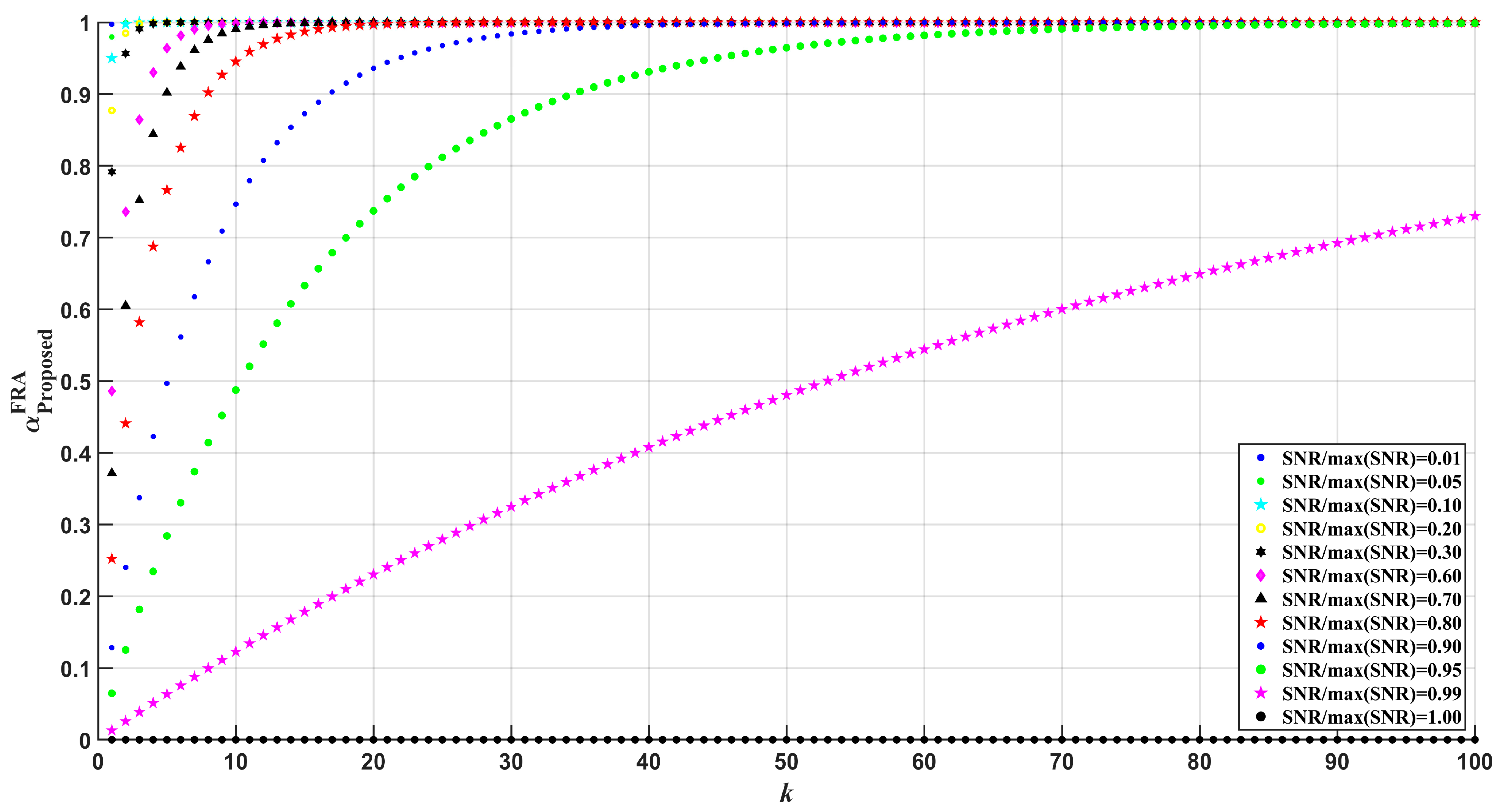
In Equation (20), the normalized ratio S N R P r o p o s e d F R A / max S N R P r o p o s e d F R A ranges from zero to one. Therefore, theoretically, a larger value of k (i.e., β ) corresponds to a smaller value of this normalized ratio, thus yielding a higher value of α P r o p o s e d F R A . From the perspective of theoretical significance, the β parameter serves as a theoretical non-linear tuning factor for the proposed AGF. It imposes a power-law non-linear transformation on the normalized SNR [ S N R P r o p o s e d F R A / max S N R P r o p o s e d F R A ]. Mathematically, when β > 1 , this transformation exhibits the characteristic behavior of a convex function: the smaller the value of [ S N R P r o p o s e d F R A / max S N R P r o p o s e d F R A ] (i.e., the lower the SNR level), the faster the decay rate of [ S N R P r o p o s e d F R A / max S N R P r o p o s e d F R A ] β ; conversely, the larger the value of the normalized SNR, the slower the decay rate. Correspondingly, the filter parameter α P r o p o s e d F R A exhibits a gentle increase in high-SNR regions, which translates to the implementation of weak filtering, whereas it climbs steeply in low-SNR regions, thus realizing intense filtering effects. Figure 1 illustrates the variations in α P r o p o s e d F R A with increasing integer scaling factor k (i.e., β ) across different values of the normalized ratio S N R P r o p o s e d F R A / max S N R P r o p o s e d F R A . For each fixed value of this normalized ratio, α P r o p o s e d F R A increases as k increases, while the rate of increase gradually slows and eventually approaches zero. In addition, a smaller value of [ S N R P r o p o s e d F R A / max S N R P r o p o s e d F R A ] (i.e., a lower SNR level) corresponds to a faster decay rate of [ S N R P r o p o s e d F R A / max S N R P r o p o s e d F R A ] β with respect to k . In contrast, a larger normalized SNR is associated with a slower rate of decay. Overall, the introduction of the β parameter addresses the inherent limitation of a fixed linear response sensitivity of α P r o p o s e d F R A to the normalized SNR, thereby allowing for tailored adjustment of filtering intensity across distinct SNR levels.
It is well recognized that radar observation scenes are typically heterogeneous, and this inherent scene non-uniformity gives rise to the spatial inhomogeneity of SNR. From the perspective of physical interpretation, the introduction of β equips the proposed AGF with enhanced adaptability to such SNR spatial heterogeneity. Specifically, β quantifies the degree to which filtering strength is adjusted in response to varying SNR levels: it amplifies the increment of filtering strength in low-SNR regions to reinforce noise suppression, while moderating the variation in filtering strength in high-SNR regions to preserve valid signal details. In this manner, the introduction of β effectively balances noise suppression and effective information preservation.
Equation (20) and Figure 1 theoretically indicate that the variable exponent β enables adjustment of the normalized ratio S N R P r o p o s e d F R A / max S N R P r o p o s e d F R A , thereby achieving a stronger filtering effect in low-SNR areas and a weaker filtering effect in high-SNR areas. Thus, β can serve as an additional control factor for the filtering effect.
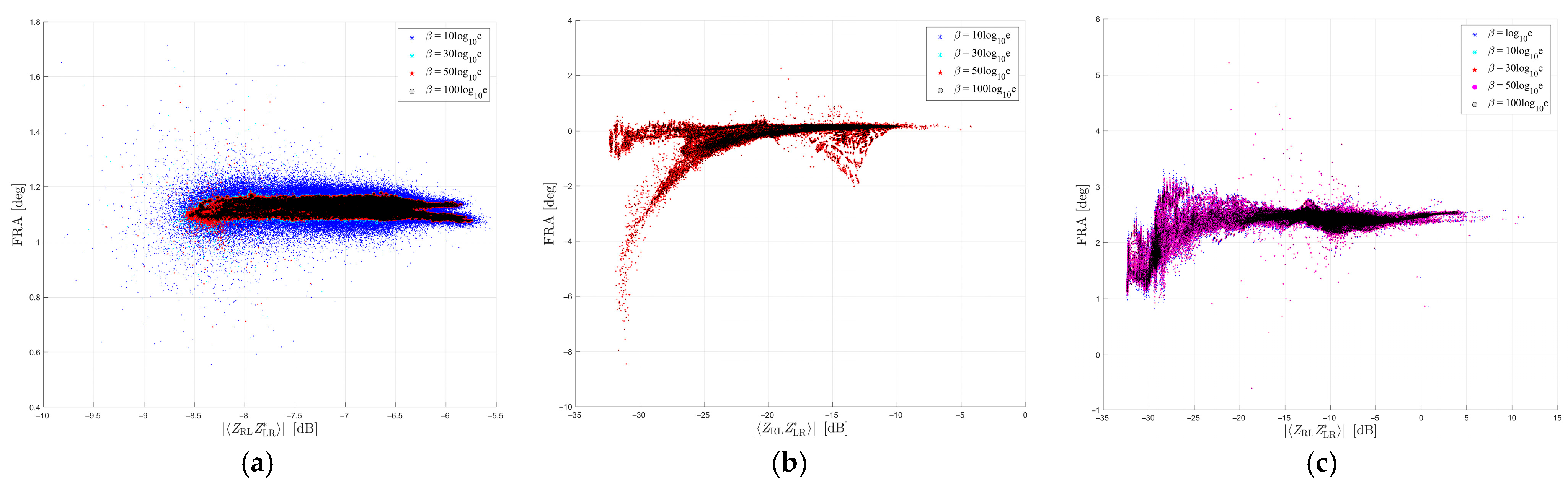
According to the above analysis, k = 5 (i.e., β = 50 l o g 10   e ) is selected for the experiments in Section 4. This choice is made to achieve a fine balance between noise suppression and the preservation of effective information across different SNR conditions, which correspond to distinct surface characteristics. In Section 5.1, we will further verify the effectiveness of this β selection by comparing the results obtained with different values of β (i.e., 10 l o g 10   e , 30 l o g 10   e , 50 l o g 10   e , and 100 l o g 10   e ) on FP SAR Datasets acquired by ALOS PALSAR.
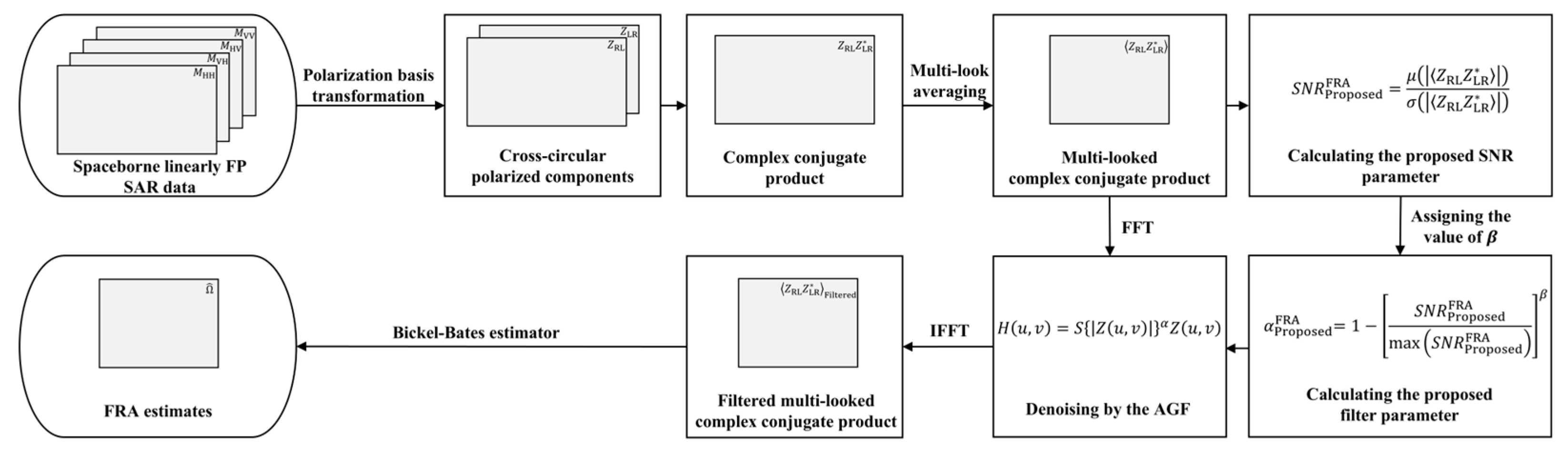
Figure 2 illustrates the flowchart of the proposed SNR-based AGF for FRA estimation. with the corresponding step-by-step descriptions provided in Table 1. As shown in Figure 2, the cross-circular polarized components Z R L and Z L R are derived from the four linearly polarized scattering matrix components extracted from the spaceborne FP SAR data.

3. Materials

The extraction of ionospheric information based on spaceborne FP SAR measurements can make up for the data deficiency of traditional ground-based detection techniques in observing the ionosphere over the areas where the ground devices are difficult to install such as the oceans. According to Figure 2 and Table 1, we conduct the experimental validation of the proposed SNR-based AGF for FRA estimation in comparison with other methods on three spaceborne L-band FP single-look complex ocean-involved Datasets (denoted by Dataset 1, 2, and 3) acquired by ALOS PALSAR. Table 2 lists some important information on these three Datasets.
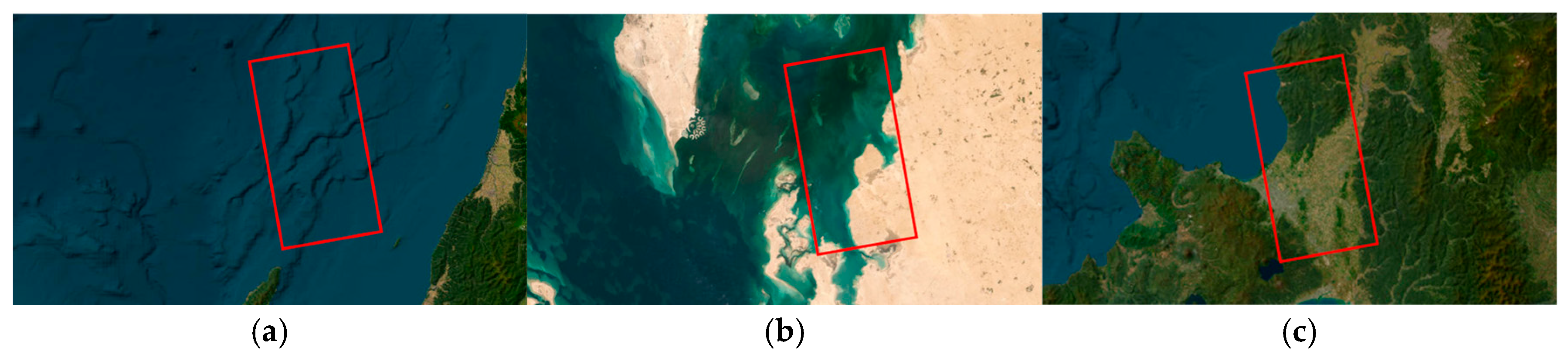
As shown in Figure 3a–c, Dataset 1 was obtained from an ocean-only zone in the Sea of Japan. Dataset 2 was collected from the northwest of Qatar, which corresponds to an ocean–land combined scene covering an ocean area of the Persian Gulf and a land area characterized by the sparsely vegetated desert. While Dataset 3 was acquired from the western part of Hokkaido Island of Japan, which presents a more complex scenario compared to Datasets 1 and 2, characterized by non-uniform scattering properties across diverse terrain types, primarily including six distinct categories: ocean, forest, mountains, urban buildings, farmland, and river.
Regarding the multi-look averaging in the experiments, a factor of 21 × 3 (azimuth × range) is adopted for Datasets 1 and 2, whereas a factor of 18 × 3 is used for Dataset 3, to ensure comparable resolutions in both the azimuth and range directions. For all the AGFs included in the comparison, a patch size of 32 × 32 and an overlap size of 14 pixels are selected to be the same as those adopted by Baran et al. [44] for interferogram filtering. In addition to these AGF variants, we also compare the proposed method with classical image denoising methods, namely Wavelet denoising [54], non-local means (NLM) denoising [55], and total variation (TV) denoising [26,28], to fully demonstrate its effectiveness.

4. Results

4.1. Experiment 1: Dataset 1

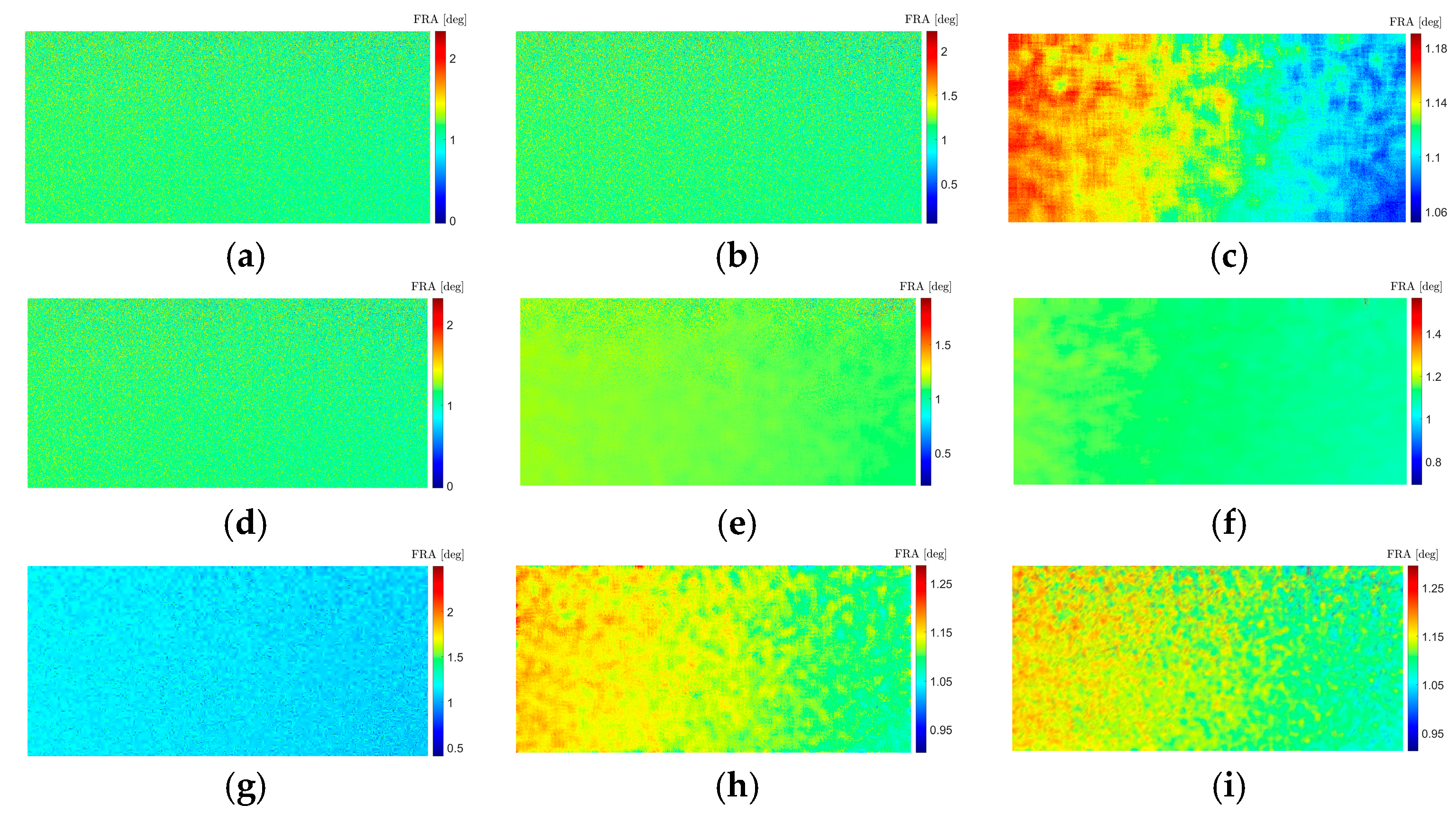
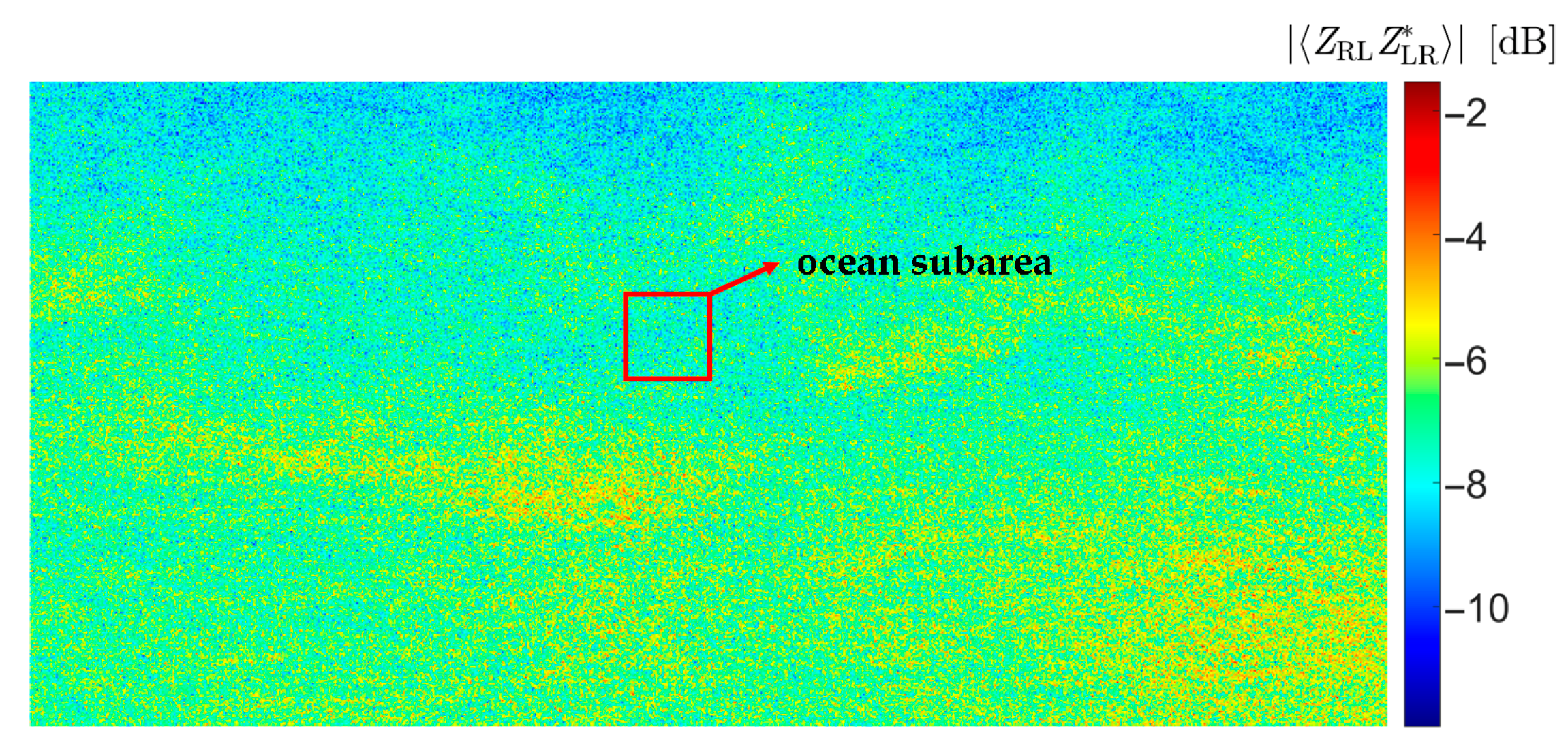
Figure 4 displays the FRA maps derived from Dataset 1 under various denoising treatments. Figure 4a is obtained directly from the multi-look averaged Bickel–Bates estimator signal (i.e., Z R L Z L R * ). Figure 4b–f illustrate the obtained FRA estimates when applying the AGFs of various filter parameters to Z R L Z L R * . Figure 4g–i illustrate the obtained FRA estimates when applying the Wavelet denoising, NLM denoising, and TV denoising to Z R L Z L R * . Compared to the other four AGFs, Figure 4c,f are visually smoother and exhibit superior noise suppression effects. Moreover, more obvious spatial variations in FRA estimates can be identified from these two subgraphs. It should be noted that Figure 4f is derived under the condition of β = 50 · l o g 10   e . The map of Z R L Z L R * shown in Figure 5 reflects the spatially variable signal intensity for this ocean-only scene of Dataset 1. Lower values of Z R L Z L R * appear in the upper part of this map. Combining Figure 4 and Figure 5, the areas with smaller values of Z R L Z L R * correspond to noisier FRA estimates, i.e., more noticeable artifacts in the estimated FRAs. Such results are consistent with the experimental findings reported in [37,39,53].
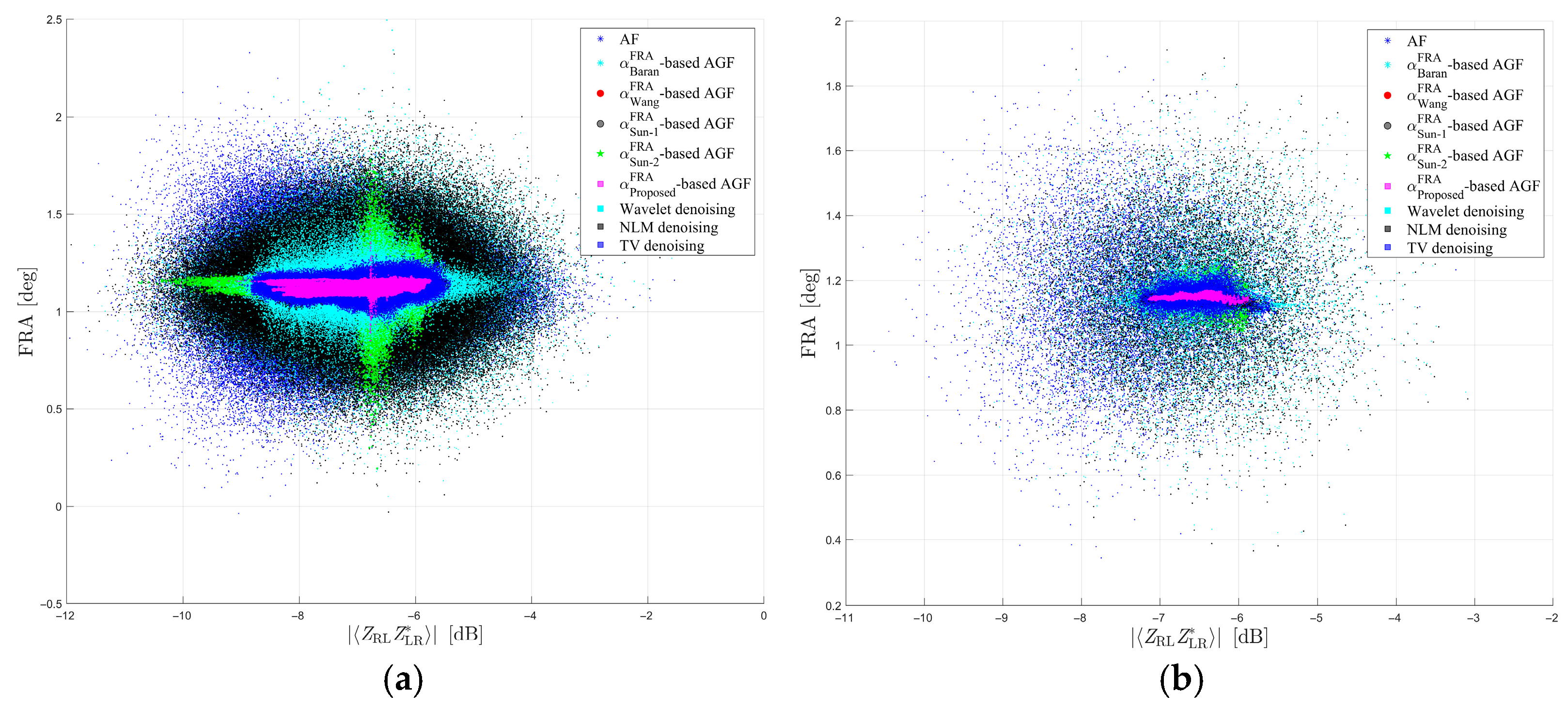
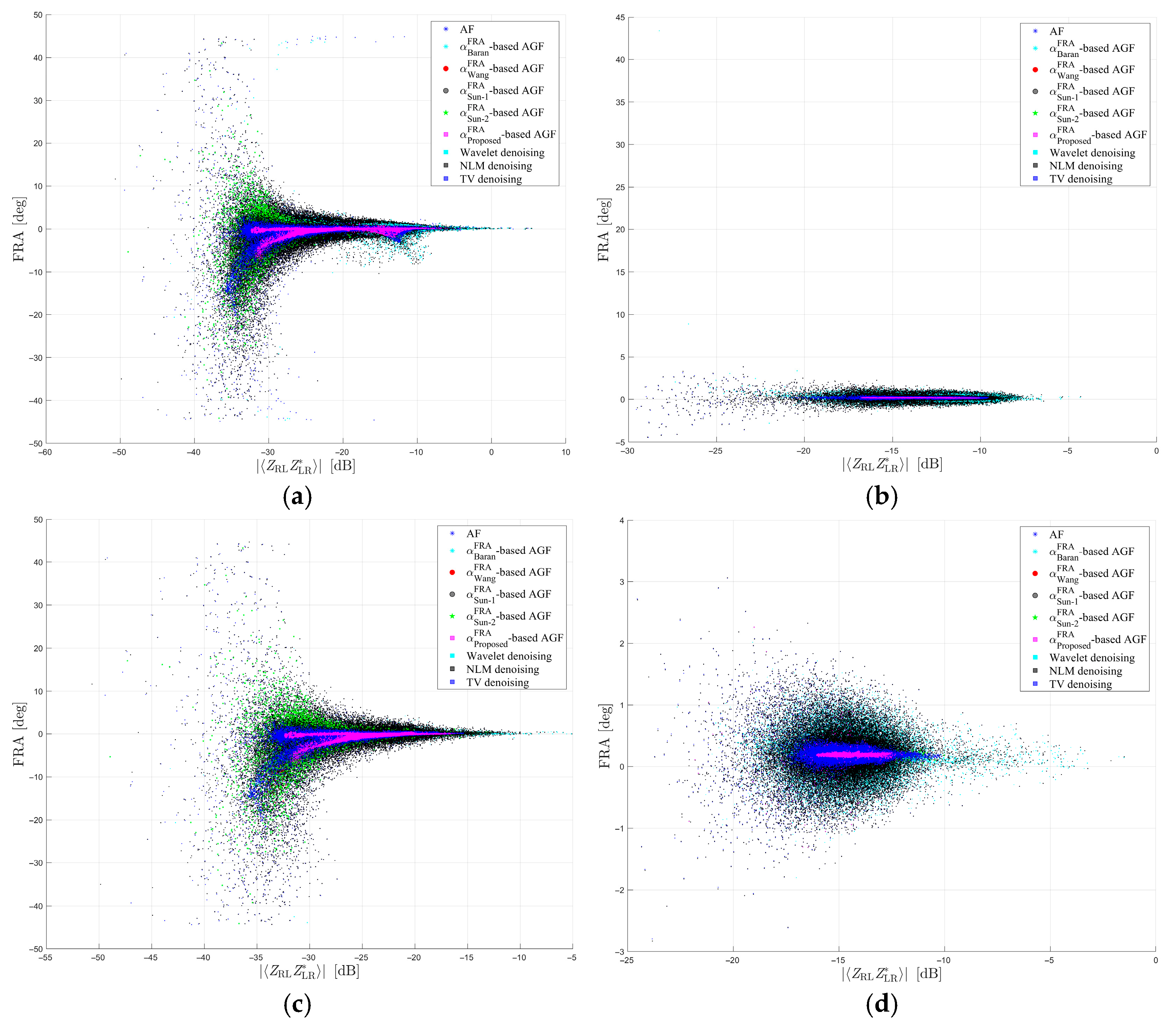
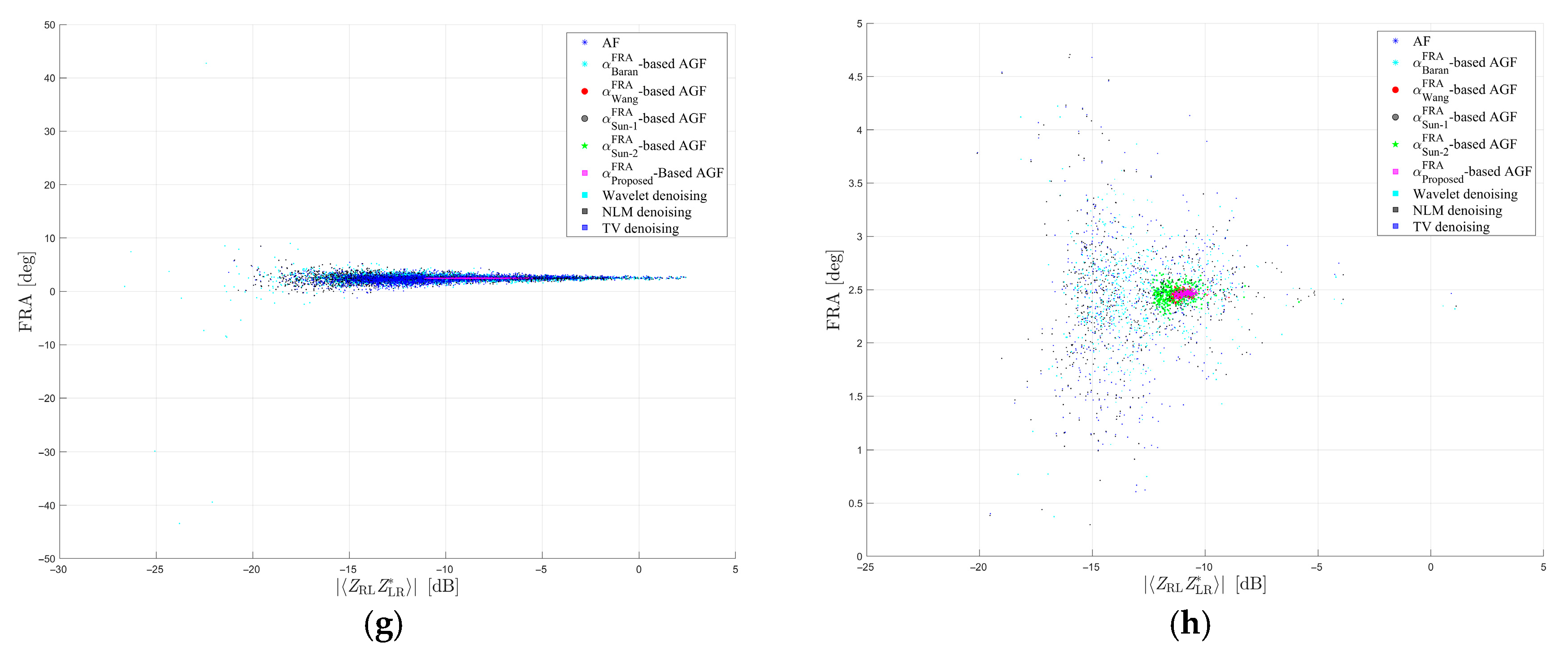
Meyer and Nicoll [39] first introduced the scatter plot of FRA versus Z R L Z L R * to clarify the correlation between them. The corresponding experimental results showed that the variance and bias of FRA estimates, in general, increase with the decrease of Z R L Z L R * . This scatter plot will also be used here to intuitively describe the quality of the estimated FRAs. Figure 6a,b show the scatter plots of FRA estimates versus Z R L Z L R * for the whole scene and a selected subarea, respectively, demonstrating consistent results across both scales. The blue asterisks (only applying the AF) exhibit the most dispersed distribution. Both the pink squares (using the proposed α P r o p o s e d F R A -based AGF) and red circles (employing the α W a n g F R A -based AGF) present a more concentrated distribution. The distributions under the SNR-based AGFs with α S u n 1 F R A and α S u n 2 F R A as filter parameters are less concentrated than that of the proposed method.
To quantitatively assess the performance of different filtering treatments, we further provide some statistics of FRA estimates and Z R L Z L R * for the whole scene corresponding to Figure 6a, as detailed in Table 3. Under the proposed SNR-based AGF, the STD of the obtained FRA estimates is the lowest. It decreases by 87.14%, 1.30%, 87.57%, and 54.78% relative to those obtained under the AGFs based on α B a r a n F R A , α W a n g F R A , α S u n 1 F R A , and α S u n 2 F R A , respectively. Compared to general image denoising methods, the STD of the proposed SNR-based AGF decreases by 59.39%, 11.33%, and 35.51% relative to those obtained under Wavelet denoising, NLM denoising and TV denoising, respectively. The means of the FRA estimates under these denoising treatments are quite close to each other. It can be known from the maximum and minimum of FRA estimates that the proposed method holds the second narrowest value range of FRA estimates. Among all the noise reduction treatments, the α W a n g F R A -based AGF and the proposed AGF feature larger means of Z R L Z L R * .
In addition to the statistics listed in Table 3, Table 4 provides another three statistical characteristics. The first is the mean FRA SNR calculated as the average of the SNRs across all effective corresponding patches in the map of FRA estimates. Here the SNR is defined as the ratio of the mean of the FRA estimates to their STD. The second is the mean FRA CV, i.e., the average of the CVs over all effective corresponding patches in the map of the estimated FRAs. This indicator measures the relative variability of FRA estimates. Contrary to the previous definition of SNR, the CV is formulated as the ratio of the STD of the FRA estimates to the corresponding mean. In terms of the mean FRA SNR, the proposed method achieves the highest value of 24.4885 dB among all the denoising treatments tested, followed by the α W a n g F R A -based AGF with a value of 22.5402 dB, while the simple AF yields the smallest value of 8.1308 dB. Correspondingly, with respect to the mean FRA CV, the proposed method attains the smallest value of 0.0038. This is trailed by the α W a n g F R A -based AGF with a value of 0.0057. The simple AF produces the highest value of 0.1579. In terms of the mean PC | γ p | , the value achieved by the proposed SNR-based AGF method is comparable to that of the Wang filter, and outperforms traditional filtering methods such as the Baran filter, Sun-1, Sun-2, and Wavelet denoising.

4.2. Experiment 2: Dataset 2

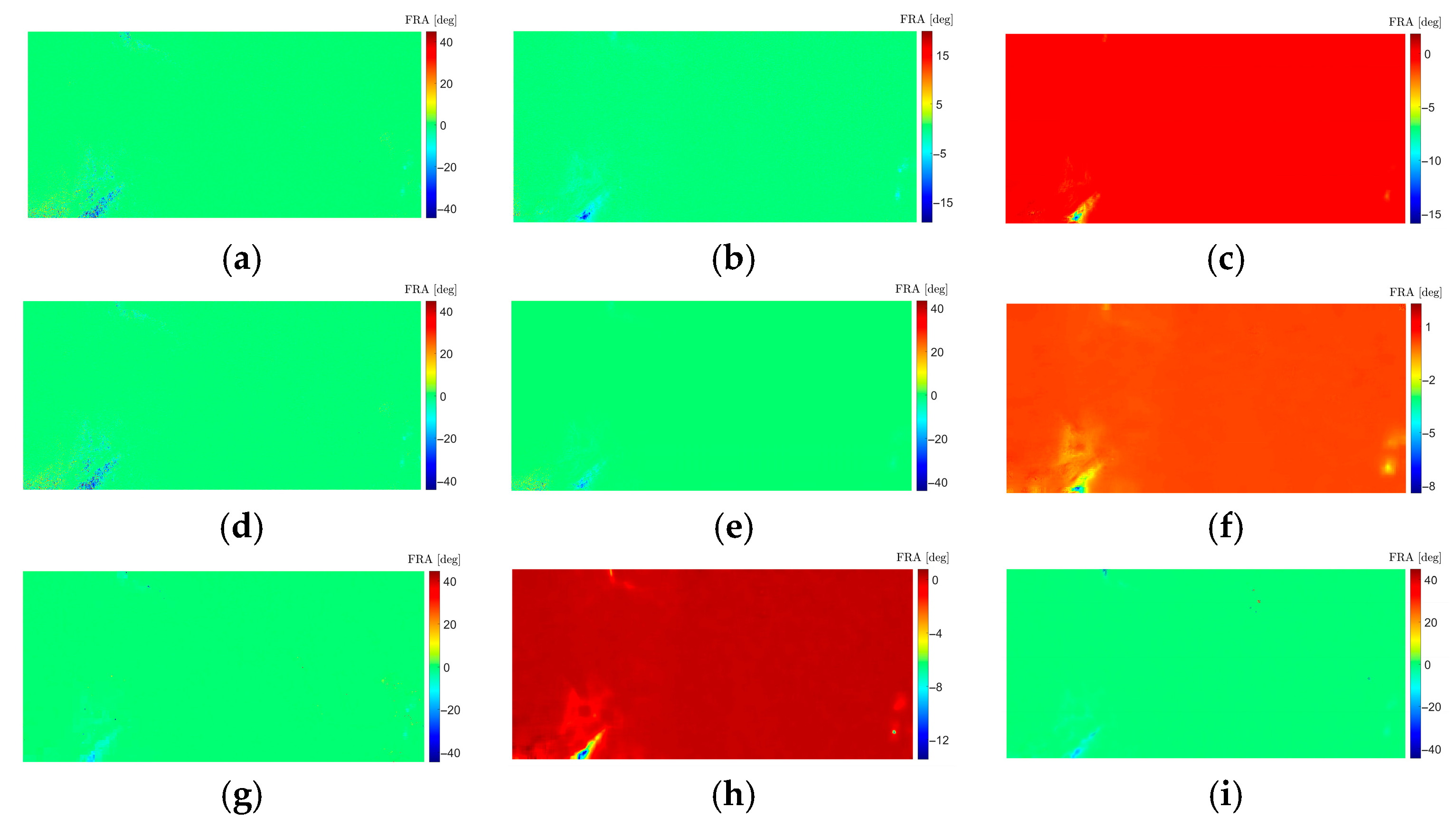
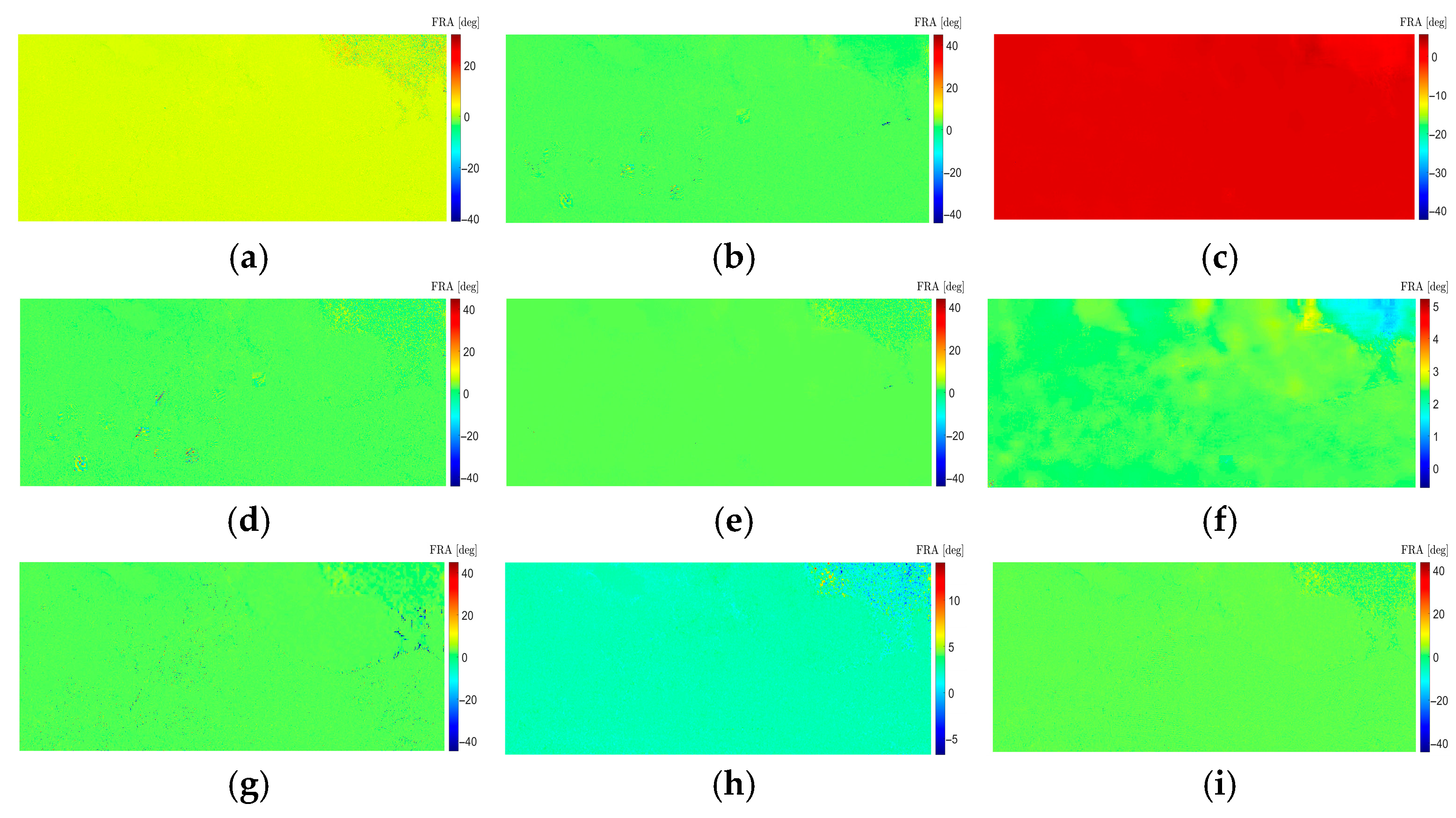
Figure 7 presents the FRA distributions of Dataset 2 (corresponding to a land–ocean combined scene) under different noise suppression procedures. As Figure 4a, the FRA estimates shown in Figure 7a are also derived from Z R L Z L R * . Figure 7b–f display the maps of FRA estimates obtained through the applications of five AGFs with different filter parameters to Z R L Z L R * , in which Figure 7f is also generated when β = 50 l o g 10   e . Figure 7g–i illustrate the obtained FRA estimates when applying the general image denoising methods (Wavelet denoising, NLM denoising and TV denoising) to Z R L Z L R * . Similarly to Dataset 1, the proposed SNR-based AGF and the α W a n g F R A -based AGF yield smoother outcomes against other methods tested. The distribution of Z R L Z L R * for Dataset 2 is illustrated in Figure 8. As can be observed, the majority of the entire ocean area exhibits larger values of Z R L Z L R * compared to the land area, whereas partial ocean areas (such as the lower left part) show low values of Z R L Z L R * . Likewise, a joint analysis of the maps of FRA estimates and Z R L Z L R * indicates that the areas with lower values of Z R L Z L R * present visually noisier characteristics in the FRA estimates.
Figure 9 shows the corresponding scatter plots of FRA estimates versus Z R L Z L R * for the whole scene and three selected subareas (land–ocean combined, land-only, and ocean-only). It can be noticed that the proposed SNR-based AGF and the AGF using α W a n g F R A as the filter parameter still yield more concentrated distributions, whether for the entire scene or for the selected subareas. Furthermore, the scatter plots of the three subareas appear visually distinct due to their differential backscattering characteristics.
Table 5 tabulates the statistical information on the estimated FRAs and Z R L Z L R * across the entire study area. Regarding the STD of FRA estimates, the proposed SNR-based AGF provides the smallest value, showing 59.64%, 35.97%, 87.62%, and 70.69% reductions, relative to the results obtained under the AGFs taking α B a r a n F R A , α W a n g F R A , α S u n 1 F R A , and α S u n 2 F R A as the filter parameters, respectively. Compared to general image denoising methods, the STD of the proposed SNR-based AGF decreases by 70.14%, 46.13% and 70.92% relative to those obtained under Wavelet denoising, NLM denoising and TV denoising, respectively. Furthermore, the NLM denoising algorithm demonstrates superior performance compared to the other two general image denoising methods. Similarly, the means of the estimated FRAs under different noise reduction treatments are comparable. According to the maximum and minimum of FRA estimates, when applying the proposed SNR-based AGF, the resulting FRA estimates exhibit narrower value range along with the lowest STD compared to other denoising treatments. In terms of the mean of Z R L Z L R * , the α W a n g F R A -based AGF and the proposed method produce larger values.
In addition to the statistics presented in Table 5, Table 6 provides another three statistical characteristics, including the mean FRA SNR, the mean FRA CV and the mean PC | γ p |. From the comparison of the mean FRA SNR, the proposed method delivers the highest value of 9.7712 dB, exceeding the value of 8.8449 dB from the α W a n g F R A -based AGF. The α S u n 1 F R A - and α S u n 2 F R A -based AGFs yield a value smaller than 6 dB. A comparative analysis of the mean FRA CV indicates that the proposed method achieves the lowest value of 1.9503, significantly outperforming the α W a n g F R A -based AGF, which yields a value of 3.3368. Furthermore, α B a r a n F R A -, α S u n 1 F R A - and α S u n 2 F R A -based AGFs all exhibit considerably high values, each exceeding 8.6208. For Dataset 2, the proposed SNR-based AGF method achieves the highest mean PC among all filtering methods, demonstrating its superior ability to preserve PC and suggesting that it retains more polarimetric information. Furthermore, the Wang filter ranks second in terms of mean PC, while the Sun-2 method ranks third.

4.3. Experiment 3: Dataset 3

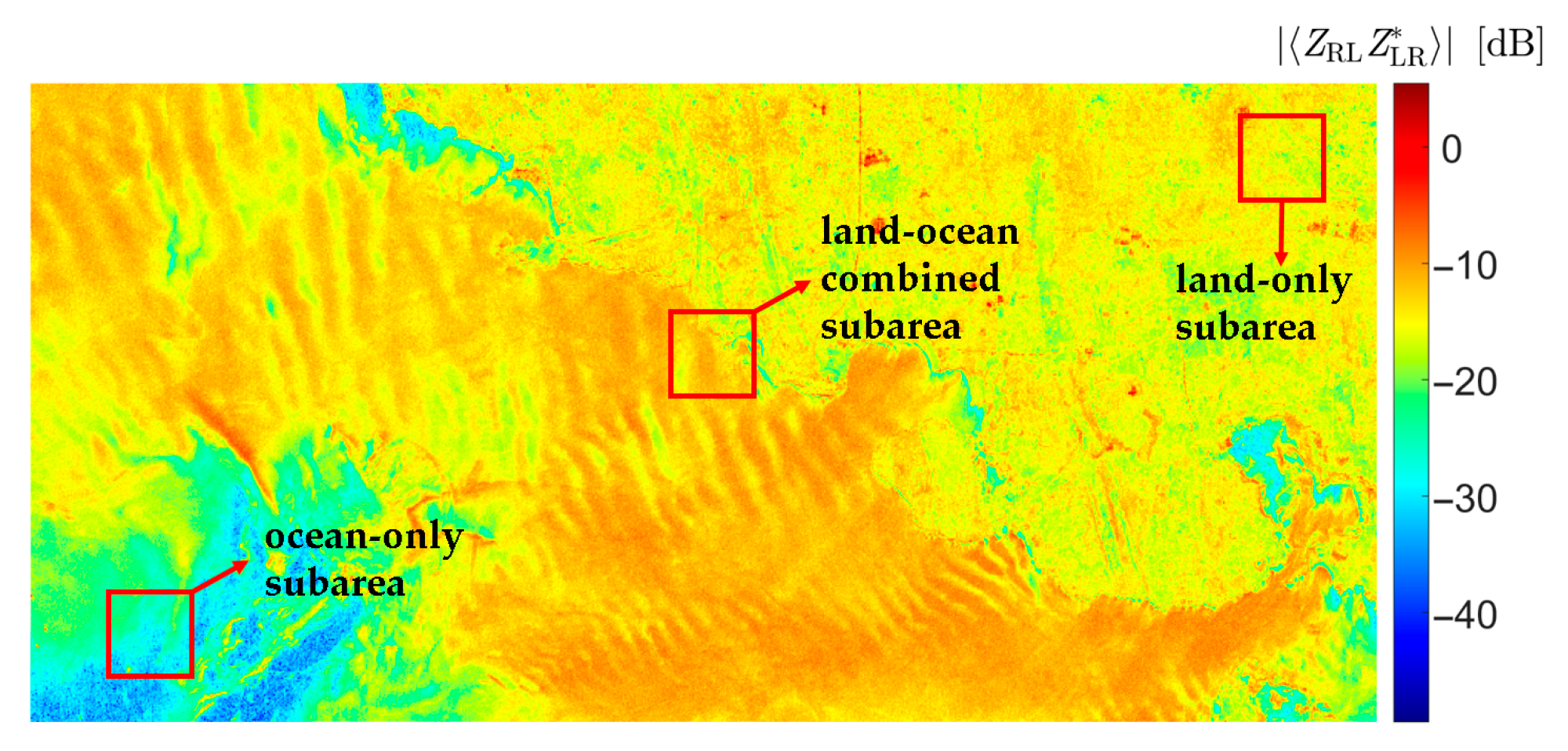
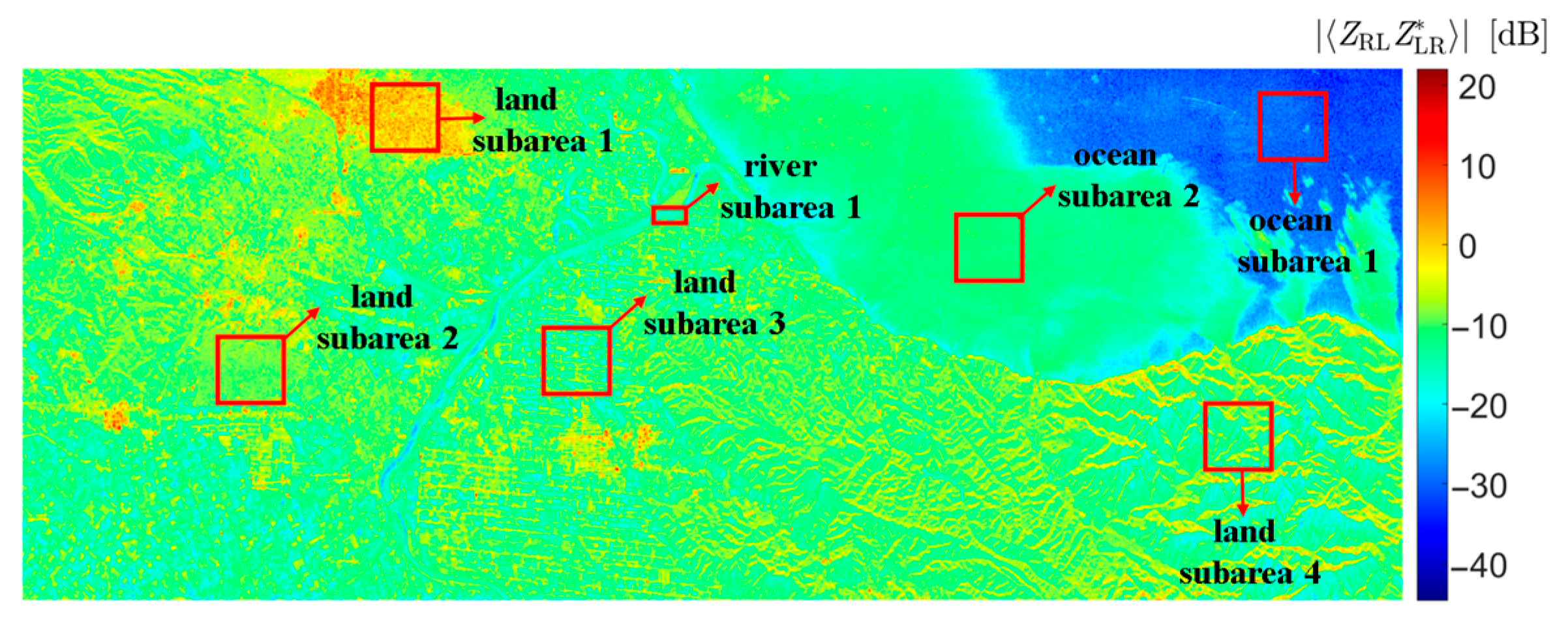
Figure 10 presents the FRA distributions of Dataset 3 under different noise suppression methods. As Figure 4a and Figure 7a, the FRA estimates shown in Figure 10a are also derived from Z R L Z L R * directly. Figure 10b–f display the maps of FRA estimates obtained through the applications of five AGFs with different filter parameters to Z R L Z L R * , in which Figure 10f is also generated when β = 50 l o g 10   e . Figure 10g–i illustrate the obtained FRA estimates when applying Wavelet denoising, NLM denoising, and TV denoising to Z R L Z L R * , respectively. Similarly to Datasets 1 and 2, the proposed SNR-based AGF and the α W a n g F R A -based AGF yield smoother outcomes against other methods tested. The distribution of Z R L Z L R * for Dataset 3 is illustrated in Figure 11. As can be observed, a joint analysis of the maps of FRA estimates and Z R L Z L R * indicates that the areas with lower values of Z R L Z L R * present visually noisier characteristics in the FRA estimates. Figure 11 reveals that ocean subareas 1 and 2 possess different magnitudes of Z R L Z L R * , which can be attributed to the differences in their scattering mechanisms under different surface roughness. Specifically, ocean areas with relatively lower Z R L Z L R * values (i.e., lower backscattering intensity) may have smaller surface roughness.
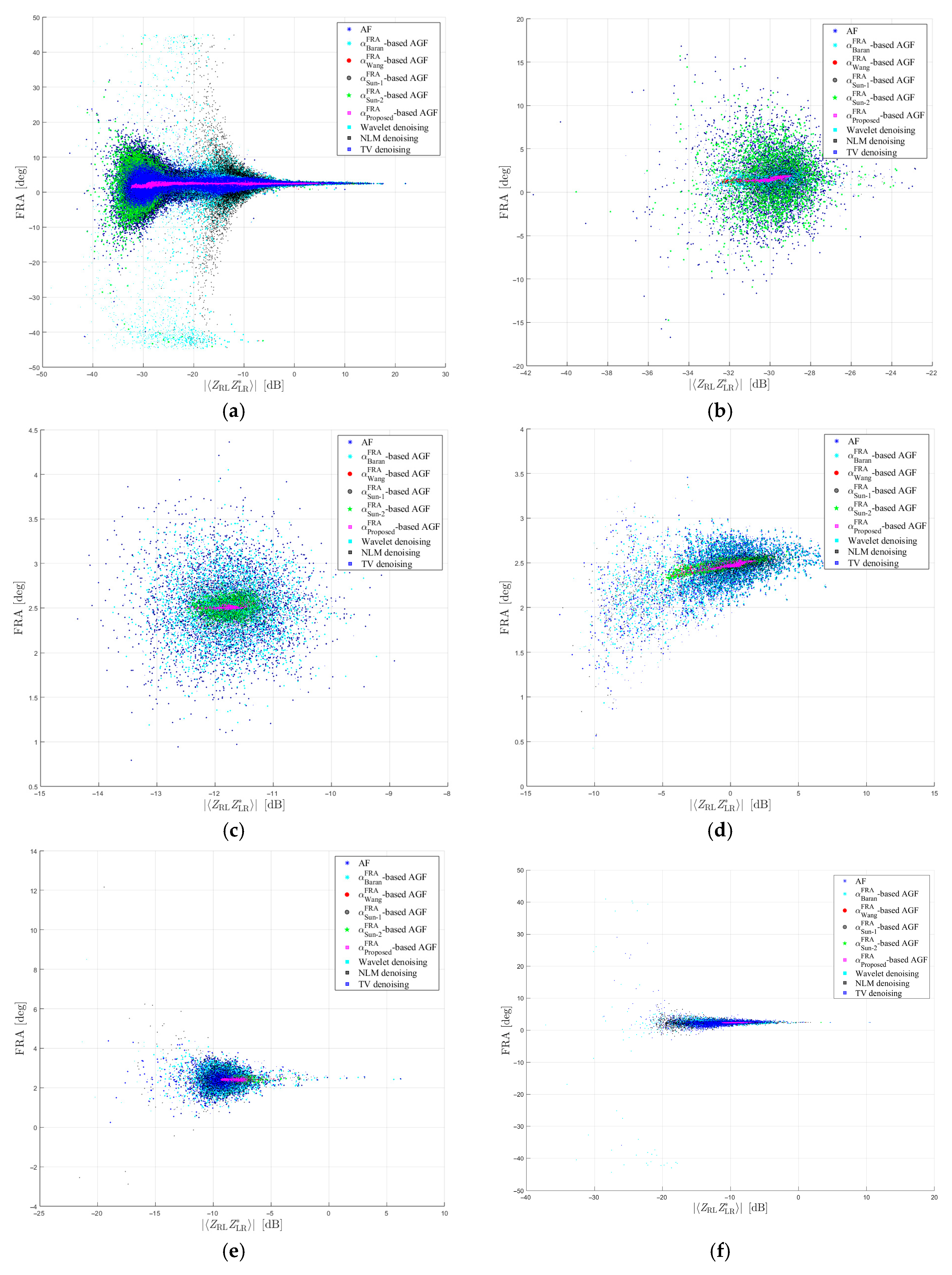
Figure 12 presents scatter plots of FRA estimates versus Z R L Z L R * for the entire scene and seven selected subareas. These plots corroborate findings from qualitative experiments: ocean and mountainous/terrestrial areas exhibit distinct magnitudes of the cross-polarization product, leading to different FRA distributions (generally lower over land). While the seven subareas show visually distinct scatter patterns due to their differing backscattering characteristics, the proposed SNR-based AGF and the AGF using α W a n g F R A consistently yield more concentrated distributions across all regions compared to other methods. Notably, the proposed SNR-based method demonstrates superior performance in filtering smoothness, producing the more homogeneous output with a tightly clustered, uniform point distribution around the mean, both globally and within each sub-region.
Table 7 tabulates the statistical information on the estimated FRAs and Z R L Z L R * across the entire study area. Regarding the STD of FRA estimates, among these, the proposed SNR-adaptive method achieves the smallest FRA STD of 0.1625°, showing 83.43%, 13.61%, 90.03%, and 78.85% reductions, relative to the results obtained under the AGFs taking α B a r a n F R A , α W a n g F R A , α S u n 1 F R A , and α S u n 2 F R A as the filter parameters, respectively. Compared to general image denoising methods, the STD of the proposed SNR-based AGF decreases by 92.09%, 13.38%, and 81.71% relative to those obtained under Wavelet denoising, NLM denoising and TV denoising, respectively.
Table 8 provides another three similar statistical metrics including mean FRA SNR, FRA CV, and PC, as Datasets 1 and 2. Regarding the mean FRA SNR, the proposed method yields the highest value of 19.4543 dB, followed by NLM denoising (18.7949 dB) and the Wang filter (17.7005 dB). The quantitative evaluation using the mean FRA CV metric shows that our proposed SNR-based method achieves the smallest CV value, followed by the NLM denoising. The mean PC shows that our proposed SNR-based method is ranked second to the NLM algorithm, confirming its effectiveness in preserving complete polarimetric information.

5. Discussion

SNR is a key factor influencing the quality of FRA estimates. Inspired by the SNR-based AGFs developed in radar interferometric processing, this article proposes a SNR-based AGF to denoise the complex signal of the Bickel–Bates estimator in the FRA estimation. As demonstrated by the qualitative and quantitative experimental results above, the denoising performance of the proposed method surpasses other noise reduction methods evaluated in the experiments, including the existing AGFs using α B a r a n F R A and α W a n g F R A as the filter parameters, and the α S u n 1 F R A - and α S u n 2 F R A -based AGFs modified from the interferometric phase AGFs that are built upon α S u n 1 I P and α S u n 2 I P , as well as the classical Wavelet denoising, NLM denoising, and TV denoising.

5.1. Sensitivity Analysis of the β Parameter

As regards the adjustable factor β in the filter parameter α P r o p o s e d F R A of the proposed method, its presence provides an extra degree of freedom for adjusting the filtering effect by modulating α P r o p o s e d F R A , compared to other AGFs applied to FRA estimation. In our experiments conducted above, the corresponding results displayed under the proposed method are those obtained when β = 50 · l o g 10   e for Datasets 1, 2, and 3. In fact, extensive experiments on these three Datasets are carried out with a sequence of β values.
We also provide additional experimental results for β values of l o g 10   e , 10 l o g 10   e , 30 l o g 10   e , 50 l o g 10   e (the value selected in the current work), and 100 l o g 10   e . These results are simply exhibited in Figure 13 and summarized in Table 9, Table 10, Table 11, Table 12, Table 13 and Table 14. Moreover, experimental verification and evaluation are also performed on numerous other ocean–land combined FP Datasets acquired by ALOS PALSAR. These Datasets exhibit different levels of scene complexity and scattering characteristics arising from different surface features.
It is indicated from the qualitative metric of FRA- Z R L Z L R * scatter plots shown in Figure 13 that the distributions for β = 50 l o g 10   e and β = 100 l o g 10   e are more concentrated, with minimal difference between them. Regarding quantitative metrics tabulated in Table 9 and Table 10, the FRA STDs for β = 50 l o g 10   e and β = 100 l o g 10   e are 0.0027° and 0.0025°, respectively, showing little variation compared to the results for β = 10 l o g 10   e and β = 30 l o g 10   e . Furthermore, the mean FRA SNR of the entire image is highest overall for β = 50 l o g 10   e and β = 100 l o g 10   e . For the results of Dataset 2, listed in Table 11 and Table 12, with the parameter β set to 50 l o g 10   e , the experimental results have converged, and the FRA- Z R L Z L R * scatter distributions are remarkably similar (see Figure 13). This indicates that the filtering performance stabilizes at this value, providing a balance between noise suppression and detail preservation. For the results of Dataset 3 listed in Table 13 and Table 14, consistent results are observed for a series of β values, which are not repeated herein. All these results show that β = 50 · l o g 10   e can produce a fine denoising effect and thus achieve relatively superior outcomes in most cases. In addition, it needs to be emphasized that when β = 10 · l o g 10   e , the filter parameter α P r o p o s e d F R A in the proposed method is equivalent to α S u n 1 F R A . This equivalence makes the experimental results of the proposed method identical to those of the α S u n 1 F R A -based AGF by substituting S N R S u n 1 F R A with 10 · l o g 10 S N R P r o p o s e d F R A .

5.2. Limitations and Future Work

Nevertheless, the current study still has several limitations that warrant further refinement in future research, as summarized below:
1.
Similarly to other sliding window-based filters, its filtering strength is not only governed by the filter parameter but also highly sensitive to the size of the filtering patch. Future work will examine the impact of window size on the filtering performance.
2.
In the current implementation, a fixed value of β is uniformly applied across all sliding windows. To further enhance the adaptive capability of the proposed method, future work will explore the use of a window-adaptive, non-constant tunable factor β .
3.
The method proposed in this article can be extended to the FRA retrieval workflows that employ any other estimator relying on the phase extraction of a complex signal, such as the approaches developed by Chen and Quegan [35], Li et al. [36], and Wang et al. [26]. This extension can be readily achieved by substituting the amplitude component derived from the Bickel–Bates estimator with that of the adopted alternative estimator. However, it should be noted that the proposed method is not applicable to FRA retrieval frameworks based on estimators that calculate the FRA using the arctangent of the ratio of two complex numbers, such as the Freeman estimator [24].

6. Conclusions

In radar interferometric processing, SNR-based AGFs are among the key AGF-type methods and exhibit superior denoising performance for interferometric phases. This study investigates denoising during the estimation of FRAs from spaceborne FP SAR measurements, with a specific focus on the first application of SNR-based AGFs to FRA estimation. Three SNR-based AGFs applicable to FRA estimation using the Bickel–Bates estimator are examined. Two of them are obtained by modifying the interferometric phase AGFs developed by Sun et al. by retaining the same mathematical forms for SNRs and filter parameters, while replacing the interferometric phase with the amplitude of the Bickel–Bates estimator signal Z R L Z L R * . The newly proposed third AGF is developed by introducing an SNR definition widely adopted in image processing, paired with a distinct filter parameter definition that incorporates an adjustable factor. The effectiveness of the proposed SNR-based AGF in noise suppression and FRA estimation improvement has been validated using three L-band ALOS PALSAR FP Datasets which correspond to an ocean-only scene, a plain land–ocean combined scene, and a more complex land–ocean combined scene. Comprehensive qualitative and quantitative experimental results confirm that the proposed filter achieves superior performance compared to eight other denoising methods, including the conventional simple AF; the AGF based on the complex correlation coefficient of Z R L and Z L R ; the AGF using normalized magnitudes of Z R L Z L R * ; the other two modified SNR-based AGF variants; and three classical image denoising methods (i.e., Wavelet denoising, NLM denoising, and TV denoising). Notably, the proposed SNR-based AGF can be integrated into FRA retrieval workflows to generate higher-quality FRA estimates, which in turn facilitates the derivation of more accurate two-dimensional ionospheric absolute TEC. In future work, ionospheric TEC retrieval will be conducted using FRA estimates obtained via the proposed denoising method. More diverse data from other spaceborne FP radar sensors will also be used subsequently, such as ALOS-2 PALSAR-2, ALOS-4 PALSAR-3, NISAR, and Biomass.

Author Contributions

Conceptualization, Z.W., X.W., D.L. and Y.Z.; methodology, Z.W., X.W. and D.L.; validation, Z.W. and X.W.; formal analysis, Z.W., X.W. and D.L.; writing—original draft preparation, Z.W.; writing—review and editing, Z.W., X.W., D.L. and Y.Z.; visualization, Z.W.; funding acquisition, D.L. and Y.Z. All authors have read and agreed to the published version of the manuscript.

Funding

This work was supported in part by the National Natural Science Foundation of China under Grants 62495034, 41871274, and 61971402.

Data Availability Statement

The three ALOS PALSAR FP datasets listed in Table 1 were retrieved through the website of ASF DAAC (accessed on 23 October 2024) after registering. The data corresponding to these experimental results presented in this study are available in the Science Data Bank by submitting a request at https://doi.org/10.57760/sciencedb.29714.

Acknowledgments

The authors would like to express their appreciation to the Japan Aerospace Exploration Agency and the Alaska Satellite Facility Distribute Active Archive Centre (ASF DAAC) for providing the high-quality ALOS PALSAR quad-polarization data.

Conflicts of Interest

No potential conflicts of interest were reported by the authors.

References

  1. Budden, K.G. The Propagation of Radio Waves: The Theory of Radio Waves of Low Power in the Ionosphere and Magnetosphere; Cambridge University Press: New York, NY, USA, 1985. [Google Scholar]
  2. Kelley, M.C. The Earth’s Ionosphere: Plasma Physics and Electrodynamics, 2nd ed.; Academic Press: New York, NY, USA, 2009. [Google Scholar]
  3. IEEE Std 211-2018 (Revision of IEEE Std 211-1997); IEEE Standard Definitions of Terms for Radio Wave Propagation. IEEE Antennas and Propagation Society: New York, NY, USA, 2019.
  4. Xu, Z.; Wu, J.; Wu, Z. A Survey of Ionospheric Effects on Space-based Radar. Waves Random Media 2004, 14, S189–S273. [Google Scholar] [CrossRef]
  5. Lawrence, R.S.; Little, C.G.; Chivers, H.J.A. A Survey of Ionospheric Effects upon Earth-space Radio Propagation. Proc. IEEE 1964, 52, 4–27. [Google Scholar] [CrossRef]
  6. Ji, Y.; Dong, Z.; Zhang, Y.; Wang, C.; Hu, C.; Xu, Z. Transionospheric Synthetic Aperture Radar Observation: A Comprehensive Review. IEEE Geosci. Remote Sens. Mag. 2025, 13, 273–313. [Google Scholar] [CrossRef]
  7. Sun, H.; Xu, L.; Wang, S.; Wu, Y. Development and Application of Ionospheric Detection Technology. In Proceedings of the 2nd International Conference on Electrical Engineering and Computer Technology (ICEECT 2022), Suzhou, China, 23–25 September 2022; IOP Publishing: Bristol, UK, 2022; Volume 2404, p. 012030. [Google Scholar]
  8. Zhen, W.; Ou, M.; Zhu, Q.; Dong, X.; Liu, D. Review on Ionospheric Sounding and Modeling. Chin. J. Radio Sci. 2023, 38, 625–645. (In Chinese) [Google Scholar]
  9. Koloskov, O.; Kashcheyev, A.; Bogomaz, O.; Sopin, A.; Gavrylyuk, B.; Zalizovski, A. Performance Analysis of a Portable Low-Cost SDR-Based Ionosonde. Atmosphere 2023, 14, 159. [Google Scholar] [CrossRef]
  10. Yue, X.; Wan, W.; Ning, B.; Jin, L.; Ding, F.; Zhao, B.; Zeng, L.; Ke, C.; Deng, X.; Wang, J.; et al. Development of the Sanya Incoherent Scatter Radar and Preliminary Results. J. Geophys. Res. Space Phys. 2022, 127, e2022JA030451. [Google Scholar] [CrossRef]
  11. Koustov, A.V.; Ullrich, S.; Ponomarenko, P.V.; Gillies, R.G.; Themens, D.R.; Nishitani, N. Comparison of SuperDARN Peak Electron Density Estimates Based on Elevation Angle Measurements to Ionosonde and Incoherent Scatter Radar Measurements. Earth Planets Space 2020, 72, 43. [Google Scholar] [CrossRef]
  12. Mengist, C.K.; Yadav, S.; Kotulak, K.; Bahar, A.; Zhang, S.R.; Seo, K.H. Validation of International Reference Ionosphere Model (IRI-2016) for F-region Peak Electron Density Height (hmF2): Comparison with Incoherent Scatter Radar (ISR) and Ionosonde Measurements at Millstone Hill. Adv. Space Res. 2020, 65, 2773–2781. [Google Scholar] [CrossRef]
  13. Li, J.; Zhu, Y.; Feng, W.; Huang, D. Ground and Space (LEO) Based GNSS Ionospheric Detection Using Chapman Function Constraint. J. Geophys. Res. Space Phys. 2025, 130, e2024JA032890. [Google Scholar] [CrossRef]
  14. Ren, X.; Zhang, X.; Xie, W.; Zhang, K.; Yuan, Y.; Li, X. Global Ionospheric Modelling Using Multi-GNSS: BeiDou, Galileo, GLONASS and GPS. Sci. Rep. 2016, 6, 33499. [Google Scholar] [CrossRef]
  15. Chen, P.; Yao, Y.; Yao, W. Global Ionosphere Maps Based on GNSS, Satellite Altimetry, Radio Occultation and DORIS. GPS Solut. 2017, 21, 639–650. [Google Scholar]
  16. Jakowski, N.; Leitinger, R.; Angling, M. Radio Occultation Techniques for Probing the Ionosphere. Ann. Geophys. 2004, 47, 1049–1066. [Google Scholar] [CrossRef]
  17. Cloude, S.R. Polarization: Applications in Remote Sensing; Oxford University Press: New York, NY, USA, 2010. [Google Scholar]
  18. Hajnsek, I.; Desnos, Y.L. Polarimetric Synthetic Aperture Radar: Principles and Application; Springer: Cham, Switzerland, 2021. [Google Scholar]
  19. Lee, J.S.; Pottier, E. Polarimetric Radar Imaging: From Basic to Applications; CRC Press: Boca Raton, FL, USA, 2009. [Google Scholar]
  20. Li, D.; Zhang, Y. Adaptive Model-Based Classification of PolSAR Data. IEEE Trans. Geosci. Remote Sens. 2018, 56, 6940–6955. [Google Scholar]
  21. Li, D.; Lu, H.; Zhang, Y. Solid Angle Geometry-Based Modeling of Volume Scattering with Application in the Adaptive Decomposition of GF-3 Data of Sea Ice in Antarctica. Remote Sens. 2023, 15, 3208. [Google Scholar] [CrossRef]
  22. Gail, W.B. Effect of Faraday Rotation on Polarimetric SAR. IEEE Trans. Aerosp. Electron. Syst. 1998, 34, 301–307. [Google Scholar] [CrossRef]
  23. Wright, P.A.; Quegan, S.; Wheadon, N.S.; Hall, C.D. Faraday Rotation Effects on L-Band Spaceborne SAR Data. IEEE Trans. Geosci. Remote Sens. 2003, 41, 2735–2744. [Google Scholar]
  24. Freeman, A.; Saatchi, S.S. On the Detection of Faraday Rotation in Linearly Polarized L-Band SAR Backscatter Signatures. IEEE Trans. Geosci. Remote Sens. 2004, 42, 1607–1616. [Google Scholar]
  25. Pi, X.; Freeman, A.; Chapman, B.; Rosen, P.; Li, Z. Imaging Ionospheric Inhomogeneities Using Spaceborne Synthetic Aperture Radar. J. Geophys. Res. Space Phys. 2011, 116, A04303. [Google Scholar] [CrossRef]
  26. Wang, C.; Liu, L.; Chen, L.; Feng, J.; Zhao, H. Improved TEC Retrieval Based on Spaceborne PolSAR Data. Radio Sci. 2017, 52, 288–304. [Google Scholar] [CrossRef]
  27. Wang, C.; Guo, W.; Zhao, H.; Chen, L.; Wei, Y.; Zhang, Y. Improving the Topside Profile of Ionosonde with TEC Retrieved from Spaceborne Polarimetric SAR. Sensors 2019, 19, 516. [Google Scholar] [CrossRef]
  28. Guo, W.; Wang, C.; Zhao, H.; Zhang, S.; Cao, L.; Xiao, P.; Liu, L.; Chen, L.; Zhang, Y. Ionospheric Sounding Based on Spaceborne PolSAR in P-Band. Atmosphere 2022, 13, 524. [Google Scholar] [CrossRef]
  29. Wang, C.; Chen, L.; Zhao, H.; Lu, Z.; Bian, M.; Zhang, R.; Feng, J. Ionospheric Reconstructions Using Faraday Rotation in Spaceborne Polarimetric SAR Data. Remote Sens. 2017, 9, 1169. [Google Scholar] [CrossRef]
  30. Wang, C.; Chen, L.; Liu, L.; Yang, J.; Lu, Z.; Feng, J. Robust Computerized Ionospheric Tomography Based on Spaceborne Polarimetric SAR Data. IEEE J. Sel. Top. Appl. Earth Observ. Remote Sens. 2017, 10, 4022–4031. [Google Scholar] [CrossRef]
  31. Pi, X. Ionospheric Effects on Spaceborne Synthetic Aperture Radar and a New Capability of Imaging the Ionosphere From Space. Space Weather 2015, 13, 737–741. [Google Scholar] [CrossRef]
  32. Bickel, S.H.; Bates, R.H.T. Effects of Magneto-ionic Propagation on the Polarization Scattering Matrix. Proc. IEEE 1965, 53, 1089–1091. [Google Scholar] [CrossRef]
  33. Freeman, A. Calibration of Linearly Polarized Polarimetric SAR Data Subject to Faraday Rotation. IEEE Trans. Geosci. Remote Sens. 2004, 42, 1617–1624. [Google Scholar] [CrossRef]
  34. Qi, R.; Jin, Y. Analysis of the Effects of Faraday Rotation on Spaceborne Polarimetric SAR Observations at P-Band. IEEE Trans. Geosci. Remote Sens. 2007, 45, 1115–1122. [Google Scholar] [CrossRef]
  35. Chen, J.; Quegan, S. Improved Estimators of Faraday Rotation in Spaceborne Polarimetric SAR Data. IEEE Geosci. Remote Sens. Lett. 2010, 7, 846–850. [Google Scholar] [CrossRef]
  36. Li, L.; Zhang, Y.; Dong, Z.; Liang, D. New Faraday Rotation Estimators Based on Polarimetric Covariance Matrix. IEEE Geosci. Remote Sens. Lett. 2014, 11, 133–137. [Google Scholar] [CrossRef]
  37. Ji, Y.; Zhang, Y.; Zhang, Q.; Dong, Z.; Yao, B. Retrieval of Ionospheric Faraday Rotation Angle in Low-Frequency Polarimetric SAR Data. IEEE Access 2019, 7, 3181–3193. [Google Scholar] [CrossRef]
  38. Guo, W.; Liu, L.; Liu, B.; Chen, L.; Zhao, H.; Wang, C. Improved Faraday Rotation Estimation in Spaceborne PolSAR Data Using Total Variation Denoising. Remote Sens. 2019, 11, 2943. [Google Scholar] [CrossRef]
  39. Meyer, F.J.; Nicoll, J.B. Prediction, Detection, and Correction of Faraday Rotation in Full-Polarimetric L-Band SAR Data. IEEE Trans. Geosci. Remote Sens. 2008, 46, 3076–3086. [Google Scholar] [CrossRef]
  40. Goldstein, R.M.; Werner, C.L. Radar Interferogram Filtering for Geophysical Applications. Geophy. Res. Lett. 1998, 25, 4035–4038. [Google Scholar] [CrossRef]
  41. Zhu, W.; Chen, J.; Zhang, Q.; Zhang, J. Mapping of High-Spatial-Resolution Three-Dimensional Electron Density by Combing of Full-Polarimetric SAR and IRI Model. Front Earth Sci. 2020, 8, 181. [Google Scholar] [CrossRef]
  42. Zhu, W.; Jung, H.S.; Chen, J.Y. Synthetic Aperture Radar Interferometry (InSAR) Ionospheric Correction Based on Faraday Rotation: Two Case Studies. Appl. Sci. 2019, 9, 3871. [Google Scholar] [CrossRef]
  43. Wang, X.; Li, D.; Zhang, Y.; Yang, J.; Shi, X.; Liang, L. Faraday Rotation Estimation Based on PolSAR Data: A Denoising Technique. In Proceedings of the 2021 7th Asia-Pacific Conference on Synthetic Aperture Radar (APSAR), Bali, Indonesia, 1–3 November 2021; pp. 1–5. [Google Scholar]
  44. Baran, I.; Stewart, M.P.; Kampes, B.M.; Perski, Z.; Lilly, P. A Modification to the Goldstein Radar Interferogram Filter. IEEE Trans. Geosci. Remote Sens. 2003, 41, 2114–2118. [Google Scholar] [CrossRef]
  45. Sun, Q.; Zhu, J.; Li, Z.; Yang, H.; He, B.; Jin, M. A New Adaptive InSAR Interferogram Filter Based on SNR. Acta Geod. Cartogr. Sin. 2009, 38, 437–442. (In Chinese) [Google Scholar]
  46. Sun, Q.; Li, Z.; Zhu, J.; Ding, X.; Hu, J.; Xu, B. Improved Goldstein Filter for InSAR Noise Reduction Based on Local SNR. J. Cent. South Univ. 2013, 20, 1896–1903. [Google Scholar] [CrossRef]
  47. Song, R.; Guo, H.; Liu, G.; Perski, Z.; Fan, J. Improved Goldstein SAR Interferogram Filter Based on Empirical Mode Decomposition. IEEE Geosci. Remote Sens. Lett. 2013, 11, 399–403. [Google Scholar] [CrossRef]
  48. Gavas, R.D.; Ghosh, S.K.; Pal, A. Enhanced Goldstein Filter for Interferometric Phase Denoising Using 2-D Variational Mode Decomposition. IEEE Open J. Instrum. Meas. 2023, 2, 9500208. [Google Scholar] [CrossRef]
  49. Liu, J.; Zhang, H.; Wang, L.; Wang, Z. A Modified Goldstein Filter for Interferogram Denoising of Interferometric Imaging Radar Altimeter Based on Multiple Quality-guided Graphs. PLoS ONE 2024, 19, e0308636. [Google Scholar] [CrossRef]
  50. Gao, B. An Operational Method for Estimating Signal to Noise Ratios from Data Acquired with Imaging Spectrometers. Remote Sens. Environ. 1993, 43, 23–33. [Google Scholar] [CrossRef]
  51. Wang, Y.; Zheng, C.; Peng, H.; Chen, Q. An Adaptive Beamforming Method for Ultrasound Imaging Based on the Mean-to-standard-deviation Factor. Ultrasonics 2018, 90, 32–41. [Google Scholar] [CrossRef] [PubMed]
  52. Timischl, F. The Contrast-to-noise Ratio for Image Quality Evaluation in Scanning Electron Microscopy. Scanning 2015, 37, 54–62. [Google Scholar] [CrossRef] [PubMed]
  53. Wang, X.; Zhang, Y.; Li, D. Estimation of Ionospheric Faraday Rotation over Ocean Areas Using L-band Spaceborne PolSAR Data. Int. J. Remote Sens. 2024, 45, 3054–3074. [Google Scholar] [CrossRef]
  54. Singh, K.; Ranade, S.K.; Singh, C. Comparative Performance Analysis of Various Wave-let and Nonlocal Means Based Approaches for Image Denoising. Optik 2017, 131, 423–437. [Google Scholar] [CrossRef]
  55. Liu, C.; Zhang, L. A Novel Denoising Algorithm Based on Wavelet and Non-Local Moment Mean Filtering. Remote Sens. 2023, 12, 1461. [Google Scholar] [CrossRef]
  56. Kim, J.S.; Papathanassiou, K.P.; Scheiber, R.; Quegan, S. Correcting Distortion of Polarimetric SAR Data Induced by Ionospheric Scintillation. IEEE Trans. Geosci. Remote Sens. 2015, 53, 6319–6335. [Google Scholar]
  57. Wang, N.; Qiao, D.; Fu, X. An Analysis of the Influence of Filter parameter on the Performance of Goldstein InSAR Interferogram Filter. Remote Sens. Land Resour. 2019, 31, 117–124. (In Chinese) [Google Scholar]
Figure 1. The filter parameter α P r o p o s e d F R A versus k for different values of the normalized SNR.
Remotesensing 18 00378 g001
Figure 2. Flowchart of the proposed SNR-based AGF for FRA estimation.
Remotesensing 18 00378 g002
Figure 3. Google optical images. (a) Dataset 1; (b) Dataset 2; (c) Dataset 3. Each red box marks the corresponding geographic area of each dataset.
Remotesensing 18 00378 g003
Figure 4. FRA maps of Dataset 1 obtained under different denoising methods. (a) AF; (b) α B a r a n F R A -based AGF; (c) α W a n g F R A -based AGF; (d) α S u n 1 F R A -based AGF; (e) α S u n 2 F R A -based AGF; (f) α P r o p o s e d F R A -based AGF; (g) Wavelet denoising; (h) NLM denoising; (i) TV denoising.
Remotesensing 18 00378 g004
Figure 5. Z R L Z L R * map corresponding to Dataset 1.
Remotesensing 18 00378 g005
Figure 6. FRA estimates versus Z R L Z L R * obtained under various denoising methods for (a) the whole scene and (b) selected subarea of Dataset 1.
Remotesensing 18 00378 g006
Figure 7. FRA maps of Dataset 2 obtained under different denoising methods. (a) AF; (b) α B a r a n F R A -based AGF; (c) α W a n g F R A -based AGF; (d) α S u n 1 F R A -based AGF; (e) α S u n 2 F R A -based AGF; (f) α P r o p o s e d F R A -based AGF; (g) wavelet denoising; (h) NLM denoising; (i) TV denoising.
Remotesensing 18 00378 g007
Figure 8. Z R L Z L R * map corresponding to Dataset 2.
Remotesensing 18 00378 g008
Figure 9. FRA estimates versus Z R L Z L R * on the whole scene and three selected subareas obtained under various denoising methods for Dataset 2. (a) The whole scene; (b) land–ocean combined subarea; (c) land-only subarea; (d) ocean-only subarea.
Remotesensing 18 00378 g009
Figure 10. FRA maps of Dataset 3 obtained under different denoising methods. (a) AF; (b) α B a r a n F R A -based AGF; (c) α W a n g F R A -based AGF; (d) α S u n 1 F R A -based AGF; (e) α S u n 2 F R A -based AGF; (f) α P r o p o s e d F R A -based AGF; (g) wavelet denoising; (h) NLM denoising; (i) TV denoising.
Remotesensing 18 00378 g010
Figure 11. Z R L Z L R * map corresponding to Dataset 3.
Remotesensing 18 00378 g011
Figure 12. FRA estimates versus Z R L Z L R * on the whole scene and seven selected subareas obtained under various denoising methods for Dataset 3. (a) The whole scene; (b) ocean subarea 1; (c) ocean subarea 2; (d) land subarea 1 (building); (e) land subarea 2 (forest); (f) land subarea 3 (farmland); (g) land subarea 4 (forested mountain); (h) river subarea 1.
Remotesensing 18 00378 g012aRemotesensing 18 00378 g012b
Figure 13. FRA estimates versus Z R L Z L R * obtained under various denoising treatments for different β parameters. (a): Dataset 1 (b): Dataset 2 (c): Dataset 3.
Remotesensing 18 00378 g013
Table 1. The step-by-step descriptions corresponding to Figure 2.
The FRA estimation procedures using the proposed SNR-based AGF
1:Derive Z R L and Z L R from the linearly FP SAR measurements through the polarization basis transformation in Equation (5).
2:Calculate the complex conjugate product between Z R L and Z L R , i.e., Z R L Z L R * .
3:Conduct multi-look averaging on Z R L Z L R * to obtain Z R L Z L R * .
4:Determine S N R P r o p o s e d F R A by Equation (19).
5:Determine the parameter α P r o p o s e d F R A used for the AGF according to Equation (20) by assigning an appropriate value of β .
6:Apply the α P r o p o s e d F R A -based AGF to Z R L Z L R * in accordance with Equation (10).
7:Obtain the FRA estimates based on the filtered Z R L Z L R * according to Equation (9).
Table 2. Information on the three ALOS PALSAR FP Datasets used in this study.
Data IdentityAcquisition LocationAcquisition DateLatitude and Longitude at Scene CenterData Name
ALPSRP222520780Sea of Japan29 March 201039.2544°N, 138.4413°EDataset 1
ALPSRP171940510Jumailiyah, Qatar16 April 200925.8857°N, 50.9442°EDataset 2
ALPSRP278970860Sapporo, Hokkaido, Japan20 April 201143.2491°N, 141.4469°EDataset 3
Table 3. Statistics of FRA estimates and Z R L Z L R * under the proposed method for the whole scene of Dataset 1 across different denoising methods.
AFAGF-Type Denoising MethodsThree General Image
Denoising Methods
α B a r a n F R A -Based α w a n g F R A -Based α S u n 1 F R A -Based α S u n 2 F R A -Based α P r o p o s e d F R A -BasedWavelet
Denoising
NLM
Denoising
TV
Denoising
FRA (°)Max2.32812.22281.19042.32151.92701.56582.49581.28601.2957
Min−0.03650.05041.0522−0.02930.19410.69070.39960.90240.9129
Mean1.12491.12491.12481.12491.12481.12481.12611.12441.1274
STD0.18500.17650.02300.18260.05020.02270.05590.02560.0352
Z R L Z L R * (dB)Max−1.5423−1.5887−5.5080−1.7912−5.6527−5.7336−2.2348−4.4893−5.3600
Min−11.9436−11.5163−8.5810−11.9188−10.7472−9.4066−11.3337−8.7119−9.0248
Mean−7.0769−7.0700−6.9837−7.0745−6.9889−6.9854−6.9949−7.0007−6.9893
STD1.05611.02790.56201.04680.58760.55690.62640.57100.5894
Table 4. Mean FRA SNR, mean FRA CV, and mean PC across different denoising methods for Dataset 1.
AFAGF-Type Denoising MethodsThree General Image
Denoising Methods
α B a r a n F R A -Based α w a n g F R A -Based α S u n 1 F R A -Based α S u n 2 F R A -Based α P r o p o s e d F R A -BasedWavelet
Denoising
NLM
Denoising
TV
Denoising
Mean FRA SNR (dB)8.13088.300422.54028.187218.461524.488513.747320.003916.4824
Mean FRA CV0.15790.15130.00570.15590.02290.00380.04380.01030.0232
Mean PC | γ p | 0.99260.99260.99270.99260.99260.99260.99260.99270.9926
Table 5. Statistics of FRA estimates and Z R L Z L R * under the proposed method for the whole scene of Dataset 2 across different denoising methods.
AFAGF-Type Denoising MethodsThree General Image
Denoising Methods
α B a r a n F R A -Based α w a n g F R A -Based α S u n 1 F R A -Based α S u n 2 F R A -Based α P r o p o s e d F R A -BasedWavelet
Denoising
NLM
Denoising
TV
Denoising
FRA (°)Max 44.769519.91191.858644.742743.34412.261844.53500.768444.9309
Min−44.8505−19.2682−15.9421−44.2898−44.0973−8.4625−44.5767−13.4976−44.5293
Mean0.02360.09750.10480.02710.08860.11480.08770.10040.0828
STD1.83540.55480.34971.80910.76380.22390.74980.41560.7699
Z R L Z L R * (dB)Max5.42455.2312−2.03655.3779−3.6947−4.20725.42383.50114.9055
Min−49.4048−43.2403−34.4938−50.6591−48.9380−32.3718−42.7309−35.4178−41.7132
Mean−15.2319−14.9006−14.6376−15.2253−14.6983−14.5884−15.0630−14.7065−14.7742
STD3.78303.19302.64783.76832.76382.50793.44222.75252.9232
Table 6. Mean FRA SNR, mean FRA CV, and mean PC across different denoising methods for Dataset 2.
AFAGF-Type Denoising MethodsThree General Image
Denoising Methods
α B a r a n F R A -Based α w a n g F R A -Based α S u n 1 F R A -Based α S u n 2 F R A -Based α P r o p o s e d F R A -BasedWavelet
Denoising
NLM
Denoising
TV
Denoising
Mean FRA SNR (dB)5.45503.87378.84495.45355.55989.77121.41777.91532.8845
Mean FRA CV0.28480.40990.13050.28490.27800.10540.72150.16160.5147
Mean PC | γ p | 0.92540.92980.93190.92560.93040.93350.92680.92760.9297
Table 7. Statistics of FRA estimates and Z R L Z L R * under the proposed method for the whole scene of Dataset 3 across different denoising methods.
AFAGF-Type Denoising MethodsThree General Image
Denoising Methods
α B a r a n F R A -Based α w a n g F R A -Based α S u n 1 F R A -Based α S u n 2 F R A -Based α P r o p o s e d F R A -BasedWavelet
Denoising
NLM
Denoising
TV
Denoising
FRA (°)Max32.034144.92735.751744.896043.88305.219344.98904.490443.5317
Min−41.2193−44.5472−42.4479−44.4178−44.1119−0.6070−44.85550.0527−44.2337
Mean2.37842.38372.40392.37252.39862.40522.33592.40222.3241
STD1.22380.98090.18811.62990.76850.16252.05390.18760.8885
Z R L Z L R * (dB)Max22.019621.977311.640622.019611.763310.720222.019610.419922.0185
Min−44.6463−36.7178−32.5839−44.6463−41.1402−32.4212−48.3482−33.1710−39.0846
Mean−12.4642−11.9210−11.0823−12.4594−11.1969−11.0004−12.3031−11.1390−12.1932
STD4.90224.41633.80104.90293.93113.71144.71703.88414.5774
Table 8. Mean FRA SNR, mean FRA CV, and mean PC across different denoising methods for Dataset 3.
AFAGF-Type Denoising MethodsThree General Image
Denoising Methods
α B a r a n F R A -Based α w a n g F R A -Based α S u n 1 F R A -Based α S u n 2 F R A -Based α P r o p o s e d F R A -BasedWavelet
Denoising
NLM
Denoising
TV
Denoising
Mean FRA SNR (dB)5.47337.039117.70054.783613.874419.45434.336918.79495.9195
Mean FRA CV0.37310.26970.02380.48480.12390.01570.77950.02030.3096
Mean PC | γ p | 0.915750.919210.922650.929690.921360.924230.915880.933810.91604
Table 9. Statistics of FRA estimates and Z R L Z L R * under the proposed method for the whole scene of Dataset 1 across different β parameters.
β
10 · l o g 10 e 30 · l o g 10 e 50 · l o g 10 e 100 · l o g 10 e
FRA (°)Max1.71211.63251.56581.4394
Min0.55410.62580.69070.8130
Mean1.12471.12481.12481.1249
STD0.03220.02320.02270.0225
Z R L Z L R * (dB)Max−5.5626−5.7258−5.7336−5.7349
Min−9.8214−9.5925−9.4066−9.0766
Mean−6.9871−6.9855−6.9854−6.9853
STD0.56850.55750.55690.5568
Table 10. Mean FRA SNR, mean FRA CV, and mean PC across different β parameters for Dataset 1.
β
10 · l o g 10 e 30 · l o g 10 e 50 · l o g 10 e 100 · l o g 10 e
Mean FRA SNR (dB)18.647923.822324.488524.6876
Mean FRA CV0.01640.00460.00380.0036
Mean   | γ p | 0.99260.99260.99260.9926
Table 11. Statistics of FRA estimates and Z R L Z L R * under the proposed method for the whole scene of Dataset 2 across different β parameters.
β
10 · l o g 10 e 30 · l o g 10 e 50 · l o g 10 e 100 · l o g 10 e
FRA (°)Max2.26182.26182.26182.2618
Min−8.4625−8.4625−8.4625−8.4625
Mean0.11480.11480.11480.1148
STD0.22390.22390.22390.2239
Z R L Z L R * (dB)Max−4.2072−4.2072−4.2072−4.2072
Min−32.3718−32.3718−32.3718−32.3718
Mean−14.5884−14.5884−14.5884−14.5884
STD2.50792.50792.50792.5079
Table 12. Mean FRA SNR, mean FRA CV, and mean PC across different β parameters for Dataset 2.
β
10 · l o g 10 e 30 · l o g 10 e 50 · l o g 10 e 100 · l o g 10 e
Mean FRA SNR (dB)9.77129.77129.77129.7712
Mean FRA CV0.10540.10540.10540.1054
Mean   | γ p | 0.93350.93350.93350.9335
Table 13. Statistics of FRA estimates and Z R L Z L R * under the proposed method for the whole scene of Dataset 3 across different β parameters.
β
l o g 10 e 10 · l o g 10 e 30 · l o g 10 e 50 · l o g 10 e 100 · l o g 10 e
FRA (°)Max 5.21935.21935.21935.21935.2193
Min−0.6070−0.6070−0.6070−0.6070−0.6070
Mean2.40502.40522.40522.40522.4052
STD0.16430.16250.16250.16250.1625
Z R L Z L R * (dB)Max11.273610.720210.720210.720210.7202
Min−31.4718−32.4212−32.4212−32.4212−32.4212
Mean−11.0107−11.0004−11.0004−11.0004−11.0004
STD3.72033.71143.71143.71143.7114
Table 14. Mean FRA SNR, mean FRA CV, and mean PC across different β parameters for Dataset 3.
β
l o g 10 e 10 · l o g 10 e 30 · l o g 10 e 50 · l o g 10 e 100 · l o g 10 e
Mean FRA SNR (dB)19.004519.454319.454319.454319.4543
Mean FRA CV0.01710.01570.01570.01570.0157
Mean | γ p | 0.92430.92420.92420.92420.9242
Disclaimer/Publisher’s Note: The statements, opinions and data contained in all publications are solely those of the individual author(s) and contributor(s) and not of MDPI and/or the editor(s). MDPI and/or the editor(s) disclaim responsibility for any injury to people or property resulting from any ideas, methods, instructions or products referred to in the content.