A SNR-Based Adaptive Goldstein Filter for Ionospheric Faraday Rotation Estimation Using Spaceborne Full-Polarimetric SAR Data



Highlights
- The developed denoising approach appropriate for ionospheric Faraday rotation angle (FRA) estimation based on spaceborne full-polarimetric radar observations integrates the adaptive Goldstein filter in radar interferometric processing and the signal-to-noise ratio (SNR) definitions commonly used in image processing.
- The developed SNR-based Goldstein denoising method demonstrates superior noise suppression performance for the Bickel–Bates estimator signal compared to other alternatives, thereby facilitating the acquisition of higher-quality FRA estimates.
- The developed method provides a viable technical reference for noise reduction in ionospheric FRA estimation using spaceborne full-polarimetric radar data.
- The higher-quality FRA estimates obtained through the developed method not only contribute to refining the correction effect of the ionospheric Faraday rotation but also aid in acquiring higher-quality two-dimensional absolute ionospheric total electron content.
Abstract
1. Introduction
- 1.
- Prompted by the SNR-based AGFs developed for the interferometric phase denoising, the SNR-based AGFs that can achieve effective noise suppression for FRA estimation are examined for the first time. The direct definition and use of an SNR parameter offer a clearer perspective and a more straightforward technical pathway to counter noise-induced errors in FRA estimates.
- 2.
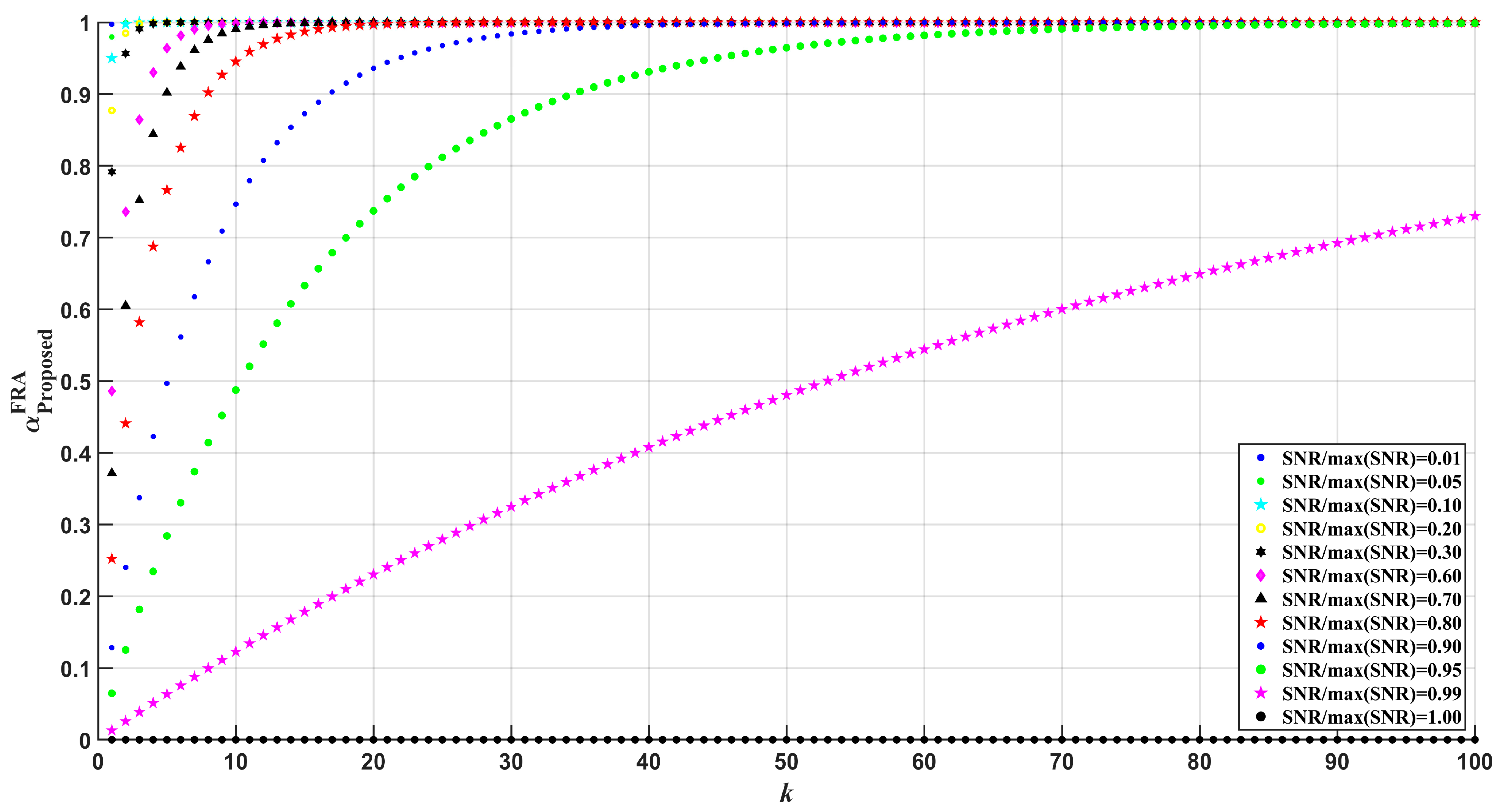
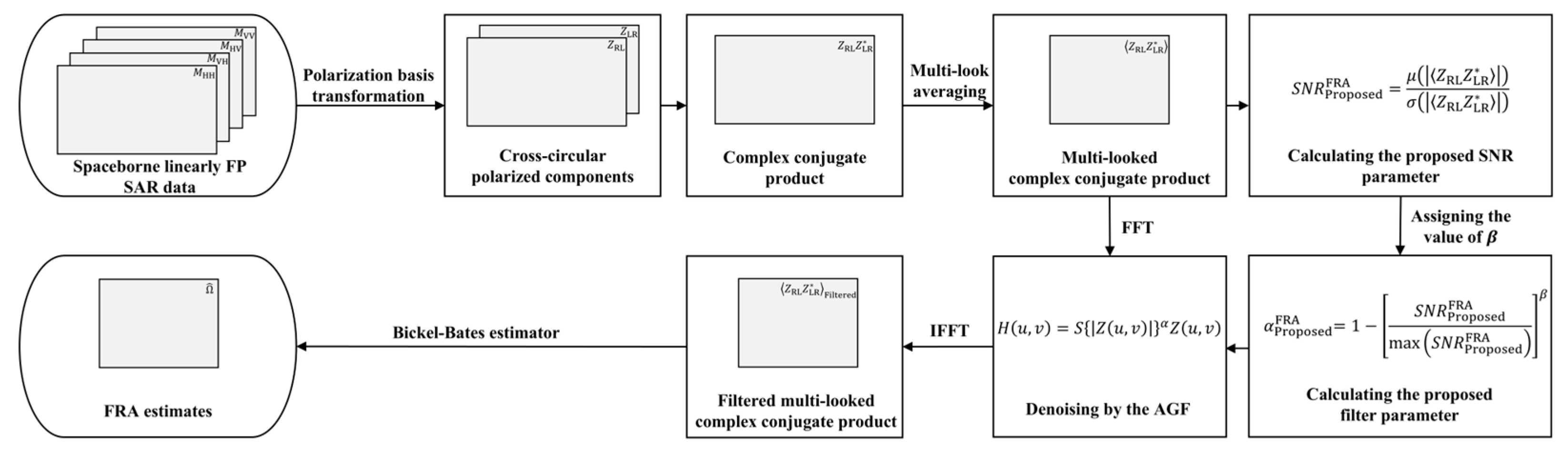
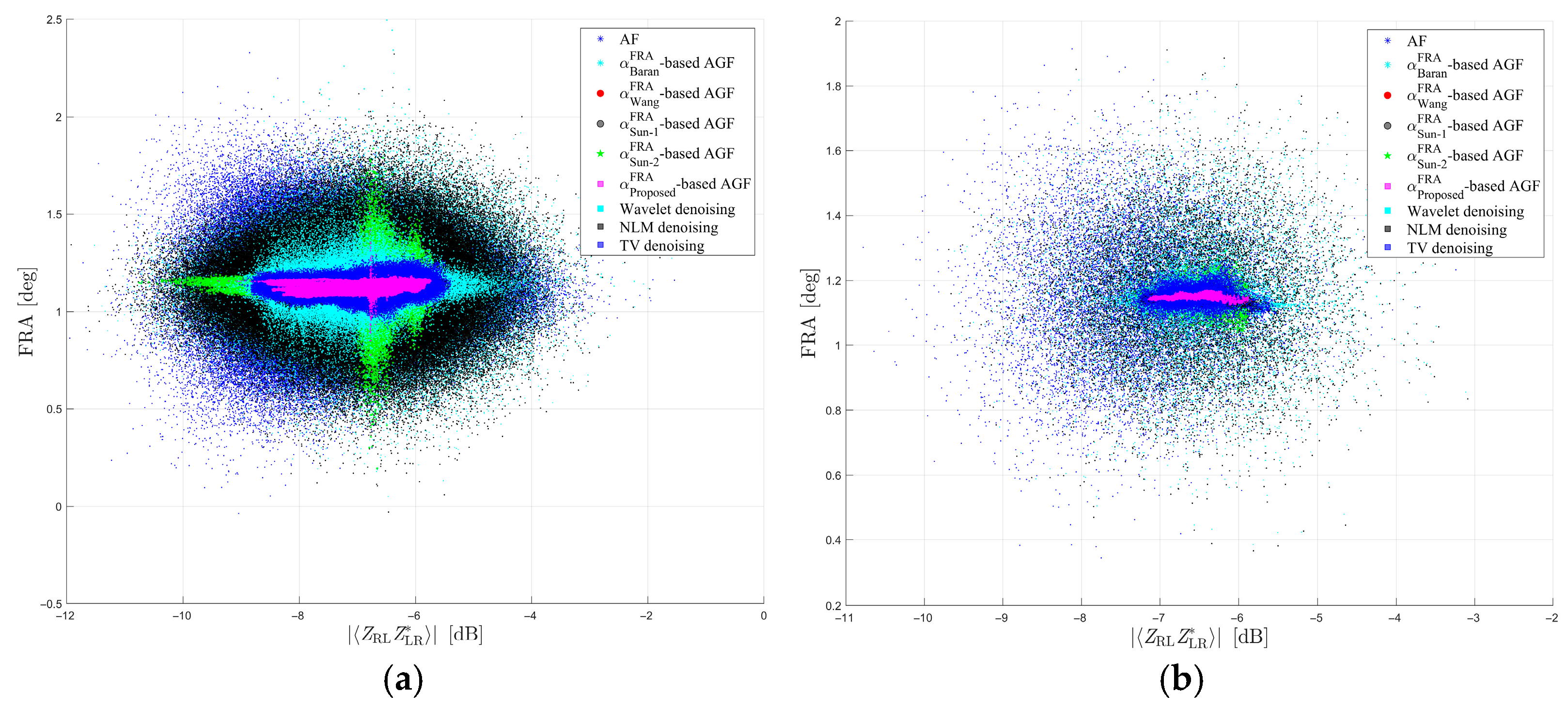
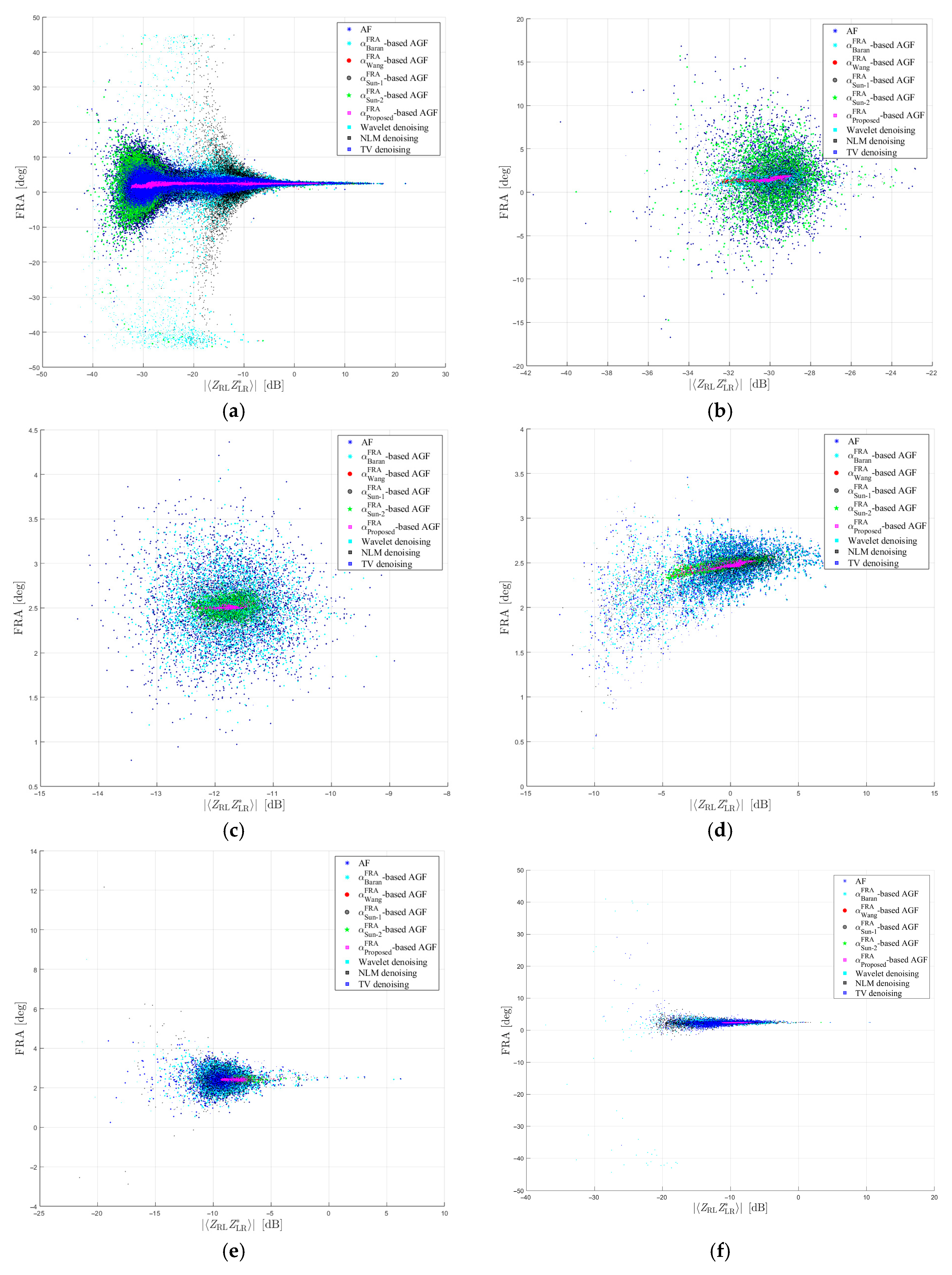
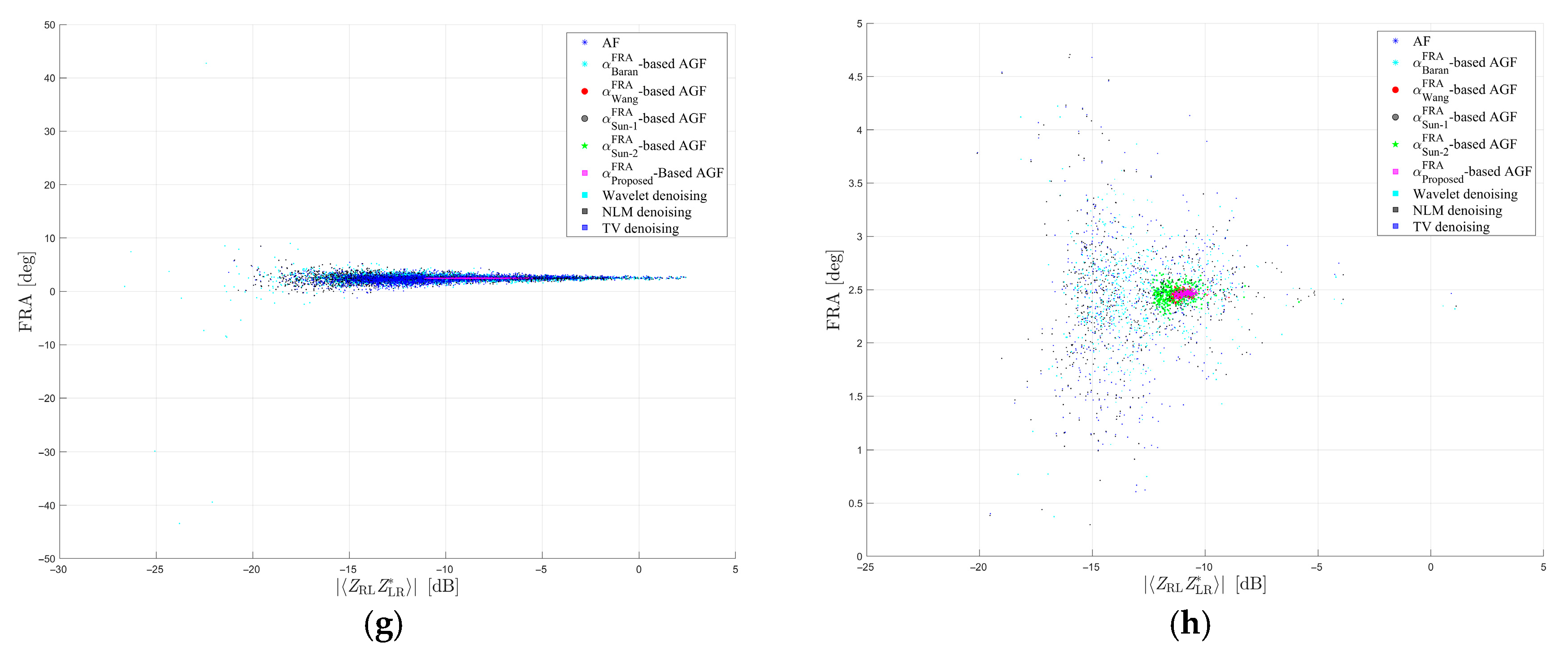
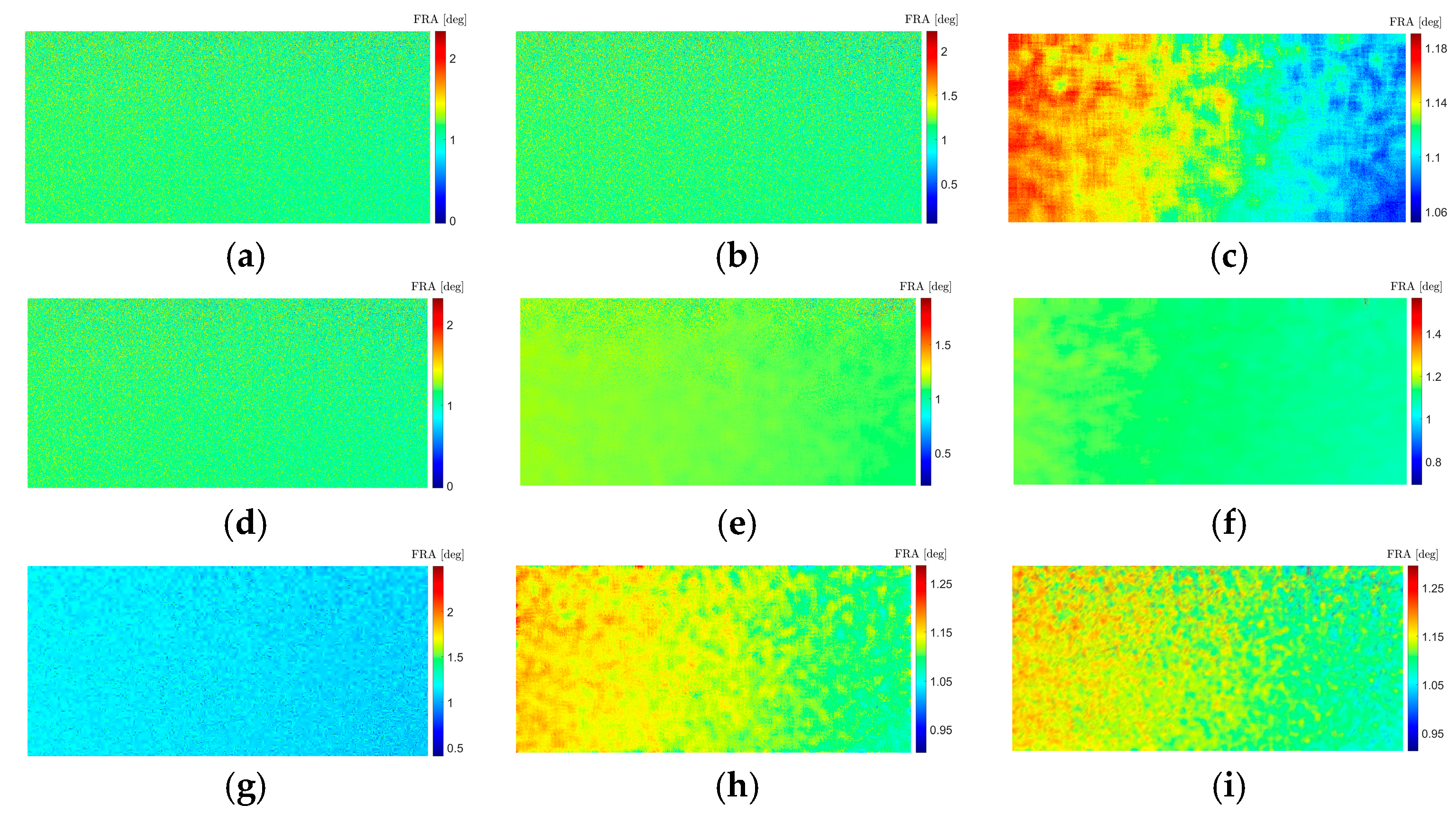
- Three SNR-based AGFs to effectively mitigate noise interference in FRA estimation using the Bickel–Bates estimator are developed. Distinctively, their SNR parameters are derived from the signal amplitude of this estimator (i.e., ), unlike the interferometric phase-based definitions adopted in interferometric processing. Concretely, two of the filters are adapted from the two SNR-based interferogram AGFs proposed by Sun et al. [45,46] by substituting the interferometric phase with while retaining the same mathematical formulations of SNR and filter parameters. The third filter is a novel proposal built on a more general mathematical form of both SNR and filter parameter. Its SNR parameter draws on the definition way popularly used in the field of image processing, defined as the ratio of the local mean of to its corresponding local STD. Its filter parameter is then derived from this customized SNR parameter, with an additional adjustable factor incorporated to enhance flexibility. The proposed method experimentally proves better performance on multiple sets of spaceborne L-band FP SAR data by comparison with alternative denoising techniques.
2. Methods
2.1. Measured Scattering Matrix of Spaceborne FP SAR and FRA Retrieval Based on the Bickel–Bates Estimator
2.2. AGFs Used for Radar Interferometric Phase Filtering
2.2.1. Baran Filter
2.2.2. SNR-Based Sun-1 Filter
2.2.3. SNR-Based Sun-2 Filter
2.3. Existing AGFs for FRA Estimation
2.3.1. AGF for FRA Estimation Based on the Complex Correlation Coefficient Between and
2.3.2. AGF for FRA Estimation Based on the Normalized Values of
2.4. SNR-Based AGFs for FRA Estimation
2.4.1. Sun-like SNR-Based AGFs for FRA Estimation
2.4.2. Proposed SNR-Based AGF for FRA Estimation
3. Materials
4. Results
4.1. Experiment 1: Dataset 1
4.2. Experiment 2: Dataset 2
4.3. Experiment 3: Dataset 3
5. Discussion
5.1. Sensitivity Analysis of the Parameter
5.2. Limitations and Future Work
- 1.
- Similarly to other sliding window-based filters, its filtering strength is not only governed by the filter parameter but also highly sensitive to the size of the filtering patch. Future work will examine the impact of window size on the filtering performance.
- 2.
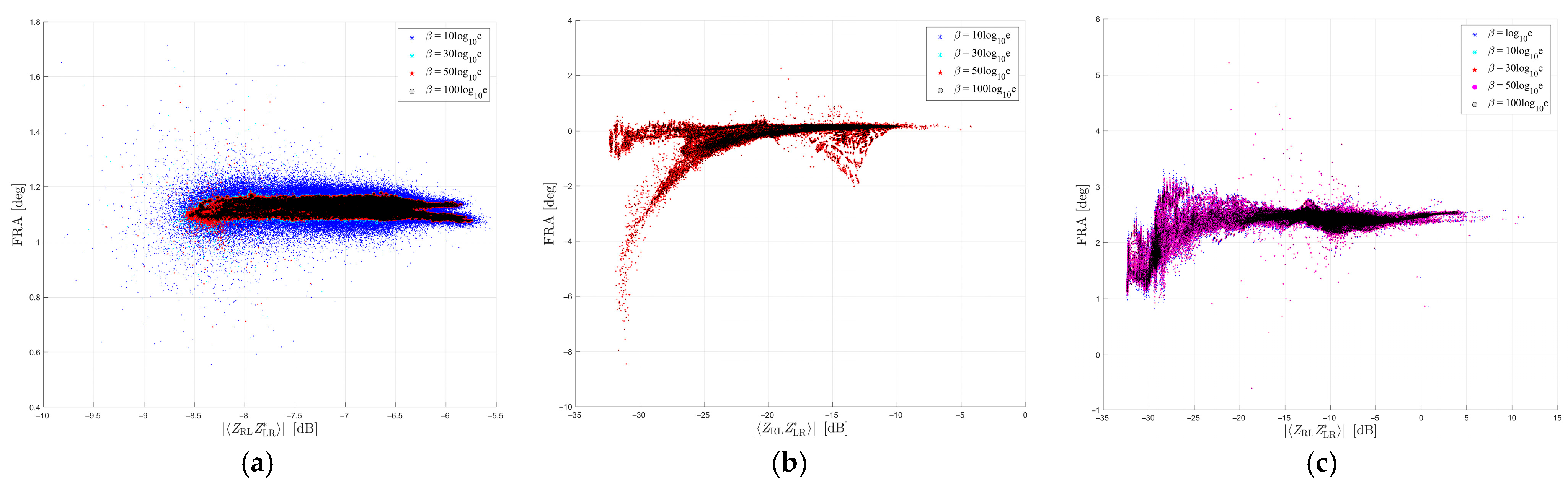
- In the current implementation, a fixed value of is uniformly applied across all sliding windows. To further enhance the adaptive capability of the proposed method, future work will explore the use of a window-adaptive, non-constant tunable factor .
- 3.
- The method proposed in this article can be extended to the FRA retrieval workflows that employ any other estimator relying on the phase extraction of a complex signal, such as the approaches developed by Chen and Quegan [35], Li et al. [36], and Wang et al. [26]. This extension can be readily achieved by substituting the amplitude component derived from the Bickel–Bates estimator with that of the adopted alternative estimator. However, it should be noted that the proposed method is not applicable to FRA retrieval frameworks based on estimators that calculate the FRA using the arctangent of the ratio of two complex numbers, such as the Freeman estimator [24].
6. Conclusions
Author Contributions
Funding
Data Availability Statement
Acknowledgments
Conflicts of Interest
References
- Budden, K.G. The Propagation of Radio Waves: The Theory of Radio Waves of Low Power in the Ionosphere and Magnetosphere; Cambridge University Press: New York, NY, USA, 1985. [Google Scholar]
- Kelley, M.C. The Earth’s Ionosphere: Plasma Physics and Electrodynamics, 2nd ed.; Academic Press: New York, NY, USA, 2009. [Google Scholar]
- IEEE Std 211-2018 (Revision of IEEE Std 211-1997); IEEE Standard Definitions of Terms for Radio Wave Propagation. IEEE Antennas and Propagation Society: New York, NY, USA, 2019.
- Xu, Z.; Wu, J.; Wu, Z. A Survey of Ionospheric Effects on Space-based Radar. Waves Random Media 2004, 14, S189–S273. [Google Scholar] [CrossRef]
- Lawrence, R.S.; Little, C.G.; Chivers, H.J.A. A Survey of Ionospheric Effects upon Earth-space Radio Propagation. Proc. IEEE 1964, 52, 4–27. [Google Scholar] [CrossRef]
- Ji, Y.; Dong, Z.; Zhang, Y.; Wang, C.; Hu, C.; Xu, Z. Transionospheric Synthetic Aperture Radar Observation: A Comprehensive Review. IEEE Geosci. Remote Sens. Mag. 2025, 13, 273–313. [Google Scholar] [CrossRef]
- Sun, H.; Xu, L.; Wang, S.; Wu, Y. Development and Application of Ionospheric Detection Technology. In Proceedings of the 2nd International Conference on Electrical Engineering and Computer Technology (ICEECT 2022), Suzhou, China, 23–25 September 2022; IOP Publishing: Bristol, UK, 2022; Volume 2404, p. 012030. [Google Scholar]
- Zhen, W.; Ou, M.; Zhu, Q.; Dong, X.; Liu, D. Review on Ionospheric Sounding and Modeling. Chin. J. Radio Sci. 2023, 38, 625–645. (In Chinese) [Google Scholar]
- Koloskov, O.; Kashcheyev, A.; Bogomaz, O.; Sopin, A.; Gavrylyuk, B.; Zalizovski, A. Performance Analysis of a Portable Low-Cost SDR-Based Ionosonde. Atmosphere 2023, 14, 159. [Google Scholar] [CrossRef]
- Yue, X.; Wan, W.; Ning, B.; Jin, L.; Ding, F.; Zhao, B.; Zeng, L.; Ke, C.; Deng, X.; Wang, J.; et al. Development of the Sanya Incoherent Scatter Radar and Preliminary Results. J. Geophys. Res. Space Phys. 2022, 127, e2022JA030451. [Google Scholar] [CrossRef]
- Koustov, A.V.; Ullrich, S.; Ponomarenko, P.V.; Gillies, R.G.; Themens, D.R.; Nishitani, N. Comparison of SuperDARN Peak Electron Density Estimates Based on Elevation Angle Measurements to Ionosonde and Incoherent Scatter Radar Measurements. Earth Planets Space 2020, 72, 43. [Google Scholar] [CrossRef]
- Mengist, C.K.; Yadav, S.; Kotulak, K.; Bahar, A.; Zhang, S.R.; Seo, K.H. Validation of International Reference Ionosphere Model (IRI-2016) for F-region Peak Electron Density Height (hmF2): Comparison with Incoherent Scatter Radar (ISR) and Ionosonde Measurements at Millstone Hill. Adv. Space Res. 2020, 65, 2773–2781. [Google Scholar] [CrossRef]
- Li, J.; Zhu, Y.; Feng, W.; Huang, D. Ground and Space (LEO) Based GNSS Ionospheric Detection Using Chapman Function Constraint. J. Geophys. Res. Space Phys. 2025, 130, e2024JA032890. [Google Scholar] [CrossRef]
- Ren, X.; Zhang, X.; Xie, W.; Zhang, K.; Yuan, Y.; Li, X. Global Ionospheric Modelling Using Multi-GNSS: BeiDou, Galileo, GLONASS and GPS. Sci. Rep. 2016, 6, 33499. [Google Scholar] [CrossRef]
- Chen, P.; Yao, Y.; Yao, W. Global Ionosphere Maps Based on GNSS, Satellite Altimetry, Radio Occultation and DORIS. GPS Solut. 2017, 21, 639–650. [Google Scholar]
- Jakowski, N.; Leitinger, R.; Angling, M. Radio Occultation Techniques for Probing the Ionosphere. Ann. Geophys. 2004, 47, 1049–1066. [Google Scholar] [CrossRef]
- Cloude, S.R. Polarization: Applications in Remote Sensing; Oxford University Press: New York, NY, USA, 2010. [Google Scholar]
- Hajnsek, I.; Desnos, Y.L. Polarimetric Synthetic Aperture Radar: Principles and Application; Springer: Cham, Switzerland, 2021. [Google Scholar]
- Lee, J.S.; Pottier, E. Polarimetric Radar Imaging: From Basic to Applications; CRC Press: Boca Raton, FL, USA, 2009. [Google Scholar]
- Li, D.; Zhang, Y. Adaptive Model-Based Classification of PolSAR Data. IEEE Trans. Geosci. Remote Sens. 2018, 56, 6940–6955. [Google Scholar]
- Li, D.; Lu, H.; Zhang, Y. Solid Angle Geometry-Based Modeling of Volume Scattering with Application in the Adaptive Decomposition of GF-3 Data of Sea Ice in Antarctica. Remote Sens. 2023, 15, 3208. [Google Scholar] [CrossRef]
- Gail, W.B. Effect of Faraday Rotation on Polarimetric SAR. IEEE Trans. Aerosp. Electron. Syst. 1998, 34, 301–307. [Google Scholar] [CrossRef]
- Wright, P.A.; Quegan, S.; Wheadon, N.S.; Hall, C.D. Faraday Rotation Effects on L-Band Spaceborne SAR Data. IEEE Trans. Geosci. Remote Sens. 2003, 41, 2735–2744. [Google Scholar]
- Freeman, A.; Saatchi, S.S. On the Detection of Faraday Rotation in Linearly Polarized L-Band SAR Backscatter Signatures. IEEE Trans. Geosci. Remote Sens. 2004, 42, 1607–1616. [Google Scholar]
- Pi, X.; Freeman, A.; Chapman, B.; Rosen, P.; Li, Z. Imaging Ionospheric Inhomogeneities Using Spaceborne Synthetic Aperture Radar. J. Geophys. Res. Space Phys. 2011, 116, A04303. [Google Scholar] [CrossRef]
- Wang, C.; Liu, L.; Chen, L.; Feng, J.; Zhao, H. Improved TEC Retrieval Based on Spaceborne PolSAR Data. Radio Sci. 2017, 52, 288–304. [Google Scholar] [CrossRef]
- Wang, C.; Guo, W.; Zhao, H.; Chen, L.; Wei, Y.; Zhang, Y. Improving the Topside Profile of Ionosonde with TEC Retrieved from Spaceborne Polarimetric SAR. Sensors 2019, 19, 516. [Google Scholar] [CrossRef]
- Guo, W.; Wang, C.; Zhao, H.; Zhang, S.; Cao, L.; Xiao, P.; Liu, L.; Chen, L.; Zhang, Y. Ionospheric Sounding Based on Spaceborne PolSAR in P-Band. Atmosphere 2022, 13, 524. [Google Scholar] [CrossRef]
- Wang, C.; Chen, L.; Zhao, H.; Lu, Z.; Bian, M.; Zhang, R.; Feng, J. Ionospheric Reconstructions Using Faraday Rotation in Spaceborne Polarimetric SAR Data. Remote Sens. 2017, 9, 1169. [Google Scholar] [CrossRef]
- Wang, C.; Chen, L.; Liu, L.; Yang, J.; Lu, Z.; Feng, J. Robust Computerized Ionospheric Tomography Based on Spaceborne Polarimetric SAR Data. IEEE J. Sel. Top. Appl. Earth Observ. Remote Sens. 2017, 10, 4022–4031. [Google Scholar] [CrossRef]
- Pi, X. Ionospheric Effects on Spaceborne Synthetic Aperture Radar and a New Capability of Imaging the Ionosphere From Space. Space Weather 2015, 13, 737–741. [Google Scholar] [CrossRef]
- Bickel, S.H.; Bates, R.H.T. Effects of Magneto-ionic Propagation on the Polarization Scattering Matrix. Proc. IEEE 1965, 53, 1089–1091. [Google Scholar] [CrossRef]
- Freeman, A. Calibration of Linearly Polarized Polarimetric SAR Data Subject to Faraday Rotation. IEEE Trans. Geosci. Remote Sens. 2004, 42, 1617–1624. [Google Scholar] [CrossRef]
- Qi, R.; Jin, Y. Analysis of the Effects of Faraday Rotation on Spaceborne Polarimetric SAR Observations at P-Band. IEEE Trans. Geosci. Remote Sens. 2007, 45, 1115–1122. [Google Scholar] [CrossRef]
- Chen, J.; Quegan, S. Improved Estimators of Faraday Rotation in Spaceborne Polarimetric SAR Data. IEEE Geosci. Remote Sens. Lett. 2010, 7, 846–850. [Google Scholar] [CrossRef]
- Li, L.; Zhang, Y.; Dong, Z.; Liang, D. New Faraday Rotation Estimators Based on Polarimetric Covariance Matrix. IEEE Geosci. Remote Sens. Lett. 2014, 11, 133–137. [Google Scholar] [CrossRef]
- Ji, Y.; Zhang, Y.; Zhang, Q.; Dong, Z.; Yao, B. Retrieval of Ionospheric Faraday Rotation Angle in Low-Frequency Polarimetric SAR Data. IEEE Access 2019, 7, 3181–3193. [Google Scholar] [CrossRef]
- Guo, W.; Liu, L.; Liu, B.; Chen, L.; Zhao, H.; Wang, C. Improved Faraday Rotation Estimation in Spaceborne PolSAR Data Using Total Variation Denoising. Remote Sens. 2019, 11, 2943. [Google Scholar] [CrossRef]
- Meyer, F.J.; Nicoll, J.B. Prediction, Detection, and Correction of Faraday Rotation in Full-Polarimetric L-Band SAR Data. IEEE Trans. Geosci. Remote Sens. 2008, 46, 3076–3086. [Google Scholar] [CrossRef]
- Goldstein, R.M.; Werner, C.L. Radar Interferogram Filtering for Geophysical Applications. Geophy. Res. Lett. 1998, 25, 4035–4038. [Google Scholar] [CrossRef]
- Zhu, W.; Chen, J.; Zhang, Q.; Zhang, J. Mapping of High-Spatial-Resolution Three-Dimensional Electron Density by Combing of Full-Polarimetric SAR and IRI Model. Front Earth Sci. 2020, 8, 181. [Google Scholar] [CrossRef]
- Zhu, W.; Jung, H.S.; Chen, J.Y. Synthetic Aperture Radar Interferometry (InSAR) Ionospheric Correction Based on Faraday Rotation: Two Case Studies. Appl. Sci. 2019, 9, 3871. [Google Scholar] [CrossRef]
- Wang, X.; Li, D.; Zhang, Y.; Yang, J.; Shi, X.; Liang, L. Faraday Rotation Estimation Based on PolSAR Data: A Denoising Technique. In Proceedings of the 2021 7th Asia-Pacific Conference on Synthetic Aperture Radar (APSAR), Bali, Indonesia, 1–3 November 2021; pp. 1–5. [Google Scholar]
- Baran, I.; Stewart, M.P.; Kampes, B.M.; Perski, Z.; Lilly, P. A Modification to the Goldstein Radar Interferogram Filter. IEEE Trans. Geosci. Remote Sens. 2003, 41, 2114–2118. [Google Scholar] [CrossRef]
- Sun, Q.; Zhu, J.; Li, Z.; Yang, H.; He, B.; Jin, M. A New Adaptive InSAR Interferogram Filter Based on SNR. Acta Geod. Cartogr. Sin. 2009, 38, 437–442. (In Chinese) [Google Scholar]
- Sun, Q.; Li, Z.; Zhu, J.; Ding, X.; Hu, J.; Xu, B. Improved Goldstein Filter for InSAR Noise Reduction Based on Local SNR. J. Cent. South Univ. 2013, 20, 1896–1903. [Google Scholar] [CrossRef]
- Song, R.; Guo, H.; Liu, G.; Perski, Z.; Fan, J. Improved Goldstein SAR Interferogram Filter Based on Empirical Mode Decomposition. IEEE Geosci. Remote Sens. Lett. 2013, 11, 399–403. [Google Scholar] [CrossRef]
- Gavas, R.D.; Ghosh, S.K.; Pal, A. Enhanced Goldstein Filter for Interferometric Phase Denoising Using 2-D Variational Mode Decomposition. IEEE Open J. Instrum. Meas. 2023, 2, 9500208. [Google Scholar] [CrossRef]
- Liu, J.; Zhang, H.; Wang, L.; Wang, Z. A Modified Goldstein Filter for Interferogram Denoising of Interferometric Imaging Radar Altimeter Based on Multiple Quality-guided Graphs. PLoS ONE 2024, 19, e0308636. [Google Scholar] [CrossRef]
- Gao, B. An Operational Method for Estimating Signal to Noise Ratios from Data Acquired with Imaging Spectrometers. Remote Sens. Environ. 1993, 43, 23–33. [Google Scholar] [CrossRef]
- Wang, Y.; Zheng, C.; Peng, H.; Chen, Q. An Adaptive Beamforming Method for Ultrasound Imaging Based on the Mean-to-standard-deviation Factor. Ultrasonics 2018, 90, 32–41. [Google Scholar] [CrossRef] [PubMed]
- Timischl, F. The Contrast-to-noise Ratio for Image Quality Evaluation in Scanning Electron Microscopy. Scanning 2015, 37, 54–62. [Google Scholar] [CrossRef] [PubMed]
- Wang, X.; Zhang, Y.; Li, D. Estimation of Ionospheric Faraday Rotation over Ocean Areas Using L-band Spaceborne PolSAR Data. Int. J. Remote Sens. 2024, 45, 3054–3074. [Google Scholar] [CrossRef]
- Singh, K.; Ranade, S.K.; Singh, C. Comparative Performance Analysis of Various Wave-let and Nonlocal Means Based Approaches for Image Denoising. Optik 2017, 131, 423–437. [Google Scholar] [CrossRef]
- Liu, C.; Zhang, L. A Novel Denoising Algorithm Based on Wavelet and Non-Local Moment Mean Filtering. Remote Sens. 2023, 12, 1461. [Google Scholar] [CrossRef]
- Kim, J.S.; Papathanassiou, K.P.; Scheiber, R.; Quegan, S. Correcting Distortion of Polarimetric SAR Data Induced by Ionospheric Scintillation. IEEE Trans. Geosci. Remote Sens. 2015, 53, 6319–6335. [Google Scholar]
- Wang, N.; Qiao, D.; Fu, X. An Analysis of the Influence of Filter parameter on the Performance of Goldstein InSAR Interferogram Filter. Remote Sens. Land Resour. 2019, 31, 117–124. (In Chinese) [Google Scholar]







| The FRA estimation procedures using the proposed SNR-based AGF | |
| 1: | Derive and from the linearly FP SAR measurements through the polarization basis transformation in Equation (5). |
| 2: | Calculate the complex conjugate product between and , i.e., . |
| 3: | Conduct multi-look averaging on to obtain . |
| 4: | Determine by Equation (19). |
| 5: | Determine the parameter used for the AGF according to Equation (20) by assigning an appropriate value of . |
| 6: | Apply the -based AGF to in accordance with Equation (10). |
| 7: | Obtain the FRA estimates based on the filtered according to Equation (9). |
| Data Identity | Acquisition Location | Acquisition Date | Latitude and Longitude at Scene Center | Data Name |
|---|---|---|---|---|
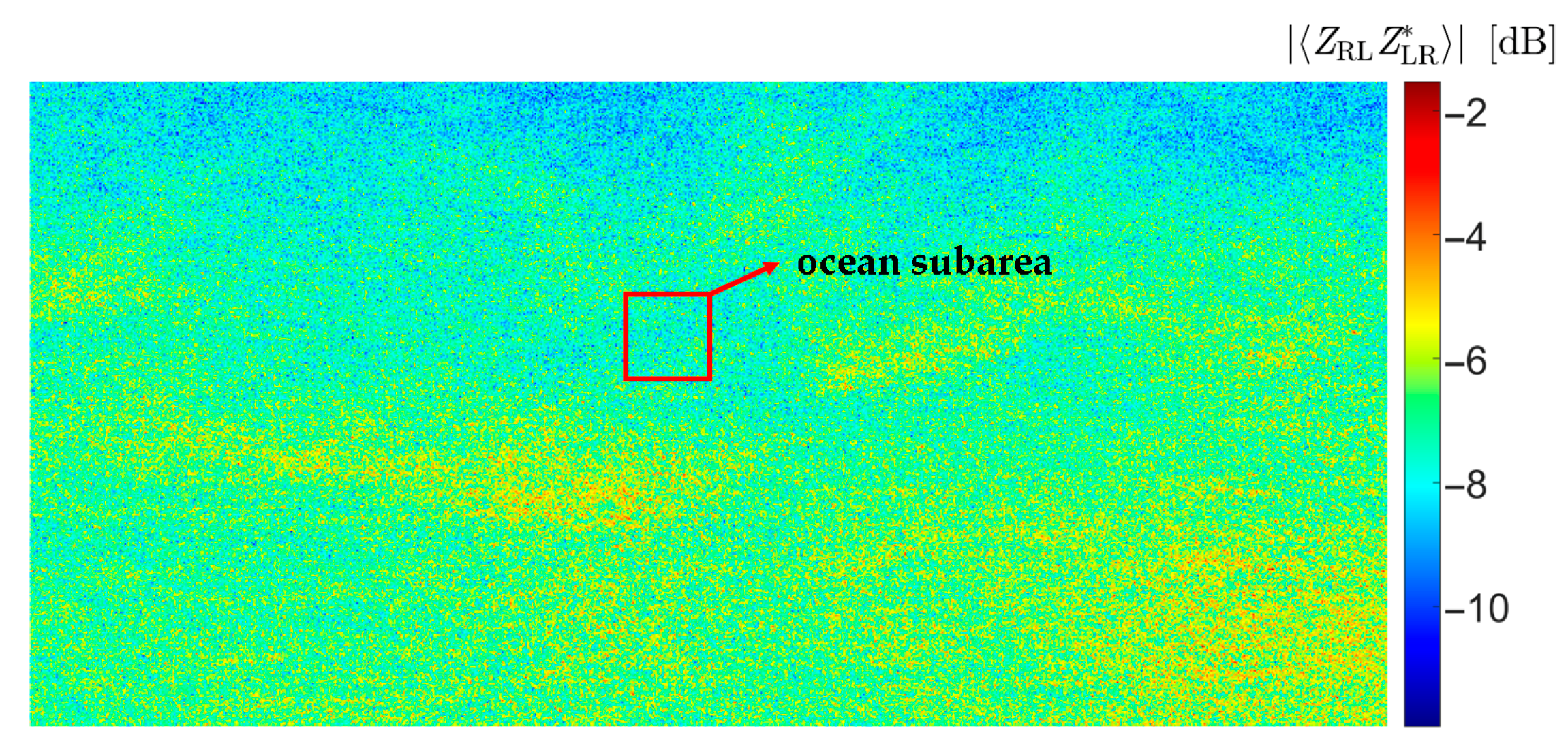
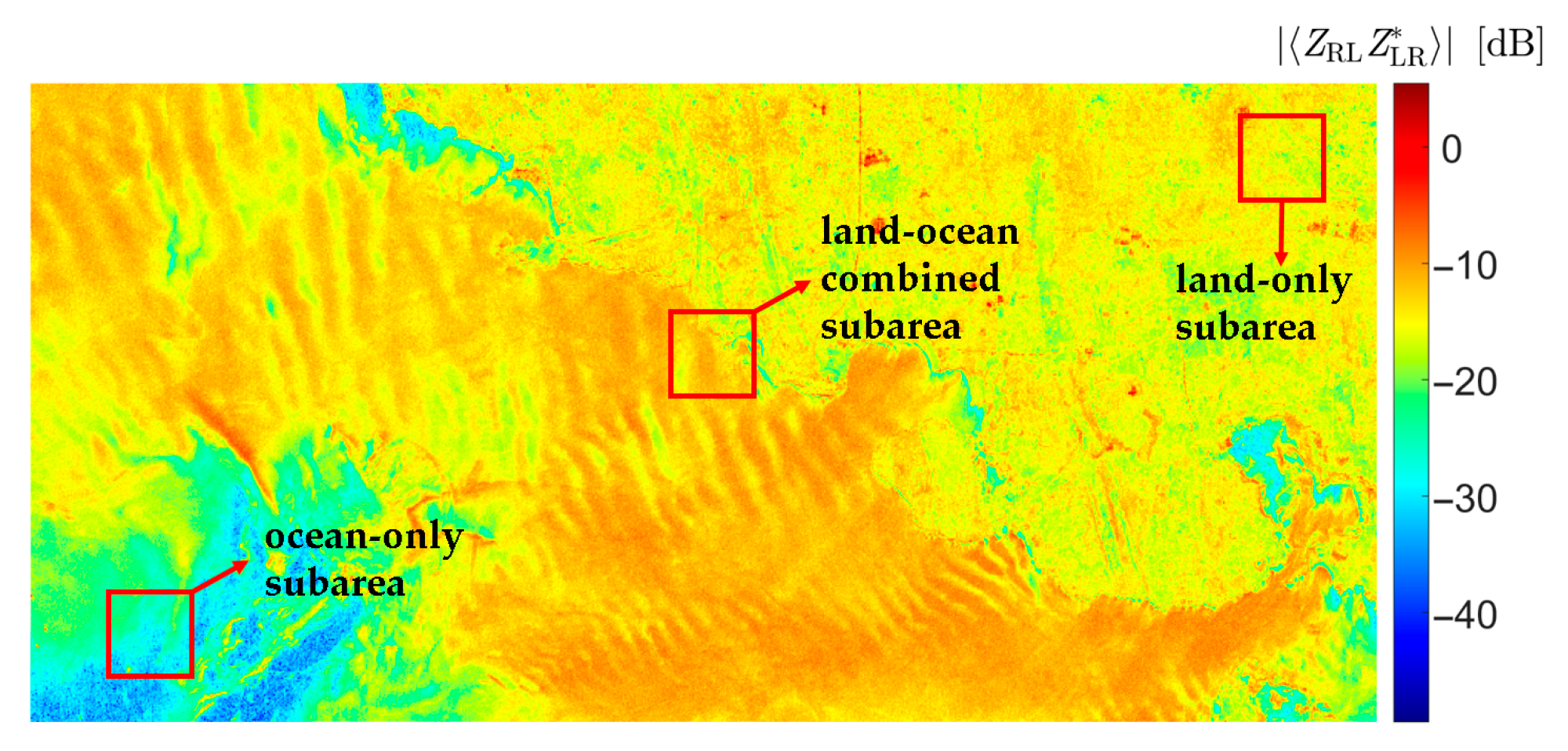
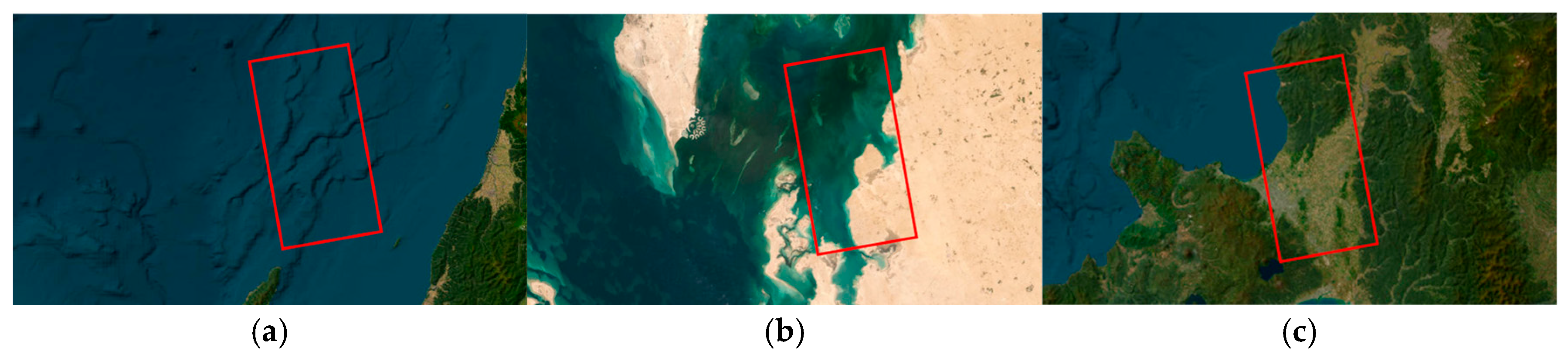
| ALPSRP222520780 | Sea of Japan | 29 March 2010 | 39.2544°N, 138.4413°E | Dataset 1 |
| ALPSRP171940510 | Jumailiyah, Qatar | 16 April 2009 | 25.8857°N, 50.9442°E | Dataset 2 |
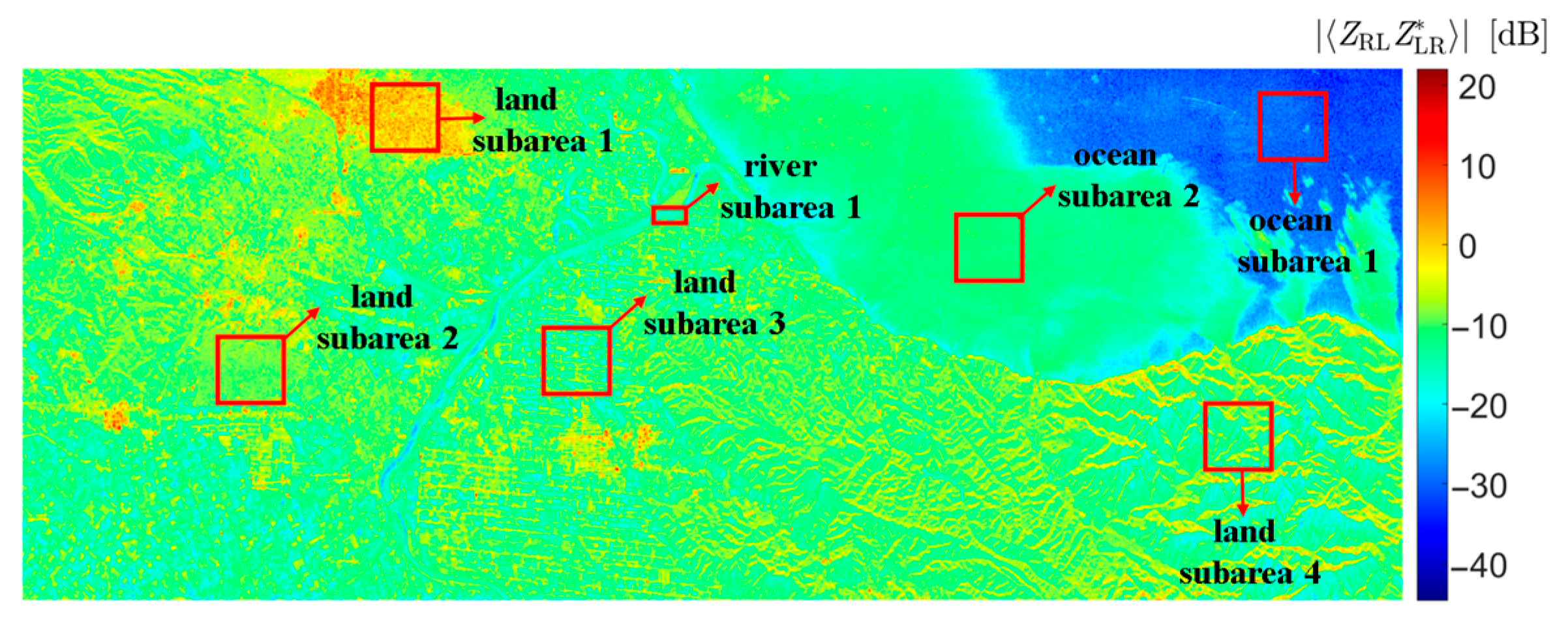
| ALPSRP278970860 | Sapporo, Hokkaido, Japan | 20 April 2011 | 43.2491°N, 141.4469°E | Dataset 3 |
| AF | AGF-Type Denoising Methods | Three General Image Denoising Methods | ||||||||
|---|---|---|---|---|---|---|---|---|---|---|
| -Based | -Based | -Based | -Based | -Based | Wavelet Denoising | NLM Denoising | TV Denoising | |||
| FRA (°) | Max | 2.3281 | 2.2228 | 1.1904 | 2.3215 | 1.9270 | 1.5658 | 2.4958 | 1.2860 | 1.2957 |
| Min | −0.0365 | 0.0504 | 1.0522 | −0.0293 | 0.1941 | 0.6907 | 0.3996 | 0.9024 | 0.9129 | |
| Mean | 1.1249 | 1.1249 | 1.1248 | 1.1249 | 1.1248 | 1.1248 | 1.1261 | 1.1244 | 1.1274 | |
| STD | 0.1850 | 0.1765 | 0.0230 | 0.1826 | 0.0502 | 0.0227 | 0.0559 | 0.0256 | 0.0352 | |
| (dB) | Max | −1.5423 | −1.5887 | −5.5080 | −1.7912 | −5.6527 | −5.7336 | −2.2348 | −4.4893 | −5.3600 |
| Min | −11.9436 | −11.5163 | −8.5810 | −11.9188 | −10.7472 | −9.4066 | −11.3337 | −8.7119 | −9.0248 | |
| Mean | −7.0769 | −7.0700 | −6.9837 | −7.0745 | −6.9889 | −6.9854 | −6.9949 | −7.0007 | −6.9893 | |
| STD | 1.0561 | 1.0279 | 0.5620 | 1.0468 | 0.5876 | 0.5569 | 0.6264 | 0.5710 | 0.5894 | |
| AF | AGF-Type Denoising Methods | Three General Image Denoising Methods | |||||||
|---|---|---|---|---|---|---|---|---|---|
| -Based | -Based | -Based | -Based | -Based | Wavelet Denoising | NLM Denoising | TV Denoising | ||
| Mean FRA SNR (dB) | 8.1308 | 8.3004 | 22.5402 | 8.1872 | 18.4615 | 24.4885 | 13.7473 | 20.0039 | 16.4824 |
| Mean FRA CV | 0.1579 | 0.1513 | 0.0057 | 0.1559 | 0.0229 | 0.0038 | 0.0438 | 0.0103 | 0.0232 |
| Mean PC | 0.9926 | 0.9926 | 0.9927 | 0.9926 | 0.9926 | 0.9926 | 0.9926 | 0.9927 | 0.9926 |
| AF | AGF-Type Denoising Methods | Three General Image Denoising Methods | ||||||||
|---|---|---|---|---|---|---|---|---|---|---|
| -Based | -Based | -Based | -Based | -Based | Wavelet Denoising | NLM Denoising | TV Denoising | |||
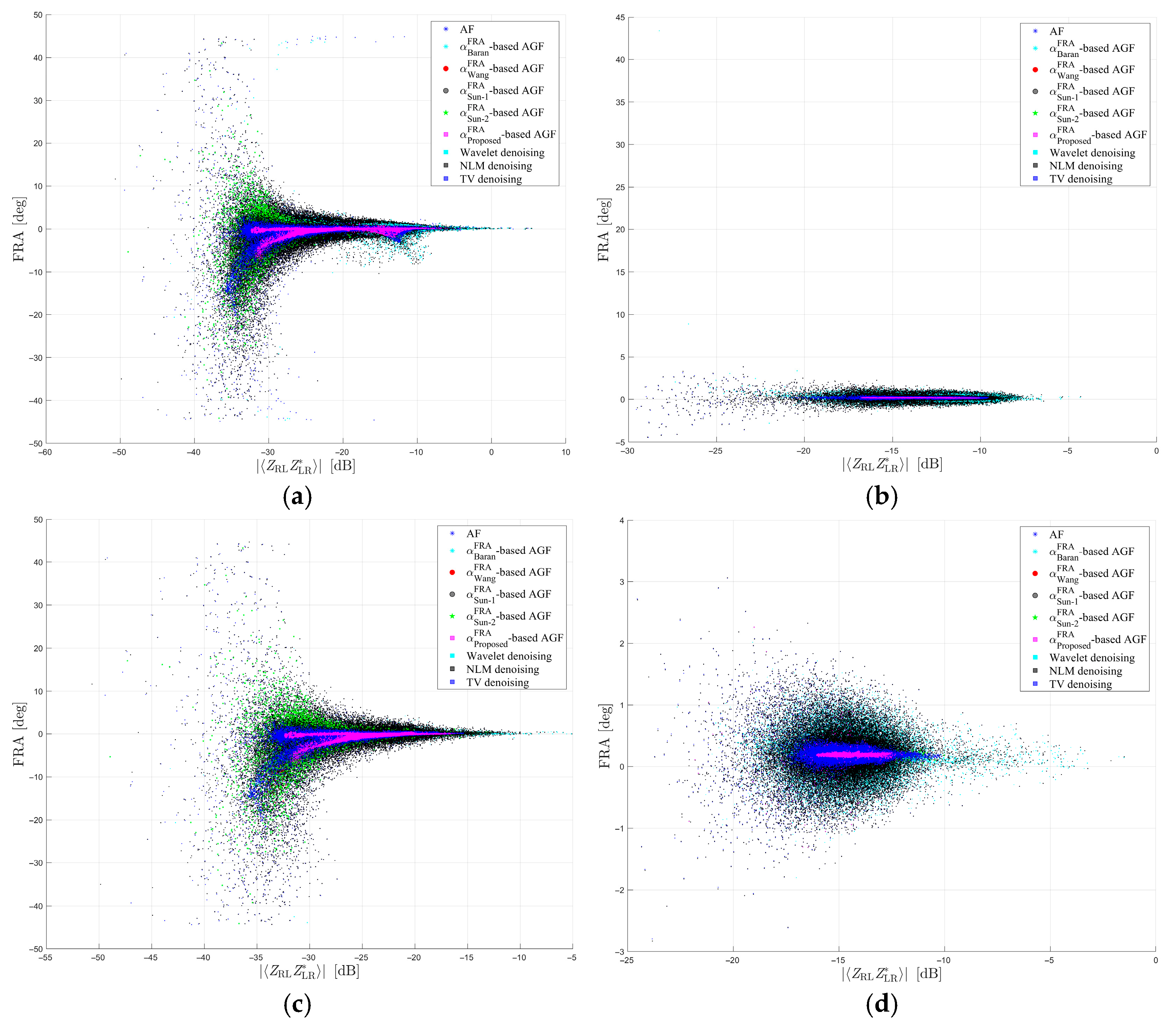
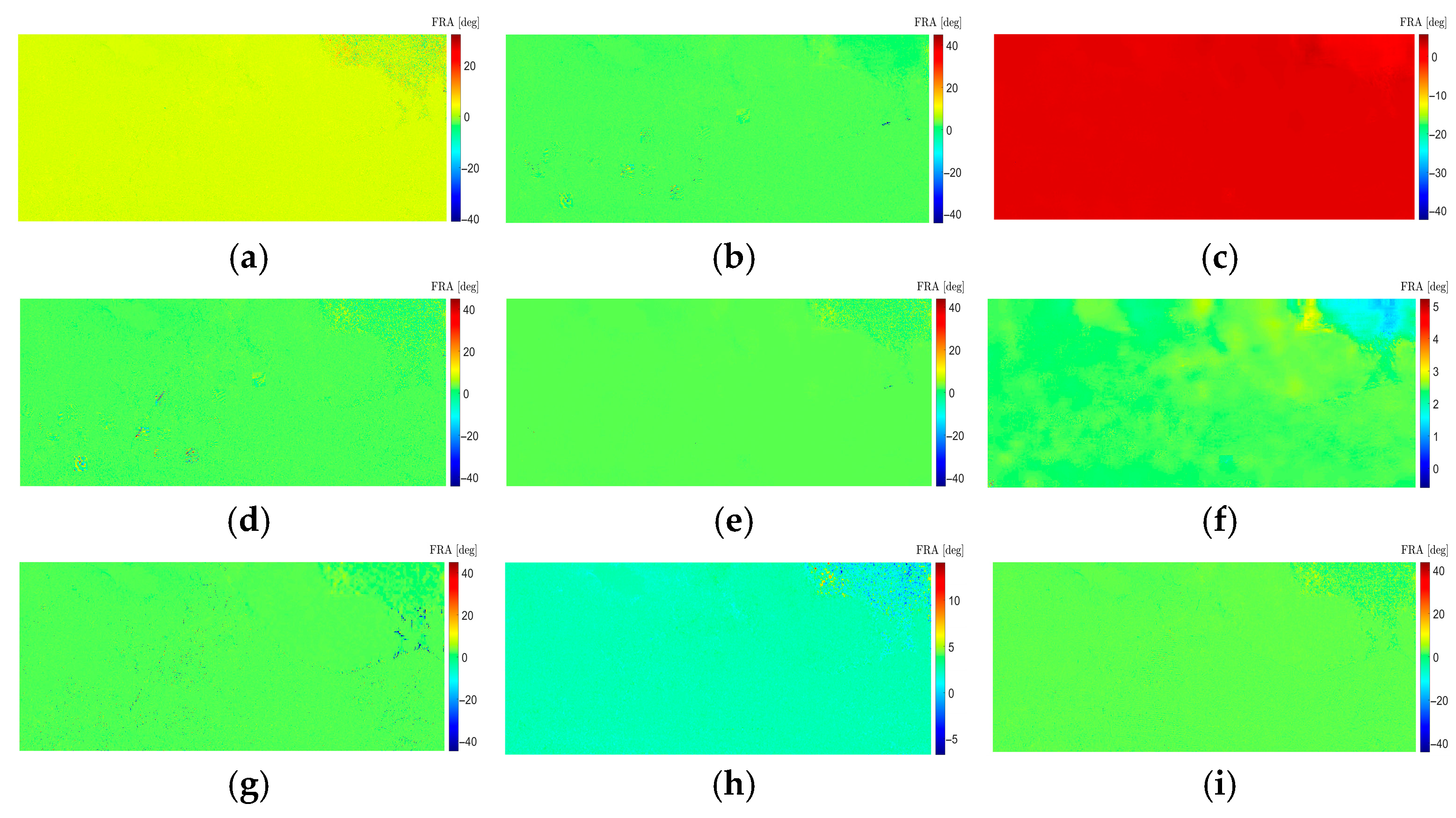
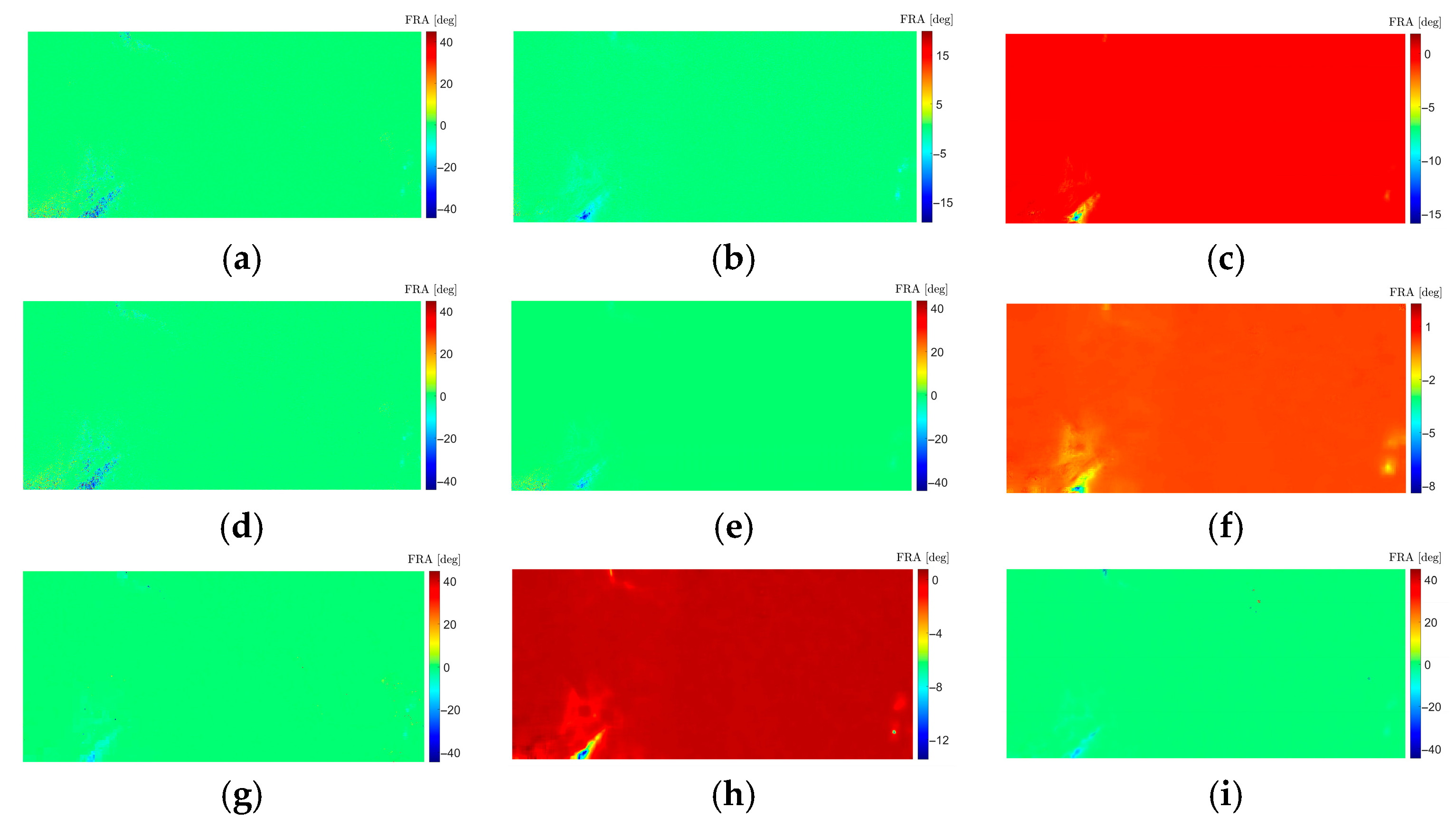
| FRA (°) | Max | 44.7695 | 19.9119 | 1.8586 | 44.7427 | 43.3441 | 2.2618 | 44.5350 | 0.7684 | 44.9309 |
| Min | −44.8505 | −19.2682 | −15.9421 | −44.2898 | −44.0973 | −8.4625 | −44.5767 | −13.4976 | −44.5293 | |
| Mean | 0.0236 | 0.0975 | 0.1048 | 0.0271 | 0.0886 | 0.1148 | 0.0877 | 0.1004 | 0.0828 | |
| STD | 1.8354 | 0.5548 | 0.3497 | 1.8091 | 0.7638 | 0.2239 | 0.7498 | 0.4156 | 0.7699 | |
| (dB) | Max | 5.4245 | 5.2312 | −2.0365 | 5.3779 | −3.6947 | −4.2072 | 5.4238 | 3.5011 | 4.9055 |
| Min | −49.4048 | −43.2403 | −34.4938 | −50.6591 | −48.9380 | −32.3718 | −42.7309 | −35.4178 | −41.7132 | |
| Mean | −15.2319 | −14.9006 | −14.6376 | −15.2253 | −14.6983 | −14.5884 | −15.0630 | −14.7065 | −14.7742 | |
| STD | 3.7830 | 3.1930 | 2.6478 | 3.7683 | 2.7638 | 2.5079 | 3.4422 | 2.7525 | 2.9232 | |
| AF | AGF-Type Denoising Methods | Three General Image Denoising Methods | |||||||
|---|---|---|---|---|---|---|---|---|---|
| -Based | -Based | -Based | -Based | -Based | Wavelet Denoising | NLM Denoising | TV Denoising | ||
| Mean FRA SNR (dB) | 5.4550 | 3.8737 | 8.8449 | 5.4535 | 5.5598 | 9.7712 | 1.4177 | 7.9153 | 2.8845 |
| Mean FRA CV | 0.2848 | 0.4099 | 0.1305 | 0.2849 | 0.2780 | 0.1054 | 0.7215 | 0.1616 | 0.5147 |
| Mean PC | 0.9254 | 0.9298 | 0.9319 | 0.9256 | 0.9304 | 0.9335 | 0.9268 | 0.9276 | 0.9297 |
| AF | AGF-Type Denoising Methods | Three General Image Denoising Methods | ||||||||
|---|---|---|---|---|---|---|---|---|---|---|
| -Based | -Based | -Based | -Based | -Based | Wavelet Denoising | NLM Denoising | TV Denoising | |||
| FRA (°) | Max | 32.0341 | 44.9273 | 5.7517 | 44.8960 | 43.8830 | 5.2193 | 44.9890 | 4.4904 | 43.5317 |
| Min | −41.2193 | −44.5472 | −42.4479 | −44.4178 | −44.1119 | −0.6070 | −44.8555 | 0.0527 | −44.2337 | |
| Mean | 2.3784 | 2.3837 | 2.4039 | 2.3725 | 2.3986 | 2.4052 | 2.3359 | 2.4022 | 2.3241 | |
| STD | 1.2238 | 0.9809 | 0.1881 | 1.6299 | 0.7685 | 0.1625 | 2.0539 | 0.1876 | 0.8885 | |
| (dB) | Max | 22.0196 | 21.9773 | 11.6406 | 22.0196 | 11.7633 | 10.7202 | 22.0196 | 10.4199 | 22.0185 |
| Min | −44.6463 | −36.7178 | −32.5839 | −44.6463 | −41.1402 | −32.4212 | −48.3482 | −33.1710 | −39.0846 | |
| Mean | −12.4642 | −11.9210 | −11.0823 | −12.4594 | −11.1969 | −11.0004 | −12.3031 | −11.1390 | −12.1932 | |
| STD | 4.9022 | 4.4163 | 3.8010 | 4.9029 | 3.9311 | 3.7114 | 4.7170 | 3.8841 | 4.5774 | |
| AF | AGF-Type Denoising Methods | Three General Image Denoising Methods | |||||||
|---|---|---|---|---|---|---|---|---|---|
| -Based | -Based | -Based | -Based | -Based | Wavelet Denoising | NLM Denoising | TV Denoising | ||
| Mean FRA SNR (dB) | 5.4733 | 7.0391 | 17.7005 | 4.7836 | 13.8744 | 19.4543 | 4.3369 | 18.7949 | 5.9195 |
| Mean FRA CV | 0.3731 | 0.2697 | 0.0238 | 0.4848 | 0.1239 | 0.0157 | 0.7795 | 0.0203 | 0.3096 |
| Mean PC | 0.91575 | 0.91921 | 0.92265 | 0.92969 | 0.92136 | 0.92423 | 0.91588 | 0.93381 | 0.91604 |
| FRA (°) | Max | 1.7121 | 1.6325 | 1.5658 | 1.4394 |
| Min | 0.5541 | 0.6258 | 0.6907 | 0.8130 | |
| Mean | 1.1247 | 1.1248 | 1.1248 | 1.1249 | |
| STD | 0.0322 | 0.0232 | 0.0227 | 0.0225 | |
| (dB) | Max | −5.5626 | −5.7258 | −5.7336 | −5.7349 |
| Min | −9.8214 | −9.5925 | −9.4066 | −9.0766 | |
| Mean | −6.9871 | −6.9855 | −6.9854 | −6.9853 | |
| STD | 0.5685 | 0.5575 | 0.5569 | 0.5568 | |
| Mean FRA SNR (dB) | 18.6479 | 23.8223 | 24.4885 | 24.6876 |
| Mean FRA CV | 0.0164 | 0.0046 | 0.0038 | 0.0036 |
| 0.9926 | 0.9926 | 0.9926 | 0.9926 | |
| FRA (°) | Max | 2.2618 | 2.2618 | 2.2618 | 2.2618 |
| Min | −8.4625 | −8.4625 | −8.4625 | −8.4625 | |
| Mean | 0.1148 | 0.1148 | 0.1148 | 0.1148 | |
| STD | 0.2239 | 0.2239 | 0.2239 | 0.2239 | |
| (dB) | Max | −4.2072 | −4.2072 | −4.2072 | −4.2072 |
| Min | −32.3718 | −32.3718 | −32.3718 | −32.3718 | |
| Mean | −14.5884 | −14.5884 | −14.5884 | −14.5884 | |
| STD | 2.5079 | 2.5079 | 2.5079 | 2.5079 | |
| Mean FRA SNR (dB) | 9.7712 | 9.7712 | 9.7712 | 9.7712 |
| Mean FRA CV | 0.1054 | 0.1054 | 0.1054 | 0.1054 |
| 0.9335 | 0.9335 | 0.9335 | 0.9335 | |
| FRA (°) | Max | 5.2193 | 5.2193 | 5.2193 | 5.2193 | 5.2193 |
| Min | −0.6070 | −0.6070 | −0.6070 | −0.6070 | −0.6070 | |
| Mean | 2.4050 | 2.4052 | 2.4052 | 2.4052 | 2.4052 | |
| STD | 0.1643 | 0.1625 | 0.1625 | 0.1625 | 0.1625 | |
| (dB) | Max | 11.2736 | 10.7202 | 10.7202 | 10.7202 | 10.7202 |
| Min | −31.4718 | −32.4212 | −32.4212 | −32.4212 | −32.4212 | |
| Mean | −11.0107 | −11.0004 | −11.0004 | −11.0004 | −11.0004 | |
| STD | 3.7203 | 3.7114 | 3.7114 | 3.7114 | 3.7114 | |
| Mean FRA SNR (dB) | 19.0045 | 19.4543 | 19.4543 | 19.4543 | 19.4543 |
| Mean FRA CV | 0.0171 | 0.0157 | 0.0157 | 0.0157 | 0.0157 |
| Mean | 0.9243 | 0.9242 | 0.9242 | 0.9242 | 0.9242 |
Disclaimer/Publisher’s Note: The statements, opinions and data contained in all publications are solely those of the individual author(s) and contributor(s) and not of MDPI and/or the editor(s). MDPI and/or the editor(s) disclaim responsibility for any injury to people or property resulting from any ideas, methods, instructions or products referred to in the content. |
© 2026 by the authors. Licensee MDPI, Basel, Switzerland. This article is an open access article distributed under the terms and conditions of the Creative Commons Attribution (CC BY) license.
Share and Cite
Wang, Z.; Wang, X.; Li, D.; Zhang, Y. A SNR-Based Adaptive Goldstein Filter for Ionospheric Faraday Rotation Estimation Using Spaceborne Full-Polarimetric SAR Data. Remote Sens. 2026, 18, 378. https://doi.org/10.3390/rs18020378
Wang Z, Wang X, Li D, Zhang Y. A SNR-Based Adaptive Goldstein Filter for Ionospheric Faraday Rotation Estimation Using Spaceborne Full-Polarimetric SAR Data. Remote Sensing. 2026; 18(2):378. https://doi.org/10.3390/rs18020378
Chicago/Turabian StyleWang, Zelin, Xun Wang, Dong Li, and Yunhua Zhang. 2026. "A SNR-Based Adaptive Goldstein Filter for Ionospheric Faraday Rotation Estimation Using Spaceborne Full-Polarimetric SAR Data" Remote Sensing 18, no. 2: 378. https://doi.org/10.3390/rs18020378
APA StyleWang, Z., Wang, X., Li, D., & Zhang, Y. (2026). A SNR-Based Adaptive Goldstein Filter for Ionospheric Faraday Rotation Estimation Using Spaceborne Full-Polarimetric SAR Data. Remote Sensing, 18(2), 378. https://doi.org/10.3390/rs18020378